EP3896261B1 - Fan blade platform for gas turbine engine - Google Patents
Fan blade platform for gas turbine engine Download PDFInfo
- Publication number
- EP3896261B1 EP3896261B1 EP21168357.8A EP21168357A EP3896261B1 EP 3896261 B1 EP3896261 B1 EP 3896261B1 EP 21168357 A EP21168357 A EP 21168357A EP 3896261 B1 EP3896261 B1 EP 3896261B1
- Authority
- EP
- European Patent Office
- Prior art keywords
- wall
- fan blade
- edge
- suction side
- gas path
- Prior art date
- Legal status (The legal status is an assumption and is not a legal conclusion. Google has not performed a legal analysis and makes no representation as to the accuracy of the status listed.)
- Active
Links
Images



Classifications
-
- F—MECHANICAL ENGINEERING; LIGHTING; HEATING; WEAPONS; BLASTING
- F01—MACHINES OR ENGINES IN GENERAL; ENGINE PLANTS IN GENERAL; STEAM ENGINES
- F01D—NON-POSITIVE DISPLACEMENT MACHINES OR ENGINES, e.g. STEAM TURBINES
- F01D11/00—Preventing or minimising internal leakage of working-fluid, e.g. between stages
- F01D11/005—Sealing means between non relatively rotating elements
- F01D11/006—Sealing the gap between rotor blades or blades and rotor
- F01D11/008—Sealing the gap between rotor blades or blades and rotor by spacer elements between the blades, e.g. independent interblade platforms
-
- F—MECHANICAL ENGINEERING; LIGHTING; HEATING; WEAPONS; BLASTING
- F02—COMBUSTION ENGINES; HOT-GAS OR COMBUSTION-PRODUCT ENGINE PLANTS
- F02C—GAS-TURBINE PLANTS; AIR INTAKES FOR JET-PROPULSION PLANTS; CONTROLLING FUEL SUPPLY IN AIR-BREATHING JET-PROPULSION PLANTS
- F02C7/00—Features, components parts, details or accessories, not provided for in, or of interest apart form groups F02C1/00 - F02C6/00; Air intakes for jet-propulsion plants
-
- F—MECHANICAL ENGINEERING; LIGHTING; HEATING; WEAPONS; BLASTING
- F01—MACHINES OR ENGINES IN GENERAL; ENGINE PLANTS IN GENERAL; STEAM ENGINES
- F01D—NON-POSITIVE DISPLACEMENT MACHINES OR ENGINES, e.g. STEAM TURBINES
- F01D11/00—Preventing or minimising internal leakage of working-fluid, e.g. between stages
- F01D11/005—Sealing means between non relatively rotating elements
-
- F—MECHANICAL ENGINEERING; LIGHTING; HEATING; WEAPONS; BLASTING
- F01—MACHINES OR ENGINES IN GENERAL; ENGINE PLANTS IN GENERAL; STEAM ENGINES
- F01D—NON-POSITIVE DISPLACEMENT MACHINES OR ENGINES, e.g. STEAM TURBINES
- F01D25/00—Component parts, details, or accessories, not provided for in, or of interest apart from, other groups
- F01D25/005—Selecting particular materials
-
- F—MECHANICAL ENGINEERING; LIGHTING; HEATING; WEAPONS; BLASTING
- F01—MACHINES OR ENGINES IN GENERAL; ENGINE PLANTS IN GENERAL; STEAM ENGINES
- F01D—NON-POSITIVE DISPLACEMENT MACHINES OR ENGINES, e.g. STEAM TURBINES
- F01D5/00—Blades; Blade-carrying members; Heating, heat-insulating, cooling or antivibration means on the blades or the members
- F01D5/12—Blades
- F01D5/22—Blade-to-blade connections, e.g. for damping vibrations
-
- F—MECHANICAL ENGINEERING; LIGHTING; HEATING; WEAPONS; BLASTING
- F01—MACHINES OR ENGINES IN GENERAL; ENGINE PLANTS IN GENERAL; STEAM ENGINES
- F01D—NON-POSITIVE DISPLACEMENT MACHINES OR ENGINES, e.g. STEAM TURBINES
- F01D5/00—Blades; Blade-carrying members; Heating, heat-insulating, cooling or antivibration means on the blades or the members
- F01D5/30—Fixing blades to rotors; Blade roots ; Blade spacers
- F01D5/3007—Fixing blades to rotors; Blade roots ; Blade spacers of axial insertion type
-
- F—MECHANICAL ENGINEERING; LIGHTING; HEATING; WEAPONS; BLASTING
- F02—COMBUSTION ENGINES; HOT-GAS OR COMBUSTION-PRODUCT ENGINE PLANTS
- F02C—GAS-TURBINE PLANTS; AIR INTAKES FOR JET-PROPULSION PLANTS; CONTROLLING FUEL SUPPLY IN AIR-BREATHING JET-PROPULSION PLANTS
- F02C7/00—Features, components parts, details or accessories, not provided for in, or of interest apart form groups F02C1/00 - F02C6/00; Air intakes for jet-propulsion plants
- F02C7/28—Arrangement of seals
-
- F—MECHANICAL ENGINEERING; LIGHTING; HEATING; WEAPONS; BLASTING
- F05—INDEXING SCHEMES RELATING TO ENGINES OR PUMPS IN VARIOUS SUBCLASSES OF CLASSES F01-F04
- F05D—INDEXING SCHEME FOR ASPECTS RELATING TO NON-POSITIVE-DISPLACEMENT MACHINES OR ENGINES, GAS-TURBINES OR JET-PROPULSION PLANTS
- F05D2220/00—Application
- F05D2220/30—Application in turbines
- F05D2220/32—Application in turbines in gas turbines
-
- F—MECHANICAL ENGINEERING; LIGHTING; HEATING; WEAPONS; BLASTING
- F05—INDEXING SCHEMES RELATING TO ENGINES OR PUMPS IN VARIOUS SUBCLASSES OF CLASSES F01-F04
- F05D—INDEXING SCHEME FOR ASPECTS RELATING TO NON-POSITIVE-DISPLACEMENT MACHINES OR ENGINES, GAS-TURBINES OR JET-PROPULSION PLANTS
- F05D2220/00—Application
- F05D2220/30—Application in turbines
- F05D2220/36—Application in turbines specially adapted for the fan of turbofan engines
-
- F—MECHANICAL ENGINEERING; LIGHTING; HEATING; WEAPONS; BLASTING
- F05—INDEXING SCHEMES RELATING TO ENGINES OR PUMPS IN VARIOUS SUBCLASSES OF CLASSES F01-F04
- F05D—INDEXING SCHEME FOR ASPECTS RELATING TO NON-POSITIVE-DISPLACEMENT MACHINES OR ENGINES, GAS-TURBINES OR JET-PROPULSION PLANTS
- F05D2240/00—Components
- F05D2240/20—Rotors
- F05D2240/24—Rotors for turbines
-
- F—MECHANICAL ENGINEERING; LIGHTING; HEATING; WEAPONS; BLASTING
- F05—INDEXING SCHEMES RELATING TO ENGINES OR PUMPS IN VARIOUS SUBCLASSES OF CLASSES F01-F04
- F05D—INDEXING SCHEME FOR ASPECTS RELATING TO NON-POSITIVE-DISPLACEMENT MACHINES OR ENGINES, GAS-TURBINES OR JET-PROPULSION PLANTS
- F05D2240/00—Components
- F05D2240/55—Seals
-
- F—MECHANICAL ENGINEERING; LIGHTING; HEATING; WEAPONS; BLASTING
- F05—INDEXING SCHEMES RELATING TO ENGINES OR PUMPS IN VARIOUS SUBCLASSES OF CLASSES F01-F04
- F05D—INDEXING SCHEME FOR ASPECTS RELATING TO NON-POSITIVE-DISPLACEMENT MACHINES OR ENGINES, GAS-TURBINES OR JET-PROPULSION PLANTS
- F05D2240/00—Components
- F05D2240/80—Platforms for stationary or moving blades
-
- F—MECHANICAL ENGINEERING; LIGHTING; HEATING; WEAPONS; BLASTING
- F05—INDEXING SCHEMES RELATING TO ENGINES OR PUMPS IN VARIOUS SUBCLASSES OF CLASSES F01-F04
- F05D—INDEXING SCHEME FOR ASPECTS RELATING TO NON-POSITIVE-DISPLACEMENT MACHINES OR ENGINES, GAS-TURBINES OR JET-PROPULSION PLANTS
- F05D2260/00—Function
- F05D2260/60—Fluid transfer
- F05D2260/606—Bypassing the fluid
-
- F—MECHANICAL ENGINEERING; LIGHTING; HEATING; WEAPONS; BLASTING
- F05—INDEXING SCHEMES RELATING TO ENGINES OR PUMPS IN VARIOUS SUBCLASSES OF CLASSES F01-F04
- F05D—INDEXING SCHEME FOR ASPECTS RELATING TO NON-POSITIVE-DISPLACEMENT MACHINES OR ENGINES, GAS-TURBINES OR JET-PROPULSION PLANTS
- F05D2300/00—Materials; Properties thereof
- F05D2300/60—Properties or characteristics given to material by treatment or manufacturing
- F05D2300/603—Composites; e.g. fibre-reinforced
-
- Y—GENERAL TAGGING OF NEW TECHNOLOGICAL DEVELOPMENTS; GENERAL TAGGING OF CROSS-SECTIONAL TECHNOLOGIES SPANNING OVER SEVERAL SECTIONS OF THE IPC; TECHNICAL SUBJECTS COVERED BY FORMER USPC CROSS-REFERENCE ART COLLECTIONS [XRACs] AND DIGESTS
- Y02—TECHNOLOGIES OR APPLICATIONS FOR MITIGATION OR ADAPTATION AGAINST CLIMATE CHANGE
- Y02T—CLIMATE CHANGE MITIGATION TECHNOLOGIES RELATED TO TRANSPORTATION
- Y02T50/00—Aeronautics or air transport
- Y02T50/60—Efficient propulsion technologies, e.g. for aircraft
Definitions
- the present invention relates to a fan blade platform assembly.
- the present invention also relates to a gas turbine engine.
- a gas turbine engine typically includes a fan section, a compressor section, a combustor section, and a turbine section. Air entering the compressor section is compressed and delivered into the combustion section where it is mixed with fuel and ignited to generate a high-speed exhaust gas flow. The high-speed exhaust gas flow expands through the turbine section to drive the compressor and the fan section.
- the fan section includes fan blades with spacers or platforms between adjacent blades at a radially inner edge of the flowpath.
- the platforms can be integral with the fan blades or separately attached to the fan blade.
- US 2013/330196 A1 discloses a fan assembly including a first fan blade with a rib extending therealong and a first fairing platform mounted on and supported from the first fan blade.
- EP 2 594 773 A2 discloses a rotor assembly for a gas turbine engine, the rotor assembly having a disc supporting a plurality of radially extending blades.
- FIG. 1 schematically illustrates a gas turbine engine 20.
- the gas turbine engine 20 is disclosed herein as a two-spool turbofan that generally incorporates a fan section 22, a compressor section 24, a combustor section 26 and a turbine section 28.
- the fan section 22 drives air along a bypass flow half B in a bypass duct defined within a housing 15, such as a fan case or nacelle, and also drives air along a core flow half C for compression and communication into the combustor section 26 then expansion through the turbine section 28.
- the exemplary engine 20 generally includes a low speed spool 30 and a high speed spool 32 mounted for rotation about an engine central longitudinal axis A relative to an engine static structure 36 via several bearing systems 38. It should be understood that various bearing systems 38 at various locations may alternatively or additionally be provided, and the location of bearing systems 38 may be varied as appropriate to the application.
- the low speed spool 30 generally includes an inner shaft 40 that interconnects, a first (or low) pressure compressor 44 and a first (or low) pressure turbine 46.
- the inner shaft 40 is connected to the fan 42 through a speed change mechanism, which in exemplary gas turbine engine 20 is illustrated as a geared architecture 48 to drive a fan 42 at a lower speed than the low speed spool 30.
- the high speed spool 32 includes an outer shaft 50 that interconnects a second (or high) pressure compressor 52 and a second (or high) pressure turbine 54.
- a combustor 56 is arranged in exemplary gas turbine 20 between the high pressure compressor 52 and the high pressure turbine 54.
- a mid-turbine frame 57 of the engine static structure 36 may be arranged generally between the high pressure turbine 54 and the low pressure turbine 46.
- the mid-turbine frame 57 further supports bearing systems 38 in the turbine section 28.
- the inner shaft 40 and the outer shaft 50 are concentric and rotate via bearing systems 38 about the engine central longitudinal axis A which is colline
- the core airflow is compressed by the low pressure compressor 44 then the high pressure compressor 52, mixed and burned with fuel in the combustor 56, then expanded over the high pressure turbine 54 and low pressure turbine 46.
- the mid-turbine frame 57 includes fan blades 59 which are in the core airflow half C.
- the turbines 46, 54 rotationally drive the respective low speed spool 30 and high speed spool 32 in response to the expansion.
- gear system 48 may be located aft of the low pressure compressor, or aft of the combustor section 26 or even aft of turbine section 28, and fan 42 may be positioned forward or aft of the location of gear system 48.
- the engine 20 in one example is a high-bypass geared aircraft engine.
- the engine 20 bypass ratio is greater than about six (6), with an example embodiment being greater than about ten (10)
- the geared architecture 48 is an epicyclic gear train, such as a planetary gear system or other gear system, with a gear reduction ratio of greater than about 2.3
- the low pressure turbine 46 has a pressure ratio that is greater than about five.
- the engine 20 bypass ratio is greater than about ten (10:1)
- the fan diameter is significantly larger than that of the low pressure compressor 44
- the low pressure turbine 46 has a pressure ratio that is greater than about five 5:1.
- Low pressure turbine 46 pressure ratio is pressure measured prior to inlet of low pressure turbine 46 as related to the pressure at the outlet of the low pressure turbine 46 prior to an exhaust nozzle.
- the geared architecture 48 may be an epicycle gear train, such as a planetary gear system or other gear system, with a gear reduction ratio of greater than about 2.3:1 and less than about 5:1. It should be understood, however, that the above parameters are only exemplary of one embodiment of a geared architecture engine and that the present disclosure is applicable to other gas turbine engines including direct drive turbofans.
- the fan section 22 of the engine 20 is designed for a particular flight condition -- typically cruise at about 0.8 Mach and about 35,000 feet (10,668 meters).
- the flight condition of 0.8 Mach and 35,000 ft (10,668 meters), with the engine at its best fuel consumption - also known as "bucket cruise Thrust Specific Fuel Consumption ('TSFC')" - is the industry standard parameter of lbm of fuel being burned divided by lbf of thrust the engine produces at that minimum point.
- "Low fan pressure ratio” is the pressure ratio across the fan blade alone, without a Fan Exit Guide Vane (“FEGV”) system.
- the low fan pressure ratio as disclosed herein according to one non-limiting embodiment is less than about 1.45.
- Low corrected fan tip speed is the actual fan tip speed in ft/sec divided by an industry standard temperature correction of [(Tram °R) / (518.7 °R)] 0.5 .
- the "Low corrected fan tip speed” as disclosed herein according to one non-limiting embodiment is less than about 1150 ft / second (350.5 meters/second).
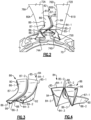
- FIG. 2 illustrates an enlarged view of a fan hub 70, a first fan blade 72A, a second fan blade 72B, and a fan blade platform 82 located between the first and second fan blades 72A, 72B.
- a plurality of fan blades 72 would surround the fan hub 70 with one of the platforms 82 between each adjacent pairs of fan blades 72.
- the first fan blade 72A is secured to the fan hub 70 with a first root portion 74A located in a first fan hub recess 75A in the fan hub 70 and the second fan blade 72B is secured to the fan hub 70 with a second root portion 74B located in a second fan hub recess 75B in the fan hub 70.
- the first and second fan blades 72A, 72B each include a pressure side 80A, 80B and a suction side 81A, 81B that extend between a leading edge 76A, 76B and a trialing edge 78A, 78B ( Figure 10 ), respectively.
- the fan blade platform 82 extends between the first and second fan blades 72A, 72B and is located immediately radially outward of the first and second root portions 74A, 74B, respectively.
- the fan blade platform 82 includes a pressure side platform half 84 and a suction side platform half 86.
- a seal 88 engages the pressure side platform half 84 and the suction side platform half 86 to prevent air from passing between the two platform halves 84, 86.
- the pressure side platform half 84 is fixed relative to the pressure side 80B on the second fan blade 72B and the suction side platform half 86 is fixed relative to the suction side 81A of the first fan blade 72A.
- radial or radially and axial or axially is in relation to the engine axis A unless stated otherwise.
- the suction side platform half 86 includes a gas path wall 86-1, an attachment wall 86-2, and a connecting wall 86-3 defining a triangular cross-section.
- the suction side platform half 86 is formed from a composite material including at least one or a plurality of plies.
- the suction side platform half 86 includes a first edge 87-1 located at an intersection of the gas path wall 86-1 and the attachment wall 86-2.
- the first edge 87-1 follows a concave profile along a convex profile of the suction side 81A of the first fan blade 72A.
- a second edge 87-2 is located opposite the first edge 87-1 at an intersection of the first gas path wall 86-1 and the connecting wall 86-3.
- the second edge 87-2 follows a convex profile similar to the convex profile of the suction side 81A of the first fan blade 72A.
- the pressure side platform half 84 includes a gas path wall 84-1, an attachment wall 84-2, and a connecting wall 84-3 defining a triangular cross-section.
- the pressure side platform half 84 is formed from a composite material including at least one or a plurality of plies.
- the pressure side platform half includes a first edge 85-1 located at an intersection of the gas path wall 84-1 and the attachment wall 84-2.
- the first edge 85-1 follows a convex profile along a concave profile of the pressure side 80B of the second fan blade 72B.
- a second edge 85-2 is located opposite the first edge 85-1 at an intersection of the gas path wall 84-1 and the connecting wall 84-3.
- the second edge 85-2 follows a concave profile similar to the concave profile of the pressure side 80B while maintaining a constant gap or spacing with the convex profile of the second edge 87-2.
- the seal 88 is located adjacent the second edges 85-2, 87-2 and is made of an elastomeric material, such as rubber. Additionally, the seal 88 is fixed relative to one of the connecting walls 84-3, 86-3 with an adhesive and moveable relative to the other of the connecting wall 84-3, 86-3. By fixing the seal 88 to only one of the suction side platform half 86 and pressure side platform half 84, the seal 88 accommodates for movement caused by thermal growth and engine loading to prevent gas path air from leaking between the two platform halves 84, 86 into an internal cavity. Also in the illustrated example, the seal 88 includes a V-shaped cross section that follows a curvilineal profile in an axial direction following the second edges 85-2, 87-2. Therefore, the seal 88 does not extend linearly or straight.
- the suction side platform half 86 is fixed relative to the suction side 81A of the first fan blade 72A with an adhesive film 90 ( Figure 4 ).
- the adhesive film 90 covers a majority of an outer surface of the attachment wall 86-2 or to a perimeter of the attachment wall 86-2.
- the pressure side platform half 84 is attached to the pressure side 80B of the second fan blade 72B with an adhesive film 92 ( Figure 3 ).
- the adhesive film 92 also covers a majority of the attachment wall 84-2 or to a perimeter of the attachment wall 84-2.
- the pressure side platform half 84 includes an internal passageway 94 that is at least partially defined by the gas path wall 84-1, the attachment wall 84-2, and the connecting wall 84-3.
- the internal passageway 94 defines a triangular profile with a radial height that increases when moving in an axially downstream direction.
- a cross-sectional area of an inlet ( Figure 3 ) to the internal passageway 94 is smaller than a cross-sectional area of an outlet ( Figure 4 ) to the internal passageway 94.
- the suction side platform half 86 includes an internal passageway 96.
- the internal passageway 96 is at least partially defined by the gas path wall 86-1, the attachment wall 86-2, and the connecting wall 86-3.
- the internal passageway 96 defines a triangular profile with a radial that increases when moving in an axially downstream direction.
- a cross-sectional area of an inlet ( Figure 3 ) to the internal passageway 96 is smaller than a cross-sectional area of an outlet ( Figure 4 ) of the internal passageway 96.
- the leading edge 76A of the fan blade 72A extends axially forward of an upstream edge of the suction side platform half 86 and an upstream edge of the pressure side platform half 84.
- the leading 76A need not extend axially forward of the platforms 84, 86 as shown in Figure 14 .
- upstream or downstream and forward and aft are in relation to a direction of air flow through the gas turbine engine unless stated otherwise.
- the seal 88 is fixed relative to the pressure side platform half 84 and is therefore moveable relative to a corresponding suction side platform half 86.
- either of the pressure side platform half 84 or the suction side platform half 86 can be formed by wrapping at least one ply 98 around a mandrel 100.
- the at least one ply 98 can include a carbon fiber pre-preg material or another composite material.
- the at least one ply 98 is formed to the mandrel 100 through the application of at least one of pressure or heat. The pressure is applied through force from a press 102 and the heat is applied from a heat source 104 to cure the at least one ply 98 to the shape of the mandrel 100. After the at least one ply 98 has been formed to the mandrel 100, the mandrel 100 can be removed to leave one of the pressure or suction side platform halves 84, 86.
- a portion of at least one of the pressure or suction side platform halves 84, 86 can have material removed from at least one of the attachment walls 84-2, 86-2 or the connecting walls 84-3, 86-3, respectively.
- the material can be removed through at least one of a machining or cutting process.
- One feature of the removed material is a reduction in weight of the platform 82 as a whole.
- the removal of material leaves a plurality of openings 106, 108 in the pressure and suction side pressure halves 84, 86, respectively.
- the openings 106, 108 are positioned in areas of the pressure and suction side platform halves 84, 86, that experience reduced loads. Additionally, the openings 106, 108 can extend through an intersection of the attachment walls 84-2, 86-2 and the connecting walls 84-3, 86-3.
- FIGs 10 through 13 illustrate another example fan blade platform 182 similar to the fan blade platform 82 above except where described below or shown in the Figures. Similar or identical elements between the fan blade platform 82 and the fan blade platform 182 will include the addition of the leading one ("1").
- the fan blade platform 182 extends between the first fan blade 72A and the second fan blade 72B.
- the fan blade platform 182 includes a pressure side platform half 184 and a suction side platform half 186.
- a seal 188 engages the pressure side platform half 184 and the suction side platform half 186.
- the pressure side platform half 184 is fixed relative to the pressure side 80B on the second fan blade 72B and the suction side platform half 186 is fixed relative to the suction side 81A of the first fan blade 72A.
- the suction side platform half 186 includes a gas path wall 186-1, an attachment wall 186-2 and a connecting wall 186-3.
- the suction side platform half 186 is formed from a composite material including a plurality of plies or layers.
- the suction side platform half 186 includes a first edge 187-1 located at an intersection of the gas path wall 186-1 and the attachment wall 186-2.
- the first edge 187-1 follows a concave profile along the convex profile of the suction side 81A of the first fan blade 72A.
- a second edge 187-2 is located opposite the first edge 187-1 on a ledge 189 extending from an intersection of the first gas path wall 186-1 and the connecting wall 186-3.
- the second edge 187-2 follows a convex profile similar to the convex profile of the suction side 81A of the first fan blade 72A.
- the pressure side platform half 184 includes a gas path wall 184-1, an attachment wall 184-2, and a connecting wall 184-3.
- the pressure side platform half 184 is formed from a composite material including a plurality of plies or layers.
- the pressure side platform half 184 includes a first edge 185-1 located at an intersection of the gas path wall 184-1 and the attachment wall 184-2.
- the first edge 185-1 follows a convex profile along the concave profile of the pressure side 80B of the second fan blade 72B.
- a second edge 185-2 is located opposite the first edge 185-1 on a ledge 191 extending from an intersection of the gas path wall 184-1 and the connecting wall 184-3.
- the second edge 185-2 follows a concave profile similar to the concave profile of the pressure side 80B while maintaining a constant gap or spacing with the convex profile of the second edge 187-2.
- the seal 188 is located adjacent the second edges 185-2, 187-2 and is spaced from the connecting walls 184-3, 186-3, respectively, such the seal 188 is flat extending between the pressure side platform half 184 and the suction side platform half 186.
- the seal 188 accommodates for movement cased by thermal growth and engine loading to prevent gas path air from leaking between the two platform halves 184, 186 and into the internal cavity.
- the seal 188 extends in a plane with a curvilineal profile to follow a profile of the second edges 185-2, 186-2. Therefore, the seal 188 does not extend linearly or straight but instead follows the curvilineal profile of the second edges 185-2, 187-2, as shown in the Figures.
- the suction side platform half 186 is fixed relative to the suction side 81A of the first fan blade 72A with an adhesive film 190 and the pressure side platform half 84 is attached to the pressure side 80B of the second fan blade 72B with an adhesive film 192.
- the pressure side platform half 184 includes an internal passageway 194 that is at least partially defined by the gas path wall 184-1, the attachment wall 184-2, and the connecting wall 184-3.
- the internal passageway 194 defines a triangular profile with a radial height that increases when moving in an axially downstream direction.
- a cross-sectional area of an inlet ( Figure 11 ) to the internal passageway 94 is smaller than a cross-sectional area of an outlet ( Figure 10 ) to the internal passageway 94.
- the suction side platform half 186 includes an internal passageway 196.
- the internal passageway 196 is at least partially defined by the gas path wall 186-1, the attachment wall 186-2, and the connecting wall 186-3.
- the internal passageway 196 defines a triangular profile with a radial that increases when moving in an axially downstream direction.
- a cross-sectional area of an inlet ( Figure 11 ) to the internal passageway 196 is smaller than a cross-sectional area of an outlet ( Figure 10 ) of the internal passageway 196.
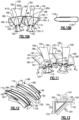
- a ring 110 extends through a corresponding one of the internal passageways 194, 196 and around a corresponding one of the fan blades 72A, 72B.
- the ring 110 could be continuous ring that is formed by wrapping a material through the internal passageways 194, 196 ( Figure 10A ).
- a two-piece ring with a first C-shaped portion 110A and a second C-shaped portion 110B could extend through the passageways 194, 196 and around a corresponding one of fan blades 72A, 72B in an overlapping configuration as shown in Figure 10B .
- the ring 110 provides a secondary attachment function to secure the pressure and suction side platform halves 184, 186 to the corresponding fan blade 72.
- the ring 110 could also be used with the pressure and suction side platform halves 84, 86 described above.
- either of the pressure side platform half 184 or the suction side platform half 186 are formed by wrapping at least one first ply 198 around the mandrel 200 and at least one second ply 199 around the at least one first ply 198 to form one of the ledges 189, 191.
- the at least one first and second plies 198, 199 can include a carbon fiber pre-preg material or another composite material. Pressure can then be applied with the press 102 with or without the application of heat from the heat source 104 to form the at least one first and second ply 198, 199 to the shape of the mandrel 200. After the at least one first and second plies 198, 199 have been formed, the mandrel 200 can be removed to leave one of the platform half 184, 186.
- FIGs 14 and 15 illustrate another example fan blade platform 282 similar to the fan blade platform 182 above except where described below or shown in the Figures. Similar or identical elements between the fan blade platform 182 and the fan blade platform 282 will include the addition of the leading two ("2") in place of the leading one ("1").
- the fan blade platform extends between the first fan blade 72A and the second fan blade 72B.
- the fan blade platform 282 includes a pressure side platform half 284 and a suction side platform half 286.
- a seal 288 engages the pressure side platform half 284 and the suction side platform half 286.
- the pressure side platform half 284 is fixed relative to the pressure side 80B on the second fan blade 72B and the suction side platform half 186 is fixed relative to the suction side 81A of the first fan blade 72A.
- a leading edge of the pressure and suction side platform halves 284, 286 extends axially forward of the leading edges 76A, 76B and a trailing edge of the pressure and suction side platform halves 284, 286 extends axially aft of the trailing edges 78A, 78B.
- the first and second fan blades 72A, 72B each include a protrusions 77 on both the pressure sides 80A, 80B and the suction sides 81A, 81B.
- the protrusions 77 are located immediately radially outward of the platform halves 284, 286 to provide additional retention in the radial direction.
- the protrusions 77 are also integrally formed with a corresponding one of the fans blades 72A, 72B such that the protrusions 77 and fan blades form a single piece unitary component.
- the protrusions 77 extend from the leading edge 76A, 76B to the trailing edge 78A, 78B.
Landscapes
- Engineering & Computer Science (AREA)
- Mechanical Engineering (AREA)
- General Engineering & Computer Science (AREA)
- Chemical & Material Sciences (AREA)
- Combustion & Propulsion (AREA)
- Materials Engineering (AREA)
- Structures Of Non-Positive Displacement Pumps (AREA)
- Turbine Rotor Nozzle Sealing (AREA)
Description
- The present invention relates to a fan blade platform assembly. The present invention also relates to a gas turbine engine.
- A gas turbine engine typically includes a fan section, a compressor section, a combustor section, and a turbine section. Air entering the compressor section is compressed and delivered into the combustion section where it is mixed with fuel and ignited to generate a high-speed exhaust gas flow. The high-speed exhaust gas flow expands through the turbine section to drive the compressor and the fan section.
- The fan section includes fan blades with spacers or platforms between adjacent blades at a radially inner edge of the flowpath. The platforms can be integral with the fan blades or separately attached to the fan blade.
-
US 2013/330196 A1 discloses a fan assembly including a first fan blade with a rib extending therealong and a first fairing platform mounted on and supported from the first fan blade. -
EP 2 594 773 A2 discloses a rotor assembly for a gas turbine engine, the rotor assembly having a disc supporting a plurality of radially extending blades. - According to an aspect, there is provided a fan blade platform assembly as recited in claim 1.
- Further, optional features are recited in each of claims 1 to 6.
- According to another aspect, there is provided a gas turbine engine as recited in claim 7.
- Further, optional features are recited in each of claims 8 to 13.
- The various features and advantages of the present disclosure will become apparent to those skilled in the art from the following detailed description. The drawings that accompany the detailed description can be briefly described as follows.
-
Figure 1 is a schematic view of an example gas turbine engine; -
Figure 2 is a perspective schematic view of a fan hub with a pair of fan blades having a fan blade platform assembly there between; -
Figure 3 is a frontal perspective schematic view of the fan blade platform ofFigure 2 ; -
Figure 4 is an aft perspective schematic view of the fan blade platform ofFigure 2 ; -
Figure 5 is a radially inner schematic view of one of the fan blades with a pressure side platform half and a suction side platform half; -
Figure 6 illustrates a method of forming one of the pressure side or suction side platform halves; -
Figure 7 is a frontal perspective schematic view of another fan blade platform having a pressure side platform half and a suction side platform half surrounding an airfoil; -
Figure 8 is a radially outward perspective schematic view of the pressure side platform half and the suction side platform half ofFigure 7 adjacent each other; -
Figure 9 is another radially outward perspective schematic view of the pressure side platform half and the suction side platform half ofFigure 7 adjacent each other; -
Figure 10A is a perspective schematic view of yet another fan blade platform; -
Figure 10B is a top of an example two-piece ring; -
Figure 11 is another perspective schematic view of the fan blade platform ofFigure 10 ; -
Figure 12 is a cross-sectional schematic view taken along line 12-12 ofFigure 11 ; -
Figure 13 illustrates a method of forming one of the pressure side or suction side platform halves of the fan blade platform ofFigure 10 ; -
Figure 14 is a top schematic view of yet another fan blade platform; and -
Figure 15 is a side schematic view of the fan blade platform ofFigure 13 . -
Figure 1 schematically illustrates agas turbine engine 20. Thegas turbine engine 20 is disclosed herein as a two-spool turbofan that generally incorporates afan section 22, acompressor section 24, acombustor section 26 and aturbine section 28. Thefan section 22 drives air along a bypass flow half B in a bypass duct defined within ahousing 15, such as a fan case or nacelle, and also drives air along a core flow half C for compression and communication into thecombustor section 26 then expansion through theturbine section 28. Although depicted as a two-spool turbofan gas turbine engine in the disclosed non-limiting embodiment, it should be understood that the concepts described herein are not limited to use with two-spool turbofans as the teachings may be applied to other types of turbine engines including three-spool architectures. - The
exemplary engine 20 generally includes alow speed spool 30 and ahigh speed spool 32 mounted for rotation about an engine central longitudinal axis A relative to an enginestatic structure 36 viaseveral bearing systems 38. It should be understood thatvarious bearing systems 38 at various locations may alternatively or additionally be provided, and the location ofbearing systems 38 may be varied as appropriate to the application. - The
low speed spool 30 generally includes aninner shaft 40 that interconnects, a first (or low)pressure compressor 44 and a first (or low)pressure turbine 46. Theinner shaft 40 is connected to thefan 42 through a speed change mechanism, which in exemplarygas turbine engine 20 is illustrated as a gearedarchitecture 48 to drive afan 42 at a lower speed than thelow speed spool 30. Thehigh speed spool 32 includes anouter shaft 50 that interconnects a second (or high)pressure compressor 52 and a second (or high)pressure turbine 54. Acombustor 56 is arranged inexemplary gas turbine 20 between thehigh pressure compressor 52 and thehigh pressure turbine 54. Amid-turbine frame 57 of the enginestatic structure 36 may be arranged generally between thehigh pressure turbine 54 and thelow pressure turbine 46. Themid-turbine frame 57 further supports bearingsystems 38 in theturbine section 28. Theinner shaft 40 and theouter shaft 50 are concentric and rotate viabearing systems 38 about the engine central longitudinal axis A which is collinear with their longitudinal axes. - The core airflow is compressed by the
low pressure compressor 44 then thehigh pressure compressor 52, mixed and burned with fuel in thecombustor 56, then expanded over thehigh pressure turbine 54 andlow pressure turbine 46. Themid-turbine frame 57 includesfan blades 59 which are in the core airflow half C. Theturbines low speed spool 30 andhigh speed spool 32 in response to the expansion. It will be appreciated that each of the positions of thefan section 22,compressor section 24,combustor section 26,turbine section 28, and fandrive gear system 48 may be varied. For example,gear system 48 may be located aft of the low pressure compressor, or aft of thecombustor section 26 or even aft ofturbine section 28, andfan 42 may be positioned forward or aft of the location ofgear system 48. - The
engine 20 in one example is a high-bypass geared aircraft engine. In a further example, theengine 20 bypass ratio is greater than about six (6), with an example embodiment being greater than about ten (10), the gearedarchitecture 48 is an epicyclic gear train, such as a planetary gear system or other gear system, with a gear reduction ratio of greater than about 2.3 and thelow pressure turbine 46 has a pressure ratio that is greater than about five. In one disclosed embodiment, theengine 20 bypass ratio is greater than about ten (10:1), the fan diameter is significantly larger than that of thelow pressure compressor 44, and thelow pressure turbine 46 has a pressure ratio that is greater than about five 5:1.Low pressure turbine 46 pressure ratio is pressure measured prior to inlet oflow pressure turbine 46 as related to the pressure at the outlet of thelow pressure turbine 46 prior to an exhaust nozzle. The gearedarchitecture 48 may be an epicycle gear train, such as a planetary gear system or other gear system, with a gear reduction ratio of greater than about 2.3:1 and less than about 5:1. It should be understood, however, that the above parameters are only exemplary of one embodiment of a geared architecture engine and that the present disclosure is applicable to other gas turbine engines including direct drive turbofans. - A significant amount of thrust is provided by the bypass flow B due to the high bypass ratio. The
fan section 22 of theengine 20 is designed for a particular flight condition -- typically cruise at about 0.8 Mach and about 35,000 feet (10,668 meters). The flight condition of 0.8 Mach and 35,000 ft (10,668 meters), with the engine at its best fuel consumption - also known as "bucket cruise Thrust Specific Fuel Consumption ('TSFC')" - is the industry standard parameter of lbm of fuel being burned divided by lbf of thrust the engine produces at that minimum point. "Low fan pressure ratio" is the pressure ratio across the fan blade alone, without a Fan Exit Guide Vane ("FEGV") system. The low fan pressure ratio as disclosed herein according to one non-limiting embodiment is less than about 1.45. "Low corrected fan tip speed" is the actual fan tip speed in ft/sec divided by an industry standard temperature correction of [(Tram °R) / (518.7 °R)]0.5. The "Low corrected fan tip speed" as disclosed herein according to one non-limiting embodiment is less than about 1150 ft / second (350.5 meters/second). -
Figure 2 illustrates an enlarged view of afan hub 70, afirst fan blade 72A, asecond fan blade 72B, and afan blade platform 82 located between the first andsecond fan blades single platform 82 and pair offan blades fan hub 70 with one of theplatforms 82 between each adjacent pairs of fan blades 72. - The
first fan blade 72A is secured to thefan hub 70 with afirst root portion 74A located in a firstfan hub recess 75A in thefan hub 70 and thesecond fan blade 72B is secured to thefan hub 70 with asecond root portion 74B located in a secondfan hub recess 75B in thefan hub 70. The first andsecond fan blades pressure side suction side leading edge edge Figure 10 ), respectively. - The
fan blade platform 82 extends between the first andsecond fan blades second root portions fan blade platform 82 includes a pressureside platform half 84 and a suctionside platform half 86. Aseal 88 engages the pressureside platform half 84 and the suctionside platform half 86 to prevent air from passing between the twoplatform halves side platform half 84 is fixed relative to thepressure side 80B on thesecond fan blade 72B and the suctionside platform half 86 is fixed relative to thesuction side 81A of thefirst fan blade 72A. In this disclosure, radial or radially and axial or axially is in relation to the engine axis A unless stated otherwise. - As shown in
Figures 2-5 , the suctionside platform half 86 includes a gas path wall 86-1, an attachment wall 86-2, and a connecting wall 86-3 defining a triangular cross-section. In the illustrated example, the suctionside platform half 86 is formed from a composite material including at least one or a plurality of plies. The suctionside platform half 86 includes a first edge 87-1 located at an intersection of the gas path wall 86-1 and the attachment wall 86-2. The first edge 87-1 follows a concave profile along a convex profile of thesuction side 81A of thefirst fan blade 72A. A second edge 87-2 is located opposite the first edge 87-1 at an intersection of the first gas path wall 86-1 and the connecting wall 86-3. The second edge 87-2 follows a convex profile similar to the convex profile of thesuction side 81A of thefirst fan blade 72A. - The pressure
side platform half 84 includes a gas path wall 84-1, an attachment wall 84-2, and a connecting wall 84-3 defining a triangular cross-section. In the illustrated example, the pressureside platform half 84 is formed from a composite material including at least one or a plurality of plies. The pressure side platform half includes a first edge 85-1 located at an intersection of the gas path wall 84-1 and the attachment wall 84-2. The first edge 85-1 follows a convex profile along a concave profile of thepressure side 80B of thesecond fan blade 72B. A second edge 85-2 is located opposite the first edge 85-1 at an intersection of the gas path wall 84-1 and the connecting wall 84-3. The second edge 85-2 follows a concave profile similar to the concave profile of thepressure side 80B while maintaining a constant gap or spacing with the convex profile of the second edge 87-2. - In the illustrated example, the
seal 88 is located adjacent the second edges 85-2, 87-2 and is made of an elastomeric material, such as rubber. Additionally, theseal 88 is fixed relative to one of the connecting walls 84-3, 86-3 with an adhesive and moveable relative to the other of the connecting wall 84-3, 86-3. By fixing theseal 88 to only one of the suctionside platform half 86 and pressureside platform half 84, theseal 88 accommodates for movement caused by thermal growth and engine loading to prevent gas path air from leaking between the twoplatform halves seal 88 includes a V-shaped cross section that follows a curvilineal profile in an axial direction following the second edges 85-2, 87-2. Therefore, theseal 88 does not extend linearly or straight. - The suction
side platform half 86 is fixed relative to thesuction side 81A of thefirst fan blade 72A with an adhesive film 90 (Figure 4 ). Theadhesive film 90 covers a majority of an outer surface of the attachment wall 86-2 or to a perimeter of the attachment wall 86-2. Similarly, the pressureside platform half 84 is attached to thepressure side 80B of thesecond fan blade 72B with an adhesive film 92 (Figure 3 ). Theadhesive film 92 also covers a majority of the attachment wall 84-2 or to a perimeter of the attachment wall 84-2. - As shown in
Figures 3 and 4 , the pressureside platform half 84 includes aninternal passageway 94 that is at least partially defined by the gas path wall 84-1, the attachment wall 84-2, and the connecting wall 84-3. In the illustrated example, theinternal passageway 94 defines a triangular profile with a radial height that increases when moving in an axially downstream direction. Furthermore, a cross-sectional area of an inlet (Figure 3 ) to theinternal passageway 94 is smaller than a cross-sectional area of an outlet (Figure 4 ) to theinternal passageway 94. - Similarly, the suction
side platform half 86 includes aninternal passageway 96. Theinternal passageway 96 is at least partially defined by the gas path wall 86-1, the attachment wall 86-2, and the connecting wall 86-3. In the illustrated example, theinternal passageway 96 defines a triangular profile with a radial that increases when moving in an axially downstream direction. Furthermore, a cross-sectional area of an inlet (Figure 3 ) to theinternal passageway 96 is smaller than a cross-sectional area of an outlet (Figure 4 ) of theinternal passageway 96. - In the illustrated example shown in
Figure 5 , theleading edge 76A of thefan blade 72A extends axially forward of an upstream edge of the suctionside platform half 86 and an upstream edge of the pressureside platform half 84. However, the leading 76A need not extend axially forward of theplatforms Figure 14 . In this disclosure, upstream or downstream and forward and aft are in relation to a direction of air flow through the gas turbine engine unless stated otherwise. In the illustrated example, theseal 88 is fixed relative to the pressureside platform half 84 and is therefore moveable relative to a corresponding suctionside platform half 86. - As shown in
Figure 6 , either of the pressureside platform half 84 or the suctionside platform half 86 can be formed by wrapping at least oneply 98 around amandrel 100. The at least oneply 98 can include a carbon fiber pre-preg material or another composite material. In the illustrated example, the at least oneply 98 is formed to themandrel 100 through the application of at least one of pressure or heat. The pressure is applied through force from apress 102 and the heat is applied from aheat source 104 to cure the at least oneply 98 to the shape of themandrel 100. After the at least oneply 98 has been formed to themandrel 100, themandrel 100 can be removed to leave one of the pressure or suction side platform halves 84, 86. - As shown in
Figures 7-9 , a portion of at least one of the pressure or suction side platform halves 84, 86 can have material removed from at least one of the attachment walls 84-2, 86-2 or the connecting walls 84-3, 86-3, respectively. The material can be removed through at least one of a machining or cutting process. One feature of the removed material is a reduction in weight of theplatform 82 as a whole. The removal of material leaves a plurality ofopenings openings openings -
Figures 10 through 13 illustrate another examplefan blade platform 182 similar to thefan blade platform 82 above except where described below or shown in the Figures. Similar or identical elements between thefan blade platform 82 and thefan blade platform 182 will include the addition of the leading one ("1"). - The
fan blade platform 182 extends between thefirst fan blade 72A and thesecond fan blade 72B. Thefan blade platform 182 includes a pressureside platform half 184 and a suctionside platform half 186. Aseal 188 engages the pressureside platform half 184 and the suctionside platform half 186. The pressureside platform half 184 is fixed relative to thepressure side 80B on thesecond fan blade 72B and the suctionside platform half 186 is fixed relative to thesuction side 81A of thefirst fan blade 72A. - The suction
side platform half 186 includes a gas path wall 186-1, an attachment wall 186-2 and a connecting wall 186-3. In the illustrated example, the suctionside platform half 186 is formed from a composite material including a plurality of plies or layers. The suctionside platform half 186 includes a first edge 187-1 located at an intersection of the gas path wall 186-1 and the attachment wall 186-2. The first edge 187-1 follows a concave profile along the convex profile of thesuction side 81A of thefirst fan blade 72A. A second edge 187-2 is located opposite the first edge 187-1 on aledge 189 extending from an intersection of the first gas path wall 186-1 and the connecting wall 186-3. The second edge 187-2 follows a convex profile similar to the convex profile of thesuction side 81A of thefirst fan blade 72A. - The pressure
side platform half 184 includes a gas path wall 184-1, an attachment wall 184-2, and a connecting wall 184-3. In the illustrated example, the pressureside platform half 184 is formed from a composite material including a plurality of plies or layers. The pressureside platform half 184 includes a first edge 185-1 located at an intersection of the gas path wall 184-1 and the attachment wall 184-2. The first edge 185-1 follows a convex profile along the concave profile of thepressure side 80B of thesecond fan blade 72B. A second edge 185-2 is located opposite the first edge 185-1 on aledge 191 extending from an intersection of the gas path wall 184-1 and the connecting wall 184-3. The second edge 185-2 follows a concave profile similar to the concave profile of thepressure side 80B while maintaining a constant gap or spacing with the convex profile of the second edge 187-2. - In the illustrated example, the
seal 188 is located adjacent the second edges 185-2, 187-2 and is spaced from the connecting walls 184-3, 186-3, respectively, such theseal 188 is flat extending between the pressureside platform half 184 and the suctionside platform half 186. By fixing theseal 188 to only one of the suctionside platform half 86 and pressureside platform half 84, theseal 188 accommodates for movement cased by thermal growth and engine loading to prevent gas path air from leaking between the twoplatform halves seal 188 extends in a plane with a curvilineal profile to follow a profile of the second edges 185-2, 186-2. Therefore, theseal 188 does not extend linearly or straight but instead follows the curvilineal profile of the second edges 185-2, 187-2, as shown in the Figures. - The suction
side platform half 186 is fixed relative to thesuction side 81A of thefirst fan blade 72A with anadhesive film 190 and the pressureside platform half 84 is attached to thepressure side 80B of thesecond fan blade 72B with anadhesive film 192. - As shown in
Figures 10 and 11 , the pressureside platform half 184 includes aninternal passageway 194 that is at least partially defined by the gas path wall 184-1, the attachment wall 184-2, and the connecting wall 184-3. In the illustrated example, theinternal passageway 194 defines a triangular profile with a radial height that increases when moving in an axially downstream direction. Furthermore, a cross-sectional area of an inlet (Figure 11 ) to theinternal passageway 94 is smaller than a cross-sectional area of an outlet (Figure 10 ) to theinternal passageway 94. - Similarly, the suction
side platform half 186 includes aninternal passageway 196. Theinternal passageway 196 is at least partially defined by the gas path wall 186-1, the attachment wall 186-2, and the connecting wall 186-3. In the illustrated example, theinternal passageway 196 defines a triangular profile with a radial that increases when moving in an axially downstream direction. Furthermore, a cross-sectional area of an inlet (Figure 11 ) to theinternal passageway 196 is smaller than a cross-sectional area of an outlet (Figure 10 ) of theinternal passageway 196. - As shown in
Figures 10-12 , aring 110 extends through a corresponding one of theinternal passageways fan blades ring 110 could be continuous ring that is formed by wrapping a material through theinternal passageways 194, 196 (Figure 10A ). Alternatively, a two-piece ring with a first C-shapedportion 110A and a second C-shapedportion 110B could extend through thepassageways fan blades Figure 10B . Thering 110 provides a secondary attachment function to secure the pressure and suction side platform halves 184, 186 to the corresponding fan blade 72. Thering 110 could also be used with the pressure and suction side platform halves 84, 86 described above. - As shown in
Figure 13 , either of the pressureside platform half 184 or the suctionside platform half 186 are formed by wrapping at least onefirst ply 198 around themandrel 200 and at least onesecond ply 199 around the at least onefirst ply 198 to form one of theledges second plies press 102 with or without the application of heat from theheat source 104 to form the at least one first andsecond ply mandrel 200. After the at least one first andsecond plies mandrel 200 can be removed to leave one of theplatform half -
Figures 14 and 15 illustrate another examplefan blade platform 282 similar to thefan blade platform 182 above except where described below or shown in the Figures. Similar or identical elements between thefan blade platform 182 and thefan blade platform 282 will include the addition of the leading two ("2") in place of the leading one ("1"). - The fan blade platform extends between the
first fan blade 72A and thesecond fan blade 72B. Thefan blade platform 282 includes a pressureside platform half 284 and a suctionside platform half 286. A seal 288 engages the pressureside platform half 284 and the suctionside platform half 286. The pressureside platform half 284 is fixed relative to thepressure side 80B on thesecond fan blade 72B and the suctionside platform half 186 is fixed relative to thesuction side 81A of thefirst fan blade 72A. A leading edge of the pressure and suction side platform halves 284, 286 extends axially forward of theleading edges edges - Additionally, the as shown in
Figures 14 and 15 , the first andsecond fan blades protrusions 77 on both the pressure sides 80A, 80B and the suction sides 81A, 81B. Theprotrusions 77 are located immediately radially outward of the platform halves 284, 286 to provide additional retention in the radial direction. Theprotrusions 77 are also integrally formed with a corresponding one of thefans blades protrusions 77 and fan blades form a single piece unitary component. In the illustrated example, theprotrusions 77 extend from theleading edge edge - Although the different non-limiting examples are illustrated as having specific components, the examples of this disclosure are not limited to those particular combinations. It is possible to use some of the components or features from any of the non-limiting examples in combination with features or components from any of the other non-limiting examples.
- It should be understood that like reference numerals identify corresponding or similar elements throughout the several drawings. It should also be understood that although a particular component arrangement is disclosed and illustrated in these exemplary embodiments, other arrangements could also benefit from the teachings of this disclosure.
- The foregoing description shall be interpreted as illustrative and not in any limiting sense. A worker of ordinary skill in the art would understand that certain modifications could come within the scope of the claims of the present invention.
- For these reasons, the following claim should be studied to determine the true scope and content of this disclosure.
Claims (13)
- A fan blade platform assembly (82; 182; 282) for a gas turbine engine (20), comprising:a pressure side platform half (84; 184; 284) including a first attachment wall (84-2; 184-2), a first gas path wall (84-1; 184-1), and a first connecting wall (84-3; 184-3) attached to both the first attachment wall and the first gas path wall;a suction side platform half (86; 186; 286) including a second attachment wall (86-2; 186-2), a second gas path wall (86-1; 186-1), and a second connecting wall (86-3; 186-3) attached to both the second attachment wall and the second gas path wall; anda seal (88; 188; 288) engaging the pressure side platform half (84; 184; 284) and the suction side platform half (86; 186; 286),characterised in that the seal (88; 188; 288) is fixed relative to one of the first connecting wall and the second connecting wall and is in moveable engagement with to the other of the first connecting wall and the second connecting wall and the seal is V-shaped and follows a curvilinear path in an axial direction.
- The assembly of claim 1, wherein the first attachment wall (84-2; 184-2), includes an adhesive for securing the pressure side platform half (84; 184; 284) to a fan blade (72B) and the second attachment wall (86-2; 186-2) includes an adhesive for securing the suction side platform half (86; 186; 286) to a suction side of an adjacent fan blade (72A).
- The assembly of claim 1 or 2, wherein the first gas path wall (84-1; 184-1) includes a first ledge (191) extending beyond an intersection with the first connecting wall (84-3; 184-3) and the second gas path wall (86-1; 186-1) includes a second ledge (189) extending beyond an intersection with the second connecting wall (86-3; 186-3) and the seal (88; 188; 288) engages a non-gas path side of the first ledge (191) and a non-gas path side of the second ledge (189).
- The assembly of claim 1, 2 or 3, wherein the first gas path wall (84-1; 184-1) includes a first edge (85-1) at an intersection of the first attachment wall (84-2; 184-2) and a second edge (85-2) opposite the first edge (85-1) and the first edge (85-1) of the first gas path wall (84-1; 184-1) follows a convex profile and the second edge (85-2) of the first gas path wall (84-1; 184-1) follows a concave profile.
- The assembly of any preceding claim, wherein the second gas path wall (86-1; 186-1) includes a first edge (87-1) at an intersection with the second attachment wall (86-2; 186-2) and a second edge (87-2) opposite the first edge (87-1) and the first edge (87-1) of the second gas path wall (86-1; 186-1) follows a concave profile and the second edge (87-2) of the second gas path wall (86-1; 186-1) follows a convex profile.
- The assembly of any preceding claim, further comprising at least one passageway (94; 194) extending through at least one of the first attachment wall (84-2; 184-2) or the first connecting wall (84-3; 184-3) and at least one second passageway (96; 196) extending through at least one of the second attachment wall (86-2; 186-2) or the second connecting wall (86-3; 186-3).
- A gas turbine engine (20) comprising:a fan section (22) for directing air into a fan bypass duct, the fan section (22) including at least a first fan blade (72B) having a pressure side wall and a first suction side wall and a second fan blade (72A) having a second pressure side wall and a second suction side wall; andthe fan blade platform assembly (82; 182; 282) as recited in claim 1.
- The gas turbine engine of claim 7, wherein the first attachment wall (84-2; 184-2) includes an adhesive for securing the pressure side platform half (84; 184; 284) to the pressure side (80B) of the first fan blade (72B) and the second attachment wall (86-2; 186-2) includes an adhesive for securing the suction side platform half (86; 186; 286) to the second suction side (81A) of second fan blade (72A).
- The gas turbine engine of claim 7 or 8, wherein the seal (88; 188; 288) engages a non-gas path side of the first gas path wall (84-1; 184-1) and a non-gas path side of the second gas path wall (86-1; 186-1).
- The gas turbine engine of claim 7, 8 or 9, wherein the first fan blade (72B) includes a first leading edge (76B) and a first trailing edge (78B) and the second fan blade (72A) includes a second leading edge (76A) and a second trailing edge (78A) and the pressure side platform half (84; 184; 284) and the suction side platform half (86; 186; 286) each extend forward beyond the first fan blade leading edge (76B) and the second fan blade leading edge (76A) and aft beyond the first trailing edge (78B) and second trailing edge (78A).
- The gas turbine engine of claim 7, 8 or 9, wherein the first fan blade (72B) includes a first leading edge (76B) and a first trailing edge (78B) and the second fan blade (72A) includes a second leading edge (76A) and a second trailing edge (78A) and the pressure side platform half (84; 184; 284) and the suction side platform half (86; 186; 286) each include a forward edge aft of the first leading edge and second leading edge (76A, 76B) and an aft edge forward of the first trailing edge and the second trailing edge (78A, 78B).
- The gas turbine engine of any of claims 7 to 11, further comprising a second suction side platform half attached to the first suction side of the first fan blade (72B) and a retention ring extending through an internal longitudinal passageway in the pressure side platform half (84; 184; 284) and an internal longitudinal passageway in the second suction side platform half (86; 186; 286).
- The gas turbine engine of any of claims 7 to 12, wherein the first fan blade (72B) includes a first protrusion (77) on the first pressure side (80B) engaging the pressure side platform half (84; 184; 284) and the second fan blade (72A) includes a second protrusion (77) on the second suction side (81A) engaging the suction side platform half (86; 186; 286).
Priority Applications (1)
| Application Number | Priority Date | Filing Date | Title |
|---|---|---|---|
| EP23201965.3A EP4279707A3 (en) | 2020-04-16 | 2021-04-14 | Fan blade platform for gas turbine engine |
Applications Claiming Priority (1)
| Application Number | Priority Date | Filing Date | Title |
|---|---|---|---|
| US16/850,848 US11815017B2 (en) | 2020-04-16 | 2020-04-16 | Fan blade platform for gas turbine engine |
Related Child Applications (1)
| Application Number | Title | Priority Date | Filing Date |
|---|---|---|---|
| EP23201965.3A Division EP4279707A3 (en) | 2020-04-16 | 2021-04-14 | Fan blade platform for gas turbine engine |
Publications (3)
| Publication Number | Publication Date |
|---|---|
| EP3896261A2 EP3896261A2 (en) | 2021-10-20 |
| EP3896261A3 EP3896261A3 (en) | 2022-01-05 |
| EP3896261B1 true EP3896261B1 (en) | 2023-11-08 |
Family
ID=75529868
Family Applications (2)
| Application Number | Title | Priority Date | Filing Date |
|---|---|---|---|
| EP23201965.3A Pending EP4279707A3 (en) | 2020-04-16 | 2021-04-14 | Fan blade platform for gas turbine engine |
| EP21168357.8A Active EP3896261B1 (en) | 2020-04-16 | 2021-04-14 | Fan blade platform for gas turbine engine |
Family Applications Before (1)
| Application Number | Title | Priority Date | Filing Date |
|---|---|---|---|
| EP23201965.3A Pending EP4279707A3 (en) | 2020-04-16 | 2021-04-14 | Fan blade platform for gas turbine engine |
Country Status (2)
| Country | Link |
|---|---|
| US (1) | US11815017B2 (en) |
| EP (2) | EP4279707A3 (en) |
Family Cites Families (18)
| Publication number | Priority date | Publication date | Assignee | Title |
|---|---|---|---|---|
| US3294364A (en) | 1962-01-02 | 1966-12-27 | Gen Electric | Rotor assembly |
| US4183720A (en) | 1978-01-03 | 1980-01-15 | The United States Of America As Represented By The Secretary Of The Air Force | Composite fan blade platform double wedge centrifugal seal |
| US4875830A (en) * | 1985-07-18 | 1989-10-24 | United Technologies Corporation | Flanged ladder seal |
| GB2416568A (en) * | 2004-07-24 | 2006-02-01 | Rolls Royce Plc | Aerofoil with support member |
| GB0806171D0 (en) * | 2008-04-07 | 2008-05-14 | Rolls Royce Plc | Aeroengine fan assembly |
| GB201020857D0 (en) * | 2010-12-09 | 2011-01-26 | Rolls Royce Plc | Annulus filler |
| GB201104994D0 (en) * | 2011-03-25 | 2011-05-11 | Rolls Royce Plc | a rotor having an annulus filler |
| GB201119655D0 (en) | 2011-11-15 | 2011-12-28 | Rolls Royce Plc | Annulus filler |
| US9017033B2 (en) | 2012-06-07 | 2015-04-28 | United Technologies Corporation | Fan blade platform |
| GB201217257D0 (en) * | 2012-09-27 | 2012-11-07 | Rolls Royce Plc | Annulus filler for axial flow machine |
| US9845699B2 (en) * | 2013-03-15 | 2017-12-19 | Gkn Aerospace Services Structures Corp. | Fan spacer having unitary over molded feature |
| US9896949B2 (en) | 2014-12-23 | 2018-02-20 | United Technologies Corporation | Bonded fan platform |
| US10253639B2 (en) * | 2015-02-05 | 2019-04-09 | Rolls-Royce North American Technologies, Inc. | Ceramic matrix composite gas turbine engine blade |
| US9976426B2 (en) * | 2015-07-21 | 2018-05-22 | United Technologies Corporation | Fan platform with stiffening feature |
| US10584592B2 (en) * | 2015-11-23 | 2020-03-10 | United Technologies Corporation | Platform for an airfoil having bowed sidewalls |
| US20180187558A1 (en) * | 2017-01-03 | 2018-07-05 | United Technologies Corporation | Blade platform with chamfer |
| US10746031B2 (en) * | 2017-07-18 | 2020-08-18 | Rolls-Royce Corporation | Annulus filler |
| US10612400B2 (en) | 2017-11-27 | 2020-04-07 | United Technologies Corporation | Composite fan platform lug reinforcement |
-
2020
- 2020-04-16 US US16/850,848 patent/US11815017B2/en active Active
-
2021
- 2021-04-14 EP EP23201965.3A patent/EP4279707A3/en active Pending
- 2021-04-14 EP EP21168357.8A patent/EP3896261B1/en active Active
Also Published As
| Publication number | Publication date |
|---|---|
| US11815017B2 (en) | 2023-11-14 |
| US20210324793A1 (en) | 2021-10-21 |
| EP3896261A3 (en) | 2022-01-05 |
| EP3896261A2 (en) | 2021-10-20 |
| EP4279707A3 (en) | 2024-02-21 |
| EP4279707A2 (en) | 2023-11-22 |
Similar Documents
| Publication | Publication Date | Title |
|---|---|---|
| EP3734018B1 (en) | Seal for a gas turbine engine component and corresponding method | |
| EP3730744A1 (en) | Seal for platform rail of turbine vane | |
| US11421558B2 (en) | Gas turbine engine component | |
| US9920633B2 (en) | Compound fillet for a gas turbine airfoil | |
| EP3009616B1 (en) | Gas turbine component with platform cooling | |
| EP3061910B1 (en) | Gas turbine engine airfoil and corresponding method of forming | |
| US10808539B2 (en) | Rotor blade for a gas turbine engine | |
| US10227991B2 (en) | Rotor hub seal | |
| EP2932043B1 (en) | Gas turbine engine turbine blade leading edge tip trench cooling | |
| EP3467260B1 (en) | Turbine blade with bowed tip | |
| EP2995778B1 (en) | Method and assembly for reducing secondary heat in a gas turbine engine | |
| EP3011141B1 (en) | Turbine vane with platform pad | |
| EP3000966A1 (en) | Method and assembly for reducing secondary heat in a gas turbine engine | |
| EP3896261B1 (en) | Fan blade platform for gas turbine engine | |
| US20160201477A1 (en) | Gas turbine engine airfoil crossover and pedestal rib cooling arrangement | |
| EP3470627B1 (en) | Gas turbine engine airfoil | |
| US10563512B2 (en) | Gas turbine engine airfoil | |
| US20140161616A1 (en) | Multi-piece blade for gas turbine engine | |
| EP2942486B1 (en) | Gas turbine engine airfoil cooling passage configuration | |
| EP3008290B1 (en) | Turbine vane with variable trailing edge inner radius | |
| EP2885503B1 (en) | Integrally bladed rotor | |
| EP3045658B1 (en) | Gas turbine engine rotor |
Legal Events
| Date | Code | Title | Description |
|---|---|---|---|
| PUAI | Public reference made under article 153(3) epc to a published international application that has entered the european phase |
Free format text: ORIGINAL CODE: 0009012 |
|
| STAA | Information on the status of an ep patent application or granted ep patent |
Free format text: STATUS: THE APPLICATION HAS BEEN PUBLISHED |
|
| AK | Designated contracting states |
Kind code of ref document: A2 Designated state(s): AL AT BE BG CH CY CZ DE DK EE ES FI FR GB GR HR HU IE IS IT LI LT LU LV MC MK MT NL NO PL PT RO RS SE SI SK SM TR |
|
| PUAL | Search report despatched |
Free format text: ORIGINAL CODE: 0009013 |
|
| AK | Designated contracting states |
Kind code of ref document: A3 Designated state(s): AL AT BE BG CH CY CZ DE DK EE ES FI FR GB GR HR HU IE IS IT LI LT LU LV MC MK MT NL NO PL PT RO RS SE SI SK SM TR |
|
| RIC1 | Information provided on ipc code assigned before grant |
Ipc: F01D 5/22 20060101ALI20211130BHEP Ipc: F01D 5/30 20060101ALI20211130BHEP Ipc: F01D 25/00 20060101ALI20211130BHEP Ipc: F01D 11/00 20060101AFI20211130BHEP |
|
| STAA | Information on the status of an ep patent application or granted ep patent |
Free format text: STATUS: REQUEST FOR EXAMINATION WAS MADE |
|
| 17P | Request for examination filed |
Effective date: 20220704 |
|
| RBV | Designated contracting states (corrected) |
Designated state(s): AL AT BE BG CH CY CZ DE DK EE ES FI FR GB GR HR HU IE IS IT LI LT LU LV MC MK MT NL NO PL PT RO RS SE SI SK SM TR |
|
| GRAP | Despatch of communication of intention to grant a patent |
Free format text: ORIGINAL CODE: EPIDOSNIGR1 |
|
| STAA | Information on the status of an ep patent application or granted ep patent |
Free format text: STATUS: GRANT OF PATENT IS INTENDED |
|
| INTG | Intention to grant announced |
Effective date: 20230601 |
|
| GRAS | Grant fee paid |
Free format text: ORIGINAL CODE: EPIDOSNIGR3 |
|
| GRAA | (expected) grant |
Free format text: ORIGINAL CODE: 0009210 |
|
| STAA | Information on the status of an ep patent application or granted ep patent |
Free format text: STATUS: THE PATENT HAS BEEN GRANTED |
|
| RAP3 | Party data changed (applicant data changed or rights of an application transferred) |
Owner name: RTX CORPORATION |
|
| AK | Designated contracting states |
Kind code of ref document: B1 Designated state(s): AL AT BE BG CH CY CZ DE DK EE ES FI FR GB GR HR HU IE IS IT LI LT LU LV MC MK MT NL NO PL PT RO RS SE SI SK SM TR |
|
| REG | Reference to a national code |
Ref country code: GB Ref legal event code: FG4D |
|
| REG | Reference to a national code |
Ref country code: CH Ref legal event code: EP |
|
| REG | Reference to a national code |
Ref country code: DE Ref legal event code: R096 Ref document number: 602021006547 Country of ref document: DE |
|
| REG | Reference to a national code |
Ref country code: IE Ref legal event code: FG4D |
|
| REG | Reference to a national code |
Ref country code: LT Ref legal event code: MG9D |
|
| REG | Reference to a national code |
Ref country code: NL Ref legal event code: MP Effective date: 20231108 |
|
| PG25 | Lapsed in a contracting state [announced via postgrant information from national office to epo] |
Ref country code: GR Free format text: LAPSE BECAUSE OF FAILURE TO SUBMIT A TRANSLATION OF THE DESCRIPTION OR TO PAY THE FEE WITHIN THE PRESCRIBED TIME-LIMIT Effective date: 20240209 |
|
| PG25 | Lapsed in a contracting state [announced via postgrant information from national office to epo] |
Ref country code: IS Free format text: LAPSE BECAUSE OF FAILURE TO SUBMIT A TRANSLATION OF THE DESCRIPTION OR TO PAY THE FEE WITHIN THE PRESCRIBED TIME-LIMIT Effective date: 20240308 |
|
| PG25 | Lapsed in a contracting state [announced via postgrant information from national office to epo] |
Ref country code: LT Free format text: LAPSE BECAUSE OF FAILURE TO SUBMIT A TRANSLATION OF THE DESCRIPTION OR TO PAY THE FEE WITHIN THE PRESCRIBED TIME-LIMIT Effective date: 20231108 |
|
| REG | Reference to a national code |
Ref country code: AT Ref legal event code: MK05 Ref document number: 1629784 Country of ref document: AT Kind code of ref document: T Effective date: 20231108 |
|
| PG25 | Lapsed in a contracting state [announced via postgrant information from national office to epo] |
Ref country code: NL Free format text: LAPSE BECAUSE OF FAILURE TO SUBMIT A TRANSLATION OF THE DESCRIPTION OR TO PAY THE FEE WITHIN THE PRESCRIBED TIME-LIMIT Effective date: 20231108 |
|
| PG25 | Lapsed in a contracting state [announced via postgrant information from national office to epo] |
Ref country code: AT Free format text: LAPSE BECAUSE OF FAILURE TO SUBMIT A TRANSLATION OF THE DESCRIPTION OR TO PAY THE FEE WITHIN THE PRESCRIBED TIME-LIMIT Effective date: 20231108 |
|
| PG25 | Lapsed in a contracting state [announced via postgrant information from national office to epo] |
Ref country code: ES Free format text: LAPSE BECAUSE OF FAILURE TO SUBMIT A TRANSLATION OF THE DESCRIPTION OR TO PAY THE FEE WITHIN THE PRESCRIBED TIME-LIMIT Effective date: 20231108 |
|
| PG25 | Lapsed in a contracting state [announced via postgrant information from national office to epo] |
Ref country code: NL Free format text: LAPSE BECAUSE OF FAILURE TO SUBMIT A TRANSLATION OF THE DESCRIPTION OR TO PAY THE FEE WITHIN THE PRESCRIBED TIME-LIMIT Effective date: 20231108 Ref country code: LT Free format text: LAPSE BECAUSE OF FAILURE TO SUBMIT A TRANSLATION OF THE DESCRIPTION OR TO PAY THE FEE WITHIN THE PRESCRIBED TIME-LIMIT Effective date: 20231108 Ref country code: IS Free format text: LAPSE BECAUSE OF FAILURE TO SUBMIT A TRANSLATION OF THE DESCRIPTION OR TO PAY THE FEE WITHIN THE PRESCRIBED TIME-LIMIT Effective date: 20240308 Ref country code: GR Free format text: LAPSE BECAUSE OF FAILURE TO SUBMIT A TRANSLATION OF THE DESCRIPTION OR TO PAY THE FEE WITHIN THE PRESCRIBED TIME-LIMIT Effective date: 20240209 Ref country code: ES Free format text: LAPSE BECAUSE OF FAILURE TO SUBMIT A TRANSLATION OF THE DESCRIPTION OR TO PAY THE FEE WITHIN THE PRESCRIBED TIME-LIMIT Effective date: 20231108 Ref country code: BG Free format text: LAPSE BECAUSE OF FAILURE TO SUBMIT A TRANSLATION OF THE DESCRIPTION OR TO PAY THE FEE WITHIN THE PRESCRIBED TIME-LIMIT Effective date: 20240208 Ref country code: AT Free format text: LAPSE BECAUSE OF FAILURE TO SUBMIT A TRANSLATION OF THE DESCRIPTION OR TO PAY THE FEE WITHIN THE PRESCRIBED TIME-LIMIT Effective date: 20231108 Ref country code: PT Free format text: LAPSE BECAUSE OF FAILURE TO SUBMIT A TRANSLATION OF THE DESCRIPTION OR TO PAY THE FEE WITHIN THE PRESCRIBED TIME-LIMIT Effective date: 20240308 |
|
| PG25 | Lapsed in a contracting state [announced via postgrant information from national office to epo] |
Ref country code: SE Free format text: LAPSE BECAUSE OF FAILURE TO SUBMIT A TRANSLATION OF THE DESCRIPTION OR TO PAY THE FEE WITHIN THE PRESCRIBED TIME-LIMIT Effective date: 20231108 Ref country code: RS Free format text: LAPSE BECAUSE OF FAILURE TO SUBMIT A TRANSLATION OF THE DESCRIPTION OR TO PAY THE FEE WITHIN THE PRESCRIBED TIME-LIMIT Effective date: 20231108 Ref country code: PL Free format text: LAPSE BECAUSE OF FAILURE TO SUBMIT A TRANSLATION OF THE DESCRIPTION OR TO PAY THE FEE WITHIN THE PRESCRIBED TIME-LIMIT Effective date: 20231108 Ref country code: NO Free format text: LAPSE BECAUSE OF FAILURE TO SUBMIT A TRANSLATION OF THE DESCRIPTION OR TO PAY THE FEE WITHIN THE PRESCRIBED TIME-LIMIT Effective date: 20240208 Ref country code: LV Free format text: LAPSE BECAUSE OF FAILURE TO SUBMIT A TRANSLATION OF THE DESCRIPTION OR TO PAY THE FEE WITHIN THE PRESCRIBED TIME-LIMIT Effective date: 20231108 Ref country code: HR Free format text: LAPSE BECAUSE OF FAILURE TO SUBMIT A TRANSLATION OF THE DESCRIPTION OR TO PAY THE FEE WITHIN THE PRESCRIBED TIME-LIMIT Effective date: 20231108 |
|
| PG25 | Lapsed in a contracting state [announced via postgrant information from national office to epo] |
Ref country code: DK Free format text: LAPSE BECAUSE OF FAILURE TO SUBMIT A TRANSLATION OF THE DESCRIPTION OR TO PAY THE FEE WITHIN THE PRESCRIBED TIME-LIMIT Effective date: 20231108 |
|
| PG25 | Lapsed in a contracting state [announced via postgrant information from national office to epo] |
Ref country code: CZ Free format text: LAPSE BECAUSE OF FAILURE TO SUBMIT A TRANSLATION OF THE DESCRIPTION OR TO PAY THE FEE WITHIN THE PRESCRIBED TIME-LIMIT Effective date: 20231108 |
|
| PG25 | Lapsed in a contracting state [announced via postgrant information from national office to epo] |
Ref country code: SK Free format text: LAPSE BECAUSE OF FAILURE TO SUBMIT A TRANSLATION OF THE DESCRIPTION OR TO PAY THE FEE WITHIN THE PRESCRIBED TIME-LIMIT Effective date: 20231108 |
|
| PG25 | Lapsed in a contracting state [announced via postgrant information from national office to epo] |
Ref country code: SM Free format text: LAPSE BECAUSE OF FAILURE TO SUBMIT A TRANSLATION OF THE DESCRIPTION OR TO PAY THE FEE WITHIN THE PRESCRIBED TIME-LIMIT Effective date: 20231108 Ref country code: SK Free format text: LAPSE BECAUSE OF FAILURE TO SUBMIT A TRANSLATION OF THE DESCRIPTION OR TO PAY THE FEE WITHIN THE PRESCRIBED TIME-LIMIT Effective date: 20231108 Ref country code: RO Free format text: LAPSE BECAUSE OF FAILURE TO SUBMIT A TRANSLATION OF THE DESCRIPTION OR TO PAY THE FEE WITHIN THE PRESCRIBED TIME-LIMIT Effective date: 20231108 Ref country code: IT Free format text: LAPSE BECAUSE OF FAILURE TO SUBMIT A TRANSLATION OF THE DESCRIPTION OR TO PAY THE FEE WITHIN THE PRESCRIBED TIME-LIMIT Effective date: 20231108 Ref country code: EE Free format text: LAPSE BECAUSE OF FAILURE TO SUBMIT A TRANSLATION OF THE DESCRIPTION OR TO PAY THE FEE WITHIN THE PRESCRIBED TIME-LIMIT Effective date: 20231108 Ref country code: DK Free format text: LAPSE BECAUSE OF FAILURE TO SUBMIT A TRANSLATION OF THE DESCRIPTION OR TO PAY THE FEE WITHIN THE PRESCRIBED TIME-LIMIT Effective date: 20231108 Ref country code: CZ Free format text: LAPSE BECAUSE OF FAILURE TO SUBMIT A TRANSLATION OF THE DESCRIPTION OR TO PAY THE FEE WITHIN THE PRESCRIBED TIME-LIMIT Effective date: 20231108 |
|
| REG | Reference to a national code |
Ref country code: DE Ref legal event code: R097 Ref document number: 602021006547 Country of ref document: DE |
|
| PLBE | No opposition filed within time limit |
Free format text: ORIGINAL CODE: 0009261 |
|
| STAA | Information on the status of an ep patent application or granted ep patent |
Free format text: STATUS: NO OPPOSITION FILED WITHIN TIME LIMIT |
|
| 26N | No opposition filed |
Effective date: 20240809 |
|
| PG25 | Lapsed in a contracting state [announced via postgrant information from national office to epo] |
Ref country code: SI Free format text: LAPSE BECAUSE OF FAILURE TO SUBMIT A TRANSLATION OF THE DESCRIPTION OR TO PAY THE FEE WITHIN THE PRESCRIBED TIME-LIMIT Effective date: 20231108 |
|
| PG25 | Lapsed in a contracting state [announced via postgrant information from national office to epo] |
Ref country code: SI Free format text: LAPSE BECAUSE OF FAILURE TO SUBMIT A TRANSLATION OF THE DESCRIPTION OR TO PAY THE FEE WITHIN THE PRESCRIBED TIME-LIMIT Effective date: 20231108 |
|
| PG25 | Lapsed in a contracting state [announced via postgrant information from national office to epo] |
Ref country code: MC Free format text: LAPSE BECAUSE OF FAILURE TO SUBMIT A TRANSLATION OF THE DESCRIPTION OR TO PAY THE FEE WITHIN THE PRESCRIBED TIME-LIMIT Effective date: 20231108 |
|
| PG25 | Lapsed in a contracting state [announced via postgrant information from national office to epo] |
Ref country code: MC Free format text: LAPSE BECAUSE OF FAILURE TO SUBMIT A TRANSLATION OF THE DESCRIPTION OR TO PAY THE FEE WITHIN THE PRESCRIBED TIME-LIMIT Effective date: 20231108 |
|
| REG | Reference to a national code |
Ref country code: CH Ref legal event code: PL |
|
| PG25 | Lapsed in a contracting state [announced via postgrant information from national office to epo] |
Ref country code: LU Free format text: LAPSE BECAUSE OF NON-PAYMENT OF DUE FEES Effective date: 20240414 |
|
| REG | Reference to a national code |
Ref country code: BE Ref legal event code: MM Effective date: 20240430 |
|
| PG25 | Lapsed in a contracting state [announced via postgrant information from national office to epo] |
Ref country code: LU Free format text: LAPSE BECAUSE OF NON-PAYMENT OF DUE FEES Effective date: 20240414 |
|
| PG25 | Lapsed in a contracting state [announced via postgrant information from national office to epo] |
Ref country code: BE Free format text: LAPSE BECAUSE OF NON-PAYMENT OF DUE FEES Effective date: 20240430 |
|
| PG25 | Lapsed in a contracting state [announced via postgrant information from national office to epo] |
Ref country code: BE Free format text: LAPSE BECAUSE OF NON-PAYMENT OF DUE FEES Effective date: 20240430 Ref country code: CH Free format text: LAPSE BECAUSE OF NON-PAYMENT OF DUE FEES Effective date: 20240430 |
|
| PG25 | Lapsed in a contracting state [announced via postgrant information from national office to epo] |
Ref country code: IE Free format text: LAPSE BECAUSE OF NON-PAYMENT OF DUE FEES Effective date: 20240414 |
|
| PGFP | Annual fee paid to national office [announced via postgrant information from national office to epo] |
Ref country code: DE Payment date: 20250319 Year of fee payment: 5 |
|
| PG25 | Lapsed in a contracting state [announced via postgrant information from national office to epo] |
Ref country code: CY Free format text: LAPSE BECAUSE OF FAILURE TO SUBMIT A TRANSLATION OF THE DESCRIPTION OR TO PAY THE FEE WITHIN THE PRESCRIBED TIME-LIMIT; INVALID AB INITIO Effective date: 20210414 |
|
| PG25 | Lapsed in a contracting state [announced via postgrant information from national office to epo] |
Ref country code: HU Free format text: LAPSE BECAUSE OF FAILURE TO SUBMIT A TRANSLATION OF THE DESCRIPTION OR TO PAY THE FEE WITHIN THE PRESCRIBED TIME-LIMIT; INVALID AB INITIO Effective date: 20210414 |
|
| PG25 | Lapsed in a contracting state [announced via postgrant information from national office to epo] |
Ref country code: FI Free format text: LAPSE BECAUSE OF FAILURE TO SUBMIT A TRANSLATION OF THE DESCRIPTION OR TO PAY THE FEE WITHIN THE PRESCRIBED TIME-LIMIT Effective date: 20231108 |
|
| P01 | Opt-out of the competence of the unified patent court (upc) registered |
Free format text: CASE NUMBER: UPC_APP_0018702_3896261/2025 Effective date: 20251221 |
|
| PGFP | Annual fee paid to national office [announced via postgrant information from national office to epo] |
Ref country code: GB Payment date: 20260319 Year of fee payment: 6 |
|
| PGFP | Annual fee paid to national office [announced via postgrant information from national office to epo] |
Ref country code: FR Payment date: 20260319 Year of fee payment: 6 |