EP3896103A1 - Stable aqueous polymer dispersions - Google Patents
Stable aqueous polymer dispersions Download PDFInfo
- Publication number
- EP3896103A1 EP3896103A1 EP21176952.6A EP21176952A EP3896103A1 EP 3896103 A1 EP3896103 A1 EP 3896103A1 EP 21176952 A EP21176952 A EP 21176952A EP 3896103 A1 EP3896103 A1 EP 3896103A1
- Authority
- EP
- European Patent Office
- Prior art keywords
- meth
- monomer
- acrylate
- group
- vinylic
- Prior art date
- Legal status (The legal status is an assumption and is not a legal conclusion. Google has not performed a legal analysis and makes no representation as to the accuracy of the status listed.)
- Pending
Links
- 229920000642 polymer Polymers 0.000 title claims abstract description 45
- 239000006185 dispersion Substances 0.000 title claims description 26
- 239000000178 monomer Substances 0.000 claims abstract description 107
- 239000004815 dispersion polymer Substances 0.000 claims abstract description 54
- -1 acrylic ester Chemical class 0.000 claims abstract description 49
- 125000002348 vinylic group Chemical group 0.000 claims abstract description 36
- NIXOWILDQLNWCW-UHFFFAOYSA-N acrylic acid group Chemical group C(C=C)(=O)O NIXOWILDQLNWCW-UHFFFAOYSA-N 0.000 claims abstract description 29
- 125000000129 anionic group Chemical group 0.000 claims abstract description 29
- 239000003999 initiator Substances 0.000 claims abstract description 29
- 239000002253 acid Substances 0.000 claims abstract description 27
- 125000000524 functional group Chemical group 0.000 claims abstract description 15
- 125000002887 hydroxy group Chemical group [H]O* 0.000 claims abstract description 11
- 229910000077 silane Inorganic materials 0.000 claims abstract description 11
- 125000000391 vinyl group Chemical group [H]C([*])=C([H])[H] 0.000 claims abstract description 10
- 150000007513 acids Chemical class 0.000 claims abstract description 9
- 125000000746 allylic group Chemical group 0.000 claims abstract description 9
- BLRPTPMANUNPDV-UHFFFAOYSA-N Silane Chemical compound [SiH4] BLRPTPMANUNPDV-UHFFFAOYSA-N 0.000 claims abstract description 8
- 239000004593 Epoxy Substances 0.000 claims abstract description 4
- LFQSCWFLJHTTHZ-UHFFFAOYSA-N Ethanol Chemical compound CCO LFQSCWFLJHTTHZ-UHFFFAOYSA-N 0.000 claims abstract description 4
- XSQUKJJJFZCRTK-UHFFFAOYSA-N Urea Chemical compound NC(N)=O XSQUKJJJFZCRTK-UHFFFAOYSA-N 0.000 claims abstract description 4
- 150000001408 amides Chemical class 0.000 claims abstract description 4
- 239000004202 carbamide Substances 0.000 claims abstract description 4
- SWXVUIWOUIDPGS-UHFFFAOYSA-N diacetone alcohol Chemical compound CC(=O)CC(C)(C)O SWXVUIWOUIDPGS-UHFFFAOYSA-N 0.000 claims abstract description 4
- 150000002825 nitriles Chemical class 0.000 claims abstract description 4
- 239000000203 mixture Substances 0.000 claims description 55
- NIXOWILDQLNWCW-UHFFFAOYSA-M Acrylate Chemical compound [O-]C(=O)C=C NIXOWILDQLNWCW-UHFFFAOYSA-M 0.000 claims description 49
- 239000004094 surface-active agent Substances 0.000 claims description 29
- 239000011230 binding agent Substances 0.000 claims description 22
- 239000003431 cross linking reagent Substances 0.000 claims description 21
- PPBRXRYQALVLMV-UHFFFAOYSA-N Styrene Chemical compound C=CC1=CC=CC=C1 PPBRXRYQALVLMV-UHFFFAOYSA-N 0.000 claims description 20
- 150000003839 salts Chemical class 0.000 claims description 14
- CHQMHPLRPQMAMX-UHFFFAOYSA-L sodium persulfate Chemical compound [Na+].[Na+].[O-]S(=O)(=O)OOS([O-])(=O)=O CHQMHPLRPQMAMX-UHFFFAOYSA-L 0.000 claims description 13
- NBIIXXVUZAFLBC-UHFFFAOYSA-N Phosphoric acid Chemical compound OP(O)(O)=O NBIIXXVUZAFLBC-UHFFFAOYSA-N 0.000 claims description 12
- QAOWNCQODCNURD-UHFFFAOYSA-L Sulfate Chemical compound [O-]S([O-])(=O)=O QAOWNCQODCNURD-UHFFFAOYSA-L 0.000 claims description 10
- 239000004753 textile Substances 0.000 claims description 10
- ISWSIDIOOBJBQZ-UHFFFAOYSA-N Phenol Chemical compound OC1=CC=CC=C1 ISWSIDIOOBJBQZ-UHFFFAOYSA-N 0.000 claims description 7
- 229920002873 Polyethylenimine Polymers 0.000 claims description 7
- ROOXNKNUYICQNP-UHFFFAOYSA-N ammonium persulfate Chemical compound [NH4+].[NH4+].[O-]S(=O)(=O)OOS([O-])(=O)=O ROOXNKNUYICQNP-UHFFFAOYSA-N 0.000 claims description 7
- 239000011521 glass Substances 0.000 claims description 7
- USHAGKDGDHPEEY-UHFFFAOYSA-L potassium persulfate Chemical compound [K+].[K+].[O-]S(=O)(=O)OOS([O-])(=O)=O USHAGKDGDHPEEY-UHFFFAOYSA-L 0.000 claims description 7
- NXBXJOWBDCQIHF-UHFFFAOYSA-N 2-[hydroxy-[2-(2-methylprop-2-enoyloxy)ethoxy]phosphoryl]oxyethyl 2-methylprop-2-enoate Chemical compound CC(=C)C(=O)OCCOP(O)(=O)OCCOC(=O)C(C)=C NXBXJOWBDCQIHF-UHFFFAOYSA-N 0.000 claims description 6
- 239000004160 Ammonium persulphate Substances 0.000 claims description 6
- RTZKZFJDLAIYFH-UHFFFAOYSA-N Diethyl ether Chemical compound CCOCC RTZKZFJDLAIYFH-UHFFFAOYSA-N 0.000 claims description 6
- 229910018828 PO3H2 Inorganic materials 0.000 claims description 6
- 239000004159 Potassium persulphate Substances 0.000 claims description 6
- 150000001252 acrylic acid derivatives Chemical class 0.000 claims description 6
- 229910000147 aluminium phosphate Inorganic materials 0.000 claims description 6
- 235000019395 ammonium persulphate Nutrition 0.000 claims description 6
- CQEYYJKEWSMYFG-UHFFFAOYSA-N butyl acrylate Chemical compound CCCCOC(=O)C=C CQEYYJKEWSMYFG-UHFFFAOYSA-N 0.000 claims description 6
- 229920001568 phenolic resin Polymers 0.000 claims description 6
- 239000005011 phenolic resin Substances 0.000 claims description 6
- 235000019394 potassium persulphate Nutrition 0.000 claims description 6
- QGZKDVFQNNGYKY-UHFFFAOYSA-O Ammonium Chemical class [NH4+] QGZKDVFQNNGYKY-UHFFFAOYSA-O 0.000 claims description 5
- 229920000877 Melamine resin Polymers 0.000 claims description 5
- 229920001807 Urea-formaldehyde Polymers 0.000 claims description 5
- 125000000217 alkyl group Chemical group 0.000 claims description 5
- 229920003180 amino resin Polymers 0.000 claims description 5
- 125000002768 hydroxyalkyl group Chemical group 0.000 claims description 5
- XXROGKLTLUQVRX-UHFFFAOYSA-N hydroxymethylethylene Natural products OCC=C XXROGKLTLUQVRX-UHFFFAOYSA-N 0.000 claims description 5
- 239000000123 paper Substances 0.000 claims description 5
- 239000005056 polyisocyanate Substances 0.000 claims description 5
- 229920001228 polyisocyanate Polymers 0.000 claims description 5
- 229920005989 resin Polymers 0.000 claims description 5
- 239000011347 resin Substances 0.000 claims description 5
- 229910021653 sulphate ion Inorganic materials 0.000 claims description 5
- 229920003043 Cellulose fiber Polymers 0.000 claims description 4
- DGAQECJNVWCQMB-PUAWFVPOSA-M Ilexoside XXIX Chemical class C[C@@H]1CC[C@@]2(CC[C@@]3(C(=CC[C@H]4[C@]3(CC[C@@H]5[C@@]4(CC[C@@H](C5(C)C)OS(=O)(=O)[O-])C)C)[C@@H]2[C@]1(C)O)C)C(=O)O[C@H]6[C@@H]([C@H]([C@@H]([C@H](O6)CO)O)O)O.[Na+] DGAQECJNVWCQMB-PUAWFVPOSA-M 0.000 claims description 4
- QAOWNCQODCNURD-UHFFFAOYSA-N Sulfuric acid Chemical compound OS(O)(=O)=O QAOWNCQODCNURD-UHFFFAOYSA-N 0.000 claims description 4
- 125000003178 carboxy group Chemical group [H]OC(*)=O 0.000 claims description 4
- 239000011111 cardboard Substances 0.000 claims description 4
- 239000002131 composite material Substances 0.000 claims description 4
- 125000004185 ester group Chemical group 0.000 claims description 4
- 239000003365 glass fiber Substances 0.000 claims description 4
- 229910052751 metal Inorganic materials 0.000 claims description 4
- 239000002184 metal Substances 0.000 claims description 4
- 150000002739 metals Chemical class 0.000 claims description 4
- 239000004745 nonwoven fabric Substances 0.000 claims description 4
- 229920003023 plastic Polymers 0.000 claims description 4
- 239000004033 plastic Substances 0.000 claims description 4
- 239000002985 plastic film Substances 0.000 claims description 4
- 229920006255 plastic film Polymers 0.000 claims description 4
- 239000011120 plywood Substances 0.000 claims description 4
- ODGAOXROABLFNM-UHFFFAOYSA-N polynoxylin Chemical compound O=C.NC(N)=O ODGAOXROABLFNM-UHFFFAOYSA-N 0.000 claims description 4
- 239000011734 sodium Substances 0.000 claims description 4
- 229910052708 sodium Inorganic materials 0.000 claims description 4
- 239000000758 substrate Substances 0.000 claims description 4
- 239000001117 sulphuric acid Substances 0.000 claims description 4
- 235000011149 sulphuric acid Nutrition 0.000 claims description 4
- 239000002023 wood Substances 0.000 claims description 4
- 239000002759 woven fabric Substances 0.000 claims description 4
- 229920000536 2-Acrylamido-2-methylpropane sulfonic acid Polymers 0.000 claims description 3
- AGBXYHCHUYARJY-UHFFFAOYSA-N 2-phenylethenesulfonic acid Chemical compound OS(=O)(=O)C=CC1=CC=CC=C1 AGBXYHCHUYARJY-UHFFFAOYSA-N 0.000 claims description 3
- SEILKFZTLVMHRR-UHFFFAOYSA-N 2-phosphonooxyethyl 2-methylprop-2-enoate Chemical compound CC(=C)C(=O)OCCOP(O)(O)=O SEILKFZTLVMHRR-UHFFFAOYSA-N 0.000 claims description 3
- NYUTUWAFOUJLKI-UHFFFAOYSA-N 3-prop-2-enoyloxypropane-1-sulfonic acid Chemical compound OS(=O)(=O)CCCOC(=O)C=C NYUTUWAFOUJLKI-UHFFFAOYSA-N 0.000 claims description 3
- XDLMVUHYZWKMMD-UHFFFAOYSA-N 3-trimethoxysilylpropyl 2-methylprop-2-enoate Chemical compound CO[Si](OC)(OC)CCCOC(=O)C(C)=C XDLMVUHYZWKMMD-UHFFFAOYSA-N 0.000 claims description 3
- NLHHRLWOUZZQLW-UHFFFAOYSA-N Acrylonitrile Chemical compound C=CC#N NLHHRLWOUZZQLW-UHFFFAOYSA-N 0.000 claims description 3
- OKTJSMMVPCPJKN-UHFFFAOYSA-N Carbon Chemical compound [C] OKTJSMMVPCPJKN-UHFFFAOYSA-N 0.000 claims description 3
- SNRUBQQJIBEYMU-UHFFFAOYSA-N Dodecane Natural products CCCCCCCCCCCC SNRUBQQJIBEYMU-UHFFFAOYSA-N 0.000 claims description 3
- IGFHQQFPSIBGKE-UHFFFAOYSA-N Nonylphenol Natural products CCCCCCCCCC1=CC=C(O)C=C1 IGFHQQFPSIBGKE-UHFFFAOYSA-N 0.000 claims description 3
- 125000003342 alkenyl group Chemical group 0.000 claims description 3
- 229910052782 aluminium Inorganic materials 0.000 claims description 3
- XAGFODPZIPBFFR-UHFFFAOYSA-N aluminium Chemical compound [Al] XAGFODPZIPBFFR-UHFFFAOYSA-N 0.000 claims description 3
- LUZRKMGMNFOSFZ-UHFFFAOYSA-N but-3-enyl(triethoxy)silane Chemical compound CCO[Si](OCC)(OCC)CCC=C LUZRKMGMNFOSFZ-UHFFFAOYSA-N 0.000 claims description 3
- 125000001951 carbamoylamino group Chemical group C(N)(=O)N* 0.000 claims description 3
- 229910052799 carbon Inorganic materials 0.000 claims description 3
- 150000001768 cations Chemical class 0.000 claims description 3
- 125000002704 decyl group Chemical group [H]C([H])([H])C([H])([H])C([H])([H])C([H])([H])C([H])([H])C([H])([H])C([H])([H])C([H])([H])C([H])([H])C([H])([H])* 0.000 claims description 3
- 125000003438 dodecyl group Chemical group [H]C([H])([H])C([H])([H])C([H])([H])C([H])([H])C([H])([H])C([H])([H])C([H])([H])C([H])([H])C([H])([H])C([H])([H])C([H])([H])C([H])([H])* 0.000 claims description 3
- 150000002148 esters Chemical class 0.000 claims description 3
- 125000001495 ethyl group Chemical group [H]C([H])([H])C([H])([H])* 0.000 claims description 3
- 125000002496 methyl group Chemical group [H]C([H])([H])* 0.000 claims description 3
- OMNKZBIFPJNNIO-UHFFFAOYSA-N n-(2-methyl-4-oxopentan-2-yl)prop-2-enamide Chemical compound CC(=O)CC(C)(C)NC(=O)C=C OMNKZBIFPJNNIO-UHFFFAOYSA-N 0.000 claims description 3
- 125000004108 n-butyl group Chemical group [H]C([H])([H])C([H])([H])C([H])([H])C([H])([H])* 0.000 claims description 3
- 125000001400 nonyl group Chemical group [H]C([*])([H])C([H])([H])C([H])([H])C([H])([H])C([H])([H])C([H])([H])C([H])([H])C([H])([H])C([H])([H])[H] 0.000 claims description 3
- ABLZXFCXXLZCGV-UHFFFAOYSA-N phosphonic acid group Chemical group P(O)(O)=O ABLZXFCXXLZCGV-UHFFFAOYSA-N 0.000 claims description 3
- 125000001436 propyl group Chemical group [H]C([*])([H])C([H])([H])C([H])([H])[H] 0.000 claims description 3
- 125000000542 sulfonic acid group Chemical group 0.000 claims description 3
- ZTWTYVWXUKTLCP-UHFFFAOYSA-N vinylphosphonic acid Chemical compound OP(O)(=O)C=C ZTWTYVWXUKTLCP-UHFFFAOYSA-N 0.000 claims description 3
- NLVXSWCKKBEXTG-UHFFFAOYSA-N vinylsulfonic acid Chemical compound OS(=O)(=O)C=C NLVXSWCKKBEXTG-UHFFFAOYSA-N 0.000 claims description 3
- 239000000835 fiber Substances 0.000 claims description 2
- 239000003960 organic solvent Substances 0.000 abstract description 19
- OKKJLVBELUTLKV-UHFFFAOYSA-N Methanol Chemical compound OC OKKJLVBELUTLKV-UHFFFAOYSA-N 0.000 description 24
- 239000002245 particle Substances 0.000 description 24
- 239000000839 emulsion Substances 0.000 description 15
- XLYOFNOQVPJJNP-UHFFFAOYSA-N water Substances O XLYOFNOQVPJJNP-UHFFFAOYSA-N 0.000 description 15
- 239000007787 solid Substances 0.000 description 11
- 238000006116 polymerization reaction Methods 0.000 description 10
- 239000000243 solution Substances 0.000 description 9
- CIHOLLKRGTVIJN-UHFFFAOYSA-N tert‐butyl hydroperoxide Chemical compound CC(C)(C)OO CIHOLLKRGTVIJN-UHFFFAOYSA-N 0.000 description 9
- 239000008367 deionised water Substances 0.000 description 7
- 229910021641 deionized water Inorganic materials 0.000 description 7
- 239000002904 solvent Substances 0.000 description 7
- 238000013112 stability test Methods 0.000 description 7
- QGZKDVFQNNGYKY-UHFFFAOYSA-N Ammonia Chemical compound N QGZKDVFQNNGYKY-UHFFFAOYSA-N 0.000 description 6
- LYCAIKOWRPUZTN-UHFFFAOYSA-N Ethylene glycol Chemical compound OCCO LYCAIKOWRPUZTN-UHFFFAOYSA-N 0.000 description 6
- 229920002554 vinyl polymer Polymers 0.000 description 6
- WOBHKFSMXKNTIM-UHFFFAOYSA-N Hydroxyethyl methacrylate Chemical compound CC(=C)C(=O)OCCO WOBHKFSMXKNTIM-UHFFFAOYSA-N 0.000 description 5
- 230000002378 acidificating effect Effects 0.000 description 5
- 238000007720 emulsion polymerization reaction Methods 0.000 description 5
- 238000000034 method Methods 0.000 description 5
- 125000000020 sulfo group Chemical group O=S(=O)([*])O[H] 0.000 description 5
- VZCYOOQTPOCHFL-UHFFFAOYSA-N trans-butenedioic acid Natural products OC(=O)C=CC(O)=O VZCYOOQTPOCHFL-UHFFFAOYSA-N 0.000 description 5
- 229920002818 (Hydroxyethyl)methacrylate Polymers 0.000 description 4
- IJGRMHOSHXDMSA-UHFFFAOYSA-N Atomic nitrogen Chemical compound N#N IJGRMHOSHXDMSA-UHFFFAOYSA-N 0.000 description 4
- XTXRWKRVRITETP-UHFFFAOYSA-N Vinyl acetate Chemical compound CC(=O)OC=C XTXRWKRVRITETP-UHFFFAOYSA-N 0.000 description 4
- 239000007864 aqueous solution Substances 0.000 description 4
- 230000000052 comparative effect Effects 0.000 description 4
- XHZPRMZZQOIPDS-UHFFFAOYSA-N 2-Methyl-2-[(1-oxo-2-propenyl)amino]-1-propanesulfonic acid Chemical compound OS(=O)(=O)CC(C)(C)NC(=O)C=C XHZPRMZZQOIPDS-UHFFFAOYSA-N 0.000 description 3
- CERQOIWHTDAKMF-UHFFFAOYSA-N Methacrylic acid Chemical compound CC(=C)C(O)=O CERQOIWHTDAKMF-UHFFFAOYSA-N 0.000 description 3
- 229910021529 ammonia Inorganic materials 0.000 description 3
- 229920001577 copolymer Polymers 0.000 description 3
- 239000012895 dilution Substances 0.000 description 3
- 238000010790 dilution Methods 0.000 description 3
- VZCYOOQTPOCHFL-UPHRSURJSA-N maleic acid Chemical compound OC(=O)\C=C/C(O)=O VZCYOOQTPOCHFL-UPHRSURJSA-N 0.000 description 3
- 239000000575 pesticide Substances 0.000 description 3
- 239000000126 substance Substances 0.000 description 3
- MYRTYDVEIRVNKP-UHFFFAOYSA-N 1,2-Divinylbenzene Chemical class C=CC1=CC=CC=C1C=C MYRTYDVEIRVNKP-UHFFFAOYSA-N 0.000 description 2
- 239000004971 Cross linker Substances 0.000 description 2
- VZCYOOQTPOCHFL-OWOJBTEDSA-N Fumaric acid Chemical compound OC(=O)\C=C\C(O)=O VZCYOOQTPOCHFL-OWOJBTEDSA-N 0.000 description 2
- 229910006069 SO3H Inorganic materials 0.000 description 2
- ZJCCRDAZUWHFQH-UHFFFAOYSA-N Trimethylolpropane Chemical compound CCC(CO)(CO)CO ZJCCRDAZUWHFQH-UHFFFAOYSA-N 0.000 description 2
- 125000002091 cationic group Chemical group 0.000 description 2
- 239000003795 chemical substances by application Substances 0.000 description 2
- 230000015271 coagulation Effects 0.000 description 2
- 238000005345 coagulation Methods 0.000 description 2
- 239000000084 colloidal system Substances 0.000 description 2
- 230000003247 decreasing effect Effects 0.000 description 2
- 150000005690 diesters Chemical class 0.000 description 2
- 235000014113 dietary fatty acids Nutrition 0.000 description 2
- 238000009826 distribution Methods 0.000 description 2
- 238000002296 dynamic light scattering Methods 0.000 description 2
- 239000003995 emulsifying agent Substances 0.000 description 2
- 239000000194 fatty acid Substances 0.000 description 2
- 229930195729 fatty acid Natural products 0.000 description 2
- 150000004665 fatty acids Chemical class 0.000 description 2
- VZCYOOQTPOCHFL-OWOJBTEDSA-L fumarate(2-) Chemical class [O-]C(=O)\C=C\C([O-])=O VZCYOOQTPOCHFL-OWOJBTEDSA-L 0.000 description 2
- 238000004519 manufacturing process Methods 0.000 description 2
- 229910052757 nitrogen Inorganic materials 0.000 description 2
- 238000002360 preparation method Methods 0.000 description 2
- 239000000376 reactant Substances 0.000 description 2
- 239000012429 reaction media Substances 0.000 description 2
- FWFUWXVFYKCSQA-UHFFFAOYSA-M sodium;2-methyl-2-(prop-2-enoylamino)propane-1-sulfonate Chemical compound [Na+].[O-]S(=O)(=O)CC(C)(C)NC(=O)C=C FWFUWXVFYKCSQA-UHFFFAOYSA-M 0.000 description 2
- 238000003756 stirring Methods 0.000 description 2
- LCPVQAHEFVXVKT-UHFFFAOYSA-N 2-(2,4-difluorophenoxy)pyridin-3-amine Chemical compound NC1=CC=CN=C1OC1=CC=C(F)C=C1F LCPVQAHEFVXVKT-UHFFFAOYSA-N 0.000 description 1
- QIXSBXVAHKCAHA-UHFFFAOYSA-N 2-(dioxidanyl)-2-methyl-propane Chemical compound CC(C)(C)OO.CC(C)(C)OO QIXSBXVAHKCAHA-UHFFFAOYSA-N 0.000 description 1
- MUZDXNQOSGWMJJ-UHFFFAOYSA-N 2-methylprop-2-enoic acid;prop-2-enoic acid Chemical compound OC(=O)C=C.CC(=C)C(O)=O MUZDXNQOSGWMJJ-UHFFFAOYSA-N 0.000 description 1
- RBWVZFZPIWEEHW-UHFFFAOYSA-N C(C1)C11NCC1 Chemical compound C(C1)C11NCC1 RBWVZFZPIWEEHW-UHFFFAOYSA-N 0.000 description 1
- HIBWGGKDGCBPTA-UHFFFAOYSA-N C=CC1=CC=CC=C1.C=CC1=CC=CC=C1 Chemical compound C=CC1=CC=CC=C1.C=CC1=CC=CC=C1 HIBWGGKDGCBPTA-UHFFFAOYSA-N 0.000 description 1
- OXCHTPAFSKXKKP-UHFFFAOYSA-N CC(C1)C2C1CCC2 Chemical compound CC(C1)C2C1CCC2 OXCHTPAFSKXKKP-UHFFFAOYSA-N 0.000 description 1
- CBWFRODNKQSXJM-UHFFFAOYSA-N Cc(cc1)ccc1S(O)(O)=O Chemical compound Cc(cc1)ccc1S(O)(O)=O CBWFRODNKQSXJM-UHFFFAOYSA-N 0.000 description 1
- ULUAUXLGCMPNKK-UHFFFAOYSA-N Sulfobutanedioic acid Chemical class OC(=O)CC(C(O)=O)S(O)(=O)=O ULUAUXLGCMPNKK-UHFFFAOYSA-N 0.000 description 1
- NINIDFKCEFEMDL-UHFFFAOYSA-N Sulfur Chemical compound [S] NINIDFKCEFEMDL-UHFFFAOYSA-N 0.000 description 1
- 239000005864 Sulphur Substances 0.000 description 1
- 239000012190 activator Substances 0.000 description 1
- 239000000853 adhesive Substances 0.000 description 1
- 230000001070 adhesive effect Effects 0.000 description 1
- 150000001298 alcohols Chemical class 0.000 description 1
- 239000003513 alkali Substances 0.000 description 1
- 150000001447 alkali salts Chemical class 0.000 description 1
- 125000002877 alkyl aryl group Chemical class 0.000 description 1
- 125000005907 alkyl ester group Chemical group 0.000 description 1
- 150000008051 alkyl sulfates Chemical class 0.000 description 1
- 239000004411 aluminium Substances 0.000 description 1
- XKMRRTOUMJRJIA-UHFFFAOYSA-N ammonia nh3 Chemical compound N.N XKMRRTOUMJRJIA-UHFFFAOYSA-N 0.000 description 1
- 150000003863 ammonium salts Chemical class 0.000 description 1
- 229920006318 anionic polymer Polymers 0.000 description 1
- 239000003945 anionic surfactant Substances 0.000 description 1
- 125000003118 aryl group Chemical group 0.000 description 1
- ARHOYLIPPGVCTE-UHFFFAOYSA-N butyl prop-2-enoate Chemical compound CCCCOC(=O)C=C.CCCCOC(=O)C=C ARHOYLIPPGVCTE-UHFFFAOYSA-N 0.000 description 1
- 238000006243 chemical reaction Methods 0.000 description 1
- 239000003638 chemical reducing agent Substances 0.000 description 1
- 238000000576 coating method Methods 0.000 description 1
- 238000001246 colloidal dispersion Methods 0.000 description 1
- 150000001875 compounds Chemical class 0.000 description 1
- 230000000779 depleting effect Effects 0.000 description 1
- 230000000368 destabilizing effect Effects 0.000 description 1
- 239000002270 dispersing agent Substances 0.000 description 1
- 239000002612 dispersion medium Substances 0.000 description 1
- WBZKQQHYRPRKNJ-UHFFFAOYSA-L disulfite Chemical compound [O-]S(=O)S([O-])(=O)=O WBZKQQHYRPRKNJ-UHFFFAOYSA-L 0.000 description 1
- 150000002191 fatty alcohols Chemical class 0.000 description 1
- 235000003891 ferrous sulphate Nutrition 0.000 description 1
- 239000011790 ferrous sulphate Substances 0.000 description 1
- 239000003828 free initiator Substances 0.000 description 1
- BHEPBYXIRTUNPN-UHFFFAOYSA-N hydridophosphorus(.) (triplet) Chemical compound [PH] BHEPBYXIRTUNPN-UHFFFAOYSA-N 0.000 description 1
- 239000000017 hydrogel Substances 0.000 description 1
- 125000004356 hydroxy functional group Chemical group O* 0.000 description 1
- 239000007791 liquid phase Substances 0.000 description 1
- 238000005259 measurement Methods 0.000 description 1
- 239000002609 medium Substances 0.000 description 1
- 125000005395 methacrylic acid group Chemical group 0.000 description 1
- 230000003472 neutralizing effect Effects 0.000 description 1
- 239000002736 nonionic surfactant Substances 0.000 description 1
- 230000020477 pH reduction Effects 0.000 description 1
- 239000003973 paint Substances 0.000 description 1
- 239000003090 pesticide formulation Substances 0.000 description 1
- 239000000049 pigment Substances 0.000 description 1
- HJWLCRVIBGQPNF-UHFFFAOYSA-N prop-2-enylbenzene Chemical compound C=CCC1=CC=CC=C1 HJWLCRVIBGQPNF-UHFFFAOYSA-N 0.000 description 1
- BDERNNFJNOPAEC-UHFFFAOYSA-N propan-1-ol Chemical compound CCCO BDERNNFJNOPAEC-UHFFFAOYSA-N 0.000 description 1
- 239000002994 raw material Substances 0.000 description 1
- 239000003381 stabilizer Substances 0.000 description 1
- 150000003455 sulfinic acids Chemical class 0.000 description 1
- 229920001567 vinyl ester resin Polymers 0.000 description 1
- 229920003169 water-soluble polymer Polymers 0.000 description 1
Images

Classifications
-
- C—CHEMISTRY; METALLURGY
- C08—ORGANIC MACROMOLECULAR COMPOUNDS; THEIR PREPARATION OR CHEMICAL WORKING-UP; COMPOSITIONS BASED THEREON
- C08F—MACROMOLECULAR COMPOUNDS OBTAINED BY REACTIONS ONLY INVOLVING CARBON-TO-CARBON UNSATURATED BONDS
- C08F212/00—Copolymers of compounds having one or more unsaturated aliphatic radicals, each having only one carbon-to-carbon double bond, and at least one being terminated by an aromatic carbocyclic ring
- C08F212/02—Monomers containing only one unsaturated aliphatic radical
- C08F212/04—Monomers containing only one unsaturated aliphatic radical containing one ring
- C08F212/06—Hydrocarbons
- C08F212/08—Styrene
-
- C—CHEMISTRY; METALLURGY
- C08—ORGANIC MACROMOLECULAR COMPOUNDS; THEIR PREPARATION OR CHEMICAL WORKING-UP; COMPOSITIONS BASED THEREON
- C08F—MACROMOLECULAR COMPOUNDS OBTAINED BY REACTIONS ONLY INVOLVING CARBON-TO-CARBON UNSATURATED BONDS
- C08F2/00—Processes of polymerisation
- C08F2/12—Polymerisation in non-solvents
- C08F2/16—Aqueous medium
- C08F2/22—Emulsion polymerisation
- C08F2/24—Emulsion polymerisation with the aid of emulsifying agents
- C08F2/26—Emulsion polymerisation with the aid of emulsifying agents anionic
-
- C—CHEMISTRY; METALLURGY
- C09—DYES; PAINTS; POLISHES; NATURAL RESINS; ADHESIVES; COMPOSITIONS NOT OTHERWISE PROVIDED FOR; APPLICATIONS OF MATERIALS NOT OTHERWISE PROVIDED FOR
- C09J—ADHESIVES; NON-MECHANICAL ASPECTS OF ADHESIVE PROCESSES IN GENERAL; ADHESIVE PROCESSES NOT PROVIDED FOR ELSEWHERE; USE OF MATERIALS AS ADHESIVES
- C09J125/00—Adhesives based on homopolymers or copolymers of compounds having one or more unsaturated aliphatic radicals, each having only one carbon-to-carbon double bond, and at least one being terminated by an aromatic carbocyclic ring; Adhesives based on derivatives of such polymers
- C09J125/02—Homopolymers or copolymers of hydrocarbons
- C09J125/04—Homopolymers or copolymers of styrene
- C09J125/08—Copolymers of styrene
- C09J125/14—Copolymers of styrene with unsaturated esters
-
- D—TEXTILES; PAPER
- D04—BRAIDING; LACE-MAKING; KNITTING; TRIMMINGS; NON-WOVEN FABRICS
- D04H—MAKING TEXTILE FABRICS, e.g. FROM FIBRES OR FILAMENTARY MATERIAL; FABRICS MADE BY SUCH PROCESSES OR APPARATUS, e.g. FELTS, NON-WOVEN FABRICS; COTTON-WOOL; WADDING ; NON-WOVEN FABRICS FROM STAPLE FIBRES, FILAMENTS OR YARNS, BONDED WITH AT LEAST ONE WEB-LIKE MATERIAL DURING THEIR CONSOLIDATION
- D04H1/00—Non-woven fabrics formed wholly or mainly of staple fibres or like relatively short fibres
- D04H1/40—Non-woven fabrics formed wholly or mainly of staple fibres or like relatively short fibres from fleeces or layers composed of fibres without existing or potential cohesive properties
- D04H1/58—Non-woven fabrics formed wholly or mainly of staple fibres or like relatively short fibres from fleeces or layers composed of fibres without existing or potential cohesive properties by applying, incorporating or activating chemical or thermoplastic bonding agents, e.g. adhesives
- D04H1/587—Non-woven fabrics formed wholly or mainly of staple fibres or like relatively short fibres from fleeces or layers composed of fibres without existing or potential cohesive properties by applying, incorporating or activating chemical or thermoplastic bonding agents, e.g. adhesives characterised by the bonding agents used
-
- D—TEXTILES; PAPER
- D04—BRAIDING; LACE-MAKING; KNITTING; TRIMMINGS; NON-WOVEN FABRICS
- D04H—MAKING TEXTILE FABRICS, e.g. FROM FIBRES OR FILAMENTARY MATERIAL; FABRICS MADE BY SUCH PROCESSES OR APPARATUS, e.g. FELTS, NON-WOVEN FABRICS; COTTON-WOOL; WADDING ; NON-WOVEN FABRICS FROM STAPLE FIBRES, FILAMENTS OR YARNS, BONDED WITH AT LEAST ONE WEB-LIKE MATERIAL DURING THEIR CONSOLIDATION
- D04H1/00—Non-woven fabrics formed wholly or mainly of staple fibres or like relatively short fibres
- D04H1/40—Non-woven fabrics formed wholly or mainly of staple fibres or like relatively short fibres from fleeces or layers composed of fibres without existing or potential cohesive properties
- D04H1/58—Non-woven fabrics formed wholly or mainly of staple fibres or like relatively short fibres from fleeces or layers composed of fibres without existing or potential cohesive properties by applying, incorporating or activating chemical or thermoplastic bonding agents, e.g. adhesives
- D04H1/64—Non-woven fabrics formed wholly or mainly of staple fibres or like relatively short fibres from fleeces or layers composed of fibres without existing or potential cohesive properties by applying, incorporating or activating chemical or thermoplastic bonding agents, e.g. adhesives the bonding agent being applied in wet state, e.g. chemical agents in dispersions or solutions
-
- D—TEXTILES; PAPER
- D04—BRAIDING; LACE-MAKING; KNITTING; TRIMMINGS; NON-WOVEN FABRICS
- D04H—MAKING TEXTILE FABRICS, e.g. FROM FIBRES OR FILAMENTARY MATERIAL; FABRICS MADE BY SUCH PROCESSES OR APPARATUS, e.g. FELTS, NON-WOVEN FABRICS; COTTON-WOOL; WADDING ; NON-WOVEN FABRICS FROM STAPLE FIBRES, FILAMENTS OR YARNS, BONDED WITH AT LEAST ONE WEB-LIKE MATERIAL DURING THEIR CONSOLIDATION
- D04H3/00—Non-woven fabrics formed wholly or mainly of yarns or like filamentary material of substantial length
- D04H3/08—Non-woven fabrics formed wholly or mainly of yarns or like filamentary material of substantial length characterised by the method of strengthening or consolidating
- D04H3/12—Non-woven fabrics formed wholly or mainly of yarns or like filamentary material of substantial length characterised by the method of strengthening or consolidating with filaments or yarns secured together by chemical or thermo-activatable bonding agents, e.g. adhesives, applied or incorporated in liquid or solid form
-
- D—TEXTILES; PAPER
- D04—BRAIDING; LACE-MAKING; KNITTING; TRIMMINGS; NON-WOVEN FABRICS
- D04H—MAKING TEXTILE FABRICS, e.g. FROM FIBRES OR FILAMENTARY MATERIAL; FABRICS MADE BY SUCH PROCESSES OR APPARATUS, e.g. FELTS, NON-WOVEN FABRICS; COTTON-WOOL; WADDING ; NON-WOVEN FABRICS FROM STAPLE FIBRES, FILAMENTS OR YARNS, BONDED WITH AT LEAST ONE WEB-LIKE MATERIAL DURING THEIR CONSOLIDATION
- D04H5/00—Non woven fabrics formed of mixtures of relatively short fibres and yarns or like filamentary material of substantial length
- D04H5/04—Non woven fabrics formed of mixtures of relatively short fibres and yarns or like filamentary material of substantial length strengthened or consolidated by applying or incorporating chemical or thermo-activatable bonding agents in solid or liquid form
-
- D—TEXTILES; PAPER
- D06—TREATMENT OF TEXTILES OR THE LIKE; LAUNDERING; FLEXIBLE MATERIALS NOT OTHERWISE PROVIDED FOR
- D06M—TREATMENT, NOT PROVIDED FOR ELSEWHERE IN CLASS D06, OF FIBRES, THREADS, YARNS, FABRICS, FEATHERS OR FIBROUS GOODS MADE FROM SUCH MATERIALS
- D06M15/00—Treating fibres, threads, yarns, fabrics, or fibrous goods made from such materials, with macromolecular compounds; Such treatment combined with mechanical treatment
- D06M15/19—Treating fibres, threads, yarns, fabrics, or fibrous goods made from such materials, with macromolecular compounds; Such treatment combined with mechanical treatment with synthetic macromolecular compounds
- D06M15/21—Macromolecular compounds obtained by reactions only involving carbon-to-carbon unsaturated bonds
- D06M15/227—Macromolecular compounds obtained by reactions only involving carbon-to-carbon unsaturated bonds of hydrocarbons, or reaction products thereof, e.g. afterhalogenated or sulfochlorinated
- D06M15/233—Macromolecular compounds obtained by reactions only involving carbon-to-carbon unsaturated bonds of hydrocarbons, or reaction products thereof, e.g. afterhalogenated or sulfochlorinated aromatic, e.g. styrene
-
- D—TEXTILES; PAPER
- D06—TREATMENT OF TEXTILES OR THE LIKE; LAUNDERING; FLEXIBLE MATERIALS NOT OTHERWISE PROVIDED FOR
- D06M—TREATMENT, NOT PROVIDED FOR ELSEWHERE IN CLASS D06, OF FIBRES, THREADS, YARNS, FABRICS, FEATHERS OR FIBROUS GOODS MADE FROM SUCH MATERIALS
- D06M15/00—Treating fibres, threads, yarns, fabrics, or fibrous goods made from such materials, with macromolecular compounds; Such treatment combined with mechanical treatment
- D06M15/19—Treating fibres, threads, yarns, fabrics, or fibrous goods made from such materials, with macromolecular compounds; Such treatment combined with mechanical treatment with synthetic macromolecular compounds
- D06M15/21—Macromolecular compounds obtained by reactions only involving carbon-to-carbon unsaturated bonds
- D06M15/263—Macromolecular compounds obtained by reactions only involving carbon-to-carbon unsaturated bonds of unsaturated carboxylic acids; Salts or esters thereof
-
- C—CHEMISTRY; METALLURGY
- C08—ORGANIC MACROMOLECULAR COMPOUNDS; THEIR PREPARATION OR CHEMICAL WORKING-UP; COMPOSITIONS BASED THEREON
- C08F—MACROMOLECULAR COMPOUNDS OBTAINED BY REACTIONS ONLY INVOLVING CARBON-TO-CARBON UNSATURATED BONDS
- C08F2810/00—Chemical modification of a polymer
- C08F2810/20—Chemical modification of a polymer leading to a crosslinking, either explicitly or inherently
Definitions
- the present invention relates to a specific polymeric aqueous dispersion, which is stable for long laps of time, when dissolved in high amount of organic solvents and eventually acidified at very low pH.
- the aqueous dispersion of the present invention is an anionic polymer dispersion, produced by emulsion polymerization of a specific mixture of monomers selected from acrylic (meaning acrylic or methacrylic), allylic and vinylic monomers (the last family including vinyl esters, vinyl aromatic and maleate monomers).
- acrylic meaning acrylic or methacrylic
- allylic and vinylic monomers the last family including vinyl esters, vinyl aromatic and maleate monomers.
- the main characteristic of this aqueous polymer dispersion is that its polymer particles contain high amount of strong acid functionalities.
- US 5910532 discloses a composition for removable coatings, with water and other organic solvents composing the dispersion media, the preferred solvent being propanol. However, for achieving stability, it is essential to have a functional monomer bearing a cationic group. It also discloses the use of acid groups but not necessarily strong acids and the organic solvent in the examples is added in the polymerization media in an amount not higher than the amount of waterborne polymer dispersion.
- EP 0357149 discloses the preparation of a pesticide formulation, where the pesticide is dissolved in an organic solvent and it is mixed with an aqueous waterborne copolymer produced by grafting a copolymer with a copolymerisable reactive surfactant. The behaviour of this grafted polymeric surfactant is independent by the pH, produced by polymerization.
- this disclosure is restricted only to a composition with pesticide dissolved in solvents and by only using grafted surfactants to the copolymer, moreover from the examples it can be deducted that water is always the main solvent of these compositions.
- WO 2014139074 discloses the use of a water-soluble polymer containing sulfonic groups, as a co binder in a composition useful to produce stain resistant paints.
- EP 2692753 and EP 2692752 disclose the use of monomer containing sulfonic groups, to be used for producing water-soluble polymeric dispersing agents with high dispersing efficiency on pigment particles.
- EP 1245240 are disclosed strong acid monomers which are used for producing water-soluble hydrogel polymer adhesives for medical use.
- aqueous polymer dispersion according to the present invention is stable in the presence of high amount of organic solvents, without the need of any polymerised surfactants grafted on the particles or cationic groups and without being restricted to a specific use such as for producing pesticide dispersions.
- this invention enables achieving these results by using monomers containing strong acid groups directly copolymerized with the other monomers and/or by introducing the required amount of said acid groups by the alternative route of using the correct type and amount of specific initiators introducing such acid groups.
- the first subject matter of the present invention relates to an aqueous polymer dispersion with said polymer obtained by emulsion polymerisation of a specific monomeric and initiator composition.
- a second subject of the invention relates to a binder composition comprising at least one aqueous polymer dispersion as defined according to the present invention.
- Another subject matter relates to the use of said binder composition for application on specific substrates.
- the invention also covers the use of said aqueous polymer dispersion in two components crosslinkable binder compositions such as by using as crosslinking agent : aminoplast resins, phenolic, urea-formaldehyde, melamine-formaldehyde resins or polyisocyanates or polyaziridines or polycarbodiimides, in particular the most preferred being phenolic resins.
- crosslinking agent aminoplast resins, phenolic, urea-formaldehyde, melamine-formaldehyde resins or polyisocyanates or polyaziridines or polycarbodiimides, in particular the most preferred being phenolic resins.
- the objective of the present invention is an aqueous polymer dispersion, which enables stability for at least 12 hours, when dissolved in high amount of organic solvents and eventually when acidified at low pH (pH ⁇ 2).
- aqueous polymer dispersion which comprises units (structural units) and/or groups (functional groups) issued from :
- the calculation of the amount of anionic or hydroxyl groups is based on the molar amount of said monomer b1) and/or of said initiator b2) and of monomer c) (vs hydroxy) used for preparing the polymer with respect to the total theoretical weight of said polymer, supposing absence of free monomer b1) or c) and absence of free initiator b2) after the polymerization and that all monomers used are converted to the polymer (100% conversion).
- the said at least one vinylic monomer e), "without any other functional group than vinylic group, bearing only one vinyl group” is to be interpreted as meaning in the present invention as "a monovinylic monomer without any functional group as borne by monomers b1) c), d) and f) as defined above, which in particular may bear one aromatic group linked to the vinylic group or one or two ester groups linked to said vinylic group and more particularly said monomer e) is a vinyl aromatic monomer, preferably styrene or vinyl toluene or is a vinyl alcohol ester, preferably vinyl acetate or vinyl versatate or a maleate or fumarate mono alkyl ester or dialkyl diester.
- Said alkyl in fumarate of maleate monoesters or diesters is an alkyl selected from C 1 to Cs, preferably C 2 to C 6 .
- said vinylic monomers e) are selected from : vinyl acetate, vinyl versatate and di- or mono-alkyl maleates or di- or mono-alkyl fumarates or styrene.
- said monomer d) is present in said polymer at a weight content with respect to said polymer of 0.05% to 6%.
- Said anionic groups as defined in b) is preferably a sulphur-containing acid group and salts or a phosphorous-containing acid group and salts.
- said anionic groups as defined in b) are selected from the group consisting of :
- said anionic groups as defined in b) can be issued from :
- the polymer of the aqueous polymer dispersion according to the invention may further contain h) at least one anionic polymerizable surfactant and/or at least one non-ionic polymerizable surfactant in an amount from 0.1 to 5%, preferably from 0.1 to 2% by weight with respect to the total of monomers, more preferably said polymerizable surfactant being selected as follows :
- R is an alkyl group containing more than 10 atom carbon and an unsaturation
- Suitable monomers c) may be selected from :
- the said monomer e) is present and selected from : vinyl acetate, vinyl versatate and di or mono-alkyl maleates, fumarates or styrene.
- said monomer f) is present and selected from : acetoacetoxy (meth) acrylate, diacetone acrylamide, alkoxy silane monomers like vinyl triethoxy ethyl silane or gamma-methacryloxypropyl trimethoxysilane, ureido group containing monomers like N-(2-methacryloyloxyethyl)-ethylene urea.
- said multifunctional monomer g) is present and selected from ethylene glycol di (meth)acrylate, trimethylol propane tri (meth) acrylate or divinyl benzenes.
- Suitable monomers a) may be selected from : methyl (meth)acrylate, ethyl (meth)acrylate, propyl (meth)acrylate, n-butyl (meth)acrylate, 2-ethyl hexyl (meth)acrylate, 2-octyl (meth)acrylate, isooctyl (meth)acrylate, nonyl(meth)acrylate or decyl (meth)acrylate, dodecyl (meth)acrylate, preferably n-butyl acrylate and preferably monomer e) is selected from styrene and monomer f) is selected from acrylonitrile.
- said aqueous polymer dispersion as defined according to the present invention is stable at least 12 h, when diluted with high amount of organic solvents, meaning dilution with higher than 30% w/w of organic solvent, with respect to the total weight of said aqueous polymer dispersion (including the said solvent). Even more particularly, it is stable for at least 12 h at strong acidic pH, meaning pH ⁇ 2.0, in particular when diluted with an organic solvent at higher amount than 30% w/w with respect to said aqueous polymer dispersion.
- Said initiator b2) is preferably selected from ammonium persulphate, sodium persulphate or potassium persulphate.
- the aqueous polymer dispersion of the invention preferably has polymeric particles with an average particle size measured by dynamic light scattering from 20 to 3000 nm, preferably from 20 to 500 nm, with a particle size distribution which is monomodal or polymodal, more preferably being monomodal with an average particle size from 20 to 500 nm.
- the aqueous polymer dispersion of the present invention is prepared by a current emulsion polymerisation method.
- aqueous dispersions of the present invention are prepared by a standard emulsion polymerization process with continuous addition of the pre-emulsified monomeric composition, to an aqueous solution of an emulsion initiator system, such as based on ammonium, sodium or potassium persulfate initiator.
- an emulsion initiator system such as based on ammonium, sodium or potassium persulfate initiator.
- Red/ox (redox) initiator systems can also be used for low polymerization temperatures, for example using ammonium or sodium persulfate combined with metabisulfite as reducer.
- Said process may comprise a seed polymerization with a part of the pre-emulsion of the monomers ranging from 1 to 10% or without seed polymerization.
- the polymerization process may be a multistage emulsion polymerization process with at least two steps of polymerization of successively two different monomeric compositions.
- a conventional surfactant or a combination of surfactants may be used as a stabilizer in said emulsion polymerization of the invention.
- the surfactant is at least one selected from the group consisting of anionic surfactants and/or non-ionic surfactants.
- preferred surfactants include, but are not limited to, alkali or ammonium salts of alkyl sulfate, alkyl aryl sulphate, alkyl ether sulphate, alkylsulfonic acid, fatty acid which may be an ethoxylated fatty acid, C 10 -C 18 ethoxylated alcohol, sulfosuccinates and derivatives or any combination thereof.
- a list of suitable surfactants is available in the book " Surfactants and Polymers in Aqueous solutions" (Holmberg et al., 2002, John Wiley & Sons ).
- polymerizable surfactants can be used for producing the aqueous polymer dispersion of the present invention, which may contain anionic or non-ionic polymerizable surfactants, like Maxemul® range (Croda) or ADEKA Reasop® range or Latemul® PD range (KAO Chemicals), Noigen® and Hitenol® (Dai-Ichi Kogyo), in an amount comprised between 0.1 to 5% as presented above.
- Initiators can be selected preferably from ammonium persulphate, sodium persulphate or potassium persulphate as defined above in b2).
- the solids content may vary from 30 to 65%, preferably from 40 to 60%.
- the second subject-matter of the present invention relates to a binder composition, which is a two component composition, comprising at least one aqueous polymer dispersion as defined above according to the invention and the said two component composition further comprising a crosslinking agent.
- Said cross linking agent is reacting with the hydroxyl groups brought by comonomer c) and preferably said cross linking agent is selected from : aminoplast resins from phenolic resins, urea-formaldehyde resins, melamine-formaldehyde resins or polyisocyanates, the most preferred being phenolic resins.
- said cross linking agent is reacting with the carboxyl group brought by comonomer d) and in particular said cross linking agent is selected from polyaziridines or polycarbodiimides with "poly-" meaning multifunctional aziridine- or carbodiimide- bearing compound.
- said crosslinkable two components binder composition is suitable for textiles or for non-woven treatment.
- Another subject-matter of the invention relates to the use of said binder composition by applying it on a substrate selected from : cellulose fibres, glass fibres, composites, textile fibres, woven and non-woven fabrics, paper, cardboard, wood including plywood and particleboard, metals in particular aluminium, glass, plastics including plastic films.
- Another and final subject matter of the invention relates to the use of said aqueous polymer dispersion according to the invention in a two components crosslinkable binder composition.
- a more specific use of said aqueous dispersion relates to textile or non-woven treatment.
- a particularly stable aqueous polymer dispersion in organic solvent is an aqueous polymer dispersion that after 12 h from the dilution with more than 30% of organic solvent, it is not possible to recognize coagulate polymer in the bottom of the bottle where the mixture has been prepared or particles floating in the mixture.
- aqueous polymer dispersion As a particularly stable aqueous polymer dispersion according to the present invention, at low acidic pH is an aqueous polymer dispersion which after 12 h from the acidification of the mixture at pH ⁇ 2.0, with strong acids, it is not possible to recognize coagulate polymer in the bottom of the bottle where the mixture has been prepared or particles floating in the mixture. This could be alone or combined with organic solvents.
- the aqueous polymer dispersion of the present invention could be used as the single binder in a composition or combined with other binders.
- This composition could be a mono-component composition, meaning that it is not necessary to add any cross-linker agent before its use or a two-component composition meaning a crosslinking agent should be added before the use of the composition.
- This cross-linker could also be intended a reactive co-binder.
- cross linking agents could be able to react with the hydroxyl groups brought by co-monomer c).
- Suitable crosslinking agents can be aminoplast resins, (phenolic, urea-formaldehyde, melamine-formaldehyde resins) or polyisocyanates, in particular the most preferred are phenolic resins.
- cross linking agents can react with the carboxyl group brought by comonomer d) and suitable crosslinking agents in this case can be polyaziridines or polycarbodimmides
- crosslinkable compositions can be used for textiles or non-woven cellulose fibres, glass fibres, composite, textile fibres, woven and non-woven fabrics, paper, cardboard, wood including plywood and particleboard, metals, glass, plastics including plastic films.
- Table 1 Table of raw materials used Commercial reference Chemical description Component type vs invention Technical function Supplier Disponil® FES32 Fatty alcohol ethoxylated sulphate sodium salt - Surfactant BASF Disponil® A1065 Fatty alcohol ethoxylated - Surfactant BASF Methacrylic acid Acrylic acid d monomer EVONIK Hydroxy ethyl methacrylate Hydroxy ethyl methacrylate c monomer EVONIK Butyl acrylate Butyl acrylate Butyl acrylate a monomer ARKEMA Styrene Styrene e monomer VERSALIS Deionized water water - solvent ARKEMA Sodium Persulphate Sodium Persulphate b2 initiator PEROXITALIA tert-butylhydroperoxide tert-butyl hydroperoxide - initiator ARKEMA Bruggolite® FF6 Derivative of sulfinic acid - activator Bruegmann NaAMP
- aqueous polymer dispersion with : 1480 g of deionized water and 12 g of Disponil® FES32 are added to a glass reactor fitted with a condenser, a stirrer, a temperature control system and inlets for nitrogen, the initiator solutions and the pre-emulsion feed, respectively.
- reaction medium is maintained at 80°C for a further 45 minutes then cooled to 70°C and 53 g of 13% tert-butylhydroperoxide and 143 g of a 6% Bruggolite® FF6 solution are fed separately into the reactor at 60°C over a period of 90 minutes at constant rate.
- the product obtained is cooled to 35°C.
- the mixture is filtered through a screen of 36 mesh.
- the pH and solids content are adjusted respectively with ammonia to be between 5.0 and 6.0 and demi water to about 50%.
- the dispersion obtained has a pH of 5.6, a viscosity (Brookfield RVT at 20 rpm and at 23°C) of 300 mPa.s, a dry residue (solids content) of 49.9% by weight (1 h at 105°C) and a pre-coagulate content on a screen of 275 mesh of about 170 ppm and particle size of 130 nm.
- This dispersion is comparative because its amount of sulfo groups coming from the initiator is of 0.03 meq/g (lower than 0.05 meq/g which is the minimal required for the dispersion of the invention) the hydroxyl group amount being of 0.42 meq/g calculated vs the total weight of monomers (corresponding to the total weight of polymer).
- the pH and solids content are adjusted respectively with ammonia to be between 5.0 and 6.0 and demi water to about 50%.
- the dispersion obtained has a pH of 5.8, a viscosity (Brookfield RVT at 20 rpm and at 23°C) of 160 mPa.s, a dry residue (solids content) of 50.7% by weight (1 h at 105°C), and a pre-coagulate content on a screen of 275 mesh of about 80 ppm and particle size of 125 nm.
- Sulfo group amount 0.102 meq/g and OH : 0.42 meq/g.
- aqueous polymer dispersion with : 1480 g of deionized water and 12 g of Disponil® FES32 are added to a glass reactor fitted with a condenser, a stirrer, a temperature control system and inlets for nitrogen, the initiator solutions and the pre-emulsion feed, respectively.
- the remaining portion of the monomer pre-emulsion and 89 g of tert-butylhydroperoxide and 192 g of a 6% solution of Bruggolite® FF6 in deionized water are fed into the reactor at a constant feed rate, over a period of 2 hours, taking care to keep the contents of the reactor at a temperature of 65°C throughout the introduction.
- the reaction medium is maintained at 65°C for a further 45 minutes then cooled to 70°C and 53 g of 13% tert-butylhydroperoxide and 143 g of a 6% Bruggolite® FF6 solution are fed separately into the reactor at 60°C over a period of 90 minutes at constant rate.
- the product obtained is cooled to 35°C.
- the mixture is filtered through a screen of 36 mesh.
- the solids content is adjusted with demineralised water to about 50%.
- the dispersion obtained has a pH of 5.9, a viscosity (Brookfield RVT at 20 rpm and at 23°C) of 1085 mPa.s, a dry residue (solids content) of 49.7% by weight (1 h at 105°C) and a pre-coagulate content on a screen of 275 mesh of about 110 ppm and particle size of 110 nm.
- the product is cooled, then the mixture is filtered through a screen of 36 mesh.
- the pH and solids content are adjusted respectively with ammonia to be between 5.0 and 6.0 and demineralised water to about 50%.
- the dispersion obtained has a pH of 5.4, a viscosity (Brookfield RVT at 20 rpm and at 23°C) of 2200 mPa.s, a dry residue (solids content) of 50.3% by weight (1 h at 105°C) and a pre-coagulate content on a screen of 275 mesh of about 151 ppm and particle size of 126 nm.
- the zeta potential is an indicator of the stability of colloidal dispersions, its magnitude indicates the degree of electrostatic repulsion between adjacent, similarly charged particles in a dispersion. When the potential is small, attractive forces may exceed this repulsion and the dispersion may break and flocculate. Therefore, colloids with high zeta potential (negative or positive) are electrically stabilized while colloids with low zeta potentials tend to coagulate.
- a Malvern Nanosizer ZS90 we carried out measurements of the Z potential of the polymer dispersion of the present invention at different pH in order to try to measure its stability in harsh conditions, meaning very low pH ( ⁇ 2.0).
- the product is considered stable, if after 12 h it is not possible to recognize visually, any coagulate polymer in the bottom or any particles floating in the mixture.
- the invention relates to the following items:
Landscapes
- Chemical & Material Sciences (AREA)
- Chemical Kinetics & Catalysis (AREA)
- Textile Engineering (AREA)
- Engineering & Computer Science (AREA)
- Organic Chemistry (AREA)
- Health & Medical Sciences (AREA)
- Medicinal Chemistry (AREA)
- Polymers & Plastics (AREA)
- General Chemical & Material Sciences (AREA)
- Dispersion Chemistry (AREA)
- Addition Polymer Or Copolymer, Post-Treatments, Or Chemical Modifications (AREA)
- Paints Or Removers (AREA)
- Compositions Of Macromolecular Compounds (AREA)
- Adhesives Or Adhesive Processes (AREA)
Abstract
Description
- The present invention relates to a specific polymeric aqueous dispersion, which is stable for long laps of time, when dissolved in high amount of organic solvents and eventually acidified at very low pH.
- The aqueous dispersion of the present invention is an anionic polymer dispersion, produced by emulsion polymerization of a specific mixture of monomers selected from acrylic (meaning acrylic or methacrylic), allylic and vinylic monomers (the last family including vinyl esters, vinyl aromatic and maleate monomers). The main characteristic of this aqueous polymer dispersion is that its polymer particles contain high amount of strong acid functionalities.
- It is known that when a waterborne polymer interacts with high amount of organic solvents, especially if they (said solvents) are water-soluble, they can increase the solubility of the surfactants in the liquid phase, in this way depleting the amount of surfactant bound on the particles surface, destabilizing them, with as a result the coagulations of the polymer dispersion. This is especially true when by adding acid substances to the aqueous polymer dispersion, the pH is decreased to low values (under 2.0) and the medium ionic force is increased compressing the ionic repulsive double layer. This leads to a strong decrease of the repulsion forces, thus decreasing the distance between particles, until a coagulation process starts.
-
US 5910532 discloses a composition for removable coatings, with water and other organic solvents composing the dispersion media, the preferred solvent being propanol. However, for achieving stability, it is essential to have a functional monomer bearing a cationic group. It also discloses the use of acid groups but not necessarily strong acids and the organic solvent in the examples is added in the polymerization media in an amount not higher than the amount of waterborne polymer dispersion. -
EP 0357149 discloses the preparation of a pesticide formulation, where the pesticide is dissolved in an organic solvent and it is mixed with an aqueous waterborne copolymer produced by grafting a copolymer with a copolymerisable reactive surfactant. The behaviour of this grafted polymeric surfactant is independent by the pH, produced by polymerization. - However, this disclosure is restricted only to a composition with pesticide dissolved in solvents and by only using grafted surfactants to the copolymer, moreover from the examples it can be deducted that water is always the main solvent of these compositions.
- Other waterborne polymer dispersions containing strong acid groups are also known from prior art.
WO 2014139074 discloses the use of a water-soluble polymer containing sulfonic groups, as a co binder in a composition useful to produce stain resistant paints. Also,EP 2692753 andEP 2692752 disclose the use of monomer containing sulfonic groups, to be used for producing water-soluble polymeric dispersing agents with high dispersing efficiency on pigment particles. InEP 1245240 are disclosed strong acid monomers which are used for producing water-soluble hydrogel polymer adhesives for medical use. - None of the cited prior art discloses or suggests a way to modify an acrylic aqueous polymer dispersion by the use of only strong acid groups bound on the polymer particles in order to give them stability in the presence of high amount of organic solvents, water soluble or not, in strong acidic conditions (pH < 2.0). Surprisingly, the aqueous polymer dispersion according to the present invention is stable in the presence of high amount of organic solvents, without the need of any polymerised surfactants grafted on the particles or cationic groups and without being restricted to a specific use such as for producing pesticide dispersions. Moreover, this invention enables achieving these results by using monomers containing strong acid groups directly copolymerized with the other monomers and/or by introducing the required amount of said acid groups by the alternative route of using the correct type and amount of specific initiators introducing such acid groups.
- The first subject matter of the present invention relates to an aqueous polymer dispersion with said polymer obtained by emulsion polymerisation of a specific monomeric and initiator composition.
- A second subject of the invention relates to a binder composition comprising at least one aqueous polymer dispersion as defined according to the present invention.
- Another subject matter relates to the use of said binder composition for application on specific substrates.
- Finally, the invention also covers the use of said aqueous polymer dispersion in two components crosslinkable binder compositions such as by using as crosslinking agent : aminoplast resins, phenolic, urea-formaldehyde, melamine-formaldehyde resins or polyisocyanates or polyaziridines or polycarbodiimides, in particular the most preferred being phenolic resins.
- The objective of the present invention is an aqueous polymer dispersion, which enables stability for at least 12 hours, when dissolved in high amount of organic solvents and eventually when acidified at low pH (pH < 2).
- This objective is achieved with an aqueous polymer dispersion which comprises units (structural units) and/or groups (functional groups) issued from :
- a) at least one (meth)acrylic monomer which is a (meth)acrylic ester of a C1-C12 alcohol which alcohol is linear (C1-C12) or branched (C4-C12), without any other functional group than (meth)acrylate
- b) at least one from monomer b1) or initiator b2) or both b1) and b2) as defined below :
- b1) at least one vinylic, allylic or (meth)acrylic monomer, preferably vinylic or (meth)acrylic monomer, bearing an anionic group derived from strong acids with pKa < 3, preferably < 2
- b2) at least one initiator, bearing the same anionic group as b1)
- c) at least one hydroxy-functional vinylic, allylic or (meth)acrylic monomer, preferably vinylic or (meth)acrylic monomer
- d) optionally, at least one carboxy-functional ethylenically unsaturated monomer
- e) optionally, at least one vinylic monomer, without any other functional group than vinylic group, bearing only one vinyl group
- f) optionally, at least one vinylic or (meth)acrylic monomer bearing at least one functional group selected from : nitrile, amide, acetoacetoxy, diacetone, free silane or alkoxy-blocked silane, epoxy, urea or ureïdo
- g) optionally, at least one multifunctional vinylic or (meth)acrylic monomer,
- the anionic groups as defined in b) in an amount of at least 0.05 meq/g, preferably from 0.07 to 0.3 meq/g (as calculated, see below) with respect to said polymer and
- hydroxy groups as defined in c) in an amount of at least 0.1 meq/g, preferably from 0.1 to 0.8 meq/g (as calculated, see below) with respect to said polymer.
- The calculation of the amount of anionic or hydroxyl groups is based on the molar amount of said monomer b1) and/or of said initiator b2) and of monomer c) (vs hydroxy) used for preparing the polymer with respect to the total theoretical weight of said polymer, supposing absence of free monomer b1) or c) and absence of free initiator b2) after the polymerization and that all monomers used are converted to the polymer (100% conversion).
- The said at least one vinylic monomer e), "without any other functional group than vinylic group, bearing only one vinyl group" is to be interpreted as meaning in the present invention as "a monovinylic monomer without any functional group as borne by monomers b1) c), d) and f) as defined above, which in particular may bear one aromatic group linked to the vinylic group or one or two ester groups linked to said vinylic group and more particularly said monomer e) is a vinyl aromatic monomer, preferably styrene or vinyl toluene or is a vinyl alcohol ester, preferably vinyl acetate or vinyl versatate or a maleate or fumarate mono alkyl ester or dialkyl diester. Said alkyl in fumarate of maleate monoesters or diesters is an alkyl selected from C1 to Cs, preferably C2 to C6.
- More preferably, said vinylic monomers e) are selected from : vinyl acetate, vinyl versatate and di- or mono-alkyl maleates or di- or mono-alkyl fumarates or styrene.
- According to a specific option of the invention, said monomer d) is present in said polymer at a weight content with respect to said polymer of 0.05% to 6%.
- Said anionic groups as defined in b) is preferably a sulphur-containing acid group and salts or a phosphorous-containing acid group and salts.
- In particular, said anionic groups as defined in b) are selected from the group consisting of :
- a sulfonic acid group (-SO3H) (I, see below) or a half- ester group of sulphuric acid (II) and their corresponding salts or a phosphonic acid group (III) or a partial ester group of phosphoric acid (IV or V) and their corresponding salts as presented in the following formulas (I) to (V) below with said groups beared by the polymeric residue represented by R :


- More particularly, said anionic groups as defined in b) can be issued from :
- b1) monomers selected from the group consisting of the following acids and their salts, preferably salts of sodium, ammonium or other cations, of :
- 2
acrylamido 2 methyl propane sulfonic acid (VI, as shown below), styrene sulfonic acid (VII), 1-allyloxy-2-hydroxypropane sulfonic acids (VIII), vinyl sulfonic acid (IX), 3 sulfo propyl acrylate acid (X) - monomeric partial esters of phosphoric acid and derivatives, like bis(methacryloyloxyethyl) hydrogen phosphate (XI) or 2-(phosphonooxy)ethyl methacrylate (XII), vinyl phosphonic acid (XIII),


- 2
- b2) initiators selected from the group consisting of : sodium persulphate, ammonium persulphate and potassium persulphate.
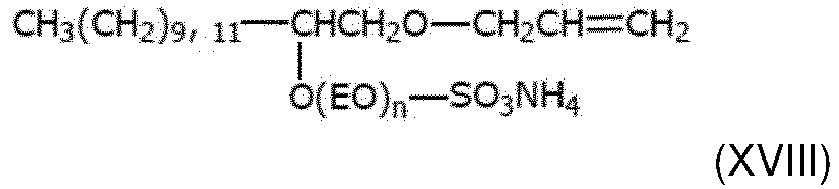
- The polymer of the aqueous polymer dispersion according to the invention may further contain h) at least one anionic polymerizable surfactant and/or at least one non-ionic polymerizable surfactant in an amount from 0.1 to 5%, preferably from 0.1 to 2% by weight with respect to the total of monomers, more preferably said polymerizable surfactant being selected as follows :
- for anionic polymerizable surfactants from : Polyoxyethylene 9-octadecenyl ether phosphate (XIV, Maxemul® 6106), unsaturated phosphate ester (XV, like Maxemul® 6112) or allyl nonyl phenol ethoxyated sulphate (XVI) (XVII) like respectively Hytenol® AR, BC or polyoxyalkylene alkenyl ether sulfate (XVIII) like Hytenol® KH-Reasop® SR SE and Latemul® PD, all as shown according to following formulas below :
(C18 H36O)-(C2H4O)n-PO3H2 (XIV)
R-O-PO3H2 (XV)
- Where R is an alkyl group containing more than 10 atom carbon and an unsaturation


- for non-ionic polymerizable surfactants, like alkyl allyl ethoxylated (IXX) (Reasop® ER, Maxemul® 5011) or allylnonyl phenol ethoxylated (XX) (Reasop® NE), respectively with the structures below :


- Suitable monomers c) may be selected from :
- hydroxyl alkyl C2-C4 (meth)acrylates, in particular hydroxyl ethyl (meth)acrylate, hydroxy propyl (meth)acrylate or hydroxybutyl (meth)acrylate or
- allyl alcohol,
- According to a specific option, the said monomer e) is present and selected from : vinyl acetate, vinyl versatate and di or mono-alkyl maleates, fumarates or styrene.
- According to another option, said monomer f) is present and selected from : acetoacetoxy (meth) acrylate, diacetone acrylamide, alkoxy silane monomers like vinyl triethoxy ethyl silane or gamma-methacryloxypropyl trimethoxysilane, ureido group containing monomers like N-(2-methacryloyloxyethyl)-ethylene urea.
- According to another option, said multifunctional monomer g) is present and selected from ethylene glycol di (meth)acrylate, trimethylol propane tri (meth) acrylate or divinyl benzenes.
- Suitable monomers a) may be selected from : methyl (meth)acrylate, ethyl (meth)acrylate, propyl (meth)acrylate, n-butyl (meth)acrylate, 2-ethyl hexyl (meth)acrylate, 2-octyl (meth)acrylate, isooctyl (meth)acrylate, nonyl(meth)acrylate or decyl (meth)acrylate, dodecyl (meth)acrylate, preferably n-butyl acrylate and preferably monomer e) is selected from styrene and monomer f) is selected from acrylonitrile.
- More particularly, said aqueous polymer dispersion as defined according to the present invention is stable at least 12 h, when diluted with high amount of organic solvents, meaning dilution with higher than 30% w/w of organic solvent, with respect to the total weight of said aqueous polymer dispersion (including the said solvent). Even more particularly, it is stable for at least 12 h at strong acidic pH, meaning pH < 2.0, in particular when diluted with an organic solvent at higher amount than 30% w/w with respect to said aqueous polymer dispersion.
- Said initiator b2) is preferably selected from ammonium persulphate, sodium persulphate or potassium persulphate.
- The aqueous polymer dispersion of the invention preferably has polymeric particles with an average particle size measured by dynamic light scattering from 20 to 3000 nm, preferably from 20 to 500 nm, with a particle size distribution which is monomodal or polymodal, more preferably being monomodal with an average particle size from 20 to 500 nm.
- The aqueous polymer dispersion of the present invention is prepared by a current emulsion polymerisation method.
- The aqueous dispersions of the present invention are prepared by a standard emulsion polymerization process with continuous addition of the pre-emulsified monomeric composition, to an aqueous solution of an emulsion initiator system, such as based on ammonium, sodium or potassium persulfate initiator. Red/ox (redox) initiator systems can also be used for low polymerization temperatures, for example using ammonium or sodium persulfate combined with metabisulfite as reducer.
- Said process may comprise a seed polymerization with a part of the pre-emulsion of the monomers ranging from 1 to 10% or without seed polymerization.
- The polymerization process may be a multistage emulsion polymerization process with at least two steps of polymerization of successively two different monomeric compositions.
- For this purpose (emulsion polymerization), a conventional surfactant or a combination of surfactants may be used as a stabilizer in said emulsion polymerization of the invention. Generally, the surfactant is at least one selected from the group consisting of anionic surfactants and/or non-ionic surfactants. Examples of preferred surfactants include, but are not limited to, alkali or ammonium salts of alkyl sulfate, alkyl aryl sulphate, alkyl ether sulphate, alkylsulfonic acid, fatty acid which may be an ethoxylated fatty acid, C10-C18 ethoxylated alcohol, sulfosuccinates and derivatives or any combination thereof. A list of suitable surfactants is available in the book "Surfactants and Polymers in Aqueous solutions" (Holmberg et al., 2002, John Wiley & Sons).
- More specifically, polymerizable surfactants can be used for producing the aqueous polymer dispersion of the present invention, which may contain anionic or non-ionic polymerizable surfactants, like Maxemul® range (Croda) or ADEKA Reasop® range or Latemul® PD range (KAO Chemicals), Noigen® and Hitenol® (Dai-Ichi Kogyo), in an amount comprised between 0.1 to 5% as presented above. Initiators can be selected preferably from ammonium persulphate, sodium persulphate or potassium persulphate as defined above in b2). The solids content (polymer w/w% vs aqueous polymer dispersion) may vary from 30 to 65%, preferably from 40 to 60%.
- The second subject-matter of the present invention relates to a binder composition, which is a two component composition, comprising at least one aqueous polymer dispersion as defined above according to the invention and the said two component composition further comprising a crosslinking agent. Said cross linking agent is reacting with the hydroxyl groups brought by comonomer c) and preferably said cross linking agent is selected from : aminoplast resins from phenolic resins, urea-formaldehyde resins, melamine-formaldehyde resins or polyisocyanates, the most preferred being phenolic resins.
- According to another option, said cross linking agent is reacting with the carboxyl group brought by comonomer d) and in particular said cross linking agent is selected from polyaziridines or polycarbodiimides with "poly-" meaning multifunctional aziridine- or carbodiimide- bearing compound.
- According to another option, said crosslinkable two components binder composition is suitable for textiles or for non-woven treatment.
- Another subject-matter of the invention relates to the use of said binder composition by applying it on a substrate selected from : cellulose fibres, glass fibres, composites, textile fibres, woven and non-woven fabrics, paper, cardboard, wood including plywood and particleboard, metals in particular aluminium, glass, plastics including plastic films.
- Another and final subject matter of the invention relates to the use of said aqueous polymer dispersion according to the invention in a two components crosslinkable binder composition.
- A more specific use of said aqueous dispersion relates to textile or non-woven treatment.
- As a particularly stable aqueous polymer dispersion in organic solvent (with respect to the addition of organic solvent), for the present invention is an aqueous polymer dispersion that after 12 h from the dilution with more than 30% of organic solvent, it is not possible to recognize coagulate polymer in the bottom of the bottle where the mixture has been prepared or particles floating in the mixture.
- As a particularly stable aqueous polymer dispersion according to the present invention, at low acidic pH is an aqueous polymer dispersion which after 12 h from the acidification of the mixture at pH < 2.0, with strong acids, it is not possible to recognize coagulate polymer in the bottom of the bottle where the mixture has been prepared or particles floating in the mixture. This could be alone or combined with organic solvents.
- The aqueous polymer dispersion of the present invention could be used as the single binder in a composition or combined with other binders. This composition could be a mono-component composition, meaning that it is not necessary to add any cross-linker agent before its use or a two-component composition meaning a crosslinking agent should be added before the use of the composition. This cross-linker could also be intended a reactive co-binder.
- In this last case, the cross linking agents could be able to react with the hydroxyl groups brought by co-monomer c). Suitable crosslinking agents can be aminoplast resins, (phenolic, urea-formaldehyde, melamine-formaldehyde resins) or polyisocyanates, in particular the most preferred are phenolic resins.
- Otherwise, the cross linking agents can react with the carboxyl group brought by comonomer d) and suitable crosslinking agents in this case can be polyaziridines or polycarbodimmides
- These crosslinkable compositions can be used for textiles or non-woven cellulose fibres, glass fibres, composite, textile fibres, woven and non-woven fabrics, paper, cardboard, wood including plywood and particleboard, metals, glass, plastics including plastic films.
- The following examples are given only for illustrating the present invention and its performances and consequently, they do not limit the covering and scope of the present invention.
- The following examples are presented for illustrating the invention and its performances and consequently the covering of the invention is not limited to these examples.
-
Table 1 : Table of raw materials used Commercial reference Chemical description Component type vs invention Technical function Supplier Disponil® FES32 Fatty alcohol ethoxylated sulphate sodium salt - Surfactant BASF Disponil® A1065 Fatty alcohol ethoxylated - Surfactant BASF Methacrylic acid Acrylic acid d monomer EVONIK Hydroxy ethyl methacrylate Hydroxy ethyl methacrylate c monomer EVONIK Butyl acrylate Butyl acrylate a monomer ARKEMA Styrene Styrene e monomer VERSALIS Deionized water water - solvent ARKEMA Sodium Persulphate Sodium Persulphate b2 initiator PEROXITALIA tert-butylhydroperoxide tert-butyl hydroperoxide - initiator ARKEMA Bruggolite® FF6 Derivative of sulfinic acid - activator Bruegmann NaAMPS 2405 2- acrylamido 2 methyl propane sulfonic acid sodium salt (50% solution)b1 monomer Lubrizol Ammonia Ammonia - Neutralizing agent - Production of an aqueous polymer dispersion, with :
1480 g of deionized water and 12 g of Disponil® FES32 are added to a glass reactor fitted with a condenser, a stirrer, a temperature control system and inlets for nitrogen, the initiator solutions and the pre-emulsion feed, respectively. A monomer pre-emulsion composed of 1087 g of deionized water, 141 g of Disponil® FES32 and 48 g of Disponil® A1065, 1658 g of butyl acrylate, 2028 g of styrene, 79 g of methacrylic acid and 231 g of hydroxy ethyl methacrylate is prepared in another container fitted with a stirrer (pre-emulsifier). - When the contents of the reactor have reached a temperature of 80°C, 286 g of the monomer pre-emulsion and 16 g of 10% sodium persulphate aqueous solution are added into the reactor. About one minute after the addition of initiator, the remaining portion of the monomer pre-emulsion and 300 g of 5% sodium persulphate aqueous solution, over a period of 2 hours, taking care to keep the contents of the reactor at a temperature of 80°C throughout the introduction. Then, the reaction medium is maintained at 80°C for a further 45 minutes then cooled to 70°C and 53 g of 13% tert-butylhydroperoxide and 143 g of a 6% Bruggolite® FF6 solution are fed separately into the reactor at 60°C over a period of 90 minutes at constant rate.
- Half an hour after the end of the above addition, the product obtained is cooled to 35°C. At the end, the mixture is filtered through a screen of 36 mesh.
- The pH and solids content are adjusted respectively with ammonia to be between 5.0 and 6.0 and demi water to about 50%.
- The dispersion obtained has a pH of 5.6, a viscosity (Brookfield RVT at 20 rpm and at 23°C) of 300 mPa.s, a dry residue (solids content) of 49.9% by weight (1 h at 105°C) and a pre-coagulate content on a screen of 275 mesh of about 170 ppm and particle size of 130 nm.
- This dispersion is comparative because its amount of sulfo groups coming from the initiator is of 0.03 meq/g (lower than 0.05 meq/g which is the minimal required for the dispersion of the invention) the hydroxyl group amount being of 0.42 meq/g calculated vs the total weight of monomers (corresponding to the total weight of polymer).
- We proceed as in the above-disclosed example 1, with the same reactants amounts and global duration of the monomer pre-emulsion feeding at a constant rate over, but the amount of
solution 5% strength of sodium persulphate, fed together with the pre-emulsion is increased to 895 g. - The pH and solids content are adjusted respectively with ammonia to be between 5.0 and 6.0 and demi water to about 50%. The dispersion obtained has a pH of 5.8, a viscosity (Brookfield RVT at 20 rpm and at 23°C) of 160 mPa.s, a dry residue (solids content) of 50.7% by weight (1 h at 105°C), and a pre-coagulate content on a screen of 275 mesh of about 80 ppm and particle size of 125 nm. Sulfo group amount: 0.102 meq/g and OH : 0.42 meq/g.
- Production of an aqueous polymer dispersion, with :
1480 g of deionized water and 12 g of Disponil® FES32 are added to a glass reactor fitted with a condenser, a stirrer, a temperature control system and inlets for nitrogen, the initiator solutions and the pre-emulsion feed, respectively. A monomer pre-emulsion composed of 1087 g of deionized water, 141 g of Disponil® FES32 and 48 g of Disponil® A1065, 1658 g of butyl acrylate, 2028 g of styrene, 79 g of methacrylic acid and 231 g of hydroxyl ethyl methacrylate is prepared in another container fitted with a stirrer (pre-emulsifier). - When the contents of the reactor have reached a temperature of 50°C, 286 g of the monomer pre-emulsion and then 4.8 g of 13% tert-butylhydroperoxide solution, 60 mg of ferrous sulphate dissolved in 2 g of deionized water and 10.5 g of 6% Bruggolite® FF6 solution are added into the reactor. About one minute after the addition of initiator, the remaining portion of the monomer pre-emulsion and 89 g of tert-butylhydroperoxide and 192 g of a 6% solution of Bruggolite® FF6 in deionized water are fed into the reactor at a constant feed rate, over a period of 2 hours, taking care to keep the contents of the reactor at a temperature of 65°C throughout the introduction. Then, the reaction medium is maintained at 65°C for a further 45 minutes then cooled to 70°C and 53 g of 13% tert-butylhydroperoxide and 143 g of a 6% Bruggolite® FF6 solution are fed separately into the reactor at 60°C over a period of 90 minutes at constant rate.
- Half an hour after the end of the above addition, the product obtained is cooled to 35°C. At the end, the mixture is filtered through a screen of 36 mesh.
- The solids content is adjusted with demineralised water to about 50%. The dispersion obtained has a pH of 5.9, a viscosity (Brookfield RVT at 20 rpm and at 23°C) of 1085 mPa.s, a dry residue (solids content) of 49.7% by weight (1 h at 105°C) and a pre-coagulate content on a screen of 275 mesh of about 110 ppm and particle size of 110 nm.
- Sulfo groups = 0 meq/ g and OH = 0.42 meq/g.
- We proceed as in the previous disclosed example 1, with the same reactants, but we added in the pre-emulsion, after having transferred the amounts for the polymerization start, 130 g more of NaAMPS 2405.
- After the final treatment, the product is cooled, then the mixture is filtered through a screen of 36 mesh. The pH and solids content are adjusted respectively with ammonia to be between 5.0 and 6.0 and demineralised water to about 50%. The dispersion obtained has a pH of 5.4, a viscosity (Brookfield RVT at 20 rpm and at 23°C) of 2200 mPa.s, a dry residue (solids content) of 50.3% by weight (1 h at 105°C) and a pre-coagulate content on a screen of 275 mesh of about 151 ppm and particle size of 126 nm. Sulfo groups = 0.104 meq/g and OH groups = 0.41 meq/g.
- The summary of the monomeric and initiator composition of the polymer dispersions of the examples 1 to 4 and their characteristics are respectively reported in table 2 and in table 3 :
Table 2 : monomeric composition and initiators used during the feed, for examples 1 to 4 (% on total monomers) Example 1 Example 2 Example 3 Example 4 Butyl Acrylate 42 42 42 42 Styrene 51 51 51 51 Hydroxyethyl methacrylate 5.5 5.5 5.5 5.5 Methacrylic acid 1.5 1.5 1.5 1.5 2 Acrylamido 2 Methyl Propane SulfonicAcid Sodium salt 0 0 0 1.65 Sodium persulphate 0.4 1.2 0 0.4 Terbutyl hydroperoxide* 0 0 0.30 0 Bruggolite® FF6* 0 0 0.31 0 sulfo groups (meq/gr) 0.034 0.102 0 0.104 hydroxy groups (meq/gr) 0.42 0.42 0.42 0.41 * Not considered the amount used to decrease residual monomer content after polymerization Table 3 : characteristics of the polymer dispersions of the examples 1 to 4 Example 1 Example 2 Example 3 Example 4 Solids (%) 49.9 50.7 49.7 50.3 pH 5.6 5.8 5.9 5.4 Viscosity (mPa,s, 20 rpm) 300 160 1085 2200 Dry coagulum 170 80 110 151 Particle size (nm) 130 125 110 126 - The zeta potential is an indicator of the stability of colloidal dispersions, its magnitude indicates the degree of electrostatic repulsion between adjacent, similarly charged particles in a dispersion. When the potential is small, attractive forces may exceed this repulsion and the dispersion may break and flocculate. Therefore, colloids with high zeta potential (negative or positive) are electrically stabilized while colloids with low zeta potentials tend to coagulate. By using a Malvern Nanosizer ZS90, we carried out measurements of the Z potential of the polymer dispersion of the present invention at different pH in order to try to measure its stability in harsh conditions, meaning very low pH (< 2.0).
- The Z potential of the aqueous polymer dispersion of the examples of the present invention measured at different pH are showed in the following graphic 1. By using it, it is possible to recognise that examples 2 and 4, which show the best stability in methanol and acid conditions, also exhibit lower Z potential at pH < 2.0 than comparative examples 1 and 3, which is a clear sign of higher stability at this lower pH.
- In a closed glass bottle, with a magnetic stirrer, 950 gr of methanol are added slowly under stirring to 100 g of polymer dispersion with 50% solids, when the addition is ended the mixture is stirred for further 60'.
- Then, the product is considered stable, if after 12 h it is not possible to recognize visually, any coagulate polymer in the bottom or any particles floating in the mixture.
- After having prepared the mixture as disclosed above in the stability test in methanol, are added slowly in said mixture and under stirring, some drops of 98% sulphuric acid in order to reach a pH of the mixture < 2.0, measured by indicator paper and when the addition is ended, the mixture is stirred for further 60 minutes. Then, the product is considered stable, if after 12 h, it is not possible to recognize visually, any coagulate polymer in the bottom or any particles floating in the said mixture.
- The results of the stability test are showed in the following table 4.
Table 4 : stability test results (in hours) in methanol alone and with acidic pH of the polymer dispersions of the examples 1 to 4 Example 1 Example 2 Example 3 Example 4 Stability test in methanol (h) 5 > 12 6 > 12 Stability test in methanol and acid (h) 2 > 12 3 > 12 - The invention relates to the following items:
-
Item 1. An aqueous polymer dispersion, characterized in that said polymer comprises units and/or groups issued from :- a) at least one (meth)acrylic monomer which is a (meth)acrylic ester of a C1-C12 alcohol which alcohol is linear (C1-C12) or branched (C4-C12), without any other functional group than (meth)acrylate
- b) at least one from monomer b1) or initiator b2) or both b1) and b2) as defined below :
- b1) at least one vinylic, allylic or (meth)acrylic monomer, preferably vinylic or (meth)acrylic monomer, bearing an anionic group derived from strong acids with pKa < 3, preferably < 2
- b2) at least one initiator, bearing the same anionic group as b1)
- c) at least one hydroxy-functional vinylic, allylic or (meth)acrylic monomer, preferably vinylic or (meth)acrylic monomer
- d) optionally, at least one carboxy-functional ethylenically unsaturated monomer
- e) optionally, at least one vinylic monomer bearing only one vinyl group, without any other functional group than vinylic group
- f) optionally, at least one vinylic or (meth)acrylic monomer bearing at least one functional group selected from : nitrile, amide, acetoacetoxy, diacetone, free silane or alkoxy-blocked silane, epoxy, urea or ureïdo
- g) optionally, at least one multifunctional vinylic or (meth)acrylic monomer
- the anionic groups as defined in b) in an amount of at least 0.05 meq/g, preferably from 0.07 to 0.30 meq/g (as calculated) with respect to said polymer and
- hydroxy groups as defined in c) in an amount of at least 0.1 meq/g, preferably from 0.1 to 0.8 meq/g (as calculated) with respect to said polymer.
-
Item 2. The aqueous dispersion according toItem 1, characterized in that said monomer d) is present and said polymer in a weight content with respect to said polymer of 0.05% to 6%. -
Item 3. The aqueous polymer dispersion according toItem - a sulfonic acid group (-SO3H) (I) or half- ester group of sulphuric acid (II) and their corresponding salts or a phosphonic acid group (III) or an partial ester group of phosphoric acid (IV e V) and their corresponding salts as presented in the following formulas (I) to (V) below and beared by the polymeric residue represented by R :


- a sulfonic acid group (-SO3H) (I) or half- ester group of sulphuric acid (II) and their corresponding salts or a phosphonic acid group (III) or an partial ester group of phosphoric acid (IV e V) and their corresponding salts as presented in the following formulas (I) to (V) below and beared by the polymeric residue represented by R :
-
Item 4. The aqueous polymer dispersion according to any one ofItems 1 to 3, characterized in that said anionic groups as defined in b) are issued from :- b1) monomers selected from the group consisting of the following acids and their salts, preferably salts of sodium, ammonium or other cations, of :
- 2
acrylamido 2 methyl propane sulfonic acid (VI), styrene sulfonic acid (VII), 1-allyloxy-2-hydroxypropane sulfonic acids (VIII), vinyl sulfonic acid (IX), 3 sulfo propyl acrylate acid (X), - monomeric partial esters of phosphoric acid and derivatives, like bis(methacryloyloxyethyl)hydrogen phosphate (XI) or 2-(phosphonooxy)ethyl methacrylate (XII), vinyl phosphonic acid (XIII).


- 2
- b2) initiators selected from the group consisting of : sodium persulphate, ammonium persulphate and potassium persulphate.
- b1) monomers selected from the group consisting of the following acids and their salts, preferably salts of sodium, ammonium or other cations, of :
-
Item 5. The aqueous polymer dispersion according to any one ofItems 1 to 4, characterized in that the said polymer further contains h) at least one anionic and/or non-ionic polymerizable surfactant in an amount from 0.1 to 5%, preferably said polymerizable surfactant being selected :- for anionic polymerizable surfactants, from Polyoxyethylene 9-octadecenyl ether phosphate (XIV) unsaturated phosphate ester (XV) or allyl nonyl phenol ethoxyated sulphate (XVI, XVII) or polyoxyalkylene alkenyl ether sulfate (XVIII) as shown below in the following formulas :
(C18 H36O)-(C2H4O)n-PO3H2 (XIV)
R-O-PO3H2 (XV)
where R is an alkyl group containing more than 10 atom carbon and an unsaturation


- for non-ionic polymerizable surfactants from : alkyl allyl ethoxylated (IXX), allylnonyl phenol ethoxylated (XX), respectively with the structures below :


- for anionic polymerizable surfactants, from Polyoxyethylene 9-octadecenyl ether phosphate (XIV) unsaturated phosphate ester (XV) or allyl nonyl phenol ethoxyated sulphate (XVI, XVII) or polyoxyalkylene alkenyl ether sulfate (XVIII) as shown below in the following formulas :
-
Item 6. The aqueous polymer dispersion according to any one ofItems 1 to 5, characterized in that monomer c) is selected from :- hydroxyl alkyl C2-C4 (meth)acrylates, in particular hydroxyl ethyl (meth)acrylate, hydroxy propyl (meth)acrylate or hydroxybutyl (meth)acrylate or
- allyl alcohol
-
Item 7. The aqueous polymer dispersion according to any one ofItems 1 to 6, characterized in that said monomer e) is present and selected from : vinyl acetate, vinyl versatate and di or mono-alkyl maleates or fumarates or styrene. - Item 8. The aqueous polymer dispersion according to any one of
Items 1 to 7, characterized in that said monomer f) is present and selected from : acetoacetoxy (meth)acrylate, diacetone acrylamide, alkoxy silane monomers like vinyl triethoxy ethyl silane or gamma-methacryloxypropyltrimethoxysilane, ureido group containing monomers like N-(2-methacryloyloxyethyl)-ethylene urea. - Item 9. The aqueous polymer dispersion according to any one of
Items 1 to 8, characterized in that said multifunctional monomer g) is present and selected from ethylene glycol di (meth)acrylate, trimethylol propane tri (meth) acrylate or divinyl benzenes. -
Item 10. The aqueous dispersion according to any one ofItems 1 to 9, characterized in that monomer a) is selected from : methyl (meth)acrylate, ethyl (meth)acrylate, propyl (meth)acrylate, n-butyl (meth)acrylate, 2-ethyl hexyl (meth)acrylate, 2-octyl (meth)acrylate, isooctyl (meth)acrylate, nonyl(meth)acrylate, decyl (meth)acrylate or dodecyl (meth)acrylate, preferably n-butyl acrylate and preferably in that monomer e) is selected from styrene and monomer f) is selected from acrylonitrile. - Item 11. The aqueous dispersion according to any one of
Items 1 to 10, characterized in that it is stable at least 12 h, when diluted with high amount of organic solvents, meaning dilution with higher than 30% w/w of organic solvent, with respect to the total weight of said aqueous polymer dispersion (including the said solvent). - Item 12. The aqueous dispersion according to any one of
Items 1 to 11, characterized in that it is stable for at least 12 h at strong acidic pH meaning pH < 2.0, in particular when diluted with an organic solvent at higher than 30% w/w as defined in Item 11. - Item 13. The aqueous dispersion according to any one of
Items 1 to 12, characterized in that the said initiator b2) is selected from ammonium persulphate, sodium persulphate or potassium persulphate. - Item 14. The aqueous polymer dispersion according to any one of
Items 1 to 13, characterized that it has polymeric particles average particle size measured by dynamic light scattering, from 20 to 3000 nm, preferably from 20 to 500 nm, with a particle size distribution which is monomodal or polymodal, more preferably being monomodal with an average particle size from 20 to 500 nm. -
Item 15. A binder composition, characterized in that it is a two component composition, comprising at least one aqueous polymer dispersion as defined according to any one ofItems 1 to 14 and the said two component composition further comprising a crosslinking agent. - Item 16. A binder composition according to
Item 15, characterized in that said cross linking agent is reacting with the hydroxyl groups brought by comonomer c), said cross linking agent being preferably selected from : aminoplast resins, phenolic, urea-formaldehyde, melamine-formaldehyde resins, polyisocyanates, polyaziridines or polycarbodiimides, in particular the most preferred being phenolic resins. - Item 17. A binder composition according to
Item 15 or 16, characterized in that said cross linking agent is reacting with the carboxyl group brought by comonomer d) and in particular said cross linking agent is selected from polyaziridines or polycarbodimmides. - Item 18. A binder composition according to
Item 15 or 16, characterized in that it is suitable for textiles or non-woven treatment. - Item 19. Use of a binder composition according to any one of
Items 15 to 17, characterized in that it is applied on a substrate selected from : cellulose fibers, glass fibers, composites, textile fibers, woven and non-woven fabrics, paper, cardboard, wood including plywood and particleboard, metals in particular aluminum, glass, plastics including plastic films. -
Item 20. Use of an aqueous polymer dispersion according to any one ofItems 1 to 14, characterized in that it relates to a two components crosslinkable binder composition. - Item 21. Use according to
Item 20, characterized in that it relates to textile or non-woven treatment.
Claims (15)
- An aqueous polymer dispersion, characterized in that said polymer comprises units and/or groups issued from :a) at least one (meth)acrylic monomer which is a (meth)acrylic ester of a C1-C12 alcohol which alcohol is linear (C1-C12) or branched (C4-C12), without any other functional group than (meth)acrylateb) at least one from monomer b1) or initiator b2) or both b1) and b2) as defined below :b1) at least one vinylic, allylic or (meth)acrylic monomer, preferably vinylic or (meth)acrylic monomer, bearing an anionic group derived from strong acids with pKa < 3, preferably < 2b2) at least one initiator, bearing the same anionic group as b1)c) at least one hydroxy-functional vinylic, allylic or (meth)acrylic monomer, preferably vinylic or (meth)acrylic monomerd) optionally, at least one carboxy-functional ethylenically unsaturated monomere) optionally, at least one vinylic monomer bearing only one vinyl group, without any other functional group than vinylic groupf) optionally, at least one vinylic or (meth)acrylic monomer bearing at least one functional group selected from : nitrile, amide, acetoacetoxy, diacetone, free silane or alkoxy-blocked silane, epoxy, urea or ureïdog) optionally, at least one multifunctional vinylic or (meth)acrylic monomer and in that said polymer bears :wherein said anionic groups as defined in b) are half-ester groups of sulphuric acid and their corresponding salts as presented in the following formula (II) below and borne by the polymeric residue represented by R :- the anionic groups as defined in b) in an amount of at least 0.05 meq/g, preferably from 0.07 to 0.30 meq/g (as calculated) with respect to said polymer and- hydroxy groups as defined in c) in an amount of at least 0.1 meq/g, preferably from 0.1 to 0.8 meq/g (as calculated) with respect to said polymer
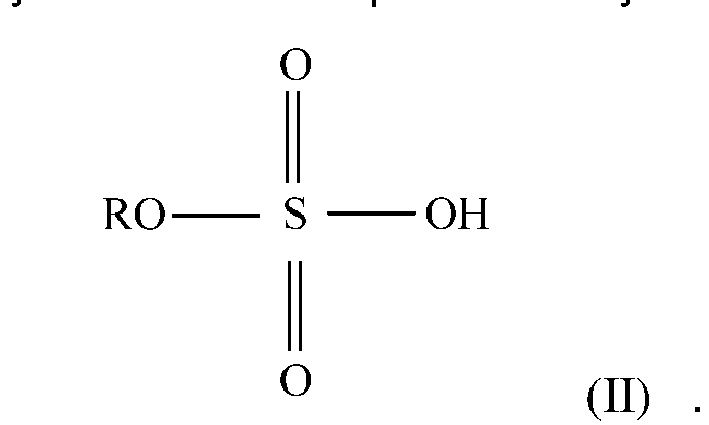
- The aqueous dispersion according to claim 1, characterized in that said monomer d) is present in said polymer in a weight content with respect to said polymer of 0.05% to 6%.
- The aqueous polymer dispersion according to claim 1 or 2, characterized in that said anionic groups as defined in b) are issued from :
b2) initiators selected from the group consisting of : sodium persulphate, ammonium persulphate and potassium persulphate. - The aqueous polymer dispersion according to any one of claims 1 to 3, characterized in that said polymer further bears anionic groups selected from the group consisting of a sulfonic acid group (-SO3H) (I), a phosphonic acid group (III), a partial ester group of phosphoric acid (IV and V) and their corresponding salts as presented in the following formulas (I) and (III) to (V) below and borne by the polymeric residue represented by R :


- The aqueous polymer dispersion according to any one of claims 1 to 4, characterized in that said polymer further bears anionic groups issued from monomers selected from the group consisting of the following acids and their salts, preferably salts of sodium, ammonium or other cations, of :- 2 acrylamido 2 methyl propane sulfonic acid (VI, as shown below), styrene sulfonic acid (VII), 1-allyloxy-2-hydroxypropane sulfonic acids (VIII), vinyl sulfonic acid (IX), 3 sulfo propyl acrylate acid (X)- monomeric partial esters of phosphoric acid and derivatives, like bis(methacryloyloxyethyl) hydrogen phosphate (XI) or 2-(phosphonooxy)ethyl methacrylate (XII), vinyl phosphonic acid (XIII),


- The aqueous polymer dispersion according to any one of claims 1 to 5, characterized in that the said polymer further contains h) at least one anionic and/or non-ionic polymerizable surfactant in an amount from 0.1 to 5%, preferably said polymerizable surfactant being selected :- for anionic polymerizable surfactants, from Polyoxyethylene 9-octadecenyl ether phosphate (XIV) unsaturated phosphate ester (XV) or allyl nonyl phenol ethoxyated sulphate (XVI, XVII) or polyoxyalkylene alkenyl ether sulfate (XVIII) as shown below in the following formulas :
(C18 H36O)-(C2H4O)n-PO3H2 (XIV)
R-O-PO3H2 (XV)
where R is an alkyl group containing more than 10 atom carbon and an unsaturation

 - for non-ionic polymerizable surfactants from : alkyl allyl ethoxylated (IXX), allylnonyl phenol ethoxylated (XX), respectively with the structures below :

- The aqueous polymer dispersion according to any one of claims 1 to 6, characterized in that monomer c) is selected from :- hydroxyl alkyl C2-C4 (meth)acrylates, in particular hydroxyl ethyl (meth)acrylate, hydroxy propyl (meth)acrylate or hydroxybutyl (meth)acrylate or- allyl alcoholpreferably, monomer c) being selected from hydroxyl alkyl C2-C4 (meth)acrylates.
- The aqueous polymer dispersion according to any one of claims 1 to 7, characterized in that said monomer f) is present and selected from : acetoacetoxy (meth)acrylate, diacetone acrylamide, alkoxy silane monomers like vinyl triethoxy ethyl silane or gamma-methacryloxypropyltrimethoxysilane, ureido group containing monomers like N-(2-methacryloyloxyethyl)-ethylene urea.
- The aqueous dispersion according to any one of claims 1 to 8, characterized in that monomer a) is selected from : methyl (meth)acrylate, ethyl (meth)acrylate, propyl (meth)acrylate, n-butyl (meth)acrylate, 2-ethyl hexyl (meth)acrylate, 2-octyl (meth)acrylate, isooctyl (meth)acrylate, nonyl(meth)acrylate, decyl (meth)acrylate or dodecyl (meth)acrylate, preferably n-butyl acrylate and preferably in that monomer e) is selected from styrene and monomer f) is selected from acrylonitrile.
- A binder composition, characterized in that it is a two component composition, comprising at least one aqueous polymer dispersion as defined according to any one of claims 1 to 9 and the said two component composition further comprising a crosslinking agent.
- A binder composition according to claim 10, characterized in that said cross linking agent is reacting with the hydroxyl groups brought by comonomer c), said cross linking agent being preferably selected from : aminoplast resins, phenolic, urea-formaldehyde, melamine-formaldehyde resins, polyisocyanates, polyaziridines or polycarbodiimides, in particular the most preferred being phenolic resins.
- A binder composition according to claim 10 or 11, characterized in that said cross linking agent is reacting with the carboxyl group brought by comonomer d) and in particular said cross linking agent is selected from polyaziridines or polycarbodimmides.
- Use of a binder composition according to any one of claims 10 to 12, characterized in that it is applied on a substrate selected from : cellulose fibers, glass fibers, composites, textile fibers, woven and non-woven fabrics, paper, cardboard, wood including plywood and particleboard, metals in particular aluminum, glass, plastics including plastic films.
- Use of an aqueous polymer dispersion according to any one of claims 1 to 9, characterized in that it relates to a two components crosslinkable binder composition.
- Use according to claim 14, characterized in that it relates to textile or non-woven treatment.
Applications Claiming Priority (3)
| Application Number | Priority Date | Filing Date | Title |
|---|---|---|---|
| EP17183080.5A EP3434701A1 (en) | 2017-07-25 | 2017-07-25 | Stable aqueous polymer dispersions |
| EP18734600.2A EP3658594B1 (en) | 2017-07-25 | 2018-07-05 | Stable aqueous polymer dispersions |
| PCT/EP2018/068294 WO2019020342A1 (en) | 2017-07-25 | 2018-07-05 | Stable aqueous polymer dispersions |
Related Parent Applications (2)
| Application Number | Title | Priority Date | Filing Date |
|---|---|---|---|
| EP18734600.2A Division-Into EP3658594B1 (en) | 2017-07-25 | 2018-07-05 | Stable aqueous polymer dispersions |
| EP18734600.2A Division EP3658594B1 (en) | 2017-07-25 | 2018-07-05 | Stable aqueous polymer dispersions |
Publications (1)
| Publication Number | Publication Date |
|---|---|
| EP3896103A1 true EP3896103A1 (en) | 2021-10-20 |
Family
ID=59579383
Family Applications (3)
| Application Number | Title | Priority Date | Filing Date |
|---|---|---|---|
| EP17183080.5A Withdrawn EP3434701A1 (en) | 2017-07-25 | 2017-07-25 | Stable aqueous polymer dispersions |
| EP18734600.2A Active EP3658594B1 (en) | 2017-07-25 | 2018-07-05 | Stable aqueous polymer dispersions |
| EP21176952.6A Pending EP3896103A1 (en) | 2017-07-25 | 2018-07-05 | Stable aqueous polymer dispersions |
Family Applications Before (2)
| Application Number | Title | Priority Date | Filing Date |
|---|---|---|---|
| EP17183080.5A Withdrawn EP3434701A1 (en) | 2017-07-25 | 2017-07-25 | Stable aqueous polymer dispersions |
| EP18734600.2A Active EP3658594B1 (en) | 2017-07-25 | 2018-07-05 | Stable aqueous polymer dispersions |
Country Status (8)
| Country | Link |
|---|---|
| US (1) | US12503535B2 (en) |
| EP (3) | EP3434701A1 (en) |
| CN (2) | CN116987464A (en) |
| CA (1) | CA3066542A1 (en) |
| ES (1) | ES2923146T3 (en) |
| MX (1) | MX2019014962A (en) |
| PL (1) | PL3658594T3 (en) |
| WO (1) | WO2019020342A1 (en) |
Cited By (1)
| Publication number | Priority date | Publication date | Assignee | Title |
|---|---|---|---|---|
| WO2025103901A1 (en) | 2023-11-14 | 2025-05-22 | Basf Se | Polymer dispersions for coatings |
Families Citing this family (6)
| Publication number | Priority date | Publication date | Assignee | Title |
|---|---|---|---|---|
| TW202214726A (en) * | 2020-06-19 | 2022-04-16 | 日商日產化學股份有限公司 | Composition for coating film formation including phosphate-group-containing polymer |
| KR102536798B1 (en) * | 2020-07-15 | 2023-05-26 | 주식회사 케이씨씨 | Water-soluble coating composition for top coat |
| KR102649582B1 (en) * | 2021-06-30 | 2024-03-21 | 문계휴 | A coating composition for safety net made of polyester fabric and manufacturing method thereof |
| CN114395294A (en) * | 2021-12-02 | 2022-04-26 | 明光科迪新材料有限公司 | Color paste for intelligent color mixing system and preparation method thereof |
| CN115417948A (en) * | 2022-09-29 | 2022-12-02 | 湖北双键精细化工有限公司 | Hydroxyl-containing acrylic acid aqueous dispersion and preparation method thereof |
| WO2025132646A1 (en) * | 2023-12-19 | 2025-06-26 | Basf Se | Waterborne coating compositions requiring reduced amounts of biocides |
Citations (13)
| Publication number | Priority date | Publication date | Assignee | Title |
|---|---|---|---|---|
| US4151149A (en) * | 1976-09-27 | 1979-04-24 | Union Oil Company Of California | Vinylidene chloride polymer latices |
| EP0357149A2 (en) | 1988-09-01 | 1990-03-07 | DowElanco | Stable concentrate formulations and emulsions of waterinsoluble organic pesticides, their use and preparation |
| US5910532A (en) | 1997-05-29 | 1999-06-08 | The Dow Chemical Company | Multisolvent-based film-forming compositions |
| US6201048B1 (en) * | 1997-09-18 | 2001-03-13 | Eastman Chemical Company | Stable waterborne polymer compositions containing poly(alkyleneimines) |
| US20010034399A1 (en) * | 2000-03-23 | 2001-10-25 | Wacker Polymer System Gmbh & Co. Kg | Crosslinkable polymer composition |
| US6417267B1 (en) * | 1996-05-28 | 2002-07-09 | Eastman Chemical Company | Adhesive compositions containing stable amino-containing polymer latex blends |
| EP1245240A1 (en) | 2001-03-30 | 2002-10-02 | The Procter & Gamble Company | Skin-compatible hydrogel adhesives and personal care products containing them |
| US20040209992A1 (en) * | 2001-05-17 | 2004-10-21 | Daniele Becchi | Process for obtaining aqueous polymer dispersions |
| WO2011080067A2 (en) * | 2009-12-18 | 2011-07-07 | Basf Se | Polymer dispersions for corrosion protection |
| EP2692753A1 (en) | 2012-07-31 | 2014-02-05 | Rohm and Haas Company | Sulphonic acid monomer based compositions |
| EP2692752A1 (en) | 2012-07-31 | 2014-02-05 | Rohm and Haas Company | Sulphonic acid monomer based compositions |
| WO2014139074A1 (en) | 2013-03-11 | 2014-09-18 | Dow Global Technologies Llc | Binder composition and its application in anti-dewing coating composition |
| US20170030015A1 (en) * | 2015-07-29 | 2017-02-02 | Aron Universal Ltd. | Polymer composition and process for making the same |
Family Cites Families (27)
| Publication number | Priority date | Publication date | Assignee | Title |
|---|---|---|---|---|
| DE2459160C3 (en) | 1974-12-14 | 1984-10-18 | Basf Ag, 6700 Ludwigshafen | Process for the preparation of aqueous dispersions of copolymers of non-tertiary acrylic acid esters |
| DE3304695A1 (en) | 1983-02-11 | 1984-08-16 | Basf Ag, 6700 Ludwigshafen | ADHESIVE ADHESIVE BASED ON AQUEOUS POLYACRYLATE DISPERSIONS FOR REMOVABLE PAPER LABELS |
| JPS62104802A (en) * | 1985-07-24 | 1987-05-15 | Asahi Denka Kogyo Kk | Emulsifier for emulsion polymerization |
| DE69008334T2 (en) | 1989-08-14 | 1994-11-03 | Avery Dennison Corp., Pasadena, Calif. | EMULSION OF PRESSURE-SENSITIVE ADHESIVE POLYMERS WITH EXCELLENT BEHAVIOR AT ROOM AND LOW TEMPERATURES. |
| DE4307683A1 (en) | 1993-03-11 | 1994-09-15 | Basf Ag | Process for the preparation of an aqueous polymer dispersion |
| DE4316379A1 (en) | 1993-05-17 | 1994-11-24 | Basf Ag | Low-odor dispersion pressure sensitive adhesive |
| DE19624281A1 (en) | 1996-06-18 | 1998-01-02 | Basf Ag | Process for the preparation of low-viscosity, aqueous polymer dispersions with polymer volume concentrations of at least 50% by volume |
| CA2213052A1 (en) * | 1996-07-31 | 1998-01-31 | Elf Atochem S.A. | Pressure-sensitive adhesive polymers |
| US5869589A (en) * | 1997-07-17 | 1999-02-09 | Raynolds; Peter Webb | Self-crosslinking aqueous dispersions |
| DE19707746A1 (en) | 1997-02-26 | 1998-08-27 | Basf Ag | Use of copolymers of ethylenically unsaturated carboxylic acids and their hydroxyalkyl esters as drying aids |
| CA2356970C (en) * | 1998-12-24 | 2009-09-01 | Akzo Nobel N.V. | Aqueous coating composition and a polyol for such a composition |
| GB0024243D0 (en) * | 2000-10-04 | 2000-11-15 | Avecia Bv | Production of Aqueous polymer emulsions |
| US6426121B1 (en) * | 2000-10-17 | 2002-07-30 | Air Products Polymers, L.P. | Dual crosslinkable emulsion polymers at ambient conditions |
| US6927267B1 (en) | 2002-03-07 | 2005-08-09 | Basf Ag | High solids dispersion for wide temperature, pressure sensitive adhesive applications |
| CN1244658C (en) | 2002-11-08 | 2006-03-08 | 江苏圣杰实业有限公司 | Water based copolymer adhesive for artificial board and its preparation method |
| WO2004074327A1 (en) | 2003-02-19 | 2004-09-02 | Kansai Paint Co., Ltd. | Process for producing aqueous resin dispersion |
| MX2007006411A (en) * | 2004-12-02 | 2008-03-11 | Cray Valley Italia S R L | Aqueous polymer dispersion useful for preparing base-coat composition for embossed leather. |
| DE102006001529A1 (en) | 2006-01-12 | 2007-07-26 | Basf Coatings Ag | Powder coating suspensions (powder slurries) and powder coatings, process for their preparation and their use |
| PL2225289T3 (en) * | 2007-12-21 | 2018-08-31 | Basf Se | Method for the production of aqueous polymer dispersions |
| US20110207851A1 (en) * | 2008-09-02 | 2011-08-25 | Basf Se | Use of aqueous composite-particle dispersions as binders in elastic coatings |
| ES2438507T3 (en) | 2009-11-02 | 2014-01-17 | Basf Se | Labels that can be removed with washing liquids |
| WO2012131050A1 (en) * | 2011-04-01 | 2012-10-04 | Basf Coatings Gmbh | Aqueous, hydroxyl functional acrylic copolymerisate dispersions |
| CN106103496B (en) * | 2013-12-20 | 2019-02-05 | 巴斯夫涂料有限公司 | Primary aqueous dispersion, process for its preparation and use thereof |
| JP6536344B2 (en) * | 2015-10-13 | 2019-07-03 | 横浜ゴム株式会社 | Waterborne primer composition for sealing material |
| WO2017065174A1 (en) * | 2015-10-13 | 2017-04-20 | 横浜ゴム株式会社 | Water-based primer composition for sealant |
| US10058502B2 (en) * | 2015-12-31 | 2018-08-28 | L'oreal | Nail polish compositions |
| JP2025104802A (en) * | 2023-12-28 | 2025-07-10 | 住友重機械工業株式会社 | Mold Equipment |
-
2017
- 2017-07-25 EP EP17183080.5A patent/EP3434701A1/en not_active Withdrawn
-
2018
- 2018-07-05 CN CN202310764639.6A patent/CN116987464A/en active Pending
- 2018-07-05 WO PCT/EP2018/068294 patent/WO2019020342A1/en not_active Ceased
- 2018-07-05 CA CA3066542A patent/CA3066542A1/en active Pending
- 2018-07-05 EP EP18734600.2A patent/EP3658594B1/en active Active
- 2018-07-05 CN CN201880045315.4A patent/CN110831987A/en active Pending
- 2018-07-05 US US16/633,258 patent/US12503535B2/en active Active
- 2018-07-05 ES ES18734600T patent/ES2923146T3/en active Active
- 2018-07-05 PL PL18734600.2T patent/PL3658594T3/en unknown
- 2018-07-05 EP EP21176952.6A patent/EP3896103A1/en active Pending
- 2018-07-05 MX MX2019014962A patent/MX2019014962A/en unknown
Patent Citations (13)
| Publication number | Priority date | Publication date | Assignee | Title |
|---|---|---|---|---|
| US4151149A (en) * | 1976-09-27 | 1979-04-24 | Union Oil Company Of California | Vinylidene chloride polymer latices |
| EP0357149A2 (en) | 1988-09-01 | 1990-03-07 | DowElanco | Stable concentrate formulations and emulsions of waterinsoluble organic pesticides, their use and preparation |
| US6417267B1 (en) * | 1996-05-28 | 2002-07-09 | Eastman Chemical Company | Adhesive compositions containing stable amino-containing polymer latex blends |
| US5910532A (en) | 1997-05-29 | 1999-06-08 | The Dow Chemical Company | Multisolvent-based film-forming compositions |
| US6201048B1 (en) * | 1997-09-18 | 2001-03-13 | Eastman Chemical Company | Stable waterborne polymer compositions containing poly(alkyleneimines) |
| US20010034399A1 (en) * | 2000-03-23 | 2001-10-25 | Wacker Polymer System Gmbh & Co. Kg | Crosslinkable polymer composition |
| EP1245240A1 (en) | 2001-03-30 | 2002-10-02 | The Procter & Gamble Company | Skin-compatible hydrogel adhesives and personal care products containing them |
| US20040209992A1 (en) * | 2001-05-17 | 2004-10-21 | Daniele Becchi | Process for obtaining aqueous polymer dispersions |
| WO2011080067A2 (en) * | 2009-12-18 | 2011-07-07 | Basf Se | Polymer dispersions for corrosion protection |
| EP2692753A1 (en) | 2012-07-31 | 2014-02-05 | Rohm and Haas Company | Sulphonic acid monomer based compositions |
| EP2692752A1 (en) | 2012-07-31 | 2014-02-05 | Rohm and Haas Company | Sulphonic acid monomer based compositions |
| WO2014139074A1 (en) | 2013-03-11 | 2014-09-18 | Dow Global Technologies Llc | Binder composition and its application in anti-dewing coating composition |
| US20170030015A1 (en) * | 2015-07-29 | 2017-02-02 | Aron Universal Ltd. | Polymer composition and process for making the same |
Non-Patent Citations (1)
| Title |
|---|
| HOLMBERG ET AL.: "Surfactants and Polymers in Aqueous solutions", 2002, JOHN WILEY & SONS |
Cited By (1)
| Publication number | Priority date | Publication date | Assignee | Title |
|---|---|---|---|---|
| WO2025103901A1 (en) | 2023-11-14 | 2025-05-22 | Basf Se | Polymer dispersions for coatings |
Also Published As
| Publication number | Publication date |
|---|---|
| PL3658594T3 (en) | 2022-08-29 |
| EP3658594B1 (en) | 2022-04-27 |
| CN116987464A (en) | 2023-11-03 |
| EP3434701A1 (en) | 2019-01-30 |
| US12503535B2 (en) | 2025-12-23 |
| US20210130517A1 (en) | 2021-05-06 |
| ES2923146T3 (en) | 2022-09-23 |
| WO2019020342A1 (en) | 2019-01-31 |
| EP3658594A1 (en) | 2020-06-03 |
| CA3066542A1 (en) | 2019-01-31 |
| CN110831987A (en) | 2020-02-21 |
| MX2019014962A (en) | 2020-02-20 |
Similar Documents
| Publication | Publication Date | Title |
|---|---|---|
| EP3658594B1 (en) | Stable aqueous polymer dispersions | |
| US8067513B2 (en) | Styrenated phenol ethoxylates in emulsion polymerization | |
| EP2582761B1 (en) | Aqueous binding agent compositions | |
| AU2011234418B2 (en) | Waterborne hybrid polymer dispersion | |
| US20110312240A1 (en) | Aqueous binder compositions | |
| US20110136975A1 (en) | Monomer mixture, polymer, coating means and method for producing a coating | |
| US8653181B2 (en) | Polymer and use thereof | |
| AU4235799A (en) | High temperature viscosity stable thickener | |
| US20090270551A1 (en) | Polymer and Composition | |
| TW202344531A (en) | Polymer binder based on 2-octyl acrylate, n-butyl acrylate and methyl methacrylate for aqueous coating compositions containing titanium dioxide | |
| EP1401877B1 (en) | Process for obtaining aqueous polymer dispersions | |
| US20220298349A1 (en) | Aqueous resin emulsion | |
| CN109996847B (en) | Latex paints with titanium dioxide pigments | |
| CN112239518A (en) | Acrylic acid copolymer emulsion for improving early water resistance and glossiness of coating and application thereof | |
| US20030104215A1 (en) | Carbodiimides in emulsion polymerisates | |
| EP3105285A1 (en) | Tristyrylphenol alkoxylate sulfosuccinates | |
| EP1290036A1 (en) | Water soluble ampiphilic heteroarm star polymers and their use as emulsion stabilizers in emulsion polymerization | |
| KR102142913B1 (en) | Polyurethane/acrylic hybrid for elastomeric wall coatings | |
| CN120958037A (en) | Polymer dispersion of polymer P | |
| CN115777006A (en) | Alcohol-tolerant acrylate polymers and uses thereof | |
| CN120187764A (en) | Aqueous polymer latexes suitable as film-forming copolymers for use as binders in aqueous coating compositions | |
| AU767612B2 (en) | Aqueous polymer dispersion | |
| CN118891296A (en) | Thickening alkylated copolymers | |
| IL125860A (en) | Method of improving the efficiency of a chain transfer agent having low water solubility |
Legal Events
| Date | Code | Title | Description |
|---|---|---|---|
| PUAI | Public reference made under article 153(3) epc to a published international application that has entered the european phase |
Free format text: ORIGINAL CODE: 0009012 |
|
| STAA | Information on the status of an ep patent application or granted ep patent |
Free format text: STATUS: THE APPLICATION HAS BEEN PUBLISHED |
|
| AC | Divisional application: reference to earlier application |
Ref document number: 3658594 Country of ref document: EP Kind code of ref document: P |
|
| AK | Designated contracting states |
Kind code of ref document: A1 Designated state(s): AL AT BE BG CH CY CZ DE DK EE ES FI FR GB GR HR HU IE IS IT LI LT LU LV MC MK MT NL NO PL PT RO RS SE SI SK SM TR |
|
| B565 | Issuance of search results under rule 164(2) epc |
Effective date: 20210916 |
|
| STAA | Information on the status of an ep patent application or granted ep patent |
Free format text: STATUS: REQUEST FOR EXAMINATION WAS MADE |
|
| 17P | Request for examination filed |
Effective date: 20220413 |
|
| RBV | Designated contracting states (corrected) |
Designated state(s): AL AT BE BG CH CY CZ DE DK EE ES FI FR GB GR HR HU IE IS IT LI LT LU LV MC MK MT NL NO PL PT RO RS SE SI SK SM TR |
|
| STAA | Information on the status of an ep patent application or granted ep patent |
Free format text: STATUS: EXAMINATION IS IN PROGRESS |
|
| 17Q | First examination report despatched |
Effective date: 20250221 |
|
| RAP3 | Party data changed (applicant data changed or rights of an application transferred) |
Owner name: ARKEMA FRANCE |