EP3895949B1 - Method and device for evaluating user discomfort - Google Patents
Method and device for evaluating user discomfort Download PDFInfo
- Publication number
- EP3895949B1 EP3895949B1 EP20315192.3A EP20315192A EP3895949B1 EP 3895949 B1 EP3895949 B1 EP 3895949B1 EP 20315192 A EP20315192 A EP 20315192A EP 3895949 B1 EP3895949 B1 EP 3895949B1
- Authority
- EP
- European Patent Office
- Prior art keywords
- processing device
- data processing
- sensors
- physiological
- user
- Prior art date
- Legal status (The legal status is an assumption and is not a legal conclusion. Google has not performed a legal analysis and makes no representation as to the accuracy of the status listed.)
- Active
Links
Images
Classifications
-
- A—HUMAN NECESSITIES
- A61—MEDICAL OR VETERINARY SCIENCE; HYGIENE
- A61B—DIAGNOSIS; SURGERY; IDENTIFICATION
- A61B5/00—Measuring for diagnostic purposes; Identification of persons
- A61B5/16—Devices for psychotechnics; Testing reaction times ; Devices for evaluating the psychological state
- A61B5/165—Evaluating the state of mind, e.g. depression, anxiety
-
- B—PERFORMING OPERATIONS; TRANSPORTING
- B60—VEHICLES IN GENERAL
- B60W—CONJOINT CONTROL OF VEHICLE SUB-UNITS OF DIFFERENT TYPE OR DIFFERENT FUNCTION; CONTROL SYSTEMS SPECIALLY ADAPTED FOR HYBRID VEHICLES; ROAD VEHICLE DRIVE CONTROL SYSTEMS FOR PURPOSES NOT RELATED TO THE CONTROL OF A PARTICULAR SUB-UNIT
- B60W40/00—Estimation or calculation of non-directly measurable driving parameters for road vehicle drive control systems not related to the control of a particular sub unit, e.g. by using mathematical models
- B60W40/08—Estimation or calculation of non-directly measurable driving parameters for road vehicle drive control systems not related to the control of a particular sub unit, e.g. by using mathematical models related to drivers or passengers
- B60W40/09—Driving style or behaviour
-
- B—PERFORMING OPERATIONS; TRANSPORTING
- B60—VEHICLES IN GENERAL
- B60W—CONJOINT CONTROL OF VEHICLE SUB-UNITS OF DIFFERENT TYPE OR DIFFERENT FUNCTION; CONTROL SYSTEMS SPECIALLY ADAPTED FOR HYBRID VEHICLES; ROAD VEHICLE DRIVE CONTROL SYSTEMS FOR PURPOSES NOT RELATED TO THE CONTROL OF A PARTICULAR SUB-UNIT
- B60W40/00—Estimation or calculation of non-directly measurable driving parameters for road vehicle drive control systems not related to the control of a particular sub unit, e.g. by using mathematical models
- B60W40/08—Estimation or calculation of non-directly measurable driving parameters for road vehicle drive control systems not related to the control of a particular sub unit, e.g. by using mathematical models related to drivers or passengers
-
- A—HUMAN NECESSITIES
- A61—MEDICAL OR VETERINARY SCIENCE; HYGIENE
- A61B—DIAGNOSIS; SURGERY; IDENTIFICATION
- A61B5/00—Measuring for diagnostic purposes; Identification of persons
- A61B5/05—Detecting, measuring or recording for diagnosis by means of electric currents or magnetic fields; Measuring using microwaves or radio waves
- A61B5/053—Measuring electrical impedance or conductance of a portion of the body
- A61B5/0531—Measuring skin impedance
-
- A—HUMAN NECESSITIES
- A61—MEDICAL OR VETERINARY SCIENCE; HYGIENE
- A61B—DIAGNOSIS; SURGERY; IDENTIFICATION
- A61B5/00—Measuring for diagnostic purposes; Identification of persons
- A61B5/05—Detecting, measuring or recording for diagnosis by means of electric currents or magnetic fields; Measuring using microwaves or radio waves
- A61B5/053—Measuring electrical impedance or conductance of a portion of the body
- A61B5/0531—Measuring skin impedance
- A61B5/0533—Measuring galvanic skin response
-
- A—HUMAN NECESSITIES
- A61—MEDICAL OR VETERINARY SCIENCE; HYGIENE
- A61B—DIAGNOSIS; SURGERY; IDENTIFICATION
- A61B5/00—Measuring for diagnostic purposes; Identification of persons
- A61B5/16—Devices for psychotechnics; Testing reaction times ; Devices for evaluating the psychological state
- A61B5/163—Devices for psychotechnics; Testing reaction times ; Devices for evaluating the psychological state by tracking eye movement, gaze, or pupil change
-
- A—HUMAN NECESSITIES
- A61—MEDICAL OR VETERINARY SCIENCE; HYGIENE
- A61B—DIAGNOSIS; SURGERY; IDENTIFICATION
- A61B5/00—Measuring for diagnostic purposes; Identification of persons
- A61B5/16—Devices for psychotechnics; Testing reaction times ; Devices for evaluating the psychological state
- A61B5/18—Devices for psychotechnics; Testing reaction times ; Devices for evaluating the psychological state for vehicle drivers or machine operators
-
- A—HUMAN NECESSITIES
- A61—MEDICAL OR VETERINARY SCIENCE; HYGIENE
- A61B—DIAGNOSIS; SURGERY; IDENTIFICATION
- A61B5/00—Measuring for diagnostic purposes; Identification of persons
- A61B5/68—Arrangements of detecting, measuring or recording means, e.g. sensors, in relation to patient
- A61B5/6887—Arrangements of detecting, measuring or recording means, e.g. sensors, in relation to patient mounted on external non-worn devices, e.g. non-medical devices
- A61B5/6893—Cars
-
- A—HUMAN NECESSITIES
- A61—MEDICAL OR VETERINARY SCIENCE; HYGIENE
- A61B—DIAGNOSIS; SURGERY; IDENTIFICATION
- A61B5/00—Measuring for diagnostic purposes; Identification of persons
- A61B5/72—Signal processing specially adapted for physiological signals or for diagnostic purposes
- A61B5/7235—Details of waveform analysis
-
- A—HUMAN NECESSITIES
- A61—MEDICAL OR VETERINARY SCIENCE; HYGIENE
- A61B—DIAGNOSIS; SURGERY; IDENTIFICATION
- A61B5/00—Measuring for diagnostic purposes; Identification of persons
- A61B5/72—Signal processing specially adapted for physiological signals or for diagnostic purposes
- A61B5/7235—Details of waveform analysis
- A61B5/7246—Details of waveform analysis using correlation, e.g. template matching or determination of similarity
-
- A—HUMAN NECESSITIES
- A61—MEDICAL OR VETERINARY SCIENCE; HYGIENE
- A61B—DIAGNOSIS; SURGERY; IDENTIFICATION
- A61B5/00—Measuring for diagnostic purposes; Identification of persons
- A61B5/72—Signal processing specially adapted for physiological signals or for diagnostic purposes
- A61B5/7235—Details of waveform analysis
- A61B5/7264—Classification of physiological signals or data, e.g. using neural networks, statistical classifiers, expert systems or fuzzy systems
- A61B5/7267—Classification of physiological signals or data, e.g. using neural networks, statistical classifiers, expert systems or fuzzy systems involving training the classification device
-
- G—PHYSICS
- G06—COMPUTING OR CALCULATING; COUNTING
- G06N—COMPUTING ARRANGEMENTS BASED ON SPECIFIC COMPUTATIONAL MODELS
- G06N20/00—Machine learning
-
- G—PHYSICS
- G06—COMPUTING OR CALCULATING; COUNTING
- G06N—COMPUTING ARRANGEMENTS BASED ON SPECIFIC COMPUTATIONAL MODELS
- G06N5/00—Computing arrangements using knowledge-based models
- G06N5/04—Inference or reasoning models
-
- G—PHYSICS
- G06—COMPUTING OR CALCULATING; COUNTING
- G06V—IMAGE OR VIDEO RECOGNITION OR UNDERSTANDING
- G06V20/00—Scenes; Scene-specific elements
- G06V20/50—Context or environment of the image
- G06V20/59—Context or environment of the image inside of a vehicle, e.g. relating to seat occupancy, driver state or inner lighting conditions
- G06V20/597—Recognising the driver's state or behaviour, e.g. attention or drowsiness
-
- G—PHYSICS
- G06—COMPUTING OR CALCULATING; COUNTING
- G06V—IMAGE OR VIDEO RECOGNITION OR UNDERSTANDING
- G06V40/00—Recognition of biometric, human-related or animal-related patterns in image or video data
- G06V40/10—Human or animal bodies, e.g. vehicle occupants or pedestrians; Body parts, e.g. hands
- G06V40/18—Eye characteristics, e.g. of the iris
- G06V40/19—Sensors therefor
-
- G—PHYSICS
- G06—COMPUTING OR CALCULATING; COUNTING
- G06V—IMAGE OR VIDEO RECOGNITION OR UNDERSTANDING
- G06V40/00—Recognition of biometric, human-related or animal-related patterns in image or video data
- G06V40/20—Movements or behaviour, e.g. gesture recognition
-
- G—PHYSICS
- G08—SIGNALLING
- G08B—SIGNALLING SYSTEMS, e.g. PERSONAL CALLING SYSTEMS; ORDER TELEGRAPHS; ALARM SYSTEMS
- G08B21/00—Alarms responsive to a single specified undesired or abnormal condition and not otherwise provided for
- G08B21/18—Status alarms
- G08B21/182—Level alarms, e.g. alarms responsive to variables exceeding a threshold
-
- G—PHYSICS
- G10—MUSICAL INSTRUMENTS; ACOUSTICS
- G10L—SPEECH ANALYSIS TECHNIQUES OR SPEECH SYNTHESIS; SPEECH RECOGNITION; SPEECH OR VOICE PROCESSING TECHNIQUES; SPEECH OR AUDIO CODING OR DECODING
- G10L25/00—Speech or voice analysis techniques not restricted to a single one of groups G10L15/00 - G10L21/00
- G10L25/48—Speech or voice analysis techniques not restricted to a single one of groups G10L15/00 - G10L21/00 specially adapted for particular use
- G10L25/51—Speech or voice analysis techniques not restricted to a single one of groups G10L15/00 - G10L21/00 specially adapted for particular use for comparison or discrimination
- G10L25/63—Speech or voice analysis techniques not restricted to a single one of groups G10L15/00 - G10L21/00 specially adapted for particular use for comparison or discrimination for estimating an emotional state
-
- A—HUMAN NECESSITIES
- A61—MEDICAL OR VETERINARY SCIENCE; HYGIENE
- A61B—DIAGNOSIS; SURGERY; IDENTIFICATION
- A61B2560/00—Constructional details of operational features of apparatus; Accessories for medical measuring apparatus
- A61B2560/02—Operational features
- A61B2560/0242—Operational features adapted to measure environmental factors, e.g. temperature, pollution
-
- B—PERFORMING OPERATIONS; TRANSPORTING
- B60—VEHICLES IN GENERAL
- B60W—CONJOINT CONTROL OF VEHICLE SUB-UNITS OF DIFFERENT TYPE OR DIFFERENT FUNCTION; CONTROL SYSTEMS SPECIALLY ADAPTED FOR HYBRID VEHICLES; ROAD VEHICLE DRIVE CONTROL SYSTEMS FOR PURPOSES NOT RELATED TO THE CONTROL OF A PARTICULAR SUB-UNIT
- B60W40/00—Estimation or calculation of non-directly measurable driving parameters for road vehicle drive control systems not related to the control of a particular sub unit, e.g. by using mathematical models
- B60W40/08—Estimation or calculation of non-directly measurable driving parameters for road vehicle drive control systems not related to the control of a particular sub unit, e.g. by using mathematical models related to drivers or passengers
- B60W2040/0872—Driver physiology
-
- B—PERFORMING OPERATIONS; TRANSPORTING
- B60—VEHICLES IN GENERAL
- B60W—CONJOINT CONTROL OF VEHICLE SUB-UNITS OF DIFFERENT TYPE OR DIFFERENT FUNCTION; CONTROL SYSTEMS SPECIALLY ADAPTED FOR HYBRID VEHICLES; ROAD VEHICLE DRIVE CONTROL SYSTEMS FOR PURPOSES NOT RELATED TO THE CONTROL OF A PARTICULAR SUB-UNIT
- B60W2540/00—Input parameters relating to occupants
-
- B—PERFORMING OPERATIONS; TRANSPORTING
- B60—VEHICLES IN GENERAL
- B60W—CONJOINT CONTROL OF VEHICLE SUB-UNITS OF DIFFERENT TYPE OR DIFFERENT FUNCTION; CONTROL SYSTEMS SPECIALLY ADAPTED FOR HYBRID VEHICLES; ROAD VEHICLE DRIVE CONTROL SYSTEMS FOR PURPOSES NOT RELATED TO THE CONTROL OF A PARTICULAR SUB-UNIT
- B60W2540/00—Input parameters relating to occupants
- B60W2540/18—Steering angle
-
- B—PERFORMING OPERATIONS; TRANSPORTING
- B60—VEHICLES IN GENERAL
- B60W—CONJOINT CONTROL OF VEHICLE SUB-UNITS OF DIFFERENT TYPE OR DIFFERENT FUNCTION; CONTROL SYSTEMS SPECIALLY ADAPTED FOR HYBRID VEHICLES; ROAD VEHICLE DRIVE CONTROL SYSTEMS FOR PURPOSES NOT RELATED TO THE CONTROL OF A PARTICULAR SUB-UNIT
- B60W2540/00—Input parameters relating to occupants
- B60W2540/221—Physiology, e.g. weight, heartbeat, health or special needs
-
- B—PERFORMING OPERATIONS; TRANSPORTING
- B60—VEHICLES IN GENERAL
- B60W—CONJOINT CONTROL OF VEHICLE SUB-UNITS OF DIFFERENT TYPE OR DIFFERENT FUNCTION; CONTROL SYSTEMS SPECIALLY ADAPTED FOR HYBRID VEHICLES; ROAD VEHICLE DRIVE CONTROL SYSTEMS FOR PURPOSES NOT RELATED TO THE CONTROL OF A PARTICULAR SUB-UNIT
- B60W2555/00—Input parameters relating to exterior conditions, not covered by groups B60W2552/00, B60W2554/00
- B60W2555/20—Ambient conditions, e.g. wind or rain
-
- B—PERFORMING OPERATIONS; TRANSPORTING
- B60—VEHICLES IN GENERAL
- B60W—CONJOINT CONTROL OF VEHICLE SUB-UNITS OF DIFFERENT TYPE OR DIFFERENT FUNCTION; CONTROL SYSTEMS SPECIALLY ADAPTED FOR HYBRID VEHICLES; ROAD VEHICLE DRIVE CONTROL SYSTEMS FOR PURPOSES NOT RELATED TO THE CONTROL OF A PARTICULAR SUB-UNIT
- B60W2556/00—Input parameters relating to data
- B60W2556/45—External transmission of data to or from the vehicle
- B60W2556/50—External transmission of data to or from the vehicle of positioning data, e.g. GPS [Global Positioning System] data
Definitions
- the invention relates to a computer-implemented method for evaluating user discomfort and to a data-processing device configured to carry out this method.
- ADAS Advanced Driver Assistance Systems
- These embedded systems can interact with the driver in different ways, either by giving the driver additional information on the state of the environment (via a multi-modal communication interface: audio, visual, tactile, etc.), or by processing information about the driver's mental state such as stress, fatigue, vigilance or drowsiness in order to assist him and/or to prevent potential risks (cf. Jinjun Wang et al, 2010: "Real-time driving danger-level prediction", Engineering Applications of Artificial Intelligence; Volume 23, Issue 8, December 2010, Pages 1247-1254 ).
- These existing systems process individually stress, fatigue, vigilance or drowsiness by considering behavioural or physiological parameters separately.
- WO2008/0127465 A1 discloses a system which predicts driving danger by capturing vehicle dynamic parameters, driver physiological data and driver behavior features; applying a learning algorithm to the features; and predicting driving danger.
- the system only predicts the driving danger of the current driving situation, in order to warn a driver before an undesirable event as e.g. an accident happens.
- a first aspect of the present invention relates to a data processing device configured to be connected to one or more physiological sensors for receiving physiological data of a user, to one or more behavioral sensors for receiving behavioral data of the user and to a vehicle context detection unit for receiving vehicle context information, and to determine a discomfort level index value based on a personality profile of the user together with at least the vehicle context information and physiological and behavioral data received within corresponding time windows.
- the discomfort level index value may be an integer from a scale graded by either ascending or descending level of discomfort. It could thus be alternatively understood as a comfort index level value.
- the user may be a vehicle driver or passenger, for example in a partially or fully automated vehicle.
- the endogenous influence of the user's own personality on his subjective discomfort level can be more adequately reflected, together with exogenous factors such as the vehicle context, on the discomfort level index value determined by the data processing device.
- the data processing device may be configured to be also connected to an emotional state detection unit for receiving emotional state information concerning the user, and to determine the discomfort level index value based also on the emotional state information concerning the user.
- the emotional state detection unit may be configured to detect emotional cues in images and/or sound received from a camera and/or a microphone connected thereto. Consequently, not only the user's baseline personality profile may be reflected in the discomfort level index value, but also his transient emotional state.
- the personality profile may comprise an index value associated to each of one or more personality traits, which may in particular include openness, agreeableness, extraversion, neuroticism, and/or conscientiousness, that is, the "Big Five” personality traits, and/or trait anxiety as measured for instance by the State-Trait Anxiety Inventory (STAI).
- STAI State-Trait Anxiety Inventory
- the data processing device may be configured to apply a learning classification algorithm, such as e.g. any one of random forest, J48, naive Bayesian, deep neural network or recurrent neural network algorithms, for determining the discomfort level index value. Consequently, this algorithm may be first taught in a learning phase to establish correlations between discomfort level and vehicle context information, physiological and behavioral data and personality profile, as well as eventually also emotional state data, in a learning phase using experimental data from one or more user subjects and one or more driving events, so as to subsequently apply those correlations in determining the comfort level index value on the basis of those parameters.
- a learning classification algorithm such as e.g. any one of random forest, J48, naive Bayesian, deep neural network or recurrent neural network algorithms
- the one or more physiological sensors may include one or more electro-dermal sensors
- the data processing device may be configured to receive, as physiological data from the one or more electro-dermal sensors, amplitude and/or latency of skin conductivity responses.
- the data processing device may in particular be configured to determine the discomfort index value on the basis of i.a. the number of occurrences of phasic skin conductivity responses within a corresponding time window, their mean amplitude, the standard deviation of their amplitude, their mean latency and/or the standard deviation of their latency.
- the one or more physiological sensors may include one or more cardiac sensors, and the data processing device may be configured to receive RR intervals as physiological data from the one or more cardiac sensors.
- the data processing device may in particular be configured to determine the discomfort index value on the basis of i.a. the minimum RR interval, the maximum RR interval, the mean RR interval, the standard deviation of the RR intervals, and/or the square-rooted standard deviation of the RR intervals, within a corresponding time window.
- the one or more physiological sensors may include one or more eye tracking sensors
- the data processing device may be configured to receive occurrence and/or duration of eye fixations as physiological data from the one or more eye tracking sensors.
- the data processing device may in particular be configured to determine the discomfort index value on the basis of i.a. the number of occurrences of eye fixations within a corresponding time window, their total duration, their mean duration, and/or the standard deviation of their duration.
- the data processing device may in particular be also configured to output a warning and/or perform user assistance if the discomfort level index value exceeds a predetermined threshold. This may help ensure the user's comfort following future driving events, by preventing a negative long-term impact on the emotional and cognitive state of the user.
- a second aspect of the present invention relates to a human-machine interface system comprising the data processing device of the first aspect, as well as the one or more physiological sensors, the one or more behavioral sensors, and the vehicle context detection unit, each connected to the data processing device.
- a third aspect of the present invention relates to a vehicle comprising the human-machine interface system of the second aspect.
- a fourth aspect of the present invention relates to a computer-implemented method for evaluating user discomfort, comprising the steps of receiving physiological data of a user from one or more physiological sensors; receiving behavioral data of the user from one or more behavioral sensors; receiving vehicle context information from a vehicle context detection unit; and determining a discomfort level index value based on a personality profile of the user, together with at least the physiological and behavioral data and vehicle context information received within corresponding time windows.
- a fifth aspect of the present invention relates to a computer program comprising instructions which, when the program is executed by a computer, cause the computer to perform the computer-implemented method of the fourth aspect.
- a sixth aspect of the present invention relates to computer-readable medium comprising instructions which, when executed by a computer, cause the computer to carry out the computer-implemented method of the fourth aspect.
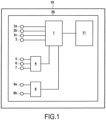
- Fig. 1 shows a block diagram of a data processing device 1 according to embodiments of the present invention.
- the data processing device 1 may be part of a human-machine interface (HMI) system 20.
- HMI system 20 may be part of a vehicle 10, and in particular provide a driving interface for a human user of the vehicle 10.
- the data processing device 1 may be connected to and/or comprise a data storage for storing a reference data set.
- the data processing device 1 may comprise an electronic circuit, a processor (shared, dedicated, or group), a combinational logic circuit, a memory that executes one or more software programs, and/or other suitable components that provide the described functionality.
- the data processing device 1 may be configured to additionally carry out further functions in the vehicle 10.
- the data processing device 1 may also be configured to act as a general purpose electronic control unit (ECU) of the vehicle 10.
- ECU electronice control unit
- the HMI system 20 may also comprise one or several physiological sensors 2a,2b,2c to which the data processing device 1 may be connected to receive a data output thereof.
- Each physiological sensor 2 may be configured to sense at least one physiological feature of the user.
- the physiological sensors 2a,2b,2c electro-dermal may include one or more electro-dermal sensors 2a, one or more cardiac sensors 2b, and/or one or more eye tracking sensors 2c.
- the one or more electro-dermal sensors 2a may comprise Ag/AgCl electrodes, located for example at least at the level of the second phalanx of the index and the third digit of the non-dominant hand of the user and be configured to measure a skin conductance level (SCL).
- SCL skin conductance level
- the one or more cardiac sensors 2b may also comprise Ag/AgCl electrodes and be configured to measure an electrocardiographic (ECG) signal.
- the one or more eye tracking sensors 2c may comprise, for instance, eye tracking Pupilabs ® v2 glasses, with a tracking frequency of 120 Hz, a gaze accuracy of 1.0°, a gaze precision of 0.08°, a camera latency of 5.7 ms, and a processing latency of 3-4 ms.
- the SCL may be sampled, for instance, at a 1000 Hz sampling rate, and the one or more electro-dermal sensors 2a may be further configured to detect, from the SCL signal, the occurrence of phasic skin conductivity responses and measure their amplitude and/or their latency to transmit these, as physiological data, to the data processing device 1.
- the one or more electro-dermal sensors 2a may directly transmit the SCL signal to the data processing device 1, which may then be itself configured to detect the occurrence of phasic skin conductivity responses and measure their amplitude and/or their latency.
- the ECG signal may also be sampled, for instance, at a 1000 Hz sampling rate, and the one or more cardiac sensors 2b may be further configured to detect, from the ECG signal, the individual heartbeats and measure the RR intervals between them, to transmit these, as physiological data, to the data processing device.
- the one or more cardiac sensors 2b may directly transmit the ECG signal to the data processing device 1, which may then be itself configured to detect the individual heartbeats and measure the RR intervals between them.
- the eye tracking sensors 2c may be configured to detect occurrence and duration of eye fixations, and transmit them, as physiological data, to the data processing device 1. Alternatively however, the eye tracking sensors 2c may directly transmit pupil position data to the data processing device, which may be configured to detect occurrence and duration of eye fixations from these eye position data.
- the HMI system 20 may also comprise one or more behavioral sensors 3.
- the one or more behavioral sensors 3 may be configured to measure one or more behavioral features of the user, in particular concerning driving behaviour, and transmit it to the data processing device 1.
- the one or more behavioral sensors 3 may measure the vehicle's lateral position on the road (e.g. supported by GPS) and/or steering wheel angle. All behavioural data may be sampled at a 60Hz sampling rate.
- the HMI system 20 may also comprise a vehicle context detection unit 4.
- the vehicle context detection unit 4 may be configured to determine vehicle context information describing a current driving situation and transmit it to the data processing device 1.
- driving situations may include e.g. a situation in which the vehicle 10 comprising the HMI system 20 overtakes another vehicle, a situation in the vehicle 10 comprising the HMI system 20 is approaching a traffic light, a situation in which the vehicle 10 comprising the HMI system 20 approaches a pedestrian or a pedestrian approaches the vehicle 10, a situation in the vehicle 10 comprising the HMI system 20 is driven in the dark, a situation in the vehicle 10 comprising the HMI system 20 makes a left-turn (in right-hand traffic), a situation in which the vehicle 10 comprising the HMI system 20 is in dense traffic and/or facing aggressive and/or unexpected behavior by other road users or other driving situations which may challenge the comfort level of the user, such as, for instance heavy rain, snowfall or icing.
- the vehicle context detection unit 4 may be connected to a plurality of sensors configured to monitor the environment of the vehicle, e.g. a GPS 5, a radar 6 or one or several outside cameras 7.
- the vehicle context detection unit 4 may also be connected to the one or more behavioral sensors 3 for receiving their output. For example, based on the information received from a GPS, cameras and an electronic map providing a scheduled driving route, the vehicle context detection unit 4 can determine a left turn of the vehicle.
- the HMI system 20 may also comprise an emotional state detection unit 8.
- the emotional state detection unit 8 may be configured to determine emotional state information describing a current emotional state of the user and transmit it to the data processing device 1.
- Such emotional state information may comprise an emotional state index value associated to each one of one or more emotions, such as, e.g. sadness, interest, anxiety, alertness, boredom, impatience, anger, serenity, fear and/or happiness.
- the emotional state detection unit 8 may be connected to one or more sensors configured to monitor the emotional state of the user, e.g. an interior camera 9a and/or a microphone 9b, in order to receive information from them, such as images and/or sound, containing emotional cues.
- Such emotional cues may be contained e.g. in acoustic features of speech like timbre, prosody and rhythm and/or visual features linked to facial expression. These acoustic and/or visual features may be correlated to specific emotions using machine learning algorithms trained on datasets such as e.g.
- the emotional state detection unit 8 may infer the emotional state information from the images and/or sound received from the camera 9a and/or microphone 9b.
- the emotional state detection unit 8 may also be connected to the physiological and/or behavioral sensors for receiving their output and using it to infer the emotional state information.
- the vehicle context detection unit 4 and/or the emotional state detection unit 8 may each be an electronic control device, as e.g. a processor. Each one of them, or both, may also be provided by the general purpose ECU of the vehicle. It is further possible that the data processing device 1 comprises the vehicle context detection unit 4 and/or the emotional state detection unit 8.
- the data processing device 1 may be configured to calculate, based on physiological data received from the one or more electro-dermal sensors 2a over an electro-dermal time window TW_EDA, i.a. the number N_scrs, mean amplitude Amp_moy, standard deviation of the amplitude Et_Amp_Scrs, mean latency Lat_Moy_scrs and/or standard deviation of the latency ET_lat_scrs of the phasic skin conductivity responses within this time window TW_EDA. Furthermore, the data processing device 1 may be configured to calculate, based on physiological data received from the one or more cardiac sensors 2b over a cardiac time window TW_ECG, i.a.
- the data processing device 1 may be configured to calculate, based on physiological data received from the one or more eye tracking sensors 2c over an eye tracking time window TW_ET, i.a. the number nbFix of occurrences of eye fixations within this eye tracking time window TW_ET, their total duration durationFixTot, their mean duration durationFixMean, and/or the standard deviation durationFixSD of their duration.
- the data processing device 1 may be configured to calculate, based on behavioral data received from the one or more behavioural sensors 3 within a behavioural time window TW_BE, i.a. the standard deviation SDLP of the vehicle's lateral position on the road, the standard deviation SDWA of the steering wheel angle, and/or the steering wheel reversal rate SRR.
- a personality profile of the user may be stored within the data storage connected to and/or comprised within the data processing device 1.
- This personality profile may comprise an index value associated to each of one or more personality traits, such as openness, agreeableness, extraversion, neuroticism, conscientiousness, and/or trait anxiety and may have been previously calculated e.g. on the basis of responses of the user to a questionnaire and/or physiological, behavioral, emotional and/or vehicle context data gathered over one or more drives and correlated to one or more of the personality traits by a learning algorithm.
- This learning algorithm may have been trained and optimized to select significantly correlated features from which the personality traits can be inferred on the basis of a generic dataset with data from multiple users in multiple situations.
- the data processing device 1 may be configured to determine a vehicle context event based on the vehicle context information, and then a discomfort index level value for the discomfort resulting from this vehicle context event.
- vehicle context events may be e.g. overtaking another vehicle, approaching a traffic light, approaching a pedestrian, driving in the dark, or making a left-turn (in right- hand traffic).
- the discomfort level index value may take the form of an integer, e.g. an integer value between 1 and 5, between 1 and 3, or just one of 1 or 2.
- the data processing device 1 may be configured to apply a learning classification algorithm, such as e.g. a random forest, J48,naive Bayesian, deep neural network or recurrent neural network algorithm, in order to determine the discomfort level index value based on the personality profile of the user together with the vehicle context information received from the vehicle context detection unit 4, the physiological and behavioral data received, within the corresponding time windows TW_EDA, TW_ECG, TW_ET and TW_BE, from the physiological and behavioral sensors 2a-2c and 3, as well as, eventually, the emotional state information received from the emotional state detection unit 8.
- the learning classification algorithm may have been trained and/or updated using a generic dataset linked to multiple users and/or one specifically linked to the current user.
- This learning classification algorithm may have been chosen and optimized based on an index created from a weighting of available indices such as the AUC-ROC curve, precision, recall, TF/FP rate, Matthews correlation coefficient, and/or precision recall curves and subsequently optimized selecting the input features and corresponding time windows best correlated to the discomfort level index value.
- the data processing device 1 may be further configured to output a warning and/or trigger user assistance if the discomfort level index value exceeds a predetermined threshold DT.
- the data processing device may for instance be connected to an advanced user assistance system (ADAS) 11 within the HMI system 20.
- ADAS 11 may even be configured to gradually increase driving assistance, i.e. increasingly take over driving tasks, as the discomfort level index value determined by the data processing device increases, i.e. the user's discomfort increases.
- the ADAS 11 may even be capable of automated driving, e.g. level 2 partial automation, level 3 conditional automation, or even higher.
- the data processing device 1 determined the discomfort level index value using a random forest algorithm, based on the parameters and corresponding time windows presented in Table 1: Electro-dermal Cardiac Eye-tracking Behavioral Personality 0-60 s 0-60 s 0-30 s 0-60 s N_scrs SDNN nbFix SDLP Openness Amp_moy durationFixTot SDWA Et_Amp_scrs durationFixMean Lat_Moy_scrs durationFixSD ET_lat_scrs
- the method When validated on the 10 final test subjects, the method had a true positive rate of 0.744, a false positive rate of 0.262, a precision of 0.703, recall of 0.744, an F-measure of 0.744, a Matthews correlation coefficient of 0.485 and areas of 0.826 and 0.845 under, respectively, the receiver operating characteristic and precision recall curves.
- the data processing device 1 determined the discomfort level index value using a J48 algorithm, based on the parameters and corresponding time windows presented in Table 2: Electro-dermal Cardiac Eye-tracking Behavioral Personality 0-15 s 0-60 s 0-60 s 0-120 s ET_lat_scrs SDNN durationFixTot SDWA Openness Amp_moy Agreeability Extraversion Neuroticism
- the method When validated on the 10 final test subjects, the method had then a true positive rate of 0.698, a false positive rate of 0.296, a precision of 0.704, recall of 0.698, an F-measure of 0.698, a Matthews correlation coefficient of 0.402 and areas of 0.739 and 0.704 under, respectively, the receiver operating characteristic and precision recall curves.
- the data processing device 1 determined the discomfort level index value using a naive Bayesian algorithm, based on the parameters and corresponding time windows presented in Table 3: Electro-dermal Cardiac Eye-tracking Behavioral Personality 0-15 s 0-60 s 0-30 s 0-60 s N_scrs SDNN durationFixTot SDLP Openness SRR Neuroticism
- the method When validated on the 10 final test subjects, the method had then a true positive rate of 0.744, a false positive rate of 0.262, a precision of 0.747, recall of 0.744, an F-measure of 0.742, a Matthews correlation coefficient of 0.486 and areas of 0.743 and 0.757 under, respectively, the receiver operating characteristic and precision recall curves.
Landscapes
- Engineering & Computer Science (AREA)
- Health & Medical Sciences (AREA)
- Life Sciences & Earth Sciences (AREA)
- Physics & Mathematics (AREA)
- General Health & Medical Sciences (AREA)
- Medical Informatics (AREA)
- Psychiatry (AREA)
- Veterinary Medicine (AREA)
- Heart & Thoracic Surgery (AREA)
- Public Health (AREA)
- Animal Behavior & Ethology (AREA)
- Biophysics (AREA)
- Pathology (AREA)
- Biomedical Technology (AREA)
- Surgery (AREA)
- Molecular Biology (AREA)
- Theoretical Computer Science (AREA)
- Artificial Intelligence (AREA)
- General Physics & Mathematics (AREA)
- Mathematical Physics (AREA)
- Computer Vision & Pattern Recognition (AREA)
- Multimedia (AREA)
- Child & Adolescent Psychology (AREA)
- Signal Processing (AREA)
- Hospice & Palliative Care (AREA)
- Social Psychology (AREA)
- Software Systems (AREA)
- Evolutionary Computation (AREA)
- Human Computer Interaction (AREA)
- Educational Technology (AREA)
- Physiology (AREA)
- Psychology (AREA)
- Developmental Disabilities (AREA)
- Dermatology (AREA)
- Computing Systems (AREA)
- General Engineering & Computer Science (AREA)
- Data Mining & Analysis (AREA)
- Computational Linguistics (AREA)
- Automation & Control Theory (AREA)
- Mechanical Engineering (AREA)
Description
- The invention relates to a computer-implemented method for evaluating user discomfort and to a data-processing device configured to carry out this method.
- The automotive industry is increasingly introducing Advanced Driver Assistance Systems (ADAS) designed to improve driving safety by reducing the risk of human error. These embedded systems can interact with the driver in different ways, either by giving the driver additional information on the state of the environment (via a multi-modal communication interface: audio, visual, tactile, etc.), or by processing information about the driver's mental state such as stress, fatigue, vigilance or drowsiness in order to assist him and/or to prevent potential risks (cf. Jinjun Wang et al, 2010: "Real-time driving danger-level prediction", Engineering Applications of Artificial Intelligence; Volume 23, ). These existing systems process individually stress, fatigue, vigilance or drowsiness by considering behavioural or physiological parameters separately.
- However, it is desirable to not only measure one specific mental state of the driver (fatigue or drowsiness, etc.) but to measure the feeling or experience of discomfort in driving. Meng and Siren (2012) propose that discomfort in driving can be considered as a form of awareness of the driver of changes in his/her own driving ability (cf. Meng and Siren (2012): "Cognitive problems, self-rated changes in driving skills, driving-related discomfort and self-regulation of driving in old drivers" Accident Analysis & Prevention, Volume 49, November 2012, Pages 322-329). Thus, these authors define the feeling of discomfort as related to a feeling of anxiety as a consequence of being self-aware that one's driving ability in a specific driving situation (for example driving in heavy rain) may include a potential driving risk. This feeling of discomfort may increase in time and can lead to complete avoidance of specific driving situations. However, Meng and Siren only analyze subjective data using questionnaires without considering measuring the (objective) driver behavioral or physiological data. In addition, most of the research dealing with (dis)comfort in driving, addresses this notion mainly in terms of physical ergonomics of the driving cabin (posture, driver seat dimensions, etc.).
- It is further known to measure the driver's mental state by electrophysiological and/or driver behavioral measures. For example,
WO2008/0127465 A1 KR 20170094836 A US 2018/0174457 ,CN 109017797 orCN 107662611 A , to measure the emotional state of the driver, on the basis of physiological data, driving behavior and/or emotional cues, and eventually to change the driving mode accordingly. On the other hand, inWO 2018/014953 A1 , it was proposed to use physiological and behavioral data, together with vehicle context data, to determine a discomfort level index value, and output a warning and/or perform driver assistance if this value exceeds a reference index. Finally,US 2016/236690 A discloses a voice interaction system providing different output to a driver depending on driver state, vehicle state and environment, wherein the driver state may include physiological, cognitive and affective aspects, e.g. alertness and emotional state. - However, these previously proposed devices and methods fail to take into consideration endogenous psychological factors which are not necessarily reflected in physiological or behavioral data or even in emotional cues, but will influence the driver's subjective discomfort, with a potentially serious impact on driving safety.
- A first aspect of the present invention relates to a data processing device configured to be connected to one or more physiological sensors for receiving physiological data of a user, to one or more behavioral sensors for receiving behavioral data of the user and to a vehicle context detection unit for receiving vehicle context information, and to determine a discomfort level index value based on a personality profile of the user together with at least the vehicle context information and physiological and behavioral data received within corresponding time windows. The discomfort level index value may be an integer from a scale graded by either ascending or descending level of discomfort. It could thus be alternatively understood as a comfort index level value. The user may be a vehicle driver or passenger, for example in a partially or fully automated vehicle.
- Consequently, the endogenous influence of the user's own personality on his subjective discomfort level can be more adequately reflected, together with exogenous factors such as the vehicle context, on the discomfort level index value determined by the data processing device.
- The data processing device may be configured to be also connected to an emotional state detection unit for receiving emotional state information concerning the user, and to determine the discomfort level index value based also on the emotional state information concerning the user. In particular, the emotional state detection unit may be configured to detect emotional cues in images and/or sound received from a camera and/or a microphone connected thereto. Consequently, not only the user's baseline personality profile may be reflected in the discomfort level index value, but also his transient emotional state.
- The personality profile may comprise an index value associated to each of one or more personality traits, which may in particular include openness, agreeableness, extraversion, neuroticism, and/or conscientiousness, that is, the "Big Five" personality traits, and/or trait anxiety as measured for instance by the State-Trait Anxiety Inventory (STAI).
- The data processing device may be configured to apply a learning classification algorithm, such as e.g. any one of random forest, J48, naive Bayesian, deep neural network or recurrent neural network algorithms, for determining the discomfort level index value. Consequently, this algorithm may be first taught in a learning phase to establish correlations between discomfort level and vehicle context information, physiological and behavioral data and personality profile, as well as eventually also emotional state data, in a learning phase using experimental data from one or more user subjects and one or more driving events, so as to subsequently apply those correlations in determining the comfort level index value on the basis of those parameters.
- The one or more physiological sensors may include one or more electro-dermal sensors, and the data processing device may be configured to receive, as physiological data from the one or more electro-dermal sensors, amplitude and/or latency of skin conductivity responses. The data processing device may in particular be configured to determine the discomfort index value on the basis of i.a. the number of occurrences of phasic skin conductivity responses within a corresponding time window, their mean amplitude, the standard deviation of their amplitude, their mean latency and/or the standard deviation of their latency.
- Alternatively or complementarily to the electro-dermal sensors, the one or more physiological sensors may include one or more cardiac sensors, and the data processing device may be configured to receive RR intervals as physiological data from the one or more cardiac sensors. The data processing device may in particular be configured to determine the discomfort index value on the basis of i.a. the minimum RR interval, the maximum RR interval, the mean RR interval, the standard deviation of the RR intervals, and/or the square-rooted standard deviation of the RR intervals, within a corresponding time window.
- Alternatively or complementarily to the electro-dermal sensors and/or cardiac sensors, the one or more physiological sensors may include one or more eye tracking sensors, and the data processing device may be configured to receive occurrence and/or duration of eye fixations as physiological data from the one or more eye tracking sensors. The data processing device may in particular be configured to determine the discomfort index value on the basis of i.a. the number of occurrences of eye fixations within a corresponding time window, their total duration, their mean duration, and/or the standard deviation of their duration.
- The data processing device may in particular be also configured to output a warning and/or perform user assistance if the discomfort level index value exceeds a predetermined threshold. This may help ensure the user's comfort following future driving events, by preventing a negative long-term impact on the emotional and cognitive state of the user.
- A second aspect of the present invention relates to a human-machine interface system comprising the data processing device of the first aspect, as well as the one or more physiological sensors, the one or more behavioral sensors, and the vehicle context detection unit, each connected to the data processing device.
- A third aspect of the present invention relates to a vehicle comprising the human-machine interface system of the second aspect.
- A fourth aspect of the present invention relates to a computer-implemented method for evaluating user discomfort, comprising the steps of receiving physiological data of a user from one or more physiological sensors; receiving behavioral data of the user from one or more behavioral sensors; receiving vehicle context information from a vehicle context detection unit; and determining a discomfort level index value based on a personality profile of the user, together with at least the physiological and behavioral data and vehicle context information received within corresponding time windows.
- A fifth aspect of the present invention relates to a computer program comprising instructions which, when the program is executed by a computer, cause the computer to perform the computer-implemented method of the fourth aspect.
- A sixth aspect of the present invention relates to computer-readable medium comprising instructions which, when executed by a computer, cause the computer to carry out the computer-implemented method of the fourth aspect.
- The invention may be more completely understood in consideration of the following detailed description of various embodiments in connection with the accompanying drawing, which shows a block diagram of a vehicle according to embodiments of the present invention.
- While the invention is amenable to various modifications and alternative forms, specifics thereof have been shown by way of example in the drawings and will be described in detail. It should be understood, however, that the intention is not to limit aspects of the invention to the particular embodiments described.
- For the following defined terms, these definitions shall be applied, unless a different definition is given in the claims or elsewhere in this specification.
- Although some suitable dimension ranges and/or values pertaining to various components, features and/or specifications are disclosed, one of skill in the art, incited by the present disclosure, would understand desired dimensions, ranges and/or values may deviate from those expressly disclosed.
- As used in this specification and the appended claims, the singular forms "a", "an", and "the" include plural referents unless the content clearly dictates otherwise. As used in this specification and the appended claims, the term "or" is generally employed in its sense including "and/or" unless the content clearly dictates otherwise.
- The following detailed description should be read with reference to the drawings in which similar elements in different drawings are numbered the same. The detailed description and the drawings, which are not necessarily to scale, depict illustrative embodiments and are not intended to limit the scope of the invention. The illustrative embodiments depicted are intended only as exemplary. Selected features of any illustrative embodiment may be incorporated into an additional embodiment unless clearly stated to the contrary.
-
Fig. 1 shows a block diagram of adata processing device 1 according to embodiments of the present invention. Thedata processing device 1 may be part of a human-machine interface (HMI)system 20. The HMIsystem 20 may be part of avehicle 10, and in particular provide a driving interface for a human user of thevehicle 10. - The
data processing device 1 may be connected to and/or comprise a data storage for storing a reference data set. Thedata processing device 1 may comprise an electronic circuit, a processor (shared, dedicated, or group), a combinational logic circuit, a memory that executes one or more software programs, and/or other suitable components that provide the described functionality. Thedata processing device 1 may be configured to additionally carry out further functions in thevehicle 10. For example, thedata processing device 1 may also be configured to act as a general purpose electronic control unit (ECU) of thevehicle 10. - The
HMI system 20 may also comprise one or severalphysiological sensors data processing device 1 may be connected to receive a data output thereof. Each physiological sensor 2 may be configured to sense at least one physiological feature of the user. For example, thephysiological sensors dermal sensors 2a, one or morecardiac sensors 2b, and/or one or moreeye tracking sensors 2c. The one or more electro-dermal sensors 2a may comprise Ag/AgCl electrodes, located for example at least at the level of the second phalanx of the index and the third digit of the non-dominant hand of the user and be configured to measure a skin conductance level (SCL). The one or morecardiac sensors 2b may also comprise Ag/AgCl electrodes and be configured to measure an electrocardiographic (ECG) signal. The one or moreeye tracking sensors 2c may comprise, for instance, eye tracking Pupilabs® v2 glasses, with a tracking frequency of 120 Hz, a gaze accuracy of 1.0°, a gaze precision of 0.08°, a camera latency of 5.7 ms, and a processing latency of 3-4 ms. - The SCL may be sampled, for instance, at a 1000 Hz sampling rate, and the one or more electro-
dermal sensors 2a may be further configured to detect, from the SCL signal, the occurrence of phasic skin conductivity responses and measure their amplitude and/or their latency to transmit these, as physiological data, to thedata processing device 1. Alternatively, however, the one or more electro-dermal sensors 2a may directly transmit the SCL signal to thedata processing device 1, which may then be itself configured to detect the occurrence of phasic skin conductivity responses and measure their amplitude and/or their latency. - The ECG signal may also be sampled, for instance, at a 1000 Hz sampling rate, and the one or more
cardiac sensors 2b may be further configured to detect, from the ECG signal, the individual heartbeats and measure the RR intervals between them, to transmit these, as physiological data, to the data processing device. Alternatively, however, the one or morecardiac sensors 2b may directly transmit the ECG signal to thedata processing device 1, which may then be itself configured to detect the individual heartbeats and measure the RR intervals between them. - The
eye tracking sensors 2c may be configured to detect occurrence and duration of eye fixations, and transmit them, as physiological data, to thedata processing device 1. Alternatively however, theeye tracking sensors 2c may directly transmit pupil position data to the data processing device, which may be configured to detect occurrence and duration of eye fixations from these eye position data. - The
HMI system 20 may also comprise one or morebehavioral sensors 3. The one or morebehavioral sensors 3 may be configured to measure one or more behavioral features of the user, in particular concerning driving behaviour, and transmit it to thedata processing device 1. For example, the one or morebehavioral sensors 3 may measure the vehicle's lateral position on the road (e.g. supported by GPS) and/or steering wheel angle. All behavioural data may be sampled at a 60Hz sampling rate. - Moreover, the
HMI system 20 may also comprise a vehiclecontext detection unit 4. The vehiclecontext detection unit 4 may be configured to determine vehicle context information describing a current driving situation and transmit it to thedata processing device 1. Such driving situations may include e.g. a situation in which thevehicle 10 comprising theHMI system 20 overtakes another vehicle, a situation in thevehicle 10 comprising theHMI system 20 is approaching a traffic light, a situation in which thevehicle 10 comprising theHMI system 20 approaches a pedestrian or a pedestrian approaches thevehicle 10, a situation in thevehicle 10 comprising theHMI system 20 is driven in the dark, a situation in thevehicle 10 comprising theHMI system 20 makes a left-turn (in right-hand traffic), a situation in which thevehicle 10 comprising theHMI system 20 is in dense traffic and/or facing aggressive and/or unexpected behavior by other road users or other driving situations which may challenge the comfort level of the user, such as, for instance heavy rain, snowfall or icing. - In order to determine the vehicle context information, the vehicle
context detection unit 4 may be connected to a plurality of sensors configured to monitor the environment of the vehicle, e.g. a GPS 5, aradar 6 or one or severaloutside cameras 7. The vehiclecontext detection unit 4 may also be connected to the one or morebehavioral sensors 3 for receiving their output. For example, based on the information received from a GPS, cameras and an electronic map providing a scheduled driving route, the vehiclecontext detection unit 4 can determine a left turn of the vehicle. - The
HMI system 20 may also comprise an emotionalstate detection unit 8. The emotionalstate detection unit 8 may be configured to determine emotional state information describing a current emotional state of the user and transmit it to thedata processing device 1. Such emotional state information may comprise an emotional state index value associated to each one of one or more emotions, such as, e.g. sadness, interest, anxiety, alertness, boredom, impatience, anger, serenity, fear and/or happiness. - In order to determine the emotional state information, the emotional
state detection unit 8 may be connected to one or more sensors configured to monitor the emotional state of the user, e.g. aninterior camera 9a and/or amicrophone 9b, in order to receive information from them, such as images and/or sound, containing emotional cues. Such emotional cues may be contained e.g. in acoustic features of speech like timbre, prosody and rhythm and/or visual features linked to facial expression. These acoustic and/or visual features may be correlated to specific emotions using machine learning algorithms trained on datasets such as e.g. the Danish Emotional Speech database, the Berlin Database of Emotional Speech, and/or the AffectNet annotated facial expression database, so that the emotionalstate detection unit 8 may infer the emotional state information from the images and/or sound received from thecamera 9a and/ormicrophone 9b. Alternatively or complementarily to those sensors, the emotionalstate detection unit 8 may also be connected to the physiological and/or behavioral sensors for receiving their output and using it to infer the emotional state information. - The vehicle
context detection unit 4 and/or the emotionalstate detection unit 8 may each be an electronic control device, as e.g. a processor. Each one of them, or both, may also be provided by the general purpose ECU of the vehicle. It is further possible that thedata processing device 1 comprises the vehiclecontext detection unit 4 and/or the emotionalstate detection unit 8. - The
data processing device 1 may be configured to calculate, based on physiological data received from the one or more electro-dermal sensors 2a over an electro-dermal time window TW_EDA, i.a. the number N_scrs, mean amplitude Amp_moy, standard deviation of the amplitude Et_Amp_Scrs, mean latency Lat_Moy_scrs and/or standard deviation of the latency ET_lat_scrs of the phasic skin conductivity responses within this time window TW_EDA. Furthermore, thedata processing device 1 may be configured to calculate, based on physiological data received from the one or morecardiac sensors 2b over a cardiac time window TW_ECG, i.a. the minimum RR interval RRint_min, the maximum RR interval RRint_max, the mean RR interval RRint_moy, the standard deviation SDNN of the RR intervals, and/or the room-mean-squared standard deviation RMSSD of the RR intervals, within this cardiac time window TW_ECG. Additionally or alternatively, thedata processing device 1 may be configured to calculate, based on physiological data received from the one or moreeye tracking sensors 2c over an eye tracking time window TW_ET, i.a. the number nbFix of occurrences of eye fixations within this eye tracking time window TW_ET, their total duration durationFixTot, their mean duration durationFixMean, and/or the standard deviation durationFixSD of their duration. - Furthermore, the
data processing device 1 may be configured to calculate, based on behavioral data received from the one or morebehavioural sensors 3 within a behavioural time window TW_BE, i.a. the standard deviation SDLP of the vehicle's lateral position on the road, the standard deviation SDWA of the steering wheel angle, and/or the steering wheel reversal rate SRR. - A personality profile of the user may be stored within the data storage connected to and/or comprised within the
data processing device 1. This personality profile may comprise an index value associated to each of one or more personality traits, such as openness, agreeableness, extraversion, neuroticism, conscientiousness, and/or trait anxiety and may have been previously calculated e.g. on the basis of responses of the user to a questionnaire and/or physiological, behavioral, emotional and/or vehicle context data gathered over one or more drives and correlated to one or more of the personality traits by a learning algorithm. This learning algorithm may have been trained and optimized to select significantly correlated features from which the personality traits can be inferred on the basis of a generic dataset with data from multiple users in multiple situations. - The
data processing device 1 may be configured to determine a vehicle context event based on the vehicle context information, and then a discomfort index level value for the discomfort resulting from this vehicle context event. Such vehicle context events may be e.g. overtaking another vehicle, approaching a traffic light, approaching a pedestrian, driving in the dark, or making a left-turn (in right- hand traffic). The discomfort level index value may take the form of an integer, e.g. an integer value between 1 and 5, between 1 and 3, or just one of 1 or 2. - More specifically, the
data processing device 1 may be configured to apply a learning classification algorithm, such as e.g. a random forest, J48,naive Bayesian, deep neural network or recurrent neural network algorithm, in order to determine the discomfort level index value based on the personality profile of the user together with the vehicle context information received from the vehiclecontext detection unit 4, the physiological and behavioral data received, within the corresponding time windows TW_EDA, TW_ECG, TW_ET and TW_BE, from the physiological andbehavioral sensors 2a-2c and 3, as well as, eventually, the emotional state information received from the emotionalstate detection unit 8. The learning classification algorithm may have been trained and/or updated using a generic dataset linked to multiple users and/or one specifically linked to the current user. This learning classification algorithm may have been chosen and optimized based on an index created from a weighting of available indices such as the AUC-ROC curve, precision, recall, TF/FP rate, Matthews correlation coefficient, and/or precision recall curves and subsequently optimized selecting the input features and corresponding time windows best correlated to the discomfort level index value. - The
data processing device 1 may be further configured to output a warning and/or trigger user assistance if the discomfort level index value exceeds a predetermined threshold DT. For this purpose, the data processing device may for instance be connected to an advanced user assistance system (ADAS) 11 within theHMI system 20. TheADAS 11 may even be configured to gradually increase driving assistance, i.e. increasingly take over driving tasks, as the discomfort level index value determined by the data processing device increases, i.e. the user's discomfort increases. TheADAS 11 may even be capable of automated driving, e.g. level 2 partial automation,level 3 conditional automation, or even higher. - Three different methods for evaluating user discomfort have been tested in a driving simulator using correspondingly configured
HMI systems 20. In each example, a different learning classification algorithm and different sets of physiological and behavioral data and personality traits have been applied. In each case, the learning classification algorithm has been trained on 59 different user test subjects. The three methods were then tested on 10 different user test subjects for validation. During both training and validation, the test subjects were exposed to various driving situations and asked to indicate their resulting discomfort level on a scale of 1 to 5. Their personality profiles were established using questionnaires. - In the first example, the
data processing device 1 determined the discomfort level index value using a random forest algorithm, based on the parameters and corresponding time windows presented in Table 1:Electro-dermal Cardiac Eye-tracking Behavioral Personality 0-60 s 0-60 s 0-30 s 0-60 s N_scrs SDNN nbFix SDLP Openness Amp_moy durationFixTot SDWA Et_Amp_scrs durationFixMean Lat_Moy_scrs durationFixSD ET_lat_scrs - When validated on the 10 final test subjects, the method had a true positive rate of 0.744, a false positive rate of 0.262, a precision of 0.703, recall of 0.744, an F-measure of 0.744, a Matthews correlation coefficient of 0.485 and areas of 0.826 and 0.845 under, respectively, the receiver operating characteristic and precision recall curves.
- In the second example, the
data processing device 1 determined the discomfort level index value using a J48 algorithm, based on the parameters and corresponding time windows presented in Table 2:Electro-dermal Cardiac Eye-tracking Behavioral Personality 0-15 s 0-60 s 0-60 s 0-120 s ET_lat_scrs SDNN durationFixTot SDWA Openness Amp_moy Agreeability Extraversion Neuroticism - When validated on the 10 final test subjects, the method had then a true positive rate of 0.698, a false positive rate of 0.296, a precision of 0.704, recall of 0.698, an F-measure of 0.698, a Matthews correlation coefficient of 0.402 and areas of 0.739 and 0.704 under, respectively, the receiver operating characteristic and precision recall curves.
- In the third example, the
data processing device 1 determined the discomfort level index value using a naive Bayesian algorithm, based on the parameters and corresponding time windows presented in Table 3:Electro-dermal Cardiac Eye-tracking Behavioral Personality 0-15 s 0-60 s 0-30 s 0-60 s N_scrs SDNN durationFixTot SDLP Openness SRR Neuroticism - When validated on the 10 final test subjects, the method had then a true positive rate of 0.744, a false positive rate of 0.262, a precision of 0.747, recall of 0.744, an F-measure of 0.742, a Matthews correlation coefficient of 0.486 and areas of 0.743 and 0.757 under, respectively, the receiver operating characteristic and precision recall curves.
- Those skilled in the art will recognize that the present invention may be manifested in a variety of forms other than the specific embodiments described and contemplated herein. Accordingly, departure in form and detail may be made without departing from the scope of the present invention as defined in the appended claims.
Claims (19)
- A data processing device (1) configured to be connected to one or more physiological sensors (2a,2b,2c) for receiving physiological data of a user, to one or more behavioral sensors (3) for receiving behavioral data of the user and to a vehicle context detection unit (4) for receiving vehicle context information, and to determine a discomfort level index value based on a personality profile of the user together with at least the vehicle context information and physiological and behavioral data received within corresponding time windows.
- The data processing device (1) according to claim 1, configured to be also connected to an emotional state detection unit (8) for receiving emotional state information concerning the user, and to determine the discomfort level index value based also on the emotional state information concerning the user.
- The data processing device (1) according to claim 2, wherein the emotional state detection unit (8) is configured to detect emotional cues in images and/or sound received from a camera (9a) and/or a microphone (9b) connected thereto.
- The data processing device (1) according to any one of claims 1 to 3, wherein the personality profile comprises an index value associated to each of one or more personality traits.
- The data processing device (1) according to claim 4, wherein the one or more personality traits include openness, agreeableness, extraversion, neuroticism, conscientiousness, and/or trait anxiety.
- The data processing device (1) according to any one of the previous claims, configured to apply a learning classification algorithm for determining the discomfort level index value.
- The data processing device (1) according to claim 6, wherein the learning classification algorithm is any one of random forest, J48, naïve Bayesian, deep neural network, or recurrent neural network algorithms.
- The data processing device (1) according to any one of the previous claims, wherein the one or more physiological sensors (2a,2b,2c) include one or more electro-dermal sensors (2a).
- The data processing device (1) according to claim 8, configured to receive, as physiological data from the one or more electro-dermal sensors (2a), occurrence, amplitude and/or latency of phasic skin conductivity responses.
- The data processing device (1) according to any one of the previous claims, wherein the one or more physiological sensors (2a,2b,2c) include one or more cardiac sensors (2b).
- The data processing device (1) according to claim 10, configured to receive RR intervals as physiological data from the one or more cardiac sensors (2b).
- The data processing device (1) according to any one of the previous claims, wherein the one or more physiological sensors (2a,2b,2c) include one or more eye tracking sensors (2c).
- The data processing device (1) according to claim 12, configured to receive occurrence and/or duration of eye fixations as physiological data from the one or more eye tracking sensors (2c).
- The data processing device (1) according to any previous claim, also configured to output a warning and/or trigger user assistance if the discomfort level index value exceeds a predetermined threshold.
- A human-machine interface system (20) comprising the data processing device (1) according to any previous claim, as well as the one or more physiological sensors (2a,2b,2c), the one or more behavioral sensors (3), and the vehicle context detection unit (4), each connected to the data processing device (1).
- A vehicle (10) comprising the human-machine interface system (20) according to any one of claims 9 to 15.
- A computer-implemented method for evaluating user discomfort, comprising the steps of:receiving physiological data of a user from one or more physiological sensors (2a,2b,2c);receiving behavioral data of the user from one or more behavioral sensors (3);receiving vehicle context information from a vehicle context detection unit (4); anddetermining a discomfort level index value based on a personality profile of the user, together with at least the physiological and behavioral data and vehicle context information received within corresponding time windows.
- A computer program comprising instructions which, when the program is executed by a computer, cause the computer to perform the computer-implemented method according to claim 17.
- A computer-readable medium comprising instructions which, when executed by a computer, cause the computer to carry out the computer-implemented method according to claim 17.
Priority Applications (3)
| Application Number | Priority Date | Filing Date | Title |
|---|---|---|---|
| EP20315192.3A EP3895949B1 (en) | 2020-04-17 | 2020-04-17 | Method and device for evaluating user discomfort |
| US17/231,128 US20210323559A1 (en) | 2020-04-17 | 2021-04-15 | Data processing device, human-machine interface system including the device, vehicle including the system, method for evaluating user discomfort, and computer-readable medium for carrying out the method |
| CN202110414083.9A CN113598773B (en) | 2020-04-17 | 2021-04-16 | Data processing device and method for evaluating user discomfort |
Applications Claiming Priority (1)
| Application Number | Priority Date | Filing Date | Title |
|---|---|---|---|
| EP20315192.3A EP3895949B1 (en) | 2020-04-17 | 2020-04-17 | Method and device for evaluating user discomfort |
Publications (2)
| Publication Number | Publication Date |
|---|---|
| EP3895949A1 EP3895949A1 (en) | 2021-10-20 |
| EP3895949B1 true EP3895949B1 (en) | 2023-08-16 |
Family
ID=70968890
Family Applications (1)
| Application Number | Title | Priority Date | Filing Date |
|---|---|---|---|
| EP20315192.3A Active EP3895949B1 (en) | 2020-04-17 | 2020-04-17 | Method and device for evaluating user discomfort |
Country Status (3)
| Country | Link |
|---|---|
| US (1) | US20210323559A1 (en) |
| EP (1) | EP3895949B1 (en) |
| CN (1) | CN113598773B (en) |
Families Citing this family (2)
| Publication number | Priority date | Publication date | Assignee | Title |
|---|---|---|---|---|
| US9422673B2 (en) | 2012-03-23 | 2016-08-23 | B & B Metals, Inc. | Tie plate separator and method thereof |
| US11718327B1 (en) * | 2022-08-08 | 2023-08-08 | Toyota Motor Engineering & Manufacturing North America, Inc. | Systems and methods for operating a vehicle based on a user's health and emotional state |
Family Cites Families (25)
| Publication number | Priority date | Publication date | Assignee | Title |
|---|---|---|---|---|
| DK1662989T3 (en) * | 2003-09-12 | 2014-12-08 | Bodymedia Inc | System to monitor and maintain body weight and other physiological conditions with iterative and personalized planning, intervention and reporting capabilities |
| US7839292B2 (en) | 2007-04-11 | 2010-11-23 | Nec Laboratories America, Inc. | Real-time driving danger level prediction |
| CN101108125B (en) * | 2007-08-02 | 2010-06-16 | 无锡微感科技有限公司 | A dynamic monitoring system for physical signs |
| JP5011266B2 (en) * | 2008-11-19 | 2012-08-29 | パナソニック株式会社 | Comfort evaluation model creation device, comfort evaluation device, and comfortable environment providing device |
| US20170224232A1 (en) * | 2009-12-08 | 2017-08-10 | Medical Screening Corporation | Measuring homeostatic risk |
| KR101901417B1 (en) * | 2011-08-29 | 2018-09-27 | 한국전자통신연구원 | System of safe driving car emotion cognitive-based and method for controlling the same |
| US11389059B2 (en) * | 2013-01-25 | 2022-07-19 | Wesley W. O. Krueger | Ocular-performance-based head impact measurement using a faceguard |
| US10137902B2 (en) * | 2015-02-12 | 2018-11-27 | Harman International Industries, Incorporated | Adaptive interactive voice system |
| KR102429822B1 (en) | 2016-02-12 | 2022-08-08 | 한국전자통신연구원 | Apparatus and Method for recognizing a driver’s emotional state |
| US20170267251A1 (en) * | 2016-03-15 | 2017-09-21 | Palo Alto Research Center Incorporated | System And Method For Providing Context-Specific Vehicular Driver Interactions |
| US9956963B2 (en) * | 2016-06-08 | 2018-05-01 | GM Global Technology Operations LLC | Apparatus for assessing, predicting, and responding to driver fatigue and drowsiness levels |
| US11173919B2 (en) * | 2016-07-20 | 2021-11-16 | Toyota Motor Europe | Control device, system and method for determining a comfort level of a driver |
| DE102016215250A1 (en) * | 2016-08-16 | 2018-02-22 | Audi Ag | A method of operating a motor vehicle using a user's mobile terminal and physiological vital signs |
| US11021165B2 (en) * | 2016-11-28 | 2021-06-01 | Honda Motor Co., Ltd. | Driving assistance device, driving assistance system, program, and control method for driving assistance device |
| US10192171B2 (en) | 2016-12-16 | 2019-01-29 | Autonomous Fusion, Inc. | Method and system using machine learning to determine an automotive driver's emotional state |
| JP2020512616A (en) * | 2017-02-10 | 2020-04-23 | コーニンクレッカ フィリップス エヌ ヴェKoninklijke Philips N.V. | Driver and passenger health and sleep interactions |
| WO2018211301A1 (en) * | 2017-05-15 | 2018-11-22 | Toyota Motor Europe | Control device, system, and method for determining a comfort level of a driver |
| US20190103182A1 (en) * | 2017-09-29 | 2019-04-04 | Apple Inc. | Management of comfort states of an electronic device user |
| CN107662611A (en) | 2017-11-06 | 2018-02-06 | 吉林大学 | A kind of automatic driving mode switching system based on driver's Emotion identification |
| KR102302917B1 (en) * | 2017-12-18 | 2021-09-15 | 현대모비스 주식회사 | Apparatus and method for supporting safe driving |
| US20190228367A1 (en) * | 2018-01-24 | 2019-07-25 | GM Global Technology Operations LLC | Profile building using occupant stress evaluation and profile matching for vehicle environment tuning during ride sharing |
| CN109017797B (en) | 2018-08-17 | 2021-08-24 | 大陆投资(中国)有限公司 | Driver emotion recognition method and vehicle-mounted control unit implementing the same |
| US11358605B2 (en) * | 2018-09-10 | 2022-06-14 | Here Global B.V. | Method and apparatus for generating a passenger-based driving profile |
| WO2020069517A2 (en) * | 2018-09-30 | 2020-04-02 | Strong Force Intellectual Capital, Llc | Intelligent transportation systems |
| US10839335B2 (en) * | 2018-12-13 | 2020-11-17 | Nice Ltd. | Call center agent performance scoring and sentiment analytics |
-
2020
- 2020-04-17 EP EP20315192.3A patent/EP3895949B1/en active Active
-
2021
- 2021-04-15 US US17/231,128 patent/US20210323559A1/en active Pending
- 2021-04-16 CN CN202110414083.9A patent/CN113598773B/en active Active
Also Published As
| Publication number | Publication date |
|---|---|
| EP3895949A1 (en) | 2021-10-20 |
| CN113598773B (en) | 2024-09-24 |
| CN113598773A (en) | 2021-11-05 |
| US20210323559A1 (en) | 2021-10-21 |
Similar Documents
| Publication | Publication Date | Title |
|---|---|---|
| Halin et al. | Survey and synthesis of state of the art in driver monitoring | |
| US11288708B2 (en) | System and method for personalized preference optimization | |
| Chung et al. | Methods to detect and reduce driver stress: a review | |
| Mårtensson et al. | Driver sleepiness classification based on physiological data and driving performance from real road driving | |
| US10357195B2 (en) | Pupillometry and sensor fusion for monitoring and predicting a vehicle operator's condition | |
| Begum | Intelligent driver monitoring systems based on physiological sensor signals: A review | |
| CN113491519A (en) | Digital assistant based on emotion-cognitive load | |
| US11173919B2 (en) | Control device, system and method for determining a comfort level of a driver | |
| Melnicuk et al. | Towards hybrid driver state monitoring: Review, future perspectives and the role of consumer electronics | |
| US10877444B1 (en) | System and method for biofeedback including relevance assessment | |
| KR20140080727A (en) | System and method for controlling sensibility of driver | |
| US11288977B1 (en) | System and method for predicting performance to control interventions by assistive technologies | |
| JP7303901B2 (en) | Suggestion system that selects a driver from multiple candidates | |
| CN109620269B (en) | Fatigue detection method, device, equipment and readable storage medium | |
| EP3895949B1 (en) | Method and device for evaluating user discomfort | |
| Zuo et al. | Mobile phone use driver distraction detection based on MSaE of multi-modality physiological signals | |
| Tavakkoli et al. | Leveraging context-aware emotion and fatigue recognition through large language models for enhanced advanced driver assistance systems (ADAS) | |
| Li et al. | Detection of perceived risk during partially automated driving on real road | |
| JP2024179055A (en) | EMOTION ESTIMATION DEVICE, TIME-SERIES APPEARANCE INFORMATION GENERATION METHOD, TIME-SERIES LENGTH DETERMINATION METHOD, ON-VEHICLE SYSTEM, COMPUTER PROGRAM, BIOLOGICAL STATE ESTIMATION DEVICE, AND OBJECT STATE ESTIMATION DEVICE | |
| JP2024141284A (en) | LEARNING METHOD, LEARNING DEVICE, LEARNING PROGRAM, AND EMOTION ESTIM | |
| Sysoev et al. | Smart driving: influence of context and behavioral data on driving style | |
| Liu | Acute Stress and Takeover Performance in Conditionally Automated Driving: Model Development and Validation Across Urban Road and Highway Contexts | |
| Li | Toward Enhancing Multitasking Performance: Modeling, Prediction, and Intervention Design | |
| Zuo | Automatic detection of driver's abnormal state based on physiological signals | |
| Shimizu et al. | Real-time Driver Cognitive Strain Evaluation System Based on Multivariate Biosignal Analysis |
Legal Events
| Date | Code | Title | Description |
|---|---|---|---|
| PUAI | Public reference made under article 153(3) epc to a published international application that has entered the european phase |
Free format text: ORIGINAL CODE: 0009012 |
|
| STAA | Information on the status of an ep patent application or granted ep patent |
Free format text: STATUS: REQUEST FOR EXAMINATION WAS MADE |
|
| 17P | Request for examination filed |
Effective date: 20200417 |
|
| AK | Designated contracting states |
Kind code of ref document: A1 Designated state(s): AL AT BE BG CH CY CZ DE DK EE ES FI FR GB GR HR HU IE IS IT LI LT LU LV MC MK MT NL NO PL PT RO RS SE SI SK SM TR |
|
| B565 | Issuance of search results under rule 164(2) epc |
Effective date: 20201020 |
|
| GRAP | Despatch of communication of intention to grant a patent |
Free format text: ORIGINAL CODE: EPIDOSNIGR1 |
|
| STAA | Information on the status of an ep patent application or granted ep patent |
Free format text: STATUS: GRANT OF PATENT IS INTENDED |
|
| RIC1 | Information provided on ipc code assigned before grant |
Ipc: B60W 40/08 20060101AFI20230227BHEP |
|
| INTG | Intention to grant announced |
Effective date: 20230321 |
|
| GRAS | Grant fee paid |
Free format text: ORIGINAL CODE: EPIDOSNIGR3 |
|
| GRAA | (expected) grant |
Free format text: ORIGINAL CODE: 0009210 |
|
| STAA | Information on the status of an ep patent application or granted ep patent |
Free format text: STATUS: THE PATENT HAS BEEN GRANTED |
|
| AK | Designated contracting states |
Kind code of ref document: B1 Designated state(s): AL AT BE BG CH CY CZ DE DK EE ES FI FR GB GR HR HU IE IS IT LI LT LU LV MC MK MT NL NO PL PT RO RS SE SI SK SM TR |
|
| REG | Reference to a national code |
Ref country code: CH Ref legal event code: EP Ref country code: DE Ref legal event code: R096 Ref document number: 602020015804 Country of ref document: DE |
|
| REG | Reference to a national code |
Ref country code: IE Ref legal event code: FG4D |
|
| REG | Reference to a national code |
Ref country code: LT Ref legal event code: MG9D |
|
| REG | Reference to a national code |
Ref country code: NL Ref legal event code: MP Effective date: 20230816 |
|
| REG | Reference to a national code |
Ref country code: AT Ref legal event code: MK05 Ref document number: 1599775 Country of ref document: AT Kind code of ref document: T Effective date: 20230816 |
|
| PG25 | Lapsed in a contracting state [announced via postgrant information from national office to epo] |
Ref country code: GR Free format text: LAPSE BECAUSE OF FAILURE TO SUBMIT A TRANSLATION OF THE DESCRIPTION OR TO PAY THE FEE WITHIN THE PRESCRIBED TIME-LIMIT Effective date: 20231117 |
|
| PG25 | Lapsed in a contracting state [announced via postgrant information from national office to epo] |
Ref country code: IS Free format text: LAPSE BECAUSE OF FAILURE TO SUBMIT A TRANSLATION OF THE DESCRIPTION OR TO PAY THE FEE WITHIN THE PRESCRIBED TIME-LIMIT Effective date: 20231216 |
|
| PG25 | Lapsed in a contracting state [announced via postgrant information from national office to epo] |
Ref country code: SE Free format text: LAPSE BECAUSE OF FAILURE TO SUBMIT A TRANSLATION OF THE DESCRIPTION OR TO PAY THE FEE WITHIN THE PRESCRIBED TIME-LIMIT Effective date: 20230816 Ref country code: RS Free format text: LAPSE BECAUSE OF FAILURE TO SUBMIT A TRANSLATION OF THE DESCRIPTION OR TO PAY THE FEE WITHIN THE PRESCRIBED TIME-LIMIT Effective date: 20230816 Ref country code: PT Free format text: LAPSE BECAUSE OF FAILURE TO SUBMIT A TRANSLATION OF THE DESCRIPTION OR TO PAY THE FEE WITHIN THE PRESCRIBED TIME-LIMIT Effective date: 20231218 Ref country code: NO Free format text: LAPSE BECAUSE OF FAILURE TO SUBMIT A TRANSLATION OF THE DESCRIPTION OR TO PAY THE FEE WITHIN THE PRESCRIBED TIME-LIMIT Effective date: 20231116 Ref country code: NL Free format text: LAPSE BECAUSE OF FAILURE TO SUBMIT A TRANSLATION OF THE DESCRIPTION OR TO PAY THE FEE WITHIN THE PRESCRIBED TIME-LIMIT Effective date: 20230816 Ref country code: LV Free format text: LAPSE BECAUSE OF FAILURE TO SUBMIT A TRANSLATION OF THE DESCRIPTION OR TO PAY THE FEE WITHIN THE PRESCRIBED TIME-LIMIT Effective date: 20230816 Ref country code: LT Free format text: LAPSE BECAUSE OF FAILURE TO SUBMIT A TRANSLATION OF THE DESCRIPTION OR TO PAY THE FEE WITHIN THE PRESCRIBED TIME-LIMIT Effective date: 20230816 Ref country code: IS Free format text: LAPSE BECAUSE OF FAILURE TO SUBMIT A TRANSLATION OF THE DESCRIPTION OR TO PAY THE FEE WITHIN THE PRESCRIBED TIME-LIMIT Effective date: 20231216 Ref country code: HR Free format text: LAPSE BECAUSE OF FAILURE TO SUBMIT A TRANSLATION OF THE DESCRIPTION OR TO PAY THE FEE WITHIN THE PRESCRIBED TIME-LIMIT Effective date: 20230816 Ref country code: GR Free format text: LAPSE BECAUSE OF FAILURE TO SUBMIT A TRANSLATION OF THE DESCRIPTION OR TO PAY THE FEE WITHIN THE PRESCRIBED TIME-LIMIT Effective date: 20231117 Ref country code: FI Free format text: LAPSE BECAUSE OF FAILURE TO SUBMIT A TRANSLATION OF THE DESCRIPTION OR TO PAY THE FEE WITHIN THE PRESCRIBED TIME-LIMIT Effective date: 20230816 Ref country code: AT Free format text: LAPSE BECAUSE OF FAILURE TO SUBMIT A TRANSLATION OF THE DESCRIPTION OR TO PAY THE FEE WITHIN THE PRESCRIBED TIME-LIMIT Effective date: 20230816 |
|
| PG25 | Lapsed in a contracting state [announced via postgrant information from national office to epo] |
Ref country code: PL Free format text: LAPSE BECAUSE OF FAILURE TO SUBMIT A TRANSLATION OF THE DESCRIPTION OR TO PAY THE FEE WITHIN THE PRESCRIBED TIME-LIMIT Effective date: 20230816 |
|
| PG25 | Lapsed in a contracting state [announced via postgrant information from national office to epo] |
Ref country code: ES Free format text: LAPSE BECAUSE OF FAILURE TO SUBMIT A TRANSLATION OF THE DESCRIPTION OR TO PAY THE FEE WITHIN THE PRESCRIBED TIME-LIMIT Effective date: 20230816 |
|
| PG25 | Lapsed in a contracting state [announced via postgrant information from national office to epo] |
Ref country code: SM Free format text: LAPSE BECAUSE OF FAILURE TO SUBMIT A TRANSLATION OF THE DESCRIPTION OR TO PAY THE FEE WITHIN THE PRESCRIBED TIME-LIMIT Effective date: 20230816 Ref country code: RO Free format text: LAPSE BECAUSE OF FAILURE TO SUBMIT A TRANSLATION OF THE DESCRIPTION OR TO PAY THE FEE WITHIN THE PRESCRIBED TIME-LIMIT Effective date: 20230816 Ref country code: ES Free format text: LAPSE BECAUSE OF FAILURE TO SUBMIT A TRANSLATION OF THE DESCRIPTION OR TO PAY THE FEE WITHIN THE PRESCRIBED TIME-LIMIT Effective date: 20230816 Ref country code: EE Free format text: LAPSE BECAUSE OF FAILURE TO SUBMIT A TRANSLATION OF THE DESCRIPTION OR TO PAY THE FEE WITHIN THE PRESCRIBED TIME-LIMIT Effective date: 20230816 Ref country code: DK Free format text: LAPSE BECAUSE OF FAILURE TO SUBMIT A TRANSLATION OF THE DESCRIPTION OR TO PAY THE FEE WITHIN THE PRESCRIBED TIME-LIMIT Effective date: 20230816 Ref country code: CZ Free format text: LAPSE BECAUSE OF FAILURE TO SUBMIT A TRANSLATION OF THE DESCRIPTION OR TO PAY THE FEE WITHIN THE PRESCRIBED TIME-LIMIT Effective date: 20230816 Ref country code: SK Free format text: LAPSE BECAUSE OF FAILURE TO SUBMIT A TRANSLATION OF THE DESCRIPTION OR TO PAY THE FEE WITHIN THE PRESCRIBED TIME-LIMIT Effective date: 20230816 |
|
| REG | Reference to a national code |
Ref country code: DE Ref legal event code: R097 Ref document number: 602020015804 Country of ref document: DE |
|
| PLBE | No opposition filed within time limit |
Free format text: ORIGINAL CODE: 0009261 |
|
| STAA | Information on the status of an ep patent application or granted ep patent |
Free format text: STATUS: NO OPPOSITION FILED WITHIN TIME LIMIT |
|
| 26N | No opposition filed |
Effective date: 20240517 |
|
| PG25 | Lapsed in a contracting state [announced via postgrant information from national office to epo] |
Ref country code: IT Free format text: LAPSE BECAUSE OF FAILURE TO SUBMIT A TRANSLATION OF THE DESCRIPTION OR TO PAY THE FEE WITHIN THE PRESCRIBED TIME-LIMIT Effective date: 20230816 Ref country code: SI Free format text: LAPSE BECAUSE OF FAILURE TO SUBMIT A TRANSLATION OF THE DESCRIPTION OR TO PAY THE FEE WITHIN THE PRESCRIBED TIME-LIMIT Effective date: 20230816 |
|
| PG25 | Lapsed in a contracting state [announced via postgrant information from national office to epo] |
Ref country code: BG Free format text: LAPSE BECAUSE OF FAILURE TO SUBMIT A TRANSLATION OF THE DESCRIPTION OR TO PAY THE FEE WITHIN THE PRESCRIBED TIME-LIMIT Effective date: 20230816 |
|
| PG25 | Lapsed in a contracting state [announced via postgrant information from national office to epo] |
Ref country code: MC Free format text: LAPSE BECAUSE OF FAILURE TO SUBMIT A TRANSLATION OF THE DESCRIPTION OR TO PAY THE FEE WITHIN THE PRESCRIBED TIME-LIMIT Effective date: 20230816 |
|
| PG25 | Lapsed in a contracting state [announced via postgrant information from national office to epo] |
Ref country code: MC Free format text: LAPSE BECAUSE OF FAILURE TO SUBMIT A TRANSLATION OF THE DESCRIPTION OR TO PAY THE FEE WITHIN THE PRESCRIBED TIME-LIMIT Effective date: 20230816 Ref country code: BG Free format text: LAPSE BECAUSE OF FAILURE TO SUBMIT A TRANSLATION OF THE DESCRIPTION OR TO PAY THE FEE WITHIN THE PRESCRIBED TIME-LIMIT Effective date: 20230816 |
|
| REG | Reference to a national code |
Ref country code: CH Ref legal event code: PL |
|
| PG25 | Lapsed in a contracting state [announced via postgrant information from national office to epo] |
Ref country code: LU Free format text: LAPSE BECAUSE OF NON-PAYMENT OF DUE FEES Effective date: 20240417 |
|
| GBPC | Gb: european patent ceased through non-payment of renewal fee |
Effective date: 20240417 |
|
| REG | Reference to a national code |
Ref country code: BE Ref legal event code: MM Effective date: 20240430 |
|
| PG25 | Lapsed in a contracting state [announced via postgrant information from national office to epo] |
Ref country code: LU Free format text: LAPSE BECAUSE OF NON-PAYMENT OF DUE FEES Effective date: 20240417 |
|
| PG25 | Lapsed in a contracting state [announced via postgrant information from national office to epo] |
Ref country code: BE Free format text: LAPSE BECAUSE OF NON-PAYMENT OF DUE FEES Effective date: 20240430 |
|
| PG25 | Lapsed in a contracting state [announced via postgrant information from national office to epo] |
Ref country code: GB Free format text: LAPSE BECAUSE OF NON-PAYMENT OF DUE FEES Effective date: 20240417 |
|
| PG25 | Lapsed in a contracting state [announced via postgrant information from national office to epo] |
Ref country code: FR Free format text: LAPSE BECAUSE OF NON-PAYMENT OF DUE FEES Effective date: 20240430 |
|
| PG25 | Lapsed in a contracting state [announced via postgrant information from national office to epo] |
Ref country code: GB Free format text: LAPSE BECAUSE OF NON-PAYMENT OF DUE FEES Effective date: 20240417 Ref country code: FR Free format text: LAPSE BECAUSE OF NON-PAYMENT OF DUE FEES Effective date: 20240430 Ref country code: BE Free format text: LAPSE BECAUSE OF NON-PAYMENT OF DUE FEES Effective date: 20240430 Ref country code: CH Free format text: LAPSE BECAUSE OF NON-PAYMENT OF DUE FEES Effective date: 20240430 |
|
| PG25 | Lapsed in a contracting state [announced via postgrant information from national office to epo] |
Ref country code: IE Free format text: LAPSE BECAUSE OF NON-PAYMENT OF DUE FEES Effective date: 20240417 |
|
| PGFP | Annual fee paid to national office [announced via postgrant information from national office to epo] |
Ref country code: DE Payment date: 20250305 Year of fee payment: 6 |
|
| PG25 | Lapsed in a contracting state [announced via postgrant information from national office to epo] |
Ref country code: CY Free format text: LAPSE BECAUSE OF FAILURE TO SUBMIT A TRANSLATION OF THE DESCRIPTION OR TO PAY THE FEE WITHIN THE PRESCRIBED TIME-LIMIT; INVALID AB INITIO Effective date: 20200417 |
|
| PG25 | Lapsed in a contracting state [announced via postgrant information from national office to epo] |
Ref country code: HU Free format text: LAPSE BECAUSE OF FAILURE TO SUBMIT A TRANSLATION OF THE DESCRIPTION OR TO PAY THE FEE WITHIN THE PRESCRIBED TIME-LIMIT; INVALID AB INITIO Effective date: 20200417 |