EP3894946B1 - Optical filter for snow conditions - Google Patents
Optical filter for snow conditions Download PDFInfo
- Publication number
- EP3894946B1 EP3894946B1 EP19831610.1A EP19831610A EP3894946B1 EP 3894946 B1 EP3894946 B1 EP 3894946B1 EP 19831610 A EP19831610 A EP 19831610A EP 3894946 B1 EP3894946 B1 EP 3894946B1
- Authority
- EP
- European Patent Office
- Prior art keywords
- transmission
- peak
- range
- light
- optical filter
- Prior art date
- Legal status (The legal status is an assumption and is not a legal conclusion. Google has not performed a legal analysis and makes no representation as to the accuracy of the status listed.)
- Active
Links
Images


Classifications
-
- A—HUMAN NECESSITIES
- A61—MEDICAL OR VETERINARY SCIENCE; HYGIENE
- A61F—FILTERS IMPLANTABLE INTO BLOOD VESSELS; PROSTHESES; DEVICES PROVIDING PATENCY TO, OR PREVENTING COLLAPSING OF, TUBULAR STRUCTURES OF THE BODY, e.g. STENTS; ORTHOPAEDIC, NURSING OR CONTRACEPTIVE DEVICES; FOMENTATION; TREATMENT OR PROTECTION OF EYES OR EARS; BANDAGES, DRESSINGS OR ABSORBENT PADS; FIRST-AID KITS
- A61F9/00—Methods or devices for treatment of the eyes; Devices for putting in contact-lenses; Devices to correct squinting; Apparatus to guide the blind; Protective devices for the eyes, carried on the body or in the hand
- A61F9/02—Goggles
- A61F9/022—Use of special optical filters, e.g. multiple layers, filters for protection against laser light or light from nuclear explosions, screens with different filter properties on different parts of the screen; Rotating slit-discs
-
- G—PHYSICS
- G02—OPTICS
- G02C—SPECTACLES; SUNGLASSES OR GOGGLES INSOFAR AS THEY HAVE THE SAME FEATURES AS SPECTACLES; CONTACT LENSES
- G02C7/00—Optical parts
- G02C7/10—Filters, e.g. for facilitating adaptation of the eyes to the dark; Sunglasses
- G02C7/104—Filters, e.g. for facilitating adaptation of the eyes to the dark; Sunglasses having spectral characteristics for purposes other than sun-protection
-
- A—HUMAN NECESSITIES
- A61—MEDICAL OR VETERINARY SCIENCE; HYGIENE
- A61F—FILTERS IMPLANTABLE INTO BLOOD VESSELS; PROSTHESES; DEVICES PROVIDING PATENCY TO, OR PREVENTING COLLAPSING OF, TUBULAR STRUCTURES OF THE BODY, e.g. STENTS; ORTHOPAEDIC, NURSING OR CONTRACEPTIVE DEVICES; FOMENTATION; TREATMENT OR PROTECTION OF EYES OR EARS; BANDAGES, DRESSINGS OR ABSORBENT PADS; FIRST-AID KITS
- A61F9/00—Methods or devices for treatment of the eyes; Devices for putting in contact-lenses; Devices to correct squinting; Apparatus to guide the blind; Protective devices for the eyes, carried on the body or in the hand
- A61F9/02—Goggles
- A61F9/022—Use of special optical filters, e.g. multiple layers, filters for protection against laser light or light from nuclear explosions, screens with different filter properties on different parts of the screen; Rotating slit-discs
- A61F9/023—Use of special optical filters, e.g. multiple layers, filters for protection against laser light or light from nuclear explosions, screens with different filter properties on different parts of the screen; Rotating slit-discs with variable transmission, e.g. photochromic
-
- G—PHYSICS
- G02—OPTICS
- G02B—OPTICAL ELEMENTS, SYSTEMS OR APPARATUS
- G02B5/00—Optical elements other than lenses
- G02B5/20—Filters
- G02B5/22—Absorbing filters
- G02B5/223—Absorbing filters containing organic substances, e.g. dyes, inks or pigments
-
- G—PHYSICS
- G02—OPTICS
- G02C—SPECTACLES; SUNGLASSES OR GOGGLES INSOFAR AS THEY HAVE THE SAME FEATURES AS SPECTACLES; CONTACT LENSES
- G02C7/00—Optical parts
- G02C7/10—Filters, e.g. for facilitating adaptation of the eyes to the dark; Sunglasses
Definitions
- This invention relates to an optical filter especially for use in eyewear such as ski googles for improving visibility in snow dominated locations.
- Snow googles and other types of eyewear such as sun glasses are frequently used to protect the eyes from the intense light on clear days and is especially important if the ground is covered with snow which also reflects ultraviolet light.
- the combination of bright sunlight and the reflected light may be dangerous to the eyes and cause snow blindness.
- the sensed contrast in the snow is very low and can cause difficulties, e.g. in downhill skiing where the skier has to be able to react fast as a response to any variations in the snow surface. For example, a patch of hard ice or a small pile of loose snow may be dangerous it the skier is caught unprepared at high speed.
- ski googles may have different colors, trying to emphasize the parts of the spectrum where the contrast sensitivity is good by filtering the light transmitted through the googles.
- the object of the present invention is to provide a filter that both protect the eyes against ultraviolet light and improves a person's ability to distinguish contrasts in the snow.
- the filter has several transmission peaks, one in the blue range, specifically in the range of 470nm, or at least in the range of 460-500nm.
- the blue light transmission peak to create contrast in snow The transmission peak at 470 nm is the most important transmission peak for seeing contrast in snow as it highlights wavelengths in blue to bluegreen.
- this color is caused by the absorption of both red and yellow light (leaving light at the blue end of the visible light spectrum).
- the absorption spectrum of ice is similar to that of water, except that hydrogen bonding causes all peaks to shift to lower energy - making the color greener. This effect is augmented by scattering within snow, which causes the light to travel an indirect path, providing more opportunity for absorption
- a Harvard medical study states that "High Energy Visible (HEV) blue light has been identified for years as the most dangerous light for the retina. After chronic exposure, one can expect to see long range growth in the number of macular degenerations, glaucomas, and retinal degenerative diseases". And a paper published by the American Macular Degeneration Foundation (AMDF) reports that "the blue rays of the spectrum seem to accelerate age-related macular degeneration (AMD) more than any other rays in the spectrum”. Thus it may be advantageous to limit the amount of blue light, especially in the shorter wavelengths, reaching the skiers eyes.
- HEV High Energy Visible
- all the filter spectra has a transmission peak, preferably at approximately 650nm, or at least within the range of 620-670nm, in order to increase the users sensitivity to the red light as discussed above. This way the ski goggles helps the user utilize the rad light from the sun being close to the horizon.
- the transmittance curve In order to boost in contrast in the red range the transmittance curve has a transmittance peak at 670nm in order to capture most of the red sunlight being reflected off surfaces. It will also highlight red ski racing gates and red markings in the snow
- the spectra have a relatively low transmission in the green and yellow parts of the spectrum, the first transmission peak being at least 2,5 times higher than the minimum transmission.
- At least one additional transmission peak is present at 470nm, or at least within the range of 460-500nm, at least twice as high transmission as the minimum transmission in the 450-670nm range. This is selected to increase the wearers sensitivity to the blue light distinguishing different types of ice, snow and water surfaces. Having a transmission peak in the blue end of the visible spectrum will thus create greater contrast in snow as the blue light is boosted, and less important colors has less transmission. The blue transmission peak will as well highlight blue ski racing gates as well as blue markings in the snow.
- a third peak is also implemented in the range of approximately 420-440nm and especially at approximately 435nm, with a local minimum between the second and third peaks at approximately 450nm, in order to improve the ability to distinguish between the blue features, but in order to reduce the effects of HEV blue light the transmission is 0 below approximately 410nm.
- Experimental evidence has suggested exposure to blue light in the 470-490nm range may be less damaging compared to blue light from 400-470nm.
- the 435nm peak may be lower than the peak at approximately 470nm.
- the local minimum may have at least 10% reduction in the transmission when compared to the third peak. This may also depend on the chosen filter as well as the filter technology used to control the spectrum.
- Figure 2 illustrates the relative cone sensitivity on a comparable scale showing the blue, green and red sensitivity curves.
- the filter according to the present invention is attenuating the light in the range where the area where the eye has the highest sensitivity. In this way the user will experience an increased sensitivity, according to the preferred embodiment of the invention, in the ranges related to snow/water/ice surfaces as well as the red spectrum related to the low sun close to the horizon.
- the transmittance curves are preferably obtained by mixing different biological stains with different absorption ranges within the visible light spectrum, but other structures such as dielectric coatings and diffractive patterns, e.g. as discussed in EP2585870B1 , may be contemplated depending on the situation and the required accuracy of the transmission spectrum.
- the absorption maximum at 680nm shown in figures 1 and 3 is a result of the production method in the specific case and does not have any significance for the performance filter at it is in the outskirts of the visual spectrum where the sensitivity of the eye is low.
- the essential feature being the transmission maximum at 650nm.
- the present invention relates to an optical filter for use in eyewear such as ski googles for improving visibility in snow dominated locations.
- the filter has a transmission spectrum with a first transmission peak in the wavelength range of 620nm-670, with a maximum at approximately 650nm.
- the ratio between the transmission peak value and the minimum transmission value in the range between 460-670nm being at least 2,5.
- the optical filter preferably also includes a second transmission peak in the range of 460-500nm, with a maximum at approximately 470, where the ratio between the transmission peak value and the minimum transmission value in the range between 460-670nm preferably is at least 2, but as seen in figure 1 with RIG 001 may be down to 1,5 depending on the situation.
- the first transmission peak thus preferably has a higher transmission than the second transmission peak.
- the filter has a transmission in the complete spectrum between 420nm and 670nm with a minimum transmission in the range between 460 and 670nm being at least 5-8% so as to provide the user with the full visual spectrum.
- the minimum transmission value in the range between 460 and 670nm is more than 1 ⁇ 4 of the first peak transmission maximum.
- the transmission is preferably reduced to zero below 410nm, thus also stopping ultraviolet light and may be reduced in an even curve from the second transmission peak at 470nm.
- filter according to the present invention is especially suitable for use in eyewear for winter sports activities, such as ski googles, sun glasses etc.
Landscapes
- Physics & Mathematics (AREA)
- Health & Medical Sciences (AREA)
- Ophthalmology & Optometry (AREA)
- Optics & Photonics (AREA)
- General Health & Medical Sciences (AREA)
- General Physics & Mathematics (AREA)
- Spectroscopy & Molecular Physics (AREA)
- Life Sciences & Earth Sciences (AREA)
- Vascular Medicine (AREA)
- Animal Behavior & Ethology (AREA)
- Heart & Thoracic Surgery (AREA)
- Public Health (AREA)
- Veterinary Medicine (AREA)
- Biomedical Technology (AREA)
- Engineering & Computer Science (AREA)
- Eyeglasses (AREA)
- Optical Filters (AREA)
Description
- This invention relates to an optical filter especially for use in eyewear such as ski googles for improving visibility in snow dominated locations.
- Snow googles and other types of eyewear such as sun glasses are frequently used to protect the eyes from the intense light on clear days and is especially important if the ground is covered with snow which also reflects ultraviolet light. The combination of bright sunlight and the reflected light may be dangerous to the eyes and cause snow blindness. In addition, even in cloudy weather the sensed contrast in the snow is very low and can cause difficulties, e.g. in downhill skiing where the skier has to be able to react fast as a response to any variations in the snow surface. For example, a patch of hard ice or a small pile of loose snow may be dangerous it the skier is caught unprepared at high speed.
- Because of this several attempts has been made to filter the light so as to protect the eyes and improve the sensed contrast in the snow. This is one reason why ski googles may have different colors, trying to emphasize the parts of the spectrum where the contrast sensitivity is good by filtering the light transmitted through the googles.
- One example of such a filtered eyewear is discussed in
US9910297 US2008/094566 , absorbing wavelengths in the range of 400-460nm. - A further example of a filtered eyewear is disclosed in
US 2013/271725 A1 . 11 - The object of the present invention is to provide a filter that both protect the eyes against ultraviolet light and improves a person's ability to distinguish contrasts in the snow.
- According to the invention the filter has several transmission peaks, one in the blue range, specifically in the range of 470nm, or at least in the range of 460-500nm.
- The blue light transmission peak to create contrast in snow. The transmission peak at 470 nm is the most important transmission peak for seeing contrast in snow as it highlights wavelengths in blue to bluegreen.
- It is well known that shorter wavelengths is scattered more efficiently than longer wavelengths in both air, as the sky is blue, and thus shadows and to some degree overcast weather may have a blue hue.
- In a similar way water is blue because the absorption which gives water its color is in the red end of the visible spectrum. Therefore one sees blue, the complementary color of red, when observing light that has passed through several meters of water.
- As with water, this color is caused by the absorption of both red and yellow light (leaving light at the blue end of the visible light spectrum). The absorption spectrum of ice is similar to that of water, except that hydrogen bonding causes all peaks to shift to lower energy - making the color greener. This effect is augmented by scattering within snow, which causes the light to travel an indirect path, providing more opportunity for absorption
- Larger grain sizes of bubbly ice allow deep penetration of incident light and a reflected hue that can vary from blue-green to blue depending on the color of the surface which underlies the ice. Thus improving the sensitivity of the skier for colours in the blue range may be advantageous.
- Another concern when being outdoors is that blue light has a harmful effect as well and needs to be controlled. A Harvard medical study states that "High Energy Visible (HEV) blue light has been identified for years as the most dangerous light for the retina. After chronic exposure, one can expect to see long range growth in the number of macular degenerations, glaucomas, and retinal degenerative diseases". And a paper published by the American Macular Degeneration Foundation (AMDF) reports that "the blue rays of the spectrum seem to accelerate age-related macular degeneration (AMD) more than any other rays in the spectrum". Thus it may be advantageous to limit the amount of blue light, especially in the shorter wavelengths, reaching the skiers eyes.
- As described above when light (or more specifically, packets of light called photons) from an astronomical object passes through the Earth's atmosphere, it scatters off particles in the latter. As shorter, "blue" wavelength scatter more than longer wavelengths the light penetrating the atmosphere will gradually contain less blue light and get a red hue. Because of this the light will contain more red light when sun is close to the horizon than when it is higher in the sky.
- In the northern hemisphere you have the same effect in the middle of the winter. The sun stays lower in the horizon, and the sunlight becomes redder due to the long travel through the atmosphere. This shift is noticeable also in cloudy weather.
- Thus it is an object of the present invention to provide eyewear suitable for use in winter sports, especially at high latitudes or in low sunlight, increasing the contrast and visibility in the wavelength ranges usual for sensing contrast in the snow and environment. This is obtained as specified in the accompanying claims.
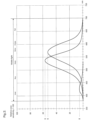
- The invention will be discussed below with reference to the accompanying drawings, illustrating the invention by way of examples.
- Figure 1
- illustrates four different transmission spectra for lenses according to the invention showing the transmission in percent as a function of the wavelength.
- Figure 2
- illustrates the sensitivity spectrum of a human eye.
- Figure 3
- illustrates the combination of
figures 1 and2 . - As can be seen from
figure 1 all the filter spectra has a transmission peak, preferably at approximately 650nm, or at least within the range of 620-670nm, in order to increase the users sensitivity to the red light as discussed above. This way the ski goggles helps the user utilize the rad light from the sun being close to the horizon. - In order to boost in contrast in the red range the transmittance curve has a transmittance peak at 670nm in order to capture most of the red sunlight being reflected off surfaces. It will also highlight red ski racing gates and red markings in the snow
- Also, the spectra have a relatively low transmission in the green and yellow parts of the spectrum, the first transmission peak being at least 2,5 times higher than the minimum transmission.
- According to the invention at least one additional transmission peak is present at 470nm, or at least within the range of 460-500nm, at least twice as high transmission as the minimum transmission in the 450-670nm range. This is selected to increase the wearers sensitivity to the blue light distinguishing different types of ice, snow and water surfaces. Having a transmission peak in the blue end of the visible spectrum will thus create greater contrast in snow as the blue light is boosted, and less important colors has less transmission. The blue transmission peak will as well highlight blue ski racing gates as well as blue markings in the snow.
- A third peak is also implemented in the range of approximately 420-440nm and especially at approximately 435nm, with a local minimum between the second and third peaks at approximately 450nm, in order to improve the ability to distinguish between the blue features, but in order to reduce the effects of HEV blue light the transmission is 0 below approximately 410nm. Experimental evidence has suggested exposure to blue light in the 470-490nm range may be less damaging compared to blue light from 400-470nm. Thus in order to reduce the harmful blue light exposure the 435nm peak may be lower than the peak at approximately 470nm. As is shown in
figure 1 the local minimum may have at least 10% reduction in the transmission when compared to the third peak. This may also depend on the chosen filter as well as the filter technology used to control the spectrum. -
Figure 2 illustrates the relative cone sensitivity on a comparable scale showing the blue, green and red sensitivity curves. As is evident fromfigure 3 where the preceding figures are combined the filter according to the present invention is attenuating the light in the range where the area where the eye has the highest sensitivity. In this way the user will experience an increased sensitivity, according to the preferred embodiment of the invention, in the ranges related to snow/water/ice surfaces as well as the red spectrum related to the low sun close to the horizon. - As discussed above, in order to have a transmission peak in the blue end of the visible spectrum while still staying safe, the transmission peak is at 470nm which is what is considered to be in the safe region. The four different courves in
figure 1 represent the following: - Lens "RIG 001" is based on extremely difficult light conditions which allows higher transmittance below 470nm in order to boost contrast.
- Transmittance curves described for "
RIG 006" and "RIG 007" is developed for exposure to stronger light, thus has lower transmission below 470nm - Transmittance curve described for "RIG 004" is developed for even stronger light at higher altitude and has very little blue light transmission.
- There is no transmission below 410nm as light between 380nm and 410nm is considered harmful due to the high frequency
- There is no UV light (below 380nm) transmission as UV light is known to be harmful.
- While developing the lens technology, experiments were made with snow goggles which only transmitted blue and red wave lengths. This created a loss of depth perception as it is believed that all the three cones (R,G and B) need to be activated in order for the brain to receive enough information. Furthermore, a lot of snow lenses creates a monochrome sensation, usually in the yellow to red region. This is where the both R and G has relative high sensitivity (as is illustrated in
figure 2 ) thus is perceived as bright and intensive light. It does not however create more contrast as there is very little of those colors available in snow environments. Therefore, the filter according to the invention maintains a transparency at all wavelengths above 410nm with a transmission above 5% in the range between 420 and 670nm. - Keeping some light transmission in the green and yellow wavelengths will also provide natural light and natural colors as well as providing great depth perception.
- The transmittance curves are preferably obtained by mixing different biological stains with different absorption ranges within the visible light spectrum, but other structures such as dielectric coatings and diffractive patterns, e.g. as discussed in
EP2585870B1 , may be contemplated depending on the situation and the required accuracy of the transmission spectrum. - The absorption maximum at 680nm shown in
figures 1 and3 is a result of the production method in the specific case and does not have any significance for the performance filter at it is in the outskirts of the visual spectrum where the sensitivity of the eye is low. The essential feature being the transmission maximum at 650nm. - To summarize the present invention relates to an optical filter for use in eyewear such as ski googles for improving visibility in snow dominated locations. The filter has a transmission spectrum with a first transmission peak in the wavelength range of 620nm-670, with a maximum at approximately 650nm. The ratio between the transmission peak value and the minimum transmission value in the range between 460-670nm being at least 2,5.
- The optical filter preferably also includes a second transmission peak in the range of 460-500nm, with a maximum at approximately 470, where the ratio between the transmission peak value and the minimum transmission value in the range between 460-670nm preferably is at least 2, but as seen in
figure 1 withRIG 001 may be down to 1,5 depending on the situation. The first transmission peak thus preferably has a higher transmission than the second transmission peak. - The filter has a transmission in the complete spectrum between 420nm and 670nm with a minimum transmission in the range between 460 and 670nm being at least 5-8% so as to provide the user with the full visual spectrum.
- The minimum transmission value in the range between 460 and 670nm is more than ¼ of the first peak transmission maximum.
- This way, in the preferred embodiment using two peaks the emphasis is made in the blue and red range while the light intensity in the green/yellow range is reduced.
- In order to protect the users eyes the transmission is preferably reduced to zero below 410nm, thus also stopping ultraviolet light and may be reduced in an even curve from the second transmission peak at 470nm.
- As discussed filter according to the present invention is especially suitable for use in eyewear for winter sports activities, such as ski googles, sun glasses etc.
Claims (8)
- Optical filter for use in eyewear such as ski googles for improving visibility in snow dominated locations, the filter having a transmission spectrum having a first transmission peak in the wavelength range of 620nm-670, with a maximum at approximately 650nm, the ratio between the transmission peak value and the minimum transmission value in the range between 460-670nm being at least 2,5, the spectrum also includes a second transmission peak in the range of 460-500nm, with a maximum at approximately 470, the ratio between the transmission peak value and the minimum transmission value in the range between 460-670nm being at least 1,5,
wherein the spectrum includes a third transmission peak in the range of 420-440nm with a peak at approximately 435nm and a local minimum between the second and third peak,
characterised in that the minimum transmission value in the range between 460 and 670nm is more than ¼ of the first peak transmission maximum. - Optical filter according to claim 1, wherein the first transmission peak has a higher transmission than the second transmission peak.
- Optical filter according to claim 1, wherein the local minimum between the second and third peak having at least 10% reduction in the transmission when compared to the third peak.
- Optical filter according to claim 1, wherein the transmission is approximately zero below 410nm.
- Optical filter according to claim 1, wherein the minimum transmission between 460 and 670nm is at least 5%.
- Optical filter according to claim 1, wherein the filter is made from a mixture from biological stains with different absorption ranges within the visible light spectrum.
- Eyewear, especially for winter sports activities comprising a filter according to one of the preceding claims.
- Eyewear according to claim 7, being constituted by ski googles.
Applications Claiming Priority (2)
| Application Number | Priority Date | Filing Date | Title |
|---|---|---|---|
| NO20181594A NO348781B1 (en) | 2018-12-12 | 2018-12-12 | Optical filter for snow conditions |
| PCT/EP2019/084918 WO2020120688A1 (en) | 2018-12-12 | 2019-12-12 | Optical filter for snow conditions |
Publications (3)
| Publication Number | Publication Date |
|---|---|
| EP3894946A1 EP3894946A1 (en) | 2021-10-20 |
| EP3894946B1 true EP3894946B1 (en) | 2024-01-24 |
| EP3894946C0 EP3894946C0 (en) | 2024-01-24 |
Family
ID=69104346
Family Applications (1)
| Application Number | Title | Priority Date | Filing Date |
|---|---|---|---|
| EP19831610.1A Active EP3894946B1 (en) | 2018-12-12 | 2019-12-12 | Optical filter for snow conditions |
Country Status (8)
| Country | Link |
|---|---|
| US (1) | US12032230B2 (en) |
| EP (1) | EP3894946B1 (en) |
| JP (1) | JP7483713B2 (en) |
| KR (1) | KR102801858B1 (en) |
| CN (1) | CN113168031B (en) |
| CA (1) | CA3118798A1 (en) |
| NO (1) | NO348781B1 (en) |
| WO (1) | WO2020120688A1 (en) |
Family Cites Families (15)
| Publication number | Priority date | Publication date | Assignee | Title |
|---|---|---|---|---|
| US4793669A (en) * | 1987-09-11 | 1988-12-27 | Coherent, Inc. | Multilayer optical filter for producing colored reflected light and neutral transmission |
| US5646781A (en) * | 1995-05-15 | 1997-07-08 | Omega Optical, Inc. | Optical filters for forming enhanced images |
| AUPN685495A0 (en) * | 1995-11-28 | 1995-12-21 | Sola International Holdings Ltd | Light transmitting articles with colour enhancing properties |
| US6011652A (en) * | 1997-12-23 | 2000-01-04 | Cushing; David Henry | Multilayer thin film dielectric bandpass filter |
| US6138286A (en) * | 1999-04-14 | 2000-10-31 | Scott Usa, Inc. | Goggle having a tinted plastic lens |
| US20060114573A1 (en) * | 2004-03-25 | 2006-06-01 | Giuseppe Iori | Optical element for use in eye protection devices and methods for its manufacture |
| BRPI0715849B1 (en) | 2006-08-23 | 2021-12-28 | High Performance Optics, Inc | SYSTEM AND METHOD FOR SELECTIVE LIGHT INHIBITION |
| US7597441B1 (en) * | 2007-10-09 | 2009-10-06 | Farwig Michael J | Polarized contrast enhancing sunglass lens |
| US8210678B1 (en) * | 2009-12-21 | 2012-07-03 | Farwig Michael J | Multiband contrast-enhancing light filter and polarized sunglass lens comprising same |
| CN102959455B (en) | 2010-06-28 | 2016-06-29 | 辛维特有限公司 | Viewing aids for 3D stereoscopic displays |
| TW201341886A (en) * | 2012-04-13 | 2013-10-16 | Cornerstone Optical Co Ltd | Color contrast enhancing sunglass lens |
| EP2946245B1 (en) * | 2013-01-17 | 2017-11-22 | Carl Zeiss Vision Italia S.p.A. | Contrast enhancing filter for eye glasses and contrast enhancing eye glass |
| US9885885B2 (en) * | 2013-11-27 | 2018-02-06 | 3M Innovative Properties Company | Blue edge filter optical lens |
| US9575335B1 (en) | 2014-01-10 | 2017-02-21 | Oakley, Inc. | Eyewear with chroma enhancement for specific activities |
| FR3054683B1 (en) * | 2016-07-26 | 2018-08-31 | Bnl Eurolens | OPHTHALMOLOGICAL LENS, IN PARTICULAR FOR SUNGLASSES |
-
2018
- 2018-12-12 NO NO20181594A patent/NO348781B1/en unknown
-
2019
- 2019-12-12 CN CN201980077335.4A patent/CN113168031B/en active Active
- 2019-12-12 JP JP2021534318A patent/JP7483713B2/en active Active
- 2019-12-12 US US17/292,111 patent/US12032230B2/en active Active
- 2019-12-12 EP EP19831610.1A patent/EP3894946B1/en active Active
- 2019-12-12 WO PCT/EP2019/084918 patent/WO2020120688A1/en not_active Ceased
- 2019-12-12 CA CA3118798A patent/CA3118798A1/en active Pending
- 2019-12-12 KR KR1020217021823A patent/KR102801858B1/en active Active
Also Published As
| Publication number | Publication date |
|---|---|
| WO2020120688A1 (en) | 2020-06-18 |
| KR102801858B1 (en) | 2025-04-30 |
| EP3894946A1 (en) | 2021-10-20 |
| CN113168031A (en) | 2021-07-23 |
| CN113168031B (en) | 2023-03-28 |
| NO20181594A1 (en) | 2020-06-15 |
| US12032230B2 (en) | 2024-07-09 |
| CA3118798A1 (en) | 2020-06-18 |
| EP3894946C0 (en) | 2024-01-24 |
| JP2022513907A (en) | 2022-02-09 |
| US20210397023A1 (en) | 2021-12-23 |
| JP7483713B2 (en) | 2024-05-15 |
| KR20210101291A (en) | 2021-08-18 |
| NO348781B1 (en) | 2025-06-02 |
Similar Documents
| Publication | Publication Date | Title |
|---|---|---|
| US11762221B2 (en) | Eyewear with chroma enhancement | |
| US12282212B2 (en) | Eyewear with chroma enhancement | |
| US5592245A (en) | Apparatus for enhancing visual perception of selected objects in recreational and sporting activities | |
| US5149183A (en) | Color enhancing lens | |
| US6893127B2 (en) | Activity-specific optical filters and eyewear using such filters | |
| CA2273166C (en) | Apparatus for enhancing visual perception of selected objects in recreational and sporting activities | |
| CN110554518A (en) | chroma enhancement optical product and application thereof in field of lenses | |
| EP1356343A2 (en) | Activity-specific optical filters and eyewear using such filters | |
| CA2314137C (en) | Ball detection viewer | |
| US12032230B2 (en) | Optical filter for snow conditions | |
| Pitts et al. | Sunglasses for ocular protection | |
| Cappuccitti | Sunwear and the science of light | |
| Brown et al. | A new approach to laser filters |
Legal Events
| Date | Code | Title | Description |
|---|---|---|---|
| STAA | Information on the status of an ep patent application or granted ep patent |
Free format text: STATUS: UNKNOWN |
|
| STAA | Information on the status of an ep patent application or granted ep patent |
Free format text: STATUS: THE INTERNATIONAL PUBLICATION HAS BEEN MADE |
|
| PUAI | Public reference made under article 153(3) epc to a published international application that has entered the european phase |
Free format text: ORIGINAL CODE: 0009012 |
|
| STAA | Information on the status of an ep patent application or granted ep patent |
Free format text: STATUS: REQUEST FOR EXAMINATION WAS MADE |
|
| 17P | Request for examination filed |
Effective date: 20210621 |
|
| AK | Designated contracting states |
Kind code of ref document: A1 Designated state(s): AL AT BE BG CH CY CZ DE DK EE ES FI FR GB GR HR HU IE IS IT LI LT LU LV MC MK MT NL NO PL PT RO RS SE SI SK SM TR |
|
| DAV | Request for validation of the european patent (deleted) | ||
| DAX | Request for extension of the european patent (deleted) | ||
| GRAP | Despatch of communication of intention to grant a patent |
Free format text: ORIGINAL CODE: EPIDOSNIGR1 |
|
| STAA | Information on the status of an ep patent application or granted ep patent |
Free format text: STATUS: GRANT OF PATENT IS INTENDED |
|
| INTG | Intention to grant announced |
Effective date: 20230712 |
|
| GRAS | Grant fee paid |
Free format text: ORIGINAL CODE: EPIDOSNIGR3 |
|
| RAP3 | Party data changed (applicant data changed or rights of an application transferred) |
Owner name: ACTIVE BRANDS AS |
|
| GRAA | (expected) grant |
Free format text: ORIGINAL CODE: 0009210 |
|
| STAA | Information on the status of an ep patent application or granted ep patent |
Free format text: STATUS: THE PATENT HAS BEEN GRANTED |
|
| AK | Designated contracting states |
Kind code of ref document: B1 Designated state(s): AL AT BE BG CH CY CZ DE DK EE ES FI FR GB GR HR HU IE IS IT LI LT LU LV MC MK MT NL NO PL PT RO RS SE SI SK SM TR |
|
| REG | Reference to a national code |
Ref country code: GB Ref legal event code: FG4D |
|
| REG | Reference to a national code |
Ref country code: CH Ref legal event code: EP |
|
| REG | Reference to a national code |
Ref country code: IE Ref legal event code: FG4D |
|
| REG | Reference to a national code |
Ref country code: DE Ref legal event code: R096 Ref document number: 602019045730 Country of ref document: DE |
|
| U01 | Request for unitary effect filed |
Effective date: 20240220 |
|
| U07 | Unitary effect registered |
Designated state(s): AT BE BG DE DK EE FI FR IT LT LU LV MT NL PT SE SI Effective date: 20240311 |
|
| PG25 | Lapsed in a contracting state [announced via postgrant information from national office to epo] |
Ref country code: IS Free format text: LAPSE BECAUSE OF FAILURE TO SUBMIT A TRANSLATION OF THE DESCRIPTION OR TO PAY THE FEE WITHIN THE PRESCRIBED TIME-LIMIT Effective date: 20240524 |
|
| PG25 | Lapsed in a contracting state [announced via postgrant information from national office to epo] |
Ref country code: GR Free format text: LAPSE BECAUSE OF FAILURE TO SUBMIT A TRANSLATION OF THE DESCRIPTION OR TO PAY THE FEE WITHIN THE PRESCRIBED TIME-LIMIT Effective date: 20240425 |
|
| PG25 | Lapsed in a contracting state [announced via postgrant information from national office to epo] |
Ref country code: HR Free format text: LAPSE BECAUSE OF FAILURE TO SUBMIT A TRANSLATION OF THE DESCRIPTION OR TO PAY THE FEE WITHIN THE PRESCRIBED TIME-LIMIT Effective date: 20240124 Ref country code: RS Free format text: LAPSE BECAUSE OF FAILURE TO SUBMIT A TRANSLATION OF THE DESCRIPTION OR TO PAY THE FEE WITHIN THE PRESCRIBED TIME-LIMIT Effective date: 20240424 |
|
| PG25 | Lapsed in a contracting state [announced via postgrant information from national office to epo] |
Ref country code: ES Free format text: LAPSE BECAUSE OF FAILURE TO SUBMIT A TRANSLATION OF THE DESCRIPTION OR TO PAY THE FEE WITHIN THE PRESCRIBED TIME-LIMIT Effective date: 20240124 |
|
| PG25 | Lapsed in a contracting state [announced via postgrant information from national office to epo] |
Ref country code: RS Free format text: LAPSE BECAUSE OF FAILURE TO SUBMIT A TRANSLATION OF THE DESCRIPTION OR TO PAY THE FEE WITHIN THE PRESCRIBED TIME-LIMIT Effective date: 20240424 Ref country code: NO Free format text: LAPSE BECAUSE OF FAILURE TO SUBMIT A TRANSLATION OF THE DESCRIPTION OR TO PAY THE FEE WITHIN THE PRESCRIBED TIME-LIMIT Effective date: 20240424 Ref country code: IS Free format text: LAPSE BECAUSE OF FAILURE TO SUBMIT A TRANSLATION OF THE DESCRIPTION OR TO PAY THE FEE WITHIN THE PRESCRIBED TIME-LIMIT Effective date: 20240524 Ref country code: HR Free format text: LAPSE BECAUSE OF FAILURE TO SUBMIT A TRANSLATION OF THE DESCRIPTION OR TO PAY THE FEE WITHIN THE PRESCRIBED TIME-LIMIT Effective date: 20240124 Ref country code: GR Free format text: LAPSE BECAUSE OF FAILURE TO SUBMIT A TRANSLATION OF THE DESCRIPTION OR TO PAY THE FEE WITHIN THE PRESCRIBED TIME-LIMIT Effective date: 20240425 Ref country code: ES Free format text: LAPSE BECAUSE OF FAILURE TO SUBMIT A TRANSLATION OF THE DESCRIPTION OR TO PAY THE FEE WITHIN THE PRESCRIBED TIME-LIMIT Effective date: 20240124 |
|
| PG25 | Lapsed in a contracting state [announced via postgrant information from national office to epo] |
Ref country code: PL Free format text: LAPSE BECAUSE OF FAILURE TO SUBMIT A TRANSLATION OF THE DESCRIPTION OR TO PAY THE FEE WITHIN THE PRESCRIBED TIME-LIMIT Effective date: 20240124 |
|
| PG25 | Lapsed in a contracting state [announced via postgrant information from national office to epo] |
Ref country code: PL Free format text: LAPSE BECAUSE OF FAILURE TO SUBMIT A TRANSLATION OF THE DESCRIPTION OR TO PAY THE FEE WITHIN THE PRESCRIBED TIME-LIMIT Effective date: 20240124 |
|
| PG25 | Lapsed in a contracting state [announced via postgrant information from national office to epo] |
Ref country code: SM Free format text: LAPSE BECAUSE OF FAILURE TO SUBMIT A TRANSLATION OF THE DESCRIPTION OR TO PAY THE FEE WITHIN THE PRESCRIBED TIME-LIMIT Effective date: 20240124 |
|
| PG25 | Lapsed in a contracting state [announced via postgrant information from national office to epo] |
Ref country code: CZ Free format text: LAPSE BECAUSE OF FAILURE TO SUBMIT A TRANSLATION OF THE DESCRIPTION OR TO PAY THE FEE WITHIN THE PRESCRIBED TIME-LIMIT Effective date: 20240124 |
|
| REG | Reference to a national code |
Ref country code: DE Ref legal event code: R097 Ref document number: 602019045730 Country of ref document: DE |
|
| PG25 | Lapsed in a contracting state [announced via postgrant information from national office to epo] |
Ref country code: SK Free format text: LAPSE BECAUSE OF FAILURE TO SUBMIT A TRANSLATION OF THE DESCRIPTION OR TO PAY THE FEE WITHIN THE PRESCRIBED TIME-LIMIT Effective date: 20240124 |
|
| PG25 | Lapsed in a contracting state [announced via postgrant information from national office to epo] |
Ref country code: SM Free format text: LAPSE BECAUSE OF FAILURE TO SUBMIT A TRANSLATION OF THE DESCRIPTION OR TO PAY THE FEE WITHIN THE PRESCRIBED TIME-LIMIT Effective date: 20240124 Ref country code: SK Free format text: LAPSE BECAUSE OF FAILURE TO SUBMIT A TRANSLATION OF THE DESCRIPTION OR TO PAY THE FEE WITHIN THE PRESCRIBED TIME-LIMIT Effective date: 20240124 Ref country code: CZ Free format text: LAPSE BECAUSE OF FAILURE TO SUBMIT A TRANSLATION OF THE DESCRIPTION OR TO PAY THE FEE WITHIN THE PRESCRIBED TIME-LIMIT Effective date: 20240124 |
|
| PLBE | No opposition filed within time limit |
Free format text: ORIGINAL CODE: 0009261 |
|
| STAA | Information on the status of an ep patent application or granted ep patent |
Free format text: STATUS: NO OPPOSITION FILED WITHIN TIME LIMIT |
|
| 26N | No opposition filed |
Effective date: 20241025 |
|
| U20 | Renewal fee for the european patent with unitary effect paid |
Year of fee payment: 6 Effective date: 20241217 |
|
| PG25 | Lapsed in a contracting state [announced via postgrant information from national office to epo] |
Ref country code: MC Free format text: LAPSE BECAUSE OF FAILURE TO SUBMIT A TRANSLATION OF THE DESCRIPTION OR TO PAY THE FEE WITHIN THE PRESCRIBED TIME-LIMIT Effective date: 20240124 |
|
| PG25 | Lapsed in a contracting state [announced via postgrant information from national office to epo] |
Ref country code: IE Free format text: LAPSE BECAUSE OF NON-PAYMENT OF DUE FEES Effective date: 20241212 |
|
| PG25 | Lapsed in a contracting state [announced via postgrant information from national office to epo] |
Ref country code: RO Free format text: LAPSE BECAUSE OF FAILURE TO SUBMIT A TRANSLATION OF THE DESCRIPTION OR TO PAY THE FEE WITHIN THE PRESCRIBED TIME-LIMIT Effective date: 20240124 |
|
| REG | Reference to a national code |
Ref country code: CH Ref legal event code: U11 Free format text: ST27 STATUS EVENT CODE: U-0-0-U10-U11 (AS PROVIDED BY THE NATIONAL OFFICE) Effective date: 20260101 |
|
| PGFP | Annual fee paid to national office [announced via postgrant information from national office to epo] |
Ref country code: GB Payment date: 20251219 Year of fee payment: 7 |
|
| U20 | Renewal fee for the european patent with unitary effect paid |
Year of fee payment: 7 Effective date: 20251216 |
|
| PGFP | Annual fee paid to national office [announced via postgrant information from national office to epo] |
Ref country code: CH Payment date: 20260101 Year of fee payment: 7 |
|
| PG25 | Lapsed in a contracting state [announced via postgrant information from national office to epo] |
Ref country code: CY Free format text: LAPSE BECAUSE OF FAILURE TO SUBMIT A TRANSLATION OF THE DESCRIPTION OR TO PAY THE FEE WITHIN THE PRESCRIBED TIME-LIMIT Effective date: 20240124 |