EP3893400A1 - Sorting method and apparatus, and electronic device and medium - Google Patents
Sorting method and apparatus, and electronic device and medium Download PDFInfo
- Publication number
- EP3893400A1 EP3893400A1 EP19894383.9A EP19894383A EP3893400A1 EP 3893400 A1 EP3893400 A1 EP 3893400A1 EP 19894383 A EP19894383 A EP 19894383A EP 3893400 A1 EP3893400 A1 EP 3893400A1
- Authority
- EP
- European Patent Office
- Prior art keywords
- data
- extracted
- pieces
- bit
- compactly arranged
- Prior art date
- Legal status (The legal status is an assumption and is not a legal conclusion. Google has not performed a legal analysis and makes no representation as to the accuracy of the status listed.)
- Pending
Links
Images



Classifications
-
- H—ELECTRICITY
- H03—ELECTRONIC CIRCUITRY
- H03M—CODING; DECODING; CODE CONVERSION IN GENERAL
- H03M13/00—Coding, decoding or code conversion, for error detection or error correction; Coding theory basic assumptions; Coding bounds; Error probability evaluation methods; Channel models; Simulation or testing of codes
- H03M13/65—Purpose and implementation aspects
- H03M13/6577—Representation or format of variables, register sizes or word-lengths and quantization
- H03M13/6591—Truncation, saturation and clamping
-
- H—ELECTRICITY
- H03—ELECTRONIC CIRCUITRY
- H03M—CODING; DECODING; CODE CONVERSION IN GENERAL
- H03M13/00—Coding, decoding or code conversion, for error detection or error correction; Coding theory basic assumptions; Coding bounds; Error probability evaluation methods; Channel models; Simulation or testing of codes
- H03M13/03—Error detection or forward error correction by redundancy in data representation, i.e. code words containing more digits than the source words
- H03M13/05—Error detection or forward error correction by redundancy in data representation, i.e. code words containing more digits than the source words using block codes, i.e. a predetermined number of check bits joined to a predetermined number of information bits
- H03M13/13—Linear codes
-
- H—ELECTRICITY
- H03—ELECTRONIC CIRCUITRY
- H03M—CODING; DECODING; CODE CONVERSION IN GENERAL
- H03M13/00—Coding, decoding or code conversion, for error detection or error correction; Coding theory basic assumptions; Coding bounds; Error probability evaluation methods; Channel models; Simulation or testing of codes
- H03M13/65—Purpose and implementation aspects
- H03M13/6502—Reduction of hardware complexity or efficient processing
-
- Y—GENERAL TAGGING OF NEW TECHNOLOGICAL DEVELOPMENTS; GENERAL TAGGING OF CROSS-SECTIONAL TECHNOLOGIES SPANNING OVER SEVERAL SECTIONS OF THE IPC; TECHNICAL SUBJECTS COVERED BY FORMER USPC CROSS-REFERENCE ART COLLECTIONS [XRACs] AND DIGESTS
- Y02—TECHNOLOGIES OR APPLICATIONS FOR MITIGATION OR ADAPTATION AGAINST CLIMATE CHANGE
- Y02D—CLIMATE CHANGE MITIGATION TECHNOLOGIES IN INFORMATION AND COMMUNICATION TECHNOLOGIES [ICT], I.E. INFORMATION AND COMMUNICATION TECHNOLOGIES AIMING AT THE REDUCTION OF THEIR OWN ENERGY USE
- Y02D10/00—Energy efficient computing, e.g. low power processors, power management or thermal management
Definitions
- the present disclosure relates to the field of communications, and in particular, to a sorting method and apparatus, an electronic device and a medium.
- a successive cancellation list (SCL) algorithm is generally used.
- the SCL algorithm maintains at most L paths simultaneously, and measures each path, so as to improve the decoding performance.
- the number L of survivor paths is an integral power of 2, and the increase of L can improve the performance of a decoder, but also can bring increase of the decoding complexity.
- the decoding sequence Before decoding the polar code, the decoding sequence needs to be determined first according to a decoding tree.
- a decoder correspondingly updates a logarithm likelihood rate (LLR) and a path metric (PM) value according to the position of the current node in the decoding tree.
- LLR logarithm likelihood rate
- PM path metric
- each decoding in a case where the number of extended paths is greater than the number L of the survivor paths, L survivor paths with the minimum PM values need to be selected by sorting.
- the quality of sorting performance directly affects the decoding performance.
- the current SCL decoder has a long time delay in a sorting operation, and occupies a large hardware resource, resulting in low sorting performance, high power consumption and poor flexibility.
- Embodiments of the present disclosure provide a sorting method and apparatus, an electronic device, and a medium, which can overcome the problems in the related art such as a long decoding time delay, a large hardware resource consumption, and poor flexibility in the decoding of a polar code.
- Some embodiments of the present disclosure provide a sorting method, the method including:
- Some embodiments of the present disclosure provide a sorting apparatus, the apparatus including:
- Some embodiments of the present disclosure further provide an electronic device, including: at least one processor; and a memory, configured to store at least one computer program, wherein when the at least one computer program is executed by the at least one processor, the at least one processor is enabled to implement the sorting method according to some embodiments of the present disclosure.
- Some embodiments of the present disclosure further provide a computer storage medium, the computer storage medium stores computer executable instructions, and the computer executable instructions are used for executing the sorting method according to the embodiments of the present disclosure.
- Fig. 1 is a schematic flowchart of a sorting method according to some embodiments of the present disclosure; the sorting method is applied to a decoding process of a polar code. As shown in Fig. 1 , the method includes operations 101 to 105.
- configuration information is acquired, wherein the configuration information includes the number L of survivor paths, the length N0 of a mother code, at least one path deletion instruction and a truncation bit width W.
- the configuration information may be preset according to decoding requirements of the polar code.
- truncation processing is performed on each of multiple pieces of inputted data according to the truncation bit width W, and each piece of truncated low-bit information of the data subjected to the truncation processing is stored in a memory.
- one or more low-bits (the low-bit information) of the data are truncated according to the truncation bit width W in the configuration information, and the low-bit data is stored in the memory.
- the truncation mode for performing truncation processing on the inputted data according to the truncation bit width W is described as follows.
- the operation that, according to the at least one path deletion instruction, data extraction is performed on the multiple pieces of data from which the low-bit information is truncated may be implemented in the following manner.
- data in the multiple pieces of data from which the low-bit information is truncated is correspondingly extracted according to an extraction rule and the path deletion instruction of each of the survivor paths, wherein the extraction rule is to reserve data corresponding to all information bits.
- the extraction rule is to reserve data corresponding to all information bits.
- the data format of the first survivor path before extraction is ⁇ info0, null, info1, null, info2, null, info3, null ⁇ , wherein the path deletion instruction herein indicates that info0 to info3 are data corresponding to information bits, and null refers to data corresponding to a non-information bit, and thus the arrangement of the data after extraction is ⁇ info0, info1, info2, info3 ⁇ .
- the data format of the second survivor path before extraction is ⁇ info6, null, info7, null, info8, null, info9, null ⁇ , and thus the arrangement of the data after extraction is ⁇ info6, info7, info8, info9 ⁇ . Then, the data extracted from the two survivor paths is compactly arranged to obtain ⁇ info0, info1, info2, info3, info6, info7, info8, info9 ⁇ .
- all input data received in operation 103 is first numbered in an ascending order, and the number is used to record the bit sequence of each piece of data.
- Data is extracted according to the path deletion instruction in the configuration information, and the bit sequences of the extracted data are recorded and are sent together to a subsequent processing module, such as a bitonic sorting bmN array, or an output control module.
- a subsequent processing module such as a bitonic sorting bmN array, or an output control module.
- 4b-SCL as an example, in each survivor path, 4 bits are decoded in each decoding process, a maximum of 16 paths are extended, and which bit in the 4 bits requires extension needs to be provided.
- the format of the path deletion instruction is ⁇ info_flg0, info_flg1, info_flg2, info_flg3 ⁇ .
- info_flg0 and info_flg2 are 1, which indicates that paths corresponding to the two bits need to be extended, that is, values of the two bits may be 0 and 1; and in a case where info_flg1 and info_flg2 are 0, which indicates that paths corresponding to the two bits are not extended, that is, values of the two bits can only be 0.
- the numbers of the reserved data paths are 4'b0000, 4'b0010, 4'b1000 and 4'b1010, that is, data corresponding to paths 0, 2, 8 and 10 is extracted.
- the extracted data is compactly arranged, and the number of data obtained after the extracted data is compactly arranged is determined.
- bit sequence of each piece of data is also recorded.
- bit sequence corresponding to info0 is 0, the bit sequence corresponding to the first null is 1, the bit sequence corresponding to info1 is 2, the bit sequence corresponding to the second null is 3, the bit sequence corresponding to info2 is 4, the bit sequence corresponding to the third null is 5, the bit sequence corresponding to info3 is 6, and the bit sequence corresponding to the fourth null is 7.
- the data after extraction is arranged as ⁇ info0, info1, info2, info3 ⁇ , and the corresponding bit sequences are recorded as ⁇ 0, 2, 4, 6 ⁇ .
- L pieces of to-be-outputted data are determined based on the number L of the survivor paths, the length N0 of the mother code, the extracted data, the bit sequences of the extracted data and the number of the data obtained after the extracted data is compactly arranged.
- the operation that the L pieces of to-be-outputted data are determined based on the number L of the survivor paths, the length N0 of the mother code, the extracted data, the bit sequences of the extracted data and the number of the data obtained after the extracted data is compactly arranged may be implemented in the following manner.
- bitonic sorting is performed, by using a preset array, on the data obtained after the extracted data is compactly arranged, and L pieces of data are extracted from the data obtained after the extracted data is compactly arranged.
- the data obtained after the extracted data is compactly arranged is complemented to L pieces of data.
- the preset array may be a bmN array (basic sorting unit).
- the operation that the L pieces of data are extracted from the data obtained after the extracted data is compactly arranged includes the following operations.
- L pieces of minimum data are selected from the data obtained after the extracted data is compactly arranged, and the bit sequence corresponding to each piece of data in the L pieces of data is determined.
- bit sequence is consistent with the bit sequence provided when performing numbering in the process of data extraction in operation 103.
- L pieces of data are selected from any N0 pieces of data, and the value of N0 includes, but is not limited to, 32, 64, 128, 256, or 512.
- the value of L includes, but is not limited to, 8, 16 or 32.
- the number of valid data can be understood as the number of the data obtained after the extracted data is compactly arranged.
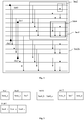
- Fig. 2 shows a basic principle diagram of conventional bitonic sorting.
- bmN is able to sort N pieces of inputted data and output an ordered sequence of the N pieces of inputted data.
- bm4 is able to sort 4 pieces of data and output an ordered sequence of the 4 pieces of data.
- bm4 is improved and optimized.
- bm16 has a total of 4 stages of comparisons from left to right. The first two stages of comparisons can be combined into one stage of bm4_b under the premise that the data is extracted at intervals. For example, data at positions shown by black points in Fig.
- 2 include four pieces of data sent to one bm4_b, and only the four pieces of data extracted at intervals can be combined into one bm4_b.
- the following 2 stages of comparisons may be achieved by using a conventional bm4, which is denoted as bm4_a.
- the method of pairwise comparison while determination is used to complete the total sorting.
- the original 4 stages of bm2 comparison logics of bm16 can be reduced to 2 stages of bm4 comparison logics.
- Fig. 3 lists optimized basic sorting units bmN.
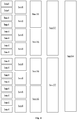
- Fig. 4 lists a sorting array required for total sorting of 64 pieces of data.
- 16 or 32 minimum pieces of data is extracted from the output data of a first stage of bm4_b array in the bm64 unit
- the operation that the data obtained after the extracted data is compactly arranged is complemented to the L pieces of data may be implemented in the following manner.
- the number and values of complementing data are determined, wherein the value of each piece of complementing data is a maximum value which is able to be represented by a bit width of the current data.
- the values of the X pieces of complementing data are consistent.
- the L-X pieces of data obtained after the extracted data is compactly arranged are complemented, and then the X pieces of complementing data and the values of the X pieces of complementing data are determined.
- the method may further include the following operations.
- corresponding truncated low-bit information is extracted from the memory according to information of the bit sequences corresponding to the data obtained after the extracted data is compactly arranged, and the data obtained after the extracted data is compactly arranged and the extracted low-bit information are spliced into original data.
- L pieces of data can be first extracted from the bmN array, and then a bit-complementing processing is performed on the L pieces of data.
- the bit sequence information recorded in the process of compact arrangement and sorting of data is used, the truncated low-bit information is extracted from the memory in operation 102, and is spliced into original data and outputted.
- the splicing manner is ⁇ a[N:W], a[W-1:0] ⁇ , that is, the output data is a[N:0].
- sorting functions required by polar code decoding can be completed with fewer hardware resources, facilitating high-speed circuit design.
- a set of circuits can be used to support the sorting requirements for decoding of a polar code of each code length.
- Fig. 5 is a schematic diagram of a composition structure of a sorting apparatus according to some embodiments of the present disclosure. As shown in Fig. 5 , the sorting apparatus includes: an acquisition module 10, a truncation module 20, an extraction module 30 and an output control module 40.
- the acquisition module 10 is configured to acquire configuration information, wherein the configuration information includes the number L of survivor paths, the length N0 of a mother code, at least one path deletion instruction and a truncation bit width W.
- the truncation module 20 is configured to perform truncation processing on each of multiple pieces of inputted data according to the truncation bit width W, and store, in a memory, each piece of truncated low-bit information of the data subjected to the truncation processing.
- the extraction module 30 is configured to perform, according to the at least one path deletion indication, data extraction on the multiple pieces of data from which the low-bit information is truncated, record bit sequences of the extracted data, compactly arrange the extracted data, and determine the number of data obtained after the extracted data is compactly arranged.
- the output control module 40 is configured to determine L pieces of to-be-outputted data based on the number L of the survivor paths, the length N0 of the mother code, the extracted data, the bit sequences of the extracted data and the number of the data obtained after the extracted data is compactly arranged.
- the output control module 40 may include:
- the sorting module 50 is configured to select L pieces of minimum data from the data obtained after the extracted data is compactly arranged, and determine the bit sequence corresponding to each piece of data in the L pieces of data.
- the complementing module 60 is configured to determine the number and values of complementing data, wherein the value of each piece of complementing data is a maximum value which is able to be represented by a bit width of the current data.
- the apparatus further includes a bit-complementing module 70, the bit-complementing module 70 being configured to:
- the extraction module 30 is configured to correspondingly extract, according to an extraction rule and the path deletion instruction of each of the survivor paths, data in the multiple pieces of data from which the low-bit information is truncated, wherein the extraction rule is to reserve data corresponding to all information bits.
- the acquisition module 10, the truncation module 20, the extraction module 30, the output control module 40, the sorting module 50, the complementing module 60 and the bit-complementing module 70 may all be implemented by a central processing unit (CPU), a microprocessor unit (MPU), a digital signal processor (DSP), or a field-programmable gate array (FPGA) located in the sorting apparatus.
- CPU central processing unit
- MPU microprocessor unit
- DSP digital signal processor
- FPGA field-programmable gate array
- sorting functions required by polar code decoding can be completed with fewer hardware resources, facilitating high-speed circuit design.
- a set of circuits can be used to support the sorting requirements for decoding of a polar code of each code length.
- Fig. 6 shows a schematic diagram of system architecture of a sorting system.
- the architecture mainly includes several parts such as truncating, extracting, bitonic sorting bmN array, output control, and bit-complementing.
- Low bits of inputted data are truncated according to configuration information, the low-bit data is stored in a memory, and the truncated data is outputted to an extraction module.
- the inputted data is a[N:0]
- data outputted after truncation is a[N:W]
- the truncated data a[W-1:0] is stored in the memory.
- the described truncation processing can be achieved by a truncation module.
- All input data is first numbered in an ascending order, and the number is used to record the bit sequence of each piece of data. Then, data is extracted according to the path deletion instruction in the configuration information, and the bit sequences of the extracted data are recorded and are sent together to a subsequent bitonic sorting bmN array, or an output control module.
- a subsequent bitonic sorting bmN array or an output control module.
- 4b-SCL as an example, in each survivor path, 4 bits are decoded in each decoding process, a maximum of 16 paths are extended, and which bit in the 4 bits requires extension needs to be provided.
- the format of the path deletion instruction is ⁇ info_flg0, info_flg1, info_flg2, info_flg3 ⁇ .
- info_flg0 and info_flg2 are 1, which indicates that paths corresponding to the two bits need to be extended, that is, values of the two bits may be 0 and 1; and in a case where info_flg1 and info_flg2 are 0, which indicates that paths corresponding to the two bits are not extended, that is, values of the two bits can only be 0.
- the numbers of the reserved data paths are 4'b0000, 4'b0010, 4'b1000 and 4'b1010, that is, data corresponding to paths 0, 2, 8 and 10 is extracted.
- the described extraction process can be achieved by an extraction module.
- the input data is sorted, and L pieces of minimum data and the bit sequence corresponding to each piece of data are selected. It is supported that L pieces of data are selected from any N0 pieces of data, and the value of N0 includes, but is not limited to, 32, 64, 128, 256, or 512. The value of L includes, but is not limited to, 8, 16 or 32.
- Fig. 2 shows a basic principle diagram of conventional bitonic sorting.
- bmN is able to sort N pieces of inputted data and output an ordered sequence of the N pieces of inputted data.
- bm4 is able to sort 4 pieces of data and output an ordered sequence of the 4 pieces of data.
- bm4 is improved and optimized.
- bm16 has a total of 4 stages of comparisons from left to right. The first two stages of comparisons can be combined into one stage of bm4_b under the premise that the data is extracted at intervals. For example, data at positions shown by black points in Fig.
- 2 include four pieces of data sent to one bm4_b, and only the four pieces of data extracted at intervals can be combined into one bm4_b.
- the following 2 stages of comparisons may be achieved by using a conventional bm4, which is denoted as bm4_a.
- the method of pairwise comparison while determination is used to complete the total sorting.
- the original 4 stages of bm2 comparison logics of bm16 can be reduced to 2 stages of bm4 comparison logics.
- Fig. 3 lists optimized basic sorting units bmN.
- Fig. 4 lists a sorting array required for total sorting of 64 pieces of data.
- 16 or 32 minimum pieces of data is extracted from the output data of a first stage of bm4_b array in the bm64 unit
- the described bitonic sorting bmN array can be achieved by a sorting module.
- L pieces of data are selected from the data outputted by the bitonic sorting bmN array or the data outputted by the extraction module and outputted.
- the control information inputted by the extraction module includes the extracted data and bit sequences corresponding to the extracted data, and the number of data obtained after compact arrangement processing by the extraction module.
- the described output control processing can be achieved by an output control module.
- the selected bit sequence information of the L pieces of data is used to extract the truncated low-bit information from the memory of the truncation module, and the data is complemented and then outputted.
- the described bit-complementing processing may be achieved by a bit-complementing module.
- each iteration decodes 4-bit data, a maximum of 16 paths are extended for each survivor path in each iteration, and the survivor paths can be extended to a maximum of 512 paths.
- the number L of survivor paths, the length N0 of a mother code, at least one path deletion instruction and a truncation bit width W are configured, and then data is inputted to perform a sorting and selection operation.
- the number of data inputted by a truncation module is 512, and the bit sequence number is 0 to 511. W low bits of each piece of data are truncated and then the data is outputted to an extraction module, and the truncated data is stored into a memory.
- the extraction module performs grouped extraction on the received data according to each group of 16 pieces of data.
- the 16 pieces of data in each group have an independent path deletion instruction.
- the format of the path deletion instruction is ⁇ info_flg0, info_flg1, info_flg2, info_flg3 ⁇ , wherein info_flgN being 1 represents an information bit requiring path extension, and the value of the bit position may be 0/1; and info_flgN being 0 represents that path extension is not needed, and the value of the bit position can only be 0.
- Splicing of a data value obtained according to this rule with the group number is the bit sequence number of data to be reserved in the group.
- a and B are directly outputted to an output control module. In a case where the number of data in A is greater than 32, A and B are outputted to a bitonic sorting bmN array module for bitonic sorting.
- the bm4 array consists of 128 bm4 sorting units in parallel, and after sorting, all data is sent to a bm8 array.
- the bm8 array consists of 64 bm8 sorting units in parallel, and after sorting, all data is sent to a bm16 array.
- the bm16 array consists of 32 bm16 sorting units in parallel, and after sorting, all data is sent to a bm32 array.
- the bm32 array consists of 16 bm32 sorting units in parallel, and after sorting, all data is sent to a bm64_a array.
- the bm64_a array consists of 8 bm64 sorting units in parallel, after sorting, 32 pieces of smaller data in the output result of each bm64 are selected, and a total of 256 pieces of data are sent to a bm64_b array.
- the bm64_b array consists of 4 bm64 sorting units in parallel, after sorting, 32 pieces of smaller data in the output result of each bm64 are selected, and a total of 128 pieces of data are sent to a bm64_c array.
- the bm64_c array consists of 2 bm64 sorting units in parallel, after sorting, 32 pieces of smaller data in the output result of each bm64 are selected, and a total of 64 pieces of data are sent to a bm2 array.
- the bm2 array consists of 32 bm2 sorting units, and the smaller 32 pieces of data are selected from 64 inputted data and outputted.
- bit sequence corresponding to each piece of data is also reserved and is sent together with the data to a lower-stage module.
- the output control module selects and outputs data of corresponding taps according to the number of valid data in A sent by the extraction module, and information of N0 and L.
- the number of valid data in A is greater than 32
- the bit-complementing module extracts truncated low-bit information of the data from the truncation module according to the received bit sequence information of each piece of data, complements the data and then outputs same.
- bitonic sorting bmN array module in Fig. 5 is separately extracted to perform a sorting and selection operation only, that is, L pieces of minimum or maximum data among M pieces of data are selected.
- the structure of the sorting array is shown in Fig. 7 .
- a maximum value which can be represented by bit widths of NO-M input data needs to be complemented after the to-be-sorted data.
- the bit width of the input data is N
- the complementing maximum value is 2N-1.
- each bm64 After the sorting of each bm64 is completed, 32 pieces of greater data in the output result are selected, and the last-stage bm2 array selects the 32 pieces of greater data from the inputted 64 pieces of data and outputs same, so that 32 pieces of maximum data can be selected from the 500 pieces of data.
- Fig. 8 is a schematic diagram of hardware structure of an electronic device according to some embodiments. As shown in Fig. 8 , the electronic device includes one or more processors 810 and a memory 820. In Fig. 8 , one processor 810 is taken as an example.
- the electronic device may further include: an input apparatus 830 and an output apparatus 840.
- the processor 810, the memory 820, the input apparatus 830 and the output apparatus 840 in the electronic device can be connected by a bus or by other manners, and connection by a bus is taken as an example in Fig. 7 .
- the memory 820 can be configured to store a software program, a computer executable program and a module.
- the processor 810 executes various function applications and data processing by running the software program, the instruction and the module which are stored in the memory 820, so as to implement any one method in the described embodiments.
- the memory 820 may include a program storage region and a data storage region, wherein the program storage region may store an operating system and an application program required by at least one function; and the data storage region may store data created according to use of the electronic device, etc.
- the memory may include a volatile memory such as a random access memory (RAM), and may further include a non-volatile memory, for example, at least one magnetic disk storage device, a flash memory device, or other non-transient solid-state storage device.
- RAM random access memory
- the memory 820 may be a non-transitory computer storage medium or a transitory computer storage medium.
- the non-transitory computer storage medium is, for example, at least one magnetic disk storage device, a flash memory device, or other non-volatile solid-state storage device.
- the memory 820 includes memories that is remotely located with respect to the processor 810, and these remote memories may be connected to the electronic device over a network. Examples of the described network may include the Internet, an intranet, a local area network, a mobile communication network, and a combination thereof.
- the input apparatus 830 may be configured to receive inputted number or character information, and generate a key signal input related to user setting and function control of the electronic device.
- the output apparatus 840 can include a display device such as a display screen.
- the present embodiment further provides a storage medium, the storage medium stores a computer program, and the computer program, after being executed by a processor, implements the described any one or more sorting methods.
- the computer storage medium may be various types of storage media, and may preferably be a non-transitory storage medium in the present embodiment.
- sorting functions required by polar code decoding can be completed with fewer hardware resources, facilitating high-speed circuit design.
- a set of circuits can be used to support the sorting requirements for decoding of a polar code of each code length.
- the disclosed method and smart device may be implemented by other manners.
- the device embodiment described above is only illustrative.
- the division of a unit is only division of logic functions and there can be other division methods in actual implementation, for example, multiple units or components can be combined or integrated into another system, or some features can be ignored or not executed.
- the coupling or direct coupling or communication connection between composition parts as shown or discussed may be indirect coupling or communication connection through some interfaces, modules or units, and may be electrical, mechanical connection or other forms of connection.
- the units described as separate components may be or may not be physically separated, and components displayed as units may be or may not be physical units, that is, may be located in one position, or may be distributed on multiple network units. Some or all units can be selected according to actual needs, to achieve the purpose of the solutions of the embodiments.
- the functional units in the embodiments of the present disclosure can be all integrated into a second processing unit, or each unit can be separately used as a unit, or two or more units can be integrated in one unit.
- the described integrated unit may be both implemented in the form of hardware, and may also be implemented in the form of hardware and software functional units.
Landscapes
- Physics & Mathematics (AREA)
- Probability & Statistics with Applications (AREA)
- Engineering & Computer Science (AREA)
- Theoretical Computer Science (AREA)
- Error Detection And Correction (AREA)
- Compression, Expansion, Code Conversion, And Decoders (AREA)
- Executing Machine-Instructions (AREA)
Abstract
Description
- The present disclosure claims the priority of
Chinese patent application No.201811483150.7 - The present disclosure relates to the field of communications, and in particular, to a sorting method and apparatus, an electronic device and a medium.
- During decoding of a polar code, a successive cancellation list (SCL) algorithm is generally used. During decoding, the SCL algorithm maintains at most L paths simultaneously, and measures each path, so as to improve the decoding performance. The number L of survivor paths is an integral power of 2, and the increase of L can improve the performance of a decoder, but also can bring increase of the decoding complexity.
- Before decoding the polar code, the decoding sequence needs to be determined first according to a decoding tree. In the decoding process, a decoder correspondingly updates a logarithm likelihood rate (LLR) and a path metric (PM) value according to the position of the current node in the decoding tree. In a case where an information bit is involved, a decoding path corresponding to the current information bit is split into two paths. In a case where the total number of paths extended currently is greater than L, a sorting algorithm is started, and L paths with the minimum PM values are selected. After iteration of 2N0-2 (N0 is the code length of a mother code) nodes except a root node is completed, the decoding process ends, and the decoding result is outputted according to a certain rule.
- During each decoding, in a case where the number of extended paths is greater than the number L of the survivor paths, L survivor paths with the minimum PM values need to be selected by sorting. The quality of sorting performance directly affects the decoding performance. The current SCL decoder has a long time delay in a sorting operation, and occupies a large hardware resource, resulting in low sorting performance, high power consumption and poor flexibility.
- Embodiments of the present disclosure provide a sorting method and apparatus, an electronic device, and a medium, which can overcome the problems in the related art such as a long decoding time delay, a large hardware resource consumption, and poor flexibility in the decoding of a polar code.
- Some embodiments of the present disclosure provide a sorting method, the method including:
- acquiring configuration information, wherein the configuration information includes the number L of survivor paths, the length N0 of a mother code, at least one path deletion instruction and a truncation bit width W;
- performing truncation processing on each of multiple pieces of inputted data according to the truncation bit width W, and storing, in a memory, each piece of truncated low-bit information of the data subjected to the truncation processing;
- performing, according to the at least one path deletion indication, data extraction on the multiple pieces of data from which the low-bit information is truncated, and recording bit sequences of the extracted data;
- compactly arranging the extracted data, and determining the number of data obtained after the extracted data is compactly arranged; and
- determining L pieces of to-be-outputted data based on the number L of the survivor paths, the length N0 of the mother code, the extracted data, the bit sequences of the extracted data and the number of the data obtained after the extracted data is compactly arranged.
- Some embodiments of the present disclosure provide a sorting apparatus, the apparatus including:
- an acquisition module, configured to acquire configuration information, wherein the configuration information includes the number L of survivor paths, the length N0 of a mother code, at least one path deletion instruction and a truncation bit width W;
- a truncation module, configured to perform truncation processing on each of multiple pieces of inputted data according to the truncation bit width W, and store, in a memory, each piece of truncated low-bit information of the data subjected to the truncation processing;
- an extraction module, configured to perform, according to the at least one path deletion indication, data extraction on the multiple pieces of data from which the low-bit information is truncated, and record bit sequences of the extracted data, and compactly arrange the extracted data, and determine the number of data obtained after the extracted data is compactly arranged; and
- an output control module, configured to determine L pieces of to-be-outputted data based on the number L of the survivor paths, the length N0 of the mother code, the extracted data, the bit sequences of the extracted data and the number of the data obtained after the extracted data is compactly arranged.
- Some embodiments of the present disclosure further provide an electronic device, including: at least one processor; and a memory, configured to store at least one computer program, wherein when the at least one computer program is executed by the at least one processor, the at least one processor is enabled to implement the sorting method according to some embodiments of the present disclosure.
- Some embodiments of the present disclosure further provide a computer storage medium, the computer storage medium stores computer executable instructions, and the computer executable instructions are used for executing the sorting method according to the embodiments of the present disclosure.
- By means of the technical solutions provided in the embodiments of the present disclosure, the problems of a long decoding time delay, a large hardware resource consumption, poor flexibility, etc. existing in a polar code decoding process in the related art can be overcome.
-
-
Fig. 1 is a schematic flowchart of a sorting method according to some embodiments of the present disclosure; -
Fig. 2 is a schematic diagram of a conventional bitonic sorting principle according to some embodiments of the present disclosure; -
Fig. 3 is a schematic diagram of bmN basic units according to some embodiments of the present disclosure; -
Fig. 4 is a schematic diagram of a 64-input/output fully-sorted bm array according to some embodiments of the present disclosure; -
Fig. 5 is a schematic diagram of a composition structure of a sorting apparatus according to some embodiments of the present disclosure; -
Fig. 6 is a schematic diagram of system architecture of a sorting system according to some embodiments of the present disclosure; -
Fig. 7 is a schematic diagram of a sorting bm array supporting N0=512 and L=32 according to some embodiments of the present disclosure; and -
Fig. 8 is a schematic diagram of a structure of an electronic device according to some embodiments of the present disclosure. - In order to understand the features and technical content of the embodiments of the present disclosure more comprehensive, hereinafter, the implementation of the embodiments of the present disclosure is described in detail with reference to the accompanying drawings, wherein the accompanying drawings are only used for reference and illustration and are not intended to limit the embodiments of the present disclosure.
-
Fig. 1 is a schematic flowchart of a sorting method according to some embodiments of the present disclosure; the sorting method is applied to a decoding process of a polar code. As shown inFig. 1 , the method includesoperations 101 to 105. - In
operation 101, configuration information is acquired, wherein the configuration information includes the number L of survivor paths, the length N0 of a mother code, at least one path deletion instruction and a truncation bit width W. - In the present embodiment, the configuration information may be preset according to decoding requirements of the polar code.
- In
operation 102, truncation processing is performed on each of multiple pieces of inputted data according to the truncation bit width W, and each piece of truncated low-bit information of the data subjected to the truncation processing is stored in a memory. - That is to say, for each piece of data inputted, one or more low-bits (the low-bit information) of the data are truncated according to the truncation bit width W in the configuration information, and the low-bit data is stored in the memory.
- The truncation mode for performing truncation processing on the inputted data according to the truncation bit width W is described as follows.
- It is assumed that the inputted data is a[N:0], then data outputted after truncation is a[N:W], and the truncated data a[W-1:0] is stored in the memory.
- Thus, high-bit information obtained by the truncation processing will be the input data of
operation 103. - In
operation 103, according to the at least one path deletion instruction, data extraction is performed on the multiple pieces of data from which the low-bit information is truncated, and bit sequences of the extracted data are recorded. - In some embodiments, the operation that, according to the at least one path deletion instruction, data extraction is performed on the multiple pieces of data from which the low-bit information is truncated may be implemented in the following manner.
data in the multiple pieces of data from which the low-bit information is truncated is correspondingly extracted according to an extraction rule and the path deletion instruction of each of the survivor paths, wherein the extraction rule is to reserve data corresponding to all information bits. - For example, currently, there are two survivor paths, and the extraction rule is to reserve data corresponding to all information bits. The data format of the first survivor path before extraction is {info0, null, info1, null, info2, null, info3, null}, wherein the path deletion instruction herein indicates that info0 to info3 are data corresponding to information bits, and null refers to data corresponding to a non-information bit, and thus the arrangement of the data after extraction is {info0, info1, info2, info3}. The data format of the second survivor path before extraction is {info6, null, info7, null, info8, null, info9, null}, and thus the arrangement of the data after extraction is {info6, info7, info8, info9}. Then, the data extracted from the two survivor paths is compactly arranged to obtain {info0, info1, info2, info3, info6, info7, info8, info9}.
- In some embodiments, all input data received in
operation 103 is first numbered in an ascending order, and the number is used to record the bit sequence of each piece of data. Data is extracted according to the path deletion instruction in the configuration information, and the bit sequences of the extracted data are recorded and are sent together to a subsequent processing module, such as a bitonic sorting bmN array, or an output control module. Taking 4b-SCL as an example, in each survivor path, 4 bits are decoded in each decoding process, a maximum of 16 paths are extended, and which bit in the 4 bits requires extension needs to be provided. The format of the path deletion instruction is {info_flg0, info_flg1, info_flg2, info_flg3}. For example, it is assumed that info_flg0 and info_flg2 are 1, which indicates that paths corresponding to the two bits need to be extended, that is, values of the two bits may be 0 and 1; and in a case where info_flg1 and info_flg2 are 0, which indicates that paths corresponding to the two bits are not extended, that is, values of the two bits can only be 0. In the present example, the numbers of the reserved data paths are 4'b0000, 4'b0010, 4'b1000 and 4'b1010, that is, data corresponding topaths - In
operation 104, the extracted data is compactly arranged, and the number of data obtained after the extracted data is compactly arranged is determined. - In this way, it is convenient to select, according to the number of the data obtained after the extracted data is compactly arranged, a manner for determining the L pieces of to-be-outputted data in
operation 105. - It should be noted that in the extraction process, the bit sequence of each piece of data is also recorded. For example, in {info0, null, info1, null, info2, null, info3, null}, the bit sequence corresponding to info0 is 0, the bit sequence corresponding to the first null is 1, the bit sequence corresponding to info1 is 2, the bit sequence corresponding to the second null is 3, the bit sequence corresponding to info2 is 4, the bit sequence corresponding to the third null is 5, the bit sequence corresponding to info3 is 6, and the bit sequence corresponding to the fourth null is 7. The data after extraction is arranged as {info0, info1, info2, info3}, and the corresponding bit sequences are recorded as {0, 2, 4, 6}.
- In
operation 105, L pieces of to-be-outputted data are determined based on the number L of the survivor paths, the length N0 of the mother code, the extracted data, the bit sequences of the extracted data and the number of the data obtained after the extracted data is compactly arranged. - In some embodiments, the operation that the L pieces of to-be-outputted data are determined based on the number L of the survivor paths, the length N0 of the mother code, the extracted data, the bit sequences of the extracted data and the number of the data obtained after the extracted data is compactly arranged may be implemented in the following manner.
- In a case where the number of the data obtained after the extracted data is compactly arranged is greater than L, bitonic sorting is performed, by using a preset array, on the data obtained after the extracted data is compactly arranged, and L pieces of data are extracted from the data obtained after the extracted data is compactly arranged.
- In a case where the number of the data obtained after the extracted data is compactly arranged is less than or equal to L, the data obtained after the extracted data is compactly arranged is complemented to L pieces of data.
- Here, the preset array may be a bmN array (basic sorting unit).
- In some embodiments, the operation that the L pieces of data are extracted from the data obtained after the extracted data is compactly arranged includes the following operations.
- L pieces of minimum data are selected from the data obtained after the extracted data is compactly arranged, and the bit sequence corresponding to each piece of data in the L pieces of data is determined.
- Here, the bit sequence is consistent with the bit sequence provided when performing numbering in the process of data extraction in
operation 103. - In the present embodiment, it is supported that L pieces of data are selected from any N0 pieces of data, and the value of N0 includes, but is not limited to, 32, 64, 128, 256, or 512. The value of L includes, but is not limited to, 8, 16 or 32.
- In this way, L pieces of data are extracted from the bmN array according to the number L of the survivor paths, the length N0 of the mother code, and the number of valid data. Herein, the number of valid data can be understood as the number of the data obtained after the extracted data is compactly arranged.
-
Fig. 2 shows a basic principle diagram of conventional bitonic sorting. Herein, bmN is able to sort N pieces of inputted data and output an ordered sequence of the N pieces of inputted data. For example, bm4 is able to sort 4 pieces of data and output an ordered sequence of the 4 pieces of data. In some embodiments of the present disclosure, bm4 is improved and optimized. As shown inFig. 2 , bm16 has a total of 4 stages of comparisons from left to right. The first two stages of comparisons can be combined into one stage of bm4_b under the premise that the data is extracted at intervals. For example, data at positions shown by black points inFig. 2 include four pieces of data sent to one bm4_b, and only the four pieces of data extracted at intervals can be combined into one bm4_b. The following 2 stages of comparisons may be achieved by using a conventional bm4, which is denoted as bm4_a. The method of pairwise comparison while determination is used to complete the total sorting. By means of the described optimization, the original 4 stages of bm2 comparison logics of bm16 can be reduced to 2 stages of bm4 comparison logics. - In
Fig. 2 , the four pieces of data represented by black points follow a certain rule, since a previous stage of input thereof is a bitonic sequence and thus there must be dat1 >= dat0 & dat2 >= dat3. Based on this fact, six comparators in the original bm4_a can be reduced to four. In addition, the maximum value of bm4_b can only be da1 or dat2, the minimum value of bm4_b can only be dat0 or dat3, and the second minimum value or the second maximum value of bm4_b can only be dat0 or dat3. According to this rule, bm4_b can achieve total sorting of four pieces of data by using a few logic. - Based on the described principle,
Fig. 3 lists optimized basic sorting units bmN. - bm4: consisting of bm4_a;
- bm8: consisting of bm4_b and bm2 in cascade;
- bm16: consisting of bm4_b and bm4_a in cascade;
- bm32: consisting of bm4_b, bm2 and bm4_a in cascade; and
- bm64: consisting of bm4_b, bm4_a and bm4_a in cascade.
-
Fig. 4 lists a sorting array required for total sorting of 64 pieces of data. When N0=32, L=8 or 16, in a case where 8 or 16 pieces of minimum data is extracted from the output data of a first stage of bm4_b array in the bm32 unit, the requirements of polar code decoding can be satisfied. When N0=64, L=16 or 32, in a case where 16 or 32 minimum pieces of data is extracted from the output data of a first stage of bm4_b array in the bm64 unit, the requirements of polar code decoding can be satisfied. According to the same principle, in a case where two stages of bm64, one stage of bm2, and one stage of bm4 are connected in cascade following bm64, a set of array can be used to achieve the sorting operation of selecting L from N0=32, 64, 128, 256, 512. - In some embodiments, the operation that the data obtained after the extracted data is compactly arranged is complemented to the L pieces of data may be implemented in the following manner.
- The number and values of complementing data are determined, wherein the value of each piece of complementing data is a maximum value which is able to be represented by a bit width of the current data.
- For example, in a case where it is determined that the number of the complementing data is X, then the values of the X pieces of complementing data are consistent.
- In this way, in a case where the number of the data obtained after the extracted data is compactly arranged is L-X, the L-X pieces of data obtained after the extracted data is compactly arranged are complemented, and then the X pieces of complementing data and the values of the X pieces of complementing data are determined.
- In the embodiments of the present disclosure, after determining the L pieces of to-be-outputted data, the method may further include the following operations.
- In a case where the number of the data obtained after the extracted data is compactly arranged is greater than L, corresponding truncated low-bit information is extracted from the memory according to information of the bit sequences of the extracted L pieces of data, and the extracted L pieces of data and the extracted low-bit information are spliced into original data.
- In a case where the number of the data obtained after the extracted data is compactly arranged is less than or equal to L, corresponding truncated low-bit information is extracted from the memory according to information of the bit sequences corresponding to the data obtained after the extracted data is compactly arranged, and the data obtained after the extracted data is compactly arranged and the extracted low-bit information are spliced into original data.
- In this way, L pieces of data can be first extracted from the bmN array, and then a bit-complementing processing is performed on the L pieces of data.
- For example, the bit sequence information recorded in the process of compact arrangement and sorting of data is used, the truncated low-bit information is extracted from the memory in
operation 102, and is spliced into original data and outputted. For example, the splicing manner is {a[N:W], a[W-1:0]}, that is, the output data is a[N:0]. - By means of the technical solutions provided in the embodiments of the present disclosure, compared with the related art, sorting functions required by polar code decoding can be completed with fewer hardware resources, facilitating high-speed circuit design. By means of a multi-tap bmN array, a set of circuits can be used to support the sorting requirements for decoding of a polar code of each code length.
-
Fig. 5 is a schematic diagram of a composition structure of a sorting apparatus according to some embodiments of the present disclosure. As shown inFig. 5 , the sorting apparatus includes: anacquisition module 10, atruncation module 20, anextraction module 30 and anoutput control module 40. - The
acquisition module 10 is configured to acquire configuration information, wherein the configuration information includes the number L of survivor paths, the length N0 of a mother code, at least one path deletion instruction and a truncation bit width W. - The
truncation module 20 is configured to perform truncation processing on each of multiple pieces of inputted data according to the truncation bit width W, and store, in a memory, each piece of truncated low-bit information of the data subjected to the truncation processing. - The
extraction module 30 is configured to perform, according to the at least one path deletion indication, data extraction on the multiple pieces of data from which the low-bit information is truncated, record bit sequences of the extracted data, compactly arrange the extracted data, and determine the number of data obtained after the extracted data is compactly arranged. - The
output control module 40 is configured to determine L pieces of to-be-outputted data based on the number L of the survivor paths, the length N0 of the mother code, the extracted data, the bit sequences of the extracted data and the number of the data obtained after the extracted data is compactly arranged. - As some embodiments, the
output control module 40 may include: - a
sorting module 50, configured to, in a case where the number of the data obtained after the extracted data is compactly arranged is greater than L, perform, by using a preset array, bitonic sorting on the data obtained after the extracted data is compactly arranged by theextraction module 30, and extract L pieces of data from the data obtained after the extracted data is compactly arranged; and - a
complementing module 60, configured to, in a case where the number of the data obtained after the extracted data is compactly arranged by theextraction module 30 is less than or equal to L, complement the data obtained after the extracted data is compactly arranged to L pieces of data. - In some embodiments, the sorting
module 50 is configured to select L pieces of minimum data from the data obtained after the extracted data is compactly arranged, and determine the bit sequence corresponding to each piece of data in the L pieces of data. - In some embodiments, the complementing
module 60 is configured to determine the number and values of complementing data, wherein the value of each piece of complementing data is a maximum value which is able to be represented by a bit width of the current data. - In some embodiments, the apparatus further includes a bit-complementing
module 70, the bit-complementingmodule 70 being configured to: - in a case where the number of the data obtained after the extracted data is compactly arranged is greater than L, extract corresponding truncated low-bit information from the memory according to information of the bit sequences of the extracted L pieces of data, and splice the extracted L pieces of data and the extracted low-bit information into original data; and
- in a case where the number of the data obtained after the extracted data is compactly arranged is less than or equal to L, extract corresponding truncated low-bit information from the memory according to information of the bit sequences corresponding to the data obtained after the extracted data is compactly arranged, and splice the data obtained after the extracted data is compactly arranged and the extracted low-bit information into original data.
- In some embodiments, the
extraction module 30 is configured to correspondingly extract, according to an extraction rule and the path deletion instruction of each of the survivor paths, data in the multiple pieces of data from which the low-bit information is truncated, wherein the extraction rule is to reserve data corresponding to all information bits. - In practical applications, the
acquisition module 10, thetruncation module 20, theextraction module 30, theoutput control module 40, the sortingmodule 50, the complementingmodule 60 and the bit-complementingmodule 70 may all be implemented by a central processing unit (CPU), a microprocessor unit (MPU), a digital signal processor (DSP), or a field-programmable gate array (FPGA) located in the sorting apparatus. - In the sorting apparatus in the present embodiment, sorting functions required by polar code decoding can be completed with fewer hardware resources, facilitating high-speed circuit design. By means of a multi-tap bmN array, a set of circuits can be used to support the sorting requirements for decoding of a polar code of each code length.
-
Fig. 6 shows a schematic diagram of system architecture of a sorting system. As shown inFig. 6 , the architecture mainly includes several parts such as truncating, extracting, bitonic sorting bmN array, output control, and bit-complementing. - Low bits of inputted data are truncated according to configuration information, the low-bit data is stored in a memory, and the truncated data is outputted to an extraction module. For example, it is assumed that the inputted data is a[N:0], then data outputted after truncation is a[N:W], and the truncated data a[W-1:0] is stored in the memory.
- The described truncation processing can be achieved by a truncation module.
- All input data is first numbered in an ascending order, and the number is used to record the bit sequence of each piece of data. Then, data is extracted according to the path deletion instruction in the configuration information, and the bit sequences of the extracted data are recorded and are sent together to a subsequent bitonic sorting bmN array, or an output control module. Taking 4b-SCL as an example, in each survivor path, 4 bits are decoded in each decoding process, a maximum of 16 paths are extended, and which bit in the 4 bits requires extension needs to be provided. The format of the path deletion instruction is {info_flg0, info_flg1, info_flg2, info_flg3}. For example, it is assumed that info_flg0 and info_flg2 are 1, which indicates that paths corresponding to the two bits need to be extended, that is, values of the two bits may be 0 and 1; and in a case where info_flg1 and info_flg2 are 0, which indicates that paths corresponding to the two bits are not extended, that is, values of the two bits can only be 0. In the present example, the numbers of the reserved data paths are 4'b0000, 4'b0010, 4'b1000 and 4'b1010, that is, data corresponding to
paths - The described extraction process can be achieved by an extraction module.
- The input data is sorted, and L pieces of minimum data and the bit sequence corresponding to each piece of data are selected. It is supported that L pieces of data are selected from any N0 pieces of data, and the value of N0 includes, but is not limited to, 32, 64, 128, 256, or 512. The value of L includes, but is not limited to, 8, 16 or 32.
-
Fig. 2 shows a basic principle diagram of conventional bitonic sorting. Herein, bmN is able to sort N pieces of inputted data and output an ordered sequence of the N pieces of inputted data. For example, bm4 is able to sort 4 pieces of data and output an ordered sequence of the 4 pieces of data. In some embodiments of the present disclosure, bm4 is improved and optimized. As shown inFig. 2 , bm16 has a total of 4 stages of comparisons from left to right. The first two stages of comparisons can be combined into one stage of bm4_b under the premise that the data is extracted at intervals. For example, data at positions shown by black points inFig. 2 include four pieces of data sent to one bm4_b, and only the four pieces of data extracted at intervals can be combined into one bm4_b. The following 2 stages of comparisons may be achieved by using a conventional bm4, which is denoted as bm4_a. The method of pairwise comparison while determination is used to complete the total sorting. By means of the described optimization, the original 4 stages of bm2 comparison logics of bm16 can be reduced to 2 stages of bm4 comparison logics. - In
Fig. 2 , the four pieces of data represented by black points follow a certain rule, since a previous stage of input thereof is a bitonic sequence and thus there must be dat1 >= dat0 & dat2 >= dat3. Based on this fact, six comparators in the original bm4_a can be reduced to four. In addition, the maximum value of bm4_b can only be da1 or dat2, the minimum value of bm4_b can only be dat0 or dat3, and the second minimum value or the second maximum value of bm4_b can only be dat0 or dat3. According to this rule, bm4_b can achieve total sorting of four pieces of data by using a few logic. - Based on the described principle,
Fig. 3 lists optimized basic sorting units bmN. - bm4: consisting of bm4_a;
- bm8: consisting of bm4_b and bm2 in cascade;
- bm16: consisting of bm4_b and bm4_a in cascade;
- bm32: consisting of bm4_b, bm2 and bm4_a in cascade; and
- bm64: consisting of bm4_b, bm4_a and bm4_a in cascade; and
-
Fig. 4 lists a sorting array required for total sorting of 64 pieces of data. When N0=32, L=8 or 16, in a case where 8 or 16 pieces of minimum data is extracted from the output data of a first stage of bm4_b array in the bm32 unit, the requirements of polar code decoding can be satisfied. When N0=64, L=16 or 32, in a case where 16 or 32 minimum pieces of data is extracted from the output data of a first stage of bm4_b array in the bm64 unit, the requirements of polar code decoding can be satisfied. According to the same principle, in a case where two stages of bm64, one stage of bm2, and one stage of bm4 are connected in cascade following bm64, a set of array can be used to achieve the sorting operation of selecting L from N0=32, 64, 128, 256, 512. - The described bitonic sorting bmN array can be achieved by a sorting module.
- According to L and N0 in the configuration information and control information inputted by the extraction module, L pieces of data are selected from the data outputted by the bitonic sorting bmN array or the data outputted by the extraction module and outputted.
- The control information inputted by the extraction module includes the extracted data and bit sequences corresponding to the extracted data, and the number of data obtained after compact arrangement processing by the extraction module.
- The described output control processing can be achieved by an output control module.
- The selected bit sequence information of the L pieces of data is used to extract the truncated low-bit information from the memory of the truncation module, and the data is complemented and then outputted.
- The described bit-complementing processing may be achieved by a bit-complementing module.
- It should be noted that the described system architecture is merely exemplary, and the present disclosure does not limit the architecture of the sorting system.
- Hereinafter, a 4b-SCL decoding algorithm in which N0=512 and L=32 is taken as an example for detailed description.
- In a 4b-SCL decoding algorithm, each iteration decodes 4-bit data, a maximum of 16 paths are extended for each survivor path in each iteration, and the survivor paths can be extended to a maximum of 512 paths.
- First, the number L of survivor paths, the length N0 of a mother code, at least one path deletion instruction and a truncation bit width W are configured, and then data is inputted to perform a sorting and selection operation.
- The number of data inputted by a truncation module is 512, and the bit sequence number is 0 to 511. W low bits of each piece of data are truncated and then the data is outputted to an extraction module, and the truncated data is stored into a memory.
- The extraction module performs grouped extraction on the received data according to each group of 16 pieces of data. The 16 pieces of data in each group have an independent path deletion instruction. For example, the format of the path deletion instruction is {info_flg0, info_flg1, info_flg2, info_flg3}, wherein info_flgN being 1 represents an information bit requiring path extension, and the value of the bit position may be 0/1; and info_flgN being 0 represents that path extension is not needed, and the value of the bit position can only be 0. Splicing of a data value obtained according to this rule with the group number is the bit sequence number of data to be reserved in the group. For example, in a first group {0, 0, 1, 0} which represents 2 in a decimal system and a group number of 0, data having a bit sequence of 2 is reserved; and in a second group {0, 0, 1, 0} which represents 2 in a decimal system and a group number of 1, data having a bit sequence of 18 is reserved. After data extraction of all the groups is completed, the spliced data is A={ extraction data of group 0, extraction data of group 1, ..., extraction data of group 31}, and the spliced bit sequences are B={data bit sequences of group 0, data bit sequences of group 1, ..., data bit sequences of group 31}. In a case where the number of data in A is less than or equal to 32, A and B are directly outputted to an output control module. In a case where the number of data in A is greater than 32, A and B are outputted to a bitonic sorting bmN array module for bitonic sorting.
-
Fig. 7 shows a sorting bm array supporting N0=512 and L=32. The bm4 array consists of 128 bm4 sorting units in parallel, and after sorting, all data is sent to a bm8 array. The bm8 array consists of 64 bm8 sorting units in parallel, and after sorting, all data is sent to a bm16 array. The bm16 array consists of 32 bm16 sorting units in parallel, and after sorting, all data is sent to a bm32 array. The bm32 array consists of 16 bm32 sorting units in parallel, and after sorting, all data is sent to a bm64_a array. The bm64_a array consists of 8 bm64 sorting units in parallel, after sorting, 32 pieces of smaller data in the output result of each bm64 are selected, and a total of 256 pieces of data are sent to a bm64_b array. The bm64_b array consists of 4 bm64 sorting units in parallel, after sorting, 32 pieces of smaller data in the output result of each bm64 are selected, and a total of 128 pieces of data are sent to a bm64_c array. The bm64_c array consists of 2 bm64 sorting units in parallel, after sorting, 32 pieces of smaller data in the output result of each bm64 are selected, and a total of 64 pieces of data are sent to a bm2 array. The bm2 array consists of 32 bm2 sorting units, and the smaller 32 pieces of data are selected from 64 inputted data and outputted. - During the sorting and selection process, the bit sequence corresponding to each piece of data is also reserved and is sent together with the data to a lower-stage module.
- As shown in
Fig. 7 , the sorting array supports input of 512 pieces of data, and selection of smaller 32 pieces of data, i.e., a requirement for decoding of polar codes in which N0=512 and L=32. In addition to the support on this requirement for decoding of polar codes, the following requirements for decoding of polar codes can also be supported via different taps: a requirement for decoding of polar codes in which N0=32 and L=16/8; a requirement for decoding of polar codes in which N0=64 and L=32/16/8; a requirement for decoding of polar codes in which N0=128 and L=32/16/8; and a requirement for decoding of polar codes in which of N0=256 and L=32/16. If connecting different bmNs in cascade following this sorting array, requirements for decoding of polar codes of any N0/L can be supported. - The output control module selects and outputs data of corresponding taps according to the number of valid data in A sent by the extraction module, and information of N0 and L. In the present embodiment, in a case where the number of valid data in A is greater than 32, data in taps of N0=512 and L=32 is selected and outputted; and in a case where the number of valid data in A is less than or equal to 32, data sent by the extraction module is directly outputted to a bit-complementing module.
- The bit-complementing module extracts truncated low-bit information of the data from the truncation module according to the received bit sequence information of each piece of data, complements the data and then outputs same.
- The bitonic sorting bmN array module in
Fig. 5 is separately extracted to perform a sorting and selection operation only, that is, L pieces of minimum or maximum data among M pieces of data are selected. - The structure of the sorting array is shown in
Fig. 7 . In a case where the number M of to-be-sorted data is not an integral power of 2, a maximum value which can be represented by bit widths of NO-M input data needs to be complemented after the to-be-sorted data. For example, in a case where the bit width of the input data is N, the complementing maximum value is 2N-1. Here, the calculation method of N0 is:
the value of N0=2k>M, wherein K is the minimum integer which satisfies this formula. - It is assumed that 32 pieces of minimum data is selected and outputted from 500 pieces of data (the bit width N of each piece of data is 8), the value of N0=2k>500, wherein K is the minimum integer which satisfies the formula, then K=9, N0=512, 12 pieces of data are complemented after the 500 pieces of data, and the values of the 12 pieces of data are all the maximum value 255 which can be represented by the bit width of the current data, and 512 pieces of data are obtained. The 512 pieces of data are inputted from the left side of the circuit of
Fig. 7 , and 32 pieces of minimum data can be obtained on the rightmost side. - In a case where 32 pieces of maximum data are to be selected from the described 500 pieces of data, first, 12 pieces of data are complemented after the 500 pieces of data, the values of the 12 pieces of data are the minimum value 0 which can be represented by the bit width of the current data, and after complementing to 512 pieces of data, the data is inputted from the left side of the circuit shown in
Fig. 7 . The structures of sorting circuits of bm4/bm8/bml6/bm32/bm64/bm2 are completely the same as the structure of the described sorting circuit for selecting a minimum value, and the mere difference lies in the selection of the output result after sorting by bm64 and the last stage of bm2. After the sorting of each bm64 is completed, 32 pieces of greater data in the output result are selected, and the last-stage bm2 array selects the 32 pieces of greater data from the inputted 64 pieces of data and outputs same, so that 32 pieces of maximum data can be selected from the 500 pieces of data. -
Fig. 8 is a schematic diagram of hardware structure of an electronic device according to some embodiments. As shown inFig. 8 , the electronic device includes one ormore processors 810 and amemory 820. InFig. 8 , oneprocessor 810 is taken as an example. - The electronic device may further include: an
input apparatus 830 and anoutput apparatus 840. - The
processor 810, thememory 820, theinput apparatus 830 and theoutput apparatus 840 in the electronic device can be connected by a bus or by other manners, and connection by a bus is taken as an example inFig. 7 . - The
memory 820, as a computer readable storage medium, can be configured to store a software program, a computer executable program and a module. Theprocessor 810 executes various function applications and data processing by running the software program, the instruction and the module which are stored in thememory 820, so as to implement any one method in the described embodiments. - The
memory 820 may include a program storage region and a data storage region, wherein the program storage region may store an operating system and an application program required by at least one function; and the data storage region may store data created according to use of the electronic device, etc. In addition, the memory may include a volatile memory such as a random access memory (RAM), and may further include a non-volatile memory, for example, at least one magnetic disk storage device, a flash memory device, or other non-transient solid-state storage device. - The
memory 820 may be a non-transitory computer storage medium or a transitory computer storage medium. The non-transitory computer storage medium is, for example, at least one magnetic disk storage device, a flash memory device, or other non-volatile solid-state storage device. In some embodiments, optionally, thememory 820 includes memories that is remotely located with respect to theprocessor 810, and these remote memories may be connected to the electronic device over a network. Examples of the described network may include the Internet, an intranet, a local area network, a mobile communication network, and a combination thereof. - The
input apparatus 830 may be configured to receive inputted number or character information, and generate a key signal input related to user setting and function control of the electronic device. Theoutput apparatus 840 can include a display device such as a display screen. - The present embodiment further provides a storage medium, the storage medium stores a computer program, and the computer program, after being executed by a processor, implements the described any one or more sorting methods.
- The computer storage medium may be various types of storage media, and may preferably be a non-transitory storage medium in the present embodiment.
- It should be understood by a person skilled in the art that for functions of programs in the storage medium in the present embodiment, they can be understood by referring to the related description of the sorting method in the embodiments.
- By using the method according to the embodiments of the present disclosure, compared with the related art, sorting functions required by polar code decoding can be completed with fewer hardware resources, facilitating high-speed circuit design. By means of a multi-tap bmN array, a set of circuits can be used to support the sorting requirements for decoding of a polar code of each code length.
- The technical solutions described in the embodiments of the present disclosure may be combined randomly without conflicts.
- In the several embodiments provided in the present disclosure, it should be understood that the disclosed method and smart device may be implemented by other manners. The device embodiment described above is only illustrative. For example, the division of a unit is only division of logic functions and there can be other division methods in actual implementation, for example, multiple units or components can be combined or integrated into another system, or some features can be ignored or not executed. In addition, the coupling or direct coupling or communication connection between composition parts as shown or discussed may be indirect coupling or communication connection through some interfaces, modules or units, and may be electrical, mechanical connection or other forms of connection.
- The units described as separate components may be or may not be physically separated, and components displayed as units may be or may not be physical units, that is, may be located in one position, or may be distributed on multiple network units. Some or all units can be selected according to actual needs, to achieve the purpose of the solutions of the embodiments.
- In addition, the functional units in the embodiments of the present disclosure can be all integrated into a second processing unit, or each unit can be separately used as a unit, or two or more units can be integrated in one unit. The described integrated unit may be both implemented in the form of hardware, and may also be implemented in the form of hardware and software functional units.
Claims (14)
- A sorting method, comprising:acquiring configuration information, wherein the configuration information comprises the number L of survivor paths, the length N0 of a mother code, at least one path deletion instruction and a truncation bit width W;performing truncation processing on each of multiple pieces of inputted data according to the truncation bit width W, and storing, in a memory, each piece of truncated low-bit information of the data subjected to the truncation processing;performing, according to the at least one path deletion indication, data extraction on the multiple pieces of data from which the low-bit information is truncated, and recording bit sequences of the extracted data;compactly arranging the extracted data, and determining the number of data obtained after the extracted data is compactly arranged; anddetermining L pieces of to-be-outputted data based on the number L of the survivor paths, the length N0 of the mother code, the extracted data, the bit sequences of the extracted data and the number of the data obtained after the extracted data is compactly arranged.
- The method according to claim 1, wherein determining the L pieces of to-be-outputted data based on the number L of the survivor paths, the length N0 of the mother code, the extracted data, the bit sequences of the extracted data and the number of the data obtained after the extracted data is compactly arranged comprises:in a case where the number of the data obtained after the extracted data is compactly arranged is greater than L, performing, by using a preset array, bitonic sorting on the data obtained after the extracted data is compactly arranged, and extracting L pieces of data from the data obtained after the extracted data is compactly arranged; andin a case where the number of the data obtained after the extracted data is compactly arranged is less than or equal to L, complementing the data obtained after the extracted data is compactly arranged to L pieces of data.
- The method according to claim 2, wherein extracting the L pieces of data from the data obtained after the extracted data is compactly arranged comprises:
selecting L pieces of minimum data from the data obtained after the extracted data is compactly arranged, and determining the bit sequence corresponding to each piece of data in the L pieces of data. - The method according to claim 2, wherein complementing the data obtained after the extracted data is compactly arranged to the L pieces of data comprises:
determining the number and values of complementing data, wherein the value of each piece of complementing data is a maximum value which is able to be represented by a bit width of the current data. - The method according to claim 2, claim 3, or claim 4, wherein after determining the L pieces of to-be-outputted data, the method further comprises:in a case where the number of the data obtained after the extracted data is compactly arranged is greater than L, extracting corresponding truncated low-bit information from the memory according to information of the bit sequences of the extracted L pieces of data, and splicing the extracted L pieces of data and the extracted low-bit information into original data; andin a case where the number of the data obtained after the extracted data is compactly arranged is less than or equal to L, extracting corresponding truncated low-bit information from the memory according to information of the bit sequences corresponding to the data obtained after the extracted data is compactly arranged, and splicing the data obtained after the extracted data is compactly arranged and the extracted low-bit information into original data.
- The method according to claim 1, wherein performing, according to the at least one path deletion indication, data extraction on the multiple pieces of data from which the low-bit information is truncated comprises:
correspondingly extracting, according to an extraction rule and the path deletion instruction of each of the survivor paths, data in the multiple pieces of data from which the low-bit information is truncated, wherein the extraction rule is to reserve data corresponding to all information bits. - A sorting apparatus, comprising:an acquisition module, configured to acquire configuration information, wherein the configuration information comprises the number L of survivor paths, the length N0 of a mother code, at least one path deletion instruction and a truncation bit width W;a truncation module, configured to perform truncation processing on each of multiple pieces of inputted data according to the truncation bit width W, and store, in a memory, each piece of truncated low-bit information of the data subjected to the truncation processing;an extraction module, configured to perform, according to the at least one path deletion indication, data extraction on the multiple pieces of data from which the low-bit information is truncated, record bit sequences of the extracted data, compactly arrange the extracted data, and determine the number of data obtained after the extracted data is compactly arranged; andan output control module, configured to determine L pieces of to-be-outputted data based on the number L of the survivor paths, the length N0 of the mother code, the extracted data, the bit sequences of the extracted data and the number of the data obtained after the extracted data is compactly arranged.
- The apparatus according to claim 7, wherein the output control module comprises:a sorting module, configured to, in a case where the number of the data obtained after the extracted data is compactly arranged is greater than L, perform, by using a preset array, bitonic sorting on the data obtained after the extracted data is compactly arranged by the extraction module, and extract L pieces of data from the data obtained after the extracted data is compactly arranged; anda complementing module, configured to, in a case where the number of the data obtained after the extracted data is compactly arranged by the extraction module is less than or equal to L, complement the data obtained after the extracted data is compactly arranged to L pieces of data.
- The apparatus according to claim 8, wherein the sorting module is configured to select L pieces of minimum data from the data obtained after the extracted data is compactly arranged, and determine the bit sequence corresponding to each piece of data in the L pieces of data.
- The apparatus according to claim 8, wherein the complementing module is configured to determine the number and values of complementing data, wherein the value of each piece of complementing data is a maximum value which is able to be represented by a bit width of the current data.
- The apparatus according to claim 8, claim 9, or claim 10, further comprising: a bit-complementing module, the bit-complementing module being configured to:in a case where the number of the data obtained after the extracted data is compactly arranged is greater than L, extract corresponding truncated low-bit information from the memory according to information of the bit sequences of the extracted L pieces of data, and splice the extracted L pieces of data and the extracted low-bit information into original data; andin a case where the number of the data obtained after the extracted data is compactly arranged is less than or equal to L, extract corresponding truncated low-bit information from the memory according to information of the bit sequences corresponding to the data obtained after the extracted data is compactly arranged, and splice the data obtained after the extracted data is compactly arranged and the extracted low-bit information into original data.
- The apparatus according to claim 7, wherein the extraction module is configured to correspondingly extract, according to an extraction rule and the path deletion instruction of each of the survivor paths, data in the multiple pieces of data from which the low-bit information is truncated, wherein the extraction rule is to reserve data corresponding to all information bits.
- An electronic device, comprising:at least one processor; anda memory configured to store at least one computer program,wherein when the at least one computer program is executed by the at least one processor, the at least one processor is enabled to implement the sorting method according to any one of claims 1-6.
- A computer readable storage medium, storing computer executable instructions, wherein the computer executable instructions are used to execute the sorting method according to any one of claims 1-6.
Applications Claiming Priority (2)
| Application Number | Priority Date | Filing Date | Title |
|---|---|---|---|
| CN201811483150.7A CN111277276B (en) | 2018-12-05 | 2018-12-05 | A sorting method and device |
| PCT/CN2019/123423 WO2020114469A1 (en) | 2018-12-05 | 2019-12-05 | Sorting method and apparatus, and electronic device and medium |
Publications (2)
| Publication Number | Publication Date |
|---|---|
| EP3893400A1 true EP3893400A1 (en) | 2021-10-13 |
| EP3893400A4 EP3893400A4 (en) | 2022-01-05 |
Family
ID=70973569
Family Applications (1)
| Application Number | Title | Priority Date | Filing Date |
|---|---|---|---|
| EP19894383.9A Pending EP3893400A4 (en) | 2018-12-05 | 2019-12-05 | SORTING PROCESS AND APPARATUS, ELECTRONIC DEVICE AND SUPPORT |
Country Status (5)
| Country | Link |
|---|---|
| EP (1) | EP3893400A4 (en) |
| JP (1) | JP7495933B2 (en) |
| KR (1) | KR102769534B1 (en) |
| CN (1) | CN111277276B (en) |
| WO (1) | WO2020114469A1 (en) |
Families Citing this family (3)
| Publication number | Priority date | Publication date | Assignee | Title |
|---|---|---|---|---|
| CN112015366B (en) * | 2020-07-06 | 2021-09-10 | 中科驭数(北京)科技有限公司 | Data sorting method, data sorting device and database system |
| CN113162633B (en) * | 2021-02-24 | 2023-09-05 | Oppo广东移动通信有限公司 | Polar code decoding method and device, decoder, equipment, storage medium |
| CN113672530B (en) * | 2021-10-21 | 2022-02-18 | 苏州浪潮智能科技有限公司 | A server and its sorting device |
Family Cites Families (16)
| Publication number | Priority date | Publication date | Assignee | Title |
|---|---|---|---|---|
| JPS6255725A (en) * | 1985-09-04 | 1987-03-11 | Hitachi Ltd | Sorting device |
| KR20000052143A (en) * | 1999-01-30 | 2000-08-16 | 윤종용 | Adaptive viterbi decoder and operating method thereof |
| CN1168254C (en) * | 2002-01-19 | 2004-09-22 | 华为技术有限公司 | A truncated Viterbi decoding method and its decoder |
| JP2004096363A (en) * | 2002-08-30 | 2004-03-25 | Matsushita Electric Ind Co Ltd | Turbo code puncturing method and encoding device |
| JP2008199308A (en) | 2007-02-13 | 2008-08-28 | Sony Corp | Decoding device and decoding method |
| CN101997553B (en) * | 2009-08-13 | 2013-03-20 | 中兴通讯股份有限公司 | Method and device for decoding convolution code |
| CN101667840B (en) * | 2009-09-08 | 2012-12-12 | 华为技术有限公司 | Method and device for tail biting decoding |
| CN108809512B (en) * | 2012-10-17 | 2019-05-07 | 华为技术有限公司 | A method, device and system for encoding and decoding |
| US20140132429A1 (en) * | 2012-11-10 | 2014-05-15 | John Conant Scoville | Method for data compression and inference |
| KR102128471B1 (en) * | 2014-03-11 | 2020-06-30 | 삼성전자주식회사 | List decoding method for polar codes and memory system adopting the same |
| KR101909549B1 (en) * | 2014-11-27 | 2018-10-18 | 후아웨이 테크놀러지 컴퍼니 리미티드 | Polar code rate matching method and apparatus, and wireless communications device |
| EP3657684B1 (en) | 2015-11-24 | 2022-08-31 | Coherent Logix Incorporated | Path sorting for list decoding for example for polar code decoding |
| WO2017178056A1 (en) | 2016-04-14 | 2017-10-19 | Huawei Technologies Co., Ltd. | A metric sorter, a successive list cancellation decoder and metric sorting method |
| CN106803759A (en) * | 2016-12-27 | 2017-06-06 | 南京邮电大学 | Polar yards of effective adaptive decoding method based on Gauss construction |
| CN108574561B (en) * | 2017-03-14 | 2020-11-17 | 华为技术有限公司 | Method and device for coding polarization code |
| CN107094064B (en) * | 2017-03-29 | 2020-02-07 | 西安电子科技大学 | Viterbi demodulation system and method for octal continuous phase frequency shift keying |
-
2018
- 2018-12-05 CN CN201811483150.7A patent/CN111277276B/en active Active
-
2019
- 2019-12-05 JP JP2021531976A patent/JP7495933B2/en active Active
- 2019-12-05 KR KR1020217020024A patent/KR102769534B1/en active Active
- 2019-12-05 EP EP19894383.9A patent/EP3893400A4/en active Pending
- 2019-12-05 WO PCT/CN2019/123423 patent/WO2020114469A1/en not_active Ceased
Also Published As
| Publication number | Publication date |
|---|---|
| KR20210097743A (en) | 2021-08-09 |
| JP7495933B2 (en) | 2024-06-05 |
| KR102769534B1 (en) | 2025-02-19 |
| WO2020114469A1 (en) | 2020-06-11 |
| CN111277276B (en) | 2023-06-27 |
| EP3893400A4 (en) | 2022-01-05 |
| JP2022510442A (en) | 2022-01-26 |
| CN111277276A (en) | 2020-06-12 |
Similar Documents
| Publication | Publication Date | Title |
|---|---|---|
| CN108256164B (en) | Boolean logic in a state machine lattice | |
| US8947272B2 (en) | Decoding encoded data | |
| US12130774B2 (en) | Devices for time division multiplexing of state machine engine signals | |
| KR102769534B1 (en) | Sorting methods, devices, electronic devices and media | |
| EP3955256A1 (en) | Non-redundant gene clustering method and system, and electronic device | |
| US20170193351A1 (en) | Methods and systems for vector length management | |
| US9053209B2 (en) | System, method, and computer program product for performing graph coloring | |
| CN111384972A (en) | Optimization method and device of multi-system LDPC decoding algorithm and decoder | |
| CN106682258B (en) | Multi-operand addition optimization method and system in high-level comprehensive tool | |
| US20150277917A1 (en) | Hybrid bit-sliced dictionary encoding for fast index-based operations | |
| CN114142873B (en) | Polarization code decoding method and device | |
| US9805091B2 (en) | Processing a database table | |
| CN114070901B (en) | Data transmitting and receiving method, device and equipment based on multi-data alignment | |
| US20160105363A1 (en) | Memory system for multiple clients | |
| US9455742B2 (en) | Compression ratio for a compression engine | |
| US10915547B2 (en) | Optimizing data conversion using pattern frequency | |
| CN117854562A (en) | Flash memory rereading voltage determining method and device and electronic equipment | |
| CN108319600B (en) | A data mining method and device | |
| CN109522313B (en) | Method, device and equipment for refreshing index of search server and readable storage medium | |
| CN111224674A (en) | Decoding method, device and decoder of multi-system LDPC code | |
| CN111046012B (en) | Method and device for extracting inspection log, storage medium and electronic equipment | |
| US20230403028A1 (en) | Parallelized decoding of variable-length prefix codes | |
| CN119692295A (en) | Clock tree verification method and device, computer readable storage medium, and computing device | |
| CN112307758A (en) | Method and device for recommending keywords through root, electronic equipment and storage medium | |
| CN114047876A (en) | Data sorting method and device based on columnar storage and storage medium |
Legal Events
| Date | Code | Title | Description |
|---|---|---|---|
| STAA | Information on the status of an ep patent application or granted ep patent |
Free format text: STATUS: THE INTERNATIONAL PUBLICATION HAS BEEN MADE |
|
| PUAI | Public reference made under article 153(3) epc to a published international application that has entered the european phase |
Free format text: ORIGINAL CODE: 0009012 |
|
| STAA | Information on the status of an ep patent application or granted ep patent |
Free format text: STATUS: REQUEST FOR EXAMINATION WAS MADE |
|
| 17P | Request for examination filed |
Effective date: 20210610 |
|
| AK | Designated contracting states |
Kind code of ref document: A1 Designated state(s): AL AT BE BG CH CY CZ DE DK EE ES FI FR GB GR HR HU IE IS IT LI LT LU LV MC MK MT NL NO PL PT RO RS SE SI SK SM TR |
|
| A4 | Supplementary search report drawn up and despatched |
Effective date: 20211208 |
|
| RIC1 | Information provided on ipc code assigned before grant |
Ipc: H03M 13/13 20060101AFI20211202BHEP |
|
| DAV | Request for validation of the european patent (deleted) | ||
| DAX | Request for extension of the european patent (deleted) | ||
| STAA | Information on the status of an ep patent application or granted ep patent |
Free format text: STATUS: EXAMINATION IS IN PROGRESS |
|
| 17Q | First examination report despatched |
Effective date: 20230713 |
|
| RAP3 | Party data changed (applicant data changed or rights of an application transferred) |
Owner name: SANECHIPS TECHNOLOGY CO., LTD. |