EP3892544B1 - System and method to prevent unintended aircraft engine shutdown - Google Patents
System and method to prevent unintended aircraft engine shutdown Download PDFInfo
- Publication number
- EP3892544B1 EP3892544B1 EP21162938.1A EP21162938A EP3892544B1 EP 3892544 B1 EP3892544 B1 EP 3892544B1 EP 21162938 A EP21162938 A EP 21162938A EP 3892544 B1 EP3892544 B1 EP 3892544B1
- Authority
- EP
- European Patent Office
- Prior art keywords
- throttle
- fuel
- aircraft
- threshold
- response
- Prior art date
- Legal status (The legal status is an assumption and is not a legal conclusion. Google has not performed a legal analysis and makes no representation as to the accuracy of the status listed.)
- Active
Links
Images

Classifications
-
- F—MECHANICAL ENGINEERING; LIGHTING; HEATING; WEAPONS; BLASTING
- F02—COMBUSTION ENGINES; HOT-GAS OR COMBUSTION-PRODUCT ENGINE PLANTS
- F02C—GAS-TURBINE PLANTS; AIR INTAKES FOR JET-PROPULSION PLANTS; CONTROLLING FUEL SUPPLY IN AIR-BREATHING JET-PROPULSION PLANTS
- F02C9/00—Controlling gas-turbine plants; Controlling fuel supply in air- breathing jet-propulsion plants
- F02C9/26—Control of fuel supply
- F02C9/32—Control of fuel supply characterised by throttling of fuel
-
- B—PERFORMING OPERATIONS; TRANSPORTING
- B64—AIRCRAFT; AVIATION; COSMONAUTICS
- B64D—EQUIPMENT FOR FITTING IN OR TO AIRCRAFT; FLIGHT SUITS; PARACHUTES; ARRANGEMENT OR MOUNTING OF POWER PLANTS OR PROPULSION TRANSMISSIONS IN AIRCRAFT
- B64D31/00—Power plant control systems; Arrangement of power plant control systems in aircraft
- B64D31/02—Initiating means
- B64D31/04—Initiating means actuated personally
-
- F—MECHANICAL ENGINEERING; LIGHTING; HEATING; WEAPONS; BLASTING
- F02—COMBUSTION ENGINES; HOT-GAS OR COMBUSTION-PRODUCT ENGINE PLANTS
- F02C—GAS-TURBINE PLANTS; AIR INTAKES FOR JET-PROPULSION PLANTS; CONTROLLING FUEL SUPPLY IN AIR-BREATHING JET-PROPULSION PLANTS
- F02C9/00—Controlling gas-turbine plants; Controlling fuel supply in air- breathing jet-propulsion plants
- F02C9/48—Control of fuel supply conjointly with another control of the plant
- F02C9/50—Control of fuel supply conjointly with another control of the plant with control of working fluid flow
- F02C9/54—Control of fuel supply conjointly with another control of the plant with control of working fluid flow by throttling the working fluid, by adjusting vanes
-
- B—PERFORMING OPERATIONS; TRANSPORTING
- B64—AIRCRAFT; AVIATION; COSMONAUTICS
- B64D—EQUIPMENT FOR FITTING IN OR TO AIRCRAFT; FLIGHT SUITS; PARACHUTES; ARRANGEMENT OR MOUNTING OF POWER PLANTS OR PROPULSION TRANSMISSIONS IN AIRCRAFT
- B64D27/00—Arrangement or mounting of power plants in aircraft; Aircraft characterised by the type or position of power plants
- B64D27/40—Arrangements for mounting power plants in aircraft
-
- B—PERFORMING OPERATIONS; TRANSPORTING
- B64—AIRCRAFT; AVIATION; COSMONAUTICS
- B64D—EQUIPMENT FOR FITTING IN OR TO AIRCRAFT; FLIGHT SUITS; PARACHUTES; ARRANGEMENT OR MOUNTING OF POWER PLANTS OR PROPULSION TRANSMISSIONS IN AIRCRAFT
- B64D45/00—Aircraft indicators or protectors not otherwise provided for
-
- F—MECHANICAL ENGINEERING; LIGHTING; HEATING; WEAPONS; BLASTING
- F02—COMBUSTION ENGINES; HOT-GAS OR COMBUSTION-PRODUCT ENGINE PLANTS
- F02C—GAS-TURBINE PLANTS; AIR INTAKES FOR JET-PROPULSION PLANTS; CONTROLLING FUEL SUPPLY IN AIR-BREATHING JET-PROPULSION PLANTS
- F02C9/00—Controlling gas-turbine plants; Controlling fuel supply in air- breathing jet-propulsion plants
- F02C9/26—Control of fuel supply
- F02C9/28—Regulating systems responsive to plant or ambient parameters, e.g. temperature, pressure, rotor speed
-
- F—MECHANICAL ENGINEERING; LIGHTING; HEATING; WEAPONS; BLASTING
- F02—COMBUSTION ENGINES; HOT-GAS OR COMBUSTION-PRODUCT ENGINE PLANTS
- F02C—GAS-TURBINE PLANTS; AIR INTAKES FOR JET-PROPULSION PLANTS; CONTROLLING FUEL SUPPLY IN AIR-BREATHING JET-PROPULSION PLANTS
- F02C9/00—Controlling gas-turbine plants; Controlling fuel supply in air- breathing jet-propulsion plants
- F02C9/26—Control of fuel supply
- F02C9/28—Regulating systems responsive to plant or ambient parameters, e.g. temperature, pressure, rotor speed
- F02C9/285—Mechanical command devices linked to the throttle lever
-
- F—MECHANICAL ENGINEERING; LIGHTING; HEATING; WEAPONS; BLASTING
- F02—COMBUSTION ENGINES; HOT-GAS OR COMBUSTION-PRODUCT ENGINE PLANTS
- F02C—GAS-TURBINE PLANTS; AIR INTAKES FOR JET-PROPULSION PLANTS; CONTROLLING FUEL SUPPLY IN AIR-BREATHING JET-PROPULSION PLANTS
- F02C9/00—Controlling gas-turbine plants; Controlling fuel supply in air- breathing jet-propulsion plants
- F02C9/26—Control of fuel supply
- F02C9/46—Emergency fuel control
-
- B—PERFORMING OPERATIONS; TRANSPORTING
- B64—AIRCRAFT; AVIATION; COSMONAUTICS
- B64D—EQUIPMENT FOR FITTING IN OR TO AIRCRAFT; FLIGHT SUITS; PARACHUTES; ARRANGEMENT OR MOUNTING OF POWER PLANTS OR PROPULSION TRANSMISSIONS IN AIRCRAFT
- B64D31/00—Power plant control systems; Arrangement of power plant control systems in aircraft
- B64D31/14—Transmitting means between initiating means and power plants
-
- B—PERFORMING OPERATIONS; TRANSPORTING
- B64—AIRCRAFT; AVIATION; COSMONAUTICS
- B64D—EQUIPMENT FOR FITTING IN OR TO AIRCRAFT; FLIGHT SUITS; PARACHUTES; ARRANGEMENT OR MOUNTING OF POWER PLANTS OR PROPULSION TRANSMISSIONS IN AIRCRAFT
- B64D45/00—Aircraft indicators or protectors not otherwise provided for
- B64D45/0005—Devices specially adapted to indicate the position of a movable element of the aircraft, e.g. landing gear
-
- F—MECHANICAL ENGINEERING; LIGHTING; HEATING; WEAPONS; BLASTING
- F05—INDEXING SCHEMES RELATING TO ENGINES OR PUMPS IN VARIOUS SUBCLASSES OF CLASSES F01-F04
- F05D—INDEXING SCHEME FOR ASPECTS RELATING TO NON-POSITIVE-DISPLACEMENT MACHINES OR ENGINES, GAS-TURBINES OR JET-PROPULSION PLANTS
- F05D2220/00—Application
- F05D2220/30—Application in turbines
- F05D2220/32—Application in turbines in gas turbines
- F05D2220/323—Application in turbines in gas turbines for aircraft propulsion, e.g. jet engines
Definitions
- the technical field relates generally to propulsion systems for aircraft, and more particularly relates to aircraft propulsion, aircraft avionics systems, propulsion and avionics algorithms, and aircraft equipped with electrically powered systems to override fuel shutoff controls when the aircraft engine is operating above a threshold power level.
- Aircraft propulsions systems are typically outfitted with a fuel shutoff switch that controls a fuel high-pressure shutoff valve (HPSOV) for each turbine engine. Inadvertent actuation of a fuel shutoff switch will result in a cutoff of fuel to the engine and an immediate loss of engine thrust.
- HPSOV fuel high-pressure shutoff valve
- aircraft are required to perform a high-powered quick engine restart in order to relight the engine after fuel shutoff. If an aircraft is travelling at low speed, high weight, and/ or high engine power, the engine may not be able to be restarted before significant altitude is lost. Cycling the switch from run to off to run may require too much time to relight the engine.
- the HPSOV is operative to cut off fuel flow to the respective turbine engine in response to the fuel cutoff switch.
- An aircraft at heavy weight, slow airspeed, and low altitude may have difficulty restarting an engine in a timely manner.
- other desirable features and characteristics will become apparent from the subsequent summary and detailed description, and the appended claims, taken in conjunction with the accompanying drawings and this background.
- US9799151 relates generally to the safety of airplanes.
- US7856295 relates to a device for issuing authorization to act on the operating conditions of an aircraft engine and a control system for at least one engine comprising same.
- propulsion control systems disclosed herein are propulsion control systems, propulsion control algorithms, related control logic for provisioning aircraft, methods for making and methods for operating such systems, and other vehicles equipped with onboard control systems.
- propulsion control algorithms disclosed herein are propulsion control algorithms, related control logic for provisioning aircraft, methods for making and methods for operating such systems, and other vehicles equipped with onboard control systems.
- control logic for provisioning aircraft
- methods for making and methods for operating such systems and other vehicles equipped with onboard control systems.
- other vehicles equipped with onboard control systems By way of example, and not limitation, there is presented a system and method to prevent unintended aircraft engine shutdown.
- an aircraft is disclosed as defined in claim 1.
- an aircraft including a combustion turbine engine, a fuel tank, a fuel high pressure shutoff valve, a fuel pump for coupling a fuel supply from the fuel tank to the combustion turbine engine via the fuel high pressure shutoff valve, a throttle controller having a throttle resolver angle proportional to an angular displacement of a throttle handle, a fuel switch for generating a first control signal indicative of the fuel switch being in an on position, and a processor configured to receive the first control signal and the throttle resolver angle and to generate a warning signal in response to the throttle resolver angle exceeding a threshold throttle angle, the processor being further operative to maintain the fuel supply to the combustion turbine engine in response to the first control signal and the throttle resolver angle exceeding the threshold throttle angle.
- avionic propulsion control systems avionic propulsion control algorithms
- aircraft fueling systems aircraft fuel control systems and aircraft
- the disclosure herein describes a method and apparatus for preventing the unintentional engagement of a fuel high pressure shut off valve in a fuel supply system of an aircraft engine during operation of the engine.
- the exemplary system provides electronic logic circuitry which overrides an HPSOV engagement command while the thrust lever is at a power setting or angular deflection greater than a threshold amount indicative of an engine operating above an idle speed.
- FIG. 1 a cockpit view 100 is shown illustrative of thrust levers 110 and fuel cutoff switches 120 in an exemplary aircraft in accordance with an embodiment of the present disclosure.
- the exemplary aircraft has the thrust levers 110 located on a cockpit center console with the fuel control switches 120 located just below the thrust levers 110 on the center console.
- the currently proposed solution addresses the need to quickly relight the engine in flight if an operating engine is unintentionally shutdown by preventing the unintentional shutdown.
- An exemplary embodiment of the solution is operative for incorporating an algorithm into the electronic engine controller that will override a fuel shutoff signal from the fuel control switch anytime that the engine is operating at any power setting above idle. In other embodiments, a higher or lower engine operating condition may be set as the operating threshold.
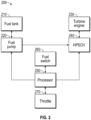
- the exemplary aircraft system 200 includes a fuel tank 210, a fuel pump 220, a turbine engine 230, an HPSOV 240, a processor 250, a fuel switch 260 and a throttle 270.
- the exemplary aircraft system 200 may include a turbine engine 230 used as a primary propulsion source for the aircraft.
- the turbine engine 230 may be a rotary, gas powered, engine that typically comprises an air intake followed by an air compressor. The compressed air is then fed to one or more combustion chambers where it is combusted and then passed over one or more turbines. After passing over the turbine, the combusted air is directed into a nozzle which accelerates the flow and then exhausts it into the free stream to generate thrust.
- the turbine engine 230 may be replaced with a ram compression or non-continuous combustion engine, such as a pulsejet, motor jet or pulse detonation engine.
- the aircraft may be equipped with multiple turbine engines as a design may require and still employ the aspects of the claimed embodiments.
- the turbine engine 230 may include an electric generator, such as a constant speed drive (CSD) electrical generator, used to power electronic systems on the aircraft and/or recharge an electric battery.
- CSD constant speed drive
- the turbine engine 230 is provided a fuel supply stored in a fuel tank 210.
- the fuel tank may be located in a wing of the aircraft or in the fuselage of the aircraft.
- Fuel from the fuel tank 210 is pumped to the turbine engine 230 by a fuel pump 220.
- the fuel pump 210 may be a single fuel pump, or a low-pressure pump located near the fuel tank 210 and a high-pressure pump located near the turbine engine 230. Using a low-pressure fuel pump and a high-pressure fuel pump allows fuel to be supplied via low pressure fuel lines from the fuel tank 210 to the high pressure pump located proximate to the turbine engine 230.
- the exemplary system further includes a HPSOV 240 for shutting off a fuel supply to the turbine engine and may be operative for completely shutting off a fuel supply to the combustion chamber of the turbine engine 230.
- the HPSOV 240 is located between the turbine engine 230 and a high-pressure fuel pump 210.
- the HPSOV 240 may be part of a hydro-mechanical unit and may be controlled by a fuel metering valve as part of an operational turbine engine fueling operation.
- the HPSOV 240 is controlled by a processor 250.
- the processor 250 is operative to receive signals from a fuel switch 260 and a throttle 270 as well as other signals from other aircraft systems and sensors.
- the fuel switch 260 may be a binary position switch indicative of an on or off state.
- the throttle 270 may a lever located in a center console of an aircraft cockpit.
- the throttle 270 may be operative to output a value representative of an angular displacement of a throttle handle.
- the throttle 270 may output a value representative of a two-degree angular displacement of the throttle handle.
- the processor 250 is operative to prevent the HPSOV from shutting off a fuel supply to the turbine engine when the throttle exceeds a threshold amount indicative of an operating turbine engine 230. If the throttle is in an off position, or less than the threshold amount, the processor 250 is then operative to generate a control signal to shut the HPSOV 240 to prevent fuel flow to the turbine engine 230.
- the processor 250 is operative to receive a signal from the throttle 270 indicative of a throttle setting, such as an angular displacement of the throttle handle.
- the processor 250 is then operative to generate a control signal in order to supply fuel from the fuel tank 210 to the turbine engine 230 at a fuel rate corresponding to the throttle setting.
- the processor 250 is then operative to receive a signal from the fuel switch 260 indicative of a pilot request to stop a fuel supply through the HPSOV 240.
- the processor is then operative to check the throttle setting, or the signal representative thereof, to determine if the throttle setting exceeds a threshold value.
- the threshold value may be two degrees of angular displacement of the throttle handle.
- the processor is operative to generate a control signal to shut the HPSOV 240 to prevent fuel flow to the turbine engine 230. If the threshold is exceeded, the processor 250 may be operative to generate a user warning that the engine is operational and not to close the HPSOV 240. In this example, in order to shut the HPSOV 240 the pilot would need to position the throttle handle below the threshold value and the cycle the fuel switch 260 in order to regenerate the request to close the HPSOV 240.
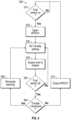
- a flow diagram illustrating a non-limiting embodiment of a method 300 for prevention of unintended aircraft engine shutdown in accordance with the teachings of the present disclosure is shown.
- the method is first operative to determine 310 if a fuel switch had been switched to the "on" position.
- the fuel switch may be an "up and over" type toggle switch operative to close and/or open an electrical circuit to identify a switch position to a flight control processor, fuel system controller, fuel management unit or the like. If the fuel switch is not determined to be in the "on” position, the method is operative to return to determine at a later instant if the switch has been switched to the "on" position.
- the method is next operative for opening 320 the HPSOV. Opening the HPSOV allows high pressure fuel to be introduced into the turbine combustion chamber.
- the method is next operative to receive 330 a throttle setting from the throttle or throttle controller.
- the throttle setting may be indicative of an angular deflection of a throttle lever positioned in a center console of an aircraft cockpit. The throttle position is used in controlling the flow rate of fuel to the turbine combustion chamber.
- the method is next operative to supply 340 fuel to the turbine engine proportional to the throttle position.
- the fuel may originally be stored in a fuel tank located in a wing or fuselage of the aircraft.
- the fuel may first be extracted from the tank using a low-pressure fuel pump and provided to a fuel management unit or the like for metering the fuel according to the throttle position and other aircraft sensors.
- the fuel is then provided to a high-pressure fuel pump where it is supplied to the turbine engine.
- the method While fuel is being provided to the turbine engine, the method is operative to monitor 350 the fuel switch position. If the fuel switch remains in the "on" position, the method is operative to continue to monitor 330 the throttle position, throttle setting, or throttle resolver angle, and to supply 340 fuel to the engine proportional to the throttle setting. If the fuel switch is switched to the off position, the method is next operative to determine 360 if the throttle position exceeds a throttle position threshold.
- the throttle position threshold may be indicative of a throttle position for an operating turbine engine or a turbine engine operating under a heavy load, such as during climb, during heavy aircraft operations, and/or during low aircraft speed.
- the throttle position threshold may be a positive throttle resolver angle of two degrees.
- the method may be operative to sense a turbine engine output power in response to a rotation sensor, fuel flow sensor, or the like. If the turbine engine output power exceeds a threshold amount, the method may assume that the throttle position is exceeding a threshold value.
- the method determines 360 that the throttle position does not exceed a threshold value, meaning that the engine is not operating at a power setting above idle, the method is operative to close 370 the HPSOV to stop fuel flow to the engine, thereby shutting down the engine. The method is then operative to return to monitoring 310 the fuel switch position. If the method determines 360 that the throttle position does exceed a threshold value, meaning that the engine is operating at a power setting above idle, the method is operative to generate 380 a warning to an aircraft occupant, such as the pilot, indicating that the engine was unintentionally attempted to be shut down while at a power setting above idle and that the engine operation must be retarded to idle before engine shutdown.
- the method is not operative to 370 close the HPSOV.
- the aircraft operator would be required to reduce the throttle setting below the threshold value and then cycle the fuel cutoff switch from "off" to "on” and back to "off' to shut the HPSOV and shut down the engine.
- the method is operative to return to monitoring 330 the throttle setting and in an exemplary embodiment, the warning would remain until the fuel switch was returned to the "on" position.
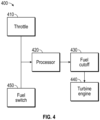
- FIG. 4 a block diagram illustrating a system 400 for prevention of unintended aircraft engine shutdown is shown.
- the exemplary system includes a throttle 410, a processor 420, a fuel switch 450, a fuel cutoff 430 and a combustion turbine engine 440.
- the throttle 410 is operative to provide an operator input to control a fuel flow to the combustion turbine engine 440.
- the throttle 410 has a throttle position, such as a throttle resolver angle.
- the throttle may further include a throttle resolver for detecting a throttle lever angle and wherein the throttle position is determined in response to the throttle resolver angle.
- the fuel switch 450 is operative to generate a control signal in order to control a state of the fuel cutoff 430.
- the fuel switch 450 may be an "up and over" type toggle switch having an on position and an off position.
- the fuel switch 450 may be located in a center console of an aircraft control panel and may be located below the throttle control handles.
- the fuel cutoff valve 430 may be a high-pressure cutoff valve 430 operative to cut off a fuel supply in response to a fuel cutoff control signal.
- the fuel cutoff valve 430 may be located between a high-pressure fuel pump and the combustion turbine engine 440.
- the combustion turbine engine 440 may have a fuel supply provided through the fuel cutoff valve 430 and having a fuel supply rate proportional to the throttle position.
- the processor 420 is operative to generate the fuel cutoff control signal in response to the fuel switch 450 being in the off position and the throttle position not exceeding a throttle position threshold.
- the throttle position threshold may be indicative of the combustion turbine engine at idle. In another exemplary embodiment, the throttle position threshold may be two degrees.
- the processor 420 is further operative to generate a warning signal and not the fuel cutoff control signal in response to the throttle position exceeding the throttle position threshold and the fuel switch 450 being in the off position.
- the warning signal may be indicative of the combustion turbine engine operating at a power level above idle.
- the warning signal may be operative to illuminate a control panel warning light within an aircraft cockpit.
- the warning signal may be operative to generate an audible alarm within an aircraft cockpit.
- the system 400 may be an aircraft including a combustion turbine engine, a fuel tank, a fuel high pressure shutoff valve, a fuel pump for coupling a fuel supply from the fuel tank to the combustion turbine engine via the fuel high-pressure shutoff valve, a throttle controller having a throttle resolver angle proportional to an angular displacement of a throttle lever, a fuel switch for generating a first control signal indicative of the fuel switch being in an on position, and a processor configured to receive the first control signal and the throttle resolver angle and to generate a warning signal in response to the throttle resolver angle exceeding a threshold throttle angle, the processor being further operative to maintain the fuel supply to the combustion turbine engine in response to the first control signal and the throttle resolver angle exceeding the threshold throttle angle.
- the processor may be further operative to engage the fuel high-pressure shutoff value to halt the fuel supply to the combustion turbine engine in response to the first control signal and the threshold throttle angle exceeding the throttle resolver angle.
- the warning signal includes a warning light on an aircraft control panel and an audible alarm presented to an aircraft operator within an aircraft cockpit.
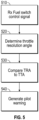
- a flow diagram illustrating a non-limiting embodiment of a method 500 for prevention of unintended aircraft engine shutdown in accordance with the teachings of the present disclosure is shown.
- the method is operative to supply fuel to a combustion turbine engine in an aircraft via a fuel high-pressure shutoff valve wherein the fuel high-pressure shutoff valve is controlled in response to the fuel switch.
- a processor is configured to receive 510, via a fuel switch, a first control signal indicative of an off position on a fuel switch.
- the processor is further configured to determine 520 a throttle resolver angle of a throttle controller in response to the first control signal.
- the throttle resolver angle may be used to control a fuel flow to a combustion turbine engine in an aircraft.
- the processor is configured to compare 530 the throttle resolver angle to a threshold throttle angle.
- the threshold throttle angle may be indicative of an idling aircraft engine.
- the threshold throttle angular may be a two-degree angle.
- the processor is configured to generate 540 a pilot warning in response to the first control signal and the throttle resolver angle exceeding the threshold throttle angle.
- the pilot warning may include an aircraft panel warning light and/or an audible alarm in an aircraft cockpit.
- the method may be operative to maintain a fuel flow to a combustion turbine engine in response to the first control signal and the threshold throttle angle exceeding the throttle resolver angle.
- the method is further operative for generating a second control angle to close a fuel high pressure shutoff valve in response to the first control signal and the threshold throttle angle exceeding the throttle resolver angle.
- the method may generate a second control angle to close a fuel high-pressure shutoff valve in response to a throttle control adjustment such that if the warning had been invoked, the threshold throttle angle is less than the throttle resolver angle, and the fuel switch being cycled from the off position to an on position and then again to the off position.
Landscapes
- Engineering & Computer Science (AREA)
- Chemical & Material Sciences (AREA)
- Combustion & Propulsion (AREA)
- Mechanical Engineering (AREA)
- General Engineering & Computer Science (AREA)
- Aviation & Aerospace Engineering (AREA)
- Physics & Mathematics (AREA)
- Fluid Mechanics (AREA)
- Electrical Control Of Air Or Fuel Supplied To Internal-Combustion Engine (AREA)
- Control Of Throttle Valves Provided In The Intake System Or In The Exhaust System (AREA)
Description
- The technical field relates generally to propulsion systems for aircraft, and more particularly relates to aircraft propulsion, aircraft avionics systems, propulsion and avionics algorithms, and aircraft equipped with electrically powered systems to override fuel shutoff controls when the aircraft engine is operating above a threshold power level.
- Aircraft propulsions systems are typically outfitted with a fuel shutoff switch that controls a fuel high-pressure shutoff valve (HPSOV) for each turbine engine. Inadvertent actuation of a fuel shutoff switch will result in a cutoff of fuel to the engine and an immediate loss of engine thrust. Currently, to counter this problem, aircraft are required to perform a high-powered quick engine restart in order to relight the engine after fuel shutoff. If an aircraft is travelling at low speed, high weight, and/ or high engine power, the engine may not be able to be restarted before significant altitude is lost. Cycling the switch from run to off to run may require too much time to relight the engine.
- The HPSOV is operative to cut off fuel flow to the respective turbine engine in response to the fuel cutoff switch. Currently, there is no two step safeguard in place to prevent an aircrew member from negligently actuating the fuel control switch while the engine is operating at high power. This can result in shutting the engine down during flight operations. An aircraft at heavy weight, slow airspeed, and low altitude (e.g., shortly after takeoff) may have difficulty restarting an engine in a timely manner. As such, it is desirable to provide propulsion control systems, propulsion control algorithms, and aircraft that provide convenient and improved prevention for unintentional fuel cutoff occurrences. In addition, other desirable features and characteristics will become apparent from the subsequent summary and detailed description, and the appended claims, taken in conjunction with the accompanying drawings and this background.
- The above information disclosed in this background section is only for enhancement of understanding of the background of the invention and therefore it may contain information that does not form the prior art that is already known in this country to a person of ordinary skill in the art.
US9799151
US7856295 relates to a device for issuing authorization to act on the operating conditions of an aircraft engine and a control system for at least one engine comprising same. - Disclosed herein are propulsion control systems, propulsion control algorithms, related control logic for provisioning aircraft, methods for making and methods for operating such systems, and other vehicles equipped with onboard control systems. By way of example, and not limitation, there is presented a system and method to prevent unintended aircraft engine shutdown.
- In a first aspect, an aircraft is disclosed as defined in claim 1.
- In accordance with another aspect of the present disclosure, a method is disclosed as defined in claim 8.
- In accordance with another aspect of the present disclosure, an aircraft including a combustion turbine engine, a fuel tank, a fuel high pressure shutoff valve, a fuel pump for coupling a fuel supply from the fuel tank to the combustion turbine engine via the fuel high pressure shutoff valve, a throttle controller having a throttle resolver angle proportional to an angular displacement of a throttle handle, a fuel switch for generating a first control signal indicative of the fuel switch being in an on position, and a processor configured to receive the first control signal and the throttle resolver angle and to generate a warning signal in response to the throttle resolver angle exceeding a threshold throttle angle, the processor being further operative to maintain the fuel supply to the combustion turbine engine in response to the first control signal and the throttle resolver angle exceeding the threshold throttle angle.
- The above advantage and other advantages and features of the present disclosure will be apparent from the following detailed description of the preferred embodiments when taken in connection with the accompanying drawings.
- The above-mentioned and other features and advantages of this invention, and the manner of attaining them, will become more apparent and the system and method will be better understood by reference to the following description of embodiments of the invention taken in conjunction with the accompanying drawings.
-
FIG. 1 is illustrative of an exemplary view of a fuel shutoff switch and thrust lever arrangement in an aircraft cockpit in accordance with the teachings of the present disclosure. -
FIG. 2 is a simplified block diagram illustrating a non-limiting embodiment of a system for prevention of unintended aircraft engine shutdown in accordance with the present disclosure. -
FIG. 3 shows a flow diagram illustrating a non-limiting embodiment of a method for prevention of unintended aircraft engine shutdown in accordance with the teachings of the present disclosure. -
FIG. 4 is a simplified block diagram illustrating another non-limiting embodiment of a system for prevention of unintended aircraft engine shutdown in accordance with the present disclosure. -
FIG. 5 shows a flow diagram illustrating another non-limiting embodiment of a method for prevention of unintended aircraft engine shutdown in accordance with the teachings of the present disclosure. - The exemplifications set out herein illustrate preferred embodiments of the disclosure, and such exemplifications are not to be construed as limiting the scope of the disclosure in any manner.
- The following detailed description is merely exemplary in nature and is not intended to limit the invention or the application and uses of the invention. Furthermore, there is no intention to be bound by any theory presented in the preceding background or the following detailed description.
- Various non-limiting embodiments of avionic propulsion control systems, avionic propulsion control algorithms, and aircraft fueling systems, aircraft fuel control systems and aircraft are provided. In general, the disclosure herein describes a method and apparatus for preventing the unintentional engagement of a fuel high pressure shut off valve in a fuel supply system of an aircraft engine during operation of the engine. Specifically, the exemplary system provides electronic logic circuitry which overrides an HPSOV engagement command while the thrust lever is at a power setting or angular deflection greater than a threshold amount indicative of an engine operating above an idle speed.
- Turning now to
FIG. 1 , acockpit view 100 is shown illustrative ofthrust levers 110 andfuel cutoff switches 120 in an exemplary aircraft in accordance with an embodiment of the present disclosure. The exemplary aircraft has thethrust levers 110 located on a cockpit center console with thefuel control switches 120 located just below thethrust levers 110 on the center console. The currently proposed solution addresses the need to quickly relight the engine in flight if an operating engine is unintentionally shutdown by preventing the unintentional shutdown. An exemplary embodiment of the solution is operative for incorporating an algorithm into the electronic engine controller that will override a fuel shutoff signal from the fuel control switch anytime that the engine is operating at any power setting above idle. In other embodiments, a higher or lower engine operating condition may be set as the operating threshold. - Turning now to
Fig. 2 , a block diagram illustrative of anexemplary aircraft system 200 for prevention of unintended aircraft engine shutdown is shown. Theexemplary aircraft system 200 includes afuel tank 210, afuel pump 220, aturbine engine 230, an HPSOV 240, aprocessor 250, afuel switch 260 and athrottle 270. - The
exemplary aircraft system 200 may include aturbine engine 230 used as a primary propulsion source for the aircraft. Theturbine engine 230 may be a rotary, gas powered, engine that typically comprises an air intake followed by an air compressor. The compressed air is then fed to one or more combustion chambers where it is combusted and then passed over one or more turbines. After passing over the turbine, the combusted air is directed into a nozzle which accelerates the flow and then exhausts it into the free stream to generate thrust. Alternatively, theturbine engine 230 may be replaced with a ram compression or non-continuous combustion engine, such as a pulsejet, motor jet or pulse detonation engine. While the exemplary system described with asingle turbine engine 230, the aircraft may be equipped with multiple turbine engines as a design may require and still employ the aspects of the claimed embodiments. In an exemplary embodiment, theturbine engine 230 may include an electric generator, such as a constant speed drive (CSD) electrical generator, used to power electronic systems on the aircraft and/or recharge an electric battery. - The
turbine engine 230 is provided a fuel supply stored in afuel tank 210. The fuel tank may be located in a wing of the aircraft or in the fuselage of the aircraft. Fuel from thefuel tank 210 is pumped to theturbine engine 230 by afuel pump 220. Thefuel pump 210 may be a single fuel pump, or a low-pressure pump located near thefuel tank 210 and a high-pressure pump located near theturbine engine 230. Using a low-pressure fuel pump and a high-pressure fuel pump allows fuel to be supplied via low pressure fuel lines from thefuel tank 210 to the high pressure pump located proximate to theturbine engine 230. - The exemplary system further includes a HPSOV 240 for shutting off a fuel supply to the turbine engine and may be operative for completely shutting off a fuel supply to the combustion chamber of the
turbine engine 230. In one exemplary embodiment, the HPSOV 240 is located between theturbine engine 230 and a high-pressure fuel pump 210. The HPSOV 240 may be part of a hydro-mechanical unit and may be controlled by a fuel metering valve as part of an operational turbine engine fueling operation. In this exemplary embodiment, the HPSOV 240 is controlled by aprocessor 250. - The
processor 250 is operative to receive signals from afuel switch 260 and athrottle 270 as well as other signals from other aircraft systems and sensors. Thefuel switch 260 may be a binary position switch indicative of an on or off state. Thethrottle 270 may a lever located in a center console of an aircraft cockpit. Thethrottle 270 may be operative to output a value representative of an angular displacement of a throttle handle. For example, thethrottle 270 may output a value representative of a two-degree angular displacement of the throttle handle. In an exemplary embodiment, theprocessor 250 is operative to prevent the HPSOV from shutting off a fuel supply to the turbine engine when the throttle exceeds a threshold amount indicative of an operatingturbine engine 230. If the throttle is in an off position, or less than the threshold amount, theprocessor 250 is then operative to generate a control signal to shut theHPSOV 240 to prevent fuel flow to theturbine engine 230. - In an exemplary embodiment, the
processor 250 is operative to receive a signal from thethrottle 270 indicative of a throttle setting, such as an angular displacement of the throttle handle. Theprocessor 250 is then operative to generate a control signal in order to supply fuel from thefuel tank 210 to theturbine engine 230 at a fuel rate corresponding to the throttle setting. Theprocessor 250 is then operative to receive a signal from thefuel switch 260 indicative of a pilot request to stop a fuel supply through theHPSOV 240. The processor is then operative to check the throttle setting, or the signal representative thereof, to determine if the throttle setting exceeds a threshold value. In one exemplary embodiment, the threshold value may be two degrees of angular displacement of the throttle handle. If the threshold is not exceeded, indicative that theturbine engine 230 is not under load or that the throttle has been retarded, the processor is operative to generate a control signal to shut theHPSOV 240 to prevent fuel flow to theturbine engine 230. If the threshold is exceeded, theprocessor 250 may be operative to generate a user warning that the engine is operational and not to close theHPSOV 240. In this example, in order to shut theHPSOV 240 the pilot would need to position the throttle handle below the threshold value and the cycle thefuel switch 260 in order to regenerate the request to close theHPSOV 240. - Turning now to
Fig. 3 , a flow diagram illustrating a non-limiting embodiment of amethod 300 for prevention of unintended aircraft engine shutdown in accordance with the teachings of the present disclosure is shown. The method is first operative to determine 310 if a fuel switch had been switched to the "on" position. The fuel switch may be an "up and over" type toggle switch operative to close and/or open an electrical circuit to identify a switch position to a flight control processor, fuel system controller, fuel management unit or the like. If the fuel switch is not determined to be in the "on" position, the method is operative to return to determine at a later instant if the switch has been switched to the "on" position. - If the fuel switch is determined to be in the "on" position, the method is next operative for opening 320 the HPSOV. Opening the HPSOV allows high pressure fuel to be introduced into the turbine combustion chamber. Once the HPSOV is placed in the open position and assuming an operating engine, the method is next operative to receive 330 a throttle setting from the throttle or throttle controller. The throttle setting may be indicative of an angular deflection of a throttle lever positioned in a center console of an aircraft cockpit. The throttle position is used in controlling the flow rate of fuel to the turbine combustion chamber.
- In response to determining the throttle position, the method is next operative to supply 340 fuel to the turbine engine proportional to the throttle position. In an exemplary embodiment, the fuel may originally be stored in a fuel tank located in a wing or fuselage of the aircraft. The fuel may first be extracted from the tank using a low-pressure fuel pump and provided to a fuel management unit or the like for metering the fuel according to the throttle position and other aircraft sensors. The fuel is then provided to a high-pressure fuel pump where it is supplied to the turbine engine.
- While fuel is being provided to the turbine engine, the method is operative to monitor 350 the fuel switch position. If the fuel switch remains in the "on" position, the method is operative to continue to monitor 330 the throttle position, throttle setting, or throttle resolver angle, and to supply 340 fuel to the engine proportional to the throttle setting. If the fuel switch is switched to the off position, the method is next operative to determine 360 if the throttle position exceeds a throttle position threshold. In an exemplary embodiment, the throttle position threshold may be indicative of a throttle position for an operating turbine engine or a turbine engine operating under a heavy load, such as during climb, during heavy aircraft operations, and/or during low aircraft speed. In an exemplary embodiment, the throttle position threshold may be a positive throttle resolver angle of two degrees. Alternatively, the method may be operative to sense a turbine engine output power in response to a rotation sensor, fuel flow sensor, or the like. If the turbine engine output power exceeds a threshold amount, the method may assume that the throttle position is exceeding a threshold value.
- If the method determines 360 that the throttle position does not exceed a threshold value, meaning that the engine is not operating at a power setting above idle, the method is operative to close 370 the HPSOV to stop fuel flow to the engine, thereby shutting down the engine. The method is then operative to return to monitoring 310 the fuel switch position. If the method determines 360 that the throttle position does exceed a threshold value, meaning that the engine is operating at a power setting above idle, the method is operative to generate 380 a warning to an aircraft occupant, such as the pilot, indicating that the engine was unintentionally attempted to be shut down while at a power setting above idle and that the engine operation must be retarded to idle before engine shutdown. If the throttle position does exceed a threshold value, the method is not operative to 370 close the HPSOV. In an exemplary embodiment, the aircraft operator would be required to reduce the throttle setting below the threshold value and then cycle the fuel cutoff switch from "off" to "on" and back to "off' to shut the HPSOV and shut down the engine. After the warning is provided to the aircraft operator, the method is operative to return to monitoring 330 the throttle setting and in an exemplary embodiment, the warning would remain until the fuel switch was returned to the "on" position.
- Turning now to
Fig. 4 , a block diagram illustrating asystem 400 for prevention of unintended aircraft engine shutdown is shown. The exemplary system includes athrottle 410, aprocessor 420, afuel switch 450, afuel cutoff 430 and acombustion turbine engine 440. - In an exemplary embodiment the
throttle 410 is operative to provide an operator input to control a fuel flow to thecombustion turbine engine 440. Thethrottle 410 has a throttle position, such as a throttle resolver angle. The throttle may further include a throttle resolver for detecting a throttle lever angle and wherein the throttle position is determined in response to the throttle resolver angle. - The
fuel switch 450 is operative to generate a control signal in order to control a state of thefuel cutoff 430. Thefuel switch 450 may be an "up and over" type toggle switch having an on position and an off position. In an exemplary embodiment, thefuel switch 450 may be located in a center console of an aircraft control panel and may be located below the throttle control handles. - The
fuel cutoff valve 430 may be a high-pressure cutoff valve 430 operative to cut off a fuel supply in response to a fuel cutoff control signal. Thefuel cutoff valve 430 may be located between a high-pressure fuel pump and thecombustion turbine engine 440. Thecombustion turbine engine 440 may have a fuel supply provided through thefuel cutoff valve 430 and having a fuel supply rate proportional to the throttle position. - The
processor 420 is operative to generate the fuel cutoff control signal in response to thefuel switch 450 being in the off position and the throttle position not exceeding a throttle position threshold. In an exemplary embodiment, the throttle position threshold may be indicative of the combustion turbine engine at idle. In another exemplary embodiment, the throttle position threshold may be two degrees. Theprocessor 420 is further operative to generate a warning signal and not the fuel cutoff control signal in response to the throttle position exceeding the throttle position threshold and thefuel switch 450 being in the off position. In one exemplary embodiment, the warning signal may be indicative of the combustion turbine engine operating at a power level above idle. In another exemplary embodiment, the warning signal may be operative to illuminate a control panel warning light within an aircraft cockpit. In another exemplary embodiment, the warning signal may be operative to generate an audible alarm within an aircraft cockpit. - In another exemplary embodiment, the
system 400 may be an aircraft including a combustion turbine engine, a fuel tank, a fuel high pressure shutoff valve, a fuel pump for coupling a fuel supply from the fuel tank to the combustion turbine engine via the fuel high-pressure shutoff valve, a throttle controller having a throttle resolver angle proportional to an angular displacement of a throttle lever, a fuel switch for generating a first control signal indicative of the fuel switch being in an on position, and a processor configured to receive the first control signal and the throttle resolver angle and to generate a warning signal in response to the throttle resolver angle exceeding a threshold throttle angle, the processor being further operative to maintain the fuel supply to the combustion turbine engine in response to the first control signal and the throttle resolver angle exceeding the threshold throttle angle. The processor may be further operative to engage the fuel high-pressure shutoff value to halt the fuel supply to the combustion turbine engine in response to the first control signal and the threshold throttle angle exceeding the throttle resolver angle. In another exemplary embodiment, the warning signal includes a warning light on an aircraft control panel and an audible alarm presented to an aircraft operator within an aircraft cockpit. - Turning now to
Fig. 5 , a flow diagram illustrating a non-limiting embodiment of a method 500 for prevention of unintended aircraft engine shutdown in accordance with the teachings of the present disclosure is shown. In this exemplary embodiment, the method is operative to supply fuel to a combustion turbine engine in an aircraft via a fuel high-pressure shutoff valve wherein the fuel high-pressure shutoff valve is controlled in response to the fuel switch. According to the exemplary embodiment, during the combustion turbine engine operation, a processor is configured to receive 510, via a fuel switch, a first control signal indicative of an off position on a fuel switch. - The processor is further configured to determine 520 a throttle resolver angle of a throttle controller in response to the first control signal. In an exemplary embodiment, the throttle resolver angle may be used to control a fuel flow to a combustion turbine engine in an aircraft. The processor is configured to compare 530 the throttle resolver angle to a threshold throttle angle. In a first exemplary embodiment, the threshold throttle angle may be indicative of an idling aircraft engine. In a second exemplary embodiment, the threshold throttle angular may be a two-degree angle.
- The processor is configured to generate 540 a pilot warning in response to the first control signal and the throttle resolver angle exceeding the threshold throttle angle. The pilot warning may include an aircraft panel warning light and/or an audible alarm in an aircraft cockpit. The method may be operative to maintain a fuel flow to a combustion turbine engine in response to the first control signal and the threshold throttle angle exceeding the throttle resolver angle.
- In another exemplary embodiment, the method is further operative for generating a second control angle to close a fuel high pressure shutoff valve in response to the first control signal and the threshold throttle angle exceeding the throttle resolver angle. For example, the method may generate a second control angle to close a fuel high-pressure shutoff valve in response to a throttle control adjustment such that if the warning had been invoked, the threshold throttle angle is less than the throttle resolver angle, and the fuel switch being cycled from the off position to an on position and then again to the off position.
- While at least one exemplary embodiment has been presented in the foregoing detailed description of the invention, it should be appreciated that a vast number of variations exist. It should also be appreciated that the exemplary embodiment or exemplary embodiments are only examples, and are not intended to limit the scope, applicability, or configuration of the invention in any way. Rather, the foregoing detailed description will provide those skilled in the art with a convenient road map for implementing an exemplary embodiment of the invention.
Claims (14)
- An aircraft comprising:a throttle (270) having a throttle position;a fuel switch (260) having an on position and an off position;a fuel cutoff valve (240) operative to cut off a fuel supply in response to a fuel cutoff control signal;a combustion turbine engine (230) having a fuel supply provided through the fuel cutoff valve and having a fuel supply rate proportional to the throttle position; anda processor (250) operative to generate the fuel cutoff control signal in response to the fuel switch being in the off position and the throttle position being less than a throttle position threshold, the processor being further operative to generate a warning signal in response to the throttle position exceeding the throttle position threshold and the fuel switch being in the off position.
- The aircraft of claim 1, wherein the throttle position threshold is indicative of the combustion turbine engine (230) at idle.
- The aircraft of claims 1 or 2, wherein the fuel cutoff valve (240) is a fuel high-pressure shut off valve.
- The aircraft of any one of claims 1-3, wherein the warning signal is indicative of the combustion turbine engine operating at a power level above idle.
- The aircraft of any one of claims 1-4, wherein the warning signal is operative to illuminate a control panel warning light within an aircraft cockpit and/or wherein the warning signal is operative to generate an audible alarm within an aircraft cockpit.
- The aircraft of any one of claims 1-5, further including a throttle resolver for detecting a throttle angle and wherein the throttle position is determined in response to the throttle resolver angle.
- The aircraft of any one of claims 1-6, wherein the throttle position threshold is two degrees.
- A method (500) for preventing unintended aircraft engine shutdown wherein a processor is configured to:receive (510), via a fuel switch, a first control signal indicative of an off position on a fuel switch;determine (520) a throttle setting of a throttle in response to the first control signal;compare (530) the throttle setting to a threshold throttle level; andgenerate (540) a fuel cutoff control signal in response to the first control signal and the throttle position being less than the throttle threshold level or generate a pilot warning in response to the first control signal and the throttle setting exceeding the threshold throttle level.
- The method of claim 8 further including generating a second control angle to close a fuel high-pressure shutoff valve in response to the first control signal and the threshold throttle level exceeding the throttle setting, and/or
further including generating a second control angle to close a fuel high-pressure shutoff valve in response to a throttle control adjustment such that the threshold throttle level exceeds the throttle setting and the fuel switch being cycled to an on position and then the off position. - The method of claims 8 or 9 wherein the threshold throttle level is indicative of an idling aircraft engine.
- The method of any one of claims 8-10 wherein the pilot warning includes an aircraft panel warning light and/or wherein the pilot warning includes an audible alarm in an aircraft cockpit.
- The method of any one of claims 8-11 wherein the throttle setting is used to control a fuel flow to a combustion turbine engine in an aircraft.
- The method of any one of claims 8-12 wherein the method is operative to maintain a fuel flow to a combustion turbine engine in response to the first control signal and the threshold throttle level exceeding the throttle setting.
- The method of any one of claims 8-13 wherein the method is operative to supply fuel to a combustion turbine engine in an aircraft via a fuel high-pressure shutoff valve wherein the fuel high-pressure shutoff valve is controlled in response to the fuel switch.
Applications Claiming Priority (1)
| Application Number | Priority Date | Filing Date | Title |
|---|---|---|---|
| US16/845,999 US11306664B2 (en) | 2020-04-10 | 2020-04-10 | System and method to prevent unintended aircraft engine shutdown |
Publications (2)
| Publication Number | Publication Date |
|---|---|
| EP3892544A1 EP3892544A1 (en) | 2021-10-13 |
| EP3892544B1 true EP3892544B1 (en) | 2023-10-04 |
Family
ID=74947010
Family Applications (1)
| Application Number | Title | Priority Date | Filing Date |
|---|---|---|---|
| EP21162938.1A Active EP3892544B1 (en) | 2020-04-10 | 2021-03-16 | System and method to prevent unintended aircraft engine shutdown |
Country Status (3)
| Country | Link |
|---|---|
| US (1) | US11306664B2 (en) |
| EP (1) | EP3892544B1 (en) |
| CN (1) | CN113513413B (en) |
Families Citing this family (3)
| Publication number | Priority date | Publication date | Assignee | Title |
|---|---|---|---|---|
| FR3110140A1 (en) * | 2020-05-12 | 2021-11-19 | Airbus Operations | AIRCRAFT ENGINE FAILURE CONFIRMATION SYSTEM |
| US12253030B2 (en) * | 2022-07-01 | 2025-03-18 | Rtx Corporation | In-flight engine re-start |
| US20260001653A1 (en) * | 2024-06-28 | 2026-01-01 | Pratt & Whitney Canada Corp. | Systems and methods for controlling an electric motor of an aircraft propulsion system |
Family Cites Families (21)
| Publication number | Priority date | Publication date | Assignee | Title |
|---|---|---|---|---|
| US2591602A (en) * | 1946-03-27 | 1952-04-01 | Matt V Pilcher | Airplane safety device |
| GB783880A (en) | 1954-02-16 | 1957-10-02 | Napier & Son Ltd | Control apparatus for internal combustion power units |
| US2938683A (en) * | 1955-06-06 | 1960-05-31 | Boeing Co | Power control mechanism for jet powered aircraft |
| GB1090143A (en) * | 1965-04-07 | 1967-11-08 | Hawker Siddeley Dynamics Ltd | Improvements in or relating to electrical control systems for engines |
| DE1920002A1 (en) * | 1969-04-19 | 1970-11-12 | Bodenseewerk Geraetetech | Device for controlling or regulating the fuel supply in propeller turbine air jet engines |
| US3691759A (en) * | 1971-01-14 | 1972-09-19 | Curtiss Wright Corp | Automatic control system for a turbojet engine employed in a stationary environment |
| US4429528A (en) * | 1980-01-22 | 1984-02-07 | Plessey Overseas Limited | Emergency fuel system |
| US4854283A (en) * | 1986-11-28 | 1989-08-08 | Nippondenso Co., Ltd. | Throttle valve control apparatus |
| DE3925881A1 (en) * | 1989-08-04 | 1991-02-07 | Bosch Gmbh Robert | METHOD AND DEVICE FOR CONTROLLING AND / OR REGULATING THE ENGINE POWER OF AN INTERNAL COMBUSTION ENGINE OF A MOTOR VEHICLE |
| US5285634A (en) * | 1991-12-09 | 1994-02-15 | United Technologies Corporation | Aircraft gas turbine engine control |
| US20040088085A1 (en) * | 2002-10-30 | 2004-05-06 | Pratt & Whitney Canada Corp. | Method and system for preventing un-commanded power surge of aircraft engine |
| GB0408886D0 (en) * | 2004-04-22 | 2004-05-26 | Rolls Royce Plc | Fuel metering unit |
| FR2879562B1 (en) * | 2004-12-20 | 2008-05-16 | Airbus France Sas | DEVICE FOR TRANSMITTING AUTHORIZATION TO ACT ON THE OPERATION OF AN AIRCRAFT ENGINE AND MOTOR CONTROL SYSTEM COMPRISING SUCH A DEVICE |
| FR3006764B1 (en) * | 2013-06-10 | 2017-02-10 | Snecma | MONITORING THE ENGINE FUEL SUPPLY CUT-OFF VALVE |
| WO2016015310A1 (en) * | 2014-07-31 | 2016-02-04 | 深圳市大疆创新科技有限公司 | Method and device for controlling auto-stop of aircraft, and aircraft |
| US9799151B2 (en) * | 2015-05-01 | 2017-10-24 | Carolyn J. Olson | Aircraft fuel shutoff interlock |
| US10203700B2 (en) * | 2016-02-29 | 2019-02-12 | Garmin International, Inc. | Emergency autoland system |
| US10106269B1 (en) * | 2017-03-17 | 2018-10-23 | Rockwell Collins, Inc. | System and method for inadvertent engine shutdown prevention |
| EP3434584B1 (en) * | 2017-07-28 | 2021-06-02 | Ge Avio S.r.l. | System and method for determining minimum pitch and minimum gas generator idle condition |
| US11199867B2 (en) * | 2018-12-07 | 2021-12-14 | Textron Innovations, Inc. | Throttle system |
| US10676209B1 (en) * | 2019-03-08 | 2020-06-09 | Christian Edmund Pezalla | System and method for engaging appropriate aircraft controls during an engine-related emergency |
-
2020
- 2020-04-10 US US16/845,999 patent/US11306664B2/en active Active
-
2021
- 2021-03-16 EP EP21162938.1A patent/EP3892544B1/en active Active
- 2021-03-31 CN CN202110345501.3A patent/CN113513413B/en active Active
Also Published As
| Publication number | Publication date |
|---|---|
| US11306664B2 (en) | 2022-04-19 |
| US20210317790A1 (en) | 2021-10-14 |
| CN113513413A (en) | 2021-10-19 |
| CN113513413B (en) | 2023-09-26 |
| EP3892544A1 (en) | 2021-10-13 |
Similar Documents
| Publication | Publication Date | Title |
|---|---|---|
| US6353790B1 (en) | Gas turbine aeroengine control system | |
| EP3892544B1 (en) | System and method to prevent unintended aircraft engine shutdown | |
| US9556800B2 (en) | Control apparatus for aeroplane gas turbine engine | |
| US6434473B1 (en) | Gas turbine aeroengine control system | |
| EP2884075B1 (en) | Aircraft engine system comprising a main engine, a starter and an auxiliary power unit | |
| US8904804B2 (en) | Overspeed protection apparatus for gas turbine engine | |
| EP3693582B1 (en) | System and method for exiting an asymmetric engine operating regime | |
| EP4030044B1 (en) | Automated initiation of starter motor operation for starting an aircraft engine | |
| JP2006316773A (en) | Control device for aircraft gas turbine engine | |
| EP2022947A2 (en) | Deicing method and device for variable inlet guide vanes of a compressor | |
| US20050267667A1 (en) | Control system for gas-turbine engine | |
| US10309249B2 (en) | Control apparatus for a gas-turbine aeroengine | |
| US9903278B2 (en) | Control apparatus for estimating operating parameter of a gas-turbine aeroengine | |
| EP3705702A1 (en) | Aircraft engine reignition | |
| US4314445A (en) | Turbine engine thrust booster | |
| US20120173078A1 (en) | Fuel system for aircraft engines | |
| EP3508427B1 (en) | Single lever control system for engines with multiple control modes | |
| US10807701B2 (en) | Aircraft turboprop engine propeller pitch control system including a controllable feather valve | |
| CN114583825B (en) | A method of working in the air for the main AC power supply of B737 aircraft | |
| GB1591217A (en) | Engine fuel control system | |
| CN118953695A (en) | An auxiliary system for determining the fault handling strategy of carrier-based aircraft engines |
Legal Events
| Date | Code | Title | Description |
|---|---|---|---|
| PUAI | Public reference made under article 153(3) epc to a published international application that has entered the european phase |
Free format text: ORIGINAL CODE: 0009012 |
|
| STAA | Information on the status of an ep patent application or granted ep patent |
Free format text: STATUS: REQUEST FOR EXAMINATION WAS MADE |
|
| 17P | Request for examination filed |
Effective date: 20210316 |
|
| AK | Designated contracting states |
Kind code of ref document: A1 Designated state(s): AL AT BE BG CH CY CZ DE DK EE ES FI FR GB GR HR HU IE IS IT LI LT LU LV MC MK MT NL NO PL PT RO RS SE SI SK SM TR |
|
| GRAP | Despatch of communication of intention to grant a patent |
Free format text: ORIGINAL CODE: EPIDOSNIGR1 |
|
| STAA | Information on the status of an ep patent application or granted ep patent |
Free format text: STATUS: GRANT OF PATENT IS INTENDED |
|
| RIC1 | Information provided on ipc code assigned before grant |
Ipc: B64D 31/14 20060101ALN20230202BHEP Ipc: B64D 45/00 20060101ALN20230202BHEP Ipc: F02C 9/32 20060101ALI20230202BHEP Ipc: F02C 9/56 20060101ALI20230202BHEP Ipc: F02C 9/28 20060101ALI20230202BHEP Ipc: B64D 31/04 20060101AFI20230202BHEP |
|
| INTG | Intention to grant announced |
Effective date: 20230223 |
|
| P01 | Opt-out of the competence of the unified patent court (upc) registered |
Effective date: 20230519 |
|
| GRAS | Grant fee paid |
Free format text: ORIGINAL CODE: EPIDOSNIGR3 |
|
| GRAA | (expected) grant |
Free format text: ORIGINAL CODE: 0009210 |
|
| STAA | Information on the status of an ep patent application or granted ep patent |
Free format text: STATUS: THE PATENT HAS BEEN GRANTED |
|
| AK | Designated contracting states |
Kind code of ref document: B1 Designated state(s): AL AT BE BG CH CY CZ DE DK EE ES FI FR GB GR HR HU IE IS IT LI LT LU LV MC MK MT NL NO PL PT RO RS SE SI SK SM TR |
|
| REG | Reference to a national code |
Ref country code: GB Ref legal event code: FG4D |
|
| REG | Reference to a national code |
Ref country code: CH Ref legal event code: EP |
|
| REG | Reference to a national code |
Ref country code: DE Ref legal event code: R096 Ref document number: 602021005526 Country of ref document: DE |
|
| REG | Reference to a national code |
Ref country code: IE Ref legal event code: FG4D |
|
| REG | Reference to a national code |
Ref country code: LT Ref legal event code: MG9D |
|
| REG | Reference to a national code |
Ref country code: NL Ref legal event code: MP Effective date: 20231004 |
|
| REG | Reference to a national code |
Ref country code: AT Ref legal event code: MK05 Ref document number: 1617541 Country of ref document: AT Kind code of ref document: T Effective date: 20231004 |
|
| PG25 | Lapsed in a contracting state [announced via postgrant information from national office to epo] |
Ref country code: NL Free format text: LAPSE BECAUSE OF FAILURE TO SUBMIT A TRANSLATION OF THE DESCRIPTION OR TO PAY THE FEE WITHIN THE PRESCRIBED TIME-LIMIT Effective date: 20231004 |
|
| PG25 | Lapsed in a contracting state [announced via postgrant information from national office to epo] |
Ref country code: GR Free format text: LAPSE BECAUSE OF FAILURE TO SUBMIT A TRANSLATION OF THE DESCRIPTION OR TO PAY THE FEE WITHIN THE PRESCRIBED TIME-LIMIT Effective date: 20240105 |
|
| PG25 | Lapsed in a contracting state [announced via postgrant information from national office to epo] |
Ref country code: IS Free format text: LAPSE BECAUSE OF FAILURE TO SUBMIT A TRANSLATION OF THE DESCRIPTION OR TO PAY THE FEE WITHIN THE PRESCRIBED TIME-LIMIT Effective date: 20240204 |
|
| PG25 | Lapsed in a contracting state [announced via postgrant information from national office to epo] |
Ref country code: LT Free format text: LAPSE BECAUSE OF FAILURE TO SUBMIT A TRANSLATION OF THE DESCRIPTION OR TO PAY THE FEE WITHIN THE PRESCRIBED TIME-LIMIT Effective date: 20231004 |
|
| PG25 | Lapsed in a contracting state [announced via postgrant information from national office to epo] |
Ref country code: AT Free format text: LAPSE BECAUSE OF FAILURE TO SUBMIT A TRANSLATION OF THE DESCRIPTION OR TO PAY THE FEE WITHIN THE PRESCRIBED TIME-LIMIT Effective date: 20231004 |
|
| PG25 | Lapsed in a contracting state [announced via postgrant information from national office to epo] |
Ref country code: ES Free format text: LAPSE BECAUSE OF FAILURE TO SUBMIT A TRANSLATION OF THE DESCRIPTION OR TO PAY THE FEE WITHIN THE PRESCRIBED TIME-LIMIT Effective date: 20231004 |
|
| PG25 | Lapsed in a contracting state [announced via postgrant information from national office to epo] |
Ref country code: LT Free format text: LAPSE BECAUSE OF FAILURE TO SUBMIT A TRANSLATION OF THE DESCRIPTION OR TO PAY THE FEE WITHIN THE PRESCRIBED TIME-LIMIT Effective date: 20231004 Ref country code: IS Free format text: LAPSE BECAUSE OF FAILURE TO SUBMIT A TRANSLATION OF THE DESCRIPTION OR TO PAY THE FEE WITHIN THE PRESCRIBED TIME-LIMIT Effective date: 20240204 Ref country code: GR Free format text: LAPSE BECAUSE OF FAILURE TO SUBMIT A TRANSLATION OF THE DESCRIPTION OR TO PAY THE FEE WITHIN THE PRESCRIBED TIME-LIMIT Effective date: 20240105 Ref country code: ES Free format text: LAPSE BECAUSE OF FAILURE TO SUBMIT A TRANSLATION OF THE DESCRIPTION OR TO PAY THE FEE WITHIN THE PRESCRIBED TIME-LIMIT Effective date: 20231004 Ref country code: BG Free format text: LAPSE BECAUSE OF FAILURE TO SUBMIT A TRANSLATION OF THE DESCRIPTION OR TO PAY THE FEE WITHIN THE PRESCRIBED TIME-LIMIT Effective date: 20240104 Ref country code: AT Free format text: LAPSE BECAUSE OF FAILURE TO SUBMIT A TRANSLATION OF THE DESCRIPTION OR TO PAY THE FEE WITHIN THE PRESCRIBED TIME-LIMIT Effective date: 20231004 Ref country code: PT Free format text: LAPSE BECAUSE OF FAILURE TO SUBMIT A TRANSLATION OF THE DESCRIPTION OR TO PAY THE FEE WITHIN THE PRESCRIBED TIME-LIMIT Effective date: 20240205 |
|
| PG25 | Lapsed in a contracting state [announced via postgrant information from national office to epo] |
Ref country code: SE Free format text: LAPSE BECAUSE OF FAILURE TO SUBMIT A TRANSLATION OF THE DESCRIPTION OR TO PAY THE FEE WITHIN THE PRESCRIBED TIME-LIMIT Effective date: 20231004 Ref country code: RS Free format text: LAPSE BECAUSE OF FAILURE TO SUBMIT A TRANSLATION OF THE DESCRIPTION OR TO PAY THE FEE WITHIN THE PRESCRIBED TIME-LIMIT Effective date: 20231004 Ref country code: PL Free format text: LAPSE BECAUSE OF FAILURE TO SUBMIT A TRANSLATION OF THE DESCRIPTION OR TO PAY THE FEE WITHIN THE PRESCRIBED TIME-LIMIT Effective date: 20231004 Ref country code: NO Free format text: LAPSE BECAUSE OF FAILURE TO SUBMIT A TRANSLATION OF THE DESCRIPTION OR TO PAY THE FEE WITHIN THE PRESCRIBED TIME-LIMIT Effective date: 20240104 Ref country code: LV Free format text: LAPSE BECAUSE OF FAILURE TO SUBMIT A TRANSLATION OF THE DESCRIPTION OR TO PAY THE FEE WITHIN THE PRESCRIBED TIME-LIMIT Effective date: 20231004 Ref country code: HR Free format text: LAPSE BECAUSE OF FAILURE TO SUBMIT A TRANSLATION OF THE DESCRIPTION OR TO PAY THE FEE WITHIN THE PRESCRIBED TIME-LIMIT Effective date: 20231004 |
|
| REG | Reference to a national code |
Ref country code: DE Ref legal event code: R097 Ref document number: 602021005526 Country of ref document: DE |
|
| PG25 | Lapsed in a contracting state [announced via postgrant information from national office to epo] |
Ref country code: DK Free format text: LAPSE BECAUSE OF FAILURE TO SUBMIT A TRANSLATION OF THE DESCRIPTION OR TO PAY THE FEE WITHIN THE PRESCRIBED TIME-LIMIT Effective date: 20231004 |
|
| PG25 | Lapsed in a contracting state [announced via postgrant information from national office to epo] |
Ref country code: CZ Free format text: LAPSE BECAUSE OF FAILURE TO SUBMIT A TRANSLATION OF THE DESCRIPTION OR TO PAY THE FEE WITHIN THE PRESCRIBED TIME-LIMIT Effective date: 20231004 |
|
| PG25 | Lapsed in a contracting state [announced via postgrant information from national office to epo] |
Ref country code: SK Free format text: LAPSE BECAUSE OF FAILURE TO SUBMIT A TRANSLATION OF THE DESCRIPTION OR TO PAY THE FEE WITHIN THE PRESCRIBED TIME-LIMIT Effective date: 20231004 |
|
| PG25 | Lapsed in a contracting state [announced via postgrant information from national office to epo] |
Ref country code: SM Free format text: LAPSE BECAUSE OF FAILURE TO SUBMIT A TRANSLATION OF THE DESCRIPTION OR TO PAY THE FEE WITHIN THE PRESCRIBED TIME-LIMIT Effective date: 20231004 Ref country code: SK Free format text: LAPSE BECAUSE OF FAILURE TO SUBMIT A TRANSLATION OF THE DESCRIPTION OR TO PAY THE FEE WITHIN THE PRESCRIBED TIME-LIMIT Effective date: 20231004 Ref country code: RO Free format text: LAPSE BECAUSE OF FAILURE TO SUBMIT A TRANSLATION OF THE DESCRIPTION OR TO PAY THE FEE WITHIN THE PRESCRIBED TIME-LIMIT Effective date: 20231004 Ref country code: IT Free format text: LAPSE BECAUSE OF FAILURE TO SUBMIT A TRANSLATION OF THE DESCRIPTION OR TO PAY THE FEE WITHIN THE PRESCRIBED TIME-LIMIT Effective date: 20231004 Ref country code: EE Free format text: LAPSE BECAUSE OF FAILURE TO SUBMIT A TRANSLATION OF THE DESCRIPTION OR TO PAY THE FEE WITHIN THE PRESCRIBED TIME-LIMIT Effective date: 20231004 Ref country code: DK Free format text: LAPSE BECAUSE OF FAILURE TO SUBMIT A TRANSLATION OF THE DESCRIPTION OR TO PAY THE FEE WITHIN THE PRESCRIBED TIME-LIMIT Effective date: 20231004 Ref country code: CZ Free format text: LAPSE BECAUSE OF FAILURE TO SUBMIT A TRANSLATION OF THE DESCRIPTION OR TO PAY THE FEE WITHIN THE PRESCRIBED TIME-LIMIT Effective date: 20231004 |
|
| PLBE | No opposition filed within time limit |
Free format text: ORIGINAL CODE: 0009261 |
|
| STAA | Information on the status of an ep patent application or granted ep patent |
Free format text: STATUS: NO OPPOSITION FILED WITHIN TIME LIMIT |
|
| 26N | No opposition filed |
Effective date: 20240705 |
|
| PG25 | Lapsed in a contracting state [announced via postgrant information from national office to epo] |
Ref country code: SI Free format text: LAPSE BECAUSE OF FAILURE TO SUBMIT A TRANSLATION OF THE DESCRIPTION OR TO PAY THE FEE WITHIN THE PRESCRIBED TIME-LIMIT Effective date: 20231004 |
|
| PG25 | Lapsed in a contracting state [announced via postgrant information from national office to epo] |
Ref country code: SI Free format text: LAPSE BECAUSE OF FAILURE TO SUBMIT A TRANSLATION OF THE DESCRIPTION OR TO PAY THE FEE WITHIN THE PRESCRIBED TIME-LIMIT Effective date: 20231004 |
|
| REG | Reference to a national code |
Ref country code: CH Ref legal event code: PL |
|
| PG25 | Lapsed in a contracting state [announced via postgrant information from national office to epo] |
Ref country code: LU Free format text: LAPSE BECAUSE OF NON-PAYMENT OF DUE FEES Effective date: 20240316 |
|
| PG25 | Lapsed in a contracting state [announced via postgrant information from national office to epo] |
Ref country code: MC Free format text: LAPSE BECAUSE OF FAILURE TO SUBMIT A TRANSLATION OF THE DESCRIPTION OR TO PAY THE FEE WITHIN THE PRESCRIBED TIME-LIMIT Effective date: 20231004 |
|
| PG25 | Lapsed in a contracting state [announced via postgrant information from national office to epo] |
Ref country code: MC Free format text: LAPSE BECAUSE OF FAILURE TO SUBMIT A TRANSLATION OF THE DESCRIPTION OR TO PAY THE FEE WITHIN THE PRESCRIBED TIME-LIMIT Effective date: 20231004 Ref country code: LU Free format text: LAPSE BECAUSE OF NON-PAYMENT OF DUE FEES Effective date: 20240316 |
|
| REG | Reference to a national code |
Ref country code: BE Ref legal event code: MM Effective date: 20240331 |
|
| PG25 | Lapsed in a contracting state [announced via postgrant information from national office to epo] |
Ref country code: BE Free format text: LAPSE BECAUSE OF NON-PAYMENT OF DUE FEES Effective date: 20240331 |
|
| PG25 | Lapsed in a contracting state [announced via postgrant information from national office to epo] |
Ref country code: FR Free format text: LAPSE BECAUSE OF NON-PAYMENT OF DUE FEES Effective date: 20240331 |
|
| PG25 | Lapsed in a contracting state [announced via postgrant information from national office to epo] |
Ref country code: IE Free format text: LAPSE BECAUSE OF NON-PAYMENT OF DUE FEES Effective date: 20240316 |
|
| PG25 | Lapsed in a contracting state [announced via postgrant information from national office to epo] |
Ref country code: IE Free format text: LAPSE BECAUSE OF NON-PAYMENT OF DUE FEES Effective date: 20240316 Ref country code: FR Free format text: LAPSE BECAUSE OF NON-PAYMENT OF DUE FEES Effective date: 20240331 Ref country code: BE Free format text: LAPSE BECAUSE OF NON-PAYMENT OF DUE FEES Effective date: 20240331 Ref country code: CH Free format text: LAPSE BECAUSE OF NON-PAYMENT OF DUE FEES Effective date: 20240331 |
|
| PG25 | Lapsed in a contracting state [announced via postgrant information from national office to epo] |
Ref country code: CY Free format text: LAPSE BECAUSE OF FAILURE TO SUBMIT A TRANSLATION OF THE DESCRIPTION OR TO PAY THE FEE WITHIN THE PRESCRIBED TIME-LIMIT; INVALID AB INITIO Effective date: 20210316 |
|
| PG25 | Lapsed in a contracting state [announced via postgrant information from national office to epo] |
Ref country code: HU Free format text: LAPSE BECAUSE OF FAILURE TO SUBMIT A TRANSLATION OF THE DESCRIPTION OR TO PAY THE FEE WITHIN THE PRESCRIBED TIME-LIMIT; INVALID AB INITIO Effective date: 20210316 |
|
| PG25 | Lapsed in a contracting state [announced via postgrant information from national office to epo] |
Ref country code: FI Free format text: LAPSE BECAUSE OF FAILURE TO SUBMIT A TRANSLATION OF THE DESCRIPTION OR TO PAY THE FEE WITHIN THE PRESCRIBED TIME-LIMIT Effective date: 20231004 |
|
| GBPC | Gb: european patent ceased through non-payment of renewal fee |
Effective date: 20250316 |
|
| PG25 | Lapsed in a contracting state [announced via postgrant information from national office to epo] |
Ref country code: TR Free format text: LAPSE BECAUSE OF FAILURE TO SUBMIT A TRANSLATION OF THE DESCRIPTION OR TO PAY THE FEE WITHIN THE PRESCRIBED TIME-LIMIT Effective date: 20231004 |
|
| PG25 | Lapsed in a contracting state [announced via postgrant information from national office to epo] |
Ref country code: GB Free format text: LAPSE BECAUSE OF NON-PAYMENT OF DUE FEES Effective date: 20250316 |
|
| PGFP | Annual fee paid to national office [announced via postgrant information from national office to epo] |
Ref country code: DE Payment date: 20260327 Year of fee payment: 6 |