EP3892274A1 - Nicotine for the prevention and treatment of covid-19 disease - Google Patents
Nicotine for the prevention and treatment of covid-19 disease Download PDFInfo
- Publication number
- EP3892274A1 EP3892274A1 EP20315125.3A EP20315125A EP3892274A1 EP 3892274 A1 EP3892274 A1 EP 3892274A1 EP 20315125 A EP20315125 A EP 20315125A EP 3892274 A1 EP3892274 A1 EP 3892274A1
- Authority
- EP
- European Patent Office
- Prior art keywords
- nicotine
- pharmaceutically acceptable
- cov
- acceptable salt
- covid
- Prior art date
- Legal status (The legal status is an assumption and is not a legal conclusion. Google has not performed a legal analysis and makes no representation as to the accuracy of the status listed.)
- Withdrawn
Links
- SNICXCGAKADSCV-JTQLQIEISA-N (-)-Nicotine Chemical compound CN1CCC[C@H]1C1=CC=CN=C1 SNICXCGAKADSCV-JTQLQIEISA-N 0.000 title claims abstract description 56
- 229960002715 nicotine Drugs 0.000 title claims abstract description 55
- SNICXCGAKADSCV-UHFFFAOYSA-N nicotine Natural products CN1CCCC1C1=CC=CN=C1 SNICXCGAKADSCV-UHFFFAOYSA-N 0.000 title claims abstract description 55
- 208000025721 COVID-19 Diseases 0.000 title claims description 73
- 238000011282 treatment Methods 0.000 title description 19
- 230000002265 prevention Effects 0.000 title description 4
- 150000003839 salts Chemical class 0.000 claims abstract description 41
- 241000008904 Betacoronavirus Species 0.000 claims abstract description 37
- 208000036142 Viral infection Diseases 0.000 claims abstract description 13
- 230000009385 viral infection Effects 0.000 claims abstract description 13
- 241000008910 Severe acute respiratory syndrome-related coronavirus Species 0.000 claims abstract description 8
- 241001678559 COVID-19 virus Species 0.000 claims description 48
- 230000037317 transdermal delivery Effects 0.000 claims description 15
- 208000037265 diseases, disorders, signs and symptoms Diseases 0.000 claims description 11
- 201000010099 disease Diseases 0.000 claims description 10
- 241000711573 Coronaviridae Species 0.000 claims description 9
- 206010001052 Acute respiratory distress syndrome Diseases 0.000 claims description 5
- 208000013616 Respiratory Distress Syndrome Diseases 0.000 claims description 5
- 201000000028 adult respiratory distress syndrome Diseases 0.000 claims description 4
- 230000004083 survival effect Effects 0.000 claims description 4
- 201000003176 Severe Acute Respiratory Syndrome Diseases 0.000 claims description 3
- 230000002354 daily effect Effects 0.000 description 28
- 208000015181 infectious disease Diseases 0.000 description 21
- 230000000391 smoking effect Effects 0.000 description 21
- 102000019315 Nicotinic acetylcholine receptors Human genes 0.000 description 19
- 108050006807 Nicotinic acetylcholine receptors Proteins 0.000 description 19
- 208000024891 symptom Diseases 0.000 description 19
- 241000700605 Viruses Species 0.000 description 13
- 102000053723 Angiotensin-converting enzyme 2 Human genes 0.000 description 11
- 108090000975 Angiotensin-converting enzyme 2 Proteins 0.000 description 11
- 241000282412 Homo Species 0.000 description 11
- 241000315672 SARS coronavirus Species 0.000 description 11
- 210000004027 cell Anatomy 0.000 description 10
- 150000001875 compounds Chemical class 0.000 description 10
- 241001465754 Metazoa Species 0.000 description 9
- 235000019504 cigarettes Nutrition 0.000 description 9
- 230000001681 protective effect Effects 0.000 description 8
- 102000005962 receptors Human genes 0.000 description 8
- 108020003175 receptors Proteins 0.000 description 8
- 230000000241 respiratory effect Effects 0.000 description 8
- 230000001225 therapeutic effect Effects 0.000 description 8
- 241000127282 Middle East respiratory syndrome-related coronavirus Species 0.000 description 7
- 241000711798 Rabies lyssavirus Species 0.000 description 7
- 239000008280 blood Substances 0.000 description 7
- 210000004369 blood Anatomy 0.000 description 7
- 210000003169 central nervous system Anatomy 0.000 description 7
- 208000011580 syndromic disease Diseases 0.000 description 7
- 239000000853 adhesive Substances 0.000 description 6
- 239000003814 drug Substances 0.000 description 6
- 210000004072 lung Anatomy 0.000 description 6
- 239000011159 matrix material Substances 0.000 description 6
- KJHKTHWMRKYKJE-SUGCFTRWSA-N Kaletra Chemical compound N1([C@@H](C(C)C)C(=O)N[C@H](C[C@H](O)[C@H](CC=2C=CC=CC=2)NC(=O)COC=2C(=CC=CC=2C)C)CC=2C=CC=CC=2)CCCNC1=O KJHKTHWMRKYKJE-SUGCFTRWSA-N 0.000 description 5
- 208000008457 Neurologic Manifestations Diseases 0.000 description 5
- 206010037660 Pyrexia Diseases 0.000 description 5
- 238000004458 analytical method Methods 0.000 description 5
- 206010012601 diabetes mellitus Diseases 0.000 description 5
- 238000003745 diagnosis Methods 0.000 description 5
- 229960004525 lopinavir Drugs 0.000 description 5
- 238000000034 method Methods 0.000 description 5
- 210000002569 neuron Anatomy 0.000 description 5
- 238000012546 transfer Methods 0.000 description 5
- 230000003612 virological effect Effects 0.000 description 5
- 102100030988 Angiotensin-converting enzyme Human genes 0.000 description 4
- 208000006545 Chronic Obstructive Pulmonary Disease Diseases 0.000 description 4
- 206010011224 Cough Diseases 0.000 description 4
- 206010013975 Dyspnoeas Diseases 0.000 description 4
- 206010019233 Headaches Diseases 0.000 description 4
- 206010020772 Hypertension Diseases 0.000 description 4
- 208000008589 Obesity Diseases 0.000 description 4
- 208000037847 SARS-CoV-2-infection Diseases 0.000 description 4
- 101000629318 Severe acute respiratory syndrome coronavirus 2 Spike glycoprotein Proteins 0.000 description 4
- 230000003247 decreasing effect Effects 0.000 description 4
- 231100000869 headache Toxicity 0.000 description 4
- 210000002540 macrophage Anatomy 0.000 description 4
- 235000020824 obesity Nutrition 0.000 description 4
- 238000012360 testing method Methods 0.000 description 4
- 206010002653 Anosmia Diseases 0.000 description 3
- 108090000695 Cytokines Proteins 0.000 description 3
- 102000004127 Cytokines Human genes 0.000 description 3
- 208000000059 Dyspnea Diseases 0.000 description 3
- 241000208125 Nicotiana Species 0.000 description 3
- 235000002637 Nicotiana tabacum Nutrition 0.000 description 3
- 206010035664 Pneumonia Diseases 0.000 description 3
- KWYUFKZDYYNOTN-UHFFFAOYSA-M Potassium hydroxide Chemical compound [OH-].[K+] KWYUFKZDYYNOTN-UHFFFAOYSA-M 0.000 description 3
- 241000270295 Serpentes Species 0.000 description 3
- HEMHJVSKTPXQMS-UHFFFAOYSA-M Sodium hydroxide Chemical compound [OH-].[Na+] HEMHJVSKTPXQMS-UHFFFAOYSA-M 0.000 description 3
- 238000003556 assay Methods 0.000 description 3
- 230000033228 biological regulation Effects 0.000 description 3
- 210000000133 brain stem Anatomy 0.000 description 3
- 230000034994 death Effects 0.000 description 3
- 231100000517 death Toxicity 0.000 description 3
- 238000001514 detection method Methods 0.000 description 3
- 208000017574 dry cough Diseases 0.000 description 3
- 230000000694 effects Effects 0.000 description 3
- 206010016256 fatigue Diseases 0.000 description 3
- 239000012458 free base Substances 0.000 description 3
- 230000036541 health Effects 0.000 description 3
- 239000007937 lozenge Substances 0.000 description 3
- 210000000653 nervous system Anatomy 0.000 description 3
- 230000002276 neurotropic effect Effects 0.000 description 3
- 230000007310 pathophysiology Effects 0.000 description 3
- 230000037361 pathway Effects 0.000 description 3
- 102000004169 proteins and genes Human genes 0.000 description 3
- 108090000623 proteins and genes Proteins 0.000 description 3
- 230000005180 public health Effects 0.000 description 3
- RWWYLEGWBNMMLJ-MEUHYHILSA-N remdesivir Drugs C([C@@H]1[C@H]([C@@H](O)[C@@](C#N)(O1)C=1N2N=CN=C(N)C2=CC=1)O)OP(=O)(N[C@@H](C)C(=O)OCC(CC)CC)OC1=CC=CC=C1 RWWYLEGWBNMMLJ-MEUHYHILSA-N 0.000 description 3
- RWWYLEGWBNMMLJ-YSOARWBDSA-N remdesivir Chemical compound NC1=NC=NN2C1=CC=C2[C@]1([C@@H]([C@@H]([C@H](O1)CO[P@](=O)(OC1=CC=CC=C1)N[C@H](C(=O)OCC(CC)CC)C)O)O)C#N RWWYLEGWBNMMLJ-YSOARWBDSA-N 0.000 description 3
- 230000008786 sensory perception of smell Effects 0.000 description 3
- 108091032973 (ribonucleotides)n+m Proteins 0.000 description 2
- UUUHXMGGBIUAPW-UHFFFAOYSA-N 1-[1-[2-[[5-amino-2-[[1-[5-(diaminomethylideneamino)-2-[[1-[3-(1h-indol-3-yl)-2-[(5-oxopyrrolidine-2-carbonyl)amino]propanoyl]pyrrolidine-2-carbonyl]amino]pentanoyl]pyrrolidine-2-carbonyl]amino]-5-oxopentanoyl]amino]-3-methylpentanoyl]pyrrolidine-2-carbon Chemical compound C1CCC(C(=O)N2C(CCC2)C(O)=O)N1C(=O)C(C(C)CC)NC(=O)C(CCC(N)=O)NC(=O)C1CCCN1C(=O)C(CCCN=C(N)N)NC(=O)C1CCCN1C(=O)C(CC=1C2=CC=CC=C2NC=1)NC(=O)C1CCC(=O)N1 UUUHXMGGBIUAPW-UHFFFAOYSA-N 0.000 description 2
- HZAXFHJVJLSVMW-UHFFFAOYSA-N 2-Aminoethan-1-ol Chemical compound NCCO HZAXFHJVJLSVMW-UHFFFAOYSA-N 0.000 description 2
- 101150059573 AGTR1 gene Proteins 0.000 description 2
- 208000010470 Ageusia Diseases 0.000 description 2
- 101710185050 Angiotensin-converting enzyme Proteins 0.000 description 2
- 241000282832 Camelidae Species 0.000 description 2
- 241000288673 Chiroptera Species 0.000 description 2
- 241000725303 Human immunodeficiency virus Species 0.000 description 2
- 208000000112 Myalgia Diseases 0.000 description 2
- 108090000882 Peptidyl-Dipeptidase A Proteins 0.000 description 2
- NBIIXXVUZAFLBC-UHFFFAOYSA-N Phosphoric acid Chemical compound OP(O)(O)=O NBIIXXVUZAFLBC-UHFFFAOYSA-N 0.000 description 2
- 241000008909 Pipistrellus bat coronavirus HKU5 Species 0.000 description 2
- 238000010240 RT-PCR analysis Methods 0.000 description 2
- 208000001647 Renal Insufficiency Diseases 0.000 description 2
- 208000004756 Respiratory Insufficiency Diseases 0.000 description 2
- 241000008907 Rousettus bat coronavirus HKU9 Species 0.000 description 2
- CDBYLPFSWZWCQE-UHFFFAOYSA-L Sodium Carbonate Chemical compound [Na+].[Na+].[O-]C([O-])=O CDBYLPFSWZWCQE-UHFFFAOYSA-L 0.000 description 2
- DTQVDTLACAAQTR-UHFFFAOYSA-N Trifluoroacetic acid Chemical compound OC(=O)C(F)(F)F DTQVDTLACAAQTR-UHFFFAOYSA-N 0.000 description 2
- 241000008908 Tylonycteris bat coronavirus HKU4 Species 0.000 description 2
- 206010047700 Vomiting Diseases 0.000 description 2
- OIPILFWXSMYKGL-UHFFFAOYSA-N acetylcholine Chemical compound CC(=O)OCC[N+](C)(C)C OIPILFWXSMYKGL-UHFFFAOYSA-N 0.000 description 2
- 229960004373 acetylcholine Drugs 0.000 description 2
- 239000002253 acid Substances 0.000 description 2
- 230000001154 acute effect Effects 0.000 description 2
- 230000001070 adhesive effect Effects 0.000 description 2
- 235000019666 ageusia Nutrition 0.000 description 2
- 230000000840 anti-viral effect Effects 0.000 description 2
- QVGXLLKOCUKJST-UHFFFAOYSA-N atomic oxygen Chemical compound [O] QVGXLLKOCUKJST-UHFFFAOYSA-N 0.000 description 2
- 230000008901 benefit Effects 0.000 description 2
- 230000000903 blocking effect Effects 0.000 description 2
- 210000004556 brain Anatomy 0.000 description 2
- 208000026106 cerebrovascular disease Diseases 0.000 description 2
- 230000001713 cholinergic effect Effects 0.000 description 2
- 235000019506 cigar Nutrition 0.000 description 2
- 230000007812 deficiency Effects 0.000 description 2
- 230000006735 deficit Effects 0.000 description 2
- 238000013461 design Methods 0.000 description 2
- 210000002249 digestive system Anatomy 0.000 description 2
- 238000009826 distribution Methods 0.000 description 2
- 210000000981 epithelium Anatomy 0.000 description 2
- 230000003203 everyday effect Effects 0.000 description 2
- 230000006870 function Effects 0.000 description 2
- XXSMGPRMXLTPCZ-UHFFFAOYSA-N hydroxychloroquine Chemical compound ClC1=CC=C2C(NC(C)CCCN(CCO)CC)=CC=NC2=C1 XXSMGPRMXLTPCZ-UHFFFAOYSA-N 0.000 description 2
- 229960004171 hydroxychloroquine Drugs 0.000 description 2
- 230000001771 impaired effect Effects 0.000 description 2
- 238000000126 in silico method Methods 0.000 description 2
- 150000007529 inorganic bases Chemical class 0.000 description 2
- 230000003993 interaction Effects 0.000 description 2
- 201000006370 kidney failure Diseases 0.000 description 2
- 230000007246 mechanism Effects 0.000 description 2
- 210000004498 neuroglial cell Anatomy 0.000 description 2
- 230000000926 neurological effect Effects 0.000 description 2
- 230000003472 neutralizing effect Effects 0.000 description 2
- 239000000181 nicotinic agonist Substances 0.000 description 2
- 150000007530 organic bases Chemical class 0.000 description 2
- 229910052760 oxygen Inorganic materials 0.000 description 2
- 239000001301 oxygen Substances 0.000 description 2
- 230000008288 physiological mechanism Effects 0.000 description 2
- 239000000902 placebo Substances 0.000 description 2
- 229940068196 placebo Drugs 0.000 description 2
- 230000003449 preventive effect Effects 0.000 description 2
- 238000004393 prognosis Methods 0.000 description 2
- 230000009467 reduction Effects 0.000 description 2
- 210000001034 respiratory center Anatomy 0.000 description 2
- 201000004193 respiratory failure Diseases 0.000 description 2
- 230000029058 respiratory gaseous exchange Effects 0.000 description 2
- 210000002345 respiratory system Anatomy 0.000 description 2
- 230000035945 sensitivity Effects 0.000 description 2
- 239000006190 sub-lingual tablet Substances 0.000 description 2
- 239000003826 tablet Substances 0.000 description 2
- 238000002560 therapeutic procedure Methods 0.000 description 2
- 238000004448 titration Methods 0.000 description 2
- 235000019505 tobacco product Nutrition 0.000 description 2
- 230000000699 topical effect Effects 0.000 description 2
- 210000002845 virion Anatomy 0.000 description 2
- HFVMEOPYDLEHBR-UHFFFAOYSA-N (2-fluorophenyl)-phenylmethanol Chemical compound C=1C=CC=C(F)C=1C(O)C1=CC=CC=C1 HFVMEOPYDLEHBR-UHFFFAOYSA-N 0.000 description 1
- YONLFQNRGZXBBF-ZIAGYGMSSA-N (2r,3r)-2,3-dibenzoyloxybutanedioic acid Chemical compound O([C@@H](C(=O)O)[C@@H](OC(=O)C=1C=CC=CC=1)C(O)=O)C(=O)C1=CC=CC=C1 YONLFQNRGZXBBF-ZIAGYGMSSA-N 0.000 description 1
- BJEPYKJPYRNKOW-REOHCLBHSA-N (S)-malic acid Chemical compound OC(=O)[C@@H](O)CC(O)=O BJEPYKJPYRNKOW-REOHCLBHSA-N 0.000 description 1
- 102000040650 (ribonucleotides)n+m Human genes 0.000 description 1
- IRJNJBIOUYJBHG-PPHPATTJSA-N 3-(1-methylpyrrolidin-2-yl)pyridine;3-[(2s)-1-methylpyrrolidin-2-yl]pyridine Chemical compound CN1CCCC1C1=CC=CN=C1.CN1CCC[C@H]1C1=CC=CN=C1 IRJNJBIOUYJBHG-PPHPATTJSA-N 0.000 description 1
- BMYNFMYTOJXKLE-UHFFFAOYSA-N 3-azaniumyl-2-hydroxypropanoate Chemical compound NCC(O)C(O)=O BMYNFMYTOJXKLE-UHFFFAOYSA-N 0.000 description 1
- QCQCHGYLTSGIGX-GHXANHINSA-N 4-[[(3ar,5ar,5br,7ar,9s,11ar,11br,13as)-5a,5b,8,8,11a-pentamethyl-3a-[(5-methylpyridine-3-carbonyl)amino]-2-oxo-1-propan-2-yl-4,5,6,7,7a,9,10,11,11b,12,13,13a-dodecahydro-3h-cyclopenta[a]chrysen-9-yl]oxy]-2,2-dimethyl-4-oxobutanoic acid Chemical compound N([C@@]12CC[C@@]3(C)[C@]4(C)CC[C@H]5C(C)(C)[C@@H](OC(=O)CC(C)(C)C(O)=O)CC[C@]5(C)[C@H]4CC[C@@H]3C1=C(C(C2)=O)C(C)C)C(=O)C1=CN=CC(C)=C1 QCQCHGYLTSGIGX-GHXANHINSA-N 0.000 description 1
- 241001550224 Apha Species 0.000 description 1
- 208000034048 Asymptomatic disease Diseases 0.000 description 1
- 241000112287 Bat coronavirus Species 0.000 description 1
- 206010006448 Bronchiolitis Diseases 0.000 description 1
- 241000272074 Bungarus Species 0.000 description 1
- COVZYZSDYWQREU-UHFFFAOYSA-N Busulfan Chemical compound CS(=O)(=O)OCCCCOS(C)(=O)=O COVZYZSDYWQREU-UHFFFAOYSA-N 0.000 description 1
- 208000024172 Cardiovascular disease Diseases 0.000 description 1
- 208000035473 Communicable disease Diseases 0.000 description 1
- 208000001528 Coronaviridae Infections Diseases 0.000 description 1
- 102000002004 Cytochrome P-450 Enzyme System Human genes 0.000 description 1
- 201000011001 Ebola Hemorrhagic Fever Diseases 0.000 description 1
- 241001678560 Embecovirus Species 0.000 description 1
- 102000004190 Enzymes Human genes 0.000 description 1
- 108090000790 Enzymes Proteins 0.000 description 1
- 241000282326 Felis catus Species 0.000 description 1
- 102000004961 Furin Human genes 0.000 description 1
- 108090001126 Furin Proteins 0.000 description 1
- 102000003886 Glycoproteins Human genes 0.000 description 1
- 108090000288 Glycoproteins Proteins 0.000 description 1
- 244000060234 Gmelina philippensis Species 0.000 description 1
- 208000032672 Histiocytosis haematophagic Diseases 0.000 description 1
- 101000929928 Homo sapiens Angiotensin-converting enzyme 2 Proteins 0.000 description 1
- 241001109669 Human coronavirus HKU1 Species 0.000 description 1
- 241001428935 Human coronavirus OC43 Species 0.000 description 1
- VEXZGXHMUGYJMC-UHFFFAOYSA-N Hydrochloric acid Chemical compound Cl VEXZGXHMUGYJMC-UHFFFAOYSA-N 0.000 description 1
- PVHLMTREZMEJCG-GDTLVBQBSA-N Ile(5)-angiotensin II (1-7) Chemical compound C([C@@H](C(=O)N[C@@H]([C@@H](C)CC)C(=O)N[C@@H](CC=1NC=NC=1)C(=O)N1[C@@H](CCC1)C([O-])=O)NC(=O)[C@@H](NC(=O)[C@H](CCCNC(N)=[NH2+])NC(=O)[C@@H]([NH3+])CC([O-])=O)C(C)C)C1=CC=C(O)C=C1 PVHLMTREZMEJCG-GDTLVBQBSA-N 0.000 description 1
- 206010061598 Immunodeficiency Diseases 0.000 description 1
- 208000029462 Immunodeficiency disease Diseases 0.000 description 1
- 102000003810 Interleukin-18 Human genes 0.000 description 1
- 108090000171 Interleukin-18 Proteins 0.000 description 1
- 208000019693 Lung disease Diseases 0.000 description 1
- 208000004987 Macrophage activation syndrome Diseases 0.000 description 1
- 241000124008 Mammalia Species 0.000 description 1
- 241001678562 Merbecovirus Species 0.000 description 1
- 101100011511 Mus musculus Elovl6 gene Proteins 0.000 description 1
- 241000699670 Mus sp. Species 0.000 description 1
- MBBZMMPHUWSWHV-BDVNFPICSA-N N-methylglucamine Chemical compound CNC[C@H](O)[C@@H](O)[C@H](O)[C@H](O)CO MBBZMMPHUWSWHV-BDVNFPICSA-N 0.000 description 1
- 101710198130 NADPH-cytochrome P450 reductase Proteins 0.000 description 1
- 208000012902 Nervous system disease Diseases 0.000 description 1
- 208000025966 Neurological disease Diseases 0.000 description 1
- GRYLNZFGIOXLOG-UHFFFAOYSA-N Nitric acid Chemical compound O[N+]([O-])=O GRYLNZFGIOXLOG-UHFFFAOYSA-N 0.000 description 1
- 241001678563 Nobecovirus Species 0.000 description 1
- 241000272106 Ophiophagus Species 0.000 description 1
- 206010036790 Productive cough Diseases 0.000 description 1
- 229940124158 Protease/peptidase inhibitor Drugs 0.000 description 1
- 101900083372 Rabies virus Glycoprotein Proteins 0.000 description 1
- 102100028255 Renin Human genes 0.000 description 1
- 108090000783 Renin Proteins 0.000 description 1
- NCDNCNXCDXHOMX-UHFFFAOYSA-N Ritonavir Natural products C=1C=CC=CC=1CC(NC(=O)OCC=1SC=NC=1)C(O)CC(CC=1C=CC=CC=1)NC(=O)C(C(C)C)NC(=O)N(C)CC1=CSC(C(C)C)=N1 NCDNCNXCDXHOMX-UHFFFAOYSA-N 0.000 description 1
- 241001678561 Sarbecovirus Species 0.000 description 1
- 241000282887 Suidae Species 0.000 description 1
- QAOWNCQODCNURD-UHFFFAOYSA-N Sulfuric acid Chemical compound OS(O)(=O)=O QAOWNCQODCNURD-UHFFFAOYSA-N 0.000 description 1
- FEWJPZIEWOKRBE-UHFFFAOYSA-N Tartaric Acid Chemical compound [H+].[H+].[O-]C(=O)C(O)C(O)C([O-])=O FEWJPZIEWOKRBE-UHFFFAOYSA-N 0.000 description 1
- GSEJCLTVZPLZKY-UHFFFAOYSA-N Triethanolamine Chemical compound OCCN(CCO)CCO GSEJCLTVZPLZKY-UHFFFAOYSA-N 0.000 description 1
- 230000003187 abdominal effect Effects 0.000 description 1
- -1 acetic Chemical class 0.000 description 1
- 102000034337 acetylcholine receptors Human genes 0.000 description 1
- 108020000715 acetylcholine receptors Proteins 0.000 description 1
- 230000009471 action Effects 0.000 description 1
- 150000003838 adenosines Chemical class 0.000 description 1
- 229910001413 alkali metal ion Inorganic materials 0.000 description 1
- 229910001420 alkaline earth metal ion Inorganic materials 0.000 description 1
- 230000004075 alteration Effects 0.000 description 1
- WNROFYMDJYEPJX-UHFFFAOYSA-K aluminium hydroxide Chemical compound [OH-].[OH-].[OH-].[Al+3] WNROFYMDJYEPJX-UHFFFAOYSA-K 0.000 description 1
- 229910021502 aluminium hydroxide Inorganic materials 0.000 description 1
- 229910000147 aluminium phosphate Inorganic materials 0.000 description 1
- REDXJYDRNCIFBQ-UHFFFAOYSA-N aluminium(3+) Chemical compound [Al+3] REDXJYDRNCIFBQ-UHFFFAOYSA-N 0.000 description 1
- 150000001413 amino acids Chemical group 0.000 description 1
- 210000004102 animal cell Anatomy 0.000 description 1
- 235000019558 anosmia Nutrition 0.000 description 1
- 230000003110 anti-inflammatory effect Effects 0.000 description 1
- 230000000078 anti-malarial effect Effects 0.000 description 1
- 230000000890 antigenic effect Effects 0.000 description 1
- 230000006907 apoptotic process Effects 0.000 description 1
- 230000003305 autocrine Effects 0.000 description 1
- 210000000270 basal cell Anatomy 0.000 description 1
- 239000002585 base Substances 0.000 description 1
- 210000004204 blood vessel Anatomy 0.000 description 1
- 210000000424 bronchial epithelial cell Anatomy 0.000 description 1
- 244000309464 bull Species 0.000 description 1
- AXCZMVOFGPJBDE-UHFFFAOYSA-L calcium dihydroxide Chemical compound [OH-].[OH-].[Ca+2] AXCZMVOFGPJBDE-UHFFFAOYSA-L 0.000 description 1
- 239000000920 calcium hydroxide Substances 0.000 description 1
- 229910001861 calcium hydroxide Inorganic materials 0.000 description 1
- 210000000234 capsid Anatomy 0.000 description 1
- 239000002775 capsule Substances 0.000 description 1
- 230000009084 cardiovascular function Effects 0.000 description 1
- 230000015556 catabolic process Effects 0.000 description 1
- 230000004663 cell proliferation Effects 0.000 description 1
- 230000009134 cell regulation Effects 0.000 description 1
- 230000002490 cerebral effect Effects 0.000 description 1
- 239000003795 chemical substances by application Substances 0.000 description 1
- 210000000038 chest Anatomy 0.000 description 1
- 230000001447 compensatory effect Effects 0.000 description 1
- 238000002591 computed tomography Methods 0.000 description 1
- 208000029078 coronary artery disease Diseases 0.000 description 1
- WZHCOOQXZCIUNC-UHFFFAOYSA-N cyclandelate Chemical compound C1C(C)(C)CC(C)CC1OC(=O)C(O)C1=CC=CC=C1 WZHCOOQXZCIUNC-UHFFFAOYSA-N 0.000 description 1
- 230000016396 cytokine production Effects 0.000 description 1
- 206010052015 cytokine release syndrome Diseases 0.000 description 1
- 238000006731 degradation reaction Methods 0.000 description 1
- 238000002405 diagnostic procedure Methods 0.000 description 1
- ZBCBWPMODOFKDW-UHFFFAOYSA-N diethanolamine Chemical compound OCCNCCO ZBCBWPMODOFKDW-UHFFFAOYSA-N 0.000 description 1
- 208000035475 disorder Diseases 0.000 description 1
- 229940079593 drug Drugs 0.000 description 1
- 230000008482 dysregulation Effects 0.000 description 1
- 230000002526 effect on cardiovascular system Effects 0.000 description 1
- 201000002491 encephalomyelitis Diseases 0.000 description 1
- 230000007717 exclusion Effects 0.000 description 1
- 239000012530 fluid Substances 0.000 description 1
- 239000011521 glass Substances 0.000 description 1
- 125000001475 halogen functional group Chemical group 0.000 description 1
- 210000005003 heart tissue Anatomy 0.000 description 1
- 230000003067 hemagglutinative effect Effects 0.000 description 1
- 102000048657 human ACE2 Human genes 0.000 description 1
- 210000005260 human cell Anatomy 0.000 description 1
- 230000008706 hypoxic vasoconstriction Effects 0.000 description 1
- 210000002865 immune cell Anatomy 0.000 description 1
- 230000001900 immune effect Effects 0.000 description 1
- 230000007813 immunodeficiency Effects 0.000 description 1
- 238000000338 in vitro Methods 0.000 description 1
- 230000002458 infectious effect Effects 0.000 description 1
- 230000002757 inflammatory effect Effects 0.000 description 1
- 206010022000 influenza Diseases 0.000 description 1
- 238000003780 insertion Methods 0.000 description 1
- 230000037431 insertion Effects 0.000 description 1
- 230000008611 intercellular interaction Effects 0.000 description 1
- 230000009545 invasion Effects 0.000 description 1
- 238000011835 investigation Methods 0.000 description 1
- SUMDYPCJJOFFON-UHFFFAOYSA-N isethionic acid Chemical compound OCCS(O)(=O)=O SUMDYPCJJOFFON-UHFFFAOYSA-N 0.000 description 1
- JVTAAEKCZFNVCJ-UHFFFAOYSA-N lactic acid Chemical compound CC(O)C(O)=O JVTAAEKCZFNVCJ-UHFFFAOYSA-N 0.000 description 1
- 231100000518 lethal Toxicity 0.000 description 1
- 230000001665 lethal effect Effects 0.000 description 1
- 230000007774 longterm Effects 0.000 description 1
- 208000020816 lung neoplasm Diseases 0.000 description 1
- VZCYOOQTPOCHFL-UPHRSURJSA-N maleic acid Chemical compound OC(=O)\C=C/C(O)=O VZCYOOQTPOCHFL-UPHRSURJSA-N 0.000 description 1
- 238000007726 management method Methods 0.000 description 1
- 238000004519 manufacturing process Methods 0.000 description 1
- 229910021645 metal ion Inorganic materials 0.000 description 1
- 150000007522 mineralic acids Chemical class 0.000 description 1
- 230000004048 modification Effects 0.000 description 1
- 238000012986 modification Methods 0.000 description 1
- TXXHDPDFNKHHGW-UHFFFAOYSA-N muconic acid Chemical compound OC(=O)C=CC=CC(O)=O TXXHDPDFNKHHGW-UHFFFAOYSA-N 0.000 description 1
- KVBGVZZKJNLNJU-UHFFFAOYSA-N naphthalene-2-sulfonic acid Chemical compound C1=CC=CC2=CC(S(=O)(=O)O)=CC=C21 KVBGVZZKJNLNJU-UHFFFAOYSA-N 0.000 description 1
- 201000009240 nasopharyngitis Diseases 0.000 description 1
- 230000001537 neural effect Effects 0.000 description 1
- 239000002581 neurotoxin Substances 0.000 description 1
- 231100000618 neurotoxin Toxicity 0.000 description 1
- 229910017604 nitric acid Inorganic materials 0.000 description 1
- 231100000252 nontoxic Toxicity 0.000 description 1
- 230000003000 nontoxic effect Effects 0.000 description 1
- 229940127073 nucleoside analogue Drugs 0.000 description 1
- 239000002773 nucleotide Substances 0.000 description 1
- 125000003729 nucleotide group Chemical group 0.000 description 1
- 210000004940 nucleus Anatomy 0.000 description 1
- 238000011580 nude mouse model Methods 0.000 description 1
- 150000007524 organic acids Chemical class 0.000 description 1
- 235000005985 organic acids Nutrition 0.000 description 1
- 230000008520 organization Effects 0.000 description 1
- 238000002638 palliative care Methods 0.000 description 1
- 230000003076 paracrine Effects 0.000 description 1
- 210000002963 paraventricular hypothalamic nucleus Anatomy 0.000 description 1
- 230000007110 pathogen host interaction Effects 0.000 description 1
- 230000007170 pathology Effects 0.000 description 1
- 230000035515 penetration Effects 0.000 description 1
- 239000000137 peptide hydrolase inhibitor Substances 0.000 description 1
- 230000010412 perfusion Effects 0.000 description 1
- 239000008194 pharmaceutical composition Substances 0.000 description 1
- 230000000144 pharmacologic effect Effects 0.000 description 1
- 230000035479 physiological effects, processes and functions Effects 0.000 description 1
- IUGYQRQAERSCNH-UHFFFAOYSA-N pivalic acid Chemical compound CC(C)(C)C(O)=O IUGYQRQAERSCNH-UHFFFAOYSA-N 0.000 description 1
- 238000002360 preparation method Methods 0.000 description 1
- 238000003825 pressing Methods 0.000 description 1
- 108090000765 processed proteins & peptides Proteins 0.000 description 1
- 239000003223 protective agent Substances 0.000 description 1
- 208000020016 psychiatric disease Diseases 0.000 description 1
- IUVKMZGDUIUOCP-BTNSXGMBSA-N quinbolone Chemical compound O([C@H]1CC[C@H]2[C@H]3[C@@H]([C@]4(C=CC(=O)C=C4CC3)C)CC[C@@]21C)C1=CCCC1 IUVKMZGDUIUOCP-BTNSXGMBSA-N 0.000 description 1
- 238000011084 recovery Methods 0.000 description 1
- 208000023504 respiratory system disease Diseases 0.000 description 1
- 229960000311 ritonavir Drugs 0.000 description 1
- NCDNCNXCDXHOMX-XGKFQTDJSA-N ritonavir Chemical compound N([C@@H](C(C)C)C(=O)N[C@H](C[C@H](O)[C@H](CC=1C=CC=CC=1)NC(=O)OCC=1SC=NC=1)CC=1C=CC=CC=1)C(=O)N(C)CC1=CSC(C(C)C)=N1 NCDNCNXCDXHOMX-XGKFQTDJSA-N 0.000 description 1
- 210000005262 rostral ventrolateral medulla Anatomy 0.000 description 1
- 238000005070 sampling Methods 0.000 description 1
- 230000001932 seasonal effect Effects 0.000 description 1
- 238000002864 sequence alignment Methods 0.000 description 1
- 208000013220 shortness of breath Diseases 0.000 description 1
- 239000000779 smoke Substances 0.000 description 1
- 229910000029 sodium carbonate Inorganic materials 0.000 description 1
- 241000894007 species Species 0.000 description 1
- 230000002269 spontaneous effect Effects 0.000 description 1
- 208000024794 sputum Diseases 0.000 description 1
- 210000003802 sputum Anatomy 0.000 description 1
- 238000007619 statistical method Methods 0.000 description 1
- 238000012916 structural analysis Methods 0.000 description 1
- 210000001712 subfornical organ Anatomy 0.000 description 1
- 230000031068 symbiosis, encompassing mutualism through parasitism Effects 0.000 description 1
- 239000006188 syrup Substances 0.000 description 1
- 235000020357 syrup Nutrition 0.000 description 1
- 230000009885 systemic effect Effects 0.000 description 1
- 230000008718 systemic inflammatory response Effects 0.000 description 1
- 230000008685 targeting Effects 0.000 description 1
- 210000001519 tissue Anatomy 0.000 description 1
- JOXIMZWYDAKGHI-UHFFFAOYSA-N toluene-4-sulfonic acid Chemical compound CC1=CC=C(S(O)(=O)=O)C=C1 JOXIMZWYDAKGHI-UHFFFAOYSA-N 0.000 description 1
- 239000003053 toxin Substances 0.000 description 1
- 231100000765 toxin Toxicity 0.000 description 1
- 108700012359 toxins Proteins 0.000 description 1
- LENZDBCJOHFCAS-UHFFFAOYSA-N tris Chemical compound OCC(N)(CO)CO LENZDBCJOHFCAS-UHFFFAOYSA-N 0.000 description 1
- 229960000281 trometamol Drugs 0.000 description 1
- 229960005486 vaccine Drugs 0.000 description 1
- 210000001186 vagus nerve Anatomy 0.000 description 1
- 238000009423 ventilation Methods 0.000 description 1
- 230000007444 viral RNA synthesis Effects 0.000 description 1
Images
Classifications
-
- A—HUMAN NECESSITIES
- A61—MEDICAL OR VETERINARY SCIENCE; HYGIENE
- A61K—PREPARATIONS FOR MEDICAL, DENTAL OR TOILETRY PURPOSES
- A61K31/00—Medicinal preparations containing organic active ingredients
- A61K31/33—Heterocyclic compounds
- A61K31/395—Heterocyclic compounds having nitrogen as a ring hetero atom, e.g. guanethidine or rifamycins
- A61K31/435—Heterocyclic compounds having nitrogen as a ring hetero atom, e.g. guanethidine or rifamycins having six-membered rings with one nitrogen as the only ring hetero atom
- A61K31/465—Nicotine; Derivatives thereof
-
- A—HUMAN NECESSITIES
- A61—MEDICAL OR VETERINARY SCIENCE; HYGIENE
- A61P—SPECIFIC THERAPEUTIC ACTIVITY OF CHEMICAL COMPOUNDS OR MEDICINAL PREPARATIONS
- A61P31/00—Antiinfectives, i.e. antibiotics, antiseptics, chemotherapeutics
- A61P31/12—Antivirals
- A61P31/14—Antivirals for RNA viruses
-
- A—HUMAN NECESSITIES
- A61—MEDICAL OR VETERINARY SCIENCE; HYGIENE
- A61K—PREPARATIONS FOR MEDICAL, DENTAL OR TOILETRY PURPOSES
- A61K9/00—Medicinal preparations characterised by special physical form
- A61K9/70—Web, sheet or filament bases ; Films; Fibres of the matrix type containing drug
- A61K9/7023—Transdermal patches and similar drug-containing composite devices, e.g. cataplasms
Definitions
- the present invention relates to a new therapeutic or veterinary use of a known compound, for preventing and/or treating viral infections caused by at least one Betacoronavirus, in particular by the SARS-CoV-2 (Severe Acute Respiratory Syndrome Coronavirus 2), this viral infection in humans being designated as COVID-19 disease.
- Betacoronavirus in particular by the SARS-CoV-2 (Severe Acute Respiratory Syndrome Coronavirus 2), this viral infection in humans being designated as COVID-19 disease.
- SARS-CoV-2 belongs to the species Coronavirus, in the genus Betacoronavirus and family Coronaviridae.
- Coronaviruses are enveloped viruses with a helically symmetrical capsid. They have a single-stranded, positive-sense RNA genome and are capable of infecting cells in birds and mammals.
- the morphology of the virions is typical, with a halo of protein protuberances ('Spike') which gave them their name of 'crown virus'.
- Betacoronavirus genus comprising virus infecting animals and/or humans, is subdivided into four lineages designated as A, B, C and D:
- Betacoronaviruses of the greatest clinical importance concerning humans are:
- coronavirus infections can cause respiratory pathologies associated with symptoms similar to the common cold, bronchiolitis and more serious diseases such as the Severe Acute Respiratory Syndrome caused by SARS-CoV-1, which generated an epidemic in 2003, and the Middle Eastern Respiratory Syndrome caused by MERS-CoV, which generated an epidemic in 2012.
- SARS-CoV-2 is the betacoronavirus causing the coronavirus epidemic of 2019-2020, generating the form of pneumonia known as coronavirus disease 2019 or COVID-19.
- SARS-CoV-2 genome was sequenced for the first time on 5 January 2020 by a team from Fudan University in Shanghai (China). Its genome consists of a single-stranded RNA of 29,903 nucleotides. It is 79.5% similar to that of SARS-CoV-1, and 96% similar to that of bat coronavirus, suggesting that the origin of the SARS-CoV-2 virus is zoonotic and is found in bats ( Zhou P et al. A pneumonia outbreak associated with a new coronavirus of probable bat origin. Nature. 2020 ).
- Symptoms of infection with SARS-CoV-2 are roughly similar to those of seasonal influenza infections: they include fever, fatigue, dry cough, shortness of breath, difficult breathing, pneumonia, renal failure, and may lead to death in severe cases.
- Antiviral compounds known for their therapeutic activity on other types of viruses, are currently tested in clinical trials.
- the French High Council for Public Health issued an opinion on March 23, 2020 on the therapeutic recommendations for the management of COVID-19 disease.
- This official notice proposes in particular to use the following therapeutic compounds: Remdesivir, Lopinavir/Rotinavir and Hydroxychloroquine.
- Remdesivir has been initially developed for the treatment of Ebola virus infections.
- Remdesivir is a broad-spectrum antiviral compound, acting as a nucleoside analogue, specifically an adenosine analogue. Its presence misleads the viral polymerase and causes a reduction in viral RNA synthesis.
- Lopinavir is a viral protease inhibitor, previously used against the human immunodeficiency virus (HIV). Lopinavir inhibits the production of functional proteins by the new virions, thereby blocking the spread of the virus. Lopinavir is rapidly degraded in the body. For this reason, it is administered in fixed combination with Ritonavir, which inhibit cytochrome P450 monooxygenases, thereby slowing the degradation of Lopinavir by these enzymes.
- Hydroxychloroquine initially known for its anti-malaria activity, has been shown to have an apparent efficacy in the treatment of Covid-19 (Yao et al., 2020). However, clinical data are still limited.
- SARS-CoV-2 virus enters the nervous system, invades the brain stem and affects the medullary neurons of the respiratory centers. Further studies have been performed to understand the physiological mechanisms of such central nervous system invasion.
- the angiotensin converting enzyme ACE2 represents the principal receptor molecule for cell entry of SARS-CoV-2 ( Lan, J. et al. Structure of the SARS-CoV-2 spike receptor-binding domain bound to the ACE2 receptor. Nature, 2020 ).
- the ACE2 is expressed in the brain, in both neurons and glia. Nevertheless, additional receptors or co-receptors for the entry of SARS-CoV-2 are not excluded.
- a first object of the present invention is nicotine or a pharmaceutical salt thereof for use for preventing and/or treating viral infections due to at least one betacoronavirus, preferably a Severe Acute Respiratory Syndrome-related coronavirus (SARS-CoV), in particular SARS-CoV-2.
- SARS-CoV Severe Acute Respiratory Syndrome-related coronavirus
- a second object of the present invention is a transdermal delivery device comprising nicotine or a pharmaceutically acceptable salt thereof for use for preventing and/or treating viral infections due to at least one betacoronavirus, advantageously a Severe Acute Respiratory Syndrome-related coronavirus, in particular SARS-CoV-2.
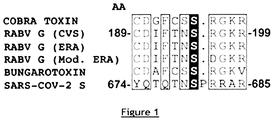
- Figure 1 discloses the amino acid sequence alignment of the motifs found in toxins from snakes of the Ophiophagus (cobra) and Bungarus genera, in G from three RABV strains and in S from SARS-CoV-2.
- Betacoronavirus designates any virus belonging to the Betacoronavirus genus (B-CoVs or Beta-CoVs), in particular any betacoronavirus belonging to one of the four lineages designated as A, B, C and D. It designates a betacoronavirus infecting animals and/or humans. In particular, this designation includes the betacoronaviruses infecting human organisms chosen among OC43, HKU1, SARS-CoV-1, SARS-CoV-2 and MERS-CoV.
- “Viral infections due to at least one betacoronavirus” designates the fact that host cells of an organism have been infected by at least one betacoronavirus, the whole organism being said to have a viral infection.
- a betacoronavirus infection in humans is usually diagnosed by a healthcare professional, based on observation of the infected patient's symptoms. Additional biological tests may be required to confirm the diagnosis: blood and/or sputum and/or bronchoalveolar fluid tests.
- Infection by a betacoronavirus can be established, for example, by molecular biological detection and/or viral titration of respiratory specimens, or by assaying blood for antibodies specific for said betacoronavirus.
- Conventional diagnostic methods comprise techniques of molecular biology such as PCR, which is well known to the person in the field.
- prevention means preventing, or reducing the likelihood of the occurrence of, an infection in a human or animal organism by at least one coronavirus.
- treatment refers to fighting the betacoronavirus infection in a human or animal organism.
- the rate of viral infection (infectious titer) in the organism will decrease, and preferably the betacoronavirus will completely disappear from the organism within a shorter period of time than expected without treatment.
- treatment also refers to reducing the symptoms associated with the betacoronovirus infection (respiratory syndrome, kidney failure, fever, etc.). Nicotine for its use according to the invention may be intended to be administered to a human being or to non-human animals.
- COVID-19 disease mean the disease linked to the infection with the SARS-CoV-2 (Severe Acute Respiratory Syndrome Coronavirus 2).
- the "symptomatic COVID-19 disease” is characterised by a patient who shows at least one symptom of the COVID-19 disease.
- the most common symptoms of the COVID-19 disease are fever, muscle aches, headaches, fatigue, loss of taste and smell and respiratory symptoms such as a dry cough, difficulty breathing and a lack of oxygen.
- a symptomatic disease is in contrast to an asymptomatic disease which is characterized by a patient who is a carrier for a disease or infection but experiences no symptoms.
- the "severe symptomatic COVID-19 disease” is characterized by severe symptoms of the COVID-19 disease, in particular respiratory symptoms. Severe symptoms are acute respiratory distress syndrome that requires hospitalization of the patient, especially in the intensive care unit (ICU).
- ICU intensive care unit
- COVID-19 patients are patients infected with the SARS-CoV-2 (Severe Acute Respiratory Syndrome Coronavirus 2).
- a "transdermal delivery device” is an adhesive device which can administer, for medical purposes, an active principle through the skin.
- Such a device provides direct administration of active principle to the blood system without passing by the digestive system, as is the case with tablets, capsules or syrups.
- LATA designates the phase of “Limitation and discontinuation of active therapies” where palliative care begins, to accompany patients at the end of life.
- ICU refers to an intensive care unit, a special department of a hospital or health care facility that provides intensive treatment medicine.
- the term "pharmaceutically acceptable” is intended to mean what is useful to the preparation of a pharmaceutical composition, and what is generally safe and non-toxic, for a pharmaceutical use.
- pharmaceutically acceptable salt is intended to mean, in the framework of the present invention, a salt of a compound which is pharmaceutically acceptable, as defined above, and which possesses the pharmacological activity of the corresponding compound.
- pharmaceutically acceptable salts comprise:
- the present inventors postulated that nicotine can sterically (or allosterically) compete with the SARS-CoV-2 binding to the nAChR, thereby preventing or reducing the hyperinflammatory syndrome that may be lethal for the patient.
- the present inventors have analyzed for the first time the smoking habits of patients that have been diagnosed from being infected by SARS-CoV-2. Severe cases (“inpatients”) and non-severe cases (“outpatients”) have been included and followed.
- the present invention relates to the use of nicotine or a pharmaceutical salt thereof to prepare a medicament intended to prevent and/or treat patients that have been diagnosed to be infected with at least one betacoronavirus.
- the invention addresses nicotine or a pharmaceutical salt thereof, for use for preventing and/or treating viral infections due to at least one betacoronavirus in a subject suffering thereof.
- the present invention also discloses a method for preventing or treating any subject that has been diagnosed to be infected with at least one betacoronavirus, said method comprising administering to said subject an effective amount of nicotine or of a pharmaceutical salt thereof.
- the method of the invention can comprise a diagnosis step as preliminary step.
- the said infection can be diagnosed or detected by any conventional means, such as molecular biological detection and/or viral titration of respiratory specimens, or by assaying blood for antibodies specific for said betacoronavirus.
- treatment of the invention designates nicotine or a pharmaceutical salt thereof, in all the embodiments disclosed below.
- said betacoronavirus is chosen in the group consisting of: OC43, HKU1, SARS-CoV-1, SARS-CoV-2 and MERS-CoV.
- said betacoronavirus is a Severe Acute Respiratory Syndrome-related coronavirus (SARS-CoV), and even more particularly, SARS-CoV-2.
- said subject is a human patient.
- Said patient can be older than 75 years old, between 65 and 74 years old, between 15 and 44 years old, or below 15 years old.
- said human patient is older than 65 years old, even more preferably older than 75 years old.
- Said subject can be a smoker or a non-smoker. Preferably, it is a non-smoker.
- said subject is an animal chosen in the group consisting of: bats, hedgehog, camels, mice, humans, pigs, cats, among others. Any other animal that can be infected with a betacoronavirus could also benefit from the treatment of the invention.
- the treatment of the invention is administered to subjects (animals or humans) that have been diagnosed to be infected with at least one betacoronavirus but do not present any symptom yet.
- the treatment of the invention is administered to subjects (animals or humans) that display at least one symptom of the COVID-19 disease, e.g., fever, muscle aches, headaches, fatigue, loss of taste, loss of smell or respiratory symptoms such as a dry cough.
- the treatment of the invention is administered to subjects (animals or humans) that suffer from severe symptomatic COVID-19 disease and experience for example difficulty in breathing and/or a lack of oxygen.
- the treatment of the invention is also useful to prevent and/or treat acute respiratory distress syndrome associated with betacoronavirus infection.
- the purpose of the treatment of the invention is to increase the survival rate of the infected subjects.
- the nicotine ((S)-3-(1-methyl-2-pyrrolidinyl)pyridine) may be in any forms such as a free base or a pharmaceutically acceptable salt such as a hydrochloride salt.
- the nicotine is in a free base form (hereinafter occasionally referred to as "nicotine free base").
- the nicotine or the pharmaceutically acceptable salt thereof may be administered via oral, parenteral, topical, transcutaneous, nasal or buccal route.
- the nicotine or the pharmaceutically acceptable salt thereof is administered via transcutaneous route.
- the nicotine or the pharmaceutically acceptable salt thereof is administered using a transdermal delivery device, more advantageously using a transdermal patch.
- the transdermal delivery device or the patch uses the cutaneous pathway to provide direct administration of active principle to the blood system without passing by the digestive system.
- Transdermal delivery devices in particular transdermal patches, comprising nicotine or a pharmaceutically acceptable salt thereof, are commonly known and marketed.
- the transdermal delivery device is advantageously type IVa patches.
- the transdermal patch comprises a support layer, a self-adhesive matrix layer comprising the nicotine or the pharmaceutically acceptable salt thereof, and a detachable protective film.
- support layer is meant any support layer typically used in the field of patches.
- detachable protective film is meant all detachable protective films capable of protecting the device's matrix before the device is used. These films typically used in the field of transdermal devices are well-known to the person skilled in the art.
- the matrix layer according to the invention is self-adhesive.
- self-adhesive is meant that the matrix layer is able to keep the device according to the invention bound to a support, for example the skin, in a stable manner, with no need for the use of other means of bonding.
- self-adhesive is meant that the matrix layer allows the device to adhere to the skin for at least 12 hours, preferentially for about 12 to 48 hours, more preferentially for about 24 hours.
- the transdermal delivery device allow the release of nicotine or a pharmaceutically acceptable salt thereof from the matrix layer by an average delivery rate comprised between 5 and 100 ⁇ g/cm 2 /h, advantageously between 10 ⁇ g/cm 2 /h and 50 ⁇ g/cm 2 /h, for a time interval comprised between 1 and 24 hours.
- the release rate may be measured by any permeation technique known to the person skilled in the art, in particular via permeation kinetics, for example on the abdominal skin of nude mouse arranged on the surface of a glass (Franz) cell.
- the transdermal patch used in the context of the invention is the patch marketed as Nicopatch® or Nicopatchlib®.
- the transdermal delivery device of the invention comprises between 5 mg and 30 mg of nicotine or a pharmaceutically acceptable salt thereof, advantageously between 10 mg and 25 mg, more advantageously between 14 mg and 25 mg, in particular 21 mg.
- the nicotine or the pharmaceutically acceptable salt thereof is administered via oral or buccal route, in particular buccal route.
- the nicotine or the pharmaceutically acceptable salt thereof is advantageously administered via buccal route using pharmaceutical sucking lozenges or sublingual tablets.
- the sublingual tablets or sucking lozenges comprise advantageously between 1mg and 30 mg of nicotine or a pharmaceutically acceptable salt thereof, advantageously between 1 mg and 20 mg, more advantageously between 1 mg and 10 mg, in particular 2 mg.
- the pharmaceutical tablets or sucking lozenges can thus be administered several times per day.
- nicotine or pharmaceutically acceptable salt thereof is administered in a dosage of between 5 and 30 mg per 24 hours, advantageously between 10 mg and 25 mg per 24 hours, more advantageously between 14 mg and 25 mg per 24 hours, in particular 21 mg per 24 hours.
- Eligible patients were patients with a confirmed diagnosis of COVID-19 infection, hospitalized in medical wards of medicine but not intensive care unit (inpatients) or having consulted for this infection in the infectious disease department and not hospitalized (outpatients, no subsequent hospitalization confirmed) at Sorbonne University APHP, Pitié-Salpêtrière Hospital, Paris France. Period of inclusion was from the 23rd to 30th of March 2020 for inpatients and from the 28th of February to the 30th of March for outpatients.
- COVID-19 was defined as a positive result on real-time reverse-transcriptase-polymerase-chain-reaction (RT-PCR) assay of nasal and pharyngeal swab specimens (NPRS).
- RT-PCR real-time reverse-transcriptase-polymerase-chain-reaction
- Daily smokers are individuals reporting daily smoking or reporting a daily frequency of the number of cigarettes (manufactured or rolled) or other tobacco products (cigar, cigarillos, pipe, shisha).
- Occasional smokers are individuals reporting smoking but not every day and only reporting no consumption of tobacco product per day.
- Age class by 10-year class
- sex by 10-year class
- comorbidities known to have potentially an impact on the prognosis of covid-19 infection diabetes, hypertension, obesity, immunodepression, respiratory disease (COPD), clinical manifestations of COVID infection, out- or inpatient status.
- COVID respiratory disease
- the standardized incidence ratios were used to compare current daily smoker rates in the COVID19 inpatients and outpatients, respectively, to current daily smoker rates in a reference population, here the French general population in 2018.
- the SIR is the ratio of observed number of current daily smokers in the COVID19 patients to the number of current daily smokers that would be expected, on the basis of age- and gender-specific current daily smokers' rates, in the general population.
- the SIR was estimated and the 95% confidence interval calculated.
- Inpatient group was composed of 242 patients, median age 65;151 men (62.4%) median age 65.5 years and 91 women (37.6%), median age 64. Total number of inpatient daily current smokers was 10 (4.1%); 6 males (4.0 % among males) and 4 females (4.4% of females).
- Outpatient group was composed of 140 patients, median age 43; 64 men (45.7%) median age 43, and 76 women (54.3 %), median age 44. Total number of outpatients daily current smokers was 7 (5.0%); 3 males (4.7 % among male) and 4 females (5.3% of female).
- Standardized Incidence Ratio for daily current smoking according to sex and age are shown in table 2.
- SIR were 0.195 [0.093-0.41] and 0.234 [0.126-0.435] for outpatients and inpatients, respectively.
- MOLECULAR DATA role of nAChR on COVID-19 infection
- nAChR cerebral nicotinic acetylcholine receptor
- nAChR is known to play a critical role in the host-pathogen interaction in the case of other well-documented viruses, such as the rabies virus (RABV).
- RABV rabies virus
- nAChRs are present in the lung epithelium.
- the non-neuronal cholinergic system contributes to the regulation of cell functions such as cell-cell interaction, apoptosis, and proliferation and it is well established that human bronchial epithelial cells contain nAChRs.
- the airway epithelium expresses ⁇ 3, ⁇ 4, ⁇ 5, ⁇ 7, ⁇ 9, ⁇ 2, and ⁇ 4 subunits for nAChRs and their contribution has been discussed in the framework of airway epithelial basal cell proliferation-differentiation and their alteration in lung cancers.
- These nAChRs are mentioned here as possible targets of Covid-19 infection of the lung, which would take place concomitantly with, and/or as a consequence of, the neuro-infection.
- the nAChR pathway is likely to be engaged in the Covid-19 inflammatory syndrome.
- the nervous system through the vagus nerve, can inhibit significantly and rapidly the release of macrophage TNF, and attenuate systemic inflammatory responses).
- This physiological mechanism termed the 'cholinergic antiinflammatory pathway' has major implications in immunology and in therapeutics.
- Macrophages mediate physiologic control of cytokine production by auto/paracrine acetylcholine through the nAChR expressed in these cells.
- the profile of cytokines massively secreted following a loss of control by acetylcholine through dysregulation of macrophage nAChR are IL1, IL6, TNF and IL18.
- This cytokine profile has striking analogies with the cytokine storm syndrome, leading to the hyperinflammatory syndrome, that has been described in a subgroup of COVID-19 patients ( Chen, G. et al. Clinical and immunologic features in severe and moderate Coronavirus Disease 2019. J Clin Invest, doi:10.1172/JCI137244 (2020 )).
- nAChR modulation by COVID-19 might thus account for the hyperinflammatory features observed in a subgroup of COVID-19 patients, mimicking bona fide the macrophage activation syndrome.
- cryo-EM structure of the trimeric SARS-CoV-2 spike (S) protein revealed an insertion with respect to that of SARS-CoV-1, in a loop that is disordered in the reported structure, and which has a polybasic sequence that corresponds to a furin site ( Walls, A. C. et al. Structure, Function, and Antigenicity of the SARS-CoV-2 Spike Glycoprotein. Cell, doi:10.1016/j.cell.2020.02.058 (2020 )).
- this exposed loop of the SARS-CoV-2 S protein also contains a motif (SEQ ID NO:1: YQTQTNSPRRAR) that is homologous to that of snake neurotoxins (SEQ ID NO:2: CDGFCSSRGKR and that of the bungarotoxin SEQ ID NO:6: CDAFCSSRGKV) and to the RABV neurotoxin-like region (SEQ ID NO:3-5) ( figure 1 ).
- Nicotine is a potential preventive agent against Covid-19 infection.
- a therapeutic assay has been set up to assess the role of nicotine (and other nicotinic agents) patches in hospitalized patients and in the general population against COVID-19 infection.
- the primary objective of this assay is to assess the efficacy of nicotine patches in terms of prevention of unfavorable evolution in hospitalized COVID-19 patients. Its end point is when unfavorable evolution is observed. "Unfavorable evolution” is herein defined by either death or transfer to ICU or indication for ICU transfer but LATA.
- the second objective is to assess the efficacy of nicotine patches in terms of survival at day 14 and day 28 post-COVID-19 detection, in particular their effect on the number of transfers to ICU, indication for ICU transfer but LATA, non-invasive ventilation or on the time to discharge.
- the percent of subjects with SARS-CoV-2 detectable in nasopharyngeal sample [Time Frame: Days 3, 5, 8, 11, 15, 29] is assessed.
- the SARS-CoV-2 is quantified in nasopharyngeal sample [Time Frame: Days 3, 5, 8, 11, 15, 29] and in blood [Time Frame: Days 3, 5, 8 and 11].
- the nicotine patch is NICOPATCHLIB® 21 mg (Pierre Fabre): Transluscent, Ultra-thin, Square shape with round corners, 5,3 x 5,6 cm
- the placebo patch is TEGADERMO: Transluscent, Ultra-thin, Square shape with round corners, 4,4 cm x 4,4 cm.
- the treatment lasts 15 days, followed by 15 days of tapering, and one-month follow-up. A long-term follow up is also scheduled for 3-6 months.
Landscapes
- Health & Medical Sciences (AREA)
- Life Sciences & Earth Sciences (AREA)
- Pharmacology & Pharmacy (AREA)
- Veterinary Medicine (AREA)
- Virology (AREA)
- Public Health (AREA)
- Chemical & Material Sciences (AREA)
- General Health & Medical Sciences (AREA)
- Animal Behavior & Ethology (AREA)
- Medicinal Chemistry (AREA)
- Communicable Diseases (AREA)
- Organic Chemistry (AREA)
- Nuclear Medicine, Radiotherapy & Molecular Imaging (AREA)
- General Chemical & Material Sciences (AREA)
- Chemical Kinetics & Catalysis (AREA)
- Oncology (AREA)
- Molecular Biology (AREA)
- Epidemiology (AREA)
- Pharmaceuticals Containing Other Organic And Inorganic Compounds (AREA)
Abstract
The invention relates to nicotine or a pharmaceutical salt thereof for use for preventing and/or treating viral infections due to at least one betacoronavirus, preferably a Severe Acute Respiratory Syndrome-related coronavirus.
Description
- The present invention relates to a new therapeutic or veterinary use of a known compound, for preventing and/or treating viral infections caused by at least one Betacoronavirus, in particular by the SARS-CoV-2 (Severe Acute Respiratory Syndrome Coronavirus 2), this viral infection in humans being designated as COVID-19 disease.
- SARS-CoV-2 belongs to the species Coronavirus, in the genus Betacoronavirus and family Coronaviridae.
- Coronaviruses are enveloped viruses with a helically symmetrical capsid. They have a single-stranded, positive-sense RNA genome and are capable of infecting cells in birds and mammals. The morphology of the virions is typical, with a halo of protein protuberances ('Spike') which gave them their name of 'crown virus'.
- Among the four genera of coronaviruses, the Betacoronavirus genus (B-CoVs or Beta-CoVs), comprising virus infecting animals and/or humans, is subdivided into four lineages designated as A, B, C and D:
- Lineage A also designated as subgenus Embecovirus includes HCoV-OC43 and HCoV-HKU1, virus able to infect various species;
- Lineage B also designated as subgenus Sarbecovirus includes SARS-CoV-1, SARS-CoV-2, and Bat SL-CoV-WIV1;
- Lineage C also designated as subgenus Merbecovirus includes Tylonycteris bat coronavirus HKU4 (BtCoV-HKU4), Pipistrellus bat coronavirus HKU5 (BtCoV-HKU5), and MERS-CoV, able to infect notably camels and humans;
- Lineage D also designated as subgenus Nobecovirus includes Rousettus bat coronavirus HKU9 (BtCoV-HKU9).
- The Betacoronaviruses of the greatest clinical importance concerning humans are:
- OC43 and HKU1 of the A lineage,
- SARS-CoV-1 and SARS-CoV-2 of the B lineage, and
- MERS-CoV of the C lineage.
- In humans, coronavirus infections can cause respiratory pathologies associated with symptoms similar to the common cold, bronchiolitis and more serious diseases such as the Severe Acute Respiratory Syndrome caused by SARS-CoV-1, which generated an epidemic in 2003, and the Middle Eastern Respiratory Syndrome caused by MERS-CoV, which generated an epidemic in 2012.
- SARS-CoV-2 is the betacoronavirus causing the coronavirus epidemic of 2019-2020, generating the form of pneumonia known as coronavirus disease 2019 or COVID-19.
- According to the World Health Organization (WHO), by April 5, 2020, 1 133 758 cases of COVID-19 have been confirmed and 62 784 patients have died worldwide. This epidemic was declared a public health emergency of international concern by WHO on January 30, 2020.
- SARS-CoV-2 genome was sequenced for the first time on 5 January 2020 by a team from Fudan University in Shanghai (China). Its genome consists of a single-stranded RNA of 29,903 nucleotides. It is 79.5% similar to that of SARS-CoV-1, and 96% similar to that of bat coronavirus, suggesting that the origin of the SARS-CoV-2 virus is zoonotic and is found in bats (Zhou P et al. A pneumonia outbreak associated with a new coronavirus of probable bat origin. Nature. 2020).
- Symptoms of infection with SARS-CoV-2 are roughly similar to those of seasonal influenza infections: they include fever, fatigue, dry cough, shortness of breath, difficult breathing, pneumonia, renal failure, and may lead to death in severe cases.
- The severity of clinical signs requires that approximately 20% of patients remain in hospital and 5% require admission to intensive care. WHO estimates the mortality rate to be around 2% (data of February 2020). However, this case-fatality rate remains uncertain, due to the difficulty in estimating the number of confirmed cases and deaths directly attributable to SARS-CoV-2 infection in the field.
- The most serious forms are observed in people who are vulnerable because of their age (over 70) or associated diseases such as hypertension, diabetes and/or coronary heart disease.
- It is of the most importance to identify therapeutic compounds for preventing and/or treating COVID-19 disease. Indeed, today, no specific therapy or vaccine is currently available for the prevention or treatment of SARS-CoV-2 viral infection.
- The majority of treatments currently received by COVID-19 patients are primarily aimed at alleviating the symptoms of fever, cough and dyspnea in order to promote spontaneous recovery.
- Antiviral compounds, known for their therapeutic activity on other types of viruses, are currently tested in clinical trials. The French High Council for Public Health issued an opinion on March 23, 2020 on the therapeutic recommendations for the management of COVID-19 disease. This official notice proposes in particular to use the following therapeutic compounds: Remdesivir, Lopinavir/Rotinavir and Hydroxychloroquine.
- Remdesivir has been initially developed for the treatment of Ebola virus infections. Remdesivir is a broad-spectrum antiviral compound, acting as a nucleoside analogue, specifically an adenosine analogue. Its presence misleads the viral polymerase and causes a reduction in viral RNA synthesis.
- Lopinavir is a viral protease inhibitor, previously used against the human immunodeficiency virus (HIV). Lopinavir inhibits the production of functional proteins by the new virions, thereby blocking the spread of the virus. Lopinavir is rapidly degraded in the body. For this reason, it is administered in fixed combination with Ritonavir, which inhibit cytochrome P450 monooxygenases, thereby slowing the degradation of Lopinavir by these enzymes.
- Hydroxychloroquine, initially known for its anti-malaria activity, has been shown to have an apparent efficacy in the treatment of Covid-19 (Yao et al., 2020). However, clinical data are still limited.
- There is a pressing urgency to identify preventive and therapeutic treatments based upon the presently available scientific information. In particular, identification of biological targets of the SARS-CoV-2 might allow to define novel therapeutic strategies.
- The following clinical symptoms of COVID-19 disease are of special interest for understanding the physiology of this viral infection:
- neurological/psychiatric disorders have been notified, especially the loss of sense of smell;
- in hospitalized old patients with bad prognosis, the following symptoms have been noted:
- ∘ systemic hyperinflammatory syndrome, with increased levels of circulating cytokines, and
- ∘ atypical acute respiratory distress syndrome, with loss of neurological control of lung perfusion regulation, and hypoxic vasoconstriction.
- Therefore, there is strong evidence for a neurotropic action of SARS-CoV-2 infection.
- It has been demonstrated that B-coronaviruses do not limit their presence to the respiratory tract and frequently invade the central nervous system. This propensity has been convincingly documented for the SARS-CoV-1 and MERS-CoV. In light of the high similarity between SARS-CoV-1 and SARS-CoV-2, it is quite likely that SARS-CoV-2 also possesses a similar potential. Neuro-infection potentially contributes to clinical manifestations of COVID-19, and the neuro-invasive potential of SARS-CoV-2 could play a role in the respiratory failure of COVID-19 patients.
- As mentioned, loss of sense of smell frequently occurs in COVID-19 patients. Furthermore, several studies have reported that some patients infected with SARS-CoV-2 show neurologic signs such as headache, nausea and vomiting. A study on 214 COVID-19 patients further found that about 88% among the severe patients displayed neurologic manifestations including acute cerebrovascular diseases and impaired consciousness.
- Based on these data, it is now admitted that SARS-CoV-2 virus enters the nervous system, invades the brain stem and affects the medullary neurons of the respiratory centers. Further studies have been performed to understand the physiological mechanisms of such central nervous system invasion.
- The angiotensin converting enzyme ACE2 represents the principal receptor molecule for cell entry of SARS-CoV-2 (Lan, J. et al. Structure of the SARS-CoV-2 spike receptor-binding domain bound to the ACE2 receptor. Nature, 2020). The ACE2 is expressed in the brain, in both neurons and glia. Nevertheless, additional receptors or co-receptors for the entry of SARS-CoV-2 are not excluded.
- A first object of the present invention is nicotine or a pharmaceutical salt thereof for use for preventing and/or treating viral infections due to at least one betacoronavirus, preferably a Severe Acute Respiratory Syndrome-related coronavirus (SARS-CoV), in particular SARS-CoV-2.
- A second object of the present invention is a transdermal delivery device comprising nicotine or a pharmaceutically acceptable salt thereof for use for preventing and/or treating viral infections due to at least one betacoronavirus, advantageously a Severe Acute Respiratory Syndrome-related coronavirus, in particular SARS-CoV-2.
-
Figure 1 discloses the amino acid sequence alignment of the motifs found in toxins from snakes of the Ophiophagus (cobra) and Bungarus genera, in G from three RABV strains and in S from SARS-CoV-2. - In the context of the invention, the term "betacoronavirus" designates any virus belonging to the Betacoronavirus genus (B-CoVs or Beta-CoVs), in particular any betacoronavirus belonging to one of the four lineages designated as A, B, C and D. It designates a betacoronavirus infecting animals and/or humans. In particular, this designation includes the betacoronaviruses infecting human organisms chosen among OC43, HKU1, SARS-CoV-1, SARS-CoV-2 and MERS-CoV.
- "Viral infections due to at least one betacoronavirus" designates the fact that host cells of an organism have been infected by at least one betacoronavirus, the whole organism being said to have a viral infection.
- A betacoronavirus infection in humans is usually diagnosed by a healthcare professional, based on observation of the infected patient's symptoms. Additional biological tests may be required to confirm the diagnosis: blood and/or sputum and/or bronchoalveolar fluid tests. Infection by a betacoronavirus can be established, for example, by molecular biological detection and/or viral titration of respiratory specimens, or by assaying blood for antibodies specific for said betacoronavirus. Conventional diagnostic methods comprise techniques of molecular biology such as PCR, which is well known to the person in the field.
- In the sense of the invention, the term "prevention" means preventing, or reducing the likelihood of the occurrence of, an infection in a human or animal organism by at least one coronavirus. By administering the compound for its use according to the invention, human or animal cells of said organism become less permissive to infection, and are thus more likely to be resistant to infection by said betacoronavirus.
- The term "treatment" refers to fighting the betacoronavirus infection in a human or animal organism. By administering the compound used according to the invention, the rate of viral infection (infectious titer) in the organism will decrease, and preferably the betacoronavirus will completely disappear from the organism within a shorter period of time than expected without treatment. The term "treatment" also refers to reducing the symptoms associated with the betacoronovirus infection (respiratory syndrome, kidney failure, fever, etc.). Nicotine for its use according to the invention may be intended to be administered to a human being or to non-human animals.
- In the context of the invention, the terms "COVID-19 disease" mean the disease linked to the infection with the SARS-CoV-2 (Severe Acute Respiratory Syndrome Coronavirus 2).
- In the context of the invention, the "symptomatic COVID-19 disease" is characterised by a patient who shows at least one symptom of the COVID-19 disease. The most common symptoms of the COVID-19 disease are fever, muscle aches, headaches, fatigue, loss of taste and smell and respiratory symptoms such as a dry cough, difficulty breathing and a lack of oxygen. A symptomatic disease is in contrast to an asymptomatic disease which is characterized by a patient who is a carrier for a disease or infection but experiences no symptoms.
- In the context of the invention, the "severe symptomatic COVID-19 disease" is characterized by severe symptoms of the COVID-19 disease, in particular respiratory symptoms. Severe symptoms are acute respiratory distress syndrome that requires hospitalization of the patient, especially in the intensive care unit (ICU).
- In the context of the invention, "COVID-19 patients" are patients infected with the SARS-CoV-2 (Severe Acute Respiratory Syndrome Coronavirus 2).
- In the context of the invention, a "transdermal delivery device" is an adhesive device which can administer, for medical purposes, an active principle through the skin. Such a device provides direct administration of active principle to the blood system without passing by the digestive system, as is the case with tablets, capsules or syrups.
- In the context of the invention, the abbreviation "LATA" designates the phase of "Limitation and discontinuation of active therapies" where palliative care begins, to accompany patients at the end of life.
- The abbreviation "ICU" refers to an intensive care unit, a special department of a hospital or health care facility that provides intensive treatment medicine.
- For the purpose of the invention, the term "pharmaceutically acceptable" is intended to mean what is useful to the preparation of a pharmaceutical composition, and what is generally safe and non-toxic, for a pharmaceutical use.
- The term "pharmaceutically acceptable salt" is intended to mean, in the framework of the present invention, a salt of a compound which is pharmaceutically acceptable, as defined above, and which possesses the pharmacological activity of the corresponding compound. The pharmaceutically acceptable salts comprise:
- 1) acid addition salts formed with inorganic acids such as hydrochloric, hydrobromic, sulfuric, nitric and phosphoric acid and the like; or formed with organic acids such as acetic, benzenesulfonic, fumaric, glucoheptonic, gluconic, glutamic, glycolic, hydroxynaphtoic, 2-hydroxyethanesulfonic, lactic, maleic, malic, mandelic, methanesulfonic, muconic, 2-naphtalenesulfonic, propionic, succinic, dibenzoyl-L-tartaric, tartaric, p-toluenesulfonic, trimethylacetic, and trifluoroacetic acid and the like, and
- 2) base addition salts formed when an acid proton present in the compound is either replaced by a metal ion, such as an alkali metal ion, an alkaline-earth metal ion, or an aluminium ion; or coordinated with an organic or inorganic base. Acceptable organic bases comprise diethanolamine, ethanolamine, N-methylglucamine, triethanolamine, tromethamine and the like. Acceptable inorganic bases comprise aluminium hydroxide, calcium hydroxide, potassium hydroxide, sodium carbonate and sodium hydroxide.
- In contrast with prior art studies showing that lung is the primary target of the SARS-COV-2 virus, and that ACE2 is the principal receptor of COVID-19 for its entry in cells, the epidemiological evidence and the in silico findings of the present inventors suggest that the COVID-19 infection is a nAChR disease that could be prevented and controlled by nicotine.
- More precisely, the present inventors postulated that nicotine can sterically (or allosterically) compete with the SARS-CoV-2 binding to the nAChR, thereby preventing or reducing the hyperinflammatory syndrome that may be lethal for the patient. To confirm this hypothesis, the present inventors have analyzed for the first time the smoking habits of patients that have been diagnosed from being infected by SARS-CoV-2. Severe cases ("inpatients") and non-severe cases ("outpatients") have been included and followed.
- Their results show for the first time that, compared to the French general population, the COVID-19 population exhibited a significantly decreased current daily smoker rate by 80,5% for outpatients and by 76,6% for inpatients. Thus, current smoking status appears to be a protective factor against the infection by SARS-CoV-2.
- In this context, they propose to administer a nicotinic treatment in order to antagonize the blocking action of SARS-CoV-2 on the AChR, and prevent the subsequent deficit it causes in the Central Nervous System.
- In a first aspect, the present invention relates to the use of nicotine or a pharmaceutical salt thereof to prepare a medicament intended to prevent and/or treat patients that have been diagnosed to be infected with at least one betacoronavirus. In other terms, the invention addresses nicotine or a pharmaceutical salt thereof, for use for preventing and/or treating viral infections due to at least one betacoronavirus in a subject suffering thereof.
- The present invention also discloses a method for preventing or treating any subject that has been diagnosed to be infected with at least one betacoronavirus, said method comprising administering to said subject an effective amount of nicotine or of a pharmaceutical salt thereof. The method of the invention can comprise a diagnosis step as preliminary step.
- The said infection can be diagnosed or detected by any conventional means, such as molecular biological detection and/or viral titration of respiratory specimens, or by assaying blood for antibodies specific for said betacoronavirus.
- As used herein, the term "treatment of the invention" designates nicotine or a pharmaceutical salt thereof, in all the embodiments disclosed below.
- In a particular embodiment, said betacoronavirus is chosen in the group consisting of: OC43, HKU1, SARS-CoV-1, SARS-CoV-2 and MERS-CoV. In a more particular embodiment, said betacoronavirus is a Severe Acute Respiratory Syndrome-related coronavirus (SARS-CoV), and even more particularly, SARS-CoV-2.
- In a preferred embodiment, said subject is a human patient. Said patient can be older than 75 years old, between 65 and 74 years old, between 15 and 44 years old, or below 15 years old. In a more preferred embodiment, said human patient is older than 65 years old, even more preferably older than 75 years old. These people indeed usually experience the most severe symptoms when infected with said virus.
- Said subject can be a smoker or a non-smoker. Preferably, it is a non-smoker.
- In a preferred embodiment, said subject is an animal chosen in the group consisting of: bats, hedgehog, camels, mice, humans, pigs, cats, among others. Any other animal that can be infected with a betacoronavirus could also benefit from the treatment of the invention.
- In a particular embodiment, the treatment of the invention is administered to subjects (animals or humans) that have been diagnosed to be infected with at least one betacoronavirus but do not present any symptom yet. In another embodiment, the treatment of the invention is administered to subjects (animals or humans) that display at least one symptom of the COVID-19 disease, e.g., fever, muscle aches, headaches, fatigue, loss of taste, loss of smell or respiratory symptoms such as a dry cough. In another embodiment, the treatment of the invention is administered to subjects (animals or humans) that suffer from severe symptomatic COVID-19 disease and experience for example difficulty in breathing and/or a lack of oxygen.
- Accordingly, the treatment of the invention is also useful to prevent and/or treat acute respiratory distress syndrome associated with betacoronavirus infection. The purpose of the treatment of the invention is to increase the survival rate of the infected subjects.
- In the context of the invention, the nicotine ((S)-3-(1-methyl-2-pyrrolidinyl)pyridine) may be in any forms such as a free base or a pharmaceutically acceptable salt such as a hydrochloride salt. Advantageously, the nicotine is in a free base form (hereinafter occasionally referred to as "nicotine free base").
- In the context of the invention, the nicotine or the pharmaceutically acceptable salt thereof may be administered via oral, parenteral, topical, transcutaneous, nasal or buccal route.
- Advantageously, the nicotine or the pharmaceutically acceptable salt thereof is administered via transcutaneous route.
- Advantageously, the nicotine or the pharmaceutically acceptable salt thereof is administered using a transdermal delivery device, more advantageously using a transdermal patch.
- The transdermal delivery device or the patch uses the cutaneous pathway to provide direct administration of active principle to the blood system without passing by the digestive system.
- Transdermal delivery devices, in particular transdermal patches, comprising nicotine or a pharmaceutically acceptable salt thereof, are commonly known and marketed.
- There are several types of patches which can be categorized (in Topical Drug Bioavailability, Bioequivalence and Penetration, V.P. Shah and H.I. Maibach, published by Springer, 1993, page 53) according to the mechanism by which the active principle is released and to the patch's design. Among the six categories listed, nicotine-based patches are those of categories II, IVa and IVc, alone or in combination. By directly incorporating nicotine in the adhesive, the type IVa patch has the advantage of having a small thickness and of being capable of being cut to size in this exceptional case by virtue of the homogeneous distribution of the active principle across its entire surface, unlike, for example, type II patches comprising a depot region.
- Thus, in the context of the invention, the transdermal delivery device is advantageously type IVa patches.
- Advantageously, the transdermal patch comprises a support layer, a self-adhesive matrix layer comprising the nicotine or the pharmaceutically acceptable salt thereof, and a detachable protective film.
- By "support layer according to the invention" is meant any support layer typically used in the field of patches.
- By "detachable protective film" is meant all detachable protective films capable of protecting the device's matrix before the device is used. These films typically used in the field of transdermal devices are well-known to the person skilled in the art.
- The matrix layer according to the invention is self-adhesive. By "self-adhesive" is meant that the matrix layer is able to keep the device according to the invention bound to a support, for example the skin, in a stable manner, with no need for the use of other means of bonding. Preferentially, by "self-adhesive" is meant that the matrix layer allows the device to adhere to the skin for at least 12 hours, preferentially for about 12 to 48 hours, more preferentially for about 24 hours.
- Advantageously, the transdermal delivery device according to the invention allow the release of nicotine or a pharmaceutically acceptable salt thereof from the matrix layer by an average delivery rate comprised between 5 and 100 µg/cm2/h, advantageously between 10 µg/cm2/h and 50 µg/cm2/h, for a time interval comprised between 1 and 24 hours. The release rate may be measured by any permeation technique known to the person skilled in the art, in particular via permeation kinetics, for example on the abdominal skin of nude mouse arranged on the surface of a glass (Franz) cell.
- Advantageously, the transdermal patch used in the context of the invention is the patch marketed as Nicopatch® or Nicopatchlib®.
- Advantageously, the transdermal delivery device of the invention comprises between 5 mg and 30 mg of nicotine or a pharmaceutically acceptable salt thereof, advantageously between 10 mg and 25 mg, more advantageously between 14 mg and 25 mg, in particular 21 mg.
- In another aspect of the invention, the nicotine or the pharmaceutically acceptable salt thereof is administered via oral or buccal route, in particular buccal route. For example, the nicotine or the pharmaceutically acceptable salt thereof is advantageously administered via buccal route using pharmaceutical sucking lozenges or sublingual tablets. In this context, the sublingual tablets or sucking lozenges comprise advantageously between 1mg and 30 mg of nicotine or a pharmaceutically acceptable salt thereof, advantageously between 1 mg and 20 mg, more advantageously between 1 mg and 10 mg, in particular 2 mg. The pharmaceutical tablets or sucking lozenges can thus be administered several times per day.
- Advantageously, in the context of the invention, nicotine or pharmaceutically acceptable salt thereof is administered in a dosage of between 5 and 30 mg per 24 hours, advantageously between 10 mg and 25 mg per 24 hours, more advantageously between 14 mg and 25 mg per 24 hours, in particular 21 mg per 24 hours.
- Although the present invention herein has been described with reference to particular embodiments, it is to be understood that these embodiments are merely illustrative of the principles and applications of the present invention. It is therefore to be understood that numerous modifications may be made to the illustrative embodiments and that other arrangements may be devised without departing from the spirit and scope of the present invention as defined by the appended claims.
- A cross sectional survey investigating the rate of current smokers in patients with a diagnosis of COVID-19 has been performed first in hospitalized patients (i.e., severe symptomatic cases of COVID-19) and second, in outpatients (i.e. the non-severe symptomatic cases of COVID-19). Current smoker rates were compared to those of the French population as reference, after standardization on age and sex.
- Eligible patients were patients with a confirmed diagnosis of COVID-19 infection, hospitalized in medical wards of medicine but not intensive care unit (inpatients) or having consulted for this infection in the infectious disease department and not hospitalized (outpatients, no subsequent hospitalization confirmed) at Sorbonne University APHP, Pitié-Salpêtrière Hospital, Paris France. Period of inclusion was from the 23rd to 30th of March 2020 for inpatients and from the 28th of February to the 30th of March for outpatients.
- The present study is observational. All data were collected in the context of care, very few data were collected in completely anonymous sheets, thus, in accordance with the French law, including the GPRD, and informed consent of the patient was not sought. This study has been approved by the ethics committee of Sorbonne University (2020 - CER-2020-13).
- Confirmed COVID-19 was defined as a positive result on real-time reverse-transcriptase-polymerase-chain-reaction (RT-PCR) assay of nasal and pharyngeal swab specimens (NPRS).
- Smoking status was collected, patients were specifically asked if they were current smokers (and if so, if they smoked every day or occasionally), former smokers, or not smokers ever.
- Daily smokers are individuals reporting daily smoking or reporting a daily frequency of the number of cigarettes (manufactured or rolled) or other tobacco products (cigar, cigarillos, pipe, shisha). Occasional smokers are individuals reporting smoking but not every day and only reporting no consumption of tobacco product per day. The group of ex-smokers includes anyone having smoked in the past, occasionally or daily, and who reported not smoking at the time of the investigation. Under the term "never smoker" people never smoked and those who just tried once or twice. The quantities of tobacco smoked have been calculated with the following equivalences: 1 cigar = 1 cigarillo = 2 cigarettes.
- For current smokers the number of daily cigarettes was recorded.
- In addition to smoking status, the following data were extracted from the medical records: Age class (by 10-year class), sex, comorbidities known to have potentially an impact on the prognosis of covid-19 infection (diabetes, hypertension, obesity, immunodepression, respiratory disease (COPD), clinical manifestations of COVID infection, out- or inpatient status.
- The population of reference to compute Standardized incidence ratios is the French population. Recent rates of current daily smokers have been reported for year 2018 by sex and age class (of 10 years) from the General survey Baromètre de Santé publique France (Public Health Barometer), a cross sectional phone survey made yearly on representative sample of 18-75-year-old people living in mainland France, with a on 2-level random sampling (Andler, R. et al. Reduction of daily smoking rate among adults: results from the 2018 santé publique france health barometer. Bull Epidémiol Hebd 15, 271-277 (2019)). The 2018 survey involved a sample of 9,074 adults of 18-75-year-old. The completion of the survey took place from January 10 to July 25, 2018.
- A descriptive analysis has been made by group (inpatients - outpatients). Qualitative variables were described by numbers and percentages, and quantitative variables by median and interquartile range. Inpatients and outpatients were compared with Pearson Chi2 tests.
- The standardized incidence ratios (SIR) were used to compare current daily smoker rates in the COVID19 inpatients and outpatients, respectively, to current daily smoker rates in a reference population, here the French general population in 2018. The SIR is the ratio of observed number of current daily smokers in the COVID19 patients to the number of current daily smokers that would be expected, on the basis of age- and gender-specific current daily smokers' rates, in the general population. The SIR was estimated and the 95% confidence interval calculated.
- The main analysis involved all included patients, and those older than 75 years were considered in the 65-75 years age class for standardisation (which is conservative for the outstanding hypothesis, as current smoker rates decrease with age). For 9 outpatients, medical charts were not available and thus smoking status was unavailable. These patients were not included in the main analysis (missing chart which were very likely to be at random). Two sensitivity analyses were performed, one excluding patients older than 75 years, another one considering the 9 patients with missing data on the smoking status as current smokers.
- 242 inpatients and 140 outpatients were included. The demographic and clinical characteristics of the two groups are shown in Table 1.
TABLE 1 - Clinical characteristics and smoking habits of COVID-19 patients Outpatients Inpatients Outpatient/inpatient comparison (Pearson's Chi2 test) Male n(%) Female n(%) all Male n(%) Female n(%) all patients 64 (45,7) 76 (54,3) 140 151 (62.4) 91 (37.6) 242 P=0.0015 Median age (yr) 43 44 43 65.5 64 65 P<0.0001 PCR + 64 (100) 76 (100) 140 (100) 151 (100) 91 (100) 242 (100) Coexisting disorder High blood presssure 9 (14.1) 7 (9,2) 16 (11.4) 64 (42.4) 31 (34.1) 95 (39.3) P<0.0001 Diabetes 4 (6.3) 3 (3.9) 7 (5.0) 42 (27.8) 22 (24.2) 64 (26.4) P<0.0001 Obesity 4 (6.3) 6 (7.9) 10 (7.1) 18 (11.9) 14 (15.4) 32 (13.2) P=0.094 Immune deficiency 3 (4.7) 1 (1,3) 4 (2.9) 24 (15.9) 18 (19.8) 42 (17.4) P=0.0001 COPD 2 (3.1) 0 (0.0) 2 (1.4) 11 (7.3) 5 (5.5) 16 (6.8) 0.027 Smoking status Current active 3 (4.7) 4 (5.3) 7 (5.0) 6 (4.0) 4 (4.4) 10 (4.1) 0.62 Current occasional 3 (4.7) 3 (3.9) 6 (4.2) 3 (2.0) 0(0) 3 (1.2) 0.07 Never smoker 32 (50.0) 46 (60.5) 78 (55.7) 72 (47.7) 67 (73.6) 139 (57.4) 0.32 Former 21 (32.8) 21 (27.6) 42 (30.) 69 (45.7) 19 (20.9) 88 (36.4) 0.89 NDMissing 5 (7.8) 2 (2.6) 7 (5.0) 1 (1,3) 1 (0.0) 2 (0.8) - Inpatient group was composed of 242 patients, median age 65;151 men (62.4%) median age 65.5 years and 91 women (37.6%), median age 64. Total number of inpatient daily current smokers was 10 (4.1%); 6 males (4.0 % among males) and 4 females (4.4% of females).
- Outpatient group was composed of 140 patients, median age 43; 64 men (45.7%) median age 43, and 76 women (54.3 %), median age 44. Total number of outpatients daily current smokers was 7 (5.0%); 3 males (4.7 % among male) and 4 females (5.3% of female).
- As described by others (Guan, W. J. et al. Clinical Characteristics of Coronavirus Disease 2019 in China. N Engl J Med, doi:10.1056/NEJMoa2002032 (2020)), hypertension (39.3%), diabetes (26.4%), obesity (13.2%) and immune deficiencies (17.4%) were frequently observed in inpatients while Chronic Obstructive Pulmonary Disease (COPD) was less frequent (6.8%). Except for obesity (7.1%; p=0.094), those comorbidities were significantly less frequent in outpatients, hypertension (5.0 %, P<0.0001), diabetes (7.1%; P<0.0001); immunodeficiencies (1.4 %; P=0.0001) and COPD (5,0%; p= 0.027).
- The rates of daily current smokers in inpatients (4.1%) did not significantly differ with outpatients (5.0%; p= 0.62; table 1). Occasional smoking was slightly more frequent in outpatients than in inpatients (4.2 vs 1.2 %; P=0.07). The proportion of men and women were equally distributed in these two smoking categories.
- Standardized Incidence Ratio for daily current smoking according to sex and age are shown in table 2. SIR were 0.195 [0.093-0.41] and 0.234 [0.126-0.435] for outpatients and inpatients, respectively. SIR in outpatients did not significantly differ from the SIR in inpatients (p = 0,71). Sensitivity analyses gave similar results (not shown).
TABLE 2 - Standardized incidence ratio of current smokers out- and inpatients Outpatients Inpatients Sex Age classe Crude rate Reference rate CSR Overall standardized rate SIR P Crude rate Reference rate CSR Overall standardized rate [IC 95%] SIR P [IC 95%] [IC 95%] [IC 95%] Female 18-24 0.0075 0.288 0.0195 0.195 [0.093 - 0.41] <0.001 0.0000 0.288 0.0012 17.8 [16.69 - 18.88] 0.234 [0.126-0.435] <0.001 25-34 0.0150 0.292 0.0395 - 0.292 - 35-44 0.0075 0.252 0.0265 0.0042 0.252 0.0063 45-54 0.0000 0.247 0.0316 0.0000 0.247 0.0185 55-64 0.0000 0.198 0.0134 0.0083 0.198 0.0165 65-75 0.0000 0.088 0.0026 0.0000 0.088 0.0040 >75 0.0000 0.088 0.0020 26.96 0.0042 0.088 0.0125 Male 18-24 0.0000 0.332 0.0150 [25.73 - 28.17] - 0.332 - 25-34 0.0075 0.350 0.0395 0.0000 0.350 0.0029 35-44 0.0000 0.367 0.0359 0.0042 0.367 0.0199 45-54 0.0075 0.314 0.0236 0.0083 0.314 0.0249 55-64 0.0075 0.216 0.0162 0.0042 0.216 0.0351 65-75 0.0000 0.113 0.0025 0.0083 0.113 0.0174 >75 0.0000 0.113 0.0017 0.0000 0.113 0.0188 - In 2018, in France the mean number of daily cigarettes by daily current smokers was 13,0 cigarettes (or equivalence) by day in the general population, 14,0/day for men and 11,9 for women (Andler, R. et al., previously cited).
- Daily cigarette consumption of current smokers in the in- and out-patients is shown in Table 3. Heavy daily current smokers (20 or more cigarettes a day) were two of 7 outpatients and 5 of 9 inpatients (data unavailable for 1 inpatient).
TABLE 3 - Daily cigarette consumption of outpatient and inpatient current smokers Gender age daily cigarette consumption OUT1 H 47 5 OUT2 F 37 5 OUT3 F 25 <5 OUT4 M 27 5 OUT5 F 28 20 OUT6 M 55 >=20 OUT7 F 18 10 IN1 M 49 <5 IN2 F 57 >20 IN3 M 48 NA (transfer in ICU) IN4 M 60 >=20 IN5 F 81 >=20 IN6 M 74 >=20 IN7 F 55 >=20 IN8 F 39 5 IN9 M 36 <5 IN10 M 66 10 - The present study reports for the first time a decreased prevalence of daily current smokers in both COVID19 outpatients and inpatients compared to the general population. These findings clearly support the hypothesis that current daily smoking may be a protective factor against COVID19 infection, or at least symptomatic COVID19 infection.
- The Standardized Incidence Ratio of current daily smoking in COVID19 outpatients and inpatients were 0.195 [0.093-0.41] and 0.234 [0.126-0.435], respectively meaning that a significantly decreased current daily smoker rate is observed, compared to the French general population. This decrease is of 80,5% and 76,6% in outpatients and inpatients, respectively. SIR did not differ between outpatients and inpatients, suggesting that the smoking protective effect was on the whole population of symptomatic (non-severe and severe) patients.
- The present inventors hypothesized that the cerebral nicotinic acetylcholine receptor (nAChR) may play a key role in the pathophysiology of COVID-19 infection.
- Several scientific clues favour this hypothesis:
- First, it is accepted that the angiotensin converting enzyme ACE2, represents the principal receptor molecule for SARS-CoV-2 (Yan, R. et al. Structural basis for the recognition of SARS-CoV-2 by full-length human ACE2. Science 367, 1444-1448, doi:10.1126/science.abb2762 (2020)). The ACE2 is expressed in the brain, in both neurones and glia, being in particular present in the brain stem and in the regions responsible for regulation of cardiovascular function including subfornical organ, paraventricular nucleus, nucleus of the tractus solitarius, and rostral ventrolateral medulla. Yet additional receptors or co-receptors are not excluded. The relationship between nicotine and ACE2 has been explored in the framework of cardiovascular and pulmonary diseases. Accordingly, in the ACE/ANG II/AT1R arm, nicotine increases the expression and/or activity of renin, ACE and AT1R, whereas in the compensatory ACE2/ANG-(1-7)/MasR arm, nicotine down regulates the expression and/or activity of ACE2 and AT2R thus suggesting a possible contribution of nAChR in ACE2 regulation. This possibility has not yet been explored in the framework of viral neuroinfections.
- Second, there are strong evidences for a neurotropic action of SARS-CoV-2 infection. It has been indeed demonstrated that β-coronaviruses, to which the SARS-CoV-2 belongs, do not limit their presence to the respiratory tract and frequently invade the CNS (Steardo, L., Steardo, L., Jr., Zorec, R. & Verkhratsky, A. Neuroinfection may potentially contribute to pathophysiology and clinical manifestations of COVID-19. Acta Physiol (Oxf), e13473, doi:10.1111/apha.13473 (2020)). This propensity has been convincingly documented for the SARS-CoV-1, MERS-CoV and the coronavirus responsible for porcine hemagglutinating encephalomyelitis (HEV 67N). In light of the high similarity between SARS-CoV-1 and SARS-CoV-2, it is quite likely that SARS-CoV-2 also possesses a similar potential. Neuroinfection has been proposed to potentially contribute to pathophysiology and clinical manifestations of COVID-19 and the neuroinvasive potential of SARS-CoV-2 suggested to play a role in the respiratory failure of COVID-19 patients (Baig, A. M., Khaleeq, A., Ali, U. & Syeda, H. Evidence of the COVID-19 Virus Targeting the CNS: Tissue Distribution, Host-Virus Interaction, and Proposed Neurotropic Mechanisms. ACS Chem Neurosci 11, 995-998, doi:10.1021/acschemneuro.0c00122 (2020)).
- Third, loss of sense of smell frequently occurs in COVID-19 patients (Gane, S. B., Kelly, C. & Hopkins, C. Isolated sudden onset anosmia in COVID-19 infection. A novel syndrome? Rhinology, doi:10.4193/Rhin20.114 (2020)). Furthermore, several studies have reported that some patients infected with SARS-CoV-2 show neurologic signs such as headache (about 8%), nausea and vomiting (1%). More recently, one study on 214 COVID-19 patients further found that about 88% (78/88) among the severe patients displayed neurologic manifestations including acute cerebrovascular diseases and impaired consciousness (Ling Mao, M. W., Shanghai Chen, Quanwei He, Jiang Chang, Candong Hong, Yifan Zhou, David Wang, Yanan Li, Huijuan Jin, Bo Hu. Neurological Manifestations of Hospitalized Patients with COVID-19 in Wuhan, China: a retrospective case series study. medRxiv, doi:https://doi.org/10.1101/2020.02.22.20026500 (2020)). Based on an epidemiological survey on Covid-19, the median time from the first symptom to dyspnea was 5.0 days, to hospital admission was 7.0 days, and to the intensive care was 8.0 days. Therefore, the latency period may be enough for the virus to enter the nervous system, invade the brain stem and affect the medullary neurons of the respiratory centers.
- Fourth, the nAChR is known to play a critical role in the host-pathogen interaction in the case of other well-documented viruses, such as the rabies virus (RABV).
- Finally, nAChRs are present in the lung epithelium. The non-neuronal cholinergic system contributes to the regulation of cell functions such as cell-cell interaction, apoptosis, and proliferation and it is well established that human bronchial epithelial cells contain nAChRs. The airway epithelium expresses α3, α4, α5, α7, α9, β2, and β4 subunits for nAChRs and their contribution has been discussed in the framework of airway epithelial basal cell proliferation-differentiation and their alteration in lung cancers. These nAChRs are mentioned here as possible targets of Covid-19 infection of the lung, which would take place concomitantly with, and/or as a consequence of, the neuro-infection.
- For all these reasons, the nAChR pathway is likely to be engaged in the Covid-19 inflammatory syndrome. The nervous system, through the vagus nerve, can inhibit significantly and rapidly the release of macrophage TNF, and attenuate systemic inflammatory responses). This physiological mechanism, termed the 'cholinergic antiinflammatory pathway' has major implications in immunology and in therapeutics.
- Macrophages mediate physiologic control of cytokine production by auto/paracrine acetylcholine through the nAChR expressed in these cells. The profile of cytokines massively secreted following a loss of control by acetylcholine through dysregulation of macrophage nAChR are IL1, IL6, TNF and IL18. This cytokine profile has striking analogies with the cytokine storm syndrome, leading to the hyperinflammatory syndrome, that has been described in a subgroup of COVID-19 patients (Chen, G. et al. Clinical and immunologic features in severe and moderate Coronavirus Disease 2019. J Clin Invest, doi:10.1172/JCI137244 (2020)). nAChR modulation by COVID-19 might thus account for the hyperinflammatory features observed in a subgroup of COVID-19 patients, mimicking bona fide the macrophage activation syndrome.
- Altogether, this nicotinic hypothesis contrasts with the two currently accepted views that the lung is the primary target of the virus and that ACE2 is the principal receptor of COVID-19 for its entry in cells.
- The present study shows that the rates of current smoking remain below 4.5 % even when main confounders for tobacco consumption, i.e. age and sex, in- or outpatient status, were considered. As shown above, compared to the French general population, the COVID-19 population exhibited a significantly decreased current daily smoker rate by 80,5% for outpatients and by 76,6% for inpatients. Thus, current smoking status appears to be a protective factor against the infection by SARS-CoV-2. Although the chemistry of tobacco smoke is complex, these data are consistent with the hypothesis that its protective role takes place through direct action on various types of nAChRs expressed in neurons, immune cells (including macrophages), cardiac tissue, lungs, and blood vessels.
- Moreover, they are structural evidences supporting the hypothesis that SARS-CoV-2 virus is a nicotinic agent. On a one hand, the recently reported X-ray structure of the RABV glycoprotein (G) ectodomain (Yang, F. et al. Structural Analysis of Rabies Virus Glycoprotein Reveals pH-Dependent Conformational Changes and Interactions with a Neutralizing Antibody. Cell Host Microbe 27, 441-453 e447, doi:10.1016/j.chom.2019.12.012 (2020)) shows that the region corresponding to the neurotoxin-like peptide is exposed at the G surface, in agreement with the fact that this region is part of the major antigenic region II of RABV (Bakker, A. B. et al. Novel human monoclonal antibody combination effectively neutralizing natural rabies virus variants and individual in vitro escape mutants. J Virol 79, 9062-9068, doi:10.1128/JVI.79.14.9062-9068.2005 (2005)). On another hand, the recently published cryo-EM structure of the trimeric SARS-CoV-2 spike (S) protein revealed an insertion with respect to that of SARS-CoV-1, in a loop that is disordered in the reported structure, and which has a polybasic sequence that corresponds to a furin site (Walls, A. C. et al. Structure, Function, and Antigenicity of the SARS-CoV-2 Spike Glycoprotein. Cell, doi:10.1016/j.cell.2020.02.058 (2020)). Importantly, this exposed loop of the SARS-CoV-2 S protein also contains a motif (SEQ ID NO:1: YQTQTNSPRRAR) that is homologous to that of snake neurotoxins (SEQ ID NO:2: CDGFCSSRGKR and that of the bungarotoxin SEQ ID NO:6: CDAFCSSRGKV) and to the RABV neurotoxin-like region (SEQ ID NO:3-5) (
figure 1 ). This observation confirms the hypothesis that SARS-CoV-2 virus itself is a nAChR blocker. - CONCLUSION: Nicotine is a potential preventive agent against Covid-19 infection.
- Both the epidemiological/clinical evidence and the in silico findings suggest that Covid-19 infection is a nAChR disease that could be prevented and may be controlled by nicotine. Nicotine would then sterically or allosterically compete with the SARS-CoV-2 binding to the nAChR. This legitimates the use of nicotine as a protective agent against SARS-CoV-2 infection and the subsequent deficits it causes in the CNS.
- In order to prevent the infection and the retropropagation of the virus through the CNS, a therapeutic assay has been set up to assess the role of nicotine (and other nicotinic agents) patches in hospitalized patients and in the general population against COVID-19 infection.
- The primary objective of this assay is to assess the efficacy of nicotine patches in terms of prevention of unfavorable evolution in hospitalized COVID-19 patients. Its end point is when unfavorable evolution is observed. "Unfavorable evolution" is herein defined by either death or transfer to ICU or indication for ICU transfer but LATA.
- The second objective is to assess the efficacy of nicotine patches in terms of survival at day 14 and day 28 post-COVID-19 detection, in particular their effect on the number of transfers to ICU, indication for ICU transfer but LATA, non-invasive ventilation or on the time to discharge.
- The percent of subjects with SARS-CoV-2 detectable in nasopharyngeal sample [Time Frame: Days 3, 5, 8, 11, 15, 29] is assessed.
- The SARS-CoV-2 is quantified in nasopharyngeal sample [Time Frame: Days 3, 5, 8, 11, 15, 29] and in blood [Time Frame: Days 3, 5, 8 and 11].
- - This randomized blind control trial enrols 194 patients:
- Main inclusion criteria: Patients hospitalized in internal medicine with diagnosis of COVID-19 (either positive PCR and/or evocative thorax CT scan)
- Main exclusion criteria: <18-year-old patients; refusal of the patients; hospitalization in ICU, LATA
- They are randomized in 2 groups of 97 patients.
- These two groups of patients will receive either a nicotine patch or a placebo patch on their back, once a day (single blind).
- The nicotine patch is NICOPATCHLIB® 21 mg (Pierre Fabre): Transluscent, Ultra-thin, Square shape with round corners, 5,3 x 5,6 cm
- The placebo patch is TEGADERMO: Transluscent, Ultra-thin, Square shape with round corners, 4,4 cm x 4,4 cm.
- The treatment lasts 15 days, followed by 15 days of tapering, and one-month follow-up. A long-term follow up is also scheduled for 3-6 months.


Claims (14)
- Nicotine or a pharmaceutical salt thereof for use for preventing and/or treating viral infections due to at least one betacoronavirus.
- Nicotine or a pharmaceutical salt thereof for use according to claim 1, wherein the betacoronavirus is a Severe Acute Respiratory Syndrome-related coronavirus (SARS-CoV), in particular SARS-CoV-2.
- Nicotine or a pharmaceutically acceptable salt thereof for use according to claim 2, for preventing and/or treating the symptomatic COVID-19 disease, and advantageously severe symptomatic COVID-19 disease.
- Nicotine or a pharmaceutically acceptable salt thereof for use according to any one of claims 1 to 3 for preventing and/or treating acute respiratory distress syndrome.
- Nicotine or a pharmaceutically acceptable salt thereof for use according to any one of claims 1 to 4 for increasing the survival rate of patients.
- Nicotine or a pharmaceutically acceptable salt thereof for use according to any one of claims 1 to 5, wherein nicotine or its pharmaceutically acceptable salt is administered via the transcutaneous route.
- Nicotine or a pharmaceutically acceptable salt thereof for use according to any one of claims 1 to 6, wherein nicotine or its pharmaceutically acceptable salt thereof is administered using transdermal delivery device, advantageously using a transdermal patch.
- Nicotine or a pharmaceutically acceptable salt thereof for use according to claim 7, wherein the transdermal delivery device comprises between 5 and 30 mg of nicotine or a pharmaceutically acceptable salt thereof.
- Nicotine or a pharmaceutically acceptable salt thereof for use according to any one of claims 1 to 8, wherein the nicotine or the pharmaceutically acceptable salt thereof is administered in a dosage of between 5 and 30 mg per 24 hours.
- A transdermal delivery device comprising nicotine or a pharmaceutically acceptable salt thereof for use for preventing and/or treating viral infections due to at least one betacoronavirus; advantageously a Severe Acute Respiratory Syndrome-reiated coronavirus, in particular SARS-CoV-2.
- A transdermal delivery device comprising nicotine or a pharmaceutically acceptable salt thereof for use according to claim 10 for preventing and/or treating symptomatic disease, more particularly severe symptomatic disease, and/or respiratory distress syndrome and/or for increasing the survival rate of patients.
- A transdermal delivery device comprising nicotine or a pharmaceutically acceptable salt thereof for use according to claim 10 or 11, wherein the disease is COVID-19 disease and patients are COVID-19 patients.
- The transdermal delivery device for use according to any one of claims 10 to 12, wherein the device is a transdermal patch.
- The transdermal delivery device for use according to any one of claims 10 to 13, wherein the device comprises between 5 and 30 mg of nicotine or a pharmaceutically acceptable salt thereof.
Priority Applications (2)
| Application Number | Priority Date | Filing Date | Title |
|---|---|---|---|
| EP20315125.3A EP3892274A1 (en) | 2020-04-06 | 2020-04-06 | Nicotine for the prevention and treatment of covid-19 disease |
| PCT/EP2021/058960 WO2021204814A1 (en) | 2020-04-06 | 2021-04-06 | Nachr, such as nicotine, for use in the prevention and the treatment of covid-19 disease |
Applications Claiming Priority (1)
| Application Number | Priority Date | Filing Date | Title |
|---|---|---|---|
| EP20315125.3A EP3892274A1 (en) | 2020-04-06 | 2020-04-06 | Nicotine for the prevention and treatment of covid-19 disease |
Publications (1)
| Publication Number | Publication Date |
|---|---|
| EP3892274A1 true EP3892274A1 (en) | 2021-10-13 |
Family
ID=70861391
Family Applications (1)
| Application Number | Title | Priority Date | Filing Date |
|---|---|---|---|
| EP20315125.3A Withdrawn EP3892274A1 (en) | 2020-04-06 | 2020-04-06 | Nicotine for the prevention and treatment of covid-19 disease |
Country Status (1)
| Country | Link |
|---|---|
| EP (1) | EP3892274A1 (en) |
Citations (1)
| Publication number | Priority date | Publication date | Assignee | Title |
|---|---|---|---|---|
| WO2017149534A1 (en) * | 2016-02-29 | 2017-09-08 | Nicogen Ltd. | Nicotine formulation and aerosols |
-
2020
- 2020-04-06 EP EP20315125.3A patent/EP3892274A1/en not_active Withdrawn
Patent Citations (1)
| Publication number | Priority date | Publication date | Assignee | Title |
|---|---|---|---|---|
| WO2017149534A1 (en) * | 2016-02-29 | 2017-09-08 | Nicogen Ltd. | Nicotine formulation and aerosols |
Non-Patent Citations (15)
Similar Documents
| Publication | Publication Date | Title |
|---|---|---|
| Lai et al. | Clinical practice guidelines for diagnosis and management of cough—Chinese Thoracic Society (CTS) Asthma Consortium | |
| US20200323843A1 (en) | Use of levocetirizine and montelukast in the treatment of viral infection caused by coronavirus | |
| US11975005B2 (en) | Treatment of respiratory diseases | |
| JP7671305B2 (en) | Novel Use of Angiotensin II Type 2 Receptor Agonists | |
| KR102421301B1 (en) | Use of Radotinib for treatment of viral respiratory disease | |
| US12485116B2 (en) | Pharmaceutical composition for preventing or treating epidemic RNA viral infectious disease | |
| KR20230020952A (en) | therapy | |
| BENICH III et al. | Evaluation of the patient with chronic cough | |
| Ahmed et al. | Coronavirus disease 2019 (COVID-19) complicated by acute respiratory distress syndrome: An internist’s perspective | |
| Murry et al. | Respiratory syncytial virus: not just for kids | |
| US11160814B1 (en) | Methods of treatment for disease from coronavirus exposure | |
| Wiselka et al. | Prophylactic intranasal alpha 2 interferon and viral exacerbations of chronic respiratory disease. | |
| WO2021204814A1 (en) | Nachr, such as nicotine, for use in the prevention and the treatment of covid-19 disease | |
| Ghanei et al. | Evaluation of chronic cough in chemical chronic bronchitis patients | |
| EP3900723A1 (en) | Nachr, such as nicotine, for use in the prevention and the treatment of covid-19 disease | |
| Nakano et al. | The safety and efficacy of the long-acting neuraminidase inhibitor laninamivir octanoate hydrate for Inhalation Suspension Set in children under the age of 5 in a post-marketing surveillance | |
| Huan | The Chinese national guidelines on diagnosis and management of cough (December 2010) | |
| US20220062219A1 (en) | Composition and method for treating or prophylaxis of coronavirus and cancers | |
| Silva et al. | Potential impact of the covid-19 in hiv-infected individuals: a systematic review | |
| Fly et al. | Advancements in Respiratory Syncytial Virus (RSV) Prevention and Treatment in Pediatrics | |
| LAI | The Chinese national guidelines on diagnosis and management of cough (December 2010) | |
| Cai et al. | Chronic Cough due to Fish Bone Incarcerated in the Bronchi Diagnosed by Bronchoscope-A Case Report | |
| HK1199815B (en) | Levocetirizine and montelukast for the treatment of influenza and common cold |
Legal Events
| Date | Code | Title | Description |
|---|---|---|---|
| PUAI | Public reference made under article 153(3) epc to a published international application that has entered the european phase |
Free format text: ORIGINAL CODE: 0009012 |
|
| STAA | Information on the status of an ep patent application or granted ep patent |
Free format text: STATUS: THE APPLICATION HAS BEEN PUBLISHED |
|
| AK | Designated contracting states |
Kind code of ref document: A1 Designated state(s): AL AT BE BG CH CY CZ DE DK EE ES FI FR GB GR HR HU IE IS IT LI LT LU LV MC MK MT NL NO PL PT RO RS SE SI SK SM TR |
|
| STAA | Information on the status of an ep patent application or granted ep patent |
Free format text: STATUS: THE APPLICATION IS DEEMED TO BE WITHDRAWN |
|
| 18D | Application deemed to be withdrawn |
Effective date: 20220414 |