EP3891288B1 - Matrix attachment regions and uses in promoting gene expression - Google Patents
Matrix attachment regions and uses in promoting gene expression Download PDFInfo
- Publication number
- EP3891288B1 EP3891288B1 EP19892450.8A EP19892450A EP3891288B1 EP 3891288 B1 EP3891288 B1 EP 3891288B1 EP 19892450 A EP19892450 A EP 19892450A EP 3891288 B1 EP3891288 B1 EP 3891288B1
- Authority
- EP
- European Patent Office
- Prior art keywords
- mar
- cells
- sequences
- sequence
- core
- Prior art date
- Legal status (The legal status is an assumption and is not a legal conclusion. Google has not performed a legal analysis and makes no representation as to the accuracy of the status listed.)
- Active
Links
Images


Classifications
-
- C—CHEMISTRY; METALLURGY
- C12—BIOCHEMISTRY; BEER; SPIRITS; WINE; VINEGAR; MICROBIOLOGY; ENZYMOLOGY; MUTATION OR GENETIC ENGINEERING
- C12N—MICROORGANISMS OR ENZYMES; COMPOSITIONS THEREOF; PROPAGATING, PRESERVING, OR MAINTAINING MICROORGANISMS; MUTATION OR GENETIC ENGINEERING; CULTURE MEDIA
- C12N15/00—Mutation or genetic engineering; DNA or RNA concerning genetic engineering, vectors, e.g. plasmids, or their isolation, preparation or purification; Use of hosts therefor
- C12N15/09—Recombinant DNA-technology
- C12N15/63—Introduction of foreign genetic material using vectors; Vectors; Use of hosts therefor; Regulation of expression
- C12N15/79—Vectors or expression systems specially adapted for eukaryotic hosts
- C12N15/85—Vectors or expression systems specially adapted for eukaryotic hosts for animal cells
-
- C—CHEMISTRY; METALLURGY
- C12—BIOCHEMISTRY; BEER; SPIRITS; WINE; VINEGAR; MICROBIOLOGY; ENZYMOLOGY; MUTATION OR GENETIC ENGINEERING
- C12N—MICROORGANISMS OR ENZYMES; COMPOSITIONS THEREOF; PROPAGATING, PRESERVING, OR MAINTAINING MICROORGANISMS; MUTATION OR GENETIC ENGINEERING; CULTURE MEDIA
- C12N15/00—Mutation or genetic engineering; DNA or RNA concerning genetic engineering, vectors, e.g. plasmids, or their isolation, preparation or purification; Use of hosts therefor
- C12N15/09—Recombinant DNA-technology
- C12N15/63—Introduction of foreign genetic material using vectors; Vectors; Use of hosts therefor; Regulation of expression
- C12N15/64—General methods for preparing the vector, for introducing it into the cell or for selecting the vector-containing host
-
- C—CHEMISTRY; METALLURGY
- C12—BIOCHEMISTRY; BEER; SPIRITS; WINE; VINEGAR; MICROBIOLOGY; ENZYMOLOGY; MUTATION OR GENETIC ENGINEERING
- C12N—MICROORGANISMS OR ENZYMES; COMPOSITIONS THEREOF; PROPAGATING, PRESERVING, OR MAINTAINING MICROORGANISMS; MUTATION OR GENETIC ENGINEERING; CULTURE MEDIA
- C12N2830/00—Vector systems having a special element relevant for transcription
- C12N2830/46—Vector systems having a special element relevant for transcription elements influencing chromatin structure, e.g. scaffold/matrix attachment region, methylation free island
Definitions
- Transcription of gene sequences is controlled at a number of different levels. Transcription initiation sites, or promoters, have different strengths, and the frequency of initiation of transcription of a given gene can also be augmented by enhancer sequences. Pausing during transcription can influence the rate of transcription and, hence, the amount of transcript produced in a given time period. Rates of pre-mRNA splicing, polyadenylation and cleavage can also influence the level of mRNA produced by a transcription unit. In addition, sequences within a mRNA molecule can regulate its transport from the nucleus to the cytoplasm, and its rate of turnover (i.e., its cytoplasmic stability).
- the PCT patent application WO2005/040377A2 discloses purified and isolated DNA sequence having protein production increasing activity characterized in that said DNA sequence comprises a) at least one bent DNA element, b) and at least one binding site for a DNA binding protein.
- polypeptides e.g., therapeutic antibodies, growth factors
- the present disclosure describes a technology for evaluating the strength of matrix attachment regions (MAR) and shows that the technology is useful for identifying MAR sequences that were previously unknown.
- MAR matrix attachment regions
- the present disclosure also describes nucleotide constructs that include cis MAR placements and related other sequences for optimal expression of genes of interest (GOI).
- GOI genes of interest
- a recombinant polynucleotide comprising a coding sequence, a promoter configured to initiate the transcription of the coding sequence, and a matrix attachment region (MAR) nucleic acid sequences having at least 75% sequence identity to SEQ ID NO: 4, wherein the MAR is capable to attach to a mammalian nuclear matrix.
- MAR matrix attachment region
- Another embodiment provides a cell comprising the polynucleotide comprising the coding sequence and a promoter configured to initiate transcription of the coding sequence, and a matrix attachment region (MAR) nucleic acid sequences having at least 75% sequence identity to SEQ ID NO: 4, wherein the MAR is capable to attach to a mammalian nuclear matrix.
- MAR matrix attachment region
- a polynucleotide includes a plurality of polynucleotides, including mixtures thereof.
- polynucleotide and “oligonucleotide” are used interchangeably and refer to a polymeric form of nucleotides of any length, either deoxyribonucleotides or ribonucleotides or analogs thereof.
- a polynucleotide can comprise modified nucleotides, such as methylated nucleotides and nucleotide analogs. If present, modifications to the nucleotide structure can be imparted before or after assembly of the polynucleotide.
- the sequence of nucleotides can be interrupted by non-nucleotide components.
- a polynucleotide can be further modified after polymerization, such as by conjugation with a labeling component.
- any embodiment of this disclosure that is a polynucleotide encompasses both the double-stranded form and each of two complementary single-stranded forms known or predicted to make up the double-stranded form.
- the present disclosure describes a method to quantify the strength of a MAR element in silico and used this method to quantify the strength of new MAR sequences identified from sequence databases.
- MAR element is likely comprised of a central AT -rich core region, along with 5' and 3' flanking regions containing transcription factor binding motifs.
- the core region may be enriched in the (ATAT)n microsatellite.
- the binding motifs may target the SATB1, NMP4, CEBP, Fast and Hox transcription factors.
- Additional nuclear matrix proteins that the MAR may bind to include the ARBP protein (attachment region binding protein), which recognizes the consensus sequence ATTTCA C /GTTGTAAAA in the MAR, the NMP-2 protein, localized exclusively in the nuclear matrix, the Spl, ATF, CCAAT, C/EBP, and AP-1 transcription factors, the yeast ACBP protein (ARS consensus binding protein), which interacts with the ARS element, the tissue-specific human SATB1 protein, expressed predominantly in thymus that binds to the minor groove of a special class of AT -rich MARs with A, T, or C but not G on one strand, the matrin 3 protein, an acidic protein of the internal nuclear matrix network of human and rat cells, matrin F/G, the transcription protein factor RFP.
- ARBP protein attachment region binding protein
- a recombinant polynucleotide comprising a coding sequence, a promoter configured to initiate the transcription of the coding sequence, and a matrix attachment region (MAR) core nucleic acid sequences having at least 75% sequence identity to t.
- MAR matrix attachment region
- MARs Matrix attachment regions, or MARs, are sequences in the DNA of eukaryotic chromosomes where the nuclear matrix attaches.
- MARs can mediate structural organization of the chromatin within the nucleus. These elements constitute anchor points of the DNA for the chromatin scaffold and serve to organize the chromatin into structural domains.
- the dynamic and complex organization of the chromatin mediated by MAR elements plays an important role in the regulation of gene expression.
- Variants of the MAR cores are nuclei acid sequences that have certain sequence identity (e.g., at least 75%, 80%, 85%, 90%, 95%, 97%, 98%, or 99%) to the reference MAR core (e.g., SEQ ID NO: 4) and have the expected MAR function (e.g., capability to attach to a mammalian nuclear matrix).
- the variants of the MAR cores are AT-rich, e.g., having at least 75%, 80%, 85%, 90%, or 95% A or T in the sequence.
- Non-limiting MAR sequences that include a MAR core, a 5' flanking region and a 3' flanking region include SEQ ID NO: 4, and nucleic acid sequences having at least 75%, 80%, 85%, 90%, 95%, 97%, 98%, or 99% sequence identity to SEQ ID NO: 4, wherein the MAR is capable to attach to a mammalian nuclear matrix.
- the cores of these newly identified MAR sequences can form functional MAR with the 5' and 3' flanking regions from other MARs, providing additional useful chimeric MAR sequences.
- a chimeric MAR of the present disclosure includes a MAR core as disclosed herein with a 5' flanking region on the 5' side. In one embodiment, a chimeric MAR of the present disclosure includes a MAR core as disclosed herein with a 3' flanking region on the 3' side. In one embodiment, a chimeric MAR of the present disclosure includes a MAR core as disclosed herein with a 5' flanking region on the 5' side and a 3' flanking region on the 3' side.
- the 5' flanking region can be selected from any 5' flanking region or 3' flanking region known in the art or disclosed herein. In some embodiments, the 5' flanking region can be selected from any 5' flanking region known in the art or disclosed herein.
- the 3' flanking region can be selected from any 5' flanking region or 3' flanking region known in the art or disclosed herein. In some embodiments, the 5' flanking region can be selected from any 3' flanking region known in the art or disclosed herein.
- Each of the MAR core, MAR 5' flanking region and MAR 3' flanking region can be substituted with a nucleic acid variant (e.g., having at least 75%, 80%, 85%, 90%, 95%, 97%, 98%, or 99% sequence identity to the reference sequence) as well.
- a nucleic acid variant e.g., having at least 75%, 80%, 85%, 90%, 95%, 97%, 98%, or 99% sequence identity to the reference sequence
- MAR flanking sequences newly identified here can also be fused to the other core sequences, either newly discovered here or known, to generate new chimeric MAR sequences, in some embodiment.
- a chimeric MAR sequence includes any one of the MAR core regions of Table 1, any one of the MAR 5' flanking sequences of Table 1, and any one of the MAR 3' flanking sequences of Table 1.
- the MAR sequences and constructs disclosed herein can be useful for promoting gene expression in cells.
- a gene of interest is included in a construct that contains the MAR (MAR alone or with 5' and/or 3' flanking regions)
- the construct can be introduced into a host cell for expressing the gene of interest.
- the MAR sequences disclosed herein can also be used in trans to promote gene expression, as a trans-acting element.
- a construct that includes any of the MAR sequences disclosed herein (MAR alone or with 5' and/or 3' flanking regions, wild-type or chimeric) can be introduced into a cell that is further transfected (or has been transfected) with a construct containing a gene of interest (GOI, or transgene) such that the MAR sequence can assist the expression of the GOI.
- a construct that includes any of the MAR sequences disclosed herein MAR alone or with 5' and/or 3' flanking regions, wild-type or chimeric
- a construct containing a gene of interest GOI, or transgene
- a cell comprising the recombinant polynucleotide comprising a coding sequence and a promoter to initiata transcription of the coding sequence, and a matrix attachment region (MAR) nucleic acid sequences having at least 75% sequence identity to SEQ ID NO: 4, wherein the MAR is capable to attach to a mammalian nuclear matrix,
- MAR matrix attachment region
- the entire MAR sequence is selected from SEQ ID NO: 4, , and nucleic acid sequences having at least 75% sequence identity to any one of SEQ ID NO: 4, wherein the MAR is capable to attach to a mammalian nuclear matrix.
- transfected cell prepared by the methods disclosed herein.
- Transcriptional regulatory sequences can include, for example, promoters, enhancers and polyadenylation signals.
- Post-transcriptional regulatory sequences include, for example, introns and PREs.
- a multiple cloning site also known as a"polylinker
- a MCS can be disposed between a promoter and a polyadenylation signal, to facilitate insertion of transgene sequences.
- the portion of the vector containing a promoter, transgene sequences a polyadenylation signal is denoted the"expression cassette.”
- Promoters active in eukaryotic cells are known in the art.
- exemplary eukaryotic promoters include, for example SV40 early promoter, SV40 late promoter, cytomegalovirus (CMV) promoter, cytomegalovirus major immediate early (CMV-MIE) promoter, EF1 -alpha (translation elongation factor- 1 a subunit) promoter, Ubc (ubiquitin C) promoter, PGK (phosphogly cerate kinase) promoter, actin promoter and others. See also Boshart et al ., GenBank Accession No.K03104; Uetsuki et al. (1989) J. Biol. Chem.
- Enhancers can also be included on the vector. Non-limiting examples include those in CMV promoter and intron A sequences.
- Five embryonic stem cell (ESC) transcription factors were previously shown to occupy super-enhancers (Oct4, Sox2, Nanog, Klf4, and Esrrb), and there are many additional transcription factors that contribute to the control of ESCs.
- Six additional transcription factors (Nr5a2, Prdml4, Tcfcp211, Smad3, Stat3, and Tcf3) occupy both typical enhancers and super-enhancers and that all of these are enriched in super-enhancers. Any of these or further known in the art can be used herein.
- Polyadenylation signals that are active in eukaryotic cells include, but are not limited to, the SV40 polyadenylation signal, the bovine growth hormone (BGH) polyadenylation signal and the herpes simplex virus thymidine kinase gene polyadenylation signal.
- the polyadenylation signal directs 3' end cleavage of pre-mRNA, polyadenylation of the pre-mRNA at the cleavage site and termination of transcription downstream of the polyadenylation signal.
- a core sequence AAUAAA is generally present in the polyadenylation signal. See also Cole et al. (1985) Mol. Cell. Biol. 5:2104-2113 .
- Exemplary introns that can be used in the vectors disclosed herein include the b-globin intron and the first intron of the human/ mouse/ rat / other species cytomegalovirus major immediate early (MIE) gene, also known as "intron A.”
- MIE cytomegalovirus major immediate early
- Additional post-transcriptional regulatory elements that can be included in the vectors of the present disclosure include, without limitation, the 5'-untranslated region of CMV MIE, the human Hsp70 gene, the SP163 sequence from the vascular endothelial growth factor (VEGF) gene, and the tripartite leader sequence associated with adenovirus late mRNAs. See, for example, Mariati et al. (2010) Protein Expression and Purification 69:9-15 .
- the vectors disclosed herein contain nucleotide sequences encoding a selection marker that functions in eukaryotic cells (i.e., a eukaryotic selection marker), such that when appropriate selection is applied, cells that do not contain the selection marker die or grow appreciably more slowly that do cells that contain the selection marker.
- a selection marker that functions in eukaryotic cells is the glutamine synthetase (GS) gene; selection is applied by culturing cells in medium lacking glutamine or selection with L-Methioniene Sulfoximine or both.
- selection marker that functions in eukaryotic cells is the gene encoding resistance to neomycin (neo); selection is applied by culturing cells in medium containing neomycin, Geneticine or G418. Additional selection markers include dihydrofolate reductase (DHFR, imparts resistance to methotrexate), puromycin-N-acetyl transferase (provides resistance to puromycin) and hygromycin kinase (provides resistance to hygromycin B). Yet additional selection markers that function in eukaryotic cells are known in the art.
- DHFR dihydrofolate reductase
- puromycin-N-acetyl transferase provides resistance to puromycin
- hygromycin kinase provides resistance to hygromycin B.
- Yet additional selection markers that function in eukaryotic cells are known in the art.
- sequences encoding the selection marker(s) described above are operatively linked to a promoter and a polyadenylation signal.
- promoters and polyadenylation signals that function in eukaryotic cells are known in the art.
- a vector as disclosed herein can contain two or more expression cassettes.
- a vector containing two expression cassettes, one of which encodes an antibody heavy chain, and the other of which encodes an antibody light chain can be used for production of functional antibody molecules.
- the vectors disclosed herein also contain a replication origin that functions in prokaryotic cells (i.e., a prokaryotic replication origin).
- Replication origins that functions in prokaryotic cells are known in the art and include, but are not limited to, the oriC origin of E. coli, plasmid origins such as, for example, the pSC101 origin, the pBR322 origin (rep) and the pUC origin; and viral ( i.e., bacteriophage) replication origins.
- Methods for identifying procaryotic replication origins are provided, for example, in Sernova & Gelfand (2008) Brief. Bioinformatics 9(5):376-391 .
- the vectors disclosed herein also contain a selection marker that functions in prokaryotic cells (i.e., a prokaryotic selection marker).
- Selection markers that function in prokaryotic cells include, for example, sequences that encode polypeptides conferring resistance to any one of ampicillin, kanamycin, chloramphenicol, or tetracycline.
- An example of a polypeptide conferring resistance to ampicillin (and other beta-lactam antibiotics) is the beta-lactamase (bla) enzyme. Kanamycin resistance can result from activity of the neomycin phosphotransferase gene; and chloramphenicol resistance is mediated by chloramphenicol acetyl transferase.
- transgenes include any recombinant protein or e.g., hormones (such as, for example, growth hormone) erythropoietin, antibodies, polyclonal, monoclonal antibodies (e.g, rituximab), antibody conjugates, fusion proteins (e.g, IgG-fusion proteins), interleukins, CD proteins, MHC proteins, enzymes and clotting factors.
- hormones such as, for example, growth hormone
- erythropoietin antibodies
- polyclonal e.g, monoclonal antibodies (e.g, rituximab)
- antibody conjugates e.g, fusion proteins (e.g, IgG-fusion proteins), interleukins, CD proteins, MHC proteins, enzymes and clotting factors.
- fusion proteins e.g, IgG-fusion proteins
- interleukins CD proteins
- MHC proteins enzymes and clotting factors.
- Antibody heavy chains and antibody light chains can be expressed from
- the present disclosure provides methods for expressing a recombinant polypeptide in a cell.
- the methods comprise introducing a vector as described herein into a cell and culturing the cell under conditions in which the vector is either transiently or stably maintained in the cell.
- Cells can be prokaryotic or eukaryotic, such as stable cell lines generated by targeted integration with CRISP/Cas9.
- Cultured eukaryotic cells, that can be used for expression of recombinant polypeptides are known in the art.
- Such cells include fungal cells (e.g., yeast), insect cells, plant cells and mammalian cells. Accordingly, the present disclosure provides a cell comprising a vector as described herein.
- Exemplary yeast cells include, but are not limited to, Trichoderma sp., Pichia pastoris, Schizosaccharomyces pombae and Saccharomyces cerevisiae.
- Exemplary insect cell lines include, but are not limited to, Sf9, Sf21, and Drosophila S2 cells.
- Exemplary plant cells include, but are not limited to, Arabidopsis cells and tobacco BY2 cells.
- Cultured mammalian cell lines useful for expression of recombinant polypeptides, include Chinese hamster ovary (CHO) cells, human embryonic kidney (HEK) cells, virally transformed HEK cells (e.g., HEK293 cells), NS0 cells, SP20 cells, CV-1 cells, baby hamster kidney (BHK) cells, 3T3 cells, Jurkat cells, HeLa cells, COS cells, PERC.6 cells, CAP ® cells and CAP-T ® cells (the latter two cell lines being commercially available from Cevec Pharmaceuticals, Cologne, Germany).
- CHO Chinese hamster ovary
- HEK human embryonic kidney
- virally transformed HEK cells e.g., HEK293 cells
- NS0 cells e.g., HEK293 cells
- SP20 cells e.g., HEK293 cells
- NS0 cells e.g., HEK293 cells
- SP20 cells e.g.,
- CHO-DXB11 CHO-DG-44
- CHO-K1 CHO-S
- engineered CHO cells such as CHO-M, CK1 SV CHO, and CHOZN.
- Mammalian primary cells can also be used.
- the cells are cultured in a serum-free medium.
- expressing cells must be grown in serum-free medium.
- the cells have been pre-adapted for growth in serum-free medium prior to being used for polypeptide expression.
- the vectors as described herein can be introduced into any of the aforementioned cells using methods that are known in the art. Such methods include, but are not limited to, polyethylene glycol (PEG)-mediated methods, electroporation, biolistic delivery (z.e., particle bombardment), protoplast fusion, DEAE-dextran-mediated methods, and calcium phosphate co precipitation. See also, Sambrook et al.”Molecular Cloning: A Laboratory Manual,” Third Edition, Cold Spring Harbor Laboratory Press, 2001 ; and Ausubel et al. ,”Current Protocols in Molecular Biology,” John Wiley & Sons, New York, 1987 and periodic updates.
- PEG polyethylene glycol
- This example developed a method to quantify the strength of a matrix attachment region (MAR) element in silico and used this method to quantify the strength of a few exemplary MAR sequences.
- MAR matrix attachment region
- a literature search was performed to identify all motifs related to MAR identification, specifically looking for MAR specific transcription factors, chromatin binding domains, DNA bending and DNA unwinding sequences. Potentially useful characteristics were summarized and used for further MAR evaluation.
- a MAR element is likely comprised of a central AT-rich core region and the 5' and 3' flanking regions containing transcription factor binding motifs.
- the core region may be enriched in the (ATAT)n microsatellite.
- a MAR may contain and be generally categorized by the inclusion of a"MAR recognition signature," a bipartite element composed of two distinct sequences AATAAYAA and AWWRTAANNWWGNNNC.
- Other MAR indicative sequences consist of various transcription factors and DNA structure motifs. Exemplary sequences include the DNA-unwinding motif, AP-1, A-box and T-box, NMP-2, SATB1, Hox4D, TEF, Pitl and Fast.
- MAR Zebrafish Four new MAR elements were identified through the search, named as MAR Zebrafish, MAR Cyprinus Carpio, MAR 12-RP13, and MAR 17XX_fos, respectively. Their, as well as a few known ones' (MAR 1-68, MAR S4, MAR X29, Mouse c-myc 5MAR, and SPR2A-MAR), completed sequences, core and 5' and 3' flanking regions of the core are listed in Table 1.
- Neon transfection was done with CT MCB cells. BalanCD + 4mM Gin Media was used for transfection. Transient Transfection done by Bio-Rad: Gene Pulser II setting at 900uF, 300v resistance 0. Cells were split before 24 hours of transfection. Day 0 viability & VCD are measured as million cells/ml. Transfections were done using 5pg of Heavy Chain & Light chain DNA. 10pg of GFP DNA was used as an external control to check the transfection efficiency. Stable pools were generated by maintaining methionine sulfoximine (MSX) at levels resulting in selective pressure that favored the growth of cells expressing the recombinant protein of interest, Rituximab Light Chain, for 14 days.
- MSX methionine sulfoximine
- Resulting recombinant pools were compared in 14 day fed batch quantitation assays. Titers at the day of harvest and throughout culture were analyzed by biolayer interferometry or ELISA. The experimental method above for pool generation was repeated to generate the pools for testing the MAR Zebrafish core, using only one concentration of MSX, 80 mM.
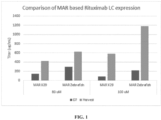
- FIG. 1 The results of the in vitro comparison of MAR X29 and MAR Zebrafish are shown in FIG. 1 .
- selection marker concentrations methionine sulfoximine (MSX) at 80mM and 100 mM
- MSX methionine sulfoximine
Landscapes
- Genetics & Genomics (AREA)
- Health & Medical Sciences (AREA)
- Life Sciences & Earth Sciences (AREA)
- Engineering & Computer Science (AREA)
- Chemical & Material Sciences (AREA)
- Wood Science & Technology (AREA)
- Organic Chemistry (AREA)
- Biotechnology (AREA)
- General Engineering & Computer Science (AREA)
- Biomedical Technology (AREA)
- Zoology (AREA)
- Bioinformatics & Cheminformatics (AREA)
- Molecular Biology (AREA)
- Microbiology (AREA)
- Plant Pathology (AREA)
- Physics & Mathematics (AREA)
- Biochemistry (AREA)
- General Health & Medical Sciences (AREA)
- Biophysics (AREA)
- Cell Biology (AREA)
- Micro-Organisms Or Cultivation Processes Thereof (AREA)
- Peptides Or Proteins (AREA)
Description
- Transcription of gene sequences (i.e., production of mRNA) is controlled at a number of different levels. Transcription initiation sites, or promoters, have different strengths, and the frequency of initiation of transcription of a given gene can also be augmented by enhancer sequences. Pausing during transcription can influence the rate of transcription and, hence, the amount of transcript produced in a given time period. Rates of pre-mRNA splicing, polyadenylation and cleavage can also influence the level of mRNA produced by a transcription unit. In addition, sequences within a mRNA molecule can regulate its transport from the nucleus to the cytoplasm, and its rate of turnover (i.e., its cytoplasmic stability).
- The
PCT patent application WO2005/040377A2 discloses purified and isolated DNA sequence having protein production increasing activity characterized in that said DNA sequence comprises a) at least one bent DNA element, b) and at least one binding site for a DNA binding protein. - Expression of polypeptides (e.g., therapeutic antibodies, growth factors) in vitro is important for the pharmaceutical industry, and methods to maximize protein expression are needed.
- The present disclosure describes a technology for evaluating the strength of matrix attachment regions (MAR) and shows that the technology is useful for identifying MAR sequences that were previously unknown.
- The present disclosure also describes nucleotide constructs that include cis MAR placements and related other sequences for optimal expression of genes of interest (GOI).
- In accordance with one embodiment of the present disclosure, therefore, provided is a recombinant polynucleotide comprising a coding sequence, a promoter configured to initiate the transcription of the coding sequence, and a matrix attachment region (MAR) nucleic acid sequences having at least 75% sequence identity to SEQ ID NO: 4, wherein the MAR is capable to attach to a mammalian nuclear matrix.
- Another embodiment provides a cell comprising the polynucleotide comprising the coding sequence and a promoter configured to initiate transcription of the coding sequence, and a matrix attachment region (MAR) nucleic acid sequences having at least 75% sequence identity to SEQ ID NO: 4, wherein the MAR is capable to attach to a mammalian nuclear matrix.
-
-
FIG. 1 compares the strength of two MAR sequences, MAR X29 a known MAR as control, and MAR Zebrafish, which was identified by the present technology. -
FIG. 2 demonstrates the strength of the MAR Zebrafish core using as control a construct that does not contain any MAR sequences. -
FIG. 3 is the vector map of a MAR core-containing construct described in Example 2. -
FIG. 4 is the vector map of the control construct that did not contain the MAR core element, as described in Example 2. - All numerical designations, e.g., pH, temperature, time, concentration, and molecular weight, including ranges, are approximations which are varied ( + ) or ( - ) by increments of 0.1. It is to be understood, although not always explicitly stated that all numerical designations are preceded by the term "about". It also is to be understood, although not always explicitly stated, that the reagents described herein are merely exemplary and that equivalents of such are known in the art.
- As used in the specification and claims, the singular form "a", "an" and "the" include plural references unless the context clearly dictates otherwise. For example, the term "a polynucleotide" includes a plurality of polynucleotides, including mixtures thereof.
- The terms "polynucleotide" and "oligonucleotide" are used interchangeably and refer to a polymeric form of nucleotides of any length, either deoxyribonucleotides or ribonucleotides or analogs thereof. A polynucleotide can comprise modified nucleotides, such as methylated nucleotides and nucleotide analogs. If present, modifications to the nucleotide structure can be imparted before or after assembly of the polynucleotide. The sequence of nucleotides can be interrupted by non-nucleotide components. A polynucleotide can be further modified after polymerization, such as by conjugation with a labeling component. The term also refers to both double- and single-stranded molecules. Unless otherwise specified or required, any embodiment of this disclosure that is a polynucleotide encompasses both the double-stranded form and each of two complementary single-stranded forms known or predicted to make up the double-stranded form.
- The present disclosure describes a method to quantify the strength of a MAR element in silico and used this method to quantify the strength of new MAR sequences identified from sequence databases.
- Through sequence comparison and structure-activity analyses, the instant inventors discovered that a MAR element is likely comprised of a central AT -rich core region, along with 5' and 3' flanking regions containing transcription factor binding motifs.
- The core region may be enriched in the (ATAT)n microsatellite. The binding motifs may target the SATB1, NMP4, CEBP, Fast and Hox transcription factors. Additional nuclear matrix proteins that the MAR may bind to include the ARBP protein (attachment region binding protein), which recognizes the consensus sequence ATTTCAC/GTTGTAAAA in the MAR, the NMP-2 protein, localized exclusively in the nuclear matrix, the Spl, ATF, CCAAT, C/EBP, and AP-1 transcription factors, the yeast ACBP protein (ARS consensus binding protein), which interacts with the ARS element, the tissue-specific human SATB1 protein, expressed predominantly in thymus that binds to the minor groove of a special class of AT -rich MARs with A, T, or C but not G on one strand, the matrin 3 protein, an acidic protein of the internal nuclear matrix network of human and rat cells, matrin F/G, the transcription protein factor RFP.
- The analytical results assisted the inventors in the search for new MAR sequences, leading to discovery of new MAR sequences that are highly effective in promoting gene expression, as compared to a positive reference, MAR X29 (Arope et al. (2013) PLoS ONE 8(11): e79262).
- In accordance with one embodiment of the present disclosure, therefore, provided is a recombinant polynucleotide comprising a coding sequence, a promoter configured to initiate the transcription of the coding sequence, and a matrix attachment region (MAR) core nucleic acid sequences having at least 75% sequence identity to t. SEQ ID NO: 4.
- Matrix attachment regions, or MARs, are sequences in the DNA of eukaryotic chromosomes where the nuclear matrix attaches. As architectural DNA components that organize the genome of eukaryotes into functional units within the cell nucleus, MARs can mediate structural organization of the chromatin within the nucleus. These elements constitute anchor points of the DNA for the chromatin scaffold and serve to organize the chromatin into structural domains. The dynamic and complex organization of the chromatin mediated by MAR elements plays an important role in the regulation of gene expression.
- Variants of the MAR cores are nuclei acid sequences that have certain sequence identity (e.g., at least 75%, 80%, 85%, 90%, 95%, 97%, 98%, or 99%) to the reference MAR core (e.g., SEQ ID NO: 4) and have the expected MAR function (e.g., capability to attach to a mammalian nuclear matrix).
- In some embodiments, the variants of the MAR cores are AT-rich, e.g., having at least 75%, 80%, 85%, 90%, or 95% A or T in the sequence.
- Non-limiting MAR sequences that include a MAR core, a 5' flanking region and a 3' flanking region include SEQ ID NO: 4, and nucleic acid sequences having at least 75%, 80%, 85%, 90%, 95%, 97%, 98%, or 99% sequence identity to SEQ ID NO: 4, wherein the MAR is capable to attach to a mammalian nuclear matrix.
- As provided, the cores of these newly identified MAR sequences can form functional MAR with the 5' and 3' flanking regions from other MARs, providing additional useful chimeric MAR sequences.
- In one embodiment, a chimeric MAR of the present disclosure includes a MAR core as disclosed herein with a 5' flanking region on the 5' side. In one embodiment, a chimeric MAR of the present disclosure includes a MAR core as disclosed herein with a 3' flanking region on the 3' side. In one embodiment, a chimeric MAR of the present disclosure includes a MAR core as disclosed herein with a 5' flanking region on the 5' side and a 3' flanking region on the 3' side.
- The 5' flanking region can be selected from any 5' flanking region or 3' flanking region known in the art or disclosed herein. In some embodiments, the 5' flanking region can be selected from any 5' flanking region known in the art or disclosed herein.
- The 3' flanking region can be selected from any 5' flanking region or 3' flanking region known in the art or disclosed herein. In some embodiments, the 5' flanking region can be selected from any 3' flanking region known in the art or disclosed herein.
- Each of the MAR core, MAR 5' flanking region and MAR 3' flanking region can be substituted with a nucleic acid variant (e.g., having at least 75%, 80%, 85%, 90%, 95%, 97%, 98%, or 99% sequence identity to the reference sequence) as well.
- The MAR flanking sequences newly identified here can also be fused to the other core sequences, either newly discovered here or known, to generate new chimeric MAR sequences, in some embodiment. In some embodiments, a chimeric MAR sequence includes any one of the MAR core regions of Table 1, any one of the MAR 5' flanking sequences of Table 1, and any one of the MAR 3' flanking sequences of Table 1.
- The MAR sequences and constructs disclosed herein can be useful for promoting gene expression in cells. When a gene of interest is included in a construct that contains the MAR (MAR alone or with 5' and/or 3' flanking regions), the construct can be introduced into a host cell for expressing the gene of interest.
- The MAR sequences disclosed herein can also be used in trans to promote gene expression, as a trans-acting element. For instance, a construct that includes any of the MAR sequences disclosed herein (MAR alone or with 5' and/or 3' flanking regions, wild-type or chimeric) can be introduced into a cell that is further transfected (or has been transfected) with a construct containing a gene of interest (GOI, or transgene) such that the MAR sequence can assist the expression of the GOI.
- In accordance with one embodiment of the present disclosure, therefore, provided is a cell comprising the recombinant polynucleotide comprising a coding sequence and a promoter to initiata transcription of the coding sequence, and a matrix attachment region (MAR) nucleic acid sequences having at least 75% sequence identity to SEQ ID NO: 4, wherein the MAR is capable to attach to a mammalian nuclear matrix,
- In some embodiments, the entire MAR sequence is selected from SEQ ID NO: 4, , and nucleic acid sequences having at least 75% sequence identity to any one of SEQ ID NO: 4, wherein the MAR is capable to attach to a mammalian nuclear matrix.
- Also provided are transfected cell prepared by the methods disclosed herein.
- In any of the constructs or vectors disclosed herein, additional transcriptional regulatory sequences and/or post-transcriptional regulatory sequences can be included. Transcriptional regulatory sequences can include, for example, promoters, enhancers and polyadenylation signals. Post-transcriptional regulatory sequences include, for example, introns and PREs.
- The following embodiments of paragraph [0038] to [0055] are not according to the invention and are present for illustration purpose only.
- In certain embodiments, a multiple cloning site (MCS), also known as a"polylinker," is present in the vector to facilitate insertion of heterologous sequences. For example, a MCS can be disposed between a promoter and a polyadenylation signal, to facilitate insertion of transgene sequences. In vectors containing transgene sequences, the portion of the vector containing a promoter, transgene sequences a polyadenylation signal is denoted the"expression cassette."
- Promoters active in eukaryotic cells are known in the art. Exemplary eukaryotic promoters include, for example SV40 early promoter, SV40 late promoter, cytomegalovirus (CMV) promoter, cytomegalovirus major immediate early (CMV-MIE) promoter, EF1 -alpha (translation elongation factor- 1 a subunit) promoter, Ubc (ubiquitin C) promoter, PGK (phosphogly cerate kinase) promoter, actin promoter and others. See also Boshart et al ., GenBank Accession No.K03104; Uetsuki et al. (1989) J. Biol. Chem. 264:5791-5798; Schorpp et al. (1996) Nucleic Acids Res. 24: 1787-1788; Hamaguchi et al. (2000 ) J. Virology 74: 10778-10784; Dreos et al. (2013) Nucleic Acids Res. 41(D1):D157-D164 and the eukaryotic promoter database at http://epd.vital-it.ch, accessed on July 16, 2014.
- Enhancers can also be included on the vector. Non-limiting examples include those in CMV promoter and intron A sequences. Five embryonic stem cell (ESC) transcription factors were previously shown to occupy super-enhancers (Oct4, Sox2, Nanog, Klf4, and Esrrb), and there are many additional transcription factors that contribute to the control of ESCs. Six additional transcription factors (Nr5a2, Prdml4, Tcfcp211, Smad3, Stat3, and Tcf3) occupy both typical enhancers and super-enhancers and that all of these are enriched in super-enhancers. Any of these or further known in the art can be used herein.
- Polyadenylation signals that are active in eukaryotic cells are known in the art and include, but are not limited to, the SV40 polyadenylation signal, the bovine growth hormone (BGH) polyadenylation signal and the herpes simplex virus thymidine kinase gene polyadenylation signal. The polyadenylation signal directs 3' end cleavage of pre-mRNA, polyadenylation of the pre-mRNA at the cleavage site and termination of transcription downstream of the polyadenylation signal. A core sequence AAUAAA is generally present in the polyadenylation signal. See also Cole et al. (1985) Mol. Cell. Biol. 5:2104-2113.
- Exemplary introns that can be used in the vectors disclosed herein include the b-globin intron and the first intron of the human/ mouse/ rat / other species cytomegalovirus major immediate early (MIE) gene, also known as "intron A."
- Additional post-transcriptional regulatory elements that can be included in the vectors of the present disclosure include, without limitation, the 5'-untranslated region of CMV MIE, the human Hsp70 gene, the SP163 sequence from the vascular endothelial growth factor (VEGF) gene, and the tripartite leader sequence associated with adenovirus late mRNAs. See, for example, Mariati et al. (2010) Protein Expression and Purification 69:9-15.
- In certain embodiments, the vectors disclosed herein contain nucleotide sequences encoding a selection marker that functions in eukaryotic cells (i.e., a eukaryotic selection marker), such that when appropriate selection is applied, cells that do not contain the selection marker die or grow appreciably more slowly that do cells that contain the selection marker. An exemplary selection marker that functions in eukaryotic cells is the glutamine synthetase (GS) gene; selection is applied by culturing cells in medium lacking glutamine or selection with L-Methioniene Sulfoximine or both. Another exemplary selection marker that functions in eukaryotic cells is the gene encoding resistance to neomycin (neo); selection is applied by culturing cells in medium containing neomycin, Geneticine or G418. Additional selection markers include dihydrofolate reductase (DHFR, imparts resistance to methotrexate), puromycin-N-acetyl transferase (provides resistance to puromycin) and hygromycin kinase (provides resistance to hygromycin B). Yet additional selection markers that function in eukaryotic cells are known in the art.
- The sequences encoding the selection marker(s) described above are operatively linked to a promoter and a polyadenylation signal. As stated above, promoters and polyadenylation signals that function in eukaryotic cells are known in the art.
- In certain embodiments, a vector as disclosed herein can contain two or more expression cassettes. For example, a vector containing two expression cassettes, one of which encodes an antibody heavy chain, and the other of which encodes an antibody light chain can be used for production of functional antibody molecules.
- The vectors disclosed herein also contain a replication origin that functions in prokaryotic cells (i.e., a prokaryotic replication origin). Replication origins that functions in prokaryotic cells are known in the art and include, but are not limited to, the oriC origin of E. coli, plasmid origins such as, for example, the pSC101 origin, the pBR322 origin (rep) and the pUC origin; and viral (i.e., bacteriophage) replication origins. Methods for identifying procaryotic replication origins are provided, for example, in Sernova & Gelfand (2008) Brief. Bioinformatics 9(5):376-391.
- The vectors disclosed herein also contain a selection marker that functions in prokaryotic cells (i.e., a prokaryotic selection marker). Selection markers that function in prokaryotic cells are known in the art and include, for example, sequences that encode polypeptides conferring resistance to any one of ampicillin, kanamycin, chloramphenicol, or tetracycline. An example of a polypeptide conferring resistance to ampicillin (and other beta-lactam antibiotics) is the beta-lactamase (bla) enzyme. Kanamycin resistance can result from activity of the neomycin phosphotransferase gene; and chloramphenicol resistance is mediated by chloramphenicol acetyl transferase.
- Exemplary transgenes include any recombinant protein or e.g., hormones (such as, for example, growth hormone) erythropoietin, antibodies, polyclonal, monoclonal antibodies (e.g, rituximab), antibody conjugates, fusion proteins (e.g, IgG-fusion proteins), interleukins, CD proteins, MHC proteins, enzymes and clotting factors. Antibody heavy chains and antibody light chains can be expressed from separate vectors, or from the same vector containing two expression cassettes.
- The present disclosure provides methods for expressing a recombinant polypeptide in a cell. The methods comprise introducing a vector as described herein into a cell and culturing the cell under conditions in which the vector is either transiently or stably maintained in the cell. Cells can be prokaryotic or eukaryotic, such as stable cell lines generated by targeted integration with CRISP/Cas9. Cultured eukaryotic cells, that can be used for expression of recombinant polypeptides, are known in the art. Such cells include fungal cells (e.g., yeast), insect cells, plant cells and mammalian cells. Accordingly, the present disclosure provides a cell comprising a vector as described herein.
- Exemplary yeast cells include, but are not limited to, Trichoderma sp., Pichia pastoris, Schizosaccharomyces pombae and Saccharomyces cerevisiae. Exemplary insect cell lines include, but are not limited to, Sf9, Sf21, and Drosophila S2 cells. Exemplary plant cells include, but are not limited to, Arabidopsis cells and tobacco BY2 cells.
- Cultured mammalian cell lines, useful for expression of recombinant polypeptides, include Chinese hamster ovary (CHO) cells, human embryonic kidney (HEK) cells, virally transformed HEK cells (e.g., HEK293 cells), NS0 cells, SP20 cells, CV-1 cells, baby hamster kidney (BHK) cells, 3T3 cells, Jurkat cells, HeLa cells, COS cells, PERC.6 cells, CAP® cells and CAP-T® cells (the latter two cell lines being commercially available from Cevec Pharmaceuticals, Cologne, Germany). A number of derivatives of CHO cells are also available such as, for example, CHO-DXB11, CHO-DG-44, CHO-K1, CHO-S, or engineered CHO cells such as CHO-M, CK1 SV CHO, and CHOZN. Mammalian primary cells can also be used.
- In certain embodiments, the cells are cultured in a serum-free medium. For example, for manufacture of therapeutic proteins for administration to patients, expressing cells must be grown in serum-free medium. In additional embodiments, the cells have been pre-adapted for growth in serum-free medium prior to being used for polypeptide expression.
- The vectors as described herein can be introduced into any of the aforementioned cells using methods that are known in the art. Such methods include, but are not limited to, polyethylene glycol (PEG)-mediated methods, electroporation, biolistic delivery (z.e., particle bombardment), protoplast fusion, DEAE-dextran-mediated methods, and calcium phosphate co precipitation. See also, Sambrook et al."Molecular Cloning: A Laboratory Manual," Third Edition, Cold Spring Harbor Laboratory Press, 2001; and Ausubel et al. ,"Current Protocols in Molecular Biology," John Wiley & Sons, New York, 1987 and periodic updates.
- Standard methods for cell culture are known in the art. See, for example, R. I. Freshney "Culture of Animal Cells: A Manual of Basic Technique," Fifth Edition, Wiley, New York, 2005.
- This example developed a method to quantify the strength of a matrix attachment region (MAR) element in silico and used this method to quantify the strength of a few exemplary MAR sequences.
- A literature search was performed to identify all motifs related to MAR identification, specifically looking for MAR specific transcription factors, chromatin binding domains, DNA bending and DNA unwinding sequences. Potentially useful characteristics were summarized and used for further MAR evaluation.
- A MAR element is likely comprised of a central AT-rich core region and the 5' and 3' flanking regions containing transcription factor binding motifs. The core region may be enriched in the (ATAT)n microsatellite.
- A MAR may contain and be generally categorized by the inclusion of a"MAR recognition signature," a bipartite element composed of two distinct sequences AATAAYAA and AWWRTAANNWWGNNNC. Other MAR indicative sequences consist of various transcription factors and DNA structure motifs. Exemplary sequences include the DNA-unwinding motif, AP-1, A-box and T-box, NMP-2, SATB1, Hox4D, TEF, Pitl and Fast.
- Four new MAR elements were identified through the search, named as MAR Zebrafish, MAR Cyprinus Carpio, MAR 12-RP13, and MAR 17XX_fos, respectively. Their, as well as a few known ones' (MAR 1-68, MAR S4, MAR X29, Mouse c-myc 5MAR, and SPR2A-MAR), completed sequences, core and 5' and 3' flanking regions of the core are listed in Table 1.


- Experimental testing of one of the identified MAR elements, MAR Zebrafish, was conducted in comparison to the strongest known MAR from literature and was shown to be two times more potent.
- In vitro comparison was made between MAR Zebrafish, a newly identified MAR element, and MAR X29 (reference, see Arope et al. (2013) PLoS ONE 8(11): e79262).
- Experimental testing of the MAR Zebrafish core, which did not include the flanking regions of the full-length MAR Zebrafish, was then conducted in comparison to a construct that did not contain any MAR sequences.
- Neon transfection was done with CT MCB cells. BalanCD + 4mM Gin Media was used for transfection. Transient Transfection done by Bio-Rad: Gene Pulser II setting at 900uF, 300v resistance 0. Cells were split before 24 hours of transfection. Day 0 viability & VCD are measured as million cells/ml. Transfections were done using 5pg of Heavy Chain & Light chain DNA. 10pg of GFP DNA was used as an external control to check the transfection efficiency. Stable pools were generated by maintaining methionine sulfoximine (MSX) at levels resulting in selective pressure that favored the growth of cells expressing the recombinant protein of interest, Rituximab Light Chain, for 14 days. Resulting recombinant pools were compared in 14 day fed batch quantitation assays. Titers at the day of harvest and throughout culture were analyzed by biolayer interferometry or ELISA. The experimental method above for pool generation was repeated to generate the pools for testing the MAR Zebrafish core, using only one concentration of MSX, 80 mM.
- The results of the in vitro comparison of MAR X29 and MAR Zebrafish are shown in
FIG. 1 . At both selection marker concentrations (methionine sulfoximine (MSX) at 80mM and 100 mM), MAR Zebrafish outperformed MAR X29 by a considerable margin. This example, therefore, validated the search and in silico approach developed in Example 1. - In a further experiment, the potency of the MAR core sequence alone was tested in comparison to a construct without any MAR elements. As shown in
FIG. 2 , The MAR Zebrafish core sequence resulted in significantly higher titers than the no MAR control.
Claims (2)
- A recombinant polynucleotide comprising a coding sequence, a promoter configured to initiate the transcription of the coding sequence, and a matrix attachment region (MAR) nucleic acid sequences having at least 75% sequence identity to SEQ ID NO: 4 wherein the MAR is capable to attach to a mammalian nuclear matrix.
- A cell comprising the polynucleotides of claim 2.
Applications Claiming Priority (2)
| Application Number | Priority Date | Filing Date | Title |
|---|---|---|---|
| US201862776643P | 2018-12-07 | 2018-12-07 | |
| PCT/US2019/064910 WO2020118169A1 (en) | 2018-12-07 | 2019-12-06 | Matrix attachment regions and uses in promoting gene expression |
Publications (4)
| Publication Number | Publication Date |
|---|---|
| EP3891288A1 EP3891288A1 (en) | 2021-10-13 |
| EP3891288A4 EP3891288A4 (en) | 2022-09-28 |
| EP3891288B1 true EP3891288B1 (en) | 2024-10-09 |
| EP3891288C0 EP3891288C0 (en) | 2024-10-09 |
Family
ID=70974440
Family Applications (1)
| Application Number | Title | Priority Date | Filing Date |
|---|---|---|---|
| EP19892450.8A Active EP3891288B1 (en) | 2018-12-07 | 2019-12-06 | Matrix attachment regions and uses in promoting gene expression |
Country Status (8)
| Country | Link |
|---|---|
| US (1) | US12565663B2 (en) |
| EP (1) | EP3891288B1 (en) |
| JP (1) | JP2022511077A (en) |
| KR (1) | KR20210113222A (en) |
| CN (1) | CN113383081B (en) |
| AU (1) | AU2019395023B2 (en) |
| CA (1) | CA3161115A1 (en) |
| WO (1) | WO2020118169A1 (en) |
Families Citing this family (1)
| Publication number | Priority date | Publication date | Assignee | Title |
|---|---|---|---|---|
| DE102023207258A1 (en) * | 2023-07-28 | 2025-01-30 | Uga Biopharma Gmbh | Polynucleotide for stable transfection of an animal cell, kit, host cell and use of the polynucleotide |
Family Cites Families (8)
| Publication number | Priority date | Publication date | Assignee | Title |
|---|---|---|---|---|
| PL1959011T3 (en) | 2003-10-24 | 2012-07-31 | Selexis Sa | High efficiency gene transfer and expression in mammalian cells by a multiple transfection procedure of matrix attachment region sequences |
| US20060263798A1 (en) * | 2005-02-11 | 2006-11-23 | International Business Machines Corporation | System and method for identification of MicroRNA precursor sequences and corresponding mature MicroRNA sequences from genomic sequences |
| US7968700B2 (en) * | 2006-03-20 | 2011-06-28 | Chromagenics B.V. | Expression augmenting DNA fragments, use thereof, and methods for finding thereof |
| CN101541959A (en) * | 2006-08-23 | 2009-09-23 | 思兰克斯有限公司 | Matrix attachment regions (MARs) for increasing transcription and uses thereof |
| US9650630B2 (en) * | 2010-09-01 | 2017-05-16 | Cellagenics B.V. | Nucleic acid fragments from a ribosomal protein promoter for enhancing gene expression |
| JP2018534946A (en) * | 2015-10-27 | 2018-11-29 | セルテオン コーポレイション | Chimeric post-transcriptional regulatory elements |
| EP3293263A1 (en) * | 2016-09-07 | 2018-03-14 | Steinbeis Innovation gGmbH | Inducible gene expression by linear at-rich dna fragments in mammalian cells and methods relating thereto |
| CN107868781B (en) * | 2017-11-15 | 2025-12-30 | 新乡医学院 | Artificially synthesized MAR fragments, expression vectors, expression systems and their applications |
-
2019
- 2019-12-06 JP JP2021532047A patent/JP2022511077A/en active Pending
- 2019-12-06 KR KR1020217021295A patent/KR20210113222A/en not_active Withdrawn
- 2019-12-06 CA CA3161115A patent/CA3161115A1/en active Pending
- 2019-12-06 CN CN201980091439.0A patent/CN113383081B/en active Active
- 2019-12-06 WO PCT/US2019/064910 patent/WO2020118169A1/en not_active Ceased
- 2019-12-06 EP EP19892450.8A patent/EP3891288B1/en active Active
- 2019-12-06 US US17/311,306 patent/US12565663B2/en active Active
- 2019-12-06 AU AU2019395023A patent/AU2019395023B2/en active Active
Also Published As
| Publication number | Publication date |
|---|---|
| EP3891288A1 (en) | 2021-10-13 |
| US12565663B2 (en) | 2026-03-03 |
| EP3891288A4 (en) | 2022-09-28 |
| CA3161115A1 (en) | 2020-06-11 |
| CN113383081B (en) | 2025-04-01 |
| JP2022511077A (en) | 2022-01-28 |
| AU2019395023B2 (en) | 2026-05-07 |
| US20220017916A1 (en) | 2022-01-20 |
| EP3891288C0 (en) | 2024-10-09 |
| CN113383081A (en) | 2021-09-10 |
| WO2020118169A1 (en) | 2020-06-11 |
| AU2019395023A1 (en) | 2021-07-29 |
| KR20210113222A (en) | 2021-09-15 |
Similar Documents
| Publication | Publication Date | Title |
|---|---|---|
| US20190309322A1 (en) | Chimeric post-transcriptional regulatory element | |
| JP6445516B2 (en) | Production of recombinant polypeptides | |
| DK2771470T3 (en) | TRANSCRIPTION DEVICES AND THEIR USE IN EXPRESSION VECTORS | |
| US20200283818A1 (en) | Methods and compositions for expression of polypeptides in a cell | |
| AU2019395023B2 (en) | Matrix attachment regions and uses in promoting gene expression | |
| JP2017200476A (en) | Expression cassette | |
| US20260139269A1 (en) | Matrix attachment regions and uses in promoting gene expression | |
| TWI812596B (en) | PROMOTER OF Hspa5 GENE | |
| WO2012147370A1 (en) | Terminator sequence-containing reverse primer for overexpression and linear dna | |
| US20150218552A1 (en) | Rnai based selection system | |
| EP4504923A1 (en) | Isolated transposase and use thereof | |
| US9512230B2 (en) | Transcription units and the use thereof in expression vectors | |
| WO2024198911A1 (en) | Isolated transposase and use thereof | |
| WO2012098100A1 (en) | S/mar containing expression vectors, cell and cell lines as well as methods using the same | |
| JP6607481B2 (en) | Linear double-stranded DNA having a terminator sequence and a promoter sequence in sequence |
Legal Events
| Date | Code | Title | Description |
|---|---|---|---|
| STAA | Information on the status of an ep patent application or granted ep patent |
Free format text: STATUS: THE INTERNATIONAL PUBLICATION HAS BEEN MADE |
|
| TPAC | Observations filed by third parties |
Free format text: ORIGINAL CODE: EPIDOSNTIPA |
|
| PUAI | Public reference made under article 153(3) epc to a published international application that has entered the european phase |
Free format text: ORIGINAL CODE: 0009012 |
|
| STAA | Information on the status of an ep patent application or granted ep patent |
Free format text: STATUS: REQUEST FOR EXAMINATION WAS MADE |
|
| 17P | Request for examination filed |
Effective date: 20210707 |
|
| AK | Designated contracting states |
Kind code of ref document: A1 Designated state(s): AL AT BE BG CH CY CZ DE DK EE ES FI FR GB GR HR HU IE IS IT LI LT LU LV MC MK MT NL NO PL PT RO RS SE SI SK SM TR |
|
| DAV | Request for validation of the european patent (deleted) | ||
| DAX | Request for extension of the european patent (deleted) | ||
| A4 | Supplementary search report drawn up and despatched |
Effective date: 20220829 |
|
| RIC1 | Information provided on ipc code assigned before grant |
Ipc: C12N 15/79 20060101ALI20220823BHEP Ipc: C12N 15/87 20060101ALI20220823BHEP Ipc: C12N 15/85 20060101AFI20220823BHEP |
|
| STAA | Information on the status of an ep patent application or granted ep patent |
Free format text: STATUS: EXAMINATION IS IN PROGRESS |
|
| 17Q | First examination report despatched |
Effective date: 20230929 |
|
| GRAP | Despatch of communication of intention to grant a patent |
Free format text: ORIGINAL CODE: EPIDOSNIGR1 |
|
| STAA | Information on the status of an ep patent application or granted ep patent |
Free format text: STATUS: GRANT OF PATENT IS INTENDED |
|
| INTG | Intention to grant announced |
Effective date: 20240508 |
|
| GRAS | Grant fee paid |
Free format text: ORIGINAL CODE: EPIDOSNIGR3 |
|
| GRAA | (expected) grant |
Free format text: ORIGINAL CODE: 0009210 |
|
| STAA | Information on the status of an ep patent application or granted ep patent |
Free format text: STATUS: THE PATENT HAS BEEN GRANTED |
|
| AK | Designated contracting states |
Kind code of ref document: B1 Designated state(s): AL AT BE BG CH CY CZ DE DK EE ES FI FR GB GR HR HU IE IS IT LI LT LU LV MC MK MT NL NO PL PT RO RS SE SI SK SM TR |
|
| REG | Reference to a national code |
Ref country code: CH Ref legal event code: EP |
|
| REG | Reference to a national code |
Ref country code: DE Ref legal event code: R096 Ref document number: 602019060295 Country of ref document: DE |
|
| REG | Reference to a national code |
Ref country code: IE Ref legal event code: FG4D |
|
| U01 | Request for unitary effect filed |
Effective date: 20241010 |
|
| U07 | Unitary effect registered |
Designated state(s): AT BE BG DE DK EE FI FR IT LT LU LV MT NL PT RO SE SI Effective date: 20241106 |
|
| U20 | Renewal fee for the european patent with unitary effect paid |
Year of fee payment: 6 Effective date: 20241224 |
|
| PG25 | Lapsed in a contracting state [announced via postgrant information from national office to epo] |
Ref country code: IS Free format text: LAPSE BECAUSE OF FAILURE TO SUBMIT A TRANSLATION OF THE DESCRIPTION OR TO PAY THE FEE WITHIN THE PRESCRIBED TIME-LIMIT Effective date: 20250209 Ref country code: HR Free format text: LAPSE BECAUSE OF FAILURE TO SUBMIT A TRANSLATION OF THE DESCRIPTION OR TO PAY THE FEE WITHIN THE PRESCRIBED TIME-LIMIT Effective date: 20241009 |
|
| PG25 | Lapsed in a contracting state [announced via postgrant information from national office to epo] |
Ref country code: ES Free format text: LAPSE BECAUSE OF FAILURE TO SUBMIT A TRANSLATION OF THE DESCRIPTION OR TO PAY THE FEE WITHIN THE PRESCRIBED TIME-LIMIT Effective date: 20241009 |
|
| PG25 | Lapsed in a contracting state [announced via postgrant information from national office to epo] |
Ref country code: NO Free format text: LAPSE BECAUSE OF FAILURE TO SUBMIT A TRANSLATION OF THE DESCRIPTION OR TO PAY THE FEE WITHIN THE PRESCRIBED TIME-LIMIT Effective date: 20250109 |
|
| PG25 | Lapsed in a contracting state [announced via postgrant information from national office to epo] |
Ref country code: GR Free format text: LAPSE BECAUSE OF FAILURE TO SUBMIT A TRANSLATION OF THE DESCRIPTION OR TO PAY THE FEE WITHIN THE PRESCRIBED TIME-LIMIT Effective date: 20250110 |
|
| PG25 | Lapsed in a contracting state [announced via postgrant information from national office to epo] |
Ref country code: PL Free format text: LAPSE BECAUSE OF FAILURE TO SUBMIT A TRANSLATION OF THE DESCRIPTION OR TO PAY THE FEE WITHIN THE PRESCRIBED TIME-LIMIT Effective date: 20241009 |
|
| PG25 | Lapsed in a contracting state [announced via postgrant information from national office to epo] |
Ref country code: RS Free format text: LAPSE BECAUSE OF FAILURE TO SUBMIT A TRANSLATION OF THE DESCRIPTION OR TO PAY THE FEE WITHIN THE PRESCRIBED TIME-LIMIT Effective date: 20250109 |
|
| PG25 | Lapsed in a contracting state [announced via postgrant information from national office to epo] |
Ref country code: SM Free format text: LAPSE BECAUSE OF FAILURE TO SUBMIT A TRANSLATION OF THE DESCRIPTION OR TO PAY THE FEE WITHIN THE PRESCRIBED TIME-LIMIT Effective date: 20241009 |
|
| PG25 | Lapsed in a contracting state [announced via postgrant information from national office to epo] |
Ref country code: MC Free format text: LAPSE BECAUSE OF FAILURE TO SUBMIT A TRANSLATION OF THE DESCRIPTION OR TO PAY THE FEE WITHIN THE PRESCRIBED TIME-LIMIT Effective date: 20241009 |
|
| PG25 | Lapsed in a contracting state [announced via postgrant information from national office to epo] |
Ref country code: SK Free format text: LAPSE BECAUSE OF FAILURE TO SUBMIT A TRANSLATION OF THE DESCRIPTION OR TO PAY THE FEE WITHIN THE PRESCRIBED TIME-LIMIT Effective date: 20241009 |
|
| PG25 | Lapsed in a contracting state [announced via postgrant information from national office to epo] |
Ref country code: CZ Free format text: LAPSE BECAUSE OF FAILURE TO SUBMIT A TRANSLATION OF THE DESCRIPTION OR TO PAY THE FEE WITHIN THE PRESCRIBED TIME-LIMIT Effective date: 20241009 |
|
| PLBE | No opposition filed within time limit |
Free format text: ORIGINAL CODE: 0009261 |
|
| STAA | Information on the status of an ep patent application or granted ep patent |
Free format text: STATUS: NO OPPOSITION FILED WITHIN TIME LIMIT |
|
| 26N | No opposition filed |
Effective date: 20250710 |
|
| PG25 | Lapsed in a contracting state [announced via postgrant information from national office to epo] |
Ref country code: IE Free format text: LAPSE BECAUSE OF NON-PAYMENT OF DUE FEES Effective date: 20241206 |
|
| REG | Reference to a national code |
Ref country code: CH Ref legal event code: U11 Free format text: ST27 STATUS EVENT CODE: U-0-0-U10-U11 (AS PROVIDED BY THE NATIONAL OFFICE) Effective date: 20260101 |
|
| PGFP | Annual fee paid to national office [announced via postgrant information from national office to epo] |
Ref country code: GB Payment date: 20251218 Year of fee payment: 7 |
|
| U20 | Renewal fee for the european patent with unitary effect paid |
Year of fee payment: 7 Effective date: 20251222 |
|
| PG25 | Lapsed in a contracting state [announced via postgrant information from national office to epo] |
Ref country code: CY Free format text: LAPSE BECAUSE OF FAILURE TO SUBMIT A TRANSLATION OF THE DESCRIPTION OR TO PAY THE FEE WITHIN THE PRESCRIBED TIME-LIMIT; INVALID AB INITIO Effective date: 20191206 |
|
| PGFP | Annual fee paid to national office [announced via postgrant information from national office to epo] |
Ref country code: CH Payment date: 20260101 Year of fee payment: 7 |