EP3890088B1 - Non-aqueous electrolyte secondary battery - Google Patents
Non-aqueous electrolyte secondary battery Download PDFInfo
- Publication number
- EP3890088B1 EP3890088B1 EP19888809.1A EP19888809A EP3890088B1 EP 3890088 B1 EP3890088 B1 EP 3890088B1 EP 19888809 A EP19888809 A EP 19888809A EP 3890088 B1 EP3890088 B1 EP 3890088B1
- Authority
- EP
- European Patent Office
- Prior art keywords
- electrode
- plate
- electrode assembly
- positive
- negative
- Prior art date
- Legal status (The legal status is an assumption and is not a legal conclusion. Google has not performed a legal analysis and makes no representation as to the accuracy of the status listed.)
- Active
Links
Images

Classifications
-
- H—ELECTRICITY
- H01—ELECTRIC ELEMENTS
- H01M—PROCESSES OR MEANS, e.g. BATTERIES, FOR THE DIRECT CONVERSION OF CHEMICAL ENERGY INTO ELECTRICAL ENERGY
- H01M10/00—Secondary cells; Manufacture thereof
- H01M10/04—Construction or manufacture in general
- H01M10/0431—Cells with wound or folded electrodes
-
- H—ELECTRICITY
- H01—ELECTRIC ELEMENTS
- H01M—PROCESSES OR MEANS, e.g. BATTERIES, FOR THE DIRECT CONVERSION OF CHEMICAL ENERGY INTO ELECTRICAL ENERGY
- H01M10/00—Secondary cells; Manufacture thereof
- H01M10/05—Accumulators with non-aqueous electrolyte
- H01M10/052—Li-accumulators
- H01M10/0525—Rocking-chair batteries, i.e. batteries with lithium insertion or intercalation in both electrodes; Lithium-ion batteries
-
- H—ELECTRICITY
- H01—ELECTRIC ELEMENTS
- H01M—PROCESSES OR MEANS, e.g. BATTERIES, FOR THE DIRECT CONVERSION OF CHEMICAL ENERGY INTO ELECTRICAL ENERGY
- H01M10/00—Secondary cells; Manufacture thereof
- H01M10/05—Accumulators with non-aqueous electrolyte
- H01M10/058—Construction or manufacture
- H01M10/0587—Construction or manufacture of accumulators having only wound construction elements, i.e. wound positive electrodes, wound negative electrodes and wound separators
-
- H—ELECTRICITY
- H01—ELECTRIC ELEMENTS
- H01M—PROCESSES OR MEANS, e.g. BATTERIES, FOR THE DIRECT CONVERSION OF CHEMICAL ENERGY INTO ELECTRICAL ENERGY
- H01M50/00—Constructional details or processes of manufacture of the non-active parts of electrochemical cells other than fuel cells, e.g. hybrid cells
- H01M50/40—Separators; Membranes; Diaphragms; Spacing elements inside cells
- H01M50/46—Separators, membranes or diaphragms characterised by their combination with electrodes
-
- H—ELECTRICITY
- H01—ELECTRIC ELEMENTS
- H01M—PROCESSES OR MEANS, e.g. BATTERIES, FOR THE DIRECT CONVERSION OF CHEMICAL ENERGY INTO ELECTRICAL ENERGY
- H01M50/00—Constructional details or processes of manufacture of the non-active parts of electrochemical cells other than fuel cells, e.g. hybrid cells
- H01M50/40—Separators; Membranes; Diaphragms; Spacing elements inside cells
- H01M50/463—Separators, membranes or diaphragms characterised by their shape
-
- H—ELECTRICITY
- H01—ELECTRIC ELEMENTS
- H01M—PROCESSES OR MEANS, e.g. BATTERIES, FOR THE DIRECT CONVERSION OF CHEMICAL ENERGY INTO ELECTRICAL ENERGY
- H01M50/00—Constructional details or processes of manufacture of the non-active parts of electrochemical cells other than fuel cells, e.g. hybrid cells
- H01M50/40—Separators; Membranes; Diaphragms; Spacing elements inside cells
- H01M50/489—Separators, membranes, diaphragms or spacing elements inside the cells, characterised by their physical properties, e.g. swelling degree, hydrophilicity or shut down properties
-
- H—ELECTRICITY
- H01—ELECTRIC ELEMENTS
- H01M—PROCESSES OR MEANS, e.g. BATTERIES, FOR THE DIRECT CONVERSION OF CHEMICAL ENERGY INTO ELECTRICAL ENERGY
- H01M2300/00—Electrolytes
- H01M2300/0017—Non-aqueous electrolytes
- H01M2300/0025—Organic electrolyte
-
- H—ELECTRICITY
- H01—ELECTRIC ELEMENTS
- H01M—PROCESSES OR MEANS, e.g. BATTERIES, FOR THE DIRECT CONVERSION OF CHEMICAL ENERGY INTO ELECTRICAL ENERGY
- H01M50/00—Constructional details or processes of manufacture of the non-active parts of electrochemical cells other than fuel cells, e.g. hybrid cells
- H01M50/10—Primary casings; Jackets or wrappings
- H01M50/102—Primary casings; Jackets or wrappings characterised by their shape or physical structure
- H01M50/103—Primary casings; Jackets or wrappings characterised by their shape or physical structure prismatic or rectangular
-
- H—ELECTRICITY
- H01—ELECTRIC ELEMENTS
- H01M—PROCESSES OR MEANS, e.g. BATTERIES, FOR THE DIRECT CONVERSION OF CHEMICAL ENERGY INTO ELECTRICAL ENERGY
- H01M50/00—Constructional details or processes of manufacture of the non-active parts of electrochemical cells other than fuel cells, e.g. hybrid cells
- H01M50/40—Separators; Membranes; Diaphragms; Spacing elements inside cells
- H01M50/409—Separators, membranes or diaphragms characterised by the material
-
- Y—GENERAL TAGGING OF NEW TECHNOLOGICAL DEVELOPMENTS; GENERAL TAGGING OF CROSS-SECTIONAL TECHNOLOGIES SPANNING OVER SEVERAL SECTIONS OF THE IPC; TECHNICAL SUBJECTS COVERED BY FORMER USPC CROSS-REFERENCE ART COLLECTIONS [XRACs] AND DIGESTS
- Y02—TECHNOLOGIES OR APPLICATIONS FOR MITIGATION OR ADAPTATION AGAINST CLIMATE CHANGE
- Y02E—REDUCTION OF GREENHOUSE GAS [GHG] EMISSIONS, RELATED TO ENERGY GENERATION, TRANSMISSION OR DISTRIBUTION
- Y02E60/00—Enabling technologies; Technologies with a potential or indirect contribution to GHG emissions mitigation
- Y02E60/10—Energy storage using batteries
-
- Y—GENERAL TAGGING OF NEW TECHNOLOGICAL DEVELOPMENTS; GENERAL TAGGING OF CROSS-SECTIONAL TECHNOLOGIES SPANNING OVER SEVERAL SECTIONS OF THE IPC; TECHNICAL SUBJECTS COVERED BY FORMER USPC CROSS-REFERENCE ART COLLECTIONS [XRACs] AND DIGESTS
- Y02—TECHNOLOGIES OR APPLICATIONS FOR MITIGATION OR ADAPTATION AGAINST CLIMATE CHANGE
- Y02P—CLIMATE CHANGE MITIGATION TECHNOLOGIES IN THE PRODUCTION OR PROCESSING OF GOODS
- Y02P70/00—Climate change mitigation technologies in the production process for final industrial or consumer products
- Y02P70/50—Manufacturing or production processes characterised by the final manufactured product
Definitions
- the present invention relates to a nonaqueous electrolyte secondary battery including a flat wound electrode assembly.
- a prismatic secondary battery including a flat wound electrode assembly housed in a prismatic battery case is known.
- a flat electrode assembly is formed by winding, into a circular shape, a positive plate having a positive electrode mixture layer formed on a surface of a positive electrode current collector, a negative plate having a negative electrode mixture layer formed on a surface of a negative electrode current collector, and a separator disposed therebetween and, thereafter, pressing the wound electrode assembly into a flat shape.
- Such a flat electrode assembly has a pair of curved portions at either end.
- the curvature of a curved portion of the positive plate or the negative plate is greatest at the innermost circumference side. For this reason, the separator is stretched thin at the innermost circumference side of the curved portion and, thus, the breakdown voltage of the separator is locally reduced.
- insulation breakdown may occur in the separator that was stretched thin.
- the positive plate and the negative plate located at the innermost circumference, where the curvature of the curved portion is greatest, are subjected to high stress.
- the positive electrode mixture layer or the negative electrode mixture layer may be peeled off from the positive or negative electrode current collector and may break through the separator, leading to internal short circuit.
- the thickness of the separator can be increased.
- the increased thickness of the separator leads to a decrease in the energy density of the battery. For this reason, this technique is difficult to apply to batteries that are designed for high energy density.
- PTL 1 describes a method for attaching an insulating tape to a curved portion of a positive electrode current collector located at the innermost circumference side.
- peel-off of the positive or negative electrode mixture layer having the greatest curvature at the innermost circumference can be suppressed and, thus, an internal short circuit can be prevented.
- PTL 2 discloses an electric storage system
- PTL 3 discloses a prismatic battery
- PTL 4 discloses a nonaqueous electrolyte secondary battery.
- the present invention has been made in view of the above circumstances, and a primary object of the present invention is to suppress a decrease in the energy density of a nonaqueous electrolyte secondary battery including a flat wound electrode assembly and suppress the occurrence of an internal short circuit between the positive and negative plates located at the innermost circumference where the curvature of a curved portion is greatest.
- a nonaqueous electrolyte secondary battery includes an electrode assembly formed by winding, into a flat shape, a first electrode plate having a first electrode mixture layer formed on a first electrode current collector, a second electrode plate having a second electrode mixture layer formed on a second electrode current collector, and a separator therebetween.
- the electrode assembly has a pair of curved portions located at either end and a flat portion between the pair of curved portions. In both of the pair of curved portions, at least two layers of the second electrode plate are disposed on an inner side of a curved portion of the first electrode plate located at an innermost circumference.
- the present invention is capable of suppressing a decrease in the energy density of a nonaqueous electrolyte secondary battery including a flat wound electrode assembly and suppressing the occurrence of an internal short circuit between the positive and negative plates located at the innermost circumference where the curvature of a curved portion is greatest.
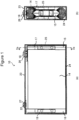
- Figures 1(a) and 1(b) are schematic illustrations of the configuration of a nonaqueous electrolyte secondary battery according to an embodiment of the present invention, where Figure 1(a) is a sectional view, and Figure 1(b) is a sectional view taken along a line Ib-Ib of Figure 1(a) .
- a nonaqueous electrolyte secondary battery 10 includes a flat electrode assembly 14 that is formed by winding, into a flat shape, a positive plate, a negative plate, and a separator therebetween and that is housed in a prismatic battery case 25.
- the positive plate has a positive electrode mixture layer formed on a positive electrode current collector
- the negative plate has a negative electrode mixture layer formed on the negative electrode current collector.
- the electrode assembly 14 is wrapped by an insulating sheet 24 and is housed in the battery case 25.
- the opening of the battery case 25 is sealed with a sealing plate 23, and a positive electrode terminal 18 and a negative electrode terminal 22 are fixed to the sealing plate 23 via insulating members 26 and 27, respectively.
- a positive electrode current collector exposed portion 15 is formed at one end of the positive plate so that the positive electrode current collector is exposed, and a negative electrode current collector exposed portion 16 is formed at the other end of the negative plate so that the negative electrode current collector is exposed.
- a plurality of stacked positive electrode current collector exposed portions 15 are disposed at one end of the electrode assembly 14, and a plurality of stacked negative electrode current collector exposed portions 16 are disposed at the other end of the electrode assembly 14.
- the plurality of stacked positive electrode current collector exposed portions 15 are electrically connected to the positive electrode terminal 18 via a positive electrode current collector plate 17, and the plurality of negative electrode current collector exposed portions 16 are electrically connected to the negative electrode terminal 22 via a negative electrode current collector plate 19.
- FIG. 2 is a sectional view schematically illustrating the configuration of the electrode assembly 14 according to the present embodiment.
- the flat electrode assembly 14 is formed by winding, into a circular shape, a positive plate 11 having a positive electrode mixture layer on the surface of the positive electrode current collector, a negative plate 12 having a negative electrode mixture layer on the surface of the negative electrode current collector, and a separator 13 disposed therebetween and, thereafter, pressing the wound electrode assembly into a flat shape.
- the positive plate 11, the negative plate 12, and the separator 13 disposed therebetween may be wound into a flat shape and, thereafter, be subjected to pressing.
- the flat electrode assembly 14 has a pair of curved portions at either end in a direction perpendicular to the direction in which the winding axis of the flat electrode assembly 14 extends and perpendicular to the thickness direction of the flat electrode assembly 14.
- Figure 2 is an enlarged view of the electrode assembly 14 at the innermost circumference side of the curved portion where the curvature is greatest.
- the electrode assembly 14 has a pair of curved portions 20A and 20B located at either end and a flat portion 21 located between the pair of curved portions 20A and 20B.
- two layers of the negative plate 12 serving as a second electrode plate are disposed on the inner side of a curved portion of the positive plate 11 serving as a first electrode plate which is located at the innermost circumference.
- a negative plate 12B is disposed on the inner side of the curved portion of the positive plate 11 located at the innermost circumference with the separator 13 therebetween, and a negative plate 12A that does not face the positive plate 11 is further disposed on the inner side of the negative plate 12B.
- the curvature of the positive plate 11, where the curvature is greatest can be reduced. This enables the separator 13 to maintain a thickness sufficient to suppress insulation breakdown even if the separator 13 is stretched in the curved portions 20A and 20B at the innermost circumference side and, even if a high voltage is applied to the positive plate 11 and the negative plate 12.
- the stress imposed on the positive plate 11 and the negative plate 12 can be suppressed at the innermost circumference side of each of the curved portions 20A and 20B, where the curvature is greatest. In this manner, peeling off of the positive electrode mixture layer or the negative electrode mixture layer from the positive electrode current collector or the negative electrode current collector can be suppressed. As a result, the occurrence of an internal short circuit caused by a peeled off mixture layer can be suppressed.
- the negative plate 12A disposed at the innermost circumference side does not face the positive plate 11 and, thus, does not contribute to the battery reaction.
- the volume occupied by the extra wound negative plate 12A is significantly small, as compared with the volume occupied by the entire electrode assembly 14. For this reason, it does little to reduce the energy density of the battery.
- the reduction in the energy density of the battery is negligible. Note that from the perspective of the energy density of the battery, it is desirable to minimize the number of winding/turns of the negative plate 12 which is located at the innermost circumference side of the electrode assembly 14.
- a winding start end 12a of the negative plate 12 be located near the end of the flat portion 21 (for example, within 10 mm from the end of the flat portion 21 and more preferably within 5 mm from the end of the flat portion 21). This location can more effectively suppress reduction in energy density of the battery.
- a winding start end 11a of the positive plate 11 be located near the end of the flat portion 21 (for example, within 10 mm from the end of the flat portion 21 and, more preferably, within 5 mm from the end of the flat portion 21). This location increases the facing area between the positive plate 11 and the negative plate 12 and, thus, further increases the energy density of the battery.
- the curvature of the curved portions 20A and 20B can be reduced by winding an extra separator 13.
- the separator 13 needs to be wound tens of times to reduce the curvature of each of the curved portions 20A and 20B.
- the electrolyte content per unit area is higher in the separator 13 than in the positive plate 11 and the negative plate 12.
- the electrolyte between the facing surfaces of the positive plate 11 and the negative plate 12 tends to be relatively insufficient when charging and discharging are repeated many times, which may lead to rapid deterioration of battery performance.
- the positive plate was fabricated by forming a positive electrode mixture layer on both sides of an aluminum foil (a positive electrode current collector) with a thickness of 15 ⁇ m.
- the thickness of the positive electrode mixture layer on one side was set to 76 ⁇ m after compression treatment.
- the length of the positive plate in the short direction was set to 131.8 mm.
- the width (the length in the short direction) of the positive electrode current collector exposed portion was set to 15.2 mm.
- the length of the positive plate in the long direction was set to 4950 mm.
- a positive electrode active material mixture layer a mixture of LiNi 0.35 Co 0.35 Mn 0.30 O 2 serving as a positive electrode active material, carbon black serving as a conductive material, and polyvinylidene fluoride (PVdF) serving as a binder, in a mass ratio of 96:3:1, was formed on an aluminum foil.
- PVdF polyvinylidene fluoride
- the negative plate was fabricated by forming a negative electrode active material layer on both sides of a copper foil (a negative electrode current collector) with a thickness of 10 ⁇ m.
- the thickness of the negative electrode active material mixture layer on one side was set to 67 ⁇ m after compression treatment.
- the length of the negative plate in the short direction was set to 133.8 mm.
- the width (the length in the short direction) of the negative electrode current collector exposed portion was set to 10.0 mm.
- the length of the negative plate in the long direction was set to 5150 mm.
- a negative electrode active material mixture a mixture of graphite serving as a negative electrode active material, carboxymethylcellulose (CMC), and styrenebutadiene rubber (SBR) serving as a binder, in a mass ratio of 98:1:1, was formed on a copper foil.
- CMC carboxymethylcellulose
- SBR styrenebutadiene rubber
- separator a polyethylene/polypropylene/polyethylene multilayer separator was used.
- the thickness of the separator was set to 14 ⁇ m, and the width was set to 127 mm.
- LiPF 6 was added to the mixed solvent so as to be 1 mol/L, and 0.8% by mass of vinylene carbonate (VC) with respect to the total mass of the nonaqueous electrolyte was added to the mixed solvent. In this manner, the nonaqueous electrolyte was produced.
- the number of layers of the positive plate 11 was set to 65.
- the positive plate 11 and the negative plate 12 are shifted from each other such that the positive electrode current collector exposed portion 15 and the negative electrode current collector exposed portion 16 do not overlap the mixture layers of the opposite electrodes and the plates were wound into a circular shape with two separators 13 therebetween.
- the flat electrode assembly 14 illustrated in Figure 2 was produced by pressing. That is, in each of the pair of curved portions 20A and 20B, the configuration was such that two layers of the negative plate 12 were disposed on the inner side of the curved portion of the positive plate 11 at innermost circumference.
- the length of the electrode assembly 14 in the wound axis direction was set to 144 mm.
- the winding start end 12a of the negative plate 12A was determined to be located at a position 2 mm from the end of the flat portion 21.
- the winding start end 11a of the positive plate 11 was determined to be located at a position 2 mm from the end of the flat portion 21.
- an electrode assembly 14 was produced in the same manner as in Embodiment 1, except that the electrode assembly was produced as a flat electrode assembly 14 illustrated in Figure 3 . That is, the configuration was such that in the curved portion 20B of the pair of curved portions 20A and 20B, two layers of the negative plate 12 were disposed on the inner side of the curved portion of the positive plate 11 at innermost circumference.
- the winding start end 12a of the negative plate 12A was determined to be located at a position 2 mm from the end of the flat portion 21.
- the winding start end 11a of the positive plate 11 was determined to be located at a position 2 mm from the end of the flat portion 21.
- an electrode assembly 14 was produced in the same manner as in Embodiment 1, except that the electrode assembly was produced as a flat electrode assembly 14 illustrated in Figure 4 . That is, the configuration was such that in each of the pair of curved portions 20A and 20B, only one layer of the negative plate 12 was disposed on the inner side of the curved portion of the positive plate 11 at innermost circumference.
- the winding start end 12a of the negative plate 12A was determined to be located near the end of the flat portion 21.
- the winding start end 11a of the positive plate 11 was determined to be located at a position 2 mm from the end of the flat portion 21.
- an electrode assembly was produced in the same manner as in Comparative Example 1, except that the electrode assembly was produced as a flat electrode assembly described in PTL 1. That is, an insulating tape having a thickness of 30 ⁇ m was attached to both sides of a curved portion of the positive plate located at the innermost circumference side.
- an electrode assembly 14 was produced in the same manner as in Comparative Example 1, except that the thickness of a separator 13 was set to 20 ⁇ m.
- An AC voltage having an effective value of 250V was applied to the positive electrode current collector exposed portion and the negative electrode current collector exposed portion for one second, and the value of a current flowing through the electrode assembly 14 was measured. If the passed current value was greater than or equal to 110 mA, it was determined that a short circuit occurred. At this time, the electrode assembly 14 was disassembled to identify a part in which the short circuit occurred and determined whether an internal short circuit occurred between the positive plate and the negative plate located at the innermost circumference of the curved portion of the electrode assembly 14.
- Table 1 reports the results of the test.
- the short circuit occurrence ratio represents the ratio of the number of samples in which an internal short circuit occurred between the positive plate and the negative plate located at the innermost circumference to the number of samples (200 samples) of the fabricated electrode assembly.
- Table 1 reports the energy density obtained by dividing the capacitance value obtained from the electrode assembly 14 fabricated in each of Embodiments 1 and 2 and Comparative Examples 1, 2, and 3 by the volume of the electrode assembly.
- the energy density of the electrode assembly of Comparative Example 1 is set to 100, and the relative energy density of each of the other electrode bodies is provided.
- the internal short circuit occurrence ratio between the positive plate and the negative plate located at the innermost circumference is zero.
- the internal short circuit occurrence ratio between the positive plate and the negative plate located at the innermost circumference is reduced to 1/2, as compared with the electrode assembly of Comparative Example 1. This is probably because in both electrode bodies of Embodiment 1 and Embodiment 2, two layers of the negative plate 12 are disposed on the inner side of at least one of the pair of curved portions of the positive plate 11 located at the innermost circumference and, thus, the curvature of the curved portion is reduced.
- a nonaqueous electrolyte secondary battery including a flat electrode assembly having a pair of curved portions
- the configuration in which in at least one of the pair of curved portions, at least two layers of a second electrode plate are disposed on the inner side of the curved portion of the first electrode plate located at the innermost circumference the occurrence of internal short circuit between the positive plate and the negative plate located at the innermost circumference, where the curvature of the curved portion is greatest, can be suppressed while suppressing a decrease in the energy density of the battery.
- the thickness of the separator is preferably less than or equal to 25 ⁇ m, more preferably less than or equal to 20 ⁇ m, and even more preferably less than or equal to 15 ⁇ m.
- the electrode assembly 14 may be disposed in such a direction that the winding axis is perpendicular to the bottom of the battery case 25.
Landscapes
- Chemical & Material Sciences (AREA)
- Chemical Kinetics & Catalysis (AREA)
- Electrochemistry (AREA)
- General Chemical & Material Sciences (AREA)
- Engineering & Computer Science (AREA)
- Manufacturing & Machinery (AREA)
- Materials Engineering (AREA)
- Secondary Cells (AREA)
- Cell Separators (AREA)
- Battery Electrode And Active Subsutance (AREA)
Description
- The present invention relates to a nonaqueous electrolyte secondary battery including a flat wound electrode assembly.
- As a nonaqueous electrolyte secondary battery, such as a lithium-ion secondary battery, a prismatic secondary battery including a flat wound electrode assembly housed in a prismatic battery case is known.
- A flat electrode assembly is formed by winding, into a circular shape, a positive plate having a positive electrode mixture layer formed on a surface of a positive electrode current collector, a negative plate having a negative electrode mixture layer formed on a surface of a negative electrode current collector, and a separator disposed therebetween and, thereafter, pressing the wound electrode assembly into a flat shape.
- Such a flat electrode assembly has a pair of curved portions at either end. In the flat electrode assembly, the curvature of a curved portion of the positive plate or the negative plate is greatest at the innermost circumference side. For this reason, the separator is stretched thin at the innermost circumference side of the curved portion and, thus, the breakdown voltage of the separator is locally reduced. As a result, when a high voltage is applied to the positive plate and the negative plate, insulation breakdown may occur in the separator that was stretched thin.
- In addition, the positive plate and the negative plate located at the innermost circumference, where the curvature of the curved portion is greatest, are subjected to high stress. As a result, the positive electrode mixture layer or the negative electrode mixture layer may be peeled off from the positive or negative electrode current collector and may break through the separator, leading to internal short circuit.
- To prevent a decrease in the local breakdown voltage of the separator and to prevent internal short circuit caused by peel-off of the electrode mixture layer, the thickness of the separator can be increased. However, in this case, the increased thickness of the separator leads to a decrease in the energy density of the battery. For this reason, this technique is difficult to apply to batteries that are designed for high energy density.
- Meanwhile, PTL 1 describes a method for attaching an insulating tape to a curved portion of a positive electrode current collector located at the innermost circumference side. As a result, peel-off of the positive or negative electrode mixture layer having the greatest curvature at the innermost circumference can be suppressed and, thus, an internal short circuit can be prevented. Then, PTL 2 discloses an electric storage system, PTL 3 discloses a prismatic battery and PTL 4 discloses a nonaqueous electrolyte secondary battery.
-
- PTL 1:
Japanese Published Unexamined Patent Application No. 2012-49089 - PTL 2:
US Patent Application Publication No. 2014/072849 - PTL 3:
US Patent Application Publication No. 2012/058373 - PTL 4:
PCT International Application Publication (WO) No. 2018/180748 - In the method described in PTL 1, since an insulating tape is partially attached to a curved portion of the positive electrode current collector located at the innermost circumference side, a decrease in the energy density of the battery can be suppressed. However, it is difficult to attach an insulating tape along only the curved portion. For this reason, this technique is difficult to apply to mass production. In addition, because the mixture layer on the surface having the insulating tape attached thereto does not appear in the battery reaction, a non-uniform battery reaction area is generated on the facing surface between the positive electrode mixture layer and the negative electrode mixture layer. For this reason, localized current concentration may occur at the boundary portion of the surface having the insulating tape attached thereto. As a result, deposition of metallic lithium may occur on the current concentrated area, leading to internal short circuit.
- The present invention has been made in view of the above circumstances, and a primary object of the present invention is to suppress a decrease in the energy density of a nonaqueous electrolyte secondary battery including a flat wound electrode assembly and suppress the occurrence of an internal short circuit between the positive and negative plates located at the innermost circumference where the curvature of a curved portion is greatest.
- According to the present invention, a nonaqueous electrolyte secondary battery includes an electrode assembly formed by winding, into a flat shape, a first electrode plate having a first electrode mixture layer formed on a first electrode current collector, a second electrode plate having a second electrode mixture layer formed on a second electrode current collector, and a separator therebetween. The electrode assembly has a pair of curved portions located at either end and a flat portion between the pair of curved portions. In both of the pair of curved portions, at least two layers of the second electrode plate are disposed on an inner side of a curved portion of the first electrode plate located at an innermost circumference.
- The present invention is capable of suppressing a decrease in the energy density of a nonaqueous electrolyte secondary battery including a flat wound electrode assembly and suppressing the occurrence of an internal short circuit between the positive and negative plates located at the innermost circumference where the curvature of a curved portion is greatest.
-
- [
Figure 1] Figure 1 is a schematic illustration of the configuration of a nonaqueous electrolyte secondary battery according to an embodiment of the present invention, whereFigure 1(a) is a sectional view andFigure 1(b) is a sectional view taken along a line Ib-Ib ofFigure 1(a) . - [
Figure 2] Figure 2 is a sectional view schematically illustrating the configuration of an electrode assembly according to an embodiment (Embodiment 1) of the present invention. - [
Figure 3] Figure 3 is a sectional view schematically illustrating the configuration of an electrode assembly according to Embodiment 2. - [
Figure 4] Figure 4 is a sectional view schematically illustrating the configuration of an electrode assembly according to a comparative example. - Embodiments of the present invention are described in detail below with reference to the accompanying drawings. Note that the present invention is not limited to the following embodiments. In addition, modification can be made as appropriate without departing from the scope of the effect of the present invention.
-
Figures 1(a) and 1(b) are schematic illustrations of the configuration of a nonaqueous electrolyte secondary battery according to an embodiment of the present invention, whereFigure 1(a) is a sectional view, andFigure 1(b) is a sectional view taken along a line Ib-Ib ofFigure 1(a) . - As illustrated in
Figures 1(a) and 1(b) , a nonaqueous electrolytesecondary battery 10 according to the present embodiment includes aflat electrode assembly 14 that is formed by winding, into a flat shape, a positive plate, a negative plate, and a separator therebetween and that is housed in aprismatic battery case 25. The positive plate has a positive electrode mixture layer formed on a positive electrode current collector, and the negative plate has a negative electrode mixture layer formed on the negative electrode current collector. In addition, theelectrode assembly 14 is wrapped by aninsulating sheet 24 and is housed in thebattery case 25. Furthermore, the opening of thebattery case 25 is sealed with asealing plate 23, and apositive electrode terminal 18 and anegative electrode terminal 22 are fixed to thesealing plate 23 via insulatingmembers - A positive electrode current collector exposed
portion 15 is formed at one end of the positive plate so that the positive electrode current collector is exposed, and a negative electrode current collector exposedportion 16 is formed at the other end of the negative plate so that the negative electrode current collector is exposed. A plurality of stacked positive electrode current collector exposedportions 15 are disposed at one end of theelectrode assembly 14, and a plurality of stacked negative electrode current collector exposedportions 16 are disposed at the other end of theelectrode assembly 14. - The plurality of stacked positive electrode current collector exposed
portions 15 are electrically connected to thepositive electrode terminal 18 via a positive electrodecurrent collector plate 17, and the plurality of negative electrode current collector exposedportions 16 are electrically connected to thenegative electrode terminal 22 via a negative electrodecurrent collector plate 19. -
Figure 2 is a sectional view schematically illustrating the configuration of theelectrode assembly 14 according to the present embodiment. Herein, theflat electrode assembly 14 is formed by winding, into a circular shape, apositive plate 11 having a positive electrode mixture layer on the surface of the positive electrode current collector, anegative plate 12 having a negative electrode mixture layer on the surface of the negative electrode current collector, and aseparator 13 disposed therebetween and, thereafter, pressing the wound electrode assembly into a flat shape. Note that thepositive plate 11, thenegative plate 12, and theseparator 13 disposed therebetween may be wound into a flat shape and, thereafter, be subjected to pressing. - The
flat electrode assembly 14 has a pair of curved portions at either end in a direction perpendicular to the direction in which the winding axis of theflat electrode assembly 14 extends and perpendicular to the thickness direction of theflat electrode assembly 14.Figure 2 is an enlarged view of theelectrode assembly 14 at the innermost circumference side of the curved portion where the curvature is greatest. - As illustrated in
Figure 2 , theelectrode assembly 14 has a pair ofcurved portions flat portion 21 located between the pair ofcurved portions curved portions negative plate 12 serving as a second electrode plate are disposed on the inner side of a curved portion of thepositive plate 11 serving as a first electrode plate which is located at the innermost circumference. As illustrated inFigure 2 , in each of the pair ofcurved portions negative plate 12B is disposed on the inner side of the curved portion of thepositive plate 11 located at the innermost circumference with theseparator 13 therebetween, and anegative plate 12A that does not face thepositive plate 11 is further disposed on the inner side of thenegative plate 12B. - According to the present embodiment, by placing at least two layers of the
negative plate 12 on the inner side of the curved portion of thepositive plate 11 where the curvature is greatest, the curvature of thepositive plate 11, where the curvature is greatest, can be reduced. This enables theseparator 13 to maintain a thickness sufficient to suppress insulation breakdown even if theseparator 13 is stretched in thecurved portions positive plate 11 and thenegative plate 12. - In addition, the stress imposed on the
positive plate 11 and thenegative plate 12 can be suppressed at the innermost circumference side of each of thecurved portions - Note that in the
electrode assembly 14 illustrated inFigure 2 , thenegative plate 12A disposed at the innermost circumference side does not face thepositive plate 11 and, thus, does not contribute to the battery reaction. However, the volume occupied by the extra woundnegative plate 12A is significantly small, as compared with the volume occupied by theentire electrode assembly 14. For this reason, it does little to reduce the energy density of the battery. In particular, in batteries having a large number of winding/turns of thepositive plate 11 and thenegative plate 12, the reduction in the energy density of the battery is negligible. Note that from the perspective of the energy density of the battery, it is desirable to minimize the number of winding/turns of thenegative plate 12 which is located at the innermost circumference side of theelectrode assembly 14. - In addition, the curvature of the
curved portions negative plate 12 disposed inside thecurved portions negative plate 12 disposed inside theflat portion 21. Therefore, from the perspective of the energy density of the battery, it is desirable that as illustrated inFigure 2 , a windingstart end 12a of thenegative plate 12 be located near the end of the flat portion 21 (for example, within 10 mm from the end of theflat portion 21 and more preferably within 5 mm from the end of the flat portion 21). This location can more effectively suppress reduction in energy density of the battery. - Furthermore, as illustrated in
Figure 2 , it is desirable that a windingstart end 11a of thepositive plate 11 be located near the end of the flat portion 21 (for example, within 10 mm from the end of theflat portion 21 and, more preferably, within 5 mm from the end of the flat portion 21). This location increases the facing area between thepositive plate 11 and thenegative plate 12 and, thus, further increases the energy density of the battery. - Instead of winding an extra
negative plate 12 on the inner side of each of thecurved portions curved portions extra separator 13. - However, because the thickness of the
separator 13 is less than the thickness of thepositive plate 11 or the negative plate 12 (typically less than 1/10 of the thickness of thepositive plate 11 or the negative plate 12), theseparator 13 needs to be wound tens of times to reduce the curvature of each of thecurved portions separator 13 than in thepositive plate 11 and thenegative plate 12. As a result, theseparator 13, which is extra wound on the inner side of thecurved portions positive plate 11 and thenegative plate 12 tends to be relatively insufficient when charging and discharging are repeated many times, which may lead to rapid deterioration of battery performance. For these reasons, it is not desirable to extra wind theseparator 13 instead of extra winding thenegative plate 12 on the inner side of each of thecurved portions - While the present embodiment has been described with reference to the configuration in which, as illustrated in
Figure 2 , in both of the pair ofcurved portions negative plate 12 are disposed on the inner side of the curved portion of thepositive plate 11 located at innermost circumference. However, as illustrated inFigure 3 , in one of the pair ofcurved portions curved portion 20B inFigure 3 ), two layers of thenegative plate 12 may be disposed on the inner side of the curved portion of thepositive plate 11 located at the innermost circumference. Even in this case, the curvature of one of the curved portions can be reduced and, thus, the same effect as the configuration of the electrode assembly illustrated inFigure 2 can be achieved. - Embodiments of the present invention are described in detail below. Note that the present invention is not limited to the embodiments described below.
- The positive plate was fabricated by forming a positive electrode mixture layer on both sides of an aluminum foil (a positive electrode current collector) with a thickness of 15 µm. The thickness of the positive electrode mixture layer on one side was set to 76 µm after compression treatment. The length of the positive plate in the short direction was set to 131.8 mm. The width (the length in the short direction) of the positive electrode current collector exposed portion was set to 15.2 mm. The length of the positive plate in the long direction was set to 4950 mm.
- As a positive electrode active material mixture layer, a mixture of LiNi0.35Co0.35Mn0.30O2 serving as a positive electrode active material, carbon black serving as a conductive material, and polyvinylidene fluoride (PVdF) serving as a binder, in a mass ratio of 96:3:1, was formed on an aluminum foil.
- The negative plate was fabricated by forming a negative electrode active material layer on both sides of a copper foil (a negative electrode current collector) with a thickness of 10 µm. The thickness of the negative electrode active material mixture layer on one side was set to 67 µm after compression treatment. The length of the negative plate in the short direction was set to 133.8 mm. The width (the length in the short direction) of the negative electrode current collector exposed portion was set to 10.0 mm. The length of the negative plate in the long direction was set to 5150 mm.
- As a negative electrode active material mixture, a mixture of graphite serving as a negative electrode active material, carboxymethylcellulose (CMC), and styrenebutadiene rubber (SBR) serving as a binder, in a mass ratio of 98:1:1, was formed on a copper foil.
- As the separator, a polyethylene/polypropylene/polyethylene multilayer separator was used. The thickness of the separator was set to 14 µm, and the width was set to 127 mm.
- A mixed solvent containing ethylene carbonate (EC), ethyl methyl carbonate (EMC), and dimethyl carbonate (DMC), in a volume ratio of 25:35:40 (25°C, 1 atm), was produced. LiPF6 was added to the mixed solvent so as to be 1 mol/L, and 0.8% by mass of vinylene carbonate (VC) with respect to the total mass of the nonaqueous electrolyte was added to the mixed solvent. In this manner, the nonaqueous electrolyte was produced.
- The number of layers of the
positive plate 11 was set to 65. Thepositive plate 11 and thenegative plate 12 are shifted from each other such that the positive electrode current collector exposedportion 15 and the negative electrode current collector exposedportion 16 do not overlap the mixture layers of the opposite electrodes and the plates were wound into a circular shape with twoseparators 13 therebetween. Thereafter, theflat electrode assembly 14 illustrated inFigure 2 was produced by pressing. That is, in each of the pair ofcurved portions negative plate 12 were disposed on the inner side of the curved portion of thepositive plate 11 at innermost circumference. Herein, the length of theelectrode assembly 14 in the wound axis direction was set to 144 mm. The windingstart end 12a of thenegative plate 12A was determined to be located at a position 2 mm from the end of theflat portion 21. In addition, the windingstart end 11a of thepositive plate 11 was determined to be located at a position 2 mm from the end of theflat portion 21. - In terms of the configuration of an electrode assembly, an
electrode assembly 14 was produced in the same manner as in Embodiment 1, except that the electrode assembly was produced as aflat electrode assembly 14 illustrated inFigure 3 . That is, the configuration was such that in thecurved portion 20B of the pair ofcurved portions negative plate 12 were disposed on the inner side of the curved portion of thepositive plate 11 at innermost circumference. Herein, the windingstart end 12a of thenegative plate 12A was determined to be located at a position 2 mm from the end of theflat portion 21. In addition, the windingstart end 11a of thepositive plate 11 was determined to be located at a position 2 mm from the end of theflat portion 21. - In terms of the configuration of an electrode assembly, an
electrode assembly 14 was produced in the same manner as in Embodiment 1, except that the electrode assembly was produced as aflat electrode assembly 14 illustrated inFigure 4 . That is, the configuration was such that in each of the pair ofcurved portions negative plate 12 was disposed on the inner side of the curved portion of thepositive plate 11 at innermost circumference. Herein, the windingstart end 12a of thenegative plate 12A was determined to be located near the end of theflat portion 21. In addition, the windingstart end 11a of thepositive plate 11 was determined to be located at a position 2 mm from the end of theflat portion 21. - In terms of the configuration of an electrode assembly, an electrode assembly was produced in the same manner as in Comparative Example 1, except that the electrode assembly was produced as a flat electrode assembly described in PTL 1. That is, an insulating tape having a thickness of 30 µm was attached to both sides of a curved portion of the positive plate located at the innermost circumference side.
- In terms of the configuration of an electrode assembly, an
electrode assembly 14 was produced in the same manner as in Comparative Example 1, except that the thickness of aseparator 13 was set to 20 µm. - The occurrence of internal short circuit was studied for the electrode bodies manufactured according to Embodiments 1 and 2 and Comparative Examples 1 to 3 by using the following test method.
- An AC voltage having an effective value of 250V was applied to the positive electrode current collector exposed portion and the negative electrode current collector exposed portion for one second, and the value of a current flowing through the
electrode assembly 14 was measured. If the passed current value was greater than or equal to 110 mA, it was determined that a short circuit occurred. At this time, theelectrode assembly 14 was disassembled to identify a part in which the short circuit occurred and determined whether an internal short circuit occurred between the positive plate and the negative plate located at the innermost circumference of the curved portion of theelectrode assembly 14. - Table 1 reports the results of the test. In Table 1, the short circuit occurrence ratio represents the ratio of the number of samples in which an internal short circuit occurred between the positive plate and the negative plate located at the innermost circumference to the number of samples (200 samples) of the fabricated electrode assembly. In addition, Table 1 reports the energy density obtained by dividing the capacitance value obtained from the
electrode assembly 14 fabricated in each of Embodiments 1 and 2 and Comparative Examples 1, 2, and 3 by the volume of the electrode assembly. In Table 1, the energy density of the electrode assembly of Comparative Example 1 is set to 100, and the relative energy density of each of the other electrode bodies is provided.[Table 1] Energy Density Short Circuit Occurrence Ratio Embodiment 1 99.8 0% Embodiment 2 99.8 0.4% Comparative Example 1 100 0.8% Comparative Example 2 98.6 - Comparative Example 3 96.5 - - As can be seen from Table 1, in terms of the electrode assembly of Embodiment 1, the internal short circuit occurrence ratio between the positive plate and the negative plate located at the innermost circumference is zero. In addition, in terms of the electrode assembly of Embodiment 2, the internal short circuit occurrence ratio between the positive plate and the negative plate located at the innermost circumference is reduced to 1/2, as compared with the electrode assembly of Comparative Example 1. This is probably because in both electrode bodies of Embodiment 1 and Embodiment 2, two layers of the
negative plate 12 are disposed on the inner side of at least one of the pair of curved portions of thepositive plate 11 located at the innermost circumference and, thus, the curvature of the curved portion is reduced. - Note that in the case of Comparative Example 2 and Comparative Example 3, the internal short circuit occurrence ratio between the positive plate and the negative plate located at the innermost circumference is thought to be zero. However, the energy density is greatly reduced, as compared with the electrode assembly of Comparative Example 1.
- In contrast, in the electrode bodies of Embodiment 1 and Embodiment 2, the energy density is hardly reduced, as compared with the electrode assembly of Comparative Example 1.
- As can be seen from the above results, in a nonaqueous electrolyte secondary battery including a flat electrode assembly having a pair of curved portions, by providing the configuration in which in at least one of the pair of curved portions, at least two layers of a second electrode plate are disposed on the inner side of the curved portion of the first electrode plate located at the innermost circumference, the occurrence of internal short circuit between the positive plate and the negative plate located at the innermost circumference, where the curvature of the curved portion is greatest, can be suppressed while suppressing a decrease in the energy density of the battery.
- While the present invention has been described above with reference to exemplary embodiments, the above descriptions are not limited thereto, and various modifications can be made. For example, while the above embodiments have been described with reference to the example in which at least two layers of the negative plate (the second electrode plate) 12 are disposed on the inner side of the curved portion of the positive plate (the first electrode plate) 11 located at the innermost circumference, a configuration in which at least two layers of the positive plate (the second electrode plate) 11 are disposed on the inner side of a curved portion of the negative plate (the first electrode plate) 12 located at the innermost circumference may be employed.
- In addition, while the above embodiments have been described with reference to the
separator 13 having a thickness of 14 µm as an example, the thickness is not limited thereto. To suppress a decrease in the energy density of the battery, the thickness of the separator is preferably less than or equal to 25 µm, more preferably less than or equal to 20 µm, and even more preferably less than or equal to 15 µm. - Furthermore, while the above embodiments have been described with reference to the configuration in which the
electrode assembly 14 is disposed in such a direction that its winding axis is parallel to the bottom of thebattery case 25, theelectrode assembly 14 may be disposed in such a direction that the winding axis is perpendicular to the bottom of thebattery case 25. - In addition, widely used materials can be used for the positive and negative electrode current collectors, the mixture layers, the separator, the nonaqueous electrolyte, and the like.
- Furthermore, in
Figures 2 to 4 , a portion of theseparator 13 that is disposed at the innermost circumference of theelectrode assembly 14 is not illustrated. However, a wound portion of only theseparator 13 may be provided at the innermost circumference of theelectrode assembly 14. Reference Signs List -
- 10
- nonaqueous electrolyte secondary battery
- 11
- positive plate
- 11a
- winding start end of positive plate
- 12, 12A, 12B
- negative plate
- 12a
- winding start end of negative plate
- 13
- separator
- 14
- electrode assembly
- 15
- positive electrode current collector exposed portion
- 16
- negative electrode current collector exposed portion
- 17
- positive electrode current collector plate
- 18
- positive electrode terminal
- 19
- negative electrode current collector plate
- 20A, 20B
- pair of curved portions
- 21
- flat portion
- 22
- negative electrode terminal
- 23
- sealing plate
- 24
- insulating sheet
- 25
- battery case
- 26, 27
- insulating member
Claims (6)
- A nonaqueous electrolyte secondary battery comprising:an electrode assembly (14) formed by winding, into a flat shape, a first electrode plate having a first electrode mixture layer formed on a first electrode current collector, a second electrode plate having a second electrode mixture layer formed on a second electrode current collector, and a separator (13) therebetween,wherein the electrode assembly (14) has a pair of curved portions (20A, 20B) located at either end and a flat portion (21) between the pair of curved portions (20A, 20B), and characterized in thatin both of the pair of curved portions (20A, 20B), at least two layers of the second electrode plate are disposed on an inner side of a curved portion of the first electrode plate located at an innermost circumference.
- The nonaqueous electrolyte secondary battery according to Claim 1, wherein the first electrode plate is a positive plate (11), and the second electrode plate is a negative plate (12).
- The nonaqueous electrolyte secondary battery according to Claim 1 or 2, wherein in the second electrode plate, the second electrode mixture layer is formed on both sides of the second electrode current collector in a region corresponding to the at least two layers disposed on the inner side of the curved portion of the first electrode plate located at the innermost circumference.
- The nonaqueous electrolyte secondary battery according to any one of Claims 1 to 3, wherein at an innermost circumference side of the electrode assembly (14), a winding start end of the second electrode plate is located within 10 mm from an end of the flat portion (21).
- The nonaqueous electrolyte secondary battery according to any one of Claims 1 to 4, wherein at an innermost circumference side of the electrode assembly (14), a winding start end of the first electrode plate is located within 10 mm from an end of the flat portion (21).
- The nonaqueous electrolyte secondary battery according to any one of Claims 1 to 5, wherein a thickness of the separator (13) is less than or equal to 15 µm.
Applications Claiming Priority (2)
| Application Number | Priority Date | Filing Date | Title |
|---|---|---|---|
| JP2018222463 | 2018-11-28 | ||
| PCT/JP2019/045912 WO2020110975A1 (en) | 2018-11-28 | 2019-11-25 | Non-aqueous electrolyte secondary battery |
Publications (3)
| Publication Number | Publication Date |
|---|---|
| EP3890088A1 EP3890088A1 (en) | 2021-10-06 |
| EP3890088A4 EP3890088A4 (en) | 2022-01-19 |
| EP3890088B1 true EP3890088B1 (en) | 2025-01-01 |
Family
ID=70853918
Family Applications (1)
| Application Number | Title | Priority Date | Filing Date |
|---|---|---|---|
| EP19888809.1A Active EP3890088B1 (en) | 2018-11-28 | 2019-11-25 | Non-aqueous electrolyte secondary battery |
Country Status (5)
| Country | Link |
|---|---|
| US (1) | US12080855B2 (en) |
| EP (1) | EP3890088B1 (en) |
| JP (1) | JP7351848B2 (en) |
| CN (1) | CN112740457A (en) |
| WO (1) | WO2020110975A1 (en) |
Families Citing this family (6)
| Publication number | Priority date | Publication date | Assignee | Title |
|---|---|---|---|---|
| JP7202338B2 (en) * | 2020-10-22 | 2023-01-11 | プライムプラネットエナジー&ソリューションズ株式会社 | battery |
| WO2022147732A1 (en) | 2021-01-07 | 2022-07-14 | 宁德时代新能源科技股份有限公司 | Electrode assembly, battery cell, battery, and method and device for manufacturing electrode assembly |
| JP7372274B2 (en) * | 2021-02-22 | 2023-10-31 | プライムプラネットエナジー&ソリューションズ株式会社 | secondary battery |
| JP7280913B2 (en) * | 2021-04-26 | 2023-05-24 | プライムプラネットエナジー&ソリューションズ株式会社 | Non-aqueous electrolyte secondary battery and battery module |
| JP7389780B2 (en) * | 2021-10-22 | 2023-11-30 | プライムプラネットエナジー&ソリューションズ株式会社 | secondary battery |
| JP7496851B2 (en) * | 2022-03-11 | 2024-06-07 | プライムプラネットエナジー&ソリューションズ株式会社 | Secondary battery |
Family Cites Families (10)
| Publication number | Priority date | Publication date | Assignee | Title |
|---|---|---|---|---|
| JP4686807B2 (en) | 2000-03-28 | 2011-05-25 | 株式会社Gsユアサ | Winding battery |
| JP4963793B2 (en) * | 2005-03-02 | 2012-06-27 | 三洋電機株式会社 | Nonaqueous electrolyte secondary battery |
| US8703314B2 (en) | 2009-03-05 | 2014-04-22 | Panasonic Corporation | Prismatic battery |
| JP2011100591A (en) * | 2009-11-05 | 2011-05-19 | Hitachi Vehicle Energy Ltd | Square shape lithium secondary battery |
| EP2573857B1 (en) * | 2010-05-18 | 2016-03-02 | Toyota Jidosha Kabushiki Kaisha | Nonaqueous electrolyte secondary battery, vehicle, and device using battery |
| JP5554181B2 (en) | 2010-08-30 | 2014-07-23 | 日立マクセル株式会社 | Nonaqueous electrolyte secondary battery |
| JP6103342B2 (en) * | 2012-09-13 | 2017-03-29 | 株式会社Gsユアサ | Electricity storage element |
| JP6202347B2 (en) * | 2015-06-25 | 2017-09-27 | トヨタ自動車株式会社 | Non-aqueous electrolyte secondary battery |
| JP6260608B2 (en) * | 2015-12-02 | 2018-01-17 | トヨタ自動車株式会社 | Vortex electrode and method of manufacturing the vortex electrode |
| US11769933B2 (en) | 2017-03-28 | 2023-09-26 | Panasonic Energy Co., Ltd. | Nonaqueous electrolyte secondary battery |
-
2019
- 2019-11-25 US US17/286,683 patent/US12080855B2/en active Active
- 2019-11-25 WO PCT/JP2019/045912 patent/WO2020110975A1/en not_active Ceased
- 2019-11-25 JP JP2020557695A patent/JP7351848B2/en active Active
- 2019-11-25 CN CN201980061040.8A patent/CN112740457A/en active Pending
- 2019-11-25 EP EP19888809.1A patent/EP3890088B1/en active Active
Also Published As
| Publication number | Publication date |
|---|---|
| US20210351441A1 (en) | 2021-11-11 |
| EP3890088A4 (en) | 2022-01-19 |
| JPWO2020110975A1 (en) | 2021-10-07 |
| US12080855B2 (en) | 2024-09-03 |
| JP7351848B2 (en) | 2023-09-27 |
| WO2020110975A1 (en) | 2020-06-04 |
| EP3890088A1 (en) | 2021-10-06 |
| CN112740457A (en) | 2021-04-30 |
Similar Documents
| Publication | Publication Date | Title |
|---|---|---|
| EP3890088B1 (en) | Non-aqueous electrolyte secondary battery | |
| US11024927B2 (en) | Electrode for non-aqueous electrolyte secondary battery and non-aqueous electrolyte secondary battery | |
| EP2258019B1 (en) | Battery having electrical insulation capability | |
| KR102160701B1 (en) | Electrode with Perforated Current Collector, Lithium Secondary Battery containing the Same | |
| EP2405506B1 (en) | Pouch, and secondary battery comprising same | |
| US9755213B2 (en) | Cathode including insulation layer on cathode tab and secondary battery including the cathode | |
| US7482090B2 (en) | Nonaqueous electrolyte secondary battery | |
| US8557423B2 (en) | Battery having enhanced electrical insulation capability | |
| US20030224242A1 (en) | Lithium ion secondary battery | |
| US20110206962A1 (en) | Nonaqueous electrolyte secondary battery and method for manufacturing the same | |
| JP2013201077A (en) | Nonaqueous electrolytic secondary battery | |
| JP2010198988A (en) | Film case type power storage device | |
| JP3821434B2 (en) | Battery electrode group and non-aqueous electrolyte secondary battery using the same | |
| KR101629498B1 (en) | Electrode assembly and secondary battery comprising the same | |
| US11552374B2 (en) | Electrode for non-aqueous electrolyte secondary battery and non-aqueous electrolyte secondary battery | |
| US6258487B1 (en) | Lithium secondary battery including a divided electrode base layer | |
| US11387495B2 (en) | Non-aqueous electrolyte secondary battery | |
| US11456489B2 (en) | Nonaqueous electrolyte secondary battery, and method for producing a nonaqueous electrolyte secondary battery | |
| JP4245429B2 (en) | Battery with spiral electrode group | |
| EP3905386A1 (en) | Non-aqueous electrolyte secondary battery and method for manufacturing same | |
| WO2013137285A1 (en) | Non-aqueous electrolyte secondary battery | |
| KR20040058919A (en) | Separator for lithium battery and lithium battery employing the same | |
| EP4401188B1 (en) | Jelly roll-type electrode assembly and secondary battery comprising same | |
| EP4407736A1 (en) | Method for activating lithium secondary battery | |
| JP4251774B2 (en) | Non-aqueous electrolyte secondary battery and manufacturing method thereof |
Legal Events
| Date | Code | Title | Description |
|---|---|---|---|
| STAA | Information on the status of an ep patent application or granted ep patent |
Free format text: STATUS: THE INTERNATIONAL PUBLICATION HAS BEEN MADE |
|
| PUAI | Public reference made under article 153(3) epc to a published international application that has entered the european phase |
Free format text: ORIGINAL CODE: 0009012 |
|
| STAA | Information on the status of an ep patent application or granted ep patent |
Free format text: STATUS: REQUEST FOR EXAMINATION WAS MADE |
|
| 17P | Request for examination filed |
Effective date: 20210107 |
|
| AK | Designated contracting states |
Kind code of ref document: A1 Designated state(s): AL AT BE BG CH CY CZ DE DK EE ES FI FR GB GR HR HU IE IS IT LI LT LU LV MC MK MT NL NO PL PT RO RS SE SI SK SM TR |
|
| A4 | Supplementary search report drawn up and despatched |
Effective date: 20211222 |
|
| RIC1 | Information provided on ipc code assigned before grant |
Ipc: H01M 50/463 20210101ALI20211216BHEP Ipc: H01M 50/46 20210101ALI20211216BHEP Ipc: H01M 10/04 20060101ALI20211216BHEP Ipc: H01M 10/0587 20100101ALI20211216BHEP Ipc: H01M 10/052 20100101AFI20211216BHEP |
|
| DAV | Request for validation of the european patent (deleted) | ||
| DAX | Request for extension of the european patent (deleted) | ||
| REG | Reference to a national code |
Ref country code: DE Ref legal event code: R079 Free format text: PREVIOUS MAIN CLASS: H01M0010052000 Ipc: H01M0010058700 Ref document number: 602019064436 Country of ref document: DE |
|
| GRAP | Despatch of communication of intention to grant a patent |
Free format text: ORIGINAL CODE: EPIDOSNIGR1 |
|
| STAA | Information on the status of an ep patent application or granted ep patent |
Free format text: STATUS: GRANT OF PATENT IS INTENDED |
|
| RIC1 | Information provided on ipc code assigned before grant |
Ipc: H01M 50/409 20210101ALN20240606BHEP Ipc: H01M 50/103 20210101ALN20240606BHEP Ipc: H01M 50/489 20210101ALI20240606BHEP Ipc: H01M 10/0525 20100101ALI20240606BHEP Ipc: H01M 10/04 20060101ALI20240606BHEP Ipc: H01M 50/46 20210101ALI20240606BHEP Ipc: H01M 10/0587 20100101AFI20240606BHEP |
|
| INTG | Intention to grant announced |
Effective date: 20240624 |
|
| GRAS | Grant fee paid |
Free format text: ORIGINAL CODE: EPIDOSNIGR3 |
|
| GRAA | (expected) grant |
Free format text: ORIGINAL CODE: 0009210 |
|
| STAA | Information on the status of an ep patent application or granted ep patent |
Free format text: STATUS: THE PATENT HAS BEEN GRANTED |
|
| AK | Designated contracting states |
Kind code of ref document: B1 Designated state(s): AL AT BE BG CH CY CZ DE DK EE ES FI FR GB GR HR HU IE IS IT LI LT LU LV MC MK MT NL NO PL PT RO RS SE SI SK SM TR |
|
| REG | Reference to a national code |
Ref country code: GB Ref legal event code: FG4D |
|
| REG | Reference to a national code |
Ref country code: CH Ref legal event code: EP |
|
| REG | Reference to a national code |
Ref country code: DE Ref legal event code: R096 Ref document number: 602019064436 Country of ref document: DE |
|
| REG | Reference to a national code |
Ref country code: IE Ref legal event code: FG4D |
|
| REG | Reference to a national code |
Ref country code: LT Ref legal event code: MG9D |
|
| REG | Reference to a national code |
Ref country code: NL Ref legal event code: MP Effective date: 20250101 |
|
| REG | Reference to a national code |
Ref country code: AT Ref legal event code: MK05 Ref document number: 1757244 Country of ref document: AT Kind code of ref document: T Effective date: 20250101 |
|
| PG25 | Lapsed in a contracting state [announced via postgrant information from national office to epo] |
Ref country code: NL Free format text: LAPSE BECAUSE OF FAILURE TO SUBMIT A TRANSLATION OF THE DESCRIPTION OR TO PAY THE FEE WITHIN THE PRESCRIBED TIME-LIMIT Effective date: 20250101 |
|
| PG25 | Lapsed in a contracting state [announced via postgrant information from national office to epo] |
Ref country code: FI Free format text: LAPSE BECAUSE OF FAILURE TO SUBMIT A TRANSLATION OF THE DESCRIPTION OR TO PAY THE FEE WITHIN THE PRESCRIBED TIME-LIMIT Effective date: 20250101 |
|
| PG25 | Lapsed in a contracting state [announced via postgrant information from national office to epo] |
Ref country code: PL Free format text: LAPSE BECAUSE OF FAILURE TO SUBMIT A TRANSLATION OF THE DESCRIPTION OR TO PAY THE FEE WITHIN THE PRESCRIBED TIME-LIMIT Effective date: 20250101 |
|
| PG25 | Lapsed in a contracting state [announced via postgrant information from national office to epo] |
Ref country code: ES Free format text: LAPSE BECAUSE OF FAILURE TO SUBMIT A TRANSLATION OF THE DESCRIPTION OR TO PAY THE FEE WITHIN THE PRESCRIBED TIME-LIMIT Effective date: 20250101 |
|
| PG25 | Lapsed in a contracting state [announced via postgrant information from national office to epo] |
Ref country code: NO Free format text: LAPSE BECAUSE OF FAILURE TO SUBMIT A TRANSLATION OF THE DESCRIPTION OR TO PAY THE FEE WITHIN THE PRESCRIBED TIME-LIMIT Effective date: 20250401 Ref country code: IS Free format text: LAPSE BECAUSE OF FAILURE TO SUBMIT A TRANSLATION OF THE DESCRIPTION OR TO PAY THE FEE WITHIN THE PRESCRIBED TIME-LIMIT Effective date: 20250501 |
|
| PG25 | Lapsed in a contracting state [announced via postgrant information from national office to epo] |
Ref country code: HR Free format text: LAPSE BECAUSE OF FAILURE TO SUBMIT A TRANSLATION OF THE DESCRIPTION OR TO PAY THE FEE WITHIN THE PRESCRIBED TIME-LIMIT Effective date: 20250101 |
|
| PG25 | Lapsed in a contracting state [announced via postgrant information from national office to epo] |
Ref country code: LV Free format text: LAPSE BECAUSE OF FAILURE TO SUBMIT A TRANSLATION OF THE DESCRIPTION OR TO PAY THE FEE WITHIN THE PRESCRIBED TIME-LIMIT Effective date: 20250101 Ref country code: PT Free format text: LAPSE BECAUSE OF FAILURE TO SUBMIT A TRANSLATION OF THE DESCRIPTION OR TO PAY THE FEE WITHIN THE PRESCRIBED TIME-LIMIT Effective date: 20250502 |
|
| PG25 | Lapsed in a contracting state [announced via postgrant information from national office to epo] |
Ref country code: GR Free format text: LAPSE BECAUSE OF FAILURE TO SUBMIT A TRANSLATION OF THE DESCRIPTION OR TO PAY THE FEE WITHIN THE PRESCRIBED TIME-LIMIT Effective date: 20250402 Ref country code: BG Free format text: LAPSE BECAUSE OF FAILURE TO SUBMIT A TRANSLATION OF THE DESCRIPTION OR TO PAY THE FEE WITHIN THE PRESCRIBED TIME-LIMIT Effective date: 20250101 |
|
| PG25 | Lapsed in a contracting state [announced via postgrant information from national office to epo] |
Ref country code: AT Free format text: LAPSE BECAUSE OF FAILURE TO SUBMIT A TRANSLATION OF THE DESCRIPTION OR TO PAY THE FEE WITHIN THE PRESCRIBED TIME-LIMIT Effective date: 20250101 |
|
| PG25 | Lapsed in a contracting state [announced via postgrant information from national office to epo] |
Ref country code: CZ Free format text: LAPSE BECAUSE OF FAILURE TO SUBMIT A TRANSLATION OF THE DESCRIPTION OR TO PAY THE FEE WITHIN THE PRESCRIBED TIME-LIMIT Effective date: 20250101 |
|
| PG25 | Lapsed in a contracting state [announced via postgrant information from national office to epo] |
Ref country code: SE Free format text: LAPSE BECAUSE OF FAILURE TO SUBMIT A TRANSLATION OF THE DESCRIPTION OR TO PAY THE FEE WITHIN THE PRESCRIBED TIME-LIMIT Effective date: 20250101 |
|
| REG | Reference to a national code |
Ref country code: DE Ref legal event code: R097 Ref document number: 602019064436 Country of ref document: DE |
|
| PG25 | Lapsed in a contracting state [announced via postgrant information from national office to epo] |
Ref country code: SM Free format text: LAPSE BECAUSE OF FAILURE TO SUBMIT A TRANSLATION OF THE DESCRIPTION OR TO PAY THE FEE WITHIN THE PRESCRIBED TIME-LIMIT Effective date: 20250101 |
|
| PG25 | Lapsed in a contracting state [announced via postgrant information from national office to epo] |
Ref country code: DK Free format text: LAPSE BECAUSE OF FAILURE TO SUBMIT A TRANSLATION OF THE DESCRIPTION OR TO PAY THE FEE WITHIN THE PRESCRIBED TIME-LIMIT Effective date: 20250101 |
|
| PG25 | Lapsed in a contracting state [announced via postgrant information from national office to epo] |
Ref country code: IT Free format text: LAPSE BECAUSE OF FAILURE TO SUBMIT A TRANSLATION OF THE DESCRIPTION OR TO PAY THE FEE WITHIN THE PRESCRIBED TIME-LIMIT Effective date: 20250101 |
|
| PG25 | Lapsed in a contracting state [announced via postgrant information from national office to epo] |
Ref country code: EE Free format text: LAPSE BECAUSE OF FAILURE TO SUBMIT A TRANSLATION OF THE DESCRIPTION OR TO PAY THE FEE WITHIN THE PRESCRIBED TIME-LIMIT Effective date: 20250101 |
|
| PG25 | Lapsed in a contracting state [announced via postgrant information from national office to epo] |
Ref country code: RO Free format text: LAPSE BECAUSE OF FAILURE TO SUBMIT A TRANSLATION OF THE DESCRIPTION OR TO PAY THE FEE WITHIN THE PRESCRIBED TIME-LIMIT Effective date: 20250101 |
|
| PG25 | Lapsed in a contracting state [announced via postgrant information from national office to epo] |
Ref country code: SK Free format text: LAPSE BECAUSE OF FAILURE TO SUBMIT A TRANSLATION OF THE DESCRIPTION OR TO PAY THE FEE WITHIN THE PRESCRIBED TIME-LIMIT Effective date: 20250101 |
|
| PLBE | No opposition filed within time limit |
Free format text: ORIGINAL CODE: 0009261 |
|
| STAA | Information on the status of an ep patent application or granted ep patent |
Free format text: STATUS: NO OPPOSITION FILED WITHIN TIME LIMIT |
|
| 26N | No opposition filed |
Effective date: 20251002 |
|
| PGFP | Annual fee paid to national office [announced via postgrant information from national office to epo] |
Ref country code: DE Payment date: 20251119 Year of fee payment: 7 |
|
| PGFP | Annual fee paid to national office [announced via postgrant information from national office to epo] |
Ref country code: GB Payment date: 20251121 Year of fee payment: 7 |
|
| PGFP | Annual fee paid to national office [announced via postgrant information from national office to epo] |
Ref country code: FR Payment date: 20251126 Year of fee payment: 7 |