EP3889823A1 - Method and apparatus for constructing document heading tree, electronic device and storage medium - Google Patents
Method and apparatus for constructing document heading tree, electronic device and storage medium Download PDFInfo
- Publication number
- EP3889823A1 EP3889823A1 EP21164267.3A EP21164267A EP3889823A1 EP 3889823 A1 EP3889823 A1 EP 3889823A1 EP 21164267 A EP21164267 A EP 21164267A EP 3889823 A1 EP3889823 A1 EP 3889823A1
- Authority
- EP
- European Patent Office
- Prior art keywords
- paragraph
- document
- heading
- level
- current
- Prior art date
- Legal status (The legal status is an assumption and is not a legal conclusion. Google has not performed a legal analysis and makes no representation as to the accuracy of the status listed.)
- Withdrawn
Links
Images



Classifications
-
- G—PHYSICS
- G06—COMPUTING OR CALCULATING; COUNTING
- G06F—ELECTRIC DIGITAL DATA PROCESSING
- G06F40/00—Handling natural language data
- G06F40/20—Natural language analysis
- G06F40/258—Heading extraction; Automatic titling; Numbering
-
- G—PHYSICS
- G06—COMPUTING OR CALCULATING; COUNTING
- G06F—ELECTRIC DIGITAL DATA PROCESSING
- G06F40/00—Handling natural language data
- G06F40/10—Text processing
- G06F40/12—Use of codes for handling textual entities
- G06F40/14—Tree-structured documents
-
- G—PHYSICS
- G06—COMPUTING OR CALCULATING; COUNTING
- G06F—ELECTRIC DIGITAL DATA PROCESSING
- G06F16/00—Information retrieval; Database structures therefor; File system structures therefor
- G06F16/30—Information retrieval; Database structures therefor; File system structures therefor of unstructured textual data
- G06F16/31—Indexing; Data structures therefor; Storage structures
-
- G—PHYSICS
- G06—COMPUTING OR CALCULATING; COUNTING
- G06F—ELECTRIC DIGITAL DATA PROCESSING
- G06F16/00—Information retrieval; Database structures therefor; File system structures therefor
- G06F16/30—Information retrieval; Database structures therefor; File system structures therefor of unstructured textual data
- G06F16/35—Clustering; Classification
-
- G—PHYSICS
- G06—COMPUTING OR CALCULATING; COUNTING
- G06F—ELECTRIC DIGITAL DATA PROCESSING
- G06F40/00—Handling natural language data
- G06F40/10—Text processing
- G06F40/189—Automatic justification
-
- G—PHYSICS
- G06—COMPUTING OR CALCULATING; COUNTING
- G06F—ELECTRIC DIGITAL DATA PROCESSING
- G06F40/00—Handling natural language data
- G06F40/20—Natural language analysis
- G06F40/205—Parsing
- G06F40/211—Syntactic parsing, e.g. based on context-free grammar [CFG] or unification grammars
-
- G—PHYSICS
- G06—COMPUTING OR CALCULATING; COUNTING
- G06F—ELECTRIC DIGITAL DATA PROCESSING
- G06F40/00—Handling natural language data
- G06F40/20—Natural language analysis
- G06F40/253—Grammatical analysis; Style critique
-
- G—PHYSICS
- G06—COMPUTING OR CALCULATING; COUNTING
- G06F—ELECTRIC DIGITAL DATA PROCESSING
- G06F40/00—Handling natural language data
- G06F40/20—Natural language analysis
- G06F40/279—Recognition of textual entities
- G06F40/289—Phrasal analysis, e.g. finite state techniques or chunking
-
- G—PHYSICS
- G06—COMPUTING OR CALCULATING; COUNTING
- G06N—COMPUTING ARRANGEMENTS BASED ON SPECIFIC COMPUTATIONAL MODELS
- G06N20/00—Machine learning
-
- G—PHYSICS
- G06—COMPUTING OR CALCULATING; COUNTING
- G06N—COMPUTING ARRANGEMENTS BASED ON SPECIFIC COMPUTATIONAL MODELS
- G06N3/00—Computing arrangements based on biological models
- G06N3/02—Neural networks
- G06N3/04—Architecture, e.g. interconnection topology
- G06N3/044—Recurrent networks, e.g. Hopfield networks
-
- G—PHYSICS
- G06—COMPUTING OR CALCULATING; COUNTING
- G06N—COMPUTING ARRANGEMENTS BASED ON SPECIFIC COMPUTATIONAL MODELS
- G06N3/00—Computing arrangements based on biological models
- G06N3/02—Neural networks
- G06N3/04—Architecture, e.g. interconnection topology
- G06N3/044—Recurrent networks, e.g. Hopfield networks
- G06N3/0442—Recurrent networks, e.g. Hopfield networks characterised by memory or gating, e.g. long short-term memory [LSTM] or gated recurrent units [GRU]
-
- G—PHYSICS
- G06—COMPUTING OR CALCULATING; COUNTING
- G06N—COMPUTING ARRANGEMENTS BASED ON SPECIFIC COMPUTATIONAL MODELS
- G06N3/00—Computing arrangements based on biological models
- G06N3/02—Neural networks
- G06N3/04—Architecture, e.g. interconnection topology
- G06N3/045—Combinations of networks
-
- G—PHYSICS
- G06—COMPUTING OR CALCULATING; COUNTING
- G06N—COMPUTING ARRANGEMENTS BASED ON SPECIFIC COMPUTATIONAL MODELS
- G06N3/00—Computing arrangements based on biological models
- G06N3/02—Neural networks
- G06N3/04—Architecture, e.g. interconnection topology
- G06N3/049—Temporal neural networks, e.g. delay elements, oscillating neurons or pulsed inputs
-
- G—PHYSICS
- G06—COMPUTING OR CALCULATING; COUNTING
- G06N—COMPUTING ARRANGEMENTS BASED ON SPECIFIC COMPUTATIONAL MODELS
- G06N3/00—Computing arrangements based on biological models
- G06N3/02—Neural networks
- G06N3/08—Learning methods
-
- G—PHYSICS
- G06—COMPUTING OR CALCULATING; COUNTING
- G06N—COMPUTING ARRANGEMENTS BASED ON SPECIFIC COMPUTATIONAL MODELS
- G06N3/00—Computing arrangements based on biological models
- G06N3/02—Neural networks
- G06N3/08—Learning methods
- G06N3/09—Supervised learning
-
- G—PHYSICS
- G06—COMPUTING OR CALCULATING; COUNTING
- G06N—COMPUTING ARRANGEMENTS BASED ON SPECIFIC COMPUTATIONAL MODELS
- G06N5/00—Computing arrangements using knowledge-based models
- G06N5/02—Knowledge representation; Symbolic representation
-
- G—PHYSICS
- G06—COMPUTING OR CALCULATING; COUNTING
- G06N—COMPUTING ARRANGEMENTS BASED ON SPECIFIC COMPUTATIONAL MODELS
- G06N5/00—Computing arrangements using knowledge-based models
- G06N5/02—Knowledge representation; Symbolic representation
- G06N5/022—Knowledge engineering; Knowledge acquisition
- G06N5/025—Extracting rules from data
-
- G—PHYSICS
- G06—COMPUTING OR CALCULATING; COUNTING
- G06V—IMAGE OR VIDEO RECOGNITION OR UNDERSTANDING
- G06V30/00—Character recognition; Recognising digital ink; Document-oriented image-based pattern recognition
- G06V30/40—Document-oriented image-based pattern recognition
- G06V30/41—Analysis of document content
- G06V30/414—Extracting the geometrical structure, e.g. layout tree; Block segmentation, e.g. bounding boxes for graphics or text
-
- Y—GENERAL TAGGING OF NEW TECHNOLOGICAL DEVELOPMENTS; GENERAL TAGGING OF CROSS-SECTIONAL TECHNOLOGIES SPANNING OVER SEVERAL SECTIONS OF THE IPC; TECHNICAL SUBJECTS COVERED BY FORMER USPC CROSS-REFERENCE ART COLLECTIONS [XRACs] AND DIGESTS
- Y02—TECHNOLOGIES OR APPLICATIONS FOR MITIGATION OR ADAPTATION AGAINST CLIMATE CHANGE
- Y02D—CLIMATE CHANGE MITIGATION TECHNOLOGIES IN INFORMATION AND COMMUNICATION TECHNOLOGIES [ICT], I.E. INFORMATION AND COMMUNICATION TECHNOLOGIES AIMING AT THE REDUCTION OF THEIR OWN ENERGY USE
- Y02D10/00—Energy efficient computing, e.g. low power processors, power management or thermal management
Definitions
- the present disclosure can be applied to the field of computer technology, and particularly, to the field of artificial intelligence.
- a document heading recognition usually uses a method based on typesetting format comparison and syntax comparison.
- the method based on typesetting format comparison mainly predefines a template rule of typesetting format to compare a relationship between a document to be processed and the template rule, and then completes a heading recognition.
- the method based on syntax comparison firstly defines a tree or graph representing a grammatical relation, then constructs a syntactic structure of a document heading, and compares whether a paragraph in the document to be processed is consistent with the syntactic structure of the document heading, thus completing a heading recognition.
- a method and apparatus for constructing a document heading tree, an electronic device and a storage medium are provided according to embodiments of the present disclosure, so as to solve at least one of the above technical problems in the existing technology.
- a method for constructing a document heading tree includes:
- an apparatus for constructing a document heading tree which includes:
- an electronic device is provided according to an embodiment of the present disclosure, which includes:
- a non-transitory computer readable storage medium which stores computer instructions, wherein the computer instructions, when executed by a computer, cause the computer to execute the method according to any one of the embodiments of the present disclosure.
- One embodiment in the present disclosure has the following advantages or beneficial effects: it is suitable for the heading recognition of various unstructured documents and the construction of the document heading tree, and has a strong fault tolerance based on the combination of the predefined rule and the machine learning model, so that the recognition result is more accurate.
- FIG 1 is a flowchart of a method for constructing a document heading tree according to an embodiment of the present disclosure.
- the method for constructing a document heading tree includes:
- the embodiment of the present disclosure is applicable to the heading recognition for various unstructured documents and the construction of the document heading tree.
- the unstructured documents may include a Word document, a Hyper Text Markup Language (HTML) document, an Optical Character Recognition (OCR) conversion document, etc.
- Such kind of document is composed of several basic units, each of which has a different role (e.g., a heading, a main body, etc.) in the article.
- a paragraph is a basic unit of a text.
- the construction of a document heading tree is to recognize a heading in a document and build a heading tree according to a recognition result.
- information contained in the document can be effectively mined, which is the basis of many applications (such as typesetting format checking).
- the construction of the document heading tree is also important in some natural language processing applications, such as document classification, structured retrieval, document understanding, etc.
- FIG 2 is a schematic diagram of a document heading tree obtained based on a method for constructing a document heading tree according to an embodiment of the present disclosure.
- FIG 2 illustrates a document heading tree reconstructed according to an input document as an example.
- "ROOT” in FIG 2 is a virtual root node, which represents a document itself.
- "T” in FIG 2 is a heading node.
- “C” in FIG 2 is a document main body node, which is generally a leaf node.
- a document heading tree can be exported using a word document parsing tool such as Apache POI, Libreoffice, etc.
- a word document parsing tool such as Apache POI, Libreoffice, etc.
- the document heading tree cannot be constructed.
- the present disclosure proposes a method for constructing a heading tree suitable for unstructured documents.
- a predefined rule-based rule matching and a machine learning model are adopted to recognize a paragraph role of at least one paragraph in a document to be processed, i.e., to recognize whether each of the paragraphs in the document to be processed is a heading.
- the paragraph level of each of the paragraphs can also be determined.
- "T: 2.Algorithm Design” is a primary-level heading
- T: 2.1 Rule Matching is a secondary-level heading.
- a document heading tree is constructed based on the paragraph levels of the respective paragraphs obtained in S114 or S116. Referring to the example in FIG. 2 , the constructed document heading tree can clearly describe the leveled nesting relationships among paragraphs of the document.
- the predefined rule-based rule matching method is used to perform a heading recognition for each of the paragraphs in a document to be processed.
- a rule matching may be performed for a text feature of each of the paragraphs in the document to be processed and a paragraph feature in the predefined rule.
- S114 is performed to determine a paragraph level of each of the paragraphs in the document to be processed according to a result of the rule matching.
- the paragraph feature in the predefined rule includes that the paragraph text contains a predetermined punctuation mark such as a comma or a period.
- the paragraph level of the current paragraph is recognized as a document main body.
- S116 is performed to determine the paragraph level of each of the paragraphs in the document to be processed using a machine learning model.
- a Long Short-Term Memory (LSTM) model may be adopted to recognize the paragraph level of each of the paragraphs in the document to be processed.
- the predefined rule-based rule matching is combined with the machine learning model to perform a heading recognition for each of the paragraphs in the document to be processed, so as to obtain the paragraph level of each of the paragraphs.
- the method of combining the predefined rule-based rule matching with the machine learning model can determine the paragraph levels of the respective paragraphs from multiple perspectives, which gets rid of the insufficient fault tolerance when comparing only with the template rule, and improves the ability of heading recognition.
- one of the predefined rule-based rule matching and the machine learning model may be adopted to perform heading recognition for each of the paragraphs in the document to be processed, so as to obtain the paragraph level of each of the paragraphs.
- the document heading tree is constructed according to the paragraph level of each of the paragraphs, so as to show the leveled nesting relationship between the paragraphs of the whole document.
- a similarity between the template and the document to be processed needs to be calculated during the heading recognition, and the relationship between the document to be processed and a heading in the template is determined from a magnitude of the similarity. If the typesetting format of the document to be processed is non-normative, it is difficult to recognize the heading by the magnitude of the similarity. The same problem exists in the method based on syntax comparison in the existing technology, and if the syntax format of the document to be processed is non-normative, the heading recognition also cannot be performed. At present, there are many non-normative phenomena during writing process of many documents, e.g., the outline hierarchy is not set, the outline hierarchy is set incorrectly, the heading format is wrong, etc., which all lead to the difficulty in heading recognition of the document.
- a method for constructing a document heading tree is provided according to an embodiment of the present disclosure, which is suitable for the heading recognition of various unstructured documents and the construction of the document heading tree, and has a strong fault tolerance based on the combination of the predefined rule and the machine learning model, so that the recognition result is more accurate.
- the paragraph level may include the document main body and the heading level of the document heading, wherein the heading level of the document heading may include a series of headings ranked from high to low, such as a primary-level heading, a secondary-level heading, a third-level heading, etc.
- “C” is a document main body node
- Algorithm Design” is a primary-level heading
- "T: 2.1 Rule Matching” is a secondary-level heading.
- a weight value corresponding to each of the paragraph levels may be preset, wherein the smaller the weight value, the higher the corresponding heading level is, and a maximum weight value is corresponding to the document main body.
- Algorithm Design” representing a primary-level heading may be assigned with a weight value of 1
- the node "T: 2.1 Rule Matching” representing a secondary-level heading may be assigned with a weight value of 2
- the node "C" representing a document main body may be assigned with a weight value of 100.
- the predefined rule-based rule matching method may include at least one of a heading format restriction based on a document main body feature, heading digit matching and keyword matching.
- the paragraph feature(s) in the predefined rule may include one or more document main body features.
- the one or more document main body features may include: a predetermined punctuation contained in a paragraph text, a predetermined paragraph length threshold, a predetermined character contained in the paragraph text, the paragraph text containing no character other than digits, etc.
- S114 in FIG. 1 i.e., determining a paragraph level of each of the paragraphs in the document to be processed according to a result of the rule matching, in a case where the rule matching is successful specifically may include: determining a paragraph level of a current paragraph as a document main body, in a case where the current paragraph in the document to be processed is successfully matched with the document main body feature.
- the heading paragraph of the document has special heading format restrictive conditions.
- the heading does not contain a punctuation mark
- the heading content has a length limit
- special characters such as "formula” will not occur in the heading.
- the content of the current paragraph to be processed can be checked according to the above heading format restrictive conditions. If the above heading format restrictive conditions are satisfied, the paragraph is recognized as a non-heading paragraph, that is, a document main body, and assigned with a weight value of 100.
- the heading format restrictive conditions are shown in Table 1. Table 1 Heading Format Restrictive Conditions Restrictive Conditions Descriptions Punctuation mark restriction A paragraph is recognized as a non-heading paragraph if a character such as . , ! or ?
- Text length restriction A paragraph is recognized as a non-heading paragraph if the length thereof is not within an interval of [min, max], where min and max may be determined according to the actual situation.
- Special symbol restriction A paragraph is recognized as a non-heading paragraph if a formula or the like occurs therein.
- Content format restriction A paragraph is recognized as a non-heading paragraph if the whole paragraph is merely of digits.
- a paragraph with an obvious document main body feature can be recognized as a document main body, and on the basis of accurate recognition, the document structure can be clearly displayed in the document heading tree constructed subsequently.
- the paragraph feature in the predefined rule may include a format of a digital symbol preceding the heading content of the document heading.
- determining a paragraph level of each of the paragraphs in the document to be processed according to a result of the rule matching, in a case where the rule matching is successful specifically may include:
- the heading level may be determined using the format of the digital symbol preceding the heading content. For example, sample documents used in various scenarios can be collected in advance. Next, a plurality of heading paragraphs starting with digits are extracted from the sample documents, and various formats of digital symbols are obtained from the heading paragraphs. In Table 2 below for details, "Chapter I”, “(1.1)”, etc. are examples of the formats of the digital symbols.
- various formats of the digital symbols obtained from the sample documents may be expressed in regular expressions, as shown in Table 2. Different formats of digital symbols represent different heading levels, which are corresponding to different weight values, so a weight value corresponding to each regular expression can be obtained.
- the third column in Table 2 shows weight values corresponding to various formats of digital symbols. For example, "Chapter I" is probably a primary-level heading, with a corresponding heading weight value of 1, and "(1. 1)" is probably a secondary-level heading, with a corresponding heading weight value of 5.
- Table 2 is a general table summarized from the sample documents in advance. Table 2 shows that different formats of digital symbols are assigned with different weight values, wherein the smaller the weight value, the higher the corresponding heading level is. Table 2.
- a format of a digital symbol preceding a heading content in a current paragraph may be matched with regular expressions corresponding to respective heading levels by regular matching, in a case where it is recognized that the digital symbol precedes the heading content of the document heading. If the current paragraph meets the above regular matching conditions, the heading weight value is output, and the program ends the recognition.
- a heading level of each of the paragraphs can be accurately recognized through the regular expressions of the formats of the digital symbols. That is, the general heading digit matching table can be summarized in the above method, and tables suitable for personalized applications can also be summarized for specific scenarios, which has a strong operability and a high accuracy.
- the paragraph feature in the predefined rule may include a keyword set, which includes a blacklist and a whitelist, wherein the whitelist includes a keyword which is included in the document heading, and the blacklist includes a keyword which is not included in the document heading.
- Determining a paragraph level of each of the paragraphs in the document to be processed according to a result of the rule matching, in a case where the rule matching is successful includes:
- the content of the document heading represents a central idea of a whole sub-chapter, and whether it is a document heading may be determined through specific keywords. For example, a paragraph containing the keywords such as "basic information", “background introduction”, “method introduction”, etc. is probably a document heading.
- a whitelist and a blacklist may be predefined for determination of the content of the paragraph, as shown in Table 3.
- the weight values corresponding to the whitelist and the blacklist are further shown in a third column of Table 3. In a case where the text of the current paragraph is successfully matched with the blacklist, the paragraph level of the current paragraph is determined as the document main body, and the corresponding weight value of the current paragraph may be set to 100.
- the paragraph level of the current paragraph is determined as the document heading.
- all the corresponding weight values of the document paragraphs successfully matched with the whitelist may be set to a first predetermined value such as 2.
- Table 3 Keyword Matching Table List Description Weight value Whitelist Heading keywords, such as "basic information” 2 Blacklist Words that can't be used as headings, such as "has", "before” 100
- the list can be freely adapted according to the actual demand, and can be extended and updated at any time as needed. This manner can be flexibly applied according to the scenarios and demands, and has good extensibility.
- the predefined rule-based rule matching method may include at least one of a heading format restriction based on a document main body feature, heading digit matching and keyword matching.
- the above predefined rule-based rule matching can be combined to further improve the accuracy of heading recognition.
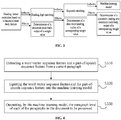
- FIG. 3 is a flowchart of paragraph level recognition in a method for constructing a document heading tree according to an embodiment of the present disclosure. As illustrated in FIG 3 , the document paragraph may be recognized by the heading format restriction based on the document main body feature. If the recognition by the heading format restriction is effective, the document paragraph is determined as the document main body and the weight value is output. If the recognition by the heading format restriction is ineffective, the document paragraph is recognized by the heading digit matching.
- the document paragraph is determined as a document heading and a corresponding weight value is output. If the recognition by the heading digit matching is ineffective, the document paragraph is recognized by the keyword matching. If the recognition by the keyword matching is effective, the document paragraph is determined as a document main body or a document heading, and a corresponding weight value is output. If the recognition by the keyword matching is ineffective, the document paragraph is recognized using the machine learning model, and finally a weight value corresponding to the document paragraph is output. According to the embodiment of the present disclosure, the paragraph role is recognized from multiple perspectives by the predefined rule and the machine learning model with respect to the feature of the document paragraph heading, which can ensure the recognition accuracy.
- FIG. 4 is a flowchart of paragraph level determination using a machine learning model in a method for constructing a document heading tree according to an embodiment of the present disclosure.
- determining a paragraph level of each of the paragraphs in the document to be processed using a machine learning model, in a case where the rule matching is failed specifically may include:
- the machine learning model may be adopted to make a binary-classification determination for the current paragraph, i.e., to determine whether the current paragraph is a document heading.
- a word vector sequence may be used as a feature to extract semantic information, wherein a word vector is a technology that processes a word into a vector, and ensures that the relative similarity and semantic similarity between the vectors are related, and wherein the word vector is a vector obtained by mapping a word into a semantic space.
- the document heading text also has corresponding characteristics in the part-of-speech, and it is usually a combination of a noun and a gerund, such as "experiences summarizing" and "rules generalizing”. Therefore, a part-of-speech sequence may be added as an input feature of the machine learning model at the same time, so that the machine learning model can learn using the word vector sequence feature and the part-of-speech sequence feature.
- word segmentation processing is performed on the current paragraph to be input into the machine learning model, to obtain the word vector sequence feature and the part-of-speech sequence feature of the current paragraph.
- the above features are input into the machine learning model in S320.
- the LSTM model may be adopted to determine the paragraph level of each of the paragraphs in the document to be processed.
- y LSTM x_emb x_pos
- x_emb a word vector sequence feature after word segmentation
- x_pos a part-of-speech sequence feature after word segmentation
- y a final output result
- y a prediction result indicating that the current paragraph is a document heading
- corresponding weight values of document paragraphs recognized as headings by the LSTM model may be all set to a second predetermined value, such as 7; and in a case where y is 0, it represents a prediction result indicating that the current paragraph is not a document heading and assigned with a weight value of 100.
- the machine learning model adopted in the embodiment of the present disclosure has natural advantages in dealing with problems related to sequence features.
- the machine learning model is configured to learn the word vector sequence feature and the part-of-speech sequence feature, to obtain a convergent model for prediction, so as to achieve an ideal prediction effect.
- constructing a document heading tree of the document to be processed based on the paragraph level of each of the paragraphs includes:
- the root node in the document heading tree represents the document itself.
- the root node may be created, and since the paragraph level corresponding to the root node is assigned as the highest level, the root node is correspondingly assigned with a minimum weight value.
- the root node may be assigned with a weight value of 0.
- a paragraph node corresponding to each of the paragraphs in the document to be processed is added into the document heading tree.
- the paragraph level of each of the paragraphs in the document to be processed has been recognized, and the weight value corresponding to each of the paragraphs can be obtained.
- a paragraph node corresponding to each of the paragraphs may be added into the document heading tree, to construct a sorting tree.
- the weight value of the root node is smallest, a child node of the root node is a node corresponding to the primary-level heading, a child node of the node corresponding to the primary-level is a node corresponding to the secondary-level heading, and so on, until a bottom-level leaf node corresponds to the document main body.
- the embodiment of the present disclosure can obtain a document heading tree with a hierarchical structure, and is suitable for various unstructured documents, such as a word document, a txt document, an html document, etc.
- the generated heading tree can be used to effectively mine the information contained in the document, and it is the basis of many applications such as typesetting format check, document classification, structured retrieval and document understanding.
- FIG. 5 is a flowchart of document heading tree construction in a method for constructing a document heading tree according to an embodiment of the present disclosure.
- adding a paragraph node corresponding to each of the paragraphs into the document heading tree according to the paragraph level of each of the paragraphs in the document to be processed may include:
- a document heading tree with a hierarchical structure is constructed using a loop structure, and the constructed document heading tree can clearly describe the leveled nesting relationship among paragraphs of the document, so that the whole document is structured, thereby overcoming the problem that it is difficult to process the unstructured document and mine information therefrom.
- adding a paragraph node corresponding to the current paragraph into the document heading tree according to a comparison result specifically may include:
- a paragraph node corresponding to a current paragraph is inserted into the document heading tree through comparison layer by layer, and finally an orderly sorted document heading tree is constructed, which provides a reliable basis for the subsequent applications, such as document inspection, document retrieval, document understanding and information mining.
- a position where a node is merged into a document heading tree is determined by comparing a weight value corresponding to a document heading of a current paragraph.
- the specific comparison method is as follows: if the weight value of the current paragraph node is less than that of the last node of the document heading tree, the paragraph level of the current paragraph is higher than that of the last node. Then, a parent node of the last node is taken as a new last node, to continue comparison between the weight value of the parent node of the last node and the weight value of the current paragraph node, and so on, until the weight value of the last node is less than that of the current paragraph node. According to a comparison result, the current paragraph node is merged into the document heading tree.
- FIG. 6 is a schematic diagram of document heading tree merging in a method for constructing a document heading tree according to an embodiment of the present disclosure.
- "ROOT: 0" represents a root node
- NODE1: 1 means that a weight value of a node NODE1 is 1
- NODE3:1 means that a weight value of a node NODE3 is 1
- NODE2:100 means that a weight value of a node NODE2 is 100
- NODE4:100 means that a weight value of a node NODE4 is 100.
- a weight value of a paragraph node NODE5 that needs to be merged at present is 3, and a last node merged into the document heading tree before NODE5 is NODE4, then firstly, the weight value of the last node NODE4 of the document heading tree is compared with that of NODE5; since the weight value 100 of NODE4 is greater than the weight value 3 of NODE5, the weight value of the parent node NODE3 of NODE4 is compared with that of NODE5. Because the weight value of NODE3 is less than that of NODE5, the comparison ends, and NODE5 is merged into the tree, i.e., the parent node of NODE5 points to NODE3, and NODE3 is added with a child node NODE5.
- FIG. 7 is a flowchart of a method for constructing a document heading tree according to an embodiment of the present disclosure.
- a word document to be processed is split into a paragraph set, and firstly, paragraph recognition is performed using the predefined rule-based rule matching method, wherein the rule matching includes heading format restriction, heading data matching and keyword matching. If the rule matching is failed, the paragraph recognition is performed in a model determination method. For example, an LTSM model may be specifically adopted to perform the paragraph recognition by learning the part-of-speech feature and the word vector feature.
- the rule matching is successful, the paragraph content is merged into the document heading tree, and the specific steps may include creating a root node, node heading level comparison and associating a parent node.
- the construction of the document heading tree is completed in a case where all paragraphs of the paragraph set are merged.
- the specific method and implementation of the above process have been described as above, and will not be repeated here.
- FIG. 8 is a schematic diagram of an apparatus for constructing a document heading tree according to an embodiment of the present disclosure. As illustrated in FIG. 8 , an apparatus for constructing a document heading tree according to an embodiment of the present disclosure includes:
- the machine learning model includes a long short-term memory network model; and the second determination unit 300 is configured to:
- the paragraph feature in the predefined rule includes a document main body feature; the first determination unit 200 is configured to determine a paragraph level of a current paragraph as a document main body, in a case where the current paragraph in the document to be processed is successfully matched with the document main body feature.
- the paragraph feature in the predefined rule includes a format of a digital symbol preceding a heading content of a document heading; the first determination unit 200 is configured to:
- the paragraph feature in the predefined rule includes a keyword set which includes a blacklist and a whitelist, wherein the whitelist includes a keyword which is included in the document heading, and the blacklist includes a keyword which is not included in the document heading;
- the first determination unit 200 is configured to:
- FIG. 9 is a schematic diagram of a construction unit of an apparatus for constructing a document heading tree according to another embodiment of the present disclosure. As illustrated in FIG 9 , in one implementation, the construction unit 400 includes:
- the addition subunit 420 is configured to:
- the addition subunit 420 is configured to:
- the present disclosure further provides an electronic device and a readable storage medium.
- FIG. 10 is a block diagram of an electronic device for implementing a method for constructing a document heading tree according to an embodiment of the present disclosure.
- the electronic device is intended to represent various forms of digital computers, such as a laptop computer, a desktop computer, a workstation, a personal digital assistant, a server, a blade server, a mainframe computer, and any other suitable computer.
- the electronic devices may also represent various forms of mobile apparatuses, such as a personal digital assistant, a cellular phone, a smart phone, a wearable device and any other similar computing apparatus.
- the components illustrated herein, their connections and relationships, and their functions are merely examples, and are not intended to limit the implementation of the present disclosure described and/or claimed herein.
- the electronic device includes one or more processors 1001, a memory 1002, and interfaces for connecting various components, including a high-speed interface and a low-speed interface.
- the various components are connected to each other by different buses, and may be mounted on a common main board or in other ways as needed.
- the processor may process instructions performed within the electronic device, including instructions stored in or on the memory to display GUI graphical information on an external input/output device (e.g., a display device coupled to an interface).
- an external input/output device e.g., a display device coupled to an interface.
- a plurality of processors and/or a plurality of buses may be used with a plurality of memories together, if necessary.
- each device may be connected, and each device provides some necessary operations (e.g., acting as a server array, a group of blade servers, or a multi-processor system).
- each device provides some necessary operations (e.g., acting as a server array, a group of blade servers, or a multi-processor system).
- one processor 1001 is taken as an example.
- the memory 1002 is a non-transitory computer-readable storage medium provided in the present disclosure.
- the memory stores instructions executable by at least one processor, so that the at least one processor can execute a method for constructing a document heading tree provided by the present disclosure.
- the non-transitory computer-readable storage medium of the present disclosure stores a computer instruction for enabling a computer to execute the method for constructing a document heading tree provided by the present disclosure.
- the memory 1002 may be configured to store a non-transitory software program, a non-transitory computer executable program and modules, such as program instructions/modules corresponding to the method for constructing the document heading tree in the embodiment of the present disclosure (for example, the matching unit 100, the first determination unit 200, the second determination unit 300 and the construction unit 400 illustrated in FIG 8 , and the creation subunit 410 and the addition subunit 420 illustrated in FIG. 9 ).
- the processor 1001 executes various functional applications and data processing of the server by running the non-transitory software programs, instructions and modules stored in the memory 1002, that is, realizes the method for constructing the document heading tree in the above method embodiments.
- the memory 1002 can include a program storage area and a data storage area, wherein the program storage area can store an operating system and an application program required by at least one function; and the data storage area can store data created according to the use of the electronic device for the construction of the document heading tree, etc.
- the memory 1002 may include a high-speed random access memory, and may also include a non-transitory memory, such as at least one magnetic disk memory device, a flash memory device, or any other non-transitory solid memory device.
- the memory 1002 optionally includes memories remotely located relative to the processor 1001, and these remote memories may be connected to the electronic device for the construction of the document heading tree through a network. Examples of the network include, but are not limited to, the Internet, an intranet, a local area network, a mobile communication network and combinations thereof.
- the electronic device for the method for constructing the document heading tree may further include: an input device 1003 and an output device 1004.
- the processor 1001, the memory 1002, the input device 1003, and the output device 1004 may be connected by buses or other means, and the bus connection is taken as an example in FIG. 10 .
- the input device 1003 may receive input digital or character information, and generate a key signal input related to a user setting and a function control of the electronic device for the construction of the document heading tree.
- the input device for example may be a touch screen, a keypad, a mouse, a track pad, a touch pad, an indicator stick, one or more mouse buttons, a trackball, a joystick, etc.
- the output device 1004 may include a display device, an auxiliary lighting apparatus (e.g., LED), a haptic feedback apparatus (e.g., vibration motor), etc.
- the display device may include, but is not limited to, a liquid crystal display (LCD), a light emitting diode (LED) display, and a plasma display. In some embodiments, the display device may be a touch screen.
- Various embodiments of the system and technology described here may be implemented in a digital electronic circuit system, an integrated circuit system, an application specific integrated circuit (ASIC), computer hardware, firmware, software, and/or combinations thereof. These various embodiments may be implemented in one or more computer programs that may be executed and/or interpreted on a programmable system including at least one programmable processor, which may be a dedicated or general programmable processor and capable of receiving and transmitting data and instructions from and to a storage system, at least one input device, and at least one output device.
- ASIC application specific integrated circuit
- machine-readable medium and “computer-readable medium” refer to any computer program product, device, and/or apparatus (e. g., magnetic disk, optical disk, memory, programmable logic device (PLD)) for providing machine instructions and/or data to the programmable processor, including a machine-readable medium that receives machine instructions as machine-readable signals.
- machine readable signal refers to any signal for providing machine instructions and/or data to the programmable processor.
- a computer having: a display device (e. g., a cathode ray tube (CRT) or a liquid crystal display (LCD) monitor) for displaying information to the user; and a keyboard and a pointing device (e. g., a mouse or a trackball), through which the user can provide an input to the computer.
- a display device e. g., a cathode ray tube (CRT) or a liquid crystal display (LCD) monitor
- a keyboard and a pointing device e. g., a mouse or a trackball
- Other kinds of devices can also provide an interaction with the user.
- a feedback provided to the user may be any form of sensory feedback (e.g., visual feedback, auditory feedback, or tactile feedback); and an input from the user may be received in any form, including an acoustic input, a voice input or a tactile input.
- the system and technology described here may be embodied in a computing system including background components (e.g., acting as a data server), a computing system including middleware components (e.g., an application server), or a computing system including front-end components (e.g., a user computer with a graphical user interface or a web browser, through which the user can interact with the embodiments of the system and technology described here), or a computing system including any combination of such background components, middleware components, or front-end components.
- the components of the system may be connected to each other through a digital data communication in any form or medium (e.g., a communication network). Examples of the communication network include a local area network (LAN), a wide area network (WAN), and the Internet.
- LAN local area network
- WAN wide area network
- the Internet the global information network
- a computer system may include a client and a server.
- the client and the server are generally remote from each other and usually interact through a communication network.
- the relationship between the client and the server is generated by computer programs running on corresponding computers and having a client-server relationship with each other.
- the embodiments of the present disclosure are suitable for the heading recognition of various unstructured documents and the construction of the document heading tree, and has a strong fault tolerance based on the combination of the predefined rule and the machine learning model, so that the recognition result is more accurate.
Landscapes
- Engineering & Computer Science (AREA)
- Theoretical Computer Science (AREA)
- Physics & Mathematics (AREA)
- General Engineering & Computer Science (AREA)
- General Physics & Mathematics (AREA)
- Artificial Intelligence (AREA)
- Computational Linguistics (AREA)
- Software Systems (AREA)
- Data Mining & Analysis (AREA)
- Health & Medical Sciences (AREA)
- General Health & Medical Sciences (AREA)
- Evolutionary Computation (AREA)
- Mathematical Physics (AREA)
- Computing Systems (AREA)
- Biophysics (AREA)
- Molecular Biology (AREA)
- Biomedical Technology (AREA)
- Life Sciences & Earth Sciences (AREA)
- Audiology, Speech & Language Pathology (AREA)
- Databases & Information Systems (AREA)
- Computer Vision & Pattern Recognition (AREA)
- Medical Informatics (AREA)
- Computer Graphics (AREA)
- Geometry (AREA)
- Multimedia (AREA)
- Information Retrieval, Db Structures And Fs Structures Therefor (AREA)
- Document Processing Apparatus (AREA)
Abstract
Description
- The present disclosure can be applied to the field of computer technology, and particularly, to the field of artificial intelligence.
- In the existing technology, a document heading recognition usually uses a method based on typesetting format comparison and syntax comparison. The method based on typesetting format comparison mainly predefines a template rule of typesetting format to compare a relationship between a document to be processed and the template rule, and then completes a heading recognition. The method based on syntax comparison firstly defines a tree or graph representing a grammatical relation, then constructs a syntactic structure of a document heading, and compares whether a paragraph in the document to be processed is consistent with the syntactic structure of the document heading, thus completing a heading recognition. However, there are many non-normative phenomena during writing of many documents at present, e.g., the outline hierarchy is not set, the outline hierarchy is set incorrectly, the heading format is wrong, etc., which all lead to the difficulty in document heading recognition. Thus, adopting the above methods may bring the problem of a low fault tolerance.
- A method and apparatus for constructing a document heading tree, an electronic device and a storage medium are provided according to embodiments of the present disclosure, so as to solve at least one of the above technical problems in the existing technology.
- In a first aspect, a method for constructing a document heading tree is provided according to an embodiment of the present disclosure, which includes:
- performing a rule matching between a text feature of each of paragraphs in a document to be processed and a paragraph feature in a predefined rule, according to the predefined rule;
- determining a paragraph level of each of the paragraphs in the document to be processed according to a result of the rule matching, in a case where the rule matching is successful;
- determining a paragraph level of each of the paragraphs in the document to be processed using a machine learning model, in a case where the rule matching is failed; and
- constructing a document heading tree of the document to be processed based on the paragraph level of each of the paragraphs.
- In a second aspect, an apparatus for constructing a document heading tree is provided according to an embodiment of the present disclosure, which includes:
- a matching unit configured to perform a rule matching between a text feature of each of paragraphs in a document to be processed and a paragraph feature in a predefined rule, according to the predefined rule;
- a first determination unit configured to determine a paragraph level of each of the paragraphs in the document to be processed according to a result of the rule matching, in a case where the rule matching is successful;
- a second determination unit configured to determine a paragraph level of each of the paragraphs in the document to be processed using a machine learning model, in a case where the rule matching is failed; and
- a construction unit configured to construct a document heading tree of the document to be processed based on the paragraph level of each of the paragraphs.
- In a third aspect, an electronic device is provided according to an embodiment of the present disclosure, which includes:
- at least one processor; and
- a memory communicatively connected to the at least one processor; wherein
- the memory stores instructions executable by the at least one processor, the instructions, when executed by the at least one processor, cause the at least one processor to perform the method according to any one of the embodiments of the present disclosure.
- In a fourth aspect, a non-transitory computer readable storage medium is provided according to an embodiment of the present disclosure, which stores computer instructions, wherein the computer instructions, when executed by a computer, cause the computer to execute the method according to any one of the embodiments of the present disclosure.
- One embodiment in the present disclosure has the following advantages or beneficial effects: it is suitable for the heading recognition of various unstructured documents and the construction of the document heading tree, and has a strong fault tolerance based on the combination of the predefined rule and the machine learning model, so that the recognition result is more accurate.
- Other effects of the alternative manners of the present disclosure will be explained as follows in conjunction with specific embodiments.
- The accompanying drawings are provided for better understanding of the solution, rather than limiting the present disclosure, wherein
-
FIG 1 is a flowchart of a method for constructing a document heading tree according to an embodiment of the present disclosure; -
FIG 2 is a schematic diagram of a document heading tree obtained based on a method for constructing a document heading tree according to an embodiment of the present disclosure; -
FIG 3 is a flowchart of paragraph level recognition in a method for constructing a document heading tree according to an embodiment of the present disclosure; -
FIG 4 is a flowchart of paragraph level determination using a machine learning model in a method for constructing a document heading tree according to an embodiment of the present disclosure; -
FIG 5 is a flowchart of document heading tree construction in a method for constructing a document heading tree according to an embodiment of the present disclosure; -
FIG 6 is a schematic diagram of document heading tree merging in a method for constructing a document heading tree according to an embodiment of the present disclosure; -
FIG 7 is a flowchart of a method for constructing a document heading tree according to an embodiment of the present disclosure; -
FIG 8 is a schematic diagram of an apparatus for constructing a document heading tree according to an embodiment of the present disclosure; -
FIG 9 is a schematic diagram of a construction unit of an apparatus for constructing a document heading tree according to another embodiment of the present disclosure; and -
FIG 10 is a block diagram of an electronic device for implementing a method for constructing a document heading tree according to an embodiment of the present disclosure. - Exemplary embodiments of the present disclosure are described below with reference to the accompanying drawings, including various details of the embodiments of the present disclosure to facilitate the understanding, and which should be considered as merely exemplary. Thus, it should be realized by those of ordinary skill in the art that various changes and modifications can be made to the embodiments described herein without departing from the scope and spirit of the present disclosure. Also, for the sake of clarity and conciseness, the contents of well-known functions and structures are omitted in the following description.
-
FIG 1 is a flowchart of a method for constructing a document heading tree according to an embodiment of the present disclosure. Referring toFIG 1 , the method for constructing a document heading tree includes: - S112: performing a rule matching between a text feature of each of paragraphs in a document to be processed and a paragraph feature in a predefined rule, according to the predefined rule;
- S114: determining a paragraph level of each of the paragraphs in the document to be processed according to a result of the rule matching, in a case where the rule matching is successful;
- S116: determining a paragraph level of each of the paragraphs in the document to be processed using a machine learning model, in a case where the rule matching is failed; and
- S120: constructing a document heading tree of the document to be processed based on the paragraph level of each of the paragraphs.
- The embodiment of the present disclosure is applicable to the heading recognition for various unstructured documents and the construction of the document heading tree. The unstructured documents may include a Word document, a Hyper Text Markup Language (HTML) document, an Optical Character Recognition (OCR) conversion document, etc. Such kind of document is composed of several basic units, each of which has a different role (e.g., a heading, a main body, etc.) in the article. Generally, a paragraph is a basic unit of a text. The construction of a document heading tree is to recognize a heading in a document and build a heading tree according to a recognition result. By using the document heading tree, information contained in the document can be effectively mined, which is the basis of many applications (such as typesetting format checking). In addition, the construction of the document heading tree is also important in some natural language processing applications, such as document classification, structured retrieval, document understanding, etc.
- The task of constructing a document heading tree requires that the structured information of corresponding heading in a document to be processed should be given according to the given document to be processed. By determining the order of occurrence and the nested structure of various paragraphs in the document to be processed, a rule syntax tree is finally formed, which is also a document heading tree that represents the document heading(s) and hierarchical levels of a document main body.
FIG 2 is a schematic diagram of a document heading tree obtained based on a method for constructing a document heading tree according to an embodiment of the present disclosure.FIG 2 illustrates a document heading tree reconstructed according to an input document as an example. "ROOT" inFIG 2 is a virtual root node, which represents a document itself. "T" inFIG 2 is a heading node. "C" inFIG 2 is a document main body node, which is generally a leaf node. - Taking a word document as an example, in a case where an outline hierarchy is set correctly in a word document, a document heading tree can be exported using a word document parsing tool such as Apache POI, Libreoffice, etc. However, in a case where the document is not written normatively, the document heading tree cannot be constructed.
- In view of the above problem, the present disclosure proposes a method for constructing a heading tree suitable for unstructured documents. In the embodiment of the present disclosure, a predefined rule-based rule matching and a machine learning model are adopted to recognize a paragraph role of at least one paragraph in a document to be processed, i.e., to recognize whether each of the paragraphs in the document to be processed is a heading. Further, the paragraph level of each of the paragraphs can also be determined. For example, in the example of
FIG. 2 , "T: 2.Algorithm Design" is a primary-level heading, and "T: 2.1 Rule Matching" is a secondary-level heading. In S120, a document heading tree is constructed based on the paragraph levels of the respective paragraphs obtained in S114 or S116. Referring to the example inFIG. 2 , the constructed document heading tree can clearly describe the leveled nesting relationships among paragraphs of the document. - In S112, firstly, the predefined rule-based rule matching method is used to perform a heading recognition for each of the paragraphs in a document to be processed. Specifically, a rule matching may be performed for a text feature of each of the paragraphs in the document to be processed and a paragraph feature in the predefined rule. In a case where the rule matching is successful, S114 is performed to determine a paragraph level of each of the paragraphs in the document to be processed according to a result of the rule matching. For example, the paragraph feature in the predefined rule includes that the paragraph text contains a predetermined punctuation mark such as a comma or a period. In a case where it is recognized that the current paragraph in the document to be processed contains a predetermined punctuation mark such as a comma or a period, the paragraph level of the current paragraph is recognized as a document main body. In a case where the rule matching is failed, S116 is performed to determine the paragraph level of each of the paragraphs in the document to be processed using a machine learning model. For example, a Long Short-Term Memory (LSTM) model may be adopted to recognize the paragraph level of each of the paragraphs in the document to be processed.
- In the above embodiment, the predefined rule-based rule matching is combined with the machine learning model to perform a heading recognition for each of the paragraphs in the document to be processed, so as to obtain the paragraph level of each of the paragraphs. The method of combining the predefined rule-based rule matching with the machine learning model can determine the paragraph levels of the respective paragraphs from multiple perspectives, which gets rid of the insufficient fault tolerance when comparing only with the template rule, and improves the ability of heading recognition.
- In another implementation, one of the predefined rule-based rule matching and the machine learning model may be adopted to perform heading recognition for each of the paragraphs in the document to be processed, so as to obtain the paragraph level of each of the paragraphs. Next, the document heading tree is constructed according to the paragraph level of each of the paragraphs, so as to show the leveled nesting relationship between the paragraphs of the whole document.
- Regarding the method based on typesetting format comparison in the existing technology, a similarity between the template and the document to be processed needs to be calculated during the heading recognition, and the relationship between the document to be processed and a heading in the template is determined from a magnitude of the similarity. If the typesetting format of the document to be processed is non-normative, it is difficult to recognize the heading by the magnitude of the similarity. The same problem exists in the method based on syntax comparison in the existing technology, and if the syntax format of the document to be processed is non-normative, the heading recognition also cannot be performed. At present, there are many non-normative phenomena during writing process of many documents, e.g., the outline hierarchy is not set, the outline hierarchy is set incorrectly, the heading format is wrong, etc., which all lead to the difficulty in heading recognition of the document.
- In view of the above problem, a method for constructing a document heading tree is provided according to an embodiment of the present disclosure, which is suitable for the heading recognition of various unstructured documents and the construction of the document heading tree, and has a strong fault tolerance based on the combination of the predefined rule and the machine learning model, so that the recognition result is more accurate.
- In the embodiment of the present disclosure, the paragraph level may include the document main body and the heading level of the document heading, wherein the heading level of the document heading may include a series of headings ranked from high to low, such as a primary-level heading, a secondary-level heading, a third-level heading, etc. In the example of
FIG. 2 , "C" is a document main body node, "T: 2. Algorithm Design" is a primary-level heading, and "T: 2.1 Rule Matching" is a secondary-level heading. - In one implementation, a weight value corresponding to each of the paragraph levels may be preset, wherein the smaller the weight value, the higher the corresponding heading level is, and a maximum weight value is corresponding to the document main body. For example, in the example of
FIG. 2 , the node "T: 2. Algorithm Design" representing a primary-level heading may be assigned with a weight value of 1, the node "T: 2.1 Rule Matching" representing a secondary-level heading may be assigned with a weight value of 2, and the node "C" representing a document main body may be assigned with a weight value of 100. - In the embodiment of the present disclosure, the predefined rule-based rule matching method may include at least one of a heading format restriction based on a document main body feature, heading digit matching and keyword matching. The specific implementations of the above methods are as follows:
- In one embodiment, the paragraph feature(s) in the predefined rule may include one or more document main body features. The one or more document main body features may include: a predetermined punctuation contained in a paragraph text, a predetermined paragraph length threshold, a predetermined character contained in the paragraph text, the paragraph text containing no character other than digits, etc.
- In one implementation, S114 in
FIG. 1 , i.e., determining a paragraph level of each of the paragraphs in the document to be processed according to a result of the rule matching, in a case where the rule matching is successful specifically may include: determining a paragraph level of a current paragraph as a document main body, in a case where the current paragraph in the document to be processed is successfully matched with the document main body feature. - Generally, the heading paragraph of the document has special heading format restrictive conditions. For example, the heading does not contain a punctuation mark, the heading content has a length limit, and special characters such as "formula" will not occur in the heading. Based on the above characteristics, the content of the current paragraph to be processed can be checked according to the above heading format restrictive conditions. If the above heading format restrictive conditions are satisfied, the paragraph is recognized as a non-heading paragraph, that is, a document main body, and assigned with a weight value of 100. In an example, the heading format restrictive conditions are shown in Table 1.
Table 1 Heading Format Restrictive Conditions Restrictive Conditions Descriptions Punctuation mark restriction A paragraph is recognized as a non-heading paragraph if a character such as . , ! or ? occurs therein. Text length restriction A paragraph is recognized as a non-heading paragraph if the length thereof is not within an interval of [min, max], where min and max may be determined according to the actual situation. Special symbol restriction A paragraph is recognized as a non-heading paragraph if a formula or the like occurs therein. Content format restriction A paragraph is recognized as a non-heading paragraph if the whole paragraph is merely of digits. - According to the embodiment of the present disclosure, a paragraph with an obvious document main body feature can be recognized as a document main body, and on the basis of accurate recognition, the document structure can be clearly displayed in the document heading tree constructed subsequently.
- In one embodiment, the paragraph feature in the predefined rule may include a format of a digital symbol preceding the heading content of the document heading.
- In S114 in
FIG. 1 , determining a paragraph level of each of the paragraphs in the document to be processed according to a result of the rule matching, in a case where the rule matching is successful specifically may include: - in a case where it is recognized that a digital symbol precedes a heading content of a document heading, obtaining a heading level set composed of respective heading levels based on a sample document, and obtaining regular expressions of formats of digital symbols corresponding to the respective heading levels; and
- matching the format of the digital symbol preceding the heading content in a current paragraph with the regular expressions corresponding to the respective heading levels, and determining a heading level of the current paragraph according to a matching result.
- In this implementation, the heading level may be determined using the format of the digital symbol preceding the heading content. For example, sample documents used in various scenarios can be collected in advance. Next, a plurality of heading paragraphs starting with digits are extracted from the sample documents, and various formats of digital symbols are obtained from the heading paragraphs. In Table 2 below for details, "Chapter I", "(1.1)", etc. are examples of the formats of the digital symbols.
- Further, various formats of the digital symbols obtained from the sample documents may be expressed in regular expressions, as shown in Table 2. Different formats of digital symbols represent different heading levels, which are corresponding to different weight values, so a weight value corresponding to each regular expression can be obtained. The third column in Table 2 shows weight values corresponding to various formats of digital symbols. For example, "Chapter I" is probably a primary-level heading, with a corresponding heading weight value of 1, and "(1. 1)" is probably a secondary-level heading, with a corresponding heading weight value of 5. Table 2 is a general table summarized from the sample documents in advance. Table 2 shows that different formats of digital symbols are assigned with different weight values, wherein the smaller the weight value, the higher the corresponding heading level is.
Table 2. Heading Digit Matching Table Examples Regular expressions Heading weight values Chapter I (Part|Chapter|Section) +(I|II|III|IV|V|VI|VII|VIII|IX|X|1|2|3|4|5|6|7|8|9|0) 1 I I|II|III|IV|V|VI|VII|VIII|IX|X 2 I. I|II|III|IV|V|VI|VII|VIII|IX|X)+(,|\.|\)|) 2 (I) (\(|()(I|H|IH|IV|V|VI|VIIIVIII|IX|X)+(\)|)) 3 (1) (\(|()(1|2|3|4|5|6|7|8|9|0)+(\)|)) 4 (1.1) (1|2|3|4|5|6|7|8|9|0)+(,|\.) 5 1) (1|2|3|4|5|6|7|8|9|0)+(\)|)) 6 - On the basis of the above table data, a format of a digital symbol preceding a heading content in a current paragraph may be matched with regular expressions corresponding to respective heading levels by regular matching, in a case where it is recognized that the digital symbol precedes the heading content of the document heading. If the current paragraph meets the above regular matching conditions, the heading weight value is output, and the program ends the recognition.
- According to the embodiment of the present disclosure, a heading level of each of the paragraphs can be accurately recognized through the regular expressions of the formats of the digital symbols. That is, the general heading digit matching table can be summarized in the above method, and tables suitable for personalized applications can also be summarized for specific scenarios, which has a strong operability and a high accuracy.
- In one implementation, the paragraph feature in the predefined rule may include a keyword set, which includes a blacklist and a whitelist, wherein the whitelist includes a keyword which is included in the document heading, and the blacklist includes a keyword which is not included in the document heading.
- Determining a paragraph level of each of the paragraphs in the document to be processed according to a result of the rule matching, in a case where the rule matching is successful includes:
- matching a text of a current paragraph with the keyword set;
- determining a paragraph level of the current paragraph as a preset heading level corresponding to the whitelist, in a case where the text of the current paragraph is successfully matched with the whitelist; and
- determining the paragraph level of the current paragraph as a document main body, in a case where the text of the current paragraph is successfully matched with the blacklist.
- The content of the document heading represents a central idea of a whole sub-chapter, and whether it is a document heading may be determined through specific keywords. For example, a paragraph containing the keywords such as "basic information", "background introduction", "method introduction", etc. is probably a document heading. In the embodiment of the present disclosure, a whitelist and a blacklist may be predefined for determination of the content of the paragraph, as shown in Table 3. The weight values corresponding to the whitelist and the blacklist are further shown in a third column of Table 3. In a case where the text of the current paragraph is successfully matched with the blacklist, the paragraph level of the current paragraph is determined as the document main body, and the corresponding weight value of the current paragraph may be set to 100. In a case where the text of the current paragraph is successfully matched with the whitelist, the paragraph level of the current paragraph is determined as the document heading. In one implementation, all the corresponding weight values of the document paragraphs successfully matched with the whitelist may be set to a first predetermined value such as 2.
Table 3. Keyword Matching Table List Description Weight value Whitelist Heading keywords, such as "basic information" 2 Blacklist Words that can't be used as headings, such as "has", "before" 100 - In the embodiment of the present disclosure, the list can be freely adapted according to the actual demand, and can be extended and updated at any time as needed. This manner can be flexibly applied according to the scenarios and demands, and has good extensibility.
- As described above, in the embodiment of the present disclosure, the predefined rule-based rule matching method may include at least one of a heading format restriction based on a document main body feature, heading digit matching and keyword matching. In an example, the above predefined rule-based rule matching can be combined to further improve the accuracy of heading recognition.
FIG. 3 is a flowchart of paragraph level recognition in a method for constructing a document heading tree according to an embodiment of the present disclosure. As illustrated inFIG 3 , the document paragraph may be recognized by the heading format restriction based on the document main body feature. If the recognition by the heading format restriction is effective, the document paragraph is determined as the document main body and the weight value is output. If the recognition by the heading format restriction is ineffective, the document paragraph is recognized by the heading digit matching. If the recognition by the heading digit matching is effective, the document paragraph is determined as a document heading and a corresponding weight value is output. If the recognition by the heading digit matching is ineffective, the document paragraph is recognized by the keyword matching. If the recognition by the keyword matching is effective, the document paragraph is determined as a document main body or a document heading, and a corresponding weight value is output. If the recognition by the keyword matching is ineffective, the document paragraph is recognized using the machine learning model, and finally a weight value corresponding to the document paragraph is output. According to the embodiment of the present disclosure, the paragraph role is recognized from multiple perspectives by the predefined rule and the machine learning model with respect to the feature of the document paragraph heading, which can ensure the recognition accuracy. -
FIG. 4 is a flowchart of paragraph level determination using a machine learning model in a method for constructing a document heading tree according to an embodiment of the present disclosure. Referring toFIG. 1 andFIG. 4 , determining a paragraph level of each of the paragraphs in the document to be processed using a machine learning model, in a case where the rule matching is failed specifically may include: - S310: extracting a word vector sequence feature and a part-of-speech sequence feature from a current paragraph;
- S320: inputting the word vector sequence feature and the part-of-speech sequence feature into the machine learning model; and
- S330: outputting, by the machine learning model, the paragraph level of each of the paragraphs in the document to be processed.
- In an example, the machine learning model may be adopted to make a binary-classification determination for the current paragraph, i.e., to determine whether the current paragraph is a document heading.
- Since the document heading text is generally embodied as a summary statement in content, on the one hand, a word vector sequence may be used as a feature to extract semantic information, wherein a word vector is a technology that processes a word into a vector, and ensures that the relative similarity and semantic similarity between the vectors are related, and wherein the word vector is a vector obtained by mapping a word into a semantic space. On the other hand, the document heading text also has corresponding characteristics in the part-of-speech, and it is usually a combination of a noun and a gerund, such as "experiences summarizing" and "rules generalizing". Therefore, a part-of-speech sequence may be added as an input feature of the machine learning model at the same time, so that the machine learning model can learn using the word vector sequence feature and the part-of-speech sequence feature.
- In S310, word segmentation processing is performed on the current paragraph to be input into the machine learning model, to obtain the word vector sequence feature and the part-of-speech sequence feature of the current paragraph. The above features are input into the machine learning model in S320. In one example, the LSTM model may be adopted to determine the paragraph level of each of the paragraphs in the document to be processed. The determination formula of the LSTM model is as follows:

- The machine learning model adopted in the embodiment of the present disclosure has natural advantages in dealing with problems related to sequence features. The machine learning model is configured to learn the word vector sequence feature and the part-of-speech sequence feature, to obtain a convergent model for prediction, so as to achieve an ideal prediction effect.
- In one implementation, in S120 in
FIG. 1 , constructing a document heading tree of the document to be processed based on the paragraph level of each of the paragraphs includes: - creating a root node of the document heading tree, and assigning a paragraph level corresponding to the root node as a highest level; and
- adding a paragraph node corresponding to each of the paragraphs into the document heading tree according to the paragraph level of each of the paragraphs in the document to be processed.
- As described above, the root node in the document heading tree represents the document itself. Firstly, the root node may be created, and since the paragraph level corresponding to the root node is assigned as the highest level, the root node is correspondingly assigned with a minimum weight value. For example, the root node may be assigned with a weight value of 0. Then, a paragraph node corresponding to each of the paragraphs in the document to be processed is added into the document heading tree. In the steps described above, the paragraph level of each of the paragraphs in the document to be processed has been recognized, and the weight value corresponding to each of the paragraphs can be obtained. According to the weight value, a paragraph node corresponding to each of the paragraphs may be added into the document heading tree, to construct a sorting tree. In the sorting tree, the weight value of the root node is smallest, a child node of the root node is a node corresponding to the primary-level heading, a child node of the node corresponding to the primary-level is a node corresponding to the secondary-level heading, and so on, until a bottom-level leaf node corresponds to the document main body.
- The embodiment of the present disclosure can obtain a document heading tree with a hierarchical structure, and is suitable for various unstructured documents, such as a word document, a txt document, an html document, etc. The generated heading tree can be used to effectively mine the information contained in the document, and it is the basis of many applications such as typesetting format check, document classification, structured retrieval and document understanding.
-
FIG. 5 is a flowchart of document heading tree construction in a method for constructing a document heading tree according to an embodiment of the present disclosure. As illustrated inFIG. 5 , in one implementation, adding a paragraph node corresponding to each of the paragraphs into the document heading tree according to the paragraph level of each of the paragraphs in the document to be processed may include: - S510: taking a first paragraph in the document to be processed as a current paragraph, and taking the root node as a last node of the document heading tree;
- S520: comparing a paragraph level of the current paragraph with that of the last node;
- S530: adding a paragraph node corresponding to the current paragraph into the document heading tree according to a comparison result;
- S540: taking a next paragraph of the current paragraph as a new current paragraph, and taking a paragraph node corresponding to the current paragraph as a new last node; and
- S550: for the new current paragraph and the new last node, repeating the comparing a paragraph level of the current paragraph with that of the last node, and the adding a paragraph node corresponding to the current paragraph into the document heading tree according to a comparison result.
- According to the embodiment of the present disclosure, a document heading tree with a hierarchical structure is constructed using a loop structure, and the constructed document heading tree can clearly describe the leveled nesting relationship among paragraphs of the document, so that the whole document is structured, thereby overcoming the problem that it is difficult to process the unstructured document and mine information therefrom.
- In one implementation, in S530, adding a paragraph node corresponding to the current paragraph into the document heading tree according to a comparison result specifically may include:
- in a case where the paragraph level of the current paragraph is higher than that of the last node, taking a parent node of the last node as a new last node, and repeating the comparing a paragraph level of the current paragraph with that of the last node; and
- in a case where the paragraph level of the current paragraph is lower than that of the last node, taking a paragraph node corresponding to the current paragraph as a child node of the last node.
- According to the embodiment of the present disclosure, a paragraph node corresponding to a current paragraph is inserted into the document heading tree through comparison layer by layer, and finally an orderly sorted document heading tree is constructed, which provides a reliable basis for the subsequent applications, such as document inspection, document retrieval, document understanding and information mining.
- In the embodiment of the present disclosure, in order to obtain the hierarchical relationship of the document heading tree, a position where a node is merged into a document heading tree is determined by comparing a weight value corresponding to a document heading of a current paragraph. An exemplary construction process is as follows:
- 1) a new document root node is created, to which a weight value of 0 is assigned;
- 2) a document paragraph set is traversed, a weight value corresponding to the current paragraph input is determined, and a new node corresponding to the current paragraph is created according to the weight value;
- 3) the weight value of the last node of the document heading tree is compared with that of the current paragraph node, wherein in an initial state, a first paragraph in the document to be processed is taken as the current paragraph, and the root node is taken as the last node of the document heading tree. The current paragraph and the last node can be redetermined in each of the following loops.
- The specific comparison method is as follows: if the weight value of the current paragraph node is less than that of the last node of the document heading tree, the paragraph level of the current paragraph is higher than that of the last node. Then, a parent node of the last node is taken as a new last node, to continue comparison between the weight value of the parent node of the last node and the weight value of the current paragraph node, and so on, until the weight value of the last node is less than that of the current paragraph node. According to a comparison result, the current paragraph node is merged into the document heading tree.
-
FIG. 6 is a schematic diagram of document heading tree merging in a method for constructing a document heading tree according to an embodiment of the present disclosure. As illustrated inFIG 6 , in the current heading tree, "ROOT: 0" represents a root node; "NODE1: 1" means that a weight value of a node NODE1 is 1; "NODE3:1" means that a weight value of a node NODE3 is 1; "NODE2:100" means that a weight value of a node NODE2 is 100; "NODE4:100" means that a weight value of a node NODE4 is 100. Assuming that a weight value of a paragraph node NODE5 that needs to be merged at present is 3, and a last node merged into the document heading tree before NODE5 is NODE4, then firstly, the weight value of the last node NODE4 of the document heading tree is compared with that of NODE5; since theweight value 100 of NODE4 is greater than the weight value 3 of NODE5, the weight value of the parent node NODE3 of NODE4 is compared with that of NODE5. Because the weight value of NODE3 is less than that of NODE5, the comparison ends, and NODE5 is merged into the tree, i.e., the parent node of NODE5 points to NODE3, and NODE3 is added with a child node NODE5. - 4) It is determined whether all paragraphs in the document paragraph set have been merged, and if so, the program ends, otherwise, steps 2) and 3) are repeated.
-
FIG. 7 is a flowchart of a method for constructing a document heading tree according to an embodiment of the present disclosure. As illustrated inFIG. 7 , a word document to be processed is split into a paragraph set, and firstly, paragraph recognition is performed using the predefined rule-based rule matching method, wherein the rule matching includes heading format restriction, heading data matching and keyword matching. If the rule matching is failed, the paragraph recognition is performed in a model determination method. For example, an LTSM model may be specifically adopted to perform the paragraph recognition by learning the part-of-speech feature and the word vector feature. If the rule matching is successful, the paragraph content is merged into the document heading tree, and the specific steps may include creating a root node, node heading level comparison and associating a parent node. The construction of the document heading tree is completed in a case where all paragraphs of the paragraph set are merged. The specific method and implementation of the above process have been described as above, and will not be repeated here. -
FIG. 8 is a schematic diagram of an apparatus for constructing a document heading tree according to an embodiment of the present disclosure. As illustrated inFIG. 8 , an apparatus for constructing a document heading tree according to an embodiment of the present disclosure includes: - a
matching unit 100 configured to perform a rule matching between a text feature of each of paragraphs in a document to be processed and a paragraph feature in a predefined rule, according to the predefined rule; - a
first determination unit 200 configured to determine a paragraph level of each of the paragraphs in the document to be processed according to a result of the rule matching, in a case where the rule matching is successful; - a
second determination unit 300 configured to determine a paragraph level of each of the paragraphs in the document to be processed using a machine learning model, in a case where the rule matching is failed; and - a
construction unit 400 configured to construct a document heading tree of the document to be processed based on the paragraph level of each of the paragraphs. - In one implementation, the machine learning model includes a long short-term memory network model; and the
second determination unit 300 is configured to: - extract a word vector sequence feature and a part-of-speech sequence feature from a current paragraph;
- input the word vector sequence feature and the part-of-speech sequence feature into the machine learning model; and
- output, by the machine learning model, the paragraph level of each of the paragraphs in the document to be processed.
- In one implementation, the paragraph feature in the predefined rule includes a document main body feature;
thefirst determination unit 200 is configured to determine a paragraph level of a current paragraph as a document main body, in a case where the current paragraph in the document to be processed is successfully matched with the document main body feature. - In one implementation, the paragraph feature in the predefined rule includes a format of a digital symbol preceding a heading content of a document heading;
thefirst determination unit 200 is configured to: - in a case where it is recognized that a digital symbol precedes a heading content of a document heading, obtain a heading level set composed of respective heading levels based on a sample document, and obtain regular expressions of formats of digital symbols corresponding to the respective heading levels; and
- match the format of the digital symbol preceding the heading content in a current paragraph with the regular expressions corresponding to the respective heading levels, and determine a heading level of the current paragraph according to a matching result.
- In one implementation, the paragraph feature in the predefined rule includes a keyword set which includes a blacklist and a whitelist, wherein the whitelist includes a keyword which is included in the document heading, and the blacklist includes a keyword which is not included in the document heading;
thefirst determination unit 200 is configured to: - match a text of a current paragraph with the keyword set;
- determine a paragraph level of the current paragraph as a preset heading level corresponding to the whitelist, in a case where the text of the current paragraph is successfully matched with the whitelist; and
- determine the paragraph level of the current paragraph as a document main body, in a case where the text of the current paragraph is successfully matched with the blacklist.
-
FIG. 9 is a schematic diagram of a construction unit of an apparatus for constructing a document heading tree according to another embodiment of the present disclosure. As illustrated inFIG 9 , in one implementation, theconstruction unit 400 includes: - a
creation subunit 410 configured to create a root node of the document heading tree, and assign a paragraph level corresponding to the root node as a highest level; and - an
addition subunit 420 configured to add a paragraph node corresponding to each of the paragraphs into the document heading tree according to the paragraph level of each of the paragraphs in the document to be processed. - In one implementation, the
addition subunit 420 is configured to: - take a first paragraph in the document to be processed as a current paragraph, and take the root node as a last node of the document heading tree;
- compare a paragraph level of the current paragraph with that of the last node;
- add a paragraph node corresponding to the current paragraph into the document heading tree according to a comparison result;
- take a next paragraph of the current paragraph as a new current paragraph, and take a paragraph node corresponding to the current paragraph as a new last node; and
- for the new current paragraph and the new last node, repeat comparing a paragraph level of the current paragraph with that of the last node, and adding a paragraph node corresponding to the current paragraph into the document heading tree according to a comparison result.
- In one implementation, the
addition subunit 420 is configured to: - in a case where the paragraph level of the current paragraph is higher than that of the last node, take a parent node of the last node as a new last node, and repeat comparing a paragraph level of the current paragraph with that of the last node; and
- in a case where the paragraph level of the current paragraph is lower than that of the last node, take a paragraph node corresponding to the current paragraph as a child node of the last node.
- For the functions of respective modules in each apparatus according to the embodiment of the present disclosure, please refer to corresponding descriptions in the above method, and they will not be repeated here.
- According to an embodiment of the present disclosure, the present disclosure further provides an electronic device and a readable storage medium.
- As illustrated in
FIG. 10 , which is a block diagram of an electronic device for implementing a method for constructing a document heading tree according to an embodiment of the present disclosure. The electronic device is intended to represent various forms of digital computers, such as a laptop computer, a desktop computer, a workstation, a personal digital assistant, a server, a blade server, a mainframe computer, and any other suitable computer. The electronic devices may also represent various forms of mobile apparatuses, such as a personal digital assistant, a cellular phone, a smart phone, a wearable device and any other similar computing apparatus. The components illustrated herein, their connections and relationships, and their functions are merely examples, and are not intended to limit the implementation of the present disclosure described and/or claimed herein. - As illustrated in
FIG. 10 , the electronic device includes one ormore processors 1001, amemory 1002, and interfaces for connecting various components, including a high-speed interface and a low-speed interface. The various components are connected to each other by different buses, and may be mounted on a common main board or in other ways as needed. The processor may process instructions performed within the electronic device, including instructions stored in or on the memory to display GUI graphical information on an external input/output device (e.g., a display device coupled to an interface). In other implementations, a plurality of processors and/or a plurality of buses may be used with a plurality of memories together, if necessary. Similarly, a plurality of electronic devices may be connected, and each device provides some necessary operations (e.g., acting as a server array, a group of blade servers, or a multi-processor system). InFIG. 10 , oneprocessor 1001 is taken as an example. - The
memory 1002 is a non-transitory computer-readable storage medium provided in the present disclosure. The memory stores instructions executable by at least one processor, so that the at least one processor can execute a method for constructing a document heading tree provided by the present disclosure. The non-transitory computer-readable storage medium of the present disclosure stores a computer instruction for enabling a computer to execute the method for constructing a document heading tree provided by the present disclosure. - As a non-transitory computer readable storage medium, the
memory 1002 may be configured to store a non-transitory software program, a non-transitory computer executable program and modules, such as program instructions/modules corresponding to the method for constructing the document heading tree in the embodiment of the present disclosure (for example, thematching unit 100, thefirst determination unit 200, thesecond determination unit 300 and theconstruction unit 400 illustrated inFIG 8 , and thecreation subunit 410 and theaddition subunit 420 illustrated inFIG. 9 ). Theprocessor 1001 executes various functional applications and data processing of the server by running the non-transitory software programs, instructions and modules stored in thememory 1002, that is, realizes the method for constructing the document heading tree in the above method embodiments. - The
memory 1002 can include a program storage area and a data storage area, wherein the program storage area can store an operating system and an application program required by at least one function; and the data storage area can store data created according to the use of the electronic device for the construction of the document heading tree, etc. In addition, thememory 1002 may include a high-speed random access memory, and may also include a non-transitory memory, such as at least one magnetic disk memory device, a flash memory device, or any other non-transitory solid memory device. In some embodiments, thememory 1002 optionally includes memories remotely located relative to theprocessor 1001, and these remote memories may be connected to the electronic device for the construction of the document heading tree through a network. Examples of the network include, but are not limited to, the Internet, an intranet, a local area network, a mobile communication network and combinations thereof. - The electronic device for the method for constructing the document heading tree may further include: an
input device 1003 and anoutput device 1004. Theprocessor 1001, thememory 1002, theinput device 1003, and theoutput device 1004 may be connected by buses or other means, and the bus connection is taken as an example inFIG. 10 . - The
input device 1003 may receive input digital or character information, and generate a key signal input related to a user setting and a function control of the electronic device for the construction of the document heading tree. The input device for example may be a touch screen, a keypad, a mouse, a track pad, a touch pad, an indicator stick, one or more mouse buttons, a trackball, a joystick, etc. Theoutput device 1004 may include a display device, an auxiliary lighting apparatus (e.g., LED), a haptic feedback apparatus (e.g., vibration motor), etc. The display device may include, but is not limited to, a liquid crystal display (LCD), a light emitting diode (LED) display, and a plasma display. In some embodiments, the display device may be a touch screen. - Various embodiments of the system and technology described here may be implemented in a digital electronic circuit system, an integrated circuit system, an application specific integrated circuit (ASIC), computer hardware, firmware, software, and/or combinations thereof. These various embodiments may be implemented in one or more computer programs that may be executed and/or interpreted on a programmable system including at least one programmable processor, which may be a dedicated or general programmable processor and capable of receiving and transmitting data and instructions from and to a storage system, at least one input device, and at least one output device.
- These computing programs (also called as programs, software, software applications, or codes) include machine instructions of the programmable processor, and may be implemented with advanced process and/or object-oriented programming language, and/or assembly/machine language. As used herein, the terms "machine-readable medium" and "computer-readable medium" refer to any computer program product, device, and/or apparatus (e. g., magnetic disk, optical disk, memory, programmable logic device (PLD)) for providing machine instructions and/or data to the programmable processor, including a machine-readable medium that receives machine instructions as machine-readable signals. The term "machine readable signal" refers to any signal for providing machine instructions and/or data to the programmable processor.
- In order to provide an interaction with a user, the system and technology described here may be implemented on a computer having: a display device (e. g., a cathode ray tube (CRT) or a liquid crystal display (LCD) monitor) for displaying information to the user; and a keyboard and a pointing device (e. g., a mouse or a trackball), through which the user can provide an input to the computer. Other kinds of devices can also provide an interaction with the user. For example, a feedback provided to the user may be any form of sensory feedback (e.g., visual feedback, auditory feedback, or tactile feedback); and an input from the user may be received in any form, including an acoustic input, a voice input or a tactile input.
- The system and technology described here may be embodied in a computing system including background components (e.g., acting as a data server), a computing system including middleware components (e.g., an application server), or a computing system including front-end components (e.g., a user computer with a graphical user interface or a web browser, through which the user can interact with the embodiments of the system and technology described here), or a computing system including any combination of such background components, middleware components, or front-end components. The components of the system may be connected to each other through a digital data communication in any form or medium (e.g., a communication network). Examples of the communication network include a local area network (LAN), a wide area network (WAN), and the Internet.
- A computer system may include a client and a server. The client and the server are generally remote from each other and usually interact through a communication network. The relationship between the client and the server is generated by computer programs running on corresponding computers and having a client-server relationship with each other.
- The embodiments of the present disclosure are suitable for the heading recognition of various unstructured documents and the construction of the document heading tree, and has a strong fault tolerance based on the combination of the predefined rule and the machine learning model, so that the recognition result is more accurate.
- It should be understood that the steps can be reordered, added or deleted using the various flows illustrated. For example, the steps described in the present disclosure may be performed concurrently, sequentially or in a different order, so long as the desired result of the technical solution disclosed in the present disclosure can be achieved, and there is no limitation herein.
- The specific embodiments do not limit the protection scope of the present disclosure. It should be understood by those skilled in the art that various modifications, combinations, sub-combinations and substitutions can be made according to the design requirements and other factors. Any modification, equivalent substitution and improvement under the spirit and principle of the present disclosure should fall within the protection scope of the present disclosure.
Claims (15)
- A method for constructing a document heading tree, comprising:Performing (S112) a rule matching between a text feature of each of paragraphs in a document to be processed and a paragraph feature in a predefined rule, according to the predefined rule;determining (S114) a paragraph level of each of the paragraphs in the document to be processed according to a result of the rule matching, in a case where the rule matching is successful;determining (S116) a paragraph level of each of the paragraphs in the document to be processed using a machine learning model, in a case where the rule matching is failed; andconstructing (S120) a document heading tree of the document to be processed based on the paragraph level of each of the paragraphs.
- The method according to claim 1, wherein the machine learning model comprises a long short-term memory network model; the determining (S116) a paragraph level of each of the paragraphs in the document to be processed using a machine learning model, in a case where the rule matching is failed comprises:extracting (S310) a word vector sequence feature and a part-of-speech sequence feature from a current paragraph;inputting (S320) the word vector sequence feature and the part-of-speech sequence feature into the machine learning model; andoutputting (S330), by the machine learning model, the paragraph level of each of the paragraphs in the document to be processed.
- The method according to claim 1 or 2, wherein the paragraph feature in the predefined rule comprises a document main body feature;
the determining (S114) a paragraph level of each of the paragraphs in the document to be processed according to a result of the rule matching, in a case where the rule matching is successful comprises: determining a paragraph level of a current paragraph as a document main body, in a case where the current paragraph in the document to be processed is successfully matched with the document main body feature. - The method according to any one of claims 1 to 3, wherein the paragraph feature in the predefined rule comprises a format of a digital symbol preceding a heading content of a document heading;
the determining (S114) a paragraph level of each of the paragraphs in the document to be processed according to a result of the rule matching, in a case where the rule matching is successful comprises:in a case where it is recognized that a digital symbol precedes a heading content of a document heading, obtaining a heading level set composed of respective heading levels based on a sample document, and obtaining regular expressions of formats of digital symbols corresponding to the respective heading levels; andmatching the format of the digital symbol preceding the heading content in a current paragraph with the regular expressions corresponding to the respective heading levels, and determining a heading level of the current paragraph according to a matching result. - The method according to any one of claims 1 to 4, wherein the paragraph feature in the predefined rule comprises a keyword set which includes a blacklist and a whitelist, wherein the whitelist comprises a keyword which is included in a document heading, and the blacklist comprises a keyword which is not included in the document heading;
the determining (S 114) a paragraph level of each of the paragraphs in the document to be processed according to a result of the rule matching, in a case where the rule matching is successful comprises:matching a text of a current paragraph with the keyword set;determining a paragraph level of the current paragraph as a preset heading level corresponding to the whitelist, in a case where the text of the current paragraph is successfully matched with the whitelist; anddetermining the paragraph level of the current paragraph as a document main body, in a case where the text of the current paragraph is successfully matched with the blacklist. - The method according to any one of claims 1 to 5, wherein the constructing a document heading tree of the document to be processed based on the paragraph level of each of the paragraphs comprises:creating a root node of the document heading tree, and assigning a paragraph level corresponding to the root node as a highest level; andadding a paragraph node corresponding to each of the paragraphs into the document heading tree according to the paragraph level of each of the paragraphs in the document to be processed;optionally, the adding a paragraph node corresponding to each of the paragraphs into the document heading tree according to the paragraph level of each of the paragraphs in the document to be processed comprises:taking (S510) a first paragraph in the document to be processed as a current paragraph, and taking the root node as a last node of the document heading tree;comparing (S520) a paragraph level of the current paragraph with that of the last node;adding (S530) a paragraph node corresponding to the current paragraph into the document heading tree according to a comparison result;taking (S540) a next paragraph of the current paragraph as a new current paragraph, and taking a paragraph node corresponding to the current paragraph as a new last node; andfor the new current paragraph and the new last node, repeating (S550) the comparing a paragraph level of the current paragraph with that of the last node and the adding a paragraph node corresponding to the current paragraph into the document heading tree according to a comparison result;optionally, the adding (S530) a paragraph node corresponding to the current paragraph into the document heading tree according to a comparison result comprises:in a case where the paragraph level of the current paragraph is higher than that of the last node, taking a parent node of the last node as a new last node, and repeating the comparing a paragraph level of the current paragraph with that of the last node; andin a case where the paragraph level of the current paragraph is lower than that of the last node, taking a paragraph node corresponding to the current paragraph as a child node of the last node.
- An apparatus for constructing a document heading tree, comprising:a matching unit (100) configured to perform a rule matching between a text feature of each of paragraphs in a document to be processed and a paragraph feature in a predefined rule, according to the predefined rule;a first determination unit (200) configured to determine a paragraph level of each of the paragraphs in the document to be processed according to a result of the rule matching, in a case where the rule matching is successful;a second determination unit (300) configured to determine a paragraph level of each of the paragraphs in the document to be processed using a machine learning model, in a case where the rule matching is failed; anda construction unit (400) configured to construct a document heading tree of the document to be processed based on the paragraph level of each of the paragraphs.
- The apparatus according to claim 7, wherein the machine learning model comprises a long short-term memory network model; and the second determination unit (300) is configured to:extract a word vector sequence feature and a part-of-speech sequence feature from a current paragraph;input the word vector sequence feature and the part-of-speech sequence feature into the machine learning model; andoutput, by the machine learning model, the paragraph level of each of the paragraphs in the document to be processed.
- The apparatus according to claim 7 or 8, wherein the paragraph feature in the predefined rule comprises a document main body feature;
the first determination unit (200) is configured to determine a paragraph level of a current paragraph as a document main body, in a case where the current paragraph in the document to be processed is successfully matched with the document main body feature. - The apparatus according to any one of claims 7 to 9, wherein the paragraph feature in the predefined rule comprises a format of a digital symbol preceding a heading content of a document heading;
the first determination unit (200) is configured to:in a case where it is recognized that a digital symbol precedes a heading content of a document heading, obtain a heading level set composed of respective heading levels based on a sample document, and obtain regular expressions of formats of digital symbols corresponding to the respective heading levels; andmatch the format of the digital symbol preceding the heading content in a current paragraph with the regular expressions corresponding to the respective heading levels, and determine a heading level of the current paragraph according to a matching result. - The apparatus according to any one of claims 7 to 10, wherein the paragraph feature in the predefined rule comprises a keyword set which includes a blacklist and a whitelist, wherein the whitelist comprises a keyword which is included in a document heading, and the blacklist comprises a keyword which is not included in the document heading;
the first determination unit (200) is configured to:match a text of a current paragraph with the keyword set;determine a paragraph level of the current paragraph as a preset heading level corresponding to the whitelist, in a case where the text of the current paragraph is successfully matched with the whitelist; anddetermine the paragraph level of the current paragraph as a document main body, in a case where the text of the current paragraph is successfully matched with the blacklist. - The apparatus according to any one of claims 7 to 11, wherein the construction unit (400) comprises:a creation subunit (410) configured to create a root node of the document heading tree, and assign a paragraph level corresponding to the root node as a highest level; andan addition subunit (420) configured to add a paragraph node corresponding to each of the paragraphs into the document heading tree according to the paragraph level of each of the paragraphs in the document to be processed;optionally, the addition subunit (420) is configured to:take a first paragraph in the document to be processed as a current paragraph, and take the root node as a last node of the document heading tree;compare a paragraph level of the current paragraph with that of the last node;add a paragraph node corresponding to the current paragraph into the document heading tree according to a comparison result;take a next paragraph of the current paragraph as a new current paragraph, and take a paragraph node corresponding to the current paragraph as a new last node; andfor the new current paragraph and the new last node, repeat comparing a paragraph level of the current paragraph with that of the last node, and adding a paragraph node corresponding to the current paragraph into the document heading tree according to a comparison result;optionally, the addition subunit (420) is configured to:in a case where the paragraph level of the current paragraph is higher than that of the last node, take a parent node of the last node as a new last node, and repeat comparing a paragraph level of the current paragraph with that of the last node; andin a case where the paragraph level of the current paragraph is lower than that of the last node, take a paragraph node corresponding to the current paragraph as a child node of the last node.
- An electronic device, comprising:at least one processor (1001); anda memory (1002) communicatively connected to the at least one processor (1001); whereinthe memory (1002) stores instructions executable by the at least one processor (1001), the instructions, when executed by the at least one processor (1001), cause the at least one processor (1001) to perform the method according to any one of claims 1 to 6.
- A non-transitory computer readable storage medium which stores computer instructions, wherein the computer instructions, when executed by a computer, cause the computer to execute the method according to any one of claims 1 to 6.
- A computer program product, comprising computer program instructions, the computer program instructions, when executed by a computer, cause the computer to perform the method according to any one of claims 1-6.
Applications Claiming Priority (1)
| Application Number | Priority Date | Filing Date | Title |
|---|---|---|---|
| CN202010247461.4A CN111460083B (en) | 2020-03-31 | 2020-03-31 | Method and device for constructing document title tree, electronic equipment and storage medium |
Publications (1)
| Publication Number | Publication Date |
|---|---|
| EP3889823A1 true EP3889823A1 (en) | 2021-10-06 |
Family
ID=71681599
Family Applications (1)
| Application Number | Title | Priority Date | Filing Date |
|---|---|---|---|
| EP21164267.3A Withdrawn EP3889823A1 (en) | 2020-03-31 | 2021-03-23 | Method and apparatus for constructing document heading tree, electronic device and storage medium |
Country Status (5)
| Country | Link |
|---|---|
| US (1) | US20210303772A1 (en) |
| EP (1) | EP3889823A1 (en) |
| JP (1) | JP7169389B2 (en) |
| KR (1) | KR102509836B1 (en) |
| CN (1) | CN111460083B (en) |
Families Citing this family (35)
| Publication number | Priority date | Publication date | Assignee | Title |
|---|---|---|---|---|
| CN111984589A (en) * | 2020-08-14 | 2020-11-24 | 维沃移动通信有限公司 | Document processing method, document processing apparatus, and electronic device |
| CN112507666B (en) * | 2020-12-21 | 2023-07-11 | 北京百度网讯科技有限公司 | Document conversion method, device, electronic device and storage medium |
| CN113568901B (en) * | 2021-01-29 | 2024-04-19 | 腾讯科技(深圳)有限公司 | Data processing method, device and storage medium |
| CN112818687B (en) * | 2021-03-25 | 2022-07-08 | 杭州数澜科技有限公司 | Method, device, electronic equipment and storage medium for constructing title recognition model |
| CN112908487B (en) * | 2021-04-19 | 2023-09-22 | 中国医学科学院医学信息研究所 | An automatic identification method and system for clinical guideline update content |
| CN113361256A (en) * | 2021-06-24 | 2021-09-07 | 上海真虹信息科技有限公司 | Rapid Word document parsing method based on Aspose technology |
| CN113378539B (en) * | 2021-06-29 | 2023-02-14 | 华南理工大学 | Template recommendation method for standard document writing |
| CN113723078A (en) * | 2021-09-07 | 2021-11-30 | 杭州叙简科技股份有限公司 | Text logic information structuring method and device and electronic equipment |
| CN113779235B (en) * | 2021-09-13 | 2024-02-02 | 北京市律典通科技有限公司 | Word document outline recognition processing method and device |
| CN113918512B (en) * | 2021-10-22 | 2024-08-13 | 国家电网公司华中分部 | Power grid operation rules knowledge graph construction system and method |
| KR102601932B1 (en) * | 2021-11-08 | 2023-11-14 | (주)사람인 | System and method for extracting data from document for each company using fingerprints and machine learning |
| CN114118070A (en) * | 2021-11-26 | 2022-03-01 | 北京百度网讯科技有限公司 | Document directory generation method and device, electronic equipment and medium |
| CN114065745A (en) * | 2021-11-29 | 2022-02-18 | 平安资产管理有限责任公司 | Method, system, device and readable storage medium for generating document title tree |
| CN114330313B (en) * | 2021-11-30 | 2026-03-24 | 广州金山移动科技有限公司 | Methods, apparatus, electronic devices, and storage media for identifying document chapter titles |
| CN115129817B (en) * | 2022-07-05 | 2025-06-10 | 上海晏鼠计算机技术股份有限公司 | A Method for Extracting Word Document Outline |
| CN115168589B (en) * | 2022-08-02 | 2025-08-26 | 云南电网有限责任公司信息中心 | A metadata identification method, storage medium and system based on fragmented documents |
| CN115270723A (en) * | 2022-08-05 | 2022-11-01 | 中国平安财产保险股份有限公司 | PDF document splitting method, device, device and storage medium |
| CN115659955A (en) * | 2022-09-30 | 2023-01-31 | 国网辽宁省电力有限公司经济技术研究院 | An Intelligent Checking Method for Review Opinions |
| CN115438628B (en) * | 2022-11-08 | 2023-03-17 | 宏景科技股份有限公司 | Structured document cooperation management method and system and document structure |
| CN116167337A (en) * | 2022-12-27 | 2023-05-26 | 天翼云科技有限公司 | A POI-based Word document style detection method and device |
| JP2024098284A (en) * | 2023-01-10 | 2024-07-23 | トヨタ自動車株式会社 | Document Comparison System |
| CN115983244A (en) * | 2023-02-28 | 2023-04-18 | 北京字跳网络技术有限公司 | Information processing method, device, electronic device and storage medium |
| CN116205233A (en) * | 2023-03-07 | 2023-06-02 | 广联达科技股份有限公司 | Method, device, equipment and storage medium for identifying key fields in document |
| CN117932079B (en) * | 2023-12-20 | 2025-04-22 | 北京百度网讯科技有限公司 | Model generation result processing method and device, electronic equipment and storage medium |
| CN117669501A (en) * | 2023-12-20 | 2024-03-08 | 江苏徐工国重实验室科技有限公司 | Document information extraction method, device and storage medium |
| CN117763206B (en) * | 2024-02-20 | 2024-06-11 | 暗物智能科技(广州)有限公司 | Knowledge tree generation method and device, electronic equipment and storage medium |
| CN118313352B (en) * | 2024-03-28 | 2025-02-11 | 华院计算技术(上海)股份有限公司 | Document processing method and device, storage medium, terminal, and computer program product |
| CN119129581A (en) * | 2024-08-20 | 2024-12-13 | 河北习知软件科技有限公司 | A test paper question splitting method and device based on abstract syntax tree |
| CN119476269B (en) * | 2024-10-16 | 2025-07-25 | 易方达基金管理有限公司 | Method and device for constructing document title tree, terminal equipment and storage medium |
| CN119378539B (en) * | 2024-10-21 | 2025-10-14 | 北京百度网讯科技有限公司 | Document processing method, device, electronic device and storage medium |
| CN119557331B (en) * | 2024-11-12 | 2025-10-21 | 云南南天电子信息产业股份有限公司 | Business resource retrieval method, device, computer equipment and readable storage medium based on AI big model |
| CN119513287A (en) * | 2024-11-19 | 2025-02-25 | 卓望信息技术(北京)有限公司 | Legal clause matching method, device, equipment and storage medium |
| CN119358543A (en) * | 2024-12-20 | 2025-01-24 | 北京数科网维技术有限责任公司 | Method, device and equipment for extracting article outline |
| CN119918505B (en) * | 2025-04-03 | 2025-06-17 | 上海冰鉴信息科技有限公司 | A document paragraph content merging and segmentation method based on combined tree structure |
| CN121029987B (en) * | 2025-08-13 | 2026-03-27 | 大连云路科技有限责任公司 | Document processing method, device and computer program product based on natural language |
Citations (1)
| Publication number | Priority date | Publication date | Assignee | Title |
|---|---|---|---|---|
| US6298357B1 (en) * | 1997-06-03 | 2001-10-02 | Adobe Systems Incorporated | Structure extraction on electronic documents |
Family Cites Families (25)
| Publication number | Priority date | Publication date | Assignee | Title |
|---|---|---|---|---|
| US5289375A (en) * | 1990-01-22 | 1994-02-22 | Sharp Kabushiki Kaisha | Translation machine |
| JP2680540B2 (en) * | 1994-05-09 | 1997-11-19 | 株式会社東芝 | Document layout method |
| US7493253B1 (en) * | 2002-07-12 | 2009-02-17 | Language And Computing, Inc. | Conceptual world representation natural language understanding system and method |
| JP2007164705A (en) * | 2005-12-16 | 2007-06-28 | S Ten Nine Kyoto:Kk | Method and program for converting computerized document |
| US20080221892A1 (en) * | 2007-03-06 | 2008-09-11 | Paco Xander Nathan | Systems and methods for an autonomous avatar driver |
| US8521512B2 (en) * | 2008-04-30 | 2013-08-27 | Deep Sky Concepts, Inc | Systems and methods for natural language communication with a computer |
| US8180629B2 (en) * | 2008-07-10 | 2012-05-15 | Trigent Softward Ltd. | Automatic pattern generation in natural language processing |
| CN102541948A (en) * | 2010-12-23 | 2012-07-04 | 北大方正集团有限公司 | Method and device for extracting document structure |
| US9361049B2 (en) * | 2011-11-01 | 2016-06-07 | Xerox Corporation | Systems and methods for appearance-intent-directed document format conversion for mobile printing |
| US9262404B2 (en) * | 2012-01-12 | 2016-02-16 | Accenture Global Services Limited | System for generating test scenarios and test conditions and expected results |
| US9424233B2 (en) * | 2012-07-20 | 2016-08-23 | Veveo, Inc. | Method of and system for inferring user intent in search input in a conversational interaction system |
| US20140156264A1 (en) * | 2012-11-19 | 2014-06-05 | University of Washington through it Center for Commercialization | Open language learning for information extraction |
| US9880997B2 (en) * | 2014-07-23 | 2018-01-30 | Accenture Global Services Limited | Inferring type classifications from natural language text |
| US10169453B2 (en) * | 2016-03-28 | 2019-01-01 | Microsoft Technology Licensing, Llc | Automatic document summarization using search engine intelligence |
| CN106776495B (en) * | 2016-11-23 | 2020-06-09 | 北京信息科技大学 | A Method for Reconstructing Document Logical Structure |
| US10783262B2 (en) * | 2017-02-03 | 2020-09-22 | Adobe Inc. | Tagging documents with security policies |
| US11550835B2 (en) * | 2017-06-16 | 2023-01-10 | Elsevier, Inc. | Systems and methods for automatically generating content summaries for topics |
| CN107391650B (en) * | 2017-07-14 | 2018-09-07 | 北京神州泰岳软件股份有限公司 | A kind of structuring method for splitting of document, apparatus and system |
| US10783314B2 (en) * | 2018-06-29 | 2020-09-22 | Adobe Inc. | Emphasizing key points in a speech file and structuring an associated transcription |
| JP7200530B2 (en) | 2018-08-06 | 2023-01-10 | コニカミノルタ株式会社 | Information processing device and information processing program |
| CN109992761A (en) * | 2019-03-22 | 2019-07-09 | 武汉工程大学 | The rule-based adaptive text information extracting method of one kind and software memory |
| CN110427614B (en) * | 2019-07-16 | 2023-08-08 | 深圳追一科技有限公司 | Construction method and device of paragraph level, electronic equipment and storage medium |
| CN110598191B (en) * | 2019-11-18 | 2020-04-07 | 江苏联著实业股份有限公司 | Complex PDF structure analysis method and device based on neural network |
| CN111274815B (en) * | 2020-01-15 | 2024-04-12 | 北京百度网讯科技有限公司 | Method and device for mining entity focus point in text |
| US11544456B2 (en) * | 2020-03-05 | 2023-01-03 | Adobe Inc. | Interpretable label-attentive encoder-decoder parser |
-
2020
- 2020-03-31 CN CN202010247461.4A patent/CN111460083B/en active Active
- 2020-09-17 US US17/023,721 patent/US20210303772A1/en not_active Abandoned
-
2021
- 2021-03-23 EP EP21164267.3A patent/EP3889823A1/en not_active Withdrawn
- 2021-03-24 JP JP2021049630A patent/JP7169389B2/en active Active
- 2021-03-24 KR KR1020210038357A patent/KR102509836B1/en active Active
Patent Citations (1)
| Publication number | Priority date | Publication date | Assignee | Title |
|---|---|---|---|---|
| US6298357B1 (en) * | 1997-06-03 | 2001-10-02 | Adobe Systems Incorporated | Structure extraction on electronic documents |
Non-Patent Citations (2)
| Title |
|---|
| BITEW SEMERE KIROS: "Logical Structure Extraction of Electronic Documents Using Contextual Information", 1 August 2018 (2018-08-01), XP055832237, Retrieved from the Internet <URL:https://essay.utwente.nl/76427/1/BITEW_MA_EEMCS.pdf> [retrieved on 20210816] * |
| HE YI: "Extracting Document Structure of a Text with Visual and Textual Cues", 1 July 2017 (2017-07-01), XP055832241, Retrieved from the Internet <URL:https://essay.utwente.nl/72979/1/Yi%20He%20-%20master%20thesis%20-%20final%20version.pdf> [retrieved on 20210816] * |
Also Published As
| Publication number | Publication date |
|---|---|
| KR102509836B1 (en) | 2023-03-14 |
| US20210303772A1 (en) | 2021-09-30 |
| CN111460083A (en) | 2020-07-28 |
| CN111460083B (en) | 2023-07-25 |
| JP2021108153A (en) | 2021-07-29 |
| KR20210040862A (en) | 2021-04-14 |
| JP7169389B2 (en) | 2022-11-10 |
Similar Documents
| Publication | Publication Date | Title |
|---|---|---|
| US20210303772A1 (en) | Method and Apparatus for Constructing Document Heading Tree, Electronic Device and Storage Medium | |
| US12182724B2 (en) | Method and apparatus for generating temporal knowledge graph, device, and medium | |
| US11403468B2 (en) | Method and apparatus for generating vector representation of text, and related computer device | |
| KR102521765B1 (en) | Method and apparatus for determining causality, electronic device and storage medium | |
| US11573992B2 (en) | Method, electronic device, and storage medium for generating relationship of events | |
| EP3923159A1 (en) | Method, apparatus, device and storage medium for matching semantics | |
| EP3913499A1 (en) | Method and apparatus for processing dataset, electronic device and storage medium | |
| KR102554758B1 (en) | Method and apparatus for training models in machine translation, electronic device and storage medium | |
| US12106052B2 (en) | Method and apparatus for generating semantic representation model, and storage medium | |
| EP3832484A2 (en) | Semantics processing method, semantics processing apparatus, electronic device, and medium | |
| CN111753914A (en) | Model optimization method and device, electronic device and storage medium | |
| US11216615B2 (en) | Method, device and storage medium for predicting punctuation in text | |
| KR102456535B1 (en) | Medical fact verification method and apparatus, electronic device, and storage medium and program | |
| JP7286737B2 (en) | Text error correction method, device, electronic device, storage medium and program | |
| EP3822815A1 (en) | Method and apparatus for mining entity relationship, electronic device, storage medium, and computer program product | |
| EP3822818A1 (en) | Method, apparatus, device and storage medium for intelligent response | |
| EP3855341A1 (en) | Language generation method and apparatus, electronic device and storage medium | |
| CN111291192A (en) | Triple confidence degree calculation method and device in knowledge graph | |
| CN114118070A (en) | Document directory generation method and device, electronic equipment and medium | |
| CN111523019A (en) | Method, apparatus, device and storage medium for outputting information | |
| US11468236B2 (en) | Method and apparatus for performing word segmentation on text, device, and medium | |
| CN114781386B (en) | Method, device and electronic device for acquiring text error correction training corpus | |
| CN111931524A (en) | Method, apparatus, device and storage medium for outputting information | |
| CN111680508A (en) | Text processing method and device | |
| US20220139369A1 (en) | Method for recognizing chinese-english mixed speech, electronic device, and storage medium |
Legal Events
| Date | Code | Title | Description |
|---|---|---|---|
| PUAI | Public reference made under article 153(3) epc to a published international application that has entered the european phase |
Free format text: ORIGINAL CODE: 0009012 |
|
| STAA | Information on the status of an ep patent application or granted ep patent |
Free format text: STATUS: REQUEST FOR EXAMINATION WAS MADE |
|
| 17P | Request for examination filed |
Effective date: 20210323 |
|
| AK | Designated contracting states |
Kind code of ref document: A1 Designated state(s): AL AT BE BG CH CY CZ DE DK EE ES FI FR GB GR HR HU IE IS IT LI LT LU LV MC MK MT NL NO PL PT RO RS SE SI SK SM TR |
|
| STAA | Information on the status of an ep patent application or granted ep patent |
Free format text: STATUS: EXAMINATION IS IN PROGRESS |
|
| 17Q | First examination report despatched |
Effective date: 20240117 |
|
| STAA | Information on the status of an ep patent application or granted ep patent |
Free format text: STATUS: THE APPLICATION HAS BEEN WITHDRAWN |
|
| 18W | Application withdrawn |
Effective date: 20240426 |