EP3889631A1 - Radio frequency probe for magnetic resonance - Google Patents
Radio frequency probe for magnetic resonance Download PDFInfo
- Publication number
- EP3889631A1 EP3889631A1 EP20166960.3A EP20166960A EP3889631A1 EP 3889631 A1 EP3889631 A1 EP 3889631A1 EP 20166960 A EP20166960 A EP 20166960A EP 3889631 A1 EP3889631 A1 EP 3889631A1
- Authority
- EP
- European Patent Office
- Prior art keywords
- coil assembly
- elastomer
- probe
- stretchable
- sheet
- Prior art date
- Legal status (The legal status is an assumption and is not a legal conclusion. Google has not performed a legal analysis and makes no representation as to the accuracy of the status listed.)
- Ceased
Links
- 239000000523 sample Substances 0.000 title claims abstract description 24
- 230000005291 magnetic effect Effects 0.000 title claims abstract description 6
- 239000000806 elastomer Substances 0.000 claims abstract description 38
- 229920001971 elastomer Polymers 0.000 claims abstract description 33
- 239000004020 conductor Substances 0.000 claims abstract description 26
- 238000001514 detection method Methods 0.000 claims abstract description 14
- 210000003127 knee Anatomy 0.000 claims description 10
- 239000000463 material Substances 0.000 claims description 10
- 239000002245 particle Substances 0.000 claims description 9
- 239000011159 matrix material Substances 0.000 claims description 7
- 239000003989 dielectric material Substances 0.000 claims description 6
- BQCADISMDOOEFD-UHFFFAOYSA-N Silver Chemical compound [Ag] BQCADISMDOOEFD-UHFFFAOYSA-N 0.000 claims description 5
- 238000003780 insertion Methods 0.000 claims description 5
- 230000037431 insertion Effects 0.000 claims description 5
- 239000004205 dimethyl polysiloxane Substances 0.000 claims description 4
- 229920000435 poly(dimethylsiloxane) Polymers 0.000 claims description 4
- 229910052709 silver Inorganic materials 0.000 claims description 4
- 239000004332 silver Substances 0.000 claims description 4
- 238000005406 washing Methods 0.000 claims description 3
- 210000003423 ankle Anatomy 0.000 claims description 2
- 210000000746 body region Anatomy 0.000 claims description 2
- 210000000038 chest Anatomy 0.000 claims description 2
- 238000004140 cleaning Methods 0.000 claims description 2
- 210000002683 foot Anatomy 0.000 claims description 2
- 210000001624 hip Anatomy 0.000 claims description 2
- 210000002414 leg Anatomy 0.000 claims description 2
- -1 polydimethylsiloxane Polymers 0.000 claims description 2
- 229920001296 polysiloxane Polymers 0.000 claims description 2
- 229920002635 polyurethane Polymers 0.000 claims description 2
- 239000004814 polyurethane Substances 0.000 claims description 2
- 238000004659 sterilization and disinfection Methods 0.000 claims description 2
- 239000004753 textile Substances 0.000 claims description 2
- 210000000707 wrist Anatomy 0.000 claims description 2
- 230000005284 excitation Effects 0.000 claims 1
- 239000013528 metallic particle Substances 0.000 claims 1
- 229910052802 copper Inorganic materials 0.000 description 10
- 239000010949 copper Substances 0.000 description 10
- RYGMFSIKBFXOCR-UHFFFAOYSA-N Copper Chemical compound [Cu] RYGMFSIKBFXOCR-UHFFFAOYSA-N 0.000 description 8
- 238000002595 magnetic resonance imaging Methods 0.000 description 8
- 229910001338 liquidmetal Inorganic materials 0.000 description 5
- 238000003491 array Methods 0.000 description 4
- 238000003384 imaging method Methods 0.000 description 4
- 238000001727 in vivo Methods 0.000 description 4
- 238000013461 design Methods 0.000 description 3
- 239000007788 liquid Substances 0.000 description 3
- 238000000034 method Methods 0.000 description 3
- FAPWRFPIFSIZLT-UHFFFAOYSA-M Sodium chloride Chemical compound [Na+].[Cl-] FAPWRFPIFSIZLT-UHFFFAOYSA-M 0.000 description 2
- 230000000386 athletic effect Effects 0.000 description 2
- 238000010276 construction Methods 0.000 description 2
- 238000002788 crimping Methods 0.000 description 2
- 238000004519 manufacturing process Methods 0.000 description 2
- 239000011859 microparticle Substances 0.000 description 2
- 230000003252 repetitive effect Effects 0.000 description 2
- 239000000126 substance Substances 0.000 description 2
- 210000000689 upper leg Anatomy 0.000 description 2
- OKTJSMMVPCPJKN-UHFFFAOYSA-N Carbon Chemical compound [C] OKTJSMMVPCPJKN-UHFFFAOYSA-N 0.000 description 1
- 241000282414 Homo sapiens Species 0.000 description 1
- 238000005481 NMR spectroscopy Methods 0.000 description 1
- 239000002042 Silver nanowire Substances 0.000 description 1
- 230000002378 acidificating effect Effects 0.000 description 1
- 210000003484 anatomy Anatomy 0.000 description 1
- 230000000712 assembly Effects 0.000 description 1
- 238000000429 assembly Methods 0.000 description 1
- 230000005540 biological transmission Effects 0.000 description 1
- 239000002041 carbon nanotube Substances 0.000 description 1
- 229910021393 carbon nanotube Inorganic materials 0.000 description 1
- 238000012512 characterization method Methods 0.000 description 1
- 239000003795 chemical substances by application Substances 0.000 description 1
- ARUVKPQLZAKDPS-UHFFFAOYSA-L copper(II) sulfate Chemical compound [Cu+2].[O-][S+2]([O-])([O-])[O-] ARUVKPQLZAKDPS-UHFFFAOYSA-L 0.000 description 1
- 229910000366 copper(II) sulfate Inorganic materials 0.000 description 1
- 230000007797 corrosion Effects 0.000 description 1
- 238000005260 corrosion Methods 0.000 description 1
- 230000001419 dependent effect Effects 0.000 description 1
- 238000005516 engineering process Methods 0.000 description 1
- 230000002349 favourable effect Effects 0.000 description 1
- 230000005294 ferromagnetic effect Effects 0.000 description 1
- 239000002184 metal Substances 0.000 description 1
- 229910052751 metal Inorganic materials 0.000 description 1
- 231100000252 nontoxic Toxicity 0.000 description 1
- 230000003000 nontoxic effect Effects 0.000 description 1
- 230000001590 oxidative effect Effects 0.000 description 1
- 238000005325 percolation Methods 0.000 description 1
- 229920003229 poly(methyl methacrylate) Polymers 0.000 description 1
- 229920000642 polymer Polymers 0.000 description 1
- 239000004926 polymethyl methacrylate Substances 0.000 description 1
- 238000011012 sanitization Methods 0.000 description 1
- 238000007789 sealing Methods 0.000 description 1
- 230000035945 sensitivity Effects 0.000 description 1
- 238000009958 sewing Methods 0.000 description 1
- 229920005573 silicon-containing polymer Polymers 0.000 description 1
- 239000011780 sodium chloride Substances 0.000 description 1
- 230000003068 static effect Effects 0.000 description 1
- 239000000758 substrate Substances 0.000 description 1
- 231100000331 toxic Toxicity 0.000 description 1
- 230000002588 toxic effect Effects 0.000 description 1
Images



Classifications
-
- G—PHYSICS
- G01—MEASURING; TESTING
- G01R—MEASURING ELECTRIC VARIABLES; MEASURING MAGNETIC VARIABLES
- G01R33/00—Arrangements or instruments for measuring magnetic variables
- G01R33/20—Arrangements or instruments for measuring magnetic variables involving magnetic resonance
- G01R33/28—Details of apparatus provided for in groups G01R33/44 - G01R33/64
- G01R33/32—Excitation or detection systems, e.g. using radio frequency signals
- G01R33/34—Constructional details, e.g. resonators, specially adapted to MR
- G01R33/34007—Manufacture of RF coils, e.g. using printed circuit board technology; additional hardware for providing mechanical support to the RF coil assembly or to part thereof, e.g. a support for moving the coil assembly relative to the remainder of the MR system
-
- G—PHYSICS
- G01—MEASURING; TESTING
- G01R—MEASURING ELECTRIC VARIABLES; MEASURING MAGNETIC VARIABLES
- G01R33/00—Arrangements or instruments for measuring magnetic variables
- G01R33/20—Arrangements or instruments for measuring magnetic variables involving magnetic resonance
- G01R33/28—Details of apparatus provided for in groups G01R33/44 - G01R33/64
- G01R33/32—Excitation or detection systems, e.g. using radio frequency signals
- G01R33/34—Constructional details, e.g. resonators, specially adapted to MR
- G01R33/34084—Constructional details, e.g. resonators, specially adapted to MR implantable coils or coils being geometrically adaptable to the sample, e.g. flexible coils or coils comprising mutually movable parts
-
- G—PHYSICS
- G01—MEASURING; TESTING
- G01R—MEASURING ELECTRIC VARIABLES; MEASURING MAGNETIC VARIABLES
- G01R33/00—Arrangements or instruments for measuring magnetic variables
- G01R33/20—Arrangements or instruments for measuring magnetic variables involving magnetic resonance
- G01R33/28—Details of apparatus provided for in groups G01R33/44 - G01R33/64
- G01R33/32—Excitation or detection systems, e.g. using radio frequency signals
- G01R33/34—Constructional details, e.g. resonators, specially adapted to MR
- G01R33/341—Constructional details, e.g. resonators, specially adapted to MR comprising surface coils
- G01R33/3415—Constructional details, e.g. resonators, specially adapted to MR comprising surface coils comprising arrays of sub-coils, i.e. phased-array coils with flexible receiver channels
Definitions
- the present invention generally relates to a stretchable radio frequency (RF) probe for magnetic resonance applications, particularly for magnetic resonance imaging (MRI).
- RF radio frequency
- RF coils For many uses of MRI, it is desirable to adapt the size and shape of RF coils to each patient's individual anatomy. To varying degrees, this can be achieved with rigid-adjustable [1-3] and flexible [4-12] designs. However, for true size adjustment and towards wearable designs, RF coils should additionally be stretchable. Stretchability has been implemented based on conductor length reserve using braided [13] or meandering [14] copper or conductive thread [15,16]. However, this turns out to pose limits on the amount of bendability, stretchability and conductivity achievable with a given configuration.
- liquid metal conductors To form a coil, liquid metal can be printed onto a substrate [17] or contained in a stretchable tube [18], which simplifies sealing and removes the need for external restoring forces.
- the use of liquid metal implies a certain degree of risk associated with possible leakage, which would require cleanup and could lead to contact with toxic materials. There are also open questions about chemical stability of contact regions between the liquid metal and associated electrical conductors.
- Conductive elastomers are basically known. In contrast to other types of flexible and stretchable conductors, conductive paths are formed through contact between particles such as carbon nanotubes [19-21], silver nanowires [22,23] or silver microparticles [24] embedded in an elastic polymer matrix [25-27]. According to percolation theory, above a certain density threshold the randomly distributed particles form a continuous electrical connection and thus render the elastomer conductive [28].
- a radio frequency (RF) probe for magnetic resonance (MR) signal detection comprising a stretchable conductor section, wherein said stretchable conductor section is formed of a conductive elastomer.
- a coil assembly for MR signal detection comprises:
- At least one RF probe implies the possibility of having a coil assembly comprising a plurality of RF probes.
- Such arrays are generally known and are also termed as “receiver arrays” or “probe arrays”.
- a device for MR signal detection comprises a coil assembly as defined above, wherein said coil assembly is provided with electrical connector ends that are connected to an electronic matching device selected from the group consisting of broadband matching devices, adjustable matching devices, automatic matching devices and mismatching devices for decoupling from other RF circuitry.
- Matching circuity will often also include means for detuning for operation with a volume transmitter.
- such a device will be configured in such manner as to be compatible with a MR apparatus, particularly an MRI apparatus.
- compatible is intended to include compatibility in terms of materials, size, electrical and possibly nonelectrical connections.
- the electrical connector ends of the coil assembly may be directly located at respective ends of the stretchable conductor or on a separate electronic device which is coupled to the stretchable conductor in a contactless manner.
- MR signal detection is not per se limited to specific MR techniques, the present invention is primarily intended and applicable to MRI, i.e. to imaging techniques based on nuclear magnetic resonance.
- ⁇ Elastomer volume resistivity not exceeding 1*10 5 ⁇ m, preferably not exceeding 7*10 -6 ⁇ m (claim 2).
- stretchable conductor section that is substantially flat or film-like.
- stretchable conductor section is substantially wire-shaped, preferably with an average cross-sectional size of 1 to 3 mm (claim 3).
- average cross-sectional size is equivalent to said diameter.
- the conductive elastomer comprises an elastomer matrix containing electrically conductive particles dispersed therein (claim 4).
- the selection of elastomeric matrix material is generally governed by mechanical, chemical and processability considerations.
- the elastomeric matrix is selected from the group consisting of polydimethylsiloxane (PDMS), polyurethane and fluorinated silicone (claim 5).
- PDMS polydimethylsiloxane
- claim 5 fluorinated silicone
- the electrically conductive particles dispersed in the elastomeric matrix will consist of a metal with high electrical conductivity, preferably non-toxic and reasonably available. Therefore, according to an advantageous embodiment, the electrically conductive particles are silver particles (claim 6).
- the stretchable conductor section In order to be operated in a probe for MR signal detection, the stretchable conductor section, which will typically be shaped as a loop or coil, needs to be electrically coupled with an associated receiver. This could be accomplished in some "contactless” fashion, e.g. inductively, but in many cases it will be done with appropriate contacting connectors. Accordingly, in many embodiments of the invention the stretchable conductor section is provided with electrical connector ends (claim 7).
- the sheet of flexible and stretchable dielectric material is provided with at least one receiving pocket configured for receiving therein a corresponding RF probe (claim 9).
- a corresponding RF probe (claim 9).
- securing means preferably by releasable securing means such as snap-button or Velcro type systems.
- the sheet of flexible and stretchable dielectric material is made from a textile and/or a polymeric material (claim 10).
- the coil assembly including of course the sheet, is preferably shaped to be wearable on a person's body region selected from the group consisting of knee, ankle, foot, hip, leg, wrist, hand, elbow, shoulder, arm, thorax, head and whole-body.
- An important practical advantage of the present invention is the possibility of manufacturing coil assemblies that are compatible with wet cleaning, washing and disinfection (claim 12), which are important routine operations in a medical setting. Such operations require intimately contacting the device with some kind of treatment liquid without causing damage to its structure. It will be understood that such treatment liquid needs judicious selection, i.e. avoidance of strongly acidic, basic or corrosive/oxidizing liquids.
- the electronic matching device is insertable in an insertion pocket of the sheet of flexible and stretchable dielectric material (claim 14).
- a radio frequency (RF) probe 2 for MR signal detection comprises a stretchable conductor section 4, which is formed of a conductive elastomer. As also shown in the figure, the stretchable conductor section 4 is provided with electrical connector ends 6a, 6b.
- a coil assembly for MR signal detection comprises a sheet of flexible and stretchable dielectric material 8 and an RF probe 2 attached to and extending along the flexible sheet.
- the sheet is configured for application on a patient's knee and is provided with a receiving pocket 10 configured for receiving therein the RF probe 2.
- an electronic matching device inserted in an insertion pocket 12 of the sheet.
- Filaments of a conductive elastomer based on silver microparticles were sourced at a diameter of 2 mm.
- the material is cut to the length of the coil segment and a solderable contact formed by crimping. Heat shrink tubing is applied ( Fig. 1 ).
- the manufacturer specifies the material to be corrosion resistant, heat and cold resistant and washable.
- the coils' unloaded Q was assessed at 61 before its first strain ( Fig. 2 ). Upon strain the coils' Q converges to its final value within ⁇ 7 strain cycles. Depending on the maximum strain applied to the conductive elastomer coil the final Q reaches values of 56 and 44 for a maximum repetitive strain of 20% or 40%, respectively.
- a Q unloaded /Q loaded ⁇ 6 is observed by loading with a volunteer's thigh - sufficient for SNR efficient detection.
- the SNR in the center of a loading phantom was assessed to be 14% lower for the conductive elastomer coil compared to the copper reference coil, as expected due to the elastomer's lower conductivity ( Fig. 3 ).
Landscapes
- Physics & Mathematics (AREA)
- Condensed Matter Physics & Semiconductors (AREA)
- General Physics & Mathematics (AREA)
- Magnetic Resonance Imaging Apparatus (AREA)
Abstract
A radio frequency (RF) probe (2) for magnetic resonance (MR) signal detection comprises a stretchable conductor section (4). In order to provide improved shape adaptability, wearability and ease of handling, the stretchable conductor section is formed of a conductive elastomer.
Description
- The present invention generally relates to a stretchable radio frequency (RF) probe for magnetic resonance applications, particularly for magnetic resonance imaging (MRI).
- For many uses of MRI, it is desirable to adapt the size and shape of RF coils to each patient's individual anatomy. To varying degrees, this can be achieved with rigid-adjustable [1-3] and flexible [4-12] designs. However, for true size adjustment and towards wearable designs, RF coils should additionally be stretchable. Stretchability has been implemented based on conductor length reserve using braided [13] or meandering [14] copper or conductive thread [15,16]. However, this turns out to pose limits on the amount of bendability, stretchability and conductivity achievable with a given configuration.
- A more recent alternative is the use of liquid metal conductors. To form a coil, liquid metal can be printed onto a substrate [17] or contained in a stretchable tube [18], which simplifies sealing and removes the need for external restoring forces. The use of liquid metal implies a certain degree of risk associated with possible leakage, which would require cleanup and could lead to contact with toxic materials. There are also open questions about chemical stability of contact regions between the liquid metal and associated electrical conductors.
- In view of the above, it is the principal object of the present invention to overcome the limitations and disadvantages of currently known methods and arrangements. Inventors have realized that, surprisingly, this can be achieved by exploiting the properties of certain conductive elastomers.
- Conductive elastomers are basically known. In contrast to other types of flexible and stretchable conductors, conductive paths are formed through contact between particles such as carbon nanotubes [19-21], silver nanowires [22,23] or silver microparticles [24] embedded in an elastic polymer matrix [25-27]. According to percolation theory, above a certain density threshold the randomly distributed particles form a continuous electrical connection and thus render the elastomer conductive [28].
- In the realm of MRI coil construction, it appears that so far the use of conductive elastomers was not considered due to the fact that the achievable conductivity is still relatively low by the standards of MRI technology. The present invention overcomes this prejudice.
- Indeed, according to one aspect of this invention, there is provided a radio frequency (RF) probe for magnetic resonance (MR) signal detection comprising a stretchable conductor section, wherein said stretchable conductor section is formed of a conductive elastomer.
- While sharing the advantages of liquid-metal tubes used in some types of RF probes, conductive elastomers obviate the issue of potential leakage. Moreover, the dry, inert material offers the possibility of simplified manufacturing and could even permit washable designs.
- According to another aspect, a coil assembly for MR signal detection comprises:
- a sheet of flexible and stretchable dielectric material;
- at least one RF probe as defined above attached to and extending along said flexible sheet.
- The term "at least one RF probe" implies the possibility of having a coil assembly comprising a plurality of RF probes. Such arrays are generally known and are also termed as "receiver arrays" or "probe arrays".
- According to a further aspect, a device for MR signal detection comprises a coil assembly as defined above, wherein said coil assembly is provided with electrical connector ends that are connected to an electronic matching device selected from the group consisting of broadband matching devices, adjustable matching devices, automatic matching devices and mismatching devices for decoupling from other RF circuitry. Matching circuity will often also include means for detuning for operation with a volume transmitter.
- As will be appreciated, such a device will be configured in such manner as to be compatible with a MR apparatus, particularly an MRI apparatus. The term "compatible" is intended to include compatibility in terms of materials, size, electrical and possibly nonelectrical connections. The electrical connector ends of the coil assembly may be directly located at respective ends of the stretchable conductor or on a separate electronic device which is coupled to the stretchable conductor in a contactless manner.
- Unless explicitly mentioned otherwise, the terms "conductive", "conductivity" etc. shall be understood in relation to electrical conductivity.
- Although the term "MR signal detection" is not per se limited to specific MR techniques, the present invention is primarily intended and applicable to MRI, i.e. to imaging techniques based on nuclear magnetic resonance.
- Advantageous embodiments of the invention are defined in the dependent claims and are discussed in the description below.
- Among the available conductive elastomers, it is preferable to select one having a volume resistivity (ρElastomer) not exceeding 1*105 Ωm, preferably not exceeding 7*10-6 Ωm (claim 2).
- For certain embodiments one could envision using a stretchable conductor section that is substantially flat or film-like. In terms of conductivity, it is advantageous if the stretchable conductor section is substantially wire-shaped, preferably with an average cross-sectional size of 1 to 3 mm (claim 3). In the case of a wire with substantially circular, constant diameter, the term "average cross-sectional size" is equivalent to said diameter.
- In most embodiments, the conductive elastomer comprises an elastomer matrix containing electrically conductive particles dispersed therein (claim 4).
- The selection of elastomeric matrix material is generally governed by mechanical, chemical and processability considerations. In certain advantageous embodiments, the elastomeric matrix is selected from the group consisting of polydimethylsiloxane (PDMS), polyurethane and fluorinated silicone (claim 5). However, additional selection criteria emerge in the context of MRI applications. Depending on the type of nucleus being subjected to magnetic resonance, it may be useful to select an elastomeric matrix not containing such nuclei. In particular, when carrying out MRI with 1H nuclei, one may use an elastomeric conductor based on a perfluorinated silicone polymer.
- In general, the electrically conductive particles dispersed in the elastomeric matrix will consist of a metal with high electrical conductivity, preferably non-toxic and reasonably available. Therefore, according to an advantageous embodiment, the electrically conductive particles are silver particles (claim 6).
- In order to be operated in a probe for MR signal detection, the stretchable conductor section, which will typically be shaped as a loop or coil, needs to be electrically coupled with an associated receiver. This could be accomplished in some "contactless" fashion, e.g. inductively, but in many cases it will be done with appropriate contacting connectors. Accordingly, in many embodiments of the invention the stretchable conductor section is provided with electrical connector ends (claim 7).
- In certain embodiments of the coil assembly of this invention, the sheet of flexible and stretchable dielectric material is provided with at least one receiving pocket configured for receiving therein a corresponding RF probe (claim 9). Depending on application, it will be appropriate to secure the RF probe by appropriate securing means, preferably by releasable securing means such as snap-button or Velcro type systems.
- Advantageously, the sheet of flexible and stretchable dielectric material is made from a textile and/or a polymeric material (claim 10). Moreover, the coil assembly, including of course the sheet, is preferably shaped to be wearable on a person's body region selected from the group consisting of knee, ankle, foot, hip, leg, wrist, hand, elbow, shoulder, arm, thorax, head and whole-body.
- An important practical advantage of the present invention is the possibility of manufacturing coil assemblies that are compatible with wet cleaning, washing and disinfection (claim 12), which are important routine operations in a medical setting. Such operations require intimately contacting the device with some kind of treatment liquid without causing damage to its structure. It will be understood that such treatment liquid needs judicious selection, i.e. avoidance of strongly acidic, basic or corrosive/oxidizing liquids.
- In certain embodiments of the device for MR signal detection of the present invention, the electronic matching device is insertable in an insertion pocket of the sheet of flexible and stretchable dielectric material (claim 14).
- The above mentioned and other features and objects of this invention and the manner of achieving them will become more apparent and this invention itself will be better understood by reference to the following description of various embodiments of this invention taken in conjunction with the accompanying drawings, which show the following:
- Fig. 1
- Conductive elastomer is obtained in the form of filaments. a) Filaments can be cut to length and electrical contact is formed by crimping. Heat shrink tube is applied. b) The resulting coil is very flexible and stretchable.
- Fig. 2
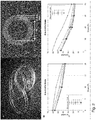
- a) A laser-cut PMMA strain setup as previously used in Ref. [18] is employed for radial stretching of coils from 0 to 40%. b) The coils' unloaded Q was assessed to be 61 before any strain occurred. Upon strain the coils' Q converges to a value lower than before primary strain within ≈ 7 cycles of strain. Depending on the maximum strain applied to the conductive elastomer coil the resulting Q is lower, reaching values of 56 and 44 for a maximum repetitive strain of 20% or 40%, respectively.
- Fig. 3
- SNR maps were derived from phantom imaging with a copper (Qunloaded = 439) and conductive elastomer (Qunloaded = 76) coil, each with a conductor diameter of 2 mm (Gradient echo sequence:
TR 30 ms, TE 4.8 ms,FA 30°, 1x1x5 mm, 1 slice). The SNR in the center of the loading phantom (770 mg/L CuSO4 *5(H2O), 2000 mg/L NaCl) was assessed to be 14% lower for the conductive elastomer coil compared to the copper reference coil, as expected due to the elastomer's lower conductivity. - Fig. 4
- Two layers of athletic pants were sewn onto each other following a pattern that allows insertion of the four individual conductive elastomer coil elements. The array was tuned and matched for the straight knee position only. No further adjustments were made for the different flexion angles. In-vivo images of a volunteer's knee at three different flexion angles were acquired (Gradient echo sequence: TR 500 ms, TE 5.8 ms,
FA 30°, 0.7x0.7x3 mm, scan duration 4:27 min). A B0 artifact is noticeable on the upper side of the thigh due to a ferromagnetic component in the coil connectors. - Fig. 5
- Dynamic in-vivo images of a volunteer's knee were acquired with an SPGR sequence (TR 7.8 ms, TE 3.8 ms, FA 7°, 1x1x5 mm, 1 slice, 30 dynamics, scan duration 1:08 min). Tuning and matching was performed only for the straight starting position of the knee. No further adjustments were made for flexion. The knee was continuously moved during image acquisition.
- As shown in
Fig. 1a , a radio frequency (RF)probe 2 for MR signal detection comprises astretchable conductor section 4, which is formed of a conductive elastomer. As also shown in the figure, thestretchable conductor section 4 is provided with electrical connector ends 6a, 6b. - As shown in
Fig. 4 , a coil assembly for MR signal detection, comprises a sheet of flexible and stretchabledielectric material 8 and anRF probe 2 attached to and extending along the flexible sheet. In the example shown, the sheet is configured for application on a patient's knee and is provided with a receivingpocket 10 configured for receiving therein theRF probe 2. Also shown inFig. 4 is an electronic matching device inserted in aninsertion pocket 12 of the sheet. - Filaments of a conductive elastomer based on silver microparticles (nanoleq AG, Zurich, Switzerland) were sourced at a diameter of 2 mm. The material is cut to the length of the coil segment and a solderable contact formed by crimping. Heat shrink tubing is applied (
Fig. 1 ). The manufacturer specifies the material to be corrosion resistant, heat and cold resistant and washable. The volume resistivity of the material is specified as ρElastomer = 7*10-6 Ωm. At DC this is a factor 417 higher than the resistivity of copper ρCopper = 1.68*10-8 Ωm. At 128 MHz, however, the skin depth of the elastomer δElastomer = 117.7 µm is a factor of ≈20 larger than of copper δCopper = 5.8 µm. For two conductors of the same length L and diameter d (d>2*δElastomer) this results in a resistance that is only ≈20 times larger for the elastomer conductor than for copper, despite the extreme difference in resistivity [4]. - Two layers of common highly elastic athletic pants were sewn onto each other following a pattern that forms stretchable casings that allow insertion of four coil elements in between the two layers (
Fig. 4 ). The sewing pattern ensures approximate geometric decoupling which is complemented by preamplifier decoupling. The high-Z preamplifiers with low correlation resistance offer low noise figure at variable loading and π-matching networks accommodate frequency shifts upon stretching [1]. - Images were obtained on a Philips 3T Ingenia system. SNR maps were calculated [1] from phantom images obtained with an elastomer coil and a copper coil for comparison, both based on conductors of 2 mm diameter (
Fig. 3 ). In-vivo images of a healthy volunteer's knee were acquired at 3 different flexion angles (Fig. 4 ) and in a dynamic study with continuous flexion (Fig. 5 ). - The coils' unloaded Q was assessed at 61 before its first strain (
Fig. 2 ). Upon strain the coils' Q converges to its final value within ≈ 7 strain cycles. Depending on the maximum strain applied to the conductive elastomer coil the final Q reaches values of 56 and 44 for a maximum repetitive strain of 20% or 40%, respectively. A Qunloaded/Qloaded ≈ 6 is observed by loading with a volunteer's thigh - sufficient for SNR efficient detection. The SNR in the center of a loading phantom was assessed to be 14% lower for the conductive elastomer coil compared to the copper reference coil, as expected due to the elastomer's lower conductivity (Fig. 3 ). In-vivo knee images, static (Fig. 4 ) and dynamic (Fig. 5 ), confirm sensitivity and coverage at different flexion angles and when flexed continuously. - The results of this study indicate that conductive elastomer is in fact a viable material for stretchable MR receive arrays and enables high-quality imaging. The favorable properties of elastomers come at an expense in terms of volume conductivity, which, however, is intrinsically mitigated by concomitant increase in skin depth. Upon repeated stretching by 20%, medium-size coil elements settled at an unloaded Q of approximately 40, which is still well above typical loaded Q at 3T and thus entails only a moderate SNR drawback. When necessary, a natural way of increasing the unloaded Q is to increase the conductor diameter, which was moderate here at 2 mm. Conductive elastomer poses no risk of leakage and is lightweight, easy to handle, and can readily be subject to washing and sanitization. These features make the material very attractive for wearable detection setups in conjunction with on-coil digitization and wireless transmission [29-34].
-
- 1. J. A. Nordmeyer-Massner, N. De Zanche, and K. P. Pruessmann, "Mechanically adjustable coil array for wrist MRI," Magn. Reson. Med., vol. 61, no. 2, pp. 429-438, 2009.
- 2. W. E. Kwok, K. K. Lo, G. Seo, and S. M. S. Totterman, "A volume adjustable fourcoil phased array for high resolution MR imaging of the hip," Magn. Reson. Mater. Physics, Biol. Med., vol. 9, no. 1-2, pp. 59-64, 1999.
- 3. G. Adriany et al., "A geometrically adjustable 16-channel transmit/receive transmission line array for improved RF efficiency and parallel imaging performance at 7 Tesla," Magn. Reson. Med., vol. 59, no. 3, pp. 590-597, 2008.
- 4. J. A. Malko, E. C. McClees, I. F. Braun, P. C. Davis, and J. C. Hoffman, "A flexible mercury-filled surface coil for MR imaging," Am. J. Neuroradiol., vol. 7, no. 2, pp. 246-247, 1986.
- 5. J. Rousseau, P. Lecouffe, and X. Marchandise, "A new, fully versatile surface coil for MRI," Magn. Reson. Imaging, vol. 8, no. 4, pp. 517-523, 1990.
- 6. F. Jia, H. Yuan, D. Zhou, J. Zhang, X. Wang, and J. Fang, "Knee MRI under varying flexion angles utilizing a flexible flat cable antenna," NMR Biomed., vol. 28, no. 4, pp. 460-467, 2015.
- 7. D. Mager et al., "An MRI receiver coil produced by inkjet printing directly on to a flexible substrate," IEEE Trans. Med. Imaging, vol. 29, no. 2, pp. 482-487, 2010.
- 8. J. R. Corea et al., "Screen-printed flexible MRI receive coils," Nat. Commun., vol. 7, p. 10839, 2016.
- 9. S. S. Vasanawala et al., "Development and Clinical Implementation of Very Light Weight and Highly Flexible AIR Technology Arrays," in Proceedings of the 24th Annual Meeting of the ISMRM, 2016, pp. 3-5.
- 10. B. Zhang, D. K. Sodickson, and M. A. Cloos, "A high-impedance detector-array glove for magnetic resonance imaging of the hand," Nat. Biomed. Eng., vol. 2, no. August, pp. 1-8, 2018.
- 11. L. Nohava et al., "Flexible multi-turn multi-gap coaxial RF coils (MTMG-CCs): design concept and bench validation," Proc. 27th Annu. Meet. ISMRM, Montreal, Canada, nr. 3903, pp. 3-5, 2019.
- 12. M. Obermann et al., "Ultra-flexible and light-weight 3-channel coaxial transmission line resonator receive-only coil array for 3T," Proc. 27th Annu. Meet. ISMRM, Montreal, Canada, vol. 6, no. I, pp. 2018-2019, 2019.
- 13. J. A. Nordmeyer-Massner, N. De Zanche, and K. P. Pruessmann, "Stretchable coil arrays: Application to knee imaging under varying flexion angles," Magn. Reson. Med., vol. 67, no. 3, pp. 872-879, 2012.
- 14. B. Gruber and S. Zink, "Anatomically adaptive local coils for MRI Imaging - Evaluation of stretchable antennas at 1.5T," Proc. 24th Annu. Meet. ISMRM, p. 543, 2016.
- 15. J. Vincent and J. Rispoli, "Stretchable and Flexible Conductive-Thread Based Radiofrequency Coils for Magnetic Resonance Imaging," Proc. Intl. Soc. Mag. Reson. Med. 27, p. 1490, 2019.
- 16. B. Kahraman Agir, B. Bayrambas, K. Yegin, and E. Ozturk Isik, "Wearable and stretchable surface breast coil," Proc. Intl. Soc. Mag. Reson. Med. 27, pp. 2-4, 2019.
- 17. M. Varga et al., "Adsorbed Eutectic Galn Structures on a Neoprene Foam for Stretchable MRI Coils," Adv. Mater., vol. 29, no. 44, pp. 1-7, 2017.
- 18. A. Port et al., "Liquid metal in stretchable tubes: A wearable 4-channel knee array," Proc. Intl. Soc. Mag. Reson. Med. 27, p. 1114, 2019.
- 19. M. K. Shin, J. Oh, M. Lima, M. E. Kozlov, S. J. Kim, and R. H. Baughman, "Elastomeric conductive composites based on carbon nanotube forests," Adv. Mater., vol. 22, no. 24, pp. 2663-2667, 2010.
- 20. D. J. Lipomi et al., "Skin-like pressure and strain sensors based on transparent elastic films of carbon nanotubes," Nat. Nanotechnol., vol. 6, no. 12, pp. 788-792, 2011.
- 21. T. Yamada et al., "A stretchable carbon nanotube strain sensor for human-motion detection," Nat. Nanotechnol., vol. 6, no. 5, pp. 296-301, 2011.
- 22. F. Stauffer and K. Tybrandt, "Bright Stretchable Alternating Current Electroluminescent Displays Based on High Permittivity Composites," Adv. Mater., pp. 7200-7203, 2016.
- 23. V. Martinez, F. Stauffer, M. O. Adagunodo, C. Forro, J. Vörös, and A. Larmagnac, "Stretchable Silver Nanowire-Elastomer 29-34 Composite Microelectrodes with Tailored Electrical Properties," ACS Appl. Mater. Interfaces, vol. 7, no. 24, pp. 13467-13475, 2015.
- 24. F. Stauffer et al., "Skin Conformal Polymer Electrodes for Clinical ECG and EEG Recordings," Adv. Healthc. Mater., vol. 7, no. 7, pp. 1-10, 2018.
- 25. Y. L. Park, Soft Wearable Robotics Technologies for Body Motion Sensing. Elsevier Inc., 2016.
- 26. Y. P. Mamunya, V. V Davydenko, P. Pissis, and E. V Lebedev, "Electrical and thermal conductivity of polymers filled with metal powders," Eur. Polym. J., vol. 38, pp. 1887-1897, 2002.
- 27. G. Harsanyi, "Polymer films in sensor applications: a review of present uses and future possibilities," Sens. Rev., vol. 20, no. 2, p. 98, 2000.
- 28. S. Choi, S. I. Han, D. Kim, T. Hyeon, and D. H. Kim, "High-performance stretchable conductive nanocomposites: Materials, processes, and device applications," Chem. Soc. Rev., vol. 48, no. 6, pp. 1566-1595, 2019.
- 29. A. Port et al., "Towards wearable MR detection: A stretchable wrist array with on-body digitization," in Proc. Joint Annual Meeting ISMRM-ESMRMB, Paris, France, 2018, p. 17.
- 30. B. Sporrer et al., "A Fully Integrated Dual-Channel On-Coil CMOS Receiver for Array Coils in 1.5-10.5 T MRI," IEEE Trans. Biomed. Circuits Syst., 2017.
- 31. K. Aggarwal et al., "A Millimeter-Wave Digital Link for Wireless MRI," IEEE Trans. Med. Imaging, 2016.
- 32. G. Scott, S. Vasanawala, F. Robb, P. Stang, and J. Pauly, "Pilot Tone Software Synchronization for Wireless MRI Receivers," in Proc. Joint Annual Meeting ISMRM-ESMRMB, Paris, France, 2018, pp. 4-6.
- 33. A. Reykowski et al., "High Precision Wireless Clock Recovery for On-Coil MRI Receivers Using Round- Trip Carrier Phase Tracking," in Proc. Joint Annual Meeting ISMRM-ESMRMB, Paris, France, 2018, pp. 2-5.
- 34. C. Vassos, F. Robb, S. Vasanawala, J. Pauly, and G. Scott, "Characterization of In-Bore 802.11 ac Wi-Fi Performance," in Proc. Intl. Soc. Mag. Reson. Med. 27, 2019.
Claims (14)
- A radio frequency (RF) probe (2) for magnetic resonance (MR) signal detection, comprising a stretchable conductor section (4), characterized in that the stretchable conductor section is formed of a conductive elastomer.
- The RF probe according to claim 1, wherein the conductive elastomer has a volume resistivity (ρElastomer) not exceeding 1*10-5 Ωm, preferably not exceeding 7*10-6 Ωm.
- The RF probe according to claim 1 or 2, wherein the stretchable conductor section is substantially wire-shaped, preferably with an average cross-sectional size of 1 to 3 mm.
- The RF probe according to one of claims 1 to 3, wherein the conductive elastomer comprises an elastomer matrix containing electrically conductive particles dispersed therein.
- The RF probe according to claim 4, wherein the elastomer is selected from the group consisting of polydimethylsiloxane (PDMS), polyurethane and fluorinated silicone.
- The RF probe according to claim 4 or 5, wherein the electrically conductive particles are metallic particles, particularly silver particles.
- The RF probe according to one of claims 1 to 6, wherein said stretchable conductor section (4) is provided with electrical connector ends (6a, 6b).
- A coil assembly for MR signal detection, comprising:- a sheet of flexible and stretchable dielectric material (8);- at least one RF probe (2) according to one of the preceding claims attached to and extending along said flexible sheet.
- The coil assembly according to claim 8, wherein said sheet is provided with receiving pockets (10) each configured for receiving therein one of said attached RF probes.
- The coil assembly according to claim 8 or 9, wherein said sheet is made from a textile and/or a polymeric material.
- The coil assembly according to one of claims 8 to 10, which is shaped to be wearable on a person's body region selected from the group consisting of knee, ankle, foot, hip, leg, wrist, hand, elbow, shoulder, arm, thorax, head and whole-body.
- The coil assembly according to one of claims 8 to 11, which is compatible with wet cleaning, washing and disinfection.
- A device for MR signal excitation or detection, comprising a coil assembly according to one of claims 8 to 12, wherein said coil assembly is provided with electrical connector ends that are connected to an electronic matching device selected from the group consisting of broadband matching devices, adjustable matching devices, automatic matching devices and mismatching devices for decoupling from other RF circuitry.
- The device according to claim 13, wherein said electronic matching device is insertable in an insertion pocket (12) of said sheet.
Priority Applications (1)
| Application Number | Priority Date | Filing Date | Title |
|---|---|---|---|
| EP20166960.3A EP3889631A1 (en) | 2020-03-31 | 2020-03-31 | Radio frequency probe for magnetic resonance |
Applications Claiming Priority (1)
| Application Number | Priority Date | Filing Date | Title |
|---|---|---|---|
| EP20166960.3A EP3889631A1 (en) | 2020-03-31 | 2020-03-31 | Radio frequency probe for magnetic resonance |
Publications (1)
| Publication Number | Publication Date |
|---|---|
| EP3889631A1 true EP3889631A1 (en) | 2021-10-06 |
Family
ID=70110011
Family Applications (1)
| Application Number | Title | Priority Date | Filing Date |
|---|---|---|---|
| EP20166960.3A Ceased EP3889631A1 (en) | 2020-03-31 | 2020-03-31 | Radio frequency probe for magnetic resonance |
Country Status (1)
| Country | Link |
|---|---|
| EP (1) | EP3889631A1 (en) |
Cited By (2)
| Publication number | Priority date | Publication date | Assignee | Title |
|---|---|---|---|---|
| US20240369655A1 (en) * | 2023-05-05 | 2024-11-07 | GE Precision Healthcare LLC | Systems, assemblies, and methods of fabrication of liquid metal radio-frequency coil assemblies of a magnetic resonance system |
| US12259450B2 (en) | 2023-05-05 | 2025-03-25 | GE Precision Healthcare LLC | Systems, assemblies, and methods of fabrication of radio-frequency coil assemblies of a magnetic resonance system |
Citations (4)
| Publication number | Priority date | Publication date | Assignee | Title |
|---|---|---|---|---|
| US20110018539A1 (en) * | 2007-08-03 | 2011-01-27 | Raju Viswanathan | Hybrid imaging coils for magnetic resonance imaging |
| US20110068792A1 (en) * | 2009-09-23 | 2011-03-24 | Joseph Alfred Iannotti | System and method for magnetic resonance coil actuation |
| US20170089991A1 (en) * | 2015-09-29 | 2017-03-30 | Bernhard Gruber | Adaptive mr local coil |
| CN106910973A (en) * | 2017-03-08 | 2017-06-30 | 常州大学 | A kind of Highly-conductive elastomer, preparation method and its flexible extensible antenna |
-
2020
- 2020-03-31 EP EP20166960.3A patent/EP3889631A1/en not_active Ceased
Patent Citations (4)
| Publication number | Priority date | Publication date | Assignee | Title |
|---|---|---|---|---|
| US20110018539A1 (en) * | 2007-08-03 | 2011-01-27 | Raju Viswanathan | Hybrid imaging coils for magnetic resonance imaging |
| US20110068792A1 (en) * | 2009-09-23 | 2011-03-24 | Joseph Alfred Iannotti | System and method for magnetic resonance coil actuation |
| US20170089991A1 (en) * | 2015-09-29 | 2017-03-30 | Bernhard Gruber | Adaptive mr local coil |
| CN106910973A (en) * | 2017-03-08 | 2017-06-30 | 常州大学 | A kind of Highly-conductive elastomer, preparation method and its flexible extensible antenna |
Non-Patent Citations (34)
| Title |
|---|
| A. PORT ET AL.: "Liquid metal in stretchable tubes: A wearable 4-channel knee array", PROC. INTL. SOC. MAG. RESON. MED., vol. 27, 2019, pages 1114 |
| A. PORT ET AL.: "Towards wearable MR detection: A stretchable wrist array with on-body digitization", PROC. JOINT ANNUAL MEETING ISMRM-ESMRMB, 2018, pages 17 |
| A. REYKOWSKI ET AL.: "High Precision Wireless Clock Recovery for On-Coil MRI Receivers Using Round- Trip Carrier Phase Tracking", PROC. JOINT ANNUAL MEETING ISMRM-ESMRMB, 2018, pages 2 - 5 |
| B. GRUBERS. ZINK: "Anatomically adaptive local coils for MRI Imaging - Evaluation of stretchable antennas at 1.5T", PROC. 24TH ANNU. MEET. ISMRM, 2016, pages 543 |
| B. KAHRAMAN AGIRB. BAYRAMBASK. YEGINE. OZTURK ISIK: "Wearable and stretchable surface breast coil", PROC. INTL. SOC. MAG. RESON. MED., vol. 27, 2019, pages 2 - 4 |
| B. SPORRER ET AL.: "A Fully Integrated Dual-Channel On-Coil CMOS Receiver for Array Coils in 1.5-10.5 T MRI", IEEE TRANS. BIOMED. CIRCUITS SYST., 2017 |
| B. ZHANGD. K. SODICKSONM. A. CLOOS: "A high-impedance detector-array glove for magnetic resonance imaging of the hand", NAT. BIOMED. ENG., vol. 2, August 2018 (2018-08-01), pages 1 - 8 |
| C. VASSOSF. ROBBS. VASANAWALAJ. PAULYG. SCOTT: "Characterization of In-Bore 802.11 ac Wi-Fi Performance", PROC. INTL. SOC. MAG. RESON. MED., vol. 27, 2019 |
| D. J. LIPOMI ET AL.: "Skin-like pressure and strain sensors based on transparent elastic films of carbon nanotubes", NAT. NANOTECHNOL., vol. 6, no. 12, 2011, pages 788 - 792, XP055390039, DOI: 10.1038/nnano.2011.184 |
| D. MAGER ET AL.: "An MRI receiver coil produced by inkjet printing directly on to a flexible substrate", IEEE TRANS. MED. IMAGING, vol. 29, no. 2, 2010, pages 482 - 487 |
| F. JIAH. YUAND. ZHOUJ. ZHANGX. WANGJ. FANG: "Knee MRI under varying flexion angles utilizing a flexible flat cable antenna", NMR BIOMED., vol. 28, no. 4, 2015, pages 460 - 467 |
| F. STAUFFER ET AL.: "Skin Conformal Polymer Electrodes for Clinical ECG and EEG Recordings", ADV. HEALTHC. MATER., vol. 7, no. 7, 2018, pages 1 - 10 |
| F. STAUFFERK. TYBRANDT: "Bright Stretchable Alternating Current Electroluminescent Displays Based on High Permittivity Composites", ADV. MATER., 2016, pages 7200 - 7203 |
| G. ADRIANY ET AL.: "A geometrically adjustable 16-channel transmit/receive transmission line array for improved RF efficiency and parallel imaging performance at 7 Tesla", MAGN. RESON. MED., vol. 59, no. 3, 2008, pages 590 - 597 |
| G. HARSANYI: "Polymer films in sensor applications: a review of present uses and future possibilities", SENS. REV., vol. 20, no. 2, 2000, pages 98, XP008103618, DOI: 10.1108/02602280010319169 |
| G. SCOTTS. VASANAWALAF. ROBBP. STANGJ. PAULY: "Pilot Tone Software Synchronization for Wireless MRI Receivers", PROC. JOINT ANNUAL MEETING ISMRM-ESMRMB, 2018, pages 4 - 6 |
| J. A. MALKOE. C. MCCLEESI. F. BRAUNP. C. DAVISJ. C. HOFFMAN: "A flexible mercury-filled surface coil for MR imaging", AM. J. NEURORADIOL., vol. 7, no. 2, 1986, pages 246 - 247 |
| J. A. NORDMEYER-MASSNERN. DE ZANCHEK. P. PRUESSMANN: "Mechanically adjustable coil array for wrist MRI", MAGN. RESON. MED., vol. 61, no. 2, 2009, pages 429 - 438 |
| J. A. NORDMEYER-MASSNERN. DE ZANCHEK. P. PRUESSMANN: "Stretchable coil arrays: Application to knee imaging under varying flexion angles", MAGN. RESON. MED., vol. 67, no. 3, 2012, pages 872 - 879, XP055027329, DOI: 10.1002/mrm.23240 |
| J. R. COREA ET AL.: "Screen-printed flexible MRI receive coils", NAT. COMMUN., vol. 7, 2016, pages 10839, XP055549039, DOI: 10.1038/ncomms10839 |
| J. ROUSSEAUP. LECOUFFEX. MARCHANDISE: "A new, fully versatile surface coil for MRI", MAGN. RESON. IMAGING, vol. 8, no. 4, 1990, pages 517 - 523 |
| J. VINCENTJ. RISPOLI: "Stretchable and Flexible Conductive-Thread Based Radiofrequency Coils for Magnetic Resonance Imaging", PROC. INTL. SOC. MAG. RESON. MED., vol. 27, 2019, pages 1490 |
| K. AGGARWAL ET AL.: "A Millimeter-Wave Digital Link for Wireless MRI", IEEE TRANS. MED. IMAGING, 2016 |
| L. NOHAVA ET AL.: "Flexible multi-turn multi-gap coaxial RF coils ( MTMG-CCs ): design concept and bench validation", PROC. 27TH ANNU. MEET. ISMRM, 2019, pages 3 - 5 |
| M. K. SHINJ. OHM. LIMAM. E. KOZLOVS. J. KIMR. H. BAUGHMAN: "Elastomeric conductive composites based on carbon nanotube forests", ADV. MATER., vol. 22, no. 24, 2010, pages 2663 - 2667 |
| M. OBERMANN ET AL.: "Ultra-flexible and light-weight 3-channel coaxial transmission line resonator receive-only coil array for 3T", PROC. 27TH ANNU. MEET. ISMRM, vol. 6, no. I, 2019, pages 2018 - 2019 |
| M. VARGA ET AL.: "Adsorbed Eutectic Gain Structures on a Neoprene Foam for Stretchable MRI Coils", ADV. MATER., vol. 29, no. 44, 2017, pages 1 - 7 |
| S. CHOIS. I. HAND. KIMT. HYEOND. H. KIM: "High-performance stretchable conductive nanocomposites: Materials, processes, and device applications", CHEM. SOC. REV., vol. 48, no. 6, 2019, pages 1566 - 1595 |
| S. S. VASANAWALA ET AL.: "Development and Clinical Implementation of Very Light Weight and Highly Flexible AIR Technology Arrays", PROCEEDINGS OF THE 24TH ANNUAL MEETING OF THE ISMRM, 2016, pages 3 - 5 |
| SONG BO ET AL: "Stretchable, Printable and Electrically Conductive Composites for Wearable RF Antennas", 2018 IEEE 68TH ELECTRONIC COMPONENTS AND TECHNOLOGY CONFERENCE (ECTC), IEEE, 29 May 2018 (2018-05-29), pages 9 - 14, XP033383270, DOI: 10.1109/ECTC.2018.00009 * |
| T. YAMADA ET AL.: "A stretchable carbon nanotube strain sensor for human-motion detection", NAT. NANOTECHNOL., vol. 6, no. 5, 2011, pages 296 - 301, XP055453086, DOI: 10.1038/nnano.2011.36 |
| V. MARTINEZF. STAUFFERM. O. ADAGUNODOC. FORROJ. VOROSA. LARMAGNAC: "Stretchable Silver Nanowire-Elastomer 29-34 Composite Microelectrodes with Tailored Electrical Properties", ACS APPL. MATER. INTERFACES, vol. 7, no. 24, 2015, pages 13467 - 13475, XP055316938, DOI: 10.1021/acsami.5b02508 |
| W. E. KWOKK. K. LOG. SEOS. M. S. TOTTERMAN: "A volume adjustable four-coil phased array for high resolution MR imaging of the hip", MAGN. RESON. MATER. PHYSICS, BIOL. MED., vol. 9, no. 1-2, 1999, pages 59 - 64 |
| Y. P. MAMUNYAV. V DAVYDENKOP. PISSISE. V LEBEDEV: "Electrical and thermal conductivity of polymers filled with metal powders", EUR. POLYM. J., vol. 38, 2002, pages 1887 - 1897 |
Cited By (3)
| Publication number | Priority date | Publication date | Assignee | Title |
|---|---|---|---|---|
| US20240369655A1 (en) * | 2023-05-05 | 2024-11-07 | GE Precision Healthcare LLC | Systems, assemblies, and methods of fabrication of liquid metal radio-frequency coil assemblies of a magnetic resonance system |
| US12259450B2 (en) | 2023-05-05 | 2025-03-25 | GE Precision Healthcare LLC | Systems, assemblies, and methods of fabrication of radio-frequency coil assemblies of a magnetic resonance system |
| US12276712B2 (en) * | 2023-05-05 | 2025-04-15 | GE Precision Healthcare LLC | Systems, assemblies, and methods of fabrication of liquid metal radio-frequency coil assemblies of a magnetic resonance system |
Similar Documents
| Publication | Publication Date | Title |
|---|---|---|
| US7619416B2 (en) | Coil assembly and multiple coil arrangement for magnetic resonance imaging | |
| Port et al. | Elastomer coils for wearable MR detection | |
| JP7073366B2 (en) | Radio frequency coil system for MR imaging | |
| US11039787B2 (en) | Garment MRI antenna array | |
| CN207867013U (en) | Local coil matrix and magnetic resonance tomography equipment with local coil matrix | |
| Nordmeyer‐Massner et al. | Stretchable coil arrays: Application to knee imaging under varying flexion angles | |
| Mehmann et al. | On the bending and stretching of liquid metal receive coils for magnetic resonance imaging | |
| JP5654543B2 (en) | Intrarectal quadrature coil and interface device therefor | |
| Frass-Kriegl et al. | Flexible 23-channel coil array for high-resolution magnetic resonance imaging at 3 Tesla | |
| US10520563B2 (en) | Adaptive MR local coil | |
| CN107076813A (en) | For low field, the system and method for multi channel imaging | |
| Gruber et al. | Anatomically adaptive coils for MRI—A 6-channel array for knee imaging at 1.5 Tesla | |
| CN113820638A (en) | Magnetic resonance coil assembly and control method of magnetic resonance equipment | |
| US11656302B2 (en) | Expandable apparatus for detecting RF signals and related method | |
| Narongrit et al. | Stretching the limits of MRI—stretchable and modular coil array using conductive thread technology | |
| Ramesh et al. | Stretchable receive coil for 7T small animal MRI | |
| US11143723B2 (en) | Flexible local coil for magnetic resonance imaging | |
| Ramesh et al. | Adaptable, wearable, and stretchable coils: A review | |
| Vincent et al. | Stitching stretchable radiofrequency coils for MRI: A conductive thread and athletic fabric approach | |
| Mathieu et al. | Towards brain MRI adaptable to head size: Bowing RF coil phased arrays | |
| US20170108562A1 (en) | Rf surface coil unit and magnetic resonance imaging system comprising same | |
| Zhang et al. | Ultra-flexible 3T HIC receive array for carotid imaging | |
| Wosik et al. | High-Tc superconducting rf receiver coils for magnetic resonance imaging of small animals | |
| CN116643220A (en) | Tunable multistage coils for functional imaging of extremities | |
| Port | Wearable Receive Arrays |
Legal Events
| Date | Code | Title | Description |
|---|---|---|---|
| PUAI | Public reference made under article 153(3) epc to a published international application that has entered the european phase |
Free format text: ORIGINAL CODE: 0009012 |
|
| STAA | Information on the status of an ep patent application or granted ep patent |
Free format text: STATUS: THE APPLICATION HAS BEEN PUBLISHED |
|
| AK | Designated contracting states |
Kind code of ref document: A1 Designated state(s): AL AT BE BG CH CY CZ DE DK EE ES FI FR GB GR HR HU IE IS IT LI LT LU LV MC MK MT NL NO PL PT RO RS SE SI SK SM TR |
|
| STAA | Information on the status of an ep patent application or granted ep patent |
Free format text: STATUS: THE APPLICATION HAS BEEN REFUSED |
|
| 18R | Application refused |
Effective date: 20220124 |