EP3889191A1 - Polypropylene resin having excellent melt characteristics, and preparation method therefor - Google Patents
Polypropylene resin having excellent melt characteristics, and preparation method therefor Download PDFInfo
- Publication number
- EP3889191A1 EP3889191A1 EP19889955.1A EP19889955A EP3889191A1 EP 3889191 A1 EP3889191 A1 EP 3889191A1 EP 19889955 A EP19889955 A EP 19889955A EP 3889191 A1 EP3889191 A1 EP 3889191A1
- Authority
- EP
- European Patent Office
- Prior art keywords
- group
- melt
- formula
- polypropylene resin
- producing
- Prior art date
- Legal status (The legal status is an assumption and is not a legal conclusion. Google has not performed a legal analysis and makes no representation as to the accuracy of the status listed.)
- Withdrawn
Links
- 0 CC(CC1C(C(C=C*)=CC)=CC=CC1*1)C1[Si]1(***)CCCC1 Chemical compound CC(CC1C(C(C=C*)=CC)=CC=CC1*1)C1[Si]1(***)CCCC1 0.000 description 5
Images

Classifications
-
- C—CHEMISTRY; METALLURGY
- C08—ORGANIC MACROMOLECULAR COMPOUNDS; THEIR PREPARATION OR CHEMICAL WORKING-UP; COMPOSITIONS BASED THEREON
- C08F—MACROMOLECULAR COMPOUNDS OBTAINED BY REACTIONS ONLY INVOLVING CARBON-TO-CARBON UNSATURATED BONDS
- C08F255/00—Macromolecular compounds obtained by polymerising monomers on to polymers of hydrocarbons as defined in group C08F10/00
- C08F255/02—Macromolecular compounds obtained by polymerising monomers on to polymers of hydrocarbons as defined in group C08F10/00 on to polymers of olefins having two or three carbon atoms
-
- C—CHEMISTRY; METALLURGY
- C08—ORGANIC MACROMOLECULAR COMPOUNDS; THEIR PREPARATION OR CHEMICAL WORKING-UP; COMPOSITIONS BASED THEREON
- C08F—MACROMOLECULAR COMPOUNDS OBTAINED BY REACTIONS ONLY INVOLVING CARBON-TO-CARBON UNSATURATED BONDS
- C08F110/00—Homopolymers of unsaturated aliphatic hydrocarbons having only one carbon-to-carbon double bond
- C08F110/04—Monomers containing three or four carbon atoms
- C08F110/06—Propene
-
- C—CHEMISTRY; METALLURGY
- C08—ORGANIC MACROMOLECULAR COMPOUNDS; THEIR PREPARATION OR CHEMICAL WORKING-UP; COMPOSITIONS BASED THEREON
- C08F—MACROMOLECULAR COMPOUNDS OBTAINED BY REACTIONS ONLY INVOLVING CARBON-TO-CARBON UNSATURATED BONDS
- C08F4/00—Polymerisation catalysts
- C08F4/42—Metals; Metal hydrides; Metallo-organic compounds; Use thereof as catalyst precursors
- C08F4/44—Metals; Metal hydrides; Metallo-organic compounds; Use thereof as catalyst precursors selected from light metals, zinc, cadmium, mercury, copper, silver, gold, boron, gallium, indium, thallium, rare earths or actinides
- C08F4/52—Metals; Metal hydrides; Metallo-organic compounds; Use thereof as catalyst precursors selected from light metals, zinc, cadmium, mercury, copper, silver, gold, boron, gallium, indium, thallium, rare earths or actinides selected from boron, aluminium, gallium, indium, thallium or rare earths
-
- C—CHEMISTRY; METALLURGY
- C08—ORGANIC MACROMOLECULAR COMPOUNDS; THEIR PREPARATION OR CHEMICAL WORKING-UP; COMPOSITIONS BASED THEREON
- C08F—MACROMOLECULAR COMPOUNDS OBTAINED BY REACTIONS ONLY INVOLVING CARBON-TO-CARBON UNSATURATED BONDS
- C08F4/00—Polymerisation catalysts
- C08F4/42—Metals; Metal hydrides; Metallo-organic compounds; Use thereof as catalyst precursors
- C08F4/44—Metals; Metal hydrides; Metallo-organic compounds; Use thereof as catalyst precursors selected from light metals, zinc, cadmium, mercury, copper, silver, gold, boron, gallium, indium, thallium, rare earths or actinides
- C08F4/60—Metals; Metal hydrides; Metallo-organic compounds; Use thereof as catalyst precursors selected from light metals, zinc, cadmium, mercury, copper, silver, gold, boron, gallium, indium, thallium, rare earths or actinides together with refractory metals, iron group metals, platinum group metals, manganese, rhenium technetium or compounds thereof
- C08F4/62—Refractory metals or compounds thereof
- C08F4/64—Titanium, zirconium, hafnium or compounds thereof
- C08F4/659—Component covered by group C08F4/64 containing a transition metal-carbon bond
- C08F4/6592—Component covered by group C08F4/64 containing a transition metal-carbon bond containing at least one cyclopentadienyl ring, condensed or not, e.g. an indenyl or a fluorenyl ring
- C08F4/65922—Component covered by group C08F4/64 containing a transition metal-carbon bond containing at least one cyclopentadienyl ring, condensed or not, e.g. an indenyl or a fluorenyl ring containing at least two cyclopentadienyl rings, fused or not
-
- C—CHEMISTRY; METALLURGY
- C08—ORGANIC MACROMOLECULAR COMPOUNDS; THEIR PREPARATION OR CHEMICAL WORKING-UP; COMPOSITIONS BASED THEREON
- C08F—MACROMOLECULAR COMPOUNDS OBTAINED BY REACTIONS ONLY INVOLVING CARBON-TO-CARBON UNSATURATED BONDS
- C08F8/00—Chemical modification by after-treatment
- C08F8/46—Reaction with unsaturated dicarboxylic acids or anhydrides thereof, e.g. maleinisation
-
- C—CHEMISTRY; METALLURGY
- C08—ORGANIC MACROMOLECULAR COMPOUNDS; THEIR PREPARATION OR CHEMICAL WORKING-UP; COMPOSITIONS BASED THEREON
- C08L—COMPOSITIONS OF MACROMOLECULAR COMPOUNDS
- C08L23/00—Compositions of homopolymers or copolymers of unsaturated aliphatic hydrocarbons having only one carbon-to-carbon double bond; Compositions of derivatives of such polymers
- C08L23/02—Compositions of homopolymers or copolymers of unsaturated aliphatic hydrocarbons having only one carbon-to-carbon double bond; Compositions of derivatives of such polymers not modified by chemical after-treatment
- C08L23/10—Homopolymers or copolymers of propene
- C08L23/12—Polypropene
-
- C—CHEMISTRY; METALLURGY
- C08—ORGANIC MACROMOLECULAR COMPOUNDS; THEIR PREPARATION OR CHEMICAL WORKING-UP; COMPOSITIONS BASED THEREON
- C08F—MACROMOLECULAR COMPOUNDS OBTAINED BY REACTIONS ONLY INVOLVING CARBON-TO-CARBON UNSATURATED BONDS
- C08F210/00—Copolymers of unsaturated aliphatic hydrocarbons having only one carbon-to-carbon double bond
- C08F210/04—Monomers containing three or four carbon atoms
- C08F210/06—Propene
-
- C—CHEMISTRY; METALLURGY
- C08—ORGANIC MACROMOLECULAR COMPOUNDS; THEIR PREPARATION OR CHEMICAL WORKING-UP; COMPOSITIONS BASED THEREON
- C08F—MACROMOLECULAR COMPOUNDS OBTAINED BY REACTIONS ONLY INVOLVING CARBON-TO-CARBON UNSATURATED BONDS
- C08F2420/00—Metallocene catalysts
-
- C—CHEMISTRY; METALLURGY
- C08—ORGANIC MACROMOLECULAR COMPOUNDS; THEIR PREPARATION OR CHEMICAL WORKING-UP; COMPOSITIONS BASED THEREON
- C08F—MACROMOLECULAR COMPOUNDS OBTAINED BY REACTIONS ONLY INVOLVING CARBON-TO-CARBON UNSATURATED BONDS
- C08F2500/00—Characteristics or properties of obtained polyolefins; Use thereof
- C08F2500/09—Long chain branches
-
- C—CHEMISTRY; METALLURGY
- C08—ORGANIC MACROMOLECULAR COMPOUNDS; THEIR PREPARATION OR CHEMICAL WORKING-UP; COMPOSITIONS BASED THEREON
- C08F—MACROMOLECULAR COMPOUNDS OBTAINED BY REACTIONS ONLY INVOLVING CARBON-TO-CARBON UNSATURATED BONDS
- C08F2500/00—Characteristics or properties of obtained polyolefins; Use thereof
- C08F2500/12—Melt flow index or melt flow ratio
-
- C—CHEMISTRY; METALLURGY
- C08—ORGANIC MACROMOLECULAR COMPOUNDS; THEIR PREPARATION OR CHEMICAL WORKING-UP; COMPOSITIONS BASED THEREON
- C08F—MACROMOLECULAR COMPOUNDS OBTAINED BY REACTIONS ONLY INVOLVING CARBON-TO-CARBON UNSATURATED BONDS
- C08F2800/00—Copolymer characterised by the proportions of the comonomers expressed
- C08F2800/20—Copolymer characterised by the proportions of the comonomers expressed as weight or mass percentages
-
- C—CHEMISTRY; METALLURGY
- C08—ORGANIC MACROMOLECULAR COMPOUNDS; THEIR PREPARATION OR CHEMICAL WORKING-UP; COMPOSITIONS BASED THEREON
- C08F—MACROMOLECULAR COMPOUNDS OBTAINED BY REACTIONS ONLY INVOLVING CARBON-TO-CARBON UNSATURATED BONDS
- C08F4/00—Polymerisation catalysts
- C08F4/42—Metals; Metal hydrides; Metallo-organic compounds; Use thereof as catalyst precursors
- C08F4/44—Metals; Metal hydrides; Metallo-organic compounds; Use thereof as catalyst precursors selected from light metals, zinc, cadmium, mercury, copper, silver, gold, boron, gallium, indium, thallium, rare earths or actinides
- C08F4/60—Metals; Metal hydrides; Metallo-organic compounds; Use thereof as catalyst precursors selected from light metals, zinc, cadmium, mercury, copper, silver, gold, boron, gallium, indium, thallium, rare earths or actinides together with refractory metals, iron group metals, platinum group metals, manganese, rhenium technetium or compounds thereof
- C08F4/62—Refractory metals or compounds thereof
- C08F4/64—Titanium, zirconium, hafnium or compounds thereof
- C08F4/659—Component covered by group C08F4/64 containing a transition metal-carbon bond
- C08F4/65912—Component covered by group C08F4/64 containing a transition metal-carbon bond in combination with an organoaluminium compound
-
- C—CHEMISTRY; METALLURGY
- C08—ORGANIC MACROMOLECULAR COMPOUNDS; THEIR PREPARATION OR CHEMICAL WORKING-UP; COMPOSITIONS BASED THEREON
- C08F—MACROMOLECULAR COMPOUNDS OBTAINED BY REACTIONS ONLY INVOLVING CARBON-TO-CARBON UNSATURATED BONDS
- C08F4/00—Polymerisation catalysts
- C08F4/42—Metals; Metal hydrides; Metallo-organic compounds; Use thereof as catalyst precursors
- C08F4/44—Metals; Metal hydrides; Metallo-organic compounds; Use thereof as catalyst precursors selected from light metals, zinc, cadmium, mercury, copper, silver, gold, boron, gallium, indium, thallium, rare earths or actinides
- C08F4/60—Metals; Metal hydrides; Metallo-organic compounds; Use thereof as catalyst precursors selected from light metals, zinc, cadmium, mercury, copper, silver, gold, boron, gallium, indium, thallium, rare earths or actinides together with refractory metals, iron group metals, platinum group metals, manganese, rhenium technetium or compounds thereof
- C08F4/62—Refractory metals or compounds thereof
- C08F4/64—Titanium, zirconium, hafnium or compounds thereof
- C08F4/659—Component covered by group C08F4/64 containing a transition metal-carbon bond
- C08F4/65916—Component covered by group C08F4/64 containing a transition metal-carbon bond supported on a carrier, e.g. silica, MgCl2, polymer
Definitions
- the present disclosure relates to a high-melt-strength polypropylene resin and a method of producing the same, and more particularly, to a method of producing a high-melt-strength polypropylene resin using a metallocene catalyst, and a polypropylene resin thereof.
- PP polypropylene
- LCB long-chain branch
- HMSPP high-melt-strength polypropylene
- U.S. Patent Nos. 5,368,919 , 5,414,027 , 5,541,236 , 5,554,668 , 5,591,785 and 5,731,362 disclose polypropylene polymers having high melt strength using an electron beam irradiation device.
- the polypropylene polymers obtained according to these patents have excellent performance, it requires the installation of electron beam irradiation equipment, and thus, there is a problem in that the operation costs may be high and the production cost of high melt strength polypropylene is high due to low productivity.
- U.S. Patent Nos. 5,416,169 and 4,525,257 , and WO1997/049759 disclose a method for preparing high-melt-strength polypropylene using an organic peroxide, and introduce long chains into polypropylene through reaction with polypropylene under certain reaction conditions.
- Korean Patent Application Publication No. 2011-0084303 discloses a method of using two types of catalysts, but there is an uneconomic problem in terms of facilities and manufacturing costs because a two-step reaction is performed.
- Korean Patent Application Publication No. 2016-0122941 discloses a method for producing high-melt strength polypropylene using one type of metallocene catalyst and a diene monomer.
- the melt elongation is short compared to the increase of the melt strength, and a certain amount of gel is generated.
- An aspect of the present disclosure is to provide a method of producing a polypropylene that may control the structure of a long-chain branch in a polypropylene main chain and has excellent melt strength and melt elongation.
- an aspect of the present disclosure is to provide a polypropylene resin having an improved melt strength to an optimum level while maintaining a gel content of 1% by weight or less.
- a method of producing a high-melt-strength polypropylene resin includes producing a polypropylene by polymerizing a propylene monomer in the presence of a metallocene catalyst; and forming a long-chain branch in a main chain of the polypropylene by adding and reacting a diene compound and a comonomer to the produced polypropylene and an unreacted propylene monomer.
- the diene compound may be at least one selected from aliphatic diene compounds and aromatic diene compounds of (C 4 to C 20 ), and the diene compound may be added in an amount of 0.0001 to 5 parts by weight based on 100 parts by weight of the propylene monomer.
- the comonomer may be at least one selected from olefins consisting of ethene, propene, 1-butene, 1-pentene, 1-hexene, 1-heptene, 1-octene, 1-nonene, 1-decene, 1-undecene and 1-dodecene, and the comonomer may be added within a range of 0.1 to 20 parts by weight based on the propylene monomer.
- the producing a polypropylene may be carried out in a first reactor, and the forming a long-chain branch in a polypropylene main chain may be carried out in a second reactor.
- the method may further include prepolymerizing the propylene monomer before the producing the polypropylene.
- the metallocene catalyst may include at least one of transition metal compounds represented by Formula 1 and Formula 2 below.
- the metallocene catalyst may further include at least one of compounds represented by Formulas 3 to 5, as a cocatalyst. [Formula 3] -[Al(Ra)-O] n -
- Al is aluminum
- O is oxygen
- Ra is a halogen group
- q is an integer of 2 or more.
- Q is aluminum or boron
- each Rb is the same as or different from to others thereof, and each thereof is independently a halogen group or a (C 1 -C 20 ) hydrocarbyl group unsubstituted or substituted with a halogen group.
- [W] + is a cationic Lewis acid, or a cationic Lewis acid to which a hydrogen atom is bonded
- Z is a group 13 element
- each Rc is the same as or different from to others thereof, and each thereof is independently a (C 6 -C 20 ) aryl group substituted with 1 or 2 or more substituents selected from the group consisting of a halogen group, a (C 1 -C 20 )hydrocarbyl group, an alkoxy group, and a phenoxy group
- a high-melt-strength polypropylene resin is provided.
- the resin is produced by the method above, includes a residue of a diene compound in an amount of 0.0001 to 5% by weight, and has a gel content of 1% by weight or less.
- the polypropylene resin may have a melt elongation rate in which a melt index (230°C, 2.16kg load) is 0.1 to 50g/10min, a melt strength (Extensional viscosity fixture in the advanced rheometric expansion system (ARES), 190°C, Extension Rate of 0.1 s -1 ) is 1 to 30 gf, and a maximum melt elongation time is 20 seconds or more.
- a melt index 230°C, 2.16kg load
- a melt strength Extensional viscosity fixture in the advanced rheometric expansion system (ARES)
- 190°C Extension Rate of 0.1 s -1
- a maximum melt elongation time is 20 seconds or more.
- the structure of a long-chain branch in a polypropylene main chain may be controlled, compared to the related art process.
- a polypropylene having excellent melt strength and melt elongation may be prepared while maintaining the gel content of 1% by weight or less.
- polypropylene as described above has excellent processability, and thus, an extruded product having an attractive surface may be obtained by extrusion.
- a method of preparing a diene-modified polypropylene resin by forming a long-chain branch in a polypropylene main chain is provided.
- polypropylene is polymerized by introducing a propylene monomer into a reactor under a metallocene catalyst, and then a diene compound and a comonomer are further added and reacted, thereby obtaining a propylene in which a long-chain branch is formed in the polypropylene main chain, to have excellent melt strength.
- a molded article having an attractive surface while having excellent workability may be manufactured.
- the polymerization reaction of the long-chain branched polypropylene may be carried out by introducing a propylene monomer, a comonomer, and a diene compound into a reactor in the presence of a catalyst to react.
- a metallocene catalyst is used.
- the metallocene catalyst it may be preferable to use a catalyst including at least one transition metal compound of Formulas 1 and 2 below.
- Ar 1 and Ar 2 may be the same as or different from each other and each may independently be a ligand having a skeleton of any one of cyclopentadienyl, methylcyclopentadienyl, dimethylcyclopentathienyl and indenyl.
- M 1 is an element of Group 3 to 10 on the periodic table.
- X 1 is a (C 1 -C 20 ) alkyl group, a (C 1 -C 20 ) cycloalkyl group, a (C 1 -C 20 ) alkylsilyl group, a silyl (C 1 -C 20 ) alkyl group; a (C 6 -C 20 ) aryl group, a (C 6 -C 20 ) aryl (C 1 -C 20 ) alkyl group, a (C 1 -C 20 ) alkyl (C 6 -C 20 ) aryl group, a (C6-C 20 ) arylsilyl group, a silyl (C 6 -C 20 ) aryl group; (a C 1 -C 20 ) alkoxy group, a (C 1 -C 20 ) alkylsiloxy group; a (C 6 -C 20 ) aryloxy group; a halogen group; or an amine group.
- m is an integer of 1 to 5.
- Ar 3 and Ar 4 may be the same as or different from each other and each may independently be a ligand having a skeleton of any one of cyclopentadienyl, methylcyclopentadienyl, dimethylcyclopentathienyl and indenyl.
- M 2 is an element of Group 3 to 10 on the periodic table.
- X 2 is a (C 1 -C 20 ) alkyl group, (C 1 -C 20 ) cycloalkyl group, (C 1 -C 20 ) alkylsilyl group, silyl (C 1 -C 20 ) alkyl group; a (C 6 -C 20 ) aryl group, (C 6 -C 20 ) aryl (C 1 -C 20 ) alkyl group, (C 1 -C 20 )alkyl(C 6 -C 20 ) aryl group, (C 6 -C 20 ) arylsilyl group, silyl (C 6 -C 20 ) aryl group; a (C 1 -C 20 ) alkoxy group, (C 1 -C 20 ) alkylsiloxy group; a (C 6 -C 20 ) aryloxy group; a halogen group; or an amine group.
- n is an integer of 1 to 5.
- B is selected from carbon, silicon, germanium, nitrogen and phosphorus.
- L is hydrogen, a (C 1 -C 20 ) alkyl group, cyclo (C 1 -C 20 ) alkyl group, (C 1 -C 20 ) alkylsilyl group, silyl (C 1 -C 20 ) alkyl group, (C 6 -C 20 ) aryl group, (C 6 -C 20 ) aryl (C 1 -C 20 ) alkyl group, (C 1 -C 20 ) alkyl (C 6 -C 20 ) aryl group, (C 6 -C 20 ) arylsilyl group or silyl(C 6 -C 20 ) aryl group.
- n is an integer of 1 or 2.
- alkyl refers to a monovalent straight or branched saturated hydrocarbon radical composed of only carbon and hydrogen atoms.
- alkyl radicals include methyl, ethyl, propyl, isopropyl, butyl, isobutyl, t-butyl, pentyl, hexyl, octyl, dodecyl, and the like, but are not limited thereto.
- cycloalkyl refers to a monovalent alicyclic alkyl radical composed of one ring, and examples of cycloalkyl include cyclopropyl, cyclobutyl, cyclopentyl, cyclohexyl, cycloheptyl, cyclooctyl , cyclononyl, cyclodecyl, and the like, but are not limited thereto.
- alkenyl refers to a straight or branched hydrocarbon radical containing one or more carbon-carbon double bonds, and examples of alkenyl include ethenyl, propenyl, butenyl, pentenyl, and the like, but are not limited thereto.
- aryl is an organic radical derived from an aromatic hydrocarbon by removing one hydrogen
- an example of aryl includes a single or fused ring system.
- aryl includes, but are not limited to, phenyl, naphthyl, biphenyl, anthryl, fluorenyl, phenanthryl, triphenylenyl, pyrenyl, peryleneyl, chrysenyl, naphthacenyl, fluoranthenyl, and the like.
- alkoxy refers to an -O-alkyl radical, where "alkyl” is as defined above.
- alkoxy radicals include, but are not limited to, methoxy, ethoxy, isopropoxy, butoxy, isobutoxy, t-butoxy, and the like.
- aryloxy described in the present disclosure refers to an -O-aryl radical, where "aryl” is as defined above.
- aryloxy radicals include, but are not limited to, phenoxy, biphenoxy, naphthoxy, and the like.
- halogen described in the present disclosure refers to a fluorine, chlorine, bromine or iodine atom.
- transition metal compound in the present disclosure by the transition metal compound as represented by Formula 1 or 2, a polypropylene resin in which high melt strength and molecular weight and uniform composition distribution may be obtained, and the long-chain branch structure may be controlled, due to excellent catalytic activity and copolymerization, may be produced.
- the transition metal compound may be selected from compounds having the following structures, but is not limited thereto.
- Cp is indenyl, cyclopentadienyl, methylcyclopentadienyl, dimethylcyclopentathienyl, diisopropylcyclopentadienyl, trimethylcyclopentadienyl or tetramethylcyclopentadienyl, and;
- M 1 is tetravalent titanium, zirconium or hafnium;
- X 1 is chloro, fluoro, bromo, methyl, ethyl, propyl, butyl, pentyl, methoxy, ethoxy, propoxy, butoxy or dimethylamino.
- a counter ion having weak binding power for example, a compound represented by Formulas 3 to 5, which may act as an anion, acts together as a cocatalyst.
- Al is aluminum
- Ra is a halogen group or a (C 1 -C 20 ) hydrocarbyl group unsubstituted or substituted with a halogen group
- O is oxygen
- n is an integer of 2 or more.
- Q is aluminum or boron
- each Rb is the same as or different from to others thereof and each thereof is independently a halogen group or a (C 1 -C 20 ) hydrocarbyl group unsubstituted or substituted with a halogen group.
- [W] + is a cationic Lewis acid or a cationic Lewis acid bonded with a hydrogen atom
- Z is a Group 13 element
- each Rc is the same as or different from to others thereof and each thereof may independently be a (C 6 -C 20 )aryl group substituted with 1 or 2 or more substituents selected from the group consisting of a halogen group, a (C 1 -C 20 ) hydrocarbyl group, an alkoxy group, and a phenoxy group; or a (C 1 -C 20 ) alkyl group substituted with 1 or 2 or more substituents selected from the group consisting of a halogen group, a (C 1 -C 20 ) hydrocarbyl group, an alkoxy group, and a phenoxy group.
- the cocatalyst compound is included in the catalyst composition together with the transition metal compound represented by Formula 1 or 2 to activate the transition metal compound.
- a ligand in the transition metal compound is extracted to cationize the central metal (M), and a compound comprising a unit represented by Formula 3, a compound represented by Formula 4, and a compound represented by Formula 5, which are capable of acting as a counterion having weak binding power, that is, an anion, act together as cocatalysts.
- the 'unit' represented by Formula 3 is a structure in which n structures in [ ] are connected in the compound, and as long as the unit represented by Formula 3 is included, other structures in the compound are not particularly limited, and the compound may be a cluster type, for example, a spherical compound in which the repeated units of Formula 3 are connected to each other.
- the compound containing the unit represented by Formula 3 is not particularly limited, and may be preferably an alkylaluminoxane.
- Non-limiting examples thereof may include methylaluminoxane, ethylaluminoxane, isobutylaluminoxane, butylaluminoxane, and the like.
- methylaluminoxane may be preferably used.
- the compound represented by Formula 4 is an alkyl metal compound and is not particularly limited, and non-limiting examples thereof may include trimethyl aluminum, triethyl aluminum, triisobutyl aluminum, tripropyl aluminum, tributyl aluminum, dimethyl chloro aluminum, tri isopropyl aluminum, tri-s-butyl aluminum, tricyclopentyl aluminum, tripentyl aluminum, triisopentyl aluminum, trihexyl aluminum, trioctyl aluminum, ethyldimethyl aluminum, methyldiethyl aluminum, triphenyl aluminum, tri-p-tolyl aluminum, dimethyl aluminum methoxide, dimethyl aluminum ethoxide, trimethyl boron, triethyl boron, triisobutyl boron, tripropyl boron, tributyl boron, and the like.
- the transition metal compound one or two or more selected from the group consisting of trimethyl aluminum, triethyl aluminum and triisobut
- the compound represented by Formula 5 may be a dimethylanilinium cation when the [W] + is a cationic Lewis acid to which a hydrogen atom is bonded, and may be [(C 6 H 5 ) 3 C] + when [W] + is a cationic Lewis acid, and the [Z(Rc) 4 ] - may preferably be [B(C 6 F 5 ) 4 ] - .
- the compound represented by Formula 5 is not particularly limited, but non-limiting examples thereof in the case in which [W] + is a cationic Lewis acid bonded with a hydrogen atom include triethylammonium tetrakisphenylborate, tributylammonium tetrakisphenylborate, trimethyl ammonium tetrakisphenylborate, tripropylammonium tetrakisphenylborate, trimethylammonium tetrakis(p-tolyl)borate, tripropylammonium tetrakis(p-tolyl)borate, trimethylammonium tetrakis(o,p-dimethylphenyl)borate, triethylammonium tetrakis (o,p-dimethylphenyl)borate, tributylammonium tetrakis (p-trifluoromethylphenyl)borate, trimethylammonium t
- the amount of the cocatalyst compound added may be determined in consideration of the amount of the transition metal compound represented by Formula 1 or 2 and the amount required to sufficiently activate the cocatalyst compound.
- the content of the cocatalyst compound may be 1:1 to 100,000, based on the molar ratio of the metal contained in the cocatalyst compound, with respect to 1 mol of the transition metal contained in the transition metal compound represented by Formula 1 or 2, and may be preferably, 1:1 to 10,000, more preferably 1:1 to 5,000.
- the compound represented by Formula 3 may be preferably included in a molar ratio of 1:10 to 5,000, more preferably 1:50 to 1,000 molar ratio, most preferably, 1:100 to 1,000 molar ratio. If the molar ratio of the compound represented by Formula 3 to the transition metal compound of Formula 1 or 2 is less than 1:10, the amount of aluminoxane is very small, so that the activation of the metal compound may not proceed completely, and if it exceeds 1:5,000, an excessive amount of aluminoxane may act as a catalyst poison such that the polymer chain is prevented from growing well.
- Q in the cocatalyst compound represented by Formula 4 is boron
- boron may be supported in a molar ratio of 1:1 to 100, preferably 1:1 to 10, more preferably 1:1 to 3, with respect to the transition metal compound represented by Formula 1 or 2.
- Q in the cocatalyst compound represented by Formula 4 is aluminum
- it may vary depending on the amount of water in the polymerization system, but aluminum may be supported in a molar ratio of 1:1 to 1000, preferably 1:1 to 500, more preferably 1:1 to 100, with respect to the transition metal compound represented by Formula 1 or 2.
- the cocatalyst compound represented by Formula 5 may be supported in a molar ratio of 1:1 to 100, preferably 1:1 to 10, more preferably 1:1 to 4, with respect to the transition metal compound represented by Formula 1 or 2. If the ratio of the cocatalyst compound represented by Formula 5 is less than 1:1, the amount of the activator is relatively small, so that the activation of the metal compound is not completely achieved, and thus there may be a problem that the activity of the resulting catalyst composition is poor. If it exceeds 1:100, activation of the metal compound is completely achieved, but there may be a problem in that the unit cost of the catalyst composition is not economical or the purity of the resulting polymer is deteriorated due to an excessive amount of the remaining activator.
- the catalyst composition presented in the present disclosure exists in a uniform form in the polymerization reactor, and thus, may be applied to a solution polymerization process carried out at a temperature equal to or higher than the melting point of the polymer.
- the catalyst composition may be used for slurry polymerization or gas phase polymerization process in the form of a heterogeneous catalyst composition obtained by supporting the transition metal catalyst and the cocatalyst on a porous metal oxide support. Therefore, the catalyst composition of the present disclosure may be used together with an inorganic carrier or an organic polymer carrier, and thus, may be applied to a slurry polymerization or gas phase polymerization process.
- the transition metal compound and the cocatalyst compound may also be used in a form supported on an inorganic carrier or an organic polymer carrier.
- the method of producing a polypropylene resin according to an exemplary embodiment of the present disclosure is prepared by polymerizing a propylene monomer in the presence of the transition metal catalyst composition.
- the transition metal catalyst and the cocatalyst component may be separately introduced into the reactor, or respective components may be mixed in advance and introduced into the reactor, and the mixing conditions such as the order of addition, temperature, or concentration are not particularly limited.
- the molecular weight of the polypropylene may be adjusted by the introduction of hydrogen.
- the hydrogen is preferably added in an amount of 0 to 1 mole per 100 moles of the propylene monomer.
- Polypropylene polymerization by reaction of the propylene monomer may be performed at a temperature of 40 to 80°C for 20 to 120 minutes, and in more detail, may be carried out at a temperature of 60 to 80 °C.
- prepolymerization may be performed prior to polymerization of the main chain of the polypropylene.
- the prepolymerization may be performed for at least 3 minutes or more, preferably 5 to 30 minutes, after the catalyst is introduced into the reactor and the reaction temperature reaches 5 to 60°C.
- polymerization of polypropylene may be performed by raising the temperature of the reactor, thereby obtaining a polypropylene main chain.
- a diene compound and a comonomer are reacted with the obtained polypropylene main chain and unreacted propylene monomer to form a long-chain branch in the polypropylene main chain and the reacting propylene monomer.
- the diene compound may be one or more selected from aliphatic diene and aromatic diene of (C 4 to C 20 ), and may be a compound selected from the group consisting of 1,4-hexadiene, 1,5-hexadiene, 1,6-heptadiene, 1,7-octadiene, 1,8-nonadiene, 1,9-decadiene, 1,10-undecadiene, 1,11-dodecadiene, 1,8-ethylidene, norbornene, dicyclopentadiene, novonadiene, 4-vinyl-1-cyclohexene, 3-vinyl-1-cyclohexene, 2-vinyl-1-cyclohexene, 1-vinyl-1-cyclohexene, o-divinylbenzene, p-divinylbenzene and m-divinylbenzene, which may be used alone or in combination of two or more.
- the diene compound is preferably added in an amount of 0.0001 to 5 parts by weight based on 100 parts by weight of the propylene monomer. If it is out of the above content, it may exhibit undesirable properties in terms of improving the melt strength. For example, if a diene compound is used in an amount less than the above range, the melt strength is not sufficiently expressed, and if a diene compound is used in an excessive amount beyond the above range, a large amount of gel may be generated.
- the comonomer may be one or more selected from olefins of ethene, propene, 1-butene, 1-pentene, 1-hexene, 1-heptene, 1-octene, 1-nonene, 1-decene, 1-undecene, and 1-dodecene.
- the comonomer is preferably added in an amount of 0.1 to 20 parts by weight based on 100 parts by weight of the propylene monomer. If the content of the comonomer is less than the above range, there is no improvement in processability, and if used in an excessive amount beyond the above range, undesirable changes in physical properties may occur.
- the polymerization of the polypropylene main chain and the formation of long-chain branches by reaction of the diene compound may be performed in the same reactor, but it is more preferable to perform in different reactors.
- polymerization of the polypropylene main chain is performed in a first reactor including a prepolymerization unit for prepolymerization, and the polypropylene and unreacted material produced thereby are supplied to a second reactor, and diene and a comonomer may be added to the second reactor to form long-chain branches in the polypropylene main chain.
- a first reactor including a prepolymerization unit for prepolymerization
- diene and a comonomer may be added to the second reactor to form long-chain branches in the polypropylene main chain.
- the first and second reactors are not limited to physically different reactors, and even when the same reactor is used, the reaction conditions and the like may be substantially different.
- the first reactor and the second reactor may be a batch type reactor, and may also be a continuous reactor such as a loop type.
- the structure of long-chain branches in polypropylene may be controlled, and polypropylene having excellent melt strength and melt elongation may be produced.
- a polypropylene having melt strength improved to an optimum level may be obtained while maintaining the gel content at 1% by weight or less.
- a diene compound may be included in an amount of 0.0001 to 5% by weight, a gel content may be 1% by weight or less, a weight average molecular weight (Mw) may be 100,000 to 3,000,000 g/mol, and a molecular weight distribution (Mw/Mn) may be 2 to 20.
- the polypropylene resin has a melt index (230°C, 2.16kg load) of 0.1 to 50g/10min, and a melt strength thereof (Extensional viscosity fixture in the advanced rheometric expansion system (ARES), 190°C, Extension Rate of 0.1 s -1 ) has a value of 1 to 30 gf, and a melt elongation rate with a maximum elongational time of 20 seconds or more is provided.
- Dimethylsilyl bis(2-methyl-4-butylphenylindenyl)zirconium dichloride (by S-PCI) was used as the transition metal compound.
- Toluene was further dried by passing Anhydrous Grade (by Sigma-Aldrich) through an activated Molecular Sieve, 4A or an activated alumina layer, and then used.
- the cocatalyst, methylaluminoxane (MAO) was used by purchasing a 10% toluene solution (HS-MAO-10%) (by Albemarle), and the calcined silica was used without any further treatment.
- the catalyst compounds used in the Examples and Comparative Examples were used without further purification.
- Silica manufactured by Grace, product name: XPO-2412, 2.0 g was put in a Schlenk flask (100 ml) in a glove box, and then, 10 ml of anhydrous toluene solution was added thereto.
- the synthesized catalyst compound (100 pmol) was put in another 100 ml Schlenk flask in the glove box, and was taken out of the glove box, and then 10 ml of anhydrous toluene solution was added thereto.
- the solution containing methylaluminoxane was slowly added to the solution containing silica and methylaluminoxane at 10°C, heated to 70°C, stirred for 1 hour, cooled to 25°C, and stirred for about 24 hours.
- the temperature was lowered to room temperature, and then excess propylene gas was discharged to obtain a polymer powder. Subsequently, the polymer powder was dried for 12 hours or more while heating at 80°C in a vacuum oven, to prepare a polypropylene resin.
- Table 1 illustrates the amount of reactants, reaction temperature, and reaction conditions thereof.
- a polypropylene resin was prepared in the same manner as in Example 1 by applying the contents and conditions as illustrated in Table 1.
- Example 1 except that 1.5 ml of diene was used and diene was immediately added when the reaction temperature reached 70°C without distinction between the first polymerization reaction and the second polymerization reaction, a propylene resin was prepared in the same manner as in Example 1.
- Table 2 shows the amount of reactants, reaction temperature, and reaction conditions.
- a polypropylene resin was prepared in the same manner as in Example 1 by applying the contents and conditions as illustrated in Table 2.
- Example 1 500 15 3 10 70 30 30
- Example 2 500 10 1.5 10 70 30
- Example 3 500 10 0.75 10 70 30
- Example 4 500 10 1.5 10 70 10 10
- Example 5 500 10 1.5 10 70 60 60
- Example 6 500 10 3 5 70 30
- Example 7 500 10 3 20 70 30
- MI Melt Index
- the polypropylene resins are heated to 230°C for 4 min and, respectively, and then passes through the orifice (inner diameter: 2.09 mm, length: 8 mm) for a certain period of time (in minutes) in a state in which a 2.16 kg piston is put in place in the cylinder.
- the weight of the resins passed through the orifice were measured and converted into passing amounts for 10 minutes.
- Measurements were made using the Extensional viscosity fixture (EVF) mode of the Advanced rheometric expansion system (ARES).
- EDF Extensional viscosity fixture
- the specimens were manufactured by hot press melting or injection, and were manufactured in a length of 20 mm, a width of 10 mm, and a thickness of 7 mm.
- the specimen was fixed to the sample holder using rheometric measuring equipment (2KFRTN, by TA Instrument Co.), and then the melt strength was measured by the resistance value applied to the specimen when the sample holder rotates about an axis.
- the maximum value of the melt strength that changes according to the rotation distance (elongation rate) of the sample holder was measured as the melt strength.
- the extension rate which is the rotation speed of the sample holder, was set to 0.1s -1 , and the measurement temperature was 190°C.
- the time that the holder to which the sample is fixed rotates about an axis was converted into the elongation distance of the sample, and measured.
- the extension rate which is the rotational speed, was measured by setting to 0.1 s -1 .
- the time when the maximum melt strength value was displayed was measured as the melt elongation rate.
- the gel content was measured according to the method of ASTM D2765.
- the dried product was pulverized, put into xylene, extracted for 12 hours at a boiling point, and the residual amount was measured. At this time, the percentage of the sample remaining after extraction to the weight of the sample before extraction was taken as the gel content.
- the polypropylene resins prepared in Examples 1 to 7 according to the method of the present disclosure have excellent catalytic activity, have an appropriate weight average molecular weight and molecular weight distribution, and have superior processability to that of the propylene resins prepared according to Comparative Examples 1 to 6, and have excellent melt elongation while having physical properties suitable for improving the melt strength.
- the melt strength may be improved to an optimum level while maintaining the gel content to 1% or less.
- the change in melt strength according to the melt elongation time is illustrated in FIGS. 1 and 2 .
Landscapes
- Chemical & Material Sciences (AREA)
- Health & Medical Sciences (AREA)
- Chemical Kinetics & Catalysis (AREA)
- Medicinal Chemistry (AREA)
- Polymers & Plastics (AREA)
- Organic Chemistry (AREA)
- Engineering & Computer Science (AREA)
- Materials Engineering (AREA)
- Crystallography & Structural Chemistry (AREA)
- General Chemical & Material Sciences (AREA)
- Transition And Organic Metals Composition Catalysts For Addition Polymerization (AREA)
- Addition Polymer Or Copolymer, Post-Treatments, Or Chemical Modifications (AREA)
Abstract
Description
- The present disclosure relates to a high-melt-strength polypropylene resin and a method of producing the same, and more particularly, to a method of producing a high-melt-strength polypropylene resin using a metallocene catalyst, and a polypropylene resin thereof.
- In order to apply polypropylene (PP) to molding processes such as foaming, thermoforming, extrusion coating, blow molding, and the like, the melting properties of a melt are important. In order to modify the melting properties, adding a long-chain branch (LCB) to the main chain of PP is known as an effective method to efficiently improve the melt strength.
- For example, the production of high-melt-strength polypropylene (HMSPP) is obtained through the introduction of a long side-chain branch of a polymer chain, and the following various methods to introduce a long side-chain branch are known.
- For example,
U.S. Patent Nos. 5,368,919 ,5,414,027 ,5,541,236 ,5,554,668 ,5,591,785 and5,731,362 disclose polypropylene polymers having high melt strength using an electron beam irradiation device. Although the polypropylene polymers obtained according to these patents have excellent performance, it requires the installation of electron beam irradiation equipment, and thus, there is a problem in that the operation costs may be high and the production cost of high melt strength polypropylene is high due to low productivity. - In addition,
U.S. Patent Nos. 5,416,169 and4,525,257 , andWO1997/049759 disclose a method for preparing high-melt-strength polypropylene using an organic peroxide, and introduce long chains into polypropylene through reaction with polypropylene under certain reaction conditions. However, there is a disadvantage of having to undergo an action extrusion process along with a residual problem due to the use of peroxide, a polypropylene decomposition problem, a yellowing problem, and the like. - In addition,
Korean Patent Application Publication No. 2011-0084303 - Furthermore,
Korean Patent Application Publication No. 2016-0122941 - An aspect of the present disclosure is to provide a method of producing a polypropylene that may control the structure of a long-chain branch in a polypropylene main chain and has excellent melt strength and melt elongation.
- In addition, an aspect of the present disclosure is to provide a polypropylene resin having an improved melt strength to an optimum level while maintaining a gel content of 1% by weight or less.
- According to an aspect of the present disclosure, a method of producing a high-melt-strength polypropylene resin is provided. The method includes producing a polypropylene by polymerizing a propylene monomer in the presence of a metallocene catalyst; and forming a long-chain branch in a main chain of the polypropylene by adding and reacting a diene compound and a comonomer to the produced polypropylene and an unreacted propylene monomer.
- The diene compound may be at least one selected from aliphatic diene compounds and aromatic diene compounds of (C4 to C20), and the diene compound may be added in an amount of 0.0001 to 5 parts by weight based on 100 parts by weight of the propylene monomer.
- The comonomer may be at least one selected from olefins consisting of ethene, propene, 1-butene, 1-pentene, 1-hexene, 1-heptene, 1-octene, 1-nonene, 1-decene, 1-undecene and 1-dodecene, and the comonomer may be added within a range of 0.1 to 20 parts by weight based on the propylene monomer.
- The producing a polypropylene may be carried out in a first reactor, and the forming a long-chain branch in a polypropylene main chain may be carried out in a second reactor.
- The method may further include prepolymerizing the propylene monomer before the producing the polypropylene.
- The metallocene catalyst may include at least one of transition metal compounds represented by Formula 1 and Formula 2 below.


- In Formula 1 and Formula 2,
- M1 and M2 are each independently an element of Group 3 to 10 on the periodic table,
- X1 and X2 each may independently be a (C1-C20) alkyl group, a (C1-C20) cycloalkyl group, a (C1-C20) alkylsilyl group, a silyl (C1-C20) alkyl group; a (C6-C20) aryl group, a (C6-C20) aryl (C1-C20) alkyl group, a (C1-C20) alkyl (C6-C20) aryl group, a (C6-C20) arylsilyl group, a silyl (C6-C20) aryl group; a (C1-C20) alkoxy group, a (C1-C20) alkylsiloxy group; a (C6-C20) aryloxy group; a halogen group; or an amine group,
- Ar1 and Ar2, and Ar3 and Ar4, are the same or different from each other, and each may independently be a ligand having a skeleton of any one of cyclopentadienyl, methylcyclopentadienyl, dimethylcyclopentathienyl and indenyl,
- m and n are each independently an integer of 1 to 5,
- B is selected from carbon, silicon, germanium, nitrogen and phosphorus,
- L is hydrogen, a (C1-C20) alkyl group, a (C1-C20) cycloalkyl group, a (C1-C20) alkylsilyl group, a silyl (C1-C20) alkyl group, a (C6-C20) aryl group, a (C6-C20) aryl (C1-C20) alkyl group, a (C1-C20) alkyl (C6-C20) aryl group, a (C6-C20) arylsilyl group, or a silyl(C6-C20)aryl group, and
- p is an integer of 1 or 2.
- In addition, the metallocene catalyst may further include at least one of compounds represented by Formulas 3 to 5, as a cocatalyst.
[Formula 3] -[Al(Ra)-O]n-
- In Formula 3 above, Al is aluminum, O is oxygen, Ra is a halogen group, or a (C1-C20) hydrocarbyl group unsubstituted or substituted with a halogen group, and q is an integer of 2 or more.
[Formula 4] Q(Rb)3
- In Formula 4 above, Q is aluminum or boron, and each Rb is the same as or different from to others thereof, and each thereof is independently a halogen group or a (C1-C20) hydrocarbyl group unsubstituted or substituted with a halogen group.
[Formula 5] [W]+[Z(Rc)4]-
- In
Formula 5 above, [W]+ is a cationic Lewis acid, or a cationic Lewis acid to which a hydrogen atom is bonded, Z is a group 13 element, each Rc is the same as or different from to others thereof, and each thereof is independently a (C6-C20) aryl group substituted with 1 or 2 or more substituents selected from the group consisting of a halogen group, a (C1-C20)hydrocarbyl group, an alkoxy group, and a phenoxy group; and a (C1-C20) alkyl group substituted with 1 or 2 or more substituents selected from the group consisting of a halogen group, a (C1-C20) hydrocarbyl group, an alkoxy group and a phenoxy group. - According to an aspect of the present disclosure, a high-melt-strength polypropylene resin is provided. The resin is produced by the method above, includes a residue of a diene compound in an amount of 0.0001 to 5% by weight, and has a gel content of 1% by weight or less.
- The polypropylene resin may have a melt elongation rate in which a melt index (230°C, 2.16kg load) is 0.1 to 50g/10min, a melt strength (Extensional viscosity fixture in the advanced rheometric expansion system (ARES), 190°C, Extension Rate of 0.1 s-1) is 1 to 30 gf, and a maximum melt elongation time is 20 seconds or more.
- According to the method in an exemplary embodiment of the present disclosure, the structure of a long-chain branch in a polypropylene main chain may be controlled, compared to the related art process.
- By the method of the present disclosure, a polypropylene having excellent melt strength and melt elongation may be prepared while maintaining the gel content of 1% by weight or less.
- Further, the polypropylene as described above has excellent processability, and thus, an extruded product having an attractive surface may be obtained by extrusion.
-
-
FIG. 1 is a graph illustrating changes in melt strength according to the melt elongational time of polypropylene resins of Examples 1 to 5. -
FIG. 2 is a graph illustrating changes in melt strength according to the melt elongational time of polypropylene resins of Comparative Examples 1 to 4. - According to an exemplary embodiment of the present disclosure, there is provided a method of preparing a diene-modified polypropylene resin by forming a long-chain branch in a polypropylene main chain.
- In the method according to the exemplary embodiment, polypropylene is polymerized by introducing a propylene monomer into a reactor under a metallocene catalyst, and then a diene compound and a comonomer are further added and reacted, thereby obtaining a propylene in which a long-chain branch is formed in the polypropylene main chain, to have excellent melt strength. With the polypropylene resin obtained accordingly, a molded article having an attractive surface while having excellent workability may be manufactured.
- The polymerization reaction of the long-chain branched polypropylene may be carried out by introducing a propylene monomer, a comonomer, and a diene compound into a reactor in the presence of a catalyst to react.
- As the catalyst, a metallocene catalyst is used. As the metallocene catalyst, it may be preferable to use a catalyst including at least one transition metal compound of
Formulas 
- In
Formula 1 above, Ar1 and Ar2 may be the same as or different from each other and each may independently be a ligand having a skeleton of any one of cyclopentadienyl, methylcyclopentadienyl, dimethylcyclopentathienyl and indenyl. - In
Formula 1 above, M1 is an element of Group 3 to 10 on the periodic table. - In
Formula 1, X1 is a (C1-C20) alkyl group, a (C1-C20) cycloalkyl group, a (C1-C20) alkylsilyl group, a silyl (C1-C20) alkyl group; a (C6-C20) aryl group, a (C6-C20) aryl (C1-C20) alkyl group, a (C1-C20) alkyl (C6-C20) aryl group, a (C6-C20) arylsilyl group, a silyl (C6-C20) aryl group; (a C1-C20) alkoxy group, a (C1-C20) alkylsiloxy group; a (C6-C20) aryloxy group; a halogen group; or an amine group. - Furthermore, in Formula 1, m is an integer of 1 to 5.

- In
Formula 2 above, Ar3 and Ar4 may be the same as or different from each other and each may independently be a ligand having a skeleton of any one of cyclopentadienyl, methylcyclopentadienyl, dimethylcyclopentathienyl and indenyl. - In
Formula 2, M2 is an element of Group 3 to 10 on the periodic table. - In
Formula 2, X2 is a (C1-C20) alkyl group, (C1-C20) cycloalkyl group, (C1-C20) alkylsilyl group, silyl (C1-C20) alkyl group; a (C6-C20) aryl group, (C6-C20) aryl (C1-C20) alkyl group, (C1-C20)alkyl(C6-C20) aryl group, (C6-C20) arylsilyl group, silyl (C6-C20) aryl group; a (C1-C20) alkoxy group, (C1-C20) alkylsiloxy group; a (C6-C20) aryloxy group; a halogen group; or an amine group. - In Formula 2, n is an integer of 1 to 5.
- In Formula 2, B is selected from carbon, silicon, germanium, nitrogen and phosphorus.
- In
Formula 2, L is hydrogen, a (C1-C20) alkyl group, cyclo (C1-C20) alkyl group, (C1-C20) alkylsilyl group, silyl (C1-C20) alkyl group, (C6-C20) aryl group, (C6-C20) aryl (C1-C20) alkyl group, (C1-C20) alkyl (C6-C20) aryl group, (C6-C20) arylsilyl group or silyl(C6-C20) aryl group. - Furthermore, in
Formula 2, n is an integer of 1 or 2. - The term "alkyl" described in the present disclosure refers to a monovalent straight or branched saturated hydrocarbon radical composed of only carbon and hydrogen atoms. Examples of such alkyl radicals include methyl, ethyl, propyl, isopropyl, butyl, isobutyl, t-butyl, pentyl, hexyl, octyl, dodecyl, and the like, but are not limited thereto.
- In addition, the term "cycloalkyl" described in the present disclosure refers to a monovalent alicyclic alkyl radical composed of one ring, and examples of cycloalkyl include cyclopropyl, cyclobutyl, cyclopentyl, cyclohexyl, cycloheptyl, cyclooctyl , cyclononyl, cyclodecyl, and the like, but are not limited thereto.
- In addition, the term "alkenyl" described in the present disclosure refers to a straight or branched hydrocarbon radical containing one or more carbon-carbon double bonds, and examples of alkenyl include ethenyl, propenyl, butenyl, pentenyl, and the like, but are not limited thereto.
- In addition, the term "aryl" described in the present disclosure is an organic radical derived from an aromatic hydrocarbon by removing one hydrogen, and an example of aryl includes a single or fused ring system. Detailed examples thereof include, but are not limited to, phenyl, naphthyl, biphenyl, anthryl, fluorenyl, phenanthryl, triphenylenyl, pyrenyl, peryleneyl, chrysenyl, naphthacenyl, fluoranthenyl, and the like.
- In addition, the term "alkoxy" described in the present disclosure refers to an -O-alkyl radical, where "alkyl" is as defined above. Examples of such alkoxy radicals include, but are not limited to, methoxy, ethoxy, isopropoxy, butoxy, isobutoxy, t-butoxy, and the like.
- In addition, the term "aryloxy" described in the present disclosure refers to an -O-aryl radical, where "aryl" is as defined above. Examples of such aryloxy radicals include, but are not limited to, phenoxy, biphenoxy, naphthoxy, and the like.
- In addition, the term "halogen" described in the present disclosure refers to a fluorine, chlorine, bromine or iodine atom.
- In the case of the transition metal compound in the present disclosure, by the transition metal compound as represented by
Formula - In an embodiment of the present disclosure, the transition metal compound may be selected from compounds having the following structures, but is not limited thereto.


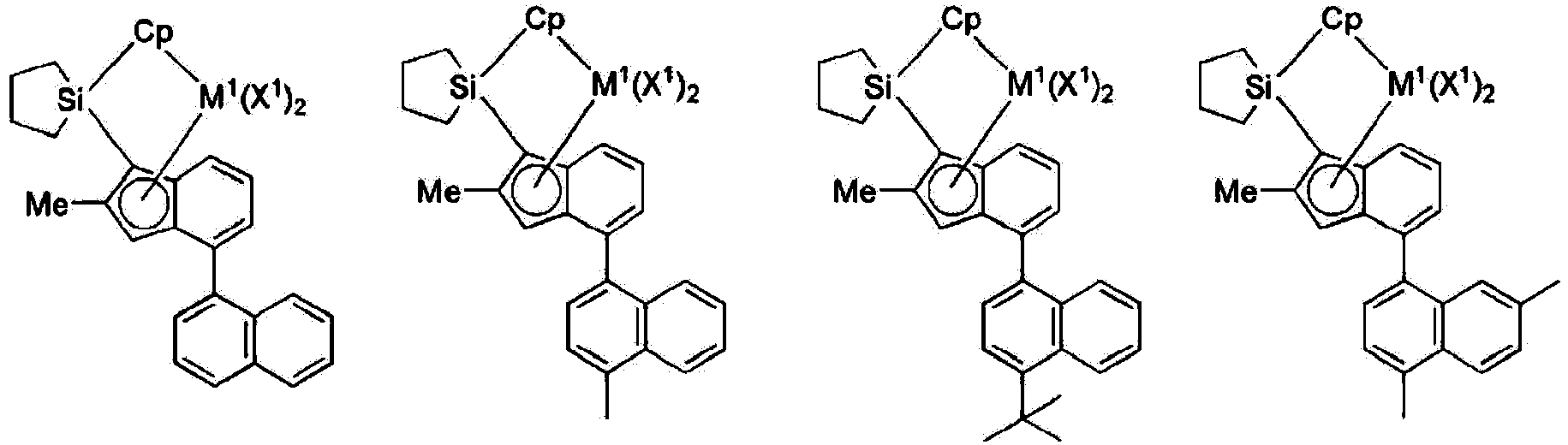


- In the compounds of the above structures, Cp is indenyl, cyclopentadienyl, methylcyclopentadienyl, dimethylcyclopentathienyl, diisopropylcyclopentadienyl, trimethylcyclopentadienyl or tetramethylcyclopentadienyl, and; M1 is tetravalent titanium, zirconium or hafnium; X1 is chloro, fluoro, bromo, methyl, ethyl, propyl, butyl, pentyl, methoxy, ethoxy, propoxy, butoxy or dimethylamino.
- Meanwhile, in order for the transition metal compound of
Formula
[Formula 3] -[Al(Ra)-O]n-
- In Formula 3, Al is aluminum, Ra is a halogen group or a (C1-C20) hydrocarbyl group unsubstituted or substituted with a halogen group, O is oxygen, and n is an integer of 2 or more.
[Formula 4] Q(Rb)3
- In Formula 4, Q is aluminum or boron, each Rb is the same as or different from to others thereof and each thereof is independently a halogen group or a (C1-C20) hydrocarbyl group unsubstituted or substituted with a halogen group.
[Formula 5] [W]+[Z(RC)4]-
- In
Formula 5, [W]+ is a cationic Lewis acid or a cationic Lewis acid bonded with a hydrogen atom, Z is a Group 13 element, each Rc is the same as or different from to others thereof and each thereof may independently be a (C6-C20)aryl group substituted with 1 or 2 or more substituents selected from the group consisting of a halogen group, a (C1-C20) hydrocarbyl group, an alkoxy group, and a phenoxy group; or a (C1-C20) alkyl group substituted with 1 or 2 or more substituents selected from the group consisting of a halogen group, a (C1-C20) hydrocarbyl group, an alkoxy group, and a phenoxy group. - The cocatalyst compound is included in the catalyst composition together with the transition metal compound represented by
Formula Formula 5, which are capable of acting as a counterion having weak binding power, that is, an anion, act together as cocatalysts. - The 'unit' represented by Formula 3 is a structure in which n structures in [ ] are connected in the compound, and as long as the unit represented by Formula 3 is included, other structures in the compound are not particularly limited, and the compound may be a cluster type, for example, a spherical compound in which the repeated units of Formula 3 are connected to each other.
- The compound containing the unit represented by Formula 3 is not particularly limited, and may be preferably an alkylaluminoxane. Non-limiting examples thereof may include methylaluminoxane, ethylaluminoxane, isobutylaluminoxane, butylaluminoxane, and the like. In consideration of the activity of the transition metal compound, methylaluminoxane may be preferably used.
- In addition, the compound represented by Formula 4 is an alkyl metal compound and is not particularly limited, and non-limiting examples thereof may include trimethyl aluminum, triethyl aluminum, triisobutyl aluminum, tripropyl aluminum, tributyl aluminum, dimethyl chloro aluminum, tri isopropyl aluminum, tri-s-butyl aluminum, tricyclopentyl aluminum, tripentyl aluminum, triisopentyl aluminum, trihexyl aluminum, trioctyl aluminum, ethyldimethyl aluminum, methyldiethyl aluminum, triphenyl aluminum, tri-p-tolyl aluminum, dimethyl aluminum methoxide, dimethyl aluminum ethoxide, trimethyl boron, triethyl boron, triisobutyl boron, tripropyl boron, tributyl boron, and the like. In consideration of the activity of the transition metal compound, one or two or more selected from the group consisting of trimethyl aluminum, triethyl aluminum and triisobutyl aluminum may be preferably used.
- When considering the activity of the transition metal compound, the compound represented by
Formula 5 may be a dimethylanilinium cation when the [W]+ is a cationic Lewis acid to which a hydrogen atom is bonded, and may be [(C6H5)3C]+ when [W]+ is a cationic Lewis acid, and the [Z(Rc)4]- may preferably be [B(C6F5)4]-. - The compound represented by
Formula 5 is not particularly limited, but non-limiting examples thereof in the case in which [W]+ is a cationic Lewis acid bonded with a hydrogen atom include triethylammonium tetrakisphenylborate, tributylammonium tetrakisphenylborate, trimethyl ammonium tetrakisphenylborate, tripropylammonium tetrakisphenylborate, trimethylammonium tetrakis(p-tolyl)borate, tripropylammonium tetrakis(p-tolyl)borate, trimethylammonium tetrakis(o,p-dimethylphenyl)borate, triethylammonium tetrakis (o,p-dimethylphenyl)borate, tributylammonium tetrakis (p-trifluoromethylphenyl)borate, trimethylammonium tetrakis (p-trifluoromethylphenyl) borate, tributylammonium tetrakispentafluorophenylborate, anilinium tetrakisphenylborate, anilinium tetrakis(pentafluorophenyl) borate, N,N-dimethylanilinium tetrakis(pentafluoro Phenyl) borate, N,N-diethylanilinium tetrakisfetylborate, N,N-diethylanilinium tetrakisphenylborate, N,N-diethylanilinium tetrakispentafluorophenylborate, di ethyl ammonium tetrakispentafluorophenyl borate, triphenylphosphonium tetrakisphenyl borate, trimethylphosphonium tetrakisphenyl borate, triphenylcarbonium tetrakis(p-trifluoromethylphenyl) borate, triphenylcarbonium tetrakispentafluorophenyl borate, dimethylanilinium tetrakis(pentafluorophenyl) borate, and the like. - The amount of the cocatalyst compound added may be determined in consideration of the amount of the transition metal compound represented by
Formula Formula - In more detail, the compound represented by Formula 3 may be preferably included in a molar ratio of 1:10 to 5,000, more preferably 1:50 to 1,000 molar ratio, most preferably, 1:100 to 1,000 molar ratio. If the molar ratio of the compound represented by Formula 3 to the transition metal compound of
Formula - In addition, when Q in the cocatalyst compound represented by Formula 4 is boron, boron may be supported in a molar ratio of 1:1 to 100, preferably 1:1 to 10, more preferably 1:1 to 3, with respect to the transition metal compound represented by
Formula Formula - In addition, the cocatalyst compound represented by
Formula 5 may be supported in a molar ratio of 1:1 to 100, preferably 1:1 to 10, more preferably 1:1 to 4, with respect to the transition metal compound represented byFormula Formula 5 is less than 1:1, the amount of the activator is relatively small, so that the activation of the metal compound is not completely achieved, and thus there may be a problem that the activity of the resulting catalyst composition is poor. If it exceeds 1:100, activation of the metal compound is completely achieved, but there may be a problem in that the unit cost of the catalyst composition is not economical or the purity of the resulting polymer is deteriorated due to an excessive amount of the remaining activator. - The catalyst composition presented in the present disclosure exists in a uniform form in the polymerization reactor, and thus, may be applied to a solution polymerization process carried out at a temperature equal to or higher than the melting point of the polymer. However, as disclosed in
U.S. Patent No. 4,752,597 , the catalyst composition may be used for slurry polymerization or gas phase polymerization process in the form of a heterogeneous catalyst composition obtained by supporting the transition metal catalyst and the cocatalyst on a porous metal oxide support. Therefore, the catalyst composition of the present disclosure may be used together with an inorganic carrier or an organic polymer carrier, and thus, may be applied to a slurry polymerization or gas phase polymerization process. For example, the transition metal compound and the cocatalyst compound may also be used in a form supported on an inorganic carrier or an organic polymer carrier. - The method of producing a polypropylene resin according to an exemplary embodiment of the present disclosure is prepared by polymerizing a propylene monomer in the presence of the transition metal catalyst composition. In this case, the transition metal catalyst and the cocatalyst component may be separately introduced into the reactor, or respective components may be mixed in advance and introduced into the reactor, and the mixing conditions such as the order of addition, temperature, or concentration are not particularly limited.
- The molecular weight of the polypropylene may be adjusted by the introduction of hydrogen. The hydrogen is preferably added in an amount of 0 to 1 mole per 100 moles of the propylene monomer.
- Polypropylene polymerization by reaction of the propylene monomer may be performed at a temperature of 40 to 80°C for 20 to 120 minutes, and in more detail, may be carried out at a temperature of 60 to 80 °C.
- If necessary, prior to polymerization of the main chain of the polypropylene, prepolymerization may be performed. The prepolymerization may be performed for at least 3 minutes or more, preferably 5 to 30 minutes, after the catalyst is introduced into the reactor and the reaction temperature reaches 5 to 60°C.
- In this manner, after prepolymerization of polypropylene or without prepolymerization, polymerization of polypropylene may be performed by raising the temperature of the reactor, thereby obtaining a polypropylene main chain.
- In the present disclosure, a diene compound and a comonomer are reacted with the obtained polypropylene main chain and unreacted propylene monomer to form a long-chain branch in the polypropylene main chain and the reacting propylene monomer.
- The diene compound may be one or more selected from aliphatic diene and aromatic diene of (C4 to C20), and may be a compound selected from the group consisting of 1,4-hexadiene, 1,5-hexadiene, 1,6-heptadiene, 1,7-octadiene, 1,8-nonadiene, 1,9-decadiene, 1,10-undecadiene, 1,11-dodecadiene, 1,8-ethylidene, norbornene, dicyclopentadiene, novonadiene, 4-vinyl-1-cyclohexene, 3-vinyl-1-cyclohexene, 2-vinyl-1-cyclohexene, 1-vinyl-1-cyclohexene, o-divinylbenzene, p-divinylbenzene and m-divinylbenzene, which may be used alone or in combination of two or more.
- In this case, the diene compound is preferably added in an amount of 0.0001 to 5 parts by weight based on 100 parts by weight of the propylene monomer. If it is out of the above content, it may exhibit undesirable properties in terms of improving the melt strength. For example, if a diene compound is used in an amount less than the above range, the melt strength is not sufficiently expressed, and if a diene compound is used in an excessive amount beyond the above range, a large amount of gel may be generated.
- The comonomer may be one or more selected from olefins of ethene, propene, 1-butene, 1-pentene, 1-hexene, 1-heptene, 1-octene, 1-nonene, 1-decene, 1-undecene, and 1-dodecene.
- In this case, the comonomer is preferably added in an amount of 0.1 to 20 parts by weight based on 100 parts by weight of the propylene monomer. If the content of the comonomer is less than the above range, there is no improvement in processability, and if used in an excessive amount beyond the above range, undesirable changes in physical properties may occur.
- The polymerization of the polypropylene main chain and the formation of long-chain branches by reaction of the diene compound may be performed in the same reactor, but it is more preferable to perform in different reactors.
- In detail, if necessary, polymerization of the polypropylene main chain is performed in a first reactor including a prepolymerization unit for prepolymerization, and the polypropylene and unreacted material produced thereby are supplied to a second reactor, and diene and a comonomer may be added to the second reactor to form long-chain branches in the polypropylene main chain. For example, in an exemplary embodiment of the present disclosure, it may be preferable to perform a two-stage reaction process using two continuous reactors. In this case, the first and second reactors are not limited to physically different reactors, and even when the same reactor is used, the reaction conditions and the like may be substantially different.
- In this case, the first reactor and the second reactor may be a batch type reactor, and may also be a continuous reactor such as a loop type.
- According to the method of the present disclosure, the structure of long-chain branches in polypropylene may be controlled, and polypropylene having excellent melt strength and melt elongation may be produced. In addition, a polypropylene having melt strength improved to an optimum level may be obtained while maintaining the gel content at 1% by weight or less.
- In the polypropylene resin obtained by an exemplary embodiment of the present disclosure, a diene compound may be included in an amount of 0.0001 to 5% by weight, a gel content may be 1% by weight or less, a weight average molecular weight (Mw) may be 100,000 to 3,000,000 g/mol, and a molecular weight distribution (Mw/Mn) may be 2 to 20. Furthermore, the polypropylene resin has a melt index (230°C, 2.16kg load) of 0.1 to 50g/10min, and a melt strength thereof (Extensional viscosity fixture in the advanced rheometric expansion system (ARES), 190°C, Extension Rate of 0.1 s-1) has a value of 1 to 30 gf, and a melt elongation rate with a maximum elongational time of 20 seconds or more is provided.
- Hereinafter, the present disclosure will be described in detail by way of examples. However, the following examples specifically illustrate one embodiment of the present disclosure, and the present disclosure is not limited thereto.
- Dimethylsilyl bis(2-methyl-4-butylphenylindenyl)zirconium dichloride (by S-PCI) was used as the transition metal compound.
- All synthesis reactions were performed in an inert atmosphere such as nitrogen, argon or the like, and standard Schlenk technology and glove box technology were used.
- Toluene was further dried by passing Anhydrous Grade (by Sigma-Aldrich) through an activated Molecular Sieve, 4A or an activated alumina layer, and then used. The cocatalyst, methylaluminoxane (MAO) was used by purchasing a 10% toluene solution (HS-MAO-10%) (by Albemarle), and the calcined silica was used without any further treatment. In addition, the catalyst compounds used in the Examples and Comparative Examples were used without further purification.
- Silica (manufacturer: Grace, product name: XPO-2412, 2.0 g) was put in a Schlenk flask (100 ml) in a glove box, and then, 10 ml of anhydrous toluene solution was added thereto.
- In this case, about 10.2 ml of methylaluminoxane (10% by weight of methylaluminoxane in toluene, 15 mmol based on Al, manufacturer: Grace) was slowly added dropwise thereto at 10°C, stirred at 0°C for about 1 hour, and then the temperature was raised to 70°C, stirred for 3 hours, and cooled to 25°C. Thereby, a catalyst compound was obtained.
- Separately, the synthesized catalyst compound (100 pmol) was put in another 100 ml Schlenk flask in the glove box, and was taken out of the glove box, and then 10 ml of anhydrous toluene solution was added thereto.
- In this case, the solution containing methylaluminoxane was slowly added to the solution containing silica and methylaluminoxane at 10°C, heated to 70°C, stirred for 1 hour, cooled to 25°C, and stirred for about 24 hours..
- Then, the resulting reaction product was washed with a sufficient amount of toluene and hexane to remove unreacted aluminum compounds, and then, was dried in vacuum to obtain a supported catalyst.
- The interior of a stainless steel autoclave with an internal volume of 3L was completely replaced with nitrogen.
- While purging with propylene, 2 mmol of triisobutylaluminum (manufactured by Aldrich), 15 mg of hydrogen, and 500 g of propylene were sequentially added, and then the temperature was raised to 40°C.
- 0.05 g of the prepared transition metal compound-supported catalyst was stirred together with 3 ml of n-Hexane in a flask, and then injected into the reactor.
- After prepolymerization was performed for 5 minutes, the temperature was raised to 70°C, the first polymerization reaction was performed for 30 minutes.
- After the first polymerization reaction was performed, 3 ml of diene and 5 g of 1-hexene were injected to perform the second polymerization reaction for 30 minutes.
- To terminate the reaction, the temperature was lowered to room temperature, and then excess propylene gas was discharged to obtain a polymer powder. Subsequently, the polymer powder was dried for 12 hours or more while heating at 80°C in a vacuum oven, to prepare a polypropylene resin.
- Table 1 illustrates the amount of reactants, reaction temperature, and reaction conditions thereof.
- A polypropylene resin was prepared in the same manner as in Example 1 by applying the contents and conditions as illustrated in Table 1.
- In Example 1, except that 1.5 ml of diene was used and diene was immediately added when the reaction temperature reached 70°C without distinction between the first polymerization reaction and the second polymerization reaction, a propylene resin was prepared in the same manner as in Example 1.
- Table 2 shows the amount of reactants, reaction temperature, and reaction conditions.
- A polypropylene resin was prepared in the same manner as in Example 1 by applying the contents and conditions as illustrated in Table 2.
[Table 1] Division Propylene content (g) Hydrogen content (mg) Diene content (ml) Comonomer content (g) Reaction temperature (°C) First reaction time (minutes) Second reaction time (minutes) Example 1 500 15 3 10 70 30 30 Example 2 500 10 1.5 10 70 30 30 Example 3 500 10 0.75 10 70 30 30 Example 4 500 10 1.5 10 70 10 10 Example 5 500 10 1.5 10 70 60 60 Example 6 500 10 3 5 70 30 30 Example 7 500 10 3 20 70 30 30 [Table 2] Division Propylene content (g) Hydrogen content (mg) Diene content (ml) Comonomer content (g) Reaction temperature (°C) First reaction time (minutes) Second reaction time (minutes) Comparative Example 1 500 10 1.5 10 70 60 - Comparative Example 2 500 10 3 10 70 60 - Comparative Example 3 500 10 1.5 - 70 60 - Comparative Example 4 500 10 3 - 70 60 - Comparative Example 5 500 10 3 - 70 30 30 Comparative Example 6 500 10 1.5 - 70 30 30 - Physical properties of the polypropylene resins prepared in Examples 1 to 7 and Comparative Examples 1 to 6 were measured in the following manner, and the results are illustrated in Table 3 below, respectively.
- According to ASTM D 1238, the polypropylene resins are heated to 230°C for 4 min and, respectively, and then passes through the orifice (inner diameter: 2.09 mm, length: 8 mm) for a certain period of time (in minutes) in a state in which a 2.16 kg piston is put in place in the cylinder. The weight of the resins passed through the orifice were measured and converted into passing amounts for 10 minutes.
- Measurements were made using the Extensional viscosity fixture (EVF) mode of the Advanced rheometric expansion system (ARES). The specimens were manufactured by hot press melting or injection, and were manufactured in a length of 20 mm, a width of 10 mm, and a thickness of 7 mm. The specimen was fixed to the sample holder using rheometric measuring equipment (2KFRTN, by TA Instrument Co.), and then the melt strength was measured by the resistance value applied to the specimen when the sample holder rotates about an axis. The maximum value of the melt strength that changes according to the rotation distance (elongation rate) of the sample holder was measured as the melt strength. At this time, the extension rate, which is the rotation speed of the sample holder, was set to 0.1s-1, and the measurement temperature was 190°C.
- When measuring the melt strength, the time that the holder to which the sample is fixed rotates about an axis was converted into the elongation distance of the sample, and measured. The extension rate, which is the rotational speed, was measured by setting to 0.1 s-1. When the sample was elongated over time, the time when the maximum melt strength value was displayed was measured as the melt elongation rate.
- The gel content was measured according to the method of ASTM D2765. The dried product was pulverized, put into xylene, extracted for 12 hours at a boiling point, and the residual amount was measured. At this time, the percentage of the sample remaining after extraction to the weight of the sample before extraction was taken as the gel content.
- Using a PL210 GPC equipped with PL Mixed-BX2+preCol, measurements were made in a 1,2,3-trichlorobenzene solvent at a rate of 1.0 mL/min at 135°C, and the molecular weight was corrected using a PL polystyrene standard material.
- Measurements were made under the 2nd heating condition at a rate of 10°C/min under a nitrogen atmosphere using a Dupont DSC2910.
- Processability was evaluated by measuring the torque of the extruder, and measured with a torque measuring device (measurement method using a load cell device) installed in the extruder.
[Table 3] Division Melt index [g/10min] Melt strength [gf] Elongation Elongation time (Sec) Gel content [wt%] Tm [°C] Mw MWD Processability (Extruder torque) [N·m] Example 1 2.5 12 25 1 152 380k 4.9 36 Example 2 2.3 12 35 0.5 152 400k 4.7 35 Example 3 3.5 4 25 0.3 152 370k 4.7 33 Example 4 5.4 2.2 24 0.3 152 360k 4.5 30 Example 5 3.0 14 30 0.6 152 390k 4.8 35 Example 6 2.5 12 34 0.5 152 390k 4.7 36 Example 7 2.4 10 33 0.2 150 400k 4.9 31 Comparative Example 1 0.5 7 4 1.7 153 480k 5.0 50 Comparative Example 2 0.1 40 14 2.3 152 510k 4.8 55 Comparative Example 3 0.35 15 15 1.7 152 500k 4.6 52 Comparative Example 4 0.45 10 12 1.5 152 480k 4.9 50 Comparative Example 5 2.3 12 34 0.3 152 400k 4.9 43 Comparative Example 6 2.6 9 32 0.2 151 380k 4.7 41 - Referring to Table 3, it can be seen that the polypropylene resins prepared in Examples 1 to 7 according to the method of the present disclosure have excellent catalytic activity, have an appropriate weight average molecular weight and molecular weight distribution, and have superior processability to that of the propylene resins prepared according to Comparative Examples 1 to 6, and have excellent melt elongation while having physical properties suitable for improving the melt strength. For example, according to an exemplary embodiment of the present disclosure, it can be seen that the melt strength may be improved to an optimum level while maintaining the gel content to 1% or less. On the other hand, for the resins of Examples 1 to 5 and Comparative Examples 1 to 4, the change in melt strength according to the melt elongation time is illustrated in
FIGS. 1 and 2 .
Claims (11)
- A method of producing a high-melt-strength polypropylene resin, comprising:producing a polypropylene by polymerizing a propylene monomer in the presence of a metallocene catalyst; andforming a long-chain branch having 40 or more carbon atoms in a main chain of the polypropylene by adding and reacting a diene compound and a comonomer to the produced polypropylene and an unreacted propylene monomer.
- The method of producing a high-melt-strength polypropylene resin of claim 1, wherein the diene compound is at least one selected from aliphatic diene compounds and aromatic diene compounds of (C4 to C20) .
- The method of producing a high-melt-strength polypropylene resin of claim 1, wherein the diene compound is added in an amount of 0.0001 to 5 parts by weight based on 100 parts by weight of the propylene monomer.
- The method of producing a high-melt-strength polypropylene resin of claim 1, wherein the comonomer is at least one selected from the group consisting of ethene, propene, 1-butene, 1-pentene, 1-hexene, 1-heptene, 1-octene, 1-nonene, 1-decene, 1-undecene and 1-dodecene.
- The method of producing a high-melt-strength polypropylene resin of claim 1, wherein the comonomer is added in an amount of 0.1 to 20 parts by weight based on 100 parts by weight of the propylene monomer.
- The method of producing a high-melt-strength polypropylene resin of any one of claims 1 to 5, wherein the producing a polypropylene is carried out in a first reactor, and the forming a long-chain branch in a polypropylene main chain is carried out in a second reactor.
- The method of producing a high-melt-strength polypropylene resin of any one of claims 1 to 5, further comprising prepolymerizing the propylene monomer before the producing the polypropylene.
- The method of producing a high-melt-strength polypropylene resin of any one of claims 1 to 5, wherein the metallocene catalyst comprises at least one transition metal compound of Formula 1 and Formula 2 below:

 M1 and M2 are each independently an element of Group 3 to 10 on the periodic table,X1 and X2 each may independently be a (C1-C20) alkyl group, a (C1-C20) cycloalkyl group, a (C1-C20) alkylsilyl group, a silyl (C1-C20) alkyl group; a (C6-C20) aryl group, a (C6-C20) aryl (C1-C20) alkyl group, a (C1-C20) alkyl (C6-C20) aryl group, a (C6-C20) arylsilyl group, a silyl (C6-C20) aryl group; a (C1-C20) alkoxy group, a (C1-C20) alkylsiloxy group; a (C6-C20) aryloxy group; a halogen group; or an amine group,Ar1 and Ar2, and Ar3 and Ar4, are the same or different from each other, and are each independently a ligand having a skeleton of any one of cyclopentadienyl, methylcyclopentadienyl, dimethylcyclopentathienyl and indenyl,m and n are each independently an integer of 1 to 5,B is selected from carbon, silicon, germanium, nitrogen and phosphorus,L is hydrogen, a (C1-C20) alkyl group, a (C1-C20) cycloalkyl group, a (C1-C20) alkylsilyl group, a silyl (C1-C20) alkyl group, a (C6-C20) aryl group, a (C6-C20) aryl (C1-C20) alkyl group, a (C1-C20) alkyl (C6-C20) aryl group, a (C6-C20) arylsilyl group, or a silyl(C6-C20)aryl group, andp is an integer of 1 or 2.
 - The method of producing a high-melt-strength polypropylene resin of claim 8, wherein the metallocene catalyst further comprises at least one cocatalyst of compounds represented by Formulas 3 to 5:
[Formula 3] -[Al(Ra)-O]n-
where in Formula 3,Al is aluminum;Ra is a halogen group, or a (C1-C20) hydrocarbyl group unsubstituted or substituted with a halogen group,O is oxygen;q is an integer of 2 or more,
[Formula 4] Q(Rb)3
where in Formula 4, Q is aluminum or boron; andeach Rb is the same as or different from to others thereof, and each thereof is independently a halogen group or a (C1-C20) hydrocarbyl group unsubstituted or substituted with a halogen group,
[Formula 5] [W]+[Z(Rc)4]-
where in Formula 5, [W]+ is a cationic Lewis acid, or a cationic Lewis acid to which a hydrogen atom is bonded;Z is a group 13 element;each Rc is the same as or different from to others thereof, and each thereof is independently a (C6-C20) aryl group substituted with 1 or 2 or more substituents selected from the group consisting of a halogen group, a (C1-C20)hydrocarbyl group, an alkoxy group, and a phenoxy group; and a (C1-C20) alkyl group substituted with 1 or 2 or more substituents selected from the group consisting of a halogen group, a (C1-C20) hydrocarbyl group, an alkoxy group and a phenoxy group. - A high-melt-strength polypropylene resin, produced by the method of any one of claims 1 to 5, including a residue of a diene compound in an amount of 0.0001 to 5% by weight, and having a gel content of 1% by weight or less.
- The high-melt-strength polypropylene resin of claim 10, wherein the high-melt-strength polypropylene resin has a melt index (230°C, 2.16 kg load) of 0.1 to 50 g/10 min, an elongation with a maximum melt elongation time of 20 seconds or more, and workability (extruder torque value) of 30 to 40 N·m.
Applications Claiming Priority (2)
| Application Number | Priority Date | Filing Date | Title |
|---|---|---|---|
| KR1020180150791A KR102671695B1 (en) | 2018-11-29 | 2018-11-29 | Polypropylene resin with improved melt properties and method for preparing the same |
| PCT/KR2019/016478 WO2020111777A1 (en) | 2018-11-29 | 2019-11-27 | Polypropylene resin having excellent melt characteristics, and preparation method therefor |
Publications (2)
| Publication Number | Publication Date |
|---|---|
| EP3889191A1 true EP3889191A1 (en) | 2021-10-06 |
| EP3889191A4 EP3889191A4 (en) | 2022-08-17 |
Family
ID=70853001
Family Applications (1)
| Application Number | Title | Priority Date | Filing Date |
|---|---|---|---|
| EP19889955.1A Withdrawn EP3889191A4 (en) | 2018-11-29 | 2019-11-27 | POLYPROPYLENE RESIN HAVING EXCELLENT MELTING CHARACTERISTICS, AND METHOD FOR PREPARING IT |
Country Status (5)
| Country | Link |
|---|---|
| US (1) | US12227602B2 (en) |
| EP (1) | EP3889191A4 (en) |
| JP (1) | JP7502293B2 (en) |
| KR (1) | KR102671695B1 (en) |
| WO (1) | WO2020111777A1 (en) |
Cited By (1)
| Publication number | Priority date | Publication date | Assignee | Title |
|---|---|---|---|---|
| EP4029884A4 (en) * | 2020-08-04 | 2022-12-28 | LG Chem, Ltd. | Hybrid supported metallocene catalyst, and method for preparing polypropylene using same |
Family Cites Families (26)
| Publication number | Priority date | Publication date | Assignee | Title |
|---|---|---|---|---|
| US4525257A (en) | 1982-12-27 | 1985-06-25 | Union Carbide Corporation | Low level irradiated linear low density ethylene/alpha-olefin copolymers and film extruded therefrom |
| EP0190889B2 (en) | 1985-01-31 | 2000-07-05 | Montell North America Inc. | Polypropylene with free-end long chain branching, process for making it, and use thereof |
| US4752597A (en) | 1985-12-12 | 1988-06-21 | Exxon Chemical Patents Inc. | New polymerization catalyst |
| US5416169A (en) | 1992-11-26 | 1995-05-16 | Chisso Corporation | Polypropylene having a high melt-tensile strength, a process for producing the same and a molded product from the same |
| WO1994019382A1 (en) * | 1993-02-24 | 1994-09-01 | Idemitsu Kosan Co., Ltd. | Propylene block copolymer, process for producing the same, and modified copolymer produced therefrom |
| US5368919A (en) | 1993-05-20 | 1994-11-29 | Himont Incorporated | Propylene polymer compositions containing high melt strength propylene polymer material |
| US5414027A (en) | 1993-07-15 | 1995-05-09 | Himont Incorporated | High melt strength, propylene polymer, process for making it, and use thereof |
| FR2717485B1 (en) | 1994-03-17 | 1996-06-07 | Solvay | Propylene polymers and process for their production. |
| JPH11508932A (en) * | 1995-07-06 | 1999-08-03 | エクソン・ケミカル・パテンツ・インク | Method for producing a prepolymerized and supported metallocene catalyst system |
| CN1093141C (en) | 1996-05-17 | 2002-10-23 | Bp化学有限公司 | Polyolefin copolymer composition in which the maximum molecular weight occurs in the fraction of the composition with the highest comonomer content |
| KR100490509B1 (en) * | 1996-05-17 | 2005-09-30 | 비피 케미칼즈 리미티드 | Polyolefin composition with molecular weight maximum occuring in that part of the composition that has the highest comonomer content |
| TW341579B (en) | 1996-06-24 | 1998-10-01 | Akzo Nobel Nv | Process for enhancing the melt strength of polypropylene (co)polymers |
| DE69809192T2 (en) | 1997-02-07 | 2003-07-24 | Exxonmobil Chemical Patents Inc., Baytown | PROPYLENE POLYMERS CONTAINING POLYETHYLENE MACROMONOMERS |
| JP2001172465A (en) | 1999-12-15 | 2001-06-26 | Tokuyama Corp | Propylene resin composition and method for producing the same |
| KR20040054596A (en) | 2000-12-20 | 2004-06-25 | 엑손모빌 케미칼 패턴츠 인코포레이티드 | Olefin polymerization process to produce branched polymer compositions |
| JP4326802B2 (en) | 2001-03-12 | 2009-09-09 | 出光興産株式会社 | Method for producing polyolefin resin composition |
| KR100612109B1 (en) | 2004-11-04 | 2006-08-11 | 삼성토탈 주식회사 | Highly elastic polypropylene resin composition excellent in vacuum formability |
| KR100695336B1 (en) | 2006-03-08 | 2007-03-16 | 삼성토탈 주식회사 | Propylene polymer with high melt strength and its manufacturing method |
| ATE424424T1 (en) * | 2006-12-28 | 2009-03-15 | Borealis Tech Oy | METHOD FOR PRODUCING BRANCHED POLYPROPYLENE |
| EP2196481A1 (en) | 2008-12-12 | 2010-06-16 | Total Petrochemicals Research Feluy | Preparation of long-chain branched isotactic polypropylene. |
| ES2599456T3 (en) | 2012-06-28 | 2017-02-01 | Borealis Ag | High melt strength polypropylene with improved quality |
| CN107396636B (en) | 2015-02-04 | 2020-06-23 | 埃克森美孚化学专利公司 | Stabilized Balanced Melt Strength and Strain Hardening Polypropylene |
| KR101695086B1 (en) | 2015-04-14 | 2017-01-11 | 농협은행(주) | Apparatus for issuing card for banking experience education |
| US10280235B2 (en) | 2015-06-05 | 2019-05-07 | Exxonmobil Chemical Patents Inc. | Catalyst system containing high surface area supports and sequential polymerization to produce heterophasic polymers |
| KR101810317B1 (en) | 2016-04-06 | 2017-12-19 | 롯데케미칼 주식회사 | High melt strength polypropylene resin composition |
| KR101859286B1 (en) * | 2016-09-26 | 2018-06-29 | 롯데케미칼 주식회사 | Preparing method for high melt strength polypropylene resin composition |
-
2018
- 2018-11-29 KR KR1020180150791A patent/KR102671695B1/en active Active
-
2019
- 2019-11-27 EP EP19889955.1A patent/EP3889191A4/en not_active Withdrawn
- 2019-11-27 US US17/296,936 patent/US12227602B2/en active Active
- 2019-11-27 JP JP2021530783A patent/JP7502293B2/en active Active
- 2019-11-27 WO PCT/KR2019/016478 patent/WO2020111777A1/en not_active Ceased
Cited By (2)
| Publication number | Priority date | Publication date | Assignee | Title |
|---|---|---|---|---|
| EP4029884A4 (en) * | 2020-08-04 | 2022-12-28 | LG Chem, Ltd. | Hybrid supported metallocene catalyst, and method for preparing polypropylene using same |
| US12528891B2 (en) | 2020-08-04 | 2026-01-20 | Lg Chem, Ltd. | Hybrid supported metallocene catalyst and method for preparing polypropylene using the same |
Also Published As
| Publication number | Publication date |
|---|---|
| US12227602B2 (en) | 2025-02-18 |
| US20220025083A1 (en) | 2022-01-27 |
| KR102671695B1 (en) | 2024-06-05 |
| WO2020111777A1 (en) | 2020-06-04 |
| JP2022511452A (en) | 2022-01-31 |
| EP3889191A4 (en) | 2022-08-17 |
| JP7502293B2 (en) | 2024-06-18 |
| KR20200065147A (en) | 2020-06-09 |
Similar Documents
| Publication | Publication Date | Title |
|---|---|---|
| JP6811783B2 (en) | Hybrid catalyst composition, its production method, and polyolefins produced using it. | |
| EP3031832A1 (en) | Method for preparing polyolefin and polyolefin prepared thereby | |
| EP3042918B1 (en) | Olefin-based polymer with excellent processability | |
| EP3441407B1 (en) | Propylene-diene copolymer resin having excellent melt tension | |
| KR20050098663A (en) | Polyethylene pipe having good melt processibilty and high resistance to stress and method for preparing the same using metallocene catalysts | |
| KR102682379B1 (en) | High melt strength polypropylene resin manufacturing method | |
| KR20220009900A (en) | Transition metal compound and catalyst composition comprising the same | |
| KR102849918B1 (en) | Method for preparing polypropylene resin with improved melt strength, polypropylene and foam using thereof | |
| KR101859286B1 (en) | Preparing method for high melt strength polypropylene resin composition | |
| KR20180054357A (en) | Method for preararing polypropylene | |
| EP3560965A1 (en) | Olefin polymer, preparation method therefor and film using same | |
| US12227602B2 (en) | Polypropylene resin having excellent melt characteristics, and preparation method therefor | |
| KR101810316B1 (en) | A supported catalyst for propylene polymerization | |
| KR101734427B1 (en) | Supported catalyst and method for preparing of olefin based polymer using the same | |
| KR20190029064A (en) | Ethylene/alpha-olefin copolymer | |
| EP4438639A1 (en) | Ethylene alpha-olefin copolymer and resin composition containing same | |
| KR101793823B1 (en) | Preparing method for high melt strength polypropylene resin composition | |
| KR102851099B1 (en) | Method for preparing polypropylene with improved melt strengh properties, and polypropylene prepared therefrom | |
| KR102778393B1 (en) | Transition metal compound, and catalystic composition comprising the same | |
| JP7130301B2 (en) | Olefin-based copolymer and method for producing the same | |
| KR20210065775A (en) | Method for preparing polypropylene resin with improved melt properties and the polypropylene resin | |
| EP3524612B1 (en) | Ligand compound, transition metal compound, and catalyst composition comprising the transition metal compound | |
| KR102230621B1 (en) | Bimetallic metallocene compound, method for preparing the same, catalyst composition and method for preparing polyolefin using the same | |
| KR20180060280A (en) | Method for preparing polyolefin having an excellent environment stress crack resistancnellent using the same | |
| KR20220043693A (en) | Hybrid supported metallocene catalyst and preparing mehtod a polyolefin using the same |
Legal Events
| Date | Code | Title | Description |
|---|---|---|---|
| STAA | Information on the status of an ep patent application or granted ep patent |
Free format text: STATUS: THE INTERNATIONAL PUBLICATION HAS BEEN MADE |
|
| PUAI | Public reference made under article 153(3) epc to a published international application that has entered the european phase |
Free format text: ORIGINAL CODE: 0009012 |
|
| STAA | Information on the status of an ep patent application or granted ep patent |
Free format text: STATUS: REQUEST FOR EXAMINATION WAS MADE |
|
| 17P | Request for examination filed |
Effective date: 20210607 |
|
| AK | Designated contracting states |
Kind code of ref document: A1 Designated state(s): AL AT BE BG CH CY CZ DE DK EE ES FI FR GB GR HR HU IE IS IT LI LT LU LV MC MK MT NL NO PL PT RO RS SE SI SK SM TR |
|
| DAV | Request for validation of the european patent (deleted) | ||
| DAX | Request for extension of the european patent (deleted) | ||
| A4 | Supplementary search report drawn up and despatched |
Effective date: 20220719 |
|
| RIC1 | Information provided on ipc code assigned before grant |
Ipc: C08L 23/12 20060101ALI20220713BHEP Ipc: C08F 4/52 20060101ALI20220713BHEP Ipc: C08F 4/659 20060101ALI20220713BHEP Ipc: C08F 4/6592 20060101ALI20220713BHEP Ipc: C08F 8/46 20060101ALI20220713BHEP Ipc: C08F 255/02 20060101ALI20220713BHEP Ipc: C08F 210/06 20060101AFI20220713BHEP |
|
| STAA | Information on the status of an ep patent application or granted ep patent |
Free format text: STATUS: EXAMINATION IS IN PROGRESS |
|
| 17Q | First examination report despatched |
Effective date: 20250603 |
|
| STAA | Information on the status of an ep patent application or granted ep patent |
Free format text: STATUS: THE APPLICATION IS DEEMED TO BE WITHDRAWN |
|
| 18D | Application deemed to be withdrawn |
Effective date: 20251007 |