EP3889187A1 - Sulfur-modified chloroprene rubber, method for producing same, sulfur-modified chloroprene rubber composition, vulcanized product and molded article - Google Patents
Sulfur-modified chloroprene rubber, method for producing same, sulfur-modified chloroprene rubber composition, vulcanized product and molded article Download PDFInfo
- Publication number
- EP3889187A1 EP3889187A1 EP20773432.8A EP20773432A EP3889187A1 EP 3889187 A1 EP3889187 A1 EP 3889187A1 EP 20773432 A EP20773432 A EP 20773432A EP 3889187 A1 EP3889187 A1 EP 3889187A1
- Authority
- EP
- European Patent Office
- Prior art keywords
- mass
- sulfur
- chloroprene rubber
- modified chloroprene
- parts
- Prior art date
- Legal status (The legal status is an assumption and is not a legal conclusion. Google has not performed a legal analysis and makes no representation as to the accuracy of the status listed.)
- Granted
Links
Classifications
-
- C—CHEMISTRY; METALLURGY
- C08—ORGANIC MACROMOLECULAR COMPOUNDS; THEIR PREPARATION OR CHEMICAL WORKING-UP; COMPOSITIONS BASED THEREON
- C08C—TREATMENT OR CHEMICAL MODIFICATION OF RUBBERS
- C08C19/00—Chemical modification of rubber
- C08C19/22—Incorporating nitrogen atoms into the molecule
-
- C—CHEMISTRY; METALLURGY
- C08—ORGANIC MACROMOLECULAR COMPOUNDS; THEIR PREPARATION OR CHEMICAL WORKING-UP; COMPOSITIONS BASED THEREON
- C08C—TREATMENT OR CHEMICAL MODIFICATION OF RUBBERS
- C08C19/00—Chemical modification of rubber
- C08C19/20—Incorporating sulfur atoms into the molecule
-
- C—CHEMISTRY; METALLURGY
- C08—ORGANIC MACROMOLECULAR COMPOUNDS; THEIR PREPARATION OR CHEMICAL WORKING-UP; COMPOSITIONS BASED THEREON
- C08F—MACROMOLECULAR COMPOUNDS OBTAINED BY REACTIONS ONLY INVOLVING CARBON-TO-CARBON UNSATURATED BONDS
- C08F136/00—Homopolymers of compounds having one or more unsaturated aliphatic radicals, at least one having two or more carbon-to-carbon double bonds
- C08F136/02—Homopolymers of compounds having one or more unsaturated aliphatic radicals, at least one having two or more carbon-to-carbon double bonds the radical having only two carbon-to-carbon double bonds
- C08F136/04—Homopolymers of compounds having one or more unsaturated aliphatic radicals, at least one having two or more carbon-to-carbon double bonds the radical having only two carbon-to-carbon double bonds conjugated
- C08F136/14—Homopolymers of compounds having one or more unsaturated aliphatic radicals, at least one having two or more carbon-to-carbon double bonds the radical having only two carbon-to-carbon double bonds conjugated containing elements other than carbon and hydrogen
- C08F136/16—Homopolymers of compounds having one or more unsaturated aliphatic radicals, at least one having two or more carbon-to-carbon double bonds the radical having only two carbon-to-carbon double bonds conjugated containing elements other than carbon and hydrogen containing halogen
- C08F136/18—Homopolymers of compounds having one or more unsaturated aliphatic radicals, at least one having two or more carbon-to-carbon double bonds the radical having only two carbon-to-carbon double bonds conjugated containing elements other than carbon and hydrogen containing halogen containing chlorine
-
- C—CHEMISTRY; METALLURGY
- C08—ORGANIC MACROMOLECULAR COMPOUNDS; THEIR PREPARATION OR CHEMICAL WORKING-UP; COMPOSITIONS BASED THEREON
- C08K—Use of inorganic or non-macromolecular organic substances as compounding ingredients
- C08K5/00—Use of organic ingredients
- C08K5/36—Sulfur-, selenium-, or tellurium-containing compounds
- C08K5/38—Thiocarbonic acids; Derivatives thereof, e.g. xanthates ; i.e. compounds containing -X-C(=X)- groups, X being oxygen or sulfur, at least one X being sulfur
-
- C—CHEMISTRY; METALLURGY
- C08—ORGANIC MACROMOLECULAR COMPOUNDS; THEIR PREPARATION OR CHEMICAL WORKING-UP; COMPOSITIONS BASED THEREON
- C08K—Use of inorganic or non-macromolecular organic substances as compounding ingredients
- C08K5/00—Use of organic ingredients
- C08K5/36—Sulfur-, selenium-, or tellurium-containing compounds
- C08K5/39—Thiocarbamic acids; Derivatives thereof, e.g. dithiocarbamates
Definitions
- the present invention relates to a sulfur-modified chloroprene rubber, a method for producing the same, a sulfur-modified chloroprene rubber composition, a vulcanizate, and a molded article.
- Sulfur-modified chloroprene rubbers have been widely used as materials for common industrial transmission belts or conveyor belts; automobile air springs; vibration-proof rubbers: sponges; and the like, while utilizing excellent dynamic properties of vulcanizates thereof. Since these products deform and return to their original shape repeatedly under dynamic stress, there are problems in that the rubbers themselves generate heat and deteriorate and in that product lifetime is shortened. Thus, there exists a craving for development of a sulfur-modified chloroprene rubber with reduced exothermicity.
- a low-exothermicity rubber composition containing an elastomer such as an acrylonitrile-butadiene copolymer rubber, a metal salt of ⁇ , ⁇ -ethylenic unsaturated carboxylic acid, magnesium oxide having a BET specific surface area of 25 m 2 /g or less, and an organic peroxide-based crosslinking agent (see, for example, Patent Literature 1 below).
- an elastomer such as an acrylonitrile-butadiene copolymer rubber
- a metal salt of ⁇ , ⁇ -ethylenic unsaturated carboxylic acid magnesium oxide having a BET specific surface area of 25 m 2 /g or less
- an organic peroxide-based crosslinking agent see, for example, Patent Literature 1 below.
- Patent Literature 2 a rubber composition containing a specific low-exothermicity carbon black with a rubber component
- Patent Literature 3 a modified conjugated diene-based polymer obtained by mixing a high-molecular weight component having predetermined properties and a low-molecular weight component having predetermined properties
- an aspect of the present invention is intended to provide a sulfur-modified chloroprene rubber with which a vulcanizate with reduced exothermicity is obtained.
- Another aspect of the present invention is intended to provide a sulfur-modified chloroprene rubber composition containing the above-described sulfur-modified chloroprene rubber.
- Still another aspect of the present invention is intended to provide a vulcanizate of the above-described sulfur-modified chloroprene rubber.
- Still another aspect of the present invention is intended to provide a molded article made of the above-described vulcanizate (a molded article using the vulcanizate).
- Still another aspect of the present invention is intended to provide a method for producing the above-described sulfur-modified chloroprene rubber.
- the inventors of the present application have conducted intensive studies in order to solve such problems, and as a result, they have succeeded in producing a sulfur-modified chloroprene rubber with which a vulcanizate with reduced exothermicity is obtained, by introducing a specific structure in a molecular terminal of a sulfur-modified chloroprene rubber, thereby completing the present invention.
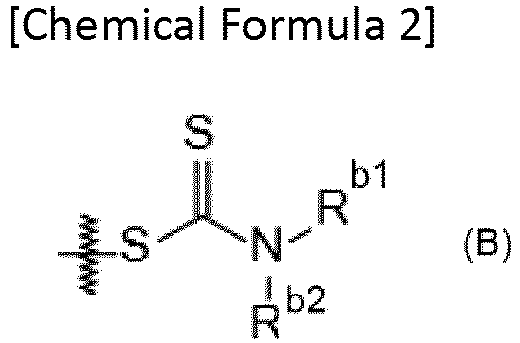
- An aspect of the present invention provides a sulfur-modified chloroprene rubber having a functional group A represented by General Formula (A) below and positioned at a molecular terminal and a functional group B represented by General Formula (B) below and positioned at a molecular terminal, in which a mass ratio B/A of a content of the functional group B with respect to a content of the functional group A is 0.10 to 12.00, and a total amount of the functional group A and the functional group B is 0.15 to 1.00% by mass.
- R a represents a hydrogen atom or an alkyl group having 1 to 4 carbon atoms which may have a substituent.
- R b1 and R b2 each independently represent an alkyl group which may have a substituent or an aryl group which may have a substituent.
- Still another aspect of the present invention provides a method for producing the aforementioned sulfur-modified chloroprene rubber or a method for producing the sulfur-modified chloroprene rubber of the aforementioned sulfur-modified chloroprene rubber composition, the method having a step of subjecting chloroprene to emulsion polymerization in the presence of sulfur to obtain a polymer, and a mixing step of mixing the polymer, an alkylxanthogen disulfide, and a dithiocarbamic acid-based compound.
- a sulfur-modified chloroprene rubber with which a vulcanizate with reduced exothermicity is obtained.
- a sulfur-modified chloroprene rubber composition containing the above-described sulfur-modified chloroprene rubber.
- a vulcanizate of the above-described sulfur-modified chloroprene rubber it is possible to provide a molded article made of the above-described vulcanizate (a molded article using the vulcanizate).
- a method for producing the above-described sulfur-modified chloroprene rubber it is possible to provide a method for producing the above-described sulfur-modified chloroprene rubber.
- a numerical range that has been indicated by use of “to” indicates the range that includes the numerical values which are described before and after “to", as the minimum value and the maximum value, respectively.
- “A or more” of the numerical range means A and a range of more than A.
- “A or less” of the numerical range means A and a range of less than A.
- the upper limit value or the lower limit value of the numerical range of a certain stage can be arbitrarily combined with the upper limit value or the lower limit value of the numerical range of another stage.
- the upper limit value or the lower limit value of the numerical value range may be replaced with the value shown in Examples.
- a or B may include any one of A and B, and may also include both of A and B. Materials listed as examples in the present specification may be used singly or in combinations of two or more kinds thereof, unless otherwise specified.
- the content of each component in the composition means the total amount of the plurality of substances that exist in the composition, unless otherwise specified.
- An “alkyl group” may be linear, branched or cyclic, unless otherwise specified.
- a sulfur-modified chloroprene rubber of the present embodiment has a functional group A represented by General Formula (A) below and positioned at a molecular terminal (hereinafter, referred to as "terminal functional group A”) and a functional group B represented by General Formula (B) below and positioned at a molecular terminal (hereinafter, referred to as "terminal functional group B”), in which a mass ratio B/A of a content of the terminal functional group B with respect to a content of the terminal functional group A is 0.10 to 12.00, and a total amount of the terminal functional group A and the terminal functional group B is 0.15 to 1.00% by mass.
- the sulfur-modified chloroprene rubber of the present embodiment is a sulfur-modified chloroprene rubber having a structure represented by General Formula (A) below and a structure represented by General Formula (B) below at a molecular terminal, in which the mass ratio B/A of the terminal functional group A represented by General Formula (A) below and the terminal functional group B represented by General Formula (B) below is 0.10 to 12.00, and the total amount (A + B) of the terminal functional group A and the terminal functional group B in 100 parts by mass of the sulfur-modified chloroprene rubber is 0.15 to 1.00 part by mass.
- R a represents a hydrogen atom or an alkyl group having 1 to 4 carbon atoms which may have a substituent.
- R b1 and R b2 each independently represent an alkyl group which may have a substituent or an aryl group which may have a substituent, and R b1 and R b2 may be identical to or different from each other.
- a vulcanizate can be obtained by vulcanizing the sulfur-modified chloroprene rubber of the present embodiment.
- a vulcanizate with reduced exothermicity (having excellent heat generation resistance) is obtained as a vulcanizate obtained by vulcanizing the sulfur-modified chloroprene rubber.
- a chloroprene rubber composition containing 100 parts by mass in total of a chloroprene rubber and natural rubber, 0.1 to 10 parts by mass of a copolymer of styrene and butadiene, 0.1 to 3 parts by mass of ethylene thiourea, and 0.1 to 3 parts by mass of dipentamethylenethiuram tetrasulfide (see, for example, Patent Literature 4 above).
- a technique of improving the scorch resistance of a chloroprene rubber known is a rubber composition containing 100 parts by weight of a chloroprene rubber, 1 to 10 parts by weight of an amine salt of dithiocarbamic acid, and 0.1 to 5 parts by weight of at least one compound selected from the group consisting of a thiuram-based vulcanization accelerator, a guanidine-based vulcanization accelerator, a thiazole-based vulcanization accelerator, and a sulfenamide-based vulcanization accelerator (see, for example, Patent Literature 5 above).
- the sulfur-modified chloroprene rubber of the present embodiment is a polymer having a structural unit derived from chloroprene (2-chloro-1,3-butadiene).
- the sulfur-modified chloroprene rubber includes a sulfur atom in a molecule chain, and may include a sulfur atom in a main chain.
- the sulfur-modified chloroprene rubber may include a polysulfide bond (S 2 to S 8 ) in a molecule chain, and may include a polysulfide bond (S 2 to S 8 ) in a main chain.
- the sulfur-modified chloroprene rubber of the present embodiment may have a structural unit derived from a monomer copolymerizable with chloroprene.
- the monomer copolymerizable with chloroprene include 2,3-dichloro-1,3-butadiene, 1-chloro-1,3-butadiene, styrene, acrylonitrile, methacrylonitrile, isoprene, butadiene, methacrylic acid, and esters.
- the monomer copolymerizable with chloroprene may be used alone or in combination of two or more kinds thereof.
- the crystallization speed of a sulfur-modified chloroprene rubber to be obtained can be delayed.
- a sulfur-modified chloroprene rubber with a slow crystallization speed can maintain rubber elasticity even in a low-temperature environment, and for example, low-temperature compression set can be improved.
- the used amount of the monomer copolymerizable with chloroprene (the content of the structural unit derived from the monomer copolymerizable with chloroprene) is preferably 10% by mass or less in all the monomers including chloroprene (the total amount of the structural units constituting the sulfur-modified chloroprene rubber).
- this used amount is 10% by mass or less, the heat resistance of the sulfur-modified chloroprene rubber to be obtained is easily improved and deterioration in processability is easily suppressed.
- the used amount of chloroprene (the content of the structural unit derived from chloroprene) is preferably 90% by mass or more, 92% by mass or more, 95% by mass or more, or 98% by mass or more in all the monomers including chloroprene (the total amount of the structural units constituting the sulfur-modified chloroprene rubber).
- An aspect in which the structural unit constituting the sulfur-modified chloroprene rubber is composed of the structural unit derived from chloroprene (substantially 100% by mass of the structural unit constituting the sulfur-modified chloroprene rubber is the structural unit derived from chloroprene) may be employed.
- the terminal functional group A may be positioned at the terminal of the main chain and/or the side chain.
- the terminal functional group A can be obtained, for example, by using an alkylxanthogen disulfide in a plasticization step described below.
- the substituent with respect to the alkyl group for R a include a halogen atom, a hydroxy group, an alkoxy group, a carboxy group, a carboxylate group, a cyano group, a sulfo group, a sulfonate group, a nitro group, and an amino group.
- the alkyl group for R a may not have a substituent.
- R a is preferably an alkyl group having 1 to 4 carbon atoms, more preferably an alkyl group having 1 to 3 carbon atoms, and further preferably an alkyl group having 2 or 3 carbon atoms.
- the terminal functional group B may be positioned at the terminal of the main chain and/or the side chain.
- the terminal functional group B can be obtained, for example, by using a dithiocarbamic acid-based compound in a plasticization step described below.
- the number of carbon atoms of at least one selected from R b1 and R b2 is preferably 6 to 10, more preferably 7 to 9, and further preferably 7 to 8, from the viewpoint of easily obtaining a vulcanizate having excellent scorch resistance and having reduced compression set and exothermicity.
- substituent with respect to the alkyl group for R b1 or R b2 include a halogen atom, a hydroxy group, an alkoxy group, a carboxy group, a carboxylate group, a cyano group, a sulfo group, a sulfonate group, a nitro group, and an amino group.
- Examples of the aryl group for R b1 or R b2 include a benzyl group, a phenyl group, a tolyl group, a xylyl group, and a naphthyl group.
- Examples of the substituent with respect to the aryl group for R b1 or R b2 include an alkyl group, a halogen atom, a hydroxy group, an alkoxy group, a carboxy group, a carboxylate group, a cyano group, a sulfo group, a sulfonate group, a nitro group, and an amino group.
- the alkyl group or the aryl group for R b1 or R b2 may not have a substituent.
- the content of the terminal functional group A is preferably in the following range on the basis of the total amount of the sulfur-modified chloroprene rubber (that is, the sulfur-modified chloroprene rubber preferably contains the following numerical value content (unit: parts by mass) of the terminal functional group A with respect to 100 parts by mass of the sulfur-modified chloroprene rubber).
- the content of the terminal functional group A is preferably 0.50% by mass or less, 0.45% by mass or less, 0.42% by mass or less, 0.40% by mass or less, 0.38% by mass or less, 0.35% by mass or less, 0.30% by mass or less, 0.25% by mass or less, or 0.23% by mass or less, from the viewpoints of improving the scorch resistance of a vulcanizate to be obtained and further reducing the compression set and the exothermicity.
- the content of the terminal functional group A is preferably 0.01% by mass or more, 0.03% by mass or more, 0.04% by mass or more, 0.05% by mass or more, 0.06% by mass or more, 0.08% by mass or more, 0.09% by mass or more, 0.10% by mass or more, 0.11% by mass or more, 0.12% by mass or more, 0.13% by mass or more, 0.14% by mass or more, or 0.15% by mass or more, from the viewpoints of improving the scorch resistance of a vulcanizate to be obtained and further reducing the compression set and the exothermicity. From these viewpoints, the content of the terminal functional group A is preferably 0.01 to 0.50% by mass or 0.05 to 0.40% by mass.
- the content of the terminal functional group A may be 0.20% by mass or less, 0.18% by mass or less, 0.16% by mass or less, 0.15% by mass or less, 0.14% by mass or less, 0.13% by mass or less, 0.12% by mass or less, 0.11% by mass or less, 0.10% by mass or less, 0.09% by mass or less, 0.08% by mass or less, 0.07% by mass or less, 0.06% by mass or less, 0.05% by mass or less, or 0.04% by mass or less.
- the content of the terminal functional group A may be 0.16% by mass or more, 0.18% by mass or more, 0.20% by mass or more, 0.23% by mass or more, 0.25% by mass or more, 0.30% by mass or more, 0.35% by mass or more, 0.38% by mass or more, 0.40% by mass or more, or 0.42% by mass or more.
- the content of the terminal functional group A can be adjusted by the amount of the alkylxanthogen disulfide used in the plasticization step described below, the plasticization time and the plasticization temperature of the plasticization step, and the like.
- the content of the terminal functional group B is not particularly limited, and is preferably in the following range on the basis of the total amount of the sulfur-modified chloroprene rubber (that is, the sulfur-modified chloroprene rubber preferably contains the following numerical value content (unit: parts by mass) of the terminal functional group B with respect to 100 parts by mass of the sulfur-modified chloroprene rubber).
- the content of the terminal functional group B is preferably 0.90% by mass or less, 0.80% by mass or less, 0.70% by mass or less, 0.60% by mass or less, 0.50% by mass or less, 0.45% by mass or less, 0.40% by mass or less, 0.35% by mass or less, 0.30% by mass or less, or 0.28% by mass or less, from the viewpoints of improving the scorch resistance of a vulcanizate to be obtained and further reducing the compression set and the exothermicity.
- the content of the terminal functional group B is preferably 0.01% by mass or more, 0.05% by mass or more, 0.09% by mass or more, 0.10% by mass or more, 0.12% by mass or more, or 0.14% by mass or more, from the viewpoints of improving the scorch resistance of a vulcanizate to be obtained and further reducing the compression set and the exothermicity. From these viewpoints, the content of the terminal functional group B is preferably 0.01 to 0.90% by mass or 0.10 to 0.80% by mass.
- the content of the terminal functional group B may be 0.25% by mass or less, 0.20% by mass or less, 0.18% by mass or less, 0.17% by mass or less, 0.16% by mass or less, 0.15% by mass or less, 0.14% by mass or less, 0.10% by mass or less, or 0.09% by mass or less.
- the content of the terminal functional group B may be 0.15% by mass or more, 0.16% by mass or more, 0.17% by mass or more, 0.18% by mass or more, 0.20% by mass or more, 0.25% by mass or more, 0.28% by mass or more, 0.30% by mass or more, 0.35% by mass or more, 0.40% by mass or more, 0.45% by mass or more, 0.50% by mass or more, 0.60% by mass or more, 0.70% by mass or more, or 0.80% by mass or more.
- the content of the terminal functional group B can be adjusted by the amount of the dithiocarbamic acid-based compound used in the plasticization step described below, the plasticization time and the plasticization temperature of the plasticization step, and the like.
- the mass ratio B/A of the content of the terminal functional group B with respect to the content of the terminal functional group A is 0.10 to 12.00. In a case where the mass ratio B/A is more than 12.00 or a case where the mass ratio B/A is less than 0.10, the scorch resistance, the compression set resistance, and the heat generation resistance of a vulcanizate to be obtained are deteriorated.
- the mass ratio B/A is preferably 11.00 or less, 10.00 or less, 9.30 or less, 9.00 or less, 8.00 or less, 7.00 or less, 6.00 or less, 5.00 or less, 3.00 or less, 2.00 or less, 1.00 or less, 0.70 or less, or 0.67 or less, from the viewpoint of easily obtaining a vulcanizate having excellent scorch resistance and having reduced compression set and exothermicity.
- the mass ratio B/A may be 0.65 or less, 0.60 or less, or 0.50 or less.
- the mass ratio B/A is preferably 0.20 or more, 0.30 or more, 0.40 or more, or 0.45 or more, from the viewpoint of easily obtaining a vulcanizate having excellent scorch resistance and having reduced compression set and exothermicity.
- the mass ratio B/A may be 0.50 or more, 0.60 or more, 0.65 or more, 0.67 or more, 0.70 or more, 1.00 or more, 2.00 or more, 3.00 or more, 5.00 or more, 6.00 or more, 7.00 or more, 8.00 or more, 9.00 or more, 9.30 or more, 10.00 or more, or 11.00 or more.
- the total amount of the terminal functional group A and the terminal functional group B (the total of the contents of the terminal functional group A and the terminal functional group B; the mass total (A + B)) is 0.15 to 1.00% by mass on the basis of the total amount of the sulfur-modified chloroprene rubber.
- the mass total (A + B) is less than 0.15% by mass, the scorch resistance, the compression set resistance, and the heat generation resistance of a vulcanizate to be obtained are deteriorated.
- the mass total (A + B) is more than 1.00% by mass, a decrease in Mooney viscosity of a sulfur-modified chloroprene rubber composition to be obtained is significant, which is not practical (a vulcanizate is not obtained).
- the mass total (A + B) is preferably in the following range on the basis of the total amount of the sulfur-modified chloroprene rubber.
- the mass total (A + B) is preferably 0.20% by mass or more or 0.24% by mass or more, from the viewpoint of easily obtaining a vulcanizate having excellent scorch resistance and having reduced compression set and exothermicity.
- the mass total (A + B) may be 0.30% by mass or more, 0.35% by mass or more, 0.37% by mass or more, 0.38% by mass or more, 0.39% by mass or more, 0.40% by mass or more, 0.43% by mass or more, 0.45% by mass or more, 0.50% by mass or more, 0.55% by mass or more, 0.60% by mass or more, 0.65% by mass or more, 0.70% by mass or more, 0.75% by mass or more, 0.80% by mass or more, 0.85% by mass or more, or 0.90% by mass or more.
- the mass total (A + B) is preferably 0.95% by mass or less, 0.90% by mass or less, 0.85% by mass or less, 0.80% by mass or less, 0.75% by mass or less, 0.70% by mass or less, 0.65% by mass or less, 0.60% by mass or less, 0.55% by mass or less, 0.50% by mass or less, 0.45% by mass or less, or 0.43% by mass or less, from the viewpoint of easily obtaining a vulcanizate with reduced compression set and exothermicity.
- the mass total (A + B) may be 0.40% by mass or less, 0.39% by mass or less, 0.38% by mass or less, 0.37% by mass or less, 0.35% by mass or less, 0.30% by mass or less, or 0.24% by mass or less.
- the contents of the terminal functional group A and the terminal functional group B in the sulfur-modified chloroprene rubber can be quantified by the procedure described in Examples.
- a method for producing the sulfur-modified chloroprene rubber of the present embodiment is a method for producing the sulfur-modified chloroprene rubber of the present embodiment or a production method for obtaining the sulfur-modified chloroprene rubber of a sulfur-modified chloroprene rubber composition described below.
- the method for producing the sulfur-modified chloroprene rubber of the present embodiment has a polymerization step of subjecting chloroprene to emulsion polymerization in the presence of sulfur (S 8 ) to obtain a polymer, and a plasticization step (mixing step) of mixing the above-described polymer, an alkylxanthogen disulfide, and a dithiocarbamic acid-based compound.
- a sulfur-modified chloroprene rubber may be obtained as a constituent of the sulfur-modified chloroprene rubber composition.
- An aspect of the method for producing the sulfur-modified chloroprene rubber of the present embodiment has a polymerization step of subjecting at least chloroprene rubber and sulfur to emulsion polymerization to obtain a polymer solution and a plasticization step of plasticizing a polymer in the polymer solution by adding an alkylxanthogen disulfide and a dithiocarbamic acid-based compound into the polymer solution.
- sulfur can be introduced in the polymer (for example, the main chain of the polymer), and a polysulfide bond (S 2 to S 8 ) can also be introduced.
- the sulfur-modified chloroprene rubber of the present embodiment encompasses a latex obtained by using an alkylxanthogen disulfide and a dithiocarbamic acid-based compound to plasticize a sulfur-modified chloroprene polymer containing an introduced-sulfur, which is obtained, in the presence of sulfur, by subjecting a single substance of chloroprene to emulsion polymerization or by subjecting chloroprene and another monomer to emulsion polymerization, and a sulfur-modified chloroprene rubber obtained by drying and washing this latex by a general method.
- chloroprene is subjected to emulsion polymerization in the presence of sulfur to obtain a polymer.
- the polymer may be a polymer in a polymer solution.
- chloroprene and the aforementioned monomer copolymerizable with chloroprene may be subjected to emulsion polymerization.
- the used amount of chloroprene or the used amount of the monomer copolymerizable with chloroprene is preferably the aforementioned used amount.
- the used amount of sulfur (S 8 ) in the emulsion polymerization is preferably in the following range with respect to 100 parts by mass of monomers (the total of monomers to be polymerized).
- the used amount of sulfur is preferably 0.01 parts by mass or more and more preferably 0.1 parts by mass or more, from the viewpoint of easily obtaining sufficient mechanical properties or dynamic properties of a sulfur-modified chloroprene rubber to be obtained.
- the used amount of sulfur is preferably 0.6 parts by mass or less and more preferably 0.5 parts by mass or less, from the viewpoint of easy processing by suppression of an excessive increase in adhesion of a sulfur-modified chloroprene rubber to be obtained to a metal. From these viewpoints, the used amount of sulfur is preferably 0.01 to 0.6 parts by mass and more preferably 0.1 to 0.5 parts by mass.
- emulsifier used in emulsion polymerization one or two or more kinds of known emulsifiers, which can be used in emulsion polymerization of chloroprene, can be freely selected and used.
- the emulsifier include rosin acids, fatty acids, a metal salt of aromatic sulfonic acid formalin condensate, sodium dodecylbenzenesulfonate, potassium dodecylbenzenesulfonate, sodium alkyldiphenyl ether sulfonate, potassium alkyldiphenyl ether sulfonate, sodium polyoxyethylene alkyl ether sulfonate, sodium polyoxypropylene alkyl ether sulfonate, potassium polyoxyethylene alkyl ether sulfonate, and potassium polyoxypropylene alkyl ether sulfonate.
- the emulsifier is preferably rosin acids.
- the "rosin acids” mean rosin acid, disproportionated rosin acid, alkali metal salts of disproportionated rosin acid (for example, disproportionated potassium rosinate), and the like.
- Examples of the constituent of disproportionated rosin acid include sesquiterpene, 8,5-isopimaric acid, dihydropimaric acid, secodehydroabietic acid, dihydroabietic acid, deisopropyldehydroabietic acid, and demethyldehydroabietic acid.
- the fatty acids include fatty acids (for example, saturated or unsaturated fatty acids having 6 to 22 carbon atoms) and metal salts of fatty acids (for example, sodium laurylsulfate).
- the emulsifier is preferably a metal salt of aromatic sulfonic acid formalin condensate and more preferably a sodium salt of ⁇ -naphthalene sulfonic acid formalin condensate.
- the sodium salt of ⁇ -naphthalene sulfonic acid formalin condensate is an emulsifier which is commonly used, stability is improved by adding a small amount thereof, and a latex can be stably produced without aggregation and precipitation in the production process.
- an aqueous alkali soap solution composed of a mixture of alkali metal salts of disproportionated rosin acid and saturated or unsaturated fatty acids having 6 to 22 carbon atoms is mentioned.
- the pH of the emulsion (for example, the aqueous emulsion) at the time of emulsion polymerization initiation is preferably 10.5 or more.
- the "emulsion” is a liquid mixture of chloroprene and other components (such as a monomer copolymerizable with chloroprene, an emulsifier, and sulfur (S 8 )) immediately before emulsion polymerization initiation.
- the "emulsion” also encompasses a case where the composition sequentially varies by adding these other components (such as a monomer copolymerizable with chloroprene, and sulfur (S 8 )) afterward, portionwise, etc.
- the pH of the emulsion can be adjusted by the amount of the alkali component such as sodium hydroxide or potassium hydroxide, which is present during emulsion polymerization.
- the polymerization temperature of emulsion polymerization is preferably 0°C to 55°C and more preferably 30°C to 55°C, from the viewpoint of excellent polymerization regulation and productivity.
- potassium persulfate potassium persulfate, benzoyl peroxide, ammonium persulfate, hydrogen peroxide, or the like, which is usually used in radical polymerization, can be used.
- the polymerization is performed in the following polymerization rate (conversion rate) range and then is terminated by adding a polymerization terminator (polymerization inhibitor).
- the polymerization rate is preferably 60% or more and more preferably 70% or more, from the viewpoint of excellent productivity.
- the polymerization rate is preferably 95% or less and more preferably 90% or less, from the viewpoint of suppressing the development of the branched structure or gel formation affecting processability of a sulfur-modified chloroprene rubber to be obtained. From these viewpoints, the polymerization rate is preferably 60 to 95% and more preferably 70 to 90%.
- polymerization terminator examples include diethylhydroxyamine, thiodiphenylamine, 4-tert-butylcatechol, and 2,2'-methylenebis-4-methyl-6-tert-butylphenol.
- the polymerization terminator may be used alone or in combination of two or more kinds thereof.
- the polymer obtained in the polymerization step an alkylxanthogen disulfide, and a dithiocarbamic acid-based compound are mixed.
- the plasticization step by reacting the polymer obtained in the polymerization step, an alkylxanthogen disulfide, and a dithiocarbamic acid-based compound with one another, the polymer can be plasticized, and for example, by adding an alkylxanthogen disulfide and a dithiocarbamic acid-based compound into the polymer solution obtained in the polymerization step, the polymer in the polymer solution can be plasticized.
- the dithiocarbamic acid-based compound reacts with an alkylxanthogen disulfide to form a reactant having higher reactivity with sulfur (for example, a polysulfide bond (S 2 to S 8 )) in the polymer (for example, the main chain of the polymer) rather than that in the case of using a single substance of the alkylxanthogen disulfide or a single substance of the dithiocarbamic acid-based compound, and thus the Mooney viscosity can be easily adjusted.
- sulfur for example, a polysulfide bond (S 2 to S 8 )
- the reactant reacts with sulfur in the polymer (for example, a polysulfide bond; for example, sulfur in the main chain of the polymer), and thereby the polymer can be cut or depolymerized while the aforementioned terminal functional group A derived from the alkylxanthogen disulfide and the aforementioned terminal functional group B derived from the dithiocarbamic acid-based compound are formed.
- sulfur in the polymer for example, a polysulfide bond; for example, sulfur in the main chain of the polymer
- chemicals used for cutting or depolymerization of the polymer are referred to as "plasticizer”.
- a vulcanizate obtained by vulcanizing the sulfur-modified chloroprene rubber obtained by the plasticization step has favorable scorch resistance and balance of physical properties of the compression set and the exothermicity of a vulcanizate to be obtained is favorable.
- the alkylxanthogen disulfide preferably includes dialkylxanthogen disulfide, more preferably includes dialkylxanthogen disulfide in which the number of carbon atoms of at least one alkyl group is 1 to 6, and further preferably includes dialkylxanthogen disulfide in which the number of carbon atoms of at least one alkyl group is 2 to 4.
- the alkylxanthogen disulfide preferably includes at least one compound selected from dimethylxanthogen disulfide, diethylxanthogen disulfide, dipropylxanthogen disulfide, diisopropylxanthogen disulfide, and dibutylxanthogen disulfide.
- the used amount (addition amount) of the alkylxanthogen disulfide is preferably 0.2 to 3 parts by mass with respect to 100 parts by mass of the polymer (for example, the polymer in the polymer solution).
- the used amount of the alkylxanthogen disulfide is 0.2 parts by mass or more, the scorch resistance of a vulcanizate to be obtained is easily improved and the compression set is easily reduced.
- the used amount of the alkylxanthogen disulfide is 3 parts by mass or less, a sulfur-modified chloroprene rubber composition having an appropriate Mooney viscosity is easily obtained, and as a result, vulcanization moldability is easily improved.
- the content of the terminal functional group A in the sulfur-modified chloroprene rubber is easily adjusted to 0.01 to 0.50% by mass (for example, 0.05 to 0.40% by mass; basis: the total amount of the sulfur-modified chloroprene rubber), and the content (residual amount) of the alkylxanthogen disulfide in the sulfur-modified chloroprene rubber composition is easily adjusted to 0.01 to 2.00 parts by mass (for example, 0.10 to 1.50 parts by mass; basis: 100 parts by mass of the sulfur-modified chloroprene rubber).
- dithiocarbamic acid-based compound examples include dithiocarbamic acid, dithiocarbamate, monoalkyl dithiocarbamic acid, monoalkyl dithiocarbamate, monoaryl dithiocarbamic acid, monoaryl dithiocarbamate, dialkyl dithiocarbamic acid, dialkyl dithiocarbamate, diaryl dithiocarbamic acid, diaryl dithiocarbamate, tetraalkylthiuram disulfide, and tetraarylalkylthiuram disulfide.
- the salt include a sodium salt, a potassium salt, a calcium salt, a zinc salt, an ammonium salt, and a nickel salt.
- the dithiocarbamic acid-based compound one or two or more kinds of known dithiocarbamic acid-based compounds can be freely selected and used. From the viewpoint of easily obtaining a vulcanizate having excellent scorch resistance and having reduced compression set and exothermicity, the dithiocarbamic acid-based compound preferably includes at least one compound selected from tetraalkylthiuram disulfide and tetraarylalkylthiuram disulfide.
- the dithiocarbamic acid-based compound preferably includes at least one compound selected from dithiocarbamic acid, sodium dithiocarbamate, potassium dithiocarbamate, calcium dithiocarbamate, zinc dithiocarbamate, ammonium dithiocarbamate, nickel dithiocarbamate, mono-2-ethylhexyl dithiocarbamate, sodium mono-2-ethylhexyl dithiocarbamate, potassium mono-2-ethylhexyl dithiocarbamate, calcium mono-2-ethylhexyl dithiocarbamate, zinc mono-2-ethylhexyl dithiocarbamate, ammonium mono-2-ethylhexyl carbamate, nickel mono-2-ethylhexyl carbamate, monobenzyl dithiocarbamate, sodium monobenzyl dithiocarbamate,
- the used amount (addition amount) of the dithiocarbamic acid-based compound is not particularly limited, and is preferably 0.5 to 8 parts by mass and more preferably 0.5 to 4 parts by mass, with respect to 100 parts by mass of the polymer (for example, the polymer in the polymer solution).
- the used amount of the dithiocarbamic acid-based compound is within these ranges, the Mooney viscosity of a sulfur-modified chloroprene rubber composition to be obtained is further easily controlled, the scorch resistance of a vulcanizate to be obtained is further improved, and the compression set and the exothermicity are further reduced.
- the content of the terminal functional group B in the sulfur-modified chloroprene rubber is easily adjusted to 0.01 to 0.90% by mass (for example, 0.10 to 0.80% by mass; basis: the total amount of the sulfur-modified chloroprene rubber), and the content (residual amount) of the dithiocarbamic acid-based compound in the sulfur-modified chloroprene rubber composition is easily adjusted to 0.01 to 2.50 parts by mass (for example, 0.10 to 2.00 parts by mass; basis: 100 parts by mass of the sulfur-modified chloroprene rubber).
- the sulfur-modified chloroprene rubber may be obtained by performing cooling, pH adjusting, freezing, drying, or the like of the polymer solution subjected to the above-described plasticization step by a general method.
- the sulfur-modified chloroprene rubber composition of the present embodiment contains the sulfur-modified chloroprene rubber of the present embodiment and further contains components other than the sulfur-modified chloroprene rubber.
- the sulfur-modified chloroprene rubber composition of the present embodiment may contain an unreacted plasticizer (such as an alkylxanthogen disulfide or a dithiocarbamic acid-based compound).
- an unreacted plasticizer such as an alkylxanthogen disulfide or a dithiocarbamic acid-based compound.
- the plasticizer the plasticizer mentioned above in the plasticization step can be used.
- the content of the alkylxanthogen disulfide (the total amount of compounds corresponding to an alkylxanthogen disulfide; for example, the residual amount) in the sulfur-modified chloroprene rubber composition is preferably in the following range with respect to 100 parts by mass of the sulfur-modified chloroprene rubber.
- the content of a specific alkylxanthogen disulfide (for example, each alkylxanthogen disulfide exemplified as mentioned above; such as diisopropylxanthogen disulfide or diethylxanthogen disulfide) in the sulfur-modified chloroprene rubber composition is preferably in the following range with respect to 100 parts by mass of the sulfur-modified chloroprene rubber.
- the content of the alkylxanthogen disulfide (for example, the residual amount of an unreacted alkylxanthogen disulfide) can be adjusted by the amount of the alkylxanthogen disulfide used in the plasticization step, the plasticization time and the plasticization temperature of the plasticization step, and the like.
- the content of the alkylxanthogen disulfide is preferably 0.01 parts by mass or more, 0.05 parts by mass or more, 0.09 parts by mass or more, 0.10 parts by mass or more, 0.11 parts by mass or more, 0.12 parts by mass or more, 0.14 parts by mass or more, 0.15 parts by mass or more, 0.20 parts by mass or more, 0.30 parts by mass or more, 0.35 parts by mass or more, 0.40 parts by mass or more, or 0.41 parts by mass or more, from the viewpoints of improving the scorch resistance of a vulcanizate to be obtained and further reducing the compression set and the exothermicity.
- the content of the alkylxanthogen disulfide is preferably 2.00 parts by mass or less, 1.60 parts by mass or less, 1.50 parts by mass or less, 1.30 parts by mass or less, 1.20 parts by mass or less, 1.00 part by mass or less, 0.90 parts by mass or less, 0.80 parts by mass or less, or 0.78 parts by mass or less, from the viewpoints of improving the scorch resistance of a vulcanizate to be obtained and further reducing the compression set and the exothermicity. From these viewpoints, the content of the alkylxanthogen disulfide is preferably 0.01 to 2.00 parts by mass or 0.10 to 1.50 parts by mass.
- the content of the alkylxanthogen disulfide may be 0.50 parts by mass or more, 0.60 parts by mass or more, 0.70 parts by mass or more, 0.75 parts by mass or more, 0.78 parts by mass or more, 0.80 parts by mass or more, 0.90 parts by mass or more, 1.00 part by mass or more, 1.20 parts by mass or more, 1.30 parts by mass or more, or 1.50 parts by mass or more.
- the content of the alkylxanthogen disulfide may be 0.75 parts by mass or less, 0.70 parts by mass or less, 0.60 parts by mass or less, 0.50 parts by mass or less, 0.41 parts by mass or less, 0.40 parts by mass or less, 0.35 parts by mass or less, 0.30 parts by mass or less, 0.20 parts by mass or less, 0.15 parts by mass or less, 0.14 parts by mass or less, 0.12 parts by mass or less, 0.11 parts by mass or less, 0.10 parts by mass or less, or 0.09 parts by mass or less.
- the content of the dithiocarbamic acid-based compound (the total amount of compounds corresponding to a dithiocarbamic acid-based compound; for example, the residual amount) in the sulfur-modified chloroprene rubber composition is preferably in the following range with respect to 100 parts by mass of the sulfur-modified chloroprene rubber.
- the content of a specific dithiocarbamic acid-based compound (for example, each dithiocarbamic acid-based compound exemplified as mentioned above; such as sodium dibenzyl dithiocarbamate or tetrakis(2-ethylhexyl)thiuram disulfide) in the sulfur-modified chloroprene rubber composition is preferably in the following range with respect to 100 parts by mass of the sulfur-modified chloroprene rubber.
- the content of the dithiocarbamic acid-based compound (for example, the residual amount of an unreacted dithiocarbamic acid-based compound) can be adjusted by the amount of the dithiocarbamic acid-based compound used in the plasticization step, the plasticization time and the plasticization temperature of the plasticization step, and the like.
- the content of the dithiocarbamic acid-based compound is preferably 2.50 parts by mass or less, 2.00 parts by mass or less, 1.80 parts by mass or less, 1.67 parts by mass or less, 1.66 parts by mass or less, 1.50 parts by mass or less, 1.20 parts by mass or less, 1.00 part by mass or less, 0.96 parts by mass or less, 0.90 parts by mass or less, 0.80 parts by mass or less, 0.70 parts by mass or less, or 0.63 parts by mass or less, from the viewpoint of easily obtaining a vulcanizate having excellent scorch resistance and having reduced compression set and exothermicity.
- the content of the dithiocarbamic acid-based compound is preferably 0.01 parts by mass or more, 0.05 parts by mass or more, 0.07 parts by mass or more, 0.10 parts by mass or more, 0.20 parts by mass or more, 0.25 parts by mass or more, or 0.26 parts by mass or more, from the viewpoint of easily obtaining a vulcanizate having excellent scorch resistance and having reduced compression set and exothermicity. From these viewpoints, the content of the dithiocarbamic acid-based compound is preferably 0.01 to 2.50 parts by mass or 0.10 to 2.00 parts by mass.
- the content of the dithiocarbamic acid-based compound may be 0.60 parts by mass or less, 0.50 parts by mass or less, 0.40 parts by mass or less, 0.30 parts by mass or less, 0.26 parts by mass or less, 0.25 parts by mass or less, 0.20 parts by mass or less, 0.10 parts by mass or less, or 0.07 parts by mass or less.
- the content of the dithiocarbamic acid-based compound may be 0.30 parts by mass or more, 0.40 parts by mass or more, 0.50 parts by mass or more, 0.60 parts by mass or more, 0.63 parts by mass or more, 0.70 parts by mass or more, 0.80 parts by mass or more, 0.90 parts by mass or more, 0.96 parts by mass or more, 1.00 part by mass or more, 1.20 parts by mass or more, 1.50 parts by mass or more, 1.66 parts by mass or more, 1.67 parts by mass or more, 1.80 parts by mass or more, or 2.00 parts by mass or more.
- the mass ratio D/C of the content (for example, residual amount) D of the dithiocarbamic acid-based compound with respect to the content (for example, residual amount) C of the alkylxanthogen disulfide is preferably in the following range.
- the mass ratio D/C is preferably 20 or less, 18 or less, 15 or less, 10 or less, 8 or less, 7 or less, 6 or less, 5 or less, 3 or less, 2 or less, or 1 or less, from the viewpoint of further favorable balance of physical properties of the scorch resistance, the compression set, and the exothermicity of a vulcanizate to be obtained.
- the mass ratio D/C is preferably 0.01 or more, 0.05 or more, 0.07 or more, 0.1 or more, 0.2 or more, 0.3 or more, or 0.4 or more, from the viewpoint of further favorable balance of physical properties of the scorch resistance, the compression set, and the exothermicity of a vulcanizate to be obtained. From these viewpoints, the mass ratio D/C is preferably 0.01 to 20 or 0.1 to 15.
- the mass ratio D/C may be 0.8 or less, 0.6 or less, 0.5 or less, 0.4 or less, 0.3 or less, 0.2 or less, or 0.1 or less.
- the mass ratio D/C may be 0.5 or more, 0.6 or more, 0.8 or more, 1 or more, 2 or more, 3 or more, 5 or more, 6 or more, 7 or more, 8 or more, 10 or more, or 15 or more.
- the content of the alkylxanthogen disulfide and the content of the dithiocarbamic acid-based compound in the sulfur-modified chloroprene rubber composition can be quantified by the procedure described in Examples.
- the sulfur-modified chloroprene rubber composition may contain additives such as a vulcanizing agent, a processing aid, a stabilizer, a metal compound, a plasticizer, or a filler.
- additives such as a vulcanizing agent, a processing aid, a stabilizer, a metal compound, a plasticizer, or a filler.
- the vulcanizing agent examples include a metal oxide.
- the metal oxide include zinc oxide, magnesium oxide, lead oxide, trilead tetraoxide, iron trioxide, titanium dioxide, calcium oxide, and hydrotalcite.
- the vulcanizing agent may be used alone or in combination of two or more kinds thereof.
- the content of the vulcanizing agent is preferably 3 to 15 parts by mass with respect to 100 parts by mass of the sulfur-modified chloroprene rubber.
- processing aid examples include fatty acids such as stearic acid; paraffin-based processing aids such as polyethylene; and fatty acid amides.
- the processing aid may be used alone or in combination of two or more kinds thereof.
- the content of the processing aid is preferably 0.5 to 5 parts by mass with respect to 100 parts by mass of the sulfur-modified chloroprene rubber.
- the sulfur-modified chloroprene rubber composition can contain a stabilizer (for example, a small amount of a stabilizer) for preventing a change in Mooney viscosity during storage.
- a stabilizer for example, one or two or more kinds of known stabilizers, which can be used in the chloroprene rubber, can be freely selected and used.
- the stabilizer include phenyl-a-naphthylamine, octylated diphenylamine, 2,6-di-tert-butyl-4-phenylphenol, 2,2'-methylenebis(4-methyl-6-tert-butylphenol), and 4,4'-thiobis-(6-tert-butyl-3-methylphenol).
- At least one selected from octylated diphenylamine and 4,4'-thiobis-(6-tert-butyl-3-methylphenol is preferred.
- a metal compound is a compound which can be added for adjusting the vulcanization rate of the sulfur-modified chloroprene rubber or suppressing the degradation of the sulfur-modified chloroprene rubber by adsorbing chlorine sources such as hydrogen chloride generated by dehydrochlorination reaction of the sulfur-modified chloroprene rubber.
- the metal compound oxides, hydroxides, or the like of zinc, titanium, magnesium, lead, iron, beryllium, calcium, barium, germanium, zirconium, vanadium, molybdenum, tungsten, or the like can be used.
- the metal compound may be used alone or in combination of two or more kinds thereof.
- the content of the metal compound is not particularly limited, and is preferably in a range of 3 to 15 parts by mass with respect to 100 parts by mass of the sulfur-modified chloroprene rubber.
- the content of the metal compound is adjusted to this range, the mechanical strength of a sulfur-modified chloroprene rubber composition to be obtained can be improved.
- a plasticizer is a component which can be added for lowering the hardness of the sulfur-modified chloroprene rubber and improving low-temperature properties thereof. Furthermore, when a sponge is produced using the sulfur-modified chloroprene rubber composition, the texture of this sponge can also be improved.
- the plasticizer include dioctyl phthalate, dioctyl adipate ⁇ also known as bis(2-ethylhexyl) adipate ⁇ , white oils, silicone oils, naphthene oils, aroma oils, triphenyl phosphate, and tricresyl phosphate.
- the plasticizer may be used alone or in combination of two or more kinds thereof.
- the content of the plasticizer is not particularly limited, and is preferably in a range of 50 parts by mass or less with respect to 100 parts by mass of the sulfur-modified chloroprene rubber.
- the content of the plasticizer is adjusted to this range, it is possible to obtain a vulcanizate which is excellent in scorch resistance and has reduced compression set and exothermicity while maintaining the tear strength of a sulfur-modified chloroprene rubber to be obtained.
- a filler is a component which can be added as a reinforcing agent for the sulfur-modified chloroprene rubber.
- the filler include carbon black, silica, clay, talc, and calcium carbonate.
- the filler may be used alone or in combination of two or more kinds thereof.
- the content of the filler is not particularly limited, and is preferably in a range of 100 parts by mass or less with respect to 100 parts by mass of the sulfur-modified chloroprene rubber.
- the content of the filler is adjusted to this range, it is possible to obtain a vulcanizate which is excellent in scorch resistance and has reduced compression set and exothermicity while suitably maintaining the molding processability of the sulfur-modified chloroprene rubber composition.
- the Mooney viscosity (ML 1+4 , 100°C) of the sulfur-modified chloroprene rubber composition is not particularly limited, and is preferably in the following range.
- the Mooney viscosity is preferably 10 or more, 15 or more, 20 or more, 25 or more, or 30 or more, from the viewpoint of easily maintaining the processability of the sulfur-modified chloroprene rubber composition.
- the Mooney viscosity is preferably 80 or less, 75 or less, 70 or less, 65 or less, 60 or less, 55 or less, or 50 or less, from the viewpoint of easily maintaining the processability of the sulfur-modified chloroprene rubber composition. From these viewpoints, the Mooney viscosity is preferably 10 to 80 or 20 to 80.
- the Mooney viscosity of the sulfur-modified chloroprene rubber composition can be adjusted by the addition amount of the plasticizer, the time and the plasticization temperature of the plasticization step, and the like.
- a vulcanizate of the present embodiment is a vulcanizate of the sulfur-modified chloroprene rubber of the present embodiment or a vulcanizate of the sulfur-modified chloroprene rubber composition of the present embodiment, and can be obtained by subjecting the sulfur-modified chloroprene rubber of the present embodiment or the sulfur-modified chloroprene rubber in the sulfur-modified chloroprene rubber composition to a vulcanization treatment.
- a molded article of the present embodiment is a molded article made of the vulcanizate of the present embodiment and can be obtained by molding the vulcanizate of the present embodiment.
- the molded article include a transmission belt, a conveyor belt, a vibration-proof rubber, an air spring (for example, an automobile air spring), a hose (a hose product), and a sponge (a sponge product).
- a molded article may be obtained by, after mixing the constituents (such as the sulfur-modified chloroprene rubber, the metal compound, the plasticizer, and the filler) of the sulfur-modified chloroprene rubber composition, molding in a desired shape and then performing a vulcanization treatment.
- a molded article may be obtained by, after mixing the constituents of the sulfur-modified chloroprene rubber composition, performing a vulcanization treatment and then molding in a desired shape.
- the constituents of the sulfur-modified chloroprene rubber composition can be mixed using a roll, a banbury mixer, an extruder, or the like.
- a plasticizer emulsion which was composed of 5 parts by mass of chloroprene (solvent), 2 parts by mass of diisopropylxanthogen disulfide (plasticizer, trade name "SANBIT DIX”: manufactured by SANSHIN CHEMICAL INDUSTRY CO., LTD.), 2 parts by mass of sodium dibenzyl dithiocarbamate (plasticizer, manufactured by OUCHI SHINKO CHEMICAL INDUSTRIAL CO., LTD.), 0.05 parts by mass of a sodium salt of ⁇ -naphthalene sulfonic acid formalin condensate (emulsifier), and 0.05 parts by mass of sodium laurylsulfate (emulsifier), was added, thereby obtaining a sulfur-modified chloroprene polymer latex before plasticization.
- solvent solvent
- plasticizer trade name "SANBIT DIX”: manufactured by SANSHIN CHEMICAL INDUSTRY CO., LTD.
- sodium dibenzyl dithiocarbamate plastic
- a plasticizer emulsion in an emulsified state was obtained by adding sodium laurylsulfate or the like to a plasticizer solution, which was obtained by dissolving a plasticizer in chloroprene (solvent), and then this plasticizer emulsion was added to the polymer solution.
- the sulfur-modified chloroprene polymer latex thus obtained was distilled under reduced pressure to remove unreacted monomers, and then was plasticized at a temperature of 50°C for 1 hour while being stirred, and thereby a crude rubber containing the sulfur-modified chloroprene rubber (latex after plasticization) was obtained.
- the "crude rubber” is a sulfur-modified chloroprene rubber composition which may contain an unreacted plasticizer or the like.
- the crude rubber was cooled, and then the polymer was isolated by a common freeze-solidification method to obtain a sulfur-modified chloroprene rubber.
- the content of the terminal functional group derived from diisopropylxanthogen disulfide represented by Formula (A1) below was 0.15% by mass
- the content of the terminal functional group derived from sodium dibenzyl dithiocarbamate represented by Formula (B1) below was 0.28% by mass.
- the content of the terminal functional group in the sulfur-modified chloroprene rubber was quantified by the following procedure. First, the sulfur-modified chloroprene rubber was purified with benzene and methanol and then freeze-dried again to obtain a sample for measurement. 1 H-NMR measurement was performed using this sample for measurement according to JIS K-6239. The measurement data thus obtained were corrected on the basis of the peak (7.24 ppm) of chloroform in deuterated chloroform used as a solvent.
- the area of peaks having peak tops at 1.30 to 1.45 ppm was calculated to quantify the content of the terminal functional group (xanthogen terminal species), and the area of peaks having peak tops at 5.05 to 5.50 ppm was calculated to quantify the content of the terminal functional group (dithiocarbamic acid terminal species).
- the content (residual amount) of the plasticizer in the crude rubber with respect to 100 parts by mass of the sulfur-modified chloroprene rubber was quantified by the following procedure. First, 1.5 g of the crude rubber thus obtained was dissolved in 30 mL of benzene, and then 60 mL of methanol was added dropwise thereto. Thereby, the rubber component (polymer component) was precipitated and separated from the solvent, and the liquid phase containing a non-rubber component as a solvent-soluble component was recovered. Dissolving with benzene and dropwise addition of methanol were performed again with respect to the precipitate by the same procedures, and thereby the rubber component was separated and the liquid phase containing a non-rubber component as a solvent-soluble component was recovered.
- the first and second liquid phases were mixed and then fixed to a constant volume of 200 mL to obtain a liquid as a sample for measurement.
- 20 ⁇ L of this sample for measurement was injected to a liquid chromatograph (LC, manufactured by Hitachi, Ltd., pump: L-6200, L-600, UV detector: L-4250).
- the mobile phase of the liquid chromatograph was used while changing the ratio of acetonitrile and water, and was flowed at a flow rate of 1 mL/min.
- Inertsil ODS-3 As a column, Inertsil ODS-3 ( ⁇ 4.6 ⁇ 150 mm, 5 ⁇ m, manufactured by GL Sciences Inc.) was used.
- the peak detection time was checked using 10 ppm, 50 ppm, and 100 ppm of standard solutions of the alkylxanthogen disulfide (measurement wavelength: 280 nm) and 10 ppm, 50 ppm, and 100 ppm of standard solutions of the dithiocarbamic acid-based compound (measurement wavelength: 280 nm), and a quantitative value was obtained by a standard curve obtained from the peak area thereof.
- the contents of the unreacted alkylxanthogen disulfide and the unreacted dithiocarbamic acid-based compound in the crude rubber were obtained.
- a crude rubber was obtained by the same method as in Example 1, except that, as a plasticizer, the addition amount of diisopropylxanthogen disulfide was changed from 2 parts by mass to 1 part by mass, and the addition amount of sodium dibenzyl dithiocarbamate was changed from 2 parts by mass to 4 parts by mass.
- a crude rubber was obtained by the same method as in Example 1, except that, as a plasticizer, the addition amount of N-cyclohexyl-2-benzothiazole sulfenamide was changed from 2 parts by mass to 3 parts by mass, and the addition amount of sodium dibenzyl dithiocarbamate was changed from 2 parts by mass to 1 part by mass.
- a crude rubber was obtained by the same method as in Example 1, except that the addition amount of N-cyclohexyl-2-benzothiazole sulfenamide as a plasticizer was changed from 2 parts by mass to 6 parts by mass.
- a crude rubber was obtained by the same method as in Example 1, except that, as a plasticizer, the addition amount of N-cyclohexyl-2-benzothiazole sulfenamide was changed from 2 parts by mass to 1 part by mass, and the addition amount of sodium dibenzyl dithiocarbamate was changed from 2 parts by mass to 6 parts by mass.
- a crude rubber was obtained by the same method as in Example 1, except that the addition amount of sodium dibenzyl dithiocarbamate as a plasticizer was changed from 2 parts by mass to 0.07 parts by mass.
- a crude rubber was obtained by the same method as in Example 1, except that, as a plasticizer, the addition amount of N-cyclohexyl-2-benzothiazole sulfenamide was changed from 2 parts by mass to 0.5 parts by mass, and the addition amount of sodium dibenzyl dithiocarbamate was changed from 2 parts by mass to 4 parts by mass.
- a crude rubber was obtained by the same method as in Example 1, except that the addition amount of diisopropylxanthogen disulfide as a plasticizer was changed from 2 parts by mass to 0.5 parts by mass, and the plasticization retention time was changed from 1 hour to 3 hours.
- a crude rubber was obtained by the same method as in Example 1, except that the addition amount of sodium dibenzyl dithiocarbamate as a plasticizer was changed from 2 parts by mass to 0.5 parts by mass, and the plasticization retention time was changed from 1 hour to 3 hours.
- a crude rubber was obtained by the same method as in Example 1, except that the addition amount of diisopropylxanthogen disulfide as a plasticizer was changed from 2 parts by mass to 4 parts by mass, and the plasticization retention time was changed from 1 hour to 15 minutes.
- a crude rubber was obtained by the same method as in Example 1, except that the addition amount of sodium dibenzyl dithiocarbamate as a plasticizer was changed from 2 parts by mass to 4 parts by mass, and the plasticization retention time was changed from 1 hour to 15 minutes.
- a crude rubber was obtained by the same method as in Example 1, except that, as a plasticizer, diisopropylxanthogen disulfide was changed to diethylxanthogen disulfide represented by Formula (A2) below (manufactured by Sigma-Aldrich, Inc.).
- the content of the terminal functional group derived from diethylxanthogen disulfide was 0.15% by mass
- the content of the terminal functional group derived from sodium dibenzyl dithiocarbamate represented by Formula (B1) mentioned above (dithiocarbamic acid terminal species B1) was 0.34% by mass.
- a crude rubber was obtained by the same method as in Example 1, except that, as a plasticizer, sodium dibenzyl dithiocarbamate was changed to tetrakis(2-ethylhexyl)thiuram disulfide represented by Formula (B2) below (trade name "NOCCELER TOT-N”: manufactured by OUCHI SHINKO CHEMICAL INDUSTRIAL CO., LTD.).
- the content of the terminal functional group derived from diisopropylxanthogen disulfide represented by Formula (A1) mentioned above was 0.16% by mass
- the content of the terminal functional group derived from tetrakis(2-ethylhexyl)thiuram disulfide was 0.26% by mass.
- a crude rubber was obtained by the same method as in Example 1, except that, as a plasticizer, diisopropylxanthogen disulfide was changed to diethylxanthogen disulfide represented by Formula (A2) mentioned above, and sodium dibenzyl dithiocarbamate was changed to tetrakis(2-ethylhexyl)thiuram disulfide represented by Formula (B2) mentioned above.
- the content of the terminal functional group derived from diethylxanthogen disulfide was 0.14% by mass
- the content of the terminal functional group derived from tetrakis(2-ethylhexyl)thiuram disulfide was 0.32% by mass.
- a crude rubber was obtained by the same method as in Example 1, except that, as a plasticizer, the addition amount of N-cyclohexyl-2-benzothiazole sulfenamide was changed from 1 part by mass to 3 parts by mass, and the addition amount of sodium dibenzyl dithiocarbamate was changed from 4 parts by mass to 12 parts by mass.
- a crude rubber was obtained by the same method as in Example 1, except that, as a plasticizer, the addition amount of N-cyclohexyl-2-benzothiazole sulfenamide was changed from 1 part by mass to 0.3 parts by mass, and the addition amount of sodium dibenzyl dithiocarbamate was changed from 4 parts by mass to 0.6 parts by mass.
- a crude rubber was obtained by the same method as in Example 1, except that, as a plasticizer, the addition amount of N-cyclohexyl-2-benzothiazole sulfenamide was changed from 1 part by mass to 0.5 parts by mass, and the addition amount of sodium dibenzyl dithiocarbamate was changed from 4 parts by mass to 12 parts by mass.
- a crude rubber was obtained by the same method as in Example 1, except that, as a plasticizer, the addition amount of N-cyclohexyl-2-benzothiazole sulfenamide was changed from 1 part by mass to 3 parts by mass, and the addition amount of sodium dibenzyl dithiocarbamate was changed from 4 parts by mass to 0.3 parts by mass.
- a crude rubber was obtained by the same method as in Example 1, except that, as a plasticizer, diisopropylxanthogen disulfide and sodium dibenzyl dithiocarbamate were changed to tetraethylthiuram disulfide represented by formula below, and the addition amount thereof was changed to 2.5 parts by mass.
- the content of the terminal functional group derived from tetraethylthiuram disulfide was 0.26% by mass.
- the Mooney viscosity (ML 1+4 ) was measured according to JIS K 6300-1 under conditions of a type-L-rotor-preheating time of 1 minute, a rotation time of 4 minutes, and a test temperature of 100°C.
- the Mooney viscosity of the crude rubber of Comparative Example 1 was too low and thus was unmeasurable.
- compression set was measured according to JIS K 6262 under the test condition of 100°C for 72 hours.
- the Goodrich Flexometer is a test method of applying repeated dynamic load on a test piece such as vulcanized rubber and evaluating fatigue characteristics for the heat generated on the inside of the test piece, and specifically, it is a method of measuring a change in the heat generation temperature or the creep amount of the test piece over time, when a static initial load is applied to the test piece under a certain temperature condition and a sinusoidal vibration at a certain amplitude is also applied thereon.
- the calorific value ( ⁇ T) was measured under conditions of 50°C, a deformation of 0.175 inches, a load of 55 pounds, and a frequency per minute of 1800.
Landscapes
- Chemical & Material Sciences (AREA)
- Health & Medical Sciences (AREA)
- Chemical Kinetics & Catalysis (AREA)
- Medicinal Chemistry (AREA)
- Polymers & Plastics (AREA)
- Organic Chemistry (AREA)
- General Chemical & Material Sciences (AREA)
- Compositions Of Macromolecular Compounds (AREA)
- Addition Polymer Or Copolymer, Post-Treatments, Or Chemical Modifications (AREA)
Abstract
Description
- The present invention relates to a sulfur-modified chloroprene rubber, a method for producing the same, a sulfur-modified chloroprene rubber composition, a vulcanizate, and a molded article.
- Sulfur-modified chloroprene rubbers have been widely used as materials for common industrial transmission belts or conveyor belts; automobile air springs; vibration-proof rubbers: sponges; and the like, while utilizing excellent dynamic properties of vulcanizates thereof. Since these products deform and return to their original shape repeatedly under dynamic stress, there are problems in that the rubbers themselves generate heat and deteriorate and in that product lifetime is shortened. Thus, there exists a craving for development of a sulfur-modified chloroprene rubber with reduced exothermicity.
- As a technique of reducing the exothermicity of rubbers, known is a low-exothermicity rubber composition containing an elastomer such as an acrylonitrile-butadiene copolymer rubber, a metal salt of α,β-ethylenic unsaturated carboxylic acid, magnesium oxide having a BET specific surface area of 25 m2/g or less, and an organic peroxide-based crosslinking agent (see, for example, Patent Literature 1 below). Furthermore, known are a rubber composition containing a specific low-exothermicity carbon black with a rubber component (see, for example, Patent Literature 2 below) and a modified conjugated diene-based polymer obtained by mixing a high-molecular weight component having predetermined properties and a low-molecular weight component having predetermined properties (see, for example, Patent Literature 3 below).
-
- Patent Literature 1:
Japanese Unexamined Patent Publication No. H9-268239 - Patent Literature 2:
Japanese Unexamined Patent Publication No. H10-130424 - Patent Literature 3:
Japanese Unexamined Patent Publication No. 2010-121086 - Patent Literature 4:
Japanese Unexamined Patent Publication No. 2012-111899 - Patent Literature 5:
Japanese Unexamined Patent Publication No. 2016-141736 - Regarding the sulfur-modified chloroprene rubber, although a technique of improving physical properties of a vulcanizate thereof is being developed, exothermicity is demanded to be further reduced.
- In this regard, an aspect of the present invention is intended to provide a sulfur-modified chloroprene rubber with which a vulcanizate with reduced exothermicity is obtained. Another aspect of the present invention is intended to provide a sulfur-modified chloroprene rubber composition containing the above-described sulfur-modified chloroprene rubber. Still another aspect of the present invention is intended to provide a vulcanizate of the above-described sulfur-modified chloroprene rubber. Still another aspect of the present invention is intended to provide a molded article made of the above-described vulcanizate (a molded article using the vulcanizate). Still another aspect of the present invention is intended to provide a method for producing the above-described sulfur-modified chloroprene rubber.
- The inventors of the present application have conducted intensive studies in order to solve such problems, and as a result, they have succeeded in producing a sulfur-modified chloroprene rubber with which a vulcanizate with reduced exothermicity is obtained, by introducing a specific structure in a molecular terminal of a sulfur-modified chloroprene rubber, thereby completing the present invention.
- An aspect of the present invention provides a sulfur-modified chloroprene rubber having a functional group A represented by General Formula (A) below and positioned at a molecular terminal and a functional group B represented by General Formula (B) below and positioned at a molecular terminal, in which a mass ratio B/A of a content of the functional group B with respect to a content of the functional group A is 0.10 to 12.00, and a total amount of the functional group A and the functional group B is 0.15 to 1.00% by mass.

- According to the sulfur-modified chloroprene rubber of the aspect of the present invention, a vulcanizate with reduced exothermicity can be obtained.
- Another aspect of the present invention provides a sulfur-modified chloroprene rubber composition containing the aforementioned sulfur-modified chloroprene rubber. Still another aspect of the present invention provides a vulcanizate of the aforementioned sulfur-modified chloroprene rubber or a vulcanizate of the aforementioned sulfur-modified chloroprene rubber composition. Still another aspect of the present invention provides a molded article made of the aforementioned vulcanizate. Still another aspect of the present invention provides a method for producing the aforementioned sulfur-modified chloroprene rubber or a method for producing the sulfur-modified chloroprene rubber of the aforementioned sulfur-modified chloroprene rubber composition, the method having a step of subjecting chloroprene to emulsion polymerization in the presence of sulfur to obtain a polymer, and a mixing step of mixing the polymer, an alkylxanthogen disulfide, and a dithiocarbamic acid-based compound.
- According to an aspect of the present invention, it is possible to provide a sulfur-modified chloroprene rubber with which a vulcanizate with reduced exothermicity is obtained. According to another aspect of the present invention, it is possible to provide a sulfur-modified chloroprene rubber composition containing the above-described sulfur-modified chloroprene rubber. According to still another aspect of the present invention, it is possible to provide a vulcanizate of the above-described sulfur-modified chloroprene rubber. According to still another aspect of the present invention, it is possible to provide a molded article made of the above-described vulcanizate (a molded article using the vulcanizate). According to still another aspect of the present invention, it is possible to provide a method for producing the above-described sulfur-modified chloroprene rubber.
- Hereinafter, preferred embodiments for carrying out the present invention will be described. Embodiments described below are only typical exemplary embodiments of the present invention and the scope of the present invention is not restricted thereby at all.
- In the present specification, a numerical range that has been indicated by use of "to" indicates the range that includes the numerical values which are described before and after "to", as the minimum value and the maximum value, respectively. "A or more" of the numerical range means A and a range of more than A. "A or less" of the numerical range means A and a range of less than A. In the numerical ranges that are described stepwise in the present specification, the upper limit value or the lower limit value of the numerical range of a certain stage can be arbitrarily combined with the upper limit value or the lower limit value of the numerical range of another stage. In the numerical ranges that are described in the present specification, the upper limit value or the lower limit value of the numerical value range may be replaced with the value shown in Examples. "A or B" may include any one of A and B, and may also include both of A and B. Materials listed as examples in the present specification may be used singly or in combinations of two or more kinds thereof, unless otherwise specified. In a case where a plurality of substances corresponding to each component exist in the composition, the content of each component in the composition means the total amount of the plurality of substances that exist in the composition, unless otherwise specified. An "alkyl group" may be linear, branched or cyclic, unless otherwise specified.
- A sulfur-modified chloroprene rubber of the present embodiment has a functional group A represented by General Formula (A) below and positioned at a molecular terminal (hereinafter, referred to as "terminal functional group A") and a functional group B represented by General Formula (B) below and positioned at a molecular terminal (hereinafter, referred to as "terminal functional group B"), in which a mass ratio B/A of a content of the terminal functional group B with respect to a content of the terminal functional group A is 0.10 to 12.00, and a total amount of the terminal functional group A and the terminal functional group B is 0.15 to 1.00% by mass. That is, the sulfur-modified chloroprene rubber of the present embodiment is a sulfur-modified chloroprene rubber having a structure represented by General Formula (A) below and a structure represented by General Formula (B) below at a molecular terminal, in which the mass ratio B/A of the terminal functional group A represented by General Formula (A) below and the terminal functional group B represented by General Formula (B) below is 0.10 to 12.00, and the total amount (A + B) of the terminal functional group A and the terminal functional group B in 100 parts by mass of the sulfur-modified chloroprene rubber is 0.15 to 1.00 part by mass.


- A vulcanizate can be obtained by vulcanizing the sulfur-modified chloroprene rubber of the present embodiment. According to the sulfur-modified chloroprene rubber of the present embodiment, a vulcanizate with reduced exothermicity (having excellent heat generation resistance) is obtained as a vulcanizate obtained by vulcanizing the sulfur-modified chloroprene rubber.
- Incidentally, conventionally, there also exists a craving for development of a sulfur-modified chloroprene rubber excellent in compression set. As a technique of improving the compression set of a rubber, known is a chloroprene rubber composition containing 100 parts by mass in total of a chloroprene rubber and natural rubber, 0.1 to 10 parts by mass of a copolymer of styrene and butadiene, 0.1 to 3 parts by mass of ethylene thiourea, and 0.1 to 3 parts by mass of dipentamethylenethiuram tetrasulfide (see, for example, Patent Literature 4 above).
- Further, as a technique of improving the scorch resistance of a chloroprene rubber, known is a rubber composition containing 100 parts by weight of a chloroprene rubber, 1 to 10 parts by weight of an amine salt of dithiocarbamic acid, and 0.1 to 5 parts by weight of at least one compound selected from the group consisting of a thiuram-based vulcanization accelerator, a guanidine-based vulcanization accelerator, a thiazole-based vulcanization accelerator, and a sulfenamide-based vulcanization accelerator (see, for example, Patent Literature 5 above).
- However, conventionally, a technique of obtaining excellent scorch resistance while reducing compression set and exothermicity in a vulcanizate has not hitherto existed. On the other hand, the inventors of the present application have conducted intensive studies, and as a result, they have succeeded in producing a sulfur-modified chloroprene rubber with which a vulcanizate with excellent scorch resistance and reduced compression set and exothermicity is obtained, by introducing the aforementioned specific structure in a molecular terminal of a sulfur-modified chloroprene rubber. That is, according to the present embodiment, it is also possible to provide a sulfur-modified chloroprene rubber with which a vulcanizate with excellent scorch resistance and reduced compression set and exothermicity (having excellent compression set resistance and heat generation resistance) is obtained.
- The sulfur-modified chloroprene rubber of the present embodiment is a polymer having a structural unit derived from chloroprene (2-chloro-1,3-butadiene). The sulfur-modified chloroprene rubber includes a sulfur atom in a molecule chain, and may include a sulfur atom in a main chain. The sulfur-modified chloroprene rubber may include a polysulfide bond (S2 to S8) in a molecule chain, and may include a polysulfide bond (S2 to S8) in a main chain.
- The sulfur-modified chloroprene rubber of the present embodiment may have a structural unit derived from a monomer copolymerizable with chloroprene. Examples of the monomer copolymerizable with chloroprene include 2,3-dichloro-1,3-butadiene, 1-chloro-1,3-butadiene, styrene, acrylonitrile, methacrylonitrile, isoprene, butadiene, methacrylic acid, and esters. The monomer copolymerizable with chloroprene may be used alone or in combination of two or more kinds thereof.
- For example, when 2,3-dichloro-1,3-butadiene among the monomers copolymerizable with chloroprene is used, the crystallization speed of a sulfur-modified chloroprene rubber to be obtained can be delayed. A sulfur-modified chloroprene rubber with a slow crystallization speed can maintain rubber elasticity even in a low-temperature environment, and for example, low-temperature compression set can be improved.
- In the case of using the monomer copolymerizable with chloroprene, the used amount of the monomer copolymerizable with chloroprene (the content of the structural unit derived from the monomer copolymerizable with chloroprene) is preferably 10% by mass or less in all the monomers including chloroprene (the total amount of the structural units constituting the sulfur-modified chloroprene rubber). When this used amount is 10% by mass or less, the heat resistance of the sulfur-modified chloroprene rubber to be obtained is easily improved and deterioration in processability is easily suppressed. From the same viewpoints, the used amount of chloroprene (the content of the structural unit derived from chloroprene) is preferably 90% by mass or more, 92% by mass or more, 95% by mass or more, or 98% by mass or more in all the monomers including chloroprene (the total amount of the structural units constituting the sulfur-modified chloroprene rubber). An aspect in which the structural unit constituting the sulfur-modified chloroprene rubber is composed of the structural unit derived from chloroprene (substantially 100% by mass of the structural unit constituting the sulfur-modified chloroprene rubber is the structural unit derived from chloroprene) may be employed.
- In the sulfur-modified chloroprene rubber of the present embodiment, the terminal functional group A may be positioned at the terminal of the main chain and/or the side chain. The terminal functional group A can be obtained, for example, by using an alkylxanthogen disulfide in a plasticization step described below. Examples of the substituent with respect to the alkyl group for Ra include a halogen atom, a hydroxy group, an alkoxy group, a carboxy group, a carboxylate group, a cyano group, a sulfo group, a sulfonate group, a nitro group, and an amino group. The alkyl group for Ra may not have a substituent.
- From the viewpoint of easily obtaining a vulcanizate having excellent scorch resistance and having reduced compression set and exothermicity, Ra is preferably an alkyl group having 1 to 4 carbon atoms, more preferably an alkyl group having 1 to 3 carbon atoms, and further preferably an alkyl group having 2 or 3 carbon atoms.
- In the sulfur-modified chloroprene rubber of the present embodiment, the terminal functional group B may be positioned at the terminal of the main chain and/or the side chain. The terminal functional group B can be obtained, for example, by using a dithiocarbamic acid-based compound in a plasticization step described below.
- The number of carbon atoms of at least one selected from Rb1 and Rb2 is preferably 6 to 10, more preferably 7 to 9, and further preferably 7 to 8, from the viewpoint of easily obtaining a vulcanizate having excellent scorch resistance and having reduced compression set and exothermicity. Examples of the substituent with respect to the alkyl group for Rb1 or Rb2 include a halogen atom, a hydroxy group, an alkoxy group, a carboxy group, a carboxylate group, a cyano group, a sulfo group, a sulfonate group, a nitro group, and an amino group. Examples of the aryl group for Rb1 or Rb2 include a benzyl group, a phenyl group, a tolyl group, a xylyl group, and a naphthyl group. Examples of the substituent with respect to the aryl group for Rb1 or Rb2 include an alkyl group, a halogen atom, a hydroxy group, an alkoxy group, a carboxy group, a carboxylate group, a cyano group, a sulfo group, a sulfonate group, a nitro group, and an amino group. The alkyl group or the aryl group for Rb1 or Rb2 may not have a substituent.
- The content of the terminal functional group A is preferably in the following range on the basis of the total amount of the sulfur-modified chloroprene rubber (that is, the sulfur-modified chloroprene rubber preferably contains the following numerical value content (unit: parts by mass) of the terminal functional group A with respect to 100 parts by mass of the sulfur-modified chloroprene rubber). The content of the terminal functional group A is preferably 0.50% by mass or less, 0.45% by mass or less, 0.42% by mass or less, 0.40% by mass or less, 0.38% by mass or less, 0.35% by mass or less, 0.30% by mass or less, 0.25% by mass or less, or 0.23% by mass or less, from the viewpoints of improving the scorch resistance of a vulcanizate to be obtained and further reducing the compression set and the exothermicity. The content of the terminal functional group A is preferably 0.01% by mass or more, 0.03% by mass or more, 0.04% by mass or more, 0.05% by mass or more, 0.06% by mass or more, 0.08% by mass or more, 0.09% by mass or more, 0.10% by mass or more, 0.11% by mass or more, 0.12% by mass or more, 0.13% by mass or more, 0.14% by mass or more, or 0.15% by mass or more, from the viewpoints of improving the scorch resistance of a vulcanizate to be obtained and further reducing the compression set and the exothermicity. From these viewpoints, the content of the terminal functional group A is preferably 0.01 to 0.50% by mass or 0.05 to 0.40% by mass. The content of the terminal functional group A may be 0.20% by mass or less, 0.18% by mass or less, 0.16% by mass or less, 0.15% by mass or less, 0.14% by mass or less, 0.13% by mass or less, 0.12% by mass or less, 0.11% by mass or less, 0.10% by mass or less, 0.09% by mass or less, 0.08% by mass or less, 0.07% by mass or less, 0.06% by mass or less, 0.05% by mass or less, or 0.04% by mass or less. The content of the terminal functional group A may be 0.16% by mass or more, 0.18% by mass or more, 0.20% by mass or more, 0.23% by mass or more, 0.25% by mass or more, 0.30% by mass or more, 0.35% by mass or more, 0.38% by mass or more, 0.40% by mass or more, or 0.42% by mass or more. The content of the terminal functional group A can be adjusted by the amount of the alkylxanthogen disulfide used in the plasticization step described below, the plasticization time and the plasticization temperature of the plasticization step, and the like.
- The content of the terminal functional group B is not particularly limited, and is preferably in the following range on the basis of the total amount of the sulfur-modified chloroprene rubber (that is, the sulfur-modified chloroprene rubber preferably contains the following numerical value content (unit: parts by mass) of the terminal functional group B with respect to 100 parts by mass of the sulfur-modified chloroprene rubber). The content of the terminal functional group B is preferably 0.90% by mass or less, 0.80% by mass or less, 0.70% by mass or less, 0.60% by mass or less, 0.50% by mass or less, 0.45% by mass or less, 0.40% by mass or less, 0.35% by mass or less, 0.30% by mass or less, or 0.28% by mass or less, from the viewpoints of improving the scorch resistance of a vulcanizate to be obtained and further reducing the compression set and the exothermicity. The content of the terminal functional group B is preferably 0.01% by mass or more, 0.05% by mass or more, 0.09% by mass or more, 0.10% by mass or more, 0.12% by mass or more, or 0.14% by mass or more, from the viewpoints of improving the scorch resistance of a vulcanizate to be obtained and further reducing the compression set and the exothermicity. From these viewpoints, the content of the terminal functional group B is preferably 0.01 to 0.90% by mass or 0.10 to 0.80% by mass. The content of the terminal functional group B may be 0.25% by mass or less, 0.20% by mass or less, 0.18% by mass or less, 0.17% by mass or less, 0.16% by mass or less, 0.15% by mass or less, 0.14% by mass or less, 0.10% by mass or less, or 0.09% by mass or less. The content of the terminal functional group B may be 0.15% by mass or more, 0.16% by mass or more, 0.17% by mass or more, 0.18% by mass or more, 0.20% by mass or more, 0.25% by mass or more, 0.28% by mass or more, 0.30% by mass or more, 0.35% by mass or more, 0.40% by mass or more, 0.45% by mass or more, 0.50% by mass or more, 0.60% by mass or more, 0.70% by mass or more, or 0.80% by mass or more. The content of the terminal functional group B can be adjusted by the amount of the dithiocarbamic acid-based compound used in the plasticization step described below, the plasticization time and the plasticization temperature of the plasticization step, and the like.
- The mass ratio B/A of the content of the terminal functional group B with respect to the content of the terminal functional group A is 0.10 to 12.00. In a case where the mass ratio B/A is more than 12.00 or a case where the mass ratio B/A is less than 0.10, the scorch resistance, the compression set resistance, and the heat generation resistance of a vulcanizate to be obtained are deteriorated.
- The mass ratio B/A is preferably 11.00 or less, 10.00 or less, 9.30 or less, 9.00 or less, 8.00 or less, 7.00 or less, 6.00 or less, 5.00 or less, 3.00 or less, 2.00 or less, 1.00 or less, 0.70 or less, or 0.67 or less, from the viewpoint of easily obtaining a vulcanizate having excellent scorch resistance and having reduced compression set and exothermicity. The mass ratio B/A may be 0.65 or less, 0.60 or less, or 0.50 or less. The mass ratio B/A is preferably 0.20 or more, 0.30 or more, 0.40 or more, or 0.45 or more, from the viewpoint of easily obtaining a vulcanizate having excellent scorch resistance and having reduced compression set and exothermicity. The mass ratio B/A may be 0.50 or more, 0.60 or more, 0.65 or more, 0.67 or more, 0.70 or more, 1.00 or more, 2.00 or more, 3.00 or more, 5.00 or more, 6.00 or more, 7.00 or more, 8.00 or more, 9.00 or more, 9.30 or more, 10.00 or more, or 11.00 or more.
- The total amount of the terminal functional group A and the terminal functional group B (the total of the contents of the terminal functional group A and the terminal functional group B; the mass total (A + B)) is 0.15 to 1.00% by mass on the basis of the total amount of the sulfur-modified chloroprene rubber. When the mass total (A + B) is less than 0.15% by mass, the scorch resistance, the compression set resistance, and the heat generation resistance of a vulcanizate to be obtained are deteriorated. When the mass total (A + B) is more than 1.00% by mass, a decrease in Mooney viscosity of a sulfur-modified chloroprene rubber composition to be obtained is significant, which is not practical (a vulcanizate is not obtained).
- The mass total (A + B) is preferably in the following range on the basis of the total amount of the sulfur-modified chloroprene rubber. The mass total (A + B) is preferably 0.20% by mass or more or 0.24% by mass or more, from the viewpoint of easily obtaining a vulcanizate having excellent scorch resistance and having reduced compression set and exothermicity. The mass total (A + B) may be 0.30% by mass or more, 0.35% by mass or more, 0.37% by mass or more, 0.38% by mass or more, 0.39% by mass or more, 0.40% by mass or more, 0.43% by mass or more, 0.45% by mass or more, 0.50% by mass or more, 0.55% by mass or more, 0.60% by mass or more, 0.65% by mass or more, 0.70% by mass or more, 0.75% by mass or more, 0.80% by mass or more, 0.85% by mass or more, or 0.90% by mass or more. The mass total (A + B) is preferably 0.95% by mass or less, 0.90% by mass or less, 0.85% by mass or less, 0.80% by mass or less, 0.75% by mass or less, 0.70% by mass or less, 0.65% by mass or less, 0.60% by mass or less, 0.55% by mass or less, 0.50% by mass or less, 0.45% by mass or less, or 0.43% by mass or less, from the viewpoint of easily obtaining a vulcanizate with reduced compression set and exothermicity. The mass total (A + B) may be 0.40% by mass or less, 0.39% by mass or less, 0.38% by mass or less, 0.37% by mass or less, 0.35% by mass or less, 0.30% by mass or less, or 0.24% by mass or less.
- The contents of the terminal functional group A and the terminal functional group B in the sulfur-modified chloroprene rubber can be quantified by the procedure described in Examples.
- A method for producing the sulfur-modified chloroprene rubber of the present embodiment is a method for producing the sulfur-modified chloroprene rubber of the present embodiment or a production method for obtaining the sulfur-modified chloroprene rubber of a sulfur-modified chloroprene rubber composition described below. The method for producing the sulfur-modified chloroprene rubber of the present embodiment has a polymerization step of subjecting chloroprene to emulsion polymerization in the presence of sulfur (S8) to obtain a polymer, and a plasticization step (mixing step) of mixing the above-described polymer, an alkylxanthogen disulfide, and a dithiocarbamic acid-based compound. In the method for producing the sulfur-modified chloroprene rubber of the present embodiment, a sulfur-modified chloroprene rubber may be obtained as a constituent of the sulfur-modified chloroprene rubber composition. An aspect of the method for producing the sulfur-modified chloroprene rubber of the present embodiment has a polymerization step of subjecting at least chloroprene rubber and sulfur to emulsion polymerization to obtain a polymer solution and a plasticization step of plasticizing a polymer in the polymer solution by adding an alkylxanthogen disulfide and a dithiocarbamic acid-based compound into the polymer solution.
- In the method for producing the sulfur-modified chloroprene rubber of the present embodiment, for example, sulfur can be introduced in the polymer (for example, the main chain of the polymer), and a polysulfide bond (S2 to S8) can also be introduced. The sulfur-modified chloroprene rubber of the present embodiment encompasses a latex obtained by using an alkylxanthogen disulfide and a dithiocarbamic acid-based compound to plasticize a sulfur-modified chloroprene polymer containing an introduced-sulfur, which is obtained, in the presence of sulfur, by subjecting a single substance of chloroprene to emulsion polymerization or by subjecting chloroprene and another monomer to emulsion polymerization, and a sulfur-modified chloroprene rubber obtained by drying and washing this latex by a general method.
- Hereinafter, the detailed description will be given along the method for producing the sulfur-modified chloroprene rubber.
- In the method for producing the sulfur-modified chloroprene rubber of the present embodiment, first, in the polymerization step, chloroprene is subjected to emulsion polymerization in the presence of sulfur to obtain a polymer. The polymer may be a polymer in a polymer solution. In the polymerization step, as necessary, chloroprene and the aforementioned monomer copolymerizable with chloroprene may be subjected to emulsion polymerization. The used amount of chloroprene or the used amount of the monomer copolymerizable with chloroprene is preferably the aforementioned used amount.
- The used amount of sulfur (S8) in the emulsion polymerization is preferably in the following range with respect to 100 parts by mass of monomers (the total of monomers to be polymerized). The used amount of sulfur is preferably 0.01 parts by mass or more and more preferably 0.1 parts by mass or more, from the viewpoint of easily obtaining sufficient mechanical properties or dynamic properties of a sulfur-modified chloroprene rubber to be obtained. The used amount of sulfur is preferably 0.6 parts by mass or less and more preferably 0.5 parts by mass or less, from the viewpoint of easy processing by suppression of an excessive increase in adhesion of a sulfur-modified chloroprene rubber to be obtained to a metal. From these viewpoints, the used amount of sulfur is preferably 0.01 to 0.6 parts by mass and more preferably 0.1 to 0.5 parts by mass.
- As an emulsifier used in emulsion polymerization, one or two or more kinds of known emulsifiers, which can be used in emulsion polymerization of chloroprene, can be freely selected and used. Examples of the emulsifier include rosin acids, fatty acids, a metal salt of aromatic sulfonic acid formalin condensate, sodium dodecylbenzenesulfonate, potassium dodecylbenzenesulfonate, sodium alkyldiphenyl ether sulfonate, potassium alkyldiphenyl ether sulfonate, sodium polyoxyethylene alkyl ether sulfonate, sodium polyoxypropylene alkyl ether sulfonate, potassium polyoxyethylene alkyl ether sulfonate, and potassium polyoxypropylene alkyl ether sulfonate. From the viewpoint of easily obtaining a vulcanizate having excellent scorch resistance and having reduced compression set and exothermicity, the emulsifier is preferably rosin acids. The "rosin acids" mean rosin acid, disproportionated rosin acid, alkali metal salts of disproportionated rosin acid (for example, disproportionated potassium rosinate), and the like. Examples of the constituent of disproportionated rosin acid include sesquiterpene, 8,5-isopimaric acid, dihydropimaric acid, secodehydroabietic acid, dihydroabietic acid, deisopropyldehydroabietic acid, and demethyldehydroabietic acid. Examples of the fatty acids include fatty acids (for example, saturated or unsaturated fatty acids having 6 to 22 carbon atoms) and metal salts of fatty acids (for example, sodium laurylsulfate).
- From the viewpoint of easily obtaining a vulcanizate having excellent scorch resistance and having reduced compression set and exothermicity, the emulsifier is preferably a metal salt of aromatic sulfonic acid formalin condensate and more preferably a sodium salt of β-naphthalene sulfonic acid formalin condensate. The sodium salt of β-naphthalene sulfonic acid formalin condensate is an emulsifier which is commonly used, stability is improved by adding a small amount thereof, and a latex can be stably produced without aggregation and precipitation in the production process. As another emulsifier which is suitably used, for example, an aqueous alkali soap solution composed of a mixture of alkali metal salts of disproportionated rosin acid and saturated or unsaturated fatty acids having 6 to 22 carbon atoms is mentioned.
- The pH of the emulsion (for example, the aqueous emulsion) at the time of emulsion polymerization initiation is preferably 10.5 or more. Herein, the "emulsion" is a liquid mixture of chloroprene and other components (such as a monomer copolymerizable with chloroprene, an emulsifier, and sulfur (S8)) immediately before emulsion polymerization initiation. The "emulsion" also encompasses a case where the composition sequentially varies by adding these other components (such as a monomer copolymerizable with chloroprene, and sulfur (S8)) afterward, portionwise, etc. When the pH of the emulsion is 10.5 or more, polymer precipitation or the like during polymerization is prevented so that the polymerization can be stably controlled. This effect can be particularly suitably obtained in the case of using rosin acids as an emulsifier. The pH of the emulsion can be adjusted by the amount of the alkali component such as sodium hydroxide or potassium hydroxide, which is present during emulsion polymerization.
- The polymerization temperature of emulsion polymerization is preferably 0°C to 55°C and more preferably 30°C to 55°C, from the viewpoint of excellent polymerization regulation and productivity.
- As a polymerization initiator, potassium persulfate, benzoyl peroxide, ammonium persulfate, hydrogen peroxide, or the like, which is usually used in radical polymerization, can be used. For example, the polymerization is performed in the following polymerization rate (conversion rate) range and then is terminated by adding a polymerization terminator (polymerization inhibitor).
- The polymerization rate is preferably 60% or more and more preferably 70% or more, from the viewpoint of excellent productivity. The polymerization rate is preferably 95% or less and more preferably 90% or less, from the viewpoint of suppressing the development of the branched structure or gel formation affecting processability of a sulfur-modified chloroprene rubber to be obtained. From these viewpoints, the polymerization rate is preferably 60 to 95% and more preferably 70 to 90%.
- Examples of the polymerization terminator include diethylhydroxyamine, thiodiphenylamine, 4-tert-butylcatechol, and 2,2'-methylenebis-4-methyl-6-tert-butylphenol. The polymerization terminator may be used alone or in combination of two or more kinds thereof.
- In the plasticization step, the polymer obtained in the polymerization step, an alkylxanthogen disulfide, and a dithiocarbamic acid-based compound are mixed. In the plasticization step, by reacting the polymer obtained in the polymerization step, an alkylxanthogen disulfide, and a dithiocarbamic acid-based compound with one another, the polymer can be plasticized, and for example, by adding an alkylxanthogen disulfide and a dithiocarbamic acid-based compound into the polymer solution obtained in the polymerization step, the polymer in the polymer solution can be plasticized. In the plasticization step, for example, the dithiocarbamic acid-based compound reacts with an alkylxanthogen disulfide to form a reactant having higher reactivity with sulfur (for example, a polysulfide bond (S2 to S8)) in the polymer (for example, the main chain of the polymer) rather than that in the case of using a single substance of the alkylxanthogen disulfide or a single substance of the dithiocarbamic acid-based compound, and thus the Mooney viscosity can be easily adjusted. The reactant reacts with sulfur in the polymer (for example, a polysulfide bond; for example, sulfur in the main chain of the polymer), and thereby the polymer can be cut or depolymerized while the aforementioned terminal functional group A derived from the alkylxanthogen disulfide and the aforementioned terminal functional group B derived from the dithiocarbamic acid-based compound are formed. Hereinafter, chemicals used for cutting or depolymerization of the polymer are referred to as "plasticizer". A vulcanizate obtained by vulcanizing the sulfur-modified chloroprene rubber obtained by the plasticization step has favorable scorch resistance and balance of physical properties of the compression set and the exothermicity of a vulcanizate to be obtained is favorable.
- As the alkylxanthogen disulfide, one or two or more kinds of known alkylxanthogen disulfides can be freely selected and used. From the viewpoint of easily obtaining a vulcanizate having excellent scorch resistance and having reduced compression set and exothermicity, the alkylxanthogen disulfide preferably includes dialkylxanthogen disulfide, more preferably includes dialkylxanthogen disulfide in which the number of carbon atoms of at least one alkyl group is 1 to 6, and further preferably includes dialkylxanthogen disulfide in which the number of carbon atoms of at least one alkyl group is 2 to 4. From the viewpoint of easily obtaining a vulcanizate having excellent scorch resistance and having reduced compression set and exothermicity, the alkylxanthogen disulfide preferably includes at least one compound selected from dimethylxanthogen disulfide, diethylxanthogen disulfide, dipropylxanthogen disulfide, diisopropylxanthogen disulfide, and dibutylxanthogen disulfide.
- The used amount (addition amount) of the alkylxanthogen disulfide is preferably 0.2 to 3 parts by mass with respect to 100 parts by mass of the polymer (for example, the polymer in the polymer solution). When the used amount of the alkylxanthogen disulfide is 0.2 parts by mass or more, the scorch resistance of a vulcanizate to be obtained is easily improved and the compression set is easily reduced. When the used amount of the alkylxanthogen disulfide is 3 parts by mass or less, a sulfur-modified chloroprene rubber composition having an appropriate Mooney viscosity is easily obtained, and as a result, vulcanization moldability is easily improved. When the used amount of the alkylxanthogen disulfide is 0.2 to 3 parts by mass, the content of the terminal functional group A in the sulfur-modified chloroprene rubber is easily adjusted to 0.01 to 0.50% by mass (for example, 0.05 to 0.40% by mass; basis: the total amount of the sulfur-modified chloroprene rubber), and the content (residual amount) of the alkylxanthogen disulfide in the sulfur-modified chloroprene rubber composition is easily adjusted to 0.01 to 2.00 parts by mass (for example, 0.10 to 1.50 parts by mass; basis: 100 parts by mass of the sulfur-modified chloroprene rubber).
- Examples of the dithiocarbamic acid-based compound include dithiocarbamic acid, dithiocarbamate, monoalkyl dithiocarbamic acid, monoalkyl dithiocarbamate, monoaryl dithiocarbamic acid, monoaryl dithiocarbamate, dialkyl dithiocarbamic acid, dialkyl dithiocarbamate, diaryl dithiocarbamic acid, diaryl dithiocarbamate, tetraalkylthiuram disulfide, and tetraarylalkylthiuram disulfide. Examples of the salt include a sodium salt, a potassium salt, a calcium salt, a zinc salt, an ammonium salt, and a nickel salt.
- As the dithiocarbamic acid-based compound, one or two or more kinds of known dithiocarbamic acid-based compounds can be freely selected and used. From the viewpoint of easily obtaining a vulcanizate having excellent scorch resistance and having reduced compression set and exothermicity, the dithiocarbamic acid-based compound preferably includes at least one compound selected from tetraalkylthiuram disulfide and tetraarylalkylthiuram disulfide. From the viewpoint of easily obtaining a vulcanizate having excellent scorch resistance and having reduced compression set and exothermicity, the dithiocarbamic acid-based compound preferably includes at least one compound selected from dithiocarbamic acid, sodium dithiocarbamate, potassium dithiocarbamate, calcium dithiocarbamate, zinc dithiocarbamate, ammonium dithiocarbamate, nickel dithiocarbamate, mono-2-ethylhexyl dithiocarbamate, sodium mono-2-ethylhexyl dithiocarbamate, potassium mono-2-ethylhexyl dithiocarbamate, calcium mono-2-ethylhexyl dithiocarbamate, zinc mono-2-ethylhexyl dithiocarbamate, ammonium mono-2-ethylhexyl carbamate, nickel mono-2-ethylhexyl carbamate, monobenzyl dithiocarbamate, sodium monobenzyl dithiocarbamate, potassium monobenzyl dithiocarbamate, calcium monobenzyl dithiocarbamate, zinc monobenzyl dithiocarbamate, ammonium monobenzyl dithiocarbamate, nickel monobenzyl dithiocarbamate, di-2-ethylhexyl dithiocarbamate, sodium di-2-ethylhexyl dithiocarbamate, potassium di-2-ethylhexyl dithiocarbamate, calcium di-2-ethylhexyl dithiocarbamate, zinc di-2-ethylhexyl dithiocarbamate, ammonium di-2-ethylhexyl carbamate, nickel di-2-ethylhexyl carbamate, dibenzyl dithiocarbamate, sodium dibenzyl dithiocarbamate, potassium dibenzyl dithiocarbamate, calcium dibenzyl dithiocarbamate, zinc dibenzyl dithiocarbamate, ammonium dibenzyl dithiocarbamate, nickel dibenzyl dithiocarbamate, tetrakis(2-ethylhexyl)thiuram disulfide, and tetrabenzylthiuram disulfide.
- The used amount (addition amount) of the dithiocarbamic acid-based compound is not particularly limited, and is preferably 0.5 to 8 parts by mass and more preferably 0.5 to 4 parts by mass, with respect to 100 parts by mass of the polymer (for example, the polymer in the polymer solution). When the used amount of the dithiocarbamic acid-based compound is within these ranges, the Mooney viscosity of a sulfur-modified chloroprene rubber composition to be obtained is further easily controlled, the scorch resistance of a vulcanizate to be obtained is further improved, and the compression set and the exothermicity are further reduced. When the used amount of the dithiocarbamic acid-based compound is 0.5 to 8 parts by mass, the content of the terminal functional group B in the sulfur-modified chloroprene rubber is easily adjusted to 0.01 to 0.90% by mass (for example, 0.10 to 0.80% by mass; basis: the total amount of the sulfur-modified chloroprene rubber), and the content (residual amount) of the dithiocarbamic acid-based compound in the sulfur-modified chloroprene rubber composition is easily adjusted to 0.01 to 2.50 parts by mass (for example, 0.10 to 2.00 parts by mass; basis: 100 parts by mass of the sulfur-modified chloroprene rubber).
- The sulfur-modified chloroprene rubber may be obtained by performing cooling, pH adjusting, freezing, drying, or the like of the polymer solution subjected to the above-described plasticization step by a general method.
- The sulfur-modified chloroprene rubber composition of the present embodiment contains the sulfur-modified chloroprene rubber of the present embodiment and further contains components other than the sulfur-modified chloroprene rubber. The sulfur-modified chloroprene rubber composition of the present embodiment may contain an unreacted plasticizer (such as an alkylxanthogen disulfide or a dithiocarbamic acid-based compound). As the plasticizer, the plasticizer mentioned above in the plasticization step can be used.
- The content of the alkylxanthogen disulfide (the total amount of compounds corresponding to an alkylxanthogen disulfide; for example, the residual amount) in the sulfur-modified chloroprene rubber composition is preferably in the following range with respect to 100 parts by mass of the sulfur-modified chloroprene rubber. Furthermore, the content of a specific alkylxanthogen disulfide (for example, each alkylxanthogen disulfide exemplified as mentioned above; such as diisopropylxanthogen disulfide or diethylxanthogen disulfide) in the sulfur-modified chloroprene rubber composition is preferably in the following range with respect to 100 parts by mass of the sulfur-modified chloroprene rubber. The content of the alkylxanthogen disulfide (for example, the residual amount of an unreacted alkylxanthogen disulfide) can be adjusted by the amount of the alkylxanthogen disulfide used in the plasticization step, the plasticization time and the plasticization temperature of the plasticization step, and the like.
- The content of the alkylxanthogen disulfide is preferably 0.01 parts by mass or more, 0.05 parts by mass or more, 0.09 parts by mass or more, 0.10 parts by mass or more, 0.11 parts by mass or more, 0.12 parts by mass or more, 0.14 parts by mass or more, 0.15 parts by mass or more, 0.20 parts by mass or more, 0.30 parts by mass or more, 0.35 parts by mass or more, 0.40 parts by mass or more, or 0.41 parts by mass or more, from the viewpoints of improving the scorch resistance of a vulcanizate to be obtained and further reducing the compression set and the exothermicity. The content of the alkylxanthogen disulfide is preferably 2.00 parts by mass or less, 1.60 parts by mass or less, 1.50 parts by mass or less, 1.30 parts by mass or less, 1.20 parts by mass or less, 1.00 part by mass or less, 0.90 parts by mass or less, 0.80 parts by mass or less, or 0.78 parts by mass or less, from the viewpoints of improving the scorch resistance of a vulcanizate to be obtained and further reducing the compression set and the exothermicity. From these viewpoints, the content of the alkylxanthogen disulfide is preferably 0.01 to 2.00 parts by mass or 0.10 to 1.50 parts by mass. The content of the alkylxanthogen disulfide may be 0.50 parts by mass or more, 0.60 parts by mass or more, 0.70 parts by mass or more, 0.75 parts by mass or more, 0.78 parts by mass or more, 0.80 parts by mass or more, 0.90 parts by mass or more, 1.00 part by mass or more, 1.20 parts by mass or more, 1.30 parts by mass or more, or 1.50 parts by mass or more. The content of the alkylxanthogen disulfide may be 0.75 parts by mass or less, 0.70 parts by mass or less, 0.60 parts by mass or less, 0.50 parts by mass or less, 0.41 parts by mass or less, 0.40 parts by mass or less, 0.35 parts by mass or less, 0.30 parts by mass or less, 0.20 parts by mass or less, 0.15 parts by mass or less, 0.14 parts by mass or less, 0.12 parts by mass or less, 0.11 parts by mass or less, 0.10 parts by mass or less, or 0.09 parts by mass or less.
- The content of the dithiocarbamic acid-based compound (the total amount of compounds corresponding to a dithiocarbamic acid-based compound; for example, the residual amount) in the sulfur-modified chloroprene rubber composition is preferably in the following range with respect to 100 parts by mass of the sulfur-modified chloroprene rubber. Furthermore, the content of a specific dithiocarbamic acid-based compound (for example, each dithiocarbamic acid-based compound exemplified as mentioned above; such as sodium dibenzyl dithiocarbamate or tetrakis(2-ethylhexyl)thiuram disulfide) in the sulfur-modified chloroprene rubber composition is preferably in the following range with respect to 100 parts by mass of the sulfur-modified chloroprene rubber. The content of the dithiocarbamic acid-based compound (for example, the residual amount of an unreacted dithiocarbamic acid-based compound) can be adjusted by the amount of the dithiocarbamic acid-based compound used in the plasticization step, the plasticization time and the plasticization temperature of the plasticization step, and the like.
- The content of the dithiocarbamic acid-based compound is preferably 2.50 parts by mass or less, 2.00 parts by mass or less, 1.80 parts by mass or less, 1.67 parts by mass or less, 1.66 parts by mass or less, 1.50 parts by mass or less, 1.20 parts by mass or less, 1.00 part by mass or less, 0.96 parts by mass or less, 0.90 parts by mass or less, 0.80 parts by mass or less, 0.70 parts by mass or less, or 0.63 parts by mass or less, from the viewpoint of easily obtaining a vulcanizate having excellent scorch resistance and having reduced compression set and exothermicity. The content of the dithiocarbamic acid-based compound is preferably 0.01 parts by mass or more, 0.05 parts by mass or more, 0.07 parts by mass or more, 0.10 parts by mass or more, 0.20 parts by mass or more, 0.25 parts by mass or more, or 0.26 parts by mass or more, from the viewpoint of easily obtaining a vulcanizate having excellent scorch resistance and having reduced compression set and exothermicity. From these viewpoints, the content of the dithiocarbamic acid-based compound is preferably 0.01 to 2.50 parts by mass or 0.10 to 2.00 parts by mass. The content of the dithiocarbamic acid-based compound may be 0.60 parts by mass or less, 0.50 parts by mass or less, 0.40 parts by mass or less, 0.30 parts by mass or less, 0.26 parts by mass or less, 0.25 parts by mass or less, 0.20 parts by mass or less, 0.10 parts by mass or less, or 0.07 parts by mass or less. The content of the dithiocarbamic acid-based compound may be 0.30 parts by mass or more, 0.40 parts by mass or more, 0.50 parts by mass or more, 0.60 parts by mass or more, 0.63 parts by mass or more, 0.70 parts by mass or more, 0.80 parts by mass or more, 0.90 parts by mass or more, 0.96 parts by mass or more, 1.00 part by mass or more, 1.20 parts by mass or more, 1.50 parts by mass or more, 1.66 parts by mass or more, 1.67 parts by mass or more, 1.80 parts by mass or more, or 2.00 parts by mass or more.
- In the sulfur-modified chloroprene rubber composition, the mass ratio D/C of the content (for example, residual amount) D of the dithiocarbamic acid-based compound with respect to the content (for example, residual amount) C of the alkylxanthogen disulfide is preferably in the following range. The mass ratio D/C is preferably 20 or less, 18 or less, 15 or less, 10 or less, 8 or less, 7 or less, 6 or less, 5 or less, 3 or less, 2 or less, or 1 or less, from the viewpoint of further favorable balance of physical properties of the scorch resistance, the compression set, and the exothermicity of a vulcanizate to be obtained. The mass ratio D/C is preferably 0.01 or more, 0.05 or more, 0.07 or more, 0.1 or more, 0.2 or more, 0.3 or more, or 0.4 or more, from the viewpoint of further favorable balance of physical properties of the scorch resistance, the compression set, and the exothermicity of a vulcanizate to be obtained. From these viewpoints, the mass ratio D/C is preferably 0.01 to 20 or 0.1 to 15. The mass ratio D/C may be 0.8 or less, 0.6 or less, 0.5 or less, 0.4 or less, 0.3 or less, 0.2 or less, or 0.1 or less. The mass ratio D/C may be 0.5 or more, 0.6 or more, 0.8 or more, 1 or more, 2 or more, 3 or more, 5 or more, 6 or more, 7 or more, 8 or more, 10 or more, or 15 or more.
- The content of the alkylxanthogen disulfide and the content of the dithiocarbamic acid-based compound in the sulfur-modified chloroprene rubber composition can be quantified by the procedure described in Examples.
- The sulfur-modified chloroprene rubber composition may contain additives such as a vulcanizing agent, a processing aid, a stabilizer, a metal compound, a plasticizer, or a filler.
- Examples of the vulcanizing agent include a metal oxide. Examples of the metal oxide include zinc oxide, magnesium oxide, lead oxide, trilead tetraoxide, iron trioxide, titanium dioxide, calcium oxide, and hydrotalcite. The vulcanizing agent may be used alone or in combination of two or more kinds thereof. The content of the vulcanizing agent is preferably 3 to 15 parts by mass with respect to 100 parts by mass of the sulfur-modified chloroprene rubber.
- Examples of the processing aid include fatty acids such as stearic acid; paraffin-based processing aids such as polyethylene; and fatty acid amides. The processing aid may be used alone or in combination of two or more kinds thereof. The content of the processing aid is preferably 0.5 to 5 parts by mass with respect to 100 parts by mass of the sulfur-modified chloroprene rubber.
- The sulfur-modified chloroprene rubber composition can contain a stabilizer (for example, a small amount of a stabilizer) for preventing a change in Mooney viscosity during storage. As a stabilizer, one or two or more kinds of known stabilizers, which can be used in the chloroprene rubber, can be freely selected and used. Examples of the stabilizer include phenyl-a-naphthylamine, octylated diphenylamine, 2,6-di-tert-butyl-4-phenylphenol, 2,2'-methylenebis(4-methyl-6-tert-butylphenol), and 4,4'-thiobis-(6-tert-butyl-3-methylphenol). As the stabilizer, from the viewpoint of easily obtaining a vulcanizate having excellent scorch resistance and having reduced compression set and exothermicity, at least one selected from octylated diphenylamine and 4,4'-thiobis-(6-tert-butyl-3-methylphenol is preferred.
- A metal compound is a compound which can be added for adjusting the vulcanization rate of the sulfur-modified chloroprene rubber or suppressing the degradation of the sulfur-modified chloroprene rubber by adsorbing chlorine sources such as hydrogen chloride generated by dehydrochlorination reaction of the sulfur-modified chloroprene rubber. As the metal compound, oxides, hydroxides, or the like of zinc, titanium, magnesium, lead, iron, beryllium, calcium, barium, germanium, zirconium, vanadium, molybdenum, tungsten, or the like can be used. The metal compound may be used alone or in combination of two or more kinds thereof.
- The content of the metal compound is not particularly limited, and is preferably in a range of 3 to 15 parts by mass with respect to 100 parts by mass of the sulfur-modified chloroprene rubber. When the content of the metal compound is adjusted to this range, the mechanical strength of a sulfur-modified chloroprene rubber composition to be obtained can be improved.
- A plasticizer is a component which can be added for lowering the hardness of the sulfur-modified chloroprene rubber and improving low-temperature properties thereof. Furthermore, when a sponge is produced using the sulfur-modified chloroprene rubber composition, the texture of this sponge can also be improved. Examples of the plasticizer include dioctyl phthalate, dioctyl adipate {also known as bis(2-ethylhexyl) adipate}, white oils, silicone oils, naphthene oils, aroma oils, triphenyl phosphate, and tricresyl phosphate. The plasticizer may be used alone or in combination of two or more kinds thereof.
- The content of the plasticizer is not particularly limited, and is preferably in a range of 50 parts by mass or less with respect to 100 parts by mass of the sulfur-modified chloroprene rubber. When the content of the plasticizer is adjusted to this range, it is possible to obtain a vulcanizate which is excellent in scorch resistance and has reduced compression set and exothermicity while maintaining the tear strength of a sulfur-modified chloroprene rubber to be obtained.
- A filler is a component which can be added as a reinforcing agent for the sulfur-modified chloroprene rubber. Examples of the filler include carbon black, silica, clay, talc, and calcium carbonate. The filler may be used alone or in combination of two or more kinds thereof.
- The content of the filler is not particularly limited, and is preferably in a range of 100 parts by mass or less with respect to 100 parts by mass of the sulfur-modified chloroprene rubber. When the content of the filler is adjusted to this range, it is possible to obtain a vulcanizate which is excellent in scorch resistance and has reduced compression set and exothermicity while suitably maintaining the molding processability of the sulfur-modified chloroprene rubber composition.
- The Mooney viscosity (ML1+4, 100°C) of the sulfur-modified chloroprene rubber composition is not particularly limited, and is preferably in the following range. The Mooney viscosity is preferably 10 or more, 15 or more, 20 or more, 25 or more, or 30 or more, from the viewpoint of easily maintaining the processability of the sulfur-modified chloroprene rubber composition. The Mooney viscosity is preferably 80 or less, 75 or less, 70 or less, 65 or less, 60 or less, 55 or less, or 50 or less, from the viewpoint of easily maintaining the processability of the sulfur-modified chloroprene rubber composition. From these viewpoints, the Mooney viscosity is preferably 10 to 80 or 20 to 80. The Mooney viscosity of the sulfur-modified chloroprene rubber composition can be adjusted by the addition amount of the plasticizer, the time and the plasticization temperature of the plasticization step, and the like.
- A vulcanizate of the present embodiment is a vulcanizate of the sulfur-modified chloroprene rubber of the present embodiment or a vulcanizate of the sulfur-modified chloroprene rubber composition of the present embodiment, and can be obtained by subjecting the sulfur-modified chloroprene rubber of the present embodiment or the sulfur-modified chloroprene rubber in the sulfur-modified chloroprene rubber composition to a vulcanization treatment.
- A molded article of the present embodiment is a molded article made of the vulcanizate of the present embodiment and can be obtained by molding the vulcanizate of the present embodiment. Examples of the molded article include a transmission belt, a conveyor belt, a vibration-proof rubber, an air spring (for example, an automobile air spring), a hose (a hose product), and a sponge (a sponge product). A molded article may be obtained by, after mixing the constituents (such as the sulfur-modified chloroprene rubber, the metal compound, the plasticizer, and the filler) of the sulfur-modified chloroprene rubber composition, molding in a desired shape and then performing a vulcanization treatment. Furthermore, a molded article may be obtained by, after mixing the constituents of the sulfur-modified chloroprene rubber composition, performing a vulcanization treatment and then molding in a desired shape. The constituents of the sulfur-modified chloroprene rubber composition can be mixed using a roll, a banbury mixer, an extruder, or the like.
- Hereinafter, the present invention will be more specifically described on the basis of Examples. Examples described below are only typical exemplary Examples of the present invention and the scope of the present invention is not restricted thereby at all.
- To a polymerization tank having an inner volume of 30 L, 100 parts by mass of chloroprene, 0.55 parts by mass of sulfur, 120 parts by mass of pure water, 4.00 parts by mass of disproportionated potassium rosinate (manufactured by Harima Chemicals, Inc.), 0.60 parts by mass of sodium hydroxide, and 0.6 parts by mass of a sodium salt of β-naphthalene sulfonic acid formalin condensate (trade name "DEMOL N": manufactured by Kao Corporation) were added. The pH of the aqueous emulsion before polymerization initiation was 12.8. 0.1 parts by mass of potassium persulfate was added as a polymerization initiator, and then emulsion polymerization was performed under a nitrogen flow at a polymerization temperature of 40°C. 0.05 parts by mass of diethylhydroxyamine as a polymerization terminator was added at the time point of a conversion rate of 85% to terminate the polymerization, thereby obtaining a chloroprene polymer solution.
- To the polymer solution thus obtained, a plasticizer emulsion, which was composed of 5 parts by mass of chloroprene (solvent), 2 parts by mass of diisopropylxanthogen disulfide (plasticizer, trade name "SANBIT DIX": manufactured by SANSHIN CHEMICAL INDUSTRY CO., LTD.), 2 parts by mass of sodium dibenzyl dithiocarbamate (plasticizer, manufactured by OUCHI SHINKO CHEMICAL INDUSTRIAL CO., LTD.), 0.05 parts by mass of a sodium salt of β-naphthalene sulfonic acid formalin condensate (emulsifier), and 0.05 parts by mass of sodium laurylsulfate (emulsifier), was added, thereby obtaining a sulfur-modified chloroprene polymer latex before plasticization. In this operation, from the viewpoint that plasticization can be more stably performed, a plasticizer emulsion in an emulsified state was obtained by adding sodium laurylsulfate or the like to a plasticizer solution, which was obtained by dissolving a plasticizer in chloroprene (solvent), and then this plasticizer emulsion was added to the polymer solution.
- The sulfur-modified chloroprene polymer latex thus obtained was distilled under reduced pressure to remove unreacted monomers, and then was plasticized at a temperature of 50°C for 1 hour while being stirred, and thereby a crude rubber containing the sulfur-modified chloroprene rubber (latex after plasticization) was obtained. The "crude rubber" is a sulfur-modified chloroprene rubber composition which may contain an unreacted plasticizer or the like.
- The crude rubber was cooled, and then the polymer was isolated by a common freeze-solidification method to obtain a sulfur-modified chloroprene rubber. On the basis of the total amount of the sulfur-modified chloroprene rubber, the content of the terminal functional group derived from diisopropylxanthogen disulfide represented by Formula (A1) below (xanthogen terminal species A1) was 0.15% by mass, and the content of the terminal functional group derived from sodium dibenzyl dithiocarbamate represented by Formula (B1) below (dithiocarbamic acid terminal species B1) was 0.28% by mass.


- The content of the terminal functional group in the sulfur-modified chloroprene rubber was quantified by the following procedure. First, the sulfur-modified chloroprene rubber was purified with benzene and methanol and then freeze-dried again to obtain a sample for measurement. 1H-NMR measurement was performed using this sample for measurement according to JIS K-6239. The measurement data thus obtained were corrected on the basis of the peak (7.24 ppm) of chloroform in deuterated chloroform used as a solvent. On the basis of the corrected measurement data, the area of peaks having peak tops at 1.30 to 1.45 ppm was calculated to quantify the content of the terminal functional group (xanthogen terminal species), and the area of peaks having peak tops at 5.05 to 5.50 ppm was calculated to quantify the content of the terminal functional group (dithiocarbamic acid terminal species).
- The content (residual amount) of the plasticizer in the crude rubber with respect to 100 parts by mass of the sulfur-modified chloroprene rubber was quantified by the following procedure. First, 1.5 g of the crude rubber thus obtained was dissolved in 30 mL of benzene, and then 60 mL of methanol was added dropwise thereto. Thereby, the rubber component (polymer component) was precipitated and separated from the solvent, and the liquid phase containing a non-rubber component as a solvent-soluble component was recovered. Dissolving with benzene and dropwise addition of methanol were performed again with respect to the precipitate by the same procedures, and thereby the rubber component was separated and the liquid phase containing a non-rubber component as a solvent-soluble component was recovered. The first and second liquid phases were mixed and then fixed to a constant volume of 200 mL to obtain a liquid as a sample for measurement. 20 µL of this sample for measurement was injected to a liquid chromatograph (LC, manufactured by Hitachi, Ltd., pump: L-6200, L-600, UV detector: L-4250). The mobile phase of the liquid chromatograph was used while changing the ratio of acetonitrile and water, and was flowed at a flow rate of 1 mL/min. As a column, Inertsil ODS-3 (φ4.6 × 150 mm, 5 µm, manufactured by GL Sciences Inc.) was used. The peak detection time was checked using 10 ppm, 50 ppm, and 100 ppm of standard solutions of the alkylxanthogen disulfide (measurement wavelength: 280 nm) and 10 ppm, 50 ppm, and 100 ppm of standard solutions of the dithiocarbamic acid-based compound (measurement wavelength: 280 nm), and a quantitative value was obtained by a standard curve obtained from the peak area thereof. By comparison between this quantitative value and the amount of the sample used in analysis, the contents of the unreacted alkylxanthogen disulfide and the unreacted dithiocarbamic acid-based compound in the crude rubber were obtained.
- A crude rubber was obtained by the same method as in Example 1, except that, as a plasticizer, the addition amount of diisopropylxanthogen disulfide was changed from 2 parts by mass to 1 part by mass, and the addition amount of sodium dibenzyl dithiocarbamate was changed from 2 parts by mass to 4 parts by mass.
- A crude rubber was obtained by the same method as in Example 1, except that, as a plasticizer, the addition amount of N-cyclohexyl-2-benzothiazole sulfenamide was changed from 2 parts by mass to 3 parts by mass, and the addition amount of sodium dibenzyl dithiocarbamate was changed from 2 parts by mass to 1 part by mass.
- A crude rubber was obtained by the same method as in Example 1, except that the addition amount of N-cyclohexyl-2-benzothiazole sulfenamide as a plasticizer was changed from 2 parts by mass to 6 parts by mass.
- A crude rubber was obtained by the same method as in Example 1, except that, as a plasticizer, the addition amount of N-cyclohexyl-2-benzothiazole sulfenamide was changed from 2 parts by mass to 1 part by mass, and the addition amount of sodium dibenzyl dithiocarbamate was changed from 2 parts by mass to 6 parts by mass.
- A crude rubber was obtained by the same method as in Example 1, except that the addition amount of sodium dibenzyl dithiocarbamate as a plasticizer was changed from 2 parts by mass to 0.07 parts by mass.
- A crude rubber was obtained by the same method as in Example 1, except that, as a plasticizer, the addition amount of N-cyclohexyl-2-benzothiazole sulfenamide was changed from 2 parts by mass to 0.5 parts by mass, and the addition amount of sodium dibenzyl dithiocarbamate was changed from 2 parts by mass to 4 parts by mass.
- A crude rubber was obtained by the same method as in Example 1, except that the addition amount of diisopropylxanthogen disulfide as a plasticizer was changed from 2 parts by mass to 0.5 parts by mass, and the plasticization retention time was changed from 1 hour to 3 hours.
- A crude rubber was obtained by the same method as in Example 1, except that the addition amount of sodium dibenzyl dithiocarbamate as a plasticizer was changed from 2 parts by mass to 0.5 parts by mass, and the plasticization retention time was changed from 1 hour to 3 hours.
- A crude rubber was obtained by the same method as in Example 1, except that the addition amount of diisopropylxanthogen disulfide as a plasticizer was changed from 2 parts by mass to 4 parts by mass, and the plasticization retention time was changed from 1 hour to 15 minutes.
- A crude rubber was obtained by the same method as in Example 1, except that the addition amount of sodium dibenzyl dithiocarbamate as a plasticizer was changed from 2 parts by mass to 4 parts by mass, and the plasticization retention time was changed from 1 hour to 15 minutes.
- A crude rubber was obtained by the same method as in Example 1, except that, as a plasticizer, diisopropylxanthogen disulfide was changed to diethylxanthogen disulfide represented by Formula (A2) below (manufactured by Sigma-Aldrich, Inc.). On the basis of the total amount of the sulfur-modified chloroprene rubber, the content of the terminal functional group derived from diethylxanthogen disulfide (xanthogen terminal species A2) was 0.15% by mass, and the content of the terminal functional group derived from sodium dibenzyl dithiocarbamate represented by Formula (B1) mentioned above (dithiocarbamic acid terminal species B1) was 0.34% by mass.

- A crude rubber was obtained by the same method as in Example 1, except that, as a plasticizer, sodium dibenzyl dithiocarbamate was changed to tetrakis(2-ethylhexyl)thiuram disulfide represented by Formula (B2) below (trade name "NOCCELER TOT-N": manufactured by OUCHI SHINKO CHEMICAL INDUSTRIAL CO., LTD.). On the basis of the total amount of the sulfur-modified chloroprene rubber, the content of the terminal functional group derived from diisopropylxanthogen disulfide represented by Formula (A1) mentioned above (xanthogen terminal species A1) was 0.16% by mass, and the content of the terminal functional group derived from tetrakis(2-ethylhexyl)thiuram disulfide (dithiocarbamic acid terminal species B2) was 0.26% by mass.

- A crude rubber was obtained by the same method as in Example 1, except that, as a plasticizer, diisopropylxanthogen disulfide was changed to diethylxanthogen disulfide represented by Formula (A2) mentioned above, and sodium dibenzyl dithiocarbamate was changed to tetrakis(2-ethylhexyl)thiuram disulfide represented by Formula (B2) mentioned above. On the basis of the total amount of the sulfur-modified chloroprene rubber, the content of the terminal functional group derived from diethylxanthogen disulfide (xanthogen terminal species A2) was 0.14% by mass, and the content of the terminal functional group derived from tetrakis(2-ethylhexyl)thiuram disulfide (dithiocarbamic acid terminal species B2) was 0.32% by mass.
- A crude rubber was obtained by the same method as in Example 1, except that, as a plasticizer, the addition amount of N-cyclohexyl-2-benzothiazole sulfenamide was changed from 1 part by mass to 3 parts by mass, and the addition amount of sodium dibenzyl dithiocarbamate was changed from 4 parts by mass to 12 parts by mass.
- A crude rubber was obtained by the same method as in Example 1, except that, as a plasticizer, the addition amount of N-cyclohexyl-2-benzothiazole sulfenamide was changed from 1 part by mass to 0.3 parts by mass, and the addition amount of sodium dibenzyl dithiocarbamate was changed from 4 parts by mass to 0.6 parts by mass.
- A crude rubber was obtained by the same method as in Example 1, except that, as a plasticizer, the addition amount of N-cyclohexyl-2-benzothiazole sulfenamide was changed from 1 part by mass to 0.5 parts by mass, and the addition amount of sodium dibenzyl dithiocarbamate was changed from 4 parts by mass to 12 parts by mass.
- A crude rubber was obtained by the same method as in Example 1, except that, as a plasticizer, the addition amount of N-cyclohexyl-2-benzothiazole sulfenamide was changed from 1 part by mass to 3 parts by mass, and the addition amount of sodium dibenzyl dithiocarbamate was changed from 4 parts by mass to 0.3 parts by mass.
- A crude rubber was obtained by the same method as in Example 1, except that, as a plasticizer, diisopropylxanthogen disulfide and sodium dibenzyl dithiocarbamate were changed to tetraethylthiuram disulfide represented by formula below, and the addition amount thereof was changed to 2.5 parts by mass. On the basis of the total amount of the sulfur-modified chloroprene rubber, the content of the terminal functional group derived from tetraethylthiuram disulfide was 0.26% by mass.

- Regarding the crude rubbers of Examples 1 to 14 and Comparative Examples 1 to 5, the Mooney viscosity (ML1+4) was measured according to JIS K 6300-1 under conditions of a type-L-rotor-preheating time of 1 minute, a rotation time of 4 minutes, and a test temperature of 100°C. The Mooney viscosity of the crude rubber of Comparative Example 1 was too low and thus was unmeasurable.
- 1.0 part by mass of stearic acid, 2.0 parts by mass of octylated diphenylamine, 4.0 parts by mass of magnesium oxide, 40 parts by mass of carbon black (GPF), and 5.0 parts by mass of zinc oxide were mixed with 100 parts by mass of the crude rubber of each of Examples 1 to 14 and Comparative Examples 1 to 5, using an 8-inch roll, and then crosslinking under pressure was performed at 160°C for 20 minutes to prepare a sample (vulcanizate) for evaluation. In Comparative Example 1, since the Mooney viscosity of the crude rubber was too low, a sample could not be prepared, and thus each evaluation was not performed.
- Regarding each sample mentioned above, a Mooney scorch test was performed according to JIS K 6300-1.
- Regarding each sample mentioned above, compression set was measured according to JIS K 6262 under the test condition of 100°C for 72 hours.
- Exothermicity was evaluated by Goodrich Flexometer (Goodrich Flexometer: JIS K 6265). The Goodrich Flexometer is a test method of applying repeated dynamic load on a test piece such as vulcanized rubber and evaluating fatigue characteristics for the heat generated on the inside of the test piece, and specifically, it is a method of measuring a change in the heat generation temperature or the creep amount of the test piece over time, when a static initial load is applied to the test piece under a certain temperature condition and a sinusoidal vibration at a certain amplitude is also applied thereon. According to JIS K 6265, the calorific value (ΔT) was measured under conditions of 50°C, a deformation of 0.175 inches, a load of 55 pounds, and a frequency per minute of 1800.
- Results of Examples are presented in the following Table 1 and Table 2, and results of Comparative Examples are presented in the following Table 3.
[Table 1] Unit Example 1 2 3 4 5 6 7 Content of terminal functional group in sulfur-modified chloroprene rubber Terminal functional group A Xanthogen terminal species A1 % by mass 0.15 0.06 0.23 0.42 0.09 0.15 0.04 Xanthogen terminal species A2 - - - - - - - Terminal functional group B Dithiocarbamic acid terminal species B1 0.28 0.56 0.14 0.28 0.83 0.09 0.46 Dithiocarbamic acid terminal species B2 - - - - - - - B/A - 1.87 9.33 0.61 0.67 9.22 0.60 11.50 A+B % by mass 0.43 0.62 0.37 0.70 0.92 0.24 0.50 Content of plasticizer with respect to 100 parts by mass of sulfur-modified chloroprene rubber in crude rubber Alkylxanthogen disulfide (C) Diisopropylxanthogen disulfide parts by mass 0.65 0.14 0.78 1.29 0.35 0.41 0.11 Diethylxanthogen disulfide - - - - - Dithiocarbamic acid-based compound (D) Sodium dibenzyl dithiocarbamate 0.63 1.00 0.30 0.54 1.67 0.26 1.66 Tetrakis(2-ethylhexyl)thiuram disulfide D/C - 1.0 6.9 0.4 0.4 4.8 0.6 15.1 Mooney viscosity (ML1+4 at 100°C) of crude rubber - 53 42 49 19 21 72 58 Evaluation Scorch time (125°C, t5) min 30 24 36 38 25 27 20 Compression set (100°C 72 hr) % 54 57 53 56 59 53 58 Exothermicity (ΔT) °C 42 43 43 44 44 43 44 [Table 2] Unit Example 8 9 10 11 12 13 14 Content of terminal functional group in sulfur-modified chloroprene rubber Terminal functional group A Xanthogen terminal species A1 % by mass 0.08 0.23 0.38 0.11 - 0.16 - Xanthogen terminal species A2 - - - - 0.15 - 0.14 Terminal functional group B Dithiocarbamic acid terminal species B1 0.42 0.16 0.18 0.71 0.34 - - Dithiocarbamic acid terminal species B2 0.26 0.32 B/A - 5.25 0.70 0.47 6.45 0.44 0.62 0.44 A + B % by mass 0.50 0.39 0.56 0.82 0.49 0.42 0.46 Content of plasticizer with respect to 100 parts by mass of sulfur-modified chloroprene rubber in crude rubber Alkylxanthogen disulfide (C) Diisopropylxanthogen disulfide parts by mass 0.09 0.75 1.52 0.90 - 0.59 - Diethylxanthogen disulfide - - - - 0.58 - 0.47 Dithiocarbamic acid-based compound (D) Sodium dibenzyl dithiocarbamate 0.47 0.07 0.96 2.02 0.72 - - Tetrakis(2-ethylhexyl)thiuram disulfide - - - - - 0.54 0.69 D/C - 5.2 0.1 0.6 2.3 1.2 0.9 1.5 Mooney viscosity (ML1+4 at 100°C) of crude rubber - 52 45 26 24 46 48 46 Evaluation Scorch time (125°C, t5) min 22 28 38 28 31 28 27 Compression set (100°C 72 hr) % 57 56 56 60 57 53 53 Exothermicity (ΔT) °C 43 44 44 44 43 44 44 [Table 3] Unit Comparative Example 1 2 3 4 5 Content of terminal functional group in sulfur-modified chloroprene rubber Terminal functional group A Xanthogen terminal species A1 % by mass 0.41 0.05 0.06 0.46 - Terminal functional group B Dithiocarbamic acid terminal species B1 0.62 0.08 0.73 0.04 - Terminal functional group derived from tetraethylthiuram disulfide - - - - 0.26 B/A - 1.51 1.60 12.17 0.09 - A + B % by mass 1.03 0.13 0.79 0.50 - Content of plasticizer with respect to 100 parts by mass of sulfur-modified chloroprene rubber in crude rubber Alkylxanthogen disulfide (C) Diisopropylxanthogen disulfide parts by mass 1.11 0.15 0.21 1.24 - Dithiocarbamic acid-based compound (D) Sodium dibenzyl dithiocarbamate 1.72 0.32 2.13 0.13 - D/C - 1.5 2.1 10.1 0.1 - Mooney viscosity (ML1+4 at 100°C) of crude rubber - X 132 28 29 56 Evaluation Scorch time (125°C, t5) min - 8 15 19 19 Compression set (100°C 72 hr) % - 65 62 63 61 Exothermicity (ΔT) °C - 49 46 47 46 - As presented in Tables 1 to 3, it could be confirmed that vulcanizates obtained using the sulfur-modified chloroprene rubbers of Examples 1 to 14 are excellent in scorch resistance and have reduced compression set and exothermicity. Even in the case of using an alkylxanthogen disulfide and a dithiocarbamic acid-based compound, in Comparative Example 1 in which the total content (A + B) of the terminal functional groups in the sulfur-modified chloroprene rubber is more than 1.00% by mass, the Mooney viscosity was too low, and thus an evaluation sample (vulcanizate) could not been prepared.
Claims (15)
- A sulfur-modified chloroprene rubber comprising a functional group A represented by General Formula (A) below and positioned at a molecular terminal and a functional group B represented by General Formula (B) below and positioned at a molecular terminal, whereina mass ratio B/A of a content of the functional group B with respect to a content of the functional group A is 0.10 to 12.00, anda total amount of the functional group A and the functional group B is 0.15 to 1.00% by mass


- The sulfur-modified chloroprene rubber according to claim 1, wherein the number of carbon atoms of at least one selected from Rb1 and Rb2 is 7 to 8.
- The sulfur-modified chloroprene rubber according to claim 1 or 2, wherein a content of the functional group A is 0.05 to 0.40% by mass.
- The sulfur-modified chloroprene rubber according to any one of claims 1 to 3, wherein a content of the functional group B is 0.10 to 0.80% by mass.
- A sulfur-modified chloroprene rubber composition comprising the sulfur-modified chloroprene rubber according to any one of claims 1 to 4.
- The sulfur-modified chloroprene rubber composition according to claim 5, wherein a content of an alkylxanthogen disulfide is 0.10 to 1.50 parts by mass with respect to 100 parts by mass of the sulfur-modified chloroprene rubber.
- The sulfur-modified chloroprene rubber composition according to claim 6, wherein the alkylxanthogen disulfide comprises at least one compound selected from dimethylxanthogen disulfide, diethylxanthogen disulfide, dipropylxanthogen disulfide, diisopropylxanthogen disulfide, and dibutylxanthogen disulfide.
- The sulfur-modified chloroprene rubber composition according to any one of claims 5 to 7, wherein a content of a dithiocarbamic acid-based compound is 0.10 to 2.00 parts by mass with respect to 100 parts by mass of the sulfur-modified chloroprene rubber.
- The sulfur-modified chloroprene rubber composition according to claim 8, wherein the dithiocarbamic acid-based compound comprises at least one compound selected from dibenzyl dithiocarbamic acid, sodium dibenzyl dithiocarbamate, potassium dibenzyl dithiocarbamate, zinc dibenzyl dithiocarbamate, ammonium dibenzyl dithiocarbamate, nickel dibenzyl dithiocarbamate, sodium di-2-ethylhexyl dithiocarbamate, potassium di-2-ethylhexyl dithiocarbamate, calcium di-2-ethylhexyl dithiocarbamate, zinc di-2-ethylhexyl dithiocarbamate, ammonium di-2-ethylhexylcarbamate, tetrabenzylthiuram disulfide, and tetrakis(2-ethylhexyl)thiuram disulfide.
- The sulfur-modified chloroprene rubber composition according to any one of claims 5 to 9, wherein a mass ratio D/C of a content D of a dithiocarbamic acid-based compound with respect to a content C of an alkylxanthogen disulfide is 0.1 to 15.
- The sulfur-modified chloroprene rubber composition according to any one of claims 5 to 10, wherein a Mooney viscosity is 20 to 80.
- A vulcanizate of the sulfur-modified chloroprene rubber according to any one of claims 1 to 4 or a vulcanizate of the sulfur-modified chloroprene rubber composition according to any one of claims 5 to 11.
- A molded article made of the vulcanizate according to claim 12.
- The molded article according to claim 13, wherein the molded article is a transmission belt, a conveyor belt, a vibration-proof rubber, an air spring, a hose, or a sponge.
- A method for producing the sulfur-modified chloroprene rubber according to any one of claims 1 to 4 or a method for producing the sulfur-modified chloroprene rubber of the sulfur-modified chloroprene rubber composition according to any one of claims 5 to 11, the method comprising:a step of subjecting chloroprene to emulsion polymerization in the presence of sulfur to obtain a polymer; anda step of mixing the polymer, an alkylxanthogen disulfide, and a dithiocarbamic acid-based compound.
Applications Claiming Priority (2)
| Application Number | Priority Date | Filing Date | Title |
|---|---|---|---|
| JP2019052482 | 2019-03-20 | ||
| PCT/JP2020/010887 WO2020189517A1 (en) | 2019-03-20 | 2020-03-12 | Sulfur-modified chloroprene rubber, method for producing same, sulfur-modified chloroprene rubber composition, vulcanized product and molded article |
Publications (3)
| Publication Number | Publication Date |
|---|---|
| EP3889187A1 true EP3889187A1 (en) | 2021-10-06 |
| EP3889187A4 EP3889187A4 (en) | 2022-03-02 |
| EP3889187B1 EP3889187B1 (en) | 2022-08-03 |
Family
ID=72521072
Family Applications (1)
| Application Number | Title | Priority Date | Filing Date |
|---|---|---|---|
| EP20773432.8A Active EP3889187B1 (en) | 2019-03-20 | 2020-03-12 | Sulfur-modified chloroprene rubber, method for producing same, sulfur-modified chloroprene rubber composition, vulcanized product and molded article |
Country Status (4)
| Country | Link |
|---|---|
| EP (1) | EP3889187B1 (en) |
| JP (1) | JP7366999B2 (en) |
| CN (1) | CN113166299B (en) |
| WO (1) | WO2020189517A1 (en) |
Families Citing this family (4)
| Publication number | Priority date | Publication date | Assignee | Title |
|---|---|---|---|---|
| WO2022085333A1 (en) * | 2020-10-20 | 2022-04-28 | デンカ株式会社 | Foam rubber composition, foam and molded article |
| JP7593771B2 (en) * | 2020-10-20 | 2024-12-03 | デンカ株式会社 | Foamed rubber composition, sponge and molded product |
| JPWO2022091599A1 (en) * | 2020-10-27 | 2022-05-05 | ||
| JP7763040B2 (en) * | 2021-04-02 | 2025-10-31 | 住友ゴム工業株式会社 | Modified diene polymer |
Family Cites Families (12)
| Publication number | Priority date | Publication date | Assignee | Title |
|---|---|---|---|---|
| FR1393099A (en) * | 1964-05-13 | 1965-03-19 | Distillers Co Yeast Ltd | Polychloroprene latex peptization process |
| JPS4624779B1 (en) * | 1969-01-13 | 1971-07-16 | ||
| DE3507825A1 (en) * | 1985-03-06 | 1986-09-11 | Bayer Ag, 5090 Leverkusen | METHOD FOR PRODUCING TOLUO-SOLUBLE, SULFUR-MODIFIED CHLOROPRENE POLYMERISATES |
| DE3725042A1 (en) * | 1987-07-29 | 1989-02-09 | Bayer Ag | POLYCHLOROPRENE MIXTURES |
| DE3800263A1 (en) * | 1988-01-08 | 1989-07-20 | Bayer Ag | METHOD FOR PRODUCING SWEAT-MODIFIED POLYCHLOROPRENE |
| JP3603473B2 (en) | 1996-01-31 | 2004-12-22 | 日本ゼオン株式会社 | Low heat generation rubber composition and roll |
| JPH10130424A (en) | 1996-10-31 | 1998-05-19 | Asahi Carbon Kk | Low heat build-up carbon black and rubber composition comprising the same |
| JP2010121086A (en) | 2008-11-21 | 2010-06-03 | Jsr Corp | Method of producing modified conjugated diene-based polymer, modified conjugated diene-based polymer and rubber composition |
| US20120022196A1 (en) * | 2009-02-18 | 2012-01-26 | Denki Kagaku Kogyo Kabushiki Kaisha | Polychloroprene elastomer composition, and production method- and the vulcanizate and molded articles thereof |
| JP5690120B2 (en) | 2010-11-26 | 2015-03-25 | 電気化学工業株式会社 | Chloroprene rubber composition, vulcanized product thereof and molded article |
| DE112013004849T5 (en) | 2012-10-02 | 2015-06-11 | Denki Kagaku Kogyo Kabushiki Kaisha | Sulfur-modified chloroprene rubber composition and molded article |
| JP2016141736A (en) | 2015-02-02 | 2016-08-08 | 東ソー株式会社 | Chloroprene rubber composition |
-
2020
- 2020-03-12 WO PCT/JP2020/010887 patent/WO2020189517A1/en not_active Ceased
- 2020-03-12 EP EP20773432.8A patent/EP3889187B1/en active Active
- 2020-03-12 CN CN202080006602.1A patent/CN113166299B/en active Active
- 2020-03-12 JP JP2021507285A patent/JP7366999B2/en active Active
Also Published As
| Publication number | Publication date |
|---|---|
| JPWO2020189517A1 (en) | 2020-09-24 |
| WO2020189517A1 (en) | 2020-09-24 |
| JP7366999B2 (en) | 2023-10-23 |
| CN113166299B (en) | 2024-02-02 |
| EP3889187B1 (en) | 2022-08-03 |
| CN113166299A (en) | 2021-07-23 |
| EP3889187A4 (en) | 2022-03-02 |
Similar Documents
| Publication | Publication Date | Title |
|---|---|---|
| EP3715409B1 (en) | Sulfur-modified chloroprene rubber composition, vulcanized product, molded article using said vulcanized product and method for producing sulfur-modified chloroprene rubber composition | |
| EP3889187B1 (en) | Sulfur-modified chloroprene rubber, method for producing same, sulfur-modified chloroprene rubber composition, vulcanized product and molded article | |
| EP3971218B1 (en) | Sulfur-modified chloroprene rubber and method for producing same, sulfur-modified chloroprene rubber composition, vulcanizate, and molded article | |
| EP3889189B1 (en) | Sulfur-modified chloroprene rubber and method for producing same, sulfur-modified chloroprene rubber composition, vulcanizate, and molded article | |
| US9475895B2 (en) | Sulfur-modified chloroprene rubber composition and molded body | |
| EP3889186B1 (en) | Sulfur-modified chloroprene rubber, method for producing same, sulfur-modified chloroprene rubber composition, vulcanized product and molded article | |
| EP3889188B1 (en) | Sulfur-modified chloroprene rubber, method for producing same, sulfur-modified chloroprene rubber composition, vulcanized product and molded article | |
| JP7336221B2 (en) | Sulfur-modified chloroprene rubber, vulcanizate, molded article using the vulcanizate, and method for producing sulfur-modified chloroprene rubber | |
| JP7593771B2 (en) | Foamed rubber composition, sponge and molded product | |
| EP4130136B1 (en) | Rubber composition, vulcanized material, and molded article | |
| EP4134399B1 (en) | Rubber composition, vulcanized material, and molded article | |
| EP4223787A1 (en) | Rubber foam composition, foam and molded article | |
| JP7461204B2 (en) | Rubber composition, vulcanizate and molded article of said rubber composition | |
| JP7421997B2 (en) | Rubber composition, vulcanizate and vulcanized molded product of the rubber composition | |
| JP7421998B2 (en) | Rubber compositions, vulcanizates and molded products of the rubber compositions |
Legal Events
| Date | Code | Title | Description |
|---|---|---|---|
| STAA | Information on the status of an ep patent application or granted ep patent |
Free format text: STATUS: THE INTERNATIONAL PUBLICATION HAS BEEN MADE |
|
| PUAI | Public reference made under article 153(3) epc to a published international application that has entered the european phase |
Free format text: ORIGINAL CODE: 0009012 |
|
| STAA | Information on the status of an ep patent application or granted ep patent |
Free format text: STATUS: REQUEST FOR EXAMINATION WAS MADE |
|
| 17P | Request for examination filed |
Effective date: 20210629 |
|
| AK | Designated contracting states |
Kind code of ref document: A1 Designated state(s): AL AT BE BG CH CY CZ DE DK EE ES FI FR GB GR HR HU IE IS IT LI LT LU LV MC MK MT NL NO PL PT RO RS SE SI SK SM TR |
|
| REG | Reference to a national code |
Ref country code: DE Ref legal event code: R079 Ref document number: 602020004366 Country of ref document: DE Free format text: PREVIOUS MAIN CLASS: C08F0008340000 Ipc: C08K0005470000 |
|
| A4 | Supplementary search report drawn up and despatched |
Effective date: 20220127 |
|
| RIC1 | Information provided on ipc code assigned before grant |
Ipc: C08F 136/18 20060101ALI20220121BHEP Ipc: C08C 19/22 20060101ALI20220121BHEP Ipc: C08C 19/20 20060101ALI20220121BHEP Ipc: C08L 15/02 20060101ALI20220121BHEP Ipc: C08K 5/39 20060101ALI20220121BHEP Ipc: C08K 5/47 20060101AFI20220121BHEP |
|
| GRAP | Despatch of communication of intention to grant a patent |
Free format text: ORIGINAL CODE: EPIDOSNIGR1 |
|
| STAA | Information on the status of an ep patent application or granted ep patent |
Free format text: STATUS: GRANT OF PATENT IS INTENDED |
|
| INTG | Intention to grant announced |
Effective date: 20220429 |
|
| GRAS | Grant fee paid |
Free format text: ORIGINAL CODE: EPIDOSNIGR3 |
|
| DAV | Request for validation of the european patent (deleted) | ||
| DAX | Request for extension of the european patent (deleted) | ||
| GRAA | (expected) grant |
Free format text: ORIGINAL CODE: 0009210 |
|
| STAA | Information on the status of an ep patent application or granted ep patent |
Free format text: STATUS: THE PATENT HAS BEEN GRANTED |
|
| AK | Designated contracting states |
Kind code of ref document: B1 Designated state(s): AL AT BE BG CH CY CZ DE DK EE ES FI FR GB GR HR HU IE IS IT LI LT LU LV MC MK MT NL NO PL PT RO RS SE SI SK SM TR |
|
| REG | Reference to a national code |
Ref country code: AT Ref legal event code: REF Ref document number: 1508721 Country of ref document: AT Kind code of ref document: T Effective date: 20220815 Ref country code: CH Ref legal event code: EP |
|
| REG | Reference to a national code |
Ref country code: DE Ref legal event code: R096 Ref document number: 602020004366 Country of ref document: DE |
|
| REG | Reference to a national code |
Ref country code: IE Ref legal event code: FG4D |
|
| REG | Reference to a national code |
Ref country code: LT Ref legal event code: MG9D |
|
| REG | Reference to a national code |
Ref country code: NL Ref legal event code: MP Effective date: 20220803 |
|
| PG25 | Lapsed in a contracting state [announced via postgrant information from national office to epo] |
Ref country code: SE Free format text: LAPSE BECAUSE OF FAILURE TO SUBMIT A TRANSLATION OF THE DESCRIPTION OR TO PAY THE FEE WITHIN THE PRESCRIBED TIME-LIMIT Effective date: 20220803 Ref country code: RS Free format text: LAPSE BECAUSE OF FAILURE TO SUBMIT A TRANSLATION OF THE DESCRIPTION OR TO PAY THE FEE WITHIN THE PRESCRIBED TIME-LIMIT Effective date: 20220803 Ref country code: PT Free format text: LAPSE BECAUSE OF FAILURE TO SUBMIT A TRANSLATION OF THE DESCRIPTION OR TO PAY THE FEE WITHIN THE PRESCRIBED TIME-LIMIT Effective date: 20221205 Ref country code: NO Free format text: LAPSE BECAUSE OF FAILURE TO SUBMIT A TRANSLATION OF THE DESCRIPTION OR TO PAY THE FEE WITHIN THE PRESCRIBED TIME-LIMIT Effective date: 20221103 Ref country code: NL Free format text: LAPSE BECAUSE OF FAILURE TO SUBMIT A TRANSLATION OF THE DESCRIPTION OR TO PAY THE FEE WITHIN THE PRESCRIBED TIME-LIMIT Effective date: 20220803 Ref country code: LV Free format text: LAPSE BECAUSE OF FAILURE TO SUBMIT A TRANSLATION OF THE DESCRIPTION OR TO PAY THE FEE WITHIN THE PRESCRIBED TIME-LIMIT Effective date: 20220803 Ref country code: LT Free format text: LAPSE BECAUSE OF FAILURE TO SUBMIT A TRANSLATION OF THE DESCRIPTION OR TO PAY THE FEE WITHIN THE PRESCRIBED TIME-LIMIT Effective date: 20220803 Ref country code: FI Free format text: LAPSE BECAUSE OF FAILURE TO SUBMIT A TRANSLATION OF THE DESCRIPTION OR TO PAY THE FEE WITHIN THE PRESCRIBED TIME-LIMIT Effective date: 20220803 Ref country code: ES Free format text: LAPSE BECAUSE OF FAILURE TO SUBMIT A TRANSLATION OF THE DESCRIPTION OR TO PAY THE FEE WITHIN THE PRESCRIBED TIME-LIMIT Effective date: 20220803 |
|
| REG | Reference to a national code |
Ref country code: AT Ref legal event code: MK05 Ref document number: 1508721 Country of ref document: AT Kind code of ref document: T Effective date: 20220803 |
|
| PG25 | Lapsed in a contracting state [announced via postgrant information from national office to epo] |
Ref country code: PL Free format text: LAPSE BECAUSE OF FAILURE TO SUBMIT A TRANSLATION OF THE DESCRIPTION OR TO PAY THE FEE WITHIN THE PRESCRIBED TIME-LIMIT Effective date: 20220803 Ref country code: IS Free format text: LAPSE BECAUSE OF FAILURE TO SUBMIT A TRANSLATION OF THE DESCRIPTION OR TO PAY THE FEE WITHIN THE PRESCRIBED TIME-LIMIT Effective date: 20221203 Ref country code: HR Free format text: LAPSE BECAUSE OF FAILURE TO SUBMIT A TRANSLATION OF THE DESCRIPTION OR TO PAY THE FEE WITHIN THE PRESCRIBED TIME-LIMIT Effective date: 20220803 Ref country code: GR Free format text: LAPSE BECAUSE OF FAILURE TO SUBMIT A TRANSLATION OF THE DESCRIPTION OR TO PAY THE FEE WITHIN THE PRESCRIBED TIME-LIMIT Effective date: 20221104 |
|
| PG25 | Lapsed in a contracting state [announced via postgrant information from national office to epo] |
Ref country code: SM Free format text: LAPSE BECAUSE OF FAILURE TO SUBMIT A TRANSLATION OF THE DESCRIPTION OR TO PAY THE FEE WITHIN THE PRESCRIBED TIME-LIMIT Effective date: 20220803 Ref country code: RO Free format text: LAPSE BECAUSE OF FAILURE TO SUBMIT A TRANSLATION OF THE DESCRIPTION OR TO PAY THE FEE WITHIN THE PRESCRIBED TIME-LIMIT Effective date: 20220803 Ref country code: DK Free format text: LAPSE BECAUSE OF FAILURE TO SUBMIT A TRANSLATION OF THE DESCRIPTION OR TO PAY THE FEE WITHIN THE PRESCRIBED TIME-LIMIT Effective date: 20220803 Ref country code: CZ Free format text: LAPSE BECAUSE OF FAILURE TO SUBMIT A TRANSLATION OF THE DESCRIPTION OR TO PAY THE FEE WITHIN THE PRESCRIBED TIME-LIMIT Effective date: 20220803 Ref country code: AT Free format text: LAPSE BECAUSE OF FAILURE TO SUBMIT A TRANSLATION OF THE DESCRIPTION OR TO PAY THE FEE WITHIN THE PRESCRIBED TIME-LIMIT Effective date: 20220803 |
|
| REG | Reference to a national code |
Ref country code: DE Ref legal event code: R097 Ref document number: 602020004366 Country of ref document: DE |
|
| PG25 | Lapsed in a contracting state [announced via postgrant information from national office to epo] |
Ref country code: SK Free format text: LAPSE BECAUSE OF FAILURE TO SUBMIT A TRANSLATION OF THE DESCRIPTION OR TO PAY THE FEE WITHIN THE PRESCRIBED TIME-LIMIT Effective date: 20220803 Ref country code: EE Free format text: LAPSE BECAUSE OF FAILURE TO SUBMIT A TRANSLATION OF THE DESCRIPTION OR TO PAY THE FEE WITHIN THE PRESCRIBED TIME-LIMIT Effective date: 20220803 |
|
| PLBE | No opposition filed within time limit |
Free format text: ORIGINAL CODE: 0009261 |
|
| STAA | Information on the status of an ep patent application or granted ep patent |
Free format text: STATUS: NO OPPOSITION FILED WITHIN TIME LIMIT |
|
| P01 | Opt-out of the competence of the unified patent court (upc) registered |
Effective date: 20230512 |
|
| PG25 | Lapsed in a contracting state [announced via postgrant information from national office to epo] |
Ref country code: AL Free format text: LAPSE BECAUSE OF FAILURE TO SUBMIT A TRANSLATION OF THE DESCRIPTION OR TO PAY THE FEE WITHIN THE PRESCRIBED TIME-LIMIT Effective date: 20220803 |
|
| 26N | No opposition filed |
Effective date: 20230504 |
|
| PG25 | Lapsed in a contracting state [announced via postgrant information from national office to epo] |
Ref country code: SI Free format text: LAPSE BECAUSE OF FAILURE TO SUBMIT A TRANSLATION OF THE DESCRIPTION OR TO PAY THE FEE WITHIN THE PRESCRIBED TIME-LIMIT Effective date: 20220803 |
|
| PG25 | Lapsed in a contracting state [announced via postgrant information from national office to epo] |
Ref country code: MC Free format text: LAPSE BECAUSE OF FAILURE TO SUBMIT A TRANSLATION OF THE DESCRIPTION OR TO PAY THE FEE WITHIN THE PRESCRIBED TIME-LIMIT Effective date: 20220803 |
|
| REG | Reference to a national code |
Ref country code: CH Ref legal event code: PL |
|
| REG | Reference to a national code |
Ref country code: BE Ref legal event code: MM Effective date: 20230331 |
|
| PG25 | Lapsed in a contracting state [announced via postgrant information from national office to epo] |
Ref country code: LU Free format text: LAPSE BECAUSE OF NON-PAYMENT OF DUE FEES Effective date: 20230312 |
|
| REG | Reference to a national code |
Ref country code: IE Ref legal event code: MM4A |
|
| PG25 | Lapsed in a contracting state [announced via postgrant information from national office to epo] |
Ref country code: FR Free format text: LAPSE BECAUSE OF NON-PAYMENT OF DUE FEES Effective date: 20230331 Ref country code: CH Free format text: LAPSE BECAUSE OF NON-PAYMENT OF DUE FEES Effective date: 20230331 Ref country code: LI Free format text: LAPSE BECAUSE OF NON-PAYMENT OF DUE FEES Effective date: 20230331 Ref country code: IE Free format text: LAPSE BECAUSE OF NON-PAYMENT OF DUE FEES Effective date: 20230312 |
|
| PG25 | Lapsed in a contracting state [announced via postgrant information from national office to epo] |
Ref country code: BE Free format text: LAPSE BECAUSE OF NON-PAYMENT OF DUE FEES Effective date: 20230331 |
|
| PG25 | Lapsed in a contracting state [announced via postgrant information from national office to epo] |
Ref country code: IT Free format text: LAPSE BECAUSE OF FAILURE TO SUBMIT A TRANSLATION OF THE DESCRIPTION OR TO PAY THE FEE WITHIN THE PRESCRIBED TIME-LIMIT Effective date: 20220803 |
|
| PG25 | Lapsed in a contracting state [announced via postgrant information from national office to epo] |
Ref country code: BG Free format text: LAPSE BECAUSE OF FAILURE TO SUBMIT A TRANSLATION OF THE DESCRIPTION OR TO PAY THE FEE WITHIN THE PRESCRIBED TIME-LIMIT Effective date: 20220803 |
|
| GBPC | Gb: european patent ceased through non-payment of renewal fee |
Effective date: 20240312 |
|
| PG25 | Lapsed in a contracting state [announced via postgrant information from national office to epo] |
Ref country code: BG Free format text: LAPSE BECAUSE OF FAILURE TO SUBMIT A TRANSLATION OF THE DESCRIPTION OR TO PAY THE FEE WITHIN THE PRESCRIBED TIME-LIMIT Effective date: 20220803 |
|
| PG25 | Lapsed in a contracting state [announced via postgrant information from national office to epo] |
Ref country code: GB Free format text: LAPSE BECAUSE OF NON-PAYMENT OF DUE FEES Effective date: 20240312 |
|
| PG25 | Lapsed in a contracting state [announced via postgrant information from national office to epo] |
Ref country code: GB Free format text: LAPSE BECAUSE OF NON-PAYMENT OF DUE FEES Effective date: 20240312 |
|
| PG25 | Lapsed in a contracting state [announced via postgrant information from national office to epo] |
Ref country code: CY Free format text: LAPSE BECAUSE OF FAILURE TO SUBMIT A TRANSLATION OF THE DESCRIPTION OR TO PAY THE FEE WITHIN THE PRESCRIBED TIME-LIMIT; INVALID AB INITIO Effective date: 20200312 |
|
| PG25 | Lapsed in a contracting state [announced via postgrant information from national office to epo] |
Ref country code: HU Free format text: LAPSE BECAUSE OF FAILURE TO SUBMIT A TRANSLATION OF THE DESCRIPTION OR TO PAY THE FEE WITHIN THE PRESCRIBED TIME-LIMIT; INVALID AB INITIO Effective date: 20200312 |
|
| PG25 | Lapsed in a contracting state [announced via postgrant information from national office to epo] |
Ref country code: TR Free format text: LAPSE BECAUSE OF FAILURE TO SUBMIT A TRANSLATION OF THE DESCRIPTION OR TO PAY THE FEE WITHIN THE PRESCRIBED TIME-LIMIT Effective date: 20220803 |
|
| PGFP | Annual fee paid to national office [announced via postgrant information from national office to epo] |
Ref country code: DE Payment date: 20260128 Year of fee payment: 7 |