EP3888952B1 - Pneumatic tire - Google Patents
Pneumatic tire Download PDFInfo
- Publication number
- EP3888952B1 EP3888952B1 EP21161498.7A EP21161498A EP3888952B1 EP 3888952 B1 EP3888952 B1 EP 3888952B1 EP 21161498 A EP21161498 A EP 21161498A EP 3888952 B1 EP3888952 B1 EP 3888952B1
- Authority
- EP
- European Patent Office
- Prior art keywords
- tire
- region
- projection
- regions
- edge
- Prior art date
- Legal status (The legal status is an assumption and is not a legal conclusion. Google has not performed a legal analysis and makes no representation as to the accuracy of the status listed.)
- Active
Links
Images





Classifications
-
- B—PERFORMING OPERATIONS; TRANSPORTING
- B60—VEHICLES IN GENERAL
- B60C—VEHICLE TYRES; TYRE INFLATION; TYRE CHANGING; CONNECTING VALVES TO INFLATABLE ELASTIC BODIES IN GENERAL; DEVICES OR ARRANGEMENTS RELATED TO TYRES
- B60C13/00—Tyre sidewalls; Protecting, decorating, marking, or the like, thereof
- B60C13/001—Decorating, marking or the like
-
- B—PERFORMING OPERATIONS; TRANSPORTING
- B60—VEHICLES IN GENERAL
- B60C—VEHICLE TYRES; TYRE INFLATION; TYRE CHANGING; CONNECTING VALVES TO INFLATABLE ELASTIC BODIES IN GENERAL; DEVICES OR ARRANGEMENTS RELATED TO TYRES
- B60C13/00—Tyre sidewalls; Protecting, decorating, marking, or the like, thereof
- B60C13/02—Arrangement of grooves or ribs
Definitions
- the present invention relates to a pneumatic tire.
- JP 2017 137025 A discloses a pneumatic tire comprising the features according to the preamble of claim 1.
- US 2020/0062043 A1 discloses a tire having features according to a related technology.
- US 10 442 251 B2 also discloses a tire having features according to a related technology.
- JP 2015 077930 A discloses a tire having features according to a related technology.
- US 2016/0137008 A1 discloses a tire having features according to a related technology.
- the present invention has been made in view of the aforementioned problems, and a main object of the present invention is to provide a pneumatic tire that allows sidewall portions to have excellent outer appearance.
- the pneumatic tire includes a pair of sidewall portions.
- a first region having a first surface, and a second region having a second surface that projects or is recessed relative to the first surface in a sidewall portion thickness direction, are formed on a surface of at least one of the pair of sidewall portions.
- a projection-recess portion is formed on the second surface.
- a height of the projection-recess portion is less than a relative distance in the sidewall portion thickness direction between the first surface and the second surface.
- the first surface is smoother than the second surface.
- the first region and the second region alternate in a tire circumferential direction and a tire radial direction.
- the second region has a rectangular shape that includes a first edge extending in the tire circumferential direction, and a second edge extending in the tire circumferential direction in a portion located outward of the first edge in the tire radial direction.
- the second region has a trapezoidal shape, and a length of the second edge is preferably greater than a length of the first edge.
- the at least one of the sidewall portions preferably has a second region radial row in which a plurality of the second regions are arranged in the tire radial direction, and the second region radial row is preferably inclined relative to the tire radial direction.
- the projection-recess portion preferably includes a plurality of linearly extending projections.
- the linear projections are preferably inclined relative to the tire radial direction.
- the two second regions adjacent to each other in the tire circumferential direction preferably include a portion in which the two second regions overlap each other in the tire radial direction.
- the two second regions adjacent to each other in the tire radial direction preferably include a portion in which the two second regions overlap each other in the tire circumferential direction.
- the plurality of linearly extending projections are preferably arranged in parallel with each other in the projection-recess portion. It is preferable that, on a transverse cross-section of the plurality of projections, the closer the projection is to the first region, the higher the projection is.
- the second surface is preferably recessed relative to the first surface.
- the second surface preferably projects relative to the first surface.
- the present invention can provide a pneumatic tire that allows a sidewall portion to have excellent outer appearance by adopting the above-described structure.
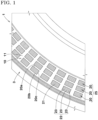
- FIG. 1 is an enlarged view of a sidewall portion 3 of a pneumatic tire (hereinafter, may be simply referred to as "tire") 1 according to the present embodiment.
- the tire 1 of the present embodiment has a pair of the sidewall portions 3 on both sides of a tread portion 2.
- the tire 1 of the present embodiment is for a passenger car.
- the present invention is not limited thereto, and the tire may be, for example, a motorcycle tire or a heavy duty tire.
- normal state refers to a state where the tire is mounted on a normal rim and inflated with a normal internal pressure, and is under no load.
- the normal state refers to a standard usage state under no load according to the usage of the tire. An ordinary tolerance for a rubber molded product is allowed for each component described herein.
- the "normal rim” represents a rim that is defined by a standard, in a standard system including the standard with which the tire complies, for each tire, and is, for example, the "standard rim” in the JATMA standard, the "Design Rim” in the TRA standard, or the “Measuring Rim” in the ETRTO standard.
- the "normal internal pressure” represents an air pressure that is defined by a standard, in a standard system including the standard with which the tire complies, for each tire, and is the “maximum air pressure” in the JATMA standard, the maximum value recited in the table "TIRE LOAD LIMITS AT VARIOUS COLD INFLATION PRESSURES" in the TRA standard, or the “INFLATION PRESSURE” in the ETRTO standard.
- a first region 10 having a first surface 11 and a second region 20 having a second surface 21 that projects or is recessed relative to the first surface 11 in a sidewall portion thickness direction are formed on a surface of at least one of the paired sidewall portions 3.
- the "sidewall portion thickness direction” refers to a thickness direction of rubber, of the sidewall portion, disposed outward of a carcass.
- a relative distance in the sidewall portion thickness direction between the first surface 11 and the second surface 21 is, for example, not greater than 2.0 mm.
- the distance is preferably 0.2 to 1.5 mm and more preferably 0.4 to 1.0 mm.
- the present invention is not limited thereto.
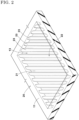
- FIG. 2 is an enlarged perspective view of the second region 20 according to the present embodiment.
- the second surface 21 of the second region 20 has a projection-recess portion 22 formed therein.
- the projection-recess portion 22 includes a plurality of linearly extending projections 23.
- the "linearly extending projection” refers to such a projection that the top portion of the projection extends in any direction and the projection thus has a length direction along the above-described top portion extending direction and a width direction orthogonal to the length direction.
- the projection 23 linearly extends.
- the projection 23 may extend so as to be curved.
- the projection 23 is not limited thereto.
- a height of the projection-recess portion 22 is less than the relative distance in the sidewall portion thickness direction between the first surface 11 and the second surface 21.
- the first surface 11 is smoother than the second surface 21. That is, regardless of whether the first surface 11 is a flat surface or has a projection-recess portion, an average value of the projecting and recessed heights of the first surface 11 is less than an average value of the projecting and recessed heights of the projection-recess portion 22 of the second surface 21.
- This structure is such that a user of the tire can recognize that the first surface 11 is flatter than the second surface 21, at least when visually observing the first surface 11 and the second surface 21 with normal attention.
- the first surface 11 is shaped in a flat surface which does not include the visually recognized projections and recesses.
- the first region 10 and the second region 20 alternate in the tire circumferential direction and the tire radial direction.
- the pneumatic tire has the above-described structure, whereby the pneumatic tire allows the sidewall portion 3 to have excellent outer appearance. This is assumed to be achieved by the following mechanism.
- the second surface 21 has the projection-recess portion 22, whereas the first surface 11 is smoother than the second surface 21. Therefore, contrast of light occurs between the first surface 11 and the second surface 21.
- the above-described projection-recess portion 22 causes the contrast also in a case where the sidewall portion 3 is observed from the various directions.
- a person who observes the surface of the sidewall portion 3 is likely to pay attention to the first region 10 and the second region 20, and is unlikely to pay attention to the local projections and recesses, of the sidewall portion 3, called bulges and dents. This mechanism is assumed to make the bulges and dents inconspicuous, and consequently provide a pneumatic tire that allows the sidewall portion 3 to have excellent outer appearance.
- the sidewall portion 3 has a plurality of the second regions 20 disposed therein, and is smooth on almost the entirety of the outer surface except for the second regions 20.
- the shape (shape formed by a boundary between the first region 10 and the second region 20) of the second region 20 is, for example, rectangular.
- the second region 20 has a laterally elongated rectangular shape in which the length in the tire circumferential direction is greater than the length in the tire radial direction.
- the second region 20 has a rectangular shape that includes a first edge 20a extending in the tire circumferential direction and a second edge 20b extending in the tire circumferential direction in a portion located outward of the first edge 20a in the tire radial direction, such that the first edge 20a and the second edge 20b have the same length.
- the length of each side is, but is not particularly limited to, for example, 2 to 10 mm and preferably 4 to 8 mm.
- the length of a third edge 20c that extends from the first edge 20a to the second edge 20b is less than the length of the first edge 20a.
- the length of the third edge 20c is, for example, 35% to 75% of the length of the first edge 20a and preferably 45% to 65% thereof.
- the outer appearance of the sidewall portion 3 is further enhanced.
- the shape of the second region 20 is not limited to such a shape.
- various shapes such as a square, trapezoidal, polygonal, round, and ellipsoidal shapes can be adopted.
- the sidewall portion 3 has a second region radial row 25 in which a plurality of the second regions 20 are arranged in the tire radial direction.
- the second region radial row 25 includes a plurality of the second regions 20 aligned along the tire radial direction.
- the second region radial row 25 having such a structure allows the projections and recesses (bulges and dents) formed in the sidewall portion to be effectively made inconspicuous (hereinafter, such an effect may be referred to as enhancement of camouflaging performance).
- the sidewall portion 3 includes a plurality of the second region radial rows 25 in the tire circumferential direction. Thus, the sidewall portion 3 also has the second regions 20 aligned in the tire circumferential direction.
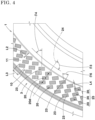
- FIG. 3 to FIG. 5 are each an enlarged view of the sidewall portion 3 of a tire according to another embodiment of the present invention.
- the second region radial row 25 is inclined relative to the tire radial direction.
- Such arrangement of the second regions 20 can regulate air flowing along the outer surface of the sidewall portion 3 during running.
- air resistance in the tire can be expected to be reduced during running.
- an imaginary line 24 connecting between centroids 20d of the second regions 20 adjacent to each other in the tire radial direction is inclined at, for example, 45° or smaller angle relative to the tire radial direction.
- the angle of the imaginary line 24 relative to the tire radial direction is preferably 10 to 45° and more preferably 20 to 40°.
- an angle ⁇ 1 of the imaginary line 24 relative to the tire circumferential direction and an angle ⁇ 2 of the linearly extending projection 23 relative to the tire circumferential direction preferably satisfy the following expression (1).
- camouflaging performance is further enhanced. 45 ° ⁇ ⁇ 1 ⁇ ⁇ 2
- the second region radial row 25 includes, in the tire radial direction, a plurality of the second regions 20 each of which has a laterally elongated rectangular shape and is inclined relative to the tire radial direction.
- the linear projection 23 of the second region 20 is inclined relative to the tire radial direction.
- An angle of the linear projection 23 relative to the tire radial direction is preferably not less than 20°, more preferably not less than 30°, and even more preferably not less than 35°, and preferably not greater than 60°, more preferably not greater than 50°, and even more preferably not greater than 45°.
- camouflaging performance can be expected to be made high by a combination of inclination of the entirety of the second regions 20 and inclination of the projections 23.
- defective molding can be effectively inhibited during vulcanization molding by applying the above-described structure to the recessed second region 20 shown in FIG. 2 .
- such an effect may be referred to as "enhancement of vulcanization molding performance”.
- an angle ⁇ 3 of the imaginary line 24 connecting between the centroids 20d of the second regions 20 relative to the tire circumferential direction and an angle ⁇ 4 of the linear projection 23 of the second region 20 relative to the tire circumferential direction preferably satisfy the following expression (2).
- camouflaging performance is further enhanced.
- Such arrangement of the second regions 20 and the projections 23 also serves to disperse a frequency band of noise which occurs by turbulence caused by the second regions 20 and the projections 23, and inhibit deterioration of noise performance. 45 ° ⁇ ⁇ 4 ⁇ 60 ° ⁇ ⁇ 3
- Two second regions 20 adjacent to each other in the tire circumferential direction preferably include a portion in which the two second regions 20 overlap each other in the tire radial direction. That is, an imaginary region obtained by extending one of the two second regions 20 along the tire circumferential direction overlaps the other of the two second regions 20.
- the overlapping length of the imaginary region in the tire radial direction is preferably not less than 50% of the length of one second region 20 in the tire radial direction, and more preferably not less than 80% thereof. In the present embodiment, the two second regions 20 entirely overlap each other.
- Two second regions 20 adjacent to each other in the tire radial direction preferably include a portion in which the two second regions 20 overlap each other in the tire circumferential direction. That is, an imaginary region obtained by extending one of the two second regions 20 along the tire radial direction overlaps the other of the two second regions 20.
- the overlapping length of the imaginary region in the tire circumferential direction is preferably not less than 50% of the length of one second region 20 in the tire circumferential direction, and more preferably not less than 80% thereof.
- the two second regions 20 entirely overlap each other.
- camouflaging performance can be expected to be further enhanced by synergistic effect of the above-described structure and the linearly extending projections 23.
- the second region 20 has a trapezoidal shape.
- the first edge 20a, of the second region 20, extending in the tire circumferential direction and the second edge 20b extending in the tire circumferential direction in a portion located outward of the first edge 20a in the tire radial direction are parallel to each other, and the length of the second edge 20b is greater than the length of the first edge 20a.
- the length of the second edge 20b is, for example, not greater than 2.0 times the length of the first edge 20a.
- the length of the second edge 20b is preferably 1.1 to 1.8 times the length of the first edge 20a and more preferably 1.2 to 1.5 times the length of the first edge 20a.
- camouflaging performance can be exhibited.
- the pattern on the outer surface of the sidewall portion becomes more complicated, and camouflaging performance can be expected to be further enhanced.
- the second surface 21 is recessed relative to the first surface 11.
- the present invention is not limited thereto. As described below, the second surface 21 may project relative to the first surface 11.
- a state where "a plurality of the projections 23 are parallel to each other" representing a state where a plurality of the linearly extending projections 23 are arranged in parallel with each other includes a state where an ordinary tolerance for a rubber product is included and a difference among angles of the plurality of projections 23 is not greater than 5°.
- FIG. 6 shows a transverse cross-section orthogonal to the length direction of the plurality of projections 23.
- the cross-sectional shape of the projection 23 is, for example, trapezoidal.
- the projections 23 having the trapezoidal cross-section are arranged in the recessed second region 20, whereby excellent vulcanization molding performance is exhibited.
- the present invention is not limited thereto, and the projection 23 may have, for example, a semicircular or a triangular cross-section.
- a height h1 of each projection 23 is, for example, less than a relative distance d1 in the sidewall portion thickness direction between the first surface 11 and the second surface 21.
- the height h1 of the projection 23 is preferably not less than 40% of the relative distance d1 and more preferably not less than 50% thereof, and preferably not greater than 80% thereof and more preferably not greater than 70% thereof.
- the projection 23 includes two inclined surfaces 23a that extend from the second surface 21.
- An angle ⁇ 5 between the two inclined surfaces 23a is, for example, 10 to 90° and preferably 20 to 40°.
- a width W1 of the projection 23 is, for example, 0.2 to 0.6 mm.
- the relative distance d1 is preferably less than a shift distance L1, in the tire circumferential direction, between the second regions 20 adjacent to each other in the tire radial direction.
- the relative distance d1 and the shift distance L1 preferably satisfy the following expression (3).
- the angle ⁇ 5 (shown in FIG. 6 ) of the projection 23, the angle ⁇ 2 of the projection relative to the tire circumferential direction, and the angle ⁇ 1 of the imaginary line 24 relative to the tire circumferential direction preferably satisfy the relationship of the following expression (4).
- an overlapping length L2 over which the two second regions 20 adjacent to each other in the tire circumferential direction overlap each other in the tire radial direction, an overlapping length L3 over which the two second regions 20 adjacent to each other in the tire radial direction overlap each other in the tire circumferential direction, and the relative distance d1 preferably satisfy the relationship of the following expression (5).
- the relative distance d1, an entire length L4 of the projection 23, and the angle ⁇ 6 of the projection relative to the tire radial direction preferably satisfy the relationship of the following expression (6).
- the projection 23 is inhibited from being broken when, for example, the second region 20 collides with a curbstone or the like, and, moreover, excellent camouflaging effect can be exhibited.
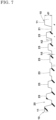
- FIG. 7 shows another embodiment of the projection-recess portion 22.
- a maximum value h2 of the height of the projection 23 in one projection-recess portion 22 is, for example, 50% to 95% of the relative distance d1 in the sidewall portion thickness direction between the first surface 11 and the second surface 21, and preferably 70% to 80% thereof.
- a minimum value h3 of the height of the projection 23 in one projection-recess portion 22 is, for example, 5% to 50% of the relative distance d1 and preferably 20% to 30% thereof.
- the second region 20 is allowed to have gradation, and camouflaging performance is further enhanced. Furthermore, such a structure allows the vulcanization mold for forming the above-described projection-recess portion 22 to reduce air accumulation, thereby enhancing vulcanization molding performance.
- the camouflaging performance and vulcanization molding performance can be enhanced in a well-balanced manner.
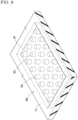
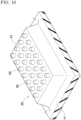
- FIG. 8 to FIG. 10 are each an enlarged perspective view of the second region 20 according to still another embodiment.
- the second surface 21 of the second region 20 projects relative to the first surface 11.
- the second surface 21 having such a structure guides air flowing on the outer surface of the sidewall portion 3 to a wheel house side during running, thereby generating downforce for pressing the tire against the road surface side.
- the second region 20 having such a structure facilitates heat dissipation during running, and also serves to cool the outer surface of the sidewall portion 3.
- durability of the sidewall portion 3 can be enhanced.
- the second surface 21 is recessed relative to the first surface 11, and has a plurality of truncated-cone-shaped projections 23 disposed thereon. Light is reflected in multiple directions by the second region 20 having such a structure, and contrast with the first region 10 can be increased.
- camouflaging performance is further enhanced.
- the second surface 21 projects relative to the first surface 11, and has a plurality of truncated-cone-shaped projections 23 disposed thereon.
- the second region 20 having such a structure, excellent camouflaging performance is exhibited, and the projecting second region 20 exhibits high heat dissipating performance. Therefore, in the present embodiment, the second region 20 contributes to enhancement of durability of the sidewall portion 3.
- each second region 20 can act as a protector of the sidewall portion 3. Therefore, such a structure can also enhance durability of the sidewall portion 3 during off-road running.
- a pneumatic tire having a size of 205/55R16 and including the sidewall portion shown in FIG. 1 was produced.
- a pneumatic tire as a sample tire having a sidewall portion a shown in FIG. 11 was produced as a comparative example.
- a plurality of regions c were arranged so as to be recessed relative to a flat-surface-shaped region b.
- the outer surface of the region c was flat-surface-shaped similarly to the region b.
- the other components were substantially the same as those of the tires of examples.
- Each test tire was tested for camouflaging performance.
- the specifications common to the test tires and a test method were as follows.
- 20 evaluators made the evaluation.
- Each evaluator made a five-point evaluation for camouflaging performance of each test tire by selecting one from one point to five point.
- the total of the points evaluated by the 20 evaluators was set as a score indicating the camouflaging performance of each test tire.
- the result indicated below was calculated by conversion based on the total of the points for the comparative example being 100. The greater the value is, the more excellent camouflaging performance is.
- the test result indicates that the tires of the examples allowed projections and recesses of the sidewall portions to be effectively made inconspicuous. That is, according to the present invention, it can be confirmed that a pneumatic tire that allows a sidewall portion to have excellent outer appearance can be provided.
Landscapes
- Engineering & Computer Science (AREA)
- Mechanical Engineering (AREA)
- Tires In General (AREA)
Description
- The present invention relates to a pneumatic tire.
- In general, sidewall portions of a pneumatic tire are covered with rubber having a small thickness. Therefore, in the sidewall portion, projections and recesses called bulges and dents are likely to appear locally due to, for example, residual air or joint portions in a carcass that is an internal structure of the tire. The projections and recesses exert no influence on performance of the tire. However, the tire has unfavorable outer appearance.
- Various pneumatic tires in which decorative patterns are formed on surfaces of the sidewall portions in order to make the projections and recesses inconspicuous have been suggested (for example, see
Japanese Laid-Open Patent Publication No. 2014-136487
JP 2017 137025 A claim 1.
US 2020/0062043 A1 discloses a tire having features according to a related technology.
US 10 442 251 B2
In addition,JP 2015 077930 A US 2016/0137008 A1 discloses a tire having features according to a related technology. - In recent years, it is highly required to make the projections and recesses of sidewall portions more inconspicuous and further enhance outer appearance of the sidewall portions.
- The present invention has been made in view of the aforementioned problems, and a main object of the present invention is to provide a pneumatic tire that allows sidewall portions to have excellent outer appearance.
- This object is satisfied by a pneumatic tire comprising the features according to
claim 1. The pneumatic tire includes a pair of sidewall portions. A first region having a first surface, and a second region having a second surface that projects or is recessed relative to the first surface in a sidewall portion thickness direction, are formed on a surface of at least one of the pair of sidewall portions. A projection-recess portion is formed on the second surface. A height of the projection-recess portion is less than a relative distance in the sidewall portion thickness direction between the first surface and the second surface. The first surface is smoother than the second surface. The first region and the second region alternate in a tire circumferential direction and a tire radial direction. - In the pneumatic tire of the present invention, the second region has a rectangular shape that includes a first edge extending in the tire circumferential direction, and a second edge extending in the tire circumferential direction in a portion located outward of the first edge in the tire radial direction.
- Alternatively, the second region has a trapezoidal shape, and a length of the second edge is preferably greater than a length of the first edge.
- In the pneumatic tire of the present invention, the at least one of the sidewall portions preferably has a second region radial row in which a plurality of the second regions are arranged in the tire radial direction, and the second region radial row is preferably inclined relative to the tire radial direction.
- In the pneumatic tire of the present invention, the projection-recess portion preferably includes a plurality of linearly extending projections.
- In the pneumatic tire of the present invention, the linear projections are preferably inclined relative to the tire radial direction.
- In the pneumatic tire of the present invention, the two second regions adjacent to each other in the tire circumferential direction preferably include a portion in which the two second regions overlap each other in the tire radial direction.
- In the pneumatic tire of the present invention, the two second regions adjacent to each other in the tire radial direction preferably include a portion in which the two second regions overlap each other in the tire circumferential direction.
- In the pneumatic tire of the present invention, the plurality of linearly extending projections are preferably arranged in parallel with each other in the projection-recess portion. It is preferable that, on a transverse cross-section of the plurality of projections, the closer the projection is to the first region, the higher the projection is.
- In the pneumatic tire of the present invention, the second surface is preferably recessed relative to the first surface.
- In the pneumatic tire of the present invention, the second surface preferably projects relative to the first surface.
- The present invention can provide a pneumatic tire that allows a sidewall portion to have excellent outer appearance by adopting the above-described structure.
-
-
FIG. 1 is an enlarged view of a sidewall portion of a tire according to an embodiment of the present invention; -
FIG. 2 is an enlarged perspective view of a second region inFIG. 1 ; -
FIG. 3 is an enlarged view of a sidewall portion according to another embodiment; -
FIG. 4 is an enlarged view of a sidewall portion according to an unclaimed example; -
FIG. 5 is an enlarged view of a sidewall portion according to another embodiment of the invention; -
FIG. 6 is a cross-sectional view of a projection-recess portion inFIG. 2 ; -
FIG. 7 is a cross-sectional view of a projection-recess portion according to another embodiment; -
FIG. 8 is an enlarged perspective view of a second region according to another embodiment; -
FIG. 9 is an enlarged perspective view of a second region according to another embodiment; -
FIG. 10 is an enlarged perspective view of a second region according to another embodiment; and -
FIG. 11 is an enlarged view of a sidewall portion of a tire of a comparative example. - An embodiment of the present invention will be described below with reference to the drawings.
-
FIG. 1 is an enlarged view of asidewall portion 3 of a pneumatic tire (hereinafter, may be simply referred to as "tire") 1 according to the present embodiment. Thetire 1 of the present embodiment has a pair of thesidewall portions 3 on both sides of atread portion 2. Thetire 1 of the present embodiment is for a passenger car. However, the present invention is not limited thereto, and the tire may be, for example, a motorcycle tire or a heavy duty tire. - In the description herein, unless otherwise specified, dimensions and the like of each component of the
tire 1 are measured in a normal state. In the case of a pneumatic tire for which various standards are specified, the "normal state" refers to a state where the tire is mounted on a normal rim and inflated with a normal internal pressure, and is under no load. In the case of a tire for which various standards are not specified, the normal state refers to a standard usage state under no load according to the usage of the tire. An ordinary tolerance for a rubber molded product is allowed for each component described herein. - The "normal rim" represents a rim that is defined by a standard, in a standard system including the standard with which the tire complies, for each tire, and is, for example, the "standard rim" in the JATMA standard, the "Design Rim" in the TRA standard, or the "Measuring Rim" in the ETRTO standard.
- The "normal internal pressure" represents an air pressure that is defined by a standard, in a standard system including the standard with which the tire complies, for each tire, and is the "maximum air pressure" in the JATMA standard, the maximum value recited in the table "TIRE LOAD LIMITS AT VARIOUS COLD INFLATION PRESSURES" in the TRA standard, or the "INFLATION PRESSURE" in the ETRTO standard.
- In the
tire 1 of the present embodiment, on a surface of at least one of the pairedsidewall portions 3, afirst region 10 having afirst surface 11 and asecond region 20 having asecond surface 21 that projects or is recessed relative to thefirst surface 11 in a sidewall portion thickness direction are formed. The "sidewall portion thickness direction" refers to a thickness direction of rubber, of the sidewall portion, disposed outward of a carcass. - A relative distance in the sidewall portion thickness direction between the
first surface 11 and thesecond surface 21 is, for example, not greater than 2.0 mm. The distance is preferably 0.2 to 1.5 mm and more preferably 0.4 to 1.0 mm. However, the present invention is not limited thereto. -
FIG. 2 is an enlarged perspective view of thesecond region 20 according to the present embodiment. As shown inFIG. 2 , thesecond surface 21 of thesecond region 20 has a projection-recess portion 22 formed therein. In the present embodiment, the projection-recess portion 22 includes a plurality of linearly extendingprojections 23. The "linearly extending projection" refers to such a projection that the top portion of the projection extends in any direction and the projection thus has a length direction along the above-described top portion extending direction and a width direction orthogonal to the length direction. In the present embodiment, theprojection 23 linearly extends. However, theprojection 23 may extend so as to be curved. However, theprojection 23 is not limited thereto. A height of the projection-recess portion 22 is less than the relative distance in the sidewall portion thickness direction between thefirst surface 11 and thesecond surface 21. - The
first surface 11 is smoother than thesecond surface 21. That is, regardless of whether thefirst surface 11 is a flat surface or has a projection-recess portion, an average value of the projecting and recessed heights of thefirst surface 11 is less than an average value of the projecting and recessed heights of the projection-recess portion 22 of thesecond surface 21. This structure is such that a user of the tire can recognize that thefirst surface 11 is flatter than thesecond surface 21, at least when visually observing thefirst surface 11 and thesecond surface 21 with normal attention. In the present embodiment, thefirst surface 11 is shaped in a flat surface which does not include the visually recognized projections and recesses. - As shown in
FIG. 1 , in the present invention, thefirst region 10 and thesecond region 20 alternate in the tire circumferential direction and the tire radial direction. In the present invention, the pneumatic tire has the above-described structure, whereby the pneumatic tire allows thesidewall portion 3 to have excellent outer appearance. This is assumed to be achieved by the following mechanism. - In the present invention, the
second surface 21 has the projection-recess portion 22, whereas thefirst surface 11 is smoother than thesecond surface 21. Therefore, contrast of light occurs between thefirst surface 11 and thesecond surface 21. Particularly, the above-described projection-recess portion 22 causes the contrast also in a case where thesidewall portion 3 is observed from the various directions. Thus, a person who observes the surface of thesidewall portion 3 is likely to pay attention to thefirst region 10 and thesecond region 20, and is unlikely to pay attention to the local projections and recesses, of thesidewall portion 3, called bulges and dents. This mechanism is assumed to make the bulges and dents inconspicuous, and consequently provide a pneumatic tire that allows thesidewall portion 3 to have excellent outer appearance. - The structure of the present embodiment will be described below in more detail. As shown in
FIG. 1 , in the present embodiment, thesidewall portion 3 has a plurality of thesecond regions 20 disposed therein, and is smooth on almost the entirety of the outer surface except for thesecond regions 20. - The shape (shape formed by a boundary between the
first region 10 and the second region 20) of thesecond region 20 is, for example, rectangular. In the present embodiment, thesecond region 20 has a laterally elongated rectangular shape in which the length in the tire circumferential direction is greater than the length in the tire radial direction. Thesecond region 20 has a rectangular shape that includes afirst edge 20a extending in the tire circumferential direction and asecond edge 20b extending in the tire circumferential direction in a portion located outward of thefirst edge 20a in the tire radial direction, such that thefirst edge 20a and thesecond edge 20b have the same length. The length of each side is, but is not particularly limited to, for example, 2 to 10 mm and preferably 4 to 8 mm. The length of athird edge 20c that extends from thefirst edge 20a to thesecond edge 20b is less than the length of thefirst edge 20a. The length of thethird edge 20c is, for example, 35% to 75% of the length of thefirst edge 20a and preferably 45% to 65% thereof. Thus, the outer appearance of thesidewall portion 3 is further enhanced. - The shape of the
second region 20 is not limited to such a shape. As the shape of thesecond region 20, various shapes such as a square, trapezoidal, polygonal, round, and ellipsoidal shapes can be adopted. - In the present embodiment, the
sidewall portion 3 has a second regionradial row 25 in which a plurality of thesecond regions 20 are arranged in the tire radial direction. In the present embodiment, the second regionradial row 25 includes a plurality of thesecond regions 20 aligned along the tire radial direction. The second regionradial row 25 having such a structure allows the projections and recesses (bulges and dents) formed in the sidewall portion to be effectively made inconspicuous (hereinafter, such an effect may be referred to as enhancement of camouflaging performance). - The
sidewall portion 3 includes a plurality of the secondregion radial rows 25 in the tire circumferential direction. Thus, thesidewall portion 3 also has thesecond regions 20 aligned in the tire circumferential direction. - The arrangement of the
second regions 20 is not limited to the above-described arrangement.FIG. 3 to FIG. 5 are each an enlarged view of thesidewall portion 3 of a tire according to another embodiment of the present invention. - As shown in
FIG. 3 , in the present embodiment, the second regionradial row 25 is inclined relative to the tire radial direction. Such arrangement of thesecond regions 20 can regulate air flowing along the outer surface of thesidewall portion 3 during running. Thus, for example, air resistance in the tire can be expected to be reduced during running. - In the present embodiment, an
imaginary line 24 connecting betweencentroids 20d of thesecond regions 20 adjacent to each other in the tire radial direction is inclined at, for example, 45° or smaller angle relative to the tire radial direction. The angle of theimaginary line 24 relative to the tire radial direction is preferably 10 to 45° and more preferably 20 to 40°. Thus, excellent camouflaging performance can be exhibited. In the present embodiment, the camouflaging performance can be expected to be further enhanced by a combination of inclination of the secondregion radial rows 25 and inclination of the linearly extendingprojections 23. - In the embodiment shown in
FIG. 3 , in a more preferable mode, an angle θ1 of theimaginary line 24 relative to the tire circumferential direction and an angle θ2 of the linearly extendingprojection 23 relative to the tire circumferential direction preferably satisfy the following expression (1). Thus, camouflaging performance is further enhanced.
- According to an unclaimed example as shown in
FIG. 4 , the second regionradial row 25 includes, in the tire radial direction, a plurality of thesecond regions 20 each of which has a laterally elongated rectangular shape and is inclined relative to the tire radial direction. - In the present embodiment, the
linear projection 23 of thesecond region 20 is inclined relative to the tire radial direction. An angle of thelinear projection 23 relative to the tire radial direction is preferably not less than 20°, more preferably not less than 30°, and even more preferably not less than 35°, and preferably not greater than 60°, more preferably not greater than 50°, and even more preferably not greater than 45°. Thus, camouflaging performance can be expected to be made high by a combination of inclination of the entirety of thesecond regions 20 and inclination of theprojections 23. Furthermore, defective molding can be effectively inhibited during vulcanization molding by applying the above-described structure to the recessedsecond region 20 shown inFIG. 2 . Hereinafter, such an effect may be referred to as "enhancement of vulcanization molding performance". - In the present embodiment, in a more preferable mode, an angle θ3 of the
imaginary line 24 connecting between thecentroids 20d of thesecond regions 20 relative to the tire circumferential direction and an angle θ4 of thelinear projection 23 of thesecond region 20 relative to the tire circumferential direction preferably satisfy the following expression (2). Thus, camouflaging performance is further enhanced. Such arrangement of thesecond regions 20 and theprojections 23 also serves to disperse a frequency band of noise which occurs by turbulence caused by thesecond regions 20 and theprojections 23, and inhibit deterioration of noise performance.
- Two
second regions 20 adjacent to each other in the tire circumferential direction preferably include a portion in which the twosecond regions 20 overlap each other in the tire radial direction. That is, an imaginary region obtained by extending one of the twosecond regions 20 along the tire circumferential direction overlaps the other of the twosecond regions 20. The overlapping length of the imaginary region in the tire radial direction is preferably not less than 50% of the length of onesecond region 20 in the tire radial direction, and more preferably not less than 80% thereof. In the present embodiment, the twosecond regions 20 entirely overlap each other. - Two
second regions 20 adjacent to each other in the tire radial direction preferably include a portion in which the twosecond regions 20 overlap each other in the tire circumferential direction. That is, an imaginary region obtained by extending one of the twosecond regions 20 along the tire radial direction overlaps the other of the twosecond regions 20. The overlapping length of the imaginary region in the tire circumferential direction is preferably not less than 50% of the length of onesecond region 20 in the tire circumferential direction, and more preferably not less than 80% thereof. In the present embodiment, the twosecond regions 20 entirely overlap each other. In the present embodiment, camouflaging performance can be expected to be further enhanced by synergistic effect of the above-described structure and the linearly extendingprojections 23. - In the embodiment shown in
FIG. 5 , thesecond region 20 has a trapezoidal shape. In the present embodiment, thefirst edge 20a, of thesecond region 20, extending in the tire circumferential direction and thesecond edge 20b extending in the tire circumferential direction in a portion located outward of thefirst edge 20a in the tire radial direction are parallel to each other, and the length of thesecond edge 20b is greater than the length of thefirst edge 20a. The length of thesecond edge 20b is, for example, not greater than 2.0 times the length of thefirst edge 20a. The length of thesecond edge 20b is preferably 1.1 to 1.8 times the length of thefirst edge 20a and more preferably 1.2 to 1.5 times the length of thefirst edge 20a. Thus, excellent camouflaging performance can be exhibited. Particularly, in a case where thesecond regions 20 arranged as shown inFIG. 5 and a structure in which thelinear projections 23 are inclined relative to the tire radial direction are combined, the pattern on the outer surface of the sidewall portion becomes more complicated, and camouflaging performance can be expected to be further enhanced. - As shown in
FIG. 2 , in the present embodiment, thesecond surface 21 is recessed relative to thefirst surface 11. However, the present invention is not limited thereto. As described below, thesecond surface 21 may project relative to thefirst surface 11. - In the projection-
recess portion 22, for example, a state where "a plurality of theprojections 23 are parallel to each other" representing a state where a plurality of the linearly extendingprojections 23 are arranged in parallel with each other, includes a state where an ordinary tolerance for a rubber product is included and a difference among angles of the plurality ofprojections 23 is not greater than 5°. -
FIG. 6 shows a transverse cross-section orthogonal to the length direction of the plurality ofprojections 23. As shown inFIG. 6 , the cross-sectional shape of theprojection 23 is, for example, trapezoidal. In the present embodiment, theprojections 23 having the trapezoidal cross-section are arranged in the recessedsecond region 20, whereby excellent vulcanization molding performance is exhibited. However, the present invention is not limited thereto, and theprojection 23 may have, for example, a semicircular or a triangular cross-section. - A height h1 of each
projection 23 is, for example, less than a relative distance d1 in the sidewall portion thickness direction between thefirst surface 11 and thesecond surface 21. The height h1 of theprojection 23 is preferably not less than 40% of the relative distance d1 and more preferably not less than 50% thereof, and preferably not greater than 80% thereof and more preferably not greater than 70% thereof. Thus, the above-described effect is exhibited and defective vulcanization molding is inhibited. - The
projection 23 includes twoinclined surfaces 23a that extend from thesecond surface 21. An angle θ5 between the twoinclined surfaces 23a is, for example, 10 to 90° and preferably 20 to 40°. A width W1 of theprojection 23 is, for example, 0.2 to 0.6 mm. - In the embodiment shown in
FIG. 3 , the relative distance d1 is preferably less than a shift distance L1, in the tire circumferential direction, between thesecond regions 20 adjacent to each other in the tire radial direction. Specifically, the relative distance d1 and the shift distance L1 preferably satisfy the following expression (3). Thus, camouflaging performance is sufficiently exhibited, the rubber thickness of thesidewall portion 3 can be inhibited from excessively varying, and durability of thesidewall portion 3 is enhanced.
- In the embodiment shown in
FIG. 3 , the angle θ5 (shown inFIG. 6 ) of theprojection 23, the angle θ2 of the projection relative to the tire circumferential direction, and the angle θ1 of theimaginary line 24 relative to the tire circumferential direction preferably satisfy the relationship of the following expression (4). Thus, light reflected by thesidewall portion 3 is more easily dispersed and camouflaging effect is further enhanced.
- In the unclaimed example shown in
FIG. 4 , an overlapping length L2 over which the twosecond regions 20 adjacent to each other in the tire circumferential direction overlap each other in the tire radial direction, an overlapping length L3 over which the twosecond regions 20 adjacent to each other in the tire radial direction overlap each other in the tire circumferential direction, and the relative distance d1 preferably satisfy the relationship of the following expression (5). By specifying the upper limit of the relative distance d1 as described above, excessive reduction of the rubber thickness of the sidewall portion can be inhibited, and durability of thesidewall portion 3 is enhanced.
- In a more preferable mode of the unclaimed example shown in
FIG. 4 , the relative distance d1, an entire length L4 of theprojection 23, and the angle θ6 of the projection relative to the tire radial direction preferably satisfy the relationship of the following expression (6). Thus, theprojection 23 is inhibited from being broken when, for example, thesecond region 20 collides with a curbstone or the like, and, moreover, excellent camouflaging effect can be exhibited.
-
FIG. 7 shows another embodiment of the projection-recess portion 22. As shown inFIG. 7 , in the present embodiment, on the transverse cross-section of the plurality ofprojections 23, the closer theprojection 23 is to thefirst region 10, the higher theprojection 23 is. A maximum value h2 of the height of theprojection 23 in one projection-recess portion 22 is, for example, 50% to 95% of the relative distance d1 in the sidewall portion thickness direction between thefirst surface 11 and thesecond surface 21, and preferably 70% to 80% thereof. A minimum value h3 of the height of theprojection 23 in one projection-recess portion 22 is, for example, 5% to 50% of the relative distance d1 and preferably 20% to 30% thereof. In the projection-recess portion 22 having such a structure, thesecond region 20 is allowed to have gradation, and camouflaging performance is further enhanced. Furthermore, such a structure allows the vulcanization mold for forming the above-described projection-recess portion 22 to reduce air accumulation, thereby enhancing vulcanization molding performance. - Particularly, by applying the above-described projection-
recess portion 22 to thesecond regions 20 arranged as shown inFIG. 3 to FIG. 5 , the camouflaging performance and vulcanization molding performance can be enhanced in a well-balanced manner. -
FIG. 8 to FIG. 10 are each an enlarged perspective view of thesecond region 20 according to still another embodiment. As shown inFIG. 8 , thesecond surface 21 of thesecond region 20 projects relative to thefirst surface 11. Thesecond surface 21 having such a structure guides air flowing on the outer surface of thesidewall portion 3 to a wheel house side during running, thereby generating downforce for pressing the tire against the road surface side. Furthermore, thesecond region 20 having such a structure facilitates heat dissipation during running, and also serves to cool the outer surface of thesidewall portion 3. Thus, durability of thesidewall portion 3 can be enhanced. - In the present embodiment, by applying the above-described linearly extending
projections 23 to thesecond region 20, heat dissipation properties as well as camouflaging performance is enhanced, and durability of thesidewall portion 3 is further enhanced. - In the
second region 20 shown inFIG. 9 , thesecond surface 21 is recessed relative to thefirst surface 11, and has a plurality of truncated-cone-shapedprojections 23 disposed thereon. Light is reflected in multiple directions by thesecond region 20 having such a structure, and contrast with thefirst region 10 can be increased. By applying the above-described structure to thesecond regions 20 arranged as shown inFIG. 3 to FIG. 5 , camouflaging performance is further enhanced. - In the
second region 20 shown inFIG. 10 , thesecond surface 21 projects relative to thefirst surface 11, and has a plurality of truncated-cone-shapedprojections 23 disposed thereon. In thesecond region 20 having such a structure, excellent camouflaging performance is exhibited, and the projectingsecond region 20 exhibits high heat dissipating performance. Therefore, in the present embodiment, thesecond region 20 contributes to enhancement of durability of thesidewall portion 3. - By applying the above-described structure to the
second regions 20 arranged as shown inFIG. 3 to FIG. 5 , camouflaging performance is further enhanced, and eachsecond region 20 can act as a protector of thesidewall portion 3. Therefore, such a structure can also enhance durability of thesidewall portion 3 during off-road running. - It should be understood that the above-described structures can be applied to a pneumatic tire in combination.
- Particularly preferable embodiments of the present invention have been described above in detail. However, the present invention is not limited to the illustrated embodiments, and various modifications can be made to implement the present invention.
- A pneumatic tire having a size of 205/55R16 and including the sidewall portion shown in
FIG. 1 was produced. A pneumatic tire as a sample tire having a sidewall portion a shown inFIG. 11 was produced as a comparative example. In the sidewall portion a of the comparative example, a plurality of regions c were arranged so as to be recessed relative to a flat-surface-shaped region b. The outer surface of the region c was flat-surface-shaped similarly to the region b. The other components were substantially the same as those of the tires of examples. Each test tire was tested for camouflaging performance. The specifications common to the test tires and a test method were as follows. - Rim on which each tire was mounted: 16×6.5J
- Tire internal pressure: 200 kPa
- Observers visually checked the outer surface of each sidewall portion from various directions outdoors in fine weather, and made sensory evaluation for occurrence of projections and recesses (bulges and dents) at the sidewall portion. 20 evaluators made the evaluation. Each evaluator made a five-point evaluation for camouflaging performance of each test tire by selecting one from one point to five point. The total of the points evaluated by the 20 evaluators was set as a score indicating the camouflaging performance of each test tire. The result indicated below was calculated by conversion based on the total of the points for the comparative example being 100. The greater the value is, the more excellent camouflaging performance is.
- The test result is indicated in Table 1.
[Table 1] Comp. Ex. Ex. 1 Ex. 2 Ex. 3 Ex. 4 Ex. 5 Ex. 6 Ex. 7 Figure indicating sidewall portion FIG. 11 FIG. 1 FIG. 3 FIG. 4 FIG. 5 FIG. 1 FIG. 1 FIG. 1 Figure indicating second region - FIG. 2 FIG. 2 FIG. 2 FIG. 2 FIG. 7 FIG. 8 FIG. 9 Camouflaging performance (Score) 100 120 122 124 126 120 118 118 - The test result indicates that the tires of the examples allowed projections and recesses of the sidewall portions to be effectively made inconspicuous. That is, according to the present invention, it can be confirmed that a pneumatic tire that allows a sidewall portion to have excellent outer appearance can be provided.
Claims (9)
- A pneumatic tire (1) comprising:a pair of sidewall portions (3), whereina first region (10) having a first surface (11), and a second region (20) having a second surface (21) that projects or is recessed relative to the first surface (11) in a sidewall portion thickness direction, are formed on a surface of at least one of the pair of sidewall portions (3),a projection-recess portion (22) is formed on the second surface (21),a height of the projection-recess portion (22) is less than a relative distance (d1) in the sidewall portion thickness direction between the first surface (11) and the second surface (21),the first surface (11) is smoother than the second surface (21), andthe first region (10) and the second region (20) alternate in a tire circumferential direction and a tire radial direction,
characterized in thatthe second region (20) includes a first edge (20a) extending in the tire circumferential direction, and a second edge (20b) extending in the tire circumferential direction in a portion located outward of the first edge (20a) in the tire radial direction, andthe second region (20) has a rectangular shape orthe second region (20) has a trapezoidal shape in which the first edge (20a) and the second edge (20b) are parallel to each other and a length of the second edge (20b) is greater than a length of the first edge (20a). - The pneumatic tire (1) according to claim 1, whereinthe at least one of the sidewall portions (3) has a second region radial row (25) in which a plurality of the second regions (20) are arranged in the tire radial direction, andthe second region radial row (25) is inclined relative to the tire radial direction.
- The pneumatic tire (1) according to claim 1 or 2, wherein the projection-recess portion (22) includes a plurality of linearly extending projections (23).
- The pneumatic tire (1) according to claim 3, wherein the linear projections (23) are inclined relative to the tire radial direction.
- The pneumatic tire (1) according to claim 3 or 4, whereinthe plurality of linearly extending projections (23) are arranged in parallel with each other in the projection-recess portion (22), andon a transverse cross-section of the plurality of projections (23), the closer the projection (23) is to the first region (10), the higher the projection (23) is.
- The pneumatic tire (1) according to any one of claims 1 to 5, wherein the two second regions (20) adjacent to each other in the tire circumferential direction include a portion in which the two second regions (20) overlap each other in the tire radial direction.
- The pneumatic tire (1) according to any one of claims 1 to 6, wherein the two second regions (20) adjacent to each other in the tire radial direction include a portion in which the two second regions (20) overlap each other in the tire circumferential direction.
- The pneumatic tire (1) according to any one of claims 1 to 7, wherein the second surface (21) is recessed relative to the first surface (11).
- The pneumatic tire (1) according to any one of claims 1 to 7, wherein the second surface (21) projects relative to the first surface (11).
Applications Claiming Priority (1)
| Application Number | Priority Date | Filing Date | Title |
|---|---|---|---|
| JP2020067660A JP7028275B2 (en) | 2020-04-03 | 2020-04-03 | Pneumatic tires |
Publications (2)
| Publication Number | Publication Date |
|---|---|
| EP3888952A1 EP3888952A1 (en) | 2021-10-06 |
| EP3888952B1 true EP3888952B1 (en) | 2023-08-16 |
Family
ID=74867474
Family Applications (1)
| Application Number | Title | Priority Date | Filing Date |
|---|---|---|---|
| EP21161498.7A Active EP3888952B1 (en) | 2020-04-03 | 2021-03-09 | Pneumatic tire |
Country Status (3)
| Country | Link |
|---|---|
| EP (1) | EP3888952B1 (en) |
| JP (1) | JP7028275B2 (en) |
| CN (1) | CN113492625B (en) |
Families Citing this family (1)
| Publication number | Priority date | Publication date | Assignee | Title |
|---|---|---|---|---|
| JP2025001084A (en) * | 2023-06-20 | 2025-01-08 | Toyo Tire株式会社 | Pneumatic tire |
Family Cites Families (23)
| Publication number | Priority date | Publication date | Assignee | Title |
|---|---|---|---|---|
| US4198774A (en) * | 1977-11-18 | 1980-04-22 | The Goodyear Tire & Rubber Company | Indicia for rubber articles |
| JP4640517B2 (en) * | 2009-04-23 | 2011-03-02 | 横浜ゴム株式会社 | Pneumatic tire |
| JP5358404B2 (en) * | 2009-11-19 | 2013-12-04 | 株式会社ブリヂストン | Pneumatic tire |
| WO2011062241A1 (en) * | 2009-11-19 | 2011-05-26 | 株式会社ブリヂストン | Tire |
| JP2012131254A (en) * | 2010-12-20 | 2012-07-12 | Sumitomo Rubber Ind Ltd | Run-flat tire |
| JP5310805B2 (en) * | 2011-08-03 | 2013-10-09 | 横浜ゴム株式会社 | Pneumatic tire |
| JP5823877B2 (en) * | 2012-01-11 | 2015-11-25 | 株式会社ブリヂストン | tire |
| JP5652376B2 (en) * | 2011-11-15 | 2015-01-14 | 横浜ゴム株式会社 | Pneumatic tire |
| EP2815898B1 (en) * | 2012-02-17 | 2019-07-10 | Bridgestone Corporation | Tire, and tire manufacturing method |
| JP5789274B2 (en) | 2013-01-16 | 2015-10-07 | 住友ゴム工業株式会社 | Pneumatic tire |
| JP6209870B2 (en) * | 2013-06-14 | 2017-10-11 | 横浜ゴム株式会社 | Pneumatic tire |
| FR3007325B1 (en) * | 2013-06-21 | 2016-02-12 | Michelin & Cie | PNEUMATIC COMPRISING A HIGH CONTRAST MARKING |
| JP2015077930A (en) * | 2013-10-18 | 2015-04-23 | 横浜ゴム株式会社 | Pneumatic tire |
| JP6196555B2 (en) * | 2014-01-09 | 2017-09-13 | 住友ゴム工業株式会社 | Pneumatic tire |
| JP6572232B2 (en) * | 2014-10-27 | 2019-09-04 | 株式会社ブリヂストン | Pneumatic tire |
| JP2016141005A (en) * | 2015-01-30 | 2016-08-08 | 横浜ゴム株式会社 | Tire manufacturing method and mold used therefor |
| JP6423295B2 (en) * | 2015-03-18 | 2018-11-14 | 株式会社ブリヂストン | tire |
| JP6672851B2 (en) * | 2016-02-05 | 2020-03-25 | 横浜ゴム株式会社 | Pneumatic tire |
| JP6972966B2 (en) * | 2017-11-27 | 2021-11-24 | 住友ゴム工業株式会社 | tire |
| JP7087597B2 (en) * | 2018-04-04 | 2022-06-21 | 横浜ゴム株式会社 | Pneumatic tires |
| JP2019196152A (en) * | 2018-05-11 | 2019-11-14 | Toyo Tire株式会社 | Pneumatic tire |
| JP7119766B2 (en) * | 2018-08-23 | 2022-08-17 | 住友ゴム工業株式会社 | tire |
| JP7427947B2 (en) * | 2019-12-11 | 2024-02-06 | 住友ゴム工業株式会社 | pneumatic tires |
-
2020
- 2020-04-03 JP JP2020067660A patent/JP7028275B2/en active Active
-
2021
- 2021-03-03 CN CN202110233512.2A patent/CN113492625B/en active Active
- 2021-03-09 EP EP21161498.7A patent/EP3888952B1/en active Active
Also Published As
| Publication number | Publication date |
|---|---|
| JP7028275B2 (en) | 2022-03-02 |
| CN113492625B (en) | 2026-03-24 |
| CN113492625A (en) | 2021-10-12 |
| JP2021160687A (en) | 2021-10-11 |
| EP3888952A1 (en) | 2021-10-06 |
Similar Documents
| Publication | Publication Date | Title |
|---|---|---|
| US9566830B2 (en) | Pneumatic tire | |
| EP3219516B1 (en) | Pneumatic tire | |
| CN107531111B (en) | run flat tire | |
| CN104995043A (en) | Tire | |
| EP1914092B1 (en) | Tire for construction vehicle | |
| EP2974886B1 (en) | Pneumatic tire | |
| EP2275285B1 (en) | Pneumatic tire | |
| EP3888952B1 (en) | Pneumatic tire | |
| EP3835089B1 (en) | Pneumatic tire | |
| US11400761B2 (en) | Tire | |
| JP7715620B2 (en) | tire | |
| JP5234889B2 (en) | Pneumatic tire | |
| JP3774710B2 (en) | Pneumatic tire | |
| JP2024155147A (en) | Pneumatic tires | |
| US20200254826A1 (en) | Tire | |
| CN108025601A (en) | Pneumatic tire | |
| US10723179B2 (en) | Tire | |
| US20260109177A1 (en) | Tire | |
| JP7629301B2 (en) | Run-flat tires | |
| EP3822097B1 (en) | Tire | |
| EP3812175B1 (en) | Pneumatic tire | |
| JP4316324B2 (en) | Pneumatic tire | |
| JP2024155145A (en) | Pneumatic tires | |
| WO2024070077A1 (en) | Pneumatic tire | |
| JP2024155143A (en) | Pneumatic tires |
Legal Events
| Date | Code | Title | Description |
|---|---|---|---|
| PUAI | Public reference made under article 153(3) epc to a published international application that has entered the european phase |
Free format text: ORIGINAL CODE: 0009012 |
|
| STAA | Information on the status of an ep patent application or granted ep patent |
Free format text: STATUS: THE APPLICATION HAS BEEN PUBLISHED |
|
| AK | Designated contracting states |
Kind code of ref document: A1 Designated state(s): AL AT BE BG CH CY CZ DE DK EE ES FI FR GB GR HR HU IE IS IT LI LT LU LV MC MK MT NL NO PL PT RO RS SE SI SK SM TR |
|
| STAA | Information on the status of an ep patent application or granted ep patent |
Free format text: STATUS: REQUEST FOR EXAMINATION WAS MADE |
|
| 17P | Request for examination filed |
Effective date: 20220204 |
|
| RBV | Designated contracting states (corrected) |
Designated state(s): AL AT BE BG CH CY CZ DE DK EE ES FI FR GB GR HR HU IE IS IT LI LT LU LV MC MK MT NL NO PL PT RO RS SE SI SK SM TR |
|
| STAA | Information on the status of an ep patent application or granted ep patent |
Free format text: STATUS: EXAMINATION IS IN PROGRESS |
|
| 17Q | First examination report despatched |
Effective date: 20221013 |
|
| GRAP | Despatch of communication of intention to grant a patent |
Free format text: ORIGINAL CODE: EPIDOSNIGR1 |
|
| STAA | Information on the status of an ep patent application or granted ep patent |
Free format text: STATUS: GRANT OF PATENT IS INTENDED |
|
| INTG | Intention to grant announced |
Effective date: 20230510 |
|
| P01 | Opt-out of the competence of the unified patent court (upc) registered |
Effective date: 20230510 |
|
| GRAS | Grant fee paid |
Free format text: ORIGINAL CODE: EPIDOSNIGR3 |
|
| GRAA | (expected) grant |
Free format text: ORIGINAL CODE: 0009210 |
|
| STAA | Information on the status of an ep patent application or granted ep patent |
Free format text: STATUS: THE PATENT HAS BEEN GRANTED |
|
| AK | Designated contracting states |
Kind code of ref document: B1 Designated state(s): AL AT BE BG CH CY CZ DE DK EE ES FI FR GB GR HR HU IE IS IT LI LT LU LV MC MK MT NL NO PL PT RO RS SE SI SK SM TR |
|
| REG | Reference to a national code |
Ref country code: CH Ref legal event code: EP |
|
| REG | Reference to a national code |
Ref country code: DE Ref legal event code: R096 Ref document number: 602021004231 Country of ref document: DE |
|
| REG | Reference to a national code |
Ref country code: IE Ref legal event code: FG4D |
|
| REG | Reference to a national code |
Ref country code: LT Ref legal event code: MG9D |
|
| REG | Reference to a national code |
Ref country code: NL Ref legal event code: MP Effective date: 20230816 |
|
| REG | Reference to a national code |
Ref country code: AT Ref legal event code: MK05 Ref document number: 1599697 Country of ref document: AT Kind code of ref document: T Effective date: 20230816 |
|
| PG25 | Lapsed in a contracting state [announced via postgrant information from national office to epo] |
Ref country code: GR Free format text: LAPSE BECAUSE OF FAILURE TO SUBMIT A TRANSLATION OF THE DESCRIPTION OR TO PAY THE FEE WITHIN THE PRESCRIBED TIME-LIMIT Effective date: 20231117 |
|
| PG25 | Lapsed in a contracting state [announced via postgrant information from national office to epo] |
Ref country code: IS Free format text: LAPSE BECAUSE OF FAILURE TO SUBMIT A TRANSLATION OF THE DESCRIPTION OR TO PAY THE FEE WITHIN THE PRESCRIBED TIME-LIMIT Effective date: 20231216 |
|
| PG25 | Lapsed in a contracting state [announced via postgrant information from national office to epo] |
Ref country code: SE Free format text: LAPSE BECAUSE OF FAILURE TO SUBMIT A TRANSLATION OF THE DESCRIPTION OR TO PAY THE FEE WITHIN THE PRESCRIBED TIME-LIMIT Effective date: 20230816 Ref country code: RS Free format text: LAPSE BECAUSE OF FAILURE TO SUBMIT A TRANSLATION OF THE DESCRIPTION OR TO PAY THE FEE WITHIN THE PRESCRIBED TIME-LIMIT Effective date: 20230816 Ref country code: PT Free format text: LAPSE BECAUSE OF FAILURE TO SUBMIT A TRANSLATION OF THE DESCRIPTION OR TO PAY THE FEE WITHIN THE PRESCRIBED TIME-LIMIT Effective date: 20231218 Ref country code: NO Free format text: LAPSE BECAUSE OF FAILURE TO SUBMIT A TRANSLATION OF THE DESCRIPTION OR TO PAY THE FEE WITHIN THE PRESCRIBED TIME-LIMIT Effective date: 20231116 Ref country code: NL Free format text: LAPSE BECAUSE OF FAILURE TO SUBMIT A TRANSLATION OF THE DESCRIPTION OR TO PAY THE FEE WITHIN THE PRESCRIBED TIME-LIMIT Effective date: 20230816 Ref country code: LV Free format text: LAPSE BECAUSE OF FAILURE TO SUBMIT A TRANSLATION OF THE DESCRIPTION OR TO PAY THE FEE WITHIN THE PRESCRIBED TIME-LIMIT Effective date: 20230816 Ref country code: LT Free format text: LAPSE BECAUSE OF FAILURE TO SUBMIT A TRANSLATION OF THE DESCRIPTION OR TO PAY THE FEE WITHIN THE PRESCRIBED TIME-LIMIT Effective date: 20230816 Ref country code: IS Free format text: LAPSE BECAUSE OF FAILURE TO SUBMIT A TRANSLATION OF THE DESCRIPTION OR TO PAY THE FEE WITHIN THE PRESCRIBED TIME-LIMIT Effective date: 20231216 Ref country code: HR Free format text: LAPSE BECAUSE OF FAILURE TO SUBMIT A TRANSLATION OF THE DESCRIPTION OR TO PAY THE FEE WITHIN THE PRESCRIBED TIME-LIMIT Effective date: 20230816 Ref country code: GR Free format text: LAPSE BECAUSE OF FAILURE TO SUBMIT A TRANSLATION OF THE DESCRIPTION OR TO PAY THE FEE WITHIN THE PRESCRIBED TIME-LIMIT Effective date: 20231117 Ref country code: FI Free format text: LAPSE BECAUSE OF FAILURE TO SUBMIT A TRANSLATION OF THE DESCRIPTION OR TO PAY THE FEE WITHIN THE PRESCRIBED TIME-LIMIT Effective date: 20230816 Ref country code: AT Free format text: LAPSE BECAUSE OF FAILURE TO SUBMIT A TRANSLATION OF THE DESCRIPTION OR TO PAY THE FEE WITHIN THE PRESCRIBED TIME-LIMIT Effective date: 20230816 |
|
| PG25 | Lapsed in a contracting state [announced via postgrant information from national office to epo] |
Ref country code: PL Free format text: LAPSE BECAUSE OF FAILURE TO SUBMIT A TRANSLATION OF THE DESCRIPTION OR TO PAY THE FEE WITHIN THE PRESCRIBED TIME-LIMIT Effective date: 20230816 |
|
| PG25 | Lapsed in a contracting state [announced via postgrant information from national office to epo] |
Ref country code: ES Free format text: LAPSE BECAUSE OF FAILURE TO SUBMIT A TRANSLATION OF THE DESCRIPTION OR TO PAY THE FEE WITHIN THE PRESCRIBED TIME-LIMIT Effective date: 20230816 |
|
| PG25 | Lapsed in a contracting state [announced via postgrant information from national office to epo] |
Ref country code: SM Free format text: LAPSE BECAUSE OF FAILURE TO SUBMIT A TRANSLATION OF THE DESCRIPTION OR TO PAY THE FEE WITHIN THE PRESCRIBED TIME-LIMIT Effective date: 20230816 Ref country code: RO Free format text: LAPSE BECAUSE OF FAILURE TO SUBMIT A TRANSLATION OF THE DESCRIPTION OR TO PAY THE FEE WITHIN THE PRESCRIBED TIME-LIMIT Effective date: 20230816 Ref country code: ES Free format text: LAPSE BECAUSE OF FAILURE TO SUBMIT A TRANSLATION OF THE DESCRIPTION OR TO PAY THE FEE WITHIN THE PRESCRIBED TIME-LIMIT Effective date: 20230816 Ref country code: EE Free format text: LAPSE BECAUSE OF FAILURE TO SUBMIT A TRANSLATION OF THE DESCRIPTION OR TO PAY THE FEE WITHIN THE PRESCRIBED TIME-LIMIT Effective date: 20230816 Ref country code: DK Free format text: LAPSE BECAUSE OF FAILURE TO SUBMIT A TRANSLATION OF THE DESCRIPTION OR TO PAY THE FEE WITHIN THE PRESCRIBED TIME-LIMIT Effective date: 20230816 Ref country code: CZ Free format text: LAPSE BECAUSE OF FAILURE TO SUBMIT A TRANSLATION OF THE DESCRIPTION OR TO PAY THE FEE WITHIN THE PRESCRIBED TIME-LIMIT Effective date: 20230816 Ref country code: SK Free format text: LAPSE BECAUSE OF FAILURE TO SUBMIT A TRANSLATION OF THE DESCRIPTION OR TO PAY THE FEE WITHIN THE PRESCRIBED TIME-LIMIT Effective date: 20230816 |
|
| REG | Reference to a national code |
Ref country code: DE Ref legal event code: R097 Ref document number: 602021004231 Country of ref document: DE |
|
| PLBE | No opposition filed within time limit |
Free format text: ORIGINAL CODE: 0009261 |
|
| STAA | Information on the status of an ep patent application or granted ep patent |
Free format text: STATUS: NO OPPOSITION FILED WITHIN TIME LIMIT |
|
| 26N | No opposition filed |
Effective date: 20240517 |
|
| PG25 | Lapsed in a contracting state [announced via postgrant information from national office to epo] |
Ref country code: IT Free format text: LAPSE BECAUSE OF FAILURE TO SUBMIT A TRANSLATION OF THE DESCRIPTION OR TO PAY THE FEE WITHIN THE PRESCRIBED TIME-LIMIT Effective date: 20230816 Ref country code: SI Free format text: LAPSE BECAUSE OF FAILURE TO SUBMIT A TRANSLATION OF THE DESCRIPTION OR TO PAY THE FEE WITHIN THE PRESCRIBED TIME-LIMIT Effective date: 20230816 |
|
| REG | Reference to a national code |
Ref country code: CH Ref legal event code: PL |
|
| PG25 | Lapsed in a contracting state [announced via postgrant information from national office to epo] |
Ref country code: BG Free format text: LAPSE BECAUSE OF FAILURE TO SUBMIT A TRANSLATION OF THE DESCRIPTION OR TO PAY THE FEE WITHIN THE PRESCRIBED TIME-LIMIT Effective date: 20230816 |
|
| PG25 | Lapsed in a contracting state [announced via postgrant information from national office to epo] |
Ref country code: LU Free format text: LAPSE BECAUSE OF NON-PAYMENT OF DUE FEES Effective date: 20240309 |
|
| PG25 | Lapsed in a contracting state [announced via postgrant information from national office to epo] |
Ref country code: MC Free format text: LAPSE BECAUSE OF FAILURE TO SUBMIT A TRANSLATION OF THE DESCRIPTION OR TO PAY THE FEE WITHIN THE PRESCRIBED TIME-LIMIT Effective date: 20230816 |
|
| PG25 | Lapsed in a contracting state [announced via postgrant information from national office to epo] |
Ref country code: MC Free format text: LAPSE BECAUSE OF FAILURE TO SUBMIT A TRANSLATION OF THE DESCRIPTION OR TO PAY THE FEE WITHIN THE PRESCRIBED TIME-LIMIT Effective date: 20230816 Ref country code: LU Free format text: LAPSE BECAUSE OF NON-PAYMENT OF DUE FEES Effective date: 20240309 Ref country code: BG Free format text: LAPSE BECAUSE OF FAILURE TO SUBMIT A TRANSLATION OF THE DESCRIPTION OR TO PAY THE FEE WITHIN THE PRESCRIBED TIME-LIMIT Effective date: 20230816 |
|
| REG | Reference to a national code |
Ref country code: BE Ref legal event code: MM Effective date: 20240331 |
|
| PG25 | Lapsed in a contracting state [announced via postgrant information from national office to epo] |
Ref country code: BE Free format text: LAPSE BECAUSE OF NON-PAYMENT OF DUE FEES Effective date: 20240331 |
|
| PG25 | Lapsed in a contracting state [announced via postgrant information from national office to epo] |
Ref country code: IE Free format text: LAPSE BECAUSE OF NON-PAYMENT OF DUE FEES Effective date: 20240309 |
|
| PG25 | Lapsed in a contracting state [announced via postgrant information from national office to epo] |
Ref country code: IE Free format text: LAPSE BECAUSE OF NON-PAYMENT OF DUE FEES Effective date: 20240309 Ref country code: BE Free format text: LAPSE BECAUSE OF NON-PAYMENT OF DUE FEES Effective date: 20240331 Ref country code: CH Free format text: LAPSE BECAUSE OF NON-PAYMENT OF DUE FEES Effective date: 20240331 |
|
| PG25 | Lapsed in a contracting state [announced via postgrant information from national office to epo] |
Ref country code: CY Free format text: LAPSE BECAUSE OF FAILURE TO SUBMIT A TRANSLATION OF THE DESCRIPTION OR TO PAY THE FEE WITHIN THE PRESCRIBED TIME-LIMIT; INVALID AB INITIO Effective date: 20210309 |
|
| PG25 | Lapsed in a contracting state [announced via postgrant information from national office to epo] |
Ref country code: HU Free format text: LAPSE BECAUSE OF FAILURE TO SUBMIT A TRANSLATION OF THE DESCRIPTION OR TO PAY THE FEE WITHIN THE PRESCRIBED TIME-LIMIT; INVALID AB INITIO Effective date: 20210309 |
|
| GBPC | Gb: european patent ceased through non-payment of renewal fee |
Effective date: 20250309 |
|
| PG25 | Lapsed in a contracting state [announced via postgrant information from national office to epo] |
Ref country code: TR Free format text: LAPSE BECAUSE OF FAILURE TO SUBMIT A TRANSLATION OF THE DESCRIPTION OR TO PAY THE FEE WITHIN THE PRESCRIBED TIME-LIMIT Effective date: 20230816 |
|
| PG25 | Lapsed in a contracting state [announced via postgrant information from national office to epo] |
Ref country code: GB Free format text: LAPSE BECAUSE OF NON-PAYMENT OF DUE FEES Effective date: 20250309 |
|
| PGFP | Annual fee paid to national office [announced via postgrant information from national office to epo] |
Ref country code: DE Payment date: 20260128 Year of fee payment: 6 |
|
| PGFP | Annual fee paid to national office [announced via postgrant information from national office to epo] |
Ref country code: FR Payment date: 20260209 Year of fee payment: 6 |