EP3886858B1 - Compounds for treatment of eye diseases associated with excessive vascularisation - Google Patents
Compounds for treatment of eye diseases associated with excessive vascularisation Download PDFInfo
- Publication number
- EP3886858B1 EP3886858B1 EP20838435.4A EP20838435A EP3886858B1 EP 3886858 B1 EP3886858 B1 EP 3886858B1 EP 20838435 A EP20838435 A EP 20838435A EP 3886858 B1 EP3886858 B1 EP 3886858B1
- Authority
- EP
- European Patent Office
- Prior art keywords
- composition
- eye
- neovascularisation
- use according
- treatment
- Prior art date
- Legal status (The legal status is an assumption and is not a legal conclusion. Google has not performed a legal analysis and makes no representation as to the accuracy of the status listed.)
- Active
Links
Images


Classifications
-
- A—HUMAN NECESSITIES
- A61—MEDICAL OR VETERINARY SCIENCE; HYGIENE
- A61K—PREPARATIONS FOR MEDICAL, DENTAL OR TOILETRY PURPOSES
- A61K31/00—Medicinal preparations containing organic active ingredients
- A61K31/33—Heterocyclic compounds
- A61K31/395—Heterocyclic compounds having nitrogen as a ring hetero atom, e.g. guanethidine or rifamycins
- A61K31/435—Heterocyclic compounds having nitrogen as a ring hetero atom, e.g. guanethidine or rifamycins having six-membered rings with one nitrogen as the only ring hetero atom
- A61K31/47—Quinolines; Isoquinolines
- A61K31/4704—2-Quinolinones, e.g. carbostyril
-
- A—HUMAN NECESSITIES
- A61—MEDICAL OR VETERINARY SCIENCE; HYGIENE
- A61K—PREPARATIONS FOR MEDICAL, DENTAL OR TOILETRY PURPOSES
- A61K38/00—Medicinal preparations containing peptides
- A61K38/16—Peptides having more than 20 amino acids; Gastrins; Somatostatins; Melanotropins; Derivatives thereof
- A61K38/17—Peptides having more than 20 amino acids; Gastrins; Somatostatins; Melanotropins; Derivatives thereof from animals; from humans
- A61K38/177—Receptors; Cell surface antigens; Cell surface determinants
- A61K38/179—Receptors; Cell surface antigens; Cell surface determinants for growth factors; for growth regulators
-
- A—HUMAN NECESSITIES
- A61—MEDICAL OR VETERINARY SCIENCE; HYGIENE
- A61K—PREPARATIONS FOR MEDICAL, DENTAL OR TOILETRY PURPOSES
- A61K39/00—Medicinal preparations containing antigens or antibodies
- A61K39/395—Antibodies; Immunoglobulins; Immune serum, e.g. antilymphocytic serum
-
- A—HUMAN NECESSITIES
- A61—MEDICAL OR VETERINARY SCIENCE; HYGIENE
- A61K—PREPARATIONS FOR MEDICAL, DENTAL OR TOILETRY PURPOSES
- A61K39/00—Medicinal preparations containing antigens or antibodies
- A61K39/395—Antibodies; Immunoglobulins; Immune serum, e.g. antilymphocytic serum
- A61K39/39533—Antibodies; Immunoglobulins; Immune serum, e.g. antilymphocytic serum against materials from animals
- A61K39/3955—Antibodies; Immunoglobulins; Immune serum, e.g. antilymphocytic serum against materials from animals against proteinaceous materials, e.g. enzymes, hormones, lymphokines
-
- A—HUMAN NECESSITIES
- A61—MEDICAL OR VETERINARY SCIENCE; HYGIENE
- A61K—PREPARATIONS FOR MEDICAL, DENTAL OR TOILETRY PURPOSES
- A61K47/00—Medicinal preparations characterised by the non-active ingredients used, e.g. carriers or inert additives; Targeting or modifying agents chemically bound to the active ingredient
- A61K47/50—Medicinal preparations characterised by the non-active ingredients used, e.g. carriers or inert additives; Targeting or modifying agents chemically bound to the active ingredient the non-active ingredient being chemically bound to the active ingredient, e.g. polymer-drug conjugates
- A61K47/51—Medicinal preparations characterised by the non-active ingredients used, e.g. carriers or inert additives; Targeting or modifying agents chemically bound to the active ingredient the non-active ingredient being chemically bound to the active ingredient, e.g. polymer-drug conjugates the non-active ingredient being a modifying agent
- A61K47/68—Medicinal preparations characterised by the non-active ingredients used, e.g. carriers or inert additives; Targeting or modifying agents chemically bound to the active ingredient the non-active ingredient being chemically bound to the active ingredient, e.g. polymer-drug conjugates the non-active ingredient being a modifying agent the modifying agent being an antibody, an immunoglobulin or a fragment thereof, e.g. an Fc-fragment
- A61K47/6801—Drug-antibody or immunoglobulin conjugates defined by the pharmacologically or therapeutically active agent
- A61K47/6803—Drugs conjugated to an antibody or immunoglobulin, e.g. cisplatin-antibody conjugates
- A61K47/6811—Drugs conjugated to an antibody or immunoglobulin, e.g. cisplatin-antibody conjugates the drug being a protein or peptide, e.g. transferrin or bleomycin
-
- A—HUMAN NECESSITIES
- A61—MEDICAL OR VETERINARY SCIENCE; HYGIENE
- A61P—SPECIFIC THERAPEUTIC ACTIVITY OF CHEMICAL COMPOUNDS OR MEDICINAL PREPARATIONS
- A61P27/00—Drugs for disorders of the senses
- A61P27/02—Ophthalmic agents
-
- C—CHEMISTRY; METALLURGY
- C07—ORGANIC CHEMISTRY
- C07K—PEPTIDES
- C07K14/00—Peptides having more than 20 amino acids; Gastrins; Somatostatins; Melanotropins; Derivatives thereof
- C07K14/435—Peptides having more than 20 amino acids; Gastrins; Somatostatins; Melanotropins; Derivatives thereof from animals; from humans
- C07K14/705—Receptors; Cell surface antigens; Cell surface determinants
- C07K14/70503—Immunoglobulin superfamily
-
- C—CHEMISTRY; METALLURGY
- C07—ORGANIC CHEMISTRY
- C07K—PEPTIDES
- C07K16/00—Immunoglobulins [IG], e.g. monoclonal or polyclonal antibodies
-
- C—CHEMISTRY; METALLURGY
- C07—ORGANIC CHEMISTRY
- C07K—PEPTIDES
- C07K16/00—Immunoglobulins [IG], e.g. monoclonal or polyclonal antibodies
- C07K16/18—Immunoglobulins [IG], e.g. monoclonal or polyclonal antibodies against material from animals or humans
- C07K16/22—Immunoglobulins [IG], e.g. monoclonal or polyclonal antibodies against material from animals or humans against growth factors ; against growth regulators
-
- A—HUMAN NECESSITIES
- A61—MEDICAL OR VETERINARY SCIENCE; HYGIENE
- A61K—PREPARATIONS FOR MEDICAL, DENTAL OR TOILETRY PURPOSES
- A61K39/00—Medicinal preparations containing antigens or antibodies
- A61K2039/505—Medicinal preparations containing antigens or antibodies comprising antibodies
-
- A—HUMAN NECESSITIES
- A61—MEDICAL OR VETERINARY SCIENCE; HYGIENE
- A61K—PREPARATIONS FOR MEDICAL, DENTAL OR TOILETRY PURPOSES
- A61K2300/00—Mixtures or combinations of active ingredients, wherein at least one active ingredient is fully defined in groups A61K31/00 - A61K41/00
-
- C—CHEMISTRY; METALLURGY
- C07—ORGANIC CHEMISTRY
- C07K—PEPTIDES
- C07K2317/00—Immunoglobulins specific features
- C07K2317/20—Immunoglobulins specific features characterized by taxonomic origin
- C07K2317/24—Immunoglobulins specific features characterized by taxonomic origin containing regions, domains or residues from different species, e.g. chimeric, humanized or veneered
-
- C—CHEMISTRY; METALLURGY
- C07—ORGANIC CHEMISTRY
- C07K—PEPTIDES
- C07K2317/00—Immunoglobulins specific features
- C07K2317/70—Immunoglobulins specific features characterized by effect upon binding to a cell or to an antigen
- C07K2317/76—Antagonist effect on antigen, e.g. neutralization or inhibition of binding
-
- C—CHEMISTRY; METALLURGY
- C07—ORGANIC CHEMISTRY
- C07K—PEPTIDES
- C07K2319/00—Fusion polypeptide
- C07K2319/30—Non-immunoglobulin-derived peptide or protein having an immunoglobulin constant or Fc region, or a fragment thereof, attached thereto
-
- C—CHEMISTRY; METALLURGY
- C07—ORGANIC CHEMISTRY
- C07K—PEPTIDES
- C07K2319/00—Fusion polypeptide
- C07K2319/32—Fusion polypeptide fusions with soluble part of a cell surface receptor, "decoy receptors"
Definitions
- the present invention relates to compounds and compositions for treatment of a disease or disorder associated with excessive vascularisation of the eye, such as for instance corneal neovascularisation, neovascularisation of the iris, neovascularisation of the ciliary body, corneal pannus, choroidal neovascularisation, retinal neovascularisation, wet age-related macular degeneration, proliferative diabetic retinopathy, retinopathy of prematurity, and ischemic retinopathy.
- a disease or disorder associated with excessive vascularisation of the eye such as for instance corneal neovascularisation, neovascularisation of the iris, neovascularisation of the ciliary body, corneal pannus, choroidal neovascularisation, retinal neovascularisation, wet age-related macular degeneration, proliferative diabetic retinopathy, retinopathy of prematurity, and ischemic retinopathy.
- Laquinimod and tasquinimod, second generation quinoline-3-carboxamide compounds have been developed as oral immunomodulators intended for the treatment of relapsing multiple sclerosis (MS) and metastatic chemo naive prostate cancer (mCRPC), respectively.
- ABDEL-RAHMAN M H ET AL "Investigation of the potential utility of a linomide analogue for treatment of choroidal neovascularization", EXPERIMENTAL EYE RESEARCH, ACADEMIC PRESS LTD, LONDON, vol. 91, no. 6, 1 December 2010, pages 837-843 , discloses a linomide analogue, i.e. N-phenyl-1,2-dihydro-4-hydroxyl-2-oxoqumoline-3-carboxamide, Lin05, for the treatment of choroidal neovascularization.
- Age-related Macular Degeneration is a devastating disease affecting individuals of over 60 years of age. It is the leading cause of irreversible, severe visual loss in the developed world. The disease results in damaging sharp and central vision. Central vision is needed for seeing objects clearly and for common daily tasks such as reading and driving. AMD affects the macula, the central part the retina that allows the eye to see fine details. There are two forms of AMD-wet and dry.
- Dry AMD is when the macula thins overtime as part of aging process, gradually blurring central vision.
- the dry form is more common and accounts for 70-90% of cases of AMD and it progresses more slowly than the wet form. Over time, as less of the macula functions, central vision is gradually lost in the affected eye. Dry AMD generally affects both eyes.
- One of the most common early signs of dry AMD is drusen.
- the exudative (“wet”), or neovascular form of AMD - wet AMD - causes vision loss due to abnormal blood vessel growth (choroidal neovascularization) in the choriocapillaris, through Bruch's membrane, ultimately leading to blood and protein leakage below the macula. Bleeding, leaking, and scarring from these blood vessels may lead to detachment of the retinal pigment epithelium and irreversible damage to the photoreceptors and rapid vision loss if left untreated.
- a treatment for an eye disease or eye disorder associated with excessive vascularisation such as wet age-related macular degeneration is highly desired.
- Such a treatment could potentially prevent or reduce damage to eye tissues, such as the macula, which would severely improve the prognosis for subjects suffering from such eye diseases or eye disorders.
- references to methods of treatment in this description are to be interpreted as references to the compounds, pharmaceutical compositions and medicaments of the present invention for use in a method for treatment of the human (or animal) body by therapy (or for diagnosis).
- the present disclosure relates to a composition comprising a compound of formula (I) for use in the treatment of an eye disease or eye disorder associated with excessive vascularisation of the eye.
- the inventors of the present disclosure have surprisingly found that treatment of induced vascularisation of eye tissues resulted in reduced vascularisation of either cornea or choroid. More specifically, the inventors have surprisingly found that compositions comprising compounds of the invention suppress choroidal neovascularisation in a laser-induced choroidal neovascularisation rat model. The inventors have also found a surprising effect in the treatment growth-factor-stimulated neovascularisation in a mouse model, where compositions comprising compounds of the invention were capable of reducing the area of vascularisation.
- composition comprising a compound according to formula (I) or formula (IV) for use as presently claimed.
- a composition comprising a compound of formula (I) is: wherein:
- compositions comprising a compound of formula or a pharmaceutically acceptable salt thereof, for use in the treatment of an eye disease or eye disorder as presently claimed.
- a specific aspect of the present disclosure provides for a composition
- a composition comprising a compound selected from the group consisting of compound of formula (II) or formula (IV). or a pharmaceutically acceptable salt thereof, for use in the treatment of an eye disease or eye disorder as claimed.
- ABR-215174 is meant 5-chloro-4-hydroxy-1-methyl-2-oxo-1,2-dihydroquinoline-3-carboxylic acid phenylamide, i.e. a compound of formula (IV):
- vascularisation and “neovascularisation” is meant a process by which new blood vessels form.
- vascularisation and “neovascularisation” are used interchangeably herein.
- vascularisation of the eye is synonymous to ocular neovascularisation.
- excessive vascularisation is meant an event wherein vascularisation occurs to an extent that is deleterious to the normal functioning of the affected tissue.
- Such excessive vascularisation occurs during or as an effect of eye diseases or eye disorders such as corneal neovascularisation, neovascularisation of the iris, neovascularisation of the ciliary body, corneal pannus, choroidal neovascularisation, proliferative diabetic retinopathy, retinopathy of prematurity, ischemic retinopathy, retinal neovascularisation, and wet age-related macular degeneration.
- an eye disease or eye disorder associated with excessive vascularisation of the eye and “an eye disease or eye disorder associated with vascularisation of the eye” are taken to mean any eye disease or eye disorder which is considered by those of skill in the art to be caused by, and/or effect vascularisation of one or more tissues of the eye, e.g. in which said vascularisation is deleterious to the normal functioning of the affected tissue. Such diseases or disorders can lead to loss of vision.
- treatment is generally meant to encompass prohibiting, preventing, restraining, and slowing, stopping or reversing progression or severity of an eye disease or eye disorder.
- extent of vascularisation is taken to mean the severity of the vascularisation.
- extent of vascularisation can be assessed using several different measureable parameters, such as the area of vascularisation, the amount of vessels in the vascularised area, the length of the vessels in the vascularised area, or the thickness of the vessels in the vascularised area.
- laquinimod vehicle is meant a vehicle used for laquinimod. The vehicle does not contain laquinimod.
- VEGF vascular endothelial growth factor
- the VEGF family comprises five members, namely VEGF-A, VEGF-B, VEGF-C, VEGF-D, and placental growth factor (PGF).
- VEGF stimulates cellular responses by binding to the VEGF receptor (VEGFR).
- bFGF basic fibroblast growth factor
- composition comprising a compound of formula (I) is provided: wherein:
- composition comprising a compound of formula (I) wherein R 1 is chloro, R 2 is ethyl, and R 3 is hydrogen, for use in the treatment of an eye disease or eye disorder as claimed.
- a method for treating an eye disease or eye disorder comprising administering a composition comprising a therapeutically effective amount of a compound according to formula (I): wherein:
- the present disclosure relates to a compound according to formula (I), wherein:
- Metabolites of laquinimod include those formed by aniline deethylation.
- Specific examples of metabolites of laquinimod include: 5-chloro-4-hydroxy-1-methyl-2-oxo-N-phenyl-1,2-dihydroquinoline-3-carboxamide.
- a preferred embodiment of the disclosure provides for the laquinimod metabolite 5-chloro-4-hydroxy-1-methyl-2-oxo-N-phenyl-1,2-dihydroquinoline-3-carboxamide (5-chloro-4-hydroxy-1-methyl-2-oxo-1,2-dihydroquinoline-3-carboxylic acid phenylamide, ABR-215174).
- the compound is selected from the group consisting of laquinimod and 5-chloro-4-hydroxy-1-methyl-2-oxo-1,2-dihydroquinoline-3-carboxylic acid phenylamide (compound of formula (IV)) .
- compositions comprising a compound selected from the group consisting of compound of formula (II) or formula (IV) or a pharmaceutically acceptable salt thereof, for use in the treatment of an eye disease or eye disorder, wherein said eye disease or eye disorder is associated with excessive vascularisation of the eye.
- One embodiment of the present disclosure provides for a method of treating an eye disease or eye disorder as presently claimed, said method comprising administering a composition comprising a therapeutically effective amount of a compound selected from the group consisting of compound of formula (II) or formula (IV) or a pharmaceutically acceptable salt thereof to a subject in need thereof.
- One embodiment of the present disclosure provides a compound selected from the group consisting of compound formula (II) or formula (IV) or a pharmaceutically acceptable salt thereof, for use in the treatment of an eye disease or eye disorder as presently claimed.
- the present disclosure relates to treatment of an eye disease or eye disorder associated with excessive vascularisation of the eye.
- vascularisation may occur in response to external stimuli to the eye, such as excessive stress.
- Vascularisation may also occur as a natural result of age.
- Vascularisation of certain eye tissues can be deleterious to eyesight.
- the eye consists of many different tissues, such as the cornea, the iris, the ciliary body, the choroid, the retina, or the macula. Each of these tissues may be subject to vascularisation.
- a compound for treatment of a subject wherein the subject is suffering from vascularisation of the cornea, the iris, the ciliary body, the choroid, the retina, or the macula.
- a compound for treatment of a subject wherein the subject is suffering from vascularisation of a tissue in the anterior of the eye, such as the cornea, the iris, or the ciliary body. It is important that the cornea is transparent for functioning eyesight. Vascularisation of the cornea is therefore deleterious to the eyesight of a person.
- the present disclosure provides for a composition comprising a compound of the disclosure for treatment of corneal neovascularisation.
- the eye disease or eye disorder is selected from the group consisting of corneal neovascularisation, neovascularisation of the iris, neovascularisation of the ciliary body, corneal pannus, choroidal neovascularisation, retinal neovascularisation, wet age-related macular degeneration, proliferative diabetic retinopathy, retinopathy of prematurity, and ischemic retinopathy.
- the eye disease or eye disorder is associated with excessive vascularisation of the eye.
- the eye disease or eye disorder is corneal neovascularisation, neovascularisation of the iris, neovascularisation of the ciliary body, corneal pannus, choroidal neovascularisation, retinal neovascularisation, wet age-related macular degeneration, proliferative diabetic retinopathy, retinopathy of prematurity, or ischemic retinopathy associated with excessive vascularisation of the eye.
- Retinopathy is damage to the retina, which may cause vision impairment. Retinopathy can refer to retinal vascular disease or damage to the retina caused by abnormal blood flow.
- a compound for treatment of a subject is provided, wherein the subject is suffering from proliferative diabetic retinopathy, retinopathy of prematurity, or ischemic retinopathy. Diabetes is a common cause of retinopathy, and diabetic retinopathy is one of the leading causes of blindness in working-aged people.
- a composition comprising a compound of the disclosure for treatment of a subject is provided, wherein the subject is suffering from proliferative diabetic retinopathy.
- a compound for treatment of a subject wherein the subject is suffering from vascularisation of a tissue in the posterior of the eye, such as the choroid, the retina, or the macule.
- the purpose of the retina is to receive light that the lens has focused, convert the light into neural signals, and send these signals on to the brain for visual recognition. Therefore, any disruption to the retina, such as vascularisation, can affect the eyesight of a person.
- a composition comprising a compound of the disclosure is provided for treatment of a subject suffering from retinal neovascularisation.
- the macula is the central area of the retina.
- the macula is responsible for the central, high-resolution, colour vision that is possible in good light. Damage to the macula will result in loss of central vision, which can severely affect a person's ability to read and recognise faces.
- a composition comprising a compound of the disclosure is provided for treatment of a subject suffering from vascularisation of the macula.
- Vascularisation of the macula is also known as wet age-related macular degeneration.
- a composition comprising a compound of the disclosure is provided for treatment of a subject suffering from wet age-related macular degeneration.
- the wet age-related macular degeneration is associated with excessive vascularisation of the eye.
- an eye disease or eye disorders associated with excessive vascularisation of the eye does not comprise uveitis or conjunctivitis.
- VEGF Vascular endothelial growth factor stimulates formation of blood vessels.
- VEGF inhibitors have the potential to reduce vascularisation of tissues by binding VEGF.
- VEGF inhibitors may affect the activity of VEGF by binding to the VEGF receptor.
- compositions of the disclosure may be administered in combination with a VEGF inhibitor for the treatment of an eye disease or eye disorder, such as those associated with excessive vascularisation of the eye.
- a VEGF inhibitor for the treatment of an eye disease or eye disorder, such as those associated with excessive vascularisation of the eye.
- Such combination treatment is potentially more effective at treating the eye disease or eye disorder than the compositions of the disclosure and/or the VEGF inhibitor alone.
- an eye disease or eye disorder is treated by administration of a composition of the disclosure in combination with administration of a VEGF inhibitor.
- VEGF inhibitors comprise antibodies, antibody-derived fragments, recombinant proteins and recombinant fusion proteins such as aflibercept, ranibizumab, bevacizumab, brolucizumab, abicipar pegol, conbercept, and faricimab.
- an eye disease or eye disorder is treated by administration of a composition of the disclosure in combination with administration of aflibercept, ranibizumab, bevacizumab, brolucizumab, abicipar pegol, conbercept, or faricimab.
- an eye disease or eye disorder is treated by administration of a composition of the disclosure in combination with administration of aflibercept, ranibizumab, bevacizumab, or brolucizumab.
- the recombinant protein aflibercept (Eylea) has affinity for VEGF-A, VEGF-B, and PGF. This VEGF inhibitor has been shown to be effective in treatment of wet AMD.
- an eye disease or eye disorder is treated by administration of a composition of the disclosure in combination with administration of aflibercept.
- the monoclonal antibody fragment ranibizumab has affinity for VEGF-A. This antibody fragment is known to be effective in the treatment of wet AMD.
- an eye disease or eye disorder is treated by administration of a composition of the disclosure in combination with administration of ranibizumab.
- Bevacizumab (Avastin) is an IgG1-based antibody which binds VEGF-A. Bevacizumab has been shown to be effective for treatment of wet AMD. Thus, in one embodiment of the present disclosure, an eye disease or eye disorder is treated by administration of a composition of the disclosure in combination with administration of bevacizumab.
- Brolucizumab is an sc antibody fragment which has affinity for VEGF-A.
- an eye disease or eye is treated by administration of a composition of the disclosure in combination with administration of bevacizumab.
- the peptide abicipar pegol is a known VEGF-A inhibitor.
- an eye disease or eye disorder is treated by administration of a composition of the disclosure in combination with administration of abicipar pegol.
- Conbercept is a recombinant fusion protein with affinity for VEGF-A.
- an eye disease or eye disorder is treated by administration of a composition of the disclosure in combination with administration of conbercept.
- the bispecific monoclonal antibody faricimab modulates both angiopoietin-2 and VEGF-A activity.
- an eye disease or eye disorder is treated by administration of a compound of the disclosure in combination with faricimab.
- the composition of the disclosure comprises or is administered in combination with an angiogenesis inhibitor.
- the angiogenesis inhibitor is aflibercept.
- composition comprising a compound of the disclosure may be administered to a subject in need thereof via a topical, oral, intravitreal, subconjunctival, retrobulbar, intracameral, or systemic route.
- a composition comprising a compound of the disclosure may be administered to a subject in need thereof via a topical, intravitreal, subconjunctival, retrobulbar, or intracameral route.
- the composition of the disclosure is administered in a way to effect systemic administration of the composition.
- the administration of the composition of the disclosure is oral administration.
- the pharmaceutical is formulated in a way that allows for self-administration.
- the person skilled in the art will know which types of formulations are suitable for self-administration.
- compositions of the invention may be administered in combination with a VEGF inhibitor.
- a VEGF inhibitor is comprised within the same formulation and thereby administered simultaneously.
- the combination treatment described herein is not limited to compositions comprising both a compound of the disclosure and a VEGF inhibitor.
- the compound of the invention and the VEGF inhibitor may be administered as different formulations.
- the choice to administer the compound of the disclosure and the VEGF inhibitor as separate formulations could be motivated by the compound of the disclosure and the VEGF inhibitor having different preferred dosage regimes. For instance, it may be advantageous to administer the compound of the disclosure often, such as daily or weekly, whereas the VEGF inhibitor is better administered infrequently, such as every few months.
- the choice to administer the compound of the disclosure and the VEGF inhibitor as separate formulations could also be motivated by the compound of the disclosure and VEGF inhibitor not being suitable for the same type of administration route.
- the compound of the disclosure might be especially suitable for one type of administration route, such as topical administration, whereas the VEGF inhibitor might be suitable for a second type of administration route, such as intravitreal injection.
- the compound of the disclosure and the VEGF inhibitor are comprised within different formulations, wherein the formulations are administered at different frequencies.
- the compound of the disclosure and the VEGF inhibitor are comprised within different formulations, wherein the formulations are administered employing different routes of administration.
- VEGF inhibitors are typically administered as intravitreal injections for treatment of eye diseases or eye disorders such as those associated with vascularisation of the eye.
- Intravitreal injections are often performed at a hospital or at the office of a general practitioner.
- Intravitreal injections for the treatment of diseases associated with vascularisation of the eye are typically given at a frequency of a few months, such as for instance every month, every 3 months, or every 6 months.
- Intravitreal injections are given under local anaesthesia.
- Adverse effects of intravitreal injection include increased pressure in the eye, floaters, inflammation, bleeding, scratched cornea, damage to the retina or surrounding nerves, and infection.
- Topical treatment with a compound of the disclosure before, during, or in the time period between intravitreal injections with VEGF inhibitors may prolong the period before additional injections of VEGF are needed.
- topical treatment of an eye disease or eye disorder such as those associated with excessive vascularisation of the eye with a composition comprising the compound of the disclosure effects that intravitreal injections with a VEGF inhibitor are needed less frequently, than had the intravitreal injections of VEGF inhibitor been employed alone.
- the compound of the disclosure and the VEGF inhibitor are comprised within different compositions wherein administration of the composition comprising the compound of the disclosure effects treatment of the eye disease or eye disorder and reduces the frequency required of intravitreal VEGF inhibitor injection.
- a composition comprising a compound of the present disclosure.
- a composition comprising a compound of the present disclosure and a pharmaceutically acceptable excipient.
- medicaments may be administered topically to the eye.
- a composition comprising a compound of the present disclosure is administered topically to the eye.
- administration routes are suitable for administration to the eye.
- composition comprising a compound of the present disclosure is administered orally.
- One embodiment of the present disclosure provides for a method of treating wet age-related macular degeneration in a subject, said method comprising administering to a subject a composition comprising a compound of formula (I): wherein:
- the present disclosure provides for a method of treating wet age-related macular degeneration in a subject, said method comprising administering to said subject laquinimod. In yet another embodiment, the present disclosure provides for a method of treating wet age-related macular degeneration, said method comprising administering to the subject a therapeutically effective amount of ABR-215062 . In yet another embodiment, the present disclosure provides for a method of treating wet age-related macular degeneration, said method comprising administering to the subject a therapeutically effective amount of ABR-215174.
- Example 1 Suppression of choroidal neovascularisation in a laser-induced choroidal neovascularisation rat model
- neovascularization was induced using a 532 nm argon laser photocoagulator (six (6) 75 ⁇ m-sized spots at 150 mW for 0.1 sec duration) in the right eyes on Day 0.
- the test item was administered three times a day by instillation or twice a day by oral administration from Day 0 (D0) just after ChNV induction to Day 21 (last day of the study).
- Control item (vehicle) was instilled three times a day and the reference item (Dexamethasone in olive oil) was administered by daily oral administration from the Day 0 just after induction of neovascularization to Day 21.
- Test, control, or reference items were administered topically by instillation (10 ⁇ L each) or by oral route (1 mL/kg) from Day 0 (just after the induction) to Day 21 (end of the study).
- Test and control items were administered three times a day (for instillation) and two times a day (for oral administration).
- Reference item was administered once a day by oral route.
- the body weight of all animals was recorded before the start of the study, then once every week.
- Fluorescein angiography was performed on Days 14 and 21 using an HRA (Heidelberg's Retinal Angiograph). After anaesthesia (same mix used for ChNV induction) and pupillary dilation, 250 ⁇ L/100 g (body weight) of a 10% sodium fluorescein was injected subcutaneously using a 26-G insulin syringe, and fluorescein photos were recorded 10 minutes after dye injection.
- HRA Heidelberg's Retinal Angiograph
- Hydron pellets for induction of vascularisation were prepared from stimulant (VEGF) and binding agent (sucralfate). 53 CR female C57BL/6 mice aged 6 to 8 weeks were prepared for surgery by anesthetising with 90 mg/kg of pentobarbital, ip. Corneal vascularisation was induced by placement of a pellet in a corneal pocket cut in one eye. Signs for ocular irritation or infection were carefully monitored.
- Treatment regimen was shown in Table 2. Results are shown in Table 3 and Figure 2 .
- Table 2 Treatment regimes for induction of corneal vascularisation with VEGF and subsequent administration of laquinimod.
- Group n Treatment regimen 1 Treatment regimen 2 Agent ng/ animal Route Schedule Agent ⁇ g/ animal Route Schedule 1 8 VEGF 129 cp qd ⁇ 1 - - - - 2 4 VEGF 129 cp qd ⁇ 1 avas.
- Treatment of vascularisation induced by VEGF showed dosage-dependent effect upon administration of laquinimod: low dosage (0.5 mg/kg, bid, group 4) did not provide for any inhibition. Increasing the frequency administration only provided for little inhibition (0.5 mg/kg, qid, group 6, 8 % inhibition). Increasing dosage provided for good inhibition of vascularisation, both at few (2.5 mg/kg, bid, group 5, 46 % inhibition) and many (2.5 mg/kg, qid, group 7, 50 % inhibition) dosages per day.
- Hydron pellets for induction of vascularisation were prepared from stimulant (bFGF) and binding agent (sucralfate). 47 CR female C57BL/6 mice aged 6 to 8 weeks were prepared for surgery by anesthetising with 90 mg/kg of pentobarbital, ip. Corneal vascularisation was induced by placement of a pellet in a corneal pocket cut in one eye. Signs for ocular irritation or infection were carefully monitored.
- Treatment regimen 1 Treatment regimen 2 Agent ng/ animal Route Schedule Agent ⁇ g/ animal Route Schedule 1 8 bFGF 200 cp qd ⁇ 1 - - - - 2 6 bFGF 200 cp qd ⁇ 1 sutent 5 * po qd x5 3 4 bFGF 200 cp qd ⁇ 1 veh. - topical qd x5 first day 2 doses 4 6 bFGF 200 cp qd ⁇ 1 laqui. 10 topical bid x5 first day 1 dose 5 6 bFGF 200 cp qd ⁇ 1 laqui. 50 topical bid x5 first day 1 dose 6 6 bFGF 200 cp qd ⁇ 1 laqui.
- Group 1 Control (Vehicle, 0.1% DMSO)
- Group 2 Sulforaphane (10 ⁇ M, positive control, anti-angiogenic effects)
- Group 3 Aflibercept ("Eylea" 40 ⁇ g/ml, positive control, partial anti-angiogenic effects)
- Group 4 ABR-215174 (0.1 ⁇ M)
- Group 5 ABR-215062 (10 ⁇ M)
- HRMECs Human retinal microvascular endothelial cells
- Neuromics Cat# HEC09, Lot# 2872
- Endo-Growth media Cat# EKG001, Lot# EKG0011902269
- Endothelial Growth Factor Cat# EKG001, Lot# EGK00125
- Microglia were seeded onto PLL coated cell culture inserts (Sarstedt, Cat# 83.3932.040) at 103 000 cells/cm 2 . Microglia were treated with study compounds, aflibercept and vehicle for 24 hours prior to lipopolysaccharide (LPS) activation using following concentrations in microglia complete growth media:
- Oxidative stress-mediated TXNIP loss causes RPE dysfunction.
- Microglia was activated with LPS (100 ng/ml) in microglia complete growth media without FBS with simultaneous treatment of freshly prepared study compounds, Eylea and vehicle for 24 hours.
- HRMECs were incubated in basal Endo-Growth media for 24 hours before co-culturing.
- HRMECs were seeded onto Matrigel ® coated 24-well plate (42 000 cells/cm 2 ) and simultaneously treated of freshly prepared study compounds, aflibercept and sulforaphane in basal Endo-Growth media:
- Raw data were plotted in mm or ⁇ m (and mm2 or ⁇ m2) for length and area measurements.
- Raw data for each of the readouts was plotted and analyzed by ordinary one-way ANOVA with Dunnett's multiple comparisons post-hoc test.
- Effect size was calculated by subtracting the mean of the vehicle group from each value, then normalizing the data to the sulforaphane (positive control) condition, such that the average for sulforaphane group is equal to a maximal effect size (100%), and for vehicle is equal to no effect size (0%). Effect size data were analyzed by non-parametric Kruskal-Wallis test, with Dunn's multiple comparisons post-hoc test.
- Test compound ABR215174 (88.2% effect size) was significantly increased in effect size on average vessel length compared to vehicle.
- Effect size of Eylea (18% effect size) and test compound ABR215062 (53% effect size), although not statistically significant, trended towards an increased effect size on average vessel length.
- test compounds ABR215174 and ABR215062 can also be used to prevent angiogenesis.
- Microglia especially activated microglia play important roles in angiogenesis and maintenance of vascular function haemostasis in the retinal microvasculature (Ding et al 2018). It is contemplated that a co-culture of human retinal microvasculature endothelial cells (HRMEC's) and human microglia from brain can be used to assess the effects of a compound of the disclosure, such as laquinimod, tasquinimod, ABR-215174 or ABR-215691, on neovascularization. A method such as the one outlined below may be used.
- HRMEC's human retinal microvasculature endothelial cells
- a method such as the one outlined below may be used.
- Tube formation assay is performed using 24-well plate wells coated with Matrigel or in 96-wells as described Ding et al. 2018 ( Ding et al. BMC Ophthalmology (2016) 18:249 ): A 96-well plate is coated with 50 ⁇ L/well Matrigel at 37 °C for 30 min. After co-culturing with microglia for 24 h, HRMECs are seeded on the Matrigel at 1.5 ⁇ 10 4 cells/well in 100 ⁇ L medium. After a period of time, for example 4 h, tube formation is observed and photographed with a microscope (Leica Microsystems).
- Images are analysed using the Angiotool plugin ( Zudaire et al., 2011, PLoS one, 6, 11, e27385 ) for ImageJ (NIH public domain). Total tube area, tube length, density, lacunarity, and branching index (number of junctions and endpoints) are quantified.
Landscapes
- Health & Medical Sciences (AREA)
- Life Sciences & Earth Sciences (AREA)
- Chemical & Material Sciences (AREA)
- Medicinal Chemistry (AREA)
- General Health & Medical Sciences (AREA)
- Bioinformatics & Cheminformatics (AREA)
- Engineering & Computer Science (AREA)
- Veterinary Medicine (AREA)
- Animal Behavior & Ethology (AREA)
- Public Health (AREA)
- Pharmacology & Pharmacy (AREA)
- Immunology (AREA)
- Epidemiology (AREA)
- Organic Chemistry (AREA)
- Proteomics, Peptides & Aminoacids (AREA)
- Molecular Biology (AREA)
- Mycology (AREA)
- Microbiology (AREA)
- Cell Biology (AREA)
- Zoology (AREA)
- Gastroenterology & Hepatology (AREA)
- Ophthalmology & Optometry (AREA)
- Nuclear Medicine, Radiotherapy & Molecular Imaging (AREA)
- General Chemical & Material Sciences (AREA)
- Chemical Kinetics & Catalysis (AREA)
- Biochemistry (AREA)
- Biophysics (AREA)
- Genetics & Genomics (AREA)
- Endocrinology (AREA)
- Toxicology (AREA)
- Pharmaceuticals Containing Other Organic And Inorganic Compounds (AREA)
- Medicines That Contain Protein Lipid Enzymes And Other Medicines (AREA)
- Acyclic And Carbocyclic Compounds In Medicinal Compositions (AREA)
- Medicines Containing Antibodies Or Antigens For Use As Internal Diagnostic Agents (AREA)
Description
- The present invention relates to compounds and compositions for treatment of a disease or disorder associated with excessive vascularisation of the eye, such as for instance corneal neovascularisation, neovascularisation of the iris, neovascularisation of the ciliary body, corneal pannus, choroidal neovascularisation, retinal neovascularisation, wet age-related macular degeneration, proliferative diabetic retinopathy, retinopathy of prematurity, and ischemic retinopathy.
- Laquinimod and tasquinimod, second generation quinoline-3-carboxamide compounds, have been developed as oral immunomodulators intended for the treatment of relapsing multiple sclerosis (MS) and metastatic chemo naive prostate cancer (mCRPC), respectively.
- Efficacy and safety of laquinimod have been assessed in clinical Phase 1-3 studies, and it has a well-established clinical safety profile based on over 14000 patient years of exposure to daily doses of up to 0.6 mg in relapsing MS patients. The data from the clinical development program in MS have demonstrated a consistent clinical benefit on annual relapse rate, the widely used endpoint in relapsing MS. Laquinimod treatment also results in certain disability progression indicators.
- Efficacy and safety of tasquinimod has been assessed in global randomized placebo controlled
Phase 2 and 3 studies. Disease progression (primary endpoint) was significantly delayed by tasquinimod treatment in thePhase 2 and 3 studies. - ABDEL-RAHMAN M H ET AL: "Investigation of the potential utility of a linomide analogue for treatment of choroidal neovascularization", EXPERIMENTAL EYE RESEARCH, ACADEMIC PRESS LTD, LONDON, vol. 91, no. 6, 1 December 2010, pages 837-843, discloses a linomide analogue, i.e. N-phenyl-1,2-dihydro-4-hydroxyl-2-oxoqumoline-3-carboxamide, Lin05, for the treatment of choroidal neovascularization.
- Many eye diseases and disorders have no early symptoms. They may be painless, and the patient may see no change in their vision until the disease has become quite advanced. Therefore, prevention, treatment, and/or delaying progression of such diseases or disorders is paramount.
- Age-related Macular Degeneration (AMD) is a devastating disease affecting individuals of over 60 years of age. It is the leading cause of irreversible, severe visual loss in the developed world. The disease results in damaging sharp and central vision. Central vision is needed for seeing objects clearly and for common daily tasks such as reading and driving. AMD affects the macula, the central part the retina that allows the eye to see fine details. There are two forms of AMD-wet and dry.
- Dry AMD is when the macula thins overtime as part of aging process, gradually blurring central vision. The dry form is more common and accounts for 70-90% of cases of AMD and it progresses more slowly than the wet form. Over time, as less of the macula functions, central vision is gradually lost in the affected eye. Dry AMD generally affects both eyes. One of the most common early signs of dry AMD is drusen.
- The exudative ("wet"), or neovascular form of AMD - wet AMD - causes vision loss due to abnormal blood vessel growth (choroidal neovascularization) in the choriocapillaris, through Bruch's membrane, ultimately leading to blood and protein leakage below the macula. Bleeding, leaking, and scarring from these blood vessels may lead to detachment of the retinal pigment epithelium and irreversible damage to the photoreceptors and rapid vision loss if left untreated.
- As described above, a treatment for an eye disease or eye disorder associated with excessive vascularisation such as wet age-related macular degeneration is highly desired. Such a treatment could potentially prevent or reduce damage to eye tissues, such as the macula, which would severely improve the prognosis for subjects suffering from such eye diseases or eye disorders.
- The references to methods of treatment in this description are to be interpreted as references to the compounds, pharmaceutical compositions and medicaments of the present invention for use in a method for treatment of the human (or animal) body by therapy (or for diagnosis).
- The present disclosure relates to a composition comprising a compound of formula (I) for use in the treatment of an eye disease or eye disorder associated with excessive vascularisation of the eye. The inventors of the present disclosure have surprisingly found that treatment of induced vascularisation of eye tissues resulted in reduced vascularisation of either cornea or choroid. More specifically, the inventors have surprisingly found that compositions comprising compounds of the invention suppress choroidal neovascularisation in a laser-induced choroidal neovascularisation rat model. The inventors have also found a surprising effect in the treatment growth-factor-stimulated neovascularisation in a mouse model, where compositions comprising compounds of the invention were capable of reducing the area of vascularisation. These findings enable a complete new way to address the treatment of diseases and disorders associated with excessive vascularisation of the eye, which could potentially lead to better prognosis for patients sufferings from diseases such as corneal neovascularisation, neovascularisation of the iris, neovascularisation of the ciliary body, corneal pannus, choroidal neovascularisation, retinal neovascularisation, wet age-related macular degeneration, proliferative diabetic retinopathy, retinopathy of prematurity, and ischemic retinopathy.
- The present application thus provides a composition comprising a compound according to formula (I) or formula (IV) for use as presently claimed.
- A composition comprising a compound of formula (I) is:

- R1 is chloro, R2 is ethyl, and R3 is hydrogen, or
- R1 is chloro, R2 is hydrogen, and R3 is hydrogen,
- or a pharmaceutically acceptable salt thereof, for use in the treatment of an eye disease or eye disorder.
- One specific aspect of the disclosure provides for a composition comprising a compound of formula
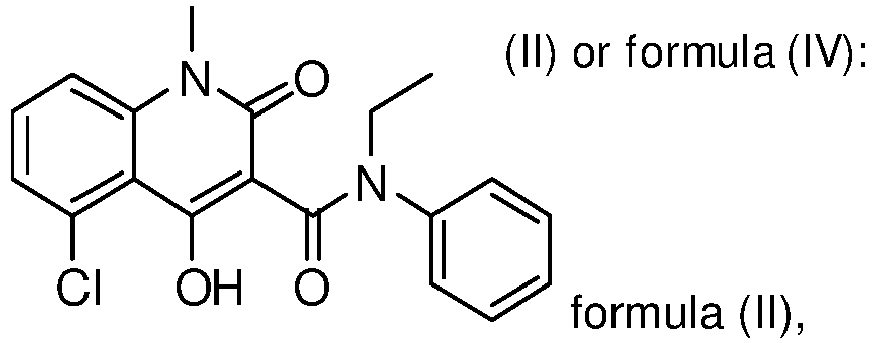

- A specific aspect of the present disclosure provides for a composition comprising a compound selected from the group consisting of compound of formula (II) or formula (IV). or a pharmaceutically acceptable salt thereof, for use in the treatment of an eye disease or eye disorder as claimed.
-
-
Figure 1 : Photography of mouse eye with clearly visible vascularisation. The overlaid graphic illustrates how to measure the average vessel length (VL) from limbal vessels toward the pellet and continuous circumferential zone (in clock hours = CH). -
Figure 2 : Inhibition of corneal vascularisation induced by VEGF. Laquin. = laquinimod. Avastin 5mg/kg provides for 100 % inhibition (reference). Dosage of 0.5 mg/kg laquinimod bid. provides for no inhibition. Dosage of 2.5 mg/kg laquinimod bid. provides for 46 % inhibition. Dosage of 0.5 mg/kg laquinimod qid. provides for 8 % inhibition. Dosage of 2.5 mg/kg laquinimod qid. provides for 50 % inhibition. -
Figure 3 : Inhibition of corneal vascularisation induced by bFGF. Laquin. = laquinimod. Sutent 40mg/kg provides for 80 % inhibition. Dosage of 0.5 mg/kg laquinimod big. provides for 11 % inhibition. Dosage of 2.5 mg/kg laquinimod bid. provides for 35 % inhibition. Dosage of 0.5 mg/kg laquinimod qid. provides for 37 % inhibition. Dosage of 2.5 mg/kg laquinimod qid. provides for 56 % inhibition. -
Figure 4 : Normalized effect size on average vessel length. Data was normalised such that vehicle has 0% average effect size, and the positive control sulforaphane has 100% average effect size. Eylea trended towards an increased effect size (18 % effect size). Test compound ABR215174 (88.2 % effect size) is significantly increased in effect size compared to vehicle. Test compound ABR215062 trended towards increased effect size (53 % effect size). - By "laquinimod" or "ABR-215062" is meant a chemical compound of formula (II):

- By "ABR-215174" is meant 5-chloro-4-hydroxy-1-methyl-2-oxo-1,2-dihydroquinoline-3-carboxylic acid phenylamide, i.e. a compound of formula (IV):

- By "vascularisation" and "neovascularisation" is meant a process by which new blood vessels form. "vascularisation" and "neovascularisation" are used interchangeably herein.
- As used herein, "vascularisation of the eye" is synonymous to ocular neovascularisation.
- By "excessive vascularisation" is meant an event wherein vascularisation occurs to an extent that is deleterious to the normal functioning of the affected tissue. Such excessive vascularisation occurs during or as an effect of eye diseases or eye disorders such as corneal neovascularisation, neovascularisation of the iris, neovascularisation of the ciliary body, corneal pannus, choroidal neovascularisation, proliferative diabetic retinopathy, retinopathy of prematurity, ischemic retinopathy, retinal neovascularisation, and wet age-related macular degeneration.
- In the context of the present disclosure, the terms "an eye disease or eye disorder associated with excessive vascularisation of the eye" and "an eye disease or eye disorder associated with vascularisation of the eye" are taken to mean any eye disease or eye disorder which is considered by those of skill in the art to be caused by, and/or effect vascularisation of one or more tissues of the eye, e.g. in which said vascularisation is deleterious to the normal functioning of the affected tissue. Such diseases or disorders can lead to loss of vision.
- By "treatment" is generally meant to encompass prohibiting, preventing, restraining, and slowing, stopping or reversing progression or severity of an eye disease or eye disorder.
- In relation to vascularisation, the term "extent" is taken to mean the severity of the vascularisation. Such extent of vascularisation can be assessed using several different measureable parameters, such as the area of vascularisation, the amount of vessels in the vascularised area, the length of the vessels in the vascularised area, or the thickness of the vessels in the vascularised area.
- By "laquinimod vehicle" is meant a vehicle used for laquinimod. The vehicle does not contain laquinimod.
- By "VEGF" is meant vascular endothelial growth factor. In mammals, the VEGF family comprises five members, namely VEGF-A, VEGF-B, VEGF-C, VEGF-D, and placental growth factor (PGF). VEGF stimulates cellular responses by binding to the VEGF receptor (VEGFR).
- By "bFGF" is meant basic fibroblast growth factor.
- In one embodiment of the present disclosure, a composition comprising a compound of formula (I) is provided:

- R1 is chloro, R2 is ethyl, and R3 is hydrogen, or
- R1 is chloro, R2 is hydrogen, and R3 is hydrogen,
- or a pharmaceutically acceptable salt thereof, for use in the treatment of an eye disease or eye disorder as presently claimed.
- In a further embodiment of the present disclosure, a composition comprising a compound of formula (I) is provided wherein R1 is chloro, R2 is ethyl, and R3 is hydrogen, for use in the treatment of an eye disease or eye disorder as claimed.
- The common name of the compound wherein R1 is Cl, R2 is ethyl, and R3 is H is laquinimod.
- In one embodiment, a method for treating an eye disease or eye disorder is provided, said method comprising administering a composition comprising a therapeutically effective amount of a compound according to formula (I):

- R1 is chloro, R2 is ethyl, and R3 is hydrogen, or
- R1 is chloro, R2 is hydrogen, and R3 is hydrogen,
- or a pharmaceutically acceptable salt thereof to a subject in need thereof.
- In one embodiment, the present disclosure relates to a compound according to formula (I),

- R1 is chloro, R2 is ethyl, and R3 is hydrogen,
or - R1 is chloro, R2 is hydrogen, and R3 is hydrogen,
- or a pharmaceutically acceptable salt thereof for use in the treatment of an eye disease or eye disorder as claimed.
- Metabolites of laquinimod include those formed by aniline deethylation. Specific examples of metabolites of laquinimod include:
5-chloro-4-hydroxy-1-methyl-2-oxo-N-phenyl-1,2-dihydroquinoline-3-carboxamide. - A preferred embodiment of the disclosure provides for the laquinimod metabolite 5-chloro-4-hydroxy-1-methyl-2-oxo-N-phenyl-1,2-dihydroquinoline-3-carboxamide (5-chloro-4-hydroxy-1-methyl-2-oxo-1,2-dihydroquinoline-3-carboxylic acid phenylamide, ABR-215174).
- In a preferred embodiment of the present disclosure, the compound is selected from the group consisting of laquinimod and 5-chloro-4-hydroxy-1-methyl-2-oxo-1,2-dihydroquinoline-3-carboxylic acid phenylamide (compound of formula (IV)) .
- One embodiment of the present disclosure provides for a composition comprising a compound selected from the group consisting of compound of formula (II) or formula (IV) or a pharmaceutically acceptable salt thereof, for use in the treatment of an eye disease or eye disorder, wherein said eye disease or eye disorder is associated with excessive vascularisation of the eye.
- One embodiment of the present disclosure provides for a method of treating an eye disease or eye disorder as presently claimed, said method comprising administering a composition comprising a therapeutically effective amount of a compound selected from the group consisting of compound of formula (II) or formula (IV) or a pharmaceutically acceptable salt thereof to a subject in need thereof.
- One embodiment of the present disclosure provides a compound selected from the group consisting of compound formula (II) or formula (IV) or a pharmaceutically acceptable salt thereof, for use in the treatment of an eye disease or eye disorder as presently claimed.
- The present disclosure relates to treatment of an eye disease or eye disorder associated with excessive vascularisation of the eye. Such vascularisation may occur in response to external stimuli to the eye, such as excessive stress. Vascularisation may also occur as a natural result of age. Vascularisation of certain eye tissues can be deleterious to eyesight. The eye consists of many different tissues, such as the cornea, the iris, the ciliary body, the choroid, the retina, or the macula. Each of these tissues may be subject to vascularisation.
- In one embodiment of the present disclosure, a compound for treatment of a subject is provided, wherein the subject is suffering from vascularisation of the cornea, the iris, the ciliary body, the choroid, the retina, or the macula.
- In one embodiment of the present disclosure, a compound for treatment of a subject is provided, wherein the subject is suffering from vascularisation of a tissue in the anterior of the eye, such as the cornea, the iris, or the ciliary body. It is important that the cornea is transparent for functioning eyesight. Vascularisation of the cornea is therefore deleterious to the eyesight of a person. Thus, in a preferred embodiment, the present disclosure provides for a composition comprising a compound of the disclosure for treatment of corneal neovascularisation.
- In one embodiment of the present disclosure, the eye disease or eye disorder is selected from the group consisting of corneal neovascularisation, neovascularisation of the iris, neovascularisation of the ciliary body, corneal pannus, choroidal neovascularisation, retinal neovascularisation, wet age-related macular degeneration, proliferative diabetic retinopathy, retinopathy of prematurity, and ischemic retinopathy.
- In one embodiment of the disclosure, the eye disease or eye disorder is associated with excessive vascularisation of the eye. In one embodiment of the present disclosure, the eye disease or eye disorder is corneal neovascularisation, neovascularisation of the iris, neovascularisation of the ciliary body, corneal pannus, choroidal neovascularisation, retinal neovascularisation, wet age-related macular degeneration, proliferative diabetic retinopathy, retinopathy of prematurity, or ischemic retinopathy associated with excessive vascularisation of the eye.
- Retinopathy is damage to the retina, which may cause vision impairment. Retinopathy can refer to retinal vascular disease or damage to the retina caused by abnormal blood flow. Thus, in one embodiment of the present disclosure, a compound for treatment of a subject is provided, wherein the subject is suffering from proliferative diabetic retinopathy, retinopathy of prematurity, or ischemic retinopathy. Diabetes is a common cause of retinopathy, and diabetic retinopathy is one of the leading causes of blindness in working-aged people. Thus, in an embodiment of the present disclosure, a composition comprising a compound of the disclosure for treatment of a subject is provided, wherein the subject is suffering from proliferative diabetic retinopathy.
- In one embodiment of the present disclosure, a compound for treatment of a subject is provided, wherein the subject is suffering from vascularisation of a tissue in the posterior of the eye, such as the choroid, the retina, or the macule. The purpose of the retina is to receive light that the lens has focused, convert the light into neural signals, and send these signals on to the brain for visual recognition. Therefore, any disruption to the retina, such as vascularisation, can affect the eyesight of a person. Thus, in a preferred embodiment of the present disclosure, a composition comprising a compound of the disclosure is provided for treatment of a subject suffering from retinal neovascularisation.
- The macula is the central area of the retina. The macula is responsible for the central, high-resolution, colour vision that is possible in good light. Damage to the macula will result in loss of central vision, which can severely affect a person's ability to read and recognise faces. Thus, in the most preferred embodiment of the present disclosure, a composition comprising a compound of the disclosure is provided for treatment of a subject suffering from vascularisation of the macula. Vascularisation of the macula is also known as wet age-related macular degeneration. Thus, in the most preferred embodiment of the present disclosure, a composition comprising a compound of the disclosure is provided for treatment of a subject suffering from wet age-related macular degeneration. In one embodiment of the present disclosure, the wet age-related macular degeneration is associated with excessive vascularisation of the eye.
- In a preferred embodiment of the disclosure, the term "an eye disease or eye disorders associated with excessive vascularisation of the eye" does not comprise uveitis or conjunctivitis.
- Vascular endothelial growth factor (VEGF) stimulates formation of blood vessels. VEGF inhibitors have the potential to reduce vascularisation of tissues by binding VEGF. Alternatively, VEGF inhibitors may affect the activity of VEGF by binding to the VEGF receptor.
- The compositions of the disclosure may be administered in combination with a VEGF inhibitor for the treatment of an eye disease or eye disorder, such as those associated with excessive vascularisation of the eye. Such combination treatment is potentially more effective at treating the eye disease or eye disorder than the compositions of the disclosure and/or the VEGF inhibitor alone. Thus, in one embodiment of the present disclosure, an eye disease or eye disorder is treated by administration of a composition of the disclosure in combination with administration of a VEGF inhibitor.
- VEGF inhibitors comprise antibodies, antibody-derived fragments, recombinant proteins and recombinant fusion proteins such as aflibercept, ranibizumab, bevacizumab, brolucizumab, abicipar pegol, conbercept, and faricimab. Thus, in one embodiment of the present disclosure, an eye disease or eye disorder is treated by administration of a composition of the disclosure in combination with administration of aflibercept, ranibizumab, bevacizumab, brolucizumab, abicipar pegol, conbercept, or faricimab. In a preferred embodiment, an eye disease or eye disorder is treated by administration of a composition of the disclosure in combination with administration of aflibercept, ranibizumab, bevacizumab, or brolucizumab.
- The recombinant protein aflibercept (Eylea) has affinity for VEGF-A, VEGF-B, and PGF. This VEGF inhibitor has been shown to be effective in treatment of wet AMD. In one preferred embodiment of the present disclosure, an eye disease or eye disorder is treated by administration of a composition of the disclosure in combination with administration of aflibercept.
- The monoclonal antibody fragment ranibizumab has affinity for VEGF-A. This antibody fragment is known to be effective in the treatment of wet AMD. In one embodiment of the present disclosure, an eye disease or eye disorder is treated by administration of a composition of the disclosure in combination with administration of ranibizumab.
- Bevacizumab (Avastin) is an IgG1-based antibody which binds VEGF-A. Bevacizumab has been shown to be effective for treatment of wet AMD. Thus, in one embodiment of the present disclosure, an eye disease or eye disorder is treated by administration of a composition of the disclosure in combination with administration of bevacizumab.
- Brolucizumab is an sc antibody fragment which has affinity for VEGF-A. In one embodiment of the present disclosure, an eye disease or eye is treated by administration of a composition of the disclosure in combination with administration of bevacizumab.
- The peptide abicipar pegol is a known VEGF-A inhibitor. In one embodiment of the present disclosure, an eye disease or eye disorder is treated by administration of a composition of the disclosure in combination with administration of abicipar pegol.
- Conbercept is a recombinant fusion protein with affinity for VEGF-A. Thus, in one embodiment of the present disclosure, an eye disease or eye disorder is treated by administration of a composition of the disclosure in combination with administration of conbercept.
- The bispecific monoclonal antibody faricimab modulates both angiopoietin-2 and VEGF-A activity. Thus, in one embodiment of the present disclosure, an eye disease or eye disorder is treated by administration of a compound of the disclosure in combination with faricimab.
- In one embodiment of the present disclosure, the composition of the disclosure comprises or is administered in combination with an angiogenesis inhibitor. In a specific embodiment of the disclosure, the angiogenesis inhibitor is aflibercept.
- In one embodiment of the present disclosure, a composition comprising a compound of the disclosure may be administered to a subject in need thereof via a topical, oral, intravitreal, subconjunctival, retrobulbar, intracameral, or systemic route.
- In the treatment of a disease or disorder which is highly localised to one part of the body, such as an eye disease or and eye disorder, it can be advantageous to administer a pharmaceutical directed against that disease or disorder via a route that ensures said pharmaceutical is localised mainly at the site of the disease or disorder. Thus, in a preferred embodiment of the present disclosure, a composition comprising a compound of the disclosure may be administered to a subject in need thereof via a topical, intravitreal, subconjunctival, retrobulbar, or intracameral route.
- In one embodiment of the disclosure, the composition of the disclosure is administered in a way to effect systemic administration of the composition. In a further embodiment of the disclosure, the administration of the composition of the disclosure is oral administration.
- In the treatment of a disease or disorder, wherein said disease or disorder requires frequent administration of dosages of a pharmaceutical to a subject, it can be advantageous if the pharmaceutical is formulated in a way that allows for self-administration. The person skilled in the art will know which types of formulations are suitable for self-administration.
- As outlined herein, the compositions of the invention may be administered in combination with a VEGF inhibitor. Thus, in one embodiment, the composition of the present disclosure and the VEGF inhibitor is comprised within the same formulation and thereby administered simultaneously.
- The combination treatment described herein is not limited to compositions comprising both a compound of the disclosure and a VEGF inhibitor. On the contrary, the compound of the invention and the VEGF inhibitor may be administered as different formulations. The choice to administer the compound of the disclosure and the VEGF inhibitor as separate formulations could be motivated by the compound of the disclosure and the VEGF inhibitor having different preferred dosage regimes. For instance, it may be advantageous to administer the compound of the disclosure often, such as daily or weekly, whereas the VEGF inhibitor is better administered infrequently, such as every few months. The choice to administer the compound of the disclosure and the VEGF inhibitor as separate formulations could also be motivated by the compound of the disclosure and VEGF inhibitor not being suitable for the same type of administration route. For instance, the compound of the disclosure might be especially suitable for one type of administration route, such as topical administration, whereas the VEGF inhibitor might be suitable for a second type of administration route, such as intravitreal injection. Thus, in one embodiment, the compound of the disclosure and the VEGF inhibitor are comprised within different formulations, wherein the formulations are administered at different frequencies. In another embodiment, the compound of the disclosure and the VEGF inhibitor are comprised within different formulations, wherein the formulations are administered employing different routes of administration.
- VEGF inhibitors are typically administered as intravitreal injections for treatment of eye diseases or eye disorders such as those associated with vascularisation of the eye. Intravitreal injections are often performed at a hospital or at the office of a general practitioner. Intravitreal injections for the treatment of diseases associated with vascularisation of the eye are typically given at a frequency of a few months, such as for instance every month, every 3 months, or every 6 months. Intravitreal injections are given under local anaesthesia. Adverse effects of intravitreal injection include increased pressure in the eye, floaters, inflammation, bleeding, scratched cornea, damage to the retina or surrounding nerves, and infection. Furthermore, the need to visit a general practitioner or a hospital every few months to have the injection performed can be inconvenient, and persons receiving intravitreal injections may find the experience unpleasant and discomforting. Topical treatment with a compound of the disclosure before, during, or in the time period between intravitreal injections with VEGF inhibitors may prolong the period before additional injections of VEGF are needed. Thus, in one embodiment of the present disclosure, topical treatment of an eye disease or eye disorder such as those associated with excessive vascularisation of the eye with a composition comprising the compound of the disclosure effects that intravitreal injections with a VEGF inhibitor are needed less frequently, than had the intravitreal injections of VEGF inhibitor been employed alone. Furthermore, in one embodiment, the compound of the disclosure and the VEGF inhibitor are comprised within different compositions wherein administration of the composition comprising the compound of the disclosure effects treatment of the eye disease or eye disorder and reduces the frequency required of intravitreal VEGF inhibitor injection.
- In one embodiment of the present disclosure, a composition is provided comprising a compound of the present disclosure. In a further embodiment, a composition is provided comprising a compound of the present disclosure and a pharmaceutically acceptable excipient.
- Different routes exist for administration of pharmaceuticals to the eye. For instance, medicaments may be administered topically to the eye. Thus, in one embodiment, a composition comprising a compound of the present disclosure is administered topically to the eye. The person skilled in the art will know which types of administration routes are suitable for administration to the eye.
- In one embodiment of the disclosure, a composition comprising a compound of the present disclosure is administered orally.
- One embodiment of the present disclosure provides for a method of treating wet age-related macular degeneration in a subject, said method comprising administering to a subject a composition comprising a compound of formula (I):

- R1 is chloro, R2 is ethyl, and R3 is hydrogen,
or - R1 is chloro, R2 is hydrogen, and R3 is hydrogen.
- In a further embodiment, the present disclosure provides for a method of treating wet age-related macular degeneration in a subject, said method comprising administering to said subject laquinimod. In yet another embodiment, the present disclosure provides for a method of treating wet age-related macular degeneration, said method comprising administering to the subject a therapeutically effective amount of ABR-215062 . In yet another embodiment, the present disclosure provides for a method of treating wet age-related macular degeneration, said method comprising administering to the subject a therapeutically effective amount of ABR-215174.
- Thus, in one embodiment of the present invention, a compound of formula (I):
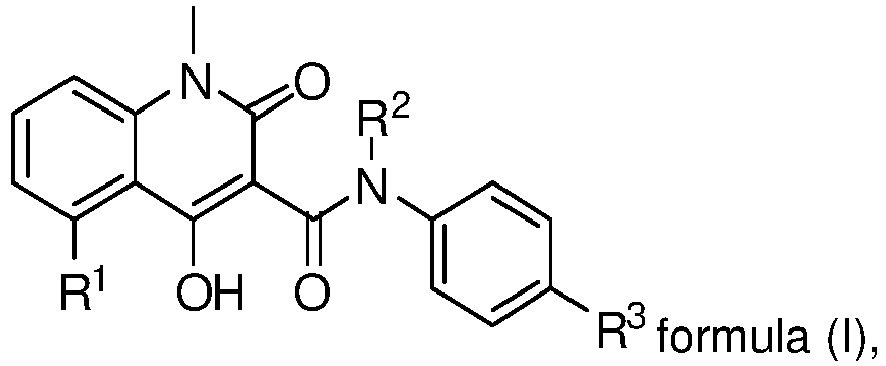
- R1 is chloro, R2 is ethyl, and R3 is hydrogen,
or - R1 is chloro, R2 is hydrogen, and R3 is hydrogen,
- is used for the treatment of wet age-related macular degeneration. In another embodiment, laquinimod is used for the treatment of wet age-related macular degeneration. In yet another embodiment, ABR-215174 is used for the treatment of wet age-related macular degeneration.
- Forty-eight (48) Brown Norway pigmented rats were divided into six (6) groups of eight (8) animals. Choroidal neovascularization was induced using a 532 nm argon laser photocoagulator (six (6) 75 µm-sized spots at 150 mW for 0.1 sec duration) in the right eyes on
Day 0. The test item was administered three times a day by instillation or twice a day by oral administration from Day 0 (D0) just after ChNV induction to Day 21 (last day of the study). Control item (vehicle) was instilled three times a day and the reference item (Dexamethasone in olive oil) was administered by daily oral administration from theDay 0 just after induction of neovascularization to Day 21. Fundus neovessels were evaluated in the right eyes on Days 14 and 21 using Heidelberg's Retinal Angiograph (HRA). Lesion size was determined on choroid flatmounts labelled with Isolectin-B4 at the end of the in vivo period. - On
Day 0, animals were anesthetized by an intramuscular injection of a mix of xylazine (5 mg/ kg) and ketamine (25 mg/ kg). Pupils from the right eyes were dilated by instillation of one drop of 0.5% tropicamide. Then, six (6) choroidal burns (75 µm spot size) were done through a slit-lamp, with a contact lens, around the optic disc, between the main vessel branches using an argon laser photocoagulator (532 nm; 150 mW; 0.1 sec duration). Production of a bubble at the time of laser treatment confirmed the rupture of Bruch's membrane. - Test, control, or reference items were administered topically by instillation (10 µL each) or by oral route (1 mL/kg) from Day 0 (just after the induction) to Day 21 (end of the study). Test and control items were administered three times a day (for instillation) and two times a day (for oral administration). Reference item was administered once a day by oral route.
- The body weight of all animals was recorded before the start of the study, then once every week.
- Fluorescein angiography was performed on Days 14 and 21 using an HRA (Heidelberg's Retinal Angiograph). After anaesthesia (same mix used for ChNV induction) and pupillary dilation, 250 µL/100 g (body weight) of a 10% sodium fluorescein was injected subcutaneously using a 26-G insulin syringe, and fluorescein photos were recorded 10 minutes after dye injection.
- The leakage of fluorescein on the angiograms were evaluated by two examiners in a masked fashion and graded as follows:
-
Score 0, no leakage; - Score 1, slightly stained;
- Score 2, moderately stained;
-
Score 3, strongly stained. - Statistical analysis, using Mann-Whitney U test or appropriate statistical model, were performed on the scoring of lesions visualized by HRA from each animal and on the scoring of the flat mounted preparations.
- The general behaviour and appearance of all animals were observed and noted in the raw data. No particular sign was observed and the general behaviour and appearance of animals were normal. All animals survived until the scheduled euthanasia.
- Animal body weights were recorded before induction and treatment (baseline) and then once a week. Animal body weights were within the normal range at the baseline: 166 - 202 g (min - max, n = 48). On Day 21, no significant difference between test and control items was observed. Animals treated with the reference item (dexamethasone) showed a 21% body weight loss during the study. This loss is an expected adverse effect of orally dosed corticosteroid.
- The grading of fluorescein angiographies (FA) was based on the fluorescence intensity for each lesion. For each treatment group, results were expressed as the group mean score per time-point. Table 1 summarises the evaluation of FA recorded at 10 min on Days 14 and 21 (n=8 animals per group, right eyes). A statistical analysis was performed on the median of the individual intensity scores, using a Kruskall-Wallis test followed by a Mann & Whitney U multiple comparison test, which was used to compare each test, control or reference group.
Table 1: evaluation of FA per treatment group. (per os = oral) Treatment Route of Administration Dosing-regimen Time-point Mean score of fluorescein leakaqe Mean (n=nb evaluated spots/48) % of reduction vs respective vehicle Laquinimod Instillations 5% 3x/day Day 14 0.7 (n = 38) 0% Day 21 0.4 (n = 45 63% 1% 3x/day Day 14 1.1 (n = 36) <0% Day 21 (n 1.2 = (n <0% 0.2% 3x/day Day 14 0.7 (n = 35) 0% Day 21 0.9 (n = 42) 18% Per os Day 14 0.8 ) <0% 1 mg/kg 2x/day (n = 42) Day 21 0.9 (n = 38) 18% Laquinimod vehicle Instillations 3x/day Day 14 0.7 (n = 35) - Day 21 1.1 (n = 38) - Dexamethasone Per os 0.5 mg/kg 1x/day Day 14 0.7 (n = 48) 71% Day 21 0.8 (n = 48) 73% - On Day 14 and Day 21, 63% and 66% of the evaluated spots were leaking in vehicle-treated animals, respectively, indicating the formation and the persistence of ChNV. However, daily topical administration of laquinimod effectively reduces vascular leakage, indicating that laquinimod is effectively counteracting the ChNV.
- The area of the neovascularisation can be measured using the formula:

Figure 1 . - Hydron pellets for induction of vascularisation were prepared from stimulant (VEGF) and binding agent (sucralfate). 53 CR female C57BL/6 mice aged 6 to 8 weeks were prepared for surgery by anesthetising with 90 mg/kg of pentobarbital, ip. Corneal vascularisation was induced by placement of a pellet in a corneal pocket cut in one eye. Signs for ocular irritation or infection were carefully monitored.
- Dosages of laquinimod in DI (deionised) water, vehicle (DDW = double distilled water), and avastin (positive control) were applied directly to the eye containing the pellet. Vascularisation was measured on
day 8. Treatment regimen is shown in Table 2. Results are shown in Table 3 andFigure 2 .Table 2: Treatment regimes for induction of corneal vascularisation with VEGF and subsequent administration of laquinimod. Group n Treatment regimen 1 Treatment regimen 2 Agent ng/ animal Route Schedule Agent µg/ animal Route Schedule 1 8 VEGF 129 cp qd·1 - - - - 2 4 VEGF 129 cp qd·1 avas. 5* ip qd x7 3 4 VEGF 129 cp qd·1 veh. - topical qd x7 first day 2 doses 4 8 VEGF 129 cp qd·1 laqui. 10 topical bid x7 first day 1 dose 5 8 VEGF 129 cp qd·1 laqui. 50 topical bid x7 first day 1 dose 6 8 VEGF 129 cp qd·1 laqui. 10 topical qid x7 first day 2 doses 7 8 VEGF 129 cp qd·1 laqui. 50 topical qid x7 first day 2 doses *mg/kg
laqui. = laquinimod
veh. = vehicle
avas. = avastinTable 3: results for treatment of corneal vascularisation induced by VEGF. Group n Pellet agent Area of vasc. Area percent of positive control 1 8 VEGF 1.47 ± 0.09 - 2 4 VEGF 0.00 ± 0.00 0 % 3 4 VEGF 1.63 ± 0.13 111 % 4 8 VEGF 1.49 ± 0.13 101 % 5 7 VEGF 0.79 ± 0.06 54 % 6 8 VEGF 1.35 ± 0.09 92 % 7 8 VEGF 0.74 ± 0.11 50% vasc. = vascularisation. - Treatment of vascularisation induced by VEGF showed dosage-dependent effect upon administration of laquinimod: low dosage (0.5 mg/kg, bid, group 4) did not provide for any inhibition. Increasing the frequency administration only provided for little inhibition (0.5 mg/kg, qid,
group group - Hydron pellets for induction of vascularisation were prepared from stimulant (bFGF) and binding agent (sucralfate). 47 CR female C57BL/6 mice aged 6 to 8 weeks were prepared for surgery by anesthetising with 90 mg/kg of pentobarbital, ip. Corneal vascularisation was induced by placement of a pellet in a corneal pocket cut in one eye. Signs for ocular irritation or infection were carefully monitored.
- Dosages of laquinimod in DI (deionised) water, vehicle (DDW = double distilled water), and avastin (positive control) were applied directly to the eye containing the pellet. Vascularisation was measured on
day 6. Treatment regimen is shown in Table 4. Results are shown in Table 5 andFigure 3 .Table 4: Treatment regimes for induction of corneal vascularisation with bFGF and subsequent administration of laquinimod. Group n Treatment regimen 1 Treatment regimen 2 Agent ng/ animal Route Schedule Agent µg/ animal Route Schedule 1 8 bFGF 200 cp qd·1 - - - - 2 6 bFGF 200 cp qd·1 sutent 5* po qd x5 3 4 bFGF 200 cp qd·1 veh. - topical qd x5 first day 2 doses 4 6 bFGF 200 cp qd·1 laqui. 10 topical bid x5 first day 1 dose 5 6 bFGF 200 cp qd·1 laqui. 50 topical bid x5 first day 1 dose 6 6 bFGF 200 cp qd·1 laqui. 10 topical qid x5 first day 2 doses 7 6 bFGF 200 cp qd·1 laqui. 50 topical qid x5 first day 2 doses *mg/kg
laqui. = laquinimod
veh. = vehicleTable 5: results for treatment corneal vascularisation induced by bFGF Group n Pellet Agent Area of vasc. Area percent of positive control 1 8 bFGF 3.54 ± 0.10 - 2 6 bFGF 0.72 ± 0.08 20 % 3 4 bFGF 3.54 ± 0.15 100 % 4 6 bFGF 3.16 ± 0.06 89 % 5 6 bFGF 2.30 ± 0.23 65 % 6 6 bFGF 2.25 ± 0.16 63 % 7 6 bFGF 1.56 ± 0.15 44 % vasc. = vascularisation. - Treatment of vascularisation induced by bFGF showed dosage-dependent effect upon administration of laquinimod: low dosage (0.5 mg/kg, bid, group 4) inhibited 11 % of the vascularisation whereas higher dosage (2.5 mg/kg, bid, group 5) inhibited 35 % of the vascularisation. Increasing the frequency of dosage improved inhibition further, with many low dosages (0.5 mg/kg, qid, group 6) providing for a similar inhibition (37 %) as few large doses (group 5). Many daily, large dosages (2.5 mg/kg, qid, group 7) provided for even further inhibition (56 %) of vascularisation.
- The following experimental groups were included in the study:
Group 1: Control (Vehicle, 0.1% DMSO) Group 2: Sulforaphane (10 µM, positive control, anti-angiogenic effects) Group 3: Aflibercept ("Eylea" 40 µg/ml, positive control, partial anti-angiogenic effects) Group 4: ABR-215174 (0.1 µM) Group 5: ABR-215062 (10 µM) - Human retinal microvascular endothelial cells (HRMECs) were purchased from Neuromics (Cat# HEC09, Lot# 2872) and cultured according to manufacturer's instructions in Endo-Growth media (Cat# EKG001, Lot# EKG0011902269) supplemented with Endothelial Growth Factor (Cat# EKG001, Lot# EGK00125) on AlphaBiocoat coated T25 flasks at 37°C 5% CO2.
- Primary human microglia from brain were purchased from Celprogen (Cat# 37089-01, Lot# 1614454-01) and cultured in microglia complete growth media with antibiotics (Cat# M37089-01, Lot# 2010089205-03) supplemented with 10% standard fetal bovine serum (Neuromics, Lot# 042P20) on poly-L-Lysine (PLL, 50 mg/ml) coated T25 flasks at 37°C 5% CO2.
- Human microglia were seeded onto PLL coated cell culture inserts (Sarstedt, Cat# 83.3932.040) at 103 000 cells/cm2. Microglia were treated with study compounds, aflibercept and vehicle for 24 hours prior to lipopolysaccharide (LPS) activation using following concentrations in microglia complete growth media:
- Vehicle (0.1% DMSO)
- Aflibercept (Eylea®, 40 g/ml), 0.1% DMSO
- ABR-215174 (0.1 µM), 0.1% DMSO
- ABR-215062 (10 µM), 0.1% DMSO
- The method for co-cultures of microglia and HRMECs was modified from protocol described by Ding et al. 2018 (Ding X, Gu R, Zhang M, Ren H, Shu Q, Xu G, Wu H. Microglia enhanced the angiogenesis, migration and proliferation of co-cultured RMECs. BMC Ophthalmol. 2018,18(1):249. doi: 10.1186/s12886-018-0886-z. PMID: 30223824; PMCID: PMC6142340) and Ji Cho et al. 2019 (Ji Cho M, Yoon SJ, Kim W, Park J, Lee J, Park JG, Cho YL, Hun Kim J, Jang H, Park YJ, Lee SH, Min JK. Oxidative stress-mediated TXNIP loss causes RPE dysfunction. Exp Mol Med. 2019 Oct 15;51(10):1-13. doi: 10.1038/s12276-019-0327-y. PMID: 31615975; PMCID: PMC6802648). Microglia was activated with LPS (100 ng/ml) in microglia complete growth media without FBS with simultaneous treatment of freshly prepared study compounds, Eylea and vehicle for 24 hours. HRMECs were incubated in basal Endo-Growth media for 24 hours before co-culturing.
- HRMECs were seeded onto Matrigel® coated 24-well plate (42 000 cells/cm2) and simultaneously treated of freshly prepared study compounds, aflibercept and sulforaphane in basal Endo-Growth media:
- Vehicle (0.1% DMSO)
- Sulforaphane (10 M), 0.1% DMSO
- Aflibercept (Eylea®, 40 µg/ml), 0.1% DMSO
- ABR-215174 (0.1 µM), 0.1% DMSO
- ABR-215062 (10 µM), 0.1% DMSO
- Media in microglia inserts containing LPS was replaced to corresponding freshly prepared study compounds, aflibercept and sulforaphane in basal Endo-Growth media. Inserts containing activated microglia were transferred into the 24-wells containing HRMECs. The co-cultures were incubated at +37 °C 5% CO2, stained with calcein-AM (5 µM) for 30 min and imaged using a fluorescence microscope (Leica Thunder 3D Tissue Imager, Leica Microsystems).
- Images were analyzed using the AngioTool software (Zudaire E, Gambardella L, Kurcz C, Vermeren S (2011) A Computational Tool for Quantitative Analysis of Vascular Networks. PLOS ONE 6(11): e27385. https://doi.org/10.1371/journal.pone.0027385) for ImageJ (NIH public domain). Total tube area, tube length, density, lacunarity, and branching index (number of junctions and endpoints) were quantified.
- Images were analyzed using AngioTool software (NIH, Bethesda, MD; available in the public domain) for the following readouts: average vessels length, total vessels length, vessel area, vessels percentage area, total number of junctions, density of junctions, total number of endpoints, and mean lacunarity. Raw data were plotted in mm or µm (and mm2 or µm2) for length and area measurements. Raw data for each of the readouts was plotted and analyzed by ordinary one-way ANOVA with Dunnett's multiple comparisons post-hoc test.
- Effect size was calculated by subtracting the mean of the vehicle group from each value, then normalizing the data to the sulforaphane (positive control) condition, such that the average for sulforaphane group is equal to a maximal effect size (100%), and for vehicle is equal to no effect size (0%). Effect size data were analyzed by non-parametric Kruskal-Wallis test, with Dunn's multiple comparisons post-hoc test.
- The difference between normalized effect size on average vessel length between sulforaphane and vehicle groups reached statistical significance (
Figure 4 ). Test compound ABR215174 (88.2% effect size) was significantly increased in effect size on average vessel length compared to vehicle. Effect size of Eylea (18% effect size) and test compound ABR215062 (53% effect size), although not statistically significant, trended towards an increased effect size on average vessel length. - Since sulphoraphane is a known and well-accepted positive control for prevention of angiogenesis, these results indicate that the test compounds ABR215174 and ABR215062 can also be used to prevent angiogenesis.
- Microglia, especially activated microglia play important roles in angiogenesis and maintenance of vascular function haemostasis in the retinal microvasculature (Ding et al 2018). It is contemplated that a co-culture of human retinal microvasculature endothelial cells (HRMEC's) and human microglia from brain can be used to assess the effects of a compound of the disclosure, such as laquinimod, tasquinimod, ABR-215174 or ABR-215691, on neovascularization. A method such as the one outlined below may be used.
- This study may be carried out substantially as outlined in Example 3.
- Tube formation assay is performed using 24-well plate wells coated with Matrigel or in 96-wells as described Ding et al. 2018 (Ding et al. BMC Ophthalmology (2018) 18:249): A 96-well plate is coated with 50 µL/well Matrigel at 37 °C for 30 min. After co-culturing with microglia for 24 h, HRMECs are seeded on the Matrigel at 1.5 × 10⁴ cells/well in 100 µL medium. After a period of time, for example 4 h, tube formation is observed and photographed with a microscope (Leica Microsystems). Images are analysed using the Angiotool plugin (Zudaire et al., 2011, PLoS one, 6, 11, e27385) for ImageJ (NIH public domain). Total tube area, tube length, density, lacunarity, and branching index (number of junctions and endpoints) are quantified.
- It is contemplated that when combining a compound of the disclosure, such as
laquinimod 1 and 10 µM or ABR-215174 0.01 and 0.1 µM, with Aflibercept (30 nM) a clear additive effect will be seen compared to each compound used as monotherapy.
Claims (15)
- A composition comprising a compound according to formula (I):
 R1 is chloro, R2 is ethyl or hydrogen, and R3 is hydrogen,or a pharmaceutically acceptable salt thereof, for use in the treatment of an eye disease or eye disorder selected from the group consisting of wet age-related macular degeneration, corneal neovascularisation, neovascularisation of the iris, neovascularisation of the ciliary body, corneal pannus, choroidal neovascularisation, retinal neovascularisation, proliferative diabetic retinopathy, retinopathy of prematurity, and ischemic retinopathy.
 - The composition for use according to claim 1, wherein the compound is laquinimod, or a pharmaceutically acceptable salt thereof.
- The composition for use according to claim 1, wherein the compound is a compound of formula (IV):

- The composition for use according to any one of the preceding claims, wherein the eye disease or eye disorder is selected from the group consisting of corneal neovascularisation, neovascularisation of the iris, neovascularisation of the ciliary body, and corneal pannus.
- The composition for use according to claim 4, wherein the eye disease or eye disorder is corneal neovascularisation.
- The composition for use according to any one of claims 1 to 3, wherein the eye disease or eye disorder is selected from the group consisting of proliferative diabetic retinopathy, retinopathy of prematurity, and ischemic retinopathy.
- The composition for use according to any one of claims 1 to 3, wherein the eye disease or eye disorder is selected from the group consisting of choroidal neovascularisation, retinal neovascularisation, and wet age-related macular degeneration.
- The composition for use according to claim 7, wherein the eye disease or eye disorder is choroidal neovascularisation.
- The composition for use according to claim 7, wherein the eye disease or eye disorder is retinal neovascularisation.
- The composition for use according to claim 7, wherein the eye disease or eye disorder is wet age-related macular degeneration.
- The composition for use according to any one of the preceding claims, wherein the composition comprises or is administered in combination with an angiogenesis inhibitor, such as aflibercept.
- The composition for use according to any one of the preceding claims, wherein the composition comprises or is administered in combination with a VEGF inhibitor.
- The composition for use according to claim 12, wherein the VEGF inhibitor is selected from the group consisting of aflibercept, ranibizumab, bevacizumab, brolucizumab, abicipar pegol, conbercept, and faricimab.
- The composition for use according to any one of the preceding claims, wherein the composition comprises or is administered in combination with at least one pharmaceutically acceptable excipient.
- The composition for use according to any one of the preceding claims, wherein the route of administration is topical, oral, intravitreal, subconjunctival, retrobulbar, intracameral, or systemic.
Priority Applications (1)
| Application Number | Priority Date | Filing Date | Title |
|---|---|---|---|
| EP22167643.0A EP4094765A1 (en) | 2019-12-19 | 2020-12-18 | Compounds for treatment of eye diseases associated with excessive vascularisation |
Applications Claiming Priority (3)
| Application Number | Priority Date | Filing Date | Title |
|---|---|---|---|
| EP19218062 | 2019-12-19 | ||
| EP20156158 | 2020-02-07 | ||
| PCT/EP2020/086993 WO2021123142A1 (en) | 2019-12-19 | 2020-12-18 | Compounds for treatment of eye diseases associated with excessive vascularisation |
Related Child Applications (1)
| Application Number | Title | Priority Date | Filing Date |
|---|---|---|---|
| EP22167643.0A Division EP4094765A1 (en) | 2019-12-19 | 2020-12-18 | Compounds for treatment of eye diseases associated with excessive vascularisation |
Publications (2)
| Publication Number | Publication Date |
|---|---|
| EP3886858A1 EP3886858A1 (en) | 2021-10-06 |
| EP3886858B1 true EP3886858B1 (en) | 2022-05-11 |
Family
ID=74141502
Family Applications (2)
| Application Number | Title | Priority Date | Filing Date |
|---|---|---|---|
| EP20838435.4A Active EP3886858B1 (en) | 2019-12-19 | 2020-12-18 | Compounds for treatment of eye diseases associated with excessive vascularisation |
| EP22167643.0A Withdrawn EP4094765A1 (en) | 2019-12-19 | 2020-12-18 | Compounds for treatment of eye diseases associated with excessive vascularisation |
Family Applications After (1)
| Application Number | Title | Priority Date | Filing Date |
|---|---|---|---|
| EP22167643.0A Withdrawn EP4094765A1 (en) | 2019-12-19 | 2020-12-18 | Compounds for treatment of eye diseases associated with excessive vascularisation |
Country Status (15)
| Country | Link |
|---|---|
| US (2) | US11478465B2 (en) |
| EP (2) | EP3886858B1 (en) |
| JP (1) | JP7730816B2 (en) |
| KR (1) | KR20220118419A (en) |
| CN (1) | CN114845718B (en) |
| AU (1) | AU2020408179B2 (en) |
| BR (1) | BR112022009192A2 (en) |
| CA (1) | CA3157394A1 (en) |
| DK (1) | DK3886858T3 (en) |
| ES (1) | ES2921360T3 (en) |
| IL (1) | IL293469B2 (en) |
| MX (1) | MX2022006439A (en) |
| PL (1) | PL3886858T3 (en) |
| WO (1) | WO2021123142A1 (en) |
| ZA (1) | ZA202204939B (en) |
Families Citing this family (7)
| Publication number | Priority date | Publication date | Assignee | Title |
|---|---|---|---|---|
| MA54325A (en) | 2019-06-05 | 2022-05-11 | Regeneron Pharma | DEVICES AND METHODS FOR ACCURATE DOSE DELIVERY |
| EP3886858B1 (en) * | 2019-12-19 | 2022-05-11 | Active Biotech AB | Compounds for treatment of eye diseases associated with excessive vascularisation |
| KR20230165260A (en) | 2021-04-01 | 2023-12-05 | 액티브 바이오테크 에이비 | Laquinimod formulation for eyes |
| USD1120314S1 (en) | 2022-11-30 | 2026-03-24 | Regeneron Pharmaceuticals, Inc. | Dose delivery device |
| WO2025006886A1 (en) * | 2023-06-28 | 2025-01-02 | Board Of Regents, The University Of Texas System | Quinoline carboxamides for use in the treatment of men |
| CN117256554A (en) * | 2023-09-08 | 2023-12-22 | 益诺思生物技术南通有限公司 | C57BL/6J mouse neovascular eye disease model and construction method thereof |
| KR102925647B1 (en) * | 2023-10-13 | 2026-02-11 | 재단법인 대구경북첨단의료산업진흥재단 | Eye disease medicine |
Family Cites Families (27)
| Publication number | Priority date | Publication date | Assignee | Title |
|---|---|---|---|---|
| US6077851A (en) | 1998-04-27 | 2000-06-20 | Active Biotech Ab | Quinoline derivatives |
| SE9801474D0 (en) | 1998-04-27 | 1998-04-27 | Active Biotech Ab | Quinoline Derivatives |
| US6875869B2 (en) | 2002-06-12 | 2005-04-05 | Active Biotech Ab | Process for the manufacture of quinoline derivatives |
| US9265725B2 (en) | 2002-10-25 | 2016-02-23 | Foamix Pharmaceuticals Ltd. | Dicarboxylic acid foamable vehicle and pharmaceutical compositions thereof |
| WO2008124828A1 (en) * | 2007-04-10 | 2008-10-16 | Myriad Genetics, Inc. | Methods for treating vascular disruption disorders |
| US20120009226A1 (en) | 2008-12-17 | 2012-01-12 | Actavis Group Ptc Ehf | Highly pure laquinimod or a pharmaceutically acceptable salt thereof |
| CN104610144A (en) * | 2010-07-09 | 2015-05-13 | 泰华制药工业有限公司 | Deuterated n-ethyl-n-phenyl-1,2-dihydro-4-hydroxy-5-chloro-1-methyl-2-oxoquinoline-3-carboxamide, salts and uses thereof |
| EP2463289A1 (en) | 2010-11-26 | 2012-06-13 | Almirall, S.A. | Imidazo[1,2-b]pyridazine derivatives as JAK inhibitors |
| EP2527344A1 (en) | 2011-05-25 | 2012-11-28 | Almirall, S.A. | Pyridin-2(1H)-one derivatives useful as medicaments for the treatment of myeloproliferative disorders, transplant rejection, immune-mediated and inflammatory diseases |
| EP2537517A1 (en) * | 2011-06-22 | 2012-12-26 | Active Biotech AB | Deuterium-enriched 4-hydroxy-5-methoxy-n,1-dimethyl-2-oxo-n-[(4-trifluoro-methyl)phenyl]-1,2-dihydroquinoline-3-carboxamide |
| CN103781354A (en) | 2011-07-28 | 2014-05-07 | 泰华制药工业有限公司 | Treatment of Multiple Sclerosis with the Combination of Laquinimod and Glatiramer Acetate |
| EP2844268A4 (en) * | 2012-04-20 | 2015-11-25 | Univ Howard | METHOD FOR TREATING OCULAR DISEASE AND EFFECTIVE COMPOSITIONS THEREFOR |
| CA2873745A1 (en) * | 2012-05-16 | 2013-11-21 | Aadigen, Llc | Multi-target modulation for treating fibrosis and inflammatory conditions |
| TW201400117A (en) * | 2012-06-05 | 2014-01-01 | Teva Pharma | Treatment of ocular inflammation with laquinimod |
| KR102467714B1 (en) * | 2012-11-08 | 2022-11-16 | 클리어사이드 바이오메디컬, 인코포레이드 | Methods and devices for the treatment of ocular disease in human subjects |
| ES2859553T3 (en) * | 2013-01-08 | 2021-10-04 | Pathologica Llc | Mitoguazone for the treatment of progressive multiple sclerosis |
| WO2015004616A1 (en) * | 2013-07-11 | 2015-01-15 | Novartis Ag | Use of a vegf antagonist in treating chorioretinal neovascular and permeability disorders in paediatric patients |
| WO2015060812A1 (en) | 2013-10-21 | 2015-04-30 | Howard University | Treating ocular disease with efflux transporter inhibitors |
| AU2014348620A1 (en) * | 2013-11-15 | 2016-06-16 | Teva Pharmaceutical Industries Ltd. | Treatment of glaucoma using laquinimod |
| US20160310417A1 (en) * | 2013-12-20 | 2016-10-27 | Emory University | Formulations and Methods For Targeted Ocular Delivery of Therapeutic Agents |
| WO2017120355A1 (en) | 2016-01-06 | 2017-07-13 | Teva Pharmaceutical Industries Ltd. | Dihydroquinolines and uses thereof |
| EP3400014A1 (en) * | 2016-01-08 | 2018-11-14 | Clearside Biomedical, Inc. | Methods and devices for treating posterior ocular disorderswith aflibercept and other biologics |
| CA3070241A1 (en) * | 2017-07-17 | 2019-01-24 | Keith Roizman | Topical delivery of therapeutic agents comprising cell-penetrating peptides for use for the treatment of age-related macular degeneration and other eye diseases |
| WO2019126424A1 (en) | 2017-12-22 | 2019-06-27 | Chemocentryx, Inc. | DIARYL SUBSTITUTED 6,5-FUSED RING COMPOUNDS AS C5aR INHIBITORS |
| CN111788184B (en) | 2017-12-22 | 2023-12-22 | 凯莫森特里克斯股份有限公司 | Diaryl substituted 5, 5-fused ring compounds useful as C5aR inhibitors |
| ES2993034T3 (en) | 2018-04-02 | 2024-12-20 | Chemocentryx Inc | Prodrugs of fused-bicyclic c5ar antagonists |
| EP3886858B1 (en) * | 2019-12-19 | 2022-05-11 | Active Biotech AB | Compounds for treatment of eye diseases associated with excessive vascularisation |
-
2020
- 2020-12-18 EP EP20838435.4A patent/EP3886858B1/en active Active
- 2020-12-18 CA CA3157394A patent/CA3157394A1/en active Pending
- 2020-12-18 IL IL293469A patent/IL293469B2/en unknown
- 2020-12-18 MX MX2022006439A patent/MX2022006439A/en unknown
- 2020-12-18 BR BR112022009192A patent/BR112022009192A2/en unknown
- 2020-12-18 KR KR1020227019983A patent/KR20220118419A/en active Pending
- 2020-12-18 PL PL20838435.4T patent/PL3886858T3/en unknown
- 2020-12-18 EP EP22167643.0A patent/EP4094765A1/en not_active Withdrawn
- 2020-12-18 CN CN202080087752.XA patent/CN114845718B/en active Active
- 2020-12-18 JP JP2022535637A patent/JP7730816B2/en active Active
- 2020-12-18 WO PCT/EP2020/086993 patent/WO2021123142A1/en not_active Ceased
- 2020-12-18 ES ES20838435T patent/ES2921360T3/en active Active
- 2020-12-18 DK DK20838435.4T patent/DK3886858T3/en active
- 2020-12-18 AU AU2020408179A patent/AU2020408179B2/en active Active
-
2021
- 2021-07-02 US US17/366,979 patent/US11478465B2/en active Active
-
2022
- 2022-05-05 ZA ZA2022/04939A patent/ZA202204939B/en unknown
- 2022-09-07 US US17/939,109 patent/US12208091B2/en active Active
Also Published As
| Publication number | Publication date |
|---|---|
| CN114845718A (en) | 2022-08-02 |
| AU2020408179A1 (en) | 2022-06-30 |
| CN114845718B (en) | 2025-05-16 |
| BR112022009192A2 (en) | 2022-07-26 |
| MX2022006439A (en) | 2022-07-19 |
| US20230066364A1 (en) | 2023-03-02 |
| KR20220118419A (en) | 2022-08-25 |
| ZA202204939B (en) | 2023-12-20 |
| US11478465B2 (en) | 2022-10-25 |
| US12208091B2 (en) | 2025-01-28 |
| JP2023509336A (en) | 2023-03-08 |
| CA3157394A1 (en) | 2021-06-24 |
| EP3886858A1 (en) | 2021-10-06 |
| IL293469B2 (en) | 2024-04-01 |
| EP4094765A1 (en) | 2022-11-30 |
| US20210322400A1 (en) | 2021-10-21 |
| WO2021123142A1 (en) | 2021-06-24 |
| ES2921360T3 (en) | 2022-08-24 |
| AU2020408179B2 (en) | 2025-04-10 |
| DK3886858T3 (en) | 2022-08-22 |
| JP7730816B2 (en) | 2025-08-28 |
| IL293469B1 (en) | 2023-12-01 |
| IL293469A (en) | 2022-08-01 |
| PL3886858T3 (en) | 2022-08-29 |
Similar Documents
| Publication | Publication Date | Title |
|---|---|---|
| US20230066364A1 (en) | Compounds for Treatment of Eye Diseases Associated With Excessive Vascularisation | |
| AU2023251388B2 (en) | Treatment of ophthalmic conditions such as macular degeneration, glaucoma, and diabetic retinopathy using pharmaceutical agents that eliminate senescent cells | |
| Donnenfeld et al. | Safety of IBI-10090 for inflammation associated with cataract surgery: phase 3 multicenter study | |
| WO2010125416A1 (en) | Drug delivery to the anterior and posterior segments of the eye | |
| Khanum et al. | Pirfenidone inhibits post-traumatic proliferative vitreoretinopathy | |
| RS62827B1 (en) | Treatment of age related macular degeneration with a small active choroidal neovascularization lesion | |
| EP3419622A1 (en) | Treatment of neurodegenerative eye disease using pridopidine | |
| CN109996814A (en) | Multi-kinase inhibitor and the purposes in eye fibrosis | |
| IL262526A (en) | Dipeptidyl peptidase-4 inhibitors for topical eye treatment of retinal neurodegenerative diseases | |
| US20070027102A1 (en) | Methods and compositions for treating macular degeneration | |
| Marquezan et al. | Effect of topical tacrolimus in the treatment of Thygeson's superficial punctate keratitis | |
| EP4257148A1 (en) | Eyedrops for treating scleral thinning and screening method for therapeutic agent of scleral thinning | |
| Gillies et al. | Topical interferon alpha 2b for corneal haze after excimer laser photorefractive keratectomy | |
| HK40061312A (en) | Compounds for treatment of eye diseases associated with excessive vascularisation | |
| HK40061312B (en) | Compounds for treatment of eye diseases associated with excessive vascularisation | |
| Tao et al. | Intravitreous delivery of Αb-crystallin ameliorates N-methyl-N-nitrosourea induced photoreceptor degeneration in mice: an in vivo and ex vivo study | |
| EA045318B1 (en) | COMPOUNDS FOR THE TREATMENT OF EYE DISEASES ASSOCIATED WITH EXCESSIVE VASCULARIZATION | |
| Narayanaswamy et al. | Randomized, controlled trial of a sustained delivery formulation of 5-fluorouracil for the treatment of failing blebs | |
| Ghule et al. | Intravitreal Bevacizumab (Avastin) Alone Or With Laser Photocoagulation for Diabetic Macular Edema | |
| Rocha-de-Lossada et al. | Toxicidade do depatuxizumabe mafodotina (ABT-414) na superfície ocular: relatos de casos | |
| Mcneil | Rare eyes diseases: Progress continues with authorised orphan medicines and breakthrough technologies | |
| Ferrer et al. | Ophthalmic therapeutics: new basic research and clinical studies |
Legal Events
| Date | Code | Title | Description |
|---|---|---|---|
| STAA | Information on the status of an ep patent application or granted ep patent |
Free format text: STATUS: UNKNOWN |
|
| STAA | Information on the status of an ep patent application or granted ep patent |
Free format text: STATUS: THE INTERNATIONAL PUBLICATION HAS BEEN MADE |
|
| PUAI | Public reference made under article 153(3) epc to a published international application that has entered the european phase |
Free format text: ORIGINAL CODE: 0009012 |
|
| STAA | Information on the status of an ep patent application or granted ep patent |
Free format text: STATUS: REQUEST FOR EXAMINATION WAS MADE |
|
| 17P | Request for examination filed |
Effective date: 20210701 |
|
| AK | Designated contracting states |
Kind code of ref document: A1 Designated state(s): AL AT BE BG CH CY CZ DE DK EE ES FI FR GB GR HR HU IE IS IT LI LT LU LV MC MK MT NL NO PL PT RO RS SE SI SK SM TR |
|
| GRAP | Despatch of communication of intention to grant a patent |
Free format text: ORIGINAL CODE: EPIDOSNIGR1 |
|
| STAA | Information on the status of an ep patent application or granted ep patent |
Free format text: STATUS: GRANT OF PATENT IS INTENDED |
|
| RIC1 | Information provided on ipc code assigned before grant |
Ipc: C07K 16/22 20060101ALI20211021BHEP Ipc: C07K 16/00 20060101ALI20211021BHEP Ipc: A61P 27/02 20060101ALI20211021BHEP Ipc: A61K 39/395 20060101ALI20211021BHEP Ipc: A61K 38/17 20060101ALI20211021BHEP Ipc: A61K 31/4704 20060101AFI20211021BHEP |
|
| INTG | Intention to grant announced |
Effective date: 20211112 |
|
| GRAJ | Information related to disapproval of communication of intention to grant by the applicant or resumption of examination proceedings by the epo deleted |
Free format text: ORIGINAL CODE: EPIDOSDIGR1 |
|
| STAA | Information on the status of an ep patent application or granted ep patent |
Free format text: STATUS: REQUEST FOR EXAMINATION WAS MADE |
|
| GRAP | Despatch of communication of intention to grant a patent |
Free format text: ORIGINAL CODE: EPIDOSNIGR1 |
|
| STAA | Information on the status of an ep patent application or granted ep patent |
Free format text: STATUS: GRANT OF PATENT IS INTENDED |
|
| INTC | Intention to grant announced (deleted) | ||
| GRAS | Grant fee paid |
Free format text: ORIGINAL CODE: EPIDOSNIGR3 |
|
| DAV | Request for validation of the european patent (deleted) | ||
| DAX | Request for extension of the european patent (deleted) | ||
| INTG | Intention to grant announced |
Effective date: 20220314 |
|
| GRAA | (expected) grant |
Free format text: ORIGINAL CODE: 0009210 |
|
| STAA | Information on the status of an ep patent application or granted ep patent |
Free format text: STATUS: THE PATENT HAS BEEN GRANTED |
|
| AK | Designated contracting states |
Kind code of ref document: B1 Designated state(s): AL AT BE BG CH CY CZ DE DK EE ES FI FR GB GR HR HU IE IS IT LI LT LU LV MC MK MT NL NO PL PT RO RS SE SI SK SM TR |
|
| REG | Reference to a national code |
Ref country code: GB Ref legal event code: FG4D |
|
| REG | Reference to a national code |
Ref country code: CH Ref legal event code: EP |
|
| REG | Reference to a national code |
Ref country code: AT Ref legal event code: REF Ref document number: 1490817 Country of ref document: AT Kind code of ref document: T Effective date: 20220515 |
|
| REG | Reference to a national code |
Ref country code: HK Ref legal event code: DE Ref document number: 40061312 Country of ref document: HK |
|
| REG | Reference to a national code |
Ref country code: DE Ref legal event code: R096 Ref document number: 602020003190 Country of ref document: DE |
|
| REG | Reference to a national code |
Ref country code: IE Ref legal event code: FG4D |
|
| REG | Reference to a national code |
Ref country code: NL Ref legal event code: FP |
|
| REG | Reference to a national code |
Ref country code: SE Ref legal event code: TRGR |
|
| REG | Reference to a national code |
Ref country code: DK Ref legal event code: T3 Effective date: 20220815 |
|
| REG | Reference to a national code |
Ref country code: ES Ref legal event code: FG2A Ref document number: 2921360 Country of ref document: ES Kind code of ref document: T3 Effective date: 20220824 |
|
| REG | Reference to a national code |
Ref country code: LT Ref legal event code: MG9D |
|
| REG | Reference to a national code |
Ref country code: AT Ref legal event code: MK05 Ref document number: 1490817 Country of ref document: AT Kind code of ref document: T Effective date: 20220511 |
|
| PG25 | Lapsed in a contracting state [announced via postgrant information from national office to epo] |
Ref country code: PT Free format text: LAPSE BECAUSE OF FAILURE TO SUBMIT A TRANSLATION OF THE DESCRIPTION OR TO PAY THE FEE WITHIN THE PRESCRIBED TIME-LIMIT Effective date: 20220912 Ref country code: NO Free format text: LAPSE BECAUSE OF FAILURE TO SUBMIT A TRANSLATION OF THE DESCRIPTION OR TO PAY THE FEE WITHIN THE PRESCRIBED TIME-LIMIT Effective date: 20220811 Ref country code: LT Free format text: LAPSE BECAUSE OF FAILURE TO SUBMIT A TRANSLATION OF THE DESCRIPTION OR TO PAY THE FEE WITHIN THE PRESCRIBED TIME-LIMIT Effective date: 20220511 Ref country code: HR Free format text: LAPSE BECAUSE OF FAILURE TO SUBMIT A TRANSLATION OF THE DESCRIPTION OR TO PAY THE FEE WITHIN THE PRESCRIBED TIME-LIMIT Effective date: 20220511 Ref country code: GR Free format text: LAPSE BECAUSE OF FAILURE TO SUBMIT A TRANSLATION OF THE DESCRIPTION OR TO PAY THE FEE WITHIN THE PRESCRIBED TIME-LIMIT Effective date: 20220812 Ref country code: FI Free format text: LAPSE BECAUSE OF FAILURE TO SUBMIT A TRANSLATION OF THE DESCRIPTION OR TO PAY THE FEE WITHIN THE PRESCRIBED TIME-LIMIT Effective date: 20220511 Ref country code: BG Free format text: LAPSE BECAUSE OF FAILURE TO SUBMIT A TRANSLATION OF THE DESCRIPTION OR TO PAY THE FEE WITHIN THE PRESCRIBED TIME-LIMIT Effective date: 20220811 Ref country code: AT Free format text: LAPSE BECAUSE OF FAILURE TO SUBMIT A TRANSLATION OF THE DESCRIPTION OR TO PAY THE FEE WITHIN THE PRESCRIBED TIME-LIMIT Effective date: 20220511 |
|
| PG25 | Lapsed in a contracting state [announced via postgrant information from national office to epo] |
Ref country code: RS Free format text: LAPSE BECAUSE OF FAILURE TO SUBMIT A TRANSLATION OF THE DESCRIPTION OR TO PAY THE FEE WITHIN THE PRESCRIBED TIME-LIMIT Effective date: 20220511 Ref country code: LV Free format text: LAPSE BECAUSE OF FAILURE TO SUBMIT A TRANSLATION OF THE DESCRIPTION OR TO PAY THE FEE WITHIN THE PRESCRIBED TIME-LIMIT Effective date: 20220511 Ref country code: IS Free format text: LAPSE BECAUSE OF FAILURE TO SUBMIT A TRANSLATION OF THE DESCRIPTION OR TO PAY THE FEE WITHIN THE PRESCRIBED TIME-LIMIT Effective date: 20220911 |
|
| PG25 | Lapsed in a contracting state [announced via postgrant information from national office to epo] |
Ref country code: SM Free format text: LAPSE BECAUSE OF FAILURE TO SUBMIT A TRANSLATION OF THE DESCRIPTION OR TO PAY THE FEE WITHIN THE PRESCRIBED TIME-LIMIT Effective date: 20220511 Ref country code: SK Free format text: LAPSE BECAUSE OF FAILURE TO SUBMIT A TRANSLATION OF THE DESCRIPTION OR TO PAY THE FEE WITHIN THE PRESCRIBED TIME-LIMIT Effective date: 20220511 Ref country code: RO Free format text: LAPSE BECAUSE OF FAILURE TO SUBMIT A TRANSLATION OF THE DESCRIPTION OR TO PAY THE FEE WITHIN THE PRESCRIBED TIME-LIMIT Effective date: 20220511 Ref country code: EE Free format text: LAPSE BECAUSE OF FAILURE TO SUBMIT A TRANSLATION OF THE DESCRIPTION OR TO PAY THE FEE WITHIN THE PRESCRIBED TIME-LIMIT Effective date: 20220511 Ref country code: CZ Free format text: LAPSE BECAUSE OF FAILURE TO SUBMIT A TRANSLATION OF THE DESCRIPTION OR TO PAY THE FEE WITHIN THE PRESCRIBED TIME-LIMIT Effective date: 20220511 |
|
| REG | Reference to a national code |
Ref country code: DE Ref legal event code: R097 Ref document number: 602020003190 Country of ref document: DE |
|
| PLBE | No opposition filed within time limit |
Free format text: ORIGINAL CODE: 0009261 |
|
| STAA | Information on the status of an ep patent application or granted ep patent |
Free format text: STATUS: NO OPPOSITION FILED WITHIN TIME LIMIT |
|
| PG25 | Lapsed in a contracting state [announced via postgrant information from national office to epo] |
Ref country code: AL Free format text: LAPSE BECAUSE OF FAILURE TO SUBMIT A TRANSLATION OF THE DESCRIPTION OR TO PAY THE FEE WITHIN THE PRESCRIBED TIME-LIMIT Effective date: 20220511 |
|
| 26N | No opposition filed |
Effective date: 20230214 |
|
| P01 | Opt-out of the competence of the unified patent court (upc) registered |
Effective date: 20230328 |
|
| PG25 | Lapsed in a contracting state [announced via postgrant information from national office to epo] |
Ref country code: LU Free format text: LAPSE BECAUSE OF NON-PAYMENT OF DUE FEES Effective date: 20221218 |
|
| PG25 | Lapsed in a contracting state [announced via postgrant information from national office to epo] |
Ref country code: CY Free format text: LAPSE BECAUSE OF FAILURE TO SUBMIT A TRANSLATION OF THE DESCRIPTION OR TO PAY THE FEE WITHIN THE PRESCRIBED TIME-LIMIT Effective date: 20220511 |
|
| PG25 | Lapsed in a contracting state [announced via postgrant information from national office to epo] |
Ref country code: MK Free format text: LAPSE BECAUSE OF FAILURE TO SUBMIT A TRANSLATION OF THE DESCRIPTION OR TO PAY THE FEE WITHIN THE PRESCRIBED TIME-LIMIT Effective date: 20220511 |
|
| PG25 | Lapsed in a contracting state [announced via postgrant information from national office to epo] |
Ref country code: MC Free format text: LAPSE BECAUSE OF FAILURE TO SUBMIT A TRANSLATION OF THE DESCRIPTION OR TO PAY THE FEE WITHIN THE PRESCRIBED TIME-LIMIT Effective date: 20220511 |
|
| PG25 | Lapsed in a contracting state [announced via postgrant information from national office to epo] |
Ref country code: TR Free format text: LAPSE BECAUSE OF FAILURE TO SUBMIT A TRANSLATION OF THE DESCRIPTION OR TO PAY THE FEE WITHIN THE PRESCRIBED TIME-LIMIT Effective date: 20220511 Ref country code: MC Free format text: LAPSE BECAUSE OF FAILURE TO SUBMIT A TRANSLATION OF THE DESCRIPTION OR TO PAY THE FEE WITHIN THE PRESCRIBED TIME-LIMIT Effective date: 20220511 |
|
| PG25 | Lapsed in a contracting state [announced via postgrant information from national office to epo] |
Ref country code: MT Free format text: LAPSE BECAUSE OF FAILURE TO SUBMIT A TRANSLATION OF THE DESCRIPTION OR TO PAY THE FEE WITHIN THE PRESCRIBED TIME-LIMIT Effective date: 20220511 |
|
| PG25 | Lapsed in a contracting state [announced via postgrant information from national office to epo] |
Ref country code: BG Free format text: LAPSE BECAUSE OF FAILURE TO SUBMIT A TRANSLATION OF THE DESCRIPTION OR TO PAY THE FEE WITHIN THE PRESCRIBED TIME-LIMIT Effective date: 20220511 |
|
| PG25 | Lapsed in a contracting state [announced via postgrant information from national office to epo] |
Ref country code: BG Free format text: LAPSE BECAUSE OF FAILURE TO SUBMIT A TRANSLATION OF THE DESCRIPTION OR TO PAY THE FEE WITHIN THE PRESCRIBED TIME-LIMIT Effective date: 20220511 |
|
| PG25 | Lapsed in a contracting state [announced via postgrant information from national office to epo] |
Ref country code: HU Free format text: LAPSE BECAUSE OF FAILURE TO SUBMIT A TRANSLATION OF THE DESCRIPTION OR TO PAY THE FEE WITHIN THE PRESCRIBED TIME-LIMIT; INVALID AB INITIO Effective date: 20201218 |
|
| REG | Reference to a national code |
Ref country code: CH Ref legal event code: U11 Free format text: ST27 STATUS EVENT CODE: U-0-0-U10-U11 (AS PROVIDED BY THE NATIONAL OFFICE) Effective date: 20260101 |
|
| PGFP | Annual fee paid to national office [announced via postgrant information from national office to epo] |
Ref country code: DE Payment date: 20251217 Year of fee payment: 6 |
|
| PGFP | Annual fee paid to national office [announced via postgrant information from national office to epo] |
Ref country code: GB Payment date: 20251212 Year of fee payment: 6 |
|
| PGFP | Annual fee paid to national office [announced via postgrant information from national office to epo] |
Ref country code: IT Payment date: 20251216 Year of fee payment: 6 Ref country code: DK Payment date: 20251212 Year of fee payment: 6 |
|
| PGFP | Annual fee paid to national office [announced via postgrant information from national office to epo] |
Ref country code: NL Payment date: 20251216 Year of fee payment: 6 Ref country code: FR Payment date: 20251212 Year of fee payment: 6 |
|
| PGFP | Annual fee paid to national office [announced via postgrant information from national office to epo] |
Ref country code: BE Payment date: 20251217 Year of fee payment: 6 |
|
| PGFP | Annual fee paid to national office [announced via postgrant information from national office to epo] |
Ref country code: SE Payment date: 20251212 Year of fee payment: 6 |
|
| PGFP | Annual fee paid to national office [announced via postgrant information from national office to epo] |
Ref country code: IE Payment date: 20251212 Year of fee payment: 6 |
|
| PGFP | Annual fee paid to national office [announced via postgrant information from national office to epo] |
Ref country code: PL Payment date: 20251212 Year of fee payment: 6 |
|
| PG25 | Lapsed in a contracting state [announced via postgrant information from national office to epo] |
Ref country code: SI Free format text: LAPSE BECAUSE OF FAILURE TO SUBMIT A TRANSLATION OF THE DESCRIPTION OR TO PAY THE FEE WITHIN THE PRESCRIBED TIME-LIMIT Effective date: 20220511 |
|
| PGFP | Annual fee paid to national office [announced via postgrant information from national office to epo] |
Ref country code: ES Payment date: 20260108 Year of fee payment: 6 |
|
| PGFP | Annual fee paid to national office [announced via postgrant information from national office to epo] |
Ref country code: CH Payment date: 20260101 Year of fee payment: 6 |