EP3886354A1 - Computation on encrypted data using somewhat fully homomorphic encryption without bootstrapping using trusted third party - Google Patents
Computation on encrypted data using somewhat fully homomorphic encryption without bootstrapping using trusted third party Download PDFInfo
- Publication number
- EP3886354A1 EP3886354A1 EP20202277.8A EP20202277A EP3886354A1 EP 3886354 A1 EP3886354 A1 EP 3886354A1 EP 20202277 A EP20202277 A EP 20202277A EP 3886354 A1 EP3886354 A1 EP 3886354A1
- Authority
- EP
- European Patent Office
- Prior art keywords
- ciphertext
- generated
- value
- count value
- ciphertexts
- Prior art date
- Legal status (The legal status is an assumption and is not a legal conclusion. Google has not performed a legal analysis and makes no representation as to the accuracy of the status listed.)
- Withdrawn
Links
Images


Classifications
-
- H—ELECTRICITY
- H04—ELECTRIC COMMUNICATION TECHNIQUE
- H04L—TRANSMISSION OF DIGITAL INFORMATION, e.g. TELEGRAPHIC COMMUNICATION
- H04L9/00—Cryptographic mechanisms or cryptographic arrangements for secret or secure communications; Network security protocols
- H04L9/08—Key distribution or management, e.g. generation, sharing or updating, of cryptographic keys or passwords
- H04L9/0894—Escrow, recovery or storing of secret information, e.g. secret key escrow or cryptographic key storage
- H04L9/0897—Escrow, recovery or storing of secret information, e.g. secret key escrow or cryptographic key storage involving additional devices, e.g. trusted platform module [TPM], smartcard or USB
-
- H—ELECTRICITY
- H04—ELECTRIC COMMUNICATION TECHNIQUE
- H04L—TRANSMISSION OF DIGITAL INFORMATION, e.g. TELEGRAPHIC COMMUNICATION
- H04L9/00—Cryptographic mechanisms or cryptographic arrangements for secret or secure communications; Network security protocols
- H04L9/008—Cryptographic mechanisms or cryptographic arrangements for secret or secure communications; Network security protocols involving homomorphic encryption
-
- H—ELECTRICITY
- H04—ELECTRIC COMMUNICATION TECHNIQUE
- H04L—TRANSMISSION OF DIGITAL INFORMATION, e.g. TELEGRAPHIC COMMUNICATION
- H04L9/00—Cryptographic mechanisms or cryptographic arrangements for secret or secure communications; Network security protocols
- H04L9/06—Cryptographic mechanisms or cryptographic arrangements for secret or secure communications; Network security protocols the encryption apparatus using shift registers or memories for block-wise or stream coding, e.g. DES systems or RC4; Hash functions; Pseudorandom sequence generators
- H04L9/0618—Block ciphers, i.e. encrypting groups of characters of a plain text message using fixed encryption transformation
-
- H—ELECTRICITY
- H04—ELECTRIC COMMUNICATION TECHNIQUE
- H04L—TRANSMISSION OF DIGITAL INFORMATION, e.g. TELEGRAPHIC COMMUNICATION
- H04L9/00—Cryptographic mechanisms or cryptographic arrangements for secret or secure communications; Network security protocols
- H04L9/08—Key distribution or management, e.g. generation, sharing or updating, of cryptographic keys or passwords
- H04L9/0891—Revocation or update of secret information, e.g. encryption key update or rekeying
-
- H—ELECTRICITY
- H04—ELECTRIC COMMUNICATION TECHNIQUE
- H04L—TRANSMISSION OF DIGITAL INFORMATION, e.g. TELEGRAPHIC COMMUNICATION
- H04L2209/00—Additional information or applications relating to cryptographic mechanisms or cryptographic arrangements for secret or secure communication H04L9/00
- H04L2209/76—Proxy, i.e. using intermediary entity to perform cryptographic operations
Definitions
- the disclosed embodiments relate to encryption technology.
- Homomorphic encryption allows various analysis algorithms to be calculated in an encrypted state by using homomorphic addition and homomorphic multiplication for calculating ciphertext of addition and multiplication.
- ciphertexts of homomorphic encryption are configured in such a form that an appropriate random value is added to a message and the random value is configured such that it can be efficiently removed using a decryption key.
- the random value is represented as addition of two types of values, and when the decryption key is denoted by s, the random value is in the form of a ⁇ s+e.
- a random value a ⁇ s remains in the same form and can be efficiently removed during decryption.
- a random value e becomes impossible to remove after a certain point and damages the message.
- An operation that solves such problems is a bootstrapping operation.
- the bootstrapping operation is a method of performing a decryption algorithm in an encrypted state using an encrypted decryption key, the operation time is determined according to the complexity of the algorithm.
- a decryption algorithm of the conventional homomorphic encryption is not only composed of non-polynomials, but also requires a bootstrapping operation to be performed each time an operation cannot be performed on a ciphertext, which causes a significant increase in the execution time of an analysis algorithm using the homomorphic encryption.
- the disclosed embodiments are to provide a method and apparatus for performing an operation using encrypted data.
- a method for performing an operation includes performing a homomorphic operation using one or more ciphertexts that are homomorphically encrypted based on an encryption key; determining a count value for a ciphertext generated through the homomorphic operation based on count values for each of the one or more ciphertexts; requesting a key management apparatus, which holds the encryption key and a decryption key corresponding to the encryption key, to re-encrypt the generated ciphertext based on the determined count value; acquiring, from the key management apparatus, a ciphertext generated by re-encrypting the generated ciphertext through decryption based on the decryption key and encryption based on the encryption key; and determining a count value for the acquired ciphertext to be a preset initial value.
- the homomorphic operation may include one of homomorphic multiplication and homomorphic addition.
- the determining may include determining that a value greater than or equal to the count value for one of the one or more ciphertexts is the count value for the generated ciphertext.
- the requesting may include requesting the key management apparatus to re-encrypt the generated ciphertext when the determined count value is greater than or equal to a preset maximum value.
- the determining may include determining that a value greater than or equal to a larger value between the count values for each of the two ciphertexts is the count value for the generated ciphertext.
- the determining may include determining that a value less than or equal to the count value for one of the one or more ciphertexts is the count value for the generated ciphertext.
- the requesting may include requesting the key management apparatus to re-encrypt the generated ciphertext when the determined count value is less than or equal to a preset minimum value.
- the determining may include determining that a value less than or equal to a smaller value between the count values for each of the two ciphertexts is the count value for the generated ciphertext.
- the acquired ciphertext may be a ciphertext that the key management apparatus generates by decrypting the generated ciphertext using the decryption key and then encrypting, using the encryption key, data resulting from the decryption.
- the acquired ciphertext may be a ciphertext that the key management apparatus generates by decrypting the generated ciphertext using the decryption key, performing a rounding operation on data resulting from the decryption, and encrypting, using the encryption key, the data on which the rounding operation is performed.
- An apparatus for performing an operation includes a calculation unit configured to perform a homomorphic operation using one or more ciphertexts that are homomorphically encrypted based on an encryption key and to determine a count value for a ciphertext generated through the homomorphic operation based on count values for each of the one or more ciphertexts; and a re-encryption requester configured to request a key management apparatus, which holds the encryption key and a decryption key corresponding to the encryption key, to re-encrypt the generated ciphertext based on the determined count value and to acquire, from the key management apparatus, a ciphertext generated by re-encrypting the generated ciphertext through decryption based on the decryption key and encryption based on the encryption key, wherein the calculation unit is configured to determine a count value for the acquired ciphertext to be a preset initial value.
- the homomorphic operation may include one of homomorphic multiplication and homomorphic addition.
- the calculation unit may determine that a value greater than or equal to the count value for one of the one or more ciphertexts is the count value for the generated ciphertext.
- the re-encryption requester may request the key management apparatus to re-encrypt the generated ciphertext when the determined count value is greater than or equal to a preset maximum value.
- the calculation unit may determine that a value greater than or equal to a larger value between the count values for each of the two ciphertexts is the count value for the generated ciphertext.
- the calculation unit may determine that a value less than or equal to the count value for one of the one or more ciphertexts is the count value for the generated ciphertext.
- the re-encryption requester may request the key management apparatus to re-encrypt the generated ciphertext when the determined count value is less than or equal to a preset minimum value.
- the calculation unit may determine that a value less than or equal to a smaller value between the count values for each of the two ciphertexts is the count value for the generated ciphertext.
- the acquired ciphertext may be a ciphertext that the key management apparatus generates by decrypting the generated ciphertext using the decryption key and then encrypting, using the encryption key, data resulting from the decryption.
- the acquired ciphertext may be a ciphertext that the key management apparatus generates by decrypting the generated ciphertext using the decryption key, performing a rounding operation on data resulting from the decryption, and encrypting, using the encryption key, the data on which the rounding operation is performed.
- FIG. 1 is a diagram illustrating a configuration of a computing system based on homomorphic encryption according to one embodiment.
- the computing system 100 includes an apparatus 110 for performing an operation and a key management apparatus 120.
- the apparatus 110 for performing an operation is an apparatus for performing a homomorphic operation using data encrypted using a homomorphic encryption algorithm.
- the homomorphic encryption algorithm refers to an encryption technique capable of calculating encrypted data in an encrypted state. In one embodiment, it is sufficient that the homomorphic encryption algorithm supports a homomorphic operation for a specific operation, and the homomorphic encryption algorithm is not necessarily limited to a specific type of homomorphic encryption algorithm.
- the homomorphic encryption algorithm when the homomorphic encryption algorithm supports a homomorphic operation for a specific operation, it may mean that a ciphertext for a result of applying a specific operation on a plaintext of a ciphertext can be generated by performing an operation on the corresponding ciphertext, which is encrypted using the same encryption key, in an encrypted state.
- a homomorphic operation for addition refers to an operation which generates, for example, as shown in Equation 1 below, a ciphertext Enc ( pk, x 1 + x 2 ) that encrypts an addition result of plaintext data x 1 and plaintext data x 2 using a ciphertext Enc ( pk , x 1 ) and a ciphertext Enc ( pk , x 2 ) in an encrypted state, wherein the ciphertext Enc ( pk, x 1 ) is obtained by encrypting the plaintext data x 1 using an encryption key pk and the ciphertext Enc ( pk , x 2 ) is obtained by encrypting the plaintext data x 2 using the encryption key pk.
- Enc pk x 1 ⁇ Enc pk x 2 ⁇ Enc pk , x 1 + x 2
- a homomorphic operation for multiplication refers to an operation which generates, for example, as shown in Equation 2 below, a ciphertext Enc ( pk, x 1 ⁇ x 2 ) that encrypts a multiplication result of plaintext data x 1 and plaintext data x 2 using a ciphertext Enc ( pk, x 1 ) and a ciphertext Enc ( pk , x 2 ) in an encrypted state, wherein the ciphertext Enc ( pk, x 1 ) is obtained by encrypting the plaintext data x 1 using an encryption key pk and the ciphertext Enc ( pk, x 2 ) is obtained by encrypting the plaintext data x 2 using the encryption key pk.
- the key management apparatus 120 is an apparatus that holds a decryption key used for decryption of a ciphertext generated by a homomorphic operation in the apparatus 110 for performing an operation and an encryption key corresponding to the decryption key.
- the key management apparatus 120 may perform requested re-encryption of the ciphertext through decryption based on the decryption key and encryption based on the encryption key, and provide the re-encrypted ciphertext to the apparatus 110 for performing an operation.
- FIG. 2 is a block diagram illustrating an apparatus for performing an operation according to one embodiment.
- the apparatus 110 for performing an operation includes a computation unit 111 and a re-encryption requester 112.
- the computation unit 111 and the re-encryption requester 112 are each implemented by using one or more physically separated devices, or may be implemented by combining one or more processors, or combining one or more processors and software, and, unlike the illustrated example, specific operations thereof may not be clearly distinguished.
- the calculation unit 111 performs a homomorphic operation using one or more ciphertexts that are homomorphically encrypted based on an encryption key.
- the homomorphically encrypted ciphertext collectively refers to a ciphertext generated through encryption using a homomorphic encryption algorithm and a ciphertext generated through a homomorphic operation using one or more other ciphertexts, and, hereinafter, a "ciphertext" refers to a homomorphically encrypted ciphertext.
- the homomorphic operation may be, for example, one of homomorphic multiplication and homomorphic addition, but is not necessarily limited to a specific type of homomorphic operation.
- the calculation unit 111 determines a count value for the generated ciphertext based on a count value for each ciphertext used for homomorphic operation.
- a count value for a ciphertext means a value used as a measure for determining whether a homomorphic operation can be performed using the corresponding ciphertext.
- the count value for a ciphertext generated through encryption using a homomorphic encryption algorithm may be determined to be a preset initial value, and a count value for a ciphertext generated through homomorphic encryption may be determined to be a value greater than or equal to a preset initial value or a value less than or equal to the preset initial value according to an embodiment.
- the count value for the ciphertext generated through the homomorphic operation may be determined as a value greater than or equal to the count value for one of the one or more ciphertexts used for the homomorphic operation.
- the calculation unit 111 may determine a value greater than or equal to the count value for the ciphertext used for the homomorphic operation as the count value for the generated ciphertext.
- the calculation unit 111 may determine a value greater than or equal to the count values for each of the two ciphertexts as the count value for the generated ciphertext.
- the calculation unit 111 may determine a value greater than or equal to a larger value between the count values for each of the two ciphertexts as the count value for the generated ciphertext.
- a count value for a ciphertext generated through a homomorphic operation using a ciphertext C 1 having a count value of l 1 may be determined to be l 1 + ⁇ .
- a count value for a ciphertext generated through a homomorphic operation using two ciphertexts C 1 and C 2 each having a count value of l 1 may be determined to be l 1 + ⁇ .
- a count value for a ciphertext generated through a homomorphic operation using a ciphertext C 1 having a count value of l 1 and a ciphertext C 3 having a count value of l 2 may be determined to be l 1 + ⁇ .
- ⁇ is a count value increment amount corresponding to the type of the homomorphic operation, and may be a preset value.
- ⁇ may be set to 1.
- ⁇ may be set to 0.
- the count value increment amount ⁇ is not necessarily limited to the above-described examples, and may be set differently according to an embodiment.
- the count value for the ciphertext generated through the homomorphic operation may be determined to be a value equal to or less than the count value for one of the one or more ciphertexts used for the homomorphic operation.
- the calculation unit 111 may determine a value less than or equal to the count value for the ciphertext used for the homomorphic operation as the count value for the generated ciphertext.
- the calculation unit 111 may determine a value less than or equal to count values for each of the two ciphertexts as the count value for the generated ciphertext.
- the calculation unit 111 may determine a value less than or equal to a smaller value between count values for each of the two ciphertexts as the count value for the generated ciphertext.
- a count value for a ciphertext generated through a homomorphic operation using a ciphertext C 1 having a count value of l 1 may be determined to be l 1 - ⁇ .
- a count value for a ciphertext generated through a homomorphic operation using ciphertexts C 1 and C 2 each having a count value of l 1 may be determined to be l 1 - ⁇ .
- a count value for a ciphertext generated through a homomorphic operation using a ciphertext C 1 having a count value of l 1 and a ciphertext C 3 having a count value of l 2 may be determined to be l 1 - ⁇ .
- ⁇ is a count value decrement amount corresponding to the type of the homomorphic operation, and may be a preset value. For example, when the homomorphic operation used for generating a ciphertext is homomorphic multiplication, ⁇ may be set to 1. Also, when the homomorphic operation used for generating a ciphertext is homomorphic addition, ⁇ may be set to 0.
- the count value decrement amount ⁇ is not necessarily limited to the above-described examples, and may be set differently according to an embodiment.
- the re-encryption requester 112 requests the key management apparatus 120 to re-encrypt the generated ciphertext based on the count value determined for the generated ciphertext.
- the re-encryption requester 112 may determine whether or not the count value determined for the ciphertext generated through the homomorphic operation is greater than or equal to a preset maximum value. In this case, when the determined count value is greater than or equal to the preset maximum value, the re-encryption requester 112 may request the key management apparatus 120 to re-encrypt the generated ciphertext.
- the re-encryption requester 112 may determine whether or not the count value determined for the ciphertext generated through the homomorphic operation is less than or equal to a preset minimum value. In this case, when the determined count value is less than or equal to the preset minimum value, the re-encryption requester 112 may request the key management apparatus 120 to re-encrypt the generated ciphertext.
- the preset minimum value and the preset maximum value may be set differently according to an embodiment.
- the re-encryption requester 112 acquires, from the key management apparatus 120, a ciphertext obtained by re-encrypting, using a homomorphic encryption algorithm, the ciphertext requested to be re-encrypted.
- the ciphertext obtained from the key management apparatus 120 may be a ciphertext that the key management apparatus 120 generates by re-encrypting the requested ciphertext through decryption based on the decryption key and encryption based on the encryption key.
- the ciphertext acquired from the key management apparatus 120 in response to the re-encryption request may be a ciphertext that the key management apparatus 120 generates by decrypting, using the decryption key, the ciphertext requested to be re-encrypted and then encrypting, using the encryption key, data resulting from the decryption.
- the key management apparatus 120 may perform a rounding operation on the data resulting from the decryption and then encrypt, using the encryption key, the data on which the rounding operation is performed.
- the homomorphic encryption algorithm is a homomorphic encryption algorithm that supports an approximation operation
- there is a difference between a result of decrypting the ciphertext generated through the homomorphic operation and a computation result for plaintext data corresponding to the homomoprhic operation there is a difference between a result of decrypting the ciphertext generated through the homomorphic operation and a computation result for plaintext data corresponding to the homomoprhic operation, and such a difference may be removed through the rounding operation on the data resulting from the decryption.
- the calculation unit 111 determines the count value for the acquired ciphertext to be a preset initial value.
- the preset initial value may be, for example, 0.
- the preset initial value may be, for example, a value greater than 1.
- the preset initial value is not necessarily limited to the above-described examples, and may be set differently according to an embodiment.
- FIG. 3 is a flowchart illustrating a method of performing an operation according to one embodiment.
- the method illustrated in FIG. 3 may be performed by, for example, the apparatus 110 for performing an operation illustrated in FIGS. 1 and 2 .
- the apparatus 110 for performing an operation first performs a homomorphic operation using one or more ciphertexts that are homomorphically encrypted based on an encryption key (310).
- the apparatus 110 for performing an operation determines a count value for the ciphertext generated through the homomorphic operation (320).
- the count value may be determined according to the first or second embodiment described above.
- the apparatus 110 for performing an operation determines whether there is a remaining homomorphic operation to perform using the ciphertext generated through the homomorphic operation (330).
- the apparatus 110 for performing an operation determines whether it is possible to perform the remaining homomorphic operation based on the determined count value (340).
- the apparatus 110 for performing an operation performs the subsequent operations of operation 310 again using the ciphertext generated through the homomorphic operation.
- the apparatus 110 for performing an operation requests the key management apparatus 120 to re-encrypt the ciphertext generated through the homomorphic operation (350), and acquires a re-encrypted ciphertext from the key management apparatus 120 (360).
- the apparatus 110 for performing an operation performs the subsequent operations of operation 310 again using the ciphertext acquired from the key management apparatus 120.
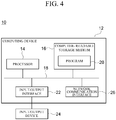
- FIG. 4 is a block diagram for describing an example of a computing environment including a computing device according to one embodiment.
- each of the components may have functions and capabilities different from those described hereinafter and additional components may be included in addition to the components described herein.
- the illustrated computing environment 10 includes a computing device 12.
- the computing device 12 may be one or more components included in the apparatus 110 for performing an operation illustrated in FIG. 2 .
- the computing device 12 includes at least one processor 14, a computer-readable storage medium 16, and a communication bus 18.
- the processor 14 may cause the computing device 12 to operate according to the above-described exemplary embodiment.
- the processor 14 may execute one or more programs stored in the computer-readable storage medium 16.
- the one or more programs may include one or more computer executable instructions, and the computer executable instructions may be configured to, when executed by the processor 14, cause the computing device 12 to perform operations according to the exemplary embodiment.
- the computer-readable storage medium 16 is configured to store computer executable instructions and program codes, program data and/or information in other suitable forms.
- the programs stored in the computer-readable storage medium 16 may include a set of instructions executable by the processor 14.
- the computer-readable storage medium 16 may be a memory (volatile memory, such as random access memory (RAM), non-volatile memory, or a combination thereof) one or more magnetic disk storage devices, optical disk storage devices, flash memory devices, storage media in other forms capable of being accessed by the computing device 12 and storing desired information, or a combination thereof.
- the communication bus 18 connects various other components of the computing device 12 including the processor 14 and the computer readable storage medium 16.
- the computing device 12 may include one or more input/output interfaces 22 for one or more input/output devices 24 and one or more network communication interfaces 26.
- the input/output interface 22 and the network communication interface 26 are connected to the communication bus 18.
- the input/output device 24 may be connected to other components of the computing device 12 through the input/output interface 22.
- the illustrative input/output device 24 may be a pointing device (a mouse, a track pad, or the like), a keyboard, a touch input device (a touch pad, a touch screen, or the like), an input device, such as a voice or sound input device, various types of sensor devices, and/or a photographing device, and/or an output device, such as a display device, a printer, a speaker, and/or a network card.
- the illustrative input/output device 24 which is one component constituting the computing device 12 may be included inside the computing device 12 or may be configured as a separate device from the computing device 12 and connected to the computing device 12.
Landscapes
- Engineering & Computer Science (AREA)
- Computer Security & Cryptography (AREA)
- Computer Networks & Wireless Communication (AREA)
- Signal Processing (AREA)
- Management, Administration, Business Operations System, And Electronic Commerce (AREA)
Abstract
Description
- The disclosed embodiments relate to encryption technology.
- Homomorphic encryption allows various analysis algorithms to be calculated in an encrypted state by using homomorphic addition and homomorphic multiplication for calculating ciphertext of addition and multiplication. In general, ciphertexts of homomorphic encryption are configured in such a form that an appropriate random value is added to a message and the random value is configured such that it can be efficiently removed using a decryption key. In this case, the random value is represented as addition of two types of values, and when the decryption key is denoted by s, the random value is in the form of a·s+e. Generally, as the homomorphic operation (e.g., homomorphic addition, homomorphic multiplication, etc.) proceeds, a random value a·s remains in the same form and can be efficiently removed during decryption. As the homomorphic operation proceeds, a random value e becomes impossible to remove after a certain point and damages the message. An operation that solves such problems is a bootstrapping operation.
- The bootstrapping operation is a method of performing a decryption algorithm in an encrypted state using an encrypted decryption key, the operation time is determined according to the complexity of the algorithm. However, a decryption algorithm of the conventional homomorphic encryption is not only composed of non-polynomials, but also requires a bootstrapping operation to be performed each time an operation cannot be performed on a ciphertext, which causes a significant increase in the execution time of an analysis algorithm using the homomorphic encryption.
- The disclosed embodiments are to provide a method and apparatus for performing an operation using encrypted data.
- A method for performing an operation according to one embodiment includes performing a homomorphic operation using one or more ciphertexts that are homomorphically encrypted based on an encryption key; determining a count value for a ciphertext generated through the homomorphic operation based on count values for each of the one or more ciphertexts; requesting a key management apparatus, which holds the encryption key and a decryption key corresponding to the encryption key, to re-encrypt the generated ciphertext based on the determined count value; acquiring, from the key management apparatus, a ciphertext generated by re-encrypting the generated ciphertext through decryption based on the decryption key and encryption based on the encryption key; and determining a count value for the acquired ciphertext to be a preset initial value.
- The homomorphic operation may include one of homomorphic multiplication and homomorphic addition.
- The determining may include determining that a value greater than or equal to the count value for one of the one or more ciphertexts is the count value for the generated ciphertext.
- The requesting may include requesting the key management apparatus to re-encrypt the generated ciphertext when the determined count value is greater than or equal to a preset maximum value.
- When the generated ciphertext is a ciphertext generated through the homomorphic operation of two ciphertext each of which is homomorphically encrypted based on the encryption key and count values for each of the two ciphertexts are different, the determining may include determining that a value greater than or equal to a larger value between the count values for each of the two ciphertexts is the count value for the generated ciphertext.
- The determining may include determining that a value less than or equal to the count value for one of the one or more ciphertexts is the count value for the generated ciphertext.
- The requesting may include requesting the key management apparatus to re-encrypt the generated ciphertext when the determined count value is less than or equal to a preset minimum value.
- When the generated ciphertext is generated through the homomorphic operation of two ciphertexts each of which is homomorphically encrypted based on the encryption key and count values for each of the two ciphertexts are different, the determining may include determining that a value less than or equal to a smaller value between the count values for each of the two ciphertexts is the count value for the generated ciphertext.
- The acquired ciphertext may be a ciphertext that the key management apparatus generates by decrypting the generated ciphertext using the decryption key and then encrypting, using the encryption key, data resulting from the decryption.
- The acquired ciphertext may be a ciphertext that the key management apparatus generates by decrypting the generated ciphertext using the decryption key, performing a rounding operation on data resulting from the decryption, and encrypting, using the encryption key, the data on which the rounding operation is performed.
- An apparatus for performing an operation according to one embodiment includes a calculation unit configured to perform a homomorphic operation using one or more ciphertexts that are homomorphically encrypted based on an encryption key and to determine a count value for a ciphertext generated through the homomorphic operation based on count values for each of the one or more ciphertexts; and a re-encryption requester configured to request a key management apparatus, which holds the encryption key and a decryption key corresponding to the encryption key, to re-encrypt the generated ciphertext based on the determined count value and to acquire, from the key management apparatus, a ciphertext generated by re-encrypting the generated ciphertext through decryption based on the decryption key and encryption based on the encryption key, wherein the calculation unit is configured to determine a count value for the acquired ciphertext to be a preset initial value.
- The homomorphic operation may include one of homomorphic multiplication and homomorphic addition.
- The calculation unit may determine that a value greater than or equal to the count value for one of the one or more ciphertexts is the count value for the generated ciphertext.
- The re-encryption requester may request the key management apparatus to re-encrypt the generated ciphertext when the determined count value is greater than or equal to a preset maximum value.
- When the generated ciphertext is a ciphertext generated through the homomorphic operation of two ciphertext each of which is homomorphically encrypted based on the encryption key and count values for each of the two ciphertexts are different, the calculation unit may determine that a value greater than or equal to a larger value between the count values for each of the two ciphertexts is the count value for the generated ciphertext.
- The calculation unit may determine that a value less than or equal to the count value for one of the one or more ciphertexts is the count value for the generated ciphertext.
- The re-encryption requester may request the key management apparatus to re-encrypt the generated ciphertext when the determined count value is less than or equal to a preset minimum value.
- When the generated ciphertext is generated through the homomorphic operation of two ciphertexts each of which is homomorphically encrypted based on the encryption key and count values for each of the two ciphertexts are different, the calculation unit may determine that a value less than or equal to a smaller value between the count values for each of the two ciphertexts is the count value for the generated ciphertext.
- The acquired ciphertext may be a ciphertext that the key management apparatus generates by decrypting the generated ciphertext using the decryption key and then encrypting, using the encryption key, data resulting from the decryption.
- The acquired ciphertext may be a ciphertext that the key management apparatus generates by decrypting the generated ciphertext using the decryption key, performing a rounding operation on data resulting from the decryption, and encrypting, using the encryption key, the data on which the rounding operation is performed.
- According to the disclosed embodiments, by performing re-encryption using a key management apparatus having encryption and decryption keys, instead of a bootstrapping operation that requires excessive operation execution time, it is possible to obtain the same effects as the bootstrapping operation within a relatively short period of time as compared to the case where the bootstrapping operation is performed.
-
-
FIG. 1 is a diagram illustrating a configuration of a computing system based on homomorphic encryption according to one embodiment; -
FIG. 2 is a block diagram illustrating an apparatus for performing an operation according to one embodiment; -
FIG. 3 is a flowchart illustrating a method of performing an operation according to one embodiment; and -
FIG. 4 is a block diagram for describing an example of a computing environment including a computing device according to one embodiment. - The following description is provided to assist the reader in gaining a comprehensive understanding of the methods, apparatuses, and/or systems described herein. Accordingly, various changes, modifications, and equivalents of the methods, apparatuses, and/or systems described herein will be suggested to those of ordinary skill in the art.
- Descriptions of well-known functions and constructions may be omitted for increased clarity and conciseness. Also, terms described in below are selected by considering functions in the embodiment and meanings may vary depending on, for example, a user or operator's intentions or customs. Therefore, definitions of the terms should be made based on the overall context. The terminology used in the detailed description is provided only to describe embodiments of the present disclosure and not for purposes of limitation. Unless the context clearly indicates otherwise, the singular forms include the plural forms. It should be understood that the terms "comprises" or "includes" specify some features, numbers, steps, operations, elements, and/or combinations thereof when used herein, but do not preclude the presence or possibility of one or more other features, numbers, steps, operations, elements, and/or combinations thereof in addition to the description.
-
FIG. 1 is a diagram illustrating a configuration of a computing system based on homomorphic encryption according to one embodiment. - Referring to
FIG. 1 , thecomputing system 100 according to one embodiment includes anapparatus 110 for performing an operation and akey management apparatus 120. - The
apparatus 110 for performing an operation is an apparatus for performing a homomorphic operation using data encrypted using a homomorphic encryption algorithm. - In this case, the homomorphic encryption algorithm refers to an encryption technique capable of calculating encrypted data in an encrypted state. In one embodiment, it is sufficient that the homomorphic encryption algorithm supports a homomorphic operation for a specific operation, and the homomorphic encryption algorithm is not necessarily limited to a specific type of homomorphic encryption algorithm.
- Meanwhile, when the homomorphic encryption algorithm supports a homomorphic operation for a specific operation, it may mean that a ciphertext for a result of applying a specific operation on a plaintext of a ciphertext can be generated by performing an operation on the corresponding ciphertext, which is encrypted using the same encryption key, in an encrypted state.
- More specifically, a homomorphic operationfor addition (hereinafter, referred to as "homomorphic addition") refers to an operation which generates, for example, as shown in Equation 1 below, a ciphertext Enc(pk, x 1 + x 2) that encrypts an addition result of plaintext data x1 and plaintext data x2 using a ciphertext Enc(pk, x 1) and a ciphertext Enc(pk,x 2) in an encrypted state, wherein the ciphertext Enc(pk, x 1) is obtained by encrypting the plaintext data x1 using an encryption key pk and the ciphertext Enc(pk, x 2) is obtained by encrypting the plaintext data x2 using the encryption key pk.


- In another example, a homomorphic operationfor multiplication (hereinafter, referred to as "homomorphic multiplication") refers to an operation which generates, for example, as shown in Equation 2 below, a ciphertext Enc(pk, x 1·x 2) that encrypts a multiplication result of plaintext data x1 and plaintext data x2 using a ciphertext Enc(pk, x 1) and a ciphertext Enc(pk,x 2) in an encrypted state, wherein the ciphertext Enc(pk, x1) is obtained by encrypting the plaintext data x1 using an encryption key pk and the ciphertext Enc(pk, x 2) is obtained by encrypting the plaintext data x2 using the encryption key pk.


- Meanwhile, the
key management apparatus 120 is an apparatus that holds a decryption key used for decryption of a ciphertext generated by a homomorphic operation in theapparatus 110 for performing an operation and an encryption key corresponding to the decryption key. - According to one embodiment, when the
apparatus 100 for performing an operation requests re-encryption of a ciphertext, thekey management apparatus 120 may perform requested re-encryption of the ciphertext through decryption based on the decryption key and encryption based on the encryption key, and provide the re-encrypted ciphertext to theapparatus 110 for performing an operation. -
FIG. 2 is a block diagram illustrating an apparatus for performing an operation according to one embodiment. - Referring to
FIG. 2 , theapparatus 110 for performing an operation according to one embodiment includes acomputation unit 111 and are-encryption requester 112. - In the embodiment shown in
FIG. 2 , thecomputation unit 111 and there-encryption requester 112 are each implemented by using one or more physically separated devices, or may be implemented by combining one or more processors, or combining one or more processors and software, and, unlike the illustrated example, specific operations thereof may not be clearly distinguished. - The
calculation unit 111 performs a homomorphic operation using one or more ciphertexts that are homomorphically encrypted based on an encryption key. - In this case, the homomorphically encrypted ciphertext collectively refers to a ciphertext generated through encryption using a homomorphic encryption algorithm and a ciphertext generated through a homomorphic operation using one or more other ciphertexts, and, hereinafter, a "ciphertext" refers to a homomorphically encrypted ciphertext.
- Meanwhile, the homomorphic operation may be, for example, one of homomorphic multiplication and homomorphic addition, but is not necessarily limited to a specific type of homomorphic operation.
- When a ciphertext is generated through a homomorphic operation, the
calculation unit 111 determines a count value for the generated ciphertext based on a count value for each ciphertext used for homomorphic operation. - In this case, a count value for a ciphertext means a value used as a measure for determining whether a homomorphic operation can be performed using the corresponding ciphertext.
- Specifically, the count value for a ciphertext generated through encryption using a homomorphic encryption algorithm may be determined to be a preset initial value, and a count value for a ciphertext generated through homomorphic encryption may be determined to be a value greater than or equal to a preset initial value or a value less than or equal to the preset initial value according to an embodiment.
- According to a first embodiment, the count value for the ciphertext generated through the homomorphic operation may be determined as a value greater than or equal to the count value for one of the one or more ciphertexts used for the homomorphic operation.
- Specifically, when the ciphertext generated through the homomorphic operation is generated through the homomorphic operation using one ciphertext, the
calculation unit 111 may determine a value greater than or equal to the count value for the ciphertext used for the homomorphic operation as the count value for the generated ciphertext. - In addition, when the ciphertext generated through the homomorphic operation is generated through the homomorphic operation using two ciphertexts having the same count value, the
calculation unit 111 may determine a value greater than or equal to the count values for each of the two ciphertexts as the count value for the generated ciphertext. - Additionally, when the ciphertext generated through the homomorphic operation is generated through the homomorphic operation using two ciphertexts having different count values, the
calculation unit 111 may determine a value greater than or equal to a larger value between the count values for each of the two ciphertexts as the count value for the generated ciphertext. - For example, a count value for a ciphertext generated through a homomorphic operation using a ciphertext C1 having a count value of l1 may be determined to be l1+α.
- In another example, a count value for a ciphertext generated through a homomorphic operation using two ciphertexts C1 and C2 each having a count value of l1 may be determined to be l1+α.
- In still another example, a count value for a ciphertext generated through a homomorphic operation using a ciphertext C1 having a count value of l1 and a ciphertext C3 having a count value of l2 (where l1<l2) may be determined to be l1+α.
- Meanwhile, in the examples described above, α is a count value increment amount corresponding to the type of the homomorphic operation, and may be a preset value. For example, when the homomorphic operation used for generating a ciphertext is homomorphic multiplication, α may be set to 1. Also, when the homomorphic operation used for generating a ciphertext is homomorphic addition, α may be set to 0. However, the count value increment amount α is not necessarily limited to the above-described examples, and may be set differently according to an embodiment.
- Meanwhile, according to a second embodiment, the count value for the ciphertext generated through the homomorphic operation may be determined to be a value equal to or less than the count value for one of the one or more ciphertexts used for the homomorphic operation.
- Specifically, when the ciphertext generated through the homomorphic operation is generated through the homomorphic operation using one ciphertext, the
calculation unit 111 may determine a value less than or equal to the count value for the ciphertext used for the homomorphic operation as the count value for the generated ciphertext. - In addition, when the ciphertext generated through the homomorphic operation is generated through the homomorphic operation using two ciphertexts having the same count value, the
calculation unit 111 may determine a value less than or equal to count values for each of the two ciphertexts as the count value for the generated ciphertext. - In addition, when the ciphertext generated through the homomorphic operation is generated through the homomorphic operation using two ciphertexts having different count values, the
calculation unit 111 may determine a value less than or equal to a smaller value between count values for each of the two ciphertexts as the count value for the generated ciphertext. - For example, a count value for a ciphertext generated through a homomorphic operation using a ciphertext C1 having a count value of l1 may be determined to be l1-β.
- In another example, a count value for a ciphertext generated through a homomorphic operation using ciphertexts C1 and C2 each having a count value of l1 may be determined to be l1-β.
- In still another example, a count value for a ciphertext generated through a homomorphic operation using a ciphertext C1 having a count value of l1 and a ciphertext C3 having a count value of l2 (where l1<l2) may be determined to be l1-β.
- In the examples described above, β is a count value decrement amount corresponding to the type of the homomorphic operation, and may be a preset value. For example, when the homomorphic operation used for generating a ciphertext is homomorphic multiplication, β may be set to 1. Also, when the homomorphic operation used for generating a ciphertext is homomorphic addition, β may be set to 0. However, the count value decrement amount β is not necessarily limited to the above-described examples, and may be set differently according to an embodiment.
- Meanwhile, when the ciphertext is generated through the homomorphic operation, the
re-encryption requester 112 requests thekey management apparatus 120 to re-encrypt the generated ciphertext based on the count value determined for the generated ciphertext. - Specifically, when the count value for the ciphertext generated through the homomorphic operation is determined to be a value greater than or equal to a count value for one of the one or more ciphertexts used for the homomorphic operation as in the first embodiment described above, the
re-encryption requester 112 may determine whether or not the count value determined for the ciphertext generated through the homomorphic operation is greater than or equal to a preset maximum value. In this case, when the determined count value is greater than or equal to the preset maximum value, there-encryption requester 112 may request thekey management apparatus 120 to re-encrypt the generated ciphertext. - On the other hand, when the count value for the ciphertext generated through the homomorphic operation is determined to be a value less than or equal to a count value for one of the one or more ciphertexts used for the homomorphic operation as in the second embodiment described above, the
re-encryption requester 112 may determine whether or not the count value determined for the ciphertext generated through the homomorphic operation is less than or equal to a preset minimum value. In this case, when the determined count value is less than or equal to the preset minimum value, there-encryption requester 112 may request thekey management apparatus 120 to re-encrypt the generated ciphertext. - Meanwhile, in the above-described embodiment, the preset minimum value and the preset maximum value may be set differently according to an embodiment.
- Meanwhile, the
re-encryption requester 112 acquires, from thekey management apparatus 120, a ciphertext obtained by re-encrypting, using a homomorphic encryption algorithm, the ciphertext requested to be re-encrypted. - In this case, the ciphertext obtained from the
key management apparatus 120 may be a ciphertext that thekey management apparatus 120 generates by re-encrypting the requested ciphertext through decryption based on the decryption key and encryption based on the encryption key. - Specifically, according to one embodiment, the ciphertext acquired from the
key management apparatus 120 in response to the re-encryption request may be a ciphertext that thekey management apparatus 120 generates by decrypting, using the decryption key, the ciphertext requested to be re-encrypted and then encrypting, using the encryption key, data resulting from the decryption. - In this case, according to one embodiment, the
key management apparatus 120 may perform a rounding operation on the data resulting from the decryption and then encrypt, using the encryption key, the data on which the rounding operation is performed. For example, when the homomorphic encryption algorithm is a homomorphic encryption algorithm that supports an approximation operation, there is a difference between a result of decrypting the ciphertext generated through the homomorphic operation and a computation result for plaintext data corresponding to the homomoprhic operation, and such a difference may be removed through the rounding operation on the data resulting from the decryption. - On the other hand, when the
re-encryption requester 112 acquires the re-encrypted ciphertext from thekey management apparatus 120, thecalculation unit 111 determines the count value for the acquired ciphertext to be a preset initial value. - Specifically, when the count value for the ciphertext generated through the homomorphic operation is determined to be greater than or equal to the count value for one of the one or more ciphertexts used for the homomorphic operation as in the above-described first embodiment, the preset initial value may be, for example, 0.
- In addition, when the count value for the ciphertext generated through the homomorphic operation is determined to be less than or equal to the count value for one of the one or more ciphertexts used for the homomorphic operation as in the above-described second embodiment, the preset initial value may be, for example, a value greater than 1.
- However, the preset initial value is not necessarily limited to the above-described examples, and may be set differently according to an embodiment.
-
FIG. 3 is a flowchart illustrating a method of performing an operation according to one embodiment. - The method illustrated in
FIG. 3 may be performed by, for example, theapparatus 110 for performing an operation illustrated inFIGS. 1 and 2 . - Referring to
FIG. 3 , theapparatus 110 for performing an operation first performs a homomorphic operation using one or more ciphertexts that are homomorphically encrypted based on an encryption key (310). - Thereafter, the
apparatus 110 for performing an operation determines a count value for the ciphertext generated through the homomorphic operation (320). - At this time, the count value may be determined according to the first or second embodiment described above.
- Then, the
apparatus 110 for performing an operation determines whether there is a remaining homomorphic operation to perform using the ciphertext generated through the homomorphic operation (330). - In this case, when there is a remaining homomorphic operation to perform, the
apparatus 110 for performing an operation determines whether it is possible to perform the remaining homomorphic operation based on the determined count value (340). - In this case, when it is possible to perform the remaining homomorphic operation, the
apparatus 110 for performing an operation performs the subsequent operations ofoperation 310 again using the ciphertext generated through the homomorphic operation. - On the contrary, when it is not possible to perform the remaining homomorphic operation, the
apparatus 110 for performing an operation requests thekey management apparatus 120 to re-encrypt the ciphertext generated through the homomorphic operation (350), and acquires a re-encrypted ciphertext from the key management apparatus 120 (360). - Thereafter, the
apparatus 110 for performing an operation performs the subsequent operations ofoperation 310 again using the ciphertext acquired from thekey management apparatus 120. - Meanwhile, in the flowchart illustrated in
FIG. 3 , at least some of the operations may be performed in different order or may be combined into fewer operations or further divided into more operations. In addition, some of the operations may be omitted, or one or more extra operations, which are not illustrated, may be added to the flowchart and be performed. -
FIG. 4 is a block diagram for describing an example of a computing environment including a computing device according to one embodiment. In the illustrated embodiment, each of the components may have functions and capabilities different from those described hereinafter and additional components may be included in addition to the components described herein. - The illustrated
computing environment 10 includes acomputing device 12. In one embodiment, thecomputing device 12 may be one or more components included in theapparatus 110 for performing an operation illustrated inFIG. 2 . - The
computing device 12 includes at least oneprocessor 14, a computer-readable storage medium 16, and acommunication bus 18. Theprocessor 14 may cause thecomputing device 12 to operate according to the above-described exemplary embodiment. For example, theprocessor 14 may execute one or more programs stored in the computer-readable storage medium 16. The one or more programs may include one or more computer executable instructions, and the computer executable instructions may be configured to, when executed by theprocessor 14, cause thecomputing device 12 to perform operations according to the exemplary embodiment. - The computer-
readable storage medium 16 is configured to store computer executable instructions and program codes, program data and/or information in other suitable forms. The programs stored in the computer-readable storage medium 16 may include a set of instructions executable by theprocessor 14. In one embodiment, the computer-readable storage medium 16 may be a memory (volatile memory, such as random access memory (RAM), non-volatile memory, or a combination thereof) one or more magnetic disk storage devices, optical disk storage devices, flash memory devices, storage media in other forms capable of being accessed by thecomputing device 12 and storing desired information, or a combination thereof. - The
communication bus 18 connects various other components of thecomputing device 12 including theprocessor 14 and the computerreadable storage medium 16. - The
computing device 12 may include one or more input/output interfaces 22 for one or more input/output devices 24 and one or more network communication interfaces 26. The input/output interface 22 and thenetwork communication interface 26 are connected to thecommunication bus 18. The input/output device 24 may be connected to other components of thecomputing device 12 through the input/output interface 22. The illustrative input/output device 24 may be a pointing device (a mouse, a track pad, or the like), a keyboard, a touch input device (a touch pad, a touch screen, or the like), an input device, such as a voice or sound input device, various types of sensor devices, and/or a photographing device, and/or an output device, such as a display device, a printer, a speaker, and/or a network card. The illustrative input/output device 24 which is one component constituting thecomputing device 12 may be included inside thecomputing device 12 or may be configured as a separate device from thecomputing device 12 and connected to thecomputing device 12. - While representative embodiments of the preset invention have been described above in detail, it may be understood by those skilled in the art that the embodiments may be variously modified without departing from the scope of the present invention. Therefore, the scope of the present invention is defined not by the described embodiment but by the appended claims.
Claims (12)
- A method for performing an operation, comprising:performing a homomorphic operation using one or more ciphertexts that are homomorphically encrypted based on an encryption key;determining a count value for a ciphertext generated through the homomorphic operation based on count values for each of the one or more ciphertexts;requesting a key management apparatus, which holds the encryption key and a decryption key corresponding to the encryption key, to re-encrypt the generated ciphertext based on the determined count value;acquiring, from the key management apparatus, a ciphertext generated by re-encrypting the generated ciphertext through decryption based on the decryption key and encryption based on the encryption key; anddetermining a count value for the acquired ciphertext to be a preset initial value.
- The method of claim 1, wherein the homomorphic operation includes one of homomorphic multiplication and homomorphic addition.
- The method of claim 1 or 2, wherein the determining comprises determining that a value greater than or equal to the count value for one of the one or more ciphertexts is the count value for the generated ciphertext,
wherein the requesting comprises requesting the key management apparatus to re-encrypt the generated ciphertext when the determined count value is greater than or equal to a preset maximum value, and
wherein, when the generated ciphertext is a ciphertext generated through the homomorphic operation of two ciphertext each of which is homomorphically encrypted based on the encryption key and count values for each of the two ciphertexts are different, the determining comprises determining that a value greater than or equal to a larger value between the count values for each of the two ciphertexts is the count value for the generated ciphertext. - The method of one of claims 1 to 3, wherein the determining comprises determining that a value less than or equal to the count value for one of the one or more ciphertexts is the count value for the generated ciphertext,
wherein the requesting comprises requesting the key management apparatus to re-encrypt the generated ciphertext when the determined count value is less than or equal to a preset minimum value, and
wherein, when the generated ciphertext is generated through the homomorphic operation of two ciphertexts each of which is homomorphically encrypted based on the encryption key and count values for each of the two ciphertexts are different, the determining comprises determining that a value less than or equal to a smaller value between the count values for each of the two ciphertexts is the count value for the generated ciphertext. - The method of one of claims 1 to 4, wherein the acquired ciphertext is a ciphertext that the key management apparatus generates by decrypting the generated ciphertext using the decryption key and then encrypting, using the encryption key, data resulting from the decryption.
- The method of one of claims 1 to 5, wherein the acquired ciphertext is a ciphertext that the key management apparatus generates by decrypting the generated ciphertext using the decryption key, performing a rounding operation on data resulting from the decryption, and encrypting, using the encryption key, the data on which the rounding operation is performed.
- An apparatus for performing an operation, comprising:a calculation unit configured to perform a homomorphic operation using one or more ciphertexts that are homomorphically encrypted based on an encryption key and to determine a count value for a ciphertext generated through the homomorphic operation based on count values for each of the one or more ciphertexts; anda re-encryption requester configured to request a key management apparatus, which holds the encryption key and a decryption key corresponding to the encryption key, to re-encrypt the generated ciphertext based on the determined count value and to acquire, from the key management apparatus, a ciphertext generated by re-encrypting the generated ciphertext through decryption based on the decryption key and encryption based on the encryption key,wherein the calculation unit is configured to determine a count value for the acquired ciphertext to be a preset initial value.
- The apparatus of claim 7, wherein the homomorphic operation includes one of homomorphic multiplication and homomorphic addition.
- The apparatus of claim 7 or 8, wherein the calculation unit is further configured to determine that a value greater than or equal to the count value for one of the one or more ciphertexts is the count value for the generated ciphertext,
wherein the re-encryption requester is further configured to request the key management apparatus to re-encrypt the generated ciphertext when the determined count value is greater than or equal to a preset maximum value, and
wherein, when the generated ciphertext is a ciphertext generated through the homomorphic operation of two ciphertext each of which is homomorphically encrypted based on the encryption key and count values for each of the two ciphertexts are different, the calculation unit is further configured to determine that a value greater than or equal to a larger value between the count values for each of the two ciphertexts is the count value for the generated ciphertext. - The apparatus of one of claims 7 to 9, wherein the calculation unit is further configured to determine that a value less than or equal to the count value for one of the one or more ciphertexts is the count value for the generated ciphertext,
wherein the re-encryption requester is configured to request the key management apparatus to re-encrypt the generated ciphertext when the determined count value is less than or equal to a preset minimum value, and
wherein, when the generated ciphertext is generated through the homomorphic operation of two ciphertexts each of which is homomorphically encrypted based on the encryption key and count values for each of the two ciphertexts are different, the calculation unit is further configured to determine that a value less than or equal to a smaller value between the count values for each of the two ciphertexts is the count value for the generated ciphertext. - The apparatus of one of claims 7 to 10, wherein the acquired ciphertext is a ciphertext that the key management apparatus generates by decrypting the generated ciphertext using the decryption key and then encrypting, using the encryption key, data resulting from the decryption.
- The apparatus of one of claims 7 to 11, wherein the acquired ciphertext is a ciphertext that the key management apparatus generates by decrypting the generated ciphertext using the decryption key, performing a rounding operation on data resulting from the decryption, and encrypting, using the encryption key, the data on which the rounding operation is performed.
Applications Claiming Priority (2)
| Application Number | Priority Date | Filing Date | Title |
|---|---|---|---|
| KR20200035085 | 2020-03-23 | ||
| KR1020200060916A KR20210118717A (en) | 2020-03-23 | 2020-05-21 | Method and apparatus for performing operation using encrypted data |
Publications (1)
| Publication Number | Publication Date |
|---|---|
| EP3886354A1 true EP3886354A1 (en) | 2021-09-29 |
Family
ID=72964463
Family Applications (1)
| Application Number | Title | Priority Date | Filing Date |
|---|---|---|---|
| EP20202277.8A Withdrawn EP3886354A1 (en) | 2020-03-23 | 2020-10-16 | Computation on encrypted data using somewhat fully homomorphic encryption without bootstrapping using trusted third party |
Country Status (2)
| Country | Link |
|---|---|
| US (1) | US11277257B2 (en) |
| EP (1) | EP3886354A1 (en) |
Cited By (1)
| Publication number | Priority date | Publication date | Assignee | Title |
|---|---|---|---|---|
| CN116527233A (en) * | 2023-03-13 | 2023-08-01 | 安徽合工质能双碳科技有限公司 | Energy monitoring data management system based on cloud computing |
Families Citing this family (14)
| Publication number | Priority date | Publication date | Assignee | Title |
|---|---|---|---|---|
| KR102475273B1 (en) * | 2020-06-15 | 2022-12-08 | 주식회사 크립토랩 | Simulation apparatus for homomorphic encryption system and method thereof |
| US12362903B2 (en) * | 2021-06-29 | 2025-07-15 | Duality Technologies, Inc. | RNS-based CKKS variant with minimal rescaling error |
| CN115118448B (en) * | 2022-04-21 | 2023-09-01 | 腾讯科技(深圳)有限公司 | Data processing method, device, equipment and storage medium |
| CN114553395B (en) * | 2022-04-24 | 2022-07-26 | 蓝象智联(杭州)科技有限公司 | Longitudinal federal feature derivation method in wind control scene |
| CN114760367B (en) * | 2022-04-24 | 2024-05-31 | 华控清交信息科技(北京)有限公司 | Encryption protocol conversion method, first node and second node |
| CN115114895B (en) * | 2022-08-26 | 2022-11-29 | 华控清交信息科技(北京)有限公司 | Method and device for combining reports and readable storage medium |
| WO2024207647A1 (en) * | 2023-04-03 | 2024-10-10 | 浙江大学杭州国际科创中心 | Information retrieval method and apparatus, and computer device and storage medium |
| CN121399886A (en) * | 2023-06-30 | 2026-01-23 | 华为技术有限公司 | Key partition management method and device |
| CN116975125A (en) * | 2023-08-03 | 2023-10-31 | 中国工商银行股份有限公司 | Data statistics method, device, system, storage medium and program product |
| US12500733B2 (en) * | 2023-11-21 | 2025-12-16 | Belfort Labs Bv | Method for accelerating bootstrapping in a cryptographic application |
| US12457195B2 (en) * | 2023-11-21 | 2025-10-28 | Salesforce, Inc. | Homomorphic encryption for web application firewall processing |
| US12512963B2 (en) * | 2023-11-22 | 2025-12-30 | Bank Of America Corporation | System and method for securely synchronizing and integrating data stored in databases associated with multiple entities |
| CN117650946B (en) * | 2024-01-29 | 2024-06-07 | 贵州永鼎云信息科技有限公司 | Method for trusted data exchange channel |
| US12476788B2 (en) * | 2024-04-08 | 2025-11-18 | International Business Machines Corporation | Tournament-league mechanisms for comparison based computer operations |
Citations (1)
| Publication number | Priority date | Publication date | Assignee | Title |
|---|---|---|---|---|
| US20180019983A1 (en) * | 2016-07-14 | 2018-01-18 | Kontron Modular Computers S.A.S. | TECHNIQUE FOR SECURELY PERFORMING AN OPERATION IN AN IoT ENVIRONMENT |
Family Cites Families (3)
| Publication number | Priority date | Publication date | Assignee | Title |
|---|---|---|---|---|
| WO2012149395A1 (en) * | 2011-04-29 | 2012-11-01 | International Business Machines Corporation | Fully homomorphic encryption |
| KR102040120B1 (en) | 2018-07-27 | 2019-11-05 | 주식회사 크립토랩 | Apparatus for processing approximate encripted messages and methods thereof |
| US11750362B2 (en) * | 2019-09-17 | 2023-09-05 | Sap Se | Private decision tree evaluation using an arithmetic circuit |
-
2020
- 2020-05-27 US US16/884,845 patent/US11277257B2/en active Active
- 2020-10-16 EP EP20202277.8A patent/EP3886354A1/en not_active Withdrawn
Patent Citations (1)
| Publication number | Priority date | Publication date | Assignee | Title |
|---|---|---|---|---|
| US20180019983A1 (en) * | 2016-07-14 | 2018-01-18 | Kontron Modular Computers S.A.S. | TECHNIQUE FOR SECURELY PERFORMING AN OPERATION IN AN IoT ENVIRONMENT |
Non-Patent Citations (6)
| Title |
|---|
| BRACK SAMUEL ET AL: "Recommender Systems on Homomorphically Encrypted Databases for Enhanced User Privacy", 2019 IEEE 44TH LCN SYMPOSIUM ON EMERGING TOPICS IN NETWORKING (LCN SYMPOSIUM), IEEE, 14 October 2019 (2019-10-14), pages 74 - 82, XP033720387, DOI: 10.1109/LCNSYMPOSIUM47956.2019.9000668 * |
| CHEN HAO ET AL: "Simple Encrypted Arithmetic Library - SEAL v2.1", 19 November 2017, SAT 2015 18TH INTERNATIONAL CONFERENCE, AUSTIN, TX, USA, SEPTEMBER 24-27, 2015; [LECTURE NOTES IN COMPUTER SCIENCE; LECT.NOTES COMPUTER], SPRINGER, BERLIN, HEIDELBERG, PAGE(S) 3 - 18, ISBN: 978-3-540-74549-5, XP047464729 * |
| CRAIG GENTRY: "A FULLY HOMOMORPHIC ENCRYPTION SCHEME", 1 September 2009 (2009-09-01), XP055389118, Retrieved from the Internet <URL:https://crypto.stanford.edu/craig/craig-thesis.pdf> [retrieved on 20170707] * |
| PAINDAVOINE MARIE ET AL: "Minimizing the Number of Bootstrappings in Fully Homomorphic Encryption", 18 March 2016, BIG DATA ANALYTICS IN THE SOCIAL AND UBIQUITOUS CONTEXT : 5TH INTERNATIONAL WORKSHOP ON MODELING SOCIAL MEDIA, MSM 2014, 5TH INTERNATIONAL WORKSHOP ON MINING UBIQUITOUS AND SOCIAL ENVIRONMENTS, MUSE 2014 AND FIRST INTERNATIONAL WORKSHOP ON MACHINE LE, ISBN: 978-3-642-17318-9, XP047345570 * |
| ROY SUJOY SINHA ET AL: "Hardware Assisted Fully Homomorphic Function Evaluation and Encrypted Search", IEEE TRANSACTIONS ON COMPUTERS, IEEE, USA, vol. 66, no. 9, 1 September 2017 (2017-09-01), pages 1562 - 1572, XP011658956, ISSN: 0018-9340, [retrieved on 20170818], DOI: 10.1109/TC.2017.2686385 * |
| ZHANG YONGHONG ET AL: "Privacy-Preserving Outsourcing Computation of QR Decomposition in the Encrypted Domain", 2019 18TH IEEE INTERNATIONAL CONFERENCE ON TRUST, SECURITY AND PRIVACY IN COMPUTING AND COMMUNICATIONS/13TH IEEE INTERNATIONAL CONFERENCE ON BIG DATA SCIENCE AND ENGINEERING (TRUSTCOM/BIGDATASE), IEEE, 5 August 2019 (2019-08-05), pages 389 - 396, XP033653693, DOI: 10.1109/TRUSTCOM/BIGDATASE.2019.00059 * |
Cited By (2)
| Publication number | Priority date | Publication date | Assignee | Title |
|---|---|---|---|---|
| CN116527233A (en) * | 2023-03-13 | 2023-08-01 | 安徽合工质能双碳科技有限公司 | Energy monitoring data management system based on cloud computing |
| CN116527233B (en) * | 2023-03-13 | 2023-09-19 | 安徽合工质能双碳科技有限公司 | Energy monitoring data management system based on cloud computing |
Also Published As
| Publication number | Publication date |
|---|---|
| US20210297232A1 (en) | 2021-09-23 |
| US11277257B2 (en) | 2022-03-15 |
Similar Documents
| Publication | Publication Date | Title |
|---|---|---|
| US11277257B2 (en) | Method and apparatus for performing operation using encrypted data | |
| US11277256B2 (en) | Ciphertext comparison method using homomorphic encryption and apparatus for performing the same | |
| EP3985540B1 (en) | Method and apparatus for generating synthetic data | |
| EP3192207B1 (en) | Apparatus and method for data encryption | |
| AU2019448601B2 (en) | Privacy preserving oracle | |
| US20060251247A1 (en) | Encryption apparatus, decryption apparatus, key generation apparatus, program and method therefor | |
| EP3843319B1 (en) | Apparatus and method for set intersection operation | |
| KR102143525B1 (en) | Method for function encryption supporting set intersection operation and apparatus using the same | |
| US11646877B2 (en) | Apparatus and method for generating secret key, apparatus and method for generating evaluation key | |
| CN113014373A (en) | Data encryption method, device, equipment and medium in homomorphic calculation | |
| JP2026035772A5 (en) | ||
| CN114124364A (en) | Key security processing method, device, equipment and computer readable storage medium | |
| EP3902193B1 (en) | Apparatus and method for data analysis | |
| CN115529120A (en) | A secure computing system | |
| US20150358162A1 (en) | Decryption service providing device, processing device, safety evaluation device, program, and recording medium | |
| KR102281265B1 (en) | Functional encryption for set intersection with time-constrained function keys | |
| KR102690536B1 (en) | Apparatus and method for encryption | |
| CN111143674A (en) | Data processing method and device | |
| EP3739806A1 (en) | Apparatus and method for generating secret key, apparatus and method for generating evaluation key | |
| JP7205016B2 (en) | Confidential Information Processing System and Confidential Information Processing Method | |
| EP3364397B1 (en) | Secret authentication code adding device, secret authentification code adding method, and program | |
| CN111737719B (en) | Privacy-protected text classification method and device | |
| KR20210158824A (en) | Method and apparatus for generating synthetic data | |
| EP3644545A1 (en) | Apparatus and method for encryption and decryption | |
| KR20210118717A (en) | Method and apparatus for performing operation using encrypted data |
Legal Events
| Date | Code | Title | Description |
|---|---|---|---|
| PUAI | Public reference made under article 153(3) epc to a published international application that has entered the european phase |
Free format text: ORIGINAL CODE: 0009012 |
|
| STAA | Information on the status of an ep patent application or granted ep patent |
Free format text: STATUS: REQUEST FOR EXAMINATION WAS MADE |
|
| 17P | Request for examination filed |
Effective date: 20201016 |
|
| AK | Designated contracting states |
Kind code of ref document: A1 Designated state(s): AL AT BE BG CH CY CZ DE DK EE ES FI FR GB GR HR HU IE IS IT LI LT LU LV MC MK MT NL NO PL PT RO RS SE SI SK SM TR |
|
| RBV | Designated contracting states (corrected) |
Designated state(s): AL AT BE BG CH CY CZ DE DK EE ES FI FR GB GR HR HU IE IS IT LI LT LU LV MC MK MT NL NO PL PT RO RS SE SI SK SM TR |
|
| STAA | Information on the status of an ep patent application or granted ep patent |
Free format text: STATUS: EXAMINATION IS IN PROGRESS |
|
| 17Q | First examination report despatched |
Effective date: 20250102 |
|
| STAA | Information on the status of an ep patent application or granted ep patent |
Free format text: STATUS: THE APPLICATION HAS BEEN WITHDRAWN |
|
| 18W | Application withdrawn |
Effective date: 20250120 |