EP3886228B1 - Peo film, preparation method thereof, and solid-state battery - Google Patents
Peo film, preparation method thereof, and solid-state battery Download PDFInfo
- Publication number
- EP3886228B1 EP3886228B1 EP20194775.1A EP20194775A EP3886228B1 EP 3886228 B1 EP3886228 B1 EP 3886228B1 EP 20194775 A EP20194775 A EP 20194775A EP 3886228 B1 EP3886228 B1 EP 3886228B1
- Authority
- EP
- European Patent Office
- Prior art keywords
- structural unit
- peo
- film
- peo film
- preparation
- Prior art date
- Legal status (The legal status is an assumption and is not a legal conclusion. Google has not performed a legal analysis and makes no representation as to the accuracy of the status listed.)
- Active
Links
Classifications
-
- H—ELECTRICITY
- H01—ELECTRIC ELEMENTS
- H01M—PROCESSES OR MEANS, e.g. BATTERIES, FOR THE DIRECT CONVERSION OF CHEMICAL ENERGY INTO ELECTRICAL ENERGY
- H01M10/00—Secondary cells; Manufacture thereof
- H01M10/05—Accumulators with non-aqueous electrolyte
- H01M10/056—Accumulators with non-aqueous electrolyte characterised by the materials used as electrolytes, e.g. mixed inorganic/organic electrolytes
- H01M10/0564—Accumulators with non-aqueous electrolyte characterised by the materials used as electrolytes, e.g. mixed inorganic/organic electrolytes the electrolyte being constituted of organic materials only
- H01M10/0565—Polymeric materials, e.g. gel-type or solid-type
-
- H—ELECTRICITY
- H01—ELECTRIC ELEMENTS
- H01M—PROCESSES OR MEANS, e.g. BATTERIES, FOR THE DIRECT CONVERSION OF CHEMICAL ENERGY INTO ELECTRICAL ENERGY
- H01M50/00—Constructional details or processes of manufacture of the non-active parts of electrochemical cells other than fuel cells, e.g. hybrid cells
- H01M50/40—Separators; Membranes; Diaphragms; Spacing elements inside cells
- H01M50/46—Separators, membranes or diaphragms characterised by their combination with electrodes
-
- C—CHEMISTRY; METALLURGY
- C08—ORGANIC MACROMOLECULAR COMPOUNDS; THEIR PREPARATION OR CHEMICAL WORKING-UP; COMPOSITIONS BASED THEREON
- C08G—MACROMOLECULAR COMPOUNDS OBTAINED OTHERWISE THAN BY REACTIONS ONLY INVOLVING UNSATURATED CARBON-TO-CARBON BONDS
- C08G65/00—Macromolecular compounds obtained by reactions forming an ether link in the main chain of the macromolecule
- C08G65/02—Macromolecular compounds obtained by reactions forming an ether link in the main chain of the macromolecule from cyclic ethers by opening of the heterocyclic ring
- C08G65/26—Macromolecular compounds obtained by reactions forming an ether link in the main chain of the macromolecule from cyclic ethers by opening of the heterocyclic ring from cyclic ethers and other compounds
- C08G65/2639—Macromolecular compounds obtained by reactions forming an ether link in the main chain of the macromolecule from cyclic ethers by opening of the heterocyclic ring from cyclic ethers and other compounds the other compounds containing elements other than oxygen, nitrogen or sulfur
-
- H—ELECTRICITY
- H01—ELECTRIC ELEMENTS
- H01M—PROCESSES OR MEANS, e.g. BATTERIES, FOR THE DIRECT CONVERSION OF CHEMICAL ENERGY INTO ELECTRICAL ENERGY
- H01M10/00—Secondary cells; Manufacture thereof
- H01M10/05—Accumulators with non-aqueous electrolyte
- H01M10/052—Li-accumulators
-
- H—ELECTRICITY
- H01—ELECTRIC ELEMENTS
- H01M—PROCESSES OR MEANS, e.g. BATTERIES, FOR THE DIRECT CONVERSION OF CHEMICAL ENERGY INTO ELECTRICAL ENERGY
- H01M10/00—Secondary cells; Manufacture thereof
- H01M10/05—Accumulators with non-aqueous electrolyte
- H01M10/058—Construction or manufacture
- H01M10/0585—Construction or manufacture of accumulators having only flat construction elements, i.e. flat positive electrodes, flat negative electrodes and flat separators
-
- H—ELECTRICITY
- H01—ELECTRIC ELEMENTS
- H01M—PROCESSES OR MEANS, e.g. BATTERIES, FOR THE DIRECT CONVERSION OF CHEMICAL ENERGY INTO ELECTRICAL ENERGY
- H01M50/00—Constructional details or processes of manufacture of the non-active parts of electrochemical cells other than fuel cells, e.g. hybrid cells
- H01M50/40—Separators; Membranes; Diaphragms; Spacing elements inside cells
- H01M50/409—Separators, membranes or diaphragms characterised by the material
- H01M50/411—Organic material
-
- H—ELECTRICITY
- H01—ELECTRIC ELEMENTS
- H01M—PROCESSES OR MEANS, e.g. BATTERIES, FOR THE DIRECT CONVERSION OF CHEMICAL ENERGY INTO ELECTRICAL ENERGY
- H01M2300/00—Electrolytes
- H01M2300/0017—Non-aqueous electrolytes
- H01M2300/0065—Solid electrolytes
- H01M2300/0082—Organic polymers
-
- H—ELECTRICITY
- H01—ELECTRIC ELEMENTS
- H01M—PROCESSES OR MEANS, e.g. BATTERIES, FOR THE DIRECT CONVERSION OF CHEMICAL ENERGY INTO ELECTRICAL ENERGY
- H01M2300/00—Electrolytes
- H01M2300/0085—Immobilising or gelification of electrolyte
-
- Y—GENERAL TAGGING OF NEW TECHNOLOGICAL DEVELOPMENTS; GENERAL TAGGING OF CROSS-SECTIONAL TECHNOLOGIES SPANNING OVER SEVERAL SECTIONS OF THE IPC; TECHNICAL SUBJECTS COVERED BY FORMER USPC CROSS-REFERENCE ART COLLECTIONS [XRACs] AND DIGESTS
- Y02—TECHNOLOGIES OR APPLICATIONS FOR MITIGATION OR ADAPTATION AGAINST CLIMATE CHANGE
- Y02E—REDUCTION OF GREENHOUSE GAS [GHG] EMISSIONS, RELATED TO ENERGY GENERATION, TRANSMISSION OR DISTRIBUTION
- Y02E60/00—Enabling technologies; Technologies with a potential or indirect contribution to GHG emissions mitigation
- Y02E60/10—Energy storage using batteries
-
- Y—GENERAL TAGGING OF NEW TECHNOLOGICAL DEVELOPMENTS; GENERAL TAGGING OF CROSS-SECTIONAL TECHNOLOGIES SPANNING OVER SEVERAL SECTIONS OF THE IPC; TECHNICAL SUBJECTS COVERED BY FORMER USPC CROSS-REFERENCE ART COLLECTIONS [XRACs] AND DIGESTS
- Y02—TECHNOLOGIES OR APPLICATIONS FOR MITIGATION OR ADAPTATION AGAINST CLIMATE CHANGE
- Y02P—CLIMATE CHANGE MITIGATION TECHNOLOGIES IN THE PRODUCTION OR PROCESSING OF GOODS
- Y02P70/00—Climate change mitigation technologies in the production process for final industrial or consumer products
- Y02P70/50—Manufacturing or production processes characterised by the final manufactured product
Definitions
- the polymer electrolyte is a polymer multiphase composite material in the form of a solid ion conductor and may be as both a separator and an electrolyte.
- the PEO-based electrolyte film features advantages such as good lithium ion transmission performance, ease of processing, and good thermoplasticity, so that such electrolyte film is widely used at present. Nevertheless, a PEO separator is suitable for working at a temperature of 70-80°C, and the lithium ion conduction rate at room temperature (25°C) may be greatly reduced.
- Partial hydrogenation of unsaturated polyethers A convenient route to curable terpolymers for lithium batteries" by F. ALLOIN ET AL, JOURNAL OF POLYMER SCIENCE PART A: POLYMER CHEMISTRY, Vol. 38, no. 16, 1 January 2000(2000-01-01), pages 2900-2909 discloses a convenient route to prepare terpolymers from dipolymers by partial reduction of the alkenyl functions.
- the present invention provides a PEO film, a preparation method of a PEO film, and a solid-state battery configured for solving the problems of poor conductivity, poor contact performance with anode and cathode and poor stability found in an existing PEO film.
- the structural unit B is thus more inclined to transfer electrons to double bonds to increase electron cloud density of the double bonds, so that the double bonds are more suitable for combining with Li+. In this way, the transmission capability of lithium ions is further improved.
- the PEO film provided by the disclosure is modified from the PEO film itself, rather than being added with an added additional solid phase structure of lithium ion conductor powder.
- the PEO film provided by the disclosure may be securely adhered to an anode and a cathode and may continuously contact with the anode and the cathode securely after being assembled into a battery, and detachment is thereby prevented. Further, since solid powder is not added to the PEO film provided by the disclosure, the PEO film itself is an integral structure and exhibits a high degree of structural compactness. Therefore, the PEO film provides good stability. Accordingly, in the case that conductivity of the PEO film provided by the disclosure is effectively improved, good structural stability of the PEO film provided by the disclosure is maintained.
- the disclosure further provides a preparation method of a PEO film, and the preparation method includes the following steps.
- a copolymerization reaction of an ethylene oxide monomer and an F-containing cyclic ether monomer is performed to obtain a polymer precursor containing a structural unit D, where the structural unit D includes -C 2 H 3 F-O-.
- an oxygen atom adjacent to the olefinic bond has a lone pair of electrons.
- the structural unit B is thus more inclined to transfer electrons to double bonds to increase electron cloud density of the double bonds, so that the double bonds are more suitable for combining with Li+. In this way, the transmission capability of lithium ions is further improved.
- the PEO film obtained through the preparation method provided by the disclosure is modified from the PEO film itself, rather than being added with an added additional solid phase structure of lithium ion conductor powder.
- the PEO film obtained through the preparation method provided by the disclosure may be securely adhered to an anode and a cathode and may continuously contact with the anode and the cathode securely after being assembled into a battery, and detachment is thereby prevented. Further, since solid powder is not added to the PEO film obtained through the preparation method, the PEO film itself is an integral structure and exhibits a high degree of structural compactness. Therefore, the PEO film provides good stability. Accordingly, in the case that conductivity of the PEO film obtained through the preparation method provided by the disclosure is effectively improved, good structural stability of the PEO film obtained through the preparation method provided by the disclosure is maintained.
- the disclosure further provides a solid-state battery including an anode electrode sheet, a cathode electrode sheet, and the PEO film provided by the disclosure or the PEO film obtained through the preparation method provided by the disclosure between the anode electrode sheet and the cathode electrode sheet.
- the solid-state battery provided by the disclosure has high electrical performance and also high cyclic stability.
- the numerical range “6-22” means that all real numbers between “6 and 22" have been listed in the specification, and “6-22" is just an abbreviated representation of these numerical combinations.
- the disclosed “range” in the form of a lower limit and an upper limit may respectively be one or plural lower limits and one or plural upper limits.
- the reaction or operation steps may be performed sequentially or in order.
- the reaction methods in the specification are performed sequentially.
- the existing solution is to add lithium ion conductor powder to PEO, the commonly used lithium ion conductor powders are all solid phases, so that problems regarding contact between PEO with anode and cathode and stability of PEO are found.
- the existing solution may solve the problem of poor conductivity of PEO at room temperature to a certain extent, contact performance of the electrolyte film and anode and cathode and stability of the electrolyte film itself are affected. Cyclic stability of a battery is thereby affected.
- a main chain structure of polyoxyethylene PEO contains a structural unit A, where a structure of the structural unit A is shown as follows:
- a strong electron donating group-ether oxygen functional group is included.
- PEO acts as an ion conducting matrix
- metal ions e.g., Li+
- metal salt dissociates into electric charge carriers.
- Metal ions migrate through the ongoing complexation/decomplexation process with ether oxygen atoms, and in this way, transmission of metal ions is achieved.
- a PEO electrolyte film has poor conductivity at room temperature, and stability of the PEO electrolyte film itself is affected after solid conductive powder is added. As such, further applications of the PEO electrolyte film are limited.
- the structural unit B is thus more inclined to transfer electrons to double bonds to increase electron cloud density of the double bonds, so that the double bonds are more suitable for combining with Li+. In this way, the transmission capability of lithium ions is further improved.
- the PEO film provided by the disclosure is modified from the PEO film itself, rather than being added with an added additional solid phase structure of lithium ion conductor powder.
- the PEO film provided by the disclosure may be securely adhered to an anode and a cathode and may continuously contact with the anode and the cathode securely after being assembled into a battery, and detachment is thereby prevented. Further, since solid powder is not added to the PEO film provided by the disclosure, the PEO film itself is an integral structure and exhibits a high degree of structural compactness. Therefore, the PEO film provides good stability. Accordingly, in the case that conductivity of the PEO film provided by the disclosure is effectively improved, good structural stability of the PEO film provided by the disclosure is maintained.
- a mass ratio of the structural unit B may be, for example, 5% to 50%.
- the structural unit B is one of the following structural formulas B1, B2, or B3: and
- the structural unit B may thus be easily formed, and a generation reaction thereof may be easily controlled.
- the molecular structure of the PEO film includes a structural unit D, and the structural unit D contains -C 2 H 3 F-O-.
- F since F exhibits a strong electron-withdrawing property, F may form a strong hydrogen bond with PVDF, SBR, and other materials in an anode electrode sheet and a cathode electrode sheet and may bond with active substance surfaces in the anode electrode sheet and the cathode electrode sheet. Therefore, through the generation of the structural unit D, adhesion between the PEO film and the anode electrode sheet and the cathode electrode sheet may be improved. In this way, interface contact impedance between the electrolyte film and the electrode sheets is reduced, and electrical performance of the battery is further improved.
- the structural unit D is -C 2 H 3 F-O- or -R 2 -C 2 H 3 F-O-, where R 2 is selected from a C1 to C10 linear alkyl group, and the linear alkyl group may be a linear alkyl group substituted with F.
- the structural unit D may be, for example, -CH 2 CHF-O- or -CHFCH 2 -O- and may also be -R 2 -CH 2 CHF-O- or -R 2 -CHFCH 2 -O-.
- at most one F substituent is provided on any two adjacent carbon atoms, so that a carbon-carbon double bond is formed after F is removed.
- a mass ratio of the structural unit D may be, for example, 5% to 25%.
- the structural unit D is one of the following structural formulas D1, D2, or D3: and
- the structural unit D may thus be easily formed, and a generation reaction thereof may be easily controlled.
- the disclosure provides a preparation method of a PEO film, and the preparation method includes the following steps.
- the structural unit D is -C 2 H 3 F-O- or -R 2 -C 2 H 3 F-O-, where R 2 is selected from a C1 to C10 linear alkyl group, and the linear alkyl group may be a linear alkyl group substituted with F.
- the preparation method of the PEO film provided by the disclosure includes the following steps.
- a F removal treatment is performed on the polymer precursor to form polymer glue containing the structural unit A and the structural unit B.
- the obtained PEO film does not include the structural unit D, but when an incomplete F removal treatment is performed, the obtained PEO includes the structural unit D.
- F included in the structural unit D exhibits a strong electron-withdrawing property, F may form a strong hydrogen bond with PVDF, SBR, and other materials in an anode electrode sheet and a cathode electrode sheet and may bond with active substance surfaces in the anode electrode sheet and the cathode electrode sheet. Therefore, through the generation of the structural unit D, adhesion between the PEO film and the anode electrode sheet and the cathode electrode sheet may be improved. In this way, interface contact impedance between the electrolyte film and the electrode sheets is reduced, and electrical performance of the battery is further improved.
- the F-containing cyclic ether is a cyclic ether in which part of hydrogens is substituted with F in the cyclic ether.
- the F-containing cyclic ether includes but is not limited to at least one of the following structures:
- an ethylene oxide monomer and an F-containing cyclic ether monomer are evenly stirred in an aprotic solvent, and fluoride ions act as a catalyst for reaction to obtain the polymer precursor.
- the aprotic solvent includes but is not limited to at least one of liquid ammonia, liquid chlorine, or ether.
- the ether is aliphatic polyether having 4 to 15 carbon atoms and includes but is not limited to at least one of ethylene glycol dimethyl ether, diethylene glycol dimethyl ether, triethylene glycol dimethyl ether, acetonitrile, propionitrile, tetraethanol glycol dimethyl ether, or bis[2-(2-methoxyethoxy)ethyl] ether.
- the prepared polymer precursor is dispersed in an organic solvent for a F removal treatment, and polymer glue is formed.
- the polymer glue is then coated on a base film, and the PEO film is obtained after drying.
- the organic solvent includes but is not limited to at least one of NMP, acetonitrile, EMC, or DMF.
- the preparation method of the PEO film includes the following steps.
- step S1 an ethylene oxide monomer and an F-containing cyclic ether monomer with a mass ratio of 19:1 to 1:1 are evenly stirred at -60°C to 25°C in an aprotic solvent, fluoride ions (KF, CsF/LiCl, LiBr) act as a catalyst for reaction for 3 to 24 hours, and a polymer precursor is obtained after filtration.
- fluoride ions KF, CsF/LiCl, LiBr
- the polymer precursor containing the structural unit A and the structural unit D is obtained.
- step S2 the prepared polymer precursor is dispersed in an organic solvent (e.g., NMP, acetonitrile, EMC, or DMF) to prepare polymer glue, nitrogen or clean air with a water content of 40-500 ppm is introduced, stirring is performed for 10-200 minutes, and the polymer glue is obtained.
- organic solvent e.g., NMP, acetonitrile, EMC, or DMF
- a F removal treatment is performed on the structural unit D, so that part or all of the structural unit D is transformed into the structural unit B.
- step S3 the polymer glue obtained in step S2 is then coated on a base film, and the PEO film is obtained after drying.
- a Lewis base is formed in the polymer glue through introduction of air containing water, so that the F removal treatment is achieved. It may be understood that, in addition to the above manner, other Lewis bases may also be added to achieve F removal. In this embodiment, no other substances are included in the Lewis base obtained through addition of a water-containing gas, so that purity of the obtained polymer glue is effectively ensured.
- NMP organic solvent as an example, during the process of removing F from the structural unit D to form a carbon-carbon double bond, such process may also be carried out by the free ammonia formed after NMP is provided with water.
- the reaction conditions of F removal are mild, and the generation amount may be controlled.
- step S2 at least one of lithium lanthanum zirconium oxide (LLZO), lithium aluminum germanium phosphate (LAGP), or lithium lanthanum zirconium tantalum oxide (LLZTO) may be selectively added to the organic solvent to obtain a dispersed alkaline electrolyte suspension.
- LLZO lithium lanthanum zirconium oxide
- LAGP lithium aluminum germanium phosphate
- LLZTO lithium lanthanum zirconium tantalum oxide
- a copolymerization method is adopted, so that crystallinity of PEO is reduced.
- F is removed from the polymer precursor, a carbon-carbon double bond may be generated, the delocalized electron cloud of the carbon-carbon double bond has a certain binding capacity with lithium ions, so that the transportation capability of the lithium ions is further enhanced.
- the above F-containing cyclic ether introduced in the synthesis process is a saturated cyclic ether that may be subjected to ring-opening easily, and fluorine atoms are provided on the carbon chain.
- the monomers may be uniformly arranged during polymerization, so that a structure in which the two types of monomers are separated from each other may not be easily generated, and stability of the PEO film is improved. And, bonding force between the PEO film and the electrode sheets is improved through the structural unit without F removal, and contact impedance is lowered, so an integrated medium is thus provided.
- the disclosure provides a solid-state battery including an anode electrode sheet, a cathode electrode sheet, and the PEO film provided by the disclosure or a PEO film obtained through the preparation method provided by the disclosure between the anode electrode sheet and the cathode electrode sheet.
- the cathode electrode sheet may include, for example, a cathode current collector and a cathode material layer.
- the cathode material layer includes a cathode active material, an adhesive, and a conductive agent.
- the cathode active material may be selected from, for example, lithium iron phosphate, lithium nickel manganese cobalt oxide, or lithium nickel manganese aluminate and the like.
- the anode electrode sheet includes, for example, an anode current collector and an anode material layer.
- the anode material layer includes an anode active material, an adhesive, and a conductive agent.
- the disclosure relates to a PEO electrolyte film, which is obtained through the following method.
- step S1 an ethylene oxide monomer and an F-containing cyclic ether monomer with a mass ratio of 19:1 are evenly stirred at a room temperature of 25°C ⁇ 5°C in an aprotic solvent of ethylene glycol dimethyl ether, fluoride ions (KF/LiCl) act as a catalyst for reaction for 15 hours, and a polymer precursor is obtained after filtration.
- fluoride ions KF/LiCl
- the polymer precursor generated after the ethylene oxide monomer reacts with the F-containing cyclic ether monomer includes a main chain structure containing a structural unit A and a structural unit D1
- step S2 the prepared polymer precursor is dispersed in an NMP organic solvent to prepare polymer glue, nitrogen or clean air with a water content of 200 ppm is introduced, stirring is performed for 60 minutes, and the polymer glue is obtained.
- a F removal treatment is performed on the structural unit D1 so that part of the structural unit D1 is transformed into a structural unit B1
- the weight-average molecular weight of the obtained PEO is 2.14 ⁇ 10 5 .
- the disclosure relates to a PEO electrolyte film, which is obtained through the following method.
- step S1 an ethylene oxide monomer and an F-containing cyclic ether monomer with a mass ratio of 19:1 are evenly stirred at a room temperature of 25°C ⁇ 5°C in an aprotic solvent of ethylene glycol dimethyl ether, fluoride ions (KF/LiCl) act as a catalyst for reaction for 15 hours, and a polymer precursor is obtained after filtration.
- fluoride ions KF/LiCl
- the polymer precursor containing a structural unit A and a structural unit D2 is obtained.
- step S2 the prepared polymer precursor is dispersed in an NMP organic solvent to prepare polymer glue, nitrogen or clean air with a water content of 200 ppm is introduced, stirring is performed for 60 minutes, and the polymer glue is obtained.
- the disclosure relates to a PEO electrolyte film, which is obtained through the following method.
- step S1 an ethylene oxide monomer and an F-containing cyclic ether monomer with a mass ratio of 19:1 are evenly stirred at a room temperature of 25°C ⁇ 5°C in an aprotic solvent of ethylene glycol dimethyl ether, fluoride ions (KF/LiCl) act as a catalyst for reaction for 15 hours, and a polymer precursor is obtained after filtration.
- fluoride ions KF/LiCl
- step S2 the prepared polymer precursor is dispersed in an NMP organic solvent to prepare polymer glue, nitrogen or clean air with a water content of 200 ppm is introduced, stirring is performed for 100 minutes, and the polymer glue is obtained.
- step S3 the polymer glue obtained in step S2 is then coated on a PE base film, and the PEO film is obtained after drying.
- Each of the Examples 4 to 6 provides a PEO electrolyte film, and a difference between these Examples and Example 1 is that the mass ratios of the ethylene oxide monomer to the F-containing cyclic ether monomer are respectively 9:1, 4:1, and 1:1.
- the comparative example relates to a PEO electrolyte film, and the preparation process of the electrolyte film includes the following.
- step S1 1.6g of 2.0 ⁇ 10 5 (MW) PEO is added to 12 ml of acetonitrile, and is stirred until dissolved to form transparent glue.
- step S2 the glue is coated on two surfaces of a PE base film for drying, and the PEO electrolyte film is obtained.
- the comparative example relates to a PEO electrolyte film, and the electrolyte film includes a film layer and lithium ion conductor powder disposed on the film layer.
- a process flow of manufacturing the PEO electrolyte film includes the following.
- step S1 1.6g of 2.0 ⁇ 10 5 (MW) PEO is added to 12 ml of acetonitrile and stirred until dissolved, and the obtained solution is then added with 0.2g of LiTFSI until dissolved to form transparent glue.
- step S2 0.2g of LLZTO is ultrasonically dispersed in 2ml of acetonitrile for 30 minutes, is then added to the glue, and is stirred for dispersion for 20 minutes.
- step S3 the glue is coated on two surfaces of a PE base film for drying, and the PEO electrolyte film is obtained.
- step S1 an ethylene oxide monomer and an F-containing cyclic ether monomer with a mass ratio of 19:1 are evenly stirred at a room temperature of 25°C ⁇ 5°C in an aprotic solvent of ethylene glycol dimethyl ether, fluoride ions (KF/LiCl) act as a catalyst for reaction for 15 hours, and a polymer precursor is obtained after filtration.
- fluoride ions KF/LiCl
- the polymer precursor containing a structural unit A and a structural unit E' is obtained.
- the batteries M1 to M12 and the batteries N1 to N3 are left to stand for 12 hours at 45°C in an oven for formation at room temperature.
- the formation conditions include the following conditions.
- the battery is charged with a 0.1C constant current to 4.25V, then charged with the constant voltage to a current ⁇ 0.05C. After standing for 5 minutes, the battery is discharged with a 0.1C constant current to 3.0V, and standed for 5 minutes.
Landscapes
- Chemical & Material Sciences (AREA)
- Chemical Kinetics & Catalysis (AREA)
- Electrochemistry (AREA)
- General Chemical & Material Sciences (AREA)
- Manufacturing & Machinery (AREA)
- Engineering & Computer Science (AREA)
- Dispersion Chemistry (AREA)
- Physics & Mathematics (AREA)
- Condensed Matter Physics & Semiconductors (AREA)
- General Physics & Mathematics (AREA)
- Inorganic Chemistry (AREA)
- Organic Chemistry (AREA)
- Polymers & Plastics (AREA)
- Medicinal Chemistry (AREA)
- Health & Medical Sciences (AREA)
- Secondary Cells (AREA)
- Battery Electrode And Active Subsutance (AREA)
- Addition Polymer Or Copolymer, Post-Treatments, Or Chemical Modifications (AREA)
Description
- The disclosure relates to a PEO film, a preparation method of a PEO film, and a solid-state battery.
- As the popularity of portable electronic apparatuses, wearable electronic apparatuses, and environmentally-friendly green electric vehicle grows, the demands for the research and development of flexible, highly-secure, highly-reliable, and highly-powerful apparatuses are on the rise.
- In a solid-state battery, since a solid-state battery uses the solid polymer electrolyte instead of the traditional liquid electrolyte, safety issues such as liquid leakage and combustion explosion are prevented. In a solid-state battery, the polymer electrolyte is a polymer multiphase composite material in the form of a solid ion conductor and may be as both a separator and an electrolyte.
- The PEO-based electrolyte film features advantages such as good lithium ion transmission performance, ease of processing, and good thermoplasticity, so that such electrolyte film is widely used at present. Nevertheless, a PEO separator is suitable for working at a temperature of 70-80°C, and the lithium ion conduction rate at room temperature (25°C) may be greatly reduced.
- "Polymeric Nanoscale All-Solid State Battery" by STEVEN E. BULLOCK ET AL, Material Research Society Symposium Proceedings, Vol. 705, 1 January 2001(2001-01-01) discloses an all-solid state battery using a synthesized A/B/C triblock copolymer functioning as anode, electrolyte and cathode.
- "Synthesis of Functionalized Polyethers by Ring-Opening Metathesis Polymerization of Unsaturated Crown Ethers" by MAYNARD H D ET AL, Macromolecules, Vol. 32, no. 19 October 1999(1999-10-19), pages 6917-6924 discloses functionalized polyethers synthesized by a tandem approach incorporating ring-closing metathesis followed by ring-opening metathesis polymerization using RuCl2(=CHPh)(PCy3)2 as an initiator.
- "Partial hydrogenation of unsaturated polyethers: A convenient route to curable terpolymers for lithium batteries" by F. ALLOIN ET AL, JOURNAL OF POLYMER SCIENCE PART A: POLYMER CHEMISTRY, Vol. 38, no. 16, 1 January 2000(2000-01-01), pages 2900-2909 discloses a convenient route to prepare terpolymers from dipolymers by partial reduction of the alkenyl functions.
- The present invention provides a PEO film, a preparation method of a PEO film, and a solid-state battery configured for solving the problems of poor conductivity, poor contact performance with anode and cathode and poor stability found in an existing PEO film.
- To accomplish the foregoing purposes, the present invention is set out in the appended claims. The following disclosure serves a better understanding of the present invention.
- The disclosure provides a PEO film. A molecular structure of the PEO film includes a structural unit B and a structural unit D, and the structural unit B includes -CH=CH-O-, and the structural unit D comprises -C2H3F-O-.
- In the PEO film provided by the disclosure, the structural unit B including the -CH=CHO- is formed in the molecular structure of the PEO film, and an oxygen atom adjacent to the olefinic bond in the structural unit B has a lone pair of electrons. Compared to saturated hydrocarbons, the structural unit B is thus more inclined to transfer electrons to double bonds to increase electron cloud density of the double bonds, so that the double bonds are more suitable for combining with Li+. In this way, the transmission capability of lithium ions is further improved. The PEO film provided by the disclosure is modified from the PEO film itself, rather than being added with an added additional solid phase structure of lithium ion conductor powder. Therefore, the PEO film provided by the disclosure may be securely adhered to an anode and a cathode and may continuously contact with the anode and the cathode securely after being assembled into a battery, and detachment is thereby prevented. Further, since solid powder is not added to the PEO film provided by the disclosure, the PEO film itself is an integral structure and exhibits a high degree of structural compactness. Therefore, the PEO film provides good stability. Accordingly, in the case that conductivity of the PEO film provided by the disclosure is effectively improved, good structural stability of the PEO film provided by the disclosure is maintained.
- The disclosure further provides a preparation method of a PEO film, and the preparation method includes the following steps.
- A copolymerization reaction of an ethylene oxide monomer and an F-containing cyclic ether monomer is performed to obtain a polymer precursor containing a structural unit D, where the structural unit D includes -C2H3F-O-.
- Polymer glue containing the structural unit B is obtained after a F removal treatment is performed on the polymer precursor, and a film forming treatment is performed on the polymer glue to obtain the PEO film, where the structural unit B includes -CH=CH-O-.
- In the PEO film obtained through the preparation method provided by the disclosure, the structural unit B containing -CH=CH-O- is formed in the finally prepared PEO film. In the structural unit B, an oxygen atom adjacent to the olefinic bond has a lone pair of electrons. Compared to saturated hydrocarbons, the structural unit B is thus more inclined to transfer electrons to double bonds to increase electron cloud density of the double bonds, so that the double bonds are more suitable for combining with Li+. In this way, the transmission capability of lithium ions is further improved. The PEO film obtained through the preparation method provided by the disclosure is modified from the PEO film itself, rather than being added with an added additional solid phase structure of lithium ion conductor powder. Therefore, the PEO film obtained through the preparation method provided by the disclosure may be securely adhered to an anode and a cathode and may continuously contact with the anode and the cathode securely after being assembled into a battery, and detachment is thereby prevented. Further, since solid powder is not added to the PEO film obtained through the preparation method, the PEO film itself is an integral structure and exhibits a high degree of structural compactness. Therefore, the PEO film provides good stability. Accordingly, in the case that conductivity of the PEO film obtained through the preparation method provided by the disclosure is effectively improved, good structural stability of the PEO film obtained through the preparation method provided by the disclosure is maintained.
- The disclosure further provides a solid-state battery including an anode electrode sheet, a cathode electrode sheet, and the PEO film provided by the disclosure or the PEO film obtained through the preparation method provided by the disclosure between the anode electrode sheet and the cathode electrode sheet.
- The solid-state battery provided by the disclosure has high electrical performance and also high cyclic stability.
- The accompanying drawings in the embodiments of the disclosure are included to provide a clear and complete description of the technical solutions provided in the embodiments of the disclosure. Obviously, the described embodiments are merely part of the embodiments, rather than all of the embodiments, of the disclosure. Based on the embodiments of the disclosure, all other embodiments obtained by a person of ordinary skill in the art without making any inventive effort fall within the scope that the disclosure seeks to protect.
- Note that in the disclosure, unless otherwise specified, all embodiments and preferred embodiments provided in the specification may be combined with each other to form new technical solutions. In the disclosure, unless otherwise specified, all technical features and preferred technical features provided in the specification may be combined with each other to form new technical solutions. In the disclosure, unless otherwise specified, percentage (%) or part refers to the weight percentage or part by weight relative to the composition. In the disclosure, unless otherwise specified, the involved components or preferred components may be combined with each other to form new technical solutions. In the disclosure, unless otherwise specified, the numerical range "a-b" represents an abbreviated representation of any combination of real numbers between a and b, where a and b are both real numbers. For instance, the numerical range "6-22" means that all real numbers between "6 and 22" have been listed in the specification, and "6-22" is just an abbreviated representation of these numerical combinations. In the disclosure, the disclosed "range" in the form of a lower limit and an upper limit may respectively be one or plural lower limits and one or plural upper limits. In the disclosure, unless otherwise specified, the reaction or operation steps may be performed sequentially or in order. Preferably, the reaction methods in the specification are performed sequentially.
- Unless otherwise specified, the technical and scientific terms used in the specification have the same meaning as those familiar to a person of ordinary skill in the art. In addition, any method or material similar or equivalent to the described content may also be applied to the disclosure.
- The existing solution is to add lithium ion conductor powder to PEO, the commonly used lithium ion conductor powders are all solid phases, so that problems regarding contact between PEO with anode and cathode and stability of PEO are found. Although the existing solution may solve the problem of poor conductivity of PEO at room temperature to a certain extent, contact performance of the electrolyte film and anode and cathode and stability of the electrolyte film itself are affected. Cyclic stability of a battery is thereby affected.
- A main chain structure of polyoxyethylene PEO contains a structural unit A, where a structure of the structural unit A is shown as follows:

- Accordingly, the disclosure provides a PEO film. A molecular structure of the PEO film includes a structural unit B, and the structural unit B includes -CH=CH-O-.
- In the PEO film provided by the disclosure, the structural unit B including the -CH=CH-O- is formed in the molecular structure of the PEO film, and an oxygen atom adjacent to the olefinic bond in the structural unit B has a lone pair of electrons. Compared to saturated hydrocarbons, the structural unit B is thus more inclined to transfer electrons to double bonds to increase electron cloud density of the double bonds, so that the double bonds are more suitable for combining with Li+. In this way, the transmission capability of lithium ions is further improved. The PEO film provided by the disclosure is modified from the PEO film itself, rather than being added with an added additional solid phase structure of lithium ion conductor powder. Therefore, the PEO film provided by the disclosure may be securely adhered to an anode and a cathode and may continuously contact with the anode and the cathode securely after being assembled into a battery, and detachment is thereby prevented. Further, since solid powder is not added to the PEO film provided by the disclosure, the PEO film itself is an integral structure and exhibits a high degree of structural compactness. Therefore, the PEO film provides good stability. Accordingly, in the case that conductivity of the PEO film provided by the disclosure is effectively improved, good structural stability of the PEO film provided by the disclosure is maintained.
- In a preferred embodiment of the disclosure, the structural unit B is -CH=CH-O- or -R1-CH=CH-O-, where R1 is selected from a C1 to C10 linear alkyl group or a C2 to C10 linear alkenyl group.
- Herein, R1 is selected from a C1 to C10 linear alkyl group or a C2 to C10 linear alkenyl group, such as -CH2-, -CH2-CH2-, -CH2-CH2-CH2-, -CH=CH-, -CH2-CH=CH-, or -CH=CH-CH=CH- and the like. Preferably, R1 is -(CH=CH)n-, and n is an integer selected from 1-5. At this time, the structural unit B is -(CH=CH)n-CH=CH-O-. When R is defined to be the structure, increasing carbon-carbon double bonds may be obtained. In the case that a complexation reaction of the PEO itself is effectively ensured, the electron cloud density in a molecular chain increases, so that the transmission capability of the lithium ions is improved.
- In the disclosure, a mass ratio of the structural unit B may be, for example, 5% to 50%.
- In some embodiments of the disclosure, the structural unit B is one of the following structural formulas B1, B2, or B3:


- The structural unit B may thus be easily formed, and a generation reaction thereof may be easily controlled.
- In the disclosure, the molecular structure of the PEO film includes a structural unit D, and the structural unit D contains -C2H3F-O-.
- In the structural unit D, since F exhibits a strong electron-withdrawing property, F may form a strong hydrogen bond with PVDF, SBR, and other materials in an anode electrode sheet and a cathode electrode sheet and may bond with active substance surfaces in the anode electrode sheet and the cathode electrode sheet. Therefore, through the generation of the structural unit D, adhesion between the PEO film and the anode electrode sheet and the cathode electrode sheet may be improved. In this way, interface contact impedance between the electrolyte film and the electrode sheets is reduced, and electrical performance of the battery is further improved.
- In a preferred embodiment, the structural unit D is -C2H3F-O- or -R2-C2H3F-O-, where R2 is selected from a C1 to C10 linear alkyl group, and the linear alkyl group may be a linear alkyl group substituted with F.
- The structural unit D may be, for example, -CH2CHF-O- or -CHFCH2-O- and may also be -R2-CH2CHF-O- or -R2-CHFCH2-O-. Herein, in the structural unit D, at most one F substituent is provided on any two adjacent carbon atoms, so that a carbon-carbon double bond is formed after F is removed.
- In the disclosure, a mass ratio of the structural unit D may be, for example, 5% to 25%.
- In some embodiments of the disclosure, the structural unit D is one of the following structural formulas D1, D2, or D3:


- The structural unit D may thus be easily formed, and a generation reaction thereof may be easily controlled.
- Based on the same inventive concept, the disclosure provides a preparation method of a PEO film, and the preparation method includes the following steps.
- A copolymerization reaction of an ethylene oxide monomer and an F-containing cyclic ether monomer is performed to obtain a polymer precursor containing a structural unit D, where the structural unit D includes -C2H3F-O-.
- A F removal treatment is performed on the polymer precursor to form polymer glue containing a structural unit B, and a film forming treatment is performed on the polymer glue to obtain the PEO film, where the structural unit B includes -CH=CH-O-.
- In the PEO film obtained through the preparation method provided by the disclosure, the structural unit B containing -CH=CH-O- is formed in the finally prepared PEO film. In the structural unit B, an oxygen atom adjacent to the olefinic bond has a lone pair of electrons. Compared to saturated hydrocarbons, the structural unit B is thus more inclined to transfer electrons to double bonds to increase electron cloud density of the double bonds, so that the double bonds are more suitable for combining with Li+. In this way, the transmission capability of lithium ions is further improved. The PEO film obtained through the preparation method provided by the disclosure is modified from the PEO film itself, rather than being added with an added additional solid phase structure of lithium ion conductor powder. Therefore, the PEO film obtained through the preparation method provided by the disclosure may be securely adhered to an anode and a cathode and may continuously contact with the anode and the cathode securely after being assembled into a battery, and detachment is thereby prevented. Further, since solid powder is not added to the PEO film obtained through the preparation method, the PEO film itself is an integral structure and exhibits a high degree of structural compactness. Therefore, the PEO film provides good stability. Accordingly, in the case that conductivity of the PEO film obtained through the preparation method provided by the disclosure is effectively improved, good structural stability of the PEO film obtained through the preparation method provided by the disclosure is maintained.
- In a preferred embodiment, the structural unit D is -C2H3F-O- or -R2-C2H3F-O-, where R2 is selected from a C1 to C10 linear alkyl group, and the linear alkyl group may be a linear alkyl group substituted with F.
- The structural unit B is -CH=CH-O- or -R1-CH=CH-O-, where R1 is selected from a C1 to C10 linear alkyl group or a C2 to C10 linear alkenyl group.
- The structural unit D may be, for example, -CH2CHF-O- or -CHFCH2-O- and may also be -R2-CH2CHF-O- or -R2-CHFCH2-O-. Herein, in the structural unit D, at most one F substituent is provided on any two adjacent carbon atoms, so that a carbon-carbon double bond is formed after F is removed.
- Herein, R1 is selected from a C1 to C10 linear alkyl group or a C2 to C10 linear alkenyl group, such as -CH2-, -CH2-CH2-, -CH2-CH2-CH2-, -CH=CH-, -CH2-CH=CH-, or -CH=CH-CH=CH- and the like. Preferably, R1 is -(CH=CH)n-, and n is an integer selected from 1-5. At this time, the structural unit B is -(CH=CH)n-CH=CH-O-. When R is defined to be the structure, increasing carbon-carbon double bonds may be obtained. In the case that a complexation reaction of the PEO itself is effectively ensured, the electron cloud density in a molecular chain increases, so that the transmission capability of the lithium ions is improved.
- In some embodiments of the disclosure, the preparation method of the PEO film provided by the disclosure includes the following steps.
- A copolymerization reaction of an ethylene oxide monomer and an F-containing cyclic ether monomer is performed to obtain a polymer precursor containing a structural unit A and a structural unit D, where a structural formula of the structural unit A is

- A F removal treatment is performed on the polymer precursor to form polymer glue containing the structural unit A and the structural unit B. A film forming treatment is performed on the polymer glue to obtain the PEO film, where the structural unit B is -CH=CH-O- or - R1-CH=CH-O-, and R1 is selected from a C1 to C10 linear alkyl group or a C2 to C10 linear alkenyl group.
- In the preparation method of the PEO film provided by the embodiment, when an ethylene oxide monomer reacts with an F-containing cyclic ether monomer, a polymer precursor containing the structural unit A and the structural unit D is obtained. Herein, a structural formula of the structural unit A is

- Note that the structure of the PEO film obtained through the preparation method provided by the disclosure includes the structural unit A and the structural unit B and may selectively include the structural unit D according to the F removal condition.
- When a complete F removal treatment is performed, the obtained PEO film does not include the structural unit D, but when an incomplete F removal treatment is performed, the obtained PEO includes the structural unit D. When the structural unit D is included, since F included in the structural unit D exhibits a strong electron-withdrawing property, F may form a strong hydrogen bond with PVDF, SBR, and other materials in an anode electrode sheet and a cathode electrode sheet and may bond with active substance surfaces in the anode electrode sheet and the cathode electrode sheet. Therefore, through the generation of the structural unit D, adhesion between the PEO film and the anode electrode sheet and the cathode electrode sheet may be improved. In this way, interface contact impedance between the electrolyte film and the electrode sheets is reduced, and electrical performance of the battery is further improved.
- Herein, the F-containing cyclic ether is a cyclic ether in which part of hydrogens is substituted with F in the cyclic ether. For instance, the F-containing cyclic ether includes but is not limited to at least one of the following structures:


- The above F-containing cyclic ether is a saturated cyclic ether that may be subjected to ring-opening easily, and fluorine atoms are provided on the carbon chain. Since structures of this type of monomers and ethylene oxide monomers are similar, the two type of monomers may be uniformly arranged during polymerization, so that a structure in which the two types of monomers are separated from each other may not be easily generated.
- Besides, in the disclosure, a mass ratio of the ethylene oxide monomer to the F-containing cyclic ether monomer may be, for example, 19 to 1:1. When the mass ratio of the ethylene oxide monomer to the F-containing cyclic ether monomer is defined, the proportion of the structural unit B obtained in the PEO film may be further optimized. In this way, the proportion of the structural unit B is controlled within a reasonable range, and on the premise of conductivity improvement of the PEO film, the separator function of the PEO film is maintained at the same time.
- In some embodiments of the disclosure, an ethylene oxide monomer and an F-containing cyclic ether monomer are evenly stirred in an aprotic solvent, and fluoride ions act as a catalyst for reaction to obtain the polymer precursor.
- Herein, the aprotic solvent includes but is not limited to at least one of liquid ammonia, liquid chlorine, or ether. The ether is aliphatic polyether having 4 to 15 carbon atoms and includes but is not limited to at least one of ethylene glycol dimethyl ether, diethylene glycol dimethyl ether, triethylene glycol dimethyl ether, acetonitrile, propionitrile, tetraethanol glycol dimethyl ether, or bis[2-(2-methoxyethoxy)ethyl] ether.
- In some embodiments of the disclosure, the prepared polymer precursor is dispersed in an organic solvent for a F removal treatment, and polymer glue is formed. The polymer glue is then coated on a base film, and the PEO film is obtained after drying.
- Herein, the organic solvent includes but is not limited to at least one of NMP, acetonitrile, EMC, or DMF.
- In some embodiments of the disclosure, the preparation method of the PEO film includes the following steps.
- In step S1, an ethylene oxide monomer and an F-containing cyclic ether monomer with a mass ratio of 19:1 to 1:1 are evenly stirred at -60°C to 25°C in an aprotic solvent, fluoride ions (KF, CsF/LiCl, LiBr) act as a catalyst for reaction for 3 to 24 hours, and a polymer precursor is obtained after filtration.
- In the reaction process, after the ethylene oxide monomer reacts with the F-containing cyclic ether monomer, the polymer precursor containing the structural unit A and the structural unit D is obtained.
- In step S2, the prepared polymer precursor is dispersed in an organic solvent (e.g., NMP, acetonitrile, EMC, or DMF) to prepare polymer glue, nitrogen or clean air with a water content of 40-500 ppm is introduced, stirring is performed for 10-200 minutes, and the polymer glue is obtained.
- In the process, a F removal treatment is performed on the structural unit D, so that part or all of the structural unit D is transformed into the structural unit B.
- In step S3, the polymer glue obtained in step S2 is then coated on a base film, and the PEO film is obtained after drying.
- In the embodiments of the disclosure, a Lewis base is formed in the polymer glue through introduction of air containing water, so that the F removal treatment is achieved. It may be understood that, in addition to the above manner, other Lewis bases may also be added to achieve F removal. In this embodiment, no other substances are included in the Lewis base obtained through addition of a water-containing gas, so that purity of the obtained polymer glue is effectively ensured.
- Taking an NMP organic solvent as an example, during the process of removing F from the structural unit D to form a carbon-carbon double bond, such process may also be carried out by the free ammonia formed after NMP is provided with water. The reaction conditions of F removal are mild, and the generation amount may be controlled.
- In addition, in step S2, at least one of lithium lanthanum zirconium oxide (LLZO), lithium aluminum germanium phosphate (LAGP), or lithium lanthanum zirconium tantalum oxide (LLZTO) may be selectively added to the organic solvent to obtain a dispersed alkaline electrolyte suspension. Through addition of the alkaline substance, the concentration of the Lewis base is increased, and conductivity of the PEO film is also improved.
- In the preparation method provided by the embodiments of the disclosure, a copolymerization method is adopted, so that crystallinity of PEO is reduced. After F is removed from the polymer precursor, a carbon-carbon double bond may be generated, the delocalized electron cloud of the carbon-carbon double bond has a certain binding capacity with lithium ions, so that the transportation capability of the lithium ions is further enhanced. The above F-containing cyclic ether introduced in the synthesis process is a saturated cyclic ether that may be subjected to ring-opening easily, and fluorine atoms are provided on the carbon chain. Since structures of this type of monomers and ethylene oxide monomers are similar, the monomers may be uniformly arranged during polymerization, so that a structure in which the two types of monomers are separated from each other may not be easily generated, and stability of the PEO film is improved. And, bonding force between the PEO film and the electrode sheets is improved through the structural unit without F removal, and contact impedance is lowered, so an integrated medium is thus provided.
- In another aspect, the disclosure provides a solid-state battery including an anode electrode sheet, a cathode electrode sheet, and the PEO film provided by the disclosure or a PEO film obtained through the preparation method provided by the disclosure between the anode electrode sheet and the cathode electrode sheet.
- Herein, the cathode electrode sheet may include, for example, a cathode current collector and a cathode material layer. The cathode material layer includes a cathode active material, an adhesive, and a conductive agent. The cathode active material may be selected from, for example, lithium iron phosphate, lithium nickel manganese cobalt oxide, or lithium nickel manganese aluminate and the like. The anode electrode sheet includes, for example, an anode current collector and an anode material layer. The anode material layer includes an anode active material, an adhesive, and a conductive agent.
- The following examples are included to provide a detailed understanding of the disclosure.
- The disclosure relates to a PEO electrolyte film, which is obtained through the following method.
- In step S1, an ethylene oxide monomer and an F-containing cyclic ether monomer
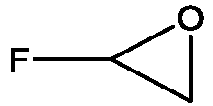
- In the reaction process, the polymer precursor generated after the ethylene oxide monomer reacts with the F-containing cyclic ether monomer


- In step S2, the prepared polymer precursor is dispersed in an NMP organic solvent to prepare polymer glue, nitrogen or clean air with a water content of 200 ppm is introduced, stirring is performed for 60 minutes, and the polymer glue is obtained.
- In the process, a F removal treatment is performed on the structural unit D1
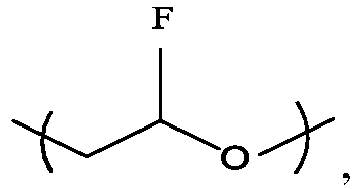

- In step S3, the polymer glue obtained in step S2 is then coated on a PE base film, and the PEO film is obtained after drying.
- After being tested through a viscosity method, the weight-average molecular weight of the obtained PEO is 2.14×10⁵.
- The disclosure relates to a PEO electrolyte film, which is obtained through the following method.
- In step S1, an ethylene oxide monomer and an F-containing cyclic ether monomer

- In the reaction process, after the ethylene oxide monomer reacts with the F-containing cyclic ether monomer, the polymer precursor containing a structural unit A


- In step S2, the prepared polymer precursor is dispersed in an NMP organic solvent to prepare polymer glue, nitrogen or clean air with a water content of 200 ppm is introduced, stirring is performed for 60 minutes, and the polymer glue is obtained.
- In the process, a F removal treatment is performed on the structural unit D2, so that part of the structural unit D2 is transformed into a structural unit B2

- In step S3, the polymer glue obtained in step S2 is then coated on a PE base film, and the PEO film is obtained after drying.
- After being tested through a viscosity method, the weight-average molecular weight of the obtained PEO is 1.96×10⁵.
- The disclosure relates to a PEO electrolyte film, which is obtained through the following method.
- In step S1, an ethylene oxide monomer and an F-containing cyclic ether monomer

- In the reaction process, after the ethylene oxide monomer reacts with the F-containing cyclic ether monomer, the polymer precursor containing a structural unit A


- In step S2, the prepared polymer precursor is dispersed in an NMP organic solvent to prepare polymer glue, nitrogen or clean air with a water content of 200 ppm is introduced, stirring is performed for 100 minutes, and the polymer glue is obtained.
- In the process, a F removal treatment is performed on the structural unit D3, so that part of the structural unit D3 is transformed into a structural unit B3

- In step S3, the polymer glue obtained in step S2 is then coated on a PE base film, and the PEO film is obtained after drying.
- After being tested through a viscosity method, the weight-average molecular weight of the obtained PEO is 1.84×10⁵.
- Each of the Examples 4 to 6 provides a PEO electrolyte film, and a difference between these Examples and Example 1 is that the mass ratios of the ethylene oxide monomer to the F-containing cyclic ether monomer

- Each of the Examples 7 to 9 provides a PEO electrolyte film, and a difference between these Examples and Example 1 is that the aprotic solvents respectively are liquid ammonia, liquid chlorine, and diethylene glycol dimethyl ether.
- Each of the Examples 10 to 12 provides a PEO electrolyte film, and a difference between these Examples and Example 1 is that the organic solvents used for preparing the polymer glue respectively are acetonitrile, EMC, and DMF.
- The comparative example relates to a PEO electrolyte film, and the preparation process of the electrolyte film includes the following.
- In step S1, 1.6g of 2.0×10⁵ (MW) PEO is added to 12 ml of acetonitrile, and is stirred until dissolved to form transparent glue.
- In step S2, the glue is coated on two surfaces of a PE base film for drying, and the PEO electrolyte film is obtained.
- The comparative example relates to a PEO electrolyte film, and the electrolyte film includes a film layer and lithium ion conductor powder disposed on the film layer.
- A process flow of manufacturing the PEO electrolyte film includes the following.
- In step S1, 1.6g of 2.0×10⁵ (MW) PEO is added to 12 ml of acetonitrile and stirred until dissolved, and the obtained solution is then added with 0.2g of LiTFSI until dissolved to form transparent glue.
- In step S2, 0.2g of LLZTO is ultrasonically dispersed in 2ml of acetonitrile for 30 minutes, is then added to the glue, and is stirred for dispersion for 20 minutes.
- In step S3, the glue is coated on two surfaces of a PE base film for drying, and the PEO electrolyte film is obtained.
- The comparative example relates to a PEO electrolyte film, and the PEO film includes a structural unit E of -CH=CH-CH2-O-. A preparation method of the PEO film includes the following steps.
- In step S1, an ethylene oxide monomer and an F-containing cyclic ether monomer

- In the reaction process, after the ethylene oxide monomer reacts with the F-containing cyclic ether monomer, the polymer precursor containing a structural unit A


- In step S2, the prepared polymer precursor is dispersed in an acetonitrile organic solvent to prepare polymer glue, nitrogen or clean air with a water content of 200 ppm is introduced, stirring is performed for 100 minutes, and the polymer glue is obtained.
- In the process, a F removal treatment is performed on a structural unit E', so that part of the structural unit E' is transformed into a structural unit E

- In step S3, the polymer glue obtained in step S2 is then coated on a PE base film, and the PEO film is obtained after drying.
- After being tested through a viscosity method, the weight-average molecular weight of the obtained PEO is 1.82×10⁵.
- The PEO electrolyte films provided by Examples 1-12 and Comparative Examples 1-3 are respectively tested for HNMR (the solvent is deuterated DMSO), and the following are found.
- 1) In Examples 1-12, a combination of a single peak and a plurality of split small peaks appears at both δ=5.36 ppm and δ=5.77 ppm, it is thus indicated that the structural unit B is present.
- 2) In Comparative Example 3, double peaks appear at δ=3.55 ppm, and triple peaks appear at δ=5.88 ppm, and an area ratio of the two is 2:1, it is thus indicated that the structural unit E is present.
- 3) The above peaks do not appear in Comparative Examples 1 and 2, it is thus indicated that the structural unit B and the structural unit E are not present.
- The PEO electrolyte films provided by Examples 1-12 and Comparative Examples 1-3 are respectively tested for film thicknesses and conductivity, and the test results are shown in Table 1. Herein, the film thickness test method includes the following steps. Each of the PEO electrolyte films provided by Examples 1-12 and the Comparative Examples 1-3 is placed in a thin-film thickness gauge for thickness measurement, the measurement is repeated for three times, and the measurement results are averaged to obtain the membrane thickness.
- The conductivity test method includes the following steps.
- 1. The PEO electrolyte films provided by Examples 1-12 and Comparative Examples 1-3 are cut into discs each with a diameter of 1 cm.
- 2. A Li sheet with a diameter of 1 cm is used, and a symmetric button cell battery is formed according to Li| electrolyte film |Li.
- 3. The impedance R for each of the button cell batteries is tested through EIS.
- 4. The conductivity δ is calculated and obtained, and the calculation formula is: δ=d/(R×S).
- Herein, d is the thickness of the electrolyte film, R is the impedance at the intercept of the Z-axis high frequency region in EIS, and S is the contact area of the electrolyte film.
Table 1 Serial Number Molecular Weight Film Thickness d/µm Conductivity S/cm (10°C) Conductivity S/cm (45°C) Example 1 2.14×10⁵ 84 4.74×10⁻⁵ 2.96×10⁴ Example 2 1.96×10⁵ 85 4.64×10⁻⁵ 2.63×10⁻⁴ Example 3 1.84×10⁵ 82 4.53×10⁻⁵ 2.32×10⁻⁴ Example 4 1.85×10⁵ 85 4.56×10⁻⁵ 2.35×10⁻⁴ Example 5 1.52×10⁵ 82 4.43×10⁻⁵ 2.28×10⁻⁴ Example 6 1.24×10⁵ 81 4.38×10⁻⁵ 2.27×10⁻⁴ Example 7 2.02×10⁵ 85 4.73×10⁻⁵ 2.94×10⁻⁴ Example 8 2.11×10⁵ 87 4.78×10⁻⁵ 2.79×10⁻⁴ Example 9 2.09×10⁵ 81 4.79×10⁻⁵ 2.88×10⁻⁴ Example 10 2.05×10⁵ 79 4.81×10⁻⁵ 2.81×10⁻⁴ Example 11 2.13×10⁵ 80 4.69×10⁻⁵ 2.73×10⁻⁴ Example 12 2.01×10⁵ 82 4.92×10⁻⁵ 2.90×10⁻⁴ Comparative Example 1 2.0×10⁵ 85 0.26×10⁻⁵ 1.21×10⁻⁴ Comparative Example 2 2.0×10⁵ 85 3.07×10⁻⁵ 2.82×10⁻⁴ Comparative Example 3 1.82×10⁵ 86 0.66×10⁻⁵ 1.45×10⁻⁴ - Based on the data provided in Table 1, it can be seen in Examples 1-12, Comparative Example 1, and Comparative Example 3 that compared to the PEO film without the structural unit B and the PEO film containing the structural unit E, the PEO film containing the structural unit B exhibits significantly improved conductivity at the low temperature of 10°C and the high temperature of 45°C. It is thus indicated that an oxygen atom adjacent to olefinic bond in the structural unit B has a lone pair of electrons. Compared to saturated hydrocarbons, the structural unit B is thus more inclined to transfer electrons to double bonds to increase electron cloud density of the double bonds, so that the double bonds are more suitable for combining with Li+. In this way, the transmission capability of lithium ions is further improved. Based on Examples 1-12 and Comparative Example 2, it can be known that the conductivity of the PEO film containing the structural unit B and the conductivity of the PEO film added with the lithium ion conductor powder at the high temperature of 45°C are comparable. Nevertheless, the PEO film containing the structural unit B exhibits significantly better conductivity at the low temperature of 10°C.
- Preparation of a lithium ion battery includes the following steps.
- A binder PVDF (i.e., polyvinylidene fluoride) is dissolved in non-aqueous solvent NMP (i.e., N-methylpyrrolidone), an anode active material artificial graphite and a conductive agent (which may include: KS-6 and SP) are then added, mixing is fully performed, and a slurry is produced. The composition of the slurry is: artificial graphite: KS-6: SP: PVDF = 91: 0.5: 3.5: solvent 5. Next, the obtained slurry is evenly coated on a 20 µm copper foil, is baked and dried at 120° C, and is rolled, so that an anode electrode sheet is then obtained.
- A binder PVDF is dissolved in non-aqueous solvent NMP, a cathode active material NCM (i.e., a ternary cathode material (e.g., LiNi0.5Co0.2Mn0.3O2)) and a conductive agent acetylene black are then added, mixing is fully performed, and a slurry is produced. The composition of the slurry is: LiNi0.5Co0.2Mn0.3O2: acetylene black: PVDF=91: 5: 4. Next, the obtained slurry is evenly coated on aluminum foil, the areal density is 170 g/m2, and then the slurry is baked and dried at 120° C and is rolled, so that a cathode electrode sheet is then obtained.
- The PEO electrolyte films provided by Examples 1-12 and Comparative Examples 1-3 are respectively placed in the anode electrode sheet and the cathode electrode sheet to be assembled into monolithic batteries with a design capacity of 70mAh, and these batteries are respectively denoted as M1 to M12 and N1 to N3.
- The batteries M1 to M12 and the batteries N1 to N3 are left to stand for 12 hours at 45°C in an oven for formation at room temperature. The formation conditions include the following conditions. The battery is charged with a 0.1C constant current to 4.25V, then charged with the constant voltage to a current < 0.05C. After standing for 5 minutes, the battery is discharged with a 0.1C constant current to 3.0V, and standed for 5 minutes.
- After formation is completed, the monolithic batteries corresponding to the different Examples and Comparative Examples are tested at 45°C and 10°C for a first-time discharge capacity and a discharge capacity after 20 cycles with 0.1C, and the test results are listed in Table 2.
Table 2 Serial Number 10°C Discharge Capacity (mAh) 45°C Discharge Capacity (mAh) First Time After 20 Cycles First Time After 20 Cycles M1 52.5 54.5 63.5 63.8 M2 53.2 53.4 62.3 62.4 M3 55.8 55.5 62.8 62.7 M4 54.3 54.6 63.2 63.3 M5 54.4 54.7 63.4 63.8 M6 53.2 53.6 64.2 64.3 M7 53.5 54.0 63.6 63.5 M8 52.7 52.9 62.2 62.7 M9 54.6 54.8 63.7 63.2 M10 52.8 53.1 64.1 64.3 M11 53.4 53.3 62.5 62.8 M12 55.1 55.4 62.8 63.3 N1 28.5 20.0 48.1 34.2 N2 34.5 34.0 61.5 61.9 N3 29.1 25.3 44.4 31.4 - Based on the data provided in Table 2, it can be seen in Examples 1-12, Comparative Example 1, and Comparative Example 3 that compared to the PEO film without the structural unit B and the PEO film containing the structural unit E, the PEO film containing the structural unit B exhibits a significantly improved discharge capacity in the first-time discharge capacity and the discharge capacity after 20 cycles at the low temperature of 10°C and the high temperature of 45°C. It is thus indicated that an oxygen atom adjacent to olefinic bond in the structural unit B has a lone pair of electrons. Compared to saturated hydrocarbons, the structural unit B is thus more inclined to transfer electrons to double bonds to increase electron cloud density of the double bonds, so that the double bonds are more suitable for combining with Li+. In this way, the transmission capability of lithium ions is further improved. Based on Examples 1-12 and Comparative Example 2, it can be known that at the low temperature of 10°C, the first-time discharge capacity and the discharge capacity after 20 cycles of the PEO film containing the structural unit B are both significantly greater than that of the PEO film added with the lithium ion conductor powder, and at the high temperature of 45°C, performance of the first-time discharge capacity and the discharge capacity after 20 cycles of the PEO film containing the structural unit B is greater than that of the PEO film added with lithium ion conductor powder. It is thus indicated that the PEO film provided by the disclosure may be securely adhered to an anode and a cathode and may continuously contact with the anode and the cathode securely after being assembled into a battery, and detachment is thereby prevented. The battery thereby exhibits favorable cyclic stability.
Claims (12)
- A PEO film, wherein a molecular structure of the PEO film comprises a structural unit B and a structural unit D, and the structural unit B comprises -CH=CH-O-, and the structural unit D comprises -C2H3F-O-.
- The PEO film according to claim 1, wherein the structural unit B is -CH=CH-O- or - R1-CH=CH-O-,
wherein R1 is selected from a C1 to C10 linear alkyl group or a C2 to C10 linear alkenyl group. - The PEO film according to claim 2, wherein the structural unit B is one of following structural formulas B1, B2, or B3:


- The PEO film according to claim 1, wherein the structural unit D is -C2H3F-O- or - R2-C2H3F-O-, wherein R2 is selected from a C1 to C10 linear alkyl group.
- The PEO film according to claim 4, wherein the structural unit D is one of following structural formulas D1, D2, or D3:


- A preparation method of a PEO film, wherein the preparation method comprises the following steps:performing a copolymerization reaction of an ethylene oxide monomer and an F-containing cyclic ether monomer to obtain a polymer precursor containing a structural unit D, wherein the structural unit D comprises -C2H3F-O-;performing a F removal treatment on the polymer precursor to form polymer glue containing a structural unit B, performing a film forming treatment on the polymer glue to obtain the PEO film, wherein the structural unit B comprises -CH=CH-O-.
- The preparation method according to claim 6, wherein the structural unit D is -C2H3F-O- or -R2-C2H3F-O-, wherein R2 is selected from a C1 to C10 linear alkyl group, and
the structural unit B is -CH=CH-O- or -R1-CH=CH-O-, wherein R1 is selected from a C1 to C10 linear alkyl group or a C2 to C10 linear alkenyl group. - The preparation method according to claim 6, wherein the ethylene oxide monomer and the F-containing cyclic ether monomer are evenly stirred in an aprotic solvent, and fluoride ions act as a catalyst for reaction to obtain the polymer precursor.
- The preparation method according to claim 8, wherein the aprotic solvent comprises at least one of liquid ammonia, liquid chlorine, or ether,
wherein the ether is aliphatic polyether having 4 to 15 carbon atoms. - The preparation method according to any one claims 6 to 9, wherein the F-containing cyclic ether monomer is selected from at least one of following structural monomers:

- The preparation method according to any one claims 6 to 9, wherein a mass ratio of the ethylene oxide monomer to the F-containing cyclic ether monomer is 19 to 1:1.
- A solid-state battery, comprising an anode electrode sheet, a cathode electrode sheet, and the PEO film according to any one of claims 1 to 5 between the anode electrode sheet and the cathode electrode sheet.
Applications Claiming Priority (1)
| Application Number | Priority Date | Filing Date | Title |
|---|---|---|---|
| CN202010217510.XA CN111370761B (en) | 2020-03-25 | 2020-03-25 | PEO film and preparation method thereof and solid-state battery |
Publications (2)
| Publication Number | Publication Date |
|---|---|
| EP3886228A1 EP3886228A1 (en) | 2021-09-29 |
| EP3886228B1 true EP3886228B1 (en) | 2025-06-25 |
Family
ID=71212000
Family Applications (1)
| Application Number | Title | Priority Date | Filing Date |
|---|---|---|---|
| EP20194775.1A Active EP3886228B1 (en) | 2020-03-25 | 2020-09-07 | Peo film, preparation method thereof, and solid-state battery |
Country Status (3)
| Country | Link |
|---|---|
| US (1) | US11962035B2 (en) |
| EP (1) | EP3886228B1 (en) |
| CN (1) | CN111370761B (en) |
Families Citing this family (3)
| Publication number | Priority date | Publication date | Assignee | Title |
|---|---|---|---|---|
| CN112259789B (en) * | 2020-10-13 | 2022-07-12 | 北京卫国创芯科技有限公司 | Polyether solid polymer electrolyte, preparation method thereof and solid battery comprising polyether solid polymer electrolyte |
| CN112310472B (en) * | 2020-11-05 | 2022-06-03 | 中创新航技术研究院(江苏)有限公司 | Solid electrolyte membrane, preparation method and battery |
| WO2023004633A1 (en) * | 2021-07-28 | 2023-02-02 | 宁德时代新能源科技股份有限公司 | Battery, battery module, battery pack, and electrical device |
Family Cites Families (12)
| Publication number | Priority date | Publication date | Assignee | Title |
|---|---|---|---|---|
| DE19963125A1 (en) * | 1999-12-24 | 2001-06-28 | Creavis Tech & Innovation Gmbh | Process for the preparation of polymers containing double bonds by ring-opening polymerization |
| JP3576448B2 (en) * | 2000-03-21 | 2004-10-13 | 三菱レイヨン株式会社 | Thermoplastic resin composition |
| US6468696B1 (en) * | 2000-11-03 | 2002-10-22 | Advanced Polymer Research, Inc. | Polymer gel electrolyte systems |
| US20040122256A1 (en) * | 2001-02-01 | 2004-06-24 | Masanori Ikeda | Perfluorvinyl ether monomer having sulfonamide group |
| KR100637486B1 (en) * | 2004-06-30 | 2006-10-20 | 삼성에스디아이 주식회사 | Electrolyte membrane for fuel cell and fuel cell comprising same |
| JP5340860B2 (en) * | 2008-09-03 | 2013-11-13 | 三洋化成工業株式会社 | Additive for electrolyte |
| WO2011146670A1 (en) * | 2010-05-19 | 2011-11-24 | Seeo, Inc | High temperature lithium cells with solid polymer electrolytes |
| JP2012077271A (en) * | 2010-10-06 | 2012-04-19 | Nec Corp | Polymerization initiator and method of manufacturing polymer using the same |
| CN102074735B (en) | 2010-12-03 | 2012-12-26 | 浙江大学 | Diene/ether copolymer-based lithium ion gel electrolyte membrane and preparation method thereof |
| CN109478684B (en) * | 2016-06-30 | 2021-12-07 | 野猫技术开发公司 | Solid electrolyte composition |
| CN109575267B (en) * | 2018-12-03 | 2020-12-18 | 上海交通大学 | Polyether-based polymers, cross-linked network polymers and electrochemical devices |
| CN109705274B (en) * | 2018-12-28 | 2021-03-02 | 东北师范大学 | All-solid-state polymer electrolyte membrane and preparation method thereof |
-
2020
- 2020-03-25 CN CN202010217510.XA patent/CN111370761B/en active Active
- 2020-09-03 US US17/012,025 patent/US11962035B2/en active Active
- 2020-09-07 EP EP20194775.1A patent/EP3886228B1/en active Active
Also Published As
| Publication number | Publication date |
|---|---|
| US11962035B2 (en) | 2024-04-16 |
| CN111370761B (en) | 2021-08-20 |
| EP3886228A1 (en) | 2021-09-29 |
| US20210301082A1 (en) | 2021-09-30 |
| CN111370761A (en) | 2020-07-03 |
Similar Documents
| Publication | Publication Date | Title |
|---|---|---|
| CN103534849B (en) | Storage device | |
| EP3886228B1 (en) | Peo film, preparation method thereof, and solid-state battery | |
| EP1229603A1 (en) | Lithium cell | |
| EP4243150A1 (en) | Novel additive for non-aqueous electrolyte solution and lithium secondary battery comprising same | |
| CN113871699A (en) | A solid electrolyte and a lithium ion battery comprising the solid electrolyte | |
| EP2453511A1 (en) | Polymer gel electrolyte and polymer secondary battery using same | |
| KR20190029443A (en) | Polymer electrolyte for secondary battery and lithium secondary battery comprising the same | |
| EP3872906B1 (en) | Nonaqueous secondary battery electrode, electrode slurry, and nonaqueous secondary battery | |
| KR20050031436A (en) | Nonaqueous electrolyte cell | |
| EP3709428A1 (en) | Electrolyte for lithium secondary battery and lithium secondary battery comprising same | |
| KR20230071721A (en) | Novle additives for nonaqueous electrolyte and lithium secondary battery containing the same | |
| WO2001080345A1 (en) | Non-aqueous electrolyte and lithium secondary battery | |
| CN119899170B (en) | Fluorine-containing thiophene compound, preparation method thereof, and electrolyte | |
| CN115719834A (en) | Lithium ion battery electrolyte, preparation method and lithium ion battery | |
| KR20230069816A (en) | Lithium secondary battery improved safety | |
| CN119518104B (en) | An amide-based eutectic electrolyte, its preparation method, and a lithium metal secondary battery | |
| JP3462764B2 (en) | Non-aqueous electrolyte secondary battery | |
| KR20260014573A (en) | Unsaturated polymer electrolyte and method for preparing the same and use thereof in electrochemical applications | |
| EP4273992B1 (en) | Lithium secondary battery having enhanced high-temperature safety | |
| CN114447416B (en) | Modified inorganic fast ion conductor and preparation method and application thereof | |
| KR102351971B1 (en) | Mellitic triimide as electrode active material for lithium secondary battery and lithium secondary battery using the same | |
| CN114649570B (en) | A polymerizable electrolyte and its preparation method and application | |
| KR102836773B1 (en) | Zwitterionic compound and composition for solid electrolyte comprising the same | |
| KR102663158B1 (en) | Lithium secondary battery with improved safety | |
| JP3198951B2 (en) | Organic electrolyte for lithium secondary battery, method for producing the same, and use thereof |
Legal Events
| Date | Code | Title | Description |
|---|---|---|---|
| PUAI | Public reference made under article 153(3) epc to a published international application that has entered the european phase |
Free format text: ORIGINAL CODE: 0009012 |
|
| STAA | Information on the status of an ep patent application or granted ep patent |
Free format text: STATUS: REQUEST FOR EXAMINATION WAS MADE |
|
| 17P | Request for examination filed |
Effective date: 20200907 |
|
| AK | Designated contracting states |
Kind code of ref document: A1 Designated state(s): AL AT BE BG CH CY CZ DE DK EE ES FI FR GB GR HR HU IE IS IT LI LT LU LV MC MK MT NL NO PL PT RO RS SE SI SK SM TR |
|
| STAA | Information on the status of an ep patent application or granted ep patent |
Free format text: STATUS: EXAMINATION IS IN PROGRESS |
|
| 17Q | First examination report despatched |
Effective date: 20240424 |
|
| GRAP | Despatch of communication of intention to grant a patent |
Free format text: ORIGINAL CODE: EPIDOSNIGR1 |
|
| STAA | Information on the status of an ep patent application or granted ep patent |
Free format text: STATUS: GRANT OF PATENT IS INTENDED |
|
| INTG | Intention to grant announced |
Effective date: 20250415 |
|
| RIN1 | Information on inventor provided before grant (corrected) |
Inventor name: LI, YANG Inventor name: LI, XU Inventor name: CHEN, CAO Inventor name: CAO, CHEN Inventor name: WANG, KANGPING |
|
| GRAS | Grant fee paid |
Free format text: ORIGINAL CODE: EPIDOSNIGR3 |
|
| GRAA | (expected) grant |
Free format text: ORIGINAL CODE: 0009210 |
|
| STAA | Information on the status of an ep patent application or granted ep patent |
Free format text: STATUS: THE PATENT HAS BEEN GRANTED |
|
| AK | Designated contracting states |
Kind code of ref document: B1 Designated state(s): AL AT BE BG CH CY CZ DE DK EE ES FI FR GB GR HR HU IE IS IT LI LT LU LV MC MK MT NL NO PL PT RO RS SE SI SK SM TR |
|
| REG | Reference to a national code |
Ref country code: GB Ref legal event code: FG4D |
|
| REG | Reference to a national code |
Ref country code: CH Ref legal event code: EP |
|
| REG | Reference to a national code |
Ref country code: DE Ref legal event code: R096 Ref document number: 602020053205 Country of ref document: DE |
|
| REG | Reference to a national code |
Ref country code: CH Ref legal event code: EP |
|
| REG | Reference to a national code |
Ref country code: IE Ref legal event code: FG4D |
|
| PG25 | Lapsed in a contracting state [announced via postgrant information from national office to epo] |
Ref country code: FI Free format text: LAPSE BECAUSE OF FAILURE TO SUBMIT A TRANSLATION OF THE DESCRIPTION OR TO PAY THE FEE WITHIN THE PRESCRIBED TIME-LIMIT Effective date: 20250625 |
|
| PGFP | Annual fee paid to national office [announced via postgrant information from national office to epo] |
Ref country code: DE Payment date: 20250919 Year of fee payment: 6 |
|
| REG | Reference to a national code |
Ref country code: LT Ref legal event code: MG9D |
|
| PG25 | Lapsed in a contracting state [announced via postgrant information from national office to epo] |
Ref country code: NO Free format text: LAPSE BECAUSE OF FAILURE TO SUBMIT A TRANSLATION OF THE DESCRIPTION OR TO PAY THE FEE WITHIN THE PRESCRIBED TIME-LIMIT Effective date: 20250925 Ref country code: GR Free format text: LAPSE BECAUSE OF FAILURE TO SUBMIT A TRANSLATION OF THE DESCRIPTION OR TO PAY THE FEE WITHIN THE PRESCRIBED TIME-LIMIT Effective date: 20250926 |
|
| PG25 | Lapsed in a contracting state [announced via postgrant information from national office to epo] |
Ref country code: BG Free format text: LAPSE BECAUSE OF FAILURE TO SUBMIT A TRANSLATION OF THE DESCRIPTION OR TO PAY THE FEE WITHIN THE PRESCRIBED TIME-LIMIT Effective date: 20250625 |
|
| PGFP | Annual fee paid to national office [announced via postgrant information from national office to epo] |
Ref country code: GB Payment date: 20250919 Year of fee payment: 6 |
|
| PG25 | Lapsed in a contracting state [announced via postgrant information from national office to epo] |
Ref country code: HR Free format text: LAPSE BECAUSE OF FAILURE TO SUBMIT A TRANSLATION OF THE DESCRIPTION OR TO PAY THE FEE WITHIN THE PRESCRIBED TIME-LIMIT Effective date: 20250625 |
|
| PGFP | Annual fee paid to national office [announced via postgrant information from national office to epo] |
Ref country code: FR Payment date: 20250922 Year of fee payment: 6 |
|
| PG25 | Lapsed in a contracting state [announced via postgrant information from national office to epo] |
Ref country code: RS Free format text: LAPSE BECAUSE OF FAILURE TO SUBMIT A TRANSLATION OF THE DESCRIPTION OR TO PAY THE FEE WITHIN THE PRESCRIBED TIME-LIMIT Effective date: 20250925 |
|
| PG25 | Lapsed in a contracting state [announced via postgrant information from national office to epo] |
Ref country code: LV Free format text: LAPSE BECAUSE OF FAILURE TO SUBMIT A TRANSLATION OF THE DESCRIPTION OR TO PAY THE FEE WITHIN THE PRESCRIBED TIME-LIMIT Effective date: 20250625 |
|
| REG | Reference to a national code |
Ref country code: NL Ref legal event code: MP Effective date: 20250625 |
|
| PG25 | Lapsed in a contracting state [announced via postgrant information from national office to epo] |
Ref country code: NL Free format text: LAPSE BECAUSE OF FAILURE TO SUBMIT A TRANSLATION OF THE DESCRIPTION OR TO PAY THE FEE WITHIN THE PRESCRIBED TIME-LIMIT Effective date: 20250625 |
|
| PG25 | Lapsed in a contracting state [announced via postgrant information from national office to epo] |
Ref country code: PT Free format text: LAPSE BECAUSE OF FAILURE TO SUBMIT A TRANSLATION OF THE DESCRIPTION OR TO PAY THE FEE WITHIN THE PRESCRIBED TIME-LIMIT Effective date: 20251027 |
|
| REG | Reference to a national code |
Ref country code: AT Ref legal event code: MK05 Ref document number: 1807529 Country of ref document: AT Kind code of ref document: T Effective date: 20250625 |
|
| PG25 | Lapsed in a contracting state [announced via postgrant information from national office to epo] |
Ref country code: IS Free format text: LAPSE BECAUSE OF FAILURE TO SUBMIT A TRANSLATION OF THE DESCRIPTION OR TO PAY THE FEE WITHIN THE PRESCRIBED TIME-LIMIT Effective date: 20251025 |
|
| PG25 | Lapsed in a contracting state [announced via postgrant information from national office to epo] |
Ref country code: AT Free format text: LAPSE BECAUSE OF FAILURE TO SUBMIT A TRANSLATION OF THE DESCRIPTION OR TO PAY THE FEE WITHIN THE PRESCRIBED TIME-LIMIT Effective date: 20250625 Ref country code: SM Free format text: LAPSE BECAUSE OF FAILURE TO SUBMIT A TRANSLATION OF THE DESCRIPTION OR TO PAY THE FEE WITHIN THE PRESCRIBED TIME-LIMIT Effective date: 20250625 |
|
| PG25 | Lapsed in a contracting state [announced via postgrant information from national office to epo] |
Ref country code: CZ Free format text: LAPSE BECAUSE OF FAILURE TO SUBMIT A TRANSLATION OF THE DESCRIPTION OR TO PAY THE FEE WITHIN THE PRESCRIBED TIME-LIMIT Effective date: 20250625 |
|
| PG25 | Lapsed in a contracting state [announced via postgrant information from national office to epo] |
Ref country code: PL Free format text: LAPSE BECAUSE OF FAILURE TO SUBMIT A TRANSLATION OF THE DESCRIPTION OR TO PAY THE FEE WITHIN THE PRESCRIBED TIME-LIMIT Effective date: 20250625 |
|
| PG25 | Lapsed in a contracting state [announced via postgrant information from national office to epo] |
Ref country code: EE Free format text: LAPSE BECAUSE OF FAILURE TO SUBMIT A TRANSLATION OF THE DESCRIPTION OR TO PAY THE FEE WITHIN THE PRESCRIBED TIME-LIMIT Effective date: 20250625 |
|
| PG25 | Lapsed in a contracting state [announced via postgrant information from national office to epo] |
Ref country code: SK Free format text: LAPSE BECAUSE OF FAILURE TO SUBMIT A TRANSLATION OF THE DESCRIPTION OR TO PAY THE FEE WITHIN THE PRESCRIBED TIME-LIMIT Effective date: 20250625 |
|
| PG25 | Lapsed in a contracting state [announced via postgrant information from national office to epo] |
Ref country code: ES Free format text: LAPSE BECAUSE OF FAILURE TO SUBMIT A TRANSLATION OF THE DESCRIPTION OR TO PAY THE FEE WITHIN THE PRESCRIBED TIME-LIMIT Effective date: 20250625 |
|
| PG25 | Lapsed in a contracting state [announced via postgrant information from national office to epo] |
Ref country code: RO Free format text: LAPSE BECAUSE OF FAILURE TO SUBMIT A TRANSLATION OF THE DESCRIPTION OR TO PAY THE FEE WITHIN THE PRESCRIBED TIME-LIMIT Effective date: 20250625 |
|
| PG25 | Lapsed in a contracting state [announced via postgrant information from national office to epo] |
Ref country code: DK Free format text: LAPSE BECAUSE OF FAILURE TO SUBMIT A TRANSLATION OF THE DESCRIPTION OR TO PAY THE FEE WITHIN THE PRESCRIBED TIME-LIMIT Effective date: 20250625 |
|
| PG25 | Lapsed in a contracting state [announced via postgrant information from national office to epo] |
Ref country code: IT Free format text: LAPSE BECAUSE OF FAILURE TO SUBMIT A TRANSLATION OF THE DESCRIPTION OR TO PAY THE FEE WITHIN THE PRESCRIBED TIME-LIMIT Effective date: 20250625 |
|
| REG | Reference to a national code |
Ref country code: CH Ref legal event code: H13 Free format text: ST27 STATUS EVENT CODE: U-0-0-H10-H13 (AS PROVIDED BY THE NATIONAL OFFICE) Effective date: 20260425 |
|
| PLBE | No opposition filed within time limit |
Free format text: ORIGINAL CODE: 0009261 |
|
| STAA | Information on the status of an ep patent application or granted ep patent |
Free format text: STATUS: NO OPPOSITION FILED WITHIN TIME LIMIT |