EP3885706B1 - Real-time localization error correction by consumer automated vehicles - Google Patents
Real-time localization error correction by consumer automated vehicles Download PDFInfo
- Publication number
- EP3885706B1 EP3885706B1 EP20213278.3A EP20213278A EP3885706B1 EP 3885706 B1 EP3885706 B1 EP 3885706B1 EP 20213278 A EP20213278 A EP 20213278A EP 3885706 B1 EP3885706 B1 EP 3885706B1
- Authority
- EP
- European Patent Office
- Prior art keywords
- real
- time
- correction value
- landmark
- mas
- Prior art date
- Legal status (The legal status is an assumption and is not a legal conclusion. Google has not performed a legal analysis and makes no representation as to the accuracy of the status listed.)
- Active
Links
Images



Classifications
-
- G—PHYSICS
- G01—MEASURING; TESTING
- G01C—MEASURING DISTANCES, LEVELS OR BEARINGS; SURVEYING; NAVIGATION; GYROSCOPIC INSTRUMENTS; PHOTOGRAMMETRY OR VIDEOGRAMMETRY
- G01C21/00—Navigation; Navigational instruments not provided for in groups G01C1/00 - G01C19/00
- G01C21/26—Navigation; Navigational instruments not provided for in groups G01C1/00 - G01C19/00 specially adapted for navigation in a road network
- G01C21/28—Navigation; Navigational instruments not provided for in groups G01C1/00 - G01C19/00 specially adapted for navigation in a road network with correlation of data from several navigational instruments
- G01C21/30—Map- or contour-matching
-
- G—PHYSICS
- G01—MEASURING; TESTING
- G01C—MEASURING DISTANCES, LEVELS OR BEARINGS; SURVEYING; NAVIGATION; GYROSCOPIC INSTRUMENTS; PHOTOGRAMMETRY OR VIDEOGRAMMETRY
- G01C21/00—Navigation; Navigational instruments not provided for in groups G01C1/00 - G01C19/00
-
- G—PHYSICS
- G01—MEASURING; TESTING
- G01C—MEASURING DISTANCES, LEVELS OR BEARINGS; SURVEYING; NAVIGATION; GYROSCOPIC INSTRUMENTS; PHOTOGRAMMETRY OR VIDEOGRAMMETRY
- G01C11/00—Photogrammetry or videogrammetry, e.g. stereogrammetry; Photographic surveying
-
- G—PHYSICS
- G01—MEASURING; TESTING
- G01C—MEASURING DISTANCES, LEVELS OR BEARINGS; SURVEYING; NAVIGATION; GYROSCOPIC INSTRUMENTS; PHOTOGRAMMETRY OR VIDEOGRAMMETRY
- G01C21/00—Navigation; Navigational instruments not provided for in groups G01C1/00 - G01C19/00
- G01C21/26—Navigation; Navigational instruments not provided for in groups G01C1/00 - G01C19/00 specially adapted for navigation in a road network
- G01C21/34—Route searching; Route guidance
- G01C21/36—Input/output arrangements for on-board computers
- G01C21/3602—Input other than that of destination using image analysis, e.g. detection of road signs, lanes, buildings, real preceding vehicles using a camera
-
- G—PHYSICS
- G01—MEASURING; TESTING
- G01C—MEASURING DISTANCES, LEVELS OR BEARINGS; SURVEYING; NAVIGATION; GYROSCOPIC INSTRUMENTS; PHOTOGRAMMETRY OR VIDEOGRAMMETRY
- G01C21/00—Navigation; Navigational instruments not provided for in groups G01C1/00 - G01C19/00
- G01C21/38—Electronic maps specially adapted for navigation; Updating thereof
- G01C21/3804—Creation or updating of map data
- G01C21/3807—Creation or updating of map data characterised by the type of data
- G01C21/3815—Road data
-
- G—PHYSICS
- G01—MEASURING; TESTING
- G01C—MEASURING DISTANCES, LEVELS OR BEARINGS; SURVEYING; NAVIGATION; GYROSCOPIC INSTRUMENTS; PHOTOGRAMMETRY OR VIDEOGRAMMETRY
- G01C21/00—Navigation; Navigational instruments not provided for in groups G01C1/00 - G01C19/00
- G01C21/38—Electronic maps specially adapted for navigation; Updating thereof
- G01C21/3804—Creation or updating of map data
- G01C21/3833—Creation or updating of map data characterised by the source of data
- G01C21/3841—Data obtained from two or more sources, e.g. probe vehicles
-
- G—PHYSICS
- G01—MEASURING; TESTING
- G01C—MEASURING DISTANCES, LEVELS OR BEARINGS; SURVEYING; NAVIGATION; GYROSCOPIC INSTRUMENTS; PHOTOGRAMMETRY OR VIDEOGRAMMETRY
- G01C21/00—Navigation; Navigational instruments not provided for in groups G01C1/00 - G01C19/00
- G01C21/38—Electronic maps specially adapted for navigation; Updating thereof
- G01C21/3804—Creation or updating of map data
- G01C21/3833—Creation or updating of map data characterised by the source of data
- G01C21/3848—Data obtained from both position sensors and additional sensors
-
- G—PHYSICS
- G01—MEASURING; TESTING
- G01S—RADIO DIRECTION-FINDING; RADIO NAVIGATION; DETERMINING DISTANCE OR VELOCITY BY USE OF RADIO WAVES; LOCATING OR PRESENCE-DETECTING BY USE OF THE REFLECTION OR RERADIATION OF RADIO WAVES; ANALOGOUS ARRANGEMENTS USING OTHER WAVES
- G01S19/00—Satellite radio beacon positioning systems; Determining position, velocity or attitude using signals transmitted by such systems
- G01S19/38—Determining a navigation solution using signals transmitted by a satellite radio beacon positioning system
- G01S19/39—Determining a navigation solution using signals transmitted by a satellite radio beacon positioning system the satellite radio beacon positioning system transmitting time-stamped messages, e.g. GPS [Global Positioning System], GLONASS [Global Orbiting Navigation Satellite System] or GALILEO
- G01S19/40—Correcting position, velocity or attitude
-
- G—PHYSICS
- G06—COMPUTING OR CALCULATING; COUNTING
- G06V—IMAGE OR VIDEO RECOGNITION OR UNDERSTANDING
- G06V20/00—Scenes; Scene-specific elements
- G06V20/50—Context or environment of the image
- G06V20/56—Context or environment of the image exterior to a vehicle by using sensors mounted on the vehicle
- G06V20/588—Recognition of the road, e.g. of lane markings; Recognition of the vehicle driving pattern in relation to the road
Definitions
- Embodiments of the present disclosure generally relate to the field of autonomous driving, and in particular to real-time localization error correction of an autonomous vehicle (AV).
- AV autonomous vehicle
- the AV may need to identify its location within a particular road segment.
- the AV may use landmarks whose world coordinates are known to perform localization.
- the idea is to construct a very detailed map (e.g. a high definition (HD) map) that contains various types of landmarks.
- the assumption is that the AV is equipped with sensing or image capture devices that can detect and locate the landmarks in its own reference frame. Once the relative position between the vehicle and the landmarks is found, the landmarks' world coordinates are taken from the map database, and the AV can use them to compute its location.
- US 2019/0003847 A1 relates to methods and systems for vehicle localization.
- a localization error is determined by comparing a first distance that is determined using navigation and image data and a second distance that is determined using navigation data and map data.
- a reference image is generated based on an observed position and pose of a vehicle and compared to a captured image. Based on the comparison, a correction of the observed position and/or the observed pose is determined.
- map matching errors of multiple vehicles are collected by a server, evaluated with respect to a road stretch, and used to determine whether the road stretch deviates from a known course of the road stretch.
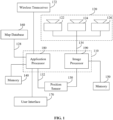
- FIG. 1 is a block diagram representation of an exemplary system according to various embodiments of the disclosure.
- System 100 may include various components depending on the requirements of a particular implementation.
- the system 100 may include a processing unit 110, an image acquisition unit 120, a position sensor 130, one or more memory units 140, 150, a map database 160, a user interface 170, and a wireless transceiver 172.
- the processing unit 110 may include one or more processing devices.
- the processing unit 110 may include an application processor 180, an image processor 190, or any other suitable processing device.
- the image acquisition unit 120 may include any number of image acquisition devices and components depending on the requirements of a particular application.
- the image acquisition unit 120 may include one or more image capture devices (e.g., cameras), such as an image capture device 122, an image capture device 124, and an image capture device 126.
- the system 100 may also include a data interface 128 communicatively connecting the processing unit 110 to the image acquisition unit 120.
- the data interface 128 may include any wired and/or wireless link or links for transmitting image data acquired by the image acquisition unit 120 to the processing unit 110.
- a wireless transceiver 172 may include one or more devices configured to exchange transmissions over an air interface to one or more networks (e.g., cellular, the Internet, etc.) by use of a radio frequency, infrared frequency, magnetic field, or an electric field.
- the wireless transceiver 172 may use any known standard to transmit and/or receive data (e.g., Wi-Fi, Bluetooth ® , Bluetooth Smart, 802.15.4, ZigBee, etc.).
- Both the application processor 180 and the image processor 190 may include various types of processing devices.
- the application processor 180 and the image processor 190 may include a microprocessor, preprocessors (such as an image preprocessor), graphics processors, a central processing unit (CPU), support circuits, digital signal processors, integrated circuits, memory, or any other types of devices suitable for running applications and for image processing and analysis.
- the application processor 180 and/or the image processor 190 may include any type of single or multi-core processor, mobile device microcontroller, central processing unit, etc.
- Various processing devices may be used, and may include various architectures.
- the application processor 180 and/or the image processor 190 may include some types of processor designs. These processor designs each include multiple processing units with local memory and instruction sets. Such processors may include video inputs for receiving image data from multiple image sensors and may also include video output capabilities. In one example, the processor uses 90 nm-micron technology operating at 332 Mhz.
- the processor architecture consists of two floating point, hyper-thread 32-bit RISC CPUs (MIPS32 ® 34K ® cores), five Vision Computing Engines (VCE), three Vector Microcode Processors (VMP ® ), Denali 64-bit Mobile DDR Controller, 128-bit internal Sonics Interconnect, dual 16-bit Video input and 18-bit Video output controllers, 16 channels DMA and several peripherals.
- One MIPS34K CPU manages the five VCEs, three VMP TM and the DMA, the other MIPS34K CPU and the multi-channel DMA as well as the other peripherals.
- the five VCEs, three VMP ® and the MIPS34K CPU can perform intensive vision computations required by multi-function bundle applications.
- Configuring a processing device such as any of the described processors or other controller or microprocessor, to perform certain functions may include programming of computer executable instructions and making those instructions available to the processing device for execution during operation of the processing device.
- configuring a processing device may include programming the processing device directly with architectural instructions.
- configuring a processing device may include storing executable instructions on a memory that is accessible to the processing device during operation. For example, the processing device may access the memory to obtain and execute the stored instructions during operation.
- FIG. 1 depicts two separate processing devices included in processing unit 110, more or fewer processing devices may be used.
- a single processing device may be used to accomplish the tasks of the application processor 180 and the image processor 190. In other embodiments, these tasks may be performed by more than two processing devices.
- the system 100 may include one or more processing units 110 without including other components, such as the image acquisition unit 120.
- the processing unit 110 may comprise various types of devices.
- the processing unit 110 may include various devices, such as a controller, an image preprocessor, a central processing unit (CPU), support circuits, digital signal processors, integrated circuits, memory, or any other types of devices for image processing and analysis.
- the image preprocessor may include a video processor for capturing, digitizing and processing the imagery from the image sensors.
- the CPU may comprise any number of microcontrollers or microprocessors.
- the support circuits may be any number of circuits generally well known in the art, including cache, power supply, clock and input-output circuits.
- the memory may store software that, when executed by the processor, controls the operation of the system.
- the memory may include databases and image processing software.
- the memory may comprise any number of random access memories, read only memories, flash memories, disk drives, optical storage, tape storage, removable storage and other types of storage.
- the memory may be separate from the processing unit 110. In another instance, the memory may be integrated into the processing unit 110.
- Each memory 140, 150 may include software instructions that when executed by a processor (e.g., the application processor 180 and/or the image processor 190), may control operations of various aspects of the system 100. These memory units may include various databases and image processing software. The memory units may include random access memory, read only memory, flash memory, disk drives, optical storage, tape storage, removable storage and/or any other types of storage. In some embodiments, memory units 140, 150 may be separate from the application processor 180 and/or the image processor 190. In other embodiments, these memory units may be integrated into the application processor 180 and/or the image processor 190.
- the position sensor 130 may include any type of device suitable for determining a location associated with at least one component of the system 100.
- the position sensor 130 may include a GPS receiver. Such receivers can determine a user position and velocity by processing signals broadcasted by global positioning system satellites. Position information from the position sensor may be made available to the application processor 180 and/or the image processor 190.
- the system 100 may include components such as a speed sensor (e.g., a tachometer) for measuring a speed of a vehicle and/or an accelerometer (not shown) for measuring an acceleration of the vehicle.
- a speed sensor e.g., a tachometer
- an accelerometer not shown
- User interface 170 may include any device suitable for providing information to or for receiving inputs from one or more users of the system 100.
- the user interface 170 may include user input devices, including, for example, a touchscreen, microphone, keyboard, pointer devices, track wheels, cameras, knobs, buttons, etc. With such input devices, a user may be able to provide information inputs or commands to the system 100 by typing instructions or information, providing voice commands, selecting menu options on a screen using buttons, pointers, or eye-tracking capabilities, or through any other suitable techniques for communicating information to the system 100.
- User interface 170 may be equipped with one or more processing devices configured to provide and receive information to or from a user and process that information for use by, for example, the application processor 180.
- processing devices may execute instructions for recognizing and tracking eye movements, receiving and interpreting voice commands, recognizing and interpreting touches and/or gestures made on a touchscreen, responding to keyboard entries or menu selections, etc.
- the user interface 170 may include a display, a speaker, a tactile device, and/or any other devices for providing output information to a user.
- Map database 160 may include any type of database for storing map data useful to the system 100.
- the map database 160 may include data relating to the position, in a reference coordinate system, of various items, including roads, water features, geographic features, businesses, points of interest, restaurants, gas stations, etc.
- the map database 160 may store not only the locations of such items, but also descriptors relating to those items, including, for example, names associated with any of the stored features.
- the map database 160 may be physically located with other components of the system 100. Alternatively or additionally, the map database 160 or a portion thereof may be located remotely with respect to other components of the system 100 (e.g., the processing unit 110). In such embodiments, information from the map database 160 may be downloaded over a wired or wireless data connection to a network (e.g., over a cellular network and/or the Internet, etc.).
- Image capture devices 122, 124, and 126 may each include any type of device suitable for capturing at least one image from an environment. Moreover, any number of image capture devices may be used to acquire images for input to the image processor. Some embodiments may include only a single image capture device, while other embodiments may include two, three, or even four or more image capture devices.
- the system 100 may be incorporated into various different platforms.
- the system 100 may be included on a vehicle 200 (e.g. an autonomous vehicle), as shown in FIG. 2 .
- vehicle 200 may be equipped with the processing unit 110 and any of the other components of the system 100, as described above relative to FIG. 1 .
- the vehicle 200 may be equipped with only a single image capture device (e.g., camera), in other embodiments, multiple image capture devices may be used.
- any of the image capture devices 122 and 124 of the vehicle 200, as shown in FIG. 2 may be part of an ADAS (Advanced Driver Assistance Systems) imaging set.
- ADAS Advanced Driver Assistance Systems
- the image capture devices included on the vehicle 200 as part of the image acquisition unit 120 may be positioned at any suitable location.
- the image capture device 122 may be located in the vicinity of the rearview mirror. This position may provide a line of sight similar to that of the driver of the vehicle 200, which may aid in determining what is and is not visible to the driver.
- the image capture device 122 may be positioned at any location near the rearview mirror, but placing the image capture device 122 on the driver side of the mirror may further aid in obtaining images representative of the driver's field of view and/or line of sight.
- the image capture device 124 may be located on or in a bumper of vehicle 200. Such a location may be especially suitable for image capture devices having a wide field of view. The line of sight of bumper-located image capture devices can be different from that of the driver and, therefore, the bumper image capture device and driver may not always see the same objects.
- the image capture devices e.g., image capture devices 122, 124, and 126) may also be located in other locations.
- the image capture devices may be located on or in one or both of the side mirrors of the vehicle 200, on the roof of the vehicle 200, on the hood of the vehicle 200, on the trunk of the vehicle 200, on the sides of the vehicle 200, mounted on, positioned behind, or positioned in front of any of the windows of the vehicle 200, and mounted in or near light fixtures on the front and/or back of the vehicle 200, etc.
- the vehicle 200 may include various other components of system 100.
- the processing unit 110 may be included on the vehicle 200 either integrated with or separate from an engine control unit (ECU) of the vehicle.
- the vehicle 200 may also be equipped with the position sensor 130 such as a GPS receiver, and may also include the map database 160 and the memory units 140 and 150.
- the wireless transceiver 172 may transmit and/or receive data over one or more networks (e.g., cellular networks, the Internet, etc.). For example, the wireless transceiver 172 may upload data collected by the system 100 to one or more servers, and download data from the one or more servers. Via the wireless transceiver 172, the system 100 may receive, for example, periodic or on-demand or real-time updates to data stored in the map database 160, the memory 140, and/or the memory 150.
- networks e.g., cellular networks, the Internet, etc.
- the wireless transceiver 172 may upload data collected by the system 100 to one or more servers, and download data from the one or more servers. Via the wireless transceiver 172, the system 100 may receive, for example, periodic or on-demand or real-time updates to data stored in the map database 160, the memory 140, and/or the memory 150.
- the wireless transceiver 172 may upload any data (e.g., images captured by image acquisition unit 120, data received by one or more sensors in the sensor unit130, vehicle control systems, etc.) from the system 100 and/or any data processed by processing unit 110 to the one or more servers.
- any data e.g., images captured by image acquisition unit 120, data received by one or more sensors in the sensor unit130, vehicle control systems, etc.
- the system 100 may upload data to a server (e.g. to the cloud) based on a privacy level setting to regulate or limit the types of data (including metadata) sent to the server that may uniquely identify a vehicle and/or driver/owner of a vehicle.
- a server e.g. to the cloud
- Such settings may be set by user via, for example, wireless transceiver 172, be initialized by factory default settings, or by data received by wireless transceiver 172.
- the system 100 may be included on an autonomous vehicle (AV), and the processor and method for real-time localization error correction as proposed may be used on the AV.
- AV autonomous vehicle
- HDMEMS HD map experience management system
- the overview of the AV and the HDMEMS will be discussed below. Meanwhile, it should be noted that the HDMEMS will be only taken as an example map experience management system to explain the principles of the embodiments of the present application, but various types of map experience management systems currently available or to be developed in the future may be applied to implement various embodiments of the present application.
- autonomous vehicle refers to a vehicle capable of implementing at least one navigational change without driver input.
- a “navigational change” refers to a change in one or more of steering, braking, or acceleration of the vehicle.
- a vehicle needs not be fully automatic (e.g., fully operation without a driver or without driver input). Rather, an AV includes those that can operate under driver control during certain time periods and without driver control during other time periods.
- AVs may also include vehicles that control only some aspects of vehicle navigation, such as steering (e.g., to maintain a vehicle course between vehicle lane constraints), but may leave other aspects to the driver (e.g., braking). In some cases, AVs may handle some or all aspects of braking, speed control, and/or steering of the vehicle.
- an AV may include a camera and a processing unit that analyzes visual information captured from the environment of the vehicle.
- the visual information may include, for example, components of the transportation infrastructure (e.g., lane markings, traffic signs, traffic lights, etc.) that are observable by drivers and other obstacles (e.g., other vehicles, pedestrians, debris, etc.).
- an AV may also use stored information, such as information that provides a model of the vehicle's environment when navigating.
- the vehicle may use GPS data, sensor data (e.g., from an accelerometer, a speed sensor, a suspension sensor, etc.), and/or other map data to provide information related to its environment while it is traveling, and the vehicle (as well as other vehicles) may use the information to localize itself on the model.
- sensor data e.g., from an accelerometer, a speed sensor, a suspension sensor, etc.
- other map data e.g., from an accelerometer, a speed sensor, a suspension sensor, etc.
- a HD map to enable fully autonomous driving stems from the fact that functional safety standards require back-up sensors -"redundancy"- for all elements of the chain from sensing to actuation.
- sensors such as radar and LiDAR may provide redundancy for object detection
- the camera is the only real-time sensor for driving path geometry and other static scene semantics (such as traffic signs, on-road markings, etc.). Therefore, for path sensing and foresight purposes, a HD map can serve as the source of redundancy.
- TTRR Time to Reflect Reality
- HDMEMS HD map experience management system
- the HDMEMS can operate as an end-to-end mapping and localization engine for full autonomy.
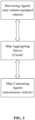
- FIG. 3 schematically illustrates an exemplary HDMEMS that can be used for real-time localization of an AV, according to various embodiments of the disclosure.
- the system may involve three layers: harvesting agents (any camera-equipped vehicles), a map aggregating server (cloud), and map-consuming agents (autonomous vehicles).
- the harvesting agents may be any camera-equipped vehicles.
- the camera-equipped vehicle may collect, via cameras, data about a driving path's geometry and stationary landmarks around the vehicle, implement real-time geometrical and semantic analysis for the collected data, compress the map-relevant data into small capsules (e.g. called Road Segment Data (RSD)), and then sent the RSDs to the map aggregating server.
- RSD Road Segment Data
- the map aggregating server may be a cloud server that aggregates and reconciles the continuous stream of RSDs to construct a highly accurate and low TTRR map.
- a map may be regarded as a HD map and also called a "Roadbook" herein.
- the HD map stored in the map aggregating server may be used by a map consuming agent (e.g. an AV) for real-time localization.
- a map consuming agent e.g. an AV
- the AV may interact with the cloud server to automatically localize itself within the Roadbook by real-time detection of landmarks stored in the Roadbook.
- Landmarks may assist the AV to perform real-time localization.
- Landmarks may be classified into two categories: landmarks that are directly relevant to driving, and landmarks that are not directly relevant to driving.
- the landmarks directly relevant to driving may include traffic signs, arrows on the road, lane markings, traffic lights, stop lines, etc.
- the landmarks not directly relevant to driving may include lampposts, directional signs, business signs, or billboards.
- the HDMEMS may operate properly for the real-time localization of an AV because the landmarks in the Roadbook come from images captured by cameras and are usually updated with an ultra-high refresh rate. Especially for an AV travelling on a road segment containing a large number of landmarks stored in the Roadbook, the AV can usually localize itself with a high accuracy by detecting the landmarks.
- the landmarks relevant to the road segments stored in the Roadbook may be deviated from the real landmarks, and thus the localization based on the landmarks in the Roadbook may be not accurate. Also, it is noted that the Roadbook is actually not updated in real time, although it is updated with an ultra-high refresh rate.
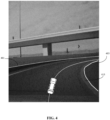
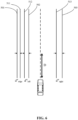
- FIG. 4 illustrates an exemplary road segment where an AV is travelling according to various embodiments of the disclosure.
- the road segment may be a segment of an interstate highway and only have very few landmarks.
- the landmarks stored in the Roadbook may be deviated from corresponding landmarks detected by the AV in real time.
- the line 401 and the line 403 respectively indicate the road edge and a lane boundary stored in the Roadbook, and the real lane boundary corresponding to the lane boundary 403 stored in the Roadbook is represented by the line 413.
- the reference landmark 403 is deviated from the real landmark 413.
- other reference landmarks may also be deviated from the real landmarks.
- a landmark stored in the Roadbook may be referred to as a reference landmark and a landmark detected by the AV in real time may be referred to as a ground truth landmark hereinafter.
- the corresponding ground truth landmark is usually deemed closer to the real landmark, because the ground truth landmark is a result of real-time detection while the reference landmark may be not updated in real time.
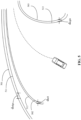
- FIG. 5 schematically illustrates example reference landmarks from a HD map aggregating server and corresponding ground truth landmarks detected by an AV in real time for the example road segment of FIG. 4 , according to various embodiments of the disclosure.
- three reference landmarks for the road segment retrieved from the map aggregating server are illustrated as an example, including a road edge 501, a left boundary 502 of a lane and a right boundary 503 of the lane.
- the AV may detect the landmarks corresponding to the reference landmarks to perform real-time localization. As illustrated, the real-time detected landmarks may be deviated from the reference landmarks.
- the deviation between the real-time detected road edge 511 and the reference road edge 501 is denoted by d edge
- the deviation between the real-time detected left lane boundary 512 and the reference left lane boundary 502 is denoted by d left
- the deviation between the real-time detected right lane boundary 513 and the reference right lane boundary 503 is denoted by d right .
- the real-time detected landmarks are more trustworthy than the reference landmarks stored in the map aggregating server since the reference landmarks are collected by harvest vehicles and may not be updated in real time.
- the deviations d edge , d left and d right in FIG. 5 are illustrated in the image plane.
- a projection of the detected road segment from the image plane onto the real-word plane is needed according to the invention.
- the projection may be characterized using a perspective project matrix having elements corresponding to physical properties such as the position, slope, curvature, and curvature derivative of the detected road segment.
- FIG. 6 schematically illustrates the example reference landmarks and ground truth landmarks of FIG. 5 projected from the image plane onto the real-world plane.
- the points at the distance D in front of the AV may be referenced to calculate the deviations d w edge , d w left and d w right along the vertical direction of the road segment.
- any of the deviations d w edge , d w left and d w right may be used by the AV as the real-time correction value for the real-time localization.
- an average deviation d w (d w right + d w left +d w edge )/N may be calculated as the real-time correction value.
- the number N depends on the number of landmarks to be detected for the localization error correction. In the exemplary embodiment, three landmarks including the road edge and two boundaries of the lane are detected, so the number N is 3. Actually, the AV may detect more landmarks to calculate an average real-time correction value so as to implement the localization error correction more accurately.
- FIG. 7 illustrates a flow chart of an exemplary process for real-time localization error correction at a map consuming vehicle (e.g. an AV) according to various embodiments of the disclosure.
- a map consuming vehicle e.g. an AV
- the exemplary process for real-time localization error correction may be performed by a processor at the AV
- the AV may be the AV 200 of FIG. 2 equipped with the system 100 of FIG. 1 .
- the process may include operations 710 to 730.
- the AV may retrieve, a reference landmark around the AV from the map aggregating server (MAS).
- the MAS may be the map aggregating server in the above described HD map experience management system, and the AV may be the map consuming vehicle.
- the landmarks stored in the MAS may be referred to as reference landmarks herein.
- the AV may be configured to interact with the MAS to perform real-time localization based on the reference landmarks.
- the AV may detect, in real time, a ground truth landmark corresponding to the reference landmark, according to image data captured by one or more image capture devices installed on the AV
- the real-time detected landmarks may be referred to as ground truth landmarks in order to be differentiated from the reference landmarks stored in the MAS.
- the ground truth landmark may be deviated from the corresponding reference landmark, and the deviation may be taken as a real-time correction value for the real-time localization of the AV
- the AV may determine a deviation between the ground truth landmark and the reference landmark as a real-time correction value for the real-time localization of the AV.
- the deviation may be calculated in the real-world plane by projecting the relevant road segment from the image plane onto the real-word plane as shown in FIG. 6 .
- the deviation between the ground truth landmark and the reference landmark is determined as the real-time correction value for the real-time localization of the AV
- multiple reference landmarks and corresponding ground truth landmarks may be compared to calculate an average deviation as the real-time correction value so as to increase the accuracy of real-time localization error correction.
- FIG. 8 illustrates a flow chart of an exemplary process for real-time localization error correction at an AV according to various embodiments of the disclosure.
- the exemplary process in FIG. 8 may also be performed by a processor at the AV
- the AV may be the AV 200 of FIG. 2 equipped with the system 100 of FIG. 1 .
- the process may include operations 810 to 840.
- the AV may retrieve, a number N of reference landmarks around the AV from the MAS, where N is an integer greater than 1. For example, as shown in FIG. 5 , three reference landmarks including a road edge 501, a left boundary 502 of a lane and a right boundary 503 of the lane are retrieved from the MAS. In some embodiments, more reference landmarks may be retrieved from the MAS. For example, a left boundary and a right boundary of an adjacent lane may be retrieved as additional reference landmarks from the MAS.
- the AV may detect, in real time, a number N of ground truth landmarks respectively corresponding to the number N of reference landmarks.
- a number N of ground truth landmarks respectively corresponding to the number N of reference landmarks.
- three ground truth landmarks including the real-time detected road edge 511, the real-time detected left boundary 512 of the lane and the real-time detected right boundary 513 of the lane are detected by the AV, according to image data captured by one or more image capture devices installed on the AV
- the AV may compare each pair of reference landmark and corresponding ground truth landmark to obtain a number N of deviations between the number N of reference landmarks and the number N of corresponding ground truth landmarks.
- three deviations d w edge , d w left and d w right along the vertical direction of the road segment are obtained by respectively comparing the reference landmarks and corresponding ground truth landmarks.
- the AV may use the correction value to correct an error of the real-time localization. Meanwhile, the AV may report the determined real-time correction value to the MAS via a communication interface between the MAS and the AV, so that the correction value may be stored in the MAS as a reference correction value for other AVs to implement the real-time localization error correction when travelling on the same road segment.
- the above described process for real-time localization error correction may be implemented at multiple AVs passing the same road segment. For example, during a predetermined period of time T, a total number M of AVs may pass the road segment as shown in FIG. 4 and FIG. 5 , where M is an integer greater than 1.
- Each AV may calculate a real-time correction value based on the above described process for real-time localization error correction, and report the real-time correction value to the MAS.
- a total number M of real-time correction values may be reported to the MAS, and the MAS may calculate an average value of these real-time correction values as the reference correction value for all AVs travelling on the road segment to perform real-time localization error correction.
- the AV may directly retrieve the reference correction value from the MAS as the correction value for the real-time localization error correction.
- the AV may also perform the above described process to determine a real-time correction value, and calculate an average value of the reference correction value and the real-time correction value as a final real-time correction value for the real-time localization of the AV
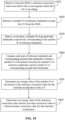
- FIG. 9 illustrates a flow chart of an exemplary process for real-time localization error correction at an AV according to various embodiments of the disclosure.
- the process may include operations 910 to 950, among which the operations 920 to 940 are the same as the operations 710 to 730 of FIG. 7 and thus will not be repeatedly described here.
- the AV retrieves from the MAS, a reference correction value associated with the road segment where the AV is travelling. Then, a real-time correction value may be determined by performing the operations 920 to 940. At 950, the AV may determine an average value of the reference correction value and the real-time correction value as a final real-time correction value for the real-time localization. Also, the final real-time correction value may be reported to the MAS.
- the reference correction value may be a real-time correction value reported to the MAS by another AV passing the road segment.
- the reference correction value may be an average value of a number M of real-time correction values reported respectively by a number M of AVs passing the road segment during a predetermined period of time, where M is an integer greater than 1.
- FIG. 10 illustrates a flow chart of an exemplary process for real-time localization error correction at an AV according to various embodiments of the disclosure.
- the process may include operations 1010 to 1060, among which the operations 1010 and 1060 are the same as the operations 910 and 950 of FIG. 9 and the operations 1020 to 1050 are the same as the operations 710 to 730 of FIG. 7 .
- the operations in FIG. 10 will not be repeatedly described here.
- the reference correction value may be a real-time correction value reported to the MAS by another AV passing the road segment, or an average value of a number M of real-time correction values reported respectively by a number M of AVs passing the road segment during a predetermined period of time, where M is an integer greater than 1.
- the exemplary processes for real-time localization error correction to be performed at the AV are illustrated.
- the AV may be configured to interact with the MAS to implement the real-time localization based on the determined real-time correction value.
- the MAS may be configured to facilitate real-time localization of the AV.
- the MAS may store a database of reference landmarks.
- the reference landmarks may come from real image data captured by cameras installed on harvesting vehicles.
- the reference landmarks may be stored in the MAS and updated with an ultra-high refresh rate.
- the MAS may receive, from the AV, a real-time correction value for the real-time localization.
- the real-time correction value may be associated with a road segment where the AV is travelling.
- the real-time correction value may be determined by the AV as a deviation between a ground truth landmark detected by the AV in real time and a corresponding reference landmark retrieved by the AV from the MAS.
- the MAS may determine the real-time correction value as a reference correction value for real-time localization of AVs travelling on the road segment.
- the AV may be configured to retrieve a number N of reference landmarks around the AV from the MAS; detect, in real time, a number N of ground truth landmarks respectively corresponding to the number N of reference landmarks; compare each pair of reference landmark and corresponding ground truth landmark to obtain a number N of deviations between the number N of reference landmarks and the number N of ground truth landmarks; and calculate an average value of the number N of deviations as the real-time correction value. Therefore, in some embodiments, the real-time correction value received from the AV may be the average value of the number N of deviations determined by the AV.
- the MAS may receive a number M of real-time correction values respectively from a number M of AVs passing the road segment during a predetermined period of time. In this case, the MAS may determine an average value of the number M of real-time correction values as the reference correction value for real-time localization of the AVs travelling on the road segment.
- the error of real-time localization of the AV due to the deviations between the reference landmarks and the real landmarks may be corrected by the real-time correction value determined by the AV.
- Such solutions may be especially advantageous for the real-time localization on the road segments having very few landmarks, small landmarks or obscure landmarks.
- An example includes a processor for real-time localization error correction of an autonomous vehicle (AV), configured to: retrieve a reference landmark around the AV from a map aggregating server (MAS), wherein the AV is configured to interact with the MAS for real-time localization; detect, in real time, a ground truth landmark corresponding to the reference landmark, according to image data captured by one or more image capture devices installed on the AV; determine a deviation between the ground truth landmark and the reference landmark as a real-time correction value for the real-time localization of the AV, by projecting the ground truth landmark from an image plane into a real-world plane, and calculating the deviation in the real-world plane, retrieve, from the MAS, a reference correction value associated with a road segment where the AV is travelling, and determine an average value of the reference correction value and the real-time correction value as a final real-time correction value for the real-time localization.
- AV autonomous vehicle
- MAS map aggregating server
- the processor is further configured to: retrieve a number N of reference landmarks around the AV from the MAS; detect, in real time, a number N of ground truth landmarks respectively corresponding to the number N of reference landmarks; compare each pair of reference landmark and corresponding ground truth landmark to obtain a number N of deviations between the number N of reference landmarks and the number N of corresponding ground truth landmarks; and determine an average value of the number N of deviations as the real-time correction value for the real-time localization of the AV, where N is an integer greater than 1.
- the reference correction value is a real-time correction value reported to the MAS by another AV passing the road segment.
- the reference correction value is an average value of a number M of real-time correction values reported respectively by a number M of AVs passing the road segment during a predetermined period of time, where M is an integer greater than 1.
- the processor is further configured to: report the final real-time correction value to the MAS via a communication interface between the MAS and the AV.
- the reference landmark comprises a road edge or a lane boundary stored and updated periodically in the MAS
- the ground truth landmark comprises a corresponding road edge or a corresponding lane boundary detected by the AV in real time according to the image data captured by the one or more image capture devices installed on the AV.
- Another example includes an autonomous vehicle (AV), comprising the processor for real-time localization error correction and the one or more image capture devices, wherein the AV is configured to interact with the map aggregating server (MAS) for the real-time localization based on the determined real-time correction value.
- AV autonomous vehicle
- MAS map aggregating server
- Another example includes a method for real-time localization error correction of an autonomous vehicle (AV), comprising: retrieving a reference landmark around the AV from a map aggregating server (MAS), wherein the AV is configured to interact with the MAS for real-time localization; detecting, in real time, a ground truth landmark corresponding to the reference landmark, according to image data captured by one or more image capture devices installed on the AV; determining a deviation between the ground truth landmark and the reference landmark as a real-time correction value for the real-time localization of the AV, by projecting the ground truth landmark from an image plane into a real-world plane, and calculating the deviation in the real-world plane; retrieving, from the MAS, a reference correction value associated with a road segment where the AV is travelling; and determining an average value of the reference correction value and the real-time correction value as a final real-time correction value for the real-time localization.
- AV autonomous vehicle
- the method further comprises retrieving a number N of reference landmarks around the AV from the MAS; detecting, in real time, a number N of ground truth landmarks respectively corresponding to the number N of reference landmarks; comparing each pair of reference landmark and corresponding ground truth landmark to obtain a number N of deviations between the number N of reference landmarks and the number N of corresponding ground truth landmarks; and determining an average value of the number N of deviations as the real-time correction value for the real-time localization of the AV, where N is an integer greater than 1.
- the reference correction value is a real-time correction value reported to the MAS by another AV passing the road segment.
- the reference correction value is an average value of a number M of real-time correction values reported respectively by a number M of AVs passing the road segment during a predetermined period of time, where M is an integer greater than 1.
- the method further comprises: reporting the final real-time correction value to the MAS via a communication interface between the MAS and the AV.
- the reference landmark comprises a road edge or a lane boundary stored and updated periodically in the MAS
- the ground truth landmark comprises a corresponding road edge or a corresponding lane boundary detected by the AV in real time according to the image data captured by the one or more image capture devices installed on the AV.
- Another example relates to a system comprising an autonomous vehicle comprising the aforementioned processor and a map aggregating server (MAS) to facilitate real-time localization of another autonomous vehicle (AV), configured to: store a database of reference landmarks; receive, from the AV, a real-time correction value for the real-time localization, wherein the real-time correction value is associated with a road segment where the AV is travelling, and a deviation between a ground truth landmark on the road segment detected by the AV in real time and a corresponding reference landmark retrieved by the AV from the MAS is determined by the AV and reported to the MAS as the real-time correction value; determine the real-time correction value as a reference correction value for real-time localization of AVs travelling on the road segment; and provide the real-time correction value as a reference correction value for real-time localization to another AV.
- AV map aggregating server
- the AV is configured to retrieve a number N of reference landmarks around the AV from the MAS; detect, in real time, a number N of ground truth landmarks respectively corresponding to the number N of reference landmarks; and compare each pair of reference landmark and corresponding ground truth landmark to obtain a number N of deviations between the number N of reference landmarks and the number N of corresponding ground truth landmarks, where N is an integer greater than 1, and wherein the real-time correction value is an average value of the number N of deviations.
- the MAS is configured to: receive a number M of real-time correction values respectively from a number M of AVs passing the road segment during a predetermined period of time, where M is an integer greater than 1; and determine an average value of the number M of real-time correction values as the reference correction value for real-time localization of the AVs travelling on the road segment.
- the AV is further configured to retrieve the reference correction value from the MAS, determine an average value of the reference correction value and the real-time correction value as a final real-time correction value for the real-time localization, and report the final real-time correction value to the MAS.
- the reference landmark comprises a road edge or a lane boundary stored and updated periodically in the MAS
- the ground truth landmark comprises a corresponding road edge or a corresponding lane boundary detected by the AV in real time according to the image data captured by the one or more image capture devices installed on the AV.
- Another example includes a computer-readable medium having instructions stored thereon, the instructions, when executed by a processor of an autonomous vehicle (AV), to cause the processor to perform the above method for real-time localization error correction of the AV.
- AV autonomous vehicle
- Another example includes an apparatus for real-time localization error correction of an autonomous vehicle (AV), comprising: means for retrieving a reference landmark around the AV from a map aggregating server (MAS), wherein the AV is configured to interact with the MAS for real-time localization; means for detecting, in real time, a ground truth landmark corresponding to the reference landmark, according to image data captured by one or more image capture devices installed on the AV; means for determining a deviation between the ground truth landmark and the reference landmark as a real-time correction value for the real-time localization of the AV, by projecting the ground truth landmark from an image plane into a real-world plane, and calculating the deviation in the real-world plane; means for retrieving, from the MAS, a reference correction value associated with a road segment where the AV is travelling; and means for determining an average value of the reference correction value and the real-time correction value as a final real-time correction value for the real-time localization means for .
- a map aggregating server MAS
- the apparatus for real-time localization error correction of an autonomous vehicle further comprises: means for retrieving a number N of reference landmarks around the AV from the MAS; means for detecting, in real time, a number N of ground truth landmarks respectively corresponding to the number N of reference landmarks; means for comparing each pair of reference landmark and corresponding ground truth landmark to obtain a number N of deviations between the number N of reference landmarks and the number N of corresponding ground truth landmarks; and means for determining an average value of the number N of deviations as the real-time correction value for the real-time localization of the AV, where N is an integer greater than 1.
- the reference correction value is a real-time correction value reported to the MAS by another AV passing the road segment.
- the reference correction value is an average value of a number M of real-time correction values reported respectively by a number M of AVs passing the road segment during a predetermined period of time, where M is an integer greater than 1.
- the apparatus for real-time localization error correction of an autonomous vehicle further comprises: means for reporting the final real-time correction value to the MAS via a communication interface between the MAS and the AV.
- the reference landmark comprises a road edge or a lane boundary stored and updated periodically in the MAS
- the ground truth landmark comprises a corresponding road edge or a corresponding lane boundary detected by the AV in real time according to the image data captured by the one or more image capture devices installed on the AV.
Landscapes
- Engineering & Computer Science (AREA)
- Remote Sensing (AREA)
- Radar, Positioning & Navigation (AREA)
- Physics & Mathematics (AREA)
- General Physics & Mathematics (AREA)
- Automation & Control Theory (AREA)
- Multimedia (AREA)
- Computer Vision & Pattern Recognition (AREA)
- Theoretical Computer Science (AREA)
- Computer Networks & Wireless Communication (AREA)
- Traffic Control Systems (AREA)
- Navigation (AREA)
Description
- Embodiments of the present disclosure generally relate to the field of autonomous driving, and in particular to real-time localization error correction of an autonomous vehicle (AV).
- In the field of autonomous driving, high precision localization is a critical issue. In order to navigate to a destination, the AV may need to identify its location within a particular road segment. The AV may use landmarks whose world coordinates are known to perform localization. The idea is to construct a very detailed map (e.g. a high definition (HD) map) that contains various types of landmarks. The assumption is that the AV is equipped with sensing or image capture devices that can detect and locate the landmarks in its own reference frame. Once the relative position between the vehicle and the landmarks is found, the landmarks' world coordinates are taken from the map database, and the AV can use them to compute its location.
US 2019/0003847 A1 relates to methods and systems for vehicle localization. In said patent application, a localization error is determined by comparing a first distance that is determined using navigation and image data and a second distance that is determined using navigation data and map data.
InEP 3 333 803 A1 , a reference image is generated based on an observed position and pose of a vehicle and compared to a captured image. Based on the comparison, a correction of the observed position and/or the observed pose is determined.
InUS 2015/0253141 A1 , map matching errors of multiple vehicles are collected by a server, evaluated with respect to a road stretch, and used to determine whether the road stretch deviates from a known course of the road stretch. - The solution is provided by the features of the independent claims. Variations are as defined by the dependent claims.
- Embodiments of the disclosure will be illustrated, by way of example and not limitation, in the figures of the accompanying drawings in which like reference numerals refer to similar elements.
-
FIG. 1 is a block diagram representation of an exemplary system according to various embodiments of the disclosure. -
FIG. 2 is a diagrammatic side view representation of an exemplary autonomous vehicle (AV) including a system according to various embodiments of the disclosure. -
FIG. 3 schematically illustrates an exemplary HD map experience management system (HDMEMS) that can be used for real-time localization of an AV, according to various embodiments of the disclosure. -
FIG. 4 illustrates an exemplary road segment where an AV is travelling according to various embodiments of the disclosure. -
FIG. 5 schematically illustrates example reference landmarks from a HD map aggregating server (HDMAS) and corresponding ground truth landmarks detected by an AV in real time for the exemplary road segment ofFIG. 4 , according to various embodiments of the disclosure. -
FIG. 6 schematically illustrates the example reference landmarks and the ground truth landmarks ofFIG. 5 projected from the image plane onto the real-world plane, according to various embodiments of the disclosure. -
FIG. 7 illustrates a flow chart of an exemplary process for real-time localization error correction at an AV according to various embodiments of the disclosure. -
FIG. 8 illustrates a flow chart of an exemplary process for real-time localization error correction at an AV according to various embodiments of the disclosure. -
FIG. 9 illustrates a flow chart of an exemplary process for real-time localization error correction at an AV according to various embodiments of the disclosure. -
FIG. 10 illustrates a flow chart of an exemplary process for real-time localization error correction at an AV according to various embodiments of the disclosure. - Various aspects of the illustrative embodiments will be described using terms commonly employed by those skilled in the art to convey the substance of the disclosure to others skilled in the art. However, it will be apparent to those skilled in the art that many alternate embodiments may be practiced using portions of the described aspects. For purposes of explanation, specific numbers, materials, and configurations are set forth in order to provide a thorough understanding of the illustrative embodiments. However, it will be apparent to those skilled in the art that alternate embodiments may be practiced without the specific details. In other instances, well known features may have been omitted or simplified in order to avoid obscuring the illustrative embodiments.
- Further, various operations will be described as multiple discrete operations, in turn, in a manner that is most helpful in understanding the illustrative embodiments; however, the order of description should not be construed as to imply that these operations are necessarily order dependent. In particular, these operations need not be performed in the order of presentation.
- The phrases "in an embodiment" "in one embodiment" and "in some embodiments" are used repeatedly herein. The phrase generally does not refer to the same embodiment; however, it may. The terms "comprising," "having," and "including" are synonymous, unless the context dictates otherwise. The phrases "A or B" and "A/B" mean "(A), (B), or (A and B)."
-
FIG. 1 is a block diagram representation of an exemplary system according to various embodiments of the disclosure.System 100 may include various components depending on the requirements of a particular implementation. In some embodiments, thesystem 100 may include aprocessing unit 110, animage acquisition unit 120, aposition sensor 130, one ormore memory units map database 160, auser interface 170, and awireless transceiver 172. Theprocessing unit 110 may include one or more processing devices. In some embodiments, theprocessing unit 110 may include anapplication processor 180, animage processor 190, or any other suitable processing device. Similarly, theimage acquisition unit 120 may include any number of image acquisition devices and components depending on the requirements of a particular application. In some embodiments, theimage acquisition unit 120 may include one or more image capture devices (e.g., cameras), such as animage capture device 122, animage capture device 124, and animage capture device 126. Thesystem 100 may also include adata interface 128 communicatively connecting theprocessing unit 110 to theimage acquisition unit 120. For example, thedata interface 128 may include any wired and/or wireless link or links for transmitting image data acquired by theimage acquisition unit 120 to theprocessing unit 110. - A
wireless transceiver 172 may include one or more devices configured to exchange transmissions over an air interface to one or more networks (e.g., cellular, the Internet, etc.) by use of a radio frequency, infrared frequency, magnetic field, or an electric field. Thewireless transceiver 172 may use any known standard to transmit and/or receive data (e.g., Wi-Fi, Bluetooth®, Bluetooth Smart, 802.15.4, ZigBee, etc.). - Both the
application processor 180 and theimage processor 190 may include various types of processing devices. For example, either or both of theapplication processor 180 and theimage processor 190 may include a microprocessor, preprocessors (such as an image preprocessor), graphics processors, a central processing unit (CPU), support circuits, digital signal processors, integrated circuits, memory, or any other types of devices suitable for running applications and for image processing and analysis. In some embodiments, theapplication processor 180 and/or theimage processor 190 may include any type of single or multi-core processor, mobile device microcontroller, central processing unit, etc. Various processing devices may be used, and may include various architectures. - In some embodiments, the
application processor 180 and/or theimage processor 190 may include some types of processor designs. These processor designs each include multiple processing units with local memory and instruction sets. Such processors may include video inputs for receiving image data from multiple image sensors and may also include video output capabilities. In one example, the processor uses 90 nm-micron technology operating at 332 Mhz. The processor architecture consists of two floating point, hyper-thread 32-bit RISC CPUs (MIPS32® 34K® cores), five Vision Computing Engines (VCE), three Vector Microcode Processors (VMP®), Denali 64-bit Mobile DDR Controller, 128-bit internal Sonics Interconnect, dual 16-bit Video input and 18-bit Video output controllers, 16 channels DMA and several peripherals. One MIPS34K CPU manages the five VCEs, three VMP™ and the DMA, the other MIPS34K CPU and the multi-channel DMA as well as the other peripherals. The five VCEs, three VMP® and the MIPS34K CPU can perform intensive vision computations required by multi-function bundle applications. - Any of the processing devices disclosed herein may be configured to perform certain functions. Configuring a processing device, such as any of the described processors or other controller or microprocessor, to perform certain functions may include programming of computer executable instructions and making those instructions available to the processing device for execution during operation of the processing device. In some embodiments, configuring a processing device may include programming the processing device directly with architectural instructions. In other embodiments, configuring a processing device may include storing executable instructions on a memory that is accessible to the processing device during operation. For example, the processing device may access the memory to obtain and execute the stored instructions during operation.
- While
FIG. 1 depicts two separate processing devices included inprocessing unit 110, more or fewer processing devices may be used. For example, in some embodiments, a single processing device may be used to accomplish the tasks of theapplication processor 180 and theimage processor 190. In other embodiments, these tasks may be performed by more than two processing devices. Further, in some embodiments, thesystem 100 may include one ormore processing units 110 without including other components, such as theimage acquisition unit 120. - The
processing unit 110 may comprise various types of devices. For example, theprocessing unit 110 may include various devices, such as a controller, an image preprocessor, a central processing unit (CPU), support circuits, digital signal processors, integrated circuits, memory, or any other types of devices for image processing and analysis. The image preprocessor may include a video processor for capturing, digitizing and processing the imagery from the image sensors. The CPU may comprise any number of microcontrollers or microprocessors. The support circuits may be any number of circuits generally well known in the art, including cache, power supply, clock and input-output circuits. The memory may store software that, when executed by the processor, controls the operation of the system. The memory may include databases and image processing software. The memory may comprise any number of random access memories, read only memories, flash memories, disk drives, optical storage, tape storage, removable storage and other types of storage. In one instance, the memory may be separate from theprocessing unit 110. In another instance, the memory may be integrated into theprocessing unit 110. - Each
memory application processor 180 and/or the image processor 190), may control operations of various aspects of thesystem 100. These memory units may include various databases and image processing software. The memory units may include random access memory, read only memory, flash memory, disk drives, optical storage, tape storage, removable storage and/or any other types of storage. In some embodiments,memory units application processor 180 and/or theimage processor 190. In other embodiments, these memory units may be integrated into theapplication processor 180 and/or theimage processor 190. - The
position sensor 130 may include any type of device suitable for determining a location associated with at least one component of thesystem 100. In some embodiments, theposition sensor 130 may include a GPS receiver. Such receivers can determine a user position and velocity by processing signals broadcasted by global positioning system satellites. Position information from the position sensor may be made available to theapplication processor 180 and/or theimage processor 190. - In some embodiments, the
system 100 may include components such as a speed sensor (e.g., a tachometer) for measuring a speed of a vehicle and/or an accelerometer (not shown) for measuring an acceleration of the vehicle. -
User interface 170 may include any device suitable for providing information to or for receiving inputs from one or more users of thesystem 100. In some embodiments, theuser interface 170 may include user input devices, including, for example, a touchscreen, microphone, keyboard, pointer devices, track wheels, cameras, knobs, buttons, etc. With such input devices, a user may be able to provide information inputs or commands to thesystem 100 by typing instructions or information, providing voice commands, selecting menu options on a screen using buttons, pointers, or eye-tracking capabilities, or through any other suitable techniques for communicating information to thesystem 100. -
User interface 170 may be equipped with one or more processing devices configured to provide and receive information to or from a user and process that information for use by, for example, theapplication processor 180. In some embodiments, such processing devices may execute instructions for recognizing and tracking eye movements, receiving and interpreting voice commands, recognizing and interpreting touches and/or gestures made on a touchscreen, responding to keyboard entries or menu selections, etc. In some embodiments, theuser interface 170 may include a display, a speaker, a tactile device, and/or any other devices for providing output information to a user. -
Map database 160 may include any type of database for storing map data useful to thesystem 100. In some embodiments, themap database 160 may include data relating to the position, in a reference coordinate system, of various items, including roads, water features, geographic features, businesses, points of interest, restaurants, gas stations, etc. Themap database 160 may store not only the locations of such items, but also descriptors relating to those items, including, for example, names associated with any of the stored features. In some embodiments, themap database 160 may be physically located with other components of thesystem 100. Alternatively or additionally, themap database 160 or a portion thereof may be located remotely with respect to other components of the system 100 (e.g., the processing unit 110). In such embodiments, information from themap database 160 may be downloaded over a wired or wireless data connection to a network (e.g., over a cellular network and/or the Internet, etc.). -
Image capture devices - The
system 100, or various components thereof, may be incorporated into various different platforms. In some embodiments, thesystem 100 may be included on a vehicle 200 (e.g. an autonomous vehicle), as shown inFIG. 2 . For example, thevehicle 200 may be equipped with theprocessing unit 110 and any of the other components of thesystem 100, as described above relative toFIG. 1 . While in some embodiments thevehicle 200 may be equipped with only a single image capture device (e.g., camera), in other embodiments, multiple image capture devices may be used. For example, any of theimage capture devices vehicle 200, as shown inFIG. 2 , may be part of an ADAS (Advanced Driver Assistance Systems) imaging set. - The image capture devices included on the
vehicle 200 as part of theimage acquisition unit 120 may be positioned at any suitable location. In some embodiments, as shown inFIG. 2 , theimage capture device 122 may be located in the vicinity of the rearview mirror. This position may provide a line of sight similar to that of the driver of thevehicle 200, which may aid in determining what is and is not visible to the driver. Theimage capture device 122 may be positioned at any location near the rearview mirror, but placing theimage capture device 122 on the driver side of the mirror may further aid in obtaining images representative of the driver's field of view and/or line of sight. - Other locations for the image capture devices of the
image acquisition unit 120 may also be used. For example, theimage capture device 124 may be located on or in a bumper ofvehicle 200. Such a location may be especially suitable for image capture devices having a wide field of view. The line of sight of bumper-located image capture devices can be different from that of the driver and, therefore, the bumper image capture device and driver may not always see the same objects. The image capture devices (e.g.,image capture devices vehicle 200, on the roof of thevehicle 200, on the hood of thevehicle 200, on the trunk of thevehicle 200, on the sides of thevehicle 200, mounted on, positioned behind, or positioned in front of any of the windows of thevehicle 200, and mounted in or near light fixtures on the front and/or back of thevehicle 200, etc. - In addition to image capture devices, the
vehicle 200 may include various other components ofsystem 100. For example, theprocessing unit 110 may be included on thevehicle 200 either integrated with or separate from an engine control unit (ECU) of the vehicle. Thevehicle 200 may also be equipped with theposition sensor 130 such as a GPS receiver, and may also include themap database 160 and thememory units - As discussed earlier, the
wireless transceiver 172 may transmit and/or receive data over one or more networks (e.g., cellular networks, the Internet, etc.). For example, thewireless transceiver 172 may upload data collected by thesystem 100 to one or more servers, and download data from the one or more servers. Via thewireless transceiver 172, thesystem 100 may receive, for example, periodic or on-demand or real-time updates to data stored in themap database 160, thememory 140, and/or thememory 150. Similarly, thewireless transceiver 172 may upload any data (e.g., images captured byimage acquisition unit 120, data received by one or more sensors in the sensor unit130, vehicle control systems, etc.) from thesystem 100 and/or any data processed by processingunit 110 to the one or more servers. - The
system 100 may upload data to a server (e.g. to the cloud) based on a privacy level setting to regulate or limit the types of data (including metadata) sent to the server that may uniquely identify a vehicle and/or driver/owner of a vehicle. Such settings may be set by user via, for example,wireless transceiver 172, be initialized by factory default settings, or by data received bywireless transceiver 172. - In addition, for more details about the components of the
system 100 and their possible implementations in thevehicle 200, references may be made to aU.S. Patent No. 9,665,100 B2 issued on May 30, 2017 - According to embodiments of the disclosure, the
system 100 may be included on an autonomous vehicle (AV), and the processor and method for real-time localization error correction as proposed may be used on the AV. - In the field of autonomous driving, high precision localization is a critical issue. In order to navigate to a destination, the AV may need to identify its location within a particular road segment. The AV may use landmarks whose world coordinates are known to perform localization. The idea is to construct a HD map that contains various types of landmarks. The assumption is that the AV is equipped with sensing or image capture devices that can detect and locate the landmarks in its own reference frame. Once the relative position between the vehicle and the landmarks is found, the landmarks' world coordinates may be taken from the map database, and the AV can use them to compute its location. Based on the idea, a HD map experience management system (HDMEMS) is proposed to allow AVs to implement high precision localization.
- For better understanding the embodiments of the present application, the overview of the AV and the HDMEMS will be discussed below. Meanwhile, it should be noted that the HDMEMS will be only taken as an example map experience management system to explain the principles of the embodiments of the present application, but various types of map experience management systems currently available or to be developed in the future may be applied to implement various embodiments of the present application.
- As used throughout this disclosure, the term "autonomous vehicle (AV)" refers to a vehicle capable of implementing at least one navigational change without driver input. A "navigational change" refers to a change in one or more of steering, braking, or acceleration of the vehicle. To be autonomous, a vehicle needs not be fully automatic (e.g., fully operation without a driver or without driver input). Rather, an AV includes those that can operate under driver control during certain time periods and without driver control during other time periods. AVs may also include vehicles that control only some aspects of vehicle navigation, such as steering (e.g., to maintain a vehicle course between vehicle lane constraints), but may leave other aspects to the driver (e.g., braking). In some cases, AVs may handle some or all aspects of braking, speed control, and/or steering of the vehicle.
- As human drivers typically rely on visual cues and observations in order to control a vehicle, transportation infrastructures are built accordingly, with lane markings, traffic signs, and traffic lights all designed to provide visual information to drivers. In view of these design characteristics of transportation infrastructures, an AV may include a camera and a processing unit that analyzes visual information captured from the environment of the vehicle. The visual information may include, for example, components of the transportation infrastructure (e.g., lane markings, traffic signs, traffic lights, etc.) that are observable by drivers and other obstacles (e.g., other vehicles, pedestrians, debris, etc.). Additionally, an AV may also use stored information, such as information that provides a model of the vehicle's environment when navigating. For example, the vehicle may use GPS data, sensor data (e.g., from an accelerometer, a speed sensor, a suspension sensor, etc.), and/or other map data to provide information related to its environment while it is traveling, and the vehicle (as well as other vehicles) may use the information to localize itself on the model.
- The need for a HD map to enable fully autonomous driving stems from the fact that functional safety standards require back-up sensors -"redundancy"- for all elements of the chain from sensing to actuation. Although other sensors such as radar and LiDAR may provide redundancy for object detection, the camera is the only real-time sensor for driving path geometry and other static scene semantics (such as traffic signs, on-road markings, etc.). Therefore, for path sensing and foresight purposes, a HD map can serve as the source of redundancy. Also, in order for the map to be a reliable source of redundancy, it must be updated with an ultra-high refresh rate to secure its low Time to Reflect Reality (TTRR) qualities.
- To address these challenges, a HD map experience management system (HDMEMS) may be constructed by exploiting the proliferation of camera-based ADAS systems to build and maintain in near-real-time an accurate map of the real environment. The HDMEMS can operate as an end-to-end mapping and localization engine for full autonomy.
-
FIG. 3 schematically illustrates an exemplary HDMEMS that can be used for real-time localization of an AV, according to various embodiments of the disclosure. As shown, the system may involve three layers: harvesting agents (any camera-equipped vehicles), a map aggregating server (cloud), and map-consuming agents (autonomous vehicles). - The harvesting agents may be any camera-equipped vehicles. The camera-equipped vehicle may collect, via cameras, data about a driving path's geometry and stationary landmarks around the vehicle, implement real-time geometrical and semantic analysis for the collected data, compress the map-relevant data into small capsules (e.g. called Road Segment Data (RSD)), and then sent the RSDs to the map aggregating server.
- The map aggregating server may be a cloud server that aggregates and reconciles the continuous stream of RSDs to construct a highly accurate and low TTRR map. Such a map may be regarded as a HD map and also called a "Roadbook" herein.
- Then the HD map stored in the map aggregating server may be used by a map consuming agent (e.g. an AV) for real-time localization. The AV may interact with the cloud server to automatically localize itself within the Roadbook by real-time detection of landmarks stored in the Roadbook.
- Various types of landmarks may assist the AV to perform real-time localization. Landmarks may be classified into two categories: landmarks that are directly relevant to driving, and landmarks that are not directly relevant to driving. For example, the landmarks directly relevant to driving may include traffic signs, arrows on the road, lane markings, traffic lights, stop lines, etc. Also for example, the landmarks not directly relevant to driving may include lampposts, directional signs, business signs, or billboards.
- In most situations, the HDMEMS may operate properly for the real-time localization of an AV because the landmarks in the Roadbook come from images captured by cameras and are usually updated with an ultra-high refresh rate. Especially for an AV travelling on a road segment containing a large number of landmarks stored in the Roadbook, the AV can usually localize itself with a high accuracy by detecting the landmarks.
- However, at some road segments, there may be only a few landmarks, or the landmarks may be very small, or the landmarks may be not clear due to poor illumination. In such situations, the landmarks relevant to the road segments stored in the Roadbook may be deviated from the real landmarks, and thus the localization based on the landmarks in the Roadbook may be not accurate. Also, it is noted that the Roadbook is actually not updated in real time, although it is updated with an ultra-high refresh rate.
- In view of these issues, it is proposed in the present disclosure to implement real-time localization error correction using the map consuming agents (e.g. map consuming AVs). The process of real-time localization error correction using the AVs according to embodiments of the present disclosure will be described in detail below with reference to
FIG. 4 to FIG. 9 . -
FIG. 4 illustrates an exemplary road segment where an AV is travelling according to various embodiments of the disclosure. For example, the road segment may be a segment of an interstate highway and only have very few landmarks. For such a road segment, the landmarks stored in the Roadbook may be deviated from corresponding landmarks detected by the AV in real time. Only for purpose of illustration, theline 401 and theline 403 respectively indicate the road edge and a lane boundary stored in the Roadbook, and the real lane boundary corresponding to thelane boundary 403 stored in the Roadbook is represented by theline 413. As shown inFIG. 4 , thereference landmark 403 is deviated from thereal landmark 413. Actually, on such a road segment, other reference landmarks may also be deviated from the real landmarks. - For convenience of description, a landmark stored in the Roadbook may be referred to as a reference landmark and a landmark detected by the AV in real time may be referred to as a ground truth landmark hereinafter. Compared to the reference landmark, the corresponding ground truth landmark is usually deemed closer to the real landmark, because the ground truth landmark is a result of real-time detection while the reference landmark may be not updated in real time.
-
FIG. 5 schematically illustrates example reference landmarks from a HD map aggregating server and corresponding ground truth landmarks detected by an AV in real time for the example road segment ofFIG. 4 , according to various embodiments of the disclosure. - In
FIG. 5 , three reference landmarks for the road segment retrieved from the map aggregating server are illustrated as an example, including aroad edge 501, aleft boundary 502 of a lane and aright boundary 503 of the lane. When the AV is travelling on the road segment, the AV may detect the landmarks corresponding to the reference landmarks to perform real-time localization. As illustrated, the real-time detected landmarks may be deviated from the reference landmarks. Specifically, the deviation between the real-time detectedroad edge 511 and thereference road edge 501 is denoted by dedge, the deviation between the real-time detected leftlane boundary 512 and the reference leftlane boundary 502 is denoted by dleft, and the deviation between the real-time detectedright lane boundary 513 and the referenceright lane boundary 503 is denoted by dright. - Generally, the real-time detected landmarks are more trustworthy than the reference landmarks stored in the map aggregating server since the reference landmarks are collected by harvest vehicles and may not be updated in real time. Thus, it is proposed to implement real-time localization error correction by calculating the deviation between the reference landmark and the real-time detected landmark and using the deviation as a real-time correction value for the real-time localization of the AV.
- The deviations dedge, dleft and dright in
FIG. 5 are illustrated in the image plane. In order to calculate the deviations between the reference landmarks and the real-time detected landmarks in the real-word plane, a projection of the detected road segment from the image plane onto the real-word plane is needed according to the invention. The projection may be characterized using a perspective project matrix having elements corresponding to physical properties such as the position, slope, curvature, and curvature derivative of the detected road segment. -
FIG. 6 schematically illustrates the example reference landmarks and ground truth landmarks ofFIG. 5 projected from the image plane onto the real-world plane. - As shown in
FIG. 6 , the points at the distance D in front of the AV may be referenced to calculate the deviations dw edge, dw left and dw right along the vertical direction of the road segment. According to embodiments of the present disclosure, any of the deviations dw edge, dw left and dw right may be used by the AV as the real-time correction value for the real-time localization. - In some embodiments, it may be advantageous to calculate an average value of the deviations dw edge, dw left and dw right as the real-time correction value for the real-time localization. That is, an average deviation dw = (dw right + dw left +dw edge)/N may be calculated as the real-time correction value. Here, the number N depends on the number of landmarks to be detected for the localization error correction. In the exemplary embodiment, three landmarks including the road edge and two boundaries of the lane are detected, so the number N is 3. Actually, the AV may detect more landmarks to calculate an average real-time correction value so as to implement the localization error correction more accurately.
- On basis of the above illustrated idea about the real-time localization error correction using the map consuming AVs, some exemplary processes for real-time localization error correction at the map consuming AVs will be described in detail below.
-
FIG. 7 illustrates a flow chart of an exemplary process for real-time localization error correction at a map consuming vehicle (e.g. an AV) according to various embodiments of the disclosure. - The exemplary process for real-time localization error correction may be performed by a processor at the AV For example, the AV may be the
AV 200 ofFIG. 2 equipped with thesystem 100 ofFIG. 1 . The process may includeoperations 710 to 730. - At 710, the AV may retrieve, a reference landmark around the AV from the map aggregating server (MAS). The MAS may be the map aggregating server in the above described HD map experience management system, and the AV may be the map consuming vehicle. The landmarks stored in the MAS may be referred to as reference landmarks herein. The AV may be configured to interact with the MAS to perform real-time localization based on the reference landmarks.
- At 720, the AV may detect, in real time, a ground truth landmark corresponding to the reference landmark, according to image data captured by one or more image capture devices installed on the AV The real-time detected landmarks may be referred to as ground truth landmarks in order to be differentiated from the reference landmarks stored in the MAS. As illustrated above, the ground truth landmark may be deviated from the corresponding reference landmark, and the deviation may be taken as a real-time correction value for the real-time localization of the AV
- Thus at 730, the AV may determine a deviation between the ground truth landmark and the reference landmark as a real-time correction value for the real-time localization of the AV. The deviation may be calculated in the real-world plane by projecting the relevant road segment from the image plane onto the real-word plane as shown in
FIG. 6 . - In the embodiment, the deviation between the ground truth landmark and the reference landmark is determined as the real-time correction value for the real-time localization of the AV In some embodiments of the present disclosure, multiple reference landmarks and corresponding ground truth landmarks may be compared to calculate an average deviation as the real-time correction value so as to increase the accuracy of real-time localization error correction.
-
FIG. 8 illustrates a flow chart of an exemplary process for real-time localization error correction at an AV according to various embodiments of the disclosure. - Similar to the process in
FIG. 7 , the exemplary process inFIG. 8 may also be performed by a processor at the AV For example, the AV may be theAV 200 ofFIG. 2 equipped with thesystem 100 ofFIG. 1 . The process may includeoperations 810 to 840. - At 810, the AV may retrieve, a number N of reference landmarks around the AV from the MAS, where N is an integer greater than 1. For example, as shown in
FIG. 5 , three reference landmarks including aroad edge 501, aleft boundary 502 of a lane and aright boundary 503 of the lane are retrieved from the MAS. In some embodiments, more reference landmarks may be retrieved from the MAS. For example, a left boundary and a right boundary of an adjacent lane may be retrieved as additional reference landmarks from the MAS. - At 820, the AV may detect, in real time, a number N of ground truth landmarks respectively corresponding to the number N of reference landmarks. In the example of
FIG. 5 , three ground truth landmarks including the real-time detectedroad edge 511, the real-time detected leftboundary 512 of the lane and the real-time detectedright boundary 513 of the lane are detected by the AV, according to image data captured by one or more image capture devices installed on the AV - At 830, the AV may compare each pair of reference landmark and corresponding ground truth landmark to obtain a number N of deviations between the number N of reference landmarks and the number N of corresponding ground truth landmarks. In the example as illustrated by
FIG. 5 andFIG. 6 , three deviations dw edge, dw left and dw right along the vertical direction of the road segment are obtained by respectively comparing the reference landmarks and corresponding ground truth landmarks. - At 840, the AV may determine an average value of the number N of deviations as the real-time correction value for the real-time localization of the AV For example, an average deviation dw = (dw right + dw left + dw edge)/3 may be calculated as the real-time correction value for the real-time localization.
- In the embodiments of the present disclosure, once the real-time correction value is determined, the AV may use the correction value to correct an error of the real-time localization. Meanwhile, the AV may report the determined real-time correction value to the MAS via a communication interface between the MAS and the AV, so that the correction value may be stored in the MAS as a reference correction value for other AVs to implement the real-time localization error correction when travelling on the same road segment.
- In some embodiments, the above described process for real-time localization error correction may be implemented at multiple AVs passing the same road segment. For example, during a predetermined period of time T, a total number M of AVs may pass the road segment as shown in
FIG. 4 andFIG. 5 , where M is an integer greater than 1. Each AV may calculate a real-time correction value based on the above described process for real-time localization error correction, and report the real-time correction value to the MAS. In this case, a total number M of real-time correction values may be reported to the MAS, and the MAS may calculate an average value of these real-time correction values as the reference correction value for all AVs travelling on the road segment to perform real-time localization error correction. - Therefore, in some embodiments, the AV may directly retrieve the reference correction value from the MAS as the correction value for the real-time localization error correction. In some alternative embodiments, the AV may also perform the above described process to determine a real-time correction value, and calculate an average value of the reference correction value and the real-time correction value as a final real-time correction value for the real-time localization of the AV
-
FIG. 9 illustrates a flow chart of an exemplary process for real-time localization error correction at an AV according to various embodiments of the disclosure. The process may includeoperations 910 to 950, among which theoperations 920 to 940 are the same as theoperations 710 to 730 ofFIG. 7 and thus will not be repeatedly described here. - At 910, the AV retrieves from the MAS, a reference correction value associated with the road segment where the AV is travelling. Then, a real-time correction value may be determined by performing the
operations 920 to 940. At 950, the AV may determine an average value of the reference correction value and the real-time correction value as a final real-time correction value for the real-time localization. Also, the final real-time correction value may be reported to the MAS. - In the embodiment, the reference correction value may be a real-time correction value reported to the MAS by another AV passing the road segment. Alternatively, the reference correction value may be an average value of a number M of real-time correction values reported respectively by a number M of AVs passing the road segment during a predetermined period of time, where M is an integer greater than 1.
-
FIG. 10 illustrates a flow chart of an exemplary process for real-time localization error correction at an AV according to various embodiments of the disclosure. The process may includeoperations 1010 to 1060, among which theoperations operations FIG. 9 and theoperations 1020 to 1050 are the same as theoperations 710 to 730 ofFIG. 7 . Thus, the operations inFIG. 10 will not be repeatedly described here. - Similar to the process of
FIG. 9 , in the process ofFIG. 10 , the reference correction value may be a real-time correction value reported to the MAS by another AV passing the road segment, or an average value of a number M of real-time correction values reported respectively by a number M of AVs passing the road segment during a predetermined period of time, where M is an integer greater than 1. - In the above embodiments, the exemplary processes for real-time localization error correction to be performed at the AV are illustrated. The AV may be configured to interact with the MAS to implement the real-time localization based on the determined real-time correction value. Accordingly, the MAS may be configured to facilitate real-time localization of the AV. Specifically, the MAS may store a database of reference landmarks. The reference landmarks may come from real image data captured by cameras installed on harvesting vehicles. The reference landmarks may be stored in the MAS and updated with an ultra-high refresh rate.
- The MAS may receive, from the AV, a real-time correction value for the real-time localization. The real-time correction value may be associated with a road segment where the AV is travelling. In some embodiments, the real-time correction value may be determined by the AV as a deviation between a ground truth landmark detected by the AV in real time and a corresponding reference landmark retrieved by the AV from the MAS. The MAS may determine the real-time correction value as a reference correction value for real-time localization of AVs travelling on the road segment.
- As described above, the AV may be configured to retrieve a number N of reference landmarks around the AV from the MAS; detect, in real time, a number N of ground truth landmarks respectively corresponding to the number N of reference landmarks; compare each pair of reference landmark and corresponding ground truth landmark to obtain a number N of deviations between the number N of reference landmarks and the number N of ground truth landmarks; and calculate an average value of the number N of deviations as the real-time correction value. Therefore, in some embodiments, the real-time correction value received from the AV may be the average value of the number N of deviations determined by the AV.
- In some embodiments, the MAS may receive a number M of real-time correction values respectively from a number M of AVs passing the road segment during a predetermined period of time. In this case, the MAS may determine an average value of the number M of real-time correction values as the reference correction value for real-time localization of the AVs travelling on the road segment.
- According to the embodiments of the present disclosure, the error of real-time localization of the AV due to the deviations between the reference landmarks and the real landmarks may be corrected by the real-time correction value determined by the AV. Such solutions may be especially advantageous for the real-time localization on the road segments having very few landmarks, small landmarks or obscure landmarks.
- The following paragraphs describe examples of various embodiments.
- An example includes a processor for real-time localization error correction of an autonomous vehicle (AV), configured to: retrieve a reference landmark around the AV from a map aggregating server (MAS), wherein the AV is configured to interact with the MAS for real-time localization; detect, in real time, a ground truth landmark corresponding to the reference landmark, according to image data captured by one or more image capture devices installed on the AV; determine a deviation between the ground truth landmark and the reference landmark as a real-time correction value for the real-time localization of the AV, by projecting the ground truth landmark from an image plane into a real-world plane, and calculating the deviation in the real-world plane, retrieve, from the MAS, a reference correction value associated with a road segment where the AV is travelling, and determine an average value of the reference correction value and the real-time correction value as a final real-time correction value for the real-time localization.
- In some examples, the processor is further configured to: retrieve a number N of reference landmarks around the AV from the MAS; detect, in real time, a number N of ground truth landmarks respectively corresponding to the number N of reference landmarks; compare each pair of reference landmark and corresponding ground truth landmark to obtain a number N of deviations between the number N of reference landmarks and the number N of corresponding ground truth landmarks; and determine an average value of the number N of deviations as the real-time correction value for the real-time localization of the AV, where N is an integer greater than 1.
- In some examples, the reference correction value is a real-time correction value reported to the MAS by another AV passing the road segment.
- In some examples, the reference correction value is an average value of a number M of real-time correction values reported respectively by a number M of AVs passing the road segment during a predetermined period of time, where M is an integer greater than 1.
- In some examples, the processor is further configured to: report the final real-time correction value to the MAS via a communication interface between the MAS and the AV.
- In some examples, the reference landmark comprises a road edge or a lane boundary stored and updated periodically in the MAS, and the ground truth landmark comprises a corresponding road edge or a corresponding lane boundary detected by the AV in real time according to the image data captured by the one or more image capture devices installed on the AV.
- Another example includes an autonomous vehicle (AV), comprising the processor for real-time localization error correction and the one or more image capture devices, wherein the AV is configured to interact with the map aggregating server (MAS) for the real-time localization based on the determined real-time correction value.
- Another example includes a method for real-time localization error correction of an autonomous vehicle (AV), comprising: retrieving a reference landmark around the AV from a map aggregating server (MAS), wherein the AV is configured to interact with the MAS for real-time localization; detecting, in real time, a ground truth landmark corresponding to the reference landmark, according to image data captured by one or more image capture devices installed on the AV; determining a deviation between the ground truth landmark and the reference landmark as a real-time correction value for the real-time localization of the AV, by projecting the ground truth landmark from an image plane into a real-world plane, and calculating the deviation in the real-world plane; retrieving, from the MAS, a reference correction value associated with a road segment where the AV is travelling; and determining an average value of the reference correction value and the real-time correction value as a final real-time correction value for the real-time localization.
- In some examples, the method further comprises retrieving a number N of reference landmarks around the AV from the MAS; detecting, in real time, a number N of ground truth landmarks respectively corresponding to the number N of reference landmarks; comparing each pair of reference landmark and corresponding ground truth landmark to obtain a number N of deviations between the number N of reference landmarks and the number N of corresponding ground truth landmarks; and determining an average value of the number N of deviations as the real-time correction value for the real-time localization of the AV, where N is an integer greater than 1.
- In some examples, the reference correction value is a real-time correction value reported to the MAS by another AV passing the road segment.
- In some examples, the reference correction value is an average value of a number M of real-time correction values reported respectively by a number M of AVs passing the road segment during a predetermined period of time, where M is an integer greater than 1.
- In some examples, the method further comprises: reporting the final real-time correction value to the MAS via a communication interface between the MAS and the AV.
- In some examples, the reference landmark comprises a road edge or a lane boundary stored and updated periodically in the MAS, and the ground truth landmark comprises a corresponding road edge or a corresponding lane boundary detected by the AV in real time according to the image data captured by the one or more image capture devices installed on the AV.
- Another example relates to a system comprising an autonomous vehicle comprising the aforementioned processor and a map aggregating server (MAS) to facilitate real-time localization of another autonomous vehicle (AV), configured to: store a database of reference landmarks; receive, from the AV, a real-time correction value for the real-time localization, wherein the real-time correction value is associated with a road segment where the AV is travelling, and a deviation between a ground truth landmark on the road segment detected by the AV in real time and a corresponding reference landmark retrieved by the AV from the MAS is determined by the AV and reported to the MAS as the real-time correction value; determine the real-time correction value as a reference correction value for real-time localization of AVs travelling on the road segment; and provide the real-time correction value as a reference correction value for real-time localization to another AV.
- In some examples, the AV is configured to retrieve a number N of reference landmarks around the AV from the MAS; detect, in real time, a number N of ground truth landmarks respectively corresponding to the number N of reference landmarks; and compare each pair of reference landmark and corresponding ground truth landmark to obtain a number N of deviations between the number N of reference landmarks and the number N of corresponding ground truth landmarks, where N is an integer greater than 1, and wherein the real-time correction value is an average value of the number N of deviations.
- In some examples, the MAS is configured to: receive a number M of real-time correction values respectively from a number M of AVs passing the road segment during a predetermined period of time, where M is an integer greater than 1; and determine an average value of the number M of real-time correction values as the reference correction value for real-time localization of the AVs travelling on the road segment.
- In some examples, the AV is further configured to retrieve the reference correction value from the MAS, determine an average value of the reference correction value and the real-time correction value as a final real-time correction value for the real-time localization, and report the final real-time correction value to the MAS.
- In some examples, the reference landmark comprises a road edge or a lane boundary stored and updated periodically in the MAS, and the ground truth landmark comprises a corresponding road edge or a corresponding lane boundary detected by the AV in real time according to the image data captured by the one or more image capture devices installed on the AV.
- Another example includes a computer-readable medium having instructions stored thereon, the instructions, when executed by a processor of an autonomous vehicle (AV), to cause the processor to perform the above method for real-time localization error correction of the AV.
- Another example includes an apparatus for real-time localization error correction of an autonomous vehicle (AV), comprising: means for retrieving a reference landmark around the AV from a map aggregating server (MAS), wherein the AV is configured to interact with the MAS for real-time localization; means for detecting, in real time, a ground truth landmark corresponding to the reference landmark, according to image data captured by one or more image capture devices installed on the AV; means for determining a deviation between the ground truth landmark and the reference landmark as a real-time correction value for the real-time localization of the AV, by projecting the ground truth landmark from an image plane into a real-world plane, and calculating the deviation in the real-world plane; means for retrieving, from the MAS, a reference correction value associated with a road segment where the AV is travelling; and means for determining an average value of the reference correction value and the real-time correction value as a final real-time correction value for the real-time localization means for .
- In some examples, the apparatus for real-time localization error correction of an autonomous vehicle (AV) further comprises: means for retrieving a number N of reference landmarks around the AV from the MAS; means for detecting, in real time, a number N of ground truth landmarks respectively corresponding to the number N of reference landmarks; means for comparing each pair of reference landmark and corresponding ground truth landmark to obtain a number N of deviations between the number N of reference landmarks and the number N of corresponding ground truth landmarks; and means for determining an average value of the number N of deviations as the real-time correction value for the real-time localization of the AV, where N is an integer greater than 1.
- In some examples, the reference correction value is a real-time correction value reported to the MAS by another AV passing the road segment.
- In some examples, the reference correction value is an average value of a number M of real-time correction values reported respectively by a number M of AVs passing the road segment during a predetermined period of time, where M is an integer greater than 1.
- In some examples, the apparatus for real-time localization error correction of an autonomous vehicle (AV) further comprises: means for reporting the final real-time correction value to the MAS via a communication interface between the MAS and the AV.
- In some examples, the reference landmark comprises a road edge or a lane boundary stored and updated periodically in the MAS, and the ground truth landmark comprises a corresponding road edge or a corresponding lane boundary detected by the AV in real time according to the image data captured by the one or more image capture devices installed on the AV.
- Although certain embodiments have been illustrated and described herein for purposes of description, a wide variety of alternate and/or equivalent embodiments or implementations calculated to achieve the same purposes may be substituted for the embodiments shown and described without departing from the scope of the present disclosure. This application is intended to cover any adaptations or variations of the embodiments discussed herein, within the scope of the appended set of claims. Therefore, it is manifestly intended that embodiments described herein be limited only by the appended claims.
Claims (13)
- A processor for real-time localization error correction of an autonomous vehicle (AV), being configured to:retrieve (710, 920) a reference landmark around the AV from a map aggregating server (MAS), wherein the AV is configured to interact with the MAS for real-time localization;detect (720, 930), in real time, a ground truth landmark corresponding to the reference landmark, according to image data captured by one or more image capture devices installed on the AV; the processor is characterized by being configured to:determine (730, 940) a deviation between the ground truth landmark and the reference landmark as a real-time correction value for the real-time localization of the AV, by projecting the ground truth landmark from an image plane into a real-world plane, and calculating the deviation in the real-world plane;retrieve (910, 1010), from the MAS, a reference correction value associated with a road segment where the AV is travelling; anddetermine (950, 1060) an average value of the reference correction value and the real-time correction value as a final real-time correction value for the real-time localization.
- The processor according to claim 1, further configured to:retrieve (810, 1020) a number N of reference landmarks around the AV from the MAS;detect (820, 1030), in real time, a number N of ground truth landmarks respectively corresponding to the number N of reference landmarks;compare (830, 1040) each pair of reference landmark and corresponding ground truth landmark to obtain a number N of deviations between the number N of reference landmarks and the number N of corresponding ground truth landmarks; anddetermine (840, 1050) an average value of the number N of deviations as the real-time correction value for the real-time localization of the AV, where N is an integer greater than 1.
- The processor according to one of the claims 1 or 2, wherein the reference correction value is a real-time correction value reported to the MAS by another AV passing the road segment.
- The processor according to one of the claims 1 or 2, wherein the reference correction value is an average value of a number M of real-time correction values reported respectively by a number M of AVs passing the road segment during a predetermined period of time, where M is an integer greater than 1.
- The processor according to one of the claims 1 to 4, wherein the reference landmark comprises a road edge or a lane boundary stored and updated periodically in the MAS, and the ground truth landmark comprises a corresponding road edge or a corresponding lane boundary detected by the AV in real time according to the image data captured by the one or more image capture devices installed on the AV.
- A method for real-time localization error correction of an autonomous vehicle (AV), comprising:retrieving (710, 920) a reference landmark around the AV from a map aggregating server (MAS), wherein the AV is configured to interact with the MAS for real-time localization;detecting (720, 930), in real time, a ground truth landmark corresponding to the reference landmark, according to image data captured by one or more image capture devices installed on the AV; the method being characterized by comprising:determining (730, 940) a deviation between the ground truth landmark and the reference landmark as a real-time correction value for the real-time localization of the AV, by projecting the ground truth landmark from an image plane into a real-world plane, and calculating the deviation in the real-world plane;retrieving (910, 1010), from the MAS, a reference correction value associated with a road segment where the AV is travelling; anddetermining (950, 1060) an average value of the reference correction value and the real-time correction value as a final real-time correction value for the real-time localization.
- The method according to claim 6, further comprising:retrieving (810, 1020) a number N of reference landmarks around the AV from the MAS;detecting (820, 1030), in real time, a number N of ground truth landmarks respectively corresponding to the number N of reference landmarks;comparing (830, 1040) each pair of reference landmark and corresponding ground truth landmark to obtain a number N of deviations between the number N of reference landmarks and the number N of corresponding ground truth landmarks; anddetermining (840, 1050) an average value of the number N of deviations as the real-time correction value for the real-time localization of the AV, where N is an integer greater than 1.
- The method according to claim 7, wherein the reference correction value is a real-time correction value reported to the MAS by another AV passing the road segment.
- The method according to claim 8, wherein the reference correction value is an average value of a number M of real-time correction values reported respectively by a number M of AVs passing the road segment during a predetermined period of time, where M is an integer greater than 1.
- The method according to one of the claims 6 to 9, wherein the reference landmark comprises a road edge or a lane boundary stored and updated periodically in the MAS, and the ground truth landmark comprises a corresponding road edge or a corresponding lane boundary detected by the AV in real time according to the image data captured by the one or more image capture devices installed on the AV.
- A system comprising a first autonomous vehicle comprising a processor according to one of the claims 1 to 5, and a map aggregating server (MAS) to facilitate real-time localization of another autonomous vehicle (AV), the MAS being characterized by being configured to:store a database of reference landmarks;receive, from the first AV, a real-time correction value for the real-time localization, wherein the real-time correction value is associated with a road segment where the first AV is travelling, and the real-time correction value is a deviation between a ground truth landmark on the road segment detected by the first AV in real time and a corresponding reference landmark retrieved by the first AV from the MAS;determine the real-time correction value as a reference correction value for real-time localization of AVs travelling on the road segment; andprovide the real-time correction value as a reference correction value for real-time localization to another AV.
- The system according to claim 11, wherein the MAS is further configured to:receive a number M of real-time correction values respectively from a number M of AVs passing the road segment during a predetermined period of time, where M is an integer greater than 1; anddetermine an average value of the number M of real-time correction values as the reference correction value for real-time localization of the AVs travelling on the road segment.
- A non-transitory computer-readable medium having instructions stored thereon, the instructions, when executed by a processor of an autonomous vehicle (AV), to cause the processor to perform the method for real-time localization error correction of the AV according to any of claims 6 to 10.
Applications Claiming Priority (1)
| Application Number | Priority Date | Filing Date | Title |
|---|---|---|---|
| US16/831,104 US11692830B2 (en) | 2020-03-26 | 2020-03-26 | Real-time localization error correction of autonomous vehicle |
Publications (2)
| Publication Number | Publication Date |
|---|---|
| EP3885706A1 EP3885706A1 (en) | 2021-09-29 |
| EP3885706B1 true EP3885706B1 (en) | 2024-03-06 |
Family
ID=73834185
Family Applications (1)
| Application Number | Title | Priority Date | Filing Date |
|---|---|---|---|
| EP20213278.3A Active EP3885706B1 (en) | 2020-03-26 | 2020-12-11 | Real-time localization error correction by consumer automated vehicles |
Country Status (3)
| Country | Link |
|---|---|
| US (1) | US11692830B2 (en) |
| EP (1) | EP3885706B1 (en) |
| CN (1) | CN113447010A (en) |
Families Citing this family (4)
| Publication number | Priority date | Publication date | Assignee | Title |
|---|---|---|---|---|
| CN113721599B (en) * | 2020-05-25 | 2023-10-20 | 华为技术有限公司 | Positioning method and positioning device |
| US11572082B2 (en) * | 2020-10-27 | 2023-02-07 | Automotive Research & Testing Center | Driving risk assessment and control decision-making method for autonomous vehicle |
| DE102022004316A1 (en) | 2021-12-08 | 2023-06-15 | Mercedes-Benz Group AG | System and method for landmark extraction |
| CN119647506B (en) * | 2024-11-27 | 2025-11-04 | 顺禾电子(盐城)有限公司 | A vehicle positioning correction method and system |
Family Cites Families (6)
| Publication number | Priority date | Publication date | Assignee | Title |
|---|---|---|---|---|
| JP2005030889A (en) * | 2003-07-11 | 2005-02-03 | Alpine Electronics Inc | Vehicle-mounted navigation system and location detecting method |
| GB201216788D0 (en) | 2012-09-20 | 2012-11-07 | Tom Tom Dev Germany Gmbh | Method and system for determining a deviation in the course of a navigable stretch |
| US9342888B2 (en) * | 2014-02-08 | 2016-05-17 | Honda Motor Co., Ltd. | System and method for mapping, localization and pose correction of a vehicle based on images |
| CN111380545B (en) | 2015-02-10 | 2024-11-12 | 御眼视觉技术有限公司 | Method, server, autonomous vehicle and medium for autonomous vehicle navigation |
| US10282861B2 (en) | 2016-12-12 | 2019-05-07 | Here Global B.V. | Pose error estimation and localization using static features |
| US10551509B2 (en) | 2017-06-30 | 2020-02-04 | GM Global Technology Operations LLC | Methods and systems for vehicle localization |
-
2020
- 2020-03-26 US US16/831,104 patent/US11692830B2/en active Active
- 2020-11-27 CN CN202011357619.XA patent/CN113447010A/en active Pending
- 2020-12-11 EP EP20213278.3A patent/EP3885706B1/en active Active
Also Published As
| Publication number | Publication date |
|---|---|
| CN113447010A (en) | 2021-09-28 |
| US20210302168A1 (en) | 2021-09-30 |
| US11692830B2 (en) | 2023-07-04 |
| EP3885706A1 (en) | 2021-09-29 |
Similar Documents
| Publication | Publication Date | Title |
|---|---|---|
| US11320836B2 (en) | Algorithm and infrastructure for robust and efficient vehicle localization | |
| JP6906011B2 (en) | Method for converting the 2D boundary frame of an object to the 3D position of an autonomous vehicle [METHOD FOR TRANSFORMING 2D BOUNDING BOXES OF OBJECTS INTO 3D POSITIONS FOR AUTONOMOUS DRIVING VEHICLES | |
| EP3885706B1 (en) | Real-time localization error correction by consumer automated vehicles | |
| KR102382420B1 (en) | Method and apparatus for positioning vehicle, electronic device and storage medium | |
| KR102223270B1 (en) | Autonomous driving vehicles with redundant ultrasonic radar | |
| CN108732589B (en) | Automatic acquisition of training data for object recognition using 3D LIDAR and localization | |
| JP6878493B2 (en) | Pitch angle correction method used for autonomous vehicles (ADV) | |
| CN108399218B (en) | Automatic driving vehicle positioning based on Walsh kernel projection technology | |
| US20210101616A1 (en) | Systems and methods for vehicle navigation | |
| KR102096726B1 (en) | Control error correction planning method for driving autonomous vehicles | |
| US10990101B2 (en) | Method for drifting correction for planning a path for autonomous driving vehicles | |
| EP3650814B1 (en) | Vision augmented navigation | |
| KR102139426B1 (en) | Vehicle location point delivery method for autonomous vehicles | |
| CN108387241A (en) | Update the method and system of the positioning map of automatic driving vehicle | |
| CN110325935A (en) | The lane guide line based on Driving Scene of path planning for automatic driving vehicle | |
| EP3729333A1 (en) | Local sensing based autonomous navigation, and associated systems and methods | |
| KR102211298B1 (en) | Data transmission logic for data transmission between sensors and planning and control of autonomous vehicles | |
| WO2022141240A1 (en) | Determining vehicle positions for autonomous driving based on monocular vision and semantic map | |
| JP2020083306A (en) | Vehicle control system based on a predetermined calibration table for operating an autonomous vehicle | |
| CN111857117B (en) | GPS message decoder for decoding GPS messages during autonomous driving | |
| US11360483B2 (en) | Method and system for generating reference lines for autonomous driving vehicles | |
| CN121175219A (en) | Parking and driving visualization | |
| CN116203506A (en) | Method for detecting radar installation error of pitch angle on autonomous vehicle |
Legal Events
| Date | Code | Title | Description |
|---|---|---|---|
| PUAI | Public reference made under article 153(3) epc to a published international application that has entered the european phase |
Free format text: ORIGINAL CODE: 0009012 |
|
| STAA | Information on the status of an ep patent application or granted ep patent |
Free format text: STATUS: THE APPLICATION HAS BEEN PUBLISHED |
|
| AK | Designated contracting states |
Kind code of ref document: A1 Designated state(s): AL AT BE BG CH CY CZ DE DK EE ES FI FR GB GR HR HU IE IS IT LI LT LU LV MC MK MT NL NO PL PT RO RS SE SI SK SM TR |
|
| STAA | Information on the status of an ep patent application or granted ep patent |
Free format text: STATUS: REQUEST FOR EXAMINATION WAS MADE |
|
| 17P | Request for examination filed |
Effective date: 20220329 |
|
| RBV | Designated contracting states (corrected) |
Designated state(s): AL AT BE BG CH CY CZ DE DK EE ES FI FR GB GR HR HU IE IS IT LI LT LU LV MC MK MT NL NO PL PT RO RS SE SI SK SM TR |
|
| STAA | Information on the status of an ep patent application or granted ep patent |
Free format text: STATUS: EXAMINATION IS IN PROGRESS |
|
| 17Q | First examination report despatched |
Effective date: 20220729 |
|
| GRAP | Despatch of communication of intention to grant a patent |
Free format text: ORIGINAL CODE: EPIDOSNIGR1 |
|
| STAA | Information on the status of an ep patent application or granted ep patent |
Free format text: STATUS: GRANT OF PATENT IS INTENDED |
|
| INTG | Intention to grant announced |
Effective date: 20230525 |
|
| GRAJ | Information related to disapproval of communication of intention to grant by the applicant or resumption of examination proceedings by the epo deleted |
Free format text: ORIGINAL CODE: EPIDOSDIGR1 |
|
| STAA | Information on the status of an ep patent application or granted ep patent |
Free format text: STATUS: EXAMINATION IS IN PROGRESS |
|
| INTC | Intention to grant announced (deleted) | ||
| GRAP | Despatch of communication of intention to grant a patent |
Free format text: ORIGINAL CODE: EPIDOSNIGR1 |
|
| STAA | Information on the status of an ep patent application or granted ep patent |
Free format text: STATUS: GRANT OF PATENT IS INTENDED |
|
| INTG | Intention to grant announced |
Effective date: 20231012 |
|
| GRAS | Grant fee paid |
Free format text: ORIGINAL CODE: EPIDOSNIGR3 |
|
| GRAA | (expected) grant |
Free format text: ORIGINAL CODE: 0009210 |
|
| STAA | Information on the status of an ep patent application or granted ep patent |
Free format text: STATUS: THE PATENT HAS BEEN GRANTED |
|
| AK | Designated contracting states |
Kind code of ref document: B1 Designated state(s): AL AT BE BG CH CY CZ DE DK EE ES FI FR GB GR HR HU IE IS IT LI LT LU LV MC MK MT NL NO PL PT RO RS SE SI SK SM TR |
|
| REG | Reference to a national code |
Ref country code: CH Ref legal event code: EP |
|
| REG | Reference to a national code |
Ref country code: IE Ref legal event code: FG4D |
|
| REG | Reference to a national code |
Ref country code: DE Ref legal event code: R096 Ref document number: 602020026736 Country of ref document: DE |
|
| P01 | Opt-out of the competence of the unified patent court (upc) registered |
Effective date: 20240224 |
|
| REG | Reference to a national code |
Ref country code: NL Ref legal event code: FP |
|
| REG | Reference to a national code |
Ref country code: LT Ref legal event code: MG9D |
|
| PG25 | Lapsed in a contracting state [announced via postgrant information from national office to epo] |
Ref country code: LT Free format text: LAPSE BECAUSE OF FAILURE TO SUBMIT A TRANSLATION OF THE DESCRIPTION OR TO PAY THE FEE WITHIN THE PRESCRIBED TIME-LIMIT Effective date: 20240306 |
|
| PG25 | Lapsed in a contracting state [announced via postgrant information from national office to epo] |
Ref country code: GR Free format text: LAPSE BECAUSE OF FAILURE TO SUBMIT A TRANSLATION OF THE DESCRIPTION OR TO PAY THE FEE WITHIN THE PRESCRIBED TIME-LIMIT Effective date: 20240607 |
|
| PG25 | Lapsed in a contracting state [announced via postgrant information from national office to epo] |
Ref country code: HR Free format text: LAPSE BECAUSE OF FAILURE TO SUBMIT A TRANSLATION OF THE DESCRIPTION OR TO PAY THE FEE WITHIN THE PRESCRIBED TIME-LIMIT Effective date: 20240306 Ref country code: RS Free format text: LAPSE BECAUSE OF FAILURE TO SUBMIT A TRANSLATION OF THE DESCRIPTION OR TO PAY THE FEE WITHIN THE PRESCRIBED TIME-LIMIT Effective date: 20240606 |
|
| PG25 | Lapsed in a contracting state [announced via postgrant information from national office to epo] |
Ref country code: ES Free format text: LAPSE BECAUSE OF FAILURE TO SUBMIT A TRANSLATION OF THE DESCRIPTION OR TO PAY THE FEE WITHIN THE PRESCRIBED TIME-LIMIT Effective date: 20240306 |
|
| PG25 | Lapsed in a contracting state [announced via postgrant information from national office to epo] |
Ref country code: RS Free format text: LAPSE BECAUSE OF FAILURE TO SUBMIT A TRANSLATION OF THE DESCRIPTION OR TO PAY THE FEE WITHIN THE PRESCRIBED TIME-LIMIT Effective date: 20240606 Ref country code: NO Free format text: LAPSE BECAUSE OF FAILURE TO SUBMIT A TRANSLATION OF THE DESCRIPTION OR TO PAY THE FEE WITHIN THE PRESCRIBED TIME-LIMIT Effective date: 20240606 Ref country code: LT Free format text: LAPSE BECAUSE OF FAILURE TO SUBMIT A TRANSLATION OF THE DESCRIPTION OR TO PAY THE FEE WITHIN THE PRESCRIBED TIME-LIMIT Effective date: 20240306 Ref country code: HR Free format text: LAPSE BECAUSE OF FAILURE TO SUBMIT A TRANSLATION OF THE DESCRIPTION OR TO PAY THE FEE WITHIN THE PRESCRIBED TIME-LIMIT Effective date: 20240306 Ref country code: GR Free format text: LAPSE BECAUSE OF FAILURE TO SUBMIT A TRANSLATION OF THE DESCRIPTION OR TO PAY THE FEE WITHIN THE PRESCRIBED TIME-LIMIT Effective date: 20240607 Ref country code: FI Free format text: LAPSE BECAUSE OF FAILURE TO SUBMIT A TRANSLATION OF THE DESCRIPTION OR TO PAY THE FEE WITHIN THE PRESCRIBED TIME-LIMIT Effective date: 20240306 Ref country code: ES Free format text: LAPSE BECAUSE OF FAILURE TO SUBMIT A TRANSLATION OF THE DESCRIPTION OR TO PAY THE FEE WITHIN THE PRESCRIBED TIME-LIMIT Effective date: 20240306 Ref country code: BG Free format text: LAPSE BECAUSE OF FAILURE TO SUBMIT A TRANSLATION OF THE DESCRIPTION OR TO PAY THE FEE WITHIN THE PRESCRIBED TIME-LIMIT Effective date: 20240306 |
|
| REG | Reference to a national code |
Ref country code: AT Ref legal event code: MK05 Ref document number: 1663932 Country of ref document: AT Kind code of ref document: T Effective date: 20240306 |
|
| PG25 | Lapsed in a contracting state [announced via postgrant information from national office to epo] |
Ref country code: SE Free format text: LAPSE BECAUSE OF FAILURE TO SUBMIT A TRANSLATION OF THE DESCRIPTION OR TO PAY THE FEE WITHIN THE PRESCRIBED TIME-LIMIT Effective date: 20240306 Ref country code: LV Free format text: LAPSE BECAUSE OF FAILURE TO SUBMIT A TRANSLATION OF THE DESCRIPTION OR TO PAY THE FEE WITHIN THE PRESCRIBED TIME-LIMIT Effective date: 20240306 |
|
| PG25 | Lapsed in a contracting state [announced via postgrant information from national office to epo] |
Ref country code: IS Free format text: LAPSE BECAUSE OF FAILURE TO SUBMIT A TRANSLATION OF THE DESCRIPTION OR TO PAY THE FEE WITHIN THE PRESCRIBED TIME-LIMIT Effective date: 20240706 |
|
| PG25 | Lapsed in a contracting state [announced via postgrant information from national office to epo] |
Ref country code: PT Free format text: LAPSE BECAUSE OF FAILURE TO SUBMIT A TRANSLATION OF THE DESCRIPTION OR TO PAY THE FEE WITHIN THE PRESCRIBED TIME-LIMIT Effective date: 20240708 Ref country code: SM Free format text: LAPSE BECAUSE OF FAILURE TO SUBMIT A TRANSLATION OF THE DESCRIPTION OR TO PAY THE FEE WITHIN THE PRESCRIBED TIME-LIMIT Effective date: 20240306 |
|
| PG25 | Lapsed in a contracting state [announced via postgrant information from national office to epo] |
Ref country code: CZ Free format text: LAPSE BECAUSE OF FAILURE TO SUBMIT A TRANSLATION OF THE DESCRIPTION OR TO PAY THE FEE WITHIN THE PRESCRIBED TIME-LIMIT Effective date: 20240306 Ref country code: EE Free format text: LAPSE BECAUSE OF FAILURE TO SUBMIT A TRANSLATION OF THE DESCRIPTION OR TO PAY THE FEE WITHIN THE PRESCRIBED TIME-LIMIT Effective date: 20240306 |
|
| PG25 | Lapsed in a contracting state [announced via postgrant information from national office to epo] |
Ref country code: AT Free format text: LAPSE BECAUSE OF FAILURE TO SUBMIT A TRANSLATION OF THE DESCRIPTION OR TO PAY THE FEE WITHIN THE PRESCRIBED TIME-LIMIT Effective date: 20240306 |
|
| PG25 | Lapsed in a contracting state [announced via postgrant information from national office to epo] |
Ref country code: PL Free format text: LAPSE BECAUSE OF FAILURE TO SUBMIT A TRANSLATION OF THE DESCRIPTION OR TO PAY THE FEE WITHIN THE PRESCRIBED TIME-LIMIT Effective date: 20240306 |
|
| PG25 | Lapsed in a contracting state [announced via postgrant information from national office to epo] |
Ref country code: SK Free format text: LAPSE BECAUSE OF FAILURE TO SUBMIT A TRANSLATION OF THE DESCRIPTION OR TO PAY THE FEE WITHIN THE PRESCRIBED TIME-LIMIT Effective date: 20240306 |
|
| PG25 | Lapsed in a contracting state [announced via postgrant information from national office to epo] |
Ref country code: SM Free format text: LAPSE BECAUSE OF FAILURE TO SUBMIT A TRANSLATION OF THE DESCRIPTION OR TO PAY THE FEE WITHIN THE PRESCRIBED TIME-LIMIT Effective date: 20240306 Ref country code: SK Free format text: LAPSE BECAUSE OF FAILURE TO SUBMIT A TRANSLATION OF THE DESCRIPTION OR TO PAY THE FEE WITHIN THE PRESCRIBED TIME-LIMIT Effective date: 20240306 Ref country code: RO Free format text: LAPSE BECAUSE OF FAILURE TO SUBMIT A TRANSLATION OF THE DESCRIPTION OR TO PAY THE FEE WITHIN THE PRESCRIBED TIME-LIMIT Effective date: 20240306 Ref country code: PT Free format text: LAPSE BECAUSE OF FAILURE TO SUBMIT A TRANSLATION OF THE DESCRIPTION OR TO PAY THE FEE WITHIN THE PRESCRIBED TIME-LIMIT Effective date: 20240708 Ref country code: PL Free format text: LAPSE BECAUSE OF FAILURE TO SUBMIT A TRANSLATION OF THE DESCRIPTION OR TO PAY THE FEE WITHIN THE PRESCRIBED TIME-LIMIT Effective date: 20240306 Ref country code: IS Free format text: LAPSE BECAUSE OF FAILURE TO SUBMIT A TRANSLATION OF THE DESCRIPTION OR TO PAY THE FEE WITHIN THE PRESCRIBED TIME-LIMIT Effective date: 20240706 Ref country code: EE Free format text: LAPSE BECAUSE OF FAILURE TO SUBMIT A TRANSLATION OF THE DESCRIPTION OR TO PAY THE FEE WITHIN THE PRESCRIBED TIME-LIMIT Effective date: 20240306 Ref country code: CZ Free format text: LAPSE BECAUSE OF FAILURE TO SUBMIT A TRANSLATION OF THE DESCRIPTION OR TO PAY THE FEE WITHIN THE PRESCRIBED TIME-LIMIT Effective date: 20240306 Ref country code: AT Free format text: LAPSE BECAUSE OF FAILURE TO SUBMIT A TRANSLATION OF THE DESCRIPTION OR TO PAY THE FEE WITHIN THE PRESCRIBED TIME-LIMIT Effective date: 20240306 |
|
| PG25 | Lapsed in a contracting state [announced via postgrant information from national office to epo] |
Ref country code: IT Free format text: LAPSE BECAUSE OF FAILURE TO SUBMIT A TRANSLATION OF THE DESCRIPTION OR TO PAY THE FEE WITHIN THE PRESCRIBED TIME-LIMIT Effective date: 20240306 |
|
| REG | Reference to a national code |
Ref country code: DE Ref legal event code: R097 Ref document number: 602020026736 Country of ref document: DE |
|
| PGFP | Annual fee paid to national office [announced via postgrant information from national office to epo] |
Ref country code: NL Payment date: 20241128 Year of fee payment: 5 |
|
| PG25 | Lapsed in a contracting state [announced via postgrant information from national office to epo] |
Ref country code: IT Free format text: LAPSE BECAUSE OF FAILURE TO SUBMIT A TRANSLATION OF THE DESCRIPTION OR TO PAY THE FEE WITHIN THE PRESCRIBED TIME-LIMIT Effective date: 20240306 |
|
| PLBE | No opposition filed within time limit |
Free format text: ORIGINAL CODE: 0009261 |
|
| STAA | Information on the status of an ep patent application or granted ep patent |
Free format text: STATUS: NO OPPOSITION FILED WITHIN TIME LIMIT |
|
| PG25 | Lapsed in a contracting state [announced via postgrant information from national office to epo] |
Ref country code: DK Free format text: LAPSE BECAUSE OF FAILURE TO SUBMIT A TRANSLATION OF THE DESCRIPTION OR TO PAY THE FEE WITHIN THE PRESCRIBED TIME-LIMIT Effective date: 20240306 |
|
| PG25 | Lapsed in a contracting state [announced via postgrant information from national office to epo] |
Ref country code: DK Free format text: LAPSE BECAUSE OF FAILURE TO SUBMIT A TRANSLATION OF THE DESCRIPTION OR TO PAY THE FEE WITHIN THE PRESCRIBED TIME-LIMIT Effective date: 20240306 |
|
| 26N | No opposition filed |
Effective date: 20241209 |
|
| PG25 | Lapsed in a contracting state [announced via postgrant information from national office to epo] |
Ref country code: SI Free format text: LAPSE BECAUSE OF FAILURE TO SUBMIT A TRANSLATION OF THE DESCRIPTION OR TO PAY THE FEE WITHIN THE PRESCRIBED TIME-LIMIT Effective date: 20240306 |
|
| PG25 | Lapsed in a contracting state [announced via postgrant information from national office to epo] |
Ref country code: MC Free format text: LAPSE BECAUSE OF FAILURE TO SUBMIT A TRANSLATION OF THE DESCRIPTION OR TO PAY THE FEE WITHIN THE PRESCRIBED TIME-LIMIT Effective date: 20240306 |
|
| REG | Reference to a national code |
Ref country code: CH Ref legal event code: PL |
|
| PG25 | Lapsed in a contracting state [announced via postgrant information from national office to epo] |
Ref country code: LU Free format text: LAPSE BECAUSE OF NON-PAYMENT OF DUE FEES Effective date: 20241211 |
|
| GBPC | Gb: european patent ceased through non-payment of renewal fee |
Effective date: 20241211 |
|
| REG | Reference to a national code |
Ref country code: BE Ref legal event code: MM Effective date: 20241231 |
|
| PG25 | Lapsed in a contracting state [announced via postgrant information from national office to epo] |
Ref country code: GB Free format text: LAPSE BECAUSE OF NON-PAYMENT OF DUE FEES Effective date: 20241211 Ref country code: BE Free format text: LAPSE BECAUSE OF NON-PAYMENT OF DUE FEES Effective date: 20241231 |
|
| PG25 | Lapsed in a contracting state [announced via postgrant information from national office to epo] |
Ref country code: FR Free format text: LAPSE BECAUSE OF NON-PAYMENT OF DUE FEES Effective date: 20241231 |
|
| PG25 | Lapsed in a contracting state [announced via postgrant information from national office to epo] |
Ref country code: CH Free format text: LAPSE BECAUSE OF NON-PAYMENT OF DUE FEES Effective date: 20241231 |
|
| PG25 | Lapsed in a contracting state [announced via postgrant information from national office to epo] |
Ref country code: IE Free format text: LAPSE BECAUSE OF NON-PAYMENT OF DUE FEES Effective date: 20241211 |
|
| PGFP | Annual fee paid to national office [announced via postgrant information from national office to epo] |
Ref country code: DE Payment date: 20251119 Year of fee payment: 6 |