EP3885385A1 - Process for modifying isocyanates with use of guanidinium salts as catalyst - Google Patents
Process for modifying isocyanates with use of guanidinium salts as catalyst Download PDFInfo
- Publication number
- EP3885385A1 EP3885385A1 EP21162873.0A EP21162873A EP3885385A1 EP 3885385 A1 EP3885385 A1 EP 3885385A1 EP 21162873 A EP21162873 A EP 21162873A EP 3885385 A1 EP3885385 A1 EP 3885385A1
- Authority
- EP
- European Patent Office
- Prior art keywords
- catalyst
- diisocyanate
- isocyanate
- formula
- isocyanates
- Prior art date
- Legal status (The legal status is an assumption and is not a legal conclusion. Google has not performed a legal analysis and makes no representation as to the accuracy of the status listed.)
- Withdrawn
Links
- 239000003054 catalyst Substances 0.000 title claims abstract description 48
- 239000012948 isocyanate Substances 0.000 title claims abstract description 47
- 150000002513 isocyanates Chemical class 0.000 title claims abstract description 47
- 238000000034 method Methods 0.000 title claims abstract description 40
- ZRALSGWEFCBTJO-UHFFFAOYSA-N Guanidine Chemical class NC(N)=N ZRALSGWEFCBTJO-UHFFFAOYSA-N 0.000 title claims abstract description 7
- 230000004048 modification Effects 0.000 claims abstract description 10
- 238000012986 modification Methods 0.000 claims abstract description 10
- 150000001768 cations Chemical class 0.000 claims abstract description 7
- IJGRMHOSHXDMSA-UHFFFAOYSA-N Atomic nitrogen Chemical compound N#N IJGRMHOSHXDMSA-UHFFFAOYSA-N 0.000 claims description 18
- 239000005057 Hexamethylene diisocyanate Substances 0.000 claims description 15
- -1 cycloaliphatic Chemical group 0.000 claims description 15
- RRAMGCGOFNQTLD-UHFFFAOYSA-N hexamethylene diisocyanate Chemical compound O=C=NCCCCCCN=C=O RRAMGCGOFNQTLD-UHFFFAOYSA-N 0.000 claims description 15
- 229910052757 nitrogen Inorganic materials 0.000 claims description 11
- 238000006384 oligomerization reaction Methods 0.000 claims description 9
- 239000002253 acid Substances 0.000 claims description 8
- 239000011541 reaction mixture Substances 0.000 claims description 8
- 239000000203 mixture Substances 0.000 claims description 7
- 125000003118 aryl group Chemical group 0.000 claims description 6
- ZFSLODLOARCGLH-UHFFFAOYSA-N isocyanuric acid Chemical group OC1=NC(O)=NC(O)=N1 ZFSLODLOARCGLH-UHFFFAOYSA-N 0.000 claims description 6
- NINIDFKCEFEMDL-UHFFFAOYSA-N Sulfur Chemical compound [S] NINIDFKCEFEMDL-UHFFFAOYSA-N 0.000 claims description 5
- 150000007513 acids Chemical class 0.000 claims description 5
- 150000001450 anions Chemical class 0.000 claims description 5
- XLYOFNOQVPJJNP-UHFFFAOYSA-M hydroxide Chemical compound [OH-] XLYOFNOQVPJJNP-UHFFFAOYSA-M 0.000 claims description 5
- 229910052717 sulfur Inorganic materials 0.000 claims description 5
- 239000011593 sulfur Substances 0.000 claims description 5
- OHLKMGYGBHFODF-UHFFFAOYSA-N 1,4-bis(isocyanatomethyl)benzene Chemical compound O=C=NCC1=CC=C(CN=C=O)C=C1 OHLKMGYGBHFODF-UHFFFAOYSA-N 0.000 claims description 4
- 125000001931 aliphatic group Chemical group 0.000 claims description 4
- QVGXLLKOCUKJST-UHFFFAOYSA-N atomic oxygen Chemical compound [O] QVGXLLKOCUKJST-UHFFFAOYSA-N 0.000 claims description 4
- 125000005842 heteroatom Chemical group 0.000 claims description 4
- 229910052760 oxygen Inorganic materials 0.000 claims description 4
- 239000001301 oxygen Substances 0.000 claims description 4
- 229920006395 saturated elastomer Polymers 0.000 claims description 4
- 239000002904 solvent Substances 0.000 claims description 4
- ROHUXHMNZLHBSF-UHFFFAOYSA-N 1,4-bis(isocyanatomethyl)cyclohexane Chemical compound O=C=NCC1CCC(CN=C=O)CC1 ROHUXHMNZLHBSF-UHFFFAOYSA-N 0.000 claims description 3
- AHBNSOZREBSAMG-UHFFFAOYSA-N 1,5-diisocyanato-2-methylpentane Chemical compound O=C=NCC(C)CCCN=C=O AHBNSOZREBSAMG-UHFFFAOYSA-N 0.000 claims description 3
- DFPJRUKWEPYFJT-UHFFFAOYSA-N 1,5-diisocyanatopentane Chemical compound O=C=NCCCCCN=C=O DFPJRUKWEPYFJT-UHFFFAOYSA-N 0.000 claims description 3
- ATOUXIOKEJWULN-UHFFFAOYSA-N 1,6-diisocyanato-2,2,4-trimethylhexane Chemical compound O=C=NCCC(C)CC(C)(C)CN=C=O ATOUXIOKEJWULN-UHFFFAOYSA-N 0.000 claims description 3
- SVEMKBCPZYWEPH-UHFFFAOYSA-N 2,4,4-trimethylhexane Chemical compound CCC(C)(C)CC(C)C SVEMKBCPZYWEPH-UHFFFAOYSA-N 0.000 claims description 3
- NXQWWXHHRBLONY-UHFFFAOYSA-N 4-(isocyanatomethyl)octane Chemical compound CCCCC(CCC)CN=C=O NXQWWXHHRBLONY-UHFFFAOYSA-N 0.000 claims description 3
- UFHFLCQGNIYNRP-UHFFFAOYSA-N Hydrogen Chemical compound [H][H] UFHFLCQGNIYNRP-UHFFFAOYSA-N 0.000 claims description 3
- 150000002148 esters Chemical class 0.000 claims description 3
- 229910052739 hydrogen Inorganic materials 0.000 claims description 3
- 239000001257 hydrogen Substances 0.000 claims description 3
- NIMLQBUJDJZYEJ-UHFFFAOYSA-N isophorone diisocyanate Chemical compound CC1(C)CC(N=C=O)CC(C)(CN=C=O)C1 NIMLQBUJDJZYEJ-UHFFFAOYSA-N 0.000 claims description 3
- 125000000954 2-hydroxyethyl group Chemical group [H]C([*])([H])C([H])([H])O[H] 0.000 claims description 2
- XFXPMWWXUTWYJX-UHFFFAOYSA-N Cyanide Chemical compound N#[C-] XFXPMWWXUTWYJX-UHFFFAOYSA-N 0.000 claims description 2
- SNRUBQQJIBEYMU-UHFFFAOYSA-N Dodecane Natural products CCCCCCCCCCCC SNRUBQQJIBEYMU-UHFFFAOYSA-N 0.000 claims description 2
- KRHYYFGTRYWZRS-UHFFFAOYSA-M Fluoride anion Chemical compound [F-] KRHYYFGTRYWZRS-UHFFFAOYSA-M 0.000 claims description 2
- 230000002378 acidificating effect Effects 0.000 claims description 2
- 239000000654 additive Substances 0.000 claims description 2
- 230000000996 additive effect Effects 0.000 claims description 2
- 230000000274 adsorptive effect Effects 0.000 claims description 2
- 150000004703 alkoxides Chemical group 0.000 claims description 2
- PASDCCFISLVPSO-UHFFFAOYSA-N benzoyl chloride Chemical compound ClC(=O)C1=CC=CC=C1 PASDCCFISLVPSO-UHFFFAOYSA-N 0.000 claims description 2
- 125000001797 benzyl group Chemical group [H]C1=C([H])C([H])=C(C([H])=C1[H])C([H])([H])* 0.000 claims description 2
- 150000007942 carboxylates Chemical class 0.000 claims description 2
- 125000000113 cyclohexyl group Chemical group [H]C1([H])C([H])([H])C([H])([H])C([H])(*)C([H])([H])C1([H])[H] 0.000 claims description 2
- 125000001511 cyclopentyl group Chemical group [H]C1([H])C([H])([H])C([H])([H])C([H])(*)C1([H])[H] 0.000 claims description 2
- 125000002704 decyl group Chemical group [H]C([H])([H])C([H])([H])C([H])([H])C([H])([H])C([H])([H])C([H])([H])C([H])([H])C([H])([H])C([H])([H])C([H])([H])* 0.000 claims description 2
- 125000003438 dodecyl group Chemical group [H]C([H])([H])C([H])([H])C([H])([H])C([H])([H])C([H])([H])C([H])([H])C([H])([H])C([H])([H])C([H])([H])C([H])([H])C([H])([H])C([H])([H])* 0.000 claims description 2
- 125000001495 ethyl group Chemical group [H]C([H])([H])C([H])([H])* 0.000 claims description 2
- 238000001914 filtration Methods 0.000 claims description 2
- 125000003187 heptyl group Chemical group [H]C([*])([H])C([H])([H])C([H])([H])C([H])([H])C([H])([H])C([H])([H])C([H])([H])[H] 0.000 claims description 2
- 125000000623 heterocyclic group Chemical group 0.000 claims description 2
- 125000004051 hexyl group Chemical group [H]C([H])([H])C([H])([H])C([H])([H])C([H])([H])C([H])([H])C([H])([H])* 0.000 claims description 2
- QAOWNCQODCNURD-UHFFFAOYSA-M hydrogensulfate Chemical compound OS([O-])(=O)=O QAOWNCQODCNURD-UHFFFAOYSA-M 0.000 claims description 2
- JBFYUZGYRGXSFL-UHFFFAOYSA-N imidazolide Chemical compound C1=C[N-]C=N1 JBFYUZGYRGXSFL-UHFFFAOYSA-N 0.000 claims description 2
- 125000001449 isopropyl group Chemical group [H]C([H])([H])C([H])(*)C([H])([H])[H] 0.000 claims description 2
- 125000002496 methyl group Chemical group [H]C([H])([H])* 0.000 claims description 2
- 125000004108 n-butyl group Chemical group [H]C([H])([H])C([H])([H])C([H])([H])C([H])([H])* 0.000 claims description 2
- 125000004123 n-propyl group Chemical group [H]C([H])([H])C([H])([H])C([H])([H])* 0.000 claims description 2
- 125000004433 nitrogen atom Chemical group N* 0.000 claims description 2
- 125000001400 nonyl group Chemical group [H]C([*])([H])C([H])([H])C([H])([H])C([H])([H])C([H])([H])C([H])([H])C([H])([H])C([H])([H])C([H])([H])[H] 0.000 claims description 2
- 125000002347 octyl group Chemical group [H]C([*])([H])C([H])([H])C([H])([H])C([H])([H])C([H])([H])C([H])([H])C([H])([H])C([H])([H])[H] 0.000 claims description 2
- 125000001147 pentyl group Chemical group C(CCCC)* 0.000 claims description 2
- 125000001997 phenyl group Chemical group [H]C1=C([H])C([H])=C(*)C([H])=C1[H] 0.000 claims description 2
- WRHZVMBBRYBTKZ-UHFFFAOYSA-N pyrrole-2-carboxylic acid Chemical compound OC(=O)C1=CC=CN1 WRHZVMBBRYBTKZ-UHFFFAOYSA-N 0.000 claims description 2
- 125000002914 sec-butyl group Chemical group [H]C([H])([H])C([H])([H])C([H])(*)C([H])([H])[H] 0.000 claims description 2
- 125000000999 tert-butyl group Chemical group [H]C([H])([H])C(*)(C([H])([H])[H])C([H])([H])[H] 0.000 claims description 2
- 239000005058 Isophorone diisocyanate Substances 0.000 claims 1
- OAICVXFJPJFONN-UHFFFAOYSA-N Phosphorus Chemical compound [P] OAICVXFJPJFONN-UHFFFAOYSA-N 0.000 claims 1
- 229910052698 phosphorus Inorganic materials 0.000 claims 1
- 239000011574 phosphorus Substances 0.000 claims 1
- 238000006243 chemical reaction Methods 0.000 description 23
- KFZMGEQAYNKOFK-UHFFFAOYSA-N Isopropanol Chemical compound CC(C)O KFZMGEQAYNKOFK-UHFFFAOYSA-N 0.000 description 16
- 239000005056 polyisocyanate Substances 0.000 description 13
- 229920001228 polyisocyanate Polymers 0.000 description 13
- XLYOFNOQVPJJNP-UHFFFAOYSA-N water Substances O XLYOFNOQVPJJNP-UHFFFAOYSA-N 0.000 description 11
- 230000000052 comparative effect Effects 0.000 description 7
- 150000001875 compounds Chemical class 0.000 description 7
- 239000000047 product Substances 0.000 description 7
- 238000004821 distillation Methods 0.000 description 6
- 239000010409 thin film Substances 0.000 description 6
- OBETXYAYXDNJHR-UHFFFAOYSA-N 2-Ethylhexanoic acid Chemical compound CCCCC(CC)C(O)=O OBETXYAYXDNJHR-UHFFFAOYSA-N 0.000 description 5
- LJKDOMVGKKPJBH-UHFFFAOYSA-N 2-ethylhexyl dihydrogen phosphate Chemical compound CCCCC(CC)COP(O)(O)=O LJKDOMVGKKPJBH-UHFFFAOYSA-N 0.000 description 5
- 238000010907 mechanical stirring Methods 0.000 description 5
- 230000001105 regulatory effect Effects 0.000 description 5
- 238000003756 stirring Methods 0.000 description 5
- OBETXYAYXDNJHR-SSDOTTSWSA-M (2r)-2-ethylhexanoate Chemical compound CCCC[C@@H](CC)C([O-])=O OBETXYAYXDNJHR-SSDOTTSWSA-M 0.000 description 4
- UPMLOUAZCHDJJD-UHFFFAOYSA-N 4,4'-Diphenylmethane Diisocyanate Chemical compound C1=CC(N=C=O)=CC=C1CC1=CC=C(N=C=O)C=C1 UPMLOUAZCHDJJD-UHFFFAOYSA-N 0.000 description 4
- PJMDLNIAGSYXLA-UHFFFAOYSA-N 6-iminooxadiazine-4,5-dione Chemical group N=C1ON=NC(=O)C1=O PJMDLNIAGSYXLA-UHFFFAOYSA-N 0.000 description 4
- CSCPPACGZOOCGX-UHFFFAOYSA-N Acetone Chemical compound CC(C)=O CSCPPACGZOOCGX-UHFFFAOYSA-N 0.000 description 4
- CDBYLPFSWZWCQE-UHFFFAOYSA-L Sodium Carbonate Chemical compound [Na+].[Na+].[O-]C([O-])=O CDBYLPFSWZWCQE-UHFFFAOYSA-L 0.000 description 4
- 239000013078 crystal Substances 0.000 description 4
- 150000002222 fluorine compounds Chemical class 0.000 description 4
- 238000006116 polymerization reaction Methods 0.000 description 4
- KYVBNYUBXIEUFW-UHFFFAOYSA-N 1,1,3,3-tetramethylguanidine Chemical compound CN(C)C(=N)N(C)C KYVBNYUBXIEUFW-UHFFFAOYSA-N 0.000 description 3
- PCHXZXKMYCGVFA-UHFFFAOYSA-N 1,3-diazetidine-2,4-dione Chemical compound O=C1NC(=O)N1 PCHXZXKMYCGVFA-UHFFFAOYSA-N 0.000 description 3
- 230000003197 catalytic effect Effects 0.000 description 3
- 230000000694 effects Effects 0.000 description 3
- 150000004714 phosphonium salts Chemical class 0.000 description 3
- 238000002360 preparation method Methods 0.000 description 3
- 239000007787 solid Substances 0.000 description 3
- 239000013638 trimer Substances 0.000 description 3
- AZUYLZMQTIKGSC-UHFFFAOYSA-N 1-[6-[4-(5-chloro-6-methyl-1H-indazol-4-yl)-5-methyl-3-(1-methylindazol-5-yl)pyrazol-1-yl]-2-azaspiro[3.3]heptan-2-yl]prop-2-en-1-one Chemical compound ClC=1C(=C2C=NNC2=CC=1C)C=1C(=NN(C=1C)C1CC2(CN(C2)C(C=C)=O)C1)C=1C=C2C=NN(C2=CC=1)C AZUYLZMQTIKGSC-UHFFFAOYSA-N 0.000 description 2
- WEVYAHXRMPXWCK-UHFFFAOYSA-N Acetonitrile Chemical compound CC#N WEVYAHXRMPXWCK-UHFFFAOYSA-N 0.000 description 2
- YGYAWVDWMABLBF-UHFFFAOYSA-N Phosgene Chemical compound ClC(Cl)=O YGYAWVDWMABLBF-UHFFFAOYSA-N 0.000 description 2
- 150000001298 alcohols Chemical class 0.000 description 2
- FCPMOQKUPRKDAN-UHFFFAOYSA-N bis(dimethylamino)methylidene-dimethylazanium Chemical compound CN(C)C(N(C)C)=[N+](C)C FCPMOQKUPRKDAN-UHFFFAOYSA-N 0.000 description 2
- 239000002981 blocking agent Substances 0.000 description 2
- 230000009849 deactivation Effects 0.000 description 2
- 238000000354 decomposition reaction Methods 0.000 description 2
- 125000005442 diisocyanate group Chemical group 0.000 description 2
- 239000000539 dimer Substances 0.000 description 2
- 239000000706 filtrate Substances 0.000 description 2
- 238000005342 ion exchange Methods 0.000 description 2
- 238000004519 manufacturing process Methods 0.000 description 2
- 238000006011 modification reaction Methods 0.000 description 2
- 239000000178 monomer Substances 0.000 description 2
- 239000004814 polyurethane Substances 0.000 description 2
- 229920002635 polyurethane Polymers 0.000 description 2
- 230000009257 reactivity Effects 0.000 description 2
- 229910000029 sodium carbonate Inorganic materials 0.000 description 2
- VDZOOKBUILJEDG-UHFFFAOYSA-M tetrabutylammonium hydroxide Chemical compound [OH-].CCCC[N+](CCCC)(CCCC)CCCC VDZOOKBUILJEDG-UHFFFAOYSA-M 0.000 description 2
- WGTYBPLFGIVFAS-UHFFFAOYSA-M tetramethylammonium hydroxide Chemical compound [OH-].C[N+](C)(C)C WGTYBPLFGIVFAS-UHFFFAOYSA-M 0.000 description 2
- AZYRZNIYJDKRHO-UHFFFAOYSA-N 1,3-bis(2-isocyanatopropan-2-yl)benzene Chemical compound O=C=NC(C)(C)C1=CC=CC(C(C)(C)N=C=O)=C1 AZYRZNIYJDKRHO-UHFFFAOYSA-N 0.000 description 1
- MPPPKRYCTPRNTB-UHFFFAOYSA-N 1-bromobutane Chemical compound CCCCBr MPPPKRYCTPRNTB-UHFFFAOYSA-N 0.000 description 1
- LFSYUSUFCBOHGU-UHFFFAOYSA-N 1-isocyanato-2-[(4-isocyanatophenyl)methyl]benzene Chemical compound C1=CC(N=C=O)=CC=C1CC1=CC=CC=C1N=C=O LFSYUSUFCBOHGU-UHFFFAOYSA-N 0.000 description 1
- KQSZRCPDBKWQGB-UHFFFAOYSA-M 2-ethylhexanoate;tetrabutylazanium Chemical compound CCCCC(CC)C([O-])=O.CCCC[N+](CCCC)(CCCC)CCCC KQSZRCPDBKWQGB-UHFFFAOYSA-M 0.000 description 1
- AYCPWULCTAQDNZ-UHFFFAOYSA-M 2-ethylhexanoate;tetramethylazanium Chemical compound C[N+](C)(C)C.CCCCC(CC)C([O-])=O AYCPWULCTAQDNZ-UHFFFAOYSA-M 0.000 description 1
- QGZKDVFQNNGYKY-UHFFFAOYSA-O Ammonium Chemical compound [NH4+] QGZKDVFQNNGYKY-UHFFFAOYSA-O 0.000 description 1
- ZQNBOXDPLRMASV-UHFFFAOYSA-M [(dibutylamino)-(dimethylamino)methylidene]-dimethylazanium acetate Chemical compound CC([O-])=O.CCCCN(C(N(C)C)=[N+](C)C)CCCC ZQNBOXDPLRMASV-UHFFFAOYSA-M 0.000 description 1
- XPWRLRAXUJTYLT-UHFFFAOYSA-N [[benzyl(methyl)amino]-(dimethylamino)methylidene]-dimethylazanium Chemical compound C(C1=CC=CC=C1)N(C(N(C)C)=[N+](C)C)C XPWRLRAXUJTYLT-UHFFFAOYSA-N 0.000 description 1
- 230000002411 adverse Effects 0.000 description 1
- 150000001338 aliphatic hydrocarbons Chemical class 0.000 description 1
- 230000002152 alkylating effect Effects 0.000 description 1
- 150000001412 amines Chemical class 0.000 description 1
- 150000003863 ammonium salts Chemical class 0.000 description 1
- 150000004945 aromatic hydrocarbons Chemical class 0.000 description 1
- OHJMTUPIZMNBFR-UHFFFAOYSA-N biuret Chemical compound NC(=O)NC(N)=O OHJMTUPIZMNBFR-UHFFFAOYSA-N 0.000 description 1
- 229910052799 carbon Inorganic materials 0.000 description 1
- 125000004432 carbon atom Chemical group C* 0.000 description 1
- 230000015556 catabolic process Effects 0.000 description 1
- 239000003153 chemical reaction reagent Substances 0.000 description 1
- 239000008199 coating composition Substances 0.000 description 1
- VAYGXNSJCAHWJZ-UHFFFAOYSA-N dimethyl sulfate Chemical compound COS(=O)(=O)OC VAYGXNSJCAHWJZ-UHFFFAOYSA-N 0.000 description 1
- 150000002170 ethers Chemical class 0.000 description 1
- 238000000605 extraction Methods 0.000 description 1
- 150000002576 ketones Chemical class 0.000 description 1
- 239000004033 plastic Substances 0.000 description 1
- 229920003023 plastic Polymers 0.000 description 1
- 238000006068 polycondensation reaction Methods 0.000 description 1
- 125000003367 polycyclic group Chemical group 0.000 description 1
- 229920000642 polymer Polymers 0.000 description 1
- 239000000376 reactant Substances 0.000 description 1
- 230000000630 rising effect Effects 0.000 description 1
- 239000007858 starting material Substances 0.000 description 1
- 239000000126 substance Substances 0.000 description 1
- 125000005628 tolylene group Chemical group 0.000 description 1
- 238000005829 trimerization reaction Methods 0.000 description 1
- AVWRKZWQTYIKIY-UHFFFAOYSA-N urea-1-carboxylic acid Chemical compound NC(=O)NC(O)=O AVWRKZWQTYIKIY-UHFFFAOYSA-N 0.000 description 1
- JOYRKODLDBILNP-UHFFFAOYSA-N urethane group Chemical group NC(=O)OCC JOYRKODLDBILNP-UHFFFAOYSA-N 0.000 description 1
Classifications
-
- C—CHEMISTRY; METALLURGY
- C08—ORGANIC MACROMOLECULAR COMPOUNDS; THEIR PREPARATION OR CHEMICAL WORKING-UP; COMPOSITIONS BASED THEREON
- C08G—MACROMOLECULAR COMPOUNDS OBTAINED OTHERWISE THAN BY REACTIONS ONLY INVOLVING UNSATURATED CARBON-TO-CARBON BONDS
- C08G18/00—Polymeric products of isocyanates or isothiocyanates
- C08G18/06—Polymeric products of isocyanates or isothiocyanates with compounds having active hydrogen
- C08G18/70—Polymeric products of isocyanates or isothiocyanates with compounds having active hydrogen characterised by the isocyanates or isothiocyanates used
- C08G18/72—Polyisocyanates or polyisothiocyanates
- C08G18/73—Polyisocyanates or polyisothiocyanates acyclic
-
- C—CHEMISTRY; METALLURGY
- C08—ORGANIC MACROMOLECULAR COMPOUNDS; THEIR PREPARATION OR CHEMICAL WORKING-UP; COMPOSITIONS BASED THEREON
- C08G—MACROMOLECULAR COMPOUNDS OBTAINED OTHERWISE THAN BY REACTIONS ONLY INVOLVING UNSATURATED CARBON-TO-CARBON BONDS
- C08G18/00—Polymeric products of isocyanates or isothiocyanates
- C08G18/06—Polymeric products of isocyanates or isothiocyanates with compounds having active hydrogen
- C08G18/08—Processes
- C08G18/09—Processes comprising oligomerisation of isocyanates or isothiocyanates involving reaction of a part of the isocyanate or isothiocyanate groups with each other in the reaction mixture
- C08G18/092—Processes comprising oligomerisation of isocyanates or isothiocyanates involving reaction of a part of the isocyanate or isothiocyanate groups with each other in the reaction mixture oligomerisation to isocyanurate groups
-
- C—CHEMISTRY; METALLURGY
- C08—ORGANIC MACROMOLECULAR COMPOUNDS; THEIR PREPARATION OR CHEMICAL WORKING-UP; COMPOSITIONS BASED THEREON
- C08G—MACROMOLECULAR COMPOUNDS OBTAINED OTHERWISE THAN BY REACTIONS ONLY INVOLVING UNSATURATED CARBON-TO-CARBON BONDS
- C08G18/00—Polymeric products of isocyanates or isothiocyanates
- C08G18/06—Polymeric products of isocyanates or isothiocyanates with compounds having active hydrogen
- C08G18/08—Processes
- C08G18/16—Catalysts
- C08G18/18—Catalysts containing secondary or tertiary amines or salts thereof
- C08G18/1858—Catalysts containing secondary or tertiary amines or salts thereof having carbon-to-nitrogen double bonds
-
- C—CHEMISTRY; METALLURGY
- C08—ORGANIC MACROMOLECULAR COMPOUNDS; THEIR PREPARATION OR CHEMICAL WORKING-UP; COMPOSITIONS BASED THEREON
- C08G—MACROMOLECULAR COMPOUNDS OBTAINED OTHERWISE THAN BY REACTIONS ONLY INVOLVING UNSATURATED CARBON-TO-CARBON BONDS
- C08G18/00—Polymeric products of isocyanates or isothiocyanates
- C08G18/06—Polymeric products of isocyanates or isothiocyanates with compounds having active hydrogen
- C08G18/08—Processes
- C08G18/09—Processes comprising oligomerisation of isocyanates or isothiocyanates involving reaction of a part of the isocyanate or isothiocyanate groups with each other in the reaction mixture
-
- C—CHEMISTRY; METALLURGY
- C08—ORGANIC MACROMOLECULAR COMPOUNDS; THEIR PREPARATION OR CHEMICAL WORKING-UP; COMPOSITIONS BASED THEREON
- C08G—MACROMOLECULAR COMPOUNDS OBTAINED OTHERWISE THAN BY REACTIONS ONLY INVOLVING UNSATURATED CARBON-TO-CARBON BONDS
- C08G18/00—Polymeric products of isocyanates or isothiocyanates
- C08G18/06—Polymeric products of isocyanates or isothiocyanates with compounds having active hydrogen
- C08G18/08—Processes
- C08G18/09—Processes comprising oligomerisation of isocyanates or isothiocyanates involving reaction of a part of the isocyanate or isothiocyanate groups with each other in the reaction mixture
- C08G18/097—Processes comprising oligomerisation of isocyanates or isothiocyanates involving reaction of a part of the isocyanate or isothiocyanate groups with each other in the reaction mixture oligomerisation to urethdione groups
Definitions
- the invention relates to a process for modifying isocyanates, in which at least one organic isocyanate having an NCO functionality of > 1 is oligomerized in the presence of at least one catalyst, and to the use of such a catalyst.
- the oligo- or polymerization of isocyanates especially to form higher molecular weight oligomer mixtures having uretdione ("dimer”), isocyanurate (“trimer”) and/or iminooxadiazinedione structures ("asymmetric trimer”) in the molecular skeleton, has long been known.
- the oligo- and polymerization of isocyanates are based in principle on the same chemical reactions.
- the reaction of a relatively small number of isocyanates with one another is referred to as oligomerization.
- the reaction of a relatively large number of isocyanates is referred to as polymerization.
- the oligomerization or polymerization of isocyanates described above is referred to collectively as isocyanate modification or modification of isocyanates.
- the modified polyisocyanates comprising free NCO groups which optionally may also have been temporarily deactivated with blocking agents, are exceptionally high-quality starting materials for the preparation of a multiplicity of polyurethane plastics and coating compositions.
- a series of industrial methods for isocyanate modification have been established in which the isocyanate to be modified, usually a diisocyanate, is generally reacted by addition of catalysts and these are then rendered inactive ( deactivated) by suitable measures, when the desired degree of conversion of the isocyanate to be modified has been reached, and the polyisocyanate obtained is generally separated from the unreacted monomer.
- a summary of these methods from the prior art can be found in H. J. Laas et al., J. Prakt. Chem. 1994, 336, 185 ff .
- fluorides and hydrogenpolyfluorides are stable adducts of HF onto compounds containing fluoride ions, optionally also in the form of their ammonium or phosphonium salts, for the isocyanate modification, from documents including EP 962455 A1 , EP 962 454 A1 , EP 896 009 A1 , EP 798 299 A1 , EP 447 074A1 , EP379 914A1 , EP339 396A1 , EP315 692A1 , EP 295 926 A1 and EP 235 388 A1 .
- the tetraorganylanunonium and -phosphonium (hydrogenpoly)fluorides of the prior art in the performance of the modification reaction, have the disadvantage that, when they are used, the reaction can sometimes be maintained only with continuous metered addition of catalyst, meaning that the breakdown of the catalyst in the isocyanate medium proceeds unacceptably quickly for technical purposes compared to the modification reaction.
- the present invention provides an improved process for isocyanate modification, in which compounds that have good commercial availability or are easily producible from inexpensive reactants are used as catalysts, these having a high catalytic activity and selectivity with simultaneously good catalyst stability.
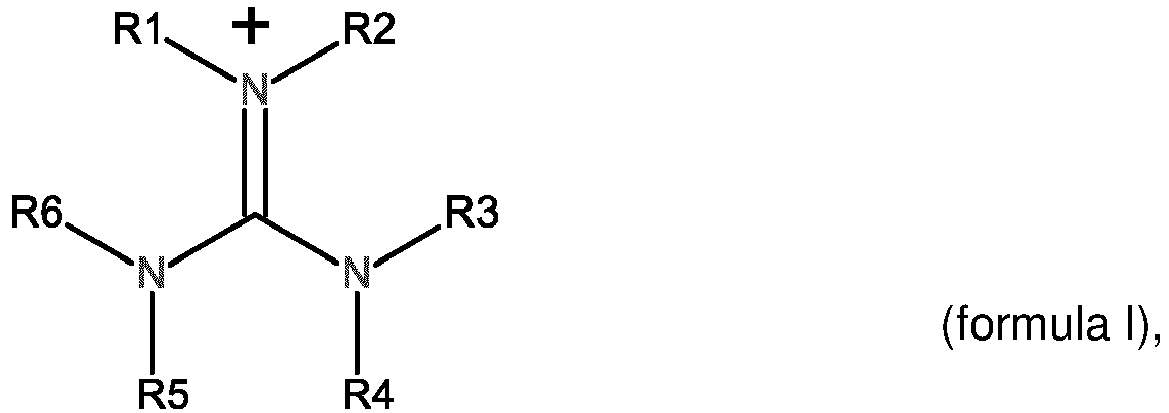
- the present invention provides a process for modifying isocyanates, in which at least one organic isocyanate having an NCO functionality of > 1 is oligomerized in the presence of at least one catalyst, characterized in that the catalyst comprises at least one guanidinium salt having a cation of the formula I as catalysts for the isocyanate modification, wherein the N-substituents R1, R2, R3, R4, R5 and R6 are mutually independently identical or different aliphatic, cycloaliphatic, aromatic or araliphatic C1-C20 radicals, which are saturated or unsaturated, linear or branched, optionally substituted and/or interrupted by heteroatoms from the group of oxygen, sulfur and nitrogen.
- references to "comprising”, “containing”, etc. mean “consisting essentially of' and most preferably “consisting of'.
- R1, R2, R3, R4, R5 and R6 in formula I are mutually independently identical or different C1 -C8-alkyl substituents, preferably identical or different C1 - C6-alkyl substituents and particularly preferably have a linear structure. These are accessible in a simple manner, for example, by reaction of tetramethylguanidine with an alkylating reagent.
- R1, R2, R3, R4, R5 and R6 in formula I are mutually independently identical or different benzyl radicals optionally substituted on the aromatic ring.
- R1, R2, R3, R4, R5 and R6 in formula I are independently selected from the group consisting of methyl, ethyl, 2-hydroxyethyl, 2-hydroxypropyl, n-propyl, isopropyl, n-butyl, sec-butyl, tert-butyl, pentyl, hexyl, heptyl, octyl, 2-ethylhexyl, nonyl, decyl, dodecyl, phenyl, ⁇ - or ⁇ naphthyl, benzyl, cyclopentyl and cyclohexyl.
- Especially preferred cations are hexamethylguanidinium, tetramethyldibutylguanidinium pentamethyl-tert-butylguanidinium and pentamethylbenzylguanidinium.
- Anions used in the compounds of the formula I may in principle be any species known to be catalytically active with respect to isocyanates, preference being given to alkoxides, fluoride, hydrogen polyfluoride of the formula Mn+ n [F - (HF)m], hydrogensulfate, cyanide, hydroxide, alkanoate, carboxylate, heterocycles having at least one negatively charged nitrogen atom in the ring, especially azolate, imidazolate, triazolate, tetrazolate, or mixtures of these, wherein the fluorides, hydrogendifluorides and higher polyfluorides (adducts of more than one equivalent HF onto compounds containing fluoride ions) lead in accordance with the invention to products having a high iminooxadiazinedione group content.
- the process of the invention affords polyisocyanates of what is known as the isocyanate trimer type (i.e. containing isocyanurate and/or iminooxadiazinedione structures) having a low proportion of uretdione groups ("isocyanate dimers").
- isocyanate trimer type i.e. containing isocyanurate and/or iminooxadiazinedione structures
- isocyanate dimers a low proportion of uretdione groups
- the oligomerization is conducted in the presence of a solvent and/or additive.
- a solvent and/or additive for performance of the process of the invention, it is possible in principle to use any known mono-, di- or polyisocyanates from the prior art, individually or in any desired mixtures with one another.
- Examples include: pentamethylene diisocyanate (PDI), hexamethylene diisocyanate (HDI), 2-methylpentane 1,5-diisocyanate, 2,4,4-trimethylhexane 1,6-diisocyanate, 2,2,4-trimethylhexane 1,6-diisocyanate, 4-isocyanatomethyloctane 1,8-diisocyanate, 3( 4)-isocyanatomethyl-1-methylcyclohexyl isocyanate (IMCI), isophorone diisocyanate (IPDI). 1,3- and 1,4-bis(isocyanatomethyl)benzene (XDI).
- PDI pentamethylene diisocyanate
- HDI hexamethylene diisocyanate
- 2-methylpentane 1,5-diisocyanate 2,4,4-trimethylhexane 1,6-diisocyanate
- aliphatic diisocyanates i.e. diisocyanates in which both NCO groups are bonded to an sp3-hybridized carbon atom.
- PDI pentamethylene diisocyanate
- HDI hexamethylene diisocyanate
- 2-methylpentane 1,5-diisocyanate 2,4,4-trimethylhexane 1,6-diisocyanate, 2,2,4-trimethylhexane 1,6-diisocyanate, 4-isocyanatomethyloctane 1,8-diisocyanate
- IPDI isophorone diisocyanate
- XDI 1,3- and 1,4-bis(isocyanatomethyl) benzene
- H6XDI 1,3- and 1,4-bis(isocyanatomethyl) cyclohexane
- the amount of the catalyst to be used in the process according to the invention is guided primarily by the organic isocyanate used and the desired reaction rate and is preferably between ⁇ 0.001 and ⁇ 5 mol %, preferably between ⁇ 0.002 and ⁇ 2 mol %, based on the sum total of the molar amounts of the isocyanate used and of the catalyst.
- the catalyst may be used undiluted or dissolved in solvents.
- Useful solvents are all compounds which do not react with the catalyst and are capable of dissolving it to a sufficient degree, for example optionally halogenated aliphatic or aromatic hydrocarbons, alcohols, ketones, esters and ethers. Preference is given to using alcohols.
- the process according to the invention can be conducted within the temperature range from 0° C. to +250° C., preferably 20° C. to 200° C., more preferably 40° C. to 150° C., and can be interrupted at any degrees of conversion, preferably after 5% to 80%, more preferably 10% to 60%, of the isocyanate used has been converted.
- Catalyst deactivation can be accomplished in principle by employing a whole series of previously described prior art methods, for example the addition of (sub- or super-) stoichiometric amounts of acids or acid derivatives (e.g. benzoyl chloride, acidic esters of phosphorus- or sulfurcontaining acids, these acids themselves, etc., but not HF), adsorptive binding of the catalyst and subsequent removal by filtration, and other methods known to those skilled in the art.
- acids or acid derivatives e.g. benzoyl chloride, acidic esters of phosphorus- or sulfurcontaining acids, these acids themselves, etc., but not HF
- unconverted organic isocyanate is removed after deactivation of the catalyst system by any method of the prior art, for example by (thin film) distillation or extraction, and subsequently preferably reused.
- catalysts according to the invention allows for preparation of substantially colorless isocyanurate-containing polyisocyanates by a very simple process in very good quality and reproducibly irrespective of their preparation.
- the catalyst of the invention can be employed over a wide temperature range and has a uniform structure and a good solubility in the reaction mixture.
- the oligomerization can be undertaken continuously.
- a tubular reactor For example, the catalysts which are used in accordance with the invention have good catalytic activity in the trimerization of (cyclo)aliphatic diisocyanates, even those prepared by the phosgene process, and result in polyisocyanates having isocyanurate groups which have a low color number.
- the process products according to the invention can be used pure or in conjunction with other prior art isocyanate derivatives, such as polyisocyanates containing uretdione, biuret, allophanate, isocyanurate and/or urethane groups, wherein the free NCO groups have optionally been deactivated with blocking agents.
- isocyanate derivatives such as polyisocyanates containing uretdione, biuret, allophanate, isocyanurate and/or urethane groups, wherein the free NCO groups have optionally been deactivated with blocking agents.
- the present invention further relates to the use of a guanidinium salt having a cation of the formula I, wherein the N-substituents R1, R2, R3, R4, R5 and R6 are mutually independently identical or different aliphatic, cycloaliphatic, aromatic or araliphatic C1-C20 radicals, which are saturated or unsaturated, linear or branched, optionally substituted and/or interrupted by heteroatoms from the group of oxygen, sulfur and nitrogen, as catalysts for the oligomerization of organic isocyanates having an NCO functionality of > 1.
- Catalyst G1 Hexamethylguanidinium 2-ethylhexanoat
- Tetramethylguanidine and sodium carbonate were dissolved in MeCN and heated to 75 °C. Dimethyl sulfate was slowly added, and the reaction mixture was stirred for 48 h. The mixture was cooled to room temperature and filtered. The filtrate was dried in vacuo and the white crystals were washed with acetone. The crystals were dissolved in water and subsequently converted to the corresponding hydroxide via ion exchange (Ambersep 900). 2-Ethyl hexanoic acid was added to neutralize the solution. The water was removed in vacuo and the solid was washed with isopropanol.
- Catalyst G2 Tetramethyldibutylguanidinium Acetate
- Tetramethylguanidine and sodium carbonate were dissolved in MeCN and heated to 75 °C. 1-Bromobutane was slowly added, and the reaction mixture was stirred for 48 h. The mixture was cooled to room temperature and filtered. The filtrate was dried in vacuo and the white crystals were washed with acetone. The crystals were dissolved in water and subsequently converted to the corresponding hydroxide via ion exchange (Ambersep 900). 2-Ethyl hexanoic acid was added to neutralize the solution. The water was removed in vacuo and the solid was washed with isopropanol.
- Catalyst C1 Tetrabutylammonium 2-ethylhexanoat
- Tetrabutylammonium hydroxide solution (40% in water) was neutralized with 2-ethyl hexanoic acid. Isopropanol was added and the azeotrope was removed in vacuo. The yellow oil was dissolved in isopropanol and the isopropanol was removed. The procedure was repeated three times and the resulting yellow oil was dried in vacuo.
- Catalyst C2 Tetramethylammonium 2-ethylhexanoat
- Tetramethylammonium hydroxide solution (25% in water) was neutralized with 2-ethyl hexanoic acid. Isopropanol was added and the azeotrope was removed in vacuo. The yellow oil was dissolved in isopropanol and the isopropanol was removed. The procedure was repeated three times and the resulting white solid was dried in vacuo.
- the reactivity of a catalyst is calculated as the amount of NCO reacted during with time and the molar amount of catalyst used. (Table below) Reference Catalyst Activity (gNCO / mmol catalyst/ min) Inventive Example 1 G1 0,73 Comparative Example 1a C1 0,22 Comparative Example 1b C2 0,21 Inventive Example 2 G2 1,66 Comparative Example 2 C1 0,97
Landscapes
- Chemical & Material Sciences (AREA)
- Health & Medical Sciences (AREA)
- Chemical Kinetics & Catalysis (AREA)
- Medicinal Chemistry (AREA)
- Polymers & Plastics (AREA)
- Organic Chemistry (AREA)
- Polyurethanes Or Polyureas (AREA)
Abstract
A process for modifying isocyanates, in which at least one organic isocyanate having an NCO functionality of > 1 is oligomerized in the presence of at least one catalyst, characterized in that the catalyst comprises at least one guanidinium salt having a cation of the formula I as catalysts for the isocyanate modification
Description
- The invention relates to a process for modifying isocyanates, in which at least one organic isocyanate having an NCO functionality of > 1 is oligomerized in the presence of at least one catalyst, and to the use of such a catalyst.
- The oligo- or polymerization of isocyanates, especially to form higher molecular weight oligomer mixtures having uretdione ("dimer"), isocyanurate ("trimer") and/or iminooxadiazinedione structures ("asymmetric trimer") in the molecular skeleton, has long been known. As can be seen above, the oligo- and polymerization of isocyanates are based in principle on the same chemical reactions. The reaction of a relatively small number of isocyanates with one another is referred to as oligomerization. The reaction of a relatively large number of isocyanates is referred to as polymerization. In the context of the present invention, the oligomerization or polymerization of isocyanates described above is referred to collectively as isocyanate modification or modification of isocyanates.
- The modified polyisocyanates comprising free NCO groups, which optionally may also have been temporarily deactivated with blocking agents, are exceptionally high-quality starting materials for the preparation of a multiplicity of polyurethane plastics and coating compositions. A series of industrial methods for isocyanate modification have been established in which the isocyanate to be modified, usually a diisocyanate, is generally reacted by addition of catalysts and these are then rendered inactive ( deactivated) by suitable measures, when the desired degree of conversion of the isocyanate to be modified has been reached, and the polyisocyanate obtained is generally separated from the unreacted monomer. A summary of these methods from the prior art can be found in H. J. Laas et al., J. Prakt. Chem. 1994, 336, 185 ff.
- Compounds with an ionic structure have proven to be effective as modification catalysts since they may be used in very low amounts, relative to the monomer to be reacted, and lead extremely rapidly to the desired result. The option of also using tetraorganylammonium or - phosphonium as cation to the anion which is catalytically active toward isocyanates, such as hydroxide, alkanoate, alkoxylate, etc., is common knowledge, although generally not explicitly emphasized as being particularly preferred; cf.: H. J. Laas et al., J. Prakt. Chem. 1994, 336, 185 ff.
- Additionally known is the use of fluorides and hydrogenpolyfluorides, the latter being stable adducts of HF onto compounds containing fluoride ions, optionally also in the form of their ammonium or phosphonium salts, for the isocyanate modification, from documents including
EP 962455 A1 EP 962 454 A1 EP 896 009 A1 EP 798 299 A1 EP 447 074A1 EP379 914A1 EP339 396A1 EP315 692A1 EP 295 926 A1 EP 235 388 A1 - However, the tetraorganylanunonium and -phosphonium (hydrogenpoly)fluorides of the prior art, in the performance of the modification reaction, have the disadvantage that, when they are used, the reaction can sometimes be maintained only with continuous metered addition of catalyst, meaning that the breakdown of the catalyst in the isocyanate medium proceeds unacceptably quickly for technical purposes compared to the modification reaction.
- An additional factor is that, when tetraorganylammonium (hydrogen)polyfluorides are used, an atypical reaction profile is sometimes observed, which leads to products having a much lower iminooxadiazinedione group content than in the case of a regular heat production rate profile ( cf.
EP 962 455 A1 EP 962 455 A1 EP 2 415 795 A1 claims, inter alia, very stable tetraorganylphosphonium (hydrogenpoly)fluorides that do not have these disadvantages, but they are not commercially available and are producible only with difficulty. - The present invention provides an improved process for isocyanate modification, in which compounds that have good commercial availability or are easily producible from inexpensive reactants are used as catalysts, these having a high catalytic activity and selectivity with simultaneously good catalyst stability.
- The present invention provides a process for modifying isocyanates, in which at least one organic isocyanate having an NCO functionality of > 1 is oligomerized in the presence of at least one catalyst, characterized in that the catalyst comprises at least one guanidinium salt having a cation of the formula I as catalysts for the isocyanate modification,

- Preferably, the references to "comprising", "containing", etc. mean "consisting essentially of' and most preferably "consisting of'.
- Compounds of the formula I are accessible in a simple manner by methods known from the literature , e.g. from
WO 2017205828 A1 , Inorganic Chemistry (2002), 41 (23), 6118-6124, Physical Chemistry Chemical Physics (2019), 21(23), 12288-12300 and Analytica Chimica Acta (2014), 815, 22-32. - In a first preferred embodiment, R1, R2, R3, R4, R5 and R6 in formula I are mutually independently identical or different C1 -C8-alkyl substituents, preferably identical or different C1 - C6-alkyl substituents and particularly preferably have a linear structure. These are accessible in a simple manner, for example, by reaction of tetramethylguanidine with an alkylating reagent.
- In a further preferred embodiment, R1, R2, R3, R4, R5 and R6 in formula I are mutually independently identical or different benzyl radicals optionally substituted on the aromatic ring.
- In a further preferred embodiment R1, R2, R3, R4, R5 and R6 in formula I are independently selected from the group consisting of methyl, ethyl, 2-hydroxyethyl, 2-hydroxypropyl, n-propyl, isopropyl, n-butyl, sec-butyl, tert-butyl, pentyl, hexyl, heptyl, octyl, 2-ethylhexyl, nonyl, decyl, dodecyl, phenyl, α- or β naphthyl, benzyl, cyclopentyl and cyclohexyl.
- Especially preferred cations are hexamethylguanidinium, tetramethyldibutylguanidinium pentamethyl-tert-butylguanidinium and pentamethylbenzylguanidinium.
- Anions used in the compounds of the formula I may in principle be any species known to be catalytically active with respect to isocyanates, preference being given to alkoxides, fluoride, hydrogen polyfluoride of the formula Mn+ n [F - (HF)m], hydrogensulfate, cyanide, hydroxide, alkanoate, carboxylate, heterocycles having at least one negatively charged nitrogen atom in the ring, especially azolate, imidazolate, triazolate, tetrazolate, or mixtures of these, wherein the fluorides, hydrogendifluorides and higher polyfluorides (adducts of more than one equivalent HF onto compounds containing fluoride ions) lead in accordance with the invention to products having a high iminooxadiazinedione group content.
- By the modification process of the invention, a wide range of high-quality polyisocyanates, which are therefore very valuable for the polyurethane sector, is very generally obtainable in a simple manner. Depending on the starting (di)isocyanate used and the reaction conditions, the process of the invention affords polyisocyanates of what is known as the isocyanate trimer type (i.e. containing isocyanurate and/or iminooxadiazinedione structures) having a low proportion of uretdione groups ("isocyanate dimers"). In the case of rising reaction temperature, the proportion of the latter in the process products generally rises, but this effect is far less marked than when phosphonium salts with identical anion are used. In the process of the invention, it may further be the case that the oligomerization is conducted in the presence of a solvent and/or additive. For performance of the process of the invention, it is possible in principle to use any known mono-, di- or polyisocyanates from the prior art, individually or in any desired mixtures with one another.
- Examples include: pentamethylene diisocyanate (PDI), hexamethylene diisocyanate (HDI), 2-methylpentane 1,5-diisocyanate, 2,4,4-trimethylhexane 1,6-diisocyanate, 2,2,4-trimethylhexane 1,6-diisocyanate, 4-isocyanatomethyloctane 1,8-diisocyanate, 3( 4)-isocyanatomethyl-1-methylcyclohexyl isocyanate (IMCI), isophorone diisocyanate (IPDI). 1,3- and 1,4-bis(isocyanatomethyl)benzene (XDI). 1,3- and 1,4-bis(isocyanatomethyl)cyclohexane (H6XDI), meta-Tetramethylxylylendiisocyanate (TMXDI) ,tolylene 2,4- and 2,6-diisocyanate (TDI), bis( 4-isocyanatophenyl) methane (4,4'MDI), 4-isocyanatophenyl-2-isocyanatophenylmethane (2,4'MDI) and polycyclic products obtainable by fonnaldehyde-aniline polycondensation and subsequent conversion of the resulting (poly)amines to the corresponding (poly)isocyanates (polymer MDI).
- Preference is given to aliphatic diisocyanates, i.e. diisocyanates in which both NCO groups are bonded to an sp3-hybridized carbon atom.
- Particular preference is given to pentamethylene diisocyanate (PDI), hexamethylene diisocyanate (HDI), 2-methylpentane 1,5-diisocyanate, 2,4,4-trimethylhexane 1,6-diisocyanate, 2,2,4-trimethylhexane 1,6-diisocyanate, 4-isocyanatomethyloctane 1,8-diisocyanate, 3( 4)-isocyanatomethyl- 1-methylcyclohexyl isocyanate (IMCI), isophorone diisocyanate (IPDI), 1,3- and 1,4-bis(isocyanatomethyl) benzene (XDI) and 1,3- and 1,4-bis(isocyanatomethyl) cyclohexane (H6XDI).
- It is irrelevant by which methods the aforementioned isocyanates are generated, i.e. with or without use of phosgene.
- The amount of the catalyst to be used in the process according to the invention is guided primarily by the organic isocyanate used and the desired reaction rate and is preferably between ≥0.001 and ≤5 mol %, preferably between ≥0.002 and ≤ 2 mol %, based on the sum total of the molar amounts of the isocyanate used and of the catalyst.
- In the process according to the invention, the catalyst may be used undiluted or dissolved in solvents. Useful solvents are all compounds which do not react with the catalyst and are capable of dissolving it to a sufficient degree, for example optionally halogenated aliphatic or aromatic hydrocarbons, alcohols, ketones, esters and ethers. Preference is given to using alcohols.
- The process according to the invention can be conducted within the temperature range from 0° C. to +250° C., preferably 20° C. to 200° C., more preferably 40° C. to 150° C., and can be interrupted at any degrees of conversion, preferably after 5% to 80%, more preferably 10% to 60%, of the isocyanate used has been converted.
- Catalyst deactivation can be accomplished in principle by employing a whole series of previously described prior art methods, for example the addition of (sub- or super-) stoichiometric amounts of acids or acid derivatives ( e.g. benzoyl chloride, acidic esters of phosphorus- or sulfurcontaining acids, these acids themselves, etc., but not HF), adsorptive binding of the catalyst and subsequent removal by filtration, and other methods known to those skilled in the art.
- In a further preferred embodiment, unconverted organic isocyanate is removed after deactivation of the catalyst system by any method of the prior art, for example by (thin film) distillation or extraction, and subsequently preferably reused.
- The use of catalysts according to the invention allows for preparation of substantially colorless isocyanurate-containing polyisocyanates by a very simple process in very good quality and reproducibly irrespective of their preparation. The catalyst of the invention can be employed over a wide temperature range and has a uniform structure and a good solubility in the reaction mixture.
- It is quite generally the case that the catalysts according to the invention, irrespective of the anion which is responsible for the catalytic activity and selectivity, are much more stable in the organic isocyanate to be converted than the prior art derivatives known from the literature.
- According to a particular continuously operating embodiment of the process according to the invention, the oligomerization can be undertaken continuously. For example in a tubular reactor. It has been found that the catalysts which are used in accordance with the invention have good catalytic activity in the trimerization of (cyclo)aliphatic diisocyanates, even those prepared by the phosgene process, and result in polyisocyanates having isocyanurate groups which have a low color number.
- The process products according to the invention can be used pure or in conjunction with other prior art isocyanate derivatives, such as polyisocyanates containing uretdione, biuret, allophanate, isocyanurate and/or urethane groups, wherein the free NCO groups have optionally been deactivated with blocking agents.
- The present invention further relates to the use of a guanidinium salt having a cation of the formula I,
- The comparative examples and examples which follow are intended to further illustrate the invention but without limiting it.
- Tetramethylguanidine and sodium carbonate were dissolved in MeCN and heated to 75 °C. Dimethyl sulfate was slowly added, and the reaction mixture was stirred for 48 h. The mixture was cooled to room temperature and filtered. The filtrate was dried in vacuo and the white crystals were washed with acetone. The crystals were dissolved in water and subsequently converted to the corresponding hydroxide via ion exchange (Ambersep 900). 2-Ethyl hexanoic acid was added to neutralize the solution. The water was removed in vacuo and the solid was washed with isopropanol.
- Tetramethylguanidine and sodium carbonate were dissolved in MeCN and heated to 75 °C. 1-Bromobutane was slowly added, and the reaction mixture was stirred for 48 h. The mixture was cooled to room temperature and filtered. The filtrate was dried in vacuo and the white crystals were washed with acetone. The crystals were dissolved in water and subsequently converted to the corresponding hydroxide via ion exchange (Ambersep 900). 2-Ethyl hexanoic acid was added to neutralize the solution. The water was removed in vacuo and the solid was washed with isopropanol.
- Tetrabutylammonium hydroxide solution (40% in water) was neutralized with 2-ethyl hexanoic acid. Isopropanol was added and the azeotrope was removed in vacuo. The yellow oil was dissolved in isopropanol and the isopropanol was removed. The procedure was repeated three times and the resulting yellow oil was dried in vacuo.
- Tetramethylammonium hydroxide solution (25% in water) was neutralized with 2-ethyl hexanoic acid. Isopropanol was added and the azeotrope was removed in vacuo. The yellow oil was dissolved in isopropanol and the isopropanol was removed. The procedure was repeated three times and the resulting white solid was dried in vacuo.
- 400,0 grams of freshly distillated HDI were charged to a 500mL, 4-neck round bottom flask equipped with a thermometer (coupled with a temperature regulated oil-bath), mechanical stirring, a cold-water condenser and nitrogen inlet. The reaction was degassed using vacuum at 60°C. Upon stirring 0,35 mmol from the catalyst G1 were added and the reaction mixture is maintained around at 60°C (maximal temperature below 65°C). After 120 minutes the NCO content reached 42,3% and the reaction was stopped using a stoichiometric amount of 2-ethylhexylphosphate. After distillation of the unreacted HDI using a thin film evaporator (165 °C / 2 mbar) a polyisocyanate with a viscosity of 1900 mPa.s (23°C) and a NCO content of 22,7% is obtained.
- 400,0 grams of freshly distillated HDI were charged to a 500mL, 4-neck round bottom flask equipped with a thermometer (coupled with a temperature regulated oil-bath), mechanical stirring, a cold-water condenser and nitrogen inlet. The reaction was degassed using vacuum at 80°C. Upon stirring 0,28 mmol from the catalyst G2 were added and the reaction mixture is maintained around at 80°C (maximal temperature below 85°C). After 75 minutes the NCO content reached 41,3% and the reaction was stopped using a stoichiometric amount of 2-ethyl-hexylphosphate. After distillation of the unreacted HDI using a thin film evaporator (165 °C / 2 mbar) a polyisocyanate with a viscosity of 2050 mPa.s (23°C) and a NCO content of 22,8 is obtained.
- 400,0 grams of freshly distillated HDI were charged to a 500mL, 4-neck round bottom flask equipped with a thermometer (coupled with a temperature regulated oil-bath), mechanical stirring, a cold-water condenser and nitrogen inlet. The reaction was degassed using vacuum at 60°C. Upon stirring, 0,62 mmol from the catalyst C1 were added. After 240 minutes the NC content reached 41,9% and the reaction was stopped using a stoichiometric amount of 2-ethylhexylphosphate. After distillation of the unreacted HDI using a thin film evaporator (165 °C / 2 mbar) a polyisocyanate with a viscosity of 2200 mPa.s (23°C) and a NCO content of 22,5% is obtained.
- 400,0 grams of freshly distillated HDI were charged to a 500mL, 4-neck round bottom flask equipped with a thermometer (coupled with a temperature regulated oil-bath), mechanical stirring, a cold-water condenser and nitrogen inlet. The reaction was degassed using vacuum at 60°C. Upon stirring 1,08 mmol from the catalyst C2 were added and the reaction mixture is maintained around at 60°C (maximal temperature below 65°C). After 135 minutes the NCO content reached 42,2% and the reaction was stopped using a stoichiometric amount of 2-ethylhexylphosphate. After distillation of the unreacted HDI using a thin film evaporator (165 °C / 2 mbar) a polyisocyanate with a viscosity of 2450 mPa.s (23°C) and a NCO content of 22,2% is obtained.
- 400,0 grams of freshly distillated HDI were charged to a 500mL, 4-neck round bottom flask equipped with a thermometer (coupled with a temperature regulated oil-bath), mechanical stirring, a cold-water condenser and nitrogen inlet. The reaction was degassed using vacuum at 80°C. Upon stirring 0,52 mmol from the catalyst C1 were added and the reaction mixture is maintained around at 80°C (maximal temperature below 85°C). After 65 minutes the NCO content reached 41,8% and the reaction was stopped using a stoichiometric amount of 2-ethylhexylphosphate. After distillation of the unreacted HDI using a thin film evaporator (165 °C / 2 mbar) a polyisocyanate with a viscosity of 2680 mPa.s (23°C) and a NCO content of 22,4% is obtained.
- The reactivity of a catalyst is calculated as the amount of NCO reacted during with time and the molar amount of catalyst used. (Table below)
Reference Catalyst Activity (gNCO / mmol catalyst/ min) Inventive Example 1 G1 0,73 Comparative Example 1a C1 0,22 Comparative Example 1b C2 0,21 Inventive Example 2 G2 1,66 Comparative Example 2 C1 0,97 - It is quite clear that the inventive example (guanidinium salts) present a higher reactivity that their counterparts (ammonium salts).
Claims (14)
- A process for modifying isocyanates, in which at least one organic isocyanate having an NCO functionality of > 1 is oligomerized in the presence of at least one catalyst, characterized in that the catalyst comprises at least one guanidinium salt having a cation of the formula I as catalysts for the isocyanate modification,

- The process as claimed in claim 1, characterized in that R1, R2, R3, R4, R5 and R6 are mutually independently identical or different C1 -C8-alkyl substituents, preferably identical or different C1 -C6-alkyl substituents and particularly preferably have a linear structure.
- The process as claimed in claim 1, characterized in that R1, R2, R3, R4, R5 and R6 in formula I are mutually independently identical or different benzyl radicals optionally substituted on the aromatic ring.
- The process as claimed in claim 1, characterized in that R1, R2, R3, R4, R5 and R6 are independently selected from the group consisting of methyl, ethyl, 2-hydroxyethyl, 2-hydroxypropyl, n-propyl, isopropyl, n-butyl, sec-butyl, tert-butyl, pentyl, hexyl, heptyl, octyl, 2-ethylhexyl, nonyl, decyl, dodecyl, phenyl, α- or β naphthyl, benzyl, cyclopentyl and cyclohexyl..
- The process as claimed in any of the preceding claims, characterized in that the anion of the guanidinium salt is selected from alkoxides, fluoride, hydrogen polyfluoride of the formula Mn+ n [F - (HF)m], hydrogensulfate, cyanide, hydroxide, alkanoate, carboxylate, heterocycles having at least one negatively charged nitrogen atom in the ring, especially azolate, imidazolate, triazolate, tetrazolate, or mixtures of these).
- The process as claimed in any of the preceding claims, characterized in that the oligomerization is conducted in the presence of a solvent and/or additive.
- The process as claimed in any of the preceding claims, characterized in that the organic isocyanate is selected from aliphatic diisocyanates, especially from pentamethylene diisocyanate, hexamethylene diisocyanate, 2-methylpentane 1,5-diisocyanate, 2,4,4-trimethylhexane 1,6-diisocyanate, 2,2,4-trimethylhexane 1,6-diisocyanate, 4-isocyanatomethyloctane 1,8-diisocyanate, 3( 4)-isocyanatomethyl-l-methylcyclohexyl isocyanate, isophorone diisocyanate, 1,3- and 1,4-bis(isocyanatomethyl)benzene, 1,3- and 1,4-bis(isocyanatomethyl) cyclohexane or mixtures of these.
- The process as claimed in any of the preceding claims, characterized in that the catalyst of the formula I is used in an amount between ≥0.001 and ≤5 mol %, preferably between ≥0.002 and ≤2 mol %, based on the sum total of the molar amounts of the isocyanate used and of the catalyst.
- The process as claimed in any of the preceding claims, characterized in that the process is conducted within the temperature range from 0° C. to 250° C., preferably 20 to 200° C., more preferably 40 to 150° C.
- The process as claimed in any of the preceding claims, characterized in that the oligomerization is stopped after 5% to 80% by weight of the organic isocyanate used has been converted, preferably 10% to 60% by weight.
- The process as claimed in claim 10, characterized in that the oligomerization is stopped by deactivating the catalyst, especially by addition of an acid or an acid derivative such as benzoyl chloride, an acidic ester of phosphorus or sulfur-containing acids, these acids themselves, adsorptive binding of the catalyst and subsequent removal by filtration or combinations thereof.
- The process as claimed in claim 10 or 11, characterized in that unconverted organic isocyanate is removed from the reaction mixture.
- The process as claimed in any of the preceding claims, characterized in that the modified isocyanates contain isocyanurate groups.
- The use of a guanidinium salt having a cation of the formula I,

Applications Claiming Priority (1)
| Application Number | Priority Date | Filing Date | Title |
|---|---|---|---|
| EP20164830 | 2020-03-23 |
Publications (1)
| Publication Number | Publication Date |
|---|---|
| EP3885385A1 true EP3885385A1 (en) | 2021-09-29 |
Family
ID=69953845
Family Applications (1)
| Application Number | Title | Priority Date | Filing Date |
|---|---|---|---|
| EP21162873.0A Withdrawn EP3885385A1 (en) | 2020-03-23 | 2021-03-16 | Process for modifying isocyanates with use of guanidinium salts as catalyst |
Country Status (1)
| Country | Link |
|---|---|
| EP (1) | EP3885385A1 (en) |
Cited By (3)
| Publication number | Priority date | Publication date | Assignee | Title |
|---|---|---|---|---|
| CN114262302A (en) * | 2022-01-04 | 2022-04-01 | 山东新和成维生素有限公司 | Method for synthesizing diisocyanate trimer, catalyst and preparation method thereof |
| CN115353493A (en) * | 2022-08-25 | 2022-11-18 | 山东新和成维生素有限公司 | Preparation method of diisocyanate trimer |
| CN116082260A (en) * | 2023-02-10 | 2023-05-09 | 山东新和成精化科技有限公司 | Catalyst, preparation method thereof and preparation method of aliphatic isocyanate polymer |
Citations (13)
| Publication number | Priority date | Publication date | Assignee | Title |
|---|---|---|---|---|
| EP0235388A2 (en) | 1985-12-28 | 1987-09-09 | MITSUI TOATSU CHEMICALS, Inc. | Preparation process of heat-resistant polymers |
| EP0295926A2 (en) | 1987-06-19 | 1988-12-21 | MITSUI TOATSU CHEMICALS, Inc. | Process for producing thermosetting resins |
| EP0315692A1 (en) | 1987-05-20 | 1989-05-17 | MITSUI TOATSU CHEMICALS, Inc. | Process for preparing substances having isocyanurate ring structure |
| EP0339396A1 (en) | 1988-04-27 | 1989-11-02 | Bayer Ag | Process for producing polyisocyanates containing isocyanurate groups |
| EP0379914A2 (en) | 1989-01-25 | 1990-08-01 | Bayer Ag | Process for the preparation of modified isocyanurate-containing polyisocyanates and use of them |
| EP0447074A2 (en) | 1990-03-12 | 1991-09-18 | Asahi Denka Kogyo Kabushiki Kaisha | Catalytic isocyanate trimerization and urethane formation |
| US5322914A (en) * | 1993-09-13 | 1994-06-21 | Air Products And Chemicals, Inc. | Aromatic polyisocyanurate resins and process therefor |
| EP0798299A1 (en) | 1996-03-26 | 1997-10-01 | Bayer Ag | Isocyanate trimers and mixtures of isocyanate trimers, production and use thereof |
| EP0896009A1 (en) | 1997-08-06 | 1999-02-10 | Bayer Ag | Process for the preparation of polyisocyanates, polyisocyanates prepared in this way and their use |
| EP0962455A1 (en) | 1998-06-02 | 1999-12-08 | Bayer Aktiengesellschaft | Process for the preparation of imino-oxadiazine-dione groups containing polyisocyanates |
| US20030078450A1 (en) * | 2001-05-14 | 2003-04-24 | Jurgen Kocher | Method for producing polyisocyanates |
| EP2415795A1 (en) | 2010-08-03 | 2012-02-08 | Bayer MaterialScience AG | Method for manufacturing polyisocyanates and their application |
| WO2017205828A1 (en) | 2016-05-26 | 2017-11-30 | Yazaki Corporation | Guanidinium-based ionic liquids in absorption chillers |
-
2021
- 2021-03-16 EP EP21162873.0A patent/EP3885385A1/en not_active Withdrawn
Patent Citations (14)
| Publication number | Priority date | Publication date | Assignee | Title |
|---|---|---|---|---|
| EP0235388A2 (en) | 1985-12-28 | 1987-09-09 | MITSUI TOATSU CHEMICALS, Inc. | Preparation process of heat-resistant polymers |
| EP0315692A1 (en) | 1987-05-20 | 1989-05-17 | MITSUI TOATSU CHEMICALS, Inc. | Process for preparing substances having isocyanurate ring structure |
| EP0295926A2 (en) | 1987-06-19 | 1988-12-21 | MITSUI TOATSU CHEMICALS, Inc. | Process for producing thermosetting resins |
| EP0339396A1 (en) | 1988-04-27 | 1989-11-02 | Bayer Ag | Process for producing polyisocyanates containing isocyanurate groups |
| EP0379914A2 (en) | 1989-01-25 | 1990-08-01 | Bayer Ag | Process for the preparation of modified isocyanurate-containing polyisocyanates and use of them |
| EP0447074A2 (en) | 1990-03-12 | 1991-09-18 | Asahi Denka Kogyo Kabushiki Kaisha | Catalytic isocyanate trimerization and urethane formation |
| US5322914A (en) * | 1993-09-13 | 1994-06-21 | Air Products And Chemicals, Inc. | Aromatic polyisocyanurate resins and process therefor |
| EP0798299A1 (en) | 1996-03-26 | 1997-10-01 | Bayer Ag | Isocyanate trimers and mixtures of isocyanate trimers, production and use thereof |
| EP0896009A1 (en) | 1997-08-06 | 1999-02-10 | Bayer Ag | Process for the preparation of polyisocyanates, polyisocyanates prepared in this way and their use |
| EP0962455A1 (en) | 1998-06-02 | 1999-12-08 | Bayer Aktiengesellschaft | Process for the preparation of imino-oxadiazine-dione groups containing polyisocyanates |
| EP0962454A1 (en) | 1998-06-02 | 1999-12-08 | Bayer Aktiengesellschaft | Process for the preparation of imino-oxadiazine-dione groups containing polyisocyanates, products prepared using this process and their use |
| US20030078450A1 (en) * | 2001-05-14 | 2003-04-24 | Jurgen Kocher | Method for producing polyisocyanates |
| EP2415795A1 (en) | 2010-08-03 | 2012-02-08 | Bayer MaterialScience AG | Method for manufacturing polyisocyanates and their application |
| WO2017205828A1 (en) | 2016-05-26 | 2017-11-30 | Yazaki Corporation | Guanidinium-based ionic liquids in absorption chillers |
Non-Patent Citations (4)
| Title |
|---|
| ANALYTICA CHIMICA AC-TA, vol. 815, 2014, pages 22 - 32 |
| H. J. LAAS ET AL., J. PRAKT. CHEM., vol. 336, 1994, pages 185 ff |
| INORGANIC CHEMISTRY, vol. 41, no. 23, 2002, pages 6118 - 6124 |
| PHYSICAL CHEMISTRY CHEMICAL PHYSICS, vol. 21, no. 23, 2019, pages 12288 - 12300 |
Cited By (5)
| Publication number | Priority date | Publication date | Assignee | Title |
|---|---|---|---|---|
| CN114262302A (en) * | 2022-01-04 | 2022-04-01 | 山东新和成维生素有限公司 | Method for synthesizing diisocyanate trimer, catalyst and preparation method thereof |
| CN114262302B (en) * | 2022-01-04 | 2023-09-29 | 山东新和成维生素有限公司 | Method for synthesizing diisocyanate trimer, catalyst and preparation method thereof |
| CN115353493A (en) * | 2022-08-25 | 2022-11-18 | 山东新和成维生素有限公司 | Preparation method of diisocyanate trimer |
| CN115353493B (en) * | 2022-08-25 | 2023-12-19 | 山东新和成维生素有限公司 | Preparation method of diisocyanate trimer |
| CN116082260A (en) * | 2023-02-10 | 2023-05-09 | 山东新和成精化科技有限公司 | Catalyst, preparation method thereof and preparation method of aliphatic isocyanate polymer |
Similar Documents
| Publication | Publication Date | Title |
|---|---|---|
| US10167358B2 (en) | Process for modifying isocyanates with use of cyclic ammonium salts as catalyst | |
| KR102327859B1 (en) | Process for isocyanate modification using spirocyclic ammonium salts as catalyst | |
| US9458097B2 (en) | Process for the preparation of polyisocyanates and use thereof | |
| JP7245166B2 (en) | Method for modifying at least pentamethylene diisocyanate using a spirocyclic ammonium salt as a catalyst | |
| JP4490813B2 (en) | Isocyanates containing uretdione groups | |
| CN103987750B (en) | Prepare method and its application of polyisocyanates | |
| JP6561073B2 (en) | Isocyanate modification method using catalyst having NPN sequence | |
| JPH11152320A (en) | Polyisocyanate having iminooxadiazinedione group and its production | |
| EP3885385A1 (en) | Process for modifying isocyanates with use of guanidinium salts as catalyst | |
| US20230023659A1 (en) | Catalyst component for isocyanate modification | |
| CN105189597B (en) | It is used to prepare the method for polyisocyanates and its catalytic component box | |
| JP2007501690A (en) | New catalysts for selective isocyanate dimerization | |
| EP4098678A1 (en) | Process for modifying isocyanates with use of difluorosilicate salts as catalyst | |
| EP3985044A1 (en) | Process for modifying isocyanates | |
| US20070270565A1 (en) | New Catalysts for selective isocyanate dimerization | |
| CN115190904A (en) | Use of specific open-chain ether isocyanates | |
| JP2026503859A (en) | Polyisocyanates with improved properties | |
| HK1083855B (en) | Isocyanates containing uretdion groups |
Legal Events
| Date | Code | Title | Description |
|---|---|---|---|
| PUAI | Public reference made under article 153(3) epc to a published international application that has entered the european phase |
Free format text: ORIGINAL CODE: 0009012 |
|
| STAA | Information on the status of an ep patent application or granted ep patent |
Free format text: STATUS: THE APPLICATION HAS BEEN PUBLISHED |
|
| AK | Designated contracting states |
Kind code of ref document: A1 Designated state(s): AL AT BE BG CH CY CZ DE DK EE ES FI FR GB GR HR HU IE IS IT LI LT LU LV MC MK MT NL NO PL PT RO RS SE SI SK SM TR |
|
| STAA | Information on the status of an ep patent application or granted ep patent |
Free format text: STATUS: THE APPLICATION HAS BEEN WITHDRAWN |
|
| 18W | Application withdrawn |
Effective date: 20211004 |