EP3885032A1 - Smart filters with improved properties in filtration and antibacterial efficiency applicable in fluids - Google Patents
Smart filters with improved properties in filtration and antibacterial efficiency applicable in fluids Download PDFInfo
- Publication number
- EP3885032A1 EP3885032A1 EP20382224.2A EP20382224A EP3885032A1 EP 3885032 A1 EP3885032 A1 EP 3885032A1 EP 20382224 A EP20382224 A EP 20382224A EP 3885032 A1 EP3885032 A1 EP 3885032A1
- Authority
- EP
- European Patent Office
- Prior art keywords
- filter
- nanoparticles
- active agents
- fibers
- polymer
- Prior art date
- Legal status (The legal status is an assumption and is not a legal conclusion. Google has not performed a legal analysis and makes no representation as to the accuracy of the status listed.)
- Withdrawn
Links
- 238000001914 filtration Methods 0.000 title claims description 54
- 230000000844 anti-bacterial effect Effects 0.000 title claims description 13
- 239000012530 fluid Substances 0.000 title claims description 7
- 229920000642 polymer Polymers 0.000 claims abstract description 44
- 239000002245 particle Substances 0.000 claims abstract description 43
- 239000000835 fiber Substances 0.000 claims abstract description 42
- 238000000034 method Methods 0.000 claims abstract description 40
- 230000008719 thickening Effects 0.000 claims abstract description 25
- 239000002105 nanoparticle Substances 0.000 claims description 50
- 239000013543 active substance Substances 0.000 claims description 41
- 238000000576 coating method Methods 0.000 claims description 33
- 229920000515 polycarbonate Polymers 0.000 claims description 32
- 239000004417 polycarbonate Substances 0.000 claims description 32
- 239000011248 coating agent Substances 0.000 claims description 28
- 230000008569 process Effects 0.000 claims description 28
- 238000001523 electrospinning Methods 0.000 claims description 22
- 239000000203 mixture Substances 0.000 claims description 20
- XLYOFNOQVPJJNP-UHFFFAOYSA-N water Substances O XLYOFNOQVPJJNP-UHFFFAOYSA-N 0.000 claims description 20
- 238000003756 stirring Methods 0.000 claims description 14
- 239000004094 surface-active agent Substances 0.000 claims description 14
- SQGYOTSLMSWVJD-UHFFFAOYSA-N silver(1+) nitrate Chemical compound [Ag+].[O-]N(=O)=O SQGYOTSLMSWVJD-UHFFFAOYSA-N 0.000 claims description 12
- 239000002243 precursor Substances 0.000 claims description 11
- 239000002904 solvent Substances 0.000 claims description 11
- 230000001699 photocatalysis Effects 0.000 claims description 10
- 238000004140 cleaning Methods 0.000 claims description 8
- LFQSCWFLJHTTHZ-UHFFFAOYSA-N Ethanol Chemical compound CCO LFQSCWFLJHTTHZ-UHFFFAOYSA-N 0.000 claims description 6
- KFZMGEQAYNKOFK-UHFFFAOYSA-N Isopropanol Chemical compound CC(C)O KFZMGEQAYNKOFK-UHFFFAOYSA-N 0.000 claims description 6
- 239000006185 dispersion Substances 0.000 claims description 6
- 238000002604 ultrasonography Methods 0.000 claims description 6
- 239000000022 bacteriostatic agent Substances 0.000 claims description 5
- 230000003115 biocidal effect Effects 0.000 claims description 5
- 239000003139 biocide Substances 0.000 claims description 5
- 239000000919 ceramic Substances 0.000 claims description 5
- 150000003378 silver Chemical class 0.000 claims description 5
- KANAPVJGZDNSCZ-UHFFFAOYSA-N 1,2-benzothiazole 1-oxide Chemical class C1=CC=C2S(=O)N=CC2=C1 KANAPVJGZDNSCZ-UHFFFAOYSA-N 0.000 claims description 4
- JLHMJWHSBYZWJJ-UHFFFAOYSA-N 1,2-thiazole 1-oxide Chemical class O=S1C=CC=N1 JLHMJWHSBYZWJJ-UHFFFAOYSA-N 0.000 claims description 4
- XDLMVUHYZWKMMD-UHFFFAOYSA-N 3-trimethoxysilylpropyl 2-methylprop-2-enoate Chemical compound CO[Si](OC)(OC)CCCOC(=O)C(C)=C XDLMVUHYZWKMMD-UHFFFAOYSA-N 0.000 claims description 4
- QDHHCQZDFGDHMP-UHFFFAOYSA-N Chloramine Chemical class ClN QDHHCQZDFGDHMP-UHFFFAOYSA-N 0.000 claims description 4
- BOTDANWDWHJENH-UHFFFAOYSA-N Tetraethyl orthosilicate Chemical compound CCO[Si](OCC)(OCC)OCC BOTDANWDWHJENH-UHFFFAOYSA-N 0.000 claims description 4
- GWEVSGVZZGPLCZ-UHFFFAOYSA-N Titan oxide Chemical compound O=[Ti]=O GWEVSGVZZGPLCZ-UHFFFAOYSA-N 0.000 claims description 4
- 125000000217 alkyl group Chemical group 0.000 claims description 4
- 150000001500 aryl chlorides Chemical class 0.000 claims description 4
- 238000009826 distribution Methods 0.000 claims description 4
- RSKGMYDENCAJEN-UHFFFAOYSA-N hexadecyl(trimethoxy)silane Chemical compound CCCCCCCCCCCCCCCC[Si](OC)(OC)OC RSKGMYDENCAJEN-UHFFFAOYSA-N 0.000 claims description 4
- BFXIKLCIZHOAAZ-UHFFFAOYSA-N methyltrimethoxysilane Chemical compound CO[Si](C)(OC)OC BFXIKLCIZHOAAZ-UHFFFAOYSA-N 0.000 claims description 4
- ZGSOBQAJAUGRBK-UHFFFAOYSA-N propan-2-olate;zirconium(4+) Chemical compound [Zr+4].CC(C)[O-].CC(C)[O-].CC(C)[O-].CC(C)[O-] ZGSOBQAJAUGRBK-UHFFFAOYSA-N 0.000 claims description 4
- 230000001681 protective effect Effects 0.000 claims description 4
- LFQCEHFDDXELDD-UHFFFAOYSA-N tetramethyl orthosilicate Chemical compound CO[Si](OC)(OC)OC LFQCEHFDDXELDD-UHFFFAOYSA-N 0.000 claims description 4
- 238000009423 ventilation Methods 0.000 claims description 4
- 239000004952 Polyamide Substances 0.000 claims description 3
- 229920001222 biopolymer Polymers 0.000 claims description 3
- 125000005843 halogen group Chemical group 0.000 claims description 3
- 229920002647 polyamide Polymers 0.000 claims description 3
- 229920000728 polyester Polymers 0.000 claims description 3
- 229920002635 polyurethane Polymers 0.000 claims description 3
- 239000004814 polyurethane Substances 0.000 claims description 3
- HKZLPVFGJNLROG-UHFFFAOYSA-M silver monochloride Chemical compound [Cl-].[Ag+] HKZLPVFGJNLROG-UHFFFAOYSA-M 0.000 claims description 3
- 125000003011 styrenyl group Chemical group [H]\C(*)=C(/[H])C1=C([H])C([H])=C([H])C([H])=C1[H] 0.000 claims description 3
- HXLAEGYMDGUSBD-UHFFFAOYSA-N 3-[diethoxy(methyl)silyl]propan-1-amine Chemical compound CCO[Si](C)(OCC)CCCN HXLAEGYMDGUSBD-UHFFFAOYSA-N 0.000 claims description 2
- VXEGSRKPIUDPQT-UHFFFAOYSA-N 4-[4-(4-methoxyphenyl)piperazin-1-yl]aniline Chemical compound C1=CC(OC)=CC=C1N1CCN(C=2C=CC(N)=CC=2)CC1 VXEGSRKPIUDPQT-UHFFFAOYSA-N 0.000 claims description 2
- 229910003910 SiCl4 Inorganic materials 0.000 claims description 2
- 229910021607 Silver chloride Inorganic materials 0.000 claims description 2
- RTAQQCXQSZGOHL-UHFFFAOYSA-N Titanium Chemical compound [Ti] RTAQQCXQSZGOHL-UHFFFAOYSA-N 0.000 claims description 2
- HCHKCACWOHOZIP-UHFFFAOYSA-N Zinc Chemical compound [Zn] HCHKCACWOHOZIP-UHFFFAOYSA-N 0.000 claims description 2
- NJSVDVPGINTNGX-UHFFFAOYSA-N [dimethoxy(propyl)silyl]oxymethanamine Chemical compound CCC[Si](OC)(OC)OCN NJSVDVPGINTNGX-UHFFFAOYSA-N 0.000 claims description 2
- ZOIORXHNWRGPMV-UHFFFAOYSA-N acetic acid;zinc Chemical compound [Zn].CC(O)=O.CC(O)=O ZOIORXHNWRGPMV-UHFFFAOYSA-N 0.000 claims description 2
- 229910052782 aluminium Inorganic materials 0.000 claims description 2
- XAGFODPZIPBFFR-UHFFFAOYSA-N aluminium Chemical compound [Al] XAGFODPZIPBFFR-UHFFFAOYSA-N 0.000 claims description 2
- SMZOGRDCAXLAAR-UHFFFAOYSA-N aluminium isopropoxide Chemical compound [Al+3].CC(C)[O-].CC(C)[O-].CC(C)[O-] SMZOGRDCAXLAAR-UHFFFAOYSA-N 0.000 claims description 2
- CETPSERCERDGAM-UHFFFAOYSA-N ceric oxide Chemical compound O=[Ce]=O CETPSERCERDGAM-UHFFFAOYSA-N 0.000 claims description 2
- 229910000422 cerium(IV) oxide Inorganic materials 0.000 claims description 2
- 238000007766 curtain coating Methods 0.000 claims description 2
- 238000005137 deposition process Methods 0.000 claims description 2
- OTARVPUIYXHRRB-UHFFFAOYSA-N diethoxy-methyl-[3-(oxiran-2-ylmethoxy)propyl]silane Chemical compound CCO[Si](C)(OCC)CCCOCC1CO1 OTARVPUIYXHRRB-UHFFFAOYSA-N 0.000 claims description 2
- 238000003618 dip coating Methods 0.000 claims description 2
- 238000004090 dissolution Methods 0.000 claims description 2
- 229910052751 metal Inorganic materials 0.000 claims description 2
- 239000002184 metal Substances 0.000 claims description 2
- 150000002739 metals Chemical class 0.000 claims description 2
- 239000003960 organic solvent Substances 0.000 claims description 2
- 239000012686 silicon precursor Substances 0.000 claims description 2
- FDNAPBUWERUEDA-UHFFFAOYSA-N silicon tetrachloride Chemical compound Cl[Si](Cl)(Cl)Cl FDNAPBUWERUEDA-UHFFFAOYSA-N 0.000 claims description 2
- 239000005049 silicon tetrachloride Substances 0.000 claims description 2
- 229910001961 silver nitrate Inorganic materials 0.000 claims description 2
- YPNVIBVEFVRZPJ-UHFFFAOYSA-L silver sulfate Chemical compound [Ag+].[Ag+].[O-]S([O-])(=O)=O YPNVIBVEFVRZPJ-UHFFFAOYSA-L 0.000 claims description 2
- 238000005507 spraying Methods 0.000 claims description 2
- 229910052719 titanium Inorganic materials 0.000 claims description 2
- 239000010936 titanium Substances 0.000 claims description 2
- VXUYXOFXAQZZMF-UHFFFAOYSA-N titanium(IV) isopropoxide Chemical compound CC(C)O[Ti](OC(C)C)(OC(C)C)OC(C)C VXUYXOFXAQZZMF-UHFFFAOYSA-N 0.000 claims description 2
- 229910052725 zinc Inorganic materials 0.000 claims description 2
- 239000011701 zinc Substances 0.000 claims description 2
- 239000004246 zinc acetate Substances 0.000 claims description 2
- 238000004519 manufacturing process Methods 0.000 abstract description 18
- 239000000463 material Substances 0.000 description 29
- 238000012360 testing method Methods 0.000 description 29
- 239000002121 nanofiber Substances 0.000 description 20
- 239000000523 sample Substances 0.000 description 19
- 239000000443 aerosol Substances 0.000 description 17
- 239000003365 glass fiber Substances 0.000 description 13
- 239000011324 bead Substances 0.000 description 11
- 239000003658 microfiber Substances 0.000 description 10
- 230000035515 penetration Effects 0.000 description 10
- 230000000052 comparative effect Effects 0.000 description 8
- 230000000694 effects Effects 0.000 description 7
- 239000012528 membrane Substances 0.000 description 7
- BQCADISMDOOEFD-UHFFFAOYSA-N Silver Chemical group [Ag] BQCADISMDOOEFD-UHFFFAOYSA-N 0.000 description 6
- 238000005516 engineering process Methods 0.000 description 6
- 239000000499 gel Substances 0.000 description 6
- 229910052709 silver Inorganic materials 0.000 description 6
- 239000004332 silver Substances 0.000 description 6
- 241000894006 Bacteria Species 0.000 description 5
- 239000013618 particulate matter Substances 0.000 description 5
- 241000588724 Escherichia coli Species 0.000 description 4
- 239000000356 contaminant Substances 0.000 description 4
- 239000002609 medium Substances 0.000 description 4
- 230000005855 radiation Effects 0.000 description 4
- 230000003252 repetitive effect Effects 0.000 description 4
- 229920001817 Agar Polymers 0.000 description 3
- 239000008272 agar Substances 0.000 description 3
- 230000007423 decrease Effects 0.000 description 3
- 230000002550 fecal effect Effects 0.000 description 3
- 238000011534 incubation Methods 0.000 description 3
- 238000005259 measurement Methods 0.000 description 3
- 239000011325 microbead Substances 0.000 description 3
- 239000002086 nanomaterial Substances 0.000 description 3
- 241000972773 Aulopiformes Species 0.000 description 2
- 229920001410 Microfiber Polymers 0.000 description 2
- 101100067989 Neurospora crassa (strain ATCC 24698 / 74-OR23-1A / CBS 708.71 / DSM 1257 / FGSC 987) cpc-2 gene Proteins 0.000 description 2
- FAPWRFPIFSIZLT-UHFFFAOYSA-M Sodium chloride Chemical compound [Na+].[Cl-] FAPWRFPIFSIZLT-UHFFFAOYSA-M 0.000 description 2
- 241000700605 Viruses Species 0.000 description 2
- 230000008901 benefit Effects 0.000 description 2
- 150000001875 compounds Chemical class 0.000 description 2
- 230000008030 elimination Effects 0.000 description 2
- 238000003379 elimination reaction Methods 0.000 description 2
- 238000000605 extraction Methods 0.000 description 2
- 238000009472 formulation Methods 0.000 description 2
- 238000007306 functionalization reaction Methods 0.000 description 2
- 230000036541 health Effects 0.000 description 2
- 239000007788 liquid Substances 0.000 description 2
- 230000004048 modification Effects 0.000 description 2
- 238000012986 modification Methods 0.000 description 2
- 239000002102 nanobead Substances 0.000 description 2
- 239000011148 porous material Substances 0.000 description 2
- 230000000241 respiratory effect Effects 0.000 description 2
- 235000019515 salmon Nutrition 0.000 description 2
- 238000001878 scanning electron micrograph Methods 0.000 description 2
- 239000011877 solvent mixture Substances 0.000 description 2
- 239000000126 substance Substances 0.000 description 2
- OKTJSMMVPCPJKN-UHFFFAOYSA-N Carbon Chemical compound [C] OKTJSMMVPCPJKN-UHFFFAOYSA-N 0.000 description 1
- 102000004190 Enzymes Human genes 0.000 description 1
- 108090000790 Enzymes Proteins 0.000 description 1
- 102000053187 Glucuronidase Human genes 0.000 description 1
- 108010060309 Glucuronidase Proteins 0.000 description 1
- 235000012093 Myrtus ugni Nutrition 0.000 description 1
- 229920000557 Nafion® Polymers 0.000 description 1
- BLRPTPMANUNPDV-UHFFFAOYSA-N Silane Chemical compound [SiH4] BLRPTPMANUNPDV-UHFFFAOYSA-N 0.000 description 1
- 244000061461 Tema Species 0.000 description 1
- CUJRVFIICFDLGR-UHFFFAOYSA-N acetylacetonate Chemical compound CC(=O)[CH-]C(C)=O CUJRVFIICFDLGR-UHFFFAOYSA-N 0.000 description 1
- 230000009471 action Effects 0.000 description 1
- 238000012387 aerosolization Methods 0.000 description 1
- 238000003915 air pollution Methods 0.000 description 1
- 230000003373 anti-fouling effect Effects 0.000 description 1
- 102000005936 beta-Galactosidase Human genes 0.000 description 1
- 108010005774 beta-Galactosidase Proteins 0.000 description 1
- 238000004173 biogeochemical cycle Methods 0.000 description 1
- 230000033228 biological regulation Effects 0.000 description 1
- 229960000074 biopharmaceutical Drugs 0.000 description 1
- 239000005388 borosilicate glass Substances 0.000 description 1
- 239000006229 carbon black Substances 0.000 description 1
- 239000002041 carbon nanotube Substances 0.000 description 1
- 229910021393 carbon nanotube Inorganic materials 0.000 description 1
- 239000003054 catalyst Substances 0.000 description 1
- 230000008859 change Effects 0.000 description 1
- 238000006243 chemical reaction Methods 0.000 description 1
- 235000019504 cigarettes Nutrition 0.000 description 1
- 239000003086 colorant Substances 0.000 description 1
- 238000002485 combustion reaction Methods 0.000 description 1
- 239000002131 composite material Substances 0.000 description 1
- 238000009833 condensation Methods 0.000 description 1
- 230000005494 condensation Effects 0.000 description 1
- 230000003247 decreasing effect Effects 0.000 description 1
- 230000008021 deposition Effects 0.000 description 1
- 238000011161 development Methods 0.000 description 1
- 239000006160 differential media Substances 0.000 description 1
- 201000010099 disease Diseases 0.000 description 1
- 208000037265 diseases, disorders, signs and symptoms Diseases 0.000 description 1
- KPUWHANPEXNPJT-UHFFFAOYSA-N disiloxane Chemical class [SiH3]O[SiH3] KPUWHANPEXNPJT-UHFFFAOYSA-N 0.000 description 1
- 239000003814 drug Substances 0.000 description 1
- 229940079593 drug Drugs 0.000 description 1
- 230000009977 dual effect Effects 0.000 description 1
- 230000007613 environmental effect Effects 0.000 description 1
- 238000002474 experimental method Methods 0.000 description 1
- 239000010419 fine particle Substances 0.000 description 1
- 239000003517 fume Substances 0.000 description 1
- 230000003100 immobilizing effect Effects 0.000 description 1
- 238000010348 incorporation Methods 0.000 description 1
- 208000015181 infectious disease Diseases 0.000 description 1
- 238000009434 installation Methods 0.000 description 1
- 230000003993 interaction Effects 0.000 description 1
- 230000000670 limiting effect Effects 0.000 description 1
- 230000014759 maintenance of location Effects 0.000 description 1
- 230000002906 microbiologic effect Effects 0.000 description 1
- 238000012009 microbiological test Methods 0.000 description 1
- 244000005700 microbiome Species 0.000 description 1
- 239000002106 nanomesh Substances 0.000 description 1
- 239000004745 nonwoven fabric Substances 0.000 description 1
- 239000003921 oil Substances 0.000 description 1
- 230000002688 persistence Effects 0.000 description 1
- 238000001556 precipitation Methods 0.000 description 1
- 238000011045 prefiltration Methods 0.000 description 1
- 238000002360 preparation method Methods 0.000 description 1
- 230000002062 proliferating effect Effects 0.000 description 1
- 230000002035 prolonged effect Effects 0.000 description 1
- 230000005180 public health Effects 0.000 description 1
- 230000002829 reductive effect Effects 0.000 description 1
- 239000012925 reference material Substances 0.000 description 1
- 239000013074 reference sample Substances 0.000 description 1
- 230000001105 regulatory effect Effects 0.000 description 1
- 238000011160 research Methods 0.000 description 1
- 210000002345 respiratory system Anatomy 0.000 description 1
- 238000004626 scanning electron microscopy Methods 0.000 description 1
- 239000006152 selective media Substances 0.000 description 1
- 229910000077 silane Inorganic materials 0.000 description 1
- 239000011780 sodium chloride Substances 0.000 description 1
- GGCZERPQGJTIQP-UHFFFAOYSA-N sodium;9,10-dioxoanthracene-2-sulfonic acid Chemical compound [Na+].C1=CC=C2C(=O)C3=CC(S(=O)(=O)O)=CC=C3C(=O)C2=C1 GGCZERPQGJTIQP-UHFFFAOYSA-N 0.000 description 1
- 239000007787 solid Substances 0.000 description 1
- 230000004083 survival effect Effects 0.000 description 1
- NHGXDBSUJJNIRV-UHFFFAOYSA-M tetrabutylammonium chloride Chemical class [Cl-].CCCC[N+](CCCC)(CCCC)CCCC NHGXDBSUJJNIRV-UHFFFAOYSA-M 0.000 description 1
Images





Classifications
-
- B—PERFORMING OPERATIONS; TRANSPORTING
- B01—PHYSICAL OR CHEMICAL PROCESSES OR APPARATUS IN GENERAL
- B01D—SEPARATION
- B01D67/00—Processes specially adapted for manufacturing semi-permeable membranes for separation processes or apparatus
- B01D67/0002—Organic membrane manufacture
- B01D67/0004—Organic membrane manufacture by agglomeration of particles
- B01D67/00042—Organic membrane manufacture by agglomeration of particles by deposition of fibres, nanofibres or nanofibrils
-
- B—PERFORMING OPERATIONS; TRANSPORTING
- B01—PHYSICAL OR CHEMICAL PROCESSES OR APPARATUS IN GENERAL
- B01D—SEPARATION
- B01D39/00—Filtering material for liquid or gaseous fluids
- B01D39/14—Other self-supporting filtering material ; Other filtering material
- B01D39/16—Other self-supporting filtering material ; Other filtering material of organic material, e.g. synthetic fibres
- B01D39/1607—Other self-supporting filtering material ; Other filtering material of organic material, e.g. synthetic fibres the material being fibrous
- B01D39/1623—Other self-supporting filtering material ; Other filtering material of organic material, e.g. synthetic fibres the material being fibrous of synthetic origin
-
- B—PERFORMING OPERATIONS; TRANSPORTING
- B01—PHYSICAL OR CHEMICAL PROCESSES OR APPARATUS IN GENERAL
- B01D—SEPARATION
- B01D67/00—Processes specially adapted for manufacturing semi-permeable membranes for separation processes or apparatus
- B01D67/0081—After-treatment of organic or inorganic membranes
- B01D67/0088—Physical treatment with compounds, e.g. swelling, coating or impregnation
-
- B—PERFORMING OPERATIONS; TRANSPORTING
- B01—PHYSICAL OR CHEMICAL PROCESSES OR APPARATUS IN GENERAL
- B01D—SEPARATION
- B01D2239/00—Aspects relating to filtering material for liquid or gaseous fluids
- B01D2239/02—Types of fibres, filaments or particles, self-supporting or supported materials
- B01D2239/025—Types of fibres, filaments or particles, self-supporting or supported materials comprising nanofibres
-
- B—PERFORMING OPERATIONS; TRANSPORTING
- B01—PHYSICAL OR CHEMICAL PROCESSES OR APPARATUS IN GENERAL
- B01D—SEPARATION
- B01D2239/00—Aspects relating to filtering material for liquid or gaseous fluids
- B01D2239/02—Types of fibres, filaments or particles, self-supporting or supported materials
- B01D2239/0258—Types of fibres, filaments or particles, self-supporting or supported materials comprising nanoparticles
-
- B—PERFORMING OPERATIONS; TRANSPORTING
- B01—PHYSICAL OR CHEMICAL PROCESSES OR APPARATUS IN GENERAL
- B01D—SEPARATION
- B01D2239/00—Aspects relating to filtering material for liquid or gaseous fluids
- B01D2239/04—Additives and treatments of the filtering material
- B01D2239/0442—Antimicrobial, antibacterial, antifungal additives
-
- B—PERFORMING OPERATIONS; TRANSPORTING
- B01—PHYSICAL OR CHEMICAL PROCESSES OR APPARATUS IN GENERAL
- B01D—SEPARATION
- B01D2239/00—Aspects relating to filtering material for liquid or gaseous fluids
- B01D2239/04—Additives and treatments of the filtering material
- B01D2239/0471—Surface coating material
- B01D2239/0492—Surface coating material on fibres
-
- B—PERFORMING OPERATIONS; TRANSPORTING
- B01—PHYSICAL OR CHEMICAL PROCESSES OR APPARATUS IN GENERAL
- B01D—SEPARATION
- B01D2239/00—Aspects relating to filtering material for liquid or gaseous fluids
- B01D2239/06—Filter cloth, e.g. knitted, woven non-woven; self-supported material
- B01D2239/0604—Arrangement of the fibres in the filtering material
- B01D2239/0631—Electro-spun
-
- B—PERFORMING OPERATIONS; TRANSPORTING
- B01—PHYSICAL OR CHEMICAL PROCESSES OR APPARATUS IN GENERAL
- B01D—SEPARATION
- B01D2239/00—Aspects relating to filtering material for liquid or gaseous fluids
- B01D2239/12—Special parameters characterising the filtering material
- B01D2239/1233—Fibre diameter
-
- B—PERFORMING OPERATIONS; TRANSPORTING
- B01—PHYSICAL OR CHEMICAL PROCESSES OR APPARATUS IN GENERAL
- B01D—SEPARATION
- B01D2323/00—Details relating to membrane preparation
- B01D2323/39—Electrospinning
-
- B—PERFORMING OPERATIONS; TRANSPORTING
- B01—PHYSICAL OR CHEMICAL PROCESSES OR APPARATUS IN GENERAL
- B01D—SEPARATION
- B01D2325/00—Details relating to properties of membranes
- B01D2325/48—Antimicrobial properties
Definitions
- the present invention relates to a filter from electrospun fibers, with micrometric and/or nanometric diameters, said filter having a structure of fibers with beads or thickenings, also of a micro- or nanometric size; the fibers may furthermore be doped in their interior and/or coated, for additional functionalization thereof.
- They can be used in the filtration of fluids, for example, for improved air filtration, particularly for increasing the filtration efficiency of small-sized particles, as well as for improving their antibacterial and photocatalytic properties, and therefore they allow them to be self-cleaning. It also relates to the process of manufacturing the filters, as well as to their use.
- PM Particulate matter
- PM can be defined, in general terms, as a complex mixture of solid and/or liquid particles, suspended in air, with a wide range of compositions and sizes [ European Environment Agency "Air Quality in Europe - 2013 Report” No 9/2013 ISSN 1725-9177 ], Particulate matter, PM, is classified as PM2.5 for particulate matter with diameters of 2.5 micrometers or less, and as PM10 for particles having diameters of 10 micrometers or less.
- Figure 1 shows the deposition probability of the particles of less than 100nm, and the regions of the respiratory system in which they are deposited. Furthermore, it must be taken into account that not all types of particles are eliminated by the body, where their elimination depends on size, morphology and chemical composition [Seguraria y salud en el trabajo con nanomateriales, Instituto Nacional de Seguridad e Higiene en el Trabajo (INSHT)].
- Micro/nanofibers are promising for various applications, such as the administration of drugs or tissue engineering [ Hai-Sheng Wang, Guo-Dong Fu, Xin-Song Li, Functional Polymeric Nanofibers from Electrospinning, Recent Patents on Nanotechnology 2009, 3, 21-31 ; Li, S., Hashi, C., Huang, N.F., Kurpinski, K.: WO07090102A2 (2007 )], due to a very high area/volume ratio, flexibility in surface functionalities and better mechanical properties.
- the process known as electrospinning is perhaps the most versatile process.
- micro/nanofibers can be prepared by electrospinning polymers mixed with additional compounds such as nanoparticles, carbon nanotubes, catalysts, enzymes, etc.
- functional micro/nanofibers prepared from the surface modification of micro/nanofibers are an important family in various sectors. Based on the advantages described above, electrospinning provides multiple possibilities for the nanostructuring of materials and provides the corresponding functionality to such materials. Both the inner and outer modifications of the nanofibers will furthermore allow the filters to be readily cleaned by means of UV technologies or without the need for radiation, which provides an improved cleaning for a more efficient operation, a longer service life of the filter or filtration system and lower service requirements.
- the filters of the present invention have been developed from the most basic electrospinning process, referred to as needle electrospinning. It consists of a syringe in which the solution to be electrospun is located, a needle to which a high voltage is applied, and a grounded collector in which the fibers are collected.
- the jet that is formed at the outlet of the needle is drawn during its flight to the collector, its diameter decreasing to the nanometric scale.
- the first object of the present invention is a filter for particles having sizes of less than 10 micrometers, with a structure based on electrospun fibers from one or more polymers, selected from at least one of the groups of polycarbonates, polyamides, polyesters, polyurethanes, styrene groups, halogen groups and biopolymers, the fibers being characterized in that they have a diameter between 30 and 1000 nm, and in that they have along their structure thickenings of a diameter of between 0.4 and 10 micrometers, with a thickening density of at least 25000 thickenings per cm 2 of filter.
- a second object of the invention is a method for manufacturing the filter of the invention.
- a further object of the present invention is the use of the filter of the invention for filtering nanoparticles with at least a dimension less than 10 micrometers contained in air or water.
- Another object consists of devices incorporating a filter according to the present invention.
- Micro/nanofibers developed by means of electrospinning are known to have characteristics such as a smaller diameter, orders of magnitude less than conventional fibers, a high surface-volume ratio and high porosity. These properties mean that the influence of the air flow rate is almost close to nil, improving filtration phenomena. [ Hinds, W. C., Aerosol Technology. Properties, Behaviour and Measurement of Airborne Particles. (2nd Ed.) New York, John Wiley & Sons, 1999, 483p ], It has also been described that the subsequent incorporation of micro/nanobeads of a different composition in a fibrillar structure used as a filter improves the efficiency thereof [Microbead / nano-fiber composite air filtration material with gradient structure and preparation method thereof. CN105999852 ].
- a filter which additionally has antibacterial and/or photocatalytic properties can be produced in the same single process according to the invention by means of incorporating nanoparticles or active agents in the interior of the fibers, or on their exterior. When said nanoparticles or active agents are on the interior, they are sometimes referred to as "doped" fibers in the scope of the present invention; when they are located on the exterior of the fibers, they form particle aggregates.
- Dual functionalization of the fibers is also possible, that is, they are simultaneously doped, incorporating functional nanoparticles or active agents in the interior of the fibers, and also coated in the external portion with a nanometric coating, which may optionally be modified with nanoparticles or active agents.
- the nanoparticles or active agents doped in the nano/microfibers can be the same as or different from those present in the coating or on the exterior of the fibers.
- a first object of the present invention is a filter, with a structure based on electrospun fibers from one or more polymers, for filtering particles having sizes of less than 10 micrometers, the fibers being characterized in that they have a diameter between 30 and 1000 nm, preferably between 200 and 700 nm, and in that they have along their structure thickenings of a diameter of between 0.4 and 10 micrometers, preferably between 1 and 6 micrometers, with a thickening density of at least 25000 thickenings per each cm 2 of filter, preferably at least 50000 thickenings per cm 2 , more preferably at least 100000 thickenings per cm 2 , still more preferably at least 175000 thickenings per cm 2 , and particularly preferably at least 250000 thickenings per cm 2 .
- polyesters polyurethanes, polyamides, styrene groups, halogen groups and biopolymers
- Nanomaterials 2018 9(1):34 are polyesters, polyurethanes, polyamides, styrene groups, halogen groups and biopolymers [ Chenyu Wang, Jun Wang, Liangdan Zeng, Ziwen Qiao, Xiaochen Liu, He Liu, Jin Zhang, and Jianxun Ding. Molecules. 2019 Mar; 24(5)
- Polycarbonates are a polymer of particular interest for manufacturing filters by means of electrospinning according to the present invention. Therefore, preferably at least one of the one or more polymers is a polycarbonate, preferably the at least one or more polymers is a polycarbonate.
- the filter object of the invention will particularly improve the filtration efficiency of small-sized particles, PM10, PM2.5, or particles with a diameter ⁇ 100nm; as well as the antibacterial and/or photocatalytic efficiency thereof, in the event that the fibers comprise, in their interior or their exterior, nanoparticles or active agents.
- nanoparticles and/or active agents such as biocidal and/or bacteriostatic agents for example
- nanoporous filters with advanced properties are achieved (e.g. antibacterial, photocatalytic and antifouling properties, etc.), for the filtration of fluids, particularly water and/or air.
- the present invention also relates to a filter like the one defined above for a first object of the invention, characterized in that the fibers in the interior of its structure comprise nanoparticles or active agents, with the nanoparticles having at least one dimension of less than 100 nm and being organic, inorganic, ceramic or carbonaceous, and the active agents being selected from biocidal and/or bacteriostatic agents of the type such as isothiazolones, benzoisothiazolones, chloramines, alkyl or aryl chlorides, or silver salts.
- biocidal and/or bacteriostatic agents of the type such as isothiazolones, benzoisothiazolones, chloramines, alkyl or aryl chlorides, or silver salts.
- the invention relates to a filter like the one defined above for a first object of the invention, characterized in that the fibers are coated in the external portion with an inorganic or organic nanometric coating, optionally modified with nanoparticles or active agents, with the nanoparticles having at least one dimension of less than 100 nm, and being organic, inorganic, ceramic or carbonaceous, and the active agents being selected from biocidal and/or bacteriostatic agents of the type such as isothiazolones, benzoisothiazolones, chloramines, alkyl or aryl chlorides, or silver salts.
- the nanometric coating may be, for example, of the type such as silane, siloxane or self-assembled polymer monolayers, inter alia.
- the fibers of the filter according to the invention may both comprise nanoparticles or active agents in the interior of its structure, and also be coated on their external portion by means of a coating optionally modified with nanoparticles or active agents.
- the nanoparticles both in the interior and the exterior of the fibers, may have antibacterial and/or photocatalytic properties.
- said nanoparticles can be selected from at least one of TiO 2 , Ag, CeO 2 and CuO.
- the active agents may be, for example, one or more silver salts, such as for example silver nitrate (AgNO 3 ), silver chloride (AgCI) or silver sulfate (Ag 2 SO 4 ).
- silver salts such as for example silver nitrate (AgNO 3 ), silver chloride (AgCI) or silver sulfate (Ag 2 SO 4 ).
- a second object of the invention is a method for preparing the filter according to the invention defined above, that is, with fibers comprising a structure with thickenings, which comprises the stages of:
- the solvents used will depend on the polymer or polymers that are going to be used, and they are those commonly used in electrospinning, and are therefore known by the person having average skill in the art.
- the predispersion that is, the precursor solution of the electrospinning process
- the predispersion must be prepared such that there is a viscosity, surface voltage and conductivity suitable for generating the structure of thickenings of process A.
- a solution with 20% by weight of PC at a DMF/THF 50/50 solvent ratio by weight has been prepared in order to obtain such structure. If the microstructure is not obtained with the indicated thickenings, maintaining the solvent ratio, it will be necessary to gradually reduce the percentage by weight of polymer in the solution by 5%, such that the viscosity of the solution decreases, until achieving said thickenings.
- the percentage by weight of polymer in the solution is from 8 to 21%, preferably 15 to 20%.
- At least one polymer is a polycarbonate, or the polymer is a polycarbonate; according to an especially particular embodiment, the polymer is a polycarbonate in the particular percentages indicated above.
- Another object of the invention is a method for manufacturing the filter of the invention comprising nanoparticles (NPs) or active agents in the interior of the electrospun fibers. Said method comprises the following stages:
- the invention also relates to a method for preparing a filter like the ones defined above, with fibers coated in their external portion with a nanometric coating optionally modified with active agents and/or nanoparticles, which, in addition to stages i) to iii) or i) to iv) previously defined, comprises the following stages:
- a further object of the present invention is the use of the filter of the invention for filtering nanoparticles with at least a dimension less than 10 micrometers contained in air or water.
- the fluid to be filtered is preferably water or air.
- the device may be, for example, a water filtration system, an air filtration system, preferably ventilation and/or climate-control equipment, protective personal equipment (PPE), a water or air treatment facility.
- PPE personal equipment
- the filters of the invention could be used in the filtration of fluids; in the case of air filtration, they could be used for the development and manufacture of protective masks, or in ventilation/protection systems.
- air filters on the market, however, which lack or do not show the properties of the filters object of the present invention.
- the filters described in the present invention can retain very fine particles, such as nanoparticles, and offer low resistance to the passage of air, which is an advantage with respect to current systems, as they present a low drop in pressure.
- the new properties of the filters will enhance user and environmental safety, since they will prevent bacteria from proliferating on the surface of the filters and their time of use will be increased.
- Example 1 Manufacturing a filter by means of electrospinning with a fiber and bead structure.
- PC Polycarbonate
- process A For the purpose of providing comparative data, samples have been developed following two different processes: process A according to the present invention, and process B, included for comparison purposes.
- process B the desired effect was to manufacture the filter with a "standard" structure, that is, that of a non-woven fabric, without beads or thickenings and uniform.
- a 20% solution of PC in a 50/50 THF/DMF solvent mixture by weight and 1% by weight of TBAC salt with respect to PC has been prepared.
- the electrospinning conditions were 15kV of applied voltage, 150 mm of distance between the needle and the collector and 0.1 ml/h of solution dosage.
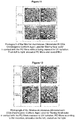
- Figure 2 (image on the left) shows the obtained structure.
- the desired effect was to introduce a special geometric structure into the entire volume of the filter, referred to as beads or thickenings in the framework of the present invention, for the purpose of improving the quality factor of the filter ( Figure 2 on the right).
- a sample of the manufactured filters is shown in Figure 3 .
- a 20% solution by weight of PC in a 50/50 THF/DMF solvent mixture by weight has been used.
- the electrospinning conditions were 10kV of applied voltage, 150 mm of distance between the needle and the collector and 0.5 ml/h of solution dosage.
- the distribution of diameters of the nanofibers ranges in values comprised between 250 and 500nm.
- the structure of beads is characterized in that it has a mean bead diameter of 3.7 ⁇ m and a bead density of about 250000 per cm 2 of filter.
- the nanofiber diameter ranges between 300 and 400 nm.
- the experimental method used in the filtration tests is inspired by standard UNE-EN 1822-3.
- the experimental system used in the tests includes three main parts: the aerosol generation unit, the installation supporting the filter and the particle measuring equipment before and after the filter.
- a polydispersed aerosol is generated from a 0.1% NaCl solution with a Collision-type atomizer.
- the aerosol produced passes through a Nafion membrane dryer that eliminates moisture from the stream.
- the dry aerosol passes through a bipolar ionizer where the particles are neutralized (acquire a Boltzmann distribution) before being conducted to the DMA (differential mobility analyzer) where the particles are sorted according to their aerodynamic size and it allows the monodisperse aerosol to be obtained.
- the flow of the monodisperse stream is divided at the outlet of the DMA into two streams: one of them is conducted to a CPC-1 (condensation particle counter) which measures the concentration of particles before entering the filter; the other current goes to the filter holder where the filter to be tested has been placed.
- the outlet aerosol is taken to CPC-2 which measures the concentration of particles that have gone through the filter.
- the drop in pressure in the filter holder is measured continuously with a magnahelic gauge. Flows are also controlled during testing.
- the aerosol generator and the pre-filtration concentration measuring apparatus are included in the aerosol generator and monitor, AGM (MSP Model 1500) equipment and the post-filtration particle measuring apparatus is included in the humidified tandem differential mobility analyzer, HTDMA, (MSP model 1040XP) equipment.
- AGM MSP Model 1500
- HTDMA humidified tandem differential mobility analyzer
- Table 1 shows the tested materials and samples.
- Material A is a polycarbonate filter developed following manufacturing process A; two samples of this material have been tested: Sample A1 and Sample A2.
- Material B is also a polycarbonate filter developed by means of process B; sample B3 of this material has been tested.
- Material C is a commercial glass fiber filter (47 mm PALL glass fiber).
- Table 2 shows the main characteristics of said reference filter. Table 1. List of tested samples.
- Filtration medium borosilicate glass Pore size 1 ⁇ m (nominal) Typical filter thickness 330 ⁇ m Typical filter weight N/A Typical aerosol retention According to ASTM D 2986-95A 0.3 ⁇ m (DOP) at 32 L/min/100 cm 2 of filter 99.98% Typical air flow rate 60 L/min/cm 2 at 0.7 bar Typical water flow rate ml/min/cm 2 at 0.3 bar Maximum operating temperature Air 550°C
- the tested filters have a diameter of 47 mm. They are tested in a 47 mm Millipore filter holder, model XX4404700, the filtration area of which is 13.8 cm 2 .
- the tests are performed with monodisperse aerosol of 100-200-300-400 and 500 nm and for each sample the test is repeated three times.
- the flow rate of monodisperse aerosol at the outlet of the DMA is 1 L/min, which is divided into a stream going to CPC-1 operating at 0.3 L/min and another stream going to the filter holder at 0.7 L/min.
- the speed through the filtration medium is 0.8 cm/s. This speed is considerably lower than the typical filter test speeds for use in ventilation and personal protection systems which are usually 5-10 and 15 cm/s [UNE-EN 1822-3 High efficiency air filters (EPA, HEPA and ULPA). Part 3: Testing flat sheet filter media; UNE-EN 143:2001/A1 Respiratory protective devices.
- Figure 4 shows the results for Material A according to the present invention.
- the data of sample A1 indicates an efficacy between 99.84-99.86%, whereas for sample A2 efficacy is higher, between 99.88 and 100.00%.
- the data is fairly repetitive in the three tests except for the size of 500 nm, where there is a greater difference between the minimum and maximum values. This scattering of the results is because the number of 500 nm particles of the starting aerosol is fairly low, and therefore mean values are less precise.
- the drop in pressure in the tests with the two samples is 2.6 mm H 2 O.
- Figure 5 shows the comparative results for Material B, sample B3. It can be seen in this graph that filtration efficacy ranges between 99.36 and 99.91 %. Again, the data is fairly repetitive in the three tests except for the size of 500 nm. In this case the drop in pressure is greater, 9.2 mm H 2 O.
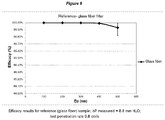
- Figure 6 shows the results for the Pall reference filter; in this case the efficacy values are very high and very similar to those of Material A (sample A2), between 99.93 and 100%, and the drop in pressure is 8.0 mm H2O. Like in the preceding cases, the data is fairly repetitive in the three tests except for the size of 500 nm.
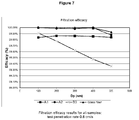
- sample A2 presents a behavior similar to that of the reference glass fiber, although sample A1 shows an efficacy that is slightly lower than the other two.
- sample B3 shows an efficacy lower than the preceding efficacies, and which decreases as the particle size increases.
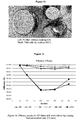
- Figure 8 shows the quality factor (fq) for the four samples. Consistent with the efficacy and drop in pressure data, samples A1 and A2 show a much higher fq due to their high efficacy and lower drop in pressure. The reference material (glass fiber) would present an intermediate fq given its high efficacy, but would present a drop in pressure greater than the samples according to the present invention. Lastly, sample B3 has the lowest fq, due to its lower efficacy and high drop in pressure. Table 3. Summary of filtration efficacy results with the analyzed samples.
- the filtration capacity of particles in air in filters manufactured with nanofibers has been significantly improved by means of optimizing electrospinning parameters, and particularly, developing special volumetric geometric structures in nanomeshes, as well as modifying the structural properties thereof.
- Example 3 Micro / nanofiber filters with improved properties in filtration efficiency and coated to provide them with self-cleaning, antibacterial and / or photocatalytic properties.
- PC filters with beads have been coated with an inorganic coating doped with a silver salt, to provide it with antibacterial capacity.
- the formulation used has the following TIP ratio: AcAc:EtOH:H2O (HCI 0.1 N) 1:1:200:2 and a concentration of AgNO3 of 0.01% by weight with respect to Si.
- the coatings have been applied by means of dipping-extraction at an extraction speed of 300 mm/min, and have been cured for 15 h at 80°C.
- the filters have been coated to study their antibacterial capacity.
- Figure 9 shows a photograph of one of the coated filters and the equipment used for applying the coating.
- the coated filters have been characterized by means of scanning electron microscopy (SEM), ( Figure 10 Error! The source of the reference cannot be found. ) where it can clearly be observed that the coating is deposited on the nanofibers. In most of the filter, the porous structure thereof is not blocked, so it is demonstrated that the alternative of coating the filter is suitable, although it may be necessary to optimize the coating process.
- SEM scanning electron microscopy
- the antibacterial capacity of the filters has been characterized by means of the Microinstant® CCA Chromogenic Coliform Agar kit (ISO).
- ISO Microinstant® CCA Chromogenic Coliform Agar kit
- This is a selective and differential medium for detecting E. coli and total coliforms in water samples by the filtration membrane method.
- the water sample is filtered through a membrane with a pore diameter of 0.45 ⁇ m, validated according to standard ISO 7704:1985, and the membrane is deposited face up on a plate containing the ACC medium, endeavoring not to form bubbles or creases.
- the plate with the membrane is incubated for 18-24 hours at 36 ⁇ 2°C.
- incubation is prolonged up to 24 h to include possible late reactions of ⁇ -galactosidase or of ⁇ -glucuronidase.
- colonies having a color ranging from salmon pink to red are counted as coliform bacteria other than E. coli, and those having colors ranging from dark blue to violet are counted as E. coli.
- the total coliform bacteria count corresponds to the sum of colonies ranging in color from salmon pink to red and the colonies ranging in dark blue to violet.
- FIG. 11 shows the final appearance of the filters, uncoated and coated, after 24 h and 4-6 days of incubation.
- the filters When the filters are coated with a coating that has silver in them, it can be seen that even though there is no UV light, the filters are capable of preventing the growth of bacteria and no significant colony can be seen. These results indicate the self-cleaning capacity thereof, both under UV radiation and when they are only modified with silver.
- PC filters with a micro/nano-fiber structure and micro/nanobeads obtained by process A have been coated using the sol-gel technique modified with silver, described above. Filtration tests have been performed in order to analyze the influence of these coatings both in filtration efficacy and in the drop in pressure of these filters with self-cleaning, photocatalytic and/or antibacterial capacity (AA.
- Figure 13 shows the filters placed in the filter holder before the filtration tests.
- filters having greater thickness referenced as A6 and A7 have been manufactured by increasing the time of the electrospinning process to obtain filtration efficacies greater than those obtained with filters without coating A4 and A5.
- results are presented in the following table, in % of mean filtration efficacy for each of the particle sizes between 50 and 400 nm and in drop in pressure in mm H2O. Testing has not been performed with particle sizes of 500 nm because the equipment is unable to generate an amount of particles suitable for being measured. Two layer-type filters have been tested in order to verify the repeatability of manufacturing same and three filtration measurements of each particle size for which the mean efficacy is depicted have been performed. Table 4. Summary of results of filtration efficacy and drop in pressure in PC filters Ref.
- Filter Characteristic filter Dp Mean efficacy % ⁇ P (mm H2O) AA1 Ag coating 50 99.87 2.6 100 98.51 200 96.26 300 96.35 400 97.88 AA2 Ag coating 50 99.87 100 98.52 200 96.36 300 96.42 400 97.16 A4 Without coating 50 99.99 0.95 100 99.87 200 99.47 300 99.41 400 99.54 A5 Without coating 50 100.00 100 99.96 200 99.75 300 99.67 400 99.70 A6 Without coating Greater thickness 50 99.99 0.93 100 100 200 99.99 300 99.98 400 99.96 A7 Without coating Greater thickness 50 100 100 100 200 100 300 100 400 99.98
Landscapes
- Chemical & Material Sciences (AREA)
- Engineering & Computer Science (AREA)
- Chemical Kinetics & Catalysis (AREA)
- Manufacturing & Machinery (AREA)
- Nanotechnology (AREA)
- Inorganic Chemistry (AREA)
- Filtering Materials (AREA)
Abstract
The invention relates to a filter for particles having sizes of less than 10 micrometers, with a structure based on electrospun fibers from one or more polymers, the fibers being characterized in that they have a diameter between 30 and 1000 nm, and in that they have along their structure thickenings of a diameter of between 0.4 and 10 micrometers, with a thickening density of at least 25,000 thickenings per each cm2 of filter. The invention also relates to a method for manufacturing the filter, uses thereof and a device incorporating same.
Description
- The present invention relates to a filter from electrospun fibers, with micrometric and/or nanometric diameters, said filter having a structure of fibers with beads or thickenings, also of a micro- or nanometric size; the fibers may furthermore be doped in their interior and/or coated, for additional functionalization thereof. They can be used in the filtration of fluids, for example, for improved air filtration, particularly for increasing the filtration efficiency of small-sized particles, as well as for improving their antibacterial and photocatalytic properties, and therefore they allow them to be self-cleaning. It also relates to the process of manufacturing the filters, as well as to their use.
- The need for clean and safe air quality is a global priority [http://ec.euroDa.eu/environment/air/quality/; https://airnow.gov/index.cfm?action=airnow.main], with numerous regulatory directives [http:llec.europa.eu/environment/air/legis.htm; http://www.mapama.gob.es/es/calidad-y-evaluacion-ambiental/temas/atmosfera-y-calidad-del-aire/calidad-del-aire/normativa/] , as well as regulation for safety levels, which must be maintained both in open environments, and in household or industrial interiors, or, in the case of the use of respiratory personal protection equipment [http://www.insht.es/Dortal/site/EEpi/menuitem.0c9dc88588aacbc9a614c52a18 Q311a0/?vgnex toid=7bfb791385e83310VgnVCM1000008130110aRCRD] .
- The problem with particles suspended in air is a serious public health threat, in addition to having an effect on climate, ecosystems and visibility [ Nel, A. Air pollution-related illness: effects of particles. Science 308, 804-806 (2005 ); Mahowald, N. Aerosol indirect effect on biogeochemical cycles and climate. Science 334, 794-796 (2011 ); Horton, D. E., Skinner, C. B., Singh, D. & Diffenbaugh, N. S. Occurrence and persistence of future atmospheric stagnation events. Nat. Clim. ); Andreae, M. O. & Rosenfeld, D. Aerosol-cloud-precipitation interactions. )]. Particulate matter (PM) can be defined, in general terms, as a complex mixture of solid and/or liquid particles, suspended in air, with a wide range of compositions and sizes [ European Environment Agency "Air Quality in Europe - 2013 Report" No 9/2013 ISSN 1725-9177 ], Particulate matter, PM, is classified as PM2.5 for particulate matter with diameters of 2.5 micrometers or less, and as PM10 for particles having diameters of 10 micrometers or less.
- 90% of the population is exposed to unhealthy levels of particles (that is, exposure to particles PM2.5 and PM10) coming from human, industrial or personal activity; furthermore there are the protection needs derived from professional activities, where there is a risk in the case of exposure to particles smaller than <100nm, such as microbiological contaminants, fumes (coming from oils, combustion, cigarettes, etc.) and carbon black, inter alia, in addition to new nanomateriales in the production or industrialization phase.
- The problem with protection for workers exposed to nanomateriales in occupational settings, where nanomaterial is understood to be one in which at least an external dimension of all or part of the particles forming them is less than 100 nanometers [Seguridad y salud en el trabajo con nanomateriales, Instituto Nacional de Seguridad e Higiene en el Trabajo (INSHT) Occupational health and safety with nanomaterials, National Occupational Safety and Hygiene Institute], is centered on the suitable and safe protection of said workers when they are exposed in their occupational setting.
-
Figure 1 shows the deposition probability of the particles of less than 100nm, and the regions of the respiratory system in which they are deposited. Furthermore, it must be taken into account that not all types of particles are eliminated by the body, where their elimination depends on size, morphology and chemical composition [Seguridad y salud en el trabajo con nanomateriales, Instituto Nacional de Seguridad e Higiene en el Trabajo (INSHT)]. - With respect to personal protection equipment to prevent workers from being exposed to nanometric aerosols (<100nm), there are recent studies on the lack of efficiency, even in certified protection equipment, showing high penetration percentages of nanometric particles between 10 nm and 100 nm. Said loss in efficiency, which may reach 10% in standard testing at 85 l/min [ Ronald E. Shaffer Æ Samy Rengasamy, J Nanopart Res (2009) 11:1661-1672 ], may be increased up to 30%, depending on the peak inhalation rate of the user.
- The problem with protection against biothreats present in the air, bioaerosols, or viruses coming from the biopharmaceutical sector lies in the potential survival of microorganisms, of their re-aerosolization, the reuse of protection equipment, the suitable selection and use of the protection equipment, provided that the assigned protection factor is suitable. In relation to biological threats, even with filtration systems with high efficiencies, it cannot be ensured that the personal protection equipment prevents the inhalation of all particles, and therefore they cannot eliminate the risk of exposure, infection and disease [ Qiang Wang, Laleh Golshahi, Da-Ren Chen, Aerosol and Air Quality Research, 17: 2681-2690, 2017 ].
- Furthermore there is a general problem associated with any type of filter, which consists of cleaning and elimination of particles, biothreats, viruses or any type of physical or chemical contaminant that may be trapped in it.
- These unresolved problems in the field of filtering materials for filtration systems for industrial use, household use, for use in transport vehicles, as personal protection equipment, etc., and the use thereof in said devices, have previously been addressed with a wide range of solutions.
- Micro/nanofibers, particularly the polymer nanofibers, are promising for various applications, such as the administration of drugs or tissue engineering [ Hai-Sheng Wang, Guo-Dong Fu, Xin-Song Li, Functional Polymeric Nanofibers from Electrospinning, Recent Patents on Nanotechnology 2009, 3, 21-31 ;
Li, S., Hashi, C., Huang, N.F., Kurpinski, K.: WO07090102A2 (2007 - What makes this technology so versatile is that functional micro/nanofibers can be prepared by electrospinning polymers mixed with additional compounds such as nanoparticles, carbon nanotubes, catalysts, enzymes, etc. Furthermore, functional micro/nanofibers prepared from the surface modification of micro/nanofibers are an important family in various sectors. Based on the advantages described above, electrospinning provides multiple possibilities for the nanostructuring of materials and provides the corresponding functionality to such materials. Both the inner and outer modifications of the nanofibers will furthermore allow the filters to be readily cleaned by means of UV technologies or without the need for radiation, which provides an improved cleaning for a more efficient operation, a longer service life of the filter or filtration system and lower service requirements.
- This technology is based on the continuous generation of a jet by means of immobilizing charges on the surface of a liquid droplet by applying a high voltage. The filters of the present invention have been developed from the most basic electrospinning process, referred to as needle electrospinning. It consists of a syringe in which the solution to be electrospun is located, a needle to which a high voltage is applied, and a grounded collector in which the fibers are collected. The jet that is formed at the outlet of the needle is drawn during its flight to the collector, its diameter decreasing to the nanometric scale.
- The first object of the present invention is a filter for particles having sizes of less than 10 micrometers, with a structure based on electrospun fibers from one or more polymers, selected from at least one of the groups of polycarbonates, polyamides, polyesters, polyurethanes, styrene groups, halogen groups and biopolymers, the fibers being characterized in that they have a diameter between 30 and 1000 nm, and in that they have along their structure thickenings of a diameter of between 0.4 and 10 micrometers, with a thickening density of at least 25000 thickenings per cm2 of filter.
- A second object of the invention is a method for manufacturing the filter of the invention.
- A further object of the present invention is the use of the filter of the invention for filtering nanoparticles with at least a dimension less than 10 micrometers contained in air or water.
- Another object consists of devices incorporating a filter according to the present invention.
-
-
Figure 1 Figure adapted frompage 29 of standard UNE-ISO/TR 12885:2010 IN " Nanotechnologies. Health and safety practices in occupational settings relevant to nanotechnologies" [AENOR; the complete text of the standard can be found at the following link:
http://www.aenor.es/aenor/normas/normas/fichanorma.asp?type=N&codi go=N0046427&PDF=Si]. -
Figure 2 : SEM micrograph of a polycarbonate (PC) nanomesh manufactured by means of:- left: process B described below;
- right: process A described below.
-
Figure 3 : Photograph of a PC filter prepared by means of process B, 47 mm in diameter. -
Figure 4 : Graph depicting the filtration efficacy results for samples A1 and A2; ΔP measured= 2.6 mm H2O; test penetration rate 0.8 cm/s -
Figure 5 : Graph depicting the efficacy results for sample B3; ΔP measured= 9.2 mm H2O; test penetration rate 0.8 cm/s. -
Figure 6 : Graph depicting the efficacy results for a reference sample (glass fiber); ΔP measured= 8 mm H2O; test penetration rate 0.8 cm/s. -
Figure 7 : Graph depicting the filtration efficacy results for all the samples; test penetration rate 0.8 cm/s. -
Figure 8 : Graph depicting the quality factor (fq) results for all the samples; test penetration rate 0.8 cm/s. -
Figure 9 : Photo of the filter coated with the sol-gel solution -
Figure 10 : SEM micrographs of the polycarbonate (PC) covers:- a) uncoated
- b) coated with the sol-gel formulation modified with silver.
-
Figure 11 : Photograph of the filtration membranes (Microinstant® CCA Chromogenic Coliform Agar) used for filtering fecal water in contact with PC filters without being exposed to UV radiation. From left to right, uncoated PC filter and coated filter. -
Figure 12 : Photograph of the filtration membranes (Microinstant® CCA Chromogenic Coliform Agar) used for filtering fecal water in contact with the PC filters exposed to UV radiation. PC filters according to the invention, uncoated on the left, coated on the right. -
Figure 13 :- Left. PC filter without coating (A4).
- Right. Filter with Ag coating (AA1).
-
Figure 14 : Graph depicting the efficacy results for PC filters with and without silver (Ag) coating. Penetration rate: 0.5 cm/s. -
Figure 15 : Graph depicting the results of the pressure drop in filters with and without coating (AA11 and A5, respectively) and commercial glass fiber filter at different air flows. - Micro/nanofibers developed by means of electrospinning are known to have characteristics such as a smaller diameter, orders of magnitude less than conventional fibers, a high surface-volume ratio and high porosity. These properties mean that the influence of the air flow rate is almost close to nil, improving filtration phenomena. [ Hinds, W. C., Aerosol Technology. Properties, Behaviour and Measurement of Airborne Particles. (2nd Ed.) New York, John Wiley & Sons, 1999, 483p ], It has also been described that the subsequent incorporation of micro/nanobeads of a different composition in a fibrillar structure used as a filter improves the efficiency thereof [Microbead/nano-fiber composite air filtration material with gradient structure and preparation method thereof.
CN105999852 ]. - However, in the present invention, there a process has been developed for manufacturing, in a single step, a structure of fibers and beads of one and the same material, with suitable mechanical and physicochemical properties, which allows its use as a filter, with a quality factor greater than 400% with respect to a conventional glass fiber filter by PALL, used as a reference. A filter which additionally has antibacterial and/or photocatalytic properties can be produced in the same single process according to the invention by means of incorporating nanoparticles or active agents in the interior of the fibers, or on their exterior. When said nanoparticles or active agents are on the interior, they are sometimes referred to as "doped" fibers in the scope of the present invention; when they are located on the exterior of the fibers, they form particle aggregates. Dual functionalization of the fibers is also possible, that is, they are simultaneously doped, incorporating functional nanoparticles or active agents in the interior of the fibers, and also coated in the external portion with a nanometric coating, which may optionally be modified with nanoparticles or active agents. In such case, the nanoparticles or active agents doped in the nano/microfibers can be the same as or different from those present in the coating or on the exterior of the fibers.
- Therefore, a first object of the present invention is a filter, with a structure based on electrospun fibers from one or more polymers, for filtering particles having sizes of less than 10 micrometers, the fibers being characterized in that they have a diameter between 30 and 1000 nm, preferably between 200 and 700 nm, and in that they have along their structure thickenings of a diameter of between 0.4 and 10 micrometers, preferably between 1 and 6 micrometers, with a thickening density of at least 25000 thickenings per each cm2 of filter, preferably at least 50000 thickenings per cm2, more preferably at least 100000 thickenings per cm2, still more preferably at least 175000 thickenings per cm2, and particularly preferably at least 250000 thickenings per cm2.
- Among the polymers that this structure may have are polyesters, polyurethanes, polyamides, styrene groups, halogen groups and biopolymers [ Chenyu Wang, Jun Wang, Liangdan Zeng, Ziwen Qiao, Xiaochen Liu, He Liu, Jin Zhang, and Jianxun Ding. Molecules. 2019 Mar; 24(5): 834 ] [ Chuan Yin, Rino Okamoto, Mikihisa Kondo, Toshihisa Tanaka, Hatsuhiko Hattori, Masaki Tanaka, Hiromasa Sato, Shota lino and Yoshitaka Koshiro. Nanomaterials 2018 9(1):34 ]. Polycarbonates are a polymer of particular interest for manufacturing filters by means of electrospinning according to the present invention. Therefore, preferably at least one of the one or more polymers is a polycarbonate, preferably the at least one or more polymers is a polycarbonate.
- The filter object of the invention will particularly improve the filtration efficiency of small-sized particles, PM10, PM2.5, or particles with a diameter < 100nm; as well as the antibacterial and/or photocatalytic efficiency thereof, in the event that the fibers comprise, in their interior or their exterior, nanoparticles or active agents.
- It has been demonstrated by means of the present invention that it is possible to provide filters made of nano/microfibers with beads obtained by electrospinning with added properties, in addition to the filtration capacity per se associated with the filter. This capacity can be enhanced by means of incorporating nanoparticles of a diverse nature (organic, inorganic, ceramic, carbonaceous) or active agents in the interior of the nanofibers and/or modifying their surface by means of nanoparticles or active agents, for example by means of coatings based on sol-gel technology, to provide the filters with antibacterial and photocatalytic properties.
- By means of these organic and/or inorganic coatings optionally modified with nanoparticles and/or active agents (such as biocidal and/or bacteriostatic agents for example), nanoporous filters with advanced properties are achieved (e.g. antibacterial, photocatalytic and antifouling properties, etc.), for the filtration of fluids, particularly water and/or air.
- Therefore, the present invention also relates to a filter like the one defined above for a first object of the invention, characterized in that the fibers in the interior of its structure comprise nanoparticles or active agents, with the nanoparticles having at least one dimension of less than 100 nm and being organic, inorganic, ceramic or carbonaceous, and the active agents being selected from biocidal and/or bacteriostatic agents of the type such as isothiazolones, benzoisothiazolones, chloramines, alkyl or aryl chlorides, or silver salts.
- Likewise, the invention relates to a filter like the one defined above for a first object of the invention, characterized in that the fibers are coated in the external portion with an inorganic or organic nanometric coating, optionally modified with nanoparticles or active agents, with the nanoparticles having at least one dimension of less than 100 nm, and being organic, inorganic, ceramic or carbonaceous, and the active agents being selected from biocidal and/or bacteriostatic agents of the type such as isothiazolones, benzoisothiazolones, chloramines, alkyl or aryl chlorides, or silver salts. The nanometric coating may be, for example, of the type such as silane, siloxane or self-assembled polymer monolayers, inter alia.
- As indicated above, the fibers of the filter according to the invention may both comprise nanoparticles or active agents in the interior of its structure, and also be coated on their external portion by means of a coating optionally modified with nanoparticles or active agents.
- By way of example, the nanoparticles, both in the interior and the exterior of the fibers, may have antibacterial and/or photocatalytic properties. For example, said nanoparticles can be selected from at least one of TiO2, Ag, CeO2 and CuO.
- The active agents, both in the interior and the exterior of the fibers, may be, for example, one or more silver salts, such as for example silver nitrate (AgNO3), silver chloride (AgCI) or silver sulfate (Ag2SO4).
- A second object of the invention is a method for preparing the filter according to the invention defined above, that is, with fibers comprising a structure with thickenings, which comprises the stages of:
- i) preparing a solution based on a polymer or mixture of polymers with its solvent, wherein the percentage by weight of the polymer in the solution is 2-25%;
- ii) mechanically stirring the solution until the complete dissolution of the polymer or mixture of polymers;
- iii) electrospinning the fibers from the predispersion prepared in stage ii).
- The solvents used will depend on the polymer or polymers that are going to be used, and they are those commonly used in electrospinning, and are therefore known by the person having average skill in the art.
- In general the predispersion, that is, the precursor solution of the electrospinning process, must be prepared such that there is a viscosity, surface voltage and conductivity suitable for generating the structure of thickenings of process A. In the specific case described in the examples of the present invention, a solution with 20% by weight of PC at a DMF/
THF 50/50 solvent ratio by weight has been prepared in order to obtain such structure. If the microstructure is not obtained with the indicated thickenings, maintaining the solvent ratio, it will be necessary to gradually reduce the percentage by weight of polymer in the solution by 5%, such that the viscosity of the solution decreases, until achieving said thickenings. - In particular embodiments, the percentage by weight of polymer in the solution is from 8 to 21%, preferably 15 to 20%.
- According to another particular embodiment, at least one polymer is a polycarbonate, or the polymer is a polycarbonate; according to an especially particular embodiment, the polymer is a polycarbonate in the particular percentages indicated above.
- Another object of the invention is a method for manufacturing the filter of the invention comprising nanoparticles (NPs) or active agents in the interior of the electrospun fibers. Said method comprises the following stages:
- i) preparing a stable solution or dispersion of the active agent or NPs in the solvents of the polymer or in the mixture of polymer with its solvent, optionally with the aid of surfactants or mixture of surfactants, wherein the percentage by weight of the surfactant is 1-100% with respect to the weight of the nanoparticles or active agents and the percentage by weight of NPs or active agents is between 0.01 and 50% by weight with respect to the polymer;
- ii) mechanically stirring or stirring by means of ultrasound the mixture obtained in stage 1), until obtaining a solution/dispersion with a mean diameter or mean particle size distribution value of 350 nm or less;
- iii) if the polymer was not incorporated in
stage 1, dissolving the polymer with a nanoparticle or active agent ratio by weight of between 0.01-50% by weight with respect to the polymer and mechanically stirring or stirring by means of ultrasound; - iv) electrospinning the fibers from the predispersion prepared in stage iii).
- The invention also relates to a method for preparing a filter like the ones defined above, with fibers coated in their external portion with a nanometric coating optionally modified with active agents and/or nanoparticles, which, in addition to stages i) to iii) or i) to iv) previously defined, comprises the following stages:
- v) preparing a sol-gel solution with suitable precursors, which comprises:
- a) one or more precursors selected from the group of silicon precursors, such as TEOS (tetraethyl orthosilicate), TMOS (tetramethyl orthosilicate), SiCl4 (silicon tetrachloride), GTPMS (3-glycidoxypropyl)methyldiethoxysilane), APTMS ((3-aminopropyl)-diethoxymethylsilane), MPTMS (3-methacryloyloxy-propyl-trimethoxy-silane), MTMS (methyltrimethoxysilane), HDTMS (hexadecyltrimethoxysilane); or from the group of titanium precursors, such as TIPs (Titanium(IV) isopropoxide); or precursors of other metals such as ZIP (zirconium isopropoxide), aluminum (aluminum isopropoxide) or zinc (zinc acetate);
- b) an organic solvent, preferably ethanol or isopropyl alcohol;
- c) a surfactant or a mixture of surfactants, said surfactants being ionic, non-ionic or amphoteric, wherein the percentage by weight of the surfactant in the mixture is from 1 to 30% with respect to the weight of the nanoparticles or active agents and the percentage by weight of NPs or active agents in the solution is from 1 to 50%;
- vi) optionally, adding the NPs or active agents and mechanically stirring or stirring by means of ultrasound, until obtaining a solution/dispersion of active agents or nanoparticles in the stable precursor solvent or solution, where stable means the absence of visible deposits or aggregates, during the deposition process;
- vii) impregnating a filter based on electrospun fibers with the sol-gel solution obtained after stage v) and optional stage vi), by means of a dip-coating, spray-coating or curtain-coating process;
- viii) curing by means of temperature or at T-20°C with respect to the Tg or Tm of the polymer by means of ultraviolet curing or by means of microwaves.
- A further object of the present invention is the use of the filter of the invention for filtering nanoparticles with at least a dimension less than 10 micrometers contained in air or water.
- Another object is a device incorporating a filter according to the present invention. The fluid to be filtered is preferably water or air. The device may be, for example, a water filtration system, an air filtration system, preferably ventilation and/or climate-control equipment, protective personal equipment (PPE), a water or air treatment facility.
- As indicated above, the filters of the invention could be used in the filtration of fluids; in the case of air filtration, they could be used for the development and manufacture of protective masks, or in ventilation/protection systems. There are air filters on the market, however, which lack or do not show the properties of the filters object of the present invention. The filters described in the present invention can retain very fine particles, such as nanoparticles, and offer low resistance to the passage of air, which is an advantage with respect to current systems, as they present a low drop in pressure. Furthermore, the new properties of the filters will enhance user and environmental safety, since they will prevent bacteria from proliferating on the surface of the filters and their time of use will be increased.
- They could also be used for water treatment, since they are capable of absorbing various specific compounds, such as typical water contaminants or new emerging contaminants, and even eliminating them from the medium when doped or coated with photocatalytic materials. Being able to make the filters self-cleaning or preventing the adherence of molecules therein can improve their efficiency and increases their time of use.
- Below, the invention will be further illustrated by means of examples and experimental results. In no case should they be interpreted as being limiting of the scope of the invention, but rather as a mere illustration of the invention.
- Polycarbonate (hereinafter, PC) has been selected as the material for manufacturing the filter samples. In manufacturing the samples, a large number of tests have been carried out in which several manufacturing parameters have been modified in order to obtain samples with the desired conditions.
- For the purpose of providing comparative data, samples have been developed following two different processes: process A according to the present invention, and process B, included for comparison purposes. In process B, the desired effect was to manufacture the filter with a "standard" structure, that is, that of a non-woven fabric, without beads or thickenings and uniform. For this process, a 20% solution of PC in a 50/50 THF/DMF solvent mixture by weight and 1% by weight of TBAC salt with respect to PC has been prepared. The electrospinning conditions were 15kV of applied voltage, 150 mm of distance between the needle and the collector and 0.1 ml/h of solution dosage.
Figure 2 (image on the left) shows the obtained structure. - With process A, the desired effect was to introduce a special geometric structure into the entire volume of the filter, referred to as beads or thickenings in the framework of the present invention, for the purpose of improving the quality factor of the filter (
Figure 2 on the right). A sample of the manufactured filters is shown inFigure 3 . For this process a 20% solution by weight of PC in a 50/50 THF/DMF solvent mixture by weight has been used. The electrospinning conditions were 10kV of applied voltage, 150 mm of distance between the needle and the collector and 0.5 ml/h of solution dosage. - Both processes have been carried out with a needle having an internal diameter of 0.6 mm. Tests were performed at room temperature and at a humidity between 40 and 50%.
- In the tested samples, in process A (according to the present invention) the distribution of diameters of the nanofibers ranges in values comprised between 250 and 500nm. The structure of beads is characterized in that it has a mean bead diameter of 3.7 µm and a bead density of about 250000 per cm2 of filter.
- In comparative process B, in which there are only fibers, without thickenings, the nanofiber diameter ranges between 300 and 400 nm.
- The experimental method used in the filtration tests is inspired by standard UNE-EN 1822-3. The experimental system used in the tests includes three main parts: the aerosol generation unit, the installation supporting the filter and the particle measuring equipment before and after the filter.
- A polydispersed aerosol is generated from a 0.1% NaCl solution with a Collision-type atomizer. The aerosol produced passes through a Nafion membrane dryer that eliminates moisture from the stream. The dry aerosol passes through a bipolar ionizer where the particles are neutralized (acquire a Boltzmann distribution) before being conducted to the DMA (differential mobility analyzer) where the particles are sorted according to their aerodynamic size and it allows the monodisperse aerosol to be obtained. The flow of the monodisperse stream is divided at the outlet of the DMA into two streams: one of them is conducted to a CPC-1 (condensation particle counter) which measures the concentration of particles before entering the filter; the other current goes to the filter holder where the filter to be tested has been placed. The outlet aerosol is taken to CPC-2 which measures the concentration of particles that have gone through the filter. The drop in pressure in the filter holder is measured continuously with a magnahelic gauge. Flows are also controlled during testing.
- The aerosol generator and the pre-filtration concentration measuring apparatus are included in the aerosol generator and monitor, AGM (MSP Model 1500) equipment and the post-filtration particle measuring apparatus is included in the humidified tandem differential mobility analyzer, HTDMA, (MSP model 1040XP) equipment.
- Table 1 shows the tested materials and samples. Material A is a polycarbonate filter developed following manufacturing process A; two samples of this material have been tested: Sample A1 and Sample A2. Material B is also a polycarbonate filter developed by means of process B; sample B3 of this material has been tested. Lastly, Material C is a commercial glass fiber filter (47 mm PALL glass fiber). Table 2 shows the main characteristics of said reference filter.
Table 1. List of tested samples. Material Sample Description Material A 1 Polycarbonate filter developed by means of electrospinning process A A2 Material B (comparative) B3 Polycarbonate filter developed by means of electrospinning process B Reference (comparative) Glass fiber 47 mm Pall glass fiber filter Table 2. Main characteristics of the 47 mm PALL reference (comparative) glass fiber filter. Filtration medium borosilicate glass Pore size 1 µm (nominal) Typical filter thickness 330 µm Typical filter weight N/A Typical aerosol retention According to ASTM D 2986-95A 0.3 µm (DOP) at 32 L/min/100 cm2 of filter 99.98% Typical air flow rate 60 L/min/cm2 at 0.7 bar Typical water flow rate ml/min/cm2 at 0.3 bar Maximum operating temperature Air 550°C - The tested filters have a diameter of 47 mm. They are tested in a 47 mm Millipore filter holder, model XX4404700, the filtration area of which is 13.8 cm2.
- The tests are performed with monodisperse aerosol of 100-200-300-400 and 500 nm and for each sample the test is repeated three times. The flow rate of monodisperse aerosol at the outlet of the DMA is 1 L/min, which is divided into a stream going to CPC-1 operating at 0.3 L/min and another stream going to the filter holder at 0.7 L/min. Considering the filtration area, the speed through the filtration medium is 0.8 cm/s. This speed is considerably lower than the typical filter test speeds for use in ventilation and personal protection systems which are usually 5-10 and 15 cm/s [UNE-EN 1822-3 High efficiency air filters (EPA, HEPA and ULPA). Part 3: Testing flat sheet filter media; UNE-EN 143:2001/A1 Respiratory protective devices.
- Particle filters. Requirements, testing, marking.]. However, these first tests work with a low speed considering that they are the first filtration tests performed with these new materials in which testing of their mechanical resistance to higher air flow rates has not yet been performed.
- The mean penetration and efficacy through the filters is calculated by means of the following expression:


- Wherein:
- P = mean penetration
- E = mean efficacy
- Cout= mean concentration measured after the filter with CPC-2
- Cin= mean concentration measured before the filter with CPC-1
- The quality factor (fq) or figure of merit has further been calculated according to the expression

- Testing has been performed for the four samples described above (Table 1). The results are presented in % of filtration efficacy for each of the particle sizes between 100 and 500 nm. For each sample, the mean value of efficacy as well as the minimum and maximum values of three tests performed with each of the samples have been depicted. Furthermore, the quality factor (fq) is expressed as 1/Pa (converting the mm H2O measured to Pascals). The obtained results are shown in Table 3. All the penetration values have been rounded off to the second decimal figure.
-
Figure 4 shows the results for Material A according to the present invention. As can be observed, the data of sample A1 indicates an efficacy between 99.84-99.86%, whereas for sample A2 efficacy is higher, between 99.88 and 100.00%. The data is fairly repetitive in the three tests except for the size of 500 nm, where there is a greater difference between the minimum and maximum values. This scattering of the results is because the number of 500 nm particles of the starting aerosol is fairly low, and therefore mean values are less precise. The drop in pressure in the tests with the two samples is 2.6 mm H2O. -
Figure 5 shows the comparative results for Material B, sample B3. It can be seen in this graph that filtration efficacy ranges between 99.36 and 99.91 %. Again, the data is fairly repetitive in the three tests except for the size of 500 nm. In this case the drop in pressure is greater, 9.2 mm H2O. - Lastly,
Figure 6 shows the results for the Pall reference filter; in this case the efficacy values are very high and very similar to those of Material A (sample A2), between 99.93 and 100%, and the drop in pressure is 8.0 mm H2O. Like in the preceding cases, the data is fairly repetitive in the three tests except for the size of 500 nm. - To compare the three materials, the graph in
Figure 7 , which includes the results of the three materials and four samples, has been prepared. As can be observed, sample A2 presents a behavior similar to that of the reference glass fiber, although sample A1 shows an efficacy that is slightly lower than the other two. Lastly, sample B3 shows an efficacy lower than the preceding efficacies, and which decreases as the particle size increases. - In regard to drops in pressure due to the filter, the data shows that for samples according to the present invention (samples A1 and A2), said drop is much lower than the third sample (B3) and the Pall reference filter. This is undoubtedly a surprising result which confirms that variations in the manufacturing process introduced for manufacturing Material A are very positive.
- Lastly,
Figure 8 shows the quality factor (fq) for the four samples. Consistent with the efficacy and drop in pressure data, samples A1 and A2 show a much higher fq due to their high efficacy and lower drop in pressure. The reference material (glass fiber) would present an intermediate fq given its high efficacy, but would present a drop in pressure greater than the samples according to the present invention. Lastly, sample B3 has the lowest fq, due to its lower efficacy and high drop in pressure.Table 3. Summary of filtration efficacy results with the analyzed samples. Material Sample Dp* (nm) Mean efficacy % Maximum Minimum ΔP (mm H2O) MAT A A1 100 99.84% 99.85% 99.83% 2.6 200 99.86% 99.87% 99.86% 300 99.86% 99.88% 99.85% 400 99.85% 99.88% 99.84% 500 99.84% 99.90% 99.73 % A2 100 100.00% 100.00% 100.00% 200 99.98% 99.99% 99.98% 300 99.98% 99.98% 99.98% 400 100.00% 100.00% 100.00% 500 99.88% 100.00% 99.63% MAT B B3 100 99.91% 99.93% 99.89% 9.2 200 99.78% 99.82% 99.71% 300 99.62% 99.68% 99.55% 400 99.48% 99.61% 99.29% 500 99.36% 99.53% 99.07% REF Glass fiber 100 100.00% 100.00% 100.00% 8.0 200 100.00% 100.00% 100.00% 300 100.00% 100.00% 99.99% 400 99.99% 99.99% 99.98% 500 99.93% 99.99% 99.82% *Dp = Particle diameter - The filtration capacity of particles in air in filters manufactured with nanofibers has been significantly improved by means of optimizing electrospinning parameters, and particularly, developing special volumetric geometric structures in nanomeshes, as well as modifying the structural properties thereof.
- Upon comparing the results obtained with the nanometric filters manufactured from Material A of the invention and comparative Material B, it is shown that not only has the efficacy of the material been increased, even when the mean diameter of the nanofibers of Material A according to the invention is greater than that of comparative Material B by about 100%, but rather, much more importantly, the drop in pressure has been reduced by 72% and, accordingly, the quality factor has been improved by almost 400%. Furthermore, if compared with the reference (glass fiber) filter, improving the quality factor by a not at all negligible 172% has also been achieved.
- PC filters with beads have been coated with an inorganic coating doped with a silver salt, to provide it with antibacterial capacity. The formulation used has the following TIP ratio: AcAc:EtOH:H2O (HCI 0.1 N) 1:1:200:2 and a concentration of AgNO3 of 0.01% by weight with respect to Si. The coatings have been applied by means of dipping-extraction at an extraction speed of 300 mm/min, and have been cured for 15 h at 80°C. The filters have been coated to study their antibacterial capacity.
-
Figure 9 shows a photograph of one of the coated filters and the equipment used for applying the coating. - The coated filters have been characterized by means of scanning electron microscopy (SEM), (
Figure 10 Error! The source of the reference cannot be found.) where it can clearly be observed that the coating is deposited on the nanofibers. In most of the filter, the porous structure thereof is not blocked, so it is demonstrated that the alternative of coating the filter is suitable, although it may be necessary to optimize the coating process. - The antibacterial capacity of the filters has been characterized by means of the Microinstant® CCA Chromogenic Coliform Agar kit (ISO). This is a selective and differential medium for detecting E. coli and total coliforms in water samples by the filtration membrane method. The water sample is filtered through a membrane with a pore diameter of 0.45 µm, validated according to standard ISO 7704:1985, and the membrane is deposited face up on a plate containing the ACC medium, endeavoring not to form bubbles or creases. The plate with the membrane is incubated for 18-24 hours at 36 ± 2°C. If at 18 h red or colorless colonies appear, incubation is prolonged up to 24 h to include possible late reactions of β-galactosidase or of β-glucuronidase. After the incubation period, colonies having a color ranging from salmon pink to red are counted as coliform bacteria other than E. coli, and those having colors ranging from dark blue to violet are counted as E. coli. The total coliform bacteria count corresponds to the sum of colonies ranging in color from salmon pink to red and the colonies ranging in dark blue to violet.
- Taking into account the microbiological tests performed in standard UNE 149101, water has been doped with fecal water to introduce a concentration of E. coli and other coliform bacteria suitable for measurement.
- The covers have been in contact with the doped H2O for 24 h, with and without UV light. After this time, the water is filtered according to the established method.
Figure 11 shows the final appearance of the filters, uncoated and coated, after 24 h and 4-6 days of incubation. - When the filters are coated with a coating that has silver in them, it can be seen that even though there is no UV light, the filters are capable of preventing the growth of bacteria and no significant colony can be seen. These results indicate the self-cleaning capacity thereof, both under UV radiation and when they are only modified with silver.
- PC filters with a micro/nano-fiber structure and micro/nanobeads obtained by process A have been coated using the sol-gel technique modified with silver, described above. Filtration tests have been performed in order to analyze the influence of these coatings both in filtration efficacy and in the drop in pressure of these filters with self-cleaning, photocatalytic and/or antibacterial capacity (AA.
Figure 13 shows the filters placed in the filter holder before the filtration tests. - Furthermore, filters having greater thickness referenced as A6 and A7 have been manufactured by increasing the time of the electrospinning process to obtain filtration efficacies greater than those obtained with filters without coating A4 and A5.
- The results are presented in the following table, in % of mean filtration efficacy for each of the particle sizes between 50 and 400 nm and in drop in pressure in mm H2O. Testing has not been performed with particle sizes of 500 nm because the equipment is unable to generate an amount of particles suitable for being measured.
Two layer-type filters have been tested in order to verify the repeatability of manufacturing same and three filtration measurements of each particle size for which the mean efficacy is depicted have been performed.Table 4. Summary of results of filtration efficacy and drop in pressure in PC filters Ref. Filter Characteristic filter Dp (nm) Mean efficacy % ΔP (mm H2O) AA1 Ag coating 50 99.87 2.6 100 98.51 200 96.26 300 96.35 400 97.88 AA2 Ag coating 50 99.87 100 98.52 200 96.36 300 96.42 400 97.16 A4 Without coating 50 99.99 0.95 100 99.87 200 99.47 300 99.41 400 99.54 A5 Without coating 50 100.00 100 99.96 200 99.75 300 99.67 400 99.70 A6 Without coating Greater thickness 50 99.99 0.93 100 100 200 99.99 300 99.98 400 99.96 A7 Without coating Greater thickness 50 100 100 100 200 100 300 100 400 99.98 - It can be concluded from these results that the silver coating deposited on the filters does not significantly affect the drop in pressure. However, this coating slightly decreases the filtration efficacy, having values between 96.36% and 99.88%, a fact that can be improved by increasing the thickness of the filter before coating, as observed in
Figure 14 . - The results obtained are repetitive in all cases and generally very high efficacies are obtained, in some cases reaching 100% for all tested particle sizes. The drops in pressure in filters of this type with a bead structure are very low compared with a commercial glass fiber filter, even when the coating is applied (
Figure 15 ).
Claims (15)
- A filter for particles having sizes of less than 10 micrometers, with a structure based on electrospun fibers from one or more polymers, selected from at least one of the groups of polycarbonates, polyamides, polyesters, polyurethanes, styrene groups, halogen groups and biopolymers, the fibers being characterized in that they have a diameter between 30 and 1000 nm, and in that they have along their structure thickenings of a diameter of between 0.4 and 10 micrometers, with a thickening density of at least 25000 thickenings per cm2 of filter.
- The filter according to claim 1, characterized in that the fibers in the interior of its structure comprise nanoparticles or active agents, with the nanoparticles having at least one dimension of less than 100 nm and being organic, inorganic, ceramic or carbonaceous, and the active agents being selected from biocidal and/or bacteriostatic agents of the type such as isothiazolones, benzoisothiazolones, chloramines, alkyl or aryl chlorides, or silver salts.
- The filter according to any one of claims 1 or 2, characterized in that the fibers are coated in the external portion with an inorganic or organic nanometric coating optionally modified with nanoparticles or active agents, with the nanoparticles having at least one dimension of less than 100 nm, and being organic, inorganic, ceramic or carbonaceous, and the active agents being selected from biocidal and/or bacteriostatic agents of the type such as isothiazolones, benzoisothiazolones, chloramines, alkyl or aryl chlorides, or silver salts.
- The filter according to any one of claims 2 or 3, characterized in that the nanoparticles have antibacterial and/or photocatalytic properties.
- The filter according to any one of claims 2 to 4, characterized in that the nanoparticles are selected from at least one of TiO2, Ag, CeO2, CuO.
- The filter according to any one of claims 2 or 3, characterized in that the active agents are one or more silver salts, preferably silver nitrate (AgNO3), silver chloride (AgCI) or silver sulfate (Ag2SO4).
- The filter according to any one of the preceding claims, characterized in that at least one of the one or more polymers is polycarbonate, preferably the at least one or more polymers is polycarbonate.
- A method for preparing the filter defined in claim 1, with fibers comprising a structure with thickenings, which comprises the stages of:i) preparing a solution based on a polymer or mixture of polymers with its solvent, wherein the percentage by weight of the polymer in the solution is 2-25%;ii) mechanically stirring the solution until the complete dissolution of the polymer or mixture of polymers, obtaining a predispersion;iii) electrospinning the fibers from the predispersion prepared in stage ii).
- A method for preparing the filter defined in claims 2 to 7, with fibers comprising nanoparticles (NPs) or active agents in the interior of the electrospun fibers, characterized in that it comprises the stages of:i) preparing a stable solution or dispersion of the active agent or NPs in the solvents of the polymer or in the mixture of polymer with its solvent, optionally with the aid of surfactants or mixture of surfactants, wherein the percentage by weight of the surfactant is 1-100% with respect to the weight of the nanoparticles or active agents, and the percentage by weight of NPs or active agents is between 0.01 and 50% by weight with respect to the polymer.ii) mechanically stirring or stirring by means of ultrasound the mixture obtained in stage 1), until obtaining a solution/dispersion with a mean diameter or mean particle size distribution value of 350 nm or less;iii) if the polymer was not incorporated in stage 1, dissolving the polymer for it to have a nanoparticle or active agent concentration of between 0.01-50% by weight with respect to the polymer and mechanically stirring or stirring by means of ultrasound;iv) electrospinning the fibers from the predispersion prepared in stage iii).
- A method for preparing a filter defined in claims 3 to 7, with fibers coated in their external portion with a nanometric coating optionally modified with active agents and/or nanoparticles, characterized in that after stages i) to iii) defined in claim 8, or after stages i) to iv) defined in claim 9, it comprises the stages of:v) preparing a sol-gel solution with suitable precursors, which comprises:a) one or more precursors selected from the group of silicon precursors, such as TEOS (tetraethyl orthosilicate), TMOS (tetramethyl orthosilicate), SiCl4 (silicon tetrachloride), GTPMS (3-glycidoxypropyl)methyldiethoxysilane), APTMS ((3-aminopropyl)-diethoxymethylsilane), MPTMS (3-methacryloyloxy-propyl-trimethoxy-silane), MTMS (methyltrimethoxysilane), HDTMS (hexadecyltrimethoxysilane); or from the group of titanium precursors, such as TIPs (Titanium(IV) isopropoxide); or precursors of other metals such as ZIP (zirconium isopropoxide), aluminum (aluminum isopropoxide) or zinc (zinc acetate);b) an organic solvent, preferably ethanol or isopropyl alcohol;c) a surfactant or a mixture of surfactants, said surfactants being ionic, non-ionic or amphoteric, wherein the percentage by weight of the surfactant in the mixture is from 1 to 30% with respect to the weight of the nanoparticles or active agents and the percentage by weight of NPs or active agents in the solution is from 1 to 50%;vi) optionally, adding the NPs or active agents and mechanically stirring or stirring by means of ultrasound, until obtaining a solution/dispersion of active agents or nanoparticles in the stable precursor solvent or solution, where stable means the absence of visible deposits or aggregates, during the deposition process;vii) impregnating the filter obtained after stage iv) with the sol-gel solution obtained after stage v) and optional stage vi), by means of a dip-coating, spray-coating or curtain-coating process;viii) curing by means of temperature at T-20 °C with respect to the Tg or Tm of the polymer, by means of ultraviolet curing, or by means of microwaves.
- Use of the filter of any one of claims 1 to 7, for filtering nanoparticles with at least a dimension less than 10 micrometers contained in air or water.
- A device for filtering a fluid, characterized in that it contains a filter according to any one of claims 1 to 7.
- The device according to claim 12, wherein the fluid is air or water.
- The device according to any one of claims 12 or 13, wherein the device is a water filtration system, an air filtration system, preferably ventilation and/or climate-control equipment, protective personal equipment (PPE), a water or air treatment facility.
- A self-cleaning filtration device, characterized in that it contains a filter according to any one of claims 1 to 7 and a UV lamp.
Priority Applications (2)
| Application Number | Priority Date | Filing Date | Title |
|---|---|---|---|
| EP20382224.2A EP3885032A1 (en) | 2020-03-24 | 2020-03-24 | Smart filters with improved properties in filtration and antibacterial efficiency applicable in fluids |
| PCT/EP2021/057638 WO2021191309A1 (en) | 2020-03-24 | 2021-03-24 | Smart filters with improved properties in filtration and antibacterial efficiency applicable in fluids |
Applications Claiming Priority (1)
| Application Number | Priority Date | Filing Date | Title |
|---|---|---|---|
| EP20382224.2A EP3885032A1 (en) | 2020-03-24 | 2020-03-24 | Smart filters with improved properties in filtration and antibacterial efficiency applicable in fluids |
Publications (1)
| Publication Number | Publication Date |
|---|---|
| EP3885032A1 true EP3885032A1 (en) | 2021-09-29 |
Family
ID=70333901
Family Applications (1)
| Application Number | Title | Priority Date | Filing Date |
|---|---|---|---|
| EP20382224.2A Withdrawn EP3885032A1 (en) | 2020-03-24 | 2020-03-24 | Smart filters with improved properties in filtration and antibacterial efficiency applicable in fluids |
Country Status (2)
| Country | Link |
|---|---|
| EP (1) | EP3885032A1 (en) |
| WO (1) | WO2021191309A1 (en) |
Families Citing this family (2)
| Publication number | Priority date | Publication date | Assignee | Title |
|---|---|---|---|---|
| CN118022556B (en) * | 2024-04-12 | 2024-06-11 | 四川大学 | A PEI-modified PVDF self-cleaning membrane loaded with CuZn-C and its preparation method and application |
| CN121550844A (en) * | 2026-01-22 | 2026-02-24 | 浙江柔荷新能源材料有限公司 | Antibacterial-catalytic difunctional nanofiber air filtering membrane and preparation method thereof |
Citations (10)
| Publication number | Priority date | Publication date | Assignee | Title |
|---|---|---|---|---|
| WO2007090102A2 (en) | 2006-01-27 | 2007-08-09 | The Regents Of The University Of California | Biomimetic scaffolds |
| KR100811205B1 (en) * | 2006-08-17 | 2008-03-07 | (주) 아모센스 | Antibacterial nano-fibers containing silver nano-particles and preparation method thereof |
| WO2013051185A1 (en) * | 2011-10-03 | 2013-04-11 | パナソニック株式会社 | Filter medium for air filters, air filter, air purifier provided with air filter and air purifier with humidifying function |
| WO2013142306A1 (en) * | 2012-03-19 | 2013-09-26 | Cornell University | Charged nanofibers and methods for making |
| CN103952783A (en) * | 2014-04-04 | 2014-07-30 | 苏州大学 | Bead-like porous PLA (Poly Lactic Acid) nano fiber as well as preparation method and application thereof |
| EP2881157A1 (en) * | 2013-12-09 | 2015-06-10 | Nano and Advanced Materials Institute Limited | Interlaced filtration barrier |
| CN105999852A (en) | 2016-06-02 | 2016-10-12 | 河北科技大学 | Microbead/nano-fiber composite air filtration material with gradient structure and preparation method thereof |
| CN106984201A (en) * | 2017-05-08 | 2017-07-28 | 河北科技大学 | Nanometer spider web/beading fiber composite air-filtering membrane and preparation method thereof |
| WO2018027479A1 (en) * | 2016-08-08 | 2018-02-15 | The University Of Hong Kong | Preparation of hand-carry gravity-driven water filter with high throughput and water disinfection performance |
| US20180080148A1 (en) * | 2016-09-16 | 2018-03-22 | Paul K. Westerhoff | Electrospun polymeric porous fibers containing nanomaterials |
-
2020
- 2020-03-24 EP EP20382224.2A patent/EP3885032A1/en not_active Withdrawn
-
2021
- 2021-03-24 WO PCT/EP2021/057638 patent/WO2021191309A1/en not_active Ceased
Patent Citations (10)
| Publication number | Priority date | Publication date | Assignee | Title |
|---|---|---|---|---|
| WO2007090102A2 (en) | 2006-01-27 | 2007-08-09 | The Regents Of The University Of California | Biomimetic scaffolds |
| KR100811205B1 (en) * | 2006-08-17 | 2008-03-07 | (주) 아모센스 | Antibacterial nano-fibers containing silver nano-particles and preparation method thereof |
| WO2013051185A1 (en) * | 2011-10-03 | 2013-04-11 | パナソニック株式会社 | Filter medium for air filters, air filter, air purifier provided with air filter and air purifier with humidifying function |
| WO2013142306A1 (en) * | 2012-03-19 | 2013-09-26 | Cornell University | Charged nanofibers and methods for making |
| EP2881157A1 (en) * | 2013-12-09 | 2015-06-10 | Nano and Advanced Materials Institute Limited | Interlaced filtration barrier |
| CN103952783A (en) * | 2014-04-04 | 2014-07-30 | 苏州大学 | Bead-like porous PLA (Poly Lactic Acid) nano fiber as well as preparation method and application thereof |
| CN105999852A (en) | 2016-06-02 | 2016-10-12 | 河北科技大学 | Microbead/nano-fiber composite air filtration material with gradient structure and preparation method thereof |
| WO2018027479A1 (en) * | 2016-08-08 | 2018-02-15 | The University Of Hong Kong | Preparation of hand-carry gravity-driven water filter with high throughput and water disinfection performance |
| US20180080148A1 (en) * | 2016-09-16 | 2018-03-22 | Paul K. Westerhoff | Electrospun polymeric porous fibers containing nanomaterials |
| CN106984201A (en) * | 2017-05-08 | 2017-07-28 | 河北科技大学 | Nanometer spider web/beading fiber composite air-filtering membrane and preparation method thereof |
Non-Patent Citations (11)
| Title |
|---|
| ANDREAE, M. 0.ROSENFELD, D.: "Aerosol-cloud-precipitation interactions. Part 1. The nature and sources of cloud-active aerosols", EARTH SCI. REV., vol. 89, 2008, pages 13 - 41, XP022707940, DOI: 10.1016/j.earscirev.2008.03.001 |
| CHENYU WANGJUN WANGLIANGDAN ZENGZIWEN QIAOXIAOCHEN LIUHE LIUJIN ZHANGJIANXUN DING, MOLECULES, vol. 24, no. 5, March 2019 (2019-03-01), pages 834 |
| CHO CHIA-JUNG ET AL: "Green electrospun nanofiber membranes filter prepared from novel biomass thermoplastic copolyester: Morphologies and filtration properties", JOURNAL OF THE TAIWAN INSTITUTE OF CHEMICAL ENGINEERS, ELSEVIER, AMSTERDAM, NL, vol. 106, 22 November 2019 (2019-11-22), pages 206 - 214, XP086011950, ISSN: 1876-1070, [retrieved on 20191122], DOI: 10.1016/J.JTICE.2019.11.002 * |
| CHUAN YINRINO OKAMOTOMIKIHISA KONDOTOSHIHISA TANAKAHATSUHIKO HATTORIMASAKI TANAKAHIROMASA SATOSHOTA LINOYOSHITAKA KOSHIRO, NANOMATERIALS, vol. 9, no. 1, 2018, pages 34 |
| HAI-SHENG WANGGUO-DONG FUXIN-SONG LI: "Functional Polymeric Nanofibers from Electrospinning", RECENT PATENTS ON NANOTECHNOLOGY, vol. 3, 2009, pages 21 - 31 |
| HINDS, W. C.: "Properties, Behaviour and Measurement of Airborne Particles", 1999, JOHN WILEY & SONS, article "Aerosol Technology", pages: 483 |
| HORTON, D. E.SKINNER, C. B.SINGH, D.DIFFENBAUGH, N. S.: "Occurrence and persistence of future atmospheric stagnation events", NAT. CLIM. CHANGE, vol. 4, 2014, pages 698 - 703 |
| MAHOWALD, N: "Aerosol indirect effect on biogeochemical cycles and climate", SCIENCE, vol. 334, 2011, pages 794 - 796 |
| NE/, A: "Air pollution-related illness: effects of particles", SCIENCE, vol. 308, 2005, pages 804 - 806 |
| QIANG WANGLALEH GOLSHAHIDA-REN CHEN, AEROSOL AND AIR QUALITY RESEARCH, vol. 17, 2017, pages 2681 - 2690 |
| RONALD ESHAFFER/E SAMY RENGASAMY, J NANOPART RES, vol. 11, 2009, pages 1661 - 1672 |
Also Published As
| Publication number | Publication date |
|---|---|
| WO2021191309A1 (en) | 2021-09-30 |
Similar Documents
| Publication | Publication Date | Title |
|---|---|---|
| Bortolassi et al. | Efficient nanoparticles removal and bactericidal action of electrospun nanofibers membranes for air filtration | |
| Xiong et al. | Flexible hydroxyapatite ultralong nanowire-based paper for highly efficient and multifunctional air filtration | |
| US11814752B2 (en) | Charged nanofibers and methods for making | |
| US7789930B2 (en) | Particle filter system incorporating nanofibers | |
| Xu et al. | Directional water transfer janus nanofibrous porous membranes for particulate matter filtration and volatile organic compound adsorption | |
| Sohrabi et al. | Fabrication and evaluation of electrospun polyacrylonitrile/silver nanofiber membranes for air filtration and antibacterial activity | |
| US20230089270A1 (en) | Dual application nanoparticle coated filtration system for air pollution and virus abatement | |
| Lakshmanan et al. | Inorganic-organic nanofiber networks with antibacteria properties for enhanced particulate filtration: The critical role of amorphous titania | |
| EP3885032A1 (en) | Smart filters with improved properties in filtration and antibacterial efficiency applicable in fluids | |
| JP5913875B2 (en) | Nanofiber | |
| Liu et al. | Superhydrophobic and highly moisture-resistant PVA@ EC composite membrane for air purification | |
| Dehghan et al. | Production of nanofibers containing magnesium oxide nanoparticles for the purpose of bioaerosol removal | |
| IL296439A (en) | Filter | |
| Jiang et al. | Three-dimensional composite electrospun nanofibrous membrane by multi-jet electrospinning with sheath gas for high-efficiency antibiosis air filtration | |
| Wang et al. | Reusable electrospun nanofibrous membranes with antibacterial activity for air filtration | |
| Wong et al. | Electrospun polystyrene and acid-treated cellulose nanocrystals with intense pulsed light treatment for N95-equivalent filters | |
| Kim et al. | Facile nanostructured zinc oxide coating technique for antibacterial and antifouling air filters with low pressure drop | |
| Sabirova et al. | Flexible isoporous air filters for high-efficiency particle capture | |
| JP2014144420A (en) | Filtering material for antibacterial air filter | |
| Edrisi et al. | Preparation of an innovative series of respiratory nano-filters using polystyrene fibrous films containing KCC-1 dendrimer and ZnO nanostructures for environmental assessment of SO 2, NO 2 and CO 2 | |
| US20230380525A1 (en) | Nanoparticles for use in anti pathogenic applications | |
| Jiang et al. | Particle removal and antibacterial of nanofiber doped with metal and ions prepared by electrospinning | |
| EP4205829A1 (en) | Web-film filter formed of aliphatic polyester fiber for purifying air, and method for producing same | |
| JP5564220B2 (en) | Composite structure including three-dimensional structure and filter using the structure | |
| KR102582637B1 (en) | Composition for multifunctional nanofiber formation, preparation method thereof, multifunctional nanofiber, porous filtration filter by the multifunctional nanofiber, and filtration device |
Legal Events
| Date | Code | Title | Description |
|---|---|---|---|
| PUAI | Public reference made under article 153(3) epc to a published international application that has entered the european phase |
Free format text: ORIGINAL CODE: 0009012 |
|
| STAA | Information on the status of an ep patent application or granted ep patent |
Free format text: STATUS: THE APPLICATION HAS BEEN PUBLISHED |
|
| AK | Designated contracting states |
Kind code of ref document: A1 Designated state(s): AL AT BE BG CH CY CZ DE DK EE ES FI FR GB GR HR HU IE IS IT LI LT LU LV MC MK MT NL NO PL PT RO RS SE SI SK SM TR |
|
| STAA | Information on the status of an ep patent application or granted ep patent |
Free format text: STATUS: THE APPLICATION IS DEEMED TO BE WITHDRAWN |
|
| 18D | Application deemed to be withdrawn |
Effective date: 20220330 |