EP3884804A1 - Protective clothing - Google Patents
Protective clothing Download PDFInfo
- Publication number
- EP3884804A1 EP3884804A1 EP19887292.1A EP19887292A EP3884804A1 EP 3884804 A1 EP3884804 A1 EP 3884804A1 EP 19887292 A EP19887292 A EP 19887292A EP 3884804 A1 EP3884804 A1 EP 3884804A1
- Authority
- EP
- European Patent Office
- Prior art keywords
- protective clothing
- nonwoven fabric
- garment
- hood
- opening
- Prior art date
- Legal status (The legal status is an assumption and is not a legal conclusion. Google has not performed a legal analysis and makes no representation as to the accuracy of the status listed.)
- Withdrawn
Links
- 230000001681 protective effect Effects 0.000 title claims abstract description 219
- 239000004745 nonwoven fabric Substances 0.000 claims abstract description 160
- 239000000463 material Substances 0.000 claims abstract description 62
- 238000009423 ventilation Methods 0.000 claims abstract description 35
- 238000012856 packing Methods 0.000 claims description 55
- 238000012545 processing Methods 0.000 claims description 33
- 210000001217 buttock Anatomy 0.000 claims description 22
- 230000001954 sterilising effect Effects 0.000 claims description 20
- 238000004659 sterilization and disinfection Methods 0.000 claims description 20
- 210000003423 ankle Anatomy 0.000 claims description 5
- 238000009833 condensation Methods 0.000 abstract description 19
- 230000005494 condensation Effects 0.000 abstract description 19
- 239000004744 fabric Substances 0.000 description 89
- 210000003128 head Anatomy 0.000 description 50
- 239000004750 melt-blown nonwoven Substances 0.000 description 48
- 239000000835 fiber Substances 0.000 description 29
- 238000000034 method Methods 0.000 description 28
- 239000004831 Hot glue Substances 0.000 description 24
- 229920001971 elastomer Polymers 0.000 description 22
- 239000000428 dust Substances 0.000 description 17
- 239000013013 elastic material Substances 0.000 description 16
- -1 polyethylene Polymers 0.000 description 15
- 238000009958 sewing Methods 0.000 description 14
- 239000010410 layer Substances 0.000 description 13
- 230000000052 comparative effect Effects 0.000 description 12
- 239000007921 spray Substances 0.000 description 12
- 239000003344 environmental pollutant Substances 0.000 description 11
- 238000011156 evaluation Methods 0.000 description 11
- 238000010586 diagram Methods 0.000 description 9
- 230000002349 favourable effect Effects 0.000 description 9
- IAYPIBMASNFSPL-UHFFFAOYSA-N Ethylene oxide Chemical compound C1CO1 IAYPIBMASNFSPL-UHFFFAOYSA-N 0.000 description 8
- 238000004826 seaming Methods 0.000 description 8
- 239000004698 Polyethylene Substances 0.000 description 7
- 229920000573 polyethylene Polymers 0.000 description 7
- 229920005672 polyolefin resin Polymers 0.000 description 7
- 229920005989 resin Polymers 0.000 description 7
- 239000011347 resin Substances 0.000 description 7
- 238000012360 testing method Methods 0.000 description 7
- 239000012943 hotmelt Substances 0.000 description 6
- 230000000704 physical effect Effects 0.000 description 6
- 210000002414 leg Anatomy 0.000 description 5
- 229920000098 polyolefin Polymers 0.000 description 5
- 239000004743 Polypropylene Substances 0.000 description 4
- 239000004793 Polystyrene Substances 0.000 description 4
- 238000007599 discharging Methods 0.000 description 4
- 230000001747 exhibiting effect Effects 0.000 description 4
- 239000004751 flashspun nonwoven Substances 0.000 description 4
- 210000001061 forehead Anatomy 0.000 description 4
- 238000010030 laminating Methods 0.000 description 4
- 239000002245 particle Substances 0.000 description 4
- 229920001155 polypropylene Polymers 0.000 description 4
- 229920002223 polystyrene Polymers 0.000 description 4
- 239000000047 product Substances 0.000 description 4
- 239000000126 substance Substances 0.000 description 4
- 229920002994 synthetic fiber Polymers 0.000 description 4
- 239000012209 synthetic fiber Substances 0.000 description 4
- 238000011144 upstream manufacturing Methods 0.000 description 4
- XLYOFNOQVPJJNP-UHFFFAOYSA-N water Chemical compound O XLYOFNOQVPJJNP-UHFFFAOYSA-N 0.000 description 4
- 238000003466 welding Methods 0.000 description 4
- 241000894006 Bacteria Species 0.000 description 3
- 241000700605 Viruses Species 0.000 description 3
- 238000007664 blowing Methods 0.000 description 3
- 239000000356 contaminant Substances 0.000 description 3
- 230000003247 decreasing effect Effects 0.000 description 3
- 210000002683 foot Anatomy 0.000 description 3
- 238000005304 joining Methods 0.000 description 3
- 238000005259 measurement Methods 0.000 description 3
- 239000000155 melt Substances 0.000 description 3
- 239000002356 single layer Substances 0.000 description 3
- CNGYZEMWVAWWOB-VAWYXSNFSA-N 5-[[4-anilino-6-[bis(2-hydroxyethyl)amino]-1,3,5-triazin-2-yl]amino]-2-[(e)-2-[4-[[4-anilino-6-[bis(2-hydroxyethyl)amino]-1,3,5-triazin-2-yl]amino]-2-sulfophenyl]ethenyl]benzenesulfonic acid Chemical compound N=1C(NC=2C=C(C(\C=C\C=3C(=CC(NC=4N=C(N=C(NC=5C=CC=CC=5)N=4)N(CCO)CCO)=CC=3)S(O)(=O)=O)=CC=2)S(O)(=O)=O)=NC(N(CCO)CCO)=NC=1NC1=CC=CC=C1 CNGYZEMWVAWWOB-VAWYXSNFSA-N 0.000 description 2
- 229920001474 Flashspun fabric Polymers 0.000 description 2
- 208000008454 Hyperhidrosis Diseases 0.000 description 2
- 239000004734 Polyphenylene sulfide Substances 0.000 description 2
- 239000000853 adhesive Substances 0.000 description 2
- 230000001070 adhesive effect Effects 0.000 description 2
- 239000003086 colorant Substances 0.000 description 2
- 230000007547 defect Effects 0.000 description 2
- 230000000694 effects Effects 0.000 description 2
- 210000004709 eyebrow Anatomy 0.000 description 2
- 239000004816 latex Substances 0.000 description 2
- 229920000126 latex Polymers 0.000 description 2
- 239000000203 mixture Substances 0.000 description 2
- 239000012466 permeate Substances 0.000 description 2
- 229920000747 poly(lactic acid) Polymers 0.000 description 2
- 239000004417 polycarbonate Substances 0.000 description 2
- 229920000515 polycarbonate Polymers 0.000 description 2
- 229920000728 polyester Polymers 0.000 description 2
- 229920000139 polyethylene terephthalate Polymers 0.000 description 2
- 239000005020 polyethylene terephthalate Substances 0.000 description 2
- 239000004626 polylactic acid Substances 0.000 description 2
- 229920000069 polyphenylene sulfide Polymers 0.000 description 2
- 239000000243 solution Substances 0.000 description 2
- 239000002904 solvent Substances 0.000 description 2
- 238000009987 spinning Methods 0.000 description 2
- 238000003860 storage Methods 0.000 description 2
- 208000013460 sweaty Diseases 0.000 description 2
- 230000037303 wrinkles Effects 0.000 description 2
- KZEVSDGEBAJOTK-UHFFFAOYSA-N 1-(2,4,6,7-tetrahydrotriazolo[4,5-c]pyridin-5-yl)-2-[5-[2-[[3-(trifluoromethoxy)phenyl]methylamino]pyrimidin-5-yl]-1,3,4-oxadiazol-2-yl]ethanone Chemical compound N1N=NC=2CN(CCC=21)C(CC=1OC(=NN=1)C=1C=NC(=NC=1)NCC1=CC(=CC=C1)OC(F)(F)F)=O KZEVSDGEBAJOTK-UHFFFAOYSA-N 0.000 description 1
- HMUNWXXNJPVALC-UHFFFAOYSA-N 1-[4-[2-(2,3-dihydro-1H-inden-2-ylamino)pyrimidin-5-yl]piperazin-1-yl]-2-(2,4,6,7-tetrahydrotriazolo[4,5-c]pyridin-5-yl)ethanone Chemical compound C1C(CC2=CC=CC=C12)NC1=NC=C(C=N1)N1CCN(CC1)C(CN1CC2=C(CC1)NN=N2)=O HMUNWXXNJPVALC-UHFFFAOYSA-N 0.000 description 1
- RNFJDJUURJAICM-UHFFFAOYSA-N 2,2,4,4,6,6-hexaphenoxy-1,3,5-triaza-2$l^{5},4$l^{5},6$l^{5}-triphosphacyclohexa-1,3,5-triene Chemical compound N=1P(OC=2C=CC=CC=2)(OC=2C=CC=CC=2)=NP(OC=2C=CC=CC=2)(OC=2C=CC=CC=2)=NP=1(OC=1C=CC=CC=1)OC1=CC=CC=C1 RNFJDJUURJAICM-UHFFFAOYSA-N 0.000 description 1
- VZSRBBMJRBPUNF-UHFFFAOYSA-N 2-(2,3-dihydro-1H-inden-2-ylamino)-N-[3-oxo-3-(2,4,6,7-tetrahydrotriazolo[4,5-c]pyridin-5-yl)propyl]pyrimidine-5-carboxamide Chemical compound C1C(CC2=CC=CC=C12)NC1=NC=C(C=N1)C(=O)NCCC(N1CC2=C(CC1)NN=N2)=O VZSRBBMJRBPUNF-UHFFFAOYSA-N 0.000 description 1
- IHCCLXNEEPMSIO-UHFFFAOYSA-N 2-[4-[2-(2,3-dihydro-1H-inden-2-ylamino)pyrimidin-5-yl]piperidin-1-yl]-1-(2,4,6,7-tetrahydrotriazolo[4,5-c]pyridin-5-yl)ethanone Chemical compound C1C(CC2=CC=CC=C12)NC1=NC=C(C=N1)C1CCN(CC1)CC(=O)N1CC2=C(CC1)NN=N2 IHCCLXNEEPMSIO-UHFFFAOYSA-N 0.000 description 1
- YLZOPXRUQYQQID-UHFFFAOYSA-N 3-(2,4,6,7-tetrahydrotriazolo[4,5-c]pyridin-5-yl)-1-[4-[2-[[3-(trifluoromethoxy)phenyl]methylamino]pyrimidin-5-yl]piperazin-1-yl]propan-1-one Chemical compound N1N=NC=2CN(CCC=21)CCC(=O)N1CCN(CC1)C=1C=NC(=NC=1)NCC1=CC(=CC=C1)OC(F)(F)F YLZOPXRUQYQQID-UHFFFAOYSA-N 0.000 description 1
- DFGKGUXTPFWHIX-UHFFFAOYSA-N 6-[2-[4-[2-(2,3-dihydro-1H-inden-2-ylamino)pyrimidin-5-yl]piperazin-1-yl]acetyl]-3H-1,3-benzoxazol-2-one Chemical compound C1C(CC2=CC=CC=C12)NC1=NC=C(C=N1)N1CCN(CC1)CC(=O)C1=CC2=C(NC(O2)=O)C=C1 DFGKGUXTPFWHIX-UHFFFAOYSA-N 0.000 description 1
- NIPNSKYNPDTRPC-UHFFFAOYSA-N N-[2-oxo-2-(2,4,6,7-tetrahydrotriazolo[4,5-c]pyridin-5-yl)ethyl]-2-[[3-(trifluoromethoxy)phenyl]methylamino]pyrimidine-5-carboxamide Chemical compound O=C(CNC(=O)C=1C=NC(=NC=1)NCC1=CC(=CC=C1)OC(F)(F)F)N1CC2=C(CC1)NN=N2 NIPNSKYNPDTRPC-UHFFFAOYSA-N 0.000 description 1
- 239000007864 aqueous solution Substances 0.000 description 1
- 239000012153 distilled water Substances 0.000 description 1
- 238000010894 electron beam technology Methods 0.000 description 1
- 238000004049 embossing Methods 0.000 description 1
- 239000003063 flame retardant Substances 0.000 description 1
- 238000007429 general method Methods 0.000 description 1
- 210000004209 hair Anatomy 0.000 description 1
- 230000001771 impaired effect Effects 0.000 description 1
- 239000011256 inorganic filler Substances 0.000 description 1
- 229910003475 inorganic filler Inorganic materials 0.000 description 1
- 230000001678 irradiating effect Effects 0.000 description 1
- 238000003475 lamination Methods 0.000 description 1
- 238000004519 manufacturing process Methods 0.000 description 1
- 238000002844 melting Methods 0.000 description 1
- 230000008018 melting Effects 0.000 description 1
- 230000003340 mental effect Effects 0.000 description 1
- 238000002156 mixing Methods 0.000 description 1
- 230000035699 permeability Effects 0.000 description 1
- 229920000642 polymer Polymers 0.000 description 1
- 239000000843 powder Substances 0.000 description 1
- 239000011241 protective layer Substances 0.000 description 1
- 238000013441 quality evaluation Methods 0.000 description 1
- 238000011160 research Methods 0.000 description 1
- 230000001953 sensory effect Effects 0.000 description 1
- 230000003068 static effect Effects 0.000 description 1
- 229920001169 thermoplastic Polymers 0.000 description 1
- 230000000007 visual effect Effects 0.000 description 1
- 239000013585 weight reducing agent Substances 0.000 description 1
Images




Classifications
-
- A—HUMAN NECESSITIES
- A41—WEARING APPAREL
- A41D—OUTERWEAR; PROTECTIVE GARMENTS; ACCESSORIES
- A41D13/00—Professional, industrial or sporting protective garments, e.g. surgeons' gowns or garments protecting against blows or punches
- A41D13/02—Overalls, e.g. bodysuits or bib overalls
-
- A—HUMAN NECESSITIES
- A41—WEARING APPAREL
- A41D—OUTERWEAR; PROTECTIVE GARMENTS; ACCESSORIES
- A41D13/00—Professional, industrial or sporting protective garments, e.g. surgeons' gowns or garments protecting against blows or punches
-
- A—HUMAN NECESSITIES
- A41—WEARING APPAREL
- A41D—OUTERWEAR; PROTECTIVE GARMENTS; ACCESSORIES
- A41D27/00—Details of garments or of their making
- A41D27/28—Means for ventilation
-
- A—HUMAN NECESSITIES
- A41—WEARING APPAREL
- A41D—OUTERWEAR; PROTECTIVE GARMENTS; ACCESSORIES
- A41D13/00—Professional, industrial or sporting protective garments, e.g. surgeons' gowns or garments protecting against blows or punches
- A41D13/05—Professional, industrial or sporting protective garments, e.g. surgeons' gowns or garments protecting against blows or punches protecting only a particular body part
-
- A—HUMAN NECESSITIES
- A41—WEARING APPAREL
- A41D—OUTERWEAR; PROTECTIVE GARMENTS; ACCESSORIES
- A41D13/00—Professional, industrial or sporting protective garments, e.g. surgeons' gowns or garments protecting against blows or punches
- A41D13/05—Professional, industrial or sporting protective garments, e.g. surgeons' gowns or garments protecting against blows or punches protecting only a particular body part
- A41D13/11—Protective face masks, e.g. for surgical use, or for use in foul atmospheres
- A41D13/1107—Protective face masks, e.g. for surgical use, or for use in foul atmospheres characterised by their shape
- A41D13/1153—Protective face masks, e.g. for surgical use, or for use in foul atmospheres characterised by their shape with a hood
-
- A—HUMAN NECESSITIES
- A41—WEARING APPAREL
- A41D—OUTERWEAR; PROTECTIVE GARMENTS; ACCESSORIES
- A41D27/00—Details of garments or of their making
- A41D27/20—Pockets; Making or setting-in pockets
-
- A—HUMAN NECESSITIES
- A41—WEARING APPAREL
- A41D—OUTERWEAR; PROTECTIVE GARMENTS; ACCESSORIES
- A41D31/00—Materials specially adapted for outerwear
- A41D31/04—Materials specially adapted for outerwear characterised by special function or use
- A41D31/10—Impermeable to liquids, e.g. waterproof; Liquid-repellent
- A41D31/102—Waterproof and breathable
-
- A—HUMAN NECESSITIES
- A41—WEARING APPAREL
- A41D—OUTERWEAR; PROTECTIVE GARMENTS; ACCESSORIES
- A41D31/00—Materials specially adapted for outerwear
- A41D31/04—Materials specially adapted for outerwear characterised by special function or use
- A41D31/14—Air permeable, i.e. capable of being penetrated by gases
- A41D31/145—Air permeable, i.e. capable of being penetrated by gases using layered materials
-
- B—PERFORMING OPERATIONS; TRANSPORTING
- B65—CONVEYING; PACKING; STORING; HANDLING THIN OR FILAMENTARY MATERIAL
- B65D—CONTAINERS FOR STORAGE OR TRANSPORT OF ARTICLES OR MATERIALS, e.g. BAGS, BARRELS, BOTTLES, BOXES, CANS, CARTONS, CRATES, DRUMS, JARS, TANKS, HOPPERS, FORWARDING CONTAINERS; ACCESSORIES, CLOSURES, OR FITTINGS THEREFOR; PACKAGING ELEMENTS; PACKAGES
- B65D85/00—Containers, packaging elements or packages, specially adapted for particular articles or materials
- B65D85/18—Containers, packaging elements or packages, specially adapted for particular articles or materials for wearing apparel, headwear or footwear
-
- A—HUMAN NECESSITIES
- A41—WEARING APPAREL
- A41D—OUTERWEAR; PROTECTIVE GARMENTS; ACCESSORIES
- A41D2200/00—Components of garments
- A41D2200/20—Hoods
-
- A—HUMAN NECESSITIES
- A41—WEARING APPAREL
- A41D—OUTERWEAR; PROTECTIVE GARMENTS; ACCESSORIES
- A41D2400/00—Functions or special features of garments
- A41D2400/38—Shaping the contour of the body or adjusting the figure
-
- A—HUMAN NECESSITIES
- A41—WEARING APPAREL
- A41D—OUTERWEAR; PROTECTIVE GARMENTS; ACCESSORIES
- A41D2400/00—Functions or special features of garments
- A41D2400/52—Disposable
-
- A—HUMAN NECESSITIES
- A41—WEARING APPAREL
- A41D—OUTERWEAR; PROTECTIVE GARMENTS; ACCESSORIES
- A41D2500/00—Materials for garments
- A41D2500/30—Non-woven
Definitions
- the present invention relates to protective clothing that is easily put on and taken off and has a high degree of tight fit to the head and face.
- protective clothing and protective hoods are worn to protect the body from these. It should be noted that the protective clothing and the like do not touch the surroundings when being put on. In food factories and clean rooms, protective clothing and protective hoods are worn for the purpose of preventing dirt such as particles and hair from the human body from being released to the outside. At this time, the mask and goggles are also required to be equipped, and the wearer often feels sweaty and uncomfortable when wearing these for a long time.
- Patent Document 1 "clean room wear” of which the foot openings are opened when put on and the shoulder openings are opened to take out the upper part of the body from the shoulder openings when taken off
- Patent Document 2 "easy-to-wear clothes” in which both trousers and both sleeves of clothing are shortened when put on and both legs and both hands are inserted in that state so that the clothes do not touch the surroundings
- Patent Document 3 "dustproof hood” having a high degree of tight fit by filling the step between the nose and cheeks with a pad
- Patent Document 4 "protective clothing” that is put on over the protective mask in a state where the protective mask is worn
- Patent Document 5 "protective clothing and fabric equipped with moisture permeability, waterproofness, and durability” which are excellent in chemical resistance, waterproofness, and weight reduction and can be repeatedly washed
- Patent Document 2 The "easy-to-wear clothes" of Patent Document 2 can be put on without touching the surroundings as both trousers and both sleeves of clothing are shortened by pulling the anchor strips installed on the inside of thereof and both legs and both hands are inserted in that state when put on, but the sewing process is complicated since there are a number of accessories to be installed such as a sheath through which the anchor strip passes and a loop for fixing the anchor strip and an increase in cost is a problem for disposable applications.
- the "dustproof hood" described in Patent Document 3 and the "protective clothing” of Patent Document 4 are highly airtight protective clothing and are hot and humid and inferior in comfortability, for example, when worn in a closed space such as a clean room.
- the protective clothing described in Patent Document 5 is made by laminating multiple layers of highly waterproof materials, thus is also excellent in chemical resistance and the like, but is hot and humid and inferior in comfortability when worn in a closed space such as a clean room.
- a method is considered that the protective clothing is composed of a highly breathable material, but it has also been revealed that water vapor evaporated from the body, especially from the head, undergoes dew condensation at the interface between the accouterments such as goggles and the protective clothing.
- the protective clothing of the present invention has any of the following configurations (1) to (11).
- the protective clothing of the present invention is not only excellent in wearing comfortability but also suppresses the occurrence of dew condensation even when accouterments are worn since a hood that is composed of two kinds of nonwoven fabrics having different quantities of ventilation is coupled onto a coverall, an upper garment or the like.
- accouterments such as goggles are worn when the protective clothing is worn in a closed space such as a clean room
- dew condensation is suppressed at the interface with the goggles by disposing a nonwoven fabric having a small quantity of ventilation around the opening that is provided in the front center of the hood and corresponds to the position to be the center of the wearer's face; and so the protective clothing of the present invention is an extremely excellent protective clothing for practical use.
- the protective clothing of the present invention is divided into an upper garment and a lower garment and placed in a packing bag by turning up the hem of the upper garment and/or the waist of the lower garment outward, the protective clothing of the present invention can be put on easily and reliably without touching the outside as much as possible when put on and is a disposable protective clothing suitable for wearing in a clean room and the like.
- the protective clothing of the present invention is coupled with a hood that is composed of a nonwoven fabric (hereinafter referred to as highly breathable nonwoven fabric) having a quantity of ventilation of 20 cm 3 /cm 2 /sec or more and 150 cm 3 /cm 2 /sec or less and a nonwoven fabric (hereinafter referred to as low breathable nonwoven fabric) having a quantity of ventilation of 0 cm 3 /cm 2 /sec or more and 19 cm 3 /cm 2 /sec or less.
- highly breathable nonwoven fabric has a quantity of ventilation of less than 20 cm 3 /cm 2 /sec, the wearer easily gets sweaty and the protective clothing is inferior in wearing comfortability.
- the highly breathable nonwoven fabric has a quantity of ventilation of more than 150 cm 3 /cm 2 /sec, the dust collection efficiency is inferior and it may be difficult to prevent the intrusion of contaminants from inside and outside.
- the protective clothing becomes the one that can suppress dew condensation.
- an opening is formed at the position to be the center of the wearer's face and belt-shaped materials are provided at the upper side of the opening and at the lower portions of the right and left sides of the opening.
- the two belt-shaped materials are coupled with or are configured to be couplable with each other on the right and left side heads.
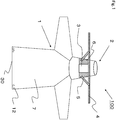
- a hood 2 which covers the wearer's head and in which an opening 3 is formed at the position to be the center of the wearer's face is sewn on an upper garment 1.
- the material for the main body of the upper garment 1 is preferably a highly breathable nonwoven fabric 7 having a quantity of ventilation of 20 cm 3 /cm 2 /sec or more and 150 cm 3 /cm 2 /sec or less.
- a highly breathable nonwoven fabric 7 having a quantity of ventilation of 20 cm 3 /cm 2 /sec or more and 150 cm 3 /cm 2 /sec or less.
- comfortable wearability is achieved while eliminating defects such as dew condensation by, for example, using a low breathable nonwoven fabric 6 having a quantity of ventilation of 0 cm 3 /cm 2 /sec or more and 19 cm 3 /cm 2 /sec or less in a range where goggles or goggles belts are worn and combining the highly breathable nonwoven fabric 7 which is a material having a large quantity of ventilation in the regions other than this region.
- the low breathable nonwoven fabric 6 is preferably arranged at least at a part of the area around the sides of the opening.
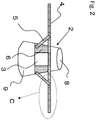
- the low breathable nonwoven fabric 6 at the area where the goggle belt is worn (namely, the area where the goggle belt comes into contact) as illustrated in Fig. 2 and Fig. 3 , it is possible to eliminate defects such as dew condensation when the goggle belt is worn. It is preferable to use the low breathable nonwoven fabric 6 for an upper side belt-shaped material 4 and for right and left sides belt-shaped materials 5 from the viewpoint of further preventing dew condensation.
- the eyes, nose, and mouth can be exposed by forming an opening 3 in the front center of the hood of the protective clothing.
- the size of the opening 3 is preferably 13 cm to 16 cm, more preferably about 15 cm in width (horizontal direction).
- the length (vertical direction) of the opening is preferably 9 cm to 13 cm, more preferably 11 cm to 12 cm. These are numbers calculated with reference to the Japanese Anthropometric Dimension Data Book 2004 to 2006 published by the Research Institute of Human Engineering for Quality Life, the width direction is based on the cheek bow width A illustrated in Fig. 4 and the length direction is based on the distance B from a portion between eyebrows to chin illustrated in Fig. 5 , and this size is considered to be a size that minimizes skin exposure and does not interfere with the line of sight.
- the low breathable nonwoven fabric 6 is arranged at least at a part of the vicinity of the opening 3 having such a size.
- the protective clothing of the present invention has an upper side belt-shaped material 4 at the upper side of the opening 3 and right and left sides belt-shaped materials 5 at the lower portions of the right and left sides and the two belt-shaped materials (upper side belt-shaped material 4 and right and left sides belt-shaped materials 5) are coupled with or are configured to be couplable with each other at the positions of right and left side heads C.
- the hood can be fit more tightly to the forehead portion and the hood can be prevented from shifting when the head and neck are moved to the right and left.
- the goggle belt In the case of wearing goggles, the goggle belt is rotated from the front of the hood through the side head to the back of the head to be worn, and the belt-shaped materials are disposed around the goggle belt.
- the periphery of the belt-shaped material is also composed of the low breathable nonwoven fabric 6 which is a material having a small quantity of ventilation.
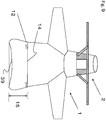
- the upper side belt-shaped material 4, the right and left sides belt-shaped materials 5, and the region from the right and left sides of the opening to the back of the hood are composed of the low breathable nonwoven fabric 6 as illustrated in dark colors in Fig. 2 and Fig. 3 .
- the engaging method of the upper side belt-shaped material 4 may be any structure as long as the upper side belt-shaped material 4 can be engaged with tension applied; for example, both right and left end portions are pulled and fastened in accordance with the vicinity of the head circumference. Both end portions of the upper side belt-shaped material 4 may intersect each other and be tied at the back of the head, a hook-and-loop fastener or double-sided tape may be attached to the ends of the upper side belt-shaped material 4 and both end portions of the upper side belt-shaped material 4 may be brought into contact with each other and fixed, or the double-sided tape may be pasted to the side face of the head to fix the upper side belt-shaped material 4.
- the upper side belt-shaped material 4 is required to have a length equal to or longer than the wearer's head circumference in the case of being fixed as both end portions thereof intersect each other and tied.
- the hood can fit more tightly to the head by being configured by sewing an approximately perfect circle fabric 8 constituting the portion corresponding to the top of the head and an approximately trapezoid fabric 9 constituting the portion corresponding to the side headtogether, for example, as illustrated in Fig. 2 .
- the hood having the shape illustrated in Fig. 2 is adopted in the present invention from the viewpoint that the correct position of the forehead is easily fixed, the visual field is not obstructed even when the head is moved, and the wearing feeling is excellent.
- the above aspect is an example; in the case of wearing accouterments other than goggles, it is preferable to arrange a low breathable nonwoven fabric at the area corresponding to the wearing position of the accouterments.
- the protective clothing of the present invention may have an aspect in which the hood is coupled onto the coverall in addition to an aspect in which the hood is coupled onto the upper garment of the protective clothing as illustrated in Fig. 1 .
- protective clothing especially protective clothing subjected to sterilization processing is put on in a clean room and the like, it is required to quickly put on the protective clothing so that the protective clothing and the human body do not touch the floor and walls and further the hands do not touch the front side of the protective clothing as much as possible.
- protective clothing to be worn in a clean room and the like is a coverall type in which the upper garment and the lower garment are connected with each other in most cases and the clothing is long, and thus it takes a long time keeping an awkward posture to wear.
- the wearer puts on the protective clothing in a state of raising one leg, and this loads the wearer with heavy mental and physical burdens. Further, the protective clothing is required to be quickly put on so as not to touch the floor and walls when it is put on.
- an aspect in which the upper garment and the lower garment are separated from each other is preferred to a coverall type protective clothing of which the putting on order is complicated and which requires a long time to be put on.
- an upper garment onto which the hood is coupled and which has a length reaching the vicinity of the buttock top of the wearer is preferable since the upper garment can overlap the lower garment and raising dust from the human body can be prevented.
- the "vicinity of buttock top” as used herein means a range of 10 cm in the vertical direction around the buttock top, namely, the most protruding portion of the buttocks.
- the upper garment may be a type that can be opened and closed with a fastener or a parka type that is pulled over the head, but a parka type that is pulled over the head is more preferable from the viewpoint of requiring fewer putting on steps.
- an elastic material 12 on the side hem of the upper garment 1 since it is possible to prevent the hem of the upper garment from slipping up and flying out of the lower garment when the arm is raised.
- the elastic material 12 flat rubber, rib knitted fabric, and the like can be used, but it is more preferable to use elastic rubber from the viewpoint of cost and of being easy to handle.
- Examples of the lower garment in the present invention include a lower garment 10 capable of covering from the waist portion to the ankles as illustrated in Fig. 7 .
- the lower garment 10 can be fixed to the waist by simply allowing both legs to pass through the lower garment and pulling the lower garment up since an elastic material 13 (elastic rubber or the like) is inserted in the waist in this lower garment 10 as illustrated in Fig. 8 .
- the elastic rubber inserted into the waist is required to have a length to be about 0.7 to 0.9 times the body waist size.
- the length is shorter than 0.7 times the body waist size, the lower garment hardly passes through the buttocks and the waist is too tight to wear for a long time. Meanwhile, it is not preferable that the length is longer than 0.9 times the body waist size since the lower garment may slide down while being worn.
- the waist portion is slightly caught by the buttocks when the lower garment passes through the buttocks but the lower garment can be fitted to the waist after passing.
- the elastic material 13 it is more preferable to attach a tool for dimensions adjustment 11 to the elastic material 13 (for example, the end portion).
- the elastic material 13 have a length to be about 1.3 to 1.6 times the body waist size, is loosened when the lower garment is put on, and can be adjusted to the wearer's waist size after the lower garment has been put on.
- the elastic material 13 being too short, the lower garment is caught by the buttocks when being put on and it is difficult to smoothly put on the lower garment.
- the tool for dimensions adjustment 11 is arranged so that the dimensions adjusting operation can be performed on the back side (inside) of the lower garment 10 from the viewpoint of being able to avoid touching the surface of the protective clothing.
- the protective clothing composed of the combination of the upper garment 1 onto which the hood is coupled and which has a length reaching the vicinity of the buttock top and the lower garment 10 that can cover from the waist portion to the ankles as described above can be put on quickly and reliably with fewer putting on steps and less burden on the worker's putting on posture.
- the protective clothing of the present invention is preferably packed in a packing bag 18 until used.
- the upper garment 1 is taken out from the packing bag 18 and is pulled over the hood, both arms pass through the sleeves, and the belt-shaped material of the opening is fixed at the back of the head.
- the protective clothing of the present invention can be easily put on without requiring to take an awkward posture.
- the lower garment is taken out from the packing bag 18, the legs are put into the trousers from the waist portion one by one, and the lower garment is fixed at the waist portion. In this way, the lower garment can be easily put on without requiring to take an awkward posture.
- the protective clothing of the present invention When the protective clothing of the present invention is packed, it is preferable that the protective clothing is folded so that the hem of the upper garment 1 is turned up outward and placed in a packing bag, for example, as illustrated in Fig. 9 .
- the protective clothing is folded so that the fold peak formed by turning up the hem of the upper garment outward is arranged on the surface and this is placed in a packing bag. It is preferable to pack the protective clothing so that at least a part of the fold peak is exposed when the opening port of the packing bag is opened.
- the wearer can hold the back side of the protective clothing by grasping the fold peak formed by turning up the hem of the upper garment outward, and, as a result, the wearer can put on the protective clothing without touching the front side of the protective clothing as much as possible and without taking an awkward posture.
- the hem of the upper garment 1 is preferably turned up by 10 cm to 20 cm from the viewpoint of the folded shape and ease of grasping.
- the lower garment 10 is also folded so that the waist is turned up outward and placed in a packing bag so that the formed fold peak is disposed on the surface. It is preferable to pack the lower garment 10 so that at least a part of the fold peak is exposed when the opening port of the packing bag is opened.
- a turned up amount 16 is preferably about 5 cm to 25 cm from a waist end 17 since the inside can be grasped. Among these, it is more preferable to turn up the lower garment by about 20 to 25 cm since the length of the lower garment is short when taken out from the packing bag and the lower garment can be easily put on without touching the walls and floor.
- the protective clothing is packed by placing each of the upper garment and the lower garment in a packing bag so as not to collapse the state of being folded as described above. It is preferable that the protective clothing is folded and packed so that the fold peak of each of the upper garment and the lower garment is arranged on the surface when the opening port of the packing bag is opened.
- the upper garment and lower garment may be packed in the same bag or may be packed separately. Provided that it is more preferable to pack the upper garment and lower garment separately since one of these is wasted when it is required to replace the protective clothing for the reason that either the upper garment or the lower garment is dirty, damaged or the like at the time of opening.
- the upper garment and the lower garment are packed in the same packing bag, it is preferable that the upper garment and the lower garment are folded and packed so that the fold peak of either the upper garment or lower garment is exposed when the opening port of the packing bag is opened and the fold peak of either the remaining lower garment or upper garment is exposed when this is taken out.
- the packing bag is not particularly limited and is preferably a bag through which the sterilization gas can permeate. It is preferable that the packing bag is provided with an opening port from the viewpoint of being able to promote smooth putting on.
- the aspect of the opening port is not particularly limited, but it is preferable to provide a notch 19 for opening on the side face of the bag from the viewpoint of manufacturing convenience and appearance and of being easy to find the opening port.
- the protective clothing of the present invention enclosed in a packing bag is preferably finished by being subjected to sterilization processing.
- the sterilization processing referred to here is processing for killing bacteria and viruses, and it is possible to use ordinary techniques. Specifically, it is possible to adopt a method in which bacteria and viruses are killed by irradiating the protective clothing with high-energy rays such as ultraviolet rays, electron beams, and gamma beams or by exposing the protective clothing to ethylene oxide gas. Among these, in the case of using a material subjected to an electret processing for the protective clothing, it is preferable to perform the sterilization processing using ethylene oxide gas in order to maintain the performance by the electret processing even after the sterilization processing.
- the protective clothing of the present invention can be used in a clean room by being subjected to the sterilization processing.
- the protective clothing of the present invention is preferably disposable. It is preferable to dispose the protective clothing every time the protective clothing is taken off for safety reasons since there is the possibility that contaminants adhere to the protective clothing. It is more preferable to use a nonwoven fabric which is inexpensive and does not require the management of cloth ends for this purpose.
- the protective clothing may be sewn by a general method; it is preferably sewn using an overlock machine or a flat seaming machine or sewn so as to cover the cloth ends with piping tape when it is considered that the manufactured protective clothing is used in a clean room.
- the method using piping tape is most preferable since the cloth end portions are not exposed and the generation of dust from the cloth end portions can be minimized.
- the material used for the protective clothing of the present invention (hereinafter referred to as cloth for protective clothing) is only required to basically be a nonwoven fabric exhibiting breathability as described above, and examples thereof include a single layer of nonwoven fabric and a laminate using nonwoven fabrics.
- cloth for protective clothing As examples of the laminate, three-layer laminates of an SMS structure (spunbonded nonwoven fabric/meltblown nonwoven fabric/spunbonded nonwoven fabric) and an SFS structure (spunbonded nonwoven fabric/film/spunbonded nonwoven fabric) and an SF structure (spunbonded nonwoven fabric/film) are well known.
- the SMS structure and SFS structure are one of the preferred forms since a functional material can be used for the middle layer and the spunbonded nonwoven fabric on the front and back layers acts as a protective layer from the outside and can provides texture and softness. Meanwhile, the SF structure is preferable from the viewpoint of exhibiting excellent cloth flexibility due to a two-layer structure and not allowing air and moisture to permeate.
- the cloth for protective clothing By appropriately selecting the cloth for protective clothing, it is possible to adjust the quantity of ventilation to the target quantity of ventilation described above.
- the protective clothing main body the portions composed of highly breathable nonwoven fabric of the upper garment 1, the lower garment 10, and the hood 2
- a nonwoven fabric having an SMS structure having a quantity of ventilation of 20 cm 3 /cm 2 /sec or more and 150 cm 3 /cm 2 /sec or less.
- the portions composed of low breathable nonwoven fabric of the hood 2 it is preferable to select a nonwoven fabric having an SF structure having a quantity of ventilation of 0 cm 3 /cm 2 /sec or more and 19 cm 3 /cm 2 /sec or less.
- Examples of the fibers constituting the spunbonded nonwoven fabric used as the cloth for protective clothing include synthetic fibers and natural fibers, but synthetic fibers are preferable from the viewpoint of being able to arbitrarily set the fiber diameter.
- Examples of the materials for the fibers constituting the spunbonded nonwoven fabric include polyolefins such as polyethylene and polypropylene, polyesters such as polyethylene terephthalate and polylactic acid, polycarbonate, polystyrene, polyphenylene sulfide, fluororesins, and mixtures thereof.
- polyolefins are preferable from the viewpoint of the productivity and excellent texture of the cloth for protective clothing.
- the average fiber diameter of the fibers constituting the spunbonded nonwoven fabric is preferably 18 ⁇ m or more and 30 ⁇ m or less.
- the average fiber diameter is 18 ⁇ m or more, the spunbonded nonwoven fabric exhibits excellent breathability, and as a result, a favorable ventilation rate of the cloth for protective clothing can be obtained.
- the average fiber diameter is 30 ⁇ m or less, a spunbonded nonwoven fabric having soft texture can be obtained.
- the average fiber diameter of the fibers constituting the spunbonded nonwoven fabric can be thinned by, for example, decreasing the amount of resin discharged, increasing the discharge speed, and increasing the degree of stretching of fibers when the fibers constituting the spunbonded nonwoven fabric are produced.
- the thickness of the spunbonded nonwoven fabric is preferably 150 ⁇ m or more and 300 ⁇ m or less. It is possible to improve the discharging property of residual gas at the time of sterilization processing when the thickness of the spunbonded nonwoven fabric is 300 ⁇ m or less; the strength of the cloth for protective clothing is further improved when the thickness of the spunbonded nonwoven fabric is 150 ⁇ m or more.
- Examples of the fibers constituting the meltblown nonwoven fabric used as the cloth for protective clothing include synthetic fibers and natural fibers, but synthetic fibers are preferable from the viewpoint of being able to arbitrarily set the fiber diameter.
- Examples of the materials for the fibers constituting the meltblown nonwoven fabric include polyolefins such as polyethylene and polypropylene, polyesters such as polyethylene terephthalate and polylactic acid, polycarbonate, polystyrene, polyphenylene sulfide, fluororesins, and mixtures thereof.
- polyolefins are preferable from the viewpoint of the productivity and excellent texture of the cloth for protective clothing.
- the meltblown nonwoven fabric can be obtained by a melt blowing method.
- the melt blowing method is generally a method in which a thermoplastic polymer extruded from the spinneret is injected with hot air to be thinned into a fiber shape and a web is formed by utilizing the self-fusing property of this fiber.
- the spinning conditions in the melt blowing method there are the amount of polymer discharged, nozzle temperature, air pressure and the like, and a nonwoven fabric having a desired fiber diameter can be obtained by optimizing these spinning conditions.
- the meltblown nonwoven fabric preferably contains a polyolefin-based resin as a main component.
- the polyolefin-based resin is used as the main component of the meltblown nonwoven fabric, the productivity and texture of the cloth for protective clothing are favorable.
- polypropylene is still more preferable from the viewpoint that the dust collecting performance of the cloth for protective clothing is easily improved by electret processing.
- the fact that the meltblown nonwoven fabric contains a polyolefin-based resin as a main component means that the meltblown nonwoven fabric contains a polyolefin-based resin at 80% by mass or more with respect to the entire mass of the meltblown nonwoven fabric as described above.
- the meltblown nonwoven fabric contains a polyolefin-based resin at 90% by mass or more with respect to the entire mass of the meltblown nonwoven fabric, and it is more preferable that the meltblown nonwoven fabric is formed from only a polyolefin-based resin.
- the average fiber diameter of the fibers constituting the meltblown nonwoven fabric is preferably 3 ⁇ m or more and 8 ⁇ m or less.
- the average fiber diameter is 8 ⁇ m or less, the dust collecting efficiency by the meltblown nonwoven fabric is favorable; as a result, the dust collecting efficiency by the cloth for protective clothing is favorable.
- the average fiber diameter is 3 ⁇ m or more, the breathability of the meltblown nonwoven fabric and the discharging property of residual gas at the time of sterilization processing are superior; as a result, the ventilation rate of the cloth for protective clothing and the discharging property of residual gas are more favorable.
- the average fiber diameter of the fibers constituting the meltblown nonwoven fabric can be adjusted by ordinary techniques. Specifically, the fibers can be thinned by decreasing the amount of resin discharged, increasing the discharge speed, and increasing the degree of stretching of fibers when the fibers used for the meltblown nonwoven fabric are produced.
- the thickness of the meltblown nonwoven fabric is preferably 100 ⁇ m or more and 200 ⁇ m or less.
- the cloth for protective clothing fabric can obtain a favorable ventilation rate and favorable discharging property of residual gas.
- the thickness of the meltblown nonwoven fabric is 100 ⁇ m or more, the dust collecting efficiency by the meltblown nonwoven fabric is favorable; as a result, the dust collecting efficiency by the cloth for protective clothing is favorable.
- the film used for the cloth for protective clothing various films obtained by ordinary techniques can be used, but a film exhibiting moisture permeable waterproof properties is preferable among these.
- the film means a sheet obtained from a resin which is two-dimensionally extruded.
- the film exhibiting moisture permeable waterproof properties there are, for example, a microporous film obtained by filling and dispersing an inorganic filler in a resin and stretching the resin and a microporous film obtained by mixing a soluble resin and an insoluble resin with a certain solvent and eluting only the soluble portion with the solvent.
- polyolefins such as polyethylene and polypropylene are preferable from the viewpoint of the productivity and excellent texture of the cloth for protective clothing.
- the method for laminating the spunbonded nonwoven fabric, meltblown nonwoven fabric, film and the like that constitute the cloth for protective clothing a method that does not impair the performance of the present invention may be adopted.
- Supersonic wave adhesion processing, heat adhesion processing using a thermal embossing roll having a handle height of 1 mm or more, and stacking processing using an adhesive can be used in order to prevent the spunbonded nonwoven fabric and the meltblown nonwoven fabric from melting or fusing beyond the desired state by excessive heat.
- stacking processing using an adhesive is preferable particularly in order to uniformly bond the regions to which the spunbonded nonwoven fabric, the meltblown nonwoven fabric, and the film are bonded, respectively.
- the cloth for protective clothing is an electretized nonwoven fabric of which the layer configuration is partially or wholly electretized, and it is more preferable that the meltblown nonwoven fabric is an electretized meltblown nonwoven fabric.
- the layer configuration of the cloth for protective clothing is composed of an electretized nonwoven fabric, the dust collecting performance is improved while securing a high ventilation rate of the cloth for protective clothing.
- the layer configuration of the cloth for protective clothing is composed of an electretized nonwoven fabric, it is possible to suppress the generation of lint of short fibers, foreign substances and the like that are contained in the cloth when the cloth for protective clothing is formed.
- electretization various known methods can be adopted, and electretization can be performed, for example, by corona discharge and water flow.
- a part of the materials for the layer configuration may be electretized and then lamination may be performed by the above-described laminating method, or all the materials for the layer configuration may be laminated and then electretization may be performed.
- Samples for measurement were collected from ten locations, and each sample was measured using a collecting performance measuring apparatus.
- a dust storage box is connected to the upstream side of the sample holder in which the measurement sample is set, and a flow meter, a flow adjusting valve, and a blower are connected to the downstream side.
- the number of dust on the upstream side and the number of dust on the downstream side of the measurement sample can be each measured via the switching cock using a particle counter in the sample holder.
- a pressure gauge is provided in the sample holder to read the static pressure difference between the upstream and downstream of the sample.
- Two spunbonded nonwoven fabrics were used, and a hot melt adhesive heated to 150°C and melted was applied to the first face of one spunbonded nonwoven fabric in a spray form from a T-die so that the amount applied was 2 g/m 2 using a hot melt adhesion machine. Thereafter, a meltblown nonwoven fabric was stacked on the first face of the spunbonded nonwoven fabric coated with the hot melt adhesive. A hot melt adhesive heated to 150°C and melted was further applied to the meltblown nonwoven fabric side of the obtained spunbonded nonwoven fabric/meltblown nonwoven fabric in a spray form from a T-die so that the amount applied was 2 g/m 2 .
- the other spunbonded nonwoven fabric was stacked on the face of the meltblown nonwoven fabric coated with the hot melt adhesive.
- the obtained three-layer laminated product of spunbonded nonwoven fabric/meltblown nonwoven fabric/spunbonded nonwoven fabric was wound to obtain an SMS nonwoven fabric.
- the quantity of ventilation of this SMS nonwoven fabric was 85 cm 3 /cm 2 /sec.
- a hot melt adhesive heated to 150°C and melted was applied to the first face of one spunbonded nonwoven fabric in a spray form from a T-die so that the amount applied was 2 g/m 2 using a hot melt adhesion machine. Thereafter, a film was stacked on the first face of the spunbonded nonwoven fabric coated with the hot melt adhesive to obtain a SF nonwoven fabric.
- the quantity of ventilation of this SF nonwoven fabric was 0.05 cm 3 /cm 2 /sec.
- the upper garment and lower garment of protective clothing were cut out from the SMS nonwoven fabric and joined together using an overlock machine.
- the upper garment was coupled with a hood to have the shape illustrated in Figs. 1 , 2 , and 3 .
- the lower garment had the shape illustrated in Figs. 7 and 8 .
- the hood was composed of the fabric 9 (hereinafter referred to as the hood side face 9) that constituted the portion corresponding to the side head and the fabric 8 (hereinafter referred to as the top of head 8) that constituted the portion corresponding to the top of the head.
- the hood side face 9 was composed of three parts of an upper part, a central part, and a lower part with the opening as a boundary line in the vertical direction when worn and configured by joining the SMS nonwoven fabric for the upper part and lower part and the SF nonwoven fabric for the central part. An opening having a width of 15 cm and a length of 11 cm was provided in the center of the face.
- a string-shaped engaging tool that constituted the upper side belt-shaped material 4 was formed of the SF nonwoven fabric, and had a width of 2 cm and a length of 130 cm was sewn on the upper side of the opening.
- a string-shaped engaging tool that constituted the right and left sides belt-shaped materials 5 was formed of the SF nonwoven fabric, and had a width of 2 cm and a length of 50 cm was sewn on each of the right and left sides of the opening.
- the upper ends of the string-shaped engaging tools that constituted the sides belt-shaped materials 5 were placed on the string-shaped engaging tool that constituted the upper side belt-shaped material 4, these were integrated to the end portions, and the right and left string-shaped engaging tools were tied at the back of the head to fix the hood at the time of putting on.
- the SF nonwoven fabric for the central part of the hood side face 9 and the band-shaped engaging tool, dew condensation does not occur and comfortability can be maintained when goggles were worn on the hood.
- the upper garment and lower garment of the protective clothing were cut out from the SMS nonwoven fabric used in Example 1 and welded and sewn by supersonic waves.
- the upper garment was coupled with a hood.
- the configuration of the hood was the same as that described in Example 1 except for the following points.
- a string-shaped engaging tool that was formed of the SF nonwoven fabric and had a width of 2 cm and a length of 60 cm was sewn on the upper side of the opening
- a string-shaped engaging tool that was formed of the SF nonwoven fabric and had a width of 2 cm and a length of 50 cm was sewn on each of the right and left sides of the opening.
- the upper ends of the string-shaped engaging tools of the right and left sides were placed on the string-shaped engaging tool of the upper side, these were integrated to the end portions, double-sided tape was pasted to the end portions, and the double-sided tape at the end portions was bonded to the center of the rear face of the hood to fix the hood at the time of putting on.
- Flat rubber that had a width of 1 cm and a length of 10 cm and constituted the elastic material 12 was sewn on the side hem of the upper garment 1.
- Flat rubber having a length of [waist size - 5 cm] and a width of 1 cm as the elastic material 13 was inserted into the waist of the lower garment 10.
- the upper garment 1 was folded in a state where the hem thereof was turned up by 10 cm, the waist of the lower garment 10 was turned up by 15 cm, and each of the upper and lower garments was placed in a packing bag. Each of these was subjected to electret processing and further sterilization processing using ethylene oxide gas.
- an SMS nonwoven fabric was obtained by sandwiching a meltblown nonwoven fabric between spunbonded nonwoven fabrics used as two front and back nonwoven fabrics.
- a hot melt adhesive heated to 150°C and melted was applied to the film side of the SF nonwoven fabric of Example 1 in a spray form from a T-die so that the amount applied was 2 g/m 2 . Thereafter, another spunbonded nonwoven fabric was stacked on the film face coated with the hot melt adhesive to obtain an SFS nonwoven fabric.
- the upper garment and lower garment of protective clothing were out from the SMS nonwoven fabric and joined together using a flat seaming machine, and the upper garment was coupled with a hood.
- the configuration of the hood was the same as that described in Example 1 except for the following points.
- fasteners were sewn on the front center of the lower portion of the hood and the front center of the upper garment so that the hood and the upper garment were able to be released by opening and closing them. When the fastener was closed, an opening having a width of 14 cm and a length of 10 cm was created in the front center of the hood.
- Example 1 The area where the SF nonwoven fabric was used in Example 1 was replaced with the SFS nonwoven fabric, a string-shaped engaging tool that was formed of the SFS nonwoven fabric and had a width of 2 cm and a length of 130 cm was sewn on the upper side of the opening.
- a string-shaped engaging tool having a width of 2 cm and a length of 50 cm was sewn on each of the right and left sides of the opening.
- the upper ends of the string-shaped engaging tools of the right and left sides were placed on the string-shaped engaging tool of the upper side, these were sewn and integrated to the end portions, and the right and left strings were tied at the back of the head to fix the hood at the time of putting on.
- Protective clothing was sewn, packed, and evaluated in the same manner as in Example 1 except that the upper garment and the lower garment were joined together using a flat seaming machine so as to cover the cloth ends with piping tape when the upper garment and lower garment of protective clothing were sewn.
- Two spunbonded nonwoven fabrics were used, and a hot melt adhesive heated to 150°C and melted was applied to the first face of one spunbonded nonwoven fabric in a spray form from a T-die so that the amount applied was 1.5 g/m 2 using a hot melt adhesion machine. Thereafter, a meltblown nonwoven fabric was stacked on the first face of the spunbonded nonwoven fabric coated with the hot melt adhesive. A hot melt adhesive heated to 150°C and melted was further applied to the meltblown nonwoven fabric side of the obtained spunbonded nonwoven fabric/meltblown nonwoven fabric in a spray form from a T-die so that the amount applied was 1.5 g/m 2 .
- the other spunbonded nonwoven fabric was stacked on the face of the meltblown nonwoven fabric coated with the hot melt adhesive.
- the obtained three-layer laminated product of spunbonded nonwoven fabric/meltblown nonwoven fabric/spunbonded nonwoven fabric was wound to obtain an SMS nonwoven fabric.
- the quantity of ventilation of this SMS nonwoven fabric was 100 cm 3 /cm 2 /sec.
- a hot melt adhesive heated to 150°C and melted was applied to the first face of one spunbonded nonwoven fabric in a spray form from a T-die so that the amount applied was 1 g/m 2 using a hot melt adhesion machine. Thereafter, a film was stacked on the first face of the spunbonded nonwoven fabric coated with the hot melt adhesive to obtain a SF nonwoven fabric.
- the quantity of ventilation of this SF nonwoven fabric was 10 cm 3 /cm 2 /sec.
- Two spunbonded nonwoven fabrics were used, and a hot melt adhesive heated to 150°C and melted was applied to the first face of one spunbonded nonwoven fabric in a spray form from a T-die so that the amount applied was 2.5 g/m 2 using a hot melt adhesion machine. Thereafter, a meltblown nonwoven fabric was stacked on the first face of the spunbonded nonwoven fabric coated with the hot melt adhesive. A hot melt adhesive heated to 150°C and melted was further applied to the meltblown nonwoven fabric side of the obtained spunbonded nonwoven fabric/meltblown nonwoven fabric in a spray form from a T-die so that the amount applied was 2.5 g/m 2 .
- the other spunbonded nonwoven fabric was stacked on the face of the meltblown nonwoven fabric coated with the hot melt adhesive.
- the obtained three-layer laminated product of spunbonded nonwoven fabric/meltblown nonwoven fabric/spunbonded nonwoven fabric was wound to obtain an SMS nonwoven fabric.
- the quantity of ventilation of this SMS nonwoven fabric was 60 cm 3 /cm 2 /sec.
- a hot melt adhesive heated to 150°C and melted was applied to the film side of the SF nonwoven fabric of Example 1 in a spray form from a T-die so that the amount applied was 2 g/m 2 . Thereafter, another spunbonded nonwoven fabric was stacked on the film face coated with the hot melt adhesive to obtain an SFS nonwoven fabric.
- An upper garment with hood and a lower garment were sewn using a single layer of polyethylene flashspun nonwoven fabric as the material using an overlock machine to obtain protective clothing.
- the hood had a bisymmetrical shape as illustrated in Fig. 6 and obtained by joining two right and left pieces together.
- Flat rubber having a width of 1 cm and a length of 60 cm was inserted into the waist of the lower garment.
- the upper garment was folded without turning up the hem thereof, the lower garment was folded without turning up the waist portion thereof, and each of the upper and lower garments was placed in a packing bag and subjected to electret processing and further sterilization processing using ethylene oxide gas.
- Protective clothing was sewn using the SMS nonwoven fabric obtained in Example 1 in the same manner as in Example 1 except that the following points were changed.
- the hood had a shape in which the top of the head and the side head were sewn in the same manner as in Example 1, an opening having a width of 15 cm and a length of 11 cm was provided in the center, but the hood was sewn using only the SMS nonwoven fabric and finished without attaching an engaging tool. Sewing was performed by supersonic welding.
- the upper garment was folded without turning up the hem thereof, the lower garment was folded without turning up the waist portion thereof, and each of the upper and lower garments was placed in a packing bag and subjected to electret processing and further sterilization processing using ethylene oxide gas.
- Coverall type protective clothing in which the upper garment and the lower garment were connected with each other was sewn using the SF nonwoven fabric obtained in Example 1.
- a coverall type has a shape in which the hood, front body, back body, sleeves, and trousers are integrated and is in a form in which a fastener was sewn on the front body and the protective clothing can be thus opened and closed.
- the hood had a bisymmetrical shape illustrated in Fig. 6 and was obtained by joining two right and left pieces together.
- a string-shaped engaging tool having a width of 2 cm and a length of 60 cm was sewn on the right and left sides of the opening using the same SF nonwoven fabric as that for the body.
- the protective clothing was folded, placed in a packing bag, and subjected to electret processing and further sterilization processing using ethylene oxide gas.
- Two spunbonded nonwoven fabrics were used, and a hot melt adhesive heated to 150°C and melted was applied to the first face of one spunbonded nonwoven fabric in a spray form from a T-die so that the amount applied was 2 g/m 2 using a hot melt adhesion machine. Thereafter, a meltblown nonwoven fabric was stacked on the first face of the spunbonded nonwoven fabric coated with the hot melt adhesive. A hot melt adhesive heated to 150°C and melted was further applied to the meltblown nonwoven fabric side of the obtained spunbonded nonwoven fabric/meltblown nonwoven fabric in a spray form from a T-die so that the amount applied was 2 g/m 2 .
- the other spunbonded nonwoven fabric was stacked on the face of the meltblown nonwoven fabric coated with the hot melt adhesive.
- the obtained three-layer laminated product of spunbonded nonwoven fabric/meltblown nonwoven fabric/spunbonded nonwoven fabric was wound to obtain an SMS nonwoven fabric.
- the upper garment and lower garment of protective clothing were cut out from the SMS nonwoven fabric and joined together using an overlock machine.
- the upper garment had the shape illustrated in Fig. 1 and the lower garment had the shape illustrated in Fig. 7 .
- An opening having a width of 15 cm and a length of 11 cm was provided in the center of the central part of the hood.
- a string-shaped engaging tool that constituted the upper side belt-shaped material 4 was formed of the same nonwoven fabric, and had a width of 2 cm and a length of 130 cm was sewn on the upper side of the opening.
- a string-shaped engaging tool that constituted the right and left sides belt-shaped materials 5 and had a width of 2 cm and a length of 50 cm was sewn on each of the right and left sides of the opening.
- the upper ends of the string-shaped engaging tools that constituted the sides belt-shaped materials 5 were placed on the string-shaped engaging tool that constituted the upper side belt-shaped material 4, these were integrated to the end portions, and the right and left strings were tied at the back of the head to fix the hood at the time of putting on.
- Protective clothing was obtained and packed using the same SMS nonwoven fabric as that used in Reference Example 1 in the same manner as in Reference Example 1 except that the following points were changed.
- the amount of hem of the upper garment turned up was changed to 18 cm.
- flat rubber having a width of 1 cm was cut into a length of 60 cm and inserted into the waist, and the lower garment was packed by turning up the waist by 10 cm.
- Protective clothing composed of a front-opening upper garment and a lower garment was sewn using the SMS nonwoven fabric obtained in Reference Example 1.
- the upper garment was in a form in which the front center was able to be released and was able to be opened and closed as a fastener was sewn thereon.
- hem rubber was sewn on the side hem.
- the protective clothing was prepared in the same manner as in Reference Example 1 except that the protective clothing was packed by turning up the hem of the upper garment of the protective clothing by 8 cmcm and the hem of the lower garment of the protective clothing by 15 cm in a state where the front fastener of the upper garment was closed.
- a parka type upper garment with hood and a lower garment were sewn using a single layer of polyethylene flashspun nonwoven fabric as the material using a flat seaming machine.
- Flat rubber having a width of 1 cm and a length of 60 cm was inserted into the waist of the lower garment.
- the upper garment was folded without turning up the hem thereof, the lower garment was folded without turning up the waist portion thereof, and each of the upper and lower garments was placed in a packing bag and subjected sterilization processing.
- Coverall type protective clothing in which the upper garment and the lower garment were connected with each other was sewn using the SMS nonwoven fabric obtained in Reference Example 1.
- a separate hood was used as the hood, and the protective clothing itself was placed in a packing bag as a coverall type without a hood and subjected to sterilization processing.
- the hood was first put on the head and fixed with the strings.
- protective clothing was put on and the hood was completely placed in the protective clothing to prevent the hood from coming out.
- a putting on test similar to that for the protective clothing described above was conducted. The evaluation results are presented in Table 4.
- the attachment was observed at the top of the hood, in the vicinity of the front center of the coverall, and in the periphery of the collar of the coverall. It is considered that the wearer has to touch these parts in order to put on the hood, adjust the worn state, and place the hood in the coverall. It took time to find a place where the attachment of para-pollutants to the outside of the protective clothing did not occur when the packing bag was opened, and it also took a long time to put on the protective clothing since the trousers came into contact with the floor and the hood was placed in the coverall at the time of putting on. As a result, there was a number of contact areas with the outside.
- the protective clothing of the present invention is excellent in wearing comfortability, suppresses the occurrence of dew condensation, and is thus suitably worn in a closed space such as a clean room.
Landscapes
- Engineering & Computer Science (AREA)
- Textile Engineering (AREA)
- Health & Medical Sciences (AREA)
- General Health & Medical Sciences (AREA)
- Physical Education & Sports Medicine (AREA)
- Mechanical Engineering (AREA)
- Professional, Industrial, Or Sporting Protective Garments (AREA)
- Details Of Garments (AREA)
- Packaging Of Annular Or Rod-Shaped Articles, Wearing Apparel, Cassettes, Or The Like (AREA)
Abstract
Description
- The present invention relates to protective clothing that is easily put on and taken off and has a high degree of tight fit to the head and face.
- When work is conducted in places where external harmful substances such as dust, radioactivity, and viruses exist, protective clothing and protective hoods are worn to protect the body from these. It should be noted that the protective clothing and the like do not touch the surroundings when being put on. In food factories and clean rooms, protective clothing and protective hoods are worn for the purpose of preventing dirt such as particles and hair from the human body from being released to the outside. At this time, the mask and goggles are also required to be equipped, and the wearer often feels sweaty and uncomfortable when wearing these for a long time.
- Hence, "clean room wear" of which the foot openings are opened when put on and the shoulder openings are opened to take out the upper part of the body from the shoulder openings when taken off (Patent Document 1), "easy-to-wear clothes" in which both trousers and both sleeves of clothing are shortened when put on and both legs and both hands are inserted in that state so that the clothes do not touch the surroundings (Patent Document 2), "dustproof hood" having a high degree of tight fit by filling the step between the nose and cheeks with a pad (Patent Document 3), "protective clothing" that is put on over the protective mask in a state where the protective mask is worn (Patent Document 4), and "protective clothing and fabric equipped with moisture permeability, waterproofness, and durability" which are excellent in chemical resistance, waterproofness, and weight reduction and can be repeatedly washed (Patent Document 5) have been proposed.
-
- Patent Document 1:
Japanese Patent No. 5317444 - Patent Document 2:
Japanese Patent No. 5380441 - Patent Document 3:
Japanese Patent Laid-Open Publication No. 10-155924 - Patent Document 4:
Japanese Patent Laid-Open Publication No. 2018-82891 - Patent Document 5:
Japanese Patent No. 6080925 - However, the "clean room wear" that is described in
Patent Document 1 and provided with openings in the shoulders and inseam is not concerned that the wear touches the floor surface when put on since the foot openings are fully opened and the wear is put on from above but is concerned that the wear touches the floor surface when taken off since the shoulder openings are opened and the wear is taken off down. Additionally, when the foot openings and the shoulder openings are opened and closed, the fingers come into contact with the outside of the wear and the slide fastener and there is a risk of bacteria and dirt attachment. - The "easy-to-wear clothes" of
Patent Document 2 can be put on without touching the surroundings as both trousers and both sleeves of clothing are shortened by pulling the anchor strips installed on the inside of thereof and both legs and both hands are inserted in that state when put on, but the sewing process is complicated since there are a number of accessories to be installed such as a sheath through which the anchor strip passes and a loop for fixing the anchor strip and an increase in cost is a problem for disposable applications. - The "dustproof hood" described in
Patent Document 3 and the "protective clothing" ofPatent Document 4 are highly airtight protective clothing and are hot and humid and inferior in comfortability, for example, when worn in a closed space such as a clean room. The protective clothing described inPatent Document 5 is made by laminating multiple layers of highly waterproof materials, thus is also excellent in chemical resistance and the like, but is hot and humid and inferior in comfortability when worn in a closed space such as a clean room. In order to reduce the sultriness, a method is considered that the protective clothing is composed of a highly breathable material, but it has also been revealed that water vapor evaporated from the body, especially from the head, undergoes dew condensation at the interface between the accouterments such as goggles and the protective clothing. - An object of the present invention is to improve the drawbacks of the prior art and to provide protective clothing that is not only excellent in wearing comfortability but also suppresses the occurrence of dew condensation even when accouterments are worn. Another object of the present invention is to provide protective clothing that can be easily and reliably put on in a clean room.
- In order to solve the above problems, the protective clothing of the present invention has any of the following configurations (1) to (11).
- (1) Protective clothing coupled with a hood that is composed of a nonwoven fabric having a quantity of ventilation of 20 cm3/cm2/sec or more and 150 cm3/cm2/sec or less and a nonwoven fabric having a quantity of ventilation of 0 cm3/cm2/sec or more and 19 cm3/cm2/sec or less, in which the hood has an opening at a position to be center of a wearer's face and belt-shaped materials at an upper side of the opening and at lower portions of right and left sides of the opening, and the two belt-shaped materials are coupled with or configured to be couplable with each other at right and left side heads.
- (2) The protective clothing according to (1), wherein the opening is formed in front center of the hood, the opening having a size of 13 cm to 16 cm in width and 9 cm to 13 cm in length, and the nonwoven fabric having a quantity of ventilation of 0 cm3/cm2/sec or more and 19 cm3/cm2/sec or less is disposed at least at a part around the opening.
- (3) The protective clothing according to (1) or (2), wherein the protective clothing comprises an upper garment having a length reaching vicinity of buttock top of a wearer and the hood is coupled onto the upper garment.
- (4) The protective clothing according to (3) or (4), wherein the protective clothing is packed in a packing bag by being folded so that a fold peak formed by turning up hem of the upper garment outward is arranged on a surface.
- (5) The protective clothing according to (3) or (4), wherein the protective clothing comprises a lower garment that can cover from a waist portion to ankles.
- (6) The protective clothing according to (5), wherein a tool for dimensions adjustment is provided at the waist portion of the lower garment.
- (7) The protective clothing according to (5) or (6), wherein the protective clothing is packed in a packing bag by being folded so that a fold peak formed by turning up the waist portion of the lower garment outward is arranged on a surface.
- (8) The protective clothing according to (4) or (7), wherein the protective clothing is packed so that the fold peak of the upper garment and/or the fold peak of the lower garment are exposed when the packing bag is opened.
- (9) The protective clothing according to any one of (1) to (8), wherein the protective clothing has been subjected to sterilization processing.
- (10) The protective clothing according to any one of (1) to (9), wherein the protective clothing is for use in a clean room.
- (11) The protective clothing according to any one of (1) to (10), wherein the protective clothing is disposable.
- The protective clothing of the present invention is not only excellent in wearing comfortability but also suppresses the occurrence of dew condensation even when accouterments are worn since a hood that is composed of two kinds of nonwoven fabrics having different quantities of ventilation is coupled onto a coverall, an upper garment or the like. In particular, even though accouterments such as goggles are worn when the protective clothing is worn in a closed space such as a clean room, dew condensation is suppressed at the interface with the goggles by disposing a nonwoven fabric having a small quantity of ventilation around the opening that is provided in the front center of the hood and corresponds to the position to be the center of the wearer's face; and so the protective clothing of the present invention is an extremely excellent protective clothing for practical use.
- In a case where the protective clothing of the present invention is divided into an upper garment and a lower garment and placed in a packing bag by turning up the hem of the upper garment and/or the waist of the lower garment outward, the protective clothing of the present invention can be put on easily and reliably without touching the outside as much as possible when put on and is a disposable protective clothing suitable for wearing in a clean room and the like.
-
-
Fig. 1 is a front view of an upper garment in protective clothing indicating an embodiment of the present invention. -
Fig. 2 is an enlarged view of the front face of a hood portion of an upper garment in protective clothing indicating an embodiment of the present invention. -
Fig. 3 is an enlarged view of the rear face of a hood portion of an upper garment in protective clothing indicating an embodiment of the present invention. -
Fig. 4 is a diagram illustrating the No. 15, cheek bow width A, in the Japanese Anthropometric Dimension Data Book. -
Fig. 5 is a diagram illustrating the No. 8, a distance B from a portion between eyebrows to chin, in the Japanese Anthropometric Dimension Data Book. -
Fig. 6 is a diagram illustrating a general shape of hood. -
Fig. 7 is a front view of a lower garment in protective clothing indicating an embodiment of the present invention. -
Fig. 8 is an enlarged view of the waist rubber adjustment part of a lower garment in protective clothing indicating an embodiment of the present invention. -
Fig. 9 is a diagram illustrating a state where an upper garment in protective clothing indicating an embodiment of the present invention is folded. -
Fig. 10 is diagram illustrating a state where a lower garment in protective clothing indicating an embodiment of the present invention is folded. -
Fig. 11 is diagram illustrating a state where an upper garment in protective clothing indicating an embodiment of the present invention is packed. -
Fig. 12 is diagram illustrating a state where a lower garment in protective clothing indicating an embodiment of the present invention is packed. -
Fig. 13 is a diagram in which a para-pollutant is attached to the front body of general coverall type protective clothing used in Reference Example 5. -
Fig. 14 is a diagram in which a para-pollutant is attached to the back body of general coverall type protective clothing used in Reference Example 5. - The protective clothing of the present invention is coupled with a hood that is composed of a nonwoven fabric (hereinafter referred to as highly breathable nonwoven fabric) having a quantity of ventilation of 20 cm3/cm2/sec or more and 150 cm3/cm2/sec or less and a nonwoven fabric (hereinafter referred to as low breathable nonwoven fabric) having a quantity of ventilation of 0 cm3/cm2/sec or more and 19 cm3/cm2/sec or less. When the highly breathable nonwoven fabric has a quantity of ventilation of less than 20 cm3/cm2/sec, the wearer easily gets sweaty and the protective clothing is inferior in wearing comfortability. When the highly breathable nonwoven fabric has a quantity of ventilation of more than 150 cm3/cm2/sec, the dust collection efficiency is inferior and it may be difficult to prevent the intrusion of contaminants from inside and outside. By using a low breathable nonwoven fabric having a quantity of ventilation of 0 cm3/cm2/sec or more and 19 cm3/cm2/sec or less at the same time, the protective clothing becomes the one that can suppress dew condensation.
- In the hood that covers the wearer's head, an opening is formed at the position to be the center of the wearer's face and belt-shaped materials are provided at the upper side of the opening and at the lower portions of the right and left sides of the opening. The two belt-shaped materials are coupled with or are configured to be couplable with each other on the right and left side heads.
- Hereinafter, embodiments of the present invention will be specifically described with reference to the drawings by taking protective clothing in which a hood is coupled onto an upper garment as an example.
- For example, in
protective clothing 100 of the present invention illustrated inFig. 1 , ahood 2 which covers the wearer's head and in which anopening 3 is formed at the position to be the center of the wearer's face is sewn on anupper garment 1. - The material for the main body of the
upper garment 1 is preferably a highly breathablenonwoven fabric 7 having a quantity of ventilation of 20 cm3/cm2/sec or more and 150 cm3/cm2/sec or less. In the case of wearing, for example, goggles on the hood worn, when thehood 2 is composed of only the nonwoven fabric having a high quantity of ventilation, moisture inside the hood, namely, insensible perspiration from the body, passes through the highly breathable nonwoven fabric to the surface and easily undergoes dew condensation in the area between the hood and the goggles or goggle belt. Hence, in the present invention, comfortable wearability is achieved while eliminating defects such as dew condensation by, for example, using a low breathablenonwoven fabric 6 having a quantity of ventilation of 0 cm3/cm2/sec or more and 19 cm3/cm2/sec or less in a range where goggles or goggles belts are worn and combining the highly breathablenonwoven fabric 7 which is a material having a large quantity of ventilation in the regions other than this region. - As illustrated in dark colors in
Fig. 1 ,Fig. 2 ,Fig. 3 , andFig. 9 , the low breathablenonwoven fabric 6 is preferably arranged at least at a part of the area around the sides of the opening. Among others, by using the low breathablenonwoven fabric 6 at the area where the goggle belt is worn (namely, the area where the goggle belt comes into contact) as illustrated inFig. 2 andFig. 3 , it is possible to eliminate defects such as dew condensation when the goggle belt is worn. It is preferable to use the low breathablenonwoven fabric 6 for an upper side belt-shapedmaterial 4 and for right and left sides belt-shapedmaterials 5 from the viewpoint of further preventing dew condensation. - The eyes, nose, and mouth can be exposed by forming an
opening 3 in the front center of the hood of the protective clothing. The size of theopening 3 is preferably 13 cm to 16 cm, more preferably about 15 cm in width (horizontal direction). The length (vertical direction) of the opening is preferably 9 cm to 13 cm, more preferably 11 cm to 12 cm. These are numbers calculated with reference to the Japanese Anthropometric Dimension Data Book 2004 to 2006 published by the Research Institute of Human Engineering for Quality Life, the width direction is based on the cheek bow width A illustrated inFig. 4 and the length direction is based on the distance B from a portion between eyebrows to chin illustrated inFig. 5 , and this size is considered to be a size that minimizes skin exposure and does not interfere with the line of sight. In the present invention, it is preferable that the low breathablenonwoven fabric 6 is arranged at least at a part of the vicinity of theopening 3 having such a size. - As illustrated in
Fig. 2 , the protective clothing of the present invention has an upper side belt-shapedmaterial 4 at the upper side of theopening 3 and right and left sides belt-shapedmaterials 5 at the lower portions of the right and left sides and the two belt-shaped materials (upper side belt-shapedmaterial 4 and right and left sides belt-shaped materials 5) are coupled with or are configured to be couplable with each other at the positions of right and left side heads C. By providing the upper side belt-shapedmaterial 4, the hood can be fit more tightly to the forehead portion and the hood can be prevented from shifting when the head and neck are moved to the right and left. In the case of not having the upper side belt-shapedmaterial 4, a gap is formed between the hood and the forehead when the head and neck are moved and it is difficult to highly prevent the intrusion of contaminants from inside and outside. By arranging the right and left sides belt-shapedmaterials 5 at the lower portion of each of the right and left sides of theopening 3 in addition to the upper side belt-shapedmaterial 4, the degree of tight fit of the hood can be further increased. As illustrated in the region C inFig. 2 , when the upper side belt-shapedmaterial 4 and the right and left sides belt-shapedmaterials 5 are integrated or configured to be integratable, the number of putting on steps can be decreased and the degree of tight fit is improved since the forehead and the sides of the opening can be pulled together. - In the case of wearing goggles, the goggle belt is rotated from the front of the hood through the side head to the back of the head to be worn, and the belt-shaped materials are disposed around the goggle belt. Hence, it is desirable that the periphery of the belt-shaped material is also composed of the low breathable
nonwoven fabric 6 which is a material having a small quantity of ventilation. In other words, it is preferable that the upper side belt-shapedmaterial 4, the right and left sides belt-shapedmaterials 5, and the region from the right and left sides of the opening to the back of the hood are composed of the low breathablenonwoven fabric 6 as illustrated in dark colors inFig. 2 andFig. 3 . By doing so, it is possible to more reliably prevent the occurrence of dew condensation due to insensible perspiration from the body at the portion where the goggles are worn. - The engaging method of the upper side belt-shaped
material 4 may be any structure as long as the upper side belt-shapedmaterial 4 can be engaged with tension applied; for example, both right and left end portions are pulled and fastened in accordance with the vicinity of the head circumference. Both end portions of the upper side belt-shapedmaterial 4 may intersect each other and be tied at the back of the head, a hook-and-loop fastener or double-sided tape may be attached to the ends of the upper side belt-shapedmaterial 4 and both end portions of the upper side belt-shapedmaterial 4 may be brought into contact with each other and fixed, or the double-sided tape may be pasted to the side face of the head to fix the upper side belt-shapedmaterial 4. The upper side belt-shapedmaterial 4 is required to have a length equal to or longer than the wearer's head circumference in the case of being fixed as both end portions thereof intersect each other and tied. - With regard to the shape of the hood, the hood can fit more tightly to the head by being configured by sewing an approximately
perfect circle fabric 8 constituting the portion corresponding to the top of the head and an approximatelytrapezoid fabric 9 constituting the portion corresponding to the side headtogether, for example, as illustrated inFig. 2 . In general, there is a hood in which two right and left clothes of the same shape are sewn together as illustrated inFig. 6 , but the hood having the shape illustrated inFig. 2 is adopted in the present invention from the viewpoint that the correct position of the forehead is easily fixed, the visual field is not obstructed even when the head is moved, and the wearing feeling is excellent. - The above aspect is an example; in the case of wearing accouterments other than goggles, it is preferable to arrange a low breathable nonwoven fabric at the area corresponding to the wearing position of the accouterments.
- The protective clothing of the present invention may have an aspect in which the hood is coupled onto the coverall in addition to an aspect in which the hood is coupled onto the upper garment of the protective clothing as illustrated in
Fig. 1 . However, when protective clothing, especially protective clothing subjected to sterilization processing is put on in a clean room and the like, it is required to quickly put on the protective clothing so that the protective clothing and the human body do not touch the floor and walls and further the hands do not touch the front side of the protective clothing as much as possible. In general, protective clothing to be worn in a clean room and the like is a coverall type in which the upper garment and the lower garment are connected with each other in most cases and the clothing is long, and thus it takes a long time keeping an awkward posture to wear. For example, the wearer puts on the protective clothing in a state of raising one leg, and this loads the wearer with heavy mental and physical burdens. Further, the protective clothing is required to be quickly put on so as not to touch the floor and walls when it is put on. Hence, an aspect in which the upper garment and the lower garment are separated from each other is preferred to a coverall type protective clothing of which the putting on order is complicated and which requires a long time to be put on. - As the upper garment at this time, an upper garment onto which the hood is coupled and which has a length reaching the vicinity of the buttock top of the wearer is preferable since the upper garment can overlap the lower garment and raising dust from the human body can be prevented. The "vicinity of buttock top" as used herein means a range of 10 cm in the vertical direction around the buttock top, namely, the most protruding portion of the buttocks.
- The upper garment may be a type that can be opened and closed with a fastener or a parka type that is pulled over the head, but a parka type that is pulled over the head is more preferable from the viewpoint of requiring fewer putting on steps.
- As illustrated in
Fig. 1 , it is preferable to install anelastic material 12 on the side hem of theupper garment 1 since it is possible to prevent the hem of the upper garment from slipping up and flying out of the lower garment when the arm is raised. As theelastic material 12, flat rubber, rib knitted fabric, and the like can be used, but it is more preferable to use elastic rubber from the viewpoint of cost and of being easy to handle. - Examples of the lower garment in the present invention include a
lower garment 10 capable of covering from the waist portion to the ankles as illustrated inFig. 7 . Thelower garment 10 can be fixed to the waist by simply allowing both legs to pass through the lower garment and pulling the lower garment up since an elastic material 13 (elastic rubber or the like) is inserted in the waist in thislower garment 10 as illustrated inFig. 8 . - The elastic rubber inserted into the waist is required to have a length to be about 0.7 to 0.9 times the body waist size. When the length is shorter than 0.7 times the body waist size, the lower garment hardly passes through the buttocks and the waist is too tight to wear for a long time. Meanwhile, it is not preferable that the length is longer than 0.9 times the body waist size since the lower garment may slide down while being worn. When the length is in the above range, the waist portion is slightly caught by the buttocks when the lower garment passes through the buttocks but the lower garment can be fitted to the waist after passing.
- As illustrated in
Fig. 8 , it is more preferable to attach a tool fordimensions adjustment 11 to the elastic material 13 (for example, the end portion). When the tool fordimensions adjustment 11 is attached, it is more preferable that theelastic material 13 have a length to be about 1.3 to 1.6 times the body waist size, is loosened when the lower garment is put on, and can be adjusted to the wearer's waist size after the lower garment has been put on. In the case of theelastic material 13 being too short, the lower garment is caught by the buttocks when being put on and it is difficult to smoothly put on the lower garment. In the case of it being too long, the lower garment slides down when being put on, it is required to hold the outside of the lower garment up by hands, and this tends to cause problems in terms of ease of putting on and contact with the outside. As illustrated inFig. 8 , it is preferable that the tool fordimensions adjustment 11 is arranged so that the dimensions adjusting operation can be performed on the back side (inside) of thelower garment 10 from the viewpoint of being able to avoid touching the surface of the protective clothing. - The protective clothing composed of the combination of the
upper garment 1 onto which the hood is coupled and which has a length reaching the vicinity of the buttock top and thelower garment 10 that can cover from the waist portion to the ankles as described above can be put on quickly and reliably with fewer putting on steps and less burden on the worker's putting on posture. - As illustrated in
Figs. 11 and 12 , the protective clothing of the present invention is preferably packed in a packingbag 18 until used. In order to put on the protective clothing, first theupper garment 1 is taken out from the packingbag 18 and is pulled over the hood, both arms pass through the sleeves, and the belt-shaped material of the opening is fixed at the back of the head. In this way, the protective clothing of the present invention can be easily put on without requiring to take an awkward posture. In the case of the lower garment as well, the lower garment is taken out from the packingbag 18, the legs are put into the trousers from the waist portion one by one, and the lower garment is fixed at the waist portion. In this way, the lower garment can be easily put on without requiring to take an awkward posture. - When the protective clothing of the present invention is packed, it is preferable that the protective clothing is folded so that the hem of the
upper garment 1 is turned up outward and placed in a packing bag, for example, as illustrated inFig. 9 . In particular, it is preferable that the protective clothing is folded so that the fold peak formed by turning up the hem of the upper garment outward is arranged on the surface and this is placed in a packing bag. It is preferable to pack the protective clothing so that at least a part of the fold peak is exposed when the opening port of the packing bag is opened. If the protective clothing is folded in this way, the wearer can hold the back side of the protective clothing by grasping the fold peak formed by turning up the hem of the upper garment outward, and, as a result, the wearer can put on the protective clothing without touching the front side of the protective clothing as much as possible and without taking an awkward posture. As a turned upamount 15, the hem of theupper garment 1 is preferably turned up by 10 cm to 20 cm from the viewpoint of the folded shape and ease of grasping. - Similarly, as illustrated in
Fig. 10 , thelower garment 10 is also folded so that the waist is turned up outward and placed in a packing bag so that the formed fold peak is disposed on the surface. It is preferable to pack thelower garment 10 so that at least a part of the fold peak is exposed when the opening port of the packing bag is opened. A turned upamount 16 is preferably about 5 cm to 25 cm from awaist end 17 since the inside can be grasped. Among these, it is more preferable to turn up the lower garment by about 20 to 25 cm since the length of the lower garment is short when taken out from the packing bag and the lower garment can be easily put on without touching the walls and floor. - When the protective clothing is packed, it is preferable that the protective clothing is packed by placing each of the upper garment and the lower garment in a packing bag so as not to collapse the state of being folded as described above. It is preferable that the protective clothing is folded and packed so that the fold peak of each of the upper garment and the lower garment is arranged on the surface when the opening port of the packing bag is opened. The upper garment and lower garment may be packed in the same bag or may be packed separately. Provided that it is more preferable to pack the upper garment and lower garment separately since one of these is wasted when it is required to replace the protective clothing for the reason that either the upper garment or the lower garment is dirty, damaged or the like at the time of opening. However, in a case where the upper garment and the lower garment are packed in the same packing bag, it is preferable that the upper garment and the lower garment are folded and packed so that the fold peak of either the upper garment or lower garment is exposed when the opening port of the packing bag is opened and the fold peak of either the remaining lower garment or upper garment is exposed when this is taken out.
- The packing bag is not particularly limited and is preferably a bag through which the sterilization gas can permeate. It is preferable that the packing bag is provided with an opening port from the viewpoint of being able to promote smooth putting on. The aspect of the opening port is not particularly limited, but it is preferable to provide a
notch 19 for opening on the side face of the bag from the viewpoint of manufacturing convenience and appearance and of being easy to find the opening port. - The protective clothing of the present invention enclosed in a packing bag is preferably finished by being subjected to sterilization processing. The sterilization processing referred to here is processing for killing bacteria and viruses, and it is possible to use ordinary techniques. Specifically, it is possible to adopt a method in which bacteria and viruses are killed by irradiating the protective clothing with high-energy rays such as ultraviolet rays, electron beams, and gamma beams or by exposing the protective clothing to ethylene oxide gas. Among these, in the case of using a material subjected to an electret processing for the protective clothing, it is preferable to perform the sterilization processing using ethylene oxide gas in order to maintain the performance by the electret processing even after the sterilization processing.
- The protective clothing of the present invention can be used in a clean room by being subjected to the sterilization processing.
- The protective clothing of the present invention is preferably disposable. It is preferable to dispose the protective clothing every time the protective clothing is taken off for safety reasons since there is the possibility that contaminants adhere to the protective clothing. It is more preferable to use a nonwoven fabric which is inexpensive and does not require the management of cloth ends for this purpose.
- The protective clothing may be sewn by a general method; it is preferably sewn using an overlock machine or a flat seaming machine or sewn so as to cover the cloth ends with piping tape when it is considered that the manufactured protective clothing is used in a clean room. Among these, the method using piping tape is most preferable since the cloth end portions are not exposed and the generation of dust from the cloth end portions can be minimized.
- The material used for the protective clothing of the present invention (hereinafter referred to as cloth for protective clothing) is only required to basically be a nonwoven fabric exhibiting breathability as described above, and examples thereof include a single layer of nonwoven fabric and a laminate using nonwoven fabrics. As examples of the laminate, three-layer laminates of an SMS structure (spunbonded nonwoven fabric/meltblown nonwoven fabric/spunbonded nonwoven fabric) and an SFS structure (spunbonded nonwoven fabric/film/spunbonded nonwoven fabric) and an SF structure (spunbonded nonwoven fabric/film) are well known. The SMS structure and SFS structure are one of the preferred forms since a functional material can be used for the middle layer and the spunbonded nonwoven fabric on the front and back layers acts as a protective layer from the outside and can provides texture and softness. Meanwhile, the SF structure is preferable from the viewpoint of exhibiting excellent cloth flexibility due to a two-layer structure and not allowing air and moisture to permeate.
- By appropriately selecting the cloth for protective clothing, it is possible to adjust the quantity of ventilation to the target quantity of ventilation described above. Specifically, for the protective clothing main body (the portions composed of highly breathable nonwoven fabric of the
upper garment 1, thelower garment 10, and the hood 2), it is preferable to adopt a nonwoven fabric having an SMS structure having a quantity of ventilation of 20 cm3/cm2/sec or more and 150 cm3/cm2/sec or less. For the portions composed of low breathable nonwoven fabric of thehood 2, it is preferable to select a nonwoven fabric having an SF structure having a quantity of ventilation of 0 cm3/cm2/sec or more and 19 cm3/cm2/sec or less. - Hereinafter, preferred forms of the cloth for protective clothing are described, respectively.
- Examples of the fibers constituting the spunbonded nonwoven fabric used as the cloth for protective clothing include synthetic fibers and natural fibers, but synthetic fibers are preferable from the viewpoint of being able to arbitrarily set the fiber diameter.
- Examples of the materials for the fibers constituting the spunbonded nonwoven fabric include polyolefins such as polyethylene and polypropylene, polyesters such as polyethylene terephthalate and polylactic acid, polycarbonate, polystyrene, polyphenylene sulfide, fluororesins, and mixtures thereof. Among these, polyolefins are preferable from the viewpoint of the productivity and excellent texture of the cloth for protective clothing.
- The average fiber diameter of the fibers constituting the spunbonded nonwoven fabric is preferably 18 µm or more and 30 µm or less. When the average fiber diameter is 18 µm or more, the spunbonded nonwoven fabric exhibits excellent breathability, and as a result, a favorable ventilation rate of the cloth for protective clothing can be obtained. When the average fiber diameter is 30 µm or less, a spunbonded nonwoven fabric having soft texture can be obtained.
- The average fiber diameter of the fibers constituting the spunbonded nonwoven fabric can be thinned by, for example, decreasing the amount of resin discharged, increasing the discharge speed, and increasing the degree of stretching of fibers when the fibers constituting the spunbonded nonwoven fabric are produced.
- The thickness of the spunbonded nonwoven fabric is preferably 150 µm or more and 300 µm or less. It is possible to improve the discharging property of residual gas at the time of sterilization processing when the thickness of the spunbonded nonwoven fabric is 300 µm or less; the strength of the cloth for protective clothing is further improved when the thickness of the spunbonded nonwoven fabric is 150 µm or more.
- It is possible to impart various functions to the spunbonded nonwoven fabric as long as the effects of the present invention are not impaired. It is possible to impart functions such as water repellency, oil repellency, antistatic function, flame retardant, bacteria-proof, and mildewproof to the spunbonded nonwoven fabric.
- Examples of the fibers constituting the meltblown nonwoven fabric used as the cloth for protective clothing include synthetic fibers and natural fibers, but synthetic fibers are preferable from the viewpoint of being able to arbitrarily set the fiber diameter.
- Examples of the materials for the fibers constituting the meltblown nonwoven fabric include polyolefins such as polyethylene and polypropylene, polyesters such as polyethylene terephthalate and polylactic acid, polycarbonate, polystyrene, polyphenylene sulfide, fluororesins, and mixtures thereof. Among these, polyolefins are preferable from the viewpoint of the productivity and excellent texture of the cloth for protective clothing.
- The meltblown nonwoven fabric can be obtained by a melt blowing method. The melt blowing method is generally a method in which a thermoplastic polymer extruded from the spinneret is injected with hot air to be thinned into a fiber shape and a web is formed by utilizing the self-fusing property of this fiber. As the spinning conditions in the melt blowing method, there are the amount of polymer discharged, nozzle temperature, air pressure and the like, and a nonwoven fabric having a desired fiber diameter can be obtained by optimizing these spinning conditions.
- The meltblown nonwoven fabric preferably contains a polyolefin-based resin as a main component. As the polyolefin-based resin is used as the main component of the meltblown nonwoven fabric, the productivity and texture of the cloth for protective clothing are favorable. Among the polyolefin-based resins, polypropylene is still more preferable from the viewpoint that the dust collecting performance of the cloth for protective clothing is easily improved by electret processing. Here, the fact that the meltblown nonwoven fabric contains a polyolefin-based resin as a main component means that the meltblown nonwoven fabric contains a polyolefin-based resin at 80% by mass or more with respect to the entire mass of the meltblown nonwoven fabric as described above. It is preferable that the meltblown nonwoven fabric contains a polyolefin-based resin at 90% by mass or more with respect to the entire mass of the meltblown nonwoven fabric, and it is more preferable that the meltblown nonwoven fabric is formed from only a polyolefin-based resin.
- The average fiber diameter of the fibers constituting the meltblown nonwoven fabric is preferably 3 µm or more and 8 µm or less. When the average fiber diameter is 8 µm or less, the dust collecting efficiency by the meltblown nonwoven fabric is favorable; as a result, the dust collecting efficiency by the cloth for protective clothing is favorable. Meanwhile, when the average fiber diameter is 3 µm or more, the breathability of the meltblown nonwoven fabric and the discharging property of residual gas at the time of sterilization processing are superior; as a result, the ventilation rate of the cloth for protective clothing and the discharging property of residual gas are more favorable.
- The average fiber diameter of the fibers constituting the meltblown nonwoven fabric can be adjusted by ordinary techniques. Specifically, the fibers can be thinned by decreasing the amount of resin discharged, increasing the discharge speed, and increasing the degree of stretching of fibers when the fibers used for the meltblown nonwoven fabric are produced.
- The thickness of the meltblown nonwoven fabric is preferably 100 µm or more and 200 µm or less. When the thickness of the meltblown nonwoven fabric is 200 µm or less, the cloth for protective clothing fabric can obtain a favorable ventilation rate and favorable discharging property of residual gas. Meanwhile, when the thickness of the meltblown nonwoven fabric is 100 µm or more, the dust collecting efficiency by the meltblown nonwoven fabric is favorable; as a result, the dust collecting efficiency by the cloth for protective clothing is favorable.
- As the film used for the cloth for protective clothing, various films obtained by ordinary techniques can be used, but a film exhibiting moisture permeable waterproof properties is preferable among these. Here, the film means a sheet obtained from a resin which is two-dimensionally extruded. As the film exhibiting moisture permeable waterproof properties, there are, for example, a microporous film obtained by filling and dispersing an inorganic filler in a resin and stretching the resin and a microporous film obtained by mixing a soluble resin and an insoluble resin with a certain solvent and eluting only the soluble portion with the solvent.
- As the material for the film, polyolefins such as polyethylene and polypropylene are preferable from the viewpoint of the productivity and excellent texture of the cloth for protective clothing.
- As the method for laminating the spunbonded nonwoven fabric, meltblown nonwoven fabric, film and the like that constitute the cloth for protective clothing, a method that does not impair the performance of the present invention may be adopted. Supersonic wave adhesion processing, heat adhesion processing using a thermal embossing roll having a handle height of 1 mm or more, and stacking processing using an adhesive can be used in order to prevent the spunbonded nonwoven fabric and the meltblown nonwoven fabric from melting or fusing beyond the desired state by excessive heat. Among these, stacking processing using an adhesive is preferable particularly in order to uniformly bond the regions to which the spunbonded nonwoven fabric, the meltblown nonwoven fabric, and the film are bonded, respectively.
- It is preferable that the cloth for protective clothing is an electretized nonwoven fabric of which the layer configuration is partially or wholly electretized, and it is more preferable that the meltblown nonwoven fabric is an electretized meltblown nonwoven fabric. As a part or whole of the layer configuration of the cloth for protective clothing is composed of an electretized nonwoven fabric, the dust collecting performance is improved while securing a high ventilation rate of the cloth for protective clothing. As a part or whole of the layer configuration of the cloth for protective clothing is composed of an electretized nonwoven fabric, it is possible to suppress the generation of lint of short fibers, foreign substances and the like that are contained in the cloth when the cloth for protective clothing is formed.
- As the method for electretization, various known methods can be adopted, and electretization can be performed, for example, by corona discharge and water flow. A part of the materials for the layer configuration may be electretized and then lamination may be performed by the above-described laminating method, or all the materials for the layer configuration may be laminated and then electretization may be performed.
- Hereinafter, the present invention will be described more specifically with reference to Examples, Comparative Examples, and Reference Examples, but the present invention is not limited thereto. The quality evaluation of protective clothing used in Examples, Comparative Examples, and Reference Examples was carried out by the following methods.
- The amount of air passing through a test piece having a size of 15 cm × 15 cm was measured by N = 3 based on JIS L 1913: 2010 6.8.1 Frazier method, and the average value thereof was taken as the breathability.
- Samples for measurement were collected from ten locations, and each sample was measured using a collecting performance measuring apparatus. In this collecting performance measuring apparatus, a dust storage box is connected to the upstream side of the sample holder in which the measurement sample is set, and a flow meter, a flow adjusting valve, and a blower are connected to the downstream side. The number of dust on the upstream side and the number of dust on the downstream side of the measurement sample can be each measured via the switching cock using a particle counter in the sample holder. A pressure gauge is provided in the sample holder to read the static pressure difference between the upstream and downstream of the sample.
- To measure the collecting performance, a polystyrene standard latex powder having a diameter of 0.3 µm (a solution of 0.309U polystyrene with a concentration of 10% by mass manufactured by NACALAI TESQUE, INC. diluted 200 times with distilled water) was filled in the dust storage box, the sample was set in the sample holder, and the air volume was adjusted with the flow adjusting valve so that the filter passing speed was 3 m/min, the dust concentration was stabilized in a range of 10,000 to 40,000 particles/2.83 × 10-4m3 (0.01 ft3), the number of dust D in the upstream and the number of dust d in the downstream of the sample were measured three times per sample using the particle counter (KC-01E manufactured by RION CO., LTD.), and the collecting performance (%) was determined by the following equation. The average value for the ten samples was calculated.

- Sensory evaluation was performed on the wearing comfortability, ease of putting on, fixing property of hood, visibility, and the presence or absence of dew condensation in the hood when monitors wore protective clothing and goggles and a mask on the protective clothing and performed work for 20 minutes in an environment of 25°C × 40% RH. The evaluation criteria are presented in Table 1. The value acquired by calculating and rounding off the average of the scores given by the respective five monitors was adopted.
[Table 1] Wearing comfortability Ease of putting on Fixing property of hood Visibility Presence or absence of dew condensation in hood 3 Comfortable to wear Can be immediately put on Fit tightly and not shifted Field of vision is not interfered even when head is moved Dew condensation does not occur 2 Slightly uncomfortable but in endurable level Taking some time to put on Slightly shifted but correctable Field of vision is slightly shifted when head is moved but self-correctable Dew condensation slightly occurs 1 Uncomfortable to wear Taking time to put on Not fit tightly and shifted Hood is shifted when head is moved and hardly correctable Dew condensation occurs -
- (1) Number of putting on procedures
- (2) Putting on time
- (3) Contact property to outside
- Monitors put on latex gloves, 2 cc of an aqueous solution of fluorescent brightener was sprayed on the palm as a para-pollutant, then the monitors took out the protective clothing from the sterilized packing bag and put on the protective clothing so as not to touch the outside as much as possible, and the number of putting on procedures and putting on time at that time were measured.
- Thereafter, the lights in the room were switched off and a black light was applied to the monitors to visually examine the attachment of para-pollutant. The fluorescent brightener glows pale when exposed to black light, but the observation was performed except for the accessories (fasteners and tapes) of the mask and protective clothing.
- Two spunbonded nonwoven fabrics were used, and a hot melt adhesive heated to 150°C and melted was applied to the first face of one spunbonded nonwoven fabric in a spray form from a T-die so that the amount applied was 2 g/m2 using a hot melt adhesion machine. Thereafter, a meltblown nonwoven fabric was stacked on the first face of the spunbonded nonwoven fabric coated with the hot melt adhesive. A hot melt adhesive heated to 150°C and melted was further applied to the meltblown nonwoven fabric side of the obtained spunbonded nonwoven fabric/meltblown nonwoven fabric in a spray form from a T-die so that the amount applied was 2 g/m2. Thereafter, the other spunbonded nonwoven fabric was stacked on the face of the meltblown nonwoven fabric coated with the hot melt adhesive. The obtained three-layer laminated product of spunbonded nonwoven fabric/meltblown nonwoven fabric/spunbonded nonwoven fabric was wound to obtain an SMS nonwoven fabric. The quantity of ventilation of this SMS nonwoven fabric was 85 cm3/cm2/sec.
- Meanwhile, a hot melt adhesive heated to 150°C and melted was applied to the first face of one spunbonded nonwoven fabric in a spray form from a T-die so that the amount applied was 2 g/m2 using a hot melt adhesion machine. Thereafter, a film was stacked on the first face of the spunbonded nonwoven fabric coated with the hot melt adhesive to obtain a SF nonwoven fabric. The quantity of ventilation of this SF nonwoven fabric was 0.05 cm3/cm2/sec.
- The upper garment and lower garment of protective clothing were cut out from the SMS nonwoven fabric and joined together using an overlock machine. The upper garment was coupled with a hood to have the shape illustrated in
Figs. 1 ,2 , and3 . The lower garment had the shape illustrated inFigs. 7 and 8 . - The hood was composed of the fabric 9 (hereinafter referred to as the hood side face 9) that constituted the portion corresponding to the side head and the fabric 8 (hereinafter referred to as the top of head 8) that constituted the portion corresponding to the top of the head. The
hood side face 9 was composed of three parts of an upper part, a central part, and a lower part with the opening as a boundary line in the vertical direction when worn and configured by joining the SMS nonwoven fabric for the upper part and lower part and the SF nonwoven fabric for the central part. An opening having a width of 15 cm and a length of 11 cm was provided in the center of the face. A string-shaped engaging tool that constituted the upper side belt-shapedmaterial 4, was formed of the SF nonwoven fabric, and had a width of 2 cm and a length of 130 cm was sewn on the upper side of the opening. A string-shaped engaging tool that constituted the right and left sides belt-shapedmaterials 5, was formed of the SF nonwoven fabric, and had a width of 2 cm and a length of 50 cm was sewn on each of the right and left sides of the opening. The upper ends of the string-shaped engaging tools that constituted the sides belt-shapedmaterials 5 were placed on the string-shaped engaging tool that constituted the upper side belt-shapedmaterial 4, these were integrated to the end portions, and the right and left string-shaped engaging tools were tied at the back of the head to fix the hood at the time of putting on. By using the SF nonwoven fabric for the central part of thehood side face 9 and the band-shaped engaging tool, dew condensation does not occur and comfortability can be maintained when goggles were worn on the hood. - Flat rubber that had a width of 1 cm and a length of 10 cm and constituted the
elastic material 12 was sewn on the side hem of theupper garment 1. Flat rubber that had a width of 1 cm and a length of 80 cm and constituted theelastic material 13 was inserted into the waist of thelower garment 10, and a tool fordimensions adjustment 11 was attached to the end of the flat rubber. The hem of theupper garment 1 was turned up outward by 10 cm, and the upper garment was folded so that the fold peak was arranged on the surface and placed in a packing bag. The waist of the lower garment was turned up outward by 20 cm, and the lower garment was folded so that the fold peak was arranged on the surface and placed in another packing bag. Each of these two packing bags was subjected to electret processing and further sterilization processing using ethylene oxide gas. - With regard to this protective clothing, the wearing feeling when the wearer took out the upper garment and lower garment from the respective packing bags, put on the garments, and performed work was evaluated according to the evaluation criteria in Table 1. The results are presented in Table 3, and the physical property values and configuration of the protective clothing are presented in Table 2.
- The upper garment and lower garment of the protective clothing were cut out from the SMS nonwoven fabric used in Example 1 and welded and sewn by supersonic waves. The upper garment was coupled with a hood. The configuration of the hood was the same as that described in Example 1 except for the following points. In other words, a string-shaped engaging tool that was formed of the SF nonwoven fabric and had a width of 2 cm and a length of 60 cm was sewn on the upper side of the opening, and a string-shaped engaging tool that was formed of the SF nonwoven fabric and had a width of 2 cm and a length of 50 cm was sewn on each of the right and left sides of the opening. The upper ends of the string-shaped engaging tools of the right and left sides were placed on the string-shaped engaging tool of the upper side, these were integrated to the end portions, double-sided tape was pasted to the end portions, and the double-sided tape at the end portions was bonded to the center of the rear face of the hood to fix the hood at the time of putting on. Flat rubber that had a width of 1 cm and a length of 10 cm and constituted the
elastic material 12 was sewn on the side hem of theupper garment 1. Flat rubber having a length of [waist size - 5 cm] and a width of 1 cm as theelastic material 13 was inserted into the waist of thelower garment 10. Theupper garment 1 was folded in a state where the hem thereof was turned up by 10 cm, the waist of thelower garment 10 was turned up by 15 cm, and each of the upper and lower garments was placed in a packing bag. Each of these was subjected to electret processing and further sterilization processing using ethylene oxide gas. - With regard to this protective clothing, the wearing feeling when the wearer took out the upper garment and lower garment from the respective packing bags, put on the garments, and performed work was evaluated according to the evaluation criteria in Table 1. The results are presented in Table 3, and the physical property values and configuration of the protective clothing are presented in Table 2.
- In the same manner as in Example 1, an SMS nonwoven fabric was obtained by sandwiching a meltblown nonwoven fabric between spunbonded nonwoven fabrics used as two front and back nonwoven fabrics.
- Meanwhile, a hot melt adhesive heated to 150°C and melted was applied to the film side of the SF nonwoven fabric of Example 1 in a spray form from a T-die so that the amount applied was 2 g/m2. Thereafter, another spunbonded nonwoven fabric was stacked on the film face coated with the hot melt adhesive to obtain an SFS nonwoven fabric.
- The upper garment and lower garment of protective clothing were out from the SMS nonwoven fabric and joined together using a flat seaming machine, and the upper garment was coupled with a hood. The configuration of the hood was the same as that described in Example 1 except for the following points. In other words, fasteners were sewn on the front center of the lower portion of the hood and the front center of the upper garment so that the hood and the upper garment were able to be released by opening and closing them. When the fastener was closed, an opening having a width of 14 cm and a length of 10 cm was created in the front center of the hood. The area where the SF nonwoven fabric was used in Example 1 was replaced with the SFS nonwoven fabric, a string-shaped engaging tool that was formed of the SFS nonwoven fabric and had a width of 2 cm and a length of 130 cm was sewn on the upper side of the opening. A string-shaped engaging tool having a width of 2 cm and a length of 50 cm was sewn on each of the right and left sides of the opening. The upper ends of the string-shaped engaging tools of the right and left sides were placed on the string-shaped engaging tool of the upper side, these were sewn and integrated to the end portions, and the right and left strings were tied at the back of the head to fix the hood at the time of putting on. Flat rubber that had a width of 1 cm and a length of 10 cm and constituted the
elastic material 12 was sewn on the side hem of theupper garment 1. Flat rubber having a width of 1 cm and a length of 80 cm as theelastic material 13 was inserted into the waist of thelower garment 10, and a tool for dimensions adjustment was attached to the end of the flat rubber. Theupper garment 1 was folded in a state where the hem thereof was turned up by 5 cm, the waist of thelower garment 10 was turned up by 10 cm, and each of the upper and lower garments was placed in a packing bag. Each of these was subjected to electret processing and further sterilization processing using ethylene oxide gas. - With regard to this protective clothing, the wearing feeling when the wearer took out the upper garment and lower garment from the respective packing bags, put on the garments, and performed work was evaluated according to the evaluation criteria in Table 1. The results are presented in Table 3, and the physical property values and configuration of the protective clothing are presented in Table 2. When the protective clothing was put on in this Example, the upper garment was taken out from the packing bag and first pulled over the hood of the upper garment, and both arms passed through the sleeves, and then the front opening fastener was pulled up to the front center opening of the hood to put on the protective clothing. Thereafter, the lower garment was taken out from the packing bag and put on.
- Protective clothing was sewn, packed, and evaluated in the same manner as in Example 1 except that the upper garment and the lower garment were joined together using a flat seaming machine so as to cover the cloth ends with piping tape when the upper garment and lower garment of protective clothing were sewn.
- Two spunbonded nonwoven fabrics were used, and a hot melt adhesive heated to 150°C and melted was applied to the first face of one spunbonded nonwoven fabric in a spray form from a T-die so that the amount applied was 1.5 g/m2 using a hot melt adhesion machine. Thereafter, a meltblown nonwoven fabric was stacked on the first face of the spunbonded nonwoven fabric coated with the hot melt adhesive. A hot melt adhesive heated to 150°C and melted was further applied to the meltblown nonwoven fabric side of the obtained spunbonded nonwoven fabric/meltblown nonwoven fabric in a spray form from a T-die so that the amount applied was 1.5 g/m2. Thereafter, the other spunbonded nonwoven fabric was stacked on the face of the meltblown nonwoven fabric coated with the hot melt adhesive. The obtained three-layer laminated product of spunbonded nonwoven fabric/meltblown nonwoven fabric/spunbonded nonwoven fabric was wound to obtain an SMS nonwoven fabric. The quantity of ventilation of this SMS nonwoven fabric was 100 cm3/cm2/sec.
- Meanwhile, a hot melt adhesive heated to 150°C and melted was applied to the first face of one spunbonded nonwoven fabric in a spray form from a T-die so that the amount applied was 1 g/m2 using a hot melt adhesion machine. Thereafter, a film was stacked on the first face of the spunbonded nonwoven fabric coated with the hot melt adhesive to obtain a SF nonwoven fabric. The quantity of ventilation of this SF nonwoven fabric was 10 cm3/cm2/sec.
- Protective clothing was sewn, packed, and evaluated using these SMS nonwoven fabric and SF nonwoven fabric in the same manner as in Example 2.
- Two spunbonded nonwoven fabrics were used, and a hot melt adhesive heated to 150°C and melted was applied to the first face of one spunbonded nonwoven fabric in a spray form from a T-die so that the amount applied was 2.5 g/m2 using a hot melt adhesion machine. Thereafter, a meltblown nonwoven fabric was stacked on the first face of the spunbonded nonwoven fabric coated with the hot melt adhesive. A hot melt adhesive heated to 150°C and melted was further applied to the meltblown nonwoven fabric side of the obtained spunbonded nonwoven fabric/meltblown nonwoven fabric in a spray form from a T-die so that the amount applied was 2.5 g/m2. Thereafter, the other spunbonded nonwoven fabric was stacked on the face of the meltblown nonwoven fabric coated with the hot melt adhesive. The obtained three-layer laminated product of spunbonded nonwoven fabric/meltblown nonwoven fabric/spunbonded nonwoven fabric was wound to obtain an SMS nonwoven fabric. The quantity of ventilation of this SMS nonwoven fabric was 60 cm3/cm2/sec.
- Meanwhile, a hot melt adhesive heated to 150°C and melted was applied to the film side of the SF nonwoven fabric of Example 1 in a spray form from a T-die so that the amount applied was 2 g/m2. Thereafter, another spunbonded nonwoven fabric was stacked on the film face coated with the hot melt adhesive to obtain an SFS nonwoven fabric.
- Protective clothing was sewn, packed, and evaluated using these SMS nonwoven fabric and SFS nonwoven fabric in the same manner as in Example 3.
- An upper garment with hood and a lower garment were sewn using a single layer of polyethylene flashspun nonwoven fabric as the material using an overlock machine to obtain protective clothing. The hood had a bisymmetrical shape as illustrated in
Fig. 6 and obtained by joining two right and left pieces together. Flat rubber having a width of 1 cm and a length of 60 cm was inserted into the waist of the lower garment. With regard to this protective clothing, the upper garment was folded without turning up the hem thereof, the lower garment was folded without turning up the waist portion thereof, and each of the upper and lower garments was placed in a packing bag and subjected to electret processing and further sterilization processing using ethylene oxide gas. - This protective clothing was subjected to a putting on test similar to that for the protective clothing of Examples 1 to 3. The results are presented in Table 3, and the physical property values and configuration of the protective clothing are presented in Table 2.
- Protective clothing was sewn using the SMS nonwoven fabric obtained in Example 1 in the same manner as in Example 1 except that the following points were changed. The hood had a shape in which the top of the head and the side head were sewn in the same manner as in Example 1, an opening having a width of 15 cm and a length of 11 cm was provided in the center, but the hood was sewn using only the SMS nonwoven fabric and finished without attaching an engaging tool. Sewing was performed by supersonic welding. With regard to this protective clothing, the upper garment was folded without turning up the hem thereof, the lower garment was folded without turning up the waist portion thereof, and each of the upper and lower garments was placed in a packing bag and subjected to electret processing and further sterilization processing using ethylene oxide gas.
- This protective clothing was subjected to a putting on test similar to that for the protective clothing of Examples 1 to 3. The results are presented in Table 3, and the physical property values and configuration of the protective clothing are presented in Table 2.
- Coverall type protective clothing in which the upper garment and the lower garment were connected with each other was sewn using the SF nonwoven fabric obtained in Example 1. A coverall type has a shape in which the hood, front body, back body, sleeves, and trousers are integrated and is in a form in which a fastener was sewn on the front body and the protective clothing can be thus opened and closed. The hood had a bisymmetrical shape illustrated in
Fig. 6 and was obtained by joining two right and left pieces together. A string-shaped engaging tool having a width of 2 cm and a length of 60 cm was sewn on the right and left sides of the opening using the same SF nonwoven fabric as that for the body. The protective clothing was folded, placed in a packing bag, and subjected to electret processing and further sterilization processing using ethylene oxide gas. - This protective clothing was subjected to a putting on test similar to that for the protective clothing of Examples 1 to 3. The results are presented in Table 3, and the physical property values and configuration of the protective clothing are presented in Table 2.
[Table 2 - part 1] Main parts of protective clothing (upper garment, lower garment, coverall) Shape of protective clothing Length of upper garment Material used Quantity of ventilation (cm3/ cm2/ sec) Collecting efficiency (%) Example 1 SMS nonwoven fabric 85 90 Pulling upper garment and long pants type lower garment Length reaching vicinity of wearer's buttock top Example 2 SMS nonwoven fabric 85 90 Pulling upper garment and long pants type lower garment Length reaching vicinity of wearer's buttock top Example 3 SMS nonwoven fabric 85 90 Front opening upper garment and long pants type lower garment Length reaching vicinity of wearer's buttock top Example 4 SMS nonwoven fabric 85 90 Pulling upper garment and long pants type lower garment Length reaching vicinity of wearer's buttock top Example 5 SMS nonwoven fabric 100 85 Pulling upper garment and long pants type lower garment Length reaching vicinity of wearer's buttock top Example 6 SMS nonwoven fabric 60 93 Front opening upper garment and long pants type lower garment Length reaching vicinity of wearer's buttock top Comparative Example 1 Polyethylene flashspun 8.5 88 Pulling upper garment and long pants type lower garment Length reaching vicinity of wearer's buttock top Comparative Example 2 SMS nonwoven fabric 85 90 Pulling upper garment and long pants type lower garment Length reaching vicinity of wearer's buttock top Comparative Example 3 SF nonwoven fabric 0.1 85 Coverall - [Table 2 - part 2] Sewing specification of hood Sewing method Packing method Material Shape String of upper side of opening String of right and left sides of opening SMS+SF nonwoven fabrics Top of head and side head Presence Presence Overlock machine sewing Folded and packed so as fold peaks formed by turning up hem of upper garment and waist portion of lower garment outward are arranged (exposed) in vicinity of opening. SMS+SF nonwoven fabrics Top of head and side head Presence Presence Supersonic welding sewing SMS+SFS nonwoven fabrics Top of head and side head Presence Presence Flat seaming machine sewing SMS+SF nonwoven fabrics Top of head and side head Presence Presence Flat seaming machine+piping sewing SMS+SF nonwoven fabrics Top of head and side head Presence Presence Supersonic welding sewing SMS+SFS nonwoven fabrics Top of head and side head Presence Presence Flat seaming machine sewing Polyethylene flashspun Two right and left pieces Absence Absence Overlock machine sewing Folded and packed so as both hem of upper garment and waist portion of lower garment are not turned up outward. SMS nonwoven fabric Top of head and side head Absence Absence Supersonic welding sewing SF nonwoven fabric Two right and left pieces Absence Presence Flat seaming machine sewing Coverall type protective clothing was folded and packed in packing bag. [Table 3] Wearing feel (scores) Wearing comfortability Ease of putting on Fixing property of hood Visibility Presence or absence of dew condensation in hood Sum Example 1 3 3 3 3 3 15 Example 2 3 3 3 3 3 15 Example 3 3 3 3 3 3 15 Example 4 3 3 3 3 3 15 Example 5 3 3 3 3 3 15 Example 6 2 2 3 3 3 13 Comparative Example 1 1 2 1 1 3 8 Comparative Example 2 2 3 1 2 1 9 Comparative Example 3 1 1 2 1 3 8 - Two spunbonded nonwoven fabrics were used, and a hot melt adhesive heated to 150°C and melted was applied to the first face of one spunbonded nonwoven fabric in a spray form from a T-die so that the amount applied was 2 g/m2 using a hot melt adhesion machine. Thereafter, a meltblown nonwoven fabric was stacked on the first face of the spunbonded nonwoven fabric coated with the hot melt adhesive. A hot melt adhesive heated to 150°C and melted was further applied to the meltblown nonwoven fabric side of the obtained spunbonded nonwoven fabric/meltblown nonwoven fabric in a spray form from a T-die so that the amount applied was 2 g/m2. Thereafter, the other spunbonded nonwoven fabric was stacked on the face of the meltblown nonwoven fabric coated with the hot melt adhesive. The obtained three-layer laminated product of spunbonded nonwoven fabric/meltblown nonwoven fabric/spunbonded nonwoven fabric was wound to obtain an SMS nonwoven fabric.
- The upper garment and lower garment of protective clothing were cut out from the SMS nonwoven fabric and joined together using an overlock machine. The upper garment had the shape illustrated in
Fig. 1 and the lower garment had the shape illustrated inFig. 7 . An opening having a width of 15 cm and a length of 11 cm was provided in the center of the central part of the hood. A string-shaped engaging tool that constituted the upper side belt-shapedmaterial 4, was formed of the same nonwoven fabric, and had a width of 2 cm and a length of 130 cm was sewn on the upper side of the opening. A string-shaped engaging tool that constituted the right and left sides belt-shapedmaterials 5 and had a width of 2 cm and a length of 50 cm was sewn on each of the right and left sides of the opening. The upper ends of the string-shaped engaging tools that constituted the sides belt-shapedmaterials 5 were placed on the string-shaped engaging tool that constituted the upper side belt-shapedmaterial 4, these were integrated to the end portions, and the right and left strings were tied at the back of the head to fix the hood at the time of putting on. - Flat rubber that had a width of 1 cm and a length of 10 cm and constituted the elastic material 12 (hem rubber) was sewn on the side hem of the
upper garment 1. Flat rubber that had a width of 1 cm and a length of 95 cm and constituted the elastic material 13 (elastic rubber) was inserted into the waist of thelower garment 10, and a tool fordimensions adjustment 11 was attached to the end of the flat rubber. - The following steps (upper 1) to (upper 5) were performed on the
upper garment 1 of this protective clothing. In other words, the hem of the upper garment was turned up outward by 10 cm as illustrated inFig. 9 and the upper garment was folded so that afold peak 39 of the back body was arranged on the surface and placed in a packing bag as illustrated inFig. 11 . - (Upper 1) The upper garment is spread out with the front body up so as not to wrinkle.
- (Upper 2) The hem is turned up to the front side.
- (Upper 3) The right and left sleeves are folded inward.
- (Upper 4) The hood is folded inward.
- (Upper 5) The upper garment is folded so that the fold peak of (upper 2) overlaps the fold peak where the hood is folded. The upper garment is inserted into the packing
bag 11 so that the turned up portion of the back body is at the top and the fold peak is on the taking out port side of the packing bag. - The following steps (lower 1) to (lower 5) were performed. In other words, the waist of the lower garment was turned up outward by 25 cm as illustrated in
Fig. 10 , and the lower garment was folded so that the fold peak was arranged on the surface and placed in a packing bag. Each of these two packing bags was subjected to sterilization processing. - (Lower 1) The lower garment is spread out with the back body up so as not to wrinkle.
- (Lower 2) The waist is turned up to the front side.
- (Lower 3) The right and left side lines are folded inward.
- (Lower 4) The trousers are folded upward from the ankles.
- (Lower 5) The lower garment is inserted into the packing
bag 18 so that the fold peak of (lower 2) is on the taking out port side of the packing bag. - With regard to the protective clothing packed as described above, the upper garment and the lower garment were taken out from the respective packing bags, put on, and evaluated. The results are presented in Table 4.
- Protective clothing was obtained and packed using the same SMS nonwoven fabric as that used in Reference Example 1 in the same manner as in Reference Example 1 except that the following points were changed. In other words, the amount of hem of the upper garment turned up was changed to 18 cm. With regard to the lower garment, flat rubber having a width of 1 cm was cut into a length of 60 cm and inserted into the waist, and the lower garment was packed by turning up the waist by 10 cm.
- The putting on time was measured when the upper and lower garments of the protective clothing were taken out from the respective packing bags and put on. As a result, it took time to pass through the buttocks since the lower garment did not have a tool for dimensions adjustment. It also took some time to put on the lower garment since the lower garment length 36 was longer than that in Reference Example 1, but there was almost no attachment of para-pollutants. The evaluation results are presented in Table 4.
- Protective clothing composed of a front-opening upper garment and a lower garment was sewn using the SMS nonwoven fabric obtained in Reference Example 1. The upper garment was in a form in which the front center was able to be released and was able to be opened and closed as a fastener was sewn thereon. In the same manner as in Reference Example 1, hem rubber was sewn on the side hem. The protective clothing was prepared in the same manner as in Reference Example 1 except that the protective clothing was packed by turning up the hem of the upper garment of the protective clothing by 8 cmcm and the hem of the lower garment of the protective clothing by 15 cm in a state where the front fastener of the upper garment was closed.
- The putting on time was measured when the upper and lower garments of the protective clothing were taken out from the respective packing bags and put on. It took more time to put on the upper garment since the number of putting on steps was increased by two steps to open the front fastener, put on the upper garment, and then close the fastener, but there was almost no attachment of para-pollutants. The evaluation results are presented in Table 4.
- A parka type upper garment with hood and a lower garment were sewn using a single layer of polyethylene flashspun nonwoven fabric as the material using a flat seaming machine. Flat rubber having a width of 1 cm and a length of 60 cm was inserted into the waist of the lower garment. With regard to this protective clothing, the upper garment was folded without turning up the hem thereof, the lower garment was folded without turning up the waist portion thereof, and each of the upper and lower garments was placed in a packing bag and subjected sterilization processing.
- A putting on test similar to that for the protective clothing described above was conducted. The evaluation results are presented in Table 4. The number of putting on procedures was the same as that in Reference Example 1, but the attachment of para-pollutants was observed on the hem of the upper garment, the waist of the lower garment, the hem of the lower garment, and the buttocks of the lower garment. It was difficult to put on the upper garment and lower garment without touching the outside at the time of putting on. For example, the outside of both the upper garment and lower garment of the protective clothing was brought into contact with the wearer when the packing bag was opened, and there was a number of contact areas with the outside. The putting on time was also long.
- Coverall type protective clothing in which the upper garment and the lower garment were connected with each other was sewn using the SMS nonwoven fabric obtained in Reference Example 1, and a putting on test similar to that for the protective clothing described above was conducted. The evaluation results are presented in Table 4.
- As illustrated in
Figs. 13 and 14 , the attachment of para-pollutants was observed in the vicinity of the front center of the protective clothing, at the top of the hood, on the upper part of the back body, and at the hood attached position. It is considered that the wearer has to touch these parts in order to put on the hood, raise the fastener, or adjust the hood and the front center at the time of putting on. It took time to find a place where the attachment of para-pollutants to the outside of the protective clothing was less likely to occur when the packing bag was opened and the protective clothing was taken out, and it also took a long time to put on the protective clothing since the wearer took an awkward posture so that the trousers did not come into contact with the floor at the time of putting on. As a result, there was a number of contact areas with the outside. - Coverall type protective clothing in which the upper garment and the lower garment were connected with each other was sewn using the SMS nonwoven fabric obtained in Reference Example 1. However, a separate hood was used as the hood, and the protective clothing itself was placed in a packing bag as a coverall type without a hood and subjected to sterilization processing. As the order of putting on, the hood was first put on the head and fixed with the strings. Next, protective clothing was put on and the hood was completely placed in the protective clothing to prevent the hood from coming out. A putting on test similar to that for the protective clothing described above was conducted. The evaluation results are presented in Table 4.
- The attachment was observed at the top of the hood, in the vicinity of the front center of the coverall, and in the periphery of the collar of the coverall. It is considered that the wearer has to touch these parts in order to put on the hood, adjust the worn state, and place the hood in the coverall. It took time to find a place where the attachment of para-pollutants to the outside of the protective clothing did not occur when the packing bag was opened, and it also took a long time to put on the protective clothing since the trousers came into contact with the floor and the hood was placed in the coverall at the time of putting on. As a result, there was a number of contact areas with the outside.
[Table 4] Shape of protective clothing Amount turned up Evaluation results Number of putting on procedures Putting on time Attachment of para-pollutants Reference Example 1 Pulling upper garment with hood and lower garment Upper garment: 10 cm 7 2 minutes 30 secondsAlmost none Lower garment: 25 cm Reference Example 2 Pulling upper garment with hood and lower garment Upper garment: 18 cm 7 3 minutes Almost none Lower garment: 10 cm Reference Example 3 Front opening upper garment with hood and lower garment Upper garment: 8 cm 9 3 minutes 20 seconds Almost none Lower garment: 15 cm Reference Example 4 Pulling upper garment with hood and lower garment 0 cm 7 6 minutes 10 secondsAttached to hem of upper garment, waist of lower garment, hem of lower garment, and buttock of lower garment Reference Example 5 Coverall with hood 0 cm 6 7 minutes 50 seconds Attached to vicinity of front center, top of hood, upper part of back body, and hood attached position (see Figs. 13 and 14 )Reference Example 6 Coverall without hood+separate hood 0 cm 9 8 minutes 20 seconds Attached to top of hood, vicinity of front center of coverall, and periphery of collar of coverall (to place hood in coverall) - The protective clothing of the present invention is excellent in wearing comfortability, suppresses the occurrence of dew condensation, and is thus suitably worn in a closed space such as a clean room.
-
- 1: Upper garment of protective clothing
- 2: Hood
- 3: Opening
- 4: Upper side belt-shaped material
- 5: Right and left side belt-shaped material
- 6: Low breathable nonwoven fabric
- 7: Highly breathable nonwoven fabric
- 8: Fabric (top of head) that constitutes portion corresponding to top of head
- 9: Fabric (hood side face) that constitutes portion corresponding to side head
- 10: Lower garment of protective clothing
- 11: Tool for dimensions adjustment
- 12: Elastic material for side hem of upper garment
- 13: Elastic material for waist of lower garment
- 14: Hem end of upper garment
- 15: Amount of upper garment turned up
- 16: Amount of lower garment turned up
- 17: Waist end of lower garment
- 18: Packing bag
- 19: Notch
- A: Cheek bow width
- B: Distance from a portion between eyeblows to chin
- C: Coupled portion between upper side belt-shaped material and right and left side belt-shaped material
Claims (11)
- Protective clothing coupled with a hood that is composed of a nonwoven fabric having a quantity of ventilation of 20 cm3/cm2/sec or more and 150 cm3/cm2/sec or less and a nonwoven fabric having a quantity of ventilation of 0 cm3/cm2/sec or more and 19 cm3/cm2/sec or less, wherein the hood has an opening at a position to be center of a wearer's face and belt-shaped materials at an upper side of the opening and at lower portions of right and left sides of the opening, and the two belt-shaped materials are coupled with or configured to be couplable with each other at right and left side heads.
- The protective clothing according to claim 1, wherein the opening is formed in front center of the hood, the opening having a size of 13 cm to 16 cm in width and 9 cm to 13 cm in length, and the nonwoven fabric having a quantity of ventilation of 0 cm3/cm2/sec or more and 19 cm3/cm2/sec or less is disposed at least at a part of vicinity of the opening.
- The protective clothing according to claim 1 or 2, wherein the protective clothing comprises an upper garment having a length reaching vicinity of buttock top of a wearer and the hood is coupled onto the upper garment.
- The protective clothing according to claim 3 or 4, wherein the protective clothing is packed in a packing bag by being folded so that a fold peak formed by turning up hem of the upper garment outward is arranged on a surface.
- The protective clothing according to claim 3 or 4, wherein the protective clothing comprises a lower garment that can cover from a waist portion to ankles.
- The protective clothing according to claim 5, wherein a tool for dimensions adjustment is provided at the waist portion of the lower garment.
- The protective clothing according to claim 5 or 6, wherein the protective clothing is packed in a packing bag by being folded so that a fold peak formed by turning up the waist portion of the lower garment outward is arranged on a surface.
- The protective clothing according to claim 4 or 7, wherein the protective clothing is packed so that the fold peak of the upper garment and/or the fold peak of the lower garment are exposed when the packing bag is opened.
- The protective clothing according to any one of claims 1 to 8, wherein the protective clothing has been subjected to sterilization processing.
- The protective clothing according to any one of claims 1 to 9, wherein the protective clothing is for use in a clean room.
- The protective clothing according to any one of claims 1 to 10, wherein the protective clothing is disposable.
Applications Claiming Priority (3)
| Application Number | Priority Date | Filing Date | Title |
|---|---|---|---|
| JP2018217377 | 2018-11-20 | ||
| JP2018217378 | 2018-11-20 | ||
| PCT/JP2019/043611 WO2020105443A1 (en) | 2018-11-20 | 2019-11-07 | Protective clothing |
Publications (2)
| Publication Number | Publication Date |
|---|---|
| EP3884804A1 true EP3884804A1 (en) | 2021-09-29 |
| EP3884804A4 EP3884804A4 (en) | 2022-09-07 |
Family
ID=70774476
Family Applications (1)
| Application Number | Title | Priority Date | Filing Date |
|---|---|---|---|
| EP19887292.1A Withdrawn EP3884804A4 (en) | 2018-11-20 | 2019-11-07 | Protective clothing |
Country Status (7)
| Country | Link |
|---|---|
| US (1) | US20210401098A1 (en) |
| EP (1) | EP3884804A4 (en) |
| JP (1) | JP7424056B2 (en) |
| KR (1) | KR20210092193A (en) |
| CN (1) | CN113038851B (en) |
| TW (1) | TW202027634A (en) |
| WO (1) | WO2020105443A1 (en) |
Families Citing this family (4)
| Publication number | Priority date | Publication date | Assignee | Title |
|---|---|---|---|---|
| CA3185798A1 (en) * | 2020-07-13 | 2022-01-20 | Xavier Mateu Codina | Ventilated cooling and protective garment with facial shield |
| JP7620973B2 (en) * | 2020-12-10 | 2025-01-24 | 国立大学法人お茶の水女子大学 | How to make disaster prevention clothing |
| US12514308B2 (en) * | 2021-12-14 | 2026-01-06 | David W. Mittig | Disposable pants-protecting painter's chaps |
| KR102724561B1 (en) * | 2022-04-04 | 2024-10-31 | 경희대학교 산학협력단 | A hood and filter for medical powered air purification respirator, and medical protective clothing comprising the same |
Family Cites Families (18)
| Publication number | Priority date | Publication date | Assignee | Title |
|---|---|---|---|---|
| US3835263A (en) | 1973-02-05 | 1974-09-10 | Industrial Research Prod Inc | Microphone assembly operable in directional and non-directional modes |
| JPH01183505A (en) * | 1988-01-04 | 1989-07-21 | Toray Ind Inc | Working uniform |
| JPH10155924A (en) | 1996-12-02 | 1998-06-16 | Goorudouin:Kk | Dustproof hood |
| JP3576042B2 (en) * | 1999-07-12 | 2004-10-13 | ユニ・チャーム株式会社 | Disposable wearing articles |
| JP4060655B2 (en) * | 2002-07-12 | 2008-03-12 | 株式会社シマノ | Fishing hood |
| JP4452114B2 (en) * | 2004-03-31 | 2010-04-21 | 美津濃株式会社 | Jacquard knitted fabric and clothing |
| US9265292B2 (en) | 2007-07-20 | 2016-02-23 | Kimberly-Clark Worldwide, Inc. | Easy donning garment |
| JP2011117093A (en) * | 2009-12-02 | 2011-06-16 | Toray Ind Inc | clothes |
| CN103211326A (en) * | 2012-01-20 | 2013-07-24 | 深中海医疗用品(深圳)有限公司 | Comfortable mask |
| TWM449473U (en) * | 2012-12-07 | 2013-04-01 | Chia-Nan Wang | Raincoat |
| TWM459726U (en) * | 2013-02-06 | 2013-08-21 | Zi-Tong You | Sun-shading collar structure for clothes |
| JP3185326U (en) * | 2013-05-31 | 2013-08-08 | 有限会社 西産業 | Dustproof surface |
| CN203609645U (en) * | 2013-10-17 | 2014-05-28 | 陈先明 | Sweating weight-reducing suit |
| TWI554222B (en) * | 2014-08-21 | 2016-10-21 | Raincoat | |
| JP6080925B2 (en) | 2014-10-29 | 2017-02-15 | 株式会社ユア・ユニフォーム | Protective clothing and fabric with moisture permeability and waterproofness and durability |
| US10039941B2 (en) * | 2015-01-08 | 2018-08-07 | Debra Sharon Johnson | Cowl neck barrier gown with attachments |
| TWM522583U (en) * | 2015-11-23 | 2016-06-01 | Univ Chang Gung Science & Technology | Protection clothes |
| JP6776845B2 (en) | 2016-11-24 | 2020-10-28 | 東洋紡株式会社 | Protective clothing |
-
2019
- 2019-11-07 CN CN201980075523.3A patent/CN113038851B/en active Active
- 2019-11-07 KR KR1020217008416A patent/KR20210092193A/en not_active Withdrawn
- 2019-11-07 JP JP2019568785A patent/JP7424056B2/en active Active
- 2019-11-07 US US17/289,836 patent/US20210401098A1/en not_active Abandoned
- 2019-11-07 WO PCT/JP2019/043611 patent/WO2020105443A1/en not_active Ceased
- 2019-11-07 EP EP19887292.1A patent/EP3884804A4/en not_active Withdrawn
- 2019-11-15 TW TW108141484A patent/TW202027634A/en unknown
Also Published As
| Publication number | Publication date |
|---|---|
| US20210401098A1 (en) | 2021-12-30 |
| JPWO2020105443A1 (en) | 2021-10-07 |
| CN113038851B (en) | 2022-11-18 |
| KR20210092193A (en) | 2021-07-23 |
| EP3884804A4 (en) | 2022-09-07 |
| JP7424056B2 (en) | 2024-01-30 |
| TW202027634A (en) | 2020-08-01 |
| CN113038851A (en) | 2021-06-25 |
| WO2020105443A1 (en) | 2020-05-28 |
Similar Documents
| Publication | Publication Date | Title |
|---|---|---|
| EP3884804A1 (en) | Protective clothing | |
| US9247775B2 (en) | Mask | |
| US4932078A (en) | Unitized garment system for particulate control | |
| JP5662076B2 (en) | mask | |
| US8621669B2 (en) | Disposable safety garment with improved doffing and neck closure | |
| KR102283989B1 (en) | Protective garment having an improved hood | |
| US9643033B2 (en) | Disposable safety garment with improved neck closure | |
| KR20190104378A (en) | Hood with Particle Barrier | |
| KR102787944B1 (en) | Mask | |
| EP0157140A1 (en) | Protective clothing for particulate control | |
| WO2019167826A1 (en) | Protective hood | |
| US20200282243A1 (en) | Advanced Multi-Threat Base Ensemble for Emergency Responders | |
| EP3944886B1 (en) | A composite material for use in a face mask, and a face mask formed thereof | |
| JP2023080521A (en) | protective clothing | |
| US20260068968A1 (en) | Protective Coverall having Antistatic Resilient Cuffs of Protective Fabric | |
| US20250161724A1 (en) | Face covering systems and methods of making same | |
| CN212522768U (en) | Half-mask respirator and comfortable medical disposable protective clothing | |
| CN211747206U (en) | Protective clothing | |
| JPH0611922B2 (en) | Integrated jacket | |
| CA2849888C (en) | Disposable safety garment | |
| NO349271B1 (en) | Neck gaiter | |
| WO2013044066A1 (en) | Disposable safety garment | |
| GB2596535A (en) | Foldable filter face-mask |
Legal Events
| Date | Code | Title | Description |
|---|---|---|---|
| STAA | Information on the status of an ep patent application or granted ep patent |
Free format text: STATUS: THE INTERNATIONAL PUBLICATION HAS BEEN MADE |
|
| PUAI | Public reference made under article 153(3) epc to a published international application that has entered the european phase |
Free format text: ORIGINAL CODE: 0009012 |
|
| STAA | Information on the status of an ep patent application or granted ep patent |
Free format text: STATUS: REQUEST FOR EXAMINATION WAS MADE |
|
| 17P | Request for examination filed |
Effective date: 20210421 |
|
| AK | Designated contracting states |
Kind code of ref document: A1 Designated state(s): AL AT BE BG CH CY CZ DE DK EE ES FI FR GB GR HR HU IE IS IT LI LT LU LV MC MK MT NL NO PL PT RO RS SE SI SK SM TR |
|
| DAV | Request for validation of the european patent (deleted) | ||
| DAX | Request for extension of the european patent (deleted) | ||
| A4 | Supplementary search report drawn up and despatched |
Effective date: 20220808 |
|
| RIC1 | Information provided on ipc code assigned before grant |
Ipc: A41D 13/11 20060101ALN20220802BHEP Ipc: A41D 31/14 20190101ALI20220802BHEP Ipc: A41D 31/102 20190101ALI20220802BHEP Ipc: A41D 27/28 20060101ALI20220802BHEP Ipc: A41D 13/00 20060101AFI20220802BHEP |
|
| STAA | Information on the status of an ep patent application or granted ep patent |
Free format text: STATUS: THE APPLICATION HAS BEEN WITHDRAWN |
|
| 18W | Application withdrawn |
Effective date: 20221011 |