EP3884374B1 - A method for generating an executable file from a parent executable file to produce a derived customer item - Google Patents
A method for generating an executable file from a parent executable file to produce a derived customer item Download PDFInfo
- Publication number
- EP3884374B1 EP3884374B1 EP19804751.6A EP19804751A EP3884374B1 EP 3884374 B1 EP3884374 B1 EP 3884374B1 EP 19804751 A EP19804751 A EP 19804751A EP 3884374 B1 EP3884374 B1 EP 3884374B1
- Authority
- EP
- European Patent Office
- Prior art keywords
- executable file
- feature
- java
- parent
- native
- Prior art date
- Legal status (The legal status is an assumption and is not a legal conclusion. Google has not performed a legal analysis and makes no representation as to the accuracy of the status listed.)
- Active
Links
Images


Classifications
-
- G—PHYSICS
- G06—COMPUTING OR CALCULATING; COUNTING
- G06F—ELECTRIC DIGITAL DATA PROCESSING
- G06F8/00—Arrangements for software engineering
- G06F8/40—Transformation of program code
- G06F8/54—Link editing before load time
-
- G—PHYSICS
- G06—COMPUTING OR CALCULATING; COUNTING
- G06F—ELECTRIC DIGITAL DATA PROCESSING
- G06F12/00—Accessing, addressing or allocating within memory systems or architectures
- G06F12/02—Addressing or allocation; Relocation
- G06F12/0223—User address space allocation, e.g. contiguous or non contiguous base addressing
- G06F12/023—Free address space management
- G06F12/0238—Memory management in non-volatile memory, e.g. resistive RAM or ferroelectric memory
- G06F12/0246—Memory management in non-volatile memory, e.g. resistive RAM or ferroelectric memory in block erasable memory, e.g. flash memory
-
- G—PHYSICS
- G06—COMPUTING OR CALCULATING; COUNTING
- G06F—ELECTRIC DIGITAL DATA PROCESSING
- G06F9/00—Arrangements for program control, e.g. control units
- G06F9/06—Arrangements for program control, e.g. control units using stored programs, i.e. using an internal store of processing equipment to receive or retain programs
- G06F9/44—Arrangements for executing specific programs
- G06F9/445—Program loading or initiating
- G06F9/44521—Dynamic linking or loading; Link editing at or after load time, e.g. Java class loading
-
- G—PHYSICS
- G06—COMPUTING OR CALCULATING; COUNTING
- G06F—ELECTRIC DIGITAL DATA PROCESSING
- G06F12/00—Accessing, addressing or allocating within memory systems or architectures
- G06F12/02—Addressing or allocation; Relocation
- G06F12/0223—User address space allocation, e.g. contiguous or non contiguous base addressing
- G06F12/023—Free address space management
- G06F12/0253—Garbage collection, i.e. reclamation of unreferenced memory
-
- G—PHYSICS
- G06—COMPUTING OR CALCULATING; COUNTING
- G06F—ELECTRIC DIGITAL DATA PROCESSING
- G06F8/00—Arrangements for software engineering
- G06F8/40—Transformation of program code
- G06F8/41—Compilation
- G06F8/44—Encoding
- G06F8/443—Optimisation
- G06F8/4434—Reducing the memory space required by the program code
- G06F8/4435—Detection or removal of dead or redundant code
-
- G—PHYSICS
- G06—COMPUTING OR CALCULATING; COUNTING
- G06F—ELECTRIC DIGITAL DATA PROCESSING
- G06F9/00—Arrangements for program control, e.g. control units
- G06F9/06—Arrangements for program control, e.g. control units using stored programs, i.e. using an internal store of processing equipment to receive or retain programs
- G06F9/44—Arrangements for executing specific programs
- G06F9/445—Program loading or initiating
- G06F9/44557—Code layout in executable memory
Definitions
- the present invention relates to a method for generating an executable file from a parent executable file.
- Such method may be used in a non-limitative example within the domain of certified secure elements.
- Secure elements may be used for a wide variety of products and can implement various kinds of technology features.
- a secure element can implement security features such as biometry, RSA (Rivest, Shamir, Adleman algorithm) and elliptic curves.
- An executable file comprises the code of said security features.
- a product can be a health card, or a driving license.
- NVM non volatile memory
- different versions of the secure element can be generated with different subsets of activated features. These different versions are usually designated as derived customer items, and the secure element from which they are derived is designated as a parent customer item. For example, a secure element that includes five different features may be used as a basis to derive several secure elements adapted to different customer requirements by removing one or several features.
- the certification process can be considered as a constraint during the production phase. It can take up to a year for a certification process to be concluded.
- Document EP3067795A1 describes a method for producing an embedded system designated as a principal customer item which comprising the following steps: generating at least one object file by compiling a source code comprising a set of at least two features organized hierarchically such that a given feature associated with a given hierarchical level has only dependencies toward other features of lower hierarchical levels; determining a list of a plurality of contiguous ranges of virtual addresses; mapping the ranges of virtual addresses of the list to a set of ranges of physical addresses in a permanent storage area of the embedded system; generating from the results provided by the linking and the mapping steps a file executable by the embedded system; loading said executable file in the permanent storage area of the embedded system.
- Said executable file is designated as derived executable file.
- the execution file derived from the parent executable file is only a modified parent executable file where one or a plurality of native features have been removed, the physical addresses of the first binary code of the at least one core feature and the second binary code of the remaining native features of the set of native features have not changed, and thus the first binary code and the second binary code have not been modified. Therefore, the certification of a secure element in which said parent executable file is embedded may be automatically applied to another secure element in which said derived executable file is embedded, without having another certification process to be performed for said another secure element.
- the method in accordance with the invention further comprises the following characteristics.
- said at least one core feature and said set of native features comprise a native code
- said set of java features comprises the java code of at least one java package.
- said first binary code, said second binary code and said bytecodes are generated by compiling a source code comprising said at least one core feature, said set of native features and said set of java features.
- said at least one core feature is not removable.
- a plurality of native features is selected to be removed.
- the bytecodes of a plurality of java features is relocated.
- said method further comprises compacting the bytecodes of the java feature(s) which are not relocated.
- the range(s) of physical addresses freed by the bytecodes compacting is reserved for user data.
- the parent executable file is embedded in a non-volatile memory of a secure element designated as a parent customer item.
- an executable file wherein said executable file is generated according to the method characterized according to any characteristics above-mentioned.
- a method for producing a secure element designated as a derived customer item, said secure element comprising a non-volatile memory wherein said method comprises the loading of an executable file generated according to the method of any above-mentioned characteristics, in said non-volatile memory of said secure element.
- said non-volatile memory is a flash memory.
- said secure element is an integrated circuit card.
- said secure element is an integrated circuit card.
- the invention proposes a method for generating an executable file derived from a parent executable file, said parent executable file comprising ranges of physical addresses referencing:
- the ranges of physical addresses of said parent executable file reference a first binary code of at least one core feature which is not removable from the parent executable file, and wherein said at least one core feature is not removable from the derived executable file and wherein the first binary code is stored in the derived executable file in the same range of physical addresses than in the parent executable file.
- the relocating process is performed according to the size of the bytecodes to be relocated and the size of the defined range of the physical addresses.
- the bytecodes of the java feature(s) which are not relocated is compacted.
- the range(s) of physical addresses freed by the compacted bytecodes (314) is reserved for user data.
- the parent executable file is loaded in a non-volatile memory.
- the generated derived executable file is loaded in a non-volatile memory of a secure element designated as a derived customer item.
- the non-volatile memory is a flash memory.
- a native feature F is selected to be removed when there is no dependency between said native feature and another native feature.
- a java feature is selected for relocation when its bytecodes can be shifted in memory in any range of physical addresses without considering the other bytecodes of the other java features.
- the native feature to be removed is overwritten by the relocation of the bytecodes or deleted before the relocation process.
- the present invention relates to a method P1 for generating an executable file 320 derived from a parent executable file 310.
- the parent executable file 310 is in the HEX format. As will be described in the following, one or several portions of the parent execution file 310 corresponding to some native feature(s) F to be removed are replaced by bytecodes 324 of java features Pkg.
- the parent executable file 310 comprises ranges 311 of physical addresses referencing:
- a set of native features or a native feature will be referenced F.
- a set of java features or a java feature will be referenced Pkg.
- the set of native features F comprises one or a plurality of native features.
- the parent executable file 310 comprises the second binary code 313-1 to 313-5 of five native features F1 to F5.
- the set of java features Pkg comprises one or a plurality of java features Pkg.
- the parent executable file 310 comprises the bytecodes 314-1 to 314-8 of eight java features Pkg-1 to Pkg-8.
- the parent executable file 310 is obtained by:
- ranges 311 of physical addresses are those of the non-volatile memory NVM described in the following, where the parent executable file 310 is loaded. It is further to be noted that the first range 311-1 of physical addresses depends on the location where the parent executable file 310 is loaded in the non-volatile memory NVM.
- core features CR which are mandatory components for the source code 300
- non-core features which are optional components that may be removed from the parent executable file 310 to obtain a derived executable file 320 described in the following.
- a native feature refers to a non-core feature.
- the core features CR are implementing the minimum functionalities to be embedded in a secure element 11 which is a parent secure element, also designated as a parent customer item or in a secure element 12 which is derived from said parent customer item and designated as a derived secure element or as a derived customer item.
- said at least one core feature CR and the set of native features F comprise a native code
- the set of java features Pkg comprises the java code of at least one java package.
- a java package Pkg is a library.
- Native code refers to programming code that is configured to run on a specific processor.
- the native code is in C code or assembly code.
- Bytecodes of the java code are interpreted by a Java Virtual Machine into code that will run on computer hardware.
- the parent executable file 310 is a computer program product which is embedded in a secure element 11 designated as parent customer item.
- the parent executable file 310 generated for the parent customer item 11 can be used as a basis to produce executable files, designated as derived executable files, for derived customer items 12.
- said secure element 11 is an integrated circuit card ICC also designated as ICC card in the following.
- the ICC card may be contact or contactless.
- the ICC card is a smart device, a soldered element, a M2M module, an eSE (embedded secure element), a micro-SD etc.
- the ICC card is a banking card, such as an EMV card, an Electronic Identity Card, a health card, a driving license, a passport, a privacy card, a financial service card, an access card etc.
- secure elements are able to control the access to the data they contain and to authorize or not the use of data by other machines.
- Secure elements may also provide computation services based on cryptographic components. In general, secure elements have limited computing resources and are intended to be connected to a host machine. Secure elements may be removable or fixed to a host device.
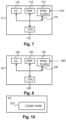
- Fig. 7 is a non-limitative embodiment of an architecture of said secure element 11. It comprises:
- the non-volatile memory NVM is a FLASH memory.
- the parent executable file 310 is embedded in the secure element 11, designated as parent customer item, and is stored in the non-volatile memory NVM. In a non-variant of embodiment, it is stored in the FLASH memory. In other non-variant of embodiment, it is stored in other types of non-volatile memory.
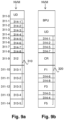
- FIG. 9a A non-limitative example of the non-volatile memory NVM where the parent executable file 310 is loaded is illustrated in Fig. 9a . As illustrated, it comprises the parent executable file 310 within the ranges 311-1 to 311-14 and a memory space for the user data UD in the range 311-10 of physical addresses.
- the non-volatile memory NVM comprises the Java Virtual Machine JVM.
- the CPU 110 executes the instructions of the different codes (first binary code 312, second binary code 313) stored in the stored in the non-volatile memory NVM, and the Java Virtual Machine JVM interprets the bytecodes 314 stored in the non-volatile memory NVM.
- the executable file 320 designated as derived executable file, which is derived from the parent executable file 310, comprises:
- Such an executable file 320 is illustrated in Fig. 6 , in a non-limitative embodiment. It results from a modification of the parent executable file 310 where at least one native feature F has been removed, that is to say where the corresponding second binary code 313 has been replaced.
- the method P1 for generating such an executable file 320 derived from the parent executable file 310 is illustrated in Fig. 1 . It comprises the following steps: In step E11), illustrated SELCT(F), at least one native feature F from the set of native features is selected to be removed.
- a plurality of native features F is selected to be removed.
- the native features F2 and F4 are selected.
- the native features F2 and F4 are circled to show their selection.
- the core features CR are not removable. Therefore, the first binary code 312 will be stored in the derived executable file 320 in the same range 321 of physical addresses than in the parent executable file 310.
- step E12 illustrated DEF(311, 313(F)), the range 311 of physical addresses where the second binary code 313 of said at least one selected native feature F is stored, is defined.
- the second binary codes 313-2 and 313-4 of the native features F2 and F4 are stored within the ranges 311-11 and 311-13 of physical addresses. It is to be reminded that the storage in said ranges 321-2 and 321-4 has been defined from the linking process.
- step E13 illustrated SELCT(314, Pkg)), at least one java feature Pkg from the set of java features to be relocated is selected.
- the bytecodes 314 of a plurality of java features Pkg is selected to be relocated.
- the java features Pkg-3, Pkg-4, Pkg-6, and Pkg-8 are selected.
- a java feature Pkg which can be relocated has no dependency with other java feature Pkg.
- the word "dependency" should be understood as a functional link between two java features Pkg. These functional links are introduced by calling in the source code 300, the name of the java feature Pkg.
- the java features Pkg which are relocatable are independent from each other, which means that their bytecodes 314 can be shifted in memory in any range 311 of physical addresses without considering the other bytecodes 314 of the other java features Pkg.
- step E14 illustrated RELOCT(314(Pkg), 311), the bytecodes 314 of said at least one selected java feature Pkg are relocated in said defined range 311 of physical addresses.
- the bytecodes 314 of a plurality of java features Pkg are relocated.
- the bytecodes 314-3, 314-4, 314-6, and 314-8 respectively of the java features pkg3, pkg4, pgk6 and Pkg8 are relocated.
- the relocating is performed according to the bytecodes' size of said at least one selected java feature Pkg and the defined range 311 of physical addresses' size.
- the relocating is performed according to the Best Fit algorithm well-known by the man skilled in the art. It permits to optimize the relocating.
- the bytecodes 314-3, 314-4 fit in the range 311-13 of physical addresses and therefore are relocated in said range 311-13
- the bytecodes 314-6, and 314-8 fit in the range 311-11 of physical addresses and therefore are relocated in said range 311-11.
- second binary code 313 of the native feature(s) F (which has been selected to be removed), which has not been overwritten by the relocation of the bytecodes 314 and which is left in the defined range 311 of physical addresses.
- This part of second binary code 313 is a dead code because it won't be called anymore.
- the second binary code 313 of said at least one selected native feature F may be deleted from said parent executable file 310.
- the part of the second binary code 313 which is left may be deleted from said parent executable file 310, part which has not been overwritten by the relocating of the bytecodes 314.
- the deleting may be performed by filling with bits 0 or 1 the range 311 of physical addresses corresponding to said part left.
- step E15 illustrated COMPACT(314(Pkg), when the bytecodes 314 of the selected java feature(s) Pkg have been relocated, in a non-limitative embodiment, the method P1 further comprises compacting the bytecodes 314 of the java features Pkg which are not relocated. As this step is non mandatory, it is illustrated in dotted line in Fig. 1 .
- the range(s) 311 of physical addresses freed by the bytecodes 314 compacting is reserved for user data UD in the non-volatile memory NVM where the derived executable file 320 is loaded, that is to say data which are specific to the user of the derived customer item 12.
- user data UD comprise a picture, a signature, the name, address, age of the user etc.
- Fig. 6 illustrated the result of the compacting step which produces the derived executable file 320 which is loaded in a secure element for producing a derived customer item.
- the derived executable file 320 is smaller than the parent executable file 310 due to the compacting.
- the derived executable file 320 generated is the one illustrated in Fig. 5 , that is to say it results from the step E14.
- FIG. 9b A non-limitative example of the non-volatile memory NVM where the derived executable file 320 is loaded is illustrated in Fig. 9b . As illustrated, it comprises the derived executable file 320, some user data UD, and some added memory space BPU where more user data UD can be added.
- This memory space brings an added value to the derived customer item 12 and this can be monetized.
- removing unnecessary native features F allows to maximize the size of the user data memory by adding unused memory to it and therefore increase the revenue generated while selling the derived customer item 12.
- a method P2 for producing a secure element 12, designated as derived customer item, said secure element 12 comprising a non-volatile memory NVM, is illustrated in Fig. 10 .
- Said method P2 comprises the loading (step E21 illustrated LD(320, NVM)) of said executable file 320 in said non-volatile memory NVM of said secure element 12.
- a derived customer item 12 is produced from the parent customer item 11 in which the parent executable file 310 is embedded.
- the secure element 12 is an integrated circuit card ICC.
- Fig. 8 is a non-limitative embodiment of architecture of said secure element 12. It comprises:
- the non-volatile memory NVM is a FLASH memory.
- the derived executable file 320 is embedded in the secure element 12 and is stored in the non-volatile memory NVM. In a non-variant of embodiment, it is stored in the FLASH memory. In other non-variant of embodiments, it is stored other types of non-volatile memory.
- the non-volatile memory NVM comprises the Java Virtual Machine JVM.
- the CPU 120 executes the instructions of the different codes (first binary code 312, second binary code 313) stored in the stored in the non-volatile memory NVM, and the Java Virtual Machine JVM interprets the bytecodes 314 stored in the non-volatile memory NVM.
- a secure element 12 designated as derived customer item, is derived from the parent customer item 11.
- a plurality of derived customer items 12 comprising different combinations of native features F can be produced in this manner.
- the compilation of the source code 300 and the linking of the object file .obj and the .jca file is performed only one time and for all the customer items, whether it is a parent customer item 11 or a derived customer item 12.
- the native code (of the core feature(s) CR and of the native feature(s) F) checked must be the same, and its related ranges 311 of physical addresses must be the same. It is to be noted that even if only one related range 311 of physical addresses is changed, it implies that the native code is modified, as the call from one native feature F for example will be modified when it calls another native feature F which related range 311 of physical addresses (where its second binary code 313 is positioned) has been modified.
- the java code (of the java feature(s) Pkg) checked must also be the same. But, if it is relocated, there is no consequence regarding the java code. It is not modified, as the dependency between different java features Pkg is implemented according to the calling of the name of the java feature Pkg.
- the Java Virtual Machine JVM interprets the dependency according to a table of the ranges 311 of physical addresses which are related to the different java features Pkg. When a java feature Pkg is relocated, this table is updated with the new corresponding ranges 311 of physical addresses.
- some embodiments of the invention may comprise one or a plurality of the following advantages:
Landscapes
- Engineering & Computer Science (AREA)
- Theoretical Computer Science (AREA)
- Software Systems (AREA)
- General Engineering & Computer Science (AREA)
- Physics & Mathematics (AREA)
- General Physics & Mathematics (AREA)
- Devices For Executing Special Programs (AREA)
Description
- The present invention relates to a method for generating an executable file from a parent executable file.
- Such method may be used in a non-limitative example within the domain of certified secure elements.
- Secure elements may be used for a wide variety of products and can implement various kinds of technology features. As an example, a secure element can implement security features such as biometry, RSA (Rivest, Shamir, Adleman algorithm) and elliptic curves. An executable file comprises the code of said security features. As an example, a product can be a health card, or a driving license.
- These executable file is generally stored in non volatile memory (NVM). Then, different versions of the secure element can be generated with different subsets of activated features. These different versions are usually designated as derived customer items, and the secure element from which they are derived is designated as a parent customer item. For example, a secure element that includes five different features may be used as a basis to derive several secure elements adapted to different customer requirements by removing one or several features.
- For some secure elements with specific security features, it is sometimes mandatory to certify said secure element, for example using the Common Criteria for Information Technology Security Evaluation standard, ISO 15408. The certification process can be considered as a constraint during the production phase. It can take up to a year for a certification process to be concluded.
- One problem of this prior art is that, when a given parent customer item is certified, the certification process should also be performed on the derived customer items derived from said parent customer item, which implies time and effort required to certify said derived customer items.
- Document
EP3067795A1 describes a method for producing an embedded system designated as a principal customer item which comprising the following steps: generating at least one object file by compiling a source code comprising a set of at least two features organized hierarchically such that a given feature associated with a given hierarchical level has only dependencies toward other features of lower hierarchical levels; determining a list of a plurality of contiguous ranges of virtual addresses; mapping the ranges of virtual addresses of the list to a set of ranges of physical addresses in a permanent storage area of the embedded system; generating from the results provided by the linking and the mapping steps a file executable by the embedded system; loading said executable file in the permanent storage area of the embedded system. - The following summary of the invention is provided in order to provide a basic understanding of some aspects and features of the invention. This summary is not an extensive overview of the invention and as such it is not intended to particularly identify key or critical elements of the invention or to delineate the scope of the invention. Its sole purpose is to present some concepts of the invention in a simplified form as a prelude to the more detailed description that is presented below.
- It is an object of the invention to provide a method generating an executable file derived from a parent executable file, which permits minimizing the time and effort required by testing and certifying a derived customer item, in which said executable file is embedded.
- To this end, there is provided a method for generating an executable file, derived from a parent executable file, said parent executable file comprising ranges of physical addresses referencing:
- a first binary code of at least one core feature;
- a second binary code of a set of native features;
- bytecodes of a set of java features;
- selecting at least one native feature from said set of native features to be removed;
- defining the range of physical addresses where the second binary code of said at least one selected native feature is stored;
- selecting at least one java feature from said set of java features to be relocated;
- relocating the bytecodes of said at least one selected java feature in said defined range of physical addresses. The relocating process is performed according to the size of the bytecodes to be relocated and the size of the defined range of the physical addresses.
- Said executable file is designated as derived executable file.
As we will see in further details, as the execution file derived from the parent executable file, is only a modified parent executable file where one or a plurality of native features have been removed, the physical addresses of the first binary code of the at least one core feature and the second binary code of the remaining native features of the set of native features have not changed, and thus the first binary code and the second binary code have not been modified. Therefore, the certification of a secure element in which said parent executable file is embedded may be automatically applied to another secure element in which said derived executable file is embedded, without having another certification process to be performed for said another secure element. - According to non-limitative embodiments of the invention, the method in accordance with the invention further comprises the following characteristics.
- In a non-limitative embodiment, said at least one core feature and said set of native features comprise a native code, and said set of java features comprises the java code of at least one java package.
- In a non-limitative embodiment, said first binary code, said second binary code and said bytecodes are generated by compiling a source code comprising said at least one core feature, said set of native features and said set of java features.
- In a non-limitative embodiment, said at least one core feature is not removable.
- In a non-limitative embodiment,
- said set of native of features comprises a plurality of native features;
- said set of java features comprises a plurality of java features.
- In a non-limitative embodiment, a plurality of native features is selected to be removed.
- In a non-limitative embodiment, the bytecodes of a plurality of java features is relocated.
- In a non-limitative embodiment, said method further comprises compacting the bytecodes of the java feature(s) which are not relocated.
- In a non-limitative embodiment, the range(s) of physical addresses freed by the bytecodes compacting is reserved for user data.
- In a non-limitative embodiment, the parent executable file is embedded in a non-volatile memory of a secure element designated as a parent customer item.
- In addition, there is provided an executable file, wherein said executable file is generated according to the method characterized according to any characteristics above-mentioned.
- In addition, there is provided a method for producing a secure element designated as a derived customer item, said secure element comprising a non-volatile memory, wherein said method comprises the loading of an executable file generated according to the method of any above-mentioned characteristics, in said non-volatile memory of said secure element.
- In a non-limitative embodiment, said non-volatile memory is a flash memory.
- In a non-limitative embodiment, said secure element is an integrated circuit card.
- In addition, there is provided a secure element designated as a derived customer item, which is produced by the method above-mentioned.
- In a non-limitative embodiment, said secure element is an integrated circuit card.
- To achieve those and other advantages, and in accordance with the purpose of the invention as embodied and broadly described, the invention proposes a method for generating an executable file derived from a parent executable file, said parent executable file comprising ranges of physical addresses referencing:
- a second binary code of at least a native feature which is removable from the parent executable file;
- bytecodes of at least a java feature;
- selecting at least one native feature from said set of native features to be removed;
- defining the range of physical addresses where the second binary code of said at least one selected native feature is stored in the parent executable file;
- selecting at least one java feature from said set of java features to be relocated;
- in the generated derived executable file, relocating the bytecodes of said at least one selected java feature in said defined range of physical addresses according to a predefined optimization relocation algorithm.
- In a various method of the present invention, the ranges of physical addresses of said parent executable file reference a first binary code of at least one core feature which is not removable from the parent executable file, and wherein said at least one core feature is not removable from the derived executable file and wherein the first binary code is stored in the derived executable file in the same range of physical addresses than in the parent executable file.
- In a various method of the present invention, the relocating process is performed according to the size of the bytecodes to be relocated and the size of the defined range of the physical addresses.
- In a various method of the present invention, the bytecodes of the java feature(s) which are not relocated is compacted.
- In a various method of the present invention, the range(s) of physical addresses freed by the compacted bytecodes (314) is reserved for user data.
- In a various method of the present invention, the parent executable file is loaded in a non-volatile memory.
- In a various method of the present invention, the generated derived executable file is loaded in a non-volatile memory of a secure element designated as a derived customer item.
- In a various method of the present invention, the non-volatile memory is a flash memory.
- In a various method of the present invention, a native feature F is selected to be removed when there is no dependency between said native feature and another native feature.
- In a various method of the present invention, a java feature is selected for relocation when its bytecodes can be shifted in memory in any range of physical addresses without considering the other bytecodes of the other java features.
- In a various method of the present invention, the native feature to be removed is overwritten by the relocation of the bytecodes or deleted before the relocation process.
- Some embodiments of methods and/or apparatus in accordance with embodiments of the present invention are now described, by way of example only, and with reference to the accompanying drawings, in which:
-
Fig. 1 is an organizational chart of a method for generating an executable file derived from a parent executable file, according to a non-limitative embodiment of the invention; -
Fig. 2 illustrates a diagram of a parent executable file from which an executable file is derived according to the method ofFig. 1 , said parent executable file comprising a first binary code of a core feature, a second binary code of a set of native features, and bytecodes of java features, in a non limitative embodiment; -
Fig. 3 illustrates a diagram of a source code from which the parent executable file ofFig. 2 is generated; -
Fig. 4 illustrates a diagram of the parent executable file ofFig. 2 , wherein the binary code corresponding to two native features has been removed, according to the method ofFig. 1 , in a non-limitative embodiment; -
Fig. 5 illustrates a diagram of the parent executable file ofFig. 4 , wherein the bytecodes of five java features have been relocated, according to the method ofFig. 1 , in a non-limitative embodiment; -
Fig. 6 illustrates a diagram of the parent executable file ofFig. 5 , wherein the bytecodes of some java features which have not been relocated have been compacted for producing a derived executable file, according to the method ofFig. 1 , in a non-limitative embodiment; -
Fig. 7 illustrates an architecture of a parent secure element in which said parent executable file ofFig. 2 is embedded, in a non limitative embodiment; -
Fig. 8 illustrates an architecture of a derived secure element in which said derived executable file ofFig. 6 is embedded, in a non limitative embodiment; -
Fig. 9a illustrates a non-volatile memory of the parent secure element ofFig. 7 , in a non-limitative embodiment; -
Fig. 9b illustrates a non-volatile memory of the parent secure element ofFig. 8 , in a non-limitative embodiment; and -
Fig. 10 is an organizational chart of a method for producing a secure element in which said derived executable file ofFig. 8 is embedded, according to a non-limitative embodiment of the invention. - Throughout the figures, the same reference numerals and characters, unless otherwise stated, are used to denote like features, elements, components or portions of the illustrated embodiments.
- In the following description, numerous specific details are set forth.
- However, it is understood that well-known circuits, structures, techniques functions or constructions by the man skilled in the art are not described in detail since they would obscure the invention in unnecessary detail.
- The present invention relates to a method P1 for generating an
executable file 320 derived from a parentexecutable file 310. - In a non-limitative embodiment, the parent
executable file 310 is in the HEX format. As will be described in the following, one or several portions of theparent execution file 310 corresponding to some native feature(s) F to be removed are replaced by bytecodes 324 of java features Pkg. - As illustrated in
Fig. 2 , the parentexecutable file 310 comprisesranges 311 of physical addresses referencing: - a first
binary code 312 of at least one core feature CR; - a second
binary code 313 of a set of native features F; -
bytecodes 314 of a set of java features Pkg. - In the following, a set of native features or a native feature will be referenced F. In the following, a set of java features or a java feature will be referenced Pkg.
- In a non-limitative embodiment, the set of native features F comprises one or a plurality of native features. In the non-limitative illustrated example in
Fig. 2 and Fig. 3 , the parentexecutable file 310 comprises the second binary code 313-1 to 313-5 of five native features F1 to F5. - In non-limitative examples:
- a first native feature F1 implements RSA algorithm;
- a second native feature F2 implements an error correcting codes EXX algorithm.
- a third native feature F3 implements RSA on-board key generation OBKG algorithm.
- In a non-limitative embodiment, the set of java features Pkg comprises one or a plurality of java features Pkg. In the non-limitative illustrated example in
Fig. 2 and Fig. 3 , the parentexecutable file 310 comprises the bytecodes 314-1 to 314-8 of eight java features Pkg-1 to Pkg-8. - The parent
executable file 310 is obtained by: - compiling a
source code 300 illustrated inFig. 3 comprising said at least one core feature CR, the set of native features F and the set of java features Pkg, said compiling resulting in said firstbinary code 312, said secondbinary code 313 and saidbytecodes 314. Hence, the firstbinary code 312 is the compiled code of the at least one core feature CR, the secondbinary code 313 is the compiled code of the set of native features F and thebytecodes 314 are the compiled code of the set of java features Pkg. In a non-limitative embodiment, the compiling generates an object file .obj comprising said firstbinary code 312 and said secondbinary code 313, and a .jca file comprising saidbytecodes 314; - linking the object file .obj and the .jca file with said
ranges 311 of physical addresses resulting in the parentexecutable file 310. The parentexecutable file 310 comprises theranges 311 of physical addresses illustrated inFig. 2 where the codes (firstbinary code 312, secondbinary code 313, and bytecodes 314) are positioned. In a non-limitative embodiment, theranges 311 of physical addresses are contiguous. Hence, after the linking,different ranges 311 of physical addresses are related to the different codes. - It is to be noted that the
ranges 311 of physical addresses are those of the non-volatile memory NVM described in the following, where the parentexecutable file 310 is loaded. It is further to be noted that the first range 311-1 of physical addresses depends on the location where the parentexecutable file 310 is loaded in the non-volatile memory NVM. - In this description, a distinction is made between core features CR which are mandatory components for the
source code 300, and non-core features which are optional components that may be removed from the parentexecutable file 310 to obtain a derivedexecutable file 320 described in the following. Unless explicitly mentioned, a native feature refers to a non-core feature. - The core features CR are implementing the minimum functionalities to be embedded in a
secure element 11 which is a parent secure element, also designated as a parent customer item or in a secure element 12 which is derived from said parent customer item and designated as a derived secure element or as a derived customer item. - In a non-limitative embodiment, said at least one core feature CR and the set of native features F comprise a native code, and the set of java features Pkg comprises the java code of at least one java package. A java package Pkg is a library.
- Native code refers to programming code that is configured to run on a specific processor. In a non-limitative example, the native code is in C code or assembly code.
- Bytecodes of the java code are interpreted by a Java Virtual Machine into code that will run on computer hardware.
- The parent
executable file 310 is a computer program product which is embedded in asecure element 11 designated as parent customer item. The parentexecutable file 310 generated for theparent customer item 11 can be used as a basis to produce executable files, designated as derived executable files, for derived customer items 12. - In a non-limitative element, said
secure element 11 is an integrated circuit card ICC also designated as ICC card in the following. The ICC card may be contact or contactless. - In non-limitative embodiments, the ICC card is a smart device, a soldered element, a M2M module, an eSE (embedded secure element), a micro-SD etc.
- In non-limitative examples, the ICC card is a banking card, such as an EMV card, an Electronic Identity Card, a health card, a driving license, a passport, a privacy card, a financial service card, an access card etc.
- It is to be noted that secure elements are able to control the access to the data they contain and to authorize or not the use of data by other machines. Secure elements may also provide computation services based on cryptographic components. In general, secure elements have limited computing resources and are intended to be connected to a host machine. Secure elements may be removable or fixed to a host device.
-
Fig. 7 is a non-limitative embodiment of an architecture of saidsecure element 11. It comprises: - a central processing unit (CPU) 110;
- a non-volatile memory (NVM) 112 ;
- a random access memory (RAM) 113;
- a communication interface (I/O) 115 for receiving input and placing output to a computer network, e.g., the Internet, to which the
secure element 11 may be connected, either directly or via intermediary devices, such as a host computer. These various components are connected to one another, for example, by abus 116 ; - a Java Virtual Machine (JVM) 117.
- In a non-limitative embodiment illustrated in
Fig. 7 , the non-volatile memory NVM is a FLASH memory. - In a non-limitative embodiment, the parent
executable file 310, is embedded in thesecure element 11, designated as parent customer item, and is stored in the non-volatile memory NVM. In a non-variant of embodiment, it is stored in the FLASH memory. In other non-variant of embodiment, it is stored in other types of non-volatile memory. - A non-limitative example of the non-volatile memory NVM where the parent
executable file 310 is loaded is illustrated inFig. 9a . As illustrated, it comprises the parentexecutable file 310 within the ranges 311-1 to 311-14 and a memory space for the user data UD in the range 311-10 of physical addresses. - In a non-limitative embodiment, the non-volatile memory NVM comprises the Java Virtual Machine JVM.
- During operation, the
CPU 110 executes the instructions of the different codes (firstbinary code 312, second binary code 313) stored in the stored in the non-volatile memory NVM, and the Java Virtual Machine JVM interprets thebytecodes 314 stored in the non-volatile memory NVM. - The
executable file 320, designated as derived executable file, which is derived from the parentexecutable file 310, comprises: - the first
binary code 312 of said at least one core feature CR; - a second
binary code 313 of a sub-set of the set of native features F of the parentexecutable file 310; -
bytecodes 314 of said set of java features Pkg of the parentexecutable file 310. - Such an
executable file 320 is illustrated inFig. 6 , in a non-limitative embodiment. It results from a modification of the parentexecutable file 310 where at least one native feature F has been removed, that is to say where the corresponding secondbinary code 313 has been replaced. - The method P1 for generating such an
executable file 320 derived from the parentexecutable file 310 is illustrated inFig. 1 . It comprises the following steps:
In step E11), illustrated SELCT(F), at least one native feature F from the set of native features is selected to be removed. - In the non-limitative embodiment, a plurality of native features F is selected to be removed. In the non-limitative example illustrated in
Fig. 4 , the native features F2 and F4 are selected. InFig. 4 the native features F2 and F4 are circled to show their selection. - It is to be noted that the core features CR are not removable. Therefore, the first
binary code 312 will be stored in the derivedexecutable file 320 in the same range 321 of physical addresses than in the parentexecutable file 310. - It is to be noted that if there is a dependency between a native feature F and another native feature F, it can't be selected to be removed.The word "dependency" should be understood as a functional link between two native features F. These functional links are introduced by instructions in the
source code 300, for example "call" or "jump" instructions. - In step E12), illustrated DEF(311, 313(F)), the
range 311 of physical addresses where the secondbinary code 313 of said at least one selected native feature F is stored, is defined. - In the non-limitative example illustrated in
Fig. 2 and Fig. 3 , the second binary codes 313-2 and 313-4 of the native features F2 and F4 are stored within the ranges 311-11 and 311-13 of physical addresses. It is to be reminded that the storage in said ranges 321-2 and 321-4 has been defined from the linking process. - In step E13), illustrated SELCT(314, Pkg)), at least one java feature Pkg from the set of java features to be relocated is selected.
- In a non-limitative embodiment, the
bytecodes 314 of a plurality of java features Pkg is selected to be relocated. In a non-limitative example, the java features Pkg-3, Pkg-4, Pkg-6, and Pkg-8 are selected. - It is to be noted that a java feature Pkg which can be relocated has no dependency with other java feature Pkg. The word "dependency" should be understood as a functional link between two java features Pkg. These functional links are introduced by calling in the
source code 300, the name of the java feature Pkg. - Hence, when there are a plurality of java features Pkg, the java features Pkg which are relocatable are independent from each other, which means that their
bytecodes 314 can be shifted in memory in anyrange 311 of physical addresses without considering theother bytecodes 314 of the other java features Pkg. - In step E14), illustrated RELOCT(314(Pkg), 311), the
bytecodes 314 of said at least one selected java feature Pkg are relocated in said definedrange 311 of physical addresses. - In a non-limitative embodiment, the
bytecodes 314 of a plurality of java features Pkg are relocated. In the non-limitative example illustrated inFig. 5 , the bytecodes 314-3, 314-4, 314-6, and 314-8 respectively of the java features pkg3, pkg4, pgk6 and Pkg8 are relocated. - In a non-limitative embodiment, the relocating is performed according to the bytecodes' size of said at least one selected java feature Pkg and the defined
range 311 of physical addresses' size. - In a non-limitative embodiment, the relocating is performed according to the Best Fit algorithm well-known by the man skilled in the art. It permits to optimize the relocating.
- Hence, in the non-limitative example illustrated in
Fig. 5 , according to the size of the range 311-11 of physical addresses and the range 311-13 of physical addresses, and to the size of the bytecodes 314-3, 314-4, 314-6, and 314-8, the bytecodes 314-3, 314-4 fit in the range 311-13 of physical addresses and therefore are relocated in said range 311-13, and the bytecodes 314-6, and 314-8 fit in the range 311-11 of physical addresses and therefore are relocated in said range 311-11. - It is to be noted that after the relocating, there may be some part of the second
binary code 313 of the native feature(s) F (which has been selected to be removed), which has not been overwritten by the relocation of thebytecodes 314 and which is left in the definedrange 311 of physical addresses. This part of secondbinary code 313 is a dead code because it won't be called anymore. - In a non-limitative embodiment, before the relocating, the second
binary code 313 of said at least one selected native feature F may be deleted from said parentexecutable file 310. In another non-limitative embodiment, after the relocating, the part of the secondbinary code 313 which is left may be deleted from said parentexecutable file 310, part which has not been overwritten by the relocating of thebytecodes 314. The deleting may be performed by filling with bits 0 or 1 therange 311 of physical addresses corresponding to said part left. - In step E15) illustrated COMPACT(314(Pkg), when the
bytecodes 314 of the selected java feature(s) Pkg have been relocated, in a non-limitative embodiment, the method P1 further comprises compacting thebytecodes 314 of the java features Pkg which are not relocated. As this step is non mandatory, it is illustrated in dotted line inFig. 1 . - It permits to free some memory space.
- In a non-limitative embodiment, the range(s) 311 of physical addresses freed by the
bytecodes 314 compacting is reserved for user data UD in the non-volatile memory NVM where the derivedexecutable file 320 is loaded, that is to say data which are specific to the user of the derived customer item 12. In non-limitative examples, user data UD comprise a picture, a signature, the name, address, age of the user etc. - In a non-limitative example illustrated in
Fig. 6 , when the bytecodes 314-3, 314-4, 314-6, and 314-8 of the java features Pkg3, Pkg4, Pkg6, and Pkg8 have been relocated, it has made: - some memory space available in the ranges 311-3 and 311-4 of physical addresses between the bytecodes 314-2 and 314-5 of the remaining java features Pkg2 and Pkg5;
- some memory space available in the range 311-6 of physical addresses;
- some memory space available in the 311-8 of physical addresses;
-
Fig. 6 illustrated the result of the compacting step which produces the derivedexecutable file 320 which is loaded in a secure element for producing a derived customer item. As illustrated, the derivedexecutable file 320 is smaller than the parentexecutable file 310 due to the compacting. - It is to be noted that if the method P1 comprises no compacting step, the derived
executable file 320 generated is the one illustrated inFig. 5 , that is to say it results from the step E14. - By compacting the
bytecodes 314 of the remaining java features Pkg, it increases the memory space available for the user data UD in the non-volatile memory NVM in which the derivedexecutable file 310 is loaded. - A non-limitative example of the non-volatile memory NVM where the derived
executable file 320 is loaded is illustrated inFig. 9b . As illustrated, it comprises the derivedexecutable file 320, some user data UD, and some added memory space BPU where more user data UD can be added. - This memory space brings an added value to the derived customer item 12 and this can be monetized. For a predetermined size of non-volatile memory NVM, removing unnecessary native features F allows to maximize the size of the user data memory by adding unused memory to it and therefore increase the revenue generated while selling the derived customer item 12.
- A method P2 for producing a secure element 12, designated as derived customer item, said secure element 12 comprising a non-volatile memory NVM, is illustrated in
Fig. 10 . Said method P2 comprises the loading (step E21 illustrated LD(320, NVM)) of saidexecutable file 320 in said non-volatile memory NVM of said secure element 12. Thus, a derived customer item 12 is produced from theparent customer item 11 in which the parentexecutable file 310 is embedded. - The description made for the
secure element 11 is applied for the secure element 12. - In a non-limitative embodiment, as the same manner than the
secure element 11, the secure element 12 is an integrated circuit card ICC. -
Fig. 8 is a non-limitative embodiment of architecture of said secure element 12. It comprises: - a central processing unit (CPU) 120;
- a non-volatile memory (NVM) 122 ;
- a random access memory (RAM) 123;
- a communication interface (I/O) 125 for receiving input and placing output to a computer network, e.g., the Internet, to which the
secure element 11 may be connected, either directly or via intermediary devices, such as a host computer. These various components are connected to one another, for example, by abus 126 ; - a Java Virtual Machine (JVM) 127.
- In a non-limitative embodiment illustrated in
Fig. 8 , the non-volatile memory NVM is a FLASH memory. - In a non-limitative embodiment, the derived
executable file 320, is embedded in the secure element 12 and is stored in the non-volatile memory NVM. In a non-variant of embodiment, it is stored in the FLASH memory. In other non-variant of embodiments, it is stored other types of non-volatile memory. - In a non-limitative embodiment, the non-volatile memory NVM comprises the Java Virtual Machine JVM.
- During operation, the
CPU 120 executes the instructions of the different codes (firstbinary code 312, second binary code 313) stored in the stored in the non-volatile memory NVM, and the Java Virtual Machine JVM interprets thebytecodes 314 stored in the non-volatile memory NVM. - Hence, with the derived
executable file 320, a secure element 12, designated as derived customer item, is derived from theparent customer item 11. - Hence, a plurality of derived customer items 12 comprising different combinations of native features F can be produced in this manner.
- Hence, thank to the generation of the derived
executable file 320 described, the compilation of thesource code 300 and the linking of the object file .obj and the .jca file is performed only one time and for all the customer items, whether it is aparent customer item 11 or a derived customer item 12. - If the
parent customer item 11 embedding this parentexecutable file 310 is tested and certified, all derived customer items 12 derived from thisparent customer item 11 will be considered as already tested and certified. - During the certification process, only the features (java, native and core) of the derived customer item 12 are checked and compared to the features (native and core) of the
parent customer item 11. Therefore, if some native features F of theparent customer item 11 are removed from the derived customer item 12, there is no consequence for the certification process. - For the certification process, the native code (of the core feature(s) CR and of the native feature(s) F) checked must be the same, and its
related ranges 311 of physical addresses must be the same. It is to be noted that even if only onerelated range 311 of physical addresses is changed, it implies that the native code is modified, as the call from one native feature F for example will be modified when it calls another native feature F whichrelated range 311 of physical addresses (where its secondbinary code 313 is positioned) has been modified. - For the certification process, the java code (of the java feature(s) Pkg) checked must also be the same. But, if it is relocated, there is no consequence regarding the java code. It is not modified, as the dependency between different java features Pkg is implemented according to the calling of the name of the java feature Pkg. The Java Virtual Machine JVM interprets the dependency according to a table of the
ranges 311 of physical addresses which are related to the different java features Pkg. When a java feature Pkg is relocated, this table is updated with the newcorresponding ranges 311 of physical addresses. - It is to be understood that the present invention is not limited to the aforementioned embodiments.
- Hence, some embodiments of the invention may comprise one or a plurality of the following advantages:
- it allows producing different versions of a secure element, based on the same hardware platform, but taking into account the needs of different customers or applications. The production process is fast, as there is no re-compilation of re-linking required for the derived customer items 12. Furthermore, it is not anymore required to re-test and re-certify the derived customer items 12 if the
parent customer item 11 is already certified; - it avoids performing re-compilation and re-linking for derived customer items 12 at product generation time or on the field for personalizing products;
- it permits to produce some derived customer items 12 when the secure element doesn't comprise any memory management unit designated as MMU, such MMU allowing the linking of virtual addresses to an object file and the mapping of said virtual addresses with ranges of physical addresses;
- memory manufacturers are sometimes selling their product (the non-volatile memory NVM) using pay-per-use billing (also referred as bill-per-use, BPU). This means that the selling price of the memory will depend on the amount of the memory that is really used by a secure element. Therefore, by removing unnecessary native features F, the unused memory space is optimized and the production cost of a derived customer item 12 is reduced.
Claims (13)
- A method (P1) for generating an executable file (320) to be loaded in a non-volatile memory (122) of a secure element (12), said executable file (320) being derived from a parent executable file (310), said parent executable file (310) comprising ranges (311) of physical addresses referencing:- a second binary code (313) of at least a native feature (F) which is removable from the parent executable file;- bytecodes (314) of at least a java feature (Pkg);wherein during the generation of the derived executable file:- selecting (E11) at least one native feature (F) from said set of native features (F) to be removed;- defining (E12) the range (311) of physical addresses where the second binary code (313) of said at least one selected native feature (F) is stored in the parent executable file;- selecting (E13) at least one java feature (Pkg) from said set of java features to be relocated;- in the generated derived executable file, relocating (E14) the bytecodes (314) of said at least one selected java feature (Pkg) in said defined range (311) of physical addresses according to a predefined optimization relocation algorithm, wherein the relocating process is performed according to the size of the bytecodes to be relocated and the size of the defined range (321) of the physical addresses.
- A method (P1) according to the previous claim, wherein ranges (311) of physical addresses of said parent executable file (310) reference a first binary code (312) of at least one core feature (CR) which is not removable from the parent executable file, and wherein said at least one core feature (CR) is not removable from the derived executable file and wherein the first binary code is stored in the derived executable file in the same range of physical addresses than in the parent executable file.
- A method (P1) according to any previous claims, further comprising the step of compacting (E15) the bytecodes (314) of the java feature(s) (Pkg) which are not relocated.
- A method (P1) according to the previous claim, wherein the range(s) (311) of physical addresses freed by the compacted bytecodes (314) is reserved for user data (UD).
- A method (P1) according to any previous claims, wherein the parent executable file (310) is loaded in a non-volatile memory (112).
- A method (P1) according to any previous claims, wherein said method comprising the loading of the derived executable file (320) generated according to the method of any previous claims 1 to 10, in a non-volatile memory (122) of a secure element (12) designated as a derived customer item.
- A method (P2) according to the previous claim 5 and 6, wherein said non-volatile memory (122) is a flash memory.
- A method (P1) according to any previous claims, wherein the parent executable file (310) is loaded in a secure element (11) designated as a parent customer item.
- A method (P1) according to claim 6 or claim 8, wherein said secure element is an integrated circuit card (ICC).
- A method (P1) according to any previous claims, wherein a native feature is selected to be removed when there is no dependency between said native feature and another native feature.
- A method (P1) according to any previous claims, wherein a java feature is selected for relocation when its bytecodes can be shifted in memory in any range of physical addresses without considering the other bytecodes of the other java features.
- A method (P1) according to any previous claims, wherein the native feature to be removed is overwritten by the relocation of the bytecodes or deleted before the relocation process.
- A method (P1) according to any previous claims, wherein said core feature (CR) and said native feature (F) comprise a native code, and said set of java features (Pkg) comprises the java code of at least one java package.
Applications Claiming Priority (2)
| Application Number | Priority Date | Filing Date | Title |
|---|---|---|---|
| EP18306551.5A EP3657319A1 (en) | 2018-11-22 | 2018-11-22 | A method for generating an executable file from a parent executable file to produce a derived customer item |
| PCT/EP2019/082116 WO2020104601A1 (en) | 2018-11-22 | 2019-11-21 | A method for generating an executable file from a parent executable file to produce a derived customer item |
Publications (3)
| Publication Number | Publication Date |
|---|---|
| EP3884374A1 EP3884374A1 (en) | 2021-09-29 |
| EP3884374C0 EP3884374C0 (en) | 2025-06-18 |
| EP3884374B1 true EP3884374B1 (en) | 2025-06-18 |
Family
ID=65228299
Family Applications (2)
| Application Number | Title | Priority Date | Filing Date |
|---|---|---|---|
| EP18306551.5A Withdrawn EP3657319A1 (en) | 2018-11-22 | 2018-11-22 | A method for generating an executable file from a parent executable file to produce a derived customer item |
| EP19804751.6A Active EP3884374B1 (en) | 2018-11-22 | 2019-11-21 | A method for generating an executable file from a parent executable file to produce a derived customer item |
Family Applications Before (1)
| Application Number | Title | Priority Date | Filing Date |
|---|---|---|---|
| EP18306551.5A Withdrawn EP3657319A1 (en) | 2018-11-22 | 2018-11-22 | A method for generating an executable file from a parent executable file to produce a derived customer item |
Country Status (4)
| Country | Link |
|---|---|
| US (1) | US11934816B2 (en) |
| EP (2) | EP3657319A1 (en) |
| ES (1) | ES3037615T3 (en) |
| WO (1) | WO2020104601A1 (en) |
Families Citing this family (1)
| Publication number | Priority date | Publication date | Assignee | Title |
|---|---|---|---|---|
| US20250181724A1 (en) * | 2023-11-30 | 2025-06-05 | The Mitre Corporation | Systems and methods for identifying software fault vulnerabilities and inserting fault countermeasures |
Family Cites Families (4)
| Publication number | Priority date | Publication date | Assignee | Title |
|---|---|---|---|---|
| EP2898413B1 (en) * | 2012-09-24 | 2016-11-23 | Giesecke & Devrient GmbH | A security module and a method for optimum memory utilization |
| CN106663025A (en) * | 2014-03-31 | 2017-05-10 | 耶德托公司 | Method, apparatus, and computer-readable medium for obfuscating execution of application on virtual machine |
| EP3067795A1 (en) * | 2015-03-10 | 2016-09-14 | Gemalto Sa | A method for generating an embedded system derivable into a plurality of personalized embedded system |
| WO2017151546A1 (en) * | 2016-03-01 | 2017-09-08 | 650 Industries, Inc. | Method and apparatus for loading multiple differing versions of a native library into a native environment |
-
2018
- 2018-11-22 EP EP18306551.5A patent/EP3657319A1/en not_active Withdrawn
-
2019
- 2019-11-21 WO PCT/EP2019/082116 patent/WO2020104601A1/en not_active Ceased
- 2019-11-21 EP EP19804751.6A patent/EP3884374B1/en active Active
- 2019-11-21 US US17/295,646 patent/US11934816B2/en active Active
- 2019-11-21 ES ES19804751T patent/ES3037615T3/en active Active
Also Published As
| Publication number | Publication date |
|---|---|
| EP3884374A1 (en) | 2021-09-29 |
| EP3657319A1 (en) | 2020-05-27 |
| US20220004402A1 (en) | 2022-01-06 |
| ES3037615T3 (en) | 2025-10-03 |
| US11934816B2 (en) | 2024-03-19 |
| EP3884374C0 (en) | 2025-06-18 |
| WO2020104601A1 (en) | 2020-05-28 |
Similar Documents
| Publication | Publication Date | Title |
|---|---|---|
| AU2004202909B2 (en) | Token-based linking | |
| US9129137B2 (en) | Method, computer program and device for providing security for intermediate programming code for its execution by a virtual machine | |
| JP2012164350A (en) | Memory management for portable data storage medium | |
| US11934816B2 (en) | Method for generating an executable file from a parent executable file to produce a derived customer item | |
| US7814334B2 (en) | Method and apparatus for changing and adding activation keys for functions of digital content without having to change and recompile the digital content | |
| EP3067795A1 (en) | A method for generating an embedded system derivable into a plurality of personalized embedded system | |
| US20200050783A1 (en) | Information processing device and computer readable medium | |
| CN113220314B (en) | APP resource loading and APK generation method, device, equipment and medium | |
| CN112463042B (en) | A data volume import data verification method, device, terminal and storage medium | |
| CN111506312A (en) | Page generation method and device, computer equipment and storage medium | |
| CN113505026B (en) | Method, device and equipment for verifying backup data and storage medium | |
| CN107743614B (en) | Method for modifying execution of a platform-independent method of an integrated circuit card | |
| CN117251234A (en) | Function calling method and device based on patches | |
| CN116700840B (en) | File execution method, device, electronic equipment and readable storage medium | |
| CN114706587B (en) | Resource index file compiling method and device | |
| CN111241536A (en) | Method and system for loading production test image and preventing illegal swiping | |
| US10789075B2 (en) | Method and apparatus for security certified smart card OS diversification system | |
| CN119988204A (en) | Test method, device, electronic device and storage medium | |
| CN117149194A (en) | Configuration method and device for portal page for identification analysis and electronic equipment | |
| CN111160896A (en) | Smart card customization method, device and system and storage medium | |
| EP3021221A1 (en) | Method for optimizing the execution of a platform-independent method by means of a virtual machine of an integrated circuit card | |
| HK1225127A (en) | A method and device for processing data across platforms of terminal device |
Legal Events
| Date | Code | Title | Description |
|---|---|---|---|
| STAA | Information on the status of an ep patent application or granted ep patent |
Free format text: STATUS: UNKNOWN |
|
| STAA | Information on the status of an ep patent application or granted ep patent |
Free format text: STATUS: THE INTERNATIONAL PUBLICATION HAS BEEN MADE |
|
| PUAI | Public reference made under article 153(3) epc to a published international application that has entered the european phase |
Free format text: ORIGINAL CODE: 0009012 |
|
| STAA | Information on the status of an ep patent application or granted ep patent |
Free format text: STATUS: REQUEST FOR EXAMINATION WAS MADE |
|
| 17P | Request for examination filed |
Effective date: 20210622 |
|
| AK | Designated contracting states |
Kind code of ref document: A1 Designated state(s): AL AT BE BG CH CY CZ DE DK EE ES FI FR GB GR HR HU IE IS IT LI LT LU LV MC MK MT NL NO PL PT RO RS SE SI SK SM TR |
|
| RAP1 | Party data changed (applicant data changed or rights of an application transferred) |
Owner name: THALES DIS FRANCE SAS |
|
| DAV | Request for validation of the european patent (deleted) | ||
| DAX | Request for extension of the european patent (deleted) | ||
| STAA | Information on the status of an ep patent application or granted ep patent |
Free format text: STATUS: EXAMINATION IS IN PROGRESS |
|
| 17Q | First examination report despatched |
Effective date: 20230123 |
|
| GRAP | Despatch of communication of intention to grant a patent |
Free format text: ORIGINAL CODE: EPIDOSNIGR1 |
|
| STAA | Information on the status of an ep patent application or granted ep patent |
Free format text: STATUS: GRANT OF PATENT IS INTENDED |
|
| INTG | Intention to grant announced |
Effective date: 20250221 |
|
| GRAS | Grant fee paid |
Free format text: ORIGINAL CODE: EPIDOSNIGR3 |
|
| GRAA | (expected) grant |
Free format text: ORIGINAL CODE: 0009210 |
|
| STAA | Information on the status of an ep patent application or granted ep patent |
Free format text: STATUS: THE PATENT HAS BEEN GRANTED |
|
| AK | Designated contracting states |
Kind code of ref document: B1 Designated state(s): AL AT BE BG CH CY CZ DE DK EE ES FI FR GB GR HR HU IE IS IT LI LT LU LV MC MK MT NL NO PL PT RO RS SE SI SK SM TR |
|
| REG | Reference to a national code |
Ref country code: GB Ref legal event code: FG4D |
|
| REG | Reference to a national code |
Ref country code: CH Ref legal event code: EP |
|
| REG | Reference to a national code |
Ref country code: DE Ref legal event code: R096 Ref document number: 602019071321 Country of ref document: DE |
|
| REG | Reference to a national code |
Ref country code: CH Ref legal event code: EP |
|
| REG | Reference to a national code |
Ref country code: IE Ref legal event code: FG4D |
|
| U01 | Request for unitary effect filed |
Effective date: 20250618 |
|
| U07 | Unitary effect registered |
Designated state(s): AT BE BG DE DK EE FI FR IT LT LU LV MT NL PT RO SE SI Effective date: 20250626 |
|
| REG | Reference to a national code |
Ref country code: ES Ref legal event code: FG2A Ref document number: 3037615 Country of ref document: ES Kind code of ref document: T3 Effective date: 20251003 |
|
| PG25 | Lapsed in a contracting state [announced via postgrant information from national office to epo] |
Ref country code: GR Free format text: LAPSE BECAUSE OF FAILURE TO SUBMIT A TRANSLATION OF THE DESCRIPTION OR TO PAY THE FEE WITHIN THE PRESCRIBED TIME-LIMIT Effective date: 20250919 Ref country code: NO Free format text: LAPSE BECAUSE OF FAILURE TO SUBMIT A TRANSLATION OF THE DESCRIPTION OR TO PAY THE FEE WITHIN THE PRESCRIBED TIME-LIMIT Effective date: 20250918 |
|
| PG25 | Lapsed in a contracting state [announced via postgrant information from national office to epo] |
Ref country code: HR Free format text: LAPSE BECAUSE OF FAILURE TO SUBMIT A TRANSLATION OF THE DESCRIPTION OR TO PAY THE FEE WITHIN THE PRESCRIBED TIME-LIMIT Effective date: 20250618 |
|
| PG25 | Lapsed in a contracting state [announced via postgrant information from national office to epo] |
Ref country code: RS Free format text: LAPSE BECAUSE OF FAILURE TO SUBMIT A TRANSLATION OF THE DESCRIPTION OR TO PAY THE FEE WITHIN THE PRESCRIBED TIME-LIMIT Effective date: 20250918 |
|
| U20 | Renewal fee for the european patent with unitary effect paid |
Year of fee payment: 7 Effective date: 20251022 |
|
| PG25 | Lapsed in a contracting state [announced via postgrant information from national office to epo] |
Ref country code: IS Free format text: LAPSE BECAUSE OF FAILURE TO SUBMIT A TRANSLATION OF THE DESCRIPTION OR TO PAY THE FEE WITHIN THE PRESCRIBED TIME-LIMIT Effective date: 20251018 |
|
| PGFP | Annual fee paid to national office [announced via postgrant information from national office to epo] |
Ref country code: GB Payment date: 20251023 Year of fee payment: 7 |
|
| PG25 | Lapsed in a contracting state [announced via postgrant information from national office to epo] |
Ref country code: SM Free format text: LAPSE BECAUSE OF FAILURE TO SUBMIT A TRANSLATION OF THE DESCRIPTION OR TO PAY THE FEE WITHIN THE PRESCRIBED TIME-LIMIT Effective date: 20250618 |
|
| PG25 | Lapsed in a contracting state [announced via postgrant information from national office to epo] |
Ref country code: CZ Free format text: LAPSE BECAUSE OF FAILURE TO SUBMIT A TRANSLATION OF THE DESCRIPTION OR TO PAY THE FEE WITHIN THE PRESCRIBED TIME-LIMIT Effective date: 20250618 |
|
| PG25 | Lapsed in a contracting state [announced via postgrant information from national office to epo] |
Ref country code: PL Free format text: LAPSE BECAUSE OF FAILURE TO SUBMIT A TRANSLATION OF THE DESCRIPTION OR TO PAY THE FEE WITHIN THE PRESCRIBED TIME-LIMIT Effective date: 20250618 |
|
| PG25 | Lapsed in a contracting state [announced via postgrant information from national office to epo] |
Ref country code: SK Free format text: LAPSE BECAUSE OF FAILURE TO SUBMIT A TRANSLATION OF THE DESCRIPTION OR TO PAY THE FEE WITHIN THE PRESCRIBED TIME-LIMIT Effective date: 20250618 |
|
| PGFP | Annual fee paid to national office [announced via postgrant information from national office to epo] |
Ref country code: ES Payment date: 20251201 Year of fee payment: 7 |
|
| PLBE | No opposition filed within time limit |
Free format text: ORIGINAL CODE: 0009261 |
|
| STAA | Information on the status of an ep patent application or granted ep patent |
Free format text: STATUS: NO OPPOSITION FILED WITHIN TIME LIMIT |
|
| REG | Reference to a national code |
Ref country code: CH Ref legal event code: L10 Free format text: ST27 STATUS EVENT CODE: U-0-0-L10-L00 (AS PROVIDED BY THE NATIONAL OFFICE) Effective date: 20260430 |