EP3884373B1 - Extracting program features for assisting software development - Google Patents
Extracting program features for assisting software development Download PDFInfo
- Publication number
- EP3884373B1 EP3884373B1 EP19805842.2A EP19805842A EP3884373B1 EP 3884373 B1 EP3884373 B1 EP 3884373B1 EP 19805842 A EP19805842 A EP 19805842A EP 3884373 B1 EP3884373 B1 EP 3884373B1
- Authority
- EP
- European Patent Office
- Prior art keywords
- client
- machine learning
- features
- codebase
- custom
- Prior art date
- Legal status (The legal status is an assumption and is not a legal conclusion. Google has not performed a legal analysis and makes no representation as to the accuracy of the status listed.)
- Active
Links
Images




Classifications
-
- G—PHYSICS
- G06—COMPUTING OR CALCULATING; COUNTING
- G06F—ELECTRIC DIGITAL DATA PROCESSING
- G06F8/00—Arrangements for software engineering
- G06F8/30—Creation or generation of source code
- G06F8/35—Creation or generation of source code model driven
-
- G—PHYSICS
- G06—COMPUTING OR CALCULATING; COUNTING
- G06F—ELECTRIC DIGITAL DATA PROCESSING
- G06F8/00—Arrangements for software engineering
- G06F8/30—Creation or generation of source code
- G06F8/36—Software reuse
-
- G—PHYSICS
- G06—COMPUTING OR CALCULATING; COUNTING
- G06N—COMPUTING ARRANGEMENTS BASED ON SPECIFIC COMPUTATIONAL MODELS
- G06N20/00—Machine learning
-
- G—PHYSICS
- G06—COMPUTING OR CALCULATING; COUNTING
- G06N—COMPUTING ARRANGEMENTS BASED ON SPECIFIC COMPUTATIONAL MODELS
- G06N5/00—Computing arrangements using knowledge-based models
- G06N5/02—Knowledge representation; Symbolic representation
- G06N5/022—Knowledge engineering; Knowledge acquisition
- G06N5/025—Extracting rules from data
-
- G—PHYSICS
- G06—COMPUTING OR CALCULATING; COUNTING
- G06F—ELECTRIC DIGITAL DATA PROCESSING
- G06F8/00—Arrangements for software engineering
- G06F8/20—Software design
-
- G—PHYSICS
- G06—COMPUTING OR CALCULATING; COUNTING
- G06F—ELECTRIC DIGITAL DATA PROCESSING
- G06F8/00—Arrangements for software engineering
- G06F8/30—Creation or generation of source code
- G06F8/31—Programming languages or programming paradigms
-
- G—PHYSICS
- G06—COMPUTING OR CALCULATING; COUNTING
- G06F—ELECTRIC DIGITAL DATA PROCESSING
- G06F8/00—Arrangements for software engineering
- G06F8/40—Transformation of program code
- G06F8/41—Compilation
- G06F8/43—Checking; Contextual analysis
- G06F8/436—Semantic checking
-
- G—PHYSICS
- G06—COMPUTING OR CALCULATING; COUNTING
- G06F—ELECTRIC DIGITAL DATA PROCESSING
- G06F8/00—Arrangements for software engineering
- G06F8/70—Software maintenance or management
- G06F8/74—Reverse engineering; Extracting design information from source code
-
- G—PHYSICS
- G06—COMPUTING OR CALCULATING; COUNTING
- G06F—ELECTRIC DIGITAL DATA PROCESSING
- G06F8/00—Arrangements for software engineering
- G06F8/70—Software maintenance or management
- G06F8/75—Structural analysis for program understanding
Definitions
- Computers and related technology have impacted many aspects of society. Indeed, a computer's ability to process information and to execute applications has transformed the way we both live and work.
- a computer operates by executing a set of executable instructions (e.g., source code). These instructions are typically created in a development environment by a code developer who is designing an application. In many instances, the developer will iteratively change the code in an effort to improve the code's execution and to remove any coding bugs or errors.
- a computer programming project often comprises a large collection of codebases that make up the project.
- a "codebase” may include source code, associated databases, test files, and/or metadata such as change history and changes made.
- Source code contained in a codebase often includes not only source code written by different programmers but also multiple preexisting code libraries. Newly created program instructions merge into a larger codebase, and are then compiled, interpreted, and/or built into executable files and other libraries.
- a computer then executes the executable files to provide the developed functionalities.
- US 2014/237595 A1 describes systems and methods for generating a behavior model on a server that includes features specific to a mobile computing device and the device's current state and configuration.
- the mobile computing device may send information identifying itself, its features, and its current state to the server.
- the server may generate a device-specific lean classifier model for the mobile computing device based on the device's information and state and may send the device-specific lean classifier model to the device for use in detecting malicious behavior.
- US 2017/185921 A1 describes a system and method for employing customized machine learning services.
- a customized data schema based on customization of one of a plurality of metadata schemas by a machine learning service client, is generated.
- clients convert proprietary data into client training data that is compatible with a customized data schema.
- the client training data is fed into a model training logic that trains a model. Models may be used to predict whether a user clicks an advertisement or to predict whether the user click is a fraudulent click.
- At least some embodiments described herein relate to the improved exercise of machine learning in the field of computer program development. This is achieved by accessing a client's codebase, extracting potential features corresponding to aspects of the code which may be required to describe it for modelling purposes. One or more features are then selected to be sent to a machine learning service to allow building of one or more custom learning models.
- a client's codebase is often very large, including not only the newly created code for a particular project, but also including several or many prerequisite libraries or other dependencies.
- the service provider must create a complete copy of the large collection of data contained in the codebase and update it as the codebase changes, or frequently or continuously access the large collection of data through a network.
- the client must ensure that all necessary dependencies and configuration required to build their source code are correctly set up on the service in order for feature extraction to work successfully. This is onerous for the client and often prevents clients from completing the configuration process.
- the present invention solves these problems by allowing clients keep their source code on their own systems and only transmit a limited amount of information (namely, the extracted data features) from the clients' side to the service side.
- This represents an efficient use of network resources when compared to sending the entire collection of the client's codebase to the service provider.
- the extracted data features are much less proprietary (and thus more likely to be shared by the client) than the entire codebase.
- the data features can be transmitted through a computer network more quickly and/or stored on the client and/or service provider's system more safely.
- the client is relieved of the need to configure the service provider's service to build their codebase, and feature extraction is possible solely on the precondition that the client's code builds on their own machine; this is a much simpler requirement for the client and considerably eases the burden of model creation based on their code.
- At least some embodiments described herein relate to the improved exercise of machine learning in the field of computer program development. This is achieved by accessing a client's codebase, extracting potential features corresponding to aspects of the code which may be required to describe it for modelling purposes. One or more features are then selected to be sent to a machine learning service to allow building of one or more custom learning models. The one or more extracted features are then sent to a machine learning service for building one or more custom machine learning models.
- a client's codebase is often very large, including not only the newly created code for a particular project, but also including several or many prerequisite libraries or other dependencies.
- the service provider must create a complete copy of the large collection of data contained in the codebase and update it as the codebase changes, or frequently or continuously access the large collection of data through a network.
- the client must ensure that all necessary dependencies and configuration required to build their source code are correctly set up on the service in order for feature extraction to work successfully. This is onerous for the client and often prevents clients from completing the configuration process.
- the present invention solves these problems by allowing clients keep their source code on their own systems and only transmit a limited amount of information (namely, the extracted data features) from the clients' side to the service side.
- This represents an efficient use of network resources when compared to sending the entire collection of the client's codebase to the service provider.
- the extracted data features are much less proprietary (and thus more likely to be shared by the client) than the entire codebase.
- the data features can be transmitted through a computer network more quickly and/or stored on the client and/or service provider's system more safely.
- the client is relieved of the need to configure the service provider's service to build their codebase, and feature extraction is possible solely on the precondition that the client's code builds on their own machine; this is a much simpler requirement for the client and considerably eases the burden of model creation based on their code.
- Figure 1 illustrates a flowchart of method 100 for extracting feature data from a client's codebase for creation of custom machine learning models.
- Figure 2 illustrates an environment 200 in which the method 100 may be implemented. Important benefits are derived from the fact that a client's codebase can be enormous and contain highly sensitive information. On the other hand, data features of the client's codebase are much smaller, and often contain less sensitive information. Since Figures 1 and 2 are closely related to each other, Figures 1 and 2 now will be described together.
- the method 100 includes accessing a client codebase (act 101).
- the client system then extracts the feature data of the corresponding codebase.
- one or more features are selected (act 103) from the feature data generated via act 102.
- the selected features are then sent (act 104) to a machine learning service for building one or more machine learning models.
- a "codebase” may include source code, associated databases, configuration and property files, test files, and/or metadata such as change history and changes made during software development.
- software development the whole collection of source code that is used to build a particular software system, application, or software component is often included in the codebase.
- Multiple projects can have separate distinct codebases, or can have a single, shared or monolithic codebases.
- related projects such as those developed within the same company, often share the same codebase. As such, the codebase can grow to a size that is too large to efficiently transmit via computer networks.
- the client codebase may be a proprietary codebase or a public (e.g., open source) codebase.
- the client codebase is mostly referred to a client's proprietary codebase.
- a model generated based on a client's proprietary codebase is often called a "custom model”.
- the same principles described herein may also be used to generate models based on public codebases.
- a model generated based on a public codebase is often called a "base model”.
- a same client may have a codebase that is made available for public access and a codebase that is proprietary. Accordingly, a base model may be built based on the public accessible codebase, and a custom model may be built based on the proprietary codebase. The base model may be made available to public for free access, and the custom model may be kept as a proprietary model.
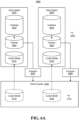
- the environment 200 includes a client computer system 210 (hereinafter also being sometimes referred to as “client system” or “client”) and a machine learning service computer system 220 (hereinafter also being sometimes referred to as “service system”).
- client system a client computer system
- service system a machine learning service computer system 220
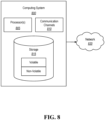
- Each of the client system 210 and the service system 220 may be structured as described before for the computing system 800 of Figure 8 .
- the client system 210 includes a client codebase 211 (hereinafter may also be referred to as "codebase”) and a feature extracting component 212.
- the client system 210 has access to the codebase 211 (referring to act 101 in Figure 1 ).
- the feature extracting component 212 extracts feature data from the codebase 211 to generate a set of feature data 213 on the client system (act 102 in Figure 1 ).
- the set of features 213 is then fed into the feature selecting component 214.
- the feature extracting component 212 selects a subset of the features (act 103 in Figure 1 ) and sends at least one of the selected features to the machine learning service for building one or more machine learning models (act 104 in Figure 1 ).
- the feature extracting component 212 and the feature selecting component 214 may be an executable component running on that computing system 800. However, the feature selecting component 214 is shown outside of the client system 210 in order to symbolically represent that the feature selecting component 214 may be partially or fully implemented outside of the client system 210. Further details regarding the feature selecting component 214 are described in Figures 4A, 4B .
- method 100 allows the large client codebase 211 to be processed through the feature extracting component 212 on the client system 210 to generate a set of feature data 213.
- the data features 213 (which is symbolically represented as a large volume) are much smaller compared to the complete codebase 211 (which is symbolically represented as a small volume).
- the data feature set 215 is a subset of the complete data features 213, as symbolized by the volume of the data feature set being even smaller. It is much more efficient to transfer such a small data feature set 215 over a network and also presents a reduced risk of leakage of private concepts in the clients' source code.
- the service provider 220 receives the data feature set 215, and generates one or more custom machine learning models using the data feature set 215.
- the arrow 223 represents that these custom machine learning model(s) 222 are then "applied back" to the client's programming environment. More details regarding how the machine learning models 222 are "applied back" to the client computing system 110 are described further below with respect to Figures 6A through 6C .
- Figure 3 illustrates a flowchart of a method 300 for featurizing the client codebase on the client computer system to generate a set of data features corresponding to the client codebase.
- Method 300 is an example of how act 102 of Figure 1 may be performed.
- the client codebase is first interpreted by a compiler (act 301).
- the compiled codebase is then used to build a semantic model (act 302).
- a semantic model is a model providing information about the semantic meaning of a program. Many different types of information may be queried through the semantic model. For example, a semantic model can answer questions like what members are accessible from a particular method, what variables are used in a particular block of text, what a name or expression refers to, and so forth. This may also be performed by the compiler during a normal compilation process.
- the semantic model often includes many features of the codebase.
- a feature may be a symbol or element declared by the source code contained in the codebase, information obtained from metadata of the codebase, errors, or warnings generated from diagnostics tools contained in or linked to the codebase.
- a feature may be a namespace of an object, a data type, a method, a property, a field, an event, a parameter, a local variable, and so forth.
- Many data features contained in the semantic model are directly or indirectly relevant to the machine learning models to be built. Therefore, the semantic model is then analyzed to obtain a set of data features (e.g., set of features 213 of Figure 2 ) (act 303).
- each codebase includes its own distinct objects, data types, methods, and so forth, the data feature set generated from one codebase is distinct from that generated from another codebase.
- the format of data features for different codebases may also be different, because each codebase may include source code written in different programming languages. Since each programming language has its own syntax, standards and/or implementation, the semantic models built for codebases may be different per programming language. Accordingly, the feature set generated from these different types of semantic models will also be in a different format. For example, a data feature set generated from a Java codebase would be very different from a feature set generated from a C++ codebase.
- a feature set is often much smaller in volume compared to the entirety of the codebase. This is often because a feature set does not contain all the sensitive information included in the entirety of the codebase.
- the complete feature set 213 may be further processed to extract a smaller set of data features 215 through the feature selecting component 214 (act 103 of Figure 1 ). The smaller set of features 215 is more informative and compact than the complete data feature set 213.
- the feature selecting component 214 is shown outside of the client system 210 in order to symbolically represent that the feature selecting component 214 may be partially or fully implemented outside of the client system 210.
- Different implementations of feature extraction will now be described with respect to Figures 4A and 4B .
- Figures 4A and 4B illustrate two different embodiments of the operation of a feature selecting component 214.
- Figure 4A illustrates a flowchart of a method 400A for extracting one or more features from a set of data features in which a set of extraction rules is defined by a client computer system (e.g., client system 210 of Figure 2 ).
- Figure 4B illustrates a flowchart of a method 400B for extracting one or more features from a set of data features in which a set of extraction rules is defined by a machine learning service (e.g., service system 220 of Figure 2 ).
- Method 400A or 400B is an example of how act 103 of Figure 1 may be performed.
- the client system (e.g., client system 210 of Figure 2 ) defines a set of applicable rules.
- the set of applicable rules defined by the client system (e.g., 210 of Figure 2 ) is first accessed (act 401A).
- the set of features (e.g., 213 of Figure 2 ) is then filtered based on this set of applicable rules to generate a filtered feature set (e.g., features set 215 of Figure 2 ) (act 401B).
- the principles described in method 400A allows the client to define what features are relevant to the target machine learning model.
- the client also can control the amount of information to be disclosed to the service system, thereby controlling privacy. Even though client data features are less sensitive compared to the entirety of the codebase, certain data features may still contain proprietary information.
- the principles described herein gives the client more control over its own data and codebase for protecting its own privacy and proprietary information.
- the service system (e.g., service system 220 of Figure 2 ) defines a set of applicable rules.
- the set of applicable rules defined by the service system is then accessed (act 401B).
- the set of features (e.g., feature set 213 of Figure 2 ) is then filtered based on the set of applicable rules defined by the service system to generate the filtered feature set (e.g., filtered feature set 215 of Figure 2 ) (act 402B).
- the principles described in method 400B allows the service to define what features are necessary for building the target machine learning model(s).
- the client may receive and access a set of rules defined by the service system (act of 401A of Figure 4 ) and apply the set of rules received from the service system to the initial features set 213 to generate the filtered feature set 215 (act of 402A of Figure 4A ). Thereafter, the filtered feature set are sent from the client system to the service system (act 104 of Figure 1 ). Alternatively, the client may send the initial feature set 213 to the service system. Then, the service system will access (act 102 of Figure 1 ) the initial feature set from the client (act 102 of Figure 1 ), access the rules defined by the service system (act of 401B of Figure 4 ) and filter the complete feature set based on its own rules (act of 402B of Figure 4 ).
- the service provider's filter may be based on the particular types of models that are to be built, the accuracy and speed requirements set by the parties, the limitations due to the available physical resources and/or the speed of the computer network, or the privacy and/or security related factors. Since at least some of the features will be transmitted from the client system to the service system, reducing the size of the necessary set of features improves the efficiency and accuracy of the machine learning models built by the service system. Thus, transmitting only the filtered feature set 215 improves the efficiency and accuracy of the machine learning models.
- both client and the service provider may apply a filter to extract features.
- a client may perform first stage filtering of the initial feature set.
- the service may further filter the feature set to generate the final filtered feature set that is to be used to generate machine learning models.
- a client-defined filter and a service-defined filter may be aggregated first, then be applied to the complete initial features set to generate the filtered feature set 215.
- the service system uses that filtered feature set 215 to generate one or more machine learning model(s) (e.g., machine learning model(s) 222 of Figure 2 ) that is customized to the client codebase.
- the custom machine learning models are then sent (e.g., represented by the arrow 223 of Figure 2 ) back to the client system to be applied to a client programming environment. Accordingly, the client system receives the custom machine learning models from the service system.
- Figure 5 illustrates a flow chart of a method 500 for receiving and applying the custom machine learning models to a client programming environment.
- a programming environment is a collection of components located on the client system.
- the programming environment may include language specific editors, debugging facilities, and/or any other hardware and software used by a programmer on the client system who may access the client codebase (e.g., codebase 211 of Figure 2 ).
- the client system receives the custom machine learning model(s) (e.g., custom machine learning model(s) 222 of Figure 2 ) from the service provider (act 501 of Figure 5 ).
- the custom machine learning model(s) are then applied to a programming environment on the client system (act 502 of Figure 5 ).
- Each of the custom machine learning model(s) is generally built for some particular purpose.
- a model may be built for example, for predicting an API, detecting variable misuses, autocompleting a portion of the source code, and so forth.
- the effect is that the client's programming tools or IDE will surface the results of that model in some appropriate user interface to allow the programmer to make use of them. This will help the computer programmer more efficiently contribute to the programming project.
- the system may predict such APIs and display the predicted API(s) on a visualization in the programming environment.
- the computer programmer does not have to look up the API in a programming guide. After all, since there are so many APIs and methods in the codebase, it is almost impossible for any programmer to remember all of them, and picking the right one in a given context requires a lot of work, which the machine learning model can assist with. This also prevents typographical errors in manually typing the API. Having the machine learning model predict and recommend APIs can increase the efficiency of computer programming.
- FIG. 6A , 6B and 6C illustrates the environments 600A, 600B and 600C in which the above-mentioned embodiments may be implemented.
- Figure 6A illustrates an environment 600A in which the method for extracting one or more features from a set of data features may be implemented, and in which a respective custom model is sent to both client computer systems.
- client systems 601A, 602A there are at least two client systems 601A, 602A and a machine learning service system 610A.
- the ellipsis 609A represents that the total number of client systems may be any natural number.
- the service system 610A represents a machine learning service provider that providing services to the client systems 601A and 602A, and is an example of the machine learning service system 220 of Figure 2 .
- Client system 601A contains a codebase 603A, and is an example of the client system 210 of Figure 2 .
- the client system 601A Based on the codebase 603A, the client system 601A generates an initial feature set 605A, from which the extraction component 607A generates a filtered feature set provided to the service provider's system 610A.
- the client system 602A contains a codebase 604A. Based on the codebase 604A, the client system 602A generates an initial feature set 606A, from which the extraction component 608A generates a filtered feature set also provided to the service provider's system 610A.
- the service system 610A After receiving at least one of the filtered features from the client system 601A, the service system 610A generates a custom model 611A for the client system 601A. Also, after receiving at least one of the filtered features from the client system 602A, the service system 610A generates a custom model 612A for the client system 601A.
- the ellipsis 613A represents that there may be any natural number of custom machine learning models being built, one of which is corresponding to one of the client systems.
- the complete custom models 611A and 612A are sent back to the respective client systems 601A and 602A. Further, each of the client systems 601A and 602A stores a copy of the custom models as 611A' and 612A', respectively.
- the custom models 611A and 612A are drawn in dotted line form, which means that after sending the custom models 611A and 612A to the client systems 601A and 602A, the service system may perhaps also keep a copy of these custom models.
- the machine learning service may allow the client to determine whether a copy of the custom model built for the system of the particular client should be kept on the service system 610A.
- This embodiment allows clients to have control of the models built from and for their own codebase.
- the application of the models will be local on the client system, thus, providing faster applications after receiving models.
- Figure 6B illustrates another embodiment 600B in which the service provider retains the control of the custom models built for each of their clients.
- FIG 6B similar to Figure 6A , there are two client systems 601B and 602B.
- the ellipsis 609B represents that there may be any natural number of client systems for which the service system 610B provides machine learning services.
- Each of the client systems 601Band 602B contain a codebase 603B and 604B, respectively.
- Client-specific data features 605B and 606B are generated from each of the corresponding codebases 603B and 604B on each of the corresponding client system 601B and 602B.
- the client-specific data features 605B and 606B are then filtered through their corresponding extraction component 607B and 608B to generate a respective filtered features.
- the service system 610B receives one or more features from each of the client systems 601B and 602B, then builds a custom model 611B and 612B for each of the client system 601B and 602B.
- the service system 610B retains control of the custom models 611B and 612B built for each of the client systems, but grant access to each of the client systems 601B and 602B.
- the client system 601B has network access to the custom model 611B built from and for its codebase 603B.
- client system 602B has network access to the custom model 612B built from and for its codebase 603B.
- the client systems 601B and 602B do not have a complete copy of the custom models built for their codebases.
- the arrow lines between the custom models 611B, 612B and the client systems 601B, 602B represent that to access the custom models 611B, 612B, each of the client systems 601B, 602B communicates with the service system 610B whenever the client models 611B, 612B are to be applied.
- This implementation gives the service provider more control, and also allows a cloud-based machine learning model application to be provided to the clients.
- certain services are inherently done in the cloud.
- code review management is often done in the cloud. If the model can be used to flag issues in code reviews, keeping the model on the service side would allow the machine learning model to be integrated with the code review management on the service side and provide clients better and integrated cloud services.
- the client may be a distributed computer system, containing computers in different network, or an employee may work from home and only have partial data in his/her home computer. Having the custom models and applications provided on the service system would make for easier access to the models from disparate locations.
- Figure 6C is a combination of Figures 6A and 6B .
- a machine learning service provider may provide both implementations illustrated in Figures 6A and 6B .
- the client system 601C is provided a complete copy 611C' of the custom model 611C
- the client system 602C is provided a cloud-based custom model 612C.
- This embodiment allows the service provider to provide different types of services. Also, the clients can choose different services based on their wants.
- Elements 603C through 608C may be similar to respective elements 603B through 608B described with respect to Figure 6B
- machine learning models there are many different machine learning models that may be built by the service system to achieve different purposes.
- computer-readable or human-readable predictions of a programming utility of the client programming environment may be generated.
- a number of programming options may be generated based on prediction of the client's programming needs.
- a portion of source code may be automatically generated or completed.
- the custom machine learning model predicts possible completions
- the predicted source code may be presented, via an autocompletion model, as a computer programmer types. If the programmer continues typing characters, the list of members (variables, methods, etc.) is filtered to include only members containing the additionally typed characters.
- the custom machine learning model may provide different types of suggestions, such as inferred proposals and the global identifiers of the project. Different suggestions may be provided in different fonts or formats.
- one or more possible code misuses within the client programming environment may be detected.
- a possible solution to correct at least one of the detected possible code misuses may be recommended to the client.
- the misuse may be automatically corrected.
- the custom machine learning model can spot different potential errors including, but not limited to, irregular patterns, missed refactorings, and variable misuse issues.
- the errors may be detected while the program is typing a new line of code, or via scanning a completed section of code.
- the detected errors may be shown in different fonts or as a pop-up alert.
- the computer system may simply autocorrect them.
- the users could also preset certain settings of the machine learning model application. If the user prefers to receive a list of suggestions for correcting any the potential error, he/she may set the setting to only allow suggestions be provided. Alternatively, if the user prefers the obvious errors be auto-corrected, he/she may set the setting to allow autocorrect application.
- Codebases may change and evolve as new source code is written and included in it. As such, the existing machine learning models may gradually become less accurate in predicting the utility of the programming. Eventually, a new model should be built based on the updated codebase.
- Each clients or service provider may manually trigger a refresh operation on any of the steps involved in the model building process illustrated in Figures 1 through 5 .
- each of the steps may include a number of events that may automatically trigger each of these steps refresh operation. Once one of these events occurs, the corresponding action will be reinitiated and the previous act's result may be discarded or stored as a history file.
- FIG. 7 illustrates a state graph 700 of the featurization (re-featurization) model.
- the circle 710 represents the act of featurization (or re-featurization).
- the ellipsis 705 represents that there may be any natural number of triggering events that may trigger a re-featurization.
- the arrows 702, 703 and 706 represent that when each of the triggering event 701, 703, 705 is true, a corresponding re-featurization will be initiated.
- each of the steps illustrated in Figures 1 through 5 may be refreshed by one or more events also, just like the act of featurization or re-featurization.
- the triggering events may include some events happening on the client system, and/or some events happening on the service system. For example, if the size of the codebase has increased by certain volume (e.g., 200MB) or by certain percentage (e.g., 5%), a re-featurization may be triggered. As another example, if the machine learning service provider has developed a new machine learning program or an improved process of creating models, the machine learning service provider may trigger a new re-featurization. The client may grant permission for the service provider to trigger a re-featurization. Alternatively, the service provider may provide an indication that a re-featurization is recommended, and it is then up to the client to initiate the re-featurization process.
- certain volume e.g. 200MB
- certain percentage e.g., 5%
- the machine learning service provider may trigger a new re-featurization.
- the client may grant permission for the service provider to trigger a re-featurization.
- some events may be party neutral, such as a time limit. Either party may set a time limit or an expiration date for the existing model.
- a re-featurization is initiated automatically.
- the re-featurization frequency may also be determined based on the service plan a client chooses.
- a re-featurization may not have to trigger a new model building process. If the newly obtained feature set is similar to the previous version of the feature set, a new model may not be necessary.
- a difference threshold may be set to determine at what point a new model should be built based on the new feature set.
- performing the featurization and re-featurization on the client's system also reduces the resource consumption on the service side. Since featurization process require analyzing and compiling the complete large codebase, the process is both time consuming and resource consuming. As such, it is further advantageous to the machine learning service providers to allow the featurization and re-featurization to be completely on the client systems.
- a computer system 800 includes various different components. As used herein, "computer system” and simply “computer” are synonymous terms that may be interchanged with each other. Figure 8 also shows that computer system 800 includes at least one hardware processing unit 805 (aka a "processor"), communication channel(s) 810, and storage 815.
- hardware processing unit 805 aka a "processor”
- the storage 815 may be physical system memory, which may be volatile, non-volatile, or some combination of the two. Accordingly, the storage 815 may be referred to as a "hardware storage device" on which computer-executable instructions are stored.
- the term “memory” may also be used herein to refer to non-volatile mass storage such as physical storage media.
- the term "executable module,” “executable component,” or even “component” can refer to software objects, routines, or methods that may be executed on the computer system 800.
- the different components, modules, engines, and services described herein may be implemented as objects or processors that execute on the computer system 800 (e.g. as separate threads).
- the disclosed embodiments may comprise or utilize a special-purpose or general-purpose computer including computer hardware, such as, for example, one or more processors (such as hardware processing unit 805) and system memory (such as storage 815), as discussed in greater detail below.
- processors such as hardware processing unit 805
- system memory such as storage 815
- Embodiments also include physical and other computer-readable media for carrying or storing computer-executable instructions and/or data structures.
- Such computer-readable media can be any available media that can be accessed by a general-purpose or special-purpose computer system.
- Computer-readable media that store computer-executable instructions in the form of data are physical computer storage media.
- Computer-readable media that carry computer-executable instructions are transmission media.
- the current embodiments can comprise at least two distinctly different kinds of computer-readable media: computer storage media and transmission media.
- Computer storage media are hardware/physical storage devices, such as RAM, ROM, EEPROM, CD-ROM, solid state drives (SSDs) that are based on RAM, Flash memory, phase-change memory (PCM), or other types of memory, or other optical disk storage, magnetic disk storage or other magnetic storage devices, or any other medium that can be used to store desired program code means in the form of computer-executable instructions, data, or data structures and that can be accessed by a general-purpose or special-purpose computer.
- RAM random access memory
- ROM read-only memory
- EEPROM electrically erasable programmable read-only memory
- CD-ROM Compact Disk Read Only Memory
- SSDs solid state drives
- PCM phase-change memory
- the computer system 800 may also be connected (via a wired or wireless connection) to external sensors (e.g., data acquisition devices). Further, the computer system 800 may also be connected through one or more wired or wireless networks 820 to remote systems(s) that are configured to perform any of the processing described with regard to computer system 800.
- external sensors e.g., data acquisition devices
- the computer system 800 may also be connected through one or more wired or wireless networks 820 to remote systems(s) that are configured to perform any of the processing described with regard to computer system 800.
- a "network,” like the network 820 shown in Figure 8 is defined as one or more data links and/or data switches that enable the transport of electronic data between computer systems, modules, and/or other electronic devices.
- a network either hardwired, wireless, or a combination of hardwired and wireless
- the computer properly views the connection as a transmission medium.
- the computer system 800 includes one or more communication channel(s) 810 (e.g., TCP ports, UDP ports, etc.) that are used to communicate with the network 820.
- Transmissions media include a network that can be used to carry data or desired program code means in the form of computer-executable instructions or in the form of data structures. Further, these computer-executable instructions can be accessed by a general-purpose or special-purpose computer. Combinations of the above should also be included within the scope of computer-readable media.
- program code means in the form of computer-executable instructions or data structures can be transferred automatically from transmission media to computer storage media (or vice versa).
- program code means in the form of computer-executable instructions or data structures received over a network or data link can be buffered in RAM within a network interface module (e.g., a network interface card or "NIC") and then eventually transferred to computer system RAM and/or to less volatile computer storage media at a computer system.
- NIC network interface card
- Computer-executable (or computer-interpretable) instructions comprise, for example, instructions that cause a general-purpose computer, special-purpose computer, or special-purpose processing device to perform a certain function or group of functions.
- the computer-executable instructions may be, for example, binaries, intermediate format instructions such as assembly language, or even source code.
- embodiments may be practiced in network computing environments with many types of computer system configurations, including personal computers, desktop computers, laptop computers, message processors, hand-held devices, multi-processor systems, microprocessor-based or programmable consumer electronics, network PCs, minicomputers, mainframe computers, mobile telephones, PDAs, tablets, pagers, routers, switches, cloud-based machines and infrastructures, and the like.
- the embodiments may also be practiced in distributed system environments where local and remote computer systems that are linked (either by hardwired data links, wireless data links, or by a combination of hardwired and wireless data links) through a network each perform tasks (e.g. cloud computing, cloud services and the like).
- program modules may be located in both local and remote memory storage devices.
- illustrative types of hardware logic components include Field-Programmable Gate Arrays (FPGAs), Program-Specific or Application-Specific Integrated Circuits (ASICs), Program-Specific Standard Products (ASSPs), System-On-A-Chip Systems (SOCs), Complex Programmable Logic Devices (CPLDs), Central Processing Units (CPUs), and other types of programmable hardware.
- FPGAs Field-Programmable Gate Arrays
- ASICs Program-Specific or Application-Specific Integrated Circuits
- ASSPs Program-Specific Standard Products
- SOCs System-On-A-Chip Systems
- CPLDs Complex Programmable Logic Devices
- CPUs Central Processing Units
Landscapes
- Engineering & Computer Science (AREA)
- Software Systems (AREA)
- Theoretical Computer Science (AREA)
- General Engineering & Computer Science (AREA)
- General Physics & Mathematics (AREA)
- Physics & Mathematics (AREA)
- Evolutionary Computation (AREA)
- Computing Systems (AREA)
- Data Mining & Analysis (AREA)
- Mathematical Physics (AREA)
- Artificial Intelligence (AREA)
- Medical Informatics (AREA)
- Computer Vision & Pattern Recognition (AREA)
- Computational Linguistics (AREA)
- Stored Programmes (AREA)
- Information Transfer Between Computers (AREA)
Description
- Computers and related technology have impacted many aspects of society. Indeed, a computer's ability to process information and to execute applications has transformed the way we both live and work. A computer operates by executing a set of executable instructions (e.g., source code). These instructions are typically created in a development environment by a code developer who is designing an application. In many instances, the developer will iteratively change the code in an effort to improve the code's execution and to remove any coding bugs or errors.
- A computer programming project often comprises a large collection of codebases that make up the project. A "codebase" may include source code, associated databases, test files, and/or metadata such as change history and changes made. Source code contained in a codebase often includes not only source code written by different programmers but also multiple preexisting code libraries. Newly created program instructions merge into a larger codebase, and are then compiled, interpreted, and/or built into executable files and other libraries. A computer then executes the executable files to provide the developed functionalities.
- Different tools have been created to assist a developer in writing, editing, testing, and debugging an application's source code. Some of these tools include source code editors, debuggers, and integrated development environments (IDEs), just to name a few. In addition to using helpful tools, the process of generating and refining source code can be further improved by receiving suggestions from other entities.
- The subject matter claimed herein is not limited to embodiments that solve any disadvantages or that operate only in environments such as those described above. Rather, this background is only provided to illustrate one exemplary technology area where some embodiments described herein may be practice.
US 2014/237595 A1 describes systems and methods for generating a behavior model on a server that includes features specific to a mobile computing device and the device's current state and configuration. The mobile computing device may send information identifying itself, its features, and its current state to the server. In response, the server may generate a device-specific lean classifier model for the mobile computing device based on the device's information and state and may send the device-specific lean classifier model to the device for use in detecting malicious behavior.
US 2017/185921 A1 describes a system and method for employing customized machine learning services. A customized data schema, based on customization of one of a plurality of metadata schemas by a machine learning service client, is generated. Specifically, it is disclosed that clients convert proprietary data into client training data that is compatible with a customized data schema. The client training data is fed into a model training logic that trains a model. Models may be used to predict whether a user clicks an advertisement or to predict whether the user click is a fraudulent click. - It is the object of the present invention to provide a computer system and a method for improving code development in a programming environment.
- This object is solved by the subject matter of the independent claims.
- Embodiments are defined by the dependent claims.
- At least some embodiments described herein relate to the improved exercise of machine learning in the field of computer program development. This is achieved by accessing a client's codebase, extracting potential features corresponding to aspects of the code which may be required to describe it for modelling purposes. One or more features are then selected to be sent to a machine learning service to allow building of one or more custom learning models.
- Existing machine-learning assisted code drafting technologies are often performed with the service provider having direct access to the client's codebases. A client's codebase is often very large, including not only the newly created code for a particular project, but also including several or many prerequisite libraries or other dependencies. In some of these existing technologies, the service provider must create a complete copy of the large collection of data contained in the codebase and update it as the codebase changes, or frequently or continuously access the large collection of data through a network. Furthermore, the client must ensure that all necessary dependencies and configuration required to build their source code are correctly set up on the service in order for feature extraction to work successfully. This is onerous for the client and often prevents clients from completing the configuration process. In addition, such a system is not only burdensome to the service provider, but also places the client's proprietary programs and data at risk. Clients often hesitate to provide complete proprietary codebases to the service provider. Given these problems, model training on client's code proves more difficult to achieve in practice, resulting in less complete models due to incomplete or out of date data.
- The present invention solves these problems by allowing clients keep their source code on their own systems and only transmit a limited amount of information (namely, the extracted data features) from the clients' side to the service side. This represents an efficient use of network resources when compared to sending the entire collection of the client's codebase to the service provider. In addition, the extracted data features are much less proprietary (and thus more likely to be shared by the client) than the entire codebase. Thus, the data features can be transmitted through a computer network more quickly and/or stored on the client and/or service provider's system more safely. Furthermore, the client is relieved of the need to configure the service provider's service to build their codebase, and feature extraction is possible solely on the precondition that the client's code builds on their own machine; this is a much simpler requirement for the client and considerably eases the burden of model creation based on their code.
- This summary is provided to introduce a selection of concepts in a simplified form that are further described below in the Detailed Description. This Summary is not intended to identify key features or essential features of the claimed subject matter, nor is it intended to be used as an aid in determining the scope of the claimed subject matter.
- In order to describe the manner in which the above-recited and other advantages and features can be obtained, a more particular description of various embodiments will be rendered by reference to the appended drawings. Understanding that these drawings depict only sample embodiments and are not therefore to be considered to be limiting of the scope of the invention, the embodiments will be described and explained with additional specificity and detail through the use of the accompanying drawings in which:
-
Figure 1 illustrates a flowchart of a method for extracting data features from a client's codebase for creation of custom models in a service; -
Figure 2 illustrates an environment in which the method illustrated inFigure 1 may be implemented; -
Figure 3 illustrates a flowchart of a method for featurizing a client codebase on a client computer system to generate a set of data features corresponding to the client codebase; -
Figure 4A illustrates a flowchart of method for extracting one or more features from a set of data features in which a set of extraction rules is defined by a client computer system; -
Figure 4B illustrates a flowchart of method for extracting one or more features from a set of data features in which a set of extraction rules is defined by a machine learning service; -
Figure 5 illustrates a flowchart of method for receiving and applying the custom machine learning model to the client programming environment; -
Figure 6A illustrates an environment in which the method for extracting one or more features from a set of data features may be implemented, and in which a respective custom model is sent to both client computer systems; -
Figure 6B illustrates an environment that is similar to that ofFigure 6A , except that custom models are kept at the service system; -
Figure 6C illustrates an environment that is a combination ofFigures 6A and6B , in that the custom model is sent to one of the client computer system, while the other custom model is kept at the service system; -
Figure 7 illustrates a state graph of the featurization model in accordance with an embodiment of the principles describes herein; and -
Figure 8 illustrates an example computer system in which the principles described herein may be implemented. - At least some embodiments described herein relate to the improved exercise of machine learning in the field of computer program development. This is achieved by accessing a client's codebase, extracting potential features corresponding to aspects of the code which may be required to describe it for modelling purposes. One or more features are then selected to be sent to a machine learning service to allow building of one or more custom learning models. The one or more extracted features are then sent to a machine learning service for building one or more custom machine learning models.
- Existing machine-learning assisted code drafting technologies are often performed with the service provider having direct access to the client's codebases. A client's codebase is often very large, including not only the newly created code for a particular project, but also including several or many prerequisite libraries or other dependencies. In some of these existing technologies, the service provider must create a complete copy of the large collection of data contained in the codebase and update it as the codebase changes, or frequently or continuously access the large collection of data through a network. Furthermore, the client must ensure that all necessary dependencies and configuration required to build their source code are correctly set up on the service in order for feature extraction to work successfully. This is onerous for the client and often prevents clients from completing the configuration process. In addition, such a system is not only burdensome to the service provider, but also places the client's proprietary programs and data at risk. Clients often hesitate to provide complete proprietary codebases to the service provider. Given these problems, model training on client's code proves more difficult to achieve in practice, resulting in less complete models due to incomplete or out of date data.
- The present invention solves these problems by allowing clients keep their source code on their own systems and only transmit a limited amount of information (namely, the extracted data features) from the clients' side to the service side. This represents an efficient use of network resources when compared to sending the entire collection of the client's codebase to the service provider. In addition, the extracted data features are much less proprietary (and thus more likely to be shared by the client) than the entire codebase. Thus, the data features can be transmitted through a computer network more quickly and/or stored on the client and/or service provider's system more safely. Furthermore, the client is relieved of the need to configure the service provider's service to build their codebase, and feature extraction is possible solely on the precondition that the client's code builds on their own machine; this is a much simpler requirement for the client and considerably eases the burden of model creation based on their code.
- This patent application will be organized as follows. First, the principles of extracting feature data from a client's codebase for creation of custom models in a service will be described with respect to
Figures 1 and2 . An example of featurization model will be described with respect toFigure 3 . Then, different implementations of feature extraction will be described with respect to 4A and 4B. Thereafter, the application of machine learning models built from those extracted features will be described with respect toFigures 5 through 6B . Thereafter, an example of the re-featurization model will be described with respect toFigure 7 . Finally, because the principles described herein operate in the context of a computer system, a computer system will be described with respect toFigure 8 . -
Figure 1 illustrates a flowchart ofmethod 100 for extracting feature data from a client's codebase for creation of custom machine learning models.Figure 2 illustrates anenvironment 200 in which themethod 100 may be implemented. Important benefits are derived from the fact that a client's codebase can be enormous and contain highly sensitive information. On the other hand, data features of the client's codebase are much smaller, and often contain less sensitive information. SinceFigures 1 and2 are closely related to each other,Figures 1 and2 now will be described together. - Referring to
Figure 1 , themethod 100 includes accessing a client codebase (act 101). The client system then extracts the feature data of the corresponding codebase. Next, one or more features are selected (act 103) from the feature data generated viaact 102. The selected features are then sent (act 104) to a machine learning service for building one or more machine learning models. - A "codebase" may include source code, associated databases, configuration and property files, test files, and/or metadata such as change history and changes made during software development. In software development, the whole collection of source code that is used to build a particular software system, application, or software component is often included in the codebase. Multiple projects can have separate distinct codebases, or can have a single, shared or monolithic codebases. In particular, related projects, such as those developed within the same company, often share the same codebase. As such, the codebase can grow to a size that is too large to efficiently transmit via computer networks.
- The client codebase may be a proprietary codebase or a public (e.g., open source) codebase. In this application, the client codebase is mostly referred to a client's proprietary codebase. A model generated based on a client's proprietary codebase is often called a "custom model". The same principles described herein may also be used to generate models based on public codebases. A model generated based on a public codebase is often called a "base model". A same client may have a codebase that is made available for public access and a codebase that is proprietary. Accordingly, a base model may be built based on the public accessible codebase, and a custom model may be built based on the proprietary codebase. The base model may be made available to public for free access, and the custom model may be kept as a proprietary model.
- Referring to
Figure 2 , theenvironment 200 includes a client computer system 210 (hereinafter also being sometimes referred to as "client system" or "client") and a machine learning service computer system 220 (hereinafter also being sometimes referred to as "service system"). Each of theclient system 210 and theservice system 220 may be structured as described before for thecomputing system 800 ofFigure 8 . - As illustrated in
Figure 2 , theclient system 210 includes a client codebase 211 (hereinafter may also be referred to as "codebase") and afeature extracting component 212. Theclient system 210 has access to the codebase 211 (referring to act 101 inFigure 1 ). Thefeature extracting component 212 extracts feature data from thecodebase 211 to generate a set offeature data 213 on the client system (act 102 inFigure 1 ). The set offeatures 213 is then fed into thefeature selecting component 214. Thefeature extracting component 212 selects a subset of the features (act 103 inFigure 1 ) and sends at least one of the selected features to the machine learning service for building one or more machine learning models (act 104 inFigure 1 ). - If the
client system 210 is implemented as described for thecomputing system 800 ofFigure 8 , thefeature extracting component 212 and thefeature selecting component 214 may be an executable component running on thatcomputing system 800. However, thefeature selecting component 214 is shown outside of theclient system 210 in order to symbolically represent that thefeature selecting component 214 may be partially or fully implemented outside of theclient system 210. Further details regarding thefeature selecting component 214 are described inFigures 4A, 4B . - Traditionally, to build custom machine learning models for such a large codebase requires the machine learning service to have complete access to the codebase. Typically, the client often provides access to their complete code repository to the service provider. This approach is burdensome to both the client and the service provider.
- For example, from the client perspective, there is a potential privacy risk when a customer discloses their complete codebase to the service provider. Because of this privacy risk, customers may choose to provide only a partial codebase to the service provider. This reduces the quality of the machine learning model because it cannot leverage information in the entirety of the codebase. In addition, it takes substantial time to transfer an entire codebase over a network.
- The principles described herein allow a service provider to customize generated machine learning models on a per-client basis. As illustrated in
Figures 1 and2 ,method 100 allows thelarge client codebase 211 to be processed through thefeature extracting component 212 on theclient system 210 to generate a set offeature data 213. As shown inFigure 2 , the data features 213 (which is symbolically represented as a large volume) are much smaller compared to the complete codebase 211 (which is symbolically represented as a small volume). Furthermore, the data feature set 215 is a subset of the complete data features 213, as symbolized by the volume of the data feature set being even smaller. It is much more efficient to transfer such a small data feature set 215 over a network and also presents a reduced risk of leakage of private concepts in the clients' source code. - On the service provider side, the
service provider 220 receives the data feature set 215, and generates one or more custom machine learning models using the data feature set 215. Thearrow 223 represents that these custom machine learning model(s) 222 are then "applied back" to the client's programming environment. More details regarding how the machine learning models 222 are "applied back" to the client computing system 110 are described further below with respect toFigures 6A through 6C . - Now, an example of an operation of the
feature extracting component 212 will be described with respect toFigures 3. Figure 3 illustrates a flowchart of amethod 300 for featurizing the client codebase on the client computer system to generate a set of data features corresponding to the client codebase.Method 300 is an example of howact 102 ofFigure 1 may be performed. - Briefly stated, the client codebase is first interpreted by a compiler (act 301). The compiled codebase is then used to build a semantic model (act 302). A semantic model is a model providing information about the semantic meaning of a program. Many different types of information may be queried through the semantic model. For example, a semantic model can answer questions like what members are accessible from a particular method, what variables are used in a particular block of text, what a name or expression refers to, and so forth. This may also be performed by the compiler during a normal compilation process.
- The semantic model often includes many features of the codebase. A feature may be a symbol or element declared by the source code contained in the codebase, information obtained from metadata of the codebase, errors, or warnings generated from diagnostics tools contained in or linked to the codebase. For example, a feature may be a namespace of an object, a data type, a method, a property, a field, an event, a parameter, a local variable, and so forth. Many data features contained in the semantic model are directly or indirectly relevant to the machine learning models to be built. Therefore, the semantic model is then analyzed to obtain a set of data features (e.g., set of
features 213 ofFigure 2 ) (act 303). - Because each codebase includes its own distinct objects, data types, methods, and so forth, the data feature set generated from one codebase is distinct from that generated from another codebase. Furthermore, the format of data features for different codebases may also be different, because each codebase may include source code written in different programming languages. Since each programming language has its own syntax, standards and/or implementation, the semantic models built for codebases may be different per programming language. Accordingly, the feature set generated from these different types of semantic models will also be in a different format. For example, a data feature set generated from a Java codebase would be very different from a feature set generated from a C++ codebase.
- Even though different types of codebases may generate different types of feature sets, a feature set is often much smaller in volume compared to the entirety of the codebase. This is often because a feature set does not contain all the sensitive information included in the entirety of the codebase. However, even when the complete set of data features is much smaller in size compared to the entirety of the codebase, not every feature is necessary or desirable to use in building a machine learning model. For instance, some features may not have material predictive value in the machine learning model at hand. Therefore, the complete feature set 213 may be further processed to extract a smaller set of data features 215 through the feature selecting component 214 (act 103 of
Figure 1 ). The smaller set offeatures 215 is more informative and compact than the complete data feature set 213. - As mentioned previously, the
feature selecting component 214 is shown outside of theclient system 210 in order to symbolically represent that thefeature selecting component 214 may be partially or fully implemented outside of theclient system 210. Different implementations of feature extraction will now be described with respect toFigures 4A and 4B . -
Figures 4A and 4B illustrate two different embodiments of the operation of afeature selecting component 214.Figure 4A illustrates a flowchart of amethod 400A for extracting one or more features from a set of data features in which a set of extraction rules is defined by a client computer system (e.g.,client system 210 ofFigure 2 ).Figure 4B illustrates a flowchart of amethod 400B for extracting one or more features from a set of data features in which a set of extraction rules is defined by a machine learning service (e.g.,service system 220 ofFigure 2 ).Method act 103 ofFigure 1 may be performed. - Referring to
Figure 4A , the client system (e.g.,client system 210 ofFigure 2 ) defines a set of applicable rules. The set of applicable rules defined by the client system (e.g., 210 ofFigure 2 ) is first accessed (act 401A). The set of features (e.g., 213 ofFigure 2 ) is then filtered based on this set of applicable rules to generate a filtered feature set (e.g., features set 215 ofFigure 2 ) (act 401B). The principles described inmethod 400A allows the client to define what features are relevant to the target machine learning model. The client also can control the amount of information to be disclosed to the service system, thereby controlling privacy. Even though client data features are less sensitive compared to the entirety of the codebase, certain data features may still contain proprietary information. The principles described herein gives the client more control over its own data and codebase for protecting its own privacy and proprietary information. - Referring to
Figure 4B , unlikeFigure 4A , the service system (e.g.,service system 220 ofFigure 2 ) defines a set of applicable rules. The set of applicable rules defined by the service system is then accessed (act 401B). The set of features (e.g., feature set 213 ofFigure 2 ) is then filtered based on the set of applicable rules defined by the service system to generate the filtered feature set (e.g., filtered feature set 215 ofFigure 2 ) (act 402B). The principles described inmethod 400B allows the service to define what features are necessary for building the target machine learning model(s). - The client may receive and access a set of rules defined by the service system (act of 401A of
Figure 4 ) and apply the set of rules received from the service system to the initial features set 213 to generate the filtered feature set 215 (act of 402A ofFigure 4A ). Thereafter, the filtered feature set are sent from the client system to the service system (act 104 ofFigure 1 ). Alternatively, the client may send the initial feature set 213 to the service system. Then, the service system will access (act 102 ofFigure 1 ) the initial feature set from the client (act 102 ofFigure 1 ), access the rules defined by the service system (act of 401B ofFigure 4 ) and filter the complete feature set based on its own rules (act of 402B ofFigure 4 ). - The service provider's filter may be based on the particular types of models that are to be built, the accuracy and speed requirements set by the parties, the limitations due to the available physical resources and/or the speed of the computer network, or the privacy and/or security related factors. Since at least some of the features will be transmitted from the client system to the service system, reducing the size of the necessary set of features improves the efficiency and accuracy of the machine learning models built by the service system. Thus, transmitting only the filtered
feature set 215 improves the efficiency and accuracy of the machine learning models. - In some embodiments, both client and the service provider may apply a filter to extract features. For instance, a client may perform first stage filtering of the initial feature set. In a second stage, the service may further filter the feature set to generate the final filtered feature set that is to be used to generate machine learning models. Alternatively, a client-defined filter and a service-defined filter may be aggregated first, then be applied to the complete initial features set to generate the filtered
feature set 215. - After the filtered
feature set 215 is accessed by the service system, the service system uses that filtered feature set 215 to generate one or more machine learning model(s) (e.g., machine learning model(s) 222 ofFigure 2 ) that is customized to the client codebase. The custom machine learning models are then sent (e.g., represented by thearrow 223 ofFigure 2 ) back to the client system to be applied to a client programming environment. Accordingly, the client system receives the custom machine learning models from the service system. -
Figure 5 illustrates a flow chart of amethod 500 for receiving and applying the custom machine learning models to a client programming environment. A programming environment is a collection of components located on the client system. The programming environment may include language specific editors, debugging facilities, and/or any other hardware and software used by a programmer on the client system who may access the client codebase (e.g., codebase 211 ofFigure 2 ). - Referring to
Figure 5 , after the custom machine learning model is built by the machine learning service provider, the client system receives the custom machine learning model(s) (e.g., custom machine learning model(s) 222 ofFigure 2 ) from the service provider (act 501 ofFigure 5 ). The custom machine learning model(s) are then applied to a programming environment on the client system (act 502 ofFigure 5 ). - Each of the custom machine learning model(s) is generally built for some particular purpose. A model may be built for example, for predicting an API, detecting variable misuses, autocompleting a portion of the source code, and so forth. When a particular model is applied to the programming environment on the client system, the effect is that the client's programming tools or IDE will surface the results of that model in some appropriate user interface to allow the programmer to make use of them. This will help the computer programmer more efficiently contribute to the programming project.
- For example, if a model is for predicting the API(s) that the programming project is likely to invoke, when the model is applied to the programming environment, the system may predict such APIs and display the predicted API(s) on a visualization in the programming environment. As such, the computer programmer does not have to look up the API in a programming guide. After all, since there are so many APIs and methods in the codebase, it is almost impossible for any programmer to remember all of them, and picking the right one in a given context requires a lot of work, which the machine learning model can assist with. This also prevents typographical errors in manually typing the API. Having the machine learning model predict and recommend APIs can increase the efficiency of computer programming.
- Different implementations may be implemented for the client to receive (act 501 of
Figure 5 ) and/or apply (act 502 ofFigure 5 ) the custom machine learning model(s) built by the service provider. In some embodiments, as described above, the service provider may send a complete copy of the custom machine learning models to the client. Then, the client system may run and apply the machine learning models on the client system itself. On the other hand, the service provider can keep control of the custom machine learning models and only allow the client to execute the models via a computer network.Figures 6A ,6B and6C illustrates theenvironments -
Figure 6A illustrates anenvironment 600A in which the method for extracting one or more features from a set of data features may be implemented, and in which a respective custom model is sent to both client computer systems. Referring toFigure 6A , there are at least twoclient systems learning service system 610A. Theellipsis 609A represents that the total number of client systems may be any natural number. Theservice system 610A represents a machine learning service provider that providing services to theclient systems learning service system 220 ofFigure 2 .Client system 601A contains acodebase 603A, and is an example of theclient system 210 ofFigure 2 . Based on thecodebase 603A, theclient system 601A generates an initial feature set 605A, from which theextraction component 607A generates a filtered feature set provided to the service provider'ssystem 610A. Similarly, theclient system 602A contains acodebase 604A. Based on thecodebase 604A, theclient system 602A generates an initial feature set 606A, from which theextraction component 608A generates a filtered feature set also provided to the service provider'ssystem 610A. - After receiving at least one of the filtered features from the
client system 601A, theservice system 610A generates a custom model 611A for theclient system 601A. Also, after receiving at least one of the filtered features from theclient system 602A, theservice system 610A generates a custom model 612A for theclient system 601A. Theellipsis 613A represents that there may be any natural number of custom machine learning models being built, one of which is corresponding to one of the client systems. - As illustrated in
Figure 6A , the complete custom models 611A and 612A are sent back to therespective client systems client systems client systems service system 610A. - This embodiment allows clients to have control of the models built from and for their own codebase. The application of the models will be local on the client system, thus, providing faster applications after receiving models. However, it is hard for the service providers to modify the models once built.
-
Figure 6B illustrates anotherembodiment 600B in which the service provider retains the control of the custom models built for each of their clients. Referring toFigure 6B , similar toFigure 6A , there are twoclient systems ellipsis 609B represents that there may be any natural number of client systems for which theservice system 610B provides machine learning services. Each of theclient systems 601Band 602B contain acodebase corresponding client system corresponding extraction component - Also similar to
Figure 6A , theservice system 610B receives one or more features from each of theclient systems custom model 611B and 612B for each of theclient system Figure 6A , theservice system 610B retains control of thecustom models 611B and 612B built for each of the client systems, but grant access to each of theclient systems client system 601B has network access to thecustom model 611B built from and for itscodebase 603B. Similarly,client system 602B has network access to the custom model 612B built from and for itscodebase 603B. However, theclient systems custom models 611B, 612B and theclient systems custom models 611B, 612B, each of theclient systems service system 610B whenever theclient models 611B, 612B are to be applied. - This implementation gives the service provider more control, and also allows a cloud-based machine learning model application to be provided to the clients. In particular, certain services are inherently done in the cloud. For example, code review management is often done in the cloud. If the model can be used to flag issues in code reviews, keeping the model on the service side would allow the machine learning model to be integrated with the code review management on the service side and provide clients better and integrated cloud services. Additionally, the client may be a distributed computer system, containing computers in different network, or an employee may work from home and only have partial data in his/her home computer. Having the custom models and applications provided on the service system would make for easier access to the models from disparate locations.
-
Figure 6C is a combination ofFigures 6A and6B . A machine learning service provider may provide both implementations illustrated inFigures 6A and6B . For example, inFigure 6C , theclient system 601C is provided acomplete copy 611C' of thecustom model 611C, and theclient system 602C is provided a cloud-based custom model 612C. This embodiment allows the service provider to provide different types of services. Also, the clients can choose different services based on their wants.Elements 603C through 608C may be similar torespective elements 603B through 608B described with respect toFigure 6B - There are many different machine learning models that may be built by the service system to achieve different purposes. In some embodiments, in response to the application of the received custom machine learning model to the client programming environment, computer-readable or human-readable predictions of a programming utility of the client programming environment may be generated. In particular, a number of programming options may be generated based on prediction of the client's programming needs. Additionally, based on the prediction of the programming utility, a portion of source code may be automatically generated or completed.
- For example, in a client programming environment, if the custom machine learning model predicts possible completions, the predicted source code may be presented, via an autocompletion model, as a computer programmer types. If the programmer continues typing characters, the list of members (variables, methods, etc.) is filtered to include only members containing the additionally typed characters. The custom machine learning model may provide different types of suggestions, such as inferred proposals and the global identifiers of the project. Different suggestions may be provided in different fonts or formats.
- In some embodiments, in response to the application of the received custom machine learning models to the client's programming environment, one or more possible code misuses within the client programming environment may be detected. In particular, in response to the detection of possible code misuse, a possible solution to correct at least one of the detected possible code misuses may be recommended to the client. Alternatively, the misuse may be automatically corrected.
- For example, the custom machine learning model can spot different potential errors including, but not limited to, irregular patterns, missed refactorings, and variable misuse issues. The errors may be detected while the program is typing a new line of code, or via scanning a completed section of code. The detected errors may be shown in different fonts or as a pop-up alert. For obvious errors, the computer system may simply autocorrect them. The users could also preset certain settings of the machine learning model application. If the user prefers to receive a list of suggestions for correcting any the potential error, he/she may set the setting to only allow suggestions be provided. Alternatively, if the user prefers the obvious errors be auto-corrected, he/she may set the setting to allow autocorrect application.
- Codebases may change and evolve as new source code is written and included in it. As such, the existing machine learning models may gradually become less accurate in predicting the utility of the programming. Eventually, a new model should be built based on the updated codebase. There may be any a number of events that may trigger the systems to build a new model. Each clients or service provider may manually trigger a refresh operation on any of the steps involved in the model building process illustrated in
Figures 1 through 5 . Also, each of the steps may include a number of events that may automatically trigger each of these steps refresh operation. Once one of these events occurs, the corresponding action will be reinitiated and the previous act's result may be discarded or stored as a history file. - In particular, a re-featurization may be triggered manually or automatically.
Figure 7 illustrates astate graph 700 of the featurization (re-featurization) model. Thecircle 710 represents the act of featurization (or re-featurization). There are one or more triggeringevents 701 and 703. Theellipsis 705 represents that there may be any natural number of triggering events that may trigger a re-featurization. Thearrows event Figures 1 through 5 may be refreshed by one or more events also, just like the act of featurization or re-featurization. - The triggering events may include some events happening on the client system, and/or some events happening on the service system. For example, if the size of the codebase has increased by certain volume (e.g., 200MB) or by certain percentage (e.g., 5%), a re-featurization may be triggered. As another example, if the machine learning service provider has developed a new machine learning program or an improved process of creating models, the machine learning service provider may trigger a new re-featurization. The client may grant permission for the service provider to trigger a re-featurization. Alternatively, the service provider may provide an indication that a re-featurization is recommended, and it is then up to the client to initiate the re-featurization process.
- Additionally, some events may be party neutral, such as a time limit. Either party may set a time limit or an expiration date for the existing model. Thus, when time is up, a re-featurization is initiated automatically. The re-featurization frequency may also be determined based on the service plan a client chooses. In some embodiments, a re-featurization may not have to trigger a new model building process. If the newly obtained feature set is similar to the previous version of the feature set, a new model may not be necessary. A difference threshold may be set to determine at what point a new model should be built based on the new feature set.
- In addition to allow the client and service to protect each other's proprietary information, performing the featurization and re-featurization on the client's system also reduces the resource consumption on the service side. Since featurization process require analyzing and compiling the complete large codebase, the process is both time consuming and resource consuming. As such, it is further advantageous to the machine learning service providers to allow the featurization and re-featurization to be completely on the client systems.
- Finally, because the principles described herein operate in the context of a computer system, a computer system will be described with respect to
Figure 8 . As illustrated inFigure 8 , in its most basic configuration, acomputer system 800 includes various different components. As used herein, "computer system" and simply "computer" are synonymous terms that may be interchanged with each other.Figure 8 also shows thatcomputer system 800 includes at least one hardware processing unit 805 (aka a "processor"), communication channel(s) 810, andstorage 815. - The
storage 815 may be physical system memory, which may be volatile, non-volatile, or some combination of the two. Accordingly, thestorage 815 may be referred to as a "hardware storage device" on which computer-executable instructions are stored. The term "memory" may also be used herein to refer to non-volatile mass storage such as physical storage media. - If the
computer system 800 is distributed, the processing, memory, and/or storage capability may be distributed as well. As used herein, the term "executable module," "executable component," or even "component" can refer to software objects, routines, or methods that may be executed on thecomputer system 800. The different components, modules, engines, and services described herein may be implemented as objects or processors that execute on the computer system 800 (e.g. as separate threads). - The disclosed embodiments may comprise or utilize a special-purpose or general-purpose computer including computer hardware, such as, for example, one or more processors (such as hardware processing unit 805) and system memory (such as storage 815), as discussed in greater detail below. Embodiments also include physical and other computer-readable media for carrying or storing computer-executable instructions and/or data structures.
- Such computer-readable media can be any available media that can be accessed by a general-purpose or special-purpose computer system. Computer-readable media that store computer-executable instructions in the form of data are physical computer storage media. Computer-readable media that carry computer-executable instructions are transmission media. Thus, by way of example and not limitation, the current embodiments can comprise at least two distinctly different kinds of computer-readable media: computer storage media and transmission media.
- Computer storage media are hardware/physical storage devices, such as RAM, ROM, EEPROM, CD-ROM, solid state drives (SSDs) that are based on RAM, Flash memory, phase-change memory (PCM), or other types of memory, or other optical disk storage, magnetic disk storage or other magnetic storage devices, or any other medium that can be used to store desired program code means in the form of computer-executable instructions, data, or data structures and that can be accessed by a general-purpose or special-purpose computer.
- The
computer system 800 may also be connected (via a wired or wireless connection) to external sensors (e.g., data acquisition devices). Further, thecomputer system 800 may also be connected through one or more wired orwireless networks 820 to remote systems(s) that are configured to perform any of the processing described with regard tocomputer system 800. - A "network," like the
network 820 shown inFigure 8 , is defined as one or more data links and/or data switches that enable the transport of electronic data between computer systems, modules, and/or other electronic devices. When information is transferred, or provided, over a network (either hardwired, wireless, or a combination of hardwired and wireless) to a computer, the computer properly views the connection as a transmission medium. As illustrated, thecomputer system 800 includes one or more communication channel(s) 810 (e.g., TCP ports, UDP ports, etc.) that are used to communicate with thenetwork 820. - Transmissions media include a network that can be used to carry data or desired program code means in the form of computer-executable instructions or in the form of data structures. Further, these computer-executable instructions can be accessed by a general-purpose or special-purpose computer. Combinations of the above should also be included within the scope of computer-readable media.
- Upon reaching various computer system components, program code means in the form of computer-executable instructions or data structures can be transferred automatically from transmission media to computer storage media (or vice versa). For example, computer-executable instructions or data structures received over a network or data link can be buffered in RAM within a network interface module (e.g., a network interface card or "NIC") and then eventually transferred to computer system RAM and/or to less volatile computer storage media at a computer system. Thus, it should be understood that computer storage media can be included in computer system components that also (or even primarily) utilize transmission media.
- Computer-executable (or computer-interpretable) instructions comprise, for example, instructions that cause a general-purpose computer, special-purpose computer, or special-purpose processing device to perform a certain function or group of functions. The computer-executable instructions may be, for example, binaries, intermediate format instructions such as assembly language, or even source code. Although the subject matter has been described in language specific to structural features and/or methodological acts, it is to be understood that the subject matter defined in the appended claims is not necessarily limited to the described features or acts described above. Rather, the described features and acts are disclosed as example forms of implementing the claims.
- Those skilled in the art will appreciate that the embodiments may be practiced in network computing environments with many types of computer system configurations, including personal computers, desktop computers, laptop computers, message processors, hand-held devices, multi-processor systems, microprocessor-based or programmable consumer electronics, network PCs, minicomputers, mainframe computers, mobile telephones, PDAs, tablets, pagers, routers, switches, cloud-based machines and infrastructures, and the like. The embodiments may also be practiced in distributed system environments where local and remote computer systems that are linked (either by hardwired data links, wireless data links, or by a combination of hardwired and wireless data links) through a network each perform tasks (e.g. cloud computing, cloud services and the like). In a distributed system environment, program modules may be located in both local and remote memory storage devices.
- Additionally or alternatively, the functionality described herein can be performed, at least in part, by one or more hardware logic components. For example, and without limitation, illustrative types of hardware logic components that can be used include Field-Programmable Gate Arrays (FPGAs), Program-Specific or Application-Specific Integrated Circuits (ASICs), Program-Specific Standard Products (ASSPs), System-On-A-Chip Systems (SOCs), Complex Programmable Logic Devices (CPLDs), Central Processing Units (CPUs), and other types of programmable hardware.
- The present invention may be embodied in other specific forms without departing from its spirit or essential characteristics. The described embodiments are to be considered in all respects only as illustrative and not restrictive. The scope of the invention is, therefore, indicated by the appended claims rather than by the foregoing description.
Claims (7)
- A computer system comprising:one or more processors; andone or more computer-readable media having stored thereon computer-executable instructions that are structured such that, when executed by the one or more processors,cause the computer system to perform a method for extracting features from a client codebase (211) for creation of custom machine learning models in a machine learning service, the method comprising:accessing (101) a client codebase (211), wherein the client codebase (211) includes a collection of source codes used to build a software program;extracting (102) a set of features (215) from the client codebase (211) on a client computer system (210), wherein extracting the set of features (215) comprises:compiling the client codebase (211);building a semantic model based on the compiled client codebase, wherein the semantic model is a model providing information about a semantic meaning of the software program; andanalyzing the semantic model to obtain the set of features (215);selecting (103) one or more features from the set of features (215);sending (104) at least one of the selected features to a machine learning service (220) for building one or more custom machine learning models (222), wherein the one or more custom machine learning models (222) are machine learning models customized to the client codebase (211);receiving (501) at least one of the custom machine learning models (222) built by the machine learning service (220) in response to sending the at least one of the selected features to the machine learning service;applying (502) the received custom machine learning model (222) to a client programming environment of the client computer system (210); andin response to the application of the received custom machine learning model to the client programming environment, automatically generating or completing a portion of source code.
- The computer system of claim 1, wherein the semantic model is built using at least some metadata of the client codebase.
- The computer system of claim 1, the selection of one or more features comprising:accessing a set of applicable rules defined by a client associated with the client codebase; andfiltering the set of features based on the set of applicable rules defined by the client to extract the one or more features.
- The computer system of claim 1, the selection of one or more features comprising:accessing a set of applicable rules defined by the at least one of the machine learning models provided by the machine learning service; andfiltering the set of features based on the set of applicable rules to extract the one or more features.
- The computer system of claim 1, wherein the at least one of the one or more custom machine learning models is sent from the machine learning service to the client computer system.
- The computer system of claim 1, wherein the at least one of the one or more custom machine learning models is stored at the machine learning service and made accessible to the client.
- A method for extracting features from a client codebase for creation of custom machine learning models in a machine learning service (220), the method comprising:accessing (101) the client codebase, wherein the client codebase (211) includes a collection of source codes used to build a software program;extracting (102) a set of features (215) from the client codebase (211) on a client computer system, wherein extracting the set of features (215) comprises:compiling the client codebase;building a semantic model based on the compiled client codebase (211),wherein the semantic model is a model providing information about a semantic meaning of the software program; andanalyzing the semantic model to obtain the set of features (215);selecting (103) one or more features from the set of features (215) sending (104) at least one of the selected features to a machine learning service (220) for building one or more custom machine learning models (222), wherein the one or more custom machine learning models (222) are machine learning models customized to the client codebase (211);receiving (501) at least one of the custom machine learning models (222) built by the machine learning service (220) in response to sending the at least one of the selected features to the machine learning service;applying (502) the received custom machine learning model (222) to a client programming environment of the client computer system (210); andin response to the application of the received custom machine learning model to the client programming environment, automatically generating or completing a portion of source code.
Applications Claiming Priority (2)
| Application Number | Priority Date | Filing Date | Title |
|---|---|---|---|
| US16/195,318 US10725748B2 (en) | 2018-11-19 | 2018-11-19 | Extracting program features for assisting software development |
| PCT/US2019/058615 WO2020106414A1 (en) | 2018-11-19 | 2019-10-29 | Extracting program features for assisting software development |
Publications (2)
| Publication Number | Publication Date |
|---|---|
| EP3884373A1 EP3884373A1 (en) | 2021-09-29 |
| EP3884373B1 true EP3884373B1 (en) | 2024-03-13 |
Family
ID=68610344
Family Applications (1)
| Application Number | Title | Priority Date | Filing Date |
|---|---|---|---|
| EP19805842.2A Active EP3884373B1 (en) | 2018-11-19 | 2019-10-29 | Extracting program features for assisting software development |
Country Status (3)
| Country | Link |
|---|---|
| US (1) | US10725748B2 (en) |
| EP (1) | EP3884373B1 (en) |
| WO (1) | WO2020106414A1 (en) |
Families Citing this family (5)
| Publication number | Priority date | Publication date | Assignee | Title |
|---|---|---|---|---|
| US11855971B2 (en) * | 2018-01-11 | 2023-12-26 | Visa International Service Association | Offline authorization of interactions and controlled tasks |
| US11150877B2 (en) * | 2019-11-06 | 2021-10-19 | Google Llc | Automatically generating machine learning models for software tools that operate on source code |
| WO2022139879A1 (en) * | 2020-12-24 | 2022-06-30 | Intel Corporation | Methods, systems, articles of manufacture and apparatus to optimize resources in edge networks |
| US11763078B2 (en) | 2021-04-22 | 2023-09-19 | Microsoft Technology Licensing, Llc | Provisional selection drives edit suggestion generation |
| US20230394112A1 (en) * | 2022-06-03 | 2023-12-07 | International Business Machines Corporation | Graph-based semi-supervised generation of files |
Family Cites Families (21)
| Publication number | Priority date | Publication date | Assignee | Title |
|---|---|---|---|---|
| US5875331A (en) * | 1994-09-30 | 1999-02-23 | International Business Machines Corp. | System and method for generating target language code utilizing an object oriented code generator |
| US6826568B2 (en) * | 2001-12-20 | 2004-11-30 | Microsoft Corporation | Methods and system for model matching |
| US7546578B2 (en) * | 2003-05-16 | 2009-06-09 | Oracle International Corporation | High level mathematical programming modeling language in an object oriented programming language |
| US7761858B2 (en) * | 2004-04-23 | 2010-07-20 | Microsoft Corporation | Semantic programming language |
| US7822592B2 (en) * | 2004-10-18 | 2010-10-26 | Manthatron-Ip Limited | Acting on a subject system |
| US7926029B1 (en) * | 2005-01-13 | 2011-04-12 | 21St Century Systems, Inc. | System and method of progressive domain specialization product solutions |
| US7861217B2 (en) * | 2005-12-30 | 2010-12-28 | The Mathworks, Inc. | Non-graphical model dependencies in graphical modeling environments |
| CA2665556A1 (en) * | 2006-10-04 | 2008-04-17 | Welch Allyn, Inc. | Dynamic medical object information base |
| US8230386B2 (en) * | 2007-08-23 | 2012-07-24 | Microsoft Corporation | Monitoring distributed applications |
| US8725666B2 (en) * | 2010-02-26 | 2014-05-13 | Lawrence Livermore National Security, Llc. | Information extraction system |
| US8429103B1 (en) * | 2012-06-22 | 2013-04-23 | Google Inc. | Native machine learning service for user adaptation on a mobile platform |
| US9491187B2 (en) | 2013-02-15 | 2016-11-08 | Qualcomm Incorporated | APIs for obtaining device-specific behavior classifier models from the cloud |
| US9892208B2 (en) * | 2014-04-02 | 2018-02-13 | Microsoft Technology Licensing, Llc | Entity and attribute resolution in conversational applications |
| US10521209B2 (en) * | 2015-05-12 | 2019-12-31 | Phase Change Software Llc | Machine-based normalization of machine instructions |
| US10387531B1 (en) * | 2015-08-18 | 2019-08-20 | Google Llc | Processing structured documents using convolutional neural networks |
| CN108604222B (en) | 2015-12-28 | 2022-03-18 | 云脑科技有限公司 | System and method for deploying customized machine learning services |
| WO2017132636A1 (en) * | 2016-01-29 | 2017-08-03 | Pointivo, Inc. | Systems and methods for extracting information about objects from scene information |
| US9928235B2 (en) * | 2016-07-07 | 2018-03-27 | International Business Machines Corporation | Type-specific rule-based generation of semantic variants of natural language expression |
| US10324961B2 (en) * | 2017-01-17 | 2019-06-18 | International Business Machines Corporation | Automatic feature extraction from a relational database |
| US10754640B2 (en) | 2017-03-24 | 2020-08-25 | Microsoft Technology Licensing, Llc | Engineering system robustness using bug data |
| US10402731B1 (en) * | 2017-12-15 | 2019-09-03 | Jasmin Cosic | Machine learning for computer generated objects and/or applications |
-
2018
- 2018-11-19 US US16/195,318 patent/US10725748B2/en active Active
-
2019
- 2019-10-29 EP EP19805842.2A patent/EP3884373B1/en active Active
- 2019-10-29 WO PCT/US2019/058615 patent/WO2020106414A1/en not_active Ceased
Also Published As
| Publication number | Publication date |
|---|---|
| WO2020106414A1 (en) | 2020-05-28 |
| US10725748B2 (en) | 2020-07-28 |
| US20200159505A1 (en) | 2020-05-21 |
| EP3884373A1 (en) | 2021-09-29 |
Similar Documents
| Publication | Publication Date | Title |
|---|---|---|
| AU2023200421B2 (en) | Dataflow graph configuration | |
| US11379657B2 (en) | Systems and methods for automatic report generation and retaining of annotations in reporting documents after regeneration | |
| EP3884373A1 (en) | Extracting program features for assisting software development | |
| US10481879B2 (en) | Code development using continued machine learnings | |
| US7810070B2 (en) | System and method for software testing | |
| US10824636B2 (en) | Mechanisms for querying disparate data storage systems | |
| US10452367B2 (en) | Variable analysis using code context | |
| US10127147B2 (en) | Automated software compliance analysis | |
| WO2021225881A1 (en) | Data science workflow execution platform with automatically managed code and graph-based data job management | |
| US12154015B2 (en) | Providing custom machine-learning models | |
| US20170090892A1 (en) | Systems and methods for dynamically replacing code objects for code pushdown | |
| US20030192027A1 (en) | Software application development | |
| US10977159B2 (en) | Instrumentation of user actions in software applications | |
| US12321721B2 (en) | Collaborative industrial integrated development and execution environment | |
| US20250371263A1 (en) | Large language model prompt generation and structuring | |
| US10586621B2 (en) | Validating and visualizing performance of analytics | |
| CN104428757B (en) | The integrated diagnosis information in development environment | |
| EP2587380A1 (en) | Runtime environment and method for non-invasive monitoring of software applications | |
| US9250870B2 (en) | Automated creation of shim programs and interfaces | |
| Panayotov | An information system for the evaluation of blockchain smart contracts' effectiveness | |
| WO2025254642A1 (en) | Large language model prompt generation and structuring | |
| Koehler | chemostat_regression | |
| Zavarella | Extending Power BI with Python and R: Perform advanced analysis using the power of analytical languages | |
| CA3249039A1 (en) | Artificial intelligence-based software test code migration |
Legal Events
| Date | Code | Title | Description |
|---|---|---|---|
| STAA | Information on the status of an ep patent application or granted ep patent |
Free format text: STATUS: UNKNOWN |
|
| STAA | Information on the status of an ep patent application or granted ep patent |
Free format text: STATUS: THE INTERNATIONAL PUBLICATION HAS BEEN MADE |
|
| PUAI | Public reference made under article 153(3) epc to a published international application that has entered the european phase |
Free format text: ORIGINAL CODE: 0009012 |
|
| STAA | Information on the status of an ep patent application or granted ep patent |
Free format text: STATUS: REQUEST FOR EXAMINATION WAS MADE |
|
| 17P | Request for examination filed |
Effective date: 20210503 |
|
| AK | Designated contracting states |
Kind code of ref document: A1 Designated state(s): AL AT BE BG CH CY CZ DE DK EE ES FI FR GB GR HR HU IE IS IT LI LT LU LV MC MK MT NL NO PL PT RO RS SE SI SK SM TR |
|
| RAP3 | Party data changed (applicant data changed or rights of an application transferred) |
Owner name: MICROSOFT TECHNOLOGY LICENSING, LLC |
|
| DAV | Request for validation of the european patent (deleted) | ||
| DAX | Request for extension of the european patent (deleted) | ||
| GRAP | Despatch of communication of intention to grant a patent |
Free format text: ORIGINAL CODE: EPIDOSNIGR1 |
|
| STAA | Information on the status of an ep patent application or granted ep patent |
Free format text: STATUS: GRANT OF PATENT IS INTENDED |
|
| RIC1 | Information provided on ipc code assigned before grant |
Ipc: G06F 8/41 20180101ALN20231010BHEP Ipc: G06N 20/00 20190101ALI20231010BHEP Ipc: G06N 5/025 20230101ALI20231010BHEP Ipc: G06F 8/20 20180101ALI20231010BHEP Ipc: G06F 8/75 20180101ALI20231010BHEP Ipc: G06F 8/72 20180101ALI20231010BHEP Ipc: G06F 8/74 20180101ALI20231010BHEP Ipc: G06F 8/36 20180101AFI20231010BHEP |
|
| INTG | Intention to grant announced |
Effective date: 20231102 |
|
| P01 | Opt-out of the competence of the unified patent court (upc) registered |
Effective date: 20231204 |
|
| GRAS | Grant fee paid |
Free format text: ORIGINAL CODE: EPIDOSNIGR3 |
|
| GRAA | (expected) grant |
Free format text: ORIGINAL CODE: 0009210 |
|
| STAA | Information on the status of an ep patent application or granted ep patent |
Free format text: STATUS: THE PATENT HAS BEEN GRANTED |
|
| AK | Designated contracting states |
Kind code of ref document: B1 Designated state(s): AL AT BE BG CH CY CZ DE DK EE ES FI FR GB GR HR HU IE IS IT LI LT LU LV MC MK MT NL NO PL PT RO RS SE SI SK SM TR |
|
| REG | Reference to a national code |
Ref country code: GB Ref legal event code: FG4D |
|
| REG | Reference to a national code |
Ref country code: CH Ref legal event code: EP |
|
| REG | Reference to a national code |
Ref country code: DE Ref legal event code: R096 Ref document number: 602019048298 Country of ref document: DE |
|
| REG | Reference to a national code |
Ref country code: IE Ref legal event code: FG4D |
|
| PG25 | Lapsed in a contracting state [announced via postgrant information from national office to epo] |
Ref country code: LT Free format text: LAPSE BECAUSE OF FAILURE TO SUBMIT A TRANSLATION OF THE DESCRIPTION OR TO PAY THE FEE WITHIN THE PRESCRIBED TIME-LIMIT Effective date: 20240313 |
|
| REG | Reference to a national code |
Ref country code: LT Ref legal event code: MG9D |
|
| PG25 | Lapsed in a contracting state [announced via postgrant information from national office to epo] |
Ref country code: GR Free format text: LAPSE BECAUSE OF FAILURE TO SUBMIT A TRANSLATION OF THE DESCRIPTION OR TO PAY THE FEE WITHIN THE PRESCRIBED TIME-LIMIT Effective date: 20240614 |
|
| REG | Reference to a national code |
Ref country code: NL Ref legal event code: MP Effective date: 20240313 |
|
| PG25 | Lapsed in a contracting state [announced via postgrant information from national office to epo] |
Ref country code: RS Free format text: LAPSE BECAUSE OF FAILURE TO SUBMIT A TRANSLATION OF THE DESCRIPTION OR TO PAY THE FEE WITHIN THE PRESCRIBED TIME-LIMIT Effective date: 20240613 Ref country code: HR Free format text: LAPSE BECAUSE OF FAILURE TO SUBMIT A TRANSLATION OF THE DESCRIPTION OR TO PAY THE FEE WITHIN THE PRESCRIBED TIME-LIMIT Effective date: 20240313 |
|
| PG25 | Lapsed in a contracting state [announced via postgrant information from national office to epo] |
Ref country code: ES Free format text: LAPSE BECAUSE OF FAILURE TO SUBMIT A TRANSLATION OF THE DESCRIPTION OR TO PAY THE FEE WITHIN THE PRESCRIBED TIME-LIMIT Effective date: 20240313 |
|
| PG25 | Lapsed in a contracting state [announced via postgrant information from national office to epo] |
Ref country code: RS Free format text: LAPSE BECAUSE OF FAILURE TO SUBMIT A TRANSLATION OF THE DESCRIPTION OR TO PAY THE FEE WITHIN THE PRESCRIBED TIME-LIMIT Effective date: 20240613 Ref country code: NO Free format text: LAPSE BECAUSE OF FAILURE TO SUBMIT A TRANSLATION OF THE DESCRIPTION OR TO PAY THE FEE WITHIN THE PRESCRIBED TIME-LIMIT Effective date: 20240613 Ref country code: LT Free format text: LAPSE BECAUSE OF FAILURE TO SUBMIT A TRANSLATION OF THE DESCRIPTION OR TO PAY THE FEE WITHIN THE PRESCRIBED TIME-LIMIT Effective date: 20240313 Ref country code: HR Free format text: LAPSE BECAUSE OF FAILURE TO SUBMIT A TRANSLATION OF THE DESCRIPTION OR TO PAY THE FEE WITHIN THE PRESCRIBED TIME-LIMIT Effective date: 20240313 Ref country code: GR Free format text: LAPSE BECAUSE OF FAILURE TO SUBMIT A TRANSLATION OF THE DESCRIPTION OR TO PAY THE FEE WITHIN THE PRESCRIBED TIME-LIMIT Effective date: 20240614 Ref country code: FI Free format text: LAPSE BECAUSE OF FAILURE TO SUBMIT A TRANSLATION OF THE DESCRIPTION OR TO PAY THE FEE WITHIN THE PRESCRIBED TIME-LIMIT Effective date: 20240313 Ref country code: ES Free format text: LAPSE BECAUSE OF FAILURE TO SUBMIT A TRANSLATION OF THE DESCRIPTION OR TO PAY THE FEE WITHIN THE PRESCRIBED TIME-LIMIT Effective date: 20240313 Ref country code: BG Free format text: LAPSE BECAUSE OF FAILURE TO SUBMIT A TRANSLATION OF THE DESCRIPTION OR TO PAY THE FEE WITHIN THE PRESCRIBED TIME-LIMIT Effective date: 20240313 |
|
| REG | Reference to a national code |
Ref country code: AT Ref legal event code: MK05 Ref document number: 1666390 Country of ref document: AT Kind code of ref document: T Effective date: 20240313 |
|
| PG25 | Lapsed in a contracting state [announced via postgrant information from national office to epo] |
Ref country code: SE Free format text: LAPSE BECAUSE OF FAILURE TO SUBMIT A TRANSLATION OF THE DESCRIPTION OR TO PAY THE FEE WITHIN THE PRESCRIBED TIME-LIMIT Effective date: 20240313 Ref country code: LV Free format text: LAPSE BECAUSE OF FAILURE TO SUBMIT A TRANSLATION OF THE DESCRIPTION OR TO PAY THE FEE WITHIN THE PRESCRIBED TIME-LIMIT Effective date: 20240313 |
|
| PG25 | Lapsed in a contracting state [announced via postgrant information from national office to epo] |
Ref country code: NL Free format text: LAPSE BECAUSE OF FAILURE TO SUBMIT A TRANSLATION OF THE DESCRIPTION OR TO PAY THE FEE WITHIN THE PRESCRIBED TIME-LIMIT Effective date: 20240313 |
|
| PG25 | Lapsed in a contracting state [announced via postgrant information from national office to epo] |
Ref country code: NL Free format text: LAPSE BECAUSE OF FAILURE TO SUBMIT A TRANSLATION OF THE DESCRIPTION OR TO PAY THE FEE WITHIN THE PRESCRIBED TIME-LIMIT Effective date: 20240313 |
|
| PG25 | Lapsed in a contracting state [announced via postgrant information from national office to epo] |
Ref country code: IS Free format text: LAPSE BECAUSE OF FAILURE TO SUBMIT A TRANSLATION OF THE DESCRIPTION OR TO PAY THE FEE WITHIN THE PRESCRIBED TIME-LIMIT Effective date: 20240713 |
|
| PG25 | Lapsed in a contracting state [announced via postgrant information from national office to epo] |
Ref country code: SM Free format text: LAPSE BECAUSE OF FAILURE TO SUBMIT A TRANSLATION OF THE DESCRIPTION OR TO PAY THE FEE WITHIN THE PRESCRIBED TIME-LIMIT Effective date: 20240313 Ref country code: PT Free format text: LAPSE BECAUSE OF FAILURE TO SUBMIT A TRANSLATION OF THE DESCRIPTION OR TO PAY THE FEE WITHIN THE PRESCRIBED TIME-LIMIT Effective date: 20240715 |
|
| PG25 | Lapsed in a contracting state [announced via postgrant information from national office to epo] |
Ref country code: CZ Free format text: LAPSE BECAUSE OF FAILURE TO SUBMIT A TRANSLATION OF THE DESCRIPTION OR TO PAY THE FEE WITHIN THE PRESCRIBED TIME-LIMIT Effective date: 20240313 Ref country code: EE Free format text: LAPSE BECAUSE OF FAILURE TO SUBMIT A TRANSLATION OF THE DESCRIPTION OR TO PAY THE FEE WITHIN THE PRESCRIBED TIME-LIMIT Effective date: 20240313 |
|
| PG25 | Lapsed in a contracting state [announced via postgrant information from national office to epo] |
Ref country code: AT Free format text: LAPSE BECAUSE OF FAILURE TO SUBMIT A TRANSLATION OF THE DESCRIPTION OR TO PAY THE FEE WITHIN THE PRESCRIBED TIME-LIMIT Effective date: 20240313 |
|
| PG25 | Lapsed in a contracting state [announced via postgrant information from national office to epo] |
Ref country code: PL Free format text: LAPSE BECAUSE OF FAILURE TO SUBMIT A TRANSLATION OF THE DESCRIPTION OR TO PAY THE FEE WITHIN THE PRESCRIBED TIME-LIMIT Effective date: 20240313 |
|
| PG25 | Lapsed in a contracting state [announced via postgrant information from national office to epo] |
Ref country code: SK Free format text: LAPSE BECAUSE OF FAILURE TO SUBMIT A TRANSLATION OF THE DESCRIPTION OR TO PAY THE FEE WITHIN THE PRESCRIBED TIME-LIMIT Effective date: 20240313 |
|
| PG25 | Lapsed in a contracting state [announced via postgrant information from national office to epo] |
Ref country code: SM Free format text: LAPSE BECAUSE OF FAILURE TO SUBMIT A TRANSLATION OF THE DESCRIPTION OR TO PAY THE FEE WITHIN THE PRESCRIBED TIME-LIMIT Effective date: 20240313 Ref country code: SK Free format text: LAPSE BECAUSE OF FAILURE TO SUBMIT A TRANSLATION OF THE DESCRIPTION OR TO PAY THE FEE WITHIN THE PRESCRIBED TIME-LIMIT Effective date: 20240313 Ref country code: RO Free format text: LAPSE BECAUSE OF FAILURE TO SUBMIT A TRANSLATION OF THE DESCRIPTION OR TO PAY THE FEE WITHIN THE PRESCRIBED TIME-LIMIT Effective date: 20240313 Ref country code: PT Free format text: LAPSE BECAUSE OF FAILURE TO SUBMIT A TRANSLATION OF THE DESCRIPTION OR TO PAY THE FEE WITHIN THE PRESCRIBED TIME-LIMIT Effective date: 20240715 Ref country code: PL Free format text: LAPSE BECAUSE OF FAILURE TO SUBMIT A TRANSLATION OF THE DESCRIPTION OR TO PAY THE FEE WITHIN THE PRESCRIBED TIME-LIMIT Effective date: 20240313 Ref country code: IS Free format text: LAPSE BECAUSE OF FAILURE TO SUBMIT A TRANSLATION OF THE DESCRIPTION OR TO PAY THE FEE WITHIN THE PRESCRIBED TIME-LIMIT Effective date: 20240713 Ref country code: EE Free format text: LAPSE BECAUSE OF FAILURE TO SUBMIT A TRANSLATION OF THE DESCRIPTION OR TO PAY THE FEE WITHIN THE PRESCRIBED TIME-LIMIT Effective date: 20240313 Ref country code: CZ Free format text: LAPSE BECAUSE OF FAILURE TO SUBMIT A TRANSLATION OF THE DESCRIPTION OR TO PAY THE FEE WITHIN THE PRESCRIBED TIME-LIMIT Effective date: 20240313 Ref country code: AT Free format text: LAPSE BECAUSE OF FAILURE TO SUBMIT A TRANSLATION OF THE DESCRIPTION OR TO PAY THE FEE WITHIN THE PRESCRIBED TIME-LIMIT Effective date: 20240313 |
|
| PG25 | Lapsed in a contracting state [announced via postgrant information from national office to epo] |
Ref country code: IT Free format text: LAPSE BECAUSE OF FAILURE TO SUBMIT A TRANSLATION OF THE DESCRIPTION OR TO PAY THE FEE WITHIN THE PRESCRIBED TIME-LIMIT Effective date: 20240313 |
|
| REG | Reference to a national code |
Ref country code: DE Ref legal event code: R097 Ref document number: 602019048298 Country of ref document: DE |
|
| PG25 | Lapsed in a contracting state [announced via postgrant information from national office to epo] |
Ref country code: IT Free format text: LAPSE BECAUSE OF FAILURE TO SUBMIT A TRANSLATION OF THE DESCRIPTION OR TO PAY THE FEE WITHIN THE PRESCRIBED TIME-LIMIT Effective date: 20240313 |
|
| PG25 | Lapsed in a contracting state [announced via postgrant information from national office to epo] |
Ref country code: DK Free format text: LAPSE BECAUSE OF FAILURE TO SUBMIT A TRANSLATION OF THE DESCRIPTION OR TO PAY THE FEE WITHIN THE PRESCRIBED TIME-LIMIT Effective date: 20240313 |
|
| PLBE | No opposition filed within time limit |
Free format text: ORIGINAL CODE: 0009261 |
|
| STAA | Information on the status of an ep patent application or granted ep patent |
Free format text: STATUS: NO OPPOSITION FILED WITHIN TIME LIMIT |
|
| PG25 | Lapsed in a contracting state [announced via postgrant information from national office to epo] |
Ref country code: DK Free format text: LAPSE BECAUSE OF FAILURE TO SUBMIT A TRANSLATION OF THE DESCRIPTION OR TO PAY THE FEE WITHIN THE PRESCRIBED TIME-LIMIT Effective date: 20240313 |
|
| 26N | No opposition filed |
Effective date: 20241216 |
|
| PG25 | Lapsed in a contracting state [announced via postgrant information from national office to epo] |
Ref country code: SI Free format text: LAPSE BECAUSE OF FAILURE TO SUBMIT A TRANSLATION OF THE DESCRIPTION OR TO PAY THE FEE WITHIN THE PRESCRIBED TIME-LIMIT Effective date: 20240313 |
|
| REG | Reference to a national code |
Ref country code: CH Ref legal event code: PL |
|
| PG25 | Lapsed in a contracting state [announced via postgrant information from national office to epo] |
Ref country code: MC Free format text: LAPSE BECAUSE OF FAILURE TO SUBMIT A TRANSLATION OF THE DESCRIPTION OR TO PAY THE FEE WITHIN THE PRESCRIBED TIME-LIMIT Effective date: 20240313 |
|
| PG25 | Lapsed in a contracting state [announced via postgrant information from national office to epo] |
Ref country code: LU Free format text: LAPSE BECAUSE OF NON-PAYMENT OF DUE FEES Effective date: 20241029 Ref country code: BE Free format text: LAPSE BECAUSE OF NON-PAYMENT OF DUE FEES Effective date: 20241031 |
|
| PG25 | Lapsed in a contracting state [announced via postgrant information from national office to epo] |
Ref country code: FR Free format text: LAPSE BECAUSE OF NON-PAYMENT OF DUE FEES Effective date: 20241031 |
|
| PG25 | Lapsed in a contracting state [announced via postgrant information from national office to epo] |
Ref country code: CH Free format text: LAPSE BECAUSE OF NON-PAYMENT OF DUE FEES Effective date: 20241031 |
|
| REG | Reference to a national code |
Ref country code: BE Ref legal event code: MM Effective date: 20241031 |
|
| PGFP | Annual fee paid to national office [announced via postgrant information from national office to epo] |
Ref country code: GB Payment date: 20250923 Year of fee payment: 7 |
|
| PG25 | Lapsed in a contracting state [announced via postgrant information from national office to epo] |
Ref country code: IE Free format text: LAPSE BECAUSE OF NON-PAYMENT OF DUE FEES Effective date: 20241029 |
|
| PGFP | Annual fee paid to national office [announced via postgrant information from national office to epo] |
Ref country code: DE Payment date: 20250923 Year of fee payment: 7 |
|
| PG25 | Lapsed in a contracting state [announced via postgrant information from national office to epo] |
Ref country code: HU Free format text: LAPSE BECAUSE OF FAILURE TO SUBMIT A TRANSLATION OF THE DESCRIPTION OR TO PAY THE FEE WITHIN THE PRESCRIBED TIME-LIMIT; INVALID AB INITIO Effective date: 20191029 |
|
| PG25 | Lapsed in a contracting state [announced via postgrant information from national office to epo] |
Ref country code: CY Free format text: LAPSE BECAUSE OF FAILURE TO SUBMIT A TRANSLATION OF THE DESCRIPTION OR TO PAY THE FEE WITHIN THE PRESCRIBED TIME-LIMIT; INVALID AB INITIO Effective date: 20191029 |