EP3883936B1 - New heterocyclic compounds - Google Patents
New heterocyclic compounds Download PDFInfo
- Publication number
- EP3883936B1 EP3883936B1 EP19809026.8A EP19809026A EP3883936B1 EP 3883936 B1 EP3883936 B1 EP 3883936B1 EP 19809026 A EP19809026 A EP 19809026A EP 3883936 B1 EP3883936 B1 EP 3883936B1
- Authority
- EP
- European Patent Office
- Prior art keywords
- carbonyl
- pyrido
- oxazin
- hexahydro
- azaspiro
- Prior art date
- Legal status (The legal status is an assumption and is not a legal conclusion. Google has not performed a legal analysis and makes no representation as to the accuracy of the status listed.)
- Active
Links
Classifications
-
- C—CHEMISTRY; METALLURGY
- C07—ORGANIC CHEMISTRY
- C07D—HETEROCYCLIC COMPOUNDS
- C07D498/00—Heterocyclic compounds containing in the condensed system at least one hetero ring having nitrogen and oxygen atoms as the only ring hetero atoms
- C07D498/02—Heterocyclic compounds containing in the condensed system at least one hetero ring having nitrogen and oxygen atoms as the only ring hetero atoms in which the condensed system contains two hetero rings
- C07D498/04—Ortho-condensed systems
-
- A—HUMAN NECESSITIES
- A61—MEDICAL OR VETERINARY SCIENCE; HYGIENE
- A61K—PREPARATIONS FOR MEDICAL, DENTAL OR TOILETRY PURPOSES
- A61K31/00—Medicinal preparations containing organic active ingredients
- A61K31/33—Heterocyclic compounds
- A61K31/395—Heterocyclic compounds having nitrogen as a ring hetero atom, e.g. guanethidine or rifamycins
- A61K31/535—Heterocyclic compounds having nitrogen as a ring hetero atom, e.g. guanethidine or rifamycins having six-membered rings with at least one nitrogen and one oxygen as the ring hetero atoms, e.g. 1,2-oxazines
- A61K31/5375—1,4-Oxazines, e.g. morpholine
- A61K31/5383—1,4-Oxazines, e.g. morpholine ortho- or peri-condensed with heterocyclic ring systems
-
- A—HUMAN NECESSITIES
- A61—MEDICAL OR VETERINARY SCIENCE; HYGIENE
- A61P—SPECIFIC THERAPEUTIC ACTIVITY OF CHEMICAL COMPOUNDS OR MEDICINAL PREPARATIONS
- A61P25/00—Drugs for disorders of the nervous system
- A61P25/28—Drugs for disorders of the nervous system for treating neurodegenerative disorders of the central nervous system, e.g. nootropic agents, cognition enhancers, drugs for treating Alzheimer's disease or other forms of dementia
-
- A—HUMAN NECESSITIES
- A61—MEDICAL OR VETERINARY SCIENCE; HYGIENE
- A61P—SPECIFIC THERAPEUTIC ACTIVITY OF CHEMICAL COMPOUNDS OR MEDICINAL PREPARATIONS
- A61P29/00—Non-central analgesic, antipyretic or antiinflammatory agents, e.g. antirheumatic agents; Non-steroidal antiinflammatory drugs [NSAID]
-
- A—HUMAN NECESSITIES
- A61—MEDICAL OR VETERINARY SCIENCE; HYGIENE
- A61P—SPECIFIC THERAPEUTIC ACTIVITY OF CHEMICAL COMPOUNDS OR MEDICINAL PREPARATIONS
- A61P35/00—Antineoplastic agents
-
- C—CHEMISTRY; METALLURGY
- C07—ORGANIC CHEMISTRY
- C07D—HETEROCYCLIC COMPOUNDS
- C07D519/00—Heterocyclic compounds containing more than one system of two or more relevant hetero rings condensed among themselves or condensed with a common carbocyclic ring system not provided for in groups C07D453/00 or C07D455/00
Definitions
- the present invention relates to organic compounds useful for therapy or prophylaxis in a mammal, and in particular to monoacylglycerol lipase (MAGL) inhibitors for the treatment or prophylaxis of neuroinflammation, neurodegenerative diseases, pain, cancer, mental disorders, multiple sclerosis, Alzheimer's disease, Parkinson's disease, amyotrophic lateral sclerosis, traumatic brain injury, neurotoxicity, stroke, epilepsy, anxiety, migraine and/or depression in a mammal.
- MLM monoacylglycerol lipase
- Endocannabinoids are signaling lipids that exert their biological actions by interacting with cannabinoid receptors (CBRs), CB1 and CB2. They modulate multiple physiological processes including neuroinflammation, neurodegeneration and tissue regeneration ( Iannotti, F.A., et al., Progress in lipid research 2016, 62, 107-28 .).
- CBRs cannabinoid receptors
- CB1 and CB2 cannabinoid receptors
- DAGL diacyglycerol lipases
- MAGL monoacylglycerol lipase
- MAGL is expressed throughout the brain and in most brain cell types, including neurons, astrocytes, oligodendrocytes and microglia cells ( Chanda, P.K., et al., Molecular pharmacology 2010, 78, 996 ; Viader, A., et al., Cell reports 2015, 12, 798 .).
- 2-AG hydrolysis results in the formation of arachidonic acid (AA), the precursor of prostaglandins (PGs) and leukotrienes (LTs).
- Oxidative metabolism of AA is increased in inflamed tissues.
- the cyclo-oxygenase which produces PGs
- the 5-lipoxygenase which produces LTs.
- PGE2 is one of the most important. These products have been detected at sites of inflammation, e.g. in the cerebrospinal fluid of patients suffering from neurodegenerative disorders and are believed to contribute to inflammatory response and disease progression.
- mice lacking MAGL exhibit dramatically reduced 2-AG hydrolase activity and elevated 2-AG levels in the nervous system while other arachidonoyl-containing phospho- and neutral lipid species including anandamide (AEA), as well as other free fatty acids, are unaltered.
- levels of AA and AA-derived prostaglandins and other eicosanoids including prostaglandin E2 (PGE2), D2 (PGD2), F2 (PGF2), and thromboxane B2 (TXB2), are strongly decreased.
- Phospholipase A 2 (PLA 2 ) enzymes have been viewed as the principal source of AA, but cPLA 2 -deficient mice have unaltered AA levels in their brain, reinforcing the key role of MAGL in the brain for AA production and regulation of the brain inflammatory process.
- Neuroinflammation is a common pathological change characteristic of diseases of the brain including, but not restricted to, neurodegenerative diseases (e.g. multiple sclerosis, Alzheimer's disease, Parkinson disease, amyotrophic lateral sclerosis, traumatic brain injury, neurotoxicity, stroke, epilepsy and mental disorders such as anxiety and migraine).
- neurodegenerative diseases e.g. multiple sclerosis, Alzheimer's disease, Parkinson disease, amyotrophic lateral sclerosis, traumatic brain injury, neurotoxicity, stroke, epilepsy and mental disorders such as anxiety and migraine.
- LPS lipopolysaccharide
- LPS treatment also induces a widespread elevation in pro-inflammatory cytokines including interleukin-1-a (IL-1-a), IL-1b, IL-6, and tumor necrosis factor-a (TNF-a) that is prevented in Mgll-/- mice.
- IL-1-a interleukin-1-a
- IL-6 IL-6
- TNF-a tumor necrosis factor-a
- Neuroinflammation is characterized by the activation of the innate immune cells of the central nervous system, the microglia and the astrocytes. It has been reported that anti-inflammatory drugs can suppress in preclinical models the activation of glia cells and the progression of disease including Alzheimer's disease and mutiple sclerosis ( Lleo A., Cell Mol Life Sci. 2007, 64, 1403 .). Importantly, genetic and/or pharmacological disruption of MAGL activity also blocks LPS-induced activation of microglial cells in the brain ( Nomura, D.K., et al., Science 2011, 334, 809 .).
- MAGL activity was shown to be protective in several animal models of neurodegeneration including, but not restricted to, Alzheimer's disease, Parkinson's disease and multiple sclerosis.
- an irreversible MAGL inhibitor has been widely used in preclinical models of neuroinflammation and neurodegeneration ( Long, J.Z., et al., Nature chemical biology 2009, 5, 37 .).
- 2-AG has been reported to show beneficial effects on pain with, for example, anti-nociceptive effects in mice ( Ignatowska-Jankowska B. et al., J. Pharmacol. Exp. Ther. 2015, 353, 424 .) and on mental disorders, such as depression in chronic stress models ( Zhong P. et al., Neuropsychopharmacology 2014, 39, 1763 .).
- oligodendrocytes the myelinating cells of the central nervous system, and their precursors (OPCs) express the cannabinoid receptor 2 (CB2) on their membrane.
- CB2 cannabinoid receptor 2
- 2-AG is the endogenous ligand of CB1 and CB2 receptors. It has been reported that both cannabinoids and pharmacological inhibition of MAGL attenuate OLs's and OPCs's vulnerability to excitotoxic insults and therefore may be neuroprotective ( Bernal-Chico, A., et al., Glia 2015, 63, 163 .).
- MAGL inhibition increases the number of myelinating OLs in the brain of mice, suggesting that MAGL inhibition may promote differentiation of OPCs in myelinating OLs in vivo ( Alpar, A., et al., Nature communications 2014, 5, 4421 .). Inhibition of MAGL was also shown to promote remyelination and functional recovery in a mouse model of progressive multiple sclerosis ( Feliu A. et al., Journal of Neuroscience 2017, 37 (35), 8385 .).
- MAGL as an important decomposing enzyme for both lipid metabolism and the endocannabinoids system, additionally as a part of a gene expression signature, contributes to different aspects of tumourigenesis ( Qin, H., et al., Cell Biochem. Biophys. 2014, 70, 33 ; Nomura DK et al., Cell 2009, 140(1), 49-61 ; Nomura DK et al., Chem. Biol. 2011, 18(7), 846-856 ).
- suppressing the action and/or the activation of MAGL is a promising new therapeutic strategy for the treatment or prevention of neuroinflammation, neurodegenerative diseases, pain, cancer and mental disorders. Furthermore, suppressing the action and/or the activation of MAGL is a promising new therapeutic strategy for providing neuroprotection and myelin regeneration. Accordingly, there is a high unmet medical need for new MAGL inhibitors.
- the present invention provides a compound of formula (I) wherein A, B, L, X, R 1 , R 2 , R 3 and R 4 are as described herein.
- the present invention provides a process of manufacturing the urea compounds of formula (I) described herein, and pharmaceutically acceptable salts thereof, comprising:
- the present invention provides a compound of formula (I) as described herein, when manufactured according to the processes described herein.
- the present invention provides a compound of formula (I) as described herein, for use as therapeutically active substance.
- the present invention provides a pharmaceutical composition
- a pharmaceutical composition comprising a compound of formula (I) as described herein and a therapeutically inert carrier.
- the present invention provides a compound of formula (I) as described herein or a pharmaceutical composition described herein for use in a method of inhibiting monoacylglycerol lipase in a mammal.
- the present invention provides a compound of formula (I) as described herein or a pharmaceutical composition described herein for use in the treatment or prophylaxis of neuroinflammation, neurodegenerative diseases, pain, cancer and/or mental disorders in a mammal.
- the present invention provides a compound of formula (I) as described herein or a pharmaceutical composition described herein, for use in the treatment or prophylaxis of multiple sclerosis, Alzheimer's disease, Parkinson's disease, amyotrophic lateral sclerosis, traumatic brain injury, neurotoxicity, stroke, epilepsy, anxiety, migraine, depression, hepatocellular carcinoma, colon carcinogenesis, ovarian cancer, neuropathic pain, chemotherapy induced neuropathy, acute pain, chronic pain and/or spasticity associated with pain in a mammal.
- multiple sclerosis Alzheimer's disease, Parkinson's disease, amyotrophic lateral sclerosis, traumatic brain injury, neurotoxicity, stroke, epilepsy, anxiety, migraine, depression, hepatocellular carcinoma, colon carcinogenesis, ovarian cancer, neuropathic pain, chemotherapy induced neuropathy, acute pain, chronic pain and/or spasticity associated with pain in a mammal.
- alkyl refers to a mono- or multivalent, e.g., a mono- or bivalent, linear or branched saturated hydrocarbon group of 1 to 6 carbon atoms ("C 1 -C 6 -alkyl”), e.g., 1, 2, 3, 4, 5, or 6 carbon atoms. In some embodiments, the alkyl group contains 1 to 3 carbon atoms, e.g., 1, 2 or 3 carbon atoms.
- alkyl include methyl, ethyl, propyl, 2-propyl (isopropyl), n-butyl, iso-butyl, sec-butyl, tert-butyl, and 2,2-dimethylpropyl.
- a particularly preferred, yet non-limiting example of alkyl is methyl.
- alkoxy refers to an alkyl group, as previously defined, attached to the parent molecular moiety via an oxygen atom. Unless otherwise specified, the alkoxy group contains 1 to 6 carbon atoms ("C 1 -C 6 -alkoxy"). In some preferred embodiments, the alkoxy group contains contains 1 to 4 carbon atoms. In still other embodiments, the alkoxy group contains 1 to 3 carbon atoms. Some non-limiting examples of alkoxy groups include methoxy, ethoxy, n-propoxy, isopropoxy, n-butoxy, isobutoxy and tert-butoxy. A particularly preferred, yet non-limiting example of alkoxy is methoxy.
- halogen refers to fluoro (F), chloro (Cl), bromo (Br), or iodo (I).
- halogen refers to fluoro (F), chloro (Cl) or bromo (Br).
- Particularly preferred, yet non-limiting examples of "halogen” or “halo” are fluoro (F) and chloro (Cl).
- bicyclic spirocycle refers to a chemical entity consisting of two heterocyclyl or two cycloalkyl moieties as defined herein, or to a combination of one heterocyclyl and one cycloalkyl moiety, having one ring atom in common, i.e., the two rings are connected via one common ring atom.
- bicyclic spirocycles include 2-azaspiro[3.3]heptane, 2,6-diazaspiro[3.3]heptane, 2,7-diazaspiro[3.5]nonane, 7-azaspiro[3.5]nonane, 1-oxa-8-azaspiro[4.5]decane, 2,7-diazaspiro[4.4]nonane and 2,7-diazaspiro[3.4]octane.
- heterocyclyl refers to a saturated or partly unsaturated monocyclic ring system of 3 to 14 ring atoms, preferably 3 to 10 ring atoms, more preferably 3 to 8 ring atoms, wherein 1, 2, or 3 of said ring atoms are heteroatoms selected from N, O and S, the remaining ring atoms being carbon.
- 1, 2, or 3 of said ring atoms are heteroatoms selected from N, O and S, the remaining ring atoms being carbon.
- 1 to 2 of said ring atoms are selected from N and O, the remaining ring atoms being carbon.
- heterocyclyl groups include azetidin-3-yl, azetidin-2-yl, oxetan-3-yl, oxetan-2-yl, 2-oxopyrrolidin-1-yl, 2-oxopyrrolidin-3-yl, 5-oxopyrrolidin-2-yl, 5-oxopyrrolidin-3-yl, 2-oxo-1-piperidyl, 2-oxo-3-piperidyl, 2-oxo-4-piperidyl, 6-oxo-2-piperidyl, 6-oxo-3-piperidyl, 1-piperidinyl, 2-piperidinyl, 3-piperidinyl, 4-piperidinyl, morpholino, morpholin-2-yl, morpholin-3-yl, pyrrolidin-1-yl, pyrrolidin-2-yl, and pyrrolidin-3-yl.
- cycloalkyl refers to a saturated or partly unsaturated monocyclic hydrocarbon group of 3 to 10 ring carbon atoms (“C 3-10 -cycloalkyl”).
- the cycloalkyl group is a saturated monocyclic hydrocarbon group of 3 to 8 ring carbon atoms.
- the cycloalkyl group is a saturated monocyclic hydrocarbon group of 3 to 6 ring carbon atoms, e.g., of 3, 4, 5 or 6 carbon atoms.
- Some non-limiting examples of cycloalkyl include cyclopropyl, cyclobutyl, cyclopentyl, cyclohexyl and cycloheptyl.
- a preferred, yet non-limiting example of cycloalkyl is cyclopropyl.
- aryl refers to a monocyclic, bicyclic, or tricyclic carbocyclic ring system having a total of 6 to 14 ring members (“C 6-14 -aryl”), preferably, 6 to 12 ring members, and more preferably 6 to 10 ring members, and wherein at least one ring in the system is aromatic.
- C 6-14 -aryl 6 to 14 ring members
- aryl is phenyl.
- heteroaryl refers to a mono- or multivalent, monocyclic or bicyclic, preferably bicyclic ring system having a total of 5 to 14 ring members, preferably, 5 to 12 ring members, and more preferably 5 to 10 ring members, wherein at least one ring in the system is aromatic, and at least one ring in the system contains one or more heteroatoms.
- heteroaryl refers to a 5-10 membered heteroaryl comprising 1, 2, 3 or 4 heteroatoms independently selected from O, S and N.
- heteroaryl refers to a 5-10 membered heteroaryl comprising 1 to 2 heteroatoms independently selected from O and N.
- heteroaryl examples include 2-pyridyl, 3-pyridyl, 4-pyridyl, indol-1-yl, 1H-indol-2-yl, 1H-indol-3-yl, 1H-indol-4-yl, 1H-indol-5-yl, 1H-indol-6-yl, 1H-indol-7-yl, 1,2-benzoxazol-3-yl, 1,2-benzoxazol-4-yl, 1,2-benzoxazol-5-yl, 1,2-benzoxazol-6-yl, 1,2-benzoxazol-7-yl, 1H-indazol-3-yl, 1H-indazol-4-yl, 1H-indazol-5-yl, 1H-indazol-6-yl, 1H-indazol-7-yl, pyrazol-1-yl, 1H-pyrazol-3-yl, 1H-o-yl
- hydroxy refers to an -OH group.
- cyano refers to a -CN (nitrile) group.
- carbonyl refers to a C(O) group.
- alkoxycarbonyl refers to a -C(O)-O-alkyl group (i.e., an alkyl ester).
- alkoxycarbonyl is tert -butoxycarbonyl.
- aryloxycarbonyl refers to a -C(O)-O-aryl group (i.e., an aryl ester).
- alkoxycarbonyl is phenoxycarbonyl.
- heteroaryloxycarbonyl refers to a -C(O)-O-heteroaryl group (i.e., a heteroaryl ester).
- alkoxycarbonyl is pyridyloxycarbonyl.
- haloalkyl refers to an alkyl group, wherein at least one of the hydrogen atoms of the alkyl group has been replaced by a halogen atom, preferably fluoro.
- haloalkyl refers to an alkyl group wherein 1, 2 or 3 hydrogen atoms of the alkyl group have been replaced by a halogen atom, most preferably fluoro.
- a particularly preferred, yet non-limiting example of haloalkyl is trifluoromethyl (CF 3 ).
- haloalkoxy refers to an alkoxy group, wherein at least one of the hydrogen atoms of the alkoxy group has been replaced by a halogen atom, preferably fluoro.
- haloalkoxy refers to an alkoxy group wherein 1, 2 or 3 hydrogen atoms of the alkoxy group have been replaced by a halogen atom, most preferably fluoro.
- a particularly preferred, yet non-limiting example of haloalkoxy is trifluoromethoxy (-OCF 3 ).
- salts refers to those salts which retain the biological effectiveness and properties of the free bases or free acids, which are not biologically or otherwise undesirable.
- the salts are formed with inorganic acids such as hydrochloric acid, hydrobromic acid, sulfuric acid, nitric acid, phosphoric acid and the like, in particular hydrochloric acid, and organic acids such as acetic acid, propionic acid, glycolic acid, pyruvic acid, oxalic acid, maleic acid, malonic acid, succinic acid, fumaric acid, tartaric acid, citric acid, benzoic acid, cinnamic acid, mandelic acid, methanesulfonic acid, ethanesulfonic acid, p-toluenesulfonic acid, salicylic acid, N-acetylcystein and the like.
- salts may be prepared by addition of an inorganic base or an organic base to the free acid.
- Salts derived from an inorganic base include, but are not limited to, the sodium, potassium, lithium, ammonium, calcium, magnesium salts and the like.
- Salts derived from organic bases include, but are not limited to salts of primary, secondary, and tertiary amines, substituted amines including naturally occurring substituted amines, cyclic amines and basic ion exchange resins, such as isopropylamine, trimethylamine, diethylamine, triethylamine, tripropylamine, ethanolamine, lysine, arginine, N-ethylpiperidine, piperidine, polyimine resins and the like.
- Particular pharmaceutically acceptable salts of compounds of formula (I) are hydrochloride salts.
- protective group denotes the group which selectively blocks a reactive site in a multifunctional compound such that a chemical reaction can be carried out selectively at another unprotected reactive site in the meaning conventionally associated with it in synthetic chemistry.
- Protective groups can be removed at the appropriate point.
- Exemplary protective groups are amino-protective groups, carboxy-protective groups or hydroxy-protective groups.
- Particular protective groups are the tert-butoxycarbonyl (Boc), benzyloxycarbonyl (Cbz), fluorenylmethoxycarbonyl (Fmoc) and benzyl (Bn).
- protective groups are the tert-butoxycarbonyl (Boc) and the fluorenylmethoxycarbonyl (Fmoc). More particular protective group is the tert-butoxycarbonyl (Boc).
- Exemplary protective groups and their application in organic synthesis are described, for example, in " Protective Groups in Organic Chemistry” by T. W. Greene and P. G. M. Wutts, 5th Ed., 2014, John Wiley & Sons, N.Y .
- urea forming reagent refers to a chemical compound that is able to render a first amine to a species that will react with a second amine, thereby forming an urea derivative.
- Non-limiting examples of urea forming reagents include bis(trichloromethyl) carbonate, phosgene, trichloromethyl chloroformate, (4-nitrophenyl)carbonate and 1,1'-carbonyldiimidazole. The urea forming reagents described in G. Sartori et al., Green Chemistry 2000, 2, 140 .
- the compounds of formula (I) can contain several asymmetric centers and can be present in the form of optically pure enantiomers, mixtures of enantiomers such as, for example, racemates, optically pure diastereioisomers, mixtures of diastereoisomers, diastereoisomeric racemates or mixtures of diastereoisomeric racemates.
- the compound of formula (I) according to the invention is a cis -enantiomer of formula (Ia) or (Ib), respectively, as described herein.
- the asymmetric carbon atom can be of the "R” or "S” configuration.
- MAGL refers to the enzyme monoacylglycerol lipase.
- the terms “MAGL” and “monoacylglycerol lipase” are used herein interchangeably.
- treatment includes: (1) inhibiting the state, disorder or condition (e.g. arresting, reducing or delaying the development of the disease, or a relapse thereof in case of maintenance treatment, of at least one clinical or subclinical symptom thereof); and/or (2) relieving the condition (i.e., causing regression of the state, disorder or condition or at least one of its clinical or subclinical symptoms).
- the benefit to a patient to be treated is either statistically significant or at least perceptible to the patient or to the physician.
- the outcome may not always be effective treatment.
- prophylaxis includes: preventing or delaying the appearance of clinical symptoms of the state, disorder or condition developing in a mammal and especially a human that may be afflicted with or predisposed to the state, disorder or condition but does not yet experience or display clinical or subclinical symptoms of the state, disorder or condition.
- neuroinflammation as used herein relates to acute and chronic inflammation of the nervous tissue, which is the main tissue component of the two parts of the nervous system; the brain and spinal cord of the central nervous system (CNS), and the branching peripheral nerves of the peripheral nervous system (PNS).
- Chronic neuroinflammation is associated with neurodegenerative diseases such as Alzheimer's disease, Parkinson's disease and multiple sclerosis.
- Acute neuroinflammation usually follows injury to the central nervous system immediately, e.g., as a result of traumatic brain injury (TBI).
- TBI traumatic brain injury
- TBI traumatic brain injury
- intracranial injury relates to damage to the brain resulting from external mechanical force, such as rapid acceleration or deceleration, impact, blast waves, or penetration by a projectile.
- neurodegenerative diseases relates to diseases that are related to the progressive loss of structure or function of neurons, including death of neurons.
- Examples of neurodegenerative diseases include, but are not limited to, multiple sclerosis, Alzheimer's disease, Parkinson's disease and amyotrophic lateral sclerosis.
- mental disorders also called mental illnesses or psychiatric disorders
- mental disorders relate to behavioral or mental patterns that may cause suffering or a poor ability to function in life. Such features may be persistent, relapsing and remitting, or occur as a single episode. Examples of mental disorders include, but are not limited to, anxiety and depression.
- pain relates to an unpleasant sensory and emotional experience associated with actual or potential tissue damage.
- pain include, but are not limited to, nociceptive pain, chronic pain (including idiopathic pain), neuropathic pain including chemotherapy induced neuropathy, phantom pain and phsychogenic pain.
- neuropathic pain which is caused by damage or disease affecting any part of the nervous system involved in bodily feelings (i.e., the somatosensory system).
- "pain” is neuropathic pain resulting from amputation or thoracotomy.
- "pain” is chemotherapy induced neuropathy.
- neurotoxicity relates to toxicity in the nervous system. It occurs when exposure to natural or artificial toxic substances (neurotoxins) alter the normal activity of the nervous system in such a way as to cause damage to nervous tissue.
- neurotoxicity include, but are not limited to, neurotoxicity resulting from exposure to substances used in chemotherapy, radiation treatment, drug therapies, drug abuse, and organ transplants, as well as exposure to heavy metals, certain foods and food additives, pesticides, industrial and/or cleaning solvents, cosmetics, and some naturally occurring substances.
- cancer refers to a disease characterized by the presence of a neoplasm or tumor resulting from abnormal uncontrolled growth of cells (such cells being “cancer cells”).
- cancer explicitly includes, but is not limited to, hepatocellular carcinoma, colon carcinogenesis and ovarian cancer.
- mammal as used herein includes both humans and non-humans and includes but is not limited to humans, non-human primates, canines, felines, murines, bovines, equines, and porcines. In a particularly preferred embodiment, the term “mammal” refers to humans.
- the present invention provides a compound of formula (I) or a pharmaceutically acceptable salt thereof, wherein:
- the present invention provides a compound of formula (I) or a pharmaceutically acceptable salt thereof, wherein:
- the present invention provides a compound of formula (I) as described herein, or a pharmaceutically acceptable salt thereof, wherein R 1 is hydrogen.
- the present invention provides a compound of formula (I) as described herein, or a pharmaceutically acceptable salt thereof, wherein R 2 is hydrogen.
- the present invention provides a compound of formula (I) as described herein, or a pharmaceutically acceptable salt thereof, wherein R 1 and R 2 are both hydrogen.
- the present invention provides a compound of formula (I) as described herein, or a pharmaceutically acceptable salt thereof, wherein R 3 is hydrogen.
- the present invention provides a compound of formula (I) as described herein, or a pharmaceutically acceptable salt thereof, wherein R 4 is hydrogen.
- the present invention provides a compound of formula (I) as described herein, or a pharmaceutically acceptable salt thereof, wherein R 3 and R 4 are both hydrogen.
- the present invention provides a compound of formula (I) as described herein, or a pharmaceutically acceptable salt thereof, wherein R 1 , R 2 , R 3 and R 4 are all hydrogen.
- the present invention provides a compound of formula (I) as described herein, or a pharmaceutically acceptable salt thereof, wherein R 5 is hydrogen or halo-C 1-6 -alkyl.
- the present invention provides a compound of formula (I) as described herein, or a pharmaceutically acceptable salt thereof, wherein R 5 is hydrogen.
- the present invention provides a compound of formula (I) as described herein, or a pharmaceutically acceptable salt thereof, wherein R 6 is C 6-14 -aryl.
- the present invention provides a compound of formula (I) as described herein, or a pharmaceutically acceptable salt thereof, wherein R 7 is hydrogen, hydroxy, C 1-6 -alkyl, halo-C 1-6 -alkyl, halogen, C 1-6 -alkoxy, halo-C 1-6 -alkoxy, SF 5 or a group wherein
- the present invention provides a compound of formula (I) as described herein, or a pharmaceutically acceptable salt thereof, wherein R 7 is hydrogen, C 1-6 -alkyl, halo-C 1-6 -alkyl, halogen, C 1-6 -alkoxy, halo-C 1-6 -alkoxy or SF 5 .
- the present invention provides a compound of formula (I) as described herein, or a pharmaceutically acceptable salt thereof, wherein R 7 is hydrogen, fluoro, chloro, CF 3 , methyl, methoxy, trifluoromethoxy or SF 5 .
- the present invention provides a compound of formula (I) as described herein, or a pharmaceutically acceptable salt thereof, wherein R 7 is hydrogen, C 1-6 -alkyl, halo-C 1-6 -alkyl, halogen, C 1-6 -alkoxy or halo-C 1-6 -alkoxy.
- the present invention provides a compound of formula (I) as described herein, or a pharmaceutically acceptable salt thereof, wherein R 7 is hydrogen, fluoro, chloro, CF 3 , methyl, methoxy or trifluoromethoxy.
- the present invention provides a compound of formula (I) as described herein, or a pharmaceutically acceptable salt thereof, wherein R 8 is hydrogen, C 1-6 -alkoxy, halo-C 1-6 -alkyl or halogen.
- the present invention provides a compound of formula (I) as described herein, or a pharmaceutically acceptable salt thereof, wherein R 8 is hydrogen, halo-C 1-6 -alkyl or halogen.
- the present invention provides a compound of formula (I) as described herein, or a pharmaceutically acceptable salt thereof, wherein R 8 is hydrogen, CF 3 , chloro or fluoro.
- the present invention provides a compound of formula (I) as described herein, or a pharmaceutically acceptable salt thereof, wherein R 9 is hydrogen.
- the present invention provides a compound of formula (I) as described herein, or a pharmaceutically acceptable salt thereof, wherein:
- the present invention provides a compound of formula (I) as described herein, or a pharmaceutically acceptable salt thereof, wherein R 10 is halogen or halo-C 1-6 -alkyl.
- the present invention provides a compound of formula (I) as described herein, or a pharmaceutically acceptable salt thereof, wherein R 10 is halo-C 1-6 -alkyl.
- the present invention provides a compound of formula (I) as described herein, or a pharmaceutically acceptable salt thereof, wherein R 10 is CF 3 .
- the present invention provides a compound of formula (I) as described herein, or a pharmaceutically acceptable salt thereof, wherein R 11 is hydrogen or halo-C 1-6 -alkyl.
- the present invention provides a compound of formula (I) as described herein, or a pharmaceutically acceptable salt thereof, wherein R 11 is hydrogen or CF 3 . In one embodiment, the present invention provides a compound of formula (I) as described herein, or a pharmaceutically acceptable salt thereof, wherein R 12 is hydrogen.
- the present invention provides a compound of formula (I) as described herein, or a pharmaceutically acceptable salt thereof, wherein:
- the present invention provides a compound of formula (I) as described herein, or a pharmaceutically acceptable salt thereof, wherein A is phenyl or pyridyl.
- the present invention provides a compound of formula (I) as described herein, or a pharmaceutically acceptable salt thereof, wherein:
- the present invention provides a compound of formula (I) as described herein, or a pharmaceutically acceptable salt thereof, wherein:
- the present invention provides a compound of formula (I) as described herein, or a pharmaceutically acceptable salt thereof, wherein:
- the present invention provides a compound of formula (I) as described herein, or a pharmaceutically acceptable salt thereof, wherein:
- the present invention provides a compound of formula (I) as described herein, or a pharmaceutically acceptable salt thereof, wherein:
- the present invention provides a compound of formula (I) as described herein, or a pharmaceutically acceptable salt thereof, wherein:
- the present invention provides a compound of formula (I) as described herein, or a pharmaceutically acceptable salt thereof, wherein:
- the present invention provides a compound of formula (I) as described herein, or a pharmaceutically acceptable salt thereof, wherein:
- the present invention provides a compound of formula (I) as described herein, or a pharmaceutically acceptable salt thereof, wherein:
- the present invention provides a compound of formula (I) as described herein, or a pharmaceutically acceptable salt thereof, wherein:
- the present invention provides a compound of formula (I) as described herein, or a pharmaceutically acceptable salt thereof, wherein:
- the present invention provides a compound of formula (I) as described herein, or a pharmaceutically acceptable salt thereof, wherein:
- the present invention provides a compound of formula (I) as described herein, or a pharmaceutically acceptable salt thereof, wherein B is a bicyclic spirocycle having formula (II): wherein:
- the present invention provides a compound of formula (I) as described herein, or a pharmaceutically acceptable salt thereof, wherein B is a bicyclic spirocycle having formula (II): wherein:
- the present invention provides a compound of formula (I) as described herein, or a pharmaceutically acceptable salt thereof, wherein B is a bicyclic spirocycle having formula (II): wherein:
- the present invention provides a compound of formula (I) as described herein, or a pharmaceutically acceptable salt thereof, wherein B is a bicyclic spirocycle selected from the group consisting of: wherein:
- the present invention provides a compound of formula (I) as described herein, or a pharmaceutically acceptable salt thereof, wherein B is a bicyclic spirocycle selected from the group consisting of: and wherein
- the present invention provides a compound of formula (I) as described herein, or a pharmaceutically acceptable salt thereof, wherein:
- the present invention provides a compound of formula (I) as described herein, or a pharmaceutically acceptable salt thereof, wherein:
- the present invention provides a compound of formula (I) as described herein, or a pharmaceutically acceptable salt thereof, wherein:
- the present invention provides a compound of formula (I) as described herein, or a pharmaceutically acceptable salt thereof, wherein:
- the present invention provides a compound of formula (I) as described herein, or a pharmaceutically acceptable salt thereof, wherein:
- the present invention provides a compound of formula (I) as described herein, or a pharmaceutically acceptable salt thereof, wherein:
- the present invention provides a compound of formula (I) as described herein, or a pharmaceutically acceptable salt thereof, wherein said compound of formula (I) is selected from the group consisting of:
- the present invention provides a compound of formula (I) as described herein, or a pharmaceutically acceptable salt thereof, wherein said compound of formula (I) is selected from the group consisting of:
- the present invention provides a compound of formula (I) as described herein, or a pharmaceutically acceptable salt thereof, wherein said compound of formula (I) is selected from the group consisting of:
- the present invention provides a compound of formula (I) as described herein, or a pharmaceutically acceptable salt thereof, wherein said compound of formula (I) is selected from the group consisting of:
- the present invention provides a compound of formula (I) as described herein, or a pharmaceutically acceptable salt thereof, wherein said compound of formula (I) is not (4aR,8aS)-6-(6-(2-fluoro-6-methoxybenzyl)-2-azaspiro[3.3]heptane-2-carbonyl)hexahydro-2H-pyrido[4,3-b][1,4]oxazin-3(4H)-one.
- the present invention provides pharmaceutically acceptable salts of the compounds according to formula (I) as described herein, especially hydrochloride salts. In a further particular embodiment, the present invention provides compounds according to formula (I) as described herein.
- the compounds of formula (I) are isotopically-labeled by having one or more atoms therein replaced by an atom having a different atomic mass or mass number.
- isotopically-labeled (i.e., radiolabeled) compounds of formula (I) are considered to be within the scope of this disclosure.
- isotopes that can be incorporated into the compounds of formula (I) include isotopes of hydrogen, carbon, nitrogen, oxygen, phosphorous, sulfur, fluorine, chlorine, and iodine, such as, but not limited to, 2 H, 3 H, 11 C, 13 C, 14 C, 13 N, 15 N, 15 O, 17 O, 18 O, 31 P, 32 P, 35 S, 18 F, 36 Cl, 123 I, and 125 I, respectively.
- Certain isotopically-labeled compounds of formula (I) for example, those incorporating a radioactive isotope, are useful in drug and/or substrate tissue distribution studies.
- the radioactive isotopes tritium, i.e.
- a compound of formula (I) can be enriched with 1, 2, 5, 10, 25, 50, 75, 90, 95, or 99 percent of a given isotope.
- substitution with heavier isotopes such as deuterium, i.e. 2 H, may afford certain therapeutic advantages resulting from greater metabolic stability, for example, increased in vivo half-life or reduced dosage requirements.
- Isotopically-labeled compounds of formula (I) can generally be prepared by conventional techniques known to those skilled in the art or by processes analogous to those described in the Examples as set out below using an appropriate isotopically-labeled reagent in place of the non-labeled reagent previously employed.
- one of the starting materials, intermediates or compounds of formula (I) contain one or more functional groups which are not stable or are reactive under the reaction conditions of one or more reaction steps
- appropriate protective groups as described e.g., in " Protective Groups in Organic Chemistry” by T. W. Greene and P. G. M. Wutts, 5th Ed., 2014, John Wiley & Sons, N.Y .
- Such protective groups can be removed at a later stage of the synthesis using standard methods described in the literature.
- compounds of formula (I) can be obtained as mixtures of diastereomers or enantiomers, which can be separated by methods well known in the art e.g., chiral HPLC, chiral SFC or chiral crystallization. Racemic compounds can e.g., be separated into their antipodes via diastereomeric salts by crystallization with optically pure acids or by separation of the antipodes by specific chromatographic methods using either a chiral adsorbent or a chiral eluent. It is equally possible to separate starting materials and intermediates containing stereogenic centers to afford diastereomerically/enantiomerically enriched starting materials and intermediates. Using such diastereomerically/enantiomerically enriched starting materials and intermediates in the synthesis of compounds of formula (I) will typically lead to the respective diastereomerically/enantiomerically enriched compounds of formula (I).
- the compounds of formula (I) can be manufactured by the methods given below, by the methods given in the examples or by analogous methods.
- Appropriate reaction conditions for the individual reaction steps are known to a person skilled in the art.
- reaction conditions described in literature affecting the described reactions see for example: Comprehensive Organic Transformations: A Guide to Functional Group Preparations, 2nd Edition, Richard C. Larock. John Wiley & Sons, New York, NY. 1999 ). It was found convenient to carry out the reactions in the presence or absence of a solvent. There is no particular restriction on the nature of the solvent to be employed, provided that it has no adverse effect on the reaction or the reagents involved and that it can dissolve the reagents, at least to some extent.
- the described reactions can take place over a wide range of temperatures, and the precise reaction temperature is not critical to the invention. It is convenient to carry out the described reactions in a temperature range between -78 °C to reflux.
- the time required for the reaction may also vary widely, depending on many factors, notably the reaction temperature and the nature of the reagents. However, a period of from 0.5 hours to several days will usually suffice to yield the described intermediates and compounds.
- the reaction sequence is not limited to the one displayed in the schemes, however, depending on the starting materials and their respective reactivity, the sequence of reaction steps can be freely altered.
- urea forming reagent such as bis(trichloromethyl) carbonate using a suitable base and solvent such as, e.g. sodium bicarbonate in DCM, to give compounds of formula I ( step a ).
- a urea forming reagent such as bis(trichloromethyl) carbonate using a suitable base and solvent such as, e.g. sodium bicarbonate in DCM
- a suitable base and solvent such as, e.g. sodium bicarbonate in DCM
- urea forming reagents include but are not limited to phosgene, trichloromethyl chloroformate, (4-nitrophenyl)carbonate, 1,1'-carbonyldiimidazole or 1,1'-carbonyl-di-(1,2,4-triazole).
- reaction partner such as a boronic acid, a potassium trifluoroborate, a pinacol boronate, an amine or an organozinc compound
- a suitable catalyst for example tetrakis(triphenylphosphine)palladium (0), PdCl2(DPPF)-CH2Cl2, Pd2(dba)3 + Xantphos, cataCXium A Pd G2, RuPhos Pd G2, an organic or inorganic base such as sodium carbonate, TEA, TMEDA or cesium carbonate in a solvent system such as Dioxane / Water, DMF or toluene / water. Reactions are typically carried out at elevated temperatures between 100 and 120°C under inert atmosphere (argon).
- 3-aminopiperidin-4-ol derivatives 3 in which "PG” signifies a suitable protective group such as a Cbz or Boc protective group, and R 2 is as defined herein can be acylated for example with acyl chlorides 4 in which R 1 is as defined herein and "LG” signifies a suitable leaving group (e.g., Cl or Br), using a suitable base such as sodium or potassium carbonate, sodium hydroxide or sodium acetate in an appropriate solvent such as THF, water, acetone or mixtures thereof, to provide intermediates 5 ( step a ).
- Intermediates 5 can be cyclized to intermediates 6 using methods well known in the art, for example by treatment of 5 with sodium hydride in THF or potassium tert-butoxide in IPA and water (step b ). Reactions of that type are described in literature (e.g. Z. Rafinski et al., J. Org. Chem. 2015, 80, 7468 ; S. Dugar et al., Synthesis 2015, 47(5), 712 ; WO2005/066187 ).
- Intermediates 1 can be obtained as mixtures of diastereomers and enantiomers, respectively, or as single stereoisomers depending on whether racemic mixtures or enantiomerically pure forms of cis- or trans-3-aminopiperidin-4-ol derivatives 3 and acid chlorides 4 (when R 1 is not H) are employed in their syntheses.
- the resulting diastereoisomers may be separated by chromatography (e.g. HPLC, chiral HPLC) or other methods known in the art.
- Intermediates 3 are commercially available and their synthesis has also been described in literature (e.g.
- Optically pure cis-configured intermediates 1B and 1C can be obtained for example according to Scheme 3 by chiral separation of commercially available rac-(4aR,8aS)-4a,5,6,7,8,8a-hexahydro-4H-pyrido[4,3-b][1,4]oxazin-3-one ( 1A ) (optionally in form of a salt such as, e.g. a hydrochloride salt) using methods known in the art, e.g. by diastereomeric salt crystallization or by chiral chromatography ( step a ).
- a salt such as, e.g. a hydrochloride salt
- intermediates 2 are intermediates of type A.
- Intermediates of type A in which A, B, R 3 and R 4 are as described herein and R 5 is hydrogen, C 1-6 -alkyl or halo-C 1-6 -alkyl, can be prepared by methods well known by a person skilled in the art and as exemplified by the general synthetic procedure outlined in Scheme 4 .
- PG signifies a suitable protective group such as a Boc, Cbz or Bn protecting group
- Intermediates 9 may alternatively be prepared by alkylation of compounds 8 with spirocyclic derivatives 10 (either commercially available or prepared by methods known in the art) in which LG signifies a suitable leaving group such as chlorine, bromine, iodine, OSO 2 alkyl (e.g. mesylate (methanesulfonate), OSO 2 fluoroalkyl (e.g. triflate (trifluoromethanesulfonate) or OSO 2 aryl (e.g. tosylate (p-toluenesulfonate) using a suitable base and an appropriate solvent (e.g. sodium hydride in DMF) at temperatures between 0°C and the boiling temperature of the solvent ( step c ).
- OSO 2 alkyl e.g. mesylate (methanesulfonate)
- OSO 2 fluoroalkyl e.g. triflate (trifluoromethanesulfonate)
- intermediates 2 are intermediates of type B.
- Intermediates of type B in which A, B, R 3 and R 4 are as described herein can be prepared by methods well known by a person skilled in the art and as exemplified by the general synthetic procedure outlined in Scheme 5.
- PG signifies a suitable protecting group such as, e.g. a Boc, Cbz or Bn protecting group
- PG a suitable protecting group
- aldehydes of type 12 can be subjected to a reductive amination reaction with aldehydes of type 12 using a suitable reducing agent and solvent such as NaBH 3 CN in MeOH, AcOH or mixtures thereof, or NaBH(OAc) 3 in DCE, DCM or THF to give intermediates 13 ( step a ).
- a suitable reducing agent and solvent such as NaBH 3 CN in MeOH, AcOH or mixtures thereof, or NaBH(OAc) 3 in DCE, DCM or THF
- step b furnishes intermediates B ( step b ).
- Intermediates 13 may alternatively prepared by alkylation of compounds 11 with compounds 15 (either commercially available or prepared by methods known in the art) in which LG is a suitable leaving group such as chlorine, bromine, iodine, OSO 2 alkyl (e.g. methanesulfonate), OSO 2 fluoroalkyl (e.g. trifluoromethanesulfonate) or OSO 2 aryl (e.g. p-toluenesulfonate using a suitable base in an appropriate solvent (e.g. NEt 3 or DIPEA in ACN) at temperatures between 0°C and the boiling temperature of the solvent ( step c ). Reactions of that type are known in the art and broadly described in literature (e.g. ARKIVOC 2005 (vi) 287-292 ).
- LG is a suitable leaving group such as chlorine, bromine, iodine
- OSO 2 alkyl e.g. methanesulfonate
- intermediates 2 are intermediates of type C, D or E.
- Intermediates of type C, D or E in which A, B, R 3 and R 4 are as described herein, can be prepared by methods well known by a person skilled in the art and as exemplified by the general synthetic procedure outlined in Scheme 6 .
- PG signifies a suitable protecting group such as, e.g. a Boc, Cbz or Bn protecting group
- PG a suitable protecting group
- carboxylic acids 16 can be acylated with carboxylic acids 16 to give intermediates 17 ( step a ).
- Amide couplings of this type are widely described in the literature and can be accomplished by the usage of coupling reagents such as CDI, DCC, HATU, HBTU, HOBT, TBTU, T3P or Mukaiyama reagent (e.g. Angew. Chem., Int. Ed. Engl.
- a suitable solvent such as DMF, DMA, DCM or dioxane
- a base e.g. NEt 3 , DIPEA (Huenig's base) or DMAP.
- carboxylic acids 16 can be converted into their acid chlorides by treatment with, e.g. thionyl chloride or oxalyl chloride, neat or optionally in a solvent such as DCM. Reaction of the acid chloride with intermediates 11 in an appropriate solvent such as DCM or DMF and a base, e.g. NEt3, Huenig's base, pyridine, DMAP or lithium bis(trimethylsilyl)amide at temperatures ranging from 0°C to the reflux temperature of the solvent or solvent mixture, yields intermediates 17 ( step a ).
- a base e.g. NEt3, Huenig's base, pyridine, DMAP or lithium bis(trimethylsilyl)amide
- step b furnishes intermediates C ( step b ).
- Compounds of type 11 can be sulphonylated for example by treatment with sulfonyl chlorides 18 (either commercially available of prepared my methods known in the art or described in literature) using a suitable base and solvent such as NEt3 or pyridine in DCM to provide intermediates 19 ( step c ).
- sulfonyl chlorides 18 either commercially available of prepared my methods known in the art or described in literature
- a suitable base and solvent such as NEt3 or pyridine in DCM
- step b furnishes intermediates D ( step d ).
- Compounds of type 11 can be converted into the corresponding carbamates 20 for example by first reacting 11 with an activating and carbonylating reagent such as bis(trichloromethyl) carbonate using a suitable base and solvent such as, e.g. sodium bicarbonate in DCM, followed by reaction of the intermediately formed carbamoylchloride with alcohols of type 8 in the presence of a suitable base such as pyridine or NEt3, optionally at elevated temperatures ( step e ).
- activating agents include but are not limited to phosgene, trichloromethyl chloroformate, (4-nitrophenyl)carbonate or 1,1'-carbonyldiimidazole.
- the synthesis of carbamates is well known in the art and is broadly described in literature (e.g. J. Med. Chem. 2015, 58(7), 2895 ).
- step b furnishes intermediates E ( step f ).
- intermediates 2 are intermediates of type F, G, and H.
- Intermediates of type F, G, and H in which A, B, R 3 and R 4 are as described herein and R 5 is hydrogen; C 1-6 -alkyl, halo-C 1-6 -alkyl, can be prepared by methods known in the art and as exemplified by the general synthetic procedure outlined in Scheme 7 .
- Intermediates 21 can be converted to intermediates 22 for example by reductive amination using aldehydes 12 and applying the conditions described under Scheme 5 , step a ( step a ).
- step b furnishes intermediates F ( step b ).
- Intermediates 21 can be reacted with carboxylic acids 16 using for example the conditions described under Scheme 6 , step a , to provide intermediates 23 ( step c ).
- step b furnishes intermediates G ( step d ).
- Intermediates 21 can be sulphonylated for example by treatment with sulfonyl chlorides 18 (either commercially available of prepared my methods known in the art or described in literature) using for example the reaction conditions described under Scheme 6 , step c , to yield intermediates 24 ( step e ).
- step b furnishes intermediates H ( step f ).
- intermediates 2 are intermediates of type J, K, and L.
- Intermediates of type J, K, and L in which A, B, R 3 and R 4 are as described herein, R 5 is hydrogen, C 1-6 -alkyl or halo-C 1-6 -alkyl, and R 19 is hydrogen or C 1-6 -alkyl can be prepared by methods known in the art and as exemplified by the general synthetic procedure outlined in Scheme 8 .
- Intermediates 22 can be converted to intermediates 27 for example by reductive amination using aldehydes 26 and applying the conditions described under Scheme 5 , step a ( step a ).
- intermediates 22 can be alkylated with compounds 25 of type R 20 LG in which LG is a suitable leaving group such as chlorine, bromine, iodine, methanesulfonate, trifluoromethanesulfonate or p-toluenesulfonate using for example the conditions described under Scheme 4 , step c , to provide intermediates 27 ( step a ).
- LG is a suitable leaving group such as chlorine, bromine, iodine, methanesulfonate, trifluoromethanesulfonate or p-toluenesulfonate
- step b furnishes intermediates J ( step b ).
- Intermediates 22 can be alkylated with compounds 25 of type R 20 LG in which LG is a suitable leaving group such as chlorine, bromine, iodine, methanesulfonate, trifluoromethanesulfonate or p-toluenesulfonate using for example the conditions described under Scheme 4 , step c , to provide intermediates 28 ( step c ).
- LG is a suitable leaving group such as chlorine, bromine, iodine, methanesulfonate, trifluoromethanesulfonate or p-toluenesulfonate
- step b furnishes intermediates K ( step d ).
- Intermediates 24 can be alkylated with compounds 25 of type R 20 LG in which LG is a suitable leaving group such as chlorine, bromine, iodine, methanesulfonate, trifluoromethanesulfonate or p-toluenesulfonate using for example the conditions described under Scheme 4 , step c , to provide intermediates 29 ( step e ).
- LG is a suitable leaving group such as chlorine, bromine, iodine, methanesulfonate, trifluoromethanesulfonate or p-toluenesulfonate
- step b furnishes intermediates L ( step d ).
- intermediates 2 are intermediates of type M.
- Intermediates of type M in which A, B, R 3 and R 4 are as described herein and R 5 is hydrogen; C 1-6 -alkyl or halo-C 1-6 -alkyl can be prepared by methods well known in the art and as exemplified by the general synthetic procedures outlined in Scheme 9 .
- Spirocyclic compounds 7 in which PG is a suitable protective group can be alkylated with compounds 15 in which LG is a suitable leaving group such as chlorine, bromine, iodine, methanesulfonate, trifluoromethanesulfonate or p-toluenesulfonate (prepared by literature methods for example from compounds 30 ) using for example the conditions described under Scheme 4 , step c , to provide intermediates 31 ( step a ).
- LG is a suitable leaving group such as chlorine, bromine, iodine, methanesulfonate, trifluoromethanesulfonate or p-toluenesulfonate
- step b furnishes intermediates M ( step b ).
- intermediates 31 may be prepared from intermediates 7 and compounds 30 via Mitsunobu reaction, applying for example the conditions described under Scheme 4 , step a ( step c ).
- intermediates 31 may be also prepared by alkylation of compounds 7 with compounds 10 and using for example the conditions described under Scheme 4 , step c ( step d ).
- Intermediates 10 in turn may be synthesized from compounds 7 converting the hydroxy function into a suitable leaving group such as an alkyl halide (e.g. bromine by using of PBr 3 , chlorine through the use of SOCl 2 ) or alkyl- or aryl-sulfonate such as methanesulfonate (using mesyl chloride) or p-toluenesulfonate (using tosyl chloride). Reactions of that type are broadly described in literature and are well known in the art.
- a suitable leaving group such as an alkyl halide (e.g. bromine by using of PBr 3 , chlorine through the use of SOCl 2 ) or alkyl- or aryl-sulfonate such as methanesulfonate (using mesyl chloride) or p-toluenesulfonate (using tosyl chloride).
- intermediates 2 are intermediates of type N.
- Intermediates of type N in which A, B, R 3 , R 4 and R 5 are as described herein, can be prepared by methods well known in the art and as exemplified by the general synthetic procedures outlined in Scheme 10 .
- step b furnishes intermediates N ( step b ).
- intermediates 34 may be prepared by alkylation of compounds 32 with compounds 33 in which LG is a suitable leaving group applying the conditions outlined for example under Scheme 4 , step c ( step c ).
- step b furnishes intermediates N ( step b ).
- compounds 8 may be alkylated with compounds 35 in which LG signifies a suitable leaving group such as chlorine, bromine, iodine, methanesulfonate, trifluoromethanesulfonate or p-toluenesulfonate, using for example the conditions described under Scheme 4 , step c , to provide intermediates 34 ( step c ).
- LG signifies a suitable leaving group such as chlorine, bromine, iodine, methanesulfonate, trifluoromethanesulfonate or p-toluenesulfonate
- intermediates 2 are intermediates of type P.
- Intermediates of type P in which A, B, R 3 and R 4 are as described herein and R 5 is hydrogen, C 1-6 -alkyl or halo-C 1-6 -alkyl, can be prepared by methods well known by a person skilled in the art and as exemplified by the general synthetic procedure outlined in Scheme 12 .
- PG signifies a suitable protective group such as a Boc, Cbz or Bn protecting group
- LG signifies a suitable leaving group such as chlorine, bromine, iodine, OSO 2 alkyl (e.g. mesylate (methanesulfonate), OSO 2 fluoroalkyl (e.g. triflate (trifluoromethanesulfonate) or OSO 2 aryl (e.g. tosylate (p-toluenesulfonate) using a suitable base and an appropriate solvent (e.g. K 2 CO 3 in DMF) at temperatures between 0°C and the boiling temperature of the solvent ( step a ).
- OSO 2 alkyl e.g. mesylate (methanesulfonate)
- OSO 2 fluoroalkyl e.g. triflate (trifluoromethanesulfonate)
- OSO 2 aryl e.g. tosylate (p-toluenesulfonate) using a suitable base and an appropriate solvent (e.g. K 2
- Intermediates 38 can be oxidized to intermediates 39, using a suitable oxidizing reagent, such as mCPBA, in an appropriate solvent (e.g. in DCM) at temperatures between 0°C and the boiling temperature of the solvent (step b).
- a suitable oxidizing reagent such as mCPBA
- an appropriate solvent e.g. in DCM
- intermediates 2 are intermediates of type Q.
- Intermediates of type Q in which A, B, R 3 and R 4 are as described herein and R 5 is hydrogen, C 1-6 -alkyl or halo-C 1-6 -alkyl, can be prepared by methods well known by a person skilled in the art and as exemplified by the general synthetic procedure outlined in Scheme 13.
- compounds 40 can be subjected to a cross-electrophile coupling with aryl- or heteroarylbromides 41 under irradiation with a 420 nm blue light lamp using an appropriate photo catalyst such as [Ir ⁇ dF(CF 3 )ppy ⁇ 2(dtbpy)]PF 6 ([4,4'-bis(1,1-dimethylethyl)-2,2'-bipyridine-N1,N1']bis[3,5-difluoro-2-[5-(trifluoromethyl)-2-pyridinyl-N]phenyl-C]Iridium(III) hexafluorophosphate), a Nickel catalyst like NiCl 2 glyme (dichloro(dimethoxyethane)nickel), 4,4'-di-tert-butyl-2,2'-dipyridyl and tris(trimethylsilyl)silane, in the presence of a suitable photo catalyst such as [Ir ⁇ dF(CF
- step c furnishes intermediates Q ( step b ).
- intermediates 2 are intermediates of type R and S.
- Intermediates of type R and S in which A, B, R 3 and R 4 are as described herein and R 5 is hydrogen, can be prepared by methods well known by a person skilled in the art and as exemplified by the general synthetic procedure outlined in Scheme 14.
- Ketones 43 can be subjected for example to a Wittig reaction with alkylidene triphenylphosphoranes of type 44a in a suitable solvent such as, e.g. THF, Methyl-THF or DMSO to give intermediates 45 ( step a ).
- Phosphoranes 44a can be formed by treating the corresponding phosphonium salts with a suitable base such as BuLi, NaH, or KOtBu in a suitable solvent such as THF, dioxane or Methyl-THF and may be isolated or used in situ.
- Phosphonium salts in turn are readily available from an aryl/heteroaryl/heterocyclic-substituted alkylhalide (with halide being Cl, Br and iodo) and triphenylphosphine in a suitable solvent such as toluene. Heating may be applied to accelerate the reaction or drive the reaction to completion (e.g . H. J. Cristau, F. Plisset in PATAI'S Chemistry of Functional Groups, Editor(s): Frank R. Hartley, 07th August 2006, Series Editor(s): Prof. Saul Patai ).
- intermediates 45 can be obtained using a Horner-Wadsworth-Emmons (HWE) reaction using ketones 43 and phosphonates 44b, wherein R a is alkyl, for example methyl or ethyl.
- Phosphonates 44b are in situ ⁇ -metalated using a suitable base and solvent such as NaH, nBuLi or KOtBu in THF ( step a ).
- Phosphonates 44b are readily prepared using for example the Arbuzov reaction by alkylation of an aryl/heteroaryl/heterocyclic halide (with halide being Cl, Br and iodo) with commercially available trialkyl phosphite (e.g. Chem. Rev. 1984, 84, 577 ).
- intermediates 2 are intermediates of type T.
- Intermediates of type T in which A, B, R 3 and R 4 are as described herein and X is nitrogen, can be prepared by methods by methods well known by a person skilled in the art and as exemplified by the general synthetic procedure outlined in Scheme 15.
- amines 47 Treatment of amines 47, with a bromo-aryl or bromo-heteroaryl 41 under typical conditions of a Buchwald-Hartwig reaction, or other organometallic C-N cross couplings known in the art, leads to intermediates 48.
- This typically requires a suitable catalyst system for example, PdCl 2 (DPPF)-CH 2 Cl 2 , Pd 2 (dba) 3 + Xantphos, cataCXium A Pd G2, RuPhos Pd G2, an organic or inorganic base such as cesium carbonate or sodium tert-butoxide in a solvent such as Dioxane or toluene.
- Reactions are typically carried out at elevated temperatures between 70 and 120°C under inert atmosphere (step a).
- step c furnishes intermediates T ( step b ).
- the present invention provides a process of manufacturing the urea compounds of formula (I) described herein, and pharmaceutically acceptable salts thereof, comprising:
- urea forming reagent is selected from bis(trichloromethyl) carbonate, phosgene, trichloromethyl chloroformate, (4-nitrophenyl)carbonate and 1,1'-carbonyldiimidazole, preferably wherein said urea forming reagent is bis(trichloromethyl) carbonate.
- the present invention provides a compound of formula (I) as described herein, when manufactured according to any one of the processes described herein.
- compositions of the present invention are MAGL inhibitors.
- the present invention provides the use of compounds of formula (I) as described herein for inhibiting MAGL in a mammal.
- the present invention provides compounds of formula (I) as described herein for use in a method of inhibiting MAGL in a mammal.
- the present invention provides the use of compounds of formula (I) as described herein for the preparation of a medicament for inhibiting MAGL in a mammal.
- the present invention provides a method for inhibiting MAGL in a mammal, which method comprises administering an effective amount of a compound of formula (I) as described herein to the mammal.
- the 4-NPA assay was carried out in 384 well assay plates (black with clear bottom, non-binding surface treated, Corning Ref. 3655) in a total volume of 40 ⁇ L.
- Compound dilutions were made in 100% DMSO (VWR Chemicals 23500.297) in a polypropylene plate in 3-fold dilution steps to give a final concentration range in the assay from 25 ⁇ M to 1.7 nM.
- 1 ⁇ L compound dilutions (100% DMSO) were added to 19 ⁇ L MAGL (recombinant wild-type) in assay buffer (50 mM TRIS (GIBCO, 15567-027), 1 mM EDTA (Fluka, 03690-100ml)).
- the plate was shaked for 1 min at 2000 rpm (Variomag Teleshake) and then incubated for 15 min at RT.
- 20 ⁇ L 4-Nitrophenlyacetate (Sigma N-8130) in assay buffer with 6% EtOH was added.
- the final concentrations in the assay were 1 nM MAGL and 300 ⁇ M 4-Nitrophenylacetate.
- the absorbance at 405 nm was measured for a fist time (Molecular Devices, SpectraMax Paradigm). A second measurement was then done after incubation for 80 min at RT. From the two measurements, the slope was calculated by substracting the first from the second measurement.
- the 2-AG assay was carried out in 384 well assay plates (PP, Greiner Cat# 784201) in a total volume of 20 ⁇ L.
- Compound dilutions were made in 100% DMSO (VWR Chemicals 23500.297) in a polypropylene plate in 3-fold dilution steps to give a final concentration range in the assay from 12.5 ⁇ M to 0.8 pM.
- 0.25 ⁇ L compound dilutions (100% DMSO) were added to 9 ⁇ L MAGL in assay buffer (50 mM TRIS (GIBCO, 15567-027), 1 mM EDTA (Fluka, 03690-100ml), 0.01% (v/v) Tween.
- a C18 SPE cartridge (G9205A) was used in an acetonitrile/water liquid setup.
- the mass spectrometer was operated in negative electrospray mode following the mass transitions 303.1 --> 259.1 for arachidonic acid and 311.1 --> 267.0 for d8-arachidonic acid.
- the activity of the compounds was calculated based on the ratio of intensities [arachidonic acid / d8-arachidonic acid].
- the present invention provides compounds of formula (I) and their pharmaceutically acceptable salts as described herein, wherein said compounds of formula (I) and their pharmaceutically acceptable salts have IC 50 's for MAGL inhibition below 25 ⁇ M, preferably below 10 ⁇ M, more preferably below 5 ⁇ M as measured in the MAGL assays described herein.
- compounds of formula (I) and their pharmaceutically acceptable salts as described herein have IC 50 (MAGL inhibition) values between 0.000001 ⁇ M and 25 ⁇ M, particular compounds have IC 50 values between 0.000005 ⁇ M and 10 ⁇ M, further particular compounds have IC 50 values between 0.00005 ⁇ M and 5 ⁇ M, as measured in the MAGL assays described herein.
- IC 50 MAGL inhibition
- the present invention provides compounds of formula (I) and their pharmaceutically acceptable salts as described herein, wherein said compounds of formula (I) and their pharmaceutically acceptable salts have an IC 50 for MAGL below 25 ⁇ M, preferably below 10 ⁇ M, more preferably below 5 ⁇ M as measured in an assay comprising the steps of:
- the present invention provides compounds of formula (I) as described herein for use as therapeutically active substance.
- the present invention provides compounds of formula (I) as described herein for use in the treatment or prophylaxis of neuroinflammation, neurodegenerative diseases, pain, cancer and/or mental disorders in a mammal.
- the present invention provides compounds of formula (I) as described herein for use in the treatment or prophylaxis of neuroinflammation and/or neurodegenerative diseases in a mammal.
- the present invention provides compounds of formula (I) as described herein for use in the treatment or prophylaxis of cancer in a mammal.
- the present invention provides compounds of formula (I) as described herein for use in the treatment or prophylaxis of neurodegenerative diseases in a mammal.
- the present invention provides compounds of formula (I) as described herein for use in the treatment or prophylaxis of multiple sclerosis, Alzheimer's disease, Parkinson's disease, amyotrophic lateral sclerosis, traumatic brain injury, neurotoxicity, stroke, epilepsy, anxiety, migraine, depression, hepatocellular carcinoma, colon carcinogenesis, ovarian cancer, neuropathic pain, chemotherapy induced neuropathy, acute pain, chronic pain and/or spasticity associated with pain in a mammal.
- the present invention provides compounds of formula (I) as described herein for use in the treatment or prophylaxis of multiple sclerosis, Alzheimer's disease and/or Parkinson's disease in a mammal.
- the present invention provides compounds of formula (I) as described herein for use in the treatment or prophylaxis of multiple sclerosis in a mammal.
- the present invention provides the use of compounds of formula (I) as described herein for the preparation of a medicament for the treatment or prophylaxis of neuro inflammation, neurodegenerative diseases, pain, cancer and/or mental disorders in a mammal.
- the present invention provides the use of compounds of formula (I) as described herein for the preparation of a medicament for the treatment or prophylaxis of neuroinflammation and/or neurodegenerative diseases in a mammal.
- the present invention provides the use of compounds of formula (I) as described herein for the preparation of a medicament for the treatment or prophylaxis of neurodegenerative diseases in a mammal.
- the present invention provides the use of compounds of formula (I) as described herein for the preparation of a medicament for the treatment or prophylaxis of cancer in a mammal.
- the present invention provides the use of compounds of formula (I) as described herein for the preparation of a medicament for the treatment or prophylaxis of multiple sclerosis, Alzheimer's disease, Parkinson's disease, amyotrophic lateral sclerosis, traumatic brain injury, neurotoxicity, stroke, epilepsy, anxiety, migraine, depression, hepatocellular carcinoma, colon carcinogenesis, ovarian cancer, neuropathic pain, chemotherapy induced neuropathy, acute pain, chronic pain and/or spasticity associated with pain in a mammal.
- the present invention provides the use of compounds of formula (I) as described herein for the preparation of a medicament for the treatment or prophylaxis of multiple sclerosis, Alzheimer's disease and/or Parkinson's disease in a mammal.
- the present invention provides the use of compounds of formula (I) as described herein for the preparation of a medicament for the treatment or prophylaxis of multiple sclerosis in a mammal.
- the present invention provides a pharmaceutical composition
- a pharmaceutical composition comprising a compound of formula (I) as described herein and a therapeutically inert carrier.
- the compounds of formula (I) and their pharmaceutically acceptable salts can be used as medicaments (e.g. in the form of pharmaceutical preparations).
- the pharmaceutical preparations can be administered internally, such as orally (e.g. in the form of tablets, coated tablets, dragées, hard and soft gelatin capsules, solutions, emulsions or suspensions), nasally (e.g. in the form of nasal sprays) or rectally (e.g. in the form of suppositories).
- the administration can also be effected parentally, such as intramuscularly or intravenously (e.g. in the form of injection solutions).
- the compounds of formula (I) and their pharmaceutically acceptable salts can be processed with pharmaceutically inert, inorganic or organic adjuvants for the production of tablets, coated tablets, dragées and hard gelatin capsules.
- Lactose, corn starch or derivatives thereof, talc, stearic acid or its salts etc. can be used, for example, as such adjuvants for tablets, dragées and hard gelatin capsules.
- Suitable adjuvants for soft gelatin capsules are, for example, vegetable oils, waxes, fats, semisolid substances and liquid polyols, etc.
- Suitable adjuvants for the production of solutions and syrups are, for example, water, polyols, saccharose, invert sugar, glucose, etc.
- Suitable adjuvants for injection solutions are, for example, water, alcohols, polyols, glycerol, vegetable oils, etc.
- Suitable adjuvants for suppositories are, for example, natural or hardened oils, waxes, fats, semisolid or liquid polyols, etc.
- the pharmaceutical preparations can contain preservatives, solubilizers, viscosity-increasing substances, stabilizers, wetting agents, emulsifiers, sweeteners, colorants, flavorants, salts for varying the osmotic pressure, buffers, masking agents or antioxidants. They can also contain still other therapeutically valuable substances.
- the dosage can vary in wide limits and will, of course, be fitted to the individual requirements in each particular case.
- the pure enantiomers can be separated by methods described herein or by methods known to the man skilled in the art, such as e.g., chiral chromatography (e.g., chiral SFC) or crystallization.
- Step a) 6-(4-bromophenyl)-2-azaspiro[3.3]heptane trifluoroacetate was obtained in analogy to BB41 from tert-butyl 6-bromo-2-azaspiro[3.3]heptane-2-carboxylate (1 eq) and 1,4-dibromobenzene (2 eq).
- MS (ESI): m/z 298.1 [M-56-H] + .
- 6-(4-bromophenyl)-2-azaspiro[3.3]heptane trifluoroacetate and BB1a purified by flash chromatography (silica gel, 0% to 10% MeOH in DCM).
- MS (ESI): m/z 434.2 [M+H] + .
- the organic layers were washed twice with H 2 O, dried over MgSO 4 , filtered, treated with silica gel and evaporated.
- the compound was purified by silica gel chromatography on a 120 g column using an MPLC system eluting with a gradient of n-heptane : EtOAc (50 to 100 in 30 min.) to provide the compound as a light yellow solid (2.48 g) which could be used in the following step without further purification.
- Step b) Benzyl rac-(4aS,8aS)-3-oxohexahydro-2H-pyrido[4,3-b][1,4]oxazine-6(5H)-carboxylate
- Triphenylphosphine (738 mg, 2.81 mmol), followed by DIAD (569 mg, 547 ⁇ L, 2.81 mmol) were added and the reaction was stirred at RT for 6 h.
- the reaction mixture was poured into sat. aq. NaHCO 3 solution (50 mL) and EtOAc (30 mL) was added. The phases were separated and the aq. phase was extracted with EtOAc. The combined organic layers were washed with brine, dried over sodium sulfate, filtered and concentrated to give an orange oil.
- tert-butyl (R)-3-((2-chloro-4-fluoro-N-methylphenyl)sulfonamido)-1-oxa-8-azaspiro[4.5]decane-8-carboxylate (87 mg, 188 ⁇ mol) was dissolved in DCM (3.61 mL) and HCl in diethylether 2M (752 ⁇ L, 1.5 mmol) was added. The reaction was stirred at RT for 6 hr. The solvent was removed in vacuum, the product was used in the next step without purification.
- MS (ESI): m/z 363.1 [M+H] + .
- tert-butyl (R)-3-amino-1-oxa-8-azaspiro[4.5]decane-8-carboxylate 80 mg, 312 ⁇ mol
- DCM 2.67 mL
- TEA 69.5 mg, 687 ⁇ mol
- 2-chloro-4-fluorobenzenesulfonyl chloride 75.1 mg, 328 ⁇ mol
- tert-butyl 2,7-diazaspiro[3.5]nonane-7-carboxylate 80 mg, 353 ⁇ mol
- DCM 3.3 mL
- TEA 78.7 mg, 108 ⁇ L, 778 ⁇ mol
- 2-chloro-4-fluorobenzenesulfonyl chloride 89.1 mg, 389 ⁇ mol
- tert-butyl (R)-3-amino-1-oxa-8-azaspiro[4.5]decane-8-carboxylate 60 mg, 234 ⁇ mol
- DCM 2 mL
- TEA 52.1 mg, 515 ⁇ mol
- 4-(trifluoromethyl)benzenesulfonyl chloride 68.7 mg, 281 ⁇ mol
- tert-butyl (R)-3-amino-1-oxa-8-azaspiro[4.5]decane-8-carboxylate 60 mg, 234 ⁇ mol
- DCM 2 mL
- TEA 52.1 mg, 515 ⁇ mol
- benzenesulfonyl chloride 49.6 mg, 281 ⁇ mol
- Step b) tert-Butyl 3-((2-chloro-4-fluorobenzyl)(methyl)amino)-1-oxa-8-azaspiro[4.5]decane-8-carboxylate
- tert-butyl 2,7-diazaspiro[3.5]nonane-7-carboxylate 80 mg, 353 ⁇ mol, Eq: 1 was dissolved in DCM (3.3 mL).
- TEA 78.7 mg, 108 ⁇ L, 778 ⁇ mol
- 4-(trifluoromethyl)benzenesulfonyl chloride 95.1 mg, 389 ⁇ mol
- BB36 was obtained from tert-butyl 2,7-diazaspiro[3.5]nonane-7-carboxylate (80 mg, 353 ⁇ mol) and benzenesulfonyl chloride (74.9 mg, 424 ⁇ mol), as described for BB35.
- MS (ESI): m/z 267.2 [M+H] + .
- tert-butyl 2-hydroxy-7-azaspiro[3.5]nonane-7-carboxylate (401 mg, 1.66 mmol, CAS RN 240401-28-9 ) was dissolved in THF (6 mL), 2,4-difluorophenol (216 mg, 159 ⁇ L, 1.66 mmol) and triphenylphosphine (479 mg, 1.83 mmol) were added.
- BB38 was obtained from tert-butyl 2-hydroxy-7-azaspiro[3.5]nonane-7-carboxylate (412 mg, 1.71 mmol) and 2-chloro-4-fluorophenol (250 mg, 1.71 mmol), as described for BB37.
- MS (ESI): m/z 270.2 [M+H] + .
- BB39 was obtained in analogy to BB37 from tert-butyl 6-[[2-fluoro-4-(trifluoromethyl)phenoxy]methyl]-2-azaspiro[3.3]heptane-2-carboxylate and was used in the next step without further purification.
- MS (ESI): m/z 290.2 [M+H] + .
- BB40 was obtained in analogy to BB25 from tert-butyl 6-hydroxy-6-(trifluoromethyl)-2-azaspiro[3.3]heptane-2-carboxylate ( CAS 1251923-04-2 ) and 1-(bromomethyl)-2-fluoro-4-(trifluoromethyl)benzene.
- MS (ESI): m/z 358.1 [M-56-H] + .
- the vial was sealed and placed under argon before DME (3 ml) was added.
- Nickel(II) chloride ethylene glycol dimethyl ether complex (1.19 mg, 5.43 ⁇ mol) and 4,4'-di-tert-butyl-2,2'-bipyridine (1.46 mg, 5.43 ⁇ mol).
- the precatalyst vial was sealed, purged with argon then to it was added DME (2 ml).
- the precatalyst vial was sonicated for 5 min, after which, 1 mL (0.5 mol% catalayst, 0.005eq) was syringed into the reaction vessel.
- the solution was degassed by sparging with argon.
- BB43 was obtained in analogy to BB42 starting from tert-butyl 6-oxo-2-azaspiro[3.3]heptane-2-carboxylate and 1-(bromomethyl)-2-chloro-4-fluorobenzene.
- MS (ESI): m/z 240.1 [M+H] + .
- BB44 was obtained in analogy to BB42 starting from tert-butyl 6-oxo-2-azaspiro[3.3]heptane-2-carboxylate and 1-(bromomethyl)-2,4-difluorobenzene.
- MS (ESI): m/z 224.1 [M+H] + .
- BB45 was obtained in analogy to BB42 starting from tert-butyl 6-oxo-2-azaspiro[3.3]heptane-2-carboxylate and 1-(bromomethyl)-2-methoxy-4-(trifluoromethyl)benzene.
- MS (ESI): m/z 286.2 [M+H] + .
- BB46 was obtained in analogy to BB42 starting from tert-butyl 6-oxo-2-azaspiro[3.3]heptane-2-carboxylate and 1-(bromomethyl)-2-fluoro-6-(trifluoromethyl)benzene.
- MS (ESI): m/z 274.2 [M+H] + .
- BB47 was obtained from tert-butyl 6-(hydroxymethyl)-2-azaspiro[3.3]heptane-2-carboxylate (300 mg, 1.32 mmol) and 2-chloro-4-fluorophenol (193 mg, 1.32 mmol), as described for BB37.
- MS (ESI): m/z 256.1 [M+H] + .
- tert-butyl 2,6-diazaspiro[3.3]heptane-2-carboxylate (190mg, 958 ⁇ mol) in DCM (3 ml) and TEA (145 mg, 200 ⁇ l, 1.44 mmol) was stirred for 5 min at RT, then 4-fluoro-2-(trifluoromethyl)benzenesulfonyl chloride (315 mg, 1.2 mmol) was added (sligthly exothermic) and stirred over night at RT.
- tert-butyl 6-((methylsulfonyl)oxy)-2-azaspiro[3.3]heptane-2-carboxylate 538 mg, 1.84 mmol
- 2-chloro-4-fluorobenzenethiol 250mg, 1.54 mmol
- K 2 CO 3 425 mg, 3.07 mmol
- the suspension was heated-up at 80°C for 4hr.
- the reaction mixture was diluted with ethyl acetate (20 ml), washed twice with water (40 ml), then with brine(40 ml).
- Step b) tert-butyl 6-((2-chloro-4-fluorophenyl)sulfonyl)-2-azaspiro[3.3]heptane-2-carboxylate
- tert-butyl 6-((2-chloro-4-fluorophenyl)thio)-2-azaspiro[3.3]heptane-2-carboxylate (218mg, 609 ⁇ mol) was dissolved in DCM (8 ml), mCPBA (315 mg, 1.28 mmol) was added in portions at 10-12°C, and stirred at RT for 3 hr. 10ml DCM were added, the organic phase was washed with 5% NaHCO 3 , water and brine, dried with MgSO4 and the solvent was removed under vacuum.
- BB57 was obtained in analogy to BB55 starting from tert-butyl 2,6-diazaspiro[3.3]heptane-2-carboxylate and 3-chloro-4-(trifluoromethyl)benzenesulfonyl chloride.
- MS (ESI): m/z 341.0 [M+H] + .
- BB58 was obtained in analogy to BB55 starting from tert-butyl 2,6-diazaspiro[3.3]heptane-2-carboxylate and 2,4-bis(trifluoromethyl)benzenesulfonyl chloride.
- MS (ESI): m/z 419.1 [M+H] + .
- BB59 was obtained in analogy to BB42 starting from tert-butyl 6-oxo-2-azaspiro[3.3]heptane-2-carboxylate and 1-(bromomethyl)-2,6-difluoro-benzene.
- MS (ESI): m/z 224.1 [M+H] + .
- BB60 was obtained in analogy to BB42 starting from tert-butyl 6-oxo-2-azaspiro[3.3]heptane-2-carboxylate and 1-(bromomethyl)-2-fluoro-6-methoxybenzene.
- MS (ESI): m/z 236.2 [M+H] + .
- BB61 was obtained in analogy to BB42 starting from tert-butyl 6-oxo-2-azaspiro[3.3]heptane-2-carboxylate and 1-(bromomethyl)-2-methoxybenzene.
- MS (ESI): m/z 218.2 [M+H] + .
Landscapes
- Chemical & Material Sciences (AREA)
- Organic Chemistry (AREA)
- Health & Medical Sciences (AREA)
- Animal Behavior & Ethology (AREA)
- Medicinal Chemistry (AREA)
- Pharmacology & Pharmacy (AREA)
- Life Sciences & Earth Sciences (AREA)
- General Health & Medical Sciences (AREA)
- Public Health (AREA)
- Veterinary Medicine (AREA)
- Neurology (AREA)
- Neurosurgery (AREA)
- Engineering & Computer Science (AREA)
- Biomedical Technology (AREA)
- Bioinformatics & Cheminformatics (AREA)
- Nuclear Medicine, Radiotherapy & Molecular Imaging (AREA)
- General Chemical & Material Sciences (AREA)
- Chemical Kinetics & Catalysis (AREA)
- Hospice & Palliative Care (AREA)
- Psychiatry (AREA)
- Rheumatology (AREA)
- Pain & Pain Management (AREA)
- Epidemiology (AREA)
- Pharmaceuticals Containing Other Organic And Inorganic Compounds (AREA)
- Nitrogen And Oxygen Or Sulfur-Condensed Heterocyclic Ring Systems (AREA)
- Nitrogen Condensed Heterocyclic Rings (AREA)
- Plural Heterocyclic Compounds (AREA)
Description
- The present invention relates to organic compounds useful for therapy or prophylaxis in a mammal, and in particular to monoacylglycerol lipase (MAGL) inhibitors for the treatment or prophylaxis of neuroinflammation, neurodegenerative diseases, pain, cancer, mental disorders, multiple sclerosis, Alzheimer's disease, Parkinson's disease, amyotrophic lateral sclerosis, traumatic brain injury, neurotoxicity, stroke, epilepsy, anxiety, migraine and/or depression in a mammal.
- Endocannabinoids (ECs) are signaling lipids that exert their biological actions by interacting with cannabinoid receptors (CBRs), CB1 and CB2. They modulate multiple physiological processes including neuroinflammation, neurodegeneration and tissue regeneration (Iannotti, F.A., et al., Progress in lipid research 2016, 62, 107-28.). In the brain, the main endocannabinoid, 2-arachidonoylglycerol (2-AG), is produced by diacyglycerol lipases (DAGL) and hydrolyzed by the monoacylglycerol lipase, MAGL. MAGL hydrolyses 85% of 2-AG; the remaining 15% being hydrolysed by ABHD6 and ABDH12 (Nomura, D.K., et al., Science 2011, 334, 809.). MAGL is expressed throughout the brain and in most brain cell types, including neurons, astrocytes, oligodendrocytes and microglia cells (Chanda, P.K., et al., Molecular pharmacology 2010, 78, 996; Viader, A., et al., Cell reports 2015, 12, 798.). 2-AG hydrolysis results in the formation of arachidonic acid (AA), the precursor of prostaglandins (PGs) and leukotrienes (LTs). Oxidative metabolism of AA is increased in inflamed tissues. There are two principal enzyme pathways of arachidonic acid oxygenation involved in inflammatory processes, the cyclo-oxygenase which produces PGs and the 5-lipoxygenase which produces LTs. Of the various cyclooxygenase products formed during inflammation, PGE2 is one of the most important. These products have been detected at sites of inflammation, e.g. in the cerebrospinal fluid of patients suffering from neurodegenerative disorders and are believed to contribute to inflammatory response and disease progression. Mice lacking MAGL (Mgll-/-) exhibit dramatically reduced 2-AG hydrolase activity and elevated 2-AG levels in the nervous system while other arachidonoyl-containing phospho- and neutral lipid species including anandamide (AEA), as well as other free fatty acids, are unaltered. Conversely, levels of AA and AA-derived prostaglandins and other eicosanoids, including prostaglandin E2 (PGE2), D2 (PGD2), F2 (PGF2), and thromboxane B2 (TXB2), are strongly decreased. Phospholipase A2 (PLA2) enzymes have been viewed as the principal source of AA, but cPLA2-deficient mice have unaltered AA levels in their brain, reinforcing the key role of MAGL in the brain for AA production and regulation of the brain inflammatory process.
- Neuroinflammation is a common pathological change characteristic of diseases of the brain including, but not restricted to, neurodegenerative diseases (e.g. multiple sclerosis, Alzheimer's disease, Parkinson disease, amyotrophic lateral sclerosis, traumatic brain injury, neurotoxicity, stroke, epilepsy and mental disorders such as anxiety and migraine). In the brain, production of eicosanoids and prostaglandins controls the neuroinflammation process. The pro-inflammatory agent lipopolysaccharide (LPS) produces a robust, time-dependent increase in brain eicosanoids that is markedly blunted in Mgll-/- mice. LPS treatment also induces a widespread elevation in pro-inflammatory cytokines including interleukin-1-a (IL-1-a), IL-1b, IL-6, and tumor necrosis factor-a (TNF-a) that is prevented in Mgll-/- mice.
- Neuroinflammation is characterized by the activation of the innate immune cells of the central nervous system, the microglia and the astrocytes. It has been reported that anti-inflammatory drugs can suppress in preclinical models the activation of glia cells and the progression of disease including Alzheimer's disease and mutiple sclerosis (Lleo A., Cell Mol Life Sci. 2007, 64, 1403.). Importantly, genetic and/or pharmacological disruption of MAGL activity also blocks LPS-induced activation of microglial cells in the brain (Nomura, D.K., et al., Science 2011, 334, 809.).
- In addition, genetic and/or pharmacological disruption of MAGL activity was shown to be protective in several animal models of neurodegeneration including, but not restricted to, Alzheimer's disease, Parkinson's disease and multiple sclerosis. For example, an irreversible MAGL inhibitor has been widely used in preclinical models of neuroinflammation and neurodegeneration (Long, J.Z., et al., Nature chemical biology 2009, 5, 37.). Systemic injection of such inhibitor recapitulates the Mgll-/- mice phenotype in the brain, including an increase in 2-AG levels, a reduction in AA levels and related eicosanoids production, as well as the prevention of cytokines production and microglia activation following LPS-induced neuroinflammation (Nomura, D.K., et al., Science 2011, 334, 809.), altogether confirming that MAGL is a druggable target.
- Consecutive to the genetic and/or pharmacological disruption of MAGL activity, the endogenous levels of the MAGL natural substrate in the brain, 2-AG, are increased. 2-AG has been reported to show beneficial effects on pain with, for example, anti-nociceptive effects in mice (Ignatowska-Jankowska B. et al., J. Pharmacol. Exp. Ther. 2015, 353, 424.) and on mental disorders, such as depression in chronic stress models (Zhong P. et al., Neuropsychopharmacology 2014, 39, 1763.).
- Furthermore, oligodendrocytes (OLs), the myelinating cells of the central nervous system, and their precursors (OPCs) express the cannabinoid receptor 2 (CB2) on their membrane. 2-AG is the endogenous ligand of CB1 and CB2 receptors. It has been reported that both cannabinoids and pharmacological inhibition of MAGL attenuate OLs's and OPCs's vulnerability to excitotoxic insults and therefore may be neuroprotective (Bernal-Chico, A., et al., Glia 2015, 63, 163.). Additionally, pharmacological inhibition of MAGL increases the number of myelinating OLs in the brain of mice, suggesting that MAGL inhibition may promote differentiation of OPCs in myelinating OLs in vivo (Alpar, A., et al., Nature communications 2014, 5, 4421.). Inhibition of MAGL was also shown to promote remyelination and functional recovery in a mouse model of progressive multiple sclerosis (Feliu A. et al., Journal of Neuroscience 2017, 37 (35), 8385.).
- Finally, in recent years, metabolism is talked highly important in cancer research, especially the lipid metabolism. Researchers believe that the de novo fatty acid synthesis plays an important role in tumor development. Many studies illustrated that endocannabinoids have anti-tumorigenic actions, including anti-proliferation, apoptosis induction and anti-metastatic effects. MAGL as an important decomposing enzyme for both lipid metabolism and the endocannabinoids system, additionally as a part of a gene expression signature, contributes to different aspects of tumourigenesis (Qin, H., et al., Cell Biochem. Biophys. 2014, 70, 33; Nomura DK et al., Cell 2009, 140(1), 49-61; Nomura DK et al., Chem. Biol. 2011, 18(7), 846-856).
- In conclusion, suppressing the action and/or the activation of MAGL is a promising new therapeutic strategy for the treatment or prevention of neuroinflammation, neurodegenerative diseases, pain, cancer and mental disorders. Furthermore, suppressing the action and/or the activation of MAGL is a promising new therapeutic strategy for providing neuroprotection and myelin regeneration. Accordingly, there is a high unmet medical need for new MAGL inhibitors.
- In a first aspect, the present invention provides a compound of formula (I)

- In one aspect, the present invention provides a process of manufacturing the urea compounds of formula (I) described herein, and pharmaceutically acceptable salts thereof, comprising:
- (a) reacting a first amine of formula 1, wherein R1 and R2 are as described herein, preferably wherein R1 and R2 are hydrogen,

- with a secondary amine 2, wherein A, B, L, X, R3 and R4 are as described herein

- in the presence of a base and a urea forming reagent, to form said compound of formula (I); and optionally
- with a secondary amine 2, wherein A, B, L, X, R3 and R4 are as described herein
- (b) transforming said compound of formula (I) to a pharmaceutically acceptable salts thereof.
- In a further aspect, the present invention provides a compound of formula (I) as described herein, when manufactured according to the processes described herein.
- In a further aspect, the present invention provides a compound of formula (I) as described herein, for use as therapeutically active substance.
- In a further aspect, the present invention provides a pharmaceutical composition comprising a compound of formula (I) as described herein and a therapeutically inert carrier.
- In a further aspect, the present invention provides a compound of formula (I) as described herein or a pharmaceutical composition described herein for use in a method of inhibiting monoacylglycerol lipase in a mammal.
- In a further aspect, the present invention provides a compound of formula (I) as described herein or a pharmaceutical composition described herein for use in the treatment or prophylaxis of neuroinflammation, neurodegenerative diseases, pain, cancer and/or mental disorders in a mammal.
- In a further aspect, the present invention provides a compound of formula (I) as described herein or a pharmaceutical composition described herein, for use in the treatment or prophylaxis of multiple sclerosis, Alzheimer's disease, Parkinson's disease, amyotrophic lateral sclerosis, traumatic brain injury, neurotoxicity, stroke, epilepsy, anxiety, migraine, depression, hepatocellular carcinoma, colon carcinogenesis, ovarian cancer, neuropathic pain, chemotherapy induced neuropathy, acute pain, chronic pain and/or spasticity associated with pain in a mammal.
- Features, integers, characteristics, compounds, chemical moieties or groups described in conjunction with a particular aspect, embodiment or example of the invention are to be understood to be applicable to any other aspect, embodiment or example described herein, unless incompatible therewith. All of the features disclosed in this specification (including any accompanying claims, abstract and drawings), and/or all of the steps of any method or process so disclosed, may be combined in any combination, except combinations where at least some of such features and/or steps are mutually exclusive. The invention is not restricted to the details of any foregoing embodiments. The invention extends to any novel one, or any novel combination, of the features disclosed in this specification (including any accompanying claims, abstract and drawings), or to any novel one, or any novel combination, of the steps of any method or process so disclosed.
- The term "alkyl" refers to a mono- or multivalent, e.g., a mono- or bivalent, linear or branched saturated hydrocarbon group of 1 to 6 carbon atoms ("C1-C6-alkyl"), e.g., 1, 2, 3, 4, 5, or 6 carbon atoms. In some embodiments, the alkyl group contains 1 to 3 carbon atoms, e.g., 1, 2 or 3 carbon atoms. Some non-limiting examples of alkyl include methyl, ethyl, propyl, 2-propyl (isopropyl), n-butyl, iso-butyl, sec-butyl, tert-butyl, and 2,2-dimethylpropyl. A particularly preferred, yet non-limiting example of alkyl is methyl.
- The term "alkoxy" refers to an alkyl group, as previously defined, attached to the parent molecular moiety via an oxygen atom. Unless otherwise specified, the alkoxy group contains 1 to 6 carbon atoms ("C1-C6-alkoxy"). In some preferred embodiments, the alkoxy group contains contains 1 to 4 carbon atoms. In still other embodiments, the alkoxy group contains 1 to 3 carbon atoms. Some non-limiting examples of alkoxy groups include methoxy, ethoxy, n-propoxy, isopropoxy, n-butoxy, isobutoxy and tert-butoxy. A particularly preferred, yet non-limiting example of alkoxy is methoxy.
- The term "halogen" or "halo" refers to fluoro (F), chloro (Cl), bromo (Br), or iodo (I). Preferably, the term "halogen" or "halo" refers to fluoro (F), chloro (Cl) or bromo (Br). Particularly preferred, yet non-limiting examples of "halogen" or "halo" are fluoro (F) and chloro (Cl).
- The term "bicyclic spirocycle" refers to a chemical entity consisting of two heterocyclyl or two cycloalkyl moieties as defined herein, or to a combination of one heterocyclyl and one cycloalkyl moiety, having one ring atom in common, i.e., the two rings are connected via one common ring atom. Some preferred, yet non-limiting examples of bicyclic spirocycles include 2-azaspiro[3.3]heptane, 2,6-diazaspiro[3.3]heptane, 2,7-diazaspiro[3.5]nonane, 7-azaspiro[3.5]nonane, 1-oxa-8-azaspiro[4.5]decane, 2,7-diazaspiro[4.4]nonane and 2,7-diazaspiro[3.4]octane.
- The term "heterocyclyl" refers to a saturated or partly unsaturated monocyclic ring system of 3 to 14 ring atoms, preferably 3 to 10 ring atoms, more preferably 3 to 8 ring atoms, wherein 1, 2, or 3 of said ring atoms are heteroatoms selected from N, O and S, the remaining ring atoms being carbon. Preferably, 1 to 2 of said ring atoms are selected from N and O, the remaining ring atoms being carbon. Some non-limiting examples of heterocyclyl groups include azetidin-3-yl, azetidin-2-yl, oxetan-3-yl, oxetan-2-yl, 2-oxopyrrolidin-1-yl, 2-oxopyrrolidin-3-yl, 5-oxopyrrolidin-2-yl, 5-oxopyrrolidin-3-yl, 2-oxo-1-piperidyl, 2-oxo-3-piperidyl, 2-oxo-4-piperidyl, 6-oxo-2-piperidyl, 6-oxo-3-piperidyl, 1-piperidinyl, 2-piperidinyl, 3-piperidinyl, 4-piperidinyl, morpholino, morpholin-2-yl, morpholin-3-yl, pyrrolidin-1-yl, pyrrolidin-2-yl, and pyrrolidin-3-yl.
- The term "cycloalkyl" as used herein refers to a saturated or partly unsaturated monocyclic hydrocarbon group of 3 to 10 ring carbon atoms ("C3-10-cycloalkyl"). In some preferred embodiments, the cycloalkyl group is a saturated monocyclic hydrocarbon group of 3 to 8 ring carbon atoms. Preferably, the cycloalkyl group is a saturated monocyclic hydrocarbon group of 3 to 6 ring carbon atoms, e.g., of 3, 4, 5 or 6 carbon atoms. Some non-limiting examples of cycloalkyl include cyclopropyl, cyclobutyl, cyclopentyl, cyclohexyl and cycloheptyl. A preferred, yet non-limiting example of cycloalkyl is cyclopropyl.
- The term "aryl" refers to a monocyclic, bicyclic, or tricyclic carbocyclic ring system having a total of 6 to 14 ring members ("C6-14-aryl"), preferably, 6 to 12 ring members, and more preferably 6 to 10 ring members, and wherein at least one ring in the system is aromatic. A particularly preferred, yet non-limiting example of aryl is phenyl.
- The term "heteroaryl" refers to a mono- or multivalent, monocyclic or bicyclic, preferably bicyclic ring system having a total of 5 to 14 ring members, preferably, 5 to 12 ring members, and more preferably 5 to 10 ring members, wherein at least one ring in the system is aromatic, and at least one ring in the system contains one or more heteroatoms. Preferably, "heteroaryl" refers to a 5-10 membered heteroaryl comprising 1, 2, 3 or 4 heteroatoms independently selected from O, S and N. Most preferably, "heteroaryl" refers to a 5-10 membered heteroaryl comprising 1 to 2 heteroatoms independently selected from O and N. Some non-limiting examples of heteroaryl include 2-pyridyl, 3-pyridyl, 4-pyridyl, indol-1-yl, 1H-indol-2-yl, 1H-indol-3-yl, 1H-indol-4-yl, 1H-indol-5-yl, 1H-indol-6-yl, 1H-indol-7-yl, 1,2-benzoxazol-3-yl, 1,2-benzoxazol-4-yl, 1,2-benzoxazol-5-yl, 1,2-benzoxazol-6-yl, 1,2-benzoxazol-7-yl, 1H-indazol-3-yl, 1H-indazol-4-yl, 1H-indazol-5-yl, 1H-indazol-6-yl, 1H-indazol-7-yl, pyrazol-1-yl, 1H-pyrazol-3-yl, 1H-pyrazol-4-yl, 1H-pyrazol-5-yl, imidazol-1-yl, 1H-imidazol-2-yl, 1H-imidazol-4-yl, 1H-imidazol-5-yl, oxazol-2-yl, oxazol-4-yl and oxazol-5-yl. A particularly preferred, yet non-limiting example of heteroaryl is indolyl, in particular 1H-indol-3-yl.
- The term "hydroxy" refers to an -OH group.
- The term "cyano" refers to a -CN (nitrile) group.
- The term "carbonyl" refers to a C(O) group.
- The term "oxo" refers to an oxygen atom bound to the parent molecule through a double bond (=O).
- The term "alkoxycarbonyl" refers to a -C(O)-O-alkyl group (i.e., an alkyl ester). A particularly preferred, yet non-limiting example of alkoxycarbonyl is tert-butoxycarbonyl.
- The term "aryloxycarbonyl" refers to a -C(O)-O-aryl group (i.e., an aryl ester). A particularly preferred, yet non-limiting example of alkoxycarbonyl is phenoxycarbonyl.
- The term "heteroaryloxycarbonyl" refers to a -C(O)-O-heteroaryl group (i.e., a heteroaryl ester). A particularly preferred, yet non-limiting example of alkoxycarbonyl is pyridyloxycarbonyl.
- The term "haloalkyl" refers to an alkyl group, wherein at least one of the hydrogen atoms of the alkyl group has been replaced by a halogen atom, preferably fluoro. Preferably, "haloalkyl" refers to an alkyl group wherein 1, 2 or 3 hydrogen atoms of the alkyl group have been replaced by a halogen atom, most preferably fluoro. A particularly preferred, yet non-limiting example of haloalkyl is trifluoromethyl (CF3).
- The term "haloalkoxy" refers to an alkoxy group, wherein at least one of the hydrogen atoms of the alkoxy group has been replaced by a halogen atom, preferably fluoro. Preferably, "haloalkoxy" refers to an alkoxy group wherein 1, 2 or 3 hydrogen atoms of the alkoxy group have been replaced by a halogen atom, most preferably fluoro. A particularly preferred, yet non-limiting example of haloalkoxy is trifluoromethoxy (-OCF3).
- The term "pharmaceutically acceptable salt" refers to those salts which retain the biological effectiveness and properties of the free bases or free acids, which are not biologically or otherwise undesirable. The salts are formed with inorganic acids such as hydrochloric acid, hydrobromic acid, sulfuric acid, nitric acid, phosphoric acid and the like, in particular hydrochloric acid, and organic acids such as acetic acid, propionic acid, glycolic acid, pyruvic acid, oxalic acid, maleic acid, malonic acid, succinic acid, fumaric acid, tartaric acid, citric acid, benzoic acid, cinnamic acid, mandelic acid, methanesulfonic acid, ethanesulfonic acid, p-toluenesulfonic acid, salicylic acid, N-acetylcystein and the like. In addition, these salts may be prepared by addition of an inorganic base or an organic base to the free acid. Salts derived from an inorganic base include, but are not limited to, the sodium, potassium, lithium, ammonium, calcium, magnesium salts and the like. Salts derived from organic bases include, but are not limited to salts of primary, secondary, and tertiary amines, substituted amines including naturally occurring substituted amines, cyclic amines and basic ion exchange resins, such as isopropylamine, trimethylamine, diethylamine, triethylamine, tripropylamine, ethanolamine, lysine, arginine, N-ethylpiperidine, piperidine, polyimine resins and the like. Particular pharmaceutically acceptable salts of compounds of formula (I) are hydrochloride salts.
- The term "protective group" (PG) denotes the group which selectively blocks a reactive site in a multifunctional compound such that a chemical reaction can be carried out selectively at another unprotected reactive site in the meaning conventionally associated with it in synthetic chemistry. Protective groups can be removed at the appropriate point. Exemplary protective groups are amino-protective groups, carboxy-protective groups or hydroxy-protective groups. Particular protective groups are the tert-butoxycarbonyl (Boc), benzyloxycarbonyl (Cbz), fluorenylmethoxycarbonyl (Fmoc) and benzyl (Bn). Further particular protective groups are the tert-butoxycarbonyl (Boc) and the fluorenylmethoxycarbonyl (Fmoc). More particular protective group is the tert-butoxycarbonyl (Boc). Exemplary protective groups and their application in organic synthesis are described, for example, in "Protective Groups in Organic Chemistry" by T. W. Greene and P. G. M. Wutts, 5th Ed., 2014, John Wiley & Sons, N.Y.
- The term "urea forming reagent" refers to a chemical compound that is able to render a first amine to a species that will react with a second amine, thereby forming an urea derivative. Non-limiting examples of urea forming reagents include bis(trichloromethyl) carbonate, phosgene, trichloromethyl chloroformate, (4-nitrophenyl)carbonate and 1,1'-carbonyldiimidazole. The urea forming reagents described in G. Sartori et al., Green Chemistry 2000, 2, 140.
- The compounds of formula (I) can contain several asymmetric centers and can be present in the form of optically pure enantiomers, mixtures of enantiomers such as, for example, racemates, optically pure diastereioisomers, mixtures of diastereoisomers, diastereoisomeric racemates or mixtures of diastereoisomeric racemates. In a preferred embodiment, the compound of formula (I) according to the invention is a cis-enantiomer of formula (Ia) or (Ib), respectively, as described herein.
- According to the Cahn-Ingold-Prelog Convention, the asymmetric carbon atom can be of the "R" or "S" configuration.
- The abbreviation "MAGL" refers to the enzyme monoacylglycerol lipase. The terms "MAGL" and "monoacylglycerol lipase" are used herein interchangeably.
- The term "treatment" as used herein includes: (1) inhibiting the state, disorder or condition (e.g. arresting, reducing or delaying the development of the disease, or a relapse thereof in case of maintenance treatment, of at least one clinical or subclinical symptom thereof); and/or (2) relieving the condition (i.e., causing regression of the state, disorder or condition or at least one of its clinical or subclinical symptoms). The benefit to a patient to be treated is either statistically significant or at least perceptible to the patient or to the physician. However, it will be appreciated that when a medicament is administered to a patient to treat a disease, the outcome may not always be effective treatment.
- The term "prophylaxis" as used herein includes: preventing or delaying the appearance of clinical symptoms of the state, disorder or condition developing in a mammal and especially a human that may be afflicted with or predisposed to the state, disorder or condition but does not yet experience or display clinical or subclinical symptoms of the state, disorder or condition.
- The term "neuroinflammation" as used herein relates to acute and chronic inflammation of the nervous tissue, which is the main tissue component of the two parts of the nervous system; the brain and spinal cord of the central nervous system (CNS), and the branching peripheral nerves of the peripheral nervous system (PNS). Chronic neuroinflammation is associated with neurodegenerative diseases such as Alzheimer's disease, Parkinson's disease and multiple sclerosis. Acute neuroinflammation usually follows injury to the central nervous system immediately, e.g., as a result of traumatic brain injury (TBI).
- The term "traumatic brain injury" ("TBI", also known as "intracranial injury"), relates to damage to the brain resulting from external mechanical force, such as rapid acceleration or deceleration, impact, blast waves, or penetration by a projectile.
- The term "neurodegenerative diseases" relates to diseases that are related to the progressive loss of structure or function of neurons, including death of neurons. Examples of neurodegenerative diseases include, but are not limited to, multiple sclerosis, Alzheimer's disease, Parkinson's disease and amyotrophic lateral sclerosis.
- The term "mental disorders" (also called mental illnesses or psychiatric disorders) relates to behavioral or mental patterns that may cause suffering or a poor ability to function in life. Such features may be persistent, relapsing and remitting, or occur as a single episode. Examples of mental disorders include, but are not limited to, anxiety and depression.
- The term "pain" relates to an unpleasant sensory and emotional experience associated with actual or potential tissue damage. Examples of pain include, but are not limited to, nociceptive pain, chronic pain (including idiopathic pain), neuropathic pain including chemotherapy induced neuropathy, phantom pain and phsychogenic pain. A particular example of pain is neuropathic pain, which is caused by damage or disease affecting any part of the nervous system involved in bodily feelings (i.e., the somatosensory system). In one embodiment, "pain" is neuropathic pain resulting from amputation or thoracotomy. In one embodiment, "pain" is chemotherapy induced neuropathy.
- The term "neurotoxicity" relates to toxicity in the nervous system. It occurs when exposure to natural or artificial toxic substances (neurotoxins) alter the normal activity of the nervous system in such a way as to cause damage to nervous tissue. Examples of neurotoxicity include, but are not limited to, neurotoxicity resulting from exposure to substances used in chemotherapy, radiation treatment, drug therapies, drug abuse, and organ transplants, as well as exposure to heavy metals, certain foods and food additives, pesticides, industrial and/or cleaning solvents, cosmetics, and some naturally occurring substances.
- The term "cancer" refers to a disease characterized by the presence of a neoplasm or tumor resulting from abnormal uncontrolled growth of cells (such cells being "cancer cells"). As used herein, the term cancer explicitly includes, but is not limited to, hepatocellular carcinoma, colon carcinogenesis and ovarian cancer.
- The term "mammal" as used herein includes both humans and non-humans and includes but is not limited to humans, non-human primates, canines, felines, murines, bovines, equines, and porcines. In a particularly preferred embodiment, the term "mammal" refers to humans.
- In a first aspect, the present invention provides a compound of formula (I)

- (i)
- X
- is C-R5;
- L
- is a covalent bond, -(CH2)n-N(C1-6-alkyl)-, -(CH2)n-NH-, -N(C1-6-alkyl)-(CH2)p-, -NH-(CH2)p-, -(CH2)n-O-, -O-(CH2)p-, -SO2-N(C1-6-alkyl)-, -SO2-NH-, -N(C1-6-alkyl)-SO2-, -NH-SO2-, carbonyl, -(CH2)n-, -CHR6-, -CF2-(CH2)n-, -(CH2)p-CF2-, -(CH2)n-S-, -S-(CH2)p-, -SO2-, -C(O)-NH-, -C(O)-N(C1-6-alkyl)-, -NH-C(O)- or -N(C1-6-alkyl)-C(O)-; and
- A
- is:
- (i) C6-14-aryl substituted with R7, R8 and R9; or
- (ii) 5-14 membered heteroaryl substituted with R10, R11 and R12; or
- (ii)
- X
- is N;
- L
- is a covalent bond, -(CH2)n-, -CHR6-, -SO2-, carbonyl, -N(C1-6-alkyl)-(CH2)p-, -NH-(CH2)p-, -O-(CH2)p-, -CF2-CH2-, -N(C1-6-alkyl)-SO2-, -NH-SO2-, -NH-C(O)- or -N(C1-6-alkyl)-C(O)-; and
- A
- is:
- (i) C6-14-aryl substituted with R7, R8 and R9; or
- (ii) 5-14 membered heteroaryl substituted with R10, R11 and R12; or
- (iii)
- X is N;
- L is C1-6-alkoxycarbonyl, C6-14-aryloxycarbonyl or 5-14 membered heteroaryloxycarbonyl; and
- A is absent;
- B
- is a bicyclic spirocycle;
- R1, R2, R3, R4 and R5
- are independently hydrogen, halogen, hydroxy, C1-6-alkyl or halo-C1-6-alkyl;
- R6
- is C6-14-aryl or 5-14 membered heteroaryl;
- R7, R8, R9, R10, R11 and R12
- are each at each occurrence independently hydrogen, hydroxy, C1-6-alkyl, halo-C1-6-alkyl, halogen, C1-6-alkoxy, halo-C1-6-alkoxy, SF5, C1-6-alkylsulfonyl, cyano or a group

- C
- is 5-14 membered heteroaryl, 3-14 membered heterocyclyl or C3-10-cycloalkyl;
- RC1, RC2 and RC3
- are each independently hydrogen, C1-6-alkyl, halo-C1-6-alkyl, oxo, halogen, hydroxy, C1-6-alkoxy or halo-C1-6-alkoxy;
- each occurrence of n is independently 0, 1, 2 or 3;
- each occurrence of p is independently 1, 2 or 3; and
- q
- is 0, 1 or 2.
- In one embodiment, the present invention provides a compound of formula (I) or a pharmaceutically acceptable salt thereof, wherein:
- (i)
- X
- is C-R5;
- L
- is -(CH2)n-N(C1-6-alkyl)-, -(CH2)n-NH-, -N(C1-6-alkyl)-(CH2)p-, -NH-(CH2)p-, -(CH2)n-O-, -O-(CH2)p-, -SO2-N(C1-6-alkyl)-, -SO2-NH-, -N(C1-6-alkyl)-SO2-, -NH-SO2-, carbonyl, -(CH2)n-, -CHR6-, -CF2-(CH2)n-,-(CH2)p-CF2-, -(CH2)n-S-, -S-(CH2)p, -SO2-, -C(O)-NH-, -C(O)-N(C1-6-alkyl)-, -NH-C(O)- or -N(C1-6-alkyl)-C(O)-; and
- A
- is:
- (i) C6-14-aryl substituted with R7, R8 and R9; or
- (ii) 5-14 membered heteroaryl substituted with R10, R11 and R12; or
- (ii)
- X
- is N;
- L
- is -(CH2)n-, -CHR6-, -SO2-, carbonyl, -N(C1-6-alkyl)-(CH2)p-, -NH-(CH2)p-, -O-(CH2)p-, -CF2-CH2-, -N(C1-6-alkyl)-SO2-, -NH-SO2-, -NH-C(O)- or -N(C1-6-alkyl)-C(O)-; and
- A
- is:
- (i) C6-14-aryl substituted with R7, R8 and R9; or
- (ii) 5-14 membered heteroaryl substituted with R10, R11 and R12; or
- (iii)
- X is N;
- L is C1-6-alkoxycarbonyl, C6-14-aryloxycarbonyl or 5-14 membered heteroaryloxycarbonyl; and
- A is absent;
- B
- is a bicyclic spirocycle;
- R1
- is hydrogen or C1-6-alkyl;
- R2
- is hydrogen or C1-6-alkyl;
- R3
- is hydrogen, C1-6-alkyl, halo-C1-6-alkyl, halogen or hydroxy;
- R4
- is hydrogen, C1-6-alkyl, halo-C1-6-alkyl, halogen or hydroxy;
- R5
- is hydrogen, C1-6-alkyl, halo-C1-6-alkyl, halogen or hydroxy;
- R6
- is C6-14-aryl or 5-14 membered heteroaryl;
- R7, R8, R9, R10, R11 and R12
- are each at each occurrence independently hydrogen, C1-6-alkyl, halo-C1-6-alkyl, halogen, C1-6-alkoxy, halo-C1-6-alkoxy, SF5, SO2CH3, cyano, a group


- R13
- is hydrogen, C1-6-alkyl, halo-C1-6-alkyl, halogen, hydroxy or C1-6-alkoxy; and
- R14
- is hydrogen, C1-6-alkyl, halo-C1-6-alkyl, halogen, hydroxy, C1-6-alkoxy; or
- R13 and R14,
- taken together with the carbon atom to which they are attached, form a 4-6-membered ring containing 0, 1 or 2 heteroatoms selected from oxygen and NR18;
- R15
- is hydrogen, C1-6-alkyl or halo-C1-6-alkyl;
- R16
- is hydrogen, C1-6-alkyl, halo-C1-6-alkyl, hydroxy or cyano;
- R17
- is hydrogen, hydroxy, cyano, halo-C1-6-alkyl or C1-6-alkyl;
- R18
- is hydrogen or C1-6-alkyl;
- each occurrence of n is independently 0, 1, 2 or 3;
- each occurrence of p is independently 1, 2 or 3; and
- q
- is 0, 1 or 2.
- In one embodiment, the present invention provides a compound of formula (I) as described herein, or a pharmaceutically acceptable salt thereof, wherein R1 is hydrogen.
- In one embodiment, the present invention provides a compound of formula (I) as described herein, or a pharmaceutically acceptable salt thereof, wherein R2 is hydrogen.
- In one embodiment, the present invention provides a compound of formula (I) as described herein, or a pharmaceutically acceptable salt thereof, wherein R1 and R2 are both hydrogen.
- In one embodiment, the present invention provides a compound of formula (I) as described herein, or a pharmaceutically acceptable salt thereof, wherein R3 is hydrogen.
- In one embodiment, the present invention provides a compound of formula (I) as described herein, or a pharmaceutically acceptable salt thereof, wherein R4 is hydrogen.
- In one embodiment, the present invention provides a compound of formula (I) as described herein, or a pharmaceutically acceptable salt thereof, wherein R3 and R4 are both hydrogen.
- In one embodiment, the present invention provides a compound of formula (I) as described herein, or a pharmaceutically acceptable salt thereof, wherein R1, R2, R3 and R4 are all hydrogen.
- In one embodiment, the present invention provides a compound of formula (I) as described herein, or a pharmaceutically acceptable salt thereof, wherein R5 is hydrogen or halo-C1-6-alkyl.
- In one embodiment, the present invention provides a compound of formula (I) as described herein, or a pharmaceutically acceptable salt thereof, wherein R5 is hydrogen.
- In one embodiment, the present invention provides a compound of formula (I) as described herein, or a pharmaceutically acceptable salt thereof, wherein R6 is C6-14-aryl.
- In one embodiment, the present invention provides a compound of formula (I) as described herein, or a pharmaceutically acceptable salt thereof, wherein R7 is hydrogen, hydroxy, C1-6-alkyl, halo-C1-6-alkyl, halogen, C1-6-alkoxy, halo-C1-6-alkoxy, SF5 or a group

- C
- is 5-14 membered heteroaryl or 3-14 membered heterocyclyl;
- RC1
- is C1-6-alkyl, halo- C1-6-alkyl or oxo; and
- RC2 and RC3
- are both hydrogen.
- In a preferred embodiment, the present invention provides a compound of formula (I) as described herein, or a pharmaceutically acceptable salt thereof, wherein R7 is hydrogen, C1-6-alkyl, halo-C1-6-alkyl, halogen, C1-6-alkoxy, halo-C1-6-alkoxy or SF5.
- In a particularly preferred embodiment, the present invention provides a compound of formula (I) as described herein, or a pharmaceutically acceptable salt thereof, wherein R7 is hydrogen, fluoro, chloro, CF3, methyl, methoxy, trifluoromethoxy or SF5.
- In one embodiment, the present invention provides a compound of formula (I) as described herein, or a pharmaceutically acceptable salt thereof, wherein R7 is hydrogen, C1-6-alkyl, halo-C1-6-alkyl, halogen, C1-6-alkoxy or halo-C1-6-alkoxy.
- In a preferred embodiment, the present invention provides a compound of formula (I) as described herein, or a pharmaceutically acceptable salt thereof, wherein R7 is hydrogen, fluoro, chloro, CF3, methyl, methoxy or trifluoromethoxy.
- In one embodiment, the present invention provides a compound of formula (I) as described herein, or a pharmaceutically acceptable salt thereof, wherein R8 is hydrogen, C1-6-alkoxy, halo-C1-6-alkyl or halogen.
- In a preferred embodiment, the present invention provides a compound of formula (I) as described herein, or a pharmaceutically acceptable salt thereof, wherein R8 is hydrogen, halo-C1-6-alkyl or halogen.
- In a particularly preferred embodiment, the present invention provides a compound of formula (I) as described herein, or a pharmaceutically acceptable salt thereof, wherein R8 is hydrogen, CF3, chloro or fluoro.
- In one embodiment, the present invention provides a compound of formula (I) as described herein, or a pharmaceutically acceptable salt thereof, wherein R9 is hydrogen.
- In one embodiment, the present invention provides a compound of formula (I) as described herein, or a pharmaceutically acceptable salt thereof, wherein:
- R7
- is hydrogen, C1-6-alkyl, halo-C1-6-alkyl, halogen, C1-6-alkoxy or halo-C1-6-alkoxy;
- R8
- is hydrogen, halo-C1-6-alkyl or halogen; and
- R9
- is hydrogen.
- In one embodiment, the present invention provides a compound of formula (I) as described herein, or a pharmaceutically acceptable salt thereof, wherein R10 is halogen or halo-C1-6-alkyl.
- In a preferred embodiment, the present invention provides a compound of formula (I) as described herein, or a pharmaceutically acceptable salt thereof, wherein R10 is halo-C1-6-alkyl.
- In a particularly preferred embodiment, the present invention provides a compound of formula (I) as described herein, or a pharmaceutically acceptable salt thereof, wherein R10 is CF3.
- In one embodiment, the present invention provides a compound of formula (I) as described herein, or a pharmaceutically acceptable salt thereof, wherein R11 is hydrogen or halo-C1-6-alkyl.
- In a preferred embodiment, the present invention provides a compound of formula (I) as described herein, or a pharmaceutically acceptable salt thereof, wherein R11 is hydrogen or CF3. In one embodiment, the present invention provides a compound of formula (I) as described herein, or a pharmaceutically acceptable salt thereof, wherein R12 is hydrogen.
- In one embodiment, the present invention provides a compound of formula (I) as described herein, or a pharmaceutically acceptable salt thereof, wherein:
- R10
- is halo-C1-6-alkyl;
- R11
- is hydrogen or halo-C1-6-alkyl; and
- R12
- is hydrogen.
- In a preferred embodiment, the present invention provides a compound of formula (I) as described herein, or a pharmaceutically acceptable salt thereof, wherein A is phenyl or pyridyl.
- In one embodiment, the present invention provides a compound of formula (I) as described herein, or a pharmaceutically acceptable salt thereof, wherein:
- X
- is C-R5;
- L
- is a covalent bond, -(CH2)n-N(C1-6-alkyl)-, -(CH2)n-NH-, -(CH2)n-O-, -OCH2-,-CH2-, -SO2-, -SO2-N(C1-6-alkyl)- or -SO2-NH-;
- n
- is 0 or 1; and
- R5
- is as defined herein.
- In a preferred embodiment, the present invention provides a compound of formula (I) as described herein, or a pharmaceutically acceptable salt thereof, wherein:
- X
- is C-R5;
- L
- is a covalent bond, -CH2O-, -O-, -OCH2-, -CH2- or -SO2-N(C1-6-alkyl)-; and
- R5
- is as defined herein.
- In a particularly preferred embodiment, the present invention provides a compound of formula (I) as described herein, or a pharmaceutically acceptable salt thereof, wherein:
- X
- is C-R5;
- L
- is a covalent bond, -CH2O-, -O-, -OCH2-, -CH2- or -SO2-N(methyl)-; and
- R5
- is as defined herein.
- In one embodiment, the present invention provides a compound of formula (I) as described herein, or a pharmaceutically acceptable salt thereof, wherein:
- X
- is C-R5;
- L
- is -CH2-N(C1-6-alkyl)-, -CH2-NH-, -(CH2)n-O-, -O-CH2-, -SO2-N(C1-6-alkyl)- or -SO2-NH-;
- n
- is 0 or 1; and
- R5
- is as defined herein.
- In one embodiment, the present invention provides a compound of formula (I) as described herein, or a pharmaceutically acceptable salt thereof, wherein:
- X
- is C-R5;
- L
- is -CH2-N(C1-6-alkyl)-, -CH2-NH-, -(CH2)n-O-, -O-CH2-, -SO2-N(C1-6-alkyl)- or -SO2-NH-;
- n
- is 0 or 1; and
- R5
- is hydrogen.
- In a preferred embodiment, the present invention provides a compound of formula (I) as described herein, or a pharmaceutically acceptable salt thereof, wherein:
- X
- is C-R5;
- L
- is -(CH2)n-O-, -O-CH2- or -SO2-N(C1-6-alkyl)-;
- n
- is 0 or 1; and
- R5
- is hydrogen.
- In a particularly preferred embodiment, the present invention provides a compound of formula (I) as described herein, or a pharmaceutically acceptable salt thereof, wherein:
- X
- is C-R5;
- L
- is -(CH2)n-O-, -O-CH2- or -SO2-N(methyl)-;
- n
- is 0 or 1; and
- R5
- is hydrogen.
- In one embodiment, the present invention provides a compound of formula (I) as described herein, or a pharmaceutically acceptable salt thereof, wherein:
- X
- is N;
- L
- is a covalent bond, -CH2-, -CHR6- or -SO2-; and
- R6
- is as defined herein.
- In a preferred embodiment, the present invention provides a compound of formula (I) as described herein, or a pharmaceutically acceptable salt thereof, wherein:
- X
- is N; and
- L
- is -CH2- or -SO2-.
- In one embodiment, the present invention provides a compound of formula (I) as described herein, or a pharmaceutically acceptable salt thereof, wherein:
- X
- is N;
- L
- is -(CH2)n-, -CHR6- or -SO2-; and
- n
- is 1; and
- R6
- is as defined herein.
- In one embodiment, the present invention provides a compound of formula (I) as described herein, or a pharmaceutically acceptable salt thereof, wherein:
- X
- is N;
- L
- is -(CH2)n-, -CHR6- or -SO2-; and
- n
- is 1; and
- R6
- is C6-14-aryl.
- In a preferred embodiment, the present invention provides a compound of formula (I) as described herein, or a pharmaceutically acceptable salt thereof, wherein:
- X
- is N;
- L
- is -(CH2)n- or -SO2-; and
- n
- is 1.
- In one embodiment, the present invention provides a compound of formula (I) as described herein, or a pharmaceutically acceptable salt thereof, wherein B is a bicyclic spirocycle having formula (II):

- X
- is as defined herein;
- Y1, Y2, Y3 and Y4
- are each independently -(CH2)m-, -(CH2)mO-, -O(CH2)m-, -(CH2)mNH- or-NH(CH2)m-;
- each occurrence of m is independently 1, 2 or 3;
- the wavy line indicates the point of attachment of bicyclic spirocycle B to L in formula (I); and
- the asterisk indicates the point of attachment of bicyclic spirocycle B to the remainder of formula (I).
- In one embodiment, the present invention provides a compound of formula (I) as described herein, or a pharmaceutically acceptable salt thereof, wherein B is a bicyclic spirocycle having formula (II):

- X
- is as defined herein;
- Y1
- is -(CH2)m- or -(CH2)mO-, wherein m is 1 or 2;
- Y2
- is -CH2- or -CH2O-;
- Y3 and Y4
- are each independently -(CH2)m-, wherein m is 1 or 2;
- the wavy line indicates the point of attachment of bicyclic spirocycle B to L in formula (I); and
- the asterisk indicates the point of attachment of bicyclic spirocycle B to the remainder of formula (I).
- In a preferred embodiment, the present invention provides a compound of formula (I) as described herein, or a pharmaceutically acceptable salt thereof, wherein B is a bicyclic spirocycle having formula (II):

- X
- is as defined herein;
- Y1
- is -CH2-;
- Y2
- is -CH2- or -CH2O-;
- Y3 and Y4
- are each independently -(CH2)m-, wherein m is 1 or 2;
- the wavy line indicates the point of attachment of bicyclic spirocycle B to L in formula (I); and
- the asterisk indicates the point of attachment of bicyclic spirocycle B to the remainder of formula (I).
- In a further preferred embodiment, the present invention provides a compound of formula (I) as described herein, or a pharmaceutically acceptable salt thereof, wherein B is a bicyclic spirocycle selected from the group consisting of:


- (i) a wavy line indicates the point of attachment of bicyclic spirocycle B to L in formula (I); and
an asterisk indicates the point of attachment of bicyclic spirocycle B to the remainder of formula (I); or - (ii) a wavy line indicates the point of attachment of bicyclic spirocycle B to the remainder of formula (I); and
an asterisk indicates the point of attachment of bicyclic spirocycle B to L in formula (I). - In a particularly preferred embodiment, the present invention provides a compound of formula (I) as described herein, or a pharmaceutically acceptable salt thereof, wherein B is a bicyclic spirocycle selected from the group consisting of:


- a wavy line indicates the point of attachment of bicyclic spirocycle B to L in formula (I); and
- an asterisk indicates the point of attachment of bicyclic spirocycle B to the remainder of formula (I).
- In one embodiment, the present invention provides a compound of formula (I) as described herein, or a pharmaceutically acceptable salt thereof, wherein:
- (i)
- X
- is C-R5;
- L
- is a covalent bond, -CH2-N(C1-6-alkyl)-, -CH2-NH-, -O-, -CH2O-, -OCH2-, -CH2-, -SO2-, -SO2-N(C1-6-alkyl)- or -SO2-NH-; and
- A
- is:
- (i) C6-14-aryl substituted with R7, R8 and R9; or
- (ii) 5-14 membered heteroaryl substituted with R10, R11 and R12; or
- (ii)
- X
- is N;
- L
- is a covalent bond, -CH2-, -CHR6- or -SO2-; and
- A
- is C6-14-aryl substituted with R7, R8 and R9; or
- (iii)
- X is N;
- L is C1-6-alkoxycarbonyl; and
- A is absent;
- B
- is a bicyclic spirocycle having formula (II):

- Y1 is -(CH2)m- or -(CH2)mO-, wherein m is 1 or 2;
- Y2 is -CH2- or -CH2O-;
- Y3 and Y4 are each independently -(CH2)m-, wherein m is 1 or 2; the wavy line indicates the point of attachment of bicyclic spirocycle B to L in formula (I); and
- the asterisk indicates the point of attachment of bicyclic spirocycle B to the remainder of formula (I);
- R5
- is hydrogen or C1-6-alkyl;
- R6
- is C6-14-aryl;
- R7
- is hydrogen, hydroxy, C1-6-alkyl, halo-C1-6-alkyl, halogen, C1-6-alkoxy or halo-C1-6-alkoxy, SF5 or a group

- R8
- is hydrogen, C1-6-alkoxy, halo-C1-6-alkyl or halogen;
- R10
- is halogen or halo-C1-6-alkyl;
- R11
- is hydrogen or halo-C1-6-alkyl;
- RC1
- is C1-6-alkyl, halo- C1-6-alkyl or oxo;
- RC2 and RC3
- are both hydrogen; and
- C
- is 5-14 membered heteroaryl or 3-14 membered heterocyclyl.
- In a preferred embodiment, the present invention provides a compound of formula (I) as described herein, or a pharmaceutically acceptable salt thereof, wherein:
- (i)
- X
- is C-R5;
- L
- is -CH2O-, -OCH2-, -O-, -CH2- or -SO2-N(C1-6-alkyl)-; and
- A
- is:
- (i) C6-14-aryl substituted with R7, R8 and R9; or
- (ii) 5-14 membered heteroaryl substituted with R10, R11 and R12; or
- (ii)
- X
- is N;
- L
- is -CH2- or -SO2-; and
- A
- is C6-14-aryl substituted with R7, R8 and R9; or
- B
- is a bicyclic spirocycle having formula (II):
- Y1 is -CH2-;
- Y2 is -CH2- or -CH2O-;
- Y3 and Y4 are each independently -(CH2)m-, wherein m is 1 or 2; the wavy line indicates the point of attachment of bicyclic spirocycle B to L in formula (I); and
- the asterisk indicates the point of attachment of bicyclic spirocycle B to the remainder of formula (I);
- R7
- is hydrogen, C1-6-alkyl, halo-C1-6-alkyl, halogen, C1-6-alkoxy, halo-C1-6-alkoxy or SF5;
- R8
- is hydrogen, halo-C1-6-alkyl or halogen;
- R10
- is halo-C1-6-alkyl; and
- R11
- is hydrogen or halo-C1-6-alkyl.
- In a particularly preferred embodiment, the present invention provides a compound of formula (I) as described herein, or a pharmaceutically acceptable salt thereof, wherein:
- (i)
- X
- is C-R5;
- L
- is -CH2O-, -OCH2-, -O-, -CH2- or -SO2-N(methyl)-; and
- A
- is:
- (i) phenyl substituted with R7, R8 and R9; or
- (ii) pyridyl substituted with R10, R11 and R12; or
- (ii)
- X
- is N;
- L
- is -CH2- or -SO2-; and
- A
- is phenyl substituted with R7, R8 and R9; or
- B
- is a bicyclic spirocycle selected from the group consisting of:

- the wavy line indicates the point of attachment of bicyclic spirocycle B to L in formula (I); and
- the asterisk indicates the point of attachment of bicyclic spirocycle B to the remainder of formula (I);
- R7
- is hydrogen, fluoro, chloro, CF3, methyl, methoxy, trifluoromethoxy or SF5;
- R8
- is hydrogen, CF3, chloro or fluoro;
- R10
- is CF3; and
- R11
- is hydrogen or CF3.
- In one embodiment, the present invention provides a compound of formula (I) as described herein, or a pharmaceutically acceptable salt thereof, wherein:
- (i)
- X
- is C-R5;
- L
- is -CH2-N(C1-6-alkyl)-, -CH2-NH-, -(CH2)n-O-, -O-CH2-, -SO2-N(C1-6-alkyl)- or -SO2-NH-; and
- A
- is:
- (i) C6-14-aryl substituted with R7, R8 and R9; or
- (ii) 5-14 membered heteroaryl substituted with R10, R11 and R12; or
- (ii)
- X
- is N;
- L
- is -CH2-, -CHR6- or -SO2-; and
- A
- is C6-14-aryl substituted with R7, R8 and R9; or
- (iii)
- X is N;
- L is C1-6-alkoxycarbonyl; and
- A is absent;
- B
- is a bicyclic spirocycle having formula (II):

- Y1 is -(CH2)m- or -(CH2)mO-, wherein m is 1 or 2;
- Y2 is -CH2- or -CH2O-;
- Y3 and Y4 are each independently -(CH2)m-, wherein m is 1 or 2; the wavy line indicates the point of attachment of bicyclic spirocycle B to L in formula (I); and
- the asterisk indicates the point of attachment of bicyclic spirocycle B to the remainder of formula (I);
- R6
- is C6-14-aryl;
- R7
- is hydrogen, C1-6-alkyl, halo-C1-6-alkyl, halogen, C1-6-alkoxy or halo-C1-6-alkoxy;
- R8
- is hydrogen, halo-C1-6-alkyl or halogen;
- R10
- is halo-C1-6-alkyl;
- R11
- is hydrogen or halo-C1-6-alkyl; and
- n
- is 0 or 1.
- In a preferred embodiment, the present invention provides a compound of formula (I) as described herein, or a pharmaceutically acceptable salt thereof, wherein:
- (i)
- X
- is C-R5;
- L
- is -(CH2)n-O-, -O-CH2- or -SO2-N(C1-6-alkyl)-; and
- A
- is:
- (i) C6-14-aryl substituted with R7, R8 and R9; or
- (ii) 5-14 membered heteroaryl substituted with R10, R11 and R12; or
- (ii)
- X
- is N;
- L
- is -CH2- or -SO2-; and
- A
- is C6-14-aryl substituted with R7, R8 and R9; or
- B
- is a bicyclic spirocycle having formula (II):

- Y1 is -CH2-;
- Y2 is -CH2- or -CH2O-;
- Y3 and Y4 are each independently -(CH2)m-, wherein m is 1 or 2; the wavy line indicates the point of attachment of bicyclic spirocycle B to L in formula (I); and
- the asterisk indicates the point of attachment of bicyclic spirocycle B to the remainder of formula (I);
- R7
- is hydrogen, C1-6-alkyl, halo-C1-6-alkyl, halogen, C1-6-alkoxy or halo-C1-6-alkoxy;
- R8
- is hydrogen, halo-C1-6-alkyl or halogen;
- R10
- is halo-C1-6-alkyl;
- R11
- is hydrogen or halo-C1-6-alkyl; and
- n
- is 0 or 1.
- In a particularly preferred embodiment, the present invention provides a compound of formula (I) as described herein, or a pharmaceutically acceptable salt thereof, wherein:
- (i)
- X
- is C-R5;
- L
- is -(CH2)n-O-, -O-CH2- or -SO2-N(methyl)-; and
- A
- is:
- (i) phenyl substituted with R7, R8 and R9; or
- (ii) pyridyl substituted with R10, R11 and R12; or
- (ii)
- X
- is N;
- L
- is -CH2- or -SO2-; and
- A
- is phenyl substituted with R7, R8 and R9; or
- B
- is a bicyclic spirocycle selected from the group consisting of:

- the wavy line indicates the point of attachment of bicyclic spirocycle B to L in formula (I); and
- the asterisk indicates the point of attachment of bicyclic spirocycle B to the remainder of formula (I);
- R7
- is hydrogen, fluoro, chloro, CF3, methyl, methoxy or trifluoromethoxy;
- R8
- is hydrogen, CF3, chloro or fluoro;
- R10
- is CF3;
- R11
- is hydrogen or CF3; and
- n
- is 0 or 1.
- In one embodiment, the present invention provides a compound of formula (I) as described herein, or a pharmaceutically acceptable salt thereof, wherein said compound of formula (I) is selected from the group consisting of:
- (4aR,8aS)-6-(6-(2-Chloro-4-(trifluoromethoxy)phenoxy)-2-azaspiro[3.3]heptane-2-carbonyl)hexahydro-2H-pyrido[4,3-b][1,4]oxazin-3(4H)-one;
- (4aR,8aS)-6-(2-(2-Fluoro-4-(trifluoromethyl)phenoxy)-7-azaspiro[3.5]nonane-7-carbonyl)hexahydro-2H-pyrido[4,3-b][1,4]oxazin-3(4H)-one;
- (4aR,8aS)-6-(6-(2-Fluoro-4-(trifluoromethyl)phenoxy)-2-azaspiro[3.3]heptane-2-carbonyl)hexahydro-2H-pyrido[4,3-b][1,4]oxazin-3(4H)-one;
- (4aR,8aS)-6-(6-(2-Methoxy-5-(trifluoromethyl)phenoxy)-2-azaspiro[3.3]heptane-2-carbonyl)hexahydro-2H-pyrido[4,3-b][1,4]oxazin-3(4H)-one;
- (4aR,8aS)-6-(6-(2-Fluoro-4-(trifluoromethoxy)phenoxy)-2-azaspiro[3.3]heptane-2-carbonyl)hexahydro-2H-pyrido[4,3-b][1,4]oxazin-3(4H)-one;
- (4aR,8aS)-6-(6-(2-Chloro-4-fluorophenoxy)-2-azaspiro[3.3]heptane-2-carbonyl)hexahydro-2H-pyrido[4,3-b][1,4]oxazin-3(4H)-one;
- (4aR,8aS)-6-(6-(4-(Trifluoromethyl)phenoxy)-2-azaspiro[3.3]heptane-2-carbonyl)hexahydro-2H-pyrido[4,3-b][1,4]oxazin-3(4H)-one;
- (4aR,8aS)-6-(6-(4-Chloro-2-(trifluoromethyl)phenoxy)-2-azaspiro[3.3]heptane-2-carbonyl)hexahydro-2H-pyrido[4,3-b][1,4]oxazin-3(4H)-one;
- (4aR,8aS)-6-(6-(2,4-Difluorophenoxy)-2-azaspiro[3.3]heptane-2-carbonyl)hexahydro-2H-pyrido[4,3-b][1,4]oxazin-3(4H)-one;
- (4aR,8aS)-6-(6-(3-Fluoro-5-(trifluoromethyl)phenoxy)-2-azaspiro[3.3]heptane-2-carbonyl)hexahydro-2H-pyrido[4,3-b][1,4]oxazin-3(4H)-one;
- (4aR,8aS)-6-(6-(2-Fluoro-4-(trifluoromethyl)benzyl)-2,6-diazaspiro[3.3]heptane-2-carbonyl)hexahydro-2H-pyrido[4,3-b][1,4]oxazin-3(4H)-one;
- (4aR,8aS)-6-(6-(2-Chloro-4-fluorobenzyl)-2,6-diazaspiro[3.3]heptane-2-carbonyl)hexahydro-2H-pyrido[4,3-b][1,4]oxazin-3(4H)-one;
- (4aR,8aS)-6-(2-(2-Fluoro-4-(trifluoromethyl)benzyl)-2,7-diazaspiro[3.5]nonane-7-carbonyl)hexahydro-2H-pyrido[4,3-b][1,4]oxazin-3(4H)-one;
- (4aR,8aS)-6-(6-((2-Chloro-4-fluorophenyl)sulfonyl)-2,6-diazaspiro[3.3]heptane-2-carbonyl)hexahydro-2H-pyrido[4,3-b][1,4]oxazin-3(4H)-one;
- (4aR,8aS)-6-(7-(2-Fluoro-4-(trifluoromethyl)benzyl)-2,7-diazaspiro[4,4]nonane-2-carbonyl)hexahydro-2H-pyrido[4,3-b][1,4]oxazin-3(4H)-one;
- (4aR,8aS)-6-(6-((2-Fluoro-4-(trifluoromethyl)phenyl)sulfonyl)-2,6-diazaspiro[3.3]heptane-2-carbonyl)hexahydro-2H-pyrido[4,3-b][1,4]oxazin-3(4H)-one;
- (4aR,8aS)-6-(2-(2-Fluoro-4-(trifluoromethyl)benzyl)-2,6-diazaspiro[3.4]octane-6-carbonyl)hexahydro-2H-pyrido[4,3-b][1,4]oxazin-3(4H)-one;
- rac-(4aR,8aS)-N-((R)-8-(3-Oxooctahydro-2H-pyrido[4,3-b][1,4]oxazine-6-carbonyl)-1-oxa-8-azaspiro[4.5]decan-3-yl)benzenesulfonamide;
- rac-(4aR,8aS)-N-((S)-8-(3-Oxooctahydro-2H-pyrido[4,3-b][1,4]oxazine-6-carbonyl)-1-oxa-8-azaspiro[4.5]decan-3-yl)benzenesulfonamide;
- rac-(4aR,8aS)-6-(2-Benzhydryl-2,6-diazaspiro[3.4]octane-6-carbonyl)hexahydro-2H-pyrido[4,3-b][1,4]oxazin-3(4H)-one;
- rac-(4aR,8aS)-6-(4-((4-Fluorophenyl)sulfonyl)-1-oxa-4,9-diazaspiro[5.5]undecane-9-carbonyl)hexahydro-2H-pyrido[4,3-b][1,4]oxazin-3(4H)-one;
- (4aR,8aS)-6-(6-((4,5-bis(trifluoromethyl)pyridin-2-yl)oxy)-2-azaspiro[3.3]heptane-2-carbonyl)hexahydro-2H-pyrido[4,3-b][1,4]oxazin-3(4H)-one;
- (4aR,8aS)-6-(6-((5,6-Bis(trifluoromethyl)pyridin-2-yl)oxy)-2-azaspiro[3.3]heptane-2-carbonyl)hexahydro-2H-pyrido[4,3-b][1,4]oxazin-3(4H)-one;
- 2-Chloro-4-fluoro-N-methyl-N-((R)-8-((4aR,8aS)-3-oxooctahydro-2H-pyrido[4,3-b][1,4]oxazine-6-carbonyl)-1-oxa-8-azaspiro[4.5]decan-3-yl)benzenesulfonamide;
- (4aR,8aS)-6-(6-((5-(Trifluoromethyl)pyridin-2-yl)oxy)-2-azaspiro[3.3]heptane-2-carbonyl)hexahydro-2H-pyrido[4,3-b][1,4]oxazin-3(4H)-one;
- (4aR,8aS)-6-(6-((4-Methyl-3-(trifluoromethyl)benzyl)oxy)-2-azaspiro[3.3]heptane-2-carbonyl)hexahydro-2H-pyrido[4,3-b][1,4]oxazin-3(4H)-one;
- (4aR,8aS)-6-(2-((2-Chloro-4-fluorophenyl)sulfonyl)-2,7-diazaspiro[3.5]nonane-7-carbonyl)hexahydro-2H-pyrido[4,3-b][1,4]oxazin-3(4H)-one;
- (4aR,8aS)-6-(6-((2-Fluoro-4-(trifluoromethyl)benzyl)oxy)-2-azaspiro[3.3]heptane-2-carbonyl)hexahydro-2H-pyrido[4,3-b][1,4]oxazin-3(4H)-one;
- N-((S)-8-((4aR,8aS)-3-Oxooctahydro-2H-pyrido[4,3-b][1,4]oxazine-6-carbonyl)-1-oxa-8-azaspiro[4.5]decan-3-yl)-4-(trifluoromethyl)benzenesulfonamide;
- N-Methyl-N-((R)-8-((4aR,8aS)-3-oxooctahydro-2H-pyrido[4,3-b][1,4]oxazine-6-carbonyl)-1-oxa-8-azaspiro[4.5]decan-3-yl)benzenesulfonamide;
- 2-Chloro-4-fluoro-N-((S)-8-((4aR,8aS)-3-oxooctahydro-2H-pyrido[4,3-b][1,4]oxazine-6-carbonyl)-1-oxa-8-azaspiro[4.5]decan-3-yl)benzenesulfonamide;
- N-((S)-8-((4aR,8aS)-3-Oxooctahydro-2H-pyrido[4,3-b][1,4]oxazine-6-carbonyl)-1-oxa-8-azaspiro[4.5]decan-3-yl)-3-(trifluoromethyl)benzenesulfonamide;
- (4aR,8aS)-6-(3-((2-Chloro-4-fluorobenzyl)(methyl)amino)-1-oxa-8-azaspiro[4.5]decane-8-carbonyl)hexahydro-2H-pyrido[4,3-b][1,4]oxazin-3(4H)-one;
- (4aR,8aS)-6-(3-((2-Chloro-4-fluorobenzyl)(methyl)amino)-1-oxa-8-azaspiro[4.5]decane-8-carbonyl)hexahydro-2H-pyrido[4,3-b][1,4]oxazin-3(4H)-one;
- (4aR,8aS)-6-(3-((2-Chloro-4-fluorobenzyl)amino)-1-oxa-8-azaspiro[4.5]decane-8-carbonyl)hexahydro-2H-pyrido[4,3-b][1,4]oxazin-3(4H)-one;
- (4aR,8aS)-6-(3-((2-Chloro-4-fluorobenzyl)amino)-1-oxa-8-azaspiro[4.5]decane-8-carbonyl)hexahydro-2H-pyrido[4,3-b][1,4]oxazin-3(4H)-one;
- (4aR,8aS)-6-(2-((4-(Trifluoromethyl)phenyl)sulfonyl)-2,7-diazaspiro[3.5]nonane-7-carbonyl)hexahydro-2H-pyrido[4,3-b][1,4]oxazin-3(4H)-one;
- rac-(4aR,8aS)-6-(3-((2-Chloro-4-fluorobenzyl)amino)-1-oxa-8-azaspiro[4.5]decane-8-carbonyl)hexahydro-2H-pyrido[4,3-b][1,4]oxazin-3(4H)-one;
- (4aR,8aS)-6-(2-(Phenylsulfonyl)-2,7-diazaspiro[3.5]nonane-7-carbonyl)hexahydro-2H-pyrido[4,3-b][1,4]oxazin-3(4H)-one;
- rac-tert-butyl 6-((4aR,8aS)-3-oxooctahydro-2H-pyrido[4,3-b][1,4]oxazine-6-carbonyl)-2,6-diazaspiro[3.4]octane-2-carboxylate;
- (4aR,8aS)-6-(6-(4-(1-methyl-1H-pyrazol-5-yl)phenyl)-2-azaspiro[3.3]heptane-2-carbonyl)hexahydro-2H-pyrido[4,3-b][1,4]oxazin-3(4H)-one;
- (4aR,8aS)-6-(6-(2-fluoro-6-hydroxybenzyl)-2-azaspiro[3.3]heptane-2-carbonyl)hexahydro-2H-pyrido[4,3-b][1,4]oxazin-3(4H)-one;
- (4aR,8aS)-6-(6-(2-hydroxybenzyl)-2-azaspiro[3.3]heptane-2-carbonyl)hexahydro-2H-pyrido[4,3-b][1,4]oxazin-3(4H)-one;
- (4aR,8aS)-6-(2-(4-(2-oxopyrrolidin-1-yl)phenyl)-2,6-diazaspiro[3.4]octane-6-carbonyl)hexahydro-2H-pyrido[4,3-b][1,4]oxazin-3(4H)-one;
- (4aR,8aS)-6-(6-(2-fluoro-6-methoxybenzyl)-2-azaspiro[3.3]heptane-2-carbonyl)hexahydro-2H-pyrido[4,3-b][1,4]oxazin-3(4H)-one;
- (4aR,8aS)-6-(6-(4-(pentafluoro-16-sulfaneyl)phenyl)-2-azaspiro[3.3]heptane-2-carbonyl)hexahydro-2H-pyrido[4,3-b][1,4]oxazin-3(4H)-one;
- (4aR,8aS)-6-(6-(2-fluoro-4-(trifluoromethyl)benzyl)-2-azaspiro[3.3]heptane-2-carbonyl)hexahydro-2H-pyrido[4,3-b][1,4]oxazin-3(4H)-one;
- (4aR,8aS)-6-(6-(2,4-difluorobenzyl)-2-azaspiro[3.3]heptane-2-carbonyl)hexahydro-2H-pyrido[4,3-b][1,4]oxazin-3(4H)-one;
- (4aR,8aS)-6-(6-(2-methoxy-4-(trifluoromethyl)benzyl)-2-azaspiro[3.3]heptane-2-carbonyl)hexahydro-2H-pyrido[4,3-b][1,4]oxazin-3(4H)-one;
- (4aR,8aS)-6-(6-((2-chloro-4-fluorophenoxy)methyl)-2-azaspiro[3.3]heptane-2-carbonyl)hexahydro-2H-pyrido[4,3-b][1,4]oxazin-3(4H)-one;
- (4aR,8aS)-6-(6-((2-fluoro-4-(trifluoromethyl)benzyl)oxy)-6-(trifluoromethyl)-2-azaspiro[3.3]heptane-2-carbonyl)hexahydro-2H-pyrido[4,3-b][1,4]oxazin-3(4H)-one;
- (4aR,8aS)-6-(6-(2-fluoro-4-(trifluoromethyl)phenyl)-2-azaspiro[3.3]heptane-2-carbonyl)hexahydro-2H-pyrido[4,3-b][1,4]oxazin-3(4H)-one;
- (4aR,8aS)-6-(6-(4-(2-(trifluoromethyl)pyrrolidin-1-yl)phenyl)-2-azaspiro[3.3]heptane-2-carbonyl)hexahydro-2H-pyrido[4,3-b][1,4]oxazin-3(4H)-one;
- (4aR,8aS)-6-(6-(2-chloro-4-fluorobenzyl)-2-azaspiro[3.3]heptane-2-carbonyl)hexahydro-2H-pyrido[4,3-b][1,4]oxazin-3(4H)-one;
- (4aR,8aS)-6-(6-(2-fluoro-6-(trifluoromethyl)benzyl)-2-azaspiro[3.3]heptane-2-carbonyl)hexahydro-2H-pyrido[4,3-b][1,4]oxazin-3(4H)-one;
- (4aR,8aS)-6-(6-(4-(trifluoromethyl)phenyl)-2,6-diazaspiro[3.3]heptane-2-carbonyl)hexahydro-2H-pyrido[4,3 -b][1,4] oxazin-3 (4H)-one;
- (4aR,8aS)-6-(6-(3-(trifluoromethyl)phenyl)-2,6-diazaspiro[3.3]heptane-2-carbonyl)hexahydro-2H-pyrido[4,3 -b][1,4] oxazin-3 (4H)-one;
- (4aR,8aS)-6-(2-(4-(trifluoromethyl)phenyl)-2,6-diazaspiro[3.4]octane-6-carbonyl)hexahydro-2H-pyrido[4,3 -b][1,4] oxazin-3 (4H)-one;
- (4aR,8aS)-6-(2-(3-(trifluoromethyl)phenyl)-2,6-diazaspiro[3.4]octane-6-carbonyl)hexahydro-2H-pyrido[4,3 -b][1,4] oxazin-3 (4H)-one;
- (4aR,8aS)-6-(2-(4-isopropoxyphenyl)-2,6-diazaspiro[3.4]octane-6-carbonyl)hexahydro-2H-pyrido[4,3-b][1,4]oxazin-3(4H)-one;
- (4aR,8aS)-6-(6-(4-isopropoxyphenyl)-2,6-diazaspiro[3.3]heptane-2-carbonyl)hexahydro-2H-pyrido[4,3-b][1,4]oxazin-3(4H)-one;
- (4aR,8aS)-6-(2-(4-methoxy-3-methylphenyl)-2,6-diazaspiro[3.4]octane-6-carbonyl)hexahydro-2H-pyrido[4,3 -b][1,4] oxazin-3 (4H)-one;
- (4aR,8aS)-6-(2-(4-chloro-3-(trifluoromethyl)phenyl)-2,6-diazaspiro[3.4]octane-6-carbonyl)hexahydro-2H-pyrido[4,3-b][1,4]oxazin-3(4H)-one;
- (4aR,8aS)-6-(2-(2-fluoropyridin-4-yl)-2,6-diazaspiro[3.4]octane-6-carbonyl)hexahydro-2H-pyrido[4,3-b][1,4]oxazin-3(4H)-one;
- (4aR,8aS)-6-(6-(2,5-bis(trifluoromethyl)phenyl)-2,6-diazaspiro[3.3]heptane-2-carbonyl)hexahydro-2H-pyrido[4,3-b][1,4]oxazin-3(4H)-one;
- (4aR,8aS)-6-(6-((4-fluoro-2-(trifluoromethyl)phenyl)sulfonyl)-2,6-diazaspiro[3.3]heptane-2-carbonyl)hexahydro-2H-pyrido[4,3-b][1,4]oxazin-3(4H)-one;
- (4aR,8aS)-6-(6-((2-chloro-4-fluorophenyl)sulfonyl)-2-azaspiro[3.3]heptane-2-carbonyl)hexahydro-2H-pyrido[4,3-b][1,4]oxazin-3(4H)-one;
- (4aR,8aS)-6-(6-((3-chloro-4-(trifluoromethyl)phenyl)sulfonyl)-2,6-diazaspiro[3.3]heptane-2-carbonyl)hexahydro-2H-pyrido[4,3-b][1,4]oxazin-3(4H)-one;
- (4aR,8aS)-6-(6-((2,4-bis(trifluoromethyl)phenyl)sulfonyl)-2,6-diazaspiro[3.3]heptane-2-carbonyl)hexahydro-2H-pyrido[4,3-b][1,4]oxazin-3(4H)-one;
- (4aR,8aS)-6-(6-(2,6-difluorobenzyl)-2-azaspiro[3.3]heptane-2-carbonyl)hexahydro-2H-pyrido[4,3-b][1,4]oxazin-3(4H)-one; and
- (4aR,8aS)-6-(6-(2-methoxybenzyl)-2-azaspiro[3.3]heptane-2-carbonyl)hexahydro-2H-pyrido[4,3-b][1,4]oxazin-3(4H)-one.
- In a preferred embodiment, the present invention provides a compound of formula (I) as described herein, or a pharmaceutically acceptable salt thereof, wherein said compound of formula (I) is selected from the group consisting of:
- (4aR,8aS)-6-(6-(2-Chloro-4-(trifluoromethoxy)phenoxy)-2-azaspiro[3.3]heptane-2-carbonyl)hexahydro-2H-pyrido[4,3-b][1,4]oxazin-3(4H)-one;
- (4aR,8aS)-6-(2-(2-Fluoro-4-(trifluoromethyl)phenoxy)-7-azaspiro[3.5]nonane-7-carbonyl)hexahydro-2H-pyrido[4,3-b][1,4]oxazin-3(4H)-one;
- (4aR,8aS)-6-(6-(2-Fluoro-4-(trifluoromethyl)phenoxy)-2-azaspiro[3.3]heptane-2-carbonyl)hexahydro-2H-pyrido[4,3-b][1,4]oxazin-3(4H)-one;
- (4aR,8aS)-6-(6-(2-Methoxy-5-(trifluoromethyl)phenoxy)-2-azaspiro[3.3]heptane-2-carbonyl)hexahydro-2H-pyrido[4,3-b][1,4]oxazin-3(4H)-one;
- (4aR,8aS)-6-(6-(2-Fluoro-4-(trifluoromethoxy)phenoxy)-2-azaspiro[3.3]heptane-2-carbonyl)hexahydro-2H-pyrido[4,3-b][1,4]oxazin-3(4H)-one;
- (4aR,8aS)-6-(6-(2-Chloro-4-fluorophenoxy)-2-azaspiro[3.3]heptane-2-carbonyl)hexahydro-2H-pyrido[4,3-b][1,4]oxazin-3(4H)-one;
- (4aR,8aS)-6-(6-(4-(Trifluoromethyl)phenoxy)-2-azaspiro[3.3]heptane-2-carbonyl)hexahydro-2H-pyrido[4,3 -b][1,4] oxazin-3 (4H)-one;
- (4aR,8aS)-6-(6-(4-Chloro-2-(trifluoromethyl)phenoxy)-2-azaspiro[3.3]heptane-2-carbonyl)hexahydro-2H-pyrido[4,3-b][1,4]oxazin-3(4H)-one;
- (4aR,8aS)-6-(6-(2,4-Difluorophenoxy)-2-azaspiro[3.3]heptane-2-carbonyl)hexahydro-2H-pyrido[4,3-b][1,4]oxazin-3(4H)-one;
- (4aR,8aS)-6-(6-(2-Fluoro-4-(trifluoromethyl)benzyl)-2,6-diazaspiro[3.3]heptane-2-carbonyl)hexahydro-2H-pyrido[4,3-b][1,4]oxazin-3(4H)-one;
- (4aR,8aS)-6-(6-((4,5-bis(trifluoromethyl)pyridin-2-yl)oxy)-2-azaspiro[3.3]heptane-2-carbonyl)hexahydro-2H-pyrido[4,3-b][1,4]oxazin-3(4H)-one;
- (4aR,8aS)-6-(6-(4-(pentafluoro-16-sulfaneyl)phenyl)-2-azaspiro[3.3]heptane-2-carbonyl)hexahydro-2H-pyrido[4,3-b][1,4]oxazin-3(4H)-one;
- (4aR,8aS)-6-(6-(2-fluoro-4-(trifluoromethyl)benzyl)-2-azaspiro[3.3]heptane-2-carbonyl)hexahydro-2H-pyrido[4,3-b][1,4]oxazin-3(4H)-one;
- (4aR,8aS)-6-(6-(2,4-difluorobenzyl)-2-azaspiro[3.3]heptane-2-carbonyl)hexahydro-2H-pyrido[4,3-b][1,4]oxazin-3(4H)-one;
- (4aR,8aS)-6-(6-(2-methoxy-4-(trifluoromethyl)benzyl)-2-azaspiro[3.3]heptane-2-carbonyl)hexahydro-2H-pyrido[4,3-b][1,4]oxazin-3(4H)-one; and
- (4aR,8aS)-6-(6-((2-chloro-4-fluorophenoxy)methyl)-2-azaspiro[3.3]heptane-2-carbonyl)hexahydro-2H-pyrido[4,3-b][1,4]oxazin-3(4H)-one.
- In one embodiment, the present invention provides a compound of formula (I) as described herein, or a pharmaceutically acceptable salt thereof, wherein said compound of formula (I) is selected from the group consisting of:
- (4aR,8aS)-6-(6-(2-Chloro-4-(trifluoromethoxy)phenoxy)-2-azaspiro[3.3]heptane-2-carbonyl)hexahydro-2H-pyrido[4,3-b][1,4] oxazin-3 (4H)-one;
- (4aR,8aS)-6-(2-(2-Fluoro-4-(trifluoromethyl)phenoxy)-7-azaspiro[3.5]nonane-7-carbonyl)hexahydro-2H-pyrido[4,3-b][1,4] oxazin-3 (4H)-one;
- (4aR,8aS)-6-(6-(2-Fluoro-4-(trifluoromethyl)phenoxy)-2-azaspiro[3.3]heptane-2-carbonyl)hexahydro-2H-pyrido[4,3-b][1,4] oxazin-3 (4H)-one;
- (4aR,8aS)-6-(6-(2-Methoxy-5-(trifluoromethyl)phenoxy)-2-azaspiro[3.3]heptane-2-carbonyl)hexahydro-2H-pyrido[4,3-b][1,4] oxazin-3 (4H)-one;
- (4aR,8aS)-6-(6-(2-Fluoro-4-(trifluoromethoxy)phenoxy)-2-azaspiro[3.3]heptane-2-carbonyl)hexahydro-2H-pyrido[4,3-b][1,4] oxazin-3 (4H)-one;
- (4aR,8aS)-6-(6-(2-Chloro-4-fluorophenoxy)-2-azaspiro[3.3]heptane-2-carbonyl)hexahydro-2H-pyrido[4,3-b][1,4] oxazin-3 (4H)-one;
- (4aR,8aS)-6-(6-(4-(Trifluoromethyl)phenoxy)-2-azaspiro[3.3]heptane-2-carbonyl)hexahydro-2H-pyrido[4,3-b][1,4]oxazin-3(4H)-one;
- (4aR,8aS)-6-(6-(4-Chloro-2-(trifluoromethyl)phenoxy)-2-azaspiro[3.3]heptane-2-carbonyl)hexahydro-2H-pyrido[4,3-b][1,4] oxazin-3 (4H)-one;
- (4aR,8aS)-6-(6-(2,4-Difluorophenoxy)-2-azaspiro[3.3]heptane-2-carbonyl)hexahydro-2H-pyrido[4,3-b][1,4] oxazin-3 (4H)-one;
- (4aR,8aS)-6-(6-(3-Fluoro-5-(trifluoromethyl)phenoxy)-2-azaspiro[3.3]heptane-2-carbonyl)hexahydro-2H-pyrido[4,3-b][1,4] oxazin-3 (4H)-one;
- (4aR,8aS)-6-(6-(2-Fluoro-4-(trifluoromethyl)benzyl)-2,6-diazaspiro[3.3]heptane-2-carbonyl)hexahydro-2H-pyrido[4,3-b][1,4] oxazin-3 (4H)-one;
- (4aR,8aS)-6-(6-(2-Chloro-4-fluorobenzyl)-2,6-diazaspiro[3.3]heptane-2-carbonyl)hexahydro-2H-pyrido[4,3-b][1,4]oxazin-3(4H)-one;
- (4aR,8aS)-6-(2-(2-Fluoro-4-(trifluoromethyl)benzyl)-2,7-diazaspiro[3.5]nonane-7-carbonyl)hexahydro-2H-pyrido[4,3-b][1,4] oxazin-3 (4H)-one;
- (4aR,8aS)-6-(6-((2-Chloro-4-fluorophenyl)sulfonyl)-2,6-diazaspiro[3.3]heptane-2-carbonyl)hexahydro-2H-pyrido[4,3-b][1,4] oxazin-3 (4H)-one;
- (4aR,8aS)-6-(7-(2-Fluoro-4-(trifluoromethyl)benzyl)-2,7-diazaspiro[4.4]nonane-2-carbonyl)hexahydro-2H-pyrido[4,3-b][1,4] oxazin-3 (4H)-one;
- (4aR,8aS)-6-(6-((2-Fluoro-4-(trifluoromethyl)phenyl)sulfonyl)-2,6-diazaspiro[3.3]heptane-2-carbonyl)hexahydro-2H-pyrido[4,3 -b][1,4] oxazin-3 (4H)-one;
- (4aR,8aS)-6-(2-(2-Fluoro-4-(trifluoromethyl)benzyl)-2,6-diazaspiro[3.4]octane-6-carbonyl)hexahydro-2H-pyrido[4,3-b][1,4]oxazin-3(4H)-one;
- rac-(4aR,8aS)-N-((R)-8-(3-Oxooctahydro-2H-pyrido[4,3-b][1,4]oxazine-6-carbonyl)-1-oxa-8-azaspiro[4.5]decan-3-yl)benzenesulfonamide;
- rac-(4aR,8aS)-N-((S)-8-(3-Oxooctahydro-2H-pyrido[4,3-b][1,4]oxazine-6-carbonyl)-1-oxa-8-azaspiro[4.5]decan-3-yl)benzenesulfonamide;
- rac-(4aR,8aS)-6-(2-Benzhydryl-2,6-diazaspiro[3.4]octane-6-carbonyl)hexahydro-2H-pyrido[4,3-b][1,4]oxazin-3(4H)-one;
- rac-(4aR,8aS)-6-(4-((4-Fluorophenyl)sulfonyl)-1-oxa-4,9-diazaspiro[5.5]undecane-9-carbonyl)hexahydro-2H-pyrido[4,3 -b][1,4] oxazin-3 (4H)-one;
- (4aR,8aS)-6-(6-((4,5-Bis(trifluoromethyl)pyridin-2-yl)oxy)-2-azaspiro[3.3]heptane-2-carbonyl)hexahydro-2H-pyrido[4,3 -b][1,4] oxazin-3 (4H)-one;
- (4aR,8aS)-6-(6-((5,6-Bis(trifluoromethyl)pyridin-2-yl)oxy)-2-azaspiro[3.3]heptane-2-carbonyl)hexahydro-2H-pyrido[4,3 -b][1,4] oxazin-3 (4H)-one;
- 2-Chloro-4-fluoro-N-methyl-N-((R)-8-((4aR,8aS)-3-oxooctahydro-2H-pyrido[4,3-b][1,4]oxazine-6-carbonyl)-1-oxa-8-azaspiro[4.5]decan-3-yl)benzenesulfonamide;
- (4aR,8aS)-6-(6-((5-(Trifluoromethyl)pyridin-2-yl)oxy)-2-azaspiro[3.3]heptane-2-carbonyl)hexahydro-2H-pyrido[4,3 -b][1,4] oxazin-3 (4H)-one;
- (4aR,8aS)-6-(6-((4-Methyl-3-(trifluoromethyl)benzyl)oxy)-2-azaspiro[3.3]heptane-2-carbonyl)hexahydro-2H-pyrido[4,3-b][1,4] oxazin-3 (4H)-one;
- (4aR,8aS)-6-(2-((2-Chloro-4-fluorophenyl)sulfonyl)-2,7-diazaspiro[3.5]nonane-7-carbonyl)hexahydro-2H-pyrido[4,3 -b][1,4] oxazin-3 (4H)-one;
- (4aR,8aS)-6-(6-((2-Fluoro-4-(trifluoromethyl)benzyl)oxy)-2-azaspiro[3.3]heptane-2-carbonyl)hexahydro-2H-pyrido[4,3 -b][1,4] oxazin-3 (4H)-one;
- N-((S)-8-((4aR,8aS)-3-Oxooctahydro-2H-pyrido[4,3-b][1,4]oxazine-6-carbonyl)-1-oxa-8-azaspiro[4.5]decan-3-yl)-4-(trifluoromethyl)benzenesulfonamide;
- N-Methyl-N-((R)-8-((4aR,8aS)-3-oxooctahydro-2H-pyrido[4,3-b][1,4]oxazine-6-carbonyl)-1-oxa-8-azaspiro[4.5]decan-3-yl)benzenesulfonamide;
- 2-Chloro-4-fluoro-N-((S)-8-((4aR,8aS)-3-oxooctahydro-2H-pyrido[4,3-b][1,4]oxazine-6-carbonyl)-1-oxa-8-azaspiro[4.5]decan-3-yl)benzenesulfonamide;
- N-((S)-8-((4aR,8aS)-3-Oxooctahydro-2H-pyrido[4,3-b][1,4]oxazine-6-carbonyl)-1-oxa-8-azaspiro[4.5]decan-3-yl)-3-(trifluoromethyl)benzenesulfonamide;
- (4aR,8aS)-6-(3-((2-Chloro-4-fluorobenzyl)(methyl)amino)-1-oxa-8-azaspiro[4.5]decane-8-carbonyl)hexahydro-2H-pyrido[4,3 -b][1,4] oxazin-3 (4H)-one;
- (4aR,8aS)-6-(3-((2-Chloro-4-fluorobenzyl)(methyl)amino)-1-oxa-8-azaspiro[4.5]decane-8-carbonyl)hexahydro-2H-pyrido[4,3 -b][1,4] oxazin-3 (4H)-one;
- (4aR,8aS)-6-(3-((2-Chloro-4-fluorobenzyl)amino)-1-oxa-8-azaspiro[4.5]decane-8-carbonyl)hexahydro-2H-pyrido[4,3-b][1,4] oxazin-3 (4H)-one;
- (4aR,8aS)-6-(3-((2-Chloro-4-fluorobenzyl)amino)-1-oxa-8-azaspiro[4.5]decane-8-carbonyl)hexahydro-2H-pyrido[4,3 -b][1,4] oxazin-3 (4H)-one;
- (4aR,8aS)-6-(2-((4-(Trifluoromethyl)phenyl)sulfonyl)-2,7-diazaspiro[3.5]nonane-7-carbonyl)hexahydro-2H-pyrido[4,3 -b][1,4] oxazin-3 (4H)-one;
- rac-(4aR,8aS)-6-(3-((2-Chloro-4-fluorobenzyl)amino)-1-oxa-8-azaspiro[4.5]decane-8-carbonyl)hexahydro-2H-pyrido[4,3 -b][1,4] oxazin-3 (4H)-one;
- (4aR,8aS)-6-(2-(Phenylsulfonyl)-2,7-diazaspiro[3.5]nonane-7-carbonyl)hexahydro-2H-pyrido[4,3-b][1,4]oxazin-3(4H)-one; and
- rac-tert-Butyl 6-((4aR,8aS)-3-oxooctahydro-2H-pyrido[4,3-b][1,4]oxazine-6-carbonyl)-2,6-diazaspiro[3.4]octane-2-carboxylate.
- In a preferred embodiment, the present invention provides a compound of formula (I) as described herein, or a pharmaceutically acceptable salt thereof, wherein said compound of formula (I) is selected from the group consisting of:
- (4aR,8aS)-6-(6-(2-Chloro-4-(trifluoromethoxy)phenoxy)-2-azaspiro[3.3]heptane-2-carbonyl)hexahydro-2H-pyrido[4,3-b][1,4]oxazin-3(4H)-one;
- (4aR,8aS)-6-(2-(2-Fluoro-4-(trifluoromethyl)phenoxy)-7-azaspiro[3.5]nonane-7-carbonyl)hexahydro-2H-pyrido[4,3-b][1,4]oxazin-3(4H)-one;
- (4aR,8aS)-6-(6-(2-Fluoro-4-(trifluoromethyl)phenoxy)-2-azaspiro[3.3]heptane-2-carbonyl)hexahydro-2H-pyrido[4,3-b][1,4]oxazin-3(4H)-one;
- (4aR,8aS)-6-(6-(2-Methoxy-5-(trifluoromethyl)phenoxy)-2-azaspiro[3.3]heptane-2-carbonyl)hexahydro-2H-pyrido[4,3-b][1,4]oxazin-3(4H)-one;
- (4aR,8aS)-6-(6-(2-Fluoro-4-(trifluoromethoxy)phenoxy)-2-azaspiro[3.3]heptane-2-carbonyl)hexahydro-2H-pyrido[4,3-b][1,4]oxazin-3(4H)-one;
- (4aR,8aS)-6-(6-(2-Chloro-4-fluorophenoxy)-2-azaspiro[3.3]heptane-2-carbonyl)hexahydro-2H-pyrido[4,3-b][1,4]oxazin-3(4H)-one;
- (4aR,8aS)-6-(6-(4-(Trifluoromethyl)phenoxy)-2-azaspiro[3.3]heptane-2-carbonyl)hexahydro-2H-pyrido[4,3-b][1,4]oxazin-3(4H)-one;
- (4aR,8aS)-6-(6-(4-Chloro-2-(trifluoromethyl)phenoxy)-2-azaspiro[3.3]heptane-2-carbonyl)hexahydro-2H-pyrido[4,3 -b][1,4] oxazin-3 (4H)-one;
- (4aR,8aS)-6-(6-(2,4-Difluorophenoxy)-2-azaspiro[3.3]heptane-2-carbonyl)hexahydro-2H-pyrido[4,3 -b][1,4] oxazin-3 (4H)-one;
- (4aR,8aS)-6-(6-(2-Fluoro-4-(trifluoromethyl)benzyl)-2,6-diazaspiro[3.3]heptane-2-carbonyl)hexahydro-2H-pyrido[4,3-b][1,4]oxazin-3(4H)-one; and
- (4aR,8aS)-6-(6-((4,5-Bis(trifluoromethyl)pyridin-2-yl)oxy)-2-azaspiro[3.3]heptane-2-carbonyl)hexahydro-2H-pyrido[4,3-b][1,4]oxazin-3(4H)-one.
- In one embodiment, the present invention provides a compound of formula (I) as described herein, or a pharmaceutically acceptable salt thereof, wherein said compound of formula (I) is not (4aR,8aS)-6-(6-(2-fluoro-6-methoxybenzyl)-2-azaspiro[3.3]heptane-2-carbonyl)hexahydro-2H-pyrido[4,3-b][1,4]oxazin-3(4H)-one.
- In a particular embodiment, the present invention provides pharmaceutically acceptable salts of the compounds according to formula (I) as described herein, especially hydrochloride salts. In a further particular embodiment, the present invention provides compounds according to formula (I) as described herein.
- In some embodiments, the compounds of formula (I) are isotopically-labeled by having one or more atoms therein replaced by an atom having a different atomic mass or mass number. Such isotopically-labeled (i.e., radiolabeled) compounds of formula (I) are considered to be within the scope of this disclosure. Examples of isotopes that can be incorporated into the compounds of formula (I) include isotopes of hydrogen, carbon, nitrogen, oxygen, phosphorous, sulfur, fluorine, chlorine, and iodine, such as, but not limited to, 2H, 3H, 11C, 13C, 14C, 13N, 15N, 15O, 17O, 18O, 31P, 32P, 35S, 18F, 36Cl, 123I, and 125I, respectively. Certain isotopically-labeled compounds of formula (I), for example, those incorporating a radioactive isotope, are useful in drug and/or substrate tissue distribution studies. The radioactive isotopes tritium, i.e. 3H, and carbon-14, i.e., 14C, are particularly useful for this purpose in view of their ease of incorporation and ready means of detection. For example, a compound of formula (I) can be enriched with 1, 2, 5, 10, 25, 50, 75, 90, 95, or 99 percent of a given isotope.
- Substitution with heavier isotopes such as deuterium, i.e. 2H, may afford certain therapeutic advantages resulting from greater metabolic stability, for example, increased in vivo half-life or reduced dosage requirements.
- Substitution with positron emitting isotopes, such as 11C, 18F, 15O and 13N, can be useful in Positron Emission Topography (PET) studies for examining substrate receptor occupancy. Isotopically-labeled compounds of formula (I) can generally be prepared by conventional techniques known to those skilled in the art or by processes analogous to those described in the Examples as set out below using an appropriate isotopically-labeled reagent in place of the non-labeled reagent previously employed.
- The preparation of compounds of formula (I) of the present invention may be carried out in sequential or convergent synthetic routes. Syntheses of the invention are shown in the following general schemes. The skills required for carrying out the reaction and purification of the resulting products are known to those persons skilled in the art. The substituents and indices used in the following description of the processes have the significance given herein, unless indicated to the contrary.
- If one of the starting materials, intermediates or compounds of formula (I) contain one or more functional groups which are not stable or are reactive under the reaction conditions of one or more reaction steps, appropriate protective groups (as described e.g., in "Protective Groups in Organic Chemistry" by T. W. Greene and P. G. M. Wutts, 5th Ed., 2014, John Wiley & Sons, N.Y.) can be introduced before the critical step applying methods well known in the art. Such protective groups can be removed at a later stage of the synthesis using standard methods described in the literature.
- If starting materials or intermediates contain stereogenic centers, compounds of formula (I) can be obtained as mixtures of diastereomers or enantiomers, which can be separated by methods well known in the art e.g., chiral HPLC, chiral SFC or chiral crystallization. Racemic compounds can e.g., be separated into their antipodes via diastereomeric salts by crystallization with optically pure acids or by separation of the antipodes by specific chromatographic methods using either a chiral adsorbent or a chiral eluent. It is equally possible to separate starting materials and intermediates containing stereogenic centers to afford diastereomerically/enantiomerically enriched starting materials and intermediates. Using such diastereomerically/enantiomerically enriched starting materials and intermediates in the synthesis of compounds of formula (I) will typically lead to the respective diastereomerically/enantiomerically enriched compounds of formula (I).
- A person skilled in the art will acknowledge that in the synthesis of compounds of formula (I) - insofar not desired otherwise - an "orthogonal protection group strategy" will be applied, allowing the cleavage of several protective groups one at a time each without affecting other protective groups in the molecule. The principle of orthogonal protection is well known in the art and has also been described in literature (e.g. Barany and R. B. Merrifield, J. Am. Chem. Soc. 1977, 99, 7363; H. Waldmann et al., Angew. Chem. Int. Ed. Engl. 1996, 35, 2056).
- A person skilled in the art will acknowledge that the sequence of reactions may be varied depending on reactivity and nature of the intermediates.
- In more detail, the compounds of formula (I) can be manufactured by the methods given below, by the methods given in the examples or by analogous methods. Appropriate reaction conditions for the individual reaction steps are known to a person skilled in the art. Also, for reaction conditions described in literature affecting the described reactions see for example:
Comprehensive Organic Transformations: A Guide to Functional Group Preparations, 2nd Edition, Richard C. Larock. John Wiley & Sons, New York, NY. 1999 ). It was found convenient to carry out the reactions in the presence or absence of a solvent. There is no particular restriction on the nature of the solvent to be employed, provided that it has no adverse effect on the reaction or the reagents involved and that it can dissolve the reagents, at least to some extent. The described reactions can take place over a wide range of temperatures, and the precise reaction temperature is not critical to the invention. It is convenient to carry out the described reactions in a temperature range between -78 °C to reflux. The time required for the reaction may also vary widely, depending on many factors, notably the reaction temperature and the nature of the reagents. However, a period of from 0.5 hours to several days will usually suffice to yield the described intermediates and compounds. The reaction sequence is not limited to the one displayed in the schemes, however, depending on the starting materials and their respective reactivity, the sequence of reaction steps can be freely altered. - If starting materials or intermediates are not commercially available or their synthesis not described in literature, they can be prepared in analogy to existing procedures for close analogues or as outlined in the experimental section.
- The following abbreviations are used in the present text:
AcOH = acetic acid, ACN = acetonitrile , Bn = benzyl, Boc = tert-butyloxycarbonyl, CAS RN = chemical abstracts registration number, Cbz = benzyloxycarbonyl, Cs2CO3 = cesium carbonate, CO = carbon monoxide, CuCl = copper(I) chloride, CuCN = copper(I) cyanide, CuI = copper(I) iodide, DAST = (diethylamino)sulfur trifluoride, DBU = 1,8-diazabicyclo[5,4,0]undec-7-ene, DCM = dichloromethane, DEAD = diethyl azodicarboxylate, DIAD = diisopropyl azodicarboxylate, DMAP = 4-dimethylaminopyridine, DME = dimethoxyethane , DMEDA = N,N'-dimethylethylenediamine, DMF = N,N-dimethylformamide, DIPEA = N,N-diisopropylethylamine, dppf = 1,1 bis(diphenyl phosphino)ferrocene, EDC.HCl = N-(3-dimethylaminopropyl)-N'-ethylcarbodiimide hydrochloride, EI = electron impact, ESI = electrospray ionization, EtOAc = ethyl acetate, EtOH = ethanol, h = hour(s), FA = formic acid, H2O = water, H2SO4 = sulfuric acid, HATU = 1-[bis(dimethylamino)methylene]-1H-1,2,3-triazolo[4,5-b]pyridinium-3-oxide hexafluorophosphate, HBTU = O-benzotriazole-N,N,N',N'-tetramethyl-uronium-hexafluoro-phosphate, HCl = hydrogen chloride, HOBt = 1-hydroxy-1H-benzotriazole; HPLC = high performance liquid chromatography, iPrMgCl = isopropylmagnesium chloride, I2 = iodine, IPA = 2-propanol, ISP = ion spray positive (mode), ISN = ion spray negative (mode), K2CO3 = potassium carbonate, KHCO3 = potassium bicarbonate, KI = potassium iodide, KOH = potassium hydroxide, K3PO4 = potassium phosphate tribasic, LiAlH4 or LAH = lithium aluminium hydride, LiHMDS = lithium bis(trimethylsilyl)amide, LiOH = lithium hydroxide, MgSO4 = magnesium sulfate, min = minute(s), mL = milliliter, MPLC = medium pressure liquid chromatography, MS = mass spectrum, MTBE =Methyl tert-butyl ether, nBuLi = n-butyllithium, NaBH3CN = sodium cyanoborohydride, NaH = sodium hydride, NaHCOs = sodium hydrogen carbonate, NaNOz = sodium nitrite, NaBH(OAc)3 = sodium triacetoxyborohydride, NaOH = sodium hydroxide, Na2CO3 = sodium carbonate, Na2SO4 = sodium sulfate, Na2S2O3 = sodium thiosulfate, NBS = N-bromosuccinimide, nBuLi = n-butyllithium, NEt3 = triethylamine (TEA), NH4Cl = ammonium chloride, NMP = N-methyl-2-pyrrolidone, OAc = Acetoxy, T3P = propylphosphonic anhydride, PE = petroleum ether, PG = protective group, Pd-C = palladium on activated carbon, PdCl2(dppf)-CH2Cl2 = 1,1 '-bis(diphenylphosphino)ferrocene-palladium(II)dichloride dichloromethane complex, Pd2(dba)3 = tris(dibenzylideneacetone)dipalladium(0), Pd(OAc)2 = palladium(II) acetate, Pd(OH)2 = palladium hydroxide, Pd(PPh3)4 = tetrakis(triphenylphosphine)palladium(0), PTSA = p-toluenesulfonic acid, R = any group, RT = room temperature, SFC = Supercritical Fluid Chromatography, S-PHOS = 2-dicyclohexylphosphino-2',6'-dimethoxybiphenyl, TBAI = tetra butyl ammonium iodine, TEA = triethylamine, TFA = trifluoroacetic acid, THF = tetrahydrofuran, TMEDA = N,N,N',N'-tetramethylethylenediamine, ZnCl2 = zinc chloride, Hal = halogen. - Compounds of formula I wherein A, L, X, R1, R2, R3 and R4 are as described herein can be synthesized in analogy to literature procedures and/or as depicted for example in Scheme 1a.

- Accordingly, 4a,5,6,7,8,8a-hexahydro-4H-pyrido[4,3-b][1,4]oxazin-3-ones 1 are reacted with intermediates 2 in the presence of a urea forming reagent such as bis(trichloromethyl) carbonate using a suitable base and solvent such as, e.g. sodium bicarbonate in DCM, to give compounds of formula I (step a). Further urea forming reagents include but are not limited to phosgene, trichloromethyl chloroformate, (4-nitrophenyl)carbonate, 1,1'-carbonyldiimidazole or 1,1'-carbonyl-di-(1,2,4-triazole). Reactions of this type and the use of these reagents are widely described in literature (e.g. G. Sartori et al., Green Chemistry 2000, 2, 140). A person skilled in the art will acknowledge that the order of the addition of the reagents can be important in this type of reactions due to the reactivity and stability of the intermediary formed carbamoyl chlorides, as well as for avoiding formation of undesired symmetrical urea by-products.
- Compounds of formula (I) wherein R1, R2, R3 and R4 are as defined herein and wherein R7 is Cl or Br, can be further modified according to the general procedure outlined in Scheme 1b.

- Treatment of compounds of formula I, containing a bromo- or chloroaryl as A under typical conditions of a Suzuki-Miyaura reaction, a Buchwald-Hartwig reaction, or other organometallic C-C or C-N cross couplings known in the art lead to substituted compounds of formula I where the bromine has been replaced with an alkyl, heterocyclyl, cycloalkyl or heteroaryl moiety. This typically requires a suitable reaction partner such as a boronic acid, a potassium trifluoroborate, a pinacol boronate, an amine or an organozinc compound, a suitable catalyst for example tetrakis(triphenylphosphine)palladium (0), PdCl2(DPPF)-CH2Cl2, Pd2(dba)3 + Xantphos, cataCXium A Pd G2, RuPhos Pd G2, an organic or inorganic base such as sodium carbonate, TEA, TMEDA or cesium carbonate in a solvent system such as Dioxane / Water, DMF or toluene / water. Reactions are typically carried out at elevated temperatures between 100 and 120°C under inert atmosphere (argon).
- Intermediates 1 may be synthesized as depicted for example in Scheme 2 and/or in analogy to methods described in literature.
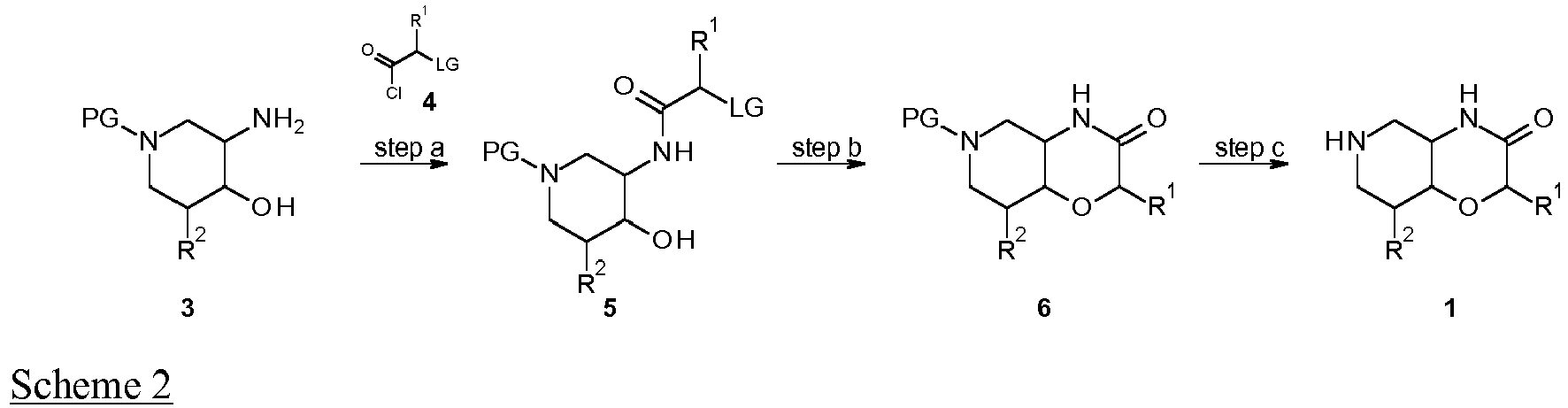
- Thus, 3-aminopiperidin-4-ol derivatives 3 in which "PG" signifies a suitable protective group such as a Cbz or Boc protective group, and R2 is as defined herein can be acylated for example with acyl chlorides 4 in which R1 is as defined herein and "LG" signifies a suitable leaving group (e.g., Cl or Br), using a suitable base such as sodium or potassium carbonate, sodium hydroxide or sodium acetate in an appropriate solvent such as THF, water, acetone or mixtures thereof, to provide intermediates 5 (step a). Intermediates 4 are either commercially available or can be prepared according to literature methods in achiral (R1 = H) racemic (R1 not H) or enantiomerically pure form (R1 not H).
- Intermediates 5 can be cyclized to intermediates 6 using methods well known in the art, for example by treatment of 5 with sodium hydride in THF or potassium tert-butoxide in IPA and water (step b). Reactions of that type are described in literature (e.g. Z. Rafinski et al., J. Org. Chem. 2015, 80, 7468; S. Dugar et al., Synthesis 2015, 47(5), 712;
WO2005/066187 ). - Removal of the protective group in intermediates 6, applying methods known in the art (e.g., a Boc group using TFA in DCM at temperatures between 0°C and room temperature, a Cbz group using hydrogen in the presence of a suitable catalyst such as Pd or Pd(OH)2 on charcoal in a suitable solvent such as MeOH, EtOH, EtOAc or mixtures thereof and as described for example in "Protective Groups in Organic Chemistry" by T.W. Greene and P.G.M. Wuts, 4th Ed., 2006, Wiley N.Y.), furnishes intermediates 1 (step c).
- Intermediates 1 can be obtained as mixtures of diastereomers and enantiomers, respectively, or as single stereoisomers depending on whether racemic mixtures or enantiomerically pure forms of cis- or trans-3-aminopiperidin-4-ol derivatives 3 and acid chlorides 4 (when R1 is not H) are employed in their syntheses. In case racemization occurs at a stereocentre bearing R1 during the conversion of 3 to 5 (step a) and/or of 5 to 6 (step b), the resulting diastereoisomers may be separated by chromatography (e.g. HPLC, chiral HPLC) or other methods known in the art. Intermediates 3 are commercially available and their synthesis has also been described in literature (e.g.
WO2005/066187 ;WO2011/0059118 WO2016/185279 ). Optically pure cis-configured intermediates 1B and 1C can be obtained for example according to Scheme 3 by chiral separation of commercially available rac-(4aR,8aS)-4a,5,6,7,8,8a-hexahydro-4H-pyrido[4,3-b][1,4]oxazin-3-one (1A) (optionally in form of a salt such as, e.g. a hydrochloride salt) using methods known in the art, e.g. by diastereomeric salt crystallization or by chiral chromatography (step a).
- In some embodiments, intermediates 2 are intermediates of type A. Intermediates of type A in which A, B, R3 and R4 are as described herein and R5 is hydrogen, C1-6-alkyl or halo-C1-6-alkyl, can be prepared by methods well known by a person skilled in the art and as exemplified by the general synthetic procedure outlined in Scheme 4.

- Spirocyclic compounds 7 in which PG signifies a suitable protective group such as a Boc, Cbz or Bn protecting group (either commercially available or prepared as described in literature, e.g. in Eur. J. Org. Chem. 2017, 36, 5316; Topics in Het. Chem. 2014, 35, 189; World Journal of Pharmacy and Pharmaceutical Sciences 2014, 3(12), 536; Chem. Rev. 2014, 114(16), 8257-8322) can be subjected to a Mitsunobu reaction with alcohol derivatives 8 using an appropriate phosphine such as triphenylphosphine and a dialkyl azodicarboxylate such as DEAD or DIAD in a suitable solvent such as THF to give intermediates 9 (step a). Mitsunobu reactions of that type are broadly described in literature (e.g. Org. Chem. Front. 2015, 2, 739; Chem. Rev. 2009, 109 (6), 2551).
- Removal of the protective group from intermediates 9, applying methods known in the art, e.g., a Boc group using TFA in DCM or 4M HCl in dioxane at temperatures between 0°C and room temperature, a Bn or Cbz group using hydrogen in the presence of a suitable catalyst such as Pd or Pd(OH)2 on charcoal in a suitable solvent such as MeOH, EtOH, EtOAc or mixtures thereof and as described for example in "Protective Groups in Organic Chemistry" by T.W. Greene and P.G.M. Wuts, 4th Ed., 2006, Wiley N.Y.), furnishes intermediates A (step b).
- Intermediates 9 may alternatively be prepared by alkylation of compounds 8 with spirocyclic derivatives 10 (either commercially available or prepared by methods known in the art) in which LG signifies a suitable leaving group such as chlorine, bromine, iodine, OSO2alkyl (e.g. mesylate (methanesulfonate), OSO2fluoroalkyl (e.g. triflate (trifluoromethanesulfonate) or OSO2aryl (e.g. tosylate (p-toluenesulfonate) using a suitable base and an appropriate solvent (e.g. sodium hydride in DMF) at temperatures between 0°C and the boiling temperature of the solvent (step c).
- In some embodiments, intermediates 2 are intermediates of type B. Intermediates of type B in which A, B, R3 and R4 are as described herein can be prepared by methods well known by a person skilled in the art and as exemplified by the general synthetic procedure outlined in Scheme 5.

- Compounds of type 11 either commercially available or prepared by methods known in the art and in which PG signifies a suitable protecting group such as, e.g. a Boc, Cbz or Bn protecting group, can be subjected to a reductive amination reaction with aldehydes of type 12 using a suitable reducing agent and solvent such as NaBH3CN in MeOH, AcOH or mixtures thereof, or NaBH(OAc)3 in DCE, DCM or THF to give intermediates 13 (step a).
- Removal of the protective group from intermediates 13, applying methods known in the art and for example described under Scheme 4, step b, furnishes intermediates B (step b).
- Intermediates 13 may alternatively prepared by alkylation of compounds 11 with compounds 15 (either commercially available or prepared by methods known in the art) in which LG is a suitable leaving group such as chlorine, bromine, iodine, OSO2alkyl (e.g. methanesulfonate), OSO2fluoroalkyl (e.g. trifluoromethanesulfonate) or OSO2aryl (e.g. p-toluenesulfonate using a suitable base in an appropriate solvent (e.g. NEt3 or DIPEA in ACN) at temperatures between 0°C and the boiling temperature of the solvent (step c). Reactions of that type are known in the art and broadly described in literature (e.g. ARKIVOC 2005 (vi) 287-292).
- In some embodiments, intermediates 2 are intermediates of type C, D or E. Intermediates of type C, D or E in which A, B, R3 and R4 are as described herein, can be prepared by methods well known by a person skilled in the art and as exemplified by the general synthetic procedure outlined in Scheme 6.

- Compounds of type 11 either commercially available or prepared by methods known in the art and in which PG signifies a suitable protecting group such as, e.g. a Boc, Cbz or Bn protecting group, can be acylated with carboxylic acids 16 to give intermediates 17 (step a). Amide couplings of this type are widely described in the literature and can be accomplished by the usage of coupling reagents such as CDI, DCC, HATU, HBTU, HOBT, TBTU, T3P or Mukaiyama reagent (e.g. Angew. Chem., Int. Ed. Engl. 1979, 18, 707) in a suitable solvent such as DMF, DMA, DCM or dioxane, optionally in the presence of a base, e.g. NEt3, DIPEA (Huenig's base) or DMAP.
- Alternatively, carboxylic acids 16 can be converted into their acid chlorides by treatment with, e.g. thionyl chloride or oxalyl chloride, neat or optionally in a solvent such as DCM. Reaction of the acid chloride with intermediates 11 in an appropriate solvent such as DCM or DMF and a base, e.g. NEt3, Huenig's base, pyridine, DMAP or lithium bis(trimethylsilyl)amide at temperatures ranging from 0°C to the reflux temperature of the solvent or solvent mixture, yields intermediates 17 (step a).
- Removal of the protective group from intermediates 17, applying methods known in the art and for example described under Scheme 4, step b, furnishes intermediates C (step b).
- Compounds of type 11 can be sulphonylated for example by treatment with sulfonyl chlorides 18 (either commercially available of prepared my methods known in the art or described in literature) using a suitable base and solvent such as NEt3 or pyridine in DCM to provide intermediates 19 (step c).
- Removal of the protective group from intermediates 19, applying methods known in the art and for example described under Scheme 4, step b, furnishes intermediates D (step d).
- Compounds of type 11 can be converted into the corresponding carbamates 20 for example by first reacting 11 with an activating and carbonylating reagent such as bis(trichloromethyl) carbonate using a suitable base and solvent such as, e.g. sodium bicarbonate in DCM, followed by reaction of the intermediately formed carbamoylchloride with alcohols of type 8 in the presence of a suitable base such as pyridine or NEt3, optionally at elevated temperatures (step e). Further activating agents include but are not limited to phosgene, trichloromethyl chloroformate, (4-nitrophenyl)carbonate or 1,1'-carbonyldiimidazole. The synthesis of carbamates is well known in the art and is broadly described in literature (e.g. J. Med. Chem. 2015, 58(7), 2895).
- Removal of the protective group from intermediates 20, applying methods known in the art and for example described under Scheme 4, step b, furnishes intermediates E (step f).
- In some embodiments, intermediates 2 are intermediates of type F, G, and H. Intermediates of type F, G, and H in which A, B, R3 and R4 are as described herein and R5 is hydrogen; C1-6-alkyl, halo-C1-6-alkyl, can be prepared by methods known in the art and as exemplified by the general synthetic procedure outlined in Scheme 7.

- Intermediates 21, either commercially available or prepared by literature methods, can be converted to intermediates 22 for example by reductive amination using aldehydes 12 and applying the conditions described under Scheme 5, step a (step a).
- Removal of the protective group from intermediates 22, applying methods known in the art and for example described under Scheme 4, step b, furnishes intermediates F (step b).
- Intermediates 21 can be reacted with carboxylic acids 16 using for example the conditions described under Scheme 6, step a, to provide intermediates 23 (step c).
- Removal of the protective group from intermediates 23, applying methods known in the art and for example described under Scheme 4, step b, furnishes intermediates G (step d).
- Intermediates 21 can be sulphonylated for example by treatment with sulfonyl chlorides 18 (either commercially available of prepared my methods known in the art or described in literature) using for example the reaction conditions described under Scheme 6, step c, to yield intermediates 24 (step e).
- Removal of the protective group from intermediates 24, applying methods known in the art and for example described under Scheme 4, step b, furnishes intermediates H (step f).
- In some embodiments, intermediates 2 are intermediates of type J, K, and L. Intermediates of type J, K, and L in which A, B, R3 and R4 are as described herein, R5 is hydrogen, C1-6-alkyl or halo-C1-6-alkyl, and R19 is hydrogen or C1-6-alkyl can be prepared by methods known in the art and as exemplified by the general synthetic procedure outlined in Scheme 8.

- Intermediates 22 can be converted to intermediates 27 for example by reductive amination using aldehydes 26 and applying the conditions described under Scheme 5, step a (step a).
- Alternatively, intermediates 22 can be alkylated with compounds 25 of type R20LG in which LG is a suitable leaving group such as chlorine, bromine, iodine, methanesulfonate, trifluoromethanesulfonate or p-toluenesulfonate using for example the conditions described under Scheme 4, step c, to provide intermediates 27 (step a).
- Removal of the protective group from intermediates 27, applying methods known in the art and for example described under Scheme 4, step b, furnishes intermediates J (step b).
- Intermediates 22 can be alkylated with compounds 25 of type R20LG in which LG is a suitable leaving group such as chlorine, bromine, iodine, methanesulfonate, trifluoromethanesulfonate or p-toluenesulfonate using for example the conditions described under Scheme 4, step c, to provide intermediates 28 (step c).
- Removal of the protective group from intermediates 28, applying methods known in the art and for example described under Scheme 4, step b, furnishes intermediates K (step d).
- Intermediates 24 can be alkylated with compounds 25 of type R20LG in which LG is a suitable leaving group such as chlorine, bromine, iodine, methanesulfonate, trifluoromethanesulfonate or p-toluenesulfonate using for example the conditions described under Scheme 4, step c, to provide intermediates 29 (step e).
- Removal of the protective group from intermediates 29, applying methods known in the art and for example described under Scheme 4, step b, furnishes intermediates L (step d).
- In some embodiments, intermediates 2 are intermediates of type M. Intermediates of type M in which A, B, R3 and R4 are as described herein and R5 is hydrogen; C1-6-alkyl or halo-C1-6-alkyl can be prepared by methods well known in the art and as exemplified by the general synthetic procedures outlined in Scheme 9.

- Spirocyclic compounds 7 in which PG is a suitable protective group can be alkylated with compounds 15 in which LG is a suitable leaving group such as chlorine, bromine, iodine, methanesulfonate, trifluoromethanesulfonate or p-toluenesulfonate (prepared by literature methods for example from compounds 30) using for example the conditions described under Scheme 4, step c, to provide intermediates 31 (step a).
- Removal of the protective group from intermediates 31, applying methods known in the art and for example described under Scheme 4, step b, furnishes intermediates M (step b).
- Alternatively, intermediates 31 may be prepared from intermediates 7 and compounds 30 via Mitsunobu reaction, applying for example the conditions described under Scheme 4, step a (step c).
- Furthermore, intermediates 31 may be also prepared by alkylation of compounds 7 with compounds 10 and using for example the conditions described under Scheme 4, step c (step d).
- Intermediates 10 in turn may be synthesized from compounds 7 converting the hydroxy function into a suitable leaving group such as an alkyl halide (e.g. bromine by using of PBr3, chlorine through the use of SOCl2) or alkyl- or aryl-sulfonate such as methanesulfonate (using mesyl chloride) or p-toluenesulfonate (using tosyl chloride). Reactions of that type are broadly described in literature and are well known in the art.
- In some embodiments, intermediates 2 are intermediates of type N. Intermediates of type N in which A, B, R3, R4 and R5 are as described herein, can be prepared by methods well known in the art and as exemplified by the general synthetic procedures outlined in Scheme 10.

- Compounds of type 32, either commercially available or prepared by methods known in the art, can be subjected to a Mitsunobu reaction with compounds 8, applying for example the conditions described under Scheme 4, step a, to provide intermediates 34 (step a).
- Removal of the protective group from intermediates 34, applying methods known in the art and for example described under Scheme 4, step b, furnishes intermediates N (step b).
- Alternatively, intermediates 34 may be prepared by alkylation of compounds 32 with compounds 33 in which LG is a suitable leaving group applying the conditions outlined for example under Scheme 4, step c (step c).
- Intermediates N may alternatively be prepared as exemplified by the general synthetic procedures outlined in Scheme 11.
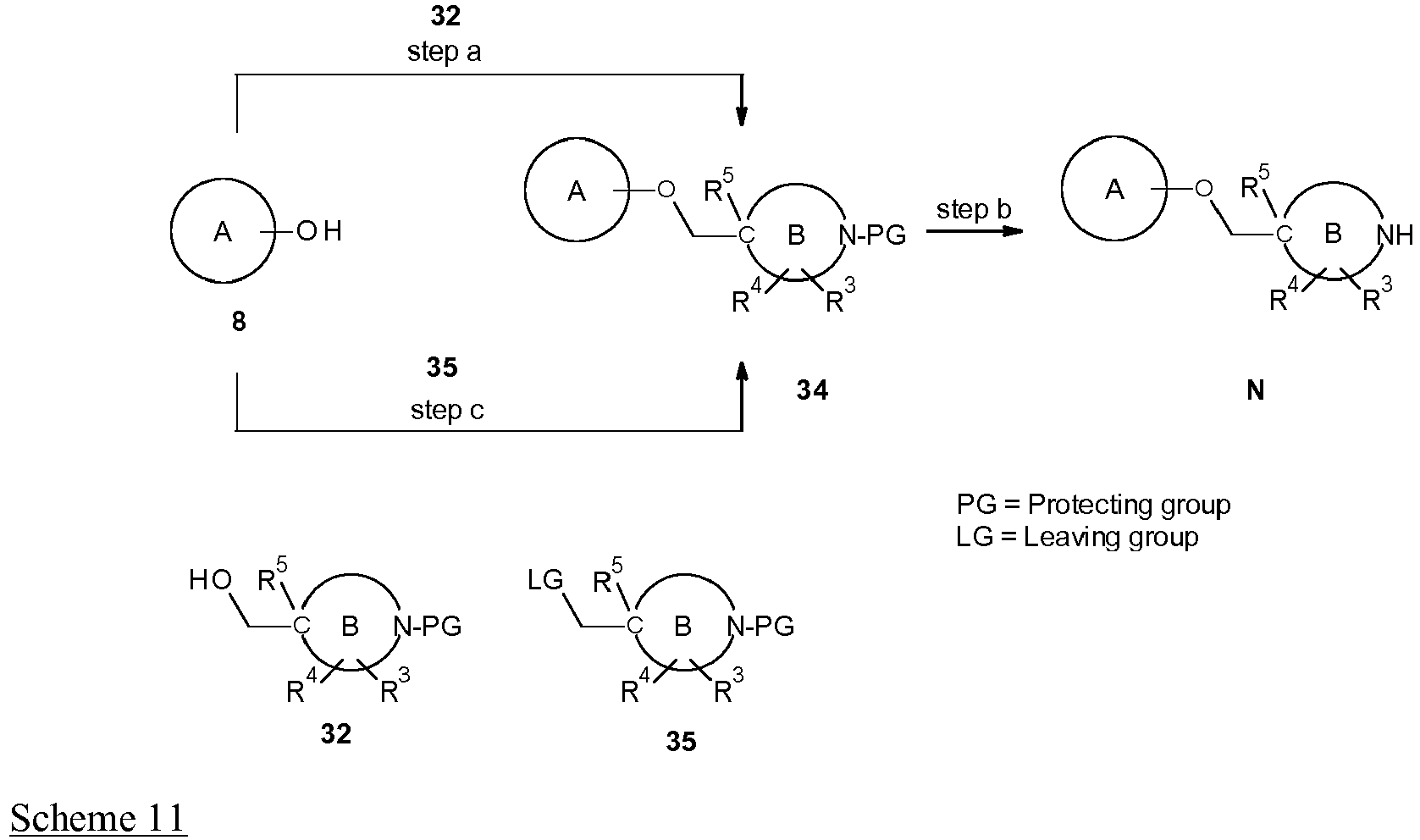
- Compounds 8 can be subjected to a Mitsunobu reaction with compounds 32 using the conditions described under Scheme 4, step a, to provide intermediates 34 (step a).
- Removal of the protective group from intermediates 34, applying methods known in the art and for example described under Scheme 4, step b, furnishes intermediates N (step b).
- Alternatively, compounds 8 may be alkylated with compounds 35 in which LG signifies a suitable leaving group such as chlorine, bromine, iodine, methanesulfonate, trifluoromethanesulfonate or p-toluenesulfonate, using for example the conditions described under Scheme 4, step c, to provide intermediates 34 (step c).
- In some embodiments, intermediates 2 are intermediates of type P. Intermediates of type P in which A, B, R3 and R4 are as described herein and R5 is hydrogen, C1-6-alkyl or halo-C1-6-alkyl, can be prepared by methods well known by a person skilled in the art and as exemplified by the general synthetic procedure outlined in Scheme 12.

- Spirocyclic compounds 38 in which PG signifies a suitable protective group such as a Boc, Cbz or Bn protecting group (either commercially available or prepared as described in literature, e.g. in Eur. J. Org. Chem. 2017, 36, 5316; Topics in Het. Chem. 2014, 35, 189; World Journal of Pharmacy and Pharmaceutical Sciences 2014, 3(12), 536; Chem. Rev. 2014, 114(16), 8257-8322) can be prepared by alkylation of thiol 37 with spirocyclic derivatives 36 (either commercially available or prepared by methods known in the art) in which LG signifies a suitable leaving group such as chlorine, bromine, iodine, OSO2alkyl (e.g. mesylate (methanesulfonate), OSO2fluoroalkyl (e.g. triflate (trifluoromethanesulfonate) or OSO2aryl (e.g. tosylate (p-toluenesulfonate) using a suitable base and an appropriate solvent (e.g. K2CO3 in DMF) at temperatures between 0°C and the boiling temperature of the solvent (step a).
- Intermediates 38 can be oxidized to intermediates 39, using a suitable oxidizing reagent, such as mCPBA, in an appropriate solvent (e.g. in DCM) at temperatures between 0°C and the boiling temperature of the solvent (step b).
- Removal of the protective group from intermediates 39, applying methods known in the art, e.g., a Boc group using TFA in DCM or 4M HCl in dioxane at temperatures between 0°C and room temperature, a Bn or Cbz group using hydrogen in the presence of a suitable catalyst such as Pd or Pd(OH)2 on charcoal in a suitable solvent such as MeOH, EtOH, EtOAc or mixtures thereof and as described for example in "Protective Groups in Organic Chemistry" by T.W. Greene and P.G.M. Wuts, 4th Ed., 2006, Wiley N.Y.), furnishes intermediates P (step c).
- In some embodiments, intermediates 2 are intermediates of type Q. Intermediates of type Q in which A, B, R3 and R4 are as described herein and R5 is hydrogen, C1-6-alkyl or halo-C1-6-alkyl, can be prepared by methods well known by a person skilled in the art and as exemplified by the general synthetic procedure outlined in Scheme 13.

- Alternatively, compounds 40, functionalized with a bromide, can be subjected to a cross-electrophile coupling with aryl- or heteroarylbromides 41 under irradiation with a 420 nm blue light lamp using an appropriate photo catalyst such as [Ir{dF(CF3)ppy}2(dtbpy)]PF6 ([4,4'-bis(1,1-dimethylethyl)-2,2'-bipyridine-N1,N1']bis[3,5-difluoro-2-[5-(trifluoromethyl)-2-pyridinyl-N]phenyl-C]Iridium(III) hexafluorophosphate), a Nickel catalyst like NiCl2 glyme (dichloro(dimethoxyethane)nickel), 4,4'-di-tert-butyl-2,2'-dipyridyl and tris(trimethylsilyl)silane, in the presence of a suitable base such as anhydrous sodium carbonate in a solvent like DME. Reactions of this type are described in literature, e.g. J. Am. Chem. Soc. 2016, 138, 8084. (step a).
- Removal of the protective group from intermediates 42 applying methods well known in the art and as described for example under Scheme 12, step c, furnishes intermediates Q (step b).
- In some embodiments, intermediates 2 are intermediates of type R and S. Intermediates of type R and S in which A, B, R3 and R4 are as described herein and R5 is hydrogen, can be prepared by methods well known by a person skilled in the art and as exemplified by the general synthetic procedure outlined in Scheme 14.

- Ketones 43, either commercially available or prepared by methods known in the art, can be subjected for example to a Wittig reaction with alkylidene triphenylphosphoranes of type 44a in a suitable solvent such as, e.g. THF, Methyl-THF or DMSO to give intermediates 45 (step a). Phosphoranes 44a can be formed by treating the corresponding phosphonium salts with a suitable base such as BuLi, NaH, or KOtBu in a suitable solvent such as THF, dioxane or Methyl-THF and may be isolated or used in situ. Phosphonium salts in turn are readily available from an aryl/heteroaryl/heterocyclic-substituted alkylhalide (with halide being Cl, Br and iodo) and triphenylphosphine in a suitable solvent such as toluene. Heating may be applied to accelerate the reaction or drive the reaction to completion (e.g. H. J. Cristau, F. Plénat in PATAI'S Chemistry of Functional Groups, Editor(s): Frank R. Hartley, 07th August 2006, Series Editor(s): Prof. Saul Patai).
- Alternatively, intermediates 45 can be obtained using a Horner-Wadsworth-Emmons (HWE) reaction using ketones 43 and phosphonates 44b, wherein Ra is alkyl, for example methyl or ethyl. Phosphonates 44b are in situ α-metalated using a suitable base and solvent such as NaH, nBuLi or KOtBu in THF (step a). Phosphonates 44b are readily prepared using for example the Arbuzov reaction by alkylation of an aryl/heteroaryl/heterocyclic halide (with halide being Cl, Br and iodo) with commercially available trialkyl phosphite (e.g. Chem. Rev. 1984, 84, 577).
- Olefination reactions of both types are broadly described in literature (e.g. Current Org. Chem. 2015, 19(9), page 744; Chem. Rev. 1989, 89(4), 863; Org. React. 1977, 25, 73; Liebigs Ann./Recueil 1997, 1283; Acc. Chem. Res. 1983, 16, 411).
- Reduction of the double bond in intermediates 45 using, e.g. hydrogen in the presence of a suitable catalyst such as palladium on charcoal in an appropriate solvent or solvent mixture such as EtOAc, MeOH or AcOH yields compounds 46 (step b).
- Removal of the protective group from intermediates 45 applying methods known in the art (e.g., a Boc group using TFA in DCM or 4M HCl in dioxane at temperatures between 0°C and room temperature, a Cbz group using hydrogen in the presence of a suitable catalyst such as Pd or Pd(OH)2 on charcoal in a suitable solvent such as MeOH, EtOH, EtOAc or mixtures thereof and as described for example in "Protective Groups in Organic Chemistry" by T.W. Greene and P.G.M. Wuts, 4th Ed., 2006, Wiley N.Y.), furnishes intermediates R (step c).
- If methoxy is among the substituents of A (R7, R8 or R9), demethylation can lead to hydroxy-substituted intermediates S. This requires a reagent such as BBr3 in a suitable solvent such as DCM, at temperatures between 0°C and the boiling temperature of the solvent. A Boc protecting group will also be cleaved under the reaction conditions, directly leading to intermediates S (step d).
- In some embodiments, intermediates 2 are intermediates of type T. Intermediates of type T in which A, B, R3 and R4 are as described herein and X is nitrogen, can be prepared by methods by methods well known by a person skilled in the art and as exemplified by the general synthetic procedure outlined in Scheme 15.


- Treatment of amines 47, with a bromo-aryl or bromo-heteroaryl 41 under typical conditions of a Buchwald-Hartwig reaction, or other organometallic C-N cross couplings known in the art, leads to intermediates 48. This typically requires a suitable catalyst system for example, PdCl2(DPPF)-CH2Cl2, Pd2(dba)3 + Xantphos, cataCXium A Pd G2, RuPhos Pd G2, an organic or inorganic base such as cesium carbonate or sodium tert-butoxide in a solvent such as Dioxane or toluene. Reactions are typically carried out at elevated temperatures between 70 and 120°C under inert atmosphere (step a).
- Removal of the protective group from intermediates 48 applying methods well known in the art and as described for example under Scheme 12, step c, furnishes intermediates T (step b).
- In one aspect, the present invention provides a process of manufacturing the urea compounds of formula (I) described herein, and pharmaceutically acceptable salts thereof, comprising:
- (c) reacting a first amine of formula 1, wherein R1 and R2 are as described herein, preferably wherein R1 and R2 are hydrogen,

- with a second amine 2, wherein A, B, L, X, R3 and R4 are as described herein

- in the presence of a base and a urea forming reagent, to form said compound of formula (I); and optionally
- with a second amine 2, wherein A, B, L, X, R3 and R4 are as described herein
- (d) transforming said compound of formula (I) to a pharmaceutically acceptable salts thereof.
- In one embodiment, there is provided a process according to the invention, wherein said base is sodium bicarbonate.
- In one embodiment, there is provided a process according to the invention, wherein said urea forming reagent is selected from bis(trichloromethyl) carbonate, phosgene, trichloromethyl chloroformate, (4-nitrophenyl)carbonate and 1,1'-carbonyldiimidazole, preferably wherein said urea forming reagent is bis(trichloromethyl) carbonate.
- In one aspect, the present invention provides a compound of formula (I) as described herein, when manufactured according to any one of the processes described herein.
- Compounds of the present invention are MAGL inhibitors. Thus, in one aspect, the present invention provides the use of compounds of formula (I) as described herein for inhibiting MAGL in a mammal.
- In a further aspect, the present invention provides compounds of formula (I) as described herein for use in a method of inhibiting MAGL in a mammal.
- In a further aspect, the present invention provides the use of compounds of formula (I) as described herein for the preparation of a medicament for inhibiting MAGL in a mammal.
- In a further aspect, the present invention provides a method for inhibiting MAGL in a mammal, which method comprises administering an effective amount of a compound of formula (I) as described herein to the mammal.
- Compounds were profiled for MAGL inhibitory activity by measuring the enzymatic activity of MAGL by following the hydrolysis of 4-nitrophenylacetate resulting in 4-nitrophenol, which absorbs at 405-412 nm (G.G. Muccioli, G. Labar, D.M. Lambert, Chem. Bio. Chem. 2008, 9, 2704-2710). This assay is hereinafter abbreviated "4-NPA assay".
- The 4-NPA assay was carried out in 384 well assay plates (black with clear bottom, non-binding surface treated, Corning Ref. 3655) in a total volume of 40 µL. Compound dilutions were made in 100% DMSO (VWR Chemicals 23500.297) in a polypropylene plate in 3-fold dilution steps to give a final concentration range in the assay from 25 µM to 1.7 nM. 1 µL compound dilutions (100% DMSO) were added to 19 µL MAGL (recombinant wild-type) in assay buffer (50 mM TRIS (GIBCO, 15567-027), 1 mM EDTA (Fluka, 03690-100ml)). The plate was shaked for 1 min at 2000 rpm (Variomag Teleshake) and then incubated for 15 min at RT. To start the reaction, 20 µL 4-Nitrophenlyacetate (Sigma N-8130) in assay buffer with 6% EtOH was added. The final concentrations in the assay were 1 nM MAGL and 300 µM 4-Nitrophenylacetate.
- After shaking (1 min, 2000 rpm) and 5 min incubation at RT, the absorbance at 405 nm was measured for a fist time (Molecular Devices, SpectraMax Paradigm). A second measurement was then done after incubation for 80 min at RT. From the two measurements, the slope was calculated by substracting the first from the second measurement.
- Alternatively, compounds were profiled for MAGL inhibitory activity by determining the enzymatic activity by following the hydrolysis of the natural substrate 2-arachidonoylglycerol resulting in arachidonic acid, which can be followed by mass spectrometry. This assay is hereinafter abbreviated "2-AG assay".
- The 2-AG assay was carried out in 384 well assay plates (PP, Greiner Cat# 784201) in a total volume of 20 µL. Compound dilutions were made in 100% DMSO (VWR Chemicals 23500.297) in a polypropylene plate in 3-fold dilution steps to give a final concentration range in the assay from 12.5 µM to 0.8 pM. 0.25µL compound dilutions (100% DMSO) were added to 9 µL MAGL in assay buffer (50 mM TRIS (GIBCO, 15567-027), 1 mM EDTA (Fluka, 03690-100ml), 0.01% (v/v) Tween. After shaking, the plate was incubated for 15 min at RT. To start the reaction, 10 µL 2-arachidonoylglycerol in assay buffer was added. The final concentrations in the assay was 50 pM MAGL and 8 µM 2-arachidonoylglyerol. After shaking and 30 min incubation at RT, the reaction was quenched by the addition of 40µL of acetonitrile containing 4µM of d8-arachidonic acid. The amount of arachidonic acid was traced by an online SPE system (Agilent Rapidfire) coupled to a triple quadrupole mass spectrometer (Agilent 6460). A C18 SPE cartridge (G9205A) was used in an acetonitrile/water liquid setup. The mass spectrometer was operated in negative electrospray mode following the mass transitions 303.1 --> 259.1 for arachidonic acid and 311.1 --> 267.0 for d8-arachidonic acid. The activity of the compounds was calculated based on the ratio of intensities [arachidonic acid / d8-arachidonic acid].
Table 1 Example Name Structure IC50 MAGL [nM] 1 (4aR,8aS)-6-(6-(2-Chloro-4-fluorophenoxy)-2-azaspiro[3.3]heptane-2-carbonyl)hexahydro-2H-pyrido[4,3-b][1,4]oxazin-3(4H)-one 
4.5[a] 2 (4aR,8aS)-6-(6-(4-(Trifluoromethyl)phenoxy)-2-azaspiro[3.3]heptane-2-carbonyl)hexahydro-2H-pyrido[4,3-b][1,4]oxazin-3(4H)-one 
5.0[a] 3 (4aR,8aS)-6-(6-(2-Fluoro-4-(trifluoromethyl)phenoxy)-2 - azaspiro[3.3]heptane-2-carbonyl)hexahydro-2H-pyrido [4,3-b][1,4]oxazin-3(4H)-one 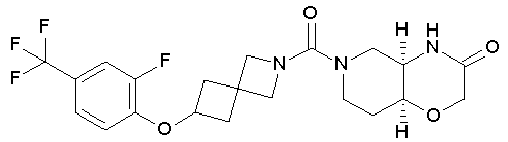
2.3[a] 4 (4aR,8aS)-6-(6-(2-Fluoro-4-(trifluoromethoxy)phenoxy)-2-azaspiro[3.3]heptane-2-carbonyl)hexahydro-2H-pyrido [4,3-b][1,4]oxazin-3(4H)-one 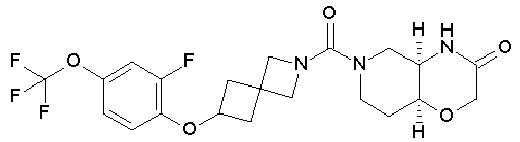
3.0[a] 5 (4aR,8aS)-6-(6-(2-Chloro-4-(trifluoromethoxy)phenoxy)-2-azaspiro[3.3]heptane-2-carbonyl)hexahydro-2H-pyrido [4,3-b][1,4]oxazin-3(4H)-one 
0.6[a] 6 (4aR,8aS)-6-(6-(2-Methoxy-5-(trifluoromethyl)phenoxy)-2-azaspiro[3.3]heptane-2-carbonyl)hexahydro-2H-pyrido[4,3-b][1,4]oxazin-3(4H)-one 
2.8[a] 7 (4aR,8aS)-6-(6-(4-Chloro-2-(trifluoromethyl)phenoxy)-2-azaspiro[3.3]heptane-2-carbonyl)hexahydro-2H-pyrido[4,3-b][1,4]oxazin-3(4H)-one 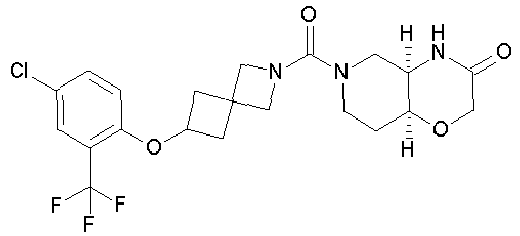
8.5[a] 8 (4aR,8aS)-6-(6-(2,4-Difluorophenoxy)-2-azaspiro[3.3]heptane-2-carbonyl)hexahydro-2H-pyrido[4,3-b][1,4]oxazin-3(4H)-one 
10.7[a] 9 (4aR,8aS)-6-(6-(3-Fluoro-5-(trifluoromethyl)phenoxy)-2-azaspiro[3.3]heptane-2-carbonyl)hexahydro-2H-pyrido[4,3-b][1,4]oxazin-3(4H)-one 
12.5[a] 10 (4aR,8aS)-6-(2-(2-Fluoro-4-(trifluoromethyl)phenoxy)-7-azaspiro[3.5]nonane-7-carbonyl)hexahydro-2H-pyrido[4,3-b][1,4]oxazin-3(4H)-one 
0.8[a] 11 (4aR,8aS)-6-(6-(2-Chloro-4-fluorobenzyl)-2,6-diazaspiro[3.3]heptane-2-carbonyl)hexahydro-2H-pyrido[4,3-b][1,4]oxazin-3(4H)-one 
19.8[a] 12 (4aR,8aS)-6-(6-(2-Fluoro-4-(trifluoromethyl)benzyl)-2,6-diazaspiro[3.3]heptane-2-carbonyl)hexahydro-2H-pyrido[4,3-b][1,4]oxazin-3(4H)-one 
15.7[a] 13 (4aR,8aS)-6-(2-(2-Fluoro-4-(trifluoromethyl)benzyl)-2,7-diazaspiro[3.5]nonane-7-carbonyl)hexahydro-2H-pyrido[4,3-b][1,4]oxazin-3(4H)-one 
76.4[a] 7 14 (4aR,8aS)-6-(7-(2-Fluoro-4-(trifluoromethyl)benzyl)-2,7-diazaspiro[4.4]nonane-2-carbonyl)hexahydro-2H-pyrido[4,3-b][1,4]oxazin-3(4H)-one 
268[a] 15 (4aR,8aS)-6-(2-(2-Fluoro-4-(trifluoromethyl)benzyl)-2,6-diazaspiro[3.4]octane-6-carbonyl)hexahydro-2H-pyrido[4,3-b][1,4]oxazin-3(4H)-one 
2032[a] 16 (4aR,8aS)-6-(6-((2-Chloro-4-fluorophenyl)sulfonyl)-2,6-diazaspiro[3.3]heptane-2-carbonyl)hexahydro-2H-pyrido[4,3-b][1,4]oxazin-3(4H)-one 
228[a] 17 (4aR,8aS)-6-(6-((2-Fluoro-4-(trifluoromethyl)phenyl)sulfony l)-2,6-diazaspiro[3.3]heptane-2-carbonyl)hexahydro-2H-pyrido[4,3-b][1,4]oxazin-3(4H)-one 
768[a] 18 rac-(4aR,8aS)-N-((R)-8-(3-oxooctahydro-2H-pyrido[4,3-b][1,4]oxazine-6-carbonyl)-1-oxa-8-azaspiro[4.5]decan-3- yl)benzenesulfonamide 
316[a] 19 rac-(4aR,8aS)-N-((S)-8-(3-oxooctahydro-2H-pyrido[4,3-b][1,4]oxazine-6-carbonyl)-1- oxa-8-azaspiro[4.5]decan-3- yl)benzenesulfonamide 
821[a] 20 rac-(4aR,8aS)-6-(2-Benzhydryl-2,6-diazaspiro[3.4]octane-6-carbonyl)hexahydro-2H-pyrido[4,3-b][1,4]oxazin-3(4H)-one 
2689[b] 21 rac-(4aR,8aS)-6-(4-((4-Fluorophenyl)sulfonyl)-1-oxa-4,9-diazaspiro[5.5]undecane-9-carbonyl)hexahydro-2H-pyrido[4,3-b][1,4]oxazin-3(4H)-one 
836[b] Int-1 rac-tert-Butyl 6-((4aR,8aS)-3-oxooctahydro-2H-pyrido[4,3-b][1,4]oxazine-6-carbonyl)-2,6-diazaspiro[3.4]octane-2-carboxylate 
539[b] 22 (4aR,8aS)-6-(6-((4,5-Bis(trifluoromethyl)pyridin-2-yl)oxy)-2-azaspiro[3.3]heptane-2-carbonyl)hexahydro-2H-pyrido[4,3-b][1,4]oxazin-3(4H)-one 
3.8[a] 23 (4aR,8aS)-6-(6-((5,6-Bis(trifluoromethyl)pyridin-2-yl)oxy)-2-azaspiro[3.3]heptane-2-carbonyl)hexahydro-2H-pyrido[4,3-b][1,4]oxazin-3(4H)-one 
4.8[a] 24 2-Chloro-4-fluoro-N-methyl-N-((R)-8-((4aR,8aS)-3-oxooctahydro-2H-pyrido[4,3-b][1,4]oxazine-6-carbonyl)-1- oxa-8-azaspiro[4.5]decan-3-yl)benzenesulfonamide 
20.9[a] 25 (4aR,8aS)-6-(6-((5-(Trifluoromethyl)pyridin-2-yl)oxy)-2-azaspiro[3.3]heptane-2-carbonyl)hexahydro-2H-pyrido[4,3-b][1,4]oxazin-3(4H)-one 
28.9[a] 26 (4aR,8aS)-6-(6-((4-Methyl-3-(trifluoromethyl)benzyl)oxy)-2-azaspiro[3.3]heptane-2-carbonyl)hexahydro-2H-pyrido[4,3-b][1,4]oxazin-3(4H)-one 
31.0[a] 27 (4aR,8aS)-6-(2-((2-Chloro-4-fluorophenyl)sulfonyl)-2,7-diazaspiro[3.5]nonane-7-carbonyl)hexahydro-2H-pyrido[4,3-b][1,4]oxazin-3(4H)-one 
33.1[a] 28 (4aR,8aS)-6-(6-((2-Fluoro-4-(trifluoromethyl)benzyl)oxy)-2-azaspiro[3.3]heptane-2-carbonyl)hexahydro-2H-pyrido[4,3-b][1,4]oxazin-3(4H)-one 
36.4[a] 29 N-((S)-8-((4aR,8aS)-3-Oxooctahydro-2H-pyrido[4,3-b][1,4]oxazine-6-carbonyl)-1- oxa-8-azaspiro[4.5]decan-3-yl)-4-(trifluoromethyl)benzenesulfon amide 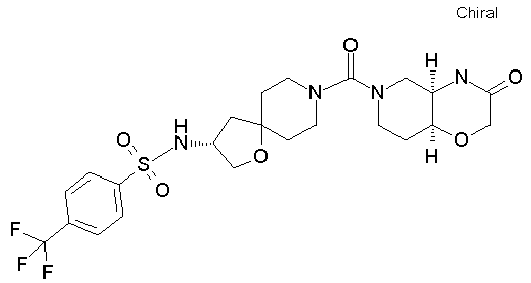
47.5[a] 30 N-Methyl-N-((R)-8-((4aR,8aS)-3-oxooctahydro-2H-pyrido [4,3- b][1,4]oxazine-6-carbonyl)-1- oxa-8-azaspiro[4.5]decan-3-yl)benzenesulfonamide 
49.3[a] 31 2-Chloro-4-fluoro-N-((S)-8-((4aR,8aS)-3 -oxooctahydro-2H-pyrido[4,3-b][1,4]oxazine-6-carbonyl)-1-oxa-8-azaspiro[4.5]decan-3-yl)benzenesulfonamide 
51.3[a] 32 N-((S)-8-((4aR,8aS)-3-Oxooctahydro-2H-pyrido[4,3-b][1,4]oxazine-6-carbonyl)-1- oxa-8-azaspiro[4.5]decan-3-yl)-3-(trifluoromethyl)benzenesulfon amide 
123.6[a] 33 (4aR,8aS)-6-(3-((2-Chloro-4-fluorob enzyl)(methyl)amino)-1 - oxa-8-azaspiro[4.5]decane-8-carbonyl)hexahydro-2H-pyrido[4,3-b][1,4]oxazin-3(4H)-one 
129.3[a] 34 (4aR,8aS)-6-(3-((2-Chloro-4-fluorob enzyl)(methyl)amino)-1 - oxa-8-azaspiro[4.5]decane-8-carbonyl)hexahydro-2H-pyrido[4,3-b][1,4]oxazin-3(4H)-one 
132.6[a] 35 (4aR,8aS)-6-(3-((2-Chloro-4-fluorobenzyl)amino)-1-oxa-8-azaspiro[4.5]decane-8-carbonyl)hexahydro-2H-pyrido[4,3-b][1,4]oxazin-3(4H)-one 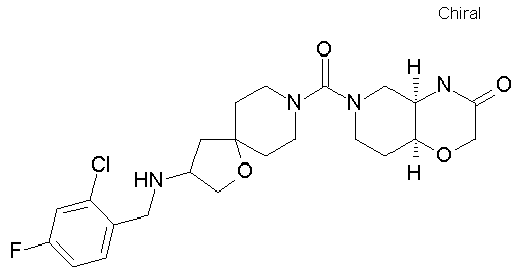
182.1[a] 36 (4aR,8aS)-6-(3-((2-Chloro-4-fluorobenzyl)amino)-1-oxa-8-azaspiro[4.5]decane-8-carbonyl)hexahydro-2H-pyrido[4,3-b][1,4]oxazin-3(4H)-one 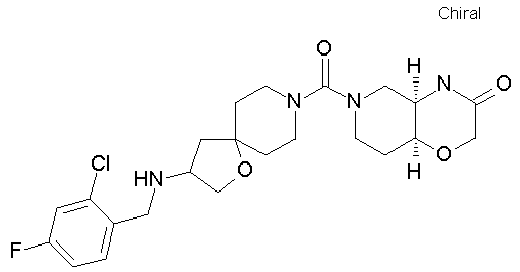
279.3[a] 37 (4aR,8aS)-6-(2-((4-(Trifluoromethyl)phenyl)sulf onyl)-2,7-diazaspiro[3.5]nonane-7-carbonyl)hexahydro-2H-pyrido[4,3-b][1,4]oxazin-3(4H)-one 
389.1[a] 38 rac-(4aR,8aS)-6-(3-((2-Chloro-4-fluorobenzyl)amino)-1 -oxa-8-azaspiro[4.5]decane-8-carbonyl)hexahydro-2H-pyrido[4,3-b][1,4]oxazin-3(4H)-one 
415.6[a] 39 (4aR,8aS)-6-(2-(Phenylsulfonyl)-2,7-diazaspiro[3.5]nonane-7-carbonyl)hexahydro-2H-pyrido[4,3-b][1,4]oxazin-3(4H)-one 
598.6[b] 40 (4aR,8aS)-6-[2-(2,4-Difluorophenoxy)-7-azaspiro[3.5]nonane-7-carbonyl]-4,4a,5,7,8,8a-hexahydropyrido[4,3-b][1,4]oxazin-3-one 
11.3[a] 41 (4aS,8aR)-6-(6-(2-Chloro-4-fluorophenoxy)-2-azaspiro[3.3]heptane-2-carbonyl)hexahydro-2H-pyrido[4,3-b][1,4]oxazin-3 (4H)-one 
466.0[a] 42 (4aR,8aS)-6-[2-(2-Chloro-4-fluoro-phenoxy)-7-azaspiro[3.5]nonane-7-carbonyl]-4,4a,5,7,8,8a-hexahydropyrido[4,3-b][1,4]oxazin-3-one 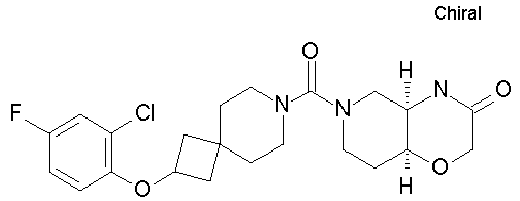
2.1[a] 43 (4aR,8aS)-6-[6-[[2-Fluoro-4-(trifluoromethyl)phenoxy]meth yl]-2-azaspiro[3.3]heptane-2-carbonyl]-4,4a,5,7,8,8a-hexahydropyrido[4,3-b][1,4]oxazin-3 -one 
1.0[a] 44 (4aR,8aS)-6-(6-((2-fluoro-4-(trifluoromethyl)benzyl)oxy)-6-(trifluoromethyl)-2-azaspiro[3.3]heptane-2-carbonyl)hexahydro-2H-pyrido[4,3-b][1,4]oxazin-3(4H)-one 
185.3 45 (4aR,8aS)-6-(6-(2-fluoro-4-(trifluoromethyl)phenyl)-2-azaspiro[3.3]heptane-2-carbonyl)hexahydro-2H-pyrido[4,3-b][1,4]oxazin-3(4H)-one 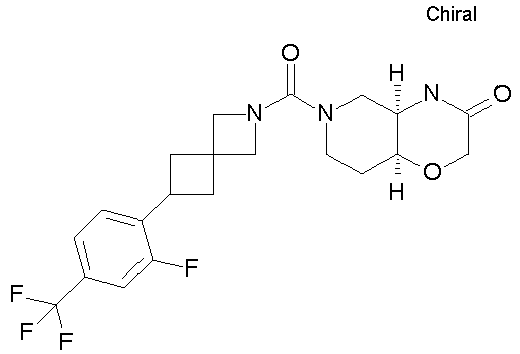
37.0 46 (4aR,8aS)-6-(6-(4-(pentafluoro-16-sulfaneyl)phenyl)-2-azaspiro[3.3]heptane-2-carbonyl)hexahydro-2H-pyrido[4,3-b][1,4]oxazin-3(4H)-one 
14.5 47 (4aR,8aS)-6-(6-(4-(2-(trifluoromethyl)pyrrolidin-1-yl)phenyl)-2-azaspiro[3.3]heptane-2-carbonyl)hexahydro-2H-pyrido[4,3-b][1,4]oxazin-3(4H)-one 
39.8 48 (4aR,8aS)-6-(6-(4-(1-methyl-1H-pyrazol-5-yl)phenyl)-2-azaspiro[3.3]heptane-2-carbonyl)hexahydro-2H-pyrido[4,3-b][1,4]oxazin-3(4H)-one 
222.9 49 (4aR,8aS)-6-(6-(2-fluoro-4-(trifluoromethyl)benzyl)-2-azaspiro[3.3]heptane-2-carbonyl)hexahydro-2H-pyrido[4,3-b][1,4]oxazin-3(4H)-one 
0.03 50 (4aR,8aS)-6-(6-(2-chloro-4-fluorobenzyl)-2-azaspiro[3.3]heptane-2-carbonyl)hexahydro-2H-pyrido[4,3-b][1,4]oxazin-3(4H)-one 
0.04 51 (4aR,8aS)-6-(6-(2,4-difluorobenzyl)-2-azaspiro[3.3]heptane-2-carbonyl)hexahydro-2H-pyrido[4,3-b][1,4]oxazin-3(4H)-one 
0.17 52 (4aR,8aS)-6-(6-(2-methoxy-4-(trifluoromethyl)benzyl)-2-azaspiro[3.3]heptane-2-carbonyl)hexahydro-2H-pyrido[4,3-b][1,4]oxazin-3(4H)-one 
0.03 53 (4aR,8aS)-6-(6-(2-fluoro-6-(trifluoromethyl)benzyl)-2-azaspiro[3.3]heptane-2-carbonyl)hexahydro-2H-pyrido[4,3-b][1,4]oxazin-3(4H)-one 
0.05 54 (4aR,8aS)-6-(6-((2-chloro-4-fluorophenoxy)methyl)-2-azaspiro[3.3]heptane-2-carbonyl)hexahydro-2H-pyrido[4,3-b][1,4]oxazin-3(4H)-one 
1.46 55 (4aR,8aS)-6-(6-(4-(trifluoromethyl)phenyl)-2,6-diazaspiro[3.3]heptane-2-carbonyl)hexahydro-2H-pyrido[4,3-b][1,4]oxazin-3(4H)-one 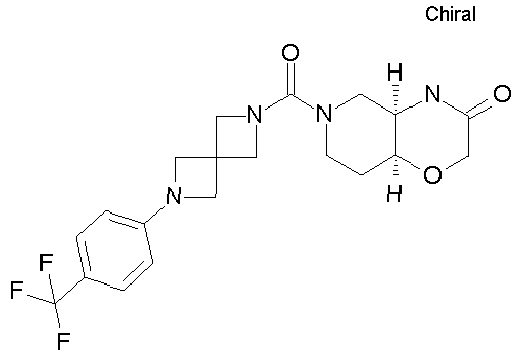
1038 56 (4aR,8aS)-6-(6-(3-(trifluoromethyl)phenyl)-2,6-diazaspiro[3.3]heptane-2-carbonyl)hexahydro-2H-pyrido[4,3-b][1,4]oxazin-3(4H)-one 
361 57 (4aR,8aS)-6-(2-(4-(trifluoromethyl)phenyl)-2,6-diazaspiro[3.4]octane-6-carbonyl)hexahydro-2H-pyrido[4,3-b][1,4]oxazin-3(4H)-one 
175 58 (4aR,8aS)-6-(2-(3-(trifluoromethyl)phenyl)-2,6-diazaspiro[3.4]octane-6-carbonyl)hexahydro-2H-pyrido[4,3-b][1,4]oxazin-3(4H)-one 
70.7 59 (4aR,8aS)-6-(2-(4-isopropoxyphenyl)-2,6-diazaspiro[3.4]octane-6-carbonyl)hexahydro-2H-pyrido[4,3-b][1,4]oxazin-3 (4H)-one 
297 60 (4aR,8aS)-6-(6-(4-isopropoxyphenyl)-2,6-diazaspiro[3.3]heptane-2-carbonyl)hexahydro-2H-pyrido[4,3-b][1,4]oxazin-3(4H)-one 
1587 61 (4aR,8aS)-6-(2-(4-(2-oxopyrrolidin-1-yl)phenyl)-2,6-diazaspiro[3.4]octane-6-carbonyl)hexahydro-2H-pyrido[4,3-b][1,4]oxazin-3(4H)-one 
2296 62 (4aR,8aS)-6-(2-(4-methoxy-3-methylphenyl)-2,6-diazaspiro[3.4]octane-6-carbonyl)hexahydro-2H-pyrido[4,3-b][1,4]oxazin-3(4H)-one 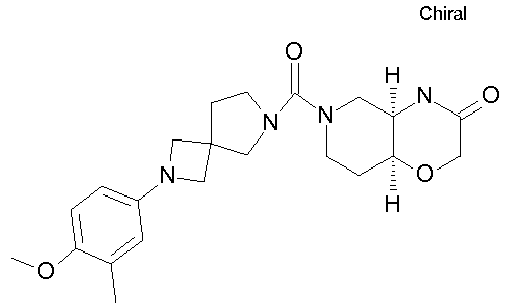
58.8 63 (4aR,8aS)-6-(2-(4-chloro-3-(trifluoromethyl)phenyl)-2,6-diazaspiro[3.4]octane-6-carbonyl)hexahydro-2H-pyrido[4,3-b][1,4]oxazin-3(4H)-one 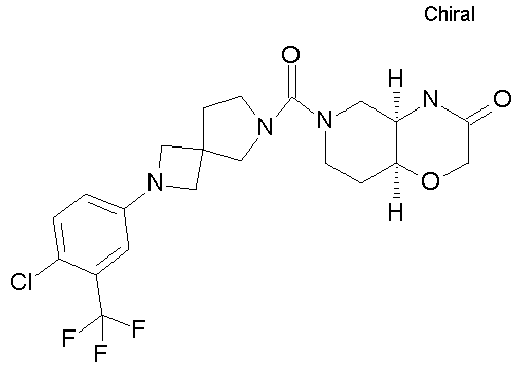
15.9 64 (4aR,8aS)-6-(2-(2-fluoropyridin-4-yl)-2,6-diazaspiro[3.4]octane-6-carbonyl)hexahydro-2H-pyrido[4,3-b][1,4]oxazin-3(4H)-one 
4968 65 (4aR,8aS)-6-(6-(2,5-bis(trifluoromethyl)phenyl)-2,6-diazaspiro[3.3]heptane-2-carbonyl)hexahydro-2H-pyrido[4,3-b][1,4]oxazin-3(4H)-one 
1100 66 (4aR,8aS)-6-(6-((4-fluoro-2-(trifluoromethyl)phenyl)sulfo nyl)-2,6-diazaspiro[3.3]heptane-2-carbonyl)hexahydro-2H-pyrido[4,3-b][1,4]oxazin-3(4H)-one 
194.9 67 (4aR,8aS)-6-(6-((2-chloro-4-fluorophenyl)sulfonyl)-2 - azaspiro[3.3]heptane-2-carbonyl)hexahydro-2H-pyrido[4,3-b][1,4]oxazin-3(4H)-one 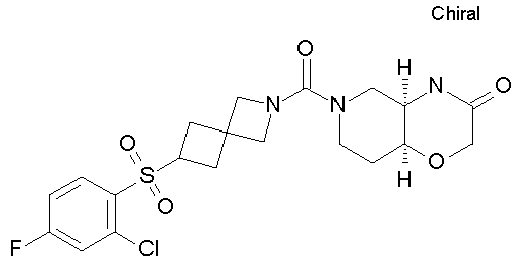
67.1 68 (4aR,8aS)-6-(6-((3-chloro-4-(trifluoromethyl)phenyl)sulfo nyl)-2,6-diazaspiro[3.3]heptane-2-carbonyl)hexahydro-2H-pyrido[4,3-b][1,4]oxazin-3(4H)-one 
357.1 69 (4aR,8aS)-6-(6-((2,4-bis(trifluoromethyl)phenyl)su lfonyl)-2,6-diazaspiro[3.3]heptane-2-carbonyl)hexahydro-2H-pyrido[4,3-b][1,4]oxazin-3(4H)-one 
213.9 70 (4aR,8aS)-6-(6-(2,6-difluorobenzyl)-2-azaspiro[3.3]heptane-2-carbonyl)hexahydro-2H-pyrido[4,3-b][1,4]oxazin-3(4H)-one 
0.1 71 (4aR,8aS)-6-(6-(2-fluoro-6-methoxybenzyl)-2-azaspiro[3.3]heptane-2-carbonyl)hexahydro-2H-pyrido[4,3-b][1,4]oxazin-3(4H)-one 
0.1 72 (4aR,8aS)-6-(6-(2-methoxybenzyl)-2-azaspiro[3.3]heptane-2-carbonyl)hexahydro-2H-pyrido[4,3-b][1,4]oxazin-3(4H)-one 
0.2 73 (4aR,8aS)-6-(6-(2-fluoro-6-hydroxybenzyl)-2-azaspiro[3.3]heptane-2-carbonyl)hexahydro-2H-pyrido[4,3-b][1,4]oxazin-3(4H)-one 
0.1 74 (4aR,8aS)-6-(6-(2-hydroxybenzyl)-2-azaspiro[3.3]heptane-2-carbonyl)hexahydro-2H-pyrido[4,3-b][1,4]oxazin-3(4H)-one 
0.5 [a]: measured in 2-AG assay; [b]: measured in 4-NPA assay; n/a: not available. - In one aspect, the present invention provides compounds of formula (I) and their pharmaceutically acceptable salts as described herein, wherein said compounds of formula (I) and their pharmaceutically acceptable salts have IC50's for MAGL inhibition below 25 µM, preferably below 10 µM, more preferably below 5 µM as measured in the MAGL assays described herein.
- In one embodiment, compounds of formula (I) and their pharmaceutically acceptable salts as described herein have IC50 (MAGL inhibition) values between 0.000001 µM and 25 µM, particular compounds have IC50 values between 0.000005 µM and 10 µM, further particular compounds have IC50 values between 0.00005 µM and 5 µM, as measured in the MAGL assays described herein.
- In one embodiment, the present invention provides compounds of formula (I) and their pharmaceutically acceptable salts as described herein, wherein said compounds of formula (I) and their pharmaceutically acceptable salts have an IC50 for MAGL below 25 µM, preferably below 10 µM, more preferably below 5 µM as measured in an assay comprising the steps of:
- a) providing a solution of a compound formula (I), or a pharmaceutically acceptable salt thereof, in DMSO;
- b) providing a solution of MAGL (recombinant wild-type) in assay buffer (50 mM tris(hydroxymethyl)aminomethane; 1 mM ethylenediaminetetraacetic acid);
- c) adding 1 µL of compound solution from step a) to 19 µL of MAGL solution from step b);
- d) shaking the mixture for 1 min at 2000 rpm;
- e) incubating for 15 min at RT;
- f) adding 20 µL of a solution of 4-nitrophenlyacetate in assay buffer (50 mM tris(hydroxymethyl)aminomethane; 1 mM ethylenediaminetetraacetic acid, 6% EtOH);
- g) shaking the mixture for 1 min at 2000 rpm;
- h) incubating for 5 min at RT;
- i) measuring the absorbance of the mixture at 405 nm a fist time;
- j) incubating a further 80 min at RT;
- k) measuring the absorbance of the mixture at 405 nm a second time;
- l) substracting the absorbance measured under i) from the absorbance measured under k) and calculating the slope of absorbance;
- i) the concentration of the compound of formula (I), or the pharmaceutically acceptable salt thereof in the assay after step f) is in the range of 25 µM to 1.7 nM;
- ii) the concentration of MAGL in the assay after step f) is 1 nM;
- iii) the concentration of 4-nitrophenylacetate in the assay after step f) is 300 µM; and
- iv) steps a) to l) are repeated for at least 3 times, each time with a different concentration of the compound of formula (I), or the pharmaceutically acceptable salt thereof.
- In one aspect, the present invention provides compounds of formula (I) as described herein for use as therapeutically active substance.
- In one aspect, the present invention provides compounds of formula (I) as described herein for use in the treatment or prophylaxis of neuroinflammation, neurodegenerative diseases, pain, cancer and/or mental disorders in a mammal.
- In one embodiment, the present invention provides compounds of formula (I) as described herein for use in the treatment or prophylaxis of neuroinflammation and/or neurodegenerative diseases in a mammal.
- In one embodiment, the present invention provides compounds of formula (I) as described herein for use in the treatment or prophylaxis of cancer in a mammal.
- In one embodiment, the present invention provides compounds of formula (I) as described herein for use in the treatment or prophylaxis of neurodegenerative diseases in a mammal.
- In one aspect, the present invention provides compounds of formula (I) as described herein for use in the treatment or prophylaxis of multiple sclerosis, Alzheimer's disease, Parkinson's disease, amyotrophic lateral sclerosis, traumatic brain injury, neurotoxicity, stroke, epilepsy, anxiety, migraine, depression, hepatocellular carcinoma, colon carcinogenesis, ovarian cancer, neuropathic pain, chemotherapy induced neuropathy, acute pain, chronic pain and/or spasticity associated with pain in a mammal.
- In a preferred embodiment, the present invention provides compounds of formula (I) as described herein for use in the treatment or prophylaxis of multiple sclerosis, Alzheimer's disease and/or Parkinson's disease in a mammal.
- In a particularly preferred embodiment, the present invention provides compounds of formula (I) as described herein for use in the treatment or prophylaxis of multiple sclerosis in a mammal.
- In one aspect, the present invention provides the use of compounds of formula (I) as described herein for the preparation of a medicament for the treatment or prophylaxis of neuro inflammation, neurodegenerative diseases, pain, cancer and/or mental disorders in a mammal.
- In one embodiment, the present invention provides the use of compounds of formula (I) as described herein for the preparation of a medicament for the treatment or prophylaxis of neuroinflammation and/or neurodegenerative diseases in a mammal.
- In one embodiment, the present invention provides the use of compounds of formula (I) as described herein for the preparation of a medicament for the treatment or prophylaxis of neurodegenerative diseases in a mammal.
- In one embodiment, the present invention provides the use of compounds of formula (I) as described herein for the preparation of a medicament for the treatment or prophylaxis of cancer in a mammal.
- In a further aspect, the present invention provides the use of compounds of formula (I) as described herein for the preparation of a medicament for the treatment or prophylaxis of multiple sclerosis, Alzheimer's disease, Parkinson's disease, amyotrophic lateral sclerosis, traumatic brain injury, neurotoxicity, stroke, epilepsy, anxiety, migraine, depression, hepatocellular carcinoma, colon carcinogenesis, ovarian cancer, neuropathic pain, chemotherapy induced neuropathy, acute pain, chronic pain and/or spasticity associated with pain in a mammal.
- In a preferred embodiment, the present invention provides the use of compounds of formula (I) as described herein for the preparation of a medicament for the treatment or prophylaxis of multiple sclerosis, Alzheimer's disease and/or Parkinson's disease in a mammal.
- In a particularly preferred embodiment, the present invention provides the use of compounds of formula (I) as described herein for the preparation of a medicament for the treatment or prophylaxis of multiple sclerosis in a mammal.
- In one aspect, the present invention provides a pharmaceutical composition comprising a compound of formula (I) as described herein and a therapeutically inert carrier.
- The compounds of formula (I) and their pharmaceutically acceptable salts can be used as medicaments (e.g. in the form of pharmaceutical preparations). The pharmaceutical preparations can be administered internally, such as orally (e.g. in the form of tablets, coated tablets, dragées, hard and soft gelatin capsules, solutions, emulsions or suspensions), nasally (e.g. in the form of nasal sprays) or rectally (e.g. in the form of suppositories). However, the administration can also be effected parentally, such as intramuscularly or intravenously (e.g. in the form of injection solutions).
- The compounds of formula (I) and their pharmaceutically acceptable salts can be processed with pharmaceutically inert, inorganic or organic adjuvants for the production of tablets, coated tablets, dragées and hard gelatin capsules. Lactose, corn starch or derivatives thereof, talc, stearic acid or its salts etc. can be used, for example, as such adjuvants for tablets, dragées and hard gelatin capsules.
- Suitable adjuvants for soft gelatin capsules are, for example, vegetable oils, waxes, fats, semisolid substances and liquid polyols, etc.
- Suitable adjuvants for the production of solutions and syrups are, for example, water, polyols, saccharose, invert sugar, glucose, etc.
- Suitable adjuvants for injection solutions are, for example, water, alcohols, polyols, glycerol, vegetable oils, etc.
- Suitable adjuvants for suppositories are, for example, natural or hardened oils, waxes, fats, semisolid or liquid polyols, etc.
- Moreover, the pharmaceutical preparations can contain preservatives, solubilizers, viscosity-increasing substances, stabilizers, wetting agents, emulsifiers, sweeteners, colorants, flavorants, salts for varying the osmotic pressure, buffers, masking agents or antioxidants. They can also contain still other therapeutically valuable substances.
- The dosage can vary in wide limits and will, of course, be fitted to the individual requirements in each particular case. In general, in the case of oral administration a daily dosage of about 0.1 mg to 20 mg per kg body weight, preferably about 0.5 mg to 4 mg per kg body weight (e.g. about 300 mg per person), divided into preferably 1-3 individual doses, which can consist, for example, of the same amounts, should be appropriate. It will, however, be clear that the upper limit given herein can be exceeded when this is shown to be indicated.
- The invention will be more fully understood by reference to the following examples. The claims should not, however, be construed as limited to the scope of the examples.
- In case the preparative examples are obtained as a mixture of enantiomers, the pure enantiomers can be separated by methods described herein or by methods known to the man skilled in the art, such as e.g., chiral chromatography (e.g., chiral SFC) or crystallization.
- All reaction examples and intermediates were prepared under an argon atmosphere if not specified otherwise.
-

- To a solution of BB9 (143.7 mg, 284 µmol) in ACN (1.42 mL) was added DIPEA (110 mg, 149 µl, 851 µmol) and 4-nitrophenyl (4aR,8aS)-3-oxohexahydro-2H-pyrido[4,3-b][1,4]oxazine-6(5H)-carboxylate (91.1 mg, 284 µmol, BB2a). The reaction vial was stirred at 80 °C for 4 h. The crude material was purified by reversed-phase HPLC to yield the title compound (66.8 mg, 134 µmol, 47.3%) as a white solid. MS (ESI): m/z = 474.3 [M+H]+.
-

- To a solution of 6-(2-chloro-4-fluorophenoxy)-2-azaspiro[3.3]heptane trifluoroacetate (1026 mg, 2.31 mmol, BB6) in ACN (11.5 mL) was added DIPEA (895 mg, 1.21 mL, 6.92 mmol) and 4-nitrophenyl (4aR,8aS)-3-oxohexahydro-2H-pyrido[4,3-b][1,4]oxazine-6(5H)-carboxylate (816 mg, 2.54 mmol, BB2a). The reaction vial was stirred at 80 °C for 2.5 h. The solution was evaporated. The residue was dissolved in saturated aqueous NaHCO3 solution (30 mL) and EtOAc (30 mL) and the layers were separated. The organic layer was washed once with saturated aqueous NaHCO3 solution (30 mL). The combined aqueous layers were extracted once with EtOAc (100 mL). The organic layers were washed once with saturated aqueous NaHCO3 solution (100 mL) and brine, dried over MgSO4, filtered, treated with silica gel and evaporated. The compound was purified by silica gel chromatography on a 40 g column using a MPLC system eluting with a gradient of n-heptane : EtOAc/EtOH 3/1 (70 : 30 to 0 : 100) and evaporated to afford the title compound as a white foam (841.2 mg, 1.94 mmol, 84.3%). MS (ESI): m/z = 424.4 [M+H]+.
-

- To an ice-cold suspension of bis(trichloromethyl) carbonate (45.3 mg, 153 µmol) and NaHCO3 (73.3 mg, 873 µmol) in DCM (1 mL) was added (R)-N-(1-oxa-8-azaspiro[4.5]decan-3-yl)benzenesulfonamide 2,2,2-trifluoroacetate (89.6 mg, 218 µmol, prepared as described in
US20170029390 ) in one portion and the mixture was stirred at RT overnight. It was cooled down in an-ice bath and rac-(4aR,8aS)-hexahydro-2H-pyrido[4,3-b][1,4]oxazin-3(4H)-one dihydrochloride (50 mg, 218 µmol, BB1) and DIPEA (113 mg, 152 µL, 873 µmol) were added. The suspension was stirred at RT for 4 h. The reaction mixture was poured on water and DCM and the layers were separated. The aqueous layer was extracted twice with DCM. The organic layers were dried over MgSO4, filtered, treated with silica gel and evaporated. The product was purified on a preparative HPLC (Gemini NX column) using a gradient of ACN : water (containing 0.1% formic acid) (20 : 80 to 98 : 2) to yield the desired compound as a colorless gum (0.025 g; 23.9%). MS (ESI): m/z = 479.2 [M+H]+. - A round-bottom flask was heat gun-dried under HV, back filled with argon and charged with bis(trichloromethyl) carbonate (39.9 mg, 134 µmol) and sodium bicarbonate (64.5 mg, 768 µmol). DCM (2 mL) was added to give a suspension. (4aR,8aS)-hexahydro-2H-pyrido[4,3-b][1,4]oxazin-3(4H)-one (30 mg, 192 µmol) was added to the suspension at 0°C. The mixture was stirred at 0 °C for 5 min and at RT for 20 hours. BB22 (84.6 mg, 192 µmol) and DIPEA (99.3 mg, 134 µL, 768 µmol) were added. The resulting off-white suspension was stirred at RT for 1 hour. The reaction mixture was poured into 5 mL H2O and extracted with DCM (2 x 10 mL). The organic layers were combined, washed with brine, dried over Na2SO4 and concentrated in vacuo. The crude material was purified by flash chromatography (silica gel, 10 g, 0% to 10% MeOH in DCM). Fractions were combined and evaporated to yield the product as white foam, 69 mg, 70% yield.
- The two stereoisomers of rac-(4aR,8aS)-6-(3-((2-chloro-4-fluorobenzyl)(methyl)amino)-1-oxa-8-azaspiro[4.5]decane-8-carbonyl)hexahydro-2H-pyrido[4,3-b][1,4]oxazin-3(4H)-one (Examples 33 and 34) were separated by preparative chiral HPLC (Reprosil Chiral NR column) using an isocratic mixture of EtOH (containing 0.05% of NH4OAc) : n-heptane (40 : 60). Absolute stereochemistry of isomers not determined.
- The two stereoisomers of rac-(4aR,8aS)-6-(3-((2-Chloro-4-fluorobenzyl)amino)-1-oxa-8-azaspiro[4.5]decane-8-carbonyl)hexahydro-2H-pyrido[4,3-b][1,4]oxazin-3(4H)-one (Example 38) were separated by preparative chiral HPLC (Reprosil Chiral OD column) using an isocratic mixture of EtOH (containing 0.05% of NH4OAc) : n-heptane (40 : 60). Absolute stereochemistry of isomers not determined.
- Preparative HPLC: Gemini NX, 12 nm, 5 µm, 100 x 30 mm column, 15 min run time, gradient 25-45-60-100% ACN in water + 0.1% HCOOH
- Preparative HPLC: YMC-Triart C18, 12 nm, 5 µm, 100 x 30 mm column, 11 min run time, gradient 30-50-60-100% ACN in water + 0.1% HCOOH
- Preparative HPLC: Gemini NX, 12 nm, 5 µm, 100 x 30 mm column, gradient ACN in water + 0.1% TEA
- Preparative HPLC: YMC-Triart C18, 12 nm, 5 µm, 100 x 30 mm column, 11 min run time, gradient 20-40-60-100% ACN in water + 0.1% TEA
- Preparative HPLC: YMC-Triart C18, 12 nm, 5 µm, 100 x 30 mm column, 11 min run time, gradient 15-35-50-100% ACN in water + 0.1% HCOOH
- The following examples were prepared from the corresponding building blocks and methods as outlined in Table 2.
Table 2 Ex. Systematic Name / Structure Building block(s) MS, m/z Method 2 (4aR,8aS)-6-(6-(4-(Trifluoromethyl)phenoxy)-2-azaspiro[3.3]heptane-2-carbonyl)hexahydro-2H-pyrido[4,3-b][1,4]oxazin-3(4H)-one BB2a and BB6 440.3 [M+H]+ A1 
3 (4aR,8aS)-6-(6-(2-Fluoro-4-(trifluoromethyl)phenoxy)-2 - azaspiro[3.3]heptane-2-carbonyl)hexahydro-2H-pyrido[4,3-b][1,4]oxazin-3(4H)-one BB2a and BB7 458.4 [M+H]+ A2 
5 (4aR,8aS)-6-(6-(2-Chloro-4-(trifluoromethoxy)phenoxy)-2 - azaspiro[3.3]heptane-2-carbonyl)hexahydro-2H-pyrido[4,3-b][1,4]oxazin-3(4H)-one BB2a and BB9 490.4 [M+H]+ A1 
6 (4aR,8aS)-6-(6-(2-Methoxy-5-(trifluoromethyl)phenoxy)-2 - azaspiro[3.3]heptane-2-carbonyl)hexahydro-2H-pyrido[4,3-b][1,4]oxazin-3(4H)-one BB2a and BB10 470.3 [M+H]+ A1 
7 (4aR,8aS)-6-(6-(4-Chloro-2-(trifluoromethyl)phenoxy)-2 - azaspiro[3.3]heptane-2-carbonyl)hexahydro-2H-pyrido[4,3-b][1,4]oxazin-3(4H)-one BB2a and BB11 474.3 [M+H]+ A1 
8 (4aR,8aS)-6-(6-(2,4-Difluorophenoxy)-2-azaspiro[3.3]heptane-2-carbonyl)hexahydro-2H-pyrido[4,3-b][1,4]oxazin-3 (4H)-one BB2a and BB12 408.3 [M+H]+ A1 
9 (4aR,8aS)-6-(6-(3-Fluoro-5-(trifluoromethyl)phenoxy)-2 - azaspiro[3.3]heptane-2-carbonyl)hexahydro-2H-pyrido[4,3-b][1,4]oxazin-3(4H)-one BB2a and BB13 458.4 [M+H]+ A1 
10 (4aR,8aS)-6-(2-(2-Fluoro-4-(trifluoromethyl)phenoxy)-7 - azaspiro[3.5]nonane-7-carbonyl)hexahydro-2H-pyrido[4,3-b][1,4]oxazin-3(4H)-one BB2a and BB14 486.4 [M+H]+ A1 Heat for 14 h 
11 (4aR,8aS)-6-(6-(2-Chloro-4-fluorobenzyl)-2,6-diazaspiro[3.3]heptane-2-carbonyl)hexahydro-2H-pyrido[4,3-b][1,4]oxazin-3(4H)-one BB2a and BB15 423.3 [M+H]+ A1 
12 (4aR,8aS)-6-(6-(2-Fluoro-4-(trifluoromethyl)benzyl)-2,6-diazaspiro[3.3]heptane-2-carbonyl)hexahydro-2H-pyrido[4,3-b][1,4]oxazin-3(4H)-one BB2a and BB16 457.3 [M+H]+ A1 
13 (4aR,8aS)-6-(2-(2-Fluoro-4-(trifluoromethyl)benzyl)-2,7-diazaspiro[3.5]nonane-7-carbonyl)hexahydro-2H-pyrido[4,3-b][1,4]oxazin-3(4H)-one BB2a and BB17 485.4 [M+H]+ A1 
14 (4aR,8aS)-6-(7-(2-Fluoro-4-(trifluoromethyl)benzyl)-2,7-diazaspiro [4.4]nonane-2-carbonyl)hexahydro-2H-pyrido[4,3-b][1,4]oxazin-3(4H)-one BB2a and BB18 485.4 [M+H]+ A1 
15 (4aR,8aS)-6-(2-(2-Fluoro-4-(trifluoromethyl)benzyl)-2,6-diazaspiro[3.4]octane-6-carbonyl)hexahydro-2H-pyrido[4,3-b][1,4]oxazin-3(4H)-one BB2a and BB19 471.4 [M+H]+ A1 
16 (4aR,8aS)-6-(6-((2-Chloro-4-fluorophenyl)sulfonyl)-2,6-diazaspiro[3.3]heptane-2-carbonyl)hexahydro-2H-pyrido[4,3-b][1,4]oxazin-3(4H)-one BB2a and BB20 473.3 [M+H]+ A1 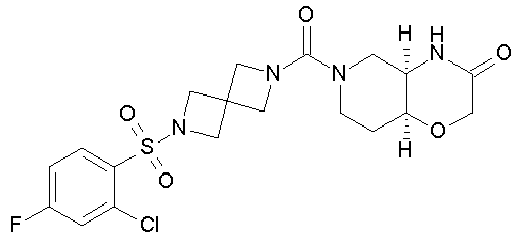
17 (4aR,8aS)-6-(6-((2-Fluoro-4-(trifluoromethyl)phenyl)sulfonyl)-2,6-diazaspiro[3.3]heptane-2-carbonyl)hexahydro-2H-pyrido[4,3-b][1,4]oxazin-3(4H)-one BB2a and BB21 507.3 [M+H]+ A1 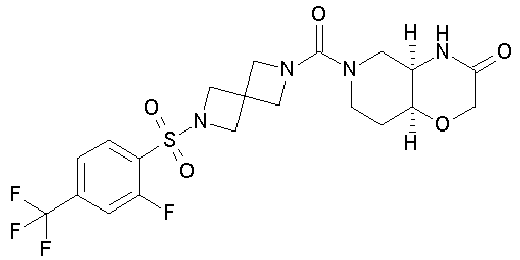
19 rac-(4aR,8aS)-N-((S)-8-(3-oxooctahydro-2H-pyrido[4,3 - b][1,4]oxazine-6-carbonyl)-1-oxa-8-azaspiro[4.5]decan-3-yl)benzenesulfonamide BB1 and (S)-N-(1-oxa-8-azaspiro[4.5]decan-3-yl)benzenesulfonamide 2,2,2-trifluoroacetate (prepared as described in US20170029390 )479.2 [M+H]+ A3 
20 rac-(4aR,8aS)-6-(2-Benzhydryl-2,6-diazaspiro[3.4]octane-6-carbonyl)hexahydro-2H-pyrido[4,3-b][1,4]oxazin-3(4H)-one BB1 and 2-Benzhydryl-2,6-diazaspiro [3.4]octane (CAS RN 1250443-61-8) 461.3 [M+H]+ A3 
21 rac-(4aR,8aS)-6-(4-((4-Fluorophenyl)sulfonyl)-1-oxa-4,9-diazaspiro[5.5]undecane-9-carbonyl)hexahydro-2H-pyrido[4,3-b][1,4]oxazin-3(4H)-one BB1 and 4-((4-Fluorophenyl)sulfonyl)-1-oxa-4,9-diazaspiro[5.5]undecane 2,2,2-trifluoroacetate (prepared as described in U.S. Pat. Appl. Publ., 20170029390 )497.2 [M+H]+ A3 
Int-1 rac-tert-Butyl 6-((4aR,8aS)-3-oxooctahydro-2H-pyrido[4,3-b][1,4]oxazine-6-carbonyl)-2,6-diazaspiro[3.4]octane-2-carboxylate BB1 and tert-Butyl 2,6-diazaspiro[3.4]octane-2-carboxylate (CAS RN 885270-84-8) 395.2 [M+H]+ A3 
23 (4aR,8aS)-6-(6-((5,6-Bis(trifluoromethyl)pyridin-2-yl)oxy)-2-azaspiro[3.3]heptane-2-carbonyl)hexahydro-2H-pyrido[4,3-b][1,4]oxazin-3(4H)-one BB1a and BB23 509.16 [M+H]+ A4 
24 2-Chloro-4-fluoro-N-methyl-N-((R)-8-((4aR,8aS)-3-oxooctahydro-2H-pyrido[4,3-b][1,4]oxazine-6-carbonyl)-1-oxa-8-azaspiro [4.5]decan-3 - yl)benzenesulfonamide BB1a and BB24 545.2 [M+H]+ A4 
25 (4aR,8aS)-6-(6-((5-(Trifluoromethyl)pyridin-2-yl)oxy)-2-azaspiro[3.3]heptane-2-carbonyl)hexahydro-2H-pyrido[4,3-b][1,4]oxazin-3(4H)-one BB1a and BB25 441.18 [M+H]+ A4 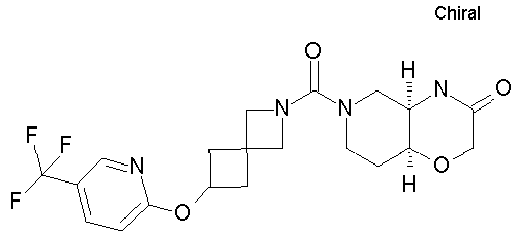
26 (4aR,8aS)-6-(6-((4-Methyl-3-(trifluoromethyl)benzyl)oxy)-2-azaspiro[3.3]heptane-2-carbonyl)hexahydro-2H-pyrido[4,3-b][1,4]oxazin-3(4H)-one BB1a and BB26 468.20 [M+H]+ A4 
27 (4aR,8aS)-6-(2-((2-Chloro-4-fluorophenyl)sulfonyl)-2,7-diazaspiro [3.5]nonane-7-carbonyl)hexahydro-2H-pyrido[4,3-b][1,4]oxazin-3(4H)-one BB1a and BB27 501.1 [M+H]+ A4 
28 (4aR,8aS)-6-(6-((2-Fluoro-4-(trifluoromethyl)benzyl)oxy)-2-azaspiro[3.3]heptane-2-carbonyl)hexahydro-2H-pyrido[4,3-b][1,4]oxazin-3(4H)-one BB1a and BB28 472.2 [M+H]+ A4 
29 N-((S)-8-((4aR,8aS)-3-Oxooctahydro-2H-pyrido[4,3-b][1,4]oxazine-6-carbonyl)-1-oxa-8-azaspiro[4.5]decan-3-yl)-4-(trifluoromethyl)benzenesulfonamide BB1a and BB29 547.2 [M+H]+ A4 
30 N-Methyl-N-((R)-8-((4aR,8aS)-3-oxooctahydro-2H-pyrido[4,3-b][1,4]oxazine-6-carbonyl)-1-oxa-8-azaspiro[4.5]decan-3 - yl)benzenesulfonamide BB1a and BB30 493.2 [M+H]+ A4 
31 2-Chloro-4-fluoro-N-((S)-8-((4aR,8aS)-3-oxooctahydro-2H-pyrido[4,3-b][1,4]oxazine-6-carbonyl)-1-oxa-8-azaspiro[4.5]decan-3 - yl)benzenesulfonamide BB1a and BB31 531.2 [M+H]+ A4 
32 N-((S)-8-((4aR,8aS)-3-Oxooctahydro-2H-pyrido[4,3-b][1,4]oxazine-6-carbonyl)-1-oxa-8-azaspiro[4.5]decan-3-yl)-3-(trifluoromethyl)benzenesulfonamide BB1a and BB32 547.3 [M+H]+ A4 
33 (4aR,8aS)-6-(3-((2-Chloro-4-fluorobenzyl)(methyl)amino)-1-oxa-8-azaspiro[4.5]decane-8-carbonyl)hexahydro-2H-pyrido[4,3-b][1,4]oxazin-3(4H)-one (Epimer A) BB1a and BB33 495.22 [M+H]+ A4, then chiral HPLC; Method A5 
34 (4aR,8aS)-6-(3-((2-Chloro-4-fluorobenzyl)(methyl)amino)-1-oxa-8-azaspiro[4.5]decane-8-carbonyl)hexahydro-2H-pyrido[4,3-b][1,4]oxazin-3(4H)-one (Epimer B) BB1a and BB33 495.22 [M+H]+ A4, then chiral HPLC: Method A5 
35 (4aR,8aS)-6-(3-((2-Chloro-4-fluorobenzyl)amino)-1 -oxa-8-azaspiro[4.5]decane-8-carbonyl)hexahydro-2H-pyrido[4,3-b][1,4]oxazin-3(4H)-one Epimer A BB1a and BB34 481.2 [M+H]+ A4, then chiral HPLC: Method A6 
36 (4aR,8aS)-6-(3-((2-Chloro-4-fluorobenzyl)amino)-1-oxa-8-azaspiro[4.5]decane-8-carbonyl)hexahydro-2H-pyrido[4,3-b][1,4]oxazin-3(4H)-one Epimer B BB1a and BB34 481.2 [M+H]+ A4, then chiral HPLC: Method A6 
37 (4aR, 8aS)-6-(2-((4-(Trifluoromethyl)phenyl)sulfonyl)-2,7-diazaspiro [3.5]nonane-7-carbonyl)hexahydro-2H-pyrido[4,3-b][1,4]oxazin-3(4H)-one BB1a and BB35 517.1 [M+H]+ A4 
38 rac-(4aR,8aS)-6-(3-((2-Chloro-4-fluorobenzyl)amino)-1-oxa-8-azaspiro[4.5]decane-8-carbonyl)hexahydro-2H-pyrido[4,3-b][1,4]oxazin-3(4H)-one BB1a and BB34 481.2 [M+H]+ A4 
39 (4aR,8aS)-6-(2-(Phenylsulfonyl)-2,7-diazaspiro [3.5]nonane-7-carbonyl)hexahydro-2H-pyrido[4,3-b][1,4]oxazin-3(4H)-one BB1a and BB36 449.1 [M+H]+ A4 
40 (4aR,8aS)-6-[2-(2,4-difluorophenoxy)-7-azaspiro[3.5]nonane-7-carbonyl]-4,4a,5,7,8,8a-hexahydropyrido[4,3-b][1,4]oxazin-3-one BB1a and BB37 436.3 [M+H]+ A4 
41 (4aS, 8aR)-6-(6-(2-Chloro-4-fluorophenoxy)-2-azaspiro[3.3]heptane-2-carbonyl)hexahydro-2H-pyrido[4,3-b][1,4]oxazin-3(4H)-one BBlb and BB5 424.2 [M+H]+ A2 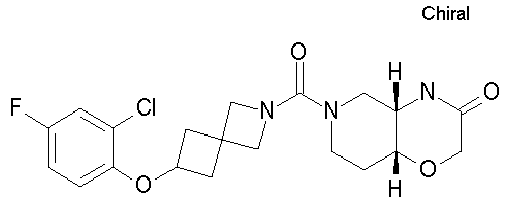
42 (4aR,8aS)-6-[2-(2-chloro-4-fluoro-phenoxy)-7-azaspiro[3.5]nonane-7-carbonyl]-4,4a,5,7,8,8a-hexahydropyrido[4,3-b][1,4]oxazin-3-one BB1a and BB38 452.8 [M+H]+ A4 
43 (4aR,8aS)-6-[6-[[2-Fluoro-4-(trifluoromethyl)phenoxy]methyl]-2-azaspiro[3.3]heptane-2-carbonyl]-4,4a,5,7,8,8a-hexahydropyrido[4,3-b][1,4]oxazin-3-one BB1a and BB39 472.19 [M+H]+ A4 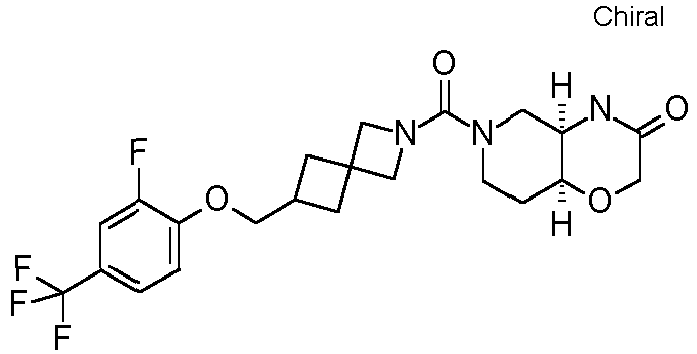
44 (4aR,8aS)-6-(6-((2-fluoro-4-(trifluoromethyl)benzyl)oxy)-6-(trifluoromethyl)-2-azaspiro[3.3]heptane-2-carbonyl)hexahydro-2H-pyrido[4,3-b][1,4]oxazin-3(4H)-one BB1a and BB40 540.17 [M+H]+ A3 
45 (4aR,8aS)-6-(6-(2-fluoro-4-(trifluoromethyl)phenyl)-2-azaspiro[3.3]heptane-2-carbonyl)hexahydro-2H-pyrido[4,3-b][1,4]oxazin-3(4H)-one Bbla and BB41 442.17 [M+H]+ A4 + A7 
46 (4aR,8aS)-6-(6-(4-(pentafluoro-16-sulfaneyl)phenyl)-2-azaspiro[3.3]heptane-2-carbonyl)hexahydro-2H-pyrido[4,3-b][1,4]oxazin-3(4H)-one BB1a and CAS 2059985-86-1 482.15 [M+H]+ A3 + A8 
49 (4aR,8aS)-6-(6-(2-fluoro-4-(trifluoromethyl)benzyl)-2-azaspiro[3.3]heptane-2-carbonyl)hexahydro-2H-pyrido[4,3-b] [1,4]oxazin-3(4H)-one BB1a and BB42 456.19 [M+H]+ A4 
50 (4aR,8aS)-6-(6-(2-chloro-4-fluorobenzyl)-2-azaspiro[3.3]heptane-2-carbonyl)hexahydro-2H-pyrido[4,3-b][1,4]oxazin-3(4H)-one BB1a and BB43 422.16 [M+H]+ A4 
51 (4aR,8aS)-6-(6-(2,4-difluorobenzyl)-2-azaspiro[3.3]heptane-2-carbonyl)hexahydro-2H-pyrido[4,3-b][1,4]oxazin-3(4H)-one BB1a and BB44 406.19 [M+H]+ A4 
52 (4aR,8aS)-6-(6-(2-methoxy-4-(trifluoromethyl)benzyl)-2-azaspiro[3.3]heptane-2-carbonyl)hexahydro-2H-pyrido[4,3-b] [1,4]oxazin-3(4H)-one BB1a and BB45 468.21 [M+H]+ A4 
53 (4aR,8aS)-6-(6-(2-fluoro-6-(trifluoromethyl)benzyl)-2-azaspiro[3.3]heptane-2-carbonyl)hexahydro-2H-pyrido[4,3-b][1,4]oxazin-3(4H)-one BB1a and BB46 456.19 [M+H]+ A4 
54 (4aR,8aS)-6-(6-((2-chloro-4-fluorophenoxy)methyl)-2-azaspiro[3.3]heptane-2-carbonyl)hexahydro-2H-pyrido[4,3-b] [1,4]oxazin-3(4H)-one BB1a and BB47 438.2 [M+H]+ A4 + A9 
55 (4aR,8aS)-6-(6-(4-(trifluoromethyl)phenyl)-2,6-diazaspiro[3.3]heptane-2-carbonyl)hexahydro-2H-pyrido[4,3-b][1,4]oxazin-3(4H)-one BB1a and CAS 1609024-22-7 425.1 [M+H]+ A4 + A10 
56 (4aR,8aS)-6-(6-(3-(trifluoromethyl)phenyl)-2,6-diazaspiro[3.3]heptane-2-carbonyl)hexahydro-2H-pyrido[4,3-b] [1,4]oxazin-3(4H)-one BB1a + BB48 425.1 [M+H]+ A4 + A8 
57 (4aR,8aS)-6-(2-(4-(trifluoromethyl)phenyl)-2,6-diazaspiro[3.4]octane-6-carbonyl)hexahydro-2H-pyrido[4,3-b] [1,4]oxazin-3(4H)-one BB1a + CAS 1785600-00-1 439.3 [M+H]+ A4 + A9 
58 (4aR,8aS)-6-(2-(3-(trifluoromethyl)phenyl)-2,6-diazaspiro[3.4]octane-6-carbonyl)hexahydro-2H-pyrido[4,3-b] [1,4]oxazin-3(4H)-one BB1a + CAS 1782337-64-7 439.3 [M+H]+ A4 + A9 
59 (4aR,8aS)-6-(2-(4-isopropoxyphenyl)-2,6-diazaspiro[3.4]octane-6-carbonyl)hexahydro-2H-pyrido[4,3- b][1,4]oxazin-3(4H)-one BB1a + CAS 1785235-75-7 429.3 [M+H]+ A4 + A11 
60 (4aR,8aS)-6-(6-(4-isopropoxyphenyl)-2,6-diazaspiro[3.3]heptane-2-carbonyl)hexahydro-2H-pyrido[4,3-b][1,4]oxazin-3(4H)-one BB2a + BB49 415.3 [M+H]+ A1 + A10 
61 (4aR,8aS)-6-(2-(4-(2-oxopyrrolidin-1-yl)phenyl)-2,6-diazaspiro[3.4]octane-6-carbonyl)hexahydro-2H-pyrido[4,3-b][1,4]oxazin-3(4H)-one BB2a + BB50 454.3 [M+H]+ A1 + A7 
62 (4aR,8aS)-6-(2-(4-methoxy-3-methylphenyl)-2,6-diazaspiro[3.4]octane-6-carbonyl)hexahydro-2H-pyrido[4,3-b][1,4]oxazin-3(4H)-one BB2a + BB51 415.3 [M+H]+ A1 + A10 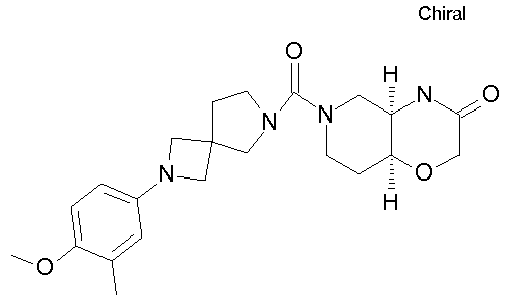
63 (4aR, 8aS)-6-(2-(4-chloro-3-(trifluoromethyl)phenyl)-2,6-diazaspiro[3.4]octane-6-carbonyl)hexahydro-2H-pyrido[4,3-b][1,4]oxazin-3(4H)-one BB2a + BB52 473.2 [M+H]+ A1 + A7 
64 (4aR, 8aS)-6-(2-(2-fluoropyridin-4-yl)-2,6-diazaspiro[3.4]octane-6-carbonyl)hexahydro-2H-pyrido[4,3-b][1,4]oxazin-3(4H)-one BB2a + BB53 390.2 [M+H]+ A1 + A10 
65 (4aR,8aS)-6-(6-(2,5-bis(trifluoromethyl)phenyl)-2,6-diazaspiro[3.3]heptane-2-carbonyl)hexahydro-2H-pyrido[4,3-b][1,4]oxazin-3(4H)-one BB2a + BB54 493.3 [M+H]+ A1 + A10 
66 (4aR,8aS)-6-(6-((4-fluoro-2-(trifluoromethyl)phenyl)sulfonyl)-2,6-diazaspiro[3.3]heptane-2-carbonyl)hexahydro-2H-pyrido[4,3-b][1,4]oxazin-3(4H)-one BB2a + BB55 507.2 [M+H]+ A1 + A9 
67 (4aR,8aS)-6-(6-((2-chloro-4-fluorophenyl)sulfonyl)-2-azaspiro[3.3]heptane-2-carbonyl)hexahydro-2H-pyrido[4,3-b][1,4]oxazin-3(4H)-one BB2a + BB56 472.1 [M+H]+ A1 + A9 
68 (4aR,8aS)-6-(6-((3-chloro-4-(trifluoromethyl)phenyl)sulfonyl)-2,6-diazaspiro[3.3]heptane-2-carbonyl)hexahydro-2H-pyrido[4,3-b][1,4]oxazin-3(4H)-one BB2a + BB57 523.2 [M+H]+ A1 + A7 
69 (4aR,8aS)-6-(6-((2,4-bis(trifluoromethyl)phenyl)sulfonyl)-2,6-diazaspiro[3.3]heptane-2-carbonyl)hexahydro-2H-pyrido[4,3-b][1,4]oxazin-3(4H)-one BB2a + BB58 557.2 [M+H]+ A1 + A7 
70 (4aR,8aS)-6-(6-(2,6-difluorobenzyl)-2-azaspiro[3.3]heptane-2-carbonyl)hexahydro-2H-pyrido[4,3-b][1,4]oxazin-3(4H)-one BB1a + BB59 406.19 [M+H]+ A4 
71 (4aR,8aS)-6-(6-(2-fluoro-6-methoxybenzyl)-2-azaspiro[3.3]heptane-2-carbonyl)hexahydro-2H-pyrido[4,3-b][1,4]oxazin-3(4H)-one BB1a + BB60 418.21 [M+H]+ A4 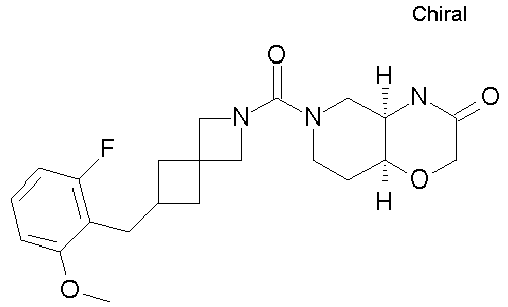
72 (4aR,8aS)-6-(6-(2-methoxybenzyl)-2-azaspiro[3.3]heptane-2-carbonyl)hexahydro-2H-pyrido[4,3-b][1,4]oxazin-3(4H)-one BB1a+BB61 400.2 [M+H]+ A4 
73 (4aR,8aS)-6-(6-(2-fluoro-6-hydroxybenzyl)-2-azaspiro[3.3]heptane-2-carbonyl)hexahydro-2H-pyrido[4,3-b][1,4]oxazin-3(4H)-one BB1a + BB62 404.19 [M+H]+ A4 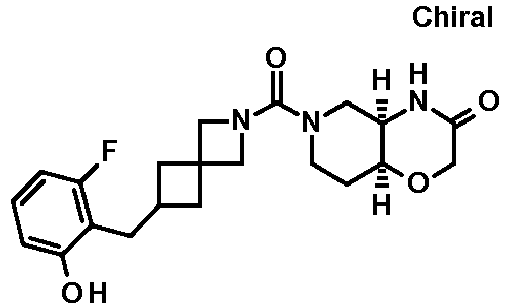
74 (4aR,8aS)-6-(6-(2-hydroxybenzyl)-2-azaspiro[3.3]heptane-2-carbonyl)hexahydro-2H-pyrido[4,3-b][1,4]oxazin-3(4H)-one BB1a + BB63 386.20 [M+H]+ A4 
-

- To a suspension of (4aR,8aS)-6-(6-(4-bromophenyl)-2-azaspiro[3.3]heptane-2-carbonyl)hexahydro-2H-pyrido[4,3-b][1,4]oxazin-3(4H)-one (0.050 g, 115 µmol) and 2-(trifluoromethyl)pyrrolidine (16 mg, 115 µmol) in tert-Butanol (1 ml) under argon were added XPhos (4.94 mg, 10.4 µmol, Eq: 0.09), Pd2(dba)3 · CHCl3 (3.57 mg, 3.45 µmol) and cesium carbonate (150 mg, 460 µmol) and the mixture was heated in a microwave to 100°C for 30min. The mixture was filtered, the filtrate was evaporated. The product was purified by prep HPLC (Gemini NX, 12 nm, 5 µm, 100 x 30 mm, gradient of acetonitrile / water + 0.1% TEA) yielding the desired product as 2.1mg of a yellow oil. MS (ESI): m/z = 493.4 [M+H]+.
- Step a) 6-(4-bromophenyl)-2-azaspiro[3.3]heptane trifluoroacetate was obtained in analogy to BB41 from tert-butyl 6-bromo-2-azaspiro[3.3]heptane-2-carboxylate (1 eq) and 1,4-dibromobenzene (2 eq). MS (ESI): m/z = 298.1 [M-56-H]+.
- Step b) (4aR,8aS)-6-(6-(4-bromophenyl)-2-azaspiro[3.3]heptane-2-carbonyl)hexahydro-2H-pyrido[4,3-b][1,4]oxazin-3(4H)-one Synthesized in analogy to general method A4 from 6-(4-bromophenyl)-2-azaspiro[3.3]heptane trifluoroacetate and BB1a, purified by flash chromatography (silica gel, 0% to 10% MeOH in DCM). MS (ESI): m/z = 434.2 [M+H]+.
-

- (4aR,8aS)-6-(6-(4-bromophenyl)-2-azaspiro[3.3]heptane-2-carbonyl)hexahydro-2H-pyrido[4,3-b][1,4]oxazin-3(4H)-one (0.050 g, 115 µmol), (1-methyl-1H-pyrazol-5-yl)boronic acid (14.5 mg, 115 µmol), potassium carbonate (79.5 mg, 576 µmol) and tetrakis(triphenylphosphine)palladium(0) (6.65 mg, 5.76 µmol) were dossilved in THF (1.5 ml) / water (0.150 ml) under argon, and stirred at 80°C for 2 days. The reaction mixture was poured into 10 mL H2O and extracted with EtOAc (2 x 20 mL). The organic layers were combined, washed with brine, dried over Na2SO4 and concentrated in vacuo. The crude material was purified by preparative HPLC (YMC-Triart C18, 12 nm, 5 µm, 100 x 30 mm, 15 mins run time, gradient 15-35-50-100 ACN in water+0.1% HCOOH). The product was obtained as a white lyophilized powder (15.6 mg, 31%). MS (ESI): m/z = 436.4 [M+H]+.
- The enantiomers of rac-(4aR,8aS)-hexahydro-2H-pyrido[4,3-b][1,4]oxazin-3(4H)-one dihydrochloride (BB1, 500 mg, 2.18 mmol, ChemBridge Corporation) were separated by preparative chiral HPLC (ReprosilChiral NR column) using an isocratic mixture of EtOH (containing 0.05% of NH4OAc) : n-heptane (30 : 70).
- First eluting enantiomer: (+)-cis-4a,5,6,7,8,8a-Hexahydro-4H-pyrido[4,3-b][1,4]oxazin-3-one (BB1a). Yellow solid (0.150 g; 44.0%). MS (ESI): m/z = 157.1 [M+H]+.
- Second eluting enantiomer: (-)-cis-4a,5,6,7,8,8a-Hexahydro-4H-pyrido[4,3-b][1,4]oxazin-3-one. (BB1b). Yellow solid (0.152 g; 44.6%). MS (ESI): m/z = 157.1 [M+H]+.
- To a suspension of rac-(4aR,8aS)-hexahydro-2H-pyrido[4,3-b][1,4]oxazin-3(4H)-one; dihydrochloride salt (4.5 g, 19.6 mmol, BB1) in dry DCM (125 mL) at 0 °C was added DIPEA (6.35 g, 8.58 mL, 49.1 mmol) followed by 4-nitrophenyl carbonochloridate (4.35 g, 21.6 mmol). The reaction mixture was stirred at 0 °C for 10 min and at RT for 2 h. The crude reaction was diluted with DCM and transferred into a separating funnel for extraction with sat. aq. Na2CO3 solution. The organic phase was collected and the aqueous phase was back-extracted with DCM. The combined organic phases were dried over Na2SO4 and evaporated down to dryness to yield 6.62 g of a crude racemic product (BB2) as a yellow solid. The crude material was directly submitted for a chiral SFC separation to yield enantiomer BB2b (2.72 g, second eluting enantiomer) as a yellow solid and enantiomer BB2a (3.25 g, first eluting enantiomer) as a light beige solid but contaminated with BB2b. A further SFC chiral separation was carried out to yield 2.71 g of BB2a. MS (ESI): m/z = 322.2 [M+H]+ for both enantiomers.
- To a solution of 6-benzyl-2-methyl-5,6,7,8-tetrahydro-2H-pyrido[4,3-b][1,4]oxazin-3(4H)-one (Isomer A, 1.10 g, 4.26 mmol) in EtOAc (16 mL) and MeOH (16 mL) was added under argon Pd-C (227 mg, 213 µmol) and the suspension was stirred under a hydrogen atmosphere (balloon) at 1 bar for 24 h. The suspension was filtered over a microglass filter and washed with 20 mL EtOAc under inert gas. The filtrate was evaporated to give BB4 as a colorless solid (715 mg). MS (ESI): m/z = 170.8 [M+H]+. Note: Only the single enantiomer formed during the reduction. Relative conformation confirmed by proton NMR.
- To a solution of 3-aminopyridin-4-ol (2.5 g, 22.7 mmol) in DMF (100 mL) was added dropwise 2-chloropropanoyl chloride (3.03 g, 2.31 mL, 23.8 mmol) and the mixture was stirred at RT for 30 min. After addition of K2CO3 (7.84 g, 56.8 mmol), the suspension was heated to 100 °C (oil bath) for 20 h. The DMF was removed in vacuo, then 100 mL EtOAc were added and stirred at RT for 10 min, and it was washed with 50 mL H2O, extracted 3 times with EtOAc. The organic phases were combined, dried with MgSO4 and concentrated under vacuo to yield 3.72 g of 2-methyl-4H-pyrido[4,3-b][1,4]oxazin-3-one which was used in the next step without further purification.
- A suspension of 2-methyl-2H-pyrido[4,3-b][1,4]oxazin-3(4H)-one (3.72 g, 22.7 mmol) in DCM (32 mL) and MeOH (8 mL) was treated with (bromomethyl)benzene (4.65 g, 3.23 mL, 27.2 mmol) and the mixture was stirred at RT for 60 h. A suspension formed, which was cooled down to 0°C, 20 mL n-hexane were added and then the precipitate was filtered. The residue was washed with 15 mL of cold DCM/n-hexan to yield the compound as an off-white solid (5.2 g). MS (ESI): m/z = 255 [M+H]+.
- To a suspension of 6-benzyl-2-methyl-3-oxo-3,4-dihydro-2H-pyrido[4,3-b][1,4]oxazin-6-ium bromide (5.2 g, 15.5 mmol) in EtOH (38 mL) was added in portions NaBH4 (763 mg, 20.2 mmol) (exothermic, 22°C to 30°C, yellow suspension). After the exothermic reaction faded out the mixture was stirred at room temperature for 3 h, then at 60 °C for 1h and at 22 °C for 1h. The reaction mixture was evaporated, partitioned between H2O and EtOAc and the layers were separated. The aqueous layer was extracted once with EtOAc. The organic layers were washed twice with H2O, dried over MgSO4, filtered, treated with silica gel and evaporated. The compound was purified by silica gel chromatography on a 120 g column using an MPLC system eluting with a gradient of n-heptane : EtOAc (50 to 100 in 30 min.) to provide the compound as a light yellow solid (2.48 g) which could be used in the following step without further purification.
- The enantiomers were separated by preparative chiral HPLC (Chiralcel OD column) using an isocratic mixture of EtOH (containing 0.05% of NH4OAc) : n-heptane (10 : 90). The fractions were evaporated to provide the desired compounds as light yellow solids (Isomer A 1.17 g, Isomer B 1.10 g).
- rac-Benzyl (4aS,8aS)-3-oxohexahydro-2H-pyrido[4,3-b][1,4]oxazine-6(5H)-carboxylate (125 mg, 431 µmol) was dissolved in MeOH (5 mL). The reaction solution was degassed in vacuo and backfilled with argon. Pd-C (20 mg, 188 µmol) was added under an argon atmosphere. Argon was evacuated from the reaction mixture and backfilled with hydrogen. The reaction mixture was stirred at RT for 15 h under a hydrogen atmosphere. The reaction mixture was filtered through a syringe filter and concentrated in vacuo to afford the desired product as a colorless solid (62 mg, 92.2%). MS (ESI): m /z = 157.098 [M+H]+.
- To a stirred suspension of rac-benzyl (3S,4S)-3-amino-4-hydroxypiperidine-1-carboxylate (317 mg, 1.27 mmol, synthesized according to patent
US 2011/59118 A1 ) and sodium acetate (208 mg, 2.53 mmol, CAS RN 127-09-3) in a mixture of acetone (4 mL)/H2O (0.5 mL) was added dropwise a solution of chloroacetyl chloride (150 mg, 107 µL, 1.33 mmol, CAS RN 79-04-9) in acetone (3 mL) between 0-5°C. After the addition the reaction mixture was stirred at RT for 1h and subsequently evaporated to dryness giving a yellow gum. The crude product was purified by silica gel chromatography to afford the desired product as a yellow solid (385 mg, 93%). MS (ESI): m /z = 325.2 [M-H]-. - To a stirred solution of rac-benzyl (3S,4S)-3-(2-chloroacetamido)-4-hydroxypiperidine-1-carboxylate (385 mg, 1.18 mmol) in dry THF (4 mL) was added NaH (67.9 mg, 1.7 mmol) at 0°C. The mixture was allowed to reach RT and then stirred for 90 min under an argon atmosphere. H2O (5 mL) was added and stirring was continued for 10 min at RT. THF was removed in vacuo from the reaction mixture. The residue was treated with DCM and the organic phase was washed with H2O and brine, dried over Na2SO4, filtered and then concentrated in vacuo. The residue was purified by flash chromatography (12 g reversed phase column, gradient 0-100% ACN in H2O (containing 0.1% FA) to afford the desired product as a colorless solid (133 mg, 38.9%). MS (ESI): m /z = 291.3 [M+H]+.
- To a solution of tert-butyl 6-(2-chloro-4-fluorophenoxy)-2-azaspiro[3.3]heptane-2-carboxylate (1.5065 g, 4.41 mmol) in DCM (22 mL) was added TFA (4.02 g, 2.72 mL, 35.3 mmol) and the reaction was stirred at RT for 3.5 h. The reaction mixture was concentrated to afford the title compound as a yellow oil (2.015 g, 4.42 mmol, 100%) which was used in the next step without further purification. MS (ESI): m/z = 242.2 [M+H]+.
- To a solution of 2-chloro-4-fluorophenol (756 mg, 562 µL, 5.16 mmol, CAS RN 1996-41-4), tert-butyl 6-hydroxy-2-azaspiro[3.3]heptane-2-carboxylate (1000 mg, 4.69 mmol, CAS RN 1147557-97-8) and triphenylphosphine (1.48 g, 5.63 mmol, CAS RN 603-35-0) in THF (23.4 mL) was added DIAD (1.14 g, 1.09 mL, 5.63 mmol, CAS RN 2446-83-5) dropwise at 0 °C and the reaction was stirred at RT for 18 h. Triphenylphosphine (738 mg, 2.81 mmol), followed by DIAD (569 mg, 547 µL, 2.81 mmol) were added and the reaction was stirred at RT for 6 h. The reaction mixture was poured into sat. aq. NaHCO3 solution (50 mL) and EtOAc (30 mL) was added. The phases were separated and the aq. phase was extracted with EtOAc. The combined organic layers were washed with brine, dried over sodium sulfate, filtered and concentrated to give an orange oil. The crude product was immobilized on Isolute and purified by column chromatography (40 gr, 0 to 30 % EtOAc in heptane) to afford the title compound as a yellow solid (1.51 g, 4.19 mmol, 89.3%). MS (ESI): m/z = 286.2 [M-56+H]+.
- In analogy to BB5 and BB5 step a), intermediates BB6 - BB13 of the following table were prepared from the commercially available phenols.
BB No. Systematic Name Starting material MS, m/z BB6 6-(4-(Trifluoromethyl)phenoxy)-2-azaspiro[3.3]heptane; trifluoroacetate salt 4-(Trifluoromethyl)phenol (CAS: 402-45-9) 258.2 [M+H]+ BB7 6-(2-Fluoro-4-(trifluoromethyl)phenoxy)-2-azaspiro[3.3]heptane; trifluoroacetate salt 2-Fluoro-4-(trifluoromethyl)phenol (CAS: 77227-78-2) 276.2 [M+H]+ BB8 6-(2-Fluoro-4-(trifluoromethoxy)phenoxy)-2-azaspiro[3.3]heptane; trifluoroacetate salt 2-Fluoro-4-(trifluoromethoxy)phenol (CAS: 77227-78-2) 292.2 [M+H]+ BB9 6-(2-Chloro-4-(trifluoromethoxy)phenoxy)-2-azaspiro[3.3]heptane; trifluoroacetate salt 2-Chloro-4-(trifluoromethoxy)phenol (CAS: 70783-75-4) 308.2 [M+H]+ BB10 6-(2-Methoxy-5-(trifluoromethyl)phenoxy)-2-azaspiro[3.3]heptane; trifluoroacetate salt 2-Methoxy-5-(trifluoromethyl)phenol (CAS: 349-67-7) 288.2 [M+H]+ BB11 6-(4-Chloro-2-(trifluoromethyl)phenoxy)-2-azaspiro[3.3]heptane; trifluoroacetate salt 4-Chloro-2-(trifluoromethyl)phenol (CAS: 53903-51-8) 292.2 [M+H]+ BB12 6-(2,4-Difluorophenoxy)-2-azaspiro[3.3]heptane; trifluoroacetate salt 2,4-Difluorophenol (CAS: 367-27-1) 226.2 [M+H]+ BB13 6-(3-Fluoro-5-(trifluoromethyl)phenoxy)-2-azaspiro[3.3]heptane; trifluoroacetate salt 3-Fluoro-5-(trifluoromethyl) phenol (CAS: 172333-87-8) 276.2 [M+H]+ - To a solution of tert-butyl 2-(2-fluoro-4-(trifluoromethyl)phenoxy)-7-azaspiro[3.5]nonane-7-carboxylate (21.3 mg, 52.8 µmol) in DCM (520 µL) was added trifluoroacetic acid (48.2 mg, 32.5 µL, 422 µmol) and the reaction was stirred at RT for 19 h. The reaction mixture was concentrated to afford the title compound as an off-white solid (23.2 mg, 52.8 µmol, 100%) which was used in the next step without further purification. MS (ESI): m/z = 304.2 [M+H]+.
- To a solution of 2-fluoro-4-(trifluoromethyl)phenol (41 mg, 28.7 µL, 228 µmol, CAS RN 77227-78-2), tert-butyl 2-hydroxy-7-azaspiro[3.5]nonane-7-carboxylate (50 mg, 207 µmol, CAS RN 240401-28-9) and triphenylphosphine (59.8 mg, 228 µmol, CAS RN 603-35-0) in THF (1.04 mL) was added DIAD (46.1 mg, 44.3 µL, 228 µmol, CAS RN 2446-83-5) dropwise and the reaction was stirred at rt for 23 h. The reaction mixture was quenched by addition of sat. aq. NaHCO3 solution. The phases were separated and the aq. phase was extracted with EtOAc. The combined organic layers were dried over sodium sulfate, filtered and concentrated to afford a colorless oil. The crude product was immobilized on Isolute and purified by column chromatography (12 gr, 0 to 30 % EtOAc in n-heptane) to afford the title compound as a colorless oil (21.3 mg, 50.2 µmol, 24.2%). MS (ESI): m/z = 348.2 [M-56+H]+.
- To a solution of tert-butyl 6-(2-chloro-4-fluorobenzyl)-2,6-diazaspiro[3.3]heptane-2-carboxylate (65.5 mg, 192 µmol) in DCM (961 µL) was added TFA (175 mg, 118 µL, 1.54 mmol) and the reaction was stirred at RT for 7 h. The reaction mixture was concentrated to afford the title compound as a yellow oil that crystallized upon standing (116.8 mg, 191 µmol, 99.4%) which was used in the next step without further purification. MS (ESI): m/z = 241.1 [M+H]+.
- To a suspension of tert-butyl 2,6-diazaspiro[3.3]heptane-2-carboxylate hemioxalate (50 mg, 204 µmol, CAS RN 1041026-71-4) and 2-chloro-4-fluorobenzaldehyde (32.4 mg, 204 µmol, CAS RN 84194-36-5) in DCE (1.02 mL) was added sodium triacetoxyborohydride (64.9 mg, 306 µmol, CAS RN 56553-60-7), and the mixture was stirred at RT for 2.5 h. The solution was diluted with EtOAc. The combined organic layers were and washed with aq. sat. NaHCO3 solution. The phases were separated and the aq. layer was extracted with EtOAc washed with brine, filtred over MgSO4 and evaporated to dryness to afford the title compound as a light-yellow oil (65.5 mg, 84.7%) which was used in the next step without further purification. MS (ESI): m/z = 341.1 [M+H]+.
- To a solution of tert-butyl 6-(2-fluoro-4-(trifluoromethyl)benzyl)-2,6-diazaspiro[3.3]heptane-2-carboxylate (71.0 mg, 190 µmol) in DCM (948 µL) was added trifluoroacetic acid (173 mg, 117 µL, 1.52 mmol) and the reaction was stirred at RT for 17 h. The reaction mixture was concentrated to afford the title compound as a yellow oil (119.5 mg, 188 µmol, 99%) which was used without further purification in the next step. MS (ESI): m/z = 275.2 [M+H]+.
- To a suspension of tert-butyl 2,6-diazaspiro[3.3]heptane-2-carboxylate hemioxalate (50 mg, 204 µmol, CAS RN 1041026-71-4) and 2-fluoro-4-(trifluoromethyl)benzaldehyde (39.2 mg, 27.8 µL, 204 µmol, CAS RN 89763-93-9) in DCE (1.0 mL) was added sodium triacetoxyborohydride (64.9 mg, 306 µmol, CAS RN 56553-60-7), and the mixture was stirred at rt for 19 h. The solution was diluted with EtOAc and washed with aq. sat. NaHCO3 solution. The phases were separated and the aq. layer was extracted with EtOAc. The combined organic layers were washed with brine, filtred over MgSO4 and evaporated to dryness. The residue was immobilized on Isolute and purified by column chromatography (4 gr, 0 to 40 % 3:1 EtOAc/EtOH in n-heptane) to afford to afford the title compound as a light-yellow oil (71.0 mg, 180 µmol, 88.2%). MS (ESI): m/z = 375.3 [M+H]+.
- To a solution of tert-butyl 2-(2-fluoro-4-(trifluoromethyl)benzyl)-2,7-diazaspiro[3.5]nonane-7-carboxylate (79 mg, 196 µmol) in DCM (982 µL) was added trifluoroacetic acid (179 mg, 121 µL, 1.57 mmol) and the reaction was stirred at rt for 7 h. The reaction mixture was concentrated and the resulting residue was dissolved in EtOAc, washed with sat. aq. NaHCO3 solution and the aqueous phase was back-extracted with EtOAc three times. The combined organic layers were washed with brine, dried over sodium sulfate and concentrated to afford the title compound as a yellow oil (57.3 mg, 91.7%) which was used in the next step without further purification. MS (ESI): m/z = 303.3 [M+H]+.
- To a suspension of tert-butyl 2,7-diazaspiro[3.5]nonane-7-carboxylate (50 mg, 221 µmol, CAS RN 896464-16-7) and 2-fluoro-4-(trifluoromethyl)benzaldehyde (42.4 mg, 30.1 µL, 221 µmol, CAS RN 89763-93-9) in DCE (1.1 mL) was added sodium triacetoxyborohydride (70.2 mg, 331 µmol, CAS RN 56553-60-7), and the mixture was stirred at RT for 4 h. The solution was diluted with EtOAc and washed with aq. sat. NaHCO3 solution. The phases were separated and the aq. layer was extracted with EtOAc. The combined organic layers were washed with brine, filtred over MgSO4 and evaporated to dryness to afford to afford the title compound as an off-white oil (79.0 mg, 80%) which was used without further purification in the next step. MS (ESI): m/z = 403.4 [M+H]+.
- To a solution of tert-butyl 7-(2-fluoro-4-(trifluoromethyl)benzyl)-2,7-diazaspiro[4.4]nonane-2-carboxylate (123 mg, 275 µmol) in DCM (1.38 mL) was added trifluoroacetic acid (251 mg, 170 µL, 2.2 mmol) and the reaction was stirred at rt for 7 h. The reaction mixture was concentrated and the resulting residue was dissolved in EtOAc, washed with sat. aq. NaHCO3 solution and the aqueous phase was back-extracted with EtOAc three times. The combined organic layers were washed with brine, dried over sodium sulfate and concentrated to afford the title compound as a yellow oil (107.7 mg, 99.7%) which was used in the next step without further purification. MS (ESI): m/z = 303.3 [M+H]+.
- To a suspension of tert-butyl tert-butyl 2,7-diazaspiro[4.4]nonane-2-carboxylate (83.1 mg, 367 µmol, CAS RN 236406-49-8) and 2-fluoro-4-(trifluoromethyl)benzaldehyde (70.5 mg, 0.05 mL, 367 µmol, CAS RN 89763-93-9) in DCE (1.1 mL) was added sodium triacetoxyborohydride (117 mg, 550 µmol, CAS RN 56553-60-7), and the mixture was stirred at rt for 1 h. The solution was diluted with EtOAc and washed with aq. sat. NaHCO3 solution. The phases were separated and the aq. layer was extracted with EtOAc. The combined organic layers were washed with brine, filtred over MgSO4 and evaporated to dryness to afford to afford the title compound as a light-yellow oil (123.0 mg, 75%) which was used in the next step without further purification. MS (ESI): m/z = 403.4 [M+H]+.
- To a solution of tert-butyl 2-(2-fluoro-4-(trifluoromethyl)benzyl)-2,6-diazaspiro[3.4]octane-6-carboxylate (147.6 mg, 361 µmol) in DCM (1.8 mL) was added trifluoroacetic acid (329 mg, 223 µL, 2.89 mmol) and the reaction was stirred at rt for 7 h. The reaction mixture was concentrated and the resulting residue was dissolved in EtOAc, washed with sat. aq. NaHCO3 solution and the aqueous phase was back-extracted with EWtOAc three times. The combined organic layers were washed with brine, dried over sodium sulfate and concentrated to afford the title compound as a yellow oil (84.7 mg, 77.3%) which was used without further purification in the next step. MS (ESI): m/z = 289.2 [M+H]+.
- To a suspension of tert-butyl 2,6-diazaspiro[3.4]octane-6-carboxylate (85.6 mg, 403 µmol, CAS RN 885270-86-0) and 2-fluoro-4-(trifluoromethyl)benzaldehyde (77.5 mg, 55 µL, 403 µmol, CAS RN 89763-93-9) in DCE (2.0 mL) was added sodium triacetoxyborohydride (128 mg, 605 µmol, CAS RN 56553-60-7), and the mixture was stirred at rt for 1 h. The solution was diluted with EtOAc and washed with aq. sat. NaHCO3 solution. The phases were separated and the aq. layer was extracted with EtOAc. The combined organic layers were washed with brine, filtred over MgSO4 and evaporated to dryness to afford to afford the title compound as a light-yellow oil (147.6 mg, 361 µmol, 89.5 % yield) which was used in the next step without further purification. MS (ESI): m/z = 389.3 [M+H]+.
- To a solution of tert-butyl 6-((2-chloro-4-fluorophenyl)sulfonyl)-2,6-diazaspiro[3.3]heptane-2-carboxylate (54.7 mg, 140 µmol) in DCM (700 µL) was added trifluoroacetic acid (128 mg, 86.3 µL, 1.12 mmol) and the reaction was stirred at RT for 22 h. The reaction mixture was concentrated to afford the title compound as an off-white oil (75.7 mg, 140 µmol, 100%) which was used without further purification in the next step. MS (ESI): m/z = 291.2 [M+H]+.
- To a suspension of tert-butyl 2,6-diazaspiro[3.3]heptane-2-carboxylate hemioxalate (50 mg, 204 µmol, CAS RN 885270-86-0) was added TEA (31 mg, 43 µL, 306 µmol), followed by 2-chloro-4-fluorobenzenesulfonyl chloride (58.5 mg, 37 µL, 255 µmol, CAS RN 85958-57-2) and the resulting clear solution was stirred at RT for 17.5 h. The reaction mixture diluted with DCM and quenched with water. The phases were separated and the aq. phase was extracted with DCM. The combined organic layers were washed with brine, dried over sodium sulfate, filtered and concentrated to afford the title compound as a white solid (54.7 mg, 65.1%) which was used in the next step without further purification. MS (ESI): m/z = 335.1 [M+H]+.
- To a solution of tert-butyl 6-((2-fluoro-4-(trifluoromethyl)phenyl)sulfonyl)-2,6-diazaspiro[3.3]heptane-2-carboxylate (67.6 mg, 159 µmol) in DCM (796 µL) was added TFA (145 mg, 98.2 µL, 1.27 mmol) and the reaction was stirred at RT for 20 h. The reaction mixture was concentrated to afford the title compound as a yellow oil (90 mg, 99.3%) which was used in the next step without further purification. MS (ESI): m/z = 325.2 [M+H]+.
- To a suspension of tert-butyl 2,6-diazaspiro[3.3]heptane-2-carboxylate hemioxalate (50 mg, 204 µmol, CAS RN 885270-86-0) in DCM was added TEA (31 mg, 42.7 µL, 306 µmol), followed by 2-fluoro-4-(trifluoromethyl)benzenesulfonyl chloride (59 mg, 225 µmol, CAS 1177009-38-9) and the resulting clear solution was stirred at RT for 18 h. The reaction mixture diluted with DCM and quenched with water. The phases were separated and the aq. phase was extracted with DCM. The combined organic layers were washed with brine, dried over sodium sulfate, filtered and concentrated to afford the title compound as a white solid (67.6 mg, 74.1%) which was used in the next step without further purification. MS (ESI): m/z = 369.2 [M+H]+.
- To a solution of tert-butyl 6-((4,5-bis(trifluoromethyl)pyridin-2-yl)oxy)-2-azaspiro[3.3]heptane-2-carboxylate (0.334 g, 783 µmol) in CH2Cl2 (5 mL) was added TFA (893 mg, 604 µl, 7.83 mmol). The resulting reaction mixture was stirred at RT for 1 hour. The reaction mixture was concentrated on high vacuum to yield 366 mg of the desired product as a light yellow oil. MS (ESI): m/z = 327.2 [M+H]+.
- To a solution of tert-butyl 6-hydroxy-2-azaspiro[3.3]heptane-2-carboxylate (0.2 g, 938 µmol) in dry THF (3 mLmL) was added potassium tert-butoxide 1M solution in THF (985 µl, 985 µmol) and the turbid reaction mixture was stirred at RT for 15 min followed by addition of 2-chloro-4,5-bis(trifluoromethyl)pyridine (234 mg, 938 µmol). The reaction mixture was then stirred at RT for 19 hours. The crude reaction was diluted with EtOAc and extracted with water, the organic phase was collected and the aqueous phase was back-extracted with EtOAc. The combined organic phases were dried over sodium sulfate and evaporated down to dryness. The crude material was purified by flash chromatography (silica gel, 20 g, 0% to 100% EtOAc in heptane). The desired product was obtained as a white solid, 334 mg. MS (ESI): m/z = 371.2 [M - 56 + H]+
- To a solution of tert-butyl 6-((5,6-bis(trifluoromethyl)pyridin-2-yl)oxy)-2-azaspiro[3.3]heptane-2-carboxylate (0.376 g, 882 µmol) in CH2Cl2 (5 mL) was added TFA (1.01 g, 679 µl, 8.82 mmol) . The resultant reaction mixture was stirred at RT for 1 hour. The reaction mixture was concentrated on high vacuum to yield 398 mg of the desired product as a light yellow oil. MS (ESI): m/z = 327.2 [M+H]+.
- To a solution of tert-butyl 6-hydroxy-2-azaspiro[3.3]heptane-2-carboxylate (0.2 g, 938 µmol) in dry THF (3 mL) was added potassium tert-butoxide 1M solution in THF (985 µl, 985 µmol) and the turbid reaction mixture was stirred at RT for 15 min followed by addition of 6-chloro-2,3-bis(trifluoromethyl)pyridine (234 mg, 938 µmol). The reaction mixture was then stirred at RT for 19 hours. The crude reaction was diluted with EtOAc and extracted with water, the organic phase was collected and the aqueous phase was back-extracted with EtOAc. The combined organic phases were dried over sodium sulfate and evaporated down to dryness. The crude material was purified by flash chromatography (silica gel, 20 g, 0% to 100% EtOAc in heptane). The desired product was obtained as a white solid, 376 mg. MS (ESI): m/z = 371.2 [M-56+H]+.
- In a 10mL tube, tert-butyl (R)-3-((2-chloro-4-fluoro-N-methylphenyl)sulfonamido)-1-oxa-8-azaspiro[4.5]decane-8-carboxylate (87 mg, 188 µmol) was dissolved in DCM (3.61 mL) and HCl in diethylether 2M (752 µL, 1.5 mmol) was added. The reaction was stirred at RT for 6 hr. The solvent was removed in vacuum, the product was used in the next step without purification. MS (ESI): m/z = 363.1 [M+H]+.
- In a 20mL tube purged with argon, tert-butyl (R)-3-amino-1-oxa-8-azaspiro[4.5]decane-8-carboxylate (80 mg, 312 µmol) was dissolved in DCM (2.67 mL). TEA (69.5 mg, 687 µmol) and 2-chloro-4-fluorobenzenesulfonyl chloride (75.1 mg, 328 µmol) were added, and the reaction mixture was stirred for 2h at RT. The reaction mixture was extracted with DCM / water, dried with Na2SO4, the solvent removed in vacuo, and the residue was purified by preparative HPLC (Gemini NX column, ACN / water + 0.1% TEA gradient). The product was obtained as a white solid (83 mg). MS (ESI): m/z = 448.9 [M-H]-.
- To a solution of tert-butyl (R)-3-((2-chloro-4-fluorophenyl)sulfonamido)-1-oxa-8-azaspiro[4.5]decane-8-carboxylate (110 mg, 245 µmol) in DMF (2 mL) at 0 °C was added NaH in mineral oil 60% (14.7 mg, 368 µmol.). The reaction mixture was stirred at RT for 30 minutes, whereupon iodomethane (104 mg, 46 µL, 735 µmol) was added, and stirring was continued for 1 hour.
- Saturated aqueous ammonium chloride solution was added, and the aqueous layer was extracted three times with EtOAc. The combined organic layers were dried over magnesium sulfate, filtered, and concentrated in vacuo to provide the crude product, which was purified by preparative HPLC HPLC (Gemini NX column, ACN / water + 0.1% HCOOH gradient). 87 mg of product were obtained as a white solid. MS (ESI): m/z = 407.2 [M-56+H]+.
- tert-butyl 6-((5-(trifluoromethyl)pyridin-2-yl)oxy)-2-azaspiro[3.3]heptane-2-carboxylate (0.314 g, 876 µmol) was dissolved in CH2Cl2 (3mL) and TFA (799 mg, 540 µL, 7.01 mmol) was added. The reaction mixture was stirred at RT for 2 hours. The solvent was removed in vacuum, the product was used in the next step without purification. MS (ESI): m/z = 259.2 [M+H]+.
- To a solution of tert-butyl 6-hydroxy-2-azaspiro[3.3]heptane-2-carboxylate (0.200 g, 938 µmol) in dry THF (3 mL) was added potassium tert-butoxide 1M solution in THF (985 µl, 985 µmol) and the turbid reaction mixture was stirred at RT for 15 min followed by addition of 2-bromo-5-(trifluoromethyl)pyridine (212 mg, 938 µmol). The reaction mixture was then stirred at RT for 19 hours. The crude reaction was diluted with EtOAc and extracted with water, the organic phase was collected and the aqueous phase was back-extracted with EtOAc. The combined organic phases were dried over sodium sulfate and evaporated down to dryness. Purification: The crude material was purified by flash chromatography (silica gel, 20 g, 0% to 100% EtOAc in heptane). The product was obtained as a light yellow solid (314 mg). MS (ESI): m/z = 303.2 [M-56+H]+.
- tert-Butyl 6-((4-methyl-3-(trifluoromethyl)benzyl)oxy)-2-azaspiro[3.3]heptane-2-carboxylate (170mg, 441 µmol) was dissolved in DCM (2 mL) and TFA (302 mg, 204 µL, 2.65 mmol) was added. The reaction mixture was stirred at RT for 8 hours. The solvent was removed in vacuum, the product was used in the next step without purification. MS (ESI): m/z = 286.3 [M+H]+.
- In a 20 ml tube under argon, tert-butyl 6-hydroxy-2-azaspiro[3.3]heptane-2-carboxylate (142 mg, 664 µmol) was dissolved in DMF (2.5 mL) and cooled to 2-4°C. NaH (31.9 mg, 797 µmol) was added and the mixture stirred for 20 min. The cooling bath was removed and 4-(bromomethyl)-1-methyl-2-(trifluoromethyl)benzene (168mg, 664 µmol) was added, then stirred at 22°C for 3 hr. 3 mL sat. NH4Cl-solution were added, extracted with water/EtOAc/sat.NaCl, dried over MgSO4. The solvent was removed and the crude product was purified by flash chromatography (20g silica with Heptane/EtOAc 0 to 40% in 30 min at UV 265 nm). MS (ESI): m/z = 330.2 [M-56+H]+.
- In a 10 mL tube, tert-butyl 2-((2-chloro-4-fluorophenyl)sulfonyl)-2,7-diazaspiro[3.5]nonane-7-carboxylate (140 mg, 334 µmol) was dissolved in DCM (4 mL) and HCl in diethylether 2M (1 mL, 2 mmol) was added. The reaction was stirred at RT for 6 hr. The solvent was removed in vacuum, the product was used in the next step without purification. MS (ESI): m/z = 319.1 [M+H]+.
- In a 20 mL tube purged with argon, tert-butyl 2,7-diazaspiro[3.5]nonane-7-carboxylate (80 mg, 353 µmol) was dissolved in DCM (3.3 mL). TEA (78.7 mg, 108 µL, 778 µmol) and 2-chloro-4-fluorobenzenesulfonyl chloride (89.1 mg, 389 µmol) were added, the mixture stirred 2 h at RT. The reaction was extracted with DCM / water, organic fraction were combined and dried over Na2SO4, solvent was removed in vacuo, the residue was purified by preparative HPLC (YMC-Triart C18, 12 nm, 5 µm, 100 x 30 mm, 9 min gradient ACN / Water+0.1% TEA). Product was obtained as a white foam. MS (ESI): m/z = 363.1 [M-56+H]+.
- tert-Butyl 6-((2-fluoro-4-(trifluoromethyl)benzyl)oxy)-2-azaspiro[3.3]heptane-2-carboxylate (235mg, 604 µmol) was dissolved in DCM (3 mL) and TFA (344 mg, 232 µL, 3.02 mmol) was added. The reaction mixture was stirred at RT for 8 hours and concentrated in vacuo (azeotrop with toluol, EE+Hep). Used directly for next step. MS (ESI): m/z = 290.2 [M+H]+.
- To an ice-cold solution of tert-butyl 6-hydroxy-2-azaspiro[3.3]heptane-2-carboxylate (250mg, 1.17 mmol) in DMF (3 mL) was added NaH 60% in mineral oil (51.6 mg, 1.29 mmol) in portions and the mixture was stirred at ice-bath temperature for 5 minutes followed by stirring at RT for 40 minutes. A solution of 2-fluoro-4-(trifluoromethyl)benzyl methanesulfonate (383 mg, 1.41 mmol) was dissolved in DMF (1 mL) and added dropwise to the mixture at RT. Stirring of the slurry was continued at RT for 16 hours. The reaction mixture was poured on saturated aqueous NH4Cl solution (10 mL) and EtOAc (20 mL) and the layers were separated. The aqueous layer was extracted once with EtOAc (50 mL). The organic layers were washed twice with water, dried over MgSO4, filtered, treated with silica gel and evaporated. The compound was purified by silica gel chromatography on a 20 g column using an MPLC system eluting with a gradient of n-heptane : EtOAc (100 : 0 to 50 : 40) to get the desired compound as a light yellow solid (235 mg). MS (ESI): m/z = 334.2 [M-56+H]+.
- In a 10 mL tube, tert-butyl (R)-3-((4-(trifluoromethyl)phenyl)sulfonamido)-1-oxa-8-azaspiro[4.5]decane-8-carboxylate (63mg, 136 µmol) was dissolved in DCM (1 mL) and HCl in diethylether 2M (678 uL, 1.36 mmol) was added. The reaction was stirred at RT for 4 hr. The solvent was removed in vacuum, the product was used in the next step without purification. MS (ESI): m/z = 365.1 [M+H]+.
- In a 20 mL tube purged with argon, tert-butyl (R)-3-amino-1-oxa-8-azaspiro[4.5]decane-8-carboxylate (60 mg, 234 µmol) was dissolved in DCM (2 mL). TEA (52.1 mg, 515 µmol) and 4-(trifluoromethyl)benzenesulfonyl chloride (68.7 mg, 281 µmol) were added, the mixture stirred 2 h at RT. The reaction was extracted with DCM / water, organic fraction were combined and dried over Na2SO4, solvent was removed in vacuo, the residue was purified by preparative HPLC (Gemini NX, 12 nm, 5 µm, 100 x 30 mm, gradient ACN / Water+0.1% TEA). Product was obtained as a white solid (63 mg). MS (ESI): m/z = 463.3 [M-H]-.
- In a 10 mL tube, tert-butyl (R)-3-(N-methylphenylsulfonamido)-1-oxa-8-azaspiro[4.5]decane-8-carboxylate (96mg, 234 µmol) was dissolved in DCM (1 mL) and HCl in diethylether 2M (1.75 mL, 3.51 mmol) was added. The reaction was stirred at RT for 4 hr. The solvent was removed in vacuum, the product was used in the next step without purification. MS (ESI): m/z = 311.2 [M+H]+.
- In a 20 mL tube purged with argon, tert-butyl (R)-3-amino-1-oxa-8-azaspiro[4.5]decane-8-carboxylate (60 mg, 234 µmol) was dissolved in DCM (2 mL). TEA (52.1 mg, 515 µmol) and benzenesulfonyl chloride (49.6 mg, 281 µmol) were added, the mixture stirred 2 h at RT. The reaction was extracted with DCM / water, organic fraction were combined and dried over Na2SO4, solvent was removed in vacuo, the residue was purified by preparative HPLC (Gemini NX, 12 nm, 5 µm, 100 x 30 mm, gradient ACN / Water+0.1% TEA). Product was obtained as a white solid (63 mg). MS (ESI): m/z = 395.3 [M-H]-.
- To a solution of tert-butyl (R)-3-(phenylsulfonamido)-1-oxa-8-azaspiro[4.5]decane-8-carboxylate (110 mg, 277 µmol) in DMF (1.2 mL) at 0 °C was added NaH in mineral oil 60% (16.6 mg, 416 µmol) The reaction mixture was stirred at RTfor 30 minutes, whereupon iodomethane (118 mg, 52 µL, 832 µmol) was added, and stirring was continued for 1 hour. Saturated aqueous NH4Cl solution was added, and the aqueous layer was extracted three times with EtOAc. The combined organic layers were dried over magnesium sulfate, filtered, and concentrated in vacuo to provide the crude product which was purified by preparative HPLC. (Gemini NX, 12 nm, 5 µm, 100 x 30 mm, gradient ACN / Water+0.1% TEA). Product was obtained as a colorless oil (96 mg). MS (ESI): m/z = 355.1 [M-56+H]+.
- In a 10 mL tube, tert-butyl (R)-3-((2-chloro-4-fluorophenyl)sulfonamido)-1-oxa-8-azaspiro[4.5]decane-8-carboxylate (64mg, 143 µmol) was dissolved in DCM (2 mL) and HCl in diethyl ether 2M (1070 µL, 2.14 mmol) was added. The reaction was stirred at RT for 6 h. The solvent was removed in vacuum, the product was used in the next step without purification. MS (ESI): m/z = 349.1 [M+H]+.
- Synthesis described under BB24.
- Synthesized as described for BB29, starting from tert-butyl (R)-3-amino-1-oxa-8-azaspiro[4.5]decane-8-carboxylate (60 mg, 234 umol), and 3-(trifluoromethyl)benzenesulfonyl chloride (68.7 mg, 281 µmol). 53 mg of product obtained as a light yellow oil. MS (ESI): m/z = 365.1 [M+H]+.
- To a solution of tert-butyl 3-((2-chloro-4-fluorobenzyl)(methyl)amino)-1-oxa-8-azaspiro[4.5]decane-8-carboxylate (0.107 g, 259 µmol) in DCM (2 mL) was added trifluoroacetic acid (236 mg, 160 µL, 2.07 mmol) and the reaction was stirred at RT for 19 h. The reaction mixture was concentrated to afford the title compound as light yellow oil (111 mg) which was used in the next step without further purification. MS (ESI): m/z = 313.2 [M+H]+.
- To a solution of tert-butyl 3-amino-1-oxa-8-azaspiro[4.5]decane-8-carboxylate (0.5 g, 1.95 mmol) and 2-chloro-4-fluorobenzaldehyde (309 mg, 1.95 mmol) in MeOH (12 mL) was added sodium cyanoborohydride (613 mg, 9.75 mmol). the reaction mixture was stirred at RT for 2 hours-For work up, the reaction mixture was poured into sat. NaHCO3 and extracted with EtOAc. The organic layers were combined, washed with brine, dried over Na2SO4 and concentrated in vacuo. The crude material was purified by flash chromatography (silica gel, 20 g, 0% to 100% EtOAc in heptane) to obtain 231 mg of product as a colorless oil. MS (ESI): m/z = 399.2 [M+H]+.
- To a solution of tert-butyl 3-((2-chloro-4-fluorobenzyl)amino)-1-oxa-8-azaspiro[4.5]decane-8-carboxylate (0.100 g, 251 µmol) in DMF (1.5 mL) at 0 °C was added NaH 60% in mineral oil (15 mg, 376 µmol). The reaction mixture was stirred at RT for 30 minutes, and then iodomethane (107 mg, 47 µl, 752 µmol) was added, and stirring was continued for 1 hour. Saturated aqueous ammonium chloride solution was added, and the aqueous layer was extracted three times with EtOAc. The combined organic layers were dried over magnesium sulfate, filtered, and concentrated in vacuo to provide the desired product as a yellow oil (104 mg), which was used directly for the next step. MS (ESI): m/z = 413.4 [M+H]+.
- To a solution of tert-butyl 3-((2-chloro-4-fluorobenzyl)amino)-1-oxa-8-azaspiro[4.5]decane-8-carboxylate (0.088 g, 221 µmol) in DCM (1 mL) was added trifluoroacetic acid (201 mg, 136 µL, 1.76 mmol) and the reaction was stirred at RT for 2 h. The reaction mixture was concentrated to afford the title compound as colorless oil (91 mg) which was used in the next step without further purification.
- tert-Butyl 3-((2-chloro-4-fluorobenzyl)amino)-1-oxa-8-azaspiro[4.5]decane-8-carboxylate was synthesized as described for BB33.
- In a 10mL tube tert-butyl 2-((4-(trifluoromethyl)phenyl)sulfonyl)-2,7-diazaspiro[3.5]nonane-7-carboxylate (124mg, 285 µmol) was dissolved in DCM (4 mL) and HCl in diethylether 2M (856 µl, 1.71 mmol) was added. The reaction was stirred at RT for 3 hr. The solvent was removed in vacuum, the product was obtained as a white solid (105 mg) and was used in the next step without purification. MS (ESI): m/z = 335.1 [M+H]+.
- In a 20 mL tube purged with argon, tert-butyl 2,7-diazaspiro[3.5]nonane-7-carboxylate (80 mg, 353 µmol, Eq: 1) was dissolved in DCM (3.3 mL). TEA (78.7 mg, 108 µL, 778 µmol) and 4-(trifluoromethyl)benzenesulfonyl chloride (95.1 mg, 389 µmol)were added, the mixture stirred 2 h at RT. The reaction was extracted with DCM / water, organic fraction were combined and dried over Na2SO4, solvent was removed in vacuo, the residue was purified by preparative HPLC (YMC-Triart C18, 12 nm, 5 µm, 100 x 30 mm, 9 min gradient ACN / Water+0.1% TEA). Product was obtained as a white foam. MS (ESI): m/z = 379.1 [M-56+H]+.
- BB36 was obtained from tert-butyl 2,7-diazaspiro[3.5]nonane-7-carboxylate (80 mg, 353 µmol) and benzenesulfonyl chloride (74.9 mg, 424 µmol), as described for BB35. MS (ESI): m/z = 267.2 [M+H]+.
- To a solution of tert-butyl 2-(2,4-difluorophenoxy)-7-azaspiro[3.5]nonane-7-carboxylate (510 mg, 1.44 mmol) in DCM (3 mL) was added trifluoroacetic acid (823 mg, 556 µL, 7.22 mmol) and the reaction was stirred at RT for 3 h. The reaction mixture was concentrated to afford the title compound as a white solid (510 mg) which was used in the next step without further purification. MS (ESI): m/z = 254.2 [M+H]+
- In a 25 mL four-necked sulphonation flask under argon, tert-butyl 2-hydroxy-7-azaspiro[3.5]nonane-7-carboxylate (401 mg, 1.66 mmol, CAS RN 240401-28-9) was dissolved in THF (6 mL), 2,4-difluorophenol (216 mg, 159 µL, 1.66 mmol) and triphenylphosphine (479 mg, 1.83 mmol) were added. The clear solution was stirred at RT for 5, then cooled to 0-2°C and DEAD (318 mg, 289 µL, 1.83 mmol) was added slowly within 10 min, stirring was continued for 1 hr at 2-4°C, then the cooling bath was removed and it was stirred over night at RT. 20 mL diethylether were added, the mixture was washed with water, 1M NaOH amd brine. The organic layer was dried over Na2SO4 and concentrated in vacuo. The crude material was purified by flash chromatography (silica gel, 50 g, 0% to 40% EtOAc in heptane) to obtain 511 mg of product as a colorless oil. MS (ESI): m/z = 298.3 [M-56+H]+.
- BB38 was obtained from tert-butyl 2-hydroxy-7-azaspiro[3.5]nonane-7-carboxylate (412 mg, 1.71 mmol) and 2-chloro-4-fluorophenol (250 mg, 1.71 mmol), as described for BB37. MS (ESI): m/z = 270.2 [M+H]+.
- BB39 was obtained in analogy to BB37 from tert-butyl 6-[[2-fluoro-4-(trifluoromethyl)phenoxy]methyl]-2-azaspiro[3.3]heptane-2-carboxylate and was used in the next step without further purification. MS (ESI): m/z = 290.2 [M+H]+.
- The compound was obtained in analogy to example 37, step a, from tert-butyl 6-(hydroxymethyl)-2-azaspiro[3.3]heptane-2-carboxylate (CAS RN 1363381-93-4) and 2-fluoro-4-(trifluoromethyl)phenol (CAS RN 77227-78-2). After extraction the material was used in the next step without further purification. MS (ESI): m/z = 334.1 [M-56-H]+.
- BB40 was obtained in analogy to BB25 from tert-butyl 6-hydroxy-6-(trifluoromethyl)-2-azaspiro[3.3]heptane-2-carboxylate (CAS 1251923-04-2) and 1-(bromomethyl)-2-fluoro-4-(trifluoromethyl)benzene. MS (ESI): m/z = 358.1 [M-56-H]+.
- To a solution of tert-butyl 6-(2-fluoro-4-(trifluoromethyl)phenyl)-2-azaspiro[3.3]heptane-2-carboxylate (0.151 g, 420 µmol) in DCM (4 ml) was added TFA (240 mg, 162 µl, 2.1 mmol). The resultant reaction mixture was stirred at RT for 1 hour and was then concentrated in vacuo (azeotrop with toluene) yielding 143 mg of colorless oil, used in the next step without further purification. MS (ESI): m/z = 260.2 [M+H]+.
- To an 20 mL vial equipped with a stir bar was added photocatalyst (Ir[dF(CF3)ppy]2(dtbpy))PF6 (6.09 mg, 5.43 µmol), 1-bromo-2-fluoro-4-(trifluoromethyl)benzene (198 mg, 137 µl, 815 µmol), tert-butyl 6-bromo-2-azaspiro[3.3]heptane-2-carboxylate (0.150 g, 543 µmol), Tris(trimethylsilyl)silane (135 mg, 168 µl, 543 µmol) and anhydrous sodium carbonate (115 mg, 1.09 mmol). The vial was sealed and placed under argon before DME (3 ml) was added. To a separate vial was added Nickel(II) chloride ethylene glycol dimethyl ether complex (1.19 mg, 5.43 µmol) and 4,4'-di-tert-butyl-2,2'-bipyridine (1.46 mg, 5.43 µmol). The precatalyst vial was sealed, purged with argon then to it was added DME (2 ml). The precatalyst vial was sonicated for 5 min, after which, 1 mL (0.5 mol% catalayst, 0.005eq) was syringed into the reaction vessel. The solution was degassed by sparging with argon. The reaction was stirred and irradiated with a 420 nm lamp for 5 hours. The reaction was quenched by exposure to air and concentrated in vacuo. The crude material was purified by flash chromatography (silica gel, 50 g, 0% to 20% EtOAc in heptane), yielding 151 mg (yield 77%, not pure based on NMR) of a colorless liquid which was used for the next step. MS (ESI): m/z = 304.2 [M-56-H]+.
- To a solution of tert-butyl 6-(2-fluoro-4-(trifluoromethyl)benzyl)-2-azaspiro[3.3]heptane-2-carboxylate (0.102 g, 273 µmol) in DCM (3 ml) was added TFA (156 mg, 105 µl, 1.37 mmol). The resultant reaction mixture was stirred at RT for 2 hour and was then concentrated in vacuo (azeotrop with toluene) yielding 108 mg of colorless oil, used in the next step without further purification. MS (ESI): m/z = 274.2 [M+H]+.
- Under argon, triphenylphosphine (1.02 g, 3.89 mmol) was dissolved in acetonitrile (10 ml) and 1-(bromomethyl)-2-fluoro-4-(trifluoromethyl)benzene (1 g, 3.89 mmol) was added. The mixture was stirred at 80°C for 3 hours. The suspension was allowed to cool to RT. It was added 100 mL MTBE and was stirred at RT for 30min. The solid was filtrated and washed with MTBE. The solid was dried under HV, the product was used directly for the next step. White solid, 2.02 g (98%). MS (ESI): m/z = 439.2 [M+H]+.
- Under Argon at -78°C, (2-fluoro-4-(trifluoromethyl)benzyl)triphenylphosphonium bromide (0.5 g, 963 µmol) was dissolved in dry THF (5 ml) and LiHMDS (1.93 ml, 1.93 mmol) was added. The reaction mixture was stirred at -78°C for 2 hours. Then at RT, tert-butyl 6-oxo-2-azaspiro[3.3]heptane-2-carboxylate (407 mg, 1.93 mmol) was added and the mixture was stirred at 85°C overnight. MTBE was added and the precipitate was filtrated off (Triphenylphoshinoxide). Filtrate was concetrated and directly purified. The crude material was purified by flash chromatography (silica gel, 20 g, 0% to 80% EtOAc in heptane) yielding the product as a yellow solid (119 mg, 33%). MS (ESI): m/z = 316.2 [M-56+H]+.
- tert-butyl 6-(2-fluoro-4-(trifluoromethyl)benzylidene)-2-azaspiro[3.3]heptane-2-carboxylate (0.119 g, 320 µmol) was dissolved in ethyl acetate (2.5 ml). The flask was purged and backfilled with argon (3x). Pd-C (34.1 mg, 32 µmol) was added and the reaction was stirred under H2 (ballon) for 2 hours. The reaction mixture was filtered through a celite pad, washed with EtOAc and dried under vacuum, yielding the product as a colorless oil (108 mg, 90%). MS (ESI): m/z = 318.2 [M-56+H]+.
- BB43 was obtained in analogy to BB42 starting from tert-butyl 6-oxo-2-azaspiro[3.3]heptane-2-carboxylate and 1-(bromomethyl)-2-chloro-4-fluorobenzene. MS (ESI): m/z = 240.1 [M+H]+.
- BB44 was obtained in analogy to BB42 starting from tert-butyl 6-oxo-2-azaspiro[3.3]heptane-2-carboxylate and 1-(bromomethyl)-2,4-difluorobenzene. MS (ESI): m/z = 224.1 [M+H]+.
- BB45 was obtained in analogy to BB42 starting from tert-butyl 6-oxo-2-azaspiro[3.3]heptane-2-carboxylate and 1-(bromomethyl)-2-methoxy-4-(trifluoromethyl)benzene. MS (ESI): m/z = 286.2 [M+H]+.
- BB46 was obtained in analogy to BB42 starting from tert-butyl 6-oxo-2-azaspiro[3.3]heptane-2-carboxylate and 1-(bromomethyl)-2-fluoro-6-(trifluoromethyl)benzene. MS (ESI): m/z = 274.2 [M+H]+.
- BB47 was obtained from tert-butyl 6-(hydroxymethyl)-2-azaspiro[3.3]heptane-2-carboxylate (300 mg, 1.32 mmol) and 2-chloro-4-fluorophenol (193 mg, 1.32 mmol), as described for BB37. MS (ESI): m/z = 256.1 [M+H]+.
- To a solution of tert-butyl 6-(3-(trifluoromethyl)phenyl)-2,6-diazaspiro[3.3]heptane-2-carboxylate (230 mg, 672 µmol) in DCM (2 ml) was added TFA (306 mg, 207 µl, 2.69 mmol). The resultant reaction mixture was stirred at RT over night and was then concentrated in vacuo (azeotrop with toluene) yielding 245 mg of colorless oil, used in the next step without further purification. MS (ESI): m/z = 243.2 [M+H]+.
- To a flask was added: 1-bromo-3-(trifluoromethyl)benzene (170 mg, 104 µl, 756 µmol), tert-butyl 2,6-diazaspiro[3.3]heptane-2-carboxylate (165 mg, 831 µmol), Cs2CO3 (492 mg, 1.51 mmol) and 1,4-Dioxane (4 ml), the suspension was bubbled with N2 for 5 mins and Chloro(2-dicyclohexylphosphino-2',6'-diisopropoxy-1,1'-biphenyl)[2-(2'-amino-1,1'-biphenyl)]palladium(II) (RuPhos Pd G2, 29.3 mg, 37.8 µmol) was added. The mixture was heated to 100 °C for 2h. The mixture was diluted with 10 mL EA and filtered through celite, the filtrate was concentrated to give a yellow oil. Then it was purified over 20g silica with Heptane / EA 0 - 40%, the product-fractions were concentrated to give the desired product as a yellow solid (233 mg, 90%). MS (ESI): m/z = 343.2 [M+H]+.
- BB49 was obtained in analogy to BB48 starting from tert-butyl 2,6-diazaspiro[3.3]heptane-2-carboxylate and 1-bromo-4-isopropoxybenzene. Reaction was heated to 120°C for 4h. MS (ESI): m/z = 233.2 [M+H]+.
- BB50 was obtained in analogy to BB48 starting from tert-butyl 2,6-diazaspiro[3.4]octane-6-carboxylate and 1-(4-bromophenyl)pyrrolidin-2-one. Reaction was heated to 125°C for 18h. MS (ESI): m/z = 272.3 [M+H]+.
- BB51 was obtained in analogy to BB48 starting from tert-butyl 2,6-diazaspiro[3.4]octane-6-carboxylate and 4-bromo-1-methoxy-2-methylbenzene. Reaction was heated to 125°C for 18h. MS (ESI): m/z = 233.2 [M+H]+.
- BB52 was obtained in analogy to BB48 starting from tert-butyl 2,6-diazaspiro[3.4]octane-6-carboxylate and 4-bromo-1-chloro-2-(trifluoromethyl)benzene. Reaction was heated to 125°C for 18h. MS (ESI): m/z = 291.1 [M+H]+.
- BB53 was obtained in analogy to BB48 starting from tert-butyl 2,6-diazaspiro[3.4]octane-6-carboxylate and 4-bromo-2-fluoropyridine. Reaction was heated to 125°C for 18h. Deprotection was achieved using 2M HCl in diethyl ether (16 hr, RT). MS (ESI): m/z = 208.2 [M+H]+.
- BB54 was obtained in analogy to BB48 starting from tert-butyl 2,6-diazaspiro[3.4]octane-6-carboxylate and 4-bromo-2-fluoropyridine. Reaction was heated to 120°C for 4h. MS (ESI): m/z = 311.4 [M+H]+.
- To a solution of tert-butyl 6-((4-fluoro-2-(trifluoromethyl)phenyl)sulfonyl)-2,6-diazaspiro[3.3]heptane-2-carboxylate (269mg, 634 µmol) in DCM (2 ml) was added TFA (434 mg, 293 µl, 3.8 mmol). The resultant reaction mixture was stirred at RT for 4 hr and was then concentrated in vacuo (azeotrop with toluene) yielding 264 mg of a white solid, used in the next step without further purification. MS (ESI): m/z = 325.1 [M+H]+.
- In a 20 ml glastube under argon, tert-butyl 2,6-diazaspiro[3.3]heptane-2-carboxylate (190mg, 958 µmol) in DCM (3 ml) and TEA (145 mg, 200 µl, 1.44 mmol) was stirred for 5 min at RT, then 4-fluoro-2-(trifluoromethyl)benzenesulfonyl chloride (315 mg, 1.2 mmol) was added (sligthly exothermic) and stirred over night at RT. 10 ml DCM was added and silica gel, solvent was removed under vacuum and chromatography over 20g silica with Heptane / EA (0 to 50% in 35min) yielded the desired product as a white solid (269 mg, 66%). MS (ESI): m/z = 369.1 [M-56+H]+.
- To a solution of tert-butyl 6-((2-chloro-4-fluorophenyl)sulfonyl)-2-azaspiro[3.3]heptane-2-carboxylate (209mg, 536 µmol) in DCM (2 ml) was added TFA (306 mg, 207 µl, 2.68 mmol). The resultant reaction mixture was stirred at RT for 16 hr and was then concentrated in vacuo (azeotrop with toluene), 5ml diethyl ether were added and the suspension was put in an ultrasonic bath, filtration yielded the desired product as a white solid (195 mg, 100%), used in the next step without further purification. MS (ESI): m/z = 290.1 [M+H]+.
- In a 20ml glas tube, tert-butyl 6-((methylsulfonyl)oxy)-2-azaspiro[3.3]heptane-2-carboxylate (538 mg, 1.84 mmol), 2-chloro-4-fluorobenzenethiol (250mg, 1.54 mmol) and K2CO3 (425 mg, 3.07 mmol) were dissolved in DMF (7 ml) under argon atmosphere. The suspension was heated-up at 80°C for 4hr. The reaction mixture was diluted with ethyl acetate (20 ml), washed twice with water (40 ml), then with brine(40 ml). The organic layer was dried over MgSO4, filter off and the solvent was removed under reduced pressure. The crude was purified over 50g silica with heptane / EA 0 to 40% in 40min, after removing the solvent under vacuum the product was obtained as a colorless viscous oil (218 mg, 38%). MS (ESI): m/z = 302.1 [M-56+H]+.
- In a 25 ml glastube under argon, tert-butyl 6-((2-chloro-4-fluorophenyl)thio)-2-azaspiro[3.3]heptane-2-carboxylate (218mg, 609 µmol) was dissolved in DCM (8 ml), mCPBA (315 mg, 1.28 mmol) was added in portions at 10-12°C, and stirred at RT for 3 hr. 10ml DCM were added, the organic phase was washed with 5% NaHCO3, water and brine, dried with MgSO4 and the solvent was removed under vacuum. Chromatography over 20g silica with heptane / EA (0 to 50%) yielded the product as 209 mg (88%) of a white solid. MS (ESI): m/z = 334.1 [M-56+H]+.
- BB57 was obtained in analogy to BB55 starting from tert-butyl 2,6-diazaspiro[3.3]heptane-2-carboxylate and 3-chloro-4-(trifluoromethyl)benzenesulfonyl chloride. MS (ESI): m/z = 341.0 [M+H]+.
- BB58 was obtained in analogy to BB55 starting from tert-butyl 2,6-diazaspiro[3.3]heptane-2-carboxylate and 2,4-bis(trifluoromethyl)benzenesulfonyl chloride. MS (ESI): m/z = 419.1 [M+H]+.
- BB59 was obtained in analogy to BB42 starting from tert-butyl 6-oxo-2-azaspiro[3.3]heptane-2-carboxylate and 1-(bromomethyl)-2,6-difluoro-benzene. MS (ESI): m/z = 224.1 [M+H]+.
- BB60 was obtained in analogy to BB42 starting from tert-butyl 6-oxo-2-azaspiro[3.3]heptane-2-carboxylate and 1-(bromomethyl)-2-fluoro-6-methoxybenzene. MS (ESI): m/z = 236.2 [M+H]+.
- BB61 was obtained in analogy to BB42 starting from tert-butyl 6-oxo-2-azaspiro[3.3]heptane-2-carboxylate and 1-(bromomethyl)-2-methoxybenzene. MS (ESI): m/z = 218.2 [M+H]+.
- In a 10 mL round-bottomed flask, tert-butyl 6-(2-fluoro-6-methoxybenzyl)-2-azaspiro[3.3]heptane-2-carboxylate (0.050 g, 149 µmol) was combined with DCM (1 ml) to give a colorless solution. BBr3 (37.3 mg, 14.1 µl, 149 µmol) was added at 0°C. The reaction was stirred at RT for 3 hours. BBr3 (37.3 mg, 14.1 µl, 149 µmol) was added again and the reaction stirred at RT overnight. The reaction mixtuire was quenched by addition of saturated solution of NaHCO3 and extracted with EtOAc / THF. Organic layers were combined, washed with brine, dried over Na2SO4 and concentrated in vacuo. MS (ESI): m/z = 222.2 [M+H]+.
- BB61 was obtained in analogy to BB62 starting from tert-butyl 6-(2-methoxybenzyl)-2-azaspiro[3.3]heptane-2-carboxylate. MS (ESI): m/z = 204.2 [M+H]+.

Claims (17)
- A compound of formula (I)
 (i)X is C-R5;L is a covalent bond, -(CH2)n-N(C1-6-alkyl)-, -(CH2)n-NH-, -N(C1-6-alkyl)-(CH2)p-, -NH-(CH2)p-, -(CH2)n-O-, -O-(CH2)p-, -SO2-N(C1-6-alkyl)-, -SO2-NH-, -N(C1-6-alkyl)-SO2-, -NH-SO2-, carbonyl, -(CH2)n-, -CHR6-, -CF2-(CH2)n-, -(CH2)p-CF2-, -(CH2)n-S-, -S-(CH2)p-, -SO2-, -C(O)-NH-, -C(O)-N(C1-6-alkyl)-, -NH-C(O)- or -N(C1-6-alkyl)-C(O)-; andA is:(i) C6-14-aryl substituted with R7, R8 and R9; or(ii) 5-14 membered heteroaryl substituted with R10, R11 and R12; or(ii)X is N;L is a covalent bond, -(CH2)n-, -CHR6-, -SO2-, carbonyl, -N(C1-6-alkyl)-(CH2)p-, -NH-(CH2)p-, -O-(CH2)p-, -CF2-CH2-, -N(C1-6-alkyl)-SO2-, -NH-SO2-, -NH-C(O)- or -N(C1-6-alkyl)-C(O)-; andA is:(i) C6-14-aryl substituted with R7, R8 and R9; or(ii) 5-14 membered heteroaryl substituted with R10, R11 and R12; or(iii)X is N;L is C1-6-alkoxycarbonyl, C6-14-aryloxycarbonyl or 5-14 membered heteroaryloxycarbonyl; andA is absent;B is a bicyclic spirocycle;R1, R2, R3, R4 and R5 are independently hydrogen, halogen, hydroxy, C1-6-alkyl or halo-C1-6-alkyl;R6 is C6-14-aryl or 5-14 membered heteroaryl;R7, R8, R9, R10, R11 and R12 are each at each occurrence independently hydrogen, hydroxy, C1-6-alkyl, halo-C1-6-alkyl, halogen, C1-6-alkoxy, halo-C1-6-alkoxy, SF5, C1-6-alkylsulfonyl, cyano or a group
 C is 5-14 membered heteroaryl, 3-14 membered heterocyclyl or C3-10-cycloalkyl;RC1, RC2 and RC3 are each independently hydrogen, C1-6-alkyl, halo-C1-6-alkyl, oxo, halogen, hydroxy, C1-6-alkoxy or halo-C1-6-alkoxy;each occurrence of n is independently 0, 1, 2 or 3; andeach occurrence of p is independently 1, 2 or 3.
 - The compound of formula (I) according to claim 1, or a pharmaceutically acceptable salt thereof, wherein R1, R2, R3, and R4 are all hydrogen.
- The compound of formula (I) according to claim 1 or 2, or a pharmaceutically acceptable salt thereof, wherein:R7 is hydrogen, hydroxy, C1-6-alkyl, halo-C1-6-alkyl, halogen, C1-6-alkoxy, halo-C1-6-alkoxy, SF5 or a group
 C is 5-14 membered heteroaryl or 3-14 membered heterocyclyl;RC1 is C1-6-alkyl, halo- C1-6-alkyl or oxo; andRC2 and RC3 are both hydrogen;R8 is hydrogen, C1-6-alkoxy, halo-C1-6-alkyl or halogen;R9 and R12 are both hydrogen;R10 is halogen or halo-C1-6-alkyl; andR11 is hydrogen or halo-C1-6-alkyl.
 - The compound of formula (I) according to claim 3, or a pharmaceutically acceptable salt thereof, wherein:R7 is hydrogen, C1-6-alkyl, halo-C1-6-alkyl, halogen, C1-6-alkoxy, halo-C1-6-alkoxy or SF5;R8 is hydrogen, halo-C1-6-alkyl or halogen;R9 and R12 are both hydrogen;R10 is halo-C1-6-alkyl; andR11 is hydrogen or halo-C1-6-alkyl.
- The compound of formula (I) according to claim 4, or a pharmaceutically acceptable salt thereof, whereinR7 is hydrogen, fluoro, chloro, CF3, methyl, methoxy, trifluoromethoxy or SF5;R8 is hydrogen, CF3, chloro or fluoro;R9 and R12 are both hydrogen;R10 is CF3; andR11 is hydrogen or CF3.
- The compound of formula (I) according to any one of claims 1 to 5, or a pharmaceutically acceptable salt thereof, wherein A is phenyl or pyridyl.
- The compound of formula (I) according to any one of claims 1 to 6, or a pharmaceutically acceptable salt thereof, wherein:X is C-R5;L is a covalent bond, -(CH2)n-N(C1-6-alkyl)-, -(CH2)n-NH-, -(CH2)n-O-, -OCH2-,-CH2-, -SOz-, -SO2-N(C1-6-alkyl)- or -SO2-NH-;n is 0 or 1; andR5 is hydrogen or halo-C1-6-alkyl; orX is N;L is a covalent bond, -CH2-, -CHR6- or -SO2-; andR6 is C6-14-aryl.
- The compound of formula (I) according to claim 7, or a pharmaceutically acceptable salt thereof, wherein:X is C-R5;L is a covalent bond, -CH2O- -O-, -OCH2-, -CH2- or -SO2-N(C1-6-alkyl)-; andR5 is hydrogen; orX is N; andL is -CH2- or -SO2-.
- The compound of formula (I) according to claim 8, or a pharmaceutically acceptable salt thereof, wherein:X is C-R5;L is a covalent bond, -CHzO-, -O-, -OCH2-, -CH2- or -SO2-N(methyl)-; andR5 is hydrogen; orX is N; andL is -CH2- or -SO2-.
- The compound of formula (I) according to any one of claims 1 to 9, or a pharmaceutically acceptable salt thereof, wherein B is a bicyclic spirocycle having formula (II):
 X is as defined herein;Y1, Y2, Y3 and Y4 are each independently -(CH2)m-, -(CH2)mO-, -O(CH2)m-, - (CH2)mNH- or -NH(CH2)m-;each occurrence of m is independently 1, 2 or 3;the wavy line indicates the point of attachment of bicyclic spirocycle B to L in formula (I); andthe asterisk indicates the point of attachment of bicyclic spirocycle B to the remainder of formula (I).
 - The compound of formula (I) according to claim 10, or a pharmaceutically acceptable salt thereof, wherein B is a bicyclic spirocycle having formula (II):
 X is as defined herein;Y1 is -(CH2)m- or -(CH2)mO-, wherein m is 1 or 2;Y2 is -CH2- or -CH2O-;Y3 and Y4 are each independently -(CH2)m-, wherein m is 1 or 2;the wavy line indicates the point of attachment of bicyclic spirocycle B to L in formula (I); andthe asterisk indicates the point of attachment of bicyclic spirocycle B to the remainder of formula (I).
 - The compound of formula (I) according to claim 11, or a pharmaceutically acceptable salt thereof, wherein B is a bicyclic spirocycle having formula (II):
 X is as defined herein;Y1 is -CH2-;Y2 is -CH2- or -CH2O-;Y3 and Y4 are each independently -(CH2)m-, wherein m is 1 or 2;the wavy line indicates the point of attachment of bicyclic spirocycle B to L in formula (I); andthe asterisk indicates the point of attachment of bicyclic spirocycle B to the remainder of formula (I).
 - The compound of formula (I) according to any one of claims 1 to 12, or a pharmaceutically acceptable salt thereof, wherein said compound of formula (I) is selected from the group consisting of:(4aR,8aS)-6-(6-(2-Chloro-4-(trifluoromethoxy)phenoxy)-2-azaspiro[3.3]heptane-2-carbonyl)hexahydro-2H-pyrido[4,3-b][1,4]oxazin-3(4H)-one;(4aR,8aS)-6-(2-(2-Fluoro-4-(trifluoromethyl)phenoxy)-7-azaspiro[3.5]nonane-7-carbonyl)hexahydro-2H-pyrido[4,3-b][1,4]oxazin-3(4H)-one;(4aR,8aS)-6-(6-(2-Fluoro-4-(trifluoromethyl)phenoxy)-2-azaspiro[3.3]heptane-2-carbonyl)hexahydro-2H-pyrido[4,3-b][1,4]oxazin-3(4H)-one;(4aR,8aS)-6-(6-(2-Methoxy-5-(trifluoromethyl)phenoxy)-2-azaspiro[3.3]heptane-2-carbonyl)hexahydro-2H-pyrido[4,3-b][1,4]oxazin-3(4H)-one;(4aR,8aS)-6-(6-(2-Fluoro-4-(trifluoromethoxy)phenoxy)-2-azaspiro[3.3]heptane-2-carbonyl)hexahydro-2H-pyrido[4,3-b][1,4]oxazin-3(4H)-one;(4aR,8aS)-6-(6-(2-Chloro-4-fluorophenoxy)-2-azaspiro[3.3]heptane-2-carbonyl)hexahydro-2H-pyrido[4,3-b][1,4]oxazin-3(4H)-one;(4aR,8aS)-6-(6-(4-(Trifluoromethyl)phenoxy)-2-azaspiro[3.3]heptane-2-carbonyl)hexahydro-2H-pyrido[4,3 -b][1,4]oxazin-3(4H)-one;(4aR,8aS)-6-(6-(4-Chloro-2-(trifluoromethyl)phenoxy)-2-azaspiro[3.3]heptane-2-carbonyl)hexahydro-2H-pyrido[4,3-b][1,4]oxazin-3(4H)-one;(4aR,8aS)-6-(6-(2,4-Difluorophenoxy)-2-azaspiro[3.3]heptane-2-carbonyl)hexahydro-2H-pyrido[4,3-b][1,4]oxazin-3(4H)-one;(4aR,8aS)-6-(6-(3-Fluoro-5-(trifluoromethyl)phenoxy)-2-azaspiro[3.3]heptane-2-carbonyl)hexahydro-2H-pyrido[4,3-b][1,4]oxazin-3(4H)-one;(4aR,8aS)-6-(6-(2-Fluoro-4-(trifluoromethyl)benzyl)-2,6-diazaspiro[3.3]heptane-2-carbonyl)hexahydro-2H-pyrido[4,3-b][1,4]oxazin-3(4H)-one;(4aR,8aS)-6-(6-(2-Chloro-4-fluorobenzyl)-2,6-diazaspiro[3.3]heptane-2-carbonyl)hexahydro-2H-pyrido[4,3-b][1,4]oxazin-3(4H)-one;(4aR,8aS)-6-(2-(2-Fluoro-4-(trifluoromethyl)benzyl)-2,7-diazaspiro[3.5]nonane-7-carbonyl)hexahydro-2H-pyrido[4,3-b][1,4]oxazin-3(4H)-one;(4aR,8aS)-6-(6-((2-Chloro-4-fluorophenyl)sulfonyl)-2,6-diazaspiro[3.3]heptane-2-carbonyl)hexahydro-2H-pyrido[4,3-b][1,4]oxazin-3(4H)-one;(4aR,8aS)-6-(7-(2-Fluoro-4-(trifluoromethyl)benzyl)-2,7-diazaspiro[4.4]nonane-2-carbonyl)hexahydro-2H-pyrido[4,3-b][1,4]oxazin-3(4H)-one;(4aR,8aS)-6-(6-((2-Fluoro-4-(trifluoromethyl)phenyl)sulfonyl)-2,6-diazaspiro[3.3]heptane-2-carbonyl)hexahydro-2H-pyrido[4,3-b][1,4]oxazin-3(4H)-one;(4aR,8aS)-6-(2-(2-Fluoro-4-(trifluoromethyl)benzyl)-2,6-diazaspiro[3.4]octane-6-carbonyl)hexahydro-2H-pyrido[4,3-b][1,4]oxazin-3(4H)-one;rac-(4aR,8aS)-N-((R)-8-(3-Oxooctahydro-2H-pyrido[4,3-b][1,4]oxazine-6-carbonyl)-1-oxa-8-azaspiro[4.5]decan-3-yl)benzenesulfonamide;rac-(4aR,8aS)-N-((S)-8-(3-Oxooctahydro-2H-pyrido[4,3-b][1,4]oxazine-6-carbonyl)-1-oxa-8-azaspiro[4.5]decan-3-yl)benzenesulfonamide;rac-(4aR,8aS)-6-(2-Benzhydryl-2,6-diazaspiro[3.4]octane-6-carbonyl)hexahydro-2H-pyrido[4,3-b][1,4]oxazin-3(4H)-one;rac-(4aR,8aS)-6-(4-((4-Fluorophenyl)sulfonyl)-1-oxa-4,9-diazaspiro[5.5]undecane-9-carbonyl)hexahydro-2H-pyrido[4,3-b][1,4]oxazin-3(4H)-one;(4aR,8aS)-6-(6-((4,5-bis(trifluoromethyl)pyridin-2-yl)oxy)-2-azaspiro[3.3]heptane-2-carbonyl)hexahydro-2H-pyrido[4,3-b][1,4]oxazin-3(4H)-one;(4aR,8aS)-6-(6-((5,6-Bis(trifluoromethyl)pyridin-2-yl)oxy)-2-azaspiro[3.3]heptane-2-carbonyl)hexahydro-2H-pyrido[4,3-b][1,4]oxazin-3(4H)-one;2-Chloro-4-fluoro-N-methyl-N-((R)-8-((4aR,8aS)-3-oxooctahydro-2H-pyrido[4,3-b][1,4]oxazine-6-carbonyl)-1-oxa-8-azaspiro[4.5]decan-3-yl)benzenesulfonamide;(4aR,8aS)-6-(6-((5-(Trifluoromethyl)pyridin-2-yl)oxy)-2-azaspiro[3.3]heptane-2-carbonyl)hexahydro-2H-pyrido[4,3-b][1,4]oxazin-3(4H)-one;(4aR,8aS)-6-(6-((4-Methyl-3-(trifluoromethyl)benzyl)oxy)-2-azaspiro[3.3]heptane-2-carbonyl)hexahydro-2H-pyrido[4,3-b][1,4]oxazin-3(4H)-one;(4aR,8aS)-6-(2-((2-Chloro-4-fluorophenyl)sulfonyl)-2,7-diazaspiro[3.5]nonane-7-carbonyl)hexahydro-2H-pyrido[4,3-b][1,4]oxazin-3(4H)-one;(4aR,8aS)-6-(6-((2-Fluoro-4-(trifluoromethyl)benzyl)oxy)-2-azaspiro[3.3]heptane-2-carbonyl)hexahydro-2H-pyrido[4,3-b][1,4]oxazin-3(4H)-one;N-((S)-8-((4aR,8aS)-3-Oxooctahydro-2H-pyrido[4,3-b][1,4]oxazine-6-carbonyl)-1-oxa-8-azaspiro[4.5]decan-3-yl)-4-(trifluoromethyl)benzenesulfonamide;N-Methyl-N-((R)-8-((4aR,8aS)-3-oxooctahydro-2H-pyrido[4,3-b][1,4]oxazine-6-carbonyl)-1-oxa-8-azaspiro[4.5]decan-3-yl)benzenesulfonamide;2-Chloro-4-fluoro-N-((S)-8-((4aR,8aS)-3-oxooctahydro-2H-pyrido[4,3-b][1,4]oxazine-6-carbonyl)-1-oxa-8-azaspiro[4.5]decan-3-yl)benzenesulfonamide;N-((S)-8-((4aR,8aS)-3-Oxooctahydro-2H-pyrido[4,3-b][1,4]oxazine-6-carbonyl)-1-oxa-8-azaspiro[4.5]decan-3-yl)-3-(trifluoromethyl)benzenesulfonamide;(4aR,8aS)-6-(3-((2-Chloro-4-fluorobenzyl)(methyl)amino)-1-oxa-8-azaspiro[4.5]decane-8-carbonyl)hexahydro-2H-pyrido[4,3-b][1,4]oxazin-3(4H)-one;(4aR,8aS)-6-(3-((2-Chloro-4-fluorobenzyl)(methyl)amino)-1-oxa-8-azaspiro[4.5]decane-8-carbonyl)hexahydro-2H-pyrido[4,3-b][1,4]oxazin-3(4H)-one;(4aR,8aS)-6-(3-((2-Chloro-4-fluorobenzyl)amino)-1-oxa-8-azaspiro[4.5]decane-8-carbonyl)hexahydro-2H-pyrido[4,3-b][1,4]oxazin-3(4H)-one;(4aR,8aS)-6-(3-((2-Chloro-4-fluorobenzyl)amino)-1-oxa-8-azaspiro[4.5]decane-8-carbonyl)hexahydro-2H-pyrido[4,3-b][1,4]oxazin-3(4H)-one;(4aR,8aS)-6-(2-((4-(Trifluoromethyl)phenyl)sulfonyl)-2,7-diazaspiro[3.5]nonane-7-carbonyl)hexahydro-2H-pyrido[4,3-b][1,4]oxazin-3(4H)-one;rac-(4aR,8aS)-6-(3-((2-Chloro-4-fluorobenzyl)amino)-1-oxa-8-azaspiro[4.5]decane-8-carbonyl)hexahydro-2H-pyrido[4,3-b][1,4]oxazin-3(4H)-one;(4aR,8aS)-6-(2-(Phenylsulfonyl)-2,7-diazaspiro[3.5]nonane-7-carbonyl)hexahydro-2H-pyrido[4,3-b][1,4]oxazin-3(4H)-one;rac-tert-butyl 6-((4aR,8aS)-3-oxooctahydro-2H-pyrido[4,3-b][1,4]oxazine-6-carbonyl)-2,6-diazaspiro[3.4]octane-2-carboxylate;(4aR,8aS)-6-(6-(4-(1-methyl-1H-pyrazol-5-yl)phenyl)-2-azaspiro[3.3]heptane-2-carbonyl)hexahydro-2H-pyrido[4,3-b][1,4]oxazin-3(4H)-one;(4aR,8aS)-6-(6-(2-fluoro-6-hydroxybenzyl)-2-azaspiro[3.3]heptane-2-carbonyl)hexahydro-2H-pyrido[4,3-b][1,4]oxazin-3(4H)-one;(4aR,8aS)-6-(6-(2-hydroxybenzyl)-2-azaspiro[3.3]heptane-2-carbonyl)hexahydro-2H-pyrido[4,3-b][1,4]oxazin-3(4H)-one;(4aR,8aS)-6-(2-(4-(2-oxopyrrolidin-1-yl)phenyl)-2,6-diazaspiro[3.4]octane-6-carbonyl)hexahydro-2H-pyrido[4,3-b][1,4]oxazin-3(4H)-one;(4aR,8aS)-6-(6-(2-fluoro-6-methoxybenzyl)-2-azaspiro[3.3]heptane-2-carbonyl)hexahydro-2H-pyrido[4,3-b][1,4]oxazin-3(4H)-one;(4aR,8aS)-6-(6-(4-(pentafluoro-16-sulfaneyl)phenyl)-2-azaspiro[3.3]heptane-2-carbonyl)hexahydro-2H-pyrido[4,3-b][1,4]oxazin-3(4H)-one;(4aR,8aS)-6-(6-(2-fluoro-4-(trifluoromethyl)benzyl)-2-azaspiro[3.3]heptane-2-carbonyl)hexahydro-2H-pyrido[4,3-b][1,4]oxazin-3(4H)-one;(4aR,8aS)-6-(6-(2,4-difluorobenzyl)-2-azaspiro[3.3]heptane-2-carbonyl)hexahydro-2H-pyrido[4,3-b][1,4]oxazin-3(4H)-one;(4aR,8aS)-6-(6-(2-methoxy-4-(trifluoromethyl)benzyl)-2-azaspiro[3.3]heptane-2-carbonyl)hexahydro-2H-pyrido[4,3-b][1,4]oxazin-3(4H)-one;(4aR,8aS)-6-(6-((2-chloro-4-fluorophenoxy)methyl)-2-azaspiro[3.3]heptane-2-carbonyl)hexahydro-2H-pyrido[4,3-b][1,4]oxazin-3(4H)-one;(4aR,8aS)-6-(6-((2-fluoro-4-(trifluoromethyl)benzyl)oxy)-6-(trifluoromethyl)-2-azaspiro[3.3]heptane-2-carbonyl)hexahydro-2H-pyrido[4,3-b][1,4]oxazin-3(4H)-one;(4aR,8aS)-6-(6-(2-fluoro-4-(trifluoromethyl)phenyl)-2-azaspiro[3.3]heptane-2-carbonyl)hexahydro-2H-pyrido[4,3-b][1,4]oxazin-3(4H)-one;(4aR,8aS)-6-(6-(4-(2-(trifluoromethyl)pyrrolidin-1-yl)phenyl)-2-azaspiro[3.3]heptane-2-carbonyl)hexahydro-2H-pyrido[4,3-b][1,4]oxazin-3(4H)-one;(4aR,8aS)-6-(6-(2-chloro-4-fluorobenzyl)-2-azaspiro[3.3]heptane-2-carbonyl)hexahydro-2H-pyrido[4,3-b][1,4]oxazin-3(4H)-one;(4aR,8aS)-6-(6-(2-fluoro-6-(trifluoromethyl)benzyl)-2-azaspiro[3.3]heptane-2-carbonyl)hexahydro-2H-pyrido[4,3-b][1,4]oxazin-3(4H)-one;(4aR,8aS)-6-(6-(4-(trifluoromethyl)phenyl)-2,6-diazaspiro[3.3]heptane-2-carbonyl)hexahydro-2H-pyrido[4,3-b][1,4]oxazin-3(4H)-one;(4aR,8aS)-6-(6-(3-(trifluoromethyl)phenyl)-2,6-diazaspiro[3.3]heptane-2-carbonyl)hexahydro-2H-pyrido[4,3-b][1,4]oxazin-3(4H)-one;(4aR,8aS)-6-(2-(4-(trifluoromethyl)phenyl)-2,6-diazaspiro[3.4]octane-6-carbonyl)hexahydro-2H-pyrido[4,3-b][1,4]oxazin-3(4H)-one;(4aR,8aS)-6-(2-(3-(trifluoromethyl)phenyl)-2,6-diazaspiro[3.4]octane-6-carbonyl)hexahydro-2H-pyrido[4,3-b][1,4]oxazin-3(4H)-one;(4aR,8aS)-6-(2-(4-isopropoxyphenyl)-2,6-diazaspiro[3.4]octane-6-carbonyl)hexahydro-2H-pyrido[4,3-b][1,4]oxazin-3(4H)-one;(4aR,8aS)-6-(6-(4-isopropoxyphenyl)-2,6-diazaspiro[3.3]heptane-2-carbonyl)hexahydro-2H-pyrido[4,3-b][1,4]oxazin-3(4H)-one;(4aR,8aS)-6-(2-(4-methoxy-3-methylphenyl)-2,6-diazaspiro[3.4]octane-6-carbonyl)hexahydro-2H-pyrido[4,3-b][1,4]oxazin-3(4H)-one;(4aR, 8aS)-6-(2-(4-chloro-3-(trifluoromethyl)phenyl)-2, 6-diazaspiro [3 .4] octane-6-carbonyl)hexahydro-2H-pyrido[4,3-b][1,4]oxazin-3(4H)-one;(4aR,8aS)-6-(2-(2-fluoropyridin-4-yl)-2,6-diazaspiro[3.4]octane-6-carbonyl)hexahydro-2H-pyrido[4,3-b][1,4]oxazin-3(4H)-one;(4aR,8aS)-6-(6-(2,5-bis(trifluoromethyl)phenyl)-2,6-diazaspiro[3.3]heptane-2-carbonyl)hexahydro-2H-pyrido[4,3-b][1,4]oxazin-3(4H)-one;(4aR,8aS)-6-(6-((4-fluoro-2-(trifluoromethyl)phenyl)sulfonyl)-2,6-diazaspiro[3.3]heptane-2-carbonyl)hexahydro-2H-pyrido[4,3-b][1,4]oxazin-3(4H)-one;(4aR,8aS)-6-(6-((2-chloro-4-fluorophenyl)sulfonyl)-2-azaspiro[3.3]heptane-2-carbonyl)hexahydro-2H-pyrido[4,3-b][1,4]oxazin-3(4H)-one;(4aR,8aS)-6-(6-((3-chloro-4-(trifluoromethyl)phenyl)sulfonyl)-2,6-diazaspiro[3.3]heptane-2-carbonyl)hexahydro-2H-pyrido[4,3-b][1,4]oxazin-3(4H)-one;(4aR,8aS)-6-(6-((2,4-bis(trifluoromethyl)phenyl)sulfonyl)-2,6-diazaspiro[3.3]heptane-2-carbonyl)hexahydro-2H-pyrido[4,3-b][1,4]oxazin-3(4H)-one;(4aR,8aS)-6-(6-(2,6-difluorobenzyl)-2-azaspiro[3.3]heptane-2-carbonyl)hexahydro-2H-pyrido[4,3-b][1,4]oxazin-3(4H)-one; and(4aR,8aS)-6-(6-(2-methoxybenzyl)-2-azaspiro[3.3]heptane-2-carbonyl)hexahydro-2H-pyrido[4,3-b][1,4]oxazin-3(4H)-one.
- A process of manufacturing the compounds of formula (I) according to any one of claims 1 to 13, or pharmaceutically acceptable salts thereof, comprising:(a) reacting a first amine of formula 1, wherein R1 and R2 are as described in any one of claims 1 to 13,
 with a second amine 2, wherein A, B, L, X, R3 and R4 are as described in any one of claims 1 to 13
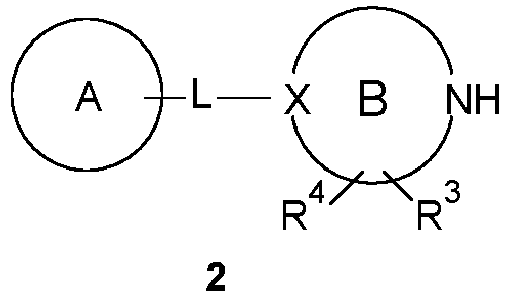 in the presence of a base and a urea forming reagent, to form said compound of formula (I); and optionally(b) transforming said compound of formula (I) to a pharmaceutically acceptable salts thereof.
 - A compound of formula (I) according to any one of claims 1 to 13 for use as therapeutically active substance.
- A pharmaceutical composition comprising a compound of formula (I) according to any one of claims 1 to 13 and a therapeutically inert carrier.
- A compound of formula (I) according to any one of claims 1 to 13 or a pharmaceutical composition according to claim 16 for use in the treatment or prophylaxis of neuroinflammation, neurodegenerative diseases, pain, cancer and/or mental disorders in a mammal, in particular for use in the treatment or prophylaxis of multiple sclerosis, Alzheimer's disease, Parkinson's disease, amyotrophic lateral sclerosis, traumatic brain injury, neurotoxicity, stroke, epilepsy, anxiety, migraine, depression, hepatocellular carcinoma, colon carcinogenesis, ovarian cancer, neuropathic pain, chemotherapy induced neuropathy, acute pain, chronic pain and/or spasticity associated with pain in a mammal.
Priority Applications (3)
| Application Number | Priority Date | Filing Date | Title |
|---|---|---|---|
| RS20230788A RS64579B1 (en) | 2018-11-22 | 2019-11-20 | New heterocyclic compounds |
| SI201930619T SI3883936T1 (en) | 2018-11-22 | 2019-11-20 | New heterocyclic compounds |
| HRP20231083TT HRP20231083T1 (en) | 2018-11-22 | 2019-11-20 | NEW HETEROCYCLIC COMPOUNDS |
Applications Claiming Priority (2)
| Application Number | Priority Date | Filing Date | Title |
|---|---|---|---|
| EP18207725 | 2018-11-22 | ||
| PCT/EP2019/081870 WO2020104494A1 (en) | 2018-11-22 | 2019-11-20 | New heterocyclic compounds |
Publications (2)
| Publication Number | Publication Date |
|---|---|
| EP3883936A1 EP3883936A1 (en) | 2021-09-29 |
| EP3883936B1 true EP3883936B1 (en) | 2023-07-12 |
Family
ID=64453331
Family Applications (1)
| Application Number | Title | Priority Date | Filing Date |
|---|---|---|---|
| EP19809026.8A Active EP3883936B1 (en) | 2018-11-22 | 2019-11-20 | New heterocyclic compounds |
Country Status (31)
| Country | Link |
|---|---|
| US (1) | US12577257B2 (en) |
| EP (1) | EP3883936B1 (en) |
| JP (1) | JP7444882B2 (en) |
| KR (1) | KR102913813B1 (en) |
| CN (1) | CN113166170A (en) |
| AR (1) | AR117139A1 (en) |
| AU (1) | AU2019383500B2 (en) |
| BR (1) | BR112021009348A2 (en) |
| CA (1) | CA3119506A1 (en) |
| CL (1) | CL2021001330A1 (en) |
| CO (1) | CO2021007056A2 (en) |
| CR (1) | CR20210247A (en) |
| DK (1) | DK3883936T3 (en) |
| ES (1) | ES2955037T3 (en) |
| FI (1) | FI3883936T3 (en) |
| HR (1) | HRP20231083T1 (en) |
| HU (1) | HUE062913T2 (en) |
| IL (1) | IL283333B2 (en) |
| LT (1) | LT3883936T (en) |
| MA (1) | MA55131B1 (en) |
| MX (1) | MX2021005714A (en) |
| PE (1) | PE20211870A1 (en) |
| PH (1) | PH12021551167A1 (en) |
| PL (1) | PL3883936T3 (en) |
| PT (1) | PT3883936T (en) |
| RS (1) | RS64579B1 (en) |
| SG (1) | SG11202104206SA (en) |
| SI (1) | SI3883936T1 (en) |
| TW (1) | TWI825227B (en) |
| UA (1) | UA128505C2 (en) |
| WO (1) | WO2020104494A1 (en) |
Families Citing this family (24)
| Publication number | Priority date | Publication date | Assignee | Title |
|---|---|---|---|---|
| AR114136A1 (en) | 2017-10-10 | 2020-07-29 | Hoffmann La Roche | HETEROCYCLIC COMPOUNDS |
| WO2019105915A1 (en) | 2017-11-28 | 2019-06-06 | F. Hoffmann-La Roche Ag | New heterocyclic compounds |
| WO2019134985A1 (en) | 2018-01-08 | 2019-07-11 | F. Hoffmann-La Roche Ag | Octahydropyrido[1,2-alpha]pyrazines as magl inhibitors |
| AU2019322538B2 (en) | 2018-08-13 | 2021-09-30 | F. Hoffmann-La Roche Ag | New heterocyclic compounds as monoacylglycerol lipase inhibitors |
| PL3883936T3 (en) | 2018-11-22 | 2023-11-20 | F. Hoffmann-La Roche Ag | New heterocyclic compounds |
| US20210094971A1 (en) * | 2019-09-09 | 2021-04-01 | Hoffmann-La Roche Inc. | Heterocyclic compounds |
| MX2022002311A (en) | 2019-09-12 | 2022-03-25 | Hoffmann La Roche | 4,4a,5,7,8,8a-hexapyrido[4,3-b][1,4]oxazin-3-one compounds as magl inhibitors. |
| CR20230115A (en) | 2020-09-03 | 2023-04-11 | Hoffmann La Roche | HETEROCYCLIC COMPOUNDS |
| EP4215526A4 (en) * | 2020-09-18 | 2024-10-16 | Shanghai Pharmaceuticals Holding Co., Ltd. | HETEROCYCLIC CARBONYL COMPOUND AND APPLICATION THEREOF |
| WO2022165513A1 (en) | 2021-01-29 | 2022-08-04 | Cedilla Therapeutics, Inc. | Cdk2 inhibitors and methods of using the same |
| KR20240000574A (en) * | 2021-04-23 | 2024-01-02 | 에프. 호프만-라 로슈 아게 | heterocyclic compounds |
| CA3225439A1 (en) | 2021-06-26 | 2022-12-29 | Cedilla Therapeutics, Inc. | Cdk2 inhibitors and methods of using the same |
| IL313987A (en) | 2021-12-29 | 2024-08-01 | Psy Therapeutics Inc | Inhibition of monoacylglycerol lipase (MAGL) |
| WO2023130043A1 (en) * | 2021-12-29 | 2023-07-06 | Psy Therapeutics, Inc. | Monoacylglycerol lipase inhibitors and use thereof for the treatment of anxiety |
| US20250170101A1 (en) * | 2021-12-29 | 2025-05-29 | Psy Therapeutics, Inc. | Monoacylglycerol lipase inhibitors and use thereof for the treatment and management of pain and related conditions |
| JP2025504522A (en) * | 2022-01-25 | 2025-02-12 | エフ. ホフマン-ラ ロシュ アーゲー | New heterocyclic compounds |
| JP2025525350A (en) * | 2022-06-24 | 2025-08-05 | エフ. ホフマン-ラ ロシュ アーゲー | Novel heterocyclic-carbonyl-cyclic compounds as MAGL inhibitors |
| AR130133A1 (en) | 2022-08-08 | 2024-11-06 | Hoffmann La Roche | NEW HETEROCYCLIC COMPOUNDS |
| US20250388592A1 (en) * | 2022-08-11 | 2025-12-25 | Remynd N.V. | (aza)spiroheptane derivatives for the treatment of neurodegenerative disorders |
| JP2025530870A (en) * | 2022-09-20 | 2025-09-17 | エフ. ホフマン-ラ ロシュ アーゲー | Fluorescent probe for MAGL |
| TW202428574A (en) * | 2022-10-24 | 2024-07-16 | 瑞士商赫孚孟拉羅股份公司 | New heterocyclic compounds |
| WO2024168426A1 (en) | 2023-02-13 | 2024-08-22 | Apogee Pharmaceuticals, Inc. | Small molecules as monoacylglycerol lipase (magl) inhibitors, compositions and use thereof |
| CN121843953A (en) | 2023-09-28 | 2026-04-10 | 豪夫迈·罗氏有限公司 | Novel heterocyclic compounds |
| TW202539671A (en) | 2024-01-19 | 2025-10-16 | 瑞士商赫孚孟拉羅股份公司 | New heterocyclic compounds |
Family Cites Families (66)
| Publication number | Priority date | Publication date | Assignee | Title |
|---|---|---|---|---|
| US5214038A (en) | 1991-04-15 | 1993-05-25 | Hoechst-Roussel Pharmaceuticals Inc. | 1-(pyrido[3,4-b]-1,4-oxazinyl-4-yl)-1H-indoles and intermediates for the preparation thereof |
| US7544678B2 (en) | 2002-11-05 | 2009-06-09 | The Trustees Of Columbia University In The City Of New York | Anti-arrythmic and heart failure drugs that target the leak in the ryanodine receptor (RyR2) |
| US7160888B2 (en) | 2003-08-22 | 2007-01-09 | Warner Lambert Company Llc | [1,8]naphthyridin-2-ones and related compounds for the treatment of schizophrenia |
| US7579495B2 (en) | 2003-12-19 | 2009-08-25 | Momentive Performance Materials Inc. | Active-releasing cyclic siloxanes |
| US7842810B2 (en) | 2005-03-31 | 2010-11-30 | Janssen Pharmaceutica, Nv | Bicyclic pyrazole compounds as antibacterial agents |
| EP1896453B1 (en) | 2005-06-20 | 2009-12-02 | Schering Corporation | Carbon-linked substituted piperidines and derivatives thereof useful as histamine h3 antagonists |
| JP5116687B2 (en) | 2005-11-02 | 2013-01-09 | バイエル・ファルマ・アクチェンゲゼルシャフト | Pyrrolo [2,1-f] [1,2,4] triazin-4-ylamine IGF-1R kinase inhibitors for the treatment of cancer and other hyperproliferative diseases |
| WO2007098418A1 (en) | 2006-02-17 | 2007-08-30 | Memory Pharmaceuticals Corporation | Compounds having 5-ht6 receptor affinity |
| WO2007117557A2 (en) | 2006-04-05 | 2007-10-18 | Vitae Pharmaceuticals, Inc. | Diaminopropanol renin inhibitors |
| CA2679754C (en) | 2007-03-12 | 2018-08-07 | Intra-Cellular Therapies, Inc. | Substituted heterocycle fused gamma-carbolines synthesis |
| FR2915197B1 (en) | 2007-04-18 | 2009-06-12 | Sanofi Aventis Sa | TRIAZOLOPYRIDINE CARBOXAMIDE DERIVATIVES, PREPARATION THEREOF AND THERAPEUTIC USE THEREOF. |
| TW200942537A (en) | 2008-02-01 | 2009-10-16 | Irm Llc | Compounds and compositions as kinase inhibitors |
| US8394792B2 (en) | 2008-03-31 | 2013-03-12 | C&C Research Laboratories | Heterocyclic derivatives |
| CA2741153A1 (en) | 2008-10-29 | 2010-05-06 | F. Hoffmann-La Roche Ag | Novel phenyl amide or pyridyl amide derivatives and their use as gpbar1 agonists |
| JP2012524809A (en) | 2009-04-22 | 2012-10-18 | ジヤンセン・フアーマシユーチカ・ナームローゼ・フエンノートシヤツプ | Heteroaromatic and aromatic piperazinyl azetidinyl amides as monoacylglycerol lipase inhibitors |
| CA2773182A1 (en) | 2009-09-10 | 2011-03-17 | F. Hoffmann-La Roche Ag | Inhibitors of jak |
| WO2011059118A1 (en) | 2009-11-10 | 2011-05-19 | Kim Hyun Jeen | System for testing olfactory perception |
| US9051296B2 (en) | 2009-11-16 | 2015-06-09 | Raqualia Pharma Inc. | Aryl carboxamide derivatives as TTX-S blockers |
| US8420661B2 (en) | 2010-04-13 | 2013-04-16 | Hoffmann-La Roche Inc. | Arylethynyl derivatives |
| JP6254075B2 (en) | 2011-05-16 | 2017-12-27 | バイオノミックス リミテッド | Amine derivatives as potassium channel blockers |
| WO2013059118A1 (en) | 2011-10-19 | 2013-04-25 | The Trustees Of Columbia University In The City Of New York | Cyclopropenimine catalyst compositions and processes |
| EP2785721A1 (en) | 2011-11-30 | 2014-10-08 | Actelion Pharmaceuticals Ltd. | 3,7-disubstituted octahydro-2h-pyrido[4,3-e][1,3]oxazin-2-one antibiotics |
| MY170922A (en) | 2011-12-22 | 2019-09-18 | Novartis Ag | Dihydro-benzo-oxazine and dihydro-pyrido-oxazine derivatives |
| MX350788B (en) | 2012-01-06 | 2017-09-13 | Abide Therapeutics Inc | Carbamate compounds and of making and using same. |
| GB201209587D0 (en) | 2012-05-30 | 2012-07-11 | Takeda Pharmaceutical | Therapeutic compounds |
| TW201422625A (en) | 2012-11-26 | 2014-06-16 | Novartis Ag | Solid form of dihydro-pyrido-oxazine derivative |
| TWI599567B (en) | 2013-03-14 | 2017-09-21 | 健生藥品公司 | P2X7 regulator |
| EA029361B1 (en) | 2013-04-16 | 2018-03-30 | Идорсиа Фармасьютиклз Лтд | Antibacterial biaromatic derivatives |
| WO2016109501A1 (en) | 2014-12-30 | 2016-07-07 | Karos Pharmaceuticals, Inc. | Amide compounds as tryptophan hydroxylase inhibitors |
| WO2016158956A1 (en) | 2015-03-30 | 2016-10-06 | 武田薬品工業株式会社 | Heterocyclic compound |
| CN107635986A (en) | 2015-05-13 | 2018-01-26 | 赛尔维他股份公司 | Substituted quinoxaline derivatives |
| CA2986199C (en) | 2015-05-21 | 2023-07-18 | Glaxosmithkline Intellectual Property Development Limited | Benzoimidazole derivatives as pad4 inhibitors |
| MX379846B (en) | 2015-06-18 | 2025-03-11 | 89Bio Ltd | SUBSTITUTED 4-BENZYL AND 4-BENZOYL PIPERIDINE DERIVATIVES. |
| HK1249101A1 (en) | 2015-07-31 | 2018-10-26 | 辉瑞公司 | 1,1,1-trifluoro-3-hydroxypropan-2-yl carbamate derivatives and 1,1,1-trifluoro-4-hydroxybutan-2-yl carbamate derivatives as magl inhibitors |
| WO2017087863A1 (en) | 2015-11-20 | 2017-05-26 | Abide Therapeutics, Inc. | Pyrazole compounds and methods of making and using same |
| WO2017087858A1 (en) | 2015-11-20 | 2017-05-26 | Abide Therapeutics, Inc. | Pyrazole compounds and methods of making and using same |
| US10610520B2 (en) | 2016-03-31 | 2020-04-07 | Takeda Pharmaceutical Company Limited | Heterocyclic compound |
| MY194647A (en) | 2016-03-31 | 2022-12-09 | Takeda Pharmaceuticals Co | Heterocyclic compound |
| KR20190022728A (en) | 2016-06-30 | 2019-03-06 | 바실리어 파마슈티카 인터내셔널 리미티드 | Mitochondrial inhibitors for the treatment of proliferative disorders |
| PE20191239A1 (en) | 2016-11-16 | 2019-09-16 | Abide Therapeutics Inc | CRYSTAL FORMS OF A MAGL INHIBITOR |
| JOP20190107A1 (en) | 2016-11-16 | 2019-05-09 | Lundbeck La Jolla Research Center Inc | monoacylglycerol lipase (MAGL) inhibitors |
| CN110709084A (en) | 2017-03-13 | 2020-01-17 | 阿比德治疗公司 | Dual MAGL and FAAH inhibitors |
| MX394645B (en) | 2017-06-12 | 2025-03-21 | Boehringer Ingelheim Int | HETEROAROMATIC COMPOUNDS AS VANIN INHIBITORS. |
| JP7189143B2 (en) | 2017-09-29 | 2022-12-13 | 武田薬品工業株式会社 | heterocyclic compound |
| AR114136A1 (en) | 2017-10-10 | 2020-07-29 | Hoffmann La Roche | HETEROCYCLIC COMPOUNDS |
| US10865194B2 (en) | 2017-11-03 | 2020-12-15 | Fondazione Istituto Italiano Di Tecnologia | Therapeutically active bicyclic-sulphonamides and pharmaceutical compositions |
| WO2019105915A1 (en) | 2017-11-28 | 2019-06-06 | F. Hoffmann-La Roche Ag | New heterocyclic compounds |
| TW201930300A (en) | 2017-12-15 | 2019-08-01 | 瑞士商赫孚孟拉羅股份公司 | New heterocyclic compounds |
| WO2019134985A1 (en) | 2018-01-08 | 2019-07-11 | F. Hoffmann-La Roche Ag | Octahydropyrido[1,2-alpha]pyrazines as magl inhibitors |
| MX2020008894A (en) | 2018-03-22 | 2020-10-12 | Hoffmann La Roche | Oxazine monoacylglycerol lipase (magl) inhibitors. |
| AU2019322538B2 (en) | 2018-08-13 | 2021-09-30 | F. Hoffmann-La Roche Ag | New heterocyclic compounds as monoacylglycerol lipase inhibitors |
| WO2020035425A1 (en) | 2018-08-13 | 2020-02-20 | F. Hoffmann-La Roche Ag | New heterocyclic compounds as monoacylglycerol lipase inhibitors |
| PL3883936T3 (en) | 2018-11-22 | 2023-11-20 | F. Hoffmann-La Roche Ag | New heterocyclic compounds |
| WO2020207941A1 (en) | 2019-04-09 | 2020-10-15 | F. Hoffmann-La Roche Ag | Heterocyclic compounds as inhibitors of monoacylglycerol lipase (magl) |
| JP7669299B2 (en) | 2019-07-03 | 2025-04-28 | エフ. ホフマン-ラ ロシュ アーゲー | Heterocyclic monoacylglycerol lipase (MAGL) inhibitors |
| JP7649283B2 (en) | 2019-07-09 | 2025-03-19 | エフ. ホフマン-ラ ロシュ アーゲー | New heterocyclic compounds |
| US20210094971A1 (en) | 2019-09-09 | 2021-04-01 | Hoffmann-La Roche Inc. | Heterocyclic compounds |
| JP2022548018A (en) * | 2019-09-12 | 2022-11-16 | エフ.ホフマン-ラ ロシュ アーゲー | Radiolabeled compound |
| MX2022002311A (en) | 2019-09-12 | 2022-03-25 | Hoffmann La Roche | 4,4a,5,7,8,8a-hexapyrido[4,3-b][1,4]oxazin-3-one compounds as magl inhibitors. |
| EP4034239A1 (en) | 2019-09-23 | 2022-08-03 | F. Hoffmann-La Roche AG | Heterocyclic compounds |
| AU2020354414A1 (en) | 2019-09-24 | 2022-02-17 | F. Hoffmann-La Roche Ag | New heterocyclic monoacylglycerol lipase (MAGL) inhibitors |
| BR112022003357A2 (en) | 2019-09-24 | 2022-05-17 | Hoffmann La Roche | Heterocyclic compounds |
| EP4034602A1 (en) | 2019-09-24 | 2022-08-03 | F. Hoffmann-La Roche AG | Fluorescent probes for monoacylglycerol lipase (magl) |
| CN116096723A (en) | 2020-08-26 | 2023-05-09 | 豪夫迈·罗氏有限公司 | Heterocyclic compounds useful as MAGL inhibitors |
| CR20230115A (en) | 2020-09-03 | 2023-04-11 | Hoffmann La Roche | HETEROCYCLIC COMPOUNDS |
| KR20240000574A (en) | 2021-04-23 | 2024-01-02 | 에프. 호프만-라 로슈 아게 | heterocyclic compounds |
-
2019
- 2019-11-20 PL PL19809026.8T patent/PL3883936T3/en unknown
- 2019-11-20 UA UAA202103201A patent/UA128505C2/en unknown
- 2019-11-20 PE PE2021000714A patent/PE20211870A1/en unknown
- 2019-11-20 DK DK19809026.8T patent/DK3883936T3/en active
- 2019-11-20 IL IL283333A patent/IL283333B2/en unknown
- 2019-11-20 LT LTEPPCT/EP2019/081870T patent/LT3883936T/en unknown
- 2019-11-20 KR KR1020217015287A patent/KR102913813B1/en active Active
- 2019-11-20 WO PCT/EP2019/081870 patent/WO2020104494A1/en not_active Ceased
- 2019-11-20 MX MX2021005714A patent/MX2021005714A/en unknown
- 2019-11-20 MA MA55131A patent/MA55131B1/en unknown
- 2019-11-20 CR CR20210247A patent/CR20210247A/en unknown
- 2019-11-20 JP JP2021528972A patent/JP7444882B2/en active Active
- 2019-11-20 HR HRP20231083TT patent/HRP20231083T1/en unknown
- 2019-11-20 FI FIEP19809026.8T patent/FI3883936T3/en active
- 2019-11-20 HU HUE19809026A patent/HUE062913T2/en unknown
- 2019-11-20 BR BR112021009348-6A patent/BR112021009348A2/en unknown
- 2019-11-20 AU AU2019383500A patent/AU2019383500B2/en active Active
- 2019-11-20 ES ES19809026T patent/ES2955037T3/en active Active
- 2019-11-20 PT PT198090268T patent/PT3883936T/en unknown
- 2019-11-20 EP EP19809026.8A patent/EP3883936B1/en active Active
- 2019-11-20 CA CA3119506A patent/CA3119506A1/en active Pending
- 2019-11-20 RS RS20230788A patent/RS64579B1/en unknown
- 2019-11-20 SI SI201930619T patent/SI3883936T1/en unknown
- 2019-11-20 SG SG11202104206SA patent/SG11202104206SA/en unknown
- 2019-11-20 CN CN201980077284.5A patent/CN113166170A/en active Pending
- 2019-11-21 AR ARP190103417A patent/AR117139A1/en unknown
- 2019-11-21 TW TW108142267A patent/TWI825227B/en active
-
2021
- 2021-05-20 US US17/325,934 patent/US12577257B2/en active Active
- 2021-05-20 CL CL2021001330A patent/CL2021001330A1/en unknown
- 2021-05-21 PH PH12021551167A patent/PH12021551167A1/en unknown
- 2021-05-28 CO CONC2021/0007056A patent/CO2021007056A2/en unknown
Also Published As
Similar Documents
| Publication | Publication Date | Title |
|---|---|---|
| US12577257B2 (en) | Heterocyclic compounds | |
| EP3837263B1 (en) | New heterocyclic compounds as monoacylglycerol lipase inhibitors | |
| EP4028401B1 (en) | 4,4a,5,7,8,8a-hexapyrido[4,3-b][1,4]oxazin-3-one compounds as magl inhibitors | |
| CA3098272A1 (en) | New heterocyclic compounds as monoacylglycerol lipase inhibitors | |
| US11981661B2 (en) | Heterocyclic compounds | |
| RU2809257C2 (en) | Heterocyclic compounds | |
| RU2801190C2 (en) | New heterocyclic compounds as monoacylglycerol lipase inhibitors | |
| HK40047688A (en) | New heterocyclic compounds |
Legal Events
| Date | Code | Title | Description |
|---|---|---|---|
| REG | Reference to a national code |
Ref country code: HR Ref legal event code: TUEP Ref document number: P20231083T Country of ref document: HR |
|
| STAA | Information on the status of an ep patent application or granted ep patent |
Free format text: STATUS: UNKNOWN |
|
| STAA | Information on the status of an ep patent application or granted ep patent |
Free format text: STATUS: THE INTERNATIONAL PUBLICATION HAS BEEN MADE |
|
| PUAI | Public reference made under article 153(3) epc to a published international application that has entered the european phase |
Free format text: ORIGINAL CODE: 0009012 |
|
| STAA | Information on the status of an ep patent application or granted ep patent |
Free format text: STATUS: REQUEST FOR EXAMINATION WAS MADE |
|
| 17P | Request for examination filed |
Effective date: 20210622 |
|
| AK | Designated contracting states |
Kind code of ref document: A1 Designated state(s): AL AT BE BG CH CY CZ DE DK EE ES FI FR GB GR HR HU IE IS IT LI LT LU LV MC MK MT NL NO PL PT RO RS SE SI SK SM TR |
|
| DAX | Request for extension of the european patent (deleted) | ||
| RAV | Requested validation state of the european patent: fee paid |
Extension state: MA Effective date: 20210622 |
|
| GRAP | Despatch of communication of intention to grant a patent |
Free format text: ORIGINAL CODE: EPIDOSNIGR1 |
|
| STAA | Information on the status of an ep patent application or granted ep patent |
Free format text: STATUS: GRANT OF PATENT IS INTENDED |
|
| INTG | Intention to grant announced |
Effective date: 20230207 |
|
| GRAS | Grant fee paid |
Free format text: ORIGINAL CODE: EPIDOSNIGR3 |
|
| GRAA | (expected) grant |
Free format text: ORIGINAL CODE: 0009210 |
|
| STAA | Information on the status of an ep patent application or granted ep patent |
Free format text: STATUS: THE PATENT HAS BEEN GRANTED |
|
| AK | Designated contracting states |
Kind code of ref document: B1 Designated state(s): AL AT BE BG CH CY CZ DE DK EE ES FI FR GB GR HR HU IE IS IT LI LT LU LV MC MK MT NL NO PL PT RO RS SE SI SK SM TR |
|
| P01 | Opt-out of the competence of the unified patent court (upc) registered |
Effective date: 20230607 |
|
| REG | Reference to a national code |
Ref country code: CH Ref legal event code: EP |
|
| REG | Reference to a national code |
Ref country code: IE Ref legal event code: FG4D |
|
| REG | Reference to a national code |
Ref country code: DE Ref legal event code: R096 Ref document number: 602019032718 Country of ref document: DE |
|
| REG | Reference to a national code |
Ref country code: PT Ref legal event code: SC4A Ref document number: 3883936 Country of ref document: PT Date of ref document: 20230904 Kind code of ref document: T Free format text: AVAILABILITY OF NATIONAL TRANSLATION Effective date: 20230830 |
|
| REG | Reference to a national code |
Ref country code: FI Ref legal event code: FGE |
|
| REG | Reference to a national code |
Ref country code: RO Ref legal event code: EPE |
|
| REG | Reference to a national code |
Ref country code: DK Ref legal event code: T3 Effective date: 20230913 Ref country code: NO Ref legal event code: T2 Effective date: 20230712 |
|
| REG | Reference to a national code |
Ref country code: NL Ref legal event code: FP |
|
| REG | Reference to a national code |
Ref country code: SE Ref legal event code: TRGR |
|
| REG | Reference to a national code |
Ref country code: MA Ref legal event code: VAGR Ref document number: 55131 Country of ref document: MA Kind code of ref document: B1 |
|
| REG | Reference to a national code |
Ref country code: ES Ref legal event code: FG2A Ref document number: 2955037 Country of ref document: ES Kind code of ref document: T3 Effective date: 20231128 |
|
| REG | Reference to a national code |
Ref country code: GR Ref legal event code: EP Ref document number: 20230401583 Country of ref document: GR Effective date: 20231113 |
|
| REG | Reference to a national code |
Ref country code: SK Ref legal event code: T3 Ref document number: E 42320 Country of ref document: SK |
|
| REG | Reference to a national code |
Ref country code: HR Ref legal event code: ODRP Ref document number: P20231083T Country of ref document: HR Payment date: 20231102 Year of fee payment: 5 |
|
| REG | Reference to a national code |
Ref country code: HR Ref legal event code: T1PR Ref document number: P20231083 Country of ref document: HR |
|
| REG | Reference to a national code |
Ref country code: HU Ref legal event code: AG4A Ref document number: E062913 Country of ref document: HU |
|
| REG | Reference to a national code |
Ref country code: DE Ref legal event code: R082 Ref document number: 602019032718 Country of ref document: DE Representative=s name: KRAUS & LEDERER PARTGMBB, DE |
|
| PG25 | Lapsed in a contracting state [announced via postgrant information from national office to epo] |
Ref country code: IS Free format text: LAPSE BECAUSE OF FAILURE TO SUBMIT A TRANSLATION OF THE DESCRIPTION OR TO PAY THE FEE WITHIN THE PRESCRIBED TIME-LIMIT Effective date: 20231112 |
|
| PG25 | Lapsed in a contracting state [announced via postgrant information from national office to epo] |
Ref country code: LV Free format text: LAPSE BECAUSE OF FAILURE TO SUBMIT A TRANSLATION OF THE DESCRIPTION OR TO PAY THE FEE WITHIN THE PRESCRIBED TIME-LIMIT Effective date: 20230712 Ref country code: IS Free format text: LAPSE BECAUSE OF FAILURE TO SUBMIT A TRANSLATION OF THE DESCRIPTION OR TO PAY THE FEE WITHIN THE PRESCRIBED TIME-LIMIT Effective date: 20231112 |
|
| REG | Reference to a national code |
Ref country code: AT Ref legal event code: UEP Ref document number: 1587043 Country of ref document: AT Kind code of ref document: T Effective date: 20230712 |
|
| REG | Reference to a national code |
Ref country code: DE Ref legal event code: R097 Ref document number: 602019032718 Country of ref document: DE |
|
| PG25 | Lapsed in a contracting state [announced via postgrant information from national office to epo] |
Ref country code: SM Free format text: LAPSE BECAUSE OF FAILURE TO SUBMIT A TRANSLATION OF THE DESCRIPTION OR TO PAY THE FEE WITHIN THE PRESCRIBED TIME-LIMIT Effective date: 20230712 Ref country code: EE Free format text: LAPSE BECAUSE OF FAILURE TO SUBMIT A TRANSLATION OF THE DESCRIPTION OR TO PAY THE FEE WITHIN THE PRESCRIBED TIME-LIMIT Effective date: 20230712 |
|
| PLBE | No opposition filed within time limit |
Free format text: ORIGINAL CODE: 0009261 |
|
| STAA | Information on the status of an ep patent application or granted ep patent |
Free format text: STATUS: NO OPPOSITION FILED WITHIN TIME LIMIT |
|
| 26N | No opposition filed |
Effective date: 20240415 |
|
| PG25 | Lapsed in a contracting state [announced via postgrant information from national office to epo] |
Ref country code: MC Free format text: LAPSE BECAUSE OF FAILURE TO SUBMIT A TRANSLATION OF THE DESCRIPTION OR TO PAY THE FEE WITHIN THE PRESCRIBED TIME-LIMIT Effective date: 20230712 |
|
| PG25 | Lapsed in a contracting state [announced via postgrant information from national office to epo] |
Ref country code: LU Free format text: LAPSE BECAUSE OF NON-PAYMENT OF DUE FEES Effective date: 20231120 |
|
| PG25 | Lapsed in a contracting state [announced via postgrant information from national office to epo] |
Ref country code: MC Free format text: LAPSE BECAUSE OF FAILURE TO SUBMIT A TRANSLATION OF THE DESCRIPTION OR TO PAY THE FEE WITHIN THE PRESCRIBED TIME-LIMIT Effective date: 20230712 Ref country code: LU Free format text: LAPSE BECAUSE OF NON-PAYMENT OF DUE FEES Effective date: 20231120 |
|
| REG | Reference to a national code |
Ref country code: HR Ref legal event code: ODRP Ref document number: P20231083 Country of ref document: HR Payment date: 20241106 Year of fee payment: 6 |
|
| PG25 | Lapsed in a contracting state [announced via postgrant information from national office to epo] |
Ref country code: CY Free format text: LAPSE BECAUSE OF FAILURE TO SUBMIT A TRANSLATION OF THE DESCRIPTION OR TO PAY THE FEE WITHIN THE PRESCRIBED TIME-LIMIT; INVALID AB INITIO Effective date: 20191120 |
|
| VSFP | Annual fee paid to validation state [announced via postgrant information from national office to epo] |
Ref country code: MA Payment date: 20231122 Year of fee payment: 5 |
|
| PGFP | Annual fee paid to national office [announced via postgrant information from national office to epo] |
Ref country code: NL Payment date: 20251022 Year of fee payment: 7 |
|
| REG | Reference to a national code |
Ref country code: HR Ref legal event code: ODRP Ref document number: P20231083 Country of ref document: HR Payment date: 20251027 Year of fee payment: 7 |
|
| VSFP | Annual fee paid to validation state [announced via postgrant information from national office to epo] |
Ref country code: MA Payment date: 20241115 Year of fee payment: 6 |
|
| REG | Reference to a national code |
Ref country code: CH Ref legal event code: U11 Free format text: ST27 STATUS EVENT CODE: U-0-0-U10-U11 (AS PROVIDED BY THE NATIONAL OFFICE) Effective date: 20251201 |
|
| PGFP | Annual fee paid to national office [announced via postgrant information from national office to epo] |
Ref country code: PT Payment date: 20251024 Year of fee payment: 7 |
|
| PGFP | Annual fee paid to national office [announced via postgrant information from national office to epo] |
Ref country code: HU Payment date: 20251117 Year of fee payment: 7 |
|
| PGFP | Annual fee paid to national office [announced via postgrant information from national office to epo] |
Ref country code: DE Payment date: 20251022 Year of fee payment: 7 |
|
| PGFP | Annual fee paid to national office [announced via postgrant information from national office to epo] |
Ref country code: LT Payment date: 20251022 Year of fee payment: 7 Ref country code: GB Payment date: 20251023 Year of fee payment: 7 |
|
| PGFP | Annual fee paid to national office [announced via postgrant information from national office to epo] |
Ref country code: NO Payment date: 20251024 Year of fee payment: 7 |
|
| PGFP | Annual fee paid to national office [announced via postgrant information from national office to epo] |
Ref country code: AT Payment date: 20251024 Year of fee payment: 7 |
|
| PGFP | Annual fee paid to national office [announced via postgrant information from national office to epo] |
Ref country code: FI Payment date: 20251022 Year of fee payment: 7 Ref country code: DK Payment date: 20251022 Year of fee payment: 7 Ref country code: IT Payment date: 20251022 Year of fee payment: 7 |
|
| PGFP | Annual fee paid to national office [announced via postgrant information from national office to epo] |
Ref country code: HR Payment date: 20251027 Year of fee payment: 7 Ref country code: FR Payment date: 20251022 Year of fee payment: 7 |
|
| PGFP | Annual fee paid to national office [announced via postgrant information from national office to epo] |
Ref country code: TR Payment date: 20251028 Year of fee payment: 7 Ref country code: GR Payment date: 20251024 Year of fee payment: 7 Ref country code: BE Payment date: 20251022 Year of fee payment: 7 |
|
| PGFP | Annual fee paid to national office [announced via postgrant information from national office to epo] |
Ref country code: SE Payment date: 20251022 Year of fee payment: 7 Ref country code: CH Payment date: 20251201 Year of fee payment: 7 |
|
| PGFP | Annual fee paid to national office [announced via postgrant information from national office to epo] |
Ref country code: IE Payment date: 20251024 Year of fee payment: 7 Ref country code: CZ Payment date: 20251104 Year of fee payment: 7 |
|
| PGFP | Annual fee paid to national office [announced via postgrant information from national office to epo] |
Ref country code: PL Payment date: 20251023 Year of fee payment: 7 Ref country code: BG Payment date: 20251028 Year of fee payment: 7 |
|
| PGFP | Annual fee paid to national office [announced via postgrant information from national office to epo] |
Ref country code: RO Payment date: 20251103 Year of fee payment: 7 Ref country code: SK Payment date: 20251029 Year of fee payment: 7 |
|
| PGFP | Annual fee paid to national office [announced via postgrant information from national office to epo] |
Ref country code: RS Payment date: 20251103 Year of fee payment: 7 |
|
| PGFP | Annual fee paid to national office [announced via postgrant information from national office to epo] |
Ref country code: SI Payment date: 20251029 Year of fee payment: 7 Ref country code: ES Payment date: 20251201 Year of fee payment: 7 |
|
| VSFP | Annual fee paid to validation state [announced via postgrant information from national office to epo] |
Ref country code: MA Payment date: 20251120 Year of fee payment: 7 |