EP3883794B1 - System for determining a support load which rests on a towing hitch - Google Patents
System for determining a support load which rests on a towing hitch Download PDFInfo
- Publication number
- EP3883794B1 EP3883794B1 EP18811186.8A EP18811186A EP3883794B1 EP 3883794 B1 EP3883794 B1 EP 3883794B1 EP 18811186 A EP18811186 A EP 18811186A EP 3883794 B1 EP3883794 B1 EP 3883794B1
- Authority
- EP
- European Patent Office
- Prior art keywords
- electronic device
- support load
- motor
- sensor
- determining
- Prior art date
- Legal status (The legal status is an assumption and is not a legal conclusion. Google has not performed a legal analysis and makes no representation as to the accuracy of the status listed.)
- Active
Links
Images
Classifications
-
- B—PERFORMING OPERATIONS; TRANSPORTING
- B60—VEHICLES IN GENERAL
- B60D—VEHICLE CONNECTIONS
- B60D1/00—Traction couplings; Hitches; Draw-gear; Towing devices
- B60D1/01—Traction couplings or hitches characterised by their type
- B60D1/04—Hook or hook-and-hasp couplings
-
- B—PERFORMING OPERATIONS; TRANSPORTING
- B60—VEHICLES IN GENERAL
- B60D—VEHICLE CONNECTIONS
- B60D1/00—Traction couplings; Hitches; Draw-gear; Towing devices
- B60D1/24—Traction couplings; Hitches; Draw-gear; Towing devices characterised by arrangements for particular functions
- B60D1/246—Traction couplings; Hitches; Draw-gear; Towing devices characterised by arrangements for particular functions for actuating the hitch by powered means
-
- B—PERFORMING OPERATIONS; TRANSPORTING
- B60—VEHICLES IN GENERAL
- B60D—VEHICLE CONNECTIONS
- B60D1/00—Traction couplings; Hitches; Draw-gear; Towing devices
- B60D1/24—Traction couplings; Hitches; Draw-gear; Towing devices characterised by arrangements for particular functions
- B60D1/248—Traction couplings; Hitches; Draw-gear; Towing devices characterised by arrangements for particular functions for measuring, indicating or displaying the weight
-
- B—PERFORMING OPERATIONS; TRANSPORTING
- B60—VEHICLES IN GENERAL
- B60D—VEHICLE CONNECTIONS
- B60D1/00—Traction couplings; Hitches; Draw-gear; Towing devices
- B60D1/48—Traction couplings; Hitches; Draw-gear; Towing devices characterised by the mounting
- B60D1/54—Traction couplings; Hitches; Draw-gear; Towing devices characterised by the mounting collapsible or retractable when not in use, e.g. hide-away hitches
-
- B—PERFORMING OPERATIONS; TRANSPORTING
- B60—VEHICLES IN GENERAL
- B60D—VEHICLE CONNECTIONS
- B60D1/00—Traction couplings; Hitches; Draw-gear; Towing devices
- B60D1/58—Auxiliary devices
- B60D1/62—Auxiliary devices involving supply lines, electric circuits or the like
-
- G—PHYSICS
- G01—MEASURING; TESTING
- G01G—WEIGHING
- G01G19/00—Weighing apparatus or methods adapted for special purposes not provided for in the preceding groups
- G01G19/08—Weighing apparatus or methods adapted for special purposes not provided for in the preceding groups for incorporation in vehicles
-
- B—PERFORMING OPERATIONS; TRANSPORTING
- B60—VEHICLES IN GENERAL
- B60D—VEHICLE CONNECTIONS
- B60D1/00—Traction couplings; Hitches; Draw-gear; Towing devices
- B60D1/24—Traction couplings; Hitches; Draw-gear; Towing devices characterised by arrangements for particular functions
- B60D1/42—Traction couplings; Hitches; Draw-gear; Towing devices characterised by arrangements for particular functions for being adjustable
- B60D1/46—Traction couplings; Hitches; Draw-gear; Towing devices characterised by arrangements for particular functions for being adjustable vertically
Definitions
- the invention relates to a system for determining a support load which rests on a towing hitch which has a motor for moving a hook of the towing hitch, having a first electronic device which can be mounted in or on the towing hitch, and having a second electronic device which can be mounted in a towing vehicle and can be connected to a network of the towing vehicle, the system having an input for a motor sensor, in particular a motor current sensor, to which a motor sensor of the motor, in particular a motor current sensor, can be connected, with which at least one electrical value of the motor, in particular a motor current can be measured, whereby the first electronic device comprises said input for a motor sensor, whereby the first electronic device comprises a unit for determining the support load as a function of the at least one measured electrical value, and whereby the first electronic device and the second electronic device each have an interface for a communication between each other.
- Document EP 2 724 876 A1 discloses a towing hitch.
- the document discloses an electrically operated towing hitch that can be moved out of sight behind the bumper when not in use.
- the disclosed towing hitch has a first motor with which the hook of the towing hitch can be moved from a position in which the towing hitch is not in use to a position in which it is in use.
- the disclosed towing hitch has a second motor which can be used to lock the hook when the hook is moved in the position for use.
- the first and second motors are controlled by a control unit of the towing hitch.
- the document also indicates that a sensor is provided to detect a current from the second motor in order to determine the support load on the towing hitch.
- a second electronic device is known as so-called Trailer Towing Module (TTM) distributed for use in towing vehicles.
- a measurement signal such as that of the sensor for the current of the second motor in the document EP 2 724 876 A1 can be transmitted to the second electronic device of the towing vehicle via an interface of the coupling and an input of the second electronic devices.
- the second electronic devices is set up to determine the support load from the measurement signal.
- the second electronic devices can generate a signal indicating the support load and make it available at an interface, preferably a bus interface, for further use in the vehicle for example for displaying it to a driver or for warning the driver if the support load is too high.
- This method of determining the support load has several disadvantages:
- the transmission of the measurement signal from the sensor to the second electronic devices takes place via long circuits. These circuits can be exposed to the weather or mechanical loads. Both can affect the measurement signal on its way from the sensor to the second electronic devices. Among other things, it may be necessary to provide for large error tolerances.
- the sensor signal provides a measured value of an electrical value that occurs in the motor of the hitch.
- a value for the support load can only be determined from this value if various parameters of the trailer coupling are known, which can differ from trailer hitch type to trailer hitch type and even for different trailer hitches of one type.
- these parameters must be made known to the second electronic devices, which can only be done once it has been determined which trailer hitch is to be mounted on the towing vehicle.
- the second electronic devices must be parameterised when the trailer coupling is fitted, which can be cumbersome and error-prone.
- a system according to the preamble of claim 1 is disclosed in document EP 2 724 876 A1 and in document DE 102013011525 B3 . It has been found that determining a value for the support load from the electric value measured does not always is reliable.
- the invention was based on the problem of improving a system that can be used with a towing hitch of the type mentioned above in such a way that the measurements are less sensitive to errors.
- this task is solved by a system according to claim 1. It has been found that the electrical value, in particular the motor current used to determine the support load, not only depends on the support load exerted on the towing hitch, but also on the temperature in the area of the towing hitch. Therefore the temperature is included in the determination of the support load.
- the first electronic device has at least one input for at least one sensor for measuring the temperature in the region of the hook.
- the unit for determining the support load is connected or connectable to the sensor for measuring the temperature.
- the unit for determining the support load determines the support load as a function of the measured temperature.
- the measuring signal of the sensor is not transmitted to the second electronic device.
- the unit used to determine the support load which is provided in the first electronic device of the system according to the invention, determines the support load from the measurement signal. Individual parameters of the towing hitch that are stored in the unit for determining the support load can be included in the determination.
- the unit for determining the support load can be provided in the close vicinity of the sensor, so that long transmission paths from the sensor to the unit for determining the support load can be omitted. This not only reduces the cabling effort, but also reduces tolerances, as the shorter transmission path is less prone to errors and malfunctions.
- the unit for determining the support load may be a hardware unit or a software unit.
- the unit for determining the support load can be a microcontroller or it can include a microcontroller.
- the microcontroller could be part of an electronical control unit (ECU), which can be used for the control of one or more motors of the towing hitch.
- the first electronic device could be such an ECU. Nevertheless the control of the at least one motor could be implemented in the second electronic device alternatively.
- connection for a communication between the first electronic device and the second electronic device can be a LIN-Bus or any other kind of bus. Therefore, the communication interfaces of the first and second device are LIN-Bus-interfaces.
- sensors could be connectable to the first electronic device. These can supply measured values which are used to determine the support load. However, sensors may be provided for determining measured values which are not relevant for determining the support load. These values can possibly be transferred to the second electronic device or another component in the towing vehicle. Thus, a sensor for measuring a trailer angle may be provided.
- reference symbol 1 denotes the first electronic device according to the invention.
- the first electronic device 1 might be a part of a towing hitch H and may be mounted in or on a hook of the towing hitch.
- the towing hitch H is connected to the second electronic device 2 via various lines, including a communication line, e.g. LIN bus line that connects the first electronic device 1, which includes a LIN bus interface, to the second electronic device 2.
- a communication line e.g. LIN bus line that connects the first electronic device 1, which includes a LIN bus interface
- Supply lines are also provided to supply sensors 3, 4, a motor 5 and the first electronic device 1.
- the system shown in figure 1 comprises a sensor 4 for measuring an electrical value, such as e.g. a current sensor, with which an electrical value, such as the current, of the motor 5 of the towing hitch can be measured.
- the towing hitch H may further comprise a temperature sensor 3, for measuring the temperature in the area of the towing hook.
- the sensors 3, 4 are connected to the first electronic device 1.
- the motor 5 of the towing hitch H is used to exert a force on a hook of the towing hitch H. If a trailer is supported on the towing hitch H, the motor 5 works against the support load. The greater the support load, the more power the motor 5 needs to work against the support load. The greater the power required to work against the support load, the greater the motor current detected by the current sensor 4.
- the motor 5 may only be intended to enable the support load to be determined. Preferably, however, the motor 5 also has other functions.
- the towing hitch H can be a towing hitch like that known from document EP 2 724 876 A1 and can be moved out of sight behind the bumper when not in use.
- the first electronic device 1 is programmed in such a way that it can determine the support load from measured values for temperature and motor current supplied by sensors 3, 4. This can be done, for example, by calculation, by looking up a look-up table or by other methods.
- the determined support load is then transmitted to the second electronic device 2 via the interface of the first electronic device 1 and can then be used in the towing vehicle.
- the second electronic device 2 is mounted in the towing vehicle and is connected to a network of the towing vehicle. Via the this network the second electronic device 2 can distribute a signal indicating a value of the support load.
Landscapes
- Engineering & Computer Science (AREA)
- Transportation (AREA)
- Mechanical Engineering (AREA)
- Physics & Mathematics (AREA)
- General Physics & Mathematics (AREA)
- Electric Propulsion And Braking For Vehicles (AREA)
- Agricultural Machines (AREA)
Description
- The invention relates to a system for determining a support load which rests on a towing hitch which has a motor for moving a hook of the towing hitch, having a first electronic device which can be mounted in or on the towing hitch, and having a second electronic device which can be mounted in a towing vehicle and can be connected to a network of the towing vehicle, the system having an input for a motor sensor, in particular a motor current sensor, to which a motor sensor of the motor, in particular a motor current sensor, can be connected, with which at least one electrical value of the motor, in particular a motor current can be measured, whereby the first electronic device comprises said input for a motor sensor, whereby the first electronic device comprises a unit for determining the support load as a function of the at least one measured electrical value, and whereby the first electronic device and the second electronic device each have an interface for a communication between each other.
-
Document EP 2 724 876 A1 discloses a towing hitch. The document discloses an electrically operated towing hitch that can be moved out of sight behind the bumper when not in use. The disclosed towing hitch has a first motor with which the hook of the towing hitch can be moved from a position in which the towing hitch is not in use to a position in which it is in use. The disclosed towing hitch has a second motor which can be used to lock the hook when the hook is moved in the position for use. The first and second motors are controlled by a control unit of the towing hitch. The document also indicates that a sensor is provided to detect a current from the second motor in order to determine the support load on the towing hitch. - Furthermore a second electronic device is known as so-called Trailer Towing Module (TTM) distributed for use in towing vehicles. A measurement signal such as that of the sensor for the current of the second motor in the
document EP 2 724 876 A1 can be transmitted to the second electronic device of the towing vehicle via an interface of the coupling and an input of the second electronic devices. The second electronic devices is set up to determine the support load from the measurement signal. The second electronic devices can generate a signal indicating the support load and make it available at an interface, preferably a bus interface, for further use in the vehicle for example for displaying it to a driver or for warning the driver if the support load is too high. - This method of determining the support load has several disadvantages:
The transmission of the measurement signal from the sensor to the second electronic devices takes place via long circuits. These circuits can be exposed to the weather or mechanical loads. Both can affect the measurement signal on its way from the sensor to the second electronic devices. Among other things, it may be necessary to provide for large error tolerances. - The sensor signal provides a measured value of an electrical value that occurs in the motor of the hitch. A value for the support load can only be determined from this value if various parameters of the trailer coupling are known, which can differ from trailer hitch type to trailer hitch type and even for different trailer hitches of one type. In order for the second electronic devices to be able to determine the support load, these parameters must be made known to the second electronic devices, which can only be done once it has been determined which trailer hitch is to be mounted on the towing vehicle. As a result, the second electronic devices must be parameterised when the trailer coupling is fitted, which can be cumbersome and error-prone.
- A system according to the preamble of claim 1 is disclosed in
document EP 2 724 876 A1 and in documentDE 102013011525 B3 . It has been found that determining a value for the support load from the electric value measured does not always is reliable. - This is where the present invention can help.
- The invention was based on the problem of improving a system that can be used with a towing hitch of the type mentioned above in such a way that the measurements are less sensitive to errors.
- According to the invention, this task is solved by a system according to claim 1. It has been found that the electrical value, in particular the motor current used to determine the support load, not only depends on the support load exerted on the towing hitch, but also on the temperature in the area of the towing hitch. Therefore the temperature is included in the determination of the support load. The first electronic device has at least one input for at least one sensor for measuring the temperature in the region of the hook. The unit for determining the support load is connected or connectable to the sensor for measuring the temperature. The unit for determining the support load determines the support load as a function of the measured temperature.
- In contrast to the towing hitch known from
document EP 2 724 876 A1 , the measuring signal of the sensor is not transmitted to the second electronic device. Instead, the unit used to determine the support load, which is provided in the first electronic device of the system according to the invention, determines the support load from the measurement signal. Individual parameters of the towing hitch that are stored in the unit for determining the support load can be included in the determination. The unit for determining the support load can be provided in the close vicinity of the sensor, so that long transmission paths from the sensor to the unit for determining the support load can be omitted. This not only reduces the cabling effort, but also reduces tolerances, as the shorter transmission path is less prone to errors and malfunctions. The unit for determining the support load may be a hardware unit or a software unit. - In one embodiment the unit for determining the support load can be a microcontroller or it can include a microcontroller. The microcontroller could be part of an electronical control unit (ECU), which can be used for the control of one or more motors of the towing hitch. The first electronic device could be such an ECU. Nevertheless the control of the at least one motor could be implemented in the second electronic device alternatively.
- The connection for a communication between the first electronic device and the second electronic device can be a LIN-Bus or any other kind of bus. Therefore, the communication interfaces of the first and second device are LIN-Bus-interfaces.
- Further sensors could be connectable to the first electronic device. These can supply measured values which are used to determine the support load. However, sensors may be provided for determining measured values which are not relevant for determining the support load. These values can possibly be transferred to the second electronic device or another component in the towing vehicle. Thus, a sensor for measuring a trailer angle may be provided.
- The invention is explained in more detail below on the basis of the attached drawings. The following shows:
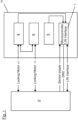
- fig. 1
- a block diagram of a system comprising a first electronic device and a second electronic device, arranged in a towing vehicle.
- In the block diagram, reference symbol 1 denotes the first electronic device according to the invention. The first electronic device 1 might be a part of a towing hitch H and may be mounted in or on a hook of the towing hitch.
- The towing hitch H is connected to the second
electronic device 2 via various lines, including a communication line, e.g. LIN bus line that connects the first electronic device 1, which includes a LIN bus interface, to the secondelectronic device 2. Supply lines are also provided to supplysensors motor 5 and the first electronic device 1. - The system shown in
figure 1 comprises asensor 4 for measuring an electrical value, such as e.g. a current sensor, with which an electrical value, such as the current, of themotor 5 of the towing hitch can be measured. The towing hitch H may further comprise atemperature sensor 3, for measuring the temperature in the area of the towing hook. Thesensors - The
motor 5 of the towing hitch H is used to exert a force on a hook of the towing hitch H. If a trailer is supported on the towing hitch H, themotor 5 works against the support load. The greater the support load, the more power themotor 5 needs to work against the support load. The greater the power required to work against the support load, the greater the motor current detected by thecurrent sensor 4. - The
motor 5 may only be intended to enable the support load to be determined. Preferably, however, themotor 5 also has other functions. For example, the towing hitch H can be a towing hitch like that known fromdocument EP 2 724 876 A1 and can be moved out of sight behind the bumper when not in use. - The first electronic device 1 is programmed in such a way that it can determine the support load from measured values for temperature and motor current supplied by
sensors - The determined support load is then transmitted to the second
electronic device 2 via the interface of the first electronic device 1 and can then be used in the towing vehicle. The secondelectronic device 2 is mounted in the towing vehicle and is connected to a network of the towing vehicle. Via the this network the secondelectronic device 2 can distribute a signal indicating a value of the support load. -
- 1
- first electronic device
- 2
- second electronic device
- 3
- temperature sensor
- 4
- current sensor
- 5
- Motor
- H
- towing hitch
Claims (7)
- System for determining a support load which rests on a towing hitch (H) which has a motor (5) for moving a hook of the towing hitch (H), having a first electronic device (1) which can be mounted in or on the towing hitch (H), and having a second electronic device (2) which can be mounted in a towing vehicle and can be connected to a network of the towing vehicle, the system having an input for a motor sensor (4) to which a motor sensor (4) of the motor (5) can be connected, with which at least one electrical value of the motor (5) can be measured,whereby the first electronic device (1) comprises said input for a motor sensor (4),whereby the first electronic device (1) comprises a unit for determining the support load as a function of the at least one measured electrical value, and whereby the first electronic device (1) and the second electronic device (2) have an interface for a communication between each other.characterised inthat the first electronic device (1) has at least one input for a sensor (3) for measuring the temperature in the region of the hook.that the unit for determining the support load is connected to the input for the sensor (3) for measuring the temperature and/or the sensor (4) for measuring the motor current undthat the unit for determining is configured to determine the support load as a function of the measured temperature.
- System according to claim 1, characterized in that at least one of the electronic devices (1, 2) is a microcontroller or it includes a microcontroller.
- System according to claim 1 or claim 2, characterized in that the interfaces are LIN-Bus-, Bluetooth-, zigbee-, WIFI-Interfaces.
- System according to one of the claims 1 to 3, characterized in that the first electronic device (1) has at least one input for a sensor for measuring a trailer angle.
- System according to one of the claims 1 to 4, characterized in that the second electronic device (2) comprises a trigger unit to trigger the first electronic device (1) to determine the support load.
- System according to one of the claims 1 to 5, characterized in that the second electronic device (2) is connected to a human machine interface and/or another component of the towing vehicle.
- System according claim 6, characterized in that the second electronic device and/or the human machine interface and/or the other component are configured to indicate the support load, if the determined support load is outside a prescribed range.
Applications Claiming Priority (1)
| Application Number | Priority Date | Filing Date | Title |
|---|---|---|---|
| PCT/EP2018/082253 WO2020104033A1 (en) | 2018-11-22 | 2018-11-22 | System for determining a support load which rests on a towing hitch |
Publications (2)
| Publication Number | Publication Date |
|---|---|
| EP3883794A1 EP3883794A1 (en) | 2021-09-29 |
| EP3883794B1 true EP3883794B1 (en) | 2024-10-16 |
Family
ID=64556870
Family Applications (1)
| Application Number | Title | Priority Date | Filing Date |
|---|---|---|---|
| EP18811186.8A Active EP3883794B1 (en) | 2018-11-22 | 2018-11-22 | System for determining a support load which rests on a towing hitch |
Country Status (3)
| Country | Link |
|---|---|
| US (1) | US20210268852A1 (en) |
| EP (1) | EP3883794B1 (en) |
| WO (1) | WO2020104033A1 (en) |
Family Cites Families (10)
| Publication number | Priority date | Publication date | Assignee | Title |
|---|---|---|---|---|
| US6072127A (en) * | 1998-08-13 | 2000-06-06 | General Electric Company | Indirect suspended load weighing apparatus |
| DE10108382A1 (en) * | 2001-02-21 | 2002-09-12 | Daimler Chrysler Ag | Movable trailer hitch to avoid pendulum movements in vehicle combinations |
| DE202011105552U1 (en) * | 2011-05-31 | 2012-09-05 | Westfalia-Automotive Gmbh | Trailer coupling with a sensor device and sensor device therefor |
| US20130253814A1 (en) * | 2012-03-24 | 2013-09-26 | Alvin R. Wirthlin | System and Method for Gauging Safe Towing Parameters |
| EP2724876B1 (en) | 2012-10-25 | 2019-11-27 | Brink Towing Systems B.V. | Towing hook arrangement and method for detecting a load applied to a towing hook |
| US10106002B2 (en) * | 2013-05-22 | 2018-10-23 | Kevin McAllister | Hitch receiver |
| US9327566B2 (en) * | 2013-05-22 | 2016-05-03 | Landecor LLC | Ball mount for measuring tongue weight of a trailer |
| DE102013011525B3 (en) * | 2013-07-10 | 2014-11-13 | Audi Ag | Device for determining a vertical load acting on a trailer hitch |
| WO2017144084A1 (en) * | 2016-02-23 | 2017-08-31 | Brink Towing Systems B.V. | Method for measuring a load on a towing hook and a towing hook arrangement |
| US9738125B1 (en) * | 2016-05-17 | 2017-08-22 | Horizon Global Americas Inc. | Communication device, system, and method for active control of external vehicle components |
-
2018
- 2018-11-22 EP EP18811186.8A patent/EP3883794B1/en active Active
- 2018-11-22 WO PCT/EP2018/082253 patent/WO2020104033A1/en not_active Ceased
-
2021
- 2021-05-20 US US17/325,927 patent/US20210268852A1/en not_active Abandoned
Also Published As
| Publication number | Publication date |
|---|---|
| WO2020104033A1 (en) | 2020-05-28 |
| US20210268852A1 (en) | 2021-09-02 |
| EP3883794A1 (en) | 2021-09-29 |
Similar Documents
| Publication | Publication Date | Title |
|---|---|---|
| US10239446B2 (en) | Vehicle sensing system using daisy chain of sensors | |
| US9604613B2 (en) | Brake controller | |
| EP3136193B1 (en) | Security monitor for vehicle | |
| US10880117B2 (en) | Control area network (CAN) transceivers with automatic polarity detection | |
| US20210197774A1 (en) | Driver and diagnostic system for a brake controller | |
| US10953862B2 (en) | Method for operating a parking brake and control device for operating a parking brake | |
| US10336247B2 (en) | Apparatus and method for automatic application/deapplication of brake lights | |
| US20140121937A1 (en) | Digital signal to analog signal gauge adapter | |
| US10035392B2 (en) | Self-closing electric socket cover | |
| EP3883794B1 (en) | System for determining a support load which rests on a towing hitch | |
| JPH07122659B2 (en) | Failure diagnosis system for automobile electronic devices | |
| KR20150031226A (en) | Sensor arrangement for an electric/electronic architecture and associated electric/electronic architecture for a vehicle | |
| JP2020158055A (en) | Wire harness and safety management system | |
| JP2023502947A (en) | A method for configuring a trailer detection system | |
| CN111619477B (en) | Communication system and communication method for motor vehicle communication | |
| WO2022092263A1 (en) | Ground short failure detection device and node device | |
| US7543097B2 (en) | Flexible wiring system for electronic apparatus | |
| US20220215702A1 (en) | Method for diagnosing a slave computer communicating with a master computer | |
| US9527444B2 (en) | Rear area monitoring device for a vehicle | |
| EP3929597B1 (en) | Electric insulation monitoring arrangement | |
| US5981907A (en) | Rear wiper monitoring theft deterrent circuit | |
| CN206884945U (en) | A kind of GES control device | |
| WO2018137764A1 (en) | Converter circuit for a two-voltage motor vehicle network, two-voltage motor vehicle network and motor vehicle | |
| KR102156019B1 (en) | Electronic Apparatus for Vehicle | |
| GB2473924A (en) | Vehicle having an apparatus for headlamp levelling and an anti-theft alarm system |
Legal Events
| Date | Code | Title | Description |
|---|---|---|---|
| STAA | Information on the status of an ep patent application or granted ep patent |
Free format text: STATUS: UNKNOWN |
|
| STAA | Information on the status of an ep patent application or granted ep patent |
Free format text: STATUS: THE INTERNATIONAL PUBLICATION HAS BEEN MADE |
|
| PUAI | Public reference made under article 153(3) epc to a published international application that has entered the european phase |
Free format text: ORIGINAL CODE: 0009012 |
|
| STAA | Information on the status of an ep patent application or granted ep patent |
Free format text: STATUS: REQUEST FOR EXAMINATION WAS MADE |
|
| 17P | Request for examination filed |
Effective date: 20210622 |
|
| AK | Designated contracting states |
Kind code of ref document: A1 Designated state(s): AL AT BE BG CH CY CZ DE DK EE ES FI FR GB GR HR HU IE IS IT LI LT LU LV MC MK MT NL NO PL PT RO RS SE SI SK SM TR |
|
| DAV | Request for validation of the european patent (deleted) | ||
| DAX | Request for extension of the european patent (deleted) | ||
| STAA | Information on the status of an ep patent application or granted ep patent |
Free format text: STATUS: EXAMINATION IS IN PROGRESS |
|
| 17Q | First examination report despatched |
Effective date: 20230329 |
|
| P01 | Opt-out of the competence of the unified patent court (upc) registered |
Effective date: 20230616 |
|
| GRAP | Despatch of communication of intention to grant a patent |
Free format text: ORIGINAL CODE: EPIDOSNIGR1 |
|
| STAA | Information on the status of an ep patent application or granted ep patent |
Free format text: STATUS: GRANT OF PATENT IS INTENDED |
|
| INTG | Intention to grant announced |
Effective date: 20240507 |
|
| GRAS | Grant fee paid |
Free format text: ORIGINAL CODE: EPIDOSNIGR3 |
|
| GRAA | (expected) grant |
Free format text: ORIGINAL CODE: 0009210 |
|
| STAA | Information on the status of an ep patent application or granted ep patent |
Free format text: STATUS: THE PATENT HAS BEEN GRANTED |
|
| AK | Designated contracting states |
Kind code of ref document: B1 Designated state(s): AL AT BE BG CH CY CZ DE DK EE ES FI FR GB GR HR HU IE IS IT LI LT LU LV MC MK MT NL NO PL PT RO RS SE SI SK SM TR |
|
| REG | Reference to a national code |
Ref country code: GB Ref legal event code: FG4D |
|
| REG | Reference to a national code |
Ref country code: DE Ref legal event code: R096 Ref document number: 602018075561 Country of ref document: DE Ref country code: CH Ref legal event code: EP |
|
| REG | Reference to a national code |
Ref country code: IE Ref legal event code: FG4D |
|
| PGFP | Annual fee paid to national office [announced via postgrant information from national office to epo] |
Ref country code: NL Payment date: 20241120 Year of fee payment: 7 |
|
| REG | Reference to a national code |
Ref country code: LT Ref legal event code: MG9D |
|
| REG | Reference to a national code |
Ref country code: NL Ref legal event code: MP Effective date: 20241016 |
|
| REG | Reference to a national code |
Ref country code: AT Ref legal event code: MK05 Ref document number: 1732663 Country of ref document: AT Kind code of ref document: T Effective date: 20241016 |
|
| PG25 | Lapsed in a contracting state [announced via postgrant information from national office to epo] |
Ref country code: NL Free format text: LAPSE BECAUSE OF FAILURE TO SUBMIT A TRANSLATION OF THE DESCRIPTION OR TO PAY THE FEE WITHIN THE PRESCRIBED TIME-LIMIT Effective date: 20241016 |
|
| PG25 | Lapsed in a contracting state [announced via postgrant information from national office to epo] |
Ref country code: NL Free format text: LAPSE BECAUSE OF FAILURE TO SUBMIT A TRANSLATION OF THE DESCRIPTION OR TO PAY THE FEE WITHIN THE PRESCRIBED TIME-LIMIT Effective date: 20241016 |
|
| PG25 | Lapsed in a contracting state [announced via postgrant information from national office to epo] |
Ref country code: PT Free format text: LAPSE BECAUSE OF FAILURE TO SUBMIT A TRANSLATION OF THE DESCRIPTION OR TO PAY THE FEE WITHIN THE PRESCRIBED TIME-LIMIT Effective date: 20250217 Ref country code: HR Free format text: LAPSE BECAUSE OF FAILURE TO SUBMIT A TRANSLATION OF THE DESCRIPTION OR TO PAY THE FEE WITHIN THE PRESCRIBED TIME-LIMIT Effective date: 20241016 Ref country code: IS Free format text: LAPSE BECAUSE OF FAILURE TO SUBMIT A TRANSLATION OF THE DESCRIPTION OR TO PAY THE FEE WITHIN THE PRESCRIBED TIME-LIMIT Effective date: 20250216 |
|
| PG25 | Lapsed in a contracting state [announced via postgrant information from national office to epo] |
Ref country code: FI Free format text: LAPSE BECAUSE OF FAILURE TO SUBMIT A TRANSLATION OF THE DESCRIPTION OR TO PAY THE FEE WITHIN THE PRESCRIBED TIME-LIMIT Effective date: 20241016 |
|
| PG25 | Lapsed in a contracting state [announced via postgrant information from national office to epo] |
Ref country code: BG Free format text: LAPSE BECAUSE OF FAILURE TO SUBMIT A TRANSLATION OF THE DESCRIPTION OR TO PAY THE FEE WITHIN THE PRESCRIBED TIME-LIMIT Effective date: 20241016 |
|
| PG25 | Lapsed in a contracting state [announced via postgrant information from national office to epo] |
Ref country code: ES Free format text: LAPSE BECAUSE OF FAILURE TO SUBMIT A TRANSLATION OF THE DESCRIPTION OR TO PAY THE FEE WITHIN THE PRESCRIBED TIME-LIMIT Effective date: 20241016 |
|
| PG25 | Lapsed in a contracting state [announced via postgrant information from national office to epo] |
Ref country code: NO Free format text: LAPSE BECAUSE OF FAILURE TO SUBMIT A TRANSLATION OF THE DESCRIPTION OR TO PAY THE FEE WITHIN THE PRESCRIBED TIME-LIMIT Effective date: 20250116 |
|
| PG25 | Lapsed in a contracting state [announced via postgrant information from national office to epo] |
Ref country code: GR Free format text: LAPSE BECAUSE OF FAILURE TO SUBMIT A TRANSLATION OF THE DESCRIPTION OR TO PAY THE FEE WITHIN THE PRESCRIBED TIME-LIMIT Effective date: 20250117 Ref country code: LV Free format text: LAPSE BECAUSE OF FAILURE TO SUBMIT A TRANSLATION OF THE DESCRIPTION OR TO PAY THE FEE WITHIN THE PRESCRIBED TIME-LIMIT Effective date: 20241016 Ref country code: AT Free format text: LAPSE BECAUSE OF FAILURE TO SUBMIT A TRANSLATION OF THE DESCRIPTION OR TO PAY THE FEE WITHIN THE PRESCRIBED TIME-LIMIT Effective date: 20241016 |
|
| PG25 | Lapsed in a contracting state [announced via postgrant information from national office to epo] |
Ref country code: PL Free format text: LAPSE BECAUSE OF FAILURE TO SUBMIT A TRANSLATION OF THE DESCRIPTION OR TO PAY THE FEE WITHIN THE PRESCRIBED TIME-LIMIT Effective date: 20241016 |
|
| PG25 | Lapsed in a contracting state [announced via postgrant information from national office to epo] |
Ref country code: RS Free format text: LAPSE BECAUSE OF FAILURE TO SUBMIT A TRANSLATION OF THE DESCRIPTION OR TO PAY THE FEE WITHIN THE PRESCRIBED TIME-LIMIT Effective date: 20250116 |
|
| REG | Reference to a national code |
Ref country code: CH Ref legal event code: PL |
|
| PG25 | Lapsed in a contracting state [announced via postgrant information from national office to epo] |
Ref country code: SM Free format text: LAPSE BECAUSE OF FAILURE TO SUBMIT A TRANSLATION OF THE DESCRIPTION OR TO PAY THE FEE WITHIN THE PRESCRIBED TIME-LIMIT Effective date: 20241016 |
|
| PG25 | Lapsed in a contracting state [announced via postgrant information from national office to epo] |
Ref country code: MC Free format text: LAPSE BECAUSE OF FAILURE TO SUBMIT A TRANSLATION OF THE DESCRIPTION OR TO PAY THE FEE WITHIN THE PRESCRIBED TIME-LIMIT Effective date: 20241016 |
|
| PG25 | Lapsed in a contracting state [announced via postgrant information from national office to epo] |
Ref country code: DK Free format text: LAPSE BECAUSE OF FAILURE TO SUBMIT A TRANSLATION OF THE DESCRIPTION OR TO PAY THE FEE WITHIN THE PRESCRIBED TIME-LIMIT Effective date: 20241016 |
|
| PG25 | Lapsed in a contracting state [announced via postgrant information from national office to epo] |
Ref country code: LU Free format text: LAPSE BECAUSE OF NON-PAYMENT OF DUE FEES Effective date: 20241122 |
|
| REG | Reference to a national code |
Ref country code: CH Ref legal event code: PL |
|
| REG | Reference to a national code |
Ref country code: DE Ref legal event code: R097 Ref document number: 602018075561 Country of ref document: DE |
|
| PG25 | Lapsed in a contracting state [announced via postgrant information from national office to epo] |
Ref country code: EE Free format text: LAPSE BECAUSE OF FAILURE TO SUBMIT A TRANSLATION OF THE DESCRIPTION OR TO PAY THE FEE WITHIN THE PRESCRIBED TIME-LIMIT Effective date: 20241016 |
|
| PG25 | Lapsed in a contracting state [announced via postgrant information from national office to epo] |
Ref country code: CH Free format text: LAPSE BECAUSE OF NON-PAYMENT OF DUE FEES Effective date: 20241130 |
|
| PG25 | Lapsed in a contracting state [announced via postgrant information from national office to epo] |
Ref country code: RO Free format text: LAPSE BECAUSE OF FAILURE TO SUBMIT A TRANSLATION OF THE DESCRIPTION OR TO PAY THE FEE WITHIN THE PRESCRIBED TIME-LIMIT Effective date: 20241016 |
|
| PG25 | Lapsed in a contracting state [announced via postgrant information from national office to epo] |
Ref country code: SK Free format text: LAPSE BECAUSE OF FAILURE TO SUBMIT A TRANSLATION OF THE DESCRIPTION OR TO PAY THE FEE WITHIN THE PRESCRIBED TIME-LIMIT Effective date: 20241016 |
|
| PG25 | Lapsed in a contracting state [announced via postgrant information from national office to epo] |
Ref country code: CZ Free format text: LAPSE BECAUSE OF FAILURE TO SUBMIT A TRANSLATION OF THE DESCRIPTION OR TO PAY THE FEE WITHIN THE PRESCRIBED TIME-LIMIT Effective date: 20241016 |
|
| PG25 | Lapsed in a contracting state [announced via postgrant information from national office to epo] |
Ref country code: IT Free format text: LAPSE BECAUSE OF FAILURE TO SUBMIT A TRANSLATION OF THE DESCRIPTION OR TO PAY THE FEE WITHIN THE PRESCRIBED TIME-LIMIT Effective date: 20241016 |
|
| PLBE | No opposition filed within time limit |
Free format text: ORIGINAL CODE: 0009261 |
|
| STAA | Information on the status of an ep patent application or granted ep patent |
Free format text: STATUS: NO OPPOSITION FILED WITHIN TIME LIMIT |
|
| REG | Reference to a national code |
Ref country code: BE Ref legal event code: MM Effective date: 20241130 |
|
| PG25 | Lapsed in a contracting state [announced via postgrant information from national office to epo] |
Ref country code: SE Free format text: LAPSE BECAUSE OF FAILURE TO SUBMIT A TRANSLATION OF THE DESCRIPTION OR TO PAY THE FEE WITHIN THE PRESCRIBED TIME-LIMIT Effective date: 20241016 |
|
| 26N | No opposition filed |
Effective date: 20250717 |
|
| PG25 | Lapsed in a contracting state [announced via postgrant information from national office to epo] |
Ref country code: BE Free format text: LAPSE BECAUSE OF NON-PAYMENT OF DUE FEES Effective date: 20241130 |
|
| PG25 | Lapsed in a contracting state [announced via postgrant information from national office to epo] |
Ref country code: IE Free format text: LAPSE BECAUSE OF NON-PAYMENT OF DUE FEES Effective date: 20241122 |
|
| PGFP | Annual fee paid to national office [announced via postgrant information from national office to epo] |
Ref country code: DE Payment date: 20251130 Year of fee payment: 8 |
|
| PGFP | Annual fee paid to national office [announced via postgrant information from national office to epo] |
Ref country code: GB Payment date: 20251121 Year of fee payment: 8 |
|
| PGFP | Annual fee paid to national office [announced via postgrant information from national office to epo] |
Ref country code: FR Payment date: 20251126 Year of fee payment: 8 |
|
| REG | Reference to a national code |
Ref country code: NL Ref legal event code: NE Effective date: 20260115 |
|
| PG25 | Lapsed in a contracting state [announced via postgrant information from national office to epo] |
Ref country code: HU Free format text: LAPSE BECAUSE OF FAILURE TO SUBMIT A TRANSLATION OF THE DESCRIPTION OR TO PAY THE FEE WITHIN THE PRESCRIBED TIME-LIMIT; INVALID AB INITIO Effective date: 20181122 |
|
| PG25 | Lapsed in a contracting state [announced via postgrant information from national office to epo] |
Ref country code: CY Free format text: LAPSE BECAUSE OF FAILURE TO SUBMIT A TRANSLATION OF THE DESCRIPTION OR TO PAY THE FEE WITHIN THE PRESCRIBED TIME-LIMIT; INVALID AB INITIO Effective date: 20181122 |
|
| REG | Reference to a national code |
Ref country code: NL Ref legal event code: FP Ref country code: NL Ref legal event code: NG |