EP3883018A1 - Method for producing separator-integrated electrode - Google Patents
Method for producing separator-integrated electrode Download PDFInfo
- Publication number
- EP3883018A1 EP3883018A1 EP21159493.2A EP21159493A EP3883018A1 EP 3883018 A1 EP3883018 A1 EP 3883018A1 EP 21159493 A EP21159493 A EP 21159493A EP 3883018 A1 EP3883018 A1 EP 3883018A1
- Authority
- EP
- European Patent Office
- Prior art keywords
- water
- solvent
- insoluble polymer
- separator
- desirably
- Prior art date
- Legal status (The legal status is an assumption and is not a legal conclusion. Google has not performed a legal analysis and makes no representation as to the accuracy of the status listed.)
- Withdrawn
Links
- 238000004519 manufacturing process Methods 0.000 title claims abstract description 13
- 239000002904 solvent Substances 0.000 claims abstract description 143
- -1 polyethylene Polymers 0.000 claims abstract description 85
- 229920003176 water-insoluble polymer Polymers 0.000 claims abstract description 83
- 239000004698 Polyethylene Substances 0.000 claims abstract description 72
- 239000002245 particle Substances 0.000 claims abstract description 70
- 229920000573 polyethylene Polymers 0.000 claims abstract description 68
- 238000000576 coating method Methods 0.000 claims abstract description 66
- 239000011248 coating agent Substances 0.000 claims abstract description 65
- 239000007788 liquid Substances 0.000 claims abstract description 49
- 239000012046 mixed solvent Substances 0.000 claims abstract description 43
- 238000000034 method Methods 0.000 claims abstract description 35
- 239000011148 porous material Substances 0.000 claims abstract description 17
- 238000009835 boiling Methods 0.000 claims abstract description 16
- 230000008016 vaporization Effects 0.000 claims abstract description 16
- 238000009834 vaporization Methods 0.000 claims abstract description 8
- 229920000219 Ethylene vinyl alcohol Polymers 0.000 claims description 27
- 229920001577 copolymer Polymers 0.000 claims description 12
- 239000010410 layer Substances 0.000 description 56
- 239000013543 active substance Substances 0.000 description 24
- XLYOFNOQVPJJNP-UHFFFAOYSA-N water Substances O XLYOFNOQVPJJNP-UHFFFAOYSA-N 0.000 description 23
- BDERNNFJNOPAEC-UHFFFAOYSA-N propan-1-ol Chemical compound CCCO BDERNNFJNOPAEC-UHFFFAOYSA-N 0.000 description 22
- 239000004715 ethylene vinyl alcohol Substances 0.000 description 19
- 238000002156 mixing Methods 0.000 description 18
- 229920000642 polymer Polymers 0.000 description 18
- 238000010438 heat treatment Methods 0.000 description 17
- CSCPPACGZOOCGX-UHFFFAOYSA-N Acetone Chemical compound CC(C)=O CSCPPACGZOOCGX-UHFFFAOYSA-N 0.000 description 15
- IAZDPXIOMUYVGZ-UHFFFAOYSA-N Dimethylsulphoxide Chemical compound CS(C)=O IAZDPXIOMUYVGZ-UHFFFAOYSA-N 0.000 description 14
- 239000006185 dispersion Substances 0.000 description 14
- 239000002798 polar solvent Substances 0.000 description 14
- ZMXDDKWLCZADIW-UHFFFAOYSA-N N,N-Dimethylformamide Chemical compound CN(C)C=O ZMXDDKWLCZADIW-UHFFFAOYSA-N 0.000 description 12
- 150000001875 compounds Chemical class 0.000 description 12
- 239000000243 solution Substances 0.000 description 12
- YEJRWHAVMIAJKC-UHFFFAOYSA-N 4-Butyrolactone Chemical compound O=C1CCCO1 YEJRWHAVMIAJKC-UHFFFAOYSA-N 0.000 description 9
- LFQSCWFLJHTTHZ-UHFFFAOYSA-N Ethanol Chemical compound CCO LFQSCWFLJHTTHZ-UHFFFAOYSA-N 0.000 description 9
- PUPZLCDOIYMWBV-UHFFFAOYSA-N (+/-)-1,3-Butanediol Chemical compound CC(O)CCO PUPZLCDOIYMWBV-UHFFFAOYSA-N 0.000 description 8
- OKTJSMMVPCPJKN-UHFFFAOYSA-N Carbon Chemical compound [C] OKTJSMMVPCPJKN-UHFFFAOYSA-N 0.000 description 8
- WYURNTSHIVDZCO-UHFFFAOYSA-N Tetrahydrofuran Chemical compound C1CCOC1 WYURNTSHIVDZCO-UHFFFAOYSA-N 0.000 description 8
- WERYXYBDKMZEQL-UHFFFAOYSA-N butane-1,4-diol Chemical compound OCCCCO WERYXYBDKMZEQL-UHFFFAOYSA-N 0.000 description 8
- 230000000052 comparative effect Effects 0.000 description 8
- VGGSQFUCUMXWEO-UHFFFAOYSA-N Ethene Chemical group C=C VGGSQFUCUMXWEO-UHFFFAOYSA-N 0.000 description 7
- 239000005977 Ethylene Substances 0.000 description 7
- WHXSMMKQMYFTQS-UHFFFAOYSA-N Lithium Chemical compound [Li] WHXSMMKQMYFTQS-UHFFFAOYSA-N 0.000 description 7
- NINIDFKCEFEMDL-UHFFFAOYSA-N Sulfur Chemical compound [S] NINIDFKCEFEMDL-UHFFFAOYSA-N 0.000 description 7
- 238000001035 drying Methods 0.000 description 7
- 229910052744 lithium Inorganic materials 0.000 description 7
- QJGQUHMNIGDVPM-UHFFFAOYSA-N nitrogen group Chemical group [N] QJGQUHMNIGDVPM-UHFFFAOYSA-N 0.000 description 7
- 238000005191 phase separation Methods 0.000 description 7
- 239000007787 solid Substances 0.000 description 7
- 239000000126 substance Substances 0.000 description 7
- 229910052717 sulfur Inorganic materials 0.000 description 7
- 239000011593 sulfur Substances 0.000 description 7
- ZWEHNKRNPOVVGH-UHFFFAOYSA-N 2-Butanone Chemical compound CCC(C)=O ZWEHNKRNPOVVGH-UHFFFAOYSA-N 0.000 description 6
- 150000001298 alcohols Chemical class 0.000 description 6
- 230000015572 biosynthetic process Effects 0.000 description 6
- 229910002804 graphite Inorganic materials 0.000 description 6
- 239000010439 graphite Substances 0.000 description 6
- ZSIAUFGUXNUGDI-UHFFFAOYSA-N hexan-1-ol Chemical compound CCCCCCO ZSIAUFGUXNUGDI-UHFFFAOYSA-N 0.000 description 6
- 229920002981 polyvinylidene fluoride Polymers 0.000 description 6
- 238000002360 preparation method Methods 0.000 description 6
- 239000011230 binding agent Substances 0.000 description 5
- 239000008151 electrolyte solution Substances 0.000 description 5
- 229920005989 resin Polymers 0.000 description 5
- 239000011347 resin Substances 0.000 description 5
- 238000003756 stirring Methods 0.000 description 5
- 229940043375 1,5-pentanediol Drugs 0.000 description 4
- PEDCQBHIVMGVHV-UHFFFAOYSA-N Glycerine Chemical compound OCC(O)CO PEDCQBHIVMGVHV-UHFFFAOYSA-N 0.000 description 4
- ALQSHHUCVQOPAS-UHFFFAOYSA-N Pentane-1,5-diol Chemical compound OCCCCCO ALQSHHUCVQOPAS-UHFFFAOYSA-N 0.000 description 4
- 235000019437 butane-1,3-diol Nutrition 0.000 description 4
- XXMIOPMDWAUFGU-UHFFFAOYSA-N hexane-1,6-diol Chemical compound OCCCCCCO XXMIOPMDWAUFGU-UHFFFAOYSA-N 0.000 description 4
- 238000002955 isolation Methods 0.000 description 4
- 239000000178 monomer Substances 0.000 description 4
- 238000007127 saponification reaction Methods 0.000 description 4
- YLQBMQCUIZJEEH-UHFFFAOYSA-N tetrahydrofuran Natural products C=1C=COC=1 YLQBMQCUIZJEEH-UHFFFAOYSA-N 0.000 description 4
- 229920001567 vinyl ester resin Polymers 0.000 description 4
- 229920002134 Carboxymethyl cellulose Polymers 0.000 description 3
- RYGMFSIKBFXOCR-UHFFFAOYSA-N Copper Chemical compound [Cu] RYGMFSIKBFXOCR-UHFFFAOYSA-N 0.000 description 3
- YMWUJEATGCHHMB-UHFFFAOYSA-N Dichloromethane Chemical compound ClCCl YMWUJEATGCHHMB-UHFFFAOYSA-N 0.000 description 3
- KFZMGEQAYNKOFK-UHFFFAOYSA-N Isopropanol Chemical compound CC(C)O KFZMGEQAYNKOFK-UHFFFAOYSA-N 0.000 description 3
- FXHOOIRPVKKKFG-UHFFFAOYSA-N N,N-Dimethylacetamide Chemical compound CN(C)C(C)=O FXHOOIRPVKKKFG-UHFFFAOYSA-N 0.000 description 3
- SECXISVLQFMRJM-UHFFFAOYSA-N N-Methylpyrrolidone Chemical compound CN1CCCC1=O SECXISVLQFMRJM-UHFFFAOYSA-N 0.000 description 3
- 229920002301 cellulose acetate Polymers 0.000 description 3
- 239000011889 copper foil Substances 0.000 description 3
- 150000005676 cyclic carbonates Chemical class 0.000 description 3
- 150000004292 cyclic ethers Chemical class 0.000 description 3
- 150000002148 esters Chemical group 0.000 description 3
- 125000001033 ether group Chemical group 0.000 description 3
- 238000006116 polymerization reaction Methods 0.000 description 3
- RUOJZAUFBMNUDX-UHFFFAOYSA-N propylene carbonate Chemical compound CC1COC(=O)O1 RUOJZAUFBMNUDX-UHFFFAOYSA-N 0.000 description 3
- 229920003048 styrene butadiene rubber Polymers 0.000 description 3
- HXJUTPCZVOIRIF-UHFFFAOYSA-N sulfolane Chemical compound O=S1(=O)CCCC1 HXJUTPCZVOIRIF-UHFFFAOYSA-N 0.000 description 3
- 238000012360 testing method Methods 0.000 description 3
- 239000002562 thickening agent Substances 0.000 description 3
- 125000000391 vinyl group Chemical group [H]C([*])=C([H])[H] 0.000 description 3
- QPFMBZIOSGYJDE-UHFFFAOYSA-N 1,1,2,2-tetrachloroethane Chemical compound ClC(Cl)C(Cl)Cl QPFMBZIOSGYJDE-UHFFFAOYSA-N 0.000 description 2
- BQCIDUSAKPWEOX-UHFFFAOYSA-N 1,1-Difluoroethene Chemical group FC(F)=C BQCIDUSAKPWEOX-UHFFFAOYSA-N 0.000 description 2
- WNXJIVFYUVYPPR-UHFFFAOYSA-N 1,3-dioxolane Chemical compound C1COCO1 WNXJIVFYUVYPPR-UHFFFAOYSA-N 0.000 description 2
- RYHBNJHYFVUHQT-UHFFFAOYSA-N 1,4-Dioxane Chemical compound C1COCCO1 RYHBNJHYFVUHQT-UHFFFAOYSA-N 0.000 description 2
- XLLIQLLCWZCATF-UHFFFAOYSA-N 2-methoxyethyl acetate Chemical compound COCCOC(C)=O XLLIQLLCWZCATF-UHFFFAOYSA-N 0.000 description 2
- NIXOWILDQLNWCW-UHFFFAOYSA-M Acrylate Chemical compound [O-]C(=O)C=C NIXOWILDQLNWCW-UHFFFAOYSA-M 0.000 description 2
- HEDRZPFGACZZDS-UHFFFAOYSA-N Chloroform Chemical compound ClC(Cl)Cl HEDRZPFGACZZDS-UHFFFAOYSA-N 0.000 description 2
- IMROMDMJAWUWLK-UHFFFAOYSA-N Ethenol Chemical group OC=C IMROMDMJAWUWLK-UHFFFAOYSA-N 0.000 description 2
- KMTRUDSVKNLOMY-UHFFFAOYSA-N Ethylene carbonate Chemical compound O=C1OCCO1 KMTRUDSVKNLOMY-UHFFFAOYSA-N 0.000 description 2
- PPBRXRYQALVLMV-UHFFFAOYSA-N Styrene Chemical compound C=CC1=CC=CC=C1 PPBRXRYQALVLMV-UHFFFAOYSA-N 0.000 description 2
- 239000006230 acetylene black Substances 0.000 description 2
- 125000004432 carbon atom Chemical group C* 0.000 description 2
- 239000003575 carbonaceous material Substances 0.000 description 2
- 238000005266 casting Methods 0.000 description 2
- 239000004020 conductor Substances 0.000 description 2
- 125000004122 cyclic group Chemical group 0.000 description 2
- JHIVVAPYMSGYDF-UHFFFAOYSA-N cyclohexanone Chemical compound O=C1CCCCC1 JHIVVAPYMSGYDF-UHFFFAOYSA-N 0.000 description 2
- 230000007423 decrease Effects 0.000 description 2
- 230000000694 effects Effects 0.000 description 2
- 239000002003 electrode paste Substances 0.000 description 2
- JBTWLSYIZRCDFO-UHFFFAOYSA-N ethyl methyl carbonate Chemical compound CCOC(=O)OC JBTWLSYIZRCDFO-UHFFFAOYSA-N 0.000 description 2
- 238000011156 evaluation Methods 0.000 description 2
- 235000011187 glycerol Nutrition 0.000 description 2
- 229920001903 high density polyethylene Polymers 0.000 description 2
- 239000004700 high-density polyethylene Substances 0.000 description 2
- 229910052739 hydrogen Inorganic materials 0.000 description 2
- 239000001257 hydrogen Substances 0.000 description 2
- 230000001771 impaired effect Effects 0.000 description 2
- 239000010954 inorganic particle Substances 0.000 description 2
- 150000002500 ions Chemical class 0.000 description 2
- 150000002576 ketones Chemical class 0.000 description 2
- 229920001684 low density polyethylene Polymers 0.000 description 2
- 239000004702 low-density polyethylene Substances 0.000 description 2
- 238000005259 measurement Methods 0.000 description 2
- 229920001179 medium density polyethylene Polymers 0.000 description 2
- 239000004701 medium-density polyethylene Substances 0.000 description 2
- 238000002844 melting Methods 0.000 description 2
- 230000008018 melting Effects 0.000 description 2
- TZIHFWKZFHZASV-UHFFFAOYSA-N methyl formate Chemical compound COC=O TZIHFWKZFHZASV-UHFFFAOYSA-N 0.000 description 2
- 239000000203 mixture Substances 0.000 description 2
- 239000011255 nonaqueous electrolyte Substances 0.000 description 2
- 229920000098 polyolefin Polymers 0.000 description 2
- 230000001629 suppression Effects 0.000 description 2
- GEWWCWZGHNIUBW-UHFFFAOYSA-N 1-(4-nitrophenyl)propan-2-one Chemical compound CC(=O)CC1=CC=C([N+]([O-])=O)C=C1 GEWWCWZGHNIUBW-UHFFFAOYSA-N 0.000 description 1
- JOLQKTGDSGKSKJ-UHFFFAOYSA-N 1-ethoxypropan-2-ol Chemical compound CCOCC(C)O JOLQKTGDSGKSKJ-UHFFFAOYSA-N 0.000 description 1
- ARXJGSRGQADJSQ-UHFFFAOYSA-N 1-methoxypropan-2-ol Chemical compound COCC(C)O ARXJGSRGQADJSQ-UHFFFAOYSA-N 0.000 description 1
- 238000005160 1H NMR spectroscopy Methods 0.000 description 1
- SBASXUCJHJRPEV-UHFFFAOYSA-N 2-(2-methoxyethoxy)ethanol Chemical compound COCCOCCO SBASXUCJHJRPEV-UHFFFAOYSA-N 0.000 description 1
- XNWFRZJHXBZDAG-UHFFFAOYSA-N 2-METHOXYETHANOL Chemical compound COCCO XNWFRZJHXBZDAG-UHFFFAOYSA-N 0.000 description 1
- ZNQVEEAIQZEUHB-UHFFFAOYSA-N 2-ethoxyethanol Chemical compound CCOCCO ZNQVEEAIQZEUHB-UHFFFAOYSA-N 0.000 description 1
- 229940093475 2-ethoxyethanol Drugs 0.000 description 1
- 229920008347 Cellulose acetate propionate Polymers 0.000 description 1
- DQEFEBPAPFSJLV-UHFFFAOYSA-N Cellulose propionate Chemical compound CCC(=O)OCC1OC(OC(=O)CC)C(OC(=O)CC)C(OC(=O)CC)C1OC1C(OC(=O)CC)C(OC(=O)CC)C(OC(=O)CC)C(COC(=O)CC)O1 DQEFEBPAPFSJLV-UHFFFAOYSA-N 0.000 description 1
- 239000001856 Ethyl cellulose Substances 0.000 description 1
- ZZSNKZQZMQGXPY-UHFFFAOYSA-N Ethyl cellulose Chemical compound CCOCC1OC(OC)C(OCC)C(OCC)C1OC1C(O)C(O)C(OC)C(CO)O1 ZZSNKZQZMQGXPY-UHFFFAOYSA-N 0.000 description 1
- YCKRFDGAMUMZLT-UHFFFAOYSA-N Fluorine atom Chemical compound [F] YCKRFDGAMUMZLT-UHFFFAOYSA-N 0.000 description 1
- 229920008396 Kynar Flex® 2821-00 Polymers 0.000 description 1
- 229920010582 Kynar Flex® 2850-00 Polymers 0.000 description 1
- 229910032387 LiCoO2 Inorganic materials 0.000 description 1
- 229910010584 LiFeO2 Inorganic materials 0.000 description 1
- 229910052493 LiFePO4 Inorganic materials 0.000 description 1
- 229910002099 LiNi0.5Mn1.5O4 Inorganic materials 0.000 description 1
- 229910003005 LiNiO2 Inorganic materials 0.000 description 1
- 229910001290 LiPF6 Inorganic materials 0.000 description 1
- 229910001228 Li[Ni1/3Co1/3Mn1/3]O2 (NCM 111) Inorganic materials 0.000 description 1
- 229920010126 Linear Low Density Polyethylene (LLDPE) Polymers 0.000 description 1
- 229910002097 Lithium manganese(III,IV) oxide Inorganic materials 0.000 description 1
- 238000005481 NMR spectroscopy Methods 0.000 description 1
- 239000004743 Polypropylene Substances 0.000 description 1
- 239000004793 Polystyrene Substances 0.000 description 1
- XBDQKXXYIPTUBI-UHFFFAOYSA-M Propionate Chemical compound CCC([O-])=O XBDQKXXYIPTUBI-UHFFFAOYSA-M 0.000 description 1
- 239000002174 Styrene-butadiene Substances 0.000 description 1
- 229920010346 Very Low Density Polyethylene (VLDPE) Polymers 0.000 description 1
- XTXRWKRVRITETP-UHFFFAOYSA-N Vinyl acetate Chemical compound CC(=O)OC=C XTXRWKRVRITETP-UHFFFAOYSA-N 0.000 description 1
- BZHJMEDXRYGGRV-UHFFFAOYSA-N Vinyl chloride Chemical compound ClC=C BZHJMEDXRYGGRV-UHFFFAOYSA-N 0.000 description 1
- KXKVLQRXCPHEJC-UHFFFAOYSA-N acetic acid trimethyl ester Natural products COC(C)=O KXKVLQRXCPHEJC-UHFFFAOYSA-N 0.000 description 1
- NIXOWILDQLNWCW-UHFFFAOYSA-N acrylic acid group Chemical group C(C=C)(=O)O NIXOWILDQLNWCW-UHFFFAOYSA-N 0.000 description 1
- XECAHXYUAAWDEL-UHFFFAOYSA-N acrylonitrile butadiene styrene Chemical compound C=CC=C.C=CC#N.C=CC1=CC=CC=C1 XECAHXYUAAWDEL-UHFFFAOYSA-N 0.000 description 1
- 239000004676 acrylonitrile butadiene styrene Substances 0.000 description 1
- 229920000122 acrylonitrile butadiene styrene Polymers 0.000 description 1
- 238000012644 addition polymerization Methods 0.000 description 1
- 238000007605 air drying Methods 0.000 description 1
- 125000001931 aliphatic group Chemical group 0.000 description 1
- 239000003513 alkali Substances 0.000 description 1
- 150000001336 alkenes Chemical class 0.000 description 1
- 229910052782 aluminium Inorganic materials 0.000 description 1
- XAGFODPZIPBFFR-UHFFFAOYSA-N aluminium Chemical compound [Al] XAGFODPZIPBFFR-UHFFFAOYSA-N 0.000 description 1
- 229910003481 amorphous carbon Inorganic materials 0.000 description 1
- 239000002194 amorphous carbon material Substances 0.000 description 1
- 229910021383 artificial graphite Inorganic materials 0.000 description 1
- 125000003118 aryl group Chemical group 0.000 description 1
- 239000006229 carbon black Substances 0.000 description 1
- 239000001768 carboxy methyl cellulose Substances 0.000 description 1
- 235000010948 carboxy methyl cellulose Nutrition 0.000 description 1
- 239000008112 carboxymethyl-cellulose Substances 0.000 description 1
- 239000003054 catalyst Substances 0.000 description 1
- 229920002678 cellulose Polymers 0.000 description 1
- 239000001913 cellulose Substances 0.000 description 1
- 229920006218 cellulose propionate Polymers 0.000 description 1
- 238000001816 cooling Methods 0.000 description 1
- 238000007334 copolymerization reaction Methods 0.000 description 1
- 238000011161 development Methods 0.000 description 1
- XXJWXESWEXIICW-UHFFFAOYSA-N diethylene glycol monoethyl ether Chemical compound CCOCCOCCO XXJWXESWEXIICW-UHFFFAOYSA-N 0.000 description 1
- 229940075557 diethylene glycol monoethyl ether Drugs 0.000 description 1
- IEJIGPNLZYLLBP-UHFFFAOYSA-N dimethyl carbonate Chemical compound COC(=O)OC IEJIGPNLZYLLBP-UHFFFAOYSA-N 0.000 description 1
- 150000002009 diols Chemical class 0.000 description 1
- 239000002612 dispersion medium Substances 0.000 description 1
- CMDXMIHZUJPRHG-UHFFFAOYSA-N ethenyl decanoate Chemical compound CCCCCCCCCC(=O)OC=C CMDXMIHZUJPRHG-UHFFFAOYSA-N 0.000 description 1
- GLVVKKSPKXTQRB-UHFFFAOYSA-N ethenyl dodecanoate Chemical compound CCCCCCCCCCCC(=O)OC=C GLVVKKSPKXTQRB-UHFFFAOYSA-N 0.000 description 1
- GFJVXXWOPWLRNU-UHFFFAOYSA-N ethenyl formate Chemical compound C=COC=O GFJVXXWOPWLRNU-UHFFFAOYSA-N 0.000 description 1
- BLZSRIYYOIZLJL-UHFFFAOYSA-N ethenyl pentanoate Chemical compound CCCCC(=O)OC=C BLZSRIYYOIZLJL-UHFFFAOYSA-N 0.000 description 1
- UIWXSTHGICQLQT-UHFFFAOYSA-N ethenyl propanoate Chemical compound CCC(=O)OC=C UIWXSTHGICQLQT-UHFFFAOYSA-N 0.000 description 1
- 125000002573 ethenylidene group Chemical group [*]=C=C([H])[H] 0.000 description 1
- 235000019325 ethyl cellulose Nutrition 0.000 description 1
- 229920001249 ethyl cellulose Polymers 0.000 description 1
- 125000001495 ethyl group Chemical group [H]C([H])([H])C([H])([H])* 0.000 description 1
- 229910052731 fluorine Inorganic materials 0.000 description 1
- 239000011737 fluorine Substances 0.000 description 1
- 239000011888 foil Substances 0.000 description 1
- 150000002334 glycols Chemical class 0.000 description 1
- 230000005484 gravity Effects 0.000 description 1
- 150000008282 halocarbons Chemical class 0.000 description 1
- 229910021385 hard carbon Inorganic materials 0.000 description 1
- HCDGVLDPFQMKDK-UHFFFAOYSA-N hexafluoropropylene Chemical group FC(F)=C(F)C(F)(F)F HCDGVLDPFQMKDK-UHFFFAOYSA-N 0.000 description 1
- 239000012535 impurity Substances 0.000 description 1
- 230000003993 interaction Effects 0.000 description 1
- 229910021437 lithium-transition metal oxide Inorganic materials 0.000 description 1
- 125000002496 methyl group Chemical group [H]C([H])([H])* 0.000 description 1
- 238000012986 modification Methods 0.000 description 1
- 230000004048 modification Effects 0.000 description 1
- 229910021382 natural graphite Inorganic materials 0.000 description 1
- JRZJOMJEPLMPRA-UHFFFAOYSA-N olefin Natural products CCCCCCCC=C JRZJOMJEPLMPRA-UHFFFAOYSA-N 0.000 description 1
- 239000012466 permeate Substances 0.000 description 1
- 125000002467 phosphate group Chemical class [H]OP(=O)(O[H])O[*] 0.000 description 1
- 239000000049 pigment Substances 0.000 description 1
- 229920005670 poly(ethylene-vinyl chloride) Polymers 0.000 description 1
- 229920002285 poly(styrene-co-acrylonitrile) Polymers 0.000 description 1
- 229920001155 polypropylene Polymers 0.000 description 1
- 229920002223 polystyrene Polymers 0.000 description 1
- 229920000915 polyvinyl chloride Polymers 0.000 description 1
- 239000004800 polyvinyl chloride Substances 0.000 description 1
- 229920002620 polyvinyl fluoride Polymers 0.000 description 1
- 239000000843 powder Substances 0.000 description 1
- 239000002244 precipitate Substances 0.000 description 1
- 239000000047 product Substances 0.000 description 1
- 238000004088 simulation Methods 0.000 description 1
- 229910021384 soft carbon Inorganic materials 0.000 description 1
- 238000001330 spinodal decomposition reaction Methods 0.000 description 1
- 239000002344 surface layer Substances 0.000 description 1
- 238000003786 synthesis reaction Methods 0.000 description 1
- 229910000319 transition metal phosphate Inorganic materials 0.000 description 1
- 229920002554 vinyl polymer Polymers 0.000 description 1
- 229920003169 water-soluble polymer Polymers 0.000 description 1
- 238000004804 winding Methods 0.000 description 1
Images
Classifications
-
- H—ELECTRICITY
- H01—ELECTRIC ELEMENTS
- H01M—PROCESSES OR MEANS, e.g. BATTERIES, FOR THE DIRECT CONVERSION OF CHEMICAL ENERGY INTO ELECTRICAL ENERGY
- H01M50/00—Constructional details or processes of manufacture of the non-active parts of electrochemical cells other than fuel cells, e.g. hybrid cells
- H01M50/40—Separators; Membranes; Diaphragms; Spacing elements inside cells
- H01M50/403—Manufacturing processes of separators, membranes or diaphragms
-
- H—ELECTRICITY
- H01—ELECTRIC ELEMENTS
- H01M—PROCESSES OR MEANS, e.g. BATTERIES, FOR THE DIRECT CONVERSION OF CHEMICAL ENERGY INTO ELECTRICAL ENERGY
- H01M4/00—Electrodes
- H01M4/02—Electrodes composed of, or comprising, active material
- H01M4/13—Electrodes for accumulators with non-aqueous electrolyte, e.g. for lithium-accumulators; Processes of manufacture thereof
- H01M4/139—Processes of manufacture
- H01M4/1393—Processes of manufacture of electrodes based on carbonaceous material, e.g. graphite-intercalation compounds or CFx
-
- H—ELECTRICITY
- H01—ELECTRIC ELEMENTS
- H01M—PROCESSES OR MEANS, e.g. BATTERIES, FOR THE DIRECT CONVERSION OF CHEMICAL ENERGY INTO ELECTRICAL ENERGY
- H01M4/00—Electrodes
- H01M4/02—Electrodes composed of, or comprising, active material
- H01M4/13—Electrodes for accumulators with non-aqueous electrolyte, e.g. for lithium-accumulators; Processes of manufacture thereof
- H01M4/139—Processes of manufacture
-
- H—ELECTRICITY
- H01—ELECTRIC ELEMENTS
- H01M—PROCESSES OR MEANS, e.g. BATTERIES, FOR THE DIRECT CONVERSION OF CHEMICAL ENERGY INTO ELECTRICAL ENERGY
- H01M50/00—Constructional details or processes of manufacture of the non-active parts of electrochemical cells other than fuel cells, e.g. hybrid cells
- H01M50/40—Separators; Membranes; Diaphragms; Spacing elements inside cells
- H01M50/409—Separators, membranes or diaphragms characterised by the material
- H01M50/411—Organic material
-
- H—ELECTRICITY
- H01—ELECTRIC ELEMENTS
- H01M—PROCESSES OR MEANS, e.g. BATTERIES, FOR THE DIRECT CONVERSION OF CHEMICAL ENERGY INTO ELECTRICAL ENERGY
- H01M50/00—Constructional details or processes of manufacture of the non-active parts of electrochemical cells other than fuel cells, e.g. hybrid cells
- H01M50/40—Separators; Membranes; Diaphragms; Spacing elements inside cells
- H01M50/409—Separators, membranes or diaphragms characterised by the material
- H01M50/411—Organic material
- H01M50/414—Synthetic resins, e.g. thermoplastics or thermosetting resins
-
- H—ELECTRICITY
- H01—ELECTRIC ELEMENTS
- H01M—PROCESSES OR MEANS, e.g. BATTERIES, FOR THE DIRECT CONVERSION OF CHEMICAL ENERGY INTO ELECTRICAL ENERGY
- H01M50/00—Constructional details or processes of manufacture of the non-active parts of electrochemical cells other than fuel cells, e.g. hybrid cells
- H01M50/40—Separators; Membranes; Diaphragms; Spacing elements inside cells
- H01M50/409—Separators, membranes or diaphragms characterised by the material
- H01M50/443—Particulate material
-
- H—ELECTRICITY
- H01—ELECTRIC ELEMENTS
- H01M—PROCESSES OR MEANS, e.g. BATTERIES, FOR THE DIRECT CONVERSION OF CHEMICAL ENERGY INTO ELECTRICAL ENERGY
- H01M50/00—Constructional details or processes of manufacture of the non-active parts of electrochemical cells other than fuel cells, e.g. hybrid cells
- H01M50/40—Separators; Membranes; Diaphragms; Spacing elements inside cells
- H01M50/46—Separators, membranes or diaphragms characterised by their combination with electrodes
-
- H—ELECTRICITY
- H01—ELECTRIC ELEMENTS
- H01M—PROCESSES OR MEANS, e.g. BATTERIES, FOR THE DIRECT CONVERSION OF CHEMICAL ENERGY INTO ELECTRICAL ENERGY
- H01M50/00—Constructional details or processes of manufacture of the non-active parts of electrochemical cells other than fuel cells, e.g. hybrid cells
- H01M50/40—Separators; Membranes; Diaphragms; Spacing elements inside cells
- H01M50/489—Separators, membranes, diaphragms or spacing elements inside the cells, characterised by their physical properties, e.g. swelling degree, hydrophilicity or shut down properties
- H01M50/491—Porosity
-
- H—ELECTRICITY
- H01—ELECTRIC ELEMENTS
- H01M—PROCESSES OR MEANS, e.g. BATTERIES, FOR THE DIRECT CONVERSION OF CHEMICAL ENERGY INTO ELECTRICAL ENERGY
- H01M4/00—Electrodes
- H01M4/02—Electrodes composed of, or comprising, active material
- H01M2004/026—Electrodes composed of, or comprising, active material characterised by the polarity
- H01M2004/027—Negative electrodes
-
- Y—GENERAL TAGGING OF NEW TECHNOLOGICAL DEVELOPMENTS; GENERAL TAGGING OF CROSS-SECTIONAL TECHNOLOGIES SPANNING OVER SEVERAL SECTIONS OF THE IPC; TECHNICAL SUBJECTS COVERED BY FORMER USPC CROSS-REFERENCE ART COLLECTIONS [XRACs] AND DIGESTS
- Y02—TECHNOLOGIES OR APPLICATIONS FOR MITIGATION OR ADAPTATION AGAINST CLIMATE CHANGE
- Y02E—REDUCTION OF GREENHOUSE GAS [GHG] EMISSIONS, RELATED TO ENERGY GENERATION, TRANSMISSION OR DISTRIBUTION
- Y02E60/00—Enabling technologies; Technologies with a potential or indirect contribution to GHG emissions mitigation
- Y02E60/10—Energy storage using batteries
-
- Y—GENERAL TAGGING OF NEW TECHNOLOGICAL DEVELOPMENTS; GENERAL TAGGING OF CROSS-SECTIONAL TECHNOLOGIES SPANNING OVER SEVERAL SECTIONS OF THE IPC; TECHNICAL SUBJECTS COVERED BY FORMER USPC CROSS-REFERENCE ART COLLECTIONS [XRACs] AND DIGESTS
- Y02—TECHNOLOGIES OR APPLICATIONS FOR MITIGATION OR ADAPTATION AGAINST CLIMATE CHANGE
- Y02P—CLIMATE CHANGE MITIGATION TECHNOLOGIES IN THE PRODUCTION OR PROCESSING OF GOODS
- Y02P70/00—Climate change mitigation technologies in the production process for final industrial or consumer products
- Y02P70/50—Manufacturing or production processes characterised by the final manufactured product
Definitions
- the present disclosure relates to a method for producing a separator-integrated electrode.
- This application claims priority on the basis of Japanese Patent Application No. 2020-047783 , which was filed on March 18, 2020, and the entire contents of that application are incorporated by reference in this specification.
- secondary batteries such as lithium secondary batteries include an electrode body having a positive electrode, a negative electrode and a separator that insulates the positive electrode from the negative electrode.
- Porous bodies made of water-insoluble polymers are commonly used in separators so as to allow permeation of an electrolyte solution.
- Separators require a so-called shutdown function in addition to the function of insulating a positive electrode from a negative electrode.
- the shutdown function is a function whereby when the temperature of a battery rapidly increases as a result of a short circuit or the like, pores in the separator close up and ion permeation (in other words, current) is interrupted.
- polyolefin porous films that have been monoaxially stretched or biaxially stretched are used as separators having a shutdown function (for example, see Japanese Patent Application Publication No. 2017-025294 ).
- separator-integrated electrodes in which a separator layer is provided on an electrode are known.
- Such separator-integrated electrodes have the advantage of facilitating production of electrode bodies.
- the object of the present disclosure is to provide a method with which a separator-integrated electrode having a shutdown function can be easily produced using a water-insoluble polymer.
- the method for producing a separator-integrated electrode disclosed here includes the steps of: preparing a coating liquid in which a water-insoluble polymer is dissolved in a mixed solvent containing a good solvent for the water-insoluble polymer and a poor solvent for the water-insoluble polymer and in which polyethylene particles are dispersed; coating the coating liquid on an electrode; and vaporizing and removing the mixed solvent from the coating liquid coated on the electrode.
- a boiling point of the poor solvent is higher than a boiling point of the good solvent.
- a porous separator layer is formed by removing the mixed solvent through vaporization and thereby forming pores.
- a separator-integrated electrode having a shutdown function can be easily produced using a water-insoluble polymer.
- the method for producing a separator-integrated electrode of the present disclosure includes a step of preparing a coating liquid in which a water-insoluble polymer is dissolved in a mixed solvent containing a good solvent for the water-insoluble polymer and a poor solvent for the water-insoluble polymer and in which polyethylene particles are dispersed (hereinafter referred to as a "coating liquid preparation step”); a step of coating the coating liquid on an electrode (hereinafter referred to as a “coating liquid coating step”); and a step of vaporizing and removing the mixed solvent from the coating liquid coated on the electrode (hereinafter referred to as a "mixed solvent removal step”).
- a boiling point of the poor solvent is higher than a boiling point of the good solvent.
- a porous separator layer is formed by removing the mixed solvent through vaporization and thereby forming pores.
- the "good solvent for the water-insoluble polymer” is a solvent in which the solubility of the water-insoluble polymer at 25°C is 1 mass% or more.
- the solubility of the water-insoluble polymer in the good solvent at 25°C is desirably 2.5 mass% or more, more desirably 5 mass% or more, further desirably 7.5 mass% or more, and most desirably 10 mass% or more.
- the type of good solvent to be used in the present disclosure is selected, as appropriate, according to the type of water-insoluble polymer. It is possible to use a single good solvent in isolation or a mixed solvent obtained by mixing two or more types of good solvents.
- the "poor solvent for the water-insoluble polymer” is a solvent in which the solubility of the water-insoluble polymer at 25°C is less than 1 mass%.
- the solubility of the water-insoluble polymer in the poor solvent at 25°C is desirably 0.5 mass% or less, more desirably 0.2 mass% or less, further desirably 0.1 mass% or less, and most desirably 0.05 mass% or less.
- the type of poor solvent to be used in the present disclosure is selected, as appropriate, according to the type of water-insoluble polymer. It is possible to use a single poor solvent in isolation or a mixed solvent obtained by mixing two or more types of poor solvents.
- HSP Hansen solubility parameters
- the interaction radius of the specific polymer compound is denoted by R 0 , it is predicted that the polymer compound will be soluble if the ratio Ra/R 0 is less than 1, partially soluble if the ratio Ra/R 0 is 1, and insoluble if the ratio Ra/R 0 is greater than 1.
- the good solvent and the poor solvent are mixed and used as a homogeneous solvent. Therefore, the good solvent and the poor solvent are compatible with each other.
- the boiling point of the poor solvent being used is higher than the boiling point of the good solvent being used. From the perspective of enabling a homogeneous porous body having a relatively high porosity to be obtained easily, the boiling point of the poor solvent is desirably at least 10°C higher, and more desirably at least 90°C higher, than the boiling point of the good solvent. From the perspective of drying speed, the boiling point of the poor solvent is desirably lower than 300°C.
- water-insoluble polymer means a polymer that has a solubility in water of less than 1 mass% at 25°C.
- the solubility of the water-insoluble polymer in water at 25°C is desirably 0.5 mass% or less, more desirably 0.2 mass% or less, and further desirably 0.1 mass% or less.
- the "water-insoluble polymer" used in the coating liquid preparation step is the same as the water-insoluble polymer that constitutes the separator layer.
- a polymer for which a good solvent and a poor solvent exist is used as the water-insoluble polymer.
- the type of water-insoluble polymer to be used is not particularly limited as long as a good solvent and a poor solvent for the polymer exist.
- water-insoluble polymers examples include olefin-based resins such as polyethylene and polypropylene; fluorine-based resins such as poly(vinyl fluoride), poly(vinylidene fluoride) and vinylidene fluoride-hexafluoropropylene copolymers; (meth)acrylic-based resins such as poly(methyl (meth)acrylate) and poly(ethyl (meth)acrylate); styrene-based resins such as polystyrene, styrene-acrylonitrile copolymers and acrylonitrile-butadiene-styrene copolymers; water-insoluble cellulose derivatives such as ethyl cellulose, cellulose acetate and cellulose propionate; vinyl chloride-based resins such as poly(vinyl chloride) and ethylene-vinyl chloride copolymers; and ethylene-vinyl alcohol copolymers.
- the water-insoluble polymer is desirably an aliphatic polymer compound (that is, a polymer compound having no aromatic ring) from the perspectives of usefulness of a porous body of the water-insoluble polymer and usefulness of a method for producing same.
- the water-insoluble polymer is desirably an addition polymerization type polymer compound (that is, a polymer compound produced by polymerization of an ethylenically unsaturated double bond in a monomer having the ethylenically unsaturated double bond; for example, a vinyl-based polymer or vinylidene-based polymer).
- an addition polymerization type polymer compound that is, a polymer compound produced by polymerization of an ethylenically unsaturated double bond in a monomer having the ethylenically unsaturated double bond; for example, a vinyl-based polymer or vinylidene-based polymer.
- the water-insoluble polymer is more desirably a vinylidene fluoride-hexafluoropropylene copolymer or an ethylene-vinyl alcohol copolymer, and is most desirably a vinylidene fluoride-hexafluoropropylene copolymer.
- a case where a separator-integrated electrode is formed using a vinylidene fluoride-hexafluoropropylene copolymer has advantages such as adhesion of a separator layer to an electrode being high, and a layering procedure and winding procedure for producing an electrode body being easy to implement.
- the average degree of polymerization of the water-insoluble polymer is not particularly limited, but is desirably not less than 70 and not more than 500,000, and more desirably not less than 100 and not more than 200,000. It should be noted that the average degree of polymerization of the water-insoluble polymer can be determined using a publicly known method (for example, NMR measurements) or the like.
- Suitable good solvents and suitable poor solvents will now be explained in more detail using specific water-insoluble polymers as examples.
- the production method of the present disclosure can be advantageously carried out by using the good solvents and poor solvents explained below with the water-insoluble polymers given below.
- a vinylidene fluoride-hexafluoropropylene copolymer (P(VDF-HFP)) is a copolymer that contains vinylidene fluoride units and hexafluoropropylene units as monomer units.
- the copolymerization ratio of these units is not particularly limited, and should be decided as appropriate in view of separator characteristics.
- Vinylidene fluoride-hexafluoropropylene copolymers can be obtained through synthesis in accordance with publicly known methods, and can also be obtained as commercially available products (for example, Kynar FLEX 2850-00, 2800-00, 2800-20, 2750-01, 2500-20, 3120-50, 2851-00, 2801-00, 2821-00, 2751-00 and 2501-00 produced by Arkema Group).
- suitable good solvents for the P(VDF-HFP) include ketones such as acetone and methyl ethyl ketone; cyclic ethers such as tetrahydrofuran; nitrogen-containing polar solvents (particularly, nitrogen-containing aprotic polar solvents) such as N,N-dimethylformamide, N,N-dimethylacetamide and N-methylpyrrolidone; and sulfur-containing polar solvents (particularly, sulfur-containing aprotic polar solvents) such as DMSO.
- the good solvent is desirably acetone, methyl ethyl ketone or tetrahydrofuran, and more desirably acetone.
- suitable poor solvents for the P(VDF-HFP) include water and alcohols such as 1-hexanol, 1,3-butane diol, 1,4-butane diol, 1,5-pentane diol, 1,6-hexane diol and glycerin. From perspectives such as placing little burden on the environment, ease of procurement and ease of handling, water is desired as the poor solvent.
- An ethylene-vinyl alcohol copolymer is a copolymer containing ethylene units and vinyl alcohol units as monomer units.
- the content of ethylene units in the EVOH is not particularly limited, but is desirably 10 mol% or more, more desirably 15 mol% or more, further desirably 20 mol% or more, and particularly desirably 25 mol% or more.
- the content of ethylene units in the EVOH is desirably 60 mol% or less, more desirably 50 mol% or less, and further desirably 45 mol% or less.
- the degree of saponification of the EVOH is not particularly limited, but is desirably 80 mol% or more, more desirably 90 mol% or more, and further desirably 95 mol% or more.
- the upper limit for the degree of saponification is determined by technical limitations relating to saponification and is, for example, 99.99 mol%. It should be noted that the content of ethylene units and the degree of saponification in the EVOH can be determined using a publicly known method (for example, 1 H-NMR measurements or the like).
- EVOHs are generally produced by saponifying copolymers of ethylene and vinyl esters using an alkali catalyst or the like.
- EVOHs can contain vinyl ester units.
- Vinyl esters in such units are typically vinyl acetate, and may also be vinyl formate, vinyl propionate, vinyl valerate, vinyl caprate, vinyl laurate, and the like.
- the EVOH may also contain other monomer units as long as the advantageous effect of the present disclosure is not significantly impaired.
- suitable good solvents for the EVOH include dimethyl sulfoxide (DMSO) and mixed solvents of water and alcohols.
- the alcohol used in the mixed solvent is desirably propyl alcohol.
- the propyl alcohol may be n-propyl alcohol or isopropyl alcohol. Therefore, a particularly suitable good solvent is DMSO or a mixed solvent of water and propyl alcohol.
- suitable poor solvents for the EVOH include water; alcohols; cyclic esters such as ⁇ -butyrolactone; cyclic carbonates such as propylene carbonate; cyclic sulfones such as sulfolane; ether group-containing monools such as propylene glycol monomethyl ether, propylene glycol monoethyl ether, diethylene glycol monomethyl ether, diethylene glycol monoethyl ether and 2-ethoxyethanol; and diols such as 1,3-butane diol, 1,4-butane diol, 1,5-pentane diol and 1,6-hexane diol.
- cyclic esters, cyclic carbonates, cyclic sulfones and ether group-containing monools are desired, ⁇ -butyrolactone, propylene carbonate, sulfolane and ether group-containing monools are more desired, and ⁇ -butyrolactone and sulfolane are further desired.
- the solubility parameter (Hildebrand SP value) ⁇ of the poor solvent is desirably at least 1.6 MPa 1/2 higher than the solubility parameter ⁇ of the EVOH.
- a mixed solvent of water and an alcohol is a good solvent.
- a mixed solvent of water and an alcohol can be regarded as a mixed solvent of a mixture of an alcohol and a reduced amount of water, which is a good solvent, with water, which is a poor solvent having a higher boiling point than this, and it is therefore possible to use only a mixed solvent of water and an alcohol in the preparation of an EVOH solution.
- suitable poor solvents for cellulose acetate include alcohols such as 1-hexanol, 1,3-butane diol, 1,4-butane diol, 1,5-pentane diol and 1,6-hexane diol.
- alcohols such as 1-hexanol, 1,3-butane diol, 1,4-butane diol, 1,5-pentane diol and 1,6-hexane diol.
- a monohydric or dihydric alcohol having 4 to 6 carbon atoms is desired as the alcohol.
- suitable good solvents for poly(vinylidene fluoride) include nitrogen-containing polar solvents (particularly, nitrogen-containing aprotic polar solvents) such as N,N-dimethylformamide, N,N-dimethylacetamide and N-methylpyrrolidone; and sulfur-containing polar solvents (particularly, sulfur-containing aprotic polar solvents) such as DMSO.
- nitrogen-containing aprotic polar solvents particularly, nitrogen-containing aprotic polar solvents
- sulfur-containing polar solvents particularly, sulfur-containing aprotic polar solvents
- DMSO sulfur-containing aprotic polar solvent
- suitable poor solvents for poly(vinylidene fluoride) include alcohols such as 1-hexanol, 1,3-butane diol, 1,4-butane diol, 1,5-pentane diol, 1,6-hexane diol and glycerin; and cyclic ethers such as tetrahydrofuran, dioxane and dioxolane.
- alcohols such as 1-hexanol, 1,3-butane diol, 1,4-butane diol, 1,5-pentane diol, 1,6-hexane diol and glycerin
- cyclic ethers such as tetrahydrofuran, dioxane and dioxolane.
- a dihydric or trihydric alcohol having 3 to 6 carbon atoms is desired as the alcohol.
- the usage quantities of the water-insoluble polymer, the good solvent and the poor solvent may be selected, as appropriate, according to the types thereof being used.
- the mixing amount of the water-insoluble polymer is desirably 1 part by mass or more, more desirably 5 parts by mass or more, and further desirably 10 parts by mass or more, relative to 100 parts by mass of the good solvent.
- the mixing amount of the water-insoluble polymer is desirably 40 parts by mass or less, more desirably 35 parts by mass or less, and further desirably 30 parts by mass or less, relative to 100 parts by mass of the good solvent.
- the mixing amount of the poor solvent is desirably 3 parts by mass or more, more desirably 5 parts by mass or more, and further desirably 10 parts by mass or more, relative to 100 parts by mass of the good solvent.
- the mixing amount of the poor solvent is desirably 400 parts by mass or less, more desirably 200 parts by mass or less, and further desirably 100 parts by mass or less, relative to 100 parts by mass of the good solvent.
- the coating liquid contains polyethylene particles.
- the polyethylene particles are dispersed in the coating liquid without being dissolved in the mixed solvent.
- the polyethylene particles soften or melt, thereby enabling pores in the separator layer of the separator-integrated electrode to close up. Therefore, the polyethylene particles impart the separator-integrated electrode with a shutdown function.
- by forming the separator layer of the separator-integrated electrode from the coating liquid that contains polyethylene particles it is possible to suppress formation of a pore-free layer (a so-called skin layer) at the surface of the separator layer.
- Polyethylene particles generally have a lower specific gravity than inorganic particles, and therefore exhibit a superior skin layer formation suppression effect than inorganic particles.
- polyethylene can have a variety of densities.
- the density of the polyethylene that constitutes the polyethylene particles used in the present disclosure is not particularly limited. Examples of this polyethylene include very low density polyethylene (VLDPE), low density polyethylene (LDPE), medium density polyethylene (M-DPE), high density polyethylene (HDPE) and linear low density polyethylene (LLDPE). It should be noted that for matters relating to classification of these types, see JIS K 6922-1:1997. From the perspective of handleability, the density of the polyethylene that constitutes the polyethylene particles used in the present disclosure is desirably 0.90 g/cm 3 or more, more desirably 0.92 g/cm 3 or more, and further desirably 0.95 g/cm 3 or more. It should be noted that the upper limit of the density of the polyethylene depends on technical limitations, and may be 0.99 g/cm 3 or less.
- polyethylene can have a variety of melting points and softening points.
- the melting point and softening point of the polyethylene that constitutes the polyethylene particles used in the present disclosure are not particularly limited, and may be selected as appropriate in view of the required shutdown temperature.
- the softening point of the polyethylene that constitutes the polyethylene particles used in the present disclosure is desirably not less than 110°C and not more than 140°C, and more desirably not less than 125°C and not more than 135°C. It should be noted that the softening point of the polyethylene can be measured using, for example, a ring and ball method in accordance with JIS K 2207:1996.
- the average particle diameter of the polyethylene particles is not particularly limited. From the perspective of achieving a high skin layer formation suppression effect, the average particle diameter of the polyethylene particles is desirably 0.5 ⁇ m or more, more desirably 1 ⁇ m or more, and further desirably 2 ⁇ m or more. On the other hand, from the perspective of ease of obtaining a state in which the polyethylene particles are homogeneously dispersed in the separator layer, the average particle diameter of the polyethylene particles is desirably 10 ⁇ m or less, more desirably 6 ⁇ m or less, and further desirably 5 ⁇ m or less. It should be noted that the average particle diameter of these polyethylene particles can be determined using a call counter method. In cases where the average particle diameter of the polyethylene particles is small (for example, a case where the average particle diameter is 1.5 ⁇ m or less), the average particle diameter thereof can be determined using a Microtrac method.
- the mixing amount of the polyethylene particles may be specified as appropriate in view of the porosity, average pore diameter, and the like, of a separator layer being produced so that a shutdown function can be exhibited. From the perspective of achieving a higher shutdown function, it is desirable for the mixing amount of the polyethylene particles to be high relative to the water-insoluble polymer. Therefore, the mixing amount of the polyethylene particles is desirably 50 parts by mass or more, more desirably 60 parts by mass or more, and further desirably 100 parts by mass or more, relative to 100 parts by mass of the water-insoluble polymer.
- the mixing amount of the polyethylene particles is desirably low relative to the water-insoluble polymer. Therefore, the mixing amount of the polyethylene particles is desirably 500 parts by mass or less, more desirably 400 parts by mass or less, and further desirably 300 parts by mass or less, relative to 100 parts by mass of the water-insoluble polymer.
- the polyethylene particles may be in a solid form or in the form of a dispersion.
- the dispersion medium is desirably either of the good solvent for the water-insoluble polymer or the poor solvent for the water-insoluble polymer.
- the viscosity thereof is not particularly limited, but is desirably 10,000 mPa ⁇ s or less, more desirably 5000 mPa ⁇ s or less, and further desirably 3000 mPa ⁇ s or less.
- the viscosity of the dispersion of polyethylene particles can be determined by, for example, measuring the viscosity using a B type viscometer at a temperature of 25°C and a speed of rotation of 6 rpm.
- the coating liquid may further contain other components as long as the advantageous effect of the present disclosure is not significantly impaired.
- the method for preparing the coating liquid is not particularly limited.
- a solution is first prepared by dissolving the water-insoluble polymer in a mixed solvent of a good solvent and a poor solvent using a publicly known method.
- a publicly known method When preparing this solution, it is possible to dissolve the water-insoluble polymer in the good solvent, add the poor solvent thereto, and then homogeneously mix them. It is also possible to add the water-insoluble polymer to the mixed solvent of the good solvent and the poor solvent so as to dissolve the water-insoluble polymer.
- This solution can be prepared using a publicly known stirring device, mixing device, or the like. When preparing this solution, it is possible to irradiate with ultrasonic waves, carry out heating, or the like.
- the heating temperature is, for example, not less than 40°C and not more than 100°C. It is possible to prepare the solution of the water-insoluble polymer by heating, and then cool the solution in such a way that the good solvent and the poor solvent do not separate. In addition, this cooling is desirably carried out so that the water-insoluble polymer does not precipitate. This is because precipitated water-insoluble polymer can be an impurity.
- a coating liquid is prepared by dispersing the polyethylene particles in the solvent using a publicly known method. More specifically, the coating liquid can be prepared by mixing the polyethylene particles and the solution of the water-insoluble polymer, and dispersing the polyethylene particles in the solution of the water-insoluble polymer, with a publicly known mixing apparatus (for example, a homogenizer, a homodisper, a planetary mixer, an ultrasonic disperser, a pigment disperser or a ball mill).
- a publicly known mixing apparatus for example, a homogenizer, a homodisper, a planetary mixer, an ultrasonic disperser, a pigment disperser or a ball mill.
- the coating liquid may be prepared by mixing the water-insoluble polymer, the good solvent, the poor solvent and the dispersion of polyethylene particles, and stirring until the water-insoluble polymer dissolves.
- Electrodes of publicly known batteries can be used without limitation as the electrode used in the coating liquid coating step.
- electrodes of lithium secondary batteries include a sheet-shaped current collector and an active substance layer provided on the current collector.
- the positive electrode typically includes a sheet-shaped positive electrode current collector and a positive electrode active substance layer provided on the positive electrode current collector.
- the positive electrode active substance layer is provided on one surface or both surfaces of the positive electrode current collector, and desirably on both surfaces of the positive electrode current collector.
- an aluminum foil or the like can be used as the positive electrode current collector.
- the positive electrode active substance layer contains a positive electrode active substance.
- Lithium-transition metal oxides for example, LiNi 1/3 Co 1/3 Mn 1/3 O 2 , LiNiO 2 , LiCoO 2 , LiFeO 2 , LiMn 2 O 4 , LiNi 0.5 Mn 1.5 O 4 , and the like
- lithium-transition metal phosphate compounds for example, LiFePO 4 and the like
- the positive electrode active substance layer can contain components other than the active substance, such as an electrically conductive material or a binder.
- Carbon black such as acetylene black (AB) and other carbon materials (for example, graphite or the like) can be advantageously used as an electrically conductive material.
- AB acetylene black
- other carbon materials for example, graphite or the like
- PVdF poly(vinylidene fluoride)
- a binder for example, poly(vinylidene fluoride) (PVdF) or the like can be used as a binder.
- the negative electrode typically includes a sheet-shaped negative electrode current collector and a negative electrode active substance layer provided on the negative electrode current collector.
- the negative electrode active substance layer is provided on one surface or both surfaces of the negative electrode current collector, and desirably on both surfaces of the negative electrode current collector.
- a copper foil or the like can be used as the negative electrode current collector.
- the negative electrode active substance layer contains a negative electrode active substance.
- a carbon material such as graphite, hard carbon or soft carbon can be used as the negative electrode active substance.
- the graphite can be natural graphite or artificial graphite, and may be amorphous carbon-coated graphite in a form whereby graphite is coated with an amorphous carbon material.
- the negative electrode active substance layer can contain components other than the active substance, such as a binder or a thickening agent.
- styrene-butadiene rubber SBR
- a binder for example, a styrene-butadiene rubber (SBR) or the like can be used as a binder.
- SBR styrene-butadiene rubber
- CMC carboxymethyl cellulose
- thickening agent for example, carboxymethyl cellulose (CMC) or the like can be used as a thickening agent.
- the electrode may be a positive electrode or a negative electrode. Because the negative electrode active substance layer has a larger area than the positive electrode active substance layer in the lithium secondary battery, it is desirable to provide the separator layer on the negative electrode active substance layer. Therefore, the electrode used in the coating liquid coating step is desirably a negative electrode.
- the thus prepared coating liquid is coated on an electrode.
- the coating liquid is coated on an active substance layer of the electrode.
- the coating method is not particularly limited.
- the coating liquid can be coated using a publicly known coating apparatus, such as a die coater, a slit coater, a comma coater, a gravure coater or a bar coater.
- the coating amount should be decided as appropriate in view of the desired thickness of the separator layer and the solid content concentration in the coating liquid.
- the coating liquid coated in the coating liquid coating step is a solution of the water-insoluble polymer, and phase separation does not occur in the coating liquid. Therefore, the turbidity of a measurement solution obtained by removing the polyethylene particles from the coating liquid is generally 50 NTU or less, as measured using a nephelometer.
- the mixed solvent removal step In the mixed solvent removal step, the good solvent and the poor solvent are removed by vaporization (particularly, volatilization). A porous skeleton of the water-insoluble polymer is formed in this mixed solvent removal step. The polyethylene particles are incorporated in the porous skeleton of the water-insoluble polymer.
- a porous separator layer is formed through formation of pores as a result of the procedure for removing the mixed solvent, and more specifically as a result of vaporization of the poor solvent. Typically, pores are formed by, for example, phase separation between the water-insoluble polymer and the mixed solvent in which the poor solvent has become highly concentrated.
- the good solvent is preferentially vaporized ahead of the poor solvent in this step.
- the concentration of the poor solvent in the mixed solvent increases.
- phase separation occurs between the water-insoluble polymer and the mixed solvent in which the poor solvent has become highly concentrated, and a porous skeleton of the water-insoluble polymer is formed. This phase separation may be spinodal decomposition.
- the good solvent is removed, the water-insoluble polymer is precipitated, the high boiling point poor solvent is removed through vaporization, and pores are produced.
- a separator layer which is a porous body of the water-insoluble polymer and in which polyethylene particles are incorporated.
- the type and usage quantity of the good solvent and the type and usage quantity of the poor solvent may be appropriately selected in order to cause phase separation between the water-insoluble polymer and the mixed solvent in which the poor solvent has become highly concentrated.
- Examples of methods for vaporizing the mixed solvent of the good solvent and the poor solvent include methods involving heating, methods involving leaving in a vacuum, methods involving heating under reduced pressure and methods involving air drying. These methods can be carried out in the same way as publicly known drying methods. From the perspective of ease of carrying out the procedure, a method involving heating is desired.
- the heating temperature is not particularly limited, and may be decided, as appropriate, according to the type of solvent and the heating time.
- the heating temperature is desirably a temperature at which the mixed solvent does not boil, the polyethylene particles do not soften and the water-insoluble polymer and the poor solvent do not decompose.
- the heating temperature is, for example, 25°C or higher, desirably 30°C or higher, more desirably 50°C or higher, and further desirably 70°C or higher.
- the heating temperature is, for example, a temperature that is at least 10°C lower than the softening point of the polyethylene particles and more specifically is, for example, lower than 110°C, desirably 100°C or lower, and more desirably 90°C or lower.
- the heating temperature may be approximately not less than 30°C and not more than 60°C.
- the heating time may be decided, as appropriate, according to the type of solvent and the heating temperature. It is desirable for the electrode on which the coating liquid has been coated to remain still while the good solvent and the poor solvent are vaporized.
- a separator-integrated electrode can be obtained in the manner described above.
- the separator layer has a three dimensional network-like porous structure in which pores are connected from one main surface of the separator layer to the opposing main surface.
- the porosity of the formed separator layer increases because the coating liquid contains polyethylene particles. This is thought to be because polyethylene particles act as phase separation nuclei, thereby facilitating phase separation.
- the porosity of a separator layer is, for example, 40% or more (particularly, 50% or more, 60% or more or even 70% or more) and 90% or less (particularly, less than 85%). It should be noted that the porosity can be calculated in accordance with a publicly known method using the true density and the apparent density.
- a separator-integrated electrode produced in the manner described above can be used in a variety of batteries according to publicly known methods.
- a lithium secondary battery is desired as a battery, and such lithium secondary batteries can be advantageously used as portable power sources for personal computers, handheld devices, and the like, and as motive power sources for vehicles such as electric vehicles (EV), hybrid vehicles (HV) and plug-in hybrid vehicles (PHV).
- EV electric vehicles
- HV hybrid vehicles
- PSV plug-in hybrid vehicles
- EVO L171B produced by Kuraray Co., Ltd.; ethylene content: 27 mol%; hereinafter abbreviated to "EVOH”
- EVOH ethylene-vinyl alcohol copolymer
- nPA n-propyl alcohol
- GBL ⁇ -butyrolactone
- the EVOH, water, nPA, GBL and an aqueous dispersion of polyethylene particles (“Chemipearl W300" produced by Mitsui Chemicals, Inc.) were added to a sample bottle such that the components were present at the quantities shown in Table 1.
- a coating liquid in which polyethylene particles were dispersed was obtained by heating the sample bottle to 70°C to 80°C and stirring until the EVOH completely dissolved in the solvents.
- a negative electrode paste was prepared by mixing graphite (C) ("SMG-TH5" produced by Hitachi Chemical Co., Ltd.) as a negative electrode active substance, a styrene butadiene rubber (SBR) ("TRD 104B” produced by JSR Corporation) as a binder and carboxymethyl cellulose (CMC) ("MAC800LC” produced by Nippon Paper Industries Co., Ltd.) as a thickening agent with ion exchanged water at quantities whereby the C:SBR:CMC mass ratio was 98:1:1.
- This negative electrode paste was coated in a band-like shape on both surfaces of a long strip-shaped copper foil, dried, and then pressed. A negative electrode sheet having a negative electrode active substance layer formed on a copper foil was obtained in this way.
- the thickness of the negative electrode active substance layer on each surface was 66 ⁇ m, and the coating weight on each surface was 3.30 mg/cm 2 .
- the coating liquid was cooled to 25°C and coated on the negative electrode active substance layer of the negative electrode sheet by means of casting. At this time, the coating thickness was 100 ⁇ m to 200 ⁇ m.
- a separator-integrated electrode was obtained by placing this in a drying oven set to 100°C and vaporizing the good solvent and the poor solvent.
- a separator-integrated electrode was obtained using a similar method to that used in Example 1, except that the aqueous dispersion of polyethylene particles was not added and the added quantity of water was increased so that the water/nPA ratio was 3.5 mL/1.5 mL.
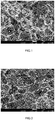
- a cross section of the separator layer in the separator-integrated electrode obtained in Comparative Example 1 was observed using a scanning electron microscope (SEM). This SEM photograph is shown in FIG. 1 .
- EVOH, nPA, GBL, an aqueous dispersion of polyethylene particles shown in Table 1 and, when necessary, water were added to a sample bottle such that the components were present at the quantities shown in Table 1.
- a coating liquid in which polyethylene particles were dispersed was obtained by heating the sample bottle to 70°C to 80°C and stirring until the EVOH completely dissolved in the solvents.
- Separator-integrated electrodes were obtained in the same way as in Example 1 using these coating liquids. However, temperature of the drying oven was set to 80°C when vaporizing the good solvent and the poor solvent in Examples 7 to 9.
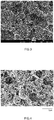
- FIGS. 2 to 4 a cross section of the separator layer in the separator-integrated electrodes in Examples 3, 4 and 7 were observed using a SEM. These SEM photographs are shown in FIGS. 2 to 4 . By comparing FIG. 1 with FIGS. 2 to 4 , It can be seen that polyethylene particles were incorporated in the porous skeleton of EVOH.
- the coating liquid was cooled to 25°C and coated on the negative electrode active substance layer of the negative electrode sheet by means of casting. At this time, the coating thickness was 100 ⁇ m to 200 ⁇ m.
- a separator-integrated electrode was obtained by placing this in a drying oven set to 100°C and vaporizing the good solvent and the poor solvent.
- a separator-integrated electrode was obtained using a similar method to that used in Example 10, except that the aqueous dispersion of polyethylene particles was not added and water was added at the quantity shown in Table 1.
- a case where the electrolyte solution did not permeate means that a skin layer was formed at the surface of the separator layer.
- a case where the electrolyte solution permeated rapidly means that the degree of porosification of the surface layer part of the separator layer was high, that is, formation of a skin layer was suppressed to a high degree.
- the separator-integrated electrodes obtained in the examples and comparative examples were placed in a drying oven set to a temperature of 140°C to 150°C and heated for approximately 10 minutes. After removing the separator-integrated electrodes from the drying oven, the separator layers were observed, and it was investigated whether or not pores had closed up.
- Example 1 PE type Average particle diameter PE particles EVOH Good solvent (water/nPA) Poor solvent (GBL) Skin layer evaluation Shutdown test Comparative Example 1 None - 0 1g 3.5 mL/1.5 mL 2.1 mL No permeation X
- Example 1 W300 3 ⁇ m 0.5 g 1 g 3.5 mL/1.5 mL 2.1 mL Slow permeation ⁇
- Example 2 W300 3 ⁇ m 1 g 1g 3.5 mL/1.5 mL 2.1 mL Slightly slow permeation ⁇
- Example 3 W300 3 ⁇ m 1.7 g 1g 3.5 mL/1.5 mL 2.1 mL Rapid permeation ⁇
- Example 4 W300 3 ⁇ m 2.3 g 1 g 3.5 mL/1.5 mL 2.1 mL Rapid permeation ⁇
- Example 5 W700 1 ⁇ m 1 g 1 g 3.5 mL/1.5 mL 2.1 mL Rapid permeation ⁇
- a separator-integrated electrode having a shutdown function can be easily produced using a water-insoluble polymer.
Landscapes
- Chemical & Material Sciences (AREA)
- Chemical Kinetics & Catalysis (AREA)
- Electrochemistry (AREA)
- General Chemical & Material Sciences (AREA)
- Engineering & Computer Science (AREA)
- Manufacturing & Machinery (AREA)
- Materials Engineering (AREA)
- Cell Separators (AREA)
- Secondary Cells (AREA)
- Battery Electrode And Active Subsutance (AREA)
Abstract
Provided is a method with which a separator-integrated electrode having a shutdown function can be easily produced using a water-insoluble polymer. The method for producing a separator-integrated electrode disclosed here includes the steps of: preparing a coating liquid in which a water-insoluble polymer is dissolved in a mixed solvent containing a good solvent for the water-insoluble polymer and a poor solvent for the water-insoluble polymer and in which polyethylene particles are dispersed; coating the coating liquid on an electrode; and vaporizing and removing the mixed solvent from the coating liquid coated on the electrode. A boiling point of the poor solvent is higher than a boiling point of the good solvent. A porous separator layer is formed by removing the mixed solvent through vaporization and thereby forming pores.
Description
- The present disclosure relates to a method for producing a separator-integrated electrode. This application claims priority on the basis of Japanese Patent Application No.
2020-047783 - Typically, secondary batteries such as lithium secondary batteries include an electrode body having a positive electrode, a negative electrode and a separator that insulates the positive electrode from the negative electrode. Porous bodies made of water-insoluble polymers are commonly used in separators so as to allow permeation of an electrolyte solution.
- Separators require a so-called shutdown function in addition to the function of insulating a positive electrode from a negative electrode. The shutdown function is a function whereby when the temperature of a battery rapidly increases as a result of a short circuit or the like, pores in the separator close up and ion permeation (in other words, current) is interrupted. In general, polyolefin porous films that have been monoaxially stretched or biaxially stretched are used as separators having a shutdown function (for example, see Japanese Patent Application Publication No.
2017-025294 - However, in a case where a polyolefin porous film is used in a separator, a procedure for stacking the separator on an electrode with high precision is required when producing an electrode body. Therefore, such a case has the drawback that production of an electrode body is not simple.
- Meanwhile, separator-integrated electrodes in which a separator layer is provided on an electrode are known. Such separator-integrated electrodes have the advantage of facilitating production of electrode bodies. However, there has been insufficient development of methods for producing separator-integrated electrodes having a shutdown function using simple methods.
- Hence, the object of the present disclosure is to provide a method with which a separator-integrated electrode having a shutdown function can be easily produced using a water-insoluble polymer.
- The method for producing a separator-integrated electrode disclosed here includes the steps of: preparing a coating liquid in which a water-insoluble polymer is dissolved in a mixed solvent containing a good solvent for the water-insoluble polymer and a poor solvent for the water-insoluble polymer and in which polyethylene particles are dispersed; coating the coating liquid on an electrode; and vaporizing and removing the mixed solvent from the coating liquid coated on the electrode. A boiling point of the poor solvent is higher than a boiling point of the good solvent. A porous separator layer is formed by removing the mixed solvent through vaporization and thereby forming pores.
- Provided by such a configuration is a method with which a separator-integrated electrode having a shutdown function can be easily produced using a water-insoluble polymer.
-
-
FIG. 1 is a SEM photograph of a cross section of a separator layer of a separator-integrated electrode obtained in Comparative Example 1; -
FIG. 2 is a SEM photograph of a cross section of a separator layer of a separator-integrated electrode obtained in Example 3; -
FIG. 3 is a SEM photograph of a cross section of a separator layer of a separator-integrated electrode obtained in Example 4; and -
FIG. 4 is a SEM photograph of a cross section of a separator layer of a separator-integrated electrode obtained in Example 7. - The method for producing a separator-integrated electrode of the present disclosure includes a step of preparing a coating liquid in which a water-insoluble polymer is dissolved in a mixed solvent containing a good solvent for the water-insoluble polymer and a poor solvent for the water-insoluble polymer and in which polyethylene particles are dispersed (hereinafter referred to as a "coating liquid preparation step"); a step of coating the coating liquid on an electrode (hereinafter referred to as a "coating liquid coating step"); and a step of vaporizing and removing the mixed solvent from the coating liquid coated on the electrode (hereinafter referred to as a "mixed solvent removal step"). Here, a boiling point of the poor solvent is higher than a boiling point of the good solvent. In the mixed solvent removal step, a porous separator layer is formed by removing the mixed solvent through vaporization and thereby forming pores.
- First, an explanation will be given of the coating liquid preparation step. In the present disclosure, the "good solvent for the water-insoluble polymer" is a solvent in which the solubility of the water-insoluble polymer at 25°C is 1 mass% or more. The solubility of the water-insoluble polymer in the good solvent at 25°C is desirably 2.5 mass% or more, more desirably 5 mass% or more, further desirably 7.5 mass% or more, and most desirably 10 mass% or more. It should be noted that the type of good solvent to be used in the present disclosure is selected, as appropriate, according to the type of water-insoluble polymer. It is possible to use a single good solvent in isolation or a mixed solvent obtained by mixing two or more types of good solvents.
- In the present disclosure, the "poor solvent for the water-insoluble polymer" is a solvent in which the solubility of the water-insoluble polymer at 25°C is less than 1 mass%. The solubility of the water-insoluble polymer in the poor solvent at 25°C is desirably 0.5 mass% or less, more desirably 0.2 mass% or less, further desirably 0.1 mass% or less, and most desirably 0.05 mass% or less. The type of poor solvent to be used in the present disclosure is selected, as appropriate, according to the type of water-insoluble polymer. It is possible to use a single poor solvent in isolation or a mixed solvent obtained by mixing two or more types of poor solvents.
- It is possible to use Hansen solubility parameters (HSP) in order to assess whether a specific solvent is a good solvent or a poor solvent for a specific polymer compound. For example, if the dispersion term, polarity term and hydrogen bonding term of the HSP of the polymer compound are denoted by δD1, δP1 and δH1 respectively and the dispersion term, polarity term and hydrogen bonding term of the HSP of the solvent are denoted by δD2, δP2 and δH2 respectively, the solubility of the polymer compound tends to increase as the distance Ra (MPa1/2) between the HSP of the polymer compound and that of the solvent, as represented by the formula below, decreases.

- In addition, if the interaction radius of the specific polymer compound is denoted by R0, it is predicted that the polymer compound will be soluble if the ratio Ra/R0 is less than 1, partially soluble if the ratio Ra/R0 is 1, and insoluble if the ratio Ra/R0 is greater than 1.
- Alternatively, it is possible to assess easily whether a specific solvent is a good solvent or a poor solvent for a specific polymer compound by carrying out a test involving mixing the polymer compound and the solvent in a sample bottle or the like.
- The good solvent and the poor solvent are mixed and used as a homogeneous solvent. Therefore, the good solvent and the poor solvent are compatible with each other. In the present disclosure, the boiling point of the poor solvent being used is higher than the boiling point of the good solvent being used. From the perspective of enabling a homogeneous porous body having a relatively high porosity to be obtained easily, the boiling point of the poor solvent is desirably at least 10°C higher, and more desirably at least 90°C higher, than the boiling point of the good solvent. From the perspective of drying speed, the boiling point of the poor solvent is desirably lower than 300°C.
- In the present disclosure, the term "water-insoluble polymer" means a polymer that has a solubility in water of less than 1 mass% at 25°C. The solubility of the water-insoluble polymer in water at 25°C is desirably 0.5 mass% or less, more desirably 0.2 mass% or less, and further desirably 0.1 mass% or less.
- The "water-insoluble polymer" used in the coating liquid preparation step is the same as the water-insoluble polymer that constitutes the separator layer. A polymer for which a good solvent and a poor solvent exist is used as the water-insoluble polymer. The type of water-insoluble polymer to be used is not particularly limited as long as a good solvent and a poor solvent for the polymer exist. Examples of water-insoluble polymers include olefin-based resins such as polyethylene and polypropylene; fluorine-based resins such as poly(vinyl fluoride), poly(vinylidene fluoride) and vinylidene fluoride-hexafluoropropylene copolymers; (meth)acrylic-based resins such as poly(methyl (meth)acrylate) and poly(ethyl (meth)acrylate); styrene-based resins such as polystyrene, styrene-acrylonitrile copolymers and acrylonitrile-butadiene-styrene copolymers; water-insoluble cellulose derivatives such as ethyl cellulose, cellulose acetate and cellulose propionate; vinyl chloride-based resins such as poly(vinyl chloride) and ethylene-vinyl chloride copolymers; and ethylene-vinyl alcohol copolymers. It is possible to use a polymer that has been rendered water-insoluble through modification of a water-soluble polymer. Of these, the water-insoluble polymer is desirably an aliphatic polymer compound (that is, a polymer compound having no aromatic ring) from the perspectives of usefulness of a porous body of the water-insoluble polymer and usefulness of a method for producing same. From the perspective of enabling a homogeneous porous body having a relatively high porosity to be obtained easily, the water-insoluble polymer is desirably an addition polymerization type polymer compound (that is, a polymer compound produced by polymerization of an ethylenically unsaturated double bond in a monomer having the ethylenically unsaturated double bond; for example, a vinyl-based polymer or vinylidene-based polymer). From the perspective of obtaining characteristics particularly suitable for a separator, the water-insoluble polymer is more desirably a vinylidene fluoride-hexafluoropropylene copolymer or an ethylene-vinyl alcohol copolymer, and is most desirably a vinylidene fluoride-hexafluoropropylene copolymer. A case where a separator-integrated electrode is formed using a vinylidene fluoride-hexafluoropropylene copolymer has advantages such as adhesion of a separator layer to an electrode being high, and a layering procedure and winding procedure for producing an electrode body being easy to implement.
- The average degree of polymerization of the water-insoluble polymer is not particularly limited, but is desirably not less than 70 and not more than 500,000, and more desirably not less than 100 and not more than 200,000. It should be noted that the average degree of polymerization of the water-insoluble polymer can be determined using a publicly known method (for example, NMR measurements) or the like.
- Suitable good solvents and suitable poor solvents will now be explained in more detail using specific water-insoluble polymers as examples. The production method of the present disclosure can be advantageously carried out by using the good solvents and poor solvents explained below with the water-insoluble polymers given below. Moreover, it is possible to use one of the good solvents listed below in isolation, or a combination of two or more types thereof. It is possible to use one of the poor solvents listed below in isolation, or a combination of two or more types thereof.
- A vinylidene fluoride-hexafluoropropylene copolymer (P(VDF-HFP)) is a copolymer that contains vinylidene fluoride units and hexafluoropropylene units as monomer units. The copolymerization ratio of these units is not particularly limited, and should be decided as appropriate in view of separator characteristics. Vinylidene fluoride-hexafluoropropylene copolymers can be obtained through synthesis in accordance with publicly known methods, and can also be obtained as commercially available products (for example, Kynar FLEX 2850-00, 2800-00, 2800-20, 2750-01, 2500-20, 3120-50, 2851-00, 2801-00, 2821-00, 2751-00 and 2501-00 produced by Arkema Group).
- Examples of suitable good solvents for the P(VDF-HFP) include ketones such as acetone and methyl ethyl ketone; cyclic ethers such as tetrahydrofuran; nitrogen-containing polar solvents (particularly, nitrogen-containing aprotic polar solvents) such as N,N-dimethylformamide, N,N-dimethylacetamide and N-methylpyrrolidone; and sulfur-containing polar solvents (particularly, sulfur-containing aprotic polar solvents) such as DMSO. From the perspective of ease of removal through vaporization, the good solvent is desirably acetone, methyl ethyl ketone or tetrahydrofuran, and more desirably acetone.
- Examples of suitable poor solvents for the P(VDF-HFP) include water and alcohols such as 1-hexanol, 1,3-butane diol, 1,4-butane diol, 1,5-pentane diol, 1,6-hexane diol and glycerin. From perspectives such as placing little burden on the environment, ease of procurement and ease of handling, water is desired as the poor solvent.
- An ethylene-vinyl alcohol copolymer (EVOH) is a copolymer containing ethylene units and vinyl alcohol units as monomer units. The content of ethylene units in the EVOH is not particularly limited, but is desirably 10 mol% or more, more desirably 15 mol% or more, further desirably 20 mol% or more, and particularly desirably 25 mol% or more. On the other hand, the content of ethylene units in the EVOH is desirably 60 mol% or less, more desirably 50 mol% or less, and further desirably 45 mol% or less. The degree of saponification of the EVOH is not particularly limited, but is desirably 80 mol% or more, more desirably 90 mol% or more, and further desirably 95 mol% or more. The upper limit for the degree of saponification is determined by technical limitations relating to saponification and is, for example, 99.99 mol%. It should be noted that the content of ethylene units and the degree of saponification in the EVOH can be determined using a publicly known method (for example, 1H-NMR measurements or the like).
- In addition, EVOHs are generally produced by saponifying copolymers of ethylene and vinyl esters using an alkali catalyst or the like. As a result, EVOHs can contain vinyl ester units. Vinyl esters in such units are typically vinyl acetate, and may also be vinyl formate, vinyl propionate, vinyl valerate, vinyl caprate, vinyl laurate, and the like. In addition to ethylene units, vinyl alcohol units and vinyl ester units, the EVOH may also contain other monomer units as long as the advantageous effect of the present disclosure is not significantly impaired.
- Examples of suitable good solvents for the EVOH include dimethyl sulfoxide (DMSO) and mixed solvents of water and alcohols. The alcohol used in the mixed solvent is desirably propyl alcohol. The propyl alcohol may be n-propyl alcohol or isopropyl alcohol. Therefore, a particularly suitable good solvent is DMSO or a mixed solvent of water and propyl alcohol.
- Examples of suitable poor solvents for the EVOH include water; alcohols; cyclic esters such as γ-butyrolactone; cyclic carbonates such as propylene carbonate; cyclic sulfones such as sulfolane; ether group-containing monools such as propylene glycol monomethyl ether, propylene glycol monoethyl ether, diethylene glycol monomethyl ether, diethylene glycol monoethyl ether and 2-ethoxyethanol; and diols such as 1,3-butane diol, 1,4-butane diol, 1,5-pentane diol and 1,6-hexane diol. Of these, cyclic esters, cyclic carbonates, cyclic sulfones and ether group-containing monools are desired, γ-butyrolactone, propylene carbonate, sulfolane and ether group-containing monools are more desired, and γ-butyrolactone and sulfolane are further desired. The solubility parameter (Hildebrand SP value) δ of the poor solvent is desirably at least 1.6 MPa1/2 higher than the solubility parameter δ of the EVOH.
- It should be noted that in the case of EVOH, water and alcohols are poor solvents for EVOH, but a mixed solvent of water and an alcohol (particularly, propyl alcohol) is a good solvent. Here, a mixed solvent of water and an alcohol can be regarded as a mixed solvent of a mixture of an alcohol and a reduced amount of water, which is a good solvent, with water, which is a poor solvent having a higher boiling point than this, and it is therefore possible to use only a mixed solvent of water and an alcohol in the preparation of an EVOH solution. Therefore, in the present disclosure, in cases where a solvent obtained by mixing two or more types of poor solvent for a specific water-insoluble polymer becomes a good solvent, it is possible to use only this mixed solvent containing two or more types of poor solvent as a mixed solvent containing a good solvent for the water-insoluble polymer and a poor solvent for the water-insoluble polymer in order to prepare a solution.
- Examples of suitable good solvents for cellulose acetate include nitrogen-containing polar solvents (particularly, nitrogen-containing aprotic polar solvents) such as N,N-dimethylformamide, N,N-dimethylacetamide and N-methylpyrrolidone; esters such as methyl formate and methyl acetate; ketones such as acetone and cyclohexanone; cyclic ethers such as tetrahydrofuran, dioxane and dioxolane; glycol derivatives such as methyl glycol and methyl glycol acetate; halogenated hydrocarbons such as methylene chloride, chloroform and tetrachloroethane; cyclic carbonates such as propylene carbonate; and sulfur-containing polar solvents (particularly, sulfur-containing aprotic polar solvents) such as DMSO. Of these, a sulfur-containing aprotic polar solvent is desired, and DMSO is more desired.
- Examples of suitable poor solvents for cellulose acetate include alcohols such as 1-hexanol, 1,3-butane diol, 1,4-butane diol, 1,5-pentane diol and 1,6-hexane diol. A monohydric or dihydric alcohol having 4 to 6 carbon atoms is desired as the alcohol.
- Examples of suitable good solvents for poly(vinylidene fluoride) include nitrogen-containing polar solvents (particularly, nitrogen-containing aprotic polar solvents) such as N,N-dimethylformamide, N,N-dimethylacetamide and N-methylpyrrolidone; and sulfur-containing polar solvents (particularly, sulfur-containing aprotic polar solvents) such as DMSO. Of these, a nitrogen-containing aprotic polar solvent is desired, and N,N-dimethylformamide is more desired.
- Examples of suitable poor solvents for poly(vinylidene fluoride) include alcohols such as 1-hexanol, 1,3-butane diol, 1,4-butane diol, 1,5-pentane diol, 1,6-hexane diol and glycerin; and cyclic ethers such as tetrahydrofuran, dioxane and dioxolane. A dihydric or trihydric alcohol having 3 to 6 carbon atoms is desired as the alcohol.
- The usage quantities of the water-insoluble polymer, the good solvent and the poor solvent may be selected, as appropriate, according to the types thereof being used. The mixing amount of the water-insoluble polymer is desirably 1 part by mass or more, more desirably 5 parts by mass or more, and further desirably 10 parts by mass or more, relative to 100 parts by mass of the good solvent. On the other hand, the mixing amount of the water-insoluble polymer is desirably 40 parts by mass or less, more desirably 35 parts by mass or less, and further desirably 30 parts by mass or less, relative to 100 parts by mass of the good solvent. The mixing amount of the poor solvent is desirably 3 parts by mass or more, more desirably 5 parts by mass or more, and further desirably 10 parts by mass or more, relative to 100 parts by mass of the good solvent. On the other hand, the mixing amount of the poor solvent is desirably 400 parts by mass or less, more desirably 200 parts by mass or less, and further desirably 100 parts by mass or less, relative to 100 parts by mass of the good solvent. By altering these amounts, it is possible to control the state of pores (for example, porosity, pore diameter, and the like) in an obtained porous body.
- The coating liquid contains polyethylene particles. The polyethylene particles are dispersed in the coating liquid without being dissolved in the mixed solvent. When the temperature of a battery rapidly increases as a result of a short circuit or the like, the polyethylene particles soften or melt, thereby enabling pores in the separator layer of the separator-integrated electrode to close up. Therefore, the polyethylene particles impart the separator-integrated electrode with a shutdown function. In addition, by forming the separator layer of the separator-integrated electrode from the coating liquid that contains polyethylene particles, it is possible to suppress formation of a pore-free layer (a so-called skin layer) at the surface of the separator layer. Polyethylene particles generally have a lower specific gravity than inorganic particles, and therefore exhibit a superior skin layer formation suppression effect than inorganic particles.
- It is known that polyethylene can have a variety of densities. The density of the polyethylene that constitutes the polyethylene particles used in the present disclosure is not particularly limited. Examples of this polyethylene include very low density polyethylene (VLDPE), low density polyethylene (LDPE), medium density polyethylene (M-DPE), high density polyethylene (HDPE) and linear low density polyethylene (LLDPE). It should be noted that for matters relating to classification of these types, see JIS K 6922-1:1997. From the perspective of handleability, the density of the polyethylene that constitutes the polyethylene particles used in the present disclosure is desirably 0.90 g/cm3 or more, more desirably 0.92 g/cm3 or more, and further desirably 0.95 g/cm3 or more. It should be noted that the upper limit of the density of the polyethylene depends on technical limitations, and may be 0.99 g/cm3 or less.
- It is known that polyethylene can have a variety of melting points and softening points. The melting point and softening point of the polyethylene that constitutes the polyethylene particles used in the present disclosure are not particularly limited, and may be selected as appropriate in view of the required shutdown temperature. The softening point of the polyethylene that constitutes the polyethylene particles used in the present disclosure is desirably not less than 110°C and not more than 140°C, and more desirably not less than 125°C and not more than 135°C. It should be noted that the softening point of the polyethylene can be measured using, for example, a ring and ball method in accordance with JIS K 2207:1996.
- The average particle diameter of the polyethylene particles is not particularly limited. From the perspective of achieving a high skin layer formation suppression effect, the average particle diameter of the polyethylene particles is desirably 0.5 µm or more, more desirably 1 µm or more, and further desirably 2 µm or more. On the other hand, from the perspective of ease of obtaining a state in which the polyethylene particles are homogeneously dispersed in the separator layer, the average particle diameter of the polyethylene particles is desirably 10 µm or less, more desirably 6 µm or less, and further desirably 5 µm or less. It should be noted that the average particle diameter of these polyethylene particles can be determined using a call counter method. In cases where the average particle diameter of the polyethylene particles is small (for example, a case where the average particle diameter is 1.5 µm or less), the average particle diameter thereof can be determined using a Microtrac method.
- The mixing amount of the polyethylene particles may be specified as appropriate in view of the porosity, average pore diameter, and the like, of a separator layer being produced so that a shutdown function can be exhibited. From the perspective of achieving a higher shutdown function, it is desirable for the mixing amount of the polyethylene particles to be high relative to the water-insoluble polymer. Therefore, the mixing amount of the polyethylene particles is desirably 50 parts by mass or more, more desirably 60 parts by mass or more, and further desirably 100 parts by mass or more, relative to 100 parts by mass of the water-insoluble polymer. On the other hand, from the perspectives of suppressing an increase in viscosity of the coating liquid and enabling uniform dispersion of the polyethylene particles, the mixing amount of the polyethylene particles is desirably low relative to the water-insoluble polymer. Therefore, the mixing amount of the polyethylene particles is desirably 500 parts by mass or less, more desirably 400 parts by mass or less, and further desirably 300 parts by mass or less, relative to 100 parts by mass of the water-insoluble polymer.
- In the coating liquid preparation step, the polyethylene particles may be in a solid form or in the form of a dispersion. In cases where a dispersion of polyethylene particles is used, the dispersion medium is desirably either of the good solvent for the water-insoluble polymer or the poor solvent for the water-insoluble polymer.
- In cases where a dispersion of polyethylene particles is used, the viscosity thereof is not particularly limited, but is desirably 10,000 mPa·s or less, more desirably 5000 mPa·s or less, and further desirably 3000 mPa·s or less. The viscosity of the dispersion of polyethylene particles can be determined by, for example, measuring the viscosity using a B type viscometer at a temperature of 25°C and a speed of rotation of 6 rpm.
- In addition to the water-insoluble polymer, the mixed solvent and the polyethylene particles, the coating liquid may further contain other components as long as the advantageous effect of the present disclosure is not significantly impaired.
- The method for preparing the coating liquid is not particularly limited. In a desired method for preparing the coating liquid, a solution is first prepared by dissolving the water-insoluble polymer in a mixed solvent of a good solvent and a poor solvent using a publicly known method. When preparing this solution, it is possible to dissolve the water-insoluble polymer in the good solvent, add the poor solvent thereto, and then homogeneously mix them. It is also possible to add the water-insoluble polymer to the mixed solvent of the good solvent and the poor solvent so as to dissolve the water-insoluble polymer. This solution can be prepared using a publicly known stirring device, mixing device, or the like. When preparing this solution, it is possible to irradiate with ultrasonic waves, carry out heating, or the like. The heating temperature is, for example, not less than 40°C and not more than 100°C. It is possible to prepare the solution of the water-insoluble polymer by heating, and then cool the solution in such a way that the good solvent and the poor solvent do not separate. In addition, this cooling is desirably carried out so that the water-insoluble polymer does not precipitate. This is because precipitated water-insoluble polymer can be an impurity.
- Next, a coating liquid is prepared by dispersing the polyethylene particles in the solvent using a publicly known method. More specifically, the coating liquid can be prepared by mixing the polyethylene particles and the solution of the water-insoluble polymer, and dispersing the polyethylene particles in the solution of the water-insoluble polymer, with a publicly known mixing apparatus (for example, a homogenizer, a homodisper, a planetary mixer, an ultrasonic disperser, a pigment disperser or a ball mill).
- In cases where the polyethylene particles are used in the form of a dispersion, the coating liquid may be prepared by mixing the water-insoluble polymer, the good solvent, the poor solvent and the dispersion of polyethylene particles, and stirring until the water-insoluble polymer dissolves.
- Next, an explanation will now be given of the coating liquid coating step. Electrodes of publicly known batteries can be used without limitation as the electrode used in the coating liquid coating step.
- As one example, an explanation will now be given of a case in which the electrode is an electrode of a lithium secondary battery. Typically, electrodes of lithium secondary batteries include a sheet-shaped current collector and an active substance layer provided on the current collector.
- In a case where the electrode is a positive electrode, the positive electrode typically includes a sheet-shaped positive electrode current collector and a positive electrode active substance layer provided on the positive electrode current collector. The positive electrode active substance layer is provided on one surface or both surfaces of the positive electrode current collector, and desirably on both surfaces of the positive electrode current collector.
- For example, an aluminum foil or the like can be used as the positive electrode current collector.
- The positive electrode active substance layer contains a positive electrode active substance. Lithium-transition metal oxides (for example, LiNi1/3Co1/3Mn1/3O2, LiNiO2, LiCoO2, LiFeO2, LiMn2O4, LiNi0.5Mn1.5O4, and the like) and lithium-transition metal phosphate compounds (for example, LiFePO4 and the like) can be given as examples of the positive electrode active substance.
- The positive electrode active substance layer can contain components other than the active substance, such as an electrically conductive material or a binder.
- Carbon black such as acetylene black (AB) and other carbon materials (for example, graphite or the like) can be advantageously used as an electrically conductive material.
- For example, poly(vinylidene fluoride) (PVdF) or the like can be used as a binder.
- In a case where the electrode is a negative electrode, the negative electrode typically includes a sheet-shaped negative electrode current collector and a negative electrode active substance layer provided on the negative electrode current collector. The negative electrode active substance layer is provided on one surface or both surfaces of the negative electrode current collector, and desirably on both surfaces of the negative electrode current collector.
- For example, a copper foil or the like can be used as the negative electrode current collector.
- The negative electrode active substance layer contains a negative electrode active substance. For example, a carbon material such as graphite, hard carbon or soft carbon can be used as the negative electrode active substance. The graphite can be natural graphite or artificial graphite, and may be amorphous carbon-coated graphite in a form whereby graphite is coated with an amorphous carbon material.
- The negative electrode active substance layer can contain components other than the active substance, such as a binder or a thickening agent.
- For example, a styrene-butadiene rubber (SBR) or the like can be used as a binder.
- For example, carboxymethyl cellulose (CMC) or the like can be used as a thickening agent.
- The electrode may be a positive electrode or a negative electrode. Because the negative electrode active substance layer has a larger area than the positive electrode active substance layer in the lithium secondary battery, it is desirable to provide the separator layer on the negative electrode active substance layer. Therefore, the electrode used in the coating liquid coating step is desirably a negative electrode.
- In the coating liquid coating step, the thus prepared coating liquid is coated on an electrode. In the case of the lithium secondary battery electrode explained above, the coating liquid is coated on an active substance layer of the electrode.
- The coating method is not particularly limited. The coating liquid can be coated using a publicly known coating apparatus, such as a die coater, a slit coater, a comma coater, a gravure coater or a bar coater.
- The coating amount should be decided as appropriate in view of the desired thickness of the separator layer and the solid content concentration in the coating liquid.
- It should be noted that the coating liquid coated in the coating liquid coating step is a solution of the water-insoluble polymer, and phase separation does not occur in the coating liquid. Therefore, the turbidity of a measurement solution obtained by removing the polyethylene particles from the coating liquid is generally 50 NTU or less, as measured using a nephelometer.
- Next, an explanation will be given of the mixed solvent removal step. In the mixed solvent removal step, the good solvent and the poor solvent are removed by vaporization (particularly, volatilization). A porous skeleton of the water-insoluble polymer is formed in this mixed solvent removal step. The polyethylene particles are incorporated in the porous skeleton of the water-insoluble polymer. In this mixed solvent removal step, a porous separator layer is formed through formation of pores as a result of the procedure for removing the mixed solvent, and more specifically as a result of vaporization of the poor solvent. Typically, pores are formed by, for example, phase separation between the water-insoluble polymer and the mixed solvent in which the poor solvent has become highly concentrated. Specifically, because the poor solvent has a higher boiling point than the good solvent, the good solvent is preferentially vaporized ahead of the poor solvent in this step. As the amount of good solvent decreases, the concentration of the poor solvent in the mixed solvent increases. Because the solubility of the water-insoluble polymer in the poor solvent is lower than in the good solvent, phase separation occurs between the water-insoluble polymer and the mixed solvent in which the poor solvent has become highly concentrated, and a porous skeleton of the water-insoluble polymer is formed. This phase separation may be spinodal decomposition. Finally, the good solvent is removed, the water-insoluble polymer is precipitated, the high boiling point poor solvent is removed through vaporization, and pores are produced. Formed in this way is a separator layer which is a porous body of the water-insoluble polymer and in which polyethylene particles are incorporated. It should be noted that the type and usage quantity of the good solvent and the type and usage quantity of the poor solvent may be appropriately selected in order to cause phase separation between the water-insoluble polymer and the mixed solvent in which the poor solvent has become highly concentrated.
- Examples of methods for vaporizing the mixed solvent of the good solvent and the poor solvent include methods involving heating, methods involving leaving in a vacuum, methods involving heating under reduced pressure and methods involving air drying. These methods can be carried out in the same way as publicly known drying methods. From the perspective of ease of carrying out the procedure, a method involving heating is desired. The heating temperature is not particularly limited, and may be decided, as appropriate, according to the type of solvent and the heating time. The heating temperature is desirably a temperature at which the mixed solvent does not boil, the polyethylene particles do not soften and the water-insoluble polymer and the poor solvent do not decompose. The heating temperature is, for example, 25°C or higher, desirably 30°C or higher, more desirably 50°C or higher, and further desirably 70°C or higher. On the other hand, the heating temperature is, for example, a temperature that is at least 10°C lower than the softening point of the polyethylene particles and more specifically is, for example, lower than 110°C, desirably 100°C or lower, and more desirably 90°C or lower. In cases where a highly volatile solvent is used, the heating temperature may be approximately not less than 30°C and not more than 60°C. The heating time may be decided, as appropriate, according to the type of solvent and the heating temperature. It is desirable for the electrode on which the coating liquid has been coated to remain still while the good solvent and the poor solvent are vaporized.
- A separator-integrated electrode can be obtained in the manner described above. The separator layer has a three dimensional network-like porous structure in which pores are connected from one main surface of the separator layer to the opposing main surface. In the present disclosure, the porosity of the formed separator layer increases because the coating liquid contains polyethylene particles. This is thought to be because polyethylene particles act as phase separation nuclei, thereby facilitating phase separation. According to the production method of the present disclosure, it is possible to obtain a separator-integrated electrode in which the porosity of a separator layer is, for example, 40% or more (particularly, 50% or more, 60% or more or even 70% or more) and 90% or less (particularly, less than 85%). It should be noted that the porosity can be calculated in accordance with a publicly known method using the true density and the apparent density.
- In the present disclosure, procedures for carrying out the coating liquid preparation step, the coating liquid coating step and the mixed solvent removal step are very simple. Therefore, it can be understood that according to the present disclosure, a separator-integrated electrode having a shutdown function can be easily produced using a water-insoluble polymer.
- A separator-integrated electrode produced in the manner described above can be used in a variety of batteries according to publicly known methods.
- A lithium secondary battery is desired as a battery, and such lithium secondary batteries can be advantageously used as portable power sources for personal computers, handheld devices, and the like, and as motive power sources for vehicles such as electric vehicles (EV), hybrid vehicles (HV) and plug-in hybrid vehicles (PHV).
- Explanations will now be given of examples relating to the present disclosure, but it is not intended that the present disclosure is limited to these examples.
- An ethylene-vinyl alcohol copolymer ("Eval L171B" produced by Kuraray Co., Ltd.; ethylene content: 27 mol%; hereinafter abbreviated to "EVOH") was used as the water-insoluble polymer, a mixed solvent of water and n-propyl alcohol (nPA) was used as the good solvent, and γ-butyrolactone (GBL) was used as the poor solvent.
- The EVOH, water, nPA, GBL and an aqueous dispersion of polyethylene particles ("Chemipearl W300" produced by Mitsui Chemicals, Inc.) were added to a sample bottle such that the components were present at the quantities shown in Table 1. A coating liquid in which polyethylene particles were dispersed was obtained by heating the sample bottle to 70°C to 80°C and stirring until the EVOH completely dissolved in the solvents.
- A negative electrode paste was prepared by mixing graphite (C) ("SMG-TH5" produced by Hitachi Chemical Co., Ltd.) as a negative electrode active substance, a styrene butadiene rubber (SBR) ("TRD 104B" produced by JSR Corporation) as a binder and carboxymethyl cellulose (CMC) ("MAC800LC" produced by Nippon Paper Industries Co., Ltd.) as a thickening agent with ion exchanged water at quantities whereby the C:SBR:CMC mass ratio was 98:1:1. This negative electrode paste was coated in a band-like shape on both surfaces of a long strip-shaped copper foil, dried, and then pressed. A negative electrode sheet having a negative electrode active substance layer formed on a copper foil was obtained in this way. The thickness of the negative electrode active substance layer on each surface was 66 µm, and the coating weight on each surface was 3.30 mg/cm2.
- The coating liquid was cooled to 25°C and coated on the negative electrode active substance layer of the negative electrode sheet by means of casting. At this time, the coating thickness was 100 µm to 200 µm.
- A separator-integrated electrode was obtained by placing this in a drying oven set to 100°C and vaporizing the good solvent and the poor solvent.
- A separator-integrated electrode was obtained using a similar method to that used in Example 1, except that the aqueous dispersion of polyethylene particles was not added and the added quantity of water was increased so that the water/nPA ratio was 3.5 mL/1.5 mL.
- A cross section of the separator layer in the separator-integrated electrode obtained in Comparative Example 1 was observed using a scanning electron microscope (SEM). This SEM photograph is shown in
FIG. 1 . - EVOH, nPA, GBL, an aqueous dispersion of polyethylene particles shown in Table 1 and, when necessary, water were added to a sample bottle such that the components were present at the quantities shown in Table 1. A coating liquid in which polyethylene particles were dispersed was obtained by heating the sample bottle to 70°C to 80°C and stirring until the EVOH completely dissolved in the solvents.
- Separator-integrated electrodes were obtained in the same way as in Example 1 using these coating liquids. However, temperature of the drying oven was set to 80°C when vaporizing the good solvent and the poor solvent in Examples 7 to 9.
- In addition, a cross section of the separator layer in the separator-integrated electrodes in Examples 3, 4 and 7 were observed using a SEM. These SEM photographs are shown in
FIGS. 2 to 4 . By comparingFIG. 1 withFIGS. 2 to 4 , It can be seen that polyethylene particles were incorporated in the porous skeleton of EVOH. - A vinylidene fluoride-hexafluoropropylene copolymer ("Kynar-FLEX 2821-00" produced by Arkema Group; grade: powder type; hereinafter abbreviated to "P(VDF-HFP)") was used as the water-insoluble polymer, acetone was used as the good solvent, and water was used as the poor solvent.
- The P(VDF-HFP), acetone and an aqueous dispersion of polyethylene particles ("Chemipearl W300" produced by Mitsui Chemicals, Inc.) were added to a sample bottle such that the components were present at the quantities shown in Table 1. A coating liquid in which polyethylene particles were dispersed was obtained by heating the sample bottle to 40°C to 50°C and stirring until the P(VDF-HFP) completely dissolved in the solvents.
- A negative electrode sheet was obtained in the same way as in Example 1.
- The coating liquid was cooled to 25°C and coated on the negative electrode active substance layer of the negative electrode sheet by means of casting. At this time, the coating thickness was 100 µm to 200 µm.
- A separator-integrated electrode was obtained by placing this in a drying oven set to 100°C and vaporizing the good solvent and the poor solvent.
- A separator-integrated electrode was obtained using a similar method to that used in Example 10, except that the aqueous dispersion of polyethylene particles was not added and water was added at the quantity shown in Table 1.
- An electrolyte solution was added dropwise to the surface of each of the separator-integrated electrodes obtained in the examples and comparative examples, and the speed with which the electrolyte solution permeated into the separator layer was evaluated visually. It should be noted that a non-aqueous electrolyte solution obtained by dissolving LiPF6 at a concentration of 1.0 mol/L in a mixed solvent containing dimethyl carbonate (DMC), ethylene carbonate (EC) and ethyl methyl carbonate (EMC) at a volume ratio of 1:1:1 was used as the non-aqueous electrolyte solution. The results are shown in Table 1. It should be noted that a case where the electrolyte solution did not permeate means that a skin layer was formed at the surface of the separator layer. In addition, a case where the electrolyte solution permeated rapidly means that the degree of porosification of the surface layer part of the separator layer was high, that is, formation of a skin layer was suppressed to a high degree.
- The separator-integrated electrodes obtained in the examples and comparative examples were placed in a drying oven set to a temperature of 140°C to 150°C and heated for approximately 10 minutes. After removing the separator-integrated electrodes from the drying oven, the separator layers were observed, and it was investigated whether or not pores had closed up.
- A case where pores closed up across the entire surface of the separator layer was evaluated as "O", a case where pores closed up in a part of the separator layer was evaluated as "Δ", and a case where pores did not close up in the separator layer was evaluated as "X". The results are shown in Table 1.
-
Table 1 PE type Average particle diameter PE particles EVOH Good solvent (water/nPA) Poor solvent (GBL) Skin layer evaluation Shutdown test Comparative Example 1 None - 0 1g 3.5 mL/1.5 mL 2.1 mL No permeation X Example 1 W300 3 µm 0.5 g 1 g 3.5 mL/1.5 mL 2.1 mL Slow permeation Δ Example 2 W300 3 µm 1 g 1g 3.5 mL/1.5 mL 2.1 mL Slightly slow permeation ○ Example 3 W300 3 µm 1.7 g 1g 3.5 mL/1.5 mL 2.1 mL Rapid permeation ○ Example 4 W300 3 µm 2.3 g 1 g 3.5 mL/1.5 mL 2.1 mL Rapid permeation ○ Example 5 W700 1 µm 1 g 1 g 3.5 mL/1.5 mL 2.1 mL Rapid permeation ○ Example 6 W700 1 µm 2.3 g 1 g 3.5 mL/1.5 mL 2.1 mL Rapid permeation ○ Example 7 M200 6 µm 1.9 g 1g 3.5 mL/1.5 mL 2.1 mL Rapid permeation ○ Example 8 A100 4 µm 1.7 g 1g 3.5 mL/1.5 mL 2.1 mL Rapid permeation ○ Example 9 A400 4 µm 1.7 g 1g 3.5 mL/1.5 mL 2.1 mL Rapid permeation ○ PE type Average particle diameter PE particles P(VDF -HFP) Good solvent (acetone) Poor solvent (water) Comparative Example 2 None - 0 2 g 12.5 mL 1.5 mL Rapid permeation X Example 10 W300 3 µm 1 g 1.5 g 12.5 mL 1.5 mL Rapid permeation ○ W300: "Chemipearl W300" produced by Mitsui Chemicals, Inc., average particle diameter: 3 µm, solid content concentration: 40 mass%, viscosity (B type viscometer): 1000 mPa·s, polyethylene density: 0.97 g/cm3, softening point (ring and ball method): 132°C
W700: "Chemipearl W700" produced by Mitsui Chemicals, Inc., average particle diameter: 1 µm, solid content concentration: 40 mass%, viscosity (B type viscometer): 800 mPa·s, polyethylene density: 0.97 g/cm3, softening point (ring and ball method): 132°C
M200: "Chemipearl M200" produced by Mitsui Chemicals, Inc., average particle diameter: 6 µm, solid content concentration: 40 mass%, viscosity (B type viscometer): 5000 mPa·s, polyethylene density: 0.92 g/cm3
A100: "Chemipearl A100" produced by Mitsui Chemicals, Inc., average particle diameter: 4 µm, solid content concentration: 40 mass%, viscosity (B type viscometer): 5000 mPa·s, polyethylene density: 0.89 g/cm3
A400: "Chemipearl A400" produced by Mitsui Chemicals, Inc., average particle diameter: 4 µm, solid content concentration: 40 mass%, viscosity (B type viscometer): 8000 mPa·s, polyethylene density: 0.885 g/cm3 - From the results above, it can be understood that according to the present disclosure, a separator-integrated electrode having a shutdown function can be easily produced using a water-insoluble polymer.
Claims (3)
- A method for producing a separator-integrated electrode, the method comprising the steps of:preparing a coating liquid in which a water-insoluble polymer is dissolved in a mixed solvent containing a good solvent for the water-insoluble polymer and a poor solvent for the water-insoluble polymer and in which polyethylene particles are dispersed;coating the coating liquid on an electrode; andvaporizing and removing the mixed solvent from the coating liquid coated on the electrode,whereina boiling point of the poor solvent is higher than a boiling point of the good solvent, anda porous separator layer is formed by removing the mixed solvent through vaporization and thereby forming pores.
- The method for producing a separator-integrated electrode according to claim 1, wherein the average particle diameter of the polyethylene particles is not less than 1 µm and not more than 6 µm.
- The method for producing a separator-integrated electrode according to claim 1 or claim 2, wherein the water-insoluble polymer is an ethylene-vinyl alcohol copolymer or a vinylidene fluoride-hexafluoropropylene copolymer.
Applications Claiming Priority (1)
| Application Number | Priority Date | Filing Date | Title |
|---|---|---|---|
| JP2020047783A JP7276691B2 (en) | 2020-03-18 | 2020-03-18 | Separator-integrated electrode manufacturing method |
Publications (1)
| Publication Number | Publication Date |
|---|---|
| EP3883018A1 true EP3883018A1 (en) | 2021-09-22 |
Family
ID=74797756
Family Applications (1)
| Application Number | Title | Priority Date | Filing Date |
|---|---|---|---|
| EP21159493.2A Withdrawn EP3883018A1 (en) | 2020-03-18 | 2021-02-26 | Method for producing separator-integrated electrode |
Country Status (5)
| Country | Link |
|---|---|
| US (1) | US11652259B2 (en) |
| EP (1) | EP3883018A1 (en) |
| JP (1) | JP7276691B2 (en) |
| KR (1) | KR102527828B1 (en) |
| CN (1) | CN113497221A (en) |
Families Citing this family (2)
| Publication number | Priority date | Publication date | Assignee | Title |
|---|---|---|---|---|
| JP7281086B2 (en) | 2019-10-09 | 2023-05-25 | トヨタ自動車株式会社 | Method for manufacturing porous body |
| CN117693823A (en) | 2021-09-15 | 2024-03-12 | 住友电气工业株式会社 | silicon carbide semiconductor devices |
Citations (4)
| Publication number | Priority date | Publication date | Assignee | Title |
|---|---|---|---|---|
| US20130244116A1 (en) * | 2012-03-13 | 2013-09-19 | Hitachi, Ltd. | Electrode for non-aqueous electrolyte secondary battery, non-aqueous electrolyte secondary battery, and method for manufacturing the same |
| US20150263325A1 (en) * | 2012-11-30 | 2015-09-17 | Teijin Limited | Separator for non-aqueous secondary battery and non-aqueous secondary battery |
| JP2017025294A (en) | 2015-06-19 | 2017-02-02 | 宇部興産株式会社 | Polyolefin microporous membrane, separator film for electricity storage device, and electricity storage device |
| JP2020047783A (en) | 2018-09-19 | 2020-03-26 | 株式会社東芝 | Semiconductor light emitting device manufacturing method and semiconductor light emitting device |
Family Cites Families (14)
| Publication number | Priority date | Publication date | Assignee | Title |
|---|---|---|---|---|
| JPH10116630A (en) * | 1996-10-15 | 1998-05-06 | Toray Ind Inc | Non-aqueous electrolyte secondary battery |
| US6464351B1 (en) * | 2000-07-27 | 2002-10-15 | Eastman Kodak Company | Ink jet printing method |
| JP2004111157A (en) * | 2002-09-17 | 2004-04-08 | Matsushita Electric Ind Co Ltd | Secondary battery and method of manufacturing the same |
| US20050208383A1 (en) * | 2004-03-19 | 2005-09-22 | Hiroki Totsuka | Electronic component separator and method for producing the same |
| JP4812266B2 (en) * | 2004-07-01 | 2011-11-09 | 株式会社巴川製紙所 | Separator for electronic parts and method for manufacturing the same |
| JP2006179205A (en) * | 2004-12-21 | 2006-07-06 | Hitachi Maxell Ltd | Non-aqueous electrolyte battery |
| JP2006331759A (en) * | 2005-05-25 | 2006-12-07 | Tomoegawa Paper Co Ltd | Separator for electronic parts and method for manufacturing the same |
| CN104823307B (en) * | 2013-01-07 | 2018-05-04 | 尤尼吉可株式会社 | Electrode for lithium secondary battery and manufacturing method thereof |
| JP6284818B2 (en) * | 2014-04-24 | 2018-02-28 | 株式会社ダイセル | Porous membrane laminate having micropores and handling strength and method for producing the same |
| KR101670802B1 (en) | 2014-12-01 | 2016-10-31 | 에스케이씨 주식회사 | Porous membrane for secondary battery |
| WO2016204274A1 (en) | 2015-06-19 | 2016-12-22 | 宇部興産株式会社 | Polyolefin micro porous film, separator film for power-storage device, and power-storage device |
| CN106299209A (en) | 2016-10-19 | 2017-01-04 | 电子科技大学 | Lithium ion battery separator and preparation method thereof, lithium ion battery |
| JP6992701B2 (en) * | 2018-08-06 | 2022-01-13 | トヨタ自動車株式会社 | Manufacturing method of separator integrated electrode and separator integrated electrode |
| KR102425513B1 (en) * | 2019-05-03 | 2022-07-25 | 삼성에스디아이 주식회사 | Lithium secondary battery |
-
2020
- 2020-03-18 JP JP2020047783A patent/JP7276691B2/en active Active
-
2021
- 2021-02-23 US US17/182,735 patent/US11652259B2/en active Active
- 2021-02-26 EP EP21159493.2A patent/EP3883018A1/en not_active Withdrawn
- 2021-03-12 CN CN202110269585.7A patent/CN113497221A/en active Pending
- 2021-03-17 KR KR1020210034883A patent/KR102527828B1/en active Active
Patent Citations (4)
| Publication number | Priority date | Publication date | Assignee | Title |
|---|---|---|---|---|
| US20130244116A1 (en) * | 2012-03-13 | 2013-09-19 | Hitachi, Ltd. | Electrode for non-aqueous electrolyte secondary battery, non-aqueous electrolyte secondary battery, and method for manufacturing the same |
| US20150263325A1 (en) * | 2012-11-30 | 2015-09-17 | Teijin Limited | Separator for non-aqueous secondary battery and non-aqueous secondary battery |
| JP2017025294A (en) | 2015-06-19 | 2017-02-02 | 宇部興産株式会社 | Polyolefin microporous membrane, separator film for electricity storage device, and electricity storage device |
| JP2020047783A (en) | 2018-09-19 | 2020-03-26 | 株式会社東芝 | Semiconductor light emitting device manufacturing method and semiconductor light emitting device |
Also Published As
| Publication number | Publication date |
|---|---|
| US11652259B2 (en) | 2023-05-16 |
| CN113497221A (en) | 2021-10-12 |
| JP7276691B2 (en) | 2023-05-18 |
| US20210296730A1 (en) | 2021-09-23 |
| JP2021150121A (en) | 2021-09-27 |
| KR20210117202A (en) | 2021-09-28 |
| KR102527828B1 (en) | 2023-05-03 |
Similar Documents
| Publication | Publication Date | Title |
|---|---|---|
| CN112042016B (en) | Lithium cobalt oxide secondary battery containing fluorinated electrolyte and positive electrode material for high voltage applications | |
| JP6341151B2 (en) | Electrode sheet manufacturing method | |
| EP3876340A1 (en) | Method for producing separator-integrated electrode | |
| WO2011004447A1 (en) | Method for producing battery electrode | |
| CN103181018B (en) | Method for producing lithium ion secondary battery | |
| EP3079190A1 (en) | Binder for electrochemical cells, paste for electrochemical cells, and method for producing electrode for electrochemical cells | |
| US11652259B2 (en) | Method for producing separator-integrated electrode | |
| JP2012138217A (en) | Battery manufacturing method | |
| JP7483911B2 (en) | Separator, secondary battery and power consuming device | |
| KR101770869B1 (en) | Positive electrode material slurry for a lithium secondary battery comprising at least two conductive material and lithium secondary battery using the same | |
| US11804619B2 (en) | Solid polymer electrolyte including solvating polymer, lithium salt, and PVdF-HFP copolymer and battery including same | |
| EP3985054B1 (en) | Production method of resin porous material | |
| EP4318705A1 (en) | Positive electrode sheet used for secondary battery, and secondary battery | |
| JP2002280077A (en) | Method of producing sheet lithium secondary battery and sheet lithium secondary battery obtained by using the same | |
| JP2014143064A (en) | Secondary battery and method for manufacturing the same | |
| CN116525758B (en) | Secondary batteries and their preparation methods | |
| CN115838521B (en) | Hollow fiber composite and manufacturing method thereof, pole piece, battery, battery module, battery pack and device | |
| EP2720297A1 (en) | Method for manufacturing separator for non-aqueous electrolyte accumulator and method for manufacturing non-aqueous electrolyte accumulator | |
| JP7249990B2 (en) | Method for manufacturing electrode, method for manufacturing non-aqueous electrolyte secondary battery, and non-aqueous electrolyte secondary battery | |
| JP2025508143A (en) | Composite oil-based separator, its manufacturing method, and secondary battery | |
| KR20060050195A (en) | Manufacturing method of positive electrode composite paint for lithium secondary battery and positive electrode for lithium secondary battery | |
| JP2018159059A (en) | Carbon material / resin composite material | |
| EP2720294A1 (en) | Separator for non-aqueous electrolyte accumulators, non-aqueous electrolyte accumulator and manufacturing methods therefor | |
| JP6895081B2 (en) | Manufacturing method of non-aqueous electrolyte secondary battery | |
| WO2019176698A1 (en) | Separator for nonaqueous electrolytic battery and production method therefor |
Legal Events
| Date | Code | Title | Description |
|---|---|---|---|
| PUAI | Public reference made under article 153(3) epc to a published international application that has entered the european phase |
Free format text: ORIGINAL CODE: 0009012 |
|
| STAA | Information on the status of an ep patent application or granted ep patent |
Free format text: STATUS: REQUEST FOR EXAMINATION WAS MADE |
|
| 17P | Request for examination filed |
Effective date: 20210226 |
|
| AK | Designated contracting states |
Kind code of ref document: A1 Designated state(s): AL AT BE BG CH CY CZ DE DK EE ES FI FR GB GR HR HU IE IS IT LI LT LU LV MC MK MT NL NO PL PT RO RS SE SI SK SM TR |
|
| STAA | Information on the status of an ep patent application or granted ep patent |
Free format text: STATUS: THE APPLICATION HAS BEEN WITHDRAWN |
|
| 18W | Application withdrawn |
Effective date: 20240325 |