EP3882816A1 - Semantic-based method and apparatus for retrieving perspective image - Google Patents
Semantic-based method and apparatus for retrieving perspective image Download PDFInfo
- Publication number
- EP3882816A1 EP3882816A1 EP21162895.3A EP21162895A EP3882816A1 EP 3882816 A1 EP3882816 A1 EP 3882816A1 EP 21162895 A EP21162895 A EP 21162895A EP 3882816 A1 EP3882816 A1 EP 3882816A1
- Authority
- EP
- European Patent Office
- Prior art keywords
- semantic
- image
- feature
- semantic region
- perspective image
- Prior art date
- Legal status (The legal status is an assumption and is not a legal conclusion. Google has not performed a legal analysis and makes no representation as to the accuracy of the status listed.)
- Granted
Links
Images




Classifications
-
- G—PHYSICS
- G06—COMPUTING OR CALCULATING; COUNTING
- G06F—ELECTRIC DIGITAL DATA PROCESSING
- G06F16/00—Information retrieval; Database structures therefor; File system structures therefor
- G06F16/50—Information retrieval; Database structures therefor; File system structures therefor of still image data
- G06F16/53—Querying
- G06F16/535—Filtering based on additional data, e.g. user or group profiles
-
- G—PHYSICS
- G06—COMPUTING OR CALCULATING; COUNTING
- G06V—IMAGE OR VIDEO RECOGNITION OR UNDERSTANDING
- G06V20/00—Scenes; Scene-specific elements
- G06V20/50—Context or environment of the image
- G06V20/52—Surveillance or monitoring of activities, e.g. for recognising suspicious objects
-
- G—PHYSICS
- G06—COMPUTING OR CALCULATING; COUNTING
- G06F—ELECTRIC DIGITAL DATA PROCESSING
- G06F16/00—Information retrieval; Database structures therefor; File system structures therefor
- G06F16/50—Information retrieval; Database structures therefor; File system structures therefor of still image data
- G06F16/55—Clustering; Classification
-
- G—PHYSICS
- G06—COMPUTING OR CALCULATING; COUNTING
- G06F—ELECTRIC DIGITAL DATA PROCESSING
- G06F16/00—Information retrieval; Database structures therefor; File system structures therefor
- G06F16/50—Information retrieval; Database structures therefor; File system structures therefor of still image data
- G06F16/58—Retrieval characterised by using metadata, e.g. metadata not derived from the content or metadata generated manually
- G06F16/583—Retrieval characterised by using metadata, e.g. metadata not derived from the content or metadata generated manually using metadata automatically derived from the content
-
- G—PHYSICS
- G06—COMPUTING OR CALCULATING; COUNTING
- G06F—ELECTRIC DIGITAL DATA PROCESSING
- G06F18/00—Pattern recognition
- G06F18/20—Analysing
- G06F18/22—Matching criteria, e.g. proximity measures
-
- G—PHYSICS
- G06—COMPUTING OR CALCULATING; COUNTING
- G06V—IMAGE OR VIDEO RECOGNITION OR UNDERSTANDING
- G06V10/00—Arrangements for image or video recognition or understanding
- G06V10/20—Image preprocessing
- G06V10/255—Detecting or recognising potential candidate objects based on visual cues, e.g. shapes
-
- G—PHYSICS
- G06—COMPUTING OR CALCULATING; COUNTING
- G06V—IMAGE OR VIDEO RECOGNITION OR UNDERSTANDING
- G06V10/00—Arrangements for image or video recognition or understanding
- G06V10/70—Arrangements for image or video recognition or understanding using pattern recognition or machine learning
- G06V10/74—Image or video pattern matching; Proximity measures in feature spaces
- G06V10/75—Organisation of the matching processes, e.g. simultaneous or sequential comparisons of image or video features; Coarse-fine approaches, e.g. multi-scale approaches; using context analysis; Selection of dictionaries
-
- G—PHYSICS
- G06—COMPUTING OR CALCULATING; COUNTING
- G06V—IMAGE OR VIDEO RECOGNITION OR UNDERSTANDING
- G06V10/00—Arrangements for image or video recognition or understanding
- G06V10/70—Arrangements for image or video recognition or understanding using pattern recognition or machine learning
- G06V10/764—Arrangements for image or video recognition or understanding using pattern recognition or machine learning using classification, e.g. of video objects
-
- G—PHYSICS
- G06—COMPUTING OR CALCULATING; COUNTING
- G06V—IMAGE OR VIDEO RECOGNITION OR UNDERSTANDING
- G06V10/00—Arrangements for image or video recognition or understanding
- G06V10/70—Arrangements for image or video recognition or understanding using pattern recognition or machine learning
- G06V10/82—Arrangements for image or video recognition or understanding using pattern recognition or machine learning using neural networks
-
- G—PHYSICS
- G06—COMPUTING OR CALCULATING; COUNTING
- G06V—IMAGE OR VIDEO RECOGNITION OR UNDERSTANDING
- G06V20/00—Scenes; Scene-specific elements
- G06V20/20—Scenes; Scene-specific elements in augmented reality scenes
-
- G—PHYSICS
- G06—COMPUTING OR CALCULATING; COUNTING
- G06Q—INFORMATION AND COMMUNICATION TECHNOLOGY [ICT] SPECIALLY ADAPTED FOR ADMINISTRATIVE, COMMERCIAL, FINANCIAL, MANAGERIAL OR SUPERVISORY PURPOSES; SYSTEMS OR METHODS SPECIALLY ADAPTED FOR ADMINISTRATIVE, COMMERCIAL, FINANCIAL, MANAGERIAL OR SUPERVISORY PURPOSES, NOT OTHERWISE PROVIDED FOR
- G06Q10/00—Administration; Management
- G06Q10/08—Logistics, e.g. warehousing, loading or distribution; Inventory or stock management
- G06Q10/083—Shipping
- G06Q10/0832—Special goods or special handling procedures, e.g. handling of hazardous or fragile goods
Definitions
- the present disclosure relates to the field of image recognition, and in particular to a semantic-based method and apparatus for retrieving a perspective image, an electronic device, and a computer-readable storage medium.
- Inspecting objects included in a closed space for example, containers, luggage bags, carriages, vans, small trucks, etc.
- the perspective image is obviously different from a natural image due to imaging principles. Such difference may increase difficulty for an inspector in understanding the image intuitively, thereby reducing the inspector's sensitivity to sensitive objects, and bringing huge challenges to corresponding security services.
- the method includes: a semantic-based image understanding stage, an image feature representation stage, and an image retrieval stage.
- semantic-based image understanding stage a semantic element is extracted from a perspective image, and the image is divided into independent object regions (i.e. semantic regions) that are visually separable. Subsequent retrievals are performed individually on each semantic region divided.
- the feature representation is performed on each image semantic region divided.
- the feature may describe main information of each semantic region in the image.
- each semantic region in the perspective image is retrieved from a history image feature database according to a certain criteria.
- the above-mentioned three stages may divide a perspective image into semantic regions, and retrieve history similar regions and history declaration information for each region. This may assist an inspector in compare and analysis of each image semantic region.
- a perspective image is split into different semantic regions that are visually separable. All semantic regions are required to cover entire range of the object in the perspective image.
- Related technology such as objectness proposal is mainly used to solve this problem.
- Region Proposal Network RPN
- the image retrieval is targeted and local, so that each independent region in the image may be refinedly retrieved.
- the image feature representation stage is mainly for the feature representation of the image semantic regions divided in the previous stage.
- deep learning technology is used to perform the feature representation on the image.
- a deep learning method has greater advantages.
- Features extracted by conventional methods are generally fixed features designed artificially, having certain limitations. While the method based on deep learning autonomously learns more effective features according to characteristics of training data itself. Therefore, the method based on deep learning is more adaptable and more conducive to image retrieval.
- a basic unit in the image retrieval stage is each semantic region covering the entire image range divided in the first stage. For each region, a most similar image region may be matched from history images, and declaration information and similarity information of the similar image region may be given. In this way, the inspector may be assisted in comparing each region in the perspective image and understanding each region.
- the image retrieval stage has a feature of retrieving each region of a mixed perspective image. It should be noted that before retrieving each divided region, a history image feature database needs to be established in advance. Each feature in the history image feature database uses each divided semantic region as a basic unit, and the feature need to have information describing cargo category, region image attribution, declaration information of the image where the region is located, and coordinates of the object region, etc.
- a semantic-based method for retrieving a perspective image including: obtaining, by a perspective image acquisition apparatus, a perspective image for a space containing an inspected object therein; performing a semantic division on the perspective image using a first method, to obtain a plurality of semantic region units; constructing a feature extraction network using a second method; extracting, based on the perspective image and each of the plurality of semantic region units, a feature of each semantic region unit using the feature extraction network; and retrieving, based on the feature of each semantic region unit, an image most similar to the semantic region unit from an image feature database, to assist in determining an inspected object in the semantic region unit.
- the first method is one or more of: selective search, objectness method, and region proposal net RPN.
- the second method is an introduction of a feature pyramid network FPN into a basic network Resnet.
- the extracting, based on the perspective image and each of the plurality of semantic region units, a feature of each semantic region unit using the feature extraction network includes: obtaining, based on the perspective image, a feature map for the perspective image using the feature extraction network; and obtaining, based on coordinates of each semantic region unit in the perspective image, a corresponding feature of each semantic region unit in the feature map.
- the method may further include: fixing a feature dimension of the corresponding feature of each semantic region unit obtained, to normalize the corresponding feature of each semantic region unit to the same feature dimension.
- the image feature database is established based on history perspective images without suspicious objects, and the perspective images used for establishing the image feature database have one or more item information recorded.
- the image most similar to the semantic region unit is retrieved from the image feature database based on the item information.
- the method may further include: displaying, by a display unit, information related to the inspected object.
- a semantic-based apparatus for retrieving a perspective image including: a perspective image acquisition module configured to obtain a perspective image for a closed space containing an inspected object therein; an image semantic division module configured to perform a semantic division on the perspective image using a first method, to obtain a plurality of semantic region units; a feature extraction module configured to: construct a feature extraction network using a second method; and extract, based on the perspective image and each of the plurality of semantic region units, a feature of each semantic region unit using the feature extraction network; and an image retrieval module configured to retrieve, based on the feature of each semantic region unit, an image most similar to the semantic region unit from an image feature database, to assist in determining an inspected object in the semantic region unit.
- an electronic device including: one or more processors; and a memory configured to store one or more programs; wherein when the one or more programs are executed by the one or more processors, cause the one or more processors to implement the method of the first aspect.
- a computer-readable storage medium has executable instructions stored thereon which, when executed by a processor, cause the processor to implement the method of the first aspect.
- Similar images and declaration information may be provided for each semantic region in a perspective image by using image retrieval technology. This may have a positive effect in customs clearance, luggage inspection and other security fields.
- Current technical means are to retrieve an entire region using pattern recognition, without considering semantic elements of the inspected object. However, in actual applications, it is very necessary to retrieve separable semantic regions as smallest units for mixed inspected objects.
- the present disclosure takes semantic information of an image into consideration. Semantic elements of the image are extracted, each semantic region in the perspective image is used as a basic unit for retrieving, and similar object region and declaration information of each semantic region is given. Thus, an inspector may compare the image regions, so as to improve an ability of assisting in inspection.
- references to “an embodiment”, “embodiments”, “an example” or “example” mean that specific features, structures, or characteristics described in conjunction with the embodiment(s) or example(s) are included in at least one embodiment in the present disclosure. Therefore, the phrases “in an embodiment”, “in some embodiments”, “an example”, or “examples” in various places throughout the specification do not necessarily all refer to the same embodiment or example.
- specific features, structures, or characteristics may be combined in one or more embodiments or examples in any suitable combination and/or sub-combination.
- each of phrases such as “A or B”, “at least one of A and B”, “at least one of A or B”, “A, B or C”, “at least one of A, B and C” and “at least one of A, B, or C” may include all possible combinations of items listed together with a corresponding one of the plurality of phrases.
- terms such as “first” and “second” or “1 st “ and “2 nd” may be used to simply distinguish one component from another component and not to limit the components in other respects (for example, importance or order).
- module may include a unit implemented in hardware, software, or firmware, and may be interchangeably used with other terms (for example, “logic”, “logical block”, “part” or “circuit”).
- a module may be a single integrated component adapted to implement one or more functions or a smallest unit or part of the single integrated component.
- a module may be implemented in a form of an application specific integrated circuit (ASIC).
- ASIC application specific integrated circuit
- Image retrieval technology has been widely used, mainly concentrated to natural image retrieval and medical perspective image retrieval.
- technology of inspecting perspective images also exists.
- the existing technology retrieves a perspective image using conventional machine learning, without considering semantic information of the perspective image and without extracting semantic elements. That is, an image is only retrieved as a whole, and thus the retrieval throughout the perspective image region seems to be rough and inaccurate.
- the embodiments of the present disclosure provides a more efficient and accurate semantic-based method for retrieving a perspective image and an apparatus for implementing the same.
- the method includes: a perspective image for a space containing an inspected object is obtained by a perspective image acquisition apparatus; a semantic division is performed on the perspective image using a first method, to obtain a plurality of semantic region units; a feature extraction network is constructed using a second method; a feature of each semantic region unit is extracted using the feature extraction network, based on the perspective image and each of the plurality of semantic region units; and an image most similar to the semantic region unit is retrieved from an image feature database, based on the feature of each semantic region unit, to assist in determining or understanding the inspected object in the semantic region unit.
- a container is used as a specific example of the space containing the inspected object in the following. Accordingly, a cargo within the container is used as a specific example of the inspected object.
- the container, the cargo, and corresponding descriptions have no restrictive effect, and are only intended to facilitate describing. Based on different application scenarios of the method, those skilled in the art may replace above descriptions accordingly.
- Fig. 1 schematically shows a system architecture 100 of a semantic-based method for retrieving a container cargo according to some embodiments of the present disclosure.
- the system architecture 100 may include a perspective image acquisition apparatus 101, a container 102, a central processing unit 103, and a storage apparatus 104.
- the perspective image acquisition apparatus 101, the central processing unit 103, and the storage apparatus 104 may communicate with each other.
- the perspective image acquisition apparatus 101 may be configured to perform a perspective shot for the container 102, to obtain a perspective image of a cargo within the container 102.
- perspective image acquisition apparatus Although only one perspective image acquisition apparatus is shown in Fig. 1 , those skilled in the art should understand that there may be two or even more perspective image acquisition apparatuses. In addition, the perspective image acquisition apparatus may be installed in different positions relative to the container 102.
- the central processing unit 103 may be configured to perform the following operations: a perspective image of the cargo is obtained by the perspective image acquisition apparatus 101; a semantic division is performed on the perspective image of the cargo, to divide a region occupied by the cargo in the perspective image into a plurality of semantic region units; and each of the semantic region units is retrieved, to assist in understanding or determining the cargo in each semantic region unit.
- the central processing unit 103 may include a processor (not shown), and a communication module (not shown), etc.
- the processor of the central processing unit 103 may be configured to perform any operations associated with the semantic-based method for retrieving a container cargo.
- the communication module may include one or more communication processors capable of operating independently of the processor (for example, an application processor (AP)), and support wired and/or wireless communication.
- the communication module may include a wireless communication module (for example, a cellular communication module, a short-distance wireless communication module, or a global navigation satellite system (GNSS) communication module) or a wired communication module (for example, a local area network (LAN) communication module or a power line communication (PLC) module).
- a wireless communication module for example, a cellular communication module, a short-distance wireless communication module, or a global navigation satellite system (GNSS) communication module
- GNSS global navigation satellite system
- wired communication module for example, a local area network (LAN) communication module or a power line communication (PLC) module.
- LAN local area network
- PLC power line communication
- Respective one of these communication modules may communicate with an external electronic apparatus via a first network (for example, a short-distance communication network such as Bluetooth, Wi-Fi Direct or Infrared Data Association (IrDA)) or a second network (for example, a long-distance communication network such as cellular network, Internet, or computer network (for example, LAN or wide area network (WAN))).
- a first network for example, a short-distance communication network such as Bluetooth, Wi-Fi Direct or Infrared Data Association (IrDA)
- a second network for example, a long-distance communication network such as cellular network, Internet, or computer network (for example, LAN or wide area network (WAN)
- IMSI International Mobile Subscriber Identity
- the wireless communication module may use user information (for example, International Mobile Subscriber Identity (IMSI)) stored in a user identification module to identify and verify an electronic apparatus in the communication network (such as the first network or the second network).
- IMSI International Mobile Subscriber Identity
- the central processing unit 103 may also include a display, a microphone, etc., to display or broadcast related information (for example, categories, etc.) of the cargo within a region being currently retrieved.
- a display for example, a microphone, etc.
- broadcast related information for example, categories, etc.
- the storage apparatus 104 may be configured to store data, instructions, etc. required and/or generated when the central processing unit 103 performs any operations associated with the semantic-based method for retrieving the container cargo.
- the storage apparatus 104 may store a history image of the cargo, declaration information associated with the image of the cargo, an image serial number, coordinates of each cargo region in the history image, a feature of each cargo region, declaration information of each cargo region, generalized category information, name and tax number representing the cargo in the region, etc.
- Fig. 2 schematically shows a flowchart of a semantic-based method for retrieving a container cargo according to some embodiments of the present disclosure.
- the method includes the following operations.
- perspective imaging for a container is performed by a perspective image acquisition apparatus, so that a perspective image of a cargo within the container is obtained, where it is possible to see a region occupied by the cargo clearly.
- a perspective image of the cargo is obtained from the perspective image acquisition apparatus by a central processing unit, and a semantic division is performed on the perspective image obtained using a first method. Therefore, the image of the region occupied by the cargo in the perspective image is divided into a plurality of semantic region units.
- the plurality of semantic region units overlaps with each other in a small degree.
- an overlap region occupies 10%, 5%, 3% of each semantic region unit or even less.
- the semantic division performed on the perspective image of the cargo refers to splitting the region occupied by the cargo into different regions separable for naked eyes, according to visual forms or arrangements of the cargo.
- each dotted box region may represent a semantic region unit of the cargo, and all semantic region units together cover entire region occupied by the cargo. Subsequent operations are all performed using the semantic region unit as a basic unit.
- the first method for performing a semantic region division on the perspective image of the cargo may include, but is not limited to, selective search, objectness technology, and region proposal net (RPN) widely used in deep learning, etc.
- RPN region proposal net
- RPN technology will be used as an example for description.
- the first model is firstly used to predict object frames similar to the object frames that are labeled, to recommend an object region of the image.
- the object frames need to cover entire cargo region. Therefore, the RPN network used in the present disclosure is different from a RPN network used in a conventional target detection. In addition to predicting the object frames, an objective function of the RPN network needs to be further defined, so that the object frames may completely cover the cargo region.
- a feature extraction network is constructed by the central processing unit by using a second method.
- the second method is different from the first method.
- the second method may be, but is not limited to an introduction of a feature pyramid network FPN into a basic network Resnet.
- a feature of each semantic region unit is extracted using the feature extraction network, based on the perspective image of the cargo obtained in operation S201 and the plurality of semantic region units obtained in operation S203.
- an image most similar to the semantic region unit is retrieved from an image feature database, based on the feature of each semantic region unit, to assist in determining or understanding the cargo in the semantic region unit.
- the image most similar to the semantic region unit may be determined as appropriate, which may be a most similar image, or a plurality of images having high similarity.
- a basic unit being retrieved is each semantic region unit after the semantic division, therefore, a feature of each semantic region unit is required to be obtained.
- Fig. 4 schematically shows an example flowchart of extracting a feature of each semantic region unit according to some embodiments of the present disclosure.
- the method includes the following operations.
- each semantic region unit is normalized to obtain a semantic region unit having a fixed size.
- the semantic region unit after being normalized is input into a feature extraction network.
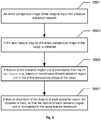
- Fig. 5 schematically shows another example flowchart of extracting a feature of each semantic region unit according to some embodiments of the present disclosure.
- the method includes the following operations.
- the entire perspective image of the cargo inputted is processed using the feature extraction network, to obtain a feature map for the entire perspective image of the cargo.
- an FPN network is used to obtain a P4 layer feature map for the entire perspective image of the cargo.
- a feature of the semantic region unit is intercepted from the feature map for the entire perspective image of the cargo obtained, based on coordinates of each semantic region unit in the entire perspective image of the cargo.
- Fig. 6 schematically shows another example flowchart of extracting a feature of each semantic region unit according to some embodiments of the present disclosure.
- the method includes the following operations.
- Operations S601 to S605 are the same as operations S501 to S505 in Fig. 5 , and will not be repeated here.
- a feature dimension of the feature of each semantic region unit obtained is fixed, so that the feature of each semantic region unit is normalized to the same feature dimension.
- Roi-pooling may be used to fix the feature dimension.
- Fig. 7 schematically shows a flowchart of retrieving each semantic region unit according to some embodiments of the present disclosure.
- the method includes the following operations.
- an image feature database is established using history images.
- each of the history images used for establishing the image feature database may be an image with a single category and without suspicious objects therein.
- the history images used for establishing the image feature database and the perspective image of the cargo being retrieved may have item information.
- the item information may include, but is not limited to, serial number of an image, coordinates of each semantic region unit in the perspective image of the cargo, feature representation of each region, declaration information of the cargo, and generalized category information representing the cargo (for example, name and tax number, or an overall feature of the object in the image).
- preselected images are retrieved from a feature map, based on the item information of entire perspective image of the cargo.
- an image having highest similarity is selected from the preselected images based on the feature of the semantic region unit.
- the image having highest similarity may be one or more images.
- the image having highest similarity may be determined based on Euclidean distance.
- all images in the feature database may be used as the preselected images, and then (one or more) similar image(s) may be selected from all the images.
- Fig. 8 schematically shows a block diagram of a semantic-based apparatus 800 for retrieving a container cargo according to some embodiments of the present disclosure.
- the semantic-based apparatus 800 for retrieving a container cargo may include a perspective image acquisition module 810, an image semantic division module 830, a feature extraction module 850, and an image retrieval module 870.
- the perspective image acquisition module 810 may be configured to obtain a perspective image of a cargo within a container.
- the image semantic division module 830 may be configured to perform a semantic division on the perspective image of the cargo using a first method, to obtain a plurality of semantic region units.
- the feature extraction module 850 may be configured to construct a feature extraction network using a second method; and extract, based on the perspective image and each of the plurality of semantic region units, a feature of each semantic region unit using the feature extraction network.
- the image retrieval module 870 may be configured to retrieve, based on the feature of each semantic region unit, an image most similar to the semantic region unit from an image feature database, to determine a category of an inspected object in the semantic region unit.
- the semantic-based apparatus 800 for retrieving a container cargo may also include other modules to correspondingly perform above operations.
- the semantic-based apparatus 800 for retrieving a container cargo may further include a display module configured to display various information (for example, similar history images and matching information) to a user.
- a display module configured to display various information (for example, similar history images and matching information) to a user.
- modules 810, 830, 850 and 870 may also adaptively perform any suitable operations described above.
- modules according to the embodiments of the present disclosure may be implemented in one module.
- One of the modules according to the embodiments of the present disclosure may be split into multiple modules for implementation.
- the modules according to the embodiments of the present disclosure may be implemented at least partially as a hardware circuit, such as a field programmable gate array (FPGA), a programmable logic array (PLA), a system on a chip, a system on a substrate, a system on a package, or an Application Specific Integrated Circuit (ASIC), or may be implemented by hardware or firmware in any other reasonable way that integrates or encapsulates the circuit, or may be implemented by any one of software, hardware and firmware or an appropriate combination thereof.
- FPGA field programmable gate array
- PLA programmable logic array
- ASIC Application Specific Integrated Circuit
- one or more of the modules, sub modules, units and subunits according to the embodiments of the present disclosure may be at least partially implemented as a computer program module that, when executed, performs the corresponding functions.
- At least one of the modules according to the embodiments of the present disclosure may be implemented at least partially as a hardware circuit, such as a field programmable gate array (FPGA), a programmable logic array (PLA), a system on a chip, a system on a substrate, a system on a package, or an Application Specific Integrated Circuit (ASIC), or may be implemented by hardware or firmware in any other reasonable way that integrates or encapsulates the circuit, or may be implemented by any one of software, hardware and firmware or an appropriate combination thereof.
- FPGA field programmable gate array
- PLA programmable logic array
- ASIC Application Specific Integrated Circuit
- one or more of the modules, sub modules, units and subunits according to the embodiments of the present disclosure may be at least partially implemented as a computer program module that, when executed, performs the corresponding functions.
- Fig. 9 schematically shows a block diagram of an electronic device suitable for implementing the above-mentioned method of semantic-based retrieval for a perspective image according to some embodiments of the present disclosure.
- the electronic device shown in Fig. 9 is only an example, and should not bring any limitation to the function and scope of use of the embodiments of the present disclosure.
- an electronic device 900 includes a processor 901, which may execute various appropriate actions and processing according to the program stored in a read only memory (ROM) 902 or the program loaded into a random access memory (RAM) 903 from a storage section 908.
- the processor 901 may, for example, include a general-purpose microprocessor (for example, CPU), an instruction set processor and/or a related chipset and/or a special-purpose microprocessor (for example, an application specific integrated circuit (ASIC)), and the like.
- the processor 901 may also include an on-board memory for caching purposes.
- the processor 901 may include a single processing unit or multiple processing units for executing different actions of the method flow according to the embodiments of the present disclosure.
- the processor 901, the ROM 902 and the RAM 903 are connected to each other through a bus 904.
- the processor 901 executes various operations of the method flow according to the embodiments of the present disclosure by executing the programs in the ROM 902 and/or the RAM 903. It should be noted that the program may also be stored in one or more memories other than the ROM 902 and the RAM 903.
- the processor 901 may also execute various operations of the method flow according to the embodiments of the present disclosure by executing the programs stored in the one or more memories.
- the electronic device 900 may further include an input/output (I/O) interface 905 which is also connected to the bus 904.
- the electronic device 900 may further include one or more of the following components connected to the I/O interface 905: an input section 906 including a keyboard, a mouse, etc.; an output section 907 including a cathode ray tube (CRT), a liquid crystal display (LCD), etc. and a speaker, etc.; a storage section 908 including a hard disk, etc.; and a communication section 909 including a network interface card such as a LAN card, a modem, and the like.
- the communication section 909 performs communication processing via a network such as the Internet.
- a drive 910 is also connected to the I/O interface 905 as required.
- a removable medium 911 such as a magnetic disk, an optical disk, a magneto-optical disk, a semiconductor memory, and the like, is installed on the drive 910 as required, so that the computer program read therefrom is installed into the storage section 908 as needed.
- the method flow according to the embodiments of the present disclosure may be implemented as a computer software program.
- the embodiments of the present disclosure include a computer program product including a computer program carried on a computer-readable storage medium.
- the computer program includes a program code for execution of the method shown in the flowchart.
- the computer program may be downloaded and installed from the network through the communication section 909, and/or installed from the removable medium 911.
- the above-mentioned functions defined in the system of the embodiments of the present disclosure are performed.
- the above-described systems, apparatuses, devices, modules, units, etc. may be implemented by computer program modules.
- the present disclosure also provides a computer-readable storage medium, which may be included in the apparatus/device/system described in the above embodiments; or exist alone without being assembled into the apparatus/device/system.
- the above-mentioned computer-readable storage medium carries one or more programs that when executed, perform the method according to the embodiments of the present disclosure.
- the computer-readable storage medium may be a non-volatile computer-readable storage medium, for example, may include but not limited to: portable computer disk, hard disk, random access memory (RAM), read-only memory (ROM), erasable programmable read-only memory (EPROM or flash memory), portable compact disk read-only memory (CD-ROM), optical storage device, magnetic storage device, or any suitable combination of the above.
- the computer-readable storage medium may be any tangible medium that includes or stores programs that may be used by or in combination with an instruction execution system, apparatus, or device.
- the computer-readable storage medium may include the above-mentioned ROM 902 and/or RAM 903 and/or one or more memories other than the ROM 902 and RAM 903.
- each block in the flowcharts or block diagrams may represent a part of a module, program segment, or code, which part includes one or more executable instructions for implementing the specified logical function.
- the functions noted in the blocks may also occur in a different order than that noted in the accompanying drawings. For example, two blocks shown in succession may actually be executed substantially in parallel, or they may sometimes be executed in the reverse order, depending on the functions involved.
- each block in the block diagrams or flowcharts, and the combination of blocks in the block diagrams or flowcharts, may be implemented by a dedicated hardware-based system that performs the specified functions or operations, or may be implemented by a combination of dedicated hardware and computer instructions.
Landscapes
- Engineering & Computer Science (AREA)
- Theoretical Computer Science (AREA)
- General Physics & Mathematics (AREA)
- Physics & Mathematics (AREA)
- Multimedia (AREA)
- Databases & Information Systems (AREA)
- Evolutionary Computation (AREA)
- Computer Vision & Pattern Recognition (AREA)
- Artificial Intelligence (AREA)
- Data Mining & Analysis (AREA)
- General Health & Medical Sciences (AREA)
- Health & Medical Sciences (AREA)
- Medical Informatics (AREA)
- Software Systems (AREA)
- Computing Systems (AREA)
- General Engineering & Computer Science (AREA)
- Library & Information Science (AREA)
- Life Sciences & Earth Sciences (AREA)
- Bioinformatics & Cheminformatics (AREA)
- Bioinformatics & Computational Biology (AREA)
- Evolutionary Biology (AREA)
- Information Retrieval, Db Structures And Fs Structures Therefor (AREA)
- Image Analysis (AREA)
Abstract
Description
- The present disclosure relates to the field of image recognition, and in particular to a semantic-based method and apparatus for retrieving a perspective image, an electronic device, and a computer-readable storage medium.
- Inspecting objects included in a closed space (for example, containers, luggage bags, carriages, vans, small trucks, etc.) using a perspective image is one of important means adopted in customs clearance and other security services. The perspective image is obviously different from a natural image due to imaging principles. Such difference may increase difficulty for an inspector in understanding the image intuitively, thereby reducing the inspector's sensitivity to sensitive objects, and bringing huge challenges to corresponding security services.
- Therefore, a more efficient and more precise method is needed for retrieving a perspective image.
- To solve problems in existing technology, a semantic-based method and apparatus for retrieving a perspective image are provided by the present disclosure. The method includes: a semantic-based image understanding stage, an image feature representation stage, and an image retrieval stage.
- In the semantic-based image understanding stage, a semantic element is extracted from a perspective image, and the image is divided into independent object regions (i.e. semantic regions) that are visually separable. Subsequent retrievals are performed individually on each semantic region divided.
- In the image feature representation stage, the feature representation is performed on each image semantic region divided. The feature may describe main information of each semantic region in the image.
- In the image retrieval stage, each semantic region in the perspective image is retrieved from a history image feature database according to a certain criteria.
- In short, the above-mentioned three stages may divide a perspective image into semantic regions, and retrieve history similar regions and history declaration information for each region. This may assist an inspector in compare and analysis of each image semantic region.
- In the semantic-based image understanding stage, according to different visual forms or different layouts, a perspective image is split into different semantic regions that are visually separable. All semantic regions are required to cover entire range of the object in the perspective image. Related technology such as objectness proposal is mainly used to solve this problem. In the field of deep learning, Region Proposal Network (RPN) is a common method. In this stage, the image retrieval is targeted and local, so that each independent region in the image may be refinedly retrieved.
- The image feature representation stage is mainly for the feature representation of the image semantic regions divided in the previous stage. In this stage, deep learning technology is used to perform the feature representation on the image. Compared with conventional representation methods, a deep learning method has greater advantages. Features extracted by conventional methods are generally fixed features designed artificially, having certain limitations. While the method based on deep learning autonomously learns more effective features according to characteristics of training data itself. Therefore, the method based on deep learning is more adaptable and more conducive to image retrieval.
- A basic unit in the image retrieval stage is each semantic region covering the entire image range divided in the first stage. For each region, a most similar image region may be matched from history images, and declaration information and similarity information of the similar image region may be given. In this way, the inspector may be assisted in comparing each region in the perspective image and understanding each region. The image retrieval stage has a feature of retrieving each region of a mixed perspective image. It should be noted that before retrieving each divided region, a history image feature database needs to be established in advance. Each feature in the history image feature database uses each divided semantic region as a basic unit, and the feature need to have information describing cargo category, region image attribution, declaration information of the image where the region is located, and coordinates of the object region, etc.
- Specifically, in a first aspect of the present disclosure, a semantic-based method for retrieving a perspective image is provided, including: obtaining, by a perspective image acquisition apparatus, a perspective image for a space containing an inspected object therein; performing a semantic division on the perspective image using a first method, to obtain a plurality of semantic region units; constructing a feature extraction network using a second method; extracting, based on the perspective image and each of the plurality of semantic region units, a feature of each semantic region unit using the feature extraction network; and retrieving, based on the feature of each semantic region unit, an image most similar to the semantic region unit from an image feature database, to assist in determining an inspected object in the semantic region unit.
- According to the first aspect, the first method is one or more of: selective search, objectness method, and region proposal net RPN.
- According to the first aspect, the second method is an introduction of a feature pyramid network FPN into a basic network Resnet.
- According to the first aspect, the extracting, based on the perspective image and each of the plurality of semantic region units, a feature of each semantic region unit using the feature extraction network includes: obtaining, based on the perspective image, a feature map for the perspective image using the feature extraction network; and obtaining, based on coordinates of each semantic region unit in the perspective image, a corresponding feature of each semantic region unit in the feature map.
- According to the first aspect, the method may further include: fixing a feature dimension of the corresponding feature of each semantic region unit obtained, to normalize the corresponding feature of each semantic region unit to the same feature dimension.
- According to the first aspect, the image feature database is established based on history perspective images without suspicious objects, and the perspective images used for establishing the image feature database have one or more item information recorded.
- According to the first aspect, the image most similar to the semantic region unit is retrieved from the image feature database based on the item information.
- According to the first aspect, there are a predetermined number of images most similar to the semantic region unit existed.
- According to the first aspect, the method may further include: displaying, by a display unit, information related to the inspected object.
- In a second aspect of the present disclosure, a semantic-based apparatus for retrieving a perspective image is provided, including: a perspective image acquisition module configured to obtain a perspective image for a closed space containing an inspected object therein; an image semantic division module configured to perform a semantic division on the perspective image using a first method, to obtain a plurality of semantic region units; a feature extraction module configured to: construct a feature extraction network using a second method; and extract, based on the perspective image and each of the plurality of semantic region units, a feature of each semantic region unit using the feature extraction network; and an image retrieval module configured to retrieve, based on the feature of each semantic region unit, an image most similar to the semantic region unit from an image feature database, to assist in determining an inspected object in the semantic region unit.
- In a third aspect of the present disclosure, an electronic device is provided, including: one or more processors; and a memory configured to store one or more programs; wherein when the one or more programs are executed by the one or more processors, cause the one or more processors to implement the method of the first aspect.
- In a fourth aspect of the present disclosure, a computer-readable storage medium is provided, the computer-readable storage medium has executable instructions stored thereon which, when executed by a processor, cause the processor to implement the method of the first aspect.
- Based on above aspects, similar images and declaration information may be provided for each semantic region in a perspective image by using image retrieval technology. This may have a positive effect in customs clearance, luggage inspection and other security fields. Current technical means are to retrieve an entire region using pattern recognition, without considering semantic elements of the inspected object. However, in actual applications, it is very necessary to retrieve separable semantic regions as smallest units for mixed inspected objects.
- The present disclosure takes semantic information of an image into consideration. Semantic elements of the image are extracted, each semantic region in the perspective image is used as a basic unit for retrieving, and similar object region and declaration information of each semantic region is given. Thus, an inspector may compare the image regions, so as to improve an ability of assisting in inspection.
- The above and other embodiments and features of the present disclosure will be more apparent through the detailed description of embodiments of the present disclosure with reference to the accompanying drawings, in which:
-
Fig. 1 schematically shows a system architecture of a semantic-based method for retrieving a container cargo according to some embodiments of the present disclosure; -
Fig. 2 schematically shows a flowchart of a semantic-based method for retrieving a container cargo according to some embodiments of the present disclosure; -
Fig. 3 schematically shows perspective images of a cargo before and after a semantic region division according to some embodiments of the present disclosure; -
Fig. 4 schematically shows an example flowchart of extracting a feature of each semantic region unit according to some embodiments of the present disclosure; -
Fig. 5 schematically shows another example flowchart of extracting a feature of each semantic region unit according to some embodiments of the present disclosure; -
Fig. 6 schematically shows another example flowchart of extracting a feature of each semantic region unit according to some embodiments of the present disclosure; -
Fig. 7 schematically shows a flowchart of retrieving each semantic region unit according to some embodiments of the present disclosure; -
Fig. 8 schematically shows a block diagram of a semantic-based apparatus for retrieving a container cargo according to some embodiments of the present disclosure; and -
Fig. 9 schematically shows a block diagram of an electronic device suitable for implementing a semantic-based method for retrieving a container cargo according to some embodiments of the present disclosure. - Hereinafter, embodiments of the present disclosure will be described in details. It should be noted that these embodiments are merely exemplary and are not intended to limit the scope of the present disclosure. In the following description, many specific details are set forth to provide a comprehensive understanding of the embodiments of the present disclosure. However, it is obvious to those of ordinary skill in the art that the present disclosure may further be implemented without these specific details. In addition, descriptions of well-known circuits, materials, or methods are omitted to avoid obscuring the present disclosure.
- Throughout the specification, references to "an embodiment", "embodiments", "an example" or "example" mean that specific features, structures, or characteristics described in conjunction with the embodiment(s) or example(s) are included in at least one embodiment in the present disclosure. Therefore, the phrases "in an embodiment", "in some embodiments", "an example", or "examples" in various places throughout the specification do not necessarily all refer to the same embodiment or example. In addition, specific features, structures, or characteristics may be combined in one or more embodiments or examples in any suitable combination and/or sub-combination.
- It should be understood that when an element is referred as being "coupled" or "connected" to another element, it may be directly coupled or connected to the other element or there may be an intermediate element existed. In contrast, when an element is referred as being "directly coupled" or "directly connected" to another element, there is no intermediate element existed.
- In addition, the term "and/or" as used herein includes any and all combinations of one or more of related listed items.
- It will be understood that a noun in singular form corresponding to a term may include one or more matters, unless relevant context clearly indicates otherwise. As used herein, each of phrases such as "A or B", "at least one of A and B", "at least one of A or B", "A, B or C", "at least one of A, B and C" and "at least one of A, B, or C" may include all possible combinations of items listed together with a corresponding one of the plurality of phrases. As used herein, terms such as "first" and "second" or "1st" and "2nd" may be used to simply distinguish one component from another component and not to limit the components in other respects (for example, importance or order).
- As used herein, the term "module" may include a unit implemented in hardware, software, or firmware, and may be interchangeably used with other terms (for example, "logic", "logical block", "part" or "circuit"). A module may be a single integrated component adapted to implement one or more functions or a smallest unit or part of the single integrated component. For example, according to some embodiments, a module may be implemented in a form of an application specific integrated circuit (ASIC).
- It should be understood that the various embodiments of the present disclosure and the terms used therein are not intended to limit technical features described to specific embodiments, but include various changes, equivalents, or alternatives to corresponding embodiments. Unless explicitly defined otherwise, all terms will give their broadest possible interpretations, including meanings implied in the specification, meanings understood by those skilled in the art and/or meanings defined in dictionaries, papers, etc.
- In addition, those of ordinary skill in the art should understand that the accompanying drawings provided herein are for illustrative purposes, and the drawings are not necessarily drawn to scale. For the description of the drawings, similar reference numbers may refer to similar or related elements. Hereinafter, the present disclosure will be exemplarily described with reference to the accompanying drawings.
- It should be noted that in recent years, artificial intelligence and deep learning technologies have been continuously developed and gradually moved towards production. It is natural to achieve security inspections by using artificial intelligence. At present, technology of inspecting perspective images using artificial intelligence already exists. However, the existing artificial intelligence means are more inclined to an intelligent direction of container inspection in a perspective image, and more inclined to risk prediction.
- Image retrieval technology has been widely used, mainly concentrated to natural image retrieval and medical perspective image retrieval. At present, technology of inspecting perspective images also exists. However, the existing technology retrieves a perspective image using conventional machine learning, without considering semantic information of the perspective image and without extracting semantic elements. That is, an image is only retrieved as a whole, and thus the retrieval throughout the perspective image region seems to be rough and inaccurate. However, in fact, there is a high probability that one or more types of objects having various visual forms may appear in the same perspective image. In this situation, in order to thoroughly inspect each independent region, it is very necessary to retrieve individually each visually separable region in the perspective image.
- To solve above problems, the embodiments of the present disclosure provides a more efficient and accurate semantic-based method for retrieving a perspective image and an apparatus for implementing the same. The method includes: a perspective image for a space containing an inspected object is obtained by a perspective image acquisition apparatus; a semantic division is performed on the perspective image using a first method, to obtain a plurality of semantic region units; a feature extraction network is constructed using a second method; a feature of each semantic region unit is extracted using the feature extraction network, based on the perspective image and each of the plurality of semantic region units; and an image most similar to the semantic region unit is retrieved from an image feature database, based on the feature of each semantic region unit, to assist in determining or understanding the inspected object in the semantic region unit.
- Hereinafter, the present disclosure will be described in details with reference to the accompanying drawings and in conjunction with specific embodiments.
- For clarity and for ease of description, a container is used as a specific example of the space containing the inspected object in the following. Accordingly, a cargo within the container is used as a specific example of the inspected object. However, those skilled in the art should understand that the container, the cargo, and corresponding descriptions (for example, a semantic-based method for retrieving a container cargo, a semantic-based apparatus for retrieving a container cargo, etc.) have no restrictive effect, and are only intended to facilitate describing. Based on different application scenarios of the method, those skilled in the art may replace above descriptions accordingly.
-
Fig. 1 schematically shows asystem architecture 100 of a semantic-based method for retrieving a container cargo according to some embodiments of the present disclosure. - The
system architecture 100 may include a perspective image acquisition apparatus 101, acontainer 102, acentral processing unit 103, and astorage apparatus 104. The perspective image acquisition apparatus 101, thecentral processing unit 103, and thestorage apparatus 104 may communicate with each other. - The perspective image acquisition apparatus 101 may be configured to perform a perspective shot for the
container 102, to obtain a perspective image of a cargo within thecontainer 102. - Although only one perspective image acquisition apparatus is shown in
Fig. 1 , those skilled in the art should understand that there may be two or even more perspective image acquisition apparatuses. In addition, the perspective image acquisition apparatus may be installed in different positions relative to thecontainer 102. - The
central processing unit 103 may be configured to perform the following operations: a perspective image of the cargo is obtained by the perspective image acquisition apparatus 101; a semantic division is performed on the perspective image of the cargo, to divide a region occupied by the cargo in the perspective image into a plurality of semantic region units; and each of the semantic region units is retrieved, to assist in understanding or determining the cargo in each semantic region unit. - The
central processing unit 103 may include a processor (not shown), and a communication module (not shown), etc. - The processor of the
central processing unit 103 may be configured to perform any operations associated with the semantic-based method for retrieving a container cargo. - The communication module may include one or more communication processors capable of operating independently of the processor (for example, an application processor (AP)), and support wired and/or wireless communication. According to some embodiments of the present disclosure, the communication module may include a wireless communication module (for example, a cellular communication module, a short-distance wireless communication module, or a global navigation satellite system (GNSS) communication module) or a wired communication module (for example, a local area network (LAN) communication module or a power line communication (PLC) module). Respective one of these communication modules may communicate with an external electronic apparatus via a first network (for example, a short-distance communication network such as Bluetooth, Wi-Fi Direct or Infrared Data Association (IrDA)) or a second network (for example, a long-distance communication network such as cellular network, Internet, or computer network (for example, LAN or wide area network (WAN))). These various types of communication modules may be implemented as a single component (for example, a single chip), or multiple components (for example, multiple chips) separated from each other. The wireless communication module may use user information (for example, International Mobile Subscriber Identity (IMSI)) stored in a user identification module to identify and verify an electronic apparatus in the communication network (such as the first network or the second network).
- In addition, the
central processing unit 103 may also include a display, a microphone, etc., to display or broadcast related information (for example, categories, etc.) of the cargo within a region being currently retrieved. - The
storage apparatus 104 may be configured to store data, instructions, etc. required and/or generated when thecentral processing unit 103 performs any operations associated with the semantic-based method for retrieving the container cargo. - In some exemplary embodiments, the
storage apparatus 104 may store a history image of the cargo, declaration information associated with the image of the cargo, an image serial number, coordinates of each cargo region in the history image, a feature of each cargo region, declaration information of each cargo region, generalized category information, name and tax number representing the cargo in the region, etc. - Only some example information stored in the
storage apparatus 104 is listed above. Those skilled in the art should understand that various information may be stored in thestorage apparatus 104 according to requirements, specific implementations, operations, etc. -
Fig. 2 schematically shows a flowchart of a semantic-based method for retrieving a container cargo according to some embodiments of the present disclosure. - As shown in
Fig. 2 , the method includes the following operations. - In operation S201, perspective imaging for a container is performed by a perspective image acquisition apparatus, so that a perspective image of a cargo within the container is obtained, where it is possible to see a region occupied by the cargo clearly.
- In operation S203, a perspective image of the cargo is obtained from the perspective image acquisition apparatus by a central processing unit, and a semantic division is performed on the perspective image obtained using a first method. Therefore, the image of the region occupied by the cargo in the perspective image is divided into a plurality of semantic region units.
- In some exemplary embodiments, the plurality of semantic region units overlaps with each other in a small degree. For example, an overlap region occupies 10%, 5%, 3% of each semantic region unit or even less.
- Preferably, only edges of the semantic region units overlap with each other, with no additional overlap regions existed.
- As shown in
Fig. 3 , the semantic division performed on the perspective image of the cargo refers to splitting the region occupied by the cargo into different regions separable for naked eyes, according to visual forms or arrangements of the cargo. InFig. 3 , by performing the semantic division on the perspective image of the cargo, each dotted box region may represent a semantic region unit of the cargo, and all semantic region units together cover entire region occupied by the cargo. Subsequent operations are all performed using the semantic region unit as a basic unit. - In some exemplary embodiments, the first method for performing a semantic region division on the perspective image of the cargo may include, but is not limited to, selective search, objectness technology, and region proposal net (RPN) widely used in deep learning, etc.
- Herein, the RPN technology will be used as an example for description.
- In the RPN technology, a large amount of object frames that are manually labeled is learned, to obtain a first model. During the semantic region division on the perspective image of the cargo, the first model is firstly used to predict object frames similar to the object frames that are labeled, to recommend an object region of the image.
- It should be noted that due to requirements for cargo inspection, the object frames need to cover entire cargo region. Therefore, the RPN network used in the present disclosure is different from a RPN network used in a conventional target detection. In addition to predicting the object frames, an objective function of the RPN network needs to be further defined, so that the object frames may completely cover the cargo region.
- In operation S205, a feature extraction network is constructed by the central processing unit by using a second method. The second method is different from the first method.
- In some exemplary embodiments, the second method may be, but is not limited to an introduction of a feature pyramid network FPN into a basic network Resnet.
- In operation S207, a feature of each semantic region unit is extracted using the feature extraction network, based on the perspective image of the cargo obtained in operation S201 and the plurality of semantic region units obtained in operation S203.
- In operation S209, an image most similar to the semantic region unit is retrieved from an image feature database, based on the feature of each semantic region unit, to assist in determining or understanding the cargo in the semantic region unit.
- Exemplarily, the image most similar to the semantic region unit may be determined as appropriate, which may be a most similar image, or a plurality of images having high similarity.
- According to the present disclosure, a basic unit being retrieved is each semantic region unit after the semantic division, therefore, a feature of each semantic region unit is required to be obtained.
-
Fig. 4 schematically shows an example flowchart of extracting a feature of each semantic region unit according to some embodiments of the present disclosure. - As shown in
Fig. 4 , the method includes the following operations. - In operation S401, each semantic region unit is normalized to obtain a semantic region unit having a fixed size.
- In operation S403, the semantic region unit after being normalized is input into a feature extraction network.
- In operation S405, inputted semantic region unit after being normalized is processed using the feature extraction network, to obtain a feature of the semantic region unit.
-
Fig. 5 schematically shows another example flowchart of extracting a feature of each semantic region unit according to some embodiments of the present disclosure. - As shown in
Fig. 5 , the method includes the following operations. - In operation S501, an entire perspective image of the cargo is input into a feature extraction network.
- In operation S503, the entire perspective image of the cargo inputted is processed using the feature extraction network, to obtain a feature map for the entire perspective image of the cargo.
- Exemplarily, an FPN network is used to obtain a P4 layer feature map for the entire perspective image of the cargo.
- In operation S505, a feature of the semantic region unit is intercepted from the feature map for the entire perspective image of the cargo obtained, based on coordinates of each semantic region unit in the entire perspective image of the cargo.
-
Fig. 6 schematically shows another example flowchart of extracting a feature of each semantic region unit according to some embodiments of the present disclosure. - As shown in
Fig. 6 , the method includes the following operations. - Operations S601 to S605 are the same as operations S501 to S505 in
Fig. 5 , and will not be repeated here. - In operation S607, a feature dimension of the feature of each semantic region unit obtained is fixed, so that the feature of each semantic region unit is normalized to the same feature dimension.
- Exemplarily, Roi-pooling may be used to fix the feature dimension.
-
Fig. 7 schematically shows a flowchart of retrieving each semantic region unit according to some embodiments of the present disclosure. - As shown in
Fig. 7 , the method includes the following operations. - In operation S701, an image feature database is established using history images.
- Exemplarily, each of the history images used for establishing the image feature database may be an image with a single category and without suspicious objects therein.
- Exemplarily, the history images used for establishing the image feature database and the perspective image of the cargo being retrieved may have item information. Exemplarily, the item information may include, but is not limited to, serial number of an image, coordinates of each semantic region unit in the perspective image of the cargo, feature representation of each region, declaration information of the cargo, and generalized category information representing the cargo (for example, name and tax number, or an overall feature of the object in the image).
- In operation S703, preselected images are retrieved from a feature map, based on the item information of entire perspective image of the cargo.
- In operation S705, for each semantic region unit, an image having highest similarity is selected from the preselected images based on the feature of the semantic region unit.
- In some exemplary embodiments, the image having highest similarity may be one or more images.
- In some exemplary embodiments, the image having highest similarity may be determined based on Euclidean distance.
- In some alternative embodiments, all images in the feature database may be used as the preselected images, and then (one or more) similar image(s) may be selected from all the images.
-
Fig. 8 schematically shows a block diagram of a semantic-basedapparatus 800 for retrieving a container cargo according to some embodiments of the present disclosure. - As shown in
Fig. 8 , the semantic-basedapparatus 800 for retrieving a container cargo may include a perspectiveimage acquisition module 810, an imagesemantic division module 830, afeature extraction module 850, and animage retrieval module 870. - The perspective
image acquisition module 810 may be configured to obtain a perspective image of a cargo within a container. - The image
semantic division module 830 may be configured to perform a semantic division on the perspective image of the cargo using a first method, to obtain a plurality of semantic region units. - The
feature extraction module 850 may be configured to construct a feature extraction network using a second method; and extract, based on the perspective image and each of the plurality of semantic region units, a feature of each semantic region unit using the feature extraction network. - The
image retrieval module 870 may be configured to retrieve, based on the feature of each semantic region unit, an image most similar to the semantic region unit from an image feature database, to determine a category of an inspected object in the semantic region unit. - In addition to
above modules apparatus 800 for retrieving a container cargo may also include other modules to correspondingly perform above operations. - For example, the semantic-based
apparatus 800 for retrieving a container cargo may further include a display module configured to display various information (for example, similar history images and matching information) to a user. - In addition to the operations performed by the
modules modules - For clarity and conciseness, each module and corresponding operations performed thereby will not be repeated here.
- Functions of multiple modules according to the embodiments of the present disclosure may be implemented in one module. One of the modules according to the embodiments of the present disclosure may be split into multiple modules for implementation. The modules according to the embodiments of the present disclosure may be implemented at least partially as a hardware circuit, such as a field programmable gate array (FPGA), a programmable logic array (PLA), a system on a chip, a system on a substrate, a system on a package, or an Application Specific Integrated Circuit (ASIC), or may be implemented by hardware or firmware in any other reasonable way that integrates or encapsulates the circuit, or may be implemented by any one of software, hardware and firmware or an appropriate combination thereof. Alternatively, one or more of the modules, sub modules, units and subunits according to the embodiments of the present disclosure may be at least partially implemented as a computer program module that, when executed, performs the corresponding functions.
- At least one of the modules according to the embodiments of the present disclosure may be implemented at least partially as a hardware circuit, such as a field programmable gate array (FPGA), a programmable logic array (PLA), a system on a chip, a system on a substrate, a system on a package, or an Application Specific Integrated Circuit (ASIC), or may be implemented by hardware or firmware in any other reasonable way that integrates or encapsulates the circuit, or may be implemented by any one of software, hardware and firmware or an appropriate combination thereof. Alternatively, one or more of the modules, sub modules, units and subunits according to the embodiments of the present disclosure may be at least partially implemented as a computer program module that, when executed, performs the corresponding functions.
-
Fig. 9 schematically shows a block diagram of an electronic device suitable for implementing the above-mentioned method of semantic-based retrieval for a perspective image according to some embodiments of the present disclosure. The electronic device shown inFig. 9 is only an example, and should not bring any limitation to the function and scope of use of the embodiments of the present disclosure. - As shown in
Fig. 9 , anelectronic device 900 according to the embodiments of the present disclosure includes aprocessor 901, which may execute various appropriate actions and processing according to the program stored in a read only memory (ROM) 902 or the program loaded into a random access memory (RAM) 903 from astorage section 908. Theprocessor 901 may, for example, include a general-purpose microprocessor (for example, CPU), an instruction set processor and/or a related chipset and/or a special-purpose microprocessor (for example, an application specific integrated circuit (ASIC)), and the like. Theprocessor 901 may also include an on-board memory for caching purposes. Theprocessor 901 may include a single processing unit or multiple processing units for executing different actions of the method flow according to the embodiments of the present disclosure. - Various programs and data required for the operation of the
electronic device 900 are stored in theRAM 903. Theprocessor 901, theROM 902 and theRAM 903 are connected to each other through abus 904. Theprocessor 901 executes various operations of the method flow according to the embodiments of the present disclosure by executing the programs in theROM 902 and/or theRAM 903. It should be noted that the program may also be stored in one or more memories other than theROM 902 and theRAM 903. Theprocessor 901 may also execute various operations of the method flow according to the embodiments of the present disclosure by executing the programs stored in the one or more memories. - According to the embodiments of the present disclosure, the
electronic device 900 may further include an input/output (I/O)interface 905 which is also connected to thebus 904. Theelectronic device 900 may further include one or more of the following components connected to the I/O interface 905: aninput section 906 including a keyboard, a mouse, etc.; anoutput section 907 including a cathode ray tube (CRT), a liquid crystal display (LCD), etc. and a speaker, etc.; astorage section 908 including a hard disk, etc.; and acommunication section 909 including a network interface card such as a LAN card, a modem, and the like. Thecommunication section 909 performs communication processing via a network such as the Internet. Adrive 910 is also connected to the I/O interface 905 as required. Aremovable medium 911, such as a magnetic disk, an optical disk, a magneto-optical disk, a semiconductor memory, and the like, is installed on thedrive 910 as required, so that the computer program read therefrom is installed into thestorage section 908 as needed. - The method flow according to the embodiments of the present disclosure may be implemented as a computer software program. For example, the embodiments of the present disclosure include a computer program product including a computer program carried on a computer-readable storage medium. The computer program includes a program code for execution of the method shown in the flowchart. In such an embodiment, the computer program may be downloaded and installed from the network through the
communication section 909, and/or installed from theremovable medium 911. When the computer program is executed by theprocessor 901, the above-mentioned functions defined in the system of the embodiments of the present disclosure are performed. According to the embodiments of the present disclosure, the above-described systems, apparatuses, devices, modules, units, etc. may be implemented by computer program modules. - The present disclosure also provides a computer-readable storage medium, which may be included in the apparatus/device/system described in the above embodiments; or exist alone without being assembled into the apparatus/device/system. The above-mentioned computer-readable storage medium carries one or more programs that when executed, perform the method according to the embodiments of the present disclosure.
- According to the embodiments of the present disclosure, the computer-readable storage medium may be a non-volatile computer-readable storage medium, for example, may include but not limited to: portable computer disk, hard disk, random access memory (RAM), read-only memory (ROM), erasable programmable read-only memory (EPROM or flash memory), portable compact disk read-only memory (CD-ROM), optical storage device, magnetic storage device, or any suitable combination of the above. In the present disclosure, the computer-readable storage medium may be any tangible medium that includes or stores programs that may be used by or in combination with an instruction execution system, apparatus, or device. For example, according to the embodiments of the present disclosure, the computer-readable storage medium may include the above-mentioned
ROM 902 and/orRAM 903 and/or one or more memories other than theROM 902 andRAM 903. - The flowcharts and block diagrams in the drawings illustrate the possible architecture, functions, and operations of the system, method, and computer program product according to various embodiments of the present disclosure. In this regard, each block in the flowcharts or block diagrams may represent a part of a module, program segment, or code, which part includes one or more executable instructions for implementing the specified logical function. It should also be noted that, in some alternative implementations, the functions noted in the blocks may also occur in a different order than that noted in the accompanying drawings. For example, two blocks shown in succession may actually be executed substantially in parallel, or they may sometimes be executed in the reverse order, depending on the functions involved. It should also be noted that each block in the block diagrams or flowcharts, and the combination of blocks in the block diagrams or flowcharts, may be implemented by a dedicated hardware-based system that performs the specified functions or operations, or may be implemented by a combination of dedicated hardware and computer instructions.
- Those skilled in the art may understand that the various embodiments of the present disclosure and/or the features described in the claims may be combined in various ways, even if such combinations are not explicitly described in the present disclosure. In particular, without departing from the spirit and teachings of the present disclosure, the various embodiments of the present disclosure and/or the features described in the claims may be combined in various ways. All these combinations fall within the scope of the present disclosure.
- The embodiments of the present disclosure have been described above. However, these embodiments are for illustrative purposes only, and are not intended to limit the scope of the present disclosure. Although the embodiments have been described separately above, this does not mean that measures in the respective embodiments cannot be used in combination advantageously. The scope of the present disclosure is defined by the appended claims and their equivalents. Without departing from the scope of the present disclosure, those skilled in the art may make various substitutions and modifications, and these substitutions and modifications should all fall within the scope of the present disclosure.
Claims (12)
- A semantic-based method for retrieving a perspective image, comprising:obtaining, by a perspective image acquisition apparatus, a perspective image for a space containing an inspected object therein;performing a semantic division on the perspective image using a first method, to obtain a plurality of semantic region units;constructing a feature extraction network using a second method;extracting, based on the perspective image and each of the plurality of semantic region units, a feature of each semantic region unit using the feature extraction network; andretrieving, based on the feature of each semantic region unit, an image most similar to the semantic region unit from an image feature database, to assist in determining an inspected object in the semantic region unit.
- The method of claim 1, wherein the first method is one or more of:
selective search, objectness method, and region proposal net RPN. - The method of claim 1, wherein the second method is an introduction of a feature pyramid network FPN into a basic network Resnet.
- The method of claim 1, wherein the extracting, based on the perspective image and each of the plurality of semantic region units, a feature of each semantic region unit using the feature extraction network comprises:obtaining, based on the perspective image, a feature map for the perspective image using the feature extraction network; andobtaining, based on coordinates of each semantic region unit in the perspective image, a corresponding feature of each semantic region unit in the feature map.
- The method of claim 4, further comprising:fixing a feature dimension of the corresponding feature of each semantic region unit obtained, to normalize the corresponding feature of each semantic region unit to the same feature dimension.
- The method of claim 1, wherein the image feature database is established based on history perspective images without suspicious objects, and
wherein the perspective images used for establishing the image feature database have one or more item information recorded. - The method of claim 6, wherein the image most similar to the semantic region unit is retrieved from the image feature database based on the item information.
- The method of claim 1, wherein there are a predetermined number of images most similar to the semantic region unit existed.
- The method of claim 1, further comprising:
displaying, by a display unit, information related to the inspected object. - A semantic-based apparatus for retrieving a perspective image, comprising:a perspective image acquisition module configured to obtain a perspective image for a closed space containing an inspected object therein;an image semantic division module configured to perform a semantic division on the perspective image using a first method, to obtain a plurality of semantic region units;a feature extraction module configured to:construct a feature extraction network using a second method; andextract, based on the perspective image and each of the plurality of semantic region units, a feature of each semantic region unit using the feature extraction network; andan image retrieval module configured to retrieve, based on the feature of each semantic region unit, an image most similar to the semantic region unit from an image feature database, to assist in determining an inspected object in the semantic region unit.
- An electronic device, comprising:one or more processors; anda memory configured to store one or more programs;wherein when the one or more programs are executed by the one or more processors, cause the one or more processors to implement the method of any one of claims 1 to 9.
- A computer-readable storage medium having executable instructions stored thereon which, when executed by a processor, cause the processor to implement the method of any one of claims 1 to 9.
Applications Claiming Priority (1)
| Application Number | Priority Date | Filing Date | Title |
|---|---|---|---|
| CN202010184164.XA CN113407753B (en) | 2020-03-16 | 2020-03-16 | Semantic-based perspective image retrieval method and device |
Publications (2)
| Publication Number | Publication Date |
|---|---|
| EP3882816A1 true EP3882816A1 (en) | 2021-09-22 |
| EP3882816B1 EP3882816B1 (en) | 2025-09-24 |
Family
ID=74946969
Family Applications (1)
| Application Number | Title | Priority Date | Filing Date |
|---|---|---|---|
| EP21162895.3A Active EP3882816B1 (en) | 2020-03-16 | 2021-03-16 | Semantic-based method and apparatus for retrieving perspective image |
Country Status (6)
| Country | Link |
|---|---|
| US (1) | US12131543B2 (en) |
| EP (1) | EP3882816B1 (en) |
| JP (1) | JP7426350B2 (en) |
| CN (2) | CN113407753B (en) |
| ES (1) | ES3056095T3 (en) |
| PT (1) | PT3882816T (en) |
Families Citing this family (2)
| Publication number | Priority date | Publication date | Assignee | Title |
|---|---|---|---|---|
| CN113920029B (en) * | 2021-10-20 | 2024-11-05 | 常州微亿智造科技有限公司 | Rain line removal device in industrial inspection |
| CN116994259A (en) * | 2023-08-03 | 2023-11-03 | 上海西井科技股份有限公司 | Container number identification method, system, equipment and storage medium |
Family Cites Families (14)
| Publication number | Priority date | Publication date | Assignee | Title |
|---|---|---|---|---|
| JP2006235715A (en) * | 2005-02-22 | 2006-09-07 | Ricoh Co Ltd | Image search device, image search method, program, and recording medium |
| KR101142163B1 (en) * | 2011-06-09 | 2012-05-03 | 인하대학교 산학협력단 | Semantic based image retrieval method |
| CN103678315B (en) * | 2012-08-31 | 2017-04-19 | 富士通株式会社 | Image processing device, image processing method and electronic equipment |
| CN104751163B (en) * | 2013-12-27 | 2018-06-19 | 同方威视技术股份有限公司 | The fluoroscopic examination system and method for automatic Classification and Identification are carried out to cargo |
| CN106706677B (en) | 2015-11-18 | 2019-09-03 | 同方威视技术股份有限公司 | Method and system for inspecting goods |
| CN106503121B (en) * | 2016-10-19 | 2019-12-06 | 公安部第三研究所 | structured description method and system for X-ray security inspection image |
| JP6912215B2 (en) | 2017-02-09 | 2021-08-04 | 国立大学法人東海国立大学機構 | Detection method and detection program to detect the posture of an object |
| US10713794B1 (en) * | 2017-03-16 | 2020-07-14 | Facebook, Inc. | Method and system for using machine-learning for object instance segmentation |
| JP6754717B2 (en) | 2017-04-04 | 2020-09-16 | 日本電信電話株式会社 | Object candidate area estimation device, object candidate area estimation method, and object candidate area estimation program |
| CN106886801B (en) * | 2017-04-14 | 2021-12-17 | 北京图森智途科技有限公司 | Image semantic segmentation method and device |
| JP2019049604A (en) | 2017-09-08 | 2019-03-28 | 国立研究開発法人情報通信研究機構 | Instruction statement estimation system and instruction statement estimation method |
| CN108228761B (en) * | 2017-12-21 | 2021-03-23 | 深圳市商汤科技有限公司 | Image retrieval method and device supporting region customization, equipment and medium |
| JP2019215647A (en) | 2018-06-12 | 2019-12-19 | キヤノンマーケティングジャパン株式会社 | Information processing device, control method of the same and program |
| GB2587248B (en) * | 2020-02-27 | 2021-12-08 | Imagination Tech Ltd | Analysing objects in a set of frames |
-
2020
- 2020-03-16 CN CN202010184164.XA patent/CN113407753B/en active Active
- 2020-03-16 CN CN202511791207.XA patent/CN121479000A/en active Pending
-
2021
- 2021-03-15 US US17/202,088 patent/US12131543B2/en active Active
- 2021-03-16 JP JP2021042729A patent/JP7426350B2/en active Active
- 2021-03-16 PT PT211628953T patent/PT3882816T/en unknown
- 2021-03-16 EP EP21162895.3A patent/EP3882816B1/en active Active
- 2021-03-16 ES ES21162895T patent/ES3056095T3/en active Active
Non-Patent Citations (3)
| Title |
|---|
| CAO SISI ET AL: "Toward Human-in-the-Loop Prohibited Item Detection in X-ray Baggage Images", 2019 CHINESE AUTOMATION CONGRESS (CAC), IEEE, 22 November 2019 (2019-11-22), pages 4360 - 4364, XP033712114, DOI: 10.1109/CAC48633.2019.8996933 * |
| CHE JIAHANG ET AL: "A Comprehensive Solution for Deep-Learning Based Cargo Inspection to Discriminate Goods in Containers", 2018 IEEE/CVF CONFERENCE ON COMPUTER VISION AND PATTERN RECOGNITION WORKSHOPS (CVPRW), IEEE, 18 June 2018 (2018-06-18), pages 1287 - 12877, XP033475462, DOI: 10.1109/CVPRW.2018.00166 * |
| CUI YUNQI ET AL: "Automated firearms detection in cargo x-ray images using RetinaNet", SPIE PROCEEDINGS; [PROCEEDINGS OF SPIE ISSN 0277-786X], SPIE, US, vol. 10999, 14 May 2019 (2019-05-14), pages 109990P - 109990P, XP060121934, ISBN: 978-1-5106-3673-6, DOI: 10.1117/12.2517817 * |
Also Published As
| Publication number | Publication date |
|---|---|
| JP7426350B2 (en) | 2024-02-01 |
| US12131543B2 (en) | 2024-10-29 |
| US20210286842A1 (en) | 2021-09-16 |
| CN113407753A (en) | 2021-09-17 |
| CN113407753B (en) | 2025-12-19 |
| CN121479000A (en) | 2026-02-06 |
| EP3882816B1 (en) | 2025-09-24 |
| ES3056095T3 (en) | 2026-02-18 |
| JP2021149970A (en) | 2021-09-27 |
| PT3882816T (en) | 2025-11-25 |
Similar Documents
| Publication | Publication Date | Title |
|---|---|---|
| US20220277572A1 (en) | Artificial intelligence-based image processing method, apparatus, device, and storage medium | |
| US12579794B2 (en) | Image processing method and apparatus, electronic device, computer-readable storage medium, and computer program product | |
| US20190279014A1 (en) | Method and apparatus for detecting object keypoint, and electronic device | |
| US20210183097A1 (en) | Spare Part Identification Using a Locally Learned 3D Landmark Database | |
| WO2021253510A1 (en) | Bidirectional interactive network-based pedestrian search method and system, and device | |
| CN112529005A (en) | Target detection method based on semantic feature consistency supervision pyramid network | |
| Sun et al. | A Segment Anything Model based weakly supervised learning method for crop mapping using Sentinel-2 time series images | |
| US11928183B2 (en) | Image processing method, image processing device and computer readable medium, for acquiring image sample data for training an attribute recognition model | |
| EP3882816B1 (en) | Semantic-based method and apparatus for retrieving perspective image | |
| US20150347369A1 (en) | Annotation display assistance device and method of assisting annotation display | |
| Kienbaum et al. | DeepCob: precise and high-throughput analysis of maize cob geometry using deep learning with an application in genebank phenomics | |
| CN114495113A (en) | Text classification method and training method and device of text classification model | |
| CN118823467A (en) | Target detection model training method, target detection method and related equipment | |
| CN117437555A (en) | A remote sensing image target extraction and processing method and device based on deep learning | |
| US11093531B2 (en) | Systems and methods for recalling points of interest using a tagging model | |
| US20190026371A1 (en) | Method for automatically constructing inter-language queries for a search engine | |
| Wang et al. | Linear pattern detection of building groups by integrating dynamic snake convolution with YOLO11 | |
| CN119887681B (en) | Industrial defect detection method based on vision-language cues | |
| CN118506040A (en) | Remote sensing image clustering method, device, equipment and medium | |
| CN117496130A (en) | Weakly supervised target detection method of basic model based on context-aware self-training | |
| Wei et al. | Cervical glandular cell detection from whole slide image with out-of-distribution data | |
| Ramos et al. | Deep learning approach for cerebellum localization in prenatal ultrasound images | |
| Tu et al. | Automatic target recognition scheme for a high-resolution and large-scale synthetic aperture radar image | |
| Dong et al. | Semantic segmentation based large-scale oil palm plantation detection using high-resolution satellite images | |
| CN115035487A (en) | Vehicle detection method and device and electronic equipment |
Legal Events
| Date | Code | Title | Description |
|---|---|---|---|
| PUAI | Public reference made under article 153(3) epc to a published international application that has entered the european phase |
Free format text: ORIGINAL CODE: 0009012 |
|
| STAA | Information on the status of an ep patent application or granted ep patent |
Free format text: STATUS: REQUEST FOR EXAMINATION WAS MADE |
|
| 17P | Request for examination filed |
Effective date: 20210316 |
|
| AK | Designated contracting states |
Kind code of ref document: A1 Designated state(s): AL AT BE BG CH CY CZ DE DK EE ES FI FR GB GR HR HU IE IS IT LI LT LU LV MC MK MT NL NO PL PT RO RS SE SI SK SM TR |
|
| STAA | Information on the status of an ep patent application or granted ep patent |
Free format text: STATUS: EXAMINATION IS IN PROGRESS |
|
| 17Q | First examination report despatched |
Effective date: 20230601 |
|
| REG | Reference to a national code |
Ref country code: DE Ref legal event code: R079 Free format text: PREVIOUS MAIN CLASS: G06K0009000000 Ipc: G06V0010820000 Ref country code: DE Ref legal event code: R079 Ref document number: 602021039003 Country of ref document: DE Free format text: PREVIOUS MAIN CLASS: G06K0009000000 Ipc: G06V0010820000 |
|
| GRAP | Despatch of communication of intention to grant a patent |
Free format text: ORIGINAL CODE: EPIDOSNIGR1 |
|
| STAA | Information on the status of an ep patent application or granted ep patent |
Free format text: STATUS: GRANT OF PATENT IS INTENDED |
|
| INTG | Intention to grant announced |
Effective date: 20250415 |
|
| RIC1 | Information provided on ipc code assigned before grant |
Ipc: G06V 10/764 20220101ALI20250404BHEP Ipc: G06V 10/75 20220101ALI20250404BHEP Ipc: G06F 18/22 20230101ALI20250404BHEP Ipc: G06V 10/20 20220101ALI20250404BHEP Ipc: G06V 20/52 20220101ALI20250404BHEP Ipc: G06T 7/00 20170101ALI20250404BHEP Ipc: G06V 10/82 20220101AFI20250404BHEP |
|
| GRAS | Grant fee paid |
Free format text: ORIGINAL CODE: EPIDOSNIGR3 |
|
| GRAA | (expected) grant |
Free format text: ORIGINAL CODE: 0009210 |
|
| STAA | Information on the status of an ep patent application or granted ep patent |
Free format text: STATUS: THE PATENT HAS BEEN GRANTED |
|
| RAP3 | Party data changed (applicant data changed or rights of an application transferred) |
Owner name: TSINGHUA UNIVERSITY Owner name: NUCTECH COMPANY LIMITED |
|
| AK | Designated contracting states |
Kind code of ref document: B1 Designated state(s): AL AT BE BG CH CY CZ DE DK EE ES FI FR GB GR HR HU IE IS IT LI LT LU LV MC MK MT NL NO PL PT RO RS SE SI SK SM TR |
|
| REG | Reference to a national code |
Ref country code: GB Ref legal event code: FG4D |
|
| REG | Reference to a national code |
Ref country code: CH Ref legal event code: EP |
|
| REG | Reference to a national code |
Ref country code: DE Ref legal event code: R096 Ref document number: 602021039003 Country of ref document: DE |
|
| REG | Reference to a national code |
Ref country code: IE Ref legal event code: FG4D |
|
| REG | Reference to a national code |
Ref country code: PT Ref legal event code: SC4A Ref document number: 3882816 Country of ref document: PT Date of ref document: 20251125 Kind code of ref document: T Free format text: AVAILABILITY OF NATIONAL TRANSLATION Effective date: 20251119 |
|
| PG25 | Lapsed in a contracting state [announced via postgrant information from national office to epo] |
Ref country code: NO Free format text: LAPSE BECAUSE OF FAILURE TO SUBMIT A TRANSLATION OF THE DESCRIPTION OR TO PAY THE FEE WITHIN THE PRESCRIBED TIME-LIMIT Effective date: 20251224 |
|
| REG | Reference to a national code |
Ref country code: LT Ref legal event code: MG9D |
|
| PG25 | Lapsed in a contracting state [announced via postgrant information from national office to epo] |
Ref country code: FI Free format text: LAPSE BECAUSE OF FAILURE TO SUBMIT A TRANSLATION OF THE DESCRIPTION OR TO PAY THE FEE WITHIN THE PRESCRIBED TIME-LIMIT Effective date: 20250924 |
|
| PG25 | Lapsed in a contracting state [announced via postgrant information from national office to epo] |
Ref country code: HR Free format text: LAPSE BECAUSE OF FAILURE TO SUBMIT A TRANSLATION OF THE DESCRIPTION OR TO PAY THE FEE WITHIN THE PRESCRIBED TIME-LIMIT Effective date: 20250924 |
|
| PG25 | Lapsed in a contracting state [announced via postgrant information from national office to epo] |
Ref country code: GR Free format text: LAPSE BECAUSE OF FAILURE TO SUBMIT A TRANSLATION OF THE DESCRIPTION OR TO PAY THE FEE WITHIN THE PRESCRIBED TIME-LIMIT Effective date: 20251225 |
|
| PG25 | Lapsed in a contracting state [announced via postgrant information from national office to epo] |
Ref country code: SE Free format text: LAPSE BECAUSE OF FAILURE TO SUBMIT A TRANSLATION OF THE DESCRIPTION OR TO PAY THE FEE WITHIN THE PRESCRIBED TIME-LIMIT Effective date: 20250924 |
|
| PG25 | Lapsed in a contracting state [announced via postgrant information from national office to epo] |
Ref country code: LV Free format text: LAPSE BECAUSE OF FAILURE TO SUBMIT A TRANSLATION OF THE DESCRIPTION OR TO PAY THE FEE WITHIN THE PRESCRIBED TIME-LIMIT Effective date: 20250924 |
|
| PG25 | Lapsed in a contracting state [announced via postgrant information from national office to epo] |
Ref country code: BG Free format text: LAPSE BECAUSE OF FAILURE TO SUBMIT A TRANSLATION OF THE DESCRIPTION OR TO PAY THE FEE WITHIN THE PRESCRIBED TIME-LIMIT Effective date: 20250924 |
|
| PG25 | Lapsed in a contracting state [announced via postgrant information from national office to epo] |
Ref country code: RS Free format text: LAPSE BECAUSE OF FAILURE TO SUBMIT A TRANSLATION OF THE DESCRIPTION OR TO PAY THE FEE WITHIN THE PRESCRIBED TIME-LIMIT Effective date: 20251224 |
|
| REG | Reference to a national code |
Ref country code: NL Ref legal event code: MP Effective date: 20250924 |
|
| PG25 | Lapsed in a contracting state [announced via postgrant information from national office to epo] |
Ref country code: NL Free format text: LAPSE BECAUSE OF FAILURE TO SUBMIT A TRANSLATION OF THE DESCRIPTION OR TO PAY THE FEE WITHIN THE PRESCRIBED TIME-LIMIT Effective date: 20250924 |
|
| REG | Reference to a national code |
Ref country code: ES Ref legal event code: FG2A Ref document number: 3056095 Country of ref document: ES Kind code of ref document: T3 Effective date: 20260218 |
|
| REG | Reference to a national code |
Ref country code: AT Ref legal event code: MK05 Ref document number: 1841008 Country of ref document: AT Kind code of ref document: T Effective date: 20250924 |
|
| PG25 | Lapsed in a contracting state [announced via postgrant information from national office to epo] |
Ref country code: SM Free format text: LAPSE BECAUSE OF FAILURE TO SUBMIT A TRANSLATION OF THE DESCRIPTION OR TO PAY THE FEE WITHIN THE PRESCRIBED TIME-LIMIT Effective date: 20250924 |
|
| PG25 | Lapsed in a contracting state [announced via postgrant information from national office to epo] |
Ref country code: AT Free format text: LAPSE BECAUSE OF FAILURE TO SUBMIT A TRANSLATION OF THE DESCRIPTION OR TO PAY THE FEE WITHIN THE PRESCRIBED TIME-LIMIT Effective date: 20250924 |
|
| PG25 | Lapsed in a contracting state [announced via postgrant information from national office to epo] |
Ref country code: IT Free format text: LAPSE BECAUSE OF FAILURE TO SUBMIT A TRANSLATION OF THE DESCRIPTION OR TO PAY THE FEE WITHIN THE PRESCRIBED TIME-LIMIT Effective date: 20250924 |
|
| PG25 | Lapsed in a contracting state [announced via postgrant information from national office to epo] |
Ref country code: IS Free format text: LAPSE BECAUSE OF FAILURE TO SUBMIT A TRANSLATION OF THE DESCRIPTION OR TO PAY THE FEE WITHIN THE PRESCRIBED TIME-LIMIT Effective date: 20260124 |
|
| PGFP | Annual fee paid to national office [announced via postgrant information from national office to epo] |
Ref country code: TR Payment date: 20260227 Year of fee payment: 6 |
|
| PG25 | Lapsed in a contracting state [announced via postgrant information from national office to epo] |
Ref country code: CZ Free format text: LAPSE BECAUSE OF FAILURE TO SUBMIT A TRANSLATION OF THE DESCRIPTION OR TO PAY THE FEE WITHIN THE PRESCRIBED TIME-LIMIT Effective date: 20250924 |
|
| PGFP | Annual fee paid to national office [announced via postgrant information from national office to epo] |
Ref country code: PT Payment date: 20260228 Year of fee payment: 6 |
|
| PG25 | Lapsed in a contracting state [announced via postgrant information from national office to epo] |
Ref country code: PL Free format text: LAPSE BECAUSE OF FAILURE TO SUBMIT A TRANSLATION OF THE DESCRIPTION OR TO PAY THE FEE WITHIN THE PRESCRIBED TIME-LIMIT Effective date: 20250924 |
|
| PG25 | Lapsed in a contracting state [announced via postgrant information from national office to epo] |
Ref country code: SK Free format text: LAPSE BECAUSE OF FAILURE TO SUBMIT A TRANSLATION OF THE DESCRIPTION OR TO PAY THE FEE WITHIN THE PRESCRIBED TIME-LIMIT Effective date: 20250924 Ref country code: EE Free format text: LAPSE BECAUSE OF FAILURE TO SUBMIT A TRANSLATION OF THE DESCRIPTION OR TO PAY THE FEE WITHIN THE PRESCRIBED TIME-LIMIT Effective date: 20250924 |