EP3882781A1 - Similarity calculation device, similarity calculation method, and similarity calculation program - Google Patents
Similarity calculation device, similarity calculation method, and similarity calculation program Download PDFInfo
- Publication number
- EP3882781A1 EP3882781A1 EP18940389.2A EP18940389A EP3882781A1 EP 3882781 A1 EP3882781 A1 EP 3882781A1 EP 18940389 A EP18940389 A EP 18940389A EP 3882781 A1 EP3882781 A1 EP 3882781A1
- Authority
- EP
- European Patent Office
- Prior art keywords
- media data
- similarity
- unit
- code
- data
- Prior art date
- Legal status (The legal status is an assumption and is not a legal conclusion. Google has not performed a legal analysis and makes no representation as to the accuracy of the status listed.)
- Withdrawn
Links
Images



Classifications
-
- G—PHYSICS
- G06—COMPUTING OR CALCULATING; COUNTING
- G06F—ELECTRIC DIGITAL DATA PROCESSING
- G06F16/00—Information retrieval; Database structures therefor; File system structures therefor
- G06F16/20—Information retrieval; Database structures therefor; File system structures therefor of structured data, e.g. relational data
- G06F16/24—Querying
- G06F16/245—Query processing
- G06F16/2458—Special types of queries, e.g. statistical queries, fuzzy queries or distributed queries
- G06F16/2462—Approximate or statistical queries
-
- G—PHYSICS
- G06—COMPUTING OR CALCULATING; COUNTING
- G06F—ELECTRIC DIGITAL DATA PROCESSING
- G06F16/00—Information retrieval; Database structures therefor; File system structures therefor
- G06F16/90—Details of database functions independent of the retrieved data types
- G06F16/903—Querying
- G06F16/90335—Query processing
-
- G—PHYSICS
- G06—COMPUTING OR CALCULATING; COUNTING
- G06F—ELECTRIC DIGITAL DATA PROCESSING
- G06F16/00—Information retrieval; Database structures therefor; File system structures therefor
- G06F16/20—Information retrieval; Database structures therefor; File system structures therefor of structured data, e.g. relational data
- G06F16/24—Querying
- G06F16/245—Query processing
- G06F16/2458—Special types of queries, e.g. statistical queries, fuzzy queries or distributed queries
- G06F16/2468—Fuzzy queries
-
- G—PHYSICS
- G06—COMPUTING OR CALCULATING; COUNTING
- G06F—ELECTRIC DIGITAL DATA PROCESSING
- G06F16/00—Information retrieval; Database structures therefor; File system structures therefor
- G06F16/20—Information retrieval; Database structures therefor; File system structures therefor of structured data, e.g. relational data
- G06F16/25—Integrating or interfacing systems involving database management systems
- G06F16/258—Data format conversion from or to a database
Definitions
- the present invention relates to a similarity calculation device and the like.
- search system searches a database for media similar to a query.
- a feature vector of the media existing in the vicinity of a feature vector of the query is searched by calculating a distance between the feature vector of the query and the feature vector of each media stored in the database.
- the distance calculation corresponds to the similarity calculation such as the cosine distance calculation.
- the feature vector used in the search system is a high-dimensional feature vector. Therefore, when each distance between the feature vector of the query and the feature vector of each media is calculated, the calculation cost becomes enormous. When the calculation cost increases, it takes time from inputting the query to outputting the search result.
- Non-Patent Document 1 Y. Gong and S Lazebnik, "Iterative Quantization: A Procrustean Approach to Leaning Binary Codes.” In Proc. CVPR, 2011 .
- the feature vector is approximated to the binary code, but since the Hamming distance between the binary codes has a discretized value, it is difficult to express a precise distance. For example, even if the feature vectors themselves each have different values, each Hamming distance may be the same as a result of calculating the Hamming distance by approximating it to the binary code. Then, it means that each similarity is matched, ranking cannot be performed, and the calculation accuracy of similarity is lowered.
- the similarity calculation device includes a storage unit and a calculation unit.
- the storage unit stores each binarized first code corresponding to a plurality of first media data.
- the calculation unit calculates each similarity between the second media data and each of the first media data based on the probability that the second code obtained by binarizing the feature vector corresponding to the second media data is converted into the first code.
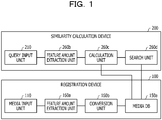
- FIG. 1 is a diagram for explaining the processing of the registration device and the similarity calculation device according to the first embodiment.
- a registration device 100 includes a media input unit 110, a feature amount extraction unit 160a, a conversion unit 160b, and a media DB 150a.
- a similarity calculation device 200 includes a query input unit 210, a feature amount extraction unit 260b, a calculation unit 260c, and a search unit 260d.
- the registration device 100 is a processing unit that converts media data into binary binary data, associates the media data with the binary data, and registers them in the media DB 150a.
- the media input unit 110 is a processing unit that accepts input of a plurality of media data.
- media data is data corresponding to image data, moving image data, sound (voice) data, and the like.
- the media input unit 110 outputs a plurality of media data to the feature amount extraction unit 160a.
- the feature amount extraction unit 160a is a processing unit that converts the media data into a feature vector having a fixed length number of dimensions by extracting the feature amount from the media data. For example, when the media data is image data or moving image data, the feature amount extraction unit 160a converts the media data into the feature vector by extracting the histograms of oriented gradients (HOG) feature amount and the like. When the media data is sound data, the feature amount extraction unit 160a converts the media data into the feature vector by extracting the i-vector feature amount and the like.
- HOG histograms of oriented gradients
- the feature amount extraction unit 160a converts each of a plurality of media data into feature vectors and outputs each of the converted feature vectors to the conversion unit 160b.
- the conversion unit 160b is a processing unit that converts the feature vector into a binary code having a predetermined number of dimensions.
- the conversion unit 160b converts the feature vector into the binary code by performing conversion processing and binarization processing.
- the conversion unit 160b converts the feature vector into a conversion vector having the same number of dimensions as the number of dimensions of the binary code by performing conversion processing such as iterative quantization (ITQ) and locality sensitive hashing (LSH).
- conversion processing such as iterative quantization (ITQ) and locality sensitive hashing (LSH).
- the conversion unit 160b converts the conversion vector into the binary code by performing binarization processing on the conversion vector.
- the conversion unit 160b converts each of a plurality of feature vectors into binary codes and registers information regarding each binary code in the media DB 150a.
- the media DB 150a is a database that holds information regarding the binary code extracted from media data.
- the similarity calculation device 200 is a device that calculates each similarity between the query and each of media data registered in the media DB 150a.
- the similarity calculation device 200 calculates the similarity based on the probability that the binary code obtained by binarizing the feature vector of the query becomes the binary code of the media.
- the query input unit 210 is a processing unit that accepts input of media data to become a query.
- the media data to become a query is referred to as "query data”.
- the query input unit 210 outputs the query data to the feature amount extraction unit 260b.
- the feature amount extraction unit 260b is a processing unit that converts the query data into the feature vector having a fixed length number of dimensions by extracting the feature amount from the query data.
- the processing of converting the query data (media data) into the feature vector by the feature amount extraction unit 260b is similar to the processing of the feature amount extraction unit 160a.
- the feature amount extraction unit 260b outputs the feature vector corresponding to the query data to the calculation unit 260c.
- the calculation unit 260c is a processing unit that calculates each similarity between the query data and each of media data in the media DB 150a.
- the calculation unit 260c calculates the similarity based on the probability that the binary code obtained by binarizing the feature vector of the query data is converted into the binary code corresponding to the media data registered in the media DB 150a.
- the calculation unit 260c outputs data of the similarity to the search unit 260d.
- the search unit 260d is a processing unit that searches the media DB 150a for media data similar to the query data based on the similarity.
- the similarity calculation device 200 calculates the similarity based on the probability that the binary code obtained by binarizing the feature vector of the query data becomes the binary code of the media data. This makes it possible to realize a similarity calculation that is more detailed than the Hamming distance.
- the binary code of the query data is "1010”
- the binary code of one media data is “1101”
- the binary code of other media data is “1110”
- the Hamming distances between the binary code of the query and the binary code of each media data become the same, and the similarities become the same.
- the similarity calculation device 200 since the probability that the query data is converted into the binary code "1101” and the probability that the query data is converted into the binary code "1110" are each calculated, it is possible to distinguish the similarities.
- the similarity calculation device 200 calculates the similarity based on the probability that the binary code obtained by binarizing the feature vector of the query data becomes the binary code of the media data, it is possible to suppress the calculation cost compared to a case of performing the similarity calculation of each feature vector.
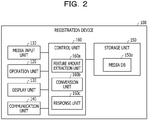
- FIG. 2 is a functional block diagram illustrating a configuration of the registration device according to the first embodiment.
- the registration device 100 includes a media input unit 110, an operation unit 120, a display unit 130, a communication unit 140, a storage unit 150, and a control unit 160.
- the media input unit 110 is a processing unit that accepts input of a plurality of media data.
- the media input unit 110 inputs a plurality of media data to the feature amount extraction unit 160a of the control unit 160.
- the media input unit 110 corresponds to an interface device or the like connected to another external device. Identification information that uniquely identifies the media data may be added to each media data.
- the operation unit 120 is an input device for the user to perform various input operations.
- the operation unit 120 corresponds to a keyboard, a mouse, a touch panel, and the like.
- the display unit 130 is a display device that displays various information output from the control unit 160.
- the display unit 130 corresponds to a liquid crystal display, a touch panel, and the like.
- the communication unit 140 is a processing unit that executes data communication with another device via a network.
- the communication unit 140 corresponds to a communication device.
- the registration device 100 performs data communication with the similarity calculation device 200 via a network.
- the storage unit 150 has the media DB 150a.
- the storage unit 150 corresponds to a semiconductor memory element such as a random access memory (RAM), a read only memory (ROM), and a flash memory, or a storage device such as a hard disk drive (HDD).
- RAM random access memory
- ROM read only memory
- HDD hard disk drive
- the media DB 150a is a database that holds information regarding the media data.
- FIG. 3 is a diagram illustrating an example of a data structure of the media DB according to the first embodiment. As illustrated in FIG. 3 , the media DB 150a associates the identification information, the media, the feature vector, and the binary code with each other.
- the identification information is information that uniquely identifies the media data.
- the media is media data input from the media input unit 110.
- the feature vector is a feature vector of media data converted by the feature amount extraction unit 160a.
- the binary code is a binary code of media data (feature vector) converted by the conversion unit 160b.
- the control unit 160 includes a feature amount extraction unit 160a, a conversion unit 160b, and a response unit 160c.
- the control unit 160 can be implemented by a central processing unit (CPU), a micro processing unit (MPU), or the like.
- the control unit 83 can also be realized by a hard-wired logic such as an application specific integrated circuit (ASIC) or a field programmable gate array (FPGA).
- ASIC application specific integrated circuit
- FPGA field programmable gate array
- the feature amount extraction unit 160a acquires a plurality of media data from the media input unit 110 and stores the plurality of media data in the media DB 150a.
- the feature amount extraction unit 160a converts each media data into the feature vector and registers it in the media DB 150a.
- Other processing related to the feature amount extraction unit 160a is similar to the processing of the feature amount extraction unit 160a performed in FIG.1 .
- the conversion unit 160b is a processing unit that converts the feature vector into the binary code having a predetermined number of dimensions.
- the conversion unit 160b converts a feature vector X into a binary code B by performing conversion processing and binarization processing. For example, let the number of dimensions of the binary code B be "Db".
- Equation (2a) a conversion result obtained by converting the feature vector is represented in Equation (2a).
- Y represented in Equation (2a) is a conversion vector.
- the number of dimensions of the conversion vector Y is "Db".
- Y F X
- Equation (2a) The conversion unit 160b generates a matrix A with Db rows and Dx columns based on LSH. The value of each element a of the matrix A is set randomly.
- the conversion unit 160b calculates the matrix Y (conversion vector Y) by multiplying the matrix A by the matrix X (feature vector X).
- the conversion processing performed by the conversion unit 160b is not limited to LSH, and the feature vector X may be converted into the conversion vector Y by performing a conversion processing such as ITQ.
- the present invention is not limited to the linear transformation described in Equation (2b), and the feature vector X may be transformed into the conversion vector Y by using a neural network that has finished learning.
- the conversion unit 160b converts the conversion vector Y into binary code based on Equation (3).
- Equation (3) is a logistic function.
- Y i is the i-dimensional value of the conversion vector Y.
- the conversion unit 160b converts Y i into "1" when R i obtained by substituting Y i into Equation (3) is 0.5 or more.
- the conversion unit 160b converts Y i into "0" when R i obtained by substituting Y i into Equation (3) is less than 0.5.
- R i 1 / 1 + exp ⁇ Y i
- the conversion unit 160b converts the conversion vector Y into the binary code B by repeatedly executing the processing described above for each dimension of the conversion vector Y.
- the conversion unit 160b converts each feature vector into binary code by executing each of conversion processing and binarization processing for each feature vector.
- the conversion unit 160b registers the binary code in the media DB 150a.
- the response unit 160c is a processing unit that responds to a request accepted from the similarity calculation device 200.
- the response unit 160c When accepting a request for a binary code of each media data from the similarity calculation device 200, the response unit 160c generates a binary code table in which the binary code is extracted from the media DB 150a and outputs the binary code table to the similarity calculation device 200.
- the response unit 160c acquires the media data corresponding to the identification information from the media DB 150a and outputs the media data to the similarity calculation device 200.
- FIG. 4 is a functional block diagram illustrating the configuration of the similarity calculation device according to the first embodiment.
- the similarity calculation device 200 includes a query input unit 210, an operation unit 220, a display unit 230, a communication unit 240, a storage unit 250, and a control unit 260.
- the query input unit 210 is a processing unit that accepts input of the query data.
- the query input unit 210 outputs the query data to the feature amount extraction unit 260b.
- the operation unit 220 is an input device for the user to perform various input operations.
- the operation unit 220 corresponds to a keyboard, a mouse, a touch panel, and the like.
- the display unit 230 is a display device that displays various information output from the control unit 260.
- the display unit 230 corresponds to a liquid crystal display, a touch panel, and the like.
- the communication unit 240 is a processing unit that executes data communication with another device via a network.
- the communication unit 240 corresponds to a communication device.
- the similarity calculation device 200 performs data communication with the registration device 100 via a network.
- the storage unit 250 has a binary code table 250a.
- the storage unit 250 corresponds to the semiconductor memory element such as the RAM, the ROM, and the flash memory, or the storage device such as the HDD.
- the binary code table 250a is a table that holds a binary code corresponding to each media data.
- FIG. 5 is a diagram illustrating an example of a data structure of the binary code table according to the first embodiment. As illustrated in FIG. 5 , the binary code table 250a associates the identification information with the binary code.
- the identification information is information that uniquely identifies the media data.
- the binary code is a binary code generated by the registration device 100.
- the control unit 260 includes an acceptance unit 260a, a feature amount extraction unit 260b, a calculation unit 260c, and a search unit 260d.
- the control unit 260 can be implemented by the CPU, the MPU, or the like. Furthermore, the control unit 260 can also be realized by a hard-wired logic such as the ASIC or the FPGA.
- the acceptance unit 260a is a processing unit that requests the binary code to the registration device 100 and accepts the binary code table 250a.
- the acceptance unit 260a registers the binary code table 250a in the storage unit 250.
- the feature amount extraction unit 260b is a processing unit that acquires query data from the query input unit 210 and extracts a feature amount from the query data to convert the query data into the feature vector having the number of dimensions "Dx".
- the processing in which the feature amount extraction unit 260b converts the query data into the feature vector is similar to the processing in which the feature amount extraction unit 160a converts the media data into the feature vector.
- the feature amount extraction unit 260b outputs the feature vector to the calculation unit 260c.
- the calculation unit 260c is a processing unit that calculates each similarity between the query data and each of media data in the media DB 150a. For example, the calculation unit 260c calculates the similarity using the feature vector of the query data and the binary code table 250a.
- X) is the conditional probability of the feature vector X regarding the binary code B.
- X) is the conditional probability of the feature vector X regarding the binary code B.
- Equation (4) Y is the conversion vector Y of the feature vector X of the query data.
- the calculation unit 260c converts the feature vector X into the conversion vector based on Equation (2a) in the manner similar to the conversion unit 160b described above.
- B*Y indicates the inner product of the binary code B and the conversion vector. const is a value that does not depend on the binary code B, that is set preliminarily.
- the calculation unit 260c calculates the value of Equation (4) based on the conversion vector obtained from the query data and each binary code of the binary code table 250a. By this processing, the calculation unit 260c calculates each similarity between the query data and each of binary data. For example, the calculation unit 260c outputs to the search unit 260d the data of the calculation result in which the identification information of the binary code used when calculating the similarity and the similarity are associated with each other.
- the search unit 260d is a processing unit that searches the media DB 150a for media data similar to the query data based on the similarity. For example, the search unit 260d acquires the data of the calculation result from the calculation unit 260c, compares each similarity, specifies the similarity that is maximum, and notifies the registration device 100 of the identification information corresponding to the specified similarity. Note that the search unit 260d may sort the similarities in descending order and notify the registration device 100 of the identification information corresponding to the top N similarities. N is a numerical value that is set preliminarily.
- the search unit 260d acquires the media data corresponding to the identification information from the registration device 100 and uses the acquired media data as the search result.
- the search unit 260d outputs the media data of the search result to the display unit 230 to cause to display it. Furthermore, the search unit 260d may transmit the media data of the search result to another device connected to the network.
- FIG. 6 is a flowchart illustrating the processing procedure of the registration device according to the first embodiment.
- the media input unit 110 of the registration device 100 accepts input of a plurality of media data (step S101).
- the feature amount extraction unit 160a of the registration device 100 selects media data (step S102).
- the feature amount extraction unit 160a converts the media data into the feature vector (step S103).
- the conversion unit 160b of the registration device 100 converts the feature vector into the conversion vector (step S104).
- the conversion unit 160b converts the conversion vector into the binary code (step S105).
- the conversion unit 160b registers the binary code in the media DB 150a (step S106).
- the registration device 100 determines whether or not all the media data have been selected (step S107). When all the media data have not been selected (step S107, No), the registration device 100 proceeds to step S102. On the other hand, when all the media data have been selected (step S107, Yes), the registration device 100 ends the processing.
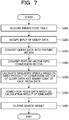
- FIG. 7 is a flowchart illustrating the processing procedure of the similarity calculation device according to the first embodiment.
- the acceptance unit 260a of the similarity calculation device 200 acquires the binary code table 250a from the registration device 100 (step S201).
- the query input unit 210 of the similarity calculation device 200 accepts the input of query data (step S202).
- the feature amount extraction unit 260b of the similarity calculation device 200 converts the query data into the feature vector (step S203).
- the calculation unit 260c of the similarity calculation device 200 converts the feature vector into the conversion vector (step S204).
- the calculation unit 260c calculates the similarity based on the inner product of the conversion vector of the query data and the binary code of each media data (step S205).
- the similarity calculated in step S205 corresponds to the probability "P(B
- the search unit 260d of the similarity calculation device 200 searches for media data based on the calculation result of the similarity (step S206).
- the search unit 260d acquires the media data as the search result by notifying the registration device 100 of the identification information of the media data corresponding to the maximum similarity.
- the search unit 260d outputs the search result to the display unit 230 (step S207).
- the similarity calculation device 200 calculates the similarity based on the probability P(B
- the binary code of the query data is “1010”
- the binary code of one media data is “1101”
- the binary code of other media data is “1110”
- the Hamming distances between the binary code of the query and the binary code of each media data become the same, and the similarities become the same.
- the similarity calculation device 200 since the probability that the query data is converted into the binary code "1101” and the probability that the query data is converted into the binary code "1110" are each calculated, it is possible to rank the similarities.
- the similarity calculation device 200 calculates the similarity based on the probability that the binary code obtained by binarizing the feature vector of the query data becomes the binary code of the media data, it is possible to suppress the calculation cost compared to a case of performing the similarity calculation of each feature vector.
- the similarity calculation device 200 calculates the similarity using the binary code table 250a and does not store each media data and each feature vector in the storage unit 250. Therefore, it is possible to reduce the capacity of the data registered in the storage unit 250.
- the similarity calculation device 200 uses the probability P(B
- the similarity calculation device 200 may use "log(P(B
- the similarity calculation device converts the query data into the binary code, compares it with the binary code of each media data, and calculates the Hamming distance.
- the similarity calculation device narrows down the media data by giving priority to those having a small Hamming distance and calculates the similarity (probability P(B
- X) the similarity
- FIG. 8 is a functional block diagram illustrating a configuration of the similarity calculation device according to the second embodiment.
- this similarity calculation device 300 includes a query input unit 310, an operation unit 320, a display unit 330, a communication unit 340, a storage unit 350, and a control unit 360.
- the query input unit 310 is a processing unit that accepts input of the query data.
- the query input unit 310 outputs the query data to the feature amount extraction unit 360b.
- the operation unit 320 is an input device for the user to perform various input operations.
- the operation unit 320 corresponds to a keyboard, a mouse, a touch panel, and the like.
- the display unit 330 is a display device that displays various information output from the control unit 360.
- the display unit 330 corresponds to a liquid crystal display, a touch panel, and the like.
- the communication unit 340 is a processing unit that executes data communication with another device via a network.
- the communication unit 340 corresponds to a communication device.
- the similarity calculation device 300 performs data communication with the registration device 100 via a network.
- the storage unit 350 has a binary code table 350a.
- the storage unit 350 corresponds to the semiconductor memory element such as the RAM, the ROM, and the flash memory, or the storage device such as the HDD.
- the binary code table 350a is a table that holds a binary code corresponding to each media data.
- the data structure of the binary code table 350a is similar to the data structure of the binary code table 250a described with reference to FIG. 5 .
- the control unit 360 includes an acceptance unit 360a, a feature amount extraction unit 360b, a conversion unit 360c, a calculation unit 360c, and a search unit 360d.
- the control unit 360 can be implemented by the CPU, the MPU, or the like. Furthermore, the control unit 360 can also be realized by a hard-wired logic such as the ASIC or the FPGA.
- the acceptance unit 360a is a processing unit that requests the binary code to the registration device 100 and accepts the binary code table 350a.
- the acceptance unit 360a registers the binary code table 350a in the storage unit 350.
- the feature amount extraction unit 360b is a processing unit that acquires query data from the query input unit 310 and extracts a feature amount from the query data to convert the query data into the feature vector having the number of dimensions "Dx".
- the processing in which the feature amount extraction unit 360b converts the query data into the feature vector is similar to the processing in which the feature amount extraction unit 160a converts the media data into the feature vector.
- the feature amount extraction unit 360b outputs the feature vector to the conversion unit 360c and the calculation unit 360d.
- the conversion unit 360c is a processing unit that converts the feature vector into the binary code having a predetermined number of dimensions.
- the conversion unit 360b converts the feature vector X into binary code B by performing conversion processing and binarization processing. For example, let the number of dimensions of the binary code B be "Db".
- the conversion processing and binarization processing performed by the conversion unit 360c are similar to the conversion processing and binarization processing performed by the conversion unit 160b.
- the conversion unit 360c outputs the binary code to the calculation unit 360d.
- the binary code of the binary code table 350a is referred to as "first binary code”.
- the binary code of the query data converted by the conversion unit 360c is referred to as "second binary code”.
- the calculation unit 360d is a processing unit that calculates each similarity between the query data and each of media data in the media DB 150a. For example, the calculation unit 360d performs the narrowing processing, narrows down the first binary code, and then calculates the similarity using the narrowed down first binary code.
- the calculation unit 360d calculates the respective Hamming distances between the second binary code and each first binary code.
- the calculation unit 360d sorts each first binary code in ascending order from the one with the smallest Hamming distance from the second binary code.
- the calculation unit 360d selects the top M first binary codes from each of the sorted first binary codes. M is a numerical value that is set preliminarily.
- the calculation of the similarity performed by the calculation unit 360d will be described.
- the calculation unit 360d calculates the similarity using the feature vector of the query data and the first binary code selected by the narrowing processing.
- the calculation unit 360d calculates the similarity based on Equation (4) in the manner similar to the calculation unit 260c.
- the calculation unit 360d outputs to the search unit 360e the data of the calculation result in which the identification information of the first binary code used when calculating the similarity and the similarity are associated with each other.
- the search unit 360e is a processing unit that searches the media DB 150a for media data similar to the query data based on the similarity. For example, the search unit 360e acquires the data of the calculation result from the calculation unit 360d, compares each similarity, specifies the similarity that is maximum, and notifies the registration device 100 of the identification information corresponding to the specified similarity. Note that the search unit 360e may sort the similarities in descending order and notify the registration device 100 of the identification information corresponding to the top N similarities.
- the search unit 360e acquires the media data corresponding to the identification information from the registration device 100 and uses the acquired media data as the search result.
- the search unit 360e outputs the media data of the search result to the display unit 330 to cause to display it. Furthermore, the search unit 360e may transmit the media data of the search result to another device connected to the network.
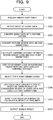
- FIG. 9 is a flowchart illustrating a processing procedure of the similarity calculation device according to the second embodiment.
- the acceptance unit 360a of the similarity calculation device 300 acquires the binary code table 350a from the registration device 100 (step S301).
- the query input unit 310 of the similarity calculation device 300 accepts the input of query data (step S302).
- the feature amount extraction unit 360b of the similarity calculation device 300 converts the query data into the feature vector (step S303).
- the conversion unit 360c of the similarity calculation device 300 converts the feature vector into the binary code (step S304).
- the calculation unit 360d calculates the Hamming distance between the conversion vector of the query data and the first binary code of each media data (step S305).
- the calculation unit 360d sorts the first binary code in ascending order from the one with the smallest Hamming distance (step S306).
- the calculation unit 360d selects the top M first binary codes (step S307).
- the calculation unit 360c calculates the similarity based on the inner product of the conversion vector of the query data and the selected first binary code (step S308).
- the similarity calculated in step S308 corresponds to the probability "P(B
- the search unit 360e of the similarity calculation device 300 searches for media data based on the calculation result of the similarity (step S309).
- the search unit 360e acquires the media data as the search result by notifying the registration device 100 of the identification information of the media data corresponding to the maximum similarity.
- the search unit 360e outputs the search result to the display unit 330 (step S310).
- the similarity calculation device 300 converts the query data into the binary code, compares it with the binary code of each media data, and calculates the Hamming distance.
- the similarity calculation device 300 narrows down the media data by giving priority to those having a small Hamming distance and calculates the similarity (probability P(B
- Biometric information includes human fingerprints, irises, facial images, vital signs, and the like.
- the registration device 100 illustrated in FIGS. 1 and 2 generates the feature vector by extracting the feature amount from the biometric data and registers the binary code of the biometric data in the media DB 150a.
- the similarity calculation devices 200 and 300 illustrated in FIGS. 1 , 4 , and 8 generate the feature vector by extracting the feature amount from the biometric information of the user and calculate the similarity.
- the case where the registration device 100 and the similarity calculation devices 200 and 300 are separate devices has been described as an example, but the present invention is not limited to this.
- the registration device 100 and the similarity calculation device 200 may be included in one device.
- the registration device 100 and the similarity calculation device 300 may be included in one device.
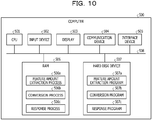
- FIG. 10 is a diagram illustrating an example of a hardware configuration of a computer that implements functions similar to those of the registration device according to the present embodiments.
- a computer 500 includes a CPU 501 that executes various calculation processing, an input device 502 that accepts data input from a user, and a display 503. Furthermore, the computer 500 includes a reading device 504 that reads a program and the like from a storage medium, and an interface device 505 that exchanges data with an external device and the like via a wired or wireless network. The computer 500 includes a RAM 506 that temporarily stores various information, and a hard disk device 507. Then, each of the devices 501 to 507 is connected to a bus 508.
- the hard disk device 507 has a feature amount extraction program 507a, a conversion program 507b, and a response program 507c.
- the CPU 501 reads the feature amount extraction program 507a, the conversion program 507b, and the response program 507c and expands them in the RAM 506.
- the feature amount extraction program 507a functions as a feature amount extraction process 506a.
- the conversion program 507b functions as a conversion process 506b.
- the response program 507c functions as a response process 506c.
- the processing of the feature amount extraction process 506a corresponds to the processing of the feature amount extraction unit 160a.
- the processing of the conversion process 506b corresponds to the processing of the conversion unit 160b.
- the processing of the response process 506c corresponds to the processing of the response unit 160c.
- each of the programs 507a to 507c may not need to be stored in the hard disk device 507 beforehand.
- each of the programs may be stored in a "portable physical medium" such as a flexible disk (FD), a compact disc (CD)-ROM, a digital versatile disk (DVD), a magneto-optical disk, or an integrated circuit (IC) card to be inserted in the computer 500.
- the computer 500 may read and execute each of the programs 507a to 507e.
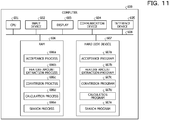
- FIG. 11 is a diagram illustrating an example of a hardware configuration of a computer that implements functions similar to those of the similarity calculation device according to the present embodiments.
- a computer 600 includes a CPU 601 that executes various calculation processing, an input device 602 that accepts data input from a user, and a display 603. Furthermore, the computer 600 includes a reading device 604 that reads a program and the like from a storage medium, and an interface device 605 that exchanges data with an external device and the like via a wired or wireless network. The computer 600 includes a RAM 606 that temporarily stores various information, and a hard disk device 607. Then, each of the devices 601 to 607 is connected to a bus 608.
- the hard disk device 607 includes a reception program 607a, a feature amount extraction program 607b, a conversion program 607c, a calculation program 607d, and a search program 607e.
- the CPU 601 reads the reception program 607a, the feature amount extraction program 607b, the conversion program 607c, the calculation program 607d, and the search program 607e and expands them in the RAM 606.
- the reception program 607a functions as a reception process 606a.
- the feature amount extraction program 607b functions as a feature amount extraction process 606b.
- the conversion program 607c functions as a conversion process 606c.
- the calculation program 607d functions as a calculation process 606d.
- the search program 607e functions as a search process 606e.
- the processing of the reception process 606a corresponds to the processing of the reception units 260a and 360a.
- the processing of the feature amount extraction process 606b corresponds to the processing of the feature amount extraction units 260b and 360b.
- the processing of the conversion process 606c corresponds to the processing of the conversion unit 360c.
- the processing of the calculation process 606d corresponds to the processing of the calculation units 260c and 360d.
- the processing of the search process 606e corresponds to the processing of the search units 260d and 360e.
- each of the programs 607a to 607e may not need to be stored in the hard disk device 607 beforehand.
- each of the programs may be stored in a "portable physical medium" such as a flexible disk (FD), a compact disc (CD)-ROM, a digital versatile disk (DVD), a magneto-optical disk, or an integrated circuit (IC) card to be inserted in the computer 600. Then, the computer 600 may read and execute each of the programs 607a to 607e.
- FD flexible disk
- CD compact disc
- DVD digital versatile disk
- IC integrated circuit
Landscapes
- Engineering & Computer Science (AREA)
- Theoretical Computer Science (AREA)
- Physics & Mathematics (AREA)
- Databases & Information Systems (AREA)
- Data Mining & Analysis (AREA)
- General Physics & Mathematics (AREA)
- General Engineering & Computer Science (AREA)
- Probability & Statistics with Applications (AREA)
- Computational Linguistics (AREA)
- Software Systems (AREA)
- Mathematical Physics (AREA)
- Fuzzy Systems (AREA)
- Automation & Control Theory (AREA)
- Information Retrieval, Db Structures And Fs Structures Therefor (AREA)
Abstract
Description
- The present invention relates to a similarity calculation device and the like.
- There is a search system that searches a database for media similar to a query. In this search system, a feature vector of the media existing in the vicinity of a feature vector of the query is searched by calculating a distance between the feature vector of the query and the feature vector of each media stored in the database. The distance calculation corresponds to the similarity calculation such as the cosine distance calculation.
- Here, the feature vector used in the search system is a high-dimensional feature vector. Therefore, when each distance between the feature vector of the query and the feature vector of each media is calculated, the calculation cost becomes enormous. When the calculation cost increases, it takes time from inputting the query to outputting the search result.
- In order to reduce the calculation cost using the feature vector, there is a conventional technology that approximates the feature vector to a binary code. This conventional technology calculates the Hamming distance between approximated binary codes as the similarity. Since the binary code is more compact than the feature vector, it is possible to reduce the calculation cost and shorten the search time.
-
- Patent Document 1:
Japanese Laid-open Patent Publication No. 2017-54438 - Patent Document 2:
Japanese Laid-open Patent Publication No. 2018-55618 - Patent Document 3:
Japanese Laid-open Patent Publication No. 2013-246739 - Patent Document 4: International Publication Pamphlet No.
WO 2009/151002 - Patent Document 5:
U.S. Patent No. 2011/0093419 NON-PATENT DOCUMENT - Non-Patent Document 1: Y. Gong and S Lazebnik, "Iterative Quantization: A Procrustean Approach to Leaning Binary Codes." In Proc. CVPR, 2011.
- However, the above-mentioned conventional technology has a problem that it is not possible to calculate the similarity accurately with a small calculation load.
- In the conventional technology, the feature vector is approximated to the binary code, but since the Hamming distance between the binary codes has a discretized value, it is difficult to express a precise distance. For example, even if the feature vectors themselves each have different values, each Hamming distance may be the same as a result of calculating the Hamming distance by approximating it to the binary code. Then, it means that each similarity is matched, ranking cannot be performed, and the calculation accuracy of similarity is lowered.
- Furthermore, if the similarity is calculated by using the feature vector as is without approximating it to the binary code, the calculation load increases even though the accuracy of the similarity calculation improves.
- In one aspect, it is an object of the present invention to provide a similarity calculation device, a similarity calculation method, and a similarity calculation program capable of accurately performing similarity calculation with a small calculation load.
- In the first plan, the similarity calculation device includes a storage unit and a calculation unit. The storage unit stores each binarized first code corresponding to a plurality of first media data. The calculation unit calculates each similarity between the second media data and each of the first media data based on the probability that the second code obtained by binarizing the feature vector corresponding to the second media data is converted into the first code.
- It is possible to calculate the similarity accurately with a small calculation load.
-
-
FIG. 1 is a diagram for explaining processing of a registration device and a similarity calculation device according to a first embodiment. -
FIG. 2 is a functional block diagram illustrating a configuration of the registration device according to the first embodiment. -
FIG. 3 is a diagram illustrating an example of a data structure of a media database (DB) according to the first embodiment. -
FIG. 4 is a functional block diagram illustrating a configuration of the similarity calculation device according to the first embodiment. -
FIG. 5 is a diagram illustrating an example of a data structure of a binary code table according to the first embodiment. -
FIG. 6 is a flowchart illustrating a processing procedure of the registration device according to the first embodiment. -
FIG. 7 is a flowchart illustrating a processing procedure of the similarity calculation device according to the first embodiment. -
FIG. 8 is a functional block diagram illustrating a configuration of the similarity calculation device according to a second embodiment. -
FIG. 9 is a flowchart illustrating a processing procedure of the similarity calculation device according to the second embodiment. -
FIG. 10 is a diagram illustrating an example of a hardware configuration of a computer that implements functions similar to those of the registration device according to the present embodiments. -
FIG. 11 is a diagram illustrating an example of a hardware configuration of a computer that implements functions similar to those of the similarity calculation device according to the present embodiments. - Hereinafter, embodiments of a similarity calculation device, a similarity calculation method, and a similarity calculation program according to the present invention will be described in detail with reference to the drawings. Note that the present invention is not limited to the embodiments.
-
FIG. 1 is a diagram for explaining the processing of the registration device and the similarity calculation device according to the first embodiment. As illustrated inFIG. 1 , aregistration device 100 includes amedia input unit 110, a featureamount extraction unit 160a, aconversion unit 160b, and amedia DB 150a. Asimilarity calculation device 200 includes aquery input unit 210, a featureamount extraction unit 260b, acalculation unit 260c, and asearch unit 260d. - The
registration device 100 is a processing unit that converts media data into binary binary data, associates the media data with the binary data, and registers them in themedia DB 150a. - The
media input unit 110 is a processing unit that accepts input of a plurality of media data. For example, media data is data corresponding to image data, moving image data, sound (voice) data, and the like. Themedia input unit 110 outputs a plurality of media data to the featureamount extraction unit 160a. - The feature
amount extraction unit 160a is a processing unit that converts the media data into a feature vector having a fixed length number of dimensions by extracting the feature amount from the media data. For example, when the media data is image data or moving image data, the featureamount extraction unit 160a converts the media data into the feature vector by extracting the histograms of oriented gradients (HOG) feature amount and the like. When the media data is sound data, the featureamount extraction unit 160a converts the media data into the feature vector by extracting the i-vector feature amount and the like. - The feature
amount extraction unit 160a converts each of a plurality of media data into feature vectors and outputs each of the converted feature vectors to theconversion unit 160b. - The
conversion unit 160b is a processing unit that converts the feature vector into a binary code having a predetermined number of dimensions. Theconversion unit 160b converts the feature vector into the binary code by performing conversion processing and binarization processing. - The
conversion unit 160b converts the feature vector into a conversion vector having the same number of dimensions as the number of dimensions of the binary code by performing conversion processing such as iterative quantization (ITQ) and locality sensitive hashing (LSH). Theconversion unit 160b converts the conversion vector into the binary code by performing binarization processing on the conversion vector. - The
conversion unit 160b converts each of a plurality of feature vectors into binary codes and registers information regarding each binary code in themedia DB 150a. - The
media DB 150a is a database that holds information regarding the binary code extracted from media data. - When accepting media data to become a query, the
similarity calculation device 200 is a device that calculates each similarity between the query and each of media data registered in themedia DB 150a. Thesimilarity calculation device 200 calculates the similarity based on the probability that the binary code obtained by binarizing the feature vector of the query becomes the binary code of the media. - The
query input unit 210 is a processing unit that accepts input of media data to become a query. In the following description, the media data to become a query is referred to as "query data". Thequery input unit 210 outputs the query data to the featureamount extraction unit 260b. - The feature
amount extraction unit 260b is a processing unit that converts the query data into the feature vector having a fixed length number of dimensions by extracting the feature amount from the query data. The processing of converting the query data (media data) into the feature vector by the featureamount extraction unit 260b is similar to the processing of the featureamount extraction unit 160a. The featureamount extraction unit 260b outputs the feature vector corresponding to the query data to thecalculation unit 260c. - The
calculation unit 260c is a processing unit that calculates each similarity between the query data and each of media data in themedia DB 150a. Thecalculation unit 260c calculates the similarity based on the probability that the binary code obtained by binarizing the feature vector of the query data is converted into the binary code corresponding to the media data registered in themedia DB 150a. Thecalculation unit 260c outputs data of the similarity to thesearch unit 260d. - The
search unit 260d is a processing unit that searches themedia DB 150a for media data similar to the query data based on the similarity. - As described above, the
similarity calculation device 200 according to the first embodiment calculates the similarity based on the probability that the binary code obtained by binarizing the feature vector of the query data becomes the binary code of the media data. This makes it possible to realize a similarity calculation that is more detailed than the Hamming distance. - For example, if the binary code of the query data is "1010", the binary code of one media data is "1101", and the binary code of other media data is "1110", the Hamming distances between the binary code of the query and the binary code of each media data become the same, and the similarities become the same. On the other hand, in the
similarity calculation device 200, since the probability that the query data is converted into the binary code "1101" and the probability that the query data is converted into the binary code "1110" are each calculated, it is possible to distinguish the similarities. - Furthermore, since the
similarity calculation device 200 calculates the similarity based on the probability that the binary code obtained by binarizing the feature vector of the query data becomes the binary code of the media data, it is possible to suppress the calculation cost compared to a case of performing the similarity calculation of each feature vector. - Next, an example of the configuration of the
registration device 100 illustrated inFIG. 1 will be described.FIG. 2 is a functional block diagram illustrating a configuration of the registration device according to the first embodiment. As illustrated inFIG. 2 , theregistration device 100 includes amedia input unit 110, anoperation unit 120, adisplay unit 130, acommunication unit 140, astorage unit 150, and acontrol unit 160. - The
media input unit 110 is a processing unit that accepts input of a plurality of media data. Themedia input unit 110 inputs a plurality of media data to the featureamount extraction unit 160a of thecontrol unit 160. For example, themedia input unit 110 corresponds to an interface device or the like connected to another external device. Identification information that uniquely identifies the media data may be added to each media data. - The
operation unit 120 is an input device for the user to perform various input operations. Theoperation unit 120 corresponds to a keyboard, a mouse, a touch panel, and the like. - The
display unit 130 is a display device that displays various information output from thecontrol unit 160. Thedisplay unit 130 corresponds to a liquid crystal display, a touch panel, and the like. - The
communication unit 140 is a processing unit that executes data communication with another device via a network. Thecommunication unit 140 corresponds to a communication device. For example, theregistration device 100 performs data communication with thesimilarity calculation device 200 via a network. - The
storage unit 150 has themedia DB 150a. Thestorage unit 150 corresponds to a semiconductor memory element such as a random access memory (RAM), a read only memory (ROM), and a flash memory, or a storage device such as a hard disk drive (HDD). - The
media DB 150a is a database that holds information regarding the media data.FIG. 3 is a diagram illustrating an example of a data structure of the media DB according to the first embodiment. As illustrated inFIG. 3 , themedia DB 150a associates the identification information, the media, the feature vector, and the binary code with each other. The identification information is information that uniquely identifies the media data. The media is media data input from themedia input unit 110. The feature vector is a feature vector of media data converted by the featureamount extraction unit 160a. The binary code is a binary code of media data (feature vector) converted by theconversion unit 160b. - The
control unit 160 includes a featureamount extraction unit 160a, aconversion unit 160b, and aresponse unit 160c. Thecontrol unit 160 can be implemented by a central processing unit (CPU), a micro processing unit (MPU), or the like. Furthermore, the control unit 83 can also be realized by a hard-wired logic such as an application specific integrated circuit (ASIC) or a field programmable gate array (FPGA). - The feature
amount extraction unit 160a is a processing unit that converts the media data into a feature vector having a fixed length number of dimensions by extracting the feature amount from the media data. For example, let the number of dimensions of a feature vector X be "Dx". Furthermore, the feature vector X is represented by Equation (1).
[Equation 1]
- The feature
amount extraction unit 160a acquires a plurality of media data from themedia input unit 110 and stores the plurality of media data in themedia DB 150a. The featureamount extraction unit 160a converts each media data into the feature vector and registers it in themedia DB 150a. Other processing related to the featureamount extraction unit 160a is similar to the processing of the featureamount extraction unit 160a performed inFIG.1 . - The
conversion unit 160b is a processing unit that converts the feature vector into the binary code having a predetermined number of dimensions. For example, theconversion unit 160b converts a feature vector X into a binary code B by performing conversion processing and binarization processing. For example, let the number of dimensions of the binary code B be "Db". - An example of the "conversion processing" performed by the
conversion unit 160b will be described. When the conversion processing is represented by a function F, a conversion result obtained by converting the feature vector is represented in Equation (2a). Y represented in Equation (2a) is a conversion vector. The number of dimensions of the conversion vector Y is "Db".

- By the way, the relationship of Equation (2a) will be described more specifically by Equation (2b), for example. The
conversion unit 160b generates a matrix A with Db rows and Dx columns based on LSH. The value of each element a of the matrix A is set randomly. Theconversion unit 160b calculates the matrix Y (conversion vector Y) by multiplying the matrix A by the matrix X (feature vector X).
[Equation 2]
- Note that the conversion processing performed by the
conversion unit 160b is not limited to LSH, and the feature vector X may be converted into the conversion vector Y by performing a conversion processing such as ITQ. Furthermore, the present invention is not limited to the linear transformation described in Equation (2b), and the feature vector X may be transformed into the conversion vector Y by using a neural network that has finished learning. - Next, the "binarization processing" performed by the
conversion unit 160b will be described. Theconversion unit 160b converts the conversion vector Y into binary code based on Equation (3). Equation (3) is a logistic function. In Equation (3), Yi is the i-dimensional value of the conversion vector Y. Theconversion unit 160b converts Yi into "1" when Ri obtained by substituting Yi into Equation (3) is 0.5 or more. Theconversion unit 160b converts Yi into "0" when Ri obtained by substituting Yi into Equation (3) is less than 0.5.

- The
conversion unit 160b converts the conversion vector Y into the binary code B by repeatedly executing the processing described above for each dimension of the conversion vector Y. Theconversion unit 160b converts each feature vector into binary code by executing each of conversion processing and binarization processing for each feature vector. Theconversion unit 160b registers the binary code in themedia DB 150a. - The
response unit 160c is a processing unit that responds to a request accepted from thesimilarity calculation device 200. When accepting a request for a binary code of each media data from thesimilarity calculation device 200, theresponse unit 160c generates a binary code table in which the binary code is extracted from themedia DB 150a and outputs the binary code table to thesimilarity calculation device 200. When receiving the identification information from thesimilarity calculation device 200, theresponse unit 160c acquires the media data corresponding to the identification information from themedia DB 150a and outputs the media data to thesimilarity calculation device 200. - Next, an example of the configuration of the
similarity calculation device 200 illustrated inFIG. 1 will be described.FIG. 4 is a functional block diagram illustrating the configuration of the similarity calculation device according to the first embodiment. As illustrated inFIG. 4 , thesimilarity calculation device 200 includes aquery input unit 210, anoperation unit 220, adisplay unit 230, acommunication unit 240, astorage unit 250, and acontrol unit 260. - The
query input unit 210 is a processing unit that accepts input of the query data. Thequery input unit 210 outputs the query data to the featureamount extraction unit 260b. - The
operation unit 220 is an input device for the user to perform various input operations. Theoperation unit 220 corresponds to a keyboard, a mouse, a touch panel, and the like. - The
display unit 230 is a display device that displays various information output from thecontrol unit 260. Thedisplay unit 230 corresponds to a liquid crystal display, a touch panel, and the like. - The
communication unit 240 is a processing unit that executes data communication with another device via a network. Thecommunication unit 240 corresponds to a communication device. For example, thesimilarity calculation device 200 performs data communication with theregistration device 100 via a network. - The
storage unit 250 has a binary code table 250a. Thestorage unit 250 corresponds to the semiconductor memory element such as the RAM, the ROM, and the flash memory, or the storage device such as the HDD. - The binary code table 250a is a table that holds a binary code corresponding to each media data.
FIG. 5 is a diagram illustrating an example of a data structure of the binary code table according to the first embodiment. As illustrated inFIG. 5 , the binary code table 250a associates the identification information with the binary code. The identification information is information that uniquely identifies the media data. The binary code is a binary code generated by theregistration device 100. - The
control unit 260 includes anacceptance unit 260a, a featureamount extraction unit 260b, acalculation unit 260c, and asearch unit 260d. Thecontrol unit 260 can be implemented by the CPU, the MPU, or the like. Furthermore, thecontrol unit 260 can also be realized by a hard-wired logic such as the ASIC or the FPGA. - The
acceptance unit 260a is a processing unit that requests the binary code to theregistration device 100 and accepts the binary code table 250a. Theacceptance unit 260a registers the binary code table 250a in thestorage unit 250. - The feature
amount extraction unit 260b is a processing unit that acquires query data from thequery input unit 210 and extracts a feature amount from the query data to convert the query data into the feature vector having the number of dimensions "Dx". The processing in which the featureamount extraction unit 260b converts the query data into the feature vector is similar to the processing in which the featureamount extraction unit 160a converts the media data into the feature vector. The featureamount extraction unit 260b outputs the feature vector to thecalculation unit 260c. - The
calculation unit 260c is a processing unit that calculates each similarity between the query data and each of media data in themedia DB 150a. For example, thecalculation unit 260c calculates the similarity using the feature vector of the query data and the binary code table 250a. - For example, it is possible to define the probability that the feature vector X of the query data is converted into the binary code B as P(B|X). P(B|X) is the conditional probability of the feature vector X regarding the binary code B. Assuming that each dimension of the binary code B is independent, it is possible to define P(B|X) by Equation (4) using logarithms.

- In Equation (4), Y is the conversion vector Y of the feature vector X of the query data. The
calculation unit 260c converts the feature vector X into the conversion vector based on Equation (2a) in the manner similar to theconversion unit 160b described above. "B*Y" indicates the inner product of the binary code B and the conversion vector. const is a value that does not depend on the binary code B, that is set preliminarily. - The
calculation unit 260c calculates the value of Equation (4) based on the conversion vector obtained from the query data and each binary code of the binary code table 250a. By this processing, thecalculation unit 260c calculates each similarity between the query data and each of binary data. For example, thecalculation unit 260c outputs to thesearch unit 260d the data of the calculation result in which the identification information of the binary code used when calculating the similarity and the similarity are associated with each other. - The
search unit 260d is a processing unit that searches themedia DB 150a for media data similar to the query data based on the similarity. For example, thesearch unit 260d acquires the data of the calculation result from thecalculation unit 260c, compares each similarity, specifies the similarity that is maximum, and notifies theregistration device 100 of the identification information corresponding to the specified similarity. Note that thesearch unit 260d may sort the similarities in descending order and notify theregistration device 100 of the identification information corresponding to the top N similarities. N is a numerical value that is set preliminarily. - The
search unit 260d acquires the media data corresponding to the identification information from theregistration device 100 and uses the acquired media data as the search result. Thesearch unit 260d outputs the media data of the search result to thedisplay unit 230 to cause to display it. Furthermore, thesearch unit 260d may transmit the media data of the search result to another device connected to the network. - Next, an example of a processing procedure of the
registration device 100 according to the first embodiment will be described.FIG. 6 is a flowchart illustrating the processing procedure of the registration device according to the first embodiment. As illustrated inFIG. 6 , themedia input unit 110 of theregistration device 100 accepts input of a plurality of media data (step S101). - The feature
amount extraction unit 160a of theregistration device 100 selects media data (step S102). The featureamount extraction unit 160a converts the media data into the feature vector (step S103). Theconversion unit 160b of theregistration device 100 converts the feature vector into the conversion vector (step S104). - The
conversion unit 160b converts the conversion vector into the binary code (step S105). Theconversion unit 160b registers the binary code in themedia DB 150a (step S106). - The
registration device 100 determines whether or not all the media data have been selected (step S107). When all the media data have not been selected (step S107, No), theregistration device 100 proceeds to step S102. On the other hand, when all the media data have been selected (step S107, Yes), theregistration device 100 ends the processing. - Next, an example of a processing procedure of the
similarity calculation device 200 according to the first embodiment will be described.FIG. 7 is a flowchart illustrating the processing procedure of the similarity calculation device according to the first embodiment. As illustrated inFIG. 7 , theacceptance unit 260a of thesimilarity calculation device 200 acquires the binary code table 250a from the registration device 100 (step S201). - The
query input unit 210 of thesimilarity calculation device 200 accepts the input of query data (step S202). The featureamount extraction unit 260b of thesimilarity calculation device 200 converts the query data into the feature vector (step S203). Thecalculation unit 260c of thesimilarity calculation device 200 converts the feature vector into the conversion vector (step S204). - The
calculation unit 260c calculates the similarity based on the inner product of the conversion vector of the query data and the binary code of each media data (step S205). The similarity calculated in step S205 corresponds to the probability "P(B|X)". - The
search unit 260d of thesimilarity calculation device 200 searches for media data based on the calculation result of the similarity (step S206). In step S206, thesearch unit 260d acquires the media data as the search result by notifying theregistration device 100 of the identification information of the media data corresponding to the maximum similarity. Thesearch unit 260d outputs the search result to the display unit 230 (step S207). - Next, effects of the
similarity calculation device 200 according to the first embodiment will be described. Thesimilarity calculation device 200 calculates the similarity based on the probability P(B|X) that the binary code obtained by binarizing the feature vector of the query data becomes the binary code of the media data. This makes it possible to realize a similarity calculation that is more detailed than the Hamming distance. - For example, if the binary code of the query data is "1010", the binary code of one media data is "1101", and the binary code of other media data is "1110", the Hamming distances between the binary code of the query and the binary code of each media data become the same, and the similarities become the same. On the other hand, in the
similarity calculation device 200, since the probability that the query data is converted into the binary code "1101" and the probability that the query data is converted into the binary code "1110" are each calculated, it is possible to rank the similarities. - Since the
similarity calculation device 200 calculates the similarity based on the probability that the binary code obtained by binarizing the feature vector of the query data becomes the binary code of the media data, it is possible to suppress the calculation cost compared to a case of performing the similarity calculation of each feature vector. - When calculating the similarity, the
similarity calculation device 200 calculates the similarity using the binary code table 250a and does not store each media data and each feature vector in thestorage unit 250. Therefore, it is possible to reduce the capacity of the data registered in thestorage unit 250. - By the way, the
similarity calculation device 200 according to the first embodiment uses the probability P(B|X) as the similarity, but the similarity is not limited to this. Thesimilarity calculation device 200 may use "log(P(B|X))" as the similarity. - Next, the similarity calculation device according to a second embodiment will be described. The similarity calculation device according to the second embodiment converts the query data into the binary code, compares it with the binary code of each media data, and calculates the Hamming distance. The similarity calculation device narrows down the media data by giving priority to those having a small Hamming distance and calculates the similarity (probability P(B|X)) between the narrowed down media data and the query data by performing the processing similar to the similarity calculation device of the first embodiment. By narrowing down using the Hamming distance in this way, it is possible to reduce the calculation target of the similarity (probability P(B|X)) and reduce the calculation cost further.
- Although not illustrated in the drawings, it is assumed that the similarity calculation device according to the second embodiment is connected to the
registration device 100 described with reference toFIGS. 1 and2 . -
FIG. 8 is a functional block diagram illustrating a configuration of the similarity calculation device according to the second embodiment. As illustrated inFIG. 8 , thissimilarity calculation device 300 includes aquery input unit 310, anoperation unit 320, adisplay unit 330, acommunication unit 340, astorage unit 350, and acontrol unit 360. - The
query input unit 310 is a processing unit that accepts input of the query data. Thequery input unit 310 outputs the query data to the featureamount extraction unit 360b. - The
operation unit 320 is an input device for the user to perform various input operations. Theoperation unit 320 corresponds to a keyboard, a mouse, a touch panel, and the like. - The
display unit 330 is a display device that displays various information output from thecontrol unit 360. Thedisplay unit 330 corresponds to a liquid crystal display, a touch panel, and the like. - The
communication unit 340 is a processing unit that executes data communication with another device via a network. Thecommunication unit 340 corresponds to a communication device. For example, thesimilarity calculation device 300 performs data communication with theregistration device 100 via a network. - The
storage unit 350 has a binary code table 350a. Thestorage unit 350 corresponds to the semiconductor memory element such as the RAM, the ROM, and the flash memory, or the storage device such as the HDD. - The binary code table 350a is a table that holds a binary code corresponding to each media data. The data structure of the binary code table 350a is similar to the data structure of the binary code table 250a described with reference to
FIG. 5 . - The
control unit 360 includes anacceptance unit 360a, a featureamount extraction unit 360b, aconversion unit 360c, acalculation unit 360c, and asearch unit 360d. Thecontrol unit 360 can be implemented by the CPU, the MPU, or the like. Furthermore, thecontrol unit 360 can also be realized by a hard-wired logic such as the ASIC or the FPGA. - The
acceptance unit 360a is a processing unit that requests the binary code to theregistration device 100 and accepts the binary code table 350a. Theacceptance unit 360a registers the binary code table 350a in thestorage unit 350. - The feature
amount extraction unit 360b is a processing unit that acquires query data from thequery input unit 310 and extracts a feature amount from the query data to convert the query data into the feature vector having the number of dimensions "Dx". The processing in which the featureamount extraction unit 360b converts the query data into the feature vector is similar to the processing in which the featureamount extraction unit 160a converts the media data into the feature vector. The featureamount extraction unit 360b outputs the feature vector to theconversion unit 360c and thecalculation unit 360d. - The
conversion unit 360c is a processing unit that converts the feature vector into the binary code having a predetermined number of dimensions. For example, theconversion unit 360b converts the feature vector X into binary code B by performing conversion processing and binarization processing. For example, let the number of dimensions of the binary code B be "Db". The conversion processing and binarization processing performed by theconversion unit 360c are similar to the conversion processing and binarization processing performed by theconversion unit 160b. Theconversion unit 360c outputs the binary code to thecalculation unit 360d. - In the following description, the binary code of the binary code table 350a is referred to as "first binary code". The binary code of the query data converted by the
conversion unit 360c is referred to as "second binary code". - The
calculation unit 360d is a processing unit that calculates each similarity between the query data and each of media data in themedia DB 150a. For example, thecalculation unit 360d performs the narrowing processing, narrows down the first binary code, and then calculates the similarity using the narrowed down first binary code. - The narrowing processing performed by the
calculation unit 360d will be described. Thecalculation unit 360d calculates the respective Hamming distances between the second binary code and each first binary code. Thecalculation unit 360d sorts each first binary code in ascending order from the one with the smallest Hamming distance from the second binary code. Thecalculation unit 360d selects the top M first binary codes from each of the sorted first binary codes. M is a numerical value that is set preliminarily. - The calculation of the similarity performed by the
calculation unit 360d will be described. Thecalculation unit 360d calculates the similarity using the feature vector of the query data and the first binary code selected by the narrowing processing. Thecalculation unit 360d calculates the similarity based on Equation (4) in the manner similar to thecalculation unit 260c. Thecalculation unit 360d outputs to thesearch unit 360e the data of the calculation result in which the identification information of the first binary code used when calculating the similarity and the similarity are associated with each other. - The
search unit 360e is a processing unit that searches themedia DB 150a for media data similar to the query data based on the similarity. For example, thesearch unit 360e acquires the data of the calculation result from thecalculation unit 360d, compares each similarity, specifies the similarity that is maximum, and notifies theregistration device 100 of the identification information corresponding to the specified similarity. Note that thesearch unit 360e may sort the similarities in descending order and notify theregistration device 100 of the identification information corresponding to the top N similarities. - The
search unit 360e acquires the media data corresponding to the identification information from theregistration device 100 and uses the acquired media data as the search result. Thesearch unit 360e outputs the media data of the search result to thedisplay unit 330 to cause to display it. Furthermore, thesearch unit 360e may transmit the media data of the search result to another device connected to the network. - Next, an example of a processing procedure of the
similarity calculation device 300 according to the second embodiment will be described.FIG. 9 is a flowchart illustrating a processing procedure of the similarity calculation device according to the second embodiment. As illustrated inFIG. 9 , theacceptance unit 360a of thesimilarity calculation device 300 acquires the binary code table 350a from the registration device 100 (step S301). - The
query input unit 310 of thesimilarity calculation device 300 accepts the input of query data (step S302). The featureamount extraction unit 360b of thesimilarity calculation device 300 converts the query data into the feature vector (step S303). Theconversion unit 360c of thesimilarity calculation device 300 converts the feature vector into the binary code (step S304). - The
calculation unit 360d calculates the Hamming distance between the conversion vector of the query data and the first binary code of each media data (step S305). Thecalculation unit 360d sorts the first binary code in ascending order from the one with the smallest Hamming distance (step S306). Thecalculation unit 360d selects the top M first binary codes (step S307). - The
calculation unit 360c calculates the similarity based on the inner product of the conversion vector of the query data and the selected first binary code (step S308). The similarity calculated in step S308 corresponds to the probability "P(B|X)". - The
search unit 360e of thesimilarity calculation device 300 searches for media data based on the calculation result of the similarity (step S309). In step S309, thesearch unit 360e acquires the media data as the search result by notifying theregistration device 100 of the identification information of the media data corresponding to the maximum similarity. Thesearch unit 360e outputs the search result to the display unit 330 (step S310). - Next, effects of the
similarity calculation device 300 according to the second embodiment will be described. Thesimilarity calculation device 300 converts the query data into the binary code, compares it with the binary code of each media data, and calculates the Hamming distance. Thesimilarity calculation device 300 narrows down the media data by giving priority to those having a small Hamming distance and calculates the similarity (probability P(B|X)) between the binary code of the narrowed down media data and the binary code of the query data. By narrowing down using the Hamming distance in this way, it is possible to reduce the calculation target of the similarity (probability P(B|X)) and reduce the calculation cost further. - By the way, in the first and second embodiments described above, image data, moving image data, and sound (voice) data have been described as examples of media data, but the description is not limited to this, and it is also possible to use biometric information as media data. Biometric information includes human fingerprints, irises, facial images, vital signs, and the like.
- The
registration device 100 illustrated inFIGS. 1 and2 generates the feature vector by extracting the feature amount from the biometric data and registers the binary code of the biometric data in themedia DB 150a. Thesimilarity calculation devices FIGS. 1 ,4 , and8 generate the feature vector by extracting the feature amount from the biometric information of the user and calculate the similarity. - Furthermore, in the first and second embodiments, the case where the
registration device 100 and thesimilarity calculation devices registration device 100 and thesimilarity calculation device 200 may be included in one device. Theregistration device 100 and thesimilarity calculation device 300 may be included in one device. - Next, an example of a hardware configuration of a computer that implements functions similar to those of the
registration device 100 and thesimilarity calculation devices FIG. 10 is a diagram illustrating an example of a hardware configuration of a computer that implements functions similar to those of the registration device according to the present embodiments. - As illustrated in
FIG. 10 , acomputer 500 includes aCPU 501 that executes various calculation processing, aninput device 502 that accepts data input from a user, and adisplay 503. Furthermore, thecomputer 500 includes areading device 504 that reads a program and the like from a storage medium, and an interface device 505 that exchanges data with an external device and the like via a wired or wireless network. Thecomputer 500 includes aRAM 506 that temporarily stores various information, and ahard disk device 507. Then, each of thedevices 501 to 507 is connected to abus 508. - The
hard disk device 507 has a featureamount extraction program 507a, aconversion program 507b, and aresponse program 507c. TheCPU 501 reads the featureamount extraction program 507a, theconversion program 507b, and theresponse program 507c and expands them in theRAM 506. - The feature
amount extraction program 507a functions as a featureamount extraction process 506a. Theconversion program 507b functions as aconversion process 506b. Theresponse program 507c functions as aresponse process 506c. - The processing of the feature
amount extraction process 506a corresponds to the processing of the featureamount extraction unit 160a. The processing of theconversion process 506b corresponds to the processing of theconversion unit 160b. The processing of theresponse process 506c corresponds to the processing of theresponse unit 160c. - Note that each of the
programs 507a to 507c may not need to be stored in thehard disk device 507 beforehand. For example, each of the programs may be stored in a "portable physical medium" such as a flexible disk (FD), a compact disc (CD)-ROM, a digital versatile disk (DVD), a magneto-optical disk, or an integrated circuit (IC) card to be inserted in thecomputer 500. Then, thecomputer 500 may read and execute each of theprograms 507a to 507e. -
FIG. 11 is a diagram illustrating an example of a hardware configuration of a computer that implements functions similar to those of the similarity calculation device according to the present embodiments. - As illustrated in
FIG. 11 , acomputer 600 includes aCPU 601 that executes various calculation processing, aninput device 602 that accepts data input from a user, and adisplay 603. Furthermore, thecomputer 600 includes a reading device 604 that reads a program and the like from a storage medium, and aninterface device 605 that exchanges data with an external device and the like via a wired or wireless network. Thecomputer 600 includes aRAM 606 that temporarily stores various information, and ahard disk device 607. Then, each of thedevices 601 to 607 is connected to abus 608. - The
hard disk device 607 includes areception program 607a, a featureamount extraction program 607b, aconversion program 607c, acalculation program 607d, and asearch program 607e. TheCPU 601 reads thereception program 607a, the featureamount extraction program 607b, theconversion program 607c, thecalculation program 607d, and thesearch program 607e and expands them in theRAM 606. - The
reception program 607a functions as areception process 606a. The featureamount extraction program 607b functions as a feature amount extraction process 606b. Theconversion program 607c functions as aconversion process 606c. Thecalculation program 607d functions as acalculation process 606d. Thesearch program 607e functions as asearch process 606e. - The processing of the
reception process 606a corresponds to the processing of thereception units amount extraction units conversion process 606c corresponds to the processing of theconversion unit 360c. The processing of thecalculation process 606d corresponds to the processing of thecalculation units search process 606e corresponds to the processing of thesearch units - Note that each of the
programs 607a to 607e may not need to be stored in thehard disk device 607 beforehand. For example, each of the programs may be stored in a "portable physical medium" such as a flexible disk (FD), a compact disc (CD)-ROM, a digital versatile disk (DVD), a magneto-optical disk, or an integrated circuit (IC) card to be inserted in thecomputer 600. Then, thecomputer 600 may read and execute each of theprograms 607a to 607e. -
- 100
- Registration device
- 110
- Media input unit
- 120, 220, 320
- Operation unit
- 130, 230, 330
- Display unit
- 140, 240, 340
- Communication unit
- 150, 250, 350
- Storage unit
- 150a
- Media DB
- 160, 260, 360
- Control unit
- 160a, 260b, 360b
- Feature amount extraction unit
- 160b, 360c
- Conversion unit
- 160c
- Response unit
- 200, 300
- Similarity calculation device
- 210, 310
- Query input unit
- 250a, 350a
- Binary code table
- 260a, 360a
- Acceptance unit
- 260c, 360d
- Calculation unit
- 260d, 350e
- Search unit
Claims (15)
- A similarity calculation device, comprising:a storage unit configured to store each first code binarized corresponding to a plurality of first media data; anda calculation unit configured to calculate, based on a probability that a second code obtained by binarizing a feature vector corresponding to second media data is converted into the first code, each similarity between the second media data and each of the first media data.
- The similarity calculation device according to claim 1, further comprising
a search unit configured to search for first media data corresponding to the second media data based on the similarity between the second media data and each of the first media data calculated by the calculation unit. - The similarity calculation device according to claim 1, wherein
the calculation unit converts the feature vector corresponding to the second media data into a conversion vector having a same number of dimensions as the second code and calculates the similarity based on an inner product of the conversion vector and the first code. - The similarity calculation device according to claim 1, further comprisinga conversion unit configured to convert the second media data into the second code, whereinthe calculation unit selects the first code used for calculating the similarity based on a distance between the second code and each first code.
- The similarity calculation device according to any one of claims 1 to 4, wherein
the first media data and the second media data include biometric data, and the calculation unit calculates each similarity between the second media data and each of the first media data based on a probability that a second code obtained by binarizing a feature vector corresponding to the biometric data of the second media data is converted into the first code. - A similarity calculation method executed by a computer, the similarity calculation method comprising processing of:referring to a storage unit configured to store each first code binarized corresponding to a plurality of first media data; andcalculating, based on a probability that a second code obtained by binarizing a feature vector corresponding to second media data is converted into the first code, each similarity between the second media data and each of the first media data.
- The similarity calculation method according to claim 6, further comprising processing of
searching for first media data corresponding to the second media data based on the similarity between the second media data and each of the first media data. - The similarity calculation method according to claim 6, wherein
in the processing of calculating, the feature vector corresponding to the second media data is converted into a conversion vector having a same number of dimensions as the second code, and the similarity is calculated based on an inner product of the conversion vector and the first code. - The similarity calculation method according to claim 6, further comprising processing of:converting the second media data into the second code; andselecting the first code used for calculating the similarity based on a distance between the second code and each first code.
- The similarity calculation method according to any one of claims 6 to 9, wherein
the first media data and the second media data include biometric data, and in the processing of calculating, each similarity between the second media data and each of the first media data is calculated based on a probability that a second code obtained by binarizing a feature vector corresponding to the biometric data of the second media data is converted into the first code. - A similarity calculation program for causing a computer to execute processing of:referring to a storage unit configured to store each first code binarized corresponding to a plurality of first media data; andcalculating, based on a probability that a second code obtained by binarizing a feature vector corresponding to second media data is converted into the first code, each similarity between the second media data and each of the first media data.
- The similarity calculation program according to claim 11, further causing the computer to execute processing of
searching for first media data corresponding to the second media data based on the similarity between the second media data and each of the first media data. - The similarity calculation program according to claim 11, wherein
in the processing of calculating, the feature vector corresponding to the second media data is converted into a conversion vector having a same number of dimensions as the second code, and the similarity is calculated based on an inner product of the conversion vector and the first code. - The similarity calculation program according to claim 11, further causing the computer to execute processing of:converting the second media data into the second code; andselecting the first code used for calculating the similarity based on a distance between the second code and each first code.
- The similarity calculation program according to any one of claims 11 to 14, wherein
the first media data and the second media data include biometric data, and in the processing of calculating, each similarity between the second media data and each of the first media data is calculated based on a probability that a second code obtained by binarizing a feature vector corresponding to the biometric data of the second media data is converted into the first code.
Applications Claiming Priority (1)
| Application Number | Priority Date | Filing Date | Title |
|---|---|---|---|
| PCT/JP2018/042484 WO2020100289A1 (en) | 2018-11-16 | 2018-11-16 | Similarity calculation device, similarity calculation method, and similarity calculation program |
Publications (2)
| Publication Number | Publication Date |
|---|---|
| EP3882781A1 true EP3882781A1 (en) | 2021-09-22 |
| EP3882781A4 EP3882781A4 (en) | 2021-11-24 |
Family
ID=70731341
Family Applications (1)
| Application Number | Title | Priority Date | Filing Date |
|---|---|---|---|
| EP18940389.2A Withdrawn EP3882781A4 (en) | 2018-11-16 | 2018-11-16 | SIMILARITY CALCULATION DEVICE, SIMILARITY CALCULATION PROCESS, AND SIMILARITY CALCULATION PROGRAM |
Country Status (5)
| Country | Link |
|---|---|
| US (1) | US20210263923A1 (en) |
| EP (1) | EP3882781A4 (en) |
| JP (1) | JPWO2020100289A1 (en) |
| CN (1) | CN113039534A (en) |
| WO (1) | WO2020100289A1 (en) |
Families Citing this family (1)
| Publication number | Priority date | Publication date | Assignee | Title |
|---|---|---|---|---|
| CN110569373B (en) * | 2018-03-29 | 2022-05-13 | 北京字节跳动网络技术有限公司 | Media feature comparison method and device |
Family Cites Families (11)
| Publication number | Priority date | Publication date | Assignee | Title |
|---|---|---|---|---|
| US20110093419A1 (en) | 2008-06-11 | 2011-04-21 | Lei Huang | Pattern identifying method, device, and program |
| JP5833499B2 (en) | 2012-05-29 | 2015-12-16 | Kddi株式会社 | Retrieval device and program for retrieving content expressed by high-dimensional feature vector set with high accuracy |
| JP6055391B2 (en) * | 2012-11-05 | 2016-12-27 | 株式会社デンソーアイティーラボラトリ | Relevance determination device, relevance determination program, and relevance determination method |
| EP2953064B1 (en) * | 2013-02-01 | 2022-07-06 | Fujitsu Limited | Information conversion method, information conversion device, and information conversion program |
| JP6317715B2 (en) | 2015-09-11 | 2018-04-25 | 日本電信電話株式会社 | Image recognition apparatus, method, and program |
| JP6607061B2 (en) * | 2016-02-05 | 2019-11-20 | 富士通株式会社 | Information processing apparatus, data comparison method, and data comparison program |
| JP6646216B2 (en) * | 2016-03-10 | 2020-02-14 | 富士通株式会社 | Information processing apparatus, similar data search method, and similar data search program |
| JP6396353B2 (en) * | 2016-03-17 | 2018-09-26 | ヤフー株式会社 | Determination apparatus and determination method |
| JP6482505B2 (en) * | 2016-08-04 | 2019-03-13 | 日本電信電話株式会社 | Verification apparatus, method, and program |
| JP6621206B2 (en) | 2016-09-30 | 2019-12-18 | Kddi株式会社 | Program, apparatus, and method for quantization using hierarchical codebook based on probability model |
| CN107421557B (en) * | 2017-07-21 | 2021-04-20 | 深圳天珑无线科技有限公司 | Method for determining navigation destination, intelligent terminal and device with storage function |
-
2018
- 2018-11-16 WO PCT/JP2018/042484 patent/WO2020100289A1/en not_active Ceased
- 2018-11-16 CN CN201880099489.9A patent/CN113039534A/en active Pending
- 2018-11-16 JP JP2020556558A patent/JPWO2020100289A1/en active Pending
- 2018-11-16 EP EP18940389.2A patent/EP3882781A4/en not_active Withdrawn
-
2021
- 2021-05-10 US US17/315,468 patent/US20210263923A1/en not_active Abandoned
Also Published As
| Publication number | Publication date |
|---|---|
| CN113039534A (en) | 2021-06-25 |
| WO2020100289A1 (en) | 2020-05-22 |
| EP3882781A4 (en) | 2021-11-24 |
| US20210263923A1 (en) | 2021-08-26 |
| JPWO2020100289A1 (en) | 2021-11-04 |
Similar Documents
| Publication | Publication Date | Title |
|---|---|---|
| AU2020363782B2 (en) | Adversarial network for transforming handwritten text | |
| Lin et al. | A general two-step approach to learning-based hashing | |
| Paliwal et al. | A tri-gram based feature extraction technique using linear probabilities of position specific scoring matrix for protein fold recognition | |
| US8374442B2 (en) | Linear spatial pyramid matching using sparse coding | |
| CN101536035B (en) | Image recognition method, image recognition device, and image recognition program | |
| US20110295778A1 (en) | Information processing apparatus, information processing method, and program | |
| JP7552675B2 (en) | Generation method and information processing device | |
| JP6235414B2 (en) | Feature quantity computing device, feature quantity computing method, and feature quantity computing program | |
| US9734434B2 (en) | Feature interpolation | |
| CN112766423A (en) | Training method and device of face recognition model, computer equipment and storage medium | |
| JP6880974B2 (en) | Information output program, information output method and information processing device | |
| EP3882781A1 (en) | Similarity calculation device, similarity calculation method, and similarity calculation program | |
| EP3451233A1 (en) | Biological-image processing unit and method and program for processing biological image | |
| CN113743239A (en) | Pedestrian re-identification method, device and electronic device | |
| Zhang et al. | Code consistent hashing based on information-theoretic criterion | |
| Ambai et al. | SPADE: scalar product accelerator by integer decomposition for object detection | |
| US20240257549A1 (en) | Information processing system, document type identification method, and model generation method | |
| JP2013140494A (en) | Retrieval device for retrieving high dimensional feature vector and program | |
| CN104573696A (en) | Method and device for processing face feature data | |
| Kimothi et al. | Metric learning on biological sequence embeddings | |
| CN114004314A (en) | Sample classification method and device, electronic equipment and storage medium | |
| Raziperchikolaei et al. | Learning hashing with affinity-based loss functions using auxiliary coordinates | |
| Giraldo-Forero et al. | A comparison of multi-label techniques based on problem transformation for protein functional prediction | |
| CN118069879A (en) | Feature retrieval method, device and computer storage medium | |
| US20220189188A1 (en) | Handwriting recognition |
Legal Events
| Date | Code | Title | Description |
|---|---|---|---|
| STAA | Information on the status of an ep patent application or granted ep patent |
Free format text: STATUS: THE INTERNATIONAL PUBLICATION HAS BEEN MADE |
|
| PUAI | Public reference made under article 153(3) epc to a published international application that has entered the european phase |
Free format text: ORIGINAL CODE: 0009012 |
|
| STAA | Information on the status of an ep patent application or granted ep patent |
Free format text: STATUS: REQUEST FOR EXAMINATION WAS MADE |
|
| 17P | Request for examination filed |
Effective date: 20210429 |
|
| AK | Designated contracting states |
Kind code of ref document: A1 Designated state(s): AL AT BE BG CH CY CZ DE DK EE ES FI FR GB GR HR HU IE IS IT LI LT LU LV MC MK MT NL NO PL PT RO RS SE SI SK SM TR |
|
| REG | Reference to a national code |
Ref country code: DE Ref legal event code: R079 Free format text: PREVIOUS MAIN CLASS: G06F0016000000 Ipc: G06F0016903000 |
|
| A4 | Supplementary search report drawn up and despatched |
Effective date: 20211027 |
|
| RIC1 | Information provided on ipc code assigned before grant |
Ipc: G06F 16/903 20190101AFI20211021BHEP |
|
| DAV | Request for validation of the european patent (deleted) | ||
| DAX | Request for extension of the european patent (deleted) | ||
| STAA | Information on the status of an ep patent application or granted ep patent |
Free format text: STATUS: EXAMINATION IS IN PROGRESS |
|
| 17Q | First examination report despatched |
Effective date: 20221206 |
|
| STAA | Information on the status of an ep patent application or granted ep patent |
Free format text: STATUS: THE APPLICATION HAS BEEN WITHDRAWN |
|
| 18W | Application withdrawn |
Effective date: 20230301 |