EP3882629B1 - Monitoring mycotoxins and its metabolites in the blood of pigs or broiler chickens - Google Patents
Monitoring mycotoxins and its metabolites in the blood of pigs or broiler chickens Download PDFInfo
- Publication number
- EP3882629B1 EP3882629B1 EP21020152.1A EP21020152A EP3882629B1 EP 3882629 B1 EP3882629 B1 EP 3882629B1 EP 21020152 A EP21020152 A EP 21020152A EP 3882629 B1 EP3882629 B1 EP 3882629B1
- Authority
- EP
- European Patent Office
- Prior art keywords
- mycotoxins
- aflatoxin
- metabolites
- zen
- don
- Prior art date
- Legal status (The legal status is an assumption and is not a legal conclusion. Google has not performed a legal analysis and makes no representation as to the accuracy of the status listed.)
- Active
Links
Classifications
-
- G—PHYSICS
- G01—MEASURING; TESTING
- G01N—INVESTIGATING OR ANALYSING MATERIALS BY DETERMINING THEIR CHEMICAL OR PHYSICAL PROPERTIES
- G01N33/00—Investigating or analysing materials by specific methods not covered by groups G01N1/00 - G01N31/00
- G01N33/48—Biological material, e.g. blood, urine; Haemocytometers
- G01N33/50—Chemical analysis of biological material, e.g. blood, urine; Testing involving biospecific ligand binding methods; Immunological testing
- G01N33/5005—Chemical analysis of biological material, e.g. blood, urine; Testing involving biospecific ligand binding methods; Immunological testing involving human or animal cells
- G01N33/5008—Chemical analysis of biological material, e.g. blood, urine; Testing involving biospecific ligand binding methods; Immunological testing involving human or animal cells for testing or evaluating the effect of chemical or biological compounds, e.g. drugs, cosmetics
- G01N33/502—Chemical analysis of biological material, e.g. blood, urine; Testing involving biospecific ligand binding methods; Immunological testing involving human or animal cells for testing or evaluating the effect of chemical or biological compounds, e.g. drugs, cosmetics for testing non-proliferative effects
- G01N33/5038—Chemical analysis of biological material, e.g. blood, urine; Testing involving biospecific ligand binding methods; Immunological testing involving human or animal cells for testing or evaluating the effect of chemical or biological compounds, e.g. drugs, cosmetics for testing non-proliferative effects involving detection of metabolites per se
-
- G—PHYSICS
- G01—MEASURING; TESTING
- G01N—INVESTIGATING OR ANALYSING MATERIALS BY DETERMINING THEIR CHEMICAL OR PHYSICAL PROPERTIES
- G01N30/00—Investigating or analysing materials by separation into components using adsorption, absorption or similar phenomena or using ion-exchange, e.g. chromatography or field flow fractionation
- G01N30/02—Column chromatography
- G01N30/04—Preparation or injection of sample to be analysed
- G01N30/06—Preparation
- G01N2030/062—Preparation extracting sample from raw material
-
- G—PHYSICS
- G01—MEASURING; TESTING
- G01N—INVESTIGATING OR ANALYSING MATERIALS BY DETERMINING THEIR CHEMICAL OR PHYSICAL PROPERTIES
- G01N30/00—Investigating or analysing materials by separation into components using adsorption, absorption or similar phenomena or using ion-exchange, e.g. chromatography or field flow fractionation
- G01N30/02—Column chromatography
- G01N30/88—Integrated analysis systems specially adapted therefor, not covered by a single one of the groups G01N30/04 - G01N30/86
- G01N2030/8809—Integrated analysis systems specially adapted therefor, not covered by a single one of the groups G01N30/04 - G01N30/86 analysis specially adapted for the sample
- G01N2030/8813—Integrated analysis systems specially adapted therefor, not covered by a single one of the groups G01N30/04 - G01N30/86 analysis specially adapted for the sample biological materials
-
- G—PHYSICS
- G01—MEASURING; TESTING
- G01N—INVESTIGATING OR ANALYSING MATERIALS BY DETERMINING THEIR CHEMICAL OR PHYSICAL PROPERTIES
- G01N2333/00—Assays involving biological materials from specific organisms or of a specific nature
- G01N2333/37—Assays involving biological materials from specific organisms or of a specific nature from fungi
- G01N2333/38—Assays involving biological materials from specific organisms or of a specific nature from fungi from Aspergillus
-
- G—PHYSICS
- G01—MEASURING; TESTING
- G01N—INVESTIGATING OR ANALYSING MATERIALS BY DETERMINING THEIR CHEMICAL OR PHYSICAL PROPERTIES
- G01N2333/00—Assays involving biological materials from specific organisms or of a specific nature
- G01N2333/37—Assays involving biological materials from specific organisms or of a specific nature from fungi
- G01N2333/385—Assays involving biological materials from specific organisms or of a specific nature from fungi from Penicillium
Definitions
- the present invention relates to a novel and inventive method for enhancing productivity in the agricultural business. More in particular, the present invention relates to a novel and inventive method for biomonitoring mycotoxins and their phase I and phase II metabolites in an easy and user-friendly manner via accessible animal matrices, and more specifically in the blood of broiler chickens or pigs.
- mycotoxins In today's environment, the presence of mycotoxins is an inherent risk. Chances are high that multiple mycotoxigenic molds such as Aspergillus, Fusarium and Penicillium and the related toxins creep into silos and corn silage at harvest and after ensiling. A recent survey highlighted that 99% of grain samples collected contained mycotoxins and over 85% contained multiple mycotoxins.
- mycotoxins More than 400 types of mycotoxins have been identified so far, also diverse in their chemistry and effect on animals. Feed contaminated with mycotoxins causes a broad spectrum of problems ranging from reduction in feed intake and growth performance to compromised reproduction, health and immunity. Symptoms are often non-specific and cost the agricultural sector billions of dollars per annum.
- Feed dietary mycotoxins can also end up in animal products destined for human consumption such as milk, eggs and meat where they remain as stable and inert toxic molecules but their fate is unknown once within the human body.
- mycotoxins can have a synergistic or additive negative effect, increasing the overall negative impact on animal's performance and health.
- Mycotoxins from fungi in feed combined with bacterial toxins further increase the negative health issues.
- Mycotoxins may also occur in a conjugated form either soluble (masked or modified mycotoxins produced by fungi and/or plants) or incorporated onto/associated with/attached to macromolecules (bound mycotoxins).
- LFDs Lateral Flow Devices
- ELISAs ELISAs
- both methods are limited in the fact that a) cross-reactivity may occur which in turn can invalidate the results and thereby, impact scientific reproducibility and that b) only one mycotoxin can be detected at a time and that not all tests are fit for different types of feed.
- this approach proves either insufficient or uneconomical for a full feed risk assessment.
- the feed risk assessment approach per se does not provide a true representation of the true exposure of animals to mycotoxins.
- This study discloses a multi-mycotoxin approach for biomonitoring and quantification of 27 important mycotoxins and mycotoxin metabolites in human blood samples.
- the study establishes a validated multi-mycotoxin approach for the detection of 27 mycotoxins and metabolites in dried blood/serum spots based on a fast sample preparation followed by sensitive HPLC-MS/MS analysis.
- DBS Dried Blood Spots
- DBS dried blood spot
- PCBs, BFRs, and several classes of manmade chemicals such as pesticides are typically 'organo-synthetic' structures. Namely not naturally occurring structures as they carry one or more chlorine, bromine, fluorine (or other) atoms of non-naturally occurring elements within organic based structures.
- mycotoxin phase I and phase II metabolites do not include mycotoxin phase I and phase II metabolites. This may significantly underestimate mycotoxin exposure especially for heavily metabolized mycotoxins. Additional research efforts are also needed to measure metabolites in vivo after exposure and to establish which mycotoxin metabolites should be prioritized for the inclusion during biomonitoring efforts.
- This method comprises a three-step process, including:
- the aim of the inventors is to find novel ways to evaluate the systemic exposure of feed mycotoxins and their intermediates on animals.
- Routine mycotoxin biomonitoring methods do not include mycotoxin phase I and phase II metabolites and this may significantly underestimate mycotoxin exposure especially for heavily metabolized mycotoxins.
- the primary aim and objective of the invention is to provide a) adequate methods and b) cheap, easy and user-friendly means that focus on animal mycotoxin exposure assessment.
- the main objectives of the invention are to identify novel biomarkers of exposure and to provide appropriate analytical tools for the precise determination and quantification not only of mycotoxins but also of their relevant metabolites in vivo after exposure and to establish which mycotoxin metabolites should be prioritized for the inclusion during biomonitoring efforts for chickens or pigs.
- a further objective of the invention is that such biomonitoring method and means may provide more reliable data related to the animal's true impact via contaminated feed and in combination with a number of biotic and abiotic stress factors (described previously) in situ i.e. under real farming conditions.
- the invention has a great potential for use as a diagnostic tool with significant economic impact in industrial animal farming.
- the present inventors have conducted extensive studies in order to solve the above-mentioned problems.
- the inventors have successfully found a method for biomonitoring mycotoxins and their relevant phase I and phase II metabolites in the blood of broiler chickens or pigs as described hereinafter.
- the method of the present invention comprises a two-step process, whereby in each step a duly prepared (part of a) dried blood sample is subjected to a liquid chromatography tandem mass spectrometry (LC-MS/MS) procedure.
- LC-MS/MS liquid chromatography tandem mass spectrometry
- mycotoxins including some of its phase I and phase II metabolites, are detected simultaneously in the two run-method of the present invention.
- the term 'detection' in the context of the present invention should be understood as on the one hand the (qualitative) determination of the presence of certain compounds and - at least as the mycotoxins and some of their phase I metabolites are concerned - on the other hand the (quantitative) calculation of the concentration of these compounds.
- the compounds subject of the detection according to the method of the present invention are some specified mycotoxins and some of their phase I and phase II metabolites, as defined hereinafter.
- collecting the dried blood sample comprises collecting a drop of blood on a filter paper, followed by drying at room temperature.
- collecting the dried blood sample comprises isolating the dried blood sample from the filter paper by punching out a paper disk out of the filter paper, preferably round and about 8 mm in diameter, using a biopsy punch.
- the blood from the dried blood sample is prepared for analysis, such preparation including extracting the dried blood sample in an extraction solvent.
- the extraction solvent preferably comprises a water/acetonitrile/acetone mixture.
- the extraction solvent is dried and reconstituted in a reconstitution solvent, such reconstituting solvent preferably comprising a water/methanol/formic acid mixture.
- the collected dried blood sample is extracted in an extraction solvent, dried, reconstituted in a reconstitution solvent, whereupon the reconstituted dried blood sample can be analyzed by liquid chromatography tandem mass spectrometry.
- the basic analytical technique used in the method of the present invention is liquid chromatography with tandem mass spectrometry, hereinafter abbreviated as LC-MS/MS.
- LC Liquid Chromatography
- MS Mass Spectrometry
- tandem Mass Spectrometry is hereinafter referred to as MS/MS.
- HR-MS High Resolution Mass Spectrometry
- LC Liquid Chromatography
- Chromatography may be preparative or analytical.
- the purpose of preparative chromatography is to separate the components of a mixture for later use, and is thus a form of purification.
- Analytical chromatography is done with smaller amounts of material and is for establishing the presence or measuring the relative proportions of analytes in a mixture.
- analytical chromatography is applied.
- Mass Spectrometry as used in the context of the present invention should be understood as an analytical technique that measures the mass-to-charge ratio of ions. The results are typically presented as a mass spectrum, a plot of intensity as a function of the mass-to-charge ratio. In the present case, mass spectrometry is applied to a quite complex organic mixture.
- a mass spectrum is a plot of the ion signal as a function of the mass-to-charge ratio.
- the spectra are used to determine the elemental or isotopic signature of a sample, the masses of particles and of molecules, and to elucidate the chemical identity or structure of molecules and other chemical compounds.
- a sample being the collected dried blood sample, extracted, dried and reconstituted as described below, is ionized. This will cause some of the sample's molecules to break into charged fragments or simply become charged without fragmenting.
- These ions are then separated according to their mass-to-charge ratio, for example by accelerating them and subjecting them to an electric or magnetic field: ions of the same mass-to-charge ratio will undergo the same amount of deflection.
- the ions are detected by a mechanism capable of detecting charged particles, such as an electron multiplier. Results are displayed as spectra of the signal intensity of detected ions as a function of the mass-to-charge ratio.
- the molecules in the dried blood sample are then identified either through a characteristic pattern for the whole of the mycotoxin or phase I metabolite molecules or through a characteristic pattern for the fragments of the mycotoxin or metabolite molecules.
- Liquid Chromatography tandem Mass Spectrometry as used in the context of the present invention should be understood as Liquid Chromatography, followed by Mass Spectrometry.
- the Dried Blood Sample after being extracted in the extraction solvent, being dried and reconstituted in the reconstituting solvent, is injected in the column of the Liquid Chromatography apparatus; the various mycotoxins and phase I metabolites, exiting the Liquid Chromatography column, are then subjected to an identification and quantification analysis by a Mass Spectrometry apparatus, based on a targeted approach.
- Liquid Chromatography with tandem mass spectrometry is a powerful analytical technique that combines the separating power of liquid chromatography with the highly sensitive and selective mass analysis capability of triple quadrupole mass spectrometry.
- a sample solution containing analytes of interest are pumped through a stationary phase (LC column) by a mobile phase flowing through at high pressure. Chemical interaction between the components of the sample, the stationary phase and the mobile phase affects different migration rates through the LC column affecting a separation.
- the wide variety of stationary phase and mobile phase combinations allow for customizing a separation to suit many complex solutions.
- the mass spectrometer for an LC-MS/MS system has an ionization source where the LC column effluent is nebulized, desolvated and ionized creating charged particles. These charged particles then migrate under high vacuum through a series of mass analyzers (quadrupole) by applying electromagnetic fields. A specific mass/charge precursor ion (or parent ion) is targeted to pass through the first quadrupole, excluding all other mass/charge ratio particles. In the collision cell, the selected mass/charge ions are then fragmented into product ions (or daughter ions) by collision with an inert gas.
- the third quadrupole is used to target specific product ion fragments.
- the resulting isolated product ions are then quantified with an electron multiplier.
- This transition of ions from the precursor to product ion (also referred to as MS 2 ) is highly specific to the structure of the compound of interest and therefore provides a high degree of selectivity.
- the strength of this technique lies in the separation power of LC for a wide range of compounds combined with the capability of the MS to quantify compounds with a high degree of sensitivity and selectivity based on the unique mass/charge (m/z) transitions of each compound of interest.
- a preferred embodiment of the present invention is directed to the detection of one or more of the 36 mycotoxins and their major phase I & II metabolites, set forth in the following list.
- the various compounds are grouped into either mycotoxins (parent), phase I metabolites, and phase II metabolites.
- the corresponding compounds detectable by the method of the prior art, described in the abovementioned reference (3) are also included in this table.
- the table indicates whether under the method of the present invention, the indicated compound is detected by the mass spectrometer either operating in positive (+) or negative (-) electrospray ionization (ESI-) mode.
- each mycotoxin or phase I or II metabolite comprises also the name in abbreviated form (such as e.g. DON for Deoxynivalenol).
- abbreviated form such as e.g. DON for Deoxynivalenol.
- 10 phase II metabolites can be detected in the LC-MS/MS method, without any need to apply the complicated LC-HRMS technique, as was the case for the prior art technique disclosed in reference article (3).
- the term 'parent' mycotoxin as used in the above table and throughout the present specification means a mycotoxin that can be found in the (animal) feed, this to make the difference with a metabolite of such mycotoxin that can be formed in the animal (for example in the liver).
- the actual LS-MS/MS two-step process according to the present invention can be applied.
- the method of the present invention comprises detection of such phase II metabolites of mycotoxins by the usual LC-MS/MS method.
- Table 4 Analytes determined in DBS using the ESI positive mode: LC retention time, Internal standard, Quantitative (Quan) or Qualitative (Qual) detection Name Retention time (min) Internal standard Quan/Qual DON 3.27 [ 13 C 15 ]-DON Quan DOM-1 3.54 [ 13 C 15 ]-DON Quan 15-ADON 3.83 [ 13 C 15 ]-DON Qual 3-ADON 3.82 [ 13 C 15 ]-DON Quan [ 13 C 15 ]-DON 3.27 / / T-2 5.92 [ 13 C 24 ]-T2 Quan HT-2 5.29 [ 13 C 24 ]-T2 Qual [ 13 C 24 ]-T2 5.92 / / AFB1 4.47 [ 13 C 17 ]-AFB1 Quan
- the method comprises spiking the collected dried blood sample with one or more internal standards.
- the internal standard(s) are, resp. are selected from the following list of 8 compounds:
- the method as set forth above, as well as any of the preferred embodiments of such method, can be used for screening and assessing the exposure of pigs and broiler chickens to feed contaminated with mycotoxins.
- Such method is also suitable for assessing the addition of mycotoxin detoxifying agents to animal feed.
- monitoring as used in the present specification is understood to mean determining the exposure of animals to mycotoxins with the use of so-called biomarkers of exposure.
- biomarkers as used in the present specification is understood to mean molecules that are a measure for the exposure by the animal to the mycotoxins and their phase I and phase II metabolites, and that can be found in the biological matrices of the animals.
- the latter are mainly non-specific and associated with either the effect or the mechanism of mycotoxins.
- the effect-based biomarkers are even less specific than the mechanism-based.
- a typical example is the alteration in feed intake after administration of deoxynivalenol.
- the direct biomarkers are specific and directly linked to the exposure. This type of biomarker is often the mycotoxin itself or their phase I and II metabolites. In biomonitoring, the direct biomarkers are the preferred biomarkers.
- biomarkers can occur in easily accessible matrices of the animal to be bio-monitored, such as blood, urine or feces.
- detection of the direct biomarkers or biomarkers for exposure are to be detected in the blood.
- Plasma Peak concentrations can be detected in the blood and the concentration in blood is directly related with the exposure. Plasma is thus a good matrix to measure mycotoxins a few hours after exposure.
- the time at which mycotoxins are absorbed by the animal varies substantially between the various mycotoxins and between animal species.
- the inventors have determined after experiments that the optimal time slot for the detection of such mycotoxins, is to collect the dried blood sample after 30 minutes up to two hours after feeding, preferably approximately 1 hour after feeding the animal.
- animal feed may comprise a quite high number of different kinds of mycotoxins and the related metabolites.
- a selection should be made as to which mycotoxins and related metabolites should be the subject of the monitoring or assessment operation.
- the mycotoxins targeted in the multi-method of the present invention comprise the regulated groups, i.e. aflatoxins, ochratoxin A and several Fusarium mycotoxins and two groups of unregulated or emerging mycotoxins, i.e. Alternaria mycotoxins and selected Fusarium mycotoxins (enniatins and beauvericin).
- Non-regulated mycotoxins are e.g. ENNs, BEA, AOH, AME and TEA.
- the method of the present invention comprises the detection of the following (8) additional mycotoxins and its metabolites: Alternariol methyl ether (AME),
- the method of the present invention comprises the detection of the following (18) additional mycotoxins and its metabolites:
- the present invention is based on the use of Dried Blood Samples, given its convenience in production and ease of conservation and transport.
- the Dried Blood Sample is produced by taking a drop of blood sample, transferring same to a saver card (paper card), preferably followed by punching out the central 8mm disk of the card.
- a saver card paper card
- the drop of blood can be taken from any part of the pig or broiler chicken, but preferably the blood is taken from the ear of the pig or from the leg of the broiler chicken.
- the drop of blood is transferred to a saver card.
- saver card use can be made e.g. of a protein saver card marketed under the brand name "Whatman 903" ® , available from Sigma-Aldrich.
- a sample collection area of the 903 Protein Saver Card contains five half-inch circles. Each circle holds 50 to 80 ⁇ l of sample.
- the optimal volume to cover a complete circle on the saver card was determined as 60 ⁇ l.
- the drop of blood spreads out over the card and fills a circle of at least 8 mm.
- the 8 mm central disk on the saver card is punched out with a biopsy punch.
- the so punched out saver paper comprising (part of) the drop of blood, constitutes the dried blood sample hereinafter referred to as the DBS.
- substances suitable to act as internal standard products are spiked into the DBS.
- the abovementioned substances are suited to act as internal standards in the method of the present invention as they comprise either carbon atoms comprising 13 neutrons or nitrogen atoms comprising 15 neutrons and are as such easily detectable by the mass spectrometer and have very similar characteristics as the 12 C and 14 N components.
- the next step in the method according to the invention is to extract the mycotoxins contained in the DBS, in a manner as pure and complete as technically feasible.
- the aim is to isolate the mycotoxins in the DBS from as much of the other blood constituents as possible.
- the method comprises placing the DBS in a test tube, e.g. made of glass, and adding a suitable extraction solvent.
- extraction solvent use can be made of a mixture of water/acetone/acetonitrile, preferably in the following respective volumes: 30/35/35 v/v/v.
- the amount of solvent to be used can vary widely, but preferably an amount ranging from 0.1 up to 10 ml, preferably from 0.5 up to 5 ml, more preferably around 1 ml can be used.
- the sample comprising the DBS and the extraction solvent is subjected to an ultrasonic treatment, preferably during a period of time ranging from 15 to 45 minutes, preferable around 30 minutes.
- the solvent is poured over in another test tube; the remaining saver card paper can be removed.
- the aim of the present step is to prepare a sample for injection into the liquid chromatography (LC) apparatus.
- LC liquid chromatography
- the latter can be realized on the one hand by an appropriate selection of the reconstitution solvent, and on the other hand by determining the appropriate amount of such reconstitution solvent to be used.
- the extraction solvent containing the mycotoxins and related metabolites to be detected, is dried, e.g. under a gentle nitrogen stream at a suitable temperature, e.g. between 20 and 60 °C, preferably between 30 and 50 °C, more preferably at around 40 °C +/- 5 °C.
- a suitable temperature e.g. between 20 and 60 °C, preferably between 30 and 50 °C, more preferably at around 40 °C +/- 5 °C.
- a solvent consisting of water/methanol/formic acid preferably can be used.
- the dried material is reconstituted in an appropriate amount of such solvent, being 60 ⁇ l (this amount corresponding to the same amount of the initial DBS, drop of blood).
- the concentration of mycotoxins in the sample to be analyzed is the same as in the original blood drop.
- the above figure shows the evaluation of the analyte peak areas after LC-MS/MS analysis of DBS (60 ⁇ l), extracts which were re-dissolved in three different reconstitution solvents: water/acetonitrile (ACN)/acetic acid (AA) (95/5/0.1, v/v/v); water/methanol (MeOH)/formic acid (FA) (60/40/0.1, v/v/v) and water/MeOH (15/85, v/v).
- ACN acetonitrile
- AA acetic acid
- MeOH water/methanol
- FA formic acid
- Individual mycotoxins were spiked in whole blood at a concentration of 10 ng ⁇ ml -1 .
- the following mycotoxins were the subject of the experiments: Deoxynivalenol (DON), de-epoxy-deoxynivalenol (DOM1), 3/15-acetyl deoxynivalenol (3/15ADON), aflatoxin B1 (AFB1), aflatoxin M1 (AFM1), enniatin A (ENNA), enniatin A1 (ENNA1), enniatin B (ENNB), enniatin B1 (ENNB1), beauvericin (BEA), fumonisin B1 (FB1), fumonisin B2 (FB2), ochratoxin A (OTA), zearalenone (ZEN), ⁇ -zearalenol (AZEL), ⁇ -zearalenol (BZEL), ⁇ -zearalanol (AZAL), ⁇ -zearalanol (BZAL), zearalanone (ZAN), tenuazonic acid (TEA), alternariol (AOH), altern
- the next step of the method of the present invention is the qualitative and quantitative determination of the various mycotoxins and related phase I and II metabolites comprised in the blood sample.
- Such apparatus comprises a column comprising a stationary phase and a mobile (liquid) phase.
- the mycotoxins and related metabolites are separated on the basis of their different affinity to on the one hand the stationary (or fixed) phase of the column, and on the other hand the mobile or liquid phase of such column. Given such differences in affinity, the residence time and hence the transfer time of the various mycotoxins and related metabolites through the column of the apparatus will be different, in term resulting in an appropriate separation of the individual mycotoxins.
- a column suitable for use in the method of the present invention comprises HSS (High Strength Silica) Technology particles available from Waters ® and its Benelux dealer, LabMakelaar Benelux BV Knibbelweg 18 C, Zevenhuizen, Nederland, e.g. the 1.8 ⁇ m High Strength Silica particle.
- HSS High Strength Silica
- the composition of the liquid phase passing through the column of the liquid chromatography apparatus is varied over time, according to the time of injection of the liquid phase into the column.
- Tables 2 and 3 set forth supra illustrate the flow rate of the mobile phase as well as the gradient program applied.
- the UPLC conditions for analytes determined using the ESI negative mode are as follows (see table 3): at the start of the operation, the mobile phase comprises predominantly water (e.g. up to 95 %) and a small proportion of acetonitrile (e.g. up to 5 %), and as time goes by, the composition of the liquid phase is changed, whereby the amount of water gradually decreases (e.g. to approximately 40 %) and the amount of acetonitrile gradually increases (e.g. up to approximately 60 %).
- the proportion of water again is increased substantially, up to 95 %, so as to recondition the column for future use.
- the UPLC conditions for analytes determined using the ESI positive mode are as follows (see table 2): at the start of the operation, the mobile phase comprises predominantly water (e.g. up to 95 %) and a small proportion of methanol (e.g. up to 5 %), and as time goes by, the composition of the liquid phase is changed, whereby the amount of water gradually decreases (e.g. to approximately 1 %) and the amount of methanol gradually increases (e.g. up to approximately 99 %).
- the proportion of water again is increased substantially, up to 95 %, so as to recondition the column for future use.
- the various individual mycotoxins and related metabolites will exit the liquid chromatography column one after the other; at such stage, these compounds are suitable for being detected in the subsequent stage of the present invention, by the MS/MS apparatus.
- HSS High Strength Silica
- T3 stands for a trifunctional C 18 alkyl chain.
- the MS-MS method and apparatus are used.
- the detection is performed on the basic ('precursor') molecule in a first stage, as well as on some fragments of such molecule in a second stage.
- the inventors Upon completion development method according to the present invention, the inventors have undertaken the task of validating the method according to the present invention with respect to the DBS from pigs and broiler chickens.
- the linearity expressed as a correlation coefficient (r) and the goodness-of-fit (g) is shown in Table 1 for pig DBSs and Table 2 for chicken DBSs and is the mean ⁇ standard deviation of three curves across three different days of analysis.
- the r ranged between 0.991 and 0.999 for pigs and between 0.993 and 0.998 for broiler chickens.
- the g-value varied from 6% to 17% in pig and 8% to 19% in broiler chicken DBSs.
- Most of the calibration curves matched a linear model with a 1/x weighing factor, except for the ENNs and BEA which are best described by a quadratic model with a 1/x weighing factor.
- the linearity ranged between 0.5 and 200 ng ⁇ ml -1 .
- the limit of quantification (LOQ) and thus the lowest concentration in the calibration curve was set at 1 ng ⁇ ml -1 for ZEN, AZAL, BZEL, ZAN, DOM1 and AME in pigs and for ZEN, AZAL, BZAL, ZAN, AOH, T2, ENNA and FB1 in broiler chickens.
- AZEL had an LOQ of 4 ng ⁇ ml -1 and FB2 2 ng ⁇ ml -1 and in pigs AOH had an LOQ of 10 ng ⁇ ml -1 .
- the results for the LOQ and corresponding LOD values are found in Table 1 and Table 3, respectively.
- the present inventors have complemented the above results with data regarding linearity, limit of quantification (LOQ) and limit of detection (LOD) that were evaluated for the analytes that were added to the LC-MS/MS method as disclosed in this reference (2) and that were quantitatively determined, i.e. AFB2, AFG1 and AFG2.
- LOQ limit of quantification
- LOD limit of detection
- the present invention offers the following advantages:
- a common way to counter the harmful effect of mycotoxins comprises adding mycotoxins detoxifiers to the animal feed.
- a detoxifier product is a product that diminishes the effects associated with toxins.
- a possible way to prove the efficacy of these products is doing in vivo absorption tests. In these trials the concentration of mycotoxins in animal matrices is detected and the difference in concentration with and without detoxifier is determined. This difference is a measure for the efficacy of the product.
- This type of test gives accurate results and should in the future replace in vitro tests or in vivo test based on non-specific parameters such as growth performance and feed conversion.
Landscapes
- Health & Medical Sciences (AREA)
- Engineering & Computer Science (AREA)
- Life Sciences & Earth Sciences (AREA)
- Biomedical Technology (AREA)
- Immunology (AREA)
- Hematology (AREA)
- Chemical & Material Sciences (AREA)
- Urology & Nephrology (AREA)
- Molecular Biology (AREA)
- Tropical Medicine & Parasitology (AREA)
- Medicinal Chemistry (AREA)
- Microbiology (AREA)
- Biotechnology (AREA)
- Toxicology (AREA)
- Bioinformatics & Cheminformatics (AREA)
- Food Science & Technology (AREA)
- Cell Biology (AREA)
- Physics & Mathematics (AREA)
- Analytical Chemistry (AREA)
- Biochemistry (AREA)
- General Health & Medical Sciences (AREA)
- General Physics & Mathematics (AREA)
- Pathology (AREA)
- Other Investigation Or Analysis Of Materials By Electrical Means (AREA)
Description
- The present invention relates to a novel and inventive method for enhancing productivity in the agricultural business. More in particular, the present invention relates to a novel and inventive method for biomonitoring mycotoxins and their phase I and phase II metabolites in an easy and user-friendly manner via accessible animal matrices, and more specifically in the blood of broiler chickens or pigs.
- The need for increased protein consumption via meat production in a sustainable manner globally, is directly linked with the need for reduction of the overall production cost. This certainly remains the primary objective within the pig and broiler chicken industry with the feed cost having the biggest impact. The high and unpredictable variability of raw material costs (cereals, proteins and fats) and the ever growing and complex load of toxins contamination continue to negatively impact productivity.
- Several stress factors such as handling, sudden environmental changes, heat, feed programs & diet composition changes, vaccination, disease challenges, infections and impaired immune response are affecting animal health and productivity. Modern farming animals possess a limited natural resistance and immunity against such stresses leading often to oxidative stress, when the animal is no longer capable of detoxifying timely the reactive oxygen species at cell level. The impact of such stress factors is worsened and amplified in the presence of mycotoxins.
- Mycotoxins decrease the function of key metabolic organs such as the liver and kidneys.
- Mycotoxins have a significant negative impact on the poultry and swine defense mechanisms and immune system.
- For example, fumonisins & deoxynivalenol (DON) predispose to the development of necrotic enteritis in broilers.
- In today's environment, the presence of mycotoxins is an inherent risk. Chances are high that multiple mycotoxigenic molds such as Aspergillus, Fusarium and Penicillium and the related toxins creep into silos and corn silage at harvest and after ensiling. A recent survey highlighted that 99% of grain samples collected contained mycotoxins and over 85% contained multiple mycotoxins.
- More than 400 types of mycotoxins have been identified so far, also diverse in their chemistry and effect on animals. Feed contaminated with mycotoxins causes a broad spectrum of problems ranging from reduction in feed intake and growth performance to compromised reproduction, health and immunity. Symptoms are often non-specific and cost the agricultural sector billions of dollars per annum.
- Feed dietary mycotoxins can also end up in animal products destined for human consumption such as milk, eggs and meat where they remain as stable and inert toxic molecules but their fate is unknown once within the human body.
- Under normal conditions multiple-mycotoxin contamination is likely. Multiple mycotoxins can have a synergistic or additive negative effect, increasing the overall negative impact on animal's performance and health. Mycotoxins from fungi in feed combined with bacterial toxins further increase the negative health issues.
- Mycotoxins may also occur in a conjugated form either soluble (masked or modified mycotoxins produced by fungi and/or plants) or incorporated onto/associated with/attached to macromolecules (bound mycotoxins).
- That effectively means that not only 'parent' mycotoxins but also their fungal and plant metabolites need to be quantified precisely for an appropriate feed risk assessment. However, individual raw material (grains/seeds) and/or feed sampling for mycotoxin analysis, although a critical factor, is often overlooked due to the high cost and the relative long (analysis) time involved. Moreover, the sampling itself of raw materials constitutes a major limitation due to the existence of what is known as 'hot' spots and the estimated relevant error occurrence during the sampling procedure is ~88%. Additionally, mycotoxin analysis of the raw materials does not necessarily warrant a true representation of the final feed that the animal consumes, as more mycotoxin transformations may take place during storage. Also, producers often rely on quick and often cheap(er) analysis tools for mycotoxin detection such as Lateral Flow Devices (LFDs) and ELISAs. While most of the LFDs provide qualitative results, some more recent versions of LFDs and all ELISAs provide quantitative results. However, both methods are limited in the fact that a) cross-reactivity may occur which in turn can invalidate the results and thereby, impact scientific reproducibility and that b) only one mycotoxin can be detected at a time and that not all tests are fit for different types of feed. Thus, this approach proves either insufficient or uneconomical for a full feed risk assessment.
- More importantly, inherently, the feed risk assessment approach per se does not provide a true representation of the true exposure of animals to mycotoxins. Only methodological approaches that aim/allow a) the detection of several mycotoxins and their Phase I and Phase II metabolites b) with high analytical precision, c) in biological fluids in animals and d) with a practical, user-friendly as well as easy to sample and transport method can provide such meaningful information. It is only then when someone can get a true representation of the mycotoxins and their metabolites that systemically enter and expose the animal.
- Reference is hereby made to a Research Paper entitled "Multi-mycotoxin analysis using dried blood spots and dried serum spots" by B. Osteresch, S. Viegas, B. Cramer and H-U Humpf in Anal. Bioanal. Chem (2017) 409:3369-3382; (Osteresch et al. 2017)
- This study discloses a multi-mycotoxin approach for biomonitoring and quantification of 27 important mycotoxins and mycotoxin metabolites in human blood samples.
- For a.o. Dried Blood Spots (DBS), HPLC-MS/MS detection method is used.
- The study establishes a validated multi-mycotoxin approach for the detection of 27 mycotoxins and metabolites in dried blood/serum spots based on a fast sample preparation followed by sensitive HPLC-MS/MS analysis.
- However, this study deals exclusively with the application of the methodology to human applications and transfer of the proposed methodology to animals cannot be taken for granted.
- In a first paragraph, in the introduction pg. 3370, it is stated that Dried Blood Spots (DBS) are suitable for extensive biomonitoring studies of environmental contaminants in humans or animals. More specifically, reference is made to study nr. 14 by Batterman S, Chernyak S, entitled "Performance and storage integrity of dried blood spots for PCB, BFR and pesticide measurements", Sci Total Environ. 2014;494-495:252-60. This study investigates the suitability of DBS analyses for population studies of exposure to three chemical groups: polychlorinated biphenyls (PCBs), brominated flame retardants (BFRs), and chlorinated pesticides.
- The collection of whole blood samples on paper, known as dried blood spot (DBS), dates back to the early 1960s in human newborn screening for inherited metabolic disorders. The last five years, DBS-LC-MS/MS has emerged as an important method for quantitative analysis of several molecules/analytes. The DBS-LC-MS/MS approach has been expanded for different types of analytes in the human sector such as polychlorinated biphenyls (PCBs), Brominated flame retardants (BFRs), pesticides (Batterman S and Chernyak S, 2014), hormones (Thomas and Thevis, 2018) and drugs (Wickremsinhe et al. 2018). However, the DBS-LC-MS/MS approach has not, yet, been adopted within the veterinary sector and no prior application for the detection of mycotoxins in farming animals is known to date. Several parameters need to be checked and validated for appropriate adoption on a particular animal species such as analytical sensitivity due to the small sample size, knowledge of the animal species-specific in vivo metabolism of mycotoxins to determine the most appropriate biomarker, potential impact of various blood sample properties on accurate quantification, sample quality, the impact of blood hematocrit, analyte stability, within day analytical variation, between days analytical variation etc.
- In that context, it should be noted that this study by Batterman S, Chernyak S (2014) referenced in the introduction of this Research Paper refers to the detection of pesticides and other environmental toxic contaminants via DBS in animals, but not per se to mycotoxins. The transfer of the DBS concept for the detection of the environmental contaminants such as pesticides and heavy metals to mycotoxins, is neither simple nor evident or obvious.
- In support hereof, it should be noted that PCBs, BFRs, and several classes of manmade chemicals such as pesticides are typically 'organo-synthetic' structures. Namely not naturally occurring structures as they carry one or more chlorine, bromine, fluorine (or other) atoms of non-naturally occurring elements within organic based structures.
- As a result, not only their corresponding physicochemical properties but also their stability in DBS by application in paper based Find The Agent (FTA) cards may be totally different to that of mycotoxins, the latter being solely naturally occurring (organic) molecules. In fact, the authors Batterman & Chernyak, report that the DBS method proved stable at room temperature for pesticides and PCBs but not for Polybrominated Diphenyl ethers (PBDEs).
- Differently phrased, one needs to perform substantive research efforts in order to determine:
- which mycotoxins and their specific (Phase I & Phase II) metabolites should be targeted and bio-monitored;
- for a specific animal species and
- for a specific biological sample (urine, blood, feces, excreta etc.).
- Further, even if satisfactorily responses to the above questions are at hand, there still remains the need for a reliable, cost-effective means and method so as to detect in a qualitative and quantitative manner the presence of such mycotoxins and its metabolites in a sample of the selected animal to be bio-monitored.
- Until today, mycotoxins are determined in the animal production farming field only in feed. Feed analysis provides only a rough estimate of the risk involved in relation to the amount of mycotoxins that animals could be exposed to. Moreover, feed analysis is prone to significant methodological errors due to the presence of hotspots and the difficulty of determining masked mycotoxins, both leading to underestimation of the risk. Therefore, although the feed risk assessment still remains a tool, its real usefulness, when applied in isolation, remains highly questionable as it lacks vital information with regards to the true exposure of animals to mycotoxins.
- Additionally, routine mycotoxin biomonitoring methods do not include mycotoxin phase I and phase II metabolites. This may significantly underestimate mycotoxin exposure especially for heavily metabolized mycotoxins. Additional research efforts are also needed to measure metabolites in vivo after exposure and to establish which mycotoxin metabolites should be prioritized for the inclusion during biomonitoring efforts.
- As a result, there remains a clear need for a cost effective and reliable method for determining the true exposure of mycotoxins to animals, broiler chicken and pigs in particular.
-
- (1) Batterman S, Chernyak S Performance and storage integrity of dried blood spots for PCB, BFR and pesticide measurements, Sci Total Environ. 2014;494-495:252-60
- (2) Thomas A, Thevis M, Analysis of insulin and insulin analogs from dried blood spots by means of liquid chromatography-high resolution mass spectrometry. Drug Testing and Analysis. 2018; doi.org/10.1002/dta.2518
- (3) Lauwers, Marianne et al. 2019. "Multi LC-MS/MS and LC-HRMS Methods for Determination of 24 Mycotoxins Including Major Phase I and II Biomarker Metabolites in Biological Matrices from Pigs and Broiler Chickens." Toxins 11(3): 171.
- (4) Osteresch, Bernd, Susana Viegas, Benedikt Cramer, and Hans Ulrich Humpf. 2017. "Multi-Mycotoxin Analysis Using Dried Blood Spots and Dried Serum Spots." Analytical and Bioanalytical Chemistry 409(13): 3369-82. http://www.ncbi.nlm.nih.gov/pubmed/28299415 (February 13, 2020).
- (5) Wickremsinhe, Enaksha R. et al. 2018. "Incorporating Dried Blood Spot LC-MS/MS Analysis for Clinical Development of a Novel Oncolytic Agent." Bioanalysis 10(5): 341-56.
- In the referenced article (3) above, a method for detecting up to 24 mycotoxins including major phase I and II biomarker metabolites has been described.
- This method comprises a three-step process, including:
- 1) first subjecting a (first part of a) DBS sample to an LC-MS/MS procedure, the MS spectrometer operating in electrospray positive mode,
- 2) followed by subjecting a further (part of a) DBS sample to an LC-MS/MS procedure, the MS spectrometer operating in electrospray negative mode, and
- 3) finally subjecting a still further (part of a) DBS sample to an LC-HRMS procedure.
- In the method described in this article, the use of the HRMS process and apparatus is required for detecting i.a. the phase II metabolites.
- Although this method may be suitable for research purposes, the necessary use of an HRMS spectrometer renders this method not suitable for use in real-field applications for the following reasons:
- 1) the raw data files generated by a LC-HRMS instrument are very large, implying that as a result sample processing takes a lot of time, unpractical for use in daily screening
- 2) HRMS analysis requires the use of a dedicated HRMS spectrometer, which is a different apparatus as compared to a (non-HR or classical) MS spectrometer; so, in order to perform the method described in this article, apart from the liquid chromatograph tandem mass spectrometer, the operator needs to search for and submit the sample to a different apparatus, which, in view of its high cost and complicated processing, not readily available;
- 3) the overall process screening time required to process a DBS sample in this three-step process is quite long: the first run in ESI positive mode on the LC-MS/MS instrument takes around 16 minutes, the further run in ESI negative mode on the LC-MS/MS instrument takes a further 12 min, and the additional run on the LC-HRMS instrument, also in ESI negative mode, takes another 12 min; so, all in total a processing time of at least 40 min (16+12+12) is required;
- 4) finally, the method as described only allows for the detection of 24 analytes, which for multi-mycotoxin biomonitoring often is insufficient.
- So there remains a need for an efficient multi-mycotoxin biomonitoring screening method, suitable for real-life conditions.
- The aim of the inventors is to find novel ways to evaluate the systemic exposure of feed mycotoxins and their intermediates on animals.
- Routine mycotoxin biomonitoring methods do not include mycotoxin phase I and phase II metabolites and this may significantly underestimate mycotoxin exposure especially for heavily metabolized mycotoxins.
- The primary aim and objective of the invention is to provide a) adequate methods and b) cheap, easy and user-friendly means that focus on animal mycotoxin exposure assessment.
- In that context, the main objectives of the invention are to identify novel biomarkers of exposure and to provide appropriate analytical tools for the precise determination and quantification not only of mycotoxins but also of their relevant metabolites in vivo after exposure and to establish which mycotoxin metabolites should be prioritized for the inclusion during biomonitoring efforts for chickens or pigs.
- A further objective of the invention is that such biomonitoring method and means may provide more reliable data related to the animal's true impact via contaminated feed and in combination with a number of biotic and abiotic stress factors (described previously) in situ i.e. under real farming conditions.
- It is thus believed that the invention has a great potential for use as a diagnostic tool with significant economic impact in industrial animal farming.
- These objectives and advantages are given only by way of illustrative example, and such objectives may be exemplary of one or more embodiments of the invention. Other desirable objectives and advantages inherently achieved by the disclosed invention may occur or become apparent to those skilled in the art.
- In view of the above, there remains a need for a reliable and cost-efficient biomonitoring method for determining the exposure of animals to multi-mycotoxins, in particular broiler chicken or pigs.
- The present inventors have conducted extensive studies in order to solve the above-mentioned problems.
- These studies have resulted in the invention as described hereinafter.
- The inventors have successfully found a method for biomonitoring mycotoxins and their relevant phase I and phase II metabolites in the blood of broiler chickens or pigs as described hereinafter.
- The invention is set forth and characterized in the main claim, while the dependent claims describe other characteristics and specific features for preferred embodiments of the invention.
- According to one aspect of the invention, there is provided a method for the detection of the following (10) mycotoxins and metabolites in broiler chickens or pigs,
- Aflatoxin B1 (AFB1),
- Aflatoxin B2 (AFB2),
- Aflatoxin M1 (AFM1),
- Fumonisin (FB1),
- Fumonisin (FB2),
- Ochratoxin A (OTA),
- Deoxynivalenol (DON),
- T2 toxin (T2),
- HT-2-toxin (HT2),
- Zearalenone (ZEN),
- collecting the blood of broiler chickens or pigs as a dried blood sample;
- preparing the dried blood sample for analysis;
- analyzing the prepared dried blood sample by liquid chromatography-tandem mass spectrometry (LC-MS/MS) in two steps:
- a) detecting in a LC-MS/MS step,
- the reversed phase LC process using as mobile phase, a mixture of acetic acid, acetonitrile and water, the proportion of the acetonitrile solution over the water solution gradually increasing during the process, and at the end diminishing to recondition the LC column,
- the mass spectrometer operating in negative electro-spray ionization mode,
and
- b) detecting in another LC-MS/MS step,
- the reversed phase LC process using as mobile phase, a mixture of ammonium formate, formic acid, water and methanol, the proportion of the methanol solution over the water solution gradually increasing during the process, and at the end diminishing to recondition the LC column,
- the mass spectrometer operating in positive electro-spray ionization mode.
- a) detecting in a LC-MS/MS step,
- So, the method of the present invention comprises a two-step process, whereby in each step a duly prepared (part of a) dried blood sample is subjected to a liquid chromatography tandem mass spectrometry (LC-MS/MS) procedure.
- In a preferred method of the present invention, the following (8) additional mycotoxins and metabolites are detected simultaneously:
- Alternariol methyl ether (AME),
- Alternariol (AOH),
- Tenuazonic Acid (TEA),
- Beauvericin (BEA),
- Enniatin A, A1, B, B1 (ENNA, ENNA1, ENNB, ENNB1).
- In a still further preferred method of the present invention, the following (18) additional mycotoxins and metabolites are detected simultaneously:
- de-epoxy-deoxynivalenol (DOM1),
- 15-acetyldeoxynivalenol (15ADON),
- 3-acetyldeoxynivalenol (3ADON),
- Zearalanone (ZAN),
- α-Zearalenol (AZEL),
- α-Zearalanol (AZAL),
- β-Zearalanol (BZAL),
- β-Zearalenol (BZEL),
- DON-glucuronide (DON-GlcA),
- DON-Sulphate (DON-S),
- ZEN-glucuronide (ZEN-GlcA),
- ZEN-sulfate (ZEN-S),
- α-zearalenol-glucuronide (A-ZEL-GlcA),
- β-zearalenol-glucuronide (B-ZEL-GlcA),
- Fumonisin B3 (FB3),
- Aflatoxin M2 (AFM2),
- Aflatoxin G 1 (AFG1),
- Aflatoxin G2 (AFG2).
- According to the latter preferred embodiment of the present invention, all in total 36 mycotoxins, including some of its phase I and phase II metabolites, are detected simultaneously in the two run-method of the present invention.
- The term 'detection' in the context of the present invention should be understood as on the one hand the (qualitative) determination of the presence of certain compounds and - at least as the mycotoxins and some of their phase I metabolites are concerned - on the other hand the (quantitative) calculation of the concentration of these compounds. According to a preferred embodiment of the invention, the compounds subject of the detection according to the method of the present invention are some specified mycotoxins and some of their phase I and phase II metabolites, as defined hereinafter.
- According to a preferred embodiment of the invention, collecting the dried blood sample comprises collecting a drop of blood on a filter paper, followed by drying at room temperature.
- According to a further preferred embodiment of the invention, collecting the dried blood sample comprises isolating the dried blood sample from the filter paper by punching out a paper disk out of the filter paper, preferably round and about 8 mm in diameter, using a biopsy punch.
- According to a further preferred embodiment of the invention, prior to analyzing, the blood from the dried blood sample is prepared for analysis, such preparation including extracting the dried blood sample in an extraction solvent.
- The extraction solvent preferably comprises a water/acetonitrile/acetone mixture. Thereupon, the extraction solvent is dried and reconstituted in a reconstitution solvent, such reconstituting solvent preferably comprising a water/methanol/formic acid mixture.
- So, the collected dried blood sample is extracted in an extraction solvent, dried, reconstituted in a reconstitution solvent, whereupon the reconstituted dried blood sample can be analyzed by liquid chromatography tandem mass spectrometry.
- The basic analytical technique used in the method of the present invention is liquid chromatography with tandem mass spectrometry, hereinafter abbreviated as LC-MS/MS.
- The term Liquid Chromatography is hereinafter referred to as LC.
- The term Mass Spectrometry is hereinafter referred to as MS.
- The term tandem Mass Spectrometry is hereinafter referred to as MS/MS.
- The term High Resolution Mass Spectrometry is hereinafter referred to as HR-MS.
- The term "Liquid Chromatography (LC)" as used in the context of the present invention should be understood as a laboratory technique for the separation of a mixture of compounds. The mixture is dissolved in a fluid called the mobile phase, which carries it through a structure holding another material called the stationary phase. The various constituents of the mixture travel at different speeds, causing them to separate. The separation is based on differential partitioning between the mobile and stationary phases. Subtle differences in a compound's partition coefficient result in differential retention on the stationary phase and thus affect the separation.
- Chromatography may be preparative or analytical. The purpose of preparative chromatography is to separate the components of a mixture for later use, and is thus a form of purification. Analytical chromatography is done with smaller amounts of material and is for establishing the presence or measuring the relative proportions of analytes in a mixture. For the purpose of the present invention, analytical chromatography is applied.
- Tables 4 and 5, included further in the present specification, illustrate the above: the retention times are set forth for the various components comprised in the DBS sample subjected to the LC process step as comprised in the method of the present invention.
- The term "Mass Spectrometry (MS)" as used in the context of the present invention should be understood as an analytical technique that measures the mass-to-charge ratio of ions. The results are typically presented as a mass spectrum, a plot of intensity as a function of the mass-to-charge ratio. In the present case, mass spectrometry is applied to a quite complex organic mixture.
- A mass spectrum is a plot of the ion signal as a function of the mass-to-charge ratio. The spectra are used to determine the elemental or isotopic signature of a sample, the masses of particles and of molecules, and to elucidate the chemical identity or structure of molecules and other chemical compounds.
- In the MS procedure as applied in the present invention, a sample, being the collected dried blood sample, extracted, dried and reconstituted as described below, is ionized. This will cause some of the sample's molecules to break into charged fragments or simply become charged without fragmenting. These ions are then separated according to their mass-to-charge ratio, for example by accelerating them and subjecting them to an electric or magnetic field: ions of the same mass-to-charge ratio will undergo the same amount of deflection. The ions are detected by a mechanism capable of detecting charged particles, such as an electron multiplier. Results are displayed as spectra of the signal intensity of detected ions as a function of the mass-to-charge ratio. The molecules in the dried blood sample are then identified either through a characteristic pattern for the whole of the mycotoxin or phase I metabolite molecules or through a characteristic pattern for the fragments of the mycotoxin or metabolite molecules.
- The term "Liquid Chromatography tandem Mass Spectrometry (LC MS/MS)" as used in the context of the present invention should be understood as Liquid Chromatography, followed by Mass Spectrometry. In such a case the Dried Blood Sample, after being extracted in the extraction solvent, being dried and reconstituted in the reconstituting solvent, is injected in the column of the Liquid Chromatography apparatus; the various mycotoxins and phase I metabolites, exiting the Liquid Chromatography column, are then subjected to an identification and quantification analysis by a Mass Spectrometry apparatus, based on a targeted approach.
- Liquid Chromatography with tandem mass spectrometry (LC-MS/MS) is a powerful analytical technique that combines the separating power of liquid chromatography with the highly sensitive and selective mass analysis capability of triple quadrupole mass spectrometry.
- A sample solution containing analytes of interest are pumped through a stationary phase (LC column) by a mobile phase flowing through at high pressure. Chemical interaction between the components of the sample, the stationary phase and the mobile phase affects different migration rates through the LC column affecting a separation. The wide variety of stationary phase and mobile phase combinations allow for customizing a separation to suit many complex solutions.
- After elution from the LC column, the effluent is directed to the mass spectrometer. The mass spectrometer for an LC-MS/MS system has an ionization source where the LC column effluent is nebulized, desolvated and ionized creating charged particles. These charged particles then migrate under high vacuum through a series of mass analyzers (quadrupole) by applying electromagnetic fields. A specific mass/charge precursor ion (or parent ion) is targeted to pass through the first quadrupole, excluding all other mass/charge ratio particles. In the collision cell, the selected mass/charge ions are then fragmented into product ions (or daughter ions) by collision with an inert gas. The third quadrupole is used to target specific product ion fragments. The resulting isolated product ions are then quantified with an electron multiplier. This transition of ions from the precursor to product ion (also referred to as MS2) is highly specific to the structure of the compound of interest and therefore provides a high degree of selectivity.
- The strength of this technique lies in the separation power of LC for a wide range of compounds combined with the capability of the MS to quantify compounds with a high degree of sensitivity and selectivity based on the unique mass/charge (m/z) transitions of each compound of interest.
- As set forth supra, a preferred embodiment of the present invention is directed to the detection of one or more of the 36 mycotoxins and their major phase I & II metabolites, set forth in the following list. In this list, the various compounds are grouped into either mycotoxins (parent), phase I metabolites, and phase II metabolites.
- Also, the corresponding compounds detectable by the method of the prior art, described in the abovementioned reference (3) are also included in this table. Finally the table indicates whether under the method of the present invention, the indicated compound is detected by the mass spectrometer either operating in positive (+) or negative (-) electrospray ionization (ESI-) mode.
- Finally, the same table indicates whether according to the method of the present invention, as compared to the prior art method described in reference article (3), the indicated compound is detected quantitatively or qualitatively.
Table I List of Mycotoxins detected in DBS by LC-MS/MS Prior art list 23 Analytes List acc. to invention 36 Analytes ESI-Mode Mycotoxins (parent) fully quantified Mycotoxins (parent) fully quantified 1 Deoxynivalenol (DON) Deoxynivalenol (DON) + 2 3/15-acetyl deoxynivalenol (3/15ADON) 3-acetyl deoxynivalenol (3/ADON) + 3 Aflatoxin B1 (AFB1) Aflatoxin B1 (AFB1) + 4 Enniatin A (ENNA) Enniatin A (ENNA) + 5 Enniatin A1 (ENNA1) Enniatin A1 (ENNA1) + 6 Enniatin B (ENNB) Enniatin B (ENNB) + 7 Enniatin B1 (ENNB1) Enniatin B1 (ENNB1) + 8 Beauvericin (BEA), Beauvericin (BEA), + 9 Fumonisin B1 (FB1) Fumonisin B1 (FB1) + 10 Fumonisin B2 (FB2) Fumonisin B2 (FB2) + 11 Ochratoxin A (OTA) Ochratoxin A (OTA) + 12 T-2 toxin (T-2) T-2 toxin (T-2) + 13 Zearalenone (ZEN) Zearalenone (ZEN) - 14 Tenuazonic acid (TEA) Tenuazonic acid (TEA) - 15 Alternariol (AOH) Alternariol (AOH) - 16 Alternariol mono-methylether (AME) Alternariol mono-methylether (AME) - 17 Aflatoxin B2 (AFB2) - 18 Aflatoxin G1 (AFG1) - 19 Aflatoxin G2 (AFG2) - Phase I metabolites fully quantified Phase I metabolites fully quantified 1 de-epoxy-Deoxynivalenol (DOM1) - phase I metabolite de-epoxy-Deoxynivalenol (DOM1) - phase I metabolite + 2 Aflatoxin M1 (AFM1) - phase I metabolite Aflatoxin M1 (AFM1) - phase I metabolite + 3 α-Zearalenol (AZEL) - phase I metabolite α-Zearalenol (AZEL) - phase I metabolite - 4 β-Zearalenol (BZEL) - phase I metabolite β-Zearalenol (BZEL) - phase I metabolite - 5 α-Zearalanol (AZAL) - phase I metabolite α-Zearalanol (AZAL) - phase I metabolite - 6 β-Zearalanol (BZAL) - phase I metabolite β-Zearalanol (BZAL) - phase I metabolite - 7 Zearalanone (ZAN) - phase I metabolite Zearalanone (ZAN) - phase I metabolite - Phase II metabolites only qualified: present/absent Phase II metabolites only qualified: present/absent 1 15-acetyl deoxynivalenol (15ADON) + 2 DON-glucuronide (DON-GlcA) + 3 DON-sulphate (DON-S) + 4 ZEN-glucuronide (ZEN-GlcA) + 5 a-ZEL-glucuronide (AZEL-GlcA) - 6 b-ZEL-glucuronide (BZEL-GlcA) - 7 ZEN-sulfate (ZEN-S) + 8 Fumonisin B3 (FB3) - 9 Aflatoxin M2 (AFM2) - 10 HT-2 toxin (HT-2) + - Near to the name of each mycotoxin or phase I or II metabolite, the above table comprises also the name in abbreviated form (such as e.g. DON for Deoxynivalenol). In the description that follows, reference to the above components may be made by referring to such abbreviated name.
- So, as compared to the LC-MS/MS part of the prior art technique disclosed in the article referenced above as (3), three additional parent mycotoxins can be detected by the method of the present invention.
- Further, by applying the method of the present invention, 10 phase II metabolites can be detected in the LC-MS/MS method, without any need to apply the complicated LC-HRMS technique, as was the case for the prior art technique disclosed in reference article (3).
- In the method of the present invention the overall procedure for analyzing a DBS sample is as follows:
- a) a first part of a given sample is submitted to a first LC step, the mobile phase in the LC apparatus being the mixture as set forth in Table 2 below (phase A - water + phase B methanol) followed by an MS procedure, operating in ESI positive mode;
this yields results for the analytes listed in Table 4; (21 analytes); - b) hereupon the remaining part of the same sample (or alternatively a separate identical sample) is submitted to a second LC step, the mobile phase in the LC apparatus being the mixture as set forth in Table 3 (phase A - water + phase B acetonitrile) again followed by an MS procedure, operating in ESI Negative mode;
- The sequence as set forth above, whereby in the first step the MS operates in ESI positive mode, and whereby in the second step the MS operates in ESI negative mode, can be reversed. These is no technical requirement to have the MS apparatus work either in positive or negative mode in the first step; any of both these steps (ESI +, resp. ESI -) can be applied first, whereupon in the second step the other mode is used (ESI -, resp. ESI +).
- So, what is applied in the method of the present invention is LC/MS step 1, followed by LC/MS step 2. Altogether, this 2-step-procedure takes 23 minutes for a complete analysis and detection.
Table 2. UPLC conditions for analytes determined in dried blood spots (DBS) using the ESI positive mode. Column + guard column Acquity HSS-T3; column: 100 × 2.1 mm i.d., dp: 1.8 µm; VanGuard pre-column: 5 × 2.1 mm i.d., dp: 1.8 µm Column temperature 40 °C Sample manager temperature 8 °C Gradient program Mobile phase A 0.3 % formic acid + 10 mM ammonium formate in water Mobile phase B 0.3 % formic acid + 10 mM ammonium formate in methanol Time (min) Flow rate (ml/min) % mobile phase A % mobile phase B 0.0 0.3 95 5 0.5 0.3 95 5 1.5 0.3 40 60 2.5 0.3 40 60 5.0 0.3 20 80 6.0 0.3 1 99 8.9 0.3 1 99 9.0 0.3 95 5 12.0 0.3 95 5 - As shown by the above table, the proportion of the methanol solution over the water solution gradually increases during the LC process. At the end, this trend is reversed, the proportion of the water solution over the methanol solution being increased again so as to recondition the LC column.
- As compared to the prior art process disclosed in reference (3), the inventors have succeeded in reducing the overall process time to only 12 minutes (as compared to a required process time of 16 minutes in the prior art.)
Table 3. UPLC conditions for analytes determined in DBS using the ESI negative mode. Column + guard column Acquity HSS-T3; column: 100 × 2.1 mm i.d., dp: 1.8 µm; Vanguard pre-column: 5 × 2.1 mm i.d., dp: 1.8 µm Column temperature 40 °C Sample manager temperature 8 °C Gradient program Mobile phase A 1 % acetic acid in water Mobile phase B 1 % acetic acid in acetonitrile Time (min) Flow rate (ml/min) % mobile phase A % mobile phase B 0.0 0.3 95 5 1.0 0.3 95 5 4.5 0.3 40 60 7.8 0.3 40 60 8.0 0.3 95 5 11.0 0.3 95 5 - As shown by the above table, the proportion of the acetonitrile solution over the water solution gradually increases during the LC process. At the end, this trend is reversed, the proportion of the water solution over the acetonitrile solution being increased again so as to recondition the LC column.
- As compared to the prior art process disclosed in reference (3), the inventors have succeeded in reducing the overall process time to only 11 minutes (as compared to a required process time of 12 minutes in the prior art.)
- The term 'parent' mycotoxin as used in the above table and throughout the present specification means a mycotoxin that can be found in the (animal) feed, this to make the difference with a metabolite of such mycotoxin that can be formed in the animal (for example in the liver).
- Upon preparation of the DBS sample, the actual LS-MS/MS two-step process according to the present invention, can be applied.
- The two subsequent steps are:
- in one step, analyzing by LC-MS/MS, the mass spectrometer apparatus operating in negative electro-spray ionization (ESI-) mode, and using as mobile phase, a mixture of acetic acid, water and acetonitrile, the proportion of acetonitrile gradually increasing during the liquid chromatography process, a first series of mycotoxins and its phase I & II metabolites:
- in another step, analyzing by LC-MS/MS, the mass spectrometer apparatus operating in positive electro-spray ionization mode, and using as mobile phase, a mixture of ammonium formate, formic acid, water and methanol, the proportion of methanol gradually increasing during the liquid chromatography process, a further series of mycotoxins and its phase I & II metabolites.
- So, contrary to the prior art comprising detection of some phase II metabolites of mycotoxins by LC-HRMS, the method of the present invention comprises detection of such phase II metabolites of mycotoxins by the usual LC-MS/MS method.
Table 4. Analytes determined in DBS using the ESI positive mode: LC retention time, Internal standard, Quantitative (Quan) or Qualitative (Qual) detection Name Retention time (min) Internal standard Quan/Qual DON 3.27 [13C15]-DON Quan DOM-1 3.54 [13C15]-DON Quan 15-ADON 3.83 [13C15]-DON Qual 3-ADON 3.82 [13C15]-DON Quan [13C15]-DON 3.27 / / T-2 5.92 [13C24]-T2 Quan HT-2 5.29 [13C24]-T2 Qual [13C24]-T2 5.92 / / AFB1 4.47 [13C17]-AFB1 Quan AFB2 4.30 [13C17]-AFB1 Quan AFG1 4.05 [13C17]-AFB1 Quan AFG2 3.91 [13C17]-AFB1 Quan [13C17]-AFB1 4.46 / / AFM1 3.91 [13C17]-AFM1 Quan AFM2 3.78 [13C17]-AFM1 Qual [13C17]-AFM1 3.91 / / OTA 6.42 [13C20]-OTA Quan [13C20]-OTA 6.41 / / ENNA 8.50 [15N3]-ENNB or [13C20]-OTA Quan ENNA1 8.38 [15N3]-ENNB or [13C20]-OTA Quan ENNB 8.13 [15N3]-ENNB or [13C20]-OTA Quan ENNB1 8.25 [15N3]-ENNB or [13C20]-OTA Quan BEA 8.21 [15N3]-ENNB or [13C20]-OTA Quan [15N3]-ENNB 8.13 / / FB1 5.38 [13C34]-FB1 Quan FB2 6.52 [13C34]-FB1 Quan FB3 6.05 [13C34]-FB1 Qual [13C34]-FB1 5.39 / / Table 5. Analytes determined in DBS using the ESI negative mode: LC retention time, Internal standard, Quantitative (Quan) or Qualitative (Qual) detection Name Retention time (min) Internal standard Quan/Qual TEA 5.82 [13C6 15N]-TEA Quan AOH 5.93 [13C6 15N]-TEA Quan [13C6 15N]-TEA 5.81 / / AME 7.10 [13C18]-ZEN Quan ZEN 7.17 [13C18]-ZEN Quan A-ZEL 6.48 [13C18]-ZEN Quan B-ZEL 6.16 [13C18]-ZEN Quan ZAN 7.09 [13C18]-ZEN Quan A-ZAL 6.59 [13C18]-ZEN Quan B-ZAL 6.09 [13C18]-ZEN Quan [13C18]-ZEN 7.17 / / DON-S 3.80 [13C18]-ZEN Qual DON-GlcA 3.77 [13C18]-ZEN Qual ZEN-S ? [13C18]-ZEN Qual ZEN-GlcA 5.54 [13C18]-ZEN Qual A-ZEL-GlcA 5.24 [13C18]-ZEN Qual B-ZEL-GlcA 4.64 [13C18]-ZEN Qual - According to a preferred embodiment of the present invention, the method comprises spiking the collected dried blood sample with one or more internal standards.
- According to a further preferred embodiment of the present invention, the internal standard(s) are, resp. are selected from the following list of 8 compounds:
- 13C15-deoxynivalenol,
- 13C17-aflatoxin B1,
- 13C20-ochratoxin A,
- 13C24-T2-toxin,
- 13C34-fumonisin B1,
- 15N3-enniatin B,
- 13C615N-tenuazonic acid,
- 13C18-zearalenone.
- The method as set forth above, as well as any of the preferred embodiments of such method, can be used for screening and assessing the exposure of pigs and broiler chickens to feed contaminated with mycotoxins.
- Further such method is also suitable for assessing the addition of mycotoxin detoxifying agents to animal feed.
- Further aspects and advantages of the invention as well as of its preferred embodiments will appear from the following detailed description.
- The term "monitoring" as used in the present specification is understood to mean determining the exposure of animals to mycotoxins with the use of so-called biomarkers of exposure.
- The term "biomarkers" as used in the present specification is understood to mean molecules that are a measure for the exposure by the animal to the mycotoxins and their phase I and phase II metabolites, and that can be found in the biological matrices of the animals.
- Two types of biomarkers should be distinguished:
- direct (exposure) and
- indirect (mechanism/effect) biomarkers.
- The latter are mainly non-specific and associated with either the effect or the mechanism of mycotoxins. The effect-based biomarkers are even less specific than the mechanism-based. A typical example is the alteration in feed intake after administration of deoxynivalenol. The direct biomarkers are specific and directly linked to the exposure. This type of biomarker is often the mycotoxin itself or their phase I and II metabolites. In biomonitoring, the direct biomarkers are the preferred biomarkers.
- The detection of biomarkers can occur in easily accessible matrices of the animal to be bio-monitored, such as blood, urine or feces.
- In the context of the present invention, detection of the direct biomarkers or biomarkers for exposure, for example for rapidly absorbed mycotoxins, are to be detected in the blood.
- Peak concentrations can be detected in the blood and the concentration in blood is directly related with the exposure. Plasma is thus a good matrix to measure mycotoxins a few hours after exposure.
- The time at which mycotoxins are absorbed by the animal varies substantially between the various mycotoxins and between animal species. The inventors have determined after experiments that the optimal time slot for the detection of such mycotoxins, is to collect the dried blood sample after 30 minutes up to two hours after feeding, preferably approximately 1 hour after feeding the animal.
- The experimental data for this preferential time frame are described in the following article by the inventors:
The Article entitled "Biomarkers for Exposure as a tool for efficacy testing of a mycotoxin detoxifier in broiler chickens and pigs", by Marianne Lauwers, Siska Croubels, Ben Letor, Christos Gougoulias and Mathias Devreese, published on March 28, 2019 by Toxins 2019, 11, 187; doi:10.3390/toxins 11040187, www.mdpi.com/journal/toxins. - It is known to the person skilled in the art that animal feed may comprise a quite high number of different kinds of mycotoxins and the related metabolites.
- As a first step, comprised in the method of the present invention, a selection should be made as to which mycotoxins and related metabolites should be the subject of the monitoring or assessment operation.
- The mycotoxins targeted in the multi-method of the present invention comprise the regulated groups, i.e. aflatoxins, ochratoxin A and several Fusarium mycotoxins and two groups of unregulated or emerging mycotoxins, i.e. Alternaria mycotoxins and selected Fusarium mycotoxins (enniatins and beauvericin).
- The selection of the abovementioned mycotoxins and their phase I & II metabolites has been based on a careful study of the regulations as presently in force in the European Union, and the occurrence data in animal feed.
- EFSA (European Food Safety Agency)-regulated mycotoxins in feed are AFB1, OTA, FB1+FB2, T2+HT2, ZEN and DON.
- Non-regulated mycotoxins are e.g. ENNs, BEA, AOH, AME and TEA.
- As a result, in the method according to the present invention at least the following (10) mycotoxins and its metabolites are detected:
- Aflatoxin B1 (AFB1),
- Aflatoxin B2 (AFB2),
- Aflatoxin M1 (AFM1),
- Fumonisin (FB1),
- Fumonisin (FB2),
- Ochratoxin A (OTA),
- Deoxynivalenol (DON),
- T2 toxin (T2),
- HT-2-toxin (HT2),
- Zearalenone (ZEN).
- According to a preferred embodiment, the method of the present invention comprises the detection of the following (8) additional mycotoxins and its metabolites:
Alternariol methyl ether (AME), - Alternariol (AOH),
- Tenuazonic Acid (TEA),
- Beauvericin (BEA),
- Enniatin A, A1, B, B1 (ENNA, ENNA1, ENNB, ENNB1).
- According to a further preferred embodiment, the method of the present invention comprises the detection of the following (18) additional mycotoxins and its metabolites:
- de-epoxy-deoxynivalenol (DOM1),
- 15-acetyldeoxynivalenol (15ADON),
- 3-acetyldeoxynivalenol (3ADON),
- Zearalanone (ZAN),
- α-Zearalenol (AZEL),
- α-Zearalanol (AZAL),
- β-Zearalanol (BZAL),
- β-Zearalenol (BZEL),
- DON-glucuronide (DON-GlcA),
- DON-Sulphate (DON-S),
- ZEN-glucuronide (ZEN-GlcA),
- ZEN-sulfate (ZEN-S),
- α-zearalenol-glucuronide (A-ZEL-GlcA),
- β-zearalenol-glucuronide (B-ZEL-GlcA),
- Fumonisin B3 (FB3),
- Aflatoxin M2 (AFM2),
- Aflatoxin G 1 (AFG1),
- Aflatoxin G2 (AFG2).
- We will now describe in further detail the various steps of the method according to the invention:
- The present invention is based on the use of Dried Blood Samples, given its convenience in production and ease of conservation and transport.
- The Dried Blood Sample is produced by taking a drop of blood sample, transferring same to a saver card (paper card), preferably followed by punching out the central 8mm disk of the card.
- The drop of blood can be taken from any part of the pig or broiler chicken, but preferably the blood is taken from the ear of the pig or from the leg of the broiler chicken.
- As a next step, the drop of blood is transferred to a saver card.
- As saver card, use can be made e.g. of a protein saver card marketed under the brand name "Whatman 903"®, available from Sigma-Aldrich.
- A sample collection area of the 903 Protein Saver Card contains five half-inch circles. Each circle holds 50 to 80 µl of sample.
- The optimal volume to cover a complete circle on the saver card was determined as 60 µl. On the saver card, the drop of blood spreads out over the card and fills a circle of at least 8 mm. As a next step, the 8 mm central disk on the saver card is punched out with a biopsy punch.
- The so punched out saver paper comprising (part of) the drop of blood, constitutes the dried blood sample hereinafter referred to as the DBS.
- Based on the following experiments, it appears that irrespective of the specific amount of the drop of blood taken yields the same results in terms of qualification and quantification of the mycotoxins are obtained.
- At this stage in the method according to the present invention, substances suitable to act as internal standard products are spiked into the DBS.
- More in particular, according to a preferred mode of operation of the present invention, a combination of the following substances can be used as such internal standards and to that end are spiked into the DBS:
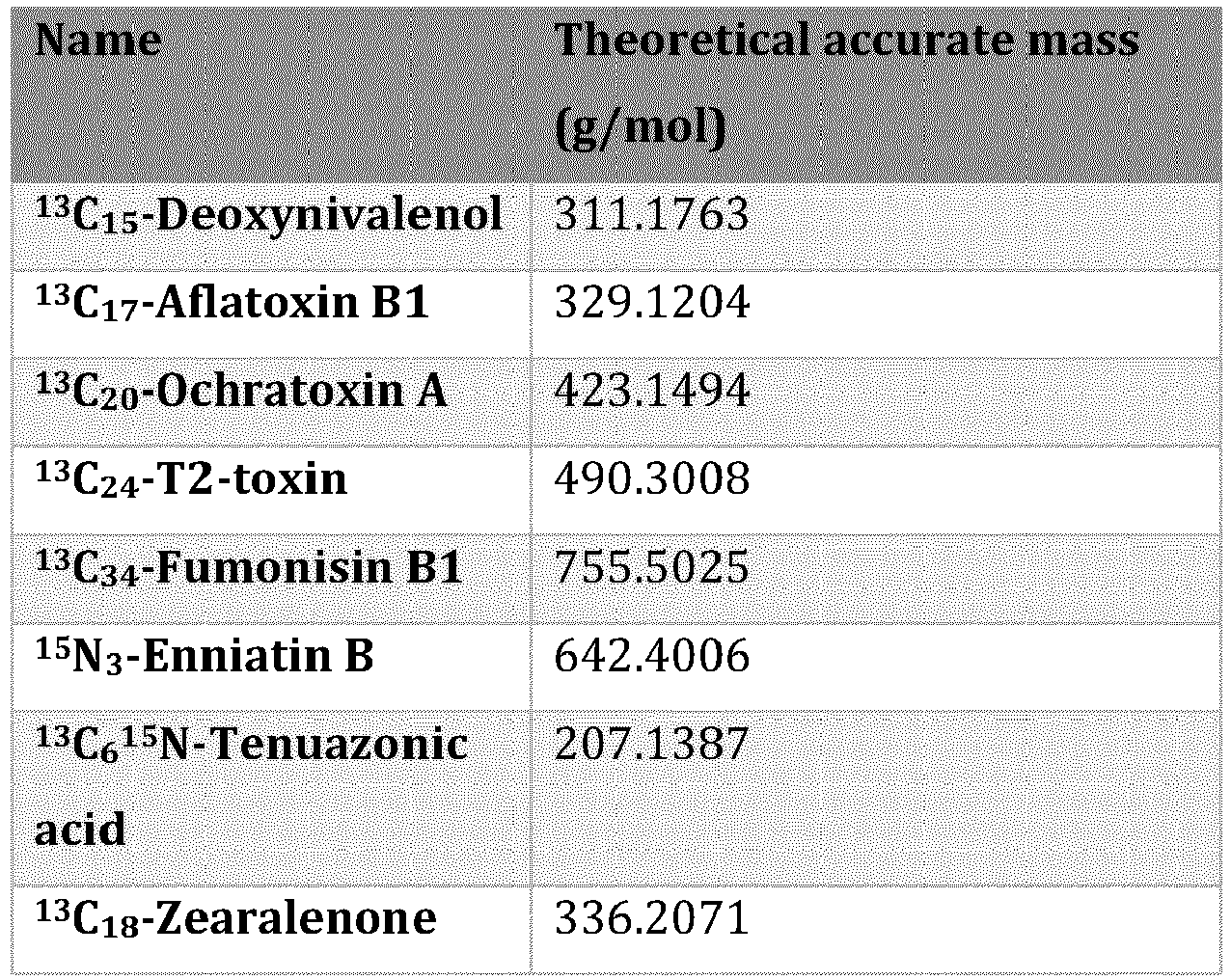
- The abovementioned substances are suited to act as internal standards in the method of the present invention as they comprise either carbon atoms comprising 13 neutrons or nitrogen atoms comprising 15 neutrons and are as such easily detectable by the mass spectrometer and have very similar characteristics as the 12C and 14N components.
- These substances are used as reference standards in the LC-MS/MS apparatus and in the HRMS apparatus used in the present invention.
- Since an isotopically labeled Internal Standard (hereinafter referred to as IS) for each single mycotoxin is too expensive and not commercially available, an IS labeled with [13C] or [15N] was used for each group of mycotoxins, as follows:
- [13C15]-deoxynivalenol was used as IS for DON, DOM1 and 3/15ADON;
- [13C24]-T2-toxin for T2 and HT2;
- [13C17]-Aflatoxin B1 for AFB1, AFB2, AFG1, AFG2, AFM1 and AFM2;
- [13C20]-Ochratoxin A for OTA;
- [13C34]-Fumonisin B1 for FB1, FB2 and FB3;
- [13C6 15N]-Tenuazonic acid for TEA, AME and AOH;
- [13C18]-Zearalenone for ZEN, AZAL, BZAL, AZEL, BZEL, ZAN, DON-GlcA, DON-S, ZEN-GlcA, ZEN-S, A-ZEL-GlcA and B-ZEL-GlcA;
- [15N3]-Enniatin B for ENNA, ENNA1, ENNB, ENNB1 and BEA.
- Hence, an optimal correction for matrix effects and losses during sample preparation was obtained, which was confirmed during method validation.
- The next step in the method according to the invention is to extract the mycotoxins contained in the DBS, in a manner as pure and complete as technically feasible. Differently phrased, in this step of the method according to the invention, the aim is to isolate the mycotoxins in the DBS from as much of the other blood constituents as possible.
- To this end, the method comprises placing the DBS in a test tube, e.g. made of glass, and adding a suitable extraction solvent.
- According to a preferred mode of operation, as extraction solvent, use can be made of a mixture of water/acetone/acetonitrile, preferably in the following respective volumes: 30/35/35 v/v/v.
- The amount of solvent to be used can vary widely, but preferably an amount ranging from 0.1 up to 10 ml, preferably from 0.5 up to 5 ml, more preferably around 1 ml can be used.
- The sample comprising the DBS and the extraction solvent is subjected to an ultrasonic treatment, preferably during a period of time ranging from 15 to 45 minutes, preferable around 30 minutes.
- Upon completion of the ultrasonic bath step, the solvent is poured over in another test tube; the remaining saver card paper can be removed.
- The aim of the present step is to prepare a sample for injection into the liquid chromatography (LC) apparatus. This implies that the DBS sample should be further treated in view of the detectability as well in qualitative as in quantitative manner mycotoxins in the sample in the LC-MS/MS or LC-HRMS.
- The latter can be realized on the one hand by an appropriate selection of the reconstitution solvent, and on the other hand by determining the appropriate amount of such reconstitution solvent to be used.
- In this stage of the method of the present invention, the extraction solvent, containing the mycotoxins and related metabolites to be detected, is dried, e.g. under a gentle nitrogen stream at a suitable temperature, e.g. between 20 and 60 °C, preferably between 30 and 50 °C, more preferably at around 40 °C +/- 5 °C. Upon drying, the dried material is reconstituted in a solvent, suitable for injection into the LC apparatus.
- The inventors have found that to that end, according to the method of the invention, a solvent consisting of water/methanol/formic acid preferably can be used. Preferably the dried material is reconstituted in an appropriate amount of such solvent, being 60 µl (this amount corresponding to the same amount of the initial DBS, drop of blood).
- By selecting the same amount of blood as original DBS, the concentration of mycotoxins in the sample to be analyzed is the same as in the original blood drop.
- The following experiments, performed by the inventors, illustrate the above.
- Three different reconstitution solvents (n = 3 per condition) were evaluated: water/ACN/acetic acid (AA) (95/5/0.1, v/v/v); water/methanol /formic acid (60/40/0.1, v/v/v) and water/methanol (15/85, v/v). The first two mixtures have previously been applied for the detection of multiple mycotoxins or OTA alone in human DBS. The latter has been used by co-inventors Lauwers et al. in an LC-MS/MS method for multi-mycotoxin determination in pig and chicken plasma. The best results were obtained using methanol instead of acetonitrile in the reconstitution solvents (Figure 1). Next, calibration curves were made with the two methanol containing reconstitution solvents and the lowest concentration achieved for each component as well as the peak shape were compared. The mixture of water/methanol/formic acid (60/40/0.1, v/v/v) showed the best results for both parameters and was therefore chosen as the preferred solvent. The same findings were also observed for DBS obtained from broiler chickens.

- The above figure shows the evaluation of the analyte peak areas after LC-MS/MS analysis of DBS (60 µl), extracts which were re-dissolved in three different reconstitution solvents: water/acetonitrile (ACN)/acetic acid (AA) (95/5/0.1, v/v/v); water/methanol (MeOH)/formic acid (FA) (60/40/0.1, v/v/v) and water/MeOH (15/85, v/v). Individual mycotoxins were spiked in whole blood at a concentration of 10 ng·ml-1. The mean (n = 3) LC-MS/MS peak areas + standard deviation (SD) is shown in graph.
- The following mycotoxins were the subject of the experiments:
Deoxynivalenol (DON), de-epoxy-deoxynivalenol (DOM1), 3/15-acetyl deoxynivalenol (3/15ADON), aflatoxin B1 (AFB1), aflatoxin M1 (AFM1), enniatin A (ENNA), enniatin A1 (ENNA1), enniatin B (ENNB), enniatin B1 (ENNB1), beauvericin (BEA), fumonisin B1 (FB1), fumonisin B2 (FB2), ochratoxin A (OTA), zearalenone (ZEN), α-zearalenol (AZEL), β-zearalenol (BZEL), α-zearalanol (AZAL), β-zearalanol (BZAL), zearalanone (ZAN), tenuazonic acid (TEA), alternariol (AOH), alternariol mono-methyl-ether (AME), T2 toxin (T2). - The next step of the method of the present invention is the qualitative and quantitative determination of the various mycotoxins and related phase I and II metabolites comprised in the blood sample.
- This can be accomplished by subjecting the dried and reconstituted DBS sample to a separation by liquid chromatography. As set forth supra, such apparatus comprises a column comprising a stationary phase and a mobile (liquid) phase. In the column of such apparatus the mycotoxins and related metabolites are separated on the basis of their different affinity to on the one hand the stationary (or fixed) phase of the column, and on the other hand the mobile or liquid phase of such column. Given such differences in affinity, the residence time and hence the transfer time of the various mycotoxins and related metabolites through the column of the apparatus will be different, in term resulting in an appropriate separation of the individual mycotoxins.
- A column suitable for use in the method of the present invention comprises HSS (High Strength Silica) Technology particles available from Waters ® and its Benelux dealer, LabMakelaar Benelux BV Knibbelweg 18 C, Zevenhuizen, Nederland, e.g. the 1.8 µm High Strength Silica particle.
- According to a preferred embodiment of the present invention, the composition of the liquid phase passing through the column of the liquid chromatography apparatus, is varied over time, according to the time of injection of the liquid phase into the column.
- Tables 2 and 3 set forth supra illustrate the flow rate of the mobile phase as well as the gradient program applied.
- The UPLC conditions for analytes determined using the ESI negative mode are as follows (see table 3):
at the start of the operation, the mobile phase comprises predominantly water (e.g. up to 95 %) and a small proportion of acetonitrile (e.g. up to 5 %), and as time goes by, the composition of the liquid phase is changed, whereby the amount of water gradually decreases (e.g. to approximately 40 %) and the amount of acetonitrile gradually increases (e.g. up to approximately 60 %). - Hereafter, the proportion of water again is increased substantially, up to 95 %, so as to recondition the column for future use.
- The UPLC conditions for analytes determined using the ESI positive mode are as follows (see table 2):
at the start of the operation, the mobile phase comprises predominantly water (e.g. up to 95 %) and a small proportion of methanol (e.g. up to 5 %), and as time goes by, the composition of the liquid phase is changed, whereby the amount of water gradually decreases (e.g. to approximately 1 %) and the amount of methanol gradually increases (e.g. up to approximately 99 %). - Hereafter, the proportion of water again is increased substantially, up to 95 %, so as to recondition the column for future use.
- As a result of the above, the various individual mycotoxins and related metabolites will exit the liquid chromatography column one after the other; at such stage, these compounds are suitable for being detected in the subsequent stage of the present invention, by the MS/MS apparatus.
- Tables 4 and 5 set forth supra, illustrate the various retention times for the components comprised in the DBS sample to be analyzed.
- Four different reversed phase columns (Hypersil Gold 50 mm × 2.1 mm, dp: 1.9, Thermo Scientific, Breda, The Netherlands; Zorbax Eclipse C18 50 mm × 2.1 mm, dp: 1.8, Agilent, Sint-Katelijne-Waver, Belgium; Acquity BEH-C18 50 mm × 2.1 mm, dp: 1.7, Waters, Milford, MA, USA; and Acquity HSS-T3 100 mm × 2.1 mm, dp: 1.8, Waters, Milford, MA, USA) were tested to achieve chromatographic separation of the selected mycotoxins. The best separation of all components was obtained on the HSS-T3 column.
- The abbreviation HSS stands for High Strength Silica, the term T3 stands for a trifunctional C18 alkyl chain.
- The latter column is available as Acquity UPLC HSS T3 column from Waters Corporation, 34 Maple Street, Milford, USA.
- For further details regarding the chromatography apparatus suitable for use in the method of the present invention, reference is made to reference document (3) as identified supra, paragraph 4.5, page 23 of 30.
- For the detection of the mycotoxins separated by the LC apparatus, the MS-MS method and apparatus are used.
- When this technique is used, the detection is performed on the basic ('precursor') molecule in a first stage, as well as on some fragments of such molecule in a second stage.
- For further details regarding the MS-MS apparatus suitable for use in the method of the present invention, reference is made to reference document (3) as identified supra, paragraph 4.6.1, page 23 of 30.
- Upon completion development method according to the present invention, the inventors have undertaken the task of validating the method according to the present invention with respect to the DBS from pigs and broiler chickens.
- For the purpose of validation, calibration curves have been set up, on the one hand with respect to the DBS from pigs, on the other hand with respect to the DBS from broiler chickens, in both cases for each of the mycotoxins and their phase I metabolites as set forth above.
- To that end, tests have been run on three different days as well within a day, and the mean values have been calculated based on these results.
- The results of these tests are described hereinafter.
- Reference is hereby made to the following document, paragraph 2.2, page 5 of the Article entitled "Assessment of dried blood spots for multi-mycotoxin biomarker analysis in pigs and broiler chickens" by Marianne Lauwers, Siska Croubels, Siegrid de Baere, Milena Sevastiyanova, Eva Maria Romero Sierra, Ben Letor, Christos Gougoulias and Mathias Devreese, published on September 18, 2019 by Toxins 2019, 11, 541: doi:10.3390/toxins 11090541, www.mdpi.com/journal/toxins .
- The linearity expressed as a correlation coefficient (r) and the goodness-of-fit (g) is shown in Table 1 for pig DBSs and Table 2 for chicken DBSs and is the mean ± standard deviation of three curves across three different days of analysis. The r ranged between 0.991 and 0.999 for pigs and between 0.993 and 0.998 for broiler chickens. The g-value varied from 6% to 17% in pig and 8% to 19% in broiler chicken DBSs. Most of the calibration curves matched a linear model with a 1/x weighing factor, except for the ENNs and BEA which are best described by a quadratic model with a 1/x weighing factor. For most mycotoxins, the linearity ranged between 0.5 and 200 ng·ml-1. However, the limit of quantification (LOQ) and thus the lowest concentration in the calibration curve was set at 1 ng·ml-1 for ZEN, AZAL, BZEL, ZAN, DOM1 and AME in pigs and for ZEN, AZAL, BZAL, ZAN, AOH, T2, ENNA and FB1 in broiler chickens. In broiler chickens, AZEL had an LOQ of 4 ng·ml-1 and FB2 2 ng·ml-1 and in pigs AOH had an LOQ of 10 ng·ml-1. The results for the LOQ and corresponding LOD values are found in Table 1 and Table 3, respectively.
- The within-day and between-day precision and accuracy at a concentration of 10 and 100 ng·ml-1 met the requirements for all mycotoxins for both species. The results of the within-day and between-day precision and accuracy experiments can be found in the Tables set forth hereinafter, respectively.
- The results for signal suppression or enhancement (SSE) after the extraction of DBSs from broiler chickens and pigs showed acceptable results (range 60-112%) for most components. Moreover, in pig DBSs, good extraction recovery rates were also observed. For some components, SSE was more pronounced and extraction recovery was rather low (<60%). However, for all mycotoxins, an adequate internal standard (IS) and matrix-matched calibration curves were used, resulting in validation results for accuracy and precision matching the acceptance criteria. The results for matrix effects and extraction recovery are shown in the Tables set forth is said publication.
- For the sake of completeness, we reproduce hereinafter the table regarding the test results for pig whole blood:
Table Validation results for linearity shown as the mean ± standard deviation of three curves across three different days of analysis (linear range, correlation coefficient (r) and goodness-of-fit coefficient (g)), limit of quantification (LOQ) and limit of detection (LOD) of 23 mycotoxins in dried blood spots of pig whole blood. Analyte Linearity (n = 3 Different Days) LOQ LOD Linear Range r ± SD (ng·ml-1) ng·mL-1 ng·mL-1 ZEN 1-200 0.999 ± 0.001 1.0 0.09 AZEL 0.5-200 0.998 ± 0.000 0.5 0.20 AZAL 1-200 0.998 ± 0.001 1.0 0.38 BZAL 0.5-200 0.997 ± 0.001 0.5 0.11 BZEL 1-200 0.994 ± 0.004 1.0 0.21 ZAN 1-200 0.996 ± 0.004 1.0 0.10 TEA 0.5-200 0.996 ± 0.003 0.5 0.04 AOH 10-200 0.994 ± 0.005 1.0 0.74 AME 1-200 0.993 ± 0.002 1.0 0.01 DON 0.5-200 0.994 ± 0.003 0.5 0.11 DOM1 1-200 0.997 ± 0.002 1.0 0.23 3/15ADON 0.5-200 0.994 ± 0.002 0.5 0.06 T2 0.5-200 0.996 ± 0.004 0.5 0.01 AFB1 0.5-200 0.994 ± 0.002 0.5 0.001 AFM1 0.5-200 0.991 ± 0.002 0.5 0.01 OTA 0.5-200 0.995 ± 0.003 0.5 0.01 ENN A1 0.5-200 0.997 ± 0.002 0.5 0.05 ENNA 0.5-100 0.998 ± 0.001 0.5 0.01 ENNB 0.5-100 0.999 ± 0.000 0.5 0.001 ENNB1 0.5-100 0.998 ± 0.001 0.5 0.001 BEA 0.5-200 0.997 ± 0.003 0.5 0.02 FB2 0.5-200 0.996 ± 0.002 0.5 0.35 FB1 1-200 0.994 ± 0.004 0.5 0.23 - For the sake of completeness, we reproduce hereinafter the table regarding the test results for broiler chicken whole blood:
Table Validation results for linearity shown as the mean ± standard deviation of three curves across three different days of analysis (linear range, correlation coefficient (r) and goodness-of-fit coefficient (g)), limit of quantification (LOQ) and limit of detection (LOD) of 23 mycotoxins in dried blood spots of broiler chicken whole blood. Analyte Linearity (n = 3 Different Days) LOQ LOD Linear Range r ± SD g ± SD (ng·ml-1) ng·mL-1 ng·mL-1 ZEN 1-200 0.997 ± 0.001 17 ± 3 1.0 0.12 AZEL 4-200 0.997 ± 0.002 8 ± 3 4.0 1.10 AZAL 1-200 0.997 ± 0.002 16 ± 6 1.0 0.15 BZAL 1-200 0.996 ± 0.003 18 ± 2 1.0 0.27 BZEL 0.5-200 0.996 ± 0.003 16 ± 2 0.5 0.1 ZAN 1-200 0.997 ± 0.001 13 ± 5 1.0 0.21 TEA 0.5-200 0.998 ± 0.001 12 ± 6 0.5 0.001 AOH 1-200 0.996 ± 0.002 17 ± 3 1.0 0.02 AME 0.5-200 0.997 ± 0.001 17 ± 4 0.5 .001 DON 0.5-200 0.997 ± 0.000 15 ± 1 0.5 0.18 DOM1 0.5-200 0.998 ± 0.001 17 ± 1 0.5 0.16 3/15ADON 0.5-200 0.995 ± 0.003 16 ± 4 0.5 0.09 T2 1-200 0.998 ± 0.000 13 ± 5 1.0 0.03 AFB1 0.5-200 0.997 ± 0.001 15 ± 4 0.5 0.01 AFM1 0.5-200 0.997 ± 0.001 15 ± 2 0.5 0.01 OTA 0.5-200 0.998 ± 0.001 19 ± 1 0.5 0.05 ENN A1 0.5-200 0.993 ± 0.002 14 ± 5 0.5 0.04 ENNA 1-200 0.995 ± 0.003 16 ± 2 1.0 0.11 ENNB 0.5-200 0.994 ± 0.001 12 ± 1 0.5 0.07 ENNB1 0.5-200 0.998 ± 0.002 12 ± 3 0.5 0.001 BEA 0.5-200 0.996 ± 0.000 15 ± 4 0.5 0.07 FB2 1-200 0.997 ± 0.001 16 ± 3 1.0 0.96 FB1 2-200 0.995 ± 0.001 15 ± 3 2.0 1.87 - The present inventors have complemented the above results with data regarding linearity, limit of quantification (LOQ) and limit of detection (LOD) that were evaluated for the analytes that were added to the LC-MS/MS method as disclosed in this reference (2) and that were quantitatively determined, i.e. AFB2, AFG1 and AFG2.
- These results are set forth in the table 7 below:
Pig Analyte Linear range (ng/ml) LOQ (ng/ml) LOD (ng/ml) AFB2 0.5-200 0.5 0.02 AFG1 0.5-200 0.5 0.03 AFG2 0.5-200 0.5 0.04 Chicken Analyte Linear range (ng/ml) LOQ (ng/ml) LOD (ng/ml) AFB2 0.5-200 0.5 0.03 AFG1 0.5-200 0.5 0.02 AFG2 0.5-200 0.5 0.05 - Field DBS samples originating from chickens and pigs coming from the real farming production, where animals are encountering naturally contaminated feed, were analyzed using the updated LC-MS/MS method. This is a difference compared to the article described by Lauwers et al (reference article 3] were only DBS samples originating of a toxicokinetic study with DON, ZEN and AFB1 in pigs and OTA, AFB1 and DON in broiler chickens were analyzed.
- The results of this multi-mycotoxin analysis in a real chicken and pig DBS sample demonstrate the applicability updated LC-MS/MS method analysis in ESI positive and negative mode, respectively.
- The advantages of the method according to the present invention:
As compared to monitoring the animal feed, the present invention offers the following advantages: - 1) Biomonitoring measures the exposure at an individual level while feed analysis shows a general risk. Exposure at an individual level takes variation in food consumption and ADME parameters into account and integrates contamination from all different sources leading to a more accurate estimation and possible use in toxicokinetic studies.
(ADME stands for Absorption, distribution, metabolism, excretion, all of these toxicokinetic parameters describing the effect of the animal body on the toxins concerned,); - 2) Although feed is an accessible matrix, it is difficult to sample correctly due to the presence of hotspots. Urine, feces and in particular plasma/blood in contrast are easy to sample correctly and also allow sequential sampling;
- 3) Measuring complete exposure: modified mycotoxins can convert back to their original forms during digestion and so contribute to the overall effect of the toxins. Biomonitoring includes these effects and gives thus a very accurate estimation of the risk;
- 4) Use of one LC-MS/MS apparatus is sufficient compared to the prior art method, requiring the additional use of an LC-HRMS equipment;
- 5) Broad screening or multi-mycotoxin biomonitoring directed to 36 components compared to the prior-art method, limited to 24 components.
- A common way to counter the harmful effect of mycotoxins comprises adding mycotoxins detoxifiers to the animal feed.
- An example of such detoxifier is the product marketed by Innovad N.V., Cogels-Osylei 33, 2600 Antwerp, Belgium, under the brand name Escent S ®.
- A detoxifier product is a product that diminishes the effects associated with toxins. A possible way to prove the efficacy of these products is doing in vivo absorption tests. In these trials the concentration of mycotoxins in animal matrices is detected and the difference in concentration with and without detoxifier is determined. This difference is a measure for the efficacy of the product. This type of test gives accurate results and should in the future replace in vitro tests or in vivo test based on non-specific parameters such as growth performance and feed conversion.
Claims (15)
- Method for the detection of the following (10) mycotoxins and metabolites in broiler chickens or pigs,- Aflatoxin B1 (AFB1),- Aflatoxin B2 (AFB2),- Aflatoxin M1 (AFM1),- Fumonisin (FB1),- Fumonisin (FB2),- Ochratoxin A (OTA),- Deoxynivalenol (DON),- T2 toxin (T2),- HT-2-toxin (HT2),- Zearalenone (ZEN),said method comprising:- collecting the blood of broiler chickens or pigs as a dried blood sample;- preparing the dried blood sample for analysis;- analyzing the prepared dried blood sample by liquid chromatography-tandem mass spectrometry (LC-MS/MS) in two steps:a) detecting in a LC-MS/MS step,- the reversed phase LC process using as mobile phase, a mixture of acetic acid, acetonitrile and water, the proportion of the acetonitrile solution over the water solution gradually increasing during the process, and at the end diminishing to recondition the LC column,- the mass spectrometer operating in negative electro-spray ionization mode,
andb) detecting in another LC-MS/MS step,- the reversed phase LC process using as mobile phase, a mixture of ammonium formate, formic acid, water and methanol, the proportion of the methanol solution over the water solution gradually increasing during the process, and at the end diminishing to recondition the LC column,- the mass spectrometer operating in positive electro-spray ionization mode. - Method according to claim 1 for the detection of the following (8) additional mycotoxins and metabolites:- Alternariol methyl ether (AME),- Alternariol (AOH),- Tenuazonic Acid (TEA),- Beauvericin (BEA),- Enniatin A, A1, B, B1 (ENNA, ENNA1, ENNB, ENNB1).
- Method according to claim 2 for the detection of the following (18) additional mycotoxins and metabolites:- de-epoxy-deoxynivalenol (DOM1),- 15-acetyldeoxynivalenol (15ADON),- 3-acetyldeoxynivalenol (3ADON),- Zearalanone (ZAN),- α-Zearalenol (AZEL),- α-Zearalanol (AZAL),- β-Zearalanol (BZAL),- β-Zearalenol (BZEL),- DON-glucuronide (DON-GlcA),- DON-Sulphate (DON-S),- ZEN-glucuronide (ZEN-GlcA),- ZEN-sulfate (ZEN-S),- α-zearalenol-glucuronide (A-ZEL-GlcA),- β-zearalenol-glucuronide (B-ZEL-GlcA),- Fumonisin B3 (FB3),- Aflatoxin M2 (AFM2),- Aflatoxin G 1 (AFG1),- Aflatoxin G2 (AFG2).
- Method according to any of the preceding claims wherein any of the following (15) mycotoxins and metabolites are detected by the mass spectrometer operating in negative electrospray ionization mode:- zearalenone (ZEN),- zearalanone (ZAN),- α-zearalenol (AZEL)- α-zearalanol (AZAL),- β-zearalanol (BZAL),- β-zearalenol (BZEL),- tenuazonic acid (TEA),- alternariol (AOH),- alternariol methyl ether (AME),- deoxynivalenol sulphate (DON-S),- deoxynivalenol glucuronide (DON-GlcA),- zearalenone sulphate (ZEN-S),- zearalenone glucuronide (ZEN-GlcA),- a-ZEL-glucuronide (AZEL-GlcA),- b-ZEL- glucuronide (BZEL-GlcA).
- Method according to any of the preceding claims wherein any of the following (21) mycotoxins and metabolites are detected by the mass spectrometer operating in positive electrospray ionization mode:- deoxynivalenol (DON),- de-epoxy-deoxynivalenol (DOM1),- 3-acetyldeoxynivalenol (3ADON),- 15-acetyldeoxynivalenol (15ADON),- T2-toxin (T2),- HT-2 toxin (HT2),- aflatoxin B1 (AFB1),- aflatoxin M1 (AFM1),- ochratoxin A (OTA),- enniatin A1 (ENNA1),- enniatin A (ENNA),- enniatin B (ENNB),- enniatin B1(ENNB1),- beauvericin (BEA),- fumonisin (FB1),- fumonisin (FB2),- aflatoxin B2 (AFB2),- aflatoxin G1, (AFG1),- aflatoxin G2 (AFG2),- aflatoxin M2, (AFM2)- fumonisin B3 (FB3).
- Method according to any of the preceding claims, whereby- in the LC-MS/MS step, using as mobile phase, a mixture of an acetic acid, acetonitrile and water solution, the overall process time amounts to 11 min or less, wherein the proportion of the acetonitrile solution over the water solution gradually increases from 5/95 % to 60/40 % in a time period of maximum 8 min, thereafter decreases to 5/95 % for a 3 minutes time period to recondition the LC column,
and/or,- in the LC-MS/MS step, using as mobile phase, a mixture of ammonium formate, formic acid, water and methanol, the overall process time amounts 12 min or less, wherein the proportion of the methanol solution over the water solution gradually increases from 5/95 % to 99/1 % in a time period of maximum 9 min, thereafter decreases to 5/95 % for a 3 minutes time period to recondition the LC column. - Method according to any of the preceding claims, wherein in the LC process a column is used comprising an hydrophobic stationary phase comprising silica with covalently bonded alkyl chains, preferably high strength silica with trifunctional C18 alkyl bonded chains.
- Method according to any of the preceding claims, comprising, prior to analyzing, extracting the mycotoxins and the metabolites from the dried blood sample in an extraction solvent and subjecting the extraction solvent and the dried blood sample to an ultrasonic bath treatment.
- Method according to claim 8, whereby the extraction solvent comprises a water/acetonitrile/acetone mixture.
- Method according to claim 8, comprising drying the extraction solvent and reconstituting the dried mass in a reconstitution solvent.
- Method according to claim 10, whereby the reconstituting solvent comprises a water/methanol/formic acid mixture.
- Method according to claim 1, further comprising spiking the collected dried blood sample with one or more internal standards.
- Method according to claim 12, comprising spiking the collected dried blood sample with one or more internal standards selected from the following list:- 13C15-deoxynivalenol,- 13C17-aflatoxin B1,- 13C17-aflatoxin M1,- 13C20-ochratoxin A,- 13C24-T2-toxin,- 13C34-fumonisin B1,- 15N3-enniatin B,- 13C6 15N-tenuazonic acid,- 13C18-zearalenone.
- Use of the method of any of the preceding claims for screening and assessing the exposure of pigs or broiler chickens to feed contaminated with mycotoxins.
- Use of the method of any of the preceding claims for assessing the impact of the addition of mycotoxin detoxifying agents to animal feed.
Applications Claiming Priority (1)
| Application Number | Priority Date | Filing Date | Title |
|---|---|---|---|
| BE20200030A BE1028151B1 (en) | 2020-03-17 | 2020-03-17 | Monitoring mycotoxins in the blood of pigs and broilers |
Publications (2)
| Publication Number | Publication Date |
|---|---|
| EP3882629A1 EP3882629A1 (en) | 2021-09-22 |
| EP3882629B1 true EP3882629B1 (en) | 2022-11-30 |
Family
ID=70740371
Family Applications (1)
| Application Number | Title | Priority Date | Filing Date |
|---|---|---|---|
| EP21020152.1A Active EP3882629B1 (en) | 2020-03-17 | 2021-03-16 | Monitoring mycotoxins and its metabolites in the blood of pigs or broiler chickens |
Country Status (5)
| Country | Link |
|---|---|
| EP (1) | EP3882629B1 (en) |
| BE (1) | BE1028151B1 (en) |
| DK (1) | DK3882629T3 (en) |
| ES (1) | ES2938794T3 (en) |
| PL (1) | PL3882629T3 (en) |
Families Citing this family (5)
| Publication number | Priority date | Publication date | Assignee | Title |
|---|---|---|---|---|
| CN114002355B (en) * | 2021-11-03 | 2023-12-05 | 上海市农业科学院 | A solid phase extraction post that is arranged in agricultural product nine kinds of mycotoxins to enrich purification simultaneously |
| CN114324656A (en) * | 2021-12-29 | 2022-04-12 | 罗玛实验室检测服务(无锡)有限公司 | Methods for the detection of 18 mycotoxins in electronic cigarettes |
| CN114487189B (en) * | 2022-01-25 | 2023-07-25 | 甘肃中商食品质量检验检测有限公司 | Method for determining aflatoxin B1 in food based on dispersion extraction technology |
| CN115032321A (en) * | 2022-06-08 | 2022-09-09 | 罗玛实验室检测服务(无锡)有限公司 | High-flux detection method for mycotoxin in silage |
| CN115718157B (en) * | 2022-12-29 | 2025-05-30 | 南京师范大学 | Improved QuEChERS-UPLC-MS/MS method for determination of 15 mycotoxins in food and drug dual-purpose substances |
Citations (8)
| Publication number | Priority date | Publication date | Assignee | Title |
|---|---|---|---|---|
| CN107741462A (en) | 2017-10-17 | 2018-02-27 | 江西省兽药饲料监察所 | A kind of detection method of 16 kinds of mycotoxins |
| CN108593832A (en) | 2018-05-14 | 2018-09-28 | 广东省农业科学院农产品公共监测中心 | LC-MS-MS methods that are a kind of while measuring six kinds of mycotoxins in corn |
| CN108760929A (en) | 2018-06-13 | 2018-11-06 | 广东省药品检验所(广东省药品质量研究所、广东省口岸药品检验所) | A method of detection 8 kinds of mycotoxins of FRUCTUS CITRI SARCODACTYLIS |
| CN109001350A (en) | 2018-06-28 | 2018-12-14 | 山东出入境检验检疫局检验检疫技术中心 | The liquid chromatography-tandem mass spectrometry method of 21 kinds of mycotoxins in Cereals is detected simultaneously |
| CN109142584A (en) | 2018-09-29 | 2019-01-04 | 广东省湛江市质量计量监督检测所 | A kind of method of mycotoxin in measurement shrimp feed |
| CN109521135A (en) | 2019-01-18 | 2019-03-26 | 山东省农业科学院农业质量标准与检测技术研究所 | A kind of method that Solid Phase Extraction combination UPLC-MS/MS quickly measures 14 kinds of toxin in Chinese chestnut |
| CN109781889A (en) | 2019-02-14 | 2019-05-21 | 山东省食品药品检验研究院 | A kind of measuring method of 24 kinds of mycotoxins in nourishing rice flour for babies |
| CN111366652A (en) | 2020-04-01 | 2020-07-03 | 福建省农业科学院农业质量标准与检测技术研究所 | Method for determining 16 mycotoxins in tea by using ultra-high performance liquid chromatography-tandem mass spectrometry |
-
2020
- 2020-03-17 BE BE20200030A patent/BE1028151B1/en active IP Right Grant
-
2021
- 2021-03-16 EP EP21020152.1A patent/EP3882629B1/en active Active
- 2021-03-16 ES ES21020152T patent/ES2938794T3/en active Active
- 2021-03-16 PL PL21020152.1T patent/PL3882629T3/en unknown
- 2021-03-16 DK DK21020152.1T patent/DK3882629T3/en active
Patent Citations (8)
| Publication number | Priority date | Publication date | Assignee | Title |
|---|---|---|---|---|
| CN107741462A (en) | 2017-10-17 | 2018-02-27 | 江西省兽药饲料监察所 | A kind of detection method of 16 kinds of mycotoxins |
| CN108593832A (en) | 2018-05-14 | 2018-09-28 | 广东省农业科学院农产品公共监测中心 | LC-MS-MS methods that are a kind of while measuring six kinds of mycotoxins in corn |
| CN108760929A (en) | 2018-06-13 | 2018-11-06 | 广东省药品检验所(广东省药品质量研究所、广东省口岸药品检验所) | A method of detection 8 kinds of mycotoxins of FRUCTUS CITRI SARCODACTYLIS |
| CN109001350A (en) | 2018-06-28 | 2018-12-14 | 山东出入境检验检疫局检验检疫技术中心 | The liquid chromatography-tandem mass spectrometry method of 21 kinds of mycotoxins in Cereals is detected simultaneously |
| CN109142584A (en) | 2018-09-29 | 2019-01-04 | 广东省湛江市质量计量监督检测所 | A kind of method of mycotoxin in measurement shrimp feed |
| CN109521135A (en) | 2019-01-18 | 2019-03-26 | 山东省农业科学院农业质量标准与检测技术研究所 | A kind of method that Solid Phase Extraction combination UPLC-MS/MS quickly measures 14 kinds of toxin in Chinese chestnut |
| CN109781889A (en) | 2019-02-14 | 2019-05-21 | 山东省食品药品检验研究院 | A kind of measuring method of 24 kinds of mycotoxins in nourishing rice flour for babies |
| CN111366652A (en) | 2020-04-01 | 2020-07-03 | 福建省农业科学院农业质量标准与检测技术研究所 | Method for determining 16 mycotoxins in tea by using ultra-high performance liquid chromatography-tandem mass spectrometry |
Non-Patent Citations (17)
| Title |
|---|
| A. VERŠILOVSKIS, J. GEYS, B. HUYBRECHTS, E. GOOSSENS, S. DE SAEGER, A. CALLEBAUT: "Simultaneous determination of masked forms of deoxynivalenol and zearalenone after oral dosing in rats by LC-MS/MS", WORLD MYCOTOXIN JOURNAL, WAGENINGEN ACADEMIC PUBLISHERS, NETHERLANDS, vol. 5, no. 3, 1 August 2012 (2012-08-01), Netherlands , pages 303 - 318, XP009555846, ISSN: 1875-0710, DOI: 10.3920/WMJ2012.1411 |
| AMELIE CATTEUW, NATHAN BROEKAERT, SIEGRID DE BAERE, MARIANNE LAUWERS, ELKE GASTHUYS, BART HUYBRECHTS, ALFONS CALLEBAUT, LADA IVANO: "Insights into In Vivo Absolute Oral Bioavailability, Biotransformation, and Toxicokinetics of Zearalenone, α-Zearalenol, β-Zearalenol, Zearalenone-14-glucoside, and Zearalenone-14-sulfate in Pigs", JOURNAL OF AGRICULTURAL AND FOOD CHEMISTRY, AMERICAN CHEMICAL SOCIETY, US, vol. 67, no. 12, 27 March 2019 (2019-03-27), US , pages 3448 - 3458, XP055744560, ISSN: 0021-8561, DOI: 10.1021/acs.jafc.8b05838 |
| BELHASSEN H.; JIMÉNEZ-DÍAZ I.; GHALI R.; GHORBEL H.; MOLINA-MOLINA J.M.; OLEA N.; HEDILI A. : "Validation of a UHPLC–MS/MS method for quantification of zearalenone, α-zearalenol, β-zearalenol, α-zearalanol, β-zearalanol and zearal", JOURNAL OF CHROMATOGRAPHY B, ELSEVIER, AMSTERDAM., NL, vol. 962, 19 May 2014 (2014-05-19), NL , pages 68 - 74, XP028855114, ISSN: 1570-0232, DOI: 10.1016/j.jchromb.2014.05.019 |
| BINDER SABINA, SCHWARTZ-ZIMMERMANN HEIDI, VARGA ELISABETH, BICHL GERLINDE, MICHLMAYR HERBERT, ADAM GERHARD, BERTHILLER FRANZ: "Metabolism of Zearalenone and Its Major Modified Forms in Pigs", TOXINS, MOLECULAR DIVERSITY PRESERVATION INTERNATIONAL (MDPI) AG., CH, vol. 9, no. 2, CH , pages 56, XP093181701, ISSN: 2072-6651, DOI: 10.3390/toxins9020056 |
| BROEKAERT NATHAN; DEVREESE MATHIAS; VAN BERGEN THOMAS; SCHAUVLIEGE STIJN; DE BOEVRE MARTHE; DE SAEGER SARAH; VANHAECKE LYNN; BERTH: "In vivo contribution of deoxynivalenol-3-β-d-glucoside to deoxynivalenol exposure in broiler chickens and pigs: oral bioavailability, hydrolysis and toxicokinetics", ARCHIVES OF TOXICOLOGY, SPRINGER, DE, vol. 91, no. 2, 21 April 2016 (2016-04-21), DE , pages 699 - 712, XP036150423, ISSN: 0340-5761, DOI: 10.1007/s00204-016-1710-2 |
| LAUWERS MARIANNE, DE BAERE SIEGRID, LETOR BEN, RYCHLIK MICHAEL, CROUBELS SISKA, DEVREESE MATHIAS: "Multi LC-MS/MS and LC-HRMS Methods for Determination of 24 Mycotoxins including Major Phase I and II Biomarker Metabolites in Biological Matrices from Pigs and Broiler Chickens", TOXINS, MOLECULAR DIVERSITY PRESERVATION INTERNATIONAL (MDPI) AG., CH, vol. 11, no. 3, CH , pages 171, XP093181681, ISSN: 2072-6651, DOI: 10.3390/toxins11030171 |
| MARIANNE LAUWERS, SISKA CROUBELS, BEN LETOR, CHRISTOS GOUGOULIAS, MATHIAS DEVREESE: "Biomarkers for Exposure as A Tool for Efficacy Testing of A Mycotoxin Detoxifier in Broiler Chickens and Pigs", TOXINS, MOLECULAR DIVERSITY PRESERVATION INTERNATIONAL (MDPI) AG., CH, vol. 11, no. 4, 1 April 2019 (2019-04-01), CH , pages 187, XP055744558, ISSN: 2072-6651, DOI: 10.3390/toxins11040187 |
| MARIANNE LAUWERS, SISKA CROUBELS, SIEGRID DE BAERE, MILENA SEVASTIYANOVA, EVA MARIA ROMERA SIERRA, BEN LETOR, CHRISTOS GOUGOULIAS,: "Assessment of Dried Blood Spots for Multi-Mycotoxin Biomarker Analysis in Pigs and Broiler Chickens", TOXINS, MOLECULAR DIVERSITY PRESERVATION INTERNATIONAL (MDPI) AG., CH, vol. 11, no. 9, 1 January 2019 (2019-01-01), CH , pages 541, XP055744557, ISSN: 2072-6651, DOI: 10.3390/toxins11090541 |
| OSTERESCH BERND; CRAMER BENEDIKT; HUMPF HANS-ULRICH: "Analysis of ochratoxin A in dried blood spots – Correlation between venous and finger‐prick blood, the influence of hematocrit and spotted volume", JOURNAL OF CHROMATOGRAPHY B, ELSEVIER, AMSTERDAM., NL, vol. 1020, 21 March 2016 (2016-03-21), NL , pages 158 - 164, XP029497205, ISSN: 1570-0232, DOI: 10.1016/j.jchromb.2016.03.026 |
| OSTERESCH BERND; VIEGAS SUSANA; CRAMER BENEDIKT; HUMPF HANS-ULRICH: "Multi-mycotoxin analysis using dried blood spots and dried serum spots", ANALYTICAL AND BIOANALYTICAL CHEMISTRY, SPRINGER BERLIN HEIDELBERG, BERLIN/HEIDELBERG, vol. 409, no. 13, 15 March 2017 (2017-03-15), Berlin/Heidelberg, pages 3369 - 3382, XP036213420, ISSN: 1618-2642, DOI: 10.1007/s00216-017-0279-9 |
| S. DE BAERE, A. OSSELAERE, M. DEVREESE, L. VANHAECKE, P. DE BACKER, S. CROUBELS: "Development of a liquid–chromatography tandem mass spectrometry and ultra-high-performance liquid chromatography high-resolution mass spectrometry method for the quantitative determination of zearalenone and its major metabolites in chicken and pig plasma", ANALYTICA CHIMICA ACTA, ELSEVIER, AMSTERDAM, NL, vol. 756, 1 December 2012 (2012-12-01), AMSTERDAM, NL , pages 37 - 48, XP055744811, ISSN: 0003-2670, DOI: 10.1016/j.aca.2012.10.027 |
| SCHWARTZ-ZIMMERMANN HEIDI E.; HAMETNER CHRISTIAN; NAGL VERONIKA; FIBY IRIS; MACHEINER LUKAS; WINKLER JANINE; DäNICKE SVEN; CL: "Glucuronidation of deoxynivalenol (DON) by different animal species: identification of iso-DON glucuronides and iso-deepoxy-DON glucuronides as novel DON metabolites in pigs, rats, mice, and cows", ARCHIVES OF TOXICOLOGY, SPRINGER, DE, vol. 91, no. 12, 21 June 2017 (2017-06-21), DE , pages 3857 - 3872, XP036374803, ISSN: 0340-5761, DOI: 10.1007/s00204-017-2012-z |
| STEINER DAVID; SULYOK MICHAEL; MALACHOVá ALEXANDRA; MUELLER ANNELIESE; KRSKA RUDOLF: "Realizing the simultaneous liquid chromatography-tandem mass spectrometry based quantification of >1200 biotoxins, pesticides and veterinary drugs in complex feed", JOURNAL OF CHROMATOGRAPHY A, ELSEVIER, AMSTERDAM, NL, vol. 1629, 19 August 2020 (2020-08-19), AMSTERDAM, NL, XP086270630, ISSN: 0021-9673, DOI: 10.1016/j.chroma.2020.461502 |
| SULYOK MICHAEL; STADLER DAVID; STEINER DAVID; KRSKA RUDOLF: "Validation of an LC-MS/MS-based dilute-and-shoot approach for the quantification of > 500 mycotoxins and other secondary metabolites in food crops: challenges and solutions", ANALYTICAL AND BIOANALYTICAL CHEMISTRY, SPRINGER BERLIN HEIDELBERG, BERLIN/HEIDELBERG, vol. 412, no. 11, 20 February 2020 (2020-02-20), Berlin/Heidelberg, pages 2607 - 2620, XP037085326, ISSN: 1618-2642, DOI: 10.1007/s00216-020-02489-9 |
| THANNER S.; CZEGLéDI L.; SCHWARTZ-ZIMMERMANN H. E.; BERTHILLER F.; GUTZWILLER A.: "Urinary deoxynivalenol (DON) and zearalenone (ZEA) as biomarkers of DON and ZEA exposure of pigs", MYCOTOXIN RESEARCH, SPRINGER BERLIN HEIDELBERG, BERLIN/HEIDELBERG, vol. 32, no. 2, 18 February 2016 (2016-02-18), Berlin/Heidelberg , pages 69 - 75, XP035665530, ISSN: 0178-7888, DOI: 10.1007/s12550-016-0241-2 |
| WENKUI LI, TSE FRANCIS L. S.: "Dried blood spot sampling in combination with LC-MS/MS for quantitative analysis of small molecules", BIOMEDICAL CHROMATOGRAPHY, vol. 24, no. 1, 1 January 2010 (2010-01-01), pages 49 - 65, XP055005748, ISSN: 02693879, DOI: 10.1002/bmc.1367 |
| ZHENG HAN; YIPING REN; HAILONG ZHOU; LIANJUN LUAN; ZENGXUAN CAI; YONGJIANG WU;: "A rapid method for simultaneous determination of zearalenone, -zearalenol, -zearalenol, zearalanone, -zearalanol and -zearalanol in traditional Chinese medicines by ultra-high-performance liquid chromatographytandem mass spectrometry", JOURNAL OF CHROMATOGRAPHY B, ELSEVIER, AMSTERDAM., NL, vol. 879, no. 5, 23 December 2010 (2010-12-23), NL , pages 411 - 420, XP028137265, ISSN: 1570-0232, DOI: 10.1016/j.jchromb.2010.12.028 |
Also Published As
| Publication number | Publication date |
|---|---|
| DK3882629T3 (en) | 2023-02-27 |
| PL3882629T3 (en) | 2023-05-08 |
| ES2938794T3 (en) | 2023-04-14 |
| BE1028151B1 (en) | 2021-10-20 |
| EP3882629A1 (en) | 2021-09-22 |
| BE1028151A1 (en) | 2021-10-11 |
Similar Documents
| Publication | Publication Date | Title |
|---|---|---|
| EP3882629A1 (en) | Monitoring mycotoxins and its metabolites in the blood of pigs or broiler chickens | |
| Li et al. | Advanced hyphenated chromatographic‐mass spectrometry in mycotoxin determination: Current status and prospects | |
| Mao et al. | Multi-mycotoxins analysis in raw milk by ultra high performance liquid chromatography coupled to quadrupole orbitrap mass spectrometry | |
| Cervino et al. | Use of isotope-labeled aflatoxins for LC-MS/MS stable isotope dilution analysis of foods | |
| McCoy et al. | Analysis of aflatoxin B1‐lysine adduct in serum using isotope‐dilution liquid chromatography/tandem mass spectrometry | |
| Wei et al. | Simultaneous determination of 19 mycotoxins in lotus seed using a multimycotoxin UFLC-MS/MS method | |
| US20210302432A1 (en) | Monitoring mycotoxins in the blood of pigs or broiler chickens | |
| Kluger et al. | Untargeted profiling of tracer-derived metabolites using stable isotopic labeling and fast polarity-switching LC-ESI-HRMS | |
| US20220074900A1 (en) | Monitoring mycotoxins and its metabolites in the blood of pigs or broiler chickens | |
| Gressler et al. | Development of a readily applied method to quantify ractopamine residue in meat and bone meal by QuEChERS-LC–MS/MS | |
| Smaoui et al. | Mycotoxins analysis in cereals and related foodstuffs by Liquid Chromatography‐Tandem Mass Spectrometry Techniques | |
| Li et al. | Multiple antibodied based immunoaffinity columns preparation for the simultaneous analysis of deoxynivalenol and T-2 toxin in cereals by liquid chromatography tandem mass spectrometry | |
| Zhao et al. | Screening and analysis of multiclass veterinary drug residues in animal source foods using UPLC-Q-Exactive Orbitrap/MS | |
| Wang et al. | Development and comparison of liquid–liquid extraction and accelerated solvent extraction methods for quantitative analysis of chloramphenicol, thiamphenicol, florfenicol, and florfenicol amine in poultry eggs | |
| Gómara et al. | Quantitative analysis of polybrominated diphenyl ethers in adipose tissue, human serum and foodstuff samples by gas chromatography with ion trap tandem mass spectrometry and isotope dilution | |
| Owolabi et al. | Applications of mycotoxin biomarkers in human biomonitoring for exposome-health studies: Past, present, and future | |
| Dhanshetty et al. | Analysis of aflatoxins and ochratoxin a in chilli powder using ultrahigh performance liquid chromatography with fluorescence detection and tandem mass spectrometry | |
| Tuzimski et al. | Comparison of DAD and FLD detection for identification of selected bisphenols in human breast milk samples and their quantitative analysis by LC-MS/MS | |
| Yin et al. | Determination of melatonin and its metabolites in biological fluids and eggs using high-performance liquid chromatography with fluorescence and quadrupole-orbitrap high-resolution mass spectrometry | |
| Wu et al. | Analysis of peptide antibiotic residues in milk using liquid chromatography-high resolution mass spectrometry (LC-HRMS) | |
| Luo et al. | Occurrence of multi‐class mycotoxins in Menthae haplocalycis analyzed by ultra‐fast liquid chromatography coupled with tandem mass spectrometry | |
| US20200249227A1 (en) | Method for detecting and quantifying vitamins and thyroid analytes from a urine sample | |
| Euler et al. | Determination and enantioselective separation of zilpaterol in human urine after mimicking consumption of contaminated meat using high‐performance liquid chromatography with tandem mass spectrometry techniques | |
| Oh et al. | Simple and sensitive determination of malondialdehyde in human urine and saliva using UHPLC–MS/MS after derivatization with 3, 4‐diaminobenzophenone | |
| Wei et al. | A review on pretreatment and analysis methods of polyether antibiotics in complex samples |
Legal Events
| Date | Code | Title | Description |
|---|---|---|---|
| PUAI | Public reference made under article 153(3) epc to a published international application that has entered the european phase |
Free format text: ORIGINAL CODE: 0009012 |
|
| STAA | Information on the status of an ep patent application or granted ep patent |
Free format text: STATUS: THE APPLICATION HAS BEEN PUBLISHED |
|
| AK | Designated contracting states |
Kind code of ref document: A1 Designated state(s): AL AT BE BG CH CY CZ DE DK EE ES FI FR GB GR HR HU IE IS IT LI LT LU LV MC MK MT NL NO PL PT RO RS SE SI SK SM TR |
|
| STAA | Information on the status of an ep patent application or granted ep patent |
Free format text: STATUS: REQUEST FOR EXAMINATION WAS MADE |
|
| GRAP | Despatch of communication of intention to grant a patent |
Free format text: ORIGINAL CODE: EPIDOSNIGR1 |
|
| STAA | Information on the status of an ep patent application or granted ep patent |
Free format text: STATUS: GRANT OF PATENT IS INTENDED |
|
| 17P | Request for examination filed |
Effective date: 20220322 |
|
| RBV | Designated contracting states (corrected) |
Designated state(s): AL AT BE BG CH CY CZ DE DK EE ES FI FR GB GR HR HU IE IS IT LI LT LU LV MC MK MT NL NO PL PT RO RS SE SI SK SM TR |
|
| INTG | Intention to grant announced |
Effective date: 20220414 |
|
| GRAJ | Information related to disapproval of communication of intention to grant by the applicant or resumption of examination proceedings by the epo deleted |
Free format text: ORIGINAL CODE: EPIDOSDIGR1 |
|
| STAA | Information on the status of an ep patent application or granted ep patent |
Free format text: STATUS: REQUEST FOR EXAMINATION WAS MADE |
|
| INTC | Intention to grant announced (deleted) | ||
| GRAP | Despatch of communication of intention to grant a patent |
Free format text: ORIGINAL CODE: EPIDOSNIGR1 |
|
| STAA | Information on the status of an ep patent application or granted ep patent |
Free format text: STATUS: GRANT OF PATENT IS INTENDED |
|
| GRAS | Grant fee paid |
Free format text: ORIGINAL CODE: EPIDOSNIGR3 |
|
| GRAA | (expected) grant |
Free format text: ORIGINAL CODE: 0009210 |
|
| STAA | Information on the status of an ep patent application or granted ep patent |
Free format text: STATUS: THE PATENT HAS BEEN GRANTED |
|
| INTG | Intention to grant announced |
Effective date: 20221004 |
|
| AK | Designated contracting states |
Kind code of ref document: B1 Designated state(s): AL AT BE BG CH CY CZ DE DK EE ES FI FR GB GR HR HU IE IS IT LI LT LU LV MC MK MT NL NO PL PT RO RS SE SI SK SM TR |
|
| REG | Reference to a national code |
Ref country code: CH Ref legal event code: EP Ref country code: GB Ref legal event code: FG4D |
|
| REG | Reference to a national code |
Ref country code: AT Ref legal event code: REF Ref document number: 1535043 Country of ref document: AT Kind code of ref document: T Effective date: 20221215 |
|
| REG | Reference to a national code |
Ref country code: IE Ref legal event code: FG4D |
|
| REG | Reference to a national code |
Ref country code: DE Ref legal event code: R096 Ref document number: 602021000838 Country of ref document: DE |
|
| REG | Reference to a national code |
Ref country code: NL Ref legal event code: FP |
|
| REG | Reference to a national code |
Ref country code: DK Ref legal event code: T3 Effective date: 20230221 |
|
| REG | Reference to a national code |
Ref country code: LT Ref legal event code: MG9D |
|
| REG | Reference to a national code |
Ref country code: ES Ref legal event code: FG2A Ref document number: 2938794 Country of ref document: ES Kind code of ref document: T3 Effective date: 20230414 |
|
| PG25 | Lapsed in a contracting state [announced via postgrant information from national office to epo] |
Ref country code: SE Free format text: LAPSE BECAUSE OF FAILURE TO SUBMIT A TRANSLATION OF THE DESCRIPTION OR TO PAY THE FEE WITHIN THE PRESCRIBED TIME-LIMIT Effective date: 20221130 Ref country code: PT Free format text: LAPSE BECAUSE OF FAILURE TO SUBMIT A TRANSLATION OF THE DESCRIPTION OR TO PAY THE FEE WITHIN THE PRESCRIBED TIME-LIMIT Effective date: 20230331 Ref country code: NO Free format text: LAPSE BECAUSE OF FAILURE TO SUBMIT A TRANSLATION OF THE DESCRIPTION OR TO PAY THE FEE WITHIN THE PRESCRIBED TIME-LIMIT Effective date: 20230228 Ref country code: LT Free format text: LAPSE BECAUSE OF FAILURE TO SUBMIT A TRANSLATION OF THE DESCRIPTION OR TO PAY THE FEE WITHIN THE PRESCRIBED TIME-LIMIT Effective date: 20221130 Ref country code: FI Free format text: LAPSE BECAUSE OF FAILURE TO SUBMIT A TRANSLATION OF THE DESCRIPTION OR TO PAY THE FEE WITHIN THE PRESCRIBED TIME-LIMIT Effective date: 20221130 |
|
| REG | Reference to a national code |
Ref country code: AT Ref legal event code: MK05 Ref document number: 1535043 Country of ref document: AT Kind code of ref document: T Effective date: 20221130 |
|
| PG25 | Lapsed in a contracting state [announced via postgrant information from national office to epo] |
Ref country code: RS Free format text: LAPSE BECAUSE OF FAILURE TO SUBMIT A TRANSLATION OF THE DESCRIPTION OR TO PAY THE FEE WITHIN THE PRESCRIBED TIME-LIMIT Effective date: 20221130 Ref country code: IS Free format text: LAPSE BECAUSE OF FAILURE TO SUBMIT A TRANSLATION OF THE DESCRIPTION OR TO PAY THE FEE WITHIN THE PRESCRIBED TIME-LIMIT Effective date: 20230330 Ref country code: HR Free format text: LAPSE BECAUSE OF FAILURE TO SUBMIT A TRANSLATION OF THE DESCRIPTION OR TO PAY THE FEE WITHIN THE PRESCRIBED TIME-LIMIT Effective date: 20221130 Ref country code: GR Free format text: LAPSE BECAUSE OF FAILURE TO SUBMIT A TRANSLATION OF THE DESCRIPTION OR TO PAY THE FEE WITHIN THE PRESCRIBED TIME-LIMIT Effective date: 20230301 |
|
| PG25 | Lapsed in a contracting state [announced via postgrant information from national office to epo] |
Ref country code: SM Free format text: LAPSE BECAUSE OF FAILURE TO SUBMIT A TRANSLATION OF THE DESCRIPTION OR TO PAY THE FEE WITHIN THE PRESCRIBED TIME-LIMIT Effective date: 20221130 Ref country code: RO Free format text: LAPSE BECAUSE OF FAILURE TO SUBMIT A TRANSLATION OF THE DESCRIPTION OR TO PAY THE FEE WITHIN THE PRESCRIBED TIME-LIMIT Effective date: 20221130 Ref country code: EE Free format text: LAPSE BECAUSE OF FAILURE TO SUBMIT A TRANSLATION OF THE DESCRIPTION OR TO PAY THE FEE WITHIN THE PRESCRIBED TIME-LIMIT Effective date: 20221130 Ref country code: CZ Free format text: LAPSE BECAUSE OF FAILURE TO SUBMIT A TRANSLATION OF THE DESCRIPTION OR TO PAY THE FEE WITHIN THE PRESCRIBED TIME-LIMIT Effective date: 20221130 Ref country code: AT Free format text: LAPSE BECAUSE OF FAILURE TO SUBMIT A TRANSLATION OF THE DESCRIPTION OR TO PAY THE FEE WITHIN THE PRESCRIBED TIME-LIMIT Effective date: 20221130 |
|
| REG | Reference to a national code |
Ref country code: DE Ref legal event code: R026 Ref document number: 602021000838 Country of ref document: DE |
|
| PLBI | Opposition filed |
Free format text: ORIGINAL CODE: 0009260 |
|
| PG25 | Lapsed in a contracting state [announced via postgrant information from national office to epo] |
Ref country code: SK Free format text: LAPSE BECAUSE OF FAILURE TO SUBMIT A TRANSLATION OF THE DESCRIPTION OR TO PAY THE FEE WITHIN THE PRESCRIBED TIME-LIMIT Effective date: 20221130 Ref country code: AL Free format text: LAPSE BECAUSE OF FAILURE TO SUBMIT A TRANSLATION OF THE DESCRIPTION OR TO PAY THE FEE WITHIN THE PRESCRIBED TIME-LIMIT Effective date: 20221130 |
|
| PLAX | Notice of opposition and request to file observation + time limit sent |
Free format text: ORIGINAL CODE: EPIDOSNOBS2 |
|
| 26 | Opposition filed |
Opponent name: DSM NUTRITIONAL PRODUCTS AG Effective date: 20230817 |
|
| PG25 | Lapsed in a contracting state [announced via postgrant information from national office to epo] |
Ref country code: MC Free format text: LAPSE BECAUSE OF FAILURE TO SUBMIT A TRANSLATION OF THE DESCRIPTION OR TO PAY THE FEE WITHIN THE PRESCRIBED TIME-LIMIT Effective date: 20221130 |
|
| PLAB | Opposition data, opponent's data or that of the opponent's representative modified |
Free format text: ORIGINAL CODE: 0009299OPPO |
|
| PG25 | Lapsed in a contracting state [announced via postgrant information from national office to epo] |
Ref country code: SI Free format text: LAPSE BECAUSE OF FAILURE TO SUBMIT A TRANSLATION OF THE DESCRIPTION OR TO PAY THE FEE WITHIN THE PRESCRIBED TIME-LIMIT Effective date: 20221130 |
|
| R26 | Opposition filed (corrected) |
Opponent name: DSM NUTRITIONAL PRODUCTS AG Effective date: 20230817 |
|
| PG25 | Lapsed in a contracting state [announced via postgrant information from national office to epo] |
Ref country code: LU Free format text: LAPSE BECAUSE OF NON-PAYMENT OF DUE FEES Effective date: 20230316 |
|
| PLBB | Reply of patent proprietor to notice(s) of opposition received |
Free format text: ORIGINAL CODE: EPIDOSNOBS3 |
|
| PLAB | Opposition data, opponent's data or that of the opponent's representative modified |
Free format text: ORIGINAL CODE: 0009299OPPO |
|
| R26 | Opposition filed (corrected) |
Opponent name: DSM NUTRITIONAL PRODUCTS AG Effective date: 20230817 |
|
| RAP4 | Party data changed (patent owner data changed or rights of a patent transferred) |
Owner name: INNOV AD N.V. Owner name: UNIVERSITEIT GENT |
|
| REG | Reference to a national code |
Ref country code: CH Ref legal event code: PL |
|
| PG25 | Lapsed in a contracting state [announced via postgrant information from national office to epo] |
Ref country code: BG Free format text: LAPSE BECAUSE OF FAILURE TO SUBMIT A TRANSLATION OF THE DESCRIPTION OR TO PAY THE FEE WITHIN THE PRESCRIBED TIME-LIMIT Effective date: 20221130 |
|
| PG25 | Lapsed in a contracting state [announced via postgrant information from national office to epo] |
Ref country code: BG Free format text: LAPSE BECAUSE OF FAILURE TO SUBMIT A TRANSLATION OF THE DESCRIPTION OR TO PAY THE FEE WITHIN THE PRESCRIBED TIME-LIMIT Effective date: 20221130 |
|
| PG25 | Lapsed in a contracting state [announced via postgrant information from national office to epo] |
Ref country code: CH Free format text: LAPSE BECAUSE OF NON-PAYMENT OF DUE FEES Effective date: 20240331 |
|
| PLCK | Communication despatched that opposition was rejected |
Free format text: ORIGINAL CODE: EPIDOSNREJ1 |
|
| PG25 | Lapsed in a contracting state [announced via postgrant information from national office to epo] |
Ref country code: CY Free format text: LAPSE BECAUSE OF FAILURE TO SUBMIT A TRANSLATION OF THE DESCRIPTION OR TO PAY THE FEE WITHIN THE PRESCRIBED TIME-LIMIT; INVALID AB INITIO Effective date: 20210316 |
|
| PG25 | Lapsed in a contracting state [announced via postgrant information from national office to epo] |
Ref country code: HU Free format text: LAPSE BECAUSE OF FAILURE TO SUBMIT A TRANSLATION OF THE DESCRIPTION OR TO PAY THE FEE WITHIN THE PRESCRIBED TIME-LIMIT; INVALID AB INITIO Effective date: 20210316 |
|
| P01 | Opt-out of the competence of the unified patent court (upc) registered |
Free format text: CASE NUMBER: UPC_APP_0388_3882629/2025 Effective date: 20250716 |
|
| APBP | Date of receipt of notice of appeal recorded |
Free format text: ORIGINAL CODE: EPIDOSNNOA2O |
|
| APAH | Appeal reference modified |
Free format text: ORIGINAL CODE: EPIDOSCREFNO |
|
| APAW | Appeal reference deleted |
Free format text: ORIGINAL CODE: EPIDOSDREFNO |
|
| APBQ | Date of receipt of statement of grounds of appeal recorded |
Free format text: ORIGINAL CODE: EPIDOSNNOA3O |
|
| PG25 | Lapsed in a contracting state [announced via postgrant information from national office to epo] |
Ref country code: TR Free format text: LAPSE BECAUSE OF FAILURE TO SUBMIT A TRANSLATION OF THE DESCRIPTION OR TO PAY THE FEE WITHIN THE PRESCRIBED TIME-LIMIT Effective date: 20221130 |
|
| PGFP | Annual fee paid to national office [announced via postgrant information from national office to epo] |
Ref country code: GB Payment date: 20260324 Year of fee payment: 6 |
|
| PGFP | Annual fee paid to national office [announced via postgrant information from national office to epo] |
Ref country code: DE Payment date: 20260319 Year of fee payment: 6 Ref country code: DK Payment date: 20260324 Year of fee payment: 6 Ref country code: IE Payment date: 20260319 Year of fee payment: 6 |
|
| PGFP | Annual fee paid to national office [announced via postgrant information from national office to epo] |
Ref country code: BE Payment date: 20260319 Year of fee payment: 6 Ref country code: IT Payment date: 20260324 Year of fee payment: 6 |
|
| PGFP | Annual fee paid to national office [announced via postgrant information from national office to epo] |
Ref country code: NL Payment date: 20260319 Year of fee payment: 6 |
|
| PGFP | Annual fee paid to national office [announced via postgrant information from national office to epo] |
Ref country code: FR Payment date: 20260323 Year of fee payment: 6 |
|
| PGFP | Annual fee paid to national office [announced via postgrant information from national office to epo] |
Ref country code: PL Payment date: 20260305 Year of fee payment: 6 |
|
| PGFP | Annual fee paid to national office [announced via postgrant information from national office to epo] |
Ref country code: LV Payment date: 20260316 Year of fee payment: 6 |
|
| PG25 | Lapsed in a contracting state [announced via postgrant information from national office to epo] |
Ref country code: CH Free format text: THE PATENT HAS BEEN ANNULLED BY A DECISION OF A NATIONAL AUTHORITY Effective date: 20240331 |
|
| PGFP | Annual fee paid to national office [announced via postgrant information from national office to epo] |
Ref country code: ES Payment date: 20260427 Year of fee payment: 6 |
|
| PG25 | Lapsed in a contracting state [announced via postgrant information from national office to epo] |
Ref country code: MT Free format text: LAPSE BECAUSE OF NON-PAYMENT OF DUE FEES Effective date: 20230316 |