EP3882558B1 - Method of rapid conversion of chemical energy into usable electrical energy - Google Patents
Method of rapid conversion of chemical energy into usable electrical energy Download PDFInfo
- Publication number
- EP3882558B1 EP3882558B1 EP21162690.8A EP21162690A EP3882558B1 EP 3882558 B1 EP3882558 B1 EP 3882558B1 EP 21162690 A EP21162690 A EP 21162690A EP 3882558 B1 EP3882558 B1 EP 3882558B1
- Authority
- EP
- European Patent Office
- Prior art keywords
- projectile
- energy
- electrically conductive
- bore
- conductive components
- Prior art date
- Legal status (The legal status is an assumption and is not a legal conclusion. Google has not performed a legal analysis and makes no representation as to the accuracy of the status listed.)
- Active
Links
Images


Classifications
-
- H—ELECTRICITY
- H02—GENERATION; CONVERSION OR DISTRIBUTION OF ELECTRIC POWER
- H02J—ELECTRIC POWER NETWORKS; CIRCUIT ARRANGEMENTS OR SYSTEMS FOR SUPPLYING OR DISTRIBUTING ELECTRIC POWER; SYSTEMS FOR STORING ELECTRIC ENERGY
- H02J50/00—Circuit arrangements or systems for wireless supply or distribution of electric power
- H02J50/001—Energy harvesting or scavenging
-
- F—MECHANICAL ENGINEERING; LIGHTING; HEATING; WEAPONS; BLASTING
- F41—WEAPONS
- F41A—FUNCTIONAL FEATURES OR DETAILS COMMON TO BOTH SMALLARMS AND ORDNANCE, e.g. CANNONS; MOUNTINGS FOR SMALLARMS OR ORDNANCE
- F41A21/00—Barrels; Gun tubes; Muzzle attachments; Barrel mounting means
- F41A21/32—Muzzle attachments or glands
-
- H—ELECTRICITY
- H02—GENERATION; CONVERSION OR DISTRIBUTION OF ELECTRIC POWER
- H02K—DYNAMO-ELECTRIC MACHINES
- H02K35/00—Generators with reciprocating, oscillating or vibrating coil system, magnet, armature or other part of the magnetic circuit
- H02K35/02—Generators with reciprocating, oscillating or vibrating coil system, magnet, armature or other part of the magnetic circuit with moving magnets and stationary coil systems
-
- F—MECHANICAL ENGINEERING; LIGHTING; HEATING; WEAPONS; BLASTING
- F41—WEAPONS
- F41A—FUNCTIONAL FEATURES OR DETAILS COMMON TO BOTH SMALLARMS AND ORDNANCE, e.g. CANNONS; MOUNTINGS FOR SMALLARMS OR ORDNANCE
- F41A21/00—Barrels; Gun tubes; Muzzle attachments; Barrel mounting means
- F41A21/32—Muzzle attachments or glands
- F41A21/36—Muzzle attachments or glands for recoil reduction ; Stabilisators; Compensators, e.g. for muzzle climb prevention
-
- F—MECHANICAL ENGINEERING; LIGHTING; HEATING; WEAPONS; BLASTING
- F41—WEAPONS
- F41B—WEAPONS FOR PROJECTING MISSILES WITHOUT USE OF EXPLOSIVE OR COMBUSTIBLE PROPELLANT CHARGE; WEAPONS NOT OTHERWISE PROVIDED FOR
- F41B6/00—Electromagnetic launchers ; Plasma-actuated launchers
- F41B6/003—Electromagnetic launchers ; Plasma-actuated launchers using at least one driving coil for accelerating the projectile, e.g. an annular coil
-
- F—MECHANICAL ENGINEERING; LIGHTING; HEATING; WEAPONS; BLASTING
- F42—AMMUNITION; BLASTING
- F42B—EXPLOSIVE CHARGES, e.g. FOR BLASTING, FIREWORKS, AMMUNITION
- F42B10/00—Means for influencing, e.g. improving, the aerodynamic properties of projectiles or missiles; Arrangements on projectiles or missiles for stabilising, steering, range-reducing, range-increasing or fall-retarding
- F42B10/32—Range-reducing or range-increasing arrangements; Fall-retarding means
- F42B10/48—Range-reducing, destabilising or braking arrangements, e.g. impact-braking arrangements; Fall-retarding means, e.g. balloons, rockets for braking or fall-retarding
-
- F—MECHANICAL ENGINEERING; LIGHTING; HEATING; WEAPONS; BLASTING
- F42—AMMUNITION; BLASTING
- F42B—EXPLOSIVE CHARGES, e.g. FOR BLASTING, FIREWORKS, AMMUNITION
- F42B12/00—Projectiles, missiles or mines characterised by the warhead, the intended effect, or the material
- F42B12/72—Projectiles, missiles or mines characterised by the warhead, the intended effect, or the material characterised by the material
- F42B12/74—Projectiles, missiles or mines characterised by the warhead, the intended effect, or the material characterised by the material of the core or solid body
-
- H—ELECTRICITY
- H02—GENERATION; CONVERSION OR DISTRIBUTION OF ELECTRIC POWER
- H02J—ELECTRIC POWER NETWORKS; CIRCUIT ARRANGEMENTS OR SYSTEMS FOR SUPPLYING OR DISTRIBUTING ELECTRIC POWER; SYSTEMS FOR STORING ELECTRIC ENERGY
- H02J50/00—Circuit arrangements or systems for wireless supply or distribution of electric power
- H02J50/10—Circuit arrangements or systems for wireless supply or distribution of electric power using inductive coupling
-
- H—ELECTRICITY
- H02—GENERATION; CONVERSION OR DISTRIBUTION OF ELECTRIC POWER
- H02J—ELECTRIC POWER NETWORKS; CIRCUIT ARRANGEMENTS OR SYSTEMS FOR SUPPLYING OR DISTRIBUTING ELECTRIC POWER; SYSTEMS FOR STORING ELECTRIC ENERGY
- H02J7/00—Circuit arrangements for charging or discharging batteries or for supplying loads from batteries
-
- H—ELECTRICITY
- H02—GENERATION; CONVERSION OR DISTRIBUTION OF ELECTRIC POWER
- H02K—DYNAMO-ELECTRIC MACHINES
- H02K7/00—Arrangements for handling mechanical energy structurally associated with dynamo-electric machines, e.g. structural association with mechanical driving motors or auxiliary dynamo-electric machines
- H02K7/18—Structural association of electric generators with mechanical driving motors, e.g. with turbines
- H02K7/1869—Linear generators; sectional generators
-
- Y—GENERAL TAGGING OF NEW TECHNOLOGICAL DEVELOPMENTS; GENERAL TAGGING OF CROSS-SECTIONAL TECHNOLOGIES SPANNING OVER SEVERAL SECTIONS OF THE IPC; TECHNICAL SUBJECTS COVERED BY FORMER USPC CROSS-REFERENCE ART COLLECTIONS [XRACs] AND DIGESTS
- Y02—TECHNOLOGIES OR APPLICATIONS FOR MITIGATION OR ADAPTATION AGAINST CLIMATE CHANGE
- Y02E—REDUCTION OF GREENHOUSE GAS [GHG] EMISSIONS, RELATED TO ENERGY GENERATION, TRANSMISSION OR DISTRIBUTION
- Y02E60/00—Enabling technologies; Technologies with a potential or indirect contribution to GHG emissions mitigation
- Y02E60/16—Mechanical energy storage, e.g. flywheels or pressurised fluids
Definitions
- the present disclosure relates to methods and system of converting chemical or kinetic energy into usable electrical energy.
- Document US 2009/108589 A1 in accordance with its abstract, states a firearm improvement taking the form of a mechanical dynamo installed in an automatic firearm.
- Several components either replace certain parts of the firearm or are added to the firearm.
- the components In conjunction with the operation of the firearm, the components generate electric energy which is then stored in a capacitor, battery, or other element for the storage of electric energy, or supply power to a battery recharging unit attached to the firearm.
- the electric energy contained in the storage component, or used to recharge the batteries placed in the recharging unit may be used at a later time as a back-up power supply for electronic components attached to or incorporated into the firearm, such as red-dot or reflex sights, laser sighting equipment, or night vision equipment.
- the present disclosure describes a regenerative braking system for converting kinetic energy of a projectile into electrical energy suitable for powering appliances or charging a battery.
- the present disclosure further describes a method of operating a firearm, comprising:
- the method further comprises providing the firearm comprising a barrel including a bore; providing a circuit including a plurality of electrically conductive components distributed along a length of the bore; and providing the projectile comprising at least one of a conductive material or a magnetic material magnetically coupled to the electrically conductive components when the projectile is moving along the length of the bore.
- the circuit stores energy generated from an electric current induced in the electrically conductive components when the projectile moving along the length of the bore causes a magnetic interaction between the electrically conductive components and the at least one of the magnetic material or the conductive material. The magnetic interaction causes braking of the projectile.
- Currently claimed invention relates to a system as defined in claim 1.
- the present disclosure describes a system that uses Faraday's law to rapidly and directly convert kinetic energy of a magnetized and/or conductive projectile (propelled by chemical energy) into usable electrical energy.
- the magnetic braking effect of an "inverse coil gun” removes energy from a high kinetic energy projectile (whose initial kinetic energy is generated from chemical energy) and produces a voltage in a circuit magnetically coupled to projectile.
- the electrical energy associated with the voltage is used directly by an application or to charge capacitors or batteries for later use. This system drastically reduces the weight of energy storage.
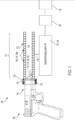
- Fig. 1 illustrates a regenerative braking system 100 comprising a barrel 102 including a bore 104; a circuit 106 including a plurality of electrically conductive components 108 distributed along a length 110 of the bore 104; and a projectile 112 comprising a material 114 selected from at least one of a conductive material or a magnetic material magnetically coupled to the electrically conductive components 108 when the projectile 112 is moving along the length 110 of the bore 104.
- Example electrically conductive components 108 include, but are not limited to, coils 144 or pick up coils 144b coupled to a magnet 147.
- Example magnetic materials include, but are not limited to, a permanent magnet 145.
- the circuit 106 stores energy 116 generated from an electric current 118 induced in the electrically conductive components 108 when the projectile 112 moving along the length 110 of the bore 104 causes a magnetic interaction 120 between the electrically conductive components 108 and the material 114.
- the magnetic interaction 120 also causes braking or slowing of the projectile 112.
- the circuit 106 comprises (or is connected to) capacitors 154 and/or batteries 156 used to store the energy 116 for powering an appliance or other device 158.
- the electrically conductive components 108 are connected in parallel with the capacitors 154.
- the system is an attachment that can be removably attached to, or retrofitted on, a firearm 130.
- a connector 132 is used to attach the barrel 102 to the muzzle 134 of the firearm 130 so that the projectile 112 (a bullet 136) is fired into the barrel 102 from the muzzle 134.
- the barrel 102 or the connector 132 comprises a vent 138 positioned forward of the electrically conductive components 108, so that the vent 138 vents an exhaust 140 from the firearm 130.
- Fig. 2 illustrates an example regenerative braking system 200 wherein the projectile 112 comprises a piston 202.
- the system further includes a reactor 204 (e.g., combustion chamber 203) coupled to the barrel 102 and the reactor 204 is configured to (1) react a chemical propellant 206 with a reactant 208 (e.g., air or oxygen) so as to form an exhaust product 210, and (2) direct the exhaust product 210 to propel the piston 202 through the bore 104.
- the reactor 204 comprises an intake 212 for inputting air, an exhaust 214 for outputting exhaust product 210, and a spark plug 216 for igniting the chemical propellant 206.
- the regenerative braking system 200 further comprises a mechanism 218 for returning the piston 202 to the reactor 204 after the piston 202 has traveled the length 110 of the bore 104 following propulsion and braking.
- the mechanism 218 comprises a connecting rod 220, a crank 222, a crank pin 224, and a crank shaft 226, wherein a portion of the reciprocating motion of the piston 202 is converted to rotational motion of the crank 222 which is then used to push the connecting rod 220 that drives the piston back to the reactor 204.
- Fig. 3 illustrates various example magnetic interactions 120 between the electrically conductive components 108 and the projectile 112 which is magnetized.
- the projectile 112 generates a first magnetic field 122 configured to induce the electric current 118 in the electrically conductive components 108 when the projectile 112 is moving along the length 110 of the bore 104.
- the electric current 118 generates a second magnetic field 124 and the electrically conductive components 108 are configured so that the magnetic interaction 120 of the second magnetic field 124 with the first magnetic field 122 causes the braking of the projectile 112, e.g., as the kinetic energy 117 of the projectile 112 is converted to electrical energy 116.
- the second magnetic field 124 does not extend behind the projectile 112 so as to prevent pushing of the projectile 112 along the bore 104.
- the magnetic interaction 120 induces an eddy current in the conductive material in the projectile 112 moving along the length 110 of the bore 104.
- the formation of the eddy current causes the braking of the projectile as kinetic energy 117 of the projectile is dissipated in the eddy current.
- Fig. 4 illustrates a human 400 (e.g., a soldier 402 or a hiker 404) operating the regenerative braking system 100 comprising a hand held or portable device.
- the hand held device is used to charge a battery for small scale power generation out in the field.
- the electrically conductive components 108 are configured so that the braking causes the projectile 112 to exit the bore at a speed of less than 10 m/s, at a speed that can be stopped by an unprotected hand or a protected hand (e.g., a hand protected with armor or a glove).
- the projectile has a kinetic energy reduced by at least 90%-99% and at least a portion of the kinetic energy is converted to the energy 116 comprising electrical energy.
- the average energy in a moving 50 caliber rifle cartridge is approximately 50 kJ, which is more than sufficient to charge an alkaline AA battery ( ⁇ 10 kJ energy storage capacity), a C battery ( ⁇ 35 kJ energy storage capacity), a NiCad battery ( ⁇ 1/3 of these energies) or a NiMH battery ( ⁇ 1/2 of these energies).
- Multiple firings or larger caliber cartridges can be used to charge an alkaline D-battery ( ⁇ 75 kJ energy storage capacity).
- the energy 116 is capable of powering at least one appliance or device 158 selected from a cell phone, a radio, a television, a computer, a global positioning system, an air conditioning system, or an electric vehicle motor (electric motor).
- Fig. 5 illustrates a vehicle 500 (a tank) comprising the regenerative braking system 200 illustrated in Fig. 2 .
- the vehicle further comprises an electromagnetic weapon 502 and the regenerative braking system 200 is used for rapid charging of the energy system for the electromagnetic weapon 502.
- a tank is illustrated, in other examples the regenerative braking system 200 is mounted on an aircraft or watercraft (e.g., boat) near a naval or aircraft gun for rapid charging of the naval gun or the aircraft gun, respectively.
- a fired M1 Abrams tank shell has an energy of ⁇ 30 MJ which is sufficient to charge multiple batteries or a hybrid car battery ( ⁇ 5.4 MJ storage capacity).
- Other example vehicles include, but are not limited to, a car, a truck, a jeep, or a bus.
- Table 1 Various energy capacities for standard batteries and kinetic energies of various caliber bullets that could be used to charge these batteries, wherein bullets are referred in with their NATO nomenclature.
- Fig. 6 illustrates a method of making a regenerative braking system (referring also to Fig. 1 and Fig. 2 ).
- Block 600 represents obtaining or manufacturing a barrel 102 comprising a bore 104.
- the barrel and bore are manufactured using materials typically used for the manufacturing of firearms (e.g., metal).
- Example barrels and bores include, but are not limited to, bores and barrels having a cylindrical cross-section or a non-cylindrical cross-section.
- Block 602 represents disposing or distributing a plurality of electrically conductive components 108 along a length 110 of the bore 104.
- Example electrically conductive components include, but are not limited to, coils 144 (comprising wire), windings (comprising wire), or pick up coils (comprising wire) coupled to a magnet.
- the electrically conductive components comprise a linear set of coils disposed linearly along the length of the bore.
- Example materials for the electrically conductive components include materials typically used for the manufacture of conductive coils and windings, e.g., wires comprising metal (e.g., silver, copper, tungsten, etc.).
- Example materials for the magnet include, but are not limited to, rare earth materials (e.g., neodymium).
- Block 604 represents obtaining or manufacturing a projectile 112 comprising at least one material 114 selected from a conductive material or a magnetic material that can be magnetically coupled to the electrically conductive components when the projectile is moving along the length of the bore.
- Example magnetic materials include a permanent magnet comprising, for example rare earth materials (e.g., neodymium).
- Example materials for the conductive material include materials typically used for the manufacture of conductive coils, windings, loops, or wires, e.g., metal such as, but not limited to, silver, copper, tungsten, etc.
- Block 606 represents connecting a circuit including the electrically conductive components.
- the circuit 106 is configured to store energy 116 generated from an electric current 118 induced in the electrically conductive components when the projectile moving along the length of the bore causes a magnetic interaction 120 between the electrically conductive components and the material.
- the circuit 106 comprises (or is connected to) capacitors 154 and/or batteries 156 used to store the energy 116.
- the circuit 106 comprises a buffer circuit, for :
- Block 608 represents the end result, a regenerative braking system as illustrated in Fig. 1 or Fig. 2 .
- Block 610 represents attaching the regenerative braking system to a firearm, reactor, or other system for propelling the projectile along the bore.
- firearm include, but are not limited to, a gun, pistol, assault weapon, or machine gun.
- reactor include, but are not limited to, a combustion chamber as used in a combustion engine.
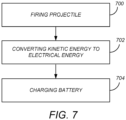
- Fig. 7 illustrates a method of operating a firearm.
- Block 700 represents firing a firearm so as to propel a projectile from the firearm.
- Block 702 a represents converting a kinetic energy of the projectile into an electrical energy.
- Block 704 represents charging a battery using the electrical energy.
- This method solves the problem of charging weaponry or other devices in the field. Specifically, the method is able to rapidly convert high-density chemical energy into usable electrical energy using direct energy conversion, reducing weight of energy storage compared to state-of-the-art batteries..
Landscapes
- Engineering & Computer Science (AREA)
- General Engineering & Computer Science (AREA)
- Power Engineering (AREA)
- Physics & Mathematics (AREA)
- Computer Networks & Wireless Communication (AREA)
- Electromagnetism (AREA)
- Plasma & Fusion (AREA)
- Thermal Sciences (AREA)
- Chemical & Material Sciences (AREA)
- Combustion & Propulsion (AREA)
- Fluid Mechanics (AREA)
- Charge And Discharge Circuits For Batteries Or The Like (AREA)
Description
- The present disclosure relates to methods and system of converting chemical or kinetic energy into usable electrical energy.
- Charging appliances while in remote field locations can be challenging. Existing solutions generally involve carrying multiple charged replacement batteries. However, batteries are heavy, have relatively low energy density, and slowly lose energy, thereby requiring frequent recharging which may not always be possible. What is needed is a more convenient, lightweight, and higher energy density method of storing energy while in the field. Embodiments described herein satisfy this need.
- Document
US 2009/108589 A1 , in accordance with its abstract, states a firearm improvement taking the form of a mechanical dynamo installed in an automatic firearm. Several components either replace certain parts of the firearm or are added to the firearm. In conjunction with the operation of the firearm, the components generate electric energy which is then stored in a capacitor, battery, or other element for the storage of electric energy, or supply power to a battery recharging unit attached to the firearm. The electric energy contained in the storage component, or used to recharge the batteries placed in the recharging unit, may be used at a later time as a back-up power supply for electronic components attached to or incorporated into the firearm, such as red-dot or reflex sights, laser sighting equipment, or night vision equipment. - The present disclosure describes a regenerative braking system for converting kinetic energy of a projectile into electrical energy suitable for powering appliances or charging a battery.
- The present disclosure further describes a method of operating a firearm, comprising:
- firing a firearm so as to propel a projectile from the firearm;
- converting a kinetic energy of the projectile into an electrical energy; and
- charging a battery using the electrical energy.
- In one or more examples, the method further comprises providing the firearm comprising a barrel including a bore; providing a circuit including a plurality of electrically conductive components distributed along a length of the bore; and providing the projectile comprising at least one of a conductive material or a magnetic material magnetically coupled to the electrically conductive components when the projectile is moving along the length of the bore. The circuit stores energy generated from an electric current induced in the electrically conductive components when the projectile moving along the length of the bore causes a magnetic interaction between the electrically conductive components and the at least one of the magnetic material or the conductive material. The magnetic interaction causes braking of the projectile. Currently claimed invention relates to a system as defined in claim 1.
-
-
Fig. 1 illustrates a regenerative braking system according to a first example. -
Fig. 2 illustrates a regenerative braking system according to a second example. -
Fig. 3 illustrates an example magnetic field distribution in a regenerative braking system according to one or more examples described herein. -
Fig. 4 illustrates a soldier or hiker using a regenerative braking system in a field application, according to one or more examples described herein. -
Fig. 5 illustrates a vehicle including a regenerative braking system according to one or more examples described herein. -
Fig. 6 is a flowchart illustrating a method of making a regenerative braking system according to one or more examples described herein. -
Fig. 7 is a flowchart illustrating a method of using a regenerative braking system, according to one or more examples described herein. - In the following description, reference is made to the accompanying drawings which form a part hereof, and which show, by way of illustration, several examples. It is understood that other examples may be utilized and structural changes may be made without departing from the scope of the present disclosure.
- The present disclosure describes a system that uses Faraday's law to rapidly and directly convert kinetic energy of a magnetized and/or conductive projectile (propelled by chemical energy) into usable electrical energy. In one example, the magnetic braking effect of an "inverse coil gun" removes energy from a high kinetic energy projectile (whose initial kinetic energy is generated from chemical energy) and produces a voltage in a circuit magnetically coupled to projectile. The electrical energy associated with the voltage is used directly by an application or to charge capacitors or batteries for later use. This system drastically reduces the weight of energy storage.
-
Fig. 1 illustrates aregenerative braking system 100 comprising a barrel 102 including abore 104; acircuit 106 including a plurality of electrically conductive components 108 distributed along alength 110 of thebore 104; and aprojectile 112 comprising a material 114 selected from at least one of a conductive material or a magnetic material magnetically coupled to the electrically conductive components 108 when theprojectile 112 is moving along thelength 110 of thebore 104. Example electrically conductive components 108 include, but are not limited to, coils 144 or pick up coils 144b coupled to a magnet 147. Example magnetic materials include, but are not limited to, a permanent magnet 145. - The
circuit 106 stores energy 116 generated from anelectric current 118 induced in the electrically conductive components 108 when theprojectile 112 moving along thelength 110 of thebore 104 causes amagnetic interaction 120 between the electrically conductive components 108 and the material 114. Themagnetic interaction 120 also causes braking or slowing of theprojectile 112. In one or more examples, thecircuit 106 comprises (or is connected to) capacitors 154 and/orbatteries 156 used to store the energy 116 for powering an appliance orother device 158. Preferably, according to one aspect, the electrically conductive components 108 are connected in parallel with the capacitors 154. - In the example illustrated in
Fig. 1 , the system is an attachment that can be removably attached to, or retrofitted on, afirearm 130. Aconnector 132 is used to attach the barrel 102 to themuzzle 134 of thefirearm 130 so that the projectile 112 (a bullet 136) is fired into the barrel 102 from themuzzle 134. The barrel 102 or theconnector 132 comprises avent 138 positioned forward of the electrically conductive components 108, so that thevent 138 vents anexhaust 140 from thefirearm 130. -
Fig. 2 illustrates an exampleregenerative braking system 200 wherein theprojectile 112 comprises a piston 202. The system further includes a reactor 204 (e.g., combustion chamber 203) coupled to the barrel 102 and the reactor 204 is configured to (1) react a chemical propellant 206 with a reactant 208 (e.g., air or oxygen) so as to form anexhaust product 210, and (2) direct theexhaust product 210 to propel the piston 202 through thebore 104. The reactor 204 comprises anintake 212 for inputting air, anexhaust 214 for outputtingexhaust product 210, and aspark plug 216 for igniting the chemical propellant 206. Theregenerative braking system 200 further comprises amechanism 218 for returning the piston 202 to the reactor 204 after the piston 202 has traveled thelength 110 of thebore 104 following propulsion and braking. In the illustrated example, themechanism 218 comprises a connectingrod 220, acrank 222, acrank pin 224, and acrank shaft 226, wherein a portion of the reciprocating motion of the piston 202 is converted to rotational motion of thecrank 222 which is then used to push the connectingrod 220 that drives the piston back to the reactor 204. -
Fig. 3 illustrates various examplemagnetic interactions 120 between the electrically conductive components 108 and theprojectile 112 which is magnetized. In one implementation, theprojectile 112 generates a firstmagnetic field 122 configured to induce theelectric current 118 in the electrically conductive components 108 when theprojectile 112 is moving along thelength 110 of thebore 104. Theelectric current 118 generates a secondmagnetic field 124 and the electrically conductive components 108 are configured so that themagnetic interaction 120 of the secondmagnetic field 124 with the firstmagnetic field 122 causes the braking of theprojectile 112, e.g., as the kinetic energy 117 of theprojectile 112 is converted to electrical energy 116. In various examples, the secondmagnetic field 124 does not extend behind theprojectile 112 so as to prevent pushing of theprojectile 112 along thebore 104. - In another implementation wherein the
projectile 112 comprises a conductive material, themagnetic interaction 120 induces an eddy current in the conductive material in theprojectile 112 moving along thelength 110 of thebore 104. The formation of the eddy current causes the braking of the projectile as kinetic energy 117 of the projectile is dissipated in the eddy current. -
Fig. 4 illustrates a human 400 (e.g., a soldier 402 or a hiker 404) operating theregenerative braking system 100 comprising a hand held or portable device. The hand held device is used to charge a battery for small scale power generation out in the field. In one or more examples, the electrically conductive components 108 are configured so that the braking causes the projectile 112 to exit the bore at a speed of less than 10 m/s, at a speed that can be stopped by an unprotected hand or a protected hand (e.g., a hand protected with armor or a glove). In one or more further examples, the projectile has a kinetic energy reduced by at least 90%-99% and at least a portion of the kinetic energy is converted to the energy 116 comprising electrical energy. The average energy in a moving 50 caliber rifle cartridge is approximately 50 kJ, which is more than sufficient to charge an alkaline AA battery (~10 kJ energy storage capacity), a C battery (~35 kJ energy storage capacity), a NiCad battery (~1/3 of these energies) or a NiMH battery (~1/2 of these energies). Multiple firings or larger caliber cartridges can be used to charge an alkaline D-battery (~75 kJ energy storage capacity). - In one or more examples, the energy 116 is capable of powering at least one appliance or
device 158 selected from a cell phone, a radio, a television, a computer, a global positioning system, an air conditioning system, or an electric vehicle motor (electric motor). -
Fig. 5 illustrates a vehicle 500 (a tank) comprising theregenerative braking system 200 illustrated inFig. 2 . The vehicle further comprises anelectromagnetic weapon 502 and theregenerative braking system 200 is used for rapid charging of the energy system for theelectromagnetic weapon 502. Although a tank is illustrated, in other examples theregenerative braking system 200 is mounted on an aircraft or watercraft (e.g., boat) near a naval or aircraft gun for rapid charging of the naval gun or the aircraft gun, respectively. A fired M1 Abrams tank shell has an energy of ~30 MJ which is sufficient to charge multiple batteries or a hybrid car battery (~5.4 MJ storage capacity). Other example vehicles include, but are not limited to, a car, a truck, a jeep, or a bus.Table 1: Various energy capacities for standard batteries and kinetic energies of various caliber bullets that could be used to charge these batteries, wherein bullets are referred in with their NATO nomenclature. battery energy (J) weight (g) J/g Rechargeable AA Alkaline 9360 24 390.0 No AA Li-Ion 11050 24 460.4 No AA NiCd 4320 29 149.0 Yes AA NiMH 9072 26 348.9 Yes D Alkaline 74970 135 555.3 No D NiCd 21600 200 108.0 Yes D NiMH 41040 170 241.4 Yes bullet energy (J) weight (g) J/g 5.56x45 1796 11.9 150.9 7.62x51 3304 25.5 129.6 7.62x39 2108 18.2 115.8 9x19 570 8 71.3 .50 BMG 18100 120 150.8 -
Fig. 6 illustrates a method of making a regenerative braking system (referring also toFig. 1 andFig. 2 ). -
Block 600 represents obtaining or manufacturing a barrel 102 comprising abore 104. In one or more examples, the barrel and bore are manufactured using materials typically used for the manufacturing of firearms (e.g., metal). Example barrels and bores include, but are not limited to, bores and barrels having a cylindrical cross-section or a non-cylindrical cross-section. -
Block 602 represents disposing or distributing a plurality of electrically conductive components 108 along alength 110 of thebore 104. Example electrically conductive components include, but are not limited to, coils 144 (comprising wire), windings (comprising wire), or pick up coils (comprising wire) coupled to a magnet. In one example, the electrically conductive components comprise a linear set of coils disposed linearly along the length of the bore. Example materials for the electrically conductive components include materials typically used for the manufacture of conductive coils and windings, e.g., wires comprising metal (e.g., silver, copper, tungsten, etc.). Example materials for the magnet include, but are not limited to, rare earth materials (e.g., neodymium). -
Block 604 represents obtaining or manufacturing a projectile 112 comprising at least one material 114 selected from a conductive material or a magnetic material that can be magnetically coupled to the electrically conductive components when the projectile is moving along the length of the bore. Example magnetic materials include a permanent magnet comprising, for example rare earth materials (e.g., neodymium). Example materials for the conductive material include materials typically used for the manufacture of conductive coils, windings, loops, or wires, e.g., metal such as, but not limited to, silver, copper, tungsten, etc. -
Block 606 represents connecting a circuit including the electrically conductive components. Thecircuit 106 is configured to store energy 116 generated from an electric current 118 induced in the electrically conductive components when the projectile moving along the length of the bore causes amagnetic interaction 120 between the electrically conductive components and the material. In one or more examples, thecircuit 106 comprises (or is connected to) capacitors 154 and/orbatteries 156 used to store the energy 116. - In one or more examples, the
circuit 106 comprises a buffer circuit, for : - charging capacitors 154 using the electrical current 118 and with a first time constant commensurate with a timescale of the projectile 112 traveling along the
bore 104, and - discharging the capacitors 154 into the
battery 156 with a second time constant longer that the first time constant and commensurate with a charging time in accordance with the battery manufacturer's specifications. -
Block 608 represents the end result, a regenerative braking system as illustrated inFig. 1 orFig. 2 . -
Block 610 represents attaching the regenerative braking system to a firearm, reactor, or other system for propelling the projectile along the bore. Examples of firearm include, but are not limited to, a gun, pistol, assault weapon, or machine gun. Examples of reactor include, but are not limited to, a combustion chamber as used in a combustion engine. -
Fig. 7 illustrates a method of operating a firearm. -
Block 700 represents firing a firearm so as to propel a projectile from the firearm. - Block 702 a represents converting a kinetic energy of the projectile into an electrical energy.
-
Block 704 represents charging a battery using the electrical energy. - This method solves the problem of charging weaponry or other devices in the field. Specifically, the method is able to rapidly convert high-density chemical energy into usable electrical energy using direct energy conversion, reducing weight of energy storage compared to state-of-the-art batteries..
- Existing solutions generally involve carrying multiple charged replacement batteries. However, batteries are heavy with relatively low energy density compared to chemical energy solutions. Moreover, batteries slowly lose energy and need frequent recharging, which requires a recharging power supply and energy source. Embodiments of the methods described herein require that only one battery is transported in the field since the energy is stored in the chemical energy of the propellant used to fire the projectile and the chemical energy is only converted to electrical energy when needed to recharge the battery.
- This concludes the description of the examples of the present disclosure. The foregoing description of the examples has been presented for the purposes of illustration and description. It is not intended to be exhaustive or to limit the disclosure to the precise form disclosed. Many modifications and variations are possible in light of the above teaching. It is intended that the scope of rights be limited not by this detailed description, but rather by the claims appended hereto.
Claims (12)
- A regenerative braking system (100), comprising:a barrel (102) comprising a bore (104);a circuit (106) including a plurality of electrically conductive components (108) distributed along a length (110) of the bore (104);a projectile (112) comprising at least one of a conductive material (114) or a magnetic material (114) magnetically coupled to the electrically conductive components (108) when the projectile (112) is moving along the length (110) of the bore (104); and wherein:the circuit (106) is configured to store energy (116) generated from an electric current (118) induced in the electrically conductive components (108) when the projectile (112) moving along the length (110) of the bore (104) causes a magnetic interaction (120) between the electrically conductive components (108) and the at least one of the magnetic material (114) or the conductive material (114), andthe magnetic interaction (120) is configured to cause braking of the projectile (112),characterized in that the regenerative braking system (100) further comprises a connector (132) configured to attach the barrel (102) to a muzzle (134) of a firearm (130), wherein the projectile (112) comprises a bullet (136) configured to be fired into the barrel (102) from the muzzle (134), wherein: the barrel (102) comprises a vent (138) positioned forward of the electrically conductive components (108), andwherein the vent (138) is configured to vent an exhaust (140) from the firearm (130).
- The system of claim 1, wherein:the projectile (112) is configured to generate a first magnetic field (122) configured to induce the electric current (118) in the electrically conductive components (108) when the projectile (112) is moving along the length (110) of the bore (104), andthe electric current (118) is configured to generate a second magnetic field (124) and the electrically conductive components (108) are configured so that the magnetic interaction (120) of the second magnetic field (124) with the first magnetic field (122) causes the braking of the projectile (112).
- The system of claims 1 or 2, wherein the magnetic interaction (120) is configured to induce an eddy current in the conductive material (114) in the projectile (112) moving along the length (110) of the bore (104).
- The system of claim 1, wherein the electrically conductive components (108) are configured so that:the projectile (112) exits the bore (104) at a speed that can be stopped by hand, or the speed is less than 10 m/s, orthe projectile (112) has a kinetic energy (117) reduced by at least 90% and at least a portion of the kinetic energy (117) is converted to energy (116) comprising electrical energy (116).
- The system of any one of claims 1-4, wherein the magnetic material (114) comprises a permanent magnet (145).
- The system of any one of claims 1-5, wherein the electrically conductive components (108) comprise coils (144).
- The system of any one of claims 1-6, wherein the circuit (106) comprises one or more capacitors (154) configured to store the energy (116) generated from the electrical current (118).
- The system of claim 7, wherein the electrically conductive components (108) are connected in parallel with the capacitors (154).
- The system of any one of claims 1-8, further comprising:
a battery (156) connected to the circuit (106), wherein the battery (156) is configured to store the energy (116). - The system of claim 9, wherein the energy (116) is capable of powering at least one device (158) selected from a cell phone, a radio, a television, a computer, a global positioning system, an air conditioning system, or an electric vehicle motor.
- The system of claims 9 or 10, wherein the circuit (106) comprises a buffer circuit for:charging capacitors (154) using the electrical current (118) and with a first time constant commensurate with a timescale of the projectile (112) traveling along the bore (104), anddischarging the capacitors (154) into the battery (156) with a second time constant longer that the first time constant and commensurate with a charging time in accordance with manufacturer specifications for the battery (156).
- A vehicle (500) comprising an electromagnetic weapon (502) powered using the system of any one of claims 1-11.
Applications Claiming Priority (1)
| Application Number | Priority Date | Filing Date | Title |
|---|---|---|---|
| US16/825,045 US11817713B2 (en) | 2020-03-20 | 2020-03-20 | Method of rapid conversion of chemical energy into usable electrical energy |
Publications (2)
| Publication Number | Publication Date |
|---|---|
| EP3882558A1 EP3882558A1 (en) | 2021-09-22 |
| EP3882558B1 true EP3882558B1 (en) | 2023-09-06 |
Family
ID=74874780
Family Applications (1)
| Application Number | Title | Priority Date | Filing Date |
|---|---|---|---|
| EP21162690.8A Active EP3882558B1 (en) | 2020-03-20 | 2021-03-15 | Method of rapid conversion of chemical energy into usable electrical energy |
Country Status (6)
| Country | Link |
|---|---|
| US (1) | US11817713B2 (en) |
| EP (1) | EP3882558B1 (en) |
| JP (1) | JP7742708B2 (en) |
| CN (1) | CN113497538A (en) |
| AU (1) | AU2021201359B2 (en) |
| CA (1) | CA3110717A1 (en) |
Families Citing this family (2)
| Publication number | Priority date | Publication date | Assignee | Title |
|---|---|---|---|---|
| US11333462B2 (en) * | 2019-11-18 | 2022-05-17 | Ra Matet, LLC | Electromagnetic accelerator |
| SK10173Y1 (en) | 2024-04-25 | 2024-11-06 | Aviusuld | System for the vibrational production of electrical energy, especially for applications in the aviation industry |
Family Cites Families (24)
| Publication number | Priority date | Publication date | Assignee | Title |
|---|---|---|---|---|
| US4714003A (en) * | 1985-02-19 | 1987-12-22 | Westinghouse Electric Corp. | Electromagnetic launcher with a passive inductive loop for rail energy retention or dissipation |
| US4753153A (en) * | 1986-11-24 | 1988-06-28 | The United States Of America As Represented By The Secretary Of The Army | Electromagnetic railgun with a non-explosive magnetic flux compression generator |
| US4840107A (en) | 1987-04-16 | 1989-06-20 | Board Of Regents, The University Of Texas System | Method and apparatus for managing recoil of electromagnetic guns |
| US4966884A (en) * | 1989-01-19 | 1990-10-30 | International Superconductor Corp. | DC powered hybrid coil gun employing superconducting elements |
| US5168118A (en) * | 1989-11-13 | 1992-12-01 | Schroeder Jon M | Method for electromagnetic acceleration of an object |
| US5024137A (en) * | 1989-11-13 | 1991-06-18 | Schroeder Jon M | Fuel assisted electromagnetic launcher |
| US5217948A (en) * | 1991-10-18 | 1993-06-08 | General Dynamics Corporation, Space Systems Division | Phase change cooling for an electromagnetic launch |
| US6361393B1 (en) * | 1998-10-09 | 2002-03-26 | Elenco Electronics, Inc. | Magnetic impulse reaction driven toys |
| US7111619B2 (en) * | 2004-01-15 | 2006-09-26 | Raytheon Company | Magnetic field protection for the projectile of an electromagnetic coil gun system |
| US20080277939A1 (en) * | 2004-03-15 | 2008-11-13 | Georgia Tech Research Corporation | Linear Generator and System to Capture Energy from Irregular Linear Movement |
| US7874237B2 (en) * | 2004-07-26 | 2011-01-25 | Lockheed Martin Corporation | Electromagnetic missile launcher |
| US7525203B1 (en) * | 2005-08-11 | 2009-04-28 | Jeffrey Racho | Back-up electric power generator for electronic components attached to automatic firearms |
| US7703373B2 (en) * | 2006-07-05 | 2010-04-27 | Lockheed Martin Corporation | Unitary electro magnetic coil launch tube |
| US8237526B2 (en) * | 2008-06-09 | 2012-08-07 | Sierra Lobo, Inc. | Nondestructive capture of projectiles |
| US8225542B2 (en) * | 2008-07-16 | 2012-07-24 | Lasermax, Inc. | Firearm assembly |
| US9476668B1 (en) * | 2012-06-12 | 2016-10-25 | Enig Associates Inc. | Hypervelocity projectile launching system |
| US20150008867A1 (en) * | 2013-07-03 | 2015-01-08 | At&T Intellectual Property I, L.P. | Charge pump battery charging |
| CA2934511A1 (en) * | 2013-12-19 | 2015-10-01 | Enig Associates Inc. | Hybrid propellant electromagnetic gun system |
| US9562736B2 (en) * | 2014-05-20 | 2017-02-07 | The Boeing Company | Electromagnetic muzzle velocity controller and booster for guns |
| WO2016066129A1 (en) * | 2014-10-30 | 2016-05-06 | 陈启星 | Linear motor based on radial magnetic tube |
| EP3106825B1 (en) * | 2015-06-19 | 2017-12-27 | Kabushiki Kaisha Kobe Seiko Sho (Kobe Steel, Ltd.) | Launching apparatus for underwater payload |
| JP2018062902A (en) * | 2016-10-13 | 2018-04-19 | 株式会社豊田中央研究所 | Free piston engine generator |
| WO2018109434A1 (en) * | 2016-12-16 | 2018-06-21 | Bae Systems Plc | A method of slowing down a moving projectile |
| US11469025B2 (en) * | 2019-12-12 | 2022-10-11 | Honeywell Federal Manufacturing & Technologies, Llc | Electromagnetic propulsion system |
-
2020
- 2020-03-20 US US16/825,045 patent/US11817713B2/en active Active
-
2021
- 2021-02-26 CA CA3110717A patent/CA3110717A1/en active Pending
- 2021-03-02 AU AU2021201359A patent/AU2021201359B2/en active Active
- 2021-03-15 EP EP21162690.8A patent/EP3882558B1/en active Active
- 2021-03-16 CN CN202110279260.7A patent/CN113497538A/en active Pending
- 2021-03-19 JP JP2021045712A patent/JP7742708B2/en active Active
Also Published As
| Publication number | Publication date |
|---|---|
| AU2021201359B2 (en) | 2026-03-05 |
| EP3882558A1 (en) | 2021-09-22 |
| CN113497538A (en) | 2021-10-12 |
| JP7742708B2 (en) | 2025-09-22 |
| US11817713B2 (en) | 2023-11-14 |
| JP2021168589A (en) | 2021-10-21 |
| CA3110717A1 (en) | 2021-09-20 |
| AU2021201359A1 (en) | 2021-10-07 |
| US20210296929A1 (en) | 2021-09-23 |
Similar Documents
| Publication | Publication Date | Title |
|---|---|---|
| US7525203B1 (en) | Back-up electric power generator for electronic components attached to automatic firearms | |
| McNab et al. | Development of a naval railgun | |
| McNab et al. | Naval railguns | |
| US9472971B2 (en) | Wireless inductive charging of weapon system energy source | |
| McNab | Pulsed power for electric guns | |
| McFarland et al. | A long-range naval railgun | |
| CA2908702C (en) | Wireless inductive charging of weapon system energy source | |
| EP3882558B1 (en) | Method of rapid conversion of chemical energy into usable electrical energy | |
| US8686576B1 (en) | System and method for harvesting electrical energy by linear induction | |
| US9784523B2 (en) | Hybrid propellant electromagnetic gun system | |
| Walls et al. | Application of electromagnetic guns to future naval platforms | |
| Beach et al. | Present and future naval applications for pulsed power | |
| US11668544B1 (en) | Electromagnetic rifle with compact armature | |
| Wisken et al. | Capacitive pulsed power supply systems for ETC guns | |
| CN102368629B (en) | Individual weapon fast charging device | |
| RU2656446C1 (en) | Method of electrical initiation of shot of small arms cartridge | |
| Walls | Rotating machines for pulsed power | |
| Golea | Improvements in modern weapons systems: the use of dielectric materials for the development of advanced models of electric weapons powered by brushless homopolar generator | |
| Barber | The personal railgun-a small study in system integration | |
| CN1298088A (en) | Current-triggered superhigh-speed shotting guns | |
| Walls et al. | Pulsed rotating machine power supplies for electro-thermal-chemical guns | |
| RU2007124826A (en) | TANK WITH TOWER CHARGING MACHINE | |
| Herbst et al. | Rotating machine technologies for integration of pulsed and high power loads in naval electric power systems | |
| Vancaeyzeele et al. | Design Considerations for Co-Use of Electromagnetic Railguns Used for Naval Artillery and Against Anti-Ship Missiles | |
| Herbig et al. | A compact pulsed power supply for ETI applications |
Legal Events
| Date | Code | Title | Description |
|---|---|---|---|
| PUAI | Public reference made under article 153(3) epc to a published international application that has entered the european phase |
Free format text: ORIGINAL CODE: 0009012 |
|
| STAA | Information on the status of an ep patent application or granted ep patent |
Free format text: STATUS: THE APPLICATION HAS BEEN PUBLISHED |
|
| AK | Designated contracting states |
Kind code of ref document: A1 Designated state(s): AL AT BE BG CH CY CZ DE DK EE ES FI FR GB GR HR HU IE IS IT LI LT LU LV MC MK MT NL NO PL PT RO RS SE SI SK SM TR |
|
| STAA | Information on the status of an ep patent application or granted ep patent |
Free format text: STATUS: REQUEST FOR EXAMINATION WAS MADE |
|
| 17P | Request for examination filed |
Effective date: 20220303 |
|
| RBV | Designated contracting states (corrected) |
Designated state(s): AL AT BE BG CH CY CZ DE DK EE ES FI FR GB GR HR HU IE IS IT LI LT LU LV MC MK MT NL NO PL PT RO RS SE SI SK SM TR |
|
| STAA | Information on the status of an ep patent application or granted ep patent |
Free format text: STATUS: EXAMINATION IS IN PROGRESS |
|
| 17Q | First examination report despatched |
Effective date: 20220718 |
|
| RAP3 | Party data changed (applicant data changed or rights of an application transferred) |
Owner name: THE BOEING COMPANY |
|
| GRAP | Despatch of communication of intention to grant a patent |
Free format text: ORIGINAL CODE: EPIDOSNIGR1 |
|
| STAA | Information on the status of an ep patent application or granted ep patent |
Free format text: STATUS: GRANT OF PATENT IS INTENDED |
|
| INTG | Intention to grant announced |
Effective date: 20230615 |
|
| GRAS | Grant fee paid |
Free format text: ORIGINAL CODE: EPIDOSNIGR3 |
|
| GRAA | (expected) grant |
Free format text: ORIGINAL CODE: 0009210 |
|
| STAA | Information on the status of an ep patent application or granted ep patent |
Free format text: STATUS: THE PATENT HAS BEEN GRANTED |
|
| AK | Designated contracting states |
Kind code of ref document: B1 Designated state(s): AL AT BE BG CH CY CZ DE DK EE ES FI FR GB GR HR HU IE IS IT LI LT LU LV MC MK MT NL NO PL PT RO RS SE SI SK SM TR |
|
| P01 | Opt-out of the competence of the unified patent court (upc) registered |
Effective date: 20230731 |
|
| REG | Reference to a national code |
Ref country code: GB Ref legal event code: FG4D |
|
| REG | Reference to a national code |
Ref country code: CH Ref legal event code: EP |
|
| REG | Reference to a national code |
Ref country code: IE Ref legal event code: FG4D |
|
| REG | Reference to a national code |
Ref country code: DE Ref legal event code: R096 Ref document number: 602021004817 Country of ref document: DE |
|
| REG | Reference to a national code |
Ref country code: LT Ref legal event code: MG9D |
|
| REG | Reference to a national code |
Ref country code: NL Ref legal event code: MP Effective date: 20230906 |
|
| PG25 | Lapsed in a contracting state [announced via postgrant information from national office to epo] |
Ref country code: GR Free format text: LAPSE BECAUSE OF FAILURE TO SUBMIT A TRANSLATION OF THE DESCRIPTION OR TO PAY THE FEE WITHIN THE PRESCRIBED TIME-LIMIT Effective date: 20231207 |
|
| PG25 | Lapsed in a contracting state [announced via postgrant information from national office to epo] |
Ref country code: SE Free format text: LAPSE BECAUSE OF FAILURE TO SUBMIT A TRANSLATION OF THE DESCRIPTION OR TO PAY THE FEE WITHIN THE PRESCRIBED TIME-LIMIT Effective date: 20230906 Ref country code: RS Free format text: LAPSE BECAUSE OF FAILURE TO SUBMIT A TRANSLATION OF THE DESCRIPTION OR TO PAY THE FEE WITHIN THE PRESCRIBED TIME-LIMIT Effective date: 20230906 Ref country code: NO Free format text: LAPSE BECAUSE OF FAILURE TO SUBMIT A TRANSLATION OF THE DESCRIPTION OR TO PAY THE FEE WITHIN THE PRESCRIBED TIME-LIMIT Effective date: 20231206 Ref country code: LV Free format text: LAPSE BECAUSE OF FAILURE TO SUBMIT A TRANSLATION OF THE DESCRIPTION OR TO PAY THE FEE WITHIN THE PRESCRIBED TIME-LIMIT Effective date: 20230906 Ref country code: LT Free format text: LAPSE BECAUSE OF FAILURE TO SUBMIT A TRANSLATION OF THE DESCRIPTION OR TO PAY THE FEE WITHIN THE PRESCRIBED TIME-LIMIT Effective date: 20230906 Ref country code: HR Free format text: LAPSE BECAUSE OF FAILURE TO SUBMIT A TRANSLATION OF THE DESCRIPTION OR TO PAY THE FEE WITHIN THE PRESCRIBED TIME-LIMIT Effective date: 20230906 Ref country code: GR Free format text: LAPSE BECAUSE OF FAILURE TO SUBMIT A TRANSLATION OF THE DESCRIPTION OR TO PAY THE FEE WITHIN THE PRESCRIBED TIME-LIMIT Effective date: 20231207 Ref country code: FI Free format text: LAPSE BECAUSE OF FAILURE TO SUBMIT A TRANSLATION OF THE DESCRIPTION OR TO PAY THE FEE WITHIN THE PRESCRIBED TIME-LIMIT Effective date: 20230906 |
|
| REG | Reference to a national code |
Ref country code: AT Ref legal event code: MK05 Ref document number: 1609055 Country of ref document: AT Kind code of ref document: T Effective date: 20230906 |
|
| PG25 | Lapsed in a contracting state [announced via postgrant information from national office to epo] |
Ref country code: NL Free format text: LAPSE BECAUSE OF FAILURE TO SUBMIT A TRANSLATION OF THE DESCRIPTION OR TO PAY THE FEE WITHIN THE PRESCRIBED TIME-LIMIT Effective date: 20230906 |
|
| PG25 | Lapsed in a contracting state [announced via postgrant information from national office to epo] |
Ref country code: IS Free format text: LAPSE BECAUSE OF FAILURE TO SUBMIT A TRANSLATION OF THE DESCRIPTION OR TO PAY THE FEE WITHIN THE PRESCRIBED TIME-LIMIT Effective date: 20240106 |
|
| PG25 | Lapsed in a contracting state [announced via postgrant information from national office to epo] |
Ref country code: AT Free format text: LAPSE BECAUSE OF FAILURE TO SUBMIT A TRANSLATION OF THE DESCRIPTION OR TO PAY THE FEE WITHIN THE PRESCRIBED TIME-LIMIT Effective date: 20230906 |
|
| PG25 | Lapsed in a contracting state [announced via postgrant information from national office to epo] |
Ref country code: ES Free format text: LAPSE BECAUSE OF FAILURE TO SUBMIT A TRANSLATION OF THE DESCRIPTION OR TO PAY THE FEE WITHIN THE PRESCRIBED TIME-LIMIT Effective date: 20230906 |
|
| PG25 | Lapsed in a contracting state [announced via postgrant information from national office to epo] |
Ref country code: SM Free format text: LAPSE BECAUSE OF FAILURE TO SUBMIT A TRANSLATION OF THE DESCRIPTION OR TO PAY THE FEE WITHIN THE PRESCRIBED TIME-LIMIT Effective date: 20230906 Ref country code: RO Free format text: LAPSE BECAUSE OF FAILURE TO SUBMIT A TRANSLATION OF THE DESCRIPTION OR TO PAY THE FEE WITHIN THE PRESCRIBED TIME-LIMIT Effective date: 20230906 Ref country code: IS Free format text: LAPSE BECAUSE OF FAILURE TO SUBMIT A TRANSLATION OF THE DESCRIPTION OR TO PAY THE FEE WITHIN THE PRESCRIBED TIME-LIMIT Effective date: 20240106 Ref country code: ES Free format text: LAPSE BECAUSE OF FAILURE TO SUBMIT A TRANSLATION OF THE DESCRIPTION OR TO PAY THE FEE WITHIN THE PRESCRIBED TIME-LIMIT Effective date: 20230906 Ref country code: EE Free format text: LAPSE BECAUSE OF FAILURE TO SUBMIT A TRANSLATION OF THE DESCRIPTION OR TO PAY THE FEE WITHIN THE PRESCRIBED TIME-LIMIT Effective date: 20230906 Ref country code: CZ Free format text: LAPSE BECAUSE OF FAILURE TO SUBMIT A TRANSLATION OF THE DESCRIPTION OR TO PAY THE FEE WITHIN THE PRESCRIBED TIME-LIMIT Effective date: 20230906 Ref country code: AT Free format text: LAPSE BECAUSE OF FAILURE TO SUBMIT A TRANSLATION OF THE DESCRIPTION OR TO PAY THE FEE WITHIN THE PRESCRIBED TIME-LIMIT Effective date: 20230906 Ref country code: SK Free format text: LAPSE BECAUSE OF FAILURE TO SUBMIT A TRANSLATION OF THE DESCRIPTION OR TO PAY THE FEE WITHIN THE PRESCRIBED TIME-LIMIT Effective date: 20230906 Ref country code: PT Free format text: LAPSE BECAUSE OF FAILURE TO SUBMIT A TRANSLATION OF THE DESCRIPTION OR TO PAY THE FEE WITHIN THE PRESCRIBED TIME-LIMIT Effective date: 20240108 |
|
| PG25 | Lapsed in a contracting state [announced via postgrant information from national office to epo] |
Ref country code: PL Free format text: LAPSE BECAUSE OF FAILURE TO SUBMIT A TRANSLATION OF THE DESCRIPTION OR TO PAY THE FEE WITHIN THE PRESCRIBED TIME-LIMIT Effective date: 20230906 Ref country code: IT Free format text: LAPSE BECAUSE OF FAILURE TO SUBMIT A TRANSLATION OF THE DESCRIPTION OR TO PAY THE FEE WITHIN THE PRESCRIBED TIME-LIMIT Effective date: 20230906 |
|
| REG | Reference to a national code |
Ref country code: DE Ref legal event code: R097 Ref document number: 602021004817 Country of ref document: DE |
|
| PG25 | Lapsed in a contracting state [announced via postgrant information from national office to epo] |
Ref country code: DK Free format text: LAPSE BECAUSE OF FAILURE TO SUBMIT A TRANSLATION OF THE DESCRIPTION OR TO PAY THE FEE WITHIN THE PRESCRIBED TIME-LIMIT Effective date: 20230906 |
|
| PLBE | No opposition filed within time limit |
Free format text: ORIGINAL CODE: 0009261 |
|
| STAA | Information on the status of an ep patent application or granted ep patent |
Free format text: STATUS: NO OPPOSITION FILED WITHIN TIME LIMIT |
|
| PG25 | Lapsed in a contracting state [announced via postgrant information from national office to epo] |
Ref country code: DK Free format text: LAPSE BECAUSE OF FAILURE TO SUBMIT A TRANSLATION OF THE DESCRIPTION OR TO PAY THE FEE WITHIN THE PRESCRIBED TIME-LIMIT Effective date: 20230906 Ref country code: SI Free format text: LAPSE BECAUSE OF FAILURE TO SUBMIT A TRANSLATION OF THE DESCRIPTION OR TO PAY THE FEE WITHIN THE PRESCRIBED TIME-LIMIT Effective date: 20230906 |
|
| 26N | No opposition filed |
Effective date: 20240607 |
|
| REG | Reference to a national code |
Ref country code: CH Ref legal event code: PL |
|
| PG25 | Lapsed in a contracting state [announced via postgrant information from national office to epo] |
Ref country code: BG Free format text: LAPSE BECAUSE OF FAILURE TO SUBMIT A TRANSLATION OF THE DESCRIPTION OR TO PAY THE FEE WITHIN THE PRESCRIBED TIME-LIMIT Effective date: 20230906 |
|
| PG25 | Lapsed in a contracting state [announced via postgrant information from national office to epo] |
Ref country code: LU Free format text: LAPSE BECAUSE OF NON-PAYMENT OF DUE FEES Effective date: 20240315 |
|
| PG25 | Lapsed in a contracting state [announced via postgrant information from national office to epo] |
Ref country code: MC Free format text: LAPSE BECAUSE OF FAILURE TO SUBMIT A TRANSLATION OF THE DESCRIPTION OR TO PAY THE FEE WITHIN THE PRESCRIBED TIME-LIMIT Effective date: 20230906 |
|
| PG25 | Lapsed in a contracting state [announced via postgrant information from national office to epo] |
Ref country code: MC Free format text: LAPSE BECAUSE OF FAILURE TO SUBMIT A TRANSLATION OF THE DESCRIPTION OR TO PAY THE FEE WITHIN THE PRESCRIBED TIME-LIMIT Effective date: 20230906 Ref country code: LU Free format text: LAPSE BECAUSE OF NON-PAYMENT OF DUE FEES Effective date: 20240315 Ref country code: BG Free format text: LAPSE BECAUSE OF FAILURE TO SUBMIT A TRANSLATION OF THE DESCRIPTION OR TO PAY THE FEE WITHIN THE PRESCRIBED TIME-LIMIT Effective date: 20230906 |
|
| REG | Reference to a national code |
Ref country code: BE Ref legal event code: MM Effective date: 20240331 |
|
| PG25 | Lapsed in a contracting state [announced via postgrant information from national office to epo] |
Ref country code: BE Free format text: LAPSE BECAUSE OF NON-PAYMENT OF DUE FEES Effective date: 20240331 |
|
| PG25 | Lapsed in a contracting state [announced via postgrant information from national office to epo] |
Ref country code: IE Free format text: LAPSE BECAUSE OF NON-PAYMENT OF DUE FEES Effective date: 20240315 |
|
| PG25 | Lapsed in a contracting state [announced via postgrant information from national office to epo] |
Ref country code: IE Free format text: LAPSE BECAUSE OF NON-PAYMENT OF DUE FEES Effective date: 20240315 Ref country code: BE Free format text: LAPSE BECAUSE OF NON-PAYMENT OF DUE FEES Effective date: 20240331 Ref country code: CH Free format text: LAPSE BECAUSE OF NON-PAYMENT OF DUE FEES Effective date: 20240331 |
|
| PG25 | Lapsed in a contracting state [announced via postgrant information from national office to epo] |
Ref country code: CY Free format text: LAPSE BECAUSE OF FAILURE TO SUBMIT A TRANSLATION OF THE DESCRIPTION OR TO PAY THE FEE WITHIN THE PRESCRIBED TIME-LIMIT; INVALID AB INITIO Effective date: 20210315 |
|
| PG25 | Lapsed in a contracting state [announced via postgrant information from national office to epo] |
Ref country code: HU Free format text: LAPSE BECAUSE OF FAILURE TO SUBMIT A TRANSLATION OF THE DESCRIPTION OR TO PAY THE FEE WITHIN THE PRESCRIBED TIME-LIMIT; INVALID AB INITIO Effective date: 20210315 |
|
| PG25 | Lapsed in a contracting state [announced via postgrant information from national office to epo] |
Ref country code: TR Free format text: LAPSE BECAUSE OF FAILURE TO SUBMIT A TRANSLATION OF THE DESCRIPTION OR TO PAY THE FEE WITHIN THE PRESCRIBED TIME-LIMIT Effective date: 20230906 |
|
| PGFP | Annual fee paid to national office [announced via postgrant information from national office to epo] |
Ref country code: GB Payment date: 20260327 Year of fee payment: 6 |
|
| PGFP | Annual fee paid to national office [announced via postgrant information from national office to epo] |
Ref country code: DE Payment date: 20260327 Year of fee payment: 6 |
|
| PGFP | Annual fee paid to national office [announced via postgrant information from national office to epo] |
Ref country code: FR Payment date: 20260325 Year of fee payment: 6 |