EP3882281A1 - Polyethylene with high pressure resistance and crosslinked polyethylene pipe comprising same - Google Patents
Polyethylene with high pressure resistance and crosslinked polyethylene pipe comprising same Download PDFInfo
- Publication number
- EP3882281A1 EP3882281A1 EP20759132.2A EP20759132A EP3882281A1 EP 3882281 A1 EP3882281 A1 EP 3882281A1 EP 20759132 A EP20759132 A EP 20759132A EP 3882281 A1 EP3882281 A1 EP 3882281A1
- Authority
- EP
- European Patent Office
- Prior art keywords
- group
- polyethylene
- chemical formula
- less
- present disclosure
- Prior art date
- Legal status (The legal status is an assumption and is not a legal conclusion. Google has not performed a legal analysis and makes no representation as to the accuracy of the status listed.)
- Granted
Links
Classifications
-
- C—CHEMISTRY; METALLURGY
- C08—ORGANIC MACROMOLECULAR COMPOUNDS; THEIR PREPARATION OR CHEMICAL WORKING-UP; COMPOSITIONS BASED THEREON
- C08F—MACROMOLECULAR COMPOUNDS OBTAINED BY REACTIONS ONLY INVOLVING CARBON-TO-CARBON UNSATURATED BONDS
- C08F10/00—Homopolymers and copolymers of unsaturated aliphatic hydrocarbons having only one carbon-to-carbon double bond
- C08F10/02—Ethene
-
- C—CHEMISTRY; METALLURGY
- C08—ORGANIC MACROMOLECULAR COMPOUNDS; THEIR PREPARATION OR CHEMICAL WORKING-UP; COMPOSITIONS BASED THEREON
- C08F—MACROMOLECULAR COMPOUNDS OBTAINED BY REACTIONS ONLY INVOLVING CARBON-TO-CARBON UNSATURATED BONDS
- C08F110/00—Homopolymers of unsaturated aliphatic hydrocarbons having only one carbon-to-carbon double bond
- C08F110/02—Ethene
-
- C—CHEMISTRY; METALLURGY
- C08—ORGANIC MACROMOLECULAR COMPOUNDS; THEIR PREPARATION OR CHEMICAL WORKING-UP; COMPOSITIONS BASED THEREON
- C08F—MACROMOLECULAR COMPOUNDS OBTAINED BY REACTIONS ONLY INVOLVING CARBON-TO-CARBON UNSATURATED BONDS
- C08F2/00—Processes of polymerisation
- C08F2/38—Polymerisation using regulators, e.g. chain terminating agents, e.g. telomerisation
-
- C—CHEMISTRY; METALLURGY
- C08—ORGANIC MACROMOLECULAR COMPOUNDS; THEIR PREPARATION OR CHEMICAL WORKING-UP; COMPOSITIONS BASED THEREON
- C08F—MACROMOLECULAR COMPOUNDS OBTAINED BY REACTIONS ONLY INVOLVING CARBON-TO-CARBON UNSATURATED BONDS
- C08F4/00—Polymerisation catalysts
- C08F4/42—Metals; Metal hydrides; Metallo-organic compounds; Use thereof as catalyst precursors
- C08F4/44—Metals; Metal hydrides; Metallo-organic compounds; Use thereof as catalyst precursors selected from light metals, zinc, cadmium, mercury, copper, silver, gold, boron, gallium, indium, thallium, rare earths or actinides
- C08F4/60—Metals; Metal hydrides; Metallo-organic compounds; Use thereof as catalyst precursors selected from light metals, zinc, cadmium, mercury, copper, silver, gold, boron, gallium, indium, thallium, rare earths or actinides together with refractory metals, iron group metals, platinum group metals, manganese, rhenium technetium or compounds thereof
- C08F4/62—Refractory metals or compounds thereof
- C08F4/64—Titanium, zirconium, hafnium or compounds thereof
- C08F4/659—Component covered by group C08F4/64 containing a transition metal-carbon bond
- C08F4/65904—Component covered by group C08F4/64 containing a transition metal-carbon bond in combination with another component of C08F4/64
-
- C—CHEMISTRY; METALLURGY
- C08—ORGANIC MACROMOLECULAR COMPOUNDS; THEIR PREPARATION OR CHEMICAL WORKING-UP; COMPOSITIONS BASED THEREON
- C08F—MACROMOLECULAR COMPOUNDS OBTAINED BY REACTIONS ONLY INVOLVING CARBON-TO-CARBON UNSATURATED BONDS
- C08F4/00—Polymerisation catalysts
- C08F4/42—Metals; Metal hydrides; Metallo-organic compounds; Use thereof as catalyst precursors
- C08F4/44—Metals; Metal hydrides; Metallo-organic compounds; Use thereof as catalyst precursors selected from light metals, zinc, cadmium, mercury, copper, silver, gold, boron, gallium, indium, thallium, rare earths or actinides
- C08F4/60—Metals; Metal hydrides; Metallo-organic compounds; Use thereof as catalyst precursors selected from light metals, zinc, cadmium, mercury, copper, silver, gold, boron, gallium, indium, thallium, rare earths or actinides together with refractory metals, iron group metals, platinum group metals, manganese, rhenium technetium or compounds thereof
- C08F4/62—Refractory metals or compounds thereof
- C08F4/64—Titanium, zirconium, hafnium or compounds thereof
- C08F4/659—Component covered by group C08F4/64 containing a transition metal-carbon bond
- C08F4/65916—Component covered by group C08F4/64 containing a transition metal-carbon bond supported on a carrier, e.g. silica, MgCl2, polymer
-
- C—CHEMISTRY; METALLURGY
- C08—ORGANIC MACROMOLECULAR COMPOUNDS; THEIR PREPARATION OR CHEMICAL WORKING-UP; COMPOSITIONS BASED THEREON
- C08F—MACROMOLECULAR COMPOUNDS OBTAINED BY REACTIONS ONLY INVOLVING CARBON-TO-CARBON UNSATURATED BONDS
- C08F4/00—Polymerisation catalysts
- C08F4/42—Metals; Metal hydrides; Metallo-organic compounds; Use thereof as catalyst precursors
- C08F4/44—Metals; Metal hydrides; Metallo-organic compounds; Use thereof as catalyst precursors selected from light metals, zinc, cadmium, mercury, copper, silver, gold, boron, gallium, indium, thallium, rare earths or actinides
- C08F4/60—Metals; Metal hydrides; Metallo-organic compounds; Use thereof as catalyst precursors selected from light metals, zinc, cadmium, mercury, copper, silver, gold, boron, gallium, indium, thallium, rare earths or actinides together with refractory metals, iron group metals, platinum group metals, manganese, rhenium technetium or compounds thereof
- C08F4/62—Refractory metals or compounds thereof
- C08F4/64—Titanium, zirconium, hafnium or compounds thereof
- C08F4/659—Component covered by group C08F4/64 containing a transition metal-carbon bond
- C08F4/6592—Component covered by group C08F4/64 containing a transition metal-carbon bond containing at least one cyclopentadienyl ring, condensed or not, e.g. an indenyl or a fluorenyl ring
- C08F4/65922—Component covered by group C08F4/64 containing a transition metal-carbon bond containing at least one cyclopentadienyl ring, condensed or not, e.g. an indenyl or a fluorenyl ring containing at least two cyclopentadienyl rings, fused or not
- C08F4/65925—Component covered by group C08F4/64 containing a transition metal-carbon bond containing at least one cyclopentadienyl ring, condensed or not, e.g. an indenyl or a fluorenyl ring containing at least two cyclopentadienyl rings, fused or not two cyclopentadienyl rings being mutually non-bridged
-
- C—CHEMISTRY; METALLURGY
- C08—ORGANIC MACROMOLECULAR COMPOUNDS; THEIR PREPARATION OR CHEMICAL WORKING-UP; COMPOSITIONS BASED THEREON
- C08F—MACROMOLECULAR COMPOUNDS OBTAINED BY REACTIONS ONLY INVOLVING CARBON-TO-CARBON UNSATURATED BONDS
- C08F4/00—Polymerisation catalysts
- C08F4/42—Metals; Metal hydrides; Metallo-organic compounds; Use thereof as catalyst precursors
- C08F4/44—Metals; Metal hydrides; Metallo-organic compounds; Use thereof as catalyst precursors selected from light metals, zinc, cadmium, mercury, copper, silver, gold, boron, gallium, indium, thallium, rare earths or actinides
- C08F4/60—Metals; Metal hydrides; Metallo-organic compounds; Use thereof as catalyst precursors selected from light metals, zinc, cadmium, mercury, copper, silver, gold, boron, gallium, indium, thallium, rare earths or actinides together with refractory metals, iron group metals, platinum group metals, manganese, rhenium technetium or compounds thereof
- C08F4/62—Refractory metals or compounds thereof
- C08F4/64—Titanium, zirconium, hafnium or compounds thereof
- C08F4/659—Component covered by group C08F4/64 containing a transition metal-carbon bond
- C08F4/6592—Component covered by group C08F4/64 containing a transition metal-carbon bond containing at least one cyclopentadienyl ring, condensed or not, e.g. an indenyl or a fluorenyl ring
- C08F4/65922—Component covered by group C08F4/64 containing a transition metal-carbon bond containing at least one cyclopentadienyl ring, condensed or not, e.g. an indenyl or a fluorenyl ring containing at least two cyclopentadienyl rings, fused or not
- C08F4/65927—Component covered by group C08F4/64 containing a transition metal-carbon bond containing at least one cyclopentadienyl ring, condensed or not, e.g. an indenyl or a fluorenyl ring containing at least two cyclopentadienyl rings, fused or not two cyclopentadienyl rings being mutually bridged
-
- C—CHEMISTRY; METALLURGY
- C08—ORGANIC MACROMOLECULAR COMPOUNDS; THEIR PREPARATION OR CHEMICAL WORKING-UP; COMPOSITIONS BASED THEREON
- C08J—WORKING-UP; GENERAL PROCESSES OF COMPOUNDING; AFTER-TREATMENT NOT COVERED BY SUBCLASSES C08B, C08C, C08F, C08G or C08H
- C08J3/00—Processes of treating or compounding macromolecular substances
- C08J3/24—Crosslinking, e.g. vulcanising, of macromolecules
-
- C—CHEMISTRY; METALLURGY
- C08—ORGANIC MACROMOLECULAR COMPOUNDS; THEIR PREPARATION OR CHEMICAL WORKING-UP; COMPOSITIONS BASED THEREON
- C08K—Use of inorganic or non-macromolecular organic substances as compounding ingredients
- C08K5/00—Use of organic ingredients
- C08K5/04—Oxygen-containing compounds
- C08K5/13—Phenols; Phenolates
- C08K5/134—Phenols containing ester groups
- C08K5/1345—Carboxylic esters of phenolcarboxylic acids
-
- C—CHEMISTRY; METALLURGY
- C08—ORGANIC MACROMOLECULAR COMPOUNDS; THEIR PREPARATION OR CHEMICAL WORKING-UP; COMPOSITIONS BASED THEREON
- C08K—Use of inorganic or non-macromolecular organic substances as compounding ingredients
- C08K5/00—Use of organic ingredients
- C08K5/04—Oxygen-containing compounds
- C08K5/14—Peroxides
-
- C—CHEMISTRY; METALLURGY
- C08—ORGANIC MACROMOLECULAR COMPOUNDS; THEIR PREPARATION OR CHEMICAL WORKING-UP; COMPOSITIONS BASED THEREON
- C08L—COMPOSITIONS OF MACROMOLECULAR COMPOUNDS
- C08L23/00—Compositions of homopolymers or copolymers of unsaturated aliphatic hydrocarbons having only one carbon-to-carbon double bond; Compositions of derivatives of such polymers
- C08L23/02—Compositions of homopolymers or copolymers of unsaturated aliphatic hydrocarbons having only one carbon-to-carbon double bond; Compositions of derivatives of such polymers not modified by chemical after-treatment
- C08L23/04—Homopolymers or copolymers of ethene
- C08L23/06—Polyethylene
-
- F—MECHANICAL ENGINEERING; LIGHTING; HEATING; WEAPONS; BLASTING
- F16—ENGINEERING ELEMENTS AND UNITS; GENERAL MEASURES FOR PRODUCING AND MAINTAINING EFFECTIVE FUNCTIONING OF MACHINES OR INSTALLATIONS; THERMAL INSULATION IN GENERAL
- F16L—PIPES; JOINTS OR FITTINGS FOR PIPES; SUPPORTS FOR PIPES, CABLES OR PROTECTIVE TUBING; MEANS FOR THERMAL INSULATION IN GENERAL
- F16L11/00—Hoses, i.e. flexible pipes
- F16L11/04—Hoses, i.e. flexible pipes made of rubber or flexible plastics
-
- C—CHEMISTRY; METALLURGY
- C08—ORGANIC MACROMOLECULAR COMPOUNDS; THEIR PREPARATION OR CHEMICAL WORKING-UP; COMPOSITIONS BASED THEREON
- C08F—MACROMOLECULAR COMPOUNDS OBTAINED BY REACTIONS ONLY INVOLVING CARBON-TO-CARBON UNSATURATED BONDS
- C08F2420/00—Metallocene catalysts
- C08F2420/06—Cp analog where at least one of the carbon atoms of the non-coordinating part of the condensed ring is replaced by a heteroatom
-
- C—CHEMISTRY; METALLURGY
- C08—ORGANIC MACROMOLECULAR COMPOUNDS; THEIR PREPARATION OR CHEMICAL WORKING-UP; COMPOSITIONS BASED THEREON
- C08F—MACROMOLECULAR COMPOUNDS OBTAINED BY REACTIONS ONLY INVOLVING CARBON-TO-CARBON UNSATURATED BONDS
- C08F2420/00—Metallocene catalysts
- C08F2420/07—Heteroatom-substituted Cp, i.e. Cp or analog where at least one of the substituent of the Cp or analog ring is or contains a heteroatom
-
- C—CHEMISTRY; METALLURGY
- C08—ORGANIC MACROMOLECULAR COMPOUNDS; THEIR PREPARATION OR CHEMICAL WORKING-UP; COMPOSITIONS BASED THEREON
- C08F—MACROMOLECULAR COMPOUNDS OBTAINED BY REACTIONS ONLY INVOLVING CARBON-TO-CARBON UNSATURATED BONDS
- C08F2420/00—Metallocene catalysts
- C08F2420/10—Heteroatom-substituted bridge, i.e. Cp or analog where the bridge linking the two Cps or analogs is substituted by at least one group that contains a heteroatom
-
- C—CHEMISTRY; METALLURGY
- C08—ORGANIC MACROMOLECULAR COMPOUNDS; THEIR PREPARATION OR CHEMICAL WORKING-UP; COMPOSITIONS BASED THEREON
- C08F—MACROMOLECULAR COMPOUNDS OBTAINED BY REACTIONS ONLY INVOLVING CARBON-TO-CARBON UNSATURATED BONDS
- C08F2500/00—Characteristics or properties of obtained polyolefins; Use thereof
- C08F2500/12—Melt flow index or melt flow ratio
-
- C—CHEMISTRY; METALLURGY
- C08—ORGANIC MACROMOLECULAR COMPOUNDS; THEIR PREPARATION OR CHEMICAL WORKING-UP; COMPOSITIONS BASED THEREON
- C08F—MACROMOLECULAR COMPOUNDS OBTAINED BY REACTIONS ONLY INVOLVING CARBON-TO-CARBON UNSATURATED BONDS
- C08F2500/00—Characteristics or properties of obtained polyolefins; Use thereof
- C08F2500/18—Bulk density
-
- C—CHEMISTRY; METALLURGY
- C08—ORGANIC MACROMOLECULAR COMPOUNDS; THEIR PREPARATION OR CHEMICAL WORKING-UP; COMPOSITIONS BASED THEREON
- C08K—Use of inorganic or non-macromolecular organic substances as compounding ingredients
- C08K5/00—Use of organic ingredients
- C08K5/0008—Organic ingredients according to more than one of the "one dot" groups of C08K5/01 - C08K5/59
- C08K5/0025—Crosslinking or vulcanising agents; including accelerators
-
- C—CHEMISTRY; METALLURGY
- C08—ORGANIC MACROMOLECULAR COMPOUNDS; THEIR PREPARATION OR CHEMICAL WORKING-UP; COMPOSITIONS BASED THEREON
- C08L—COMPOSITIONS OF MACROMOLECULAR COMPOUNDS
- C08L2203/00—Applications
- C08L2203/18—Applications used for pipes
-
- C—CHEMISTRY; METALLURGY
- C08—ORGANIC MACROMOLECULAR COMPOUNDS; THEIR PREPARATION OR CHEMICAL WORKING-UP; COMPOSITIONS BASED THEREON
- C08L—COMPOSITIONS OF MACROMOLECULAR COMPOUNDS
- C08L2205/00—Polymer mixtures characterised by other features
- C08L2205/02—Polymer mixtures characterised by other features containing two or more polymers of the same C08L -group
- C08L2205/025—Polymer mixtures characterised by other features containing two or more polymers of the same C08L -group containing two or more polymers of the same hierarchy C08L, and differing only in parameters such as density, comonomer content, molecular weight, structure
-
- C—CHEMISTRY; METALLURGY
- C08—ORGANIC MACROMOLECULAR COMPOUNDS; THEIR PREPARATION OR CHEMICAL WORKING-UP; COMPOSITIONS BASED THEREON
- C08L—COMPOSITIONS OF MACROMOLECULAR COMPOUNDS
- C08L2207/00—Properties characterising the ingredient of the composition
- C08L2207/06—Properties of polyethylene
- C08L2207/062—HDPE
-
- C—CHEMISTRY; METALLURGY
- C08—ORGANIC MACROMOLECULAR COMPOUNDS; THEIR PREPARATION OR CHEMICAL WORKING-UP; COMPOSITIONS BASED THEREON
- C08L—COMPOSITIONS OF MACROMOLECULAR COMPOUNDS
- C08L2312/00—Crosslinking
-
- C—CHEMISTRY; METALLURGY
- C08—ORGANIC MACROMOLECULAR COMPOUNDS; THEIR PREPARATION OR CHEMICAL WORKING-UP; COMPOSITIONS BASED THEREON
- C08L—COMPOSITIONS OF MACROMOLECULAR COMPOUNDS
- C08L2314/00—Polymer mixtures characterised by way of preparation
- C08L2314/06—Metallocene or single site catalysts
-
- F—MECHANICAL ENGINEERING; LIGHTING; HEATING; WEAPONS; BLASTING
- F16—ENGINEERING ELEMENTS AND UNITS; GENERAL MEASURES FOR PRODUCING AND MAINTAINING EFFECTIVE FUNCTIONING OF MACHINES OR INSTALLATIONS; THERMAL INSULATION IN GENERAL
- F16L—PIPES; JOINTS OR FITTINGS FOR PIPES; SUPPORTS FOR PIPES, CABLES OR PROTECTIVE TUBING; MEANS FOR THERMAL INSULATION IN GENERAL
- F16L9/00—Rigid pipes
- F16L9/12—Rigid pipes of plastics with or without reinforcement
Definitions
- the present disclosure relates to a polyethylene having high pressure resistance and a crosslinked polyethylene pipe comprising the same.
- Crosslinked polyethylene was developed by an electric wire company in 1960 to improve the temperature characteristics by heat generation of an electric wire, and German Thomas Engel has produced a pipe having excellent durability using this polyethylene in 1967.
- the crosslinked polyethylene is one that is modified into polyethylene having a three-dimensional network structure by crosslinking high density polyethylene (HDPE) having a linear molecular structure, and has excellent characteristics such as heat resistance, durability, chemical resistance, and flexibility.
- HDPE high density polyethylene
- crosslinking polyethylene there may be mentioned a crosslinking method using an organic peroxide (peroxide crosslinking), a crosslinking method using a silane compound (silane crosslinking), and a crosslinking method using an electron beam irradiation (radiation crosslinking).
- peroxide crosslinking an organic peroxide
- silane crosslinking a crosslinking method using a silane compound
- radiation crosslinking a crosslinking method using an electron beam irradiation
- PE-Xa polyethylene crosslinked by organic peroxide
- PE-Xb polyethylene crosslinked by a silane compound
- PE-Xc polyethylene crosslinked by an electron beam irradiation
- the crosslinked polyethylene pipe particularly PE-Xa pipe
- PE-Xa pipe requires uniform and high pressure during extrusion molding, it is usually produced by extrusion-molding a mixture of a polyethylene resin, a crosslinking agent, an antioxidant, and the like with a RAM type extruder.
- PE-Xa In the case of PE-Xa, it has superior physical properties compared to PE-Xb and PE-Xc, and has the advantage of being able to produce flexible pipe products.
- polyethylene in order to satisfy the pressure resistance characteristics among the physical properties required for pipe products, polyethylene needs to have a high density, but for this purpose, polyethylene with a high melt index is suitable. This is because as the melt index is higher, the chain mobility is enhanced and the density is higher.
- polyethylene having a high melt index has a disadvantage that a large amount of low molecular weight is produced and thus, the degree of crosslinking is lowered.
- the present disclosure has been made in view of the above-mentioned problems, and the object of the present disclosure is to provide a polyethylene which not only has a high melt index and density and thus improves pressure resistance, but also exhibits excellent degree of crosslinking and thus has excellent physical properties as a pipe, and a crosslinked polyethylene pipe comprising the same.
- a crosslinked polyethylene pipe including the polyethylene.
- the polyethylene according to the present disclosure has a high density and exhibits a sufficient degree of crosslinking, thereby exhibiting excellent strength and pressure resistance.
- terms such as first, second, and the like may be used to describe various components, and the terms are used only to discriminate one component from another component.
- the polyethylene according to one embodiment of the present disclosure is characterized in that a density measured according to ASTM D792 is 0.940 g/cm 3 or more and 0.960 g/cm 3 or less; a number average molecular weight (Mn) is 20,000 g/mol or more and 70,000 g/mol or less; a weight average molecular weight (Mw) is 100,000 g/mol or more and 250,000 g/mol or less; a polydispersity index (PDI, Mw/Mn) is 2.5 or more and 3.7 or less; and a melt index (MI 21 . 6 ) is 1 g/10min or more and 20 g/10min or less as measured at a temperature of 190°C under a load of 21.6 kg according to ASTM D1238.
- the crosslinked polyethylene is one that is modified into polyethylene having a three-dimensional network structure by crosslinking high density polyethylene (HDPE) having a linear molecular structure, and has excellent characteristics such as heat resistance, durability, chemical resistance, and flexibility.
- HDPE high density polyethylene
- Pipes produced from such crosslinked polyethylene are usually produced by mixing polyethylene with a crosslinking agent and an antioxidant and then extrusion-molding the mixture with a RAM type extruder.
- PE-Xa has superior physical properties compared to PE-Xb and PE-Xc, and has the advantage of being able to produce flexible pipe products.
- polyethylene in order to satisfy the pressure resistance characteristics among the physical properties required for pipe products, polyethylene needs to have a high density, but polyethylene with a high melt index has a disadvantage that a large amount of low molecular weight is produced and the degree of crosslinking is lowered.
- the present disclosure has been designed to further improve the pressure resistance of PE-Xa pipes, and the inventors have developed a polyethylene resin suitable for use in PE-Xa pipes in which the molecular weight distribution of polyethylene is improved, the melt index (MI) and density are increased at the same time than before, and thus, the degree of crosslinking is not reduced and is maintained at 70% or more while exhibiting improved pressure resistance, thereby completing the present disclosure.
- the polyethylene according to an embodiment of the present disclosure may be high density polyethylene (HDPE) having a density of 0.940 g/cm 3 or more and 0.960 g/cm 3 or less as measured according to ASTM D792.
- HDPE high density polyethylene
- the density of the polyethylene of the present disclosure may be 0.940 g/cm 3 or more, or 0.945 g/cm 3 or more, or 0.949 g/cm 3 or more, or 0.950 g/cm 3 or more, and 0.960 g/cm 3 or less, or 0.958 g/cm 3 or less, or 0.956 g/cm 3 or less, or 0.955 g/cm 3 or less.
- the polyethylene of the present disclosure can satisfy excellent pressure resistance characteristics.
- the polyethylene according to an embodiment of the present disclosure has a number average molecular weight (Mn) of 20,000 to 70,000 g/mol. More specifically, the number average molecular weight may be 20,000 g/mol or more, or 25,000 g/mol or more, or 30,000 g/mol or more, or 33,000 g/mol or more, and 70,000 g/mol or less, or 65,000 g/mol or less, or 60,000 g/mol or less, or 57,000 g/mol or less, or 55,000 g/mol or less.
- Mn number average molecular weight
- the polyethylene according to an embodiment of the present disclosure has a weight average molecular weight (Mw) of 100,000 to 250,000 g/mol. More specifically, the weight average molecular weight may be 100,000 g/mol or more, or 120,000 g/mol or more, or 125,000 g/mol or more, or 130,000 g/mol or more, and 250,000 g/mol or less, or 230,000 g/mol or less, or 220,000 g/mol or less, or 210,000 g/mol or less, or 200,000 g/mol or less.
- Mw weight average molecular weight
- the polyethylene according to an embodiment of the present disclosure has a molecular weight distribution (MWD, Mw/Mn) of 2.5 to 3.7. More specifically, the molecular weight distribution may be 2.5 or more, or 2.6 or more, or 2.7 or more, or 2.8 or more, and 3.7 or less, or 3.6 or less, or 3.5 or less, or 3.4 or less.
- Mw/Mn molecular weight distribution
- the polyethylene of the present disclosure can satisfy high crosslinking properties.
- the number average molecular weight (Mn), the weight average molecular weight (Mw), and the molecular weight distribution are measured in which the weight average molecular weight (Mw) and the number average molecular weight (Mn) of polyethylene are respectively measured using gel permeation chromatography (GPC), and the ratio of the weight average molecular weight to the number average molecular weight (Mw/Mn) was calculated as the polydispersity index.
- a polyethylene sample was evaluated using a Waters PL-GPC220 instrument using a PLgel Mixed-B column (300 mm in length) from Polymer Laboratories, wherein an evaluation temperature is set to 160°C, 1,2,4-trichlorobenzene is used as a solvent, and a flow rate is set to 1 mL/min.
- a sample is prepared at a concentration of 10 mg/10 mL, and then supplied in an amount of 200 ⁇ L.
- a calibration curve formed by using a polystyrene standard is used to determine Mw and Mn values.
- the molecular weight of the polystyrene standard used was nine types of 2,000 / 10,000 / 30,000 / 70,000 / 200,000 / 700,000 / 2,000,000 / 4,000,000 / 10,000,000.
- the polyethylene according to an embodiment of the present disclosure has a melt index (MI 21 . 6 ) of 1 to 20 g/10min as measured at a temperature of 190°C under a load of 21.6 kg according to the ASTM D1238 standard. More specifically, the melt index (MI 21 . 6 ) may be 3 g/10min or more, or 4 g/10min or more, or 5 g/10min or more, or 6 g/10min or more, and 18 g/10min or less, or 16 g/10min or less, or 15 g/10min or less, or 14 g/10min or less.
- the polyethylene of the present disclosure can satisfy excellent pressure resistance characteristics.
- the polyethylene according to an embodiment of the present disclosure may have an integration value in a region where log Mw value is 4.5 or less, of 25% or less of the total integration value, in a GPC curve graph in which the x axis is log Mw and the y axis is dw/dlog Mw.
- the GPC curve graph means that the logarithmic function molecular weight and mass fraction of polyethylene are measured by GPC and plotted on the x and y axes.
- Mw means a weight-average molecular weight.
- the polyethylene of the present disclosure may have the integration value in a region where the Log Mw value is 4.5 or less, of 25% or less, 24% or less, or 23% or less, 22% or less, or 21% or less, and 15% or more, or 16% or more, or 17% or more, or 18% or more of the total integration value.
- the polyethylene of the present disclosure may have the integration value in the region where Log Mw value may be 4.5 or less, of 25% or less of the total integration value.
- the polyethylene has a higher melt index, excellent degree of crosslinking and pressure resistance as compared with conventional products having a similar low molecular weight content. Thus, due to such characteristics, it can satisfy high crosslinking degree properties.
- polyethylene according to an embodiment of the present disclosure having the physical properties as described can be prepared by a preparation method comprising polymerizing an ethylene monomer in the presence of a specific metallocene compound as a catalytically active component.
- the polyethylene of the present disclosure includes, but not limited thereto, a first metallocene compound represented by the following Chemical Formula 1; and a second metallocene compound represented by the following Chemical Formula 3, and can be prepared by polymerizing an ethylene monomer in the presence of a hybrid metallocene catalyst in which a molar ratio between the first metallocene compound and the second metallocene compound is 1:5 to 1:20. in the Chemical Formula 1,
- the C1 to C20 alkyl group includes a linear or branched alkyl group, and specifically, a methyl group, an ethyl group, a propyl group, an isopropyl group, an n-butyl group, a tert-butyl group, a pentyl group, a hexyl group, a heptyl group, an octyl group, and the like may be mentioned, but is not limited thereto.
- the C2 to C20 alkenyl group includes a linear or branched alkenyl group, and specifically, an allyl group, an ethenyl group, a propenyl group, a butenyl group, a pentenyl group, and the like may be mentioned, but is not limited thereto.
- the C6 to C20 aryl group includes a monocyclic or condensed ring aryl group, and specifically, a phenyl group, a biphenyl group, a naphthyl group, a phenanthrenyl group, a fluorenyl group, and the like may be mentioned, but is not limited thereto.
- the C1 to C20 alkoxy group may include, but not limited to, a methoxy group, an ethoxy group, a phenyloxy group, and a cyclohexyloxy group.
- the C2 to C20 alkoxyalkyl group is a functional group in which at least one hydrogen of the alkyl group as described above is substituted with an alkoxy group, and specifically, alkoxyalkyl groups such as a methoxymethyl group, a methoxyethyl group, an ethoxymethyl group, an iso-propoxymethyl group, an isopropoxyethyl group, an iso-propoxyhexyl group, a tert-butoxymethyl group, a tert-butoxyethyl group and a tert-butoxyhexyl group; or aryloxyalkyl groups such as a phenoxyhexyl group may be mentioned, but is not limited thereto.
- the C1 to C20 alkylsilyl group or the C1 to C20 alkoxysilyl group is a functional group in which 1 to 3 hydrogens of -SiH 3 are substituted with 1 to 3 alkyl or alkoxy groups as described above, and specifically, alkylsilyl groups such as a methylsilyl group, a dimethylsilyl group, a trimethylsilyl group, a dimethylethylsilyl group, a diethylmethylsilyl group, or a dimethylpropylsilyl group; alkoxysilyl groups such as a methoxysilyl group, a dimethoxysilyl group, a trimethoxysilyl group or a dimethoxyethoxysilyl group; alkoxyalkylsilyl groups such as a methoxydimethylsilyl group, a diethoxymethylsilyl group, or a dimethoxypropylsilyl group may be mentioned, but is not
- the C1 to C20 silylalkyl group is a functional group in which at least one hydrogen of the alkyl group as described above is substituted with a silyl group, and specifically, -CH 2 -SiH 3 , a methylsilylmethyl group, or a dimethylethoxysilylpropyl group may be mentioned, but are not limited thereto.
- the halogen may be fluorine (F), chlorine (CI), bromine (Br), or iodine (I).
- substituents may be optionally substituted with one or more substituents selected from the group consisting of a hydroxy group; a halogen; an alkyl group or an alkenyl group, an aryl group, an alkoxy group; an alkyl or an alkenyl group, an aryl group, or an alkoxy group including at least one heteroatom selected among the heteroatoms of Groups 14 to 16; a silyl group; an alkylsilyl group or an alkoxysilyl group; a phosphine group; a phosphide group; a sulfonate group; and a sulfone group which are within a range exhibiting the same or similar effect as the desired effect.
- substituents selected from the group consisting of a hydroxy group; a halogen; an alkyl group or an alkenyl group, an aryl group, an alkoxy group; an alkyl or an alkenyl group, an aryl group, or an alk
- the Group 4 transition metal may include titanium (Ti), zirconium (Zr), and hafnium (Hf), but are not limited thereto.
- R 1 to R 21 and R1' to R 13 ' in Chemical Formulas 2a, 2b, and 2c may be each independently hydrogen, a halogen, a C1 to C20 alkyl group, or a C1 to C20 haloalkyl group, and at least one of R 9 to R 13 and R 9 ' to R 13 ' may be a C1 to C20 haloalkyl group.
- R 1 to R 21 and R 1 ' to R 13 ' may be each independently hydrogen, a methyl group, an ethyl group, a propyl group, an isopropyl group, an n-butyl group, a tert-butyl group, a pentyl group, a hexyl group, a heptyl group, an octyl group, or a fluoroalkyl group, and at least one of R 9 to R 13 and R 9 ' to R 13 ' may be fluoroalkyl, but is not limited thereto.
- Q 1 and Q 2 in Chemical Formula 1 may be each independently hydrogen, a halogen, a C1 to C20 alkyl group, or a C2 to C20 alkoxyalkyl group.
- Q 1 and Q 2 may be each independently hydrogen, a methyl group, an ethyl group, a propyl group, an isopropyl group, an n-butyl group, a tert-butyl group, a methoxymethyl group, a tert-butoxymethyl group, a tert-butoxyhexyl group, 1-ethoxyethyl group, 1-methyl-1-methoxyethyl group, a tetrahydropyranyl group or a tetrahydrofuranyl group, but are not limited thereto.
- B in Chemical Formula 1 is preferably silicon, but is not limited thereto.
- X 1 and X 2 in Chemical Formula 1 may be each independently a halogen or a C1 to C20 alkyl group.
- the first metallocene compound of Chemical Formula 1 forms a structure in which an indeno-indole derivative and a cyclopentadiene derivative are asymmetrically crosslinked by a bridge, and by having a non-shared electron pair capable of functioning as a Lewis base in the ligand structure, it is supported on the surface having Lewis acid properties of the support, and exhibits high polymerization activity even when supported. Further, by including the electronically rich indeno-indole group and cyclopentadiene group, the activity is high, and excellent copolymerization property and high activity are maintained due to appropriate steric hindrance and the electronic effect of the ligand. Moreover, beta-hydrogen of the polymer chain in which the nitrogen atom of the indeno-indole derivative grows can be stabilized by hydrogen bonding to suppress beta-hydrogen elimination and polymerize an ultra-high molecular weight polyolefin.
- R 9 to R 13 and R 9 ' to R 13 ' in the transition metal compound of Chemical Formula 1 includes a C1-C20 haloalkyl group.
- haloalkyl groups containing halogen elements other than other fluorine may also interact with beta-hydrogen, but hydrogen forms a hydrogen bond with highly electronegative atoms such as nitrogen, oxygen, and fluorine. All haloalkyl groups do not form a hydrogen bond with beta-H. It does not form a hydrogen bond with beta-H by including a haloalkyl group, but is an effect exhibited by introducing a fluorine substituent.
- a fluoroalkyl group that is, CF 3 , etc. may be mentioned.
- specific examples of the compound represented by Chemical Formula 2a may include a compound represented by the following structural formula, but the present disclosure is not limited thereto.
- specific examples of the compound represented by Chemical Formula 2b may be a compound represented by the following structural formula, but the present disclosure is not limited thereto.
- specific examples of the compound represented by Chemical Formula 2c may include a compound represented by one of the following structural formulas, but the present disclosure is not limited thereto.
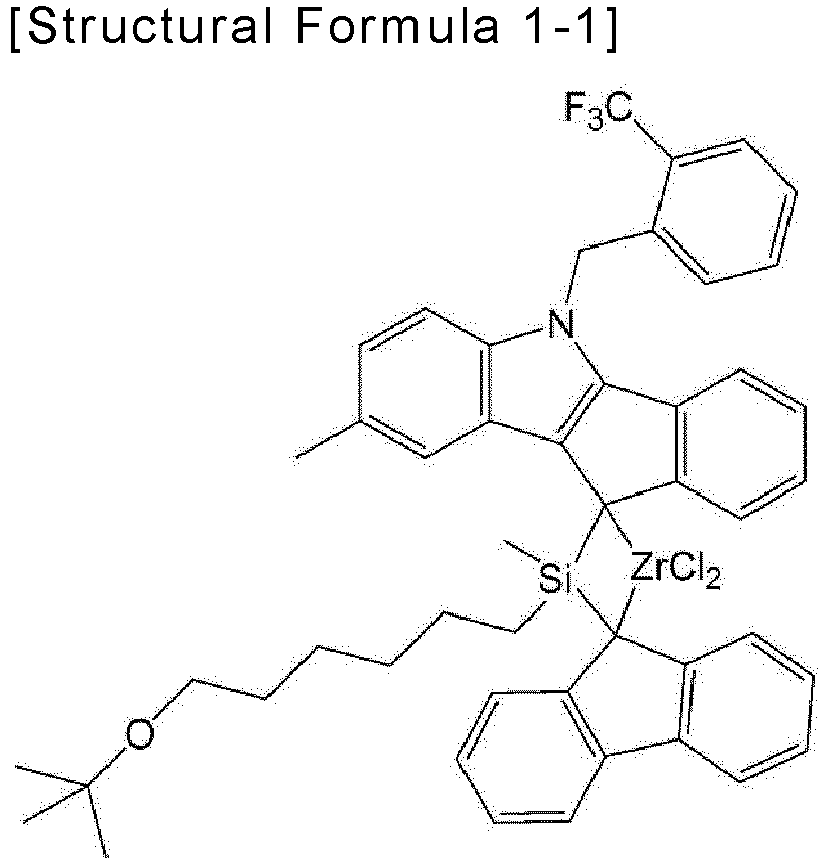
- specific examples of the first metallocene compound represented by Chemical Formula 1 may include a compound represented by Chemical Formula 1-1, but the present disclosure is not limited thereto.
- the first metallocene compound may be synthesized by applying known reactions, and for a more detailed synthesis method, please refer to Examples.
- Cp 1 and Cp 2 in Chemical Formula 3 may be each independently cyclopentadienyl or indenyl, and at least one hydrogen of the cyclopentadienyl or indenyl may be each independently substituted with any one substituent selected among a C1 to 20 alkyl or a C2 to C20 alkoxyalkyl.
- M 2 in Chemical Formula 3 is preferably zirconium (Zr), but the present disclosure is not limited thereto.
- X 3 and X 4 in Chemical Formula 3 may be each independently a halogen or a C1 to C20 alkyl group.
- the second metallocene compound represented by Chemical Formula 3 may be, for example, a compound represented by one of the following structural formulas, but the present disclosure is not limited thereto.
- the second metallocene compound represented by Chemical Formula 3 may be more preferably represented by the following Formula 3-1:
- the second metallocene compound represented by Chemical Formula 3 may be synthesized by applying known reactions, and for a more detailed synthesis method, refer to Examples.
- the first metallocene compound represented by Chemical Formula 1 can mainly contribute to the expression of high molecular weight polyethylene
- the second metallocene compound represented by Chemical Formula 3 can mainly contribute to the expression of low molecular weight polyethylene with a narrow molecular weight distribution.
- hybrid metallocene catalyst uses as a hybrid metallocene catalyst using a metallocene compound with a low molecular weight expression having a narrow polydispersity index and a metallocene compound with a high molecular weight expression together, it is advantageous for polymerizing the polyethylene of the present disclosure described above.
- the molar ratio between the first metallocene compound represented by Chemical Formula 1 and the second metallocene compound represented by Chemical Formula 3 may be 1:5 to 1:20, or 1:7 to 1:18, or 1:8 to 1:15.
- the molar ratio of the first and second metallocene compounds exceeds 1:20 and the content of the second metallocene compound is too large, the ratio of low molecular weight expression becomes too large and thus, the crosslinking property may be deteriorated.
- the molar ratio is less than 1:5 and the content of the second metallocene compound is too small, the chain mobility is reduced and the density of polyethylene is reduced which may deteriorate pressure resistance. Therefore, from such a viewpoint, the molar ratio of the first and second metallocene compounds may be preferably in the above-described range.
- one or more of the first metallocene compound represented by Chemical Formula 1 and one or more of the second metallocene compound represented by Chemical Formula 3 may be supported on respective supports together with a cocatalyst compound.
- the cocatalyst supported together on the support for activating the first and second metallocene compounds is an organometallic compound containing a Group 13 metal, and it is not particularly limited as long as it can be used when polymerizing olefins under a general metallocene catalyst.
- the cocatalyst compound may include at least one selected among an aluminum-containing first cocatalyst of the following Chemical Formula 4 and a borate-based second cocatalyst of the following Chemical Formula 5.
- Chemical Formula 4 [Chemical Formula 4] -[Al(R a )-O-] k - in the Chemical Formula 4, each R a is independently a halogen, a halogen-substituted or unsubstituted hydrocarbyl group having 1 to 20 carbon atoms, and k is an integer of 2 or more
- T + is a +1 charge polyatomic ion
- B is boron in an oxidation state of +3
- each G is independently selected from the group consisting of a hydride group, a dialkylamido group, a halide group, an alkoxide group, an aryloxide group, a hydrocarbyl group,
- the polymerization activity can be further enhanced.
- the first cocatalyst of Chemical Formula 4 may be an alkylaluminoxane-based compound wherein the repeating units are combined into a linear, circular, or network form.
- Specific examples of the first cocatalyst include methylaluminoxane (MAO), ethylaluminoxane, isobutylaluminoxane, butylaluminoxane, and the like.
- the second cocatalyst of Chemical Formula 5 may be a trisubstituted ammonium salt, a dialkylammonium salt, or a trisubstituted phosphate type of borate compound.
- Specific examples of the second cocatalyst include a borate-based compound in the form of a trisubstituted ammonium salt, such as trimethylammonium tetraphenylborate, methyl dioctadecylammonium tetraphenylborate, triethylammonium tetraphenylborate, tripropylammonium tetraphenylborate, tri(n-butyl)ammonium tetraphenylborate, methyltetradecyloctadecylammonium tetraphenylborate, N,N-dimethylanilinium tetraphenylborate, N,N-diethylanilinium tetrapheny
- the mass ratio of the total weight of the transition metals contained in the first and second metallocene compounds relative to the support may be 1 : 10 to 1 : 1,000.
- the support and the metallocene compound are contained in the range of the above mass ratio, an optimal shape can be provided.
- the mass ratio of the cocatalyst compound to the support may be 1:1 to 1:100.
- a support containing a hydroxy group on its surface can be used, and preferably a support having a highly reactive hydroxy group and siloxane group, of which the surface is dried and removed of moisture, can be used.
- silica, silica-alumina, silica-magnesia, or the like which are dried at high temperature, can be used, and they may typically contain oxides, carbonates, sulfates, and nitrates such as Na 2 O, K 2 CO 3 , BaSO 4 , and Mg(NO 3 ) 2 .
- the drying temperature of the support is preferably 200 to 800°C, more preferably 300 to 600°C, and most preferably 300 to 400°C. If the drying temperature of the support is lower than 200°C, it retains excessive moisture such that moisture on the surface is reacted with the cocatalyst. If the drying temperature is higher than 800°C, pores on the surface of the support are combined with each other to reduce the surface area, and many hydroxyl groups are lost on the surface to leave only siloxane groups. Thus, since the reactive sites with cocatalyst are reduced, it is not preferable.
- the amount of hydroxyl groups on the surface of the support is preferably 0.1 to 10 mmol/g, and more preferably 0.5 to 5 mmol/g.
- the amount of hydroxyl groups on the surface of the support may be controlled depending on the preparation method and conditions of the support, or drying conditions such as temperature, time, vacuum, spray drying, and the like.
- the amount of hydroxyl groups is less than 0.1 mmol/g, the reactive sites with the cocatalyst are reduced. If the amount of hydroxyl groups is more than 10 mmol/g, it is not desirable because it may be caused by moisture in addition to the hydroxyl groups present on the surface of support particles.
- the polyethylene according to the present disclosure can be prepared by polymerizing an ethylene monomer in the presence of the above-described hybrid metallocene catalyst.
- it may be prepared by copolymerizing an ethylene monomer and another olefinic comonomer together.
- olefinic monomer may include 1-butene, 1-pentene, 4-methyl-1-pentene, 1-hexene, 1-heptene, 1-octene, 1-decene, 1-undecene, 1-dodecene, 1-tetradecene, 1-hexadecene, 1-eicosene, and the like, and these monomers may be copolymerized by mixing two or more thereof.
- the olefinic polymer is an ethylene/alpha-olefin copolymer
- the content of alpha-olefin as a comonomer is not particularly limited, and it may be appropriately selected according to the use or purpose of the olefinic polymer.
- the polymerization reaction may be carried out by polymerizing monomers, using a continuous slurry polymerization reactor, a loop slurry reactor, a gas phase reactor, or a solution reactor.
- the polymerization temperature may be about 25 to about 500°C, preferably about 25 to about 200°C, and more preferably about 50 to about 150°C.
- the polymerization pressure may be from about 1 to about 100 Kgf/cm 2 , preferably from about 1 to about 50 Kgf/cm 2 , and more preferably from about 5 to about 30 Kgf/cm 2 .
- the metallocene catalyst may be injected after being dissolved or diluted in an aliphatic hydrocarbon solvent having 5 to 12 carbon atoms, for example, pentane, hexane, heptane, nonane, decane, and isomers thereof, an aromatic hydrocarbon solvent such as toluene and benzene, or a hydrocarbon solvent substituted with a chlorine atom such as dichloromethane and chlorobenzene. It is preferable that the solvent is used after a small amount of water, air, or the like acting as a catalyst poison is removed by treating with a small amount of aluminum. It can also be performed by further using a cocatalyst.
- an aromatic hydrocarbon solvent such as toluene and benzene
- a hydrocarbon solvent substituted with a chlorine atom such as dichloromethane and chlorobenzene.
- the solvent is used after a small amount of water, air, or the like acting as a catalyst poison is removed by treating with a small amount
- a crosslinked polyethylene pipe including the polyethylene is provided.
- the crosslinked polyethylene pipe of the present disclosure may be produced by subjecting the above-mentioned polyethylene to RAM extrusion molding.
- the RAM extrusion molding is used in the extrusion molding field where uniform and high pressure is required, and has the effect of processing a high molecular weight polyethylene resin during production of a crosslinked polyethylene pipe, as compared with a screw-type extrusion molding.
- the RAM extrusion molding may be performed by a method used for producing a conventional crosslinked polyethylene pipe, and is not particularly limited.
- a conventional crosslinking agent and an antioxidant can be mixed together with the polyethylene of the present disclosure to perform extrusion.
- an organic peroxide crosslinking agent may be used as the crosslinking agent.
- the organic peroxide crosslinking agent may include di-t-butyl peroxide (DTBP), dicumyl peroxide, di-t-amyl peroxide, 2,5-dimethyl-2,5-di(t-butylperoxy)hexane, and the like, but the present disclosure is not limited thereto.
- the content of the crosslinking agent is not particularly limited, but it may be contained in an amount of 0.4 to 1 part by weight based on 100 parts by weight of polyethylene.
- a phenolic antioxidant may be used as the antioxidant.
- the phenolic antioxidant may include IRGANOX1076, IRGANOX1010, BHT, songnox 1076, and the like, but the present disclosure is not limited thereto.
- the content of the antioxidant is not particularly limited, but it may be contained in an amount of 0.1 to 0.6 parts by weight based on 100 parts by weight of polyethylene.
- crosslinked pipe may be a PE-Xa pipe.
- crosslinked polyethylene pipe according to an embodiment of the present disclosure may have a degree of crosslinking of 70% or more as measured according to KS M ISO 10147.
- the crosslinked polyethylene pipe of the present disclosure has a degree of crosslinking of 70% or more, or 75% or more, or 77% or more, or 80% or more, or 81% or more, or 82% or more, or 83% or more, and 99% or less, or 96% or less, or 93% or less as measured according to KS M ISO 10147.
- the crosslinked polyethylene pipe of the present disclosure may have excellent mechanical strength.
- crosslinked polyethylene pipe according to an embodiment of the present disclosure may have a hoop stress of 18.5 MPa or more as measured according to ISO 1167-1.
- the crosslinked polyethylene pipe of the present disclosure has a hoop stress of 18.5 MPa or more, or 18.7 MPa or more, or 18.7 MPa or more, and 25 MPa or less, 24 MPa or less, or 22 Mpa or less.
- the crosslinked polyethylene pipe of the present disclosure may have excellent pressure resistance.
- Reaction solution (Si solution) of 8-methyl-5-(2-(trifluoromethyl)benzyl)-5,10-dihydroindeno[1,2-b]indole and (6-(tert-butoxy)hexyl)dichloro(methyl)silane was subjected to NMR sampling to confirm the completion of the reaction.
- reaction mixture was filtered to remove LiCI, the filtrate was dried under vacuum to remove toluene, and then 100 mL of hexane was added thereto and sonicated for 1 hour. This was filtered to obtain 3.5 g of a purple metallocene compound as a filtered solid (yield 52 mol %).
- t-butyl-O-(CH 2 ) 6 -C 5 H 5 was dissolved in THF at -78°C, n- butyllithium (n-BuLi) was slowly added thereto, the reaction temperature was raised to room temperature, and the mixture was then allowed to react for 8 hours. The solution was again reacted in which the already synthesized lithium salt solution was slowly added to a suspension solution of ZrCl 4 (THF) 2 (1.70g, 4.50mmol)/THF(30ml) at -78°C and further reacted at room temperature for 6 hours.
- THF ZrCl 4
- the supported catalyst prepared in Preparation Example 1 was added to a single slurry polymerization process to prepare a high-density polyethylene.
- hexane was injected at a flow rate of 25 ton/hr, ethylene at 10 ton/hr, hydrogen at 35 ppm (relative to ethylene), and triethyl aluminum (TEAL) at 10 kg/hr into a reactor with a capacity of 100 m 3 , respectively. Further, the hybrid supported metallocene catalyst according to Preparation Example 1 was injected at 0.5 kg/hr. Then, ethylene was continuously reacted in the form of a hexane slurry at a reactor temperature of 82°C and a pressure of 7.0 kg/cm 2 to 7.5 kg/cm 2 , and then subjected to solvent removal and drying process to prepare high density polyethylene in powder form.
- TEAL triethyl aluminum
- the high-density polyethylene in powder form was prepared in the same manner as in Example 1, except that the amount of charged hydrogen was 25 ppm relative to ethylene.
- Example 1 100 g of polyethylene of Example 1 was mixed with 0.3 g of n-octadecyl-3-(3,5-di-tert.butyl-4-hydroxyphenyl)-propionate (product name Irganox 1076, produced by BASF) as an antioxidant and 0.6 g of di-tert-butyl peroxide (product name: Trigonox B, produced by Akzo Nobel) as a crosslinking agent, and dispersed using a Henschell Mixer (RPM 400, mixing time 15min, mix temp ⁇ 40°C).
- RPM 400 Henschell Mixer
- extrusion was performed with a Ram type extruder.
- the pipe diameter of the extruder was set to 20mm and the thickness was set to 1.9mm, and the temperature conditions were set to Body 130°C, Adapter 180°C, and Die -240°C. Further, the linear velocity during extrusion was set to 1.8 m/min.
- the crosslinked polyethylene pipe was produced in the same manner as in Example 3, except that the polyethylene of Example 2 was used instead of the polyethylene of Example 1.
- the crosslinked polyethylene pipe was prepared in the same manner as in Example 3, except that the polyethylene of Example 2 was used instead of the polyethylene of Example 1, and 0.5 g of di-tert-butyl peroxide (product name: Trigonox B, produced by Akzo Nobel) was used as a crosslinking agent.
- di-tert-butyl peroxide product name: Trigonox B, produced by Akzo Nobel
- the crosslinked polyethylene pipe was prepared in the same manner as in Example 3, except that the polyethylene of Comparative Example 1 was used instead of the polyethylene of Example 1.
- the crosslinked polyethylene pipe was prepared in the same manner as in Example 3, except that the polyethylene of Comparative Example 1 was used instead of the polyethylene of Example 1, and 0.5 g of di-tert-butyl peroxide (product name: Trigonox B, produced by Akzo Nobel) was used as a crosslinking agent.
- di-tert-butyl peroxide product name: Trigonox B, produced by Akzo Nobel
- the crosslinked polyethylene pipe was prepared in the same manner as in Example 3, except that the polyethylene of Comparative Example 2 was used instead of the polyethylene of Example 1
- Mw weight average molecular weight
- Mn molecular weight distribution
- GPC curve The weight average molecular weight (Mw) and the number average molecular weight (Mn) of the polymer were measured using a gel permeation chromatography (GPC; produced by Waters Corp.), and the polydispersity index (PDI) was calculated by dividing the weight average molecular weight into the number average molecular weight.
- polyethylene sample was evaluated using a Waters PL-GPC220 instrument using a PLgel Mixed-B column (300 mm in length) from Polymer Laboratories, wherein an evaluation temperature was set to 160°C, 1,2,4-trichlorobenzene was used as a solvent, and a flow rate was set to 1 mL/min.
- a sample was prepared at a concentration of 10 mg/10 mL, and then supplied in an amount of 200 ⁇ L.
- a calibration curve formed by using a polystyrene standard was used to determine Mw and Mn values.
- the molecular weight of the polystyrene standard used was nine types of 2,000 / 10,000 / 30,000 / 70,000 / 200,000 / 700,000 / 2,000,000 / 4,000,000/ 10,000,000.
- MI 21.6 Melt Index
- Density Measured according to the ASTM D792 standard.
- Log Mw ( ⁇ 4.5) It was calculated by the ratio of the integration value in a region where the Log Mw value is 4.5 or less relative to the entire area (integration value) of the entire GPC curve graph, through the GPC curve graph measured in the above (1).
- Degree of crosslinking Measured according to KS M ISO 10147.
- the polyethylene of Examples 1 to 2 according to the present disclosure exhibited higher characteristics in terms of melt index (MI 21 . 6 ) and density than Comparative Examples.
Landscapes
- Chemical & Material Sciences (AREA)
- Medicinal Chemistry (AREA)
- Health & Medical Sciences (AREA)
- Chemical Kinetics & Catalysis (AREA)
- Polymers & Plastics (AREA)
- Organic Chemistry (AREA)
- Engineering & Computer Science (AREA)
- General Engineering & Computer Science (AREA)
- Crystallography & Structural Chemistry (AREA)
- Materials Engineering (AREA)
- Mechanical Engineering (AREA)
- Addition Polymer Or Copolymer, Post-Treatments, Or Chemical Modifications (AREA)
- Transition And Organic Metals Composition Catalysts For Addition Polymerization (AREA)
Abstract
Description
- This application claims the benefit of
Korean Patent Application No. 10-2019-0020026 filed on February 20, 2019 Korean Patent Application No. 10-2020-0020643 filed on February 19, 2020 - The present disclosure relates to a polyethylene having high pressure resistance and a crosslinked polyethylene pipe comprising the same.
- Crosslinked polyethylene was developed by an electric wire company in 1960 to improve the temperature characteristics by heat generation of an electric wire, and German Thomas Engel has produced a pipe having excellent durability using this polyethylene in 1967.
- The crosslinked polyethylene is one that is modified into polyethylene having a three-dimensional network structure by crosslinking high density polyethylene (HDPE) having a linear molecular structure, and has excellent characteristics such as heat resistance, durability, chemical resistance, and flexibility.
- On the other hand, as the method of crosslinking polyethylene in this way, there may be mentioned a crosslinking method using an organic peroxide (peroxide crosslinking), a crosslinking method using a silane compound (silane crosslinking), and a crosslinking method using an electron beam irradiation (radiation crosslinking).
- In general, polyethylene crosslinked by organic peroxide is referred to as PE-Xa, polyethylene crosslinked by a silane compound is referred to as PE-Xb, and polyethylene crosslinked by an electron beam irradiation is referred to as PE-Xc.
- Since the crosslinked polyethylene pipe, particularly PE-Xa pipe, requires uniform and high pressure during extrusion molding, it is usually produced by extrusion-molding a mixture of a polyethylene resin, a crosslinking agent, an antioxidant, and the like with a RAM type extruder.
- In the case of PE-Xa, it has superior physical properties compared to PE-Xb and PE-Xc, and has the advantage of being able to produce flexible pipe products.
- On the other hand, in order to satisfy the pressure resistance characteristics among the physical properties required for pipe products, polyethylene needs to have a high density, but for this purpose, polyethylene with a high melt index is suitable. This is because as the melt index is higher, the chain mobility is enhanced and the density is higher. However, polyethylene having a high melt index has a disadvantage that a large amount of low molecular weight is produced and thus, the degree of crosslinking is lowered.
- Therefore, there is a need to develop a crosslinked polyethylene pipe having excellent degree of crosslinking while having high melt index and high density.
- Therefore, the present disclosure has been made in view of the above-mentioned problems, and the object of the present disclosure is to provide a polyethylene which not only has a high melt index and density and thus improves pressure resistance, but also exhibits excellent degree of crosslinking and thus has excellent physical properties as a pipe, and a crosslinked polyethylene pipe comprising the same.
- In order to achieve that above object, according to one embodiment of the present disclosure, there is provided a polyethylene which satisfies:
- a density of 0.940 g/cm3 or more and 0.960 g/cm3 or less as measured according to ASTM D792;
- a number average molecular weight (Mn) of 20,000 g/mol or more and 70,000 g/mol or less;
- a weight average molecular weight (Mw) of 100,000 g/mol or more and 250,000 g/mol or less;
- a polydispersity index (PDI, Mw/Mn) of 2.5 or more and 3.7 or less; and
- a melt index (MI21.6) of 1 g/10min or more and 20 g/10min or less as measured at a temperature of 190°C under a load of 21.6 kg according to ASTM D1238.
- According to another embodiment of the present disclosure, there is provided a crosslinked polyethylene pipe including the polyethylene.
- The polyethylene according to the present disclosure has a high density and exhibits a sufficient degree of crosslinking, thereby exhibiting excellent strength and pressure resistance.
- Therefore, it can be usefully used in the production of crosslinked polyethylene pipes, especially PE-Xa pipes.
- As used herein, terms such as first, second, and the like may be used to describe various components, and the terms are used only to discriminate one component from another component.
- Also, the terms used herein are used only to describe exemplary embodiments, and are not intended to limit the present disclosure. A singular expression includes a plural expression unless they have definitely opposite meanings in the context. It should be understood that the terms "comprise", "include", and "have" as used herein are intended to designate the presence of stated features, steps, constitutional elements, or combinations thereof, but it should be understood that they do not preclude a possibility of existence or addition of one or more other features, steps, constitutional elements, or combinations thereof.
- Since the present disclosure may be modified in various forms and may have several embodiments, particular embodiments will be illustrated and described in detail below. However, it will be understood that the present disclosure is not limited to the particular embodiments but the invention includes all modifications, equivalents, and alternatives falling within the scope and sprit of the present disclosure.
- Hereinafter, the polyethylene of the present disclosure and a crosslinked polyethylene pipe comprising the same will be described in more detail.
- The polyethylene according to one embodiment of the present disclosure is characterized in that a density measured according to ASTM D792 is 0.940 g/cm3 or more and 0.960 g/cm3 or less; a number average molecular weight (Mn) is 20,000 g/mol or more and 70,000 g/mol or less; a weight average molecular weight (Mw) is 100,000 g/mol or more and 250,000 g/mol or less; a polydispersity index (PDI, Mw/Mn) is 2.5 or more and 3.7 or less; and a melt index (MI21.6) is 1 g/10min or more and 20 g/10min or less as measured at a temperature of 190°C under a load of 21.6 kg according to ASTM D1238.
- The crosslinked polyethylene is one that is modified into polyethylene having a three-dimensional network structure by crosslinking high density polyethylene (HDPE) having a linear molecular structure, and has excellent characteristics such as heat resistance, durability, chemical resistance, and flexibility.
- Pipes produced from such crosslinked polyethylene are usually produced by mixing polyethylene with a crosslinking agent and an antioxidant and then extrusion-molding the mixture with a RAM type extruder.
- Among the pipes produced from the crosslinked polyethylene in this way, PE-Xa has superior physical properties compared to PE-Xb and PE-Xc, and has the advantage of being able to produce flexible pipe products.
- On the other hand, in order to satisfy the pressure resistance characteristics among the physical properties required for pipe products, polyethylene needs to have a high density, but polyethylene with a high melt index has a disadvantage that a large amount of low molecular weight is produced and the degree of crosslinking is lowered.
- Therefore, the present disclosure has been designed to further improve the pressure resistance of PE-Xa pipes, and the inventors have developed a polyethylene resin suitable for use in PE-Xa pipes in which the molecular weight distribution of polyethylene is improved, the melt index (MI) and density are increased at the same time than before, and thus, the degree of crosslinking is not reduced and is maintained at 70% or more while exhibiting improved pressure resistance, thereby completing the present disclosure.
- Specifically, the polyethylene according to an embodiment of the present disclosure may be high density polyethylene (HDPE) having a density of 0.940 g/cm3 or more and 0.960 g/cm3 or less as measured according to ASTM D792.
- More specifically, according to one embodiment, the density of the polyethylene of the present disclosure may be 0.940 g/cm3 or more, or 0.945 g/cm3 or more, or 0.949 g/cm3 or more, or 0.950 g/cm3 or more, and 0.960 g/cm3 or less, or 0.958 g/cm3 or less, or 0.956 g/cm3 or less, or 0.955 g/cm3 or less. By having the density range as described above, the polyethylene of the present disclosure can satisfy excellent pressure resistance characteristics.
- Further, the polyethylene according to an embodiment of the present disclosure has a number average molecular weight (Mn) of 20,000 to 70,000 g/mol. More specifically, the number average molecular weight may be 20,000 g/mol or more, or 25,000 g/mol or more, or 30,000 g/mol or more, or 33,000 g/mol or more, and 70,000 g/mol or less, or 65,000 g/mol or less, or 60,000 g/mol or less, or 57,000 g/mol or less, or 55,000 g/mol or less.
- Further, the polyethylene according to an embodiment of the present disclosure has a weight average molecular weight (Mw) of 100,000 to 250,000 g/mol. More specifically, the weight average molecular weight may be 100,000 g/mol or more, or 120,000 g/mol or more, or 125,000 g/mol or more, or 130,000 g/mol or more, and 250,000 g/mol or less, or 230,000 g/mol or less, or 220,000 g/mol or less, or 210,000 g/mol or less, or 200,000 g/mol or less.
- Further, the polyethylene according to an embodiment of the present disclosure has a molecular weight distribution (MWD, Mw/Mn) of 2.5 to 3.7. More specifically, the molecular weight distribution may be 2.5 or more, or 2.6 or more, or 2.7 or more, or 2.8 or more, and 3.7 or less, or 3.6 or less, or 3.5 or less, or 3.4 or less.
- By having the molecular weight distribution as described above, the polyethylene of the present disclosure can satisfy high crosslinking properties.
- In the present disclosure, the number average molecular weight (Mn), the weight average molecular weight (Mw), and the molecular weight distribution are measured in which the weight average molecular weight (Mw) and the number average molecular weight (Mn) of polyethylene are respectively measured using gel permeation chromatography (GPC), and the ratio of the weight average molecular weight to the number average molecular weight (Mw/Mn) was calculated as the polydispersity index.
- Specifically, a polyethylene sample was evaluated using a Waters PL-GPC220 instrument using a PLgel Mixed-B column (300 mm in length) from Polymer Laboratories, wherein an evaluation temperature is set to 160°C, 1,2,4-trichlorobenzene is used as a solvent, and a flow rate is set to 1 mL/min. In addition, a sample is prepared at a concentration of 10 mg/10 mL, and then supplied in an amount of 200 µL. A calibration curve formed by using a polystyrene standard is used to determine Mw and Mn values. The molecular weight of the polystyrene standard used was nine types of 2,000 / 10,000 / 30,000 / 70,000 / 200,000 / 700,000 / 2,000,000 / 4,000,000 / 10,000,000.
- Further, the polyethylene according to an embodiment of the present disclosure has a melt index (MI21.6) of 1 to 20 g/10min as measured at a temperature of 190°C under a load of 21.6 kg according to the ASTM D1238 standard. More specifically, the melt index (MI21.6) may be 3 g/10min or more, or 4 g/10min or more, or 5 g/10min or more, or 6 g/10min or more, and 18 g/10min or less, or 16 g/10min or less, or 15 g/10min or less, or 14 g/10min or less.
- By having the range of the melt index (MI21.6) as described above, the polyethylene of the present disclosure can satisfy excellent pressure resistance characteristics.
- Further, the polyethylene according to an embodiment of the present disclosure may have an integration value in a region where log Mw value is 4.5 or less, of 25% or less of the total integration value, in a GPC curve graph in which the x axis is log Mw and the y axis is dw/dlog Mw. The GPC curve graph means that the logarithmic function molecular weight and mass fraction of polyethylene are measured by GPC and plotted on the x and y axes. Further, in the above, Mw means a weight-average molecular weight.
- More specifically, according to an embodiment, the polyethylene of the present disclosure may have the integration value in a region where the Log Mw value is 4.5 or less, of 25% or less, 24% or less, or 23% or less, 22% or less, or 21% or less, and 15% or more, or 16% or more, or 17% or more, or 18% or more of the total integration value.
- As described above, the polyethylene of the present disclosure may have the integration value in the region where Log Mw value may be 4.5 or less, of 25% or less of the total integration value. The polyethylene has a higher melt index, excellent degree of crosslinking and pressure resistance as compared with conventional products having a similar low molecular weight content. Thus, due to such characteristics, it can satisfy high crosslinking degree properties.
- On the other hand, polyethylene according to an embodiment of the present disclosure having the physical properties as described can be prepared by a preparation method comprising polymerizing an ethylene monomer in the presence of a specific metallocene compound as a catalytically active component.
- More specifically, the polyethylene of the present disclosure includes, but not limited thereto, a first metallocene compound represented by the following Chemical Formula 1; and a second metallocene compound represented by the following Chemical Formula 3, and can be prepared by polymerizing an ethylene monomer in the presence of a hybrid metallocene catalyst in which a molar ratio between the first metallocene compound and the second metallocene compound is 1:5 to 1:20.


- Q1 and Q2 are the same as or different from each other, and each independently represents hydrogen, a halogen, a C1 to C20 alkyl group, a C2 to C20 alkenyl group, a C2 to C20 alkoxyalkyl group, a C6 to C20 aryl group, a C7 to C20 alkylaryl group, or a C7 to C20 arylalkyl group;
- B is carbon, silicon, or germanium;
- M1 is a Group 4 transition metal;
- X1 and X2 are the same as or different from each other, and each independently represents a halogen, a C1 to C20 alkyl group, a C2 to C10 alkenyl group, a C6 to C20 aryl group, a C7 to C20 alkylaryl group, or a C7 to C20 arylalkyl group;
- one of C1 and C2 is represented by the following Chemical Formula 2a or Chemical Formula 2b, and the other of C1 and C2 is represented by the following Chemical Formula 2c;
- R1 to R21 and R1' to R13' are the same as or different from each other, and each independently represents hydrogen, a halogen, a C1 to C20 alkyl group, a C1 to C20 haloalkyl group, a C2 to C20 alkenyl group, a C1 to C20 alkylsilyl group, a C1 to C20 silylalkyl group, a C1 to C20 alkoxysilyl group, a C1 to C20 alkoxy group, a C6 to C20 aryl group, a C7 to C20 alkylaryl group, or a C7 to C20 arylalkyl group, provided that at least one of Rg to R13 and R9' to R13' is a C1 to C20 haloalkyl group,

- M2 is a Group 4 transition metal;
- Cp1 and Cp2 are the same as or different from each other, and each independently represents any one cyclic compound selected from the group consisting of cyclopentadienyl, indenyl, 4,5,6,7-tetrahydro-1-indenyl and fluorenyl, one or more hydrogens of the cyclic compound may be each independently substituted with any one substituent selected among a C1 to 20 alkyl, a C1 to C20 alkoxy, a C2 to C20 alkoxyalkyl, a C6 to C20 aryl, a C7 to C20 alkylaryl, or a C7 to C20 arylalkyl; and
- X3 and X4 are the same as or different from each other, and each independently represents a halogen, a C1 to C20 alkyl, a C2 to C10 alkenyl, a C6 to C20 aryl, a C7 to C20 alkylaryl, or a C7 to C20 arylalkyl.
- The substituents of Chemical Formulas 1 and 2 will be described in more detail below.
- The C1 to C20 alkyl group includes a linear or branched alkyl group, and specifically, a methyl group, an ethyl group, a propyl group, an isopropyl group, an n-butyl group, a tert-butyl group, a pentyl group, a hexyl group, a heptyl group, an octyl group, and the like may be mentioned, but is not limited thereto.
- The C2 to C20 alkenyl group includes a linear or branched alkenyl group, and specifically, an allyl group, an ethenyl group, a propenyl group, a butenyl group, a pentenyl group, and the like may be mentioned, but is not limited thereto.
- The C6 to C20 aryl group includes a monocyclic or condensed ring aryl group, and specifically, a phenyl group, a biphenyl group, a naphthyl group, a phenanthrenyl group, a fluorenyl group, and the like may be mentioned, but is not limited thereto.
- The C1 to C20 alkoxy group may include, but not limited to, a methoxy group, an ethoxy group, a phenyloxy group, and a cyclohexyloxy group.
- The C2 to C20 alkoxyalkyl group is a functional group in which at least one hydrogen of the alkyl group as described above is substituted with an alkoxy group, and specifically, alkoxyalkyl groups such as a methoxymethyl group, a methoxyethyl group, an ethoxymethyl group, an iso-propoxymethyl group, an isopropoxyethyl group, an iso-propoxyhexyl group, a tert-butoxymethyl group, a tert-butoxyethyl group and a tert-butoxyhexyl group; or aryloxyalkyl groups such as a phenoxyhexyl group may be mentioned, but is not limited thereto.
- The C1 to C20 alkylsilyl group or the C1 to C20 alkoxysilyl group is a functional group in which 1 to 3 hydrogens of -SiH3 are substituted with 1 to 3 alkyl or alkoxy groups as described above, and specifically, alkylsilyl groups such as a methylsilyl group, a dimethylsilyl group, a trimethylsilyl group, a dimethylethylsilyl group, a diethylmethylsilyl group, or a dimethylpropylsilyl group; alkoxysilyl groups such as a methoxysilyl group, a dimethoxysilyl group, a trimethoxysilyl group or a dimethoxyethoxysilyl group; alkoxyalkylsilyl groups such as a methoxydimethylsilyl group, a diethoxymethylsilyl group, or a dimethoxypropylsilyl group may be mentioned, but is not limited thereto.
- The C1 to C20 silylalkyl group is a functional group in which at least one hydrogen of the alkyl group as described above is substituted with a silyl group, and specifically, -CH2-SiH3, a methylsilylmethyl group, or a dimethylethoxysilylpropyl group may be mentioned, but are not limited thereto.
- The halogen may be fluorine (F), chlorine (CI), bromine (Br), or iodine (I).
- The above-described substituents may be optionally substituted with one or more substituents selected from the group consisting of a hydroxy group; a halogen; an alkyl group or an alkenyl group, an aryl group, an alkoxy group; an alkyl or an alkenyl group, an aryl group, or an alkoxy group including at least one heteroatom selected among the heteroatoms of Groups 14 to 16; a silyl group; an alkylsilyl group or an alkoxysilyl group; a phosphine group; a phosphide group; a sulfonate group; and a sulfone group which are within a range exhibiting the same or similar effect as the desired effect.
- The Group 4 transition metal may include titanium (Ti), zirconium (Zr), and hafnium (Hf), but are not limited thereto.
- According to an embodiment of the present disclosure, R1 to R21 and R1' to R13' in Chemical Formulas 2a, 2b, and 2c may be each independently hydrogen, a halogen, a C1 to C20 alkyl group, or a C1 to C20 haloalkyl group, and at least one of R9 to R13 and R9' to R13' may be a C1 to C20 haloalkyl group.
- More specifically, R1 to R21 and R1' to R13' may be each independently hydrogen, a methyl group, an ethyl group, a propyl group, an isopropyl group, an n-butyl group, a tert-butyl group, a pentyl group, a hexyl group, a heptyl group, an octyl group, or a fluoroalkyl group, and at least one of R9 to R13 and R9' to R13' may be fluoroalkyl, but is not limited thereto.
- According to an embodiment of the present disclosure Q1 and Q2 in Chemical Formula 1 may be each independently hydrogen, a halogen, a C1 to C20 alkyl group, or a C2 to C20 alkoxyalkyl group.
- More specifically, Q1 and Q2 may be each independently hydrogen, a methyl group, an ethyl group, a propyl group, an isopropyl group, an n-butyl group, a tert-butyl group, a methoxymethyl group, a tert-butoxymethyl group, a tert-butoxyhexyl group, 1-ethoxyethyl group, 1-methyl-1-methoxyethyl group, a tetrahydropyranyl group or a tetrahydrofuranyl group, but are not limited thereto.
- According to an embodiment of the present disclosure, B in Chemical Formula 1 is preferably silicon, but is not limited thereto.
- According to an embodiment of the present disclosure, X1 and X2 in Chemical Formula 1 may be each independently a halogen or a C1 to C20 alkyl group.
- The first metallocene compound of Chemical Formula 1 forms a structure in which an indeno-indole derivative and a cyclopentadiene derivative are asymmetrically crosslinked by a bridge, and by having a non-shared electron pair capable of functioning as a Lewis base in the ligand structure, it is supported on the surface having Lewis acid properties of the support, and exhibits high polymerization activity even when supported. Further, by including the electronically rich indeno-indole group and cyclopentadiene group, the activity is high, and excellent copolymerization property and high activity are maintained due to appropriate steric hindrance and the electronic effect of the ligand. Moreover, beta-hydrogen of the polymer chain in which the nitrogen atom of the indeno-indole derivative grows can be stabilized by hydrogen bonding to suppress beta-hydrogen elimination and polymerize an ultra-high molecular weight polyolefin.
- In particular, one or more of R9 to R13 and R9' to R13' in the transition metal compound of Chemical Formula 1 includes a C1-C20 haloalkyl group. Further, haloalkyl groups containing halogen elements other than other fluorine may also interact with beta-hydrogen, but hydrogen forms a hydrogen bond with highly electronegative atoms such as nitrogen, oxygen, and fluorine. All haloalkyl groups do not form a hydrogen bond with beta-H. It does not form a hydrogen bond with beta-H by including a haloalkyl group, but is an effect exhibited by introducing a fluorine substituent. For example, a fluoroalkyl group, that is, CF3, etc. may be mentioned. It acts like the nitrogen atom of the indeno-indole derivative, stabilizes beta-hydrogen of a growing polymer chain by hydrogen bonding, further suppresses beta-hydrogen elimination, and more effectively can achieve the polymerization of the ultra-high molecular weight polyolefin. In other words, it maintains the basic skeleton of the catalyst in which the indeno-indole derivative and the cyclopentadiene derivative are asymmetrically crosslinked by a bridge, and by introducing substituents such as CF3 which is a stronger hydrogen bond acceptor, beta-hydrogen is stabilized by hydrogen bonding, thereby enhancing the effect of suppressing beta-hydrogen elimination and enabling the polymerization of ultra-high molecular weight polyolefin.
- According to an embodiment of the present disclosure, specific examples of the compound represented by Chemical Formula 2a may include a compound represented by the following structural formula, but the present disclosure is not limited thereto.

- According to an embodiment of the present disclosure, specific examples of the compound represented by Chemical Formula 2b may be a compound represented by the following structural formula, but the present disclosure is not limited thereto.

- According to an embodiment of the present disclosure, specific examples of the compound represented by Chemical Formula 2c may include a compound represented by one of the following structural formulas, but the present disclosure is not limited thereto.


- According to an embodiment of the present disclosure, specific examples of the first metallocene compound represented by Chemical Formula 1 may include a compound represented by Chemical Formula 1-1, but the present disclosure is not limited thereto.
- The first metallocene compound may be synthesized by applying known reactions, and for a more detailed synthesis method, please refer to Examples.
- According to an embodiment of the present disclosure, Cp1 and Cp2 in Chemical Formula 3 may be each independently cyclopentadienyl or indenyl, and at least one hydrogen of the cyclopentadienyl or indenyl may be each independently substituted with any one substituent selected among a C1 to 20 alkyl or a C2 to C20 alkoxyalkyl.
- According to an embodiment of the present disclosure, M2 in Chemical Formula 3 is preferably zirconium (Zr), but the present disclosure is not limited thereto.
- According to an embodiment of the present disclosure, X3 and X4 in Chemical Formula 3 may be each independently a halogen or a C1 to C20 alkyl group.
- The second metallocene compound represented by Chemical Formula 3 may be, for example, a compound represented by one of the following structural formulas, but the present disclosure is not limited thereto.



- Further, the second metallocene compound represented by Chemical Formula 3 may be more preferably represented by the following Formula 3-1:

- The second metallocene compound represented by Chemical Formula 3 may be synthesized by applying known reactions, and for a more detailed synthesis method, refer to Examples.
- In the hybrid metallocene catalyst according to an embodiment of the present disclosure, the first metallocene compound represented by Chemical Formula 1 can mainly contribute to the expression of high molecular weight polyethylene, and the second metallocene compound represented by Chemical Formula 3 can mainly contribute to the expression of low molecular weight polyethylene with a narrow molecular weight distribution.
- As the hybrid metallocene catalyst according to an embodiment of the present disclosure uses as a hybrid metallocene catalyst using a metallocene compound with a low molecular weight expression having a narrow polydispersity index and a metallocene compound with a high molecular weight expression together, it is advantageous for polymerizing the polyethylene of the present disclosure described above.
- In the hybrid metallocene catalyst of the present disclosure, the molar ratio between the first metallocene compound represented by Chemical Formula 1 and the second metallocene compound represented by Chemical Formula 3 may be 1:5 to 1:20, or 1:7 to 1:18, or 1:8 to 1:15. At this time, when the molar ratio of the first and second metallocene compounds exceeds 1:20 and the content of the second metallocene compound is too large, the ratio of low molecular weight expression becomes too large and thus, the crosslinking property may be deteriorated. When the molar ratio is less than 1:5 and the content of the second metallocene compound is too small, the chain mobility is reduced and the density of polyethylene is reduced which may deteriorate pressure resistance. Therefore, from such a viewpoint, the molar ratio of the first and second metallocene compounds may be preferably in the above-described range.
- In the hybrid metallocene catalyst used in the present disclosure, one or more of the first metallocene compound represented by Chemical Formula 1 and one or more of the second metallocene compound represented by Chemical Formula 3 may be supported on respective supports together with a cocatalyst compound.
- In the hybrid metallocene catalyst of the present disclosure, the cocatalyst supported together on the support for activating the first and second metallocene compounds is an organometallic compound containing a Group 13 metal, and it is not particularly limited as long as it can be used when polymerizing olefins under a general metallocene catalyst.
- Specifically, the cocatalyst compound may include at least one selected among an aluminum-containing first cocatalyst of the following Chemical Formula 4 and a borate-based second cocatalyst of the following Chemical Formula 5.
[Chemical Formula 4] -[Al(Ra)-O-]k-
in the Chemical Formula 4, each Ra is independently a halogen, a halogen-substituted or unsubstituted hydrocarbyl group having 1 to 20 carbon atoms, and k is an integer of 2 or more,
[Chemical Formula 5] T+[BG4]-
in the Chemical Formula 5, T+ is a +1 charge polyatomic ion, B is boron in an oxidation state of +3, each G is independently selected from the group consisting of a hydride group, a dialkylamido group, a halide group, an alkoxide group, an aryloxide group, a hydrocarbyl group, a halocarbyl group, and a halo-substituted hydrocarbyl group, wherein the G has 20 or less carbon atoms, provided that G is a halide at one or less position. - By using the first and second cocatalysts as described above, the polymerization activity can be further enhanced.
- The first cocatalyst of Chemical Formula 4 may be an alkylaluminoxane-based compound wherein the repeating units are combined into a linear, circular, or network form. Specific examples of the first cocatalyst include methylaluminoxane (MAO), ethylaluminoxane, isobutylaluminoxane, butylaluminoxane, and the like.
- Further, the second cocatalyst of Chemical Formula 5 may be a trisubstituted ammonium salt, a dialkylammonium salt, or a trisubstituted phosphate type of borate compound. Specific examples of the second cocatalyst include a borate-based compound in the form of a trisubstituted ammonium salt, such as trimethylammonium tetraphenylborate, methyl dioctadecylammonium tetraphenylborate, triethylammonium tetraphenylborate, tripropylammonium tetraphenylborate, tri(n-butyl)ammonium tetraphenylborate, methyltetradecyloctadecylammonium tetraphenylborate, N,N-dimethylanilinium tetraphenylborate, N,N-diethylanilinium tetraphenylborate, N,N-dimethyl(2,4,6-trimethylanilinium)tetraphenylborate, trimethylammonium tetrakis(pentafluorophenyl)borate, methylditetradecylammonium tetrakis(pentaphenyl)borate, methyldioctadecylammonium tetrakis(pentafluorophenyl)borate, triethylammonium tetrakis(pentafluorophenyl)borate, tripropylammonium tetrakis(pentafluorophenyl)borate, tri(n-butyl)ammonium tetrakis(pentafluorophenyl)borate, tri(sec-butyl)ammonium tetrakis(pentafluorophenyl)borate, N,N-dimethylanilinium tetrakis(pentafluorophenyl)borate, N,N-diethylanilinium tetrakis(pentafluorophenyl)borate, N,N-dimethyl(2,4,6-trimethylanilinium)tetrakis(pentafluorophenyl)borate, trimethylammonium tetrakis(2,3,4,6-tetrafluorophenyl)borate, triethylammonium tetrakis(2,3,4,6-tetrafluorophenyl)borate, tripropylammonium tetrakis(2,3,4,6-tetrafluorophenyl)borate, tri(n-butyl)ammonium tetrakis(2,3,4,6-tetrafluorophenyl)borate, dimethyl(t-butyl)ammonium tetrakis(2,3,4,6-tetrafluorophenyl)borate, N,N-dimethylanilinium tetrakis(2,3,4,6-tetrafluorophenyl)borate, N,N-diethylanilinium tetrakis(2,3,4,6-tetrafluorophenyl)borate or N,N-dimethyl-(2,4,6-trimethylanilinium)tetrakis-(2,3,4,6-tetrafluorophenyl)borate and the like; a borate-based compound in the form of a dialkylammonium salt, such as dioctadecylammonium tetrakis(pentafluorophenyl)borate, ditetradecylammonium tetrakis(pentafluorophenyl) borate or dicyclohexylammonium tetrakis(pentafluorophenyl)borate; or a borate-based compound in the form of a trisubstituted phosphonium salt, such as triphenylphosphonium tetrakis(pentafluorophenyl)borate, methyldioctadecylphosphonium tetrakis(pentafluorophenyl)borate, or tri(2,6-dimethylphenyl)phosphonium tetrakis(pentafluorophenyl)borate.
- In themetallocene catalyst according to the present disclosure, the mass ratio of the total weight of the transition metals contained in the first and second metallocene compounds relative to the support may be 1 : 10 to 1 : 1,000. When the support and the metallocene compound are contained in the range of the above mass ratio, an optimal shape can be provided. Further, the mass ratio of the cocatalyst compound to the support may be 1:1 to 1:100.
- In themetallocene catalyst according to the present disclosure, as the support, a support containing a hydroxy group on its surface can be used, and preferably a support having a highly reactive hydroxy group and siloxane group, of which the surface is dried and removed of moisture, can be used.
- For example, silica, silica-alumina, silica-magnesia, or the like, which are dried at high temperature, can be used, and they may typically contain oxides, carbonates, sulfates, and nitrates such as Na2O, K2CO3, BaSO4, and Mg(NO3)2.
- The drying temperature of the support is preferably 200 to 800°C, more preferably 300 to 600°C, and most preferably 300 to 400°C. If the drying temperature of the support is lower than 200°C, it retains excessive moisture such that moisture on the surface is reacted with the cocatalyst. If the drying temperature is higher than 800°C, pores on the surface of the support are combined with each other to reduce the surface area, and many hydroxyl groups are lost on the surface to leave only siloxane groups. Thus, since the reactive sites with cocatalyst are reduced, it is not preferable.
- The amount of hydroxyl groups on the surface of the support is preferably 0.1 to 10 mmol/g, and more preferably 0.5 to 5 mmol/g. The amount of hydroxyl groups on the surface of the support may be controlled depending on the preparation method and conditions of the support, or drying conditions such as temperature, time, vacuum, spray drying, and the like.
- If the amount of hydroxyl groups is less than 0.1 mmol/g, the reactive sites with the cocatalyst are reduced. If the amount of hydroxyl groups is more than 10 mmol/g, it is not desirable because it may be caused by moisture in addition to the hydroxyl groups present on the surface of support particles.
- Meanwhile, the polyethylene according to the present disclosure can be prepared by polymerizing an ethylene monomer in the presence of the above-described hybrid metallocene catalyst.
- Alternatively, according to an embodiment of the present disclosure, it may be prepared by copolymerizing an ethylene monomer and another olefinic comonomer together.
- Specific examples of the olefinic monomer may include 1-butene, 1-pentene, 4-methyl-1-pentene, 1-hexene, 1-heptene, 1-octene, 1-decene, 1-undecene, 1-dodecene, 1-tetradecene, 1-hexadecene, 1-eicosene, and the like, and these monomers may be copolymerized by mixing two or more thereof.
- In the case where the olefinic polymer is an ethylene/alpha-olefin copolymer, the content of alpha-olefin as a comonomer is not particularly limited, and it may be appropriately selected according to the use or purpose of the olefinic polymer.
- The polymerization reaction may be carried out by polymerizing monomers, using a continuous slurry polymerization reactor, a loop slurry reactor, a gas phase reactor, or a solution reactor.
- And, the polymerization temperature may be about 25 to about 500°C, preferably about 25 to about 200°C, and more preferably about 50 to about 150°C. Further, the polymerization pressure may be from about 1 to about 100 Kgf/cm2, preferably from about 1 to about 50 Kgf/cm2, and more preferably from about 5 to about 30 Kgf/cm2.
- The metallocene catalyst may be injected after being dissolved or diluted in an aliphatic hydrocarbon solvent having 5 to 12 carbon atoms, for example, pentane, hexane, heptane, nonane, decane, and isomers thereof, an aromatic hydrocarbon solvent such as toluene and benzene, or a hydrocarbon solvent substituted with a chlorine atom such as dichloromethane and chlorobenzene. It is preferable that the solvent is used after a small amount of water, air, or the like acting as a catalyst poison is removed by treating with a small amount of aluminum. It can also be performed by further using a cocatalyst.
- According to another embodiment of the present disclosure, a crosslinked polyethylene pipe including the polyethylene is provided.
- The crosslinked polyethylene pipe of the present disclosure may be produced by subjecting the above-mentioned polyethylene to RAM extrusion molding. The RAM extrusion molding is used in the extrusion molding field where uniform and high pressure is required, and has the effect of processing a high molecular weight polyethylene resin during production of a crosslinked polyethylene pipe, as compared with a screw-type extrusion molding.
- The RAM extrusion molding may be performed by a method used for producing a conventional crosslinked polyethylene pipe, and is not particularly limited.
- Further, in the production of the crosslinked polyethylene pipe, a conventional crosslinking agent and an antioxidant can be mixed together with the polyethylene of the present disclosure to perform extrusion.
- As the crosslinking agent, an organic peroxide crosslinking agent may be used. Specific examples of the organic peroxide crosslinking agent may include di-t-butyl peroxide (DTBP), dicumyl peroxide, di-t-amyl peroxide, 2,5-dimethyl-2,5-di(t-butylperoxy)hexane, and the like, but the present disclosure is not limited thereto. Further, the content of the crosslinking agent is not particularly limited, but it may be contained in an amount of 0.4 to 1 part by weight based on 100 parts by weight of polyethylene.
- As the antioxidant, a phenolic antioxidant may be used. Specific examples of the phenolic antioxidant may include IRGANOX1076, IRGANOX1010, BHT, songnox 1076, and the like, but the present disclosure is not limited thereto. In addition, the content of the antioxidant is not particularly limited, but it may be contained in an amount of 0.1 to 0.6 parts by weight based on 100 parts by weight of polyethylene.
- Further, the crosslinked pipe may be a PE-Xa pipe.
- Further, the crosslinked polyethylene pipe according to an embodiment of the present disclosure may have a degree of crosslinking of 70% or more as measured according to KS M ISO 10147.
- More specifically, according to one embodiment, the crosslinked polyethylene pipe of the present disclosure has a degree of crosslinking of 70% or more, or 75% or more, or 77% or more, or 80% or more, or 81% or more, or 82% or more, or 83% or more, and 99% or less, or 96% or less, or 93% or less as measured according to KS M ISO 10147.
- By having the high degree of crosslinking of 70% or more as described above, the crosslinked polyethylene pipe of the present disclosure may have excellent mechanical strength.
- Further, the crosslinked polyethylene pipe according to an embodiment of the present disclosure may have a hoop stress of 18.5 MPa or more as measured according to ISO 1167-1.
- More specifically, according to one embodiment, the crosslinked polyethylene pipe of the present disclosure has a hoop stress of 18.5 MPa or more, or 18.7 MPa or more, or 18.7 MPa or more, and 25 MPa or less, 24 MPa or less, or 22 Mpa or less.
- As described above, the crosslinked polyethylene pipe of the present disclosure may have excellent pressure resistance.
- Hereinafter, preferred embodiments are presented to aid in understanding the present disclosure. However, the following examples are provided for a better understanding of the present disclosure, and the contents of the present disclosure are not limited thereto.
-

- 2.9 g (7.4 mmol) of 8-methyl-5-(2-(trifluoromethyl)benzyl)-5,10-dihydroindeno[1,2-b]indole was dissolved in 100 mL of hexane and 2 mL(16.8 mmol) of MTBE (methyl tertiary butyl ether), and 3.2 mL (8.1 mmol) of a 2.5 M n-BuLi hexane solution was added dropwise in a dry ice/acetone bath, and then the mixture was stirred at room temperature overnight. 2 g (7.4 mmol) of (6-tert-butoxyhexyl)dichloro(methyl)silane was dissolved in 50 mL of hexane in another 250 mL Schlenk flask, and then added dropwise in a dry ice/acetone bath, and a lithiated slurry of 8-methyl-5-(2-(trifluoromethyl)benzyl)-5,10-dihydroindeno[1,2-b]indole was added dropwise via a cannula. After the injection was completed, the mixture was slowly raised to room temperature and then stirred at room temperature overnight. At the same time, 1.2 g (7.4 mmol) of fluorene was also dissolved in 100 mL of THF, and 3.2 mL (8.1 mmol) of 2.5 M n-BuLi hexane solution was added dropwise in a dry ice/acetone bath, and the mixture was stirred at room temperature overnight.
- Reaction solution (Si solution) of 8-methyl-5-(2-(trifluoromethyl)benzyl)-5,10-dihydroindeno[1,2-b]indole and (6-(tert-butoxy)hexyl)dichloro(methyl)silane was subjected to NMR sampling to confirm the completion of the reaction.
- 1H NMR (500 MHz, CDCl3): 7.74-6.49 (11H, m), 5.87 (2H, s), 4.05 (1H, d), 3.32 (2H, m), 3.49 (3H, s), 1.50-1.25(8H, m), 1.15 (9H, s), 0.50 (2H, m), 0.17 (3H, d)
- After confirming the synthesis first, a lithiated solution of fluorene was slowly added dropwise to the Si solution in a dry ice/acetone bath, and then the mixture was stirred at room temperature overnight. After the reaction, extraction was performed with ether/water, and residual moisture in the organic layer was removed with MgSO4, and then the solvent was removed under vacuum and reduced pressure conditions to obtain 5.5 g (7.4 mmol) of the oily ligand compound, which could be confirmed by 1H-NMR.
- 1H NMR (500 MHz, CDCl3): 7.89-6.53 (19H, m), 5.82 (2H, s), 4.26 (1H, d), 4.14-4.10 (1H, m), 3.19 (3H, s), 2.40 (3H, m), 1.35-1.21 (6H, m), 1.14 (9H, s), 0.97-0.9 (4H, m), -0.34 (3H, t).
- 5.4 g (Mw 742.00, 7.4 mmol) of the ligand compound synthesized in 1-1 was dissolved in 80 mL of toluene and 3 mL (25.2 mmol) of MTBE, and 7.1 mL (17.8 mmol) of 2.5 M n-BuLi hexane solution was added dropwise in a dry ice/acetone bath and stirred at room temperature overnight. 3.0 g (8.0 mmol) of ZrCl4(THF)2 was added to 80 mL of toluene to prepare a slurry. 80 mL of ZrCl4(THF)2 as a toluene slurry was transferred to a ligand-Li solution in a dry ice/acetone bath and stirred at room temperature overnight.
- The reaction mixture was filtered to remove LiCI, the filtrate was dried under vacuum to remove toluene, and then 100 mL of hexane was added thereto and sonicated for 1 hour. This was filtered to obtain 3.5 g of a purple metallocene compound as a filtered solid (yield 52 mol %).
- 1H NMR (500 MHz, CDCl3): 7.90-6.69 (9H, m), 5.67 (2H, s), 3.37 (2H, m), 2.56 (3H,s), 2.13-1.51 (11H, m), 1.17 (9H, s).
- Tert-Butyl-O-(CH2)6-Cl was prepared using 6-chlorohexanol by the method suggested in the literature [Tetrahedron Lett. 2951 (1988)], and reacted with NaCp to obtain t-Butyl-O-(CH2)6-C5H5 (yield: 60%, b.p. 80°C / 0.1 mmHg).
- Further, t-butyl-O-(CH2)6-C5H5 was dissolved in THF at -78°C, n- butyllithium (n-BuLi) was slowly added thereto, the reaction temperature was raised to room temperature, and the mixture was then allowed to react for 8 hours. The solution was again reacted in which the already synthesized lithium salt solution was slowly added to a suspension solution of ZrCl4(THF)2 (1.70g, 4.50mmol)/THF(30mℓ) at -78°C and further reacted at room temperature for 6 hours.
- All volatile substances were vacuum dried, and a hexane solvent was added to the obtained oily liquid substance and the mixture was filtered out. The filtered solution was vacuum dried, and then hexane was added thereto to induce a precipitate at low temperature (-20°C). The obtained precipitate was filtered off at a low temperature to obtain a [tBu-O-(CH2)6-C5H4]2ZrCl2 compound as a white solid (yield: 92%).
- 1H NMR (300 MHz, CDCl3): 6.28 (t, J = 2.6 Hz, 2 H), 6.19 (t, J = 2.6 Hz, 2 H), 3.31 (t, 6.6 Hz, 2 H), 2.62 (t, J = 8 Hz), 1.7 - 1.3 (m, 8 H), 1.17 (s, 9 H).
- 13C NMR (CDCl3): 135.09, 116.66, 112.28, 72.42, 61.52, 30.66, 30.61, 30.14, 29.18, 27.58, 26.00.
- 5.0 kg of a toluene solution was added to a 20 L sus autoclave, and the reactor temperature was maintained at 40°C. 1000 g of silica (produced by Grace Davison, SP 948) was dehydrated by applying vacuum for 12 hours at a temperature of 600°C, and then added to a reactor to sufficiently disperse the silica. 55 g of the first metallocene compound of Synthesis Example 1 was then dissolved in toluene and then added thereto. The mixture was allowed to react while stirring at 200 rpm at 40°C for 2 hours. Then, the stirring was stopped, and the reaction solution was settled for 30 minutes and decanted.
- 2.5 kg of toluene was added to the reactor, and 9.4 kg of a 10 wt% methylaluminoxane (MAO)/toluene solution was added thereto, and the mixture was stirred at 200 rpm at 40°C for 12 hours. After the reaction, the stirring was stopped, and the reaction solution was settled for 30 minutes and decanted. 3.0 kg of toluene was added thereto and stirred for 10 minutes, then the stirring was stopped, and the reaction solution was settled for 30 minutes, and decanted.
- 3.0 kg of toluene was added to the reactor, and 142.3 g of the second metallocene compound of Synthesis Example 2 was dissolved in 1 L of a toluene solution and added to the reactor, and allowed to react while stirring at 40°C at 200 rpm for 2 hours. After lowering the reactor temperature to room temperature, the stirring was stopped, and the reaction solution was settled for 30 minutes, and decanted.
- 2.0 kg of toluene was added to the reactor and stirred for 10 minutes. Then, the stirring was stopped, and the reaction solution was settled for 30 minutes, and decanted.
- 3.0 kg of hexane was added to the reactor, a hexane slurry was transferred to a filter dryer, and the hexane solution was filtered. The filtrate was dried under reduced pressure at 40°C for 4 hours to prepare 1 kg of a SiO2 hybrid supported catalyst (molar ratio between the first metallocene compound and the second metallocene compound was 1:10).
- The supported catalyst prepared in Preparation Example 1 was added to a single slurry polymerization process to prepare a high-density polyethylene.
- First, hexane was injected at a flow rate of 25 ton/hr, ethylene at 10 ton/hr, hydrogen at 35 ppm (relative to ethylene), and triethyl aluminum (TEAL) at 10 kg/hr into a reactor with a capacity of 100 m3, respectively. Further, the hybrid supported metallocene catalyst according to Preparation Example 1 was injected at 0.5 kg/hr. Then, ethylene was continuously reacted in the form of a hexane slurry at a reactor temperature of 82°C and a pressure of 7.0 kg/cm2 to 7.5 kg/cm2, and then subjected to solvent removal and drying process to prepare high density polyethylene in powder form.
- The high-density polyethylene in powder form was prepared in the same manner as in Example 1, except that the amount of charged hydrogen was 25 ppm relative to ethylene.
- The polyethylene prepared using a Ziegler-Natta catalyst, XL1800 product by LG Chem, was used as Comparative Example 1.
- The polyethylene prepared using a Ziegler-Natta catalyst, 8100GX product by Lotte Chemical, was used as Comparative Example 2.
- 100 g of polyethylene of Example 1 was mixed with 0.3 g of n-octadecyl-3-(3,5-di-tert.butyl-4-hydroxyphenyl)-propionate (product name Irganox 1076, produced by BASF) as an antioxidant and 0.6 g of di-tert-butyl peroxide (product name: Trigonox B, produced by Akzo Nobel) as a crosslinking agent, and dispersed using a Henschell Mixer (RPM 400, mixing time 15min, mix temp <40°C).
- Subsequently, in order to produce the crosslinked polyethylene pipe, extrusion was performed with a Ram type extruder. At this time, the pipe diameter of the extruder was set to 20mm and the thickness was set to 1.9mm, and the temperature conditions were set to Body 130°C, Adapter 180°C, and Die -240°C. Further, the linear velocity during extrusion was set to 1.8 m/min.
- The crosslinked polyethylene pipe was produced in the same manner as in Example 3, except that the polyethylene of Example 2 was used instead of the polyethylene of Example 1.
- The crosslinked polyethylene pipe was prepared in the same manner as in Example 3, except that the polyethylene of Example 2 was used instead of the polyethylene of Example 1, and 0.5 g of di-tert-butyl peroxide (product name: Trigonox B, produced by Akzo Nobel) was used as a crosslinking agent.
- The crosslinked polyethylene pipe was prepared in the same manner as in Example 3, except that the polyethylene of Comparative Example 1 was used instead of the polyethylene of Example 1.
- The crosslinked polyethylene pipe was prepared in the same manner as in Example 3, except that the polyethylene of Comparative Example 1 was used instead of the polyethylene of Example 1, and 0.5 g of di-tert-butyl peroxide (product name: Trigonox B, produced by Akzo Nobel) was used as a crosslinking agent.
- The crosslinked polyethylene pipe was prepared in the same manner as in Example 3, except that the polyethylene of Comparative Example 2 was used instead of the polyethylene of Example 1
- Physical properties of the polyethylene and the crosslinked polyethylene pipes produced in the Examples and Comparative Examples were evaluated by the following method.
(1) Weight average molecular weight (Mw) and molecular weight distribution (MWD, polydispersity index), GPC curve: The weight average molecular weight (Mw) and the number average molecular weight (Mn) of the polymer were measured using a gel permeation chromatography (GPC; produced by Waters Corp.), and the polydispersity index (PDI) was calculated by dividing the weight average molecular weight into the number average molecular weight.
Specifically, polyethylene sample was evaluated using a Waters PL-GPC220 instrument using a PLgel Mixed-B column (300 mm in length) from Polymer Laboratories, wherein an evaluation temperature was set to 160°C, 1,2,4-trichlorobenzene was used as a solvent, and a flow rate was set to 1 mL/min. In addition, a sample was prepared at a concentration of 10 mg/10 mL, and then supplied in an amount of 200 µL. A calibration curve formed by using a polystyrene standard was used to determine Mw and Mn values. The molecular weight of the polystyrene standard used was nine types of 2,000 / 10,000 / 30,000 / 70,000 / 200,000 / 700,000 / 2,000,000 / 4,000,000/ 10,000,000.
(2) Melt Index (MI21.6):
Measured according to the ASTM D1238 standard (Condition E, 190°C, 21.6 kg load).
(3) Density: Measured according to the ASTM D792 standard.
(4) Log Mw (≤4.5): It was calculated by the ratio of the integration value in a region where the Log Mw value is 4.5 or less relative to the entire area (integration value) of the entire GPC curve graph, through the GPC curve graph measured in the above (1).
(5) Degree of crosslinking: Measured according to KS M ISO 10147.
(6) Hoop stress
The pressure was increased at room temperature (25°C) condition, the pressure at which ductile failure occurred within 5 minutes was measured, and calculated as a hoop stress. At this time, the pressure resistance test method was performed according to ISO 1167-1 in order to find the Hoop stress in which ductile failure occurred.[Table 1] Crosslinked polyethylene Example 3 Example 4 Example 5 Comparative Example 3 Comparative Example 4 Comparative Example 5 Polyethylene Example Example Example Comparative Comparative Comparative 1 2 2 Example 1 Example 1 Example 2 Mn (g/mol) 40,500 44,300 44,300 53,900 53,900 52,200 Mw (g/mol) 147,000 165,000 165,000 221,000 221,000 231,000 MWD 3.1 3.0 3.0 3.9 3.9 4.1 MI21.6 (g/10min) 10 7 7 2 2 1.5 Density (g/cm3) 0.952 0.951 0.951 0.948 0.948 0.945 Log MW ≤4.5 (%)* 19 17 17 16 16 16 Degree of crosslinking (%) 86 88 87 87 86 75 hoop stress (MPa) 19.3 18.9 19.1 18.8 18.9 18.1 * the ratio of the integration value of the area where the log Mw value is 4.5 or less relative to the total integral value, in the GPC curve graph where the x-axis is log Mw and the y-axis is dw/dlogMw - Referring to Table 1, the polyethylene of Examples 1 to 2 according to the present disclosure exhibited higher characteristics in terms of melt index (MI21.6) and density than Comparative Examples.
- Therefore, while the hoop stress of the crosslinked polyethylene of Examples 3 to 5 was high and the pressure resistance was improved, the degree of crosslinking was shown to be a level equivalent to Comparative Examples.


Claims (11)
- A polyethylene which satisfies:a density of 0.940 g/cm3 or more and 0.960 g/cm3 or less as measured according to ASTM D792;a number average molecular weight (Mn) of 20,000 g/mol or more and 70,000 g/mol or less;a weight average molecular weight (Mw) of 100,000 g/mol or more and 250,000 g/mol or less;a polydispersity index (PDI, Mw/Mn) of 2.5 or more and 3.7 or less; anda melt index (MI21.6) of 1 g/10min or more and 10 g/10min or less as measured at a temperature of 190°C under a load of 21.6 kg according to ASTM D1238.
- The polyethylene according to claim 1, wherein the integration value in a region where a log Mw value is 4.5 or less is 25% or less of the total integration value.
- The polyethylene according to claim 1, wherein a weight average molecular weight (Mw) is 100,000 to 200,000 g/mol.
- The polyethylene according to claim 1, wherein the polyethylene includes a first metallocene compound represented by the following Chemical Formula 1; and a second metallocene compound represented by the following Chemical Formula 3, and is prepared polymerizing an ethylene monomer in the presence of a hybrid metallocene catalyst in which a molar ratio between the first metallocene compound and the second metallocene compound is 1:5 to 1:20.
 Q1 and Q2 are the same as or different from each other, and each independently represents hydrogen, a halogen, a C1 to C20 alkyl group, a C2 to C20 alkenyl group, a C2 to C20 alkoxyalkyl group, a C6 to C20 aryl group, a C7 to C20 alkylaryl group, or a C7 to C20 arylalkyl group;B is carbon, silicon, or germanium;M1 is a Group 4 transition metal;X1 and X2 are the same as or different from each other, and each independently represents a halogen, a C1 to C20 alkyl group, a C2 to C10 alkenyl group, a C6 to C20 aryl group, a C7 to C20 alkylaryl group, or a C7 to C20 arylalkyl group;one of C1 and C2 is represented by the following Chemical Formula 2a or Chemical Formula 2b, and the other of C1 and C2 is represented by the following Chemical Formula 2c;


 R1 to R21 and R1' to R13' are the same as or different from each other, and each independently represents hydrogen, a halogen, a C1 to C20 alkyl group, a C1 to C20 haloalkyl group, a C2 to C20 alkenyl group, a C1 to C20 alkylsilyl group, a C1 to C20 silylalkyl group, a C1 to C20 alkoxysilyl group, a C1 to C20 alkoxy group, a C6 to C20 aryl group, a C7 to C20 alkylaryl group, or a C7 to C20 arylalkyl group, provided that at least one of R9 to R13 and R9' to R13' is a C1 to C20 haloalkyl group,
 M2 is a Group 4 transition metal;Cp1 and Cp2 are the same as or different from each other, and each independently represents any one cyclic compound selected from the group consisting of cyclopentadienyl, indenyl, 4,5,6,7-tetrahydro-1-indenyl and fluorenyl, one or more hydrogens of the cyclic compound is each independently substituted with any one substituent selected among a C1 to 20 alkyl, a C1 to C20 alkoxy, a C2 to C20 alkoxyalkyl, a C6 to C20 aryl, a C7 to C20 alkylaryl, or a C7 to C20 arylalkyl; andX3 and X4 are the same as or different from each other, and each independently represents a halogen, a C1 to C20 alkyl, a C2 to C10 alkenyl, a C6 to C20 aryl, a C7 to C20 alkylaryl, or a C7 to C20 arylalkyl.
 - The polyethylene according to claim 4, wherein R1 to R21 and R1' to R13' in Chemical Formulas 2a, 2b and 2c each independently represents hydrogen, a halogen, a C1 to C20 alkyl group, or a C1 to C20 haloalkyl group, and at least one of R9 to R13 and R9' to R13' is a C1 to C20 haloalkyl group,
- The polyethylene according to claim 4, wherein the first metallocene compound represented by Chemical Formula 1 is a compound represented by the following Chemical Formula 1-1:

- The polyethylene according to claim 4, wherein the second metallocene compound represented by Chemical Formula 3 is represented by one of the following structural formulas:


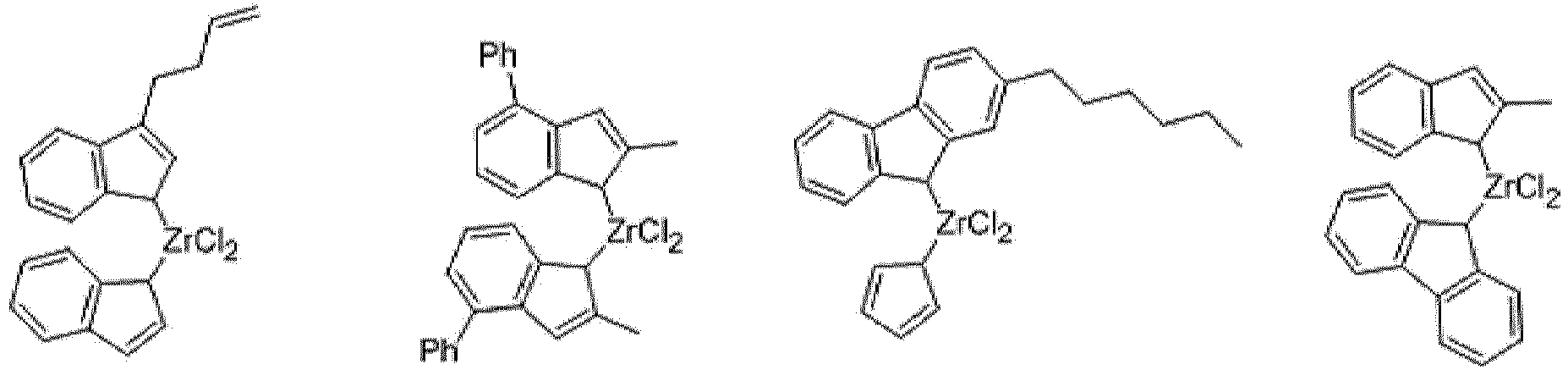

- A crosslinked polyethylene pipe produced by a crosslinking reaction of the polyethylene of claim 1, and a crosslinking agent.
- The crosslinked polyethylene pipe according to claim 8, wherein the crosslinking agent comprises at least one selected from the group consisting of di-t-butyl peroxide (DTBP), dicumyl peroxide, di-t-amyl peroxide, and 2,5-dimethyl-2,5-di(t-butylperoxy)hexane.
- The crosslinked polyethylene pipe according to claim 8, wherein a degree of crosslinking measured according to KS M ISO 10147 is 70% or more.
- The crosslinked polyethylene pipe according to claim 8, wherein the pipe is PE-Xa pipe.
Applications Claiming Priority (3)
| Application Number | Priority Date | Filing Date | Title |
|---|---|---|---|
| KR20190020026 | 2019-02-20 | ||
| KR1020200020643A KR102178360B1 (en) | 2019-02-20 | 2020-02-19 | Polyethylene with high pressure resistance and Crosslinked polyethylene pipe comprising the same |
| PCT/KR2020/002467 WO2020171623A1 (en) | 2019-02-20 | 2020-02-20 | Polyethylene with high pressure resistance and crosslinked polyethylene pipe comprising same |
Publications (3)
| Publication Number | Publication Date |
|---|---|
| EP3882281A1 true EP3882281A1 (en) | 2021-09-22 |
| EP3882281A4 EP3882281A4 (en) | 2022-03-02 |
| EP3882281B1 EP3882281B1 (en) | 2025-11-26 |
Family
ID=72265896
Family Applications (1)
| Application Number | Title | Priority Date | Filing Date |
|---|---|---|---|
| EP20759132.2A Active EP3882281B1 (en) | 2019-02-20 | 2020-02-20 | Polyethylene having high pressure resistance and crosslinked polyethylene pipe comprising the same |
Country Status (5)
| Country | Link |
|---|---|
| US (1) | US12065514B2 (en) |
| EP (1) | EP3882281B1 (en) |
| KR (1) | KR102178360B1 (en) |
| CN (2) | CN113195552B (en) |
| CA (1) | CA3123238A1 (en) |
Cited By (1)
| Publication number | Priority date | Publication date | Assignee | Title |
|---|---|---|---|---|
| EP4015543A4 (en) * | 2020-06-10 | 2022-11-23 | LG Chem, Ltd. | POLYETHYLENE AND CHLORINATED POLYETHYLENE THEREOF |
Families Citing this family (4)
| Publication number | Priority date | Publication date | Assignee | Title |
|---|---|---|---|---|
| US12173142B2 (en) * | 2019-02-20 | 2024-12-24 | Lg Chem, Ltd. | Polyethylene having high degree of crosslinking and crosslinked polyethylene pipe comprising the same |
| US12122903B2 (en) | 2019-02-20 | 2024-10-22 | Lg Chem, Ltd. | Crosslinked polyethylene pipe having excellent physical properties |
| KR102178360B1 (en) | 2019-02-20 | 2020-11-12 | 주식회사 엘지화학 | Polyethylene with high pressure resistance and Crosslinked polyethylene pipe comprising the same |
| KR20250152268A (en) | 2024-04-16 | 2025-10-23 | 한화토탈에너지스 주식회사 | Polyethylene resin composition, method for preparing the same, and molded article manufactured therefrom |
Family Cites Families (45)
| Publication number | Priority date | Publication date | Assignee | Title |
|---|---|---|---|---|
| JPH09309926A (en) | 1996-05-17 | 1997-12-02 | Dow Chem Co:The | Production of ethylene copolymer |
| US6124406A (en) | 1998-03-31 | 2000-09-26 | The B. F. Goodrich Company | Blocky chlorinated polyolefins, process for making and use as impact modifier compatibilizer for PVC or CPVC |
| BR9917422A (en) | 1999-07-15 | 2002-05-07 | Dow Chemical Co | High density ethylene homopolymers and mixing compositions |
| US6908972B2 (en) | 2002-04-16 | 2005-06-21 | Equistar Chemicals, Lp | Method for making polyolefins |
| EP1574772B1 (en) | 2004-03-12 | 2008-07-02 | Borealis Technology Oy | A crosslinked ethylene polymer pressure pipe and a method for the preparation thereof |
| KR100646249B1 (en) * | 2004-04-08 | 2006-11-23 | 주식회사 엘지화학 | Polyethylene for water supply pipe with excellent processability and pressure resistance characteristics using hybrid supported metallocene catalyst and its manufacturing method |
| JP5113324B2 (en) | 2005-07-08 | 2013-01-09 | 住友電工ファインポリマー株式会社 | Lens holder and optical recording / reproducing apparatus |
| KR101373926B1 (en) | 2007-01-16 | 2014-03-12 | 다우 글로벌 테크놀로지스 엘엘씨 | Stretch fabrics and garments of olefin block polymers |
| KR101032210B1 (en) * | 2007-04-18 | 2011-05-02 | 주식회사 엘지화학 | Polyethylene resins, preparation methods thereof and crosslinked polyethylene pipes prepared therefrom |
| WO2008134503A1 (en) | 2007-04-27 | 2008-11-06 | Dow Global Technologies Inc. | αMICROPOROUS FILMS FROM COMPATIBILIZED POLYMERIC BLENDS |
| EP2350139B1 (en) | 2008-10-31 | 2016-11-30 | Borealis AG | Multimodal polymer |
| KR20110091710A (en) | 2008-10-31 | 2011-08-12 | 보레알리스 아게 | Multimodal polymer |
| US10082228B2 (en) | 2008-10-31 | 2018-09-25 | Borealis Ag | Cross-linked polyethylene pipe |
| EP2256159A1 (en) | 2009-05-26 | 2010-12-01 | Borealis AG | Polymer composition for crosslinked pipes |
| KR101362560B1 (en) | 2011-08-08 | 2014-02-14 | 주식회사 엘지화학 | Cross-linked polyethylene compositions |
| CN103183859B (en) | 2011-12-31 | 2015-01-07 | 北京低碳清洁能源研究所 | Polyethylene compounding composition containing mico-crosslinking component and pipe products prepared from polyethylene compounding composition |
| CN104334630B (en) | 2012-06-04 | 2018-03-20 | 神华集团有限责任公司 | A cross-linked polyethylene composition with improved processability |
| US9923110B2 (en) | 2012-06-07 | 2018-03-20 | Dai Nippon Printing Co., Ltd. | Solar battery module and method of manufacture thereof |
| JP6344839B2 (en) | 2012-11-22 | 2018-06-20 | 三菱重工業株式会社 | Lining |
| US8815357B1 (en) | 2013-02-27 | 2014-08-26 | Chevron Phillips Chemical Company Lp | Polymer resins with improved processability and melt fracture characteristics |
| KR101707367B1 (en) | 2013-04-19 | 2017-02-15 | 미쓰비시덴키 가부시키가이샤 | Production method for molded article of silane crosslinked polyethylene resin, production method for molded rod, and production device for same |
| US9346897B2 (en) | 2013-05-14 | 2016-05-24 | Chevron Phillips Chemical Company Lp | Peroxide treated metallocene-based polyolefins with improved melt strength |
| KR101769097B1 (en) * | 2013-11-21 | 2017-08-17 | 주식회사 엘지화학 | Metallocene compound, catalyst composition comprising the same, and method for preparing polyolefin using the same |
| CN105722905B (en) | 2013-11-25 | 2019-10-08 | 陶氏环球技术有限责任公司 | Moisture and peroxide crosslinkable polymer composition |
| JP2015224996A (en) | 2014-05-29 | 2015-12-14 | 住友金属鉱山株式会社 | Method for evaluating degree of crosslinking of polyethylene resin |
| KR101705340B1 (en) * | 2014-06-03 | 2017-02-09 | 주식회사 엘지화학 | Method for preparing polyolefin and polyolefin prepared therefrom |
| KR101617870B1 (en) * | 2014-09-05 | 2016-05-03 | 주식회사 엘지화학 | Olefin based polymer having excellent processibility |
| EP3056524B1 (en) * | 2014-10-13 | 2021-09-22 | LG Chem, Ltd. | Ethylene/1-butene copolymer having excellent processibility and environmental stress cracking resistance |
| GB2533770B (en) | 2014-12-22 | 2021-02-10 | Norner Verdandi As | Polyethylene for pipes |
| KR20160121940A (en) | 2015-04-13 | 2016-10-21 | 주식회사 엘지화학 | Ethylene/alpha-olefin copolymer having an excellent environmental stress crack resistance |
| KR101891638B1 (en) | 2015-04-15 | 2018-08-24 | 주식회사 엘지화학 | Ethylene/alpha-olefin copolymer having excellent processibility |
| US9540457B1 (en) | 2015-09-24 | 2017-01-10 | Chevron Phillips Chemical Company Lp | Ziegler-natta—metallocene dual catalyst systems with activator-supports |
| KR102228534B1 (en) | 2016-10-27 | 2021-03-15 | 주식회사 엘지화학 | Ethylene/alpha-olefin copolymer having an excellent environmental stress crack resistance |
| KR102073252B1 (en) | 2016-12-05 | 2020-02-04 | 주식회사 엘지화학 | Catalyst composition for polymerizing olefin copolymer and preparation method of olefin copolymer |
| KR102234944B1 (en) * | 2016-12-13 | 2021-03-31 | 주식회사 엘지화학 | Olefin copolymer |
| KR20180072470A (en) | 2016-12-21 | 2018-06-29 | 롯데케미칼 주식회사 | Preparation method of crosslinked polyethylene color pipe |
| EP3476870B1 (en) | 2017-01-12 | 2026-01-28 | LG Chem, Ltd. | Method for preparing an olefin polymer |
| KR102260362B1 (en) * | 2017-03-09 | 2021-06-02 | 주식회사 엘지화학 | Olefin copolymer |
| KR102431339B1 (en) | 2018-12-10 | 2022-08-10 | 주식회사 엘지화학 | Polyethylene and its chlorinated polyethylene |
| KR102427755B1 (en) | 2018-12-10 | 2022-08-01 | 주식회사 엘지화학 | Polyethylene and its chlorinated polyethylene |
| KR102427756B1 (en) | 2018-12-10 | 2022-08-01 | 주식회사 엘지화학 | Polyethylene and its chlorinated polyethylene |
| WO2020122562A1 (en) * | 2018-12-10 | 2020-06-18 | 주식회사 엘지화학 | Polyethylene and chlorinated polyethylene thereof |
| US12122903B2 (en) * | 2019-02-20 | 2024-10-22 | Lg Chem, Ltd. | Crosslinked polyethylene pipe having excellent physical properties |
| US12173142B2 (en) | 2019-02-20 | 2024-12-24 | Lg Chem, Ltd. | Polyethylene having high degree of crosslinking and crosslinked polyethylene pipe comprising the same |
| KR102178360B1 (en) | 2019-02-20 | 2020-11-12 | 주식회사 엘지화학 | Polyethylene with high pressure resistance and Crosslinked polyethylene pipe comprising the same |
-
2020
- 2020-02-19 KR KR1020200020643A patent/KR102178360B1/en active Active
- 2020-02-20 CN CN202080006546.1A patent/CN113195552B/en active Active
- 2020-02-20 EP EP20759132.2A patent/EP3882281B1/en active Active
- 2020-02-20 CN CN202311486617.4A patent/CN117510688A/en active Pending
- 2020-02-20 US US17/414,616 patent/US12065514B2/en active Active
- 2020-02-20 CA CA3123238A patent/CA3123238A1/en active Pending
Cited By (2)
| Publication number | Priority date | Publication date | Assignee | Title |
|---|---|---|---|---|
| EP4015543A4 (en) * | 2020-06-10 | 2022-11-23 | LG Chem, Ltd. | POLYETHYLENE AND CHLORINATED POLYETHYLENE THEREOF |
| US12365748B2 (en) | 2020-06-10 | 2025-07-22 | Lg Chem, Ltd. | Polyethylene and chlorinated polyethylene thereof |
Also Published As
| Publication number | Publication date |
|---|---|
| CN117510688A (en) | 2024-02-06 |
| KR102178360B1 (en) | 2020-11-12 |
| KR20200101872A (en) | 2020-08-28 |
| EP3882281B1 (en) | 2025-11-26 |
| US20220135712A1 (en) | 2022-05-05 |
| CA3123238A1 (en) | 2020-08-27 |
| CN113195552B (en) | 2023-11-21 |
| BR112021012527A2 (en) | 2021-09-14 |
| US12065514B2 (en) | 2024-08-20 |
| EP3882281A4 (en) | 2022-03-02 |
| CN113195552A (en) | 2021-07-30 |
Similar Documents
| Publication | Publication Date | Title |
|---|---|---|
| EP3168243B1 (en) | Olefin-based polymer with excellent processability | |
| EP3882281B1 (en) | Polyethylene having high pressure resistance and crosslinked polyethylene pipe comprising the same | |
| EP3037167B1 (en) | Hybrid-supported metallocene catalyst | |
| KR102178361B1 (en) | Polyethylene with high degree of crosslinking and Crosslinked polyethylene pipe comprising the same | |
| EP3040124B1 (en) | Method for producing hybrid-supported metallocene catalyst | |
| KR101726820B1 (en) | Ethylene/1-hexene or ethylene/1-butene copolymer having excellent processibility and environmental stress crack resistance | |
| US12173142B2 (en) | Polyethylene having high degree of crosslinking and crosslinked polyethylene pipe comprising the same | |
| KR102342780B1 (en) | Preparation method of supported hybrid metallocene catalyst | |
| EP3910220B1 (en) | Crosslinked polyethylene pipe with excellent properties | |
| EP3225638A1 (en) | Ethylene/ -olefin copolymer having excellent processability and surface characteristics | |
| EP3476870B1 (en) | Method for preparing an olefin polymer | |
| EP3418311A1 (en) | Hybrid support catalyst | |
| KR102812372B1 (en) | Crosslinked polyethylene pipe with high pressure resistance | |
| KR102371577B1 (en) | Crosslinked polyethylene with excellent properties | |
| KR102215024B1 (en) | Method for preparing polyolfin | |
| BR112021012527B1 (en) | HIGH PRESSURE RESISTANCE POLYETHYLENE AND CROSS-LINKED POLYETHYLENE PIPE COMPRISING THE SAME |
Legal Events
| Date | Code | Title | Description |
|---|---|---|---|
| STAA | Information on the status of an ep patent application or granted ep patent |
Free format text: STATUS: THE INTERNATIONAL PUBLICATION HAS BEEN MADE |
|
| PUAI | Public reference made under article 153(3) epc to a published international application that has entered the european phase |
Free format text: ORIGINAL CODE: 0009012 |
|
| STAA | Information on the status of an ep patent application or granted ep patent |
Free format text: STATUS: REQUEST FOR EXAMINATION WAS MADE |
|
| 17P | Request for examination filed |
Effective date: 20210614 |
|
| AK | Designated contracting states |
Kind code of ref document: A1 Designated state(s): AL AT BE BG CH CY CZ DE DK EE ES FI FR GB GR HR HU IE IS IT LI LT LU LV MC MK MT NL NO PL PT RO RS SE SI SK SM TR |
|
| A4 | Supplementary search report drawn up and despatched |
Effective date: 20220201 |
|
| RIC1 | Information provided on ipc code assigned before grant |
Ipc: F16L 9/12 20060101ALI20220126BHEP Ipc: C08K 5/00 20060101ALI20220126BHEP Ipc: C08K 5/14 20060101ALI20220126BHEP Ipc: C08L 23/06 20060101ALI20220126BHEP Ipc: C08F 4/6592 20060101ALI20220126BHEP Ipc: C08F 4/659 20060101ALI20220126BHEP Ipc: C08F 2/38 20060101ALI20220126BHEP Ipc: C08F 10/02 20060101AFI20220126BHEP |
|
| DAV | Request for validation of the european patent (deleted) | ||
| DAX | Request for extension of the european patent (deleted) | ||
| STAA | Information on the status of an ep patent application or granted ep patent |
Free format text: STATUS: EXAMINATION IS IN PROGRESS |
|
| 17Q | First examination report despatched |
Effective date: 20240118 |
|
| GRAP | Despatch of communication of intention to grant a patent |
Free format text: ORIGINAL CODE: EPIDOSNIGR1 |
|
| STAA | Information on the status of an ep patent application or granted ep patent |
Free format text: STATUS: GRANT OF PATENT IS INTENDED |
|
| INTG | Intention to grant announced |
Effective date: 20250728 |
|
| GRAS | Grant fee paid |
Free format text: ORIGINAL CODE: EPIDOSNIGR3 |
|
| GRAA | (expected) grant |
Free format text: ORIGINAL CODE: 0009210 |
|
| STAA | Information on the status of an ep patent application or granted ep patent |
Free format text: STATUS: THE PATENT HAS BEEN GRANTED |
|
| AK | Designated contracting states |
Kind code of ref document: B1 Designated state(s): AL AT BE BG CH CY CZ DE DK EE ES FI FR GB GR HR HU IE IS IT LI LT LU LV MC MK MT NL NO PL PT RO RS SE SI SK SM TR |
|
| REG | Reference to a national code |
Ref country code: CH Ref legal event code: F10 Free format text: ST27 STATUS EVENT CODE: U-0-0-F10-F00 (AS PROVIDED BY THE NATIONAL OFFICE) Effective date: 20251126 Ref country code: GB Ref legal event code: FG4D |
|
| REG | Reference to a national code |
Ref country code: IE Ref legal event code: FG4D |
|
| REG | Reference to a national code |
Ref country code: DE Ref legal event code: R096 Ref document number: 602020062783 Country of ref document: DE |
|
| REG | Reference to a national code |
Ref country code: NL Ref legal event code: MP Effective date: 20251126 |
|
| PGFP | Annual fee paid to national office [announced via postgrant information from national office to epo] |
Ref country code: GB Payment date: 20260122 Year of fee payment: 7 |
|
| PG25 | Lapsed in a contracting state [announced via postgrant information from national office to epo] |
Ref country code: ES Free format text: LAPSE BECAUSE OF FAILURE TO SUBMIT A TRANSLATION OF THE DESCRIPTION OR TO PAY THE FEE WITHIN THE PRESCRIBED TIME-LIMIT Effective date: 20251126 |
|
| REG | Reference to a national code |
Ref country code: LT Ref legal event code: MG9D |
|
| PG25 | Lapsed in a contracting state [announced via postgrant information from national office to epo] |
Ref country code: NO Free format text: LAPSE BECAUSE OF FAILURE TO SUBMIT A TRANSLATION OF THE DESCRIPTION OR TO PAY THE FEE WITHIN THE PRESCRIBED TIME-LIMIT Effective date: 20260226 |
|
| PGFP | Annual fee paid to national office [announced via postgrant information from national office to epo] |
Ref country code: DE Payment date: 20260120 Year of fee payment: 7 |
|
| PG25 | Lapsed in a contracting state [announced via postgrant information from national office to epo] |
Ref country code: AT Free format text: LAPSE BECAUSE OF FAILURE TO SUBMIT A TRANSLATION OF THE DESCRIPTION OR TO PAY THE FEE WITHIN THE PRESCRIBED TIME-LIMIT Effective date: 20251126 Ref country code: HR Free format text: LAPSE BECAUSE OF FAILURE TO SUBMIT A TRANSLATION OF THE DESCRIPTION OR TO PAY THE FEE WITHIN THE PRESCRIBED TIME-LIMIT Effective date: 20251126 Ref country code: FI Free format text: LAPSE BECAUSE OF FAILURE TO SUBMIT A TRANSLATION OF THE DESCRIPTION OR TO PAY THE FEE WITHIN THE PRESCRIBED TIME-LIMIT Effective date: 20251126 |
|
| PGFP | Annual fee paid to national office [announced via postgrant information from national office to epo] |
Ref country code: IT Payment date: 20260121 Year of fee payment: 7 |
|
| REG | Reference to a national code |
Ref country code: AT Ref legal event code: MK05 Ref document number: 1861028 Country of ref document: AT Kind code of ref document: T Effective date: 20251126 |
|
| PG25 | Lapsed in a contracting state [announced via postgrant information from national office to epo] |
Ref country code: NL Free format text: LAPSE BECAUSE OF FAILURE TO SUBMIT A TRANSLATION OF THE DESCRIPTION OR TO PAY THE FEE WITHIN THE PRESCRIBED TIME-LIMIT Effective date: 20251126 |
|
| PG25 | Lapsed in a contracting state [announced via postgrant information from national office to epo] |
Ref country code: RS Free format text: LAPSE BECAUSE OF FAILURE TO SUBMIT A TRANSLATION OF THE DESCRIPTION OR TO PAY THE FEE WITHIN THE PRESCRIBED TIME-LIMIT Effective date: 20260226 |
|
| PG25 | Lapsed in a contracting state [announced via postgrant information from national office to epo] |
Ref country code: IS Free format text: LAPSE BECAUSE OF FAILURE TO SUBMIT A TRANSLATION OF THE DESCRIPTION OR TO PAY THE FEE WITHIN THE PRESCRIBED TIME-LIMIT Effective date: 20260326 |
|
| PGFP | Annual fee paid to national office [announced via postgrant information from national office to epo] |
Ref country code: FR Payment date: 20260121 Year of fee payment: 7 |
|
| PG25 | Lapsed in a contracting state [announced via postgrant information from national office to epo] |
Ref country code: PT Free format text: LAPSE BECAUSE OF FAILURE TO SUBMIT A TRANSLATION OF THE DESCRIPTION OR TO PAY THE FEE WITHIN THE PRESCRIBED TIME-LIMIT Effective date: 20260326 |
|
| PG25 | Lapsed in a contracting state [announced via postgrant information from national office to epo] |
Ref country code: PL Free format text: LAPSE BECAUSE OF FAILURE TO SUBMIT A TRANSLATION OF THE DESCRIPTION OR TO PAY THE FEE WITHIN THE PRESCRIBED TIME-LIMIT Effective date: 20251126 |
|
| PG25 | Lapsed in a contracting state [announced via postgrant information from national office to epo] |
Ref country code: LV Free format text: LAPSE BECAUSE OF FAILURE TO SUBMIT A TRANSLATION OF THE DESCRIPTION OR TO PAY THE FEE WITHIN THE PRESCRIBED TIME-LIMIT Effective date: 20251126 |
|
| PG25 | Lapsed in a contracting state [announced via postgrant information from national office to epo] |
Ref country code: BG Free format text: LAPSE BECAUSE OF FAILURE TO SUBMIT A TRANSLATION OF THE DESCRIPTION OR TO PAY THE FEE WITHIN THE PRESCRIBED TIME-LIMIT Effective date: 20251126 |