EP3882148B1 - Color correction method for chromatic aberration using multiple color led sources - Google Patents
Color correction method for chromatic aberration using multiple color led sources Download PDFInfo
- Publication number
- EP3882148B1 EP3882148B1 EP21163713.7A EP21163713A EP3882148B1 EP 3882148 B1 EP3882148 B1 EP 3882148B1 EP 21163713 A EP21163713 A EP 21163713A EP 3882148 B1 EP3882148 B1 EP 3882148B1
- Authority
- EP
- European Patent Office
- Prior art keywords
- light
- region
- light sources
- optical system
- color
- Prior art date
- Legal status (The legal status is an assumption and is not a legal conclusion. Google has not performed a legal analysis and makes no representation as to the accuracy of the status listed.)
- Active
Links
Images




Classifications
-
- B—PERFORMING OPERATIONS; TRANSPORTING
- B60—VEHICLES IN GENERAL
- B60Q—ARRANGEMENT OF SIGNALLING OR LIGHTING DEVICES, THE MOUNTING OR SUPPORTING THEREOF OR CIRCUITS THEREFOR, FOR VEHICLES IN GENERAL
- B60Q3/00—Arrangement of lighting devices for vehicle interiors; Lighting devices specially adapted for vehicle interiors
- B60Q3/40—Arrangement of lighting devices for vehicle interiors; Lighting devices specially adapted for vehicle interiors specially adapted for specific vehicle types
- B60Q3/41—Arrangement of lighting devices for vehicle interiors; Lighting devices specially adapted for vehicle interiors specially adapted for specific vehicle types for mass transit vehicles, e.g. buses
- B60Q3/43—General lighting
-
- B—PERFORMING OPERATIONS; TRANSPORTING
- B64—AIRCRAFT; AVIATION; COSMONAUTICS
- B64D—EQUIPMENT FOR FITTING IN OR TO AIRCRAFT; FLIGHT SUITS; PARACHUTES; ARRANGEMENT OR MOUNTING OF POWER PLANTS OR PROPULSION TRANSMISSIONS IN AIRCRAFT
- B64D11/00—Passenger or crew accommodation; Flight-deck installations not otherwise provided for
-
- B—PERFORMING OPERATIONS; TRANSPORTING
- B60—VEHICLES IN GENERAL
- B60Q—ARRANGEMENT OF SIGNALLING OR LIGHTING DEVICES, THE MOUNTING OR SUPPORTING THEREOF OR CIRCUITS THEREFOR, FOR VEHICLES IN GENERAL
- B60Q3/00—Arrangement of lighting devices for vehicle interiors; Lighting devices specially adapted for vehicle interiors
- B60Q3/40—Arrangement of lighting devices for vehicle interiors; Lighting devices specially adapted for vehicle interiors specially adapted for specific vehicle types
- B60Q3/41—Arrangement of lighting devices for vehicle interiors; Lighting devices specially adapted for vehicle interiors specially adapted for specific vehicle types for mass transit vehicles, e.g. buses
- B60Q3/47—Circuits; Control arrangements
-
- F—MECHANICAL ENGINEERING; LIGHTING; HEATING; WEAPONS; BLASTING
- F21—LIGHTING
- F21V—FUNCTIONAL FEATURES OR DETAILS OF LIGHTING DEVICES OR SYSTEMS THEREOF; STRUCTURAL COMBINATIONS OF LIGHTING DEVICES WITH OTHER ARTICLES, NOT OTHERWISE PROVIDED FOR
- F21V5/00—Refractors for light sources
- F21V5/04—Refractors for light sources of lens shape
- F21V5/048—Refractors for light sources of lens shape the lens being a simple lens adapted to cooperate with a point-like source for emitting mainly in one direction and having an axis coincident with the main light transmission direction, e.g. convergent or divergent lenses, plano-concave or plano-convex lenses
-
- B—PERFORMING OPERATIONS; TRANSPORTING
- B64—AIRCRAFT; AVIATION; COSMONAUTICS
- B64D—EQUIPMENT FOR FITTING IN OR TO AIRCRAFT; FLIGHT SUITS; PARACHUTES; ARRANGEMENT OR MOUNTING OF POWER PLANTS OR PROPULSION TRANSMISSIONS IN AIRCRAFT
- B64D11/00—Passenger or crew accommodation; Flight-deck installations not otherwise provided for
- B64D2011/0038—Illumination systems for cabins as a whole
-
- B—PERFORMING OPERATIONS; TRANSPORTING
- B64—AIRCRAFT; AVIATION; COSMONAUTICS
- B64D—EQUIPMENT FOR FITTING IN OR TO AIRCRAFT; FLIGHT SUITS; PARACHUTES; ARRANGEMENT OR MOUNTING OF POWER PLANTS OR PROPULSION TRANSMISSIONS IN AIRCRAFT
- B64D11/00—Passenger or crew accommodation; Flight-deck installations not otherwise provided for
- B64D2011/0053—Cabin passenger reading lights
-
- F—MECHANICAL ENGINEERING; LIGHTING; HEATING; WEAPONS; BLASTING
- F21—LIGHTING
- F21W—INDEXING SCHEME ASSOCIATED WITH SUBCLASSES F21K, F21L, F21S and F21V, RELATING TO USES OR APPLICATIONS OF LIGHTING DEVICES OR SYSTEMS
- F21W2106/00—Interior vehicle lighting devices
-
- F—MECHANICAL ENGINEERING; LIGHTING; HEATING; WEAPONS; BLASTING
- F21—LIGHTING
- F21W—INDEXING SCHEME ASSOCIATED WITH SUBCLASSES F21K, F21L, F21S and F21V, RELATING TO USES OR APPLICATIONS OF LIGHTING DEVICES OR SYSTEMS
- F21W2107/00—Use or application of lighting devices on or in particular types of vehicles
- F21W2107/30—Use or application of lighting devices on or in particular types of vehicles for aircraft
-
- F—MECHANICAL ENGINEERING; LIGHTING; HEATING; WEAPONS; BLASTING
- F21—LIGHTING
- F21Y—INDEXING SCHEME ASSOCIATED WITH SUBCLASSES F21K, F21L, F21S and F21V, RELATING TO THE FORM OR THE KIND OF THE LIGHT SOURCES OR OF THE COLOUR OF THE LIGHT EMITTED
- F21Y2105/00—Planar light sources
- F21Y2105/10—Planar light sources comprising a two-dimensional [2D] array of point-like light-generating elements
-
- F—MECHANICAL ENGINEERING; LIGHTING; HEATING; WEAPONS; BLASTING
- F21—LIGHTING
- F21Y—INDEXING SCHEME ASSOCIATED WITH SUBCLASSES F21K, F21L, F21S and F21V, RELATING TO THE FORM OR THE KIND OF THE LIGHT SOURCES OR OF THE COLOUR OF THE LIGHT EMITTED
- F21Y2113/00—Combination of light sources
- F21Y2113/10—Combination of light sources of different colours
- F21Y2113/13—Combination of light sources of different colours comprising an assembly of point-like light sources
-
- F—MECHANICAL ENGINEERING; LIGHTING; HEATING; WEAPONS; BLASTING
- F21—LIGHTING
- F21Y—INDEXING SCHEME ASSOCIATED WITH SUBCLASSES F21K, F21L, F21S and F21V, RELATING TO THE FORM OR THE KIND OF THE LIGHT SOURCES OR OF THE COLOUR OF THE LIGHT EMITTED
- F21Y2115/00—Light-generating elements of semiconductor light sources
- F21Y2115/10—Light-emitting diodes [LED]
Definitions
- the present disclosure relates generally to methods and apparatus for interior lighting of an aircraft cabin and, more particularly, to methods and apparatus configured to provide illumination for passengers seated within an aircraft cabin.
- sidewall lights may be arranged in recesses at sidewall panels or ceiling portions to provide a general illumination of the aircraft cabin. These lights may be switched off during takeoff and landing and may also be switched off during nighttime flights.
- aircraft are typically provided with reading lights that are usually integrated within a passenger service unit (PSU), which is typically located at a lower portion of a luggage compartment overhead of a seated passenger.
- PSU passenger service unit
- Each such reading light typically provides a focused and geometrically defined light spot to the passenger, and in particular to an area that may be defined as a reading area.
- the reading area may, for example, comprise a portion of the surface area of a stowable tray located in front of the passenger or a larger area that includes both the tray and the lap of the passenger.
- LED light emitting diode
- Advances in light emitting diode (“LED") technology have made LEDs an ideal source of light where low-powered lighting solutions are desirable, such as in an aircraft, where power availability is limited. Among such advances are techniques used to reduce or eliminate chromatic aberration or similar distortions that may occur with aircraft lighting units or reading lights.
- Interior lighting systems are disclosed in US 2014/306249 , US 2012/001555 , and US 2010/244061 .
- WO2019208559 A1 discloses a vehicle lamp comprising a light source and an aberration correction lens unit that guides direct light from the light source forward to correct chromatic aberration.
- a lighting device is provided as defined by claim 1.
- the first light color has a wavelength within a range of 625-740 nanometers.
- the second light color has the wavelength within the range of 500-565 nanometers.
- the third plurality of light sources is configured to generate a white light beam on a circular area radially inward of the second region.
- the third plurality of light sources comprises a plurality of red light emitting diodes, a plurality of green light emitting diodes and a plurality of blue light emitting diodes.
- a method of producing a white light beam is provided as defined by claim 5.
- the first light color has a wavelength within a range of 625-740 nanometers.
- the second light color has the wavelength within the range of 500-565 nanometers.
- the third light color is a white color generated via a plurality of red light sources, a plurality of green light sources and a plurality of blue light sources.
- references to "a,” “an” or “the” may include one or more than one and that reference to an item in the singular may also include the item in the plural. Further, all ranges may include upper and lower values and all ranges and ratio limits disclosed herein may be combined.
- FIG. 1 illustrates a lighting device 100 mounted on or within a passenger service unit 10 located at a lower portion of a luggage compartment 12 overhead of a passenger seat 14.
- the lighting device 100 includes a plurality of light sources arranged in an array or a matrix and configured to reduce or eliminate a chromatic aberration that may result from an optic system or lens system within the lighting device 100.
- the chromatic aberration may result in a light spot 16 having a fringe-like distortion 18 at a periphery 20 of the light spot 16.
- the light spot 16 is illustrated as being confined to the surface area of a stowable tray 22 located in front of the passenger seat 14, the light spot 16 contemplated herein is not so limited in size and may, in various embodiments, span a larger area that includes both the stowable tray 22 and the lap of a passenger seated within the passenger seat 14.
- chromatic aberration may be described, in accordance with various embodiments.
- light e.g. , white light
- a light source 200 passes through an optic system 202, such as, for example, a convex lens 204
- the components of the light being irradiated typically have different wavelengths and thus have different refractive indices.
- a red light component 206 having a relatively long wavelength (e.g., within a range of 625-740 nanometers (nm)) has a relatively low refractive index
- a blue light component 208 having a relatively short wavelength (e.g., within a range of 450-485 nm) has a relatively high refractive index
- a green light component 210 having an intermediate wavelength (e.g., within a range of 500-565 nm) has a refractive index between the refractive indices of the red light component 206 and the blue light component 208.
- the light that passes through the peripheral portion 212 of the convex lens 204 causes the color blurring due to the difference in refractive indices in accordance with the light components.
- methods and apparatus configured to precondition the light prior to being refracted by the optic system 202 may substantially reduce or even eliminate the chromatic aberration.
- the lighting device 300 includes a printed circuit board 320.
- a plurality of light sources 322 is mounted to the printed circuit board 320 in a matrix or an array (e.g., a 10x10, a 20x20, ... or a NxM matrix or array, where N and M represent the number of light sources in the rows and columns of the matrix or array).
- the plurality of light sources 322 comprises a plurality of light emitting diodes (LEDs).
- the plurality of light sources 322 comprises various colors, including, for example, red, green and blue LEDs that may be controlled by a processor 326 to generate a desired color of light, including white light.
- a processor 326 may be controlled by a processor 326 to generate a desired color of light, including white light.
- the red, green and blue LEDs may be mixed throughout the matrix or array and controlled by the processor 326 to produce a blended source of light to produce a white light or some other desired color that results from the mixing of the red, green and blue colors.
- LEDs as the light sources within the plurality of lights sources 322
- other light sources are contemplated, such as, for example, digital light processing (DLP), liquid crystal display (LCD), liquid crystal on silicon (LCoS), organic light emitting diode (OLED) and quantum dot (QD) sources.
- DLP digital light processing
- LCD liquid crystal display
- LCD liquid crystal on silicon
- OLED organic light emitting diode
- QD quantum dot
- the lighting device 300 is illustrated as operating in a white light state.
- operation of the individual red, green and blue LEDs within the plurality of light sources 322 are controlled by the processor 326 to produce a white light beam 328 that is incident on an optical system 302 including a convex lens 304 (e.g. , a biconvex lens having convex surfaces on both sides of the lens (as illustrated in FIG. 2 ) or a plano-convex lens having a plane surface on one side of the lens and a convex surface of the other side of the lens (as illustrated in FIGS. 3A and 3B )).
- a convex lens 304 e.g. , a biconvex lens having convex surfaces on both sides of the lens (as illustrated in FIG. 2 ) or a plano-convex lens having a plane surface on one side of the lens and a convex surface of the other side of the lens (as illustrated in FIGS. 3A and 3B )).
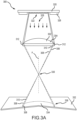
- a central axis A extends longitudinally through the plurality of light sources 322 and the optical system 302. Similar to the description provided above with reference to FIG. 2 , the white light beam 328 experiences refraction, particularly at a peripheral portion 312 of the convex lens 304, causing the color blurring due to the difference in refractive indices in accordance with the red, green and blue light components. As illustrated, the color blurring, or chromatic aberration, results in a red component 306, a blue component 308 and a green component 310 of the white light beam 328 being refracted at different angles by the convex lens 304, thereby resulting in the blurring or aberration.
- the white light beam 328 is configured to pass through a focal point 330 (or a focal region if spherical aberration is present due to various surface imperfections in the convex lens 304).
- a focal point 330 or a focal region if spherical aberration is present due to various surface imperfections in the convex lens 304.
- the light beam continues toward a target surface 332, which, in various embodiments, may comprise a stowable tray, such as the stowable tray 22 described above with reference to FIG. 1 .
- a light spot 334 is projected on the target surface 332 and includes a fringe 336 at a periphery of the light spot 334, the fringe 336 resulting from the color blurring or the chromatic aberration due to the difference in refractive indices of the red component 306, the blue component 308 and the green component 310 refracted at different angles by the convex lens 304.
- the lighting device 300 is illustrated as operating in a preconditioned light state.
- operation of the individual red, green and blue LEDs within the plurality of light sources 322 are controlled by the processor 326 to produce a white light beam 328 that is incident on a central portion 311 of the convex lens 304 that lies inward of the peripheral portion 312.
- a first plurality of light sources 323 of the plurality of light sources 322 is controlled by the processor 326 to irradiate red light within a first region 325 and a second plurality of light sources 327 of the plurality of light sources 322 is controlled by the processor 326 to irradiate green light within a second region 329.
- the first region 325 is a first annular region that irradiates the red light toward a first peripheral region within the peripheral portion 312 of the convex lens 304.
- the second region 329 is a second annular region that irradiates the green light toward a second peripheral region within the peripheral portion 312 of the convex lens 304, with the second peripheral region being radially inward of the first peripheral region.
- the white light beam 328 that is incident on the central portion 311 of the convex lens 304 is generated by a third plurality of light sources 321, which is surrounded by the second plurality of light sources 327, which is surrounded by the first plurality of light sources 323.
- the third plurality of light sources 321 is configured to irradiate a circular area radially inward of the second annular region.
- the various red, green and blue color components are controlled by the processor 326 to combine and produce a white light at the location where the fringe 336, as illustrated in FIG. 3A , previously existed.
- the red light within the first region 325 is refracted at a first angle by the convex lens and the green light within the second region 329 is refracted at a second angle.
- the red, green and blue components of the white light beam 328 are refracted at a location radially inward of the second region 329, though not at angles as great as those described above with reference to FIG.
- the convex lens 304 is white in color throughout the entire light beam. After passing through the focal point 330, the light beam continues toward the target surface 332. A light spot 334 that results is projected on the target surface 332, but no longer includes the fringe 336 at the periphery of the light spot 334 described above with reference to FIG. 3A .
- the plurality of light sources 422 may include various red, green and blue colored light sources that are intermixed and controlled by a processor (e.g., the processor 326 described above) to combine and produce a white light within a central region 431, a red light at a first region 425 and a green light at a second region 429, with the first region 425 being located radially outward of the second region 429 and the second region 429 being located radially outward of the central region 431.
- a processor e.g., the processor 326 described above
- the red light at the first region 425 may be generated via a plurality or red light sources (e.g., a plurality of red light emitting diodes)
- the green light at the second region 429 may be generated via a plurality or green light sources (e.g., a plurality of green light emitting diodes)
- the white light within the central region 431 may be generated via a combination of a plurality of red light sources, a plurality of green light sources and a plurality of blue light sources (e.g., a plurality of blue light emitting diodes).
- the contributions of the red light from the first region 425, the green light from the second region 429 and the red, green and blue light from the central region 431 are mixed at a peripheral portion of the convex lens to produce a white light and to substantially reduce or eliminate the color blurring or chromatic aberration described above. Accordingly, the light exiting the convex lens is white in color throughout the entire light beam. After passing through a focal point, the light beam continues toward a target surface. A light spot that results is projected on the target surface, but without a fringe at the periphery of the light spot described above with reference to FIG. 3A .
- a method 500 of producing a white light beam is described as having the following steps.
- a first step 502 includes illuminating a first region of an optical system with a first light color.
- a second 504 step includes illuminating a second region of the optical system with a second light color, the second region positioned inward of the first region with respect to a central axis.
- a third step 506 includes illuminating a central region of the optical system with a third light color, the central region positioned inward of the second region with respect to the central axis.
- a fourth step 508 includes refracting light from the first region, the second region and the central region by the optical system to generate a beam of white light throughout a light spot projected onto a target surface by the optical system.
- the first light color has a wavelength within a range of 625-740 nanometers and the second light color has the wavelength within the range of 500-565 nanometers.
- the third light color is a white color generated via a plurality of red light sources, a plurality of green light sources and a plurality of blue light sources.
- the first region defines a first annular region within a peripheral portion of the optical system and the second region defines a second annular region within the peripheral portion of the optical system.
- the optical system is configured to combine the first light color, the second light color and the third light color at the peripheral portion of the optical system.
- references to "one embodiment,” “an embodiment,” “various embodiments,” etc. indicate that the embodiment described may include a particular feature, structure, or characteristic, but every embodiment may not necessarily include the particular feature, structure, or characteristic. Moreover, such phrases are not necessarily referring to the same embodiment. Further, when a particular feature, structure, or characteristic is described in connection with an embodiment, it is submitted that it is within the knowledge of one skilled in the art to affect such feature, structure, or characteristic in connection with other embodiments whether or not explicitly described. After reading the description, it will be apparent to one skilled in the relevant art(s) how to implement the disclosure in alternative embodiments.
- Numbers, percentages, or other values stated herein are intended to include that value, and also other values that are about or approximately equal to the stated value, as would be appreciated by one of ordinary skill in the art encompassed by various embodiments of the present disclosure.
- a stated value should therefore be interpreted broadly enough to encompass values that are at least close enough to the stated value to perform a desired function or achieve a desired result.
- the stated values include at least the variation to be expected in a suitable industrial process, and may include values that are within 10%, within 5%, within 1%, within 0.1%, or within 0.01% of a stated value.
- the terms “substantially,” “about” or “approximately” as used herein represent an amount close to the stated amount that still performs a desired function or achieves a desired result.
- the term “substantially,” “about” or “approximately” may refer to an amount that is within 10% of, within 5% of, within 1% of, within 0.1% of, and within 0.01% of a stated amount or value
- system program instructions or controller instructions may be loaded onto a tangible, non-transitory, computer-readable medium (also referred to herein as a tangible, non-transitory, memory) having instructions stored thereon that, in response to execution by a controller, cause the controller to perform various operations.
- a tangible, non-transitory, computer-readable medium also referred to herein as a tangible, non-transitory, memory
Landscapes
- Engineering & Computer Science (AREA)
- Mechanical Engineering (AREA)
- Aviation & Aerospace Engineering (AREA)
- General Engineering & Computer Science (AREA)
- Non-Portable Lighting Devices Or Systems Thereof (AREA)
Description
- The present disclosure relates generally to methods and apparatus for interior lighting of an aircraft cabin and, more particularly, to methods and apparatus configured to provide illumination for passengers seated within an aircraft cabin.
- In aircraft cabins, various different light sources are typically used.
For example, sidewall lights may be arranged in recesses at sidewall panels or ceiling portions to provide a general illumination of the aircraft cabin. These lights may be switched off during takeoff and landing and may also be switched off during nighttime flights. Additionally, aircraft are typically provided with reading lights that are usually integrated within a passenger service unit (PSU), which is typically located at a lower portion of a luggage compartment overhead of a seated passenger. For each passenger aircraft seat, a separate reading light is provided that is configured for switching on and off by the passenger. Each such reading light typically provides a focused and geometrically defined light spot to the passenger, and in particular to an area that may be defined as a reading area. The reading area may, for example, comprise a portion of the surface area of a stowable tray located in front of the passenger or a larger area that includes both the tray and the lap of the passenger. Advances in light emitting diode ("LED") technology have made LEDs an ideal source of light where low-powered lighting solutions are desirable, such as in an aircraft, where power availability is limited. Among such advances are techniques used to reduce or eliminate chromatic aberration or similar distortions that may occur with aircraft lighting units or reading lights. Interior lighting systems are disclosed inUS 2014/306249 ,US 2012/001555 , andUS 2010/244061 .WO2019208559 A1 discloses a vehicle lamp comprising a light source and an aberration correction lens unit that guides direct light from the light source forward to correct chromatic aberration. - A lighting device is provided as defined by claim 1.
- In various embodiments, the first light color has a wavelength within a range of 625-740 nanometers. In various embodiments, the second light color has the wavelength within the range of 500-565 nanometers. In various embodiments, the third plurality of light sources is configured to generate a white light beam on a circular area radially inward of the second region. In various embodiments, the third plurality of light sources comprises a plurality of red light emitting diodes, a plurality of green light emitting diodes and a plurality of blue light emitting diodes.
- A method of producing a white light beam is provided as defined by claim 5.
- In various embodiments, the first light color has a wavelength within a range of 625-740 nanometers. In various embodiments, the second light color has the wavelength within the range of 500-565 nanometers. In various embodiments, the third light color is a white color generated via a plurality of red light sources, a plurality of green light sources and a plurality of blue light sources.
- The accompanying drawings illustrate various embodiments employing the principles described herein and are a part of the specification. The illustrated embodiments are meant for description and not to limit the scope of the claims.
-
FIG. 1 illustrates a passenger seat having a reading light disposed in a personal seating unit, in accordance with various embodiments; -
FIG. 2 is a schematic illustration of a convex lens displaying a chromatic aberration, in accordance with various embodiments; -
FIGS. 3A and3B illustrate a reading light displaying a chromatic aberration inFIG. 3A and no aberration inFIG. 3B , in accordance with various embodiments; -
FIG. 4 illustrates a plurality of light sources configured to reduce or eliminate a chromatic aberration in a reading light, in accordance with various embodiments; and -
FIG. 5 describes various method steps used to reduce or eliminate a chromatic aberration in a reading light, in accordance with various embodiments. - The following detailed description of various embodiments herein makes reference to the accompanying drawings, which show various embodiments by way of illustration. While these various embodiments are described in sufficient detail to enable those skilled in the art to practice the disclosure, it should be understood that other embodiments may be realized and that changes may be made without departing from the scope of the invention as defined by the claims. Thus, the detailed description herein is presented for purposes of illustration only and not of limitation. Furthermore, any reference to singular includes plural embodiments, and any reference to more than one component or step may include a singular embodiment or step. Also, any reference to attached, fixed, connected, or the like may include permanent, removable, temporary, partial, full or any other possible attachment option. It should also be understood that unless specifically stated otherwise, references to "a," "an" or "the" may include one or more than one and that reference to an item in the singular may also include the item in the plural. Further, all ranges may include upper and lower values and all ranges and ratio limits disclosed herein may be combined.
- Referring now to the drawings,
FIG. 1 illustrates alighting device 100 mounted on or within apassenger service unit 10 located at a lower portion of aluggage compartment 12 overhead of apassenger seat 14. As described in further detail below, thelighting device 100 includes a plurality of light sources arranged in an array or a matrix and configured to reduce or eliminate a chromatic aberration that may result from an optic system or lens system within thelighting device 100. As illustrated, for example, the chromatic aberration may result in alight spot 16 having a fringe-like distortion 18 at aperiphery 20 of thelight spot 16. While thelight spot 16 is illustrated as being confined to the surface area of astowable tray 22 located in front of thepassenger seat 14, thelight spot 16 contemplated herein is not so limited in size and may, in various embodiments, span a larger area that includes both thestowable tray 22 and the lap of a passenger seated within thepassenger seat 14. - With reference now to
FIG. 2 , the phenomena of chromatic aberration may be described, in accordance with various embodiments. When light (e.g., white light) irradiated from alight source 200 passes through anoptic system 202, such as, for example, aconvex lens 204, the components of the light being irradiated typically have different wavelengths and thus have different refractive indices. Therefore, ared light component 206 having a relatively long wavelength (e.g., within a range of 625-740 nanometers (nm)) has a relatively low refractive index, ablue light component 208 having a relatively short wavelength (e.g., within a range of 450-485 nm) has a relatively high refractive index, and agreen light component 210 having an intermediate wavelength (e.g., within a range of 500-565 nm) has a refractive index between the refractive indices of thered light component 206 and theblue light component 208. The light that passes through theperipheral portion 212 of theconvex lens 204 causes the color blurring due to the difference in refractive indices in accordance with the light components. As described further below, methods and apparatus configured to precondition the light prior to being refracted by theoptic system 202 may substantially reduce or even eliminate the chromatic aberration. - Referring now to
FIGS. 3A and3B , alighting device 300, such as, for example, thelighting device 100 described above with reference toFIG. 1 , is illustrated. In various embodiments, thelighting device 300 includes a printedcircuit board 320. A plurality oflight sources 322 is mounted to the printedcircuit board 320 in a matrix or an array (e.g., a 10x10, a 20x20, ... or a NxM matrix or array, where N and M represent the number of light sources in the rows and columns of the matrix or array). In various embodiments, the plurality oflight sources 322 comprises a plurality of light emitting diodes (LEDs). Typically, the plurality oflight sources 322 comprises various colors, including, for example, red, green and blue LEDs that may be controlled by aprocessor 326 to generate a desired color of light, including white light. For example, the red, green and blue LEDs may be mixed throughout the matrix or array and controlled by theprocessor 326 to produce a blended source of light to produce a white light or some other desired color that results from the mixing of the red, green and blue colors. Note that while the disclosure is described in general terms using LEDs as the light sources within the plurality oflights sources 322, other light sources are contemplated, such as, for example, digital light processing (DLP), liquid crystal display (LCD), liquid crystal on silicon (LCoS), organic light emitting diode (OLED) and quantum dot (QD) sources. - Referring more particularly to
FIG. 3A , thelighting device 300 is illustrated as operating in a white light state. In the white light state, operation of the individual red, green and blue LEDs within the plurality oflight sources 322 are controlled by theprocessor 326 to produce awhite light beam 328 that is incident on anoptical system 302 including a convex lens 304 (e.g., a biconvex lens having convex surfaces on both sides of the lens (as illustrated inFIG. 2 ) or a plano-convex lens having a plane surface on one side of the lens and a convex surface of the other side of the lens (as illustrated inFIGS. 3A and3B )). A central axis A extends longitudinally through the plurality oflight sources 322 and theoptical system 302. Similar to the description provided above with reference toFIG. 2 , thewhite light beam 328 experiences refraction, particularly at aperipheral portion 312 of theconvex lens 304, causing the color blurring due to the difference in refractive indices in accordance with the red, green and blue light components. As illustrated, the color blurring, or chromatic aberration, results in ared component 306, ablue component 308 and agreen component 310 of thewhite light beam 328 being refracted at different angles by theconvex lens 304, thereby resulting in the blurring or aberration. Due to the light converging nature of theconvex lens 304, thewhite light beam 328, together with the blurred region comprising thered component 306, theblue component 308 and thegreen component 310, is configured to pass through a focal point 330 (or a focal region if spherical aberration is present due to various surface imperfections in the convex lens 304). After passing through thefocal point 330, the light beam continues toward atarget surface 332, which, in various embodiments, may comprise a stowable tray, such as thestowable tray 22 described above with reference toFIG. 1 . Alight spot 334 is projected on thetarget surface 332 and includes afringe 336 at a periphery of thelight spot 334, thefringe 336 resulting from the color blurring or the chromatic aberration due to the difference in refractive indices of thered component 306, theblue component 308 and thegreen component 310 refracted at different angles by theconvex lens 304. - Referring more particularly now to
FIG. 3B , thelighting device 300 is illustrated as operating in a preconditioned light state. In the preconditioned light state, operation of the individual red, green and blue LEDs within the plurality oflight sources 322 are controlled by theprocessor 326 to produce awhite light beam 328 that is incident on acentral portion 311 of theconvex lens 304 that lies inward of theperipheral portion 312. At the same time, a first plurality oflight sources 323 of the plurality oflight sources 322 is controlled by theprocessor 326 to irradiate red light within afirst region 325 and a second plurality oflight sources 327 of the plurality oflight sources 322 is controlled by theprocessor 326 to irradiate green light within asecond region 329. Thefirst region 325 is a first annular region that irradiates the red light toward a first peripheral region within theperipheral portion 312 of theconvex lens 304. Similarly, thesecond region 329 is a second annular region that irradiates the green light toward a second peripheral region within theperipheral portion 312 of theconvex lens 304, with the second peripheral region being radially inward of the first peripheral region. Thewhite light beam 328 that is incident on thecentral portion 311 of theconvex lens 304 is generated by a third plurality oflight sources 321, which is surrounded by the second plurality oflight sources 327, which is surrounded by the first plurality oflight sources 323. In various embodiments, the third plurality oflight sources 321 is configured to irradiate a circular area radially inward of the second annular region. - In a manner similar to the description above, light of the various colors will be refracted by the
convex lens 304 at theperipheral portion 312. In various embodiments represented byFIG. 3B , however, the various red, green and blue color components are controlled by theprocessor 326 to combine and produce a white light at the location where thefringe 336, as illustrated inFIG. 3A , previously existed. The red light within thefirst region 325 is refracted at a first angle by the convex lens and the green light within thesecond region 329 is refracted at a second angle. At the same time, the red, green and blue components of thewhite light beam 328 are refracted at a location radially inward of thesecond region 329, though not at angles as great as those described above with reference toFIG. 3A . The result is the contributions of the red light from thefirst region 325, the green light from thesecond region 329 and the red, green and blue light from thewhite light beam 328 that are mixed at theperipheral portion 312 of theconvex lens 304 to produce a white light and to substantially reduce or eliminate the color blurring or chromatic aberration described above. Accordingly, the light exiting theconvex lens 304 is white in color throughout the entire light beam. After passing through thefocal point 330, the light beam continues toward thetarget surface 332. Alight spot 334 that results is projected on thetarget surface 332, but no longer includes thefringe 336 at the periphery of thelight spot 334 described above with reference toFIG. 3A . - Referring now to
FIG. 4 , a schematic illustration of a plurality oflight sources 422, similar to the plurality oflight sources 322 described above with reference toFIGS. 3A and3B , is provided. Similar to the foregoing description, the plurality oflight sources 422 may include various red, green and blue colored light sources that are intermixed and controlled by a processor (e.g., theprocessor 326 described above) to combine and produce a white light within acentral region 431, a red light at afirst region 425 and a green light at asecond region 429, with thefirst region 425 being located radially outward of thesecond region 429 and thesecond region 429 being located radially outward of thecentral region 431. For example, in various embodiments, the red light at thefirst region 425 may be generated via a plurality or red light sources (e.g., a plurality of red light emitting diodes), the green light at thesecond region 429 may be generated via a plurality or green light sources (e.g., a plurality of green light emitting diodes) and the white light within thecentral region 431 may be generated via a combination of a plurality of red light sources, a plurality of green light sources and a plurality of blue light sources (e.g., a plurality of blue light emitting diodes). When directed at a convex lens, the contributions of the red light from thefirst region 425, the green light from thesecond region 429 and the red, green and blue light from thecentral region 431 are mixed at a peripheral portion of the convex lens to produce a white light and to substantially reduce or eliminate the color blurring or chromatic aberration described above. Accordingly, the light exiting the convex lens is white in color throughout the entire light beam. After passing through a focal point, the light beam continues toward a target surface. A light spot that results is projected on the target surface, but without a fringe at the periphery of the light spot described above with reference toFIG. 3A . - With reference now to
FIG. 5 , amethod 500 of producing a white light beam is described as having the following steps. Afirst step 502 includes illuminating a first region of an optical system with a first light color. A second 504 step includes illuminating a second region of the optical system with a second light color, the second region positioned inward of the first region with respect to a central axis. Athird step 506 includes illuminating a central region of the optical system with a third light color, the central region positioned inward of the second region with respect to the central axis. Afourth step 508 includes refracting light from the first region, the second region and the central region by the optical system to generate a beam of white light throughout a light spot projected onto a target surface by the optical system. - In various embodiments, the first light color has a wavelength within a range of 625-740 nanometers and the second light color has the wavelength within the range of 500-565 nanometers. In various embodiments, the third light color is a white color generated via a plurality of red light sources, a plurality of green light sources and a plurality of blue light sources. The first region defines a first annular region within a peripheral portion of the optical system and the second region defines a second annular region within the peripheral portion of the optical system. The optical system is configured to combine the first light color, the second light color and the third light color at the peripheral portion of the optical system.
- Benefits, other advantages, and solutions to problems have been described herein with regard to specific embodiments. Furthermore, the connecting lines shown in the various figures contained herein are intended to represent exemplary functional relationships and/or physical couplings between the various elements. It should be noted that many alternative or additional functional relationships or physical connections may be present in a practical system. However, the benefits, advantages, solutions to problems, and any elements that may cause any benefit, advantage, or solution to occur or become more pronounced are not to be construed as critical, required, or essential features or elements of the disclosure. The scope of the disclosure is accordingly to be limited by nothing other than the appended claims, in which reference to an element in the singular is not intended to mean "one and only one" unless explicitly so stated, but rather "one or more." Moreover, where a phrase similar to "at least one of A, B, or C" is used in the claims, it is intended that the phrase be interpreted to mean that A alone may be present in an embodiment, B alone may be present in an embodiment, C alone may be present in an embodiment, or that any combination of the elements A, B and C may be present in a single embodiment; for example, A and B, A and C, B and C, or A and B and C. Different cross-hatching is used throughout the figures to denote different parts but not necessarily to denote the same or different materials.
- Systems, methods and apparatus are provided herein. In the detailed description herein, references to "one embodiment," "an embodiment," "various embodiments," etc., indicate that the embodiment described may include a particular feature, structure, or characteristic, but every embodiment may not necessarily include the particular feature, structure, or characteristic. Moreover, such phrases are not necessarily referring to the same embodiment. Further, when a particular feature, structure, or characteristic is described in connection with an embodiment, it is submitted that it is within the knowledge of one skilled in the art to affect such feature, structure, or characteristic in connection with other embodiments whether or not explicitly described. After reading the description, it will be apparent to one skilled in the relevant art(s) how to implement the disclosure in alternative embodiments.
- Numbers, percentages, or other values stated herein are intended to include that value, and also other values that are about or approximately equal to the stated value, as would be appreciated by one of ordinary skill in the art encompassed by various embodiments of the present disclosure. A stated value should therefore be interpreted broadly enough to encompass values that are at least close enough to the stated value to perform a desired function or achieve a desired result. The stated values include at least the variation to be expected in a suitable industrial process, and may include values that are within 10%, within 5%, within 1%, within 0.1%, or within 0.01% of a stated value. Additionally, the terms "substantially," "about" or "approximately" as used herein represent an amount close to the stated amount that still performs a desired function or achieves a desired result. For example, the term "substantially," "about" or "approximately" may refer to an amount that is within 10% of, within 5% of, within 1% of, within 0.1% of, and within 0.01% of a stated amount or value.
- In various embodiments, system program instructions or controller instructions may be loaded onto a tangible, non-transitory, computer-readable medium (also referred to herein as a tangible, non-transitory, memory) having instructions stored thereon that, in response to execution by a controller, cause the controller to perform various operations.
- Finally, it should be understood that any of the above described concepts can be used alone or in combination with any or all of the other above described concepts. Although various embodiments have been disclosed and described, one of ordinary skill in this art would recognize that certain modifications would come within the scope of the invention as far as they remain within the scope of the claims.
Claims (7)
- A lighting device, comprising:an optical system including a convex lens (204);a plurality of light sources (322) arranged in a matrix, the plurality of light sources including a first plurality of light sources (323) configured to irradiate a first region (325) of the optical system with a first light color, a second plurality of light sources (327) configured to irradiate a second region (329) of the optical system with a second light color; anda processor (326) configured to control interaction of the first plurality of light sources and the second plurality of light sources with a third plurality of light sources (321) and to control mixing of the first light color and the second light color; whereinthe first region defines a first annular region within a peripheral portion of the optical system;wherein the second region defines a second annular region within the peripheral portion of the optical system;wherein a central axis extends through the optical system and the first plurality of light sources is disposed about the central axis;wherein the second plurality of light sources is disposed about the central axis between the first plurality of light sources and the central axis;wherein the third plurality of light sources is disposed about the central axis between the second plurality of light sources and the central axis, wherein the third plurality of light sources is configured to illuminate a central portion (311) of the optical system with a third light color, the central portion positioned inward of the second region with respect to the central axis;wherein a convex surface of the convex lens extends towards the plurality of light sources;wherein the first light color within the first region of the optical system is refracted at a first angle by the convex lens and the second light color within the second region of the optical system is refracted at a second angle, different from the first angle, such that the first light color, the second light color and the third light color are mixed at the peripheral portion (312) to produce a white light exiting the peripheral portion of the convex lens and configured to pass through a focal point (330) toward a target surface (332).
- The lighting device of claim 1, wherein the third plurality of light sources is configured to irradiate a circular area radially inward of the second annular region.
- The lighting device of any preceding claim, wherein the first light color has a wavelength within a range of 625-740 nanometers, and optionally wherein the second light color has the wavelength within the range of 500-565 nanometers.
- The lighting device of claim 3, wherein the third plurality of light sources is configured to generate a white light beam on a circular area radially inward of the second region, and optionally wherein the third plurality of light sources comprises a plurality of red light emitting diodes, a plurality of green light emitting diodes and a plurality of blue light emitting diodes.
- A method of producing a white light beam using the lighting device of any preceding claim, comprising:illuminating the first region of the optical system with the first light color;illuminating the second region of the optical system with the second light color, the second region positioned inward of the first region with respect to the central axis;illuminating the central portion of the optical system with the third light color;refracting light from the first region, the second region and the central portion by the optical system to generate a beam of white light throughout a light spot projected onto the target surface by the optical system;wherein the first light color within the first region of the optical system is refracted at a first angle by the convex lens and the second light color within the second region of the optical system is refracted at a second angle, different from the first angle, such that the first light color, the second light color and the third light color are mixed at the peripheral portion to produce a white light exiting the peripheral portion of the convex lens and configured to pass through the focal point toward the target surface.
- The method of claim 5, wherein the first light color has a wavelength within a range of 625-740 nanometers, and optionally wherein the second light color has the wavelength within the range of 500-565 nanometers.
- The method of claim 6, wherein the third light color is a white color generated via a plurality of red light sources, a plurality of green light sources and a plurality of blue light sources.
Applications Claiming Priority (1)
| Application Number | Priority Date | Filing Date | Title |
|---|---|---|---|
| US16/823,826 US11318882B2 (en) | 2020-03-19 | 2020-03-19 | Color correction method for chromatic aberration using multiple color LED sources |
Publications (2)
| Publication Number | Publication Date |
|---|---|
| EP3882148A1 EP3882148A1 (en) | 2021-09-22 |
| EP3882148B1 true EP3882148B1 (en) | 2023-09-13 |
Family
ID=75111500
Family Applications (1)
| Application Number | Title | Priority Date | Filing Date |
|---|---|---|---|
| EP21163713.7A Active EP3882148B1 (en) | 2020-03-19 | 2021-03-19 | Color correction method for chromatic aberration using multiple color led sources |
Country Status (2)
| Country | Link |
|---|---|
| US (1) | US11318882B2 (en) |
| EP (1) | EP3882148B1 (en) |
Families Citing this family (1)
| Publication number | Priority date | Publication date | Assignee | Title |
|---|---|---|---|---|
| EP4650273A1 (en) * | 2024-05-14 | 2025-11-19 | Goodrich Lighting Systems GmbH & Co. KG | Aircraft passenger reading light, aircraft comprising an aircraft passenger reading light, and method of operating an aircraft passenger reading light |
Citations (1)
| Publication number | Priority date | Publication date | Assignee | Title |
|---|---|---|---|---|
| WO2019208559A1 (en) * | 2018-04-26 | 2019-10-31 | 市光工業株式会社 | Vehicle lamp |
Family Cites Families (12)
| Publication number | Priority date | Publication date | Assignee | Title |
|---|---|---|---|---|
| US7387891B2 (en) * | 1999-05-17 | 2008-06-17 | Applera Corporation | Optical instrument including excitation source |
| US6773139B2 (en) * | 2001-09-17 | 2004-08-10 | Gelcore Llp | Variable optics spot module |
| US20040218387A1 (en) * | 2003-03-18 | 2004-11-04 | Robert Gerlach | LED lighting arrays, fixtures and systems and method for determining human color perception |
| US8693519B2 (en) * | 2008-11-17 | 2014-04-08 | SMS Siemag, LLC | Sensor system for bottom electrodes of an electric arc furnace |
| JP2010231938A (en) | 2009-03-26 | 2010-10-14 | Panasonic Electric Works Co Ltd | LED lighting device |
| CN102313249B (en) | 2010-07-01 | 2014-11-26 | 惠州元晖光电股份有限公司 | Tunable white color methods and uses thereof |
| JP2012109532A (en) * | 2010-09-08 | 2012-06-07 | Mitsubishi Chemicals Corp | Light emitting apparatus, lighting apparatus, and lens |
| US9217552B2 (en) | 2012-07-27 | 2015-12-22 | Sharp Kabushiki Kaisha | Illumination device |
| JP6136002B2 (en) | 2013-04-12 | 2017-05-31 | パナソニックIpマネジメント株式会社 | Lighting device |
| US10247385B2 (en) | 2015-05-20 | 2019-04-02 | Philips Lighting Holding B.V. | Lighting device, lens and method, having a mixing structure with a variable blurring strength |
| KR101878666B1 (en) | 2016-11-11 | 2018-08-16 | 순천대학교 산학협력단 | Micro pixel array light emitting diode and lighting device having the same |
| EP3447372A1 (en) * | 2017-08-24 | 2019-02-27 | Goodrich Lighting Systems GmbH | Helicopter search light and method of operating a helicopter search light |
-
2020
- 2020-03-19 US US16/823,826 patent/US11318882B2/en active Active
-
2021
- 2021-03-19 EP EP21163713.7A patent/EP3882148B1/en active Active
Patent Citations (1)
| Publication number | Priority date | Publication date | Assignee | Title |
|---|---|---|---|---|
| WO2019208559A1 (en) * | 2018-04-26 | 2019-10-31 | 市光工業株式会社 | Vehicle lamp |
Also Published As
| Publication number | Publication date |
|---|---|
| US11318882B2 (en) | 2022-05-03 |
| EP3882148A1 (en) | 2021-09-22 |
| US20210291726A1 (en) | 2021-09-23 |
Similar Documents
| Publication | Publication Date | Title |
|---|---|---|
| CN102333676B (en) | Illumination device for several people in airplanes | |
| CN208635005U (en) | Lamps apparatus for vehicle | |
| US7540639B2 (en) | Cross bin illumination system | |
| US9777903B2 (en) | Exterior aircraft light | |
| US20050135095A1 (en) | Array for the illumination of an object | |
| GB2497950A (en) | Laser and Phosphor Based Light Source for Improved Safety | |
| EP3543771A1 (en) | Head-up display and moving object | |
| US10670217B2 (en) | Illumination device with light source | |
| US20180327096A1 (en) | Luminaire and luminaire module | |
| EP3882148B1 (en) | Color correction method for chromatic aberration using multiple color led sources | |
| US20140092581A1 (en) | Wavelength conversion through remote phosphor on a support wheel | |
| CN109690179B (en) | lighting device | |
| US10344934B2 (en) | Illumination system and headlamp | |
| US10760772B2 (en) | Illumination device | |
| CN108626686A (en) | Lighting module with chromatic aberration correction | |
| US7352510B2 (en) | Light-pipe integrator for uniform irradiance and intensity | |
| US20140327887A1 (en) | Projection system with a plurality of light-emitting elements | |
| US11905035B2 (en) | Aircraft light, aircraft, and method of assembling an aircraft light | |
| EP4349711B1 (en) | Aircraft reading light, aircraft comprising an aircraft reading light, and method of operating an aircraft reading light | |
| US12529466B2 (en) | Illumination system and illumination method | |
| US9995457B1 (en) | Multicolor illumination for a single panel display source | |
| US10830408B1 (en) | Lighting devices with variable beam patterns | |
| CZ35692U1 (en) | Transparent display for aircraft | |
| CN117950257A (en) | Multicolor light-combining module | |
| KR20190069064A (en) | Laser projector |
Legal Events
| Date | Code | Title | Description |
|---|---|---|---|
| PUAI | Public reference made under article 153(3) epc to a published international application that has entered the european phase |
Free format text: ORIGINAL CODE: 0009012 |
|
| STAA | Information on the status of an ep patent application or granted ep patent |
Free format text: STATUS: THE APPLICATION HAS BEEN PUBLISHED |
|
| AK | Designated contracting states |
Kind code of ref document: A1 Designated state(s): AL AT BE BG CH CY CZ DE DK EE ES FI FR GB GR HR HU IE IS IT LI LT LU LV MC MK MT NL NO PL PT RO RS SE SI SK SM TR |
|
| STAA | Information on the status of an ep patent application or granted ep patent |
Free format text: STATUS: REQUEST FOR EXAMINATION WAS MADE |
|
| 17P | Request for examination filed |
Effective date: 20220322 |
|
| RBV | Designated contracting states (corrected) |
Designated state(s): AL AT BE BG CH CY CZ DE DK EE ES FI FR GB GR HR HU IE IS IT LI LT LU LV MC MK MT NL NO PL PT RO RS SE SI SK SM TR |
|
| GRAP | Despatch of communication of intention to grant a patent |
Free format text: ORIGINAL CODE: EPIDOSNIGR1 |
|
| STAA | Information on the status of an ep patent application or granted ep patent |
Free format text: STATUS: GRANT OF PATENT IS INTENDED |
|
| RIC1 | Information provided on ipc code assigned before grant |
Ipc: F21Y 113/13 20160101ALN20230315BHEP Ipc: B64D 11/00 20060101AFI20230315BHEP |
|
| RIC1 | Information provided on ipc code assigned before grant |
Ipc: F21Y 113/13 20160101ALN20230321BHEP Ipc: B64D 11/00 20060101AFI20230321BHEP |
|
| RIC1 | Information provided on ipc code assigned before grant |
Ipc: F21Y 113/13 20160101ALN20230330BHEP Ipc: B64D 11/00 20060101AFI20230330BHEP |
|
| INTG | Intention to grant announced |
Effective date: 20230413 |
|
| RIN1 | Information on inventor provided before grant (corrected) |
Inventor name: MAUZY, JAMESON Inventor name: JOHANNESSEN, ERIC |
|
| GRAS | Grant fee paid |
Free format text: ORIGINAL CODE: EPIDOSNIGR3 |
|
| GRAA | (expected) grant |
Free format text: ORIGINAL CODE: 0009210 |
|
| STAA | Information on the status of an ep patent application or granted ep patent |
Free format text: STATUS: THE PATENT HAS BEEN GRANTED |
|
| AK | Designated contracting states |
Kind code of ref document: B1 Designated state(s): AL AT BE BG CH CY CZ DE DK EE ES FI FR GB GR HR HU IE IS IT LI LT LU LV MC MK MT NL NO PL PT RO RS SE SI SK SM TR |
|
| REG | Reference to a national code |
Ref country code: CH Ref legal event code: EP |
|
| REG | Reference to a national code |
Ref country code: DE Ref legal event code: R096 Ref document number: 602021005045 Country of ref document: DE |
|
| REG | Reference to a national code |
Ref country code: IE Ref legal event code: FG4D |
|
| P01 | Opt-out of the competence of the unified patent court (upc) registered |
Effective date: 20230922 |
|
| REG | Reference to a national code |
Ref country code: LT Ref legal event code: MG9D |
|
| REG | Reference to a national code |
Ref country code: NL Ref legal event code: MP Effective date: 20230913 |
|
| PG25 | Lapsed in a contracting state [announced via postgrant information from national office to epo] |
Ref country code: GR Free format text: LAPSE BECAUSE OF FAILURE TO SUBMIT A TRANSLATION OF THE DESCRIPTION OR TO PAY THE FEE WITHIN THE PRESCRIBED TIME-LIMIT Effective date: 20231214 |
|
| PG25 | Lapsed in a contracting state [announced via postgrant information from national office to epo] |
Ref country code: SE Free format text: LAPSE BECAUSE OF FAILURE TO SUBMIT A TRANSLATION OF THE DESCRIPTION OR TO PAY THE FEE WITHIN THE PRESCRIBED TIME-LIMIT Effective date: 20230913 Ref country code: RS Free format text: LAPSE BECAUSE OF FAILURE TO SUBMIT A TRANSLATION OF THE DESCRIPTION OR TO PAY THE FEE WITHIN THE PRESCRIBED TIME-LIMIT Effective date: 20230913 Ref country code: NO Free format text: LAPSE BECAUSE OF FAILURE TO SUBMIT A TRANSLATION OF THE DESCRIPTION OR TO PAY THE FEE WITHIN THE PRESCRIBED TIME-LIMIT Effective date: 20231213 Ref country code: LV Free format text: LAPSE BECAUSE OF FAILURE TO SUBMIT A TRANSLATION OF THE DESCRIPTION OR TO PAY THE FEE WITHIN THE PRESCRIBED TIME-LIMIT Effective date: 20230913 Ref country code: LT Free format text: LAPSE BECAUSE OF FAILURE TO SUBMIT A TRANSLATION OF THE DESCRIPTION OR TO PAY THE FEE WITHIN THE PRESCRIBED TIME-LIMIT Effective date: 20230913 Ref country code: HR Free format text: LAPSE BECAUSE OF FAILURE TO SUBMIT A TRANSLATION OF THE DESCRIPTION OR TO PAY THE FEE WITHIN THE PRESCRIBED TIME-LIMIT Effective date: 20230913 Ref country code: GR Free format text: LAPSE BECAUSE OF FAILURE TO SUBMIT A TRANSLATION OF THE DESCRIPTION OR TO PAY THE FEE WITHIN THE PRESCRIBED TIME-LIMIT Effective date: 20231214 Ref country code: FI Free format text: LAPSE BECAUSE OF FAILURE TO SUBMIT A TRANSLATION OF THE DESCRIPTION OR TO PAY THE FEE WITHIN THE PRESCRIBED TIME-LIMIT Effective date: 20230913 |
|
| REG | Reference to a national code |
Ref country code: AT Ref legal event code: MK05 Ref document number: 1611043 Country of ref document: AT Kind code of ref document: T Effective date: 20230913 |
|
| PG25 | Lapsed in a contracting state [announced via postgrant information from national office to epo] |
Ref country code: NL Free format text: LAPSE BECAUSE OF FAILURE TO SUBMIT A TRANSLATION OF THE DESCRIPTION OR TO PAY THE FEE WITHIN THE PRESCRIBED TIME-LIMIT Effective date: 20230913 |
|
| PG25 | Lapsed in a contracting state [announced via postgrant information from national office to epo] |
Ref country code: IS Free format text: LAPSE BECAUSE OF FAILURE TO SUBMIT A TRANSLATION OF THE DESCRIPTION OR TO PAY THE FEE WITHIN THE PRESCRIBED TIME-LIMIT Effective date: 20240113 |
|
| PG25 | Lapsed in a contracting state [announced via postgrant information from national office to epo] |
Ref country code: AT Free format text: LAPSE BECAUSE OF FAILURE TO SUBMIT A TRANSLATION OF THE DESCRIPTION OR TO PAY THE FEE WITHIN THE PRESCRIBED TIME-LIMIT Effective date: 20230913 |
|
| PG25 | Lapsed in a contracting state [announced via postgrant information from national office to epo] |
Ref country code: ES Free format text: LAPSE BECAUSE OF FAILURE TO SUBMIT A TRANSLATION OF THE DESCRIPTION OR TO PAY THE FEE WITHIN THE PRESCRIBED TIME-LIMIT Effective date: 20230913 |
|
| PG25 | Lapsed in a contracting state [announced via postgrant information from national office to epo] |
Ref country code: SM Free format text: LAPSE BECAUSE OF FAILURE TO SUBMIT A TRANSLATION OF THE DESCRIPTION OR TO PAY THE FEE WITHIN THE PRESCRIBED TIME-LIMIT Effective date: 20230913 Ref country code: RO Free format text: LAPSE BECAUSE OF FAILURE TO SUBMIT A TRANSLATION OF THE DESCRIPTION OR TO PAY THE FEE WITHIN THE PRESCRIBED TIME-LIMIT Effective date: 20230913 Ref country code: IS Free format text: LAPSE BECAUSE OF FAILURE TO SUBMIT A TRANSLATION OF THE DESCRIPTION OR TO PAY THE FEE WITHIN THE PRESCRIBED TIME-LIMIT Effective date: 20240113 Ref country code: ES Free format text: LAPSE BECAUSE OF FAILURE TO SUBMIT A TRANSLATION OF THE DESCRIPTION OR TO PAY THE FEE WITHIN THE PRESCRIBED TIME-LIMIT Effective date: 20230913 Ref country code: EE Free format text: LAPSE BECAUSE OF FAILURE TO SUBMIT A TRANSLATION OF THE DESCRIPTION OR TO PAY THE FEE WITHIN THE PRESCRIBED TIME-LIMIT Effective date: 20230913 Ref country code: CZ Free format text: LAPSE BECAUSE OF FAILURE TO SUBMIT A TRANSLATION OF THE DESCRIPTION OR TO PAY THE FEE WITHIN THE PRESCRIBED TIME-LIMIT Effective date: 20230913 Ref country code: AT Free format text: LAPSE BECAUSE OF FAILURE TO SUBMIT A TRANSLATION OF THE DESCRIPTION OR TO PAY THE FEE WITHIN THE PRESCRIBED TIME-LIMIT Effective date: 20230913 Ref country code: PT Free format text: LAPSE BECAUSE OF FAILURE TO SUBMIT A TRANSLATION OF THE DESCRIPTION OR TO PAY THE FEE WITHIN THE PRESCRIBED TIME-LIMIT Effective date: 20240115 Ref country code: SK Free format text: LAPSE BECAUSE OF FAILURE TO SUBMIT A TRANSLATION OF THE DESCRIPTION OR TO PAY THE FEE WITHIN THE PRESCRIBED TIME-LIMIT Effective date: 20230913 |
|
| PG25 | Lapsed in a contracting state [announced via postgrant information from national office to epo] |
Ref country code: PL Free format text: LAPSE BECAUSE OF FAILURE TO SUBMIT A TRANSLATION OF THE DESCRIPTION OR TO PAY THE FEE WITHIN THE PRESCRIBED TIME-LIMIT Effective date: 20230913 Ref country code: IT Free format text: LAPSE BECAUSE OF FAILURE TO SUBMIT A TRANSLATION OF THE DESCRIPTION OR TO PAY THE FEE WITHIN THE PRESCRIBED TIME-LIMIT Effective date: 20230913 |
|
| REG | Reference to a national code |
Ref country code: DE Ref legal event code: R097 Ref document number: 602021005045 Country of ref document: DE |
|
| PG25 | Lapsed in a contracting state [announced via postgrant information from national office to epo] |
Ref country code: DK Free format text: LAPSE BECAUSE OF FAILURE TO SUBMIT A TRANSLATION OF THE DESCRIPTION OR TO PAY THE FEE WITHIN THE PRESCRIBED TIME-LIMIT Effective date: 20230913 |
|
| PLBE | No opposition filed within time limit |
Free format text: ORIGINAL CODE: 0009261 |
|
| STAA | Information on the status of an ep patent application or granted ep patent |
Free format text: STATUS: NO OPPOSITION FILED WITHIN TIME LIMIT |
|
| PG25 | Lapsed in a contracting state [announced via postgrant information from national office to epo] |
Ref country code: DK Free format text: LAPSE BECAUSE OF FAILURE TO SUBMIT A TRANSLATION OF THE DESCRIPTION OR TO PAY THE FEE WITHIN THE PRESCRIBED TIME-LIMIT Effective date: 20230913 |
|
| 26N | No opposition filed |
Effective date: 20240614 |
|
| PG25 | Lapsed in a contracting state [announced via postgrant information from national office to epo] |
Ref country code: SI Free format text: LAPSE BECAUSE OF FAILURE TO SUBMIT A TRANSLATION OF THE DESCRIPTION OR TO PAY THE FEE WITHIN THE PRESCRIBED TIME-LIMIT Effective date: 20230913 |
|
| PG25 | Lapsed in a contracting state [announced via postgrant information from national office to epo] |
Ref country code: SI Free format text: LAPSE BECAUSE OF FAILURE TO SUBMIT A TRANSLATION OF THE DESCRIPTION OR TO PAY THE FEE WITHIN THE PRESCRIBED TIME-LIMIT Effective date: 20230913 |
|
| REG | Reference to a national code |
Ref country code: CH Ref legal event code: PL |
|
| PG25 | Lapsed in a contracting state [announced via postgrant information from national office to epo] |
Ref country code: BG Free format text: LAPSE BECAUSE OF FAILURE TO SUBMIT A TRANSLATION OF THE DESCRIPTION OR TO PAY THE FEE WITHIN THE PRESCRIBED TIME-LIMIT Effective date: 20230913 |
|
| PG25 | Lapsed in a contracting state [announced via postgrant information from national office to epo] |
Ref country code: LU Free format text: LAPSE BECAUSE OF NON-PAYMENT OF DUE FEES Effective date: 20240319 |
|
| PG25 | Lapsed in a contracting state [announced via postgrant information from national office to epo] |
Ref country code: MC Free format text: LAPSE BECAUSE OF FAILURE TO SUBMIT A TRANSLATION OF THE DESCRIPTION OR TO PAY THE FEE WITHIN THE PRESCRIBED TIME-LIMIT Effective date: 20230913 |
|
| PG25 | Lapsed in a contracting state [announced via postgrant information from national office to epo] |
Ref country code: MC Free format text: LAPSE BECAUSE OF FAILURE TO SUBMIT A TRANSLATION OF THE DESCRIPTION OR TO PAY THE FEE WITHIN THE PRESCRIBED TIME-LIMIT Effective date: 20230913 Ref country code: LU Free format text: LAPSE BECAUSE OF NON-PAYMENT OF DUE FEES Effective date: 20240319 Ref country code: BG Free format text: LAPSE BECAUSE OF FAILURE TO SUBMIT A TRANSLATION OF THE DESCRIPTION OR TO PAY THE FEE WITHIN THE PRESCRIBED TIME-LIMIT Effective date: 20230913 |
|
| REG | Reference to a national code |
Ref country code: BE Ref legal event code: MM Effective date: 20240331 |
|
| PG25 | Lapsed in a contracting state [announced via postgrant information from national office to epo] |
Ref country code: BE Free format text: LAPSE BECAUSE OF NON-PAYMENT OF DUE FEES Effective date: 20240331 |
|
| PG25 | Lapsed in a contracting state [announced via postgrant information from national office to epo] |
Ref country code: IE Free format text: LAPSE BECAUSE OF NON-PAYMENT OF DUE FEES Effective date: 20240319 |
|
| PG25 | Lapsed in a contracting state [announced via postgrant information from national office to epo] |
Ref country code: IE Free format text: LAPSE BECAUSE OF NON-PAYMENT OF DUE FEES Effective date: 20240319 Ref country code: BE Free format text: LAPSE BECAUSE OF NON-PAYMENT OF DUE FEES Effective date: 20240331 Ref country code: CH Free format text: LAPSE BECAUSE OF NON-PAYMENT OF DUE FEES Effective date: 20240331 |
|
| PG25 | Lapsed in a contracting state [announced via postgrant information from national office to epo] |
Ref country code: CY Free format text: LAPSE BECAUSE OF FAILURE TO SUBMIT A TRANSLATION OF THE DESCRIPTION OR TO PAY THE FEE WITHIN THE PRESCRIBED TIME-LIMIT; INVALID AB INITIO Effective date: 20210319 |
|
| PG25 | Lapsed in a contracting state [announced via postgrant information from national office to epo] |
Ref country code: HU Free format text: LAPSE BECAUSE OF FAILURE TO SUBMIT A TRANSLATION OF THE DESCRIPTION OR TO PAY THE FEE WITHIN THE PRESCRIBED TIME-LIMIT; INVALID AB INITIO Effective date: 20210319 |
|
| PG25 | Lapsed in a contracting state [announced via postgrant information from national office to epo] |
Ref country code: TR Free format text: LAPSE BECAUSE OF FAILURE TO SUBMIT A TRANSLATION OF THE DESCRIPTION OR TO PAY THE FEE WITHIN THE PRESCRIBED TIME-LIMIT Effective date: 20230913 |
|
| PGFP | Annual fee paid to national office [announced via postgrant information from national office to epo] |
Ref country code: GB Payment date: 20260219 Year of fee payment: 6 |
|
| PGFP | Annual fee paid to national office [announced via postgrant information from national office to epo] |
Ref country code: DE Payment date: 20260219 Year of fee payment: 6 |
|
| PGFP | Annual fee paid to national office [announced via postgrant information from national office to epo] |
Ref country code: FR Payment date: 20260219 Year of fee payment: 6 |