EP3882114B1 - System for estimating riding posture - Google Patents
System for estimating riding posture Download PDFInfo
- Publication number
- EP3882114B1 EP3882114B1 EP20164241.0A EP20164241A EP3882114B1 EP 3882114 B1 EP3882114 B1 EP 3882114B1 EP 20164241 A EP20164241 A EP 20164241A EP 3882114 B1 EP3882114 B1 EP 3882114B1
- Authority
- EP
- European Patent Office
- Prior art keywords
- vibrations
- posture
- location
- driver
- passenger
- Prior art date
- Legal status (The legal status is an assumption and is not a legal conclusion. Google has not performed a legal analysis and makes no representation as to the accuracy of the status listed.)
- Active
Links
Images



Classifications
-
- B—PERFORMING OPERATIONS; TRANSPORTING
- B60—VEHICLES IN GENERAL
- B60W—CONJOINT CONTROL OF VEHICLE SUB-UNITS OF DIFFERENT TYPE OR DIFFERENT FUNCTION; CONTROL SYSTEMS SPECIALLY ADAPTED FOR HYBRID VEHICLES; ROAD VEHICLE DRIVE CONTROL SYSTEMS FOR PURPOSES NOT RELATED TO THE CONTROL OF A PARTICULAR SUB-UNIT
- B60W50/00—Details of control systems for road vehicle drive control not related to the control of a particular sub-unit, e.g. process diagnostic or vehicle driver interfaces
- B60W50/08—Interaction between the driver and the control system
- B60W50/14—Means for informing the driver, warning the driver or prompting a driver intervention
- B60W50/16—Tactile feedback to the driver, e.g. vibration or force feedback to the driver on the steering wheel or the accelerator pedal
-
- B—PERFORMING OPERATIONS; TRANSPORTING
- B62—LAND VEHICLES FOR TRAVELLING OTHERWISE THAN ON RAILS
- B62J—CYCLE SADDLES OR SEATS; AUXILIARY DEVICES OR ACCESSORIES SPECIALLY ADAPTED TO CYCLES AND NOT OTHERWISE PROVIDED FOR, e.g. ARTICLE CARRIERS OR CYCLE PROTECTORS
- B62J45/00—Electrical equipment arrangements specially adapted for use as accessories on cycles, not otherwise provided for
- B62J45/40—Sensor arrangements; Mounting thereof
- B62J45/41—Sensor arrangements; Mounting thereof characterised by the type of sensor
- B62J45/416—Physiological sensors, e.g. heart rate sensors
-
- B—PERFORMING OPERATIONS; TRANSPORTING
- B62—LAND VEHICLES FOR TRAVELLING OTHERWISE THAN ON RAILS
- B62J—CYCLE SADDLES OR SEATS; AUXILIARY DEVICES OR ACCESSORIES SPECIALLY ADAPTED TO CYCLES AND NOT OTHERWISE PROVIDED FOR, e.g. ARTICLE CARRIERS OR CYCLE PROTECTORS
- B62J99/00—Subject matter not provided for in other groups of this subclass
-
- G—PHYSICS
- G06—COMPUTING OR CALCULATING; COUNTING
- G06V—IMAGE OR VIDEO RECOGNITION OR UNDERSTANDING
- G06V20/00—Scenes; Scene-specific elements
- G06V20/50—Context or environment of the image
- G06V20/59—Context or environment of the image inside of a vehicle, e.g. relating to seat occupancy, driver state or inner lighting conditions
- G06V20/597—Recognising the driver's state or behaviour, e.g. attention or drowsiness
-
- G—PHYSICS
- G06—COMPUTING OR CALCULATING; COUNTING
- G06V—IMAGE OR VIDEO RECOGNITION OR UNDERSTANDING
- G06V40/00—Recognition of biometric, human-related or animal-related patterns in image or video data
- G06V40/20—Movements or behaviour, e.g. gesture recognition
-
- G—PHYSICS
- G06—COMPUTING OR CALCULATING; COUNTING
- G06F—ELECTRIC DIGITAL DATA PROCESSING
- G06F2218/00—Aspects of pattern recognition specially adapted for signal processing
- G06F2218/12—Classification; Matching
Definitions
- the invention relates to a system and method for determining a posture of an operator of a device that transmits vibration to its operator, in particular of a driver or passenger of a vehicle. More specifically, the invention relates to a system and method for determining a posture of a rider riding a two-wheeled or three-wheeled vehicle.
- driver assistance systems have been developed in order to increase the comfort for a driver and the safety of driving.
- Such driver assistance systems are capable of sensing not only the environment around a vehicle, but also monitoring the driver or passenger to determine its presence, gaze direction, awareness and/or posture.
- the vehicles are equipped with cameras capturing images of the driver and/or the passengers. The captured images are processed to derive information on presence and/or posture.
- Such cameras are often difficult to integrate, especially in motorcycles like two-wheelers, three-wheelers or quad bikes without a cabin. Further, the quality of the captured image may be affected by weather conditions, for example, by raindrops or dirt on the lens.
- An estimated posture can be used to set vehicle stability control parameters, to trigger automatic emergency braking, to select a driving mode (sport, low-torque or rain), to adapt damper setting and/or to give feedback for rider about unsafe rider posture.
- WO 2020/143944 A1 a system for determining a posture of a rider riding a motorcycle is described in WO 2020/143944 A1 to be state of the art according Art. 54(3) EPC.
- the system described in WO 2020/143944 A1 comprises acceleration sensors for measuring accelerations at locations, at which the rider contacts the motorcycle, a reference acceleration sensor for measuring accelerations at a location, at which the rider does not contact the motorcycle and a posture determining means configured to calculate a transfer function based on the reference sensor signal and the other sensor signals and to determine the posture based on the transfer function.
- vibrations generated by external and/or internal sources of the vehicle are transmitted from the vehicle to the driver and/or the passenger.
- the application takes into account the fact that the vibration transmissibility within the handlebar-equipped vehicle, from the handlebar-equipped vehicle to the human body and within the human body as well as the vibration characteristic (frequencies and amplitudes) at a location on the vehicle or the human body depends on the posture of the human body being in contact with the handlebar-equipped vehicle or its vibrating parts.
- a system for determining a posture of a driver or a passenger of a handlebar-equipped vehicle, particularly a rider riding the handlebar-equipped vehicle, that transmits vibrations to the driver or the passenger comprises at least one vibration sensor for measuring, on at least one location on the body of the driver or the passenger, the vibrations transmitted from the handlebar-equipped vehicle to the driver or the passenger and a posture determining means for detecting one or more characteristics of the measured vibrations assigned to a predetermined posture and for determining the predetermined posture as the posture of the driver or the passenger when the characteristic is detected.
- posture means the totality of body posture, especially with regard to a "riding posture” or “rider posture”, handle grip force, muscle tension, vehicle-rider contact, e.g., hands-on-handlebar vs hands-off-handlebar, strength of handlebar grip, strength of knee-vehicle contact, feet-on-footrests/pegs vs feet-off-footrests/pegs, arm angle, leg angles, a upright posture, forward-leaning posture and/or standing posture are included.
- a "riding posture” or “rider posture” handle grip force, muscle tension, vehicle-rider contact, e.g., hands-on-handlebar vs hands-off-handlebar, strength of handlebar grip, strength of knee-vehicle contact, feet-on-footrests/pegs vs feet-off-footrests/pegs, arm angle, leg angles, a upright posture, forward-leaning posture and/or standing posture are included.
- the handlebar-equipped can be any handlebar-equipped vehicle, which transmits mechanical vibrations generated by external and/or internal sources of the handlebar-equipped vehicle to the driver or the passenger and where the posture is essential to the safety of the person and/or device operation.
- the device can be a vehicle such as a bicycle, scooter, motorcycle like two-wheelers, three-wheelers or quad bikes, either powered or unpowered.
- the posture estimated by the system can be stored for analysis and statistical purposes and/or can be further processed by the system to generate an acoustical and/or visually warning signal for the driver or the passenger, and/or can be supplied to a separate driver assistance system.
- the system can be a part of the driver assistance system.
- the characteristics of vibrations assigned to the predetermined posture can be estimated and stored by the manufacturer or the driver or the passenger, wherein characteristics of vibrations are analyzed during the driver or the passenger drives with the posture to be estimated.
- the vibration sensor(s) can be configured to measure translational and/or rotational movement and/or can comprise at least one of an accelerometer, a piezoelectric sensor, a piezo-resistive sensor, resistive sensor, an inductive sensor, a capacitive sensor, a gyroscope, a magnetometer and a seismometer.
- the vibration sensor(s) can be configured to measure the vibrations on at least one of the locations: palm, back of the hand, wrist, forearm, upper arm, shoulder, sole, ankle, lower leg, knee, thigh of the driver or the passenger.
- the vibration may also be measured on at least one of the following locations: handlebar, handlebar grips, footrest, seat, frame, fork bridge, engine mount and engine of the vehicle.
- At least one of the characteristics can be an intensity of the measured vibrations.
- the postures "hands-on-handlebar” and “hands-off-handlebar” or the postures “feet-on-footrest” and “feet-off-footrest” can be determined easily, wherein the vibration intensity at a location on the handlebar or the footrest increases when the hand or the feet is removed from handlebar or the footrest, whereas the vibration intensity at a location on the hand or foot decreases. Further, a very high vibration intensity at a location on the foot indicates a standing position/posture of the rider.
- the measured vibrations also depend on the excitation source of the vibrations. Even if the wheels and/or an engine of the handlebar-equipped vehicle is the excitation source, its emitted vibrations are often not constant and depend on the handlebar-equipped vehicle and/or engine speed. This can be taken into consideration in order to increase the detection accuracy.
- the posture determining means can be configured to determine an excitation frequency of the vibrations and/or the excitation intensity and to perform a filtering by a band-pass filter that passes frequencies of the measured vibrations within a certain range, wherein the center frequency of the band-pass filter is the determined excitation frequency and/or to perform an amplification or damping of the measured vibrations based on the determined excitation intensity.
- At least one of the characteristics can be a composition of frequencies and amplitudes in a frequency spectrum of the measured vibrations, wherein the posture determining means is configured to transform a signal of the measured vibrations in the frequency domain and to detect, in the frequency spectrum of the transformed signal, the composition of frequencies and amplitudes assigned to the predetermined posture.
- the posture determining means can be configured to detect one of the characteristics described above by measuring the vibrations at only one location.
- Vibrations at the excitation source could be determined indirectly and, when the vibrations are transferred from a first location to a second location, the vibration sensor(s) can be configured to merely measure vibrations at the second location.
- the posture determining means can be configured to determine vibrations of the first location based on at least one of: an engine speed of the vehicle, driving speed of the vehicle, gear position and throttle position.
- the vibration sensor(s) can be configured to measure vibrations of the first location on the vehicle and to measure vibrations of the second location on the handlebar-equipped vehicle or the body.
- the vibration sensor(s) can be configured to measure both vibrations of the first location and vibrations of the second location on the body.
- At least one of the characteristics can be a transfer function of vibrations transferred from the first location to the second location, wherein the posture determining means is configured to calculate the transfer function and to compare the calculated transfer function with a transfer function assigned to the predetermined posture.
- the posture determining means is configured to calculate magnitude squared coherence between vibrations of the first location and the second location and to compare the calculated magnitude squared coherence with a magnitude squared coherence assigned to the predetermined posture.
- the posture determining means is configured to determine each of a plurality of different postures of the driver or the passenger, wherein each posture is classified by one or more predetermined characteristics and/or a predetermined combination of characteristics.
- a method for determining a posture of a driver or the passenger of a handlebar-equipped vehicle that transmits vibrations to the driver or the passenger comprises the steps of:
- the device is a two-wheeled vehicles such as a motorcycle and the operator is the writer of the motorcycle, unless indicated otherwise.
- FIG. 1 shows a system for determining postures of a rider riding a vehicle according to a first embodiment of the present invention.
- the vehicle is a motorcycle (not shown) and the determined postures are "right hand 1 on a handlebar 2" of the motorcycle and "right hand 1 off the handlebar 2".
- the system comprises a vibration sensor 3 for measuring vibrations at the right hand 1 and a posture determining means 4 for determining whether the right hand 1 is placed on the handlebar 2 as shown in FIG. 1 or the right hand 1 is removed from the handlebar 2.
- the sensor 3 which can be an inertial measurement unit (IMU), is located in a glove of the rider, measures translational and/or rotational movement at the right hand 1 and transmits the measurement result to the posture determining means 4, preferably via a wireless connection (e.g. Bluetooth).
- IMU inertial measurement unit
- the posture determining means 4 comprises a receiving unit 5 for receiving the measurement result (measured vibrations) from vibration sensor 3, a detecting unit 6 for detecting/extracting characteristics of the measured vibrations, with which "hand-on-handlebar" posture or "hand-off-handlebar” posture can be determined and a determining unit 7 for determining the "hand-on-handlebar” posture or "hand-off-handlebar” posture based on the extracted characteristics and for transmitting, by wireless link or cable, a signal to a warning light 8 when the "hand-off-handlebar” posture is detected.
- the posture determining means 4 may be realized as a processor configured to perform the necessary calculations based on an input signal from the vibration sensor 3. The signal generated by the vibration sensor 3 may be preprocessed before it is input into the processor.
- an amplitude of the vibrations indicates the "hand-off-handlebar” posture and the "hand-on-handlebar” posture.
- information on engine speed is supplied from an electronic control unit 9 (ECU) of the motorcycle and the detecting unit 6 determines the amplitude at a frequency that corresponds to the current engine speed by filtering the measured vibrations or by transforming the signal of the measured vibrations in the frequency domain.
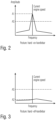
- FIG. 2 shows a diagram of the measured amplitude of "hand-on-handlebar” posture in the frequency domain (vibration spectrum)
- FIG. 3 shows a diagram of the measured amplitude of "hand-off-handlebar” posture, wherein the amplitudes A1 and A2 are measured at the same frequency of the engine speed.
- the amplitude A1 of "hand-on-handlebar” posture exceeds a threshold AS and the amplitude A2 of "hand-off-handlebar” posture is below the threshold AS.
- the detecting unit 6 detects the amplitude A1, A2 at the frequency of the excitation source (engine) and the determining unit 7 compares the detected amplitude A1, A2 and the threshold AS and transmits the signal to the warning light 8 when the amplitude A1, A2 is below the threshold AS.
- the threshold AS is set by the manufacturer or the user (rider) based on tests.
- the threshold AS can be set/adjusted dependent on the engine speed, wherein, for example, the threshold AS is increased when the engine speed approaches a critical engine speed and vice versa.
- the vibration sensor 3 can measure the vibrations at the handlebar 2 and/or the footrest, wherein the determining unit 7 transmits the signal to the warning light 8 when the amplitude A1, A2 exceeds the threshold AS.
- a band-pass filter which only passes frequencies close to a known excitation frequency (e.g. of the engine), can be applied to the sensor's output. Further, the filter bandwidth can be continuously adapted to match the excitation frequency. Whether and how strong the vibrations are measureable at the sensor position depends on the excitation source, the rider-vehicle contact surfaces and the general posture of the rider. The output of the filter is compared with estimated values for certain rider postures for the current estimated excitations.
- a spectral analysis can be performed by the detecting unit 6 for a certain time window, wherein the output shows the composition of frequencies and amplitudes of the signal during the given time window. Since applying a rectangular window creates artifacts, a fitting window function can improve the quality (e.g. Hamming window).
- the determining unit 7 compares the output of the detecting unit 6 with the expected output for different rider postures at the current excitation level to estimate the posture.
- the posture can be determined based on transfer function of the vibrations measured at different locations.
- FIG. 4 shows a system according to a second embodiment of the present invention, in which the vibration sensor 3 measures the vibrations at the right hand 1 and sensor 10 measures the vibrations at the right forearm 11. Both vibration sensors 3 and 10 transmit the measurement results to the receiving unit 5.
- the detecting unit 6 estimates the transmissibility of vibrations from the right hand 1 to the right forearm 11 and generates/calculates a respective transfer function. With the transfer function, in addition to the "right-hand-on/off-handlebar" posture, the hand-arm posture can be determined.
- the transfer function H(s) describes the relation between a given input a e (t) and a resulting output a r (t) in the Laplace domain, wherein a e (t) corresponds to the measured vibrations at the right hand and a r (t) corresponds to the vibrations at the right forearm 11.
- the transfer function H(s) of a mechanical system consisting of springs and dampers depends on the spring and damping constants. As a tensing or relaxing of muscles also changes the mechanical properties of the human body (e.g. damping behavior), it also changes the transfer function. From these changes, the current posture of the rider can be estimated by comparing each generated transfer function with transfer functions for known hand-arm postures. In this way, the posture is estimated with the transfer function as classifier. For known hand arm postures the associated transfer functions, in a memory connected with the determining unit 7.
- the determining unit 7 compares the estimated transfer function and stored transfer functions for unsafe (hand-arm) postures and transmits the signal to the warning light 8 when the estimated transfer function is classified as unsafe.
- FIG. 5 and FIG. 6 show different transfer functions estimated over a short time window.
- the transfer function H(s) shown in FIG. 5 corresponds to the save posture "tense arm with strong grip” and the transfer function H(s) shown in FIG. 6 corresponds to the unsafe posture "lose arm with loose grip”.
- the transfer function H(s) between a part of the vehicle and a limb of the rider can be estimated, wherein the vibration sensor 3 measures the vibrations at a location on the motorcycle (e.g. engine, handlebar or footrest) and the vibration sensor 10 measures the vibrations at a location on the body of the rider (e.g. hand, arm or foot).
- the vibration sensor 3 is closer to the excitation source and the transfer function H(s) consists of the mechanical system of the motorcycle and the human body.
- H tw (s) is the component of the transfer function of the vehicle and H h (s) is the component of the transfer function related to the human body.
- H tw (s) H(s) / H tw (s) assuming a linear system behavior.
- H tw (s) can also be taken from a measured characteristic diagram. In this case, the influence of the rider's body is disregarded to calibrate the online measurement of rider-posture dependent on, e.g., engine speed.
- the transfer function H(s) between two parts of the vehicle can be estimated, wherein sensor 3 measures the vibrations at a first location on the motorcycle (e.g. engine) and vibration sensor 10 measures the vibrations at a second location on the motorcycle (e.g. handlebar or footrest).
- transfer function H(s) between a part of the vehicle and a limb of the rider can be estimated, wherein the vibrations at a first location on the motorcycle (e.g. engine) are estimated based on the engine speed and/or other parameter supplied by ECU and merely the vibrations at a second location on the body of the rider (e.g. handlebar or footrest) are measured by the vibration sensors 3 or 10.
- first location on the motorcycle e.g. engine
- the vibrations at a second location on the body of the rider e.g. handlebar or footrest
- the magnitude squared coherence Ca e a r between the vibrations a e at a first location and the vibrations a r at a second location can be calculated and the calculated coherence Ca e a r can be calculated with coherences for known hand-arm postures.
- the output signal a r can be calculated if the signal a e and the transfer function are known. Only noise, non-linear system behavior or if the output is influenced by other inputs besides a e ( t ) will lower C a e a r ( f ). For a known level of noise, a change in the coherence can indicate a change of the rider posture.
- the magnitude squared coherence Ca e a r between two parts of the motorcycle, between a part of the motorcycle and a limb of the rider, or between two limbs of the rider is calculated.
- FIG. 7 shows a system according to a third embodiment of the present invention
- the vibrational sensor 3 measures the vibrations at the right hand 1
- vibration sensor 12 measures the vibrations at the left hand
- vibration sensor 13 measures the vibrations at the handle bar. 2
- the vibration sensors 3 and 12 transmit the measurement results (vibration signals) to the receiving unit 5 (not shown) and the vibration sensor 13 transmit the measurement results (vibration signals) to the detecting unit 6 via cable directly.
- the detecting unit 6 determines the power spectrum of each of the vibration signals and calculates a left transfer function for the left hand and a right transfer function for the right hand 1.
- the determining unit 7 determines/classifies the rider posture "hand-on/off-handlebar" posture for the left and right hand based on the left transfer function and the right transfer function, respectively. Additionally the determining unit 7 receives engine speed (rpm) and/or speed indication information from the motorcycle ECU 7 via e.g. CAN-Bus to determine whether the motorcycle is actually in movement.
- the warning light 8 is a dashboard LED and the determining unit 7 unit will warn the rider whenever the motorcycle is driving and at least one hand is not on the handlebar 2 (condition A). Additionally, taking one hand off the handlebar 2 for a longer time (30s) or taking both hands off simultaneously will result in the dashboard LED to flash (condition B). The automatic emergency braking system of the motorcycle will be disabled unless both hands are on the handlebar, i.e. not condition A or B.
- the system shown in FIG. 7 uses three IMU based vibration sensors 12, 13, 3: one attached to the handle bar 2 and two inside the motorcycle jacket's lower sleeves, close to each wrist. All IMUs 12, 13, 3 send their measurements to a small computing unit (the posture determining means 4) attached to the motorcycle where computations are performed.
- all sensors and/or the computing unit can be attached to the rider or its clothing, wherein the warning light 8 can be mounted in the helmet (viewing area).
- FIG. 8 shows an overview of dual-sensor and single-sensor methods, with which the posture can be determined
- FIG. 9 to FIG. 11 show the steps of the dual-sensor and single-sensor methods
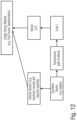
- FIG. 12 show the steps of the single-sensor methods.
- the posture can be determined by the following dual-sensor methods:
- the posture can be determined by the following single-sensor methods:
- the vibrations at only one location on the rider's body or the vehicle are measured while the other one needs to be estimated.
- Two or more of the methods 1 to 9 can be combined, wherein each method estimates another posture and/or methods estimate the same posture and the results are combined to increase the accuracy.
- An advanced rider assistant systems that supports a rider of the motorcycle can include the system for determining the posture or the determine posture can be transmitted to the ARAS.
- Possible distinguishable postures can be (but are not limited to):
- Detected postures can be used for:
- ASIC application specific integrated circuit
- DSP digital signal processor
Landscapes
- Engineering & Computer Science (AREA)
- Mechanical Engineering (AREA)
- Automation & Control Theory (AREA)
- Human Computer Interaction (AREA)
- General Physics & Mathematics (AREA)
- Multimedia (AREA)
- Theoretical Computer Science (AREA)
- Physics & Mathematics (AREA)
- Health & Medical Sciences (AREA)
- General Health & Medical Sciences (AREA)
- Transportation (AREA)
- Social Psychology (AREA)
- Psychiatry (AREA)
- Computer Vision & Pattern Recognition (AREA)
- Life Sciences & Earth Sciences (AREA)
- Biophysics (AREA)
- Cardiology (AREA)
- Heart & Thoracic Surgery (AREA)
- Physiology (AREA)
- Measurement Of Mechanical Vibrations Or Ultrasonic Waves (AREA)
Description
- The invention relates to a system and method for determining a posture of an operator of a device that transmits vibration to its operator, in particular of a driver or passenger of a vehicle. More specifically, the invention relates to a system and method for determining a posture of a rider riding a two-wheeled or three-wheeled vehicle.
- Over the last years driver assistance systems have been developed in order to increase the comfort for a driver and the safety of driving. Such driver assistance systems are capable of sensing not only the environment around a vehicle, but also monitoring the driver or passenger to determine its presence, gaze direction, awareness and/or posture. In order to do so, the vehicles are equipped with cameras capturing images of the driver and/or the passengers. The captured images are processed to derive information on presence and/or posture.
- Such cameras are often difficult to integrate, especially in motorcycles like two-wheelers, three-wheelers or quad bikes without a cabin. Further, the quality of the captured image may be affected by weather conditions, for example, by raindrops or dirt on the lens. However, similar to cars, the posture of a rider is essential to the safety of the rider and vehicle operation. An estimated posture can be used to set vehicle stability control parameters, to trigger automatic emergency braking, to select a driving mode (sport, low-torque or rain), to adapt damper setting and/or to give feedback for rider about unsafe rider posture.
- On the other hand, monitoring the operation of tools and work machines by an operator can increase safety, too. However, it is difficult to capture images of a worker using such a machine or tool because many machines do not offer a position that allows proper imaging of the worker, which would be needed to determine the worker's posture in order to switch off the working machine in case of its unsecure handling.
- A system, in which all features of the preamble of
claim 1 are disclosed, is described inWO 2019/162826 A1 . - Furthermore, a system for determining a posture of a rider riding a motorcycle is described in
WO 2020/143944 A1 to be state of the art according Art. 54(3) EPC. The system described inWO 2020/143944 A1 comprises acceleration sensors for measuring accelerations at locations, at which the rider contacts the motorcycle, a reference acceleration sensor for measuring accelerations at a location, at which the rider does not contact the motorcycle and a posture determining means configured to calculate a transfer function based on the reference sensor signal and the other sensor signals and to determine the posture based on the transfer function. - It is an object of the present invention to overcome the above-mentioned drawbacks and to provide an improved system for determining a posture of a driver or a passenger of a handlebar-equipped vehicle. More specifically, it is an object of the invention to provide a system and method, with which the posture of a rider riding a handlebar-equipped vehicle can be estimated with low effort and costs.
- This object is achieved by a system and a method according to the enclosed independent claims. Advantageous features of the present invention are defined in the corresponding subclaims.
- In many vehicles, mechanical vibrations generated by external and/or internal sources of the vehicle are transmitted from the vehicle to the driver and/or the passenger. The application takes into account the fact that the vibration transmissibility within the handlebar-equipped vehicle, from the handlebar-equipped vehicle to the human body and within the human body as well as the vibration characteristic (frequencies and amplitudes) at a location on the vehicle or the human body depends on the posture of the human body being in contact with the handlebar-equipped vehicle or its vibrating parts.
- According to the present invention, a system for determining a posture of a driver or a passenger of a handlebar-equipped vehicle, particularly a rider riding the handlebar-equipped vehicle, that transmits vibrations to the driver or the passenger comprises at least one vibration sensor for measuring, on at least one location on the body of the driver or the passenger, the vibrations transmitted from the handlebar-equipped vehicle to the driver or the passenger and a posture determining means for detecting one or more characteristics of the measured vibrations assigned to a predetermined posture and for determining the predetermined posture as the posture of the driver or the passenger when the characteristic is detected.
- The term "posture" means the totality of body posture, especially with regard to a "riding posture" or "rider posture", handle grip force, muscle tension, vehicle-rider contact, e.g., hands-on-handlebar vs hands-off-handlebar, strength of handlebar grip, strength of knee-vehicle contact, feet-on-footrests/pegs vs feet-off-footrests/pegs, arm angle, leg angles, a upright posture, forward-leaning posture and/or standing posture are included.
- The handlebar-equipped can be any handlebar-equipped vehicle, which transmits mechanical vibrations generated by external and/or internal sources of the handlebar-equipped vehicle to the driver or the passenger and where the posture is essential to the safety of the person and/or device operation. Preferably, the device can be a vehicle such as a bicycle, scooter, motorcycle like two-wheelers, three-wheelers or quad bikes, either powered or unpowered.
- The posture estimated by the system can be stored for analysis and statistical purposes and/or can be further processed by the system to generate an acoustical and/or visually warning signal for the driver or the passenger, and/or can be supplied to a separate driver assistance system. Alternatively, the system can be a part of the driver assistance system.
- The characteristics of vibrations assigned to the predetermined posture can be estimated and stored by the manufacturer or the driver or the passenger, wherein characteristics of vibrations are analyzed during the driver or the passenger drives with the posture to be estimated.
- The vibration sensor(s) can be configured to measure translational and/or rotational movement and/or can comprise at least one of an accelerometer, a piezoelectric sensor, a piezo-resistive sensor, resistive sensor, an inductive sensor, a capacitive sensor, a gyroscope, a magnetometer and a seismometer.
- Alternatively or in addition, the vibration sensor(s) can be configured to measure the vibrations on at least one of the locations: palm, back of the hand, wrist, forearm, upper arm, shoulder, sole, ankle, lower leg, knee, thigh of the driver or the passenger. In addition, the vibration may also be measured on at least one of the following locations: handlebar, handlebar grips, footrest, seat, frame, fork bridge, engine mount and engine of the vehicle.
- Preferably, at least one of the characteristics can be an intensity of the measured vibrations. With the measured intensity, for example, the postures "hands-on-handlebar" and "hands-off-handlebar" or the postures "feet-on-footrest" and "feet-off-footrest" can be determined easily, wherein the vibration intensity at a location on the handlebar or the footrest increases when the hand or the feet is removed from handlebar or the footrest, whereas the vibration intensity at a location on the hand or foot decreases. Further, a very high vibration intensity at a location on the foot indicates a standing position/posture of the rider.
- The measured vibrations also depend on the excitation source of the vibrations. Even if the wheels and/or an engine of the handlebar-equipped vehicle is the excitation source, its emitted vibrations are often not constant and depend on the handlebar-equipped vehicle and/or engine speed. This can be taken into consideration in order to increase the detection accuracy. For example, the posture determining means can be configured to determine an excitation frequency of the vibrations and/or the excitation intensity and to perform a filtering by a band-pass filter that passes frequencies of the measured vibrations within a certain range, wherein the center frequency of the band-pass filter is the determined excitation frequency and/or to perform an amplification or damping of the measured vibrations based on the determined excitation intensity.
- Alternatively or in addition, at least one of the characteristics can be a composition of frequencies and amplitudes in a frequency spectrum of the measured vibrations, wherein the posture determining means is configured to transform a signal of the measured vibrations in the frequency domain and to detect, in the frequency spectrum of the transformed signal, the composition of frequencies and amplitudes assigned to the predetermined posture.
- In addition, the posture determining means can be configured to detect one of the characteristics described above by measuring the vibrations at only one location.
- Vibrations at the excitation source could be determined indirectly and, when the vibrations are transferred from a first location to a second location, the vibration sensor(s) can be configured to merely measure vibrations at the second location.
- Preferably, the posture determining means can be configured to determine vibrations of the first location based on at least one of: an engine speed of the vehicle, driving speed of the vehicle, gear position and throttle position.
- Alternatively, the vibration sensor(s) can be configured to measure vibrations of the first location on the vehicle and to measure vibrations of the second location on the handlebar-equipped vehicle or the body.
- Alternatively or in addition, the vibration sensor(s) can be configured to measure both vibrations of the first location and vibrations of the second location on the body.
- At least one of the characteristics can be a transfer function of vibrations transferred from the first location to the second location, wherein the posture determining means is configured to calculate the transfer function and to compare the calculated transfer function with a transfer function assigned to the predetermined posture.
- Alternatively or in addition, at least one of the characteristics can be a coherence between vibrations of the first location and the second location, the posture determining means is configured to calculate magnitude squared coherence between vibrations of the first location and the second location and to compare the calculated magnitude squared coherence with a magnitude squared coherence assigned to the predetermined posture.
- Preferably, the posture determining means is configured to determine each of a plurality of different postures of the driver or the passenger, wherein each posture is classified by one or more predetermined characteristics and/or a predetermined combination of characteristics.
- According to the present invention, a method for determining a posture of a driver or the passenger of a handlebar-equipped vehicle that transmits vibrations to the driver or the passenger, comprises the steps of:
- measuring, on at least one location on the body of the driver or the passenger, the vibrations transmitted from the vehicle to the driver or the passenger,
- detecting one or more characteristic(s) of the measured vibrations assigned to a predetermined posture, and
- determining the predetermined posture as the posture of the driver or the passenger when the characteristic is detected.
- The invention is to be explained more detailed in the following with reference to the accompanying drawing, wherein:
-
FIG. 1 shows a schematic structural diagram of a system according to a first embodiment of the present invention, -
FIG. 2 shows characteristic of vibrations measured by the system shown inFIG. 1 and assigned to a first posture, -
FIG. 3 shows characteristic of vibrations measured by the system shown inFIG. 1 and assigned to a second posture, -
FIG. 4 shows a system according to a second embodiment of the present invention, -
FIG. 5 shows characteristic of vibrations measured by the system shown inFIG. 4 and assigned to a third posture, -
FIG. 6 shows characteristic of vibrations measured by the system shown inFIG. 4 and assigned to a fourth posture, -
FIG. 7 shows a system according to a third embodiment of the present invention, -
FIG. 8 shows an overview of dual-sensor and single-sensor methods, with which the posture can be determined, -
FIG. 9 to FIG. 11 show the steps of the dual-sensor methods, and -
FIG. 12 show the steps of the single-sensor methods. - The same features are denoted in the figures by the same reference signs. It is to be noted that for the following explanations it is assumed that the device is a two-wheeled vehicles such as a motorcycle and the operator is the writer of the motorcycle, unless indicated otherwise.
-
FIG. 1 shows a system for determining postures of a rider riding a vehicle according to a first embodiment of the present invention. To be more precise, the vehicle is a motorcycle (not shown) and the determined postures are "right hand 1 on ahandlebar 2" of the motorcycle and "right hand 1 off thehandlebar 2". The system comprises avibration sensor 3 for measuring vibrations at theright hand 1 and aposture determining means 4 for determining whether theright hand 1 is placed on thehandlebar 2 as shown inFIG. 1 or theright hand 1 is removed from thehandlebar 2. - The
sensor 3, which can be an inertial measurement unit (IMU), is located in a glove of the rider, measures translational and/or rotational movement at theright hand 1 and transmits the measurement result to theposture determining means 4, preferably via a wireless connection (e.g. Bluetooth). Theposture determining means 4 comprises a receivingunit 5 for receiving the measurement result (measured vibrations) fromvibration sensor 3, a detectingunit 6 for detecting/extracting characteristics of the measured vibrations, with which "hand-on-handlebar" posture or "hand-off-handlebar" posture can be determined and a determiningunit 7 for determining the "hand-on-handlebar" posture or "hand-off-handlebar" posture based on the extracted characteristics and for transmitting, by wireless link or cable, a signal to awarning light 8 when the "hand-off-handlebar" posture is detected. Theposture determining means 4 may be realized as a processor configured to perform the necessary calculations based on an input signal from thevibration sensor 3. The signal generated by thevibration sensor 3 may be preprocessed before it is input into the processor. - With the "hand-on-handlebar" posture, vibrations generated by the combustion engine of the motorcycle are transmitted from the engine to the
right hand 1 via thehandlebar 2, whereas there is no transfer of vibrations via thehandlebar 2 with the "hand-off-handlebar" posture. - In this way, an amplitude of the vibrations indicates the "hand-off-handlebar" posture and the "hand-on-handlebar" posture. In order to tune the detecting
unit 6 to the vibrations generated by the engine, information on engine speed is supplied from an electronic control unit 9 (ECU) of the motorcycle and the detectingunit 6 determines the amplitude at a frequency that corresponds to the current engine speed by filtering the measured vibrations or by transforming the signal of the measured vibrations in the frequency domain. -
FIG. 2 shows a diagram of the measured amplitude of "hand-on-handlebar" posture in the frequency domain (vibration spectrum) andFIG. 3 shows a diagram of the measured amplitude of "hand-off-handlebar" posture, wherein the amplitudes A1 and A2 are measured at the same frequency of the engine speed. As shown inFIG. 2 and FIG. 3 , the amplitude A1 of "hand-on-handlebar" posture exceeds a threshold AS and the amplitude A2 of "hand-off-handlebar" posture is below the threshold AS. - The detecting
unit 6 detects the amplitude A1, A2 at the frequency of the excitation source (engine) and the determiningunit 7 compares the detected amplitude A1, A2 and the threshold AS and transmits the signal to thewarning light 8 when the amplitude A1, A2 is below the threshold AS. The threshold AS is set by the manufacturer or the user (rider) based on tests. - Since the detected amplitude A1, A2 also depends on the engine speed, the threshold AS can be set/adjusted dependent on the engine speed, wherein, for example, the threshold AS is increased when the engine speed approaches a critical engine speed and vice versa. With the system described above, "righthand-on/off-handlebar" posture is determined only. However, "left-hand-on/off-handlebar" posture and/or "feet-on/off-footrests" can be determined similarly. Alternatively or in addition, the
vibration sensor 3 can measure the vibrations at thehandlebar 2 and/or the footrest, wherein the determiningunit 7 transmits the signal to thewarning light 8 when the amplitude A1, A2 exceeds the threshold AS. - As described above, a band-pass filter, which only passes frequencies close to a known excitation frequency (e.g. of the engine), can be applied to the sensor's output. Further, the filter bandwidth can be continuously adapted to match the excitation frequency. Whether and how strong the vibrations are measureable at the sensor position depends on the excitation source, the rider-vehicle contact surfaces and the general posture of the rider. The output of the filter is compared with estimated values for certain rider postures for the current estimated excitations.
- Alternatively or in addition, a spectral analysis (Fourier Transformation) can be performed by the detecting
unit 6 for a certain time window, wherein the output shows the composition of frequencies and amplitudes of the signal during the given time window. Since applying a rectangular window creates artifacts, a fitting window function can improve the quality (e.g. Hamming window). The determiningunit 7 compares the output of the detectingunit 6 with the expected output for different rider postures at the current excitation level to estimate the posture. - Motorcycle and rider form a mechanical system that transmits the vibrations. A system, with which shift of the overall transmissibility from handlebar (or similar objects) to the human body with respect to the posture can be determined, is disclosed in Forte, Paola; Pham, Due (2017): "Identification of the hand-arm system mechanical impedance by simultaneous measurement of grip, transmitted force and acceleration with an adaptable instrumented handle", Cogent Engineering 4 (1), S. 2953. Further, Xu, Xueyan S.; Dong, Ren G.; Welcome, Daniel E.; Warren, Christopher; McDowell, Thomas W.; Wu, John Z. (2017): "Vibrations transmitted from human hands to upper arm, shoulder, back, neck, and head", International journal of industrial ergonomics 62, S. 1-12, discloses a system, with which the transmissibility of vibrations from an excitation source held in one or both hands to other parts of the body can be determined.
- According to the present invention, the posture can be determined based on transfer function of the vibrations measured at different locations.
FIG. 4 shows a system according to a second embodiment of the present invention, in which thevibration sensor 3 measures the vibrations at theright hand 1 andsensor 10 measures the vibrations at theright forearm 11. Bothvibration sensors unit 5. The detectingunit 6 estimates the transmissibility of vibrations from theright hand 1 to theright forearm 11 and generates/calculates a respective transfer function. With the transfer function, in addition to the "right-hand-on/off-handlebar" posture, the hand-arm posture can be determined. - The transfer function H(s) describes the relation between a given input ae(t) and a resulting output ar(t) in the Laplace domain, wherein ae(t) corresponds to the measured vibrations at the right hand and ar(t) corresponds to the vibrations at the
right forearm 11.
- The transfer function H(s) of a mechanical system consisting of springs and dampers depends on the spring and damping constants. As a tensing or relaxing of muscles also changes the mechanical properties of the human body (e.g. damping behavior), it also changes the transfer function. From these changes, the current posture of the rider can be estimated by comparing each generated transfer function with transfer functions for known hand-arm postures. In this way, the posture is estimated with the transfer function as classifier. For known hand arm postures the associated transfer functions, in a memory connected with the determining
unit 7. - The determining
unit 7 compares the estimated transfer function and stored transfer functions for unsafe (hand-arm) postures and transmits the signal to thewarning light 8 when the estimated transfer function is classified as unsafe. -
FIG. 5 and FIG. 6 show different transfer functions estimated over a short time window. The transfer function H(s) shown inFIG. 5 corresponds to the save posture "tense arm with strong grip" and the transfer function H(s) shown inFIG. 6 corresponds to the unsafe posture "lose arm with loose grip". - Alternatively or in addition, the transfer function H(s) between a part of the vehicle and a limb of the rider can be estimated, wherein the
vibration sensor 3 measures the vibrations at a location on the motorcycle (e.g. engine, handlebar or footrest) and thevibration sensor 10 measures the vibrations at a location on the body of the rider (e.g. hand, arm or foot). In this way, thevibration sensor 3 is closer to the excitation source and the transfer function H(s) consists of the mechanical system of the motorcycle and the human body.
- A change in the rider posture again leads to change in the transfer function H(s). In the formula, Htw(s) is the component of the transfer function of the vehicle and Hh(s) is the component of the transfer function related to the human body. In some applications it might be beneficial to measure Htw(s) without the rider to calculate Hh(s) = H(s) / Htw(s) assuming a linear system behavior. Htw(s) can also be taken from a measured characteristic diagram. In this case, the influence of the rider's body is disregarded to calibrate the online measurement of rider-posture dependent on, e.g., engine speed.
- Alternatively or in addition, the transfer function H(s) between two parts of the vehicle can be estimated, wherein
sensor 3 measures the vibrations at a first location on the motorcycle (e.g. engine) andvibration sensor 10 measures the vibrations at a second location on the motorcycle (e.g. handlebar or footrest). In this way, the transfer function H(s) consists of the mechanical system of the motorcycle, which is affected by the human body:
- A change in the rider posture (e.g. damping of hands on handlebars) leads to changes in Htw(s). Thus, the rider posture can be concluded.
- Alternatively or in addition, transfer function H(s) between a part of the vehicle and a limb of the rider can be estimated, wherein the vibrations at a first location on the motorcycle (e.g. engine) are estimated based on the engine speed and/or other parameter supplied by ECU and merely the vibrations at a second location on the body of the rider (e.g. handlebar or footrest) are measured by the
vibration sensors - Alternatively or in addition, the magnitude squared coherence Caear between the vibrations ae at a first location and the vibrations ar at a second location can be calculated and the calculated coherence Caear can be calculated with coherences for known hand-arm postures. The magnitude squared coherence Caear defined as

e ar and Par ar being the power spectral densities of input and output signal and Pan ar being the cross spectral density. For linear system functions and ergodic signals it can be used to estimate the correlation (causality) between the input signal ae and the output signal ar. It takes values between zero and one. For C aear (f) = 1 the output signal a r can be calculated if the signal ae and the transfer function are known. Only noise, non-linear system behavior or if the output is influenced by other inputs besides ae (t) will lower C ae ar (f). For a known level of noise, a change in the coherence can indicate a change of the rider posture. - The magnitude squared coherence Caear between two parts of the motorcycle, between a part of the motorcycle and a limb of the rider, or between two limbs of the rider is calculated.
-
FIG. 7 shows a system according to a third embodiment of the present invention, thevibrational sensor 3 measures the vibrations at theright hand 1,vibration sensor 12 measures the vibrations at the left hand andvibration sensor 13 measures the vibrations at the handle bar. 2 Thevibration sensors vibration sensor 13 transmit the measurement results (vibration signals) to the detectingunit 6 via cable directly. The detectingunit 6 determines the power spectrum of each of the vibration signals and calculates a left transfer function for the left hand and a right transfer function for theright hand 1. - The determining
unit 7 determines/classifies the rider posture "hand-on/off-handlebar" posture for the left and right hand based on the left transfer function and the right transfer function, respectively. Additionally the determiningunit 7 receives engine speed (rpm) and/or speed indication information from themotorcycle ECU 7 via e.g. CAN-Bus to determine whether the motorcycle is actually in movement. Thewarning light 8 is a dashboard LED and the determiningunit 7 unit will warn the rider whenever the motorcycle is driving and at least one hand is not on the handlebar 2 (condition A). Additionally, taking one hand off thehandlebar 2 for a longer time (30s) or taking both hands off simultaneously will result in the dashboard LED to flash (condition B). The automatic emergency braking system of the motorcycle will be disabled unless both hands are on the handlebar, i.e. not condition A or B. - The system shown in
FIG. 7 uses three IMU basedvibration sensors handle bar 2 and two inside the motorcycle jacket's lower sleeves, close to each wrist. AllIMUs - Alternatively, all sensors and/or the computing unit (processor) can be attached to the rider or its clothing, wherein the
warning light 8 can be mounted in the helmet (viewing area). -
FIG. 8 shows an overview of dual-sensor and single-sensor methods, with which the posture can be determined,FIG. 9 to FIG. 11 show the steps of the dual-sensor and single-sensor methods andFIG. 12 show the steps of the single-sensor methods. - With the present invention, the posture can be determined by the following dual-sensor methods:
- Method 1: The transfer function between the two limbs of the rider is estimated to estimate e.g. posture stiffness aka body tension (see
FIG. 9 ). - Method 2: The transfer function between a part of the vehicle and a limb of the rider is estimated, e.g. handle bar grip strength, (see
FIG. 10 ) - Method 3: The transfer function between two parts of the vehicle is estimated, to derive e.g. handlebar vibration dampening caused from a stronger grip on the handlebar. (see
FIG. 11 ). Asmethods - Method 4: The magnitude squared coherence between two limbs is calculated. (see
FIG. 9 ) - Method 5: The magnitude squared coherence between a part of the vehicle and a limb of the rider is calculated. (see
FIG. 10 ). - Method 6: The magnitude squared coherence between two parts of the vehicle is calculated (see
FIG. 11 ). Asmethods - Further, the posture can be determined by the following single-sensor methods:
- Method 7: A bandpass filter, which only passes frequencies close to a known excitation frequency (e.g. engine), is applied to the sensor's output. The output is compared with estimated values for certain rider postures for the current estimated excitations.
- Method 8: A Spectral Analysis (Fourier Transformation) is performed for a certain time window (see
FIG. 12 ). - Method 9: With an estimated transfer function between a part of the vehicle and a limb of the rider is estimated.
- For the single-sensor methods, the vibrations at only one location on the rider's body or the vehicle are measured while the other one needs to be estimated.
- Two or more of the
methods 1 to 9 can be combined, wherein each method estimates another posture and/or methods estimate the same posture and the results are combined to increase the accuracy. - An advanced rider assistant systems (ARAS) that supports a rider of the motorcycle can include the system for determining the posture or the determine posture can be transmitted to the ARAS. Possible distinguishable postures can be (but are not limited to):
- Rider-hands-on-handlebar-detection
- Rider-foot-on-footpegs-detection
- Unsafe-riding-posture-detection
- Rider-prepared-to-brake-detection (not necessarily binary)
- Rider-mode detection (sporty posture, relaxed cruising posture)
- Estimation of rider-vehicle contact (especially inner leg-vehicle contact and grip-strength estimation)
- Detected postures can be used for:
- Automatic emergency braking (none, soft or hard braking intervention)
- Rider skill estimation to give feedback to rider
- Rider skill estimation to adjust vehicle behavior (e.g. maximum acceleration)
- Riding mode determination to adjust vehicle behavior (e.g. sporty mode when sporty posture)
- Rider alert when riding in unsafe riding posture (e.g. hands-off-handlebar or foot-off-footpegs).
- The system and/or any of the functions described herein may be implemented using individual hardware circuitry, using software functioning in conjunction with a programmed microprocessor or a general purpose computer, using an application specific integrated circuit (ASIC) and/or using one or more digital signal processors (DSPs).
Claims (15)
- System for determining a posture of a driver or passenger of a handlebar equipped vehicle that transmits vibrations to the driver or the passenger,
characterized byat least one vibration sensor (3, 10, 12, 13) for measuring, on at least one location on the body of the driver or the passenger, the vibrations transmitted from the handlebar equipped vehicle to the driver or the passenger; andposture determining means (4) for detecting one or more characteristics of the measured vibrations assigned to a predetermined posture and for determining the predetermined posture as the posture of the driver or the passenger when the characteristic is detected. - System according to claim 1, wherein
the vibration sensor(s) (3, 10, 12, 13) is/are configured to measure translational and/or rotational movement and comprise(s) at least one of an accelerometer, a piezoelectric sensor, a piezo-resistive sensor, resistive sensor, an inductive sensor, a capacitive sensor, a gyroscope, a magnetometer and a seismometer. - System according to any one of the preceding claims, wherein
the vibration sensor(s) (3, 10, 12, 13) is/are configured to measure the vibrations on at least one of the locations: palm, back of the hand, wrist, forearm, upper arm, shoulder, sole, ankle, lower leg, knee of the rider and thigh of the driver or the passenger, or in addition on at least of the locations: handlebar, handlebar grips, footrest, seat, frame, fork bridge, engine mount and engine of the vehicle. - System according to any one of the preceding claims, wherein
at least one of the characteristics is an intensity of the measured vibrations. - System according to claim 4, wherein
the posture determining means (4) is configured to determine an excitation frequency of the measured vibrations and to perform a filtering by a band-pass filter that passes frequencies of the measured vibrations within a certain range, wherein the center frequency of the band-pass filter is the determined excitation frequency. - System according to any one of the preceding claims, wherein
at least one of the characteristics is a composition of frequencies and amplitudes of a frequency spectrum of the measured vibrations and the posture determining means (4) is configured to transform a signal of the measured vibrations in the frequency domain and to detect, in the frequency spectrum, the composition of frequencies and amplitudes assigned to the predetermined posture. - System according to claim 5 or 6, wherein
the posture determining means (4) is configured to detect one of the characteristics by measuring the vibrations at only one location. - System according to any one of the preceding claims, wherein
the measuring means (3, 10, 12, 13) is configured to measure at least vibrations at a second location to which vibrations are transferred from a first location. - System according to claim 8, wherein
the posture determining means (4) is configured to determine vibrations at the first location based on at least one of: an engine speed of the vehicle, driving speed of the vehicle, gear position and throttle position. - System according to according to claim 8, wherein
the vibration sensor(s) (3, 10, 12, 13) is/are configured to measure vibrations at the first location on the vehicle and to measure vibrations at the second location on the body. - System according to claim 8, wherein
the vibration sensor(s) (3, 10, 12, 13) is/are configured to measure both vibrations at the first location and vibrations at the second location on the body. - System according to any one of claims 8 to 11, whereinat least one of the characteristics is a transfer function of vibrations transferred from the first location to the second location; andthe posture determining means (4) is configured to calculate the transfer function and to compare the calculated transfer function with a transfer function assigned to the predetermined posture.
- System according to any one of claims 8 to 12, whereinat least one of the characteristics is a coherence between vibrations of the first location and the second location; andthe posture determining means (4) is configured to calculate magnitude squared coherence between vibrations of the first location and the second location and to compare the calculated magnitude squared coherence with a magnitude squared coherence assigned to the predetermined posture.
- System according to any one of the preceding claims, wherein
the posture determining means (4) is configured to determine each of a plurality of different postures of the driver or the passenger, wherein each posture is classified by one or more predetermined characteristics and/or a predetermined combination of characteristics. - Method for determining a posture of a driver or passenger of a handlebar equipped vehicle that transmits vibrations to the driver or the passenger,characterized in that the method comprises the steps of:measuring (2, 12, 13), on at least one location on the body of the driver or the passenger, the vibrations transmitted from the vehicle to the driver or the passenger;detecting (6) one or more characteristics of the measured vibrations assigned to a predetermined posture; anddetermining (7) the predetermined posture as the posture of the rider when the characteristic is detected.
Priority Applications (2)
| Application Number | Priority Date | Filing Date | Title |
|---|---|---|---|
| EP20164241.0A EP3882114B1 (en) | 2020-03-19 | 2020-03-19 | System for estimating riding posture |
| US17/206,161 US11565714B2 (en) | 2020-03-19 | 2021-03-19 | System for estimating riding posture |
Applications Claiming Priority (1)
| Application Number | Priority Date | Filing Date | Title |
|---|---|---|---|
| EP20164241.0A EP3882114B1 (en) | 2020-03-19 | 2020-03-19 | System for estimating riding posture |
Publications (2)
| Publication Number | Publication Date |
|---|---|
| EP3882114A1 EP3882114A1 (en) | 2021-09-22 |
| EP3882114B1 true EP3882114B1 (en) | 2023-09-20 |
Family
ID=69846348
Family Applications (1)
| Application Number | Title | Priority Date | Filing Date |
|---|---|---|---|
| EP20164241.0A Active EP3882114B1 (en) | 2020-03-19 | 2020-03-19 | System for estimating riding posture |
Country Status (2)
| Country | Link |
|---|---|
| US (1) | US11565714B2 (en) |
| EP (1) | EP3882114B1 (en) |
Families Citing this family (5)
| Publication number | Priority date | Publication date | Assignee | Title |
|---|---|---|---|---|
| KR102735979B1 (en) * | 2019-10-29 | 2024-11-28 | 현대자동차주식회사 | Apparatus and method for determining riding comfort of mobility user using brain wave |
| TWI875810B (en) * | 2020-09-15 | 2025-03-11 | 日商島野股份有限公司 | Human-powered vehicle control device |
| CN115384663B (en) * | 2022-09-20 | 2023-11-21 | 台铃科技股份有限公司 | Riding gesture monitoring and reminding method |
| CN116173478B (en) * | 2023-03-06 | 2024-08-27 | 南通大学 | Posture correction system for indoor bicycle safe riding training |
| IT202300012036A1 (en) * | 2023-06-13 | 2024-12-13 | Pili Giorgio | DEVICE LOCATED AT THE REAR OF THE TANK OF A SPORTS ROAD MOTORCYCLE WITH THE PURPOSE OF ACTIVATING, THROUGH THE RIDER'S DRIVING MOVEMENTS ON IT AND HYDRAULIC AND/OR PNEUMATIC PISTONS, OTHER DEVICES (SUCH AS SUSPENSIONS) DESIGNED TO IMPROVE THE PERFORMANCE, SAFETY AND COMFORT OF THE VEHICLE ITSELF |
Family Cites Families (12)
| Publication number | Priority date | Publication date | Assignee | Title |
|---|---|---|---|---|
| US8083693B1 (en) * | 2007-03-30 | 2011-12-27 | Perseus Athletics, LLC | Monitoring posture |
| US20170257934A1 (en) * | 2016-03-05 | 2017-09-07 | Brian Jon Garvey | Wireless signal light systems for vehicles including wireless illuminated gear and clothing |
| JP2018115978A (en) * | 2017-01-19 | 2018-07-26 | ソニー株式会社 | Vehicle control device |
| JP2020100163A (en) * | 2017-04-07 | 2020-07-02 | ヤマハ発動機株式会社 | Handling input information acquisition system |
| US11195118B2 (en) * | 2017-11-20 | 2021-12-07 | International Business Machines Corporation | Detecting human input activity in a cognitive environment using wearable inertia and audio sensors |
| JP7066389B2 (en) * | 2017-12-07 | 2022-05-13 | パラマウントベッド株式会社 | Posture judgment device |
| IT201800002996A1 (en) * | 2018-02-23 | 2019-08-23 | Sense Corp | SYSTEM FOR EVALUATING A CYCLIST'S PERFORMANCE ACCORDING TO HIS POSITION ON THE SADDLE |
| US11406285B2 (en) * | 2018-05-08 | 2022-08-09 | Seismic Holdings, Inc. | Exosuit systems and methods for posture session segmentation and biomechanical feedback |
| KR102602419B1 (en) * | 2018-09-21 | 2023-11-14 | 현대자동차주식회사 | System for correcting passenger's posture in the self-driving vehicle |
| DE102019200195A1 (en) * | 2019-01-10 | 2020-07-16 | Robert Bosch Gmbh | Method for performing a braking operation in a vehicle with a passenger |
| WO2020255287A1 (en) * | 2019-06-19 | 2020-12-24 | 三菱電機株式会社 | Automatic driving assistance device, automatic driving assistance system, and automatic driving assistance method |
| US11345298B2 (en) * | 2019-12-26 | 2022-05-31 | Panasonic Intellectual Property Management Co., Ltd. | Driver monitoring device and driver monitoring method |
-
2020
- 2020-03-19 EP EP20164241.0A patent/EP3882114B1/en active Active
-
2021
- 2021-03-19 US US17/206,161 patent/US11565714B2/en active Active
Also Published As
| Publication number | Publication date |
|---|---|
| EP3882114A1 (en) | 2021-09-22 |
| US20210291854A1 (en) | 2021-09-23 |
| US11565714B2 (en) | 2023-01-31 |
Similar Documents
| Publication | Publication Date | Title |
|---|---|---|
| EP3882114B1 (en) | System for estimating riding posture | |
| JP4719188B2 (en) | Method of measuring vibration in operating device | |
| US20140015662A1 (en) | Method for monitoring the posture of a motorcyclist | |
| JP5650815B2 (en) | Method and apparatus for detecting driver's fatigue using steering angle detection sensor | |
| KR101519199B1 (en) | System and Method for Detecting of Road | |
| JP3991978B2 (en) | Vehicle angular velocity sensor correction diagnosis device | |
| JP6080078B2 (en) | Posture and walking state estimation device | |
| JP6159541B2 (en) | Method and apparatus for data acquisition for a safety device of a balanced vehicle | |
| US10845802B2 (en) | Method for operating a motor vehicle | |
| US12151676B2 (en) | Rider-assistance system and control method for rider-assistance system | |
| JP7186867B2 (en) | Method and apparatus for monitoring motorcycles | |
| JP2014008789A (en) | Pedalling state measurement device | |
| JP2015107798A (en) | Method and apparatus for detecting the fall of a driver of a motorcycle | |
| WO2014031042A1 (en) | Eyelid movement processing for detection of drowsiness | |
| JP2020100163A (en) | Handling input information acquisition system | |
| CN110382339A (en) | The system and method for the road quality in bicyclist's behavior and/or the path followed along the bicycle on estimation bicycle | |
| US10780855B2 (en) | Method for operating a motorized two-wheeled vehicle, in particular a motorcycle, and computer program for carrying out the method | |
| US12330463B2 (en) | Vehicle suspension system | |
| JP5914163B2 (en) | Motorcycle airbag determination device | |
| CN112889270A (en) | Information processing method, information processing device, information processing program, and information processing system | |
| JP2010067058A (en) | Face direction detection device | |
| JP2014162260A (en) | Stability evaluation system and stability evaluation method | |
| JP2002019601A (en) | Bad road judgment device | |
| JP2007062602A (en) | Rider behavior measurement method | |
| JP4657514B2 (en) | Phase lag detector for maneuverability and stability feeling evaluation |
Legal Events
| Date | Code | Title | Description |
|---|---|---|---|
| PUAI | Public reference made under article 153(3) epc to a published international application that has entered the european phase |
Free format text: ORIGINAL CODE: 0009012 |
|
| STAA | Information on the status of an ep patent application or granted ep patent |
Free format text: STATUS: THE APPLICATION HAS BEEN PUBLISHED |
|
| AK | Designated contracting states |
Kind code of ref document: A1 Designated state(s): AL AT BE BG CH CY CZ DE DK EE ES FI FR GB GR HR HU IE IS IT LI LT LU LV MC MK MT NL NO PL PT RO RS SE SI SK SM TR |
|
| STAA | Information on the status of an ep patent application or granted ep patent |
Free format text: STATUS: REQUEST FOR EXAMINATION WAS MADE |
|
| 17P | Request for examination filed |
Effective date: 20211221 |
|
| RBV | Designated contracting states (corrected) |
Designated state(s): AL AT BE BG CH CY CZ DE DK EE ES FI FR GB GR HR HU IE IS IT LI LT LU LV MC MK MT NL NO PL PT RO RS SE SI SK SM TR |
|
| GRAP | Despatch of communication of intention to grant a patent |
Free format text: ORIGINAL CODE: EPIDOSNIGR1 |
|
| STAA | Information on the status of an ep patent application or granted ep patent |
Free format text: STATUS: GRANT OF PATENT IS INTENDED |
|
| RIC1 | Information provided on ipc code assigned before grant |
Ipc: G06F 18/00 20230101ALN20230512BHEP Ipc: B62J 99/00 20200101ALI20230512BHEP Ipc: B62J 45/416 20200101AFI20230512BHEP |
|
| INTG | Intention to grant announced |
Effective date: 20230616 |
|
| GRAS | Grant fee paid |
Free format text: ORIGINAL CODE: EPIDOSNIGR3 |
|
| GRAA | (expected) grant |
Free format text: ORIGINAL CODE: 0009210 |
|
| STAA | Information on the status of an ep patent application or granted ep patent |
Free format text: STATUS: THE PATENT HAS BEEN GRANTED |
|
| REG | Reference to a national code |
Ref country code: DE Ref legal event code: R084 Ref document number: 602020017834 Country of ref document: DE |
|
| AK | Designated contracting states |
Kind code of ref document: B1 Designated state(s): AL AT BE BG CH CY CZ DE DK EE ES FI FR GB GR HR HU IE IS IT LI LT LU LV MC MK MT NL NO PL PT RO RS SE SI SK SM TR |
|
| REG | Reference to a national code |
Ref country code: GB Ref legal event code: FG4D |
|
| REG | Reference to a national code |
Ref country code: CH Ref legal event code: EP |
|
| REG | Reference to a national code |
Ref country code: DE Ref legal event code: R096 Ref document number: 602020017834 Country of ref document: DE |
|
| REG | Reference to a national code |
Ref country code: IE Ref legal event code: FG4D |
|
| REG | Reference to a national code |
Ref country code: LT Ref legal event code: MG9D |
|
| PG25 | Lapsed in a contracting state [announced via postgrant information from national office to epo] |
Ref country code: GR Free format text: LAPSE BECAUSE OF FAILURE TO SUBMIT A TRANSLATION OF THE DESCRIPTION OR TO PAY THE FEE WITHIN THE PRESCRIBED TIME-LIMIT Effective date: 20231221 |
|
| P01 | Opt-out of the competence of the unified patent court (upc) registered |
Effective date: 20231214 |
|
| REG | Reference to a national code |
Ref country code: NL Ref legal event code: MP Effective date: 20230920 |
|
| PG25 | Lapsed in a contracting state [announced via postgrant information from national office to epo] |
Ref country code: SE Free format text: LAPSE BECAUSE OF FAILURE TO SUBMIT A TRANSLATION OF THE DESCRIPTION OR TO PAY THE FEE WITHIN THE PRESCRIBED TIME-LIMIT Effective date: 20230920 Ref country code: RS Free format text: LAPSE BECAUSE OF FAILURE TO SUBMIT A TRANSLATION OF THE DESCRIPTION OR TO PAY THE FEE WITHIN THE PRESCRIBED TIME-LIMIT Effective date: 20230920 Ref country code: NO Free format text: LAPSE BECAUSE OF FAILURE TO SUBMIT A TRANSLATION OF THE DESCRIPTION OR TO PAY THE FEE WITHIN THE PRESCRIBED TIME-LIMIT Effective date: 20231220 Ref country code: LV Free format text: LAPSE BECAUSE OF FAILURE TO SUBMIT A TRANSLATION OF THE DESCRIPTION OR TO PAY THE FEE WITHIN THE PRESCRIBED TIME-LIMIT Effective date: 20230920 Ref country code: LT Free format text: LAPSE BECAUSE OF FAILURE TO SUBMIT A TRANSLATION OF THE DESCRIPTION OR TO PAY THE FEE WITHIN THE PRESCRIBED TIME-LIMIT Effective date: 20230920 Ref country code: HR Free format text: LAPSE BECAUSE OF FAILURE TO SUBMIT A TRANSLATION OF THE DESCRIPTION OR TO PAY THE FEE WITHIN THE PRESCRIBED TIME-LIMIT Effective date: 20230920 Ref country code: GR Free format text: LAPSE BECAUSE OF FAILURE TO SUBMIT A TRANSLATION OF THE DESCRIPTION OR TO PAY THE FEE WITHIN THE PRESCRIBED TIME-LIMIT Effective date: 20231221 Ref country code: FI Free format text: LAPSE BECAUSE OF FAILURE TO SUBMIT A TRANSLATION OF THE DESCRIPTION OR TO PAY THE FEE WITHIN THE PRESCRIBED TIME-LIMIT Effective date: 20230920 |
|
| REG | Reference to a national code |
Ref country code: AT Ref legal event code: MK05 Ref document number: 1613244 Country of ref document: AT Kind code of ref document: T Effective date: 20230920 |
|
| PG25 | Lapsed in a contracting state [announced via postgrant information from national office to epo] |
Ref country code: NL Free format text: LAPSE BECAUSE OF FAILURE TO SUBMIT A TRANSLATION OF THE DESCRIPTION OR TO PAY THE FEE WITHIN THE PRESCRIBED TIME-LIMIT Effective date: 20230920 |
|
| PG25 | Lapsed in a contracting state [announced via postgrant information from national office to epo] |
Ref country code: IS Free format text: LAPSE BECAUSE OF FAILURE TO SUBMIT A TRANSLATION OF THE DESCRIPTION OR TO PAY THE FEE WITHIN THE PRESCRIBED TIME-LIMIT Effective date: 20240120 |
|
| PG25 | Lapsed in a contracting state [announced via postgrant information from national office to epo] |
Ref country code: AT Free format text: LAPSE BECAUSE OF FAILURE TO SUBMIT A TRANSLATION OF THE DESCRIPTION OR TO PAY THE FEE WITHIN THE PRESCRIBED TIME-LIMIT Effective date: 20230920 |
|
| PG25 | Lapsed in a contracting state [announced via postgrant information from national office to epo] |
Ref country code: ES Free format text: LAPSE BECAUSE OF FAILURE TO SUBMIT A TRANSLATION OF THE DESCRIPTION OR TO PAY THE FEE WITHIN THE PRESCRIBED TIME-LIMIT Effective date: 20230920 |
|
| PG25 | Lapsed in a contracting state [announced via postgrant information from national office to epo] |
Ref country code: SM Free format text: LAPSE BECAUSE OF FAILURE TO SUBMIT A TRANSLATION OF THE DESCRIPTION OR TO PAY THE FEE WITHIN THE PRESCRIBED TIME-LIMIT Effective date: 20230920 Ref country code: RO Free format text: LAPSE BECAUSE OF FAILURE TO SUBMIT A TRANSLATION OF THE DESCRIPTION OR TO PAY THE FEE WITHIN THE PRESCRIBED TIME-LIMIT Effective date: 20230920 Ref country code: IS Free format text: LAPSE BECAUSE OF FAILURE TO SUBMIT A TRANSLATION OF THE DESCRIPTION OR TO PAY THE FEE WITHIN THE PRESCRIBED TIME-LIMIT Effective date: 20240120 Ref country code: ES Free format text: LAPSE BECAUSE OF FAILURE TO SUBMIT A TRANSLATION OF THE DESCRIPTION OR TO PAY THE FEE WITHIN THE PRESCRIBED TIME-LIMIT Effective date: 20230920 Ref country code: EE Free format text: LAPSE BECAUSE OF FAILURE TO SUBMIT A TRANSLATION OF THE DESCRIPTION OR TO PAY THE FEE WITHIN THE PRESCRIBED TIME-LIMIT Effective date: 20230920 Ref country code: CZ Free format text: LAPSE BECAUSE OF FAILURE TO SUBMIT A TRANSLATION OF THE DESCRIPTION OR TO PAY THE FEE WITHIN THE PRESCRIBED TIME-LIMIT Effective date: 20230920 Ref country code: AT Free format text: LAPSE BECAUSE OF FAILURE TO SUBMIT A TRANSLATION OF THE DESCRIPTION OR TO PAY THE FEE WITHIN THE PRESCRIBED TIME-LIMIT Effective date: 20230920 Ref country code: SK Free format text: LAPSE BECAUSE OF FAILURE TO SUBMIT A TRANSLATION OF THE DESCRIPTION OR TO PAY THE FEE WITHIN THE PRESCRIBED TIME-LIMIT Effective date: 20230920 Ref country code: PT Free format text: LAPSE BECAUSE OF FAILURE TO SUBMIT A TRANSLATION OF THE DESCRIPTION OR TO PAY THE FEE WITHIN THE PRESCRIBED TIME-LIMIT Effective date: 20240122 |
|
| PG25 | Lapsed in a contracting state [announced via postgrant information from national office to epo] |
Ref country code: PL Free format text: LAPSE BECAUSE OF FAILURE TO SUBMIT A TRANSLATION OF THE DESCRIPTION OR TO PAY THE FEE WITHIN THE PRESCRIBED TIME-LIMIT Effective date: 20230920 |
|
| REG | Reference to a national code |
Ref country code: DE Ref legal event code: R097 Ref document number: 602020017834 Country of ref document: DE |
|
| PG25 | Lapsed in a contracting state [announced via postgrant information from national office to epo] |
Ref country code: DK Free format text: LAPSE BECAUSE OF FAILURE TO SUBMIT A TRANSLATION OF THE DESCRIPTION OR TO PAY THE FEE WITHIN THE PRESCRIBED TIME-LIMIT Effective date: 20230920 |
|
| PLBE | No opposition filed within time limit |
Free format text: ORIGINAL CODE: 0009261 |
|
| STAA | Information on the status of an ep patent application or granted ep patent |
Free format text: STATUS: NO OPPOSITION FILED WITHIN TIME LIMIT |
|
| PG25 | Lapsed in a contracting state [announced via postgrant information from national office to epo] |
Ref country code: DK Free format text: LAPSE BECAUSE OF FAILURE TO SUBMIT A TRANSLATION OF THE DESCRIPTION OR TO PAY THE FEE WITHIN THE PRESCRIBED TIME-LIMIT Effective date: 20230920 |
|
| 26N | No opposition filed |
Effective date: 20240621 |
|
| PG25 | Lapsed in a contracting state [announced via postgrant information from national office to epo] |
Ref country code: SI Free format text: LAPSE BECAUSE OF FAILURE TO SUBMIT A TRANSLATION OF THE DESCRIPTION OR TO PAY THE FEE WITHIN THE PRESCRIBED TIME-LIMIT Effective date: 20230920 |
|
| PG25 | Lapsed in a contracting state [announced via postgrant information from national office to epo] |
Ref country code: SI Free format text: LAPSE BECAUSE OF FAILURE TO SUBMIT A TRANSLATION OF THE DESCRIPTION OR TO PAY THE FEE WITHIN THE PRESCRIBED TIME-LIMIT Effective date: 20230920 |
|
| REG | Reference to a national code |
Ref country code: CH Ref legal event code: PL |
|
| PG25 | Lapsed in a contracting state [announced via postgrant information from national office to epo] |
Ref country code: BG Free format text: LAPSE BECAUSE OF FAILURE TO SUBMIT A TRANSLATION OF THE DESCRIPTION OR TO PAY THE FEE WITHIN THE PRESCRIBED TIME-LIMIT Effective date: 20230920 |
|
| PG25 | Lapsed in a contracting state [announced via postgrant information from national office to epo] |
Ref country code: LU Free format text: LAPSE BECAUSE OF NON-PAYMENT OF DUE FEES Effective date: 20240319 |
|
| PG25 | Lapsed in a contracting state [announced via postgrant information from national office to epo] |
Ref country code: MC Free format text: LAPSE BECAUSE OF FAILURE TO SUBMIT A TRANSLATION OF THE DESCRIPTION OR TO PAY THE FEE WITHIN THE PRESCRIBED TIME-LIMIT Effective date: 20230920 |
|
| GBPC | Gb: european patent ceased through non-payment of renewal fee |
Effective date: 20240319 |
|
| PG25 | Lapsed in a contracting state [announced via postgrant information from national office to epo] |
Ref country code: MC Free format text: LAPSE BECAUSE OF FAILURE TO SUBMIT A TRANSLATION OF THE DESCRIPTION OR TO PAY THE FEE WITHIN THE PRESCRIBED TIME-LIMIT Effective date: 20230920 Ref country code: LU Free format text: LAPSE BECAUSE OF NON-PAYMENT OF DUE FEES Effective date: 20240319 Ref country code: BG Free format text: LAPSE BECAUSE OF FAILURE TO SUBMIT A TRANSLATION OF THE DESCRIPTION OR TO PAY THE FEE WITHIN THE PRESCRIBED TIME-LIMIT Effective date: 20230920 |
|
| REG | Reference to a national code |
Ref country code: BE Ref legal event code: MM Effective date: 20240331 |
|
| PG25 | Lapsed in a contracting state [announced via postgrant information from national office to epo] |
Ref country code: BE Free format text: LAPSE BECAUSE OF NON-PAYMENT OF DUE FEES Effective date: 20240331 |
|
| PG25 | Lapsed in a contracting state [announced via postgrant information from national office to epo] |
Ref country code: GB Free format text: LAPSE BECAUSE OF NON-PAYMENT OF DUE FEES Effective date: 20240319 |
|
| PG25 | Lapsed in a contracting state [announced via postgrant information from national office to epo] |
Ref country code: IE Free format text: LAPSE BECAUSE OF NON-PAYMENT OF DUE FEES Effective date: 20240319 |
|
| PG25 | Lapsed in a contracting state [announced via postgrant information from national office to epo] |
Ref country code: IE Free format text: LAPSE BECAUSE OF NON-PAYMENT OF DUE FEES Effective date: 20240319 Ref country code: GB Free format text: LAPSE BECAUSE OF NON-PAYMENT OF DUE FEES Effective date: 20240319 Ref country code: BE Free format text: LAPSE BECAUSE OF NON-PAYMENT OF DUE FEES Effective date: 20240331 Ref country code: CH Free format text: LAPSE BECAUSE OF NON-PAYMENT OF DUE FEES Effective date: 20240331 |
|
| REG | Reference to a national code |
Ref country code: DE Ref legal event code: R081 Ref document number: 602020017834 Country of ref document: DE Owner name: HONDA MOTOR CO., LTD., JP Free format text: FORMER OWNER: HONDA RESEARCH INSTITUTE EUROPE GMBH, 63073 OFFENBACH, DE |
|
| PGFP | Annual fee paid to national office [announced via postgrant information from national office to epo] |
Ref country code: IT Payment date: 20250331 Year of fee payment: 6 |
|
| PG25 | Lapsed in a contracting state [announced via postgrant information from national office to epo] |
Ref country code: CY Free format text: LAPSE BECAUSE OF FAILURE TO SUBMIT A TRANSLATION OF THE DESCRIPTION OR TO PAY THE FEE WITHIN THE PRESCRIBED TIME-LIMIT; INVALID AB INITIO Effective date: 20200319 |
|
| PG25 | Lapsed in a contracting state [announced via postgrant information from national office to epo] |
Ref country code: HU Free format text: LAPSE BECAUSE OF FAILURE TO SUBMIT A TRANSLATION OF THE DESCRIPTION OR TO PAY THE FEE WITHIN THE PRESCRIBED TIME-LIMIT; INVALID AB INITIO Effective date: 20200319 |
|
| PG25 | Lapsed in a contracting state [announced via postgrant information from national office to epo] |
Ref country code: TR Free format text: LAPSE BECAUSE OF FAILURE TO SUBMIT A TRANSLATION OF THE DESCRIPTION OR TO PAY THE FEE WITHIN THE PRESCRIBED TIME-LIMIT Effective date: 20230920 |
|
| PGFP | Annual fee paid to national office [announced via postgrant information from national office to epo] |
Ref country code: DE Payment date: 20260323 Year of fee payment: 7 |
|
| PGFP | Annual fee paid to national office [announced via postgrant information from national office to epo] |
Ref country code: FR Payment date: 20260324 Year of fee payment: 7 |