EP3882005A1 - Encodable material for additive material extrusion - Google Patents
Encodable material for additive material extrusion Download PDFInfo
- Publication number
- EP3882005A1 EP3882005A1 EP21161568.7A EP21161568A EP3882005A1 EP 3882005 A1 EP3882005 A1 EP 3882005A1 EP 21161568 A EP21161568 A EP 21161568A EP 3882005 A1 EP3882005 A1 EP 3882005A1
- Authority
- EP
- European Patent Office
- Prior art keywords
- machine code
- machine
- additive manufacturing
- recited
- extruder
- Prior art date
- Legal status (The legal status is an assumption and is not a legal conclusion. Google has not performed a legal analysis and makes no representation as to the accuracy of the status listed.)
- Withdrawn
Links
Images

Classifications
-
- B—PERFORMING OPERATIONS; TRANSPORTING
- B22—CASTING; POWDER METALLURGY
- B22F—WORKING METALLIC POWDER; MANUFACTURE OF ARTICLES FROM METALLIC POWDER; MAKING METALLIC POWDER; APPARATUS OR DEVICES SPECIALLY ADAPTED FOR METALLIC POWDER
- B22F10/00—Additive manufacturing of workpieces or articles from metallic powder
- B22F10/30—Process control
-
- B—PERFORMING OPERATIONS; TRANSPORTING
- B22—CASTING; POWDER METALLURGY
- B22F—WORKING METALLIC POWDER; MANUFACTURE OF ARTICLES FROM METALLIC POWDER; MAKING METALLIC POWDER; APPARATUS OR DEVICES SPECIALLY ADAPTED FOR METALLIC POWDER
- B22F10/00—Additive manufacturing of workpieces or articles from metallic powder
- B22F10/80—Data acquisition or data processing
- B22F10/85—Data acquisition or data processing for controlling or regulating additive manufacturing processes
-
- B—PERFORMING OPERATIONS; TRANSPORTING
- B29—WORKING OF PLASTICS; WORKING OF SUBSTANCES IN A PLASTIC STATE IN GENERAL
- B29C—SHAPING OR JOINING OF PLASTICS; SHAPING OF MATERIAL IN A PLASTIC STATE, NOT OTHERWISE PROVIDED FOR; AFTER-TREATMENT OF THE SHAPED PRODUCTS, e.g. REPAIRING
- B29C64/00—Additive manufacturing, i.e. manufacturing of three-dimensional [3D] objects by additive deposition, additive agglomeration or additive layering, e.g. by 3D printing, stereolithography or selective laser sintering
- B29C64/10—Processes of additive manufacturing
- B29C64/106—Processes of additive manufacturing using only liquids or viscous materials, e.g. depositing a continuous bead of viscous material
- B29C64/118—Processes of additive manufacturing using only liquids or viscous materials, e.g. depositing a continuous bead of viscous material using filamentary material being melted, e.g. fused deposition modelling [FDM]
-
- B—PERFORMING OPERATIONS; TRANSPORTING
- B29—WORKING OF PLASTICS; WORKING OF SUBSTANCES IN A PLASTIC STATE IN GENERAL
- B29C—SHAPING OR JOINING OF PLASTICS; SHAPING OF MATERIAL IN A PLASTIC STATE, NOT OTHERWISE PROVIDED FOR; AFTER-TREATMENT OF THE SHAPED PRODUCTS, e.g. REPAIRING
- B29C64/00—Additive manufacturing, i.e. manufacturing of three-dimensional [3D] objects by additive deposition, additive agglomeration or additive layering, e.g. by 3D printing, stereolithography or selective laser sintering
- B29C64/30—Auxiliary operations or equipment
- B29C64/307—Handling of material to be used in additive manufacturing
- B29C64/314—Preparation
-
- B—PERFORMING OPERATIONS; TRANSPORTING
- B29—WORKING OF PLASTICS; WORKING OF SUBSTANCES IN A PLASTIC STATE IN GENERAL
- B29C—SHAPING OR JOINING OF PLASTICS; SHAPING OF MATERIAL IN A PLASTIC STATE, NOT OTHERWISE PROVIDED FOR; AFTER-TREATMENT OF THE SHAPED PRODUCTS, e.g. REPAIRING
- B29C64/00—Additive manufacturing, i.e. manufacturing of three-dimensional [3D] objects by additive deposition, additive agglomeration or additive layering, e.g. by 3D printing, stereolithography or selective laser sintering
- B29C64/30—Auxiliary operations or equipment
- B29C64/386—Data acquisition or data processing for additive manufacturing
- B29C64/393—Data acquisition or data processing for additive manufacturing for controlling or regulating additive manufacturing processes
-
- B—PERFORMING OPERATIONS; TRANSPORTING
- B33—ADDITIVE MANUFACTURING TECHNOLOGY
- B33Y—ADDITIVE MANUFACTURING, i.e. MANUFACTURING OF THREE-DIMENSIONAL [3D] OBJECTS BY ADDITIVE DEPOSITION, ADDITIVE AGGLOMERATION OR ADDITIVE LAYERING, e.g. BY 3D PRINTING, STEREOLITHOGRAPHY OR SELECTIVE LASER SINTERING
- B33Y10/00—Processes of additive manufacturing
-
- B—PERFORMING OPERATIONS; TRANSPORTING
- B33—ADDITIVE MANUFACTURING TECHNOLOGY
- B33Y—ADDITIVE MANUFACTURING, i.e. MANUFACTURING OF THREE-DIMENSIONAL [3D] OBJECTS BY ADDITIVE DEPOSITION, ADDITIVE AGGLOMERATION OR ADDITIVE LAYERING, e.g. BY 3D PRINTING, STEREOLITHOGRAPHY OR SELECTIVE LASER SINTERING
- B33Y70/00—Materials specially adapted for additive manufacturing
-
- G—PHYSICS
- G06—COMPUTING OR CALCULATING; COUNTING
- G06K—GRAPHICAL DATA READING; PRESENTATION OF DATA; RECORD CARRIERS; HANDLING RECORD CARRIERS
- G06K19/00—Record carriers for use with machines and with at least a part designed to carry digital markings
- G06K19/06—Record carriers for use with machines and with at least a part designed to carry digital markings characterised by the kind of the digital marking, e.g. shape, nature, code
-
- B—PERFORMING OPERATIONS; TRANSPORTING
- B22—CASTING; POWDER METALLURGY
- B22F—WORKING METALLIC POWDER; MANUFACTURE OF ARTICLES FROM METALLIC POWDER; MAKING METALLIC POWDER; APPARATUS OR DEVICES SPECIALLY ADAPTED FOR METALLIC POWDER
- B22F12/00—Apparatus or devices specially adapted for additive manufacturing; Auxiliary means for additive manufacturing; Combinations of additive manufacturing apparatus or devices with other processing apparatus or devices
- B22F12/50—Means for feeding of material, e.g. heads
-
- B—PERFORMING OPERATIONS; TRANSPORTING
- B22—CASTING; POWDER METALLURGY
- B22F—WORKING METALLIC POWDER; MANUFACTURE OF ARTICLES FROM METALLIC POWDER; MAKING METALLIC POWDER; APPARATUS OR DEVICES SPECIALLY ADAPTED FOR METALLIC POWDER
- B22F12/00—Apparatus or devices specially adapted for additive manufacturing; Auxiliary means for additive manufacturing; Combinations of additive manufacturing apparatus or devices with other processing apparatus or devices
- B22F12/90—Means for process control, e.g. cameras or sensors
-
- B—PERFORMING OPERATIONS; TRANSPORTING
- B22—CASTING; POWDER METALLURGY
- B22F—WORKING METALLIC POWDER; MANUFACTURE OF ARTICLES FROM METALLIC POWDER; MAKING METALLIC POWDER; APPARATUS OR DEVICES SPECIALLY ADAPTED FOR METALLIC POWDER
- B22F2999/00—Aspects linked to processes or compositions used in powder metallurgy
-
- B—PERFORMING OPERATIONS; TRANSPORTING
- B33—ADDITIVE MANUFACTURING TECHNOLOGY
- B33Y—ADDITIVE MANUFACTURING, i.e. MANUFACTURING OF THREE-DIMENSIONAL [3D] OBJECTS BY ADDITIVE DEPOSITION, ADDITIVE AGGLOMERATION OR ADDITIVE LAYERING, e.g. BY 3D PRINTING, STEREOLITHOGRAPHY OR SELECTIVE LASER SINTERING
- B33Y50/00—Data acquisition or data processing for additive manufacturing
- B33Y50/02—Data acquisition or data processing for additive manufacturing for controlling or regulating additive manufacturing processes
-
- G—PHYSICS
- G06—COMPUTING OR CALCULATING; COUNTING
- G06K—GRAPHICAL DATA READING; PRESENTATION OF DATA; RECORD CARRIERS; HANDLING RECORD CARRIERS
- G06K19/00—Record carriers for use with machines and with at least a part designed to carry digital markings
- G06K19/06—Record carriers for use with machines and with at least a part designed to carry digital markings characterised by the kind of the digital marking, e.g. shape, nature, code
- G06K2019/06215—Aspects not covered by other subgroups
- G06K2019/06253—Aspects not covered by other subgroups for a specific application
-
- Y—GENERAL TAGGING OF NEW TECHNOLOGICAL DEVELOPMENTS; GENERAL TAGGING OF CROSS-SECTIONAL TECHNOLOGIES SPANNING OVER SEVERAL SECTIONS OF THE IPC; TECHNICAL SUBJECTS COVERED BY FORMER USPC CROSS-REFERENCE ART COLLECTIONS [XRACs] AND DIGESTS
- Y02—TECHNOLOGIES OR APPLICATIONS FOR MITIGATION OR ADAPTATION AGAINST CLIMATE CHANGE
- Y02P—CLIMATE CHANGE MITIGATION TECHNOLOGIES IN THE PRODUCTION OR PROCESSING OF GOODS
- Y02P10/00—Technologies related to metal processing
- Y02P10/25—Process efficiency
Definitions
- the present disclosure relates to additive manufacturing, and more particularly to material extrusion type additive manufacturing.
- Material extrusion additive manufacturing systems traditionally feed an extruded material through an extruder, which deposits the material first onto a build plate or support structure, and then layer by layer builds a part upward from the preceding layers.
- a common practice is for a design firm to design a part, supply the three-dimensional build data to a vendor, and for the vendor to enter the three-dimensional build data into the controller of an additive manufacturing machine to produce the part.
- the designing firm can lose control of their design, e.g., where the vendor makes unauthorized copies of the designed part, and/or does not observe the design firm's quality requirements.
- a stock material for additive manufacturing includes an extrudable filament configured for use as feed stock for an extrusion type additive manufacturing machine.
- Machine code is physically affixed to the extrudable filament.
- the machine code includes code specifying build instructions readable by the extrusion type additive manufacturing machine for building a specific part.
- the machine code can include layer by layer movement instructions for controlling an extruder of the additive manufacturing machine to make a specific part.
- the machine code can be encrypted.
- the machine code can be formed in markings that are configured to evaporate or dissolve while being extruded through the additive manufacturing machine.
- the markings can be formed from a thermal, mechanical, and/or chemical process.
- a method includes receiving extrudable filament into an extrusion type additive manufacturing machine.
- the method includes reading machine code physically affixed to the extrudable filament, wherein the machine code includes code specifying build instructions readable by the extrusion type additive manufacturing machine for building a specific part.
- the method includes following the instructions with an extruder to additively manufacture the specific part.
- Following the instructions with an extruder can include evaporating or dissolving the markings of which the machine code is formed.
- Following the instructions with the extruder can include building the specific part layer by layer. Reading machine code and following the instructions with the extruder can occur at the same time, e.g., wherein a portion of the extrudable filament being read contains instructions controlling the extruder in real time without copying the machine code. There can be a lag between reading a portion of the machine code and when that portion of the machine code is followed by the extruder so a final layer of the specific part is printed after instructions for the final layer are received from the filament material, e.g. where the machine code is buffered but no complete or permanent copy is made of the machine code.
- the machine code corresponding to early layers in the specific part can be destroyed prior to printing subsequent layers of the specific part.
- the method can include decrypting the machine code for use in controlling the extruder.
- a method includes physically affixing machine code to an extrudable filament for use as feed stock for a material extrusion type additive manufacturing machine, wherein the machine code includes code specifying build instructions readable by the extrusion type additive manufacturing machine for building a specific part.
- the method can include encrypting the machine code prior to physically affixing the machine code to the extrudable filament.
- FIG. 1 a partial view of an embodiment of an additive manufacturing machine in accordance with the disclosure is shown in Fig. 1 and is designated generally by reference character 100.
- FIG. 2 Other embodiments of systems in accordance with the disclosure, or aspects thereof, are provided in Fig. 2 , as will be described.
- the systems and methods described herein can be used to provide self-destructing code for additively manufactured parts, e.g., so the designer can maintain control of quality, unauthorized copying, and the like.
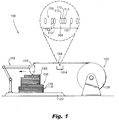
- a stock material 102 for additive manufacturing includes an extrudable filament 104 configured for use as feed-stock for the extrusion type additive manufacturing machine 100.
- Machine code 106 (schematically indicated in the magnified inset of Fig. 1 ) is physically affixed to the extrudable filament 104.
- the machine code 106 includes code specifying build instructions readable by the material extrusion type additive manufacturing machine 100 for building a specific part 108.
- the machine code 106 can include layer by layer movement instructions for controlling the extruder 110 of the additive manufacturing machine 100 to make the specific part 108.
- the machine code 106 can be encrypted.
- the machine code 106 can be formed in markings 112 (schematically indicated in the magnified inset of Fig. 1 ) that are configured to evaporate or dissolve while being extruded through the extruder 110 additive manufacturing machine 100.
- the markings 112 can be formed from a thermal, mechanical (e.g. engraving) and/or chemical process, e.g. in writer 130 described more below.
- the spacing between the markings 112 can be indicative of numerical values, e.g., binary, or the like, similar to the data written on compact discs.
- a method includes receiving extrudable filament, e.g. filament 104, into a material extrusion type additive manufacturing machine, e.g. machine 100.
- the method includes reading machine code that is physically affixed to the extrudable filament, e.g., reading machine code 106 with a reader 114 of the machine 100, wherein the machine code includes code specifying build instructions readable by the material extrusion type additive manufacturing machine for building a specific part, e.g. specific part 108 of Fig. 1 .
- the method includes following the instructions with an extruder, e.g. moving extruder 108 with gantry 116 and controlling the rate at which the filament 104 is extruded through the extruder 110, to additively manufacture the specific part.
- Following the instructions with an extruder can include evaporating or dissolving the markings, e.g., markings 112, of which the machine code is formed.
- Following the instructions with the extruder can include building the specific part 108 layer by layer, e.g. starting from a build plate 108 and adding layers 118 layer by layer.
- Reading machine code and following the instructions with the extruder can occur at the same time, e.g., wherein a portion of the extrudable filament being read contains instructions controlling the extruder in real time without copying the machine code. There can be a lag between reading a portion of the machine code and when that portion of the machine code is followed by the extruder, e.g.
- a final layer 122 of the specific part 108 is printed after instructions for the final layer 122 are received from the filament material 104, e.g. where the machine code is buffered in reader 114 but no complete or permanent copy is made of the machine code 106.
- the machine code corresponding to early layers, e.g. layers closer to the build plate 120, in the specific part can be destroyed prior to printing subsequent layers, e.g. layers farther from the build plate 120, of the specific part.
- the method can include decrypting the machine code for use in controlling the extruder.
- a method includes physically affixing machine code 106 to an extrudable filament 104 for use as feed-stock, e.g. passing the feed-stock from a first reel 126 to a second reel 128 so reel 126 can be used as stock material in the machine 100 of Fig. 1 .
- the method can include encrypting the machine code prior to physically affixing the machine code to the extrudable filament, e.g. wherein the writer 130 writes encrypted machine code onto the filament 104.
Landscapes
- Engineering & Computer Science (AREA)
- Chemical & Material Sciences (AREA)
- Materials Engineering (AREA)
- Manufacturing & Machinery (AREA)
- Physics & Mathematics (AREA)
- Mechanical Engineering (AREA)
- Optics & Photonics (AREA)
- General Physics & Mathematics (AREA)
- Theoretical Computer Science (AREA)
- Automation & Control Theory (AREA)
Abstract
Description
- The present disclosure relates to additive manufacturing, and more particularly to material extrusion type additive manufacturing.
- Material extrusion additive manufacturing systems traditionally feed an extruded material through an extruder, which deposits the material first onto a build plate or support structure, and then layer by layer builds a part upward from the preceding layers. A common practice is for a design firm to design a part, supply the three-dimensional build data to a vendor, and for the vendor to enter the three-dimensional build data into the controller of an additive manufacturing machine to produce the part. The designing firm can lose control of their design, e.g., where the vendor makes unauthorized copies of the designed part, and/or does not observe the design firm's quality requirements.
- The conventional techniques have been considered satisfactory for their intended purposes. However, there is an ever present need for improved systems and methods for additive manufacturing. This disclosure provides a solution for this need.
- A stock material for additive manufacturing includes an extrudable filament configured for use as feed stock for an extrusion type additive manufacturing machine. Machine code is physically affixed to the extrudable filament. The machine code includes code specifying build instructions readable by the extrusion type additive manufacturing machine for building a specific part.
- The machine code can include layer by layer movement instructions for controlling an extruder of the additive manufacturing machine to make a specific part. The machine code can be encrypted. The machine code can be formed in markings that are configured to evaporate or dissolve while being extruded through the additive manufacturing machine. The markings can be formed from a thermal, mechanical, and/or chemical process.
- A method includes receiving extrudable filament into an extrusion type additive manufacturing machine. The method includes reading machine code physically affixed to the extrudable filament, wherein the machine code includes code specifying build instructions readable by the extrusion type additive manufacturing machine for building a specific part. The method includes following the instructions with an extruder to additively manufacture the specific part.
- Following the instructions with an extruder can include evaporating or dissolving the markings of which the machine code is formed. Following the instructions with the extruder can include building the specific part layer by layer. Reading machine code and following the instructions with the extruder can occur at the same time, e.g., wherein a portion of the extrudable filament being read contains instructions controlling the extruder in real time without copying the machine code. There can be a lag between reading a portion of the machine code and when that portion of the machine code is followed by the extruder so a final layer of the specific part is printed after instructions for the final layer are received from the filament material, e.g. where the machine code is buffered but no complete or permanent copy is made of the machine code. The machine code corresponding to early layers in the specific part can be destroyed prior to printing subsequent layers of the specific part. The method can include decrypting the machine code for use in controlling the extruder.
- A method includes physically affixing machine code to an extrudable filament for use as feed stock for a material extrusion type additive manufacturing machine, wherein the machine code includes code specifying build instructions readable by the extrusion type additive manufacturing machine for building a specific part. The method can include encrypting the machine code prior to physically affixing the machine code to the extrudable filament.
- These and other features of the systems and methods of the subject disclosure will become more readily apparent to those skilled in the art from the following detailed description of the preferred embodiments taken in conjunction with the drawings.
- So that those skilled in the art to which the subject disclosure appertains will readily understand how to make and use the devices and methods of the subject disclosure without undue experimentation, preferred embodiments thereof will be described in detail herein below with reference to certain figures, wherein:
-
Fig. 1 is a schematic view of an embodiment of a machine for additive manufacturing constructed in accordance with the present disclosure, showing extrudable filament with machine code affixed thereto for printing a specific part in with the additive manufacturing machine; and -
Fig. 2 is a schematic view of a process for encoding the machine code ofFig. 1 onto the extrudable filament. - Reference will now be made to the drawings wherein like reference numerals identify similar structural features or aspects of the subject disclosure. For purposes of explanation and illustration, and not limitation, a partial view of an embodiment of an additive manufacturing machine in accordance with the disclosure is shown in
Fig. 1 and is designated generally byreference character 100. Other embodiments of systems in accordance with the disclosure, or aspects thereof, are provided inFig. 2 , as will be described. The systems and methods described herein can be used to provide self-destructing code for additively manufactured parts, e.g., so the designer can maintain control of quality, unauthorized copying, and the like. - A
stock material 102 for additive manufacturing includes anextrudable filament 104 configured for use as feed-stock for the extrusion typeadditive manufacturing machine 100. Machine code 106 (schematically indicated in the magnified inset ofFig. 1 ) is physically affixed to theextrudable filament 104. Themachine code 106 includes code specifying build instructions readable by the material extrusion typeadditive manufacturing machine 100 for building aspecific part 108. - The
machine code 106 can include layer by layer movement instructions for controlling theextruder 110 of theadditive manufacturing machine 100 to make thespecific part 108. Themachine code 106 can be encrypted. Themachine code 106 can be formed in markings 112 (schematically indicated in the magnified inset ofFig. 1 ) that are configured to evaporate or dissolve while being extruded through theextruder 110additive manufacturing machine 100. Themarkings 112 can be formed from a thermal, mechanical (e.g. engraving) and/or chemical process, e.g. inwriter 130 described more below. The spacing between themarkings 112 can be indicative of numerical values, e.g., binary, or the like, similar to the data written on compact discs. - A method includes receiving extrudable filament,
e.g. filament 104, into a material extrusion type additive manufacturing machine,e.g. machine 100. The method includes reading machine code that is physically affixed to the extrudable filament, e.g.,reading machine code 106 with areader 114 of themachine 100, wherein the machine code includes code specifying build instructions readable by the material extrusion type additive manufacturing machine for building a specific part, e.g.specific part 108 ofFig. 1 . The method includes following the instructions with an extruder,e.g. moving extruder 108 withgantry 116 and controlling the rate at which thefilament 104 is extruded through theextruder 110, to additively manufacture the specific part. - Following the instructions with an extruder can include evaporating or dissolving the markings, e.g.,
markings 112, of which the machine code is formed. Following the instructions with the extruder can include building thespecific part 108 layer by layer, e.g. starting from abuild plate 108 and addinglayers 118 layer by layer. Reading machine code and following the instructions with the extruder can occur at the same time, e.g., wherein a portion of the extrudable filament being read contains instructions controlling the extruder in real time without copying the machine code. There can be a lag between reading a portion of the machine code and when that portion of the machine code is followed by the extruder, e.g. so afinal layer 122 of thespecific part 108 is printed after instructions for thefinal layer 122 are received from thefilament material 104, e.g. where the machine code is buffered inreader 114 but no complete or permanent copy is made of themachine code 106. The machine code corresponding to early layers, e.g. layers closer to thebuild plate 120, in the specific part can be destroyed prior to printing subsequent layers, e.g. layers farther from thebuild plate 120, of the specific part. The method can include decrypting the machine code for use in controlling the extruder. - With reference now to
Fig. 2 , a method includes physically affixingmachine code 106 to anextrudable filament 104 for use as feed-stock, e.g. passing the feed-stock from afirst reel 126 to asecond reel 128 soreel 126 can be used as stock material in themachine 100 ofFig. 1 . For example, passing the filament fromreel 126 to reel 128 while passing the filament through awriter 130 which places themachine code 106 on thefilament 104 as indicated by the movement arrows and the two magnified insets inFig. 2 . The method can include encrypting the machine code prior to physically affixing the machine code to the extrudable filament, e.g. wherein thewriter 130 writes encrypted machine code onto thefilament 104. - The methods and systems of the present disclosure, as described above and shown in the drawings, provide for self-destructing code for additively manufactured parts, e.g., so the designer can maintain control of quality, unauthorized copying, and the like. While the apparatus and methods of the subject disclosure have been shown and described with reference to preferred embodiments, those skilled in the art will readily appreciate that changes and/or modifications may be made thereto without departing from the scope of the invention as defined by the claims.
Claims (15)
- A stock material for additive manufacturing comprising:an extrudable filament (104) configured for use as feed-stock for an extrusion type additive manufacturing machine; andmachine code (106) physically affixed to the extrudable filament, wherein the machine code includes code specifying build instructions readable by the extrusion type additive manufacturing machine for building a part.
- The stock material as recited in claim 1, wherein the machine code includes layer by layer movement instructions for controlling an extruder of the extrusion type additive manufacturing machine to make the specific part.
- The stock material as recited in claim 2, wherein the machine code is encrypted.
- The stock material as recited in claim 1, 2 or 3, wherein the machine code is formed in markings (112) that are configured to evaporate or dissolve while being extruded through the additive manufacturing machine.
- The stock material as recited in claim 4, wherein the markings are formed from a thermal, mechanical, and/or chemical process.
- A method comprising:receiving extrudable filament (104) into an extrusion type additive manufacturing machine (100);reading machine code (106) physically affixed to the extrudable filament, wherein the machine code includes code specifying build instructions readable by the extrusion type additive manufacturing machine for building a specific part; andfollowing the instructions with an extruder (110) to additively manufacture the specific part.
- The method as recited in claim 6, wherein machine code is formed in markings (112) that are configured to evaporate or dissolve while being extruded through the additive manufacturing machine, and wherein following the instructions with an extruder includes evaporating or dissolving the markings.
- The method as recited in claim 6, wherein the machine code includes layer by layer movement instructions for controlling the extruder of the additive manufacturing machine to make a specific part, wherein following the instructions with the extruder includes building the specific part layer by layer.
- The method as recited in claim 8, wherein reading machine code and following the instructions with the extruder occur at the same time, wherein a portion of the extrudable filament being read contains instructions for controlling the extruder in real time without copying the machine code.
- The method as recited in claim 9, wherein there is a lag between:reading a portion of the machine code; anda time when the portion of the machine code is followed by the extruder so a final layer of the specific part is printed after instructions for the final layer are received from the filament material.
- The method as recited in claim 9, wherein the machine code corresponding to early layers in the specific part is destroyed prior to printing subsequent layers of the specific part.
- The method as recited in claim 6, wherein the machine code is encrypted and further comprising decrypting the machine code for use in controlling the extruder.
- A method comprising:
physically affixing machine code (106) to an extrudable filament (104) for use as feed-stock for a material extrusion type additive manufacturing machine, wherein the machine code includes code specifying build instructions readable by the extrusion type additive manufacturing machine for building a specific part. - The method as recited in claim 13, wherein the machine code comprises markings formed from a thermal, mechanical, and/or chemical process.
- The method as recited in claim 13, further comprising encrypting the machine code prior to physically affixing the machine code to the extrudable filament.
Applications Claiming Priority (1)
| Application Number | Priority Date | Filing Date | Title |
|---|---|---|---|
| US16/813,125 US20210276246A1 (en) | 2020-03-09 | 2020-03-09 | Encodable material for additive material extrusion |
Publications (1)
| Publication Number | Publication Date |
|---|---|
| EP3882005A1 true EP3882005A1 (en) | 2021-09-22 |
Family
ID=74870606
Family Applications (1)
| Application Number | Title | Priority Date | Filing Date |
|---|---|---|---|
| EP21161568.7A Withdrawn EP3882005A1 (en) | 2020-03-09 | 2021-03-09 | Encodable material for additive material extrusion |
Country Status (2)
| Country | Link |
|---|---|
| US (1) | US20210276246A1 (en) |
| EP (1) | EP3882005A1 (en) |
Citations (3)
| Publication number | Priority date | Publication date | Assignee | Title |
|---|---|---|---|---|
| US20110117268A1 (en) * | 2009-11-19 | 2011-05-19 | Stratasys, Inc. | Consumable materials having encoded markings for use with direct digital manufacturing systems |
| US20180001565A1 (en) * | 2014-12-17 | 2018-01-04 | Sabic Global Technologies B.V. | Identifying a characteristic of a material for additive manufacturing |
| US10549487B1 (en) * | 2015-08-27 | 2020-02-04 | Amazon Technologies, Inc. | Safety data sheets (SDS) signing for feedstock materials |
Family Cites Families (1)
| Publication number | Priority date | Publication date | Assignee | Title |
|---|---|---|---|---|
| WO2015185155A1 (en) * | 2014-06-06 | 2015-12-10 | Das-Nano, S.L. | 3d printing material encoding |
-
2020
- 2020-03-09 US US16/813,125 patent/US20210276246A1/en not_active Abandoned
-
2021
- 2021-03-09 EP EP21161568.7A patent/EP3882005A1/en not_active Withdrawn
Patent Citations (3)
| Publication number | Priority date | Publication date | Assignee | Title |
|---|---|---|---|---|
| US20110117268A1 (en) * | 2009-11-19 | 2011-05-19 | Stratasys, Inc. | Consumable materials having encoded markings for use with direct digital manufacturing systems |
| US20180001565A1 (en) * | 2014-12-17 | 2018-01-04 | Sabic Global Technologies B.V. | Identifying a characteristic of a material for additive manufacturing |
| US10549487B1 (en) * | 2015-08-27 | 2020-02-04 | Amazon Technologies, Inc. | Safety data sheets (SDS) signing for feedstock materials |
Also Published As
| Publication number | Publication date |
|---|---|
| US20210276246A1 (en) | 2021-09-09 |
Similar Documents
| Publication | Publication Date | Title |
|---|---|---|
| DE3587658T2 (en) | Execution of a shared, higher privilege level on personal computers for software copy backup. | |
| CN114519180B (en) | Methods and systems for implementing distributed ledger manufacturing history | |
| DE69617478T2 (en) | Optical disc and optical disc reproducing apparatus | |
| US4577289A (en) | Hardware key-on-disk system for copy-protecting magnetic storage media | |
| DE3855635T2 (en) | METHOD FOR DATA STORAGE AND REPLAY FOR AN OPTICAL CARD | |
| DE112010004076T5 (en) | Reuse Logical Data Objects in a Virtual Server | |
| EP0442531B1 (en) | Array disk apparatus | |
| US20130208320A1 (en) | Using device, control method, and program | |
| US20110117268A1 (en) | Consumable materials having encoded markings for use with direct digital manufacturing systems | |
| US9937656B2 (en) | Method for printing component with anti-counterfeit features | |
| JP2006244501A (en) | Storage system with cascaded copy targeting function and enhanced perfectibility | |
| US20210276246A1 (en) | Encodable material for additive material extrusion | |
| US10282371B1 (en) | Object storage device with probabilistic data structure | |
| CN108536390A (en) | Data storage device and block release method thereof | |
| CN100373947C (en) | Method and apparatus for uniquely identifying a copy of a motion picture disposed on a medium and a security encoded motion picture | |
| US10303593B2 (en) | Detecting tampering of data during media migration, and storage device | |
| JP5354714B2 (en) | Image forming apparatus, image forming apparatus control method, computer-readable recording medium, and consumables | |
| CN112199238A (en) | Memory firmware updating method and device, storage medium and electronic equipment | |
| US6940667B2 (en) | Redundant servo pattern stamper | |
| DE10307940A1 (en) | Method and device for preventing duplication of digital data | |
| JP2009245488A (en) | Magnetic disk device | |
| JP4441566B2 (en) | Film and fingerprinting | |
| CN119127568A (en) | Method for realizing general cross-storage cluster clone volume | |
| CN110659708B (en) | Identification feature composite structure | |
| JP2009181523A (en) | Print control device |
Legal Events
| Date | Code | Title | Description |
|---|---|---|---|
| PUAI | Public reference made under article 153(3) epc to a published international application that has entered the european phase |
Free format text: ORIGINAL CODE: 0009012 |
|
| STAA | Information on the status of an ep patent application or granted ep patent |
Free format text: STATUS: THE APPLICATION HAS BEEN PUBLISHED |
|
| AK | Designated contracting states |
Kind code of ref document: A1 Designated state(s): AL AT BE BG CH CY CZ DE DK EE ES FI FR GB GR HR HU IE IS IT LI LT LU LV MC MK MT NL NO PL PT RO RS SE SI SK SM TR |
|
| STAA | Information on the status of an ep patent application or granted ep patent |
Free format text: STATUS: REQUEST FOR EXAMINATION WAS MADE |
|
| 17P | Request for examination filed |
Effective date: 20220322 |
|
| RBV | Designated contracting states (corrected) |
Designated state(s): AL AT BE BG CH CY CZ DE DK EE ES FI FR GB GR HR HU IE IS IT LI LT LU LV MC MK MT NL NO PL PT RO RS SE SI SK SM TR |
|
| STAA | Information on the status of an ep patent application or granted ep patent |
Free format text: STATUS: EXAMINATION IS IN PROGRESS |
|
| 17Q | First examination report despatched |
Effective date: 20220808 |
|
| STAA | Information on the status of an ep patent application or granted ep patent |
Free format text: STATUS: THE APPLICATION IS DEEMED TO BE WITHDRAWN |
|
| 18D | Application deemed to be withdrawn |
Effective date: 20230221 |