EP3881757A1 - Method and system for wellness estimation of a user using pulse harmonics from ppg signals - Google Patents
Method and system for wellness estimation of a user using pulse harmonics from ppg signals Download PDFInfo
- Publication number
- EP3881757A1 EP3881757A1 EP21163304.5A EP21163304A EP3881757A1 EP 3881757 A1 EP3881757 A1 EP 3881757A1 EP 21163304 A EP21163304 A EP 21163304A EP 3881757 A1 EP3881757 A1 EP 3881757A1
- Authority
- EP
- European Patent Office
- Prior art keywords
- wellness
- user
- harmonics
- hardware processors
- power
- Prior art date
- Legal status (The legal status is an assumption and is not a legal conclusion. Google has not performed a legal analysis and makes no representation as to the accuracy of the status listed.)
- Granted
Links
Images


Classifications
-
- A—HUMAN NECESSITIES
- A61—MEDICAL OR VETERINARY SCIENCE; HYGIENE
- A61B—DIAGNOSIS; SURGERY; IDENTIFICATION
- A61B5/00—Measuring for diagnostic purposes; Identification of persons
- A61B5/48—Other medical applications
- A61B5/4854—Diagnosis based on concepts of alternative medicine, e.g. homeopathy or non-orthodox
-
- A—HUMAN NECESSITIES
- A61—MEDICAL OR VETERINARY SCIENCE; HYGIENE
- A61B—DIAGNOSIS; SURGERY; IDENTIFICATION
- A61B5/00—Measuring for diagnostic purposes; Identification of persons
- A61B5/02—Detecting, measuring or recording for evaluating the cardiovascular system, e.g. pulse, heart rate, blood pressure or blood flow
- A61B5/024—Measuring pulse rate or heart rate
- A61B5/02416—Measuring pulse rate or heart rate using photoplethysmograph signals, e.g. generated by infrared radiation
-
- A—HUMAN NECESSITIES
- A61—MEDICAL OR VETERINARY SCIENCE; HYGIENE
- A61B—DIAGNOSIS; SURGERY; IDENTIFICATION
- A61B5/00—Measuring for diagnostic purposes; Identification of persons
- A61B5/145—Measuring characteristics of blood in vivo, e.g. gas concentration or pH-value ; Measuring characteristics of body fluids or tissues, e.g. interstitial fluid or cerebral tissue
- A61B5/1455—Measuring characteristics of blood in vivo, e.g. gas concentration or pH-value ; Measuring characteristics of body fluids or tissues, e.g. interstitial fluid or cerebral tissue using optical sensors, e.g. spectral photometrical oximeters
- A61B5/14551—Measuring characteristics of blood in vivo, e.g. gas concentration or pH-value ; Measuring characteristics of body fluids or tissues, e.g. interstitial fluid or cerebral tissue using optical sensors, e.g. spectral photometrical oximeters for measuring blood gases
-
- A—HUMAN NECESSITIES
- A61—MEDICAL OR VETERINARY SCIENCE; HYGIENE
- A61B—DIAGNOSIS; SURGERY; IDENTIFICATION
- A61B5/00—Measuring for diagnostic purposes; Identification of persons
- A61B5/72—Signal processing specially adapted for physiological signals or for diagnostic purposes
- A61B5/7235—Details of waveform analysis
- A61B5/7253—Details of waveform analysis characterised by using transforms
- A61B5/7257—Details of waveform analysis characterised by using transforms using Fourier transforms
-
- G—PHYSICS
- G16—INFORMATION AND COMMUNICATION TECHNOLOGY [ICT] SPECIALLY ADAPTED FOR SPECIFIC APPLICATION FIELDS
- G16H—HEALTHCARE INFORMATICS, i.e. INFORMATION AND COMMUNICATION TECHNOLOGY [ICT] SPECIALLY ADAPTED FOR THE HANDLING OR PROCESSING OF MEDICAL OR HEALTHCARE DATA
- G16H50/00—ICT specially adapted for medical diagnosis, medical simulation or medical data mining; ICT specially adapted for detecting, monitoring or modelling epidemics or pandemics
- G16H50/30—ICT specially adapted for medical diagnosis, medical simulation or medical data mining; ICT specially adapted for detecting, monitoring or modelling epidemics or pandemics for calculating health indices; for individual health risk assessment
Definitions
- the disclosure herein generally relates to wellness monitoring, and, more particularly, to a method and system for wellness estimation of a user.
- 'Wellness monitoring broadly refers to an activity of monitoring one or more health parameters and in turn health conditions of users.
- appropriate methods/systems are used. For example, if a person is being monitored for diagnosis of heart diseases, then suitable sensors for collecting and processing cardiac signals are used.
- Photophlethysmogram is an optically obtained phlethysmogram that can be used to detect blood volume changes in microvascular bed of tissue.
- the PPG signals collected can be processed further, so as to perform the health estimation.
- PPG as a signal has different characteristics/components.
- different signal processing approaches can be adopted, each providing varying accuracy and convenience in terms of the signal processing and the health estimation.
- HRV Heart Rate Variability
- HRV consists of changes in time intervals between consecutive heartbeats.
- the HRV information estimated from PPG signals can be representative of various health conditions of the user.
- Such methods currently available provide measurement estimates of specific health parameters like heart rate, peripheral capillary oxygen saturation level (SPO2), Heart Rate Variability (HRV) features and not a holistic perspective of wellness.
- SPO2 peripheral capillary oxygen saturation level
- HRV Heart Rate Variability
- a processor implemented method for estimation of wellness of a user is provided. Initially a photoplethysmogram (PPG) signal from the user is collected, over a period of time, via one or more hardware processors. Further, a power spectral analysis of the PPG signal is performed using Fast Fourier Transforms (FFT) to generate a power spectrum of the PPG signal, via the one or more hardware processors. A fundamental frequency (f1) is then estimated as a frequency component with highest magnitude in the power spectrum of the PPG signal, via the one or more hardware processors.
- PPG photoplethysmogram
- FFT Fast Fourier Transforms
- 12 harmonics of the fundamental frequency as equal to multiples of the fundamental frequency for 12 iterations are calculated via the one or more hardware processors, and then power of each of the harmonics is calculated via the one or more hardware processors.
- a plurality of key distinguishing features from the calculated power of each of the 12 harmonics are determined via the one or more hardware processors.
- a wellness metric is calculated based on the plurality of key distinguishing features, via the one or more hardware processors, wherein the wellness metric represents health condition of the user.
- a system for estimation of the wellness of a user includes one or more hardware processors, one or more communication interfaces, and one or more memory (102) storing a plurality of instructions.
- the plurality of instructions when executed cause the one or more hardware processors to collect a photoplethysmogram (PPG) signal from the user, over a period of time.
- the system then performs a power spectral analysis of the PPG signal is performed using Fast Fourier Transforms (FFT) to generate a power spectrum of the PPG signal, via the one or more hardware processors.
- FFT Fast Fourier Transforms
- the system further estimates a fundamental frequency (f1) is then estimated as a frequency component with highest magnitude in the power spectrum of the PPG signal, via the one or more hardware processors.
- 12 harmonics of the fundamental frequency as equal to multiples of the fundamental frequency for 12 iterations are calculated by the system via the one or more hardware processors, and then power of each of the harmonics is calculated via the one or more hardware processors.
- the system determines a plurality of key distinguishing features from the calculated power of each of the 12 harmonics via the one or more hardware processors.
- a wellness metric is calculated based on the plurality of key distinguishing features, via the one or more hardware processors, wherein the wellness metric represents health condition of the user.
- a non-transitory computer readable medium for estimation of the wellness of a user.
- the non-transitory computer readable medium initially collects a photoplethysmogram (PPG) signal from the user, over a period of time, via one or more hardware processors. Further, a power spectral analysis of the PPG signal is performed using Fast Fourier Transforms (FFT) to generate a power spectrum of the PPG signal, via the one or more hardware processors. A fundamental frequency (f1) is then estimated as a frequency component with highest magnitude in the power spectrum of the PPG signal, via the one or more hardware processors.
- PPG photoplethysmogram
- FFT Fast Fourier Transforms
- 12 harmonics of the fundamental frequency as equal to multiples of the fundamental frequency for 12 iterations are calculated via the one or more hardware processors, and then power of each of the harmonics is calculated via the one or more hardware processors.
- a plurality of key distinguishing features from the calculated power of each of the harmonics are determined via the one or more hardware processors.
- a wellness metric is calculated based on the plurality of key distinguishing features, via the one or more hardware processors, wherein the wellness metric represents health condition of the user.
- FIG. 1 through FIG. 2 where similar reference characters denote corresponding features consistently throughout the figures, there are shown preferred embodiments and these embodiments are described in the context of the following exemplary system and/or method.
- FIG. 1 illustrates an exemplary system for wellness estimation of a user using pulse harmonics extracted from PPG signal of the user, according to some embodiments of the present disclosure.
- the system 100 may be implemented in a computing device. Examples of the computing device include, but are not limited to, mainframe computers, workstations, personal computers, desktop computers, minicomputers, servers, multiprocessor systems, laptops, a cellular communicating device, such as a personal digital assistant, a smart phone, and a mobile phone; and the like.
- the system 100, implemented using the computing device includes one or more hardware processor(s) 102, IO interface(s) 104, and a memory 106 coupled to the processor 102.
- the processor 102 can be a single processing unit or a number of units.
- the hardware processor 102, the memory 106, and the IO interface 104 may be coupled by a system bus such as a system bus 112 or a similar mechanism.
- the processor 102 may be implemented as one or more microprocessors, microcomputers, microcontrollers, digital signal processors, central processing units, state machines, logic circuitries, and/or any devices that manipulate signals based on operational instructions.
- the processor 102 is configured to fetch and execute computer-readable instructions and data stored in the memory 106.
- processors may be provided through the use of dedicated hardware as well as hardware capable of executing software in association with appropriate software.
- the functions may be provided by a single dedicated processor, by a single shared processor, or by a plurality of individual processors, some of which may be shared.
- explicit use of the term "processor” should not be construed to refer exclusively to hardware capable of executing software, and may implicitly include, without limitation, digital signal processor (DSP) hardware, network processor, application specific integrated circuit (ASIC), field programmable gate array (FPGA), read only memory (ROM) for storing software, random access memory (RAM), and non-volatile storage.
- DSP digital signal processor
- ASIC application specific integrated circuit
- FPGA field programmable gate array
- ROM read only memory
- RAM random access memory
- non-volatile storage Other hardware, conventional and/or customized, may also be included.
- the IO interfaces 104 may include a variety of software and hardware interfaces, for example, interface for peripheral device(s), such as a keyboard, a mouse, an external memory, and a printer. Further, the IO interfaces 104 may enable the computing device to communicate with other computing devices, such as a personal computer, a laptop, and like.
- the memory 106 may include any computer-readable medium known in the art including, for example, volatile memory, such as static random access memory (SRAM) and dynamic random access memory (DRAM), and/or non-volatile memory, such as read only memory (ROM), erasable programmable ROM, flash memories, hard disks, optical disks, and magnetic tapes.
- volatile memory such as static random access memory (SRAM) and dynamic random access memory (DRAM)
- non-volatile memory such as read only memory (ROM), erasable programmable ROM, flash memories, hard disks, optical disks, and magnetic tapes.
- ROM read only memory
- erasable programmable ROM erasable programmable ROM
- the modules 108 may include routines, programs, objects, components, data structures, and so on, which perform particular tasks or implement particular abstract data types.
- the modules 108 may include programs or computer-readable instructions or coded instructions that supplement applications or functions performed by the system 100.
- the modules 108 may also be used as, signal processor(s), state machine(s), logic circuitries, and/or any other device or component that manipulates signals based on operational instructions.
- the modules 108 can be used by hardware, by computer-readable instructions executed by the one or more hardware processors 102, or by a combination thereof.
- the modules 108 can include various sub-modules (not shown).
- the other module(s) may include programs or coded instructions that supplement applications and functions of the computing device.
- the data 110 serves as a repository for storing data processed, received, and generated by one or more of the module(s) 108.
- the data 110 includes, for example, history of PPG signals collected over a period of time, wellness metrics calculated for each set of input PPG signals collected, and any such data that are collected or generated during the wellness monitoring being performed by the system 100.
- the other data includes data generated as a result of the execution of one or more modules in the other module(s).
- Steps involved in the process of performing the wellness estimation by the system 100 are depicted in FIG. 2 , and are explained with reference to the system 100.
- FIG. 2 is a flow diagram depicting steps involved in the process of the pulse harmonics based wellness estimation of the user, using the system of FIG. 1 , according to some embodiments of the present disclosure.
- the system 100 collects (202) a PPG signal from a user (who may be a patient being monitored), using any known sensor such as a pulse oximeter.
- the PPG signal maybe collected for a specific time period as may be required.
- the system 100 performs (204) a power spectral analysis of the collected PPG signal.
- the system 100 may process the collected PPG signal at once, or may split the PPG signal to segments of specific length and process, as configured.
- the system may use Fast Fourier Transform (FFT) or any other such suitable approach to perform the power spectral analysis.
- FFT Fast Fourier Transform
- the system 100 may use direct component of the power spectrum signals for A3 and A4 metrics.
- the system 100 further estimates (206) a frequency component with highest magnitude in the power spectrum of the PPG signal, and which is closest to a normal heart rate, as a fundamental frequency ( f1 ) of the PPG signal.
- a fundamental frequency ( f1 ) of the PPG signal For the value of the 'normal heart rate' may be pre-configured with the system 100.
- the system 100 further calculates power (pn) of each of the calculated harmonics, and the calculated power is denoted as p2, p3, ...p12. It was observed that peaks are too small to be processed, post 12 th harmonic. However, it is to be noted that the system 100 can be configured to calculate harmonics and power spectrum past the 12 th harmonics if required.
- the system 100 determines (210) a plurality of key distinguishing features from the calculated power of each of the harmonics, by computing a separation capability of each of the harmonic powers independently of pulse harmonics p2, p3, ...p12 so as to determine one or more of the features p2, p3, ...p12 as key distinguishing features relating to variations in health condition, which may be result of any fitness activity being performed by the user.
- the 'separation capability' refers to ability of a feature to consistently distinguish between different states of a ground truth. The ground truth in the case of wellness estimation is a user being monitored being healthy or unhealthy.
- the system 100 calculates (212) a wellness metric.
- the wellness metric includes one or more wellness indexes that represent different health conditions of the user being monitored.
- wellness metrices are calculated at a first time instance T1 and at a second time instance T2.
- the wellness metric at time T1 and the wellness metric at time T2 are compared to generate a first wellness index (A1), a second wellness index (A2), a third wellness index (A3), and a fourth wellness index (A4).
- the first wellness index (A1) represents a general health condition of the user being monitored.
- the second wellness index (A2) represents improvement in health of the user due to one or more fitness activities performed during the time between T1 and T2 a general health condition of the user being monitored.
- the third wellness index A3 represents a point in time general wellness of the user.
- the fourth wellness index A4 represents a point in time wellness of the user due to effect of the one or more physical activities.
- the system 100 can be configured to determine improvement in wellness or health condition of a user, over a period of time, by applying the method 200.
- the system 100 calculates a first wellness metric at a first time instance T1, and a second wellness metric at a second time instance T2.
- the system 100 compares the first wellness metric and the second wellness metric.
- the system 100 generates a first wellness index A1 a second wellness index A2.
- A1 represents improvement in a general wellness of the user
- A2 represents improvement in health of the user, due to one or more physical activities performed by the user during the time period between T1 and T2. For example, consider that the user had been practicing Yoga during this time period. In that case the wellness index A2 represents improvement in health condition of the user due to Yoga.
- a first group of people containing 36 subjects practiced yoga for an experiment period of 12 days.
- PPG signals were taken from each of the subjects on first day of the experiment period and on last day (i.e. 12 th day) of the experiment period.
- a second group of people referred to as a 'control group'
- a 'control group' containing 24 subjects, with the subjects having different exercise patterns. From the subjects in the control group also, PPG signals were collected on first day and on the 12 th day of the experiment period.
- Table. 1 contains values of different parameters for the subjects in the first group and the second group. Table.
- the values indicate that while there has not been any significant change in the power-values for the subjects in the control group, there is a significant change for the subjects in the yoga group, from P5 to P12, which in turn depicts improvement in wellness/health of the subjects due effect of the physical activity (which in this example is Yoga).
- the embodiments of present disclosure herein address unresolved problem of wellness estimation using pulse harmonics extracted from a PPG signal of a user being monitored.
- the embodiment thus provides a PPG based wellness estimation of a user.
- the embodiments herein further provide a mechanism of using the pulse harmonics based wellness estimation to determine improvement in wellness/health condition due to effect of any physical activity being practiced by a user.
- the hardware device can be any kind of device which can be programmed including e.g. any kind of computer like a server or a personal computer, or the like, or any combination thereof.
- the device may also include means which could be e.g. hardware means like e.g. an application-specific integrated circuit (ASIC), a field-programmable gate array (FPGA), or a combination of hardware and software means, e.g.
- ASIC application-specific integrated circuit
- FPGA field-programmable gate array
- the means can include both hardware means and software means.
- the method embodiments described herein could be implemented in hardware and software.
- the device may also include software means.
- the embodiments may be implemented on different hardware devices, e.g. using a plurality of CPUs.
- the embodiments herein can comprise hardware and software elements.
- the embodiments that are implemented in software include but are not limited to, firmware, resident software, microcode, etc.
- the functions performed by various components described herein may be implemented in other components or combinations of other components.
- a computer-usable or computer readable medium can be any apparatus that can comprise, store, communicate, propagate, or transport the program for use by or in connection with the instruction execution system, apparatus, or device.
- a computer-readable storage medium refers to any type of physical memory on which information or data readable by a processor may be stored.
- a computer-readable storage medium may store instructions for execution by one or more processors, including instructions for causing the processor(s) to perform steps or stages consistent with the embodiments described herein.
- the term "computer-readable medium” should be understood to include tangible items and exclude carrier waves and transient signals, i.e., be non-transitory. Examples include random access memory (RAM), read-only memory (ROM), volatile memory, nonvolatile memory, hard drives, CD ROMs, DVDs, flash drives, disks, and any other known physical storage media.
Landscapes
- Health & Medical Sciences (AREA)
- Life Sciences & Earth Sciences (AREA)
- Engineering & Computer Science (AREA)
- Medical Informatics (AREA)
- Public Health (AREA)
- Physics & Mathematics (AREA)
- General Health & Medical Sciences (AREA)
- Biomedical Technology (AREA)
- Pathology (AREA)
- Molecular Biology (AREA)
- Biophysics (AREA)
- Veterinary Medicine (AREA)
- Animal Behavior & Ethology (AREA)
- Surgery (AREA)
- Heart & Thoracic Surgery (AREA)
- Physiology (AREA)
- Cardiology (AREA)
- Primary Health Care (AREA)
- Databases & Information Systems (AREA)
- Psychiatry (AREA)
- Computer Vision & Pattern Recognition (AREA)
- Data Mining & Analysis (AREA)
- Artificial Intelligence (AREA)
- Mathematical Physics (AREA)
- Epidemiology (AREA)
- Signal Processing (AREA)
- Spectroscopy & Molecular Physics (AREA)
- Optics & Photonics (AREA)
- Alternative & Traditional Medicine (AREA)
- Measuring Pulse, Heart Rate, Blood Pressure Or Blood Flow (AREA)
Abstract
Description
- The present application claims priority from Indian patent application no.
202021012087, filed on March 20, 2020 - The disclosure herein generally relates to wellness monitoring, and, more particularly, to a method and system for wellness estimation of a user.
- 'Wellness monitoring' broadly refers to an activity of monitoring one or more health parameters and in turn health conditions of users. Depends on purpose/type of wellness monitoring, appropriate methods/systems are used. For example, if a person is being monitored for diagnosis of heart diseases, then suitable sensors for collecting and processing cardiac signals are used.
- Photophlethysmogram (PPG) is an optically obtained phlethysmogram that can be used to detect blood volume changes in microvascular bed of tissue. The PPG signals collected can be processed further, so as to perform the health estimation. State of the art systems that use PPG based health estimation approaches exist. However, PPG as a signal has different characteristics/components. As a result, different signal processing approaches can be adopted, each providing varying accuracy and convenience in terms of the signal processing and the health estimation. For example, one of the PPG signal processing approaches that is widely used is Heart Rate Variability (HRV) estimation. HRV consists of changes in time intervals between consecutive heartbeats. The HRV information estimated from PPG signals can be representative of various health conditions of the user. Such methods currently available provide measurement estimates of specific health parameters like heart rate, peripheral capillary oxygen saturation level (SPO2), Heart Rate Variability (HRV) features and not a holistic perspective of wellness. The user has to be well educated on how to interpret these measurements in relation to health and usually requires comparison of data over long periods.
- Embodiments of the present disclosure present technological improvements as solutions to one or more of the above-mentioned technical problems recognized by the inventors in conventional systems. For example, in one embodiment, a processor implemented method for estimation of wellness of a user is provided. Initially a photoplethysmogram (PPG) signal from the user is collected, over a period of time, via one or more hardware processors. Further, a power spectral analysis of the PPG signal is performed using Fast Fourier Transforms (FFT) to generate a power spectrum of the PPG signal, via the one or more hardware processors. A fundamental frequency (f1) is then estimated as a frequency component with highest magnitude in the power spectrum of the PPG signal, via the one or more hardware processors. Further, 12 harmonics of the fundamental frequency as equal to multiples of the fundamental frequency for 12 iterations are calculated via the one or more hardware processors, and then power of each of the harmonics is calculated via the one or more hardware processors. A plurality of key distinguishing features from the calculated power of each of the 12 harmonics are determined via the one or more hardware processors. Further, a wellness metric is calculated based on the plurality of key distinguishing features, via the one or more hardware processors, wherein the wellness metric represents health condition of the user.
- In another aspect, a system for estimation of the wellness of a user is provided. The system includes one or more hardware processors, one or more communication interfaces, and one or more memory (102) storing a plurality of instructions. The plurality of instructions when executed cause the one or more hardware processors to collect a photoplethysmogram (PPG) signal from the user, over a period of time. The system then performs a power spectral analysis of the PPG signal is performed using Fast Fourier Transforms (FFT) to generate a power spectrum of the PPG signal, via the one or more hardware processors. The system further estimates a fundamental frequency (f1) is then estimated as a frequency component with highest magnitude in the power spectrum of the PPG signal, via the one or more hardware processors. Further, 12 harmonics of the fundamental frequency as equal to multiples of the fundamental frequency for 12 iterations are calculated by the system via the one or more hardware processors, and then power of each of the harmonics is calculated via the one or more hardware processors. The system then determines a plurality of key distinguishing features from the calculated power of each of the 12 harmonics via the one or more hardware processors. Further, a wellness metric is calculated based on the plurality of key distinguishing features, via the one or more hardware processors, wherein the wellness metric represents health condition of the user.
- In yet another aspect, a non-transitory computer readable medium for estimation of the wellness of a user is provided. The non-transitory computer readable medium initially collects a photoplethysmogram (PPG) signal from the user, over a period of time, via one or more hardware processors. Further, a power spectral analysis of the PPG signal is performed using Fast Fourier Transforms (FFT) to generate a power spectrum of the PPG signal, via the one or more hardware processors. A fundamental frequency (f1) is then estimated as a frequency component with highest magnitude in the power spectrum of the PPG signal, via the one or more hardware processors. Further, 12 harmonics of the fundamental frequency as equal to multiples of the fundamental frequency for 12 iterations are calculated via the one or more hardware processors, and then power of each of the harmonics is calculated via the one or more hardware processors. A plurality of key distinguishing features from the calculated power of each of the harmonics are determined via the one or more hardware processors. Further, a wellness metric is calculated based on the plurality of key distinguishing features, via the one or more hardware processors, wherein the wellness metric represents health condition of the user.
- It is to be understood that both the foregoing general description and the following detailed description are exemplary and explanatory only and are not restrictive of the invention, as claimed.
- The accompanying drawings, which are incorporated in and constitute a part of this disclosure, illustrate exemplary embodiments and, together with the description, serve to explain the disclosed principles:
-
FIG. 1 illustrates an exemplary system for wellness estimation of a user using pulse harmonics extracted from PPG signal of the user, according to some embodiments of the present disclosure. -
FIG. 2 is a flow diagram depicting steps involved in the process of the pulse harmonics based health estimation of the user, using the system ofFIG. 1 , according to some embodiments of the present disclosure. - Exemplary embodiments are described with reference to the accompanying drawings. In the figures, the left-most digit(s) of a reference number identifies the figure in which the reference number first appears. Wherever convenient, the same reference numbers are used throughout the drawings to refer to the same or like parts. While examples and features of disclosed principles are described herein, modifications, adaptations, and other implementations are possible without departing from the scope of the disclosed embodiments. It is intended that the following detailed description be considered as exemplary only, with the true scope being indicated by the following claims.
- Referring now to the drawings, and more particularly to
FIG. 1 through FIG. 2 , where similar reference characters denote corresponding features consistently throughout the figures, there are shown preferred embodiments and these embodiments are described in the context of the following exemplary system and/or method. -
FIG. 1 illustrates an exemplary system for wellness estimation of a user using pulse harmonics extracted from PPG signal of the user, according to some embodiments of the present disclosure. Thesystem 100 may be implemented in a computing device. Examples of the computing device include, but are not limited to, mainframe computers, workstations, personal computers, desktop computers, minicomputers, servers, multiprocessor systems, laptops, a cellular communicating device, such as a personal digital assistant, a smart phone, and a mobile phone; and the like. Thesystem 100, implemented using the computing device, includes one or more hardware processor(s) 102, IO interface(s) 104, and amemory 106 coupled to theprocessor 102. Theprocessor 102 can be a single processing unit or a number of units. Thehardware processor 102, thememory 106, and theIO interface 104 may be coupled by a system bus such as asystem bus 112 or a similar mechanism. Theprocessor 102 may be implemented as one or more microprocessors, microcomputers, microcontrollers, digital signal processors, central processing units, state machines, logic circuitries, and/or any devices that manipulate signals based on operational instructions. Among other capabilities, theprocessor 102 is configured to fetch and execute computer-readable instructions and data stored in thememory 106. - Functions of the various elements shown in the figures, including any functional blocks labeled as "processor(s)", may be provided through the use of dedicated hardware as well as hardware capable of executing software in association with appropriate software. When provided by a processor, the functions may be provided by a single dedicated processor, by a single shared processor, or by a plurality of individual processors, some of which may be shared. Moreover, explicit use of the term "processor" should not be construed to refer exclusively to hardware capable of executing software, and may implicitly include, without limitation, digital signal processor (DSP) hardware, network processor, application specific integrated circuit (ASIC), field programmable gate array (FPGA), read only memory (ROM) for storing software, random access memory (RAM), and non-volatile storage. Other hardware, conventional and/or customized, may also be included.
- The IO interfaces 104 may include a variety of software and hardware interfaces, for example, interface for peripheral device(s), such as a keyboard, a mouse, an external memory, and a printer. Further, the IO interfaces 104 may enable the computing device to communicate with other computing devices, such as a personal computer, a laptop, and like.
- The
memory 106 may include any computer-readable medium known in the art including, for example, volatile memory, such as static random access memory (SRAM) and dynamic random access memory (DRAM), and/or non-volatile memory, such as read only memory (ROM), erasable programmable ROM, flash memories, hard disks, optical disks, and magnetic tapes. Thememory 106 may also include module(s) 108 anddata 110. - The
modules 108 may include routines, programs, objects, components, data structures, and so on, which perform particular tasks or implement particular abstract data types. Themodules 108 may include programs or computer-readable instructions or coded instructions that supplement applications or functions performed by thesystem 100. Themodules 108 may also be used as, signal processor(s), state machine(s), logic circuitries, and/or any other device or component that manipulates signals based on operational instructions. Further, themodules 108 can be used by hardware, by computer-readable instructions executed by the one ormore hardware processors 102, or by a combination thereof. In an embodiment, themodules 108 can include various sub-modules (not shown). The other module(s) may include programs or coded instructions that supplement applications and functions of the computing device. - The
data 110, amongst other things, serves as a repository for storing data processed, received, and generated by one or more of the module(s) 108. Thedata 110 includes, for example, history of PPG signals collected over a period of time, wellness metrics calculated for each set of input PPG signals collected, and any such data that are collected or generated during the wellness monitoring being performed by thesystem 100. The other data includes data generated as a result of the execution of one or more modules in the other module(s). - Steps involved in the process of performing the wellness estimation by the
system 100 are depicted inFIG. 2 , and are explained with reference to thesystem 100. -
FIG. 2 is a flow diagram depicting steps involved in the process of the pulse harmonics based wellness estimation of the user, using the system ofFIG. 1 , according to some embodiments of the present disclosure. Initially thesystem 100 collects (202) a PPG signal from a user (who may be a patient being monitored), using any known sensor such as a pulse oximeter. The PPG signal maybe collected for a specific time period as may be required. - Further, the
system 100 performs (204) a power spectral analysis of the collected PPG signal. In an embodiment, thesystem 100 may process the collected PPG signal at once, or may split the PPG signal to segments of specific length and process, as configured. The system may use Fast Fourier Transform (FFT) or any other such suitable approach to perform the power spectral analysis. After performing the power spectral analysis, thesystem 100 may use direct component of the power spectrum signals for A3 and A4 metrics. - The
system 100 further estimates (206) a frequency component with highest magnitude in the power spectrum of the PPG signal, and which is closest to a normal heart rate, as a fundamental frequency (f1) of the PPG signal. Here the value of the 'normal heart rate' may be pre-configured with thesystem 100. - The
system 100 further calculates nth harmonics (pulse harmonics) of the fundamental frequency (f1) as multiples/iterations of the fundamental frequency (f1) i.e.
- The
system 100 further calculates power (pn) of each of the calculated harmonics, and the calculated power is denoted as p2, p3, ...p12. It was observed that peaks are too small to be processed, post 12th harmonic. However, it is to be noted that thesystem 100 can be configured to calculate harmonics and power spectrum past the 12th harmonics if required. - Further at
step 210, thesystem 100 determines (210) a plurality of key distinguishing features from the calculated power of each of the harmonics, by computing a separation capability of each of the harmonic powers independently of pulse harmonics p2, p3, ...p12 so as to determine one or more of the features p2, p3, ...p12 as key distinguishing features relating to variations in health condition, which may be result of any fitness activity being performed by the user. The 'separation capability' refers to ability of a feature to consistently distinguish between different states of a ground truth. The ground truth in the case of wellness estimation is a user being monitored being healthy or unhealthy. - Based on the determined key distinguishing features, the
system 100 calculates (212) a wellness metric. The wellness metric includes one or more wellness indexes that represent different health conditions of the user being monitored. In order to determine improvement in health condition of the user over a period of time, wellness metrices are calculated at a first time instance T1 and at a second time instance T2. The wellness metric at time T1 and the wellness metric at time T2 are compared to generate a first wellness index (A1), a second wellness index (A2), a third wellness index (A3), and a fourth wellness index (A4). - The first wellness index (A1) of the user is determined as:
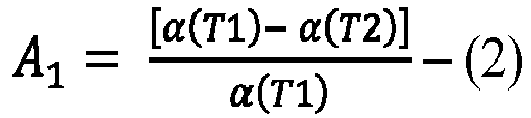
- The first wellness index (A1) represents a general health condition of the user being monitored.
- The second wellness index (A2) of the user is determined as:

- The second wellness index (A2) represents improvement in health of the user due to one or more fitness activities performed during the time between T1 and T2 a general health condition of the user being monitored.
- The third wellness index (A3) is determined as:

- The third wellness index A3 represents a point in time general wellness of the user.
- The fourth wellness index (A4) is determined as:

- The fourth wellness index A4 represents a point in time wellness of the user due to effect of the one or more physical activities.
- In a practical application, the
system 100 can be configured to determine improvement in wellness or health condition of a user, over a period of time, by applying themethod 200. In this approach, for a user, thesystem 100 calculates a first wellness metric at a first time instance T1, and a second wellness metric at a second time instance T2. Thesystem 100 then compares the first wellness metric and the second wellness metric. By virtue of the comparison, thesystem 100 generates a first wellness index A1 a second wellness index A2. A1 represents improvement in a general wellness of the user, and A2 represents improvement in health of the user, due to one or more physical activities performed by the user during the time period between T1 and T2. For example, consider that the user had been practicing Yoga during this time period. In that case the wellness index A2 represents improvement in health condition of the user due to Yoga. - In an experimental setup, a first group of people (referred to as Yoga Group) containing 36 subjects practiced yoga for an experiment period of 12 days. PPG signals were taken from each of the subjects on first day of the experiment period and on last day (i.e. 12th day) of the experiment period. A second group of people (referred to as a 'control group') containing 24 subjects, with the subjects having different exercise patterns. From the subjects in the control group also, PPG signals were collected on first day and on the 12th day of the experiment period. Table. 1 below contains values of different parameters for the subjects in the first group and the second group.
Table. 1 Pulse Harmonics Feature Yoga group Control group f1 0.22 0.31 P1 0.37 0.26 P2 0.16 0.57 P3 0.65 0.29 P4 0.16 0.54 P5 0.01 0.47 P6 0.03 0.45 P7 0.01 0.84 P8 0.01 0.54 P9 0.0001 0.83 P10 0.01 0.73 P11 0.02 0.41 P12 0.01 0.27 - The values indicate that while there has not been any significant change in the power-values for the subjects in the control group, there is a significant change for the subjects in the yoga group, from P5 to P12, which in turn depicts improvement in wellness/health of the subjects due effect of the physical activity (which in this example is Yoga).
- The written description describes the subject matter herein to enable any person skilled in the art to make and use the embodiments. The scope of the subject matter embodiments is defined by the claims and may include other modifications that occur to those skilled in the art. Such other modifications are intended to be within the scope of the claims if they have similar elements that do not differ from the literal language of the claims or if they include equivalent elements with insubstantial differences from the literal language of the claims.
- The embodiments of present disclosure herein address unresolved problem of wellness estimation using pulse harmonics extracted from a PPG signal of a user being monitored. The embodiment thus provides a PPG based wellness estimation of a user. Moreover, the embodiments herein further provide a mechanism of using the pulse harmonics based wellness estimation to determine improvement in wellness/health condition due to effect of any physical activity being practiced by a user.
- It is to be understood that the scope of the protection is extended to such a program and in addition to a computer-readable means having a message therein; such computer-readable storage means contain program-code means for implementation of one or more steps of the method, when the program runs on a server or mobile device or any suitable programmable device. The hardware device can be any kind of device which can be programmed including e.g. any kind of computer like a server or a personal computer, or the like, or any combination thereof. The device may also include means which could be e.g. hardware means like e.g. an application-specific integrated circuit (ASIC), a field-programmable gate array (FPGA), or a combination of hardware and software means, e.g. an ASIC and an FPGA, or at least one microprocessor and at least one memory with software processing components located therein. Thus, the means can include both hardware means and software means. The method embodiments described herein could be implemented in hardware and software. The device may also include software means. Alternatively, the embodiments may be implemented on different hardware devices, e.g. using a plurality of CPUs.
- The embodiments herein can comprise hardware and software elements. The embodiments that are implemented in software include but are not limited to, firmware, resident software, microcode, etc. The functions performed by various components described herein may be implemented in other components or combinations of other components. For the purposes of this description, a computer-usable or computer readable medium can be any apparatus that can comprise, store, communicate, propagate, or transport the program for use by or in connection with the instruction execution system, apparatus, or device.
- The illustrated steps are set out to explain the exemplary embodiments shown, and it should be anticipated that ongoing technological development will change the manner in which particular functions are performed. These examples are presented herein for purposes of illustration, and not limitation. Further, the boundaries of the functional building blocks have been arbitrarily defined herein for the convenience of the description. Alternative boundaries can be defined so long as the specified functions and relationships thereof are appropriately performed. Alternatives (including equivalents, extensions, variations, deviations, etc., of those described herein) will be apparent to persons skilled in the relevant art(s) based on the teachings contained herein. Such alternatives fall within the scope of the disclosed embodiments. Also, the words "comprising," "having," "containing," and "including," and other similar forms are intended to be equivalent in meaning and be open ended in that an item or items following any one of these words is not meant to be an exhaustive listing of such item or items, or meant to be limited to only the listed item or items. It must also be noted that as used herein and in the appended claims, the singular forms "a," "an," and "the" include plural references unless the context clearly dictates otherwise.
- Furthermore, one or more computer-readable storage media may be utilized in implementing embodiments consistent with the present disclosure. A computer-readable storage medium refers to any type of physical memory on which information or data readable by a processor may be stored. Thus, a computer-readable storage medium may store instructions for execution by one or more processors, including instructions for causing the processor(s) to perform steps or stages consistent with the embodiments described herein. The term "computer-readable medium" should be understood to include tangible items and exclude carrier waves and transient signals, i.e., be non-transitory. Examples include random access memory (RAM), read-only memory (ROM), volatile memory, nonvolatile memory, hard drives, CD ROMs, DVDs, flash drives, disks, and any other known physical storage media.
- It is intended that the disclosure and examples be considered as exemplary only, with a true scope of disclosed embodiments being indicated by the following claims.
Claims (15)
- A processor implemented method (200) for estimation of wellness of a user, comprising:collecting (202) a photoplethysmogram (PPG) signal from the user, over a period of time, via one or more hardware processors (102);performing (204) a power spectral analysis of the PPG signal using Fast Fourier Transforms (FFT) to generate a power spectrum of the PPG signal,via the one or more hardware processors (102);estimating (206) a fundamental frequency (f1) as a frequency component with highest magnitude in the power spectrum of the PPG signal, via the one or more hardware processors (102);calculating (208) harmonics of the fundamental frequency as equal to multiples of the fundamental frequency for 12 iterations to generate 12 harmonics, via the one or more hardware processors (102);calculating power of each of the 12 harmonics, via the one or more hardware processors (102);determining (210) a plurality of key distinguishing features from the calculated power of each of the 12 harmonics, via the one or more hardware processors (102); andcalculating (212) a wellness metric based on the plurality of key distinguishing features, via the one or more hardware processors (102), wherein the wellness metric represents health condition of the user.
- The method (200) as claimed in claim 1, wherein the plurality of key distinguishing features are computed by calculating a separation capability of the power of each of the harmonics independently.
- The method (200) as claimed in claim 1, wherein the wellness metric is used to determine improvement in health condition of the user over a period of time, comprising:calculating a first wellness metric at a first time instance (T1), via the one or more hardware processors;calculating a second wellness metric at a second time instance (T2), via the one or more hardware processors; andcomparing the first wellness metric and the second wellness metric, comprising:determining a first wellness index (A1) of the user, wherein the first wellness index represents a general wellness of the user;determining a second wellness index (A2) of the user, wherein the second wellness index represents improvement in health of the user due to one or more physical activities performed during the time between T1 and T2;determining a third wellness index (A3) of the user, wherein the third wellness index represents a point in time general wellness of the user; anddetermining a fourth wellness index (A4) of the user, wherein the fourth wellness index represents a point in time wellness of the user due to effect of the one or more physical activities.
- The method as claimed in claim 3, wherein the first wellness index (A1) is determined as:

- The method as claimed in claim 3, wherein the second wellness index (A2) is determined as:

- The method as claimed in claim 3, wherein the third wellness index (A3) is determined as:

- The method as claimed in claim 3, wherein the fourth wellness index (A4) is determined as:

- A system (100) for estimation of wellness of a user, comprising:one or more hardware processors (104);one or more communication interfaces (106); andone or more memory (102) storing a plurality of instructions, whereinthe plurality of instructions when executed cause the one or more hardware processors to:collect (202) a photoplethysmogram (PPG) signal from the user, over a period of time;perform (204) a power spectral analysis of the PPG signal using Fast Fourier Transforms (FFT) to generate a power spectrum of the PPG signal;estimate (206) a fundamental frequency (f1) as a frequency component with highest magnitude in the power spectrum of the PPG signal, via the one or more hardware processors;calculate (208) harmonics of the fundamental frequency as equal to multiples of the fundamental frequency for 12 iterations to generate 12 harmonics;calculate power of each of the 12 harmonics;determine (210) a plurality of key distinguishing features from the calculated power of each of the 12 harmonics;calculate (212) a wellness metric based on the plurality of key distinguishing features, wherein the wellness metric represents health condition of the user.
- The system (100) as claimed in claim 8, wherein the system computes the plurality of key distinguishing features by calculating a separation capability of the power of each of the harmonics independently.
- The system (100) as claimed in claim 8, wherein the system uses the wellness metric to determine improvement in health condition of the user over a period of time, by:calculating a first wellness metric at a first time instance (T1), via the one or more hardware processors;calculating a second wellness metric at a second time instance (T2), via the one or more hardware processors; andcomparing the first wellness metric and the second wellness metric, comprising:determining a first wellness index (A1) of the user, wherein the first wellness index represents a general wellness of the user;determining a second wellness index (A2) of the user, wherein the second wellness index represents improvement in health of the user due to one or more physical activities performed during the time between T1 and T2;determining a third wellness index (A3) of the user, wherein the third wellness index represents a point in time general wellness of the user; anddetermining a fourth wellness index (A4) of the user, wherein the fourth wellness index represents a point in time wellness of the user due to effect of the one or more physical activities.
- The system as claimed in claim 10, wherein the system determines the first wellness index (A1) as:

- The system as claimed in claim 10, wherein the system determines the second wellness index (A2) as:

- The system as claimed in claim 10, wherein the system determines the third wellness index (A3) as:

- The system as claimed in claim 10, wherein the system determines a fourth wellness index (A4) is determined as:

- A computer program product comprising a non-transitory computer readable medium having a computer readable instructions embodied therein, wherein the computer readable instructions, when executed, cause to perform estimation of wellness of a user, by:collecting a photoplethysmogram (PPG) signal from the user, over a period of time, via one or more hardware processors;performing a power spectral analysis of the PPG signal using Fast Fourier Transforms (FFT) to generate a power spectrum of the PPG signal, via the one or more hardware processors;estimating a fundamental frequency (f1) as a frequency component with highest magnitude in the power spectrum of the PPG signal, via the one or more hardware processors;calculating harmonics of the fundamental frequency as equal to multiples of the fundamental frequency for 12 iterations to generate 12 harmonics, via the one or more hardware processors;calculating power of each of the 12 harmonics, via the one or more hardware processors;determining a plurality of key distinguishing features from the calculated power of each of the 12 harmonics, via the one or more hardware processors; andcalculating a wellness metric based on the plurality of key distinguishing features, via the one or more hardware processors, wherein the wellness metric represents health condition of the user.
Applications Claiming Priority (1)
| Application Number | Priority Date | Filing Date | Title |
|---|---|---|---|
| IN202021012087 | 2020-03-20 |
Publications (3)
| Publication Number | Publication Date |
|---|---|
| EP3881757A1 true EP3881757A1 (en) | 2021-09-22 |
| EP3881757C0 EP3881757C0 (en) | 2025-11-26 |
| EP3881757B1 EP3881757B1 (en) | 2025-11-26 |
Family
ID=75108128
Family Applications (1)
| Application Number | Title | Priority Date | Filing Date |
|---|---|---|---|
| EP21163304.5A Active EP3881757B1 (en) | 2020-03-20 | 2021-03-18 | System for wellness estimation of a user using pulse harmonics from ppg signals |
Country Status (2)
| Country | Link |
|---|---|
| US (1) | US20210290091A1 (en) |
| EP (1) | EP3881757B1 (en) |
Families Citing this family (1)
| Publication number | Priority date | Publication date | Assignee | Title |
|---|---|---|---|---|
| CN117933310A (en) * | 2022-05-13 | 2024-04-26 | 鸿海精密工业股份有限公司 | Data processing apparatus and method |
Citations (1)
| Publication number | Priority date | Publication date | Assignee | Title |
|---|---|---|---|---|
| KR20120021098A (en) * | 2010-08-31 | 2012-03-08 | 상지대학교산학협력단 | Method for evaluting vascular aging using frequency domain analysis of pulse waves |
Family Cites Families (2)
| Publication number | Priority date | Publication date | Assignee | Title |
|---|---|---|---|---|
| GB201209412D0 (en) * | 2012-05-28 | 2012-07-11 | Obs Medical Ltd | Narrow band feature extraction from cardiac signals |
| US10123746B2 (en) * | 2015-05-08 | 2018-11-13 | Texas Instruments Incorporated | Accuracy of heart rate estimation from photoplethysmographic (PPG) signals |
-
2021
- 2021-03-17 US US17/204,090 patent/US20210290091A1/en not_active Abandoned
- 2021-03-18 EP EP21163304.5A patent/EP3881757B1/en active Active
Patent Citations (1)
| Publication number | Priority date | Publication date | Assignee | Title |
|---|---|---|---|---|
| KR20120021098A (en) * | 2010-08-31 | 2012-03-08 | 상지대학교산학협력단 | Method for evaluting vascular aging using frequency domain analysis of pulse waves |
Non-Patent Citations (2)
| Title |
|---|
| LU WAN-AN ET AL: "Increased first and second pulse harmonics in Tai Chi Chuan practitioners", vol. 16, no. 1, 29 February 2016 (2016-02-29), XP055829994, Retrieved from the Internet <URL:https://www.researchgate.net/journal/BMC-Complementary-and-Alternative-Medicine-1472-6882/publication/296632023_Increased_first_and_second_pulse_harmonics_in_Tai_Chi_Chuan_practitioners/links/5fc236a1a6fdcc6cc677c445/Increased-first-and-second-pulse-harmonics-in-Tai-Chi-Chuan-practitioners.pdf> DOI: 10.1186/s12906-016-1058-4 * |
| YI-JU SU ET AL: "Power spectral analysis of plethysmographic pulse waveform in pregnant women", JOURNAL OF CLINICAL MONITORING AND COMPUTING, KLUWER ACADEMIC PUBLISHERS, DO, vol. 25, no. 3, 9 August 2011 (2011-08-09), pages 183 - 191, XP019954447, ISSN: 1573-2614, DOI: 10.1007/S10877-011-9291-3 * |
Also Published As
| Publication number | Publication date |
|---|---|
| US20210290091A1 (en) | 2021-09-23 |
| EP3881757C0 (en) | 2025-11-26 |
| EP3881757B1 (en) | 2025-11-26 |
Similar Documents
| Publication | Publication Date | Title |
|---|---|---|
| Champseix et al. | A python package for heart rate variability analysis and signal preprocessing | |
| Aziz et al. | ECG-based machine-learning algorithms for heartbeat classification | |
| Sopic et al. | Real-time event-driven classification technique for early detection and prevention of myocardial infarction on wearable systems | |
| Choi et al. | Photoplethysmography sampling frequency: pilot assessment of how low can we go to analyze pulse rate variability with reliability? | |
| US20200155024A1 (en) | Detection of electrocardiographic signal | |
| EP3479759B1 (en) | System and computer program product to classify cardiopulmonary fatigue | |
| US20160038044A1 (en) | Measuring blood pressure | |
| US12220262B2 (en) | Systems and methods for atrial fibrillation (AF) and cardiac disorders detection from biological signals | |
| US20190069850A1 (en) | Non-invasive method and system for estimating blood pressure from photoplethysmogram using statistical post-processing | |
| CN117271977B (en) | HRV data preprocessing method, device and electronic equipment | |
| Zhang et al. | Towards early detection and burden estimation of atrial fibrillation in an ambulatory free-living environment | |
| US11141061B2 (en) | Cognitive load estimation based on pupil dilation | |
| Al-Fahoum et al. | Detection of cardiac ischaemia using bispectral analysis approach | |
| US12257032B2 (en) | Methods and systems for determining breathing rate and heart rate from cardiopulmonary signals | |
| EP3881757B1 (en) | System for wellness estimation of a user using pulse harmonics from ppg signals | |
| US11432779B2 (en) | Method and device for capacitive touch panel based biosignal measurement | |
| Garcia-Gonzalez et al. | Errors in the estimation of approximate entropy and other recurrence-plot-derived indices due to the finite resolution of RR time series | |
| EP4434462A1 (en) | Method and system for determining cardiac abnormalities using chaos-based classification model from multi-lead ecg | |
| CN112957018A (en) | Heart state detection method and device based on artificial intelligence | |
| EP4447068A1 (en) | Method and system for determining post-exercise recovery score using personalized cardiac model | |
| EP3506314B1 (en) | Systems and methods for detecting anomaly in a cardiovascular signal using hierarchical extremas and repetitions | |
| Kapsecker et al. | PeakSwift: mobile detection of R-peaks in single lead electrocardiograms | |
| Rabkin | Assessment of the QT interval in right bundle branch block | |
| Al Osman et al. | A pattern-based windowed impulse rejection filter for nonpathological HRV artifacts correction | |
| Vistisen et al. | Association between the sensory-motor nervous system and the autonomic nervous system in neurorehabilitation patients with severe acquired brain injury |
Legal Events
| Date | Code | Title | Description |
|---|---|---|---|
| PUAI | Public reference made under article 153(3) epc to a published international application that has entered the european phase |
Free format text: ORIGINAL CODE: 0009012 |
|
| STAA | Information on the status of an ep patent application or granted ep patent |
Free format text: STATUS: THE APPLICATION HAS BEEN PUBLISHED |
|
| AK | Designated contracting states |
Kind code of ref document: A1 Designated state(s): AL AT BE BG CH CY CZ DE DK EE ES FI FR GB GR HR HU IE IS IT LI LT LU LV MC MK MT NL NO PL PT RO RS SE SI SK SM TR |
|
| STAA | Information on the status of an ep patent application or granted ep patent |
Free format text: STATUS: REQUEST FOR EXAMINATION WAS MADE |
|
| 17P | Request for examination filed |
Effective date: 20220302 |
|
| RBV | Designated contracting states (corrected) |
Designated state(s): AL AT BE BG CH CY CZ DE DK EE ES FI FR GB GR HR HU IE IS IT LI LT LU LV MC MK MT NL NO PL PT RO RS SE SI SK SM TR |
|
| STAA | Information on the status of an ep patent application or granted ep patent |
Free format text: STATUS: EXAMINATION IS IN PROGRESS |
|
| 17Q | First examination report despatched |
Effective date: 20240129 |
|
| GRAP | Despatch of communication of intention to grant a patent |
Free format text: ORIGINAL CODE: EPIDOSNIGR1 |
|
| STAA | Information on the status of an ep patent application or granted ep patent |
Free format text: STATUS: GRANT OF PATENT IS INTENDED |
|
| INTG | Intention to grant announced |
Effective date: 20250811 |
|
| GRAS | Grant fee paid |
Free format text: ORIGINAL CODE: EPIDOSNIGR3 |
|
| GRAA | (expected) grant |
Free format text: ORIGINAL CODE: 0009210 |
|
| STAA | Information on the status of an ep patent application or granted ep patent |
Free format text: STATUS: THE PATENT HAS BEEN GRANTED |
|
| AK | Designated contracting states |
Kind code of ref document: B1 Designated state(s): AL AT BE BG CH CY CZ DE DK EE ES FI FR GB GR HR HU IE IS IT LI LT LU LV MC MK MT NL NO PL PT RO RS SE SI SK SM TR |
|
| REG | Reference to a national code |
Ref country code: CH Ref legal event code: F10 Free format text: ST27 STATUS EVENT CODE: U-0-0-F10-F00 (AS PROVIDED BY THE NATIONAL OFFICE) Effective date: 20251126 Ref country code: GB Ref legal event code: FG4D |
|
| REG | Reference to a national code |
Ref country code: CH Ref legal event code: R17 Free format text: ST27 STATUS EVENT CODE: U-0-0-R10-R17 (AS PROVIDED BY THE NATIONAL OFFICE) Effective date: 20251127 |
|
| REG | Reference to a national code |
Ref country code: IE Ref legal event code: FG4D |
|
| U01 | Request for unitary effect filed |
Effective date: 20251126 |
|
| U07 | Unitary effect registered |
Designated state(s): AT BE BG DE DK EE FI FR IT LT LU LV MT NL PT RO SE SI Effective date: 20251202 |
|
| REG | Reference to a national code |
Ref country code: CH Ref legal event code: U11 Free format text: ST27 STATUS EVENT CODE: U-0-0-U10-U11 (AS PROVIDED BY THE NATIONAL OFFICE) Effective date: 20260401 |
|
| PGFP | Annual fee paid to national office [announced via postgrant information from national office to epo] |
Ref country code: GB Payment date: 20260304 Year of fee payment: 6 |
|
| PG25 | Lapsed in a contracting state [announced via postgrant information from national office to epo] |
Ref country code: ES Free format text: LAPSE BECAUSE OF FAILURE TO SUBMIT A TRANSLATION OF THE DESCRIPTION OR TO PAY THE FEE WITHIN THE PRESCRIBED TIME-LIMIT Effective date: 20251126 |
|
| PG25 | Lapsed in a contracting state [announced via postgrant information from national office to epo] |
Ref country code: NO Free format text: LAPSE BECAUSE OF FAILURE TO SUBMIT A TRANSLATION OF THE DESCRIPTION OR TO PAY THE FEE WITHIN THE PRESCRIBED TIME-LIMIT Effective date: 20260226 |
|
| PG25 | Lapsed in a contracting state [announced via postgrant information from national office to epo] |
Ref country code: HR Free format text: LAPSE BECAUSE OF FAILURE TO SUBMIT A TRANSLATION OF THE DESCRIPTION OR TO PAY THE FEE WITHIN THE PRESCRIBED TIME-LIMIT Effective date: 20251126 |
|
| PG25 | Lapsed in a contracting state [announced via postgrant information from national office to epo] |
Ref country code: RS Free format text: LAPSE BECAUSE OF FAILURE TO SUBMIT A TRANSLATION OF THE DESCRIPTION OR TO PAY THE FEE WITHIN THE PRESCRIBED TIME-LIMIT Effective date: 20260226 |
|
| PG25 | Lapsed in a contracting state [announced via postgrant information from national office to epo] |
Ref country code: IS Free format text: LAPSE BECAUSE OF FAILURE TO SUBMIT A TRANSLATION OF THE DESCRIPTION OR TO PAY THE FEE WITHIN THE PRESCRIBED TIME-LIMIT Effective date: 20260326 |
|
| PG25 | Lapsed in a contracting state [announced via postgrant information from national office to epo] |
Ref country code: PL Free format text: LAPSE BECAUSE OF FAILURE TO SUBMIT A TRANSLATION OF THE DESCRIPTION OR TO PAY THE FEE WITHIN THE PRESCRIBED TIME-LIMIT Effective date: 20251126 |
|
| U20 | Renewal fee for the european patent with unitary effect paid |
Year of fee payment: 6 Effective date: 20260323 |