EP3881031B1 - Systems and methods for direction estimation in indoor and outdoor locations - Google Patents
Systems and methods for direction estimation in indoor and outdoor locations Download PDFInfo
- Publication number
- EP3881031B1 EP3881031B1 EP19798519.5A EP19798519A EP3881031B1 EP 3881031 B1 EP3881031 B1 EP 3881031B1 EP 19798519 A EP19798519 A EP 19798519A EP 3881031 B1 EP3881031 B1 EP 3881031B1
- Authority
- EP
- European Patent Office
- Prior art keywords
- clone
- heading
- processor
- processes
- clone processes
- Prior art date
- Legal status (The legal status is an assumption and is not a legal conclusion. Google has not performed a legal analysis and makes no representation as to the accuracy of the status listed.)
- Active
Links
Images





Classifications
-
- G—PHYSICS
- G01—MEASURING; TESTING
- G01C—MEASURING DISTANCES, LEVELS OR BEARINGS; SURVEYING; NAVIGATION; GYROSCOPIC INSTRUMENTS; PHOTOGRAMMETRY OR VIDEOGRAMMETRY
- G01C21/00—Navigation; Navigational instruments not provided for in groups G01C1/00 - G01C19/00
- G01C21/20—Instruments for performing navigational calculations
- G01C21/206—Instruments for performing navigational calculations specially adapted for indoor navigation
-
- G—PHYSICS
- G01—MEASURING; TESTING
- G01S—RADIO DIRECTION-FINDING; RADIO NAVIGATION; DETERMINING DISTANCE OR VELOCITY BY USE OF RADIO WAVES; LOCATING OR PRESENCE-DETECTING BY USE OF THE REFLECTION OR RERADIATION OF RADIO WAVES; ANALOGOUS ARRANGEMENTS USING OTHER WAVES
- G01S19/00—Satellite radio beacon positioning systems; Determining position, velocity or attitude using signals transmitted by such systems
- G01S19/38—Determining a navigation solution using signals transmitted by a satellite radio beacon positioning system
- G01S19/39—Determining a navigation solution using signals transmitted by a satellite radio beacon positioning system the satellite radio beacon positioning system transmitting time-stamped messages, e.g. GPS [Global Positioning System], GLONASS [Global Orbiting Navigation Satellite System] or GALILEO
- G01S19/42—Determining position
- G01S19/48—Determining position by combining or switching between position solutions derived from the satellite radio beacon positioning system and position solutions derived from a further system
- G01S19/49—Determining position by combining or switching between position solutions derived from the satellite radio beacon positioning system and position solutions derived from a further system whereby the further system is an inertial position system, e.g. loosely-coupled
-
- G—PHYSICS
- G01—MEASURING; TESTING
- G01C—MEASURING DISTANCES, LEVELS OR BEARINGS; SURVEYING; NAVIGATION; GYROSCOPIC INSTRUMENTS; PHOTOGRAMMETRY OR VIDEOGRAMMETRY
- G01C21/00—Navigation; Navigational instruments not provided for in groups G01C1/00 - G01C19/00
- G01C21/10—Navigation; Navigational instruments not provided for in groups G01C1/00 - G01C19/00 by using measurements of speed or acceleration
- G01C21/12—Navigation; Navigational instruments not provided for in groups G01C1/00 - G01C19/00 by using measurements of speed or acceleration executed aboard the object being navigated; Dead reckoning
- G01C21/16—Navigation; Navigational instruments not provided for in groups G01C1/00 - G01C19/00 by using measurements of speed or acceleration executed aboard the object being navigated; Dead reckoning by integrating acceleration or speed, i.e. inertial navigation
- G01C21/165—Navigation; Navigational instruments not provided for in groups G01C1/00 - G01C19/00 by using measurements of speed or acceleration executed aboard the object being navigated; Dead reckoning by integrating acceleration or speed, i.e. inertial navigation combined with non-inertial navigation instruments
-
- G—PHYSICS
- G01—MEASURING; TESTING
- G01C—MEASURING DISTANCES, LEVELS OR BEARINGS; SURVEYING; NAVIGATION; GYROSCOPIC INSTRUMENTS; PHOTOGRAMMETRY OR VIDEOGRAMMETRY
- G01C21/00—Navigation; Navigational instruments not provided for in groups G01C1/00 - G01C19/00
- G01C21/20—Instruments for performing navigational calculations
-
- G—PHYSICS
- G01—MEASURING; TESTING
- G01S—RADIO DIRECTION-FINDING; RADIO NAVIGATION; DETERMINING DISTANCE OR VELOCITY BY USE OF RADIO WAVES; LOCATING OR PRESENCE-DETECTING BY USE OF THE REFLECTION OR RERADIATION OF RADIO WAVES; ANALOGOUS ARRANGEMENTS USING OTHER WAVES
- G01S19/00—Satellite radio beacon positioning systems; Determining position, velocity or attitude using signals transmitted by such systems
- G01S19/38—Determining a navigation solution using signals transmitted by a satellite radio beacon positioning system
- G01S19/39—Determining a navigation solution using signals transmitted by a satellite radio beacon positioning system the satellite radio beacon positioning system transmitting time-stamped messages, e.g. GPS [Global Positioning System], GLONASS [Global Orbiting Navigation Satellite System] or GALILEO
- G01S19/53—Determining attitude
Definitions
- GPS global positioning system
- GPS-based systems may take three to seven minutes to determine an initial heading, particularly if the GPS-based system has been moved to a new location since its last GPS-based position determination.
- mobile devices determining position based on location information provided by beacon devices may take a minute or more to determine initial heading.
- CN105737826 describes an indoor positioning method for a pedestrian.
- the method comprises the steps of determining the initial state of the pedestrian; mapping the initial state of the pedestrian into an adaptability graph model, wherein the adaptability graph model is composed of a one-dimensional Thiessen polygon graph representing a narrow and long area and a two-dimensional regular grid graph representing an open area, and the one-dimensional Thiessen polygon graph and the two-dimensional regular grid graph express corresponding spaces into dispersed nodes and edges formed by passable paths; conducting pedestrian dead reckoning based on data collected by an inertial sensor, and further detecting walking events of the pedestrian; when the walking events of the pedestrian is detected each time, spreading particles corresponding to the motion state of the pedestrian in the adaptability graph model through a particle filter; conducting weighting and summation on all the particles, so that current coordinates are obtained, and mapping the current coordinates to one corresponding node on the adaptability graph model to serve as the current state.
- a mobile device can determine a location of the mobile device using a particle filter and a Kalman filter.
- the particle filter can filter candidate locations of the mobile device using measurements of environment variables in the venue.
- the Kalman filter can filter inputs from a sensor of the mobile device for measuring angular movement of the mobile device.
- the particle filter and the Kalman filter can be linked by heading of the mobile device.
- Output of the Kalman filter can be used to determine where to place particles, or candidate locations, in a next iteration of the particle filter.
- Output from the particle filter can be used to determine a center mode of the Kalman filter and to determine a bias of the sensor for measuring angular movement.
- a computer-implemented method of determining a heading of a mobile device according to appended claim 1, and a hand-held computing device according to appended claim 9, are provided.
- Controller shall mean, alone or in combination, individual circuit components, an application specific integrated circuit (ASIC), a microcontroller with controlling software, a digital signal processor (DSP), a processor with controlling software on memory, and/or a field programmable gate array (FPGA), configured to read inputs and drive outputs responsive to the inputs.
- ASIC application specific integrated circuit
- DSP digital signal processor
- FPGA field programmable gate array
- “Navigation domain” shall mean an indoor area or outdoor area in which navigation is accomplished by lodestar devices placed for use in the area.
- beacons may be placed to provide information used to navigate within the indoor area
- GPS satellites may be used to navigate within the outdoor area. While some signals from the GPS satellites may be received within the indoor area (e.g., near a window or skylight), the signals from the GPS satellites are not suitable for navigation within a navigation domain that is indoor. Similarly, while some signals from beacon devices placed in an indoor area may be received outdoors (e.g., near a window or garage door), the signals from the beacons that are placed in the indoor area are not suitable for navigation within a navigation domain that is outdoor.
- Various example embodiments are directed to navigation within and between navigation domains. More particularly, various example embodiments are directed to providing navigation information to a user of a hand-held computing device or a mobile device as the user transitions between navigation domains (e.g., transitioning from indoors to outdoors, or outdoors to indoors).
- the specification is conceptually divided into indoor navigation issues, outdoor navigation issues, and then to navigation when transitioning between navigation domains.
- Figure 1 shows an overhead view of an indoor venue in accordance with at least some embodiments.
- Figure 1 shows the layout 100 of an example indoor venue 102.
- a person may enter the indoor venue 102 through a portal illustratively shown as doors 104. Once inside, the person may want to navigate from the entry hall area 108 to the exhibition area 106 or exhibition area 110.
- a mobile device of a person may not be able to detected signals from global positioning system (GPS) satellites.
- GPS global positioning system
- the example indoor venue 102 has disposed therein a plurality of beacon devices 112. Not all beacon devices are numbered so as not to unduly complicate the figure.
- the beacon devices 112 may be placed at any suitable location, such as ceiling-mounted beacon devices, wallmounted beacon devices, beacon devices mounted on structural pillars, and the like.
- the example indoor venue 102 represents a navigation domain where lodestar devices in the form of beacons provide navigation signals and/or data.
- the beacon devices 112 may take any suitable form, such as Bluetooth Low Energy (BLE) devices, or Ultra Wide Band (UWB) devices, available from many manufacturers.
- location determinations may take any suitable form, such as triangulation, received signal strength indications (RSSI), and combinations.
- the hand-held computing device or mobile device carried by the user has a navigation program that either knows in advance, or is provided upon request from the beacon devices 112 or a data network, the layout of the indoor venue 102. While the mobile device may know its initial location 114, the initial heading may not be known or there may be more than one viable solution based on the accuracy of the location data available at the time. If the navigation program makes an incorrect assumption about direction to travel from location 114, the user may travel a significant distance in the wrong direction (in the example, into exhibit area 106), before being given a correct heading to reach location 116 in exhibition area 110.
- the navigation platform may take several minutes to determine the initial heading, in which case the user may be walking in the wrong direction (e.g., towards exhibit area 106 rather than exhibition area 110 in this example) before the navigation platform can resolve an initial heading.
- the related-art systems focus on increasing accuracy of triangulation methods, none of the related-art systems have paid sufficient attention to reducing the time required to compute the initial heading. Nor have the related-art systems paid attention to increasing the accuracy of initial heading so that the user is directed correctly as soon as navigation program starts.
- Some related-art systems use particle filters for navigation algorithms, particularly in robots, vehicles, and other types of machines. For such related-art navigation platforms to work accurately and responsively, the navigation platforms need to generate, maintain, and follow in excess of 10,000 particle filters.
- particle filters perform well in estimating position, but not heading or heading change. Walking users are more likely to change heading suddenly than vehicles. Therefore, if the user changes heading suddenly, particle filters would take significant time to realize the change in heading.
- Another major disadvantage of particle filter systems is that the process is stochastic and not deterministic. Feeding the same data to a stochastic process may yield different results each time. This is totally unacceptable for pedestrians.
- example embodiments are directed to systems and methods for estimating initial direction at start-up of navigation. More particularly, example embodiments are directed to determining initial heading of a mobile device by not assuming any initial heading; rather, example methods spawn a plurality of clone processes that are initially given identical locations and identical speeds, and with each clone process assigned or given a unique direction.
- the clone processes in some cases Kalman filters, and in a particular case extended Kalman filters, each calculate a respective position after a frame period. In some cases, each clone process performs multiple location calculations during the frame period by being provided speed and heading change information multiple times during the frame period.
- the mobile device determines a new position indication (likely with higher accuracy than the first position indication) that too is passed to the clone processes.
- Each clone process calculates metrics related to the respective position and the actual position, and clone processes whose assigned directions are sufficiently different than the actual direction of travel are terminated, resulting in remaining clone processes.
- an initial heading is thus established.
- the initial heading is determined in two seconds or less, and in some cases one second or less.
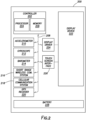
- Figure 2 shows a block diagram of a hand-held or mobile device in accordance with at least some embodiments.
- the controller 202 takes any suitable form, such as an application specific integrated circuit (ASIC), a microcontroller with controlling software, a digital signal processor (DSP), a processor with controlling software, a field programmable gate array (FPGA), or combinations thereof, configured to read inputs and drive outputs responsive to the inputs.
- ASIC application specific integrated circuit
- DSP digital signal processor
- FPGA field programmable gate array
- the controller 202 is implemented in the example form of a processor 204 coupled to a memory 206.
- the controller 202 couples to host of internal components and devices by any suitable direct connection or bus system, as shown by the example internal bus 208.
- the example mobile device 200 comprises an accelerometer 210 electrically coupled to the controller 202 by way of the internal bus 208.
- the accelerometer 210 may take any suitable form, such as a single-axis accelerometer, or multi-axis accelerometer.
- the accelerometer 210 is a three-axis accelerometer such that the mobile device 200 may be able to determine acceleration in any dimension (e.g., movement in the horizontal plane along with how much the user "bounces" for each step taken).
- the accelerometer 210 may be one or more velocity meters, from which acceleration can be mathematically determined.
- the example mobile device 200 further comprises an electronic gyroscope 212 electrically coupled to the controller 202 by way of the example internal bus 208.
- the gyroscope 212 standing alone, may not be able to provide a heading relative to a coordinate system (e.g., relative to magnetic North) unless the data from the gyroscope 212 is combined with other data.
- the gyroscope 212 can be used to create accurate indications of heading change even when the absolute heading is not known.
- the example mobile device 200 further comprises a barometer 214 electrically coupled to the controller 202 by way of the example internal bus 208.
- the barometer 214 may be used to read barometric pressure, which is indicative of the elevation.
- barometric pressure is also influenced by high and low pressure weather patterns; however, frequent readings of the barometer are much less likely to be influenced by weather, especially when relative elevation changes are used. Further, the data from the barometer 214 may need to be combined with other data for absolute elevation determinations.
- the example mobile device 200 further comprises a short-range wireless communication system 216 coupled to the controller 202 by way of the example internal bus 208.
- the short-range wireless communication system 216 may take any suitable form and protocol, such as Bluetooth, Ultra Wide Band (UWB), or any of the various WIFI protocols, such as IEEE 802.11.
- the processor 204 executing a program, may read from the short-range wireless communication system 216 digital values indicative of current location of the mobile device 200 or digital values of Time of Flight or Angle of Arrival values to aid in calculation of location.
- the mobile device 200 receives data from beacon devices 112 ( Figure 1 ) as part of providing navigation services to the user of the mobile device 200.
- the example mobile device 200 further comprises a cellular communication system 218 electrically coupled to the controller by way of the example internal bus 208.
- the cellular communication system 218 wirelessly communicates with cell towers to provide voice and data services.
- maps of venue or areas e.g., maps of indoor venues (such as indoor venue 102 ( Figure 1 )
- the maps may also be downloaded by use of the short-range wireless communication system 216 in addition to, or in place of, the cellular communication system 218.
- the example mobile device 200 further comprises a GPS receiver 220 electrically coupled to the controller 202 by way of the internal bus 208.
- the GPS receiver 220 or a similar location engine calculates a geographical location (or series of geographic locations for moving devices).
- GPS receiver 220 may receive signals from one or more satellites orbiting the earth via an antenna (not specifically shown) that is tuned to the frequencies transmitted by the one or more satellites.
- GPS receiver 220 may analyze the received signals to create location data indicative of a current location of mobile device 200.
- the processor 204 executing a program, may read from the GPS receiver 220 digital values indicative of current location of the mobile device 200.
- the GPS receiver 220 provides data to the processor 204 executing a program, and the processor 204 analyzes the data to determine location of the mobile device 200.
- the example mobile device 200 further comprises a display device 222 electrically coupled to the controller 202 by way of display driver 224.
- the display driver 224 takes data provided by the controller 202 (e.g., maps, graphical indications of direction to travel) and displays the information on the display device 222 for the user.
- the display device 222 is covered by or integrated with a touch screen system (not specifically shown).
- the controller 202 may interface with the touch screen system by way of touch screen interface 226.
- the controller 202 may receive information from the user, such as by way of keyboard implemented using the display device 222.
- the mobile device 200 may implement a physical keyboard in addition to, or in place of, the touch screen system and touch screen interface 226.
- the example mobile device 200 comprises a battery 228.
- the battery 228 provides power to all of the noted internal components, but the electrical connections to the battery 228 are not shown so as not to unduly complicate the drawing.
- the battery 228 may take any suitable form, such as a lithium-ion battery, but any currently available or after-developed battery technology may be used.
- the mobile device 200 may be any currently available mobile device (e.g., APPLE ® brand iPhones available from Apple, Inc., or ANDROID ® brand devices available from Google, Inc.) or any after-developed hand-held computing device or mobile device.
- Figure 3 shows a block diagram of a navigation program in accordance with at least some embodiments.
- navigation program 300 interfaces with various devices of the mobile device 200 ( Figure 2 ), such as the accelerometer 210, gyroscope 212, barometer 214, short-range wireless communication system 216, and GPS receiver 220.
- the navigation program 300 may provide to the user navigation information, such as by placing that navigation information on the display device 222 of Figure 2 .
- the example navigation program 300 is conceptually, though not necessarily physically, divided into a plurality of modules and data engines.
- the example navigation program 300 comprises an initial heading module 302 which, as the name implies, is designed and programmed to determine or estimate the initial heading of the user in startup situations, and as we shall see situations where the user makes abrupt direction changes.
- the initial heading module 302 reads or takes input from the accelerometer 210 and the gyroscope 212. In cases where the mobile device 200 does not have a gyroscope 212, a magnetometer may be substituted. If a mobile device 200 has both a gyroscope 212 and magnetometer, example embodiments use only the gyroscope 212 to the exclusion of the magnetometer.
- the initial heading module 302 further receives data indicative of position (hereafter just position data) from other portions of the navigation program 300.
- the position data is provided from a position estimation module 304, and in particular the position estimation module 304 periodically (e.g., once every second) provides position data to the initial heading module 302.
- the initial heading module 302 further receives map data 306 from the navigation program 300, such as map data downloaded through the cellular communication system 218 ( Figure 2 ) or read through the short-range wireless communication system 216.
- the initial heading module 302 outputs or provides position and heading 308 to the navigation program 300, which may be used to provide directions to the user of the mobile device 200.
- the initial heading module 302 is conceptually, though not necessarily physically, divided into a plurality of underlying modules and engines.
- the initial heading module 302 may comprise an inertial navigation module 310, a data supply engine 312, and an initial convergence engine 314.
- the example inertial navigation module 310 takes input from the accelerometer 210 and gyroscope 212, and produces data indicative of speed (hereafter just speed data) of the mobile device 200 ( Figure 2 ) and thus user, as shown by arrow 311.
- the inertial navigation module 310 also produces data indicative of heading change (hereafter just heading change data) of the mobile device 200, as shown by arrow 313.
- the heading change data may include a numerical value that indicates the change in heading that has occurred since the immediately previous numerical value (e.g., +10 degrees, -20 degrees).
- the heading change data is, in some embodiments, not a direct indication of direction; rather, the heading change data merely shows how much heading has changed since the immediately previous heading change data was provided.
- the inertial navigation module 310 produces updated speed data and heading change data multiple times within a frame period (e.g., a frame period of one second).
- the functionality of the inertial navigation module 310 is conceptually divided into a step detector module 316 and a heading estimation module 318.
- the step detector module 316 determines or calculates speed data based on detecting steps taken by the user of the mobile device 200 ( Figure 2 ).
- the step detector module 316 takes into account information about the user and/or the venue (e.g., indoor venue 102 ( Figure 1 )) when calculating stride length as part of generating speed data.
- Heading estimation module 318 is primarily concerned with creating the heading change data based on data from the accelerometer 210 and gyroscope 212.
- the initial heading module 302 again comprises the data supply engine 312.
- the data supply engine 312 receives as input speed data and heading change data from the step detector module 316 and heading estimation module 318, respectively.
- the speed data and heading change data may arrive at the data supply engine 312 multiple times within a frame period. For example, if a frame period is one second, the data supply engine 312 may receive ten or more updates of speed data and heading change data within the one second frame period.
- the data supply engine 312 further receives as input data indicative of actual position (hereafter just actual position) from the navigation program 300, and specifically the position estimation module 304.
- the data supply engine 312 is designed and programmed to ensure the data makes logical sense before being passed to the initial convergence engine 314.
- the internal workings of the initial convergence engine 314 are discussed in greater detail below. Nevertheless, the initial convergence engine 314 receives the speed data, heading change data, and when available updates to the actual position. Moreover, the initial convergence engine 314 receives map data 306. The initial convergence engine spawns a plurality of clone processes, and terminates clone processes whose unique direction fails to sufficiently match the actual direction. The initial convergence engine 314 determines the initial heading of the mobile device 200 ( Figure 2 ) based on remaining clone processes, and passes the initial position and heading 308 to the navigation program 300.
- Position estimation module 304 may receive as input: barometric pressure data from the barometer 214; location information through the short-range wireless communication system 216 (e.g., location information from beacon devices 112 ( Figure 1 )) when indoors; and location information from the GPS receiver 220 when outdoors.
- the position estimation module 304 is shown outside the initial heading module 302 to signify that any currently available or after-developed position estimation methodology may be used.
- the position estimation module may use a triangulation method and/or a RSSI method to determine location.
- the position estimate module may directly receive location (based on GPS signals) or may calculate position based on timing of arrival and/or signal strength of each GPS signal.
- Each location estimation takes a finite time to perform, and thus in some cases the actual position 320 estimated and supplied to the data supply engine 312 may be provided once every frame period.
- the frame period is defined by the rate at which the position estimation module 324 can generate updated actual positions, such as once a second.
- average speed in a time interval is calculated by dividing total displacement of the mobile device 200 by the time interval. Displacement of the mobile device 200 may be obtained by processing accelerometer data. When the user of the mobile device 200 walks, periodic variations are detected by accelerometer 210. By performing peak detection, steps are detected in real time. For each detected step, a dynamic calculation formula of step length based on a human's walking features is performed. While any of a variety of models for calculating speed may be used, in example cases the Scarlet Model is used. The Scarlet Model considers variations due to different users, different paces of the same user, and stride lengths of the same user.
- L Scarlet is the calculated step length
- N represents the number of acceleration sampling points during a step
- a i is the acceleration in one sampling process
- a max and a min are the maximum and minimum value, respectively, of the acceleration in vertical direction during a step
- k is a constant.
- the constant k may be determined experimentally by modelling the user's behavior. In accordance with at least some embodiments, accuracy of Scarlet Model is enhanced by determining the constant k for a particular user. That is, the constant k may be personalized and adapted to the user.
- the mobile device 200 learns and adapts k for the person and/or the environment. Further, the more the user deploys the navigation program 300, the better the constant k becomes for the particular user. That is to say, in example systems the inertial navigation module 310 modifies the stride length, and in particular the constant k , based on data regarding the user or person carrying the mobile device 200.
- accuracy of the example Scarlet Model is enhanced by modifying the constant k for a particular location or venue. That is, the user's pace and strides change depending on location or venue. For example, some users walk faster outdoors or at the airports, and some users stroll in shopping centers.
- the mobile device 200 and more particularly the step detector module 316 may: modify the constant k to modify the stride length based on data regarding the location or venue within which the user and mobile device are moving; and/or modify the constant k to modify the stride length based on data received from a lodestar device (e.g., a beacon device 112 ( Figure 1 ) within the venue, or GPS signal).
- a lodestar device e.g., a beacon device 112 ( Figure 1 ) within the venue, or GPS signal.
- changes to the value of the constant k are made depending based on: user dependent data; deployment of data over time; location; and/or venue and user adapted data.
- heading estimation module 318 To compute heading change in specific time intervals, readings from both the accelerometer 210 and gyroscope 212 may be made, and those readings fused to compute an attitude (e.g., 3-dimensional orientation) of the mobile device 200 ( Figure 2 ). The attitude may be then projected onto the ground-tangential plane to extract the two-dimensional heading. The heading change is then computed by determining a difference of the heading values of two consecutive heading values. In at least some embodiments, the fusion is performed using a Kalman filter or a complementary filter. In some mobile devices Kalman filter use less power. A specific filtering method may be selected by the heading estimation module 318 based on an identification of mobile device 200.
- Optimizing the application for the device reduces power usage significantly.
- the magnetometer is not used (even if present), as magnetometer readings are affected by environmental factors, such as iron, steel blocks, and computers by power cables. Data from a magnetometer is used only if the mobile device does not have a gyroscope.
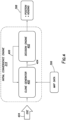
- Figure 4 shows a block diagram of the internal components of the initial convergence engine.
- the initial convergence engine 314 may be conceptually, though not necessarily physically, divided into a clone generator 400 and a decision engine 402.
- the clone generator 400 receives speed, heading change, and in some cases position from the data supply engine 312 ( Figure 3 ), and as shown by arrow 404.
- the clone generator 400 receives map data 306 from the navigation program 300.
- the clone generator 400 spawns clone processes and "distributes" the clone processes across a swath of directions (e.g., covering 360 degrees).
- each clone processes is given an identical initial location and speed, and each clone process given a unique direction.
- the clone generator 400 refrains from spawning clone processes whose unique directions are toward obstacles, such as walls, pillars and other obstacles.
- the clone generator 400 may spawn 120 clone processes with unique directions spanning 360 degrees.
- the unique directions of the clone processes may be evenly spread about the span of directions. For example, in the case of 120 clone processes spanning 360 degrees, the unique direction of each clone process may be three degrees from the unique direction of its nearest neighbor clone processes.
- the clone generator 400 may spawn clone processes along a smaller span of headings, such as clone processes spanning a range of headings greater than 90 degrees, but less than 270 degrees, or less than 180 degrees. While the developmental context is spawning clone processes in two dimensions, one having ordinary skill in art, with the benefit of this disclosure, could easily extend the idea of spawning clone processes in three-dimensional space (e.g., aviation context) for higher accuracy.
- three-dimensional space e.g., aviation context
- the decision engine 402 is the authority that makes survival decisions regarding the clone processes, and at the appropriate times makes the determination regarding the initial heading of the mobile device 200 ( Figure 2 ). Example internal workings of the decision engine 402 are described after a more thorough description of the clone processes and lifespan thereof.
- Figure 5 shows an overhead conceptual view of spawning clone processes in accordance with at least some embodiments.
- Figure 5 shows spawning or creation process in an example two-dimensional space with no obstacles in the immediate vicinity.
- Figure 5 shows two distinct points in time, with the center blocks representing location of the clone processes when initially spawned, and the outer ring of blocks a finite time after creation.
- the initial convergence engine 314 creates or spawns a plurality of clone processes 500.
- Each clone process is given an initial identical location L and identical initial speed S, and each clone process given a unique direction.
- the clone processes 500 at creation are all "located” in the same place in the middle of the figure, and thus not all the clone processes are visible.
- the "L” and “S” inside the upper most clone process 500 signify the location and speed.
- the unique direction of each clone process is shown by the radial arrows. That is, in the example of Figure 5 , eight clone processes are created with eight unique directions spanning 360 degrees. Figure 5 uses eight clone processes so as not to unduly complicate the figure, but in practice for unique directions spanning 360 degrees, 120 clone processes may be used.
- the location and speed data is provided to the clone processes 500 from the data supply engine 312 ( Figure 3 ). Note, however, that while the data supply engine 312 passes along heading change data, the heading change data may be ignored or discarded at the point in the time that the clone processes are created. Rather, each clone processes is assigned a unique direction within a range of headings (again here, spanning 360 degrees).
- Each clone process then calculates a respective position at the end of a period of time, such as a frame period. That is, given the initial location and speed data, each clone process calculates a how far the clone process "moves" during the frame period based on the initial location, speed data, and unique direction. For example, clone process 502 calculates a new location (i.e., respective position) a distance along the unique direction 504 given the speed, to arrive at the new location as conceptually shown in Figure 5 . The same process is carried out by all the example clone processes 506, 508, 510, 512, 514, 516, and 518 along their respective unique directions 520, 522, 524, 526, 528, 530, and 532.
- Each clone process is a software construct, not an actual device moving the two- or three-dimensional space.
- each clone process may be an entry in a data table, and the table is updated with updated speed data, heading change data, and position.
- each clone process may be a separately executed thread of the processor communicating through inter-process communication (IPC) calls to the other modules and engines.
- IPC inter-process communication
- each clone process utilizes the updated speed data and heading change data to calculate new respective locations.
- Figure 5 does not show a second location calculation so as not to unduly complicate the drawings.
- the data supply engine 312 periodically supplies actual location data to the clone processes, for example, once every frame period. That is, speed data and heading change data may be provided more often than actual location. Nevertheless, when a clone process receives actual location data, the clone process calculates one or more metrics that are used in termination decisions regarding the clone. Each clone process determines a distance or gap between the respective position and a nearby obstacle. Each clone process may calculate a separation between the respective position and the actual position. Other metrics related to the clone processes being Extended Kalman Filters (discussed more below) may also be calculated.
- the example system and method terminates clone processes whose metrics indicate the clone process does not show sufficient correlation to the actual heading. For example, if the separation between the respective position and the actual position is outside a separation threshold, the clone process is terminated. If the gap between the respective position and an obstacle is less than a gap threshold, the clone process is terminated.
- the actual heading is between unique directions 526 and 528, such as actual heading 534.
- the metrics regarding correlation with respect to the actual heading 534 will be greater for clone processes whose unique directions are closer to the actual heading 534. Oppositely, the metrics regarding correlation with respect to the actual heading 534 will be less for clone processes whose unique directions are farther or opposite actual heading 534.
- some of the example clone processes of Figure 5 will be terminated, such as clone processes 502, 506, and 518. The process may thus continue for one or more frame periods, each time narrowing the number of clone processes, where the unique directions of the remaining clone processes are indicative of the actual heading 534.
- Figure 6 shows a flow diagram of a single clone process in accordance with at least some embodiments.
- the clone process X (in the figure "clone x") is created or spawned with an initial speed, initial position, and unique heading (block 600).
- the example clone process waits for an update from the data supply engine 312 (block 602).
- the example process moves to a determination as to whether the updated data is an update to speed data and heading change data, or the updated data is an actual position (block 604).
- the example process moves to speed & heading change (block 606), where the "location" of the clone process is updated, to arrive at or predict the state of the clone process (block 608). The example process then retreats to the wait for further data.
- the example process moves to calculating metrics regarding the actual position compared to the respective position of the clone process (block 610), among other possible metrics, such as metrics related to the Extended Kalman Filter process discussed more below.
- the metrics related to position (block 612) are passed to the decision engine (DE) 402, and the example process waits for a termination decision (block 614). If the decision engine 402 elects to keep the clone process alive (again block 614), the example process returns to waiting for the next set of updated data (again block 602). If the decision engine elects to kill or terminate the clone process (again block 614), the clone process is killed or terminated (block 616), and the process ends.
- a data update may include both speed data, heading change data, and an actual position.
- the example clone process calculates the updated respective location (block 606), and then calculates the metrics (block 610); however, the flow diagram does not show the simultaneous arrival case so as not to unduly complicate the figure.
- each clone process is an instance of a Kalman Filter, and in certain cases an Extended Kalman Filter.
- the state of clone process at time t may be presented by: x ⁇ t
- t s ⁇ t
- t is the heading.
- t ⁇ 1 , u t 1 0 ⁇ v t ⁇ t sin ⁇ ⁇ t ⁇ 1
- t ⁇ 1 + ⁇ ⁇ t 0 0 1 and H t ⁇ h ⁇ x
- t ⁇ 1 1 0 0 0 1 0
- F t is the state transition model
- H t is the observation model.
- the state of a clone process is updated using the prediction procedure of the Extended Kalman Filter x ⁇ t
- t ⁇ 1 f x ⁇ t ⁇ 1
- t ⁇ 1 F t P t ⁇ 1
- t -1 is the predicted state estimate across the transition from time t - 1 to time t
- t -1 is the predicted covariance estimate
- Q t is process noise covariance matrix (i.e., the potential error in the speed and heading change data combined with the prediction process)
- f is the state prediction function that transitions the clone process state with the given speed and heading change input u t f x ⁇ t ⁇ 1
- u t x ⁇ t ⁇ 1
- Actual position information is obtained from lodestar devices in the navigation domain.
- the position information may be received from BLE beacons or any other transmitter transmitting location information, such as UWB transmitters or any other type.
- position information may come, for example, from GPS signals and/or cellular tower triangulation.
- the position estimation module 304 calculates and provides the actual position information, and supplies the actual position 320 ( Figure 3 ) to data supply engine 312 ( Figure 3 ) for boundary checks and verification. "Internal Position" is then determined by fusing sensor supplied data and map information. Internal Position is inherently and significantly more accurate than externally supplied position information.
- t ⁇ 1 S t H t P t
- t ⁇ 1 H t T + R t K t P t
- t ⁇ 1 H t x ⁇ t
- state of the clone process is passed to the decision engine (block 402, Figure 4 ) for the evaluation of the survival of the clone process in the next time frame.
- decision engine 402 regarding clone process termination decisions as well as determining the heading of mobile device 200 ( Figure 2 ) from remaining clone processes.
- the decision engine 402 receives state information from the clone processes (as shown by arrow 404). Using the state information, the decision engine makes decisions, and conveys the decisions back to the clone processes (as shown by arrow 406).
- the decision engine 402 has two functions: making kill or termination decisions regarding each clone process using the state information; and determining whether the remaining clone processes are converging, and if so calculating a heading from the remaining clone processes.
- the decision engine 402 kills or terminates a clone process if the distance between the clone process and the latest actual position identified position estimation module 304 is greater than a threshold, and in some cases threshold is optimized and pre-determined for a venue. Stated otherwise, the decision engine terminates each clone process whose separation between its respective position and the actual position is greater than the predetermined threshold being a separation threshold.
- the example decision engine 402 also kills or terminates a clone process if the clone process is getting too close to a wall or any obstacle identified by map data 306. 'Close' is pre-determined for a venue. Stated otherwise, the decision engine 402 kills or terminates each clone process whose gap between its respective position and an obstacle is less than the predetermined threshold being a gap threshold.
- Figure 7 shows a flow diagram of the process of the decision engine in accordance with at least some embodiments.
- all the clone processes communicate with the decision engine 402 (see arrow 406 of Figure 4 ).
- the decision engine 402 collects all the state data from the clone processes (block 706), and makes kill or termination decisions using the data (again block 706). For each clone process still "alive", a decision is then made whether to kill or terminate each clone process.
- Figure 7 shows two example decision blocks 708 and 710 making kill or termination decisions, but there would be a decision block for each clone process and/or each remaining clone process.
- a calculation of vectoral values is made (block 720), followed by a calculation of a heading vector (block 722).
- a decision is made as to whether the direction suggested by the remaining clones is converging (block 724). If not, the process retreats to the collection of clone data (block 706). If convergence has occurred (again block 724), the initial convergence engine has successfully determined the initial heading, and handover is made to the navigation engine or navigation program (block 726).
- the specification turns to a visual representation of determining whether convergence on a heading has taken place.
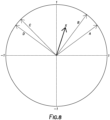
- Figure 8 shows a unit circle in order to describe convergence determinations, in accordance with at least some embodiments.
- Figure 8 assumes that four clone processes remain, being clone processes A, B, C, and D.
- Each clone process has a unique heading, which may be either the original unique heading, or headings modified by one or more sets of heading change data. Since all the clone processes are provided the heading change data, the relative relationship between the unique headings remain unchanged. The headings are implied by the arrows indicated each clone process in Figure 8 .
- the vector displacement of each clone process from the initial location will be the same, and thus for purposes of convergence determinations the vectors may be considered to be unit vectors of length one as shown. Calculated displacements from the initial location could also be used.
- the decision engine 402 calculates an average vector using the unique heading from each of the remaining clone processes.
- An example average vector is shown in Figure 8 as vector X. If a magnitude of the average vector X meets or exceeds a magnitude threshold, then the decision engine 402 assumes that convergence has taken place.
- the heading of the average vector X is then assigned to be the initial heading of the mobile device 200 ( Figure 2 ) and is provided to the navigation program 300 ( Figure 3 ).
- the magnitude threshold may be 0.8, but the magnitude threshold may be modified taking into account properties of the venue, such as wall structures and number of beacon devices per square yard.
- the example process returns to the remaining clone processes calculating new positions based on updated speed data and heading change data, and terminating clone processes, until convergence is achieved.
- heading information of surviving or remaining clone processes is used.
- the magnitude of the average heading vector m avg
- the decision engine 402 assumes that convergence has taken place. And if the magnitude of the average vector X is below the magnitude threshold, the example process returns to the remaining clone processes calculating new positions based on updated speed data and heading change data, and terminating clone processes, until convergence is achieved.
- the initial convergence engine 314 starts anew spawns a sufficient number of clone processes.
- a similar scenario could take place when the user suddenly turns (e.g., a turn 180 degrees) and starts walking in the opposite direction.
- the navigation program 300 gathers information about the venue over time and statistically analyzes user behavior. For example, if a hallway is not used very often, then it is less likely that user should turn into that hallway.
- the example systems and methods can reduce the number of clones spawned that way (e.g., the unused hallway of feature would be considered an obstacle). This feature is innovative and improves on actual map data. It may be that the hallway is dark that is why it is not used often.
- the navigation program 300 may save the data, and transmit to a central server at a later point in time, as again connection to a central server is not needed for the initial heading determinations of the various embodiments.
- internet access e.g., cellular or WIFI
- Figure 9 shows a method in accordance with at least some embodiments.
- the method starts (block 900) and comprises: spawning a plurality of clone processes, each clone process given an identical location and speed, and each clone process given a unique direction (block 902); calculating, by each clone process, a respective position at the end of a frame period (block 904); terminating clone processes whose position at the end of the frame period is outside a predetermined threshold, the terminating results in remaining clone processes (block 906); and determining the heading of the mobile device from the remaining clone processes (block 908). Thereafter the method ends (block 910).
- lodestar devices for outdoor navigation are GPS satellites.
- Other lodestar devices for outdoor navigation are possible, such as cellular towers of a cellular network, where the location may be determined by triangulating and/or RSSI regarding signals from cellular towers.
- it is possible that some outdoor venues may also include beacon devices even though mobile devices within the outdoor venue can receive GPS signals. Nevertheless, outdoor areas may be considered or represent a navigation domain different than an indoor navigation domain.
- the mobile device carried by the user has a navigation program (e.g., the same or different than the navigation program used for indoor areas) that either knows in advance, or is provided upon request from the cellular data network, a map of the outdoor layout. While the mobile device may know its initial outdoor location 118, the initial heading may not be known or there may be more than one viable solution based on the accuracy of the location data available at the time. As with indoor navigation, if the navigation program makes an incorrect assumption about direction to travel, the user may travel a significant distance in the wrong direction before being given a correct heading.
- a navigation program e.g., the same or different than the navigation program used for indoor areas
- example embodiments are directed to systems and methods for estimating initial direction at startup of navigation, including start-up of outdoor navigation. More particularly, and much like the indoor navigation discussed above, example embodiments are directed to determining an initial heading of the mobile device by not assuming a particular initial heading; rather, example methods spawn a plurality of clone processes that are initially given identical locations and identical speeds, and with each clone process assigned or given a unique direction. The clone processes each calculate a respective position after a frame period.
- each clone process performs multiple location calculations during the frame period by being provided speed heading change information multiple times during the frame period.
- the mobile device determines a new position indication (likely with higher accuracy than the first position indication) that too is passed to the clone processes.
- Each clone process calculates metrics related to the respective position and the actual position, and clone processes whose assigned directions are sufficiently different than the actual direction of travel are terminated, resulting in remaining clone processes.
- an initial heading is thus established.
- the initial heading is determined in two seconds or less, and in some cases one second or less.
- Figure 3 was initially discussed in terms of indoor navigation.
- the navigation program 300 itself, or a version thereof, may be used for outdoor navigation.
- the discussion continues based on the assumption that the navigation program 300 operates for both indoor and outdoor navigation.
- one having ordinary skill in the art could create an outdoor navigation program, or modify the navigation program 300 for outdoor navigation.
- Operation of the example navigation program 300 is largely the same for outdoor navigation as for indoor navigation, and as described above.
- the navigation program 300 will not be described again in its entirety here. Rather, the description focuses on a few areas where the navigation program 300 operates differently in the outdoor context, starting with the position estimation module 304.
- the position estimation module 304 may create position data periodically (e.g., once every second) based on lodestar devices for outdoor navigation.
- the position estimation module 304 may receive position data from the GPS receiver 220 and provide the position data to the initial heading module 302. Because the example GPS-based position calculations inherently contain error information, when providing the example GPS-based position data to the data supply engine 312 the position estimation module 304 likewise provides the error information to be used in the initial heading determination.
- the position estimation module 304 may also receive data from a lodestar device in other navigation domains, and thus the position estimation module 304 may discard or ignore signals and/or data from lodestar devices in different navigation domains. For example, if the user is at location 118 ( Figure 1 ), the mobile device may receive GPS-signals and calculate position based on those GPS signals, but the mobile device may also receive signals from beacons within the indoor venue 102. Thus, the position estimation module 304 may, knowing its position outside the indoor venue 102, discard or ignore the beacons associated with the indoor venue.
- the position in outdoor areas may be determined (with varying degrees of accuracy) based on "triangulation" of three or more cell towers having known location.
- the cell-tower based position data may be used in place of, or supplement, GPS-based position data.
- the cell-tower based position data may be calculated by the processor 204 ( Figure 2 )
- no physical device is shown in Figure 3 to provide the cell-tower based position data to the position estimation module 304.
- such cell-tower based position data may be transferred between software processes by way of inter-process communication (IPC).
- IPC inter-process communication
- the map data 306 received by the initial convergence engine 314 is map data for the outdoor area or outdoor venue, such as map data downloaded through the cellular communication system 218 ( Figure 2 ) or read through the short-range wireless communication system 216.
- the display device of the mobile device may show a merged map concatenating a map (or portion thereof) of the indoor venue 102 with a map (or portion thereof) of the outdoor area.
- the map concatenation aspects are discussed more below in the section regarding transitioning between navigation domains.
- the initial convergence engine 314 is used to determine heading much like the indoor navigation context.
- the initial convergence engine 314 receives the speed data, heading change data, and when available updates to the actual position.
- the initial convergence engine 314 receives the map data 306.
- the initial convergence engine spawns a plurality of clone processes, and terminates clone processes whose unique direction fails to sufficiently match the actual direction, all as previously discussed.
- the data used to create the clone processes is data based on and collected in the outdoor area, but the underlying mathematics (e.g., Kalman Filter, or Extended Kalman Filter) are the same.
- the expected position error and thus the expected error in speed and heading change, are modified to take into account the difference in lodestar devices. More particularly, in Equation 8 above the Q t value, being the process noise covariance matrix (i.e., the potential error in the speed and heading change data combined with the prediction process), is modified to account for the potential error in the speed and heading change data. Similarly, in Equation 11 above the R t value, being the measurement noise covariance matrix (i.e., the potential error in the lodestar position information), is modified to account errors associated with GPS-based position determinations. The errors are in some cases larger than their indoor venue counterparts, and may be based on parameters such as the number of satellites used to make the position determination, and signal strength from those satellites.
Landscapes
- Engineering & Computer Science (AREA)
- Radar, Positioning & Navigation (AREA)
- Remote Sensing (AREA)
- Physics & Mathematics (AREA)
- General Physics & Mathematics (AREA)
- Automation & Control Theory (AREA)
- Computer Networks & Wireless Communication (AREA)
- Navigation (AREA)
Description
- Navigation systems designed for vehicles use global positioning system (GPS) signals to find position and find a route to a destination. GPS-based systems are usually deployed in vehicles where main power supply is not restricted, and in most operational circumstances the vehicle is outdoors where the GPS receivers have direct "view" of the GPS satellites.
- However when navigation is needed for a pedestrian many things change. For example, when navigating within an indoor area the hand-held computing device of the pedestrian may not be able to sense any GPS signals, and thus indoor navigation may be based on beacons disposed within the indoor area. Oppositely, when navigating outdoors the hand-held computing device of pedestrian may not be able to sense beacons from the indoor area, and thus outdoor navigation may be based on the GPS signals. Moreover, transitioning from indoor to outdoor, or outdoor to indoor, is difficult for related-art devices, as the two areas represent different navigation domains.
- Notwithstanding the issues noted above, whether in vehicles or hand-held computing devices, GPS-based systems may take three to seven minutes to determine an initial heading, particularly if the GPS-based system has been moved to a new location since its last GPS-based position determination. Similarly, mobile devices determining position based on location information provided by beacon devices may take a minute or more to determine initial heading.
- Further problems occur when seamless navigation is required in two domains; indoors and outdoors. Current systems require the user change devices or applications when moving from one domain to another. This is not only inconvenient but also does not allow the user to plan his/her journey and estimate walking times from one indoor location to another when there is an outdoor area in between.
-
CN105737826 describes an indoor positioning method for a pedestrian. The method comprises the steps of determining the initial state of the pedestrian; mapping the initial state of the pedestrian into an adaptability graph model, wherein the adaptability graph model is composed of a one-dimensional Thiessen polygon graph representing a narrow and long area and a two-dimensional regular grid graph representing an open area, and the one-dimensional Thiessen polygon graph and the two-dimensional regular grid graph express corresponding spaces into dispersed nodes and edges formed by passable paths; conducting pedestrian dead reckoning based on data collected by an inertial sensor, and further detecting walking events of the pedestrian; when the walking events of the pedestrian is detected each time, spreading particles corresponding to the motion state of the pedestrian in the adaptability graph model through a particle filter; conducting weighting and summation on all the particles, so that current coordinates are obtained, and mapping the current coordinates to one corresponding node on the adaptability graph model to serve as the current state. -
US2015350849 describes methods, systems, and a computer program product for location determination using dual statistical filters. A mobile device can determine a location of the mobile device using a particle filter and a Kalman filter. The particle filter can filter candidate locations of the mobile device using measurements of environment variables in the venue. The Kalman filter can filter inputs from a sensor of the mobile device for measuring angular movement of the mobile device. The particle filter and the Kalman filter can be linked by heading of the mobile device. Output of the Kalman filter can be used to determine where to place particles, or candidate locations, in a next iteration of the particle filter. Output from the particle filter can be used to determine a center mode of the Kalman filter and to determine a bias of the sensor for measuring angular movement. - A computer-implemented method of determining a heading of a mobile device according to appended
claim 1, and a hand-held computing device according to appended claim 9, are provided. - For a detailed description of example embodiments, reference will now be made to the accompanying drawings in which:
-
Figure 1 shows an overhead view of an indoor venue in accordance with at least some embodiments; -
Figure 2 shows a block diagram of a mobile device in accordance with at least some embodiments; -
Figure 3 shows a block diagram of a navigation program in accordance with at least some embodiments; -
Figure 4 shows a block diagram of the internal components of the initial convergence engine; -
Figure 5 shows an overhead conceptual view of spawning clone processes in accordance with at least some embodiments; -
Figure 6 shows a flow diagram of a single clone process in accordance with at least some embodiments; -
Figure 7 shows a flow diagram of the process of the decision engine in accordance with at least some embodiments; -
Figure 8 shows a unit circle in order to describe convergence determinations, in accordance with at least some embodiments; and -
Figure 9 shows a method in accordance with at least some embodiments. - Various terms are used to refer to particular system components. Different companies may refer to a component by different names - this document does not intend to distinguish between components that differ in name but not function. In the following discussion and in the claims, the terms "including" and "comprising" are used in an openended fashion, and thus should be interpreted to mean "including, but not limited to...." Also, the term "couple" or "couples" is intended to mean either an indirect or direct connection. Thus, if a first device couples to a second device, that connection may be through a direct connection or through an indirect connection via other devices and connections.
- "Controller" shall mean, alone or in combination, individual circuit components, an application specific integrated circuit (ASIC), a microcontroller with controlling software, a digital signal processor (DSP), a processor with controlling software on memory, and/or a field programmable gate array (FPGA), configured to read inputs and drive outputs responsive to the inputs.
- "Navigation domain" shall mean an indoor area or outdoor area in which navigation is accomplished by lodestar devices placed for use in the area. For example, in an indoor area beacons may be placed to provide information used to navigate within the indoor area, and in an outdoor area GPS satellites may be used to navigate within the outdoor area. While some signals from the GPS satellites may be received within the indoor area (e.g., near a window or skylight), the signals from the GPS satellites are not suitable for navigation within a navigation domain that is indoor. Similarly, while some signals from beacon devices placed in an indoor area may be received outdoors (e.g., near a window or garage door), the signals from the beacons that are placed in the indoor area are not suitable for navigation within a navigation domain that is outdoor.
- Various example embodiments are directed to navigation within and between navigation domains. More particularly, various example embodiments are directed to providing navigation information to a user of a hand-held computing device or a mobile device as the user transitions between navigation domains (e.g., transitioning from indoors to outdoors, or outdoors to indoors). The specification is conceptually divided into indoor navigation issues, outdoor navigation issues, and then to navigation when transitioning between navigation domains.
-
Figure 1 shows an overhead view of an indoor venue in accordance with at least some embodiments. In particular,Figure 1 shows thelayout 100 of an exampleindoor venue 102. A person may enter theindoor venue 102 through a portal illustratively shown asdoors 104. Once inside, the person may want to navigate from theentry hall area 108 to theexhibition area 106 orexhibition area 110. Because theindoor venue 102 is indoors, a mobile device of a person may not be able to detected signals from global positioning system (GPS) satellites. In order to provide indoor navigation, the exampleindoor venue 102 has disposed therein a plurality ofbeacon devices 112. Not all beacon devices are numbered so as not to unduly complicate the figure. Thebeacon devices 112 may be placed at any suitable location, such as ceiling-mounted beacon devices, wallmounted beacon devices, beacon devices mounted on structural pillars, and the like. Thus, the exampleindoor venue 102 represents a navigation domain where lodestar devices in the form of beacons provide navigation signals and/or data. Thebeacon devices 112 may take any suitable form, such as Bluetooth Low Energy (BLE) devices, or Ultra Wide Band (UWB) devices, available from many manufacturers. Moreover, location determinations may take any suitable form, such as triangulation, received signal strength indications (RSSI), and combinations. - Consider that user has entered the facility, is standing at
location 114 in theentry hall 108, and would like to navigate tolocation 116 withinexhibition area 110. The hand-held computing device or mobile device carried by the user has a navigation program that either knows in advance, or is provided upon request from thebeacon devices 112 or a data network, the layout of theindoor venue 102. While the mobile device may know itsinitial location 114, the initial heading may not be known or there may be more than one viable solution based on the accuracy of the location data available at the time. If the navigation program makes an incorrect assumption about direction to travel fromlocation 114, the user may travel a significant distance in the wrong direction (in the example, into exhibit area 106), before being given a correct heading to reachlocation 116 inexhibition area 110. - In related-art systems, the navigation platform may take several minutes to determine the initial heading, in which case the user may be walking in the wrong direction (e.g., towards
exhibit area 106 rather thanexhibition area 110 in this example) before the navigation platform can resolve an initial heading. While most related-art systems focus on increasing accuracy of triangulation methods, none of the related-art systems have paid sufficient attention to reducing the time required to compute the initial heading. Nor have the related-art systems paid attention to increasing the accuracy of initial heading so that the user is directed correctly as soon as navigation program starts. Some related-art systems use particle filters for navigation algorithms, particularly in robots, vehicles, and other types of machines. For such related-art navigation platforms to work accurately and responsively, the navigation platforms need to generate, maintain, and follow in excess of 10,000 particle filters. Maintaining and harvesting data from 10,000 particle filters consumes significant power resources, making such methods unsuitable for mobile devices. For this reason alone, use of particle filters is not viable on mobile devices. Another important point to consider is that particle filters perform well in estimating position, but not heading or heading change. Walking users are more likely to change heading suddenly than vehicles. Therefore, if the user changes heading suddenly, particle filters would take significant time to realize the change in heading. Another major disadvantage of particle filter systems is that the process is stochastic and not deterministic. Feeding the same data to a stochastic process may yield different results each time. This is totally unacceptable for pedestrians. - By contrast, example embodiments are directed to systems and methods for estimating initial direction at start-up of navigation. More particularly, example embodiments are directed to determining initial heading of a mobile device by not assuming any initial heading; rather, example methods spawn a plurality of clone processes that are initially given identical locations and identical speeds, and with each clone process assigned or given a unique direction. The clone processes, in some cases Kalman filters, and in a particular case extended Kalman filters, each calculate a respective position after a frame period. In some cases, each clone process performs multiple location calculations during the frame period by being provided speed and heading change information multiple times during the frame period. Eventually the mobile device determines a new position indication (likely with higher accuracy than the first position indication) that too is passed to the clone processes. Each clone process calculates metrics related to the respective position and the actual position, and clone processes whose assigned directions are sufficiently different than the actual direction of travel are terminated, resulting in remaining clone processes. When the remaining clone processes sufficiently agree, an initial heading is thus established. In example embodiments the initial heading is determined in two seconds or less, and in some cases one second or less.
- Mobile devices and computer systems, prior to the innovations described herein, were unable to resolve initial heading quickly enough to be useful for deriving initial navigation directions, many times resulting in navigation platforms providing incorrect navigation directions that many times were not corrected for five minutes or more. The improvements discussed herein thus improve the operation of the computer systems and mobile devices. Moreover, improvements discussed herein improve another technological field of computer-assisted navigation. The specification now turns to an example mobile device which may implement the various embodiments.
-
Figure 2 shows a block diagram of a hand-held or mobile device in accordance with at least some embodiments. In particular,Figure 2 shows examplemobile device 200 comprising acontroller 202. Thecontroller 202 takes any suitable form, such as an application specific integrated circuit (ASIC), a microcontroller with controlling software, a digital signal processor (DSP), a processor with controlling software, a field programmable gate array (FPGA), or combinations thereof, configured to read inputs and drive outputs responsive to the inputs. In the system ofFigure 2 , thecontroller 202 is implemented in the example form of aprocessor 204 coupled to amemory 206. Thecontroller 202 couples to host of internal components and devices by any suitable direct connection or bus system, as shown by the exampleinternal bus 208. - The example
mobile device 200 comprises anaccelerometer 210 electrically coupled to thecontroller 202 by way of theinternal bus 208. Theaccelerometer 210 may take any suitable form, such as a single-axis accelerometer, or multi-axis accelerometer. In a particular example, theaccelerometer 210 is a three-axis accelerometer such that themobile device 200 may be able to determine acceleration in any dimension (e.g., movement in the horizontal plane along with how much the user "bounces" for each step taken). In other cases theaccelerometer 210 may be one or more velocity meters, from which acceleration can be mathematically determined. - The example
mobile device 200 further comprises anelectronic gyroscope 212 electrically coupled to thecontroller 202 by way of the exampleinternal bus 208. Thegyroscope 212, standing alone, may not be able to provide a heading relative to a coordinate system (e.g., relative to magnetic North) unless the data from thegyroscope 212 is combined with other data. However, thegyroscope 212 can be used to create accurate indications of heading change even when the absolute heading is not known. - The example
mobile device 200 further comprises abarometer 214 electrically coupled to thecontroller 202 by way of the exampleinternal bus 208. Thebarometer 214 may be used to read barometric pressure, which is indicative of the elevation. Of course, barometric pressure is also influenced by high and low pressure weather patterns; however, frequent readings of the barometer are much less likely to be influenced by weather, especially when relative elevation changes are used. Further, the data from thebarometer 214 may need to be combined with other data for absolute elevation determinations. - The example
mobile device 200 further comprises a short-rangewireless communication system 216 coupled to thecontroller 202 by way of the exampleinternal bus 208. The short-rangewireless communication system 216 may take any suitable form and protocol, such as Bluetooth, Ultra Wide Band (UWB), or any of the various WIFI protocols, such as IEEE 802.11. Theprocessor 204, executing a program, may read from the short-rangewireless communication system 216 digital values indicative of current location of themobile device 200 or digital values of Time of Flight or Angle of Arrival values to aid in calculation of location. In example embodiments, themobile device 200 receives data from beacon devices 112 (Figure 1 ) as part of providing navigation services to the user of themobile device 200. - The example
mobile device 200 further comprises acellular communication system 218 electrically coupled to the controller by way of the exampleinternal bus 208. Thecellular communication system 218 wirelessly communicates with cell towers to provide voice and data services. In example embodiments, maps of venue or areas (e.g., maps of indoor venues (such as indoor venue 102 (Figure 1 )) may be downloaded using the data aspects of thecellular communication system 218. The maps may also be downloaded by use of the short-rangewireless communication system 216 in addition to, or in place of, thecellular communication system 218. - The example
mobile device 200 further comprises aGPS receiver 220 electrically coupled to thecontroller 202 by way of theinternal bus 208. TheGPS receiver 220 or a similar location engine calculates a geographical location (or series of geographic locations for moving devices). In example embodiments,GPS receiver 220 may receive signals from one or more satellites orbiting the earth via an antenna (not specifically shown) that is tuned to the frequencies transmitted by the one or more satellites.GPS receiver 220 may analyze the received signals to create location data indicative of a current location ofmobile device 200. Thus, theprocessor 204, executing a program, may read from theGPS receiver 220 digital values indicative of current location of themobile device 200. In other cases, theGPS receiver 220 provides data to theprocessor 204 executing a program, and theprocessor 204 analyzes the data to determine location of themobile device 200. - The example
mobile device 200 further comprises adisplay device 222 electrically coupled to thecontroller 202 by way ofdisplay driver 224. As the name implies, thedisplay driver 224 takes data provided by the controller 202 (e.g., maps, graphical indications of direction to travel) and displays the information on thedisplay device 222 for the user. In some example systems, thedisplay device 222 is covered by or integrated with a touch screen system (not specifically shown). Thecontroller 202 may interface with the touch screen system by way oftouch screen interface 226. Thus, using the touch screen system and thetouch screen interface 226, thecontroller 202 may receive information from the user, such as by way of keyboard implemented using thedisplay device 222. In other cases, themobile device 200 may implement a physical keyboard in addition to, or in place of, the touch screen system andtouch screen interface 226. - Finally, the example
mobile device 200 comprises abattery 228. Thebattery 228 provides power to all of the noted internal components, but the electrical connections to thebattery 228 are not shown so as not to unduly complicate the drawing. Thebattery 228 may take any suitable form, such as a lithium-ion battery, but any currently available or after-developed battery technology may be used. Thus, themobile device 200 may be any currently available mobile device (e.g., APPLE® brand iPhones available from Apple, Inc., or ANDROID® brand devices available from Google, Inc.) or any after-developed hand-held computing device or mobile device. The discussion now turns to a software environment in which the example embodiments of indoor navigation are operated, and it will be understood the various pieces of the software that make up the software environment may be executed by thecontroller 202, and in specific examples stored on thememory 206 and executed by theprocessor 204. -
Figure 3 shows a block diagram of a navigation program in accordance with at least some embodiments. In particular,Figure 3 shows thatnavigation program 300 interfaces with various devices of the mobile device 200 (Figure 2 ), such as theaccelerometer 210,gyroscope 212,barometer 214, short-rangewireless communication system 216, andGPS receiver 220. Thenavigation program 300 may provide to the user navigation information, such as by placing that navigation information on thedisplay device 222 ofFigure 2 . Theexample navigation program 300 is conceptually, though not necessarily physically, divided into a plurality of modules and data engines. In particular, theexample navigation program 300 comprises aninitial heading module 302 which, as the name implies, is designed and programmed to determine or estimate the initial heading of the user in startup situations, and as we shall see situations where the user makes abrupt direction changes. Theinitial heading module 302 reads or takes input from theaccelerometer 210 and thegyroscope 212. In cases where themobile device 200 does not have agyroscope 212, a magnetometer may be substituted. If amobile device 200 has both agyroscope 212 and magnetometer, example embodiments use only thegyroscope 212 to the exclusion of the magnetometer. Theinitial heading module 302 further receives data indicative of position (hereafter just position data) from other portions of thenavigation program 300. In the example environment ofFigure 3 , the position data is provided from aposition estimation module 304, and in particular theposition estimation module 304 periodically (e.g., once every second) provides position data to theinitial heading module 302. Theinitial heading module 302 further receivesmap data 306 from thenavigation program 300, such as map data downloaded through the cellular communication system 218 (Figure 2 ) or read through the short-rangewireless communication system 216. Finally, theinitial heading module 302 outputs or provides position and heading 308 to thenavigation program 300, which may be used to provide directions to the user of themobile device 200. - In example embodiments, the
initial heading module 302 is conceptually, though not necessarily physically, divided into a plurality of underlying modules and engines. For example, theinitial heading module 302 may comprise aninertial navigation module 310, adata supply engine 312, and aninitial convergence engine 314. Each will be addressed in turn, starting with theinertial navigation module 310. The exampleinertial navigation module 310 takes input from theaccelerometer 210 andgyroscope 212, and produces data indicative of speed (hereafter just speed data) of the mobile device 200 (Figure 2 ) and thus user, as shown byarrow 311. Theinertial navigation module 310 also produces data indicative of heading change (hereafter just heading change data) of themobile device 200, as shown byarrow 313. That is, the heading change data may include a numerical value that indicates the change in heading that has occurred since the immediately previous numerical value (e.g., +10 degrees, -20 degrees). Thus, the heading change data is, in some embodiments, not a direct indication of direction; rather, the heading change data merely shows how much heading has changed since the immediately previous heading change data was provided. Theinertial navigation module 310 produces updated speed data and heading change data multiple times within a frame period (e.g., a frame period of one second). - For reasons that will become clearer below, the functionality of the
inertial navigation module 310 is conceptually divided into astep detector module 316 and a headingestimation module 318. As the names imply, thestep detector module 316 determines or calculates speed data based on detecting steps taken by the user of the mobile device 200 (Figure 2 ). In some example systems, thestep detector module 316 takes into account information about the user and/or the venue (e.g., indoor venue 102 (Figure 1 )) when calculating stride length as part of generating speed data. Headingestimation module 318 is primarily concerned with creating the heading change data based on data from theaccelerometer 210 andgyroscope 212. - Still referring to
Figure 3 , theinitial heading module 302 again comprises thedata supply engine 312. Thedata supply engine 312 receives as input speed data and heading change data from thestep detector module 316 and headingestimation module 318, respectively. The speed data and heading change data may arrive at thedata supply engine 312 multiple times within a frame period. For example, if a frame period is one second, thedata supply engine 312 may receive ten or more updates of speed data and heading change data within the one second frame period. Thedata supply engine 312 further receives as input data indicative of actual position (hereafter just actual position) from thenavigation program 300, and specifically theposition estimation module 304. Thedata supply engine 312 is designed and programmed to ensure the data makes logical sense before being passed to theinitial convergence engine 314. - The internal workings of the
initial convergence engine 314 are discussed in greater detail below. Nevertheless, theinitial convergence engine 314 receives the speed data, heading change data, and when available updates to the actual position. Moreover, theinitial convergence engine 314 receivesmap data 306. The initial convergence engine spawns a plurality of clone processes, and terminates clone processes whose unique direction fails to sufficiently match the actual direction. Theinitial convergence engine 314 determines the initial heading of the mobile device 200 (Figure 2 ) based on remaining clone processes, and passes the initial position and heading 308 to thenavigation program 300. -
Position estimation module 304 may receive as input: barometric pressure data from thebarometer 214; location information through the short-range wireless communication system 216 (e.g., location information from beacon devices 112 (Figure 1 )) when indoors; and location information from theGPS receiver 220 when outdoors. Theposition estimation module 304 is shown outside theinitial heading module 302 to signify that any currently available or after-developed position estimation methodology may be used. For indoor navigation, the position estimation module may use a triangulation method and/or a RSSI method to determine location. For outdoor navigation, the position estimate module may directly receive location (based on GPS signals) or may calculate position based on timing of arrival and/or signal strength of each GPS signal. Each location estimation takes a finite time to perform, and thus in some cases theactual position 320 estimated and supplied to thedata supply engine 312 may be provided once every frame period. In some example systems, the frame period is defined by the rate at which the position estimation module 324 can generate updated actual positions, such as once a second. - Still referring to
Figure 3 , and returning to thestep detector module 316. In accordance with example embodiments, average speed in a time interval is calculated by dividing total displacement of themobile device 200 by the time interval. Displacement of themobile device 200 may be obtained by processing accelerometer data. When the user of themobile device 200 walks, periodic variations are detected byaccelerometer 210. By performing peak detection, steps are detected in real time. For each detected step, a dynamic calculation formula of step length based on a human's walking features is performed. While any of a variety of models for calculating speed may be used, in example cases the Scarlet Model is used. The Scarlet Model considers variations due to different users, different paces of the same user, and stride lengths of the same user. In the Scarlet Model, the step length is calculated by using the following formula:
Figure 2 ) may thus be determined by the summation step lengths divided the time period. - The constant k may be determined experimentally by modelling the user's behavior. In accordance with at least some embodiments, accuracy of Scarlet Model is enhanced by determining the constant k for a particular user. That is, the constant k may be personalized and adapted to the user. The mobile device 200 (
Figure 2 ) learns and adapts k for the person and/or the environment. Further, the more the user deploys thenavigation program 300, the better the constant k becomes for the particular user. That is to say, in example systems theinertial navigation module 310 modifies the stride length, and in particular the constant k, based on data regarding the user or person carrying themobile device 200. - In accordance with yet still further embodiments, accuracy of the example Scarlet Model is enhanced by modifying the constant k for a particular location or venue. That is, the user's pace and strides change depending on location or venue. For example, some users walk faster outdoors or at the airports, and some users stroll in shopping centers. Thus, in some embodiments the
mobile device 200, and more particularly thestep detector module 316 may: modify the constant k to modify the stride length based on data regarding the location or venue within which the user and mobile device are moving; and/or modify the constant k to modify the stride length based on data received from a lodestar device (e.g., a beacon device 112 (Figure 1 ) within the venue, or GPS signal). Stated otherwise, in some example systems and methods, changes to the value of the constant k are made depending based on: user dependent data; deployment of data over time; location; and/or venue and user adapted data. - Still referring to
Figure 3 , and specifically the headingestimation module 318. To compute heading change in specific time intervals, readings from both theaccelerometer 210 andgyroscope 212 may be made, and those readings fused to compute an attitude (e.g., 3-dimensional orientation) of the mobile device 200 (Figure 2 ). The attitude may be then projected onto the ground-tangential plane to extract the two-dimensional heading. The heading change is then computed by determining a difference of the heading values of two consecutive heading values. In at least some embodiments, the fusion is performed using a Kalman filter or a complementary filter. In some mobile devices Kalman filter use less power. A specific filtering method may be selected by the headingestimation module 318 based on an identification ofmobile device 200. Optimizing the application for the device reduces power usage significantly. In some systems, to increase accuracy the magnetometer is not used (even if present), as magnetometer readings are affected by environmental factors, such as iron, steel blocks, and computers by power cables. Data from a magnetometer is used only if the mobile device does not have a gyroscope. -
Figure 4 shows a block diagram of the internal components of the initial convergence engine. In particular, theinitial convergence engine 314 may be conceptually, though not necessarily physically, divided into aclone generator 400 and adecision engine 402. As will be discussed in greater detail below, theclone generator 400 receives speed, heading change, and in some cases position from the data supply engine 312 (Figure 3 ), and as shown byarrow 404. Moreover, theclone generator 400 receivesmap data 306 from thenavigation program 300. Theclone generator 400 spawns clone processes and "distributes" the clone processes across a swath of directions (e.g., covering 360 degrees). Stated differently, each clone processes is given an identical initial location and speed, and each clone process given a unique direction. In some cases, theclone generator 400 refrains from spawning clone processes whose unique directions are toward obstacles, such as walls, pillars and other obstacles. In an open space with no close obstacles, theclone generator 400 may spawn 120 clone processes with unique directions spanning 360 degrees. In many cases, the unique directions of the clone processes may be evenly spread about the span of directions. For example, in the case of 120 clone processes spanning 360 degrees, the unique direction of each clone process may be three degrees from the unique direction of its nearest neighbor clone processes. In cases where the initial heading may be partially known (e.g., an abrupt turn by the user), theclone generator 400 may spawn clone processes along a smaller span of headings, such as clone processes spanning a range of headings greater than 90 degrees, but less than 270 degrees, or less than 180 degrees. While the developmental context is spawning clone processes in two dimensions, one having ordinary skill in art, with the benefit of this disclosure, could easily extend the idea of spawning clone processes in three-dimensional space (e.g., aviation context) for higher accuracy. - The
decision engine 402 is the authority that makes survival decisions regarding the clone processes, and at the appropriate times makes the determination regarding the initial heading of the mobile device 200 (Figure 2 ). Example internal workings of thedecision engine 402 are described after a more thorough description of the clone processes and lifespan thereof. -
Figure 5 shows an overhead conceptual view of spawning clone processes in accordance with at least some embodiments. In particular,Figure 5 shows spawning or creation process in an example two-dimensional space with no obstacles in the immediate vicinity. Moreover,Figure 5 shows two distinct points in time, with the center blocks representing location of the clone processes when initially spawned, and the outer ring of blocks a finite time after creation. In example embodiments, when the initial heading module 302 (Figure 3 ), and particularly the initial convergence engine 314 (againFigure 3 ) is called or executed, theinitial convergence engine 314 creates or spawns a plurality of clone processes 500. Each clone process is given an initial identical location L and identical initial speed S, and each clone process given a unique direction. In the conceptual example ofFigure 5 , the clone processes 500 at creation are all "located" in the same place in the middle of the figure, and thus not all the clone processes are visible. The "L" and "S" inside the uppermost clone process 500 signify the location and speed. The unique direction of each clone process is shown by the radial arrows. That is, in the example ofFigure 5 , eight clone processes are created with eight unique directions spanning 360 degrees.Figure 5 uses eight clone processes so as not to unduly complicate the figure, but in practice for unique directions spanning 360 degrees, 120 clone processes may be used. - The location and speed data is provided to the clone processes 500 from the data supply engine 312 (
Figure 3 ). Note, however, that while thedata supply engine 312 passes along heading change data, the heading change data may be ignored or discarded at the point in the time that the clone processes are created. Rather, each clone processes is assigned a unique direction within a range of headings (again here, spanning 360 degrees). - Each clone process then calculates a respective position at the end of a period of time, such as a frame period. That is, given the initial location and speed data, each clone process calculates a how far the clone process "moves" during the frame period based on the initial location, speed data, and unique direction. For example,
clone process 502 calculates a new location (i.e., respective position) a distance along theunique direction 504 given the speed, to arrive at the new location as conceptually shown inFigure 5 . The same process is carried out by all the example clone processes 506, 508, 510, 512, 514, 516, and 518 along their respectiveunique directions - Each clone process is a software construct, not an actual device moving the two- or three-dimensional space. In some cases, each clone process may be an entry in a data table, and the table is updated with updated speed data, heading change data, and position. In other cases, such as mobile devices 200 (
Figure 2 ) having multi-threaded processors, each clone process may be a separately executed thread of the processor communicating through inter-process communication (IPC) calls to the other modules and engines. - Still referring to
Figure 5 , each time the data supply engine 312 (Figure 3 ) provides updated speed data and heading change data, each clone process utilizes the updated speed data and heading change data to calculate new respective locations.Figure 5 , however, does not show a second location calculation so as not to unduly complicate the drawings. Thedata supply engine 312 periodically supplies actual location data to the clone processes, for example, once every frame period. That is, speed data and heading change data may be provided more often than actual location. Nevertheless, when a clone process receives actual location data, the clone process calculates one or more metrics that are used in termination decisions regarding the clone. Each clone process determines a distance or gap between the respective position and a nearby obstacle. Each clone process may calculate a separation between the respective position and the actual position. Other metrics related to the clone processes being Extended Kalman Filters (discussed more below) may also be calculated. - The example system and method terminates clone processes whose metrics indicate the clone process does not show sufficient correlation to the actual heading. For example, if the separation between the respective position and the actual position is outside a separation threshold, the clone process is terminated. If the gap between the respective position and an obstacle is less than a gap threshold, the clone process is terminated.
- Consider, for purposes of explanation, that the actual heading is between
unique directions Figure 5 will be terminated, such as clone processes 502, 506, and 518. The process may thus continue for one or more frame periods, each time narrowing the number of clone processes, where the unique directions of the remaining clone processes are indicative of the actual heading 534. -
Figure 6 shows a flow diagram of a single clone process in accordance with at least some embodiments. In particular, the clone process X (in the figure "clone x") is created or spawned with an initial speed, initial position, and unique heading (block 600). Thereafter, the example clone process waits for an update from the data supply engine 312 (block 602). When the updated data is received, the example process moves to a determination as to whether the updated data is an update to speed data and heading change data, or the updated data is an actual position (block 604). If the updated data is speed data and heading change data (again block 604), the example process moves to speed & heading change (block 606), where the "location" of the clone process is updated, to arrive at or predict the state of the clone process (block 608). The example process then retreats to the wait for further data. - If the updated data includes an actual position (again block 604), the example process moves to calculating metrics regarding the actual position compared to the respective position of the clone process (block 610), among other possible metrics, such as metrics related to the Extended Kalman Filter process discussed more below. The metrics related to position (block 612) are passed to the decision engine (DE) 402, and the example process waits for a termination decision (block 614). If the
decision engine 402 elects to keep the clone process alive (again block 614), the example process returns to waiting for the next set of updated data (again block 602). If the decision engine elects to kill or terminate the clone process (again block 614), the clone process is killed or terminated (block 616), and the process ends. - In some cases a data update may include both speed data, heading change data, and an actual position. In at least some embodiments, when all three data types arrive, the example clone process calculates the updated respective location (block 606), and then calculates the metrics (block 610); however, the flow diagram does not show the simultaneous arrival case so as not to unduly complicate the figure.
- In example cases each clone process is an instance of a Kalman Filter, and in certain cases an Extended Kalman Filter. A bit more mathematically then, the state of clone process at time t may be presented by:



- In the Extended Kalman Filter implemented in at least some embodiments, the state transition and observation matrices are defined by the following Jacobians:


- In example cases, when speed and heading change data are received from the
data supply engine 312, the state of a clone process is updated using the prediction procedure of the Extended Kalman Filter


- Actual position information is obtained from lodestar devices in the navigation domain. For example, in an indoor area the position information may be received from BLE beacons or any other transmitter transmitting location information, such as UWB transmitters or any other type. When outdoors, position information may come, for example, from GPS signals and/or cellular tower triangulation. Regardless of the lodestar device used in the navigation domain, in example embodiments the
position estimation module 304 calculates and provides the actual position information, and supplies the actual position 320 (Figure 3 ) to data supply engine 312 (Figure 3 ) for boundary checks and verification. "Internal Position" is then determined by fusing sensor supplied data and map information. Internal Position is inherently and significantly more accurate than externally supplied position information. - The state of a clone process is updated by using and update procedure of Extended Kalman Filter:



- After the state of a clone process is updated upon reception of a position information, state of the clone process is passed to the decision engine (block 402,
Figure 4 ) for the evaluation of the survival of the clone process in the next time frame. The specification now turns to a description of thedecision engine 402 regarding clone process termination decisions as well as determining the heading of mobile device 200 (Figure 2 ) from remaining clone processes. - Returning briefly to
Figure 4 , thedecision engine 402 receives state information from the clone processes (as shown by arrow 404). Using the state information, the decision engine makes decisions, and conveys the decisions back to the clone processes (as shown by arrow 406). Thedecision engine 402 has two functions: making kill or termination decisions regarding each clone process using the state information; and determining whether the remaining clone processes are converging, and if so calculating a heading from the remaining clone processes. Starting with the kill or termination decisions, and as alluded to above, in example cases thedecision engine 402 kills or terminates a clone process if the distance between the clone process and the latest actual position identifiedposition estimation module 304 is greater than a threshold, and in some cases threshold is optimized and pre-determined for a venue. Stated otherwise, the decision engine terminates each clone process whose separation between its respective position and the actual position is greater than the predetermined threshold being a separation threshold. Theexample decision engine 402 also kills or terminates a clone process if the clone process is getting too close to a wall or any obstacle identified bymap data 306. 'Close' is pre-determined for a venue. Stated otherwise, thedecision engine 402 kills or terminates each clone process whose gap between its respective position and an obstacle is less than the predetermined threshold being a gap threshold. -
Figure 7 shows a flow diagram of the process of the decision engine in accordance with at least some embodiments. In particular, shown across the top of the figure are a plurality of clone processes 700, 702, and 704. When the clone processes are initially spawned, all the clone processes communicate with the decision engine 402 (seearrow 406 ofFigure 4 ). As the clone processes are terminated during the determination of initial heading, fewer and fewer remain to communicate with thedecision engine 402. Thedecision engine 402 collects all the state data from the clone processes (block 706), and makes kill or termination decisions using the data (again block 706). For each clone process still "alive", a decision is then made whether to kill or terminate each clone process.Figure 7 shows two example decision blocks 708 and 710 making kill or termination decisions, but there would be a decision block for each clone process and/or each remaining clone process. With the data of the remaining clone processes, a calculation of vectoral values is made (block 720), followed by a calculation of a heading vector (block 722). From there, a decision is made as to whether the direction suggested by the remaining clones is converging (block 724). If not, the process retreats to the collection of clone data (block 706). If convergence has occurred (again block 724), the initial convergence engine has successfully determined the initial heading, and handover is made to the navigation engine or navigation program (block 726). The specification turns to a visual representation of determining whether convergence on a heading has taken place. -
Figure 8 shows a unit circle in order to describe convergence determinations, in accordance with at least some embodiments. In particular,Figure 8 assumes that four clone processes remain, being clone processes A, B, C, and D. Each clone process has a unique heading, which may be either the original unique heading, or headings modified by one or more sets of heading change data. Since all the clone processes are provided the heading change data, the relative relationship between the unique headings remain unchanged. The headings are implied by the arrows indicated each clone process inFigure 8 . Moreover, since all the clone processes are provided the same initial speed, and the same sets of speed data, the vector displacement of each clone process from the initial location will be the same, and thus for purposes of convergence determinations the vectors may be considered to be unit vectors of length one as shown. Calculated displacements from the initial location could also be used. - In accordance with example embodiments, to determine whether convergence has occurred, the decision engine 402 (
Figure 4 ) calculates an average vector using the unique heading from each of the remaining clone processes. An example average vector is shown inFigure 8 as vector X. If a magnitude of the average vector X meets or exceeds a magnitude threshold, then thedecision engine 402 assumes that convergence has taken place. The heading of the average vector X is then assigned to be the initial heading of the mobile device 200 (Figure 2 ) and is provided to the navigation program 300 (Figure 3 ). In example cases using unit vector length for the clone processes, the magnitude threshold may be 0.8, but the magnitude threshold may be modified taking into account properties of the venue, such as wall structures and number of beacon devices per square yard. - On the other hand, if the magnitude of the average vector X is below the magnitude threshold, the example process returns to the remaining clone processes calculating new positions based on updated speed data and heading change data, and terminating clone processes, until convergence is achieved.
- More mathematically now, for purposes of determining whether convergence has taking place, heading information of surviving or remaining clone processes is used. For each remaining clone process indexed by i (where 1≤i≤n, and n is the number of remaining clone processes) heading of the average vector is calculated by using its heading θi as
h =(cos θi, sin θi). Then the average heading vectorh avg=(xavg, yavg) is calculated as:

- The magnitude of the average heading vector mavg = |
havg |is a number between [0,1] which is calculated as:
Figure 4 ) informs initial convergence engine 314 (Figure 4 ) about the convergence. If true, theinitial convergence engine 314 then calculates estimated position P = (x, y) and heading θ = atan2(xavg, yavg ) by using the following formulas:


- Thus again, if the magnitude of the average vector X meets or exceeds the magnitude threshold, then the
decision engine 402 assumes that convergence has taken place. And if the magnitude of the average vector X is below the magnitude threshold, the example process returns to the remaining clone processes calculating new positions based on updated speed data and heading change data, and terminating clone processes, until convergence is achieved. - If the number of clone processes falls below a certain threshold before convergence is achieved, the initial convergence engine 314 (
Figure 4 ) starts anew spawns a sufficient number of clone processes. A similar scenario could take place when the user suddenly turns (e.g., a turn 180 degrees) and starts walking in the opposite direction. - In yet more advanced embodiments, the
navigation program 300, as part of operating within theindoor venue 102, gathers information about the venue over time and statistically analyzes user behavior. For example, if a hallway is not used very often, then it is less likely that user should turn into that hallway. The example systems and methods can reduce the number of clones spawned that way (e.g., the unused hallway of feature would be considered an obstacle). This feature is innovative and improves on actual map data. It may be that the hallway is dark that is why it is not used often. In cases where the example mobile device does not have internet access (e.g., cellular or WIFI) within the venue, thenavigation program 300 may save the data, and transmit to a central server at a later point in time, as again connection to a central server is not needed for the initial heading determinations of the various embodiments. -
Figure 9 shows a method in accordance with at least some embodiments. In particular, the method starts (block 900) and comprises: spawning a plurality of clone processes, each clone process given an identical location and speed, and each clone process given a unique direction (block 902); calculating, by each clone process, a respective position at the end of a frame period (block 904); terminating clone processes whose position at the end of the frame period is outside a predetermined threshold, the terminating results in remaining clone processes (block 906); and determining the heading of the mobile device from the remaining clone processes (block 908). Thereafter the method ends (block 910). - The prevailing lodestar devices for outdoor navigation are GPS satellites. Other lodestar devices for outdoor navigation are possible, such as cellular towers of a cellular network, where the location may be determined by triangulating and/or RSSI regarding signals from cellular towers. Moreover, it is possible that some outdoor venues may also include beacon devices even though mobile devices within the outdoor venue can receive GPS signals. Nevertheless, outdoor areas may be considered or represent a navigation domain different than an indoor navigation domain.
- Referring again to
Figure 1 , consider that the user has stepped outdoors throughdoors 104 of theindoor venue 102 and is standing at an initialoutdoor location 118. Further consider that the user would like to navigate to another building within the complex or campus. The mobile device carried by the user has a navigation program (e.g., the same or different than the navigation program used for indoor areas) that either knows in advance, or is provided upon request from the cellular data network, a map of the outdoor layout. While the mobile device may know its initialoutdoor location 118, the initial heading may not be known or there may be more than one viable solution based on the accuracy of the location data available at the time. As with indoor navigation, if the navigation program makes an incorrect assumption about direction to travel, the user may travel a significant distance in the wrong direction before being given a correct heading. - Again, related-art systems may take several minutes to determine the initial outdoor heading, in which case the user may be walking in the wrong direction before the outdoor navigation platform can resolve an initial heading. By contrast, example embodiments are directed to systems and methods for estimating initial direction at startup of navigation, including start-up of outdoor navigation. More particularly, and much like the indoor navigation discussed above, example embodiments are directed to determining an initial heading of the mobile device by not assuming a particular initial heading; rather, example methods spawn a plurality of clone processes that are initially given identical locations and identical speeds, and with each clone process assigned or given a unique direction. The clone processes each calculate a respective position after a frame period. In some cases, each clone process performs multiple location calculations during the frame period by being provided speed heading change information multiple times during the frame period. Eventually the mobile device determines a new position indication (likely with higher accuracy than the first position indication) that too is passed to the clone processes. Each clone process calculates metrics related to the respective position and the actual position, and clone processes whose assigned directions are sufficiently different than the actual direction of travel are terminated, resulting in remaining clone processes. When the remaining clone processes sufficiently agree, an initial heading is thus established. In example embodiments the initial heading is determined in two seconds or less, and in some cases one second or less.
- Referring again to
Figure 3. Figure 3 was initially discussed in terms of indoor navigation. However, thenavigation program 300 itself, or a version thereof, may be used for outdoor navigation. The discussion continues based on the assumption that thenavigation program 300 operates for both indoor and outdoor navigation. With the benefit of this disclosure one having ordinary skill in the art could create an outdoor navigation program, or modify thenavigation program 300 for outdoor navigation. Operation of theexample navigation program 300 is largely the same for outdoor navigation as for indoor navigation, and as described above. Thus, so as not to unduly lengthen the discussion thenavigation program 300 will not be described again in its entirety here. Rather, the description focuses on a few areas where thenavigation program 300 operates differently in the outdoor context, starting with theposition estimation module 304. - In the outdoor context, the
position estimation module 304 may create position data periodically (e.g., once every second) based on lodestar devices for outdoor navigation. In an example system, theposition estimation module 304 may receive position data from theGPS receiver 220 and provide the position data to theinitial heading module 302. Because the example GPS-based position calculations inherently contain error information, when providing the example GPS-based position data to thedata supply engine 312 theposition estimation module 304 likewise provides the error information to be used in the initial heading determination. Depending on location of the mobile device (e.g., near the indoor venue 102), theposition estimation module 304 may also receive data from a lodestar device in other navigation domains, and thus theposition estimation module 304 may discard or ignore signals and/or data from lodestar devices in different navigation domains. For example, if the user is at location 118 (Figure 1 ), the mobile device may receive GPS-signals and calculate position based on those GPS signals, but the mobile device may also receive signals from beacons within theindoor venue 102. Thus, theposition estimation module 304 may, knowing its position outside theindoor venue 102, discard or ignore the beacons associated with the indoor venue. - In addition to, or in place of, the GPS-based position data, in some cases the position in outdoor areas may be determined (with varying degrees of accuracy) based on "triangulation" of three or more cell towers having known location. Thus, the cell-tower based position data may be used in place of, or supplement, GPS-based position data. Inasmuch as the cell-tower based position data may be calculated by the processor 204 (
Figure 2 ), no physical device is shown inFigure 3 to provide the cell-tower based position data to theposition estimation module 304. Instead, such cell-tower based position data may be transferred between software processes by way of inter-process communication (IPC). - Still considering the differences in operation of
navigation program 300 as between the example indoor navigation and outdoor navigation, themap data 306 received by theinitial convergence engine 314 is map data for the outdoor area or outdoor venue, such as map data downloaded through the cellular communication system 218 (Figure 2 ) or read through the short-rangewireless communication system 216. Depending on the proximity of the mobile device and the user to the exampleindoor venue 102, the display device of the mobile device may show a merged map concatenating a map (or portion thereof) of theindoor venue 102 with a map (or portion thereof) of the outdoor area. The map concatenation aspects are discussed more below in the section regarding transitioning between navigation domains. - In the outdoor navigation context, the
initial convergence engine 314 is used to determine heading much like the indoor navigation context. Theinitial convergence engine 314 receives the speed data, heading change data, and when available updates to the actual position. Moreover, theinitial convergence engine 314 receives themap data 306. The initial convergence engine spawns a plurality of clone processes, and terminates clone processes whose unique direction fails to sufficiently match the actual direction, all as previously discussed. The data used to create the clone processes is data based on and collected in the outdoor area, but the underlying mathematics (e.g., Kalman Filter, or Extended Kalman Filter) are the same. In implementing the Kalman or Extended Kalman Filters, the expected position error, and thus the expected error in speed and heading change, are modified to take into account the difference in lodestar devices. More particularly, in Equation 8 above the Qt value, being the process noise covariance matrix (i.e., the potential error in the speed and heading change data combined with the prediction process), is modified to account for the potential error in the speed and heading change data. Similarly, in Equation 11 above the Rt value, being the measurement noise covariance matrix (i.e., the potential error in the lodestar position information), is modified to account errors associated with GPS-based position determinations. The errors are in some cases larger than their indoor venue counterparts, and may be based on parameters such as the number of satellites used to make the position determination, and signal strength from those satellites. - The above discussion is meant to be illustrative of the principles and various embodiments of the appended claims. Within the scope of the appended claims, numerous variations and modifications of the illustrative embodiments will become apparent to those skilled in the art once the above disclosure is fully appreciated.
Claims (16)
- A computer-implemented method of determining a heading of a mobile device (200), comprising:spawning (902) a plurality of clone processes, each clone process given an identical initial location and identical initial speed, and each clone process given a unique direction; andcalculating (904), by each clone process, a respective position at the end of a frame period based on the identical initial location, the identical initial speed and unique direction;characterised in that the method further comprises:terminating (906) clone processes whose position at the end of the frame period is outside a predetermined threshold, the terminating results in remaining clone processes, wherein terminating clone processes further comprises, for each clone process:determining a gap between the respective position and an obstacle identified by map data; andterminating each clone process whose gap is less than the predetermined threshold being a gap threshold; anddetermining (908) the heading of the mobile device from the remaining clone processes.
- The computer-implemented method of claim 1 wherein spawning (902) the plurality of clone processes further comprises spawning the plurality of clone processes such that the unique directions span a range of headings greater than 90 degrees, wherein spawning the plurality of clone processes further comprises refraining from spawning clone processes with unique directions heading toward one or more obstacles.
- The computer-implemented method of claim 1 wherein calculating (904), by each clone process, the respective position further comprises, a plurality of times during each frame period:receiving, by each clone process, updated speed and a value indicative of change of direction; andcalculating, by each clone process, the respective position using the updated speed and the value indicative of change of direction.
- The computer-implemented method of claim 1 wherein terminating (906) clone processes further comprises, for each clone process:receiving an actual position, and calculating a separation between the respective position and the actual position; andterminating each clone process whose separation is greater than the predetermined threshold being a separation threshold.
- The computer-implemented method of claim 1 wherein determining (908) the heading of the mobile device further comprises:calculating an average vector using the unique direction from each of the remaining clone processes; andusing a heading of the average vector as the heading of the mobile device.
- The computer-implemented method of claim 1 further comprising, prior to determining (908) the heading:calculating an average vector using the unique direction from each of the remaining clone processes; andrepeating the calculating (904) of the respective positions and terminating (906) until an attribute of the average vector meets or exceeds a convergence threshold.
- The computer-implemented method of claim 1 wherein spawning (902) the plurality of clone processes further comprises spawning an Extended Kalman Filter for each of the plurality of clone processes.
- The computer-implemented method of claim 1 further comprising, prior to spawning (902) the clone processes:reading an accelerometer (210) of the mobile device, the reading creates accelerometer data;estimating a stride length of a person carrying the mobile device using the accelerometer data; anddetermining the speed based on the stride length.
- A hand-held computing device (200) comprising:a processor (204);a memory (206) coupled to the processor;a display device (222) electrically coupled to the processor;an accelerometer (210) electrically coupled to the processor;a wireless communication system (216) electrically coupled to the processor, the wireless communication system configured to receive location information wirelessly from beacons external to the hand-held computing device;wherein the memory stores a program that, when executed by the processor,causes the processor to:spawn (902) a plurality of clone processes, each clone process given an identical initial location and identical initial speed, and each clone process given a unique direction; andcalculate (904), by each clone process, a respective position at the end of a frame period based on the identical initial location, the identical initial speed and unique direction;characterised in that the program further causes the processor to:terminate (906) clone processes whose position at the end of the frame period is outside a predetermined threshold, the terminating results in remaining clone processes, wherein when the processor terminates the clone processes, the program further causes the processor to, for each clone process:determine a gap between the respective position and an obstacle identified by map data; andterminate each clone process whose gap is less than the predetermined threshold being a gap threshold;determine (908) the heading of the mobile device from the remaining clone processes; andprovide an indication of direction to travel to a user of the hand-held device by way of the display device.
- The hand-held computing device (200) of claim 9 wherein when the processor (204) spawns the plurality of clone processes, the program causes the processor to spawn the plurality of clone processes such that the unique directions span a range of headings greater than 90 degrees, wherein when the processor spawns the plurality of clone processes, the program causes the processor to refrain from spawning clone processes with unique directions heading toward one or more obstacles.
- The hand-held computing device (200) of claim 9 wherein when the processor (204) calculates, by each clone process, the respective position the program further causes the processor to, a plurality of times during each frame period:calculate updated speed and a value indicative of change of direction; andcalculate, for each clone process, the respective position using the updated speed and the value indicative of change of direction.
- The hand-held computing device (200) of claim 9 wherein when the processor (204) terminates clone processes, the program further causes the processor to:determine an actual position using the wireless communication system (216);calculate, for each clone process, a separation between the respective position and the actual position; andterminate each clone process whose separation is greater than the predetermined threshold being a separation threshold.
- The hand-held computing device (200) of claim 9 wherein when the processor (204) determines the heading of the mobile device, the program further causes the processor to:calculate an average vector using the unique heading from each of the remaining clone processes; anduse a heading of the average vector as the heading of the hand-held computing device.
- The hand-held computing device (200) of claim 9 wherein the program further causes the processor (204) to, prior to the determination of the heading:calculate an average vector using the unique heading from each of the remaining clone processes; andrepeat the calculation of the respective positions and the termination until an attribute of the average vector meets or exceeds convergence threshold.
- The hand-held computing device (200) of claim 9 wherein when the processor (204) spawns the plurality of clone processes, the program causes the processor to spawn a Kalman filter as each instance of plurality of clone processes.
- The hand-held computing device (200) of claim 9 wherein prior to when the processor (204) spawns the clone processes, the program further causes the processor to:read the accelerometer (210), the reading creates accelerometer data;estimate a stride length of a person carrying the hand-held computing device using the accelerometer data; anddetermine the speed based on the stride length.
Applications Claiming Priority (3)
| Application Number | Priority Date | Filing Date | Title |
|---|---|---|---|
| US16/189,520 US10324197B1 (en) | 2018-11-13 | 2018-11-13 | Systems and methods for estimating initial heading at start-up of navigation |
| US16/578,933 US11169280B2 (en) | 2018-11-13 | 2019-09-23 | Systems and methods for direction estimation in indoor and outdoor locations |
| PCT/EP2019/081242 WO2020099519A2 (en) | 2018-11-13 | 2019-11-13 | Systems and methods for direction estimation in indoor and outdoor locations |
Publications (3)
| Publication Number | Publication Date |
|---|---|
| EP3881031A2 EP3881031A2 (en) | 2021-09-22 |
| EP3881031B1 true EP3881031B1 (en) | 2024-08-07 |
| EP3881031C0 EP3881031C0 (en) | 2024-08-07 |
Family
ID=68581800
Family Applications (1)
| Application Number | Title | Priority Date | Filing Date |
|---|---|---|---|
| EP19798519.5A Active EP3881031B1 (en) | 2018-11-13 | 2019-11-13 | Systems and methods for direction estimation in indoor and outdoor locations |
Country Status (3)
| Country | Link |
|---|---|
| US (1) | US11169280B2 (en) |
| EP (1) | EP3881031B1 (en) |
| WO (1) | WO2020099519A2 (en) |
Families Citing this family (5)
| Publication number | Priority date | Publication date | Assignee | Title |
|---|---|---|---|---|
| JP2022033370A (en) * | 2018-12-27 | 2022-03-01 | ソニーグループ株式会社 | Communication device and communication control method |
| US11512518B2 (en) * | 2020-01-14 | 2022-11-29 | Cornellcookson, Llc | Apparatus and method for door control |
| US12104425B2 (en) * | 2020-01-14 | 2024-10-01 | Cornellcookson, Llc | Apparatus and method for door control |
| KR20230068116A (en) * | 2021-11-10 | 2023-05-17 | 현대자동차주식회사 | Electronic device and controlling method of thereof. |
| US11959763B1 (en) | 2023-07-20 | 2024-04-16 | Pointr Limited | Methods and systems of generating route guidance in near real-time |
Family Cites Families (14)
| Publication number | Priority date | Publication date | Assignee | Title |
|---|---|---|---|---|
| AU2003900863A0 (en) * | 2003-02-26 | 2003-03-20 | Commonwealth Scientific & Industrial Research Organisation | Inertial and radiolocation method |
| US7561960B2 (en) | 2006-04-20 | 2009-07-14 | Honeywell International Inc. | Motion classification methods for personal navigation |
| WO2008108788A2 (en) * | 2006-05-31 | 2008-09-12 | Trx Systems, Inc. | Method and system for locating and monitoring first responders |
| US8224575B2 (en) | 2008-04-08 | 2012-07-17 | Ensco, Inc. | Method and computer-readable storage medium with instructions for processing data in an internal navigation system |
| US8649930B2 (en) | 2009-09-17 | 2014-02-11 | Agjunction Llc | GNSS integrated multi-sensor control system and method |
| US9157745B2 (en) * | 2010-01-14 | 2015-10-13 | Qualcomm Incorporated | Scalable routing for mobile station navigation with location context identifier |
| US8706137B2 (en) * | 2011-08-02 | 2014-04-22 | Qualcomm Incorporated | Likelihood of mobile device portal transition |
| US10215587B2 (en) | 2012-05-18 | 2019-02-26 | Trx Systems, Inc. | Method for step detection and gait direction estimation |
| US9014974B2 (en) * | 2012-10-16 | 2015-04-21 | Qualcomm, Incorporated | Predictive scheduling of navigation tasks |
| US9223004B2 (en) | 2013-03-22 | 2015-12-29 | Qualcomm Incorporated | Controlling position uncertainty in a mobile device |
| US9491585B2 (en) | 2014-05-31 | 2016-11-08 | Apple Inc. | Location determination using dual statistical filters |
| CN107110651B (en) | 2014-09-08 | 2021-04-30 | 应美盛股份有限公司 | Method and apparatus for enhanced portable navigation using map information assistance |
| CN105737826B (en) | 2016-02-24 | 2018-02-23 | 中国地质大学(武汉) | Pedestrian's indoor orientation method |
| CN106441302B (en) | 2016-09-23 | 2020-06-12 | 上海交通大学 | Indoor positioning methods in large open areas |
-
2019
- 2019-09-23 US US16/578,933 patent/US11169280B2/en active Active
- 2019-11-13 WO PCT/EP2019/081242 patent/WO2020099519A2/en not_active Ceased
- 2019-11-13 EP EP19798519.5A patent/EP3881031B1/en active Active
Also Published As
| Publication number | Publication date |
|---|---|
| EP3881031C0 (en) | 2024-08-07 |
| US11169280B2 (en) | 2021-11-09 |
| EP3881031A2 (en) | 2021-09-22 |
| WO2020099519A3 (en) | 2020-07-30 |
| WO2020099519A2 (en) | 2020-05-22 |
| US20200150283A1 (en) | 2020-05-14 |
Similar Documents
| Publication | Publication Date | Title |
|---|---|---|
| EP3881031B1 (en) | Systems and methods for direction estimation in indoor and outdoor locations | |
| Zhou et al. | Activity sequence-based indoor pedestrian localization using smartphones | |
| US10190881B2 (en) | Method and apparatus for enhanced pedestrian navigation based on WLAN and MEMS sensors | |
| EP2724174B1 (en) | Tracking algorithm | |
| Fuchs et al. | Indoor tracking for mission critical scenarios: A survey | |
| KR102111104B1 (en) | Route smoothing | |
| US10677883B2 (en) | System and method for automating beacon location map generation using sensor fusion and simultaneous localization and mapping | |
| US10557711B2 (en) | Apparatus for inferring pedestrian position based on pedestrian movement detection, and method therefor | |
| CN107036597A (en) | A kind of indoor positioning air navigation aid based on inertial sensor built in smart mobile phone | |
| EP3414524A1 (en) | Method and system for using offline map information aided enhanced portable navigation | |
| JP5742794B2 (en) | Inertial navigation device and program | |
| CN105865450A (en) | Zero-speed update method and system based on gait | |
| US11029415B2 (en) | Systems and methods for estimating initial heading at start-up of navigation | |
| Giarré et al. | Improved PDR localization via UWB-anchor based on-line calibration | |
| EP2538237A1 (en) | Tracking algorithm | |
| KR101523147B1 (en) | Indoor Positioning Device and Method | |
| Zhang et al. | The indoor localization method based on the integration of RSSI and inertial sensor | |
| D'Souza et al. | Wireless localisation network for patient tracking | |
| Ibrahima et al. | IMU-based indoor localization for construction applications | |
| Xuan et al. | Making indoor maps with portable accelerometer and magnetometer | |
| US10469982B2 (en) | System and method for enhanced integrated navigation with wireless angle of arrival | |
| Kessel et al. | Automated WLAN calibration with a backtracking particle filter | |
| CN116202534A (en) | Tunnel positioning method, device, equipment and storage medium | |
| Lategahn et al. | Robust pedestrian localization in indoor environments with an IMU aided TDoA system | |
| Zhang et al. | Integrated iBeacon/PDR Indoor Positioning System Using Extended Kalman Filter |
Legal Events
| Date | Code | Title | Description |
|---|---|---|---|
| STAA | Information on the status of an ep patent application or granted ep patent |
Free format text: STATUS: UNKNOWN |
|
| STAA | Information on the status of an ep patent application or granted ep patent |
Free format text: STATUS: THE INTERNATIONAL PUBLICATION HAS BEEN MADE |
|
| PUAI | Public reference made under article 153(3) epc to a published international application that has entered the european phase |
Free format text: ORIGINAL CODE: 0009012 |
|
| STAA | Information on the status of an ep patent application or granted ep patent |
Free format text: STATUS: REQUEST FOR EXAMINATION WAS MADE |
|
| 17P | Request for examination filed |
Effective date: 20210531 |
|
| AK | Designated contracting states |
Kind code of ref document: A2 Designated state(s): AL AT BE BG CH CY CZ DE DK EE ES FI FR GB GR HR HU IE IS IT LI LT LU LV MC MK MT NL NO PL PT RO RS SE SI SK SM TR |
|
| DAV | Request for validation of the european patent (deleted) | ||
| DAX | Request for extension of the european patent (deleted) | ||
| STAA | Information on the status of an ep patent application or granted ep patent |
Free format text: STATUS: EXAMINATION IS IN PROGRESS |
|
| 17Q | First examination report despatched |
Effective date: 20220615 |
|
| GRAP | Despatch of communication of intention to grant a patent |
Free format text: ORIGINAL CODE: EPIDOSNIGR1 |
|
| STAA | Information on the status of an ep patent application or granted ep patent |
Free format text: STATUS: GRANT OF PATENT IS INTENDED |
|
| INTG | Intention to grant announced |
Effective date: 20230314 |
|
| GRAJ | Information related to disapproval of communication of intention to grant by the applicant or resumption of examination proceedings by the epo deleted |
Free format text: ORIGINAL CODE: EPIDOSDIGR1 |
|
| STAA | Information on the status of an ep patent application or granted ep patent |
Free format text: STATUS: EXAMINATION IS IN PROGRESS |
|
| INTC | Intention to grant announced (deleted) | ||
| GRAP | Despatch of communication of intention to grant a patent |
Free format text: ORIGINAL CODE: EPIDOSNIGR1 |
|
| STAA | Information on the status of an ep patent application or granted ep patent |
Free format text: STATUS: GRANT OF PATENT IS INTENDED |
|
| INTG | Intention to grant announced |
Effective date: 20240423 |
|
| GRAS | Grant fee paid |
Free format text: ORIGINAL CODE: EPIDOSNIGR3 |
|
| GRAA | (expected) grant |
Free format text: ORIGINAL CODE: 0009210 |
|
| STAA | Information on the status of an ep patent application or granted ep patent |
Free format text: STATUS: THE PATENT HAS BEEN GRANTED |
|
| AK | Designated contracting states |
Kind code of ref document: B1 Designated state(s): AL AT BE BG CH CY CZ DE DK EE ES FI FR GB GR HR HU IE IS IT LI LT LU LV MC MK MT NL NO PL PT RO RS SE SI SK SM TR |
|
| REG | Reference to a national code |
Ref country code: GB Ref legal event code: FG4D |
|
| REG | Reference to a national code |
Ref country code: CH Ref legal event code: EP |
|
| REG | Reference to a national code |
Ref country code: DE Ref legal event code: R096 Ref document number: 602019056652 Country of ref document: DE |
|
| REG | Reference to a national code |
Ref country code: IE Ref legal event code: FG4D |
|
| U01 | Request for unitary effect filed |
Effective date: 20240821 |
|
| U07 | Unitary effect registered |
Designated state(s): AT BE BG DE DK EE FI FR IT LT LU LV MT NL PT RO SE SI Effective date: 20240902 |
|
| U20 | Renewal fee for the european patent with unitary effect paid |
Year of fee payment: 6 Effective date: 20241127 |
|
| PG25 | Lapsed in a contracting state [announced via postgrant information from national office to epo] |
Ref country code: NO Free format text: LAPSE BECAUSE OF FAILURE TO SUBMIT A TRANSLATION OF THE DESCRIPTION OR TO PAY THE FEE WITHIN THE PRESCRIBED TIME-LIMIT Effective date: 20241107 |
|
| PG25 | Lapsed in a contracting state [announced via postgrant information from national office to epo] |
Ref country code: GR Free format text: LAPSE BECAUSE OF FAILURE TO SUBMIT A TRANSLATION OF THE DESCRIPTION OR TO PAY THE FEE WITHIN THE PRESCRIBED TIME-LIMIT Effective date: 20241108 Ref country code: PL Free format text: LAPSE BECAUSE OF FAILURE TO SUBMIT A TRANSLATION OF THE DESCRIPTION OR TO PAY THE FEE WITHIN THE PRESCRIBED TIME-LIMIT Effective date: 20240807 |
|
| PG25 | Lapsed in a contracting state [announced via postgrant information from national office to epo] |
Ref country code: IS Free format text: LAPSE BECAUSE OF FAILURE TO SUBMIT A TRANSLATION OF THE DESCRIPTION OR TO PAY THE FEE WITHIN THE PRESCRIBED TIME-LIMIT Effective date: 20241207 |
|
| PG25 | Lapsed in a contracting state [announced via postgrant information from national office to epo] |
Ref country code: HR Free format text: LAPSE BECAUSE OF FAILURE TO SUBMIT A TRANSLATION OF THE DESCRIPTION OR TO PAY THE FEE WITHIN THE PRESCRIBED TIME-LIMIT Effective date: 20240807 |
|
| PG25 | Lapsed in a contracting state [announced via postgrant information from national office to epo] |
Ref country code: ES Free format text: LAPSE BECAUSE OF FAILURE TO SUBMIT A TRANSLATION OF THE DESCRIPTION OR TO PAY THE FEE WITHIN THE PRESCRIBED TIME-LIMIT Effective date: 20240807 Ref country code: RS Free format text: LAPSE BECAUSE OF FAILURE TO SUBMIT A TRANSLATION OF THE DESCRIPTION OR TO PAY THE FEE WITHIN THE PRESCRIBED TIME-LIMIT Effective date: 20241107 |
|
| PG25 | Lapsed in a contracting state [announced via postgrant information from national office to epo] |
Ref country code: RS Free format text: LAPSE BECAUSE OF FAILURE TO SUBMIT A TRANSLATION OF THE DESCRIPTION OR TO PAY THE FEE WITHIN THE PRESCRIBED TIME-LIMIT Effective date: 20241107 Ref country code: PL Free format text: LAPSE BECAUSE OF FAILURE TO SUBMIT A TRANSLATION OF THE DESCRIPTION OR TO PAY THE FEE WITHIN THE PRESCRIBED TIME-LIMIT Effective date: 20240807 Ref country code: NO Free format text: LAPSE BECAUSE OF FAILURE TO SUBMIT A TRANSLATION OF THE DESCRIPTION OR TO PAY THE FEE WITHIN THE PRESCRIBED TIME-LIMIT Effective date: 20241107 Ref country code: IS Free format text: LAPSE BECAUSE OF FAILURE TO SUBMIT A TRANSLATION OF THE DESCRIPTION OR TO PAY THE FEE WITHIN THE PRESCRIBED TIME-LIMIT Effective date: 20241207 Ref country code: HR Free format text: LAPSE BECAUSE OF FAILURE TO SUBMIT A TRANSLATION OF THE DESCRIPTION OR TO PAY THE FEE WITHIN THE PRESCRIBED TIME-LIMIT Effective date: 20240807 Ref country code: GR Free format text: LAPSE BECAUSE OF FAILURE TO SUBMIT A TRANSLATION OF THE DESCRIPTION OR TO PAY THE FEE WITHIN THE PRESCRIBED TIME-LIMIT Effective date: 20241108 Ref country code: ES Free format text: LAPSE BECAUSE OF FAILURE TO SUBMIT A TRANSLATION OF THE DESCRIPTION OR TO PAY THE FEE WITHIN THE PRESCRIBED TIME-LIMIT Effective date: 20240807 |
|
| PG25 | Lapsed in a contracting state [announced via postgrant information from national office to epo] |
Ref country code: SM Free format text: LAPSE BECAUSE OF FAILURE TO SUBMIT A TRANSLATION OF THE DESCRIPTION OR TO PAY THE FEE WITHIN THE PRESCRIBED TIME-LIMIT Effective date: 20240807 |
|
| PG25 | Lapsed in a contracting state [announced via postgrant information from national office to epo] |
Ref country code: CZ Free format text: LAPSE BECAUSE OF FAILURE TO SUBMIT A TRANSLATION OF THE DESCRIPTION OR TO PAY THE FEE WITHIN THE PRESCRIBED TIME-LIMIT Effective date: 20240807 |
|
| PG25 | Lapsed in a contracting state [announced via postgrant information from national office to epo] |
Ref country code: SK Free format text: LAPSE BECAUSE OF FAILURE TO SUBMIT A TRANSLATION OF THE DESCRIPTION OR TO PAY THE FEE WITHIN THE PRESCRIBED TIME-LIMIT Effective date: 20240807 |
|
| PLBE | No opposition filed within time limit |
Free format text: ORIGINAL CODE: 0009261 |
|
| STAA | Information on the status of an ep patent application or granted ep patent |
Free format text: STATUS: NO OPPOSITION FILED WITHIN TIME LIMIT |
|
| REG | Reference to a national code |
Ref country code: CH Ref legal event code: PL |
|
| PG25 | Lapsed in a contracting state [announced via postgrant information from national office to epo] |
Ref country code: MC Free format text: LAPSE BECAUSE OF FAILURE TO SUBMIT A TRANSLATION OF THE DESCRIPTION OR TO PAY THE FEE WITHIN THE PRESCRIBED TIME-LIMIT Effective date: 20240807 |
|
| REG | Reference to a national code |
Ref country code: CH Ref legal event code: PL |
|
| 26N | No opposition filed |
Effective date: 20250508 |
|
| PG25 | Lapsed in a contracting state [announced via postgrant information from national office to epo] |
Ref country code: CH Free format text: LAPSE BECAUSE OF NON-PAYMENT OF DUE FEES Effective date: 20241130 |
|
| PG25 | Lapsed in a contracting state [announced via postgrant information from national office to epo] |
Ref country code: IE Free format text: LAPSE BECAUSE OF NON-PAYMENT OF DUE FEES Effective date: 20241113 |
|
| U20 | Renewal fee for the european patent with unitary effect paid |
Year of fee payment: 7 Effective date: 20251126 |
|
| PGFP | Annual fee paid to national office [announced via postgrant information from national office to epo] |
Ref country code: GB Payment date: 20251127 Year of fee payment: 7 |
|
| PG25 | Lapsed in a contracting state [announced via postgrant information from national office to epo] |
Ref country code: HU Free format text: LAPSE BECAUSE OF FAILURE TO SUBMIT A TRANSLATION OF THE DESCRIPTION OR TO PAY THE FEE WITHIN THE PRESCRIBED TIME-LIMIT; INVALID AB INITIO Effective date: 20191113 |
|
| PG25 | Lapsed in a contracting state [announced via postgrant information from national office to epo] |
Ref country code: CY Free format text: LAPSE BECAUSE OF FAILURE TO SUBMIT A TRANSLATION OF THE DESCRIPTION OR TO PAY THE FEE WITHIN THE PRESCRIBED TIME-LIMIT; INVALID AB INITIO Effective date: 20191113 |