EP3880972B1 - Roue aubagée de masquage pour réduire la signature radar d'une roue mobile de compresseur de turboreacteur - Google Patents
Roue aubagée de masquage pour réduire la signature radar d'une roue mobile de compresseur de turboreacteur Download PDFInfo
- Publication number
- EP3880972B1 EP3880972B1 EP19842384.0A EP19842384A EP3880972B1 EP 3880972 B1 EP3880972 B1 EP 3880972B1 EP 19842384 A EP19842384 A EP 19842384A EP 3880972 B1 EP3880972 B1 EP 3880972B1
- Authority
- EP
- European Patent Office
- Prior art keywords
- wheel
- zone
- surface wall
- upstream
- extending
- Prior art date
- Legal status (The legal status is an assumption and is not a legal conclusion. Google has not performed a legal analysis and makes no representation as to the accuracy of the status listed.)
- Active
Links
Images


Classifications
-
- F—MECHANICAL ENGINEERING; LIGHTING; HEATING; WEAPONS; BLASTING
- F04—POSITIVE - DISPLACEMENT MACHINES FOR LIQUIDS; PUMPS FOR LIQUIDS OR ELASTIC FLUIDS
- F04D—NON-POSITIVE-DISPLACEMENT PUMPS
- F04D29/00—Details, component parts, or accessories
- F04D29/40—Casings; Connections of working fluid
- F04D29/52—Casings; Connections of working fluid for axial pumps
- F04D29/54—Fluid-guiding means, e.g. diffusers
- F04D29/56—Fluid-guiding means, e.g. diffusers adjustable
- F04D29/563—Fluid-guiding means, e.g. diffusers adjustable specially adapted for elastic fluid pumps
-
- B—PERFORMING OPERATIONS; TRANSPORTING
- B64—AIRCRAFT; AVIATION; COSMONAUTICS
- B64U—UNMANNED AERIAL VEHICLES [UAV]; EQUIPMENT THEREFOR
- B64U20/00—Constructional aspects of UAVs
- B64U20/10—Constructional aspects of UAVs for stealth, e.g. reduction of cross-section detectable by radars
-
- B—PERFORMING OPERATIONS; TRANSPORTING
- B64—AIRCRAFT; AVIATION; COSMONAUTICS
- B64D—EQUIPMENT FOR FITTING IN OR TO AIRCRAFT; FLIGHT SUITS; PARACHUTES; ARRANGEMENT OR MOUNTING OF POWER PLANTS OR PROPULSION TRANSMISSIONS IN AIRCRAFT
- B64D7/00—Arrangement of military equipment, e.g. armaments, armament accessories or military shielding, in aircraft; Adaptations of armament mountings for aircraft
-
- F—MECHANICAL ENGINEERING; LIGHTING; HEATING; WEAPONS; BLASTING
- F01—MACHINES OR ENGINES IN GENERAL; ENGINE PLANTS IN GENERAL; STEAM ENGINES
- F01D—NON-POSITIVE DISPLACEMENT MACHINES OR ENGINES, e.g. STEAM TURBINES
- F01D17/00—Regulating or controlling by varying flow
- F01D17/10—Final actuators
- F01D17/12—Final actuators arranged in stator parts
- F01D17/14—Final actuators arranged in stator parts varying effective cross-sectional area of nozzles or guide conduits
- F01D17/16—Final actuators arranged in stator parts varying effective cross-sectional area of nozzles or guide conduits by means of nozzle vanes
- F01D17/162—Final actuators arranged in stator parts varying effective cross-sectional area of nozzles or guide conduits by means of nozzle vanes for axial flow, i.e. the vanes turning around axes which are essentially perpendicular to the rotor centre line
-
- F—MECHANICAL ENGINEERING; LIGHTING; HEATING; WEAPONS; BLASTING
- F01—MACHINES OR ENGINES IN GENERAL; ENGINE PLANTS IN GENERAL; STEAM ENGINES
- F01D—NON-POSITIVE DISPLACEMENT MACHINES OR ENGINES, e.g. STEAM TURBINES
- F01D5/00—Blades; Blade-carrying members; Heating, heat-insulating, cooling or antivibration means on the blades or the members
- F01D5/12—Blades
- F01D5/14—Form or construction
- F01D5/141—Shape, i.e. outer, aerodynamic form
-
- F—MECHANICAL ENGINEERING; LIGHTING; HEATING; WEAPONS; BLASTING
- F01—MACHINES OR ENGINES IN GENERAL; ENGINE PLANTS IN GENERAL; STEAM ENGINES
- F01D—NON-POSITIVE DISPLACEMENT MACHINES OR ENGINES, e.g. STEAM TURBINES
- F01D9/00—Stators
- F01D9/02—Nozzles; Nozzle boxes; Stator blades; Guide conduits, e.g. individual nozzles
-
- F—MECHANICAL ENGINEERING; LIGHTING; HEATING; WEAPONS; BLASTING
- F01—MACHINES OR ENGINES IN GENERAL; ENGINE PLANTS IN GENERAL; STEAM ENGINES
- F01D—NON-POSITIVE DISPLACEMENT MACHINES OR ENGINES, e.g. STEAM TURBINES
- F01D9/00—Stators
- F01D9/02—Nozzles; Nozzle boxes; Stator blades; Guide conduits, e.g. individual nozzles
- F01D9/04—Nozzles; Nozzle boxes; Stator blades; Guide conduits, e.g. individual nozzles forming ring or sector
- F01D9/041—Nozzles; Nozzle boxes; Stator blades; Guide conduits, e.g. individual nozzles forming ring or sector using blades
-
- F—MECHANICAL ENGINEERING; LIGHTING; HEATING; WEAPONS; BLASTING
- F02—COMBUSTION ENGINES; HOT-GAS OR COMBUSTION-PRODUCT ENGINE PLANTS
- F02C—GAS-TURBINE PLANTS; AIR INTAKES FOR JET-PROPULSION PLANTS; CONTROLLING FUEL SUPPLY IN AIR-BREATHING JET-PROPULSION PLANTS
- F02C3/00—Gas-turbine plants characterised by the use of combustion products as the working fluid
- F02C3/04—Gas-turbine plants characterised by the use of combustion products as the working fluid having a turbine driving a compressor
-
- F—MECHANICAL ENGINEERING; LIGHTING; HEATING; WEAPONS; BLASTING
- F02—COMBUSTION ENGINES; HOT-GAS OR COMBUSTION-PRODUCT ENGINE PLANTS
- F02C—GAS-TURBINE PLANTS; AIR INTAKES FOR JET-PROPULSION PLANTS; CONTROLLING FUEL SUPPLY IN AIR-BREATHING JET-PROPULSION PLANTS
- F02C7/00—Features, components parts, details or accessories, not provided for in, or of interest apart form groups F02C1/00 - F02C6/00; Air intakes for jet-propulsion plants
- F02C7/04—Air intakes for gas-turbine plants or jet-propulsion plants
- F02C7/042—Air intakes for gas-turbine plants or jet-propulsion plants having variable geometry
-
- F—MECHANICAL ENGINEERING; LIGHTING; HEATING; WEAPONS; BLASTING
- F02—COMBUSTION ENGINES; HOT-GAS OR COMBUSTION-PRODUCT ENGINE PLANTS
- F02K—JET-PROPULSION PLANTS
- F02K3/00—Plants including a gas turbine driving a compressor or a ducted fan
- F02K3/02—Plants including a gas turbine driving a compressor or a ducted fan in which part of the working fluid by-passes the turbine and combustion chamber
- F02K3/04—Plants including a gas turbine driving a compressor or a ducted fan in which part of the working fluid by-passes the turbine and combustion chamber the plant including ducted fans, i.e. fans with high volume, low pressure outputs, for augmenting the jet thrust, e.g. of double-flow type
- F02K3/06—Plants including a gas turbine driving a compressor or a ducted fan in which part of the working fluid by-passes the turbine and combustion chamber the plant including ducted fans, i.e. fans with high volume, low pressure outputs, for augmenting the jet thrust, e.g. of double-flow type with front fan
-
- F—MECHANICAL ENGINEERING; LIGHTING; HEATING; WEAPONS; BLASTING
- F04—POSITIVE - DISPLACEMENT MACHINES FOR LIQUIDS; PUMPS FOR LIQUIDS OR ELASTIC FLUIDS
- F04D—NON-POSITIVE-DISPLACEMENT PUMPS
- F04D19/00—Axial-flow pumps
- F04D19/002—Axial flow fans
-
- F—MECHANICAL ENGINEERING; LIGHTING; HEATING; WEAPONS; BLASTING
- F04—POSITIVE - DISPLACEMENT MACHINES FOR LIQUIDS; PUMPS FOR LIQUIDS OR ELASTIC FLUIDS
- F04D—NON-POSITIVE-DISPLACEMENT PUMPS
- F04D29/00—Details, component parts, or accessories
- F04D29/18—Rotors
- F04D29/181—Axial flow rotors
-
- F—MECHANICAL ENGINEERING; LIGHTING; HEATING; WEAPONS; BLASTING
- F04—POSITIVE - DISPLACEMENT MACHINES FOR LIQUIDS; PUMPS FOR LIQUIDS OR ELASTIC FLUIDS
- F04D—NON-POSITIVE-DISPLACEMENT PUMPS
- F04D29/00—Details, component parts, or accessories
- F04D29/40—Casings; Connections of working fluid
- F04D29/52—Casings; Connections of working fluid for axial pumps
- F04D29/54—Fluid-guiding means, e.g. diffusers
- F04D29/541—Specially adapted for elastic fluid pumps
- F04D29/542—Bladed diffusers
- F04D29/544—Blade shapes
-
- F—MECHANICAL ENGINEERING; LIGHTING; HEATING; WEAPONS; BLASTING
- F05—INDEXING SCHEMES RELATING TO ENGINES OR PUMPS IN VARIOUS SUBCLASSES OF CLASSES F01-F04
- F05D—INDEXING SCHEME FOR ASPECTS RELATING TO NON-POSITIVE-DISPLACEMENT MACHINES OR ENGINES, GAS-TURBINES OR JET-PROPULSION PLANTS
- F05D2220/00—Application
- F05D2220/30—Application in turbines
- F05D2220/32—Application in turbines in gas turbines
- F05D2220/321—Application in turbines in gas turbines for a special turbine stage
- F05D2220/3216—Application in turbines in gas turbines for a special turbine stage for a special compressor stage
- F05D2220/3217—Application in turbines in gas turbines for a special turbine stage for a special compressor stage for the first stage of a compressor or a low pressure compressor
-
- F—MECHANICAL ENGINEERING; LIGHTING; HEATING; WEAPONS; BLASTING
- F05—INDEXING SCHEMES RELATING TO ENGINES OR PUMPS IN VARIOUS SUBCLASSES OF CLASSES F01-F04
- F05D—INDEXING SCHEME FOR ASPECTS RELATING TO NON-POSITIVE-DISPLACEMENT MACHINES OR ENGINES, GAS-TURBINES OR JET-PROPULSION PLANTS
- F05D2220/00—Application
- F05D2220/30—Application in turbines
- F05D2220/32—Application in turbines in gas turbines
- F05D2220/323—Application in turbines in gas turbines for aircraft propulsion, e.g. jet engines
-
- F—MECHANICAL ENGINEERING; LIGHTING; HEATING; WEAPONS; BLASTING
- F05—INDEXING SCHEMES RELATING TO ENGINES OR PUMPS IN VARIOUS SUBCLASSES OF CLASSES F01-F04
- F05D—INDEXING SCHEME FOR ASPECTS RELATING TO NON-POSITIVE-DISPLACEMENT MACHINES OR ENGINES, GAS-TURBINES OR JET-PROPULSION PLANTS
- F05D2240/00—Components
- F05D2240/10—Stators
- F05D2240/12—Fluid guiding means, e.g. vanes
-
- F—MECHANICAL ENGINEERING; LIGHTING; HEATING; WEAPONS; BLASTING
- F05—INDEXING SCHEMES RELATING TO ENGINES OR PUMPS IN VARIOUS SUBCLASSES OF CLASSES F01-F04
- F05D—INDEXING SCHEME FOR ASPECTS RELATING TO NON-POSITIVE-DISPLACEMENT MACHINES OR ENGINES, GAS-TURBINES OR JET-PROPULSION PLANTS
- F05D2250/00—Geometry
- F05D2250/70—Shape
- F05D2250/71—Shape curved
- F05D2250/711—Shape curved convex
-
- F—MECHANICAL ENGINEERING; LIGHTING; HEATING; WEAPONS; BLASTING
- F05—INDEXING SCHEMES RELATING TO ENGINES OR PUMPS IN VARIOUS SUBCLASSES OF CLASSES F01-F04
- F05D—INDEXING SCHEME FOR ASPECTS RELATING TO NON-POSITIVE-DISPLACEMENT MACHINES OR ENGINES, GAS-TURBINES OR JET-PROPULSION PLANTS
- F05D2250/00—Geometry
- F05D2250/70—Shape
- F05D2250/71—Shape curved
- F05D2250/712—Shape curved concave
-
- F—MECHANICAL ENGINEERING; LIGHTING; HEATING; WEAPONS; BLASTING
- F05—INDEXING SCHEMES RELATING TO ENGINES OR PUMPS IN VARIOUS SUBCLASSES OF CLASSES F01-F04
- F05D—INDEXING SCHEME FOR ASPECTS RELATING TO NON-POSITIVE-DISPLACEMENT MACHINES OR ENGINES, GAS-TURBINES OR JET-PROPULSION PLANTS
- F05D2250/00—Geometry
- F05D2250/70—Shape
- F05D2250/75—Shape given by its similarity to a letter, e.g. T-shaped
-
- F—MECHANICAL ENGINEERING; LIGHTING; HEATING; WEAPONS; BLASTING
- F05—INDEXING SCHEMES RELATING TO ENGINES OR PUMPS IN VARIOUS SUBCLASSES OF CLASSES F01-F04
- F05D—INDEXING SCHEME FOR ASPECTS RELATING TO NON-POSITIVE-DISPLACEMENT MACHINES OR ENGINES, GAS-TURBINES OR JET-PROPULSION PLANTS
- F05D2250/00—Geometry
- F05D2250/90—Variable geometry
-
- F—MECHANICAL ENGINEERING; LIGHTING; HEATING; WEAPONS; BLASTING
- F05—INDEXING SCHEMES RELATING TO ENGINES OR PUMPS IN VARIOUS SUBCLASSES OF CLASSES F01-F04
- F05D—INDEXING SCHEME FOR ASPECTS RELATING TO NON-POSITIVE-DISPLACEMENT MACHINES OR ENGINES, GAS-TURBINES OR JET-PROPULSION PLANTS
- F05D2260/00—Function
- F05D2260/96—Preventing, counteracting or reducing vibration or noise
-
- Y—GENERAL TAGGING OF NEW TECHNOLOGICAL DEVELOPMENTS; GENERAL TAGGING OF CROSS-SECTIONAL TECHNOLOGIES SPANNING OVER SEVERAL SECTIONS OF THE IPC; TECHNICAL SUBJECTS COVERED BY FORMER USPC CROSS-REFERENCE ART COLLECTIONS [XRACs] AND DIGESTS
- Y02—TECHNOLOGIES OR APPLICATIONS FOR MITIGATION OR ADAPTATION AGAINST CLIMATE CHANGE
- Y02T—CLIMATE CHANGE MITIGATION TECHNOLOGIES RELATED TO TRANSPORTATION
- Y02T50/00—Aeronautics or air transport
- Y02T50/60—Efficient propulsion technologies, e.g. for aircraft
Definitions
- the invention relates to a turbojet type engine equipped with means reducing its radar and/or sound signature.
- a radar is an electromagnetic wave emitter comprising a receiver for detecting whether part of the waves it emits are or are not reflected by an object or obstacle present in the emission region of these waves.
- the external elements of this aircraft are treated to limit the reflection of electromagnetic waves, so as to make it the least detectable by radar.
- the air is admitted into an inlet sleeve to first pass through a low-pressure compressor comprising a series of rotating blades before splitting into a central primary flow and a secondary stream surrounding the primary stream.
- the rotating elements of this turbojet engine constitute in themselves a source of detection, due to the fact that they reflect the radar waves, and thereby contribute to making the aircraft detectable.
- One possibility for limiting detection by radar of the low pressure compressor is to bend the inlet sleeve, so that the incident radar waves are deflected by reflection on the inclined walls of the sleeve during their progression in the latter. These waves thus have an oblique incidence on the motor rotor elements, so that they are diffused by the latter to be weakly reflected towards the inlet of the sleeve.
- the object of the invention is to provide a solution making it possible to reduce the level of detection by radar of the rotor elements of a low-pressure turbojet compressor.
- Each blade is mounted on the bladed wheel so as to be able to pivot about a radial axis coinciding with its leading edge in order to modify its pitch angle, and the bladed wheel is equipped with control means which control the pitch of the blades .
- the invention also relates to a bladed wheel thus defined, in which the blades are covered with a coating that absorbs electromagnetic radiation.
- the invention also relates to a turbocharger comprising a low-pressure compressor including a moving wheel upstream of which is arranged an inlet steering wheel, upstream of which is mounted a bladed wheel thus defined.
- the invention also relates to a turbocharger comprising a low-pressure compressor including a movable wheel upstream of which is arranged a bladed wheel thus defined.
- the basic idea of the invention is to provide, between the air inlet and the low pressure compressor, a wheel carrying fixed blades arranged to geometrically mask the compressor rotor located downstream.
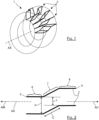
- this masking wheel 1 carries fixed masking blades 2 regularly distributed along its circumference, and whose shapes are arranged to delimit between them inter-blade channels in the form of baffles to provide angles of reflection to the electromagnetic radiation which cross in order to deflect them.
- each blade 2 extends between a leading edge 3 and a trailing edge 4 oriented one and the other parallel to a span axis of the blade which is an axis extending radially with respect to a longitudinal axis AX of the engine when the blade is mounted.
- This blade 2 comprises an upstream axial portion 6 extended by a central oblique portion 7 itself extended by a downstream axial portion 8.
- the upstream marked with AM, and the downstream marked with AV in the figures are defined with respect to the direction of circulation of the air flow in the engine, that is to say the along the longitudinal direction AX of the turbojet engine, in accordance with the usual conventions.
- the upstream axial portion 6 extends in the longitudinal direction, that is to say approximately along a plane containing the longitudinal axis AX of the engine, to approximately 10° of inclination.
- the central portion has an oblique orientation, which means that it is inclined with respect to the axis AX.
- the downstream portion 8 is offset from the upstream portion around the axis AX, while extending approximately longitudinally, that is to say that this downstream portion extends along another plane passing through the axis longitudinal AX, with about 10° of inclination.
- each blade 2 has a curved shape that can be broken down into upstream, central and downstream portions by virtue of their functionalities with respect to fluid flow and electromagnetic deflection.
- FIG. 3 An example of a blade 2 according to the invention having a curved shape is represented on the figures 3 and 4 .
- This blade 2 comprises an extrados wall Pe and a curved intrados wall Pi each connecting its leading edge 3 to its trailing edge 4 while being laterally spaced from each other, and each extending from a foot Pd to a vertex Sm.
- the foot Pd corresponds to the part by which this blade is connected or fixed to an internal shroud of the wheel 1
- its vertex Sm corresponds to the part by which it is fixed to an external casing of this wheel 1.
- the extrados wall Pe comprises, from the leading edge 3 to the trailing edge 4, a 6th axial upstream portion followed by a concave zone CCe followed by an inclined 7th central portion followed by a convex zone CVe followed by an 8th axial downstream portion terminated at the trailing edge.
- These zones and these portions extend over the majority of the height of the blade, that is to say its length from its root Pd to its top Sm measured along the span axis EV of this blade.
- the intrados wall Pi comprises from the leading edge 3 to the trailing edge 4 an axial upstream portion 6i followed by a convex zone CVi followed by a inclined central portion 7i followed by a concave zone CCi followed by an axial downstream portion 8i terminated by the trailing edge 4. These zones and these portions extend over the majority of the height of the blade measured along its axis of wingspan EV.
- Each central portion 7e and 7i extends between a convex zone and a concave zone, such that the two central portions 7e and 7i each comprise an inversion of curvature.
- two consecutive masking blades 2 delimit between them an inter-blade passage channel for the fluid which constitutes a baffle between the two oblique central portions 7 inclined with respect to the axis AX.
- this channel can be characterized by its masking coefficient and by its relative pitch which are representative of its geometry.
- This channel thus has a pitch noted P which is the distance separating two consecutive blades 2 in top view, that is to say along the circumference of the wheel 1, and which corresponds approximately to the ratio of the perimeter of the wheel on its number of blades.
- This channel also has an apparent width L, corresponding to the smallest apparent distance between two consecutive blades when the wheel is seen from the front, that is to say along the axis AX.
- the masking coefficient of the channel or else of the wheel 1, namely the L/P ratio, thus corresponds to the proportion of blades of the compressor wheel located downstream of the masking wheel 1, which is visible through the blades of this wheel 1.
- the proportion of waves emitted which can be reflected by the blades of the compressor is at most L/P.
- the effective masking coefficient is all the lower as the orientation of the radar is inclined with respect to the axis AX.
- the relative pitch of the inter-blade channel corresponds to the ratio of the pitch P to the chord length denoted C of the oblique portion 7, namely P/C, and it mainly conditions the aerodynamics of the channel.
- the central oblique portion 7 of the blade 2 is that which ensures the masking: it is its inclination and its length which condition the L/P coefficient, that is to say the proportion of incident electromagnetic waves which are deflected by being reflected by this central oblique portion 7 when they cross wheel 1.
- the upstream axial portion 6 is dedicated to straightening the incoming flow which can be disturbed in particular by its course in the angled inlet sleeve.
- the fact of guiding this flow in the upstream axial portion of the channel makes it possible to straighten it and to obtain a flow limiting the increase in entropy (limitation of losses by friction and shear), in order to avoid a drop in the flow of air passing through the engine.
- These upstream axial portions thus provide the system with robustness with respect to the flow distortions of the incoming air flow.
- the upstream axial portion 6 is all the longer as the incident flow is likely to be disturbed: in the event of undisturbed flow, this upstream axial portion 6 could have a very short length, or even zero, to be non-existent.
- the downstream axial portion 8 is for its part dedicated to the straightening of the flow at the outlet of the central oblique portion: the passage of the flow through the central oblique portion generates a gyration of this flow.
- the reduction of this gyration (straightening of flow or untwisting) by the downstream axial portion 8 makes it possible to ensure optimum supply of the compression stages to be passed through.
- the gyration of the flux corresponds to a flow whose streamlines have helical shapes around the axis AX, as opposed to rectilinear streamlines parallel to the axis AX in the case of a straightened flux.
- downstream axial portion 8 is thus all the longer as the flow must be straightened to supply the compressor, so that this length can be very short or even zero in the case where the compressor would have a high robustness vis-à-vis the flow twist.
- each blade 2 is mounted on the wheel 1 so as to be able to pivot around a radial axis coinciding with its leading edge 3, to change its pitch angle. Additionally, the wheel 1 is then equipped with control means, not shown, which control the setting of the blades 2.
- a modification of the pitch angle of the blades 2 makes it possible, for example, to temporarily increase the apparent width L of the inter-blade channels, to promote engine efficiency to the detriment of stealth.
- the masking wheel 1 is advantageously arranged upstream of a first mobile compressor wheel in a propulsion system architecture such as represented on the figure 6 , that is to say comprising an angled inlet sleeve 9 connected to a turbojet engine 11 comprising a compressor 12, to supply this turbojet engine 11 with air.
- the low-pressure compressor 12 comprises a first impeller 13 with blades upstream of which is arranged a known inlet steering wheel 14 .
- This inlet guide wheel comprises fixed axial blades to stabilize the fluid flow having crossed the inlet sleeve 9 before it crosses the first mobile wheel 13.
- the masking wheel 1 according to the invention is installed upstream of this guide wheel 14 in the inlet sleeve, to reduce the reflection on the first mobile wheel 13 of the electromagnetic radiation having penetrated into the inlet sleeve 9.
- the masking wheel according to the invention comprises an outer casing located at the inlet of the turbojet engine and to which the blades are connected by their tips Sm, and an inner shroud 16 to which the blades are connected by their roots Pd.
- the masking wheel according to the invention is located immediately upstream of the first mobile wheel 13 of the compressor, so as to jointly ensure the functions of masking wheel and input steering wheel for the compressor.
- the pressure losses introduced by the masking wheel are reduced by the fact that it replaces the existing steering wheel: the flux passing through the motor is entirely stabilized by the masking wheel before reaching the first mobile wheel of the compressor: it is then the downstream axial portions 8 of the masking blades which ensure the function of the input steering wheel.
- the blades 2 are advantageously in two parts: a first fixed part comprising the upstream portion 6 and the central portion 7, and a second part with variable pitch comprising the downstream portion 8.
- the second part thus constitutes a variable-pitch flap, capable of pivoting around its upstream edge which extends at the level of the concave zone CCi of the intrados wall Pi and of the convex zone CVe of the extrados wall Pe .
- the shutter pitch angle is then controlled to be adjusted according to the operating conditions of the engine so as to best adjust the straightening of the flow before admission into the compressor.
- the blades are sized to optimize the masking coefficient in order to reduce the radar signature, while maintaining sufficient compressor performance.
- This dimensioning mainly consists in determining the angle of inclination of the central oblique portion, and the chord length C of this oblique portion, that is to say the masking coefficient and the relative pitch. In practice, it appears that the optimum operating compromises can be obtained for an inclination of the oblique portion significantly less than 30° and a relative pitch less than 0.6.
- the blades 2 can advantageously be covered with a coating that partly absorbs the incident electromagnetic radiation.
- the invention has been described in the context of reducing the radar signature of a turbojet engine, but it applies just as well to reducing the sound emissions of such a turbojet engine. In the latter case, the invention applies in particular to an engine integrated into an aircraft tailplane, also called a buried engine.
Landscapes
- Engineering & Computer Science (AREA)
- Mechanical Engineering (AREA)
- General Engineering & Computer Science (AREA)
- Chemical & Material Sciences (AREA)
- Combustion & Propulsion (AREA)
- Physics & Mathematics (AREA)
- Geometry (AREA)
- Aviation & Aerospace Engineering (AREA)
- Remote Sensing (AREA)
- Fluid Mechanics (AREA)
- Radar, Positioning & Navigation (AREA)
- Structures Of Non-Positive Displacement Pumps (AREA)
Description
- L'invention concerne un moteur de type turboréacteur équipé de moyens réduisant sa signature radar et/ou sonore.
- Un radar est un émetteur d'ondes électromagnétiques comportant un récepteur pour détecter si une partie des ondes qu'il émet sont ou ne sont pas réfléchies par un objet ou obstacle présent dans la région d'émission de ces ondes.
- Dans le cas d'un aéronef dit furtif, les éléments externes de cet aéronef sont traités pour limiter la réflexion des ondes électromagnétiques, de façon à le rendre le plus faiblement détectable par radar.
- Lorsque cet aéronef est équipé d'un système de propulsion de type turboréacteur, l'air est admis dans une manche d'entrée pour traverser en premier lieu un compresseur basse pression comportant une série de pales rotatives avant de se scinder en un flux primaire central et un flux secondaire entourant le flux primaire.
- Les éléments rotatifs de ce turboréacteur constituent en soi une source de détection, du fait qu'ils réfléchissent les ondes radars, et contribuent par là même à rendre l'aéronef détectable.
- Une possibilité pour limiter la détection par radar du compresseur basse pression est de couder la manche d'entrée, pour que les ondes radar incidentes soient déviées par réflexion sur les parois inclinées de la manche durant leur progression dans celle-ci. Ces ondes ont ainsi une incidence oblique sur les éléments de rotor du moteur, de sorte qu'elles sont diffusées par ceux-ci pour être faiblement réfléchies vers l'entrée de la manche.
- En pratique, cette solution reste insuffisante, et le niveau de détection par radar du compresseur basse pression d'un turboréacteur est encore trop important. Le document
US 2006/254271 A1 divulgue une roue aubagée de masquage d'une roue mobile de turboréacteur selon l'art antérieur. - Dans ce cadre, l'objet de l'invention est d'apporter une solution permettant de diminuer le niveau de détection par radar des éléments de rotor d'un compresseur basse pression de turboréacteur.
- A cet effet, l'invention a pour objet une roue aubagée de masquage d'une roue mobile de turboréacteur selon la revendication 1, comportant des pales, chaque pale comportant une paroi d'intrados et une paroi d'extrados réunies au niveau d'un bord d'attaque et au niveau d'un bord de fuite et s'étendant selon un axe d'envergure depuis un pied jusqu'à un sommet, et dans laquelle :
- la paroi d'intrados comporte une portion amont s'étendant du bord d'attaque à une zone convexe de cette paroi d'intrados, une portion centrale s'étendant de la zone convexe à une zone concave de cette paroi d'intrados, et une portion aval s'étendant de la zone concave au bord de fuite ;
- la paroi d'extrados comporte une portion amont s'étendant du bord d'attaque à une zone concave de cette paroi d'extrados, une portion centrale s'étendant de la zone concave à une zone convexe de cette paroi d'extrados, et une portion aval s'étendant de la zone convexe au bord de fuite ;
- ces zones concaves et ces zones convexes s'étendent chacune sur la majorité de la hauteur de la pale le long de son axe d'envergure ;
- la zone concave de la paroi d'intrados est en vis-à-vis de la zone convexe de la paroi d'extrados, et la zone concave de la paroi d'extrados est en vis-à-vis de la zone convexe de la paroi d'intrados.
- Avec cet agencement, les ondes magnétiques entrantes traversant la roue sont déviées pour avoir une incidence oblique sur la roue du compresseur basse pression de manière à être faiblement réfléchies par celui-ci.
- Chaque pale est montée sur la roue aubagée de manière à pouvoir pivoter autour d'un axe radial coïncidant avec son bord d'attaque afin de modifier son angle de calage, et la roue aubagée est équipée de moyens de commande qui pilotent le calage des pales.
- L'invention concerne également une roue aubagée ainsi définie, dans laquelle les pales sont couvertes d'un revêtement absorbant les rayonnements électromagnétiques.
- L'invention concerne également un turbocompresseur comprenant un compresseur basse pression incluant une roue mobile en amont de laquelle est agencée une roue directrice d'entrée en amont de laquelle est montée une roue aubagée ainsi définie.
- L'invention concerne également un turbocompresseur comprenant un compresseur basse pression incluant une roue mobile en amont de laquelle est agencée une roue aubagée ainsi définie.
-
- La
figure 1 est une vue schématique en perspective d'une portion de la roue de masquage selon l'invention ; - La
figure 2 est une représentation schématique montrant deux pales consécutives selon l'invention en vue de dessus ; - La
figure 3 est une vue en coupe selon un plan orthoradial d'une pale selon l'invention ; - La
figure 4 est une représentation en perspective d'une pale selon l'invention ; - La
figure 5 est une représentation schématique montrant deux pales de masquage consécutives à calage variable conformément à l'invention ; - La
figure 6 est une représentation schématique en coupe longitudinale d'une architecture de système de propulsion comprenant une manche d'entrée coudée débouchant dans un turboréacteur ; - La
figure 7 est une vue schématique en coupe longitudinale d'une portion d'entrée de turboréacteur équipée d'une roue de masquage selon l'invention agencée en amont d'une roue directrice d'entrée elle-même en amont du compresseur basse pression ; - La
figure 8 est une vue schématique en coupe longitudinale d'une portion d'entrée d'un moteur équipée d'une roue de masquage selon l'invention agencée directement en amont du compresseur basse pression ; - La
figure 9 est une représentation schématique montrant deux pales de masquage consécutives ayant chacune un volet aval à calage variable selon une variante ne faisant pas partie de l'invention. - L'idée à la base de l'invention est de prévoir entre l'entrée d'air et le compresseur basse pression, une roue portant des pales fixes agencées pour masquer géométriquement le rotor de compresseur situé à leur aval.
- Comme représenté schématiquement sur la
figure 1 cette roue de masquage 1 porte des pales de masquage fixes 2 régulièrement réparties le long de sa circonférence, et dont les formes sont agencées pour délimiter entre elles des canaux inter-pales en formes de chicanes pour offrir des angles de réflexion aux rayonnements électromagnétiques qui la traversent afin de les dévier. - Comme visible sur la
figure 2 , chaque pale 2 s'étend entre un bord d'attaque 3 et un bord de fuite 4 orientés l'un et l'autre parallèlement à un axe d'envergure de la pale qui est est un axe s'étendant radialement par rapport à un axe longitudinal AX du moteur lorsque la pale est montée. Cette pale 2 comporte une portion axiale amont 6 prolongée par une portion oblique centrale 7 elle-même prolongée par une portion aval 8 axiale. L'amont repéré par AM, et l'aval repéré par AV sur les figures sont définis par rapport au sens de circulation du flux d'air dans le moteur, c'est-à-dire le long de la direction longitudinale AX du turboréacteur, conformément aux conventions usuelles. - La portion axiale amont 6 s'étend selon la direction longitudinale, c'est-à-dire approximativement selon un plan contenant l'axe longitudinal AX du moteur, à environ 10° d'inclinaison près. La portion centrale a quant à elle une orientation oblique, ce qui signifie qu'elle est inclinée par rapport à l'axe AX. La portion aval 8 est décalée par rapport à la portion amont autour de l'axe AX, tout en s'étendant approximativement longitudinalement, c'est-à-dire que cette portion aval s'étend selon un autre plan passant par l'axe longitudinal AX, à environ 10° d'inclinaison près.
- Les portions amont, centrale, et aval sont représentées symboliquement par des parois planes dans les
figures 1, 2 ,5 et9 , pour simplifier la compréhension. En pratique, chaque pale 2 a une forme incurvée pouvant être décomposée en des portions amont, centrale, et aval de par leurs fonctionnalités vis-à-vis de l'écoulement fluide et de la déviation électromagnétique. - Un exemple de pale 2 selon l'invention ayant une forme incurvée est représenté sur les
figures 3 et 4 . Cette pale 2 comporte une paroi d'extrados Pe et une paroi d'intrados Pi incurvées reliant chacune son bord d'attaque 3 à son bord de fuite 4 en étant latéralement espacées l'une de l'autre, et en s'étendant chacune depuis un pied Pd jusqu'à un sommet Sm. Le pied Pd correspond à la partie par laquelle cette pale est raccordée ou fixée à une virole interne de la roue 1, et son sommet Sm correspond à la partie par laquelle elle est fixée à un carter externe de cette roue 1. - La paroi d'extrados Pe comporte depuis le bord d'attaque 3 jusqu'au bord de fuite 4 une portion amont 6e axiale suivie d'une zone concave CCe suivie d'une portion centrale 7e inclinée suivie d'une zone convexe CVe suivie d'une portion aval 8e axiale terminée au niveau du bord de fuite. Ces zones et ces portions s'étendent sur la majorité de la hauteur de la pale, c'est-à-dire sa longueur depuis son pied Pd jusqu'à son sommet Sm mesurée selon l'axe d'envergure EV de cette pale.
- La paroi d'intrados Pi comporte depuis le bord d'attaque 3 jusqu'au bord de fuite 4 une portion amont 6i axiale suivie d'une zone convexe CVi suivie d'une portion centrale 7i inclinée suivie d'une zone concave CCi suivie d'une portion aval 8i axiale terminée par le bord de fuite 4. Ces zones et ces portions s'étendent sur la majorité de la hauteur de la pale mesurée selon son axe d'envergure EV.
- Chaque portion centrale 7e et 7i s'étend entre une zone convexe et une zone concave, de sorte que les deux portions centrales 7e et 7i comportent chacune une inversion de courbure.
- Comme illustré sur la
figure 2 , deux pales de masquage 2 consécutives délimitent entre elles un canal de passage inter-pales du fluide qui constitue une chicane entre les deux portions centrales obliques 7 inclinées par rapport à l'axe AX. - D'une manière générale, ce canal peut être caractérisé par son coefficient de masquage et par son pas relatif qui sont représentatifs de sa géométrie.
- Ce canal présente ainsi un pas noté P qui est la distance séparant deux pales 2 consécutives en vue de dessus, c'est-à-dire le long de la circonférence de la roue 1, et qui correspond approximativement au rapport du périmètre de la roue sur son nombre de pales. Ce canal présente également une largeur apparente L, correspondant à la plus faible distance apparente entre deux pales consécutives lorsque la roue est vue de face c'est-à-dire selon l'axe AX.
- Le coefficient de masquage du canal ou bien de la roue 1, à savoir le rapport L/P, correspond ainsi à la proportion d'aubages de la roue de compresseur située en aval de la roue de masquage 1, qui est visible à travers les pales de cette roue 1. Autrement dit, pour un radar situé dans l'axe AX, face à la roue 1, la proportion d'ondes émises pouvant être réfléchies par les aubages du compresseur est au maximum de L/P. Le coefficient de masquage effectif est d'autant plus bas que l'orientation du radar est inclinée par rapport à l'axe AX.
- Le pas relatif du canal inter-pales correspond au rapport du pas P sur la longueur de corde notée C de la portion oblique 7, à savoir P/C, et il conditionne principalement l'aérodynamique du canal.
- La portion oblique centrale 7 de la pale 2 est celle qui assure le masquage : c'est son inclinaison et sa longueur qui conditionnent le coefficient L/P, c'est-à-dire la proportion d'ondes électromagnétiques incidentes qui sont déviées en étant réfléchies par cette portion oblique centrale 7 lorsqu'elles traversent la roue 1.
- La portion axiale amont 6 est dédiée au redressement du flux entrant qui peut être perturbé notamment par son parcours dans la manche d'entrée coudée. Le fait de guider ce flux dans la portion axiale amont du canal permet de le redresser et d'obtenir un écoulement limitant l'augmentation d'entropie (limitation des pertes par frottement et cisaillement), afin d'éviter une chute du débit d'air traversant le moteur. Ces portions axiales amont procurent ainsi au système une robustesse par rapport aux distorsions d'écoulement du flux d'air entrant.
- La portion axiale amont 6 est d'autant plus longue que le le flux incident est susceptible d'être perturbé : en cas de flux non perturbé, cette portion axiale amont 6 pourrait avoir une longueur très faible, voire nulle pour être inexistante.
- La portion axiale aval 8 est quant à elle dédiée au redressement du flux en sortie de la portion oblique centrale : le passage du flux à travers la portion oblique centrale engendre une giration de ce flux. La réduction de cette giration (redressement de flux ou dévrillage) par la portion axiale aval 8 permet d'assurer une alimentation optimale des étages de compression à traverser. En pratique, la giration du flux correspond à un écoulement dont les lignes de courant ont des formes hélicoïdales autour de l'axe AX, par opposition à des lignes de courant rectilignes parallèles à l'axe AX dans le cas d'un flux redressé.
- La portion axiale aval 8 est ainsi d'autant plus longue que le flux doit être redressé pour alimenter le compresseur, de sorte que cette longueur peut être très faible voire nulle dans le cas où le compresseur présenterait une robustesse élevée vis-à-vis du vrillage de flux.
- Par ailleurs, les pales de masquage selon l'invention sont calage variable, pour ajuster le degré de masquage aux conditions de vol. Ainsi, comme représenté sur la
figure 5 , chaque pale 2 est montée sur la roue 1 de manière à pouvoir pivoter autour d'un axe radial coïncidant avec son bord d'attaque 3, afin de modifier son angle de calage. Complémentairement, la roue 1 est alors équipée de moyens de commande non représentés qui pilotent le calage des pales 2. - Ainsi, et comme illustré schématiquement sur la
figure 5 , une modification de l'angle de calage des pales 2 permet par exemple d'augmenter temporairement la largeur apparente L des canaux inter-pales, pour favoriser le rendement du moteur au détriment de la furtivité. - La roue de masquage 1 est avantageusement agencée en amont d'une première roue mobile de compresseur dans une architecture de système de propulsion telle que représentée sur la
figure 6 , c'est-à-dire comprenant une manche d'entrée coudée 9 raccordée à un turboréacteur 11 comprenant un compresseur 12, pour alimenter ce turboréacteur 11 en air. - Comme visible plus en détail sur la
figure 7 , le compresseur basse pression 12 comporte une première roue mobile 13 aubagée à l'amont de laquelle est agencée une roue directrice d'entrée 14 connue. Cette roue directrice d'entrée comporte des pales fixes axiales pour stabiliser l'écoulement fluide ayant traversé la manche d'entrée 9 avant qu'il ne traverse la première roue mobile 13. - La roue de masquage 1 selon l'invention est installée en amont de cette roue directrice 14 dans la manche d'entrée, pour réduire la réflexion sur la première roue mobile 13 des rayonnements électromagnétiques ayant pénétré dans la manche d'entrée 9.
- Dans ce cadre, la roue masquante selon l'invention comporte un carter externe situé à l'entrée du turboréacteur et auquel les pales sont reliées par leurs sommets Sm, et une virole interne 16 à laquelle les pales sont reliées par leurs pieds Pd.
- Selon un autre agencement représenté sur la
figure 8 , la roue de masquage selon l'invention est située immédiatement en amont de la première roue mobile 13 du compresseur, de façon à assurer conjointement les fonctions de roue de masquage et de roue directrice d'entrée pour le compresseur. - Avec cet autre agencement, les pertes de charge introduites par la roue de masquage sont réduites par le fait qu'elle remplace la roue directrice existante : le flux traversant le moteur est entièrement stabilisé par la roue masquante avant d'atteindre la première roue mobile du compresseur : ce sont alors les portions axiales aval 8 des pales de masquage qui assurent la fonction de la roue directrice d'entrée.
- Dans un agencement ne faisant pas partie de l'invention, les pales 2 sont avantageusement en deux parties : une première partie fixe comportant la portion 6 amont et la portion centrale 7, et une deuxième partie à calage variable comportant la portion aval 8.
- La deuxième partie constitue ainsi un volet à calage variable, apte à pivoter autour de son bord amont qui s'étend au niveau de la zone concave CCi de la paroi d'intrados Pi et de la zone convexe CVe de la paroi d'extrados Pe.
- L'angle de calage du volet est alors commandé pour être ajusté en fonction des conditions de fonctionnement du moteur de manière à ajuster au mieux le redressement du flux avant admission dans le compresseur.
- D'une manière générale, les pales sont dimensionnées pour optimiser le coefficient de masquage afin de réduire la signature radar, tout en maintenant une performance du compresseur suffisante. Ce dimensionnement consiste principalement à déterminer l'angle d'inclinaison de la portion oblique centrale, et la longueur de corde C de cette portion oblique, c'est-à-dire le coefficient de masquage et le pas relatif. En pratique, il apparait que les compromis de fonctionnement optimaux peuvent être obtenus pour une inclinaison de la portion oblique significativement inférieure à 30° et un pas relatif inférieur à 0,6.
- Afin d'accroître la furtivité, les pales 2 peuvent avantageusement être couvertes d'un revêtement absorbant en partie les rayonnements électromagnétiques incidents.
- Par ailleurs, l'invention a été décrite dans le contexte de la réduction de signature radar d'un turboréacteur, mais elle s'applique aussi bien à la réduction des émissions sonores d'un tel turboréacteur. Dans ce dernier cas, l'invention s'applique notamment à un moteur intégré à un empennage d'aéronef, encore appelé moteur enterré.
Claims (4)
- Roue aubagée (1) de masquage d'une roue mobile de turboréacteur, comportant des pales (2), chaque pale (2) comportant une paroi d'intrados (Pi) et une paroi d'extrados (Pe) réunies au niveau d'un bord d'attaque (3) et au niveau d'un bord de fuite (4) et s'étendant selon un axe d'envergure (EV) depuis un pied (Pd) jusqu'à un sommet (Sm), et dans laquelle :- la paroi d'intrados (Pi) comporte une portion amont (6i) s'étendant du bord d'attaque (3) à une zone convexe (CVi) de cette paroi d'intrados (Pi), une portion centrale (7i) s'étendant de la zone convexe (CVi) à une zone concave (CCi) de cette paroi d'intrados (Pi), et une portion aval (8i) s'étendant de la zone concave (CCi) au bord de fuite (4) ;- la paroi d'extrados (Pe) comporte une portion amont (6e) s'étendant du bord d'attaque (3) à une zone concave (CCe) de cette paroi d'extrados (Pe), une portion centrale (7e) s'étendant de la zone concave (CCe) à une zone convexe (CVe) de cette paroi d'extrados (Pe), et une portion aval (8e) s'étendant de la zone convexe (CVe) au bord de fuite (4) ;- ces zones concaves (CCi, CCe) et ces zones convexes (CVe, CVi) s'étendent chacune sur la majorité de la hauteur de la pale (2) le long de son axe d'envergure (EV) ;- la zone concave (CCi) de la paroi d'intrados (Pi) est en vis-à-vis de la zone convexe (CVe) de la paroi d'extrados (Pe), et la zone concave (CCe) de la paroi d'extrados (Pe) est en vis-à-vis de la zone convexe (CVi) de la paroi d'intrados (Pi) caractérisée en ce que chaque pale (2) est montée sur la roue aubagée (1) de manière à pouvoir pivoter autour d'un axe radial coïncidant avec son bord d'attaque (3) afin de modifier son angle de calage, et en ce que la roue aubagée (1) est équipée de moyens de commande qui pilotent le calage des pales
- S-Roue aubagée selon la revendication 1, dans laquelle les pales (2) sont couvertes d'un revêtement absorbant les rayonnements électromagnétiques.
- Turboréacteur comprenant un compresseur basse pression (12) incluant une roue mobile (13) en amont (AM) de laquelle est agencée une roue directrice d'entrée (14) en amont (AM) de laquelle est montée une roue aubagée de masquage (1) selon la revendication 1.
- Turboréacteur comprenant un compresseur basse pression (12) incluant une roue mobile (13) en amont de laquelle est agencée une roue aubagée de masquage (1) selon la revendication 1.
Applications Claiming Priority (2)
| Application Number | Priority Date | Filing Date | Title |
|---|---|---|---|
| FR1873465A FR3090760B1 (fr) | 2018-12-20 | 2018-12-20 | Roue de masquage d'une roue mobile de compresseur de turboreacteur |
| PCT/FR2019/052918 WO2020128201A1 (fr) | 2018-12-20 | 2019-12-04 | Roue aubagee de masquage pour reduire la signature radar d'une roue mobile de compresseur de turboreacteur |
Publications (2)
| Publication Number | Publication Date |
|---|---|
| EP3880972A1 EP3880972A1 (fr) | 2021-09-22 |
| EP3880972B1 true EP3880972B1 (fr) | 2023-08-09 |
Family
ID=66867254
Family Applications (1)
| Application Number | Title | Priority Date | Filing Date |
|---|---|---|---|
| EP19842384.0A Active EP3880972B1 (fr) | 2018-12-20 | 2019-12-04 | Roue aubagée de masquage pour réduire la signature radar d'une roue mobile de compresseur de turboreacteur |
Country Status (4)
| Country | Link |
|---|---|
| US (1) | US11993408B2 (fr) |
| EP (1) | EP3880972B1 (fr) |
| FR (1) | FR3090760B1 (fr) |
| WO (1) | WO2020128201A1 (fr) |
Families Citing this family (3)
| Publication number | Priority date | Publication date | Assignee | Title |
|---|---|---|---|---|
| US11434018B1 (en) * | 2021-11-27 | 2022-09-06 | Airbus Defence and Space GmbH | Switchable air inlet device for engine air |
| CN115591109B (zh) * | 2022-08-01 | 2026-04-17 | 利为惠德无锡医疗科技有限公司 | 一种可变形后导叶结构及人工心脏 |
| CN115614176B (zh) * | 2022-08-29 | 2024-04-19 | 中国航发四川燃气涡轮研究院 | 基于内外涵结构一体化的红外与雷达综合隐身装置 |
Family Cites Families (13)
| Publication number | Priority date | Publication date | Assignee | Title |
|---|---|---|---|---|
| US3829237A (en) * | 1972-06-27 | 1974-08-13 | Nasa | Variably positioned guide vanes for aerodynamic choking |
| US3908683A (en) * | 1974-06-03 | 1975-09-30 | Boeing Co | Translating multi-ring inlet for gas turbine engines |
| US5794432A (en) * | 1996-08-27 | 1998-08-18 | Diversitech, Inc. | Variable pressure and variable air flow turbofan engines |
| US6619916B1 (en) * | 2002-02-28 | 2003-09-16 | General Electric Company | Methods and apparatus for varying gas turbine engine inlet air flow |
| US7195456B2 (en) * | 2004-12-21 | 2007-03-27 | United Technologies Corporation | Turbine engine guide vane and arrays thereof |
| US20060254271A1 (en) * | 2005-05-13 | 2006-11-16 | Ishikawajima-Harima Heavy Industries Co., Ltd. | Apparatus for controlling microwave reflecting |
| US7922445B1 (en) * | 2008-09-19 | 2011-04-12 | Florida Turbine Technologies, Inc. | Variable inlet guide vane with actuator |
| US9957823B2 (en) * | 2014-01-24 | 2018-05-01 | United Technologies Corporation | Virtual multi-stream gas turbine engine |
| EP3111075B1 (fr) * | 2014-02-28 | 2020-11-25 | United Technologies Corporation | Réseau sans fil protégé |
| US10718221B2 (en) * | 2015-08-27 | 2020-07-21 | Rolls Royce North American Technologies Inc. | Morphing vane |
| RU2623031C1 (ru) * | 2016-06-30 | 2017-06-21 | Публичное акционерное общество "Авиационная холдинговая компания "Сухой" | Воздухозаборник самолета |
| US10436050B2 (en) * | 2017-04-11 | 2019-10-08 | United Technologies Corporation | Guide vane arrangement for gas turbine engine |
| US10364750B2 (en) * | 2017-10-30 | 2019-07-30 | General Electric Company | Thermal management system |
-
2018
- 2018-12-20 FR FR1873465A patent/FR3090760B1/fr active Active
-
2019
- 2019-12-04 WO PCT/FR2019/052918 patent/WO2020128201A1/fr not_active Ceased
- 2019-12-04 US US17/415,395 patent/US11993408B2/en active Active
- 2019-12-04 EP EP19842384.0A patent/EP3880972B1/fr active Active
Also Published As
| Publication number | Publication date |
|---|---|
| WO2020128201A1 (fr) | 2020-06-25 |
| FR3090760B1 (fr) | 2024-12-13 |
| US11993408B2 (en) | 2024-05-28 |
| FR3090760A1 (fr) | 2020-06-26 |
| EP3880972A1 (fr) | 2021-09-22 |
| US20220042518A1 (en) | 2022-02-10 |
Similar Documents
| Publication | Publication Date | Title |
|---|---|---|
| EP3880972B1 (fr) | Roue aubagée de masquage pour réduire la signature radar d'une roue mobile de compresseur de turboreacteur | |
| FR3153849A1 (fr) | Sous-ensemble de turbomachine comportant un col de cygne a configuration amelioree et turbomachine comportant un tel sous-ensemble | |
| EP1916385B1 (fr) | Nageoire de plateforme de soufflante | |
| CA2975570C (fr) | Ensemble de redressement a performances aerodynamiques optimisees | |
| WO2014023891A1 (fr) | Turbomachine comportant une pluralité d'aubes radiales fixes montées en amont de la soufflante | |
| EP2085620B1 (fr) | Compresseur de turboréacteur | |
| EP3295009B1 (fr) | Mélangeur à lobes avec écopes | |
| CA3089694A1 (fr) | Structure profilee et turbomachine associee | |
| WO2013178914A1 (fr) | Aube de soufflante pour turboreacteur d'avion a profil cambre en sections de pied | |
| EP2438306B1 (fr) | Rouet centrifuge de compresseur. | |
| FR2680830A1 (fr) | Procede pour ameliorer les caracteristiques de performances d'une nacelle de moteur a turbine d'avion et nacelle ainsi qu'entree de nacelle obtenues a l'aide de ce procede. | |
| EP3274578B1 (fr) | Dispositif a grilles d'ejection de microjets pour la reduction du bruit de jet d'une turbomachine | |
| EP3956226B1 (fr) | Procédé d'utilisation d'une entrée d'air de nacelle de turboréacteur comprenant une lèvre d'entrée d'air comprenant une portion mobile pour favoriser une phase d'inversion de poussée | |
| EP4022171B1 (fr) | Aube de redresseur à calage variable comportant des ailettes aérodynamiques | |
| EP4508311B1 (fr) | Pièce statorique à ailette dans une turbomachine | |
| EP4508310B1 (fr) | Pièce statorique à ailette dans une turbomachine | |
| FR2935348A1 (fr) | Turbomachine a helices non carenees | |
| EP3563047B1 (fr) | Moyeu de carter intermédiaire comprenant des canaux de guidage du flux de décharge formés par les ailettes de décharge | |
| FR3065759A1 (fr) | Rouet centrifuge pour turbomachine | |
| FR3163687A1 (fr) | Ensemble d’etancheite a labyrinthe pour une turbomachine d’aeronef | |
| WO2025093843A1 (fr) | Aube de redresseur avec une fente | |
| FR3164759A1 (fr) | Carter a fentes comprenant plusieurs etages | |
| FR3162060A1 (fr) | Rangée d’aubes à fentes de bord d’attaque | |
| EP4571076A1 (fr) | Module de turbomachine comprenant des aubes rotoriques et des ailettes, et turbomachine correspondante | |
| FR3089577A1 (fr) | Compresseur de turbomachine comprenant des aubes statoriques à calage variable et procédé de déplacement desdites aubes |
Legal Events
| Date | Code | Title | Description |
|---|---|---|---|
| STAA | Information on the status of an ep patent application or granted ep patent |
Free format text: STATUS: UNKNOWN |
|
| STAA | Information on the status of an ep patent application or granted ep patent |
Free format text: STATUS: THE INTERNATIONAL PUBLICATION HAS BEEN MADE |
|
| PUAI | Public reference made under article 153(3) epc to a published international application that has entered the european phase |
Free format text: ORIGINAL CODE: 0009012 |
|
| STAA | Information on the status of an ep patent application or granted ep patent |
Free format text: STATUS: REQUEST FOR EXAMINATION WAS MADE |
|
| 17P | Request for examination filed |
Effective date: 20210616 |
|
| AK | Designated contracting states |
Kind code of ref document: A1 Designated state(s): AL AT BE BG CH CY CZ DE DK EE ES FI FR GB GR HR HU IE IS IT LI LT LU LV MC MK MT NL NO PL PT RO RS SE SI SK SM TR |
|
| DAV | Request for validation of the european patent (deleted) | ||
| DAX | Request for extension of the european patent (deleted) | ||
| GRAP | Despatch of communication of intention to grant a patent |
Free format text: ORIGINAL CODE: EPIDOSNIGR1 |
|
| STAA | Information on the status of an ep patent application or granted ep patent |
Free format text: STATUS: GRANT OF PATENT IS INTENDED |
|
| INTG | Intention to grant announced |
Effective date: 20230301 |
|
| GRAS | Grant fee paid |
Free format text: ORIGINAL CODE: EPIDOSNIGR3 |
|
| GRAA | (expected) grant |
Free format text: ORIGINAL CODE: 0009210 |
|
| STAA | Information on the status of an ep patent application or granted ep patent |
Free format text: STATUS: THE PATENT HAS BEEN GRANTED |
|
| AK | Designated contracting states |
Kind code of ref document: B1 Designated state(s): AL AT BE BG CH CY CZ DE DK EE ES FI FR GB GR HR HU IE IS IT LI LT LU LV MC MK MT NL NO PL PT RO RS SE SI SK SM TR |
|
| REG | Reference to a national code |
Ref country code: GB Ref legal event code: FG4D Free format text: NOT ENGLISH |
|
| REG | Reference to a national code |
Ref country code: CH Ref legal event code: EP |
|
| REG | Reference to a national code |
Ref country code: DE Ref legal event code: R096 Ref document number: 602019034811 Country of ref document: DE |
|
| REG | Reference to a national code |
Ref country code: IE Ref legal event code: FG4D Free format text: LANGUAGE OF EP DOCUMENT: FRENCH |
|
| REG | Reference to a national code |
Ref country code: LT Ref legal event code: MG9D |
|
| REG | Reference to a national code |
Ref country code: NL Ref legal event code: MP Effective date: 20230809 |
|
| REG | Reference to a national code |
Ref country code: AT Ref legal event code: MK05 Ref document number: 1597809 Country of ref document: AT Kind code of ref document: T Effective date: 20230809 |
|
| PG25 | Lapsed in a contracting state [announced via postgrant information from national office to epo] |
Ref country code: GR Free format text: LAPSE BECAUSE OF FAILURE TO SUBMIT A TRANSLATION OF THE DESCRIPTION OR TO PAY THE FEE WITHIN THE PRESCRIBED TIME-LIMIT Effective date: 20231110 |
|
| PG25 | Lapsed in a contracting state [announced via postgrant information from national office to epo] |
Ref country code: IS Free format text: LAPSE BECAUSE OF FAILURE TO SUBMIT A TRANSLATION OF THE DESCRIPTION OR TO PAY THE FEE WITHIN THE PRESCRIBED TIME-LIMIT Effective date: 20231209 |
|
| PG25 | Lapsed in a contracting state [announced via postgrant information from national office to epo] |
Ref country code: SE Free format text: LAPSE BECAUSE OF FAILURE TO SUBMIT A TRANSLATION OF THE DESCRIPTION OR TO PAY THE FEE WITHIN THE PRESCRIBED TIME-LIMIT Effective date: 20230809 Ref country code: RS Free format text: LAPSE BECAUSE OF FAILURE TO SUBMIT A TRANSLATION OF THE DESCRIPTION OR TO PAY THE FEE WITHIN THE PRESCRIBED TIME-LIMIT Effective date: 20230809 Ref country code: PT Free format text: LAPSE BECAUSE OF FAILURE TO SUBMIT A TRANSLATION OF THE DESCRIPTION OR TO PAY THE FEE WITHIN THE PRESCRIBED TIME-LIMIT Effective date: 20231211 Ref country code: NO Free format text: LAPSE BECAUSE OF FAILURE TO SUBMIT A TRANSLATION OF THE DESCRIPTION OR TO PAY THE FEE WITHIN THE PRESCRIBED TIME-LIMIT Effective date: 20231109 Ref country code: NL Free format text: LAPSE BECAUSE OF FAILURE TO SUBMIT A TRANSLATION OF THE DESCRIPTION OR TO PAY THE FEE WITHIN THE PRESCRIBED TIME-LIMIT Effective date: 20230809 Ref country code: LV Free format text: LAPSE BECAUSE OF FAILURE TO SUBMIT A TRANSLATION OF THE DESCRIPTION OR TO PAY THE FEE WITHIN THE PRESCRIBED TIME-LIMIT Effective date: 20230809 Ref country code: LT Free format text: LAPSE BECAUSE OF FAILURE TO SUBMIT A TRANSLATION OF THE DESCRIPTION OR TO PAY THE FEE WITHIN THE PRESCRIBED TIME-LIMIT Effective date: 20230809 Ref country code: IS Free format text: LAPSE BECAUSE OF FAILURE TO SUBMIT A TRANSLATION OF THE DESCRIPTION OR TO PAY THE FEE WITHIN THE PRESCRIBED TIME-LIMIT Effective date: 20231209 Ref country code: HR Free format text: LAPSE BECAUSE OF FAILURE TO SUBMIT A TRANSLATION OF THE DESCRIPTION OR TO PAY THE FEE WITHIN THE PRESCRIBED TIME-LIMIT Effective date: 20230809 Ref country code: GR Free format text: LAPSE BECAUSE OF FAILURE TO SUBMIT A TRANSLATION OF THE DESCRIPTION OR TO PAY THE FEE WITHIN THE PRESCRIBED TIME-LIMIT Effective date: 20231110 Ref country code: FI Free format text: LAPSE BECAUSE OF FAILURE TO SUBMIT A TRANSLATION OF THE DESCRIPTION OR TO PAY THE FEE WITHIN THE PRESCRIBED TIME-LIMIT Effective date: 20230809 Ref country code: AT Free format text: LAPSE BECAUSE OF FAILURE TO SUBMIT A TRANSLATION OF THE DESCRIPTION OR TO PAY THE FEE WITHIN THE PRESCRIBED TIME-LIMIT Effective date: 20230809 |
|
| PG25 | Lapsed in a contracting state [announced via postgrant information from national office to epo] |
Ref country code: PL Free format text: LAPSE BECAUSE OF FAILURE TO SUBMIT A TRANSLATION OF THE DESCRIPTION OR TO PAY THE FEE WITHIN THE PRESCRIBED TIME-LIMIT Effective date: 20230809 |
|
| PG25 | Lapsed in a contracting state [announced via postgrant information from national office to epo] |
Ref country code: ES Free format text: LAPSE BECAUSE OF FAILURE TO SUBMIT A TRANSLATION OF THE DESCRIPTION OR TO PAY THE FEE WITHIN THE PRESCRIBED TIME-LIMIT Effective date: 20230809 |
|
| PG25 | Lapsed in a contracting state [announced via postgrant information from national office to epo] |
Ref country code: SM Free format text: LAPSE BECAUSE OF FAILURE TO SUBMIT A TRANSLATION OF THE DESCRIPTION OR TO PAY THE FEE WITHIN THE PRESCRIBED TIME-LIMIT Effective date: 20230809 Ref country code: RO Free format text: LAPSE BECAUSE OF FAILURE TO SUBMIT A TRANSLATION OF THE DESCRIPTION OR TO PAY THE FEE WITHIN THE PRESCRIBED TIME-LIMIT Effective date: 20230809 Ref country code: ES Free format text: LAPSE BECAUSE OF FAILURE TO SUBMIT A TRANSLATION OF THE DESCRIPTION OR TO PAY THE FEE WITHIN THE PRESCRIBED TIME-LIMIT Effective date: 20230809 Ref country code: EE Free format text: LAPSE BECAUSE OF FAILURE TO SUBMIT A TRANSLATION OF THE DESCRIPTION OR TO PAY THE FEE WITHIN THE PRESCRIBED TIME-LIMIT Effective date: 20230809 Ref country code: DK Free format text: LAPSE BECAUSE OF FAILURE TO SUBMIT A TRANSLATION OF THE DESCRIPTION OR TO PAY THE FEE WITHIN THE PRESCRIBED TIME-LIMIT Effective date: 20230809 Ref country code: CZ Free format text: LAPSE BECAUSE OF FAILURE TO SUBMIT A TRANSLATION OF THE DESCRIPTION OR TO PAY THE FEE WITHIN THE PRESCRIBED TIME-LIMIT Effective date: 20230809 Ref country code: SK Free format text: LAPSE BECAUSE OF FAILURE TO SUBMIT A TRANSLATION OF THE DESCRIPTION OR TO PAY THE FEE WITHIN THE PRESCRIBED TIME-LIMIT Effective date: 20230809 |
|
| REG | Reference to a national code |
Ref country code: DE Ref legal event code: R097 Ref document number: 602019034811 Country of ref document: DE |
|
| PG25 | Lapsed in a contracting state [announced via postgrant information from national office to epo] |
Ref country code: IT Free format text: LAPSE BECAUSE OF FAILURE TO SUBMIT A TRANSLATION OF THE DESCRIPTION OR TO PAY THE FEE WITHIN THE PRESCRIBED TIME-LIMIT Effective date: 20230809 |
|
| PLBE | No opposition filed within time limit |
Free format text: ORIGINAL CODE: 0009261 |
|
| STAA | Information on the status of an ep patent application or granted ep patent |
Free format text: STATUS: NO OPPOSITION FILED WITHIN TIME LIMIT |
|
| 26N | No opposition filed |
Effective date: 20240513 |
|
| PG25 | Lapsed in a contracting state [announced via postgrant information from national office to epo] |
Ref country code: SI Free format text: LAPSE BECAUSE OF FAILURE TO SUBMIT A TRANSLATION OF THE DESCRIPTION OR TO PAY THE FEE WITHIN THE PRESCRIBED TIME-LIMIT Effective date: 20230809 |
|
| REG | Reference to a national code |
Ref country code: CH Ref legal event code: PL |
|
| PG25 | Lapsed in a contracting state [announced via postgrant information from national office to epo] |
Ref country code: LU Free format text: LAPSE BECAUSE OF NON-PAYMENT OF DUE FEES Effective date: 20231204 |
|
| PG25 | Lapsed in a contracting state [announced via postgrant information from national office to epo] |
Ref country code: MC Free format text: LAPSE BECAUSE OF FAILURE TO SUBMIT A TRANSLATION OF THE DESCRIPTION OR TO PAY THE FEE WITHIN THE PRESCRIBED TIME-LIMIT Effective date: 20230809 |
|
| REG | Reference to a national code |
Ref country code: BE Ref legal event code: MM Effective date: 20231231 |
|
| PG25 | Lapsed in a contracting state [announced via postgrant information from national office to epo] |
Ref country code: MC Free format text: LAPSE BECAUSE OF FAILURE TO SUBMIT A TRANSLATION OF THE DESCRIPTION OR TO PAY THE FEE WITHIN THE PRESCRIBED TIME-LIMIT Effective date: 20230809 Ref country code: LU Free format text: LAPSE BECAUSE OF NON-PAYMENT OF DUE FEES Effective date: 20231204 |
|
| REG | Reference to a national code |
Ref country code: IE Ref legal event code: MM4A |
|
| PG25 | Lapsed in a contracting state [announced via postgrant information from national office to epo] |
Ref country code: IE Free format text: LAPSE BECAUSE OF NON-PAYMENT OF DUE FEES Effective date: 20231204 |
|
| PG25 | Lapsed in a contracting state [announced via postgrant information from national office to epo] |
Ref country code: BE Free format text: LAPSE BECAUSE OF NON-PAYMENT OF DUE FEES Effective date: 20231231 |
|
| PG25 | Lapsed in a contracting state [announced via postgrant information from national office to epo] |
Ref country code: CH Free format text: LAPSE BECAUSE OF NON-PAYMENT OF DUE FEES Effective date: 20231231 |
|
| PG25 | Lapsed in a contracting state [announced via postgrant information from national office to epo] |
Ref country code: IE Free format text: LAPSE BECAUSE OF NON-PAYMENT OF DUE FEES Effective date: 20231204 Ref country code: CH Free format text: LAPSE BECAUSE OF NON-PAYMENT OF DUE FEES Effective date: 20231231 Ref country code: BE Free format text: LAPSE BECAUSE OF NON-PAYMENT OF DUE FEES Effective date: 20231231 |
|
| PG25 | Lapsed in a contracting state [announced via postgrant information from national office to epo] |
Ref country code: BG Free format text: LAPSE BECAUSE OF FAILURE TO SUBMIT A TRANSLATION OF THE DESCRIPTION OR TO PAY THE FEE WITHIN THE PRESCRIBED TIME-LIMIT Effective date: 20230809 |
|
| PG25 | Lapsed in a contracting state [announced via postgrant information from national office to epo] |
Ref country code: BG Free format text: LAPSE BECAUSE OF FAILURE TO SUBMIT A TRANSLATION OF THE DESCRIPTION OR TO PAY THE FEE WITHIN THE PRESCRIBED TIME-LIMIT Effective date: 20230809 |
|
| PG25 | Lapsed in a contracting state [announced via postgrant information from national office to epo] |
Ref country code: CY Free format text: LAPSE BECAUSE OF FAILURE TO SUBMIT A TRANSLATION OF THE DESCRIPTION OR TO PAY THE FEE WITHIN THE PRESCRIBED TIME-LIMIT; INVALID AB INITIO Effective date: 20191204 |
|
| PG25 | Lapsed in a contracting state [announced via postgrant information from national office to epo] |
Ref country code: HU Free format text: LAPSE BECAUSE OF FAILURE TO SUBMIT A TRANSLATION OF THE DESCRIPTION OR TO PAY THE FEE WITHIN THE PRESCRIBED TIME-LIMIT; INVALID AB INITIO Effective date: 20191204 |
|
| PG25 | Lapsed in a contracting state [announced via postgrant information from national office to epo] |
Ref country code: TR Free format text: LAPSE BECAUSE OF FAILURE TO SUBMIT A TRANSLATION OF THE DESCRIPTION OR TO PAY THE FEE WITHIN THE PRESCRIBED TIME-LIMIT Effective date: 20230809 |
|
| PGFP | Annual fee paid to national office [announced via postgrant information from national office to epo] |
Ref country code: GB Payment date: 20251229 Year of fee payment: 7 |
|
| PGFP | Annual fee paid to national office [announced via postgrant information from national office to epo] |
Ref country code: FR Payment date: 20251222 Year of fee payment: 7 |
|
| PGFP | Annual fee paid to national office [announced via postgrant information from national office to epo] |
Ref country code: DE Payment date: 20251222 Year of fee payment: 7 |