EP3880630B1 - Process for manufacturing a chromium alloyed molybdenum silicide portion of a heating element - Google Patents
Process for manufacturing a chromium alloyed molybdenum silicide portion of a heating element Download PDFInfo
- Publication number
- EP3880630B1 EP3880630B1 EP19804721.9A EP19804721A EP3880630B1 EP 3880630 B1 EP3880630 B1 EP 3880630B1 EP 19804721 A EP19804721 A EP 19804721A EP 3880630 B1 EP3880630 B1 EP 3880630B1
- Authority
- EP
- European Patent Office
- Prior art keywords
- powder
- heating element
- process according
- chromium
- forming
- Prior art date
- Legal status (The legal status is an assumption and is not a legal conclusion. Google has not performed a legal analysis and makes no representation as to the accuracy of the status listed.)
- Active
Links
Images
Classifications
-
- C—CHEMISTRY; METALLURGY
- C04—CEMENTS; CONCRETE; ARTIFICIAL STONE; CERAMICS; REFRACTORIES
- C04B—LIME, MAGNESIA; SLAG; CEMENTS; COMPOSITIONS THEREOF, e.g. MORTARS, CONCRETE OR LIKE BUILDING MATERIALS; ARTIFICIAL STONE; CERAMICS; REFRACTORIES; TREATMENT OF NATURAL STONE
- C04B35/00—Shaped ceramic products characterised by their composition; Ceramics compositions; Processing powders of inorganic compounds preparatory to the manufacturing of ceramic products
- C04B35/515—Shaped ceramic products characterised by their composition; Ceramics compositions; Processing powders of inorganic compounds preparatory to the manufacturing of ceramic products based on non-oxide ceramics
- C04B35/58—Shaped ceramic products characterised by their composition; Ceramics compositions; Processing powders of inorganic compounds preparatory to the manufacturing of ceramic products based on non-oxide ceramics based on borides, nitrides, i.e. nitrides, oxynitrides, carbonitrides or oxycarbonitrides or silicides
- C04B35/58085—Shaped ceramic products characterised by their composition; Ceramics compositions; Processing powders of inorganic compounds preparatory to the manufacturing of ceramic products based on non-oxide ceramics based on borides, nitrides, i.e. nitrides, oxynitrides, carbonitrides or oxycarbonitrides or silicides based on silicides
- C04B35/58092—Shaped ceramic products characterised by their composition; Ceramics compositions; Processing powders of inorganic compounds preparatory to the manufacturing of ceramic products based on non-oxide ceramics based on borides, nitrides, i.e. nitrides, oxynitrides, carbonitrides or oxycarbonitrides or silicides based on silicides based on refractory metal silicides
-
- C—CHEMISTRY; METALLURGY
- C04—CEMENTS; CONCRETE; ARTIFICIAL STONE; CERAMICS; REFRACTORIES
- C04B—LIME, MAGNESIA; SLAG; CEMENTS; COMPOSITIONS THEREOF, e.g. MORTARS, CONCRETE OR LIKE BUILDING MATERIALS; ARTIFICIAL STONE; CERAMICS; REFRACTORIES; TREATMENT OF NATURAL STONE
- C04B35/00—Shaped ceramic products characterised by their composition; Ceramics compositions; Processing powders of inorganic compounds preparatory to the manufacturing of ceramic products
- C04B35/515—Shaped ceramic products characterised by their composition; Ceramics compositions; Processing powders of inorganic compounds preparatory to the manufacturing of ceramic products based on non-oxide ceramics
- C04B35/547—Shaped ceramic products characterised by their composition; Ceramics compositions; Processing powders of inorganic compounds preparatory to the manufacturing of ceramic products based on non-oxide ceramics based on sulfides or selenides or tellurides
-
- C—CHEMISTRY; METALLURGY
- C01—INORGANIC CHEMISTRY
- C01B—NON-METALLIC ELEMENTS; COMPOUNDS THEREOF; METALLOIDS OR COMPOUNDS THEREOF NOT COVERED BY SUBCLASS C01C
- C01B33/00—Silicon; Compounds thereof
- C01B33/06—Metal silicides
-
- C—CHEMISTRY; METALLURGY
- C04—CEMENTS; CONCRETE; ARTIFICIAL STONE; CERAMICS; REFRACTORIES
- C04B—LIME, MAGNESIA; SLAG; CEMENTS; COMPOSITIONS THEREOF, e.g. MORTARS, CONCRETE OR LIKE BUILDING MATERIALS; ARTIFICIAL STONE; CERAMICS; REFRACTORIES; TREATMENT OF NATURAL STONE
- C04B35/00—Shaped ceramic products characterised by their composition; Ceramics compositions; Processing powders of inorganic compounds preparatory to the manufacturing of ceramic products
- C04B35/622—Forming processes; Processing powders of inorganic compounds preparatory to the manufacturing of ceramic products
- C04B35/626—Preparing or treating the powders individually or as batches ; preparing or treating macroscopic reinforcing agents for ceramic products, e.g. fibres; mechanical aspects section B
- C04B35/63—Preparing or treating the powders individually or as batches ; preparing or treating macroscopic reinforcing agents for ceramic products, e.g. fibres; mechanical aspects section B using additives specially adapted for forming the products, e.g.. binder binders
- C04B35/6303—Inorganic additives
-
- C—CHEMISTRY; METALLURGY
- C04—CEMENTS; CONCRETE; ARTIFICIAL STONE; CERAMICS; REFRACTORIES
- C04B—LIME, MAGNESIA; SLAG; CEMENTS; COMPOSITIONS THEREOF, e.g. MORTARS, CONCRETE OR LIKE BUILDING MATERIALS; ARTIFICIAL STONE; CERAMICS; REFRACTORIES; TREATMENT OF NATURAL STONE
- C04B35/00—Shaped ceramic products characterised by their composition; Ceramics compositions; Processing powders of inorganic compounds preparatory to the manufacturing of ceramic products
- C04B35/622—Forming processes; Processing powders of inorganic compounds preparatory to the manufacturing of ceramic products
- C04B35/64—Burning or sintering processes
-
- H—ELECTRICITY
- H05—ELECTRIC TECHNIQUES NOT OTHERWISE PROVIDED FOR
- H05B—ELECTRIC HEATING; ELECTRIC LIGHT SOURCES NOT OTHERWISE PROVIDED FOR; CIRCUIT ARRANGEMENTS FOR ELECTRIC LIGHT SOURCES, IN GENERAL
- H05B3/00—Ohmic-resistance heating
- H05B3/10—Heating elements characterised by the composition or nature of the materials or by the arrangement of the conductor
- H05B3/12—Heating elements characterised by the composition or nature of the materials or by the arrangement of the conductor characterised by the composition or nature of the conductive material
- H05B3/14—Heating elements characterised by the composition or nature of the materials or by the arrangement of the conductor characterised by the composition or nature of the conductive material the material being non-metallic
- H05B3/141—Conductive ceramics, e.g. metal oxides, metal carbides, barium titanate, ferrites, zirconia, vitrous compounds
-
- C—CHEMISTRY; METALLURGY
- C04—CEMENTS; CONCRETE; ARTIFICIAL STONE; CERAMICS; REFRACTORIES
- C04B—LIME, MAGNESIA; SLAG; CEMENTS; COMPOSITIONS THEREOF, e.g. MORTARS, CONCRETE OR LIKE BUILDING MATERIALS; ARTIFICIAL STONE; CERAMICS; REFRACTORIES; TREATMENT OF NATURAL STONE
- C04B2235/00—Aspects relating to ceramic starting mixtures or sintered ceramic products
- C04B2235/02—Composition of constituents of the starting material or of secondary phases of the final product
- C04B2235/30—Constituents and secondary phases not being of a fibrous nature
- C04B2235/32—Metal oxides, mixed metal oxides, or oxide-forming salts thereof, e.g. carbonates, nitrates, (oxy)hydroxides, chlorides
- C04B2235/3231—Refractory metal oxides, their mixed metal oxides, or oxide-forming salts thereof
- C04B2235/3241—Chromium oxides, chromates, or oxide-forming salts thereof
-
- C—CHEMISTRY; METALLURGY
- C04—CEMENTS; CONCRETE; ARTIFICIAL STONE; CERAMICS; REFRACTORIES
- C04B—LIME, MAGNESIA; SLAG; CEMENTS; COMPOSITIONS THEREOF, e.g. MORTARS, CONCRETE OR LIKE BUILDING MATERIALS; ARTIFICIAL STONE; CERAMICS; REFRACTORIES; TREATMENT OF NATURAL STONE
- C04B2235/00—Aspects relating to ceramic starting mixtures or sintered ceramic products
- C04B2235/02—Composition of constituents of the starting material or of secondary phases of the final product
- C04B2235/30—Constituents and secondary phases not being of a fibrous nature
- C04B2235/34—Non-metal oxides, non-metal mixed oxides, or salts thereof that form the non-metal oxides upon heating, e.g. carbonates, nitrates, (oxy)hydroxides, chlorides
- C04B2235/349—Clays, e.g. bentonites, smectites such as montmorillonite, vermiculites or kaolines, e.g. illite, talc or sepiolite
-
- C—CHEMISTRY; METALLURGY
- C04—CEMENTS; CONCRETE; ARTIFICIAL STONE; CERAMICS; REFRACTORIES
- C04B—LIME, MAGNESIA; SLAG; CEMENTS; COMPOSITIONS THEREOF, e.g. MORTARS, CONCRETE OR LIKE BUILDING MATERIALS; ARTIFICIAL STONE; CERAMICS; REFRACTORIES; TREATMENT OF NATURAL STONE
- C04B2235/00—Aspects relating to ceramic starting mixtures or sintered ceramic products
- C04B2235/02—Composition of constituents of the starting material or of secondary phases of the final product
- C04B2235/30—Constituents and secondary phases not being of a fibrous nature
- C04B2235/38—Non-oxide ceramic constituents or additives
- C04B2235/3891—Silicides, e.g. molybdenum disilicide, iron silicide
-
- C—CHEMISTRY; METALLURGY
- C04—CEMENTS; CONCRETE; ARTIFICIAL STONE; CERAMICS; REFRACTORIES
- C04B—LIME, MAGNESIA; SLAG; CEMENTS; COMPOSITIONS THEREOF, e.g. MORTARS, CONCRETE OR LIKE BUILDING MATERIALS; ARTIFICIAL STONE; CERAMICS; REFRACTORIES; TREATMENT OF NATURAL STONE
- C04B2235/00—Aspects relating to ceramic starting mixtures or sintered ceramic products
- C04B2235/02—Composition of constituents of the starting material or of secondary phases of the final product
- C04B2235/30—Constituents and secondary phases not being of a fibrous nature
- C04B2235/40—Metallic constituents or additives not added as binding phase
- C04B2235/404—Refractory metals
-
- C—CHEMISTRY; METALLURGY
- C04—CEMENTS; CONCRETE; ARTIFICIAL STONE; CERAMICS; REFRACTORIES
- C04B—LIME, MAGNESIA; SLAG; CEMENTS; COMPOSITIONS THEREOF, e.g. MORTARS, CONCRETE OR LIKE BUILDING MATERIALS; ARTIFICIAL STONE; CERAMICS; REFRACTORIES; TREATMENT OF NATURAL STONE
- C04B2235/00—Aspects relating to ceramic starting mixtures or sintered ceramic products
- C04B2235/02—Composition of constituents of the starting material or of secondary phases of the final product
- C04B2235/30—Constituents and secondary phases not being of a fibrous nature
- C04B2235/42—Non metallic elements added as constituents or additives, e.g. sulfur, phosphor, selenium or tellurium
- C04B2235/428—Silicon
-
- C—CHEMISTRY; METALLURGY
- C04—CEMENTS; CONCRETE; ARTIFICIAL STONE; CERAMICS; REFRACTORIES
- C04B—LIME, MAGNESIA; SLAG; CEMENTS; COMPOSITIONS THEREOF, e.g. MORTARS, CONCRETE OR LIKE BUILDING MATERIALS; ARTIFICIAL STONE; CERAMICS; REFRACTORIES; TREATMENT OF NATURAL STONE
- C04B2235/00—Aspects relating to ceramic starting mixtures or sintered ceramic products
- C04B2235/60—Aspects relating to the preparation, properties or mechanical treatment of green bodies or pre-forms
- C04B2235/602—Making the green bodies or pre-forms by moulding
- C04B2235/6021—Extrusion moulding
-
- C—CHEMISTRY; METALLURGY
- C04—CEMENTS; CONCRETE; ARTIFICIAL STONE; CERAMICS; REFRACTORIES
- C04B—LIME, MAGNESIA; SLAG; CEMENTS; COMPOSITIONS THEREOF, e.g. MORTARS, CONCRETE OR LIKE BUILDING MATERIALS; ARTIFICIAL STONE; CERAMICS; REFRACTORIES; TREATMENT OF NATURAL STONE
- C04B2235/00—Aspects relating to ceramic starting mixtures or sintered ceramic products
- C04B2235/60—Aspects relating to the preparation, properties or mechanical treatment of green bodies or pre-forms
- C04B2235/604—Pressing at temperatures other than sintering temperatures
-
- C—CHEMISTRY; METALLURGY
- C04—CEMENTS; CONCRETE; ARTIFICIAL STONE; CERAMICS; REFRACTORIES
- C04B—LIME, MAGNESIA; SLAG; CEMENTS; COMPOSITIONS THEREOF, e.g. MORTARS, CONCRETE OR LIKE BUILDING MATERIALS; ARTIFICIAL STONE; CERAMICS; REFRACTORIES; TREATMENT OF NATURAL STONE
- C04B2235/00—Aspects relating to ceramic starting mixtures or sintered ceramic products
- C04B2235/65—Aspects relating to heat treatments of ceramic bodies such as green ceramics or pre-sintered ceramics, e.g. burning, sintering or melting processes
- C04B2235/656—Aspects relating to heat treatments of ceramic bodies such as green ceramics or pre-sintered ceramics, e.g. burning, sintering or melting processes characterised by specific heating conditions during heat treatment
-
- C—CHEMISTRY; METALLURGY
- C04—CEMENTS; CONCRETE; ARTIFICIAL STONE; CERAMICS; REFRACTORIES
- C04B—LIME, MAGNESIA; SLAG; CEMENTS; COMPOSITIONS THEREOF, e.g. MORTARS, CONCRETE OR LIKE BUILDING MATERIALS; ARTIFICIAL STONE; CERAMICS; REFRACTORIES; TREATMENT OF NATURAL STONE
- C04B2235/00—Aspects relating to ceramic starting mixtures or sintered ceramic products
- C04B2235/65—Aspects relating to heat treatments of ceramic bodies such as green ceramics or pre-sintered ceramics, e.g. burning, sintering or melting processes
- C04B2235/66—Specific sintering techniques, e.g. centrifugal sintering
- C04B2235/661—Multi-step sintering
-
- H—ELECTRICITY
- H05—ELECTRIC TECHNIQUES NOT OTHERWISE PROVIDED FOR
- H05B—ELECTRIC HEATING; ELECTRIC LIGHT SOURCES NOT OTHERWISE PROVIDED FOR; CIRCUIT ARRANGEMENTS FOR ELECTRIC LIGHT SOURCES, IN GENERAL
- H05B2203/00—Aspects relating to Ohmic resistive heating covered by group H05B3/00
- H05B2203/017—Manufacturing methods or apparatus for heaters
Definitions
- the present disclosure relates to a new process for manufacturing a portion of a heating element, which portion comprises chromium alloyed molybdenum disilicide and the use thereof.
- Molybdenum disilicide based materials have successfully been used in many demanding high temperature applications, such as in parts in engines, turbines and furnaces. These materials typically exhibit good mechanical properties at high temperatures, up to 1800 °C, as well as good corrosion and oxidation resistance in air. This is mainly owing to the formation of a continuous and well-adherent SiO 2 layer protecting the molybdenum disilicide.
- chromium alloyed molybdenum disilicide compositions such as (Mo 0.90 Cr 0.10 )Si 2 and (Mo 0.85 Cr 0.15 )Si 2 display an improved resistance towards pesting.
- WO 2017/108694 A1 discloses a heating element comprising a sintered chromium containing molybdenum-silicide based compound.
- the present disclosure therefore provides a new process for manufacturing a chromium alloyed molybdenum disilicide portion of a heating element.
- the chromium alloyed molybdenum disilicide portion of a heating element obtained through this process will have an improved oxidation resistance.
- the present process comprises the steps of:
- the chemical element chromium will not be added to the molybdenum disilicide (MoSi 2 ) powder until the final steps of the manufacturing process. It has surprisingly been shown (see the example) that by adding chromium powder in the last stages of the process, a reduction of the pesting rate in the portion as defined hereinabove or hereinafter will be obtained. Without being bound to any theory, it is believed that effect is due to the homogeneous distribution of the element chromium along the grain boundaries of MoSi 2 . Furthermore, as an additional advantage, it has been shown that all other important properties of the portion of the heating element will be maintained.
- Another advantage with the present process is that the manufacturing of MoSi 2 powder and the manufacturing of the powder comprising CrSi 2 may be performed using different manufacturing equipment as these powders will be mixed in the final stages of the process, thus chromium contamination of the manufacturing equipment will be reduced.
- a chromium powder and a silicon powder are added as separate powders to a mixing device and mixed.
- mixing devices are different types of mills.
- the obtained mixture may then be inserted in a furnace which has an inert atmosphere and a temperature of at least 1100°C but not higher than 1580 °C, such as about 1300 to about 1400°C.
- the term "about” means plus or minus 10% of the numerical value of the number with which it is being used.
- the mixture will react and form a reaction product comprising of essentially CrSi 2 but it may also comprise CrSi, Cr 5 Si 3 , Cr 3 Si and non-reacted chromium and non-reacted silicon.
- the levels of these other compounds/elements will be so low that they will not affect the final properties of said portion of the heating element.
- the reaction product is converted to a powder composition comprising CrSi 2 , for example by milling and using a sieve in order to obtain the desire particle size range.
- the powder composition comprising CrSi 2 is then mixed with a MoSi 2 powder and optionally with an extrusion aid, whereby a ceramic powder composition is obtained.
- the extrusion aid is an inorganic clay, such as an aluminum silicate clay.
- an aluminum silicate clay is Bentolite-L.
- the obtained ceramic powder composition is formed by extrusion by using an extruder whereby an extruded portion of a heating element is formed.
- the extruded portion may have the form of a rod.
- a whole heating element may be formed.
- the obtained ceramic powder composition is formed by using isostatic pressing process, wherein the isostatic forming process includes the step of:
- a whole heating element may be formed by this method. After forming, the obtained portion of the heating element is sintered. The obtained portion of the heating element may also be pre-sintered to a brown body. The pre-sintering may be performed in a temperature of about 1400 to about 1600°C and in an inert atmosphere. Additionally, according to one embodiment, the portion of the heating element may be dried before pre-sintering and/or sintering.
- the sintered portion of the heating element comprises more than 90 weight% Mo 1-x Cr x Si 2 , the balance is the extrusion aid and unavoidable impurities.
- x is between 0.08 to 0.15. It has been found that by having x between these numbers, the best pest resistance is obtained in the portion of the heating element.
- the present disclosure also relates to a non-claimed a heating element comprising or consisting of the chromium alloyed molybdenum silicide portion which has been manufactured according to the process as defined hereinabove or hereinafter.
- the heating element may comprise more than one portion as defined hereinabove or hereinafter.
- the present disclosure also relates to a use of the process as defined hereinabove or hereinafter for manufacturing a heating element.
- a chromium powder and a silicon powder were mixed, and the mixture was reacted in argon atmosphere to form CrSi 2 and analyzed by x-ray diffraction (XRD).
- the obtained powder which was obtained through milling, contained mostly CrSi 2 , a small fraction of CrSi and indications of elemental Si and Cr.
- the ceramic paste was extruded into 6 mm diameter rods, which were subsequently dried and pre-sintered and then sintered in inert atmosphere, using for example as hydrogen or argon, in temperatures of 1000 °C to 1520 °C until a dense material is obtained.
- the material was also evaluated by SEM-EDS with respect to phase distribution and oxide thickness.
- the distribution of Cr seems to be slightly different.
- reference Cr 0.15 which was made from elemental Mo, Si and Cr
- Cr was concentrated to certain areas unevenly distributed in the cross section of the material.
- MoSi 2 and CrSi 2 Cr was more homogeneously distributed along the grain boundaries of MoSi 2 , either as tetragonal (Mo,Cr) 5 Si 3 (D8 m ) phase or as hexagonal (Mo,Cr)Si 2 (C40) phase.
- EDS showed that Cr distribution was concentrated to certain grain boundaries in case of reference Cr 0.15 made from elemental powders while homogeneous distribution of Cr along grain boundaries of MoSi 2 was found in Cr 0.14 made from CrSi 2 and MoSi 2 powders.
Landscapes
- Chemical & Material Sciences (AREA)
- Engineering & Computer Science (AREA)
- Ceramic Engineering (AREA)
- Manufacturing & Machinery (AREA)
- Organic Chemistry (AREA)
- Materials Engineering (AREA)
- Structural Engineering (AREA)
- Inorganic Chemistry (AREA)
- Ceramic Products (AREA)
- Resistance Heating (AREA)
Description
- The present disclosure relates to a new process for manufacturing a portion of a heating element, which portion comprises chromium alloyed molybdenum disilicide and the use thereof.
- Molybdenum disilicide based materials have successfully been used in many demanding high temperature applications, such as in parts in engines, turbines and furnaces. These materials typically exhibit good mechanical properties at high temperatures, up to 1800 °C, as well as good corrosion and oxidation resistance in air. This is mainly owing to the formation of a continuous and well-adherent SiO2 layer protecting the molybdenum disilicide.
- However, heating of molybdenum disilicide based materials in air also leads to the formation of MoOs which, especially in the temperature range of 400-600 °C, disturbs the formation of a continuous and well-adherent SiOz layer on the molybdenum disilicide based material. This phenomenon was first described and termed "pesting" by Fitzer in 1955. Since pesting hinders the formation of a protective silica layer, material consumption due to oxidation and corrosion will be both high and continuous where pesting has occurred. In a high temperature application, such as a furnace, at least part of the heating elements used therein will be in the pesting temperature regime.
- It has been shown by for example Ström et al. in "Low temperature oxidation of Cr-alloyed MoSi2", Transaction of Nonferrous Metals Society of China, 2007: 17(6) 1282-1286 that chromium alloyed molybdenum disilicide compositions such as (Mo0.90Cr0.10)Si2 and (Mo0.85Cr0.15)Si2 display an improved resistance towards pesting.
WO 2017/108694 A1 discloses a heating element comprising a sintered chromium containing molybdenum-silicide based compound. - However, there still exists a need for a chromium alloyed molybdenum disilicide heating elements having an improved oxidation resistance.
- The present disclosure therefore provides a new process for manufacturing a chromium alloyed molybdenum disilicide portion of a heating element. The chromium alloyed molybdenum disilicide portion of a heating element obtained through this process will have an improved oxidation resistance.
- The present process comprises the steps of:
- forming a mixture of a chromium powder and a silicon powder;
- reacting the mixture to a reaction product in an inert atmosphere at a temperature of at least 1100°C but not more than 1580°C;
- converting the reaction product to a powder comprising CrSi2;
- forming a powder ceramic composition by mixing the powder comprising CrSi2 with a MoSi2 powder and optionally with an extrusion aid;
- forming the portion of the heating element; and
- sintering the portion of the heating element in a temperature of from about 1450°C to about 1700°C;
- Hence, during this process, the chemical element chromium will not be added to the molybdenum disilicide (MoSi2) powder until the final steps of the manufacturing process. It has surprisingly been shown (see the example) that by adding chromium powder in the last stages of the process, a reduction of the pesting rate in the portion as defined hereinabove or hereinafter will be obtained. Without being bound to any theory, it is believed that effect is due to the homogeneous distribution of the element chromium along the grain boundaries of MoSi2. Furthermore, as an additional advantage, it has been shown that all other important properties of the portion of the heating element will be maintained.
- Another advantage with the present process is that the manufacturing of MoSi2 powder and the manufacturing of the powder comprising CrSi2 may be performed using different manufacturing equipment as these powders will be mixed in the final stages of the process, thus chromium contamination of the manufacturing equipment will be reduced.
- In the first step, a chromium powder and a silicon powder are added as separate powders to a mixing device and mixed. Examples of mixing devices are different types of mills. The obtained mixture may then be inserted in a furnace which has an inert atmosphere and a temperature of at least 1100°C but not higher than 1580 °C, such as about 1300 to about 1400°C. In the present disclosure, the term "about" means plus or minus 10% of the numerical value of the number with which it is being used.
- The mixture will react and form a reaction product comprising of essentially CrSi2 but it may also comprise CrSi, Cr5Si3, Cr3Si and non-reacted chromium and non-reacted silicon. The levels of these other compounds/elements will be so low that they will not affect the final properties of said portion of the heating element.
- The reaction product is converted to a powder composition comprising CrSi2, for example by milling and using a sieve in order to obtain the desire particle size range. The powder composition comprising CrSi2 is then mixed with a MoSi2 powder and optionally with an extrusion aid, whereby a ceramic powder composition is obtained.
- According to one embodiment, the extrusion aid is an inorganic clay, such as an aluminum silicate clay. Example of an aluminum silicate clay is Bentolite-L.
- According to one embodiment, the obtained ceramic powder composition is formed by extrusion by using an extruder whereby an extruded portion of a heating element is formed. The extruded portion may have the form of a rod. According to the present disclosure, a whole heating element may be formed.
- According to one embodiment, the obtained ceramic powder composition is formed by using isostatic pressing process, wherein the isostatic forming process includes the step of:
- adding the powder ceramic composition to a capsule which has at least part of the shape of the desired portion of the heating element and
- subjecting said capsule to a predetermined pressure at a predetermined temperature for a predetermined time. Example of a predetermined pressure is a pressure about 150 bar to about 250 bar. Example of temperature is room temperature and example of time is about 1 to 30 minutes.
- According to one embodiment, a whole heating element may be formed by this method. After forming, the obtained portion of the heating element is sintered. The obtained portion of the heating element may also be pre-sintered to a brown body. The pre-sintering may be performed in a temperature of about 1400 to about 1600°C and in an inert atmosphere. Additionally, according to one embodiment, the portion of the heating element may be dried before pre-sintering and/or sintering.
- According to one embodiment, the sintered portion of the heating element comprises more than 90 weight% Mo1-xCrxSi2, the balance is the extrusion aid and unavoidable impurities. According to another embodiment, x is between 0.08 to 0.15. It has been found that by having x between these numbers, the best pest resistance is obtained in the portion of the heating element.
- The present disclosure also relates to a non-claimed a heating element comprising or consisting of the chromium alloyed molybdenum silicide portion which has been manufactured according to the process as defined hereinabove or hereinafter. According to one embodiment, the heating element may comprise more than one portion as defined hereinabove or hereinafter.
- The present disclosure also relates to a use of the process as defined hereinabove or hereinafter for manufacturing a heating element.
-
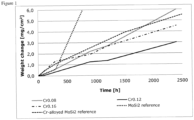
- Figure 1
- shows the weight change during air exposure at 450 °C;
- The disclosure is further illustrated by the following non-limiting illustrative examples.
- A chromium powder and a silicon powder were mixed, and the mixture was reacted in argon atmosphere to form CrSi2 and analyzed by x-ray diffraction (XRD). The obtained powder, which was obtained through milling, contained mostly CrSi2, a small fraction of CrSi and indications of elemental Si and Cr. A CrSi2 powder and was then mixed with a production charge of MoSi2 powder according to specified stoichiometric compositions, and 4 to 6 wt% Bentolite-L was used as binder phase (extrusion aid) and petrol in a ball mill. The ceramic paste was extruded into 6 mm diameter rods, which were subsequently dried and pre-sintered and then sintered in inert atmosphere, using for example as hydrogen or argon, in temperatures of 1000 °C to 1520 °C until a dense material is obtained. The resulting material contained Mo1-xCrxSi2, where x=0.08, 0.12, 0.14 and 0.16, equivalent to 2.7, 4.1, 4.9 and 5.4 at% Cr, respectively. A reference material made from purchased CrSi2 powder, with a final composition of x=0.13, equivalent of 4.3 at% Cr was also prepared. Samples of each composition were ground to remove the protective SiO2 scale that was formed during final sintering. Samples were placed individually on alumina sample holders to collect potential oxidation products and include them in the weight measurements. The samples were placed in laboratory air in an electrical furnace heated to 450°C employing FeCrAl heating elements and utilized with ceramic fiber insulation. Sample and holder were weighted to monitor individual weight changes as function of exposure time. For the two reference materials, MoSi2 reference and Cr-alloyed MoSi2 reference, data were taken from other pest tests. The resulting data is presented in the figure below:
Figure 1 shows that all Cr-alloyed materials performed substantially better than the reference MoSi2-based material KS1700 and better in comparison to previous experience of Cr-alloyed material. Cr0.14 equivalent to 4.9 at% Cr (orange) appeared to have an ideal composition with respect to resistance against pesting. - The material was also evaluated by SEM-EDS with respect to phase distribution and oxide thickness. In comparison to the reference Cr0.15 material the distribution of Cr seems to be slightly different. In the case of reference Cr0.15, which was made from elemental Mo, Si and Cr, Cr was concentrated to certain areas unevenly distributed in the cross section of the material. In the case of material alloyed by sintering MoSi2 and CrSi2, Cr was more homogeneously distributed along the grain boundaries of MoSi2, either as tetragonal (Mo,Cr)5Si3 (D8m) phase or as hexagonal (Mo,Cr)Si2 (C40) phase. Hence, EDS showed that Cr distribution was concentrated to certain grain boundaries in case of reference Cr0.15 made from elemental powders while homogeneous distribution of Cr along grain boundaries of MoSi2 was found in Cr0.14 made from CrSi2 and MoSi2 powders.
Claims (10)
- A process of manufacturing a chromium alloyed molybdenum silicide portion of a heating element comprising the steps of:- forming a mixture of a chromium powder and a silicon powder;- reacting the mixture to a reaction product in an inert atmosphere at a temperature of at least 1100°C but not more than 1580°C;- converting the reaction product to a powder comprising CrSi2;- forming a powder ceramic composition by mixing the powder comprising CrSi2 with a MoSi2 powder and optionally with an extrusion aid;- forming the portion of the heating element; and- sintering the portion of the heating element in a temperature of from 1450°C plus or minus 10% to 1700°C plus or minus 10%;characterized in that the chromium powder and the silicon powder are provided separately to the mixture.
- The process according to claim 1, wherein the forming step is extrusion of powder ceramic composition to the portion of the heating element.
- The process according to claim 1, wherein the forming step comprises subjecting the ceramic powder composition to an isostatic forming pressing process wherein said process comprises the step of:• adding the ceramic powder composition to a capsule which has at least part of the shape of the desired object; and• subjecting said capsule to a predetermined pressure at a predetermined temperature for a predetermined time.
- The process according to any one of claims 1 to 3, wherein the portion of the heating element is optionally pre-sintered before sintering.
- The process according to claim 4, wherein the pre-sintering step is performed in inert atmosphere at a temperature of from about 1400°C to about 1600°C.
- The process according to any one of claims 1 to 5, wherein the extrusion aid is an inorganic clay.
- The process according to claim 6, wherein the inorganic clay is an aluminum silicate clay, such as bentonite clay.
- The process according to any one of claim 1 to 7, wherein the sintered portion of the heating element comprises more than 90 weight% Mo1-xCrxSi2 and the balance is extrusion aid and unavoidable impurities.
- The process according to claim 8, wherein x is between 0.08 to 0.15.
- Use of the process according to any one of claims 1 to 9 for manufacturing a heating element.
Applications Claiming Priority (2)
| Application Number | Priority Date | Filing Date | Title |
|---|---|---|---|
| EP18206793 | 2018-11-16 | ||
| PCT/EP2019/081506 WO2020099644A1 (en) | 2018-11-16 | 2019-11-15 | New process for manufacturing a chromium alloyed molybdenum silicide portion of a heating element |
Publications (2)
| Publication Number | Publication Date |
|---|---|
| EP3880630A1 EP3880630A1 (en) | 2021-09-22 |
| EP3880630B1 true EP3880630B1 (en) | 2024-08-07 |
Family
ID=64331946
Family Applications (1)
| Application Number | Title | Priority Date | Filing Date |
|---|---|---|---|
| EP19804721.9A Active EP3880630B1 (en) | 2018-11-16 | 2019-11-15 | Process for manufacturing a chromium alloyed molybdenum silicide portion of a heating element |
Country Status (7)
| Country | Link |
|---|---|
| US (1) | US11932579B2 (en) |
| EP (1) | EP3880630B1 (en) |
| JP (1) | JP7474252B2 (en) |
| KR (1) | KR102937445B1 (en) |
| CN (1) | CN112996762A (en) |
| PL (1) | PL3880630T3 (en) |
| WO (1) | WO2020099644A1 (en) |
Families Citing this family (1)
| Publication number | Priority date | Publication date | Assignee | Title |
|---|---|---|---|---|
| CN115141021B (en) * | 2022-08-31 | 2023-01-03 | 钢研昊普科技有限公司 | Modified molybdenum disilicide material and preparation method thereof |
Citations (1)
| Publication number | Priority date | Publication date | Assignee | Title |
|---|---|---|---|---|
| WO2017108694A1 (en) * | 2015-12-21 | 2017-06-29 | Sandvik Intellectual Property Ab | A new molybdenum silicide based composition |
Family Cites Families (6)
| Publication number | Priority date | Publication date | Assignee | Title |
|---|---|---|---|---|
| US2779579A (en) * | 1954-07-26 | 1957-01-29 | Schwarzkopf Dev Co | Conveyor for high temperature furnaces |
| US3009886A (en) * | 1958-09-10 | 1961-11-21 | Axel R Wejnarth | Electrical resistance heating compositions |
| US3362787A (en) * | 1964-02-04 | 1968-01-09 | Norton Co | Preparation of molybdenum silicides |
| JP2570404B2 (en) * | 1988-10-21 | 1997-01-08 | 三菱マテリアル株式会社 | Method for producing chromium silicide powder with low content of Na and K |
| SE521796C2 (en) | 2002-04-05 | 2003-12-09 | Sandvik Ab | Process for manufacturing a molybdenum silicon type heating element and a heating element |
| JP2012506365A (en) * | 2008-10-22 | 2012-03-15 | サンドビック インテレクチュアル プロパティー アクティエボラーグ | Molybdenum silicide composite material |
-
2019
- 2019-11-15 CN CN201980074317.0A patent/CN112996762A/en active Pending
- 2019-11-15 EP EP19804721.9A patent/EP3880630B1/en active Active
- 2019-11-15 WO PCT/EP2019/081506 patent/WO2020099644A1/en not_active Ceased
- 2019-11-15 KR KR1020217013919A patent/KR102937445B1/en active Active
- 2019-11-15 JP JP2021525631A patent/JP7474252B2/en active Active
- 2019-11-15 US US17/293,062 patent/US11932579B2/en active Active
- 2019-11-15 PL PL19804721.9T patent/PL3880630T3/en unknown
Patent Citations (1)
| Publication number | Priority date | Publication date | Assignee | Title |
|---|---|---|---|---|
| WO2017108694A1 (en) * | 2015-12-21 | 2017-06-29 | Sandvik Intellectual Property Ab | A new molybdenum silicide based composition |
Also Published As
| Publication number | Publication date |
|---|---|
| KR20210091149A (en) | 2021-07-21 |
| JP7474252B2 (en) | 2024-04-24 |
| US20210403386A1 (en) | 2021-12-30 |
| US11932579B2 (en) | 2024-03-19 |
| WO2020099644A1 (en) | 2020-05-22 |
| KR102937445B1 (en) | 2026-03-10 |
| CN112996762A (en) | 2021-06-18 |
| JP2022507179A (en) | 2022-01-18 |
| EP3880630A1 (en) | 2021-09-22 |
| PL3880630T3 (en) | 2024-12-16 |
Similar Documents
| Publication | Publication Date | Title |
|---|---|---|
| DE3337630A1 (en) | TEMPERATURE COMPENSATING BODY | |
| Carrijo et al. | Fabrication of Ti3SiC2-based composites via three-dimensional printing: Influence of processing on the final properties | |
| JP6783528B2 (en) | Ceramic structure, its manufacturing method and members for semiconductor manufacturing equipment | |
| US20120168431A1 (en) | Heating element | |
| US11932579B2 (en) | Process for manufacturing a chromium alloyed molybdenum silicide portion of a heating element | |
| Cygan et al. | Thermal stability and coefficient of friction of the diamond composites with the titanium compound bonding phase | |
| JP2535768B2 (en) | High heat resistant composite material | |
| Mishra et al. | Sintering behaviour of self-propagating high temperature synthesised ZrB2–Al2O3 composite powder | |
| EP3394001B1 (en) | A new molybdenum silicide based composition | |
| Wang et al. | Effects of particle sizes of starting oxides on the properties of spinel-type Mn1. 1Co1. 5Fe0. 4O4 negative temperature coefficient ceramics | |
| DE3235838A1 (en) | THERMOCOUPLE FROM THE THERMOPAAR GRAPHITE / BORCARBIDE | |
| KR102364910B1 (en) | Heating elements comprising chromium alloy molybdenum disilicide and uses thereof | |
| DE102014017021B4 (en) | Seed holder of a single crystal growing device and single crystal growing device | |
| CN113073270A (en) | Wide-temperature-area zero-expansion alloy with abnormal component fluctuation and preparation method thereof | |
| EP2703349B1 (en) | Lanthanum boride sintered body and method for producing the same | |
| CN1179916C (en) | Method for preparing single-phase dense titanium silicon carbide bulk material by in-situ hot pressing reaction with Al as auxiliary agent | |
| IE882028L (en) | Methods for Forming Complex Oxidation Reaction Products¹Including Superconducting Articles | |
| WO2001033177A1 (en) | Temperature detector which is resistant to high temperatures and mechanically stable | |
| CN101805840A (en) | Method for inhibiting directional migration of rare earth in hard alloy sintering process | |
| AT502394B1 (en) | METHOD FOR PRODUCING A CERAMIC MATERIAL AND CERAMIC MATERIAL | |
| RU2570273C1 (en) | Method of production of composite molybdenum-based material | |
| Zygmuntowicz et al. | A dangerous trade-off: Phase instability and porosity in Ti-Rich Al 2 O 3-Ti composites | |
| JP2003089857A (en) | Negative magnetostrictive material and manufacturing method thereof | |
| WO2024257738A1 (en) | Novel thermoelectric conversion molten synthetic body and use thereof | |
| JP2004224668A (en) | Thermal expansion coefficient control type ceramics and manufacturing method thereof |
Legal Events
| Date | Code | Title | Description |
|---|---|---|---|
| STAA | Information on the status of an ep patent application or granted ep patent |
Free format text: STATUS: UNKNOWN |
|
| STAA | Information on the status of an ep patent application or granted ep patent |
Free format text: STATUS: THE INTERNATIONAL PUBLICATION HAS BEEN MADE |
|
| PUAI | Public reference made under article 153(3) epc to a published international application that has entered the european phase |
Free format text: ORIGINAL CODE: 0009012 |
|
| STAA | Information on the status of an ep patent application or granted ep patent |
Free format text: STATUS: REQUEST FOR EXAMINATION WAS MADE |
|
| 17P | Request for examination filed |
Effective date: 20210616 |
|
| AK | Designated contracting states |
Kind code of ref document: A1 Designated state(s): AL AT BE BG CH CY CZ DE DK EE ES FI FR GB GR HR HU IE IS IT LI LT LU LV MC MK MT NL NO PL PT RO RS SE SI SK SM TR |
|
| RAP3 | Party data changed (applicant data changed or rights of an application transferred) |
Owner name: KANTHAL AB |
|
| DAV | Request for validation of the european patent (deleted) | ||
| DAX | Request for extension of the european patent (deleted) | ||
| GRAP | Despatch of communication of intention to grant a patent |
Free format text: ORIGINAL CODE: EPIDOSNIGR1 |
|
| STAA | Information on the status of an ep patent application or granted ep patent |
Free format text: STATUS: GRANT OF PATENT IS INTENDED |
|
| INTG | Intention to grant announced |
Effective date: 20240314 |
|
| GRAS | Grant fee paid |
Free format text: ORIGINAL CODE: EPIDOSNIGR3 |
|
| GRAA | (expected) grant |
Free format text: ORIGINAL CODE: 0009210 |
|
| STAA | Information on the status of an ep patent application or granted ep patent |
Free format text: STATUS: THE PATENT HAS BEEN GRANTED |
|
| AK | Designated contracting states |
Kind code of ref document: B1 Designated state(s): AL AT BE BG CH CY CZ DE DK EE ES FI FR GB GR HR HU IE IS IT LI LT LU LV MC MK MT NL NO PL PT RO RS SE SI SK SM TR |
|
| REG | Reference to a national code |
Ref country code: GB Ref legal event code: FG4D |
|
| REG | Reference to a national code |
Ref country code: CH Ref legal event code: EP |
|
| REG | Reference to a national code |
Ref country code: DE Ref legal event code: R096 Ref document number: 602019056660 Country of ref document: DE |
|
| REG | Reference to a national code |
Ref country code: IE Ref legal event code: FG4D |
|
| REG | Reference to a national code |
Ref country code: SE Ref legal event code: TRGR |
|
| REG | Reference to a national code |
Ref country code: LT Ref legal event code: MG9D |
|
| REG | Reference to a national code |
Ref country code: NL Ref legal event code: MP Effective date: 20240807 |
|
| PG25 | Lapsed in a contracting state [announced via postgrant information from national office to epo] |
Ref country code: NO Free format text: LAPSE BECAUSE OF FAILURE TO SUBMIT A TRANSLATION OF THE DESCRIPTION OR TO PAY THE FEE WITHIN THE PRESCRIBED TIME-LIMIT Effective date: 20241107 |
|
| REG | Reference to a national code |
Ref country code: AT Ref legal event code: MK05 Ref document number: 1710790 Country of ref document: AT Kind code of ref document: T Effective date: 20240807 |
|
| PG25 | Lapsed in a contracting state [announced via postgrant information from national office to epo] |
Ref country code: FI Free format text: LAPSE BECAUSE OF FAILURE TO SUBMIT A TRANSLATION OF THE DESCRIPTION OR TO PAY THE FEE WITHIN THE PRESCRIBED TIME-LIMIT Effective date: 20240807 Ref country code: NL Free format text: LAPSE BECAUSE OF FAILURE TO SUBMIT A TRANSLATION OF THE DESCRIPTION OR TO PAY THE FEE WITHIN THE PRESCRIBED TIME-LIMIT Effective date: 20240807 Ref country code: GR Free format text: LAPSE BECAUSE OF FAILURE TO SUBMIT A TRANSLATION OF THE DESCRIPTION OR TO PAY THE FEE WITHIN THE PRESCRIBED TIME-LIMIT Effective date: 20241108 Ref country code: PT Free format text: LAPSE BECAUSE OF FAILURE TO SUBMIT A TRANSLATION OF THE DESCRIPTION OR TO PAY THE FEE WITHIN THE PRESCRIBED TIME-LIMIT Effective date: 20241209 |
|
| PG25 | Lapsed in a contracting state [announced via postgrant information from national office to epo] |
Ref country code: BG Free format text: LAPSE BECAUSE OF FAILURE TO SUBMIT A TRANSLATION OF THE DESCRIPTION OR TO PAY THE FEE WITHIN THE PRESCRIBED TIME-LIMIT Effective date: 20240807 |
|
| PG25 | Lapsed in a contracting state [announced via postgrant information from national office to epo] |
Ref country code: LV Free format text: LAPSE BECAUSE OF FAILURE TO SUBMIT A TRANSLATION OF THE DESCRIPTION OR TO PAY THE FEE WITHIN THE PRESCRIBED TIME-LIMIT Effective date: 20240807 |
|
| PG25 | Lapsed in a contracting state [announced via postgrant information from national office to epo] |
Ref country code: IS Free format text: LAPSE BECAUSE OF FAILURE TO SUBMIT A TRANSLATION OF THE DESCRIPTION OR TO PAY THE FEE WITHIN THE PRESCRIBED TIME-LIMIT Effective date: 20241207 Ref country code: AT Free format text: LAPSE BECAUSE OF FAILURE TO SUBMIT A TRANSLATION OF THE DESCRIPTION OR TO PAY THE FEE WITHIN THE PRESCRIBED TIME-LIMIT Effective date: 20240807 |
|
| PG25 | Lapsed in a contracting state [announced via postgrant information from national office to epo] |
Ref country code: HR Free format text: LAPSE BECAUSE OF FAILURE TO SUBMIT A TRANSLATION OF THE DESCRIPTION OR TO PAY THE FEE WITHIN THE PRESCRIBED TIME-LIMIT Effective date: 20240807 |
|
| PG25 | Lapsed in a contracting state [announced via postgrant information from national office to epo] |
Ref country code: ES Free format text: LAPSE BECAUSE OF FAILURE TO SUBMIT A TRANSLATION OF THE DESCRIPTION OR TO PAY THE FEE WITHIN THE PRESCRIBED TIME-LIMIT Effective date: 20240807 Ref country code: RS Free format text: LAPSE BECAUSE OF FAILURE TO SUBMIT A TRANSLATION OF THE DESCRIPTION OR TO PAY THE FEE WITHIN THE PRESCRIBED TIME-LIMIT Effective date: 20241107 |
|
| PG25 | Lapsed in a contracting state [announced via postgrant information from national office to epo] |
Ref country code: RS Free format text: LAPSE BECAUSE OF FAILURE TO SUBMIT A TRANSLATION OF THE DESCRIPTION OR TO PAY THE FEE WITHIN THE PRESCRIBED TIME-LIMIT Effective date: 20241107 Ref country code: PT Free format text: LAPSE BECAUSE OF FAILURE TO SUBMIT A TRANSLATION OF THE DESCRIPTION OR TO PAY THE FEE WITHIN THE PRESCRIBED TIME-LIMIT Effective date: 20241209 Ref country code: NO Free format text: LAPSE BECAUSE OF FAILURE TO SUBMIT A TRANSLATION OF THE DESCRIPTION OR TO PAY THE FEE WITHIN THE PRESCRIBED TIME-LIMIT Effective date: 20241107 Ref country code: NL Free format text: LAPSE BECAUSE OF FAILURE TO SUBMIT A TRANSLATION OF THE DESCRIPTION OR TO PAY THE FEE WITHIN THE PRESCRIBED TIME-LIMIT Effective date: 20240807 Ref country code: LV Free format text: LAPSE BECAUSE OF FAILURE TO SUBMIT A TRANSLATION OF THE DESCRIPTION OR TO PAY THE FEE WITHIN THE PRESCRIBED TIME-LIMIT Effective date: 20240807 Ref country code: IS Free format text: LAPSE BECAUSE OF FAILURE TO SUBMIT A TRANSLATION OF THE DESCRIPTION OR TO PAY THE FEE WITHIN THE PRESCRIBED TIME-LIMIT Effective date: 20241207 Ref country code: HR Free format text: LAPSE BECAUSE OF FAILURE TO SUBMIT A TRANSLATION OF THE DESCRIPTION OR TO PAY THE FEE WITHIN THE PRESCRIBED TIME-LIMIT Effective date: 20240807 Ref country code: GR Free format text: LAPSE BECAUSE OF FAILURE TO SUBMIT A TRANSLATION OF THE DESCRIPTION OR TO PAY THE FEE WITHIN THE PRESCRIBED TIME-LIMIT Effective date: 20241108 Ref country code: FI Free format text: LAPSE BECAUSE OF FAILURE TO SUBMIT A TRANSLATION OF THE DESCRIPTION OR TO PAY THE FEE WITHIN THE PRESCRIBED TIME-LIMIT Effective date: 20240807 Ref country code: ES Free format text: LAPSE BECAUSE OF FAILURE TO SUBMIT A TRANSLATION OF THE DESCRIPTION OR TO PAY THE FEE WITHIN THE PRESCRIBED TIME-LIMIT Effective date: 20240807 Ref country code: BG Free format text: LAPSE BECAUSE OF FAILURE TO SUBMIT A TRANSLATION OF THE DESCRIPTION OR TO PAY THE FEE WITHIN THE PRESCRIBED TIME-LIMIT Effective date: 20240807 Ref country code: AT Free format text: LAPSE BECAUSE OF FAILURE TO SUBMIT A TRANSLATION OF THE DESCRIPTION OR TO PAY THE FEE WITHIN THE PRESCRIBED TIME-LIMIT Effective date: 20240807 |
|
| PG25 | Lapsed in a contracting state [announced via postgrant information from national office to epo] |
Ref country code: RO Free format text: LAPSE BECAUSE OF FAILURE TO SUBMIT A TRANSLATION OF THE DESCRIPTION OR TO PAY THE FEE WITHIN THE PRESCRIBED TIME-LIMIT Effective date: 20240807 Ref country code: DK Free format text: LAPSE BECAUSE OF FAILURE TO SUBMIT A TRANSLATION OF THE DESCRIPTION OR TO PAY THE FEE WITHIN THE PRESCRIBED TIME-LIMIT Effective date: 20240807 Ref country code: SM Free format text: LAPSE BECAUSE OF FAILURE TO SUBMIT A TRANSLATION OF THE DESCRIPTION OR TO PAY THE FEE WITHIN THE PRESCRIBED TIME-LIMIT Effective date: 20240807 |
|
| PG25 | Lapsed in a contracting state [announced via postgrant information from national office to epo] |
Ref country code: EE Free format text: LAPSE BECAUSE OF FAILURE TO SUBMIT A TRANSLATION OF THE DESCRIPTION OR TO PAY THE FEE WITHIN THE PRESCRIBED TIME-LIMIT Effective date: 20240807 |
|
| PG25 | Lapsed in a contracting state [announced via postgrant information from national office to epo] |
Ref country code: SK Free format text: LAPSE BECAUSE OF FAILURE TO SUBMIT A TRANSLATION OF THE DESCRIPTION OR TO PAY THE FEE WITHIN THE PRESCRIBED TIME-LIMIT Effective date: 20240807 |
|
| REG | Reference to a national code |
Ref country code: DE Ref legal event code: R097 Ref document number: 602019056660 Country of ref document: DE |
|
| PLBE | No opposition filed within time limit |
Free format text: ORIGINAL CODE: 0009261 |
|
| STAA | Information on the status of an ep patent application or granted ep patent |
Free format text: STATUS: NO OPPOSITION FILED WITHIN TIME LIMIT |
|
| REG | Reference to a national code |
Ref country code: CH Ref legal event code: PL |
|
| PG25 | Lapsed in a contracting state [announced via postgrant information from national office to epo] |
Ref country code: MC Free format text: LAPSE BECAUSE OF FAILURE TO SUBMIT A TRANSLATION OF THE DESCRIPTION OR TO PAY THE FEE WITHIN THE PRESCRIBED TIME-LIMIT Effective date: 20240807 |
|
| PG25 | Lapsed in a contracting state [announced via postgrant information from national office to epo] |
Ref country code: LU Free format text: LAPSE BECAUSE OF NON-PAYMENT OF DUE FEES Effective date: 20241115 |
|
| REG | Reference to a national code |
Ref country code: CH Ref legal event code: PL |
|
| 26N | No opposition filed |
Effective date: 20250508 |
|
| GBPC | Gb: european patent ceased through non-payment of renewal fee |
Effective date: 20241115 |
|
| PG25 | Lapsed in a contracting state [announced via postgrant information from national office to epo] |
Ref country code: CH Free format text: LAPSE BECAUSE OF NON-PAYMENT OF DUE FEES Effective date: 20241130 |
|
| REG | Reference to a national code |
Ref country code: BE Ref legal event code: MM Effective date: 20241130 |
|
| PG25 | Lapsed in a contracting state [announced via postgrant information from national office to epo] |
Ref country code: BE Free format text: LAPSE BECAUSE OF NON-PAYMENT OF DUE FEES Effective date: 20241130 Ref country code: GB Free format text: LAPSE BECAUSE OF NON-PAYMENT OF DUE FEES Effective date: 20241115 |
|
| PG25 | Lapsed in a contracting state [announced via postgrant information from national office to epo] |
Ref country code: FR Free format text: LAPSE BECAUSE OF NON-PAYMENT OF DUE FEES Effective date: 20241130 |
|
| PG25 | Lapsed in a contracting state [announced via postgrant information from national office to epo] |
Ref country code: IE Free format text: LAPSE BECAUSE OF NON-PAYMENT OF DUE FEES Effective date: 20241115 |
|
| PGFP | Annual fee paid to national office [announced via postgrant information from national office to epo] |
Ref country code: DE Payment date: 20251007 Year of fee payment: 7 |
|
| PGFP | Annual fee paid to national office [announced via postgrant information from national office to epo] |
Ref country code: SE Payment date: 20251010 Year of fee payment: 7 |
|
| PGFP | Annual fee paid to national office [announced via postgrant information from national office to epo] |
Ref country code: CZ Payment date: 20251103 Year of fee payment: 7 |
|
| PGFP | Annual fee paid to national office [announced via postgrant information from national office to epo] |
Ref country code: PL Payment date: 20251015 Year of fee payment: 7 |
|
| PG25 | Lapsed in a contracting state [announced via postgrant information from national office to epo] |
Ref country code: IT Free format text: LAPSE BECAUSE OF FAILURE TO SUBMIT A TRANSLATION OF THE DESCRIPTION OR TO PAY THE FEE WITHIN THE PRESCRIBED TIME-LIMIT Effective date: 20240807 |
|
| PG25 | Lapsed in a contracting state [announced via postgrant information from national office to epo] |
Ref country code: HU Free format text: LAPSE BECAUSE OF FAILURE TO SUBMIT A TRANSLATION OF THE DESCRIPTION OR TO PAY THE FEE WITHIN THE PRESCRIBED TIME-LIMIT; INVALID AB INITIO Effective date: 20191115 |
|
| PG25 | Lapsed in a contracting state [announced via postgrant information from national office to epo] |
Ref country code: CY Free format text: LAPSE BECAUSE OF FAILURE TO SUBMIT A TRANSLATION OF THE DESCRIPTION OR TO PAY THE FEE WITHIN THE PRESCRIBED TIME-LIMIT; INVALID AB INITIO Effective date: 20191115 |