EP3880511B1 - Disc recliner mechanism for use in an automotive vehicle - Google Patents
Disc recliner mechanism for use in an automotive vehicle Download PDFInfo
- Publication number
- EP3880511B1 EP3880511B1 EP20708760.2A EP20708760A EP3880511B1 EP 3880511 B1 EP3880511 B1 EP 3880511B1 EP 20708760 A EP20708760 A EP 20708760A EP 3880511 B1 EP3880511 B1 EP 3880511B1
- Authority
- EP
- European Patent Office
- Prior art keywords
- cam
- pawl
- tooth plate
- guide plate
- disc recliner
- Prior art date
- Legal status (The legal status is an assumption and is not a legal conclusion. Google has not performed a legal analysis and makes no representation as to the accuracy of the status listed.)
- Active
Links
Images


Classifications
-
- B—PERFORMING OPERATIONS; TRANSPORTING
- B60—VEHICLES IN GENERAL
- B60N—SEATS SPECIALLY ADAPTED FOR VEHICLES; VEHICLE PASSENGER ACCOMMODATION NOT OTHERWISE PROVIDED FOR
- B60N2/00—Seats specially adapted for vehicles; Arrangement or mounting of seats in vehicles
- B60N2/02—Seats specially adapted for vehicles; Arrangement or mounting of seats in vehicles the seat or part thereof being movable, e.g. adjustable
- B60N2/22—Seats specially adapted for vehicles; Arrangement or mounting of seats in vehicles the seat or part thereof being movable, e.g. adjustable the back-rest being adjustable
- B60N2/235—Seats specially adapted for vehicles; Arrangement or mounting of seats in vehicles the seat or part thereof being movable, e.g. adjustable the back-rest being adjustable by gear-pawl type mechanisms
- B60N2/2356—Seats specially adapted for vehicles; Arrangement or mounting of seats in vehicles the seat or part thereof being movable, e.g. adjustable the back-rest being adjustable by gear-pawl type mechanisms with internal pawls
- B60N2/236—Seats specially adapted for vehicles; Arrangement or mounting of seats in vehicles the seat or part thereof being movable, e.g. adjustable the back-rest being adjustable by gear-pawl type mechanisms with internal pawls linearly movable
Definitions
- the present invention relates to a disc recliner mechanism for use in an automotive vehicle.
- Disc recliner mechanisms for use in an automotive vehicle are known in the art.
- Typical disc recliner mechanisms include a guide plate and a tooth plate with an outer lip, wherein the outer lip rotatably engages the guide plate and has a plurality of teeth extending radially inward therefrom.
- At least one pawl is mounted between the guide plate and tooth plate.
- the pawl includes a toothed outer edge and a radially inner cam surface.
- a cam is rotatably mounted between the guide plate and the tooth plate.
- the cam includes a radially outer cam profile with at least one cam lobe, and the cam lobe has an engagement surface for selectively engaging the radially inner cam surface of the pawl.
- a disc recliner mechanism for use in an automotive vehicle.
- the disc recliner mechanism includes a guide plate and a tooth plate with an outer lip extending circumferentially therearound.
- the outer lip rotatably engages the guide plate and has a plurality of teeth extending radially inward therefrom.
- At least one pawl is mounted between the guide plate and tooth plate, and the pawl includes a toothed outer edge and a radially inner cam surface.
- a cam is rotatably mounted between the guide plate and the tooth plate.
- the cam includes a radially outer cam profile for selectively engaging the radially inner cam surface of the pawl.
- the outer lip of the tooth plate includes a channel for retaining lubricant and reducing rotational friction between the tooth plate and the guide plate.
- the disc recliner mechanism 10 includes a tooth plate 12 rotatably coupled to a guide plate 14.
- a radially outer lip 16 extends circumferentially around the tooth plate 12 and includes an axially outer surface 18 and opposite, substantially parallel, radially outer and radially inner edges 20, 22.
- a plurality of teeth 23 extend radially inward from the inner edge 22 of the tooth plate 12.
- a plurality of pawls 24 with opposite, substantially parallel, first and second sides 26, 28 are oriented between a pair of guides 30a, 30b extending axially from the guide plate 14.
- Each pair of guides 30a, 30b is laterally spaced apart and has opposing, substantially parallel, inner guiding surfaces 32a, 32b that engage the first and second sides of each pawl 26, 28.
- Each pawl 24 further includes a toothed radially outer edge 34 disposed between the first and second sides 26, 28 that is capable of selectively and complementarily engaging the teeth 23 extending from the inner edge 22 of the tooth plate 12.
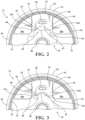
- the disc recliner mechanism 10 further includes a cam 36 rotatably mounted between the tooth plate 12 and the guide plate 14. Referring to Figures 2 and 3 , rotation of the cam 36 moves the pawls 24 between an extended position in which the toothed edges 34 of the pawls 24 engage the tooth plate 12 to lock the disc recliner mechanism 10 (shown in Figure 2 ) and prevent rotation of the tooth plate 12 relative to the guide plate 14, and a retracted position in which the toothed edges 34 of the pawls 24 disengage the tooth plate 12 to unlock the disc recliner mechanism 10 (shown in Figure 3 ) and allow rotation of the tooth plate 12 relative to the guide plate 14.
- the cam 36 includes a radially outer cam profile 38 with at least one cam lobe 40 for selectively engaging a radially inner cam surface 42 of the pawls 24.
- the radially inner cam surface 42 is disposed on the pawls 24 opposite the toothed edge 34 and extends between the first and second sides 26, 28.
- At least one cam follower 44 is disposed on the inner cam surface 42 of the pawls 24.
- the cam lobes 40 each have an engagement surface 46 that selectively contacts the inner cam surface 42 of the pawls 24 as the cam 36 is rotated.
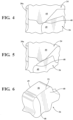
- At least one of the cam lobes 40 includes a notch 48 extending axially from a first end 49 to a second end 51 of the engagement surface 46 or between opposite axial sides of the cam 36.
- the notch 48 creates a gap between the cam lobe 40 and the cam follower 44 to reduce friction during selective sliding engagement of the cam lobe 40 along the cam follower 44.
- a control mechanism such as a cam shaft 50 to which a handle or the like may be coupled, is attached to the cam 36 to facilitate rotation thereof.
- the cam shaft 50 also extends through a central aperture 53 in the tooth plate 12 and a central aperture 55 in the guide plate 14.
- the outer cam profile 38 includes first and second cam lobes 40 that correspond to and engage first and second cam followers 44 disposed on the inner cam surface 42 of the pawls 24.
- the notch 48 is disposed on the engagement surface 46 of the first cam lobe 40.
- the disc recliner mechanism 10 may include any number of notches 48 and any number of cam lobes 40 and cam followers 44 without varying the scope of the invention.
- the notch 48 may also be placed on any one or any number of the cam lobes 40 to control an amount of friction between the cam lobe 40 and cam follower 44 as desired without varying the scope of the invention.
- a spring 52 is operatively coupled to the cam shaft 50 to rotatably bias the cam 36 in a first direction (counterclockwise when viewed from Figures 2 and 3 ) to move the pawls 24 to the extended position.
- alternative means of biasing the pawls 24 to the extended position may be used without varying the scope of the invention.
- One potential alternative biasing means is a pair of springs 52, where each spring 52 is operatively coupled to opposite sides of the cam 36, as is described in U.S. Patent No. 8,459,743 , the disclosure of which is hereby incorporated by reference in its entirety.
- Rotation of the cam 36 in the first direction by one or more of the springs 52 causes the cam lobes 40 to engage the cam followers 44, thereby pushing the pawl 24 radially outward between the inner guiding surfaces 32a, 32b of the guides 30a, 30b to the extended position in which the toothed edge 34 of the pawls 24 engages the teeth 23 extending from the tooth plate 12 to lock the disc recliner mechanism 10.
- the control mechanism cam shaft 50, rotates the cam 36 in a second direction (clockwise when viewed from Figures 2 and 3 ) against a biasing force of the spring 52 to move the pawls 24 to the retracted position.
- a pawl retractor plate 54 is operatively mounted adjacent the cam 36 and rotates in tandem with the cam 36 and the cam shaft 50 to facilitate return of the pawls 24 to the retracted position.
- the pawl retractor plate 54 includes a plurality of slots 56 for receiving a pip 58 extending axially from each pawl 24.
- a radially outer lip 60 extends circumferentially around the guide plate 14 and includes an axially outer surface 62 and opposite, substantially parallel, radially outer and radially inner edges 64, 66.
- the outer lip 60 of the guide plate 14 has an outer diameter larger than that of the outer lip 16 of the tooth plate 12.
- the outer lip 16 of the tooth plate 12 nests within and is encapsulated by the outer lip 60 of the guide plate 14.
- the tooth plate 12 and the guide plate 14 are thereby rotatably coupled such that the inner edge 66 of the guide plate 14 contacts the outer edge 20 of the tooth plate 12, and the outer surface 18 of the tooth plate 12 rotatably engages the guide plate 14 at a planar surface 68 disposed substantially perpendicularly from the inner edge 66 of the guide plate 14.
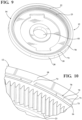
- a channel 70 is recessed in and extends concentrically around the outer surface 18 of the tooth plate 12.
- the channel 70 has a pair of substantially parallel radially outer and radially inner walls 71, 73 with a channel floor 75 extending between the inner and outer walls 71, 73.
- the channel 70 eliminates flat-to-flat contact of and helps retain a lubricant, such as grease, between the tooth plate 12 and the guide plate 14, thereby reducing mitigation of the lubricant and reducing friction between the tooth plate 12 and the guide plate 14.
- a plurality of dividers 72 intersecting the channel 70 may be used to separate the channel 70 into multiple segments, as is shown in Figure 10 .
- the channel 70 may include any number of dividers 72 or may omit the dividers 72 entirely without varying the scope of the invention.
- a stepped retaining ring 74 rotatably secures the tooth plate 12 to the guide plate 14 and includes a radially outer planar edge 76 and a radially inner planar edge 78 with a plurality of axially extending protrusions 80.
- the outer planar edge 76 of the retaining ring 74 is attached to the outer surface 62 of the guide plate 14 by a weld 82 extending axially into the guide plate 14.
- the protrusions 80 engage a rear planar surface 84 of the tooth plate 12 disposed opposite from and substantially parallel to the outer surface 18 of the tooth plate 12, thereby preventing axial separation of the tooth plate 12 and the guide plate 14 while still allowing the tooth plate 12 to rotate relative to the guide plate 14. Because the retaining ring 74 is coupled to the outer surface 62 of the guide plate 14 rather than, for instance, extending around the outer edge 64 of the guide plate 14, the retaining ring 74 is ultimately inconsequential to the overall diameter of the disc recliner mechanism 10.
- the disc recliner mechanism 10 can be adapted for use in various capacities within the automotive vehicle. In one such capacity, the disc recliner mechanism 10 can be coupled between a seat back and a seat cushion in a seat assembly to allow selective pivotal movement of the seat back relative to the seat cushion. In another such capacity, the disc recliner mechanism 10 can be coupled between the seat cushion and a seat base for allowing the seat assembly to move between numerous positions, including a stowed position, an easy entry position, and a design position.
- the cam shaft 50 is rotated in the second direction (clockwise when viewed from Figures 2 and 3 ) to overcome the biasing force of the spring 52 and simultaneously rotate the cam 36 and the pawl retractor plate 54 in the second direction.
- the slots 56 engage the pips 58 extending from the pawls 24 to move the pawls 24, guided by the guiding surfaces 32a, 32b, radially inward to the retracted position.
- the toothed edge 34 of the pawls 24 disengages the teeth 23 extending from the tooth plate 12, thereby unlocking the disc recliner mechanism 10 and allowing rotational movement between the guide plate 14 and the tooth plate 12.
- a user may then rotate the disc recliner mechanism 10 to a desired position.
- Lubricant displaced radially outward during rotation between the guide plate 14 and the tooth plate 12 is trapped within the channel 70 extending concentrically around the outer surface 18 of the tooth plate 12 to continuously reduce rotational friction therebetween.
- the biasing force of the spring 52 rotates the cam shaft 50 and cam 36 in the first direction (counterclockwise when viewed from Figures 2 and 3 ).
- the engagement surfaces 46 of the cam lobes 40 initially engage the cam followers 44, pushing the pawls 24 radially outward, guided by the guiding surfaces 32a, 32b, toward the outer lip 16 of the tooth plate 12.
- the first cam follower 44 skips across the notch 48 in the engagement surface 46 of the first cam lobe 40, thereby reducing friction and easing return of the pawls 24 to the extended position.
- the cam 36 then comes to rest engaged with the pawls 24 such that the first cam lobe 40 is in full contact with the first cam follower 44, and the second cam lobe 40 is in full contact with the second cam follower 44.
- the pawls 24 are disposed in the extended position where the toothed edges 34 are engaged with the teeth 23 extending from the inner edge 22 of the tooth plate 12, thereby locking the disc recliner mechanism 10 and preventing rotation of the tooth plate 12 relative to the guide plate 14.
Landscapes
- Engineering & Computer Science (AREA)
- Aviation & Aerospace Engineering (AREA)
- Transportation (AREA)
- Mechanical Engineering (AREA)
- Chairs For Special Purposes, Such As Reclining Chairs (AREA)
Description
- This application claims priority to and all the benefits of
U.S. Provisional Application 62/796,600, filed on January 25, 2019 - The present invention relates to a disc recliner mechanism for use in an automotive vehicle.
- Disc recliner mechanisms for use in an automotive vehicle are known in the art. Typical disc recliner mechanisms include a guide plate and a tooth plate with an outer lip, wherein the outer lip rotatably engages the guide plate and has a plurality of teeth extending radially inward therefrom. At least one pawl is mounted between the guide plate and tooth plate. The pawl includes a toothed outer edge and a radially inner cam surface. Often a cam is rotatably mounted between the guide plate and the tooth plate. The cam includes a radially outer cam profile with at least one cam lobe, and the cam lobe has an engagement surface for selectively engaging the radially inner cam surface of the pawl. Rotation of the cam moves the pawl between a first position in which the pawl engages the tooth plate to lock the disc recliner mechanism and a second position in which the pawl disengages the tooth plate to unlock the disc recliner mechanism. However, the disc recliner mechanisms known in the art can push grease radially outward from between the tooth plate and the guide plate due to a flat-to-flat contact area where the outer lip of the tooth plate rotatably engages the guide plate, leading to potential grease mitigation and increased friction. Furthermore, the disc recliner mechanisms known in the art can be difficult to operate efficiently due to increased friction when the cam engages the pawl at slow actuation speeds.
US 2015/123444 A1 discloses a disc recliner mechanism according to the preamble of claim 1. - According to the invention, a disc recliner mechanism is provided for use in an automotive vehicle. The disc recliner mechanism includes a guide plate and a tooth plate with an outer lip extending circumferentially therearound. The outer lip rotatably engages the guide plate and has a plurality of teeth extending radially inward therefrom. At least one pawl is mounted between the guide plate and tooth plate, and the pawl includes a toothed outer edge and a radially inner cam surface. A cam is rotatably mounted between the guide plate and the tooth plate. The cam includes a radially outer cam profile for selectively engaging the radially inner cam surface of the pawl. Rotation of the cam moves the pawl between an extended position in which the pawl engages the tooth plate to lock the disc recliner mechanism and a retracted position in which the pawl disengages the tooth plate to unlock the disc recliner mechanism. Additionally, the outer lip of the tooth plate includes a channel for retaining lubricant and reducing rotational friction between the tooth plate and the guide plate.
- Advantages of the present invention will be readily appreciated as the same becomes better understood by reference to the following detailed description when considered in connection with the accompanying drawings, wherein:
-
Figure 1 is an exploded view of a disc recliner according to an embodiment of the present invention; -
Figure 2 is a fragmentary cross-sectional view of the disc recliner ofFigure 1 with a pawl in an extended position; -
Figure 3 is a fragmentary cross-sectional view of the disc recliner ofFigure 1 with the pawl in a retracted position; -
Figure 4 is an enlarged fragmentary elevation view of the disc recliner ofFigure 1 with a cam engaging the pawl; -
Figure 5 is an enlarged fragmentary elevation view of the disc recliner ofFigure 1 with the cam further engaging the pawl; -
Figure 6 is an enlarged fragmentary perspective view of a cam lobe and a notch of the disc recliner ofFigure 1 ; -
Figure 7 is a cross-sectional view of the disc recliner ofFigure 1 ; -
Figure 8 is a fragmentary cross-sectional view of the disc recliner ofFigure 1 ; -
Figure 9 is a perspective view of a tooth plate of the disc recliner ofFigure 1 ; and -
Figure 10 is an enlarged fragmentary perspective view of the tooth plate of the disc recliner ofFigure 1 . - Referring to the Figures, wherein like numerals indicate like or corresponding parts throughout the several views, a disc recliner mechanism for use in an automotive vehicle is shown generally at 10. The
disc recliner mechanism 10 includes atooth plate 12 rotatably coupled to aguide plate 14. A radiallyouter lip 16 extends circumferentially around thetooth plate 12 and includes an axiallyouter surface 18 and opposite, substantially parallel, radially outer and radiallyinner edges teeth 23 extend radially inward from theinner edge 22 of thetooth plate 12. A plurality ofpawls 24 with opposite, substantially parallel, first andsecond sides guides guide plate 14. Each pair ofguides surfaces pawl pawl 24 further includes a toothed radiallyouter edge 34 disposed between the first andsecond sides teeth 23 extending from theinner edge 22 of thetooth plate 12. - The
disc recliner mechanism 10 further includes acam 36 rotatably mounted between thetooth plate 12 and theguide plate 14. Referring toFigures 2 and 3 , rotation of thecam 36 moves thepawls 24 between an extended position in which thetoothed edges 34 of thepawls 24 engage thetooth plate 12 to lock the disc recliner mechanism 10 (shown inFigure 2 ) and prevent rotation of thetooth plate 12 relative to theguide plate 14, and a retracted position in which thetoothed edges 34 of thepawls 24 disengage thetooth plate 12 to unlock the disc recliner mechanism 10 (shown inFigure 3 ) and allow rotation of thetooth plate 12 relative to theguide plate 14. Thecam 36 includes a radiallyouter cam profile 38 with at least onecam lobe 40 for selectively engaging a radiallyinner cam surface 42 of thepawls 24. The radiallyinner cam surface 42 is disposed on thepawls 24 opposite thetoothed edge 34 and extends between the first andsecond sides cam follower 44 is disposed on theinner cam surface 42 of thepawls 24. Thecam lobes 40 each have anengagement surface 46 that selectively contacts theinner cam surface 42 of thepawls 24 as thecam 36 is rotated. - Referring to
Figures 4-6 , at least one of thecam lobes 40 includes anotch 48 extending axially from afirst end 49 to asecond end 51 of theengagement surface 46 or between opposite axial sides of thecam 36. Thenotch 48 creates a gap between thecam lobe 40 and thecam follower 44 to reduce friction during selective sliding engagement of thecam lobe 40 along thecam follower 44. A control mechanism, such as acam shaft 50 to which a handle or the like may be coupled, is attached to thecam 36 to facilitate rotation thereof. Thecam shaft 50 also extends through acentral aperture 53 in thetooth plate 12 and acentral aperture 55 in theguide plate 14. In a preferred embodiment, theouter cam profile 38 includes first andsecond cam lobes 40 that correspond to and engage first andsecond cam followers 44 disposed on theinner cam surface 42 of thepawls 24. Thenotch 48 is disposed on theengagement surface 46 of thefirst cam lobe 40. However, it is to be appreciated that thedisc recliner mechanism 10 may include any number ofnotches 48 and any number ofcam lobes 40 andcam followers 44 without varying the scope of the invention. Further, it is to be appreciated that thenotch 48 may also be placed on any one or any number of thecam lobes 40 to control an amount of friction between thecam lobe 40 andcam follower 44 as desired without varying the scope of the invention. - A
spring 52 is operatively coupled to thecam shaft 50 to rotatably bias thecam 36 in a first direction (counterclockwise when viewed fromFigures 2 and 3 ) to move thepawls 24 to the extended position. However, it is to be appreciated that alternative means of biasing thepawls 24 to the extended position may be used without varying the scope of the invention. One potential alternative biasing means is a pair ofsprings 52, where eachspring 52 is operatively coupled to opposite sides of thecam 36, as is described inU.S. Patent No. 8,459,743 , the disclosure of which is hereby incorporated by reference in its entirety. Rotation of thecam 36 in the first direction by one or more of thesprings 52 causes thecam lobes 40 to engage thecam followers 44, thereby pushing thepawl 24 radially outward between the inner guidingsurfaces guides toothed edge 34 of thepawls 24 engages theteeth 23 extending from thetooth plate 12 to lock thedisc recliner mechanism 10. - The control mechanism,
cam shaft 50, rotates thecam 36 in a second direction (clockwise when viewed fromFigures 2 and 3 ) against a biasing force of thespring 52 to move thepawls 24 to the retracted position. Apawl retractor plate 54 is operatively mounted adjacent thecam 36 and rotates in tandem with thecam 36 and thecam shaft 50 to facilitate return of thepawls 24 to the retracted position. Thepawl retractor plate 54 includes a plurality ofslots 56 for receiving apip 58 extending axially from eachpawl 24. Rotation of thepawl retractor plate 54 in the second direction due to corresponding rotation of thecam shaft 50 andcam 36 in the second direction thereby urges thepawls 24 to move radially inward as thepip 58 of eachpawl 24 engages theslots 56 of thepawl retractor plate 54. Thepawls 24 are thereby moved to the retracted position in which thetoothed edge 34 of thepawls 24 disengages theteeth 23 extending from thetooth plate 12 to unlock thedisc recliner mechanism 10. It is also to be appreciated that alternative means of returning thepawls 24 to the retracted position, includingvarious cam lobe 40 andcam follower 44 configurations, may be used without varying the scope of the invention. One such potential configuration ofcam lobes 40 andcam followers 44 used to return thepawls 24 to the retracted position is described inU.S. Patent No. 8,459,74 . - Referring to
Figures 7 and 8 , a radiallyouter lip 60 extends circumferentially around theguide plate 14 and includes an axiallyouter surface 62 and opposite, substantially parallel, radially outer and radiallyinner edges outer lip 60 of theguide plate 14 has an outer diameter larger than that of theouter lip 16 of thetooth plate 12. Thus, theouter lip 16 of thetooth plate 12 nests within and is encapsulated by theouter lip 60 of theguide plate 14. Thetooth plate 12 and theguide plate 14 are thereby rotatably coupled such that theinner edge 66 of theguide plate 14 contacts theouter edge 20 of thetooth plate 12, and theouter surface 18 of thetooth plate 12 rotatably engages theguide plate 14 at aplanar surface 68 disposed substantially perpendicularly from theinner edge 66 of theguide plate 14. - Referring to
Figures 9 and 10 , achannel 70 is recessed in and extends concentrically around theouter surface 18 of thetooth plate 12. Thechannel 70 has a pair of substantially parallel radially outer and radiallyinner walls channel floor 75 extending between the inner andouter walls channel 70 eliminates flat-to-flat contact of and helps retain a lubricant, such as grease, between thetooth plate 12 and theguide plate 14, thereby reducing mitigation of the lubricant and reducing friction between thetooth plate 12 and theguide plate 14. A plurality ofdividers 72 intersecting thechannel 70 may be used to separate thechannel 70 into multiple segments, as is shown inFigure 10 . However, it is to be appreciated that thechannel 70 may include any number ofdividers 72 or may omit thedividers 72 entirely without varying the scope of the invention. - Referring to
Figures 7 and 8 , a stepped retainingring 74 rotatably secures thetooth plate 12 to theguide plate 14 and includes a radially outerplanar edge 76 and a radially innerplanar edge 78 with a plurality of axially extendingprotrusions 80. The outerplanar edge 76 of the retainingring 74 is attached to theouter surface 62 of theguide plate 14 by aweld 82 extending axially into theguide plate 14. Theprotrusions 80 engage a rearplanar surface 84 of thetooth plate 12 disposed opposite from and substantially parallel to theouter surface 18 of thetooth plate 12, thereby preventing axial separation of thetooth plate 12 and theguide plate 14 while still allowing thetooth plate 12 to rotate relative to theguide plate 14. Because the retainingring 74 is coupled to theouter surface 62 of theguide plate 14 rather than, for instance, extending around theouter edge 64 of theguide plate 14, the retainingring 74 is ultimately inconsequential to the overall diameter of thedisc recliner mechanism 10. - The
disc recliner mechanism 10 can be adapted for use in various capacities within the automotive vehicle. In one such capacity, thedisc recliner mechanism 10 can be coupled between a seat back and a seat cushion in a seat assembly to allow selective pivotal movement of the seat back relative to the seat cushion. In another such capacity, thedisc recliner mechanism 10 can be coupled between the seat cushion and a seat base for allowing the seat assembly to move between numerous positions, including a stowed position, an easy entry position, and a design position. - Referring to operation of the preferred embodiment of the
disc recliner mechanism 10, thecam shaft 50 is rotated in the second direction (clockwise when viewed fromFigures 2 and 3 ) to overcome the biasing force of thespring 52 and simultaneously rotate thecam 36 and thepawl retractor plate 54 in the second direction. As thepawl retractor plate 54 rotates in the second direction, theslots 56 engage thepips 58 extending from thepawls 24 to move thepawls 24, guided by the guidingsurfaces toothed edge 34 of thepawls 24 disengages theteeth 23 extending from thetooth plate 12, thereby unlocking thedisc recliner mechanism 10 and allowing rotational movement between theguide plate 14 and thetooth plate 12. A user may then rotate thedisc recliner mechanism 10 to a desired position. Lubricant displaced radially outward during rotation between theguide plate 14 and thetooth plate 12 is trapped within thechannel 70 extending concentrically around theouter surface 18 of thetooth plate 12 to continuously reduce rotational friction therebetween. - Once the user has selected the desired position for the
disc recliner mechanism 10, the biasing force of thespring 52 rotates thecam shaft 50 andcam 36 in the first direction (counterclockwise when viewed fromFigures 2 and 3 ). As thecam 36 rotates in the first direction, the engagement surfaces 46 of thecam lobes 40 initially engage thecam followers 44, pushing thepawls 24 radially outward, guided by the guidingsurfaces outer lip 16 of thetooth plate 12. As thecam 36 continues to rotate and the engagement surfaces 46 of thecam lobes 40 slide further across thecam followers 44, thefirst cam follower 44 skips across thenotch 48 in theengagement surface 46 of thefirst cam lobe 40, thereby reducing friction and easing return of thepawls 24 to the extended position. Thecam 36 then comes to rest engaged with thepawls 24 such that thefirst cam lobe 40 is in full contact with thefirst cam follower 44, and thesecond cam lobe 40 is in full contact with thesecond cam follower 44. Thepawls 24 are disposed in the extended position where thetoothed edges 34 are engaged with theteeth 23 extending from theinner edge 22 of thetooth plate 12, thereby locking thedisc recliner mechanism 10 and preventing rotation of thetooth plate 12 relative to theguide plate 14. - The invention has been described in an illustrative manner, and it is to be understood that the terminology which has been used is intended to be in the nature of words of description rather than of limitation. Directional references employed or shown in the description, figures or claims, such as top, bottom, upper, lower, upward, downward, lengthwise, widthwise, longitudinal, lateral, and the like, are relative terms employed for ease of description and are not intended to limit the scope of the invention in any respect. Many modifications and variations of the present invention are possible in light of the above teachings. It is, therefore, to be understood that within the scope of the appended claims, the invention may be practiced other than as specifically described.
Claims (13)
- A disc recliner mechanism (10) for use in an automotive vehicle, the disc recliner mechanism (10) comprising:a guide plate (14);a tooth plate (12) with an outer lip (16) extending circumferentially therearound, the outer lip (16) rotatably engaging the guide plate (14) and having a plurality of teeth (23) extending radially inward therefrom;at least one pawl (24) mounted between the guide plate (14) and tooth plate (12), the pawl (24) including a toothed outer edge (34) and a radially inner cam surface (42); anda cam (36) rotatably mounted between the guide plate (14) and the tooth plate (12), the cam (36) including a radially outer cam profile (38) for selectively engaging the radially inner cam surface (42) of the pawl (24), wherein rotation of the cam (36) moves the pawl (24) between an extended position in which the pawl (24) engages the tooth plate (12) to lock the disc recliner mechanism (10), and a retracted position in which the pawl (24) disengages the tooth plate (12) to unlock the disc recliner mechanism (10); andcharacterised in that the outer lip (16) of the tooth plate (12) includes a channel (70) for retaining lubricant and reducing rotational friction between the tooth plate (12) and the guide plate (14).
- The disc recliner mechanism (10) of claim 1, further comprising at least one cam lobe (40) disposed on the radially outer cam profile (38) and at least one cam follower (44) disposed on the radially inner cam surface (42), wherein the cam lobe (40) preferably includes an engagement surface (46) for selectively engaging the radially inner cam surface (42) of the pawl (24), further preferably wherein the engagement surface (46) of the cam lobe (40) includes a notch (48) to create a gap between the cam lobe (40) and the cam follower (44) for reducing friction therebetween when the cam lobe (40) selectively engages the cam follower (44).
- The disc recliner mechanism (10) of claim 2, wherein the tooth plate (12) is rotatably coupled to the guide plate (14) and rotation of the cam (36) in a first direction moves the pawl (24) to the extended position to prevent rotation between the tooth plate (12) and the guide plate (14), and rotation of the cam (36) in a second direction opposite the first direction moves the pawl (24) to the retracted position to allow rotation between the tooth plate (12) and the guide plate (14), preferably wherein rotation of the cam (36) in the first direction causes the cam lobe (40) to engage the cam follower (44), thereby moving the pawl (24) to the extended position in which the pawl (24) engages the tooth plate (12) to lock the disc recliner mechanism (10) and prevent rotation between the tooth plate (12) and the guide plate (14).
- The disc recliner of claim 3, further comprising a pawl retractor plate (54) operatively mounted adjacent the cam (36), wherein rotation of the cam (36) simultaneously rotates the pawl retractor plate (54), preferably wherein rotation of the pawl retractor plate (54) in the second direction due to rotation of the cam (36) in the second direction moves the pawl (24) radially inward to the retracted position in which the pawl (24) disengages the tooth plate (12) to unlock the disc recliner mechanism (10) and allow rotation between the tooth plate (12) and the guide plate (14).
- The disc recliner mechanism (10) of claim 4, wherein the pawl (24) further includes an axially extending pip (58) for engaging the pawl retractor plate (54) when the pawl retractor plate (54) is rotated in the second direction, thereby moving the pawl (24) radially inward to the retracted position.
- The disc recliner mechanism (10) of claim 5, wherein the guide plate (14) further includes at least one pair of axially extending guides (30a, 30b) between which the pawl (24) is mounted.
- The disc recliner mechanism (10) of claim 6, further comprising a cam shaft (50) operatively coupled to the cam (36), preferably further comprising a spring (52) operatively coupled to the cam shaft (50) or to the cam (30) to rotatably bias the cam (36) in the first direction.
- The disc recliner mechanism (10) of claim 7, further comprising a retaining ring (74) for rotatably coupling the guide plate (14) and the tooth plate (12).
- The disc recliner mechanism (10) of claim 8, wherein the retaining ring (74) includes a radially outer planar edge (76) and a radially inner planar edge (78) with a plurality of axially extending protrusions (80).
- The disc recliner mechanism (10) of claim 9, wherein the radially outer planar edge (76) of the retaining ring (74) is attached to the guide plate (14) by an axial weld (82), and the axially extending protrusions (80) engage the tooth plate (12) to rotatably couple the guide plate (14) and the tooth plate (12) and to prevent axial separation of the guide plate (14) and the tooth plate (12).
- The disc recliner mechanism (10) of claim 10, wherein the guide plate (14) includes an outer lip (60) extending circumferentially therearound, the outer lip (60) including opposite radially outer and radially inner edges (64, 66).
- The disc recliner mechanism (10) of claim 11, wherein the outer lip (16) of the tooth plate (12) also includes opposite radially outer and radially inner edges (20, 22), the plurality of teeth (23) extending from the radially inner edge (22).
- The disc recliner mechanism (10) of claim 12, wherein the outer lip (16) of the tooth plate (12) is disposed between the outer lip (60) of the guide plate (14) and the toothed outer edge (34) of the pawl (24) such that the radially outer edge (20) of the tooth plate (12) faces the radially inner edge (66) of the guide plate (14).
Applications Claiming Priority (2)
| Application Number | Priority Date | Filing Date | Title |
|---|---|---|---|
| US201962796600P | 2019-01-25 | 2019-01-25 | |
| PCT/US2020/014947 WO2020154590A1 (en) | 2019-01-25 | 2020-01-24 | Disc recliner mechanism for use in an automotive vehicle |
Publications (2)
| Publication Number | Publication Date |
|---|---|
| EP3880511A1 EP3880511A1 (en) | 2021-09-22 |
| EP3880511B1 true EP3880511B1 (en) | 2024-09-25 |
Family
ID=69740561
Family Applications (1)
| Application Number | Title | Priority Date | Filing Date |
|---|---|---|---|
| EP20708760.2A Active EP3880511B1 (en) | 2019-01-25 | 2020-01-24 | Disc recliner mechanism for use in an automotive vehicle |
Country Status (6)
| Country | Link |
|---|---|
| US (1) | US11904739B2 (en) |
| EP (1) | EP3880511B1 (en) |
| CN (1) | CN113382887B (en) |
| BR (1) | BR112021012349A2 (en) |
| CA (1) | CA3127794A1 (en) |
| WO (1) | WO2020154590A1 (en) |
Families Citing this family (3)
| Publication number | Priority date | Publication date | Assignee | Title |
|---|---|---|---|---|
| US12552296B2 (en) | 2021-05-28 | 2026-02-17 | Magna Seating Inc. | High latch for a seat back with slouch locking feature |
| CA3231707A1 (en) | 2021-10-27 | 2023-05-04 | Magna Seating Inc. | Multi-function rear seat structure with stow to floor |
| US20250229689A1 (en) | 2022-04-01 | 2025-07-17 | David M. Runde | High latch assembly with disc recliner |
Family Cites Families (18)
| Publication number | Priority date | Publication date | Assignee | Title |
|---|---|---|---|---|
| DE10105282B4 (en) | 2001-02-06 | 2005-03-24 | Keiper Gmbh & Co. Kg | Fitting for a vehicle seat |
| DE10217873B4 (en) | 2001-04-23 | 2008-08-14 | Aisin Seiki K.K., Kariya | joint fitting |
| JP4186610B2 (en) | 2002-12-10 | 2008-11-26 | トヨタ紡織株式会社 | Reclining device |
| CN102897061A (en) | 2004-10-29 | 2013-01-30 | 白木工业株式会社 | Reclining device |
| JP4916155B2 (en) | 2004-12-28 | 2012-04-11 | デルタ工業株式会社 | Reclining device |
| CA2537924C (en) | 2005-03-03 | 2008-10-07 | Faurecia Automotive Seating Canada Limited | Rotary recliner mechanism for use with a vehicle seat assembly |
| DE102005046806B3 (en) | 2005-09-30 | 2007-04-19 | Keiper Gmbh & Co.Kg | Fitting for a vehicle seat |
| US7703852B2 (en) | 2007-12-03 | 2010-04-27 | Lear Corporation | Heavy duty reclining mechanism for vehicle seats |
| CA2727953C (en) | 2008-08-22 | 2017-05-16 | Magna Seating Inc. | Disc recliner with reduced backlash |
| DE102010053525B3 (en) | 2010-12-01 | 2012-03-08 | Keiper Gmbh & Co. Kg | Fitting and vehicle seat |
| DE102011013163B4 (en) * | 2011-03-04 | 2014-05-15 | Keiper Gmbh & Co. Kg | Fitting for a vehicle seat |
| IN2014CN03257A (en) * | 2011-10-06 | 2015-07-03 | Lear Corp | |
| DE102012023057B4 (en) | 2012-10-04 | 2020-11-19 | Adient Luxembourg Holding S.À R.L. | Fitting for a vehicle seat and vehicle seat |
| US9296315B2 (en) | 2013-02-26 | 2016-03-29 | Fisher & Company, Incorporated | Recliner mechanism with backdriving feature |
| US9701223B2 (en) * | 2013-03-18 | 2017-07-11 | Magna Seating Inc | Disc recliner with tapered pin cam surface |
| JP6079550B2 (en) * | 2013-10-16 | 2017-02-15 | トヨタ紡織株式会社 | Recliner |
| FR3032658B1 (en) * | 2015-02-13 | 2018-06-15 | Faurecia Sieges D'automobile | JOINT DEVICE FOR ADJUSTING THE INCLINATION OF A SEAT BACK |
| US9796301B2 (en) | 2015-09-22 | 2017-10-24 | Ford Global Technologies, Llc | Ball bearing application for seat recliner disk mechanisms |
-
2020
- 2020-01-24 US US17/425,776 patent/US11904739B2/en active Active
- 2020-01-24 BR BR112021012349-0A patent/BR112021012349A2/en unknown
- 2020-01-24 EP EP20708760.2A patent/EP3880511B1/en active Active
- 2020-01-24 CN CN202080010449.XA patent/CN113382887B/en active Active
- 2020-01-24 WO PCT/US2020/014947 patent/WO2020154590A1/en not_active Ceased
- 2020-01-24 CA CA3127794A patent/CA3127794A1/en active Pending
Also Published As
| Publication number | Publication date |
|---|---|
| US11904739B2 (en) | 2024-02-20 |
| CN113382887B (en) | 2023-09-22 |
| EP3880511A1 (en) | 2021-09-22 |
| WO2020154590A9 (en) | 2020-09-17 |
| US20220185152A1 (en) | 2022-06-16 |
| CN113382887A (en) | 2021-09-10 |
| CA3127794A1 (en) | 2020-07-30 |
| WO2020154590A1 (en) | 2020-07-30 |
| BR112021012349A2 (en) | 2021-08-31 |
Similar Documents
| Publication | Publication Date | Title |
|---|---|---|
| EP3880511B1 (en) | Disc recliner mechanism for use in an automotive vehicle | |
| EP2326531B1 (en) | Disc recliner with reduced backlash | |
| EP2977257B1 (en) | Seat reclining device for vehicles | |
| US9616780B2 (en) | Device for adjusting the tilt of a vehicle seat by smaller increments | |
| US8651578B2 (en) | Seat reclining apparatus for vehicle | |
| EP2293960B1 (en) | Disc recliner with integral travel stops | |
| EP2720578A1 (en) | Disc recliner with internal leaf springs | |
| US20150035339A1 (en) | Recliner | |
| US7823978B2 (en) | Reclining device | |
| JP2009509596A (en) | Vehicle seat fitting | |
| KR20110133076A (en) | Round Recliner for Vehicle Seat | |
| US20050264076A1 (en) | Reclining device and method of locking the device | |
| CA2955703C (en) | Recliner assembly with improved chuck performance | |
| CN104129280A (en) | Actuator element for a motor vehicle cover | |
| EP1764258B1 (en) | Seat reclining apparatus | |
| US12365269B2 (en) | Brake device for vehicle seat | |
| WO2015027309A1 (en) | Disc recliner with two stage internal leaf springs | |
| US12139048B2 (en) | Seat rail assembly | |
| US20170072818A1 (en) | Seat reclining device | |
| WO2021231899A1 (en) | Disc locking mechanism with concentric rotation |
Legal Events
| Date | Code | Title | Description |
|---|---|---|---|
| STAA | Information on the status of an ep patent application or granted ep patent |
Free format text: STATUS: UNKNOWN |
|
| STAA | Information on the status of an ep patent application or granted ep patent |
Free format text: STATUS: THE INTERNATIONAL PUBLICATION HAS BEEN MADE |
|
| PUAI | Public reference made under article 153(3) epc to a published international application that has entered the european phase |
Free format text: ORIGINAL CODE: 0009012 |
|
| STAA | Information on the status of an ep patent application or granted ep patent |
Free format text: STATUS: REQUEST FOR EXAMINATION WAS MADE |
|
| 17P | Request for examination filed |
Effective date: 20210618 |
|
| AK | Designated contracting states |
Kind code of ref document: A1 Designated state(s): AL AT BE BG CH CY CZ DE DK EE ES FI FR GB GR HR HU IE IS IT LI LT LU LV MC MK MT NL NO PL PT RO RS SE SI SK SM TR |
|
| DAV | Request for validation of the european patent (deleted) | ||
| DAX | Request for extension of the european patent (deleted) | ||
| P01 | Opt-out of the competence of the unified patent court (upc) registered |
Effective date: 20230517 |
|
| STAA | Information on the status of an ep patent application or granted ep patent |
Free format text: STATUS: EXAMINATION IS IN PROGRESS |
|
| 17Q | First examination report despatched |
Effective date: 20231218 |
|
| GRAP | Despatch of communication of intention to grant a patent |
Free format text: ORIGINAL CODE: EPIDOSNIGR1 |
|
| STAA | Information on the status of an ep patent application or granted ep patent |
Free format text: STATUS: GRANT OF PATENT IS INTENDED |
|
| INTG | Intention to grant announced |
Effective date: 20240423 |
|
| GRAS | Grant fee paid |
Free format text: ORIGINAL CODE: EPIDOSNIGR3 |
|
| GRAA | (expected) grant |
Free format text: ORIGINAL CODE: 0009210 |
|
| STAA | Information on the status of an ep patent application or granted ep patent |
Free format text: STATUS: THE PATENT HAS BEEN GRANTED |
|
| AK | Designated contracting states |
Kind code of ref document: B1 Designated state(s): AL AT BE BG CH CY CZ DE DK EE ES FI FR GB GR HR HU IE IS IT LI LT LU LV MC MK MT NL NO PL PT RO RS SE SI SK SM TR |
|
| REG | Reference to a national code |
Ref country code: GB Ref legal event code: FG4D |
|
| REG | Reference to a national code |
Ref country code: CH Ref legal event code: EP |
|
| REG | Reference to a national code |
Ref country code: DE Ref legal event code: R096 Ref document number: 602020038267 Country of ref document: DE |
|
| REG | Reference to a national code |
Ref country code: IE Ref legal event code: FG4D |
|
| REG | Reference to a national code |
Ref country code: LT Ref legal event code: MG9D |
|
| PG25 | Lapsed in a contracting state [announced via postgrant information from national office to epo] |
Ref country code: NO Free format text: LAPSE BECAUSE OF FAILURE TO SUBMIT A TRANSLATION OF THE DESCRIPTION OR TO PAY THE FEE WITHIN THE PRESCRIBED TIME-LIMIT Effective date: 20241225 |
|
| PG25 | Lapsed in a contracting state [announced via postgrant information from national office to epo] |
Ref country code: GR Free format text: LAPSE BECAUSE OF FAILURE TO SUBMIT A TRANSLATION OF THE DESCRIPTION OR TO PAY THE FEE WITHIN THE PRESCRIBED TIME-LIMIT Effective date: 20241226 Ref country code: FI Free format text: LAPSE BECAUSE OF FAILURE TO SUBMIT A TRANSLATION OF THE DESCRIPTION OR TO PAY THE FEE WITHIN THE PRESCRIBED TIME-LIMIT Effective date: 20240925 |
|
| PG25 | Lapsed in a contracting state [announced via postgrant information from national office to epo] |
Ref country code: BG Free format text: LAPSE BECAUSE OF FAILURE TO SUBMIT A TRANSLATION OF THE DESCRIPTION OR TO PAY THE FEE WITHIN THE PRESCRIBED TIME-LIMIT Effective date: 20240925 |
|
| PG25 | Lapsed in a contracting state [announced via postgrant information from national office to epo] |
Ref country code: LV Free format text: LAPSE BECAUSE OF FAILURE TO SUBMIT A TRANSLATION OF THE DESCRIPTION OR TO PAY THE FEE WITHIN THE PRESCRIBED TIME-LIMIT Effective date: 20240925 |
|
| PG25 | Lapsed in a contracting state [announced via postgrant information from national office to epo] |
Ref country code: RS Free format text: LAPSE BECAUSE OF FAILURE TO SUBMIT A TRANSLATION OF THE DESCRIPTION OR TO PAY THE FEE WITHIN THE PRESCRIBED TIME-LIMIT Effective date: 20241225 |
|
| REG | Reference to a national code |
Ref country code: NL Ref legal event code: MP Effective date: 20240925 |
|
| PG25 | Lapsed in a contracting state [announced via postgrant information from national office to epo] |
Ref country code: RS Free format text: LAPSE BECAUSE OF FAILURE TO SUBMIT A TRANSLATION OF THE DESCRIPTION OR TO PAY THE FEE WITHIN THE PRESCRIBED TIME-LIMIT Effective date: 20241225 Ref country code: NO Free format text: LAPSE BECAUSE OF FAILURE TO SUBMIT A TRANSLATION OF THE DESCRIPTION OR TO PAY THE FEE WITHIN THE PRESCRIBED TIME-LIMIT Effective date: 20241225 Ref country code: LV Free format text: LAPSE BECAUSE OF FAILURE TO SUBMIT A TRANSLATION OF THE DESCRIPTION OR TO PAY THE FEE WITHIN THE PRESCRIBED TIME-LIMIT Effective date: 20240925 Ref country code: GR Free format text: LAPSE BECAUSE OF FAILURE TO SUBMIT A TRANSLATION OF THE DESCRIPTION OR TO PAY THE FEE WITHIN THE PRESCRIBED TIME-LIMIT Effective date: 20241226 Ref country code: FI Free format text: LAPSE BECAUSE OF FAILURE TO SUBMIT A TRANSLATION OF THE DESCRIPTION OR TO PAY THE FEE WITHIN THE PRESCRIBED TIME-LIMIT Effective date: 20240925 Ref country code: BG Free format text: LAPSE BECAUSE OF FAILURE TO SUBMIT A TRANSLATION OF THE DESCRIPTION OR TO PAY THE FEE WITHIN THE PRESCRIBED TIME-LIMIT Effective date: 20240925 |
|
| REG | Reference to a national code |
Ref country code: DE Ref legal event code: R082 Ref document number: 602020038267 Country of ref document: DE Representative=s name: WITTE, WELLER & PARTNER PATENTANWAELTE MBB, DE |
|
| REG | Reference to a national code |
Ref country code: AT Ref legal event code: MK05 Ref document number: 1726405 Country of ref document: AT Kind code of ref document: T Effective date: 20240925 |
|
| PG25 | Lapsed in a contracting state [announced via postgrant information from national office to epo] |
Ref country code: NL Free format text: LAPSE BECAUSE OF FAILURE TO SUBMIT A TRANSLATION OF THE DESCRIPTION OR TO PAY THE FEE WITHIN THE PRESCRIBED TIME-LIMIT Effective date: 20240925 |
|
| PG25 | Lapsed in a contracting state [announced via postgrant information from national office to epo] |
Ref country code: IS Free format text: LAPSE BECAUSE OF FAILURE TO SUBMIT A TRANSLATION OF THE DESCRIPTION OR TO PAY THE FEE WITHIN THE PRESCRIBED TIME-LIMIT Effective date: 20250125 Ref country code: PT Free format text: LAPSE BECAUSE OF FAILURE TO SUBMIT A TRANSLATION OF THE DESCRIPTION OR TO PAY THE FEE WITHIN THE PRESCRIBED TIME-LIMIT Effective date: 20250127 |
|
| PG25 | Lapsed in a contracting state [announced via postgrant information from national office to epo] |
Ref country code: SM Free format text: LAPSE BECAUSE OF FAILURE TO SUBMIT A TRANSLATION OF THE DESCRIPTION OR TO PAY THE FEE WITHIN THE PRESCRIBED TIME-LIMIT Effective date: 20240925 Ref country code: RO Free format text: LAPSE BECAUSE OF FAILURE TO SUBMIT A TRANSLATION OF THE DESCRIPTION OR TO PAY THE FEE WITHIN THE PRESCRIBED TIME-LIMIT Effective date: 20240925 |
|
| PG25 | Lapsed in a contracting state [announced via postgrant information from national office to epo] |
Ref country code: ES Free format text: LAPSE BECAUSE OF FAILURE TO SUBMIT A TRANSLATION OF THE DESCRIPTION OR TO PAY THE FEE WITHIN THE PRESCRIBED TIME-LIMIT Effective date: 20240925 |
|
| PG25 | Lapsed in a contracting state [announced via postgrant information from national office to epo] |
Ref country code: EE Free format text: LAPSE BECAUSE OF FAILURE TO SUBMIT A TRANSLATION OF THE DESCRIPTION OR TO PAY THE FEE WITHIN THE PRESCRIBED TIME-LIMIT Effective date: 20240925 Ref country code: AT Free format text: LAPSE BECAUSE OF FAILURE TO SUBMIT A TRANSLATION OF THE DESCRIPTION OR TO PAY THE FEE WITHIN THE PRESCRIBED TIME-LIMIT Effective date: 20240925 |
|
| PG25 | Lapsed in a contracting state [announced via postgrant information from national office to epo] |
Ref country code: CZ Free format text: LAPSE BECAUSE OF FAILURE TO SUBMIT A TRANSLATION OF THE DESCRIPTION OR TO PAY THE FEE WITHIN THE PRESCRIBED TIME-LIMIT Effective date: 20240925 Ref country code: PL Free format text: LAPSE BECAUSE OF FAILURE TO SUBMIT A TRANSLATION OF THE DESCRIPTION OR TO PAY THE FEE WITHIN THE PRESCRIBED TIME-LIMIT Effective date: 20240925 |
|
| PG25 | Lapsed in a contracting state [announced via postgrant information from national office to epo] |
Ref country code: IT Free format text: LAPSE BECAUSE OF FAILURE TO SUBMIT A TRANSLATION OF THE DESCRIPTION OR TO PAY THE FEE WITHIN THE PRESCRIBED TIME-LIMIT Effective date: 20240925 Ref country code: SK Free format text: LAPSE BECAUSE OF FAILURE TO SUBMIT A TRANSLATION OF THE DESCRIPTION OR TO PAY THE FEE WITHIN THE PRESCRIBED TIME-LIMIT Effective date: 20240925 |
|
| REG | Reference to a national code |
Ref country code: DE Ref legal event code: R097 Ref document number: 602020038267 Country of ref document: DE |
|
| PG25 | Lapsed in a contracting state [announced via postgrant information from national office to epo] |
Ref country code: DK Free format text: LAPSE BECAUSE OF FAILURE TO SUBMIT A TRANSLATION OF THE DESCRIPTION OR TO PAY THE FEE WITHIN THE PRESCRIBED TIME-LIMIT Effective date: 20240925 |
|
| PLBE | No opposition filed within time limit |
Free format text: ORIGINAL CODE: 0009261 |
|
| STAA | Information on the status of an ep patent application or granted ep patent |
Free format text: STATUS: NO OPPOSITION FILED WITHIN TIME LIMIT |
|
| REG | Reference to a national code |
Ref country code: CH Ref legal event code: PL |
|
| 26N | No opposition filed |
Effective date: 20250626 |
|
| PG25 | Lapsed in a contracting state [announced via postgrant information from national office to epo] |
Ref country code: SE Free format text: LAPSE BECAUSE OF FAILURE TO SUBMIT A TRANSLATION OF THE DESCRIPTION OR TO PAY THE FEE WITHIN THE PRESCRIBED TIME-LIMIT Effective date: 20240925 |
|
| PG25 | Lapsed in a contracting state [announced via postgrant information from national office to epo] |
Ref country code: LU Free format text: LAPSE BECAUSE OF NON-PAYMENT OF DUE FEES Effective date: 20250124 Ref country code: MC Free format text: LAPSE BECAUSE OF FAILURE TO SUBMIT A TRANSLATION OF THE DESCRIPTION OR TO PAY THE FEE WITHIN THE PRESCRIBED TIME-LIMIT Effective date: 20240925 |
|
| GBPC | Gb: european patent ceased through non-payment of renewal fee |
Effective date: 20250124 |
|
| PG25 | Lapsed in a contracting state [announced via postgrant information from national office to epo] |
Ref country code: BE Free format text: LAPSE BECAUSE OF NON-PAYMENT OF DUE FEES Effective date: 20250131 Ref country code: GB Free format text: LAPSE BECAUSE OF NON-PAYMENT OF DUE FEES Effective date: 20250124 |
|
| PG25 | Lapsed in a contracting state [announced via postgrant information from national office to epo] |
Ref country code: CH Free format text: LAPSE BECAUSE OF NON-PAYMENT OF DUE FEES Effective date: 20250131 |
|
| REG | Reference to a national code |
Ref country code: BE Ref legal event code: MM Effective date: 20250131 |
|
| PG25 | Lapsed in a contracting state [announced via postgrant information from national office to epo] |
Ref country code: HR Free format text: LAPSE BECAUSE OF FAILURE TO SUBMIT A TRANSLATION OF THE DESCRIPTION OR TO PAY THE FEE WITHIN THE PRESCRIBED TIME-LIMIT Effective date: 20240925 |
|
| PGFP | Annual fee paid to national office [announced via postgrant information from national office to epo] |
Ref country code: FR Payment date: 20251128 Year of fee payment: 7 |
|
| PG25 | Lapsed in a contracting state [announced via postgrant information from national office to epo] |
Ref country code: IE Free format text: LAPSE BECAUSE OF NON-PAYMENT OF DUE FEES Effective date: 20250124 |
|
| PGFP | Annual fee paid to national office [announced via postgrant information from national office to epo] |
Ref country code: DE Payment date: 20251203 Year of fee payment: 7 |