EP3879666B1 - Electronic device - Google Patents
Electronic device Download PDFInfo
- Publication number
- EP3879666B1 EP3879666B1 EP20193064.1A EP20193064A EP3879666B1 EP 3879666 B1 EP3879666 B1 EP 3879666B1 EP 20193064 A EP20193064 A EP 20193064A EP 3879666 B1 EP3879666 B1 EP 3879666B1
- Authority
- EP
- European Patent Office
- Prior art keywords
- charge pump
- circuit board
- electronic device
- chips
- chip
- Prior art date
- Legal status (The legal status is an assumption and is not a legal conclusion. Google has not performed a legal analysis and makes no representation as to the accuracy of the status listed.)
- Active
Links
Images


Classifications
-
- H—ELECTRICITY
- H02—GENERATION; CONVERSION OR DISTRIBUTION OF ELECTRIC POWER
- H02J—ELECTRIC POWER NETWORKS; CIRCUIT ARRANGEMENTS OR SYSTEMS FOR SUPPLYING OR DISTRIBUTING ELECTRIC POWER; SYSTEMS FOR STORING ELECTRIC ENERGY
- H02J9/00—Circuit arrangements for emergency or stand-by power supply, e.g. for emergency lighting
- H02J9/04—Circuit arrangements for emergency or stand-by power supply, e.g. for emergency lighting in which the distribution system is disconnected from the normal source and connected to a standby source
- H02J9/06—Circuit arrangements for emergency or stand-by power supply, e.g. for emergency lighting in which the distribution system is disconnected from the normal source and connected to a standby source with automatic change-over, e.g. UPS systems
- H02J9/061—Circuit arrangements for emergency or stand-by power supply, e.g. for emergency lighting in which the distribution system is disconnected from the normal source and connected to a standby source with automatic change-over, e.g. UPS systems for DC powered loads
-
- H—ELECTRICITY
- H05—ELECTRIC TECHNIQUES NOT OTHERWISE PROVIDED FOR
- H05K—PRINTED CIRCUITS; CASINGS OR CONSTRUCTIONAL DETAILS OF ELECTRIC APPARATUS; MANUFACTURE OF ASSEMBLAGES OF ELECTRICAL COMPONENTS
- H05K7/00—Constructional details common to different types of electric apparatus
- H05K7/20—Modifications to facilitate cooling, ventilating, or heating
- H05K7/2039—Modifications to facilitate cooling, ventilating, or heating characterised by the heat transfer by conduction from the heat generating element to a dissipating body
-
- H—ELECTRICITY
- H02—GENERATION; CONVERSION OR DISTRIBUTION OF ELECTRIC POWER
- H02J—ELECTRIC POWER NETWORKS; CIRCUIT ARRANGEMENTS OR SYSTEMS FOR SUPPLYING OR DISTRIBUTING ELECTRIC POWER; SYSTEMS FOR STORING ELECTRIC ENERGY
- H02J7/00—Circuit arrangements for charging or discharging batteries or for supplying loads from batteries
- H02J7/60—Circuit arrangements for charging or discharging batteries or for supplying loads from batteries including safety or protection arrangements
- H02J7/65—Circuit arrangements for charging or discharging batteries or for supplying loads from batteries including safety or protection arrangements against overtemperature
-
- H—ELECTRICITY
- H02—GENERATION; CONVERSION OR DISTRIBUTION OF ELECTRIC POWER
- H02J—ELECTRIC POWER NETWORKS; CIRCUIT ARRANGEMENTS OR SYSTEMS FOR SUPPLYING OR DISTRIBUTING ELECTRIC POWER; SYSTEMS FOR STORING ELECTRIC ENERGY
- H02J7/00—Circuit arrangements for charging or discharging batteries or for supplying loads from batteries
- H02J7/70—Circuit arrangements for charging or discharging batteries or for supplying loads from batteries characterised by the mechanical construction
- H02J7/731—Circuit arrangements for charging or discharging batteries or for supplying loads from batteries characterised by the mechanical construction specially adapted for holding portable devices containing batteries
-
- H—ELECTRICITY
- H05—ELECTRIC TECHNIQUES NOT OTHERWISE PROVIDED FOR
- H05K—PRINTED CIRCUITS; CASINGS OR CONSTRUCTIONAL DETAILS OF ELECTRIC APPARATUS; MANUFACTURE OF ASSEMBLAGES OF ELECTRICAL COMPONENTS
- H05K1/00—Printed circuits
- H05K1/02—Details
- H05K1/0201—Thermal arrangements, e.g. for cooling, heating or preventing overheating
- H05K1/0203—Cooling of mounted components
-
- H—ELECTRICITY
- H05—ELECTRIC TECHNIQUES NOT OTHERWISE PROVIDED FOR
- H05K—PRINTED CIRCUITS; CASINGS OR CONSTRUCTIONAL DETAILS OF ELECTRIC APPARATUS; MANUFACTURE OF ASSEMBLAGES OF ELECTRICAL COMPONENTS
- H05K1/00—Printed circuits
- H05K1/02—Details
- H05K1/0277—Bendability or stretchability details
-
- H—ELECTRICITY
- H05—ELECTRIC TECHNIQUES NOT OTHERWISE PROVIDED FOR
- H05K—PRINTED CIRCUITS; CASINGS OR CONSTRUCTIONAL DETAILS OF ELECTRIC APPARATUS; MANUFACTURE OF ASSEMBLAGES OF ELECTRICAL COMPONENTS
- H05K1/00—Printed circuits
- H05K1/02—Details
- H05K1/14—Structural association of two or more printed circuits
- H05K1/144—Stacked arrangements of planar printed circuit boards
-
- H—ELECTRICITY
- H05—ELECTRIC TECHNIQUES NOT OTHERWISE PROVIDED FOR
- H05K—PRINTED CIRCUITS; CASINGS OR CONSTRUCTIONAL DETAILS OF ELECTRIC APPARATUS; MANUFACTURE OF ASSEMBLAGES OF ELECTRICAL COMPONENTS
- H05K1/00—Printed circuits
- H05K1/18—Printed circuits structurally associated with non-printed electric components
- H05K1/181—Printed circuits structurally associated with non-printed electric components associated with surface mounted components
-
- H—ELECTRICITY
- H02—GENERATION; CONVERSION OR DISTRIBUTION OF ELECTRIC POWER
- H02M—APPARATUS FOR CONVERSION BETWEEN AC AND AC, BETWEEN AC AND DC, OR BETWEEN DC AND DC, AND FOR USE WITH MAINS OR SIMILAR POWER SUPPLY SYSTEMS; CONVERSION OF DC OR AC INPUT POWER INTO SURGE OUTPUT POWER; CONTROL OR REGULATION THEREOF
- H02M1/00—Details of apparatus for conversion
- H02M1/32—Means for protecting converters other than automatic disconnection
- H02M1/327—Means for protecting converters other than automatic disconnection against abnormal temperatures
-
- H—ELECTRICITY
- H02—GENERATION; CONVERSION OR DISTRIBUTION OF ELECTRIC POWER
- H02M—APPARATUS FOR CONVERSION BETWEEN AC AND AC, BETWEEN AC AND DC, OR BETWEEN DC AND DC, AND FOR USE WITH MAINS OR SIMILAR POWER SUPPLY SYSTEMS; CONVERSION OF DC OR AC INPUT POWER INTO SURGE OUTPUT POWER; CONTROL OR REGULATION THEREOF
- H02M3/00—Conversion of DC power input into DC power output
- H02M3/02—Conversion of DC power input into DC power output without intermediate conversion into AC
- H02M3/04—Conversion of DC power input into DC power output without intermediate conversion into AC by static converters
- H02M3/06—Conversion of DC power input into DC power output without intermediate conversion into AC by static converters using resistors or capacitors, e.g. potential divider
- H02M3/07—Conversion of DC power input into DC power output without intermediate conversion into AC by static converters using resistors or capacitors, e.g. potential divider using capacitors charged and discharged alternately by semiconductor devices with control electrode, e.g. charge pumps
-
- H—ELECTRICITY
- H05—ELECTRIC TECHNIQUES NOT OTHERWISE PROVIDED FOR
- H05K—PRINTED CIRCUITS; CASINGS OR CONSTRUCTIONAL DETAILS OF ELECTRIC APPARATUS; MANUFACTURE OF ASSEMBLAGES OF ELECTRICAL COMPONENTS
- H05K2201/00—Indexing scheme relating to printed circuits covered by H05K1/00
- H05K2201/10—Details of components or other objects attached to or integrated in a printed circuit board
- H05K2201/10007—Types of components
- H05K2201/10151—Sensor
-
- Y—GENERAL TAGGING OF NEW TECHNOLOGICAL DEVELOPMENTS; GENERAL TAGGING OF CROSS-SECTIONAL TECHNOLOGIES SPANNING OVER SEVERAL SECTIONS OF THE IPC; TECHNICAL SUBJECTS COVERED BY FORMER USPC CROSS-REFERENCE ART COLLECTIONS [XRACs] AND DIGESTS
- Y02—TECHNOLOGIES OR APPLICATIONS FOR MITIGATION OR ADAPTATION AGAINST CLIMATE CHANGE
- Y02E—REDUCTION OF GREENHOUSE GAS [GHG] EMISSIONS, RELATED TO ENERGY GENERATION, TRANSMISSION OR DISTRIBUTION
- Y02E60/00—Enabling technologies; Technologies with a potential or indirect contribution to GHG emissions mitigation
- Y02E60/10—Energy storage using batteries
Definitions
- the present invention relates to a field of charging technologies of electronic devices, and more particularly, to an electronic device.
- fast charging technology is a popular development trend of electronic devices.
- the fast charging technology enables electricity quantity of a battery in an electronic device to reach a level of normal use in a relatively short period of time.
- the fast charging also brings a problem of serious heat generation during charging, so how to solve the problem of heat generation during the charging has become an urgent matter.
- Document US2017222465A1 discloses a method for supplying power to a battery determines a first thermal budget for a first charging regulator. The method also determines a second thermal budget for a second charging regulator. The first charging regulator and the second charging regulator are coupled to the battery. The method further includes dynamically increasing a first charging regulator power output and substantially simultaneously decreasing a second charging regulator power output based on the first thermal budget and the second thermal budget.
- the present invention provides an electronic device to solve the defect of a poor user experience of fast charging technology resulted from heat generated by charge pump chips.
- the present invention provides an electronic device as defined in claim 1.
- the electronic device includes a first circuit board, a second circuit board, a charge pump chipset, a battery, and a control component.
- the second circuit board is provided on the first circuit board.
- the charge pump chipset is connected to the battery, and includes at least two charge pump chips provided on the first circuit board, and at least two charge pump chips provided on the second circuit board.
- the charge pump chips on the first circuit board are connected in parallel with the charge pump chips on the second circuit board.
- the control component is configured to control one charge pump chip on the first circuit board and at least one charge pump chip on the second circuit board to be in a working state at the same time, and in response to a temperature of the charge pump chip on the first circuit board in the working state being higher than a set threshold, switches any charge pump chip on the first circuit board with the temperature lower than the set threshold to the working state, to enable the charge pump chips (320, 330) on the first circuit board (100) to work in turn.
- Preferred embodiments are defined in the dependent claims.
- the at least two charge pump chips on the first circuit board and the at least two charge pump chips on the second circuit board are arranged on respective vertices of a polygon.
- two charge pump chips are provided on the first circuit board, and two charge pump chips are provided on the second circuit board.
- the charge pump chips on the first circuit board and the second circuit board are respectively arranged on the four vertices of a quadrilateral.
- the two charge pump chips on the first circuit board are arranged on a first lateral edge of the quadrilateral, and the two charge pump chips on the second circuit board are arranged on a second lateral edge of the quadrilateral opposite to the first lateral edge.
- two charge pump chips on a same diagonal of the quadrilateral are in the working state at the same time.
- control component in the charge only state, is configured to, in response to the temperature of each of the two charge pump chips on one diagonal in the working state being higher than the set threshold, switch the two charge pump chips on the other diagonal to the working state.
- the control component is configured to, in response to a temperature of the charge pump chip in the working state on the first circuit board being higher than the set threshold, switch any charge pump chip on the first circuit board with the temperature lower than the set threshold to the working state, and keep the two charge pump chips on the second circuit board in the working state.
- control component includes: a plurality of temperature detection devices, wherein one temperature detection device is connected to one charge pump chip, and configured to output a detection signal based on the temperature of the charge pump chip; and a control device, connected to the plurality of temperature detection devices, and configured to control the working state of the charge pump chip and thereby to switch the charge pump on or off based on the detection signal outputted by the temperature detection device.
- the temperature detection device includes: a flexible printed circuit, including a first part facing the charge pump chip, and a second part connected to the control device; and a temperature detection circuit, arranged on a surface facing the charge pump chip of the first part, and including a temperature-sensitive element attached to the charge pump chip.
- the charge pump chip includes a package housing, and a heat dissipation member provided on the package housing, the temperature-sensitive element being attached to the heat dissipation member.
- a protective housing is provided around the charge pump chip to cover the charge pump chip.
- the protective housing includes an accommodation chamber accommodating the charge pump chip, and a through hole communicating with the accommodation chamber and the outside of the protective housing.
- the flexible printed circuit is arranged to extend through the through hole, the first part is located in the accommodation chamber and connected to the protective housing, and the second part is located outside the accommodation chamber.
- control device includes: a processor, provided on the first circuit board, connected to the temperature detection device, and configured to control the working state of the charge pump chip in a state of charging when the electronic device is in a normal use state; and a single-chip microcomputer, provided on at least one of the first circuit board and the second circuit board, connected to the temperature detection device or the processor, and configured to control the working state of the charge pump chip in a charge only state.
- a processor provided on the first circuit board, connected to the temperature detection device, and configured to control the working state of the charge pump chip in a state of charging when the electronic device is in a normal use state
- a single-chip microcomputer provided on at least one of the first circuit board and the second circuit board, connected to the temperature detection device or the processor, and configured to control the working state of the charge pump chip in a charge only state.
- the second circuit board further includes a plurality of sub-circuit boards arranged at a set distance, and the charge pump chips on the second circuit board are arranged on the plurality of sub-circuit boards in a one-to-one correspondence.
- the charge pump chips on the second circuit board are provided on a surface of the second circuit board facing away from the first circuit board.
- the heat dissipation member is a heat dissipation coating arranged on the package housing.
- the electronic device provided by the present invention at least provides the following beneficial effects.
- the charge pump chips on the first circuit board and the charge pump chips on the second circuit board work at the same time, such that dispersed heat sources are formed. In this manner, heat generated by the charge pump chips is effectively controlled during the charging process, and the user experience is optimized.
- the charge pump chips on the first circuit board and the second circuit board are controlled to work in a time-sharing mode. Consequently, a length of time that a charge pump chipset charges a power supply with a large current is extended, and the charging speed of fast charging is increased.
- a charge pump chip is a converter capable of reducing voltage and increasing current, and is used as one of several components of a charging module in an electronic device to achieve fast charging.
- Related fast charging solution can use two charge pump chips simultaneously.
- capacity conversion loss of the charge pump chip is high, resulting in a rapid increase in temperature of the electronic device.
- the body of the electronic device being hot affects user experience.
- the charge pump chip is suppressed from generating heat by reducing a charging current. In this manner, the length of time of charging with a large current is shortened, charging speed is slowed down, and the experience of fast charging is affected.
- embodiments of the present invention provide an electronic device to adapt to a charging solution of a charging power of 100W or more.
- the electronic device may be charged with a large current for a long period of time in a charge only state and a screen-on charging state to increase the charging speed.
- the heat generated by the charge pump chipset can be effectively suppressed, thereby optimizing the user experience.
- the electronic device according to embodiments of the present invention may be selected from a mobile phone, a tablet computer, a wearable device (for example, a smart watch, a smart bracelet, a helmet, or a pair of glasses), a vehicle-mounted device, or a medical device.
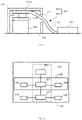
- FIG. 1 and FIG. 2 are schematic diagrams of circuit boards in an electronic device according to different exemplary embodiments.
- the electronic device provided by the present invention can include a first circuit board 100, a second circuit board 200, a charge pump chipset, a battery, and a control component 400.
- the second circuit board 200 is provided on the first circuit board 100.
- the second circuit board 200 is soldered to the first circuit board 100 through a connecting structure, that is, the second circuit board 200 is electrically connected to the first circuit board 100.
- the second circuit board 200 is a complete circuit board provided on the first circuit board 100.
- the second circuit board 200 can include a plurality of sub-circuit boards dispersedly arranged on the first circuit board 100. In such a case, the plurality of sub-circuit boards of the second circuit board 200 are spaced at a set distance, that is, the plurality of parts of the second circuit board 200 are not in contact.
- the charge pump chipset is connected to the battery to charge the battery.
- the charge pump chipset includes at least two charge pump chips 320, 330 provided on the first circuit board 100 and at least two charge pump chips 310, 340 provided on the second circuit board 200.
- the charge pump chipset includes a charge pump chip 320 and a charge pump chip 330 provided on the first circuit board 100, and a charge pump chip 310 and a charge pump chip 340 provided on the second circuit board 200.
- the charge pump chips are arranged on the sub-circuit boards of the second circuit board 200 in a one-to-one correspondence.
- the second circuit board 200 includes a first surface facing the first circuit board 100 and a second surface opposite to the first surface.
- the charge pump chips are arranged on the second surface of the second circuit board 200.
- the charge pump chips In addition to the charge pump chips, functional modules such as a central processing unit (CPU) of the electronic device, a radio frequency module, and a camera module can also be provided on the first circuit board 100. Therefore, there are relatively many heat generating devices on the first circuit board 100. In this case, the first circuit board 100 and the second circuit board 200 are used in a coordinated manner, so that the charge pump chips 310, 340 on the second circuit board 200 and the first circuit board 100 form relatively independent heat sources, avoiding an excessive local temperature of the electronic device when the charge pump chips are used.
- CPU central processing unit
- radio frequency module a radio frequency module
- a camera module can also be provided on the first circuit board 100. Therefore, there are relatively many heat generating devices on the first circuit board 100.
- the first circuit board 100 and the second circuit board 200 are used in a coordinated manner, so that the charge pump chips 310, 340 on the second circuit board 200 and the first circuit board 100 form relatively independent heat sources, avoiding an excessive local temperature of the electronic device when the charge pump chips
- respective charge pump chips in the charge pump chipset can be connected in parallel. In this manner, when the plurality of charge pump chips are used at the same time, the current shared by each charge pump chip is reduced, thereby reducing the heat generated by each charge pump chip.
- At least two charge pump chips 320, 330 on the first circuit board 100 and at least two charge pump chips 310, 340 on the second circuit board 200 are arranged on respective vertices of a polygon.
- two charge pump chips 320, 330 are provided on the first circuit board 100, and two charge pump chips 310, 340 are provided on the second circuit board 200.
- the four charge pump chips are arranged on the four vertices of a quadrilateral.
- the two charge pump chips 320, 330 on the first circuit board 100 are located on a first lateral edge of the quadrilateral, and the two charge pump chips 310, 340 on the second circuit board 200 are located on a second lateral edge of the quadrilateral opposite to the first lateral edge. That is, the charge pump chip 310 and the charge pump chip 330 are arranged on one diagonal of the quadrilateral, and the charge pump chip 320 and the charge pump chip 340 are arranged on the other diagonal of the quadrilateral.
- the plurality of charge pump chips are dispersedly distributed on the first circuit board 100 and the second circuit board 200.
- the plurality of charge pump chips form dispersed heat sources to reduce or prevent the local temperature of the electronic device from being too high during the charging process.
- the control component 400 is connected to the charge pump chips, and is configured to control the working state of the charge pump chips on the first circuit board 100 and the second circuit board 200. In addition, the control component 400 is further configured to monitor temperatures of the charge pump chips on the first circuit board 100 and the second circuit board 200.
- the control component 400 controls one charge pump chip on the first circuit board 100 and at least one charge pump chip on the second circuit board 200 to be in the working state at the same time.
- the charge pump chips in the working state on the first circuit board 100 and the second circuit board 200 form relatively independent heat sources to prevent the local temperature of the electronic device from being too high during the charging process.
- the control component 400 switches another charge pump chip on the first circuit board 100 to the working state.
- the charge pump chips on the first circuit board 100 are used in turn, forming dynamically distributed heat sources.
- the charge pump chips on the first circuit board 100 are used in turn to extend the length of time for each charge pump chip to charge with the large current, thereby increasing the charging speed and optimizing the user experience.
- Charging states of the electronic device include the charge only state and the screen-on charging state.
- the charge only state the electronic device only performs charging. Consequently, the charge pump chips in the electronic device are the main heat sources in the electronic device, while other functional modules such as most of the circuit of the CPU, the radio frequency module, and the display screen module are in an inactive state.
- the screen-on charging state the electronic device is in a normal use state, and thus other functional modules in addition to the charge pump chips are also in the working state, forming several heat sources in the electronic device.
- the control component 400 controls one charge pump chip on the first circuit board 100 and one charge pump chip on the second circuit board 200 to be in the working state at the same time.
- the other charge pump chips on the first circuit board 100 and the second circuit board 200 are switched to work.
- the control component 400 controls the charge pump chip 310 and the charge pump chip 330 to simultaneously be in the working state, and in response to the temperature of each of the charge pump chip 310 and the charge pump chip 330 being higher than the set threshold (which, for example, may be set to 38°C in the charge only state), switches the charge pump chip 320 and the charge pump chip 340 to the working state and may switch the charge pump chips 310 and 330 to the non-working state.
- the set threshold which, for example, may be set to 38°C in the charge only state
- the control component 400 controls one charge pump chip on the first circuit board 100 and at least two charge pump chips on the second circuit board 200 to be in the working state at the same time.
- the control component 400 switches another charge pump chip on the first circuit board 100 to work while keeping the charge pump chips on the second circuit board 200 in the working state.
- the control component 400 controls the charge pump chip 310, the charge pump chip 320, and the charge pump chip 340 to be in the working state at the same time.
- the charge pump chip 330 is switched to work while the charge pump chip 310 and the charge pump chip 340 are kept in the working state.
- the charging current in the screen-on charging state is weaker than the charging current in the charge only state.
- the two charge pump chips in a charging state on the second circuit board generate little heat.
- the charging current in the screen-on charging state is 5A.
- the current shared by each charge pump chip in the charging state on the second circuit board can be 1.66A.
- the temperature of the charge pump chip on the first circuit board rises quickly. Based on this, in the screen-on charging state, the temperature of the charge pump chip on the first circuit board being higher than the set threshold is determined as a trigger condition for switching the charge pump chip.
- the set threshold in the screen-on charging state is higher than the set threshold in the charge only state. Due to there being more heat sources on the first circuit board in the screen-on charging state, the temperature of the charge pump chip on the first circuit board rises relatively quickly, and thus the set threshold in the screen-on charging state is higher than the set threshold in the charge only state to ensure that the charge pump chips in the screen-on charging state on the first circuit board have a reasonable temperature climbing space, avoiding frequent switches of the charge pump chips.
- the dispersed heat sources are formed in the electronic device, since in the charge only state and the screen-on charge state, the charge pump chips on the first circuit board and the charge pump chips on the second circuit board are set to work at the same time. In this manner, the heat generation of the charge pump chips are effectively controlled during the charging process, and the user experience is optimized.
- different charge pump chips on the first circuit board and the second circuit board are controlled to work in a time-sharing mode. Consequently, the length of time that the charge pump chipset charges the power supply with the large current is prolonged, and the charging speed of the fast charging is increased.
- FIG. 3 is a schematic diagram of a partial structure of circuit boards where charge pump chips are provided in an electronic device according to an exemplary embodiment.
- the control component 400 includes a temperature detection device 410 and a control device 420 connected to the temperature detection device 410.
- the temperature detection device 410 is connected to one charge pump chip, and is configured to output a detection signal based on the temperature of the charge pump chip.
- the temperature detection device 410 includes a flexible printed circuit 411, and a temperature detection circuit provided on the flexible printed circuit 411.
- the flexible printed circuit includes a first part 411a arranged above the charge pump chip, and a second part 411b connected to the control device 420. As illustrated in FIG. 3 , the first part 411a and the second part 411b are two ends of the flexible printed circuit.
- the temperature detection circuit is arranged on a surface facing the charge pump chip of the first part 411a, and includes a temperature-sensitive element 412 attached to the charge pump chip.
- the impedance of the temperature-sensitive element 412 changes with an ambient temperature. Therefore, under different ambient temperature conditions, the temperature-sensitive element 412 has different divided voltages in the temperature detection circuit.
- the temperature detection circuit outputs a detection signal (for example, the detection signal indicates a value of the divided voltage of the temperature-sensitive element 412, that is, an analog signal) based on the voltage shared by the temperature-sensitive element 412.
- the detection signal represents the ambient temperature of an environment where the temperature-sensitive element 412 is.
- the charge pump chip includes a package housing 300a, and a heat dissipation member 300b provided on the package housing 300a.
- the temperature-sensitive element 412 is attached to the heat dissipation member 300b. In this manner, the impedance of the temperature-sensitive element 412 changes as the temperature of the charge pump chip changes.
- the temperature detection circuit outputs the detection signal based on the value of the divided voltage of the temperature-sensitive element 412. The detection signal represents the temperature of the charge pump chip.
- the heat dissipation member 300b may be a heat dissipation coating, which is arranged on the package housing 300a of the charge pump chip. With the heat dissipation member 300b, the heat generated by the package housing 300a is dispersed evenly, thereby ensuring an even distribution of heat on a contact surface of the temperature-sensitive element 412 and the heat dissipation member 300b, and ensuring that an impedance change of the temperature-sensitive element 412 accurately reflects a temperature change of the charge pump chip.
- a protective housing 500 may be provided outside/around the charge pump chip to cover the charge pump chip.
- the protective housing 500 includes an accommodation chamber 510 accommodating the charge pump chip, and a through hole 520 communicating with the accommodation chamber 510 and the outside of the protective housing 500.
- the flexible printed circuit 411 is provided to extend through the through hole 520.
- the first part 411a of the flexible printed circuit 411 is located inside the accommodation chamber 510, and the second part 411b of the flexible printed circuit 411 is located outside the accommodation chamber 510.
- the first part 411a is connected to the protective housing 500.
- the first part 411a is connected to an inner wall surface of the accommodation chamber 510.
- the protective housing 500 ensures that the temperature-sensitive element 412 on the flexible printed circuit 411 is stably attached to the charge pump chip, so as to prevent the temperature detection device from being interfered by other factors around the charge pump chip, and to accurately detect the temperature of the charge pump chip.
- one temperature detection device 410 is provided on each charge pump chip, that is, one temperature detection device 410 outputs the detection signal based on the temperature of one charge pump chip.
- the control device 420 can be configured to control the working state of the charge pump chip based on the detection signal output by the temperature detection device.
- FIG. 4 is a schematic diagram of circuit boards 100, 200 in an electronic device according to yet another exemplary embodiment. As illustrated in FIG. 4 , the control device 420 includes a single-chip microcomputer 421 and a processor 422.
- the processor 422 is provided on the first circuit board 100, connected to the temperature detection device 410, and is configured to control, based on the detection signal outputted by the temperature detection device 410, the working state of the charge pump chip in the screen-on charging state.
- the processor 422 receives the detection signal outputted by the temperature detection device 410, and converts the detection signal into a digital signal, and then determines the temperature of the charge pump chip based on the digital signal.
- the processor 422 is a central processing unit of the electronic device. In the screen-on charging state, the central processing unit is in the working state, and thus the processor 422 is used to control the working state of the charge pump chip to increase the processing speed.
- the single-chip microcomputer 421 is arranged on at least one of the first circuit board 100 and the second circuit board 200.
- the single-chip microcomputer 421 is provided on the first circuit board 100 or the second circuit board 200, and is connected to the temperature detection devices and the charge pump chips on the first circuit board 100 and the second circuit board 200 through wires.
- one single-chip microcomputer 421 is provided on the main circuit 100 and one single-chip microcomputer 421 is provided on the second circuit board 200, and the single-chip microcomputers 421 on the first circuit board 100 and the second circuit board 200 are connected to each other.
- a wire width required for a connection to one single-chip microcomputer is reduced, thereby reducing the heat generated when the wire is powering on.
- the single-chip microcomputer 421 is connected to the processor 422 or the temperature detection device 410. In the charge only state, most of the circuits in the processor 422 are in a non-working state. At this time, in order to ensure the smooth charging of the electronic device, the working state of the charge pump chip is controlled by the single-chip microcomputer 421 based on the detection signal output by the temperature detection device 410.
- the single-chip microcomputer 421 has an analog-to-digital conversion circuit.
- the single-chip microcomputer 421 is directly connected to the temperature detection device 410.
- the single-chip microcomputer 421 converts the detection signal outputted by the temperature detection device 410 into the digital signal, and determines the temperature of the charge pump chip based on the digital signal, thereby controlling the working state of the charge pump chip.
- the single-chip microcomputer 421 does not have an analog-to-digital conversion circuit.
- circuits with low power consumptions in the processor 422, such as the analog-to-digital conversion circuit are in the working state.
- the analog-to-digital conversion circuit in the processor 422 converts the detection signal outputted by the temperature detection device 410 into the digital signal.
- the single-chip microcomputer 421 receives the digital signal and determines the temperature of the charge pump chip based on the digital signal, thereby controlling the working state of the charge pump chip.
- FIG. 5 is a block diagram of an electronic device according to an exemplary embodiment.
- the electronic device 500 may include one or more of the following components: a processing component 502, a memory 504, a power component 506, a multimedia component 508, an audio component 510, an input/output (I/O) interface 512, a sensor component 514, a communication component 516, and an image collection component.
- a processing component 502 a memory 504
- a power component 506 a multimedia component 508, an audio component 510, an input/output (I/O) interface 512, a sensor component 514, a communication component 516, and an image collection component.
- I/O input/output
- the processing component 502 normally controls the overall operation (such as operations associated with displaying, telephone calls, data communications, camera operations and recording operations) of the electronic device 500.
- the processing component 502 may include one or a plurality of processors 520 to execute instructions.
- the processing component 502 may include one or a plurality of units to facilitate interactions between the processing component 502 and other components.
- the processing component 502 may include a multimedia unit to facilitate interactions between the multimedia component 508 and the processing component 502.
- the memory 504 is configured to store various types of data to support operations at the electronic device 500. Examples of such data include instructions for any application or method operated on the electronic device 500, contact data, phone book data, messages, images, videos and the like.
- the memory 504 may be realized by any type of volatile or non-volatile storage devices, or a combination thereof, such as a static random access memory (SRAM), an electrically erasable programmable read only memory (EEPROM), an erasable programmable read only memory (EPROM), a programmable read only memory (PROM), a read only memory (ROM), a magnetic memory, a flash memory, a disk or an optical disk.
- SRAM static random access memory
- EEPROM electrically erasable programmable read only memory
- EPROM erasable programmable read only memory
- PROM programmable read only memory
- ROM read only memory
- magnetic memory a magnetic memory
- flash memory a flash memory
- disk or an optical disk an optical disk.
- the power component 506 provides power to various components of the electronic device 500.
- the power component 506 may include a power management system, one or a plurality of power sources and other components associated with power generation, management, and distribution of the electronic device 500.
- the multimedia component 508 includes a screen that provides an output interface between the electronic device 500 and a target object.
- the screen may include a liquid crystal display (LCD) and a touch panel (TP). If the screen includes a touch panel, the screen may be implemented as a touch screen to receive input signals from the user.
- the touch panel includes one or a plurality of touch sensors to sense touches, slides, and gestures on the touch panel. The touch sensor may sense not only the boundary of the touches or sliding actions, but also the duration and pressure related to the touches or sliding operations.
- the audio component 510 is configured to output and/or input an audio signal.
- the audio component 510 includes a microphone (MIC) that is configured to receive an external audio signal when the electronic device 500 is in an operation mode such as a call mode, a recording mode, and a voice recognition mode.
- the received audio signal may be further stored in the memory 504 or transmitted via the communication component 516.
- the audio component 510 further includes a speaker for outputting audio signals.
- the I/O interface 512 provides an interface between the processing component 502 and a peripheral interface unit.
- the peripheral interface unit may be a keyboard, a click wheel, a button and the like.
- the sensor assembly 514 includes one or a plurality of sensors for providing the electronic device 500 with various aspects of status assessments.
- the sensor component 514 may detect an open/closed state of the electronic device 500 and a relative positioning of the components.
- the components may be a display and a keypad of the electronic device 500.
- the sensor component 514 may also detect a change in position of the electronic device 500 or a component of the electronic device 500, the presence or absence of contact of the target object with the electronic device 500, the orientation or acceleration/deceleration of the electronic device 500 and a temperature change of the electronic device 500.
- the communication component 516 is configured to facilitate wired or wireless communication between the electronic device 500 and other devices.
- the electronic device 500 may access a wireless network based on any communication standard such as Wi-Fi, 2G or 3G, 4G/ LTE, 5G or a combination thereof.
- the communication component 516 receives broadcast signals or broadcast-associated information from an external broadcast management system via a broadcast channel.
- the communication component 516 further includes a near field communication (NFC) module to facilitate short range communication.
- NFC near field communication
- short range communication may be implemented based on radio frequency identification (RFID) technology, infrared data association (IrDA) technology, ultra-wideband (UWB) technology, Bluetooth (BT) technology and other technologies.
- RFID radio frequency identification
- IrDA infrared data association
- UWB ultra-wideband
- Bluetooth Bluetooth
- the electronic device 500 may be implemented by one or a plurality of application specific integrated circuits (ASICs), digital signal processors (DSPs), digital signal processing devices (DSPDs), programmable logic devices (PLDs), field programmable gate arrays (FPGA), controllers, microcontrollers, microprocessors, or other electronic components.
- ASICs application specific integrated circuits
- DSPs digital signal processors
- DSPDs digital signal processing devices
- PLDs programmable logic devices
- FPGA field programmable gate arrays
- controllers microcontrollers, microprocessors, or other electronic components.
Landscapes
- Engineering & Computer Science (AREA)
- Microelectronics & Electronic Packaging (AREA)
- Power Engineering (AREA)
- Physics & Mathematics (AREA)
- Thermal Sciences (AREA)
- Business, Economics & Management (AREA)
- Emergency Management (AREA)
- Charge And Discharge Circuits For Batteries Or The Like (AREA)
- Cooling Or The Like Of Electrical Apparatus (AREA)
Description
- The present invention relates to a field of charging technologies of electronic devices, and more particularly, to an electronic device.
- Currently, fast charging technology is a popular development trend of electronic devices. The fast charging technology enables electricity quantity of a battery in an electronic device to reach a level of normal use in a relatively short period of time. However, the fast charging also brings a problem of serious heat generation during charging, so how to solve the problem of heat generation during the charging has become an urgent matter.
- Document
US2017222465A1 discloses a method for supplying power to a battery determines a first thermal budget for a first charging regulator. The method also determines a second thermal budget for a second charging regulator. The first charging regulator and the second charging regulator are coupled to the battery. The method further includes dynamically increasing a first charging regulator power output and substantially simultaneously decreasing a second charging regulator power output based on the first thermal budget and the second thermal budget. - The present invention provides an electronic device to solve the defect of a poor user experience of fast charging technology resulted from heat generated by charge pump chips.
- The present invention provides an electronic device as defined in claim 1.
- The electronic device includes a first circuit board, a second circuit board, a charge pump chipset, a battery, and a control component. The second circuit board is provided on the first circuit board. The charge pump chipset is connected to the battery, and includes at least two charge pump chips provided on the first circuit board, and at least two charge pump chips provided on the second circuit board. The charge pump chips on the first circuit board are connected in parallel with the charge pump chips on the second circuit board. The control component is configured to control one charge pump chip on the first circuit board and at least one charge pump chip on the second circuit board to be in a working state at the same time, and in response to a temperature of the charge pump chip on the first circuit board in the working state being higher than a set threshold, switches any charge pump chip on the first circuit board with the temperature lower than the set threshold to the working state, to enable the charge pump chips (320, 330) on the first circuit board (100) to work in turn. Preferred embodiments are defined in the dependent claims.
- Optionally, the at least two charge pump chips on the first circuit board and the at least two charge pump chips on the second circuit board are arranged on respective vertices of a polygon.
- Preferably, two charge pump chips are provided on the first circuit board, and two charge pump chips are provided on the second circuit board. The charge pump chips on the first circuit board and the second circuit board are respectively arranged on the four vertices of a quadrilateral. The two charge pump chips on the first circuit board are arranged on a first lateral edge of the quadrilateral, and the two charge pump chips on the second circuit board are arranged on a second lateral edge of the quadrilateral opposite to the first lateral edge. In a charge only state, two charge pump chips on a same diagonal of the quadrilateral are in the working state at the same time.
- Optionally, in the charge only state, the control component is configured to, in response to the temperature of each of the two charge pump chips on one diagonal in the working state being higher than the set threshold, switch the two charge pump chips on the other diagonal to the working state.
- Preferably, in a state of charging when the electronic device is in a normal use state, the control component is configured to, in response to a temperature of the charge pump chip in the working state on the first circuit board being higher than the set threshold, switch any charge pump chip on the first circuit board with the temperature lower than the set threshold to the working state, and keep the two charge pump chips on the second circuit board in the working state.
- Optionally, the control component includes: a plurality of temperature detection devices, wherein one temperature detection device is connected to one charge pump chip, and configured to output a detection signal based on the temperature of the charge pump chip; and a control device, connected to the plurality of temperature detection devices, and configured to control the working state of the charge pump chip and thereby to switch the charge pump on or off based on the detection signal outputted by the temperature detection device.
- Preferably, the temperature detection device includes: a flexible printed circuit, including a first part facing the charge pump chip, and a second part connected to the control device; and a temperature detection circuit, arranged on a surface facing the charge pump chip of the first part, and including a temperature-sensitive element attached to the charge pump chip.
- Optionally, the charge pump chip includes a package housing, and a heat dissipation member provided on the package housing, the temperature-sensitive element being attached to the heat dissipation member.
- Preferably, a protective housing is provided around the charge pump chip to cover the charge pump chip. The protective housing includes an accommodation chamber accommodating the charge pump chip, and a through hole communicating with the accommodation chamber and the outside of the protective housing. The flexible printed circuit is arranged to extend through the through hole, the first part is located in the accommodation chamber and connected to the protective housing, and the second part is located outside the accommodation chamber.
- Optionally, the control device includes: a processor, provided on the first circuit board, connected to the temperature detection device, and configured to control the working state of the charge pump chip in a state of charging when the electronic device is in a normal use state; and a single-chip microcomputer, provided on at least one of the first circuit board and the second circuit board, connected to the temperature detection device or the processor, and configured to control the working state of the charge pump chip in a charge only state.
- Preferably, the second circuit board further includes a plurality of sub-circuit boards arranged at a set distance, and the charge pump chips on the second circuit board are arranged on the plurality of sub-circuit boards in a one-to-one correspondence.
- Optionally, the charge pump chips on the second circuit board are provided on a surface of the second circuit board facing away from the first circuit board.
- Preferably, the heat dissipation member is a heat dissipation coating arranged on the package housing.
- The electronic device provided by the present invention at least provides the following beneficial effects.
- With the electronic device provided by the present invention, in the charge only state and the screen-on charging state, the charge pump chips on the first circuit board and the charge pump chips on the second circuit board work at the same time, such that dispersed heat sources are formed. In this manner, heat generated by the charge pump chips is effectively controlled during the charging process, and the user experience is optimized. In addition, based on temperatures of the charge pump chips on the first circuit board, the charge pump chips on the first circuit board and the second circuit board are controlled to work in a time-sharing mode. Consequently, a length of time that a charge pump chipset charges a power supply with a large current is extended, and the charging speed of fast charging is increased.
- The accompanying drawings, which are incorporated in and constitute a part of this specification, illustrate embodiments consistent with the present invention and, together with the description, serve to explain the principles of the present invention.
-
FIG. 1 is a schematic diagram of circuit boards in an electronic device according to an exemplary embodiment. -
FIG. 2 is a schematic diagram of circuit boards in an electronic device according to another exemplary embodiment. -
FIG. 3 is a schematic diagram of a partial structure of circuit boards where charge pump chips are provided in an electronic device according to an exemplary embodiment. -
FIG. 4 is a schematic diagram of circuit boards in an electronic device according to yet another exemplary embodiment. -
FIG. 5 is a block diagram of an electronic device according to an exemplary embodiment. - Reference will now be made in detail to exemplary embodiments, examples of which are illustrated in the accompanying drawings. The following description refers to the accompanying drawings in which the same numbers in different drawings represent the same or similar elements unless otherwise represented. The implementations set forth in the following description of exemplary embodiments do not represent all implementations consistent with the present invention. Instead, they are merely examples of apparatuses and methods consistent with aspects related to the present invention as recited in the appended claims.
- Terms used in the present invention are for the purpose of describing specific embodiments only, and are not intended to limit the present invention. Unless otherwise defined, the technical or scientific terms used in the present invention shall have usual meanings understood by persons of ordinary skill in the field to which the present invention belongs. Words such as "a" and "one" used in the specification and claims do not limit the quantity; rather, they mean at least one. Unless otherwise specified, words such as "comprise" or "include" mean that elements or objects before "comprise" or "include" cover elements or objects listed after "comprise" or "include" and their equivalents, and other components or objects are not excluded. "Connected", "linked" and similar words are not limited to physical or mechanical connections, rather, they may include direct or indirect electrical connections.
- The singular forms "a", "said" and "the" used in the present invention and attached claims are also intended to include plural forms, unless the context clearly indicates other meanings. It should also be understood that terms "and/or" as used herein refer to and include any or all possible combinations of one or more associated listed items.
- A charge pump chip is a converter capable of reducing voltage and increasing current, and is used as one of several components of a charging module in an electronic device to achieve fast charging. Related fast charging solution can use two charge pump chips simultaneously. However, when a charging power exceeds 100W, capacity conversion loss of the charge pump chip is high, resulting in a rapid increase in temperature of the electronic device. The body of the electronic device being hot affects user experience.
- In addition, when the temperature in the electronic device is excessively high, the charge pump chip is suppressed from generating heat by reducing a charging current. In this manner, the length of time of charging with a large current is shortened, charging speed is slowed down, and the experience of fast charging is affected.
- In view of the above, embodiments of the present invention provide an electronic device to adapt to a charging solution of a charging power of 100W or more. The electronic device may be charged with a large current for a long period of time in a charge only state and a screen-on charging state to increase the charging speed. In addition, during the charging process, the heat generated by the charge pump chipset can be effectively suppressed, thereby optimizing the user experience. The electronic device according to embodiments of the present invention may be selected from a mobile phone, a tablet computer, a wearable device (for example, a smart watch, a smart bracelet, a helmet, or a pair of glasses), a vehicle-mounted device, or a medical device.
-
FIG. 1 and FIG. 2 are schematic diagrams of circuit boards in an electronic device according to different exemplary embodiments. As illustrated inFIG. 1 , the electronic device provided by the present invention can include afirst circuit board 100, asecond circuit board 200, a charge pump chipset, a battery, and acontrol component 400. - The
second circuit board 200 is provided on thefirst circuit board 100. Optionally, thesecond circuit board 200 is soldered to thefirst circuit board 100 through a connecting structure, that is, thesecond circuit board 200 is electrically connected to thefirst circuit board 100. - Regarding the distribution manner of the
second circuit board 200 on thefirst circuit board 100, as an example illustrated byFIG. 1 , thesecond circuit board 200 is a complete circuit board provided on thefirst circuit board 100. As another example, thesecond circuit board 200 can include a plurality of sub-circuit boards dispersedly arranged on thefirst circuit board 100. In such a case, the plurality of sub-circuit boards of thesecond circuit board 200 are spaced at a set distance, that is, the plurality of parts of thesecond circuit board 200 are not in contact. - The charge pump chipset is connected to the battery to charge the battery. The charge pump chipset includes at least two
charge pump chips first circuit board 100 and at least twocharge pump chips second circuit board 200. As an example, inFIG. 1 , the charge pump chipset includes acharge pump chip 320 and acharge pump chip 330 provided on thefirst circuit board 100, and acharge pump chip 310 and acharge pump chip 340 provided on thesecond circuit board 200. - In a case where the
second circuit board 200 includes the plurality of parts arranged dispersedly, optionally, the charge pump chips are arranged on the sub-circuit boards of thesecond circuit board 200 in a one-to-one correspondence. In addition, thesecond circuit board 200 includes a first surface facing thefirst circuit board 100 and a second surface opposite to the first surface. The charge pump chips are arranged on the second surface of thesecond circuit board 200. - In addition to the charge pump chips, functional modules such as a central processing unit (CPU) of the electronic device, a radio frequency module, and a camera module can also be provided on the
first circuit board 100. Therefore, there are relatively many heat generating devices on thefirst circuit board 100. In this case, thefirst circuit board 100 and thesecond circuit board 200 are used in a coordinated manner, so that thecharge pump chips second circuit board 200 and thefirst circuit board 100 form relatively independent heat sources, avoiding an excessive local temperature of the electronic device when the charge pump chips are used. - In addition, respective charge pump chips in the charge pump chipset can be connected in parallel. In this manner, when the plurality of charge pump chips are used at the same time, the current shared by each charge pump chip is reduced, thereby reducing the heat generated by each charge pump chip.
- Regarding how the charge pump chips are distributed on the
first circuit board 100 and thesecond circuit board 200, in an embodiment, at least twocharge pump chips first circuit board 100 and at least twocharge pump chips second circuit board 200 are arranged on respective vertices of a polygon. - Taking the case illustrated in
FIG. 1 as an example, twocharge pump chips first circuit board 100, and twocharge pump chips second circuit board 200. The four charge pump chips are arranged on the four vertices of a quadrilateral. The twocharge pump chips first circuit board 100 are located on a first lateral edge of the quadrilateral, and the twocharge pump chips second circuit board 200 are located on a second lateral edge of the quadrilateral opposite to the first lateral edge. That is, thecharge pump chip 310 and thecharge pump chip 330 are arranged on one diagonal of the quadrilateral, and thecharge pump chip 320 and thecharge pump chip 340 are arranged on the other diagonal of the quadrilateral. - In this manner, the plurality of charge pump chips are dispersedly distributed on the
first circuit board 100 and thesecond circuit board 200. When in use, the plurality of charge pump chips form dispersed heat sources to reduce or prevent the local temperature of the electronic device from being too high during the charging process. - The
control component 400 is connected to the charge pump chips, and is configured to control the working state of the charge pump chips on thefirst circuit board 100 and thesecond circuit board 200. In addition, thecontrol component 400 is further configured to monitor temperatures of the charge pump chips on thefirst circuit board 100 and thesecond circuit board 200. - In detail, during the charging process, the
control component 400 controls one charge pump chip on thefirst circuit board 100 and at least one charge pump chip on thesecond circuit board 200 to be in the working state at the same time. At this time, the charge pump chips in the working state on thefirst circuit board 100 and thesecond circuit board 200 form relatively independent heat sources to prevent the local temperature of the electronic device from being too high during the charging process. In addition, in response to a temperature of a charge pump chip on thefirst circuit board 100 in the working state being higher than a set threshold, thecontrol component 400 switches another charge pump chip on thefirst circuit board 100 to the working state. - In this manner, the charge pump chips on the
first circuit board 100 are used in turn, forming dynamically distributed heat sources. During charging, the charge pump chips on thefirst circuit board 100 are used in turn to extend the length of time for each charge pump chip to charge with the large current, thereby increasing the charging speed and optimizing the user experience. - Charging states of the electronic device include the charge only state and the screen-on charging state. In the charge only state, the electronic device only performs charging. Consequently, the charge pump chips in the electronic device are the main heat sources in the electronic device, while other functional modules such as most of the circuit of the CPU, the radio frequency module, and the display screen module are in an inactive state. In the screen-on charging state, the electronic device is in a normal use state, and thus other functional modules in addition to the charge pump chips are also in the working state, forming several heat sources in the electronic device.
- With the electronic device according to embodiments of the present invention, in the charge only state, the
control component 400 controls one charge pump chip on thefirst circuit board 100 and one charge pump chip on thesecond circuit board 200 to be in the working state at the same time. In addition, in response to the temperature of each of charge pump chips in the working state on thefirst circuit board 100 and thesecond circuit board 200 being higher than the set threshold, the other charge pump chips on thefirst circuit board 100 and thesecond circuit board 200 are switched to work. - Referring to
FIG. 1 , thecontrol component 400 controls thecharge pump chip 310 and thecharge pump chip 330 to simultaneously be in the working state, and in response to the temperature of each of thecharge pump chip 310 and thecharge pump chip 330 being higher than the set threshold (which, for example, may be set to 38°C in the charge only state), switches thecharge pump chip 320 and thecharge pump chip 340 to the working state and may switch thecharge pump chips - In this manner, in the charge only state, groups of the charge pump chips on different diagonals work in turn, so that heat generated by the charge pump chips in the working state are dispersed as much as possible. In addition, while one group of charge pump chips is working, the other group of charge pump chips dissipates heat, performing alternate work. In this manner, an overall heating speed of the electronic device is effectively slowed down, thereby prolonging the length of time for the charge pump chips to charge with the large current, that is, increasing the charging speed.
- In the screen-on charging state, the
control component 400 controls one charge pump chip on thefirst circuit board 100 and at least two charge pump chips on thesecond circuit board 200 to be in the working state at the same time. In addition, in response to the temperature of the charge pump chip in the working state on thefirst circuit board 100 being higher than the set threshold, thecontrol component 400 switches another charge pump chip on thefirst circuit board 100 to work while keeping the charge pump chips on thesecond circuit board 200 in the working state. - Referring to
FIG. 1 , thecontrol component 400 controls thecharge pump chip 310, thecharge pump chip 320, and thecharge pump chip 340 to be in the working state at the same time. In addition, in response to the temperature of thecharge pump chip 320 being higher than the set threshold (which may be set to 39°C in the screen-on charging state), thecharge pump chip 330 is switched to work while thecharge pump chip 310 and thecharge pump chip 340 are kept in the working state. - In this manner, in the screen-on charging state, at least three charge pump chips are in the working state at the same time. The use of the charge pump chips in the screen-on charging state is explained as follows.
- Generally, in order to ensure power supply safety, the charging current in the screen-on charging state is weaker than the charging current in the charge only state. In this case, the two charge pump chips in a charging state on the second circuit board generate little heat. For example, the charging current in the screen-on charging state is 5A. When the three charge pump chips work at the same time, the current shared by each charge pump chip in the charging state on the second circuit board can be 1.66A. At this time, it is difficult for the temperature of the charge pump chip to rise to the set threshold of the screen-on charging state. In addition, as the first circuit board has other heat sources (functional modules on the first circuit board), the temperature of the charge pump chip on the first circuit board rises quickly. Based on this, in the screen-on charging state, the temperature of the charge pump chip on the first circuit board being higher than the set threshold is determined as a trigger condition for switching the charge pump chip.
- In addition, the set threshold in the screen-on charging state is higher than the set threshold in the charge only state. Due to there being more heat sources on the first circuit board in the screen-on charging state, the temperature of the charge pump chip on the first circuit board rises relatively quickly, and thus the set threshold in the screen-on charging state is higher than the set threshold in the charge only state to ensure that the charge pump chips in the screen-on charging state on the first circuit board have a reasonable temperature climbing space, avoiding frequent switches of the charge pump chips.
- For the electronic device according to the present invention, the dispersed heat sources are formed in the electronic device, since in the charge only state and the screen-on charge state, the charge pump chips on the first circuit board and the charge pump chips on the second circuit board are set to work at the same time. In this manner, the heat generation of the charge pump chips are effectively controlled during the charging process, and the user experience is optimized. In addition, on the basis of the temperatures of the charge pump chips on the first circuit board, different charge pump chips on the first circuit board and the second circuit board are controlled to work in a time-sharing mode. Consequently, the length of time that the charge pump chipset charges the power supply with the large current is prolonged, and the charging speed of the fast charging is increased.
-
FIG. 3 is a schematic diagram of a partial structure of circuit boards where charge pump chips are provided in an electronic device according to an exemplary embodiment. In an embodiment, as illustrated inFIG. 2 , thecontrol component 400 includes atemperature detection device 410 and acontrol device 420 connected to thetemperature detection device 410. - The
temperature detection device 410 is connected to one charge pump chip, and is configured to output a detection signal based on the temperature of the charge pump chip. In an embodiment of the present invention, as illustrated inFIG. 3 , thetemperature detection device 410 includes a flexible printedcircuit 411, and a temperature detection circuit provided on the flexible printedcircuit 411. - The flexible printed circuit includes a first part 411a arranged above the charge pump chip, and a second part 411b connected to the
control device 420. As illustrated inFIG. 3 , the first part 411a and the second part 411b are two ends of the flexible printed circuit. - The temperature detection circuit is arranged on a surface facing the charge pump chip of the first part 411a, and includes a temperature-
sensitive element 412 attached to the charge pump chip. The impedance of the temperature-sensitive element 412 changes with an ambient temperature. Therefore, under different ambient temperature conditions, the temperature-sensitive element 412 has different divided voltages in the temperature detection circuit. Furthermore, the temperature detection circuit outputs a detection signal (for example, the detection signal indicates a value of the divided voltage of the temperature-sensitive element 412, that is, an analog signal) based on the voltage shared by the temperature-sensitive element 412. The detection signal represents the ambient temperature of an environment where the temperature-sensitive element 412 is. - The charge pump chip includes a
package housing 300a, and aheat dissipation member 300b provided on thepackage housing 300a. The temperature-sensitive element 412 is attached to theheat dissipation member 300b. In this manner, the impedance of the temperature-sensitive element 412 changes as the temperature of the charge pump chip changes. Furthermore, the temperature detection circuit outputs the detection signal based on the value of the divided voltage of the temperature-sensitive element 412. The detection signal represents the temperature of the charge pump chip. - The
heat dissipation member 300b may be a heat dissipation coating, which is arranged on thepackage housing 300a of the charge pump chip. With theheat dissipation member 300b, the heat generated by thepackage housing 300a is dispersed evenly, thereby ensuring an even distribution of heat on a contact surface of the temperature-sensitive element 412 and theheat dissipation member 300b, and ensuring that an impedance change of the temperature-sensitive element 412 accurately reflects a temperature change of the charge pump chip. - In addition, according to the present invention, a
protective housing 500 may be provided outside/around the charge pump chip to cover the charge pump chip. Theprotective housing 500 includes anaccommodation chamber 510 accommodating the charge pump chip, and a throughhole 520 communicating with theaccommodation chamber 510 and the outside of theprotective housing 500. - The flexible printed
circuit 411 is provided to extend through the throughhole 520. The first part 411a of the flexible printedcircuit 411 is located inside theaccommodation chamber 510, and the second part 411b of the flexible printedcircuit 411 is located outside theaccommodation chamber 510. In addition, the first part 411a is connected to theprotective housing 500. For example, the first part 411a is connected to an inner wall surface of theaccommodation chamber 510. In this manner, theprotective housing 500 ensures that the temperature-sensitive element 412 on the flexible printedcircuit 411 is stably attached to the charge pump chip, so as to prevent the temperature detection device from being interfered by other factors around the charge pump chip, and to accurately detect the temperature of the charge pump chip. - In addition, one
temperature detection device 410 is provided on each charge pump chip, that is, onetemperature detection device 410 outputs the detection signal based on the temperature of one charge pump chip. - The
control device 420 can be configured to control the working state of the charge pump chip based on the detection signal output by the temperature detection device.FIG. 4 is a schematic diagram ofcircuit boards FIG. 4 , thecontrol device 420 includes a single-chip microcomputer 421 and aprocessor 422. - The
processor 422 is provided on thefirst circuit board 100, connected to thetemperature detection device 410, and is configured to control, based on the detection signal outputted by thetemperature detection device 410, the working state of the charge pump chip in the screen-on charging state. - Optionally, the
processor 422 receives the detection signal outputted by thetemperature detection device 410, and converts the detection signal into a digital signal, and then determines the temperature of the charge pump chip based on the digital signal. Optionally, theprocessor 422 is a central processing unit of the electronic device. In the screen-on charging state, the central processing unit is in the working state, and thus theprocessor 422 is used to control the working state of the charge pump chip to increase the processing speed. - The single-
chip microcomputer 421 is arranged on at least one of thefirst circuit board 100 and thesecond circuit board 200. Optionally, the single-chip microcomputer 421 is provided on thefirst circuit board 100 or thesecond circuit board 200, and is connected to the temperature detection devices and the charge pump chips on thefirst circuit board 100 and thesecond circuit board 200 through wires. - Optionally, one single-
chip microcomputer 421 is provided on themain circuit 100 and one single-chip microcomputer 421 is provided on thesecond circuit board 200, and the single-chip microcomputers 421 on thefirst circuit board 100 and thesecond circuit board 200 are connected to each other. In this manner, a wire width required for a connection to one single-chip microcomputer is reduced, thereby reducing the heat generated when the wire is powering on. - In addition, the single-
chip microcomputer 421 is connected to theprocessor 422 or thetemperature detection device 410. In the charge only state, most of the circuits in theprocessor 422 are in a non-working state. At this time, in order to ensure the smooth charging of the electronic device, the working state of the charge pump chip is controlled by the single-chip microcomputer 421 based on the detection signal output by thetemperature detection device 410. - Optionally, the single-
chip microcomputer 421 has an analog-to-digital conversion circuit. In such a case, the single-chip microcomputer 421 is directly connected to thetemperature detection device 410. The single-chip microcomputer 421 converts the detection signal outputted by thetemperature detection device 410 into the digital signal, and determines the temperature of the charge pump chip based on the digital signal, thereby controlling the working state of the charge pump chip. - Optionally, the single-
chip microcomputer 421 does not have an analog-to-digital conversion circuit. In such a case, in the charge only state, circuits with low power consumptions in theprocessor 422, such as the analog-to-digital conversion circuit, are in the working state. Furthermore, the analog-to-digital conversion circuit in theprocessor 422 converts the detection signal outputted by thetemperature detection device 410 into the digital signal. The single-chip microcomputer 421 receives the digital signal and determines the temperature of the charge pump chip based on the digital signal, thereby controlling the working state of the charge pump chip. -
FIG. 5 is a block diagram of an electronic device according to an exemplary embodiment. As illustrated inFIG. 5 , theelectronic device 500 may include one or more of the following components: aprocessing component 502, amemory 504, apower component 506, amultimedia component 508, anaudio component 510, an input/output (I/O)interface 512, asensor component 514, acommunication component 516, and an image collection component. - The
processing component 502 normally controls the overall operation (such as operations associated with displaying, telephone calls, data communications, camera operations and recording operations) of theelectronic device 500. Theprocessing component 502 may include one or a plurality ofprocessors 520 to execute instructions. In addition, theprocessing component 502 may include one or a plurality of units to facilitate interactions between theprocessing component 502 and other components. For example, theprocessing component 502 may include a multimedia unit to facilitate interactions between themultimedia component 508 and theprocessing component 502. - The
memory 504 is configured to store various types of data to support operations at theelectronic device 500. Examples of such data include instructions for any application or method operated on theelectronic device 500, contact data, phone book data, messages, images, videos and the like. Thememory 504 may be realized by any type of volatile or non-volatile storage devices, or a combination thereof, such as a static random access memory (SRAM), an electrically erasable programmable read only memory (EEPROM), an erasable programmable read only memory (EPROM), a programmable read only memory (PROM), a read only memory (ROM), a magnetic memory, a flash memory, a disk or an optical disk. - The
power component 506 provides power to various components of theelectronic device 500. Thepower component 506 may include a power management system, one or a plurality of power sources and other components associated with power generation, management, and distribution of theelectronic device 500. - The
multimedia component 508 includes a screen that provides an output interface between theelectronic device 500 and a target object. In some embodiments, the screen may include a liquid crystal display (LCD) and a touch panel (TP). If the screen includes a touch panel, the screen may be implemented as a touch screen to receive input signals from the user. The touch panel includes one or a plurality of touch sensors to sense touches, slides, and gestures on the touch panel. The touch sensor may sense not only the boundary of the touches or sliding actions, but also the duration and pressure related to the touches or sliding operations. - The
audio component 510 is configured to output and/or input an audio signal. For example, theaudio component 510 includes a microphone (MIC) that is configured to receive an external audio signal when theelectronic device 500 is in an operation mode such as a call mode, a recording mode, and a voice recognition mode. The received audio signal may be further stored in thememory 504 or transmitted via thecommunication component 516. In some embodiments, theaudio component 510 further includes a speaker for outputting audio signals. - The I/
O interface 512 provides an interface between theprocessing component 502 and a peripheral interface unit. The peripheral interface unit may be a keyboard, a click wheel, a button and the like. - The
sensor assembly 514 includes one or a plurality of sensors for providing theelectronic device 500 with various aspects of status assessments. For example, thesensor component 514 may detect an open/closed state of theelectronic device 500 and a relative positioning of the components. For example, the components may be a display and a keypad of theelectronic device 500. Thesensor component 514 may also detect a change in position of theelectronic device 500 or a component of theelectronic device 500, the presence or absence of contact of the target object with theelectronic device 500, the orientation or acceleration/deceleration of theelectronic device 500 and a temperature change of theelectronic device 500. - The
communication component 516 is configured to facilitate wired or wireless communication between theelectronic device 500 and other devices. Theelectronic device 500 may access a wireless network based on any communication standard such as Wi-Fi, 2G or 3G, 4G/ LTE, 5G or a combination thereof. In an exemplary embodiment, thecommunication component 516 receives broadcast signals or broadcast-associated information from an external broadcast management system via a broadcast channel. In an exemplary embodiment, thecommunication component 516 further includes a near field communication (NFC) module to facilitate short range communication. For example, in the NFC module, short range communication may be implemented based on radio frequency identification (RFID) technology, infrared data association (IrDA) technology, ultra-wideband (UWB) technology, Bluetooth (BT) technology and other technologies. - In an exemplary embodiment, the
electronic device 500 may be implemented by one or a plurality of application specific integrated circuits (ASICs), digital signal processors (DSPs), digital signal processing devices (DSPDs), programmable logic devices (PLDs), field programmable gate arrays (FPGA), controllers, microcontrollers, microprocessors, or other electronic components.
Claims (13)
- An electronic device, comprising:a first circuit board (100);a battery;a charge pump chipset, connected to the battery, and comprising at least two charge pump chips (320, 330) provided on the first circuit board (100);a control component (400);characterized in that,the electronic device further comprises a second circuit board (200), provided on the first circuit board (100);the charge pump chipset further comprises at least two charge pump chips (310, 340) provided on the second circuit board (200), the charge pump chips (320, 330) on the first circuit board (100) being connected in parallel with the charge pump chips (310, 340) on the second circuit board (200); andthe control component (400) is configured to control one charge pump chip on the first circuit board (100) and at least one charge pump chip on the second circuit board (200) to simultaneously be in a working state, and in response to a temperature of the charge pump chip on the first circuit board (100) in the working state being higher than a set threshold, toswitch any charge pump chip on the first circuit (100) board having a temperature lower than the set threshold to the working state, to enable the charge pump chips (320, 330) on the first circuit board (100) to work in turn.
- The electronic device of claim 1, wherein the at least two charge pump chips (320, 330) on the first circuit board (100) and the at least two charge pump chips (310, 340) on the second circuit board (200) are arranged on respective vertices of a polygon.
- The electronic device of claim 2, wherein two charge pump chips (320, 330) are provided on the first circuit board (100), and two charge pump chips (310, 340) are provided on the second circuit board (200);the charge pump chips on the first circuit board (100) and the second circuit board (200) are respectively arranged on the four vertices of a quadrilateral, the two charge pump chips (320, 330) on the first circuit board (100) are arranged on a first lateral edge of the quadrilateral, and the two charge pump chips (310, 340) on the second circuit board (200) are arranged on a second lateral edge of the quadrilateral opposite to the first lateral edge; andin a charge only state, the control component (400) is configured to control two charge pump chips on a same diagonal of the quadrilateral to simultaneously be in the working state, wherein in the charge only state, the charge pump chips are the main heat sources, while other functional modules are in an inactive state
- The electronic device of claim 3, wherein in the charge only state, the control component (400) is further configured to:
in response to the temperature of each of the two charge pump chips on one diagonal in the working state being higher than the set threshold, switch the two charge pump chips on the other diagonal to the working state. - The electronic device of claim 3 or 4, wherein in a state of charging when the
electronic device is in a normal use state, called screen-on charging state, other functional modules in addition to the charge pump chips are also in the working state, forming several heat sources in the electronic device, the control component (400) is further configured to:
in response to a temperature of the charge pump chip in the working state on the first circuit board (100) being higher than the set threshold, switch any charge pump chip on the first circuit board (100) with a temperature lower than the set threshold to the working state, and maintain the two charge pump chips on the second circuit board (200) in the working state. - The electronic device of any one of claims 1 to 5, wherein the control component (400) comprises:a plurality of temperature detection devices (410), wherein one temperature detection device (410) is connected to one charge pump chip, and the temperature detection device (410) is configured to output a detection signal based on the temperature of the charge pump chip; anda control device (420), connected to the plurality of temperature detection devices (410) respectively, and configured to control the working state of each of the plurality of charge pump chips based on the detection signal outputted by the respective temperature detection device.
- The electronic device of claim 6, wherein the temperature detection device (410) further comprises:a flexible printed circuit (411), comprising a first part (411a) facing the charge pump chip, and a second part (411b) connected to the control device (420); anda temperature detection circuit, arranged on a surface facing the charge pump chip of the first part (411a), and comprising a temperature-sensitive element (412) coupled to the charge pump chip.
- The electronic device of claim 7, wherein the charge pump chip further comprises a package housing (300a), and a heat dissipation member (300b) provided on the package housing (300a), the temperature-sensitive element (412) being attached to the heat dissipation member (300b).
- The electronic device of any one of claims 6 to 8, wherein a protective housing (500) is provided around the charge pump chip to cover the charge pump chip;the protective housing (500) comprises an accommodation chamber (510) accommodating the charge pump chip, and a through hole (520) communicating with the accommodation chamber (510) and the outside of the protective housing (500); andthe flexible printed circuit (411) is arranged to extend through the through hole (520), the first part (411a) is located in the accommodation chamber (510) and connected to the protective housing (500), and the second part (411b) is located outside the accommodation chamber (510).
- The electronic device of any one of claims 6 to 9, wherein the control device (420) further comprises:a processor (422), provided on the first circuit board (100), connected to the temperature detection device (410), and configured to control the working state of the charge pump chip in a state of charging when the electronic device is in a normal use state; anda single-chip microcomputer (421), provided on at least one of the first circuit board (100) and the second circuit board (200), connected to the temperature detection device (410) or the processor (422), and configured to control the working state of the charge pump chip in a charge only state.
- The electronic device of any one of claims 1 to 10, wherein the second circuit board (200) further comprises a plurality of sub-circuit boards (201) arranged at a set distance, and the charge pump chips on the second circuit board are arranged on the plurality of sub-circuit boards (201) in a one-to-one correspondence.
- The electronic device of any one of claims 1 to 10, wherein the charge pump chips on the second circuit board are provided on a surface of the second circuit board (200) facing away from the first circuit board (100).
- The electronic device of any one of the claims 8 to 12, wherein the heat dissipation member (300b) is a heat dissipation coating arranged on the package housing.
Applications Claiming Priority (1)
| Application Number | Priority Date | Filing Date | Title |
|---|---|---|---|
| CN202010177304.0A CN113394833B (en) | 2020-03-13 | 2020-03-13 | Electronic equipment |
Publications (2)
| Publication Number | Publication Date |
|---|---|
| EP3879666A1 EP3879666A1 (en) | 2021-09-15 |
| EP3879666B1 true EP3879666B1 (en) | 2022-08-24 |
Family
ID=72266196
Family Applications (1)
| Application Number | Title | Priority Date | Filing Date |
|---|---|---|---|
| EP20193064.1A Active EP3879666B1 (en) | 2020-03-13 | 2020-08-27 | Electronic device |
Country Status (3)
| Country | Link |
|---|---|
| US (1) | US11122708B1 (en) |
| EP (1) | EP3879666B1 (en) |
| CN (1) | CN113394833B (en) |
Families Citing this family (1)
| Publication number | Priority date | Publication date | Assignee | Title |
|---|---|---|---|---|
| CN113394471B (en) * | 2020-03-13 | 2023-05-02 | 北京小米移动软件有限公司 | Charging method and device, electronic equipment and storage medium |
Family Cites Families (6)
| Publication number | Priority date | Publication date | Assignee | Title |
|---|---|---|---|---|
| US20170222465A1 (en) * | 2016-02-01 | 2017-08-03 | Qualcomm Incorporated | Dynamic thermal balancing of parallel regulators to reduce hotspots and increase performance |
| CN105611010B (en) * | 2016-03-25 | 2018-08-24 | 银隆新能源股份有限公司 | Mobile communication terminal |
| CN106849645A (en) * | 2016-08-15 | 2017-06-13 | 珠海市魅族科技有限公司 | A kind of charging circuit, method and electronic installation |
| US20180288889A1 (en) * | 2017-03-30 | 2018-10-04 | Google Inc. | Circuit board and battery architecture of an electronic device |
| CN109066884A (en) * | 2018-09-03 | 2018-12-21 | Oppo广东移动通信有限公司 | charging circuit and electronic device |
| CN109787318B (en) * | 2019-02-23 | 2021-09-03 | 华为技术有限公司 | Discharge circuit and electronic equipment |
-
2020
- 2020-03-13 CN CN202010177304.0A patent/CN113394833B/en active Active
- 2020-08-06 US US16/987,102 patent/US11122708B1/en active Active
- 2020-08-27 EP EP20193064.1A patent/EP3879666B1/en active Active
Also Published As
| Publication number | Publication date |
|---|---|
| US20210289656A1 (en) | 2021-09-16 |
| EP3879666A1 (en) | 2021-09-15 |
| CN113394833B (en) | 2023-05-02 |
| CN113394833A (en) | 2021-09-14 |
| US11122708B1 (en) | 2021-09-14 |
Similar Documents
| Publication | Publication Date | Title |
|---|---|---|
| US11336105B2 (en) | Multi-battery charging and discharging device and mobile terminal | |
| US11398744B2 (en) | Charging method and device, electronic device and storage medium | |
| KR102216484B1 (en) | Method and Apparatus for Controlling Battery Charging | |
| US9252890B2 (en) | Near field communication device and method for saving applied power | |
| CN111277040B (en) | Electronic equipment and power supply method | |
| CN110854977B (en) | Wireless charging method, storage medium, electronic device and charging device | |
| CN109066884A (en) | charging circuit and electronic device | |
| KR101659018B1 (en) | Mobile terminal and control method thereof | |
| US20150113301A1 (en) | Charging method and mobile electronic device | |
| CN109217487B (en) | Charging circuit and electronic device | |
| EP3879666B1 (en) | Electronic device | |
| EP3879658B1 (en) | Charging control method and apparatus, electronic device, and storage medium | |
| KR102787618B1 (en) | A system including a power supply case and a wearable device and a power supply controlling method of the system | |
| CN109038863A (en) | Electronic equipment | |
| KR102937255B1 (en) | Method for providing upcycling function and electronic device supporting the same | |
| CN112514268A (en) | System and method for charging mobile phone and mobile phone shell | |
| CN114069772B (en) | Power supply circuit, power supply method, device and storage medium | |
| CN110505344B (en) | Battery-powered method, electronic device, and computer-readable storage medium | |
| KR20240039980A (en) | electronic device and method for controlling battery | |
| KR101688136B1 (en) | Mobile terminal and control method thereof | |
| KR20230054074A (en) | Electronic device including flexible display and method for controlling of motor driving in the electronic device | |
| CN210725085U (en) | Recording device for external visit | |
| TW201939301A (en) | A coreless tablet computer and tablet computer | |
| CN120222643A (en) | Charging circuit, charging chip and electronic device | |
| KR20250018905A (en) | Electronic device including battery reset structure |
Legal Events
| Date | Code | Title | Description |
|---|---|---|---|
| PUAI | Public reference made under article 153(3) epc to a published international application that has entered the european phase |
Free format text: ORIGINAL CODE: 0009012 |
|
| STAA | Information on the status of an ep patent application or granted ep patent |
Free format text: STATUS: THE APPLICATION HAS BEEN PUBLISHED |
|
| AK | Designated contracting states |
Kind code of ref document: A1 Designated state(s): AL AT BE BG CH CY CZ DE DK EE ES FI FR GB GR HR HU IE IS IT LI LT LU LV MC MK MT NL NO PL PT RO RS SE SI SK SM TR |
|
| STAA | Information on the status of an ep patent application or granted ep patent |
Free format text: STATUS: REQUEST FOR EXAMINATION WAS MADE |
|
| 17P | Request for examination filed |
Effective date: 20210920 |
|
| RBV | Designated contracting states (corrected) |
Designated state(s): AL AT BE BG CH CY CZ DE DK EE ES FI FR GB GR HR HU IE IS IT LI LT LU LV MC MK MT NL NO PL PT RO RS SE SI SK SM TR |
|
| RIC1 | Information provided on ipc code assigned before grant |
Ipc: H02M 3/07 20060101ALI20220214BHEP Ipc: H02J 7/00 20060101AFI20220214BHEP |
|
| GRAP | Despatch of communication of intention to grant a patent |
Free format text: ORIGINAL CODE: EPIDOSNIGR1 |
|
| STAA | Information on the status of an ep patent application or granted ep patent |
Free format text: STATUS: GRANT OF PATENT IS INTENDED |
|
| INTG | Intention to grant announced |
Effective date: 20220328 |
|
| RIN1 | Information on inventor provided before grant (corrected) |
Inventor name: FAN, JIE |
|
| GRAS | Grant fee paid |
Free format text: ORIGINAL CODE: EPIDOSNIGR3 |
|
| GRAA | (expected) grant |
Free format text: ORIGINAL CODE: 0009210 |
|
| STAA | Information on the status of an ep patent application or granted ep patent |
Free format text: STATUS: THE PATENT HAS BEEN GRANTED |
|
| AK | Designated contracting states |
Kind code of ref document: B1 Designated state(s): AL AT BE BG CH CY CZ DE DK EE ES FI FR GB GR HR HU IE IS IT LI LT LU LV MC MK MT NL NO PL PT RO RS SE SI SK SM TR |
|
| REG | Reference to a national code |
Ref country code: CH Ref legal event code: EP |
|
| REG | Reference to a national code |
Ref country code: DE Ref legal event code: R096 Ref document number: 602020004663 Country of ref document: DE |
|
| REG | Reference to a national code |
Ref country code: IE Ref legal event code: FG4D |
|
| REG | Reference to a national code |
Ref country code: AT Ref legal event code: REF Ref document number: 1514337 Country of ref document: AT Kind code of ref document: T Effective date: 20220915 |
|
| REG | Reference to a national code |
Ref country code: LT Ref legal event code: MG9D |
|
| REG | Reference to a national code |
Ref country code: NL Ref legal event code: MP Effective date: 20220824 |
|
| PG25 | Lapsed in a contracting state [announced via postgrant information from national office to epo] |
Ref country code: SE Free format text: LAPSE BECAUSE OF FAILURE TO SUBMIT A TRANSLATION OF THE DESCRIPTION OR TO PAY THE FEE WITHIN THE PRESCRIBED TIME-LIMIT Effective date: 20220824 Ref country code: RS Free format text: LAPSE BECAUSE OF FAILURE TO SUBMIT A TRANSLATION OF THE DESCRIPTION OR TO PAY THE FEE WITHIN THE PRESCRIBED TIME-LIMIT Effective date: 20220824 Ref country code: PT Free format text: LAPSE BECAUSE OF FAILURE TO SUBMIT A TRANSLATION OF THE DESCRIPTION OR TO PAY THE FEE WITHIN THE PRESCRIBED TIME-LIMIT Effective date: 20221226 Ref country code: NO Free format text: LAPSE BECAUSE OF FAILURE TO SUBMIT A TRANSLATION OF THE DESCRIPTION OR TO PAY THE FEE WITHIN THE PRESCRIBED TIME-LIMIT Effective date: 20221124 Ref country code: NL Free format text: LAPSE BECAUSE OF FAILURE TO SUBMIT A TRANSLATION OF THE DESCRIPTION OR TO PAY THE FEE WITHIN THE PRESCRIBED TIME-LIMIT Effective date: 20220824 Ref country code: LV Free format text: LAPSE BECAUSE OF FAILURE TO SUBMIT A TRANSLATION OF THE DESCRIPTION OR TO PAY THE FEE WITHIN THE PRESCRIBED TIME-LIMIT Effective date: 20220824 Ref country code: LT Free format text: LAPSE BECAUSE OF FAILURE TO SUBMIT A TRANSLATION OF THE DESCRIPTION OR TO PAY THE FEE WITHIN THE PRESCRIBED TIME-LIMIT Effective date: 20220824 Ref country code: FI Free format text: LAPSE BECAUSE OF FAILURE TO SUBMIT A TRANSLATION OF THE DESCRIPTION OR TO PAY THE FEE WITHIN THE PRESCRIBED TIME-LIMIT Effective date: 20220824 |
|
| REG | Reference to a national code |
Ref country code: AT Ref legal event code: MK05 Ref document number: 1514337 Country of ref document: AT Kind code of ref document: T Effective date: 20220824 |
|
| PG25 | Lapsed in a contracting state [announced via postgrant information from national office to epo] |
Ref country code: PL Free format text: LAPSE BECAUSE OF FAILURE TO SUBMIT A TRANSLATION OF THE DESCRIPTION OR TO PAY THE FEE WITHIN THE PRESCRIBED TIME-LIMIT Effective date: 20220824 Ref country code: IS Free format text: LAPSE BECAUSE OF FAILURE TO SUBMIT A TRANSLATION OF THE DESCRIPTION OR TO PAY THE FEE WITHIN THE PRESCRIBED TIME-LIMIT Effective date: 20221224 Ref country code: HR Free format text: LAPSE BECAUSE OF FAILURE TO SUBMIT A TRANSLATION OF THE DESCRIPTION OR TO PAY THE FEE WITHIN THE PRESCRIBED TIME-LIMIT Effective date: 20220824 Ref country code: GR Free format text: LAPSE BECAUSE OF FAILURE TO SUBMIT A TRANSLATION OF THE DESCRIPTION OR TO PAY THE FEE WITHIN THE PRESCRIBED TIME-LIMIT Effective date: 20221125 |
|
| PG25 | Lapsed in a contracting state [announced via postgrant information from national office to epo] |
Ref country code: SM Free format text: LAPSE BECAUSE OF FAILURE TO SUBMIT A TRANSLATION OF THE DESCRIPTION OR TO PAY THE FEE WITHIN THE PRESCRIBED TIME-LIMIT Effective date: 20220824 Ref country code: RO Free format text: LAPSE BECAUSE OF FAILURE TO SUBMIT A TRANSLATION OF THE DESCRIPTION OR TO PAY THE FEE WITHIN THE PRESCRIBED TIME-LIMIT Effective date: 20220824 Ref country code: LU Free format text: LAPSE BECAUSE OF NON-PAYMENT OF DUE FEES Effective date: 20220827 Ref country code: ES Free format text: LAPSE BECAUSE OF FAILURE TO SUBMIT A TRANSLATION OF THE DESCRIPTION OR TO PAY THE FEE WITHIN THE PRESCRIBED TIME-LIMIT Effective date: 20220824 Ref country code: DK Free format text: LAPSE BECAUSE OF FAILURE TO SUBMIT A TRANSLATION OF THE DESCRIPTION OR TO PAY THE FEE WITHIN THE PRESCRIBED TIME-LIMIT Effective date: 20220824 Ref country code: CZ Free format text: LAPSE BECAUSE OF FAILURE TO SUBMIT A TRANSLATION OF THE DESCRIPTION OR TO PAY THE FEE WITHIN THE PRESCRIBED TIME-LIMIT Effective date: 20220824 Ref country code: AT Free format text: LAPSE BECAUSE OF FAILURE TO SUBMIT A TRANSLATION OF THE DESCRIPTION OR TO PAY THE FEE WITHIN THE PRESCRIBED TIME-LIMIT Effective date: 20220824 |
|
| REG | Reference to a national code |
Ref country code: BE Ref legal event code: MM Effective date: 20220831 |
|
| REG | Reference to a national code |
Ref country code: DE Ref legal event code: R097 Ref document number: 602020004663 Country of ref document: DE |
|
| PG25 | Lapsed in a contracting state [announced via postgrant information from national office to epo] |
Ref country code: SK Free format text: LAPSE BECAUSE OF FAILURE TO SUBMIT A TRANSLATION OF THE DESCRIPTION OR TO PAY THE FEE WITHIN THE PRESCRIBED TIME-LIMIT Effective date: 20220824 Ref country code: MC Free format text: LAPSE BECAUSE OF FAILURE TO SUBMIT A TRANSLATION OF THE DESCRIPTION OR TO PAY THE FEE WITHIN THE PRESCRIBED TIME-LIMIT Effective date: 20220824 Ref country code: EE Free format text: LAPSE BECAUSE OF FAILURE TO SUBMIT A TRANSLATION OF THE DESCRIPTION OR TO PAY THE FEE WITHIN THE PRESCRIBED TIME-LIMIT Effective date: 20220824 |
|
| P01 | Opt-out of the competence of the unified patent court (upc) registered |
Effective date: 20230523 |
|
| PG25 | Lapsed in a contracting state [announced via postgrant information from national office to epo] |
Ref country code: AL Free format text: LAPSE BECAUSE OF FAILURE TO SUBMIT A TRANSLATION OF THE DESCRIPTION OR TO PAY THE FEE WITHIN THE PRESCRIBED TIME-LIMIT Effective date: 20220824 |
|
| PLBE | No opposition filed within time limit |
Free format text: ORIGINAL CODE: 0009261 |
|
| STAA | Information on the status of an ep patent application or granted ep patent |
Free format text: STATUS: NO OPPOSITION FILED WITHIN TIME LIMIT |
|
| PG25 | Lapsed in a contracting state [announced via postgrant information from national office to epo] |
Ref country code: IE Free format text: LAPSE BECAUSE OF NON-PAYMENT OF DUE FEES Effective date: 20220827 |
|
| 26N | No opposition filed |
Effective date: 20230525 |
|
| PG25 | Lapsed in a contracting state [announced via postgrant information from national office to epo] |
Ref country code: SI Free format text: LAPSE BECAUSE OF FAILURE TO SUBMIT A TRANSLATION OF THE DESCRIPTION OR TO PAY THE FEE WITHIN THE PRESCRIBED TIME-LIMIT Effective date: 20220824 |
|
| PG25 | Lapsed in a contracting state [announced via postgrant information from national office to epo] |
Ref country code: BE Free format text: LAPSE BECAUSE OF NON-PAYMENT OF DUE FEES Effective date: 20220831 |
|
| REG | Reference to a national code |
Ref country code: CH Ref legal event code: PL |
|
| PG25 | Lapsed in a contracting state [announced via postgrant information from national office to epo] |
Ref country code: CY Free format text: LAPSE BECAUSE OF FAILURE TO SUBMIT A TRANSLATION OF THE DESCRIPTION OR TO PAY THE FEE WITHIN THE PRESCRIBED TIME-LIMIT Effective date: 20220824 Ref country code: CH Free format text: LAPSE BECAUSE OF NON-PAYMENT OF DUE FEES Effective date: 20230831 |
|
| PG25 | Lapsed in a contracting state [announced via postgrant information from national office to epo] |
Ref country code: MK Free format text: LAPSE BECAUSE OF FAILURE TO SUBMIT A TRANSLATION OF THE DESCRIPTION OR TO PAY THE FEE WITHIN THE PRESCRIBED TIME-LIMIT Effective date: 20220824 Ref country code: IT Free format text: LAPSE BECAUSE OF FAILURE TO SUBMIT A TRANSLATION OF THE DESCRIPTION OR TO PAY THE FEE WITHIN THE PRESCRIBED TIME-LIMIT Effective date: 20220824 Ref country code: HU Free format text: LAPSE BECAUSE OF FAILURE TO SUBMIT A TRANSLATION OF THE DESCRIPTION OR TO PAY THE FEE WITHIN THE PRESCRIBED TIME-LIMIT; INVALID AB INITIO Effective date: 20200827 |
|
| PG25 | Lapsed in a contracting state [announced via postgrant information from national office to epo] |
Ref country code: TR Free format text: LAPSE BECAUSE OF FAILURE TO SUBMIT A TRANSLATION OF THE DESCRIPTION OR TO PAY THE FEE WITHIN THE PRESCRIBED TIME-LIMIT Effective date: 20220824 |
|
| PG25 | Lapsed in a contracting state [announced via postgrant information from national office to epo] |
Ref country code: BG Free format text: LAPSE BECAUSE OF FAILURE TO SUBMIT A TRANSLATION OF THE DESCRIPTION OR TO PAY THE FEE WITHIN THE PRESCRIBED TIME-LIMIT Effective date: 20220824 |
|
| PG25 | Lapsed in a contracting state [announced via postgrant information from national office to epo] |
Ref country code: MT Free format text: LAPSE BECAUSE OF FAILURE TO SUBMIT A TRANSLATION OF THE DESCRIPTION OR TO PAY THE FEE WITHIN THE PRESCRIBED TIME-LIMIT Effective date: 20220824 |
|
| PGFP | Annual fee paid to national office [announced via postgrant information from national office to epo] |
Ref country code: DE Payment date: 20250820 Year of fee payment: 6 |
|
| PGFP | Annual fee paid to national office [announced via postgrant information from national office to epo] |
Ref country code: GB Payment date: 20250820 Year of fee payment: 6 |
|
| PGFP | Annual fee paid to national office [announced via postgrant information from national office to epo] |
Ref country code: FR Payment date: 20250828 Year of fee payment: 6 |