EP3879428A1 - Enabling combined use of natural language processing models in a secure environment - Google Patents

Enabling combined use of natural language processing models in a secure environment Download PDF

Info

Publication number
EP3879428A1
EP3879428A1 EP20382188.9A EP20382188A EP3879428A1 EP 3879428 A1 EP3879428 A1 EP 3879428A1 EP 20382188 A EP20382188 A EP 20382188A EP 3879428 A1 EP3879428 A1 EP 3879428A1
Authority
EP
European Patent Office
Prior art keywords
nlp
results
models
decision threshold
corpus
Prior art date
Legal status (The legal status is an assumption and is not a legal conclusion. Google has not performed a legal analysis and makes no representation as to the accuracy of the status listed.)
Ceased
Application number
EP20382188.9A
Other languages
German (de)
French (fr)
Inventor
Nuria GARCIA SANTA
Kendrick CETINA
Current Assignee (The listed assignees may be inaccurate. Google has not performed a legal analysis and makes no representation or warranty as to the accuracy of the list.)
Fujitsu Ltd
Original Assignee
Fujitsu Ltd
Priority date (The priority date is an assumption and is not a legal conclusion. Google has not performed a legal analysis and makes no representation as to the accuracy of the date listed.)
Filing date
Publication date
Application filed by Fujitsu Ltd filed Critical Fujitsu Ltd
Priority to EP20382188.9A priority Critical patent/EP3879428A1/en
Priority to JP2021021264A priority patent/JP2021149955A/en
Publication of EP3879428A1 publication Critical patent/EP3879428A1/en
Ceased legal-status Critical Current

Links

Images

Classifications

    • GPHYSICS
    • G06COMPUTING OR CALCULATING; COUNTING
    • G06FELECTRIC DIGITAL DATA PROCESSING
    • G06F40/00Handling natural language data
    • G06F40/20Natural language analysis
    • G06F40/279Recognition of textual entities
    • G06F40/289Phrasal analysis, e.g. finite state techniques or chunking
    • G06F40/295Named entity recognition

Definitions

  • Embodiments relate to enabling the combined use of Natural Language Processing (NLP) models in a secure environment.
  • NLP Natural Language Processing
  • NLP techniques include entity recognition, relations extraction, text categorization and topics extraction.
  • NER Named Entity Recognition
  • NLP Natural Language Processing
  • Text Mining NER models aim to detect and extract named entities of different types in unstructured texts. These entities are units like names (including persons, organizations and locations) and numeric expressions (including time, date, money and percent expressions).
  • NER methods have been included as an important subtask of Information Extraction (IE) where structured data is retrieved from unstructured texts.
  • IE Information Extraction
  • NLP models In some circumstances it may be desirable to have a decentralized system involving a plurality of independent NLP models, so as to ensure that the NLP models, and the data they contain, are kept private for security or confidentiality reasons, but where the outcomes from the individual NLP models may be combined effectively.
  • An embodiment of a first aspect provides a computer-implemented secure natural language processing (NLP) method comprising: causing a plurality of independent NLP models, distributed in a decentralized architecture where direct access to data in the NLP models is not permitted, for example for data security reasons, to analyze a corpus of unstructured texts in which different types of entity are annotated, and receiving first results of the analysis of the NLP models; for each entity type annotated in the corpus, automatically determining a decision threshold for each NLP model using the received first results; causing the NLP models to analyze an unstructured text in which entities are unannotated and receiving second results of the analysis of the NLP models; applying the determined decision thresholds to the second results to determine which of those second results are valid; and outputting, in respect of the unannotated unstructured text, the second results determined in the validity determination to be valid.
  • NLP secure natural language processing
  • An embodiment of a second aspect provides secure natural language processing (NLP) apparatus comprising: an automatic decision threshold determiner to: cause a plurality of independent NLP models, distributed in a decentralized architecture where direct access to data in the NLP models is not permitted, for example for data security reasons, to analyze a corpus of unstructured texts in which different types of entity are annotated, and receive first results of the analysis of the NLP models; and for each entity type annotated in the corpus, automatically determine a decision threshold for each NLP model using the received first results; and a text analyzer to: cause the NLP models to analyze an unstructured text in which entities are unannotated and receive second results of the analysis of the NLP models; apply the determined decision thresholds to the second results to determine which of those second results are valid; and output, in respect of the unannotated unstructured text, the second results determined in the validity determination to be valid.
  • NLP secure natural language processing
  • a decision threshold value is the value of a decision making variable at which a decision is made, such that an action is selected or a commitment to one alternative is made, i.e. in NER the value needed to discriminate if an entity belongs to one type or another.
  • NER the value needed to discriminate if an entity belongs to one type or another.
  • each NLP model is trained with a particular dataset and neural network design which is likely to be different to those used for another NLP model, each NLP model has its own specific decision threshold value. In order to maximize the combined outcomes of a plurality of NLP models, it is necessary to determine the decision threshold values of the NLP models which will optimize the combined outcomes.
  • Embodiments allow decision thresholds for a plurality of independent NLP models in a decentralized environment to be determined automatically without the need to access the data of the origin models, nor to the methodology for building the NLP models.
  • a plurality of NLP models may be used in a decentralized environment such that the quality of results and performance of the combined NLP models is high and independent NLP models may be well-integrated, whilst preserving security/confidentiality of the data and the models.
  • time and human resources may be saved.
  • automatically determining a decision threshold may comprise: for each type of entity annotated in the corpus, comparing the first results provided by the NLP models with the annotations in the corpus to obtain a set of values representing whether or not the entities in the corpus have been correctly identified by the NLP models; for each of the entity types for which a set of values has been obtained, using the set of values to determine sensitivity and specificity for each NLP model; and using the determined sensitivity and specificity to determine an optimal decision threshold by entity type, for each NLP model, which maximizes correlation between the sensitivity and the specificity.
  • Determining an optimal decision threshold by entity type for each NLP model may comprise: calculating an average between the sensitivity and specificity values obtained for the entity type with the NLP model. The average may be calculated using weighted sensitivity and specificity values.
  • Causing the plurality of independent NLP models to analyze a corpus of unstructured texts may comprise sending each text in the corpus to each of the NLP models.
  • Causing the plurality of independent NLP models to analyze an unannotated text may comprise sending the unannotated text to each of the NLP models.
  • applying the determined decision thresholds to the second results to determine which of those second results are valid comprises: for each of the second results, using an accuracy value, representing the percentage of valid results provided by the corresponding NLP model, and a confidence measure provided by that NLP model for the result to calculate a score; for each of the second results, comparing the score calculated for the result with the determined decision threshold for the entity type and NLP model corresponding to the result; and determining that the result is valid if the score is equal to or greater than the determined decision threshold.
  • the automatic decision threshold determiner automatically determines a decision threshold by: for each type of entity annotated in the corpus, comparing the first results provided by the NLP models with the annotations in the corpus to obtain a set of values representing whether or not the entities in the corpus have been correctly identified by the NLP models; for each of the entity types for which a set of values has been obtained, using the set of values to determine sensitivity and specificity for each NLP model; and using the determined sensitivity and specificity to determine an optimal decision threshold by entity type, for each NLP model, which maximizes correlation between the sensitivity and the specificity.
  • the automatic decision threshold determiner may determine an optimal decision threshold by entity type for each NLP model by calculating an average between the sensitivity and specificity values obtained for the entity type with the NLP model. At least one of the sensitivity value and the specificity value may be weighted in calculating the average.
  • the automatic decision threshold determiner may cause the plurality of independent NLP models to analyze a corpus of unstructured texts by sending each text in the corpus to each of the NLP models.
  • the text analyzer may cause the plurality of independent NLP models to analyze an unannotated text by sending the unannotated text to each of the NLP models.
  • the text analyzer may determine which of the second results is valid by: for each of the second results, using an accuracy value, representing the percentage of valid results provided by the corresponding NLP model, and a confidence measure provided by that NLP model for the result to calculate a score; for each of the second results, comparing the score calculated for the result with the determined decision threshold for the entity type and NLP model corresponding to the result; and determining that the result is valid if the score is equal to or greater than the determined decision threshold.
  • at least one of the NLP models is a Named Entity Recognition (NER) model.
  • NER Named Entity Recognition
  • An embodiment provides a computer program which, when run on a computer, carries out a method embodying the first aspect.
  • secure natural language processing (NLP) apparatus 10 comprises an automatic decision threshold determiner 1 and a text analyzer 2.
  • Automatic decision threshold determiner 1 is configured to cause a plurality 20 of independent NLP models to analyze a corpus 30 of unstructured texts in which different types of entity are annotated, the plurality 20 of independent NLP models being distributed in a decentralized architecture where direct access to data in the NLP models 20 is not permitted.
  • the automatic decision threshold determiner 1 is configured to receive first results of the analysis of the NLP models 20, and, for each entity type annotated in the corpus 30, automatically determine a decision threshold for each NLP model using the received first results.
  • Text analyzer 2 is configured to cause the plurality 20 of NLP models to analyze an unstructured text 40 in which entities are unannotated and receive second results of the analysis of the NLP models 20.
  • the text analyzer 2 is configured to apply the determined decision thresholds to the second results to determine which of those second results are valid, and output, in respect of the unannotated unstructured text 40, the second results determined in the validity determination to be valid.
  • Figure 2 is a flowchart of a method carried out by the apparatus of Figure 1 .
  • the plurality 20 of independent NLP models distributed in a decentralized architecture where direct access to data in the NLP models 20 is not permitted, are caused by the automatic decision threshold determiner 1 to analyze the corpus 30 of unstructured texts in which different types of entity are annotated, and first results of the analysis of the NLP models 20 are received by the automatic decision threshold determiner 1.
  • Causing the plurality 20 of independent NLP models to analyze the corpus 30 of unstructured texts may comprise the automatic decision threshold determiner 1 sending each text in the corpus 30 to each of the NLP models 20.
  • the decision threshold for each NLP model is automatically determined by the automatic decision threshold determiner 1 using the received first results. Determining the decision threshold may comprise, for each type of entity annotated in the corpus 30, the automatic decision threshold determiner 1 comparing the first results provided by the NLP models 20 with the annotations in the corpus 30 to obtain a set of values representing whether or not the entities in the corpus 30 have been correctly identified by the NLP models 20, and then, for each of the entity types for which a set of values has been obtained, using the set of values to determine sensitivity and specificity for each NLP model.
  • the determined sensitivity and specificity may then be used by the automatic decision threshold determiner 1 to determine an optimal decision threshold by entity type, for each NLP model, which maximizes correlation between the sensitivity and the specificity.
  • An optimal decision threshold by entity type for each NLP model may be determined by the automatic decision threshold determiner 1 by calculating an average between the sensitivity and specificity values obtained for the entity type with the NLP model.
  • the NLP models 20 are caused by the text analyzer 2 to analyze the unstructured text 40 in which entities are unannotated and second results of the analysis of the NLP models 20 are received by the text analyzer 2, for example by text analyzer 2 sending the unannotated text 40 to each of the NLP models 20.
  • the determined decision thresholds are applied by the text analyzer 2 to the second results to determine which of those second results are valid.
  • This may comprise the text analyzer 2 ascertaining, for each NLP model, an accuracy value representing the percentage of valid results provided by the NLP model, and then, for each of the second results, using the accuracy value for the corresponding NLP model and a confidence measure provided by that NLP model for the result to calculate a score.
  • the score calculated for the result may be compared by the text analyzer 2 with the determined decision threshold for the entity type and NLP model corresponding to the result. The result is determined by the text analyzer 2 to be valid if the score is equal to or greater than the determined decision threshold.
  • the second results determined in the validity determination to be valid in respect of the unannotated unstructured text are output by the text analyzer 2.
  • Figure 3 shows:
  • the Automatic Decision Threshold Determination Engine 15 is configured to calculate a decision threshold for the combined results of the plurality 200 of independent NER models in a decentralized environment.
  • This module generates a matrix of determined decision thresholds, comprising decimal values between 0 and 1, such that each member of the matrix is the determined decision threshold of each NER model by entity type that will maximize the performance of the combined NER models.
  • These decision threshold values are used later to discriminate if an entity belongs to one type or another for the processing of new unstructured texts within this decentralized architecture.
  • FIG. 4 shows the workflow of an embodiment of the Automatic Decision Threshold Determination Engine 15, which has the following inputs:
  • the procedure carried out by the Automatic Decision Threshold Determination Engine 15 comprises three processes, P151, P152 and P153.
  • Confusion Matrix 1000 (a table that may be used to describe the performance of a classification model on a set of test data for which true values are known) by entity type is created for each input NER model, for example as shown in Figure 5 .
  • This activity requires:
  • each text is analyzed against each NER model, to obtain the results needed for the following evaluation of the result predicted by the NER models with the real values annotated in the corpus.
  • HTTP calls are made to each API sending each text to get the results of the named entities recognized by the NER models.
  • the parameters (TP, FP, FN or TN) for that text will be marked with value 1 if the result corresponds to one of the above relationships, otherwise with value 0.
  • the overall value of each parameter will be the sum of the values for each text and these overall values will form the Confusion Matrix 1000 for the entity type concerned.
  • Receiver Operating Characteristic (ROC) analysis is carried out for each entity type and each NER model.
  • ROC analysis considers the decision ability of a classifier system as its discrimination threshold is varied and is used to determine an optimal decision threshold for relative costs of false positive and false negative errors using the relationship between the parameters sensitivity and specificity. These parameters are obtained from the calculation of the Confusion Matrices.
  • Sensitivity also known as recall or True Positive Rate, TPR
  • TPR True Positive Rate
  • TNR True Negative Rate
  • TN true negatives
  • FP false positives
  • An ROC curve is the plot of sensitivity (SN) versus false positive rate (FPR) (or 1 - specificity); each point of the curve corresponds to a different threshold that separates the negative samples from the positive samples.
  • the sensitivity and specificity for each NER model is calculated using the values of the associated Confusion Matrix 1000 created in the previous step, to obtain the ROC relationships for these two parameters.
  • each NER decision threshold by entity type is determined.
  • the previously-obtained mathematical ROC relationships will be used for automatic decision threshold determination.
  • Values for sensitivity and specificity derived from the ROC relationships are compared to determine an optimal decision threshold by entity type for each NER model which maximizes correlation between the sensitivity and the specificity.
  • the optimal decision threshold is calculated taking the results of sensitivity and specificity for each NER model from the previous step and taking an average between them with respective parameter deviations q and r, for example: q ⁇ Specificity + r ⁇ Sensitivity 2
  • a value t1 which is the largest decision threshold such that the corresponding sensitivity (SN) meets the specified sensitivity level
  • a value t2 which is the smallest decision threshold such that the corresponding specificity (SP) meets the desired specificity level
  • a decision threshold will have been determined for each NER model by entity type (a matrix 500 of determined decision thresholds); these decision thresholds will have been obtained through the joint analysis of the common gold standard corpus 300.
  • This component employs the matrix 500 of determined decision thresholds to provide an improved performance in the discrimination by entity type of the independent NER models 200.
  • Acc ent i.e. the accuracy of the NER model, may be provided by the origin NER model to indicate its performance. If this value is not provided, the accuracy over the common gold standard corpus will be calculated.
  • step S253 For each NER and entity type, a check is made (step S253) using the corresponding decision threshold to see if the value of the Score final is higher than the threshold (positive discrimination); if so (step S254) then that named entity will be kept, but if it is lower (negative discrimination), then the named entity will be rejected.
  • a probabilistic vector 600 (NER probabilistic labelled output) of those entities that meet the decision threshold is output.
  • each portion of text in the corpus is annotated to show different entities recognized in the text, with the entity type and its position within the text.
  • the next step is to calculate sensitivity and specificity from the confusion matrix parameters.
  • sensitivity recall or True Positive Rate, TPR
  • TPR True Positive Rate
  • specificity a.k.a. True Negative Rate, TNR
  • TPR True Positive Rate
  • the calculated sensitivity and specificity values are compared to determine an optimal decision threshold by entity type for each NER model which maximizes correlation between the sensitivity and the specificity.
  • the optimal decision threshold is calculated taking the results of sensitivity and specificity for each NER model from the previous step and taking an average between them with respective parameter deviations q, r.
  • minimum and maximum possible threshold values are set as 0.3 and 0.9 respectively.
  • the final output of this process is a matrix of adjusted decision thresholds, each member of the matrix corresponding to the decision threshold of a specific NER model by entity type.
  • Chemical Symptom Disease Treatment NER 1 0.85 0.85 0.9 0.5 NER 2 0.6 0.5 0.5 0.9
  • HTTP calls are made to each of the two NER models; NER 1 has an accuracy of 0.93 and NER 2 has an accuracy of 0.74.
  • Embodiments are described above which relate to NER models and these may be applied to any domain using NER in unstructured texts. It should be noted that embodiments may also be used in other kinds of NLP models, such as those for relations extraction, text categorization, topics extraction, etc.
  • NLP models such as those for relations extraction, text categorization, topics extraction, etc.
  • text categorization the texts in a corpus would be annotated with labels of the type of thematic (such as sports, finance, entertainment, health, etc.).
  • Each text had only one thematic.
  • the decision threshold determination process would be similar, comparing true thematic values in the corpus against predicted values from text categorization models.
  • Figure 7 is a block diagram of a computing device, such as a data storage server, which embodies the present invention, and which may be used to implement some or all of the steps of a method of an embodiment, and perform some or all of the tasks of apparatus of an embodiment.
  • the computing device of Figure 7 may be used to implement all, or only some, of steps S1 to S5 of the method illustrated in Figure 2 , and to perform some or all of the tasks of the automatic decision threshold determiner 1 and/or text analyser 2 in the apparatus 10 illustrated in Figure 1 .
  • the computing device comprises a processor 993, and memory, 994.
  • the computing device also includes a network interface 997 for communication with other such computing devices, for example with other computing devices of invention embodiments.
  • an embodiment may be composed of a network of such computing devices.
  • the computing device also includes one or more input mechanisms such as keyboard and mouse 996 and a display unit such as one or more monitors 995.
  • the components are connectable to one another via a bus 992.
  • the memory 994 may include a computer readable medium, which term may refer to a single medium or multiple media (e.g., a centralized or distributed database and/or associated caches and servers) configured to carry computer-executable instructions or have data structures stored thereon, such as texts in corpus 30/300 or unannotated text 40/400.
  • Computer-executable instructions may include, for example, instructions and data accessible by and causing a general purpose computer, special purpose computer, or special purpose processing device (e.g., one or more processors) to perform one or more functions or operations such as all or parts of the methods described with reference to Figure 2 , Figure 3 , Figure 4 and/or Figure 6 .
  • computer-readable storage medium may also include any medium that is capable of storing, encoding or carrying a set of instructions for execution by the machine and that cause the machine to perform any one or more of the methods of the present disclosure.
  • the term “computer-readable storage medium” may accordingly be taken to include, but not be limited to, solid-state memories, optical media and magnetic media.
  • such computer-readable media may include non-transitory computer-readable storage media, including Random Access Memory (RAM), Read-Only Memory (ROM), Electrically Erasable Programmable Read-Only Memory (EEPROM), Compact Disc Read-Only Memory (CD-ROM) or other optical disk storage, magnetic disk storage or other magnetic storage devices, flash memory devices (e.g., solid state memory devices).
  • the processor 993 is configured to control the computing device and execute processing operations, for example executing computer program code stored in the memory 994 to implement some or all of the methods described with reference to Figures 2 , 3 , 4 and/or 6 and defined in the claims.
  • processor 993 may execute computer program code to implement each of processes P151, P152 and P153 of Figure 4 , or only step S4 in whole or in part of Figure 2 .
  • a processor may include one or more general-purpose processing devices such as a microprocessor, central processing unit, or the like.
  • the processor may include a complex instruction set computing (CISC) microprocessor, reduced instruction set computing (RISC) microprocessor, very long instruction word (VLIW) microprocessor, or a processor implementing other instruction sets or processors implementing a combination of instruction sets.
  • the processor may also include one or more special-purpose processing devices such as an application specific integrated circuit (ASIC), a field programmable gate array (FPGA), a digital signal processor (DSP), network processor, or the like.
  • ASIC application specific integrated circuit
  • FPGA field programmable gate array
  • DSP digital signal processor
  • network processor or the like.
  • a processor is configured to execute instructions for performing the operations and steps discussed herein.
  • the display unit 995 may display a representation of data stored by the computing device, and may also display a cursor and dialog boxes and screens enabling interaction between a user and the programs and data stored on the computing device.
  • the input mechanisms 996 may enable a user to input data and instructions to the computing device.
  • the network interface (network I/F) 997 may be connected to a network, such as the Internet, and is connectable to other such computing devices via the network.
  • the network I/F 997 may control data input/output from/to other apparatus via the network.
  • Other peripheral devices such as microphone, speakers, printer, power supply unit, fan, case, scanner, trackerball etc may be included in the computing device.
  • Methods embodying the present invention may be carried out on a computing device such as that illustrated in Figure 7 .
  • a computing device need not have every component illustrated in Figure 7 , and may be composed of a subset of those components.
  • a method embodying the present invention may be carried out by a single computing device in communication with one or more data storage servers via a network.
  • the computing device may be a data storage itself storing at least a portion of the data.
  • a method embodying the present invention may be carried out by a plurality of computing devices operating in cooperation with one another.
  • One or more of the plurality of computing devices may be a data storage server storing at least a portion of the data.
  • Embodiments may be implemented in hardware, or as software modules running on one or more processors, or on a combination thereof. That is, those skilled in the art will appreciate that a microprocessor or digital signal processor (DSP) may be used in practice to implement some or all of the functionality described above.
  • DSP digital signal processor
  • the invention may also be embodied as one or more device or apparatus programs (e.g. computer programs and computer program products) for carrying out part or all of the methods described herein.
  • Such programs embodying the present invention may be stored on computer-readable media, or could, for example, be in the form of one or more signals.
  • signals may be data signals downloadable from an Internet website, or provided on a carrier signal, or in any other form.

Landscapes

  • Engineering & Computer Science (AREA)
  • Theoretical Computer Science (AREA)
  • Health & Medical Sciences (AREA)
  • Artificial Intelligence (AREA)
  • Audiology, Speech & Language Pathology (AREA)
  • Computational Linguistics (AREA)
  • General Health & Medical Sciences (AREA)
  • Physics & Mathematics (AREA)
  • General Engineering & Computer Science (AREA)
  • General Physics & Mathematics (AREA)
  • Information Retrieval, Db Structures And Fs Structures Therefor (AREA)
  • Machine Translation (AREA)

Abstract

A computer-implemented secure natural language processing (NLP) method comprises: causing a plurality of independent NLP models, distributed in a decentralized architecture where direct access to data in the NLP models is not permitted, to analyze a corpus of unstructured texts in which different types of entity are annotated, and receiving first results of the analysis of the NLP models; for each entity type annotated in the corpus, automatically determining a decision threshold for each NLP model using the received first results; causing the NLP models to analyze an unstructured text in which entities are unannotated and receiving second results of the analysis of the NLP models; applying the determined decision thresholds to the second results to determine which of those second results are valid; and outputting, in respect of the unannotated unstructured text, the second results determined in the validity determination to be valid.

Description

  • Embodiments relate to enabling the combined use of Natural Language Processing (NLP) models in a secure environment.
  • NLP techniques include entity recognition, relations extraction, text categorization and topics extraction. For example, Named Entity Recognition (NER) is an important technique in the fields of Natural Language Processing (NLP) and Text Mining. NER models aim to detect and extract named entities of different types in unstructured texts. These entities are units like names (including persons, organizations and locations) and numeric expressions (including time, date, money and percent expressions). NER methods have been included as an important subtask of Information Extraction (IE) where structured data is retrieved from unstructured texts.
  • Ensuring the privacy, security and confidentiality of data is nowadays essential in most enterprises. Many critical infrastructures in banking, healthcare, insurance, etc. require architectures where the data, models and resources are protected from external individuals and organizations, and therefore the information is decoupled from external access, often by decentralizing components and modules, i.e. providing a system in which lower level components operate on local information to accomplish global goals. The main idea of decentralized environments is the absence of a single point where a decision is made. Every node makes a decision for its own behaviour and the resulting system behaviour is the aggregate response. The local decision of each component will influence the overall decision of the system. A key characteristic is that typically no single node will have complete system information.
  • In some circumstances it may be desirable to have a decentralized system involving a plurality of independent NLP models, so as to ensure that the NLP models, and the data they contain, are kept private for security or confidentiality reasons, but where the outcomes from the individual NLP models may be combined effectively.
  • An embodiment of a first aspect provides a computer-implemented secure natural language processing (NLP) method comprising: causing a plurality of independent NLP models, distributed in a decentralized architecture where direct access to data in the NLP models is not permitted, for example for data security reasons, to analyze a corpus of unstructured texts in which different types of entity are annotated, and receiving first results of the analysis of the NLP models; for each entity type annotated in the corpus, automatically determining a decision threshold for each NLP model using the received first results; causing the NLP models to analyze an unstructured text in which entities are unannotated and receiving second results of the analysis of the NLP models; applying the determined decision thresholds to the second results to determine which of those second results are valid; and outputting, in respect of the unannotated unstructured text, the second results determined in the validity determination to be valid.
  • An embodiment of a second aspect provides secure natural language processing (NLP) apparatus comprising: an automatic decision threshold determiner to: cause a plurality of independent NLP models, distributed in a decentralized architecture where direct access to data in the NLP models is not permitted, for example for data security reasons, to analyze a corpus of unstructured texts in which different types of entity are annotated, and receive first results of the analysis of the NLP models; and for each entity type annotated in the corpus, automatically determine a decision threshold for each NLP model using the received first results; and a text analyzer to: cause the NLP models to analyze an unstructured text in which entities are unannotated and receive second results of the analysis of the NLP models; apply the determined decision thresholds to the second results to determine which of those second results are valid; and output, in respect of the unannotated unstructured text, the second results determined in the validity determination to be valid.
  • In the context of this application, a decision threshold value is the value of a decision making variable at which a decision is made, such that an action is selected or a commitment to one alternative is made, i.e. in NER the value needed to discriminate if an entity belongs to one type or another. As each NLP model is trained with a particular dataset and neural network design which is likely to be different to those used for another NLP model, each NLP model has its own specific decision threshold value. In order to maximize the combined outcomes of a plurality of NLP models, it is necessary to determine the decision threshold values of the NLP models which will optimize the combined outcomes. Embodiments allow decision thresholds for a plurality of independent NLP models in a decentralized environment to be determined automatically without the need to access the data of the origin models, nor to the methodology for building the NLP models. In this way a plurality of NLP models may be used in a decentralized environment such that the quality of results and performance of the combined NLP models is high and independent NLP models may be well-integrated, whilst preserving security/confidentiality of the data and the models. In addition, time and human resources may be saved.
  • In a method embodying the first aspect, automatically determining a decision threshold may comprise: for each type of entity annotated in the corpus, comparing the first results provided by the NLP models with the annotations in the corpus to obtain a set of values representing whether or not the entities in the corpus have been correctly identified by the NLP models; for each of the entity types for which a set of values has been obtained, using the set of values to determine sensitivity and specificity for each NLP model; and using the determined sensitivity and specificity to determine an optimal decision threshold by entity type, for each NLP model, which maximizes correlation between the sensitivity and the specificity.
  • Determining an optimal decision threshold by entity type for each NLP model may comprise: calculating an average between the sensitivity and specificity values obtained for the entity type with the NLP model. The average may be calculated using weighted sensitivity and specificity values.
  • Causing the plurality of independent NLP models to analyze a corpus of unstructured texts may comprise sending each text in the corpus to each of the NLP models.
  • Causing the plurality of independent NLP models to analyze an unannotated text may comprise sending the unannotated text to each of the NLP models.
  • In a method embodying the first aspect, applying the determined decision thresholds to the second results to determine which of those second results are valid comprises: for each of the second results, using an accuracy value, representing the percentage of valid results provided by the corresponding NLP model, and a confidence measure provided by that NLP model for the result to calculate a score; for each of the second results, comparing the score calculated for the result with the determined decision threshold for the entity type and NLP model corresponding to the result; and determining that the result is valid if the score is equal to or greater than the determined decision threshold.
  • In apparatus embodying the second aspect, the automatic decision threshold determiner automatically determines a decision threshold by: for each type of entity annotated in the corpus, comparing the first results provided by the NLP models with the annotations in the corpus to obtain a set of values representing whether or not the entities in the corpus have been correctly identified by the NLP models; for each of the entity types for which a set of values has been obtained, using the set of values to determine sensitivity and specificity for each NLP model; and using the determined sensitivity and specificity to determine an optimal decision threshold by entity type, for each NLP model, which maximizes correlation between the sensitivity and the specificity.
  • The automatic decision threshold determiner may determine an optimal decision threshold by entity type for each NLP model by calculating an average between the sensitivity and specificity values obtained for the entity type with the NLP model. At least one of the sensitivity value and the specificity value may be weighted in calculating the average.
  • The automatic decision threshold determiner may cause the plurality of independent NLP models to analyze a corpus of unstructured texts by sending each text in the corpus to each of the NLP models.
  • The text analyzer may cause the plurality of independent NLP models to analyze an unannotated text by sending the unannotated text to each of the NLP models.
  • The text analyzer may determine which of the second results is valid by: for each of the second results, using an accuracy value, representing the percentage of valid results provided by the corresponding NLP model, and a confidence measure provided by that NLP model for the result to calculate a score; for each of the second results, comparing the score calculated for the result with the determined decision threshold for the entity type and NLP model corresponding to the result; and determining that the result is valid if the score is equal to or greater than the determined decision threshold. In a method embodying the first aspect or apparatus embodying the second aspect, at least one of the NLP models is a Named Entity Recognition (NER) model.
  • An embodiment provides a computer program which, when run on a computer, carries out a method embodying the first aspect.
  • Reference will now be made, by way of example, to the accompanying drawings, in which:
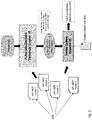
    • Figure 1 is a block diagram of apparatus embodying the second aspect;
    • Figure 2 is a flowchart of a method embodying the first aspect;
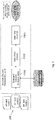
    • Figure 3 is a flowchart of a method in accordance with an embodiment;
    • Figure 4 is a flowchart of processes in accordance with an embodiment;
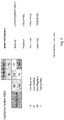
    • Figure 5 shows an example of a confusion matrix;
    • Figure 6 is a flowchart of a process in accordance with an embodiment; and
    • Figure 7 a block diagram of a computing device suitable for carrying out a method according to an embodiment.
  • As shown in Figure 1, secure natural language processing (NLP) apparatus 10 comprises an automatic decision threshold determiner 1 and a text analyzer 2. Automatic decision threshold determiner 1 is configured to cause a plurality 20 of independent NLP models to analyze a corpus 30 of unstructured texts in which different types of entity are annotated, the plurality 20 of independent NLP models being distributed in a decentralized architecture where direct access to data in the NLP models 20 is not permitted. The automatic decision threshold determiner 1 is configured to receive first results of the analysis of the NLP models 20, and, for each entity type annotated in the corpus 30, automatically determine a decision threshold for each NLP model using the received first results. Text analyzer 2 is configured to cause the plurality 20 of NLP models to analyze an unstructured text 40 in which entities are unannotated and receive second results of the analysis of the NLP models 20. The text analyzer 2 is configured to apply the determined decision thresholds to the second results to determine which of those second results are valid, and output, in respect of the unannotated unstructured text 40, the second results determined in the validity determination to be valid.
  • Figure 2 is a flowchart of a method carried out by the apparatus of Figure 1.
  • At step 1 of the method, the plurality 20 of independent NLP models, distributed in a decentralized architecture where direct access to data in the NLP models 20 is not permitted, are caused by the automatic decision threshold determiner 1 to analyze the corpus 30 of unstructured texts in which different types of entity are annotated, and first results of the analysis of the NLP models 20 are received by the automatic decision threshold determiner 1. Causing the plurality 20 of independent NLP models to analyze the corpus 30 of unstructured texts may comprise the automatic decision threshold determiner 1 sending each text in the corpus 30 to each of the NLP models 20.
  • At step 2, for each entity type annotated in the corpus 30, the decision threshold for each NLP model is automatically determined by the automatic decision threshold determiner 1 using the received first results. Determining the decision threshold may comprise, for each type of entity annotated in the corpus 30, the automatic decision threshold determiner 1 comparing the first results provided by the NLP models 20 with the annotations in the corpus 30 to obtain a set of values representing whether or not the entities in the corpus 30 have been correctly identified by the NLP models 20, and then, for each of the entity types for which a set of values has been obtained, using the set of values to determine sensitivity and specificity for each NLP model. The determined sensitivity and specificity may then be used by the automatic decision threshold determiner 1 to determine an optimal decision threshold by entity type, for each NLP model, which maximizes correlation between the sensitivity and the specificity. An optimal decision threshold by entity type for each NLP model may be determined by the automatic decision threshold determiner 1 by calculating an average between the sensitivity and specificity values obtained for the entity type with the NLP model.
  • At step 3, the NLP models 20 are caused by the text analyzer 2 to analyze the unstructured text 40 in which entities are unannotated and second results of the analysis of the NLP models 20 are received by the text analyzer 2, for example by text analyzer 2 sending the unannotated text 40 to each of the NLP models 20.
  • At step 4, the determined decision thresholds are applied by the text analyzer 2 to the second results to determine which of those second results are valid. This may comprise the text analyzer 2 ascertaining, for each NLP model, an accuracy value representing the percentage of valid results provided by the NLP model, and then, for each of the second results, using the accuracy value for the corresponding NLP model and a confidence measure provided by that NLP model for the result to calculate a score. For each of the second results, the score calculated for the result may be compared by the text analyzer 2 with the determined decision threshold for the entity type and NLP model corresponding to the result. The result is determined by the text analyzer 2 to be valid if the score is equal to or greater than the determined decision threshold.
  • At step 5, the second results determined in the validity determination to be valid in respect of the unannotated unstructured text are output by the text analyzer 2.
  • An embodiment for use with Named Entity Recognition (NER) models will now be described with reference to Figures 3, 4 and 5. Figure 3 shows:
    1. 1. Inputs:
      1. a. Inputs 1:
        • Application Programming Interfaces (APIs) to a plurality 200 of independent NER models 1 to n in a decentralized environment with the minimal information required in order for the NER models to be consulted;
        • a small corpus 300 of unstructured texts annotated with different entities for the different domains
      2. b. Input 2: An unstructured text 400 for the later analysis of new cases
    2. 2. Automatic Decision Threshold Determiner 1, comprising Automatic Decision Threshold Determination Engine 15, and Text Analyzer 2, comprising a Named Entities Extractor 25.
      The Automatic Decision Threshold Determination Engine 15 determines decision thresholds to enable combination of the results of the plurality 200 of independent NER models in the decentralized environment.
      The Named Entities Extractor 25 takes the determined decision thresholds as the discriminator values to decide for the input unstructured text 400 the entities recognized.
    3. 3. Outputs:
      1. a. Intermediate output: A matrix 500 of the decision thresholds determined automatically by the Automatic Decision Threshold Determination Engine 15. Each member of the matrix will be the decision threshold of each NER and by entity type.
      2. b. Final output: The final result is a probabilistic vector of entities 600 with its type from the combined results of the plurality 200 of NER models of those ones that overcome the threshold defined through this approach (NER probabilistic labelled output)
    Automatic Decision Threshold Determination Engine 15
  • The Automatic Decision Threshold Determination Engine 15 is configured to calculate a decision threshold for the combined results of the plurality 200 of independent NER models in a decentralized environment. This module generates a matrix of determined decision thresholds, comprising decimal values between 0 and 1, such that each member of the matrix is the determined decision threshold of each NER model by entity type that will maximize the performance of the combined NER models. These decision threshold values are used later to discriminate if an entity belongs to one type or another for the processing of new unstructured texts within this decentralized architecture.
  • Figure 4 shows the workflow of an embodiment of the Automatic Decision Threshold Determination Engine 15, which has the following inputs:
    • APIs to the plurality 200 of independent NER models with the minimal information required in order for the NER models to be consulted
    • Small corpus 300 of unstructured texts annotated with different entities for the different domains (for example texts in the healthcare domain with entities of type Disease, Drug, Treatment, etc., texts in the finance domain with entities of type Organization, Brand, Product, etc., texts in the general domain with entities of type Location, Person, Time, etc., but as in this embodiment ideally a Cross-domain Gold Standard corpus having as far as possible text examples of different domains so as to have a wide spectrum)
  • The procedure carried out by the Automatic Decision Threshold Determination Engine 15 comprises three processes, P151, P152 and P153.
  • Process 151 - Evaluate & Calculate Confusion Matrix 1000:
  • In this process a Confusion Matrix 1000 (a table that may be used to describe the performance of a classification model on a set of test data for which true values are known) by entity type is created for each input NER model, for example as shown in Figure 5. This activity requires:
    1. a. APIs of the NER models 200 with the following information for each one:
      • URL of the API
      • HTTP method (get, post)
      • Format of request message body
      • Entity types managed by the NER (e.g. disease, drug, species, location, etc.)
      • [Optional] Accuracy score of each NER by entity type (these values, if they are available, will be used later by the component Named Entities Extractor)
    2. b. Small corpus 300 of unstructured texts annotated with entities (in this example a cross-domain Gold Standard corpus)
  • First, over the small corpus 300 of unstructured texts annotated with entities, each text is analyzed against each NER model, to obtain the results needed for the following evaluation of the result predicted by the NER models with the real values annotated in the corpus. HTTP calls are made to each API sending each text to get the results of the named entities recognized by the NER models.
  • Second, for each entity type managed by the NER models 200 the results are collected, and the predicted and real values for each NER are compared and assessed in accordance with the following relationships:
    • ▪ True Positives (TP): An entity is annotated as being a particular type in both the gold-standard corpus and the NER model
    • ▪ False Positives (FP): An entity is annotated as being a particular type in the NER model but not in the gold-standard corpus
    • ▪ False Negatives (FN): An entity is annotated as being a particular type in the gold-standard corpus but not in the NER model
    • ▪ True Negatives (TN): An entity is not annotated in the gold-standard corpus and not annotated in the NER model
  • For each entity type and NER, in every text, the parameters (TP, FP, FN or TN) for that text will be marked with value 1 if the result corresponds to one of the above relationships, otherwise with value 0. The overall value of each parameter will be the sum of the values for each text and these overall values will form the Confusion Matrix 1000 for the entity type concerned.
  • Third, once all the results have been evaluated, for each entity type there will be a number of Confusion Matrices 1000 equal to the number of NER models to be combined.
  • Process 152 - Obtain ROC Analysis:
  • In this process Receiver Operating Characteristic (ROC) analysis is carried out for each entity type and each NER model. ROC analysis considers the decision ability of a classifier system as its discrimination threshold is varied and is used to determine an optimal decision threshold for relative costs of false positive and false negative errors using the relationship between the parameters sensitivity and specificity. These parameters are obtained from the calculation of the Confusion Matrices. Sensitivity (also known as recall or True Positive Rate, TPR) is the result of the fraction of true positives (TP) by the sum of true positives (TP) and false negatives (FN), i.e. TP/(TP+FN). Specificity (also known as True Negative Rate, TNR) is the result of the fraction of true negatives (TN) by the sum of true negatives (TN) and false positives (FP), i.e. TN/(TN+FP). An ROC curve is the plot of sensitivity (SN) versus false positive rate (FPR) (or 1 - specificity); each point of the curve corresponds to a different threshold that separates the negative samples from the positive samples.
  • For each entity type the sensitivity and specificity for each NER model is calculated using the values of the associated Confusion Matrix 1000 created in the previous step, to obtain the ROC relationships for these two parameters.
  • Process 153 - Determine Threshold:
  • In this process each NER decision threshold by entity type is determined. The previously-obtained mathematical ROC relationships will be used for automatic decision threshold determination.
  • Values for sensitivity and specificity derived from the ROC relationships are compared to determine an optimal decision threshold by entity type for each NER model which maximizes correlation between the sensitivity and the specificity.
  • The optimal decision threshold is calculated taking the results of sensitivity and specificity for each NER model from the previous step and taking an average between them with respective parameter deviations q and r, for example: q Specificity + r Sensitivity 2
    Figure imgb0001
  • The values of parameter deviations q and r will depend on the importance in the model of sensitivity or specificity. If for example sensitivity is to be prioritized, the deviation applied will weight the value of sensitivity more heavily as compared to specificity. For instance:
    Using a value of q=0.95 for specificity and r=1 for sensitivity, where:
    sensitivity = 1 and specificity = 0.75 0.95 0.75 + 1 2 = 0.85 = Optimal Threshold
    Figure imgb0002
  • Before calculating the optimal threshold value, a value t1, which is the largest decision threshold such that the corresponding sensitivity (SN) meets the specified sensitivity level, and a value t2, which is the smallest decision threshold such that the corresponding specificity (SP) meets the desired specificity level, are chosen. By way of example only, to avoid a very high or a very low threshold, for each entity type the minimum possible threshold value t2 may be 0.3 and the maximum possible threshold value t1 may be 0.9. If instead in the above example both sensitivity and specificity = 1, the threshold calculated in the above manner would be 0.97, but this would exceed the value of the maximum threshold value t1=0.9, so the optimal threshold would be determined to be equal to t1.
  • At completion of these three processes 151, 152, 153 a decision threshold will have been determined for each NER model by entity type (a matrix 500 of determined decision thresholds); these decision thresholds will have been obtained through the joint analysis of the common gold standard corpus 300.
  • Named Entities Extractor 25
  • This component employs the matrix 500 of determined decision thresholds to provide an improved performance in the discrimination by entity type of the independent NER models 200. The Named Entities Extractor 25 takes the determined decision thresholds as discriminator values to decide for an input unstructured text 400 the entities recognized combining the independent NER models 200. As shown in Figure 6, for this activity at least one new unstructured text 400 (the one or ones to be analyzed in order to recognize named entities) is input and HTTP calls are made to each API sending the or each text to get the results of the named entities recognized, i.e. a list of named entities recognized with its internal score (step S251). These results are discriminated by entity type using the matrix 500 of determined decision thresholds belonging to the different NER models. For each NER, over its list of named entities recognized, the value of the following formula is calculated (step S252): Score final = IntScore ent Acc ent
    Figure imgb0003
    where,
    • IntScoreent is the internal score of confidence provided by the NER (this score is provided in the results received from each API NER)
    • Accent is the accuracy of the NER
  • Accent, i.e. the accuracy of the NER model, may be provided by the origin NER model to indicate its performance. If this value is not provided, the accuracy over the common gold standard corpus will be calculated.
  • Next, for each NER and entity type, a check is made (step S253) using the corresponding decision threshold to see if the value of the Scorefinal is higher than the threshold (positive discrimination); if so (step S254) then that named entity will be kept, but if it is lower (negative discrimination), then the named entity will be rejected.
  • At the completion of this process a probabilistic vector 600 (NER probabilistic labelled output) of those entities that meet the decision threshold is output.
  • Example
  • An example of how an embodiment may be applied to automatically determine a decision threshold for obtaining an improved combination of pharmacological entities from independent NER models will now be described. This example should not be construed as limiting in any way, as embodiments may be used with NER models for any domain, even general-purpose NER models.
  • The workflow of this worked example is as follows:
    Inputs:
    • Information concerning two independent API NER models:
      • ▪ URL API NER 1: http://www.../medical-ner
      • ▪ HTTP method NER 1: post
      • ▪ Message body NER 1: JSON input {text:string, lang:string}
      • ▪ Entity types managed NER 1: disease, drug, symptom, chemical
      • ▪ Accuracy score by entity type:
        • ▪ Disease: 86%
        • ▪ Drug: 74%
        • ▪ Symptom: 68%
        • ▪ Chemical: 81%
      • ▪ URL API NER 2: http://www.../mner
      • ▪ HTTP method NER 2: get
      • ▪ Message body NER 2: JSON input {text:string}
      • ▪ Entity types managed NER 2: disease, drug, chemical, treatment
      • ▪ Accuracy score by entity type:
        • ▪ Disease: 79%
        • ▪ Drug: 82%
        • ▪ Chemical: 77%
        • ▪ Treatment: 65%
    • Small corpus of unstructured texts annotated with the kind of entities managed by the NER models (disease, drug, symptom, chemical and treatment). An excerpt of this corpus is given below:
      • ("GI/ GU: EGD revealed ulcerations; gastritis; no active bleeding.", {"entities": [(21, 32, "Symptom")]}),
      • ("HOSPITAL COURSE: RESPIRATORY: **Date Range 59057** did not have respiratory distress.", {"entities": [(64, 84, "Symptom")]}),
      • ("She also had not been informed of the serum creatinine result and was very concerned that 0.9 was abnormal and indicative of renal failure.", {"entities": [(125, 138, "Symptom"), (42, 52, "Chemical")]}), [TEXT 1]
      • ("L Leg PIV infusing D10W with lytes at 30cc/k/d.", {"entities": [(19, 23, "DRUG")]}),
      • ("Mom verbalizing concerns and anxiety over infants recent bradycardic episode.", { "entities": [(29, 36, "Symptom")]}),
      • ("Monitoring for apnea.", {"entities": [(15, 20, "Symptom")]}),
      • ("Apnea well-controlled on caffeine.", {"entities": [(0, 5, "Symptom")]}),
      • ("Alternatively; this could be secondary to the portal hypertension.", {"entities": [(46, 65, "DISEASE")]}),
      • ("The right upper chest and pre-existing hemodialysis catheter were prepped and draped in the standard sterile fashion.", {"entities": [(39, 51, "Treatment")]}),
      • ("The fate of LSD in the body: forensic considerations.", {"entities": [(12, 15, "Chemical")]}),
      • "[Therapy of hepatic encephalopathy.", {"entities": [(12, 34, "Disease")]}),
      • ("Modification of the plasma aminogram using amino acid infusions].", {"entities": [(27, 36, "Chemical'),(43, 53, "Chemical")]}), [TEXT 2]
      • ("However, the same carboxyl group (pKa 4.2--4.8)", {"entities": [(18, 26, "Chemical")]}),
      • ("Isolation and some properties of megamitochondria from the cuprizone-treated mouse liver.", {"entities": [(59, 68, "Chemical"),(0, 9, "Treatment")]}),
      • ("Aortography demonstrated the presence of a suspected ilio-caval fistula.", {"entities": [(64, 71, "Disease"),(0, 11, "Treatment")]}) [TEXT 3]
  • As indicated above, each portion of text in the corpus is annotated to show different entities recognized in the text, with the entity type and its position within the text.
  • Procedure: 1. Evaluate & Calculate Confusion Matrix:
  • First, HTTP calls to each of the two NER models analyzing the texts of the input corpus are made and the results noted. An example for texts 1, 2 and 3 of the corpus is shown below:
    • Text 1: She also had not been informed of the serum creatinine result and was very concerned that 0.9 was abnormal and indicative of renal failure.
      Figure imgb0004
      Figure imgb0005
    • Text 2: Modification of the plasma aminogram using amino acid infusions
      Figure imgb0006
      Figure imgb0007
    • Text 3: Aortography demonstrated the presence of a suspected ilio-caval fistula.
      Figure imgb0008
      Figure imgb0009
  • Second, confusion matrix parameters (TP, FP, FN, TN) are then calculated for each entity and NER model by comparing the predicted results from the NER models with the real values (observed class) included in the annotations of the corpus. Taking the previous examples the following confusion matrices are obtained:
    For entity type = Chemical
    NER 1:
    Predicted Class
    No Yes
    Observed Class No TN = 3 FP = 1
    Yes FN = 0 TP = 3
    NER 2:
    Predicted Class
    No Yes
    Observed Class No TN = 3 FP = 1
    Yes FN = 2 TP = 1
    For entity type = Symptom
    NER 1:
    Predicted Class
    No Yes
    Observed Class No TN = 5 FP = 2
    Yes FN = 0 TP = 1
    NER 2:
    Predicted Class
    No Yes
    Observed Class No TN = 5 FP = 0
    Yes FN = 1 TP = 0
    For entity type = Disease
    NER 1:
    Predicted Class
    No Yes
    Observed Class No TN = 4 FP = 1
    Yes FN = 0 TP = 1
    NER 2:
    Predicted Class
    No Yes
    Observed Class No TN = 5 FP = 0
    Yes FN = 1 TP = 0
    For entity type = Treatment
    NER 1:
    Predicted Class
    No Yes
    Observed Class No TN = 5 FP = 0
    Yes FN = 1 TP = 0
    NER 2:
    Predicted Class
    No Yes
    Observed Class No TN = 5 FP = 0
    Yes FN = 0 TP = 1
    For entity type = Drug - Not applicable in these examples
  • At this point, for each entity type, there are the same number of confusion matrices as the number of NER models. In the example shown there are four entity types with results (i.e. for the entities: chemical, symptom, disease and treatment) and two NER models, so there are a total of eight confusion matrices.
  • 2. Obtain ROC Analysis:
  • The next step is to calculate sensitivity and specificity from the confusion matrix parameters. As mentioned above, sensitivity (recall or True Positive Rate, TPR) is the result of the fraction of true positives divided by the sum of true positives and false negatives [TP/(TP+FN)], and specificity (a.k.a. True Negative Rate, TNR) is the result of the fraction of true negatives by the sum of true negatives and false positives [TN/(TN+FP)].
  • For entity type = Chemical
    NER 1: NER 2:
     Sensitivity = 3/(3+0) = 1  Sensitivity = 1/(1+2) = 0.33
     Specificity = 3/(3+1) = 0.75  Specificity = 3/(3+1) = 0.75
  • For entity type = Symptom
    NER 1: NER 2:
     Sensitivity = 1/(1+0) = 1  Sensitivity = 0/(0+1) = 0
     Specificity = 5/(5+2) = 0.71  Specificity = 5/(5+0) = 1
  • For entity type = Disease
    NER 1: NER 2:
     Sensitivity = 1/(1+0) = 1  Sensitivity = 0/(0+1) = 0
     Specificity = 4/(4+1) = 0.8  Specificity = 5/(5+0) = 1
  • For entity type = Treatment
    NER 1: NER 2:
     Sensitivity = 0/(0+1) = 0  Sensitivity = 1/(1+0) = 1
     Specificity = 5/(5+0) = 1  Specificity = 5/(5+0) = 1
  • Therefore there are now for each entity type as many Sensitivity-Specificity measures as NER models, i.e. eight.
  • 3. Determine Threshold:
  • In this step the calculated sensitivity and specificity values are compared to determine an optimal decision threshold by entity type for each NER model which maximizes correlation between the sensitivity and the specificity. The optimal decision threshold is calculated taking the results of sensitivity and specificity for each NER model from the previous step and taking an average between them with respective parameter deviations q, r. In this example minimum and maximum possible threshold values are set as 0.3 and 0.9 respectively.
  • For entity type = Chemical
    NER 1: NER 2:
    Decision Threshold = 0.85 Decision Threshold = 0.6
    (q = 0.95, r = 1) (q = 1.5, r = 0.23)
  • For entity type = Symptom
    NER 1: NER 2:
    Decision Threshold = 0.85 Decision Threshold = 0.5
    (q = 0.98, r = 1) (q = 1, r= 1)
  • For entity type = Disease
    NER 1: NER 2:
    Decision Threshold = 0.9 Decision Threshold = 0.5
    (q=1, r=1) (q=1, r=1)
  • For entity type = Treatment
    NER 1: NER 2:
    Decision Threshold = 0.5 Decision Threshold = 0.9 (as max limit = 0.9)
    (q=1, r=1) (q=1, r=1)
  • The final output of this process is a matrix of adjusted decision thresholds, each member of the matrix corresponding to the decision threshold of a specific NER model by entity type.
    Chemical Symptom Disease Treatment
    NER
    1 0.85 0.85 0.9 0.5
    NER 2 0.6 0.5 0.5 0.9
  • These results may be applied to the Named Entities Extractor component for analysis of a new unstructured text as follows:
    Input: New unstructured text to analyse and recognize named entities. For instance the following text:
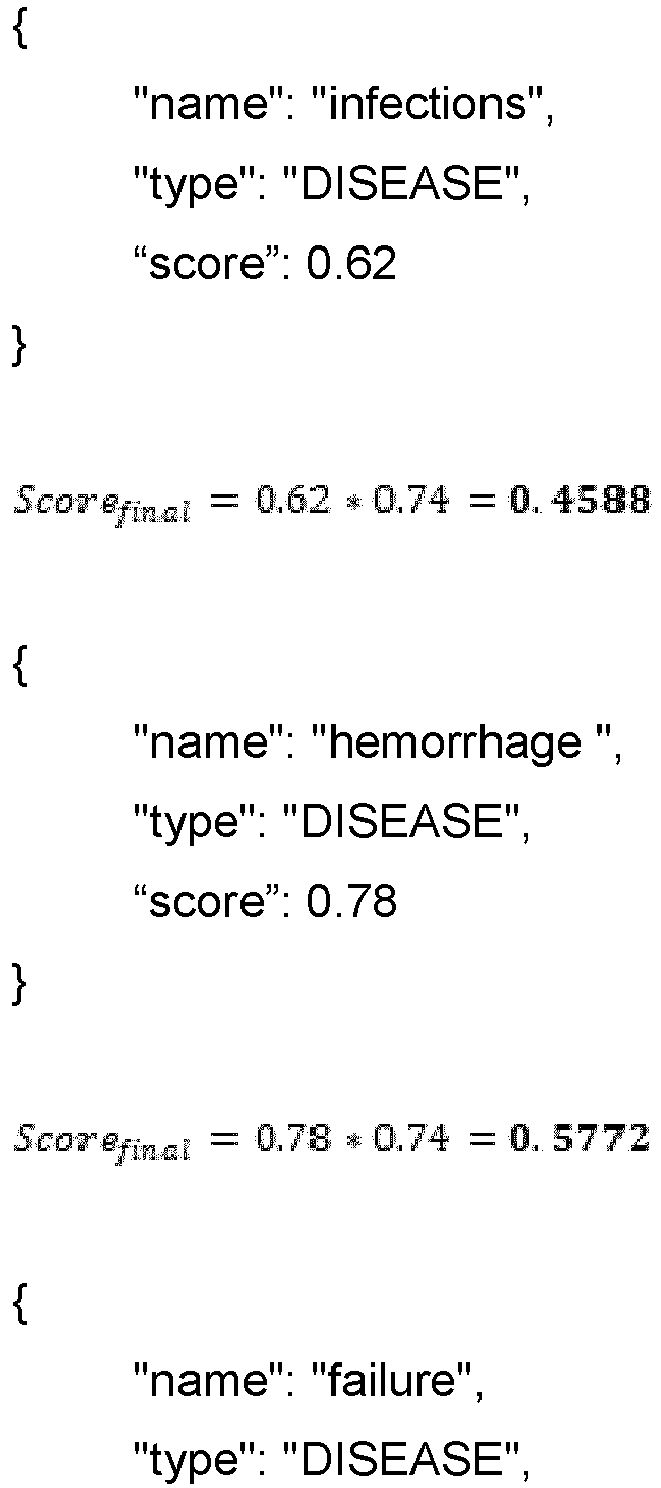
    In 82 cases, 6 cases had complications of barotrauma, 39 cases, of infections, 15 cases, of hypotension, 24 cases, of arrhythmia, 14 cases, of upper gastrointestinal hemorrhage and 10 cases, of multiple organ failure.
  • HTTP calls are made to each of the two NER models; NER 1 has an accuracy of 0.93 and NER 2 has an accuracy of 0.74.
    Figure imgb0010
    Figure imgb0011
  • These results are then compared by entity type with the matrix of adjusted thresholds determined for the different NER models by calculating the value of the formula Scorefinal = IntScoreent Accent and checking using the corresponding decision threshold to determine if the calculated value is higher than the adjusted threshold (positive discrimination), in which case the entity is said to have been recognized correctly, or lower (negative discrimination), in which case the entity is said to have been recognized incorrectly. For example:
    • NER 1:
      Figure imgb0012
      Figure imgb0013
    • NER 2:
      Figure imgb0014
      Figure imgb0015
  • Taking into account these values and the corresponding adjusted decision thresholds [NER1: Symptom: 0.85, Disease: 0.9; NER2: Symptom: 0.5, Disease: 0.5], the named entities included in the final result by positive discrimination are:
    Figure imgb0016
    Figure imgb0017
  • Embodiments are described above which relate to NER models and these may be applied to any domain using NER in unstructured texts. It should be noted that embodiments may also be used in other kinds of NLP models, such as those for relations extraction, text categorization, topics extraction, etc. For example, in the case of text categorization the texts in a corpus would be annotated with labels of the type of thematic (such as sports, finance, entertainment, health, etc.). One might assume that each text had only one thematic. The decision threshold determination process would be similar, comparing true thematic values in the corpus against predicted values from text categorization models. Similarly, in relations extraction there would be an annotated relationship type for each text (such as disease-drug, organization-product, drug-side effect, etc.), and decision threshold determination might be carried out by comparing the true annotations in the corpus against the predicted values. And similarly for topics extraction.
  • Figure 7 is a block diagram of a computing device, such as a data storage server, which embodies the present invention, and which may be used to implement some or all of the steps of a method of an embodiment, and perform some or all of the tasks of apparatus of an embodiment. For example, the computing device of Figure 7 may be used to implement all, or only some, of steps S1 to S5 of the method illustrated in Figure 2, and to perform some or all of the tasks of the automatic decision threshold determiner 1 and/or text analyser 2 in the apparatus 10 illustrated in Figure 1.
  • The computing device comprises a processor 993, and memory, 994. Optionally, the computing device also includes a network interface 997 for communication with other such computing devices, for example with other computing devices of invention embodiments.
  • For example, an embodiment may be composed of a network of such computing devices. Optionally, the computing device also includes one or more input mechanisms such as keyboard and mouse 996 and a display unit such as one or more monitors 995. The components are connectable to one another via a bus 992.
  • The memory 994 may include a computer readable medium, which term may refer to a single medium or multiple media (e.g., a centralized or distributed database and/or associated caches and servers) configured to carry computer-executable instructions or have data structures stored thereon, such as texts in corpus 30/300 or unannotated text 40/400. Computer-executable instructions may include, for example, instructions and data accessible by and causing a general purpose computer, special purpose computer, or special purpose processing device (e.g., one or more processors) to perform one or more functions or operations such as all or parts of the methods described with reference to Figure 2, Figure 3, Figure 4 and/or Figure 6. Thus, the term "computer-readable storage medium" may also include any medium that is capable of storing, encoding or carrying a set of instructions for execution by the machine and that cause the machine to perform any one or more of the methods of the present disclosure. The term "computer-readable storage medium" may accordingly be taken to include, but not be limited to, solid-state memories, optical media and magnetic media. By way of example, and not limitation, such computer-readable media may include non-transitory computer-readable storage media, including Random Access Memory (RAM), Read-Only Memory (ROM), Electrically Erasable Programmable Read-Only Memory (EEPROM), Compact Disc Read-Only Memory (CD-ROM) or other optical disk storage, magnetic disk storage or other magnetic storage devices, flash memory devices (e.g., solid state memory devices).
  • The processor 993 is configured to control the computing device and execute processing operations, for example executing computer program code stored in the memory 994 to implement some or all of the methods described with reference to Figures 2, 3, 4 and/or 6 and defined in the claims. For example, processor 993 may execute computer program code to implement each of processes P151, P152 and P153 of Figure 4, or only step S4 in whole or in part of Figure 2.
  • The memory 994 stores data being read and written by the processor 993. As referred to herein, a processor may include one or more general-purpose processing devices such as a microprocessor, central processing unit, or the like. The processor may include a complex instruction set computing (CISC) microprocessor, reduced instruction set computing (RISC) microprocessor, very long instruction word (VLIW) microprocessor, or a processor implementing other instruction sets or processors implementing a combination of instruction sets. The processor may also include one or more special-purpose processing devices such as an application specific integrated circuit (ASIC), a field programmable gate array (FPGA), a digital signal processor (DSP), network processor, or the like. In one or more embodiments, a processor is configured to execute instructions for performing the operations and steps discussed herein.
  • The display unit 995 may display a representation of data stored by the computing device, and may also display a cursor and dialog boxes and screens enabling interaction between a user and the programs and data stored on the computing device.
  • The input mechanisms 996 may enable a user to input data and instructions to the computing device.
  • The network interface (network I/F) 997 may be connected to a network, such as the Internet, and is connectable to other such computing devices via the network. The network I/F 997 may control data input/output from/to other apparatus via the network. Other peripheral devices such as microphone, speakers, printer, power supply unit, fan, case, scanner, trackerball etc may be included in the computing device.
  • Methods embodying the present invention may be carried out on a computing device such as that illustrated in Figure 7. Such a computing device need not have every component illustrated in Figure 7, and may be composed of a subset of those components. A method embodying the present invention may be carried out by a single computing device in communication with one or more data storage servers via a network. The computing device may be a data storage itself storing at least a portion of the data.
  • A method embodying the present invention may be carried out by a plurality of computing devices operating in cooperation with one another. One or more of the plurality of computing devices may be a data storage server storing at least a portion of the data.
  • Embodiments may be implemented in hardware, or as software modules running on one or more processors, or on a combination thereof. That is, those skilled in the art will appreciate that a microprocessor or digital signal processor (DSP) may be used in practice to implement some or all of the functionality described above.
  • The invention may also be embodied as one or more device or apparatus programs (e.g. computer programs and computer program products) for carrying out part or all of the methods described herein. Such programs embodying the present invention may be stored on computer-readable media, or could, for example, be in the form of one or more signals. Such signals may be data signals downloadable from an Internet website, or provided on a carrier signal, or in any other form.
  • The above-described embodiments of the present invention may advantageously be used independently of any other of the embodiments or in any feasible combination with one or more others of the embodiments.

Claims (15)

  1. A computer-implemented secure natural language processing (NLP) method comprising:
    causing a plurality of independent NLP models, distributed in a decentralized architecture where direct access to data in the NLP models is not permitted for data security or another reason, to analyze a corpus of unstructured texts in which different types of entity are annotated, and receiving first results of the analysis of the NLP models;
    for each entity type annotated in the corpus, automatically determining a decision threshold for each NLP model using the received first results;
    causing the NLP models to analyze an unstructured text in which entities are unannotated and receiving second results of the analysis of the NLP models;
    applying the determined decision thresholds to the second results to determine which of those second results are valid; and
    outputting, in respect of the unannotated unstructured text, the second results determined in the validity determination to be valid.
  2. A method as claimed in claim 1, wherein automatically determining a decision threshold comprises:
    for each type of entity annotated in the corpus, comparing the first results provided by the NLP models with the annotations in the corpus to obtain a set of values representing whether or not the entities in the corpus have been correctly identified by the NLP models;
    for each of the entity types for which a set of values has been obtained, using the set of values to determine sensitivity and specificity for each NLP model; and
    using the determined sensitivity and specificity to determine an optimal decision threshold by entity type, for each NLP model, which maximizes correlation between the sensitivity and the specificity.
  3. A method as claimed in claim 2, wherein determining an optimal decision threshold by entity type for each NLP model comprises:
    calculating an average between the sensitivity and specificity values obtained for the entity type with the NLP model.
  4. A method as claimed in claim 3, further comprising calculating the average using weighted sensitivity and specificity values.
  5. A method as claimed in any preceding claim, wherein causing the plurality of independent NLP models to analyze a corpus of unstructured texts comprises sending each text in the corpus to each of the NLP models.
  6. A method as claimed in any preceding claim, wherein causing the plurality of independent NLP models to analyze an unannotated text comprises sending the unannotated text to each of the NLP models.
  7. A method as claimed in any preceding claim, wherein applying the determined decision thresholds to the second results to determine which of those second results are valid comprises:
    for each of the second results, using an accuracy value, representing the percentage of valid results provided by the corresponding NLP model, and a confidence measure provided by that NLP model for the result to calculate a score;
    for each of the second results, comparing the score calculated for the result with the determined decision threshold for the entity type and NLP model corresponding to the result; and
    determining that the result is valid if the score is equal to or greater than the determined decision threshold.
  8. Secure natural language processing (NLP) apparatus comprising:
    an automatic decision threshold determiner to:
    cause a plurality of independent NLP models, distributed in a decentralized architecture where direct access to data in the NLP models is not permitted for data security or another reason, to analyze a corpus of unstructured texts in which different types of entity are annotated, and receive first results of the analysis of the NLP models; and
    for each entity type annotated in the corpus, automatically determine a decision threshold for each NLP model using the received first results; and
    a text analyzer to:
    cause the NLP models to analyze an unstructured text in which entities are unannotated and receive second results of the analysis of the NLP models;
    apply the determined decision thresholds to the second results to determine which of those second results are valid; and
    output, in respect of the unannotated unstructured text, the second results determined in the validity determination to be valid.
  9. Apparatus as claimed in claim 8, wherein the automatic decision threshold determiner automatically determines a decision threshold by:
    for each type of entity annotated in the corpus, comparing the first results provided by the NLP models with the annotations in the corpus to obtain a set of values representing whether or not the entities in the corpus have been correctly identified by the NLP models;
    for each of the entity types for which a set of values has been obtained, using the set of values to determine sensitivity and specificity for each NLP model; and
    using the determined sensitivity and specificity to determine an optimal decision threshold by entity type, for each NLP model, which maximizes correlation between the sensitivity and the specificity.
  10. Apparatus as claimed in claim 9, wherein the automatic decision threshold determiner determines an optimal decision threshold by entity type for each NLP model by calculating an average between the sensitivity and specificity values obtained for the entity type with the NLP model.
  11. Apparatus as claimed in claim 10, wherein at least one of the sensitivity value and the specificity value is weighted in calculating the average.
  12. Apparatus as claimed in any one of claims 8 to 11, wherein the automatic decision threshold deteminer causes the plurality of independent NLP models to analyze a corpus of unstructured texts by sending each text in the corpus to each of the NLP models.
  13. Apparatus as claimed in any one of claims 8 to 12, wherein the text analyzer causes the plurality of independent NLP models to analyze an unannotated text by sending the unannotated text to each of the NLP models.
  14. Apparatus as claimed in any one of claims 8 to 13, wherein the text analyzer determines which of the second results is valid by:
    for each of the second results, using an accuracy value, representing the percentage of valid results provided by the corresponding NLP model, and a confidence measure provided by that NLP model for the result to calculate a score;
    for each of the second results, comparing the score calculated for the result with the determined decision threshold for the entity type and NLP model corresponding to the result; and
    determining that the result is valid if the score is equal to or greater than the determined decision threshold.
  15. A method or apparatus as claimed in any preceding claim, wherein at least one of the NLP models is a Named Entity Recognition (NER) model.
EP20382188.9A 2020-03-13 2020-03-13 Enabling combined use of natural language processing models in a secure environment Ceased EP3879428A1 (en)

Priority Applications (2)

Application Number Priority Date Filing Date Title
EP20382188.9A EP3879428A1 (en) 2020-03-13 2020-03-13 Enabling combined use of natural language processing models in a secure environment
JP2021021264A JP2021149955A (en) 2020-03-13 2021-02-12 Combination of natural language processing model in safe environment

Applications Claiming Priority (1)

Application Number Priority Date Filing Date Title
EP20382188.9A EP3879428A1 (en) 2020-03-13 2020-03-13 Enabling combined use of natural language processing models in a secure environment

Publications (1)

Publication Number Publication Date
EP3879428A1 true EP3879428A1 (en) 2021-09-15

Family

ID=69953934

Family Applications (1)

Application Number Title Priority Date Filing Date
EP20382188.9A Ceased EP3879428A1 (en) 2020-03-13 2020-03-13 Enabling combined use of natural language processing models in a secure environment

Country Status (2)

Country Link
EP (1) EP3879428A1 (en)
JP (1) JP2021149955A (en)

Citations (3)

* Cited by examiner, † Cited by third party
Publication number Priority date Publication date Assignee Title
US20110213742A1 (en) * 2010-02-26 2011-09-01 Lemmond Tracy D Information extraction system
US9190055B1 (en) * 2013-03-14 2015-11-17 Amazon Technologies, Inc. Named entity recognition with personalized models
US20170060848A1 (en) * 2015-08-31 2017-03-02 Microsoft Technology Licensing, Llc Distributed server system for language understanding

Patent Citations (3)

* Cited by examiner, † Cited by third party
Publication number Priority date Publication date Assignee Title
US20110213742A1 (en) * 2010-02-26 2011-09-01 Lemmond Tracy D Information extraction system
US9190055B1 (en) * 2013-03-14 2015-11-17 Amazon Technologies, Inc. Named entity recognition with personalized models
US20170060848A1 (en) * 2015-08-31 2017-03-02 Microsoft Technology Licensing, Llc Distributed server system for language understanding

Non-Patent Citations (3)

* Cited by examiner, † Cited by third party
Title
ANONYMOUS: "F1 score", WIKIPEDIA, 4 March 2020 (2020-03-04), XP055729962, Retrieved from the Internet <URL:https://en.wikipedia.org/w/index.php?title=F1_score&oldid=943881524> [retrieved on 20200911] *
BOGDAN SACALEANU ET AL: "An Adaptive Framework for Named Entity Combination", PROCEEDINGS OF LREC 2012, EIGHTH INTERNATIONAL CONFERENCE ON LANGUAGE RESOURCES AND EVALUATION, 21 May 2012 (2012-05-21), Istanbul, Turkey, pages 1244 - 1249, XP055327272, Retrieved from the Internet <URL:http://www.lrec-conf.org/proceedings/lrec2012/pdf/411_Paper.pdf> [retrieved on 20161208] *
DUONG D ET AL: "Support Vector Machines to Weight Voters in a Voting System of Entity Extractors", INTERNATIONAL JOINT CONFERENCE ON NEURAL NETWORKS, 2006. IJCNN '06, PISCATAWAY, NJ : IEEE OPERATIONS CENTER, PISCATAWAY, NJ, USA, 16 July 2006 (2006-07-16), pages 1226 - 1230, XP010948157, ISBN: 978-0-7803-9490-2, DOI: 10.1109/IJCNN.2006.1716242 *

Also Published As

Publication number Publication date
JP2021149955A (en) 2021-09-27

Similar Documents

Publication Publication Date Title
US9141662B2 (en) Intelligent evidence classification and notification in a deep question answering system
US9911082B2 (en) Question classification and feature mapping in a deep question answering system
US10438297B2 (en) Anti-money laundering platform for mining and analyzing data to identify money launderers
US9158772B2 (en) Partial and parallel pipeline processing in a deep question answering system
Lee et al. Risk factors for heart failure with preserved or reduced ejection fraction among Medicare beneficiaries: application of competing risks analysis and gradient boosted model
US20180181866A1 (en) Crowdsourced learning engine for semantic analysis of webpages
Desai et al. Development and preliminary validation of a Medicare claims–based model to predict left ventricular ejection fraction class in patients with heart failure
WO2024183396A1 (en) Space-time correlation-based multi-source heterogeneous alarm information fusion method and system, computer device, computer readable storage medium and computer program product
Rani et al. Blockchain-based rumor detection approach for COVID-19
US10431337B2 (en) System and method for weighting manageable patient attributes during criteria evaluations for treatment
US10565311B2 (en) Method for updating a knowledge base of a sentiment analysis system
CN103870528B (en) Method and system for question classification and feature mapping in a deep question answering system
Malhotra et al. An empirical comparison of machine learning techniques for software defect prediction
CN111161884A (en) Disease prediction method, device, equipment and medium for unbalanced data
Naseer et al. An improved hybrid model for cardiovascular disease detection using machine learning in IoT
Alzaid et al. Large multimodal model‐based standardisation of pathology reports with confidence and its prognostic significance
EP3879428A1 (en) Enabling combined use of natural language processing models in a secure environment
Martínez‐Licort et al. Machine learning methods for predicting syncope severity in the emergency department: a retrospective analysis
Xu et al. A Tri-light Warning System for Hospitalized COVID-19 Patients: Credibility-based Risk Stratification under Data Shift
Lin et al. A Trustworthy Model With Uncertainty Management for Predicting Vascular Access Dysfunction in Hemodialysis Patients
Adepoju et al. Early detection of heart disease using machine learning algorithm: performance analysis and model comparison
CN121009182B (en) Question-answering processing method, system, equipment and medium based on three-dimensional entropy evaluation
Tokac et al. Using natural language processing in the LACE Index Scoring Tool to predict unplanned trauma and surgical readmissions in South Africa
Mittelberg et al. Trustworthy personalized treatment selection: causal effect-trees and calibration in perioperative medicine
Wu et al. Analysis and prediction of in-hospital risks among covid-19 patients with substance use disorder (sud)

Legal Events

Date Code Title Description
PUAI Public reference made under article 153(3) epc to a published international application that has entered the european phase

Free format text: ORIGINAL CODE: 0009012

STAA Information on the status of an ep patent application or granted ep patent

Free format text: STATUS: REQUEST FOR EXAMINATION WAS MADE

17P Request for examination filed

Effective date: 20210607

AK Designated contracting states

Kind code of ref document: A1

Designated state(s): AL AT BE BG CH CY CZ DE DK EE ES FI FR GB GR HR HU IE IS IT LI LT LU LV MC MK MT NL NO PL PT RO RS SE SI SK SM TR

STAA Information on the status of an ep patent application or granted ep patent

Free format text: STATUS: EXAMINATION IS IN PROGRESS

17Q First examination report despatched

Effective date: 20220623

STAA Information on the status of an ep patent application or granted ep patent

Free format text: STATUS: THE APPLICATION HAS BEEN REFUSED

18R Application refused

Effective date: 20231026