EP3878847A1 - Bcl-2 family proteins modulating compounds for cancer treatment - Google Patents

Bcl-2 family proteins modulating compounds for cancer treatment Download PDF

Info

Publication number
EP3878847A1
EP3878847A1 EP20305263.4A EP20305263A EP3878847A1 EP 3878847 A1 EP3878847 A1 EP 3878847A1 EP 20305263 A EP20305263 A EP 20305263A EP 3878847 A1 EP3878847 A1 EP 3878847A1
Authority
EP
European Patent Office
Prior art keywords
aryl
alkyl
bcl
compound
groups
Prior art date
Legal status (The legal status is an assumption and is not a legal conclusion. Google has not performed a legal analysis and makes no representation as to the accuracy of the status listed.)
Withdrawn
Application number
EP20305263.4A
Other languages
German (de)
French (fr)
Inventor
Anne-Sophie Voisin-Chiret
Charline KIEFFER
Nicolas GUEDENEY
Camille DENIS
Martina DE PASCALE
Laurent Poulain
Louis Bastien WEISWALD
Hippolyte PAYSANT
Current Assignee (The listed assignees may be inaccurate. Google has not performed a legal analysis and makes no representation or warranty as to the accuracy of the list.)
Université de Caen Normandie
Institut National de la Santé et de la Recherche Médicale
Centre François Baclesse
Original Assignee
Université de Caen Normandie
Institut National de la Santé et de la Recherche Médicale
Centre François Baclesse
Priority date (The priority date is an assumption and is not a legal conclusion. Google has not performed a legal analysis and makes no representation as to the accuracy of the date listed.)
Filing date
Publication date
Application filed by Université de Caen Normandie, Institut National de la Santé et de la Recherche Médicale, Centre François Baclesse filed Critical Université de Caen Normandie
Priority to EP20305263.4A priority Critical patent/EP3878847A1/en
Priority to US17/909,916 priority patent/US12643894B2/en
Priority to CN202180027952.0A priority patent/CN115715286B/en
Priority to PCT/EP2021/056415 priority patent/WO2021180966A1/en
Priority to JP2022554284A priority patent/JP2023516790A/en
Priority to EP21710981.8A priority patent/EP4118080B1/en
Priority to AU2021236366A priority patent/AU2021236366A1/en
Priority to CA3170893A priority patent/CA3170893A1/en
Publication of EP3878847A1 publication Critical patent/EP3878847A1/en
Withdrawn legal-status Critical Current

Links

Classifications

    • C—CHEMISTRY; METALLURGY
    • C07—ORGANIC CHEMISTRY
    • C07D—HETEROCYCLIC COMPOUNDS
    • C07D417/00—Heterocyclic compounds containing two or more hetero rings, at least one ring having nitrogen and sulfur atoms as the only ring hetero atoms, not provided for by group C07D415/00
    • C07D417/14—Heterocyclic compounds containing two or more hetero rings, at least one ring having nitrogen and sulfur atoms as the only ring hetero atoms, not provided for by group C07D415/00 containing three or more hetero rings
    • A—HUMAN NECESSITIES
    • A61—MEDICAL OR VETERINARY SCIENCE; HYGIENE
    • A61K—PREPARATIONS FOR MEDICAL, DENTAL OR TOILETRY PURPOSES
    • A61K47/00—Medicinal preparations characterised by the non-active ingredients used, e.g. carriers or inert additives; Targeting or modifying agents chemically bound to the active ingredient
    • A61K47/50—Medicinal preparations characterised by the non-active ingredients used, e.g. carriers or inert additives; Targeting or modifying agents chemically bound to the active ingredient the non-active ingredient being chemically bound to the active ingredient, e.g. polymer-drug conjugates
    • A61K47/51—Medicinal preparations characterised by the non-active ingredients used, e.g. carriers or inert additives; Targeting or modifying agents chemically bound to the active ingredient the non-active ingredient being chemically bound to the active ingredient, e.g. polymer-drug conjugates the non-active ingredient being a modifying agent
    • A61K47/54—Medicinal preparations characterised by the non-active ingredients used, e.g. carriers or inert additives; Targeting or modifying agents chemically bound to the active ingredient the non-active ingredient being chemically bound to the active ingredient, e.g. polymer-drug conjugates the non-active ingredient being a modifying agent the modifying agent being an organic compound
    • A61K47/545—Heterocyclic compounds
    • A—HUMAN NECESSITIES
    • A61—MEDICAL OR VETERINARY SCIENCE; HYGIENE
    • A61P—SPECIFIC THERAPEUTIC ACTIVITY OF CHEMICAL COMPOUNDS OR MEDICINAL PREPARATIONS
    • A61P35/00—Antineoplastic agents
    • C—CHEMISTRY; METALLURGY
    • C07—ORGANIC CHEMISTRY
    • C07D—HETEROCYCLIC COMPOUNDS
    • C07D401/00—Heterocyclic compounds containing two or more hetero rings, having nitrogen atoms as the only ring hetero atoms, at least one ring being a six-membered ring with only one nitrogen atom
    • C07D401/02—Heterocyclic compounds containing two or more hetero rings, having nitrogen atoms as the only ring hetero atoms, at least one ring being a six-membered ring with only one nitrogen atom containing two hetero rings
    • C07D401/12—Heterocyclic compounds containing two or more hetero rings, having nitrogen atoms as the only ring hetero atoms, at least one ring being a six-membered ring with only one nitrogen atom containing two hetero rings linked by a chain containing hetero atoms as chain links
    • C—CHEMISTRY; METALLURGY
    • C07—ORGANIC CHEMISTRY
    • C07D—HETEROCYCLIC COMPOUNDS
    • C07D401/00—Heterocyclic compounds containing two or more hetero rings, having nitrogen atoms as the only ring hetero atoms, at least one ring being a six-membered ring with only one nitrogen atom
    • C07D401/14—Heterocyclic compounds containing two or more hetero rings, having nitrogen atoms as the only ring hetero atoms, at least one ring being a six-membered ring with only one nitrogen atom containing three or more hetero rings

Definitions

  • the present invention relates to compounds, compositions and methods for treating cancers and disorders of cell proliferation and more particularly, methods of making and using compounds that modulate at least one of the proteins chosen from Bcl-2, Mcl-1, Bcl-x L , Bcl-w, Bfl-1 and Bcl-B, in particular Bcl-2 protein, or Bcl-x L and/or Mcl-1 proteins; said compounds may be contained in pharmaceutical compositions and used as therapeutic agents.
  • Apoptosis also known as programmed cell death, is a natural process used by multicellular organisms to eliminate aging or damaged cells also involved in various physiological processes such as morphogenesis and tissue homeostasis. Apoptosis is a complex, highly regulated process involving many proteins. Some of these proteins promote cell death (“pro-apoptotic” proteins) and some prevent it (“anti-apoptotic” proteins). Cancer cells tend to over-express anti-apoptotic genes. The overexpression of anti-apoptotic genes is associated with tumor formation, metastatic growth and resistance to chemotherapy and there is a continuing need for therapeutic strategies that selectively kill cancer cells.
  • apoptosis control defect is frequently involved in chemoresistance in cancer cells, in both hematological malignancies and solid tumors, and the deregulation of Bcl-2 family members expression constitutes one of the most frequent and important event.
  • These proteins share Bcl-2 homology domains (named BH domains).
  • Anti-apoptotic proteins (Bcl-2, Bcl-x L ) contain the BH1 to BH4 domains, whereas pro-apoptotic proteins contain either the BH1 to BH3 domains (multidomain members such as Bax and Bak) or only the BH3 domain (BH3-only group such as Bim, Puma, Bid, Bad, Noxa and Hrk).
  • BH3-only proteins initiate apoptosis by either blocking the activity of anti-apoptotic members or directly activating multidomain pro-apoptotic members, which is mediated via interaction of the BH3 domain of one protein with the hydrophobic pocket of another.
  • Mcl-1 is overexpressed in various tumor cells, including ovarian carcinoma, hematological malignancies, breast cancers, colon cancers and lung cancers, and its expression has also been associated to chemoresistance. Importantly, Mcl-1 locus is one of the most frequently amplified in human cancers, further pointing to its centrality in carcinogenesis and increasing its importance as a high priority therapeutic target.
  • the anti-apoptotic Bcl-x L proteins of constitute targets of choice. This is particularly true in the management of certain solid tumors, which overexpress these proteins (including ovarian tumors), and whose expression is strongly correlated with drug resistance. Although the pharmacological benefit of targeting these proteins is not questioned at present, the development of molecules inhibiting this protein is currently hampered by the emergence of thrombocytopenia in patients.
  • Mcl-1 activity and/or Bcl-x L in particular degrading Mcl-1 and/or Bcl-x L protein, while having no or low toxicity towards heart and platelets.
  • Y 1 and Y 3 are C, and Y 2 and Y 4 are N.
  • the compound as defined above is of following formula (IIIa) or (IIIb): said compound being in particular of following formula (IIIa1) or (IIIa2), (IIIb1) or (IIIb2):
  • Ar 2 is a (5 to 7 membered) heteroaryl, -O-(C 6 -C 10 )aryl, -O-(5 to 7 membered)heteroaryl, -S-(C 6 -C 10 )aryl, -S-(5 to 7 membered)heteroaryl, -(C 1 -C 6 )alkyl-(C 6 -C 10 )aryl, or -(C 1 -C 6 )alkyl-(5 to 7 membered) heteroaryl, in particular a 5 to 7 membered heteroaryl containing a nitrogen atom, preferably pyridyl, notably 3-pyridyl.
  • Ar 1 , Ar 2 is a (C 6 -C 10 )aryl, in particular a phenyl.
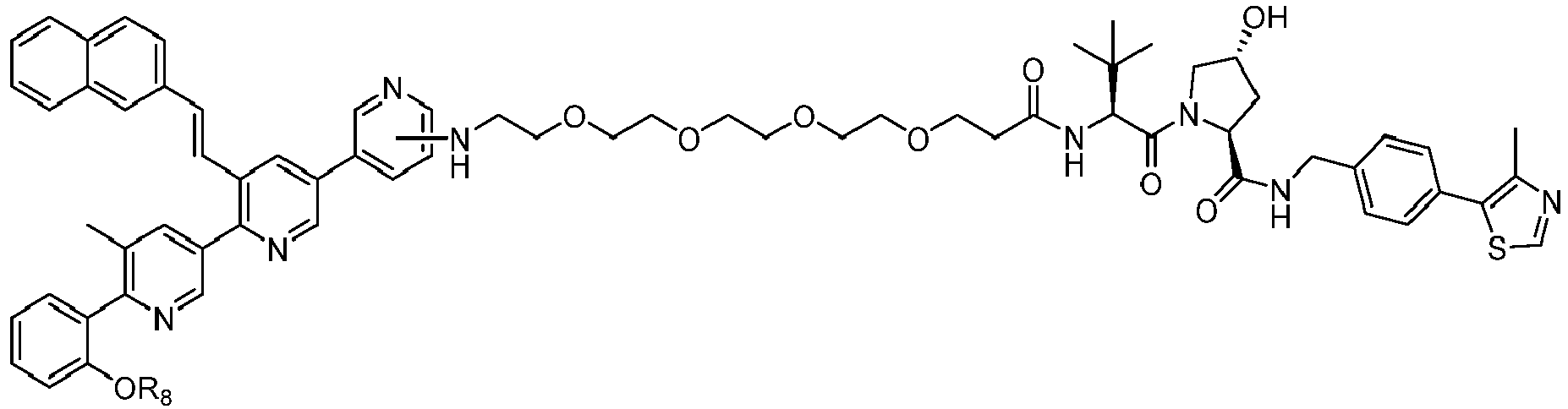
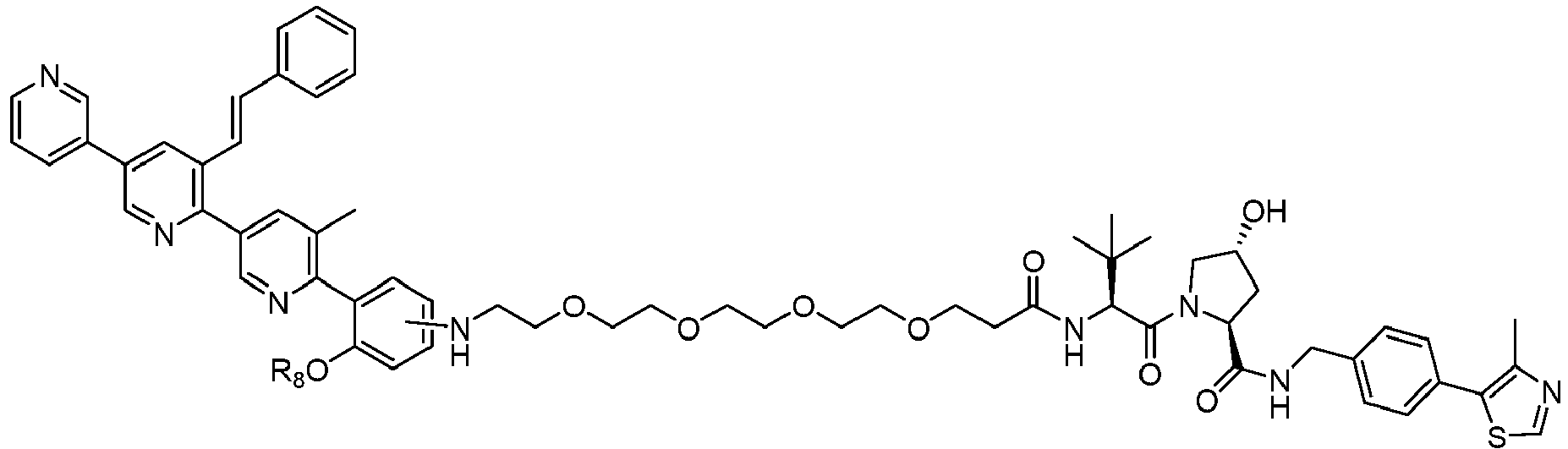
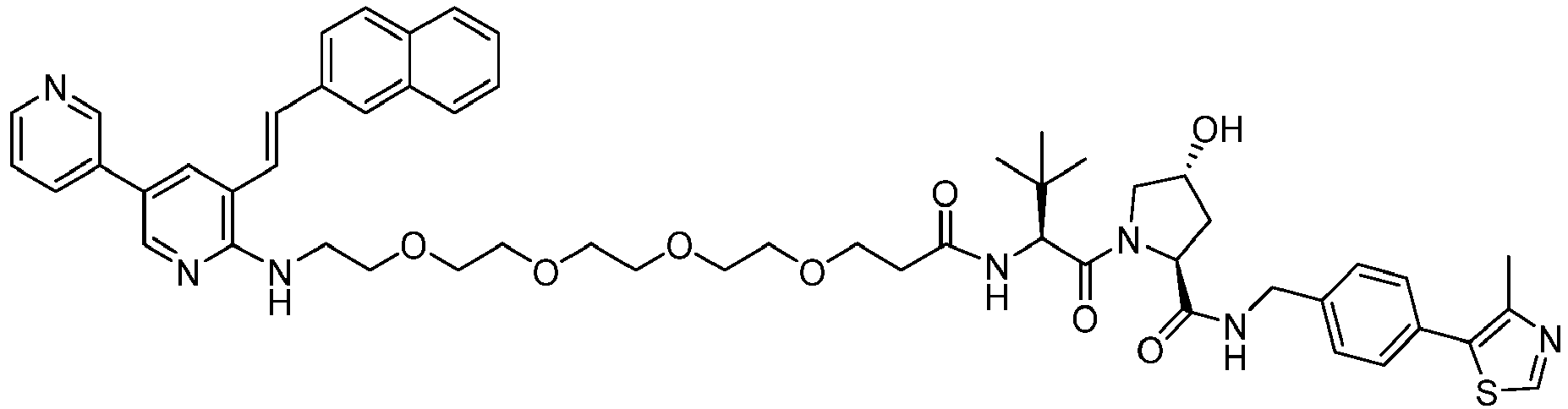
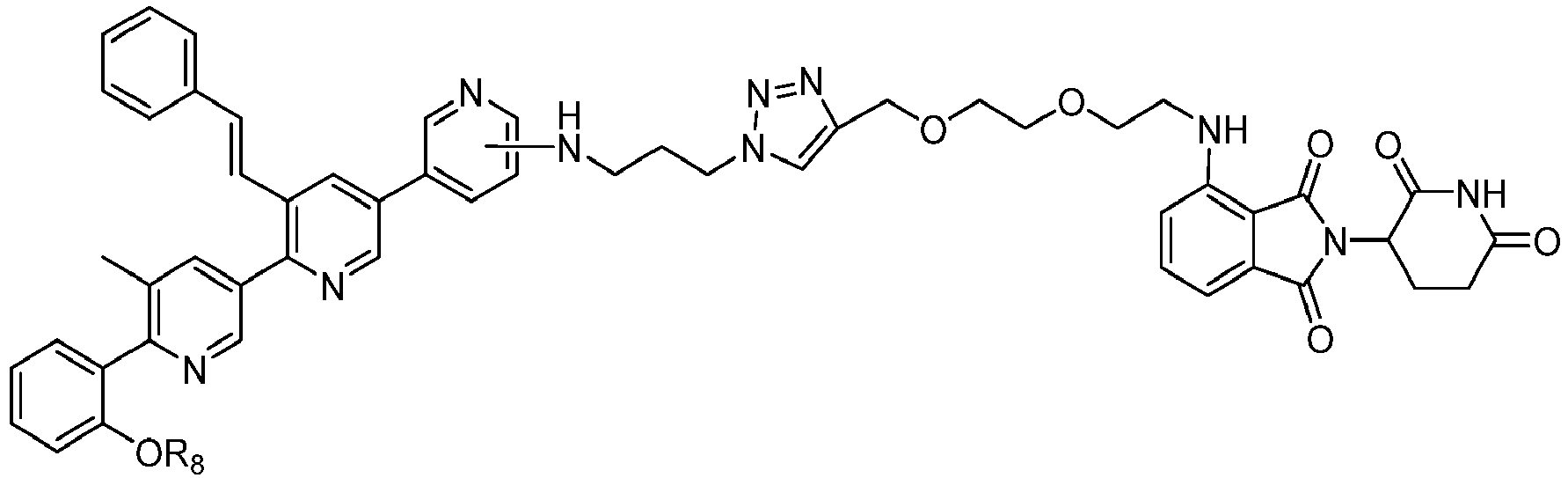
  • R 1 and R 2 are independently selected from C 1 -C 6 alkyl and (C 6 -C 10 )aryl(C 2 -C 6 )alkenyl, preferably from methyl, styryl and 2-(naphthalen-2-yl)vinyl.
  • R 1 is selected from C 1 -C 6 alkyl, in particular methyl and R 2 is selected from -(C 1 -C 6 )alkyl-(C 6 -C 10 )aryl, in particular styryl or 2-(naphthalen-2-yl)vinyl.
  • compounds of the present invention may exist in various stereoisomeric forms.
  • the compounds of the present invention include diastereomers, enantiomers and atropisomers.
  • the compounds are normally prepared as racemates and can conveniently be used as such, but individual enantiomers can be isolated or synthesized by conventional techniques if so desired. Such racemates and individual enantiomers and mixtures thereof form part of the present invention.
  • Stereoisomers can be prepared by stereospecific synthesis using enantiomerically pure or enantiomerically enriched starting materials.
  • the specific stereoisomers of either starting materials or products can be resolved and recovered by techniques known in the art, such as resolution of racemic forms, normal, reverse-phase, and chiral chromatography, recrystallization, enzymatic resolution, or fractional recrystallization of addition salts formed by reagents used for that purpose.
  • the compound as defined above is of following formula (IVa) or (IVb): in particular of following formula (IVa1), (IVa2), (IVb1) or (IVb2): wherein :
  • Z is selected from:
  • the compounds of the present invention may be prepared in a number of methods well known to those skilled in the art, including, but not limited to those described below, or through modifications of these methods by applying standard techniques known to those skilled in the art of organic synthesis.
  • the reagents and starting materials are commercially available, or readily synthesized by well-known techniques by one of ordinary skill in the arts. All substituents, unless otherwise indicated, are as previously defined. All processes disclosed in association with the present invention are contemplated to be practiced on any scale, including milligram, gram, multigram, or commercial industrial scale.
  • protecting groups are known per se as chemical functional groups that can be selectively appended to and removed from functionalities, such as hydroxyl groups and carboxyl groups. These groups are present in a chemical compound to render such functionality inert to chemical reaction conditions to which the compound is exposed. Any of a variety of protecting groups may be employed with the present invention. Other preferred protecting groups according to the invention may be found in Greene, T.W. and Wuts, P.G.M., "Protective Groups in Organic Synthesis” 2d. Ed., Wiley & Sons, 1991 , or in P.J. Kocienski, “Protecting Groups", 3rd. Ed., Thieme, Stuttgart, NY, 2004 .
  • the present invention relates to a method for preparing a compound of formula (I) as defined herein, wherein r is 1, comprising the steps of:
  • Compound (B) is commercially available, as described below, or may be obtained as follows: Xb-L 2 -Y a (B1) + Yb-Z (B2) ⁇ Xb-L 2-Y-Z (B)
  • compound (A) is obtained as follows:
  • Hal 1 and Hal 2 are halogens, for example I and Br, respectively.
  • compound (G) is obtained as follows: wherein Hal 3 is an halogen, in particular I, Hal 1 being for example Br.
  • compound (G) may be obtained as follows: wherein Hal 4 is an halogen, in particular I, Hal 1 being for example Br.
  • the present invention relates to a method for preparing a compound of formula (I) as defined herein, wherein r is 0, comprising the steps of:
  • Compound (B2) is as mentioned above.
  • Compound (A') is as defined above as compound (A).
  • Ya and Yb are well known from the skilled person in the art and are for example -COOH or an activated ester and -NH 2 respectively, forming -CONH- by peptidic coupling, or -NH2 and -F (-F being in particular bound to an aromatic group), forming -NH- by nucleophilic aromatic substitution.
  • the present invention relates to a pharmaceutical composition
  • a pharmaceutical composition comprising a compound of formula (I) as defined above, in admixture with at least one pharmaceutically acceptable excipient or carrier.
  • the pharmaceutical composition defined above further comprises an additional anti-cancer agent, in particular chosen from anti-EGFR, anti-Map kinases and anti-Akt compounds.
  • additional anticancer agents include carboplatin, paclitaxel, doxorubicin, topotecan, and functional derivatives of the foregoing.
  • compositions of said pharmaceutical composition can be selected based on the type of cancer being treated.
  • compositions of the invention can be formulated for administration to a patient with materials that improve their stability and/or provide for a controlled or sustained release in vivo.
  • compositions can be prepared in a well known manner in the pharmaceutical art and, can be administered by a variety of routes, depending upon whether local or systemic treatment is desired and upon the area to be treated.
  • Administration may be topical (including skin, ophthalmic and to mucous membranes including intranasal, vaginal and rectal delivery), pulmonary (e.g., by inhalation or insufflation of powders or aerosols, including by nebulizer; intratracheal, intranasal, epidermal and transdermal), ocular, oral or parenteral.
  • topical including skin, ophthalmic and to mucous membranes including intranasal, vaginal and rectal delivery
  • pulmonary e.g., by inhalation or insufflation of powders or aerosols, including by nebulizer; intratracheal, intranasal, epidermal and transdermal
  • ocular oral or parenteral.
  • compounds and compositions of the invention are administered by oral administration or by intravenous administration.
  • the compounds and pharmaceutical compositions of this invention may be orally administered in any orally acceptable dosage form including, but not limited to, capsules, tablets, aqueous suspensions or solutions.
  • carriers which are commonly used include lactose and corn starch.
  • Lubricating agents such as magnesium stearate, are also typically added.
  • useful diluents include lactose and dried corn starch.
  • aqueous suspensions are required for oral use, the active ingredient is combined with emulsifying and suspending agents. If desired, certain sweetening, flavoring or coloring agents may also be added.
  • Methods for ocular delivery can include topical administration (eye drops), subconjunctival, periocular or intravitreal injection or introduction by balloon catheter or ophthalmic inserts surgically placed in the conjunctival sac.
  • Parenteral administration includes intravenous, intraarterial, subcutaneous, intraperitoneal or intramuscular injection or infusion; or intracranial, e.g., intrathecal or intraventricular administration.
  • compositions can be formulated so as to provide controlled, quick, sustained or delayed release of the active ingredient after administration to the patient by employing procedures known in the art.
  • compositions can also be formulated by techniques well known from those skilled in the art, for example by nanovectorization, or by using a micronized form.
  • compositions usually comprise pharmaceutically acceptable, inorganic or organic carriers, preservatives, solubilizers, stabilizers, wetting agents, emulsifiers, sweeteners, colorants, flavorings, salts for varying the osmotic pressure, buffers, masking agents or antioxidants. They can also contain still other therapeutically valuable substances. These ingredients are selected on the basis of the mode and route of administration. Suitable pharmaceutical ingredients, as well as pharmaceutical necessities for use in pharmaceutical formulations, are described in Remington's Pharmaceutical Sciences (E. W. Martin).
  • Pharmaceutically acceptable carriers that may be used in these pharmaceutical compositions include, but are not limited to, ion exchangers, alumina, aluminum stearate, lecithin, serum proteins, such as human serum albumin, buffer substances such as phosphates, glycine, sorbic acid, potassium sorbate, partial glyceride mixtures of saturated vegetable fatty acids, water, salts or electrolytes, such as prolamine sulfate, disodium hydrogen phosphate, potassium hydrogen phosphate, sodium chloride, zinc salts, colloidal silica, magnesium trisilicate, polyvinyl pyrrolidone, cellulose-based substances, polyethylene glycol, sodium carboxymethylcellulose, polyacrylates, waxes, polyethylene-polyoxypropylene block polymers, polyethylene glycol and wool fat.
  • the therapeutic dosage of the compounds of the present invention can vary according to, for example, the particular use for which the treatment is made, the manner of administration of the compound, the health and condition of the patient, and the judgment of the
  • the present invention thus relates to a compound of formula (I) as defined above for use in the treatment of cancer, notably of hematologic malignancies, such as lymphoma, leukemia, multiple myeloma, and/or of solid tumors such as ovarian cancers, mesothelioma, melanoma, pancrea, lung, breast, kidney and liver cancers.
  • cancer notably of hematologic malignancies, such as lymphoma, leukemia, multiple myeloma, and/or of solid tumors such as ovarian cancers, mesothelioma, melanoma, pancrea, lung, breast, kidney and liver cancers.
  • Cancers amenable to the therapeutic methods of the invention can be cancers that are responsive to the modulation of at least one of the proteins chosen from Bcl-2, Mcl-1, Bcl-x L , Bcl-w, Bfl-1 and Bcl-B, in particular of Bcl-2 protein, or Bcl-xL and/or Mcl-1 proteins; any form of cancer which is associated with misregulation of at least one of the proteins chosen from Bcl-2, Mcl-1, Bcl-x L , Bcl-w, Bfl-1 and Bcl-B, in particular of Bcl-2 protein, or Bcl-xL and/or Mcl-1 proteins (e.g., overexpression or altered binding or activity) is thus within the scope of the invention.
  • Cancers or neoplastic disorders include, for example, without limitation, breast cancer, hematological cancers such as myeloma, leukemia and lymphoma (e.g., Burkitt lymphoma, non-Hodgkin lymphoma, Hodgkin lymphoma, and acute T cell leukemia), neurological tumors such as brain tumors, e.g., gliomas, including astrocytomas or glioblastomas, melanomas, lung cancer, head and neck cancer, thyroid cancer, gastrointestinal tumors such as stomach, colon or rectal cancer, liver cancer, pancreatic cancer, genitourinary tumors such ovarian cancer, vaginal cancer, vulval cancer, endometrial cancer, bladder cancer, kidney cancer, testicular cancer, prostate cancer, or penile cancer, bone tumors, vascular tumors, and skin cancers such as basal cell carcinoma, squamous cell carcinoma and melanoma.
  • myeloma e.g.,
  • compounds of formula (I) for use as a ligand of at least one of the proteins chosen from Bcl-2, Mcl-1, Bcl-x L , Bcl-w, Bfl-1 and Bcl-B, in particular of Bcl-2 protein, or Bcl-xL and/or Mcl-1 proteins, more particularly of Bcl-2 protein, or Bcl-xL and Mcl-1 proteins.
  • compounds of formula (I) for use for inducing apoptosis mediated by at least one of the proteins chosen from Bcl-2, Mcl-1, Bcl-x L , Bcl-w, Bfl-1 and Bcl-B, in particular of Bcl-2 protein, or Bcl-xL and/or Mcl-1 proteins, more particularly of Bcl-2 protein, or Bcl-xL and Mcl-1 proteins.
  • a patient is effectively treated whenever a clinically beneficial result ensues. This may mean, for example, a complete resolution of the symptoms of a disease, a decrease in the severity of the symptoms of the disease, or a slowing of the disease's progression.
  • an effective amount of any composition provided herein can be administered to an individual in need of treatment.
  • the term "effective” as used herein refers to any amount that induces a desired response while not inducing significant toxicity in the patient. Such an amount can be determined by assessing a patient's response after administration of a known amount of a particular composition.
  • the inventions relates to a method of treating cancer comprising administering to a patient in need thereof an effective amount of pharmaceutical composition comprising a compound of formula (I) as defined above.
  • the inventions relates to a method of degrading at least one of the proteins chosen from Bcl-2, Mcl-1, Bcl-x L , Bcl-w, Bfl-1 and Bcl-B, in particular of Bcl-2 protein, or Bcl-xL and/or Mcl-1 proteins, more particularly of Bcl-2 protein, or Bcl-xL and Mcl-1 proteins, comprising contacting said protein with a compound of formula (I) as defined above.
  • the inventions relates to a method of degrading at least one of the proteins chosen from Bcl-2, Mcl-1, Bcl-x L , Bcl-w, Bfl-1 and Bcl-B, in particular Bcl-2 protein, or Bcl-xL and/or Mcl-1 proteins, more particularly Bcl-2 protein, or Bcl-xL and Mcl-1 proteins, in vivo comprising contacting the protein with a compound of formula (I) as defined above to degrade said protein by ubiquitination targeted by said compound of formula (I).
  • the present invention also relates to methods of killing cancer cells and methods of modulating levels of at least one of the proteins chosen from Bcl-2, Mcl-1, Bcl-x L , Bcl-w, Bfl-1 and Bcl-B, in particular of Bcl-2 protein, or Bcl-xL and/or Mcl-1 proteins in a cell.
  • the therapeutic methods described herein can be carried out in connection with other cytotoxic therapies (e.g., chemotherapy, hormone therapy, radiotherapy, antibody-based therapies or targeted therapies directed against cell signaling pathways).
  • the compound and the composition of the invention are useful for preventing or reducing metastasis or further dissemination in patient suffering from Bcl-2, Mcl-1, Bcl-x L , Bcl-w, Bfl-1 and Bcl-B, in particular Bcl-2, or Bcl-xL and/or Mcl-1 expressing cancer; more specifically, they are useful for increasing the duration of survival of such a patient, increasing the progression free survival of such a patient, increasing the duration of response, resulting in a statistically significant and clinically meaningful improvement of the treated patient as measured by the duration of survival, progression free survival, response rate or duration of response.
  • the medicament is useful for increasing the response rate in a group of patients.
  • alkyl refers to a straight-chain, or branched alkyl group having 1 to 8 carbon atoms, such as methyl, ethyl, propyl, isopropyl, butyl, isobutyl, sec-butyl, tert-butyl, pentyl, isoamyl, neopentyl, 1-ethylpropyl, 3-methylpentyl, 2,2-dimethylbutyl, 2,3-dimethylbutyl, hexyl, octyl, etc.
  • alkyl moiety of alkyl-containing groups such as alkoxy, and alkoxycarbonyl, has the same meaning as alkyl defined above.
  • Lower alkyl groups which are preferred, are alkyl groups as defined above which contain 1 to 4 carbons.
  • a designation such as "C1-C6 alkyl” refers to an alkyl radical containing from 1 to 6 carbon atoms.
  • alkenyl refers to a straight chain, or branched hydrocarbon chains of 2 to 6 carbon atoms having at least one carbon-carbon double bond.
  • a designation "C2-C6 alkenyl” refers to an alkenyl radical containing from 2 to 6 carbon atoms. Examples of alkenyl groups include ethenyl, propenyl, isopropenyl, 2,4-pentadienyl. "C2-C4 alkenyl” are particularly preferred.
  • alkoxy means an alkyl-O- group wherein the alkyl group is as herein described.
  • exemplary alkoxy groups include methoxy, ethoxy, n-propoxy, i-propoxy, and n-butoxy.
  • aryl refers to a substituted or unsubstituted, mono- or bicyclic hydrocarbon aromatic ring system having 6 to 10 ring carbon atoms. Examples include phenyl and naphthyl.
  • arylalkyl refers to an alkyl group that is substituted with an aryl group.
  • arylalkyl groups include, but are not limited to, benzyl, bromobenzyl, phenethyl, benzhydryl, diphenylmethyl, triphenylmethyl, diphenylethyl, naphthylmethyl.
  • arylalkenyl refers to an alkenyl group that is substituted with an aryl group.
  • arylalkenyl include, but are not limited to, styryl.
  • heteroaryl refers to an aromatic group containing 5 to 10 ring carbon atoms, preferably 5 to 7, in which one or more ring carbon atoms are replaced by at least one hetero atom such as -O-, -N-, or -S-.
  • heteroaryl groups include pyrrolyl, furanyl, thienyl, pyrazolyl, imidazolyl, thiazolyl, isothiazolyl, isoxazolyl, oxazolyl, oxathiolyl, oxadiazolyl, triazolyl, oxatriazolyl, furazanyl, tetrazolyl, pyridyl, pyrazinyl, pyrimidinyl, pyridazinyl, triazinyl, indolyl, isoindolyl, indazolyl, benzofuranyl, isobenzofuranyl, purinyl, quinazolinyl, quinolyl, isoquinolyl, benzoimidazolyl, benzothiazolyl, benzothiophenyl, thianaphthenyl, benzoxazolyl, benzisoxazolyl, cinnolin
  • fused ring systems including, for example, ring systems in which an aromatic ring is fused to a heterocycloalkyl ring.
  • fused ring systems include, for example, phthalamide, phthalic anhydride, indoline, isoindoline, tetrahydroisoquinoline, chroman, isochroman, chromene, and isochromene.
  • the term "subject” refers to a warm blooded animal such as a mammal, preferably a human, or a human child, which is afflicted with, or has the potential to be afflicted with one or more diseases and conditions described herein.
  • a "therapeutically effective amount” refers to an amount of a compound of the present invention effective to prevent or treat the symptoms of particular disorders.
  • disorders include, but are not limited to, those pathological and neurological disorders associated with the aberrant activity of the receptors described herein, wherein the treatment or prevention comprises inhibiting, inducing, or enhancing the activity thereof by contacting the receptor with a compound of the present invention.
  • the term "pharmaceutically acceptable” refers to those compounds, materials, compositions, and/or dosage forms which are, within the scope of sound medical judgment, suitable for contact with the tissues of human beings and animals without excessive toxicity, irritation, allergic response, or other problem complications commensurate with a reasonable benefit/risk ratio.
  • the present invention is directed to pharmaceutically acceptable salts of the compounds described above.
  • pharmaceutically acceptable salts includes salts of compounds of the present invention derived from the combination of such compounds with non-toxic acid or base addition salts.
  • Acid addition salts include inorganic acids such as hydrochloric, hydrobromic, hydroiodic, sulfuric, nitric and phosphoric acid, as well as organic acids such as acetic, citric, propionic, fumaric, maleic, tartaric, glutamic, salicylic, oxalic, methanesulfonic, paratoluenesulfonic, succinic, and benzoic acid, and related inorganic and organic acids.
  • inorganic acids such as hydrochloric, hydrobromic, hydroiodic, sulfuric, nitric and phosphoric acid
  • organic acids such as acetic, citric, propionic, fumaric, maleic, tartaric, glutamic, salicylic, oxalic, methanesulfonic, paratoluenesulfonic, succinic, and benzoic acid, and related inorganic and organic acids.
  • Base addition salts include those derived from inorganic bases such as ammonium and alkali and alkaline earth metal hydroxides, carbonates, bicarbonates, and the like, as well as salts derived from basic organic amines such as aliphatic and aromatic amines, aliphatic diamines, hydroxy alkamines, and the like.
  • bases useful in preparing the salts of this invention thus include ammonium hydroxide, potassium carbonate, sodium bicarbonate, calcium hydroxide, methylamine, diethylamine, ethylenediamine, cyclohexylamine, ethanolamine and the like.
  • salts are included in the invention. They may serve as intermediates in the purification of the compounds, in the preparation of other salts, or in the identification and characterization of the compounds or intermediates.
  • Chromatography was carried out on a column using flash silica gel 60 Merck (0.063-0.200 mm) as the stationary phase.
  • the eluting solvent indicated for each purification was determined by thin layer chromatography (TLC) performed on 0.2 mm precoated plates of silica gel 60F-264 (Merck) and spots were visualized using an ultraviolet-light lamp. Elemental analyses for new compounds were performed and the data for C, H, and N were within ⁇ 0.4 of the theoretical values for all final compounds.
  • An is selected from -O-(C 6 -C 10 )aryl, -O-(5 to 7 membered)heteroaryl, -S-(C 6 -C 10 )aryl, -S-(5 to 7 membered)heteroaryl, -(C 1 -C 6 )alkyl-(C 6 -C 10 )aryl, -(C 1 -C 6 )alkyl-(5 to 7 membered) heteroaryl, the An group may be introduced analogously as indicated below:
  • both detached and adherent cells are pooled after trypsinization, applied to a polylysine-coated glass slide by cytocentrifugation and fixed with a solution of ethanol/chloroform/acetic acid (6:3:1).
  • the preparations are then incubated for 15min at room temperature with 1 ⁇ g/ml DAPI solution (Boehringer Mannheim-Roche, Mannheim, Germany), washed in distillated water, mounted under a coverslip in Mowiol (Calbiochem) and analyzed under a fluorescence microscope (BX51, Olympus, Rungis, France). Condensed and fragmented nuclei indicate the induction of apoptosis.
  • Cells are rinsed with ice-cold PBS, suspended in a lysis buffer [RIPA : NaCl 150mM, Tris (pH 8) 50mM, Triton X100 1%, PMSF 4mM, EDTA 5mM, NaF 10mM, NaPPi 10mM, Na3OV4 1mM, aprotinin 0.5 ⁇ l/ml and 4.6 ml ultra-pure water] and incubated on ice for 30min. Lysates are collected after centrifugation (13200g, 10 min, 4°C) and protein concentrations are determined using the Bradford assay (Bio-Rad, Hercules, USA).
  • a lysis buffer [RIPA : NaCl 150mM, Tris (pH 8) 50mM, Triton X100 1%, PMSF 4mM, EDTA 5mM, NaF 10mM, NaPPi 10mM, Na3OV4 1mM, aprotinin 0.5 ⁇ l/
  • Equal amounts of protein (20 ⁇ g) are separated by SDS-PAGE on a 4-15% gradient polyacrylamide Mini-PROTEAN® TGXTM precast gel (Bio-Rad) and transferred to PDVF membranes (Bio-Rad). Membranes are blocked 1h at room temperature with 5% (v/v) non-fat dry milk in TBS with 0.05% (v/v) Tween20 (T-TBS). Membranes are then incubated overnight at 4°C with the appropriate antibodies, listed above. Membranes are then washed with T-TBS and incubated for 1 hour with the appropriate secondary antibody.
  • Enhance ChemiLuminescence substrate ECL Prime Western Blot detection reagent (GE Healthcare Life Sciences) and the ImageQuant® Las4000Series (GE Healthcare Life Sciences), and then quantified by pixel densitometry using the ImageJ® software.
  • Adherent and floating cells are pooled, washed with phosphated-buffered saline (PBS) and fixed with ethanol 70%. Cells are then centrifuged at 2000r.p.m for 5min and incubated for 30min at 37°C in PBS, to allow the release of low molecular weight DNA. Cell pellets are stained with propidium iodide using the DNA Prep Coulter Reagent Kit (Beckman Coulter). Samples are analyzed using Gallios flow cytometer (Beckman Coulter) and cell cycle distribution is determined using Gallios software (Beckman-Coulter).
  • Real-time growth curves monitoring is performed with the Real-Time Cell Analyzer MultiPlate instrument, using the xCELLigence System (ACEA, Ozyme, Saint Quentin en Yvelines, France).
  • This system monitors cellular events in real-time by measuring electrical impedance across interdigitated micro-electrodes integrated into the bottom surfaces of 96-well E-plates VIEW. These electrodes measure CI (Cell Index) based on impedance. CI correlates with the area of cells attached to the bottom of the plate. The CI values are displayed in the plot. Briefly, cells are plated in 96-well E-Plate View and placed onto the RTCA MP located inside a tissue culture incubator. The cells are left to grow for 24 h before treatment and impedance is continuously measured until the end of the treatment. Standard deviations of wells triplicates are analyzed with the RTCA 2.1.0 Software
  • Cells are seeded in 96-well plates in media. Cells are maintained at 37°C and 5% CO2 and monitored using an IncuCyte® S3 (Essen BioScience). IncuCyte® Caspase-3/7 Green Apoptosis Assay Reagent (Essen Bioscience) is added the next day following treatment and baseline images are taken using 10x objective. Fluorescent and phase-contrast images are acquired in real time every 1 hour from 2 separate regions per well. The Caspase 3/7 reagent labels dead cells yielding green fluorescence. The live-cell phase contrast images are used to calculate confluence using the IncuCyte® software, and to provide morphology information. Each experiment is done in triplicate and accumulation of caspase 3/7 over time is normalized to confluence of cells.
  • the colorimetric ELISA assays allows quantitative analysis on target protein expression.
  • a primary antibody targets the protein of interest.
  • a second antibody recognizes the primary and conjugated to HRP allows a colorimetric detection.
  • the kits used for ELISA assay can be OKAG00550 for Bcl-x L and OKAG00858 for Mcl-1, and procedures are applied according to the manufacturer's recommendations.
  • Compounds of the invention induce proteolysis of Bcl-2, Mcl-1, Bcl-x L , Bcl-w, Bfl-1 or Bcl-B protein, in particular of Bcl-2 protein, or Bcl-xL and/or Mcl-1 proteins.

Landscapes

  • Chemical & Material Sciences (AREA)
  • Organic Chemistry (AREA)
  • Health & Medical Sciences (AREA)
  • Life Sciences & Earth Sciences (AREA)
  • General Health & Medical Sciences (AREA)
  • Medicinal Chemistry (AREA)
  • Pharmacology & Pharmacy (AREA)
  • Veterinary Medicine (AREA)
  • Public Health (AREA)
  • Animal Behavior & Ethology (AREA)
  • Epidemiology (AREA)
  • Engineering & Computer Science (AREA)
  • Bioinformatics & Cheminformatics (AREA)
  • Chemical Kinetics & Catalysis (AREA)
  • General Chemical & Material Sciences (AREA)
  • Nuclear Medicine, Radiotherapy & Molecular Imaging (AREA)
  • Pharmaceuticals Containing Other Organic And Inorganic Compounds (AREA)
  • Medicines That Contain Protein Lipid Enzymes And Other Medicines (AREA)
  • Plural Heterocyclic Compounds (AREA)

Abstract

The present invention relates to compounds, compositions and methods for treating cancers and disorders of cell proliferation and more particularly, methods of making and using compounds that modulate at least one of the proteins chosen from Bcl-2, Mcl-1, Bcl-xL, Bcl-w, Bfl-1 and Bcl-B, in particular Bcl-2 protein, or Bcl-xL and/or Mcl-1 proteins; said compounds may be contained in pharmaceutical compositions and used as therapeutic agents.

Description

  • The present invention relates to compounds, compositions and methods for treating cancers and disorders of cell proliferation and more particularly, methods of making and using compounds that modulate at least one of the proteins chosen from Bcl-2, Mcl-1, Bcl-xL, Bcl-w, Bfl-1 and Bcl-B, in particular Bcl-2 protein, or Bcl-xL and/or Mcl-1 proteins; said compounds may be contained in pharmaceutical compositions and used as therapeutic agents.
  • Cancer is a leading cause of death worldwide. Apoptosis, also known as programmed cell death, is a natural process used by multicellular organisms to eliminate aging or damaged cells also involved in various physiological processes such as morphogenesis and tissue homeostasis. Apoptosis is a complex, highly regulated process involving many proteins. Some of these proteins promote cell death ("pro-apoptotic" proteins) and some prevent it ("anti-apoptotic" proteins). Cancer cells tend to over-express anti-apoptotic genes. The overexpression of anti-apoptotic genes is associated with tumor formation, metastatic growth and resistance to chemotherapy and there is a continuing need for therapeutic strategies that selectively kill cancer cells.
  • More specifically, apoptosis control defect is frequently involved in chemoresistance in cancer cells, in both hematological malignancies and solid tumors, and the deregulation of Bcl-2 family members expression constitutes one of the most frequent and important event. These proteins share Bcl-2 homology domains (named BH domains). Anti-apoptotic proteins (Bcl-2, Bcl-xL...) contain the BH1 to BH4 domains, whereas pro-apoptotic proteins contain either the BH1 to BH3 domains (multidomain members such as Bax and Bak) or only the BH3 domain (BH3-only group such as Bim, Puma, Bid, Bad, Noxa and Hrk). Under cellular stress, BH3-only proteins initiate apoptosis by either blocking the activity of anti-apoptotic members or directly activating multidomain pro-apoptotic members, which is mediated via interaction of the BH3 domain of one protein with the hydrophobic pocket of another.
  • Constant efforts are made to impede the activity of anti-apoptotic members such as Bcl-2 or Bcl-xL, among which the development of potent BH3-mimetic molecules represent a promising way. These molecules bind to the BH3-binding groove in anti-apoptotic proteins of the Bcl-2 family and promote cell death through the release of pro-apoptotic Bcl-2 family members.
  • In ovarian carcinoma, inventors previously demonstrated that Bcl-xL and Mcl-1 cooperate to protect tumor cells against apoptosis, and that their concomitant inhibition leads to massive apoptosis even in absence of chemotherapy, whereas the down-regulation of either Bcl-xL or Mcl-1 may in some cases remain ineffective. In this context, they also showed that Mcl-1 down regulation or inactivation was required to sensitize ovarian cancer cells to Bcl-xL-targeting BH3-mimetic molecules such as ABT-737.
  • Mcl-1 contains three BH domains (BH1-BH3) but lacks a clearly defined BH4 domain at the NH2 terminus. Mcl-1 localizes to various intracellular membranes, especially, the outer mitochondrial membrane through a transmembrane domain at its COOH terminus. Like Bcl-2 and Bcl-xL, Mcl-1 can interact with Bak to inhibit mitochondria-mediated apoptosis. Unlike Bcl-2 and Bcl-xL, Mcl-1 expression is quickly induced upon exposure to cytokines or growth factors. Increased Mcl-1 expression promotes cell viability in a wide range of tumor cell types, including leukemias, hepatocellular carcinomas, melanoma, prostate and breast cancer cells. Moreover, Mcl-1 plays a role in cell immortalization and tumorigenesis in many kinds of cancers through amplification of somatic copy number. Cancer cells harboring Mcl-1 amplification are frequently dependent upon Mcl-1 for survival.
  • Mcl-1 is overexpressed in various tumor cells, including ovarian carcinoma, hematological malignancies, breast cancers, colon cancers and lung cancers, and its expression has also been associated to chemoresistance. Importantly, Mcl-1 locus is one of the most frequently amplified in human cancers, further pointing to its centrality in carcinogenesis and increasing its importance as a high priority therapeutic target.
  • However, the development of several molecules inhibiting the Mcl-1 pathway has been recently abandoned for reasons of cardiac toxicity.
  • Among the other promising therapeutic targets, the anti-apoptotic Bcl-xL proteins of constitute targets of choice. This is particularly true in the management of certain solid tumors, which overexpress these proteins (including ovarian tumors), and whose expression is strongly correlated with drug resistance. Although the pharmacological benefit of targeting these proteins is not questioned at present, the development of molecules inhibiting this protein is currently hampered by the emergence of thrombocytopenia in patients.
  • Accordingly, it is an object of the present invention to provide alternative compounds useful for modulating Mcl-1 activity and/or Bcl-xL, in particular degrading Mcl-1 and/or Bcl-xL protein, while having no or low toxicity towards heart and platelets.
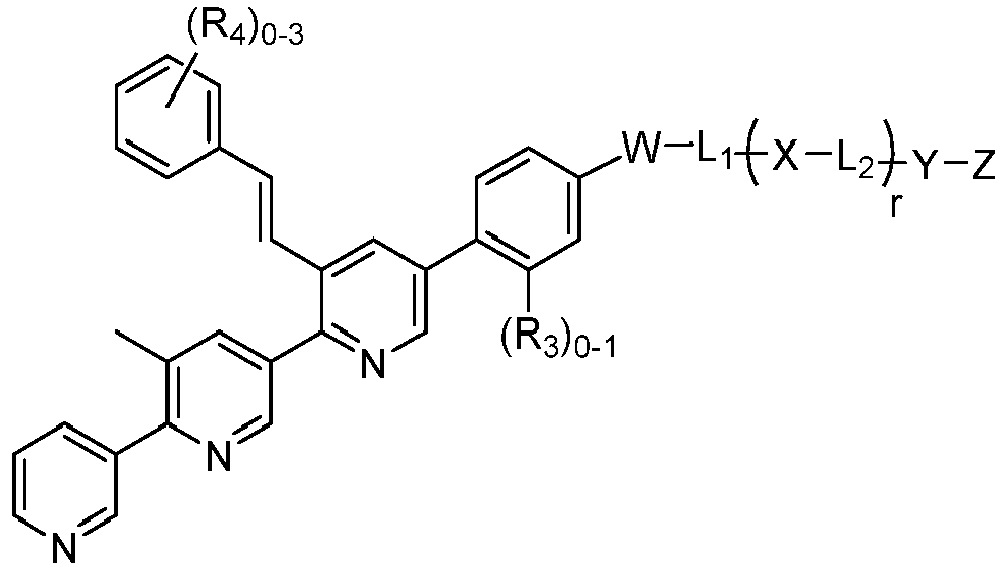
  • The present invention is thus directed, in one aspect, to a compound of following formula (I) :
    Figure imgb0001
  • Wherein:
    • Y1, Y2, Y3 and Y4 are each independently C or N, Y1 and Y2 being such as one is N and the other is C, Y3 and Y4 being such as one is N and the other is C;
    • Ar1, Ar2 are each independently selected from (C6-C10)aryl, (5 to 7 membered) heteroaryl, -O-(C6-C10)aryl, -O-(5 to 7 membered)heteroaryl, -S-(C6-C10)aryl, -S-(5 to 7 membered)heteroaryl, -(C1-C6)alkyl-(C6-C10)aryl, -(C1-C6)alkyl-(5 to 7 membered) heteroaryl and halogens, in particular Cl, said aryl and heteroaryl groups being optionally substituted by one to three R3 groups,
    • i and j are independently 0 or 1,
      and
    • R1, R2, are at each occurrence, independently selected from (C1-C6)alkyl, (C6-C10)aryl, -(C1-C6)alkyl-(C6-C10)aryl, -(C2-C6)alkenyl-(C6-C10)aryl, -carbonyl-(C6-C10)aryl-, -carbonyl-(C1-C6)alkyl-(C6-C10)aryl, C(=O)H, COOH, OH, said alkyl groups being optionally substituted by OH, said aryl groups being optionally substituted by one to three R4 groups;
    • k and 1 are independently 0 or 1;
    • at least one of (R1)k and (R2)l being such as:
      • R1 is selected from (C6-C10)aryl, -(C1-C6)alkyl-(C6-C10)aryl, -(C2-C6)alkenyl-(C6-C10)aryl, -carbonyl-(C6-C10)aryl-, -carbonyl-(C1-C6)alkyl-(C6-C10)aryl, and k is 1; or
      • R2 is selected from (C6-C10)aryl, -(C1-C6)alkyl-(C6-C10)aryl, -(C2-C6)alkenyl-(C6-C10)aryl, -carbonyl-(C6-C10)aryl-, -carbonyl-(C1-C6)alkyl-(C6-C10)aryl, and l is 1;
    • R3 is, at each occurrence, independently selected from (C1-C6)alkyl, (C1-C6)alkoxy, OH, C(=O)H, (CH2)mCONRaRb, C(=O)Rc, (CH2)nCO2H, (CH2)nCO2Rc, (CH2)pCN, (CH2)qC(=N(OH))NH2, -SO2NRaRb, I, Cl, Br, F, (C6-C10)aryl, a (5 to 7 membered)heteroaryl, -(C1-C6)alkyl-(C6-C10)aryl, -(C2-C6)alkenyl-(C6-C10)aryl, said alkyl groups being optionally substituted by a OH, (C1-C6)alkoxy and/or -O-(C6-C10)aryl group;
    • R4 is, at each occurrence, independently selected from (C1-C6)alkyl, (CH2)nCO2H, (CH2)nCO2Rc, I, Cl, Br, F, or there are two R4 groups that form with the aryl to which they are bound a naphthyl;
    • Ra and Rb are independently chosen from H and (C1-C6)alkyl;
    • Rc is chosen from H and (C1-C6)alkyl;
    • m is 0,1,2,3 ;
    • n is 0,1,2,3 ;
    • p is 0,1,2,3 ;
    • q is 0,1,2,3 ;
    • r is 0 or 1;
    • W and Y are each independently selected from a single bond, -NH-,-NR5-, -O-, -S-, -C(=O)NH-, -NHC(=O)-, -C(=O)O-, -OC(=O)-;
    • R5 is, at each occurrence, independently selected from (C1-C6)alkyl,
    • L1 and L2 are each independently selected from (C1-C18)alkyl, (C2-C18)alkenyl, and (C2-C18)alkynyl groups, said groups being optionally interrupted by one or more groups selected from -O-, -S-, -NR6-;
    • R6 is, at each occurrence, independently selected from H and (C1-C6)alkyl,
    • X is selected from (5 to 7 membered) heteroaryl, in particular a triazole, -NH-,-NR7- , -O-, -S-, -C(=O)NH-, -NHC(=O)-, -C(=O)O-, -OC(=O)-;
    • R7 is selected from (C1-C6)alkyl,
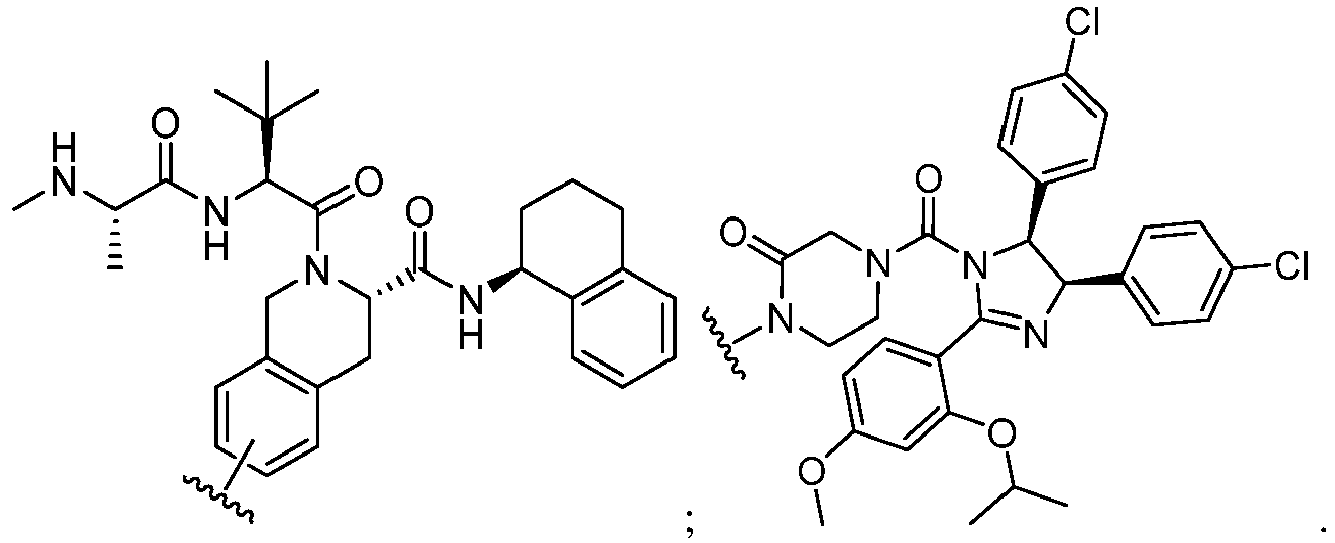
    • Z is a E3 ubiquitin ligase ligand;
    • and the pharmaceutically acceptable salts thereof.
  • According to an embodiment, Y1 and Y3 are N, and Y2 and Y4 are C.
  • According to an embodiment, Y1 and Y3 are C, and Y2 and Y4 are N.
  • According to an embodiment, Y1 and Y4 are N, and Y2 and Y34 are C.
  • According to an embodiment, when j is 0, then Y4 is N.
  • According to an embodiment, the compound of formula (I) as defined above is of following formula (II):
    Figure imgb0002
  • According to an embodiment, the compound as defined above is of following formula (IIIa) or (IIIb):
    Figure imgb0003
    Figure imgb0004
    said compound being in particular of following formula (IIIa1) or (IIIa2), (IIIb1) or (IIIb2):
    Figure imgb0005
    Figure imgb0006
    Figure imgb0007
    Figure imgb0008
  • In a particular aspect, there are included compounds as defined above wherein at least one of An, Ar2 is a (5 to 7 membered) heteroaryl, -O-(C6-C10)aryl, -O-(5 to 7 membered)heteroaryl, -S-(C6-C10)aryl, -S-(5 to 7 membered)heteroaryl, -(C1-C6)alkyl-(C6-C10)aryl, or -(C1-C6)alkyl-(5 to 7 membered) heteroaryl, in particular a 5 to 7 membered heteroaryl containing a nitrogen atom, preferably pyridyl, notably 3-pyridyl.
  • In a particular aspect, there are included compounds as defined above wherein at least one of Ar1, Ar2 is a (C6-C10)aryl, in particular a phenyl.
  • According to an embodiment, Ar1 and/or Ar2 are selected from phenyl, pyridyl, pyrimidyl, imidazolyl, pyrazolyl, thiophenyl, triazolyl, in particular from phenyl, 3-pyridyl, 5-pyrimidyl, 2-imidazolyl, 3-pyrazolyl, 2-thiophenyl, 5-triazolyl.
  • According to an embodiment, Ar1 is 3-pyridyl or phenyl.
  • According to an embodiment, Ar2 is 3-pyridyl or phenyl.
  • According to an embodiment, R1 and R2 are independently selected from C1-C6 alkyl, in particular methyl, (C6-C10)aryl, in particular phenyl or naphthyl, -(C1-C6)alkyl-(C6-C10)aryl, in particular -(C1-C6)alkyl-phenyl, more particularly phenetyl, and -(C1-C6)alkyl-naphthyl, more particularly ethyl-naphthyl, and -(C2-C6)alkenyl-(C6-C10)aryl, in particular -(C2-C6)alkenyl-phenyl, more particularly styryl, and -(C2-C6)alkenyl-naphthyl, more particularly -vinyl-naphthyl.
  • According to a particular embodiment, R1 is selected from C1-C6 alkyl and R2 is selected from (C6-C10)aryl, -(C1-C6)alkyl-(C6-C10)aryl, and -(C2-C6)alkenyl-(C6-C10)aryl.
  • According to another particular embodiment, R2 is selected from C1-C6 alkyl and R1 is selected from (C6-C10)aryl, -(C1-C6)alkyl-(C6-C10)aryl, and -(C2-C6)alkenyl-(C6-C10)aryl.
  • According to an embodiment, R1 and R2 are independently selected from C1-C6 alkyl and (C6-C10)aryl(C2-C6)alkenyl, preferably from methyl, styryl and 2-(naphthalen-2-yl)vinyl.
  • According to a particular embodiment, R1 is selected from C1-C6 alkyl, in particular methyl and R2 is selected from -(C1-C6)alkyl-(C6-C10)aryl, in particular styryl or 2-(naphthalen-2-yl)vinyl.
  • According to another particular embodiment, R2 is selected from C1-C6 alkyl and R1 is selected from (C6-C10)aryl, -(C1-C6)alkyl-(C6-C10)aryl, and -(C2-C6)alkenyl-(C6-C10)aryl.
  • According to an embodiment, R1 is 5-methyl.
  • According to an embodiment, R2 is 5-styryl or 2-(naphthalen-2-yl)vinyl.
  • According to another embodiment, R2 is 5-methyl.
  • According to another embodiment, R1 is 5-styryl or 2-(naphthalen-2-yl)vinyl.
  • In other aspects, there are included compounds of formula (I) wherein the pharmaceutically acceptable salts are hydrochloride, hydrobromide, hydroiodide, sulfate, nitrate, phosphate, acetate, citrate, propionate, fumarate, maleate, tartrate, glutamate, salicylate, oxalate, methanesulfonate, para-toluenesulfonate, succinate, or benzoate salts.
  • In other aspects, there are included compounds of formula (I) wherein the pharmaceutically acceptable salts are calcium, magnesium, lithium, potassium or sodium salts.
  • It is recognized that compounds of the present invention may exist in various stereoisomeric forms. As such, the compounds of the present invention include diastereomers, enantiomers and atropisomers. The compounds are normally prepared as racemates and can conveniently be used as such, but individual enantiomers can be isolated or synthesized by conventional techniques if so desired. Such racemates and individual enantiomers and mixtures thereof form part of the present invention.
  • It is well known in the art how to prepare and isolate such optically active forms. Specific stereoisomers can be prepared by stereospecific synthesis using enantiomerically pure or enantiomerically enriched starting materials. The specific stereoisomers of either starting materials or products can be resolved and recovered by techniques known in the art, such as resolution of racemic forms, normal, reverse-phase, and chiral chromatography, recrystallization, enzymatic resolution, or fractional recrystallization of addition salts formed by reagents used for that purpose. Useful methods of resolving and recovering specific stereoisomers described in Eliel, E. L.; Wilen, S.H. Stereochemistry of Organic Compounds; Wiley: New York, 1994, and Jacques, J, et al. Enantiomers, Racemates, and Resolutions; Wiley: New York, 1981, each incorporated by reference herein in their entireties.
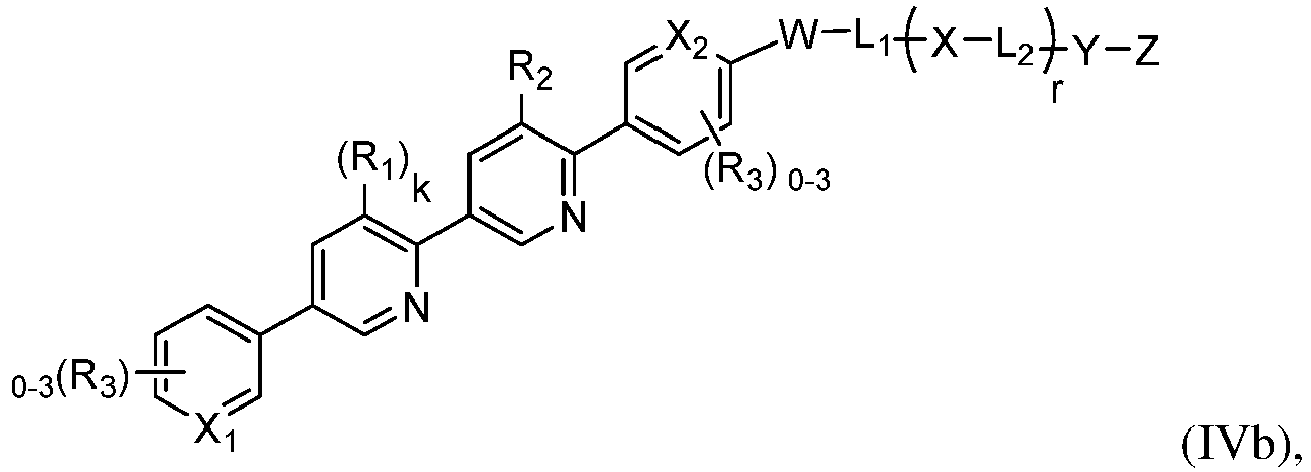
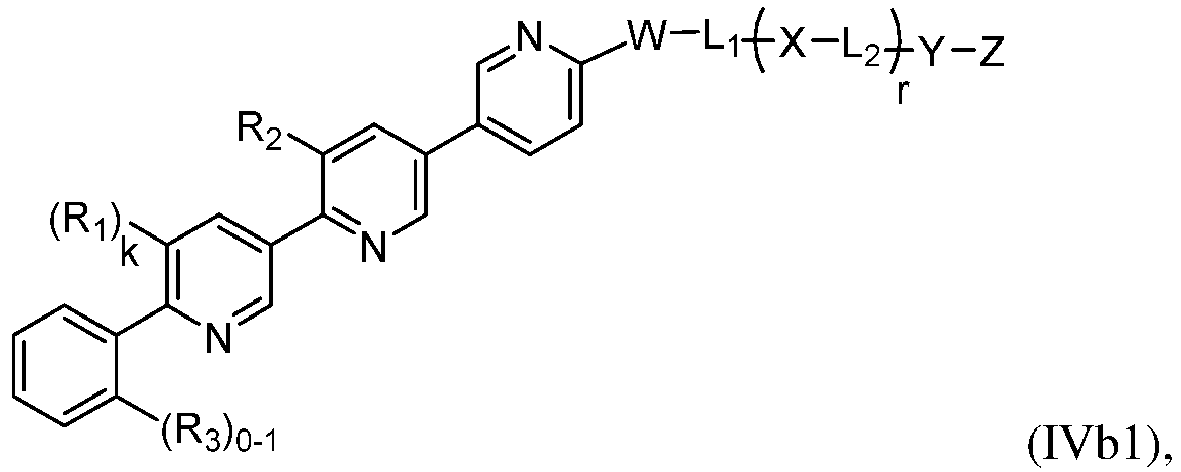
  • According to an embodiment, the compound as defined above is of following formula (IVa) or (IVb):
    Figure imgb0009
    Figure imgb0010
    in particular of following formula (IVa1), (IVa2), (IVb1) or (IVb2):
    Figure imgb0011
    Figure imgb0012
    Figure imgb0013
    Figure imgb0014
    wherein :
    • X1, X2, are at each occurrence, independently selected from C or N;
    • R1, R2, R3 are independently, at each occurrence, as defined above.
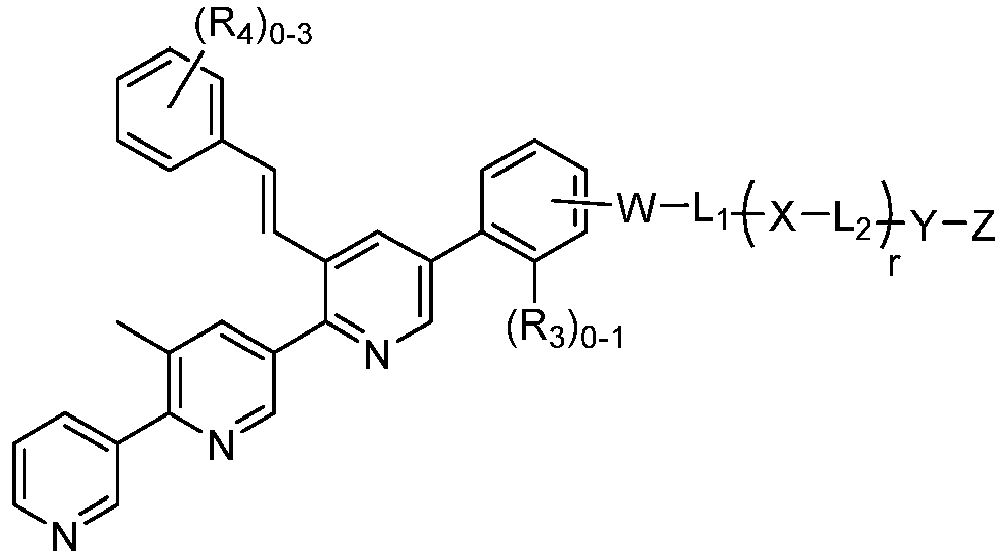
  • According to an embodiment, the compound as defined above is of one of the following formulae:
    Figure imgb0015
    Figure imgb0016
    Figure imgb0017
    Figure imgb0018
    Figure imgb0019
    Figure imgb0020
    Figure imgb0021
    Figure imgb0022
    Figure imgb0023
    Figure imgb0024
    Figure imgb0025
    Figure imgb0026
    Figure imgb0027
    Figure imgb0028
    Figure imgb0029
    or a stereoisomeric form, a mixture of stereoisomeric forms and a pharmaceutically acceptable salt form thereof, in particular a sodium or fumarate salt,
    wherein :
    R3 and R4 are independently, at each occurrence, as defined above.
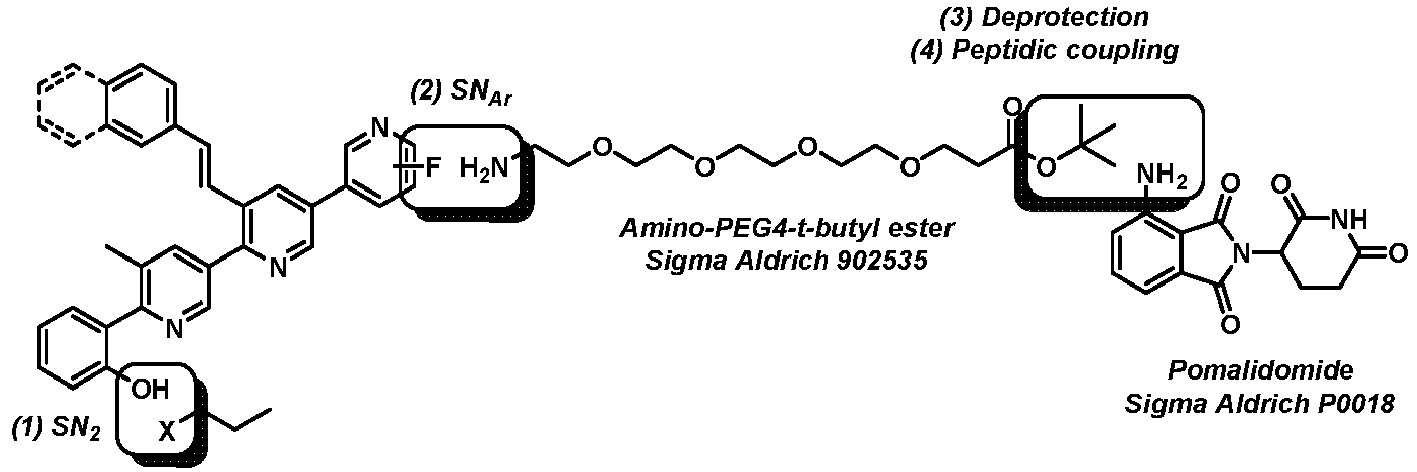
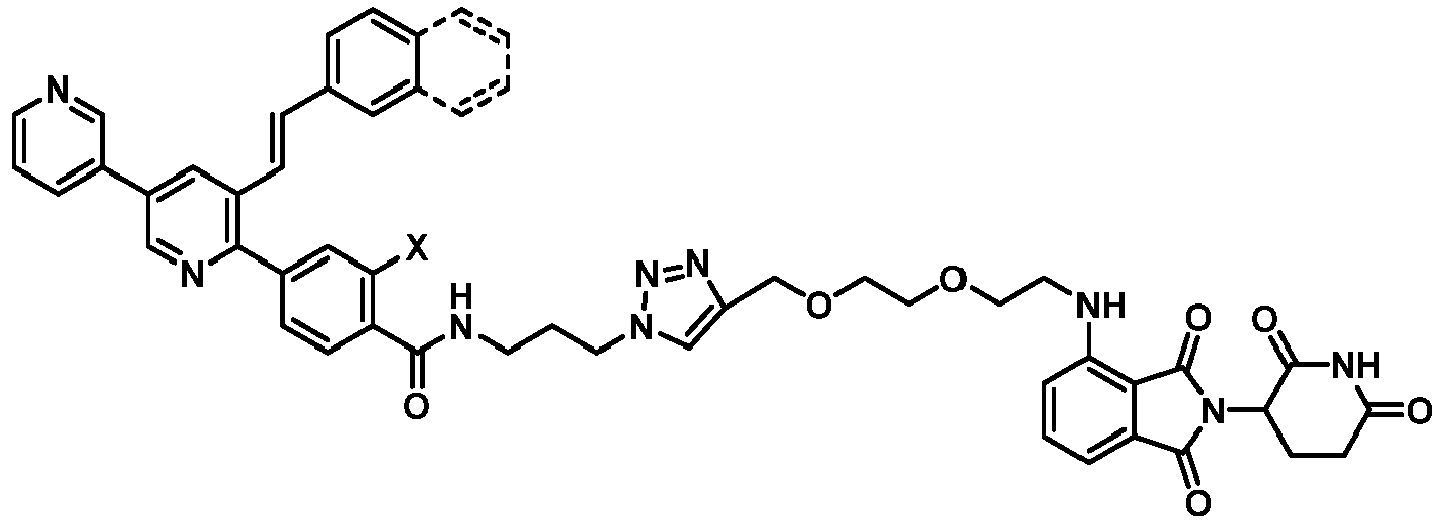
  • According to an embodiment, W is -NH-, L1 is (C1-C18)alkyl, r is 1, X is a (5 to 7 membered) heteroaryl, in particular a triazole, L2 is a (C1-C18)alkyl interrupted by one or more -O- atoms, in particular of formula -CH2-(O-CH2-CH2)1-6- and Y is a single bond,-NH- or -C(=O)NH-.
  • According to another embodiment, W is -NH-, L1 is a (C1-C18)alkyl interrupted by one or more -O- atoms, in particular of formula -CH2-CH2-(O-CH2-CH2)1-6-, r is 0 and Y is a single bond or -C(=O)NH-.
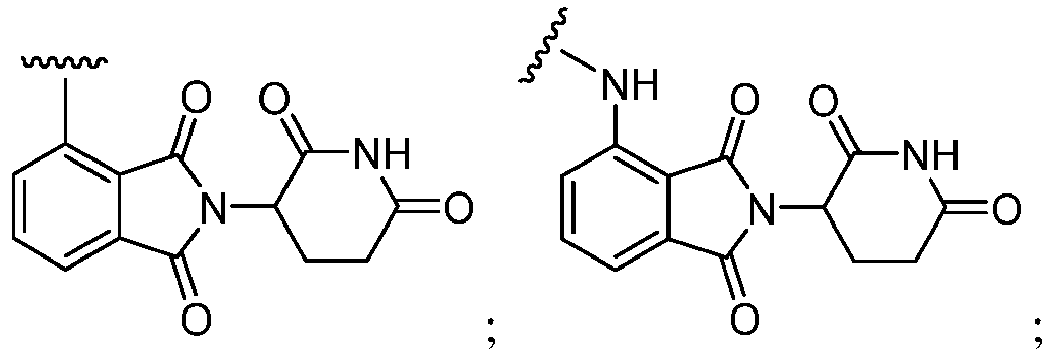
  • According to an embodiment, Z is a VHL (von Hippel-Lindau), CRBN (cereblon), cIAP (Cellular Inhibitor of Apoptosis) or MDM2 (Mouse Double Minute 2) E3 ubiquitin ligase ligand, Z being in particular a VHL E3 ubiquitin ligase ligand.
  • According to a particular embodiment, Z is selected from:
    Figure imgb0030
    Figure imgb0031
    Figure imgb0032
    Figure imgb0033
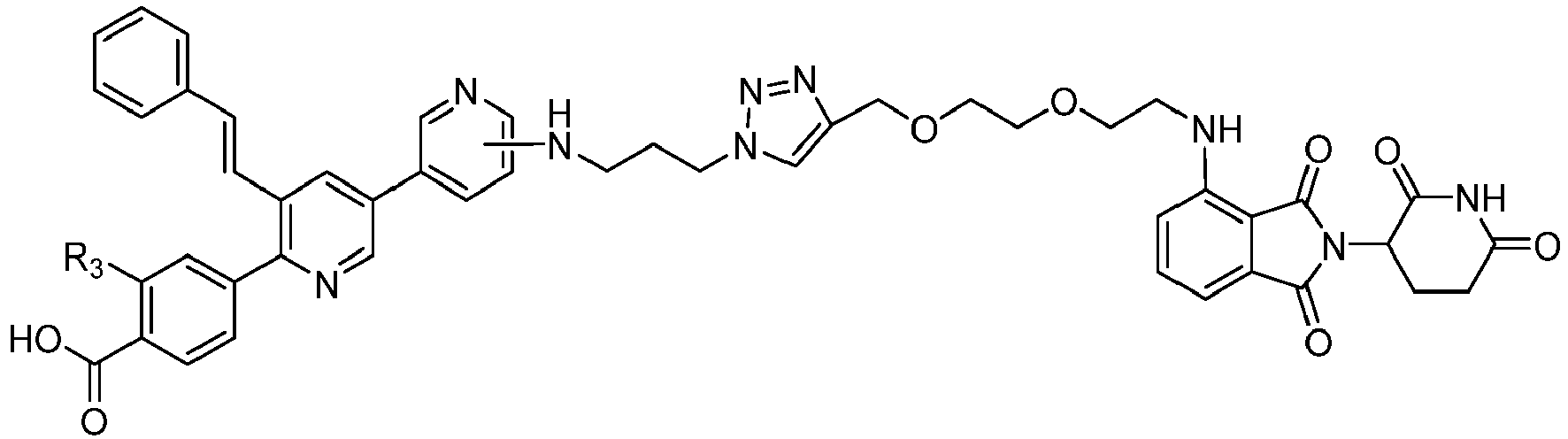
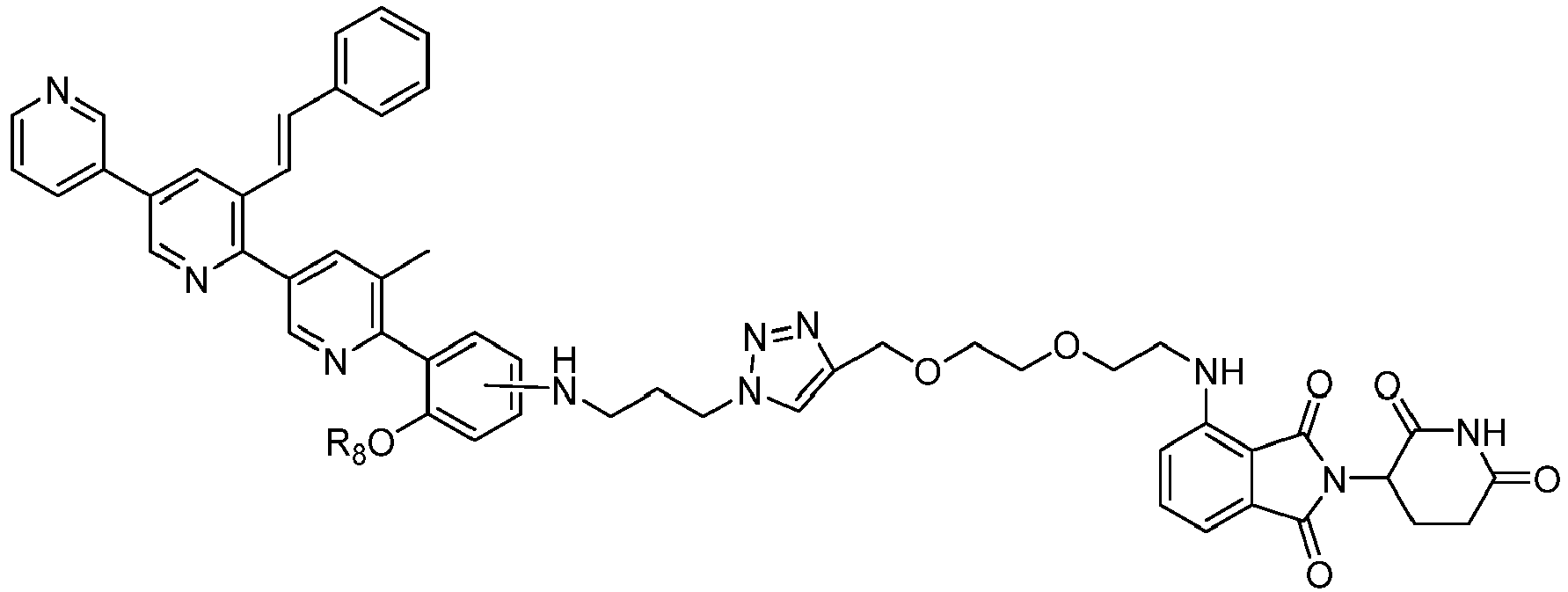
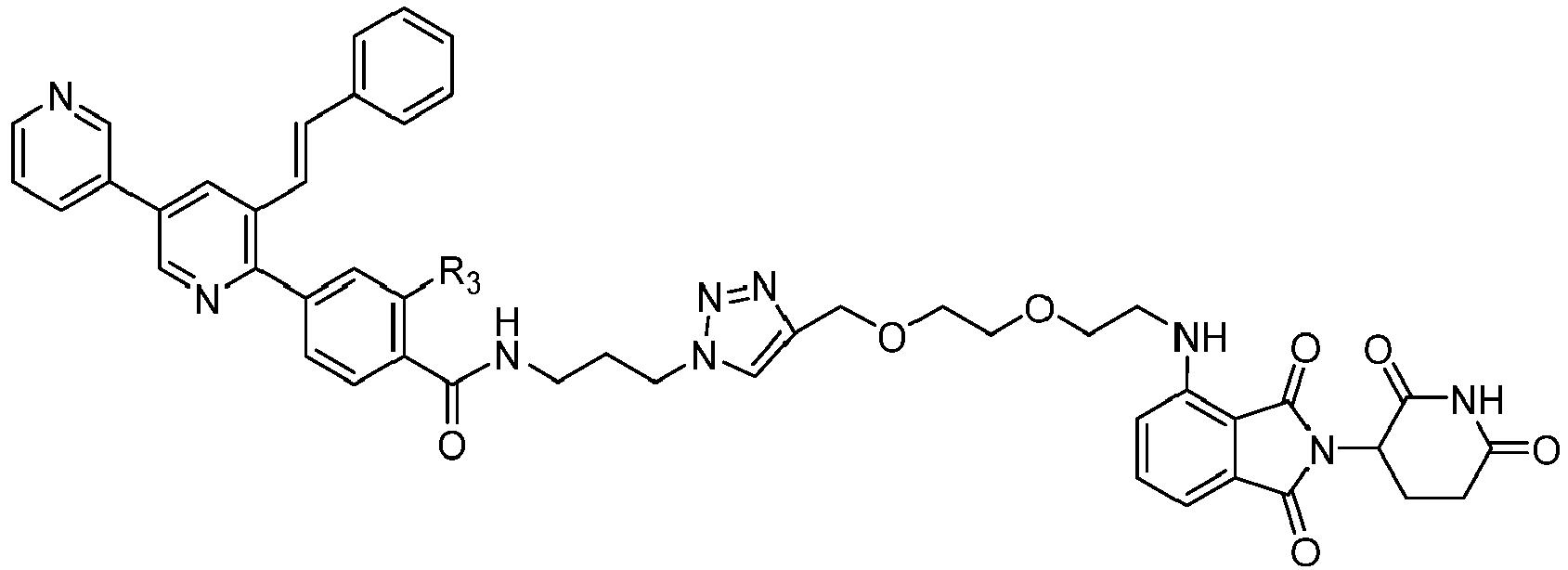
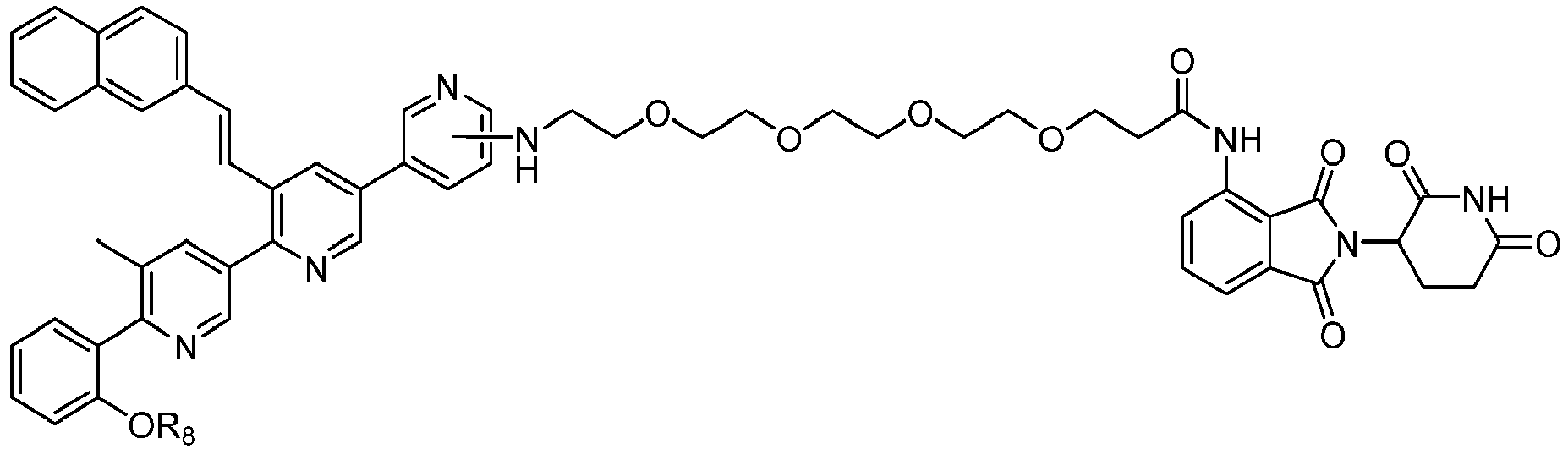
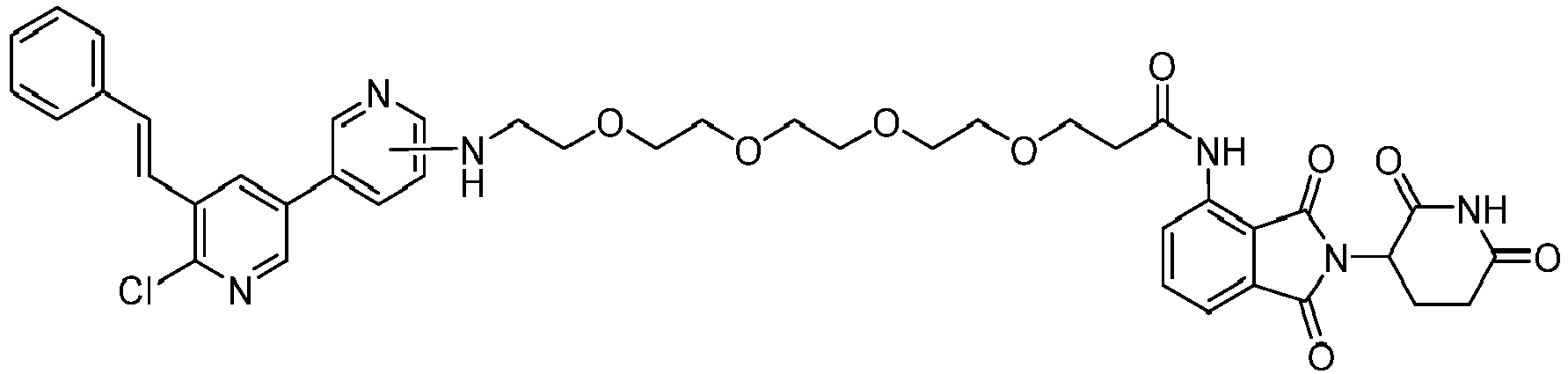
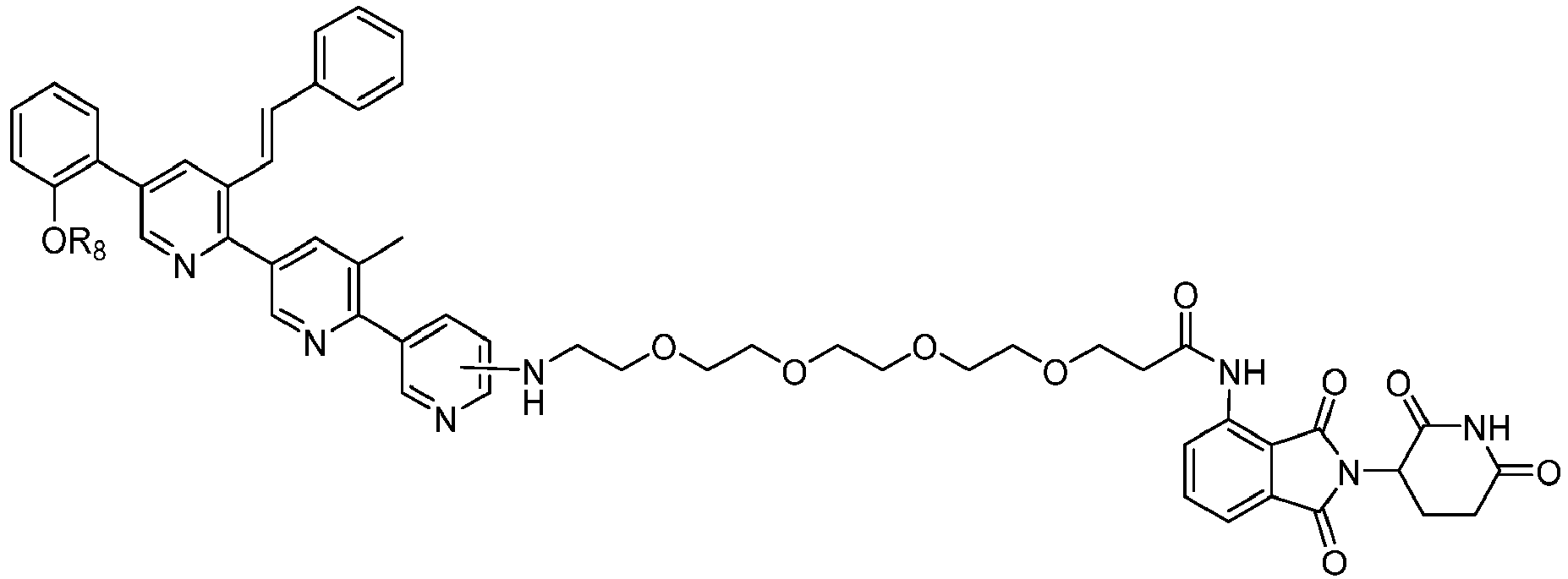
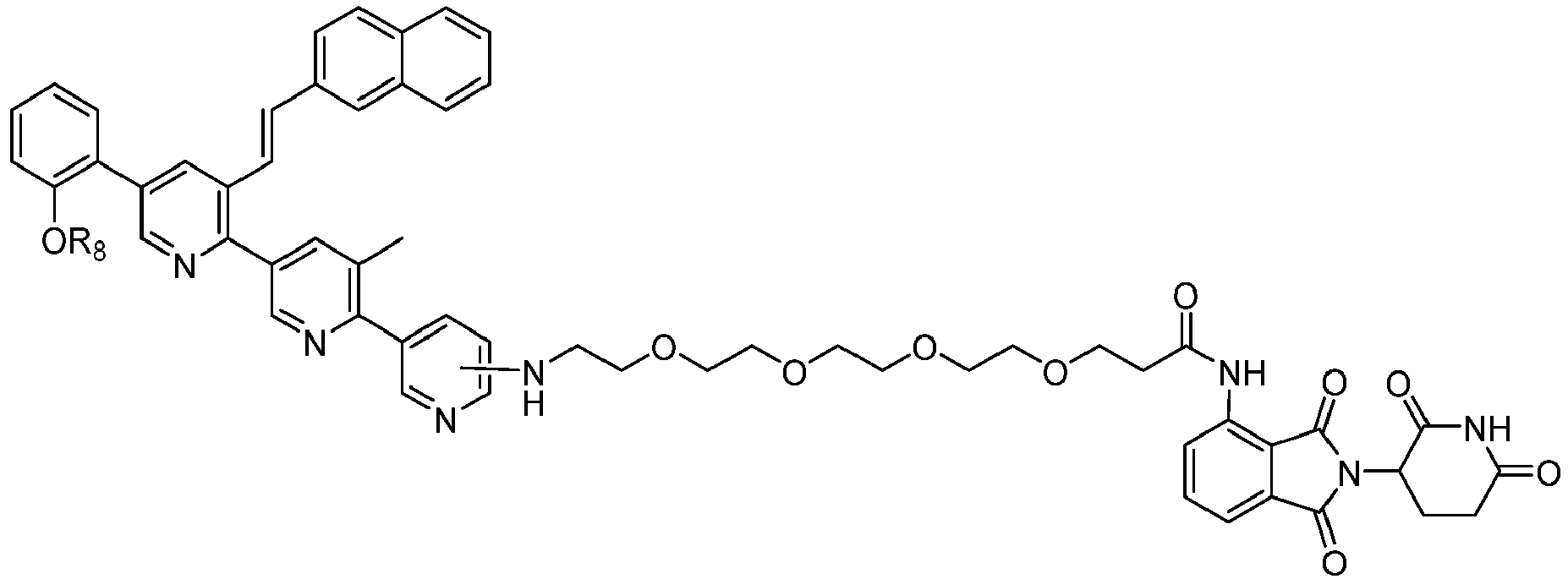
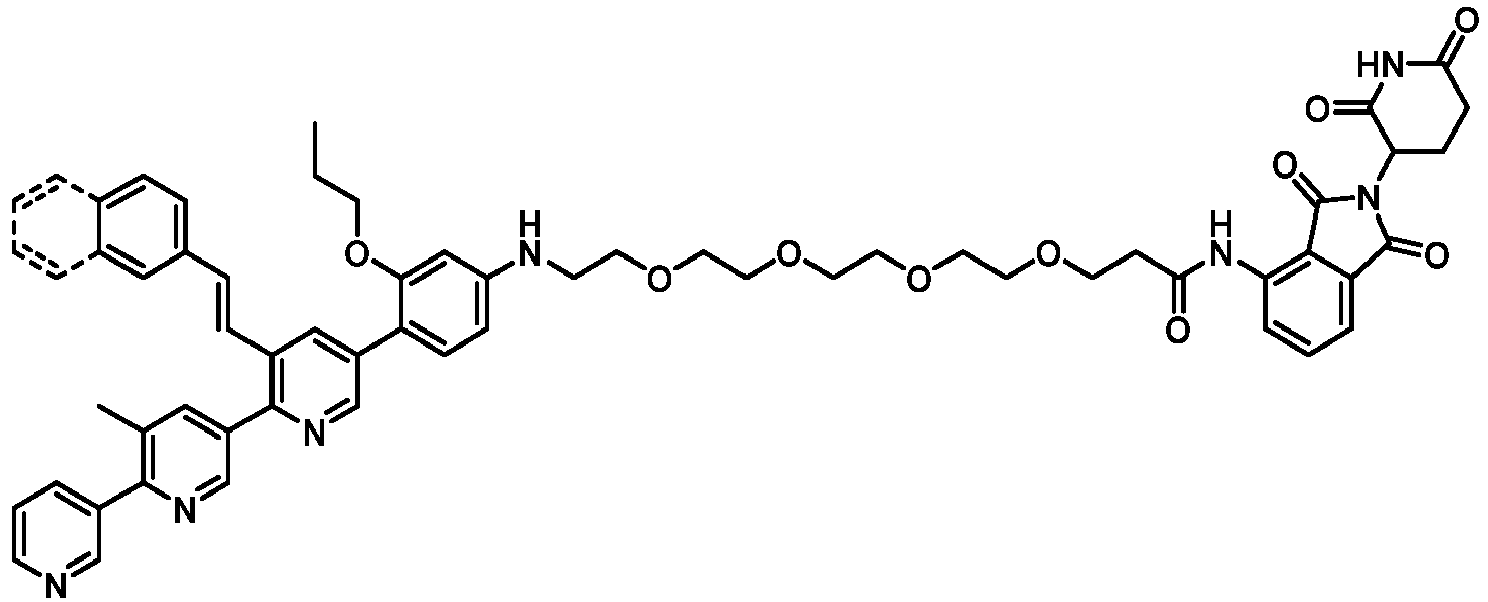
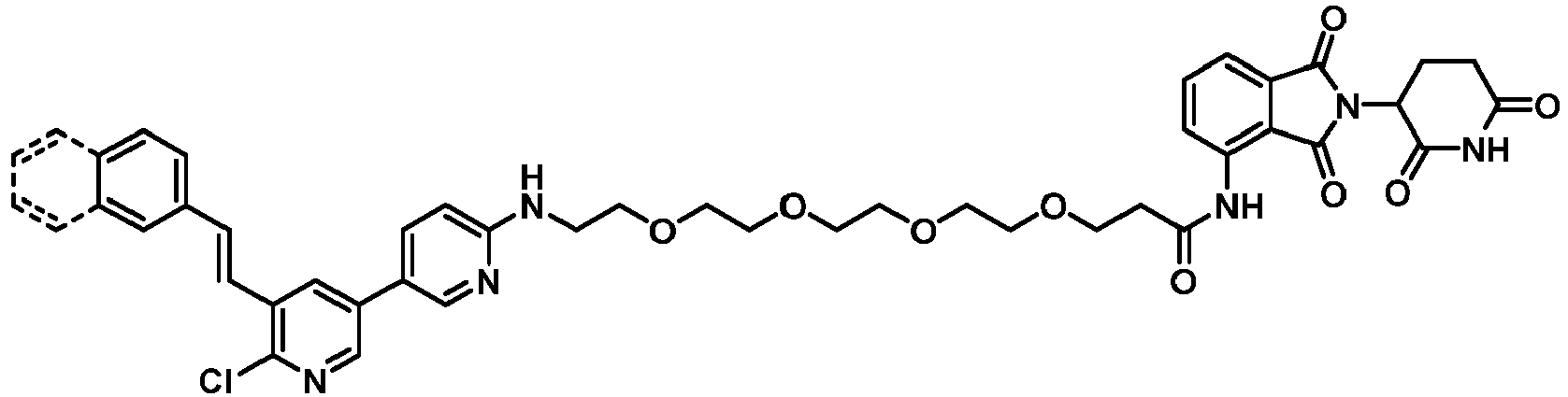
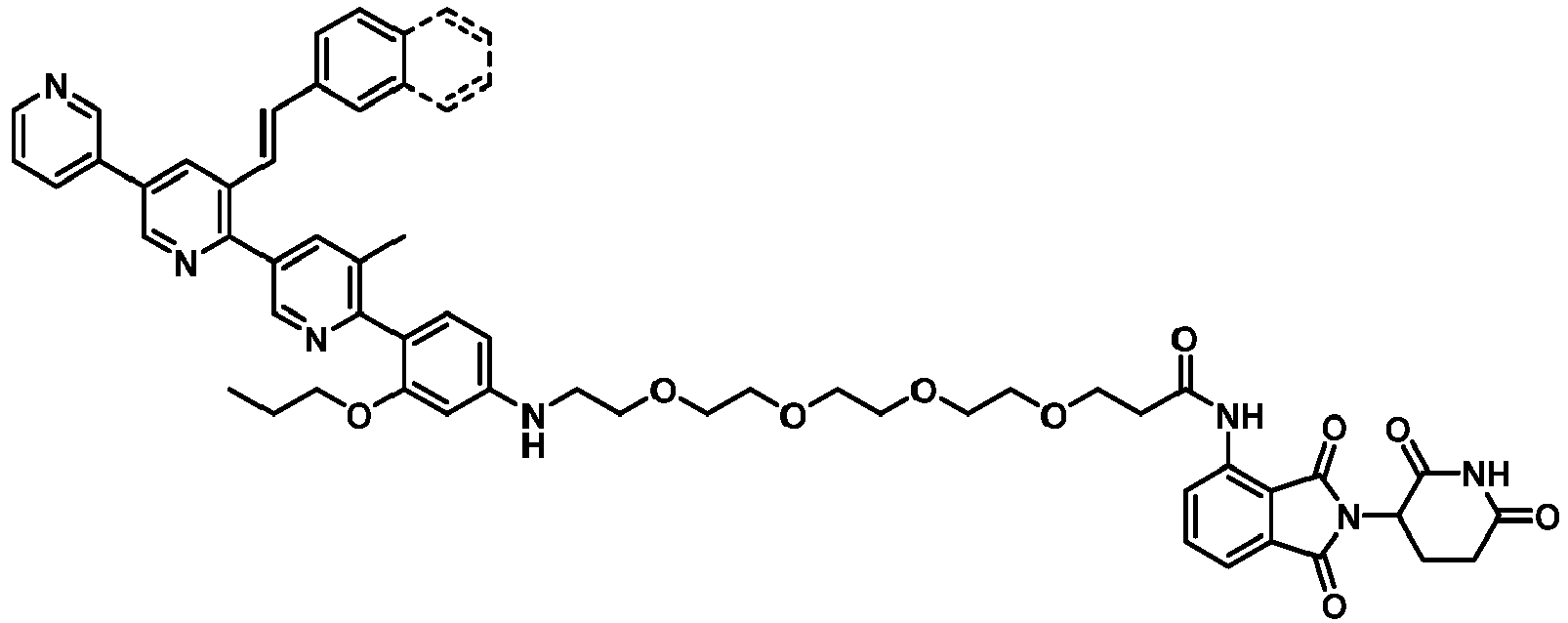
  • In still other aspects, there are included compounds of formula (I) which are selected from:
    Figure imgb0034
    Figure imgb0035
    Figure imgb0036
    Figure imgb0037
    Figure imgb0038
    Figure imgb0039
    Figure imgb0040
    Figure imgb0041
    Figure imgb0042
    Figure imgb0043
    Figure imgb0044
    Figure imgb0045
    Figure imgb0046
    Figure imgb0047
    Figure imgb0048
    Figure imgb0049
    Figure imgb0050
    Figure imgb0051
    Figure imgb0052
    Figure imgb0053
    Figure imgb0054
    Figure imgb0055
    Figure imgb0056
    Figure imgb0057
    Figure imgb0058
    Figure imgb0059
    Figure imgb0060
    Figure imgb0061
    Figure imgb0062
    Figure imgb0063
    Figure imgb0064
    Figure imgb0065
    Figure imgb0066
    Figure imgb0067
    Figure imgb0068
    Figure imgb0069
    Figure imgb0070
    Figure imgb0071
    Figure imgb0072
    Figure imgb0073
    Figure imgb0074
    Figure imgb0075
    Figure imgb0076
    Figure imgb0077
    Figure imgb0078
    Figure imgb0079
    Figure imgb0080
    Figure imgb0081
    Figure imgb0082
    Figure imgb0083
    Figure imgb0084
    Figure imgb0085
    Figure imgb0086
    Figure imgb0087
    Figure imgb0088
    Figure imgb0089
    Figure imgb0090
    Figure imgb0091
    Figure imgb0092
    Figure imgb0093
  • Wherein :
    • R3 is H or as defined above, in particular Cl;
    • R8 is (C1-C6)alkyl, in particular propyl.
    Method of preparation of compounds of formula (I)
  • The compounds of the present invention may be prepared in a number of methods well known to those skilled in the art, including, but not limited to those described below, or through modifications of these methods by applying standard techniques known to those skilled in the art of organic synthesis. The reagents and starting materials are commercially available, or readily synthesized by well-known techniques by one of ordinary skill in the arts. All substituents, unless otherwise indicated, are as previously defined. All processes disclosed in association with the present invention are contemplated to be practiced on any scale, including milligram, gram, multigram, or commercial industrial scale.
  • As will be readily understood, functional groups present on the compounds of Formula I may contain protecting groups. Protecting groups are known per se as chemical functional groups that can be selectively appended to and removed from functionalities, such as hydroxyl groups and carboxyl groups. These groups are present in a chemical compound to render such functionality inert to chemical reaction conditions to which the compound is exposed. Any of a variety of protecting groups may be employed with the present invention. Other preferred protecting groups according to the invention may be found in Greene, T.W. and Wuts, P.G.M., "Protective Groups in Organic Synthesis" 2d. Ed., Wiley & Sons, 1991, or in P.J. Kocienski, "Protecting Groups", 3rd. Ed., Thieme, Stuttgart, NY, 2004.
  • The compound thus prepared may be recovered from the reaction mixture by conventional means. For example, the compounds may be distilled off from the solvent mixture after the extraction or, if necessary after distilling off from the solvent mixture, pouring the residue into water followed by extraction with a water-immiscible organic solvent and distilling off from the solvent mixture. Additionally, the product can, if desired, be further purified by various well known techniques, such as recrystallization, precipitation or the various chromatography techniques, notably column chromatography or preparative thin layer chromatography, in particular High Performance Liquid Chromatography (HPLC).
  • In another object, the present invention relates to a method for preparing a compound of formula (I) as defined herein, wherein r is 1, comprising the steps of:
    Figure imgb0094
    • wherein Xa and Xb are chemical groups that form after chemical reaction the group X as defined above.
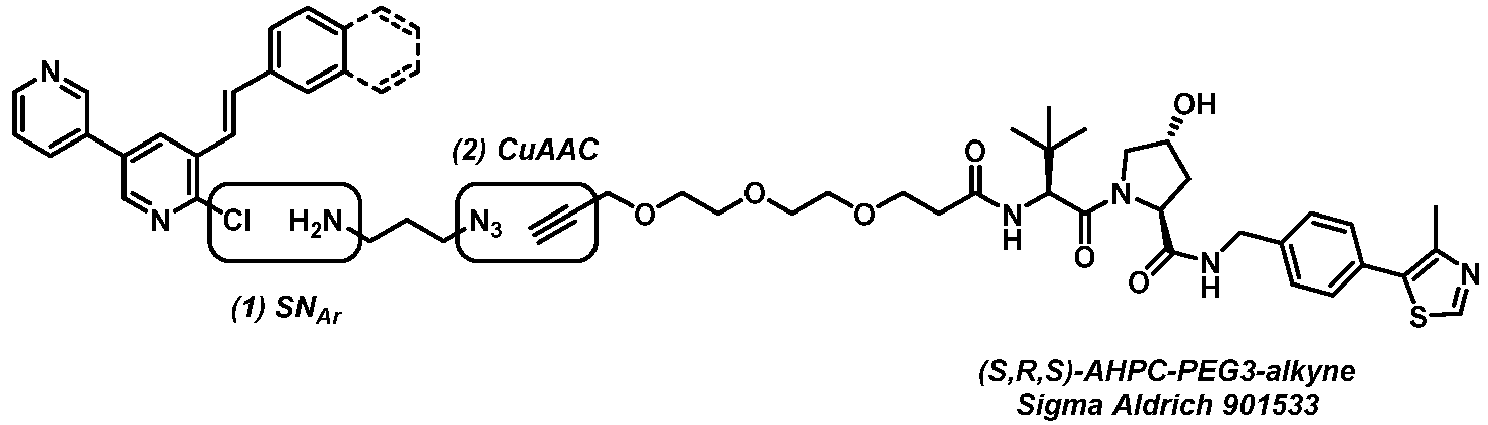
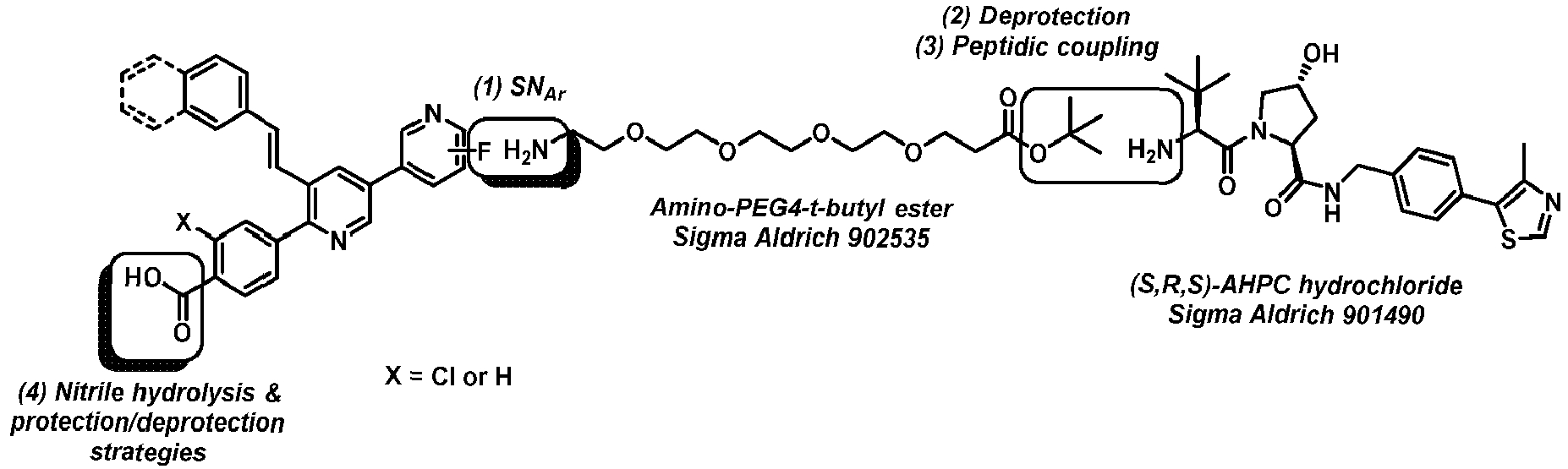
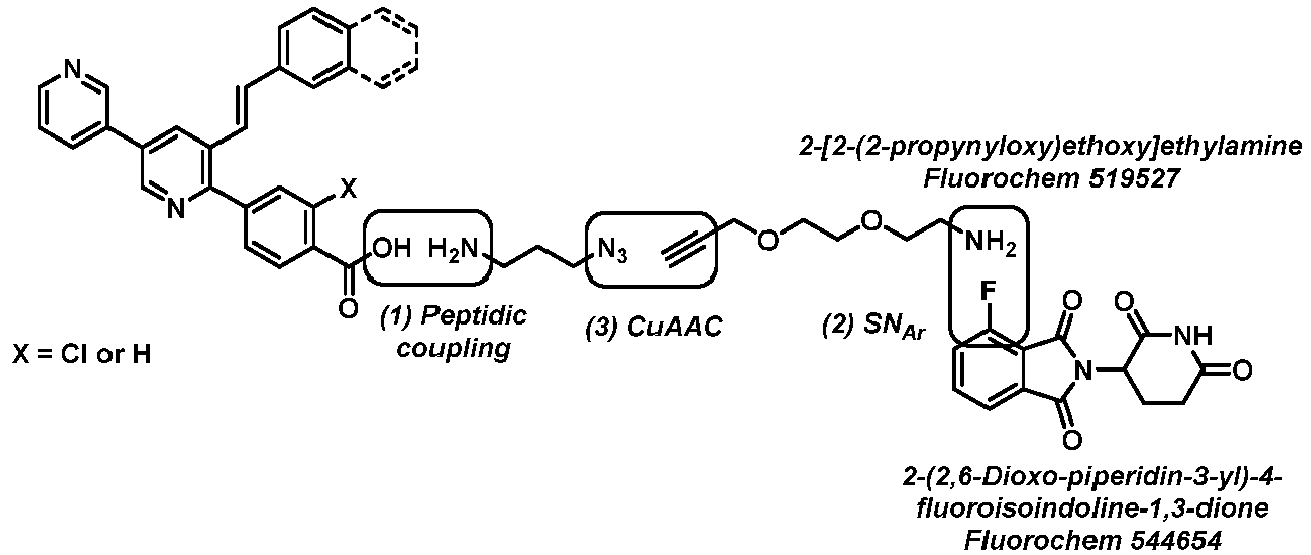
    • Xa and Xb are well known from the skilled person in the art and are for example -N3 and -≡ (alkynyl) respectively, forming a triazole by copper(I)-catalyzed azide-alkyne Huisgen cycloaddition.
  • Compound (B) is commercially available, as described below, or may be obtained as follows:

             Xb-L2-Ya (B1) + Yb-Z (B2) → Xb-L2-Y-Z (B)

    • wherein Ya and Yb are chemical groups that form after chemical reaction the group Y as defined above.
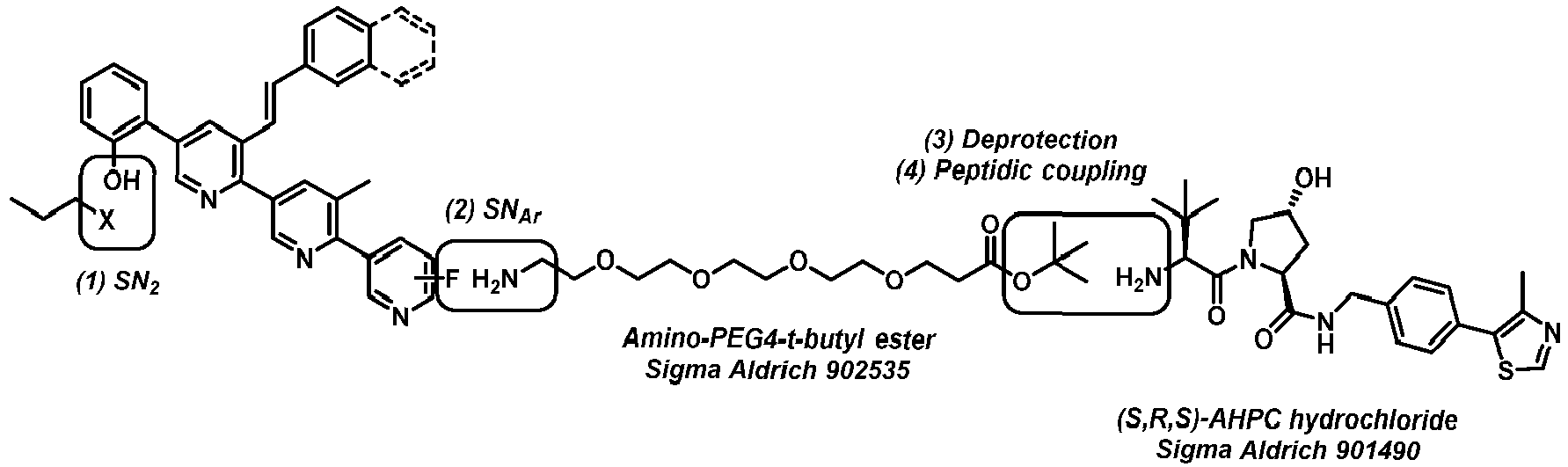
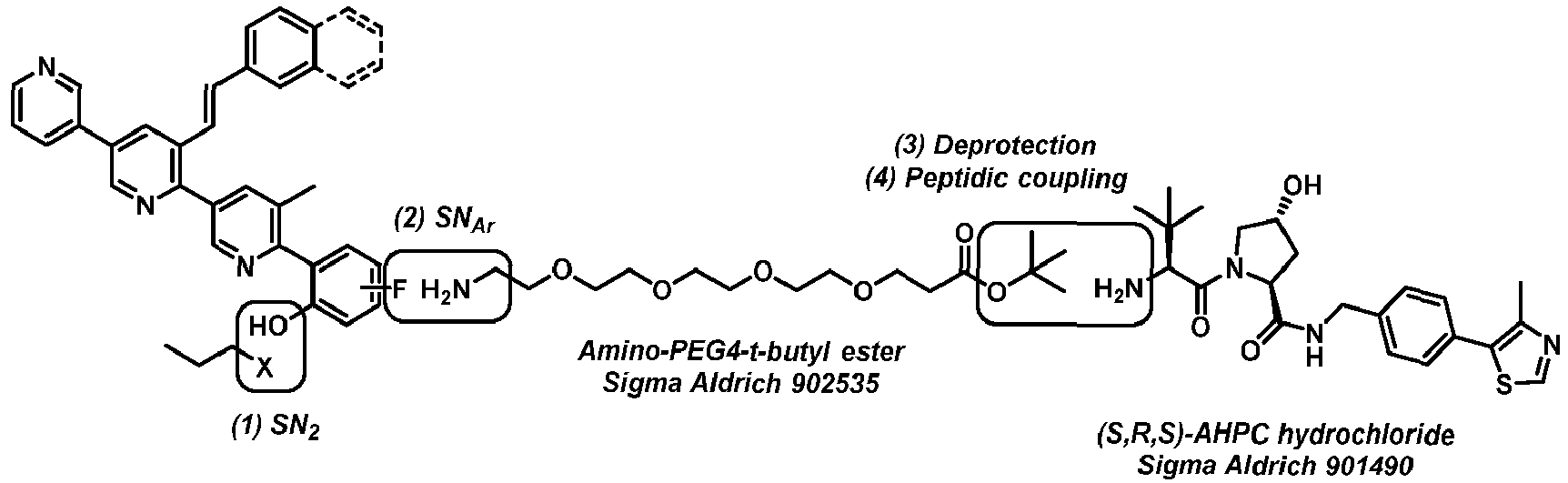
    • Ya and Yb are well known from the skilled person in the art and are for example -COOH or an activated ester and -NH2 respectively, forming -CONH- by peptidic coupling, or -NH2 and -F (-F being in particular bound to an aromatic group), forming -NH- by nucleophilic aromatic substitution.
  • Compounds (B1) and (B2) are commercially available, as described below or obtained by procedures well known from those skilled in the art.
  • In an embodiment, compound (A) is obtained as follows:
    Figure imgb0095
    • wherein Wa and Wb are chemical groups that form after chemical reaction the group W as defined above.
    • Wa and Wb are well known from the skilled person in the art and are for example -F or -Cl and -NH2 respectively, forming -NH- by nucleophilic aromatic substitution, or - COOH or an activated ester and -NH2 respectively, forming -CONH- by peptidic coupling.
    • D is commercially available or obtained by procedures well known from those skilled in the art.
  • In an embodiment, compound (C) is obtained as follows, An being in particular selected from (C6-C10)aryl and (5 to 7 membered) heteroaryl :
    • when j is 1, and i is 0 or 1:
      Figure imgb0096
      wherein Hal2 is an halogen, in particular Br,
      or
    • when j is 1, and i is 1:
      Figure imgb0097
      wherein Hal1 is an halogen, in particular Br,
      or
    • when j=0, and i is 1:
      Figure imgb0098
      • wherein Hal1 is an halogen, in particular Br.
      • When j=0 and i=0, compound (C) is then obtainable by procedures well known from those skilled in the art, in particular those described in WO2015132727 .
      • When Ar1 is Hal, compound (C) may be obtained similarly to compound (G) as described below.
      • When An is selected from -O-(C6-C10)aryl, -O-(5 to 7 membered)heteroaryl, -S-(C6-C10)aryl, -S-(5 to 7 membered)heteroaryl, -(C1-C6)alkyl-(C6-C10)aryl, -(C1-C6)alkyl-(5 to 7 membered) heteroaryl, compound (C) may be obtained as follows:
        • for Ar1 = -O-(C6-C10)aryl, -O-(5 to 7 membered)heteroaryl, -S-(C6-C10)aryl, or-S-(5 to 7 membered)heteroaryl, from compound (G), for example with Hal1=Br, in contact with Ar-SH or Ar-OH compound, by nuclear aromatic substitution;
        • for An = -(C1-C6)alkyl-(C6-C10)aryl, -(C1-C6)alkyl-(5 to 7 membered) heteroaryl, from compound (G), for example with Hal1=Br, in particular by Negishi coupling, in presence of an Ar-alkyl-MgBr compound.
  • In an embodiment, compound (E) is obtained as follows, when i is 1:
    Figure imgb0099
  • Wherein Hal1 and Hal2 are halogens, for example I and Br, respectively.
  • J is obtainable by procedures well known from those skilled in the art, in particular those described in WO2015132727 .
  • When i is 0, (E) is obtainable by procedures well known from those skilled in the art, in particular those described in WO2015132727 .
  • Alternatively, compound (E) may be obtained as follows:
    Figure imgb0100
    wherein Hal5 is an halogen, in particular I, Hal2 being for example Br.
  • In an embodiment, compound (G) is obtained as follows:
    Figure imgb0101
    wherein Hal3 is an halogen, in particular I, Hal1 being for example Br.
  • Alternatively, compound (G) may be obtained as follows:
    Figure imgb0102
    wherein Hal4 is an halogen, in particular I, Hal1 being for example Br.
    • (L) is commercially available or obtained by procedures well known from those skilled in the art.
    • (M) is obtainable by procedures well known from those skilled in the art, in particular those described in WO2015132727 .
    • (N) is obtainable by procedures well known from those skilled in the art, in particular those described in WO2015132727 .
  • In another object, the present invention relates to a method for preparing a compound of formula (I) as defined herein, wherein r is 0, comprising the steps of:
    Figure imgb0103
  • Compound (B2) is as mentioned above.
  • Compound (A') is as defined above as compound (A). Ya and Yb are well known from the skilled person in the art and are for example -COOH or an activated ester and -NH2 respectively, forming -CONH- by peptidic coupling, or -NH2 and -F (-F being in particular bound to an aromatic group), forming -NH- by nucleophilic aromatic substitution.
  • All the substituents, for example the group R3, may be modified before, between, or after the steps described above. For example, the group R3=OH can be modified to R3=O-propyl by SN2 reaction.
  • In another object, the present invention relates to a pharmaceutical composition comprising a compound of formula (I) as defined above, in admixture with at least one pharmaceutically acceptable excipient or carrier.
  • All the embodiments mentioned above for the compounds of formula (I) apply here, alone or in combinations.
  • In an embodiment, the pharmaceutical composition defined above further comprises an additional anti-cancer agent, in particular chosen from anti-EGFR, anti-Map kinases and anti-Akt compounds. Other exemplary additional anticancer agents include carboplatin, paclitaxel, doxorubicin, topotecan, and functional derivatives of the foregoing.
  • As will be apparent to one of ordinary skill in the art, the specific formulations of said pharmaceutical composition can be selected based on the type of cancer being treated. The compositions of the invention can be formulated for administration to a patient with materials that improve their stability and/or provide for a controlled or sustained release in vivo.
  • These pharmaceutical compositions can be prepared in a well known manner in the pharmaceutical art and, can be administered by a variety of routes, depending upon whether local or systemic treatment is desired and upon the area to be treated.
  • Administration may be topical (including skin, ophthalmic and to mucous membranes including intranasal, vaginal and rectal delivery), pulmonary (e.g., by inhalation or insufflation of powders or aerosols, including by nebulizer; intratracheal, intranasal, epidermal and transdermal), ocular, oral or parenteral.
  • In particular, compounds and compositions of the invention are administered by oral administration or by intravenous administration.
  • The compounds and pharmaceutical compositions of this invention may be orally administered in any orally acceptable dosage form including, but not limited to, capsules, tablets, aqueous suspensions or solutions. In the case of tablets for oral use, carriers which are commonly used include lactose and corn starch. Lubricating agents, such as magnesium stearate, are also typically added. For oral administration in a capsule form, useful diluents include lactose and dried corn starch. When aqueous suspensions are required for oral use, the active ingredient is combined with emulsifying and suspending agents. If desired, certain sweetening, flavoring or coloring agents may also be added.
  • Methods for ocular delivery can include topical administration (eye drops), subconjunctival, periocular or intravitreal injection or introduction by balloon catheter or ophthalmic inserts surgically placed in the conjunctival sac. Parenteral administration includes intravenous, intraarterial, subcutaneous, intraperitoneal or intramuscular injection or infusion; or intracranial, e.g., intrathecal or intraventricular administration.
  • The pharmaceutical compositions can be formulated so as to provide controlled, quick, sustained or delayed release of the active ingredient after administration to the patient by employing procedures known in the art.
  • The pharmaceutical compositions can also be formulated by techniques well known from those skilled in the art, for example by nanovectorization, or by using a micronized form.
  • Pharmaceutical compositions usually comprise pharmaceutically acceptable, inorganic or organic carriers, preservatives, solubilizers, stabilizers, wetting agents, emulsifiers, sweeteners, colorants, flavorings, salts for varying the osmotic pressure, buffers, masking agents or antioxidants. They can also contain still other therapeutically valuable substances. These ingredients are selected on the basis of the mode and route of administration. Suitable pharmaceutical ingredients, as well as pharmaceutical necessities for use in pharmaceutical formulations, are described in Remington's Pharmaceutical Sciences (E. W. Martin).
  • Pharmaceutically acceptable carriers that may be used in these pharmaceutical compositions include, but are not limited to, ion exchangers, alumina, aluminum stearate, lecithin, serum proteins, such as human serum albumin, buffer substances such as phosphates, glycine, sorbic acid, potassium sorbate, partial glyceride mixtures of saturated vegetable fatty acids, water, salts or electrolytes, such as prolamine sulfate, disodium hydrogen phosphate, potassium hydrogen phosphate, sodium chloride, zinc salts, colloidal silica, magnesium trisilicate, polyvinyl pyrrolidone, cellulose-based substances, polyethylene glycol, sodium carboxymethylcellulose, polyacrylates, waxes, polyethylene-polyoxypropylene block polymers, polyethylene glycol and wool fat.The therapeutic dosage of the compounds of the present invention can vary according to, for example, the particular use for which the treatment is made, the manner of administration of the compound, the health and condition of the patient, and the judgment of the attending clinician. The proportion or concentration of a compound of the invention in a pharmaceutical composition can vary depending upon a number of factors including dosage, chemical characteristics (e.g., hydrophobicity), and the route of administration.
  • In a further object, the present invention thus relates to a compound of formula (I) as defined above for use in the treatment of cancer, notably of hematologic malignancies, such as lymphoma, leukemia, multiple myeloma, and/or of solid tumors such as ovarian cancers, mesothelioma, melanoma, pancrea, lung, breast, kidney and liver cancers.
  • All the embodiments mentioned above for the compounds of formula (I) apply here, alone or in combinations.
  • Cancers amenable to the therapeutic methods of the invention can be cancers that are responsive to the modulation of at least one of the proteins chosen from Bcl-2, Mcl-1, Bcl-xL, Bcl-w, Bfl-1 and Bcl-B, in particular of Bcl-2 protein, or Bcl-xL and/or Mcl-1 proteins; any form of cancer which is associated with misregulation of at least one of the proteins chosen from Bcl-2, Mcl-1, Bcl-xL, Bcl-w, Bfl-1 and Bcl-B, in particular of Bcl-2 protein, or Bcl-xL and/or Mcl-1 proteins (e.g., overexpression or altered binding or activity) is thus within the scope of the invention.
  • Cancers or neoplastic disorders include, for example, without limitation, breast cancer, hematological cancers such as myeloma, leukemia and lymphoma (e.g., Burkitt lymphoma, non-Hodgkin lymphoma, Hodgkin lymphoma, and acute T cell leukemia), neurological tumors such as brain tumors, e.g., gliomas, including astrocytomas or glioblastomas, melanomas, lung cancer, head and neck cancer, thyroid cancer, gastrointestinal tumors such as stomach, colon or rectal cancer, liver cancer, pancreatic cancer, genitourinary tumors such ovarian cancer, vaginal cancer, vulval cancer, endometrial cancer, bladder cancer, kidney cancer, testicular cancer, prostate cancer, or penile cancer, bone tumors, vascular tumors, and skin cancers such as basal cell carcinoma, squamous cell carcinoma and melanoma.
  • In another aspect, there are included compounds of formula (I), for use as a ligand of at least one of the proteins chosen from Bcl-2, Mcl-1, Bcl-xL, Bcl-w, Bfl-1 and Bcl-B, in particular of Bcl-2 protein, or Bcl-xL and/or Mcl-1 proteins, more particularly of Bcl-2 protein, or Bcl-xL and Mcl-1 proteins.
  • In another aspect, there are included compounds of formula (I), for use for inducing apoptosis mediated by at least one of the proteins chosen from Bcl-2, Mcl-1, Bcl-xL, Bcl-w, Bfl-1 and Bcl-B, in particular of Bcl-2 protein, or Bcl-xL and/or Mcl-1 proteins, more particularly of Bcl-2 protein, or Bcl-xL and Mcl-1 proteins.
  • A patient is effectively treated whenever a clinically beneficial result ensues. This may mean, for example, a complete resolution of the symptoms of a disease, a decrease in the severity of the symptoms of the disease, or a slowing of the disease's progression.
  • An effective amount of any composition provided herein can be administered to an individual in need of treatment. The term "effective" as used herein refers to any amount that induces a desired response while not inducing significant toxicity in the patient. Such an amount can be determined by assessing a patient's response after administration of a known amount of a particular composition.
  • In another aspect, the inventions relates to a method of treating cancer comprising administering to a patient in need thereof an effective amount of pharmaceutical composition comprising a compound of formula (I) as defined above.
  • In another aspect, the inventions relates to a method of degrading at least one of the proteins chosen from Bcl-2, Mcl-1, Bcl-xL, Bcl-w, Bfl-1 and Bcl-B, in particular of Bcl-2 protein, or Bcl-xL and/or Mcl-1 proteins, more particularly of Bcl-2 protein, or Bcl-xL and Mcl-1 proteins, comprising contacting said protein with a compound of formula (I) as defined above.
  • In another aspect, the inventions relates to a method of degrading at least one of the proteins chosen from Bcl-2, Mcl-1, Bcl-xL, Bcl-w, Bfl-1 and Bcl-B, in particular Bcl-2 protein, or Bcl-xL and/or Mcl-1 proteins, more particularly Bcl-2 protein, or Bcl-xL and Mcl-1 proteins, in vivo comprising contacting the protein with a compound of formula (I) as defined above to degrade said protein by ubiquitination targeted by said compound of formula (I).
  • The present invention also relates to methods of killing cancer cells and methods of modulating levels of at least one of the proteins chosen from Bcl-2, Mcl-1, Bcl-xL, Bcl-w, Bfl-1 and Bcl-B, in particular of Bcl-2 protein, or Bcl-xL and/or Mcl-1 proteins in a cell. The therapeutic methods described herein can be carried out in connection with other cytotoxic therapies (e.g., chemotherapy, hormone therapy, radiotherapy, antibody-based therapies or targeted therapies directed against cell signaling pathways).
  • In a preferred embodiment, the compound and the composition of the invention are useful for preventing or reducing metastasis or further dissemination in patient suffering from Bcl-2, Mcl-1, Bcl-xL, Bcl-w, Bfl-1 and Bcl-B, in particular Bcl-2, or Bcl-xL and/or Mcl-1 expressing cancer; more specifically, they are useful for increasing the duration of survival of such a patient, increasing the progression free survival of such a patient, increasing the duration of response, resulting in a statistically significant and clinically meaningful improvement of the treated patient as measured by the duration of survival, progression free survival, response rate or duration of response. In a preferred embodiment, the medicament is useful for increasing the response rate in a group of patients.
  • Definitions
  • The following terms and expressions contained herein are defined as follows:
    As used herein, the term "alkyl" refers to a straight-chain, or branched alkyl group having 1 to 8 carbon atoms, such as methyl, ethyl, propyl, isopropyl, butyl, isobutyl, sec-butyl, tert-butyl, pentyl, isoamyl, neopentyl, 1-ethylpropyl, 3-methylpentyl, 2,2-dimethylbutyl, 2,3-dimethylbutyl, hexyl, octyl, etc. The alkyl moiety of alkyl-containing groups, such as alkoxy, and alkoxycarbonyl, has the same meaning as alkyl defined above. Lower alkyl groups, which are preferred, are alkyl groups as defined above which contain 1 to 4 carbons. A designation such as "C1-C6 alkyl" refers to an alkyl radical containing from 1 to 6 carbon atoms.
  • As used herein, the term "alkenyl" refers to a straight chain, or branched hydrocarbon chains of 2 to 6 carbon atoms having at least one carbon-carbon double bond. A designation "C2-C6 alkenyl" refers to an alkenyl radical containing from 2 to 6 carbon atoms. Examples of alkenyl groups include ethenyl, propenyl, isopropenyl, 2,4-pentadienyl. "C2-C4 alkenyl" are particularly preferred.
  • As used herein, the term "alkoxy" means an alkyl-O- group wherein the alkyl group is as herein described. Exemplary alkoxy groups include methoxy, ethoxy, n-propoxy, i-propoxy, and n-butoxy.
  • As used herein, the term "aryl" refers to a substituted or unsubstituted, mono- or bicyclic hydrocarbon aromatic ring system having 6 to 10 ring carbon atoms. Examples include phenyl and naphthyl.
  • As used herein, the term "arylalkyl" refers to an alkyl group that is substituted with an aryl group. Examples of arylalkyl groups include, but are not limited to, benzyl, bromobenzyl, phenethyl, benzhydryl, diphenylmethyl, triphenylmethyl, diphenylethyl, naphthylmethyl.
  • As used herein, the term "arylalkenyl" refers to an alkenyl group that is substituted with an aryl group. Examples of arylalkenyl include, but are not limited to, styryl.
  • As used herein, the term "arylcarbonyl" refers to an aryl-C(=O)- group wherein the aryl group is as herein described.
  • As used herein, the term "arylalkylcarbonyl" refers to an arylalkyl-C(=O)- group wherein the arylalkyl group is as herein described.
  • As used herein, the term "heteroaryl" refers to an aromatic group containing 5 to 10 ring carbon atoms, preferably 5 to 7, in which one or more ring carbon atoms are replaced by at least one hetero atom such as -O-, -N-, or -S-. Examples of heteroaryl groups include pyrrolyl, furanyl, thienyl, pyrazolyl, imidazolyl, thiazolyl, isothiazolyl, isoxazolyl, oxazolyl, oxathiolyl, oxadiazolyl, triazolyl, oxatriazolyl, furazanyl, tetrazolyl, pyridyl, pyrazinyl, pyrimidinyl, pyridazinyl, triazinyl, indolyl, isoindolyl, indazolyl, benzofuranyl, isobenzofuranyl, purinyl, quinazolinyl, quinolyl, isoquinolyl, benzoimidazolyl, benzothiazolyl, benzothiophenyl, thianaphthenyl, benzoxazolyl, benzisoxazolyl, cinnolinyl, phthalazinyl, naphthyridinyl, and quinoxalinyl. Included within the definition of "heteroaryl" are fused ring systems, including, for example, ring systems in which an aromatic ring is fused to a heterocycloalkyl ring. Examples of such fused ring systems include, for example, phthalamide, phthalic anhydride, indoline, isoindoline, tetrahydroisoquinoline, chroman, isochroman, chromene, and isochromene.
  • As used herein, the term "subject" refers to a warm blooded animal such as a mammal, preferably a human, or a human child, which is afflicted with, or has the potential to be afflicted with one or more diseases and conditions described herein.
  • As used herein, a "therapeutically effective amount" refers to an amount of a compound of the present invention effective to prevent or treat the symptoms of particular disorders. Such disorders include, but are not limited to, those pathological and neurological disorders associated with the aberrant activity of the receptors described herein, wherein the treatment or prevention comprises inhibiting, inducing, or enhancing the activity thereof by contacting the receptor with a compound of the present invention.
  • As used herein, the term "pharmaceutically acceptable" refers to those compounds, materials, compositions, and/or dosage forms which are, within the scope of sound medical judgment, suitable for contact with the tissues of human beings and animals without excessive toxicity, irritation, allergic response, or other problem complications commensurate with a reasonable benefit/risk ratio.
  • The meanings of all the other terms used in the description of the present invention are well known in the art.
  • In another aspect, the present invention is directed to pharmaceutically acceptable salts of the compounds described above. As used herein, "pharmaceutically acceptable salts" includes salts of compounds of the present invention derived from the combination of such compounds with non-toxic acid or base addition salts.
  • Acid addition salts include inorganic acids such as hydrochloric, hydrobromic, hydroiodic, sulfuric, nitric and phosphoric acid, as well as organic acids such as acetic, citric, propionic, fumaric, maleic, tartaric, glutamic, salicylic, oxalic, methanesulfonic, paratoluenesulfonic, succinic, and benzoic acid, and related inorganic and organic acids.
  • Base addition salts include those derived from inorganic bases such as ammonium and alkali and alkaline earth metal hydroxides, carbonates, bicarbonates, and the like, as well as salts derived from basic organic amines such as aliphatic and aromatic amines, aliphatic diamines, hydroxy alkamines, and the like. Such bases useful in preparing the salts of this invention thus include ammonium hydroxide, potassium carbonate, sodium bicarbonate, calcium hydroxide, methylamine, diethylamine, ethylenediamine, cyclohexylamine, ethanolamine and the like.
  • In addition to pharmaceutically acceptable salts, other salts are included in the invention. They may serve as intermediates in the purification of the compounds, in the preparation of other salts, or in the identification and characterization of the compounds or intermediates.
  • EXAMPLES I. Synthesis of compounds of formula (I)
  • Material and method are described below.
  • Material
  • Commercial reagents were used as received without additional purification. Melting points were determined on a Kofler heating bench. IR spectra were recorded on a Perkin Elmer BX FT-IR spectrophotometer. The band positions are given in reciprocal centimeters (cm-1). 1H NMR (400 MHz) and 13C NMR (100 MHz) spectra were recorded on a JEOL Lambda 400 spectrometer. Chemical shifts are expressed in parts per million downfield from tetramethylsilane as an internal standard and coupling constants in Hertz. Chemical shift are reported in part per million (ppm) relative to the solvent resonance. Chromatography was carried out on a column using flash silica gel 60 Merck (0.063-0.200 mm) as the stationary phase. The eluting solvent indicated for each purification was determined by thin layer chromatography (TLC) performed on 0.2 mm precoated plates of silica gel 60F-264 (Merck) and spots were visualized using an ultraviolet-light lamp. Elemental analyses for new compounds were performed and the data for C, H, and N were within ± 0.4 of the theoretical values for all final compounds.
  • Methods
  • Compounds of the invention were synthesized as follows. Reactions were performed in the order indicated in brackets, according to the general procedures mentioned below:
    Figure imgb0104
    Figure imgb0105
    Figure imgb0106
    Figure imgb0107
    Figure imgb0108
    Figure imgb0109
    Figure imgb0110
    Figure imgb0111
    Figure imgb0112
    Figure imgb0113
    Figure imgb0114
    Figure imgb0115
    Figure imgb0116
    Figure imgb0117
    Figure imgb0118
    Figure imgb0119
    Figure imgb0120
    Figure imgb0121
    Figure imgb0122
    Figure imgb0123
    Figure imgb0124
    Figure imgb0125
    Figure imgb0126
    Figure imgb0127
    Figure imgb0128
    Figure imgb0129
    Figure imgb0130
    Figure imgb0131
    Figure imgb0132
    Figure imgb0133
    Figure imgb0134
    Figure imgb0135
    • General procedure for Suzuki-Miyaura cross-coupling reaction: To a reaction vessel containing a solution of the appropriate bromo- or iodopyridine derivative in 1,4-dioxane (0.2 M) under inert atmosphere, the boronic acid reactant (1.1 equiv), tetrakis(triphenylphosphine)palladium(0) (5 mol%) and saturated K3PO4 aqueous solution (2.5 equiv) were added. The mixture was refluxed until completion of the reaction (monitored by TLC). The mixture was cooled to room temperature, quenched with water and extracted in ethyl acetate. The organic layers were collected, washed with brine, dried over anhydrous magnesium sulfate, filtered and concentrated under reduced pressure to give the crude residue which was purified by column chromatography.
    • General procedure for Nucleophilic Aromatic Substitution SNAr:
      The amine was dissolved in dry DMSO and DIPEA (N,N-diisopropylethylamine) (2 to 4 equiv). Fluoro- or chloro(pyridyl) or (benzyl) compound (1.0 equiv) was added, and the mixture was stirred at 90 °C until completion of the reaction (monitored by TLC). After cooling to rt, the mixture was poured onto half-saturated brine and it was extracted with EtOAc. The combined organic layers were further washed with saturated NH4Cl solution, 5% LiCl solution, and brine. The organic layers were dried over Na2SO4, filtered and concentrated in vacuo.
    • General procedure for Nucleophilic Substitution SN2: To a reaction vessel containing phenol compound (1.0 equiv) in DMF, iodoalkane (2.0 equiv) and K2CO3 (4.0 equiv) were added at 0 °C. The reaction mixture was stirred at rt until completion of the reaction (monitored by TLC). The mixture was extracted with ethyl acetate. The combined organic layers were washed with brine, dried over anhydrous magnesium sulfate, filtered and concentrated under reduced pressure to give the crude residue which was purified by column chromatography.
    • General procedure for copper(I)-catalyzed azide-alkyne cycloaddition CuACC:
      To a mixture of azide compound (1.0 equiv) and alkyne compound (1.33 equiv) in t BuOH-THF (1:1, v/v) under inert atmosphere was added CuSO4·5H2O (2.2 equiv) and sodium L-ascorbate (2.2 equiv) in water. The mixture was stirred at 55 °C until completion of the reaction (monitored by TLC) and cooled to room temperature. Then it was poured into water and extracted with DCM. The organic phase was washed with brine, dried over Na2SO4, filtered and evaporated to dryness. The crude product was purified by silica gel flash column chromatography using DCM and MeOH as eluents.
    • General procedure for nitrile hydrolysis:
      Benzonitrile compound (1.0 equiv) was stirred in a mixture of NaOH (2N) and MeOH at 100 °C until completion of the reaction (monitored by TLC). The reaction mixture was cooled at rt. The reaction mixture was acidified by AcOH until the apparition of a precipitate. The precipitate was filtered.
    • General procedure for peptidic coupling reaction:
      The carboxylic acid compound (1.0 equiv.) was dissolved in dry DMF and DIPEA (3.0 equiv) and HATU (1.1 equiv) were added under inert atmosphere. After stirring for 5 min, the amine derivative (1.1 equiv.), dissolved in dry DMF was added. The combined mixture was stirred at rt until completion of the reaction (monitored by TLC). Half-saturated brine was added and it was extracted with EtOAc. The combined organic layers were further washed with saturated NH4Cl solution, 5% LiCl solution, and brine. The organic layers were dried over Na2SO4, filtered and concentrated in vacuo.
    • General procedure for Boc-deprotection and HATU coupling:
      The Boc-protected linker conjugate (1.0 equiv) was dissolved in dry CH2Cl2 and it was treated with trifluoroacetic acid. The mixture was stirred until completion of the reaction at rt. The solvent was removed and it was co-evaporated with dry CH2Cl2. The oily residue was further dried in high vacuum. The deprotected acid derivative (1.0 equiv) was dissolved in dry DMF and DIPEA (3.0 equiv) and HATU (1.1 equiv) were added. After stirring for 5 min, the amine derivative (1.1 equiv) dissolved in dry DMF, was added. The combined mixture was stirred at rt until completion of the reaction (monitored by TLC). Half-saturated brine was added and it was extracted with EtOAc. The combined organic layers were further washed with saturated NH4Cl solution, 5% LiCl solution, and brine. The organic layers were dried over Na2SO4, filtered and concentrated in vacuo.
  • Starting compounds mentioned above have been obtained as follows:
    Figure imgb0136
    analogously to what has been described in WO2015132727 .
  • When An is selected from -O-(C6-C10)aryl, -O-(5 to 7 membered)heteroaryl, -S-(C6-C10)aryl, -S-(5 to 7 membered)heteroaryl, -(C1-C6)alkyl-(C6-C10)aryl, -(C1-C6)alkyl-(5 to 7 membered) heteroaryl, the An group may be introduced analogously as indicated below:
    Figure imgb0137
  • General procedure for Nucleophilic Aromatic Substitution SNAr: To a reaction vessel containing (E)-6-bromo-5-methyl-3'-styryl-3,2':5',3"-terpyridine (1.0 equiv) in DMSO, benzenethiol (1.0 equiv) and K2CO3 (2.0 equiv) were added. The reaction mixture was stirred at 110 °C for 48 h, obtaining only 50% conversion of starting material. Benzenethiol (1.0 equiv) and K2CO3 (2.0 equiv) were recharged in the reaction mixture and reaction was completed after 24h. The mixture was cooled to room temperature, quenched with water and extracted with DCM. The combined organic layers were washed with brine, dried over anhydrous magnesium sulfate, filtered and concentrated under reduced pressure to give the crude residue which was purified by column chromatography (DCM/MeOH 95/5 to 9/1).
  • General procedure for Ullman-type coupling reaction: To a reaction vessel containing (E)-6-bromo-5-methyl-3'-styryl-3,2':5',3"-terpyridine (1.0 equiv) in DMF, phenol (1.0 equiv), copper(0) powder (10%) and Cs2CO3 (3.0 equiv) were added. The reaction mixture was stirred at 100 °C for 24 h. The mixture was cooled to room temperature, quenched with NaOH 1 M solution and extracted with DCM. The combined organic layers were washed with brine, dried over anhydrous magnesium sulfate, filtered and concentrated under reduced pressure to give the crude residue which was purified by column chromatography (DCM/MeOH 98/2).
  • General procedure for palladocatalyzed Negishi cross coupling reaction: To a reaction vessel containing (E)-6-bromo-5-methyl-3'-styryl-3,2':5',3"-terpyridine (1.0 equiv) in dry THF under nitrogen atmosphere, benzylzinc(II) bromide 0.5 M (1.0 equiv) and tetrakis(triphenylphosphine)palladium(0) (10%) were added. The reaction mixture was stirred at rt for 48 h. The mixture was concentrated under reduced pressure to give the crude residue which was purified by column chromatography (DCM/MeOH 99/1 to 9/1).
  • II. Biological activity of compounds of formula (I) Morphological observation of the cell nuclei
  • After treatment, both detached and adherent cells are pooled after trypsinization, applied to a polylysine-coated glass slide by cytocentrifugation and fixed with a solution of ethanol/chloroform/acetic acid (6:3:1). The preparations are then incubated for 15min at room temperature with 1µg/ml DAPI solution (Boehringer Mannheim-Roche, Mannheim, Germany), washed in distillated water, mounted under a coverslip in Mowiol (Calbiochem) and analyzed under a fluorescence microscope (BX51, Olympus, Rungis, France). Condensed and fragmented nuclei indicate the induction of apoptosis.
  • Target expression and apoptosis induction analysis by western blot
  • Cells are rinsed with ice-cold PBS, suspended in a lysis buffer [RIPA : NaCl 150mM, Tris (pH 8) 50mM, Triton X100 1%, PMSF 4mM, EDTA 5mM, NaF 10mM, NaPPi 10mM, Na3OV4 1mM, aprotinin 0.5µl/ml and 4.6 ml ultra-pure water] and incubated on ice for 30min. Lysates are collected after centrifugation (13200g, 10 min, 4°C) and protein concentrations are determined using the Bradford assay (Bio-Rad, Hercules, USA). Equal amounts of protein (20µg) are separated by SDS-PAGE on a 4-15% gradient polyacrylamide Mini-PROTEAN® TGX™ precast gel (Bio-Rad) and transferred to PDVF membranes (Bio-Rad). Membranes are blocked 1h at room temperature with 5% (v/v) non-fat dry milk in TBS with 0.05% (v/v) Tween20 (T-TBS). Membranes are then incubated overnight at 4°C with the appropriate antibodies, listed above. Membranes are then washed with T-TBS and incubated for 1 hour with the appropriate secondary antibody. Signals are revealed using Enhance ChemiLuminescence substrate (ECL) Prime Western Blot detection reagent (GE Healthcare Life Sciences) and the ImageQuant® Las4000Series (GE Healthcare Life Sciences), and then quantified by pixel densitometry using the ImageJ® software. Antibodies used: anti-Mcl-1 (#5453), anti-Bcl-xL (#2764), anti-Caspase 3 (#9662), anti-PARP (#9542), (Cell Signaling Technology), anti-Actin (#MAB1501) (Merck Millipore) and anti-VHL (#GTX101087) (Genetex)
  • Apoptotic events quantification using flow cytometry
  • Adherent and floating cells are pooled, washed with phosphated-buffered saline (PBS) and fixed with ethanol 70%. Cells are then centrifuged at 2000r.p.m for 5min and incubated for 30min at 37°C in PBS, to allow the release of low molecular weight DNA. Cell pellets are stained with propidium iodide using the DNA Prep Coulter Reagent Kit (Beckman Coulter). Samples are analyzed using Gallios flow cytometer (Beckman Coulter) and cell cycle distribution is determined using Gallios software (Beckman-Coulter).
  • Real time cell activity analysis (impedancemetry, xCELLigence technology)
  • Real-time growth curves monitoring is performed with the Real-Time Cell Analyzer MultiPlate instrument, using the xCELLigence System (ACEA, Ozyme, Saint Quentin en Yvelines, France). This system monitors cellular events in real-time by measuring electrical impedance across interdigitated micro-electrodes integrated into the bottom surfaces of 96-well E-plates VIEW. These electrodes measure CI (Cell Index) based on impedance. CI correlates with the area of cells attached to the bottom of the plate. The CI values are displayed in the plot. Briefly, cells are plated in 96-well E-Plate View and placed onto the RTCA MP located inside a tissue culture incubator. The cells are left to grow for 24 h before treatment and impedance is continuously measured until the end of the treatment. Standard deviations of wells triplicates are analyzed with the RTCA 2.1.0 Software
  • Real time cell imaging
  • Cells are seeded in 96-well plates in media. Cells are maintained at 37°C and 5% CO2 and monitored using an IncuCyte® S3 (Essen BioScience). IncuCyte® Caspase-3/7 Green Apoptosis Assay Reagent (Essen Bioscience) is added the next day following treatment and baseline images are taken using 10x objective. Fluorescent and phase-contrast images are acquired in real time every 1 hour from 2 separate regions per well. The Caspase 3/7 reagent labels dead cells yielding green fluorescence. The live-cell phase contrast images are used to calculate confluence using the IncuCyte® software, and to provide morphology information. Each experiment is done in triplicate and accumulation of caspase 3/7 over time is normalized to confluence of cells.
  • E3 ligases expression characterization by immunohistochemistry
  • Immunohistochemistry using a Ventana Discovery XT autostainer is performed on 4 µm-thick paraffin sections. Slides are deparaffinized with EZPrep buffer and epitopes are unmasked by 15 min of high-temperature treatment in CC1 EDTA buffer. Sections are incubated for 40 min at 37°C with an antibody directed against various E3 ligases, among which anti VHL (GTX101087) (Genetex). Secondary antibody (Omnimap Rabbit; Ventana Medical System Inc., Tucson, AZ, USA) is incubated for 16 min at room temperature. Immunodetection performed without the primary antibody is used as the control. After washes, the staining is performed with DAB and sections are counterstained with hematoxylin using Ventana reagents according to the manufacturer's protocol. Stained slides are then digitized using an Aperio ScanScope slide scanner (Aperio Technologies, Vista, CA, USA).
  • Protein quantitation by ELISA
  • The colorimetric ELISA assays allows quantitative analysis on target protein expression. A primary antibody targets the protein of interest. A second antibody recognizes the primary and conjugated to HRP allows a colorimetric detection. The kits used for ELISA assay can be OKAG00550 for Bcl-xL and OKAG00858 for Mcl-1, and procedures are applied according to the manufacturer's recommendations.
  • Results
  • Compounds of the invention induce proteolysis of Bcl-2, Mcl-1, Bcl-xL, Bcl-w, Bfl-1 or Bcl-B protein, in particular of Bcl-2 protein, or Bcl-xL and/or Mcl-1 proteins.
  • Without being bound to any particular theory, it is believed that they recruit an E3 ligase to said target protein, which results in ubiquitination and subsequent degradation of the target protein by the proteasome.
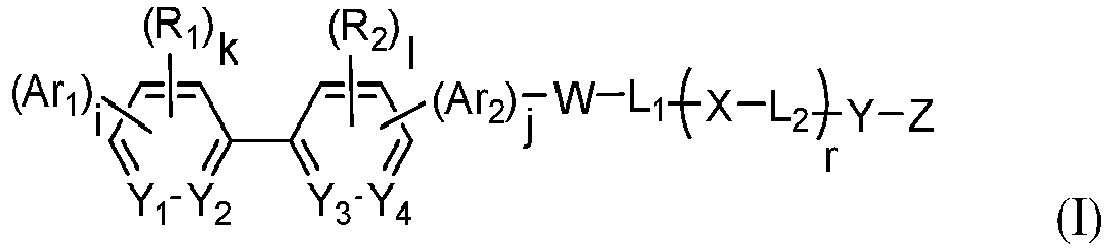
Claims (15)

  1. A compound of following formula (I) :
    Figure imgb0138
    Wherein:
    Y1, Y2, Y3 and Y4 are each independently C or N, Y1 and Y2 being such as one is N and the other is C, Y3 and Y4 being such as one is N and the other is C;
    Ar1, Ar2 are each independently selected from (C6-C10)aryl, (5 to 7 membered) heteroaryl, -O-(C6-C10)aryl, -O-(5 to 7 membered)heteroaryl, -S-(C6-C10)aryl, -S-(5 to 7 membered)heteroaryl, -(C1-C6)alkyl-(C6-C10)aryl, -(C1-C6)alkyl-(5 to 7 membered) heteroaryl and halogens, in particular Cl, said aryl and heteroaryl groups being optionally substituted by one to three R3 groups,
    i and j are independently 0 or 1,
    and
    R1, R2, are at each occurrence, independently selected from (C1-C6)alkyl, (C6-C10)aryl, -(C1-C6)alkyl-(C6-C10)aryl, -(C2-C6)alkenyl-(C6-C10)aryl, -carbonyl-(C6-C10)aryl-, -carbonyl-(C1-C6)alkyl-(C6-C10)aryl, C(=O)H, COOH, OH, said alkyl groups being optionally substituted by OH, said aryl groups being optionally substituted by one to three R4 groups;
    k and 1 are independently 0 or 1;
    at least one of (R1)k and (R2)l being such as:
    - R1 is selected from (C6-C10)aryl, -(C1-C6)alkyl-(C6-C10)aryl, -(C2-C6)alkenyl-(C6-C10)aryl, -carbonyl-(C6-C10)aryl-, -carbonyl-(C1-C6)alkyl-(C6-C10)aryl, and k is 1; or
    - R2 is selected from (C6-C10)aryl, -(C1-C6)alkyl-(C6-C10)aryl, -(C2-C6)alkenyl-(C6-C10)aryl, -carbonyl-(C6-C10)aryl-, -carbonyl-(C1-C6)alkyl-(C6-C10)aryl, and 1 is 1;
    R3 is, at each occurrence, independently selected from (C1-C6)alkyl, (C1-C6)alkoxy, OH, C(=O)H, (CH2)mCONRaRb, C(=O)Rc, (CH2)nCO2H, (CH2)nCO2Rc, (CH2)pCN, (CH2)qC(=N(OH))NH2, -SO2NRaRb, I, Cl, Br, F, (C6-C10)aryl, a (5 to 7 membered)heteroaryl, -(C1-C6)alkyl-(C6-C10)aryl, -(C2-C6)alkenyl-(C6-C10)aryl, said alkyl groups being optionally substituted by a OH, (C1-C6)alkoxy and/or -O-(C6-C10)aryl group;
    R4 is, at each occurrence, independently selected from (C1-C6)alkyl, (CH2)nCO2H, (CH2)nCO2Rc, I, Cl, Br, F, or there are two R4 groups that form with the aryl to which they are bound a naphthyl;
    Ra and Rb are independently chosen from H and (C1-C6)alkyl;
    Rc is chosen from H and (C1-C6)alkyl;
    m is 0,1,2,3 ;
    n is 0,1,2,3 ;
    p is 0,1,2,3 ;
    q is 0,1,2,3 ;
    r is 0 or 1;
    W and Y are each independently selected from a single bond, -NH-,-NR5-, -O-, -S-, -C(=O)NH-, -NHC(=O)-, -C(=O)O-, -OC(=O)-;
    R5 is, at each occurrence, independently selected from (C1-C6)alkyl,
    L1 and L2 are each independently selected from (C1-C18)alkyl, (C2-C18)alkenyl, and (C2-C18)alkynyl groups, said groups being optionally interrupted by one or more groups selected from -O-, -S-, -NR6-;
    R6 is, at each occurrence, independently selected from H and (C1-C6)alkyl,
    X is selected from (5 to 7 membered) heteroaryl, in particular a triazole, -NH-,-NR7- , -O-, -S-, -C(=O)NH-, -NHC(=O)-, -C(=O)O-, -OC(=O)-;
    R7 is selected from (C1-C6)alkyl,
    Z is a E3 ubiquitin ligase ligand;
    or a stereoisomeric form, a mixture of stereoisomeric forms and a pharmaceutically acceptable salt form thereof.
  2. The compound according to claim 1, of following formula (II) :
    Figure imgb0139
  3. The compound according to anyone of the preceding claims, of following formula (IIIa) or (IIIb):
    Figure imgb0140
    Figure imgb0141
    said compound being in particular of following formula (IIIa1) or (IIIa2), (IIIb1) or (IIIb2):
    Figure imgb0142
    Figure imgb0143
    Figure imgb0144
    Figure imgb0145
  4. The compound according to anyone of the preceding claims, wherein An and/or Ar2 are selected from phenyl, pyridyl, pyrimidyl, imidazolyl, pyrazolyl, thiophenyl, triazolyl, in particular from phenyl, 3-pyridyl, 5-pyrimidyl, 2-imidazolyl, 3-pyrazolyl, 2-thiophenyl, 5-triazolyl.
  5. The compound according to anyone of the preceding claims, wherein at least one of Ar1, Ar2 is a 5 to 7 membered heteroaryl containing a nitrogen atom, preferably pyridyl, notably 3-pyridyl.
  6. The compound according to anyone of the preceding claims, wherein R1 and R2 are independently selected from C1-C6 alkyl and (C6-C10)aryl(C2-C6)alkenyl, preferably from methyl, styryl and 2-(naphthalen-2-yl)vinyl.
  7. The compound according to anyone of the preceding claims, wherein R1 is 5-methyl, and/or R2 is 5-styryl or 2-(naphthalen-2-yl)vinyl; or R2 is 5-methyl, and/or R1 is 5-styryl or 2-(naphthalen-2-yl)vinyl
  8. The compound according to anyone of the preceding claims, of following formula (IVa) or (IVb):
    Figure imgb0146
    Figure imgb0147
    in particular of following formula (IVa1), (IVa2), (IVb1) or (IVb2):
    Figure imgb0148
    Figure imgb0149
    Figure imgb0150
    Figure imgb0151
    wherein :
    X1, X2, are at each occurrence, independently selected from C or N;
    R1, R2, R3 are independently, at each occurrence, as defined in any of claims 1 to 7.
  9. The compound according to anyone of claim 1 and 2, of one of the following formulae :
    Figure imgb0152
    Figure imgb0153
    Figure imgb0154
    Figure imgb0155
    Figure imgb0156
    Figure imgb0157
    Figure imgb0158
    Figure imgb0159
    Figure imgb0160
    Figure imgb0161
    Figure imgb0162
    Figure imgb0163
    Figure imgb0164
    Figure imgb0165
    Figure imgb0166
    wherein :
    R3 and R4 are independently, at each occurrence, as defined in any of claims 1 to 7.
  10. The compound according to anyone of the preceding claims, wherein:
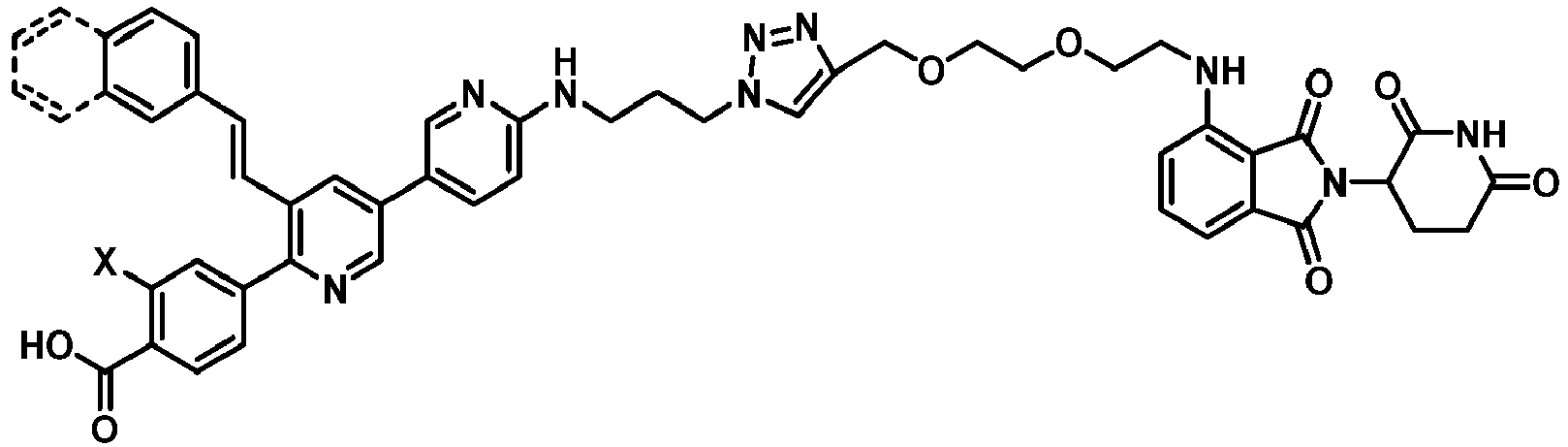
    - W is -NH-, L1 is (C1-C18)alkyl, r is 1, X is a (5 to 7 membered) heteroaryl, in particular a triazole, L2 is a (C1-C18)alkyl interrupted by one or more -O- atoms, in particular of formula -CH2-(O-CH2-CH2)1-6- and Y is a single bond, -NH- or-C(=O)NH-; or
    - W is -NH-, L1 is a (C1-C18)alkyl interrupted by one or more -O- atoms, in particular of formula -CH2-CH2-(O-CH2-CH2)1-6-, r is 0 and Y is a single bond or -C(=O)NH-.
  11. The compound according to anyone of claims 1 to 10, wherein Z is selected from:
    Figure imgb0167
    Figure imgb0168
    Figure imgb0169
    Figure imgb0170
  12. The compound according to claim 1, said compound being selected from:
    Figure imgb0171
    Figure imgb0172
    Figure imgb0173
    Figure imgb0174
    Figure imgb0175
    Figure imgb0176
    Figure imgb0177
    Figure imgb0178
    Figure imgb0179
    Figure imgb0180
    Figure imgb0181
    Figure imgb0182
    Figure imgb0183
    Figure imgb0184
    Figure imgb0185
    Figure imgb0186
    Figure imgb0187
    Figure imgb0188
    Figure imgb0189
    Figure imgb0190
    Figure imgb0191
    Figure imgb0192
    Figure imgb0193
    Figure imgb0194
    Figure imgb0195
    Figure imgb0196
    Figure imgb0197
    Figure imgb0198
    Figure imgb0199
    Figure imgb0200
    Figure imgb0201
    Figure imgb0202
    wherein
    Figure imgb0203
    means
    Figure imgb0204
    X is H or Cl.
  13. A pharmaceutical composition comprising a compound of formula (I) as defined in anyone of claims 1 to 12, in admixture with at least one pharmaceutically acceptable excipient or carrier.
  14. A pharmaceutical composition comprising a compound of formula (I) as defined in anyone of claims 1 to 12, further comprising an additional anti-cancer agent, in particular chosen from anti-EGFR, anti-Map kinases and anti-Akt compounds.
  15. A compound of formula (I) according to any of claims 1 to 12, for use in the treatment of cancer, notably of hematologic malignancies, such as lymphoma, leukemia, multiple myeloma, and/or of solid tumors such as ovarian cancers, mesothelioma, melanoma, pancrea, lung, breast, kidney and liver cancers.
EP20305263.4A 2020-03-13 2020-03-13 Bcl-2 family proteins modulating compounds for cancer treatment Withdrawn EP3878847A1 (en)

Priority Applications (8)

Application Number Priority Date Filing Date Title
EP20305263.4A EP3878847A1 (en) 2020-03-13 2020-03-13 Bcl-2 family proteins modulating compounds for cancer treatment
US17/909,916 US12643894B2 (en) 2020-03-13 2021-03-12 BCL-2 family proteins modulating compounds for cancer treatment
CN202180027952.0A CN115715286B (en) 2020-03-13 2021-03-12 BCL-2 family protein modulating compounds for cancer therapy
PCT/EP2021/056415 WO2021180966A1 (en) 2020-03-13 2021-03-12 Bcl-2 family proteins modulating compounds for cancer treatment
JP2022554284A JP2023516790A (en) 2020-03-13 2021-03-12 BCL-2 FAMILY PROTEIN MODULATING COMPOUNDS FOR CANCER TREATMENT
EP21710981.8A EP4118080B1 (en) 2020-03-13 2021-03-12 Bcl-2 family proteins modulating compounds for cancer treatment
AU2021236366A AU2021236366A1 (en) 2020-03-13 2021-03-12 Bcl-2 family proteins modulating compounds for cancer treatment
CA3170893A CA3170893A1 (en) 2020-03-13 2021-03-12 Bcl-2 family proteins modulating compounds for cancer treatment

Applications Claiming Priority (1)

Application Number Priority Date Filing Date Title
EP20305263.4A EP3878847A1 (en) 2020-03-13 2020-03-13 Bcl-2 family proteins modulating compounds for cancer treatment

Publications (1)

Publication Number Publication Date
EP3878847A1 true EP3878847A1 (en) 2021-09-15

Family

ID=71120134

Family Applications (2)

Application Number Title Priority Date Filing Date
EP20305263.4A Withdrawn EP3878847A1 (en) 2020-03-13 2020-03-13 Bcl-2 family proteins modulating compounds for cancer treatment
EP21710981.8A Active EP4118080B1 (en) 2020-03-13 2021-03-12 Bcl-2 family proteins modulating compounds for cancer treatment

Family Applications After (1)

Application Number Title Priority Date Filing Date
EP21710981.8A Active EP4118080B1 (en) 2020-03-13 2021-03-12 Bcl-2 family proteins modulating compounds for cancer treatment

Country Status (7)

Country Link
US (1) US12643894B2 (en)
EP (2) EP3878847A1 (en)
JP (1) JP2023516790A (en)
CN (1) CN115715286B (en)
AU (1) AU2021236366A1 (en)
CA (1) CA3170893A1 (en)
WO (1) WO2021180966A1 (en)

Families Citing this family (3)

* Cited by examiner, † Cited by third party
Publication number Priority date Publication date Assignee Title
WO2026011086A1 (en) * 2024-07-03 2026-01-08 Board Of Regents, The University Of Texas System Aak1 degraders
CN118908940B (en) * 2024-10-11 2024-12-31 齐鲁理工学院 Preparation and application of target anti-apoptosis Bcl-2 proteolytic targeting chimeric
CN121064161B (en) * 2025-09-08 2026-03-20 中南大学湘雅医院 A MAT2A protein degrading agent, its preparation method and application

Citations (4)

* Cited by examiner, † Cited by third party
Publication number Priority date Publication date Assignee Title
WO2015132727A1 (en) 2014-03-04 2015-09-11 Centre Regional De Lutte Contre Le Cancer Francois Baclesse Mcl-1 modulating compounds for cancer treatment
WO2019060742A1 (en) * 2017-09-22 2019-03-28 Kymera Therapeutics, Inc Protein degraders and uses thereof
WO2019140380A1 (en) * 2018-01-12 2019-07-18 Kymera Therapeutics, Inc. Protein degraders and uses thereof
WO2020010227A1 (en) * 2018-07-06 2020-01-09 Kymera Therapeutics, Inc. Protein degraders and uses thereof

Patent Citations (4)

* Cited by examiner, † Cited by third party
Publication number Priority date Publication date Assignee Title
WO2015132727A1 (en) 2014-03-04 2015-09-11 Centre Regional De Lutte Contre Le Cancer Francois Baclesse Mcl-1 modulating compounds for cancer treatment
WO2019060742A1 (en) * 2017-09-22 2019-03-28 Kymera Therapeutics, Inc Protein degraders and uses thereof
WO2019140380A1 (en) * 2018-01-12 2019-07-18 Kymera Therapeutics, Inc. Protein degraders and uses thereof
WO2020010227A1 (en) * 2018-07-06 2020-01-09 Kymera Therapeutics, Inc. Protein degraders and uses thereof

Non-Patent Citations (5)

* Cited by examiner, † Cited by third party
Title
CELINE GLOAGUEN ET AL: "First Evidence That Oligopyridines, [alpha]-Helix Foldamers, Inhibit Mcl-1 and Sensitize Ovarian Carcinoma Cells to Bcl-x L -Targeting Strategies", JOURNAL OF MEDICINAL CHEMISTRY, vol. 58, no. 4, 26 February 2015 (2015-02-26), pages 1644 - 1668, XP055202086, ISSN: 0022-2623, DOI: 10.1021/jm500672y *
ELIEL, E. L.WILEN, S.H.: "Stereochemistry of Organic Compounds", 1994, WILEY
GREENE, T.W.WUTS, P.G.M.: "Protective Groups in Organic Synthesis", 1991, WILEY & SONS
JACQUES, J ET AL.: "Enantiomers, Racemates, and Resolutions", 1981, WILEY
P.J. KOCIENSKI: "Protecting Groups", 2004, THIEME

Also Published As

Publication number Publication date
WO2021180966A1 (en) 2021-09-16
US20240228477A1 (en) 2024-07-11
EP4118080B1 (en) 2024-02-21
CA3170893A1 (en) 2021-09-16
US12643894B2 (en) 2026-06-02
CN115715286A (en) 2023-02-24
JP2023516790A (en) 2023-04-20
EP4118080C0 (en) 2024-02-21
EP4118080A1 (en) 2023-01-18
CN115715286B (en) 2024-12-13
AU2021236366A1 (en) 2022-11-03

Similar Documents

Publication Publication Date Title
AU2008294410B2 (en) Compounds with anti-cancer activity
CN106220644B (en) Fused ring pyrimidine amino derivative, its preparation method, intermediate, pharmaceutical composition and application
EP3021839B1 (en) Compositions for treatment of fibrosis
EP4118080B1 (en) Bcl-2 family proteins modulating compounds for cancer treatment
WO2023198078A1 (en) Polycyclic compounds as kras g12d inhibitors
EP3114119B1 (en) Mcl-1 modulating compounds for cancer treatment
KR20250127002A (en) Thiobenzimidazole derivatives or its pharmaceutically acceptable salts and use thereof
CN107501279B (en) Furanoquinoline dione compound and medical application thereof
US20130310376A1 (en) 2-aryl-4-quinazolinones and their pharmaceutical compositions
KR20220051816A (en) Thiobenzimidazole derivatives or its pharmaceutically acceptable salts and use thereof
CN111518065A (en) Parthenolide derivative and preparation method and application thereof
JP2025529533A (en) Prolyl hydroxylase inhibitors and uses thereof
US10882852B1 (en) 3-vinylquinolines as cancer cells inhibitors
WO2022166990A1 (en) Anti-tumor pharmaceutical combination
CN102584679A (en) Benzocarbazole acylamide compound and preparation method and application thereof
CN104817519A (en) CA-4 derivatives as well as preparation method and medical application of CA-4 derivatives
CN104250257B (en) 3,4 dihydro 1H benzos [c] [1,2] Evil boric acid compounds or its officinal salt and its production and use
CN118255693A (en) Biphenyl compounds and their use in preparing drugs for treating leukemia, lung cancer and breast cancer
TW202430505A (en) Naphthamide compound, preparation method and application thereof
PL236095B1 (en) Triazolo-quinoline derivatives of cinchona-tree alkaloids, method for obtaining them and their application
JP2019501137A (en) 4-oxo-4,5-dihydrothiazole derivatives, their preparation and use
HK1224210B (en) Compositions for treatment of fibrosis

Legal Events

Date Code Title Description
PUAI Public reference made under article 153(3) epc to a published international application that has entered the european phase

Free format text: ORIGINAL CODE: 0009012

STAA Information on the status of an ep patent application or granted ep patent

Free format text: STATUS: THE APPLICATION HAS BEEN PUBLISHED

AK Designated contracting states

Kind code of ref document: A1

Designated state(s): AL AT BE BG CH CY CZ DE DK EE ES FI FR GB GR HR HU IE IS IT LI LT LU LV MC MK MT NL NO PL PT RO RS SE SI SK SM TR

STAA Information on the status of an ep patent application or granted ep patent

Free format text: STATUS: THE APPLICATION IS DEEMED TO BE WITHDRAWN

18D Application deemed to be withdrawn

Effective date: 20220316