EP3878822B1 - Apparatuses, systems and methods for cold forming glass - Google Patents
Apparatuses, systems and methods for cold forming glass Download PDFInfo
- Publication number
- EP3878822B1 EP3878822B1 EP21162046.3A EP21162046A EP3878822B1 EP 3878822 B1 EP3878822 B1 EP 3878822B1 EP 21162046 A EP21162046 A EP 21162046A EP 3878822 B1 EP3878822 B1 EP 3878822B1
- Authority
- EP
- European Patent Office
- Prior art keywords
- linkages
- glass substrate
- backing
- forming apparatus
- adhesive
- Prior art date
- Legal status (The legal status is an assumption and is not a legal conclusion. Google has not performed a legal analysis and makes no representation as to the accuracy of the status listed.)
- Active
Links
Images






Classifications
-
- C—CHEMISTRY; METALLURGY
- C03—GLASS; MINERAL OR SLAG WOOL
- C03B—MANUFACTURE, SHAPING, OR SUPPLEMENTARY PROCESSES
- C03B23/00—Re-forming shaped glass
- C03B23/02—Re-forming glass sheets
- C03B23/023—Re-forming glass sheets by bending
- C03B23/035—Re-forming glass sheets by bending using a gas cushion or by changing gas pressure, e.g. by applying vacuum or blowing for supporting the glass while bending
- C03B23/0352—Re-forming glass sheets by bending using a gas cushion or by changing gas pressure, e.g. by applying vacuum or blowing for supporting the glass while bending by suction or blowing out for providing the deformation force to bend the glass sheet
- C03B23/0357—Re-forming glass sheets by bending using a gas cushion or by changing gas pressure, e.g. by applying vacuum or blowing for supporting the glass while bending by suction or blowing out for providing the deformation force to bend the glass sheet by suction without blowing, e.g. with vacuum or by venturi effect
-
- G—PHYSICS
- G09—EDUCATION; CRYPTOGRAPHY; DISPLAY; ADVERTISING; SEALS
- G09F—DISPLAYING; ADVERTISING; SIGNS; LABELS OR NAME-PLATES; SEALS
- G09F9/00—Indicating arrangements for variable information in which the information is built-up on a support by selection or combination of individual elements
-
- B—PERFORMING OPERATIONS; TRANSPORTING
- B32—LAYERED PRODUCTS
- B32B—LAYERED PRODUCTS, i.e. PRODUCTS BUILT-UP OF STRATA OF FLAT OR NON-FLAT, e.g. CELLULAR OR HONEYCOMB, FORM
- B32B37/00—Methods or apparatus for laminating, e.g. by curing or by ultrasonic bonding
- B32B37/0046—Methods or apparatus for laminating, e.g. by curing or by ultrasonic bonding characterised by constructional aspects of the apparatus
-
- B—PERFORMING OPERATIONS; TRANSPORTING
- B32—LAYERED PRODUCTS
- B32B—LAYERED PRODUCTS, i.e. PRODUCTS BUILT-UP OF STRATA OF FLAT OR NON-FLAT, e.g. CELLULAR OR HONEYCOMB, FORM
- B32B37/00—Methods or apparatus for laminating, e.g. by curing or by ultrasonic bonding
- B32B37/10—Methods or apparatus for laminating, e.g. by curing or by ultrasonic bonding characterised by the pressing technique, e.g. using action of vacuum or fluid pressure
-
- B—PERFORMING OPERATIONS; TRANSPORTING
- B32—LAYERED PRODUCTS
- B32B—LAYERED PRODUCTS, i.e. PRODUCTS BUILT-UP OF STRATA OF FLAT OR NON-FLAT, e.g. CELLULAR OR HONEYCOMB, FORM
- B32B38/00—Ancillary operations in connection with laminating processes
- B32B38/18—Handling of layers or the laminate
- B32B38/1866—Handling of layers or the laminate conforming the layers or laminate to a convex or concave profile
-
- B—PERFORMING OPERATIONS; TRANSPORTING
- B60—VEHICLES IN GENERAL
- B60K—ARRANGEMENT OR MOUNTING OF PROPULSION UNITS OR OF TRANSMISSIONS IN VEHICLES; ARRANGEMENT OR MOUNTING OF PLURAL DIVERSE PRIME-MOVERS IN VEHICLES; AUXILIARY DRIVES FOR VEHICLES; INSTRUMENTATION OR DASHBOARDS FOR VEHICLES; ARRANGEMENTS IN CONNECTION WITH COOLING, AIR INTAKE, GAS EXHAUST OR FUEL SUPPLY OF PROPULSION UNITS IN VEHICLES
- B60K35/00—Instruments specially adapted for vehicles; Arrangement of instruments in or on vehicles
-
- B—PERFORMING OPERATIONS; TRANSPORTING
- B61—RAILWAYS
- B61L—GUIDING RAILWAY TRAFFIC; ENSURING THE SAFETY OF RAILWAY TRAFFIC
- B61L15/00—Indicators provided on the vehicle or train for signalling purposes
- B61L15/009—On-board display devices
-
- B—PERFORMING OPERATIONS; TRANSPORTING
- B63—SHIPS OR OTHER WATERBORNE VESSELS; RELATED EQUIPMENT
- B63B—SHIPS OR OTHER WATERBORNE VESSELS; EQUIPMENT FOR SHIPPING
- B63B49/00—Arrangements of nautical instruments or navigational aids
-
- B—PERFORMING OPERATIONS; TRANSPORTING
- B64—AIRCRAFT; AVIATION; COSMONAUTICS
- B64D—EQUIPMENT FOR FITTING IN OR TO AIRCRAFT; FLIGHT SUITS; PARACHUTES; ARRANGEMENT OR MOUNTING OF POWER PLANTS OR PROPULSION TRANSMISSIONS IN AIRCRAFT
- B64D43/00—Arrangements or adaptations of instruments
-
- C—CHEMISTRY; METALLURGY
- C03—GLASS; MINERAL OR SLAG WOOL
- C03B—MANUFACTURE, SHAPING, OR SUPPLEMENTARY PROCESSES
- C03B23/00—Re-forming shaped glass
- C03B23/02—Re-forming glass sheets
-
- B—PERFORMING OPERATIONS; TRANSPORTING
- B32—LAYERED PRODUCTS
- B32B—LAYERED PRODUCTS, i.e. PRODUCTS BUILT-UP OF STRATA OF FLAT OR NON-FLAT, e.g. CELLULAR OR HONEYCOMB, FORM
- B32B2315/00—Other materials containing non-metallic inorganic compounds not provided for in groups B32B2311/00 - B32B2313/04
- B32B2315/08—Glass
-
- B—PERFORMING OPERATIONS; TRANSPORTING
- B32—LAYERED PRODUCTS
- B32B—LAYERED PRODUCTS, i.e. PRODUCTS BUILT-UP OF STRATA OF FLAT OR NON-FLAT, e.g. CELLULAR OR HONEYCOMB, FORM
- B32B37/00—Methods or apparatus for laminating, e.g. by curing or by ultrasonic bonding
- B32B37/12—Methods or apparatus for laminating, e.g. by curing or by ultrasonic bonding characterised by using adhesives
-
- C—CHEMISTRY; METALLURGY
- C03—GLASS; MINERAL OR SLAG WOOL
- C03B—MANUFACTURE, SHAPING, OR SUPPLEMENTARY PROCESSES
- C03B23/00—Re-forming shaped glass
- C03B23/02—Re-forming glass sheets
- C03B23/023—Re-forming glass sheets by bending
-
- Y—GENERAL TAGGING OF NEW TECHNOLOGICAL DEVELOPMENTS; GENERAL TAGGING OF CROSS-SECTIONAL TECHNOLOGIES SPANNING OVER SEVERAL SECTIONS OF THE IPC; TECHNICAL SUBJECTS COVERED BY FORMER USPC CROSS-REFERENCE ART COLLECTIONS [XRACs] AND DIGESTS
- Y10—TECHNICAL SUBJECTS COVERED BY FORMER USPC
- Y10T—TECHNICAL SUBJECTS COVERED BY FORMER US CLASSIFICATION
- Y10T156/00—Adhesive bonding and miscellaneous chemical manufacture
- Y10T156/10—Methods of surface bonding and/or assembly therefor
- Y10T156/1002—Methods of surface bonding and/or assembly therefor with permanent bending or reshaping or surface deformation of self sustaining lamina
- Y10T156/1043—Subsequent to assembly
Definitions
- the disclosure provides, among other things, cold formed 3D products such as curved glass substrates for surfaces in a vehicle interior such as vehicle displays.
- the methods, systems and apparatuses of forming such curved glass substrates provide for various improvements. These improvements can include elimination of a need to pre-fabricate a specific form that is adhered to the glass and becomes part of the final product, elimination of the need to dispense adhesive with a uniform thickness onto the form, structural loading being concentrated as a shear force such that tensile force, and hence, tensile stress is reduced on the bonding medium used to adhere with the curved glass substrate, improved replaceability of the curved glass substrate and/or improved usability by facilitating dynamic movement such as bending of the display to provide for flexibility of visualization for the display while in use.
- Cold forming is an energy efficient method of creating curved glass substrates having a radius of curvature based on the elastic deformation of glass at relatively low temperature (e.g., ⁇ 140°C) with the application of out of plane loads to create the desired shape.
- a flat high-strength glass substrate is three-dimensionally (3D) deformed.
- the glass substrate is mechanically fixed by an adhesive interlayer to the target pre-formed 3D frame to which, e.g., display functional modules are mounted.
- this process has proven difficult as the adhesive interlayer can peel away or otherwise become decoupled from one of the glass substrate or the frame.
- a new method of cold forming is disclosed.
- a radius of curvature for the glass substrate can be defined by a form that may not become a part of the display.
- This form can have moveable segments/linkages, can be reusable and/or programmable, for example.
- This form is referred to as a forming apparatus herein.
- a bonding medium can be applied to the glass substrate and adhered.
- the forming apparatus can comprise, for example, a plurality of linkages such as those of a flexible mesh, chain mail or other construction as discussed herein.
- the forming apparatus can be adhered to the glass substrate and bonding medium by the remaining exposed side of the bonding medium.
- the bonding medium can hold one or more of the linkages of the plurality of linkages at a desired angle for cold forming by engaging with surface(s) of the linkages pressing into the bonding medium.
- Alternative methods of positionally fixing (sometimes termed locking herein) the linkages together with a desired angle are discussed herein.
- the assembly including the glass substrate, bonding medium and the forming apparatus can be held in a vacuum mold or otherwise compressed (e.g. pressure formed with a mold, etc.) until the bonding medium is strong enough to hold the cold formed curvature desired. This cold formed curvature can be imparted from the forming apparatus to the glass substrate via the bonding medium.
- the forming apparatus and/or the bonding medium can then optionally be removed from the display.
- the disclosed method eliminates the need for a frame as part of the display.
- the frame need not be structural in construction.
- the forming apparatus can be retained as a backing or can form a frame for the display. This backing can be cut or otherwise shaped to any desired dimensions and matched to the glass substrate. This variable dimensioning can be valuable in high part mix manufacturing operation such as automotive interior manufacturing.
- the disclosed method can eliminate the need to dispense a liquid epoxy (or other adhesive) with a uniform thickness onto the frame as has been the case with prior methods that utilize a structural frame. Missing adhesive or even thickness variation of such adhesive can have the potential to cause stress concentrations that can weaken the display. These potential problems can be avoided utilizing the forming apparatus.
- the forming apparatus can facilitate the use of a structural tape as the bonding medium.
- This structural tape can be cut precisely to shape. This cutting can be done before the forming apparatus is removed.
- the forming apparatus can utilize linkages or other moveable members such as segments with articulating joint such as a hinge or other type of connection. These hinges or other articulating connections can cause the resultant structural load on the adhesive being more concentrated in the shear force than static tensile force as force is transferred from glass substrate back to the hinge in the forming apparatus. Reducing static tensile force (and resulting stress) can improve adhesion between the glass substrate and the bonding medium.
- the backing can have the same or similar construction as that of the forming apparatus. Indeed, in some embodiments the forming apparatus can subsequently be utilized as the backing for the glass substrate, frame and/or other components of the display. However, this may not be the case in other embodiments. Thus, for example, the forming apparatus can be removed from the display after cold forming and a separate backing can be installed. The construction of the backing is further discussed herein.
- the backing can enhance the replaceability of the display. For example, if the glass substrate should become scratched or broken, a new backing and glass substrate can be utilized to replicate the original. This can be accomplished by flexing the backing and removing the bonding medium (such as structural tape) from the glass substrate. This can be done without damaging the display module and touch panel unit. Additionally, according to some embodiments, the backing can enable a display that is flexible with a dynamic bending capability. More particularly, the backing can be constructed of moveable linkages, sections, segments, hinges, articulating connections, etc. that are capable of selective movement relative to one another and relative to the glass substrate. This moveable construct for the backing can make the backing flexible.
- An actuator e.g., motor(s), linkage(s), wire/pulley(s), reel, pinion/rack(s), hydraulic device(s), combinations thereof, etc.
- the actuator can drive one or more of the linkages (or another member if alternatively used) of the backing to various positions as desired.
- the actuator can have a construction of actuators used to reposition an automobile's side mirrors, for example. Hinges or articulating connection of the backing can be free to move and may not be bonded or otherwise locked in position.
- the actuator(s) can be attached or otherwise coupled to the backing and can be configured to control and shape the glass substrate of the display via the backing for improved user viewing angle(s) of the display.
- the terms “cold forming” “cold formed,” “cold bent,” or “cold bending” and iterations thereof refers to curving the glass substrate at a temperature which is less than the softening point of the glass.
- the term “cold bendable” “bendable” or “flexible” refers to the capability of a glass substrate to be cold bent or otherwise geometrically changed such as in the dynamic manner using the actuator(s) and backing described in FIGS. 8-9D .
- FIG. 1 shows a vehicle interior 10 that includes three different vehicle interior systems 100, 200, 300, according to an exemplary embodiment.
- Vehicle interior system 100 includes a center console base 110 with a curved surface 120 including a display, shown as curved display 130.
- Vehicle interior system 200 includes a dashboard base 210 with a curved surface 220 including a display, shown curved display 230.
- the dashboard base 210 typically includes an instrument panel 215 which may also include a curved display.
- Vehicle interior system 300 includes a dashboard steering wheel base 310 with a curved surface 320 and a display, shown as a curved display 330.
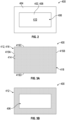
- FIG. 2 shows a display 400 for a vehicle interior system according to one embodiment.
- Methods, systems and apparatuses for forming the display 400 are further discussed in reference to FIGS. 3A-9D . It should be recognized that the techniques and apparatus of FIGS. 3A-9D are not limited to the display 400 but to any display or other vehicle component including those of FIG. 1 .
- the display 400 includes a glass substrate 402, and a frame 404.
- the frame 404 is entirely optional and may not be utilized according to some embodiments.
- the frame 404 can be formed by the backing and/or bonding medium as further described herein.
- the frame 404 may not be utilized for support (e.g., to facilitate or maintain the curvature of the glass substrate 402), and thus, can be non-structural.
- a structural frame has typically been utilized previously.
- the frame 404 can be utilized for aesthetic purposes and for contrast with a display module (not shown).
- the backing can provide support (e.g., to facilitate or maintain the curvature of the glass substrate 402) or a combination of the frame 404 and backing can be utilized for support.
- the frame 404 include a first opening 406 configured to house further display components or modules (not shown).
- the frame 404 and glass substrate 402 can includes a curved portion 408.
- the glass substrate 402 can be positioned on the frame 404 and can include the central portion interfacing with and generally conforming to a corresponding curved portion of the frame 404. As illustrated, the glass substrate 402 includes a first major surface 410 immediately facing the viewer and a second opposing second major surface (not numbered) interfacing with the frame 404 and/or other components.
- the backing 412 can be a mesh 416, such as a chain link mesh, for example.
- the mesh 416 can have the plurality of linkages 414 connected together.
- the linkages 414 can extend in various directions across the display 400 such as generally longitudinal (left/right in the plane of view) from a first edge 415A to or closely adjacent a second edge 415B and laterally (up/down in the plane of view) from a third edge 415C to or closely adjacent a fourth edge 415D (these items are numbered in reference to FIG. 3A only unless otherwise indicated).
- the layout and interlinked configuration of the plurality linkages 414 shown in FIGS. 3A-3D is exemplary and non-limiting.
- the backing 412 can be constructed of any known material, thus, the backing 412 can be polymer, metal, ceramic, glass, composite thereof, etc.
- the mesh 416 if utilized, can be constructed of fibers or filaments including natural or synthetic fibers according to some embodiments.
- FIG. 3B shows the backing 412 can be applied, cut or otherwise positioned around the opening 406 defined by the frame 404 ( FIG. 2 ).
- the opening 406 is uncovered by the backing 412.
- the backing 412 of FIG. 3B can be positioned behind and can support the frame 404 ( FIG. 2 ).
- the plurality of linkages 514A, 514B, 514C, 514D, etc., 514AA, 514BB, 514CC, 514DD, etc., 514AAA, 514BBB, 514CCC, 514DDD, etc. can define a first major surface 520 and a second major surface 522 of the backing 512.
- the method 900 can further optionally include locking the articulating joint to position the one of the plurality of linkages relative to the at least another one of the plurality of linkages and to reduce or eliminate substantial relative movement between the one of the plurality of linkages and the at least another one of the plurality of linkages.
- the actuator 1006 can comprise a reel (not shown) utilizing wire or other line coupled to a first portion 1004A of the backing 1004 and a second portion 1004B of the backing 1004.
- the first portion 1004A and second portion 1004B can be located on opposing ends of the display 1000.
- substantially refers to a majority of, or mostly, as in at least about 50%, 60%, 70%, 80%, 90%, 95%, 96%, 97%, 98%, 99%, 99.5%, 99.9%, 99.99%, or at least about 99.999% or more.
Landscapes
- Engineering & Computer Science (AREA)
- Chemical & Material Sciences (AREA)
- Materials Engineering (AREA)
- Organic Chemistry (AREA)
- Mechanical Engineering (AREA)
- Physics & Mathematics (AREA)
- Combustion & Propulsion (AREA)
- Fluid Mechanics (AREA)
- Theoretical Computer Science (AREA)
- General Physics & Mathematics (AREA)
- Transportation (AREA)
- Radar, Positioning & Navigation (AREA)
- Remote Sensing (AREA)
- Ocean & Marine Engineering (AREA)
- Aviation & Aerospace Engineering (AREA)
- Devices For Indicating Variable Information By Combining Individual Elements (AREA)
- Joining Of Glass To Other Materials (AREA)
- Instrument Panels (AREA)
Description
- Vehicle interiors can include curved surfaces that incorporate displays and/or touch panels. The materials used to form such curved surfaces are typically limited to polymers, which do not exhibit the durability, appearance, feel and optical performance of glass. As such, curved glass substrates are desirable, especially when used as covers for displays and/or touch panels. Existing methods of forming curved glass substrates, such as thermal forming, have drawbacks including high cost, and optical distortion and/or surface marking occurring during curving or shaping. Accordingly, there is a need for vehicle interior systems that can incorporate a curved glass substrate in a cost-effective manner and without the problems typically associated with glass thermal forming processes. However, current cold forming methods have various drawbacks including that an adhesive layer is subject to both shear and tensile stress in some instances.
-
EP 3 482 253 A1 discloses articles comprising a curved cold-formed glass substrate and a plurality of separate mechanical retainers attached to the cold-formed glass substrate. - The disclosure provides, among other things, cold formed 3D products such as curved glass substrates for surfaces in a vehicle interior such as vehicle displays. In addition, the methods, systems and apparatuses of forming such curved glass substrates provided herein provide for various improvements. These improvements can include elimination of a need to pre-fabricate a specific form that is adhered to the glass and becomes part of the final product, elimination of the need to dispense adhesive with a uniform thickness onto the form, structural loading being concentrated as a shear force such that tensile force, and hence, tensile stress is reduced on the bonding medium used to adhere with the curved glass substrate, improved replaceability of the curved glass substrate and/or improved usability by facilitating dynamic movement such as bending of the display to provide for flexibility of visualization for the display while in use.
- The drawings illustrate generally, by way of example, but not by way of limitation, various embodiments discussed herein.
-
FIG. 1 is a perspective view illustration of a vehicle interior with vehicle interior systems according to one embodiment. -
FIG. 2 is a front view of a display including a curved glass substrate and frame according to one embodiment. -
FIG. 3A is a back view of the display ofFIG. 2 having a backing with a first configuration according to a first embodiment. -
FIG. 3B is a back view of the display ofFIG. 2 having the backing with a second configuration according to a second embodiment. -
FIG. 3C is a back view of the display ofFIG. 2 having the backing with a third configuration according to a third embodiment. -
FIG. 3D is a back view of the display ofFIG. 2 having the backing with a fourth configuration according to a fourth embodiment. -
FIG. 3E is a back view of the display ofFIG. 2 having the backing with a fifth configuration according to a fifth embodiment. -
FIGS. 4A and4B are perspective views of the backing according to one embodiment. -
FIG. 5 is a perspective view of a system of components that can be used to form the backing ofFIGS. 4A and4B . -
FIG. 5A is a perspective view of a second system of components that can be used to form the backing ofFIGS. 4A and4B . -
FIG. 6A is a perspective view of part of the system ofFIG. 5 ., which can be used in combination with a bonding medium according to one embodiment. -
FIG. 6B is a perspective view of part of the system ofFIG. 5 ., which can be used in combination with the bonding medium ofFIG. 6A and a second bonding medium according to one embodiment. -
FIG. 6C is a perspective view of the backing ofFIGS. 4A and4B , which can be in combination with the bonding medium according to another embodiment. -
FIGS. 7A and 7B are perspective views illustrating an apparatus and method of forming the display including using the backing ofFIGS. 4A and4B as a forming apparatus according to one embodiment. -
FIG. 8 is a perspective view showing the backing ofFIGS. 4A and4B used in combination with an actuator to facilitate dynamic movement such as for bending of the glass substrate of the display according to one embodiment. -
FIGS. 9A-9D are schematic views of any example of the backing such as any of those previously described and illustrated used in combination with one or more actuators to facilitate dynamic movement such as bending of the glass substrate of the display according to one embodiment. - Repeated use of reference characters in the specification and drawings is intended to represent the same or analogous features or elements of the disclosure, even when the numbers by 100 from figure-to-figure. It should be understood that numerous other modifications and examples can be devised by those skilled in the art, which fall within the scope of the principles of the disclosure.
- Reference will now be made in detail to certain embodiments of the disclosed subject matter, examples of which are illustrated in part in the accompanying drawings.
- Vehicle interior systems may include a variety of different curved surfaces that are designed to be transparent, such as curved display surfaces, and the present disclosure provides articles and methods for forming these curved surfaces which include a glass substrate. Displays for vehicle interior systems have typically been equipped with a frame that allows components of the display to be more easily viewed when the display is on. The frame can also contrast the color or pattern of the display to adjacent automotive interior components. Furthermore, the frame can provide support for the components of the display.
- Cold forming (e.g., bending) is an energy efficient method of creating curved glass substrates having a radius of curvature based on the elastic deformation of glass at relatively low temperature (e.g., < 140°C) with the application of out of plane loads to create the desired shape. During the cold forming process, a flat high-strength glass substrate is three-dimensionally (3D) deformed. Typically, the glass substrate is mechanically fixed by an adhesive interlayer to the target pre-formed 3D frame to which, e.g., display functional modules are mounted. However, this process has proven difficult as the adhesive interlayer can peel away or otherwise become decoupled from one of the glass substrate or the frame. This disclosure provides methods of cold forming, systems, apparatuses and resulting displays that represent improvements in various key areas. According to one embodiment, a new method of cold forming is disclosed. With this method, a radius of curvature for the glass substrate can be defined by a form that may not become a part of the display. This form can have moveable segments/linkages, can be reusable and/or programmable, for example. This form is referred to as a forming apparatus herein. A bonding medium can be applied to the glass substrate and adhered. The forming apparatus can comprise, for example, a plurality of linkages such as those of a flexible mesh, chain mail or other construction as discussed herein. The forming apparatus can be adhered to the glass substrate and bonding medium by the remaining exposed side of the bonding medium. The bonding medium can hold one or more of the linkages of the plurality of linkages at a desired angle for cold forming by engaging with surface(s) of the linkages pressing into the bonding medium. Alternative methods of positionally fixing (sometimes termed locking herein) the linkages together with a desired angle are discussed herein. The assembly (including the glass substrate, bonding medium and the forming apparatus can be held in a vacuum mold or otherwise compressed (e.g. pressure formed with a mold, etc.) until the bonding medium is strong enough to hold the cold formed curvature desired. This cold formed curvature can be imparted from the forming apparatus to the glass substrate via the bonding medium. The forming apparatus and/or the bonding medium can then optionally be removed from the display.
- The disclosed method, for example, eliminates the need for a frame as part of the display. However, if utilized, the frame need not be structural in construction. According to some embodiments, the forming apparatus can be retained as a backing or can form a frame for the display. This backing can be cut or otherwise shaped to any desired dimensions and matched to the glass substrate. This variable dimensioning can be valuable in high part mix manufacturing operation such as automotive interior manufacturing. Additionally, the disclosed method can eliminate the need to dispense a liquid epoxy (or other adhesive) with a uniform thickness onto the frame as has been the case with prior methods that utilize a structural frame. Missing adhesive or even thickness variation of such adhesive can have the potential to cause stress concentrations that can weaken the display. These potential problems can be avoided utilizing the forming apparatus. According to one embodiment, the forming apparatus can facilitate the use of a structural tape as the bonding medium. This structural tape can be cut precisely to shape. This cutting can be done before the forming apparatus is removed. Furthermore, the forming apparatus can utilize linkages or other moveable members such as segments with articulating joint such as a hinge or other type of connection. These hinges or other articulating connections can cause the resultant structural load on the adhesive being more concentrated in the shear force than static tensile force as force is transferred from glass substrate back to the hinge in the forming apparatus. Reducing static tensile force (and resulting stress) can improve adhesion between the glass substrate and the bonding medium.
- Further embodiments disclosed herein are directed to the construction of the backing and uses thereof. The backing can have the same or similar construction as that of the forming apparatus. Indeed, in some embodiments the forming apparatus can subsequently be utilized as the backing for the glass substrate, frame and/or other components of the display. However, this may not be the case in other embodiments. Thus, for example, the forming apparatus can be removed from the display after cold forming and a separate backing can be installed. The construction of the backing is further discussed herein.
- The backing can enhance the replaceability of the display. For example, if the glass substrate should become scratched or broken, a new backing and glass substrate can be utilized to replicate the original. This can be accomplished by flexing the backing and removing the bonding medium (such as structural tape) from the glass substrate. This can be done without damaging the display module and touch panel unit. Additionally, according to some embodiments, the backing can enable a display that is flexible with a dynamic bending capability. More particularly, the backing can be constructed of moveable linkages, sections, segments, hinges, articulating connections, etc. that are capable of selective movement relative to one another and relative to the glass substrate. This moveable construct for the backing can make the backing flexible. An actuator (e.g., motor(s), linkage(s), wire/pulley(s), reel, pinion/rack(s), hydraulic device(s), combinations thereof, etc.) can drive one or more of the linkages (or another member if alternatively used) of the backing to various positions as desired. The actuator can have a construction of actuators used to reposition an automobile's side mirrors, for example. Hinges or articulating connection of the backing can be free to move and may not be bonded or otherwise locked in position. Thus, the actuator(s) can be attached or otherwise coupled to the backing and can be configured to control and shape the glass substrate of the display via the backing for improved user viewing angle(s) of the display.
- As used herein, the terms "cold forming" "cold formed," "cold bent," or "cold bending" and iterations thereof refers to curving the glass substrate at a temperature which is less than the softening point of the glass. The term "cold bendable" "bendable" or "flexible" refers to the capability of a glass substrate to be cold bent or otherwise geometrically changed such as in the dynamic manner using the actuator(s) and backing described in
FIGS. 8-9D . -
FIG. 1 shows avehicle interior 10 that includes three different vehicleinterior systems interior system 100 includes acenter console base 110 with acurved surface 120 including a display, shown ascurved display 130. Vehicleinterior system 200 includes adashboard base 210 with acurved surface 220 including a display, showncurved display 230. Thedashboard base 210 typically includes aninstrument panel 215 which may also include a curved display. Vehicleinterior system 300 includes a dashboardsteering wheel base 310 with acurved surface 320 and a display, shown as acurved display 330. In one or more embodiments, the vehicle interior system may include a base that is an arm rest, a pillar, a seat back, a floor board, a headrest, a door panel, or any portion of the interior of a vehicle that includes a curved surface. - The articles and techniques described herein can be used in any or all of vehicle
interior systems FIG. 1 shows an automobile interior, the various embodiments of the vehicle interior system may be incorporated into any type of vehicle such as trains, automobiles (e.g., cars, trucks, buses and the like), sea craft (boats, ships, submarines, and the like), and aircraft (e.g., drones, airplanes, jets, helicopters and the like), including both human-piloted vehicles, semi-autonomous vehicles and fully autonomous vehicles. -
FIG. 2 shows adisplay 400 for a vehicle interior system according to one embodiment. Methods, systems and apparatuses for forming thedisplay 400 are further discussed in reference toFIGS. 3A-9D . It should be recognized that the techniques and apparatus ofFIGS. 3A-9D are not limited to thedisplay 400 but to any display or other vehicle component including those ofFIG. 1 . As shown in bothFIG. 2 , thedisplay 400 includes a glass substrate 402, and aframe 404. Theframe 404 is entirely optional and may not be utilized according to some embodiments. According to some embodiments, theframe 404 can be formed by the backing and/or bonding medium as further described herein. Theframe 404 may not be utilized for support (e.g., to facilitate or maintain the curvature of the glass substrate 402), and thus, can be non-structural. A structural frame has typically been utilized previously. Theframe 404 can be utilized for aesthetic purposes and for contrast with a display module (not shown). According to some embodiments, the backing can provide support (e.g., to facilitate or maintain the curvature of the glass substrate 402) or a combination of theframe 404 and backing can be utilized for support. - As shown in
FIG. 2 , theframe 404 include afirst opening 406 configured to house further display components or modules (not shown). Theframe 404 and glass substrate 402 can includes a curved portion 408. - A radius of curvature of the curved portion 408 can be, for example, about 20 mm or greater, 40 mm or greater, 50 mm or greater, 60 mm or greater, 100 mm or greater, 250 mm or greater or 500 mm or greater. For example, the radius of curvature may be in a range from about 20 mm to about 2000 mm, from about 30 mm to about 2000 mm, from about 40 mm to about 1500 mm, from about 50 mm to about 1500 mm, 60 mm to about 1500 mm, from about 70 mm to about 2000 mm, from about 80 mm to about 1500 mm, from about 90 mm to about 2000 mm, from about 100 mm to about 2000 mm, from about 120 mm to about 2000 mm, from about 140 mm to about 2000 mm, from about 150 mm to about 2000 mm, from about 160 mm to about 2000 mm, from about 180 mm to about 2000 mm, from about 200 mm to about 2000 mm, from about 220 mm to about 2000 mm, from about 240 mm to about 2000 mm, from about 250 mm to about 2000 mm, from about 260 mm to about 2000 mm, from about 270 mm to about 2000 mm, from about 280 mm to about 2000 mm, from about 290 mm to about 2000 mm, from about 300 mm to about 2000 mm, from about 350 mm to about 2000 mm, from about 400 mm to about 2000 mm, from about 450 mm to about 2000 mm, from about 500 mm to about 2000 mm, from about 550 mm to about 2000 mm, from about 600 mm to about 2000 mm, from about 650 mm to about 2000 mm, from about 700 mm to about 2000 mm, from about 750 mm to about 2000 mm, from about 800 mm to about 2000 mm, from about 900 mm to about 2000 mm, from about 950 mm to about 2000 mm, from about 1000 mm to about 2000 mm, from about 1250 mm to about 2000 mm, from about 20 mm to about 1400 mm, from about 20 mm to about 1300 mm, from about 20 mm to about 1200 mm, from about 20 mm to about 1100 mm, from about 20 mm to about 1000 mm, from about 20 mm to about 950 mm, from about 20 mm to about 900 mm, from about 20 mm to about 850 mm, from about 20 mm to about 800 mm, from about 20 mm to about 750 mm, from about 20 mm to about 700 mm, from about 20 mm to about 650 mm, from about 20 mm to about 200 mm, from about 20 mm to about 550 mm, from about 20 mm to about 500 mm, from about 20 mm to about 450 mm, from about 20 mm to about 400 mm, from about 20 mm to about 350 mm, from about 20 mm to about 300 mm, from about 20 mm to about 250 mm, from about 20 mm to about 200 mm, from about 20 mm to about 150 mm, from about 20 mm to about 100 mm, from about 20 mm to about 50 mm, from about 60 mm to about 1400 mm, from about 60 mm to about 1300 mm, from about 60 mm to about 1200 mm, from about 60 mm to about 1100 mm, from about 60 mm to about 1000 mm, from about 60 mm to about 950 mm, from about 60 mm to about 900 mm, from about 60 mm to about 850 mm, from about 60 mm to about 800 mm, from about 60 mm to about 750 mm, from about 60 mm to about 700 mm, from about 60 mm to about 650 mm, from about 60 mm to about 600 mm, from about 60 mm to about 550 mm, from about 60 mm to about 500 mm, from about 60 mm to about 450 mm, from about 60 mm to about 400 mm, from about 60 mm to about 350 mm, from about 60 mm to about 300 mm, or from about 60 mm to about 250 mm.
- The glass substrate 402 can be comprised of suitable glass compositions for use in the cold formed glass substrates described herein include soda lime glass, aluminosilicate glass, borosilicate glass, boroaluminosilicate glass, alkali-containing aluminosilicate glass, alkali-containing borosilicate glass, and alkali-containing boroaluminosilicate glass.
- The glass substrate 402 can be strengthened using any suitable method known in the art, including by including compressive stress (CS) into the glass substrate, that extends from a surface to a depth of compression (DOC); by utilizing a mismatch of the coefficient of thermal expansion between portions of the article to create a compressive stress region and a central region exhibiting a tensile stress; thermally by heating the glass to a temperature above the glass transition point and then rapidly quenching; and chemically by ion exchange, where, e.g., ions at or near the surface of the glass substrate are replaced by, or exchanged with, larger ions having the same valence or oxidation state.
- As used herein, the term "glass substrate" is used in its broadest sense to include any object made wholly or partly of glass. Glass substrates include laminates of glass and non-glass materials, laminates of glass and crystalline materials, and glass-ceramics (including an amorphous phase and a crystalline phase). The glass substrate may be transparent or opaque. Cold-formed glass substrate can include a colorant that provides a specific color.
- The thickness of the glass substrate 402 can be tailored to allow the glass substrate 402 to be flexible to achieve a desired radius of curvature. Moreover, a thinner glass substrate 402 may deform more readily, which could potentially compensate for shape mismatches and gaps that may be created by the shape of the display 400 (when curved). The glass substrate 402 and at least a portion of the
frame 404 can have substantially similar radii of curvature to provide a substantially uniform distance therebetween. - The glass substrate 402 can be positioned on the
frame 404 and can include the central portion interfacing with and generally conforming to a corresponding curved portion of theframe 404. As illustrated, the glass substrate 402 includes a firstmajor surface 410 immediately facing the viewer and a second opposing second major surface (not numbered) interfacing with theframe 404 and/or other components. - The
frame 404 has an interior surface that defines theopening 406. The interior surface can provide for mechanical alignment for positioning the display module within theopening 406.FIG. 3A shows an opposing side of thedisplay 400 from that ofFIG. 2 and further illustrates abacking 412 according to one embodiment. Thebacking 412 can comprise a plurality oflinkages 414. Theselinkages 414 are illustrated at a schematic manner inFIGS. 3A-3E . Thelinkages 414 can be selectively moveable such as relative to one another (and the glass substrate, bonding medium, etc.) as further described herein subsequently. Various embodiments of thebacking 412 are contemplated. - According to the embodiment of
FIGS. 3A-3E , thebacking 412 can be a mesh 416, such as a chain link mesh, for example. The mesh 416 can have the plurality oflinkages 414 connected together. Thelinkages 414 can extend in various directions across thedisplay 400 such as generally longitudinal (left/right in the plane of view) from afirst edge 415A to or closely adjacent asecond edge 415B and laterally (up/down in the plane of view) from athird edge 415C to or closely adjacent afourth edge 415D (these items are numbered in reference toFIG. 3A only unless otherwise indicated). The layout and interlinked configuration of theplurality linkages 414 shown inFIGS. 3A-3D is exemplary and non-limiting. Various layouts and interlinked configurations of the plurality oflinkages 414 are contemplated. Thebacking 412 can be constructed of any known material, thus, thebacking 412 can be polymer, metal, ceramic, glass, composite thereof, etc. The mesh 416, if utilized, can be constructed of fibers or filaments including natural or synthetic fibers according to some embodiments. -
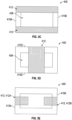
FIGS. 3A-3E show various exemplary configurations for thebacking 412. As shown inFIG. 3A , thebacking 412 can take up substantially an entirety of a secondmajor surface 418 of thedisplay 400. Thus, thebacking 412 can extend to or closely adjacent thefirst edge 415A,second edge 415B,third edge 415C andfourth edge 415D. Thus, the backing 412 ofFIG. 3A can be positioned behind and can support the glass substrate 402 (FIG. 2 ), frame 404 (FIG. 2 ), display module and/or other components of thedisplay 400. -
FIG. 3B shows thebacking 412 can be applied, cut or otherwise positioned around theopening 406 defined by the frame 404 (FIG. 2 ). Thus, theopening 406 is uncovered by thebacking 412. The backing 412 ofFIG. 3B can be positioned behind and can support the frame 404 (FIG. 2 ). -
FIGS. 3C and 3D show thebacking 412 can be applied, cut or otherwise positioned around or across theopening 406. Thus, thebacking 412 can cover only selective portions of theframe 404. InFIG. 3C , thebacking 412 extends from or closely adjacent thefirst edge 415A to or closely adjacent thesecond edge 415B. InFIG. 3D , the backing extends from or closely adjacent thethird edge 415C to or closely adjacent thefourth edge 415D. Thebacking 412 can provide structural support and/or can facilitate curvature of thedisplay 400 in the selected areas applied as further discussed herein. TakingFIG. 3D as an example, thebacking 412 can facilitate and/or support a curvature of thedisplay 400 in this middle region of thedisplay 400 illustrated. -
FIG. 3E shows an embodiment where thebacking 412 is separated in to distinct portions 412A and 412B that are positioned on opposing ends of thedisplay 400 such as at or closely adjacent thefirst edge 415A and at or closely adjacent thesecond edge 415B. Thebacking 412 can provide structural support and/or can facilitate curvature of thedisplay 400 in these selected areas. The embodiment ofFIG. 3E can further be configured to enable thedisplay 400 to be flexible with a dynamic bending capability as further illustrated and discussed inFIGS. 9A and 9B . Furthermore, any of the embodiments ofFIGS. 3A-3E can provide such a capability for thedisplay 400 as further discussed herein. -
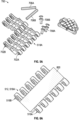
FIGS. 4A and4B show abacking 512 according to one embodiment.FIG. 4A shows a first side of thebacking 512 andFIG. 4B shows an opposing side of thebacking 512. Unless otherwise indicated all reference numbers are provided in regard toFIG. 4A . - The
backing 512 can include a plurality oflinkages joints backing 512 can be constructed with any number of linkages and articulating joints as desired. Thebacking 512 can optionally include a covering 517 on one or more major surfaces thereof. - The plurality of
linkages joints linkage 514A as an example, thelinkage 514A can extend longitudinally (corresponding to the Cartesian y-axis) from the articulating joint 516A to the articulating joint 516B. As shown inFIG. 4A , the plurality oflinkages linkages joints linkages joints - As shown in
FIG. 4A , thebacking 512 can be formed by a plurality ofsegments linkages linkages linkages major surface 520 and a secondmajor surface 522 of thebacking 512. - According to some examples, the plurality of
segments FIG. 5 ) or other structure. Thus, according to some examples, thelinkages joints - The first
major surface 520 can be defined by spaced side surfaces of the individual linkages of the plurality ofsegments major surface 522 can be abutted by the covering 517, for example. The covering 517 can comprise adhesive, foam, rubber or other desired materials. - The plurality of articulating
joints linkages joints linkages 514A, 514AA, and 514AAA. This can be in addition to connectinglinkage 514A tolinkage 514B as is the case with articulating joint 516B. Thelinkages 514A, 514AA, and 514AAA can be selectively moveable in unison via the articulatingjoints major surface 520 and the secondmajor surface 522. Thelinkages 514B, 514BB, 514BBB, etc. and articulatingjoints 516C, etc. can be similarly constructed. Thus, the plurality of articulatingjoints segments - According to the embodiment of
FIGS. 4A and4B , thebacking 512 can comprise a metal (e.g., aluminum alloy) chain such as Lynxmotion chain track, which is commercially available from RobotShop Inc. Although described and illustrated in the embodiment ofFIGS. 4A and4B as utilizing articulating joints, the backings disclosed herein need not include articulating joints such as hinges in some embodiments. For example, filament, fiber or other type of mesh can have sufficient flexibility and capability for relative movement such that articulating joints are not necessary according to some embodiments of the backing. Although the articulating joints shown inFIGS. 4A and4B comprise hinges, other types of articulating joints such as those using folds, creases, slots, hooks, latches, etc. are contemplated. -
FIG. 5 shows asystem 600 for forming thebacking 512 ofFIGS. 4A and4B . Thesystem 600 includes one or more of the plurality ofsegments segment 518A and a portion ofsegment 518B are shown inFIG. 5 ) and the articulatingjoints segment 518A can include the cross-member 519 and the plurality oflinkages 514A, 514AA, 514AAA, etc. The articulatingjoints apertures linkages 514A, 514AA, 514AAA, etc. and can further includeaxles end caps -
FIG. 5 shows the portion of thesegment 518B that haslinkages 514B, 514BB, 514BBB, etc., configured to insert between the plurality oflinkages 514A, 514AA, 514AAA, etc. of thesegment 518A. Together apertures of these linkages of including the plurality oflinkages 514A, 514AA, 514AAA, etc. of thesegment 518A can define a common aperture for thehinge 604B. Theaxle 606B andend cap 608B can be inserted (or removed from) in this common aperture. - The
axle 606A can be configured to be insertable through theapertures 602A of therespective linkages 514A, 514AA, 514AAA, etc. (and apertures of an additional linkage not illustrated inFIG. 5 ). Theend cap 608A can be insertable in theaxle 606A and in theaperture 602A of thelinkage 514A, for example. Similarly, theaxle 606B can be configured to be insertable in the manner previously described. -
FIG. 5A shows analternative system 700 for forming thebacking 512 ofFIGS. 4A and4B . Thissystem 700 can be the same as thesystem 600 previously described but can differ in thatapertures axles end caps segment 518A to be selectively positionally fixed (positionally locked) relative to other segments via hinges 704A and 704B. More particularly, theaxles segment 518A and adjoining segments. Thesegment 518A can then be positioned as desired relative to the adjoining segments. Theaxles respective apertures axles apertures segment 518A is not moveable (is locked as used herein) relative to the adjoining segments. - Although described in reference to polygonal features (e.g., polygonal axle and aperture), the
backing 512 can be configured to have segments or linkages that can selectively positionally fixed (positionally locked) relative to other segments or linkages by other mechanical mechanisms known in the art. Thus, the articulating joints could utilize snap-fit, snap connection, interference fit or other features such as indents, tabs, gears, hooks, rack/pinion, or other mating male/female connection. Thus, according to some embodiments, the locking of the segments or linkages can be facilitated by any one or combination of retaining the plurality of linkages with the bonding medium (described subsequently in reference toFIG. 6C ), retaining the plurality of linkages by applying a second adhesive over the articulating joint or adjacent the articulating joint (described subsequently in reference toFIG. 6B ), applying the adhesive over the articulating joint (described subsequently in reference toFIG. 6C ), mating a female portion of the articulating joint with a male portion of the articulating joint (described in reference toFIG. 5A ) or creating a fixed connection at the articulating joint (described in reference toFIG. 5A ). -
FIG. 6A shows the onesegment 518A of thebacking 512. Thesegment 518A has abonding medium 800 attached to the firstmajor surface 520 thereof. Thebonding medium 800 can comprise a structural adhesive according to one embodiment. The structural adhesive can include polyurethanes (e.g., DP604NS available from 3M®, Saint Paul, MN, as well as Betamate 73100/002, 73100/005, 73100/010, Betaseal X2500, and Betalink K2, from Dupont®, Wilmington, DE), polysiloxanes and silane-modified polymers (e.g., TEROSON RB IX, also known as TEROSTAT MS 9399 and TEROSON MS 647, available from Loctite®), and epoxies (e.g., Scotch-Weld™ Epoxy Adhesive DP125 and DP604 available from 3M®, Saint Paul, MN). - Additional adhesives include, but not limited to, an adhesive selected from one of more of the categories: (a) Toughened Epoxy (for example, Masterbond EP21TDCHT-LO, 3M Scotch Weld Epoxy DP460 Off-white); (b) Flexible Epoxy (for example, Masterbond EP21TDC-2LO, 3M Scotch Weld Epoxy 2216 ); (c) Acrylics and/or Toughened Acrylics (for example, LORD Adhesive 403, 406 or 410 Acrylic adhesives with LORD Accelerator 19 or 19GB w/ LORD AP 134 primer, LORD Adhesive 850 or 852/LORD Accelerator 25GB, Loctite HF8000, Loctite AA4800); (d) Urethanes (for example, 3M Scotch Weld Urethane DP640 Brown, SikaForce 7570 L03, SikaForce 7550 L15, Sikaflex 552 and Polyurethane (PUR) Hot Melt adhesives such as, Technomelt PUR 9622-02 UVNA, Loctite HHD 3542, Loctite HHD 3580, 3M Hotmelt adhesives 3764 and 3748); and (e) Silicones (Dow Corning 995, Dow Corning 3-0500 Silicone Assembly adhesive, Dow Corning 7091, SikaSil-GP). In some cases, structural adhesives available as sheets or films (for example, but not limited to, 3M Structural adhesive films AF126-2, AF 163-2M, SBT 9263 and 9214, Masterbond FLM36-LO) may be utilized.
- Furthermore, pressure sensitive adhesives such as 3M VHB tapes can comprise the
bonding medium 800 according to some embodiments. In such embodiments, utilizing a pressure sensitive adhesive (such as the tape) allows for the curved glass substrate to be bonded to the backing (and/or forming apparatus) without the need for, among other things, a curing step. Thus, thebonding medium 800 can be any one of or a combination of VHB tape, foam tape, pre-cured adhesive dots or other shapes, rigid polymer, compliant polymer or fully or partially cured adhesive (cured fully or partially). - The
bonding medium 800 can be rigid, semi-rigid or compliant. As discussed, thebonding medium 800 and/or the backing 512 (and/or the forming apparatus) can optionally be used only in critical stress areas to prevent glass compression prior to full curing of the adhesive, for example. Thebacking 512, in particular the sides of thelinkages 514A, 514AA, 514AAA, etc. that interface with thebonding medium 800 can have mechanical features such as grooves, ridges, etc. to improve attachment, provide alignment or otherwise improve performance of thebonding medium 800, for example. Thebonding medium 800 could be sacrificial or permanent.Sacrificial bonding medium 800 could be cut or otherwise removed and shaped. In some cases, it can be replaced with another bonding medium such as adhesive later. - According to the embodiment of
FIG. 6A , thebonding medium 800 can be cut or otherwise shaped to allow the articulatingjoints bonding medium 800. This can facilitate selective movement of thesegment 518A relative to adjoining segments via the articulatingjoints backing 512 for bending of the glass substrate of the display as further described in reference toFIGS. 8-9D . - The
bonding medium 800 can have any desirable thickness between the glass substrate and thebacking 512. The thickness of thebonding medium 800 can be tailored to, among other things, ensure lamination between the backing 512 and the cold-formed glass substrate. Exemplary thicknesses for thebonding medium 800 can be 5mm, 3mm, 2 mm, 1 mm, 0.5 mm, 0.25 mm, 0.01 mm, or less and may be applied in a variety of ways. The bonding medium 420 can have a thickness in a range from about 200 µm to about 500 µm, from about 225 µm to about 500 µm, from about 250 µm to about 500 µm, from about 275 µm to about 500 µm, from about 300 µm to about 500 µm, from about 325 µm to about 500 µm, from about 350 µm to about 500 µm, from about 375 µm to about 500 µm, from about 400 µm to about 500 µm, from about 200 µm to about 475 µm, from about 200 µm to about 450 µm, from about 200 µm to about 425 µm, from about 200 µm to about 400 µm, from about 200 µm to about 375 µm, from about 200 µm to about 350 µm, from about 200 µm to about 325µm, from about 200 µm to about 300 µm, or from about 225 µm to about 275 µm In one embodiment, if thebonding medium 800 comprises some of the adhesives described above, it can be applied using an applicator gun and mixing nozzle or premixed syringes or robotic adhesive dispenser, and spread uniformly using any of the following, for example, a roller, a brush, a doctor blade or a draw down bar - The
bonding medium 800 can also have any suitable length and/or width as defined by the size of the display as previously described. Thus, thebonding medium 800 is not dimensionally limited in either the length or width other than by the size of the display in these dimensions. -
FIG. 6B shows an alternative embodiment of the onesegment 518A of thebacking 512. Thesegment 518A has thebonding medium 800 attached to the firstmajor surface 520 thereof and asecond bonding medium 802 attached to the secondmajor surface 522 thereof. Thesecond bonding medium 802 can be of the same or similar material(s) to thebonding medium 800. As shown inFIG. 6B , the second bonding medium 802 (or indeed the first bonding medium 800) can extend laterally to cover the articulatingjoints second bonding medium 802 is cured, such an arrangement can positionally lock thesegment 518A relative to adjoining segments in a manner similar to those previously described in reference toFIG. 5A . -
FIG. 6C shows thebacking 512 with the plurality ofsegments linkages hinges FIG. 6C does not illustrate the glass substrate which would be located atop and abutting thebonding medium 800 for clarity. Selective movement of the plurality ofsegments backing 512 between thesegments bonding medium 800. Thebonding medium 800 has been applied to thesegments joints bonding medium 800 can positionally lock the plurality ofsegments linkages FIG. 5A . - As shown in
FIG. 6C , the radius of curvature of the central portion of thebacking 512 and thebonding medium 800 can be within 500 µm or less of the radius of curvature of the curved portion 408 (FIG. 2 ) of the glass substrate 402 (FIG. 2 ). This tolerance can be impacted by the method and forming apparatus for forming the display 400 (FIG. 2 ) as further discussed in reference toFIGS. 7A and 7B . -
FIG. 7A and 7B show amethod 900 including a formingapparatus 900. The formingapparatus 900 can be the backing 412 as previously described. Themethod 900 can include the formingapparatus 902, which can have the segments and/or linkages thereof selectively moved to provide for a desired curvature (or other shape) of the formingapparatus 900. Themethod 900 is illustrated in reference to a test mold that includes clamps and platens. However, it is contemplated that themethod 900 can utilize a vacuum forming apparatus (also called a vacuum chuck) for cold forming the glass substrate 402 as previously discussed. Such vacuum forming apparatuses are known in the art for cold forming. A plenum or such as one defined by one or both of the platens or other device can facilitate a pressure differential to the forming apparatus and/or glass substrate. - As shown best in
FIG. 7A , the formingapparatus 902 can optionally be positioned between the opposing platens interfacing the glass substrate with the bonding medium positioned therebetween in the manner previously described. The bonding medium can be applied to the glass substrate and adhered. The forming apparatus can be adhered to the glass substrate and bonding medium by the remaining exposed side of the bonding medium. The bonding medium can hold one or more of the linkages of the plurality of linkages (or one or more segments of the plurality of segments) at a desired angle for cold forming by engaging with surface(s) of the linkages pressing into the bonding medium. Various features or techniques of positionally fixing (sometimes termed locking herein) the linkages together with the desired angle were discussed herein previously. The assembly (including the glass substrate, bonding medium and the forming apparatus can be held in a vacuum mold or otherwise compressed (e.g. pressure formed with a mold, etc.) until the bonding medium is strong enough to hold the cold formed curvature desired. This cold formed curvature can be imparted from the forming apparatus to the glass substrate via the bonding medium. The forming apparatus and/or the bonding medium can then optionally be removed from the display. - According to one embodiment of the method, the radius of curvature for the glass substrate can be defined by the forming
apparatus 902 as previously described. Recall the formingapparatus 902 may or may not become a part of the display. The formingapparatus 902 can have moveable segments/linkages to achieve the desired radius of curvature as previously described. These segments/linkages can be reusable and/or programmable, for example. Accordingly,FIGS. 7A and 7B illustrate themethod 900 of cold forming a display, console or other feature or component for a vehicle interior system according to one embodiment. Themethod 900 can include applying a adhesive to a glass substrate, positioning the formingapparatus 902 on the glass substrate with the adhesive positioned therebetween such that the forming apparatus is coupled to the adhesive, wherein the forming apparatus comprises a plurality of linkages configured to be selectively moveable to assume a radius of curvature along a first major surface of the forming apparatus, applying a desired force to the glass substrate and the formingapparatus 902 to compress the adhesive, and maintaining applying the desired force to compress the adhesive for a desired duration of time with the glass substrate clamped to the forming apparatus. Themethod 900 can further optionally include locking the articulating joint to position the one of the plurality of linkages relative to the at least another one of the plurality of linkages and to reduce or eliminate substantial relative movement between the one of the plurality of linkages and the at least another one of the plurality of linkages. -
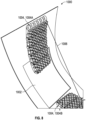
FIGS. 8 shows a portion of adisplay 1000 that is undergoing bending of aglass substrate 1002 thereof. This bending forms a radius of curvature 1003 in thisglass substrate 1002. The bending of the glass substrate is being performed by a backing 1004 (e.g., the same as or similar to the backing 512) used in combination with anactuator 1006. This combination of the backing 1004 and theactuator 1006 can facilitate dynamic movement of thedisplay 1000. - According to the example of
FIGS. 9A and 9D , theactuator 1006 can comprise a reel (not shown) utilizing wire or other line coupled to a first portion 1004A of the backing 1004 and a second portion 1004B of the backing 1004. The first portion 1004A and second portion 1004B can be located on opposing ends of thedisplay 1000. -
FIGS. 9A-9D illustrate amethod 1100 of dynamically altering a shape of adisplay 1101. Thedisplay 1101 can include aglass substrate 1102, abacking 1104 such as any of those previously described and optionally a frame 1105.FIG. 9A shows thebacking 1104 alone prior to application to theglass substrate 1102 and frame 1105 via the bonding medium as previously described.FIG. 9B shows thebacking 1104 attached to theglass substrate 1102 and frame 1105.FIG. 9C shows at least one actuator 1106 (here a plurality ofmotors 1108 with shafts 1110) can be coupled to particular segment(s) or linkage(s) of thebacking 1104. The at least oneactuator 1106 can be arranged to extend across a portion or all of thebacking 1104.FIG. 9D shows the at least oneactuator 1106 can move the particular segment(s) or linkage(s) of thebacking 1104. This can facilitate dynamic movement of thedisplay 1101 such as to form acurved region 1112 along a surface of theglass substrate 1102 thereof. - Values expressed in a range format should be interpreted in a flexible manner to include not only the numerical values explicitly recited as the limits of the range, but also to include all the individual numerical values or sub-ranges encompassed within that range as if each numerical value and sub-range were explicitly recited. For example, a range of "about 0.1% to about 5%" or "about 0.1% to 5%" should be interpreted to include not just about 0.1% to about 5%, but also the individual values (e.g., 1%, 2%, 3%, and 4%) and the sub-ranges (e.g., 0.1% to 0.5%, 1.1% to 2.2%, 3.3% to 4.4%) within the indicated range. The statement "about X to Y" has the same meaning as "about X to about Y," unless indicated otherwise. Likewise, the statement "about X, Y, or about Z" has the same meaning as "about X, about Y, or about Z," unless indicated otherwise.
- In this document, the terms "a," "an," or "the" are used to include one or more than one unless the context clearly dictates otherwise. The term "or" is used to refer to a nonexclusive "or" unless otherwise indicated. In addition, it is to be understood that the phraseology or terminology employed herein, and not otherwise defined, is for the purpose of description only and not of limitation. Any use of section headings is intended to aid reading of the document and is not to be interpreted as limiting; information that is relevant to a section heading may occur within or outside of that particular section.
- The terms "about", "generally", or "correspond" as used herein can allow for a degree of variability in a value or range, for example, within 10%, within 5%, or within 1% of a stated value or of a stated limit of a range.
- The term "substantially" or "substantial" as used herein refers to a majority of, or mostly, as in at least about 50%, 60%, 70%, 80%, 90%, 95%, 96%, 97%, 98%, 99%, 99.5%, 99.9%, 99.99%, or at least about 99.999% or more.
Claims (14)
- An apparatus for housing one or more display modules (400) or other components within a vehicle interior system (100, 200, 300), comprising:a glass substrate (402) having a curved portion (408);a backing (412, 512) configured to support the glass substrate (402), wherein the backing (412, 512) comprises a plurality of linkages (414), wherein one or more of the plurality of linkages (414) are selectively moveable to interface with and correspond to a radius of curvature of the curved portion (408) of the glass substrate (402); anda bonding medium (800) attaching the glass substrate (402) to the backing (412, 512).
- The apparatus of claim 1, wherein the backing (412, 512) comprises a mesh (416) formed by connecting the plurality of linkages (414).
- The apparatus of claim 2, wherein the mesh (416) comprises a chain mail.
- The apparatus of any one of claims 1-3, further comprising an articulating joint (516A, 516B, 516C, 516D) connecting one of the plurality of linkages (414) with at least a second one of the plurality of linkages (414), and wherein the at least the one of the plurality of linkages (414) is movable relative to the at least the second one of the plurality of linkages (414) via the articulating joint (516A, 516B, 516C, 516D).
- The apparatus of claim 4, wherein the articulating joint (516A, 516B, 516C, 516D) cross-links at least a third of the plurality of linkages (414) with at least a fourth of the plurality of linkages (414), wherein the at least the third of the plurality of linkages (414) and the at least a fourth of the plurality of linkages (414) are positioned generally parallel with a respective one of the at least the one of the plurality of linkages (414) and the at least the second one of the plurality of linkages (414).
- The apparatus of any one of claim 5, wherein the articulating joint (516A, 516B, 516C, 516D) is free of being covered by the bonding medium (800) and further comprising one or more actuators (1006, 1106) configured to drive one or more of the plurality of linkages (414) to a desired position to form the curved portion (408) of the glass substrate (402).
- The apparatus of any one of claims 1-5, further comprising one or more actuators (1006, 1106) configured to drive one or more of the plurality of linkages (414) to a desired position to control and shape one or more of a curvature or location of the curved portion (408) of the glass substrate (402).
- The apparatus of any one of claims 1-7, wherein the bonding medium (800) comprises one or more of VHB tape, foam tape, rigid polymer, compliant polymer or fully or partially cured structural adhesive.
- The apparatus of any one of claims 1-8, further comprising a frame (404) coupled to the glass substrate (402).
- A method (900) of cold forming a display (400) or console for a vehicle interior system (100, 200, 300), the method (900) comprising:applying an adhesive to a glass substrate (402);positioning a forming apparatus (902) on the glass substrate (402) with the adhesive positioned therebetween such that the forming apparatus (902) is coupled to the adhesive, wherein the forming apparatus (902) comprises a plurality of linkages (414);selectively moving the plurality of linkages (414) relative to one another such that a first major surface of the forming apparatus (902) assumes a radius of curvature;applying a desired force to the glass substrate (402) and the forming apparatus (902) to compress the adhesive; andmaintaining applying the desired force to compress the adhesive for a desired duration of time with the glass substrate (402) clamped to the forming apparatus (902).
- The method (900) of claim 10, further comprising:
connecting one of the plurality of linkages (414) with at least another one of the plurality of linkages (414) by means of an articulating joint (516A, 516B, 516C, 516D), such that at least two of the plurality of linkages (414) are selectively movable relative to one another via the articulating joint (516A, 516B, 516C, 516D). - The method (900) of claim 11, further comprising locking the articulating joint (516A, 516B, 516C, 516D)to position the one of the plurality of linkages (414) relative to the at least another one of the plurality of linkages (414) and to reduce or eliminate substantial relative movement between the one of the plurality of linkages (414) and the at least another one of the plurality of linkages (414).
- The method (900) of claim 12, wherein the locking comprises at least one of retaining the plurality of linkages (414) with the adhesive, retaining the plurality of linkages (414) by applying a second adhesive over the articulating joint (516A, 516B, 516C, 516D) or adjacent the articulating joint (516A, 516B, 516C, 516D), applying the adhesive over the articulating joint (516A, 516B, 516C, 516D), mating a female portion of the articulating joint (516A, 516B, 516C, 516D) with a male portion of the articulating joint (516A, 516B, 516C, 516D) or creating a snap fit connection at the articulating joint (516A, 516B, 516C, 516D).
- A system (100, 200, 300) for a display (400), console or other component of a vehicle, the system (100, 200, 300) comprising:a glass substrate (402) having a curved portion (408);a backing (412, 512) configured to support the glass substrate (402), wherein the backing (412, 512) comprises a first plurality of linkages (414), and wherein one or more of the first plurality of linkages (414) are selectively moveable to interface with and correspond to a radius of curvature of the curved portion (408) of the glass substrate (402);a forming apparatus (902) configured to provide the glass substrate (402) with the curved portion (408), wherein the forming apparatus (902) comprises a second plurality of linkages (414) configured to be selectively moveable to assume a second radius of curvature along a first major surface of the forming apparatus (902), wherein the second radius of curvature corresponds with the radius of curvature of the curved portion (408) of the glass substrate (402); anda bonding medium (800) configured to attach the glass substrate to (402) one of the backing (412, 512) or the forming apparatus (902).
Applications Claiming Priority (1)
| Application Number | Priority Date | Filing Date | Title |
|---|---|---|---|
| US202062988481P | 2020-03-12 | 2020-03-12 |
Publications (2)
| Publication Number | Publication Date |
|---|---|
| EP3878822A1 EP3878822A1 (en) | 2021-09-15 |
| EP3878822B1 true EP3878822B1 (en) | 2025-04-16 |
Family
ID=74871261
Family Applications (1)
| Application Number | Title | Priority Date | Filing Date |
|---|---|---|---|
| EP21162046.3A Active EP3878822B1 (en) | 2020-03-12 | 2021-03-11 | Apparatuses, systems and methods for cold forming glass |
Country Status (3)
| Country | Link |
|---|---|
| US (2) | US11952304B2 (en) |
| EP (1) | EP3878822B1 (en) |
| CN (2) | CN113393760B (en) |
Families Citing this family (1)
| Publication number | Priority date | Publication date | Assignee | Title |
|---|---|---|---|---|
| US11952304B2 (en) * | 2020-03-12 | 2024-04-09 | Corning Incorporated | Apparatuses, systems and methods for cold forming glass |
Citations (1)
| Publication number | Priority date | Publication date | Assignee | Title |
|---|---|---|---|---|
| EP3482253B1 (en) * | 2016-07-05 | 2021-05-05 | Corning Incorporated | Cold-formed glass article and assembly process thereof |
Family Cites Families (21)
| Publication number | Priority date | Publication date | Assignee | Title |
|---|---|---|---|---|
| BE1000350A5 (en) | 1987-02-27 | 1988-11-08 | Saint Roch Glaceries | Hanger glass panel. |
| EP1636683A4 (en) | 2003-12-15 | 2007-08-22 | Schott Corp | Touch control assembly |
| TWI379261B (en) | 2008-05-16 | 2012-12-11 | Au Optronics Corp | Curved display panel and manufacturing method thereof |
| US10088863B2 (en) * | 2011-09-30 | 2018-10-02 | Apple Inc. | Electronic devices with cover layers mounted to displays |
| JP5835038B2 (en) | 2012-03-15 | 2015-12-24 | 日本電気硝子株式会社 | Glass material-resin material laminate |
| KR101692252B1 (en) * | 2012-04-08 | 2017-01-04 | 삼성전자주식회사 | Flexible display apparatus and control method thereof |
| KR20160103083A (en) * | 2013-12-24 | 2016-08-31 | 폴리에라 코퍼레이션 | Support structures for an attachable, two-dimensional flexible electronic device |
| DE102014016323B4 (en) * | 2014-11-03 | 2021-11-25 | Audi Ag | Display device for a motor vehicle, method for operating a display device and motor vehicle with a display device |
| WO2016194916A1 (en) * | 2015-06-05 | 2016-12-08 | 旭硝子株式会社 | Vehicle mounted display device |
| EP3271795B1 (en) * | 2015-06-26 | 2020-06-17 | Hewlett-Packard Development Company, L.P. | Hinge for a foldable display unit |
| US10421545B2 (en) | 2015-06-30 | 2019-09-24 | Bae Systems Controls Inc. | Vehicle display |
| KR102396460B1 (en) * | 2015-10-29 | 2022-05-11 | 엘지디스플레이 주식회사 | Curved display device and electronic device comprising the same |
| DE102016215546A1 (en) | 2016-08-18 | 2018-02-22 | Faurecia Innenraum Systeme Gmbh | Method for producing a vehicle interior trim part and vehicle interior trim part |
| KR102445875B1 (en) * | 2017-01-03 | 2022-09-21 | 코닝 인코포레이티드 | Vehicle interior system having curved cover glass and display or touch panel and method of forming same |
| US10929707B2 (en) | 2017-03-02 | 2021-02-23 | Ricoh Company, Ltd. | Computation of audience metrics focalized on displayed content |
| KR20200027462A (en) * | 2017-07-07 | 2020-03-12 | 코닝 인코포레이티드 | Vehicle interior system with curved cover glass and display or touch panel and method of forming the same |
| EP3681847B1 (en) * | 2017-09-12 | 2025-01-29 | Corning Incorporated | Tactile elements for deadfronted glass and methods of making the same |
| US11065960B2 (en) | 2017-09-13 | 2021-07-20 | Corning Incorporated | Curved vehicle displays |
| CN208737802U (en) * | 2018-08-21 | 2019-04-12 | 深圳市柔宇科技有限公司 | Electronic device and flexible display device thereof |
| US11353919B2 (en) * | 2019-09-19 | 2022-06-07 | Visteon Global Technologies, Inc. | Display assembly |
| US11952304B2 (en) * | 2020-03-12 | 2024-04-09 | Corning Incorporated | Apparatuses, systems and methods for cold forming glass |
-
2021
- 2021-03-11 US US17/198,722 patent/US11952304B2/en active Active
- 2021-03-11 EP EP21162046.3A patent/EP3878822B1/en active Active
- 2021-03-12 CN CN202110268925.4A patent/CN113393760B/en active Active
- 2021-03-12 CN CN202120518852.5U patent/CN215814862U/en not_active Expired - Fee Related
-
2024
- 2024-03-08 US US18/599,766 patent/US12338158B2/en active Active
Patent Citations (1)
| Publication number | Priority date | Publication date | Assignee | Title |
|---|---|---|---|---|
| EP3482253B1 (en) * | 2016-07-05 | 2021-05-05 | Corning Incorporated | Cold-formed glass article and assembly process thereof |
Also Published As
| Publication number | Publication date |
|---|---|
| US11952304B2 (en) | 2024-04-09 |
| US20210284564A1 (en) | 2021-09-16 |
| CN215814862U (en) | 2022-02-11 |
| EP3878822A1 (en) | 2021-09-15 |
| US12338158B2 (en) | 2025-06-24 |
| CN113393760A (en) | 2021-09-14 |
| US20240208851A1 (en) | 2024-06-27 |
| CN113393760B (en) | 2025-12-09 |
Similar Documents
| Publication | Publication Date | Title |
|---|---|---|
| US12011914B2 (en) | Curved glass constructions and methods for forming same | |
| EP3482253B1 (en) | Cold-formed glass article and assembly process thereof | |
| EP4185465B1 (en) | Glass article including flexible mid-frame for joining a bent glass sheet to a rigid frame | |
| KR20200068690A (en) | Vehicle interior system with curved cover glass with improved reliability and method for forming same | |
| US12338158B2 (en) | Apparatuses, systems and methods for cold forming glass | |
| US20220088903A1 (en) | Three-dimensional cold formed curved composites | |
| US20220234447A1 (en) | Method and system for laminating and dynamically and reversibly bending cover glass | |
| US20250214318A1 (en) | Glass articles having adhesive bead with high aspect ratio and method of preparing same | |
| US11993148B2 (en) | Cold formed 3D product and processes using vacuum chuck | |
| CN116615395A (en) | Optimized shape for improved performance and reliability of glass articles made by cold forming methods | |
| US20250100384A1 (en) | Bendable glass article for vehicle interior system having improved head impact performance | |
| WO2026050006A1 (en) | Glass article with adhesive layer configured for delamination of glass substrate in response to headform impact | |
| EP4659068A1 (en) | Display systems comprising spacers disposed between frame and display back panel and associated methods | |
| CN121001973A (en) | Apparatus and method for preventing adhesive peeling on convex curved glass articles |
Legal Events
| Date | Code | Title | Description |
|---|---|---|---|
| PUAI | Public reference made under article 153(3) epc to a published international application that has entered the european phase |
Free format text: ORIGINAL CODE: 0009012 |
|
| STAA | Information on the status of an ep patent application or granted ep patent |
Free format text: STATUS: THE APPLICATION HAS BEEN PUBLISHED |
|
| AK | Designated contracting states |
Kind code of ref document: A1 Designated state(s): AL AT BE BG CH CY CZ DE DK EE ES FI FR GB GR HR HU IE IS IT LI LT LU LV MC MK MT NL NO PL PT RO RS SE SI SK SM TR |
|
| STAA | Information on the status of an ep patent application or granted ep patent |
Free format text: STATUS: REQUEST FOR EXAMINATION WAS MADE |
|
| 17P | Request for examination filed |
Effective date: 20220314 |
|
| RBV | Designated contracting states (corrected) |
Designated state(s): AL AT BE BG CH CY CZ DE DK EE ES FI FR GB GR HR HU IE IS IT LI LT LU LV MC MK MT NL NO PL PT RO RS SE SI SK SM TR |
|
| GRAP | Despatch of communication of intention to grant a patent |
Free format text: ORIGINAL CODE: EPIDOSNIGR1 |
|
| STAA | Information on the status of an ep patent application or granted ep patent |
Free format text: STATUS: GRANT OF PATENT IS INTENDED |
|
| INTG | Intention to grant announced |
Effective date: 20241015 |
|
| GRAS | Grant fee paid |
Free format text: ORIGINAL CODE: EPIDOSNIGR3 |
|
| GRAA | (expected) grant |
Free format text: ORIGINAL CODE: 0009210 |
|
| STAA | Information on the status of an ep patent application or granted ep patent |
Free format text: STATUS: THE PATENT HAS BEEN GRANTED |
|
| AK | Designated contracting states |
Kind code of ref document: B1 Designated state(s): AL AT BE BG CH CY CZ DE DK EE ES FI FR GB GR HR HU IE IS IT LI LT LU LV MC MK MT NL NO PL PT RO RS SE SI SK SM TR |
|
| REG | Reference to a national code |
Ref country code: GB Ref legal event code: FG4D |
|
| REG | Reference to a national code |
Ref country code: CH Ref legal event code: EP |
|
| REG | Reference to a national code |
Ref country code: IE Ref legal event code: FG4D |
|
| REG | Reference to a national code |
Ref country code: DE Ref legal event code: R096 Ref document number: 602021029107 Country of ref document: DE |
|
| REG | Reference to a national code |
Ref country code: NL Ref legal event code: MP Effective date: 20250416 |
|
| PG25 | Lapsed in a contracting state [announced via postgrant information from national office to epo] |
Ref country code: NL Free format text: LAPSE BECAUSE OF FAILURE TO SUBMIT A TRANSLATION OF THE DESCRIPTION OR TO PAY THE FEE WITHIN THE PRESCRIBED TIME-LIMIT Effective date: 20250416 |
|
| REG | Reference to a national code |
Ref country code: AT Ref legal event code: MK05 Ref document number: 1785582 Country of ref document: AT Kind code of ref document: T Effective date: 20250416 |
|
| PG25 | Lapsed in a contracting state [announced via postgrant information from national office to epo] |
Ref country code: ES Free format text: LAPSE BECAUSE OF FAILURE TO SUBMIT A TRANSLATION OF THE DESCRIPTION OR TO PAY THE FEE WITHIN THE PRESCRIBED TIME-LIMIT Effective date: 20250416 Ref country code: FI Free format text: LAPSE BECAUSE OF FAILURE TO SUBMIT A TRANSLATION OF THE DESCRIPTION OR TO PAY THE FEE WITHIN THE PRESCRIBED TIME-LIMIT Effective date: 20250416 Ref country code: PT Free format text: LAPSE BECAUSE OF FAILURE TO SUBMIT A TRANSLATION OF THE DESCRIPTION OR TO PAY THE FEE WITHIN THE PRESCRIBED TIME-LIMIT Effective date: 20250818 |
|
| REG | Reference to a national code |
Ref country code: LT Ref legal event code: MG9D |
|
| PG25 | Lapsed in a contracting state [announced via postgrant information from national office to epo] |
Ref country code: NO Free format text: LAPSE BECAUSE OF FAILURE TO SUBMIT A TRANSLATION OF THE DESCRIPTION OR TO PAY THE FEE WITHIN THE PRESCRIBED TIME-LIMIT Effective date: 20250716 Ref country code: GR Free format text: LAPSE BECAUSE OF FAILURE TO SUBMIT A TRANSLATION OF THE DESCRIPTION OR TO PAY THE FEE WITHIN THE PRESCRIBED TIME-LIMIT Effective date: 20250717 |
|
| PG25 | Lapsed in a contracting state [announced via postgrant information from national office to epo] |
Ref country code: PL Free format text: LAPSE BECAUSE OF FAILURE TO SUBMIT A TRANSLATION OF THE DESCRIPTION OR TO PAY THE FEE WITHIN THE PRESCRIBED TIME-LIMIT Effective date: 20250416 |
|
| PG25 | Lapsed in a contracting state [announced via postgrant information from national office to epo] |
Ref country code: BG Free format text: LAPSE BECAUSE OF FAILURE TO SUBMIT A TRANSLATION OF THE DESCRIPTION OR TO PAY THE FEE WITHIN THE PRESCRIBED TIME-LIMIT Effective date: 20250416 |
|
| PG25 | Lapsed in a contracting state [announced via postgrant information from national office to epo] |
Ref country code: HR Free format text: LAPSE BECAUSE OF FAILURE TO SUBMIT A TRANSLATION OF THE DESCRIPTION OR TO PAY THE FEE WITHIN THE PRESCRIBED TIME-LIMIT Effective date: 20250416 |
|
| PG25 | Lapsed in a contracting state [announced via postgrant information from national office to epo] |
Ref country code: AT Free format text: LAPSE BECAUSE OF FAILURE TO SUBMIT A TRANSLATION OF THE DESCRIPTION OR TO PAY THE FEE WITHIN THE PRESCRIBED TIME-LIMIT Effective date: 20250416 |
|
| PG25 | Lapsed in a contracting state [announced via postgrant information from national office to epo] |
Ref country code: RS Free format text: LAPSE BECAUSE OF FAILURE TO SUBMIT A TRANSLATION OF THE DESCRIPTION OR TO PAY THE FEE WITHIN THE PRESCRIBED TIME-LIMIT Effective date: 20250716 |
|
| PG25 | Lapsed in a contracting state [announced via postgrant information from national office to epo] |
Ref country code: IS Free format text: LAPSE BECAUSE OF FAILURE TO SUBMIT A TRANSLATION OF THE DESCRIPTION OR TO PAY THE FEE WITHIN THE PRESCRIBED TIME-LIMIT Effective date: 20250816 |
|
| PG25 | Lapsed in a contracting state [announced via postgrant information from national office to epo] |
Ref country code: LV Free format text: LAPSE BECAUSE OF FAILURE TO SUBMIT A TRANSLATION OF THE DESCRIPTION OR TO PAY THE FEE WITHIN THE PRESCRIBED TIME-LIMIT Effective date: 20250416 |
|
| PG25 | Lapsed in a contracting state [announced via postgrant information from national office to epo] |
Ref country code: DK Free format text: LAPSE BECAUSE OF FAILURE TO SUBMIT A TRANSLATION OF THE DESCRIPTION OR TO PAY THE FEE WITHIN THE PRESCRIBED TIME-LIMIT Effective date: 20250416 Ref country code: SM Free format text: LAPSE BECAUSE OF FAILURE TO SUBMIT A TRANSLATION OF THE DESCRIPTION OR TO PAY THE FEE WITHIN THE PRESCRIBED TIME-LIMIT Effective date: 20250416 |
|
| REG | Reference to a national code |
Ref country code: DE Ref legal event code: R097 Ref document number: 602021029107 Country of ref document: DE |
|
| PG25 | Lapsed in a contracting state [announced via postgrant information from national office to epo] |
Ref country code: CZ Free format text: LAPSE BECAUSE OF FAILURE TO SUBMIT A TRANSLATION OF THE DESCRIPTION OR TO PAY THE FEE WITHIN THE PRESCRIBED TIME-LIMIT Effective date: 20250416 |
|
| PG25 | Lapsed in a contracting state [announced via postgrant information from national office to epo] |
Ref country code: EE Free format text: LAPSE BECAUSE OF FAILURE TO SUBMIT A TRANSLATION OF THE DESCRIPTION OR TO PAY THE FEE WITHIN THE PRESCRIBED TIME-LIMIT Effective date: 20250416 |
|
| PG25 | Lapsed in a contracting state [announced via postgrant information from national office to epo] |
Ref country code: SK Free format text: LAPSE BECAUSE OF FAILURE TO SUBMIT A TRANSLATION OF THE DESCRIPTION OR TO PAY THE FEE WITHIN THE PRESCRIBED TIME-LIMIT Effective date: 20250416 Ref country code: RO Free format text: LAPSE BECAUSE OF FAILURE TO SUBMIT A TRANSLATION OF THE DESCRIPTION OR TO PAY THE FEE WITHIN THE PRESCRIBED TIME-LIMIT Effective date: 20250416 |
|
| PG25 | Lapsed in a contracting state [announced via postgrant information from national office to epo] |
Ref country code: IT Free format text: LAPSE BECAUSE OF FAILURE TO SUBMIT A TRANSLATION OF THE DESCRIPTION OR TO PAY THE FEE WITHIN THE PRESCRIBED TIME-LIMIT Effective date: 20250416 |
|
| PLBE | No opposition filed within time limit |
Free format text: ORIGINAL CODE: 0009261 |
|
| STAA | Information on the status of an ep patent application or granted ep patent |
Free format text: STATUS: NO OPPOSITION FILED WITHIN TIME LIMIT |
|
| REG | Reference to a national code |
Ref country code: CH Ref legal event code: L10 Free format text: ST27 STATUS EVENT CODE: U-0-0-L10-L00 (AS PROVIDED BY THE NATIONAL OFFICE) Effective date: 20260225 |
|
| 26N | No opposition filed |
Effective date: 20260119 |