EP3877636B1 - Engine with fluidic variable turbochager - Google Patents
Engine with fluidic variable turbochager Download PDFInfo
- Publication number
- EP3877636B1 EP3877636B1 EP19896905.7A EP19896905A EP3877636B1 EP 3877636 B1 EP3877636 B1 EP 3877636B1 EP 19896905 A EP19896905 A EP 19896905A EP 3877636 B1 EP3877636 B1 EP 3877636B1
- Authority
- EP
- European Patent Office
- Prior art keywords
- engine
- injection ports
- air
- vane
- row
- Prior art date
- Legal status (The legal status is an assumption and is not a legal conclusion. Google has not performed a legal analysis and makes no representation as to the accuracy of the status listed.)
- Active
Links
Images



Classifications
-
- F—MECHANICAL ENGINEERING; LIGHTING; HEATING; WEAPONS; BLASTING
- F02—COMBUSTION ENGINES; HOT-GAS OR COMBUSTION-PRODUCT ENGINE PLANTS
- F02B—INTERNAL-COMBUSTION PISTON ENGINES; COMBUSTION ENGINES IN GENERAL
- F02B37/00—Engines characterised by provision of pumps driven at least for part of the time by exhaust
- F02B37/12—Control of the pumps
- F02B37/24—Control of the pumps by using pumps or turbines with adjustable guide vanes
-
- F—MECHANICAL ENGINEERING; LIGHTING; HEATING; WEAPONS; BLASTING
- F01—MACHINES OR ENGINES IN GENERAL; ENGINE PLANTS IN GENERAL; STEAM ENGINES
- F01D—NON-POSITIVE DISPLACEMENT MACHINES OR ENGINES, e.g. STEAM TURBINES
- F01D17/00—Regulating or controlling by varying flow
- F01D17/10—Final actuators
- F01D17/12—Final actuators arranged in stator parts
- F01D17/14—Final actuators arranged in stator parts varying effective cross-sectional area of nozzles or guide conduits
- F01D17/16—Final actuators arranged in stator parts varying effective cross-sectional area of nozzles or guide conduits by means of nozzle vanes
- F01D17/167—Final actuators arranged in stator parts varying effective cross-sectional area of nozzles or guide conduits by means of nozzle vanes of vanes moving in translation
-
- B—PERFORMING OPERATIONS; TRANSPORTING
- B61—RAILWAYS
- B61C—LOCOMOTIVES; MOTOR RAILCARS
- B61C5/00—Locomotives or motor railcars with IC engines or gas turbines
- B61C5/04—Arrangement or disposition of exhaust apparatus
-
- F—MECHANICAL ENGINEERING; LIGHTING; HEATING; WEAPONS; BLASTING
- F01—MACHINES OR ENGINES IN GENERAL; ENGINE PLANTS IN GENERAL; STEAM ENGINES
- F01D—NON-POSITIVE DISPLACEMENT MACHINES OR ENGINES, e.g. STEAM TURBINES
- F01D17/00—Regulating or controlling by varying flow
- F01D17/10—Final actuators
- F01D17/12—Final actuators arranged in stator parts
- F01D17/14—Final actuators arranged in stator parts varying effective cross-sectional area of nozzles or guide conduits
- F01D17/16—Final actuators arranged in stator parts varying effective cross-sectional area of nozzles or guide conduits by means of nozzle vanes
-
- F—MECHANICAL ENGINEERING; LIGHTING; HEATING; WEAPONS; BLASTING
- F01—MACHINES OR ENGINES IN GENERAL; ENGINE PLANTS IN GENERAL; STEAM ENGINES
- F01D—NON-POSITIVE DISPLACEMENT MACHINES OR ENGINES, e.g. STEAM TURBINES
- F01D17/00—Regulating or controlling by varying flow
- F01D17/10—Final actuators
- F01D17/12—Final actuators arranged in stator parts
- F01D17/14—Final actuators arranged in stator parts varying effective cross-sectional area of nozzles or guide conduits
- F01D17/16—Final actuators arranged in stator parts varying effective cross-sectional area of nozzles or guide conduits by means of nozzle vanes
- F01D17/165—Final actuators arranged in stator parts varying effective cross-sectional area of nozzles or guide conduits by means of nozzle vanes for radial flow, i.e. the vanes turning around axes which are essentially parallel to the rotor centre line
-
- F—MECHANICAL ENGINEERING; LIGHTING; HEATING; WEAPONS; BLASTING
- F01—MACHINES OR ENGINES IN GENERAL; ENGINE PLANTS IN GENERAL; STEAM ENGINES
- F01D—NON-POSITIVE DISPLACEMENT MACHINES OR ENGINES, e.g. STEAM TURBINES
- F01D5/00—Blades; Blade-carrying members; Heating, heat-insulating, cooling or antivibration means on the blades or the members
- F01D5/12—Blades
- F01D5/14—Form or construction
- F01D5/147—Construction, i.e. structural features, e.g. of weight-saving hollow blades
-
- F—MECHANICAL ENGINEERING; LIGHTING; HEATING; WEAPONS; BLASTING
- F01—MACHINES OR ENGINES IN GENERAL; ENGINE PLANTS IN GENERAL; STEAM ENGINES
- F01D—NON-POSITIVE DISPLACEMENT MACHINES OR ENGINES, e.g. STEAM TURBINES
- F01D5/00—Blades; Blade-carrying members; Heating, heat-insulating, cooling or antivibration means on the blades or the members
- F01D5/12—Blades
- F01D5/14—Form or construction
- F01D5/148—Blades with variable camber, e.g. by ejection of fluid
-
- F—MECHANICAL ENGINEERING; LIGHTING; HEATING; WEAPONS; BLASTING
- F02—COMBUSTION ENGINES; HOT-GAS OR COMBUSTION-PRODUCT ENGINE PLANTS
- F02B—INTERNAL-COMBUSTION PISTON ENGINES; COMBUSTION ENGINES IN GENERAL
- F02B37/00—Engines characterised by provision of pumps driven at least for part of the time by exhaust
- F02B37/12—Control of the pumps
-
- F—MECHANICAL ENGINEERING; LIGHTING; HEATING; WEAPONS; BLASTING
- F02—COMBUSTION ENGINES; HOT-GAS OR COMBUSTION-PRODUCT ENGINE PLANTS
- F02C—GAS-TURBINE PLANTS; AIR INTAKES FOR JET-PROPULSION PLANTS; CONTROLLING FUEL SUPPLY IN AIR-BREATHING JET-PROPULSION PLANTS
- F02C6/00—Plural gas-turbine plants; Combinations of gas-turbine plants with other apparatus; Adaptations of gas-turbine plants for special use
- F02C6/04—Gas-turbine plants providing heated or pressurised working fluid for other apparatus, e.g. without mechanical power output
- F02C6/10—Gas-turbine plants providing heated or pressurised working fluid for other apparatus, e.g. without mechanical power output supplying working fluid to a user, e.g. a chemical process, which returns working fluid to a turbine of the plant
- F02C6/12—Turbochargers, i.e. plants for augmenting mechanical power output of internal-combustion piston engines by increase of charge pressure
-
- F—MECHANICAL ENGINEERING; LIGHTING; HEATING; WEAPONS; BLASTING
- F05—INDEXING SCHEMES RELATING TO ENGINES OR PUMPS IN VARIOUS SUBCLASSES OF CLASSES F01-F04
- F05D—INDEXING SCHEME FOR ASPECTS RELATING TO NON-POSITIVE-DISPLACEMENT MACHINES OR ENGINES, GAS-TURBINES OR JET-PROPULSION PLANTS
- F05D2220/00—Application
- F05D2220/40—Application in turbochargers
-
- F—MECHANICAL ENGINEERING; LIGHTING; HEATING; WEAPONS; BLASTING
- F05—INDEXING SCHEMES RELATING TO ENGINES OR PUMPS IN VARIOUS SUBCLASSES OF CLASSES F01-F04
- F05D—INDEXING SCHEME FOR ASPECTS RELATING TO NON-POSITIVE-DISPLACEMENT MACHINES OR ENGINES, GAS-TURBINES OR JET-PROPULSION PLANTS
- F05D2240/00—Components
- F05D2240/10—Stators
- F05D2240/12—Fluid guiding means, e.g. vanes
- F05D2240/128—Nozzles
-
- F—MECHANICAL ENGINEERING; LIGHTING; HEATING; WEAPONS; BLASTING
- F05—INDEXING SCHEMES RELATING TO ENGINES OR PUMPS IN VARIOUS SUBCLASSES OF CLASSES F01-F04
- F05D—INDEXING SCHEME FOR ASPECTS RELATING TO NON-POSITIVE-DISPLACEMENT MACHINES OR ENGINES, GAS-TURBINES OR JET-PROPULSION PLANTS
- F05D2240/00—Components
- F05D2240/20—Rotors
- F05D2240/30—Characteristics of rotor blades, i.e. of any element transforming dynamic fluid energy to or from rotational energy and being attached to a rotor
-
- F—MECHANICAL ENGINEERING; LIGHTING; HEATING; WEAPONS; BLASTING
- F05—INDEXING SCHEMES RELATING TO ENGINES OR PUMPS IN VARIOUS SUBCLASSES OF CLASSES F01-F04
- F05D—INDEXING SCHEME FOR ASPECTS RELATING TO NON-POSITIVE-DISPLACEMENT MACHINES OR ENGINES, GAS-TURBINES OR JET-PROPULSION PLANTS
- F05D2250/00—Geometry
- F05D2250/10—Two-dimensional
- F05D2250/14—Two-dimensional elliptical
- F05D2250/141—Two-dimensional elliptical circular
-
- Y—GENERAL TAGGING OF NEW TECHNOLOGICAL DEVELOPMENTS; GENERAL TAGGING OF CROSS-SECTIONAL TECHNOLOGIES SPANNING OVER SEVERAL SECTIONS OF THE IPC; TECHNICAL SUBJECTS COVERED BY FORMER USPC CROSS-REFERENCE ART COLLECTIONS [XRACs] AND DIGESTS
- Y02—TECHNOLOGIES OR APPLICATIONS FOR MITIGATION OR ADAPTATION AGAINST CLIMATE CHANGE
- Y02T—CLIMATE CHANGE MITIGATION TECHNOLOGIES RELATED TO TRANSPORTATION
- Y02T10/00—Road transport of goods or passengers
- Y02T10/10—Internal combustion engine [ICE] based vehicles
- Y02T10/12—Improving ICE efficiencies
Definitions
- Embodiments of the subject matter disclosed herein relate to an engine comprising a fluidic variable turbocharger.
- Engines such as those installed on a vehicle, may be equipped with a variable geometry turbocharger, which may allow an effective aspect ratio of the turbocharger to be altered as engine conditions change, for example, from low engine speeds to high engine speeds. Thus, a desired amount of boost may be provided during engine conditions where exhaust gas production is lower.
- US 2015/184516 A1 shows a gas turbine comprising a nozzle segment, the nozzle segment including an airfoil extending between an upper endwall and a lower endwall.
- the airfoil includes a plurality of inner cooling apertures and a plurality of outer cooling apertures.
- An engine comprising a turbocharger according to the preamble of claim 1 is known from document DE 10 2007 017844 A1 .
- Vanes and other similar components may be arranged in a nozzle of the turbine to adjust the turbine geometry.
- the vanes or other adjacent components may be actuated within the turbine to adjust an airflow therein to decrease an effective throat area of the turbine. This may accelerate exhaust gas therein to increase a turbine speed and increase boost. It is an objective of the present invention to provide an improved engine comprising a turbocharger.
- an engine comprising a turbocharger including a turbocharger turbine; wherein the turbocharger turbine has a nozzle ring.
- the nozzle ring includes a plurality of stationary vanes.
- Each vane of the plurality of stationary vanes includes a plurality of injection ports arranged at an outer surface of the vane.
- the engine also includes a gas supply system that is configured to supply variable gas flow to and out of the plurality of injection ports, via passages that extend through the vanes.
- the ports may be circular shaped, slot shaped, polygonal shaped, etc.
- variable geometry turbines have moving components, such as pivotable or slideable vanes, within a nozzle ring of the turbine to adjust a geometry of the turbine.
- This architecture presents some problems, including maintenance, reliability, and manufacturing difficulties (e.g., the moving parts may become degraded and need replacing and may be more complicated and/or expensive to manufacture).
- the stationary vanes described herein receive air flow from an air source, such as from a compressor or turbocharger compressor, in order to inject air into a nozzle of the turbine.
- An amount of air injected via the vanes may adjust a throat area of the turbine, thereby adjusting an output of the turbine.
- the amount of air injected via the vanes may be adjusted via adjusting positions of first and second valves of a flow control system, which may be arranged outside of the turbine.
- the turbocharger turbine receives exhaust gas from an engine of a vehicle as shown in FIG. 1 .
- the turbine comprises a plurality of vanes arranged along a circumference of a turbine nozzle as shown in FIG. 2 .
- the vanes may comprise a plurality of inlets and interior passages for receiving air from an air source (such as a compressor of the turbocharger) and directing the air to injection ports arranged on an outer surface of the vanes.
- the injection ports may be arranged in rows aligned with the inlets and interior passages such that each row is fluidly coupled to one inlet and one interior passage, as shown in FIG. 2B .
- a flow control system such as the flow control system shown in FIG.
- FIG. 4 comprises a set of valves, wherein each valve is configured to adjust air flow to each inlet and interior passage.
- FIG. 5 shows a method for adjusting an amount of air injected by the turbine nozzle vanes based on an engine condition, such as an engine power level.
- FIG. 6 shows an engine operating sequence illustrating changes in air supplied to the nozzle vanes based on changing operating conditions of the engine.
- An alternative embodiment of the vanes is illustrated in FIG. 3 .
- the vanes may produce a boundary layer sized based on an amount of air flowing therethrough. Examples of two differently sized boundary layers are shown in FIGS. 7A and 7B . Further alternative examples of the vanes are illustrated in FIGS. 8A, 8B , and 8C .
- FIGS. 1-3 , and 8A to-8C show example configurations with relative positioning of the various components. If shown directly contacting each other, or directly coupled, then such elements may be referred to as directly contacting or directly coupled, respectively, at least in one example. Similarly, elements shown contiguous or adjacent to one another may be contiguous or adjacent to each other, respectively, at least in one example. As an example, components laying in face-sharing contact with each other may be referred to as in face-sharing contact. As another example, elements positioned apart from each other with only a space there-between and no other components may be referred to as such, in at least one example.
- top/bottom, upper/lower, above/below may be relative to a vertical axis of the figures and used to describe positioning of elements of the figures relative to one another.
- elements shown above other elements are positioned vertically above the other elements, in one example.
- shapes of the elements depicted within the figures may be referred to as having those shapes (e.g., such as being circular, straight, planar, curved, rounded, chamfered, angled, or the like).
- elements shown intersecting one another may be referred to as intersecting elements or intersecting one another, in at least one example.
- an element shown within another element or shown outside of another element may be referred as such, in one example.
- FIG. 1 shows an embodiment of a system in which a turbocharger arrangement may be installed.
- FIG. 1 shows a block diagram of an embodiment of a vehicle system 100, herein depicted as a vehicle 106.
- the illustrated vehicle is configured to run on a rail 102 via a plurality of wheels 112.
- the vehicle 106 includes an engine 104.
- the engine includes a plurality of cylinders 101 (only one representative cylinder shown in FIG. 1 ) that each include at least one intake valve 103, exhaust valve 105, and fuel injector 107.
- Each intake valve, exhaust valve, and fuel injector may include an actuator that may be actuated via a signal from a controller 110 of the engine 104.
- the engine 104 may be a stationary engine, such as in a power-plant application, or an engine in a marine vessel or other on- or off-highway vehicle propulsion system as noted above.
- the engine receives intake air for combustion from an intake passage 114.
- the intake passage comprises an air filter 160 that filters air from outside of the vehicle.
- Exhaust gas resulting from combustion in the engine is supplied to an exhaust passage 116. Exhaust gas flows through the exhaust passage, and out of an exhaust stack of the vehicle.
- the engine is a diesel engine that combusts air and diesel fuel through compression ignition.
- the engine is a dual or multi-fuel engine that may combust a mixture of gaseous fuel and air upon injection of diesel fuel during compression of the air-gaseous fuel mix.
- the engine may additionally combust fuel including gasoline, kerosene, natural gas, biodiesel, or other petroleum distillates of similar density through compression ignition (and/or spark ignition).
- the vehicle is a diesel-electric vehicle.
- the engine is coupled to an electric power generation system, which includes an alternator/generator 122 and electric traction motors 124.
- the engine is a diesel and/or natural gas engine that generates a torque output that is transmitted to the alternator/generator which is mechanically coupled to the engine.
- the engine is a multi-fuel engine operating with diesel fuel and natural gas, but in other examples the engine may use various combinations of fuels other than diesel and natural gas.
- the alternator/generator 122 produces electrical power that may be stored and applied for subsequent propagation to a variety of downstream electrical components.
- the alternator/generator 122 may be electrically coupled to a plurality of traction motors and the alternator/generator may provide electrical power to the plurality of traction motors.
- each of the plurality of traction motors is connected to one of the plurality of wheels to provide tractive power to propel the vehicle.
- One example configuration includes one traction motor per wheel set.
- six traction motors correspond to each of six pairs of motive wheels of the vehicle.
- alternator/generator may be coupled to one or more resistive grids 126.
- the resistive grids may be configured to dissipate excess engine torque via heat produced by the grids from electricity generated by alternator/generator.
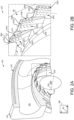
- FIG. 2A it shows a first embodiment 200 of a turbine 202.
- the turbine may be used in the turbocharger arrangement 120 of FIG. 1 .
- An axis system 290 is shown comprising three axes, namely an x-axis parallel to a horizontal direction, a y-axis parallel to a vertical direction, and a z-axis perpendicular to each of the x- and y-axes.
- the axes may be used in reference to describe shapes and orientations of components of the turbine.
- the turbine comprises a turbine housing 204 which may shape an exhaust gas inlet 206.
- the exhaust gas inlet 206 may comprise a volute shape adapted to receive exhaust gas from an engine, such as engine 104 of FIG. 1 .
- the volute shape of the exhaust gas inlet may distribute the exhaust gas around in a 360 ° manner to a turbine wheel (circle 209 indicates where a turbine wheel may be positioned within the turbine).
- the exhaust gas may rotate the turbine wheel, which may translate into rotation of a compressor wheel in a manner known to those of ordinary skill in the art.
- the turbine further comprises a plurality of vanes 210 arranged adj acent to and surrounding the turbine wheel, around an entire circumference of the turbine wheel, along a nozzle ring 208.
- the nozzle ring 208 and plurality of vanes 210 may form a nozzle of the turbine (e.g., turbine nozzle), adapted to guide exhaust flow to the turbine wheel.
- the plurality of vanes may be printed onto the nozzle ring in some examples, e.g., using an additive manufacturing or 3-D printer. Additionally or alternatively, the plurality of vanes may be assembled from a mold. The plurality of vanes are fixed and stationary.
- the three vanes may each comprise individual central axes, which may also define a long axis of each vane, including a first vane central axis 262A, a second vane central axis 262B, and a third vane central axis 262C.
- the vanes may be angled relative to one another such that the central axes may be misaligned. In one example, the central axes are not parallel.
- the angle between each vane of the three vanes may be fixed in one example. In some embodiments, additionally or alternatively, the vanes may each be oriented differently such that an angle between the first and second vanes is different than an angle between the second and third vanes. In either case, the angle between adjacent vanes may not be adjusted due to the vanes being fixed and stationary once arranged on the nozzle ring.
- the first and second extreme ends may be extreme ends of a vane body 273.
- the vane body 273 may be solid, except for one or more interior air passages arranged therein for the plurality of ports as will be described below.
- the vane body 273 may comprise a first side wall 274 and a second side wall 275.
- the first side wall may be substantially identical to the second side wall in size and shape, except that the second side wall may be physically coupled to a portion of the turbine 202.
- the physical coupling may include one or more of bolts, adhesives, welds, and fusions to maintain the vanes stationary position.
- Each of the first and second side walls may extend from between the first extreme end and the second extreme end.
- the vane body, including the side walls may comprise a paddle-like shape. In some examples, additionally or alternatively, the side walls may comprise an elongated teardrop shape.
- Each vane may comprise a plurality of inlets, wherein the first vane comprises a first plurality of inlets 264A, the second vane comprises a second plurality of inlets 264B, and the third vane comprises a third plurality of inlets 264C.
- Each of the plurality of inlets may be arranged along the first side wall of the vanes, facing a direction opposite a turbine blade.
- the air supply may be partially or fully derived from a compressor outlet of the turbocharger to the extent that the desired benefits may be achieved at various operating conditions.
- the air supply to the turbine vanes may also be supplemented by off engine sources in some applications, such as an auxiliary pump.
- the first vane, second vane, and third vane may be substantially identical. As such, the following description with regard to the first plurality of inlets and the first plurality of injection ports of the first vane may also be applied to the inlets and injection ports of the second and third vanes.
- the first plurality of inlets may be aligned along a common axis and arranged on the first side surface. Each inlet of the first plurality of inlets may comprise a circular shape. However, in alternate embodiments, the inlets may have a different shape, such as square, rectangular, or oblong. Each inlet of the first plurality of inlets may be similarly sized.
- the first plurality of inlets may receive air from the air source and direct the received air through an interior air passage of the first vane to a plurality of corresponding injection ports.
- the interior air passage extends in a direction perpendicular to the common axis and the central axis, wherein the interior passage is fluidly coupled only to injection ports arranged along its path, which may include a row of injection ports. That is to say, an inlet may be fluidly coupled to only one interior passage, and the interior passage may be fluidly coupled only to the injection ports aligned with an axis of the interior passage.
- the interior passages may be machined and/or molded into the vane body.
- the vane body may be solid except for the interior passages. In this way, fluid (e.g., air) in different interior passages may not mix.
- the first vane, excluding the inlets and interior passages but including the injection ports may comprise reflectional symmetry about the central axis. Additionally or alternatively, the first vane, excluding the injection ports but including the inlets and interior passages may comprise reflectional symmetry about the common axis.
- Each of the interior passages may originate at a single inlet, wherein the interior passage may branch a number of times corresponding to a number of injection ports corresponding to the inlet, wherein the interior passage may terminate at each of the injection ports.
- each interior passage may branch twice from a common passage, wherein each of the two branches terminate at the injection ports.
- the interior passages of a single, shared vane may be fluidly separated from one another such that gas of a first interior passage does not mix with gas of a second interior passage.
- the vane may be hollow and serve as a plenum for providing a desired air supply.
- the internal structure of the vane may comprise a unique geometry which results in a certain state of optimized flow which is presented to the inlet resulting in an increased effectiveness of throat reduction.
- Each of the plurality of injection ports may be arranged to inject air in a radially inward direction, angled to a central axis (dashed line 299) of the turbine wheel, perpendicular to a plane of the vane body. This may result in a reduction of a throat area of the nozzle ring.
- the inlets ports may be arranged on either side of the vane. That is to say, the inlet ports may be arranged on the side shown in FIG. 2B , or on an opposite side, as shown in FIG. 3 . Either iteration of inlet ports may be used depending on air flow behavior and desired throat nozzle characteristics. More specifically, a boundary layer of air may be formed as air flows through the pluralities of injection ports and into the nozzle ring.
- the boundary layer may decrease the nozzle ring opening via fluidic blocking, which may increase an acceleration of exhaust gas flowing to the turbine blade, which may allow a turbocharger to realize higher amounts of boost. This may be desired at lower engine loads and/or lower engine power, where exhaust gas production may be low and insufficient to provide a desired amount of boost.
- the boundary layer may further increase (e.g., extend in a direction outward from the vane), further decreasing the nozzle throat area and increasing the acceleration of exhaust gas.
- applications may benefit from a variation of the present example, which may mimic a moving wall geometry turbine, which may comprise inlet ports acting on faces perpendicular to a vane face.
- the plurality of inlets may be configured such that each inlet corresponds to two or more injection ports of the plurality of injection ports.
- each inlet of the plurality of inlets corresponds to two injection ports.
- the first vane comprises four inlets, wherein each inlet is fluidly coupled to two injection ports.
- the first vane comprises eight injection ports divided into four groups and/or rows, where each group is fluidly coupled to a different one of the plurality of inlets.
- FIG. 3 Another example of vanes shaped to adjust a throat area of a turbine is shown in FIG. 3 .
- the flow control system for the vanes includes a valve actuation system, which includes a plurality of valves configured to individually adjust air flow to groups of the injection ports.
- FIG. 3 it shows an alternative embodiment 300 of the plurality of vanes 210 illustrated in FIGS. 2A and 2B . More specifically, the alternative embodiment illustrates a different arrangement of a plurality of inlets 312 and a plurality of injection ports 314 of a vane 302. More specifically, a number of the plurality of inlets may be less than a number of the plurality of inlets illustrated in FIG. 2B . In one example, there are only two inlets per vane in the example of FIG. 3 , whereas the example of FIG. 2B comprises four inlets per vane.
- valves may be actuated to positions between fully closed and fully open. In this way, a minimum or no air flow may occur at the fully closed position and a maximum air flow may occur at the fully open position. Thus, positions between the fully open and fully closed positions may provide less than the maximum and greater than the minimum amounts of air flow. In this way, the valves may provide a continuously variable amount of airflow through the injection ports.
- the valves are configured to be operated independently such that air flow through the first row of injection ports may be different than air flow through the second row of injection ports. For example, the first row of injection ports may flow maximum air flow and the second row of the injection ports may flow air flow corresponding to a partially open position of the second valve. By doing this, rows may be progressively activated (e.g., enabled to flow air into the turbine) as the engine power level decreases to meet a boost demand.
- the injection ports of the first group may be misaligned with injection ports of the second group. That is to say, the injection ports of different groups may be misaligned relative to a longitudinal axis, parallel to a central axis 399, of the vane.
- a number of injection ports in the first group may be greater than a number of injection ports in the second group. Additionally or alternatively, the numbers may be equal without departing from a scope of the present disclosure.
- additional rows of injection ports (and corresponding air inlets) may be included on the outer surface of each vane.
- each vane may include three, four, five, or the like, rows of injection ports and a corresponding number of air inlets.
- the nozzle throat area may be progressively decreased.
- FIG. 4 it shows an embodiment 400 comprising an engine 410, a turbocharger 420, and a flow control system 430.
- the engine 410 and turbocharger 420 may be used similarly to engine 104 and turbo 120 of FIG. 1 .
- the turbocharger 420 comprises a turbine 4421 and a compressor 424.
- the turbine may be used similarly to turbine 202 of FIG. 2A .
- Arrow 442 indicates boost air flow from the compressor 424 to the engine 410.
- the engine may expel exhaust gas, shown by arrow 444, to the turbine.
- a charge-air cooler 450 may be arranged between the compressor and the engine in a manner known to those of ordinary skill in the art.
- the charge-air cooler may cool the compressed air from the compressor, which may cool engine components and provide greater engine power output.
- it may be desired to decrease a throat area of the turbine to compensate for exhaust gas production being insufficient to meet a boost demand.
- a boundary layer of air may be generated via vanes arranged in the nozzle 426 between a turbine wheel 422 and the compressor.
- the vanes may receive air from an air source via the flow control system 430.
- the air source is the compressor 424.
- the air source may be the charge-air cooler.
- the air source may be switched between the compressor and the charge-air cooler based on operating conditions. For example, air flow through the vanes may form a boundary layer and may cool the turbine. If an increased amount of cooling is desired, then the charge-air cooler may be selected as an air source and not the compressor, as shown by arrow 452. However, if cooling is not desired or if less cooling is desired, then the compressor may be selected.
- Arrow 446 indicates air flowing from the compressor to the flow control system, where the air flows through at least one partially open valve and to the vanes, as shown by arrow 448.
- the valve may be commanded open via a signal from a controller 490, which may be used similarly to controller 110 of FIG. 1 .
- the controller may send the signal to an actuator of the valve in response to an engine condition (e.g., engine power level and/or pre-turbine temperature).
- an engine condition e.g., engine power level and/or pre-turbine temperature
- the plurality of inlets may receive air from the air source when one or more valves of the flow control system are in an at least partially open position.
- the number of valves arranged in the flow control system may be equal to the number of the plurality of inlets. As such, if there are four inlets, then the flow control system may comprise four valves.
- a first valve of the flow control system may adjust air flow to a first inlet of the vanes
- a second valve of the flow control system may adjust air flow to a second inlet of the vanes
- a third valve of the flow control system may adjust air flow to a third inlet of the vanes
- a fourth valve of the flow control system may adjust air flow to a fourth inlet of the vanes.
- the method 500 begins at 502, which includes determining, estimating, and/or measuring one or more engine operating parameters.
- the one or more engine operating parameters may include but are not limited to one or more of an engine speed, engine load, engine power level (e.g., notch level), engine temperature, mass air flow, boost, EGR flow rate, exhaust pressure, and air/fuel ratio.
- the method 500 may proceed to 504, which may include determining if an engine power level (e.g., engine load level or notch level) is at a full engine power level.
- the engine power level may be full if the engine is operating at a highest power output or if the engine power level is greater than a threshold power level. Additionally or alternatively, the engine power level may correspond to a throttle position, wherein a fully open throttle position may indicate the engine power level being full. Additionally or alternatively, the method may further include determining if a boost demand is met. Boost demand may be met if a compressor speed matches a value associated with a specific compressor speed according to a compressor map, as an example. In yet another example, the engine power level may be at a full (e.g., highest) level when a notch level of the engine (such as a locomotive engine) is at a highest available notch level.
- an engine power level e.g., engine load level or notch level
- the method 500 may proceed to 510, which may include maintaining current engine operating parameters. In one example, this may further include not operating the turbine with variable geometry. As such, the flow control system blocks air from flowing to the vanes (e.g., from flowing to the air ports of the nozzle vanes) at 512. In this way, a boundary layer of air does not form in the turbine nozzle, between the nozzle vanes.
- the method 500 may proceed to 528 to determine if the engine power level is increasing or if the difference is decreasing. If the engine power level is increasing or if the difference is decreasing, then the method 500 may proceed to 530 to flow less air from the air source to the vanes. This may decrease the boundary layer size and decrease cooling provided by the vanes.
- air may flow through inlets of the vanes corresponding to the opened valve.
- injection ports fluidly coupled to the inlets receiving air may begin to flow air adjacent the turbine nozzle and form a boundary layer of air.
- the boundary layer of air may decrease the effective throat area of the turbine, resulting in an amplification of the boost provided by a current level of exhaust gas production.
- the current boost increases toward the boost demand.
- the current boost still remains below the boost demand.
- a second valve is opened such that two valves are in open positions. The second valve may be opened in response to the engine power level continuing to decrease.
- the engine power level begins to increase, thereby increasing the boost demand and the current boost.
- the exhaust gas produced may also increase, thereby resulting in less demand for the effect of the exhaust gas to be amplified by a reduced effective throat area.
- the number of valves open decreases from two to one and the effective throat area increases to prevent too much boost production.
- the engine power level continues to increase.
- the air may form a boundary layer, wherein an outer boundary of the boundary layer is shown via dashed line 708.
- Double headed arrow 712 illustrates a distance between the boundary layer and the second vane of the first example.
- Double headed arrow 714 illustrates a distance between the boundary layer and the second vane of the second example. As shown, the distance between the second vane and the boundary layer in the first example is greater than the distance between the second vane and the boundary layer in the second example. More specifically, the double headed arrow is bigger than the double headed arrow due to less air flowing in the first example compared to the second example.
- exhaust gas 724 flowing through the space between the second vane and the boundary layer in the first example may accelerate less than exhaust gas flowing through the space between the second vane and the boundary layer in the second example.
- the second example may provide more boost than the first example with an equal volume of exhaust gas.
- the geometry of the turbine nozzle may be adjusted via vane airflow alone and not by mechanically adjusting a position of the vanes.
- FIG. 8A it shows an embodiment 800 of a plurality of vanes 810.
- the plurality of vanes 810 may be similar to the plurality of vanes 210 of FIG. 2A , and thus may be coupled to a nozzle ring of a turbine, be paddle- or tear drop-shaped, be stationary, etc.
- the plurality of vanes 810 may comprise a plurality of inlets 812 configured to direct gas, such as air, to a plurality of injection ports 814.
- the plurality of injection ports 814 may be configured to adjust an effective throat area of the turbine based on at least an engine power level and exhaust gas production.
- the plurality of injection ports 814 may include an injection port 816, and the remaining injection ports of the plurality of injection ports 814 may be substantially identical to the injection port 816.
- the injection port 816 may be a single opening, extending in a direction perpendicular to a central axis 899 of a first vane 815 of the plurality of vanes 810.
- the injection port 816 may be a slot or other type of opening that is relatively long (e.g., in width) and narrow (e.g., in height).
- the injection port may comprise a rectangular shape. As such, corners of the injection port 816 may be 90 °. Additionally or alternatively, the injection port 816 may comprise curved and/or rounded corners, which may enhance air flow therethrough.
- the injection port 816 has a width that extends perpendicular to the central axis 899 and has a height that extends parallel to the central axis 899.
- the width of the injection port 816 is greater than the height of the injection port 816. In a non-limiting example, the width may be at least twice the height. In another non-limiting example, the width may be at least five times the height.
- the injection port 816 may extend across a majority of an outer surface 803 of each vane of the plurality of vanes 810, such as extending across at least 75% of a width of the outer surface. More specifically, the injection port extends from a first side 804, where the plurality of inlets 812 are arranged, to a second side 805.
- Each injection port such as the injection port 816, may receive air from one of the plurality of inlets 812. In this way, each injection port is fluidly coupled to only one inlet of the plurality of inlets. Additionally or alternatively, in one example, each inlet of the plurality of inlets 812 is fluidly coupled to only one injection port of the plurality of injection ports 814. In one embodiment, each inlet may be individually controlled via a valve such that air flow through each injection port may be more finely controlled. In such an example, the effective throat area may be fine-tuned to a precise throat area.
- the slot shape of the plurality of injection ports 814 may provide more uniform airflow than the circular injection ports 314 of FIG. 3 . That is to say, breaks and/or interruptions, which may be experienced between the injection ports 314 may be avoided with the injection ports 814.
- air flow through the plurality of inlets 812 for a single vane may be controlled independently relative to other vanes of the plurality of vanes 810.
- air flow to the single vane may be distributed to each of the plurality of inlets 812 without control of air flow through individual inlets of the plurality of inlets 812 of the single vane.
- a vane is receiving air, then its inlets may be flowing relatively equal amount of air to each of the injection ports associated with the vane. By doing this, a cost of manufacture of the turbine nozzle may be reduced.
- a plurality of valves 802 is configured to adjust air flow to each of the plurality of injection ports 814. Positions of the plurality of valves 802 may be adjusted in response to a signal sent from a controller (e.g., controller 110 of FIG. 1 ). In one example, the controller may send different signals to actuators of the plurality of valves 802 such that at least two of the plurality of valves 802 are in different positions, thereby allowing different air flows through corresponding injection ports to allow a more fine-tuned nozzle throat area.
- a controller e.g., controller 110 of FIG. 1
- the controller may send different signals to actuators of the plurality of valves 802 such that at least two of the plurality of valves 802 are in different positions, thereby allowing different air flows through corresponding injection ports to allow a more fine-tuned nozzle throat area.
- a first valve 802A of the plurality of valves 802 adjusts airflow to only a first row 820A of the plurality of injection ports 814.
- a second valve 802B may adjust air flow to only a second row 820B of the plurality of injection ports 814.
- a third valve 802C may adjust air flow to only a third row 820C.
- a fourth valve 802D may adjust air flow to only a fourth row 820D of the plurality of injection ports 814.
- each row comprises a single injection port with a rectangular-shape extending from the first longitudinal side 804 to the second longitudinal side 805 of the first vane 805 in a direction perpendicular to the central axis 899.
- each row may comprise a different number of injection ports, wherein some rows may comprise a mix of differently shaped injection ports.
- the nozzle throat area may be more finely controlled.
- Each injection port of the plurality of injection ports 814 may be spaced apart from a neighboring injection port by a suitable amount.
- a space 822 between the first row 820A and the second row 820B may have a height (extending in a direction parallel to the central axis) that is at least as high as the height of the injection port 816.
- the space 822 may have a height that is twice as high as the height of the injector port.
- Each space between neighboring rows may be the same height, or different spaces may have different heights.
- the plurality of injection ports shown in FIG. 8A may include injection ports that are consistent in size and shape as the ports extend across the outer surface of the vane body. Further, the outer surface surrounding each injection port may be substantially smooth and/or flat. This configuration may result in air being injected across each respective port in an equal manner (e.g., equal in pressure or flow rate) and/or air being injected in a relatively straight direction.
- the injection ports may be configured with one or more air-directing devices that may act to preferentially direct the air up, down, or to one side.
- one or more injection ports may include a louver-like covering that extends over a top or bottom of the injection port.
- one or more injection ports may change in height as the injection port extends across the outer surface of the vane body.
- an injection port may have a first height at a first side of the injection port (e.g., adjacent to its corresponding inlet), and a second height at a second side of the injection port, with the height gradually increasing or decreasing from the first height to the second height across the injection port.
- the injection ports as slots rather than circular holes, a larger amount of air may be injected...By including a single, long slot rather than a row of smaller injection holes, the complexity of each vane may be reduced by including only one supply line per slot rather than two, four, or more supply lines per row of injection holes...
- FIG. 8B shows an embodiment 820 of a plurality of vanes 830.
- the embodiment 820 may differ from the embodiment 800 in that it comprises a plurality of first injection ports 832 identical to the plurality of injection ports 814 of FIG. 8A and a second plurality of injection ports 834 identical to the plurality of injection ports 314 of FIG. 3 .
- each vane of the plurality of vanes 830 may comprise differently shaped injection ports, wherein the first plurality of injection ports 832 comprise a rectangular shape and the second plurality of injection ports 834 comprise a circular shape.
- the first and second plurality of injection ports 832, 834 may alternate with one another along the central axis 899 of a vane of the plurality of vanes 830, relative to a plurality of inlets 836. That is to say, a first inlet of the plurality of inlets is fluidly coupled to only a first injection port of the plurality of first injection ports 832, wherein a second inlet, subsequent the first inlet, is fluidly coupled to only a second injection port of the plurality of second injection ports 834. By doing this, injection ports of an identical shape are separated via an injection port with a different shape. Additionally or alternatively, the injection ports may not alternate along the central axis 899.
- the plurality of first and second injection ports may be fluidly coupled to a single inlet of the plurality of inlets.
- the row may comprise at least two different shapes for the injection ports including the slot and/or rectangular shape and the circular shape.
- the injection port shapes may alternate along the row such that injection ports with the same shape may be separated by an injection port with a different shape. It will be appreciated that shapes other than rectangular and circular may be used. Other example shape may include triangles, trapezoids, squares, diamonds, ellipses, pentagons, hexagons, stars with varying numbers of points, other polygonal shapes, and the like.
- a first vane 835 of the plurality of vanes 830 may comprise a first row 840A comprising an injection port of the plurality of first injection ports 832.
- the first vane 835 further comprises a second row 840B, adjacent to the first row 840A, comprising a plurality of injection ports of the plurality of second injection ports 834.
- the first vane 835 further comprises a third row 840C, adjacent to the second row 840B, comprising an injection port of the plurality of first injection ports 832.
- the first vane 835 further comprises a fourth row 840D, adjacent to the third row 840C, comprising a plurality of injection ports of the plurality of second injection ports 834.
- Each vane of the plurality of vanes 830 may be substantially identical to the first vane 835. Additionally or alternatively, in the example of FIG. 8B , a second vane 837 of the plurality of vanes 830 is different than the first vane 835.
- the second vane 837 comprises a first row 841A, a second row 841B, a third row 841C, and a fourth row 841D.
- Each of the first, second, third, and fourth rows 841A-D comprise different numbers and arrangements of the plurality of first injection ports 832 and second injection ports 834.
- the first row 841A comprises one of the plurality of first injection ports 832 adj acent to a first longitudinal side 822 and a plurality of the second injection ports 834 adjacent to a second longitudinal side 824.
- injection ports of multiple types e.g., shapes and sizes
- benefits of the slot-shaped (e.g., rectangle -shaped) injection ports and the circle-shaped injection ports may be realized.
- air flow to the plurality of first injection ports 832 may be independently controlled relative to air flow to the plurality of second injection ports 834.
- a valve may control air flow to adjacent injection ports of the plurality of first and second injection ports 832, 834.
- the adjacent injection ports may constitute a set of injection ports, wherein a single valve adjusts air flow to the set of injection ports.
- FIG. 8C it shows an embodiment 850 of a plurality of vanes 860 comprising a first vane 865 and a second vane 867.
- the first vane 865 and the second vane 867 are different from one another in the example of FIG. 8C .
- the first vane 865 and the second vane 867 may be identical in other examples.
- the plurality of vanes 860 may comprise vanes in addition to the first and second vanes, wherein other vanes of the plurality of vanes 860 may be identical to the first vane 865 or the second vane 867.
- the first vane 865 comprise a first plurality of injection ports 862 and a second plurality of injection ports 864.
- the first plurality of injection ports 862 may be arranged along a first row 870A and a third row 870C.
- the second plurality of injection ports 864 may be arranged along a second row 870B and a fourth row 870D.
- the first row 870A, the second row 870B, the third row 870C, and the fourth row 870D may receive air from different inlets of a plurality of inlets 866 arranged on a long side 865A of the first vane 865
- the first and second pluralities of injection ports 862 and 864 are arranged on an outer surface 865B which extends from the long side 865A, which is a first long side 865A, to a second long side opposite the first.
- the first plurality of injection ports 862 may include slot-shaped ports shaped similarly to the slot-shaped ports of FIGS. 8A and 8B . However, in the example of FIG.
- the second plurality of injection ports 864 may comprise a plurality of shapes include a circle 864A, a triangle 864B, a pentagon 864C, a chevron 864D, a trapezoid 864E, a diamond 864F, a star 864G, a donut 864H, and a plus 864I.
- the second plurality of injection ports 864 may comprise any number of the different plurality of shapes such that more than one of each of the shapes may be arranged within a single row or across the plurality of rows.
- the second plurality of injection ports 864 are arranged along separate axes within a single row, such that the second plurality of injection ports 864 arranged within the second row 870B are not aligned along a single axis. Similarly, the second plurality of injection ports 864 arranged along the fourth row 870D are not aligned along a single axis.
- the second vane 867 comprises a different arrangement of the first plurality of injection ports 862 and the second plurality of injection ports 864.
- the first row 871A of the second vane 867 comprises a combination of a slot-shaped injection port of the first plurality of injection ports 862 and circle shaped injection ports 864A and the star-shaped injection port 864G of the second plurality of injection ports.
- the second row 871B of the second vane 867 comprises a slot-shaped injection port of the first plurality of injection ports 862 and circle-shaped injection ports 864A and a donut-shaped injection port 864H of the second plurality of injection ports 864.
- the slot injection port arranged along the second row is oriented in a direction parallel to the slot injection port arranged along the first row, while each are angled at an angle different than 90 degrees relative to the central axis 899.
- the third row 871C comprises only a single slot injection port oriented exactly perpendicular to the central axis 899.
- the fourth row 871D comprises only circle shaped injection ports and a plus-shaped injection port 864I of the second plurality of injection ports 864.
- FIG. 8C illustrates vanes of a turbine which may comprise a plurality of injection ports configured to flow air to create a boundary layer of air in a turbine throat to adjust an effective area of the throat.
- the plurality of injection ports may comprise a plurality of different shapes and orientations to achieve a wide-range of effective areas so that desired turbine operating parameters may be realized despite insufficient exhaust gas production.
- an engine for a locomotive comprises a turbocharger turbine including a nozzle ring, the nozzle ring including a plurality of stationary vanes, each vane of the plurality of stationary vanes including a plurality of injection ports arranged at an outer surface of the vane and a gas supply system to supply variable gas flow to and out of the plurality of injection ports.
- the gas supply system is adapted to supply the variable gas flow based on an operating condition of the engine.
- the gas supply system includes an electronically controlled valve system fluidly coupled with the plurality of injection ports and adapted to adjust an amount of air supplied via the plurality of injection ports based on the operating condition of the engine.
- the operating condition is an engine power level.
- nozzle rings with the vanes attached thereto may be manufactured using an additive manufacturing process, e.g., a 3-D printer.
- a 3-D printer where metal powder is deposited in successive layers according to the configuration of the final part, with the successive layers bonded to one another with a liquid binding agent.
- Other examples include direct metal laser sintering (DMLS) and direct metal laser melting (DMLM), where, e.g., lasers are used to melt successive, thin (e.g., 20-60 micron) layers of metal powder on top of one another.
- DMLS direct metal laser sintering
- DMLM direct metal laser melting
- Other processing steps may include sintering, annealing, curing, chemical cleaning and other processing, coating, polishing, etc.
- control methods and routines disclosed herein may be stored as executable instructions in non-transitory memory and may be carried out by the control system including the controller in combination with the various sensors, actuators, and other engine hardware.
- the specific routines described herein may represent one or more of any number of processing strategies such as event-driven, interrupt-driven, multi-tasking, multi-threading, and the like.
- various actions, operations, and/or functions illustrated may be performed in the sequence illustrated, in parallel, or in some cases omitted.
- the order of processing is not necessarily required to achieve the features and advantages of the example embodiments described herein, but is provided for ease of illustration and description.
- One or more of the illustrated actions, operations and/or functions may be repeatedly performed depending on the particular strategy being used.
- the described actions, operations and/or functions may graphically represent code to be programmed into non-transitory memory of the computer readable storage medium in the engine control system, where the described actions are carried out by executing the instructions in a system including the various engine hardware components in combination with the electronic controller.
Landscapes
- Engineering & Computer Science (AREA)
- Mechanical Engineering (AREA)
- General Engineering & Computer Science (AREA)
- Chemical & Material Sciences (AREA)
- Combustion & Propulsion (AREA)
- Transportation (AREA)
- Chemical Kinetics & Catalysis (AREA)
- General Chemical & Material Sciences (AREA)
- Architecture (AREA)
- Supercharger (AREA)
Description
- Embodiments of the subject matter disclosed herein relate to an engine comprising a fluidic variable turbocharger.
- Engines, such as those installed on a vehicle, may be equipped with a variable geometry turbocharger, which may allow an effective aspect ratio of the turbocharger to be altered as engine conditions change, for example, from low engine speeds to high engine speeds. Thus, a desired amount of boost may be provided during engine conditions where exhaust gas production is lower.
US 2015/184516 A1 shows a gas turbine comprising a nozzle segment, the nozzle segment including an airfoil extending between an upper endwall and a lower endwall. The airfoil includes a plurality of inner cooling apertures and a plurality of outer cooling apertures. - An engine comprising a turbocharger according to the preamble of
claim 1 is known from documentDE 10 2007 017844 A1 . - Vanes and other similar components may be arranged in a nozzle of the turbine to adjust the turbine geometry. The vanes or other adjacent components may be actuated within the turbine to adjust an airflow therein to decrease an effective throat area of the turbine. This may accelerate exhaust gas therein to increase a turbine speed and increase boost. It is an objective of the present invention to provide an improved engine comprising a turbocharger.
- This object is solved by the subject matter of
independent claim 1. Embodiments are the subject of the subclaims. - According to the present invention, an engine is provided comprising a turbocharger including a turbocharger turbine; wherein the turbocharger turbine has a nozzle ring. The nozzle ring includes a plurality of stationary vanes. Each vane of the plurality of stationary vanes includes a plurality of injection ports arranged at an outer surface of the vane. The engine also includes a gas supply system that is configured to supply variable gas flow to and out of the plurality of injection ports, via passages that extend through the vanes. The ports may be circular shaped, slot shaped, polygonal shaped, etc.
-
-
FIG. 1 shows a schematic diagram of a vehicle with an engine comprising a turbocharger arrangement, according to an embodiment of the present disclosure. -
FIGS. 2A and 2B show a first embodiment of a fluidic variable turbine having nozzle vanes adapted to inject air to adjust a throat area of the turbine. -
FIG. 3 shows a second embodiment of the fluidic variable turbine having nozzle vanes adapted to inject air to adjust the throat area of the turbine. -
FIG. 4 shows an embodiment of the turbocharger arrangement with a fluidic variable turbine with air injecting nozzle vanes in combination with a flow control arrangement for the nozzle vanes. -
FIG. 5 shows a method for operating a fluidic variable turbine having nozzle vanes adapted to inject air to adjust a throat area of the turbine. -
FIG. 6 shows an engine operating sequence for operating a fluidic variable turbine having nozzle vanes adapted to inject air to adjust a throat area of the turbine based on engine operating conditions. -
FIGS. 7A and 7B show examples of a smaller boundary layer and a larger boundary layer for adjusting the throat area of the turbine. -
FIGS. 8A, 8B , and8C show alternative examples of the nozzle vanes. - The following description relates to embodiments of a system for an engine comprising a turbocharger turbine having a nozzle ring, the nozzle ring including a plurality of stationary vanes, each vane of the plurality of stationary vanes including a plurality of injection ports arranged at an outer surface of the vane, and a gas supply system to supply variable gas flow to and out of the plurality of injection ports. Previous examples of variable geometry turbines have moving components, such as pivotable or slideable vanes, within a nozzle ring of the turbine to adjust a geometry of the turbine. This architecture presents some problems, including maintenance, reliability, and manufacturing difficulties (e.g., the moving parts may become degraded and need replacing and may be more complicated and/or expensive to manufacture). The stationary vanes described herein receive air flow from an air source, such as from a compressor or turbocharger compressor, in order to inject air into a nozzle of the turbine. An amount of air injected via the vanes may adjust a throat area of the turbine, thereby adjusting an output of the turbine. According to the invention, the amount of air injected via the vanes may be adjusted via adjusting positions of first and second valves of a flow control system, which may be arranged outside of the turbine.
- In one example, the turbocharger turbine receives exhaust gas from an engine of a vehicle as shown in
FIG. 1 . The turbine comprises a plurality of vanes arranged along a circumference of a turbine nozzle as shown inFIG. 2 . The vanes may comprise a plurality of inlets and interior passages for receiving air from an air source (such as a compressor of the turbocharger) and directing the air to injection ports arranged on an outer surface of the vanes. In one embodiment, the injection ports may be arranged in rows aligned with the inlets and interior passages such that each row is fluidly coupled to one inlet and one interior passage, as shown inFIG. 2B . A flow control system, such as the flow control system shown inFIG. 4 , comprises a set of valves, wherein each valve is configured to adjust air flow to each inlet and interior passage.FIG. 5 shows a method for adjusting an amount of air injected by the turbine nozzle vanes based on an engine condition, such as an engine power level.FIG. 6 shows an engine operating sequence illustrating changes in air supplied to the nozzle vanes based on changing operating conditions of the engine. An alternative embodiment of the vanes is illustrated inFIG. 3 . The vanes may produce a boundary layer sized based on an amount of air flowing therethrough. Examples of two differently sized boundary layers are shown inFIGS. 7A and 7B . Further alternative examples of the vanes are illustrated inFIGS. 8A, 8B , and8C . - The approach described herein may be employed in a variety of engine types, and a variety of engine-driven systems. Some of these systems may be stationary, while others may be on semi-mobile or mobile platforms. Semi-mobile platforms may be relocated between operational periods, such as mounted on flatbed trailers. Mobile platforms include self-propelled vehicles. Such vehicles can include on-road transportation vehicles, as well as mining equipment, marine vessels, rail vehicles, and other off-highway vehicles (OHV). For clarity of illustration, a locomotive is provided as an example of a mobile platform supporting a system incorporating an embodiment of the disclosure.
-
FIGS. 1-3 , and8A to-8C show example configurations with relative positioning of the various components. If shown directly contacting each other, or directly coupled, then such elements may be referred to as directly contacting or directly coupled, respectively, at least in one example. Similarly, elements shown contiguous or adjacent to one another may be contiguous or adjacent to each other, respectively, at least in one example. As an example, components laying in face-sharing contact with each other may be referred to as in face-sharing contact. As another example, elements positioned apart from each other with only a space there-between and no other components may be referred to as such, in at least one example. As yet another example, elements shown above/below one another, at opposite sides to one another, or to the left/right of one another may be referred to as such, relative to one another. Further, as shown in the figures, a topmost element or point of element may be referred to as a "top" of the component and a bottommost element or point of the element may be referred to as a "bottom" of the component, in at least one example. As used herein, top/bottom, upper/lower, above/below, may be relative to a vertical axis of the figures and used to describe positioning of elements of the figures relative to one another. As such, elements shown above other elements are positioned vertically above the other elements, in one example. As yet another example, shapes of the elements depicted within the figures may be referred to as having those shapes (e.g., such as being circular, straight, planar, curved, rounded, chamfered, angled, or the like). Further, elements shown intersecting one another may be referred to as intersecting elements or intersecting one another, in at least one example. Further still, an element shown within another element or shown outside of another element may be referred as such, in one example. -
FIG. 1 shows an embodiment of a system in which a turbocharger arrangement may be installed. Specifically,FIG. 1 shows a block diagram of an embodiment of avehicle system 100, herein depicted as avehicle 106. The illustrated vehicle is configured to run on arail 102 via a plurality ofwheels 112. As depicted, thevehicle 106 includes anengine 104. The engine includes a plurality of cylinders 101 (only one representative cylinder shown inFIG. 1 ) that each include at least oneintake valve 103,exhaust valve 105, andfuel injector 107. Each intake valve, exhaust valve, and fuel injector may include an actuator that may be actuated via a signal from acontroller 110 of theengine 104. In other non-limiting embodiments, theengine 104 may be a stationary engine, such as in a power-plant application, or an engine in a marine vessel or other on- or off-highway vehicle propulsion system as noted above. - The engine receives intake air for combustion from an
intake passage 114. The intake passage comprises anair filter 160 that filters air from outside of the vehicle. Exhaust gas resulting from combustion in the engine is supplied to anexhaust passage 116. Exhaust gas flows through the exhaust passage, and out of an exhaust stack of the vehicle. In one example, the engine is a diesel engine that combusts air and diesel fuel through compression ignition. In another example, the engine is a dual or multi-fuel engine that may combust a mixture of gaseous fuel and air upon injection of diesel fuel during compression of the air-gaseous fuel mix. In other non-limiting embodiments, the engine may additionally combust fuel including gasoline, kerosene, natural gas, biodiesel, or other petroleum distillates of similar density through compression ignition (and/or spark ignition). - In one embodiment, the vehicle is a diesel-electric vehicle. As depicted in
FIG. 1 , the engine is coupled to an electric power generation system, which includes an alternator/generator 122 andelectric traction motors 124. For example, the engine is a diesel and/or natural gas engine that generates a torque output that is transmitted to the alternator/generator which is mechanically coupled to the engine. In one embodiment herein, the engine is a multi-fuel engine operating with diesel fuel and natural gas, but in other examples the engine may use various combinations of fuels other than diesel and natural gas. - The alternator/
generator 122 produces electrical power that may be stored and applied for subsequent propagation to a variety of downstream electrical components. As an example, the alternator/generator 122 may be electrically coupled to a plurality of traction motors and the alternator/generator may provide electrical power to the plurality of traction motors. As depicted, each of the plurality of traction motors is connected to one of the plurality of wheels to provide tractive power to propel the vehicle. One example configuration includes one traction motor per wheel set. As depicted herein, six traction motors correspond to each of six pairs of motive wheels of the vehicle. In another example, alternator/generator may be coupled to one or moreresistive grids 126. The resistive grids may be configured to dissipate excess engine torque via heat produced by the grids from electricity generated by alternator/generator. - The engine includes a
turbocharger 120 that is arranged between the intake passage and the exhaust passage. The turbocharger increases air charge of ambient air drawn into the intake passage in order to provide greater charge density during combustion to increase power output and/or engine-operating efficiency. The turbocharger includes at least one compressor (not shown) which is at least partially driven by at least one corresponding turbine (not shown). In some embodiments, the vehicle system may further include an aftertreatment system coupled in the exhaust passage upstream and/or downstream of the turbocharger. In one embodiment, the aftertreatment system may include a diesel oxidation catalyst (DOC) and a diesel particulate filter (DPF). In other embodiments, the aftertreatment system may additionally or alternatively include one or more emission control devices. Such emission control devices may include a selective catalytic reduction (SCR) catalyst, three-way catalyst, NOx trap, or various other devices or exhaust aftertreatment systems. - As depicted in
FIG. 1 , the vehicle system further includes a cooling system 150 (e.g., engine cooling system). The cooling system circulates coolant through the engine to absorb waste engine heat and distribute the heated coolant to a heat exchanger, such as a radiator 152 (e.g., radiator heat exchanger). In one example, the coolant may be water. Afan 154 may be coupled to the radiator in order to maintain an airflow through the radiator when the vehicle is moving slowly or stopped while the engine is running. In some examples, fan speed may be controlled by the controller. Coolant which is cooled by the radiator may enter a tank (not shown). The coolant may then be pumped by a water, or coolant, pump 156 back to the engine or to another component of the vehicle system. - The
controller 110 may be configured to control various components related to the vehicle. As an example, various components of the vehicle system may be coupled to the controller via a communication channel or data bus. In one example, the controller includes a computer control system. The controller may additionally or alternatively include a memory holding non-transitory computer readable storage media (not shown) including code for enabling on-board monitoring and control of vehicle operation. In some examples, the controller may include more than one controller each in communication with one another, such as a first controller to control the engine and a second controller to control other operating parameters of the locomotive (such as tractive motor load, blower speed, etc.). The first controller may be configured to control various actuators based on output received from the second controller and/or the second controller may be configured to control various actuators based on output received from the first controller. - The controller may receive information from a plurality of sensors and may send control signals to a plurality of actuators. The controller, while overseeing control and management of the engine and/or vehicle, may be configured to receive signals from a variety of engine sensors, as further elaborated herein, in order to determine operating parameters and operating conditions, and correspondingly adjust various engine actuators to control operation of the engine and/or rail vehicle. For example, the engine controller may receive signals from various engine sensors including, but not limited to, engine speed, engine load, intake manifold air pressure, boost pressure, exhaust pressure, ambient pressure, ambient temperature, exhaust temperature, particulate filter temperature, particulate filter back pressure, engine coolant pressure, or the like. Additional sensors, such as coolant temperature sensors, may be positioned in the cooling system. Correspondingly, the controller may control the engine and/or the vehicle by sending commands to various components such as the traction motors, the alternator/generator, fuel injectors, valves (e.g., coolant and/or EGR cooler valve), coolant pump, or the like. For example, the controller may control the operation of a restrictive element (e.g., such as a valve) in the engine cooling system. Other actuators may be coupled to various locations in the vehicle.
- Herein, description is directed to a turbine of a turbocharger, such as
turbocharger 120 shown inFIG. 1 , which is a fluidic variable turbine , wherein a throat area of the turbine may be adjusted based on engine conditions. In one example, the engine condition is an engine power level (e.g., notch level) and/or an engine load. As the engine power level decreases, it may be desired to decrease a throat area of the turbine. Previous examples of variable geometry turbines include mechanically movable vanes or stationary vanes with a movable component such as a shroud or other similar device. By moving the vanes or an adjacent component, a throat area of the turbine is adjusted to adjust a speed of airflow through the turbine and increase boost provided by a current level of exhaust gas production. - However, such turbines may have shortcomings. For example, moving components, such as mechanically movable components, arranged in the turbine may be prone to degradation, which may be difficult to access and repair. Additionally, manufacture of such a turbine may be cumbersome as electrical wires are routed through various surfaces of the turbine, which may become hot during engine operation. Thus, the electrical wires may demand a heat resistant coating. The inventors have recognized these problems and have come up with a way to at least partially solve them. By utilizing a plurality of stationary nozzle vanes in a turbine to inject various amounts of air into the turbine nozzle to adjust a throat area of the nozzle through fluidic blocking and by arranging a flow control system outside of the turbine for the stationary nozzle vanes inside of the turbine, the above described issues may be circumvented. For example, such a system may reduce a number of mechanical components within the turbine. Additionally, the nozzle vanes and flow control system described herein may provide a greater degree of control over adjusting the area of the turbine such that a greater range of boost may be achieved.
- Turning now to
FIG. 2A , it shows afirst embodiment 200 of aturbine 202. The turbine may be used in theturbocharger arrangement 120 ofFIG. 1 . Anaxis system 290 is shown comprising three axes, namely an x-axis parallel to a horizontal direction, a y-axis parallel to a vertical direction, and a z-axis perpendicular to each of the x- and y-axes. The axes may be used in reference to describe shapes and orientations of components of the turbine. - The turbine comprises a
turbine housing 204 which may shape anexhaust gas inlet 206. Theexhaust gas inlet 206 may comprise a volute shape adapted to receive exhaust gas from an engine, such asengine 104 ofFIG. 1 . The volute shape of the exhaust gas inlet may distribute the exhaust gas around in a 360 ° manner to a turbine wheel (circle 209 indicates where a turbine wheel may be positioned within the turbine). The exhaust gas may rotate the turbine wheel, which may translate into rotation of a compressor wheel in a manner known to those of ordinary skill in the art. - The turbine further comprises a plurality of
vanes 210 arranged adj acent to and surrounding the turbine wheel, around an entire circumference of the turbine wheel, along anozzle ring 208. Together, thenozzle ring 208 and plurality ofvanes 210 may form a nozzle of the turbine (e.g., turbine nozzle), adapted to guide exhaust flow to the turbine wheel. The plurality of vanes may be printed onto the nozzle ring in some examples, e.g., using an additive manufacturing or 3-D printer. Additionally or alternatively, the plurality of vanes may be assembled from a mold. The plurality of vanes are fixed and stationary. For example, each vane may be stationary and not move (e.g., pivot, rotate, or translate) relative to a body of the nozzle ring (to which they are attached) and a central axis of the turbine wheel. Additionally, the plurality of vanes, inside the turbine, may be free of electrical, mechanical, pneumatic, hydraulic, and other types of actuators. The plurality of vanes may be free of moving parts, such as a sliding wall, slotted shroud, or other devices known by those of ordinary skill in the art to adjust the turbine housing geometry. In one example, the vanes may be fixed relative to the nozzle ring such that when the ring rotates the vanes remain stationary. Additionally or alternatively, the vanes may rotate with a rotation of the nozzle ring, but may not rotate independent of the nozzle ring. - The plurality of vanes may be arranged around an entire circumference of the nozzle ring, between the turbine wheel and the exhaust gas inlet. The plurality of vanes may be shaped to adjust a geometry of the turbine based on one or more engine conditions, such as an engine power level. The plurality of vanes are shaped to inject air through a plurality of ports, which may create a boundary layer of air. The boundary layer of air may reduce an effective throat area of the nozzle, which may adjust an operating point of the turbocharger. In one example, the boundary layer of air adjusts a geometry of the turbine housing to accelerate exhaust gas as it flows between the boundary layer and to the turbine blades, making them spin faster than they would otherwise. This may be desired when a current level of exhaust gas production is insufficient (e.g., below a threshold) to meet a current boost demand, such as during a lower engine power level.
- Turning now to
FIG. 2B , it shows adetailed view 250 of threevanes 260 of the plurality ofvanes 210 ofFIG. 2A . More specifically, the three vanes include afirst vane 260A, asecond vane 260B, and athird vane 260C. - The three vanes may each comprise individual central axes, which may also define a long axis of each vane, including a first vane central axis 262A, a second vane
central axis 262B, and a third vanecentral axis 262C. The vanes may be angled relative to one another such that the central axes may be misaligned. In one example, the central axes are not parallel. The angle between each vane of the three vanes may be fixed in one example. In some embodiments, additionally or alternatively, the vanes may each be oriented differently such that an angle between the first and second vanes is different than an angle between the second and third vanes. In either case, the angle between adjacent vanes may not be adjusted due to the vanes being fixed and stationary once arranged on the nozzle ring. - The angle between adjacent vanes may be less than 80 degrees. In some examples, additionally or alternatively, the angle between adjacent vanes is between 5 and 70 degrees. In some examples, additionally or alternatively, the angle between adjacent vanes is between 5 and 60 degrees. In some examples, additionally or alternatively, the angle between adjacent vanes is between 5 and 50 degrees. In some examples, additionally or alternatively, the angle between adjacent vanes is between 5 and 40 degrees. In some examples, additionally or alternatively, the angle between adjacent vanes is between 5 and 30 degrees. In some examples, additionally or alternatively, the angle between adjacent vanes is between 5 and 20 degrees. In some examples, additionally or alternatively, the angle between adjacent vanes is between 10 and 20 degrees. In one example, the angle is 15 degrees. In some examples, the angle may be based on increasing efficiency for a plurality of load points. As such, the angle may be adjusted based on a maximization of efficiency of a desired load point.
- The first, second, and third vanes may be substantially identical in size and shape. The first, second, and third vanes may be a single, continuous piece. More specifically, each vane may comprise a first
extreme end 271 and a secondextreme end 272, wherein a curvature of the second extreme end may be more pronounced than the first extreme end. As such, the first extreme end may be more pointed than the second extreme end. In this way, the vane may narrow as it extends from the second extreme end to the first extreme end. - The first and second extreme ends may be extreme ends of a
vane body 273. Thevane body 273 may be solid, except for one or more interior air passages arranged therein for the plurality of ports as will be described below. Thevane body 273 may comprise afirst side wall 274 and asecond side wall 275. The first side wall may be substantially identical to the second side wall in size and shape, except that the second side wall may be physically coupled to a portion of theturbine 202. The physical coupling may include one or more of bolts, adhesives, welds, and fusions to maintain the vanes stationary position. Each of the first and second side walls may extend from between the first extreme end and the second extreme end. The vane body, including the side walls, may comprise a paddle-like shape. In some examples, additionally or alternatively, the side walls may comprise an elongated teardrop shape. - Each vane may comprise a plurality of inlets, wherein the first vane comprises a first plurality of
inlets 264A, the second vane comprises a second plurality ofinlets 264B, and the third vane comprises a third plurality of inlets 264C. Each of the plurality of inlets may be arranged along the first side wall of the vanes, facing a direction opposite a turbine blade. - The first plurality of inlets may be shaped and/or configured to flow air to a first plurality of
injection ports 266A arranged on an outer surface of the vane body of the first vane. The second plurality of inlets may be shaped and/or configured to flow air to a second plurality ofinjection ports 266B arranged on an outer surface of the vane body of the second vane. The third plurality of inlets may be shaped and/or configured to flow air to a third plurality ofinjection ports 266C arranged on an outer surface of the vane body of the third vane. Air may flow from an air source (such as a compressor, as shown inFIG. 4 ), through a flow control system arranged outside of the turbine, to the inlets, through one or more interior passages, and out the injection ports to form a boundary layer of air. Additionally or alternatively, the air supply may be partially or fully derived from a compressor outlet of the turbocharger to the extent that the desired benefits may be achieved at various operating conditions. The air supply to the turbine vanes may also be supplemented by off engine sources in some applications, such as an auxiliary pump. - The first vane, second vane, and third vane may be substantially identical. As such, the following description with regard to the first plurality of inlets and the first plurality of injection ports of the first vane may also be applied to the inlets and injection ports of the second and third vanes. The first plurality of inlets may be aligned along a common axis and arranged on the first side surface. Each inlet of the first plurality of inlets may comprise a circular shape. However, in alternate embodiments, the inlets may have a different shape, such as square, rectangular, or oblong. Each inlet of the first plurality of inlets may be similarly sized. The first plurality of inlets may receive air from the air source and direct the received air through an interior air passage of the first vane to a plurality of corresponding injection ports. In one example, the interior air passage extends in a direction perpendicular to the common axis and the central axis, wherein the interior passage is fluidly coupled only to injection ports arranged along its path, which may include a row of injection ports. That is to say, an inlet may be fluidly coupled to only one interior passage, and the interior passage may be fluidly coupled only to the injection ports aligned with an axis of the interior passage. Thus, in the example of the first vane, there may be four interior passages, wherein each of the interior passages is fluidly coupled to two injection ports. The interior passages may be machined and/or molded into the vane body. As such, the vane body may be solid except for the interior passages. In this way, fluid (e.g., air) in different interior passages may not mix. In one example, the first vane, excluding the inlets and interior passages but including the injection ports may comprise reflectional symmetry about the central axis. Additionally or alternatively, the first vane, excluding the injection ports but including the inlets and interior passages may comprise reflectional symmetry about the common axis.
- More specifically, air from an air source may flow to the first plurality of
inlets 264A and to a first plurality ofinterior passages 268A which are fluidly coupled to the first plurality ofinjection ports 266A. Air from the air source may flow to the second plurality ofinlets 264B and to a second plurality ofinterior passages 268B which are fluidly coupled to the second plurality ofinjection ports 266B. Air from the air source may flow to the third plurality of inlets 264C and to a third plurality of interior passage 268C which are fluidly coupled to the third plurality ofinjection ports 266C. - Each of the interior passages may originate at a single inlet, wherein the interior passage may branch a number of times corresponding to a number of injection ports corresponding to the inlet, wherein the interior passage may terminate at each of the injection ports. In the example of
FIG. 2B , there are two injection ports corresponding to each inlet, as such, each interior passage may branch twice from a common passage, wherein each of the two branches terminate at the injection ports. The interior passages of a single, shared vane may be fluidly separated from one another such that gas of a first interior passage does not mix with gas of a second interior passage. Additionally or alternatively, in some examples, the vane may be hollow and serve as a plenum for providing a desired air supply. The internal structure of the vane may comprise a unique geometry which results in a certain state of optimized flow which is presented to the inlet resulting in an increased effectiveness of throat reduction. - Each of the plurality of injection ports may be arranged to inject air in a radially inward direction, angled to a central axis (dashed line 299) of the turbine wheel, perpendicular to a plane of the vane body. This may result in a reduction of a throat area of the nozzle ring. The inlets ports may be arranged on either side of the vane. That is to say, the inlet ports may be arranged on the side shown in
FIG. 2B , or on an opposite side, as shown inFIG. 3 . Either iteration of inlet ports may be used depending on air flow behavior and desired throat nozzle characteristics. More specifically, a boundary layer of air may be formed as air flows through the pluralities of injection ports and into the nozzle ring. In this way, the boundary layer may decrease the nozzle ring opening via fluidic blocking, which may increase an acceleration of exhaust gas flowing to the turbine blade, which may allow a turbocharger to realize higher amounts of boost. This may be desired at lower engine loads and/or lower engine power, where exhaust gas production may be low and insufficient to provide a desired amount of boost. As described further below, as an amount of air injected by a vane increases, the boundary layer may further increase (e.g., extend in a direction outward from the vane), further decreasing the nozzle throat area and increasing the acceleration of exhaust gas. In some examples, applications may benefit from a variation of the present example, which may mimic a moving wall geometry turbine, which may comprise inlet ports acting on faces perpendicular to a vane face. - The plurality of inlets may be configured such that each inlet corresponds to two or more injection ports of the plurality of injection ports. In the example of
FIG. 2B , each inlet of the plurality of inlets corresponds to two injection ports. In one example, the first vane comprises four inlets, wherein each inlet is fluidly coupled to two injection ports. Thus, the first vane comprises eight injection ports divided into four groups and/or rows, where each group is fluidly coupled to a different one of the plurality of inlets. However, in alternate embodiments, there may be different numbers and shapes of injection ports. Another example of vanes shaped to adjust a throat area of a turbine is shown inFIG. 3 . - As will be described below, the flow control system for the vanes includes a valve actuation system, which includes a plurality of valves configured to individually adjust air flow to groups of the injection ports.
- Turning now to
FIG. 3 , it shows analternative embodiment 300 of the plurality ofvanes 210 illustrated inFIGS. 2A and 2B . More specifically, the alternative embodiment illustrates a different arrangement of a plurality ofinlets 312 and a plurality ofinjection ports 314 of avane 302. More specifically, a number of the plurality of inlets may be less than a number of the plurality of inlets illustrated inFIG. 2B . In one example, there are only two inlets per vane in the example ofFIG. 3 , whereas the example ofFIG. 2B comprises four inlets per vane. - A
first inlet 312A may flow air to a first group and/or a first row ofinjection ports 314A. Asecond inlet 312B may flow air to a second group and/or a second row ofinjection ports 314B. As such, a valve of a flow control system may be dedicated to adjusting air flow to only the first inlet and first group and/or first row of injection ports. A second valve of the flow control system may be dedicated to adjusting air flow to only the second inlet and second group and/or second row of injection ports. In one example, the valves are valves of the flow control system illustrated inFIG. 4 . The valves may be actuated between fully closed and fully open positions. In this way, opening more valves may increase the amount of air injected from a vane. Additionally or alternatively, the valves may be actuated to positions between fully closed and fully open. In this way, a minimum or no air flow may occur at the fully closed position and a maximum air flow may occur at the fully open position. Thus, positions between the fully open and fully closed positions may provide less than the maximum and greater than the minimum amounts of air flow. In this way, the valves may provide a continuously variable amount of airflow through the injection ports. The valves are configured to be operated independently such that air flow through the first row of injection ports may be different than air flow through the second row of injection ports. For example, the first row of injection ports may flow maximum air flow and the second row of the injection ports may flow air flow corresponding to a partially open position of the second valve. By doing this, rows may be progressively activated (e.g., enabled to flow air into the turbine) as the engine power level decreases to meet a boost demand. - The injection ports of the first group may be misaligned with injection ports of the second group. That is to say, the injection ports of different groups may be misaligned relative to a longitudinal axis, parallel to a
central axis 399, of the vane. In one example, a number of injection ports in the first group may be greater than a number of injection ports in the second group. Additionally or alternatively, the numbers may be equal without departing from a scope of the present disclosure. Additionally, though only two rows of injection ports (and two corresponding air inlets) are shown inFIG. 3 , in alternate embodiments, additional rows of injection ports (and corresponding air inlets) may be included on the outer surface of each vane. For example, each vane may include three, four, five, or the like, rows of injection ports and a corresponding number of air inlets. By flowing air to an increasing number of the inlets (e.g., via the valve system described below), the nozzle throat area may be progressively decreased. - In the example of
FIG. 3 , the injection ports are arranged to inject air in a radially outward direction, which may be opposite to a radially inward direction shown inFIG. 2B . At any rate, the injection ports may still generate a boundary layer of air, which may provide a similar throat area reduction as described with respect toFIG. 2B . - Turning now to
FIG. 4 , it shows anembodiment 400 comprising anengine 410, aturbocharger 420, and aflow control system 430. Theengine 410 andturbocharger 420 may be used similarly toengine 104 andturbo 120 ofFIG. 1 . As shown, theturbocharger 420 comprises a turbine 4421 and acompressor 424. The turbine may be used similarly toturbine 202 ofFIG. 2A . -
Arrow 442 indicates boost air flow from thecompressor 424 to theengine 410. As the air is combusted, the engine may expel exhaust gas, shown byarrow 444, to the turbine. Additionally or alternatively, a charge-air cooler 450 may be arranged between the compressor and the engine in a manner known to those of ordinary skill in the art. The charge-air cooler may cool the compressed air from the compressor, which may cool engine components and provide greater engine power output. During some engine operating conditions, it may be desired to decrease a throat area of the turbine to compensate for exhaust gas production being insufficient to meet a boost demand. In order to decrease the throat area of the turbine, a boundary layer of air may be generated via vanes arranged in thenozzle 426 between aturbine wheel 422 and the compressor. The vanes may receive air from an air source via theflow control system 430. In one example, the air source is thecompressor 424. In another example, the air source may be the charge-air cooler. The air source may be switched between the compressor and the charge-air cooler based on operating conditions. For example, air flow through the vanes may form a boundary layer and may cool the turbine. If an increased amount of cooling is desired, then the charge-air cooler may be selected as an air source and not the compressor, as shown byarrow 452. However, if cooling is not desired or if less cooling is desired, then the compressor may be selected. -
Arrow 446 indicates air flowing from the compressor to the flow control system, where the air flows through at least one partially open valve and to the vanes, as shown byarrow 448. The valve may be commanded open via a signal from acontroller 490, which may be used similarly tocontroller 110 ofFIG. 1 . The controller may send the signal to an actuator of the valve in response to an engine condition (e.g., engine power level and/or pre-turbine temperature). - More specifically, the plurality of inlets may receive air from the air source when one or more valves of the flow control system are in an at least partially open position. In some examples, the number of valves arranged in the flow control system may be equal to the number of the plurality of inlets. As such, if there are four inlets, then the flow control system may comprise four valves. Continuing with the example above where each vane comprises four inlets, a first valve of the flow control system may adjust air flow to a first inlet of the vanes, a second valve of the flow control system may adjust air flow to a second inlet of the vanes, a third valve of the flow control system may adjust air flow to a third inlet of the vanes, and a fourth valve of the flow control system may adjust air flow to a fourth inlet of the vanes. In this way, if the first valve is in a partially open position and the second, third, and fourth valves are in fully closed positions, then air may flow only through injection ports fluidly coupled to the first inlets of the vanes.
- In some alternative configurations not covered by the claims, the flow control system may comprise a single valve controllable to adjust air flow to each of the inlets of the vanes. As such, the single valve may be progressively opened so that each injection port of each vane injects more air, thereby increasing the boundary layer size and decreasing the throat area. Thus, the single valve may also be gradually closed so that each injection port of each vane injects less, thereby decreasing the boundary layer size and increasing the throat area.
- In some embodiments, additionally or alternatively, the flow control system may comprise a configuration of valves such that air flow through each vane may be adjusted individually. Thus, if a vane of the plurality of vanes comprises four inlets, then the flow control system may comprise four valves to adjust air flow through each of the inlets of the vane, and the valve system may comprise four valves for each vane.
- Additionally or alternatively, the flow control system may comprise a combination of valves for metering air flow from the compressor and charge-air cooler. In some examples, a desired temperature of air may be provided to the vanes by mixing air from the compressor and the charge-air cooler. In this way, a desired amount of cooling may be achieved in the turbine when a pre-turbine temperature is greater than or equal to a threshold. As will be described in the method of
FIG. 5 , the flow control system may be operated to adjust air flow from the air source(s) to either adjust the turbine temperature or to adjust the throat area of the turbine. - Turning now to
FIG. 5 , it shows amethod 500 for adjusting air flow through the turbine nozzle vanes to adjust a throat area of the turbine nozzle to increase an efficiency of the turbocharger while meeting a boost demand for current engine operating conditions. Instructions for carrying outmethod 500 may be executed by a controller (e.g.,controller 110 shown inFIG. 1 orcontroller 490 shown inFIG. 4 ) based on instructions stored on a memory of the controller and in conjunction with signals received from sensors of the engine system, such as the sensors described above with reference toFIG. 1 . The controller may employ engine actuators of the engine system to adjust engine operation, according to the methods described below, such as actuators described above with reference toFIG. 4 and in conjunction with the nozzle vanes of the turbocharger, such as the nozzle vanes shown inFIGS. 2 and/or 3. - The
method 500 begins at 502, which includes determining, estimating, and/or measuring one or more engine operating parameters. The one or more engine operating parameters may include but are not limited to one or more of an engine speed, engine load, engine power level (e.g., notch level), engine temperature, mass air flow, boost, EGR flow rate, exhaust pressure, and air/fuel ratio. - The
method 500 may proceed to 504, which may include determining if an engine power level (e.g., engine load level or notch level) is at a full engine power level. The engine power level may be full if the engine is operating at a highest power output or if the engine power level is greater than a threshold power level. Additionally or alternatively, the engine power level may correspond to a throttle position, wherein a fully open throttle position may indicate the engine power level being full. Additionally or alternatively, the method may further include determining if a boost demand is met. Boost demand may be met if a compressor speed matches a value associated with a specific compressor speed according to a compressor map, as an example. In yet another example, the engine power level may be at a full (e.g., highest) level when a notch level of the engine (such as a locomotive engine) is at a highest available notch level. - If the engine power level is at the full power level, then the
method 500 may proceed to 508, which may include determining if a pre-turbine temperature is less than a threshold temperature. The pre-turbine temperature may be estimated based on feedback from a temperature sensor arranged upstream of the turbine and downstream of the engine so that exhaust gas from the engine reaches the temperature sensor before the turbine. The temperature sensor may provide an indication of exhaust gas temperatures flowing to the turbine, which may be extrapolated via data stored in a look-up table to estimate the turbine temperature. The threshold temperature may be substantially equal to a turbine temperature where degradation may occur. As such, the turbine may be too hot or get too hot if the pre-turbine temperature is greater than the threshold temperature. If the pre-turbine temperature is less than the threshold temperature, then themethod 500 may proceed to 510, which may include maintaining current engine operating parameters. In one example, this may further include not operating the turbine with variable geometry. As such, the flow control system blocks air from flowing to the vanes (e.g., from flowing to the air ports of the nozzle vanes) at 512. In this way, a boundary layer of air does not form in the turbine nozzle, between the nozzle vanes. - If the engine power level is less than the full level or if the engine power level is equal to the full level but the pre-turbine temperature is greater than or equal to the threshold temperature, then the
method 500 may proceed to 514, which may include flowing air from the air source to the vanes to form a boundary layer of air at 516. This may include adjusting one or more valves of the flow control system to at least partially open positions. As described above, the flow source may be a compressor or charge-air cooler. Additionally or alternatively, high pressure air may be retrieved from some other device, such as a pump or deactivated cylinder. In some examples, multiple air sources may be used to flow air to the vanes. For example, each of the charge-air cooler and compressor may be used to provide a mixture of uncooled and cooled compressed air to the vanes. Additionally or alternatively, only one of the compressor and the charge-air cooler may provide air to the vanes at a given moment. - An amount of air flowing to the vanes may be based on a variety of factors including engine power level and pre-turbine temperature. In one example, more air may flow to the vanes if the engine power level is a lower power level. Additionally or alternatively, more air may flow to the vanes as a difference between the pre-turbine temperature and the threshold temperature increases. As such, less air may flow to the vanes as the engine power level increases or as the difference between the pre-turbine temperature and the threshold temperature decreases.
- In some examples, the pre-turbine temperature may be greater than the threshold temperature during higher engine power levels, such as a full engine power level. In such an example, a portion of exhaust gas may bypass the turbine to avoid surge. In this way, the boundary layer formed when the pre-turbine temperatures are too high may be compensated for by bypassing exhaust gas around the turbine, via a wastegate or other similar device.
- As described above, the valves of the flow control system may be configured to actuate to a fully open position, a fully closed position, or a position therebetween. The fully open position allows 100% air flow and the fully closed position blocks air flow (e.g., allows 0% air flow). Thus, positions of the valve between fully opened and fully closed may allow between 0 and 100% air flow. This may provide a greater control over the effective throat area created in the turbine, allow the controller to more finely tune an amount of boost provided.
- The
method 500 may proceed to 518, which may include determining if the turbine area is not changing. If the turbine area is not changing, then themethod 500 may proceed to 520 to stop flowing air to the vanes and to activate an indicator lamp at 522. The indicator lamp may alert an operator that degradation to the turbine has occurred. The degradation may include a valve or other element of the flow control system being stuck and/or injection ports or other openings of the vanes being clogged. If the turbine area is changing, then air is flowing through the vanes and forming a boundary layer and themethod 500 may proceed to 524 to determine if the engine power level is decreasing. The method may additionally include determining if the difference between the pre-turbine temperature and the threshold temperature is increasing. If the engine power level is decreasing or if the difference is increasing, then themethod 500 may proceed to 526 to flow more air from the air source to the vanes to increase the boundary layer size and/or to increase cooling. If the boundary layer size is increased, then more boost may be generated with a smaller volume of exhaust gas. Additionally, the turbine may be cooled as more air flows from the vanes into the turbine nozzle. - If the engine power level is not decreasing or if the difference is not increasing, then the
method 500 may proceed to 528 to determine if the engine power level is increasing or if the difference is decreasing. If the engine power level is increasing or if the difference is decreasing, then themethod 500 may proceed to 530 to flow less air from the air source to the vanes. This may decrease the boundary layer size and decrease cooling provided by the vanes. - If the engine power level is not increasing or if the difference is not decreasing, then the
method 500 may proceed to 532 where the engine power level is constant. Themethod 500 may proceed to 534 to maintain the current air flow to the vanes so that the boundary layer and cooling do not change. - Turning now to
FIG. 6 , it shows anengine operating sequence 600 illustrating one or more operating conditions of an engine (e.g.,engine 104 ofFIG. 1 ) executing a method for adjusting an effective throat area of a turbine (e.g.,method 500 ofFIG. 5 ).Plot 610 illustrates an engine power level, which may be similar to an engine load and/or notch level of the engine.Plot 620 illustrates a current boost provided by the turbocharger andplot 622, shown in dashed lines, illustrates a boost demand. During some instances,plot 622 may trackplot 620 and as such, the two plots may overlap, thereby illustrating an equivalence between the two plots.Plot 630 illustrates a number of valves of the flow control system (e.g.,flow control system 430 shown inFIG. 4 ) in an at least partially open position. Thus,plot 630 corresponds to an amount of airflow provided to the nozzle vanes (e.g., more airflow is provided as a larger number of valves are opened). However, in alternate embodiments, a different type of flow control system may be used to adjust (e.g., continuously adjust based on engine operating conditions), an amount of airflow provided to the nozzle vanes.Plot 640 illustrates an effective throat area of the turbine. Time increases from a left to right side of the figure. - Prior to 11, the engine power level is relatively high (plot 610). For example, the engine power level prior to time t1 may represent a full load condition. Boost demand is also relatively high (plot 622). Current boost (plot 620) is equal to the boost demand without adjusting the effective throat area (plot 640) of the turbine. As such, exhaust gas production prior to t1 is sufficient to meet the boost demand without opening valves of the flow control system. Further, the nozzle ring including the nozzle vanes may be optimized for full load operation (e.g., the vanes may be positioned on the nozzle vane for increased efficiency at full load operation when airflow through the turbine is relatively high). As such, zero vales are open (plot 630). At t1, the engine load begins to decrease.
- Between t1 and t2, the engine power level continues to decrease. The boost demand also decreases. However, the efficiency of the turbine at the current, lower level of exhaust gas production may be reduced and may not be able to meet the boost demand, and as a result, the current boost falls below the boost demand. At t2, one valve of the flow control system is moved to an at least partially open position. In the example of
FIG. 6 , the one valve is moved to a fully open position. - Between t2 and t3, air may flow through inlets of the vanes corresponding to the opened valve. As such, injection ports fluidly coupled to the inlets receiving air may begin to flow air adjacent the turbine nozzle and form a boundary layer of air. The boundary layer of air may decrease the effective throat area of the turbine, resulting in an amplification of the boost provided by a current level of exhaust gas production. As such, the current boost increases toward the boost demand. However, the current boost still remains below the boost demand. At t3, a second valve is opened such that two valves are in open positions. The second valve may be opened in response to the engine power level continuing to decrease.
- Between t3 and t4, air may flow through inlets of the vanes corresponding to the two opened valves including a first valve and a second valve. As such, injection ports fluidly coupled to the inlets receiving air may flow air adjacent to the turbine nozzle and increase a size of the boundary layer of air. As the size of the boundary layer of air increases, the effective throat area of the turbine decreases, thereby accelerating exhaust gas flowing toward a turbine blade and increasing boost. The current boost increases toward and equals the boost demand. At t4, the engine power level remains constant.
- Between t4 and t5, the engine power level begins to increase, thereby increasing the boost demand and the current boost. However, as the engine power level increases, the exhaust gas produced may also increase, thereby resulting in less demand for the effect of the exhaust gas to be amplified by a reduced effective throat area. As such, the number of valves open decreases from two to one and the effective throat area increases to prevent too much boost production. At t5, the engine power level continues to increase.
- After t5, the engine power level continues to increase and exhaust gas production reaches an amount where the boundary layer of air is no longer needed. As such, the remaining valve is moved to a closed position. The boundary layer of air is disrupted and the effective throat area of the turbine increases to a full area.
- Turning now to
FIGS. 7A and 7B , they show first and second examples 700 and 750, respectively, of differently sized boundary layers of air formed by flowing air through and out of stationary vanes of a turbine nozzle (such as the vanes shown inFIGS. 2 and/or 3). More specifically, the first example shows a smaller boundary layer and the second example shows a larger boundary layer. Each of the examples comprises afirst vane 702 directingair 722 toward asecond vane 704. The air may flow frominjection ports 706 of the first vane to the second vane, where a flow direction of the air is angled to a plane of the second vane and perpendicular to a plane of the first vane. The air may form a boundary layer, wherein an outer boundary of the boundary layer is shown via dashedline 708. Double headedarrow 712 illustrates a distance between the boundary layer and the second vane of the first example. Double headed arrow 714 illustrates a distance between the boundary layer and the second vane of the second example. As shown, the distance between the second vane and the boundary layer in the first example is greater than the distance between the second vane and the boundary layer in the second example. More specifically, the double headed arrow is bigger than the double headed arrow due to less air flowing in the first example compared to the second example. As a result,exhaust gas 724 flowing through the space between the second vane and the boundary layer in the first example may accelerate less than exhaust gas flowing through the space between the second vane and the boundary layer in the second example. As such, the second example may provide more boost than the first example with an equal volume of exhaust gas. In this way, the geometry of the turbine nozzle may be adjusted via vane airflow alone and not by mechanically adjusting a position of the vanes. - Turning now to
FIG. 8A , it shows anembodiment 800 of a plurality ofvanes 810. The plurality ofvanes 810 may be similar to the plurality ofvanes 210 ofFIG. 2A , and thus may be coupled to a nozzle ring of a turbine, be paddle- or tear drop-shaped, be stationary, etc. The plurality ofvanes 810 may comprise a plurality ofinlets 812 configured to direct gas, such as air, to a plurality ofinjection ports 814. The plurality ofinjection ports 814 may be configured to adjust an effective throat area of the turbine based on at least an engine power level and exhaust gas production. - The plurality of
injection ports 814 may include an injection port 816, and the remaining injection ports of the plurality ofinjection ports 814 may be substantially identical to the injection port 816. The injection port 816 may be a single opening, extending in a direction perpendicular to acentral axis 899 of afirst vane 815 of the plurality ofvanes 810. The injection port 816 may be a slot or other type of opening that is relatively long (e.g., in width) and narrow (e.g., in height). In an example, the injection port may comprise a rectangular shape. As such, corners of the injection port 816 may be 90 °. Additionally or alternatively, the injection port 816 may comprise curved and/or rounded corners, which may enhance air flow therethrough. The injection port 816 has a width that extends perpendicular to thecentral axis 899 and has a height that extends parallel to thecentral axis 899. The width of the injection port 816 is greater than the height of the injection port 816. In a non-limiting example, the width may be at least twice the height. In another non-limiting example, the width may be at least five times the height. The injection port 816 may extend across a majority of anouter surface 803 of each vane of the plurality ofvanes 810, such as extending across at least 75% of a width of the outer surface. More specifically, the injection port extends from afirst side 804, where the plurality ofinlets 812 are arranged, to asecond side 805. - Each injection port, such as the injection port 816, may receive air from one of the plurality of
inlets 812. In this way, each injection port is fluidly coupled to only one inlet of the plurality of inlets. Additionally or alternatively, in one example, each inlet of the plurality ofinlets 812 is fluidly coupled to only one injection port of the plurality ofinjection ports 814. In one embodiment, each inlet may be individually controlled via a valve such that air flow through each injection port may be more finely controlled. In such an example, the effective throat area may be fine-tuned to a precise throat area. The slot shape of the plurality ofinjection ports 814 may provide more uniform airflow than thecircular injection ports 314 ofFIG. 3 . That is to say, breaks and/or interruptions, which may be experienced between theinjection ports 314 may be avoided with theinjection ports 814. - Additionally or alternatively, in one example, air flow through the plurality of
inlets 812 for a single vane may be controlled independently relative to other vanes of the plurality ofvanes 810. In a configuration not covered by the claims, air flow to the single vane may be distributed to each of the plurality ofinlets 812 without control of air flow through individual inlets of the plurality ofinlets 812 of the single vane. As such, if a vane is receiving air, then its inlets may be flowing relatively equal amount of air to each of the injection ports associated with the vane. By doing this, a cost of manufacture of the turbine nozzle may be reduced. - More specifically, a plurality of
valves 802 is configured to adjust air flow to each of the plurality ofinjection ports 814. Positions of the plurality ofvalves 802 may be adjusted in response to a signal sent from a controller (e.g.,controller 110 ofFIG. 1 ). In one example, the controller may send different signals to actuators of the plurality ofvalves 802 such that at least two of the plurality ofvalves 802 are in different positions, thereby allowing different air flows through corresponding injection ports to allow a more fine-tuned nozzle throat area. - In one example, a
first valve 802A of the plurality ofvalves 802 adjusts airflow to only afirst row 820A of the plurality ofinjection ports 814. Thus, asecond valve 802B may adjust air flow to only asecond row 820B of the plurality ofinjection ports 814. A third valve 802C may adjust air flow to only athird row 820C. Afourth valve 802D may adjust air flow to only afourth row 820D of the plurality ofinjection ports 814. As illustrated in the embodiment ofFIG. 8A , each row comprises a single injection port with a rectangular-shape extending from the firstlongitudinal side 804 to the secondlongitudinal side 805 of thefirst vane 805 in a direction perpendicular to thecentral axis 899. In some embodiments, each row may comprise a different number of injection ports, wherein some rows may comprise a mix of differently shaped injection ports. By adjusting a number and shape of injection ports arranged within a single row, the nozzle throat area may be more finely controlled. - Each injection port of the plurality of
injection ports 814 may be spaced apart from a neighboring injection port by a suitable amount. For example, aspace 822 between thefirst row 820A and thesecond row 820B may have a height (extending in a direction parallel to the central axis) that is at least as high as the height of the injection port 816. In a non-limiting example, thespace 822 may have a height that is twice as high as the height of the injector port. Each space between neighboring rows may be the same height, or different spaces may have different heights. - The plurality of injection ports shown in
FIG. 8A may include injection ports that are consistent in size and shape as the ports extend across the outer surface of the vane body. Further, the outer surface surrounding each injection port may be substantially smooth and/or flat. This configuration may result in air being injected across each respective port in an equal manner (e.g., equal in pressure or flow rate) and/or air being injected in a relatively straight direction. However, other configurations are possible without departing from the scope of this disclosure. For example, the injection ports may be configured with one or more air-directing devices that may act to preferentially direct the air up, down, or to one side. As an example, one or more injection ports may include a louver-like covering that extends over a top or bottom of the injection port. In another example, additionally or alternatively, one or more injection ports may change in height as the injection port extends across the outer surface of the vane body. For example, an injection port may have a first height at a first side of the injection port (e.g., adjacent to its corresponding inlet), and a second height at a second side of the injection port, with the height gradually increasing or decreasing from the first height to the second height across the injection port. - In this way, by configuring the injection ports as slots rather than circular holes, a larger amount of air may be injected...By including a single, long slot rather than a row of smaller injection holes, the complexity of each vane may be reduced by including only one supply line per slot rather than two, four, or more supply lines per row of injection holes...
- Turning now to
FIG. 8B , it shows anembodiment 820 of a plurality ofvanes 830. Theembodiment 820 may differ from theembodiment 800 in that it comprises a plurality offirst injection ports 832 identical to the plurality ofinjection ports 814 ofFIG. 8A and a second plurality ofinjection ports 834 identical to the plurality ofinjection ports 314 ofFIG. 3 . As such, each vane of the plurality ofvanes 830 may comprise differently shaped injection ports, wherein the first plurality ofinjection ports 832 comprise a rectangular shape and the second plurality ofinjection ports 834 comprise a circular shape. The first and second plurality ofinjection ports central axis 899 of a vane of the plurality ofvanes 830, relative to a plurality ofinlets 836. That is to say, a first inlet of the plurality of inlets is fluidly coupled to only a first injection port of the plurality offirst injection ports 832, wherein a second inlet, subsequent the first inlet, is fluidly coupled to only a second injection port of the plurality ofsecond injection ports 834. By doing this, injection ports of an identical shape are separated via an injection port with a different shape. Additionally or alternatively, the injection ports may not alternate along thecentral axis 899. - In one embodiment, additionally or alternatively, the plurality of first and second injection ports may be fluidly coupled to a single inlet of the plurality of inlets. In this way, if the single inlet is fluidly coupled to a row of injection ports extending in a direction perpendicular to the central axis, then the row may comprise at least two different shapes for the injection ports including the slot and/or rectangular shape and the circular shape. The injection port shapes may alternate along the row such that injection ports with the same shape may be separated by an injection port with a different shape. It will be appreciated that shapes other than rectangular and circular may be used. Other example shape may include triangles, trapezoids, squares, diamonds, ellipses, pentagons, hexagons, stars with varying numbers of points, other polygonal shapes, and the like.
- More specifically, a
first vane 835 of the plurality ofvanes 830 may comprise afirst row 840A comprising an injection port of the plurality offirst injection ports 832. Thefirst vane 835 further comprises asecond row 840B, adjacent to thefirst row 840A, comprising a plurality of injection ports of the plurality ofsecond injection ports 834. Thefirst vane 835 further comprises athird row 840C, adjacent to thesecond row 840B, comprising an injection port of the plurality offirst injection ports 832. Thefirst vane 835 further comprises afourth row 840D, adjacent to thethird row 840C, comprising a plurality of injection ports of the plurality ofsecond injection ports 834. Each vane of the plurality ofvanes 830 may be substantially identical to thefirst vane 835. Additionally or alternatively, in the example ofFIG. 8B , asecond vane 837 of the plurality ofvanes 830 is different than thefirst vane 835. Thesecond vane 837 comprises afirst row 841A, asecond row 841B, athird row 841C, and afourth row 841D. Each of the first, second, third, andfourth rows 841A-D comprise different numbers and arrangements of the plurality offirst injection ports 832 andsecond injection ports 834. For example, thefirst row 841A comprises one of the plurality offirst injection ports 832 adj acent to a firstlongitudinal side 822 and a plurality of thesecond injection ports 834 adjacent to a secondlongitudinal side 824. In this way, injection ports of multiple types (e.g., shapes and sizes) may be intermixed along a single row. By doing this, benefits of the slot-shaped (e.g., rectangle -shaped) injection ports and the circle-shaped injection ports may be realized. - In one example, air flow to the plurality of
first injection ports 832 may be independently controlled relative to air flow to the plurality ofsecond injection ports 834. In one example, a valve may control air flow to adjacent injection ports of the plurality of first andsecond injection ports - Turning now to
FIG. 8C , it shows anembodiment 850 of a plurality ofvanes 860 comprising afirst vane 865 and asecond vane 867. Thefirst vane 865 and thesecond vane 867 are different from one another in the example ofFIG. 8C . However, it will be appreciated that thefirst vane 865 and thesecond vane 867 may be identical in other examples. Additionally or alternatively, the plurality ofvanes 860 may comprise vanes in addition to the first and second vanes, wherein other vanes of the plurality ofvanes 860 may be identical to thefirst vane 865 or thesecond vane 867. - The
first vane 865 comprise a first plurality ofinjection ports 862 and a second plurality ofinjection ports 864. The first plurality ofinjection ports 862 may be arranged along afirst row 870A and athird row 870C. The second plurality ofinjection ports 864 may be arranged along asecond row 870B and afourth row 870D. Thefirst row 870A, thesecond row 870B, thethird row 870C, and thefourth row 870D may receive air from different inlets of a plurality ofinlets 866 arranged on along side 865A of the first vane 865The first and second pluralities ofinjection ports outer surface 865B which extends from thelong side 865A, which is a firstlong side 865A, to a second long side opposite the first. The first plurality ofinjection ports 862 may include slot-shaped ports shaped similarly to the slot-shaped ports ofFIGS. 8A and 8B . However, in the example ofFIG. 8C , the first plurality ofinjection ports 862 are angled less than or greater than 90 ° such that slot-shaped injection ports of separate rows are angled to or away from one another. Said another way, the first plurality ofinjection ports 862 are not parallel to one another. As illustrated, thefirst row 870A comprises only one slot-shaped injection port and thethird row 870C comprises only one slot-shaped injection port. The slot-shaped injection ports extend toward one another at first extreme ends while extending away from one another at second extreme ends. The second plurality ofinjection ports 864 arranged in thesecond row 870B are arranged proximally to the second extreme ends of the slot-shaped injection ports. - As illustrated, the second plurality of
injection ports 864 may comprise a plurality of shapes include acircle 864A, atriangle 864B, apentagon 864C, achevron 864D, atrapezoid 864E, adiamond 864F, astar 864G, adonut 864H, and a plus 864I. The second plurality ofinjection ports 864 may comprise any number of the different plurality of shapes such that more than one of each of the shapes may be arranged within a single row or across the plurality of rows. - Along the
second row 870B and thefourth row 870D, the second plurality ofinjection ports 864 are arranged along separate axes within a single row, such that the second plurality ofinjection ports 864 arranged within thesecond row 870B are not aligned along a single axis. Similarly, the second plurality ofinjection ports 864 arranged along thefourth row 870D are not aligned along a single axis. - The
second vane 867 comprises a different arrangement of the first plurality ofinjection ports 862 and the second plurality ofinjection ports 864. For example, thefirst row 871A of thesecond vane 867 comprises a combination of a slot-shaped injection port of the first plurality ofinjection ports 862 and circle shapedinjection ports 864A and the star-shapedinjection port 864G of the second plurality of injection ports. Thesecond row 871B of thesecond vane 867 comprises a slot-shaped injection port of the first plurality ofinjection ports 862 and circle-shapedinjection ports 864A and a donut-shapedinjection port 864H of the second plurality ofinjection ports 864. The slot injection port arranged along the second row is oriented in a direction parallel to the slot injection port arranged along the first row, while each are angled at an angle different than 90 degrees relative to thecentral axis 899. Thethird row 871C comprises only a single slot injection port oriented exactly perpendicular to thecentral axis 899. Thefourth row 871D comprises only circle shaped injection ports and a plus-shaped injection port 864I of the second plurality ofinjection ports 864. - In one example, the embodiment of
FIG. 8C illustrates vanes of a turbine which may comprise a plurality of injection ports configured to flow air to create a boundary layer of air in a turbine throat to adjust an effective area of the throat. The plurality of injection ports may comprise a plurality of different shapes and orientations to achieve a wide-range of effective areas so that desired turbine operating parameters may be realized despite insufficient exhaust gas production. - In this way, a turbine geometry may be adjusted via a flow control system arranged outside of (e.g., exterior to a housing of) the turbine, wherein the flow control system may adjust an amount and/or flow rate of air flow supplied to a plurality of vanes arranged on a nozzle ring in the turbine and out of injection ports of the plurality of vanes. As the vanes inject more air into the nozzle ring, the throat area of the nozzle decreases, thereby changing the geometry of the turbine. By adjusting the geometry of the turbine without moving parts arranged therein, repairs and maintenance of the turbine and the vanes may be simpler and less costly. Additionally, manufacture of the turbine may be less expensive than comparable turbines with moving shrouds and/or vanes. The technical effect of maintaining the vanes stationary and adjust the throat area of the turbine nozzle via airflow from the vanes is to decrease a difficulty of fabricating the turbine while providing a greater degree of turbine geometry control via the external flow control system.
- As one embodiment, an engine for a locomotive, comprises a turbocharger turbine including a nozzle ring, the nozzle ring including a plurality of stationary vanes, each vane of the plurality of stationary vanes including a plurality of injection ports arranged at an outer surface of the vane and a gas supply system to supply variable gas flow to and out of the plurality of injection ports. Optionally, the gas supply system is adapted to supply the variable gas flow based on an operating condition of the engine. Optionally, the gas supply system includes an electronically controlled valve system fluidly coupled with the plurality of injection ports and adapted to adjust an amount of air supplied via the plurality of injection ports based on the operating condition of the engine. Optionally, the operating condition is an engine power level. According to the invention, the plurality of injection ports is divided into groups including at least a first group of injection ports and a second group of injection ports. Still according to the invention, the gas supply system comprises a first valve configured to adjust air flow to the first group of injection ports and a second valve configured to adjust air flow to the second group of injection ports, the first valve controlled independently of the second valve. Optionally, a central axis of a first stationary vane of the plurality of stationary vanes, defining a long axis of the first stationary vane, is angled relative to central axes of stationary vanes arranged adjacent to the stationary vane on the nozzle ring. Optionally, the stationary vanes are fixed and immovable relative to a body of the nozzle ring.
- As mentioned, nozzle rings with the vanes attached thereto (and/or the vanes individually), including the injection ports and internal passages, may be manufactured using an additive manufacturing process, e.g., a 3-D printer. One example is a metal binder jet printer where metal powder is deposited in successive layers according to the configuration of the final part, with the successive layers bonded to one another with a liquid binding agent. Other examples include direct metal laser sintering (DMLS) and direct metal laser melting (DMLM), where, e.g., lasers are used to melt successive, thin (e.g., 20-60 micron) layers of metal powder on top of one another. Other processing steps may include sintering, annealing, curing, chemical cleaning and other processing, coating, polishing, etc.
- The control methods and routines disclosed herein may be stored as executable instructions in non-transitory memory and may be carried out by the control system including the controller in combination with the various sensors, actuators, and other engine hardware. The specific routines described herein may represent one or more of any number of processing strategies such as event-driven, interrupt-driven, multi-tasking, multi-threading, and the like. As such, various actions, operations, and/or functions illustrated may be performed in the sequence illustrated, in parallel, or in some cases omitted. Likewise, the order of processing is not necessarily required to achieve the features and advantages of the example embodiments described herein, but is provided for ease of illustration and description. One or more of the illustrated actions, operations and/or functions may be repeatedly performed depending on the particular strategy being used. Further, the described actions, operations and/or functions may graphically represent code to be programmed into non-transitory memory of the computer readable storage medium in the engine control system, where the described actions are carried out by executing the instructions in a system including the various engine hardware components in combination with the electronic controller.
Claims (10)
- An engine comprising a turbocharger (120) including a turbocharger turbine;wherein the turbocharger turbine includes a nozzle ring (208), the nozzle ring (208) including a plurality of stationary vanes (260A, 260B, 260C, 302), each of the plurality of stationary vanes (260A, 260B, 260C, 302) including an outer surface, and each of the plurality of stationary vanes (260A, 260B, 260C, 302) including a plurality of injection ports (266A, 266B, 266C, 314) arranged at the outer surface of each of the plurality of stationary vanes (260A, 260B, 260C, 302); andwherein the engine further comprises a gas supply system configured to supply variable gas flow to and out of the plurality of injection ports (266A, 266B, 266C, 314) via one or more passages (268A, 268B, 268C) through the plurality of stationary vanes (260A, 260B, 260C, 302),wherein the plurality of injection ports (314) is divided into groups comprising a first group of injection ports (314A) and a second group of injection ports (314B),characterized in thatthe gas supply system comprises each of a first valve configured to adjust air flow to the first group of injection ports (314A) and a second valve configured to adjust air flow to the second group of injection ports (314B), the first valve controlled independently of the second valve.
- The engine of claim 1,
wherein the plurality of injection ports (266A, 266B, 266C, 314) have one or more shapes including one or more of a slot shape, a circular shape, a rectangle shape, a square shape, a diamond shape, a trapezoid shape, a star shape, a pentagon shape, a hexagon shape, a plus shape, and a donut shape. - The engine of any one of the preceding claims, wherein the gas supply system is configured to supply the variable gas flow based on an operating condition of the engine,optionally wherein the gas supply system includes an electronically controlled valve system fluidly coupled with the plurality of injection ports (266A, 266B, 266C, 314) and configured to adjust an amount of air supplied via the plurality of injection ports (266A, 266B, 266C, 314) based on the operating condition,optionally wherein the operating condition is an engine power level, andoptionally wherein the electronically controlled valve system comprises a valve for each of the one or more passages (268A, 268B, 268C), and where only the valves move to adjust air flow through the one or more passages (268A, 268B, 268C).
- The engine of any one of the preceding claims, wherein the first group of injection ports comprises at least one injection port (840A) having the slot shape, wherein the second group of injection ports comprises at least one injection port having the circular shape (840B), and wherein the at least one injection port (840A) having the slot shape comprises a height smaller than its width and extends across at least 75% of a width of the outer surface of the vane (835).
- The engine of any one of the preceding claims, wherein a central axis (262A) of a first stationary vane (260A) of the plurality of stationary vanes (260A, 260B, 260C), defining a long axis of the first stationary vane (260A), is angled relative to central axes (262B) of other stationary vanes (260B) arranged adjacent to the first stationary vane (260A) on the nozzle ring (208), orwherein the plurality of stationary vanes (260A, 260B, 260C) are fixed and immovable relative to a body of the nozzle ring (208) to which the plurality of stationary vanes (260A, 260B, 260C) are attached, orwherein each passage of the one or more passages (268A, 268B, 268C) is fluidly coupled to the plurality of injection ports (266A, 266B, 266C) and wherein adjacent passages of the one or more passages (268A, 268B, 268C) are fluidly separated from one another.
- The engine of any one of the preceding claims, wherein the one or more passages (268A, 268B, 268C) comprises, for each vane of the plurality of stationary vanes (260A, 260B, 260C), multiple rows of air passages within the vane, where each air passage of the multiple rows of air passages terminates at at least one of the plurality of injection ports (266A, 266B, 266C),wherein the turbocharger includes a compressor driven by the turbocharger turbine,wherein the gas supply system is an air flow control system fluidly coupled to the compressor and the multiple rows of air passages of each vane of the plurality of stationary vanes (260A, 260B, 260C), andwherein the engine further comprises a controller (110) including computer-readable instructions stored on memory that when executed during operation of the engine (104) cause the controller to:
actuate the air flow control system to adjust, for each vane of the plurality of stationary vanes (260A, 260B, 260C), a number of rows of the multiple rows of air passages (268A, 268B, 268C) receiving air from the compressor via the air flow control system as the engine power level of the engine (104) changes. - The engine of claim 6, wherein the computer-readable instructions, when executed, further cause the controller (110) to actuate the air flow control system to block air flow from the compressor to the multiple rows of air passages (268A, 268B, 268C) when the engine power level is greater than a threshold power level, or
wherein the computer-readable instructions, when executed, further cause the controller (110) to increase the number of rows of the multiple rows of air passages (268A, 268B, 268C) receiving air from the compressor via the air flow control system in response to a gas temperature upstream of the turbocharger turbine increasing above a threshold temperature. - The engine of any one of claims 6 and 7, wherein a first row (840A) of the multiple rows of air passages comprises at least one slot-shaped injection port at which at least one air passage of the first row (840A) respectively terminates and a second row (840B) of the multiple rows of air passages comprises a plurality of circular-shaped injection ports at which a plurality of air passages of the second row (840B) respectively terminate.
- The engine of claim 8, wherein the first row (871A) further comprises at least one circular-shaped injection port, and wherein the first row comprises a plurality of slot-shaped and circular-shaped injection ports alternating with one another along the first row, orwherein injection ports arranged along the first row and the second row have one or more of the trapezoid shape, the square shape, the diamond shape, the pentagon shape, and the hexagon shape, orwherein the first row (840A) only comprises only one slot-shaped injection port and the second row (840B) comprises only the plurality of circular-shaped injection ports, orwherein the first row (840A) is a row of a plurality of first rows and the second row (840B) is a row of a plurality of second rows, wherein the plurality of first and second rows alternate along the central axis (899) of the vane (835), wherein each second row (840B) of the plurality of second rows separates adjacent first rows (840A) of the plurality of first rows, and wherein adjacent air passages of the multiple rows of air passages are fluidly separated from one another.
- The engine according to any one of the preceding claims, including a plurality of cylinders (101) that each include at least one intake valve (103), exhaust valve (105), and fuel injector (107).
Applications Claiming Priority (2)
| Application Number | Priority Date | Filing Date | Title |
|---|---|---|---|
| US16/219,462 US10907497B2 (en) | 2018-12-13 | 2018-12-13 | Method and systems for a variable geometry turbocharger for an engine |
| PCT/US2019/066400 WO2020124049A1 (en) | 2018-12-13 | 2019-12-13 | Method and systems for a fluidic variable turbochager for an engine |
Publications (3)
| Publication Number | Publication Date |
|---|---|
| EP3877636A1 EP3877636A1 (en) | 2021-09-15 |
| EP3877636A4 EP3877636A4 (en) | 2021-11-24 |
| EP3877636B1 true EP3877636B1 (en) | 2023-12-13 |
Family
ID=71073468
Family Applications (1)
| Application Number | Title | Priority Date | Filing Date |
|---|---|---|---|
| EP19896905.7A Active EP3877636B1 (en) | 2018-12-13 | 2019-12-13 | Engine with fluidic variable turbochager |
Country Status (6)
| Country | Link |
|---|---|
| US (2) | US10907497B2 (en) |
| EP (1) | EP3877636B1 (en) |
| CN (1) | CN113423928B (en) |
| AU (1) | AU2019397556B2 (en) |
| EA (1) | EA202191300A1 (en) |
| WO (1) | WO2020124049A1 (en) |
Families Citing this family (3)
| Publication number | Priority date | Publication date | Assignee | Title |
|---|---|---|---|---|
| US10907497B2 (en) * | 2018-12-13 | 2021-02-02 | Transportation Ip Holdings, Llc | Method and systems for a variable geometry turbocharger for an engine |
| US11753986B1 (en) | 2022-02-23 | 2023-09-12 | Transportation Ip Holdings, Llc | Methods and systems for turbocharger |
| CN115388428B (en) * | 2022-07-29 | 2023-06-16 | 北京航空航天大学 | Main combustion stage swirlers, combustor nozzles and combustors for improved radial temperature distribution |
Citations (1)
| Publication number | Priority date | Publication date | Assignee | Title |
|---|---|---|---|---|
| DE102007017844A1 (en) * | 2007-04-16 | 2008-10-23 | Siemens Ag | Turbocharger and method for controlling turbocharger boost pressure |
Family Cites Families (38)
| Publication number | Priority date | Publication date | Assignee | Title |
|---|---|---|---|---|
| US2447292A (en) * | 1943-10-12 | 1948-08-17 | Joseph E Van Acker | Gas-actuated turbine-driven compressor |
| CH638867A5 (en) * | 1979-03-16 | 1983-10-14 | Bbc Brown Boveri & Cie | TURBOCHARGER WITH A DEVICE FOR CONTROLLING THE SWALLOWING CAPACITY OF THE TURBINE. |
| US4297077A (en) | 1979-07-09 | 1981-10-27 | Westinghouse Electric Corp. | Cooled turbine vane |
| FR2487913A1 (en) * | 1980-08-01 | 1982-02-05 | Alsacienne Constr Meca | METHOD FOR IMPROVING THE OPERATION OF A TURBO-COMPRESSOR FOR SUPERIMUMING A THERMAL MOTOR AND TURBO-COMPRESSOR FOR CARRYING OUT SAID METHOD |
| US4674275A (en) * | 1984-05-15 | 1987-06-23 | Sigmunn Stroem | Method for varying the cross-sectional flow area in a radial gas turbine inlet |
| US4624104A (en) * | 1984-05-15 | 1986-11-25 | A/S Kongsberg Vapenfabrikk | Variable flow gas turbine engine |
| US5489155A (en) | 1987-05-29 | 1996-02-06 | Ide; Russell D. | Tilt pad variable geometry bearings having tilting bearing pads and methods of making same |
| WO1993024735A1 (en) | 1992-06-02 | 1993-12-09 | Mtu Motoren- Und Turbinen-Union Friedrichshafen Gmbh | Support casing with integrated bearing housing for a turbo-charger |
| JP3758050B2 (en) * | 1995-08-21 | 2006-03-22 | 石川島播磨重工業株式会社 | Centrifugal compressor with diffuser |
| US5879085A (en) | 1995-10-13 | 1999-03-09 | Orion Corporation | Tilt pad hydrodynamic bearing for rotating machinery |
| US5704759A (en) | 1996-10-21 | 1998-01-06 | Alliedsignal Inc. | Abrasive tip/abradable shroud system and method for gas turbine compressor clearance control |
| GB2367096B (en) * | 2000-09-23 | 2004-11-24 | Abb Alstom Power Uk Ltd | Turbocharging of engines |
| US6660405B2 (en) | 2001-05-24 | 2003-12-09 | General Electric Co. | High temperature abradable coating for turbine shrouds without bucket tipping |
| ITTO20020699A1 (en) * | 2002-08-06 | 2004-02-07 | Fiatavio Spa | VANE FOR THE STATOR OF A VARIABLE GEOMETRY TURBINE, |
| US6997676B2 (en) * | 2004-03-10 | 2006-02-14 | General Electric Company | Bifurcated outlet guide vanes |
| CN101050722A (en) * | 2006-04-07 | 2007-10-10 | 孙敏超 | Changeable outlet flow section turbine jet nozzle ring |
| US20080134685A1 (en) * | 2006-12-07 | 2008-06-12 | Ronald Scott Bunker | Gas turbine guide vanes with tandem airfoils and fuel injection and method of use |
| US8403624B2 (en) | 2007-12-12 | 2013-03-26 | General Electric Company | Composite containment casings having an integral fragment catcher |
| US8197209B2 (en) * | 2007-12-19 | 2012-06-12 | United Technologies Corp. | Systems and methods involving variable throat area vanes |
| DE102008011258A1 (en) | 2008-02-27 | 2009-09-10 | Continental Automotive Gmbh | Cooled housing consisting of a turbine housing and a bearing housing of a turbocharger |
| US20120159947A1 (en) * | 2009-02-19 | 2012-06-28 | Volvo Lastvagnar Ab | Method and apparatus for controlling turbine efficiency |
| US8668442B2 (en) | 2010-06-30 | 2014-03-11 | Honeywell International Inc. | Turbine nozzles and methods of manufacturing the same |
| CN102094705A (en) * | 2011-02-22 | 2011-06-15 | 孙敏超 | Turbine nozzle ring with adjustable and variable outlet flowing angle |
| GB201113506D0 (en) | 2011-08-05 | 2011-09-21 | Materialise Nv | Impregnated lattice structure |
| ITFI20120035A1 (en) | 2012-02-23 | 2013-08-24 | Nuovo Pignone Srl | "IMPELLER PRODUCTION FOR TURBO-MACHINES" |
| US9188019B2 (en) * | 2012-11-15 | 2015-11-17 | Honeywell International, Inc. | Turbocharger and variable-nozzle assembly therefor |
| KR20140063474A (en) * | 2012-11-16 | 2014-05-27 | 에이비비 터보 시스템즈 아게 | Nozzle ring |
| US20150345376A1 (en) * | 2013-02-21 | 2015-12-03 | Mitsubishi Heavy Industries, Ltd. | Variable geometry exhaust gas turbocharger |
| US9605548B2 (en) * | 2014-01-02 | 2017-03-28 | Sofar Turbines Incorporated | Nozzle endwall film cooling with airfoil cooling holes |
| DE102014200381A1 (en) | 2014-01-13 | 2015-07-16 | Robert Bosch Gmbh | Method of generatively producing a turbine wheel with a shroud |
| US20160346997A1 (en) | 2014-02-10 | 2016-12-01 | President And Fellows Of Harvard College | Three-dimensional (3d) printed composite structure and 3d printable composite ink formulation |
| US20150322850A1 (en) | 2014-05-09 | 2015-11-12 | General Electric Company | Turbocharger and casing |
| US20160023272A1 (en) | 2014-05-22 | 2016-01-28 | United Technologies Corporation | Turbulating cooling structures |
| EP3075471B1 (en) | 2015-03-30 | 2021-11-03 | MTU Aero Engines AG | Method of production of a gas turbine housing section by additive manufacturing |
| US10047627B2 (en) | 2015-06-11 | 2018-08-14 | General Electric Company | Methods and system for a turbocharger |
| JP6033391B1 (en) * | 2015-11-24 | 2016-11-30 | 三菱日立パワーシステムズ株式会社 | Gas turbine operation control method, refurbishment method, and gas turbine control device setting change method |
| DE102016003701A1 (en) | 2016-03-24 | 2016-08-25 | Daimler Ag | Impeller for a turbomachine, and method for producing such an impeller |
| US10907497B2 (en) * | 2018-12-13 | 2021-02-02 | Transportation Ip Holdings, Llc | Method and systems for a variable geometry turbocharger for an engine |
-
2018
- 2018-12-13 US US16/219,462 patent/US10907497B2/en active Active
-
2019
- 2019-12-13 EA EA202191300A patent/EA202191300A1/en unknown
- 2019-12-13 EP EP19896905.7A patent/EP3877636B1/en active Active
- 2019-12-13 AU AU2019397556A patent/AU2019397556B2/en active Active
- 2019-12-13 WO PCT/US2019/066400 patent/WO2020124049A1/en not_active Ceased
- 2019-12-13 CN CN201980092156.8A patent/CN113423928B/en active Active
-
2021
- 2021-06-11 US US17/346,128 patent/US11674410B2/en active Active
Patent Citations (1)
| Publication number | Priority date | Publication date | Assignee | Title |
|---|---|---|---|---|
| DE102007017844A1 (en) * | 2007-04-16 | 2008-10-23 | Siemens Ag | Turbocharger and method for controlling turbocharger boost pressure |
Also Published As
| Publication number | Publication date |
|---|---|
| AU2019397556A1 (en) | 2021-07-08 |
| US20200191012A1 (en) | 2020-06-18 |
| CN113423928B (en) | 2023-07-25 |
| EA202191300A1 (en) | 2021-09-21 |
| US11674410B2 (en) | 2023-06-13 |
| BR112021011070A2 (en) | 2021-08-31 |
| EP3877636A4 (en) | 2021-11-24 |
| US10907497B2 (en) | 2021-02-02 |
| WO2020124049A1 (en) | 2020-06-18 |
| US20210301715A1 (en) | 2021-09-30 |
| AU2019397556B2 (en) | 2025-08-28 |
| EP3877636A1 (en) | 2021-09-15 |
| CN113423928A (en) | 2021-09-21 |
Similar Documents
| Publication | Publication Date | Title |
|---|---|---|
| US11674410B2 (en) | Method and systems for a fluidic variable turbocharger for an engine | |
| US11821441B2 (en) | System for a combined turbine and bearing case for a turbocharger | |
| EP3284925B1 (en) | Method and systems for an exhaust gas recirculation cooler including two sections | |
| US9945311B2 (en) | Method and systems for adjusting flow resistance in a thermal management system during an engine start | |
| US10428729B2 (en) | Systems and method for an engine bypass valve | |
| CN113944554A (en) | System and method for engine operation | |
| US9745886B2 (en) | Method and systems for adjusting flow resistance in an engine cooling system | |
| WO2018187650A1 (en) | Method and systems for a multistage exhaust gas cooler | |
| CA3030041C (en) | Apparatus and system for directing exhaust gas flow | |
| EA042266B1 (en) | SYSTEM FOR TURBOCHARGER WITH VARIABLE FLUID FLOW FOR ENGINE | |
| EP3009632A1 (en) | Method and systems for adjusting a turbine bypass valve | |
| US10697407B2 (en) | Method and systems for a multistage exhaust gas cooler | |
| BR112021011070B1 (en) | SYSTEM FOR A MOTOR AND METHOD FOR A MOTOR | |
| US10989152B2 (en) | Systems and method for exhaust gas recirculation | |
| US9228537B2 (en) | Method and systems for a passageway block | |
| US11753986B1 (en) | Methods and systems for turbocharger | |
| US11891909B2 (en) | System and method for an electric turbocharger | |
| CN116641788A (en) | Method and system for a turbocharger |
Legal Events
| Date | Code | Title | Description |
|---|---|---|---|
| STAA | Information on the status of an ep patent application or granted ep patent |
Free format text: STATUS: THE INTERNATIONAL PUBLICATION HAS BEEN MADE |
|
| PUAI | Public reference made under article 153(3) epc to a published international application that has entered the european phase |
Free format text: ORIGINAL CODE: 0009012 |
|
| STAA | Information on the status of an ep patent application or granted ep patent |
Free format text: STATUS: REQUEST FOR EXAMINATION WAS MADE |
|
| 17P | Request for examination filed |
Effective date: 20210610 |
|
| AK | Designated contracting states |
Kind code of ref document: A1 Designated state(s): AL AT BE BG CH CY CZ DE DK EE ES FI FR GB GR HR HU IE IS IT LI LT LU LV MC MK MT NL NO PL PT RO RS SE SI SK SM TR |
|
| A4 | Supplementary search report drawn up and despatched |
Effective date: 20211025 |
|
| RIC1 | Information provided on ipc code assigned before grant |
Ipc: B61C 5/04 20060101ALI20211019BHEP Ipc: F02C 6/12 20060101ALI20211019BHEP Ipc: F01D 5/18 20060101ALI20211019BHEP Ipc: F01D 5/14 20060101ALI20211019BHEP Ipc: F02B 37/12 20060101ALI20211019BHEP Ipc: F01D 17/16 20060101ALI20211019BHEP Ipc: F23R 3/14 20060101ALI20211019BHEP Ipc: F23R 3/28 20060101ALI20211019BHEP Ipc: F02B 37/24 20060101AFI20211019BHEP |
|
| DAV | Request for validation of the european patent (deleted) | ||
| DAX | Request for extension of the european patent (deleted) | ||
| STAA | Information on the status of an ep patent application or granted ep patent |
Free format text: STATUS: EXAMINATION IS IN PROGRESS |
|
| 17Q | First examination report despatched |
Effective date: 20230116 |
|
| P01 | Opt-out of the competence of the unified patent court (upc) registered |
Effective date: 20230530 |
|
| GRAP | Despatch of communication of intention to grant a patent |
Free format text: ORIGINAL CODE: EPIDOSNIGR1 |
|
| STAA | Information on the status of an ep patent application or granted ep patent |
Free format text: STATUS: GRANT OF PATENT IS INTENDED |
|
| INTG | Intention to grant announced |
Effective date: 20230919 |
|
| GRAS | Grant fee paid |
Free format text: ORIGINAL CODE: EPIDOSNIGR3 |
|
| GRAA | (expected) grant |
Free format text: ORIGINAL CODE: 0009210 |
|
| STAA | Information on the status of an ep patent application or granted ep patent |
Free format text: STATUS: THE PATENT HAS BEEN GRANTED |
|
| AK | Designated contracting states |
Kind code of ref document: B1 Designated state(s): AL AT BE BG CH CY CZ DE DK EE ES FI FR GB GR HR HU IE IS IT LI LT LU LV MC MK MT NL NO PL PT RO RS SE SI SK SM TR |
|
| REG | Reference to a national code |
Ref country code: GB Ref legal event code: FG4D |
|
| REG | Reference to a national code |
Ref country code: CH Ref legal event code: EP |
|
| REG | Reference to a national code |
Ref country code: DE Ref legal event code: R096 Ref document number: 602019043410 Country of ref document: DE |
|
| REG | Reference to a national code |
Ref country code: IE Ref legal event code: FG4D |
|
| PG25 | Lapsed in a contracting state [announced via postgrant information from national office to epo] |
Ref country code: GR Free format text: LAPSE BECAUSE OF FAILURE TO SUBMIT A TRANSLATION OF THE DESCRIPTION OR TO PAY THE FEE WITHIN THE PRESCRIBED TIME-LIMIT Effective date: 20240314 |
|
| REG | Reference to a national code |
Ref country code: LT Ref legal event code: MG9D |
|
| PG25 | Lapsed in a contracting state [announced via postgrant information from national office to epo] |
Ref country code: LT Free format text: LAPSE BECAUSE OF FAILURE TO SUBMIT A TRANSLATION OF THE DESCRIPTION OR TO PAY THE FEE WITHIN THE PRESCRIBED TIME-LIMIT Effective date: 20231213 |
|
| REG | Reference to a national code |
Ref country code: NL Ref legal event code: MP Effective date: 20231213 |
|
| PG25 | Lapsed in a contracting state [announced via postgrant information from national office to epo] |
Ref country code: ES Free format text: LAPSE BECAUSE OF FAILURE TO SUBMIT A TRANSLATION OF THE DESCRIPTION OR TO PAY THE FEE WITHIN THE PRESCRIBED TIME-LIMIT Effective date: 20231213 |
|
| PG25 | Lapsed in a contracting state [announced via postgrant information from national office to epo] |
Ref country code: LT Free format text: LAPSE BECAUSE OF FAILURE TO SUBMIT A TRANSLATION OF THE DESCRIPTION OR TO PAY THE FEE WITHIN THE PRESCRIBED TIME-LIMIT Effective date: 20231213 Ref country code: GR Free format text: LAPSE BECAUSE OF FAILURE TO SUBMIT A TRANSLATION OF THE DESCRIPTION OR TO PAY THE FEE WITHIN THE PRESCRIBED TIME-LIMIT Effective date: 20240314 Ref country code: ES Free format text: LAPSE BECAUSE OF FAILURE TO SUBMIT A TRANSLATION OF THE DESCRIPTION OR TO PAY THE FEE WITHIN THE PRESCRIBED TIME-LIMIT Effective date: 20231213 Ref country code: BG Free format text: LAPSE BECAUSE OF FAILURE TO SUBMIT A TRANSLATION OF THE DESCRIPTION OR TO PAY THE FEE WITHIN THE PRESCRIBED TIME-LIMIT Effective date: 20240313 |
|
| REG | Reference to a national code |
Ref country code: AT Ref legal event code: MK05 Ref document number: 1640619 Country of ref document: AT Kind code of ref document: T Effective date: 20231213 |
|
| PG25 | Lapsed in a contracting state [announced via postgrant information from national office to epo] |
Ref country code: NL Free format text: LAPSE BECAUSE OF FAILURE TO SUBMIT A TRANSLATION OF THE DESCRIPTION OR TO PAY THE FEE WITHIN THE PRESCRIBED TIME-LIMIT Effective date: 20231213 |
|
| PG25 | Lapsed in a contracting state [announced via postgrant information from national office to epo] |
Ref country code: SE Free format text: LAPSE BECAUSE OF FAILURE TO SUBMIT A TRANSLATION OF THE DESCRIPTION OR TO PAY THE FEE WITHIN THE PRESCRIBED TIME-LIMIT Effective date: 20231213 Ref country code: RS Free format text: LAPSE BECAUSE OF FAILURE TO SUBMIT A TRANSLATION OF THE DESCRIPTION OR TO PAY THE FEE WITHIN THE PRESCRIBED TIME-LIMIT Effective date: 20231213 Ref country code: NO Free format text: LAPSE BECAUSE OF FAILURE TO SUBMIT A TRANSLATION OF THE DESCRIPTION OR TO PAY THE FEE WITHIN THE PRESCRIBED TIME-LIMIT Effective date: 20240313 Ref country code: NL Free format text: LAPSE BECAUSE OF FAILURE TO SUBMIT A TRANSLATION OF THE DESCRIPTION OR TO PAY THE FEE WITHIN THE PRESCRIBED TIME-LIMIT Effective date: 20231213 Ref country code: LV Free format text: LAPSE BECAUSE OF FAILURE TO SUBMIT A TRANSLATION OF THE DESCRIPTION OR TO PAY THE FEE WITHIN THE PRESCRIBED TIME-LIMIT Effective date: 20231213 Ref country code: HR Free format text: LAPSE BECAUSE OF FAILURE TO SUBMIT A TRANSLATION OF THE DESCRIPTION OR TO PAY THE FEE WITHIN THE PRESCRIBED TIME-LIMIT Effective date: 20231213 |
|
| PG25 | Lapsed in a contracting state [announced via postgrant information from national office to epo] |
Ref country code: IS Free format text: LAPSE BECAUSE OF FAILURE TO SUBMIT A TRANSLATION OF THE DESCRIPTION OR TO PAY THE FEE WITHIN THE PRESCRIBED TIME-LIMIT Effective date: 20240413 |
|
| PG25 | Lapsed in a contracting state [announced via postgrant information from national office to epo] |
Ref country code: CZ Free format text: LAPSE BECAUSE OF FAILURE TO SUBMIT A TRANSLATION OF THE DESCRIPTION OR TO PAY THE FEE WITHIN THE PRESCRIBED TIME-LIMIT Effective date: 20231213 Ref country code: AT Free format text: LAPSE BECAUSE OF FAILURE TO SUBMIT A TRANSLATION OF THE DESCRIPTION OR TO PAY THE FEE WITHIN THE PRESCRIBED TIME-LIMIT Effective date: 20231213 |
|
| PG25 | Lapsed in a contracting state [announced via postgrant information from national office to epo] |
Ref country code: SK Free format text: LAPSE BECAUSE OF FAILURE TO SUBMIT A TRANSLATION OF THE DESCRIPTION OR TO PAY THE FEE WITHIN THE PRESCRIBED TIME-LIMIT Effective date: 20231213 |
|
| PG25 | Lapsed in a contracting state [announced via postgrant information from national office to epo] |
Ref country code: SM Free format text: LAPSE BECAUSE OF FAILURE TO SUBMIT A TRANSLATION OF THE DESCRIPTION OR TO PAY THE FEE WITHIN THE PRESCRIBED TIME-LIMIT Effective date: 20231213 Ref country code: SK Free format text: LAPSE BECAUSE OF FAILURE TO SUBMIT A TRANSLATION OF THE DESCRIPTION OR TO PAY THE FEE WITHIN THE PRESCRIBED TIME-LIMIT Effective date: 20231213 Ref country code: RO Free format text: LAPSE BECAUSE OF FAILURE TO SUBMIT A TRANSLATION OF THE DESCRIPTION OR TO PAY THE FEE WITHIN THE PRESCRIBED TIME-LIMIT Effective date: 20231213 Ref country code: IT Free format text: LAPSE BECAUSE OF FAILURE TO SUBMIT A TRANSLATION OF THE DESCRIPTION OR TO PAY THE FEE WITHIN THE PRESCRIBED TIME-LIMIT Effective date: 20231213 Ref country code: IS Free format text: LAPSE BECAUSE OF FAILURE TO SUBMIT A TRANSLATION OF THE DESCRIPTION OR TO PAY THE FEE WITHIN THE PRESCRIBED TIME-LIMIT Effective date: 20240413 Ref country code: EE Free format text: LAPSE BECAUSE OF FAILURE TO SUBMIT A TRANSLATION OF THE DESCRIPTION OR TO PAY THE FEE WITHIN THE PRESCRIBED TIME-LIMIT Effective date: 20231213 Ref country code: CZ Free format text: LAPSE BECAUSE OF FAILURE TO SUBMIT A TRANSLATION OF THE DESCRIPTION OR TO PAY THE FEE WITHIN THE PRESCRIBED TIME-LIMIT Effective date: 20231213 Ref country code: AT Free format text: LAPSE BECAUSE OF FAILURE TO SUBMIT A TRANSLATION OF THE DESCRIPTION OR TO PAY THE FEE WITHIN THE PRESCRIBED TIME-LIMIT Effective date: 20231213 |
|
| REG | Reference to a national code |
Ref country code: CH Ref legal event code: PL |
|
| PG25 | Lapsed in a contracting state [announced via postgrant information from national office to epo] |
Ref country code: PL Free format text: LAPSE BECAUSE OF FAILURE TO SUBMIT A TRANSLATION OF THE DESCRIPTION OR TO PAY THE FEE WITHIN THE PRESCRIBED TIME-LIMIT Effective date: 20231213 Ref country code: PT Free format text: LAPSE BECAUSE OF FAILURE TO SUBMIT A TRANSLATION OF THE DESCRIPTION OR TO PAY THE FEE WITHIN THE PRESCRIBED TIME-LIMIT Effective date: 20240415 |
|
| PG25 | Lapsed in a contracting state [announced via postgrant information from national office to epo] |
Ref country code: LU Free format text: LAPSE BECAUSE OF NON-PAYMENT OF DUE FEES Effective date: 20231213 |
|
| REG | Reference to a national code |
Ref country code: BE Ref legal event code: MM Effective date: 20231231 |
|
| PG25 | Lapsed in a contracting state [announced via postgrant information from national office to epo] |
Ref country code: PT Free format text: LAPSE BECAUSE OF FAILURE TO SUBMIT A TRANSLATION OF THE DESCRIPTION OR TO PAY THE FEE WITHIN THE PRESCRIBED TIME-LIMIT Effective date: 20240415 Ref country code: PL Free format text: LAPSE BECAUSE OF FAILURE TO SUBMIT A TRANSLATION OF THE DESCRIPTION OR TO PAY THE FEE WITHIN THE PRESCRIBED TIME-LIMIT Effective date: 20231213 Ref country code: LU Free format text: LAPSE BECAUSE OF NON-PAYMENT OF DUE FEES Effective date: 20231213 |
|
| REG | Reference to a national code |
Ref country code: DE Ref legal event code: R097 Ref document number: 602019043410 Country of ref document: DE |
|
| PG25 | Lapsed in a contracting state [announced via postgrant information from national office to epo] |
Ref country code: MC Free format text: LAPSE BECAUSE OF FAILURE TO SUBMIT A TRANSLATION OF THE DESCRIPTION OR TO PAY THE FEE WITHIN THE PRESCRIBED TIME-LIMIT Effective date: 20231213 |
|
| REG | Reference to a national code |
Ref country code: IE Ref legal event code: MM4A |
|
| PG25 | Lapsed in a contracting state [announced via postgrant information from national office to epo] |
Ref country code: IE Free format text: LAPSE BECAUSE OF NON-PAYMENT OF DUE FEES Effective date: 20231213 |
|
| PG25 | Lapsed in a contracting state [announced via postgrant information from national office to epo] |
Ref country code: DK Free format text: LAPSE BECAUSE OF FAILURE TO SUBMIT A TRANSLATION OF THE DESCRIPTION OR TO PAY THE FEE WITHIN THE PRESCRIBED TIME-LIMIT Effective date: 20231213 |
|
| PG25 | Lapsed in a contracting state [announced via postgrant information from national office to epo] |
Ref country code: BE Free format text: LAPSE BECAUSE OF NON-PAYMENT OF DUE FEES Effective date: 20231231 |
|
| PLBE | No opposition filed within time limit |
Free format text: ORIGINAL CODE: 0009261 |
|
| STAA | Information on the status of an ep patent application or granted ep patent |
Free format text: STATUS: NO OPPOSITION FILED WITHIN TIME LIMIT |
|
| PG25 | Lapsed in a contracting state [announced via postgrant information from national office to epo] |
Ref country code: CH Free format text: LAPSE BECAUSE OF NON-PAYMENT OF DUE FEES Effective date: 20231231 |
|
| PG25 | Lapsed in a contracting state [announced via postgrant information from national office to epo] |
Ref country code: SI Free format text: LAPSE BECAUSE OF FAILURE TO SUBMIT A TRANSLATION OF THE DESCRIPTION OR TO PAY THE FEE WITHIN THE PRESCRIBED TIME-LIMIT Effective date: 20231213 |
|
| PG25 | Lapsed in a contracting state [announced via postgrant information from national office to epo] |
Ref country code: SI Free format text: LAPSE BECAUSE OF FAILURE TO SUBMIT A TRANSLATION OF THE DESCRIPTION OR TO PAY THE FEE WITHIN THE PRESCRIBED TIME-LIMIT Effective date: 20231213 Ref country code: IE Free format text: LAPSE BECAUSE OF NON-PAYMENT OF DUE FEES Effective date: 20231213 Ref country code: DK Free format text: LAPSE BECAUSE OF FAILURE TO SUBMIT A TRANSLATION OF THE DESCRIPTION OR TO PAY THE FEE WITHIN THE PRESCRIBED TIME-LIMIT Effective date: 20231213 Ref country code: CH Free format text: LAPSE BECAUSE OF NON-PAYMENT OF DUE FEES Effective date: 20231231 Ref country code: BE Free format text: LAPSE BECAUSE OF NON-PAYMENT OF DUE FEES Effective date: 20231231 |
|
| 26N | No opposition filed |
Effective date: 20240916 |
|
| GBPC | Gb: european patent ceased through non-payment of renewal fee |
Effective date: 20240313 |
|
| PG25 | Lapsed in a contracting state [announced via postgrant information from national office to epo] |
Ref country code: GB Free format text: LAPSE BECAUSE OF NON-PAYMENT OF DUE FEES Effective date: 20240313 |
|
| PG25 | Lapsed in a contracting state [announced via postgrant information from national office to epo] |
Ref country code: FR Free format text: LAPSE BECAUSE OF NON-PAYMENT OF DUE FEES Effective date: 20240213 |
|
| PG25 | Lapsed in a contracting state [announced via postgrant information from national office to epo] |
Ref country code: GB Free format text: LAPSE BECAUSE OF NON-PAYMENT OF DUE FEES Effective date: 20240313 Ref country code: FR Free format text: LAPSE BECAUSE OF NON-PAYMENT OF DUE FEES Effective date: 20240213 |
|
| PG25 | Lapsed in a contracting state [announced via postgrant information from national office to epo] |
Ref country code: FI Free format text: LAPSE BECAUSE OF FAILURE TO SUBMIT A TRANSLATION OF THE DESCRIPTION OR TO PAY THE FEE WITHIN THE PRESCRIBED TIME-LIMIT Effective date: 20231213 |
|
| PG25 | Lapsed in a contracting state [announced via postgrant information from national office to epo] |
Ref country code: CY Free format text: LAPSE BECAUSE OF FAILURE TO SUBMIT A TRANSLATION OF THE DESCRIPTION OR TO PAY THE FEE WITHIN THE PRESCRIBED TIME-LIMIT; INVALID AB INITIO Effective date: 20191213 |
|
| PG25 | Lapsed in a contracting state [announced via postgrant information from national office to epo] |
Ref country code: HU Free format text: LAPSE BECAUSE OF FAILURE TO SUBMIT A TRANSLATION OF THE DESCRIPTION OR TO PAY THE FEE WITHIN THE PRESCRIBED TIME-LIMIT; INVALID AB INITIO Effective date: 20191213 |
|
| PG25 | Lapsed in a contracting state [announced via postgrant information from national office to epo] |
Ref country code: TR Free format text: LAPSE BECAUSE OF FAILURE TO SUBMIT A TRANSLATION OF THE DESCRIPTION OR TO PAY THE FEE WITHIN THE PRESCRIBED TIME-LIMIT Effective date: 20231213 |
|
| PGFP | Annual fee paid to national office [announced via postgrant information from national office to epo] |
Ref country code: DE Payment date: 20251113 Year of fee payment: 7 |