EP3877459B1 - Polymer network forming silane compositions - Google Patents
Polymer network forming silane compositions Download PDFInfo
- Publication number
- EP3877459B1 EP3877459B1 EP19835917.6A EP19835917A EP3877459B1 EP 3877459 B1 EP3877459 B1 EP 3877459B1 EP 19835917 A EP19835917 A EP 19835917A EP 3877459 B1 EP3877459 B1 EP 3877459B1
- Authority
- EP
- European Patent Office
- Prior art keywords
- group
- carbon atoms
- bis
- alkoxymethylamino
- silane
- Prior art date
- Legal status (The legal status is an assumption and is not a legal conclusion. Google has not performed a legal analysis and makes no representation as to the accuracy of the status listed.)
- Active
Links
Images


Classifications
-
- B—PERFORMING OPERATIONS; TRANSPORTING
- B60—VEHICLES IN GENERAL
- B60C—VEHICLE TYRES; TYRE INFLATION; TYRE CHANGING; CONNECTING VALVES TO INFLATABLE ELASTIC BODIES IN GENERAL; DEVICES OR ARRANGEMENTS RELATED TO TYRES
- B60C1/00—Tyres characterised by the chemical composition or the physical arrangement or mixture of the composition
- B60C1/0016—Compositions of the tread
-
- B—PERFORMING OPERATIONS; TRANSPORTING
- B60—VEHICLES IN GENERAL
- B60C—VEHICLE TYRES; TYRE INFLATION; TYRE CHANGING; CONNECTING VALVES TO INFLATABLE ELASTIC BODIES IN GENERAL; DEVICES OR ARRANGEMENTS RELATED TO TYRES
- B60C11/00—Tyre tread bands; Tread patterns; Anti-skid inserts
- B60C11/0008—Tyre tread bands; Tread patterns; Anti-skid inserts characterised by the tread rubber
-
- C—CHEMISTRY; METALLURGY
- C07—ORGANIC CHEMISTRY
- C07F—ACYCLIC, CARBOCYCLIC OR HETEROCYCLIC COMPOUNDS CONTAINING ELEMENTS OTHER THAN CARBON, HYDROGEN, HALOGEN, OXYGEN, NITROGEN, SULFUR, SELENIUM OR TELLURIUM
- C07F7/00—Compounds containing elements of Groups 4 or 14 of the Periodic Table
- C07F7/02—Silicon compounds
- C07F7/08—Compounds having one or more C—Si linkages
- C07F7/18—Compounds having one or more C—Si linkages as well as one or more C—O—Si linkages
- C07F7/1804—Compounds having Si-O-C linkages
-
- C—CHEMISTRY; METALLURGY
- C08—ORGANIC MACROMOLECULAR COMPOUNDS; THEIR PREPARATION OR CHEMICAL WORKING-UP; COMPOSITIONS BASED THEREON
- C08J—WORKING-UP; GENERAL PROCESSES OF COMPOUNDING; AFTER-TREATMENT NOT COVERED BY SUBCLASSES C08B, C08C, C08F, C08G or C08H
- C08J3/00—Processes of treating or compounding macromolecular substances
- C08J3/20—Compounding polymers with additives, e.g. colouring
- C08J3/203—Solid polymers with solid and/or liquid additives
-
- C—CHEMISTRY; METALLURGY
- C08—ORGANIC MACROMOLECULAR COMPOUNDS; THEIR PREPARATION OR CHEMICAL WORKING-UP; COMPOSITIONS BASED THEREON
- C08K—Use of inorganic or non-macromolecular organic substances as compounding ingredients
- C08K3/00—Use of inorganic substances as compounding ingredients
- C08K3/02—Elements
- C08K3/04—Carbon
-
- C—CHEMISTRY; METALLURGY
- C08—ORGANIC MACROMOLECULAR COMPOUNDS; THEIR PREPARATION OR CHEMICAL WORKING-UP; COMPOSITIONS BASED THEREON
- C08K—Use of inorganic or non-macromolecular organic substances as compounding ingredients
- C08K3/00—Use of inorganic substances as compounding ingredients
- C08K3/02—Elements
- C08K3/06—Sulfur
-
- C—CHEMISTRY; METALLURGY
- C08—ORGANIC MACROMOLECULAR COMPOUNDS; THEIR PREPARATION OR CHEMICAL WORKING-UP; COMPOSITIONS BASED THEREON
- C08K—Use of inorganic or non-macromolecular organic substances as compounding ingredients
- C08K3/00—Use of inorganic substances as compounding ingredients
- C08K3/34—Silicon-containing compounds
- C08K3/36—Silica
-
- C—CHEMISTRY; METALLURGY
- C08—ORGANIC MACROMOLECULAR COMPOUNDS; THEIR PREPARATION OR CHEMICAL WORKING-UP; COMPOSITIONS BASED THEREON
- C08K—Use of inorganic or non-macromolecular organic substances as compounding ingredients
- C08K5/00—Use of organic ingredients
- C08K5/04—Oxygen-containing compounds
- C08K5/13—Phenols; Phenolates
-
- C—CHEMISTRY; METALLURGY
- C08—ORGANIC MACROMOLECULAR COMPOUNDS; THEIR PREPARATION OR CHEMICAL WORKING-UP; COMPOSITIONS BASED THEREON
- C08K—Use of inorganic or non-macromolecular organic substances as compounding ingredients
- C08K5/00—Use of organic ingredients
- C08K5/16—Nitrogen-containing compounds
- C08K5/21—Urea; Derivatives thereof, e.g. biuret
-
- C—CHEMISTRY; METALLURGY
- C08—ORGANIC MACROMOLECULAR COMPOUNDS; THEIR PREPARATION OR CHEMICAL WORKING-UP; COMPOSITIONS BASED THEREON
- C08K—Use of inorganic or non-macromolecular organic substances as compounding ingredients
- C08K5/00—Use of organic ingredients
- C08K5/16—Nitrogen-containing compounds
- C08K5/34—Heterocyclic compounds having nitrogen in the ring
- C08K5/3467—Heterocyclic compounds having nitrogen in the ring having more than two nitrogen atoms in the ring
- C08K5/3477—Six-membered rings
- C08K5/3492—Triazines
-
- C—CHEMISTRY; METALLURGY
- C08—ORGANIC MACROMOLECULAR COMPOUNDS; THEIR PREPARATION OR CHEMICAL WORKING-UP; COMPOSITIONS BASED THEREON
- C08K—Use of inorganic or non-macromolecular organic substances as compounding ingredients
- C08K5/00—Use of organic ingredients
- C08K5/54—Silicon-containing compounds
- C08K5/544—Silicon-containing compounds containing nitrogen
- C08K5/5455—Silicon-containing compounds containing nitrogen containing at least one group
-
- C—CHEMISTRY; METALLURGY
- C08—ORGANIC MACROMOLECULAR COMPOUNDS; THEIR PREPARATION OR CHEMICAL WORKING-UP; COMPOSITIONS BASED THEREON
- C08K—Use of inorganic or non-macromolecular organic substances as compounding ingredients
- C08K5/00—Use of organic ingredients
- C08K5/54—Silicon-containing compounds
- C08K5/544—Silicon-containing compounds containing nitrogen
- C08K5/5477—Silicon-containing compounds containing nitrogen containing nitrogen in a heterocyclic ring
-
- C—CHEMISTRY; METALLURGY
- C08—ORGANIC MACROMOLECULAR COMPOUNDS; THEIR PREPARATION OR CHEMICAL WORKING-UP; COMPOSITIONS BASED THEREON
- C08K—Use of inorganic or non-macromolecular organic substances as compounding ingredients
- C08K7/00—Use of ingredients characterised by shape
- C08K7/02—Fibres or whiskers
-
- C—CHEMISTRY; METALLURGY
- C08—ORGANIC MACROMOLECULAR COMPOUNDS; THEIR PREPARATION OR CHEMICAL WORKING-UP; COMPOSITIONS BASED THEREON
- C08K—Use of inorganic or non-macromolecular organic substances as compounding ingredients
- C08K9/00—Use of pretreated ingredients
- C08K9/02—Ingredients treated with inorganic substances
-
- C—CHEMISTRY; METALLURGY
- C08—ORGANIC MACROMOLECULAR COMPOUNDS; THEIR PREPARATION OR CHEMICAL WORKING-UP; COMPOSITIONS BASED THEREON
- C08K—Use of inorganic or non-macromolecular organic substances as compounding ingredients
- C08K9/00—Use of pretreated ingredients
- C08K9/04—Ingredients treated with organic substances
- C08K9/06—Ingredients treated with organic substances with silicon-containing compounds
-
- C—CHEMISTRY; METALLURGY
- C08—ORGANIC MACROMOLECULAR COMPOUNDS; THEIR PREPARATION OR CHEMICAL WORKING-UP; COMPOSITIONS BASED THEREON
- C08K—Use of inorganic or non-macromolecular organic substances as compounding ingredients
- C08K9/00—Use of pretreated ingredients
- C08K9/08—Ingredients agglomerated by treatment with a binding agent
-
- C—CHEMISTRY; METALLURGY
- C08—ORGANIC MACROMOLECULAR COMPOUNDS; THEIR PREPARATION OR CHEMICAL WORKING-UP; COMPOSITIONS BASED THEREON
- C08L—COMPOSITIONS OF MACROMOLECULAR COMPOUNDS
- C08L61/00—Compositions of condensation polymers of aldehydes or ketones; Compositions of derivatives of such polymers
- C08L61/20—Condensation polymers of aldehydes or ketones with only compounds containing hydrogen attached to nitrogen
- C08L61/22—Condensation polymers of aldehydes or ketones with only compounds containing hydrogen attached to nitrogen of aldehydes with acyclic or carbocyclic compounds
- C08L61/24—Condensation polymers of aldehydes or ketones with only compounds containing hydrogen attached to nitrogen of aldehydes with acyclic or carbocyclic compounds with urea or thiourea
-
- C—CHEMISTRY; METALLURGY
- C08—ORGANIC MACROMOLECULAR COMPOUNDS; THEIR PREPARATION OR CHEMICAL WORKING-UP; COMPOSITIONS BASED THEREON
- C08L—COMPOSITIONS OF MACROMOLECULAR COMPOUNDS
- C08L61/00—Compositions of condensation polymers of aldehydes or ketones; Compositions of derivatives of such polymers
- C08L61/20—Condensation polymers of aldehydes or ketones with only compounds containing hydrogen attached to nitrogen
- C08L61/26—Condensation polymers of aldehydes or ketones with only compounds containing hydrogen attached to nitrogen of aldehydes with heterocyclic compounds
- C08L61/28—Condensation polymers of aldehydes or ketones with only compounds containing hydrogen attached to nitrogen of aldehydes with heterocyclic compounds with melamine
-
- C—CHEMISTRY; METALLURGY
- C08—ORGANIC MACROMOLECULAR COMPOUNDS; THEIR PREPARATION OR CHEMICAL WORKING-UP; COMPOSITIONS BASED THEREON
- C08L—COMPOSITIONS OF MACROMOLECULAR COMPOUNDS
- C08L7/00—Compositions of natural rubber
-
- C—CHEMISTRY; METALLURGY
- C08—ORGANIC MACROMOLECULAR COMPOUNDS; THEIR PREPARATION OR CHEMICAL WORKING-UP; COMPOSITIONS BASED THEREON
- C08L—COMPOSITIONS OF MACROMOLECULAR COMPOUNDS
- C08L9/00—Compositions of homopolymers or copolymers of conjugated diene hydrocarbons
-
- C—CHEMISTRY; METALLURGY
- C09—DYES; PAINTS; POLISHES; NATURAL RESINS; ADHESIVES; COMPOSITIONS NOT OTHERWISE PROVIDED FOR; APPLICATIONS OF MATERIALS NOT OTHERWISE PROVIDED FOR
- C09C—TREATMENT OF INORGANIC MATERIALS, OTHER THAN FIBROUS FILLERS, TO ENHANCE THEIR PIGMENTING OR FILLING PROPERTIES ; PREPARATION OF CARBON BLACK ; PREPARATION OF INORGANIC MATERIALS WHICH ARE NO SINGLE CHEMICAL COMPOUNDS AND WHICH ARE MAINLY USED AS PIGMENTS OR FILLERS
- C09C1/00—Treatment of specific inorganic materials other than fibrous fillers; Preparation of carbon black
- C09C1/28—Compounds of silicon
- C09C1/30—Silicic acid
- C09C1/3081—Treatment with organo-silicon compounds
-
- B—PERFORMING OPERATIONS; TRANSPORTING
- B60—VEHICLES IN GENERAL
- B60C—VEHICLE TYRES; TYRE INFLATION; TYRE CHANGING; CONNECTING VALVES TO INFLATABLE ELASTIC BODIES IN GENERAL; DEVICES OR ARRANGEMENTS RELATED TO TYRES
- B60C11/00—Tyre tread bands; Tread patterns; Anti-skid inserts
- B60C11/0008—Tyre tread bands; Tread patterns; Anti-skid inserts characterised by the tread rubber
- B60C2011/0016—Physical properties or dimensions
- B60C2011/0025—Modulus or tan delta
-
- C—CHEMISTRY; METALLURGY
- C08—ORGANIC MACROMOLECULAR COMPOUNDS; THEIR PREPARATION OR CHEMICAL WORKING-UP; COMPOSITIONS BASED THEREON
- C08L—COMPOSITIONS OF MACROMOLECULAR COMPOUNDS
- C08L2205/00—Polymer mixtures characterised by other features
- C08L2205/03—Polymer mixtures characterised by other features containing three or more polymers in a blend
-
- C—CHEMISTRY; METALLURGY
- C08—ORGANIC MACROMOLECULAR COMPOUNDS; THEIR PREPARATION OR CHEMICAL WORKING-UP; COMPOSITIONS BASED THEREON
- C08L—COMPOSITIONS OF MACROMOLECULAR COMPOUNDS
- C08L2312/00—Crosslinking
Definitions
- the invention relates generally to hydrolyzable silanes, polymer network-forming hydrolyzable silane compositions, processes for their preparation and rubber compositions containing the same.
- Carbon black has been the preeminent filler choice in truck tires.
- US Pat. No. 6,608,132 indicates that the particle size and structure of carbon black can affect certain key performance properties of tires, such as tread wear, rolling resistance, heat buildup and tear resistance.
- US Pat. No. 6,046,266 disclosed tire tread compositions in which the rubber was a mixture comprising natural or synthetic cis 1,4-polyisoprene rubber and cis 1,4-polybutadiene rubber, and the filler was a mixture of carbon black filler and precipitated silica filler.
- the rubber components had a defined glass transition temperature and were used within defined ranges.
- the tire tread composition contained a silane coupling agent and was prepared with a prescribed order of addition of the fillers.
- US Pat. No. 5,396,940 disclosed tire tread compositions in which the rubber was a mixture comprising epoxidized natural rubber and cis-1,4-polyisoprene and the carbon black filler was partially or completely replaced with a silica filler and a silane coupling agent.
- WO 96/40827 discloses a vulcanizable rubber composition comprising (a) an uncured rubber, (b) a triazine resin additive and (c) a vulcanizing agent.
- the partial or total substitution of carbon black filler in rubber composition with silica filler or a carbon-silica dual phase filler and the optimization of the formulations through choice of rubber or mixture of rubbers and/or processing are known.
- the rubber compositions containing silica filler or carbon-silica dual phase filler may be chemically coupled to the rubber polymers using silane coupling agents.
- the chemical coupling of the rubber with the filler often results in significant tradeoffs between rolling resistance, wear and/or traction (handling).
- a hydrolyzable alkoxymethylamino-functional silane used as a rubber composition additive is provided. Also provided are uncured rubber compositions containing the hydrolyzable alkoxymethylamino-functional silane additive, and cured rubber compounds and tires having portions, including tread portions, made from said uncured rubber compounds containing hydrolyzable alkoxymethylamino-functional silane additives. Also provided are methods of forming those products.
- Uncured rubber compositions in accordance with preferred embodiments of the invention can comprise (a) a rubbery polymer, such as natural rubber, synthetic rubber and a blend of polymers and copolymers, for forming a primary polymeric network; (b) a reinforcing filler that is reactive with a hydrolyzable alkoxymethylamino-functional silane; (c) a secondary network forming organic resin, especially a thermosetting network forming monomer, oligomer or polymer, for forming a secondary polymeric network; and (d) a hydrolyzable alkoxymethylamino-functional silane.
- a rubbery polymer such as natural rubber, synthetic rubber and a blend of polymers and copolymers, for forming a primary polymeric network
- a reinforcing filler that is reactive with a hydrolyzable alkoxymethylamino-functional silane
- a secondary network forming organic resin especially a thermosetting network forming monomer, oligomer or polymer, for forming
- compositions in accordance with the invention can also optionally include (e) an active hydrogen containing organic compound capable of reacting with one or more moieties of the secondary network forming organic resin (c) and/or the hydrolyzable alkoxymethylamino-functional silane (d).
- Compositions in accordance with the invention can also optionally include an active hydrogen containing organic compound (e) or mixtures of organic resin (c) and an active hydrogen containing organic compound (e) thereof; and optionally (f) a sulfur-donating compound capable of reacting with the rubbery polymer (a) to form a crosslinked primary polymeric network.
- the primary and secondary polymer networks that can be generated in-situ.
- the cured rubber formulation comprises a reinforcing filler (b), preferably silica, capable of reacting with the hydrolyzable alkoxymethylamino-functional silane (d), and having the secondary polymer network coupled thereto, by means of the hydrolyzable alkoxymethylamino-functional silane additive, within the primary polymer rubber matrix.
- the secondary polymer network is formed from the network forming organic resin (c), and the hydrolyzable alkoxymethylamino-functional silane (d) and optionally active hydrogen-containing compound (e), where the secondary polymer network is not bonded directly to the rubber chains via sulfidic linkages.
- Tires especially tires sized, constructed and otherwise adapted to be used as heavy vehicle tires, passenger tires, truck tires, bus tires or specialty tires, with tread portions formulated in accordance with the invention, can be filled with silica and carbon black, or even no carbon black.
- the tire tread can exhibit improvement in wear resistance when compared to similar tire tread formulations that do not contain the secondary polymer network forming components (b), (c), (d) and/or (e).
- the hydrolyzable alkoxymethylamino-functional silane (d) is capable of reacting with one or more moieties of the other aforementioned secondary network forming components.
- the tire tread formulations of the present invention may provide for at least 90% or more, or even 100% or more of the wear resistance of a tire tread portion having the same or essentially the same composition, except that the reinforcing filler is silica when compared to tire tread formulations containing 100% carbon black filler and no silica filler, including when driven for 500, 1000 or more miles.
- Vehicle tires including heavy vehicles, passenger tires, truck tires, bus tires or specialty tires, are typically multi-component constructions.
- most tires include a tire casing, which acts as the body of the tire.
- Many tire casings are one or two body plies.
- the tire casing can incorporate fabric of steel, polyester, nylon or rayon cords within the casing rubber compound.
- a belt system can be disposed on top of (outside) the casing portion in the tire construction process.
- a tread slab or cap portion can be disposed on top of (outside) the belt system and/or casing. The tread portion contacts the road and is formulated to enhance the performance properties and durability of the tire. Key properties include handling, traction, rolling resistance and wear resistance.
- integer values of stoichiometric subscripts refer to molecular species and non-integer values of stoichiometric subscripts refer to a mixture of molecular species on a molecular weight average basis, a number average basis or a mole fraction basis.
- hydrocarbon group or “hydrocarbon radical” means any hydrocarbon composed of hydrogen and carbon atoms from which one or more hydrogen atoms has been removed and is inclusive of alkyl, alkenyl, alkynyl, cycloalkyl, cycloalkenyl, cycloalkynyl, aryl, aralkyl and arenyl groups.
- Groups can be composed of hydrocarbon groups containing at least one heteroatom and more specifically, a hydrocarbon group containing at least one heteroatom of oxygen, nitrogen or sulfur.
- alkyl means any monovalent, saturated straight chain or branched chain hydrocarbon group
- alkenyl means any monovalent straight chain or branched chain hydrocarbon group containing one or more carbon-carbon double bonds where the site of attachment of the group can be either at a carbon-carbon double bond or elsewhere therein
- alkynyl means any monovalent straight chain or branched chain hydrocarbon group containing one or more carbon-carbon triple bonds and, optionally, one or more carbon-carbon double bonds, where the site of attachment of the group can be either at a carbon-carbon triple bond, a carbon-carbon double bond or elsewhere therein.
- alkyls include methyl, ethyl, propyl and isobutyl.
- alkenyls include vinyl, propenyl, allyl, methallyl, ethylidenyl norbornane, ethylidene norbornyl, ethylidenyl norbornene and ethylidene norbornenyl.
- alkynyls include acetylenyl, propargyl and methylacetylenyl.
- a "rubbery polymer”, as used herein, is an organic polymer containing at least two carbon-carbon double bonds and a backbone comprising a chain or chains of carbon atoms, or mixtures thereof.
- rubbery polymer (a) can be at least one member selected from the group consisting of diene based elastomers and rubbers.
- Rubbery polymer (a) can be any of those that are well known in the art and are described in numerous texts, of which two examples include The Vanderbilt Rubber Handbook; RF. Ohm, ed. ; R.T. Vanderbilt Company, Inc., Norwalk, CT; 1990 and Manual For The Rubber Industry; T. Kempermann, S. Koch, J. Sumner, eds.; Bayer AG, Leverkusen, Germany; 1993 .
- suitable rubbery polymer (a), the rubber component of the composition include those selected from the group consisting of natural rubber (NR), synthetic polyisoprene (IR), polybutadiene (BR), various copolymers of butadiene, the various copolymers of isoprene, solution styrene-butadiene rubber (SSBR), emulsion styrene-butadiene rubber (ESBR), ethylene-propylene terpolymers (EPDM), acrylonitrile-butadiene rubber (NBR) and combinations thereof.
- natural rubber (NR) includes rubber from various natural plant sources, including but not limited to, rubber trees, dandelions, guayule, and so forth.
- Suitable monomers for preparing the rubbery polymers herein can be selected from the group consisting of conjugated dienes such as the non-limiting examples of isoprene and 1,3-butadiene; and suitable vinyl aromatic compounds, such as the non-limiting examples of styrene and alpha methyl styrene; and combinations thereof.
- Rubbery polymers can be a sulfur curable rubber.
- the diene based elastomers, or rubbers can be selected, to be at least one of cis-1,4-polyisoprene rubber, including natural rubber and synthetic polyisoprene rubber, and more specifically natural rubber, emulsion polymerization-prepared styrene/butadiene copolymer rubber, organic solution polymerization-prepared styrene/butadiene rubber, 3,4-polyisoprene rubber, isoprene/butadiene rubber, styrene/isoprene/butadiene terpolymer rubber, cis-1,4-polybutadiene, medium vinyl polybutadiene rubber (35-50 percent vinyl), high vinyl polybutadiene rubber (50-75 percent vinyl), styrene/isoprene copolymers, emulsion polymerization-prepared styrene/butadiene/acrylonitrile terpolymer rubber and butadiene/acrylonit
- Emulsion polymerization-derived styrene/butadiene rubbers are also contemplated as diene-based rubbers for use herein including those having a relatively conventional styrene content of 20 to 28 percent bound styrene or, for some applications, ESBR's having a medium to relatively high bound styrene content, namely, a bound styrene content of 30 to 45 percent.
- Emulsion polymerization-prepared styrene/butadiene/acrylonitrile terpolymer rubbers containing 2 to 40 weight percent bound acrylonitrile in the terpolymer are also contemplated as diene based rubbers for use herein.
- the rubbery polymers (a) can also be functionalized rubbers.
- Functionalized rubbers are rubbers modified by at least one functional group containing an atom other than carbon or hydrogen.
- the functional groups are typically alkoxysilyl groups, tin-containing groups, amino groups, hydroxyl groups, carboxylic acid groups, polysiloxane groups, epoxy groups, and the like, or combinations of these functional groups.
- the functional groups can be introduced into the rubbery polymer during the preparation of the synthetic rubber by co-polymerizing the monomers used to make the rubber with a monomer containing the functional group.
- the rubber polymers (a) can be modified with the functional group by grafting the functional group onto the already formed rubbery polymer.
- the functionalized rubbery polymer can be used in combination with other non-functionalized rubbery polymers.
- the mixture can contain at least 5 to 95 parts per hundred parts rubber of at least one styrene-butadiene rubber, which is functionalized with at least one group selected from phthalocyanino, tin-containing groups, hydroxyl, epoxy, carboxylate, amino, alkoxysilyl and sulfido groups, where the styrene content is 0 to 12 weight percent, and from 5 to 95 parts per hundred rubber of at least one further rubbery polymer.
- the functionalized rubbery polymers (rubber) generally have a glass transition temperature (T g ) according to DSC of -75 to -120 °C in the unvulcanized state.
- rubbery polymer (a) can be a diene polymer functionalized or modified by an alkoxysilane derivative.
- Silane-functionalized organic solution polymerization-prepared styrene-butadiene rubber and silane-functionalized organic solution polymerization-prepared 1,4-polybutadiene rubbers may be used. These rubber compositions are known; see, for example, U.S. Patent No. 5,821,290 .
- rubbery polymer (a) is a diene polymer functionalized or modified by a tin derivative.
- Tin-coupled copolymers of styrene and butadiene may be prepared, for example, by introducing a tin coupling agent during the styrene and 1,3-butadiene monomer copolymerization reaction in an organic solvent solution, usually at or near the end of the polymerization reaction.
- tin-coupled styrene-butadiene rubbers are well known to those skilled in the art; see, for example, U.S. Patent No. 5,268,439 .
- at least 50 percent, and preferably from 60 to 85 percent, of the tin is bonded to the butadiene units of the styrene-butadiene rubbers to create a tin-dienyl bond.
- rubbery polymer (a) comprises natural rubber, or mixtures of natural rubber and synthetic rubbers.
- natural rubber should comprise at least 10 parts of natural rubber per hundred parts rubber, preferably 30 parts natural rubber per hundred parts rubber, more preferably at least 50 parts natural rubber per hundred parts rubber, and still even more preferably at least 70 parts natural rubber per hundred parts rubber.
- Uncured rubber compositions containing the hydrolyzable alkoxymethylamino-functional silane in accordance with the present invention comprise a reinforcing filler (b) which is reactive with the hydrolyzable alkoxymethylamino-functional silane (d).
- Reinforcing fillers (b) which are reactive with the hydrolyzable alkoxymethylamino-functional silane (d) should be materials whose moduli are higher than rubbery polymers (a) of the rubber composition and should be capable of absorbing stress when the cured rubber composition is strained.
- Reinforcing fillers (b) which are reactive with the hydrolyzable alkoxymethylamino-functional silane (d) can include fibers, particulates and sheet-like structures.
- the reinforcing fillers that are reactive with alkoxymethylamino-functional silane (d) can be a discrete particle or group of particles in the form of aggregates or agglomerates.
- the alkoxymethylamino-functional silane (d) can be reactive with the surface of the filler.
- Particulate precipitated silica can be useful as reinforcing filler that is reactive with the alkoxymethylamino-functional silane (d), particularly when the silica has reactive surface silanols.
- the silicas may be provided in a hydrated form or be converted to a hydrated form by reaction with water.
- the reinforcing filler (b) can be used in the amount of from 1 to 150 parts reinforcing filler (b) per 100 parts of the rubbery polymer (a), more specifically from 25 to 90 parts reinforcing filler (b) per 100 parts of the rubbery polymer (a) and more specifically from 40 to 80 parts reinforcing filler (b) per 100 parts of the rubber polymer (a).
- reinforcing fillers (b) that are reactive with alkoxymethylamino-functional silane (d) include at least one metalloid oxide or metal oxide such as pyrogenic silica, precipitated silica, titanium dioxide, aluminosilicate, alumina and siliceous materials including clays and talc and combinations thereof.
- reinforcing filler (b) which is reactive with the alkoxymethylamino-functional silane (d) is a silica used alone or in combination with one or more other fillers, e.g., organic and/or inorganic fillers that do not react with alkoxymethylamino-functional silane (d).
- a representative non-limiting example is the combination of silica and carbon black, such as for reinforcing fillers for various rubber products, including the non-limiting example of treads for tires.
- Alumina can be used either alone or in combination with silica.
- the term "alumina" herein refers to aluminum oxide, or Al 2 O 3 . Use of alumina in rubber compositions is known; see, for example, U.S. Patent No. 5,116,886 and EP 631 982 .
- Reinforcing fillers (b) that are reactive with the alkoxymethylamino-functional silane (d) can be used as a carrier for the alkoxymethylamino-functional silane (d).
- Other fillers that can be used as carriers are non-reactive with alkoxymethylamino-functional silane (d).
- the non-reactive nature of the fillers is demonstrated by the ability of alkoxymethylamino-functional silane (d) to be extracted at greater than 50 percent of the loaded silane using an organic solvent. The extraction procedure is described in U. S. Patent No. 6,005,027 .
- Representative of non-reactive carriers include, but are not limited to, porous organic polymers and carbon black.
- the amount of alkoxymethylamino-functional silane (d) that can be loaded on the carrier is preferably between 0.1 and 70 percent and more preferably between 10 and 50 percent, based on the total weight of the carrier and alkoxymethylamino-functional silane (d).
- the other fillers that may be mixed with reinforcing filler that is reactive with the alkoxymethylamino-functional silane (d) can be essentially inert to the alkoxymethylamino-functional silane (d) with which they are admixed as is the case with carbon black or organic polymers.
- at least two reinforcing fillers that are reactive with alkoxymethylamino-functional silane (d) can be mixed together and can be reactive therewith.
- Reinforcing fillers that possess metalloid hydroxyl surface functionality such as silicas and other siliceous particulates which possess surface silanol functionality, can be used in combination with reinforcing fillers containing metal hydroxyl surface functionality, such as alumina and other siliceous fillers.
- precipitated silica is utilized as reinforcing filler (b) that is reactive with alkoxymethylamino-functional silane (d).
- the silica fillers can be characterized by having a Brunauer, Emmett and Teller (BET) surface area, as measured using nitrogen gas, in the range of from 40 to 600 m 2 /g, preferably in the range of from 50 to 300 m 2 /g and more preferably in the range of from 100 to 220 m 2 /g.
- BET Brunauer, Emmett and Teller
- the silica is typically characterized by having a dibutylphthalate (DBP) absorption value in a range of from 100 to 350, preferably from 150 to 300 and more preferably from 200 to 250.
- reinforcing filler (b) that is reactive with the alkoxymethylamino-functional silane (d) is alumina and aluminosilicate fillers, and possess a CTAB surface area in the range of from 80 to 220 m 2 /g.
- CTAB surface area is the external surface area as determined by cetyl trimethylammonium bromide with a pH of 9; the method for its measurement is described in ASTM D 3849.
- Mercury porosity surface area is the specific surface area determined by mercury porosimetry. In this technique, mercury is penetrated into the pores of the sample after a thermal treatment to remove volatiles.
- set-up conditions use a 100 milligram sample, remove volatiles over 2 hours at 105 °C and ambient atmospheric pressure and employ a measuring range of from ambient to 2000 bars pressure.
- Such evaluations can be performed according to the method described in Winslow, et al. in ASTM bulletin, p.39 (1959 ) or according to DIN 66133; for such an evaluation, a CARLO-ERBA Porosimeter 2000 can be used.
- Particularly useful reinforcing fillers (b) that are reactive with the alkoxymethylamino-functional silane (d) include silica, which has an average mercury porosity specific surface area in a range of from 100 to 300 m 2 /g, preferably from 150 to 275 m 2 /g and more preferably from 200 to 250 m 2 /g.
- Suitable pore size distribution for reinforcing filler (b) that are reactive with the alkoxymethylamino-functional silane (d) include the non-limiting examples of silica, alumina and aluminosilicate, according to such mercury porosity evaluation, is considered herein to be five percent or less of its pores having a diameter of less than 10 nm; from 60 to 90 percent of its pores having a diameter of from 10 to 100 nm; from 10 to 30 percent of its pores having a diameter of from 100 to 1,000 nm; and, from 5 to 20 percent of its pores having a diameter of greater than 1,000 nm.
- These reinforcing fillers (b) can normally be expected to have an average ultimate particle size in the range of from 0.005 to 0.075 ⁇ m, preferably of from 0.01 to 0.05 ⁇ m as determined by electron microscopy, although the particles can be smaller or larger in average size.
- Various commercially available silicas can be used herein such as those available from PPG Industries under the HI-SIL trademark, in particular, HI-SIL 210, and 243; silicas available from Solvay, e.g., ZEOSII, 1165MP; silicas available from Evonik, e.g., VN2 and VN3, etc., and silicas available from Huber, e.g., HUBERSIL 8745.
- the filler can comprise a reinforcing filler (b) that is reactive with the alkoxymethylamino-functional silane (d) in the amount of from 15 to 95 weight percent precipitated silica, alumina and/or aluminosilicate, preferably silica and, correspondingly, from 5 to 85 weight percent carbon black having a CTAB value in a range of from 80 to 150, more preferably, the filler can comprise from 60 to 95 weight percent of said silica, alumina and/or aluminosilicate, preferably silica and, correspondingly, from 40 to 50 weight percent of carbon black.
- the precipitated silica, alumina and/or aluminosilicate filler and carbon black can be pre-blended or blended together during the manufacture of the vulcanized rubber.
- Tire tread portions are conventionally formulated with carbon black filler. Carbon black provides tread portions with exceptional wear resistance, which leads to high mileage, long lasting tires.
- silica When silica is used as filler, it can form a silica-silica network during the tire manufacturing process. This network can interfere with tire properties, such as rolling resistance.
- Adding conventional silanes to tire formulations can reduce rolling resistance by limiting silica-silica network formation and immobilizing polymer chains on the silica surface.
- silane bonding to the rubber chains via sulfur can increase the trans content of natural rubber, as discussed in J.I. Cuneen, Rubber Chemistry and Technology, vol. 33, page 445, 1960 ; and J.I. Cuneen and F.W. Shipley, Journal of Polymer Science, vol. 36, page 77, 1959 . This likely adversely affects performance properties such as wear resistance.
- severely restricting chain mobility could affect the ability of natural rubber to undergo strain-induced crystallization and compromise wear resistance and tear resistance.
- Rolling resistance can be lowered by hydrophobating the silica. Increasing the effective filler volume promotes wear resistance and tear resistance. Furthermore, the secondary polymeric network can increase reinforcement and stiffness of the resulting tread under static and dynamic deformations.
- This secondary polymer network polymerization is believed to grow from the reinforcing filler surface, especially silica surface, which has reacted with the alkoxymethylamino-functional silane (d). These alkoxymethylamino-functional silanes (d) can function as initiators or co-initiators during the rubber mixing and/or curing process.
- the resulting secondary polymer network may create additional points of physical and chemical chain entanglements for the rubber phase. These entanglements, along with the resulting secondary polymeric network and the silica, are believed to create a hierarchical structure whose modulus gradient is useful for load transfer from the rubbery polymer chains to the silica during static and dynamic deformation, thereby enhancing tear and wear resistance and reducing abrasion.
- the secondary polymer network polymerization from the filler surface can lead to the creation of a network structure on the filler surface and increases the effective filler volume. This network structure and effective filler volume result in additional reinforcement, which is also helpful for improved wear resistance.
- Such polymeric networks are formed from secondary polymer network organic resins (c) and active hydrogen-containing compounds (e).
- These secondary polymer network forming organic resins (c) include polyisocyanates, polyisocyanurates, epoxy resins, amino resins and polyurethanes.
- Secondary polymer network forming active hydrogen-containing compounds (e) include, but are not limited to, polyols, polyamines, polyureas, polyamides, hydroxyl-containing polyacrylates, hydroxyl containing polymethacrylates, polycarboxylates, hydroxyl substituted alkyl, aryl, or alkylene groups, amine substituted alkyl, aryl, alkylene groups, thiol substituted alkyl, aryl or alkylene groups.
- the organic resins (c) are amino resins.
- the amino resins can be resins formed from the reaction of -NH containing compounds, formaldehyde and alcohol. More preferably, the amino resins are derived from 2,4,6-triamino-1,3,5-triazine, benzoguanamine, urea, glycoluril and poly(meth)acrylamide.
- the organic resins (c) have the chemical Formulae (VII), (VIII) or (IX): wherein
- R 10 is an alkyl group of from 1 to 5 carbon atoms
- each R 11 and R 12 is independently -N(CH 2 OR 10 ) 2
- d is 1
- z is 1 to 3.
- At least two R 10 groups are an alkyl group of from 1 to 3 carbon atoms, and at least one R 10 group is hydrogen.
- the amino resins have at least one R 12 , which is hydrogen or -CH 2 OH, and at least two R 12 which are CH 2 OR 10 , where R 10 is independently an alkyl group having from 1 to 10 carbon atoms, a cycloalkyl group having from 3 to 10 carbon atoms, an alkenyl group having from 2 to 10 carbon atoms, an aryl group having from 6 to 12 carbon atoms or an aralkyl group having from 7 to 12 carbon atoms.
- amino resins also known as aminoplast resins
- aminoplast resins are 1,1,3,3-tetra-methoxymethylurea, 1,3,3-tris-methoxymethylurea, 1,3-bis-methoxymethylurea, 1,1-bis-methoxymethylurea, 1,1,3,3-tetra-ethoxymethylurea, 1,3,3-tris-ethoxymethylurea, 1,3-bis-ethoxymethylurea, 1,1-bis-ethoxymethylurea, 1,1,3,3-tetra-propoxymethylurea, 1,3,3-tris-propoxymethylurea, 1,3-bis-propoxymethylurea, 1,1-bis-propoxymethylurea, 1,1,3,3-tetra-butoxymethylurea, 1,1,3,3-tetra-phenoxymethylurea, N-(1,3,3-tris-ethoxymethylureidomethyl)-1,1,3,3-tetra-ethoxymethylurea, N, N'-bis-(1,3-tri
- the organic resin can be obtained commercially.
- amino resins can be commercially purchased from PERFERE, formally INEOS Melamine GmbH, under the tradenames, RESIMENE ® 747 ULF, RESIMENE ® 755, RESIMENE ® 757, RESIMENE ® 764, RESIMENE ® CE 8824 ULF and MAPRENAL ® UF 134/60B.
- the hydrolyzable alkoxymethylamino-functional silane (d) in accordance with the present invention are organic compounds that contain at least one hydrolyzable silyl group and at least one, preferably at least two, alkoxymethylamino-functional groups in which alkoxymethylamino-functional groups and the hydrolyzable silyl group are bonded to the rest of the organic compound to form a N-C covalent bond, where the carbon atom is sp 2 hybridized.
- the sp 2 -hybridized carbon means that the carbon atom is bonded to three other atoms to form a planar structure, and also contains a p-orbital that is perpendicular to the plane form from the carbon atom and the three other atoms bonded to it.
- the alkoxymethylamino-functional group has the chemical Formula (I): where R 1 is independently hydrogen, an alkyl group having from 1 to 10 carbon atoms, a cycloalkyl group having from 3 to 10 carbon atoms, alkenyl group having from 2 to 10 carbon atoms, an aryl group having from 6 to 12 carbon atoms or an aralkyl group having from 7 to 12 carbon atoms, more preferably an alkyl group having from 1 to 3 carbon atoms and even more preferably methyl or ethyl, and the nitrogen atom is bonded to a sp 2 -hybridized carbon atom.
- R 1 is independently hydrogen, an alkyl group having from 1 to 10 carbon atoms, a cycloalkyl group having from 3 to 10 carbon atoms, alkenyl group having from 2 to 10 carbon atoms, an aryl group having from 6 to 12 carbon atoms or an aralkyl group having from 7 to 12 carbon atoms, more
- the hydrolyzable alkoxymethylamino-functional silane in accordance with the present invention comprises at least one hydrolyzable silyl group.
- the silyl groups has the chemical Formula (II): where each R 2 is independently hydrogen, an alkyl group having from 1 to 10 carbon atoms and optionally at least one oxygen atom, a cycloalkyl group having from 3 to 10 carbon atoms, an alkenyl group having from 2 to 10 carbon atoms, an aryl group having from 6 to 12 carbon atoms or an aralkyl group having from 7 to 12 carbon atoms, more preferably an alkyl group having from 1 to 3 carbon atoms and even more preferably ethyl; each R 3 is independently an alkyl group having from 1 to 3 carbon atoms or phenyl; R 4 is an alkylene group having from 1 to 10 carbon atoms and optionally at least one oxygen atom, a cycloalkylene group having from 3 to 10 carbon atoms, an alkyl
- the hydrolyzable alkoxymethylamino-functional silanes (d) in accordance with the present invention are derived from amino resins.
- the amino containing compounds useful in preparing the hydrolyzable alkoxymethylamino-functional silanes include, but are not limited to, 2,4,6-triamino-1,3,5-triazine, benzoguanamine, urea, glycoluril and copolymers of (meth)acrylamide.
- Amino resins are made by reacting the amino containing compounds with formaldehyde and subsequently with alcohols.
- the hydrolyzable alkoxymethylamino-functional silanes (d) in accordance with the present invention have the chemical structures selected from the group consisting of structures having the general Formulae (III)-(V) or stereoisomers thereof: and wherein
- hydrolyzable alkoxymethylamino-functional silane (d) include 1-(5-trimethoxysilyl-2-thiapentyl)-1,3,3-tris-methoxymethylurea, 1,3-bis-(1-(5-trimethoxysilyl-2-thiapentyl)-1,3-bis-methoxymethylurea, 3,3-bis-(3-dimethoxysilyl-2-thiapropyl)-1,1-bis-methoxymethylurea, 1-(5-triethoxysilyl-2-thiapentyl)-1,3,3-tetra-ethoxymethylurea, 1-(5-triethoxysilyl-2-aza-2-methyl-pentyl)-1,3,3-tris-ethoxymethylurea, 1,3-bis-(7-triethoxysilyl-2,4-diaza-3-oxo-heptyl)-1,3-bis-ethoxymethyl
- the hydrolyzable alkoxymethylamino-functional silane is formed by combining a silane containing a functional group with an amino resin.
- the amino resin may be a component in the secondary polymer network forming organic resin (c).
- the hydrolyzable alkoxymethylamino-functional silane (d) can be formed prior to addition of the hydrolyzable alkoxymethylamino-functional silane (d) to the rubber composition.
- the hydrolyzable alkoxymethylamino-functional silane (d) can be used in the amounts of from 0.1 to 30 parts hydrolyzable alkoxymethylamino-functional silane (d) per 100 parts of the rubbery polymer (a), more specifically, from 0.5 to 15 parts hydrolyzable alkoxymethylamino-functional silane (d) per 100 parts rubbery polymer (a) and even more specifically from 1 to 10 parts hydrolyzable alkoxymethylamino-functional silane (d) per 100 parts of the rubbery polymer (a).
- the silane containing a functional group can be added to a rubber composition containing the amino resin (c) which may be used to form the secondary polymer network, to generate the hydrolyzable alkoxymethylamino-functional silane (d) in situ.
- the silane containing a functional group can be used in the amounts of amount of 0.1 to 30 parts silane containing a functional group per 100 parts of rubbery polymer (a), more specifically from 0.2 to 15 parts silane containing a functional group per 100 parts of rubbery polymer (a) and even more specifically from 0.3 to 10 parts silane containing a functional group per 100 parts of rubbery polymer (a) and the organic resin can be use in the amount of 0.2 to 35 parts organic resin (c) per 100 parts of rubbery polymer (a), more specifically from 0.4 to 15 parts organic resin (c) per 100 parts of rubbery polymer (a) and even more specifically from 1 to 10 parts organic resin (c) per 100 parts of rubbery polymer (a).
- This embodiment is not encompassed by the wording of the claims but is considered as useful for understanding the invention.
- hydrolyzable alkoxymethylamino-functional silane (d) is prepared by the following process:
- the molar ratio of the -X 1 H group to the R 10 OCH 2 N- group or the -X 2 to R 12 group is from 0.1 to 0.8, preferably, from 0.2 to 0.5.
- the reaction product, the hydrolyzable alkoxymethylamino-functional silane (d) has at least one (R 2 O) a R 3 3-a SiR 4 X- group and at least two R 10 OCH 2 N- groups or has at least one (R 2 O) a R 3 3-a SiR 4 X- group and at least one (R 10 OCH 2 ) 2 N- group.
- silane contains a functional group of Formula (X) include 3-mercaptopropyltrimethoxysilane, 3-mercaptopropyltriethoxysilane, 3-mercaptopropyltripropoxysilane, 3-mercaptopropyldimethoxyethoxysilane, 3-mercaptopropylmethyldiethoxysilane, 3-mercaptopropyldimethylethoxysilane, mercaptomethyltriethoxysilane, 4-mercapto-3,3-dimethylbutyltriethoxysilane, 3-mercaptopropylethoxy-[1,3,2]dioxasilinane, 3-mercaptopropyl-(3-hydroxy-2-methylpropoxy)-5-methyl-[1,3,2]dioxasilinane, 6-mercaptohexyltriethoxysilane, 3-aminopropyltriethoxysilane, N-ethyl-3-aminopropyltrimethoxys
- silane contains a functional group of Formula (XI) include N-(3-triethoxypropyl)-O-methylcarbamate, N-(3-triethoxysilylpropyl)-O-ethylcarbamate, 3-ureidopropyltriethoxysilane, 3-ureidopropyltrimethoxysilane, isocyanatomethyltriethoxysilane, isocyanatomethylmethyldiethoxysilane, 3-isocyanatopropyltrimethoxysilane, 3-isocyanatopropyltriethoxysilane, chloromethyltriethoxysilane, 3-chloropropyltriethoxysilane, 3-bromopropyltriethoxysilane, 3-glycidoxypropyltriethoxysilane, 3-glycidoxypropyltrimethoxysilane, 3-glycidoxypropylmethyldiethoxysilane, 3-glycidoxypropylmethyl
- Typical catalysts are Bronsted-Lowry acids, as for example, sulfur acid, phosphoric acid, p-toluene sulfonic acid and hydrochloric acid, acid catalysts supported on solid polymeric resin, such solid sulfonated polystyrene and solid phosphonated polystyrene resin, or Lewis acids, as for example, dibutyltin oxide, dibutyl tin dilaurate, tetra alkyl titanates, zirconium or titanium complexes, and the like.
- the catalyst can optionally be removed from the hydrolyzable alkoxymethylamino-functional silane (d) by filtration of the acid catalysts supported on the solid polymeric resin, neutralization of Bronsted-Lowry acids with bases, absorption of the acid catalyst on an absorbent and followed by filtration of the reaction mixture or removal of the acid catalyst using an ion exchange resin, followed by filtration.
- the reaction can be carried out in the presence or absence of a solvent, such as hydrocarbon solvents, ether solvents, chlorinated solvents and the like.
- the reactions can be carried out at sub-atmospheric, atmospheric or superatmospheric pressure ranging from 0.01 kilogram-force/centimeter 2 to 5 kilogram-force/centimeter 2 , more preferably from 1 kilogram-force/centimeter 2 to 1 kilogram-force/centimeter 2 and temperatures, and temperatures ranging from 15 °C to 150 °C, more preferably, from 30 °C to 100 °C.
- the hydrolyzable alkoxymethylamino-functional silane (d) is prepared by the process comprising (i) contacting an amino resin having the structure of general Formula (VII) or (VIII), where R 12 is -CH 2 OR 10 , with a silane containing a functional group having the general Formula (X), (ii) reacting an amino resin with the silane containing a functional group of step (i) and optionally (iii) removing the alcohol, R 10 OH.
- the reaction can be carried out in a reactor in the absence of the rubbery polymer (a) or in situ in a rubber composition comprising a rubber polymer (a) and optionally a reinforcing filler (b), where the silane containing a functional group has formed silanols and said silanols have reacted with reinforcing filler (b) to form covalent chemical bonds with the filler.
- the silane containing a functional group can be a mercapto-functionalized silane, an ureido-functionalized silane, an amino-functionalized silane, a carbamato-functionalized silane, an epoxy-functionalized silane, an isocyanato-functionalized silanes or a blocked isocyanato-functionalized silane.
- the mercaptofunctionalized silane used to prepare the hydrolyzable alkoxymethylamino-functional has the general Formula (VI): (R 2 O) a R 3 3-a SiR 4 SH (VI) wherein
- the active hydrogen-containing compounds (e) are organic compounds containing at least two functional groups having a hydrogen atom bonded to a heteroatom of oxygen or nitrogen.
- the functional groups of the active hydrogen-containing compounds (e) includes hydroxyl, amido, ureido and amino.
- the active hydrogen-containing compound (e) can be used in the amounts of 0.1 to 30 parts active hydrogen-containing compounds (e) per100 parts of rubbery polymer (a), more specifically from 0.2 to 15 parts active hydrogen-containing compounds (e) per 100 parts of rubbery polymer (a) and even more specifically from 0.3 to 10 parts active hydrogen-containing compounds (e) per 100 parts of rubbery polymer (a)
- the active hydrogen-containing compound (e) has the general Formula (XII): R 14 (X 3 H) e wherein R 14 is a polyvalent organic group having from 1 to 100 carbon atom, preferably a polyvalent hydrocarbon group containing 1 to 50 carbon atoms or a polyvalent hydrocarbon containing 1 to 100 carbon atoms, more preferably 1 to 50 carbon atoms, and containing at least one heteroatom of oxygen or nitrogen;
- active hydrogen-containing compound (e) include aliphatic diols, triols or polyols, such as ethylene glycol, propylene glycol, 1,3-butanediol, diethylene glycol, triethylene glycol, polyethylene glycol having a molecular weight of up to 2000 grams/mole, preferably from 190 to 2000 grams/mole, dipropylene glycol, tripropylene glycol polypropylene glycol having a molecular weight of from 250 to 2500 grams/mole, glycerol, trimethylolmethane, trimethylolethane, trimethylolpropane, pentaerythritol, glycerol monostearate and sorbitan monostearate; aromatic diols, triol or polyols, such as catechol, resorcinol, phloroglucinol, hydroquinone, phenol-formaldehyde resins, which include novolac resins
- the active hydrogen-containing compound (e) can be commercially purchased, as for example, GP ® 161G66, GP ® 4864 triazone, GP ® 445D05, GP ® 48634, GP ® 5018, GP ® 5236 and GP ® 7648 available from Georgia-Pacific Chemicals, penacolite resins P-19-s, B-20-s and r-2170 available from OXY INDSPEC Chemical Corporation, and Cellobond TM Resin J6030L and Cellobond TM J60021X01 available from Hexion.
- the sulfur-donating compound (f) can be used to crosslink the rubbery polymer to form a crosslinked primary network. Without wishing to be bound by theory, the sulfur-donating compound (f) is believed to donate sulfur atoms under curing conditions.
- the sulfur-donating compound (f) generally has more than two sulfur atoms bonded together to form a chain of sulfur atoms.
- Polysulfides and elemental sulfur are sulfur-donating compounds (f), preferably sulfur, Ss.
- Vulcanization can be conducted in the presence of sulfur-donating compound (f), often referred to as a vulcanizing agent. It reacts with the rubbery polymer (a) containing carbon-carbon double bonds to form a crosslinked, or cured, rubber.
- sulfur vulcanizing agents include, e.g., elemental sulfur (free sulfur) or sulfur-donating compound such as the non-limiting examples of amino disulfide, polymeric polysulfide or sulfur-olefin adducts.
- the sulfur-donating compounds are generally used at 0.1 to 5 phr, more preferably from 1 to 3 phr and even more preferably from 1.5 to 2.5 phr.
- the rubber compositions can be compounded with other commonly used additive materials such as, e.g., retarders and accelerators, processing additives such as oils, resins such as tackifying resins, plasticizers, pigments, fatty acid, zinc oxide, waxes, antioxidants and antiozonants, peptizing agents, and the like. Depending on the intended use of the rubber compositions, these and/or other rubber additives are used in conventional amounts.
- additive materials such as, e.g., retarders and accelerators, processing additives such as oils, resins such as tackifying resins, plasticizers, pigments, fatty acid, zinc oxide, waxes, antioxidants and antiozonants, peptizing agents, and the like.
- processing additives such as oils, resins such as tackifying resins, plasticizers, pigments, fatty acid, zinc oxide, waxes, antioxidants and antiozonants, peptizing agents, and the like.
- these and/or other rubber additives are used in conventional amounts
- Vulcanization accelerators can also be used if desired.
- vulcanization accelerators include benzothiazole, alkyl thiuram disulfide, guanidine derivatives and thiocarbamates.
- Other examples of such accelerators include, but are not limited to, mercapto benzothiazole, tetramethyl thiuram disulfide, tetrabenzyl thiuram disulfide, benzothiazole disulfide, diphenylguanidine, zinc dithiocarbamate, alkylphenoldisulfide, zinc butyl xanthate, N-dicyclohexyl-2-benzothiazolesulfenamide, N-cyclohexyl-2-benzothiazolesulfenamide, N-oxydiethylenebenzothiazole-2-sulfenamide, N,N-diphenylthiourea, dithiocarbamylsulfenamide, N,N-diisopropyl
- other additional sulfur donors include, e.g., thiuram and morpholine derivatives.
- representative of such donors include, but are not limited to, dimorpholine disulfide, dimorpholine tetrasulfide, tetramethyl thiuram tetrasulfide, benzothiazyl-2,N-dithiomorpholide, thioplasts, dipentamethylenethiuram hexasulfide and disulfidecaprolactam.
- Accelerators may be used to control the time and/or temperature required for vulcanization and to improve the properties of the vulcanizate.
- a single accelerator system can be used, i.e., a primary accelerator.
- a primary accelerator(s) is used in total amounts ranging from 0.5 to 4 phr, and preferably from 0.8 to 2.0 phr.
- combinations of a primary and a secondary accelerator can be used with the secondary accelerator being used in smaller amounts, e.g., from 0.05 to 3 phr in order to activate and to improve the properties of the vulcanizate.
- delayed action accelerators can also be used.
- vulcanization retarders can also be used.
- Suitable types of accelerators are those such as the non-limiting examples of amines, disulfides, guanidines, thioureas, thiazoles, thiurams, sulfenamides, dithiocarbamates, xanthates and combinations thereof.
- the primary accelerator is a sulfenamide.
- the secondary accelerator can be a guanidine, dithiocarbamate or thiuram compound, such as for example tetrabenzyl thiuram disulfide used at levels from 0.1 to 0.3 phr, more preferably 0.2 phr.
- Optional tackifier resins can be used at levels of from 0.5 to 10 phr and preferably from 1 to 5 phr.
- the amounts of processing aids range from 1 to 50 phr.
- Suitable processing aids can include, as non-limiting examples, aromatic, naphthenic and/or paraffinic processing oils and combinations thereof.
- preferred amounts of antioxidants are from 1 to 5 phr.
- Representative antioxidants include, as non-limiting examples, diphenyl-p-phenylenediamine and others, e.g., those disclosed in the Vanderbilt Rubber Handbook (1978), pages 344-346.
- preferred amounts of antiozonants range from 1 to 5 phr.
- Preferred amounts of optional fatty acids which can include the non-limiting example of stearic acid, range from 0.5 to 3 phr.
- Preferred amounts of zinc oxide range from 2 to 5 phr.
- Preferred amounts of peptizers range from 0.1 to 1 phr. Suitable peptizers include, as non-limiting examples, pentachlorothiophenol, dibenzamidodiphenyl disulfide and combinations thereof.
- the uncured rubber compositions contain the hydrolyzable alkoxymethylamino-functional silane (d), and the rubber composition preferably comprises (a) at least one rubbery polymer used to form a primary network, (b) at least one reinforcing filler that is capable of reacting with the hydrolyzable alkoxymethylamino-functional silane (d); (c) at least one secondary polymer network forming organic resin; (d) at least one hydrolyzable alkoxymethylamino-functional silane that can be reacted with the reinforcing filler (b), and optionally, (e) at least one active hydrogen containing organic compound or (e) at least one active hydrogen containing organic compound and (f) at least one sulfur-donating compound, especially sulfur (Ss) or at least one sulfur-donating compound, especially sulfur (Ss).
- the rubbery polymer component (a) comprises one or more rubber components in which the rubber components add up to 100 phr (parts per hundred rubber).
- natural rubber should be 50 to100 phr of the primary polymer blend portion of the rubber composition, preferably 75 to100 phr.
- the reinforcing filler (b) can comprise 1 to 150 phr of the rubber composition, preferably from 15 to 90 phr, more preferably from 20 to 55 phr.
- the reinforcing filler (b) is silica, preferably precipitated silica.
- the hydrolyzable alkoxymethylamino-functional silane (d) itself and/or the materials for forming the secondary network (network forming organic resins and active hydrogen-containing compounds) can comprise from 6 to 50% of reinforcing filler weight portion of the formulation, preferably from 8 to 25% of the reinforcing filler weight, more preferably 12 to 25% of the reinforcing filler (b) weight in the formulation.
- the rubbery polymer (a) contains natural rubber; the reinforcing filler (b) is precipitated silica; the organic resin (c) is an amino resin having the structure of Formula (VII): wherein R 10 is hydrogen, methyl, ethyl or propyl, R 12 is methoxymethyl, ethoxymethyl or propoxymethyl, R 11 is N,N-bis-(methoxymethyl)-aminomethyl, N,N-bis-(ethoxymethyl)-aminomethyl or N,N-bis-(propoxymethyl)-aminomethyl, and z is 1 to 40; the active hydrogen-containing compound (d) is catechol, resorcinol, hydroquinone, phenol-formaldehyde resins, 2,2-bis(4-hydroxyphenyl)butane, 2,2-bis(4-hydroxyphenyl)propane, 1,1-bis(4-hydroxyphenyl)ethane, bis(4-hydroxyphenyl)me
- R 10 is hydrogen, methyl,
- the rubber composition comprises:
- the rubber composition comprises alkoxymethylamino-functional silane (d) in an amount of from 0.2 to 20 weight percent based on the total weight of rubber composition, the rubbery component (a) in an amount of from 25 to 95 weight percent based on the total weight of the rubber composition, the reinforcing filler (b) that is reactive with the alkoxymethylamino-functional silane (d) in an amount of from 2 to 70 weight percent based on the total weight of rubber composition, the organic resin (c) in the amount of from 0.2 to 25 weight percent based on the total weight of the rubber composition, the active hydrogen-containing compound (e) in the amount of from 0.2 to 25 weight percent based on the total weight of the rubber composition and the amount of the sulfur-donating compound (f) in an amount of from 0.2 to 5 weight percent based on the total weight of the rubber composition.
- the rubber composition comprising a combination of:
- the rubbery polymer (a) is selected from the group consisting of natural rubber (NR), synthetic polyisoprene (IR), polybutadiene (BR), various copolymers of butadiene, the copolymers of isoprene, solution styrene-butadiene rubber (SSBR), emulsion styrene-butadiene rubber (ESBR), ethylene-propylene terpolymers (EPDM), acrylonitrile-butadiene rubber (NBR), and functionalized rubbers that are modified by at least one alkoxysilyl group, tin-containing group, amino group, hydroxyl group, carboxylic acid group, polysiloxane group, epoxy group or phthalocyanimo group.
- the rubber polymer (a) comprises natural rubber or a mixture of natural rubber and butadiene rubber.
- the at least one sulfur donating compound (f) is particularly sulfur.
- the reinforcing filler (b) before reaction with the reacting with the alkoxymethylamino-functional silane (d) can be fibers, particulates or sheet-like structures comprising metalloid oxides or metal oxides having surface hydroxyl groups that are capable of reacting the with the alkoxymethylamino-functional silane (d).
- the reinforcing filler (b) before reaction with the with the alkoxymethylamino-functional silane (d) can be silicates, clays, ceramics, diatomaceous earth, pyrogenic silica, precipitated silica, titanium dioxide, aluminosilicate, alumina, talc and mixtures thereof, and more particularly, precipitated silica.
- the organic polymer (c) can be polyisocyanates, polyisocyanurates, epoxy resins, amino resins and polyurethanes.
- the organic polymer (c) before it has reacted with the other reactants used in the formation of the secondary polymeric network can be an amino resin having the chemical structure of Formulae (VII) or (VIII): or wherein
- amino resin before reaction with the other reactants used in the formation of the secondary polymeric network include 1,1,3,3-tetra-methoxymethylurea, 1,3,3-tris-methoxymethylurea, 1,3-bis-methoxymethylurea, 1,1-bis-methoxymethylurea, 1,1,3,3-tetra-ethoxymethylurea, 1,3,3-tris-ethoxymethylurea, 1,3-bis-ethoxymethylurea, 1,1-bis-ethoxymethylurea, 1,1,3,3-tetra-propoxymethylurea, 1,3,3-tris-propoxymethylurea, 1,3-bis-propoxymethylurea, 1,1-bis-propoxymethylurea, 1,1,3,3-tetra-butoxymethylurea, 1,1,3,3-tetra-phenoxymethylurea, N-(1,3,3-tris-ethoxymethylureidomethyl)-1,1,3,3-tetra-ethoxymethylurea, N,
- R 14 contains at least one ether functional group, amino functional group, ester functional group, ketone functional group, aldehyde functional groups, amido functional groups, carbamato functional group or ureido functional group.
- active hydrogen-containing organic compound (d) before reaction with the other reactants used in the formation of the secondary polymeric network include ethylene glycol, propylene glycol, 1,3-butanediol, diethylene glycol, triethylene glycol, polyethylene glycol having a molecular weight of from 194 to 2000 grams/mole, dipropylene glycol, tripropylene glycol polypropylene glycol having a molecular weight of from 250 to 2500 grams/mole, glycerol, trimethylolmethane, trimethylolethane, trimethylolpropane and pentaerythritol, catechol, resorcinol, hydroquinone, phenol-formaldehyde resins, 2,2-bis(4-hydroxyphenyl)butane, 2,2-bis(4-hydroxyphenyl)propane, 1,1-bis(4-hydroxyphenyl)ethane, bis(4-hydroxyphenyl)methane,resorcino
- the secondary polymeric network is formed from the reaction of precipitated silica, amino resin having the structure of Formula (VII): wherein R 10 is methyl, ethyl or propyl, R 12 is methoxymethyl, ethoxymethyl or propoxymethyl, R 11 is N,N-bis-(methoxymethyl)-aminomethyl, N,N-bis-(ethoxymethyl)-aminomethyl or N,N-bis-(propoxymethyl)-aminomethyl, the active hydrogen-containing compound (e) which is catechol, resorcinol, hydroquinone, phenol-formaldehyde resins, 2,2-bis(4-hydroxyphenyl)butane, 2,2-bis(4-hydroxyphenyl)propane, 1,1-bis(4-hydroxyphenyl)ethane, bis(4-hydroxyphenyl)methane or resorcinol-formaldehyde resins and the hydrolyzable alkoxymethylamino-functional silane
- the amounts of components (b), (c), (d) and (e) before reaction to form the the secondary polymeric network are alkoxymethylamino-functional silane (d) in the amount of from 0.2 to 20 weight percent based on the total weight of rubber composition, the reinforcing filler (b) that is reactive with the alkoxymethylamino-functional silane (d) in the amount of from 2 to 70 weight percent based on the total weight of rubber composition, the organic resin (c) in the amount of from 0.2 to 25 weight percent based on the total weight of the rubber composition and the active hydrogen-containing compound (e) in the amount of from 0.2 to 25 weight percent based on the total weight of the rubber composition.
- the primary polymeric network is cured to form a crosslinked rubber polymer or crosslinked blend of polymers by subjecting the rubber composition to an elevated temperature for a time sufficient to react the rubber polymer or blend or rubber polymers (a) with the at least one sulfur-donating compound (f).
- the process for providing the rubber compositions described herein involves the mixing of components (a), (b), (c), (d), (e) and (f), as disclosed above, in effective amounts.
- an effective amount of alkoxymethylamino-functional silane (d) can range from 0.2 to 20, preferably from 0.5 to 15 and more preferably from 2 to 10, weight percent based on the total weight of rubber composition.
- An effective amount of rubbery component (a) can range from 25 to 95, preferably from 50 to 90 and more preferably from 60 to 80, weight percent based on the total weight of the rubber composition.
- An effective amount of the reinforcing filler that is reactive with the alkoxymethylamino-functional silane (d) can range from 2 to 70, preferably from 5 to 55 and more preferably from 20 to 50, weight percent based on the total weight of rubber composition.
- An effective amount of organic resin (c) can range from 0.2 to 25 weight percent, preferably from 2 to 15 weight percent and more preferably from 5 to 10, weight percent based on the total weight of the rubber composition.
- An effective amount of the active hydrogen-containing compound (e) can range from 0.2 to 25 weight percent, preferably from 2 to 15 weight percent and more preferably from 5 to 10, weight percent based on the total weight of the rubber composition.
- An effective amount of the sulfur-donating compound (f) can range from 0.2 to 5, preferably from 0.5 to 2.5 and more preferably from 1 to 2, weight percent based on the total weight of the rubber composition.
- the process for preparing a rubber composition can optionally comprise curing the rubber composition, before, during and/or after molding the rubber composition.
- a vulcanized rubber composition should contain a sufficient amount of the secondary polymer network to contribute to a higher modulus and better wear.
- the combined weight of the reinforcing filler that is reactive with the alkoxymethylamino-functional silane (d) can be as low as 5 and can range preferably from 10 to 150 parts per hundred parts of rubbery polymer (a) (phr) and more preferably ranged from 25 to 85 phr, and even more preferably from 50 to 70 phr.
- the hydrolyzable alkoxymethylamino-functional silane (d) can be premixed, or pre-reacted, with particles, aggregates and/or agglomerates of the reinforcing filler (b) or added to the rubber mix during the processing or mixing of the rubbery polymer (a) and reinforcing filler (b).
- the alkoxymethylamino-functional silane (d) and reinforcing filler (b) are added separately to the process mixture containing rubbery polymer (a) component.
- Reinforcing filler (b) and hydrolyzable alkoxymethylamino-functional silane (d) can be considered to couple or react in situ to form a reinforcing filler in which the alkoxymethylamino-functional silane (d) is chemically bonded to the filler.
- the process for preparing the rubber compositions comprise multiple steps.
- components (a), (b) and (d) are mixed under reactive-mechanical-working conditions.
- reactive-mechanical-working conditions shall be understood to mean the conditions of elevated temperature, residence time and shear prevailing within a mechanical-working apparatus, such as an extruder, intermeshing mixer, or tangential mixer, such conditions being sufficient to bring about one or more of the following:
- the organic resin (c) and/or the optional active hydrogen-containing components (e) are added to the mixture of step (i).
- components (a), (b), (c), (d) and optionally (e) are mixed under reactive-mechanical-working conditions, where the conditions of elevated temperature, residence time and shear prevailing within a mechanical-working apparatus, such as an extruder, intermeshing mixer, or tangential mixer, such conditions being sufficient to bring about one or more of the following:
- step (iii) the sulfur-donating compound (f) is added to the mixture of step (ii).
- other components can be added to the rubber composition.
- other components include activators, processing aids, accelerators, waxes, oils, anti-ozonants and anti-oxidants,
- the rubber composition is typically mixed in a mixing apparatus under high shear conditions where it autogenously heats up as a result of the mixing, primarily due to shear and associated friction occurring within the rubber mixture.
- the mixture of the desired amounts of rubbery polymer (a), reinforcing filler (b) and hydrolyzable alkoxymethylamino-functional silane (d) of step (i) is substantially homogeneously blended under reactive-mechanical-working conditions in mixing step (i) carried out on a continuous or non-continuous basis.
- Non-continuous mixing can be employed where a build-up of excessive heat might occur and the rubber composition may need to be cooled. Cooling of the rubber will avoid or minimize thermal decomposition of rubbery polymer component(s) or other components in the rubber composition.
- mixing step (i) is conducted at temperatures from 100 °C to 200 °C and more preferably from 140 °C to 180 °C.
- step (iii) at least one sulfur-donating compound (f) along with other vulcanization accelerators, can be mixed with the rubber composition from step (ii).
- Mixing should be accomplished under non-reactive-mechanical-working conditions.
- non-reactive-mechanical-working conditions shall be understood to mean the conditions of sub-ambient, ambient or slightly elevated temperature, residence time and shear prevailing within a mechanical-working apparatus, such as an extruder, intermeshing mixer, tangential mixer, or roll mill, such conditions being sufficient to bring about dispersion of the sulfur-donating compound (f), e.g. vulcanizing agent, and vulcanization accelerators into the rubber composition of step (ii) without resulting in any appreciable vulcanization of the rubber composition.
- Low temperatures and low shear are advantageously employed in step (iii).
- residence time can vary considerably and is generally chosen to complete the dispersion of the vulcanizing agent. Residence times in most cases can range from 0.5 to 30 minutes and preferably from 5 to 20 minutes.
- the temperature employed in step (iii) can range from 5 °C to 150 °C, preferably from 30 °C to 120 °C and more preferably from 50 °C to 110 °C. These temperatures are lower than those utilized for reactive-mechanical-working conditions in order to prevent or inhibit premature curing of the sulfur-curable rubber, sometimes referred to as scorching of the rubber composition, which might take place at higher temperatures.
- the rubber composition may be allowed to cool, e.g., during or after step (iii) or between step (i) and step (ii) or between step (ii) and step (iii), to a temperature of 50 °C or less.
- the rubber composition when it is desired to mold and to cure the rubber composition, the rubber composition is placed in the desired mold and heated to at least 130 °C and up to 200 °C for a time of from 1 to 60 minutes to bring about the vulcanization of the rubber.
- Rubber compositions preferred for forming tire tread portions in accordance with preferred embodiments of the invention comprise (a) a rubbery primary polymer or blend of polymers, (b) reinforcing silica filler particles, (c) an organic resin capable of forming a secondary polymer network, which can be generated in-situ, (d) a hydrolyzable alkoxymethylamino-functional silane which can react with the reinforcing filler (b) and/or an active hydrogen-containing compound (e) in which components (b), (c), (d) and (e) contribute to the aforementioned secondary network.
- the rubber composition herein can be used for various purposes.
- an article of which at least one component is the herein described cured rubber composition.
- the rubber composition can be used for the manufacture of such articles as shoe soles, hoses, seals, cable jackets, gaskets and other industrial goods.
- Such articles can be built, shaped, molded and cured by various known and conventional methods as is readily apparent to those skilled in the art.
- the compositions and methods in accordance with the invention are particularly well suited for the manufacture of tires, in particular, truck or bus tires.
- a process for the preparation of an alkoxymethylamino-functional silane (d) in accordance with the invention, in which the mole ratio of silane containing a functional group to amino resin is about 1: 1 is described below: Hexamethoxymethylmelamine (815 grams, available from Ineos as Resimene 3520) and 3-mercaptopropyltriethoxysilane (497.9 grams, available from Momentive Performance Materials under the tradename Silquest ® A-1891 silane) were charged into a 2-liter round bottom flask equipped with a magnetic stirrer, a short-path distillation head, a heating mantle, and a temperature controller. The contents were heated to 40° C until the components became miscible.
- Hexamethoxymethylmelamine (1017 grams, available from Ineos under the tradename Resimene 3520) and 3-mercaptopropyltriethoxysilane (310.7 grams, available from Momentive Performance Materials under the tradename Silquest ® A-1891 silane) were charged into a 2-liter round bottom flask, equipped with a mechanical stirrer, a 6 inch vigreux column, a short-path distillation head, a heating mantle, and a temperature controller. The contents were heated to 40°C until the components became miscible. Sulfuric acid (0.3 gram) was added to the reaction flask. The contents were heated from 40° C to 100° C under 18 mmHg of vacuum initially. The vacuum was lowered to 9 mmHg while collecting methanol. A total of 71 grams of low boiling compounds and 1231 grams of Silane B product were recovered.
- Hexamethoxymethylmelamine is characterized by a central triazine ring having three alternating carbon and nitrogen atoms. The three carbon atoms are each bonded to an additional "free" nitrogen atom. Each "free" nitrogen is indirectly bonded to two oxygen atoms, thereby providing six silicon substitution sites for a silane, such as a silane coupling agent, to attach. When combined with silanes in accordance with the invention, this provides sites for the addition of six silane groups.
- Silane A includes one silane substituted per hexamethoxymethylmelamine molecule.
- Silane B includes one silane substitution for every two hexamethoxymethylmelamine molecules.
- Silane A can be considered to have 1 silane per hexamethoxymethylmelamine molecule and Silane B can be considered to have one-half of a silane per hexamethoxymethylmelamine molecule.
- Table 1 lists the ingredients used for preparing rubber compositions using an 80/20 blend of Natural Rubber / cis 1,4-polybutadiene.
- the compositions contain N121 carbon black (control) and silica coupled with TESPT (coupling agent) or Silane A, a silane in accordance with preferred embodiments of this invention comprising a silane modified network forming polymer.
- TESPT coupling agent
- Silane A silane in accordance with preferred embodiments of this invention comprising a silane modified network forming polymer.
- “non-productive” combinations refer to combinations of materials that are not cured and “productive” combinations are used to result in cured compositions.
- Example 4 Carbon black formulation TESPT formulation Resorcinol formulation Penacolite formulation Ingredients 1st Non-Productive Natural Rubber 1 80.0 80.0 80.0 cis 1,4-Polybutadiene 2 20.0 20.0 20.0 20.0 Silica 3 0.0 50.0 50.0 50.0 Carbon Black 4 25.0 5.0 5.0 5.0 TDAE Process Oil 1.0 1.0 1.0 1.0 1.0 TESPT 0.0 4.0 0.0 0.0 Silane A 0.0 0.0 6.0 6.0 Zinc Oxide 1.5 1.5 1.5 1.5 1.5 1.5 1.5 1.5 1.5 1.5 1.5 1.5 1.5 1.5 1.5 1.5 1.5 1.5 1.5 1.5 1.5 1.5 1.5 1.5 1.5 1.5 1.5 1.5 Stearic Acid 1.0 1.0 1.0 1.0 1.0 1.0 1.0 1.0 Non-productive Mix 1 Total 128.5 162.5 164.5 164.5 2nd Non-Productive Carbon Black 25.0 5.0 5.0 5.0 6-PPD 5 2.0 2.0 2.0 2.0 2.0 TMQ 6 0.5 0.5 0.5 0.5 0.5 Microcystalline Wax 1.3 1.3 1.3 1.3 1.3 1.3 Zinc Oxide 1.5 1.5 1.5 1.5 1.5 1.5 1.5 Ste
- the silica-containing formulations require slightly more CBS due to the tendency of silica to absorb this accelerator to its surface.
- All four formulations carbon black control, TESPT, Silane A with Resorcinol, and Silane A with Penacolite, were mixed in an internal rubber mixer utilizing a mixing procedure involving three sequential non-productive mixing steps followed by a final productive (curative) mix.
- the silica formulation containing TESPT was heat treated for 150 secs at 145 °C during all 3 non-productive passes.
- the silica formulation containing Silane A was heat treated for 150 secs at 155 °C during the 1 st non-productive, for 150 secs at 150 °C for the 2 nd non-productive, and for 150 secs at 140 °C for the 3 rd non-productive step.
- the hexa(methoxymethyl)melamine and resorcinol for the in-situ polymerization of the secondary network for the Silane A formulation were added in the 2 nd and 3 rd non-productive stages, respectively.
- the phr loading for hexa(methoxymethyl)melamine and resorcinol are optimized values to ensure that the Shore A Hardness for the cured compounds are within the typical range for a truck tire formulation (Shore A Hardness of 60-65) and to achieve the best balance of physical and dynamic properties.
- Example 3 Tan ⁇ @ 10% strain, 55°C (Strain Sweep) 0.138 0.104 0.119 0.129 E' @ 60°C (Temp. Sweep), MPa 8.49 6.73 7.16 7.56 Tan ⁇ @ 60°C (Temp. Sweep) 0.116 0.080 0.085 0.095 E' @ 30°C (Temp. Sweep), MPa 10.19 7.26 7.95 8.59 E' @ 0°C (Temp. Sweep), MPa 13.24 9.21 10.40 11.76 Tan ⁇ @ 0°C (Temp.
- the scorch safety and cure behavior of Silane A is comparable to that of TESPT (See Fig. 1 ).
- the higher minimum torque observed in the Silane A compounds is likely due to the secondary polymer network initiation and growth.
- the Silane A compounds have lower values of delta torque (difference of modulus at 100% strain versus modulus at 300% strain) compared to TESPT, despite the in-situ creation of a thermosetting polymeric network in the Silane A compounds during the cure process.
- the TESPT compound has a higher number of total sulfur atoms (4.79*10 22 atoms compared to 3*10 22 atoms) that could be a contributing factor
- the lower delta torque observed in the Silane A compounds is possibly due to the hydrophobating effect of the excess hexa(methoxymethyl)melamine moieties from the Silane A and the free hexa(methoxymethyl)melamine on the silica. This likely results in less filler-filler interaction, and a lower max torque.
- the rubber compounds prepared with Silane A have greater stiffness, as indicated by 300% modulus, and reinforcing index than the rubber compounds prepared with TESPT and comparable stiffness to the rubber compounds formulated with the N121-carbon black control filler.
- the reinforcement enhancement is a positive indicator for improved wear and abrasion resistance.
- the Silane A formulation exhibited excellent abrasion resistance in the silica-containing rubber compound, as measured using both a DIN abrader and an Angle Abrader (at both 12° and 16° slip angles under a normal load of 61N and 123N, respectively, using grindstone as the grinding surface).
- the Silane A compounds exhibited comparable abrasion resistance to the N121-carbon black control.
- Silane A also improved DIN abrasion resistance by 33% and angle abrasion resistance by 48% versus the TESPT compound.
- Two key contributing factors to the significant improvement in abrasion resistance include an increase in the effective filler volume and bound rubber content. The resulting increase in polymer-filler interaction is seen in Figure 2 , an RPA strain sweep on cured compound at 60 °C.
- the crossing of Silane A storage modulus curves over the carbon black curve at 2-3% strain is indicative of a greater hydrodynamic effect, i.e., higher effective filler volume and bound rubber content.
- the dynamic stiffness (G', E') between 30 °C and 60 °C is an indicator for tire handling. It can be compromised if silane-coupled silica replaces carbon black in a tire formulation. This trade-off is reduced in the Silane A formulations, an improvement compared to TESPT formulations.
- the dynamic stiffness at 0 °C is considered an indicator for irregular treadwear (see US Pat. No. 6,046,266 ). Increased stiffness reduces irregular wear.
- Table 2 shows that Silane A further reduces the gap in performance of silica filled rubber with respect to this feature, as compared to compounds formulated with carbon black.
- Silane A can reduce the trade-off in tire handling and irregular treadwear, improve tire durability, match the abrasion resistance of carbon black, and also reduce the hysteresis of the tire formulation.
- tire rolling resistance related to the deformation of a tire at a frequency of 10-100 HZ and a temperature of 50-70 °C, is proportional to tan ⁇ , a ratio of viscous modulus to elastic modulus under cyclic deformation.
- Table 2 shows that Silane A containing rubber compounds can have lower tan ⁇ values than the N121-carbon black control. Thus, it appears that Silane A can minimize trade-off in wear resistance and rolling resistance in truck tire formulations.
- Example 4 All four formulations were mixed in the manner described in Example 1. The physical and dynamic properties are shown in Table 4. TABLE 4 Sample Comp. Ex. III Comp. Ex. IV Example 5 Example 6 Mooney Carbon black TESPT Resorcinol Penacolite Plasticity ML1+4 at 100°C 48.9 47.6 69.6 72.3 Scorch Ts3 7.7 12.6 12.5 13.5 Rheometer, 160°C Max. Torque, dNm 19.37 19.40 17.89 17.31 Min.
- the cure package for the TESPT formulations was selected to ensure that the cure rate for TESPT containing compounds was similar to that for Silane A containing compounds and carbon black containing compounds (See Figure 3 ). All Silane A formulations were mixed in the manner described for Example 3. The carbon black formulation without resorcinol and hexa(methoxymethyl)melamine was also mixed as described for Example 3. The TESPT formulation without resorcinol and hexa(methoxymethyl)melamine was heat treated for 90 seconds at 155 °C during all 3 non-productive (non-curing) passes.
- the network also improved the abrasion resistance and reduced the hysteresis of the Silane A containing compound.
- a melamine resin containing residual hydroxyl groups (19.0 grams, 0.048 mole) and ethyl N-(3-triethoxysilylpropyl)carbamate (14.4 grams, 0.049 mole, available from Momentive Performance Materials) were charged into a three neck round bottom flask equipped with a magnetic stirrer, a short-path distillation head, a heating mantle, and a temperature controller. The contents were heated to 100° C under a vacuum of about 46 mmHg at which time sulfuric acid (0.0097 gram) and dodecylbenzene sulfonic acid 70% in isopropyl alcohol were then added to the reaction flask.
- a melamine resin containing residual hydroxyl groups (83.2 grams, 0.213 mole), ureidopropyltrimethoxysilane (48.2 grams, 0.217 mole, available from Momentive Performance Materials), and a non-reactive high-boiling solvent, 2,6,10,14-tetramethylpentadecane (34.2 grams) were charged into a three neck round bottom flask equipped with a magnetic stirrer, a short-path distillation head, a heating mantle, and a temperature controller. The contents were heated to 140° C at atmospheric pressure for 1.5 hours. Dodecylbenzene sulfonic acid (0.65 gram) was then added to the reaction flask.
- the contents were heated at 140 °C for another 1.5 hours. Low boiling compounds (about 2 grams) were removed.
- the reaction mixture was separated into 2 phases.
- the top phase was determined by gas chromatography to be 2,6,10,14-tetramethylpentadecane and Silane D.
- the amount of the top phase was 134.2 grams.
- the bottom phase was determined by gas chromatography to be methanol. 134.2 grams of Silane D product in 2,6,10,14-tetramethylpentadecane were recovered.
- the temperature was maintained at 70C while the pressure was lowered from 530 mmHg to 60 mmHg until the concentration of 3 mercaptopropyltriethoxysilane was non-detectable by GC. 32.53 grams of lites were recovered. 78.32 grams of product were recovered.
- the temperature was maintained at 90°C while the pressure was lowered from 400 mmHg to 30 mmHg to until the concentration of 3-mercaptopropyltriethoxysilane was non-detectable by GC. 33.5 grams of lites were recovered. 229.8 grams of product were recovered, having a viscosity of approximately 2700 cSt.
- the temperature was maintained at 90°C while the pressure was lowered from 400 mmHg to 30 mmHg until the concentration of 3-mercaptopropyltriethoxysilane was non-detectable by GC. 46.2 grams of lites were recovered. 212.5 grams of product was recovered, having a viscosity greater than 14800 cSt.
- Example 1 All four formulations were mixed in the manner described in Example 1. The physical and dynamic properties are shown in Table 8. TABLE 8 Sample Comp. Ex. I Comp. Ex II Example 3 Example X Carbon black formulation TESPT formulation Resorcinol formulation Silane E formulation Mooney Plasticity ML1+4 at 100°C 65.9 57.4 77.6 65.1 Scorch Ts3 7.4 12.2 9.4 10.8 Rheometer, 160°C Max. Torque, dNm 21.32 21.64 19.38 25.71 Min.
- silane E implies that it should perform similarly to Silane A, but the data in table 8 show that this is clearly not the case.
- the comparative example X compound also has an overall lower reinforcement compared to example 3. This is reflected in the lower tensile strength, 300% modulus, reinforcing index, and abrasion resistance. It appears that silane E forms a softer, non-reinforcing network, and this also has a negative impact on the rolling resistance indicators as seen in the rebound and tan ⁇ values in table 8.
- not all polymeric networks can provide the level of reinforcement needed to meet the performance requirements for a tire tread formulation, such as the one in table 7.
- the process for preparing a hydrolyzable alkoxymethylamino-functional silane, without the need of a catalyst, could also occur in situ in a rubber composition comprising a rubber polymer (a) and a reinforcing filler (b) having water bound thereto, and wherein the silane containing a functional group forms silanols by reacting with the water bound to the reinforcing filler and said silanols react with the reinforcing filler to form a plurality of covalent chemical bonds with the filler.
- the formulation in table 9 compares silane A with combinations of mercapto-containing silanes with reinforcing resins in predetermined ratios. TABLE 9 Comp. Ex. XI Comp. Ex XII Comp.
- ⁇ G' 0 is the Payne effect at low strain amplitude
- ⁇ G' ( u ) is the 'Payne effect' at arbitrary amplitude.
- Quantitative rigor of this model holds for case D/d>1.
- the model was adopted empirically for case D/d ⁇ 1, which suggests monotonically increasing diameter to distance ratio (D/d) as Silane A is added to silica in first nonproductive stage, and as HMMM is added to the mixture in second nonproductive stage and joined by resorcinol in the third nonproductive stage.
Landscapes
- Chemical & Material Sciences (AREA)
- Organic Chemistry (AREA)
- Health & Medical Sciences (AREA)
- Chemical Kinetics & Catalysis (AREA)
- Medicinal Chemistry (AREA)
- Polymers & Plastics (AREA)
- Engineering & Computer Science (AREA)
- Mechanical Engineering (AREA)
- Compositions Of Macromolecular Compounds (AREA)
- Phenolic Resins Or Amino Resins (AREA)
Description
- The invention relates generally to hydrolyzable silanes, polymer network-forming hydrolyzable silane compositions, processes for their preparation and rubber compositions containing the same.
- Carbon black has been the preeminent filler choice in truck tires.
US Pat. No. 6,608,132 indicates that the particle size and structure of carbon black can affect certain key performance properties of tires, such as tread wear, rolling resistance, heat buildup and tear resistance. - While the high structure and high surface area of carbon black can enhance the wear resistance and tear resistance, these characteristics commonly lead to highly hysteretic tire compounds. Hysteresis can adversely affect rolling resistance and as a result negatively impact fuel usage per mile travelled. Regulatory drivers, which include Corporate Average Fuel Economy (CAFE) standards, Green House Gas (GHG) regulations, Environmental Protection Agency (EPA) regulations and European Tire Labelling regulations, have put a premium on energy savings. As a result, tire manufacturers are increasingly striving to make tires with lower rolling resistance while maintaining tire wear and traction (handling) properties. The trade-offs between wear resistance, rolling resistance and traction, when rubber compositions use conventional carbon black filler, particularly in truck, heavy vehicles and bus tire applications, has created a need for technologies that achieve an improved balance in rolling resistance, wear and traction (handling) properties.
- According to
US Pat. No. 5,227,425 tire tread compositions were disclosed in which the rubber component was a copolymer of a conjugated diene and a vinyl-containing aromatic compound which was prepared in solution and in which the carbon black filler was partially or completely replaced with silica and a silane coupling agent. -
US Pat. No. 6,046,266 disclosed tire tread compositions in which the rubber was a mixture comprising natural or synthetic cis 1,4-polyisoprene rubber and cis 1,4-polybutadiene rubber, and the filler was a mixture of carbon black filler and precipitated silica filler. Each of the rubber components had a defined glass transition temperature and were used within defined ranges. The tire tread composition contained a silane coupling agent and was prepared with a prescribed order of addition of the fillers. -
US Pat. No. 5,396,940 disclosed tire tread compositions in which the rubber was a mixture comprising epoxidized natural rubber and cis-1,4-polyisoprene and the carbon black filler was partially or completely replaced with a silica filler and a silane coupling agent. - P.J. Martin et al., Rubber Chemistry and Technology vol. 88, page 390 (2015) compared a truck tire formulation containing natural rubber, butadiene rubber and carbon black filler with a similar formulation where the carbon black filler was replaced with silica filler and a silane coupling agent.
- M. Wang et al., Rubber Chemistry and Technology vol. 74, page 124 (2001) discussed the replacement of carbon black filler or silica filler in rubber compositions with a carbon-silica dual phase filler. The carbon-silica dual phase filler had particles in which individual particles contained a silica phase finely dispersed in a carbon phase. The carbon phase may contain minor constituents of hydrogen and oxygen.
WO 96/40827 - The partial or total substitution of carbon black filler in rubber composition with silica filler or a carbon-silica dual phase filler and the optimization of the formulations through choice of rubber or mixture of rubbers and/or processing are known. The rubber compositions containing silica filler or carbon-silica dual phase filler may be chemically coupled to the rubber polymers using silane coupling agents. The chemical coupling of the rubber with the filler often results in significant tradeoffs between rolling resistance, wear and/or traction (handling).
- Accordingly, there remains a need to provide rubber compositions having an improved balance of low hysteretic properties (low rolling resistance), wear properties and traction (handling), which may be used in the fabrication of tires and other rubber goods, especially specialty tires, heavy vehicle tires, bus tires and truck tires.
- In accordance with the present invention, a hydrolyzable alkoxymethylamino-functional silane used as a rubber composition additive is provided. Also provided are uncured rubber compositions containing the hydrolyzable alkoxymethylamino-functional silane additive, and cured rubber compounds and tires having portions, including tread portions, made from said uncured rubber compounds containing hydrolyzable alkoxymethylamino-functional silane additives. Also provided are methods of forming those products. Uncured rubber compositions in accordance with preferred embodiments of the invention can comprise (a) a rubbery polymer, such as natural rubber, synthetic rubber and a blend of polymers and copolymers, for forming a primary polymeric network; (b) a reinforcing filler that is reactive with a hydrolyzable alkoxymethylamino-functional silane; (c) a secondary network forming organic resin, especially a thermosetting network forming monomer, oligomer or polymer, for forming a secondary polymeric network; and (d) a hydrolyzable alkoxymethylamino-functional silane. Compositions in accordance with the invention can also optionally include (e) an active hydrogen containing organic compound capable of reacting with one or more moieties of the secondary network forming organic resin (c) and/or the hydrolyzable alkoxymethylamino-functional silane (d). Compositions in accordance with the invention can also optionally include an active hydrogen containing organic compound (e) or mixtures of organic resin (c) and an active hydrogen containing organic compound (e) thereof; and optionally (f) a sulfur-donating compound capable of reacting with the rubbery polymer (a) to form a crosslinked primary polymeric network.
- In an embodiment of the invention, the primary and secondary polymer networks that can be generated in-situ. The cured rubber formulation comprises a reinforcing filler (b), preferably silica, capable of reacting with the hydrolyzable alkoxymethylamino-functional silane (d), and having the secondary polymer network coupled thereto, by means of the hydrolyzable alkoxymethylamino-functional silane additive, within the primary polymer rubber matrix. In an embodiment of the invention, the secondary polymer network is formed from the network forming organic resin (c), and the hydrolyzable alkoxymethylamino-functional silane (d) and optionally active hydrogen-containing compound (e), where the secondary polymer network is not bonded directly to the rubber chains via sulfidic linkages.
- Tires, especially tires sized, constructed and otherwise adapted to be used as heavy vehicle tires, passenger tires, truck tires, bus tires or specialty tires, with tread portions formulated in accordance with the invention, can be filled with silica and carbon black, or even no carbon black. The tire tread can exhibit improvement in wear resistance when compared to similar tire tread formulations that do not contain the secondary polymer network forming components (b), (c), (d) and/or (e). The hydrolyzable alkoxymethylamino-functional silane (d) is capable of reacting with one or more moieties of the other aforementioned secondary network forming components.
- In one embodiment of the invention, the tire tread formulations of the present invention may provide for at least 90% or more, or even 100% or more of the wear resistance of a tire tread portion having the same or essentially the same composition, except that the reinforcing filler is silica when compared to tire tread formulations containing 100% carbon black filler and no silica filler, including when driven for 500, 1000 or more miles. These advantages can be achieved when the secondary polymer network is coupled to the silica filler.
- Accordingly, it is an object of the invention to provide a hydrolyzable alkoxymethylamino-functional silane used as an additive, rubber composition including the alkoxymethylamino-functional silane, tires or tire components made from said rubber compositions and methods of forming the above.
- Still other objects of the invention will in part be obvious and will, in part be apparent from the specification and the scope of the invention will be indicating the claims.
- Vehicle tires, including heavy vehicles, passenger tires, truck tires, bus tires or specialty tires, are typically multi-component constructions. For example, most tires include a tire casing, which acts as the body of the tire. Many tire casings are one or two body plies. The tire casing can incorporate fabric of steel, polyester, nylon or rayon cords within the casing rubber compound. A belt system can be disposed on top of (outside) the casing portion in the tire construction process. A tread slab or cap portion can be disposed on top of (outside) the belt system and/or casing. The tread portion contacts the road and is formulated to enhance the performance properties and durability of the tire. Key properties include handling, traction, rolling resistance and wear resistance.
- All methods described herein may be performed in any suitable order unless otherwise indicated herein or otherwise clearly contradicted by context. The use of any and all examples, or exemplary language (e.g., "such as") provided herein, is intended merely to better illuminate the invention and does not pose a limitation on the scope of the invention unless otherwise claimed.
- As used herein, integer values of stoichiometric subscripts refer to molecular species and non-integer values of stoichiometric subscripts refer to a mixture of molecular species on a molecular weight average basis, a number average basis or a mole fraction basis.
- In the description that follows, all weight percents are based upon total weight percent of the organic material(s) unless stated otherwise and all ranges given herein comprise all subranges therebetween and any combination of ranges and/or subranges therebetween.
- The expression "hydrocarbon group" or "hydrocarbon radical" means any hydrocarbon composed of hydrogen and carbon atoms from which one or more hydrogen atoms has been removed and is inclusive of alkyl, alkenyl, alkynyl, cycloalkyl, cycloalkenyl, cycloalkynyl, aryl, aralkyl and arenyl groups. Groups can be composed of hydrocarbon groups containing at least one heteroatom and more specifically, a hydrocarbon group containing at least one heteroatom of oxygen, nitrogen or sulfur.
- The term "alkyl" means any monovalent, saturated straight chain or branched chain hydrocarbon group; the term "alkenyl" means any monovalent straight chain or branched chain hydrocarbon group containing one or more carbon-carbon double bonds where the site of attachment of the group can be either at a carbon-carbon double bond or elsewhere therein; and, the term "alkynyl" means any monovalent straight chain or branched chain hydrocarbon group containing one or more carbon-carbon triple bonds and, optionally, one or more carbon-carbon double bonds, where the site of attachment of the group can be either at a carbon-carbon triple bond, a carbon-carbon double bond or elsewhere therein. Examples of alkyls include methyl, ethyl, propyl and isobutyl. Examples of alkenyls include vinyl, propenyl, allyl, methallyl, ethylidenyl norbornane, ethylidene norbornyl, ethylidenyl norbornene and ethylidene norbornenyl. Examples of alkynyls include acetylenyl, propargyl and methylacetylenyl.
- A "rubbery polymer", as used herein, is an organic polymer containing at least two carbon-carbon double bonds and a backbone comprising a chain or chains of carbon atoms, or mixtures thereof. In one embodiment of the invention, rubbery polymer (a) can be at least one member selected from the group consisting of diene based elastomers and rubbers. Rubbery polymer (a) can be any of those that are well known in the art and are described in numerous texts, of which two examples include The Vanderbilt Rubber Handbook; RF. Ohm, ed. ; R.T. Vanderbilt Company, Inc., Norwalk, CT; 1990 and Manual For The Rubber Industry; T. Kempermann, S. Koch, J. Sumner, eds.; Bayer AG, Leverkusen, Germany; 1993.
- Some representative non-limiting examples of suitable rubbery polymer (a), the rubber component of the composition, include those selected from the group consisting of natural rubber (NR), synthetic polyisoprene (IR), polybutadiene (BR), various copolymers of butadiene, the various copolymers of isoprene, solution styrene-butadiene rubber (SSBR), emulsion styrene-butadiene rubber (ESBR), ethylene-propylene terpolymers (EPDM), acrylonitrile-butadiene rubber (NBR) and combinations thereof. It is understood that natural rubber (NR) includes rubber from various natural plant sources, including but not limited to, rubber trees, dandelions, guayule, and so forth.
- Suitable monomers for preparing the rubbery polymers herein can be selected from the group consisting of conjugated dienes such as the non-limiting examples of isoprene and 1,3-butadiene; and suitable vinyl aromatic compounds, such as the non-limiting examples of styrene and alpha methyl styrene; and combinations thereof. Rubbery polymers can be a sulfur curable rubber. The diene based elastomers, or rubbers, can be selected, to be at least one of cis-1,4-polyisoprene rubber, including natural rubber and synthetic polyisoprene rubber, and more specifically natural rubber, emulsion polymerization-prepared styrene/butadiene copolymer rubber, organic solution polymerization-prepared styrene/butadiene rubber, 3,4-polyisoprene rubber, isoprene/butadiene rubber, styrene/isoprene/butadiene terpolymer rubber, cis-1,4-polybutadiene, medium vinyl polybutadiene rubber (35-50 percent vinyl), high vinyl polybutadiene rubber (50-75 percent vinyl), styrene/isoprene copolymers, emulsion polymerization-prepared styrene/butadiene/acrylonitrile terpolymer rubber and butadiene/acrylonitrile copolymer rubber. Emulsion polymerization-derived styrene/butadiene rubbers (ESBR) are also contemplated as diene-based rubbers for use herein including those having a relatively conventional styrene content of 20 to 28 percent bound styrene or, for some applications, ESBR's having a medium to relatively high bound styrene content, namely, a bound styrene content of 30 to 45 percent. Emulsion polymerization-prepared styrene/butadiene/acrylonitrile terpolymer rubbers containing 2 to 40 weight percent bound acrylonitrile in the terpolymer are also contemplated as diene based rubbers for use herein.
- The rubbery polymers (a) can also be functionalized rubbers. Functionalized rubbers are rubbers modified by at least one functional group containing an atom other than carbon or hydrogen. The functional groups are typically alkoxysilyl groups, tin-containing groups, amino groups, hydroxyl groups, carboxylic acid groups, polysiloxane groups, epoxy groups, and the like, or combinations of these functional groups. The functional groups can be introduced into the rubbery polymer during the preparation of the synthetic rubber by co-polymerizing the monomers used to make the rubber with a monomer containing the functional group. Alternatively, the rubber polymers (a) can be modified with the functional group by grafting the functional group onto the already formed rubbery polymer.
- The functionalized rubbery polymer can be used in combination with other non-functionalized rubbery polymers. The mixture can contain at least 5 to 95 parts per hundred parts rubber of at least one styrene-butadiene rubber, which is functionalized with at least one group selected from phthalocyanino, tin-containing groups, hydroxyl, epoxy, carboxylate, amino, alkoxysilyl and sulfido groups, where the styrene content is 0 to 12 weight percent, and from 5 to 95 parts per hundred rubber of at least one further rubbery polymer. The functionalized rubbery polymers (rubber) generally have a glass transition temperature (Tg) according to DSC of -75 to -120 °C in the unvulcanized state.
- In another embodiment of the invention, rubbery polymer (a) can be a diene polymer functionalized or modified by an alkoxysilane derivative. Silane-functionalized organic solution polymerization-prepared styrene-butadiene rubber and silane-functionalized organic solution polymerization-prepared 1,4-polybutadiene rubbers may be used. These rubber compositions are known; see, for example,
U.S. Patent No. 5,821,290 . - In yet another embodiment of the invention, rubbery polymer (a) is a diene polymer functionalized or modified by a tin derivative. Tin-coupled copolymers of styrene and butadiene may be prepared, for example, by introducing a tin coupling agent during the styrene and 1,3-butadiene monomer copolymerization reaction in an organic solvent solution, usually at or near the end of the polymerization reaction. Such tin-coupled styrene-butadiene rubbers are well known to those skilled in the art; see, for example,
U.S. Patent No. 5,268,439 . In practice, at least 50 percent, and preferably from 60 to 85 percent, of the tin is bonded to the butadiene units of the styrene-butadiene rubbers to create a tin-dienyl bond. - Properties of natural rubber (NR) are particularly useful in the manufacture of heavy vehicle tires, bus tires and truck tires. One important reason for this is due to natural rubber's high content of cis-1, 4-polyisoprene and its ability to undergo strain-induced crystallization. In one embodiment of the invention, rubbery polymer (a) comprises natural rubber, or mixtures of natural rubber and synthetic rubbers. Preferably, when the rubbery polymer (a) is a mixture of rubbers, natural rubber should comprise at least 10 parts of natural rubber per hundred parts rubber, preferably 30 parts natural rubber per hundred parts rubber, more preferably at least 50 parts natural rubber per hundred parts rubber, and still even more preferably at least 70 parts natural rubber per hundred parts rubber.
- Uncured rubber compositions containing the hydrolyzable alkoxymethylamino-functional silane in accordance with the present invention comprise a reinforcing filler (b) which is reactive with the hydrolyzable alkoxymethylamino-functional silane (d). Reinforcing fillers (b) which are reactive with the hydrolyzable alkoxymethylamino-functional silane (d)should be materials whose moduli are higher than rubbery polymers (a) of the rubber composition and should be capable of absorbing stress when the cured rubber composition is strained. Reinforcing fillers (b) which are reactive with the hydrolyzable alkoxymethylamino-functional silane (d) can include fibers, particulates and sheet-like structures. They can be composed of inorganic minerals, silicates, silica, clays, ceramics and diatomaceous earth. The reinforcing fillers that are reactive with alkoxymethylamino-functional silane (d) can be a discrete particle or group of particles in the form of aggregates or agglomerates. The alkoxymethylamino-functional silane (d) can be reactive with the surface of the filler. Particulate precipitated silica can be useful as reinforcing filler that is reactive with the alkoxymethylamino-functional silane (d), particularly when the silica has reactive surface silanols. The silicas may be provided in a hydrated form or be converted to a hydrated form by reaction with water. The reinforcing filler (b) can be used in the amount of from 1 to 150 parts reinforcing filler (b) per 100 parts of the rubbery polymer (a), more specifically from 25 to 90 parts reinforcing filler (b) per 100 parts of the rubbery polymer (a) and more specifically from 40 to 80 parts reinforcing filler (b) per 100 parts of the rubber polymer (a).
- Representative non-limiting examples of reinforcing fillers (b) that are reactive with alkoxymethylamino-functional silane (d) include at least one metalloid oxide or metal oxide such as pyrogenic silica, precipitated silica, titanium dioxide, aluminosilicate, alumina and siliceous materials including clays and talc and combinations thereof.
- In specific embodiment herein, reinforcing filler (b) which is reactive with the alkoxymethylamino-functional silane (d) is a silica used alone or in combination with one or more other fillers, e.g., organic and/or inorganic fillers that do not react with alkoxymethylamino-functional silane (d). A representative non-limiting example is the combination of silica and carbon black, such as for reinforcing fillers for various rubber products, including the non-limiting example of treads for tires. Alumina can be used either alone or in combination with silica. The term "alumina" herein refers to aluminum oxide, or Al2O3. Use of alumina in rubber compositions is known; see, for example,
U.S. Patent No. 5,116,886 andEP 631 982 - Reinforcing fillers (b) that are reactive with the alkoxymethylamino-functional silane (d) can be used as a carrier for the alkoxymethylamino-functional silane (d). Other fillers that can be used as carriers are non-reactive with alkoxymethylamino-functional silane (d). The non-reactive nature of the fillers is demonstrated by the ability of alkoxymethylamino-functional silane (d) to be extracted at greater than 50 percent of the loaded silane using an organic solvent. The extraction procedure is described in
U. S. Patent No. 6,005,027 . Representative of non-reactive carriers include, but are not limited to, porous organic polymers and carbon black. The amount of alkoxymethylamino-functional silane (d) that can be loaded on the carrier is preferably between 0.1 and 70 percent and more preferably between 10 and 50 percent, based on the total weight of the carrier and alkoxymethylamino-functional silane (d). - In one non-limiting embodiment of the invention, the other fillers that may be mixed with reinforcing filler that is reactive with the alkoxymethylamino-functional silane (d) can be essentially inert to the alkoxymethylamino-functional silane (d) with which they are admixed as is the case with carbon black or organic polymers. In another embodiment, at least two reinforcing fillers that are reactive with alkoxymethylamino-functional silane (d) can be mixed together and can be reactive therewith. Reinforcing fillers that possess metalloid hydroxyl surface functionality, such as silicas and other siliceous particulates which possess surface silanol functionality, can be used in combination with reinforcing fillers containing metal hydroxyl surface functionality, such as alumina and other siliceous fillers.
- In one embodiment of the invention, precipitated silica is utilized as reinforcing filler (b) that is reactive with alkoxymethylamino-functional silane (d). In a preferred embodiment of the invention, the silica fillers can be characterized by having a Brunauer, Emmett and Teller (BET) surface area, as measured using nitrogen gas, in the range of from 40 to 600 m2/g, preferably in the range of from 50 to 300 m2/g and more preferably in the range of from 100 to 220 m2/g. The BET method of measuring surface area, described in the Journal of the American Chemical Society, Volume 60, page 304 (1930), is the method used herein. In yet another preferred embodiment, the silica is typically characterized by having a dibutylphthalate (DBP) absorption value in a range of from 100 to 350, preferably from 150 to 300 and more preferably from 200 to 250. In other embodiments, reinforcing filler (b) that is reactive with the alkoxymethylamino-functional silane (d) is alumina and aluminosilicate fillers, and possess a CTAB surface area in the range of from 80 to 220 m2/g. CTAB surface area is the external surface area as determined by cetyl trimethylammonium bromide with a pH of 9; the method for its measurement is described in ASTM D 3849.
- Mercury porosity surface area is the specific surface area determined by mercury porosimetry. In this technique, mercury is penetrated into the pores of the sample after a thermal treatment to remove volatiles. In a more specific embodiment, set-up conditions use a 100 milligram sample, remove volatiles over 2 hours at 105 °C and ambient atmospheric pressure and employ a measuring range of from ambient to 2000 bars pressure. Such evaluations can be performed according to the method described in Winslow, et al. in ASTM bulletin, p.39 (1959) or according to DIN 66133; for such an evaluation, a CARLO-
ERBA Porosimeter 2000 can be used. Particularly useful reinforcing fillers (b) that are reactive with the alkoxymethylamino-functional silane (d) include silica, which has an average mercury porosity specific surface area in a range of from 100 to 300 m2/g, preferably from 150 to 275 m2/g and more preferably from 200 to 250 m2/g. - Suitable pore size distribution for reinforcing filler (b) that are reactive with the alkoxymethylamino-functional silane (d) include the non-limiting examples of silica, alumina and aluminosilicate, according to such mercury porosity evaluation, is considered herein to be five percent or less of its pores having a diameter of less than 10 nm; from 60 to 90 percent of its pores having a diameter of from 10 to 100 nm; from 10 to 30 percent of its pores having a diameter of from 100 to 1,000 nm; and, from 5 to 20 percent of its pores having a diameter of greater than 1,000 nm. These reinforcing fillers (b) can normally be expected to have an average ultimate particle size in the range of from 0.005 to 0.075 µm, preferably of from 0.01 to 0.05 µm as determined by electron microscopy, although the particles can be smaller or larger in average size. Various commercially available silicas can be used herein such as those available from PPG Industries under the HI-SIL trademark, in particular, HI-SIL 210, and 243; silicas available from Solvay, e.g., ZEOSII, 1165MP; silicas available from Evonik, e.g., VN2 and VN3, etc., and silicas available from Huber, e.g., HUBERSIL 8745.
- In one embodiment of the invention, the filler can comprise a reinforcing filler (b) that is reactive with the alkoxymethylamino-functional silane (d) in the amount of from 15 to 95 weight percent precipitated silica, alumina and/or aluminosilicate, preferably silica and, correspondingly, from 5 to 85 weight percent carbon black having a CTAB value in a range of from 80 to 150, more preferably, the filler can comprise from 60 to 95 weight percent of said silica, alumina and/or aluminosilicate, preferably silica and, correspondingly, from 40 to 50 weight percent of carbon black. The precipitated silica, alumina and/or aluminosilicate filler and carbon black can be pre-blended or blended together during the manufacture of the vulcanized rubber.
- Tire tread portions are conventionally formulated with carbon black filler. Carbon black provides tread portions with exceptional wear resistance, which leads to high mileage, long lasting tires. When silica is used as filler, it can form a silica-silica network during the tire manufacturing process. This network can interfere with tire properties, such as rolling resistance. Adding conventional silanes to tire formulations can reduce rolling resistance by limiting silica-silica network formation and immobilizing polymer chains on the silica surface. However, not wishing to be bound by theory, it is believed that silane bonding to the rubber chains via sulfur can increase the trans content of natural rubber, as discussed in J.I. Cuneen, Rubber Chemistry and Technology, vol. 33, page 445, 1960; and J.I. Cuneen and F.W. Shipley, Journal of Polymer Science, vol. 36, page 77, 1959. This likely adversely affects performance properties such as wear resistance. Furthermore, severely restricting chain mobility could affect the ability of natural rubber to undergo strain-induced crystallization and compromise wear resistance and tear resistance.
- It has been determined that the shortcomings of using conventional silanes in silica filled rubber formulations, particularly wear resistance, can be addressed by what is believed to be coupling the reinforcing filler (b) that is reactive with the alkoxymethylamino-functional silane (d), to a reinforcing "secondary polymeric network". This secondary polymer network is preferably formed in-situ within the rubber matrix and not bonded directly to the rubber chains of the primary polymer network via sulfidic linkages. The secondary polymeric network can be formed from secondary polymer network forming organic resins (c) or can be formed from secondary polymer network forming organic resins (c) and active hydrogen-containing compounds (e). These secondary polymer networks are preferably thermosetting resins that react with the alkoxymethylamino-functional silane (d) of the present invention.
- Rolling resistance can be lowered by hydrophobating the silica. Increasing the effective filler volume promotes wear resistance and tear resistance. Furthermore, the secondary polymeric network can increase reinforcement and stiffness of the resulting tread under static and dynamic deformations.
- This secondary polymer network polymerization is believed to grow from the reinforcing filler surface, especially silica surface, which has reacted with the alkoxymethylamino-functional silane (d). These alkoxymethylamino-functional silanes (d) can function as initiators or co-initiators during the rubber mixing and/or curing process. The resulting secondary polymer network may create additional points of physical and chemical chain entanglements for the rubber phase. These entanglements, along with the resulting secondary polymeric network and the silica, are believed to create a hierarchical structure whose modulus gradient is useful for load transfer from the rubbery polymer chains to the silica during static and dynamic deformation, thereby enhancing tear and wear resistance and reducing abrasion. The secondary polymer network polymerization from the filler surface can lead to the creation of a network structure on the filler surface and increases the effective filler volume. This network structure and effective filler volume result in additional reinforcement, which is also helpful for improved wear resistance.
- Such polymeric networks are formed from secondary polymer network organic resins (c) and active hydrogen-containing compounds (e). These secondary polymer network forming organic resins (c) include polyisocyanates, polyisocyanurates, epoxy resins, amino resins and polyurethanes. Secondary polymer network forming active hydrogen-containing compounds (e) include, but are not limited to, polyols, polyamines, polyureas, polyamides, hydroxyl-containing polyacrylates, hydroxyl containing polymethacrylates, polycarboxylates, hydroxyl substituted alkyl, aryl, or alkylene groups, amine substituted alkyl, aryl, alkylene groups, thiol substituted alkyl, aryl or alkylene groups.
- In one embodiment of the invention, the organic resins (c) are amino resins. The amino resins can be resins formed from the reaction of -NH containing compounds, formaldehyde and alcohol. More preferably, the amino resins are derived from 2,4,6-triamino-1,3,5-triazine, benzoguanamine, urea, glycoluril and poly(meth)acrylamide.
- In one embodiment of the invention, the organic resins (c) have the chemical Formulae (VII), (VIII) or (IX):
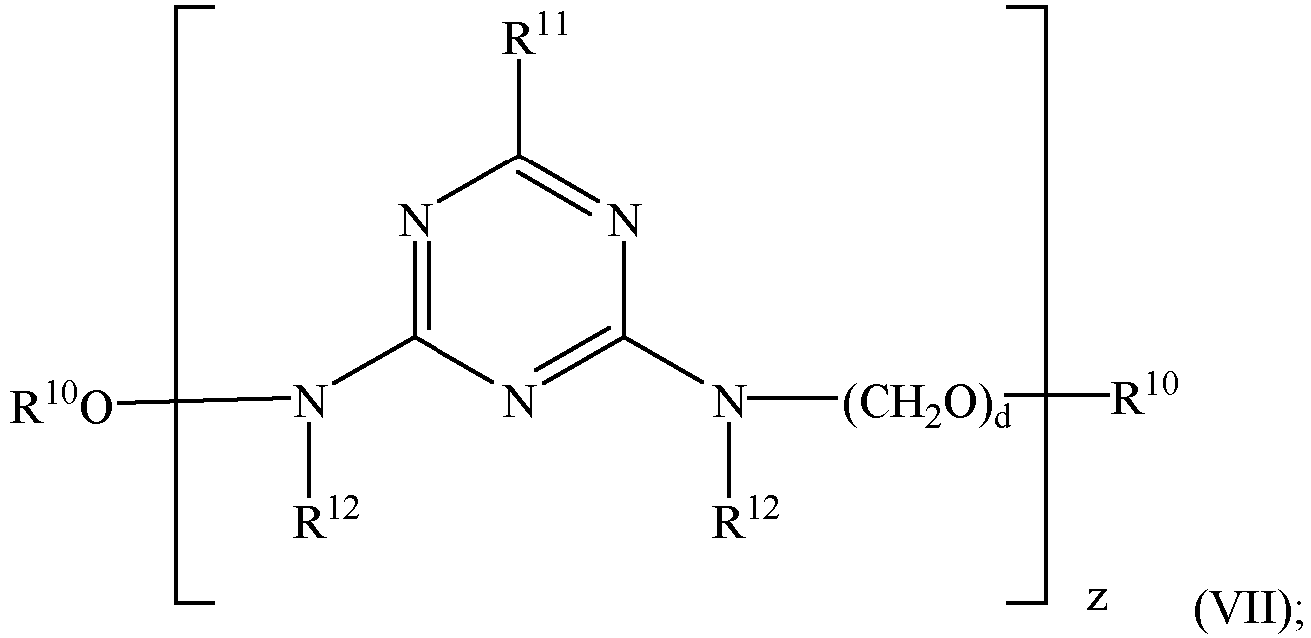


- each R10 is independently an alkyl group having from 1 to 10 carbon atoms, a cycloalkyl group having from 3 to 10 carbon atoms, an alkenyl group having from 2 to 10 carbon atoms, an aryl group having from 6 to 12 carbon atoms, an aralkyl group having from 7 to 12 carbon atoms or hydrogen, more preferably an alkyl group having from 1 to 3 carbon atoms or hydrogen and even more preferably methyl or ethyl;
- each R11 is independently phenyl, -N(CH2OR10)2 or -NH(CH2OR10);
- each R12 is independently hydrogen or -CH2OR10; and
- each d and z is an integer, where d is 0 or 1, more preferably 1, and z is from 1 to 40, more preferably 1 to 15, even more preferably 1 to 3. The organic resin (c) can be used in the amount of 0. 1 to 30 parts organic resin (c) per 100 parts of rubbery polymer (a), more specifically from 0.2 to 15 parts organic resin (c) per 100 parts of rubbery polymer (a) and even more specifically from 0.3 to 10 parts organic resin (c) per 100 parts of rubbery polymer (a).
- In one embodiment of the invention, R10 is an alkyl group of from 1 to 5 carbon atoms, each R11 and R12 is independently -N(CH2OR10)2, d is 1 and z is 1 to 3.
- In another embodiment, at least two R10 groups are an alkyl group of from 1 to 3 carbon atoms, and at least one R10 group is hydrogen.
- In yet another embodiment, the amino resins have at least one R12, which is hydrogen or -CH2OH, and at least two R12 which are CH2OR10, where R10 is independently an alkyl group having from 1 to 10 carbon atoms, a cycloalkyl group having from 3 to 10 carbon atoms, an alkenyl group having from 2 to 10 carbon atoms, an aryl group having from 6 to 12 carbon atoms or an aralkyl group having from 7 to 12 carbon atoms.
- Representative and non-limiting examples of the amino resins, also known as aminoplast resins, are 1,1,3,3-tetra-methoxymethylurea, 1,3,3-tris-methoxymethylurea, 1,3-bis-methoxymethylurea, 1,1-bis-methoxymethylurea, 1,1,3,3-tetra-ethoxymethylurea, 1,3,3-tris-ethoxymethylurea, 1,3-bis-ethoxymethylurea, 1,1-bis-ethoxymethylurea, 1,1,3,3-tetra-propoxymethylurea, 1,3,3-tris-propoxymethylurea, 1,3-bis-propoxymethylurea, 1,1-bis-propoxymethylurea, 1,1,3,3-tetra-butoxymethylurea, 1,1,3,3-tetra-phenoxymethylurea, N-(1,3,3-tris-ethoxymethylureidomethyl)-1,1,3,3-tetra-ethoxymethylurea, N, N'-bis-(1,1,3-tris-ethoxymethylureidomethyl)-1,3-bis-ethoxymethylurea, N, N'-bis-(1,1,3-tris-ethoxymethylureido-methoxymethyl)-1,3-bis-ethoxymethylurea, N,N,N',N',N",N"-hexakis-methoxymethyl-[1,3,5]triazine-2,4,6-triamine, N,N,N',N',N"-pentakis-methoxymethyl-[1,3,5]triazine-2,4,6-triamine, N,N,N',N"-tetrakis-methoxymethyl-[1,3,5]triazine-2,4,6-triamine, N,N,N',N',N",N"-hexakis-ethoxymethyl-[1,3,5]triazine-2,4,6-triamine, N,N,N',N',N"-pentakis-ethoxymethyl-[1,3,5]triazine-2,4,6-triamine, N,N,N',N"-tetrakis-ethoxymethyl-[1,3,5]triazine-2,4,6-triamine, N,N,N',N',N",N"-hexakis-propoxymethyl-[1,3,5]triazine-2,4,6-triamine, N,N,N',N',N"-pentakis-propoxymethyl-[1,3,5]triazine-2,4,6-triamine, N,N,N',N"-tetrakis-propoxymethyl-[1,3,5]triazine-2,4,6-triamine, N,N,N',N',N",N"-hexakis-phenoxymethyl-[1,3,5]triazine-2,4,6-triamine, N,N,N',N',N"-pentakis-phenoxymethyl-[1,3,5]triazine-2,4,6-triamine, N,N,N',N"-tetrakis-phenoxymethyl-[1,3,5]triazine-2,4,6-triamine, 1,3,4,6-tetrakis-methoxymethyl-tetrahydro-imidazo[4,5-d]imidazole-2,5-dione, 1,3,4,6-tetrakis-ethoxymethyl-tetrahydro-imidazo[4,5-d]imidazole-2,5-dione, 1,3,4,6-tetrakis-propoxymethyl-tetrahydro-imidazo[4,5-d]imidazole-2,5-dione, 1,3,4,6-tetrakis-phenoxymethyl-tetrahydro-imidazo[4,5-d]imidazole-2,5-dione, 1,3,4-tris-ethoxymethyl-tetrahydro-imidazo[4,5-d]imidazole-2,5-dione, 1,4-bis-ethoxymethyl-tetrahydro-imidazo[4,5-d]imidazole-2,5-dione, 1,3,4,-tris-methoxymethyl-tetrahydro-imidazo[4,5-d]imidazole-2,5-dione and 1,3,4,-tris-phenoxymethyl-tetrahydro-imidazo[4,5-d]imidazole-2,5-dione.
- The organic resin can be obtained commercially. For example, amino resins can be commercially purchased from PERFERE, formally INEOS Melamine GmbH, under the tradenames, RESIMENE® 747 ULF, RESIMENE®755, RESIMENE®757, RESIMENE® 764, RESIMENE® CE 8824 ULF and MAPRENAL® UF 134/60B.
- The hydrolyzable alkoxymethylamino-functional silane (d) in accordance with the present invention, are organic compounds that contain at least one hydrolyzable silyl group and at least one, preferably at least two, alkoxymethylamino-functional groups in which alkoxymethylamino-functional groups and the hydrolyzable silyl group are bonded to the rest of the organic compound to form a N-C covalent bond, where the carbon atom is sp2 hybridized. The sp2-hybridized carbon means that the carbon atom is bonded to three other atoms to form a planar structure, and also contains a p-orbital that is perpendicular to the plane form from the carbon atom and the three other atoms bonded to it. The sp2-hybridized carbon includes for example -C(=C)-, -C(=O)-, -C(=N)- or -C(=S)-, where the two hyphens represent chemical bonds to other atoms, and the underline carbon atom is the carbon atoms which is a sp2-hybridized carbon atom.
- According to the present invention, the alkoxymethylamino-functional group has the chemical Formula (I):

- The hydrolyzable alkoxymethylamino-functional silane in accordance with the present invention comprises at least one hydrolyzable silyl group. According to the invention, the silyl groups has the chemical Formula (II):

- In another embodiment of the invention, the hydrolyzable alkoxymethylamino-functional silanes (d) in accordance with the present invention are derived from amino resins. The amino containing compounds useful in preparing the hydrolyzable alkoxymethylamino-functional silanes include, but are not limited to, 2,4,6-triamino-1,3,5-triazine, benzoguanamine, urea, glycoluril and copolymers of (meth)acrylamide. Amino resins are made by reacting the amino containing compounds with formaldehyde and subsequently with alcohols.
- In still another embodiment of the invention, the hydrolyzable alkoxymethylamino-functional silanes (d) in accordance with the present invention have the chemical structures selected from the group consisting of structures having the general Formulae (III)-(V) or stereoisomers thereof:


- each R1 is independently hydrogen, an alkyl group having from 1 to 10 carbon atoms, a cycloalkyl group having from 3 to 10 carbon atoms, an alkenyl group having from 2 to 10 carbon atoms, an aryl group having from 6 to 12 carbon atoms or an aralkyl group having from 7 to 12 carbon atoms, preferably an alkyl group having from 1 to 3 carbon atoms and more preferably methyl;
- each R2 is independently hydrogen, an alkyl group having from 1 to 10 carbon atoms and optionally at least one oxygen atom, a cycloalkyl group having from 3 to 10 carbon atoms, an alkenyl group having from 2 to 10 carbon atoms, an aryl group having from 6 to 12 carbon atoms or an aralkyl group having from 7 to 12 carbon atoms, preferably an alkyl group having from 1 to 3 carbon atoms and more preferably ethyl;
- each R3 is independently an alkyl group having from 1 to 3 carbon atoms or phenyl;
- each R4 is independently an alkylene group having from 1 to 10 carbon atoms and optionally at least one oxygen atom, a cycloalkylene group having from 3 to 10 carbon atoms, an alkenylene group having from 2 to 10 carbon atoms, an arylene group having from 6 to 12 carbon atoms, an aralkylene group having from 7 to 14 carbon atoms, preferably an alkylene group having from 1 to 6 carbon atoms, and more preferably, a propylene;
- each R5 and R7 is independently phenyl, -N(CH2OR1)2, -N(CH2OR1)(XR4Si(R3)3-a(OR2)a), -N(XR4Si(R3)3-a(OR2)a)2,


- each R6, R8 and R9 is independently hydrogen, -CH2OR1 or -XR4Si(R3)3-a(OR2)a, more specifically -CH2OR1;
- each X is independently -SCH2-, R1OC(=O)NCH2-, -NR1C(=O)N(R1)CH2-, R1 2N(C=O)NCH2- , -NR1(C=O)OCH2-, -OCH2-, -NR1CH2-, or -OCH2CH(OH)CH2OCH2-group, more preferably a -SCH2- or -NR1CH2- group, and even more preferably -SCH2-, where the methylene carbon atom of the group is bonded to the nitrogen atom, or X is independently -NH(C=O)-, -OCH2CH(OH)CH2- or a chemical bond which forms the bond between the R4 group and the nitrogen atom, with the proviso that the nitrogen atom is bonded to a sp2-hybridized carbon atom; the subscripts a, b, c, d, x and y are independently integers where a is 1, 2 or 3, preferably 3; b is 0 or 1, more preferably 1; c is 0 or 1, preferably 1; x is from 1 to 20, preferably 1, 2 or 3; and y is from 0 to 20, preferably 0.
- Representative and non-limiting examples of the hydrolyzable alkoxymethylamino-functional silane (d) include 1-(5-trimethoxysilyl-2-thiapentyl)-1,3,3-tris-methoxymethylurea, 1,3-bis-(1-(5-trimethoxysilyl-2-thiapentyl)-1,3-bis-methoxymethylurea, 3,3-bis-(3-dimethoxysilyl-2-thiapropyl)-1,1-bis-methoxymethylurea, 1-(5-triethoxysilyl-2-thiapentyl)-1,3,3-tetra-ethoxymethylurea, 1-(5-triethoxysilyl-2-aza-2-methyl-pentyl)-1,3,3-tris-ethoxymethylurea, 1,3-bis-(7-triethoxysilyl-2,4-diaza-3-oxo-heptyl)-1,3-bis-ethoxymethylurea, 3,3-bis-(1-(5-triethoxysilyl-2-thiapentyl)-1,1-bis-ethoxymethylurea, 1-(5-triethoxysilyl-2-thiapentyl)-1,3,3-tris-propoxymethylurea, 1-(5-triethoxysilyl-2-thiapentyl)-1,3,3-tris-propoxymethylurea, 1,3-bis-(5-tripropoxysilyl-2-thiapentyl)-1,3-bis-propoxymethylurea, 3,3-bis-(5-tripropoxysilyl-2-thiapentyl)-1,1-bis-propoxymethylurea, 1,3-bis-(5-tripropoxysilyl-2-thiapentyl)-1,3,3-tetra-butoxymethylurea, 1-(5-triphenoxysilyl-2-thiapentyl)-1,3,3-tetra-phenoxymethylurea, N-[1-(5-triethoxysilyl-2-thiapentyl)-1,3-tris-ethoxymethylureidomethyl]-1,3,3-tetra-ethoxymethylurea, N, N'-bis-[(1-(5-triethoxysilyl-2-thiapentyl)-1,3-bis-ethoxymethylureidomethyl]-1,3-bis-ethoxymethylurea, N, N'-bis-[1-(5-triethoxysilyl-2-thiapentyl)-1,3-bis-ethoxymethylureido-methoxymethyl]-1,3-bis-ethoxymethylurea, N-(5-triethoxysilyl-2-thiapentyl)-N,N',N',N",N"-pentakis-methoxymethyl-[1,3,5]triazine-2,4,6-triamine, N, N"-bis-(5-triethoxysilyl-2-thiapentyl)-N,N',N',N"-tetrakis-methoxymethyl-[1,3,5]triazine-2,4,6-triamine, N', N"-(5-triethoxysilyl-2-thiapentyl)-N,N,N',N"-tetrakis-methoxymethyl-[1,3,5]triazine-2,4,6-triamine, N-(5-triethoxysilyl-2-aza-2-methyl-pentyl)-N,N',N',N",N"-pentakis-ethoxymethyl-[1,3,5]triazine-2,4,6-triamine, N"-(7-triethoxysilyl-2,4-diaza-3-oxo-heptyl)- N,N,N',N',N"-pentakis-ethoxymethyl-[1,3,5]triazine-2,4,6-triamine, N',N" - (7-triethoxysilyl-2,4-diaza-3-oxo-heptyl)-N,N,N',N"-tetrakis-ethoxymethyl-[1,3,5]triazine-2,4,6-triamine, N-(5-triethoxysilyl-2-aza-2-methyl-pentyl)-N,N',N',N",N"-pentakis-propoxymethyl-[1,3,5]triazine-2,4,6-triamine, N-(5-triethoxysilyl-2-aza-2-methyl-pentyl)-N,N',N',N",N"-pentakis-phenoxymethyl-[1,3,5]triazine-2,4,6-triamine, 1-(5-triethoxysilyl-2-thia-pentyl)-3,4,6-tris-methoxymethyl-tetrahydro-imidazo[4,5-d]imidazole-2,5-dione, 1-(5-triethoxysilyl-2-aza-2-methyl-pentyl)-3,4,6-tris-ethoxymethyl-tetrahydro-imidazo[4,5-d]imidazole-2,5-dione, 3,6-bis-(5-triethoxysilyl-2-thia-pentyl)-1,4-bis-ethoxymethyl-tetrahydro-imidazo[4,5-d]imidazole-2,5-dione, 6-(5-triethoxysilyl-2-aza-2-methyl-pentyl)-1,3,4,-tris-methoxymethyl-tetrahydro-imidazo[4,5-d]imidazole-2,5-dione and 6-(5-triethoxysilyl-2-thia -pentyl)-1,3,4,-tris-phenoxymethyl-tetrahydro-imidazo[4,5-d]imidazole-2,5-dione, preferably 1-(5-trimethoxysilyl-2-thiapentyl)-1,3,3-tris-methoxymethylurea, N-[1-(5-triethoxysilyl-2-thiapentyl)-1,3-tris-ethoxymethylureidomethyl]-1,3,3-tetra-ethoxymethylurea, N-(5-triethoxysilyl-2-thiapentyl)-N,N',N',N",N"-pentakis-methoxymethyl-[1,3,5]triazine-2,4,6-triamine, N, N"-bis-(5-triethoxysilyl-2-thiapentyl)-N,N',N',N"-tetrakis-methoxymethyl-[1,3,5]triazine-2,4,6-triamine, N', N"-(5-triethoxysilyl-2-thiapentyl)-N,N,N',N"-tetrakis-methoxymethyl-[1,3,5]triazine-2,4,6-triamine, N-(5-triethoxysilyl-2-aza-2-methyl-pentyl)-N,N',N',N",N"-pentakis-ethoxymethyl-[1,3,5]triazine-2,4,6-triamine and 1-(5-triethoxysilyl-2-thia-pentyl)-3,4,6-tris-methoxymethyl-tetrahydro-imidazo[4,5-d]imidazole-2,5-dione.
- In one embodiment of the invention, the hydrolyzable alkoxymethylamino-functional silane is formed by combining a silane containing a functional group with an amino resin. The amino resin may be a component in the secondary polymer network forming organic resin (c). The hydrolyzable alkoxymethylamino-functional silane (d) can be formed prior to addition of the hydrolyzable alkoxymethylamino-functional silane (d) to the rubber composition. The hydrolyzable alkoxymethylamino-functional silane (d) can be used in the amounts of from 0.1 to 30 parts hydrolyzable alkoxymethylamino-functional silane (d) per 100 parts of the rubbery polymer (a), more specifically, from 0.5 to 15 parts hydrolyzable alkoxymethylamino-functional silane (d) per 100 parts rubbery polymer (a) and even more specifically from 1 to 10 parts hydrolyzable alkoxymethylamino-functional silane (d) per 100 parts of the rubbery polymer (a). Alternatively, the silane containing a functional group can be added to a rubber composition containing the amino resin (c) which may be used to form the secondary polymer network, to generate the hydrolyzable alkoxymethylamino-functional silane (d) in situ. When the hydrolyzable alkoxymethylamino-functional silane (d) is generated in situ, the silane containing a functional group can be used in the amounts of amount of 0.1 to 30 parts silane containing a functional group per 100 parts of rubbery polymer (a), more specifically from 0.2 to 15 parts silane containing a functional group per 100 parts of rubbery polymer (a) and even more specifically from 0.3 to 10 parts silane containing a functional group per 100 parts of rubbery polymer (a) and the organic resin can be use in the amount of 0.2 to 35 parts organic resin (c) per 100 parts of rubbery polymer (a), more specifically from 0.4 to 15 parts organic resin (c) per 100 parts of rubbery polymer (a) and even more specifically from 1 to 10 parts organic resin (c) per 100 parts of rubbery polymer (a). This embodiment is not encompassed by the wording of the claims but is considered as useful for understanding the invention.
- In another embodiment of the invention, the hydrolyzable alkoxymethylamino-functional silane (d) is prepared by the following process:
- (i) contacting an amino resin having the structure of general Formula (VII) or (VIII), where R12 is -CH2OR10, with a silane containing a functional group having the general Formula (X):
(R2O)aR3 3-aSiR4X1H (X)
wherein- each R2 is independently hydrogen, an alkyl group having from 1 to 10 carbon atoms and optionally at least one oxygen atom, a cycloalkyl group having from 3 to 10 carbon atoms, an alkenyl group having from 2 to 10 carbon atoms, an aryl group having from 6 to 12 carbon atoms or an aralkyl group having from 7 to 12 carbon atoms, preferably an alkyl group having from 1 to 3 carbon atoms and more preferably ethyl;
- each R3 is independently an alkyl group having from 1 to 3 carbon atoms or phenyl;
- R4 is an alkylene group having from 1 to 10 carbon atoms and optionally at least one oxygen atom, a cycloalkylene group having from 3 to 10 carbon atoms, an alkenylene group having from 2 to 10 carbon atoms, an arylene group having from 6 to 12 carbon atoms, an aralkylene group having from 7 to 14 carbon atoms, preferably an alkylene group having from 1 to 6 carbon atoms, and more preferably, a propylene;
- X1 is -O-, -S-, -NR13-, -NR13C(=O)NR13-, - where R13 is hydrogen, an alkyl group having from 1 to 10 carbon atoms and optionally at least one oxygen atom, a cycloalkyl group having from 3 to 10 carbon atoms, an alkenyl group having from 2 to 10 carbon atoms, an aryl group having from 6 to 12 carbon atoms or an aralkyl group having from 7 to 12 carbon atoms, preferably hydrogen or an alkyl group having from 1 to 3 carbon atoms and more preferably a hydrogen;
- a is an integer equal to 0, 1 or 2, or
contacting an amino resin having the structure of general Formula (VII), (VIII) or (IX), where at least one R12 is hydrogen or -CH2OH, with a silane containing a functional group having the general Formula (XI):
(R2O)aR3 3-aSiR4X2 (XI)
wherein - each R2 is independently hydrogen, an alkyl group having from 1 to 10 carbon atoms and optionally at least one oxygen atom, a cycloalkyl group having from 3 to 10 carbon atoms, an alkenyl group having from 2 to 10 carbon atoms, an aryl group having from 6 to 12 carbon atoms or an aralkyl group having from 7 to 12 carbon atoms, preferably an alkyl group having from 1 to 3 carbon atoms and more preferably ethyl;
- each R3 is independently an alkyl group having from 1 to 3 carbon atoms or phenyl;
- R4 is an alkylene group having from 1 to 10 carbon atoms and optionally at least one oxygen atom, a cycloalkylene group having from 3 to 10 carbon atoms, an alkenylene group having from 2 to 10 carbon atoms, an arylene group having from 6 to 12 carbon atoms, an aralkylene group having from 7 to 14 carbon atoms, preferably an alkylene group having from 1 to 6 carbon atoms, and more preferably, a propylene;
- X2 is -Cl, -Br,

- a is an integer equal to 0, 1 or 2;
- (ii) reacting the amino resin of step (i) with the silane containing a functional group of step (i); and, optionally
- (iii) removing the byproducts selected from the group R10OH, R13OH, R13 2NH, HCl or HBr from the reaction mixture if the byproduct is formed in the reaction.
- The molar ratio of the -X1H group to the R10OCH2N- group or the -X2 to R12 group is from 0.1 to 0.8, preferably, from 0.2 to 0.5. The reaction product, the hydrolyzable alkoxymethylamino-functional silane (d), has at least one (R2O)aR3 3-aSiR4X- group and at least two R10OCH2N- groups or has at least one (R2O)aR3 3-aSiR4X- group and at least one (R10OCH2)2N- group.
- Representative an non-limiting examples of silane contain a functional group of Formula (X) include 3-mercaptopropyltrimethoxysilane, 3-mercaptopropyltriethoxysilane, 3-mercaptopropyltripropoxysilane, 3-mercaptopropyldimethoxyethoxysilane, 3-mercaptopropylmethyldiethoxysilane, 3-mercaptopropyldimethylethoxysilane, mercaptomethyltriethoxysilane, 4-mercapto-3,3-dimethylbutyltriethoxysilane, 3-mercaptopropylethoxy-[1,3,2]dioxasilinane, 3-mercaptopropyl-(3-hydroxy-2-methylpropoxy)-5-methyl-[1,3,2]dioxasilinane, 6-mercaptohexyltriethoxysilane, 3-aminopropyltriethoxysilane, N-ethyl-3-aminopropyltriethoxysilane, N-methyl-3-aminopropyltriethoxysilane, N-ethyl-3,3-dimethyl-4-aminobutyltriethoxysilane, n-phenyl-3 -aminopropyltriethoxysilane, 3-ureidopropyltriethoxysilane, 3-ureidopropyltrimethoxysilane and mixtures thereof.
- Representative an non-limiting examples of silane contain a functional group of Formula (XI) include N-(3-triethoxypropyl)-O-methylcarbamate, N-(3-triethoxysilylpropyl)-O-ethylcarbamate, 3-ureidopropyltriethoxysilane, 3-ureidopropyltrimethoxysilane, isocyanatomethyltriethoxysilane, isocyanatomethylmethyldiethoxysilane, 3-isocyanatopropyltrimethoxysilane, 3-isocyanatopropyltriethoxysilane, chloromethyltriethoxysilane, 3-chloropropyltriethoxysilane, 3-bromopropyltriethoxysilane, 3-glycidoxypropyltriethoxysilane, 3-glycidoxypropyltrimethoxysilane, 3-glycidoxypropylmethyldiethoxysilane, 3-glycidoxypropylmethyldimethoxysilane and the like.
- The reaction can be catalyzed. Typical catalysts are Bronsted-Lowry acids, as for example, sulfur acid, phosphoric acid, p-toluene sulfonic acid and hydrochloric acid, acid catalysts supported on solid polymeric resin, such solid sulfonated polystyrene and solid phosphonated polystyrene resin, or Lewis acids, as for example, dibutyltin oxide, dibutyl tin dilaurate, tetra alkyl titanates, zirconium or titanium complexes, and the like. The catalyst can optionally be removed from the hydrolyzable alkoxymethylamino-functional silane (d) by filtration of the acid catalysts supported on the solid polymeric resin, neutralization of Bronsted-Lowry acids with bases, absorption of the acid catalyst on an absorbent and followed by filtration of the reaction mixture or removal of the acid catalyst using an ion exchange resin, followed by filtration. The reaction can be carried out in the presence or absence of a solvent, such as hydrocarbon solvents, ether solvents, chlorinated solvents and the like.
- The reactions can be carried out at sub-atmospheric, atmospheric or superatmospheric pressure ranging from 0.01 kilogram-force/centimeter2 to 5 kilogram-force/centimeter2, more preferably from 1 kilogram-force/centimeter2 to 1 kilogram-force/centimeter2 and temperatures, and temperatures ranging from 15 °C to 150 °C, more preferably, from 30 °C to 100 °C.
- In another embodiment of the invention, the hydrolyzable alkoxymethylamino-functional silane (d) is prepared by the process comprising (i) contacting an amino resin having the structure of general Formula (VII) or (VIII), where R12 is -CH2OR10, with a silane containing a functional group having the general Formula (X), (ii) reacting an amino resin with the silane containing a functional group of step (i) and optionally (iii) removing the alcohol, R10OH. The reaction can be carried out in a reactor in the absence of the rubbery polymer (a) or in situ in a rubber composition comprising a rubber polymer (a) and optionally a reinforcing filler (b), where the silane containing a functional group has formed silanols and said silanols have reacted with reinforcing filler (b) to form covalent chemical bonds with the filler.
- Preferably the silane containing a functional group can be a mercapto-functionalized silane, an ureido-functionalized silane, an amino-functionalized silane, a carbamato-functionalized silane, an epoxy-functionalized silane, an isocyanato-functionalized silanes or a blocked isocyanato-functionalized silane.
- The mercaptofunctionalized silane used to prepare the hydrolyzable alkoxymethylamino-functional has the general Formula (VI):
(R2O)aR3 3-aSiR4SH (VI)
wherein - each R2 is independently hydrogen, an alkyl group having from 1 to 10 carbon atoms and optionally at least one oxygen atom, a cycloalkyl group having from 3 to 10 carbon atoms, an alkenyl group having from 2 to 10 carbon atoms, an aryl group having from 6 to 12 carbon atoms or an aralkyl group having from 7 to 12 carbon atoms, preferably an alkyl group having from 1 to 3 carbon atoms and more preferably ethyl;
- each R3 is independently an alkyl group having from 1 to 3 carbon atoms or phenyl;
- R4 is an alkylene group having from 1 to 10 carbon atoms and optionally at least one oxygen atom, a cycloalkylene group having from 3 to 10 carbon atoms, an alkenylene group having from 2 to 10 carbon atoms, an arylene group having from 6 to 12 carbon atoms, an aralkylene group having from 7 to 14 carbon atoms, preferably an alkylene group having from 1 to 6 carbon atoms, and more preferably, a propylene, and
- a is an integer equal to 0, 1 or 2.
- The active hydrogen-containing compounds (e) are organic compounds containing at least two functional groups having a hydrogen atom bonded to a heteroatom of oxygen or nitrogen. The functional groups of the active hydrogen-containing compounds (e) includes hydroxyl, amido, ureido and amino. The active hydrogen-containing compound (e) can be used in the amounts of 0.1 to 30 parts active hydrogen-containing compounds (e) per100 parts of rubbery polymer (a), more specifically from 0.2 to 15 parts active hydrogen-containing compounds (e) per 100 parts of rubbery polymer (a) and even more specifically from 0.3 to 10 parts active hydrogen-containing compounds (e) per 100 parts of rubbery polymer (a)
- In one embodiment of the invention, the active hydrogen-containing compound (e) has the general Formula (XII):
R14(X3H)e
wherein R14 is a polyvalent organic group having from 1 to 100 carbon atom, preferably a polyvalent hydrocarbon group containing 1 to 50 carbon atoms or a polyvalent hydrocarbon containing 1 to 100 carbon atoms, more preferably 1 to 50 carbon atoms, and containing at least one heteroatom of oxygen or nitrogen; X3 is -NH-, -NR15-, -C(O)NH-, -C(=O)NR15-, -NHC(=O)NH-, -NH(=O)NR15-, -S-, -C(=O)O- or -O-, preferably -NH-, -NR15- or -O-, wherein R15 is independently an alkyl group having from 1 to 10 carbon atoms, a cycloalkyl group having from 3 to 10 carbon atoms, an alkenyl group having from 2 to 10 carbon atoms, an aryl group having from 6 to 12 carbon atoms, an aralkyl group having from 7 to 12 carbon atoms or hydrogen, more preferably an alkyl group having from 1 to 3 carbon atoms or hydrogen and even more preferably hydrogen, methyl or ethyl; and e is an integer of from 2 to 15, more preferably 2 to 10 and even more preferably 2, 3, 4 or 5. X3-H is an active hydrogen functional group, including amino functional groups, amido functional groups, carbamato functional groups, ureido functional groups, hydroxyl functional groups or mercapto functional groups. - Representative and non-limiting examples of the active hydrogen-containing compound (e) include aliphatic diols, triols or polyols, such as ethylene glycol, propylene glycol, 1,3-butanediol, diethylene glycol, triethylene glycol, polyethylene glycol having a molecular weight of up to 2000 grams/mole, preferably from 190 to 2000 grams/mole, dipropylene glycol, tripropylene glycol polypropylene glycol having a molecular weight of from 250 to 2500 grams/mole, glycerol, trimethylolmethane, trimethylolethane, trimethylolpropane, pentaerythritol, glycerol monostearate and sorbitan monostearate; aromatic diols, triol or polyols, such as catechol, resorcinol, phloroglucinol, hydroquinone, phenol-formaldehyde resins, which include novolac resins in which formaldehyde to phenol molar ratio of less than one and resole resins in which the formaldehyde to phenol molar ratio is greater than or equal to one, penacolite resins, terephthaldehyde adducts, 2,2-bis(4-hydroxyphenyl)butane, 2,2-bis(4-hydroxyphenyl)propane, 1,1-bis(4-hydroxyphenyl)ethane, bis(4-hydroxyphenyl)methane and resorcinol-formaldehyde resins; polyamines, such as ethylene diamine, diethylene triamine, triethylene tetraamine, bis-(2-aminoethyl)ether and 2-aminoethyl heptanamide; and urea formaldehyde resins, preferably as catechol, resorcinol, hydroquinone, 2,2-bis(4-hydroxyphenyl)butane, novolac resins, resole resins and resorcinol-formaldehyde resins.
- The active hydrogen-containing compound (e) can be commercially purchased, as for example, GP® 161G66, GP® 4864 triazone, GP® 445D05, GP® 48634, GP® 5018, GP® 5236 and GP® 7648 available from Georgia-Pacific Chemicals, penacolite resins P-19-s, B-20-s and r-2170 available from OXY INDSPEC Chemical Corporation, and Cellobond™ Resin J6030L and Cellobond™ J60021X01 available from Hexion.
- The sulfur-donating compound (f) can be used to crosslink the rubbery polymer to form a crosslinked primary network. Without wishing to be bound by theory, the sulfur-donating compound (f) is believed to donate sulfur atoms under curing conditions. The sulfur-donating compound (f) generally has more than two sulfur atoms bonded together to form a chain of sulfur atoms. Polysulfides and elemental sulfur are sulfur-donating compounds (f), preferably sulfur, Ss.
- Vulcanization can be conducted in the presence of sulfur-donating compound (f), often referred to as a vulcanizing agent. It reacts with the rubbery polymer (a) containing carbon-carbon double bonds to form a crosslinked, or cured, rubber. Some non-limiting examples of suitable sulfur vulcanizing agents include, e.g., elemental sulfur (free sulfur) or sulfur-donating compound such as the non-limiting examples of amino disulfide, polymeric polysulfide or sulfur-olefin adducts. These and other known and conventional vulcanizing agents are added in the usual amounts during a mixing step referred to as a productive mixing step in the process for preparing rubber compositions.
- The sulfur-donating compounds are generally used at 0.1 to 5 phr, more preferably from 1 to 3 phr and even more preferably from 1.5 to 2.5 phr.
- The rubber compositions can be compounded with other commonly used additive materials such as, e.g., retarders and accelerators, processing additives such as oils, resins such as tackifying resins, plasticizers, pigments, fatty acid, zinc oxide, waxes, antioxidants and antiozonants, peptizing agents, and the like. Depending on the intended use of the rubber compositions, these and/or other rubber additives are used in conventional amounts.
- Vulcanization accelerators can also be used if desired. Non-limiting examples of vulcanization accelerators include benzothiazole, alkyl thiuram disulfide, guanidine derivatives and thiocarbamates. Other examples of such accelerators include, but are not limited to, mercapto benzothiazole, tetramethyl thiuram disulfide, tetrabenzyl thiuram disulfide, benzothiazole disulfide, diphenylguanidine, zinc dithiocarbamate, alkylphenoldisulfide, zinc butyl xanthate, N-dicyclohexyl-2-benzothiazolesulfenamide, N-cyclohexyl-2-benzothiazolesulfenamide, N-oxydiethylenebenzothiazole-2-sulfenamide, N,N-diphenylthiourea, dithiocarbamylsulfenamide, N,N-diisopropylbenzothiozole-2-sulfenamide, zinc-2-mercaptotoluimidazole, dithiobis(N-methylpiperazine), dithiobis(N-beta-hydroxy ethyl piperazine) and dithiobis(dibenzyl amine). In another embodiment, other additional sulfur donors include, e.g., thiuram and morpholine derivatives. In a more specific embodiment, representative of such donors include, but are not limited to, dimorpholine disulfide, dimorpholine tetrasulfide, tetramethyl thiuram tetrasulfide, benzothiazyl-2,N-dithiomorpholide, thioplasts, dipentamethylenethiuram hexasulfide and disulfidecaprolactam.
- Accelerators may be used to control the time and/or temperature required for vulcanization and to improve the properties of the vulcanizate. In one embodiment of the invention, a single accelerator system can be used, i.e., a primary accelerator. In another embodiment, conventionally and preferably, a primary accelerator(s) is used in total amounts ranging from 0.5 to 4 phr, and preferably from 0.8 to 2.0 phr. In a preferred embodiment, combinations of a primary and a secondary accelerator can be used with the secondary accelerator being used in smaller amounts, e.g., from 0.05 to 3 phr in order to activate and to improve the properties of the vulcanizate. In yet another embodiment, delayed action accelerators can also be used. In still another embodiment, vulcanization retarders can also be used. Suitable types of accelerators are those such as the non-limiting examples of amines, disulfides, guanidines, thioureas, thiazoles, thiurams, sulfenamides, dithiocarbamates, xanthates and combinations thereof. In a preferred embodiment, the primary accelerator is a sulfenamide. In another embodiment, if a second accelerator is used, the secondary accelerator can be a guanidine, dithiocarbamate or thiuram compound, such as for example tetrabenzyl thiuram disulfide used at levels from 0.1 to 0.3 phr, more preferably 0.2 phr.
- Optional tackifier resins can be used at levels of from 0.5 to 10 phr and preferably from 1 to 5 phr. In a preferred embodiment, the amounts of processing aids range from 1 to 50 phr. Suitable processing aids can include, as non-limiting examples, aromatic, naphthenic and/or paraffinic processing oils and combinations thereof. In yet another embodiment, preferred amounts of antioxidants are from 1 to 5 phr. Representative antioxidants include, as non-limiting examples, diphenyl-p-phenylenediamine and others, e.g., those disclosed in the Vanderbilt Rubber Handbook (1978), pages 344-346. In yet another embodiment, preferred amounts of antiozonants range from 1 to 5 phr. Preferred amounts of optional fatty acids, which can include the non-limiting example of stearic acid, range from 0.5 to 3 phr. Preferred amounts of zinc oxide range from 2 to 5 phr. Preferred amounts of waxes, e.g., microcrystalline wax, range from 1 to 5 phr. Preferred amounts of peptizers range from 0.1 to 1 phr. Suitable peptizers include, as non-limiting examples, pentachlorothiophenol, dibenzamidodiphenyl disulfide and combinations thereof.
- In one embodiment of the invention, the uncured rubber compositions contain the hydrolyzable alkoxymethylamino-functional silane (d), and the rubber composition preferably comprises (a) at least one rubbery polymer used to form a primary network, (b) at least one reinforcing filler that is capable of reacting with the hydrolyzable alkoxymethylamino-functional silane (d); (c) at least one secondary polymer network forming organic resin; (d) at least one hydrolyzable alkoxymethylamino-functional silane that can be reacted with the reinforcing filler (b), and optionally, (e) at least one active hydrogen containing organic compound or (e) at least one active hydrogen containing organic compound and (f) at least one sulfur-donating compound, especially sulfur (Ss) or at least one sulfur-donating compound, especially sulfur (Ss). The rubbery polymer component (a) comprises one or more rubber components in which the rubber components add up to 100 phr (parts per hundred rubber). In one embodiment of the invention, natural rubber should be 50 to100 phr of the primary polymer blend portion of the rubber composition, preferably 75 to100 phr. The reinforcing filler (b) can comprise 1 to 150 phr of the rubber composition, preferably from 15 to 90 phr, more preferably from 20 to 55 phr. In one embodiment of the invention, the reinforcing filler (b) is silica, preferably precipitated silica. The hydrolyzable alkoxymethylamino-functional silane (d) itself and/or the materials for forming the secondary network (network forming organic resins and active hydrogen-containing compounds) can comprise from 6 to 50% of reinforcing filler weight portion of the formulation, preferably from 8 to 25% of the reinforcing filler weight, more preferably 12 to 25% of the reinforcing filler (b) weight in the formulation.
- In one embodiment of the rubber composition of the invention, the rubbery polymer (a) contains natural rubber; the reinforcing filler (b) is precipitated silica; the organic resin (c) is an amino resin having the structure of Formula (VII):


- In one embodiment, the rubber composition comprises:
- (a) a rubbery polymer or blend of polymers;
- (b) at least one reinforcing filler that is reactive with the hydrolyzable alkoxymethylamino-functional silane;
- (c) at least one organic resin;
- (d) at least one hydrolyzable alkoxymethylamino-functional silane;
- (e) optionally, at least one active hydrogen containing organic compound; and
- (f) optionally, at least one a sulfur-donating compound.
- In another embodiment, the rubber composition comprises alkoxymethylamino-functional silane (d) in an amount of from 0.2 to 20 weight percent based on the total weight of rubber composition, the rubbery component (a) in an amount of from 25 to 95 weight percent based on the total weight of the rubber composition, the reinforcing filler (b) that is reactive with the alkoxymethylamino-functional silane (d) in an amount of from 2 to 70 weight percent based on the total weight of rubber composition, the organic resin (c) in the amount of from 0.2 to 25 weight percent based on the total weight of the rubber composition, the active hydrogen-containing compound (e) in the amount of from 0.2 to 25 weight percent based on the total weight of the rubber composition and the amount of the sulfur-donating compound (f) in an amount of from 0.2 to 5 weight percent based on the total weight of the rubber composition.
- In still another embodiment, the rubber composition comprising a combination of:
- (i) a primary polymeric network comprising (a) a rubbery polymer or blend of polymers and (b) at least one sulfur-donating compound; and
- (ii) a secondary polymeric network comprising the reaction product of (b) at least one reinforcing filler, (c) at least one organic resin, (d) at least one hydrolyzable alkoxymethylamino-functional silane (e) at least one active hydrogen containing organic compound.
- In the primary polymeric network, the rubbery polymer (a) is selected from the group consisting of natural rubber (NR), synthetic polyisoprene (IR), polybutadiene (BR), various copolymers of butadiene, the copolymers of isoprene, solution styrene-butadiene rubber (SSBR), emulsion styrene-butadiene rubber (ESBR), ethylene-propylene terpolymers (EPDM), acrylonitrile-butadiene rubber (NBR), and functionalized rubbers that are modified by at least one alkoxysilyl group, tin-containing group, amino group, hydroxyl group, carboxylic acid group, polysiloxane group, epoxy group or phthalocyanimo group. In particular, the rubber polymer (a) comprises natural rubber or a mixture of natural rubber and butadiene rubber.
- In the primary polymeric network, the at least one sulfur donating compound (f) is particularly sulfur.
- In the secondary polymeric network, the reinforcing filler (b) before reaction with the reacting with the alkoxymethylamino-functional silane (d) can be fibers, particulates or sheet-like structures comprising metalloid oxides or metal oxides having surface hydroxyl groups that are capable of reacting the with the alkoxymethylamino-functional silane (d). In particular, the reinforcing filler (b) before reaction with the with the alkoxymethylamino-functional silane (d) can be silicates, clays, ceramics, diatomaceous earth, pyrogenic silica, precipitated silica, titanium dioxide, aluminosilicate, alumina, talc and mixtures thereof, and more particularly, precipitated silica.
- In the secondary polymeric network, before the organic polymer (c) has reacted with the other reactants used in the formation of the secondary polymeric network, the organic polymer (c) can be polyisocyanates, polyisocyanurates, epoxy resins, amino resins and polyurethanes.
- In one embodiment, the organic polymer (c) before it has reacted with the other reactants used in the formation of the secondary polymeric network can be an amino resin having the chemical structure of Formulae (VII) or (VIII):


- each R10 is independently an alkyl group having from 1 to 10 carbon atoms, a cycloalkyl group having from 3 to 10 carbon atoms, alkenyl group having from 2 to 10 carbon atoms, an aryl group having from 6 to 12 carbon atoms, an aralkyl group having from 7 to 12 carbon atoms or hydrogen;
- each R11 is independently phenyl, -N(CH2OR10)2 or -NH(CH2OR10);
- each R12 is independently hydrogen or -CH2OR10; and
- each d and z is an integer, where d is 0 or 1 and z is 1 to 40.
- Representative and non-limiting examples of the amino resin before reaction with the other reactants used in the formation of the secondary polymeric network include 1,1,3,3-tetra-methoxymethylurea, 1,3,3-tris-methoxymethylurea, 1,3-bis-methoxymethylurea, 1,1-bis-methoxymethylurea, 1,1,3,3-tetra-ethoxymethylurea, 1,3,3-tris-ethoxymethylurea, 1,3-bis-ethoxymethylurea, 1,1-bis-ethoxymethylurea, 1,1,3,3-tetra-propoxymethylurea, 1,3,3-tris-propoxymethylurea, 1,3-bis-propoxymethylurea, 1,1-bis-propoxymethylurea, 1,1,3,3-tetra-butoxymethylurea, 1,1,3,3-tetra-phenoxymethylurea, N-(1,3,3-tris-ethoxymethylureidomethyl)-1,1,3,3-tetra-ethoxymethylurea, N, N'-bis-(1,1,3-tris-ethoxymethylureldomethyl)-1,3-bis-ethoxymethylurea, N, N'-bis-(1,1,3-tris-ethoxymethylureido-methoxymethyl)-1,3-bis-ethoxymethylurea, N,N,N',N',N",N"-hexakis-methoxymethyl-[1,3,5]triazine-2,4,6-triamine, N,N,N',N',N"-pentakis-methoxymethyl-[1,3,5]triazine-2,4,6-triamine, N,N,N',N"-tetrakis-methoxymethyl-[1,3,5]triazine-2,4,6-triamine, N,N,N',N',N",N"-hexakis-ethoxymethyl-[1,3,5]triazine-2,4,6-triamine, N,N,N',N',N"-pentakis-ethoxymethyl-[1,3,5]triazine-2,4,6-triamine, N,N,N',N"-tetrakis-ethoxymethyl-[1,3,5]triazine-2,4,6-triamine, N,N,N',N',N",N"-hexakis-propoxymethyl-[1,3,5]triazine-2,4,6-triamine, N,N,N',N',N"-pentakis-propoxymethyl-[1,3,5]triazine-2,4,6-triamine, N,N,N',N"-tetrakis-propoxymethyl-[1,3,5]triazine-2,4,6-triamine, N,N,N',N',N",N"-hexakis-phenoxymethyl-[1,3,5]triazine-2,4,6-triamine, N,N,N',N',N"-pentakis-phenoxymethyl-[1,3,5]triazine-2,4,6-triamine and N,N,N',N"-tetrakis-phenoxymethyl-[1,3,5]triazine-2,4,6-triamine.
- In the secondary polymeric network, the active hydrogen-containing organic compound (e) before reaction with the other reactants used in the formation of the secondary polymeric network has the structure of Formula (XII):
R14(X3H)e (XII)
wherein R14 is a polyvalent organic group having from 1 to 100 carbon atoms or a polyvalent hydrocarbon containing 1 to 100 carbon atoms containing at least one heteroatom of oxygen or nitrogen; X3 is -NH-, -NR15-, -C(O)NH-, -C(=O)NR15-, -NHC(=O)NH-, -NH(=O)NR15-, -S-, -C(=O)O- or -O-, where R15is independently an alkyl group having from 1 to 10 carbon atoms, a cycloalkyl group having from 3 to 10 carbon atoms, an alkenyl group having from 2 to 10 carbon atoms, an aryl group having from 6 to 12 carbon atoms, an aralkyl group having from 7 to 12 carbon atoms or hydrogen. - In one embodiment, R14 contains at least one ether functional group, amino functional group, ester functional group, ketone functional group, aldehyde functional groups, amido functional groups, carbamato functional group or ureido functional group.
- Representative and non-limiting examples of the active hydrogen-containing organic compound (d) before reaction with the other reactants used in the formation of the secondary polymeric network include ethylene glycol, propylene glycol, 1,3-butanediol, diethylene glycol, triethylene glycol, polyethylene glycol having a molecular weight of from 194 to 2000 grams/mole, dipropylene glycol, tripropylene glycol polypropylene glycol having a molecular weight of from 250 to 2500 grams/mole, glycerol, trimethylolmethane, trimethylolethane, trimethylolpropane and pentaerythritol, catechol, resorcinol, hydroquinone, phenol-formaldehyde resins, 2,2-bis(4-hydroxyphenyl)butane, 2,2-bis(4-hydroxyphenyl)propane, 1,1-bis(4-hydroxyphenyl)ethane, bis(4-hydroxyphenyl)methane,resorcinol-formaldehyde resins, ethylene diamine, diethylene triamine, triethylene tetraamine, bis-(2-aminoethyl)ether, 2-aminoethyl heptanamide, gycerol monostearate, sorbitan monostearate and urea formaldehyde resins.
- In one specific embodiment, the secondary polymeric network is formed from the reaction of precipitated silica, amino resin having the structure of Formula (VII):

the active hydrogen-containing compound (e) which is catechol, resorcinol, hydroquinone, phenol-formaldehyde resins, 2,2-bis(4-hydroxyphenyl)butane, 2,2-bis(4-hydroxyphenyl)propane, 1,1-bis(4-hydroxyphenyl)ethane, bis(4-hydroxyphenyl)methane or resorcinol-formaldehyde resins and the hydrolyzable alkoxymethylamino-functional silane (d) has the structure of Formula (III):
- In one embodiment, the amounts of components (b), (c), (d) and (e) before reaction to form the the secondary polymeric network are alkoxymethylamino-functional silane (d) in the amount of from 0.2 to 20 weight percent based on the total weight of rubber composition, the reinforcing filler (b) that is reactive with the alkoxymethylamino-functional silane (d) in the amount of from 2 to 70 weight percent based on the total weight of rubber composition, the organic resin (c) in the amount of from 0.2 to 25 weight percent based on the total weight of the rubber composition and the active hydrogen-containing compound (e) in the amount of from 0.2 to 25 weight percent based on the total weight of the rubber composition.
- In the cured rubber composition, the primary polymeric network is cured to form a crosslinked rubber polymer or crosslinked blend of polymers by subjecting the rubber composition to an elevated temperature for a time sufficient to react the rubber polymer or blend or rubber polymers (a) with the at least one sulfur-donating compound (f).
- In another embodiment of the invention, the process for providing the rubber compositions described herein involves the mixing of components (a), (b), (c), (d), (e) and (f), as disclosed above, in effective amounts. In one embodiment of a process in accordance with the invention, an effective amount of alkoxymethylamino-functional silane (d) can range from 0.2 to 20, preferably from 0.5 to 15 and more preferably from 2 to 10, weight percent based on the total weight of rubber composition. An effective amount of rubbery component (a) can range from 25 to 95, preferably from 50 to 90 and more preferably from 60 to 80, weight percent based on the total weight of the rubber composition. An effective amount of the reinforcing filler that is reactive with the alkoxymethylamino-functional silane (d) can range from 2 to 70, preferably from 5 to 55 and more preferably from 20 to 50, weight percent based on the total weight of rubber composition. An effective amount of organic resin (c) can range from 0.2 to 25 weight percent, preferably from 2 to 15 weight percent and more preferably from 5 to 10, weight percent based on the total weight of the rubber composition. An effective amount of the active hydrogen-containing compound (e) can range from 0.2 to 25 weight percent, preferably from 2 to 15 weight percent and more preferably from 5 to 10, weight percent based on the total weight of the rubber composition. An effective amount of the sulfur-donating compound (f) can range from 0.2 to 5, preferably from 0.5 to 2.5 and more preferably from 1 to 2, weight percent based on the total weight of the rubber composition.
- In another embodiment of the invention, the process for preparing a rubber composition can optionally comprise curing the rubber composition, before, during and/or after molding the rubber composition. A vulcanized rubber composition should contain a sufficient amount of the secondary polymer network to contribute to a higher modulus and better wear. The combined weight of the reinforcing filler that is reactive with the alkoxymethylamino-functional silane (d) can be as low as 5 and can range preferably from 10 to 150 parts per hundred parts of rubbery polymer (a) (phr) and more preferably ranged from 25 to 85 phr, and even more preferably from 50 to 70 phr.
- In one embodiment of the invention, the hydrolyzable alkoxymethylamino-functional silane (d) can be premixed, or pre-reacted, with particles, aggregates and/or agglomerates of the reinforcing filler (b) or added to the rubber mix during the processing or mixing of the rubbery polymer (a) and reinforcing filler (b). In another embodiment, the alkoxymethylamino-functional silane (d) and reinforcing filler (b) are added separately to the process mixture containing rubbery polymer (a) component. Reinforcing filler (b) and hydrolyzable alkoxymethylamino-functional silane (d) can be considered to couple or react in situ to form a reinforcing filler in which the alkoxymethylamino-functional silane (d) is chemically bonded to the filler.
- In one embodiment of the invention, the process for preparing the rubber compositions comprise multiple steps. In the non-productive step (i), components (a), (b) and (d) are mixed under reactive-mechanical-working conditions. As used herein, the expression "reactive-mechanical-working conditions" shall be understood to mean the conditions of elevated temperature, residence time and shear prevailing within a mechanical-working apparatus, such as an extruder, intermeshing mixer, or tangential mixer, such conditions being sufficient to bring about one or more of the following:
- a) the reactive process of hydrolysis of alkoxymethylamino-functional silane (d) with water, which is present on the reinforcing filler (b), to form alkoxymethylamino-functional silanols;
- b) the reactive process of these silanols with reinforcing filler (b) to form covalent chemical bonds with the filler;
- c) the breakdown of reinforcing filler (b) agglomerates into smaller aggregates and/or individual filler particles; and,
- d) the dispersion into the rubbery polymer (a) the reinforcing filler (b) covalently bonded to hydrolyzed and subsequently condensed alkoxymethylamino-functional silane.
- In the non-productive step (ii), the organic resin (c) and/or the optional active hydrogen-containing components (e) are added to the mixture of step (i). In the non-productive step (ii), components (a), (b), (c), (d) and optionally (e) are mixed under reactive-mechanical-working conditions, where the conditions of elevated temperature, residence time and shear prevailing within a mechanical-working apparatus, such as an extruder, intermeshing mixer, or tangential mixer, such conditions being sufficient to bring about one or more of the following:
- e) the dispersion into the mixture of the rubbery polymer (a), reinforcing filler (b) covalently bonded to hydrolyzed and subsequently condensed alkoxymethylamino-functional silane of step (i) the organic resin (c) and active hydrogen-containing compound (e);
- f) reaction of the reinforcing filler (b) covalently bonded to hydrolyzed and subsequently condensed alkoxymethylamino-functional silane with the organic resin (c) or the active hydrogen-containing compound (e) or the organic resin (c) and the active hydrogen-containing compound (e); and optionally
- g) reaction of the organic resin (c) with the active hydrogen-containing compound (e) if present to form the secondary network dispersed within the primary network and provide for uncured rubber composition.
- In the optional productive step (iii), the sulfur-donating compound (f) is added to the mixture of step (ii).
- In any of steps (i), (ii) or (iii), other components can be added to the rubber composition. Representative and non-limiting examples of other components include activators, processing aids, accelerators, waxes, oils, anti-ozonants and anti-oxidants,
- The rubber composition is typically mixed in a mixing apparatus under high shear conditions where it autogenously heats up as a result of the mixing, primarily due to shear and associated friction occurring within the rubber mixture.
- In a preferred embodiment of the invention, the mixture of the desired amounts of rubbery polymer (a), reinforcing filler (b) and hydrolyzable alkoxymethylamino-functional silane (d) of step (i) is substantially homogeneously blended under reactive-mechanical-working conditions in mixing step (i) carried out on a continuous or non-continuous basis. Non-continuous mixing can be employed where a build-up of excessive heat might occur and the rubber composition may need to be cooled. Cooling of the rubber will avoid or minimize thermal decomposition of rubbery polymer component(s) or other components in the rubber composition. Preferably, mixing step (i) is conducted at temperatures from 100 °C to 200 °C and more preferably from 140 °C to 180 °C.
- In step (iii), at least one sulfur-donating compound (f) along with other vulcanization accelerators, can be mixed with the rubber composition from step (ii). Mixing should be accomplished under non-reactive-mechanical-working conditions. As used herein, the expression "non-reactive-mechanical-working" conditions shall be understood to mean the conditions of sub-ambient, ambient or slightly elevated temperature, residence time and shear prevailing within a mechanical-working apparatus, such as an extruder, intermeshing mixer, tangential mixer, or roll mill, such conditions being sufficient to bring about dispersion of the sulfur-donating compound (f), e.g. vulcanizing agent, and vulcanization accelerators into the rubber composition of step (ii) without resulting in any appreciable vulcanization of the rubber composition. Low temperatures and low shear are advantageously employed in step (iii).
- In step (iii), residence time can vary considerably and is generally chosen to complete the dispersion of the vulcanizing agent. Residence times in most cases can range from 0.5 to 30 minutes and preferably from 5 to 20 minutes.
- The temperature employed in step (iii) can range from 5 °C to 150 °C, preferably from 30 °C to 120 °C and more preferably from 50 °C to 110 °C. These temperatures are lower than those utilized for reactive-mechanical-working conditions in order to prevent or inhibit premature curing of the sulfur-curable rubber, sometimes referred to as scorching of the rubber composition, which might take place at higher temperatures.
- The rubber composition may be allowed to cool, e.g., during or after step (iii) or between step (i) and step (ii) or between step (ii) and step (iii), to a temperature of 50 °C or less.
- In another embodiment of the invention, when it is desired to mold and to cure the rubber composition, the rubber composition is placed in the desired mold and heated to at least 130 °C and up to 200 °C for a time of from 1 to 60 minutes to bring about the vulcanization of the rubber.
- Rubber compositions preferred for forming tire tread portions in accordance with preferred embodiments of the invention comprise (a) a rubbery primary polymer or blend of polymers, (b) reinforcing silica filler particles, (c) an organic resin capable of forming a secondary polymer network, which can be generated in-situ, (d) a hydrolyzable alkoxymethylamino-functional silane which can react with the reinforcing filler (b) and/or an active hydrogen-containing compound (e) in which components (b), (c), (d) and (e) contribute to the aforementioned secondary network.
- The rubber composition herein can be used for various purposes. In one embodiment of the invention, there is provided an article of which at least one component is the herein described cured rubber composition. In another embodiment herein, there is provided a tire at least one component of which, e.g., the tread, is the herein described cured rubber composition. In yet another preferred embodiment, for example, the rubber composition can be used for the manufacture of such articles as shoe soles, hoses, seals, cable jackets, gaskets and other industrial goods. Such articles can be built, shaped, molded and cured by various known and conventional methods as is readily apparent to those skilled in the art. In particular, the compositions and methods in accordance with the invention are particularly well suited for the manufacture of tires, in particular, truck or bus tires.
- In the following, preferred embodiments according to the invention are summarized:
- 1. A hydrolyzable alkoxymethylamino-functional silane, comprising:
- at least one hydrolyzable silyl group and at least one alkoxymethylamino-functional group,
- wherein the alkoxymethylamino-functional group and the hydrolyzable silyl group are each bonded to an sp2 carbon atom on an organic group to form a N-C covalent bond, and wherein the at least one alkoxymethylamino-functional group has the structure
(R1OCH2)2N-
- where R1 is independently hydrogen, an alkyl group having from 1 to 10 carbon atoms, a cycloalkyl group having from 3 to 10 carbon atoms, an alkenyl group having from 2 to 10 carbon atoms, an aryl group having from 6 to 12 carbon atoms or an aralkyl group having from 7 to 12 carbon atoms; and
- the at least one hydrolyzable silyl group has the chemical Formula (II):

- each R2 is independently hydrogen, an alkyl group having from 1 to 10 carbon atoms and optionally at least one oxygen atom, a cycloalkyl group having from 3 to 10 carbon atoms, an alkenyl group having from 2 to 10 carbon atoms, an aryl group having from 6 to 12 carbon atoms or an aralkyl group having from 7 to 12 carbon atoms;
- each R3 is independently an alkyl group having from 1 to 3 carbon atoms or phenyl;
- R4 is an alkylene group having from 1 to 10 carbon atoms and optionally at least one oxygen atom, a cycloalkylene group having from 3 to 10 carbon atoms, an alkenylene group having from 2 to 10 carbon atoms, an arylene group having from 6 to 12 carbon atoms, an aralkylene group having from 7 to 14 carbon atoms;
- each X is a -SCH2-,


- the subscript a is an integer equal to 1, 2 or 3, with the proviso that the nitrogen atom shown in Formula (II) is bonded to a sp2-hybridized carbon atom.
- the at least one hydrolyzable silyl group has the chemical Formula (II):
- 2. The hydrolyzable alkoxymethylamino-functional silane of Embodiment 1, wherein the at least one of the hydrolyzable alkoxymethylamino-functional silanes has the chemical structure of Formulae III or IV or stereoisomers thereof:


- each R1 is independently hydrogen, an alkyl group having from 1 to 10 carbon atoms, a cycloalkyl group having from 3 to 10 carbon atoms, an alkenyl group having from 2 to 10 carbon atoms, an aryl group having from 6 to 12 carbon atoms or an aralkyl group having from 7 to 12 carbon atoms;
- each R2 is independently hydrogen, an alkyl group having from 1 to 10 carbon atoms and optionally at least one oxygen atom, a cycloalkyl group having from 3 to 10 carbon atoms, alkenyl group having from 2 to 10 carbon atoms, an aryl group having from 6 to 12 carbon atoms or an aralkyl group having from 7 to 12 carbon atoms;
- each R3 is independently an alkyl group having from 1 to 3 carbon atoms or phenyl;
- each R4 is independently an alkylene group having from 1 to 10 carbon atoms and optionally at least one oxygen atom, a cycloalkylene group having from 3 to 10 carbon atoms, an alkenylene group having from 2 to 10 carbon atoms, an arylene group having from 6 to 12 carbon atoms, an aralkylene group having from 7 to 14 carbon atoms;
- each R5 and R7 is independently phenyl, -N(CH2OR1)2, -N(CH2OR1)(XR4Si(R3)3-a(OR2)a), -N(XR4Si(R3)3-a(OR2)a)2,


- each R6, R8 and R9 is independently hydrogen, -CH2OR1 or -XR4Si(R3)3-a(OR2)a;
- each X is independently -SCH2-, R1OC(=O)NCH2-, -NR1C(=O)N(R1)CH2-, R1 2N(C=O)NCH2- , -NR1(C=O)OCH2-, -OCH2-, -NR1CH2- or -OCH2CH(OH)CH2OCH2- group, where the methylene carbon atom of the group is bonded to the nitrogen atom, or -NH(C=O)-, -OCH2CH(OH)CH2- or a chemical bond which forms the bond between the R4 group and the nitrogen atom, with the proviso that the nitrogen atom is bonded to a sp2-hybridized carbon atom; the subscripts a, b, c, d, x and y are independently integers where a is 1, 2 or 3; b is 0 or 1; c is 0 or 1; x is from 1 to 20; and y is from 0 to 20.
- 3. The hydrolyzable alkoxymethylamino-functional silane of Embodiment 2, wherein
- each R1 is independently an alkyl group having from 1 to 3 carbon atoms;
- each R2 is independently an alkyl group having from 1 to 3 carbon atoms;
- each R3 is independently an alkyl group having from 1 to 3 carbon atoms; each R4 is independently an alkylene group having from 1 to 6 carbon atoms;
- each R5 and R7 is independently -N(CH2OR1)2 or -N(CH2OR1)(CH2XR4Si(R3)3-a(OR2)a);
- each R6, R8 and R9 is -CH2OR1;
- each X is independently -SCH2- or -NR1CH2- group; the subscripts a, b, c, d, x and y are independently integers where a is 3; b is 1; c is 1; x is 1, 2 or 3; and y is 0.
- 4. The hydrolyzable alkoxymethylamino-functional silane of Embodiment 1, wherein said silane is selected from the group consisting of 1-(5-trimethoxysilyl-2-thiapentyl)-1,3,3-tris-methoxymethylurea, 1,3-bis-(1-(5-trimethoxysilyl-2-thiapentyl)-1,3-bis-methoxymethylurea, 3,3-bis-(3-dimethoxysilyl-2-thiapropyl)-1,1-bis-methoxymethylurea, 1-(5-triethoxysilyl-2-thiapentyl)-1,3,3-tetra-ethoxymethylurea, 1-(5-triethoxysilyl-2-aza-2-methyl-pentyl)-1,3,3-tris-ethoxymethylurea, 1,3-bis-(7-triethoxysilyl-2,4-diaza-3-oxo-heptyl)-1,3-bis-ethoxymethylurea, 3,3-bis-(1-(5-triethoxysilyl-2-thiapentyl)-1,1-bis-ethoxymethylurea, 1-(5-triethoxysilyl-2-thiapentyl)-1,3,3-tris-propoxymethylurea, 1-(5-triethoxysilyl-2-thiapentyl)-1,3,3-tris-propoxymethylurea, 1,3-bis-(5-tripropoxysilyl-2-thiapentyl)-1,3-bis-propoxymethylurea, 3,3-bis-(5-tripropoxysilyl-2-thiapentyl)-1,1-bis-propoxymethylurea, 1,3-bis-(5-tripropoxysilyl-2-thiapentyl)-1,3,3-tetra-butoxymethylurea, 1-(5-triphenoxysilyl-2-thiapentyl)-1,3,3-tetra-phenoxymethylurea, N-[1-(5-triethoxysilyl-2-thiapentyl)-1,3-tris-ethoxymethylureidomethyl]-1,3,3-tetra-ethoxymethylurea, N, N'-bis-[(1-(5-triethoxysilyl-2-thiapentyl)-1,3-bis-ethoxymethylureidomethyl]-1,3-bis-ethoxymethylurea, N, N'-bis-[1-(5-triethoxysilyl-2-thiapentyl)-1,3-bis-ethoxymethylureido-methoxymethyl]-1,3-bis-ethoxymethylurea, N-(5-triethoxysily1-2-thiapentyl)-N,N',N',N",N"-pentakis-methoxymethyl-[1,3,5]triazine-2,4,6-triamine, N, N"-bis-(5-triethoxysilyl-2-thiapentyl)-N,N',N',N"-tetrakis-methoxymethyl-[1,3,5]triazine-2,4,6-triamine, N', N"-(5-triethoxysilyl-2-thiapentyl)-N,N,N',N"-tetrakis-methoxymethyl-[1,3,5]triazine-2,4,6-triamine, N-(5-triethoxysilyl-2-aza-2-methyl-pentyl)-N,N',N',N",N"-pentakis-ethoxymethyl-[1,3,5]triazine-2,4,6-triamine, N"-(7-triethoxysilyl-2,4-diaza-3-oxo-heptyl)- N,N,N',N',N"-pentakis-ethoxymethyl-[1,3,5]triazine-2,4,6-triamine, N',N" - (7-triethoxysilyl-2,4-diaza-3-oxo-heptyl)-N,N,N',N"-tetrakis-ethoxymethyl-[1,3,5]triazine-2,4,6-triamine, N-(5-triethoxysilyl-2-aza-2-methyl-pentyl)-N,N',N',N",N"-pentakis-propoxymethyl-[1,3,5]triazine-2,4,6-triamine and N-(5-triethoxysilyl-2-aza-2-methyl-pentyl)-N,N',N',N",N"-pentakis-phenoxymethyl-[1,3,5]triazine-2,4,6-triamine..
- 5. A process for preparing a hydrolyzable alkoxymethylamino-functional silane, comprising:
- (i) contacting an amino resin having the structure of general Formula (VII) or (VIII),


- each R10 is independently an alkyl group having from 1 to 10 carbon atoms, a cycloalkyl group having from 3 to 10 carbon atoms, alkenyl group having from 2 to 10 carbon atoms, an aryl group having from 6 to 12 carbon atoms, an aralkyl group having from 7 to 12 carbon atoms or hydrogen;
- each R11 is independently phenyl, -N(CH2OR10)2 or -NH(CH2OR10);
- each R12 is independently hydrogen or -CH2OR10; and
- each d and z is an integer, where d is 0 or 1 and z is from 1 to 40
- each R12 is -CH2OR10, with a silane containing a functional group having the general Formula (X):
(R2O)aR3 3-aSiR4X1H (X)
wherein- each R2 is independently hydrogen, an alkyl group having from 1 to 10 carbon atoms and optionally at least one oxygen atom, a cycloalkyl group having from 3 to 10 carbon atoms, alkenyl group having from 2 to 10 carbon atoms, an aryl group having from 6 to 12 carbon atoms or an aralkyl group having from 7 to 12 carbon atoms;
- each R3 is independently an alkyl group having from 1 to 3 carbon atoms or phenyl;
- R4 is an alkylene group having from 1 to 10 carbon atoms and optionally at least one oxygen atom, a cycloalkylene group having from 3 to 10 carbon atoms, an alkenylene group having from 2 to 10 carbon atoms, an arylene group having from 6 to 12 carbon atoms, an aralkylene group having from 7 to 14 carbon atoms;
- X1 is -O-, -S-, -NR13-, -NR13C(=O)NR13-, - where R13 is hydrogen, an alkyl group having from 1 to 10 carbon atoms and optionally at least one oxygen atom, a cycloalkyl group having from 3 to 10 carbon atoms, alkenyl group having from 2 to 10 carbon atoms, an aryl group having from 6 to 12 carbon atoms or an aralkyl group having from 7 to 12 carbon atoms;
- a is an integer equal to 0, 1 or 2, or contacting an amino resin having the structure of general Formula (VII), (VIII) or (IX), where at least one R12 is hydrogen or -CH2OH, with a silane containing a functional group having the general Formula (XI):
(R2O)aR3 3-aSiR4X2 (XI)
- each R2 is independently hydrogen, an alkyl group having from 1 to 10 carbon atoms and optionally at least one oxygen atom, a cycloalkyl group having from 3 to 10 carbon atoms, alkenyl group having from 2 to 10 carbon atoms, an aryl group having from 6 to 12 carbon atoms or an aralkyl group having from 7 to 12 carbon atoms;
- each R3 is independently an alkyl group having from 1 to 3 carbon atoms or phenyl;
- R4 is an alkylene group having from 1 to 10 carbon atoms and optionally at least one oxygen atom, a cycloalkylene group having from 3 to 10 carbon atoms, an alkenylene group having from 2 to 10 carbon atoms, an arylene group having from 6 to 12 carbon atoms, an aralkylene group having from 7 to 14 carbon atoms;
- X2 is -Cl, -Br,

- a is an integer equal to 0, 1 or 2; and
- (ii) reacting the amino resin of step (i) with the silane containing a functional group of step (i).
- (i) contacting an amino resin having the structure of general Formula (VII) or (VIII),
- 6. The process of
Embodiment 5, further comprising removing byproducts selected from the group consisting of R10OH, R13OH, R13 2NH, HCl and HBr from the reaction mixture if the byproducts are formed in the reaction, wherein the molar ratio of the -X1H group to the R10OCH2N- group or the -X2 to R12 group is from 0.1 to 0.8. - 7. The process of
Embodiment 5, wherein the process is carried out in situ in a rubber composition comprising a rubber polymer (a) and a reinforcing filler (b) having water bound thereto, and wherein the silane containing a functional group forms silanols by reacting with water or water bound to the reinforcing filler and said silanols react with the reinforcing filler to form a plurality of covalent chemical bonds with the filler. - 8. A rubber composition comprising:
- (a) a rubbery polymer or blend of polymers;
- (b) at least one reinforcing filler that is reactive with the hydrolyzable alkoxymethylamino-functional silane of embodiment 1;
- (c) at least one organic resin;
- (d) at least one hydrolyzable alkoxymethylamino-functional silane of embodiment 1;
- (e) optionally, at least one active hydrogen containing organic compound; and
- (f) optionally, at least one a sulfur-donating compound.
- 9. The rubber composition of Embodiment 8, wherein the amount of alkoxymethylamino-functional silane (d) ranges from 0.2 to 20 weight percent based on the total weight of rubber composition, the rubbery component (a) ranges from 25 to 95 weight percent based on the total weight of the rubber composition, the reinforcing filler (b) that is reactive with the alkoxymethylamino-functional silane (d) ranges from 2 to 70 weight percent based on the total weight of rubber composition, the organic resin (c) ranges from 0.2 to 25 weight percent based on the total weight of the rubber composition, the active hydrogen-containing compound (e) ranges from 0.2 to 25 weight percent based on the total weight of the rubber composition and the amount of the sulfur-donating compound (f) ranges from 0.2 to 5 weight percent based on the total weight of the rubber composition.
- 10. The rubber composition of embodiment 8, comprising:
- a combination of (i) a primary polymeric network comprising (a) a rubbery polymer or blend of polymers and (f) at least one sulfur-donating compound; and
- (ii) a secondary polymeric network comprising the reaction product of (b) at least one reinforcing filler, (c) at least one organic resin, (d) at least one hydrolyzable alkoxymethylamino-functional silane of embodiment 1 and (e) at least one active hydrogen containing organic compound.
- 11. The rubber composition of
Embodiment 10, wherein the rubbery polymer (a) is selected from the group consisting of natural rubber (NR), synthetic polyisoprene (IR), polybutadiene (BR), various copolymers of butadiene, the copolymers of isoprene, solution styrene-butadiene rubber (SSBR), emulsion styrene-butadiene rubber (ESBR), ethylene-propylene terpolymers (EPDM), acrylonitrile-butadiene rubber (NBR), and functionalized rubbers that are modified by at least one alkoxysilyl group, tin-containing group, amino group, hydroxyl group, carboxylic acid group, polysiloxane group, epoxy group or phthalocyanimo group. - 12. The rubber composition of
Embodiment 10, wherein the rubbery polymer (a) comprises natural rubber or a mixture of natural rubber and butadiene rubber. - 13. The rubber composition of
Embodiment 10, wherein the reinforcing filler (b) before reaction with the other reactants of the secondary polymeric network is chosen from fibers, particulates or sheet-like structures comprising metalloid oxides or metal oxides having surface hydroxyl groups. - 14. The rubber composition of Embodiment 13, wherein the reinforcing filler (b) is selected from the group consisting of silicates, clays, ceramics, diatomaceous earth, pyrogenic silica, precipitated silica, titanium dioxide, aluminosilicate, alumina, talc and mixtures thereof.
- 15. The rubber composition of Embodiment 13, wherein the reinforcing filler (b) comprises precipitated silica.
- 16. The rubber composition of
Embodiment 10, wherein the organic polymer (c) before reaction with the other reactants of the secondary polymeric network is selected from the group consisting of polyisocyanates, polyisocyanurates, epoxy resins, amino resins and polyurethanes. - 17. The rubber composition of Embodiment 16, wherein the amino resin has the chemical structure of Formulae (VII) or (VIII):


- each R10 is independently an alkyl group having from 1 to 10 carbon atoms, a cycloalkyl group having from 3 to 10 carbon atoms, alkenyl group having from 2 to 10 carbon atoms, an aryl group having from 6 to 12 carbon atoms, an aralkyl group having from 7 to 12 carbon atoms or hydrogen;
- each R11 is independently phenyl, -N(CH2OR10)2 or -NH(CH2OR10);
- each R12 is independently hydrogen or -CH2OR10; and
- each d and z is an integer, where d is 0 or 1 and z is 1 to 40.
- 18. The rubber composition of Embodiment 16, wherein the amino resin is selected from the group consisting of 1,1,3,3-tetra-methoxymethylurea, 1,3,3-tris-methoxymethylurea, 1,3-bis-methoxymethylurea, 1,1-bis-methoxymethylurea, 1,1,3,3-tetra-ethoxymethylurea, 1,3,3-tris-ethoxymethylurea, 1,3-bis-ethoxymethylurea, 1,1-bis-ethoxymethylurea, 1,1,3,3-tetra-propoxymethylurea, 1,3,3-tris-propoxymethylurea, 1,3-bis-propoxymethylurea, 1,1-bis-propoxymethylurea, 1,1,3,3-tetra-butoxymethylurea, 1,1,3,3-tetra-phenoxymethylurea, N-(1,3,3-tris-ethoxymethylureidomethyl)-1,1,3,3-tetra-ethoxymethylurea, N, N'-bis-(1,1,3-tris-ethoxymethylureidomethyl)-1,3-bis-ethoxymethylurea, N, N'-bis-(1,1,3-tris-ethoxymethylureido-methoxymethyl)-1,3-bis-ethoxymethylurea, N,N,N',N',N",N"-hexakis-methoxymethyl-[1,3,5]triazine-2,4,6-triamine, N,N,N',N',N"-pentakis-methoxymethyl-[1,3,5]triazine-2,4,6-triamine, N,N,N',N"-tetrakis-methoxymethyl-[1,3,5]triazine-2,4,6-triamine, N,N,N',N',N",N"-hexakis-ethoxymethyl-[1,3,5]triazine-2,4,6-triamine, N,N,N',N',N"-pentakis-ethoxymethyl-[1,3,5]triazine-2,4,6-triamine, N,N,N',N"-tetrakis-ethoxymethyl-[1,3,5]triazine-2,4,6-triamine, N,N,N',N',N",N"-hexakis-propoxymethyl-[1,3,5]triazine-2,4,6-triamine, N,N,N',N',N"-pentakis-propoxymethyl-[1,3,5]triazine-2,4,6-triamine, N,N,N',N"-tetrakis-propoxymethyl-[1,3,5]triazine-2,4,6-triamine, N,N,N',N',N",N"-hexakis-phenoxymethyl-[1,3,5]triazine-2,4,6-triamine, N,N,N',N',N"-pentakis-phenoxymethyl-[1,3,5]triazine-2,4,6-triamine and N,N,N',N"-tetrakis-phenoxymethyl-[1,3,5]triazine-2,4,6-triamine.
- 19. The rubber composition of
Embodiment 10, wherein the active hydrogen-containing organic compound (e) before reaction with the other reactants of the secondary polymeric network has the structure of Formula (XII):
R14(X3H)e (XII)
wherein R14 is a polyvalent organic group having from 1 to 100 carbon atoms or a polyvalent hydrocarbon containing 1 to 100 carbon atoms containing at least one heteroatom of oxygen or nitrogen; X3 is -NH-, -NR15-, -C(O)NH-, -C(=O)NR15-, -NHC(=O)NH-, -NH(=O)NR15-, -S-, - C(=O)O- or -O-, where R15 is independently an alkyl group having from 1 to 10 carbon atoms, a cycloalkyl group having from 3 to 10 carbon atoms, an alkenyl group having from 2 to 10 carbon atoms, an aryl group having from 6 to 12 carbon atoms, an aralkyl group having from 7 to 12 carbon atoms or hydrogen. - 20. The rubber composition of Embodiment 19, wherein R14 contains at least one ether functional group, amino functional group, ester functional group, ketone functional group, aldehyde functional groups, amido functional groups, carbamato functional group or ureido functional group.
- 21. The rubber composition of Embodiment 19, wherein the active hydrogen-containing organic compound (d) is selected from the group consisting of ethylene glycol, propylene glycol, 1,3-butanediol, diethylene glycol, triethylene glycol, polyethylene glycol having a molecular weight of from 194 to 2000 grams/mole, dipropylene glycol, tripropylene glycol polypropylene glycol having a molecular weight of from 250 to 2500 grams/mole, glycerol, trimethylolmethane, trimethylolethane, trimethylolpropane and pentaerythritol, catechol, resorcinol, hydroquinone, phenol-formaldehyde resins, 2,2-bis(4-hydroxyphenyl)butane, 2,2-bis(4-hydroxyphenyl)propane, 1,1-bis(4-hydroxyphenyl)ethane, bis(4-hydroxyphenyl)methane,resorcinol-formaldehyde resins, ethylene diamine, diethylene triamine, triethylene tetraamine, bis-(2-aminoethyl)ether, 2-aminoethyl heptanamide, gycerol monostearate, sorbitan monostearate and urea formaldehyde resins.
- 22. The rubber composition of
Embodiment 10, wherein the sulfur-donating compound (f) is sulfur. - 23. A rubber composition of Embodiment 10, wherein the rubbery polymer (a) contains natural rubber; the reinforcing filler (b) before reaction with the other reactants of the secondary polymeric network is precipitated silica; the organic resin (c) before reaction with the other reactants of the secondary polymeric network is an amino resin having the structure of Formula (VII):


- 23. The rubber composition of
Embodiment 10, wherein before the reaction of components (b), (c), (d) and (e), the amount of alkoxymethylamino-functional silane (d) ranges from 0.2 to 20 weight percent based on the total weight of rubber composition, the reinforcing filler (b) that is reactive with the alkoxymethylamino-functional silane (d) ranges from 2 to 70 weight percent based on the total weight of rubber composition, the organic resin (c) ranges from 0.2 to 25 weight percent based on the total weight of the rubber composition and the active hydrogen-containing compound (e) ranges from 0.2 to 25 weight percent based on the total weight of the rubber composition. - 24. A process for preparing the rubber composition of
Embodiment 10, comprising mixing, in a non-productive mixing step (i), components (a), (b) and (d) under reactive-mechanical-working conditions sufficient to bring about one or more of the following:- (a) hydrolysis of the alkoxymethylamino-functional silane (d) with water, which is present on the reinforcing filler (b), to form alkoxymethylamino-functional silanols;
- (b) reaction of the silanols with the reinforcing filler (b) to form covalent chemical bonds with the filler;
- (c) breakdown of agglomerates of the reinforcing filler (b) into smaller aggregates and/or individual filler particles; and,
- (d) dispersion of the reinforcing filler (b) covalently bonded to hydrolyzed and subsequently condensed alkoxymethylamino-functional silane (d) into the rubbery polymer (a);
- (e) dispersion of the organic resin (c) and active hydrogen-containing compound (e) into the mixture of the rubbery polymer (a), reinforcing filler (b), which is covalently bonded to the hydrolyzed and subsequently condensed alkoxymethylamino-functional silane of step (i);
- (f) reaction of the reinforcing filler (b), which is covalently bonded to hydrolyzed and subsequently condensed alkoxymethylamino-functional silane, with the organic resin (c) or the active hydrogen-containing organic compound (e) or the organic resin (c) and the active hydrogen-containing compound (e); and
- (g) reaction of the organic resin (c) with the optional active hydrogen-containing organic compound (e) to form the secondary network dispersed within the primary network to provide an uncured rubber composition, with the proviso that the organic resin (c) or active-hydrogen-containing organic compound (e) can be added sequentially or together to the second non-productive mixing step (ii); and optionally,
- 25. The process of Embodiment 24 further comprising a step (iv) in which the mixture of step (iii) is subjected to curing conditions of elevated temperature and time sufficient to cure the rubber composition.
- 26. A cured rubber composition of
embodiment 10, wherein the primary polymeric network is crosslinked. - 27. An article comprising the cured rubber composition of Embodiment 26.
- 28. The article of Embodiment 27, wherein said article is a component of a tire.
- Aspects and attributes of preferred embodiments of the invention will be described with reference to the following examples, which are being presented for purposes of illustration only and should not be construed as limiting.
- A process for the preparation of an alkoxymethylamino-functional silane (d) in accordance with the invention, in which the mole ratio of silane containing a functional group to amino resin is about 1: 1 is described below: Hexamethoxymethylmelamine (815 grams, available from Ineos as Resimene 3520) and 3-mercaptopropyltriethoxysilane (497.9 grams, available from Momentive Performance Materials under the tradename Silquest® A-1891 silane) were charged into a 2-liter round bottom flask equipped with a magnetic stirrer, a short-path distillation head, a heating mantle, and a temperature controller. The contents were heated to 40° C until the components became miscible. Sulfuric acid (0.3 grams) was then added to the reaction flask. The contents were heated from 40° C to 100° C under 18 mmHg of initial vacuum. The vacuum was lowered to 9 mmHg while collecting methanol. A total of 103 grams of low boiling compounds and 1198.7 grams of Silane A product were recovered. The product was analyzed by GC, 13C NMR, LC/MS and GPC. The structure of Silane A was determined to include a mixture of structures, where the average structure was:
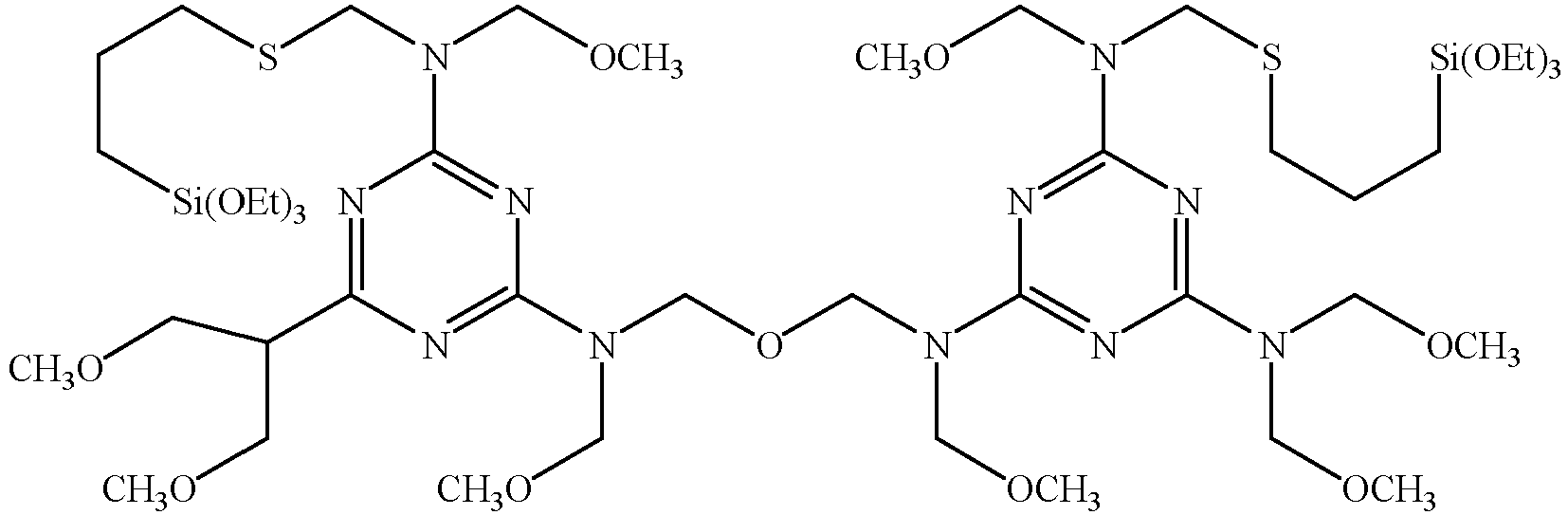


- Hexamethoxymethylmelamine (1017 grams, available from Ineos under the tradename Resimene 3520) and 3-mercaptopropyltriethoxysilane (310.7 grams, available from Momentive Performance Materials under the tradename Silquest® A-1891 silane) were charged into a 2-liter round bottom flask, equipped with a mechanical stirrer, a 6 inch vigreux column, a short-path distillation head, a heating mantle, and a temperature controller. The contents were heated to 40°C until the components became miscible. Sulfuric acid (0.3 gram) was added to the reaction flask. The contents were heated from 40° C to 100° C under 18 mmHg of vacuum initially. The vacuum was lowered to 9 mmHg while collecting methanol. A total of 71 grams of low boiling compounds and 1231 grams of Silane B product were recovered.
- Hexamethoxymethylmelamine is characterized by a central triazine ring having three alternating carbon and nitrogen atoms. The three carbon atoms are each bonded to an additional "free" nitrogen atom. Each "free" nitrogen is indirectly bonded to two oxygen atoms, thereby providing six silicon substitution sites for a silane, such as a silane coupling agent, to attach. When combined with silanes in accordance with the invention, this provides sites for the addition of six silane groups.
- For example, Silane A, described above, includes one silane substituted per hexamethoxymethylmelamine molecule. Silane B, below includes one silane substitution for every two hexamethoxymethylmelamine molecules. Thus, Silane A can be considered to have 1 silane per hexamethoxymethylmelamine molecule and Silane B can be considered to have one-half of a silane per hexamethoxymethylmelamine molecule.
- Table 1 lists the ingredients used for preparing rubber compositions using an 80/20 blend of Natural Rubber / cis 1,4-polybutadiene. The compositions contain N121 carbon black (control) and silica coupled with TESPT (coupling agent) or Silane A, a silane in accordance with preferred embodiments of this invention comprising a silane modified network forming polymer. As used herein, "non-productive" combinations refer to combinations of materials that are not cured and "productive" combinations are used to result in cured compositions.
TABLE 1 Comp. Ex. I Comp. Ex II Example 3 Example 4 Carbon black formulation TESPT formulation Resorcinol formulation Penacolite formulation Ingredients 1st Non-Productive Natural Rubber 1 80.0 80.0 80.0 80.0 cis 1,4-Polybutadiene2 20.0 20.0 20.0 20.0 Silica 3 0.0 50.0 50.0 50.0 Carbon Black 4 25.0 5.0 5.0 5.0 TDAE Process Oil 1.0 1.0 1.0 1.0 TESPT 0.0 4.0 0.0 0.0 Silane A 0.0 0.0 6.0 6.0 Zinc Oxide 1.5 1.5 1.5 1.5 Stearic Acid 1.0 1.0 1.0 1.0 Non-productive Mix 1 Total 128.5 162.5 164.5 164.5 2nd Non-Productive Carbon Black 25.0 5.0 5.0 5.0 6-PPD 5 2.0 2.0 2.0 2.0 TMQ6 0.5 0.5 0.5 0.5 Microcystalline Wax 1.3 1.3 1.3 1.3 Zinc Oxide 1.5 1.5 1.5 1.5 Stearic Acid 1.0 1.0 1.0 1.0 Hexa(methoxymethyl) melamine (HMMM) 0.0 0.0 1.25 1.25 Non-productive Mix 2 Total 159.8 173.8 177.1 177.1 3rd Non-Productive Resorcinol 0.0 0.0 0.63 0.0 Penacolite Resin B-19-SC 0.0 0.0 0.0 1.1 Non-productive Mix 3 Total 159.8 173.8 177.7 178.2 Productive Mix Sulfur 1.600 1.600 1.600 1.600 CBS 7 1.100 2.000 2.000 2.000 DPG8 0.4 0.4 0.4 0.4 Rubber Composition Total 162.9 177.8 181.7 182.2 1Natural Rubber (cis 1, 4-polyisoprene) - as SIR 20- Standard Indonesian Rubber
2High cis 1,4-polybutdadiene rubber (SYNTECA 44)-Synthos S.A.
3Zeosil 1165MP- Solvay
4N121 Carbon black-Columbian Chemicals Company
5N-1,3-dimethylbutyl-N-phenyl-para-phenylenediamine-Harwick Standard Distribution Corporation
62,2,4-Trimethyl-1,2-Dihydroquinoline polymer-NOCII,
7N-Cyclohexyl-2-benzothiazole sulfonamide (CBS)(accelerator)- Harwick Standard Distribution Corporation
8Diphenylguanidine- Harwick Standard Distribution Corporation - The silica-containing formulations require slightly more CBS due to the tendency of silica to absorb this accelerator to its surface. All four formulations (carbon black control, TESPT, Silane A with Resorcinol, and Silane A with Penacolite, were mixed in an internal rubber mixer utilizing a mixing procedure involving three sequential non-productive mixing steps followed by a final productive (curative) mix. The silica formulation containing TESPT was heat treated for 150 secs at 145 °C during all 3 non-productive passes. The silica formulation containing Silane A was heat treated for 150 secs at 155 °C during the 1st non-productive, for 150 secs at 150 °C for the 2nd non-productive, and for 150 secs at 140 °C for the 3rd non-productive step. The hexa(methoxymethyl)melamine and resorcinol for the in-situ polymerization of the secondary network for the Silane A formulation were added in the 2nd and 3rd non-productive stages, respectively. The phr loading for hexa(methoxymethyl)melamine and resorcinol are optimized values to ensure that the Shore A Hardness for the cured compounds are within the typical range for a truck tire formulation (Shore A Hardness of 60-65) and to achieve the best balance of physical and dynamic properties.
- All four formulations were mixed with curatives in the final productive mix for 180 secs at 105 °C. The rubber compositions shown in Table 1 were cured at 160 °C for 15 minutes. The resulting physical and dynamic properties are shown below in Table 2.
TABLE 2 Sample Comp. Ex. I Comp. Ex. II Example 3 Example 4 Mooney Plasticity ML1+4 at 100°C 65.5 62.1 83.9 81.1 Scorch Ts3 7.6 12.7 11.7 13.6 Rheometer, 160°C Max. Torque, dNm 20.75 21.14 19.85 19.77 Min. Torque, dNm 2.67 2.34 3.15 3.05 Delta Torque, dNm 18.10 18.80 16.70 16.70 Stress-Strain Tensile Strength, MPa 22.4 22.2 23.1 22.4 Elongation @ Break, % 474 519 488 492 100% Modulus, MPa 2.4 2.2 2.3 2.3 300% Modulus, MPa 13.5 11.8 13.5 13.2 Reinforcing Index 5.6 5.5 5.8 5.7 Shore A Hardness 25°C 63.6 62.5 64.5 64.3 70°C 60.2 61.2 60.5 61.5 Durability Graves Tear (100°C), N/mm 59.7 59.3 57.8 61.4 High Speed Tear Energy (HSTE), MJ/m3 8.5 10.0 9.3 9.7 Heat Buildup, °C 16.9 11.4 13.7 13.9 Abrasion Resistance DIN Abrasion loss, mm3 59.7 79.3 57.8 61.4 Angular Abrasion Loss (12° slip angle, high severity), g/Km 0.619 0.917 0.620 0.636 Angular Abrasion Loss (16° slip angle, ultrahigh severity), g/Km 2.33 3.42 2.53 2.52 Eplexor, cured compound E' @ 10% strain, 55°C (Strain Sweep), MPa 4.83 4.48 4.81 4.76 Sample Comp. Ex. I Comp. Ex. II Example 3 Example 4 Tan δ @ 10% strain, 55°C (Strain Sweep) 0.138 0.104 0.119 0.129 E' @ 60°C (Temp. Sweep), MPa 8.49 6.73 7.16 7.56 Tan δ @ 60°C (Temp. Sweep) 0.116 0.080 0.085 0.095 E' @ 30°C (Temp. Sweep), MPa 10.19 7.26 7.95 8.59 E' @ 0°C (Temp. Sweep), MPa 13.24 9.21 10.40 11.76 Tan δ @ 0°C (Temp. Sweep) 0.177 0.153 0.157 0.176 RPA strain sweep, cured compound G' @ 10% strain, 60°C 1.29 1.03 1.38 1.39 Tan δ @ 10% strain, 60°C 0.282 0.232 0.231 0.246 Rebound 70°C 59.2 63.8 60.1 58.5 100°C 62.1 67.0 63.2 62.6 - As shown in Table 2, the Shore A Hardness of all four formulations is similar. Thus, the physical and chemical properties can be compared on an equal hardness basis.
- The scorch safety and cure behavior of Silane A is comparable to that of TESPT (See
Fig. 1 ). The higher minimum torque observed in the Silane A compounds is likely due to the secondary polymer network initiation and growth. The Silane A compounds have lower values of delta torque (difference of modulus at 100% strain versus modulus at 300% strain) compared to TESPT, despite the in-situ creation of a thermosetting polymeric network in the Silane A compounds during the cure process. Although the TESPT compound has a higher number of total sulfur atoms (4.79*1022 atoms compared to 3*1022 atoms) that could be a contributing factor, the lower delta torque observed in the Silane A compounds is possibly due to the hydrophobating effect of the excess hexa(methoxymethyl)melamine moieties from the Silane A and the free hexa(methoxymethyl)melamine on the silica. This likely results in less filler-filler interaction, and a lower max torque. The rubber compounds prepared with Silane A have greater stiffness, as indicated by 300% modulus, and reinforcing index than the rubber compounds prepared with TESPT and comparable stiffness to the rubber compounds formulated with the N121-carbon black control filler. It is believed that there is a greater polymer-filler interaction and less filler-filler interaction in the rubber compounds formulated with Silane A, as compared to the rubber compounds formulated with TESPT. This becomes evident when the lower delta torque values are also taken into consideration. The reinforcement enhancement is a positive indicator for improved wear and abrasion resistance. - All four formulations of Table 1 exhibit comparable tensile strengths. The tear resistance of the Silane A compounds is acceptable, as it is comparable to the carbon black control. The silica-containing compounds all have a greater High Speed Tear Energy (HSTE) than the carbon black control compounds, which is a strong indication of better cut and chip resistance, an important property in a truck or bus tire. Furthermore, using the Silane A formulation would improve retreadability, because the lower heat buildup exhibited with these compounds correlates with improved retreadability, another important property in truck tires.
- The Silane A formulation exhibited excellent abrasion resistance in the silica-containing rubber compound, as measured using both a DIN abrader and an Angle Abrader (at both 12° and 16° slip angles under a normal load of 61N and 123N, respectively, using grindstone as the grinding surface). The Silane A compounds exhibited comparable abrasion resistance to the N121-carbon black control. Silane A also improved DIN abrasion resistance by 33% and angle abrasion resistance by 48% versus the TESPT compound. Two key contributing factors to the significant improvement in abrasion resistance include an increase in the effective filler volume and bound rubber content. The resulting increase in polymer-filler interaction is seen in
Figure 2 , an RPA strain sweep on cured compound at 60 °C. The crossing of Silane A storage modulus curves over the carbon black curve at 2-3% strain is indicative of a greater hydrodynamic effect, i.e., higher effective filler volume and bound rubber content. Referring to Table 2, the dynamic stiffness (G', E') between 30 °C and 60 °C is an indicator for tire handling. It can be compromised if silane-coupled silica replaces carbon black in a tire formulation. This trade-off is reduced in the Silane A formulations, an improvement compared to TESPT formulations. The dynamic stiffness at 0 °C is considered an indicator for irregular treadwear (seeUS Pat. No. 6,046,266 ). Increased stiffness reduces irregular wear. Based on this indicator, Table 2 shows that Silane A further reduces the gap in performance of silica filled rubber with respect to this feature, as compared to compounds formulated with carbon black. Thus, Silane A can reduce the trade-off in tire handling and irregular treadwear, improve tire durability, match the abrasion resistance of carbon black, and also reduce the hysteresis of the tire formulation. As also shown in Table 2, tire rolling resistance, related to the deformation of a tire at a frequency of 10-100 HZ and a temperature of 50-70 °C, is proportional to tan δ, a ratio of viscous modulus to elastic modulus under cyclic deformation. Table 2 shows that Silane A containing rubber compounds can have lower tan δ values than the N121-carbon black control. Thus, it appears that Silane A can minimize trade-off in wear resistance and rolling resistance in truck tire formulations. - Table 3, below, lists the 100% Natural Rubber formulations for the carbon black control, the TESPT, and the Silane A with Resorcinol, and Silane A with Penacolite and silica reinforced compounds.
TABLE 3 Comp. Ex.III Comp. Ex. IV Example 5 Example 6 Carbon Black TESPT Resorcinol Penacolite Ingredients 1st Non-Productive Natural Rubber 1 100 100 100 100 Silica 2 0.0 50.0 50.0 50.0 Carbon Black 3 25.0 5.0 5.0 5.0 TDAE Process Oil 1.0 1.0 1.0 1.0 TESPT silane 0.0 4.0 0.0 0.0 Silane A 0.0 0.0 6.0 6.0 Zinc Oxide 1.5 1.5 1.5 1.5 Stearic Acid 1.0 1.0 1.0 1.0 NP1 Total 128.5 162.5 164.5 164.5 2nd Non-Productive Carbon Black 25.0 5.0 5.0 5.0 6-PPD 4 2.0 2.0 2.0 2.0 TMQ5 0.5 0.5 0.5 0.5 Microcystalline Wax 1.3 1.3 1.3 1.3 Zinc Oxide 1.5 1.5 1.5 1.5 Stearic Acid 1.0 1.0 1.0 1.0 Hexa(methoxymethyl) melamine (HMMM) 0.0 0.0 1.25 1.25 NP2 Total 159.8 173.8 177.1 177.1 3rd Non-Productive Resorcinol 0.0 0.0 0.63 0.0 Penacolite Resin B-19-SC 0.0 0.0 0.0 1.1 NP3 Total 159.8 173.8 177.7 178.2 Productive Sulfur 1.600 1.600 1.600 1.600 CBS 6 1.100 2.000 2.000 2.000 DPG7 0.4 0.4 0.4 0.4 FM Total 162.9 177.8 181.7 182.2 1Natural Rubber (cis 1, 4-polyisoprene) - as SIR 20- Standard Indonesian Rubber
2Zeosil 1165MP- Solvay
3N121 Carbon black-Columbian Chemicals Company
4N-1,3-dimethylbutyl-N-phenyl-para-phenylenediamine-Harwick Standard Distribution Corporation
52,2,4-Trimethyl-1,2-Dihydroquinoline polymer-NOCII,
6N-Cyclohexyl-2-benzothiazole sulfonamide- Harwick Standard Distribution Corporation
7Diphenylguanidine- Harwick Standard Distribution Corporation - All four formulations were mixed in the manner described in Example 1. The physical and dynamic properties are shown in Table 4.
TABLE 4 Sample Comp. Ex. III Comp. Ex. IV Example 5 Example 6 Mooney Carbon black TESPT Resorcinol Penacolite Plasticity ML1+4 at 100°C 48.9 47.6 69.6 72.3 Scorch Ts3 7.7 12.6 12.5 13.5 Rheometer, 160°C Max. Torque, dNm 19.37 19.40 17.89 17.31 Min. Torque, dNm 1.93 1.66 2.54 2.62 Delta Torque, dNm 17.4 17.7 15.4 14.7 Stress-Strain Tensile Strength, MPa 22.4 23.0 22.3 22.2 Elongation @ Break, % 469 504 444 466 100% Modulus, MPa 2.4 2.2 2.2 2.1 300% Modulus, MPa 13.9 13.2 14.7 13.6 Reinforcing Index 5.8 6.1 6.7 6.6 Shore A Hardness 25°C 62.9 63.0 62.2 62.1 70°C 60.1 59.7 58.9 58.5 Durability Graves Tear (100°C), N/mm 71.7 79.1 62.8 67.0 High Speed Tear Energy (HSTE), MJ/m3 10.0 10.7 9.3 11.0 Heat Buildup, °C 15.6 9.6 11.8 16.1 Abrasion Resistance DIN Abrasion loss, mm3 96.2 117.3 96.0 103.4 Eplexor, cured compound E' @ 10% strain, 55°C (Strain Sweep), MPa 4.47 4.23 4.44 4.33 Tan δ @ 10% strain, 55°C (Strain Sweep) 0.133 0.100 0.115 0.123 E' @ 60°C (Temp. Sweep), MPa 7.85 6.03 6.51 6.40 Tan δ @ 60°C (Temp. Sweep) 0.117 0.078 0.081 0.087 E' @ 30°C (Temp. Sweep), MPa 9.26 6.57 7.29 7.18 E' @ 0°C (Temp. Sweep), MPa 12.44 8.68 9.71 9.59 Tan δ @ 0°C (Temp. Sweep) 0.190 0.166 0.161 0.166 RPA strain sweep, cured compound G' @ 10% strain, 60°C 1.15 0.95 1.24 1.23 Tan δ @ 10% strain, 60°C 0.270 0.219 0.193 0.197 Rebound 70°C 54.9 60.5 58.9 59.5 100°C 61.3 64.1 63.1 63.1 - The trends observed in the Mooney cure, physical durability, abrasion resistance, and dynamic properties are similar to the NR/BR formulation previously shown in Table 2. One key difference is the greater improvement in the 70 °C and 100 °C Rebound values. Silane A, when compounded with a network forming polymer (especially the same thermosetting resin), the composition can be compounded with a silica filled rubber to provide tire tread that significantly minimizes the trade-off in wear resistance and rolling resistance in tire formulations. Other benefits include improved tire durability, and less compromise in tire handling and irregular treadwear. It is a promising option for steer and drive truck tires that are compounded using NR/BR blends as well as trailer tires which containing higher levels of NR.
- Table 5, below, lists the ingredients used for preparing rubber compositions using 100% Natural Rubber, together with N234 carbon black control and the TESPT and Silane A with resorcinol silica compounds. The compounds were evaluated with and without the secondary polymer network to highlight the synergy of the network with the silane compounds.
TABLE 5 Comp. Ex. V Comp. Ex. VI Comp. Ex, VII Comp. Ex. VIII Comp. Ex. IX Example 7 Carbon black Carbon black - network TESPT TESPT-network Silane A Silane A-network Ingredients 1st Non-Productive Natural Rubber 1 100 100 100 100 100 100 Silica 2 0.0 0.0 40.0 40.0 40.0 40.0 Carbon Black 3 43.5 43.5 10.0 10.0 10.0 10.0 TESPT 0.0 0.0 3.2 3.2 0.0 0.0 6-PPD 4 1.5 1.5 1.5 1.5 1.5 1.5 TMQ5 1.0 1.0 1.0 1.0 1.0 1.0 DPTD 6 1.0 1.0 1.0 1.0 1.0 1.0 Microcrystalline Wax 2.5 2.5 2.5 2.5 2.5 2.5 Silane A 0.0 0.0 0.0 0.0 4.8 4.8 Zinc Oxide 3.0 3.0 3.0 3.0 3.0 3.0 Stearic Acid 2.0 2.0 2.0 2.0 2.0 2.0 NP1 Total 154.5 154.5 164.2 164.2 165.8 165.8 2nd Non-Productive HMMM7 0.0 1.0 0.0 1.0 0.0 1.0 NP2 Total 154.5 155.5 164.2 165.2 165.8 166.8 3rd Non-Productive Resorcinol 0.0 0.5 0.0 0.5 0.0 0.5 NP3 Total 154.5 156.0 164.2 165.7 165.8 167.3 Productive Sulfur 1.800 1.800 1.368 1.368 1.800 1.800 CBS 8 1.100 1.100 2.000 2.000 2.000 2.000 DPG9 0.0 0.0 0.400 0.400 0.0 0.0 FM Total 157.4 158.9 168.0 169.5 169.6 171.1 1Natural Rubber (cis 1, 4-polyisoprene) - as SIR 20- Standard Indonesian Rubber
2Zeosil 1165MP- Solvay
3N220 Carbon black-Columbian Chemicals Company
4N-1,3-dimethylbutyl-N-phenyl-para-phenylenediamine-Harwick Standard Distribution Corporation
52,2,4-Trimethyl-1,2-Dihydroquinoline polymer-NOCII,
6Dipentamethylene Thiuram Disulphide- as Antiozonant MPD-100- Akrochem Corporation
7HMMM is hexa(methoxymethyl)melamine
8N-Cyclohexyl-2-benzothiazole sulfonamide- Harwick Standard Distribution Corporation
9Diphenylguanidine- Harwick Standard Distribution Corporation - The cure package for the TESPT formulations was selected to ensure that the cure rate for TESPT containing compounds was similar to that for Silane A containing compounds and carbon black containing compounds (See
Figure 3 ). All Silane A formulations were mixed in the manner described for Example 3. The carbon black formulation without resorcinol and hexa(methoxymethyl)melamine was also mixed as described for Example 3. The TESPT formulation without resorcinol and hexa(methoxymethyl)melamine was heat treated for 90 seconds at 155 °C during all 3 non-productive (non-curing) passes. The carbon black and TESPT formulations containing resorcinol and hexa(methoxymethyl)melamine were mixed similarly to the formulations without the network forming polymer ingredients. The only difference was that the heat treatment for 3rd mixing passes were done for 150 sec. at 140 °C (similar to the Silane A formulations). This was done to minimize the premature reaction between resorcinol and hexa(methoxymethyl)melamine during the 3rd mixing pass. The physical and dynamic properties are shown in Table 6, below.TABLE 6 Sample Comp. Ex. V Comp. Ex. VI Comp. Ex. VII Comp. Ex. VIII Comp. Ex. IX Example 7 Mooney Plasticity ML1+4 at 100°C 36.9 40.9 42.7 49.5 46.4 53.2 Scorch Ts3 14.3 13.0 18.6 15.3 20.1 13.3 Rheometer, 160°C Max. Torque, dNm 15.92 17.36 15.10 16.92 15.47 15.63 Min. Torque, dNm 1.40 1.65 1.37 1.81 1.35 1.83 Delta Torque, dNm 14.5 15.7 13.7 15.1 14.1 13.8 Stress-Strain Tensile Strength, MPa 22.7 22.4 22.6 22.7 21.4 22.9 Elongation @ Break, % 549 533 570 552 597 537 100% Modulus, MPa 1.8 2.0 1.7 1.9 1.5 1.8 300% Modulus, MPa 10.2 10.7 9.6 10.4 8.0 10.7 Reinforcing Index 5.7 5.4 5.6 5.6 5.3 5.9 Shore A Hardness 25°C 57.3 60.5 56.9 60.9 56.2 58.3 70°C 52.5 56.6 52.9 57.1 53.8 55.0 Durability Graves Tear (100°C), N/mm 67.7 77.5 76.4 79.3 77.2 66.8 High Speed Tear Energy (HSTE), MJ/m3 11.2 11.0 13.8 13.5 17.0 11.4 Heat Buildup, °C 10.7 11.6 10.9 8.4 7.8 8.1 Abrasion Resistance DIN Abrasion loss, mm3 121.7 121.6 131.7 129.7 144.3 118.8 RPA strain sweep, cured compound G @ 10% strain, 60°C 0.8 0.9 0.7 1.0 0.9 0.9 Tan δ @ 10% strain, 60°C 0.277 0.291 0.219 0.252 0.258 0.222 Rebound 70°C 61.7 57.7 63.7 64.0 61.4 66.1 100°C 64.3 60.8 67.8 67.0 64.7 69.2 - The common effect of the polymer network on all the formulations included increased viscosity and reduced scorch safety. However, a synergy was evident between the network formed from resorcinol, hexa(methoxymethyl)melamine and Silane A, not seen in either the carbon black or TESPT formulations. Adding resorcinol and hexa(methoxymethyl)melamine to the Silane A formulations and forming the secondary network increased the tensile strength, 300% modulus and reinforcing index, all indicators of increased reinforcement. This increase in reinforcement, with no change in delta torque, is indicative of better polymer-filler interaction. The network also improved the abrasion resistance and reduced the hysteresis of the Silane A containing compound.
- A melamine resin containing residual hydroxyl groups (19.0 grams, 0.048 mole) and ethyl N-(3-triethoxysilylpropyl)carbamate (14.4 grams, 0.049 mole, available from Momentive Performance Materials) were charged into a three neck round bottom flask equipped with a magnetic stirrer, a short-path distillation head, a heating mantle, and a temperature controller. The contents were heated to 100° C under a vacuum of about 46 mmHg at which time sulfuric acid (0.0097 gram) and dodecylbenzene sulfonic acid 70% in isopropyl alcohol were then added to the reaction flask. The contents were heated from 120 °C to 155 °C under 42 to 47 mmHg of vacuum for 5 hours. Low boiling compounds (4.8 grams) were removed. A total of 103 grams of low boiling compounds and 1198.7 grams of Silane C product were recovered. The reaction was followed using GC.
- A melamine resin containing residual hydroxyl groups (83.2 grams, 0.213 mole), ureidopropyltrimethoxysilane (48.2 grams, 0.217 mole, available from Momentive Performance Materials), and a non-reactive high-boiling solvent, 2,6,10,14-tetramethylpentadecane (34.2 grams) were charged into a three neck round bottom flask equipped with a magnetic stirrer, a short-path distillation head, a heating mantle, and a temperature controller. The contents were heated to 140° C at atmospheric pressure for 1.5 hours. Dodecylbenzene sulfonic acid (0.65 gram) was then added to the reaction flask. The contents were heated at 140 °C for another 1.5 hours. Low boiling compounds (about 2 grams) were removed. The reaction mixture was separated into 2 phases. The top phase was determined by gas chromatography to be 2,6,10,14-tetramethylpentadecane and Silane D. The amount of the top phase was 134.2 grams. The bottom phase was determined by gas chromatography to be methanol. 134.2 grams of Silane D product in 2,6,10,14-tetramethylpentadecane were recovered.
- A 200 mL round bottomed flask equipped with a mechanical stirrer, short-path distillation head, dry ice cooled receiver, heating mantle and nitrogen inlet, was charged 50.58 grams of 1,3,4,6-tetrakis(methoxymethyl)glycouril and 27.22 grams of methyl alcohol. The mixture was heated to 55°C. Subsequently, 38.9 grams of 3-mercaptopropyltriethoxysilane and 0.0381g of dodecylbenzenesulfonic acid solution (70% in isopropanol) was added to the reaction flask, which was then heated to 70°C under 530 mmHg. Over a period of five hours, the temperature was maintained at 70C while the pressure was lowered from 530 mmHg to 60 mmHg until the concentration of 3 mercaptopropyltriethoxysilane was non-detectable by GC. 32.53 grams of lites were recovered. 78.32 grams of product were recovered.
- A 500 mL round bottom flask equipped with a 5-plate Oldershaw column, short-path distillation head, mechanical stirrer, dry-ice cooled receiver, heating mantle and nitrogen inlet, was charged 269.7 grams of Hexabutoxymethyl melamine (Allnex Cymel 1156), and 100.0 grams of 3-mercaptopropyltriethoxysilane and heated to 40°C under atmospheric pressure. 0.2176 grams of dodecylbenzenesulfonic acid solution (70% in isopropanol) was then added to the reaction flask, which was subsequently heated to 90°C under 400 mmHg. Over a period of 9 hours, the temperature was maintained at 90°C while the pressure was lowered from 400 mmHg to 30 mmHg to until the concentration of 3-mercaptopropyltriethoxysilane was non-detectable by GC. 33.5 grams of lites were recovered. 229.8 grams of product were recovered, having a viscosity of approximately 2700 cSt.
- In a 500 mL round bottom flask equipped with a 5-plate Oldershaw column, short-path distillation head, mechanical stirrer, dry-ice cooled receiver, heating mantle and nitrogen inlet, was charged 167.7 grams of methylated benzoguanamine formaldehyde resin at 80% in n-butanol (Ineos Maprenal MF 984-80B Resin), and 100.0 grams of 3-mercaptopropyltriethoxysilane and heated to 40C under atmospheric pressure. 0.2545 grams of dodecylbenzenesulfonic acid solution (70% in isopropanol) was then added to the reaction flask, which was subsequently heated to 90°C under 400 mmHg. Over a period of 8 hours, the temperature was maintained at 90°C while the pressure was lowered from 400 mmHg to 30 mmHg until the concentration of 3-mercaptopropyltriethoxysilane was non-detectable by GC. 46.2 grams of lites were recovered. 212.5 grams of product was recovered, having a viscosity greater than 14800 cSt.
- In a 1000 mL round bottom flask equipped with a 5-plate Oldershaw column, short-path distillation head, mechanical stirrer, dry-ice cooled receiver, heating mantle and nitrogen inlet, was charged 366.3 g of HMMM Resimene 3520 and 122.89 grams 1-octanol, which were stirred at ambient temperature until the mixture turned homogeneous, at which point 0.5271 grams dodecylbenzenesulfonic acid solution (70% in isopropanol) was also charged. The reaction flask was then heated to 100°C under a vacuum of 60 mmHg. After 4 hours at 100°C and 60 mmHg, the concentration of 1-octanol was non-detectable by GC. 224.11 grams of 3-mercaptopropyltriethoxysilane were subsequently added to the reaction flask, which was then heated to 90°C under 40 mmHg, and subsequently held for 6 hours until the 3-mercaptopropyltriethoxysilane concentration was non-detectable by GC. 647.8 grams of product was recovered.
- Table 7, below, lists the same ingredients used in table 1, and compares Silane E with silane A, and comparative examples I and II. Silanes A and E were evaluated at equal loadings.
TABLE 7 Comp. Ex. I Comp. Ex II Example 3 Comp. Ex X Carbon black formulation TESPT formulation Resorcinol formulation Silane E formulation Ingredients 1st Non-Productive Natural Rubber 1 80.0 80.0 80.0 80.0 cis 1,4-Polybutadiene2 20.0 20.0 20.0 20.0 Silica 3 0.0 50.0 50.0 50.0 Carbon Black 4 25.0 5.0 5.0 5.0 TDAE Process Oil 1.0 1.0 1.0 1.0 TESPT 0.0 4.0 0.0 0.0 Silane A 0.0 0.0 6.0 0.0 Silane E 0.0 0.0 0.0 6.0 Zinc Oxide 1.5 1.5 1.5 1.5 Stearic Acid 1.0 1.0 1.0 1.0 Non-productive Mix 1 Total 128.5 162.5 164.5 164.5 2nd Non-Productive Carbon Black 25.0 5.0 5.0 5.0 6-PPD 5 2.0 2.0 2.0 2.0 TMQ6 0.5 0.5 0.5 0.5 Microcystalline Wax 1.3 1.3 1.3 1.3 Zinc Oxide 1.5 1.5 1.5 1.5 Stearic Acid 1.0 1.0 1.0 1.0 Hexa(methoxymethyl) melamine (HMMM) 0.0 0.0 1.25 0.0 Methoxy methyl glycouril 0.0 0.0 0.0 1.25 Non-productive Mix 2 Total 159.8 173.8 177.1 177.1 3rd Non-Productive Resorcinol 0.0 0.0 0.63 0.63 Non-productive Mix 3 Total 159.8 173.8 177.7 177.7 Productive Mix Sulfur 1.600 1.600 1.600 1.600 CBS7 1.100 2.000 2.000 2.000 DPG8 0.4 0.4 0.4 0.4 Rubber Composition Total 162.9 177.8 181.7 181.7 - All four formulations were mixed in the manner described in Example 1. The physical and dynamic properties are shown in Table 8.
TABLE 8 Sample Comp. Ex. I Comp. Ex II Example 3 Example X Carbon black formulation TESPT formulation Resorcinol formulation Silane E formulation Mooney Plasticity ML1+4 at 100°C 65.9 57.4 77.6 65.1 Scorch Ts3 7.4 12.2 9.4 10.8 Rheometer, 160°C Max. Torque, dNm 21.32 21.64 19.38 25.71 Min. Torque, dNm 2.66 2.07 2.87 2.82 Delta Torque, dNm 18.7 19.6 16.5 22.9 Stress-Strain Tensile Strength, MPa 22.4 22.4 22.5 20.7 Elongation @ Break, % 461 497 474 570 100% Modulus, MPa 2.4 2.4 2.3 2.3 300% Modulus, MPa 14.2 13.0 13.7 9.6 Reinforcing Index 5.8 5.5 5.9 4.2 Shore A Hardness 25°C 64.1 63.6 64.0 71.7 70°C 60.6 61.6 61.5 66.7 Durability Graves Tear (100°C), N/mm 60.5 59.2 55.3 65.2 High Speed Tear Energy (HSTE), MJ/m3 7.8 7.7 7.5 11.2 Abrasion Resistance DIN Abrasion loss, mm3 76.4 87.5 80.1 128.7 RPA strain sweep, cured compound G' @ 10% strain, 60°C 1.5 1.3 1.5 2.1 Tan δ @ 10% strain, 60°C 0.255 0.193 0.178 0.305 Rebound 70°C 57.1 62.6 59.5 48.6 100°C 61.0 66.1 63.0 53.9 - The chemical structure of silane E implies that it should perform similarly to Silane A, but the data in table 8 show that this is clearly not the case. Aside from having a different plasticity and cure profile, the comparative example X compound also has an overall lower reinforcement compared to example 3. This is reflected in the lower tensile strength, 300% modulus, reinforcing index, and abrasion resistance. It appears that silane E forms a softer, non-reinforcing network, and this also has a negative impact on the rolling resistance indicators as seen in the rebound and tan δ values in table 8. Thus, without optimization, not all polymeric networks can provide the level of reinforcement needed to meet the performance requirements for a tire tread formulation, such as the one in table 7.
- The process for preparing a hydrolyzable alkoxymethylamino-functional silane, without the need of a catalyst, could also occur in situ in a rubber composition comprising a rubber polymer (a) and a reinforcing filler (b) having water bound thereto, and wherein the silane containing a functional group forms silanols by reacting with the water bound to the reinforcing filler and said silanols react with the reinforcing filler to form a plurality of covalent chemical bonds with the filler. The formulation in table 9 compares silane A with combinations of mercapto-containing silanes with reinforcing resins in predetermined ratios.
TABLE 9 Comp. Ex. XI Comp. Ex XII Comp. Ex XIII Comp. Ex XIV Example 3 Ingredients 1st Non-Productive Natural Rubber 1 80.0 80.0 80.0 80.0 80.0 cis 1,4-Polybutadiene2 20.0 20.0 20.0 20.0 20.0 Silica 3 0.0 50.0 50.0 50.0 50.0 Carbon Black 4 25.0 5.0 5.0 5.0 5.0 TDAE Process Oil 1.0 1.0 1.0 1.0 1.0 HMMM 3.72 3.72 3.72 3.72 3.72 Silane A 0.0 0.0 0.0 0.0 6.0 NXT Silane 3.48 0.0 0.0 0.0 0.0 NXT Z45 Silane 0.0 4.20 0.0 0.0 0.0 NXT Z100 Silane 0.0 0.0 3.535 0.0 0.0 A-1891 Silane 0.0 0.0 0.0 2.274 0.0 Zinc Oxide 1.5 1.5 1.5 1.5 1.5 Stearic Acid 1.0 1.0 1.0 1.0 1.0 Non-productive Mix 1 Total 165.7 166.4 165.8 164.5 164.5 2nd Non-Productive Carbon Black 25.0 5.0 5.0 5.0 5.0 6-PPD 5 2.0 2.0 2.0 2.0 2.0 TMQ6 0.5 0.5 0.5 0.5 0.5 Microcystalline Wax 1.3 1.3 1.3 1.3 1.3 Zinc Oxide 1.5 1.5 1.5 1.5 1.5 Stearic Acid 1.0 1.0 1.0 1.0 1.0 Hexa(methoxymethyl) melamine (HMMM) 1.25 1.25 1.25 1.25 1.25 Non-productive Mix 2 Total 178.3 179.0 178.3 177.0 177.1 3rd Non-Productive Resorcinol 0.63 0.63 0.63 0.63 0.63 Non-productive Mix 3 Total 178.9 179.6 178.9 177.7 177.7 Productive Mix Sulfur 1.600 1.600 1.600 1.600 1.600 CBS7 2.000 2.000 2.000 2.000 2.000 DPG8 0.4 0.4 0.4 0.4 0.4 Rubber Composition Total 182.9 183.6 182.9 181.7 181.7 - The physical and dynamic properties are shown in Table 10 below.
TABLE 10 Sample Comp. Ex. XI Comp. Ex XII Comp. Ex XIII Comp. Ex XIV Example 3 Mooney Plasticity ML 1+4 at 100°C 73.2 75.7 74.8 79.0 81.0 Scorch Ts3 11.9 10.2 10.3 12.1 11.6 Rheometer, 160°C Max. Torque, dNm 17.97 21.64 21.79 19.58 19.87 Min. Torque, dNm 2.60 2.96 2.98 3.25 3.03 Delta Torque, dNm 15.4 18.7 18.8 16.3 16.8 Stress-Strain Tensile Strength, MPa 22.7 23.1 23.3 23.3 23.4 Elongation @ Break, % 530 507 500 495 491 100% Modulus, MPa 2.2 2.6 2.6 2.3 2.4 300% Modulus, MPa 12.1 13.4 13.6 13.4 13.7 Reinforcing Index 5.5 5.1 5.3 5.8 5.8 Shore A Hardness 25°C 62.8 67.8 66.9 65.0 64.3 70°C 60.0 64.2 63.9 62.5 62.1 Durability Graves Tear (100°C), N/mm 63.0 63.7 60.6 66.7 71.1 High Speed Tear Energy (HSTE), MJ/m3 8.4 8.1 7.5 7.5 7.6 Abrasion Resistance DIN Abrasion loss, mm3 85.6 83.8 80.7 78.4 76.6 RPA strain sweep, cured compound G' @ 10% strain, 60°C 1.3 1.8 1.8 1.6 1.7 Tan δ @ 10% strain, 60°C 0.168 0.230 0.226 0.185 0.186 Rebound 70°C 58.9 55.4 56.0 58.3 59.0 100°C 62.4 58.8 59.1 60.5 61.2 - From table 10, it appears that combining gamma-mercaptopropyltriethoxysilane with HMMM in the first non-productive pass gives similar physical and dynamic properties as silane A, indicating the possibility of in-situ formation of silane A and the subsequent network upon curing of the compound.
- However, the network structure indicators from rheology show that this is not the case. The
RPA 2000 from Alpha Technologies was used to run strain sweep from 0.25% to 500% strain at 1Hz, and with testing temperature maintained at 170°C applied to compound example XIV and compound example 3 of table 9. The resulting empirical data suggested that the size of silica-silane A aggregates increases from one nonproductive stage to the next. This is not the case with example XIV. - Work by R. Hentschke et al. 2017 suggests that information about aggregate size can be obtained from the Payne effect curve. The formula shown below is used to fit the Payne effect data:

- Aggregate size data was proved to be independent of the Payne effect. The Shell dimensions of Silane A's Network grew in size whereas the in situ blend of HMMM with gamma-mercaptopropyltriethoxysilane decreased in size by contrast, while the Payne effect data were identical. The table below illustrates this.
TABLE 11 Payne Effect D/d NP1 NP1 NP2 NP3 Silane A 1354 0.07 0.12 0.16 Mercapto & Hmmm 1366 0.18 0.16 0.09
Claims (15)
- A hydrolyzable alkoxymethylamino-functional silane, comprising:at least one hydrolyzable silyl group and at least one alkoxymethylamino-functional group,wherein the alkoxymethylamino-functional group and the hydrolyzable silyl group are each bonded to an sp2 carbon atom on an organic group to form a N-C covalent bond, and wherein the at least one alkoxymethylamino-functional group has the structure
(R1OCH2)2N-
where R1 is independently hydrogen, an alkyl group having from 1 to 10 carbon atoms, a cycloalkyl group having from 3 to 10 carbon atoms, an alkenyl group having from 2 to 10 carbon atoms, an aryl group having from 6 to 12 carbon atoms or an aralkyl group having from 7 to 12 carbon atoms; and
the at least one hydrolyzable silyl group has the chemical Formula (II): whereineach R2 is independently hydrogen, an alkyl group having from 1 to 10 carbon atoms and optionally at least one oxygen atom, a cycloalkyl group having from 3 to 10 carbon atoms, an alkenyl group having from 2 to 10 carbon atoms, an aryl group having from 6 to 12 carbon atoms or an aralkyl group having from 7 to 12 carbon atoms;each R3 is independently an alkyl group having from 1 to 3 carbon atoms or phenyl;R4 is an alkylene group having from 1 to 10 carbon atoms and optionally at least one oxygen atom, a cycloalkylene group having from 3 to 10 carbon atoms, an alkenylene group having from 2 to 10 carbon atoms, an arylene group having from 6 to 12 carbon atoms, an aralkylene group having from 7 to 14 carbon atoms;each X is a -SCH2-,
 the subscript a is an integer equal to 1, 2 or 3, with the proviso that the nitrogen atom shown in Formula (II) is bonded to a sp2-hybridized carbon atom.
 - The hydrolyzable alkoxymethylamino-functional silane of Claim 1, wherein the at least one of the hydrolyzable alkoxymethylamino-functional silanes has the chemical structure of Formulae III or IV or stereoisomers thereof:
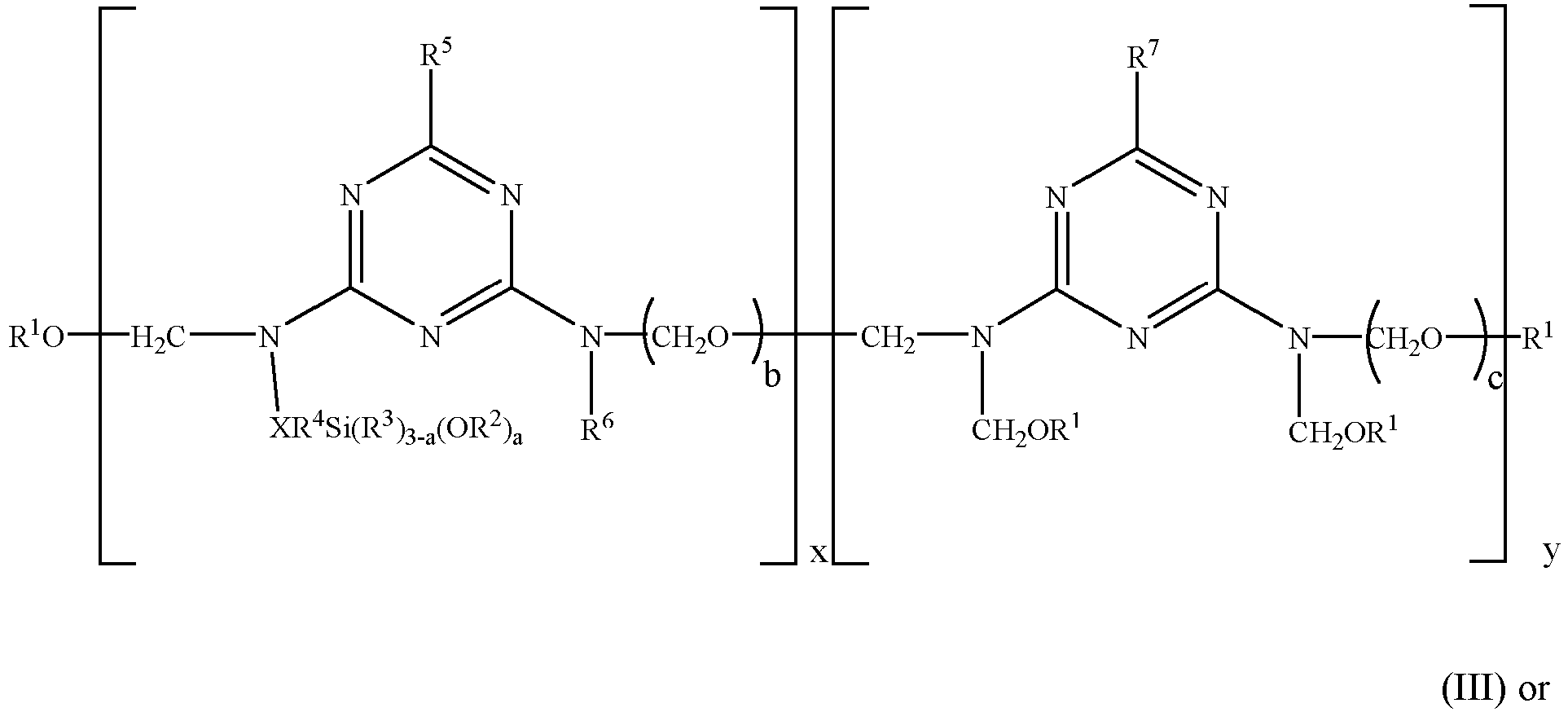
 each R1 is independently hydrogen, an alkyl group having from 1 to 10 carbon atoms, a cycloalkyl group having from 3 to 10 carbon atoms, an alkenyl group having from 2 to 10 carbon atoms, an aryl group having from 6 to 12 carbon atoms or an aralkyl group having from 7 to 12 carbon atoms;each R2 is independently hydrogen, an alkyl group having from 1 to 10 carbon atoms and optionally at least one oxygen atom, a cycloalkyl group having from 3 to 10 carbon atoms, alkenyl group having from 2 to 10 carbon atoms, an aryl group having from 6 to 12 carbon atoms or an aralkyl group having from 7 to 12 carbon atoms;each R3 is independently an alkyl group having from 1 to 3 carbon atoms or phenyl;each R4 is independently an alkylene group having from 1 to 10 carbon atoms and optionally at least one oxygen atom, a cycloalkylene group having from 3 to 10 carbon atoms, an alkenylene group having from 2 to 10 carbon atoms, an arylene group having from 6 to 12 carbon atoms, an aralkylene group having from 7 to 14 carbon atoms;each R5 and R7 is independently phenyl, -N(CH2OR1)2, -N(CH2OR1)(XR4Si(R3)3-a(OR2)a), -N(XR4Si(R3)3-a(OR2)a)2,
 each R6, R8 and R9 is independently hydrogen, -CH2OR1 or -XR4Si(R3)3-a(OR2)a;each X is independently -SCH2-, -NR1C(=O)N(R1)CH2-, -NR1(C=O)OCH2-, -OCH2-, -NR1CH2- or -OCH2CH(OH)CH2OCH2- group, where the methylene carbon atom of the group is bonded to the nitrogen atom, or -NH(C=O)-, -OCH2CH(OH)CH2- or a chemical bond which forms the bond between the R4 group and the nitrogen atom, with the proviso that the nitrogen atom is bonded to a sp2-hybridized carbon atom; the subscripts a, b, c, d, x and y are independently integers where a is 1, 2 or 3; b is 0 or 1; c is 0 or 1; x is from 1 to 20; and y is from 0 to 20,
and wherein preferablyeach R1 is independently an alkyl group having from 1 to 3 carbon atoms;each R2 is independently an alkyl group having from 1 to 3 carbon atoms;each R3 is independently an alkyl group having from 1 to 3 carbon atoms; each R4 is independently an alkylene group having from 1 to 6 carbon atoms;each R5 and R7 is independently -N(CH2OR1)2 or -N(CH2OR1)(CH2XR4Si(R3)3-a(OR2)a);each R6, R8 and R9 is -CH2OR1;each X is independently -SCH2- or -NR1CH2- group; the subscripts a, b, c, d, x and y are independently integers where a is 3; b is 1; c is 1; x is 1, 2 or 3; and y is 0. - The hydrolyzable alkoxymethylamino-functional silane of Claim 1, wherein said silane is selected from the group consisting of 1-(5-trimethoxysilyl-2-thiapentyl)-1,3,3-tris-methoxymethylurea, 1,3-bis-(1-(5-trimethoxysilyl-2-thiapentyl)-1,3-bis-methoxymethylurea, 3,3-bis-(3-dimethoxysilyl-2-thiapropyl)-1,1-bis-methoxymethylurea, 1-(5-triethoxysilyl-2-thiapentyl)-1,3,3-tetra-ethoxymethylurea, 1-(5-triethoxysilyl-2-aza-2-methyl-pentyl)-1,3,3-tris-ethoxymethylurea, 1,3-bis-(7-triethoxysilyl-2,4-diaza-3-oxo-heptyl)-1,3-bis-ethoxymethylurea, 3,3-bis-(1-(5-triethoxysilyl-2-thiapentyl)-1,1-bis-ethoxymethylurea, 1-(5-triethoxysilyl-2-thiapentyl)-1,3,3-tris-propoxymethylurea, 1-(5-triethoxysilyl-2-thiapentyl)-1,3,3-tris-propoxymethylurea, 1,3-bis-(5-tripropoxysilyl-2-thiapentyl)-1,3-bis-propoxymethylurea, 3,3-bis-(5-tripropoxysilyl-2-thiapentyl)-1,1-bis-propoxymethylurea, 1,3-bis-(5-tripropoxysilyl-2-thiapentyl)-1,3,3-tetra-butoxymethylurea, 1-(5-triphenoxysilyl-2-thiapentyl)-1,3,3-tetra-phenoxymethylurea, N-[1-(5-triethoxysilyl-2-thiapentyl)-1,3-tris-ethoxymethylureidomethyl]-1,3,3-tetra-ethoxymethylurea, N, N'-bis-[(1-(5-triethoxysilyl-2-thiapentyl)-1,3-bis-ethoxymethylureidomethyl]-1,3-bis-ethoxymethylurea, N, N'-bis-[1-(5-triethoxysilyl-2-thiapentyl)-1,3-bis-ethoxymethylureido-methoxymethyl]-1,3-bis-ethoxymethylurea, N-(5-triethoxysilyl-2-thiapentyl)-N,N',N',N",N"-pentakis-methoxymethyl-[1,3,5]triazine-2,4,6-triamine, N, N"-bis-(5-triethoxysilyl-2-thiapentyl)-N,N',N',N"-tetrakis-methoxymethyl-[1,3,5]triazine-2,4,6-triamine, N', N"-(5-triethoxysilyl-2-thiapentyl)-N,N,N',N"-tetrakis-methoxymethyl-[1,3,5]triazine-2,4,6-triamine, N-(5-triethoxysilyl-2-aza-2-methyl-pentyl)-N,N',N',N",N"-pentakis-ethoxymethyl-[1,3,5]triazine-2,4,6-triamine, N"-(7-triethoxysilyl-2,4-diaza-3-oxo-heptyl)- N,N,N',N',N"-pentakis-ethoxymethyl-[1,3,5]triazine-2,4,6-triamine, N',N" - (7-triethoxysilyl-2,4-diaza-3-oxo-heptyl)-N,N,N',N"-tetrakis-ethoxymethyl-[1,3,5]triazine-2,4,6-triamine, N-(5-triethoxysilyl-2-aza-2-methyl-pentyl)-N,N',N',N",N"-pentakis-propoxymethyl-[1,3,5]triazine-2,4,6-triamine and N-(5-triethoxysilyl-2-aza-2-methyl-pentyl)-N,N',N',N",N"-pentakis-phenoxymethyl-[1,3,5]triazine-2,4,6-triamine.
- A process for preparing a hydrolyzable alkoxymethylamino-functional silane, comprising:(i) contacting an amino resin having the structure of general Formula (VII) or (VIII),

 each R10 is independently an alkyl group having from 1 to 10 carbon atoms, a cycloalkyl group having from 3 to 10 carbon atoms, alkenyl group having from 2 to 10 carbon atoms, an aryl group having from 6 to 12 carbon atoms, an aralkyl group having from 7 to 12 carbon atoms or hydrogen;each R11 is independently phenyl, -N(CH2OR10)2 or -NH(CH2OR10);each R12 is independently hydrogen or -CH2OR10; andeach d and z is an integer, where d is 0 or 1 and z is from 1 to 40each R12 is -CH2OR10,with a silane containing a functional group having the general Formula (X):wherein
(R2O)aR3 3-aSiR4X1H (X)
each R2 is independently hydrogen, an alkyl group having from 1 to 10 carbon atoms and optionally at least one oxygen atom, a cycloalkyl group having from 3 to 10 carbon atoms, alkenyl group having from 2 to 10 carbon atoms, an aryl group having from 6 to 12 carbon atoms or an aralkyl group having from 7 to 12 carbon atoms;each R3 is independently an alkyl group having from 1 to 3 carbon atoms or phenyl;R4 is an alkylene group having from 1 to 10 carbon atoms and optionally at least one oxygen atom, a cycloalkylene group having from 3 to 10 carbon atoms, an alkenylene group having from 2 to 10 carbon atoms, an arylene group having from 6 to 12 carbon atoms, an aralkylene group having from 7 to 14 carbon atoms;X1 is -O-, -S-, -NR13-, -NR13C(=O)NR13-, - where R13 is hydrogen, an alkyl group having from 1 to 10 carbon atoms and optionally at least one oxygen atom, a cycloalkyl group having from 3 to 10 carbon atoms, alkenyl group having from 2 to 10 carbon atoms, an aryl group having from 6 to 12 carbon atoms or an aralkyl group having from 7 to 12 carbon atoms;a is an integer equal to 0, 1 or 2, orwherein
contacting an amino resin having the structure of general Formula (VII), (VIII) or (IX), where at least one R12 is hydrogen or -CH2OH, with a silane containing a functional group having the general Formula (XI):
(R2O)aR3 3-aSiR4X2 (XI)
each R2 is independently hydrogen, an alkyl group having from 1 to 10 carbon atoms and optionally at least one oxygen atom, a cycloalkyl group having from 3 to 10 carbon atoms, alkenyl group having from 2 to 10 carbon atoms, an aryl group having from 6 to 12 carbon atoms or an aralkyl group having from 7 to 12 carbon atoms;each R3 is independently an alkyl group having from 1 to 3 carbon atoms or phenyl;R4 is an alkylene group having from 1 to 10 carbon atoms and optionally at least one oxygen atom, a cycloalkylene group having from 3 to 10 carbon atoms, an alkenylene group having from 2 to 10 carbon atoms, an arylene group having from 6 to 12 carbon atoms, an aralkylene group having from 7 to 14 carbon atoms;X2 is -Cl, -Br, a is an integer equal to 0, 1 or 2; and(ii) reacting the amino resin of step (i) with the silane containing a functional group of step (i),wherein the process preferablyfurther comprises removing byproducts selected from the group consisting of R10OH, R13OH, R13 2NH, HCl and HBr from the reaction mixture if the byproducts are formed in the reaction, wherein the molar ratio of the -X1H group to the R10OCH2N- group or the -X2 to R12 group is from 0.1 to 0.8,or wherein the process is preferably carried out in situ in a rubber composition comprising a rubber polymer (a) and a reinforcing filler (b) having water bound thereto, and wherein the silane containing a functional group forms silanols by reacting with water or water bound to the reinforcing filler and said silanols react with the reinforcing filler to form a plurality of covalent chemical bonds with the filler.
 - A rubber composition comprising:(a) a rubbery polymer or blend of polymers;(b) at least one reinforcing filler that is reactive with the hydrolyzable alkoxymethylamino-functional silane of claim 1;(c) at least one organic resin;(d) at least one hydrolyzable alkoxymethylamino-functional silane of claims 1;(e) optionally, at least one active hydrogen containing organic compound; and(f) optionally, at least one a sulfur-donating compound,wherein preferably the amount of alkoxymethylamino-functional silane (d) ranges from 0.2 to 20 weight percent based on the total weight of rubber composition, the rubbery component (a) ranges from 25 to 95 weight percent based on the total weight of the rubber composition, the reinforcing filler (b) that is reactive with the alkoxymethylamino-functional silane (d) ranges from 2 to 70 weight percent based on the total weight of rubber composition, the organic resin (c) ranges from 0.2 to 25 weight percent based on the total weight of the rubber composition, the active hydrogen-containing compound (e) ranges from 0.2 to 25 weight percent based on the total weight of the rubber composition and the amount of the sulfur-donating compound (f) ranges from 0.2 to 5 weight percent based on the total weight of the rubber composition.
- The rubber composition of claim 5, comprising:a combination of (i) a primary polymeric network comprising (a) a rubbery polymer or blend of polymers and (f) at least one sulfur-donating compound; and(ii) a secondary polymeric network comprising the reaction product of (b) at least one reinforcing filler, (c) at least one organic resin, (d) at least one hydrolyzable alkoxymethylamino-functional silane of claim 1 and (e) at least one active hydrogen containing organic compound.
- The rubber composition of Claim 6, wherein the rubbery polymer (a) is selected from the group consisting of natural rubber (NR), synthetic polyisoprene (IR), polybutadiene (BR), various copolymers of butadiene, the copolymers of isoprene, solution styrene-butadiene rubber (SSBR), emulsion styrene-butadiene rubber (ESBR), ethylene-propylene terpolymers (EPDM), acrylonitrile-butadiene rubber (NBR), and functionalized rubbers that are modified by at least one alkoxysilyl group, tin-containing group, amino group, hydroxyl group, carboxylic acid group, polysiloxane group, epoxy group or phthalocyanimo group, or wherein
the rubbery polymer (a) comprises natural rubber or a mixture of natural rubber and butadiene rubber. - The rubber composition of Claim 6, wherein the reinforcing filler (b) before reaction with the other reactants of the secondary polymeric network is chosen from fibers, particulates or sheet-like structures comprising metalloid oxides or metal oxides having surface hydroxyl groups,wherein preferably
the reinforcing filler (b) is selected from the group consisting of silicates, clays, ceramics, diatomaceous earth, pyrogenic silica, precipitated silica, titanium dioxide, aluminosilicate, alumina, talc and mixtures thereof,or wherein preferably
the reinforcing filler (b) comprises precipitated silica. - The rubber composition of Claim 6, wherein the organic polymer (c) before reaction with the other reactants of the secondary polymeric network is selected from the group consisting of polyisocyanates, polyisocyanurates, epoxy resins, amino resins and polyurethanes,wherein in the rubber composition preferably
the amino resin has the chemical structure of Formulae (VII) or (VIII): or
or whereineach R10 is independently an alkyl group having from 1 to 10 carbon atoms, a cycloalkyl group having from 3 to 10 carbon atoms, alkenyl group having from 2 to 10 carbon atoms, an aryl group having from 6 to 12 carbon atoms, an aralkyl group having from 7 to 12 carbon atoms or hydrogen;each R11 is independently phenyl, -N(CH2OR10)2 or -NH(CH2OR10);each R12 is independently hydrogen or -CH2OR10; andeach d and z is an integer, where d is 0 or 1 and z is 1 to 40,or wherein in the rubber composition preferably
the amino resin is selected from the group consisting of 1,1,3,3-tetra-methoxymethylurea, 1,3,3-tris-methoxymethylurea, 1,3-bis-methoxymethylurea, 1,1-bis-methoxymethylurea, 1,1,3,3-tetra-ethoxymethylurea, 1,3,3-tris-ethoxymethylurea, 1,3-bis-ethoxymethylurea, 1,1-bis-ethoxymethylurea, 1,1,3,3-tetra-propoxymethylurea, 1,3,3-tris-propoxymethylurea, 1,3-bis-propoxymethylurea, 1,1-bis-propoxymethylurea, 1,1,3,3-tetra-butoxymethylurea, 1,1,3,3-tetra-phenoxymethylurea, N-(1,3,3-tris-ethoxymethylureidomethyl)-1,1,3,3-tetra-ethoxymethylurea, N, N'-bis-(1,1,3-tris-ethoxymethylureidomethyl)-1,3-bis-ethoxymethylurea, N, N'-bis-(1,1,3-tris-ethoxymethylureido-methoxymethyl)-1,3-bis-ethoxymethylurea, N,N,N',N',N",N"-hexakis-methoxymethyl-[1,3,5]triazine-2,4,6-triamine, N,N,N',N',N"-pentakis-methoxymethyl-[1,3,5]triazine-2,4,6-triamine, N,N,N',N"-tetrakis-methoxymethyl-[1,3,5]triazine-2,4,6-triamine, N,N,N',N',N",N"-hexakis-ethoxymethyl-[1,3,5]triazine-2,4,6-triamine, N,N,N',N',N"-pentakis-ethoxymethyl-[1,3,5]triazine-2,4,6-triamine, N,N,N',N"-tetrakis-ethoxymethyl-[1,3,5]triazine-2,4,6-triamine, N,N,N',N',N",N"-hexakis-propoxymethyl-[1,3,5]triazine-2,4,6-triamine, N,N,N',N',N"-pentakis-propoxymethyl-[1,3,5]triazine-2,4,6-triamine, N,N,N',N"-tetrakis-propoxymethyl-[1,3,5]triazine-2,4,6-triamine, N,N,N',N',N",N"-hexakis-phenoxymethyl-[1,3,5]triazine-2,4,6-triamine, N,N,N',N',N"-pentakis-phenoxymethyl-[1,3,5]triazine-2,4,6-triamine and N,N,N',N"-tetrakis-phenoxymethyl-[1,3,5]triazine-2,4,6-triamine. - The rubber composition of Claim 6, wherein the active hydrogen-containing organic compound (e) before reaction with the other reactants of the secondary polymeric network has the structure of Formula (XII):
R14(X3H)e (XII)
wherein R14 is a polyvalent organic group having from 1 to 100 carbon atoms or a polyvalent hydrocarbon containing 1 to 100 carbon atoms containing at least one heteroatom of oxygen or nitrogen; X3 is -NH-, -NR15-, -C(O)NH-, -C(=O)NR15-, -NHC(=O)NH-, -NH(=O)NR15-, -S-, - C(=O)O- or -O-, where R15 is independently an alkyl group having from 1 to 10 carbon atoms, a cycloalkyl group having from 3 to 10 carbon atoms, an alkenyl group having from 2 to 10 carbon atoms, an aryl group having from 6 to 12 carbon atoms, an aralkyl group having from 7 to 12 carbon atoms or hydrogen,wherein preferably
R14 contains at least oneether functional group, amino functional group, ester functional group, ketone functional group, aldehyde functional groups, amido functional groups, carbamato functional group or ureido functional group,or wherein preferably the active hydrogen-containing organic compound (d) is selected from the group consisting of ethylene glycol, propylene glycol, 1,3-butanediol, diethylene glycol, triethylene glycol, polyethylene glycol having a molecular weight of from 194 to 2000 grams/mole, dipropylene glycol, tripropylene glycol polypropylene glycol having a molecular weight of from 250 to 2500 grams/mole, glycerol, trimethylolmethane, trimethylolethane, trimethylolpropane and pentaerythritol, catechol, resorcinol, hydroquinone, phenol-formaldehyde resins, 2,2-bis(4-hydroxyphenyl)butane, 2,2-bis(4-hydroxyphenyl)propane, 1,1-bis(4-hydroxyphenyl)ethane, bis(4-hydroxyphenyl)methane,resorcinol-formaldehyde resins, ethylene diamine, diethylene triamine, triethylene tetraamine, bis-(2-aminoethyl)ether, 2-aminoethyl heptanamide, gycerol monostearate, sorbitan monostearate and urea formaldehyde resins. - The rubber composition of Claim 6, wherein the sulfur-donating compound (f) is sulfur.
- A rubber composition of Claim 6, wherein the rubbery polymer (a) contains natural rubber; the reinforcing filler (b) before reaction with the other reactants of the secondary polymeric network is precipitated silica; the organic resin (c) before reaction with the other reactants of the secondary polymeric network is an amino resin having the structure of Formula (VII):
 wherein R10 is methyl, ethyl or propyl, R12 is methoxymethyl, ethoxymethyl or propoxymethyl, R11 is N,N-bis-(methoxymethyl)-aminomethyl, N,N-bis-(ethoxymethyl)-aminomethyl or N,N-bis-(propoxymethyl)-aminomethyl; the active hydrogen-containing compound (e) before reaction with the other reactants of the secondary polymeric network is catechol, resorcinol, hydroquinone, phenol-formaldehyde resins, 2,2-bis(4-hydroxyphenyl)butane, 2,2-bis(4-hydroxyphenyl)propane, 1,1-bis(4-hydroxyphenyl)ethane, bis(4-hydroxyphenyl)methane or resorcinol-formaldehyde resins; the hydrolyzable alkoxymethylamino-functional silane (d) before reaction with the other reactants of the secondary polymeric network has the structure of Formula (III):
 wherein R1 is methyl, ethyl or propyl; R2 is methyl, ethoxy or propyl, R3 is methyl, R4 is propylene; each R5 and R7 is N,N-bis-(methoxymethyl)-aminomethyl, N,N-bis-(ethoxymethyl)-aminomethyl or N,N-bis-(propoxymethyl)-aminomethyl, X is -SCH2-; a is 2 or 3, x is 1, 2, 3, 4 or 5, and y is 0 or 1, or wherein
before the reaction of components (b), (c), (d) and (e), the amount of alkoxymethylamino-functional silane (d) ranges from 0.2 to 20 weight percent based on the total weight of rubber composition, the reinforcing filler (b) that is reactive with the alkoxymethylamino-functional silane (d) ranges from 2 to 70 weight percent based on the total weight of rubber composition, the organic resin (c) ranges from 0.2 to 25 weight percent based on the total weight of the rubber composition and the active hydrogen-containing compound (e) ranges from 0.2 to 25 weight percent based on the total weight of the rubber composition. - A process for preparing the rubber composition of Claim 6, comprising mixing, in a non-productive mixing step (i), components (a), (b) and (d) under reactive-mechanical-working conditions sufficient to bring about one or more of the following:(a) hydrolysis of the alkoxymethylamino-functional silane (d) with water, which is present on the reinforcing filler (b), to form alkoxymethylamino-functional silanols;(b) reaction of the silanols with the reinforcing filler (b) to form covalent chemical bonds with the filler;(c) breakdown of agglomerates of the reinforcing filler (b) into smaller aggregates and/or individual filler particles; and,(d) dispersion of the reinforcing filler (b) covalently bonded to hydrolyzed and subsequently condensed alkoxymethylamino-functional silane (d) into the rubbery polymer (a);mixing, in a non-productive mixing step (ii), component (c) and/or optional component (e) with the mixture of step (i) under reactive-mechanical-working conditions sufficient to bring about one or more of the following:(e) dispersion of the organic resin (c) and active hydrogen-containing compound (e) into the mixture of the rubbery polymer (a), reinforcing filler (b), which is covalently bonded to the hydrolyzed and subsequently condensed alkoxymethylamino-functional silane of step (i);(f) reaction of the reinforcing filler (b), which is covalently bonded to hydrolyzed and subsequently condensed alkoxymethylamino-functional silane, with the organic resin (c) or the active hydrogen-containing organic compound (e) or the organic resin (c) and the active hydrogen-containing compound (e); and(g) reaction of the organic resin (c) with the optional active hydrogen-containing organic compound (e) to form the secondary network dispersed within the primary network to provide an uncured rubber composition, with the proviso that the organic resin (c) or active-hydrogen-containing organic compound (e) can be added sequentially or together to the second non-productive mixing step (ii); and optionally,mixing, in optional step (iii), the sulfur-donating compound (f) with the mixture of step (ii),wherein the process for preparing the rubber composition preferably further comprises a step (iv) in which the mixture of step (iii) is subjected to curing conditions of elevated temperature and time sufficient to cure the rubber composition.
- A cured rubber composition of claim 6, wherein the primary polymeric network is crosslinked.
- An article comprising the cured rubber composition of Claim 14,
wherein preferably said article is a component of a tire.
Applications Claiming Priority (2)
| Application Number | Priority Date | Filing Date | Title |
|---|---|---|---|
| US201862755619P | 2018-11-05 | 2018-11-05 | |
| PCT/US2019/059766 WO2020097010A1 (en) | 2018-11-05 | 2019-11-05 | Polymer network forming silane compositions |
Publications (2)
| Publication Number | Publication Date |
|---|---|
| EP3877459A1 EP3877459A1 (en) | 2021-09-15 |
| EP3877459B1 true EP3877459B1 (en) | 2025-01-22 |
Family
ID=69159958
Family Applications (1)
| Application Number | Title | Priority Date | Filing Date |
|---|---|---|---|
| EP19835917.6A Active EP3877459B1 (en) | 2018-11-05 | 2019-11-05 | Polymer network forming silane compositions |
Country Status (12)
| Country | Link |
|---|---|
| US (1) | US11267955B2 (en) |
| EP (1) | EP3877459B1 (en) |
| JP (2) | JP7664831B2 (en) |
| KR (1) | KR102847282B1 (en) |
| CN (1) | CN113227228B (en) |
| ES (1) | ES3011957T3 (en) |
| FI (1) | FI3877459T3 (en) |
| HU (1) | HUE071061T2 (en) |
| MX (1) | MX2021005211A (en) |
| PL (1) | PL3877459T3 (en) |
| PT (1) | PT3877459T (en) |
| WO (1) | WO2020097010A1 (en) |
Families Citing this family (7)
| Publication number | Priority date | Publication date | Assignee | Title |
|---|---|---|---|---|
| US11350694B1 (en) * | 2021-08-27 | 2022-06-07 | Cole Haan Llc | Article of footwear comprising dandelion foam latex materials |
| JP2025500794A (en) | 2021-12-10 | 2025-01-15 | モメンティブ パフォーマンス マテリアルズ インコーポレイテッド | Silane-functional amine compositions and their use in rubber |
| CN116790018A (en) * | 2022-03-16 | 2023-09-22 | 可汉有限责任公司 | Methods of Manufacturing Dandelion Latex Shoe Parts |
| CA3261553A1 (en) * | 2022-07-14 | 2024-01-18 | Sumitomo Chemical Advanced Technologies, Llc, D.B.A. Sumika Electronic Materials | Rubber compositions containing phloroglucinolic resins for use in tire treads of heavy vehicles |
| US12503532B2 (en) * | 2022-07-28 | 2025-12-23 | The Goodyear Tire & Rubber Company | Rubber composition and truck tire |
| CN115925645B (en) * | 2022-12-28 | 2026-03-13 | 上海彤程电子材料有限公司 | A crosslinking agent and its preparation method, and a photoresist. |
| US20250382436A1 (en) | 2024-06-18 | 2025-12-18 | Momentive Performance Materials Inc. | Reducing formaldehyde emission from silica containing polymer network formation |
Family Cites Families (31)
| Publication number | Priority date | Publication date | Assignee | Title |
|---|---|---|---|---|
| JPS60177319A (en) * | 1984-02-23 | 1985-09-11 | Sharp Corp | Liquid crystal display element |
| US4874858A (en) * | 1988-03-28 | 1989-10-17 | The B. F. Goodrich Company | Triazine-containing multisilane coupling agents for coating glass fibers, for adhesives, and for protective coatings |
| DE4004781A1 (en) | 1990-02-16 | 1991-08-22 | Degussa | Modifying surface of natural or synthetic oxidic or silicate fillers - using organo:silicon cpds. useful in vulcanisable natural rubber mixts. to improve rubber properties |
| US5268439A (en) | 1991-01-02 | 1993-12-07 | Bridgestone/Firestone, Inc. | Tin containing elastomers and products having reduced hysteresis properties |
| FR2673187B1 (en) | 1991-02-25 | 1994-07-01 | Michelin & Cie | RUBBER COMPOSITION AND TIRE COVERS BASED ON SAID COMPOSITION. |
| CA2105719A1 (en) | 1993-06-28 | 1994-12-29 | Rene Jean Zimmer | Silica based aggregates, elastomers reinforced therewith and tire with tread thereof |
| US5396940A (en) | 1993-09-17 | 1995-03-14 | The Goodyear Tire & Rubber Company | Sulfur cured rubber composition containing epoxidized natural rubber and silica filler |
| US5792805A (en) | 1995-06-07 | 1998-08-11 | Cytec Technology Corp. | Vulcanizable rubber compositions containing self-condensing alkylated triazine resins having high imino and/or methylol functionality for improved tire cord adhesion and reinforcement |
| BR9610255A (en) | 1995-08-16 | 1999-07-06 | Osi Specialties Inc | Stable silane compositions in a silica carrier |
| DE69622235T2 (en) | 1995-10-04 | 2003-01-23 | Compagnie Generale Des Etablissements Michelin-Michelin & Cie., Clermont-Ferrand | Rubber compound based on a diene polymer with groups derived from organosilanes for use in tire treads |
| ES2253777T3 (en) | 1996-05-16 | 2006-06-01 | Columbian Chemicals Company | CARBON BLACK FOR CARS AND RUBBER COMPOSITIONS CONTAINING IT. |
| US6046266A (en) | 1998-09-24 | 2000-04-04 | The Goodyear Tire & Rubber Company | Tire with silica reinforced tread and/or sidewall components |
| DE10017654A1 (en) * | 2000-04-08 | 2001-10-18 | Degussa | Organosilicon compounds |
| CN100334135C (en) * | 2000-06-16 | 2007-08-29 | 米其林技术公司 | Rubber composition for tyre comprising multifunctional polyorganosiloxane as coupling agent |
| CN1277873C (en) * | 2001-06-28 | 2006-10-04 | 米其林技术公司 | Rubber composition for tyre comprising a coupling agent with polythiosulphenamide function |
| AU2003249019A1 (en) * | 2002-07-09 | 2004-01-23 | Momentive Performance Materials Inc. | Silica-rubber mixtures having improved hardness |
| US7138537B2 (en) * | 2003-04-02 | 2006-11-21 | General Electric Company | Coupling agents for mineral-filled elastomer compositions |
| US20040214017A1 (en) * | 2003-04-28 | 2004-10-28 | Uhlianuk Peter William | Coatings that contain monomeric and polymeric melamines with attached functional silane groups |
| FR2886303B1 (en) * | 2005-05-26 | 2007-07-20 | Rhodia Chimie Sa | USE OF A PARTICULAR COMBINATION OF A COUPLING AGENT AND A RECOVERY AGENT, AS A COUPLING SYSTEM (WHITE-ELASTOMERIC CHARGE) IN RUBBER COMPOSITIONS COMPRISING AN INORGANIC LOAD |
| US7368490B2 (en) * | 2005-11-28 | 2008-05-06 | Momentive Performance Materials Inc. | Rubber compositions comprising unsaturated imidoalkoxysilanes |
| US7550524B2 (en) * | 2006-10-06 | 2009-06-23 | Momentive Performance Materials Inc. | Elastomer composition containing mercaptofunctional silane and process for making same |
| US10023723B2 (en) * | 2007-06-05 | 2018-07-17 | Momentive Performance Materials Inc. | Process for preparing rubber compositions and articles made therefrom |
| EP2070952A1 (en) * | 2007-12-14 | 2009-06-17 | Continental Aktiengesellschaft | Vulcanizable rubber mixture and its use for rubber products |
| EP2424740B1 (en) * | 2009-04-30 | 2013-10-16 | Dow Corning Corporation | Elastomer compositions modified by silanes |
| JP5395113B2 (en) * | 2011-05-13 | 2014-01-22 | 住友ゴム工業株式会社 | Rubber composition for breaker topping and pneumatic tire |
| US9267019B2 (en) * | 2011-06-15 | 2016-02-23 | Lion Copolymer Holdings, Llc | Functionalized silica for silica wet masterbatches and styrene butadiene rubber compositions |
| JP6328558B2 (en) * | 2011-10-24 | 2018-05-23 | ブリヂストン アメリカズ タイヤ オペレイションズ エルエルシー | Silica-filled rubber composition and preparation method thereof |
| GB201121124D0 (en) * | 2011-12-08 | 2012-01-18 | Dow Corning | Hydrolysable silanes |
| BR112017005873B1 (en) * | 2014-09-25 | 2021-09-14 | Hexion Inc. | COMPOSITION |
| JP2018108936A (en) * | 2015-05-14 | 2018-07-12 | Jxtgエネルギー株式会社 | Silane coupling agent, sealing agent composition, adhesive composition, rubber composition and tire |
| FR3045624A1 (en) * | 2015-12-17 | 2017-06-23 | Michelin & Cie | PNEUMATIC RUBBER COMPOSITION COMPRISING AZOSILANE COUPLING AGENT |
-
2019
- 2019-11-05 ES ES19835917T patent/ES3011957T3/en active Active
- 2019-11-05 FI FIEP19835917.6T patent/FI3877459T3/en active
- 2019-11-05 PL PL19835917.6T patent/PL3877459T3/en unknown
- 2019-11-05 PT PT198359176T patent/PT3877459T/en unknown
- 2019-11-05 MX MX2021005211A patent/MX2021005211A/en unknown
- 2019-11-05 KR KR1020217013495A patent/KR102847282B1/en active Active
- 2019-11-05 WO PCT/US2019/059766 patent/WO2020097010A1/en not_active Ceased
- 2019-11-05 JP JP2021523469A patent/JP7664831B2/en active Active
- 2019-11-05 US US16/674,713 patent/US11267955B2/en active Active
- 2019-11-05 HU HUE19835917A patent/HUE071061T2/en unknown
- 2019-11-05 EP EP19835917.6A patent/EP3877459B1/en active Active
- 2019-11-05 CN CN201980086967.7A patent/CN113227228B/en active Active
-
2024
- 2024-11-18 JP JP2024200868A patent/JP2025026938A/en not_active Withdrawn
Also Published As
| Publication number | Publication date |
|---|---|
| US11267955B2 (en) | 2022-03-08 |
| JP2025026938A (en) | 2025-02-26 |
| PT3877459T (en) | 2025-02-18 |
| PL3877459T3 (en) | 2025-05-12 |
| US20200140662A1 (en) | 2020-05-07 |
| HUE071061T2 (en) | 2025-07-28 |
| BR112021008694A2 (en) | 2021-08-10 |
| CN113227228B (en) | 2023-09-05 |
| EP3877459A1 (en) | 2021-09-15 |
| MX2021005211A (en) | 2021-07-21 |
| CN113227228A (en) | 2021-08-06 |
| JP7664831B2 (en) | 2025-04-18 |
| ES3011957T3 (en) | 2025-04-08 |
| WO2020097010A1 (en) | 2020-05-14 |
| JP2022507017A (en) | 2022-01-18 |
| FI3877459T3 (en) | 2025-03-26 |
| KR20210089158A (en) | 2021-07-15 |
| KR102847282B1 (en) | 2025-08-19 |
Similar Documents
| Publication | Publication Date | Title |
|---|---|---|
| EP3877459B1 (en) | Polymer network forming silane compositions | |
| EP2152799B1 (en) | Process for preparing rubber compositions and articles made therefrom | |
| EP1341843B1 (en) | Mineral-filled elastomer compositions | |
| EP1551913B1 (en) | Silica-rubber mixtures having improved hardness | |
| EP2099858B1 (en) | Tire compositions and components containing silated cyclic core polysulfides | |
| EP2099859B1 (en) | Tire compositions and components containing free-flowing filler compositions | |
| EP2099857B1 (en) | Tire compositions and components containing free-flowing filler compositions | |
| EP2109642B1 (en) | Free-flowing filler composition and rubber composition containing same | |
| EP1613636B1 (en) | Coupling agents for mineral-filled elastomer compositions | |
| EP2121349B1 (en) | Rubber composition, process of preparing same and articles made therefrom | |
| EP2086988B1 (en) | Mercaptofunctional silane and process for its preparation | |
| CN101374899A (en) | Rubber mixture | |
| US11866578B2 (en) | Rubber composition based on epoxy resin, an amine hardener and an imidazole | |
| EP2310397B1 (en) | Sulfur-containing silane, filled elastomeric compositions containing same and articles made therefrom | |
| WO2024015956A1 (en) | Rubber compositions containing phloroglucinolic resins for use in tire treads of heavy vehicles | |
| EP1969044B1 (en) | Rubber compositions comprising unsaturated imidoalkoxysilanes | |
| US20250382436A1 (en) | Reducing formaldehyde emission from silica containing polymer network formation | |
| WO2025147697A1 (en) | Rubber compositions containing phloroglucinol acetate or butyrate for use in tire tre ads of heavy vehicles | |
| BR112021008694B1 (en) | SILANE FUNCTIONALIZED WITH ALKOXYMETHYLAMINO GROUP, PROCESS FOR PREPARING THE SAME, RUBBER COMPOSITIONS, PROCESS FOR PREPARING THE SAME AND ARTICLE | |
| EP4493417B1 (en) | Rubber composition comprising an epoxy resin and a hardener | |
| CN120390772A (en) | Vulcanizable rubber mixtures, vulcanized rubber and rubber products |
Legal Events
| Date | Code | Title | Description |
|---|---|---|---|
| STAA | Information on the status of an ep patent application or granted ep patent |
Free format text: STATUS: UNKNOWN |
|
| STAA | Information on the status of an ep patent application or granted ep patent |
Free format text: STATUS: THE INTERNATIONAL PUBLICATION HAS BEEN MADE |
|
| PUAI | Public reference made under article 153(3) epc to a published international application that has entered the european phase |
Free format text: ORIGINAL CODE: 0009012 |
|
| STAA | Information on the status of an ep patent application or granted ep patent |
Free format text: STATUS: REQUEST FOR EXAMINATION WAS MADE |
|
| 17P | Request for examination filed |
Effective date: 20210426 |
|
| AK | Designated contracting states |
Kind code of ref document: A1 Designated state(s): AL AT BE BG CH CY CZ DE DK EE ES FI FR GB GR HR HU IE IS IT LI LT LU LV MC MK MT NL NO PL PT RO RS SE SI SK SM TR |
|
| DAV | Request for validation of the european patent (deleted) | ||
| DAX | Request for extension of the european patent (deleted) | ||
| STAA | Information on the status of an ep patent application or granted ep patent |
Free format text: STATUS: EXAMINATION IS IN PROGRESS |
|
| 17Q | First examination report despatched |
Effective date: 20220520 |
|
| GRAP | Despatch of communication of intention to grant a patent |
Free format text: ORIGINAL CODE: EPIDOSNIGR1 |
|
| STAA | Information on the status of an ep patent application or granted ep patent |
Free format text: STATUS: GRANT OF PATENT IS INTENDED |
|
| INTG | Intention to grant announced |
Effective date: 20240909 |
|
| GRAS | Grant fee paid |
Free format text: ORIGINAL CODE: EPIDOSNIGR3 |
|
| GRAA | (expected) grant |
Free format text: ORIGINAL CODE: 0009210 |
|
| STAA | Information on the status of an ep patent application or granted ep patent |
Free format text: STATUS: THE PATENT HAS BEEN GRANTED |
|
| AK | Designated contracting states |
Kind code of ref document: B1 Designated state(s): AL AT BE BG CH CY CZ DE DK EE ES FI FR GB GR HR HU IE IS IT LI LT LU LV MC MK MT NL NO PL PT RO RS SE SI SK SM TR |
|
| REG | Reference to a national code |
Ref country code: GB Ref legal event code: FG4D |
|
| REG | Reference to a national code |
Ref country code: CH Ref legal event code: EP |
|
| P01 | Opt-out of the competence of the unified patent court (upc) registered |
Free format text: CASE NUMBER: APP_217/2025 Effective date: 20250103 |
|
| REG | Reference to a national code |
Ref country code: IE Ref legal event code: FG4D |
|
| REG | Reference to a national code |
Ref country code: DE Ref legal event code: R096 Ref document number: 602019065189 Country of ref document: DE |
|
| REG | Reference to a national code |
Ref country code: PT Ref legal event code: SC4A Ref document number: 3877459 Country of ref document: PT Date of ref document: 20250218 Kind code of ref document: T Free format text: AVAILABILITY OF NATIONAL TRANSLATION Effective date: 20250213 |
|
| REG | Reference to a national code |
Ref country code: NL Ref legal event code: FP |
|
| REG | Reference to a national code |
Ref country code: FI Ref legal event code: FGE |
|
| REG | Reference to a national code |
Ref country code: ES Ref legal event code: FG2A Ref document number: 3011957 Country of ref document: ES Kind code of ref document: T3 Effective date: 20250408 |
|
| PG25 | Lapsed in a contracting state [announced via postgrant information from national office to epo] |
Ref country code: RS Free format text: LAPSE BECAUSE OF FAILURE TO SUBMIT A TRANSLATION OF THE DESCRIPTION OR TO PAY THE FEE WITHIN THE PRESCRIBED TIME-LIMIT Effective date: 20250422 |
|
| REG | Reference to a national code |
Ref country code: LT Ref legal event code: MG9D |
|
| PG25 | Lapsed in a contracting state [announced via postgrant information from national office to epo] |
Ref country code: NO Free format text: LAPSE BECAUSE OF FAILURE TO SUBMIT A TRANSLATION OF THE DESCRIPTION OR TO PAY THE FEE WITHIN THE PRESCRIBED TIME-LIMIT Effective date: 20250422 Ref country code: IS Free format text: LAPSE BECAUSE OF FAILURE TO SUBMIT A TRANSLATION OF THE DESCRIPTION OR TO PAY THE FEE WITHIN THE PRESCRIBED TIME-LIMIT Effective date: 20250522 |
|
| REG | Reference to a national code |
Ref country code: AT Ref legal event code: MK05 Ref document number: 1761454 Country of ref document: AT Kind code of ref document: T Effective date: 20250122 |
|
| PG25 | Lapsed in a contracting state [announced via postgrant information from national office to epo] |
Ref country code: HR Free format text: LAPSE BECAUSE OF FAILURE TO SUBMIT A TRANSLATION OF THE DESCRIPTION OR TO PAY THE FEE WITHIN THE PRESCRIBED TIME-LIMIT Effective date: 20250122 |
|
| PG25 | Lapsed in a contracting state [announced via postgrant information from national office to epo] |
Ref country code: LV Free format text: LAPSE BECAUSE OF FAILURE TO SUBMIT A TRANSLATION OF THE DESCRIPTION OR TO PAY THE FEE WITHIN THE PRESCRIBED TIME-LIMIT Effective date: 20250122 |
|
| PG25 | Lapsed in a contracting state [announced via postgrant information from national office to epo] |
Ref country code: BG Free format text: LAPSE BECAUSE OF FAILURE TO SUBMIT A TRANSLATION OF THE DESCRIPTION OR TO PAY THE FEE WITHIN THE PRESCRIBED TIME-LIMIT Effective date: 20250122 Ref country code: GR Free format text: LAPSE BECAUSE OF FAILURE TO SUBMIT A TRANSLATION OF THE DESCRIPTION OR TO PAY THE FEE WITHIN THE PRESCRIBED TIME-LIMIT Effective date: 20250423 |
|
| PG25 | Lapsed in a contracting state [announced via postgrant information from national office to epo] |
Ref country code: AT Free format text: LAPSE BECAUSE OF FAILURE TO SUBMIT A TRANSLATION OF THE DESCRIPTION OR TO PAY THE FEE WITHIN THE PRESCRIBED TIME-LIMIT Effective date: 20250122 |
|
| REG | Reference to a national code |
Ref country code: HU Ref legal event code: AG4A Ref document number: E071061 Country of ref document: HU |
|
| PG25 | Lapsed in a contracting state [announced via postgrant information from national office to epo] |
Ref country code: SE Free format text: LAPSE BECAUSE OF FAILURE TO SUBMIT A TRANSLATION OF THE DESCRIPTION OR TO PAY THE FEE WITHIN THE PRESCRIBED TIME-LIMIT Effective date: 20250122 |
|
| PG25 | Lapsed in a contracting state [announced via postgrant information from national office to epo] |
Ref country code: SM Free format text: LAPSE BECAUSE OF FAILURE TO SUBMIT A TRANSLATION OF THE DESCRIPTION OR TO PAY THE FEE WITHIN THE PRESCRIBED TIME-LIMIT Effective date: 20250122 |
|
| PG25 | Lapsed in a contracting state [announced via postgrant information from national office to epo] |
Ref country code: DK Free format text: LAPSE BECAUSE OF FAILURE TO SUBMIT A TRANSLATION OF THE DESCRIPTION OR TO PAY THE FEE WITHIN THE PRESCRIBED TIME-LIMIT Effective date: 20250122 |
|
| PG25 | Lapsed in a contracting state [announced via postgrant information from national office to epo] |
Ref country code: EE Free format text: LAPSE BECAUSE OF FAILURE TO SUBMIT A TRANSLATION OF THE DESCRIPTION OR TO PAY THE FEE WITHIN THE PRESCRIBED TIME-LIMIT Effective date: 20250122 |
|
| REG | Reference to a national code |
Ref country code: DE Ref legal event code: R097 Ref document number: 602019065189 Country of ref document: DE |
|
| PG25 | Lapsed in a contracting state [announced via postgrant information from national office to epo] |
Ref country code: SK Free format text: LAPSE BECAUSE OF FAILURE TO SUBMIT A TRANSLATION OF THE DESCRIPTION OR TO PAY THE FEE WITHIN THE PRESCRIBED TIME-LIMIT Effective date: 20250122 |
|
| PLBE | No opposition filed within time limit |
Free format text: ORIGINAL CODE: 0009261 |
|
| STAA | Information on the status of an ep patent application or granted ep patent |
Free format text: STATUS: NO OPPOSITION FILED WITHIN TIME LIMIT |
|
| PGFP | Annual fee paid to national office [announced via postgrant information from national office to epo] |
Ref country code: PT Payment date: 20251015 Year of fee payment: 7 |
|
| PGFP | Annual fee paid to national office [announced via postgrant information from national office to epo] |
Ref country code: HU Payment date: 20251030 Year of fee payment: 7 |
|
| PGFP | Annual fee paid to national office [announced via postgrant information from national office to epo] |
Ref country code: LU Payment date: 20251124 Year of fee payment: 7 Ref country code: NL Payment date: 20251124 Year of fee payment: 7 |
|
| 26N | No opposition filed |
Effective date: 20251023 |
|
| PGFP | Annual fee paid to national office [announced via postgrant information from national office to epo] |
Ref country code: DE Payment date: 20251126 Year of fee payment: 7 |
|
| PGFP | Annual fee paid to national office [announced via postgrant information from national office to epo] |
Ref country code: GB Payment date: 20251125 Year of fee payment: 7 |
|
| PGFP | Annual fee paid to national office [announced via postgrant information from national office to epo] |
Ref country code: IT Payment date: 20251121 Year of fee payment: 7 Ref country code: FI Payment date: 20251124 Year of fee payment: 7 |
|
| PGFP | Annual fee paid to national office [announced via postgrant information from national office to epo] |
Ref country code: FR Payment date: 20251125 Year of fee payment: 7 |
|
| PGFP | Annual fee paid to national office [announced via postgrant information from national office to epo] |
Ref country code: BE Payment date: 20251124 Year of fee payment: 7 |
|
| PGFP | Annual fee paid to national office [announced via postgrant information from national office to epo] |
Ref country code: CZ Payment date: 20251017 Year of fee payment: 7 |
|
| PGFP | Annual fee paid to national office [announced via postgrant information from national office to epo] |
Ref country code: PL Payment date: 20251013 Year of fee payment: 7 |
|
| PGFP | Annual fee paid to national office [announced via postgrant information from national office to epo] |
Ref country code: RO Payment date: 20251023 Year of fee payment: 7 |
|
| PGFP | Annual fee paid to national office [announced via postgrant information from national office to epo] |
Ref country code: ES Payment date: 20251209 Year of fee payment: 7 |