EP3877258B1 - Adaptive vertical take-off and landing propulsion system - Google Patents
Adaptive vertical take-off and landing propulsion system Download PDFInfo
- Publication number
- EP3877258B1 EP3877258B1 EP19883153.9A EP19883153A EP3877258B1 EP 3877258 B1 EP3877258 B1 EP 3877258B1 EP 19883153 A EP19883153 A EP 19883153A EP 3877258 B1 EP3877258 B1 EP 3877258B1
- Authority
- EP
- European Patent Office
- Prior art keywords
- aircraft
- propulsion system
- elements
- fps
- plenum
- Prior art date
- Legal status (The legal status is an assumption and is not a legal conclusion. Google has not performed a legal analysis and makes no representation as to the accuracy of the status listed.)
- Active
Links
Images


Classifications
-
- B—PERFORMING OPERATIONS; TRANSPORTING
- B64—AIRCRAFT; AVIATION; COSMONAUTICS
- B64C—AEROPLANES; HELICOPTERS
- B64C11/00—Propellers, e.g. of ducted type; Features common to propellers and rotors for rotorcraft
- B64C11/001—Shrouded propellers
-
- B—PERFORMING OPERATIONS; TRANSPORTING
- B64—AIRCRAFT; AVIATION; COSMONAUTICS
- B64C—AEROPLANES; HELICOPTERS
- B64C15/00—Attitude, flight direction, or altitude control by jet reaction
- B64C15/02—Attitude, flight direction, or altitude control by jet reaction the jets being propulsion jets
-
- B—PERFORMING OPERATIONS; TRANSPORTING
- B64—AIRCRAFT; AVIATION; COSMONAUTICS
- B64C—AEROPLANES; HELICOPTERS
- B64C15/00—Attitude, flight direction, or altitude control by jet reaction
- B64C15/02—Attitude, flight direction, or altitude control by jet reaction the jets being propulsion jets
- B64C15/12—Attitude, flight direction, or altitude control by jet reaction the jets being propulsion jets the power plant being tiltable
-
- B—PERFORMING OPERATIONS; TRANSPORTING
- B64—AIRCRAFT; AVIATION; COSMONAUTICS
- B64C—AEROPLANES; HELICOPTERS
- B64C29/00—Aircraft capable of landing or taking-off vertically, e.g. vertical take-off and landing [VTOL] aircraft
-
- B—PERFORMING OPERATIONS; TRANSPORTING
- B64—AIRCRAFT; AVIATION; COSMONAUTICS
- B64C—AEROPLANES; HELICOPTERS
- B64C29/00—Aircraft capable of landing or taking-off vertically, e.g. vertical take-off and landing [VTOL] aircraft
- B64C29/0008—Aircraft capable of landing or taking-off vertically, e.g. vertical take-off and landing [VTOL] aircraft having its flight directional axis horizontal when grounded
- B64C29/0016—Aircraft capable of landing or taking-off vertically, e.g. vertical take-off and landing [VTOL] aircraft having its flight directional axis horizontal when grounded the lift during taking-off being created by free or ducted propellers or by blowers
-
- B—PERFORMING OPERATIONS; TRANSPORTING
- B64—AIRCRAFT; AVIATION; COSMONAUTICS
- B64C—AEROPLANES; HELICOPTERS
- B64C29/00—Aircraft capable of landing or taking-off vertically, e.g. vertical take-off and landing [VTOL] aircraft
- B64C29/0008—Aircraft capable of landing or taking-off vertically, e.g. vertical take-off and landing [VTOL] aircraft having its flight directional axis horizontal when grounded
- B64C29/0016—Aircraft capable of landing or taking-off vertically, e.g. vertical take-off and landing [VTOL] aircraft having its flight directional axis horizontal when grounded the lift during taking-off being created by free or ducted propellers or by blowers
- B64C29/0025—Aircraft capable of landing or taking-off vertically, e.g. vertical take-off and landing [VTOL] aircraft having its flight directional axis horizontal when grounded the lift during taking-off being created by free or ducted propellers or by blowers the propellers being fixed relative to the fuselage
-
- B—PERFORMING OPERATIONS; TRANSPORTING
- B64—AIRCRAFT; AVIATION; COSMONAUTICS
- B64C—AEROPLANES; HELICOPTERS
- B64C29/00—Aircraft capable of landing or taking-off vertically, e.g. vertical take-off and landing [VTOL] aircraft
- B64C29/0008—Aircraft capable of landing or taking-off vertically, e.g. vertical take-off and landing [VTOL] aircraft having its flight directional axis horizontal when grounded
- B64C29/0016—Aircraft capable of landing or taking-off vertically, e.g. vertical take-off and landing [VTOL] aircraft having its flight directional axis horizontal when grounded the lift during taking-off being created by free or ducted propellers or by blowers
- B64C29/0033—Aircraft capable of landing or taking-off vertically, e.g. vertical take-off and landing [VTOL] aircraft having its flight directional axis horizontal when grounded the lift during taking-off being created by free or ducted propellers or by blowers the propellers being tiltable relative to the fuselage
-
- B—PERFORMING OPERATIONS; TRANSPORTING
- B64—AIRCRAFT; AVIATION; COSMONAUTICS
- B64C—AEROPLANES; HELICOPTERS
- B64C29/00—Aircraft capable of landing or taking-off vertically, e.g. vertical take-off and landing [VTOL] aircraft
- B64C29/0008—Aircraft capable of landing or taking-off vertically, e.g. vertical take-off and landing [VTOL] aircraft having its flight directional axis horizontal when grounded
- B64C29/0041—Aircraft capable of landing or taking-off vertically, e.g. vertical take-off and landing [VTOL] aircraft having its flight directional axis horizontal when grounded the lift during taking-off being created by jet motors
- B64C29/0066—Aircraft capable of landing or taking-off vertically, e.g. vertical take-off and landing [VTOL] aircraft having its flight directional axis horizontal when grounded the lift during taking-off being created by jet motors with horizontal jet and jet deflector
-
- B—PERFORMING OPERATIONS; TRANSPORTING
- B64—AIRCRAFT; AVIATION; COSMONAUTICS
- B64D—EQUIPMENT FOR FITTING IN OR TO AIRCRAFT; FLIGHT SUITS; PARACHUTES; ARRANGEMENT OR MOUNTING OF POWER PLANTS OR PROPULSION TRANSMISSIONS IN AIRCRAFT
- B64D27/00—Arrangement or mounting of power plants in aircraft; Aircraft characterised by the type or position of power plants
- B64D27/02—Aircraft characterised by the type or position of power plants
- B64D27/10—Aircraft characterised by the type or position of power plants of gas-turbine type
- B64D27/14—Aircraft characterised by the type or position of power plants of gas-turbine type within, or attached to, fuselages
-
- B—PERFORMING OPERATIONS; TRANSPORTING
- B64—AIRCRAFT; AVIATION; COSMONAUTICS
- B64D—EQUIPMENT FOR FITTING IN OR TO AIRCRAFT; FLIGHT SUITS; PARACHUTES; ARRANGEMENT OR MOUNTING OF POWER PLANTS OR PROPULSION TRANSMISSIONS IN AIRCRAFT
- B64D33/00—Arrangement in aircraft of power plant parts or auxiliaries not otherwise provided for
- B64D33/04—Arrangement in aircraft of power plant parts or auxiliaries not otherwise provided for of exhaust outlets or jet pipes
-
- F—MECHANICAL ENGINEERING; LIGHTING; HEATING; WEAPONS; BLASTING
- F02—COMBUSTION ENGINES; HOT-GAS OR COMBUSTION-PRODUCT ENGINE PLANTS
- F02K—JET-PROPULSION PLANTS
- F02K1/00—Plants characterised by the form or arrangement of the jet pipe or nozzle; Jet pipes or nozzles peculiar thereto
- F02K1/36—Plants characterised by the form or arrangement of the jet pipe or nozzle; Jet pipes or nozzles peculiar thereto having an ejector
-
- Y—GENERAL TAGGING OF NEW TECHNOLOGICAL DEVELOPMENTS; GENERAL TAGGING OF CROSS-SECTIONAL TECHNOLOGIES SPANNING OVER SEVERAL SECTIONS OF THE IPC; TECHNICAL SUBJECTS COVERED BY FORMER USPC CROSS-REFERENCE ART COLLECTIONS [XRACs] AND DIGESTS
- Y02—TECHNOLOGIES OR APPLICATIONS FOR MITIGATION OR ADAPTATION AGAINST CLIMATE CHANGE
- Y02T—CLIMATE CHANGE MITIGATION TECHNOLOGIES RELATED TO TRANSPORTATION
- Y02T50/00—Aeronautics or air transport
- Y02T50/60—Efficient propulsion technologies, e.g. for aircraft
Definitions
- the invention relates to a propulsion system for Vertical Take-off and Landing (VTOL) aircraft.
- VTOL Vertical Take-off and Landing
- VTOL Vertical Take-off and Landing
- VTOL was achieved with either separate systems (lift/cruise compromising weight but separating propulsion) or pure rotorcraft such as helicopters (compromising wing-borne capabilities).
- the most successful aircraft employing VTOL capabilities use the same system for both vertical and wing-borne phases. Examples are jump-jets such as Harrier Hawker, which vectors its turbofan jets (but ends up oversizing the engine for the missions in wing-bome phase) and the V22 Osprey, which utilizes turboprops with tilting capabilities.
- the tilt-rotor approach is not without risks including vibrations, vortex ring state (VRS) and large footprints, as well as complex architectures.
- VRS vortex ring state
- a fluidic propulsion system introduces an alternate approach where thrusters without rotating parts can be tilted for transitioning from hovering to cruise.
- thrust augmentation can be obtained using a pressurized fluid as source.
- One or more embodiments may include a system that is used in all phases of flight (vertical and wing-borne) while still obtaining an augmentation for thrust in a forward moving direction.
- An embodiment includes a lift+cruise solution involving a source of compression such as a fan or compressor of fluids including air, as well as a dual capability to switch from an augmented thrust in vertical flight (VTOL+hover) and a separate turbofan configuration in cruise.
- a source of compression such as a fan or compressor of fluids including air
- VTOL+hover augmented thrust in vertical flight
- a separate turbofan configuration in cruise.
- a fan or compressor or similar machine receives mechanical work and compresses ambient air to a pressure ratio of between 1.5-2.5.
- the component may have one or several stages and may be driven preferably by a gas turbine stage such as the free turbine of a turboshaft engine, without the need of a reduction gear.
- This element is optionally advantageous as the weight and moving parts reduction will allow a lighter and simpler construction to be employed.
- a shaft 11 receives the mechanical power from the free turbine of a turboshaft or electric motor, and transmits the power to a fan 21 to compress the air to the aforementioned pressure ratios.
- the air is pumped into a plenum 12 immediately downstream of the fan 21, and from there the air may be directed into side ports 13 and 14 or axially downstream through a nozzle having variable vanes 16.
- Vanes 16 can be fully closed or fully opened via mechanisms known in the art. For example, one such mechanism could be the variable guide vanes employed in a typical compressor. Another mechanism could be a mechanical screw rotating the hub of the vanes 16 and forcing the vanes to close. When closed as seen in FIGS. 1 and 3 , the entire flow from the fan 21 is forced into the side ports 13 and 14 of the plenum 12 and into FPS system elements 17, 18 connected fluidically to the plenum 12 via valves 15.
- the fan 21 receives a power of, for example, 1000 kW from a free turbine of a gas turbine of the turboshaft type that spins at, for example, 25,000 RPM. This value is typical of a machine such as a typical turboprop architecture, before the reduction gear, at full speed.
- Such power and speed can yield a compressed air stream of, e.g., 1.8 atmospheres (a pressure ratio of 1.8 or 180 kPa approximately) and a flow of circa 15 kg/s assuming an efficiency of 80% on the part of the fan.
- the fan 21 itself may be manufactured of ultralight materials such as titanium or even composite materials, the former using wide chord, compound swept fan blades for higher efficiency and manufactured in one piece as a blisk. A design with low noise features is included.
- stream 22 is split and transmitted to FPS elements 17, 18 embedded within an airframe of an aircraft.
- FPS elements 17, 18, which are described in greater detail as ejectors in, for example, U.S. Patent Application Nos. 15/221,389 filed July 27, 2016 and 15/256,178 filed September 2, 2016 , can augment the thrust which would otherwise result from accelerating and expanding the flow simply to the atmospheric pressure to at least 2:1 and up to 3:1 ratios.
- 287 J/kg-K is the air constant
- 1.4 is the air exponential factor
- 353 K is the discharge temperature from the fan 21 compression
- 2 is the augmentation ratio
- 15 kg/s the total mass flow rate.
- the total thrust may reach an augmentation ratio of 2.5, meaning 14.122 kN, for the same amount of mechanical input power of 1000 kW supplied to the fan 21.
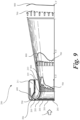
- FIG. 9 illustrates a cross-section of the upper half of an ejector 200, the structure and functionality of which is similar or identical to that of elements 17, 18.
- a plenum 211 is supplied with hotter-than-ambient air (i.e., a pressurized motive gas stream) from, for example, a combustion-based engine that may be employed by the vehicle.
- This pressurized motive gas stream denoted by arrow 600, is introduced via at least one conduit, such as primary nozzles 203, to the interior of the ejector 200. More specifically, the primary nozzles 203 are configured to accelerate the motive fluid stream 600 to a variable predetermined desired velocity directly over a convex Coanda surface 204 as a wall jet.
- primary nozzles 203 provide adjustable volumes of fluid stream 600.
- This wall jet serves to entrain through an intake structure 206 secondary fluid, such as ambient air denoted by arrow 1, that may be at rest or approaching the ejector 200 at non-zero speed from the direction indicated by arrow 1.
- secondary fluid such as ambient air denoted by arrow 1
- the nozzles 203 may be arranged in an array and in a curved orientation, a spiraled orientation, and/or a zigzagged orientation.
- the mix of the stream 600 and the air 1 may be moving purely axially at a throat section 225 of the ejector 200.
- a diffusing structure such as diffuser 210
- the mixing and smoothing out process continues so the profiles of temperature (800) and velocity (700) in the axial direction of ejector 200 no longer have the high and low values present at the throat section 225, but become more uniform at the terminal end 100 of diffuser 210.
- the temperature and velocity profiles are almost uniform.
- the temperature of the mixture is low enough to be directed towards an airfoil such as a wing or control surface.
- vanes 16 When vanes 16 are closed and the fan 21 supplies this power, enough thrust may be obtained from such a system to enable lifting of an aircraft that weighs, for example, between 1100 and 1400 kgs.
- This type of aircraft may direct the thrust upwards via swiveling FPS elements 17, 18 supplied from the fan 21 via ports 13 and 14, which can also rotate with respect to their principal axes via swiveling joints 23.
- the swiveling or vectoring of FPS elements 17, 18 can change the attitude of the aircraft first in vertical takeoff, further in hovering via small angle changes and finally in transition to wing borne operation via swiveling of the FPS elements to direct the thrust at 45 degrees (as shown in FIG. 5 ) up to 90 degrees perpendicular to the original VTOL position shown in FIG. 1 .
- angles in the swiveling joints 23, which also allow the passage of the flow to the elements 17, 18, can be gradually changed to allow a perfect balancing of the aircraft from hover to gaining speed and increase the lift of the wings of the aircraft at forward velocities of, e.g., 10% more than stall velocities of the aircraft.
- an aircraft according to an embodiment of a VTOL aircraft may reach a speed of 50 mph within a few tens of seconds after hovering at a fixed point, while still balancing some of the weight via FPS 17, 18 pointing at 45 degrees upwards in the direction of flight, and still accelerating in the forward direction while the wings begin supporting, e.g., 50% of the weight of the aircraft flying forward.
- FPS elements 17, 18 are moving into perfectly horizontal position (90 degrees or more perpendicular to their original VTOL position) and a balance between the drag force and thrust is achieved using purely the FPS system (i.e., all air 22 is routed via ports 13 and 14 to supply the FPS elements with motive fluid).
- a forward air speed of, for example, 150 mph the vanes 16 begin to open and allow the air stream 22 to pass through the vanes thus pushing the aircraft forward in a faster manner.
- the augmentation ratio of the FPS is lowered due to the increasing ram drag imposed by the incoming air into the FPS elements 17, 18.
- the final thrust obtained in wing borne operation can be increased by switching to fully open vanes 16 as shown in FIGS. 2 and 4 and closing valves 15 thereby blocking the air supply to the ports 13 and 14 and forcing the entirety of air 22 to exit the plenum 12 via vanes 16 resulting in an accelerated stream 25 and propelling the aircraft in the forward direction and wing-borne mode at speeds that can be modulated by the RPM of fan 21.
- an embodiment solves the problem of mismatches between separate takeoff and cruise powerplants by using the same powerplant to supply the mechanical work via shaft 11 to the fan 21.
- reduction of fuel flow to the main gas turbine providing mechanical power results in slowing down the fan 21 similar to a turbofan operation.
- Low temperature of the air discharge from the fan 21 with modes 1.8 pressure ratio means low temperature and lightweight materials can be used for the FPS elements 17, 18, such as thermally resistant plastic composites.
- High speed can be achieved in cruise by switching to fan type of operation.
- the gas turbine can be replaced with an electric motor for use with batteries of high energy density.
- a high-efficiency system and same size turboshaft turbine can be used hence minimizing cost and weight.
- FIGS. 7 and 8 An embodiment of an aircraft 40 can be further refined by integrating the FPS system into aerodynamic control surfaces, such as airfoils, for decreased drag during high-speed flight.
- FIGS. 7 and 8 Such an embodiment is illustrated in FIGS. 7 and 8 .
- propulsive elements 30, 31, similar in functionality to that of elements 17, 18, are rotated to a horizontal configuration to match the profile of the main aircraft wing 41.
- thrust is solely generated through the turbofan nozzle 16, and valves 15 are closed preventing airflow through FPS elements 30 and 31.
- FIG. 8 the FPS propulsive elements 30, 31, as well as accompanying surfaces 32-37, are rotated relative to wing 41 so that thrust is generated upwards for hover and VTOL.
- the variable nozzle vanes 16 are closed and all airflow is directed through the FPS elements 30 and 31.
- FIG. 7 illustrates the geometry of this alternate embodiment.
- Compressed air is directed from the main plenum 12 into wall jets (not shown) in devices 30, 31. These wall jets entrain ambient air at a high bypass ratio through the slot-shaped periphery across trailing surfaces 32, 33.
- Surfaces 32 and 33 are partially circumscribed by sidewalls 34a, 34b, 35a, 35b. These sidewalls taper toward the airfoils trailing edges 36 and 37.
- the surfaces 32, 33 play a role in generating more lift (lift augmentation) at angles shallower than 45 degrees to the horizontal (direction of flight).
- lift augmentation lift augmentation
- the suction side of the surfaces 32, 33 that see the emerging flow from the elements 30 and 31 will experience a larger local velocity compared to the aircraft 40 velocity.
- the additional lift generated by the difference in pressures on the suction and pressure sides of the surfaces 32, 33 will create more lift, as it is known in the industry and by the conditions dictated by Bernoulli.
- a vehicle employing this system may accelerate to speeds in the range of 150-200 mph and reach steady-state flight; for the vehicle to accelerate to 400 mph the switch is required.
- the vehicle may hence suffer an increase in velocity as well as in fuel consumption, due to the elements 30 and 31 no longer being employed and producing no longer a net force sufficient for acceleration.
- the air mass entrainment by these elements and hence thrust augmentation may fall below the acceptable levels, and a switch to use the compressed air flowrate via expansion in nozzle vanes 16 allows for further acceleration.
- the thrusters 30, 31 would be able to be aligned with a streamlined profile reducing the drag and the RAM drag existing while in operation. The reverse is valid for slowing down and flying economically in lower speed regimes, at lower speeds but higher efficiency.
- Such a system results in the fastest possible commercial or military application with VTOL capability.
- the switch from thrusters (fluidic) entrainment mode to fan mode results in an optimized thermal and propulsive efficiency between the two regimes.
- a regime lower than 125 mph approximately a high thermal efficiency and better propulsive efficiency is obtained using the fluidic (thrust augmentation) via entrainment of ambient air, even if RAM drag increases with entrainment.
- the entrainment ratio may be for instance >10 and the velocity emerging for the mixture of compressed and entrained air may reach 105 m/s (235 mph).
- a switch to use the entire primary air as direct jet is made beyond 125 mph. This way the thermal efficiency increases at a different rate and a high overall total efficiency, as the product between the propulsive and thermal efficiencies is obtained.
Landscapes
- Engineering & Computer Science (AREA)
- Aviation & Aerospace Engineering (AREA)
- Chemical & Material Sciences (AREA)
- Combustion & Propulsion (AREA)
- Mechanical Engineering (AREA)
- General Engineering & Computer Science (AREA)
- Structures Of Non-Positive Displacement Pumps (AREA)
- Jet Pumps And Other Pumps (AREA)
Description
- The invention relates to a propulsion system for Vertical Take-off and Landing (VTOL) aircraft.
- One of the main challenges of designing a Vertical Take-off and Landing (VTOL) aircraft is sizing the propulsion system to be efficient in both VTOL and hover phases as well as cruise conditions. Since the propulsion system fraction of the total weight needs to be kept low to maximize payload and fuel reserves, the challenge is how to employ a system that produces roughly 4-6 times more thrust at take-off (in lift-by -thrust-only mode) or in hover, compared to in wing-borne and cruise conditions. In the first case the thrust is balancing the weight of the aircraft and much larger engines and power or thrust are required, whereas in cruise conditions the size of the engine needs to be much smaller to balance drag as the wings of the aircraft balance the weight.
- Traditionally VTOL was achieved with either separate systems (lift/cruise compromising weight but separating propulsion) or pure rotorcraft such as helicopters (compromising wing-borne capabilities). The most successful aircraft employing VTOL capabilities use the same system for both vertical and wing-borne phases. Examples are jump-jets such as Harrier Hawker, which vectors its turbofan jets (but ends up oversizing the engine for the missions in wing-bome phase) and the V22 Osprey, which utilizes turboprops with tilting capabilities. The tilt-rotor approach is not without risks including vibrations, vortex ring state (VRS) and large footprints, as well as complex architectures.
- For smaller systems (i.e., 2-4 passenger aircraft) especially in the growing Urban Air Mobility market, large lift+cruise airplanes are the dominant design. Especially for electric VTOL, this results in very large footprint and moving parts between 8-16 large rotors for efficiency reasons. The wingspan for carrying 4-6 passengers may be as large as the wingspan of a small regional plane. The weight of the aircraft due to today's low energy density batteries also impose large-size wings and complex operation with the multi-rotors, increasing risk.
-
US 6547180 B1 ,GB 1073542 A US 2017/283080 A1 all describe examples of propulsion systems for VTOL aircraft. - Preferred and alternative embodiments of the present invention are described in detail below with reference to the following drawings:
-
FIG. 1 shows a perspective view of an embodiment in trimetric view in VTOL configuration; -
FIG. 2 shows a perspective trimetric view of a cruise configuration with FPS system elements used as air brakes for transition to VTOL according to an embodiment; -
FIG. 3 shows a perspective view of variable vanes in VTOL configuration according to an embodiment; -
FIG. 4 shows a perspective view of variable vanes in full cruise configuration with FPS system elements extended for airbraking according to an embodiment; -
FIG. 5 shows a perspective view of the mid-transition from VTOL to wingborne configuration and 45-degree FPS system elements while the aircraft accelerates only due to FPS system elements according to an embodiment; -
FIG. 6 shows a perspective view of the system elements in cruise configuration according to an embodiment; -
FIGS. 7-8 show an alternative embodiment of the invention, using wing-integrated FPS system elements that allows the thrust augmenting devices to be hidden during forward flight; and -
FIG. 9 is a cross-section of an ejector of an embodiment of the present invention depicting the upper half of the ejector and profiles of velocity and temperature within the internal flow. - This patent application is intended to describe one or more embodiments of the present invention. It is to be understood that the use of absolute terms, such as "must," "will," and the like, as well as specific quantities, is to be construed as being applicable to one or more of such embodiments, but not necessarily to all such embodiments. As such, embodiments of the invention may omit, or include a modification of, one or more features or functionalities described in the context of such absolute terms.
- A fluidic propulsion system (FPS) according to an embodiment introduces an alternate approach where thrusters without rotating parts can be tilted for transitioning from hovering to cruise. During VTOL and hover, thrust augmentation can be obtained using a pressurized fluid as source. One or more embodiments may include a system that is used in all phases of flight (vertical and wing-borne) while still obtaining an augmentation for thrust in a forward moving direction.
- An embodiment includes a lift+cruise solution involving a source of compression such as a fan or compressor of fluids including air, as well as a dual capability to switch from an augmented thrust in vertical flight (VTOL+hover) and a separate turbofan configuration in cruise. Such a configuration and operation would eliminate the restriction in speed and allow a VTOL vehicle to move forward at very high velocity, higher altitude capabilities and operate very efficient by lowering significantly the fuel burn (specific fuel consumption.)
- More descriptively, a fan or compressor or similar machine receives mechanical work and compresses ambient air to a pressure ratio of between 1.5-2.5. The component may have one or several stages and may be driven preferably by a gas turbine stage such as the free turbine of a turboshaft engine, without the need of a reduction gear. This element is optionally advantageous as the weight and moving parts reduction will allow a lighter and simpler construction to be employed.
- Referring to
FIG. 1 , ashaft 11 receives the mechanical power from the free turbine of a turboshaft or electric motor, and transmits the power to afan 21 to compress the air to the aforementioned pressure ratios. The air is pumped into aplenum 12 immediately downstream of thefan 21, and from there the air may be directed intoside ports variable vanes 16. Vanes 16 can be fully closed or fully opened via mechanisms known in the art. For example, one such mechanism could be the variable guide vanes employed in a typical compressor. Another mechanism could be a mechanical screw rotating the hub of thevanes 16 and forcing the vanes to close. When closed as seen inFIGS. 1 and3 , the entire flow from thefan 21 is forced into theside ports plenum 12 and intoFPS system elements plenum 12 viavalves 15. - In one embodiment the
fan 21 receives a power of, for example, 1000 kW from a free turbine of a gas turbine of the turboshaft type that spins at, for example, 25,000 RPM. This value is typical of a machine such as a typical turboprop architecture, before the reduction gear, at full speed. Such power and speed can yield a compressed air stream of, e.g., 1.8 atmospheres (a pressure ratio of 1.8 or 180 kPa approximately) and a flow of circa 15 kg/s assuming an efficiency of 80% on the part of the fan. - The
fan 21 itself may be manufactured of ultralight materials such as titanium or even composite materials, the former using wide chord, compound swept fan blades for higher efficiency and manufactured in one piece as a blisk. A design with low noise features is included. - At 15 kg/sec, 180-200 kPa total pressure, and assuming an air temperature of 353 Kelvin, stream 22 is split and transmitted to
FPS elements FPS elements U.S. Patent Application Nos. 15/221,389 filed July 27, 2016 15/256,178 filed September 2, 2016
can augment the thrust which would otherwise result from accelerating and expanding the flow simply to the atmospheric pressure to at least 2:1 and up to 3:1 ratios. In this example, the thrust achieved via ejector augmentation is given in Equation 1 below:

as opposed to a thrust of 5.65 kN if a simple nozzle is employed. In this case 287 J/kg-K is the air constant, 1.4 is the air exponential factor, 353 K is the discharge temperature from thefan 21 compression, 2 is the augmentation ratio and 15 kg/s is the total mass flow rate. - With further optimization of the
FPS elements fan 21. -
FIG. 9 illustrates a cross-section of the upper half of anejector 200, the structure and functionality of which is similar or identical to that ofelements plenum 211 is supplied with hotter-than-ambient air (i.e., a pressurized motive gas stream) from, for example, a combustion-based engine that may be employed by the vehicle. This pressurized motive gas stream, denoted by arrow 600, is introduced via at least one conduit, such asprimary nozzles 203, to the interior of theejector 200. More specifically, theprimary nozzles 203 are configured to accelerate the motive fluid stream 600 to a variable predetermined desired velocity directly over aconvex Coanda surface 204 as a wall jet. Additionally,primary nozzles 203 provide adjustable volumes of fluid stream 600. This wall jet, in turn, serves to entrain through anintake structure 206 secondary fluid, such as ambient air denoted by arrow 1, that may be at rest or approaching theejector 200 at non-zero speed from the direction indicated by arrow 1. In various embodiments, thenozzles 203 may be arranged in an array and in a curved orientation, a spiraled orientation, and/or a zigzagged orientation. - The mix of the stream 600 and the air 1 may be moving purely axially at a
throat section 225 of theejector 200. Through diffusion in a diffusing structure, such asdiffuser 210, the mixing and smoothing out process continues so the profiles of temperature (800) and velocity (700) in the axial direction ofejector 200 no longer have the high and low values present at thethroat section 225, but become more uniform at the terminal end 100 ofdiffuser 210. As the mixture of the stream 600 and the air 1 approaches the exit plane of terminal end 100, the temperature and velocity profiles are almost uniform. In particular, the temperature of the mixture is low enough to be directed towards an airfoil such as a wing or control surface. - When
vanes 16 are closed and thefan 21 supplies this power, enough thrust may be obtained from such a system to enable lifting of an aircraft that weighs, for example, between 1100 and 1400 kgs. This type of aircraft may direct the thrust upwards via swivelingFPS elements fan 21 viaports joints 23. The swiveling or vectoring ofFPS elements FIG. 5 ) up to 90 degrees perpendicular to the original VTOL position shown inFIG. 1 . - The angles in the swiveling
joints 23, which also allow the passage of the flow to theelements FPS FPS elements ports vanes 16 begin to open and allow the air stream 22 to pass through the vanes thus pushing the aircraft forward in a faster manner. During said transition to fully wing-borne operation, the augmentation ratio of the FPS is lowered due to the increasing ram drag imposed by the incoming air into theFPS elements open vanes 16 as shown inFIGS. 2 and4 and closingvalves 15 thereby blocking the air supply to theports plenum 12 viavanes 16 resulting in an acceleratedstream 25 and propelling the aircraft in the forward direction and wing-borne mode at speeds that can be modulated by the RPM offan 21. - In this manner, an embodiment solves the problem of mismatches between separate takeoff and cruise powerplants by using the same powerplant to supply the mechanical work via
shaft 11 to thefan 21. In addition, reduction of fuel flow to the main gas turbine providing mechanical power results in slowing down thefan 21 similar to a turbofan operation. By shutting off the air to theFPS elements FPS elements nozzle vanes 16 for high speed cruising whilst operating thefan 21 at lower than maximum speed. This means adjusting to a thrust calculated with an augmentation ratio of 1.0 per Equation 2:

when the aircraft is in full wing-borne mode. A typical general aviation aircraft achieving such thrust would have no problem accelerating to speeds exceeding 400 mph and high altitudes. Conversely, a transition can be achieved for transferring from cruise, as illustrated inFIG. 6 , to hovering via closure ofvanes 16 and forcing the air throughports FPS elements FPS elements elements vane system 16 fully closed andports - No moving parts for
FPS elements - Low temperature of the air discharge from the
fan 21 with modes 1.8 pressure ratio means low temperature and lightweight materials can be used for theFPS elements - High speed can be achieved in cruise by switching to fan type of operation.
- The gas turbine can be replaced with an electric motor for use with batteries of high energy density.
- A high-efficiency system and same size turboshaft turbine can be used hence minimizing cost and weight.
- An embodiment of an
aircraft 40 can be further refined by integrating the FPS system into aerodynamic control surfaces, such as airfoils, for decreased drag during high-speed flight. Such an embodiment is illustrated inFIGS. 7 and8 . InFIG 7 ,propulsive elements elements main aircraft wing 41. In this configuration, thrust is solely generated through theturbofan nozzle 16, andvalves 15 are closed preventing airflow throughFPS elements FIG. 8 , the FPSpropulsive elements wing 41 so that thrust is generated upwards for hover and VTOL. In this configuration, thevariable nozzle vanes 16 are closed and all airflow is directed through theFPS elements -
FIG. 7 illustrates the geometry of this alternate embodiment. Compressed air is directed from themain plenum 12 into wall jets (not shown) indevices surfaces Surfaces sidewalls airfoils trailing edges - In
FIG. 7 , thesurfaces surfaces elements aircraft 40 velocity. In this case, and just prior to switching to the turbofan nozzle jet modus operandum, the additional lift generated by the difference in pressures on the suction and pressure sides of thesurfaces elements nozzle vanes 16, is anticipated to coincide with best conditions for which the aircraft is moving at fastest, safe speeds, in good coordination with thevalves 15 making the switch and attitude of theaircraft 40. The switch to using the compressed air as a motive/primary air to the thrusters (elements 30 and 31) with entrainment to a direct jet via expansion throughnozzle vanes 16 at high speeds will coincide with the point whereelements aircraft 40. For example, a vehicle employing this system may accelerate to speeds in the range of 150-200 mph and reach steady-state flight; for the vehicle to accelerate to 400 mph the switch is required. The vehicle may hence suffer an increase in velocity as well as in fuel consumption, due to theelements nozzle vanes 16 allows for further acceleration. At this point thethrusters - The switch from thrusters (fluidic) entrainment mode to fan mode results in an optimized thermal and propulsive efficiency between the two regimes. In a regime lower than 125 mph approximately, a high thermal efficiency and better propulsive efficiency is obtained using the fluidic (thrust augmentation) via entrainment of ambient air, even if RAM drag increases with entrainment. The entrainment ratio may be for instance >10 and the velocity emerging for the mixture of compressed and entrained air may reach 105 m/s (235 mph). As entrainment diminishes and RAM increases with speed, a switch to use the entire primary air as direct jet is made beyond 125 mph. This way the thermal efficiency increases at a different rate and a high overall total efficiency, as the product between the propulsive and thermal efficiencies is obtained.
- Although the foregoing text sets forth a detailed description of numerous different embodiments, it should be understood that the scope of protection is defined by the words of the claims to follow. The detailed description is to be construed as exemplary only and does not describe every possible embodiment because describing every possible embodiment would be impractical, if not impossible. Numerous alternative embodiments could be implemented, the scope of protection being defined by the appended claims.
- Thus, many modifications and variations may be made in the techniques and structures described and illustrated herein without departing from the scope of the present claims. Accordingly, it should be understood that the methods and apparatus described herein are illustrative only and are not limiting upon the scope of the claims.
Claims (3)
- A propulsion system for an aircraft, comprising:a plenum (12) having an intake port and an output port;a powered fan (21) coupled to a motor configured to power the powered fan (21), the powered fan (21) configured to compress ambient air entering the intake port;one or more ejectors (17,18) fluidically coupled to the plenum (12) via one or more valves (15); anda nozzle disposed within the output port, the nozzle comprising a set of nozzle vanes (16), wherein:the propulsion system operates in a first configuration in which the nozzle vanes (16) are closed and the compressed ambient air exits the plenum (12) only through the one or more valves (15) into the one or more ejectors (17,18),characterized in thatthe propulsion system operates in a second configuration in which the one or more valves (15) are closed, the nozzle vanes (16) are open and the compressed ambient air exits the plenum (12) only through the output port.
- The propulsion system of claim 1, wherein the one or more ejectors (17,18) are rotatable through at least a 90° angle with respect to the plenum (12).
- The propulsion system of claim 1, wherein the one or more ejectors (17,18) comprise:a convex surface (204);a diffusing structure (210) coupled to the convex surface (204);at least one conduit (203) coupled to the convex surface (204) and configured to introduce to the convex surface (204) a primary fluid produced by the aircraft; andan intake structure (206) coupled to the convex surface (204) and configured to introduce to the diffusing structure (210) a secondary fluid accessible to the aircraft, wherein the diffusing structure (210) comprises a terminal end configured to provide egress from the propulsion system for the introduced primary fluid and secondary fluid.
Applications Claiming Priority (4)
| Application Number | Priority Date | Filing Date | Title |
|---|---|---|---|
| US201862758441P | 2018-11-09 | 2018-11-09 | |
| US201962817448P | 2019-03-12 | 2019-03-12 | |
| US201962839541P | 2019-04-26 | 2019-04-26 | |
| PCT/US2019/060786 WO2020097608A1 (en) | 2018-11-09 | 2019-11-11 | Adaptive vertical take-off and landing propulsion system |
Publications (3)
| Publication Number | Publication Date |
|---|---|
| EP3877258A1 EP3877258A1 (en) | 2021-09-15 |
| EP3877258A4 EP3877258A4 (en) | 2022-12-14 |
| EP3877258B1 true EP3877258B1 (en) | 2025-05-21 |
Family
ID=70611394
Family Applications (1)
| Application Number | Title | Priority Date | Filing Date |
|---|---|---|---|
| EP19883153.9A Active EP3877258B1 (en) | 2018-11-09 | 2019-11-11 | Adaptive vertical take-off and landing propulsion system |
Country Status (8)
| Country | Link |
|---|---|
| US (2) | US20200324890A1 (en) |
| EP (1) | EP3877258B1 (en) |
| JP (3) | JP7560130B2 (en) |
| KR (2) | KR20260007294A (en) |
| CN (1) | CN113226925A (en) |
| ES (1) | ES3038440T3 (en) |
| IL (2) | IL283016B2 (en) |
| WO (1) | WO2020097608A1 (en) |
Families Citing this family (6)
| Publication number | Priority date | Publication date | Assignee | Title |
|---|---|---|---|---|
| KR100914677B1 (en) * | 2009-03-11 | 2009-08-31 | 주식회사 에코빅 | Water permeable block and water permeable block frame for water purifing system |
| IL283016B2 (en) * | 2018-11-09 | 2025-03-01 | Jetoptera Inc | Adaptive Vertical Take-Off and Landing Propulsion System |
| KR20220050562A (en) * | 2020-10-16 | 2022-04-25 | 현대자동차주식회사 | Air mobility |
| CN117858832A (en) * | 2021-05-19 | 2024-04-09 | 杰托普特拉股份有限公司 | Adaptive fluid propulsion system |
| US11772809B2 (en) * | 2021-11-27 | 2023-10-03 | Airbus Defence and Space GmbH | Fuselage for an aircraft with fuselage-integrated tailplane |
| CN116039980B (en) * | 2022-12-06 | 2025-09-30 | 千叶智能科技(深圳)有限公司 | Attitude control vector jet device and vertical take-off and landing aircraft |
Family Cites Families (26)
| Publication number | Priority date | Publication date | Assignee | Title |
|---|---|---|---|---|
| US3154917A (en) * | 1963-04-15 | 1964-11-03 | Ryan Aeronautical Co | Diverter for ducted fan aircraft |
| GB1073542A (en) * | 1963-12-02 | 1967-06-28 | Kershaw H A | Improvements in jet propulsion units for aircraft |
| US4248041A (en) * | 1977-12-03 | 1981-02-03 | Rolls-Royce Limited | Gas turbine engine power plant |
| BR9106696A (en) * | 1990-07-25 | 1993-06-08 | Sadleir Vtol Aircraft Co Pty L | FLUSHING UNIT FOR VTOL AIRCRAFT |
| US5275356A (en) * | 1992-07-15 | 1994-01-04 | Lockheed Corporation | Propulsion system for a V/STOL aircraft |
| US5666803A (en) * | 1995-08-14 | 1997-09-16 | Windisch; D. Anthony | Vectored thrust compressor for remote controlled aircraft |
| US5779169A (en) * | 1995-12-15 | 1998-07-14 | The Boeing Company | Aircraft engine inlet hot gas and foreign object ingestion reduction and pitch control system |
| GB2365392B (en) * | 2000-03-22 | 2002-07-10 | David Bernard Cassidy | Aircraft |
| US6918244B2 (en) * | 2001-08-17 | 2005-07-19 | John Eugene Dickau | Vertical takeoff and landing aircraft propulsion systems |
| AU2003246915B2 (en) * | 2002-06-28 | 2009-06-11 | Vtol Technologies Limited | Ducted air power plant |
| US20060102801A1 (en) * | 2004-11-01 | 2006-05-18 | The Boeing Company | High-lift distributed active flow control system and method |
| US20070018034A1 (en) * | 2005-07-12 | 2007-01-25 | Dickau John E | Thrust vectoring |
| CN101143622A (en) * | 2006-09-11 | 2008-03-19 | 李志文 | Wingless air vehicle capable of vertical take-off and landing and its realizing method |
| JP4830836B2 (en) * | 2006-12-18 | 2011-12-07 | 株式会社Ihi | Jet jet exhaust nozzle and jet engine |
| US20110215204A1 (en) * | 2007-06-20 | 2011-09-08 | General Electric Company | System and method for generating thrust |
| US8087618B1 (en) * | 2007-10-29 | 2012-01-03 | The Boeing Company | Propulsion system and method for efficient lift generation |
| US20100162680A1 (en) * | 2008-12-31 | 2010-07-01 | Syed Jalaluddin Khalid | Gas turbine engine with ejector |
| US9688396B2 (en) * | 2015-06-18 | 2017-06-27 | Avery Aerospace Corporation | Ducted oblique-rotor VTOL vehicle |
| US20170283080A1 (en) | 2015-09-02 | 2017-10-05 | Jetoptera, Inc. | Winglet ejector configurations |
| EP4306789A3 (en) * | 2015-09-02 | 2024-06-12 | Jetoptera, Inc. | Fluidic propulsive system |
| US10464668B2 (en) | 2015-09-02 | 2019-11-05 | Jetoptera, Inc. | Configuration for vertical take-off and landing system for aerial vehicles |
| KR101607816B1 (en) * | 2015-10-26 | 2016-03-31 | 이진우 | Drone with air guide part |
| US10570926B2 (en) * | 2015-12-03 | 2020-02-25 | The Boeing Company | Variable-geometry ducted fan |
| CA3006361A1 (en) * | 2015-12-04 | 2017-07-06 | Jetoptera, Inc. | Micro-turbine gas generator and propulsive system |
| US10933991B2 (en) * | 2018-06-18 | 2021-03-02 | Aurora Flight Sciences Corporation | Propulsors, aircraft including the propulsors, and methods of directing a fluid stream in a propulsor |
| IL283016B2 (en) * | 2018-11-09 | 2025-03-01 | Jetoptera Inc | Adaptive Vertical Take-Off and Landing Propulsion System |
-
2019
- 2019-11-11 IL IL283016A patent/IL283016B2/en unknown
- 2019-11-11 ES ES19883153T patent/ES3038440T3/en active Active
- 2019-11-11 EP EP19883153.9A patent/EP3877258B1/en active Active
- 2019-11-11 KR KR1020257042328A patent/KR20260007294A/en active Pending
- 2019-11-11 IL IL316380A patent/IL316380A/en unknown
- 2019-11-11 CN CN201980082161.0A patent/CN113226925A/en active Pending
- 2019-11-11 KR KR1020217015778A patent/KR102903486B1/en active Active
- 2019-11-11 WO PCT/US2019/060786 patent/WO2020097608A1/en not_active Ceased
- 2019-11-11 JP JP2021524478A patent/JP7560130B2/en active Active
- 2019-11-11 US US16/680,479 patent/US20200324890A1/en not_active Abandoned
-
2023
- 2023-07-11 US US18/220,755 patent/US12291328B2/en active Active
-
2024
- 2024-09-11 JP JP2024157149A patent/JP7800948B2/en active Active
-
2025
- 2025-12-22 JP JP2025272386A patent/JP2026065009A/en active Pending
Also Published As
| Publication number | Publication date |
|---|---|
| IL283016B1 (en) | 2024-11-01 |
| JP7560130B2 (en) | 2024-10-02 |
| CN113226925A (en) | 2021-08-06 |
| JP2025003977A (en) | 2025-01-14 |
| WO2020097608A1 (en) | 2020-05-14 |
| JP7800948B2 (en) | 2026-01-16 |
| KR20260007294A (en) | 2026-01-13 |
| JP2026065009A (en) | 2026-04-14 |
| IL283016B2 (en) | 2025-03-01 |
| ES3038440T3 (en) | 2025-10-13 |
| KR20210093264A (en) | 2021-07-27 |
| IL316380A (en) | 2024-12-01 |
| JP2022506861A (en) | 2022-01-17 |
| KR102903486B1 (en) | 2025-12-26 |
| US20200324890A1 (en) | 2020-10-15 |
| EP3877258A1 (en) | 2021-09-15 |
| US20240182166A1 (en) | 2024-06-06 |
| EP3877258A4 (en) | 2022-12-14 |
| IL283016A (en) | 2021-06-30 |
| US12291328B2 (en) | 2025-05-06 |
Similar Documents
| Publication | Publication Date | Title |
|---|---|---|
| US12291328B2 (en) | Adaptive vertical take-off and landing propulsion system | |
| US12252265B2 (en) | Fluidic propulsive system and thrust and lift generator for aerial vehicles | |
| US12434833B2 (en) | Adaptive vertical take-off and landing propulsion system | |
| US20220009617A1 (en) | Vertical take off and landing aircraft with fluidic propulsion system | |
| US20260116538A1 (en) | Adaptive Vertical Take-Off and Landing Propulsion System | |
| EP3793898B1 (en) | Combination compressed-fluid ejector and propeller propulsion system | |
| CA3118928A1 (en) | Adaptive vertical take-off and landing propulsion system |
Legal Events
| Date | Code | Title | Description |
|---|---|---|---|
| STAA | Information on the status of an ep patent application or granted ep patent |
Free format text: STATUS: THE INTERNATIONAL PUBLICATION HAS BEEN MADE |
|
| PUAI | Public reference made under article 153(3) epc to a published international application that has entered the european phase |
Free format text: ORIGINAL CODE: 0009012 |
|
| STAA | Information on the status of an ep patent application or granted ep patent |
Free format text: STATUS: REQUEST FOR EXAMINATION WAS MADE |
|
| 17P | Request for examination filed |
Effective date: 20210521 |
|
| AK | Designated contracting states |
Kind code of ref document: A1 Designated state(s): AL AT BE BG CH CY CZ DE DK EE ES FI FR GB GR HR HU IE IS IT LI LT LU LV MC MK MT NL NO PL PT RO RS SE SI SK SM TR |
|
| DAV | Request for validation of the european patent (deleted) | ||
| DAX | Request for extension of the european patent (deleted) | ||
| A4 | Supplementary search report drawn up and despatched |
Effective date: 20221111 |
|
| RIC1 | Information provided on ipc code assigned before grant |
Ipc: B64C 15/12 20060101ALI20221107BHEP Ipc: B64C 15/02 20060101ALI20221107BHEP Ipc: F02K 1/28 20060101ALI20221107BHEP Ipc: F02K 1/00 20060101ALI20221107BHEP Ipc: B64D 27/14 20060101ALI20221107BHEP Ipc: B64D 33/04 20060101ALI20221107BHEP Ipc: F02K 1/36 20060101ALI20221107BHEP Ipc: B64C 29/00 20060101AFI20221107BHEP |
|
| GRAP | Despatch of communication of intention to grant a patent |
Free format text: ORIGINAL CODE: EPIDOSNIGR1 |
|
| STAA | Information on the status of an ep patent application or granted ep patent |
Free format text: STATUS: GRANT OF PATENT IS INTENDED |
|
| INTG | Intention to grant announced |
Effective date: 20241209 |
|
| GRAS | Grant fee paid |
Free format text: ORIGINAL CODE: EPIDOSNIGR3 |
|
| GRAA | (expected) grant |
Free format text: ORIGINAL CODE: 0009210 |
|
| STAA | Information on the status of an ep patent application or granted ep patent |
Free format text: STATUS: THE PATENT HAS BEEN GRANTED |
|
| AK | Designated contracting states |
Kind code of ref document: B1 Designated state(s): AL AT BE BG CH CY CZ DE DK EE ES FI FR GB GR HR HU IE IS IT LI LT LU LV MC MK MT NL NO PL PT RO RS SE SI SK SM TR |
|
| REG | Reference to a national code |
Ref country code: GB Ref legal event code: FG4D |
|
| REG | Reference to a national code |
Ref country code: CH Ref legal event code: EP |
|
| REG | Reference to a national code |
Ref country code: DE Ref legal event code: R096 Ref document number: 602019070379 Country of ref document: DE |
|
| REG | Reference to a national code |
Ref country code: IE Ref legal event code: FG4D |
|
| RAP4 | Party data changed (patent owner data changed or rights of a patent transferred) |
Owner name: JETOPTERA, INC. |
|
| REG | Reference to a national code |
Ref country code: NL Ref legal event code: MP Effective date: 20250521 |
|
| PG25 | Lapsed in a contracting state [announced via postgrant information from national office to epo] |
Ref country code: PT Free format text: LAPSE BECAUSE OF FAILURE TO SUBMIT A TRANSLATION OF THE DESCRIPTION OR TO PAY THE FEE WITHIN THE PRESCRIBED TIME-LIMIT Effective date: 20250922 Ref country code: FI Free format text: LAPSE BECAUSE OF FAILURE TO SUBMIT A TRANSLATION OF THE DESCRIPTION OR TO PAY THE FEE WITHIN THE PRESCRIBED TIME-LIMIT Effective date: 20250521 |
|
| REG | Reference to a national code |
Ref country code: LT Ref legal event code: MG9D |
|
| PG25 | Lapsed in a contracting state [announced via postgrant information from national office to epo] |
Ref country code: NO Free format text: LAPSE BECAUSE OF FAILURE TO SUBMIT A TRANSLATION OF THE DESCRIPTION OR TO PAY THE FEE WITHIN THE PRESCRIBED TIME-LIMIT Effective date: 20250821 Ref country code: GR Free format text: LAPSE BECAUSE OF FAILURE TO SUBMIT A TRANSLATION OF THE DESCRIPTION OR TO PAY THE FEE WITHIN THE PRESCRIBED TIME-LIMIT Effective date: 20250822 |
|
| REG | Reference to a national code |
Ref country code: ES Ref legal event code: FG2A Ref document number: 3038440 Country of ref document: ES Kind code of ref document: T3 Effective date: 20251013 |
|
| PG25 | Lapsed in a contracting state [announced via postgrant information from national office to epo] |
Ref country code: NL Free format text: LAPSE BECAUSE OF FAILURE TO SUBMIT A TRANSLATION OF THE DESCRIPTION OR TO PAY THE FEE WITHIN THE PRESCRIBED TIME-LIMIT Effective date: 20250521 Ref country code: PL Free format text: LAPSE BECAUSE OF FAILURE TO SUBMIT A TRANSLATION OF THE DESCRIPTION OR TO PAY THE FEE WITHIN THE PRESCRIBED TIME-LIMIT Effective date: 20250521 |
|
| PG25 | Lapsed in a contracting state [announced via postgrant information from national office to epo] |
Ref country code: BG Free format text: LAPSE BECAUSE OF FAILURE TO SUBMIT A TRANSLATION OF THE DESCRIPTION OR TO PAY THE FEE WITHIN THE PRESCRIBED TIME-LIMIT Effective date: 20250521 |
|
| PG25 | Lapsed in a contracting state [announced via postgrant information from national office to epo] |
Ref country code: HR Free format text: LAPSE BECAUSE OF FAILURE TO SUBMIT A TRANSLATION OF THE DESCRIPTION OR TO PAY THE FEE WITHIN THE PRESCRIBED TIME-LIMIT Effective date: 20250521 |
|
| PG25 | Lapsed in a contracting state [announced via postgrant information from national office to epo] |
Ref country code: RS Free format text: LAPSE BECAUSE OF FAILURE TO SUBMIT A TRANSLATION OF THE DESCRIPTION OR TO PAY THE FEE WITHIN THE PRESCRIBED TIME-LIMIT Effective date: 20250821 |
|
| PG25 | Lapsed in a contracting state [announced via postgrant information from national office to epo] |
Ref country code: IS Free format text: LAPSE BECAUSE OF FAILURE TO SUBMIT A TRANSLATION OF THE DESCRIPTION OR TO PAY THE FEE WITHIN THE PRESCRIBED TIME-LIMIT Effective date: 20250921 |
|
| PG25 | Lapsed in a contracting state [announced via postgrant information from national office to epo] |
Ref country code: LV Free format text: LAPSE BECAUSE OF FAILURE TO SUBMIT A TRANSLATION OF THE DESCRIPTION OR TO PAY THE FEE WITHIN THE PRESCRIBED TIME-LIMIT Effective date: 20250521 |
|
| REG | Reference to a national code |
Ref country code: AT Ref legal event code: MK05 Ref document number: 1796551 Country of ref document: AT Kind code of ref document: T Effective date: 20250521 |
|
| PGFP | Annual fee paid to national office [announced via postgrant information from national office to epo] |
Ref country code: DE Payment date: 20251126 Year of fee payment: 7 |
|
| PGFP | Annual fee paid to national office [announced via postgrant information from national office to epo] |
Ref country code: GB Payment date: 20251125 Year of fee payment: 7 |
|
| PG25 | Lapsed in a contracting state [announced via postgrant information from national office to epo] |
Ref country code: AT Free format text: LAPSE BECAUSE OF FAILURE TO SUBMIT A TRANSLATION OF THE DESCRIPTION OR TO PAY THE FEE WITHIN THE PRESCRIBED TIME-LIMIT Effective date: 20250521 Ref country code: SM Free format text: LAPSE BECAUSE OF FAILURE TO SUBMIT A TRANSLATION OF THE DESCRIPTION OR TO PAY THE FEE WITHIN THE PRESCRIBED TIME-LIMIT Effective date: 20250521 Ref country code: DK Free format text: LAPSE BECAUSE OF FAILURE TO SUBMIT A TRANSLATION OF THE DESCRIPTION OR TO PAY THE FEE WITHIN THE PRESCRIBED TIME-LIMIT Effective date: 20250521 |
|
| PGFP | Annual fee paid to national office [announced via postgrant information from national office to epo] |
Ref country code: IT Payment date: 20251121 Year of fee payment: 7 |
|
| PGFP | Annual fee paid to national office [announced via postgrant information from national office to epo] |
Ref country code: FR Payment date: 20251125 Year of fee payment: 7 |
|
| PG25 | Lapsed in a contracting state [announced via postgrant information from national office to epo] |
Ref country code: CZ Free format text: LAPSE BECAUSE OF FAILURE TO SUBMIT A TRANSLATION OF THE DESCRIPTION OR TO PAY THE FEE WITHIN THE PRESCRIBED TIME-LIMIT Effective date: 20250521 |
|
| PG25 | Lapsed in a contracting state [announced via postgrant information from national office to epo] |
Ref country code: EE Free format text: LAPSE BECAUSE OF FAILURE TO SUBMIT A TRANSLATION OF THE DESCRIPTION OR TO PAY THE FEE WITHIN THE PRESCRIBED TIME-LIMIT Effective date: 20250521 |
|
| PG25 | Lapsed in a contracting state [announced via postgrant information from national office to epo] |
Ref country code: SK Free format text: LAPSE BECAUSE OF FAILURE TO SUBMIT A TRANSLATION OF THE DESCRIPTION OR TO PAY THE FEE WITHIN THE PRESCRIBED TIME-LIMIT Effective date: 20250521 Ref country code: RO Free format text: LAPSE BECAUSE OF FAILURE TO SUBMIT A TRANSLATION OF THE DESCRIPTION OR TO PAY THE FEE WITHIN THE PRESCRIBED TIME-LIMIT Effective date: 20250521 |
|
| PGFP | Annual fee paid to national office [announced via postgrant information from national office to epo] |
Ref country code: ES Payment date: 20251209 Year of fee payment: 7 |
|
| REG | Reference to a national code |
Ref country code: DE Ref legal event code: R097 Ref document number: 602019070379 Country of ref document: DE |
|
| PLBE | No opposition filed within time limit |
Free format text: ORIGINAL CODE: 0009261 |
|
| STAA | Information on the status of an ep patent application or granted ep patent |
Free format text: STATUS: NO OPPOSITION FILED WITHIN TIME LIMIT |
|
| REG | Reference to a national code |
Ref country code: CH Ref legal event code: L10 Free format text: ST27 STATUS EVENT CODE: U-0-0-L10-L00 (AS PROVIDED BY THE NATIONAL OFFICE) Effective date: 20260402 |
|
| 26N | No opposition filed |
Effective date: 20260224 |