EP3876535A1 - Video encoding method and apparatus, and computer-readable storage medium and computer device - Google Patents
Video encoding method and apparatus, and computer-readable storage medium and computer device Download PDFInfo
- Publication number
- EP3876535A1 EP3876535A1 EP19880678.8A EP19880678A EP3876535A1 EP 3876535 A1 EP3876535 A1 EP 3876535A1 EP 19880678 A EP19880678 A EP 19880678A EP 3876535 A1 EP3876535 A1 EP 3876535A1
- Authority
- EP
- European Patent Office
- Prior art keywords
- bit rate
- video frame
- current
- complexity
- available bit
- Prior art date
- Legal status (The legal status is an assumption and is not a legal conclusion. Google has not performed a legal analysis and makes no representation as to the accuracy of the status listed.)
- Granted
Links
Images




Classifications
-
- H—ELECTRICITY
- H04—ELECTRIC COMMUNICATION TECHNIQUE
- H04N—PICTORIAL COMMUNICATION, e.g. TELEVISION
- H04N19/00—Methods or arrangements for coding, decoding, compressing or decompressing digital video signals
- H04N19/10—Methods or arrangements for coding, decoding, compressing or decompressing digital video signals using adaptive coding
- H04N19/134—Methods or arrangements for coding, decoding, compressing or decompressing digital video signals using adaptive coding characterised by the element, parameter or criterion affecting or controlling the adaptive coding
- H04N19/146—Data rate or code amount at the encoder output
-
- H—ELECTRICITY
- H04—ELECTRIC COMMUNICATION TECHNIQUE
- H04N—PICTORIAL COMMUNICATION, e.g. TELEVISION
- H04N19/00—Methods or arrangements for coding, decoding, compressing or decompressing digital video signals
- H04N19/10—Methods or arrangements for coding, decoding, compressing or decompressing digital video signals using adaptive coding
- H04N19/102—Methods or arrangements for coding, decoding, compressing or decompressing digital video signals using adaptive coding characterised by the element, parameter or selection affected or controlled by the adaptive coding
- H04N19/124—Quantisation
-
- H—ELECTRICITY
- H04—ELECTRIC COMMUNICATION TECHNIQUE
- H04N—PICTORIAL COMMUNICATION, e.g. TELEVISION
- H04N19/00—Methods or arrangements for coding, decoding, compressing or decompressing digital video signals
- H04N19/10—Methods or arrangements for coding, decoding, compressing or decompressing digital video signals using adaptive coding
- H04N19/134—Methods or arrangements for coding, decoding, compressing or decompressing digital video signals using adaptive coding characterised by the element, parameter or criterion affecting or controlling the adaptive coding
- H04N19/136—Incoming video signal characteristics or properties
- H04N19/14—Coding unit complexity, e.g. amount of activity or edge presence estimation
-
- H—ELECTRICITY
- H04—ELECTRIC COMMUNICATION TECHNIQUE
- H04N—PICTORIAL COMMUNICATION, e.g. TELEVISION
- H04N19/00—Methods or arrangements for coding, decoding, compressing or decompressing digital video signals
- H04N19/10—Methods or arrangements for coding, decoding, compressing or decompressing digital video signals using adaptive coding
- H04N19/169—Methods or arrangements for coding, decoding, compressing or decompressing digital video signals using adaptive coding characterised by the coding unit, i.e. the structural portion or semantic portion of the video signal being the object or the subject of the adaptive coding
- H04N19/17—Methods or arrangements for coding, decoding, compressing or decompressing digital video signals using adaptive coding characterised by the coding unit, i.e. the structural portion or semantic portion of the video signal being the object or the subject of the adaptive coding the unit being an image region, e.g. an object
- H04N19/172—Methods or arrangements for coding, decoding, compressing or decompressing digital video signals using adaptive coding characterised by the coding unit, i.e. the structural portion or semantic portion of the video signal being the object or the subject of the adaptive coding the unit being an image region, e.g. an object the region being a picture, frame or field
-
- H—ELECTRICITY
- H04—ELECTRIC COMMUNICATION TECHNIQUE
- H04N—PICTORIAL COMMUNICATION, e.g. TELEVISION
- H04N19/00—Methods or arrangements for coding, decoding, compressing or decompressing digital video signals
- H04N19/10—Methods or arrangements for coding, decoding, compressing or decompressing digital video signals using adaptive coding
- H04N19/189—Methods or arrangements for coding, decoding, compressing or decompressing digital video signals using adaptive coding characterised by the adaptation method, adaptation tool or adaptation type used for the adaptive coding
-
- H—ELECTRICITY
- H04—ELECTRIC COMMUNICATION TECHNIQUE
- H04N—PICTORIAL COMMUNICATION, e.g. TELEVISION
- H04N19/00—Methods or arrangements for coding, decoding, compressing or decompressing digital video signals
- H04N19/10—Methods or arrangements for coding, decoding, compressing or decompressing digital video signals using adaptive coding
- H04N19/189—Methods or arrangements for coding, decoding, compressing or decompressing digital video signals using adaptive coding characterised by the adaptation method, adaptation tool or adaptation type used for the adaptive coding
- H04N19/196—Methods or arrangements for coding, decoding, compressing or decompressing digital video signals using adaptive coding characterised by the adaptation method, adaptation tool or adaptation type used for the adaptive coding being specially adapted for the computation of encoding parameters, e.g. by averaging previously computed encoding parameters
- H04N19/197—Methods or arrangements for coding, decoding, compressing or decompressing digital video signals using adaptive coding characterised by the adaptation method, adaptation tool or adaptation type used for the adaptive coding being specially adapted for the computation of encoding parameters, e.g. by averaging previously computed encoding parameters including determination of the initial value of an encoding parameter
Definitions
- the present disclosure relates to the field of computer technologies, and in particular, to a video encoding method and a video encoding apparatus, a computer-readable storage medium, and a computer device.
- H.264 video encoding standard dominates the field of Internet videos.
- a video source is usually transcoded to various video streams with different bit rates, so that a user may select a bit rate level that conforms to bandwidth and traffic requirements of the user to view the video, thereby ensuring the fluency of the video, while saving bandwidths for various video distribution servers.
- a video encoding method and a video encoding apparatus are provided, to resolve the technical problem of relative poor encoding quality because a bit rate can only be controlled in a second time granularity range in the above encoding manner.
- a video encoding method including:
- a video encoding apparatus including:
- a computer-readable storage medium stores a computer program, the computer program, when being executed by a processor, causing the processor to perform the steps of the foregoing video encoding method.
- a computer device includes a memory and a processor, the memory storing a computer program, the computer program, when executed by the processor, causing the processor to perform the following operations:
- the first available bit rate represents status of an available bit rate at the first time granularity
- the second available bit rate represents status of an available bit rate at the second time granularity
- the second time granularity is a finer time unit relative to the first time granularity.
- the first bit rate and the second available bit rate are combined to achieve bit rate control at the first time granularity and further achieve bit rate allocation in a larger time range, rendering the bit rate allocation more uniform and significantly improving encoding quality.
- the first historical complexity corresponding to the current video frame is acquired.
- encoding complexity of the current video frame at the first time granularity is predicted according to the complexity of the current video frame, the current second available bit rate, and the current first available bit rate, so as to adjust the second available bit rate.
- the current quantization parameter corresponding to the current video frame then can be determined according to the adjusted second available bit rate.
- the current video frame is encoded according to the current quantization parameter.
- FIG. 1 is a schematic diagram of an application environment of a video encoding method according to an embodiment.
- the video encoding method is applied to a video encoding system.
- the video encoding system includes an anchor terminal 110, a video distribution server 120, and a user terminal 130.
- the anchor terminal 110 is connected to the video distribution server 120 through a network.
- the video distribution server 120 is connected to the user terminal 130 through a network.
- the anchor terminal 110 or the user terminal 130 may be a desktop terminal or a mobile terminal, and the mobile terminal may be at least one of a mobile phone, a tablet computer, a notebook computer, and the like.
- the video distribution server 120 may be implemented by using an independent server or a server cluster including multiple servers.
- the video distribution server 120 may be alternatively a cloud server providing basic cloud computing services, such as a cloud server, a cloud database, cloud storage, and a content delivery network (CDN).
- CDN content delivery network
- the video distribution server 120 may include a video encoder and a code stream controller.
- the video encoder is used for encoding a video stream pushed by the anchor terminal 110, inputting a code stream obtained by encoding the video into a buffer to get buffered, and transmitting the code stream through an internet.
- the code rate controller may be used for adjusting a quantization parameter in the video encoder, so as to control the video encoder to perform subsequent video encoding, to prevent overflow or underflow in the buffer.
- the video distribution server 120 may further push the obtained code stream to the user terminal 130.
- a video encoding method is provided.
- the video encoding method in this embodiment is applicable to a computer device.
- the computer device may be the video distribution server 120 in FIG. 1 , but is not limited thereto.
- the video encoding method includes the following steps S202 to S212.
- step S202 a current to-be-encoded video frame and an initial quantization parameter are acquired.
- a video stream is formed by video frame sequences.
- the current to-be-encoded video frame refers to a video frame that is to be encoded currently.
- the video frame sequences are inputted in a video encoder, and the video encoder acquires to-be-encoded video frames according to a preset order and performs encoding.
- a quantization parameter is a sequence number of a quantization step.
- a quantization parameter corresponds to a quantization step.
- a quantization step may be acquired according to a corresponding quantization parameter.
- the current video frame is quantized and encoded according to the quantization step.
- the initial quantization parameter is a preset quantization parameter, and may be set according to actual requirements such as a bandwidth of a current network and an average encoding bit rate. When the video frame sequence is encoded, the same initial quantization parameter may be set for the to-be-encoded video frames in the video frame sequence.
- step S204 a first historical complexity corresponding to the current video frame is calculated.
- a time granularity is a unit with which time is refined.
- a second time granularity is a finer time unit relative to a first time granularity.
- a finer time unit represents a shorter time period.
- a second is a finer time granularity relative to a minute
- a millisecond is a finer time granularity relative to a second.
- the first time granularity means division of time in minutes
- the second time granularity means division of time in seconds.
- two minutes is a finer time granularity relative to one minute.
- the first time granularity means division of time using two minutes as a unit
- the second time granularity means division of time using one minute as a unit.
- the embodiments of the present disclosure do not limit the time unit for division, the first time granularity, and the second time granularity.
- Historical complexity is historical complexity information corresponding to the current video frame, which may be obtained through calculation according to complexities corresponding to multiple video frames before the current video frame.
- the first historical complexity is historical complexity information obtained at the first time granularity and corresponding to the current video frame, and may be used for predicting complexity of the current video frame at the first time granularity, so as to predict a required bit rate for video encoding of the current video frame after bit rate control is performed on the current video frame at the first time granularity.
- a higher first historical complexity indicates that an overall complexity of video frames in a time range corresponding to the first granularity is relatively high and the complexities fluctuate greatly.
- the current video frame is allocated with a higher bit rate for encoding only when the current video frame has higher complexity.
- the computer device may acquire, in the video frame sequence, multiple video frames that are before the current video frame and that are in the time range corresponding to the first time granularity, and then obtain the first historical complexity corresponding to the current video frame according to the complexities of the acquired multiple video frames.
- the number of the acquired multiple video frames is related to a time range for bit rate control at the first time granularity.
- a frame rate is 30 frames/second
- the time range for bit rate control at the first time granularity is one minute, that is, a bit rate of video encoding of video frames in one minute is to be controlled, 1800 video frames in one minute before the current video frame in the video frame sequence are acquired; and if the range for bit rate control at the first time granularity is two minutes, that is, a bit rate of video encoding of video frames in two minutes needs to be controlled, 3600 video frames in two minutes before the current video frame in the video frame sequence are acquired.
- complexity of a video frame may be determined according to prediction residuals of the video frame.
- Hadamond transform may be performed on the prediction residuals of the video frame and absolute values thereof are summed to obtain a sum of absolute transformed difference (SATD).
- the complexity of the video frame may be represented by using a value of the SATD.
- the computer device may determine the first historical complexity corresponding to the current video frame according to SATDs of the acquired video frames before the current video frame.
- absolute errors of the prediction residuals of the video frame may be directly summed to obtain a sum of absolute difference (SAD).
- SAD sum of absolute difference
- the complexity of the video frame is represented by using a value of the SAD.
- squared prediction residuals of the video frame may be directly summed to obtain a sum of squared difference (SSD).
- the complexity of the video frame is represented by using a value of the SSD.
- step S206 a current second available bit rate and a current first available bit rate are acquired.
- the second available bit rate refers to an available bit rate in a second-time-granularity bit rate control buffer used for bit rate control at the second time granularity.
- the second-time-granularity bit rate control buffer is used for controlling, in a time range corresponding to the second time granularity, a bit rate required for encoding of the current video frame according to complexities of video frames after the current video frame.
- the first available bit rate refers to an available bit rate in a first-time-granularity bit rate control buffer used for bit rate control at the first time granularity.
- the first-time-granularity bit rate control buffer is used for controlling, in a time range corresponding to the first time granularity, a bit rate required for encoding of the current video frame according to complexities of video frames before the current video frame.
- the time range corresponding to the first-time-granularity bit rate control buffer may be 0.5 minutes to 5 minutes. In order to prevent excessively fluctuations between bit rates used during encoding of video frames in the time range, optionally, the time range may be 1 minute to 2 minutes.
- the time range corresponding to the second-time-granularity bit rate control buffer may be 1 second to 5 seconds. In order to reduce the delay of outputting encoded frames, optionally, the time range may be 1 second to 2 seconds.
- the second available bit rate and the first available bit rate are dynamic values. The two cooperate with each other to implement average bit rate control in a larger time range during the video encoding.
- a bit rate is adjusted between the first available bit rate and the second available bit rate.
- an adjusted second available bit rate is updated according to an actually occupied bit rate during the encoding of the current video frame, so as to continue to encode a next video frame based on an adjusted first available bit rate and the updated second available bit rate. Therefore, the current second available bit rate and the current first available bit rate acquired by the computer device are values obtained after a previous frame of the current video frame is encoded.
- step S208 a bit rate is adjusted between the second available bit rate and the first available bit rate based on the second available bit rate and the first available bit rate according to a complexity of the current video frame and the first historical complexity.
- a complexity of a video frame may be determined according to prediction residuals of the video frame.
- the complexity of the current video frame may be determined according to prediction residuals of the current video frame.
- the computer device may calculate corresponding SATD, SSD, or SAD according to the prediction residuals of the current video frame. At least one of the obtained SATD, SSD, or SAD is used for measuring the complexity of the current video frame.
- the adjustment is performed based on a magnitude relationship between the complexity of the current video frame and the first historical complexity corresponding to the current video frame.
- the value of the adjusted bit rate is related to the current second available bit rate, the current first available bit rate, the complexity of the current video frame, and the first historical complexity corresponding to the current video frame.
- the second available bit rate may be reduced and the saved bit rate is added to the first available bit rate.
- a bit rate during encoding of a subsequent video frame may be acquired from the first available bit rate according to complexity of the video frame.
- a bit rate may be acquired from the first available bit rate and added to the second available bit rate, to improve the quality of video encoding of the current video frame.
- video frames in the video frame sequence are sequentially encoded, ensuring that an average bit rate in the time range corresponding to the first time granularity conforms to requirements of a user.
- step S210 the initial quantization parameter is updated according to the adjusted second available bit rate to obtain a current quantization parameter.
- the current quantization parameter may be obtained by updating the initial quantization parameter according to the adjusted second available bit rate.
- a value of the current quantization parameter is related to a cumulative encoding bit rate of video frames in the time range corresponding to the second time granularity after the current video frame and the adjusted second available bit rate.
- a greater estimated cumulative encoding bit rate of the video frames in the time range corresponding to the second time granularity after the current video frame indicates a greater value of the current quantization parameter and a lower bit rate actually occupied by the current video frame after the current video frame is encoded.
- a greater adjusted second available bit rate indicates a greater value of the current quantization parameter and a higher bit rate actually occupied by the current video frame after the current video frame is encoded.
- the step of updating the initial quantization parameter according to the adjusted second available bit rate to obtain a current quantization parameter in S210 includes: obtaining a video frame sequence that is in a second time granularity detection window and that corresponds to the current video frame; and gradually increasing a value starting from the initial quantization parameter to obtain the current quantization parameter that causes a cumulative encoding bit rate, estimated based on the video frame sequence and the current quantization parameter, and the adjusted second available bit rate to conform to a preset bit rate relationship.
- the condition that the cumulative encoding bit rate and the adjusted second available bit rate conform to the preset bit rate relationship may be set according to actual requirements. For example, the cumulative encoding bit rate may be half the adjusted second available bit rate.
- the video frame sequence in the second time granularity detection window is a sequence formed by video frames in the time range corresponding to the second time granularity after the current video frame.
- the computer device may acquire a prediction coefficient for prediction of the previous frame of the current video frame and complexities of the video frames in the second time granularity detection window, and calculate the cumulative encoding bit rate according to the prediction coefficient, the complexities of the video frames in the video frame sequence, and the initial quantization parameter.
- the initial quantization parameter is increased and the cumulative encoding bit rate is calculated again according to the prediction coefficient, the complexities of the video frames in the video frame sequence, and the increased quantization parameter, until the obtained cumulative encoding bit rate and the adjusted second available bit rate conform to the preset bit rate relationship, and the obtained increased quantization parameter is used as the current quantization parameter.
- a time range corresponding to the second time granularity detection window coincides with the time range corresponding to the second-time-granularity bit rate control buffer. For example, if the frame rate is 30 frames/second and the second-time-granularity bit rate control buffer is used for controlling a bit rate required for encoding of video frames in 2 seconds, the time range corresponding to the second time granularity detection window is 2 seconds after the current video frame.
- the computer device may acquire a video frame sequence formed by 60 video frames in the 2 seconds and calculate an estimated cumulative encoding bit rate of the 60 video frames based on the current quantization parameter.
- the initial quantization parameter may be set to a small value, and then the value is gradually increased starting from the initial quantization parameter, thereby improving the encoding quality of a video frame and ensuring that an actually occupied bit rate currently is not too large.
- step S212 the current video frame is encoded according to the current quantization parameter.
- the step of encoding the current video frame according to the current quantization parameter includes: obtaining a current quantization step corresponding to the current video frame according to the current quantization parameter; and encoding the current video frame according to the current quantization step to obtain an actually occupied bit rate corresponding to the current video frame.
- a current quantization step may be obtained according to a correspondence between a quantization parameter and a quantization step.
- the current video frame is encoded according to the current quantization step.
- the Round(x) function means performing Banker's rounding on a quantized value, that is, when a last digit of the quantized value is less than or equal to four, the quantized value is rounded down; when the last digit of the quantized value is greater than or equal to six, the quantized value is rounded up; when the last digit of the quantized value is five, if there is a number behind the digit five, the quantized value is rounded up; if there is no number behind the digit five, and a previous number of the digit five is odd, the quantized value is rounded up; if the previous number of the digit five is even, the quantized value is rounded down.
- the correspondence between the quantization parameter and the quantization step may be set according to a requirement.
- the quantization parameter has 52 values that are integers from 0 to 51.
- the quantization step increases as the quantization parameter increases. Each time the quantization parameter is increased by 6, the quantization step is doubled.
- a greater current quantization parameter indicates a lower bit rate required for the encoding of the current video frame; on the contrary, a smaller current quantization parameter indicates a higher bit rate required for the encoding of the current video frame.
- the first available bit rate represents status of an available bit rate at the first time granularity.
- a combination of the first available bit rate and the second available bit rate can achieve bit rate control at the first time granularity and further achieve bit rate allocation in a larger time range, rendering the bit rate allocation more uniform and significantly improving encoding quality.
- the first historical complexity corresponding to the current video frame is acquired. Based on the first historical complexity, encoding complexity of the current video frame at the first time granularity is predicted according to the complexity of the current video frame, the current second available bit rate, and the current first available bit rate, so as to adjust the second available bit rate.
- the current quantization parameter corresponding to the current video frame then can be determined according to the adjusted second available bit rate.
- the current video frame is encoded according to the current quantization parameter.
- the step of calculating a first historical complexity corresponding to the current video frame in S204 includes the following steps S302 to S306.
- step S302 a first historical video frame sequence corresponding to the current video frame is determined.
- the computer device may acquire, in a video stream, the video frames that are in the time range corresponding to the first time granularity and that are before the current video frame. Because the video frames are previous to the current to-be-encoded video frame, a video frame sequence formed by the video frames is referred to as the first historical video frame sequence.
- the time range corresponding to the first time granularity is the same during encoding of each video frame.
- the time range corresponding to the first time granularity coincides with the time range corresponding to the first-time-granularity bit rate control buffer.
- the first historical video frame sequence is a sequence formed by video frames in 1 minute after the current video frame. Assuming that a frame rate is 30 frames/s, when a current video frame i is encoded, a sequence formed by video frames from the 1800 th frame to the first frame before the current video frame i is determined as the first historical video frame sequence corresponding to the current video frame i.
- current video frame in the present disclosure is used for describing a video frame that is being processed by a video encoder.
- the term “current video frame” is determined dynamically. For example, when a “next video frame” of the "current video frame” is processed, the “next video frame” may be determined as a new current video frame and the original "current video frame” is used as a new previous video frame. Because the current video frame is a dynamically determined, the corresponding first historical video frame sequence changes dynamically.
- step S304 a complexity of each video frame in the first historical video frame sequence is acquired.
- the computer device may directly acquire the complexities of such video frames.
- the manner of calculating complexity of a video frame is described above, and is not repeated herein.
- step S306 the first historical complexity corresponding to the current video frame is calculated according to the complexities of the video frames.
- the first historical complexity corresponding to the current video frame may be be obtained according to the complexities of the video frames.
- the first historical complexity includes a first historical average complexity and a first historical complexity fluctuation degree.
- the step of calculating the first historical complexity corresponding to the current video frame according to the complexity of the each video frame in S306 includes the following steps S402 to S406.
- step S402 a first historical average complexity is calculated according to the complexities of the video frames.
- an average value of the complexities of the video frames may be calculated and the obtained average value is used as the first historical average complexity.
- a higher first historical average complexity indicates a higher overall complexity of the encoded video frames before the current video frame.
- the current video frame is allocated with a higher bit rate for video encoding only when the current video frame has higher complexity.
- step S404 a first historical complexity fluctuation degree is calculated according to the complexity of the each video frame.
- a complexity fluctuation of the video frames may be calculated according to the complexities of the video frames, to be used as the first historical complexity fluctuation. Then a difference between the first historical complexity fluctuation and the first historical average complexity is calculated and the obtained difference is used as the first historical complexity fluctuation degree.
- a greater first historical complexity fluctuation degree indicates a more violent fluctuation, and a smaller first historical complexity fluctuation degree indicates a milder fluctuation.
- the first historical complexity fluctuation degree is relatively high, the current video frame is allocated with a higher bit rate for video encoding only when the current video frame has higher complexity.
- step S406 the first historical average complexity and the first historical complexity fluctuation degree are fused to obtain the first historical complexity.
- the first historical average complexity and the first historical complexity fluctuation degree may be used in combination to obtain the first historical complexity corresponding to the current video frame through calculation. In this way, when the average complexity of the video frames in the time range corresponding to the first time granularity is relatively high and the complexities fluctuates greatly, the current video frame is allocated with a higher bit rate only when the current video frame has higher complexity.
- the step of adjusting a bit rate between the second available bit rate and the first available bit rate based on the second available bit rate and the first available bit rate according to a complexity of the current video frame and the first historical complexity in S208 includes the following steps S502 to S508.
- step S502 the complexity of the current video frame is acquired.
- the complexity of the current video frame may be determined according to the prediction residual of the current video frame as mentioned above.
- step S504 a magnitude relationship between the complexity of the current video frame and the first historical complexity is determined.
- the first historical complexity may be subtracted from the complexity of the current video frame to obtain a complexity fluctuation value of the current video frame.
- the complexity fluctuation value of the current video frame it may be determined whether a higher or lower bit rate is needed to encode the current video frame.
- step S506 a first bit rate is subtracted from the first available bit rate and the first bit rate is added to the second available bit rate in a case that the complexity of the current video frame is higher than the first historical complexity.
- the complexity of the current video frame is higher than the first historical complexity, it indicates that a higher bit rate may be allocated to the current video frame for video encoding. Therefore, the first bit rate is acquired from the first available bit rate and added to the second available bit rate. In this way, a smaller quantization parameter is obtained to encode the current video frame.
- step S508 a second bit rate is subtracted from the second available bit rate and the second bit rate is added to the first available bit rate in a case that the complexity of the current video frame is lower than the first historical complexity.
- the complexity of the current video frame is lower than the first historical complexity, it indicates that the current video frame may be encoded with a lower bit rate. Therefore, the second bit rate is acquired from the second available bit rate and the saved second bit rate is added to the first available bit rate. In this way, a greater quantization parameter may be obtained to encode the current video frame.
- FIG. 6 is a schematic diagram of adjusting a bit rate between a first available bit rate and a second available bit rate according to an embodiment.
- AdRation corresponding to the current video frame
- the first bit rate is calculated, and the first bit rate is subtracted from the first available bit rate and added to the second available bit rate
- AdRation less than 0, the second bit rate is calculated, and the second bit rate is subtracted from the second available bit rate and added to the first available bit rate.
- the first bit rate is positively correlated with the current first available bit rate; and the first bit rate is positively correlated with the difference between the complexity of the current video frame and the first historical complexity.
- a value of a bit rate that can be subtracted from the first available bit rate and added to the second available bit rate is related to the current first available bit rate, and is further related to the difference between the complexity of the current video frame and the first historical complexity.
- a higher current first available bit rate indicates that a higher first bit rate can be acquired from the first available bit rate; and a greater difference between the complexity of the current video frame and the first historical complexity indicates that a higher first bit rate can be acquired from the first available bit rate.
- the second available bit rate added with the first bit rate exceeds a maximum value of the second available bit rate
- the second available bit rate is adjusted to be the maximum value of the second available bit rate.
- the maximum value of the second available bit rate is determined according to a target bit rate corresponding to a target video frame sequence to which the current video frame belongs, and is generally set to 1 to 2 times of the target bit rate.
- the target bit rate may be an average bit rate that a user expects according to current bandwidth and network situations.
- the quantization parameter used during the encoding of the current video frame is determined according to the adjusted second available bit rate, in order to prevent a high bit rate that is actually occupied due to encoding of the current video frame with a small quantization parameter, the adjusted second available bit rate cannot exceed the maximum value of the second available bit rate.
- ⁇ is generally set to the reciprocal of the number n of encoding threads, that is, 1 n .
- the second bit rate is positively correlated with the current second available bit rate; the second bit rate is positively correlated with a degree of fullness of the second available bit rate; and the second bit rate is positively correlated with the difference between the complexity of the current video frame and the first historical complexity.
- a value of a bit rate that can be subtracted from the second available bit rate and added to the first available bit rate is related to the current second available bit rate, related to the difference between the complexity of the current video frame and the first historical complexity, and further related to the degree of fullness of the current second available bit rate.
- a higher current second available bit rate indicates that a higher second bit rate can be acquired from the second available bit rate; and a greater difference between the first historical complexity and the complexity of the current video frame indicates that a higher second bit rate can be acquired from the second available bit rate.
- the degree of fullness of the second available bit rate refers to a degree of fullness of the second-time-granularity bit rate control buffer and can be expressed by a ratio of the current second available bit rate to the maximum value of the second available bit rate. A higher degree of fullness indicates that a higher second bit rate can be acquired from the second available bit rate.
- the first available bit rate added with the second bit rate exceeds a maximum value of the first available bit rate
- the first available bit rate is adjusted to be the maximum value corresponding to the first available bit rate.
- the maximum value of the first available bit rate is related to the target bit rate corresponding to the target video frame sequence to which the current video frame belongs. A higher target bit rate indicates a greater maximum value of the first available bit rate.
- the acquired bit rate is positively correlated with a value of the first available bit rate after the last adjustment. Therefore, in order to prevent a high bit rate that is actually occupied during encoding of the subsequent video frames due to a high second available bit rate after subsequent adjustment, the adjusted first available bit rate cannot exceed the maximum value of the first available bit rate.
- m _ buffer max corresponding to the bit rate control of video encoding in a time range of one minute is 50 * titrate
- m _ buffer max corresponding to the bit rate control of video encoding in a time range of two minutes is 2 * 50 * bitrate .
- FIG. 7 is a schematic diagram of adding, to a first available bit rate, bit rates saved during encoding of video frames before a current video frame according to an embodiment.
- a frame rate of the target video frame sequence is 30 frames/second, and the time range corresponding to the first time granularity is 1 minute.
- the first available bit rate includes bit rates saved during encoding of the current video frame and bit rates saved during encoding of 1799 video frames before the current video frame.
- Bit rates saved by the 1800 video frames are 1022, 3521, 0, 22121, ..., 22, 124.
- a bit rate may be acquired from the first available bit rate.
- the video encoding method further includes: acquiring a target bit rate corresponding to a target video frame sequence to which the current video frame belongs; calculating an allocable bit rate per frame according to the target bit rate and a frame rate of the target video frame sequence; acquiring an actually occupied bit rate corresponding to the current video frame that has been encoded; and updating the adjusted second available bit rate according to the average allocable bit rate per frame and the actually occupied bit rate to obtain a second available bit rate corresponding to a next video frame.
- the target bit rate is an expected bit rate specified by a user.
- the average allocable bit rate per frame refers to a bit rate expected to be occupied by each frame in an ideal case in which complexity of the video frame is not considered.
- the average allocable bit rate per frame may be expressed by a product of a duration occupied by each frame and the target bit rate.
- the duration occupied by each frame may be expressed by the reciprocal of the frame rate.
- the actually occupied bit rate refers to a bit rate actually occupied after the current video frame is encoded according to the current quantization parameter. Specifically, when the next video frame is encoded, an acquired current second available bit rate is the updated second available bit rate.
- the maximum value of the second available bit rate is used as the second available bit rate corresponding to the next video frame.
- FIG. 8 is a flowchart of a video encoding method in an embodiment.
- a complexity of a current video frame i and complexities of n video frames in a second time granularity detection window are calculated, a value of n being related to a time range corresponding to a second time granularity, the complexity being satd i , satd i +1 , satd i +2 , ...
- a first historical complexity corresponding to the current video frame i is calculated, a magnitude relationship between complexity satd i of the current video frame i and the corresponding first historical complexity is analyzed, and a bit rate is adjusted between a first available bit rate and a second available bit rate according to the magnitude relationship; next, starting from an initial quantization parameter, a cumulative encoding bit rate is calculated according to a quantization parameter and the complexity of each video frame in the second time granularity detection window, and it is determined whether the obtained cumulative encoding bit rate is less than half of an adjusted second available bit rate; if yes, the current video frame i is encoded according to a current quantization parameter obtained after updating; if no, the quantization parameter is increased gradually at a preset step until the cumulative encoding bit rate obtained through calculation according to the current quantization parameter is less than half of the adjusted second available bit rate; next, the current video frame is encoded according to the obtained current quantization parameter, the second available bit rate is further
- the first available bit rate is a minute-level available bit rate
- the first available bit rate is a second-level available bit rate
- a time range corresponding to the minute-level available bit rate is 1 minute
- a time range corresponding to the second-level available bit rate is 1 second
- a frame rate is 30 frames/s
- the current video frame is the 1900 th frame.
- step 1 a current minute-level available bit rate and a current second-level available bit rate are acquired.
- a complexity of the 1900 th frame is calculated according to a prediction residual of the 1900 th frame, complexities of frames from the 100 th frame to the 1899 th frame are obtained, an average complexity value and a complexity fluctuation of the frames from the 100 th frame to the 1899 th frame are calculated, and a historical complexity is obtained according to the average complexity value and the complexity fluctuation.
- step 3 a bit rate to be subtracted from the current minute-level available bit rate is calculated according to the current minute-level available bit rate and a difference between the complexity of the 1900 th frame and the historical complexity and the subtracted bit rate is added to the second-level available bit rate if the complexity of the 1900 th frame is higher than the obtained historical complexity; and a bit rate to be subtracted from the current second-level available bit rate is calculated according to an absolute value of the difference between the complexity of the 1900 th frame and the historical complexity, the current second-level available bit rate, and a degree of fullness of the second-level available bit rate, and the subtracted bit rate is added to the minute-level available bit rate if the complexity of the 1900 th frame is lower than the obtained historical complexity.
- step 4 complexities of frames from the 1901 st frame to the 1960 th frame are calculated according to prediction residuals of the frames, a cumulative encoding bit rate is calculated based on an initial quantization parameter and the complexities of the frames, and a current quantization parameter is determined according to the cumulative encoding bit rate and an adjusted second-level available bit rate.
- step 5 the 1900 th frame is encoded according to the current quantization parameter.
- step 6 the second-level available bit rate is updated according to a bit rate actually occupied by the 1900 th frame after the encoding.
- step 7 the 1901 st frame is encoded according to steps 1 to 6 based on the updated second-level available bit rate and an adjusted minute-level available bit rate.
- a video encoding method includes the following steps:
- the first available bit rate represents status of an available bit rate at the first time granularity
- the second available bit rate represents status of an available bit rate at the second time granularity
- the second time granularity is a finer time unit relative to the first time granularity.
- the first bit rate and the second available bit rate are combined to achieve bit rate control at the first time granularity and further achieve bit rate allocation in a larger time range, rendering the bit rate allocation more uniform and significantly improving encoding quality.
- the first historical complexity corresponding to the current video frame is acquired.
- encoding complexity of the current video frame at the first time granularity is predicted according to the complexity of the current video frame, the current second available bit rate, and the current first available bit rate, so as to adjust the second available bit rate.
- the current quantization parameter corresponding to the current video frame then can be determined according to the adjusted second available bit rate.
- the current video frame is encoded according to the current quantization parameter.
- steps in the foregoing embodiments are displayed sequentially according to indication of arrows in the flowcharts, these steps are not necessarily performed sequentially according to the sequence indicated by the arrows. Unless explicitly specified herein, the steps are performed without any strict sequence limitation, and may be performed in another sequence.
- at least some steps in the flowcharts may include a multiple substeps or a multiple stages.
- the substeps or the stages are not necessarily performed at the same moment, but may be performed at different moments.
- the substeps or the stages are not necessarily performed in sequence, but may be performed in turn or alternately with another step or at least some of substeps or stages of the another step.
- a video encoding apparatus 900 including a video frame acquisition module 902, a historical complexity calculation module 904, an available bit rate acquisition module 906, a bit rate adjusting module 908, a quantization parameter updating module 910, and an encoding module 912, where
- the historical complexity calculation module 904 is further configured to determine a first historical video frame sequence corresponding to the current video frame; acquire complexities of video frames in the first historical video frame sequence; and calculate the first historical complexity corresponding to the current video frame according to the complexities of the video frames.
- the historical complexity calculation module 904 is further configured to calculate a first historical average complexity according to the complexities of the video frames; calculate a first historical complexity fluctuation degree according to the complexities of the video frames; and fuse the first time granularity historical average complexity and the first historical complexity fluctuation degree to obtain the first historical complexity.
- the bit rate adjusting module 908 is further configured to acquire the complexity of the current video frame; determine a magnitude relationship between the complexity of the current video frame and the first historical complexity; subtract a first bit rate from the first available bit rate and add the first bit rate to the second available bit rate in a case that the complexity of the current video frame is higher than the first historical complexity; and subtract a second bit rate from the second available bit rate and add the second bit rate to the first available bit rate in a case that the complexity of the current video frame is lower than the first historical complexity.
- the first bit rate is positively correlated with the current first available bit rate; and the first bit rate is positively correlated with the difference between the complexity of the current video frame and the first historical complexity.
- the second bit rate is positively correlated with the current second available bit rate; the second bit rate is positively correlated with a degree of fullness of the second available bit rate; and the second bit rate is positively correlated with the difference between the complexity of the current video frame and the first historical complexity.
- the bit rate adjusting module 908 is further configured to adjust, in a case that the second available bit rate added with the first bit rate exceeds a maximum value of the second available bit rate, the second available bit rate to be the maximum value of the second available bit rate; and adjust, in a case that the first available bit rate added with the second bit rate exceeds a maximum value of the first available bit rate, the first available bit rate to be the maximum value of the first available bit rate.
- the quantization parameter updating module 910 is further configured to obtain a video frame sequence that is in a second time granularity detection window and that corresponds to the current video frame; and gradually increase a value starting from the initial quantization parameter to obtain the current quantization parameter that causes a cumulative encoding bit rate, estimated based on the video frame sequence and the current quantization parameter, and the adjusted second available bit rate to conform to a preset bit rate relationship.
- the encoding module 912 is further configured to obtain a current quantization step corresponding to the current video frame according to the current quantization parameter; and encode the current video frame according to the current quantization step to obtain an actually occupied bit rate corresponding to the current video frame.
- the video encoding apparatus further include a second available bit rate updating module.
- the second available bit rate updating module is configured to acquire a target bit rate corresponding to a target video frame sequence to which the current video frame belongs; calculate an allocable bit rate per frame according to the target bit rate and a frame rate of the target video frame sequence; acquire an actually occupied bit rate corresponding to the current video frame that has been encoded; and update the adjusted second available bit rate according to the average allocable bit rate per frame and the actually occupied bit rate to obtain a second available bit rate corresponding to a next video frame.
- the first available bit rate can represent status of an available bit rate at the first time granularity.
- a combination of the first available bit rate and the second available bit rate can achieve bit rate control at the first time granularity and further achieve bit rate allocation in a larger time range, rendering the bit rate allocation more uniform and significantly improving encoding quality.
- the first historical complexity corresponding to the current video frame is acquired. Based on the above, encoding complexity of the current video frame at the first time granularity is predicted according to the complexity of the current video frame, the current second available bit rate, and the current first available bit rate, so as to adjust the second available bit rate.
- the current quantization parameter corresponding to the current video frame then can be determined according to the adjusted second available bit rate. Finally, the current video frame is encoded according to the current quantization parameter.
- FIG. 10 is a diagram showing an internal structure of a computer device in an embodiment.
- the computer device may be specifically the video distribution server 120 in FIG. 1 .
- the computer device includes a processor, a memory, and a network interface that are connected through a system bus.
- the memory includes a non-volatile storage medium and an internal memory.
- the non-volatile storage medium of the computer device stores an operating system and may further store a computer program, the computer program, when executed by the processor, causing the processor to implement the video encoding method.
- the internal memory may also store a computer program. When executed by the processor, the computer program may cause the processor to perform the video encoding method.
- FIG. 10 is only a block diagram of a partial structure related to the solution of the present disclosure, and does not constitute a limitation on the computer device to which the solution of the present disclosure is applied.
- the computer device may specifically include more or fewer components than those shown in the figure, or some components may be combined, or a different component arrangement may be used.
- the video encoding apparatus 900 provided in the present disclosure may be implemented in a form of a computer program.
- the computer program may run on the computer device shown in FIG. 10 .
- the memory of the computer device may store various program modules that form the video encoding apparatus 900, for example, the video frame acquisition module 902, the historical complexity calculation module 904, the available bit rate acquisition module 906, the bit rate adjusting module 908, the quantization parameter updating module 910, and the encoding module 912 that are shown in FIG. 9 .
- the computer program formed by the program modules causes the processor to perform the steps of the video encoding method described in the embodiments of the present disclosure in this specification.
- the computer device shown in FIG. 10 may perform step S202 by using the video frame acquisition module 902 in the video encoding apparatus 900 shown in FIG. 9 .
- the computer device may perform step S204 by using the historical complexity calculation module 904.
- the computer device may perform step S206 by using the available bit rate acquisition module 906.
- the computer device may perform step S208 by using the adjusting module 908.
- the computer device may perform step S210 by using the quantization parameter updating module 910.
- the computer device may perform step S212 by using the encoding module 912.
- a computer device including a memory and a processor, the memory storing a computer program, the computer program, when executed by the processor, causing the processor to perform the following operations:
- the computer program when executed by the processor, causes the processor to perform the following operations:
- the computer program when executed by the processor, causes the processor to perform the following operations:
- the computer program when executed by the processor, causes the processor to perform the following operations:
- the first bit rate is positively correlated with the first available bit rate; and the first bit rate is positively correlated with the difference between the complexity of the current video frame and the first historical complexity.
- the second bit rate is positively correlated with the current second available bit rate; the second bit rate is positively correlated with a degree of fullness of the second available bit rate; and the second bit rate is positively correlated with the difference between the complexity of the current video frame and the first historical complexity.
- the computer program when executed by the processor, causes the processor to perform the following operations:
- the computer program when executed by the processor, causes the processor to perform the following operations:
- the computer program when executed by the processor, causes the processor to perform the following operations:
- the computer program when executed by the processor, causes the processor to perform the following operations:
- a computer-readable storage medium storing a computer program, the computer program, when executed by a processor, causing the processor to perform the following operations:
- the computer program when executed by the processor, causes the processor to perform the following operations:
- the computer program when executed by the processor, causes the processor to perform the following operations:
- the computer program when executed by the processor, causes the processor to perform the following operations:
- the first bit rate is positively correlated with the first available bit rate; and the first bit rate is positively correlated with the difference between the complexity of the current video frame and the first historical complexity.
- the second bit rate is positively correlated with the current second available bit rate; the second bit rate is positively correlated with a degree of fullness of the second available bit rate; and the second bit rate is positively correlated with the difference between the complexity of the current video frame and the first historical complexity.
- the computer program when executed by the processor, causes the processor to perform the following operations:
- the computer program when executed by the processor, causes the processor to perform the following operations:
- the computer program when executed by the processor, causes the processor to perform the following operations:
- the computer program when executed by the processor, causes the processor to perform the following operations:
- the non-volatile memory may include a read-only memory (ROM), a programmable ROM (PROM), an electrically programmable ROM (EPROM), an electrically erasable programmable ROM (EEPROM), or a flash.
- ROM read-only memory
- PROM programmable ROM
- EPROM electrically programmable ROM
- EEPROM electrically erasable programmable ROM
- the volatile memory may include a random access memory (RAM) or an external cache.
- the RAM is available in various forms, such as a static RAM (SRAM), a dynamic RAM (DRAM), a synchronous DRAM (SDRAM), a double data rate SDRAM (DDRSDRAM), an enhanced SDRAM (ESDRAM), a synchronous link (Synchlink) DRAM (SLDRAM), a rambus direct RAM (RDRAM), a direct rambus dynamic RAM (DRDRAM), and a rambus dynamic RAM (DRAM).
- SRAM static RAM
- DRAM dynamic RAM
- SDRAM synchronous DRAM
- DDRSDRAM double data rate SDRAM
- ESDRAM enhanced SDRAM
- SLDRAM synchronous link
- RDRAM rambus direct RAM
- DRAM direct rambus dynamic RAM
- DRAM rambus dynamic RAM
Landscapes
- Engineering & Computer Science (AREA)
- Multimedia (AREA)
- Signal Processing (AREA)
- Computing Systems (AREA)
- Theoretical Computer Science (AREA)
- Compression Or Coding Systems Of Tv Signals (AREA)
Abstract
Description
- This application claims priority to
Chinese Patent Application No. 201811288530.5 - The present disclosure relates to the field of computer technologies, and in particular, to a video encoding method and a video encoding apparatus, a computer-readable storage medium, and a computer device.
- At present, H.264 video encoding standard dominates the field of Internet videos. In technical fields related to videos such as the field of live streaming, due to limited bandwidths and storage resources, a video source is usually transcoded to various video streams with different bit rates, so that a user may select a bit rate level that conforms to bandwidth and traffic requirements of the user to view the video, thereby ensuring the fluency of the video, while saving bandwidths for various video distribution servers.
- During video encoding, how to stabilize a bit rate within a user-specified range while improving video quality as much as possible is key research content for each video encoder. Currently, in order to ensure a low delay and the stability of a bit rate, a mainstream encoder of H264, such as x264, can only control a bit rate in a fine time granularity range. The relative small range of bit rate control causes relative poor encoding quality.
- Based on the above, a video encoding method and a video encoding apparatus, a computer-readable storage medium, and a computer device are provided, to resolve the technical problem of relative poor encoding quality because a bit rate can only be controlled in a second time granularity range in the above encoding manner.
- A video encoding method is provided, including:
- acquiring a current to-be-encoded video frame and an initial quantization parameter;
- calculating a first historical complexity corresponding to the current video frame at a first time granularity;
- acquiring a current second available bit rate at a second time granularity and a current first available bit rate at the first time granularity, the second time granularity being a finer time unit relative to the first time granularity;
- adjusting a bit rate between the second available bit rate and the first available bit rate based on the second available bit rate and the first available bit rate according to a complexity of the current video frame and the first historical complexity;
- updating the initial quantization parameter according to an adjusted second available bit rate to obtain a current quantization parameter; and
- encoding the current video frame according to the current quantization parameter.
- A video encoding apparatus is provided, including:
- a video frame acquisition module, configured to acquire a current to-be-encoded video frame and an initial quantization parameter;
- a historical complexity calculation module, configured to calculate a first historical complexity corresponding to the current video frame at a first time granularity;
- an available bit rate acquisition module, configured to acquire a current second available bit rate at a second time granularity and a current first available bit rate at the first time granularity, the second time granularity being a finer time unit relative to the first time granularity;
- a bit rate adjusting module, configured to adjust a bit rate between the second available bit rate and the first available bit rate based on the second available bit rate and the first available bit rate according to a complexity of the current video frame and the first historical complexity;
- a quantization parameter updating module, configured to update the initial quantization parameter according to an adjusted second available bit rate to obtain a current quantization parameter; and
- an encoding module, configured to encode the current video frame according to the current quantization parameter.
- A computer-readable storage medium is provided. The computer-readable storage medium stores a computer program, the computer program, when being executed by a processor, causing the processor to perform the steps of the foregoing video encoding method.
- A computer device is provided. The computer device includes a memory and a processor, the memory storing a computer program, the computer program, when executed by the processor, causing the processor to perform the following operations:
- acquiring a current to-be-encoded video frame and an initial quantization parameter;
- calculating first historical complexity corresponding to the current video frame at a first time granularity;
- acquiring a current second available bit rate at a second time granularity and a current first available bit rate at the first time granularity, the second time granularity being a finer time unit relative to the first time granularity;
- adjusting a bit rate between the second available bit rate and the first available bit rate based on the second available bit rate and the first available bit rate according to a complexity of the current video frame and the first historical complexity;
- updating the initial quantization parameter according to an adjusted second available bit rate to obtain a current quantization parameter; and
- encoding the current video frame according to the current quantization parameter.
- Through the foregoing video encoding method and video encoding apparatus, the computer-readable storage medium, and the computer device, the first available bit rate represents status of an available bit rate at the first time granularity, the second available bit rate represents status of an available bit rate at the second time granularity, and the second time granularity is a finer time unit relative to the first time granularity. The first bit rate and the second available bit rate are combined to achieve bit rate control at the first time granularity and further achieve bit rate allocation in a larger time range, rendering the bit rate allocation more uniform and significantly improving encoding quality. During encoding, the first historical complexity corresponding to the current video frame is acquired. Based on the first historical complexity, encoding complexity of the current video frame at the first time granularity is predicted according to the complexity of the current video frame, the current second available bit rate, and the current first available bit rate, so as to adjust the second available bit rate. The current quantization parameter corresponding to the current video frame then can be determined according to the adjusted second available bit rate. Finally, the current video frame is encoded according to the current quantization parameter.
-
-
FIG. 1 is a schematic diagram of an application environment of a video encoding method according to an embodiment; -
FIG. 2 is a flowchart of a video encoding method according to an embodiment; -
FIG. 3 is a flowchart of steps of calculating a first historical complexity corresponding to a current video frame according to an embodiment; -
FIG. 4 is a flowchart of steps of calculating a first historical complexity corresponding to a current video frame according to complexities of video frame according to an embodiment; -
FIG. 5 is a flowchart of steps of adjusting a bit rate between a first available bit rate and a second available bit rate according to an embodiment; -
FIG. 6 is a schematic diagram of adjusting a bit rate between a first available bit rate and a second available bit rate according to an embodiment; -
FIG. 7 is a schematic diagram of adding, to a first available bit rate, bit rates saved during encoding of video frames before a current video frame according to an embodiment; -
FIG. 8 is a flowchart of a video encoding method according to an embodiment; -
FIG. 9 is a schematic structural diagram of a video encoding apparatus according to an embodiment; and -
FIG. 10 is a schematic structural diagram of a computer device according to an embodiment. - To make the objectives, technical solutions, and advantages of the present disclosure clearer and more comprehensible, the following further describes the present disclosure in detail with reference to the accompanying drawings and embodiments. It is to be understood that the specific embodiments described herein are merely used for explaining the present disclosure, and are not intended to limit the present disclosure.
-
FIG. 1 is a schematic diagram of an application environment of a video encoding method according to an embodiment. Referring toFIG. 1 , the video encoding method is applied to a video encoding system. The video encoding system includes ananchor terminal 110, avideo distribution server 120, and auser terminal 130. Theanchor terminal 110 is connected to thevideo distribution server 120 through a network. Thevideo distribution server 120 is connected to theuser terminal 130 through a network. Theanchor terminal 110 or theuser terminal 130 may be a desktop terminal or a mobile terminal, and the mobile terminal may be at least one of a mobile phone, a tablet computer, a notebook computer, and the like. Thevideo distribution server 120 may be implemented by using an independent server or a server cluster including multiple servers. Thevideo distribution server 120 may be alternatively a cloud server providing basic cloud computing services, such as a cloud server, a cloud database, cloud storage, and a content delivery network (CDN). - The
video distribution server 120 may include a video encoder and a code stream controller. The video encoder is used for encoding a video stream pushed by theanchor terminal 110, inputting a code stream obtained by encoding the video into a buffer to get buffered, and transmitting the code stream through an internet. The code rate controller may be used for adjusting a quantization parameter in the video encoder, so as to control the video encoder to perform subsequent video encoding, to prevent overflow or underflow in the buffer. Thevideo distribution server 120 may further push the obtained code stream to theuser terminal 130. - As shown in
FIG. 2 , in an embodiment, a video encoding method is provided. The video encoding method in this embodiment is applicable to a computer device. The computer device may be thevideo distribution server 120 inFIG. 1 , but is not limited thereto. Referring toFIG. 2 , the video encoding method includes the following steps S202 to S212. - In step S202, a current to-be-encoded video frame and an initial quantization parameter are acquired.
- A video stream is formed by video frame sequences. The current to-be-encoded video frame refers to a video frame that is to be encoded currently. When the video stream is to be encoded, the video frame sequences are inputted in a video encoder, and the video encoder acquires to-be-encoded video frames according to a preset order and performs encoding.
- A quantization parameter is a sequence number of a quantization step. A quantization parameter corresponds to a quantization step. A quantization step may be acquired according to a corresponding quantization parameter. The current video frame is quantized and encoded according to the quantization step. The initial quantization parameter is a preset quantization parameter, and may be set according to actual requirements such as a bandwidth of a current network and an average encoding bit rate. When the video frame sequence is encoded, the same initial quantization parameter may be set for the to-be-encoded video frames in the video frame sequence.
- In step S204, a first historical complexity corresponding to the current video frame is calculated.
- A time granularity is a unit with which time is refined. A second time granularity is a finer time unit relative to a first time granularity. A finer time unit represents a shorter time period. For example, a second is a finer time granularity relative to a minute, and a millisecond is a finer time granularity relative to a second. In an embodiment, the first time granularity means division of time in minutes, and the second time granularity means division of time in seconds. In another example, two minutes is a finer time granularity relative to one minute. The first time granularity means division of time using two minutes as a unit, and the second time granularity means division of time using one minute as a unit. The embodiments of the present disclosure do not limit the time unit for division, the first time granularity, and the second time granularity.
- Historical complexity is historical complexity information corresponding to the current video frame, which may be obtained through calculation according to complexities corresponding to multiple video frames before the current video frame. The first historical complexity is historical complexity information obtained at the first time granularity and corresponding to the current video frame, and may be used for predicting complexity of the current video frame at the first time granularity, so as to predict a required bit rate for video encoding of the current video frame after bit rate control is performed on the current video frame at the first time granularity. A higher first historical complexity indicates that an overall complexity of video frames in a time range corresponding to the first granularity is relatively high and the complexities fluctuate greatly. The current video frame is allocated with a higher bit rate for encoding only when the current video frame has higher complexity.
- The computer device may acquire, in the video frame sequence, multiple video frames that are before the current video frame and that are in the time range corresponding to the first time granularity, and then obtain the first historical complexity corresponding to the current video frame according to the complexities of the acquired multiple video frames. The number of the acquired multiple video frames is related to a time range for bit rate control at the first time granularity. For example, assuming that a frame rate is 30 frames/second, if the time range for bit rate control at the first time granularity is one minute, that is, a bit rate of video encoding of video frames in one minute is to be controlled, 1800 video frames in one minute before the current video frame in the video frame sequence are acquired; and if the range for bit rate control at the first time granularity is two minutes, that is, a bit rate of video encoding of video frames in two minutes needs to be controlled, 3600 video frames in two minutes before the current video frame in the video frame sequence are acquired.
- In some embodiments, complexity of a video frame may be determined according to prediction residuals of the video frame. Hadamond transform may be performed on the prediction residuals of the video frame and absolute values thereof are summed to obtain a sum of absolute transformed difference (SATD). The complexity of the video frame may be represented by using a value of the SATD. In this way, the computer device may determine the first historical complexity corresponding to the current video frame according to SATDs of the acquired video frames before the current video frame. Alternatively, absolute errors of the prediction residuals of the video frame may be directly summed to obtain a sum of absolute difference (SAD). The complexity of the video frame is represented by using a value of the SAD. Alternatively, squared prediction residuals of the video frame may be directly summed to obtain a sum of squared difference (SSD). The complexity of the video frame is represented by using a value of the SSD.
- In step S206, a current second available bit rate and a current first available bit rate are acquired.
- The second available bit rate refers to an available bit rate in a second-time-granularity bit rate control buffer used for bit rate control at the second time granularity. The second-time-granularity bit rate control buffer is used for controlling, in a time range corresponding to the second time granularity, a bit rate required for encoding of the current video frame according to complexities of video frames after the current video frame. Correspondingly, the first available bit rate refers to an available bit rate in a first-time-granularity bit rate control buffer used for bit rate control at the first time granularity. The first-time-granularity bit rate control buffer is used for controlling, in a time range corresponding to the first time granularity, a bit rate required for encoding of the current video frame according to complexities of video frames before the current video frame.
- This embodiment does not impose limitations on time ranges corresponding to the first-time-granularity bit rate control buffer and the second-time-granularity bit rate control buffer. The time range corresponding to the first-time-granularity bit rate control buffer may be 0.5 minutes to 5 minutes. In order to prevent excessively fluctuations between bit rates used during encoding of video frames in the time range, optionally, the time range may be 1 minute to 2 minutes. The time range corresponding to the second-time-granularity bit rate control buffer may be 1 second to 5 seconds. In order to reduce the delay of outputting encoded frames, optionally, the time range may be 1 second to 2 seconds.
- During video encoding, the second available bit rate and the first available bit rate are dynamic values. The two cooperate with each other to implement average bit rate control in a larger time range during the video encoding. In an embodiment, before the computer device encodes the current video frame, a bit rate is adjusted between the first available bit rate and the second available bit rate. After the encoding of the video frame is finished, an adjusted second available bit rate is updated according to an actually occupied bit rate during the encoding of the current video frame, so as to continue to encode a next video frame based on an adjusted first available bit rate and the updated second available bit rate. Therefore, the current second available bit rate and the current first available bit rate acquired by the computer device are values obtained after a previous frame of the current video frame is encoded.
- In step S208, a bit rate is adjusted between the second available bit rate and the first available bit rate based on the second available bit rate and the first available bit rate according to a complexity of the current video frame and the first historical complexity.
- As mentioned above, a complexity of a video frame may be determined according to prediction residuals of the video frame. The complexity of the current video frame may be determined according to prediction residuals of the current video frame. In some embodiments, the computer device may calculate corresponding SATD, SSD, or SAD according to the prediction residuals of the current video frame. At least one of the obtained SATD, SSD, or SAD is used for measuring the complexity of the current video frame.
- When a bit rate is adjusted between the first available bit rate and the second available bit rate, the adjustment is performed based on a magnitude relationship between the complexity of the current video frame and the first historical complexity corresponding to the current video frame. The value of the adjusted bit rate is related to the current second available bit rate, the current first available bit rate, the complexity of the current video frame, and the first historical complexity corresponding to the current video frame.
- When the complexity of the current video frame is relatively low, which indicates that the current video frame may be encoded with a lower bit rate, the second available bit rate may be reduced and the saved bit rate is added to the first available bit rate. In this way, a bit rate during encoding of a subsequent video frame may be acquired from the first available bit rate according to complexity of the video frame. When the complexity of the current video frame is relatively high, which indicates that the current video frame requires a higher bit rate for encoding, a bit rate may be acquired from the first available bit rate and added to the second available bit rate, to improve the quality of video encoding of the current video frame. In this way, video frames in the video frame sequence are sequentially encoded, ensuring that an average bit rate in the time range corresponding to the first time granularity conforms to requirements of a user.
- In step S210, the initial quantization parameter is updated according to the adjusted second available bit rate to obtain a current quantization parameter.
- After the adjusted second available bit rate is obtained, the current quantization parameter may be obtained by updating the initial quantization parameter according to the adjusted second available bit rate. A value of the current quantization parameter is related to a cumulative encoding bit rate of video frames in the time range corresponding to the second time granularity after the current video frame and the adjusted second available bit rate. A greater estimated cumulative encoding bit rate of the video frames in the time range corresponding to the second time granularity after the current video frame indicates a greater value of the current quantization parameter and a lower bit rate actually occupied by the current video frame after the current video frame is encoded. A greater adjusted second available bit rate indicates a greater value of the current quantization parameter and a higher bit rate actually occupied by the current video frame after the current video frame is encoded.
- In an embodiment, the step of updating the initial quantization parameter according to the adjusted second available bit rate to obtain a current quantization parameter in S210 includes: obtaining a video frame sequence that is in a second time granularity detection window and that corresponds to the current video frame; and gradually increasing a value starting from the initial quantization parameter to obtain the current quantization parameter that causes a cumulative encoding bit rate, estimated based on the video frame sequence and the current quantization parameter, and the adjusted second available bit rate to conform to a preset bit rate relationship. Optionally, the condition that the cumulative encoding bit rate and the adjusted second available bit rate conform to the preset bit rate relationship may be set according to actual requirements. For example, the cumulative encoding bit rate may be half the adjusted second available bit rate.
- The video frame sequence in the second time granularity detection window is a sequence formed by video frames in the time range corresponding to the second time granularity after the current video frame. The computer device may acquire a prediction coefficient for prediction of the previous frame of the current video frame and complexities of the video frames in the second time granularity detection window, and calculate the cumulative encoding bit rate according to the prediction coefficient, the complexities of the video frames in the video frame sequence, and the initial quantization parameter. When the currently obtained cumulative encoding bit rate and the adjusted second available bit rate do not conform to the preset bit rate relationship, the initial quantization parameter is increased and the cumulative encoding bit rate is calculated again according to the prediction coefficient, the complexities of the video frames in the video frame sequence, and the increased quantization parameter, until the obtained cumulative encoding bit rate and the adjusted second available bit rate conform to the preset bit rate relationship, and the obtained increased quantization parameter is used as the current quantization parameter.
- A time range corresponding to the second time granularity detection window coincides with the time range corresponding to the second-time-granularity bit rate control buffer. For example, if the frame rate is 30 frames/second and the second-time-granularity bit rate control buffer is used for controlling a bit rate required for encoding of video frames in 2 seconds, the time range corresponding to the second time granularity detection window is 2 seconds after the current video frame. The computer device may acquire a video frame sequence formed by 60 video frames in the 2 seconds and calculate an estimated cumulative encoding bit rate of the 60 video frames based on the current quantization parameter.
- In an embodiment, the estimated cumulative encoding bit rate may be obtained through calculation using the following equation:
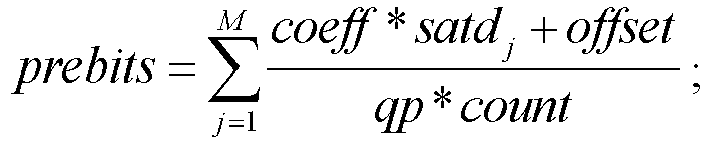
- It is understood that the initial quantization parameter may be set to a small value, and then the value is gradually increased starting from the initial quantization parameter, thereby improving the encoding quality of a video frame and ensuring that an actually occupied bit rate currently is not too large.
- In step S212, the current video frame is encoded according to the current quantization parameter.
- In an embodiment, the step of encoding the current video frame according to the current quantization parameter includes: obtaining a current quantization step corresponding to the current video frame according to the current quantization parameter; and encoding the current video frame according to the current quantization step to obtain an actually occupied bit rate corresponding to the current video frame.
- After the current quantization parameter is obtained by updating the initial quantization parameter according to the adjusted second available bit rate, a current quantization step may be obtained according to a correspondence between a quantization parameter and a quantization step. The current video frame is encoded according to the current quantization step. For example, generally, a principle of quantization is expressed by using the following equation: FQ=round(y/Qstep); where y is a prediction residual corresponding to a video frame before quantization, Qstep is a quantization step, and FQ is a quantized value of y. The Round(x) function means performing Banker's rounding on a quantized value, that is, when a last digit of the quantized value is less than or equal to four, the quantized value is rounded down; when the last digit of the quantized value is greater than or equal to six, the quantized value is rounded up; when the last digit of the quantized value is five, if there is a number behind the digit five, the quantized value is rounded up; if there is no number behind the digit five, and a previous number of the digit five is odd, the quantized value is rounded up; if the previous number of the digit five is even, the quantized value is rounded down. The correspondence between the quantization parameter and the quantization step may be set according to a requirement. For example, in the current video encoding standards, for brightness encoding, the quantization parameter has 52 values that are integers from 0 to 51. The quantization step increases as the quantization parameter increases. Each time the quantization parameter is increased by 6, the quantization step is doubled. A greater current quantization parameter indicates a lower bit rate required for the encoding of the current video frame; on the contrary, a smaller current quantization parameter indicates a higher bit rate required for the encoding of the current video frame.
- In the foregoing video encoding method, the first available bit rate represents status of an available bit rate at the first time granularity. A combination of the first available bit rate and the second available bit rate can achieve bit rate control at the first time granularity and further achieve bit rate allocation in a larger time range, rendering the bit rate allocation more uniform and significantly improving encoding quality. During encoding, the first historical complexity corresponding to the current video frame is acquired. Based on the first historical complexity, encoding complexity of the current video frame at the first time granularity is predicted according to the complexity of the current video frame, the current second available bit rate, and the current first available bit rate, so as to adjust the second available bit rate. The current quantization parameter corresponding to the current video frame then can be determined according to the adjusted second available bit rate. Finally, the current video frame is encoded according to the current quantization parameter.
- In an embodiment, as shown in
FIG. 3 , the step of calculating a first historical complexity corresponding to the current video frame in S204 includes the following steps S302 to S306. - In step S302, a first historical video frame sequence corresponding to the current video frame is determined.
- The computer device may acquire, in a video stream, the video frames that are in the time range corresponding to the first time granularity and that are before the current video frame. Because the video frames are previous to the current to-be-encoded video frame, a video frame sequence formed by the video frames is referred to as the first historical video frame sequence.
- The time range corresponding to the first time granularity is the same during encoding of each video frame. The time range corresponding to the first time granularity coincides with the time range corresponding to the first-time-granularity bit rate control buffer. For example, if the time range corresponding to the first-time-granularity bit rate control buffer is 1 minute, the first historical video frame sequence is a sequence formed by video frames in 1 minute after the current video frame. Assuming that a frame rate is 30 frames/s, when a current video frame i is encoded, a sequence formed by video frames from the 1800th frame to the first frame before the current video frame i is determined as the first historical video frame sequence corresponding to the current video frame i.
- The term "current video frame" in the present disclosure is used for describing a video frame that is being processed by a video encoder. The term "current video frame" is determined dynamically. For example, when a "next video frame" of the "current video frame" is processed, the "next video frame" may be determined as a new current video frame and the original "current video frame" is used as a new previous video frame. Because the current video frame is a dynamically determined, the corresponding first historical video frame sequence changes dynamically.
- In step S304, a complexity of each video frame in the first historical video frame sequence is acquired.
- Specifically, when the each video frame in the first historical video frame sequence is encoded, the complexity of the each video frame is already calculated. Therefore, when the current video frame is encoded, the computer device may directly acquire the complexities of such video frames. The manner of calculating complexity of a video frame is described above, and is not repeated herein.
- In step S306, the first historical complexity corresponding to the current video frame is calculated according to the complexities of the video frames.
- After the complexities of the video frames in the first historical video frame sequence is acquired, the first historical complexity corresponding to the current video frame may be be obtained according to the complexities of the video frames. The first historical complexity includes a first historical average complexity and a first historical complexity fluctuation degree.
- In an embodiment, as shown in
FIG. 4 , the step of calculating the first historical complexity corresponding to the current video frame according to the complexity of the each video frame in S306 includes the following steps S402 to S406. - In step S402, a first historical average complexity is calculated according to the complexities of the video frames.
- After the complexities of the video frames are obtained, an average value of the complexities of the video frames may be calculated and the obtained average value is used as the first historical average complexity. A higher first historical average complexity indicates a higher overall complexity of the encoded video frames before the current video frame. The current video frame is allocated with a higher bit rate for video encoding only when the current video frame has higher complexity.
- In an embodiment, the first historical average complexity may be obtained through calculation using the following equation:

- In step S404, a first historical complexity fluctuation degree is calculated according to the complexity of the each video frame.
- After the complexities of the video frames in the time range corresponding to the first time granularity are obtained, a complexity fluctuation of the video frames may be calculated according to the complexities of the video frames, to be used as the first historical complexity fluctuation. Then a difference between the first historical complexity fluctuation and the first historical average complexity is calculated and the obtained difference is used as the first historical complexity fluctuation degree. A greater first historical complexity fluctuation degree indicates a more violent fluctuation, and a smaller first historical complexity fluctuation degree indicates a milder fluctuation. When the first historical complexity fluctuation degree is relatively high, the current video frame is allocated with a higher bit rate for video encoding only when the current video frame has higher complexity.
- In an embodiment, the first historical complexity fluctuation is obtained through calculation using the following equation:

- In step S406, the first historical average complexity and the first historical complexity fluctuation degree are fused to obtain the first historical complexity.
- The first historical average complexity and the first historical complexity fluctuation degree may be used in combination to obtain the first historical complexity corresponding to the current video frame through calculation. In this way, when the average complexity of the video frames in the time range corresponding to the first time granularity is relatively high and the complexities fluctuates greatly, the current video frame is allocated with a higher bit rate only when the current video frame has higher complexity.
- In an embodiment, the first historical complexity corresponding to the current video frame is obtained through calculation using the following equation:

- In the foregoing embodiments, statistics about the complexity of the video frames in the time range corresponding to the first time granularity before the current video frame are collected. The first historical complexity obtained through statistics is used for measuring whether the current video frame needs a higher or lower bit rate for video encoding.
- As shown in
FIG. 5 , the step of adjusting a bit rate between the second available bit rate and the first available bit rate based on the second available bit rate and the first available bit rate according to a complexity of the current video frame and the first historical complexity in S208 includes the following steps S502 to S508. - In step S502, the complexity of the current video frame is acquired.
- The complexity of the current video frame may be determined according to the prediction residual of the current video frame as mentioned above.
- In step S504, a magnitude relationship between the complexity of the current video frame and the first historical complexity is determined.
- The first historical complexity may be subtracted from the complexity of the current video frame to obtain a complexity fluctuation value of the current video frame. According to the complexity fluctuation value of the current video frame, it may be determined whether a higher or lower bit rate is needed to encode the current video frame.
- In an embodiment, the magnitude relationship between the complexity of the current video frame and the first historical complexity may be expressed in the following equation:

- In step S506, a first bit rate is subtracted from the first available bit rate and the first bit rate is added to the second available bit rate in a case that the complexity of the current video frame is higher than the first historical complexity.
- When the complexity of the current video frame is higher than the first historical complexity, it indicates that a higher bit rate may be allocated to the current video frame for video encoding. Therefore, the first bit rate is acquired from the first available bit rate and added to the second available bit rate. In this way, a smaller quantization parameter is obtained to encode the current video frame.
- In step S508, a second bit rate is subtracted from the second available bit rate and the second bit rate is added to the first available bit rate in a case that the complexity of the current video frame is lower than the first historical complexity.
- When the complexity of the current video frame is lower than the first historical complexity, it indicates that the current video frame may be encoded with a lower bit rate. Therefore, the second bit rate is acquired from the second available bit rate and the saved second bit rate is added to the first available bit rate. In this way, a greater quantization parameter may be obtained to encode the current video frame.
-
FIG. 6 is a schematic diagram of adjusting a bit rate between a first available bit rate and a second available bit rate according to an embodiment. Referring toFIG. 6 , according to AdRation corresponding to the current video frame, when AdRation is greater than 0, the first bit rate is calculated, and the first bit rate is subtracted from the first available bit rate and added to the second available bit rate; when AdRation is less than 0, the second bit rate is calculated, and the second bit rate is subtracted from the second available bit rate and added to the first available bit rate. - In an embodiment, the first bit rate is positively correlated with the current first available bit rate; and the first bit rate is positively correlated with the difference between the complexity of the current video frame and the first historical complexity.
- A value of a bit rate that can be subtracted from the first available bit rate and added to the second available bit rate is related to the current first available bit rate, and is further related to the difference between the complexity of the current video frame and the first historical complexity. A higher current first available bit rate indicates that a higher first bit rate can be acquired from the first available bit rate; and a greater difference between the complexity of the current video frame and the first historical complexity indicates that a higher first bit rate can be acquired from the first available bit rate.
- In an embodiment, in a case that the second available bit rate added with the first bit rate exceeds a maximum value of the second available bit rate, the second available bit rate is adjusted to be the maximum value of the second available bit rate.
- The maximum value of the second available bit rate is determined according to a target bit rate corresponding to a target video frame sequence to which the current video frame belongs, and is generally set to 1 to 2 times of the target bit rate. The target bit rate may be an average bit rate that a user expects according to current bandwidth and network situations.
- Because the quantization parameter used during the encoding of the current video frame is determined according to the adjusted second available bit rate, in order to prevent a high bit rate that is actually occupied due to encoding of the current video frame with a small quantization parameter, the adjusted second available bit rate cannot exceed the maximum value of the second available bit rate.
- In an embodiment, the first bit rate is obtained through calculation using the following equation:


- In an embodiment, the second bit rate is positively correlated with the current second available bit rate; the second bit rate is positively correlated with a degree of fullness of the second available bit rate; and the second bit rate is positively correlated with the difference between the complexity of the current video frame and the first historical complexity.
- A value of a bit rate that can be subtracted from the second available bit rate and added to the first available bit rate is related to the current second available bit rate, related to the difference between the complexity of the current video frame and the first historical complexity, and further related to the degree of fullness of the current second available bit rate. A higher current second available bit rate indicates that a higher second bit rate can be acquired from the second available bit rate; and a greater difference between the first historical complexity and the complexity of the current video frame indicates that a higher second bit rate can be acquired from the second available bit rate. The degree of fullness of the second available bit rate refers to a degree of fullness of the second-time-granularity bit rate control buffer and can be expressed by a ratio of the current second available bit rate to the maximum value of the second available bit rate. A higher degree of fullness indicates that a higher second bit rate can be acquired from the second available bit rate.
- In an embodiment, in a case that the first available bit rate added with the second bit rate exceeds a maximum value of the first available bit rate, the first available bit rate is adjusted to be the maximum value corresponding to the first available bit rate.
- Similarly, the maximum value of the first available bit rate is related to the target bit rate corresponding to the target video frame sequence to which the current video frame belongs. A higher target bit rate indicates a greater maximum value of the first available bit rate.
- During encoding of subsequent video frames, if a bit rate is to be acquired from the first available bit rate and added to the second available bit rate, the acquired bit rate is positively correlated with a value of the first available bit rate after the last adjustment. Therefore, in order to prevent a high bit rate that is actually occupied during encoding of the subsequent video frames due to a high second available bit rate after subsequent adjustment, the adjusted first available bit rate cannot exceed the maximum value of the first available bit rate.
- In an embodiment, the maximum value of the first available bit rate may be expressed using the following equation:

- In an embodiment, the second bit rate is obtained through calculation using the following equation:

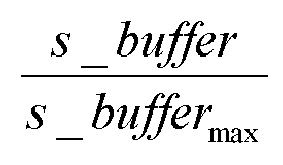
-
FIG. 7 is a schematic diagram of adding, to a first available bit rate, bit rates saved during encoding of video frames before a current video frame according to an embodiment. Referring toFIG. 7 , a frame rate of the target video frame sequence is 30 frames/second, and the time range corresponding to the first time granularity is 1 minute. In this case, the first available bit rate includes bit rates saved during encoding of the current video frame and bit rates saved during encoding of 1799 video frames before the current video frame. Bit rates saved by the 1800 video frames are 1022, 3521, 0, 22121, ..., 22, 124. When the current video frame is encoded, a bit rate may be acquired from the first available bit rate. - In an embodiment, after the step of encoding the current video frame according to the current quantization parameter in S212, the video encoding method further includes: acquiring a target bit rate corresponding to a target video frame sequence to which the current video frame belongs; calculating an allocable bit rate per frame according to the target bit rate and a frame rate of the target video frame sequence; acquiring an actually occupied bit rate corresponding to the current video frame that has been encoded; and updating the adjusted second available bit rate according to the average allocable bit rate per frame and the actually occupied bit rate to obtain a second available bit rate corresponding to a next video frame.
- The target bit rate is an expected bit rate specified by a user. The average allocable bit rate per frame refers to a bit rate expected to be occupied by each frame in an ideal case in which complexity of the video frame is not considered. The average allocable bit rate per frame may be expressed by a product of a duration occupied by each frame and the target bit rate. The duration occupied by each frame may be expressed by the reciprocal of the frame rate. The actually occupied bit rate refers to a bit rate actually occupied after the current video frame is encoded according to the current quantization parameter. Specifically, when the next video frame is encoded, an acquired current second available bit rate is the updated second available bit rate.
- In an embodiment, if the updated second available bit rate is greater than the maximum value of the second available bit rate, the maximum value of the second available bit rate is used as the second available bit rate corresponding to the next video frame.
- In an embodiment, the step of updating the adjusted second available bit rate according to the average allocable bit rate per frame and the actually occupied bit rate may be expressed using the following equation:



-
FIG. 8 is a flowchart of a video encoding method in an embodiment. Referring toFIG. 8 , first, a complexity of a current video frame i and complexities of n video frames in a second time granularity detection window are calculated, a value of n being related to a time range corresponding to a second time granularity, the complexity being satdi, satd i+1, satd i+2, ... and satd i+n ; then, a first historical complexity corresponding to the current video frame i is calculated, a magnitude relationship between complexity satdi of the current video frame i and the corresponding first historical complexity is analyzed, and a bit rate is adjusted between a first available bit rate and a second available bit rate according to the magnitude relationship; next, starting from an initial quantization parameter, a cumulative encoding bit rate is calculated according to a quantization parameter and the complexity of each video frame in the second time granularity detection window, and it is determined whether the obtained cumulative encoding bit rate is less than half of an adjusted second available bit rate; if yes, the current video frame i is encoded according to a current quantization parameter obtained after updating; if no, the quantization parameter is increased gradually at a preset step until the cumulative encoding bit rate obtained through calculation according to the current quantization parameter is less than half of the adjusted second available bit rate; next, the current video frame is encoded according to the obtained current quantization parameter, the second available bit rate is further updated according to an actually occupied bit rate corresponding to the current video frame that has been encoded, and video encoding can be performed on a next frame based on an updated second available bit rate. - The following describes the video encoding method provided in this embodiment by using an example that the first available bit rate is a minute-level available bit rate, the first available bit rate is a second-level available bit rate, a time range corresponding to the minute-level available bit rate is 1 minute, a time range corresponding to the second-level available bit rate is 1 second, a frame rate is 30 frames/s, and the current video frame is the 1900th frame.
- In
step 1, a current minute-level available bit rate and a current second-level available bit rate are acquired. - In
step 2, a complexity of the 1900th frame is calculated according to a prediction residual of the 1900th frame, complexities of frames from the 100th frame to the 1899th frame are obtained, an average complexity value and a complexity fluctuation of the frames from the 100th frame to the 1899th frame are calculated, and a historical complexity is obtained according to the average complexity value and the complexity fluctuation. - In
step 3, a bit rate to be subtracted from the current minute-level available bit rate is calculated according to the current minute-level available bit rate and a difference between the complexity of the 1900th frame and the historical complexity and the subtracted bit rate is added to the second-level available bit rate if the complexity of the 1900th frame is higher than the obtained historical complexity; and a bit rate to be subtracted from the current second-level available bit rate is calculated according to an absolute value of the difference between the complexity of the 1900th frame and the historical complexity, the current second-level available bit rate, and a degree of fullness of the second-level available bit rate, and the subtracted bit rate is added to the minute-level available bit rate if the complexity of the 1900th frame is lower than the obtained historical complexity. - In step 4, complexities of frames from the 1901st frame to the 1960th frame are calculated according to prediction residuals of the frames, a cumulative encoding bit rate is calculated based on an initial quantization parameter and the complexities of the frames, and a current quantization parameter is determined according to the cumulative encoding bit rate and an adjusted second-level available bit rate.
- In step 5, the 1900th frame is encoded according to the current quantization parameter.
- In step 6, the second-level available bit rate is updated according to a bit rate actually occupied by the 1900th frame after the encoding.
- In step 7, the 1901st frame is encoded according to
steps 1 to 6 based on the updated second-level available bit rate and an adjusted minute-level available bit rate. - In an embodiment, a video encoding method includes the following steps:
- acquiring a current to-be-encoded video frame and an initial quantization parameter;
- determining a first historical video frame sequence corresponding to the current video frame;
- acquiring complexities of video frames in the first historical video frame sequence;
- calculating a first historical average complexity according to the complexities of the video frames;
- calculating a first historical complexity fluctuation degree according to the complexities of the video frames;
- fusing the first historical average complexity and the first historical complexity fluctuation degree to obtain a first historical complexity;
- acquiring a current second available bit rate and a current first available bit rate;
- acquiring a complexity of the current video frame;
- determining a magnitude relationship between the complexity of the current video frame and the first historical complexity;
- subtracting a first bit rate from the first available bit rate and adding the first bit rate to the second available bit rate in a case that the complexity of the current video frame is higher than the first historical complexity and adjusting, in a case that the second available bit rate added with the first bit rate exceeds a maximum value of the second available bit rate, the second available bit rate to be the maximum value of the second available bit rate;
- subtracting a second bit rate from the second available bit rate and adding the second bit rate to the first available bit rate in a case that the complexity of the current video frame is lower than the first historical complexity and adjusting, in a case that the first available bit rate added with the second bit rate exceeds a maximum value of the first available bit rate, the first available bit rate to be the maximum value of the first available bit rate.
- acquiring a video frame sequence that is in a second time granularity detection window and that corresponds to the current video frame;
- gradually increasing the initial quantization parameter to obtain the current quantization parameter that causes a cumulative encoding bit rate, estimated based on the video frame sequence and the current quantization parameter, and the adjusted second available bit rate to conform to a preset bit rate relationship;
- obtaining a current quantization step corresponding to the current video frame according to the current quantization parameter;
- encoding the current video frame according to the current quantization step to obtain an actually occupied bit rate corresponding to the current video frame;
- acquiring a target bit rate corresponding to a target video frame sequence to which the current video frame belongs;
- calculating an average allocable bit rate per frame according to the target bit rate and a frame rate of the target video frame sequence; and
- updating the adjusted second available bit rate according to the average allocable bit rate per frame and the actually occupied bit rate to obtain a second available bit rate corresponding to a next video frame.
- In the video encoding method, the first available bit rate represents status of an available bit rate at the first time granularity, the second available bit rate represents status of an available bit rate at the second time granularity, and the second time granularity is a finer time unit relative to the first time granularity. The first bit rate and the second available bit rate are combined to achieve bit rate control at the first time granularity and further achieve bit rate allocation in a larger time range, rendering the bit rate allocation more uniform and significantly improving encoding quality. During encoding, the first historical complexity corresponding to the current video frame is acquired. Based on the first historical complexity, encoding complexity of the current video frame at the first time granularity is predicted according to the complexity of the current video frame, the current second available bit rate, and the current first available bit rate, so as to adjust the second available bit rate. The current quantization parameter corresponding to the current video frame then can be determined according to the adjusted second available bit rate. Finally, the current video frame is encoded according to the current quantization parameter.
- It is to be understood that, although the steps in the foregoing embodiments are displayed sequentially according to indication of arrows in the flowcharts, these steps are not necessarily performed sequentially according to the sequence indicated by the arrows. Unless explicitly specified herein, the steps are performed without any strict sequence limitation, and may be performed in another sequence. In addition, at least some steps in the flowcharts may include a multiple substeps or a multiple stages. The substeps or the stages are not necessarily performed at the same moment, but may be performed at different moments. The substeps or the stages are not necessarily performed in sequence, but may be performed in turn or alternately with another step or at least some of substeps or stages of the another step.
- In an embodiment, as shown in
FIG. 9 , a video encoding apparatus 900 is provided, including a videoframe acquisition module 902, a historicalcomplexity calculation module 904, an available bitrate acquisition module 906, a bitrate adjusting module 908, a quantizationparameter updating module 910, and anencoding module 912, where - the video
frame acquisition module 902 is configured to acquire a current to-be-encoded video frame and an initial quantization parameter; - the historical
complexity calculation module 904 is configured to calculate a first historical complexity corresponding to the current video frame at a first time granularity; - the available bit
rate acquisition module 906 is configured to acquire a current second available bit rate at a second time granularity and a current first available bit rate at the first time granularity, the second time granularity being a finer time unit relative to the first time granularity; - the bit
rate adjusting module 908 is configured to adjust a bit rate between the second available bit rate and the first available bit rate based on the second available bit rate and the first available bit rate according to a complexity of the current video frame and the first historical complexity; - the quantization
parameter updating module 910 is configured to update the initial quantization parameter according to an adjusted second available bit rate to obtain a current quantization parameter; and - the
encoding module 912 is configured to encode the current video frame according to the current quantization parameter. - In an embodiment, the historical
complexity calculation module 904 is further configured to determine a first historical video frame sequence corresponding to the current video frame; acquire complexities of video frames in the first historical video frame sequence; and calculate the first historical complexity corresponding to the current video frame according to the complexities of the video frames. - In an embodiment, the historical
complexity calculation module 904 is further configured to calculate a first historical average complexity according to the complexities of the video frames; calculate a first historical complexity fluctuation degree according to the complexities of the video frames; and fuse the first time granularity historical average complexity and the first historical complexity fluctuation degree to obtain the first historical complexity. - In an embodiment, the first historical complexity corresponding to the current video frame is obtained through calculation using the following equation:


- In an embodiment, the bit
rate adjusting module 908 is further configured to acquire the complexity of the current video frame; determine a magnitude relationship between the complexity of the current video frame and the first historical complexity; subtract a first bit rate from the first available bit rate and add the first bit rate to the second available bit rate in a case that the complexity of the current video frame is higher than the first historical complexity; and subtract a second bit rate from the second available bit rate and add the second bit rate to the first available bit rate in a case that the complexity of the current video frame is lower than the first historical complexity. - In an embodiment, the first bit rate is positively correlated with the current first available bit rate; and the first bit rate is positively correlated with the difference between the complexity of the current video frame and the first historical complexity.
- In an embodiment, the second bit rate is positively correlated with the current second available bit rate; the second bit rate is positively correlated with a degree of fullness of the second available bit rate; and the second bit rate is positively correlated with the difference between the complexity of the current video frame and the first historical complexity.
- In an embodiment, the bit
rate adjusting module 908 is further configured to adjust, in a case that the second available bit rate added with the first bit rate exceeds a maximum value of the second available bit rate, the second available bit rate to be the maximum value of the second available bit rate; and adjust, in a case that the first available bit rate added with the second bit rate exceeds a maximum value of the first available bit rate, the first available bit rate to be the maximum value of the first available bit rate. - In an embodiment, the first bit rate and the second bit rate are obtained through calculation using the following formulas:


- In an embodiment, the quantization
parameter updating module 910 is further configured to obtain a video frame sequence that is in a second time granularity detection window and that corresponds to the current video frame; and gradually increase a value starting from the initial quantization parameter to obtain the current quantization parameter that causes a cumulative encoding bit rate, estimated based on the video frame sequence and the current quantization parameter, and the adjusted second available bit rate to conform to a preset bit rate relationship. - In an embodiment, the
encoding module 912 is further configured to obtain a current quantization step corresponding to the current video frame according to the current quantization parameter; and encode the current video frame according to the current quantization step to obtain an actually occupied bit rate corresponding to the current video frame. - In an embodiment, the video encoding apparatus further include a second available bit rate updating module. The second available bit rate updating module is configured to acquire a target bit rate corresponding to a target video frame sequence to which the current video frame belongs; calculate an allocable bit rate per frame according to the target bit rate and a frame rate of the target video frame sequence; acquire an actually occupied bit rate corresponding to the current video frame that has been encoded; and update the adjusted second available bit rate according to the average allocable bit rate per frame and the actually occupied bit rate to obtain a second available bit rate corresponding to a next video frame.
- Through the video encoding apparatus 900, the first available bit rate can represent status of an available bit rate at the first time granularity. A combination of the first available bit rate and the second available bit rate can achieve bit rate control at the first time granularity and further achieve bit rate allocation in a larger time range, rendering the bit rate allocation more uniform and significantly improving encoding quality. During encoding, the first historical complexity corresponding to the current video frame is acquired. Based on the above, encoding complexity of the current video frame at the first time granularity is predicted according to the complexity of the current video frame, the current second available bit rate, and the current first available bit rate, so as to adjust the second available bit rate. The current quantization parameter corresponding to the current video frame then can be determined according to the adjusted second available bit rate. Finally, the current video frame is encoded according to the current quantization parameter.
-
FIG. 10 is a diagram showing an internal structure of a computer device in an embodiment. The computer device may be specifically thevideo distribution server 120 inFIG. 1 . As shown inFIG. 10 , the computer device includes a processor, a memory, and a network interface that are connected through a system bus. The memory includes a non-volatile storage medium and an internal memory. The non-volatile storage medium of the computer device stores an operating system and may further store a computer program, the computer program, when executed by the processor, causing the processor to implement the video encoding method. The internal memory may also store a computer program. When executed by the processor, the computer program may cause the processor to perform the video encoding method. - A person skilled in the art may understand that the structure shown in
FIG. 10 is only a block diagram of a partial structure related to the solution of the present disclosure, and does not constitute a limitation on the computer device to which the solution of the present disclosure is applied. The computer device may specifically include more or fewer components than those shown in the figure, or some components may be combined, or a different component arrangement may be used. - In an embodiment, the video encoding apparatus 900 provided in the present disclosure may be implemented in a form of a computer program. The computer program may run on the computer device shown in
FIG. 10 . The memory of the computer device may store various program modules that form the video encoding apparatus 900, for example, the videoframe acquisition module 902, the historicalcomplexity calculation module 904, the available bitrate acquisition module 906, the bitrate adjusting module 908, the quantizationparameter updating module 910, and theencoding module 912 that are shown inFIG. 9 . The computer program formed by the program modules causes the processor to perform the steps of the video encoding method described in the embodiments of the present disclosure in this specification. - For example, the computer device shown in
FIG. 10 may perform step S202 by using the videoframe acquisition module 902 in the video encoding apparatus 900 shown inFIG. 9 . The computer device may perform step S204 by using the historicalcomplexity calculation module 904. The computer device may perform step S206 by using the available bitrate acquisition module 906. The computer device may perform step S208 by using theadjusting module 908. The computer device may perform step S210 by using the quantizationparameter updating module 910. The computer device may perform step S212 by using theencoding module 912. - In an embodiment, a computer device is provided, including a memory and a processor, the memory storing a computer program, the computer program, when executed by the processor, causing the processor to perform the following operations:
- acquiring a current to-be-encoded video frame and an initial quantization parameter;
- calculating a first historical complexity corresponding to the current video frame at a first time granularity;
- acquiring a current second available bit rate at a second time granularity and a current first available bit rate at the first time granularity, the second time granularity being a finer time unit relative to the first time granularity;
- adjusting a bit rate between the second available bit rate and the first available bit rate based on the second available bit rate and the first available bit rate according to a complexity of the current video frame and the first historical complexity;
- updating the initial quantization parameter according to an adjusted second available bit rate to obtain a current quantization parameter; and
- encoding the current video frame according to the current quantization parameter.
- In another embodiment, the computer program, when executed by the processor, causes the processor to perform the following operations:
- determining a first historical video frame sequence corresponding to the current video frame;
- acquiring complexities of video frames in the first historical video frame sequence;
- calculating the first historical complexity corresponding to the current video frame according to the complexities of the video frames.
- In another embodiment, the computer program, when executed by the processor, causes the processor to perform the following operations:
- calculating a first historical average complexity according to the complexities of the video frames;
- calculating a first historical complexity fluctuation degree according to the complexities of the video frames;
- fusing the first historical average complexity and the first historical complexity fluctuation degree to obtain the first historical complexity.
- In another embodiment, the first historical complexity corresponding to the current video frame is obtained through calculation using the following equations:


- In another embodiment, the computer program, when executed by the processor, causes the processor to perform the following operations:
- acquiring complexity of the current video frame;
- determining a magnitude relationship between the complexity of the current video frame and the first historical complexity;
- subtracting a first bit rate from the first available bit rate and adding the first bit rate to the second available bit rate in a case that the complexity of the current video frame is higher than the first historical complexity; and
- subtracting a second bit rate from the second available bit rate and adding the second bit rate to the first available bit rate in a case that the complexity of the current video frame is lower than the first historical complexity.
- In another embodiment, the first bit rate is positively correlated with the first available bit rate; and the first bit rate is positively correlated with the difference between the complexity of the current video frame and the first historical complexity.
- In another embodiment, the second bit rate is positively correlated with the current second available bit rate; the second bit rate is positively correlated with a degree of fullness of the second available bit rate; and the second bit rate is positively correlated with the difference between the complexity of the current video frame and the first historical complexity.
- In another embodiment, the computer program, when executed by the processor, causes the processor to perform the following operations:
- adjusting, in a case that the second available bit rate added with the first bit rate exceeds a maximum value of the second available bit rate, the second available bit rate to be the maximum value of the second available bit rate; and
- adjusting, in a case that the first available bit rate added with the second bit rate exceeds a maximum value of the first available bit rate, the first available bit rate to be the maximum value of the first available bit rate.
- In another embodiment, the first bit rate and the second bit rate are obtained through calculation using the following formulas:


- In another embodiment, the computer program, when executed by the processor, causes the processor to perform the following operations:
- acquiring a video frame sequence that is in a second time granularity detection window and that corresponds to the current video frame;
- gradually increasing a value starting from the initial quantization parameter to obtain the current quantization parameter that causes a cumulative encoding bit rate, estimated based on the video frame sequence and the current quantization parameter, and the adjusted second available bit rate to conform to a preset bit rate relationship;
- In another embodiment, the computer program, when executed by the processor, causes the processor to perform the following operations:
- obtaining a current quantization step corresponding to the current video frame according to the current quantization parameter;
- encoding the current video frame according to the current quantization step to obtain an actually occupied bit rate corresponding to the current video frame;
- In another embodiment, the computer program, when executed by the processor, causes the processor to perform the following operations:
- acquiring a target bit rate corresponding to a target video frame sequence to which the current video frame belongs;
- calculating an average allocable bit rate per frame according to the target bit rate and a frame rate of the target video frame sequence; and
- acquiring an actually occupied bit rate corresponding to the current video frame that has been encoded; and
- updating the adjusted second available bit rate according to the average allocable bit rate per frame and the actually occupied bit rate to obtain a second available bit rate corresponding to a next video frame.
- In an embodiment, a computer-readable storage medium is provided, storing a computer program, the computer program, when executed by a processor, causing the processor to perform the following operations:
- acquiring a current to-be-encoded video frame and an initial quantization parameter;
- calculating a first historical complexity corresponding to the current video frame at a first time granularity;
- acquiring a current second available bit rate at a second time granularity and a current first available bit rate at the first time granularity, the second time granularity being a finer time unit relative to the first time granularity;
- adjusting a bit rate between the second available bit rate and the first available bit rate based on the second available bit rate and the first available bit rate according to a complexity of the current video frame and the first historical complexity;
- updating the initial quantization parameter according to an adjusted second available bit rate to obtain a current quantization parameter; and
- encoding the current video frame according to the current quantization parameter.
- In another embodiment, the computer program, when executed by the processor, causes the processor to perform the following operations:
- determining a first historical video frame sequence corresponding to the current video frame;
- acquiring complexities of video frames in the first historical video frame sequence;
- calculating the first historical complexity corresponding to the current video frame according to the complexities of the video frames.
- In another embodiment, the computer program, when executed by the processor, causes the processor to perform the following operations:
- Calculating a first historical average complexity according to the complexities of the video frames;
- calculating a first historical complexity fluctuation degree according to the complexities of the video frames;
- fusing the first historical average complexity and the first historical complexity fluctuation degree to obtain the first historical complexity.
- In another embodiment, the first historical complexity corresponding to the current video frame is obtained through calculation using the following equations:


- In another embodiment, the computer program, when executed by the processor, causes the processor to perform the following operations:
- acquiring complexity of the current video frame;
- determining a magnitude relationship between the complexity of the current video frame and the first historical complexity;
- subtracting a first bit rate from the first available bit rate and adding the first bit rate to the second available bit rate in a case that the complexity of the current video frame is higher than the first historical complexity; and
- subtracting a second bit rate from the second available bit rate and adding the second bit rate to the first available bit rate in a case that the complexity of the current video frame is lower than the first historical complexity.
- In another embodiment, the first bit rate is positively correlated with the first available bit rate; and the first bit rate is positively correlated with the difference between the complexity of the current video frame and the first historical complexity.
- In another embodiment, the second bit rate is positively correlated with the current second available bit rate; the second bit rate is positively correlated with a degree of fullness of the second available bit rate; and the second bit rate is positively correlated with the difference between the complexity of the current video frame and the first historical complexity.
- In another embodiment, the computer program, when executed by the processor, causes the processor to perform the following operations:
- adjusting, in a case that the second available bit rate added with the first bit rate exceeds a maximum value of the second available bit rate, the second available bit rate to be the maximum value of the second available bit rate; and
- adjusting, in a case that the first available bit rate added with the second bit rate exceeds a maximum value of the first available bit rate, the first available bit rate to be the maximum value of the first available bit rate.
- In another embodiment, the first bit rate and the second bit rate are obtained through calculation using the following formulas:


- In another embodiment, the computer program, when executed by the processor, causes the processor to perform the following operations:
- acquiring a video frame sequence that is in a second time granularity detection window and that corresponds to the current video frame;
- gradually increasing a value starting from the initial quantization parameter to obtain the current quantization parameter that causes a cumulative encoding bit rate, estimated based on the video frame sequence and the current quantization parameter, and the adjusted second available bit rate to conform to a preset bit rate relationship;
- In another embodiment, the computer program, when executed by the processor, causes the processor to perform the following operations:
- obtaining a current quantization step corresponding to the current video frame according to the current quantization parameter;
- encoding the current video frame according to the current quantization step to obtain an actually occupied bit rate corresponding to the current video frame;
- In another embodiment, the computer program, when executed by the processor, causes the processor to perform the following operations:
- acquiring a target bit rate corresponding to a target video frame sequence to which the current video frame belongs;
- calculating an average allocable bit rate per frame according to the target bit rate and a frame rate of the target video frame sequence; and
- acquiring an actually occupied bit rate corresponding to the current video frame that has been encoded; and
- updating the adjusted second available bit rate according to the average allocable bit rate per frame and the actually occupied bit rate to obtain a second available bit rate corresponding to a next video frame.
- A person of ordinary skill in the art may understand that all or some of the processes of the methods in the foregoing embodiments may be implemented by a computer program instructing relevant hardware. The program may be stored in a non-volatile computer-readable storage medium. When the program runs, the procedures of the foregoing method embodiments may be included. Any reference to a memory, storage, database or another medium used in the embodiments provided in the present disclosure may include a non-volatile and/or volatile memory. The non-volatile memory may include a read-only memory (ROM), a programmable ROM (PROM), an electrically programmable ROM (EPROM), an electrically erasable programmable ROM (EEPROM), or a flash. The volatile memory may include a random access memory (RAM) or an external cache. As an illustration instead of a limitation, the RAM is available in various forms, such as a static RAM (SRAM), a dynamic RAM (DRAM), a synchronous DRAM (SDRAM), a double data rate SDRAM (DDRSDRAM), an enhanced SDRAM (ESDRAM), a synchronous link (Synchlink) DRAM (SLDRAM), a rambus direct RAM (RDRAM), a direct rambus dynamic RAM (DRDRAM), and a rambus dynamic RAM (DRAM).
- The technical features in the foregoing embodiments may be randomly combined. For concise description, not all possible combinations of the technical features in the embodiment are described. However, the combinations of the technical features are to be considered as falling within the scope recorded in this specification provided that they do not conflict with each other.
- Only several implementations of the present disclosure are described in the foregoing embodiments, and are described in detail, but they are not to be construed as a limitation to the patent scope of the present disclosure. A person of ordinary skill in the art may further make variations and improvements without departing from the ideas of the present disclosure, which shall fall within the protection scope of the present disclosure. Therefore, the protection scope of the present disclosure shall be subject to the protection scope of the appended claims.
Claims (26)
- A video encoding method, applied to a computer device, the method comprising:acquiring a current to-be-encoded video frame and an initial quantization parameter;calculating a first historical complexity corresponding to the current video frame at a first time granularity;acquiring a current second available bit rate at a second time granularity and a current first available bit rate at the first time granularity, the second time granularity being a finer time unit relative to the first time granularity;adjusting a bit rate between the second available bit rate and the first available bit rate based on the second available bit rate and the first available bit rate according to a complexity of the current video frame and the first historical complexity;updating the initial quantization parameter according to an adjusted second available bit rate to obtain a current quantization parameter; andencoding the current video frame according to the current quantization parameter.
- The method according to claim 1, wherein the calculating first historical complexity corresponding to the current video frame at a first time granularity comprises:determining a first historical video frame sequence corresponding to the current video frame;acquiring complexities of video frames in the first historical video frame sequence; andcalculating the first historical complexity corresponding to the current video frame according to the complexities of the video frames.
- The method according to claim 2, wherein the calculating the first historical complexity corresponding to the current video frame according to the complexities of the video frames comprises:calculating a first historical average complexity according to the complexities of the video frames;calculating a first historical complexity fluctuation degree according to the complexities of the video frames; andfusing the first historical average complexity and the first historical complexity fluctuation degree to obtain the first historical complexity.
- The method according to claim 3, wherein the first historical complexity corresponding to the current video frame is obtained through calculation using the following equations:


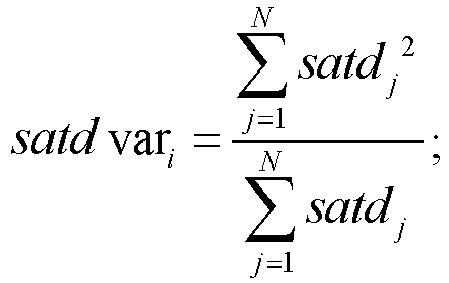
- The method according to claim 1, wherein the adjusting a bit rate between the second available bit rate and the first available bit rate based on the second available bit rate and the first available bit rate according to a complexity of the current video frame and the first historical complexity comprises:acquiring the complexity of the current video frame;determining a magnitude relationship between the complexity of the current video frame and the first historical complexity;subtracting a first bit rate from the first available bit rate and adding the first bit rate to the second available bit rate in a case that the complexity of the current video frame is higher than the first historical complexity; andsubtracting a second bit rate from the second available bit rate and adding the second bit rate to the first available bit rate in a case that the complexity of the current video frame is lower than the first historical complexity.
- The method according to claim 5, wherein the first bit rate is positively correlated with the current first available bit rate; and the first bit rate is positively correlated with a difference between the complexity of the current video frame and the first historical complexity.
- The method according to claim 5, wherein the second bit rate is positively correlated with the current second available bit rate; the second bit rate is positively correlated with a degree of fullness of the second available bit rate; and the second bit rate is positively correlated with a difference between the complexity of the current video frame and the first historical complexity.
- The method according to claim 5, further comprising:adjusting, in a case that the second available bit rate added with the first bit rate exceeds a maximum value of the second available bit rate, the second available bit rate to be the maximum value of the second available bit rate; andadjusting, in a case that the first available bit rate added with the second bit rate exceeds a maximum value of the first available bit rate, the first available bit rate to be the maximum value of the first available bit rate.
- The method according to claim 5, wherein the first bit rate and the second bit rate are obtained through calculation using the following formulas:


- The method according to claim 1, wherein the updating the initial quantization parameter according to an adjusted second available bit rate to obtain a current quantization parameter comprises:acquiring a video frame sequence that is in a second time granularity detection window and that corresponds to the current video frame; andgradually increasing a value starting from the initial quantization parameter to obtain the current quantization parameter that causes a cumulative encoding bit rate, estimated based on the video frame sequence and the current quantization parameter, and the adjusted second available bit rate to conform to a preset bit rate relationship.
- The method according to claim 1, wherein the encoding the current video frame according to the current quantization parameter comprises:obtaining a current quantization step corresponding to the current video frame according to the current quantization parameter; andencoding the current video frame according to the current quantization step to obtain an actually occupied bit rate corresponding to the current video frame.
- The method according to any one of claims 1 to 11, further comprising:acquiring a target bit rate corresponding to a target video frame sequence to which the current video frame belongs;calculating an average allocable bit rate per frame according to the target bit rate and a frame rate of the target video frame sequence;acquiring an actually occupied bit rate corresponding to the current video frame that has been encoded; andupdating the adjusted second available bit rate according to the average allocable bit rate per frame and the actually occupied bit rate to obtain a second available bit rate corresponding to a next video frame.
- A video encoding apparatus, comprising:a video frame acquisition module, configured to acquire a current to-be-encoded video frame and an initial quantization parameter;a historical complexity calculation module, configured to calculate a first historical complexity corresponding to the current video frame at a first time granularity;an available bit rate acquisition module, configured to acquire a current second available bit rate at a second time granularity and a current first available bit rate at the first time granularity, the second time granularity being a finer time unit relative to the first time granularity;a bit rate adjusting module, configured to adjust a bit rate between the second available bit rate and the first available bit rate based on the second available bit rate and the first available bit rate according to complexity of the current video frame and the first historical complexity;a quantization parameter updating module, configured to update the initial quantization parameter according to an adjusted second available bit rate to obtain a current quantization parameter; andan encoding module, configured to encode the current video frame according to the current quantization parameter.
- A computer-readable storage medium, storing a computer program, the computer program, when executed by a processor, causing the processor to perform the method according to any one of claims 1 to 12.
- A computer device, comprising a memory and a processor, the memory storing a computer program, the computer program, when executed by the processor, causing the processor to perform the following operations:acquiring a current to-be-encoded video frame and an initial quantization parameter;calculating a first historical complexity corresponding to the current video frame at a first time granularity;acquiring a current second available bit rate at a second time granularity and a current first available bit rate at the first time granularity, the second time granularity being a finer time unit relative to the first time granularity;adjusting a bit rate between the second available bit rate and the first available bit rate based on the second available bit rate and the first available bit rate according to complexity of the current video frame and the first historical complexity;updating the initial quantization parameter according to an adjusted second available bit rate to obtain a current quantization parameter; andencoding the current video frame according to the current quantization parameter.
- The computer device according to claim 15, wherein the computer program, when executed by the processor, causes the processor to perform the following operations:determining a first historical video frame sequence corresponding to the current video frame;acquiring complexities of video frames in the first historical video frame sequence; andcalculating the first historical complexity corresponding to the current video frame according to the complexities of the video frames.
- The computer device according to claim 16, wherein the computer program, when executed by the processor, causes the processor to perform the following operations:calculating a first historical average complexity according to the complexities of the video frames;calculating a first historical complexity fluctuation degree according to the complexities of the video frames; andfusing the first historical average complexity and the first historical complexity fluctuation degree to obtain the first historical complexity.
- The computer device according to claim 17, wherein the first historical complexity corresponding to the current video frame is obtained through calculation using the following formulas:


- The computer device according to claim 15, wherein the computer program, when executed by the processor, causes the processor to perform the following operations:acquiring the complexity of the current video frame;determining a magnitude relationship between the complexity of the current video frame and the first historical complexity;subtracting a first bit rate from the first available bit rate and adding the first bit rate to the second available bit rate in a case that the complexity of the current video frame is higher than the first historical complexity; andsubtracting a second bit rate from the second available bit rate and adding the second bit rate to the first available bit rate in a case that the complexity of the current video frame is lower than the first historical complexity.
- The computer device according to claim 19, wherein the first bit rate is positively correlated with the current first available bit rate; and the first bit rate is positively correlated with a difference between the complexity of the current video frame and the first historical complexity.
- The computer device according to claim 19, wherein the second bit rate is positively correlated with the current second available bit rate; the second bit rate is positively correlated with a degree of fullness of the second available bit rate; and the second bit rate is positively correlated with a difference between the complexity of the current video frame and the first historical complexity.
- The computer device according to claim 19, wherein the computer program, when executed by the processor, causes the processor to perform the following operations:adjusting, in a case that the second available bit rate added with the first bit rate exceeds a maximum value of the second available bit rate, the second available bit rate to be the maximum value of the second available bit rate; andadjusting, in a case that the first available bit rate added with the second bit rate exceeds a maximum value of the first available bit rate, the first available bit rate to be the maximum value of the first available bit rate.
- The computer device according to claim 19, wherein the first bit rate and the second bit rate are obtained through calculation using the following formulas:


- The computer device according to claim 15, wherein the computer program, when executed by the processor, causes the processor to perform the following operations:acquiring a video frame sequence that is in a second time granularity detection window and that corresponds to the current video frame; andgradually increasing a value starting from the initial quantization parameter to obtain the current quantization parameter that causes a cumulative encoding bit rate, estimated based on the video frame sequence and the current quantization parameter, and the adjusted second available bit rate to conform to a preset bit rate relationship.
- The computer device according to claim 15, wherein the computer program, when executed by the processor, causes the processor to perform the following operations:obtaining a current quantization step corresponding to the current video frame according to the current quantization parameter; andencoding the current video frame according to the current quantization step to obtain an actually occupied bit rate corresponding to the current video frame.
- The computer device according to any one of claims 15 to 25, wherein the computer program, when executed by the processor, causes the processor to perform the following operations:acquiring a target bit rate corresponding to a target video frame sequence to which the current video frame belongs;calculating an average allocable bit rate per frame according to the target bit rate and a frame rate of the target video frame sequence;acquiring an actually occupied bit rate corresponding to the current video frame that has been encoded; andupdating the adjusted second available bit rate according to the average allocable bit rate per frame and the actually occupied bit rate to obtain a second available bit rate corresponding to a next video frame.
Applications Claiming Priority (2)
| Application Number | Priority Date | Filing Date | Title |
|---|---|---|---|
| CN201811288530.5A CN110213585B (en) | 2018-10-31 | 2018-10-31 | Video encoding method, apparatus, computer-readable storage medium, and computer device |
| PCT/CN2019/109976 WO2020088200A1 (en) | 2018-10-31 | 2019-10-08 | Video encoding method and apparatus, and computer-readable storage medium and computer device |
Publications (3)
| Publication Number | Publication Date |
|---|---|
| EP3876535A1 true EP3876535A1 (en) | 2021-09-08 |
| EP3876535A4 EP3876535A4 (en) | 2022-01-26 |
| EP3876535B1 EP3876535B1 (en) | 2025-02-26 |
Family
ID=67779803
Family Applications (1)
| Application Number | Title | Priority Date | Filing Date |
|---|---|---|---|
| EP19880678.8A Active EP3876535B1 (en) | 2018-10-31 | 2019-10-08 | Video encoding method and apparatus, and computer-readable storage medium and computer device |
Country Status (5)
| Country | Link |
|---|---|
| US (1) | US11317097B2 (en) |
| EP (1) | EP3876535B1 (en) |
| JP (1) | JP7123470B2 (en) |
| CN (1) | CN110213585B (en) |
| WO (1) | WO2020088200A1 (en) |
Families Citing this family (10)
| Publication number | Priority date | Publication date | Assignee | Title |
|---|---|---|---|---|
| CN110213585B (en) * | 2018-10-31 | 2022-10-28 | 腾讯科技(深圳)有限公司 | Video encoding method, apparatus, computer-readable storage medium, and computer device |
| CN111836081B (en) * | 2020-07-20 | 2021-07-27 | 南京百家云科技有限公司 | Video transmission method and device |
| CN115606176B (en) | 2020-11-30 | 2025-08-29 | 京东方科技集团股份有限公司 | Video processing method, device, electronic device and storage medium |
| CN113301331B (en) * | 2021-05-25 | 2022-11-04 | 哈尔滨工业大学 | A Fast Decision Method for Intra-frame Predictive Coding Mode Based on Common Video Coding Standard |
| CN113660491B (en) * | 2021-08-10 | 2024-05-07 | 杭州网易智企科技有限公司 | Encoding method, encoding device, storage medium, and electronic apparatus |
| CN115002462A (en) * | 2022-05-31 | 2022-09-02 | 深信服科技股份有限公司 | Encoding method, device, equipment and storage medium |
| US20240137522A1 (en) * | 2022-10-12 | 2024-04-25 | City University Of Hong Kong | Processing and encoding screen content video |
| CN116684608A (en) * | 2023-06-06 | 2023-09-01 | 北京百度网讯科技有限公司 | Video coding method, device and equipment |
| CN119484826A (en) * | 2024-11-12 | 2025-02-18 | 北京达佳互联信息技术有限公司 | Bit rate control method, device, electronic device and computer program product |
| CN119893184B (en) * | 2024-12-31 | 2025-11-07 | 北京达佳互联信息技术有限公司 | Code rate adjusting method, device, electronic equipment and computer program product |
Family Cites Families (23)
| Publication number | Priority date | Publication date | Assignee | Title |
|---|---|---|---|---|
| JPH04137685A (en) | 1990-09-28 | 1992-05-12 | Toshiba Corp | Starting of metal vapor laser equipment |
| JP2534914Y2 (en) * | 1991-06-14 | 1997-05-07 | 日本電気ホームエレクトロニクス株式会社 | Image data compression encoding device |
| JP3918208B2 (en) * | 1996-08-30 | 2007-05-23 | ソニー株式会社 | Video data compression apparatus and method |
| JP3872849B2 (en) * | 1996-11-28 | 2007-01-24 | 松下電器産業株式会社 | Video encoding device |
| CN1234246C (en) * | 1998-09-29 | 2005-12-28 | 松下电器产业株式会社 | Variable bit rate coder |
| US6963608B1 (en) * | 1998-10-02 | 2005-11-08 | General Instrument Corporation | Method and apparatus for providing rate control in a video encoder |
| JP2000308047A (en) | 1999-04-19 | 2000-11-02 | Matsushita Electric Ind Co Ltd | Image encoding method, image encoding device, and data storage medium |
| JP4273385B2 (en) | 2002-04-05 | 2009-06-03 | ソニー株式会社 | Encoding apparatus, encoding method, program, and recording medium |
| JP4556844B2 (en) | 2005-11-04 | 2010-10-06 | パナソニック株式会社 | Code amount control method and code amount control apparatus |
| US20080151998A1 (en) * | 2006-12-21 | 2008-06-26 | General Instrument Corporation | Method and Apparatus for Providing Rate Control for Panel-Based Real Time Video Encoder |
| KR101033442B1 (en) * | 2008-06-12 | 2011-05-09 | 주식회사 몬도시스템즈 | Apparatus and method for controlling bit rate in image processing system |
| US20100150168A1 (en) * | 2008-11-17 | 2010-06-17 | Chanchal Chatterjee | Method and apparatus for multiplexing of digital video |
| US8879623B2 (en) * | 2009-09-02 | 2014-11-04 | Sony Computer Entertainment Inc. | Picture-level rate control for video encoding a scene-change I picture |
| CN102036062B (en) * | 2009-09-29 | 2012-12-19 | 华为技术有限公司 | Video coding method and device and electronic equipment |
| CN102647586B (en) * | 2011-02-16 | 2015-07-08 | 富士通株式会社 | Code rate control method and device used in video coding system |
| CN103096048B (en) * | 2011-11-02 | 2015-11-11 | 北京大学 | A kind of scalable video quantization parameter defining method and device |
| CN104780369B (en) * | 2012-08-21 | 2018-04-17 | 华为技术有限公司 | A kind of method and device for obtaining Video coding compression quality |
| US9621917B2 (en) * | 2014-03-10 | 2017-04-11 | Euclid Discoveries, Llc | Continuous block tracking for temporal prediction in video encoding |
| CN104410861A (en) * | 2014-11-24 | 2015-03-11 | 华为技术有限公司 | Video encoding method and device |
| KR102274747B1 (en) * | 2014-11-24 | 2021-07-07 | 삼성전자주식회사 | CODEC, SYSTEM ON CHIP(SoC) INCLUDING THE SAME, AND DATA PROCESSING SYSTEM INCLUDING THE SoC |
| US9639935B1 (en) * | 2016-05-25 | 2017-05-02 | Gopro, Inc. | Apparatus and methods for camera alignment model calibration |
| CN108235016B (en) * | 2016-12-21 | 2019-08-23 | 杭州海康威视数字技术股份有限公司 | A code rate control method and device |
| CN110213585B (en) * | 2018-10-31 | 2022-10-28 | 腾讯科技(深圳)有限公司 | Video encoding method, apparatus, computer-readable storage medium, and computer device |
-
2018
- 2018-10-31 CN CN201811288530.5A patent/CN110213585B/en active Active
-
2019
- 2019-10-08 EP EP19880678.8A patent/EP3876535B1/en active Active
- 2019-10-08 JP JP2020560329A patent/JP7123470B2/en active Active
- 2019-10-08 WO PCT/CN2019/109976 patent/WO2020088200A1/en not_active Ceased
-
2020
- 2020-10-23 US US17/078,414 patent/US11317097B2/en active Active
Also Published As
| Publication number | Publication date |
|---|---|
| JP7123470B2 (en) | 2022-08-23 |
| CN110213585B (en) | 2022-10-28 |
| US11317097B2 (en) | 2022-04-26 |
| EP3876535A4 (en) | 2022-01-26 |
| JP2021520160A (en) | 2021-08-12 |
| CN110213585A (en) | 2019-09-06 |
| US20210044805A1 (en) | 2021-02-11 |
| WO2020088200A1 (en) | 2020-05-07 |
| EP3876535B1 (en) | 2025-02-26 |
Similar Documents
| Publication | Publication Date | Title |
|---|---|---|
| EP3876535B1 (en) | Video encoding method and apparatus, and computer-readable storage medium and computer device | |
| EP3697095B1 (en) | Video transcoding method, computer device and storage medium | |
| US11032539B2 (en) | Video coding method, computer device, and storage medium | |
| US10735740B2 (en) | Bit rate control method and device | |
| EP4228258A1 (en) | Video coding method and apparatus, device, and storage medium | |
| US8538176B2 (en) | Method for sending compressed data representing a digital image and corresponding device | |
| US20130163667A1 (en) | Video streaming | |
| EP3993413A1 (en) | Method and device for determining video bitrate, computer apparatus, and storage medium | |
| JP2010508769A (en) | Video coding rate adaptation to reduce packetization overhead | |
| CN102457728B (en) | Method and device for video image encoding | |
| US20170214915A1 (en) | Image encoding device and image encoding method | |
| US20150172680A1 (en) | Producing an Output Need Parameter for an Encoder | |
| EP4633158A1 (en) | Coding control method and apparatus, and device, storage medium and product | |
| US20120076202A1 (en) | System and method for frame level bit rate control without pre-analysis | |
| WO2012001339A1 (en) | Video streaming | |
| US20110310962A1 (en) | Rate control method of perceptual-based rate-distortion optimized bit allocation | |
| US20140092204A1 (en) | Dynamic rate control algorithm for high definition video conferencing | |
| US9167256B2 (en) | Method and apparatus for encoding | |
| He et al. | Efficient rate control in versatile video coding with adaptive spatial–temporal bit allocation and parameter updating | |
| JP2014504818A (en) | Video encoding | |
| CN101335891A (en) | Video rate control method and video rate controller | |
| Song et al. | A new GOP level bit allocation method for HEVC rate control | |
| Barannik et al. | A method to control bit rate while compressing predicted frames | |
| CN115914632A (en) | Video encoding method, decoding method, video codec and computer medium | |
| CN114422783B (en) | Video encoding method, electronic device, and storage medium |
Legal Events
| Date | Code | Title | Description |
|---|---|---|---|
| STAA | Information on the status of an ep patent application or granted ep patent |
Free format text: STATUS: THE INTERNATIONAL PUBLICATION HAS BEEN MADE |
|
| PUAI | Public reference made under article 153(3) epc to a published international application that has entered the european phase |
Free format text: ORIGINAL CODE: 0009012 |
|
| STAA | Information on the status of an ep patent application or granted ep patent |
Free format text: STATUS: REQUEST FOR EXAMINATION WAS MADE |
|
| 17P | Request for examination filed |
Effective date: 20210531 |
|
| AK | Designated contracting states |
Kind code of ref document: A1 Designated state(s): AL AT BE BG CH CY CZ DE DK EE ES FI FR GB GR HR HU IE IS IT LI LT LU LV MC MK MT NL NO PL PT RO RS SE SI SK SM TR |
|
| A4 | Supplementary search report drawn up and despatched |
Effective date: 20220107 |
|
| RIC1 | Information provided on ipc code assigned before grant |
Ipc: H04N 19/196 20140101ALI20211223BHEP Ipc: H04N 19/172 20140101ALI20211223BHEP Ipc: H04N 19/14 20140101ALI20211223BHEP Ipc: H04N 19/124 20140101ALI20211223BHEP Ipc: H04N 19/146 20140101AFI20211223BHEP |
|
| DAV | Request for validation of the european patent (deleted) | ||
| DAX | Request for extension of the european patent (deleted) | ||
| RAP3 | Party data changed (applicant data changed or rights of an application transferred) |
Owner name: TENCENT TECHNOLOGY (SHENZHEN) COMPANY LIMITED |
|
| STAA | Information on the status of an ep patent application or granted ep patent |
Free format text: STATUS: EXAMINATION IS IN PROGRESS |
|
| 17Q | First examination report despatched |
Effective date: 20231102 |
|
| GRAP | Despatch of communication of intention to grant a patent |
Free format text: ORIGINAL CODE: EPIDOSNIGR1 |
|
| STAA | Information on the status of an ep patent application or granted ep patent |
Free format text: STATUS: GRANT OF PATENT IS INTENDED |
|
| INTG | Intention to grant announced |
Effective date: 20241004 |
|
| GRAS | Grant fee paid |
Free format text: ORIGINAL CODE: EPIDOSNIGR3 |
|
| GRAA | (expected) grant |
Free format text: ORIGINAL CODE: 0009210 |
|
| STAA | Information on the status of an ep patent application or granted ep patent |
Free format text: STATUS: THE PATENT HAS BEEN GRANTED |
|
| AK | Designated contracting states |
Kind code of ref document: B1 Designated state(s): AL AT BE BG CH CY CZ DE DK EE ES FI FR GB GR HR HU IE IS IT LI LT LU LV MC MK MT NL NO PL PT RO RS SE SI SK SM TR |
|
| REG | Reference to a national code |
Ref country code: GB Ref legal event code: FG4D |
|
| REG | Reference to a national code |
Ref country code: CH Ref legal event code: EP |
|
| REG | Reference to a national code |
Ref country code: DE Ref legal event code: R096 Ref document number: 602019066646 Country of ref document: DE |
|
| REG | Reference to a national code |
Ref country code: IE Ref legal event code: FG4D |
|
| REG | Reference to a national code |
Ref country code: NL Ref legal event code: MP Effective date: 20250226 |
|
| PG25 | Lapsed in a contracting state [announced via postgrant information from national office to epo] |
Ref country code: RS Free format text: LAPSE BECAUSE OF FAILURE TO SUBMIT A TRANSLATION OF THE DESCRIPTION OR TO PAY THE FEE WITHIN THE PRESCRIBED TIME-LIMIT Effective date: 20250526 |
|
| PG25 | Lapsed in a contracting state [announced via postgrant information from national office to epo] |
Ref country code: FI Free format text: LAPSE BECAUSE OF FAILURE TO SUBMIT A TRANSLATION OF THE DESCRIPTION OR TO PAY THE FEE WITHIN THE PRESCRIBED TIME-LIMIT Effective date: 20250226 |
|
| PG25 | Lapsed in a contracting state [announced via postgrant information from national office to epo] |
Ref country code: PL Free format text: LAPSE BECAUSE OF FAILURE TO SUBMIT A TRANSLATION OF THE DESCRIPTION OR TO PAY THE FEE WITHIN THE PRESCRIBED TIME-LIMIT Effective date: 20250226 |
|
| PG25 | Lapsed in a contracting state [announced via postgrant information from national office to epo] |
Ref country code: ES Free format text: LAPSE BECAUSE OF FAILURE TO SUBMIT A TRANSLATION OF THE DESCRIPTION OR TO PAY THE FEE WITHIN THE PRESCRIBED TIME-LIMIT Effective date: 20250226 |
|
| REG | Reference to a national code |
Ref country code: LT Ref legal event code: MG9D |
|
| PG25 | Lapsed in a contracting state [announced via postgrant information from national office to epo] |
Ref country code: NO Free format text: LAPSE BECAUSE OF FAILURE TO SUBMIT A TRANSLATION OF THE DESCRIPTION OR TO PAY THE FEE WITHIN THE PRESCRIBED TIME-LIMIT Effective date: 20250526 Ref country code: IS Free format text: LAPSE BECAUSE OF FAILURE TO SUBMIT A TRANSLATION OF THE DESCRIPTION OR TO PAY THE FEE WITHIN THE PRESCRIBED TIME-LIMIT Effective date: 20250626 |
|
| PG25 | Lapsed in a contracting state [announced via postgrant information from national office to epo] |
Ref country code: NL Free format text: LAPSE BECAUSE OF FAILURE TO SUBMIT A TRANSLATION OF THE DESCRIPTION OR TO PAY THE FEE WITHIN THE PRESCRIBED TIME-LIMIT Effective date: 20250226 |
|
| PG25 | Lapsed in a contracting state [announced via postgrant information from national office to epo] |
Ref country code: HR Free format text: LAPSE BECAUSE OF FAILURE TO SUBMIT A TRANSLATION OF THE DESCRIPTION OR TO PAY THE FEE WITHIN THE PRESCRIBED TIME-LIMIT Effective date: 20250226 |
|
| PG25 | Lapsed in a contracting state [announced via postgrant information from national office to epo] |
Ref country code: PT Free format text: LAPSE BECAUSE OF FAILURE TO SUBMIT A TRANSLATION OF THE DESCRIPTION OR TO PAY THE FEE WITHIN THE PRESCRIBED TIME-LIMIT Effective date: 20250626 Ref country code: LV Free format text: LAPSE BECAUSE OF FAILURE TO SUBMIT A TRANSLATION OF THE DESCRIPTION OR TO PAY THE FEE WITHIN THE PRESCRIBED TIME-LIMIT Effective date: 20250226 |
|
| PG25 | Lapsed in a contracting state [announced via postgrant information from national office to epo] |
Ref country code: GR Free format text: LAPSE BECAUSE OF FAILURE TO SUBMIT A TRANSLATION OF THE DESCRIPTION OR TO PAY THE FEE WITHIN THE PRESCRIBED TIME-LIMIT Effective date: 20250527 Ref country code: BG Free format text: LAPSE BECAUSE OF FAILURE TO SUBMIT A TRANSLATION OF THE DESCRIPTION OR TO PAY THE FEE WITHIN THE PRESCRIBED TIME-LIMIT Effective date: 20250226 |
|
| REG | Reference to a national code |
Ref country code: AT Ref legal event code: MK05 Ref document number: 1771826 Country of ref document: AT Kind code of ref document: T Effective date: 20250226 |
|
| PG25 | Lapsed in a contracting state [announced via postgrant information from national office to epo] |
Ref country code: SE Free format text: LAPSE BECAUSE OF FAILURE TO SUBMIT A TRANSLATION OF THE DESCRIPTION OR TO PAY THE FEE WITHIN THE PRESCRIBED TIME-LIMIT Effective date: 20250226 |
|
| PG25 | Lapsed in a contracting state [announced via postgrant information from national office to epo] |
Ref country code: SM Free format text: LAPSE BECAUSE OF FAILURE TO SUBMIT A TRANSLATION OF THE DESCRIPTION OR TO PAY THE FEE WITHIN THE PRESCRIBED TIME-LIMIT Effective date: 20250226 |
|
| PG25 | Lapsed in a contracting state [announced via postgrant information from national office to epo] |
Ref country code: DK Free format text: LAPSE BECAUSE OF FAILURE TO SUBMIT A TRANSLATION OF THE DESCRIPTION OR TO PAY THE FEE WITHIN THE PRESCRIBED TIME-LIMIT Effective date: 20250226 |
|
| PG25 | Lapsed in a contracting state [announced via postgrant information from national office to epo] |
Ref country code: IT Free format text: LAPSE BECAUSE OF FAILURE TO SUBMIT A TRANSLATION OF THE DESCRIPTION OR TO PAY THE FEE WITHIN THE PRESCRIBED TIME-LIMIT Effective date: 20250226 |
|
| PG25 | Lapsed in a contracting state [announced via postgrant information from national office to epo] |
Ref country code: AT Free format text: LAPSE BECAUSE OF FAILURE TO SUBMIT A TRANSLATION OF THE DESCRIPTION OR TO PAY THE FEE WITHIN THE PRESCRIBED TIME-LIMIT Effective date: 20250226 |
|
| PG25 | Lapsed in a contracting state [announced via postgrant information from national office to epo] |
Ref country code: CZ Free format text: LAPSE BECAUSE OF FAILURE TO SUBMIT A TRANSLATION OF THE DESCRIPTION OR TO PAY THE FEE WITHIN THE PRESCRIBED TIME-LIMIT Effective date: 20250226 Ref country code: EE Free format text: LAPSE BECAUSE OF FAILURE TO SUBMIT A TRANSLATION OF THE DESCRIPTION OR TO PAY THE FEE WITHIN THE PRESCRIBED TIME-LIMIT Effective date: 20250226 |
|
| PG25 | Lapsed in a contracting state [announced via postgrant information from national office to epo] |
Ref country code: RO Free format text: LAPSE BECAUSE OF FAILURE TO SUBMIT A TRANSLATION OF THE DESCRIPTION OR TO PAY THE FEE WITHIN THE PRESCRIBED TIME-LIMIT Effective date: 20250226 |
|
| PG25 | Lapsed in a contracting state [announced via postgrant information from national office to epo] |
Ref country code: SK Free format text: LAPSE BECAUSE OF FAILURE TO SUBMIT A TRANSLATION OF THE DESCRIPTION OR TO PAY THE FEE WITHIN THE PRESCRIBED TIME-LIMIT Effective date: 20250226 |
|
| REG | Reference to a national code |
Ref country code: DE Ref legal event code: R097 Ref document number: 602019066646 Country of ref document: DE |
|
| PLBE | No opposition filed within time limit |
Free format text: ORIGINAL CODE: 0009261 |
|
| STAA | Information on the status of an ep patent application or granted ep patent |
Free format text: STATUS: NO OPPOSITION FILED WITHIN TIME LIMIT |
|
| PGFP | Annual fee paid to national office [announced via postgrant information from national office to epo] |
Ref country code: DE Payment date: 20251020 Year of fee payment: 7 |
|
| PGFP | Annual fee paid to national office [announced via postgrant information from national office to epo] |
Ref country code: GB Payment date: 20251024 Year of fee payment: 7 |
|
| PGFP | Annual fee paid to national office [announced via postgrant information from national office to epo] |
Ref country code: FR Payment date: 20251017 Year of fee payment: 7 |
|
| 26N | No opposition filed |
Effective date: 20251127 |