EP3876329A1 - Electrolyte, electrochemical device and electronic device - Google Patents
Electrolyte, electrochemical device and electronic device Download PDFInfo
- Publication number
- EP3876329A1 EP3876329A1 EP20174024.8A EP20174024A EP3876329A1 EP 3876329 A1 EP3876329 A1 EP 3876329A1 EP 20174024 A EP20174024 A EP 20174024A EP 3876329 A1 EP3876329 A1 EP 3876329A1
- Authority
- EP
- European Patent Office
- Prior art keywords
- ether
- electrolyte
- compound
- mass percentage
- present disclosure
- Prior art date
- Legal status (The legal status is an assumption and is not a legal conclusion. Google has not performed a legal analysis and makes no representation as to the accuracy of the status listed.)
- Pending
Links
- 239000003792 electrolyte Substances 0.000 title claims abstract description 154
- 150000001875 compounds Chemical class 0.000 claims abstract description 78
- IGILRSKEFZLPKG-UHFFFAOYSA-M lithium;difluorophosphinate Chemical compound [Li+].[O-]P(F)(F)=O IGILRSKEFZLPKG-UHFFFAOYSA-M 0.000 claims abstract description 21
- -1 sultone compound Chemical class 0.000 claims description 59
- 239000007774 positive electrode material Substances 0.000 claims description 39
- 239000011777 magnesium Substances 0.000 claims description 23
- 229920001774 Perfluoroether Polymers 0.000 claims description 20
- 229910052731 fluorine Inorganic materials 0.000 claims description 14
- 125000001183 hydrocarbyl group Chemical group 0.000 claims description 11
- 229910052749 magnesium Inorganic materials 0.000 claims description 9
- 125000001424 substituent group Chemical group 0.000 claims description 9
- FYYHWMGAXLPEAU-UHFFFAOYSA-N Magnesium Chemical compound [Mg] FYYHWMGAXLPEAU-UHFFFAOYSA-N 0.000 claims description 8
- GWTYBAOENKSFAY-UHFFFAOYSA-N 1,1,1,2,2-pentafluoro-2-(1,2,2-trifluoroethenoxy)ethane Chemical compound FC(F)=C(F)OC(F)(F)C(F)(F)F GWTYBAOENKSFAY-UHFFFAOYSA-N 0.000 claims description 6
- DFUYAWQUODQGFF-UHFFFAOYSA-N 1-ethoxy-1,1,2,2,3,3,4,4,4-nonafluorobutane Chemical compound CCOC(F)(F)C(F)(F)C(F)(F)C(F)(F)F DFUYAWQUODQGFF-UHFFFAOYSA-N 0.000 claims description 6
- 229910052794 bromium Inorganic materials 0.000 claims description 6
- 229910052801 chlorine Inorganic materials 0.000 claims description 6
- 229910052736 halogen Inorganic materials 0.000 claims description 6
- 150000002367 halogens Chemical class 0.000 claims description 6
- SFNHUVOCGCQZEG-UHFFFAOYSA-N 1,1-difluoro-2-(trifluoromethoxy)ethane Chemical compound FC(F)COC(F)(F)F SFNHUVOCGCQZEG-UHFFFAOYSA-N 0.000 claims description 4
- 125000004093 cyano group Chemical group *C#N 0.000 claims description 4
- 125000000008 (C1-C10) alkyl group Chemical group 0.000 claims description 3
- 125000006832 (C1-C10) alkylene group Chemical group 0.000 claims description 3
- PGISRKZDCUNMRX-UHFFFAOYSA-N 1,1,1,2,2,3,3,4,4-nonafluoro-4-(trifluoromethoxy)butane Chemical compound FC(F)(F)OC(F)(F)C(F)(F)C(F)(F)C(F)(F)F PGISRKZDCUNMRX-UHFFFAOYSA-N 0.000 claims description 3
- CUTPKDUMZWIJKT-UHFFFAOYSA-N 1,1,1,2,2,3,3-heptafluoro-3-(1,2,2,2-tetrafluoroethoxy)propane Chemical compound FC(F)(F)C(F)OC(F)(F)C(F)(F)C(F)(F)F CUTPKDUMZWIJKT-UHFFFAOYSA-N 0.000 claims description 3
- KHXKESCWFMPTFT-UHFFFAOYSA-N 1,1,1,2,2,3,3-heptafluoro-3-(1,2,2-trifluoroethenoxy)propane Chemical compound FC(F)=C(F)OC(F)(F)C(F)(F)C(F)(F)F KHXKESCWFMPTFT-UHFFFAOYSA-N 0.000 claims description 3
- LGGCGWDMDWEQLN-UHFFFAOYSA-N 1,1,1,2,2,4,4-heptafluoro-4-(1,1,3,3,4,4,4-heptafluorobutoxy)butane Chemical compound FC(F)(F)C(F)(F)CC(F)(F)OC(F)(F)CC(F)(F)C(F)(F)F LGGCGWDMDWEQLN-UHFFFAOYSA-N 0.000 claims description 3
- ZYAMKYAPIQPWQR-UHFFFAOYSA-N 1,1,1,2,2-pentafluoro-3-methoxypropane Chemical compound COCC(F)(F)C(F)(F)F ZYAMKYAPIQPWQR-UHFFFAOYSA-N 0.000 claims description 3
- RJBJXVAPYONTFE-UHFFFAOYSA-N 1,1,1,2,3,3-hexafluoro-2-(1,1,2,2,3,3,3-heptafluoropropoxy)-3-(1,2,2-trifluoroethenoxy)propane Chemical compound FC(F)=C(F)OC(F)(F)C(F)(C(F)(F)F)OC(F)(F)C(F)(F)C(F)(F)F RJBJXVAPYONTFE-UHFFFAOYSA-N 0.000 claims description 3
- QZFIQARJCSJGEG-UHFFFAOYSA-N 1,1,1,2-tetrafluoro-2-(1,2,2,2-tetrafluoroethoxy)ethane Chemical compound FC(F)(F)C(F)OC(F)C(F)(F)F QZFIQARJCSJGEG-UHFFFAOYSA-N 0.000 claims description 3
- BEPCUGVFWAYLBF-UHFFFAOYSA-N 1,1,1,2-tetrafluoro-2-methoxyethane Chemical compound COC(F)C(F)(F)F BEPCUGVFWAYLBF-UHFFFAOYSA-N 0.000 claims description 3
- CXEFFVMAMIDRRR-UHFFFAOYSA-N 1,1,1,3,3,3-hexafluoro-2-(2,2,3,3-tetrafluoropropoxy)propane Chemical compound FC(F)C(F)(F)COC(C(F)(F)F)C(F)(F)F CXEFFVMAMIDRRR-UHFFFAOYSA-N 0.000 claims description 3
- VNXYDFNVQBICRO-UHFFFAOYSA-N 1,1,1,3,3,3-hexafluoro-2-methoxypropane Chemical compound COC(C(F)(F)F)C(F)(F)F VNXYDFNVQBICRO-UHFFFAOYSA-N 0.000 claims description 3
- YSGKVOMJRCQYMT-UHFFFAOYSA-N 1,1,2,2-tetrafluoro-1-[1,1,2,2-tetrafluoro-2-(trifluoromethoxy)ethoxy]-2-(trifluoromethoxy)ethane Chemical compound FC(F)(F)OC(F)(F)C(F)(F)OC(F)(F)C(F)(F)OC(F)(F)F YSGKVOMJRCQYMT-UHFFFAOYSA-N 0.000 claims description 3
- YQQHEHMVPLLOKE-UHFFFAOYSA-N 1,1,2,2-tetrafluoro-1-methoxyethane Chemical compound COC(F)(F)C(F)F YQQHEHMVPLLOKE-UHFFFAOYSA-N 0.000 claims description 3
- MEIXYCHYADMPTF-UHFFFAOYSA-N 1,1,2,2-tetrafluoro-3-prop-2-enoxypropane Chemical compound FC(F)C(F)(F)COCC=C MEIXYCHYADMPTF-UHFFFAOYSA-N 0.000 claims description 3
- NYIXJXBRWHOWFJ-UHFFFAOYSA-N 1,1,2-trifluoro-2-(trifluoromethoxy)ethane Chemical compound FC(F)C(F)OC(F)(F)F NYIXJXBRWHOWFJ-UHFFFAOYSA-N 0.000 claims description 3
- BLTXWCKMNMYXEA-UHFFFAOYSA-N 1,1,2-trifluoro-2-(trifluoromethoxy)ethene Chemical compound FC(F)=C(F)OC(F)(F)F BLTXWCKMNMYXEA-UHFFFAOYSA-N 0.000 claims description 3
- CRGZRXUKXVTRNO-UHFFFAOYSA-N 1,1-difluoro-2-methoxyethane Chemical compound COCC(F)F CRGZRXUKXVTRNO-UHFFFAOYSA-N 0.000 claims description 3
- HBRLMDFVVMYNFH-UHFFFAOYSA-N 1-ethoxy-1,1,2,2-tetrafluoroethane Chemical compound CCOC(F)(F)C(F)F HBRLMDFVVMYNFH-UHFFFAOYSA-N 0.000 claims description 3
- FQVSGUBAZSXHFZ-UHFFFAOYSA-N 1-fluoro-2-methoxyethane Chemical compound COCCF FQVSGUBAZSXHFZ-UHFFFAOYSA-N 0.000 claims description 3
- BYTYDSUKTOLPQA-UHFFFAOYSA-N 1-fluoro-4-(4-fluorobutoxy)butane Chemical compound FCCCCOCCCCF BYTYDSUKTOLPQA-UHFFFAOYSA-N 0.000 claims description 3
- MHLLQRDUPCIDMR-UHFFFAOYSA-N 2-(2,2-difluoroethoxy)-1,1-difluoroethane Chemical compound FC(F)COCC(F)F MHLLQRDUPCIDMR-UHFFFAOYSA-N 0.000 claims description 3
- ZJNSNLGAFDATPK-UHFFFAOYSA-N 2-(3-aminopyridin-4-yl)acetic acid Chemical compound NC1=CN=CC=C1CC(O)=O ZJNSNLGAFDATPK-UHFFFAOYSA-N 0.000 claims description 3
- ZASBKNPRLPFSCA-UHFFFAOYSA-N 2-(difluoromethoxy)-1,1,1-trifluoroethane Chemical compound FC(F)OCC(F)(F)F ZASBKNPRLPFSCA-UHFFFAOYSA-N 0.000 claims description 3
- YDHBUMSZDRJWRM-UHFFFAOYSA-N 2-cyano-n-cyclopentylacetamide Chemical compound N#CCC(=O)NC1CCCC1 YDHBUMSZDRJWRM-UHFFFAOYSA-N 0.000 claims description 3
- ZKNHDJMXIUOHLX-UHFFFAOYSA-N 2-ethoxy-1,1,1-trifluoroethane Chemical compound CCOCC(F)(F)F ZKNHDJMXIUOHLX-UHFFFAOYSA-N 0.000 claims description 3
- FNUBKINEQIEODM-UHFFFAOYSA-N 3,3,4,4,5,5,5-heptafluoropentanal Chemical compound FC(F)(F)C(F)(F)C(F)(F)CC=O FNUBKINEQIEODM-UHFFFAOYSA-N 0.000 claims description 3
- PCTQNZRJAGLDPD-UHFFFAOYSA-N 3-(difluoromethoxy)-1,1,2,2-tetrafluoropropane Chemical compound FC(F)OCC(F)(F)C(F)F PCTQNZRJAGLDPD-UHFFFAOYSA-N 0.000 claims description 3
- CEGOHIRBPWQSQD-UHFFFAOYSA-N 4-ethenoxybut-1-ene Chemical compound C=CCCOC=C CEGOHIRBPWQSQD-UHFFFAOYSA-N 0.000 claims description 3
- WSUWXWBRIBGIQT-UHFFFAOYSA-N 7-bromo-1,3-dihydroindol-2-one Chemical compound BrC1=CC=CC2=C1NC(=O)C2 WSUWXWBRIBGIQT-UHFFFAOYSA-N 0.000 claims description 3
- MBUCFVKJCBBWRI-UHFFFAOYSA-N bis(ethylsulfanyl)methanone Chemical compound CCSC(=O)SCC MBUCFVKJCBBWRI-UHFFFAOYSA-N 0.000 claims description 3
- 125000001589 carboacyl group Chemical group 0.000 claims description 3
- DPYMFVXJLLWWEU-UHFFFAOYSA-N desflurane Chemical compound FC(F)OC(F)C(F)(F)F DPYMFVXJLLWWEU-UHFFFAOYSA-N 0.000 claims description 3
- 229960003537 desflurane Drugs 0.000 claims description 3
- CGZAMBNIGLUBRY-UHFFFAOYSA-N difluoro(methoxy)methane Chemical compound COC(F)F CGZAMBNIGLUBRY-UHFFFAOYSA-N 0.000 claims description 3
- ACYQYBAHTSKBLM-UHFFFAOYSA-N difluoromethoxy(trifluoro)methane Chemical compound FC(F)OC(F)(F)F ACYQYBAHTSKBLM-UHFFFAOYSA-N 0.000 claims description 3
- SGAMQLNREKTWEK-UHFFFAOYSA-N fluoro(fluoromethoxy)methane Chemical compound FCOCF SGAMQLNREKTWEK-UHFFFAOYSA-N 0.000 claims description 3
- DLEGDLSLRSOURQ-UHFFFAOYSA-N fluroxene Chemical compound FC(F)(F)COC=C DLEGDLSLRSOURQ-UHFFFAOYSA-N 0.000 claims description 3
- 229950010045 fluroxene Drugs 0.000 claims description 3
- 229910052739 hydrogen Inorganic materials 0.000 claims description 3
- 125000004430 oxygen atom Chemical group O* 0.000 claims description 3
- DFEYYRMXOJXZRJ-UHFFFAOYSA-N sevoflurane Chemical compound FCOC(C(F)(F)F)C(F)(F)F DFEYYRMXOJXZRJ-UHFFFAOYSA-N 0.000 claims description 3
- 229960002078 sevoflurane Drugs 0.000 claims description 3
- JRHMNRMPVRXNOS-UHFFFAOYSA-N trifluoro(methoxy)methane Chemical compound COC(F)(F)F JRHMNRMPVRXNOS-UHFFFAOYSA-N 0.000 claims description 3
- 125000004051 hexyl group Chemical group [H]C([H])([H])C([H])([H])C([H])([H])C([H])([H])C([H])([H])C([H])([H])* 0.000 claims description 2
- LMRGTZDDPWGCGL-UHFFFAOYSA-N 1,1,1,2,3,3-hexafluoro-3-(2,2,2-trifluoroethoxy)propane Chemical compound FC(F)(F)C(F)C(F)(F)OCC(F)(F)F LMRGTZDDPWGCGL-UHFFFAOYSA-N 0.000 claims 1
- GZJFDMGJHHVNAC-UHFFFAOYSA-N 1-(dichloromethoxy)-1,1,2,3,3,3-hexafluoropropane Chemical compound FC(F)(F)C(F)C(F)(F)OC(Cl)Cl GZJFDMGJHHVNAC-UHFFFAOYSA-N 0.000 claims 1
- DMECHFLLAQSVAD-UHFFFAOYSA-N 1-ethoxy-1,1,2,3,3,3-hexafluoropropane Chemical compound CCOC(F)(F)C(F)C(F)(F)F DMECHFLLAQSVAD-UHFFFAOYSA-N 0.000 claims 1
- 230000014759 maintenance of location Effects 0.000 abstract description 23
- 238000003860 storage Methods 0.000 abstract description 18
- 239000010410 layer Substances 0.000 description 21
- RTZKZFJDLAIYFH-UHFFFAOYSA-N Diethyl ether Natural products CCOCC RTZKZFJDLAIYFH-UHFFFAOYSA-N 0.000 description 17
- 229910012265 LiPO2F2 Inorganic materials 0.000 description 17
- 239000002904 solvent Substances 0.000 description 14
- HBBGRARXTFLTSG-UHFFFAOYSA-N Lithium ion Chemical compound [Li+] HBBGRARXTFLTSG-UHFFFAOYSA-N 0.000 description 12
- 230000000694 effects Effects 0.000 description 12
- 229910001416 lithium ion Inorganic materials 0.000 description 12
- 239000003960 organic solvent Substances 0.000 description 12
- 230000001681 protective effect Effects 0.000 description 12
- 239000011230 binding agent Substances 0.000 description 11
- 229910052744 lithium Inorganic materials 0.000 description 10
- 239000007773 negative electrode material Substances 0.000 description 10
- WHXSMMKQMYFTQS-UHFFFAOYSA-N Lithium Chemical compound [Li] WHXSMMKQMYFTQS-UHFFFAOYSA-N 0.000 description 9
- PXHVJJICTQNCMI-UHFFFAOYSA-N Nickel Chemical compound [Ni] PXHVJJICTQNCMI-UHFFFAOYSA-N 0.000 description 9
- 229910003002 lithium salt Inorganic materials 0.000 description 9
- 159000000002 lithium salts Chemical class 0.000 description 9
- 239000000243 solution Substances 0.000 description 9
- OKTJSMMVPCPJKN-UHFFFAOYSA-N Carbon Chemical group [C] OKTJSMMVPCPJKN-UHFFFAOYSA-N 0.000 description 8
- YCKRFDGAMUMZLT-UHFFFAOYSA-N Fluorine atom Chemical compound [F] YCKRFDGAMUMZLT-UHFFFAOYSA-N 0.000 description 8
- 125000003118 aryl group Chemical group 0.000 description 8
- 238000000576 coating method Methods 0.000 description 8
- 230000029087 digestion Effects 0.000 description 8
- 239000011737 fluorine Substances 0.000 description 8
- 238000002360 preparation method Methods 0.000 description 8
- 239000000654 additive Substances 0.000 description 7
- 239000011248 coating agent Substances 0.000 description 7
- 230000000052 comparative effect Effects 0.000 description 7
- 239000004020 conductor Substances 0.000 description 7
- 239000000203 mixture Substances 0.000 description 7
- 229920000642 polymer Polymers 0.000 description 7
- 229910032387 LiCoO2 Inorganic materials 0.000 description 6
- 239000002033 PVDF binder Substances 0.000 description 6
- 239000004698 Polyethylene Substances 0.000 description 6
- 239000004743 Polypropylene Substances 0.000 description 6
- 230000015572 biosynthetic process Effects 0.000 description 6
- 239000011247 coating layer Substances 0.000 description 6
- 239000006258 conductive agent Substances 0.000 description 6
- BHEPBYXIRTUNPN-UHFFFAOYSA-N hydridophosphorus(.) (triplet) Chemical compound [PH] BHEPBYXIRTUNPN-UHFFFAOYSA-N 0.000 description 6
- 238000000034 method Methods 0.000 description 6
- 229920001155 polypropylene Polymers 0.000 description 6
- 229920002981 polyvinylidene fluoride Polymers 0.000 description 6
- 239000000843 powder Substances 0.000 description 6
- RYGMFSIKBFXOCR-UHFFFAOYSA-N Copper Chemical compound [Cu] RYGMFSIKBFXOCR-UHFFFAOYSA-N 0.000 description 5
- 229910001290 LiPF6 Inorganic materials 0.000 description 5
- 239000011149 active material Substances 0.000 description 5
- 229910052782 aluminium Inorganic materials 0.000 description 5
- 229910052751 metal Inorganic materials 0.000 description 5
- 239000002184 metal Substances 0.000 description 5
- 229920000573 polyethylene Polymers 0.000 description 5
- OIFBSDVPJOWBCH-UHFFFAOYSA-N Diethyl carbonate Chemical compound CCOC(=O)OCC OIFBSDVPJOWBCH-UHFFFAOYSA-N 0.000 description 4
- KMTRUDSVKNLOMY-UHFFFAOYSA-N Ethylene carbonate Chemical compound O=C1OCCO1 KMTRUDSVKNLOMY-UHFFFAOYSA-N 0.000 description 4
- 239000006230 acetylene black Substances 0.000 description 4
- XAGFODPZIPBFFR-UHFFFAOYSA-N aluminium Chemical compound [Al] XAGFODPZIPBFFR-UHFFFAOYSA-N 0.000 description 4
- 229910021383 artificial graphite Inorganic materials 0.000 description 4
- 239000002131 composite material Substances 0.000 description 4
- 150000004292 cyclic ethers Chemical class 0.000 description 4
- IEJIGPNLZYLLBP-UHFFFAOYSA-N dimethyl carbonate Chemical compound COC(=O)OC IEJIGPNLZYLLBP-UHFFFAOYSA-N 0.000 description 4
- 229910010272 inorganic material Inorganic materials 0.000 description 4
- 239000011147 inorganic material Substances 0.000 description 4
- 239000000463 material Substances 0.000 description 4
- 229910021382 natural graphite Inorganic materials 0.000 description 4
- 229910052759 nickel Inorganic materials 0.000 description 4
- 229920000058 polyacrylate Polymers 0.000 description 4
- 229920000036 polyvinylpyrrolidone Polymers 0.000 description 4
- 239000001267 polyvinylpyrrolidone Substances 0.000 description 4
- 235000013855 polyvinylpyrrolidone Nutrition 0.000 description 4
- RUOJZAUFBMNUDX-UHFFFAOYSA-N propylene carbonate Chemical compound CC1COC(=O)O1 RUOJZAUFBMNUDX-UHFFFAOYSA-N 0.000 description 4
- 239000000523 sample Substances 0.000 description 4
- 239000000758 substrate Substances 0.000 description 4
- HCBRSIIGBBDDCD-UHFFFAOYSA-N 1,1,2,2-tetrafluoro-3-(1,1,2,2-tetrafluoroethoxy)propane Chemical compound FC(F)C(F)(F)COC(F)(F)C(F)F HCBRSIIGBBDDCD-UHFFFAOYSA-N 0.000 description 3
- WNXJIVFYUVYPPR-UHFFFAOYSA-N 1,3-dioxolane Chemical compound C1COCO1 WNXJIVFYUVYPPR-UHFFFAOYSA-N 0.000 description 3
- XEKOWRVHYACXOJ-UHFFFAOYSA-N Ethyl acetate Chemical compound CCOC(C)=O XEKOWRVHYACXOJ-UHFFFAOYSA-N 0.000 description 3
- ZMXDDKWLCZADIW-UHFFFAOYSA-N N,N-Dimethylformamide Chemical compound CN(C)C=O ZMXDDKWLCZADIW-UHFFFAOYSA-N 0.000 description 3
- 230000000996 additive effect Effects 0.000 description 3
- 238000004364 calculation method Methods 0.000 description 3
- 239000003575 carbonaceous material Substances 0.000 description 3
- 230000002508 compound effect Effects 0.000 description 3
- 229920001940 conductive polymer Polymers 0.000 description 3
- 229910052802 copper Inorganic materials 0.000 description 3
- 239000010949 copper Substances 0.000 description 3
- 230000006866 deterioration Effects 0.000 description 3
- 239000011888 foil Substances 0.000 description 3
- 230000001965 increasing effect Effects 0.000 description 3
- CPLXHLVBOLITMK-UHFFFAOYSA-N magnesium oxide Inorganic materials [Mg]=O CPLXHLVBOLITMK-UHFFFAOYSA-N 0.000 description 3
- 239000004745 nonwoven fabric Substances 0.000 description 3
- 229920001343 polytetrafluoroethylene Polymers 0.000 description 3
- 239000004810 polytetrafluoroethylene Substances 0.000 description 3
- 229920003048 styrene butadiene rubber Polymers 0.000 description 3
- 239000002335 surface treatment layer Substances 0.000 description 3
- XOLBLPGZBRYERU-UHFFFAOYSA-N tin dioxide Chemical compound O=[Sn]=O XOLBLPGZBRYERU-UHFFFAOYSA-N 0.000 description 3
- 229910052723 transition metal Inorganic materials 0.000 description 3
- 150000003624 transition metals Chemical class 0.000 description 3
- XLYOFNOQVPJJNP-UHFFFAOYSA-N water Substances O XLYOFNOQVPJJNP-UHFFFAOYSA-N 0.000 description 3
- DHKHKXVYLBGOIT-UHFFFAOYSA-N 1,1-Diethoxyethane Chemical compound CCOC(C)OCC DHKHKXVYLBGOIT-UHFFFAOYSA-N 0.000 description 2
- SPEUIVXLLWOEMJ-UHFFFAOYSA-N 1,1-dimethoxyethane Chemical compound COC(C)OC SPEUIVXLLWOEMJ-UHFFFAOYSA-N 0.000 description 2
- ZZXUZKXVROWEIF-UHFFFAOYSA-N 1,2-butylene carbonate Chemical compound CCC1COC(=O)O1 ZZXUZKXVROWEIF-UHFFFAOYSA-N 0.000 description 2
- YEJRWHAVMIAJKC-UHFFFAOYSA-N 4-Butyrolactone Chemical compound O=C1CCCO1 YEJRWHAVMIAJKC-UHFFFAOYSA-N 0.000 description 2
- OZJPLYNZGCXSJM-UHFFFAOYSA-N 5-valerolactone Chemical compound O=C1CCCCO1 OZJPLYNZGCXSJM-UHFFFAOYSA-N 0.000 description 2
- BTBUEUYNUDRHOZ-UHFFFAOYSA-N Borate Chemical compound [O-]B([O-])[O-] BTBUEUYNUDRHOZ-UHFFFAOYSA-N 0.000 description 2
- 229920000049 Carbon (fiber) Polymers 0.000 description 2
- XTHFKEDIFFGKHM-UHFFFAOYSA-N Dimethoxyethane Chemical compound COCCOC XTHFKEDIFFGKHM-UHFFFAOYSA-N 0.000 description 2
- LFQSCWFLJHTTHZ-UHFFFAOYSA-N Ethanol Chemical compound CCO LFQSCWFLJHTTHZ-UHFFFAOYSA-N 0.000 description 2
- IAYPIBMASNFSPL-UHFFFAOYSA-N Ethylene oxide Chemical group C1CO1 IAYPIBMASNFSPL-UHFFFAOYSA-N 0.000 description 2
- VEXZGXHMUGYJMC-UHFFFAOYSA-N Hydrochloric acid Chemical compound Cl VEXZGXHMUGYJMC-UHFFFAOYSA-N 0.000 description 2
- 229920002153 Hydroxypropyl cellulose Polymers 0.000 description 2
- KFZMGEQAYNKOFK-UHFFFAOYSA-N Isopropanol Chemical compound CC(C)O KFZMGEQAYNKOFK-UHFFFAOYSA-N 0.000 description 2
- TWRXJAOTZQYOKJ-UHFFFAOYSA-L Magnesium chloride Chemical compound [Mg+2].[Cl-].[Cl-] TWRXJAOTZQYOKJ-UHFFFAOYSA-L 0.000 description 2
- UUIQMZJEGPQKFD-UHFFFAOYSA-N Methyl butyrate Chemical compound CCCC(=O)OC UUIQMZJEGPQKFD-UHFFFAOYSA-N 0.000 description 2
- SECXISVLQFMRJM-UHFFFAOYSA-N N-Methylpyrrolidone Chemical compound CN1CCCC1=O SECXISVLQFMRJM-UHFFFAOYSA-N 0.000 description 2
- 239000004677 Nylon Substances 0.000 description 2
- 229910019142 PO4 Inorganic materials 0.000 description 2
- 239000004952 Polyamide Substances 0.000 description 2
- 229920000265 Polyparaphenylene Polymers 0.000 description 2
- 239000004372 Polyvinyl alcohol Substances 0.000 description 2
- XBDQKXXYIPTUBI-UHFFFAOYSA-M Propionate Chemical compound CCC([O-])=O XBDQKXXYIPTUBI-UHFFFAOYSA-M 0.000 description 2
- VYPSYNLAJGMNEJ-UHFFFAOYSA-N Silicium dioxide Chemical compound O=[Si]=O VYPSYNLAJGMNEJ-UHFFFAOYSA-N 0.000 description 2
- BQCADISMDOOEFD-UHFFFAOYSA-N Silver Chemical compound [Ag] BQCADISMDOOEFD-UHFFFAOYSA-N 0.000 description 2
- 229920002125 Sokalan® Chemical class 0.000 description 2
- QAOWNCQODCNURD-UHFFFAOYSA-N Sulfuric acid Chemical compound OS(O)(=O)=O QAOWNCQODCNURD-UHFFFAOYSA-N 0.000 description 2
- WYURNTSHIVDZCO-UHFFFAOYSA-N Tetrahydrofuran Chemical compound C1CCOC1 WYURNTSHIVDZCO-UHFFFAOYSA-N 0.000 description 2
- XLOMVQKBTHCTTD-UHFFFAOYSA-N Zinc monoxide Chemical compound [Zn]=O XLOMVQKBTHCTTD-UHFFFAOYSA-N 0.000 description 2
- 229920005993 acrylate styrene-butadiene rubber polymer Polymers 0.000 description 2
- NIXOWILDQLNWCW-UHFFFAOYSA-N acrylic acid group Chemical group C(C=C)(=O)O NIXOWILDQLNWCW-UHFFFAOYSA-N 0.000 description 2
- 230000002411 adverse Effects 0.000 description 2
- 239000005456 alcohol based solvent Substances 0.000 description 2
- 229910045601 alloy Inorganic materials 0.000 description 2
- 239000000956 alloy Substances 0.000 description 2
- 229910003481 amorphous carbon Inorganic materials 0.000 description 2
- 238000004458 analytical method Methods 0.000 description 2
- 239000000010 aprotic solvent Substances 0.000 description 2
- 239000007864 aqueous solution Substances 0.000 description 2
- TZCXTZWJZNENPQ-UHFFFAOYSA-L barium sulfate Chemical compound [Ba+2].[O-]S([O-])(=O)=O TZCXTZWJZNENPQ-UHFFFAOYSA-L 0.000 description 2
- 230000005540 biological transmission Effects 0.000 description 2
- 239000006227 byproduct Substances 0.000 description 2
- 229910052799 carbon Inorganic materials 0.000 description 2
- 239000004917 carbon fiber Substances 0.000 description 2
- 239000001768 carboxy methyl cellulose Substances 0.000 description 2
- 239000005466 carboxylated polyvinylchloride Substances 0.000 description 2
- 150000007942 carboxylates Chemical class 0.000 description 2
- 239000011889 copper foil Substances 0.000 description 2
- 239000013078 crystal Substances 0.000 description 2
- 238000005520 cutting process Methods 0.000 description 2
- JHIVVAPYMSGYDF-UHFFFAOYSA-N cyclohexanone Chemical compound O=C1CCCCC1 JHIVVAPYMSGYDF-UHFFFAOYSA-N 0.000 description 2
- 229920005994 diacetyl cellulose Polymers 0.000 description 2
- VUPKGFBOKBGHFZ-UHFFFAOYSA-N dipropyl carbonate Chemical compound CCCOC(=O)OCCC VUPKGFBOKBGHFZ-UHFFFAOYSA-N 0.000 description 2
- 238000004090 dissolution Methods 0.000 description 2
- 239000011267 electrode slurry Substances 0.000 description 2
- 239000003822 epoxy resin Substances 0.000 description 2
- FKRCODPIKNYEAC-UHFFFAOYSA-N ethyl propionate Chemical compound CCOC(=O)CC FKRCODPIKNYEAC-UHFFFAOYSA-N 0.000 description 2
- CYEDOLFRAIXARV-UHFFFAOYSA-N ethyl propyl carbonate Chemical compound CCCOC(=O)OCC CYEDOLFRAIXARV-UHFFFAOYSA-N 0.000 description 2
- 239000000835 fiber Substances 0.000 description 2
- 125000001153 fluoro group Chemical group F* 0.000 description 2
- 239000006260 foam Substances 0.000 description 2
- CJNBYAVZURUTKZ-UHFFFAOYSA-N hafnium(iv) oxide Chemical compound O=[Hf]=O CJNBYAVZURUTKZ-UHFFFAOYSA-N 0.000 description 2
- ZQBFAOFFOQMSGJ-UHFFFAOYSA-N hexafluorobenzene Chemical compound FC1=C(F)C(F)=C(F)C(F)=C1F ZQBFAOFFOQMSGJ-UHFFFAOYSA-N 0.000 description 2
- 239000001863 hydroxypropyl cellulose Substances 0.000 description 2
- 235000010977 hydroxypropyl cellulose Nutrition 0.000 description 2
- 239000010954 inorganic particle Substances 0.000 description 2
- 239000003273 ketjen black Substances 0.000 description 2
- 239000005453 ketone based solvent Substances 0.000 description 2
- VDVLPSWVDYJFRW-UHFFFAOYSA-N lithium;bis(fluorosulfonyl)azanide Chemical compound [Li+].FS(=O)(=O)[N-]S(F)(=O)=O VDVLPSWVDYJFRW-UHFFFAOYSA-N 0.000 description 2
- 239000000395 magnesium oxide Substances 0.000 description 2
- 239000007769 metal material Substances 0.000 description 2
- VNWKTOKETHGBQD-UHFFFAOYSA-N methane Chemical compound C VNWKTOKETHGBQD-UHFFFAOYSA-N 0.000 description 2
- TZIHFWKZFHZASV-UHFFFAOYSA-N methyl formate Chemical compound COC=O TZIHFWKZFHZASV-UHFFFAOYSA-N 0.000 description 2
- KKQAVHGECIBFRQ-UHFFFAOYSA-N methyl propyl carbonate Chemical compound CCCOC(=O)OC KKQAVHGECIBFRQ-UHFFFAOYSA-N 0.000 description 2
- 238000002156 mixing Methods 0.000 description 2
- 229920001778 nylon Polymers 0.000 description 2
- 239000002245 particle Substances 0.000 description 2
- NBIIXXVUZAFLBC-UHFFFAOYSA-K phosphate Chemical compound [O-]P([O-])([O-])=O NBIIXXVUZAFLBC-UHFFFAOYSA-K 0.000 description 2
- 239000010452 phosphate Substances 0.000 description 2
- 230000010287 polarization Effects 0.000 description 2
- 239000004584 polyacrylic acid Chemical class 0.000 description 2
- 229920002239 polyacrylonitrile Polymers 0.000 description 2
- 229920002647 polyamide Polymers 0.000 description 2
- 229920000647 polyepoxide Polymers 0.000 description 2
- 229920002635 polyurethane Polymers 0.000 description 2
- 239000004814 polyurethane Substances 0.000 description 2
- 229920002451 polyvinyl alcohol Polymers 0.000 description 2
- 229920000915 polyvinyl chloride Polymers 0.000 description 2
- 239000004800 polyvinyl chloride Substances 0.000 description 2
- 229920001289 polyvinyl ether Polymers 0.000 description 2
- 229920002620 polyvinyl fluoride Polymers 0.000 description 2
- 229920000973 polyvinylchloride carboxylated Polymers 0.000 description 2
- 239000002244 precipitate Substances 0.000 description 2
- 230000008569 process Effects 0.000 description 2
- YKYONYBAUNKHLG-UHFFFAOYSA-N propyl acetate Chemical compound CCCOC(C)=O YKYONYBAUNKHLG-UHFFFAOYSA-N 0.000 description 2
- 150000003839 salts Chemical class 0.000 description 2
- 238000007086 side reaction Methods 0.000 description 2
- 229910052710 silicon Inorganic materials 0.000 description 2
- 229910052709 silver Inorganic materials 0.000 description 2
- 239000004332 silver Substances 0.000 description 2
- 239000002002 slurry Substances 0.000 description 2
- 239000000126 substance Substances 0.000 description 2
- HVLLSGMXQDNUAL-UHFFFAOYSA-N triphenyl phosphite Chemical compound C=1C=CC=CC=1OP(OC=1C=CC=CC=1)OC1=CC=CC=C1 HVLLSGMXQDNUAL-UHFFFAOYSA-N 0.000 description 2
- 238000003466 welding Methods 0.000 description 2
- JYVXNLLUYHCIIH-UHFFFAOYSA-N (+/-)-mevalonolactone Natural products CC1(O)CCOC(=O)C1 JYVXNLLUYHCIIH-UHFFFAOYSA-N 0.000 description 1
- 125000004169 (C1-C6) alkyl group Chemical group 0.000 description 1
- GETTZEONDQJALK-UHFFFAOYSA-N (trifluoromethyl)benzene Chemical compound FC(F)(F)C1=CC=CC=C1 GETTZEONDQJALK-UHFFFAOYSA-N 0.000 description 1
- WACNXHCZHTVBJM-UHFFFAOYSA-N 1,2,3,4,5-pentafluorobenzene Chemical compound FC1=CC(F)=C(F)C(F)=C1F WACNXHCZHTVBJM-UHFFFAOYSA-N 0.000 description 1
- SOZFIIXUNAKEJP-UHFFFAOYSA-N 1,2,3,4-tetrafluorobenzene Chemical compound FC1=CC=C(F)C(F)=C1F SOZFIIXUNAKEJP-UHFFFAOYSA-N 0.000 description 1
- AJKNNUJQFALRIK-UHFFFAOYSA-N 1,2,3-trifluorobenzene Chemical compound FC1=CC=CC(F)=C1F AJKNNUJQFALRIK-UHFFFAOYSA-N 0.000 description 1
- LZDKZFUFMNSQCJ-UHFFFAOYSA-N 1,2-diethoxyethane Chemical compound CCOCCOCC LZDKZFUFMNSQCJ-UHFFFAOYSA-N 0.000 description 1
- GOYDNIKZWGIXJT-UHFFFAOYSA-N 1,2-difluorobenzene Chemical compound FC1=CC=CC=C1F GOYDNIKZWGIXJT-UHFFFAOYSA-N 0.000 description 1
- VDFVNEFVBPFDSB-UHFFFAOYSA-N 1,3-dioxane Chemical compound C1COCOC1 VDFVNEFVBPFDSB-UHFFFAOYSA-N 0.000 description 1
- RYHBNJHYFVUHQT-UHFFFAOYSA-N 1,4-Dioxane Chemical compound C1COCCO1 RYHBNJHYFVUHQT-UHFFFAOYSA-N 0.000 description 1
- MYCXIDKAJBXPCZ-UHFFFAOYSA-N 1-ethoxy-1-methoxyethane Chemical compound CCOC(C)OC MYCXIDKAJBXPCZ-UHFFFAOYSA-N 0.000 description 1
- YTXFOSVCYYHADT-UHFFFAOYSA-N 2,1,3-benzoxadiazol-5-ol Chemical compound C1=C(O)C=CC2=NON=C21 YTXFOSVCYYHADT-UHFFFAOYSA-N 0.000 description 1
- HEWZVZIVELJPQZ-UHFFFAOYSA-N 2,2-dimethoxypropane Chemical compound COC(C)(C)OC HEWZVZIVELJPQZ-UHFFFAOYSA-N 0.000 description 1
- UHOPWFKONJYLCF-UHFFFAOYSA-N 2-(2-sulfanylethyl)isoindole-1,3-dione Chemical compound C1=CC=C2C(=O)N(CCS)C(=O)C2=C1 UHOPWFKONJYLCF-UHFFFAOYSA-N 0.000 description 1
- IUVGGESEBFJHPK-UHFFFAOYSA-N 2-ethoxy-1,3,2$l^{5}-dioxaphospholane 2-oxide Chemical compound CCOP1(=O)OCCO1 IUVGGESEBFJHPK-UHFFFAOYSA-N 0.000 description 1
- LDMIKSKELVYBIZ-UHFFFAOYSA-N 2-methoxy-1,3,2$l^{5}-dioxaphospholane 2-oxide Chemical compound COP1(=O)OCCO1 LDMIKSKELVYBIZ-UHFFFAOYSA-N 0.000 description 1
- HTWIZMNMTWYQRN-UHFFFAOYSA-N 2-methyl-1,3-dioxolane Chemical compound CC1OCCO1 HTWIZMNMTWYQRN-UHFFFAOYSA-N 0.000 description 1
- JWUJQDFVADABEY-UHFFFAOYSA-N 2-methyltetrahydrofuran Chemical compound CC1CCCO1 JWUJQDFVADABEY-UHFFFAOYSA-N 0.000 description 1
- SBUOHGKIOVRDKY-UHFFFAOYSA-N 4-methyl-1,3-dioxolane Chemical compound CC1COCO1 SBUOHGKIOVRDKY-UHFFFAOYSA-N 0.000 description 1
- 229910001148 Al-Li alloy Inorganic materials 0.000 description 1
- BVKZGUZCCUSVTD-UHFFFAOYSA-M Bicarbonate Chemical compound OC([O-])=O BVKZGUZCCUSVTD-UHFFFAOYSA-M 0.000 description 1
- BVKZGUZCCUSVTD-UHFFFAOYSA-L Carbonate Chemical compound [O-]C([O-])=O BVKZGUZCCUSVTD-UHFFFAOYSA-L 0.000 description 1
- 229920002134 Carboxymethyl cellulose Polymers 0.000 description 1
- 229910021580 Cobalt(II) chloride Inorganic materials 0.000 description 1
- OTMSDBZUPAUEDD-UHFFFAOYSA-N Ethane Chemical compound CC OTMSDBZUPAUEDD-UHFFFAOYSA-N 0.000 description 1
- 229910008365 Li-Sn Inorganic materials 0.000 description 1
- 229910008410 Li-Sn-O Inorganic materials 0.000 description 1
- 229910013876 LiPF2 Inorganic materials 0.000 description 1
- 229910013880 LiPF4 Inorganic materials 0.000 description 1
- 229910006759 Li—Sn Inorganic materials 0.000 description 1
- 229910006763 Li—Sn—O Inorganic materials 0.000 description 1
- RJUFJBKOKNCXHH-UHFFFAOYSA-N Methyl propionate Chemical compound CCC(=O)OC RJUFJBKOKNCXHH-UHFFFAOYSA-N 0.000 description 1
- GRYLNZFGIOXLOG-UHFFFAOYSA-N Nitric acid Chemical compound O[N+]([O-])=O GRYLNZFGIOXLOG-UHFFFAOYSA-N 0.000 description 1
- OAICVXFJPJFONN-UHFFFAOYSA-N Phosphorus Chemical compound [P] OAICVXFJPJFONN-UHFFFAOYSA-N 0.000 description 1
- 239000002202 Polyethylene glycol Substances 0.000 description 1
- 239000004642 Polyimide Substances 0.000 description 1
- JYVXNLLUYHCIIH-ZCFIWIBFSA-N R-mevalonolactone, (-)- Chemical compound C[C@@]1(O)CCOC(=O)C1 JYVXNLLUYHCIIH-ZCFIWIBFSA-N 0.000 description 1
- XUIMIQQOPSSXEZ-UHFFFAOYSA-N Silicon Chemical compound [Si] XUIMIQQOPSSXEZ-UHFFFAOYSA-N 0.000 description 1
- 229910010248 TiO2—Li4Ti5O12 Inorganic materials 0.000 description 1
- GWEVSGVZZGPLCZ-UHFFFAOYSA-N Titan oxide Chemical compound O=[Ti]=O GWEVSGVZZGPLCZ-UHFFFAOYSA-N 0.000 description 1
- RTAQQCXQSZGOHL-UHFFFAOYSA-N Titanium Chemical compound [Ti] RTAQQCXQSZGOHL-UHFFFAOYSA-N 0.000 description 1
- 239000007983 Tris buffer Substances 0.000 description 1
- PCBOWMZAEDDKNH-HOTGVXAUSA-N [4-(trifluoromethoxy)phenyl]methyl (3as,6as)-2-(3-fluoro-4-sulfamoylbenzoyl)-1,3,3a,4,6,6a-hexahydropyrrolo[3,4-c]pyrrole-5-carboxylate Chemical compound C1=C(F)C(S(=O)(=O)N)=CC=C1C(=O)N1C[C@H]2CN(C(=O)OCC=3C=CC(OC(F)(F)F)=CC=3)C[C@@H]2C1 PCBOWMZAEDDKNH-HOTGVXAUSA-N 0.000 description 1
- SOXUFMZTHZXOGC-UHFFFAOYSA-N [Li].[Mn].[Co].[Ni] Chemical compound [Li].[Mn].[Co].[Ni] SOXUFMZTHZXOGC-UHFFFAOYSA-N 0.000 description 1
- KXKVLQRXCPHEJC-UHFFFAOYSA-N acetic acid trimethyl ester Natural products COC(C)=O KXKVLQRXCPHEJC-UHFFFAOYSA-N 0.000 description 1
- DPXJVFZANSGRMM-UHFFFAOYSA-N acetic acid;2,3,4,5,6-pentahydroxyhexanal;sodium Chemical compound [Na].CC(O)=O.OCC(O)C(O)C(O)C(O)C=O DPXJVFZANSGRMM-UHFFFAOYSA-N 0.000 description 1
- 239000002253 acid Substances 0.000 description 1
- WNROFYMDJYEPJX-UHFFFAOYSA-K aluminium hydroxide Chemical compound [OH-].[OH-].[OH-].[Al+3] WNROFYMDJYEPJX-UHFFFAOYSA-K 0.000 description 1
- PNEYBMLMFCGWSK-UHFFFAOYSA-N aluminium oxide Inorganic materials [O-2].[O-2].[O-2].[Al+3].[Al+3] PNEYBMLMFCGWSK-UHFFFAOYSA-N 0.000 description 1
- 150000001408 amides Chemical class 0.000 description 1
- QZPSXPBJTPJTSZ-UHFFFAOYSA-N aqua regia Chemical compound Cl.O[N+]([O-])=O QZPSXPBJTPJTSZ-UHFFFAOYSA-N 0.000 description 1
- 239000012300 argon atmosphere Substances 0.000 description 1
- 229910052785 arsenic Inorganic materials 0.000 description 1
- 230000009286 beneficial effect Effects 0.000 description 1
- 229910001593 boehmite Inorganic materials 0.000 description 1
- 229910052796 boron Inorganic materials 0.000 description 1
- 239000011329 calcined coke Substances 0.000 description 1
- 229910052791 calcium Inorganic materials 0.000 description 1
- 239000011575 calcium Substances 0.000 description 1
- AXCZMVOFGPJBDE-UHFFFAOYSA-L calcium dihydroxide Chemical compound [OH-].[OH-].[Ca+2] AXCZMVOFGPJBDE-UHFFFAOYSA-L 0.000 description 1
- 239000000920 calcium hydroxide Substances 0.000 description 1
- 229910001861 calcium hydroxide Inorganic materials 0.000 description 1
- BRPQOXSCLDDYGP-UHFFFAOYSA-N calcium oxide Chemical compound [O-2].[Ca+2] BRPQOXSCLDDYGP-UHFFFAOYSA-N 0.000 description 1
- 239000000292 calcium oxide Substances 0.000 description 1
- ODINCKMPIJJUCX-UHFFFAOYSA-N calcium oxide Inorganic materials [Ca]=O ODINCKMPIJJUCX-UHFFFAOYSA-N 0.000 description 1
- NKCVNYJQLIWBHK-UHFFFAOYSA-N carbonodiperoxoic acid Chemical compound OOC(=O)OO NKCVNYJQLIWBHK-UHFFFAOYSA-N 0.000 description 1
- 235000010948 carboxy methyl cellulose Nutrition 0.000 description 1
- 239000008112 carboxymethyl-cellulose Substances 0.000 description 1
- 239000000919 ceramic Substances 0.000 description 1
- CETPSERCERDGAM-UHFFFAOYSA-N ceric oxide Chemical compound O=[Ce]=O CETPSERCERDGAM-UHFFFAOYSA-N 0.000 description 1
- 229910000422 cerium(IV) oxide Inorganic materials 0.000 description 1
- 150000005678 chain carbonates Chemical class 0.000 description 1
- 230000008859 change Effects 0.000 description 1
- 239000003610 charcoal Substances 0.000 description 1
- 229910017052 cobalt Inorganic materials 0.000 description 1
- 239000010941 cobalt Substances 0.000 description 1
- GUTLYIVDDKVIGB-UHFFFAOYSA-N cobalt atom Chemical compound [Co] GUTLYIVDDKVIGB-UHFFFAOYSA-N 0.000 description 1
- 229920001577 copolymer Polymers 0.000 description 1
- 150000005676 cyclic carbonates Chemical class 0.000 description 1
- 238000000354 decomposition reaction Methods 0.000 description 1
- 239000008367 deionised water Substances 0.000 description 1
- 229910021641 deionized water Inorganic materials 0.000 description 1
- UAEWCWCMYQAIDR-UHFFFAOYSA-N diethyl methyl phosphate Chemical compound CCOP(=O)(OC)OCC UAEWCWCMYQAIDR-UHFFFAOYSA-N 0.000 description 1
- VVRKSAMWBNJDTH-UHFFFAOYSA-N difluorophosphane Chemical compound FPF VVRKSAMWBNJDTH-UHFFFAOYSA-N 0.000 description 1
- NKDDWNXOKDWJAK-UHFFFAOYSA-N dimethoxymethane Chemical compound COCOC NKDDWNXOKDWJAK-UHFFFAOYSA-N 0.000 description 1
- 238000003618 dip coating Methods 0.000 description 1
- 238000007599 discharging Methods 0.000 description 1
- 230000009977 dual effect Effects 0.000 description 1
- 238000005516 engineering process Methods 0.000 description 1
- 230000002708 enhancing effect Effects 0.000 description 1
- 150000002148 esters Chemical class 0.000 description 1
- KLKFAASOGCDTDT-UHFFFAOYSA-N ethoxymethoxyethane Chemical compound CCOCOCC KLKFAASOGCDTDT-UHFFFAOYSA-N 0.000 description 1
- JQVXMIPNQMYRPE-UHFFFAOYSA-N ethyl dimethyl phosphate Chemical compound CCOP(=O)(OC)OC JQVXMIPNQMYRPE-UHFFFAOYSA-N 0.000 description 1
- JBTWLSYIZRCDFO-UHFFFAOYSA-N ethyl methyl carbonate Chemical compound CCOC(=O)OC JBTWLSYIZRCDFO-UHFFFAOYSA-N 0.000 description 1
- 238000004880 explosion Methods 0.000 description 1
- WBJINCZRORDGAQ-UHFFFAOYSA-N formic acid ethyl ester Natural products CCOC=O WBJINCZRORDGAQ-UHFFFAOYSA-N 0.000 description 1
- 229910052733 gallium Inorganic materials 0.000 description 1
- 229910052732 germanium Inorganic materials 0.000 description 1
- 229910002804 graphite Inorganic materials 0.000 description 1
- 239000010439 graphite Substances 0.000 description 1
- 229910021385 hard carbon Inorganic materials 0.000 description 1
- XLYOFNOQVPJJNP-UHFFFAOYSA-M hydroxide Chemical compound [OH-] XLYOFNOQVPJJNP-UHFFFAOYSA-M 0.000 description 1
- FAHBNUUHRFUEAI-UHFFFAOYSA-M hydroxidooxidoaluminium Chemical compound O[Al]=O FAHBNUUHRFUEAI-UHFFFAOYSA-M 0.000 description 1
- 229920003063 hydroxymethyl cellulose Polymers 0.000 description 1
- 229940031574 hydroxymethyl cellulose Drugs 0.000 description 1
- 230000006872 improvement Effects 0.000 description 1
- 238000002955 isolation Methods 0.000 description 1
- XGZVUEUWXADBQD-UHFFFAOYSA-L lithium carbonate Chemical compound [Li+].[Li+].[O-]C([O-])=O XGZVUEUWXADBQD-UHFFFAOYSA-L 0.000 description 1
- 229910052808 lithium carbonate Inorganic materials 0.000 description 1
- GELKBWJHTRAYNV-UHFFFAOYSA-K lithium iron phosphate Chemical compound [Li+].[Fe+2].[O-]P([O-])([O-])=O GELKBWJHTRAYNV-UHFFFAOYSA-K 0.000 description 1
- QSZMZKBZAYQGRS-UHFFFAOYSA-N lithium;bis(trifluoromethylsulfonyl)azanide Chemical compound [Li+].FC(F)(F)S(=O)(=O)[N-]S(=O)(=O)C(F)(F)F QSZMZKBZAYQGRS-UHFFFAOYSA-N 0.000 description 1
- 230000007774 longterm Effects 0.000 description 1
- 229910001629 magnesium chloride Inorganic materials 0.000 description 1
- VTHJTEIRLNZDEV-UHFFFAOYSA-L magnesium dihydroxide Chemical compound [OH-].[OH-].[Mg+2] VTHJTEIRLNZDEV-UHFFFAOYSA-L 0.000 description 1
- 239000000347 magnesium hydroxide Substances 0.000 description 1
- 229910001862 magnesium hydroxide Inorganic materials 0.000 description 1
- AXZKOIWUVFPNLO-UHFFFAOYSA-N magnesium;oxygen(2-) Chemical compound [O-2].[Mg+2] AXZKOIWUVFPNLO-UHFFFAOYSA-N 0.000 description 1
- WPBNNNQJVZRUHP-UHFFFAOYSA-L manganese(2+);methyl n-[[2-(methoxycarbonylcarbamothioylamino)phenyl]carbamothioyl]carbamate;n-[2-(sulfidocarbothioylamino)ethyl]carbamodithioate Chemical compound [Mn+2].[S-]C(=S)NCCNC([S-])=S.COC(=O)NC(=S)NC1=CC=CC=C1NC(=S)NC(=O)OC WPBNNNQJVZRUHP-UHFFFAOYSA-L 0.000 description 1
- 230000007246 mechanism Effects 0.000 description 1
- 239000006051 mesophase pitch carbide Substances 0.000 description 1
- CHCLGECDSSWNCP-UHFFFAOYSA-N methoxymethoxyethane Chemical compound CCOCOC CHCLGECDSSWNCP-UHFFFAOYSA-N 0.000 description 1
- CXHHBNMLPJOKQD-UHFFFAOYSA-M methyl carbonate Chemical compound COC([O-])=O CXHHBNMLPJOKQD-UHFFFAOYSA-M 0.000 description 1
- 229940017219 methyl propionate Drugs 0.000 description 1
- 229940057061 mevalonolactone Drugs 0.000 description 1
- 239000011806 microball Substances 0.000 description 1
- 238000000120 microwave digestion Methods 0.000 description 1
- PYLWMHQQBFSUBP-UHFFFAOYSA-N monofluorobenzene Chemical compound FC1=CC=CC=C1 PYLWMHQQBFSUBP-UHFFFAOYSA-N 0.000 description 1
- 229910000480 nickel oxide Inorganic materials 0.000 description 1
- 229910017604 nitric acid Inorganic materials 0.000 description 1
- 230000003647 oxidation Effects 0.000 description 1
- 238000007254 oxidation reaction Methods 0.000 description 1
- 238000006864 oxidative decomposition reaction Methods 0.000 description 1
- SIWVEOZUMHYXCS-UHFFFAOYSA-N oxo(oxoyttriooxy)yttrium Chemical compound O=[Y]O[Y]=O SIWVEOZUMHYXCS-UHFFFAOYSA-N 0.000 description 1
- GNRSAWUEBMWBQH-UHFFFAOYSA-N oxonickel Chemical compound [Ni]=O GNRSAWUEBMWBQH-UHFFFAOYSA-N 0.000 description 1
- RVTZCBVAJQQJTK-UHFFFAOYSA-N oxygen(2-);zirconium(4+) Chemical compound [O-2].[O-2].[Zr+4] RVTZCBVAJQQJTK-UHFFFAOYSA-N 0.000 description 1
- 238000004806 packaging method and process Methods 0.000 description 1
- 229910052698 phosphorus Inorganic materials 0.000 description 1
- 239000011574 phosphorus Substances 0.000 description 1
- 229920003229 poly(methyl methacrylate) Polymers 0.000 description 1
- 229920001223 polyethylene glycol Polymers 0.000 description 1
- 229920001721 polyimide Polymers 0.000 description 1
- 229920006254 polymer film Polymers 0.000 description 1
- 229920000307 polymer substrate Polymers 0.000 description 1
- 239000004926 polymethyl methacrylate Substances 0.000 description 1
- 229910052700 potassium Inorganic materials 0.000 description 1
- 238000001556 precipitation Methods 0.000 description 1
- 239000000047 product Substances 0.000 description 1
- 239000011241 protective layer Substances 0.000 description 1
- 238000007142 ring opening reaction Methods 0.000 description 1
- 239000012488 sample solution Substances 0.000 description 1
- 238000007493 shaping process Methods 0.000 description 1
- 239000010703 silicon Substances 0.000 description 1
- HBMJWWWQQXIZIP-UHFFFAOYSA-N silicon carbide Chemical compound [Si+]#[C-] HBMJWWWQQXIZIP-UHFFFAOYSA-N 0.000 description 1
- 229910010271 silicon carbide Inorganic materials 0.000 description 1
- 239000000377 silicon dioxide Substances 0.000 description 1
- 239000002153 silicon-carbon composite material Substances 0.000 description 1
- 229910052708 sodium Inorganic materials 0.000 description 1
- 239000011734 sodium Substances 0.000 description 1
- 235000019812 sodium carboxymethyl cellulose Nutrition 0.000 description 1
- 229920001027 sodium carboxymethylcellulose Polymers 0.000 description 1
- 229910021384 soft carbon Inorganic materials 0.000 description 1
- 238000001179 sorption measurement Methods 0.000 description 1
- 229910052596 spinel Inorganic materials 0.000 description 1
- 239000011029 spinel Substances 0.000 description 1
- 238000005507 spraying Methods 0.000 description 1
- 230000000087 stabilizing effect Effects 0.000 description 1
- 239000010935 stainless steel Substances 0.000 description 1
- 229910001220 stainless steel Inorganic materials 0.000 description 1
- HXJUTPCZVOIRIF-UHFFFAOYSA-N sulfolane Chemical compound O=S1(=O)CCCC1 HXJUTPCZVOIRIF-UHFFFAOYSA-N 0.000 description 1
- BDHFUVZGWQCTTF-UHFFFAOYSA-M sulfonate Chemical compound [O-]S(=O)=O BDHFUVZGWQCTTF-UHFFFAOYSA-M 0.000 description 1
- 150000008053 sultones Chemical class 0.000 description 1
- KKEYFWRCBNTPAC-UHFFFAOYSA-L terephthalate(2-) Chemical compound [O-]C(=O)C1=CC=C(C([O-])=O)C=C1 KKEYFWRCBNTPAC-UHFFFAOYSA-L 0.000 description 1
- WMOVHXAZOJBABW-UHFFFAOYSA-N tert-butyl acetate Chemical compound CC(=O)OC(C)(C)C WMOVHXAZOJBABW-UHFFFAOYSA-N 0.000 description 1
- YLQBMQCUIZJEEH-UHFFFAOYSA-N tetrahydrofuran Natural products C=1C=COC=1 YLQBMQCUIZJEEH-UHFFFAOYSA-N 0.000 description 1
- RBYFNZOIUUXJQD-UHFFFAOYSA-J tetralithium oxalate Chemical compound [Li+].[Li+].[Li+].[Li+].[O-]C(=O)C([O-])=O.[O-]C(=O)C([O-])=O RBYFNZOIUUXJQD-UHFFFAOYSA-J 0.000 description 1
- 239000002562 thickening agent Substances 0.000 description 1
- 229910052718 tin Inorganic materials 0.000 description 1
- 229910001887 tin oxide Inorganic materials 0.000 description 1
- QHGNHLZPVBIIPX-UHFFFAOYSA-N tin(II) oxide Inorganic materials [Sn]=O QHGNHLZPVBIIPX-UHFFFAOYSA-N 0.000 description 1
- 239000010936 titanium Substances 0.000 description 1
- 229910052719 titanium Inorganic materials 0.000 description 1
- OGIDPMRJRNCKJF-UHFFFAOYSA-N titanium oxide Inorganic materials [Ti]=O OGIDPMRJRNCKJF-UHFFFAOYSA-N 0.000 description 1
- DQWPFSLDHJDLRL-UHFFFAOYSA-N triethyl phosphate Chemical compound CCOP(=O)(OCC)OCC DQWPFSLDHJDLRL-UHFFFAOYSA-N 0.000 description 1
- BDZBKCUKTQZUTL-UHFFFAOYSA-N triethyl phosphite Chemical compound CCOP(OCC)OCC BDZBKCUKTQZUTL-UHFFFAOYSA-N 0.000 description 1
- WVLBCYQITXONBZ-UHFFFAOYSA-N trimethyl phosphate Chemical compound COP(=O)(OC)OC WVLBCYQITXONBZ-UHFFFAOYSA-N 0.000 description 1
- CYTQBVOFDCPGCX-UHFFFAOYSA-N trimethyl phosphite Chemical compound COP(OC)OC CYTQBVOFDCPGCX-UHFFFAOYSA-N 0.000 description 1
- XZZNDPSIHUTMOC-UHFFFAOYSA-N triphenyl phosphate Chemical compound C=1C=CC=CC=1OP(OC=1C=CC=CC=1)(=O)OC1=CC=CC=C1 XZZNDPSIHUTMOC-UHFFFAOYSA-N 0.000 description 1
- ZMQDTYVODWKHNT-UHFFFAOYSA-N tris(2,2,2-trifluoroethyl) phosphate Chemical compound FC(F)(F)COP(=O)(OCC(F)(F)F)OCC(F)(F)F ZMQDTYVODWKHNT-UHFFFAOYSA-N 0.000 description 1
- 229910021642 ultra pure water Inorganic materials 0.000 description 1
- 239000012498 ultrapure water Substances 0.000 description 1
- 229910052720 vanadium Inorganic materials 0.000 description 1
- 238000005303 weighing Methods 0.000 description 1
- 239000011787 zinc oxide Substances 0.000 description 1
- 229910052726 zirconium Inorganic materials 0.000 description 1
- 229910001928 zirconium oxide Inorganic materials 0.000 description 1
- PAPBSGBWRJIAAV-UHFFFAOYSA-N ε-Caprolactone Chemical compound O=C1CCCCCO1 PAPBSGBWRJIAAV-UHFFFAOYSA-N 0.000 description 1
Classifications
-
- H—ELECTRICITY
- H01—ELECTRIC ELEMENTS
- H01M—PROCESSES OR MEANS, e.g. BATTERIES, FOR THE DIRECT CONVERSION OF CHEMICAL ENERGY INTO ELECTRICAL ENERGY
- H01M10/00—Secondary cells; Manufacture thereof
- H01M10/05—Accumulators with non-aqueous electrolyte
- H01M10/052—Li-accumulators
-
- H—ELECTRICITY
- H01—ELECTRIC ELEMENTS
- H01M—PROCESSES OR MEANS, e.g. BATTERIES, FOR THE DIRECT CONVERSION OF CHEMICAL ENERGY INTO ELECTRICAL ENERGY
- H01M10/00—Secondary cells; Manufacture thereof
- H01M10/05—Accumulators with non-aqueous electrolyte
- H01M10/052—Li-accumulators
- H01M10/0525—Rocking-chair batteries, i.e. batteries with lithium insertion or intercalation in both electrodes; Lithium-ion batteries
-
- H—ELECTRICITY
- H01—ELECTRIC ELEMENTS
- H01M—PROCESSES OR MEANS, e.g. BATTERIES, FOR THE DIRECT CONVERSION OF CHEMICAL ENERGY INTO ELECTRICAL ENERGY
- H01M10/00—Secondary cells; Manufacture thereof
- H01M10/05—Accumulators with non-aqueous electrolyte
- H01M10/056—Accumulators with non-aqueous electrolyte characterised by the materials used as electrolytes, e.g. mixed inorganic/organic electrolytes
- H01M10/0564—Accumulators with non-aqueous electrolyte characterised by the materials used as electrolytes, e.g. mixed inorganic/organic electrolytes the electrolyte being constituted of organic materials only
- H01M10/0566—Liquid materials
- H01M10/0567—Liquid materials characterised by the additives
-
- H—ELECTRICITY
- H01—ELECTRIC ELEMENTS
- H01M—PROCESSES OR MEANS, e.g. BATTERIES, FOR THE DIRECT CONVERSION OF CHEMICAL ENERGY INTO ELECTRICAL ENERGY
- H01M10/00—Secondary cells; Manufacture thereof
- H01M10/05—Accumulators with non-aqueous electrolyte
- H01M10/056—Accumulators with non-aqueous electrolyte characterised by the materials used as electrolytes, e.g. mixed inorganic/organic electrolytes
- H01M10/0564—Accumulators with non-aqueous electrolyte characterised by the materials used as electrolytes, e.g. mixed inorganic/organic electrolytes the electrolyte being constituted of organic materials only
- H01M10/0566—Liquid materials
- H01M10/0569—Liquid materials characterised by the solvents
-
- H—ELECTRICITY
- H01—ELECTRIC ELEMENTS
- H01M—PROCESSES OR MEANS, e.g. BATTERIES, FOR THE DIRECT CONVERSION OF CHEMICAL ENERGY INTO ELECTRICAL ENERGY
- H01M10/00—Secondary cells; Manufacture thereof
- H01M10/42—Methods or arrangements for servicing or maintenance of secondary cells or secondary half-cells
- H01M10/4235—Safety or regulating additives or arrangements in electrodes, separators or electrolyte
-
- H—ELECTRICITY
- H01—ELECTRIC ELEMENTS
- H01M—PROCESSES OR MEANS, e.g. BATTERIES, FOR THE DIRECT CONVERSION OF CHEMICAL ENERGY INTO ELECTRICAL ENERGY
- H01M2300/00—Electrolytes
- H01M2300/0017—Non-aqueous electrolytes
- H01M2300/0025—Organic electrolyte
- H01M2300/0028—Organic electrolyte characterised by the solvent
- H01M2300/0034—Fluorinated solvents
-
- Y—GENERAL TAGGING OF NEW TECHNOLOGICAL DEVELOPMENTS; GENERAL TAGGING OF CROSS-SECTIONAL TECHNOLOGIES SPANNING OVER SEVERAL SECTIONS OF THE IPC; TECHNICAL SUBJECTS COVERED BY FORMER USPC CROSS-REFERENCE ART COLLECTIONS [XRACs] AND DIGESTS
- Y02—TECHNOLOGIES OR APPLICATIONS FOR MITIGATION OR ADAPTATION AGAINST CLIMATE CHANGE
- Y02E—REDUCTION OF GREENHOUSE GAS [GHG] EMISSIONS, RELATED TO ENERGY GENERATION, TRANSMISSION OR DISTRIBUTION
- Y02E60/00—Enabling technologies; Technologies with a potential or indirect contribution to GHG emissions mitigation
- Y02E60/10—Energy storage using batteries
Definitions
- the present disclosure relates to the field of electrochemical technology, and in particular, to an electrolyte, and an electrochemical device and an electronic apparatus using the electrolyte.
- lithium-ion batteries With the popularization and application of mobile phones, laptops, cameras and other electronic products, electrochemical devices represented by lithium-ion batteries have also been widely used.
- the safety problems of using lithium-ion batteries in hostile environment have been the focus of peoples' attention, for example, whether it can be used normally at extreme low temperature, whether it can cause hazard during use at high temperatures, whether large-rate discharge is still possible, etc. Therefore, it is urgent to develop a lithium-ion battery that has good low temperature performance and high temperature performance.
- the present disclosure provides an electrolyte.
- a first aspect of the present disclosure provides an electrolyte including lithium difluorophosphate (LiPO 2 F 2 ) and a compound containing (F) 2 PO-.
- the compound containing (F) 2 PO- is selected from compounds represented by Formula I:. in which,
- the compound containing (F) 2 PO- comprises at least one of the following compounds:
- the compound containing (F) 2 PO- includes at least one of the following compounds:
- a mass percentage of the compound containing (F) 2 PO- in the electrolyte is 0.001% to 5%.
- the mass percentage of the compound containing (F) 2 PO- in the electrolyte is 0.1% to 1%.
- a mass content of the lithium difluorophosphate in the electrolyte is 0.001% to 1%.
- a mass content of the lithium difluorophosphate in the electrolyte is 0.001% to 0.49%.
- the electrolyte further includes a multiple-cyano compound
- the multiple-cyano compound includes at least one of the following compounds: and based on a total mass of the electrolyte, a mass percentage of the multiple-cyano compound in the electrolyte is 0.01% to 10%.
- the electrolyte further includes a sultone compound
- the sultone compound includes a structure represented by Formula III-A or Formula III-B: in which, R 31 , R 32 , R 33 , R 34 , R 35 , R 36 , and R 37 are each independently selected from the group consisting of H, F, Cl, Br, a substituted or unsubstituted C 1 -C 6 alkyl, and a substituted or unsubstituted C 2 -C 6 unsaturated hydrocarbyl, in which the substituent, if present, is selected from the group consisting of F, Cl, and Br, and based on a total mass of the electrolyte, a mass percentage of the sultone compound in the electrolyte is 0.01% to 10%.
- the sultone compound includes at least one of the following compounds:
- a mass percentage of the sultone compound in the electrolyte is 0.5% to 5%.
- the electrolyte further includes a fluoroether compound
- the fluoroether compound is selected from the group consisting of selected from the group consisting of desflurane, sevoflurane, fluroxene, 2,2,2-trifluoroether, bis (fluoromethyl) ether, 2,2,3,3,3-pentafluoropropyl difluoromethyl ether, 2,2-difluoroethyl trifluoromethyl ether, 1,1,2,3,3,3-penta fluoropropyl 2,2,2-trifluoroethyl ether, heptafluoropropyl 1,2,2,2-tetrafluoroethyl ether, trifluoromethyl trifluorovinyl ether, 1,2,2,2-tetrafluoroethyl trifluoromethyl ether, 1,1,2,3,3,3-penta fluoropropyl difluoromethyl ether, 1,2,2-trifluoroethyl trifluorooromethyl fluoromethyl
- a mass percentage of the fluoroether compound in the electrolyte is 0.1% to 20%, based on a total mass of the electrolyte.
- a mass percentage of the fluoroether compound in the electrolyte is 0.5% to 10%, based on a total mass of the electrolyte.
- the electrochemical device includes a positive electrode, a negative electrode, a separator disposed between the positive electrode and the negative electrode, and the electrode of the present disclosure.
- the positive electrode includes a positive current collector and a positive active material layer disposed on the positive current collector, and the positive active material layer comprises a positive active material, a binder and a conductive agent.
- the positive active material contains magnesium element, and a content of the magnesium element is m ⁇ 10 3 ppm based on a total weight of the positive active material layer, where m is in a range of 0.5 to 2.
- a mass percentage of the lithium difluorophosphate in the electrolyte is a %, and a mass percentage of the compound containing (F) 2 PO- in the electrolyte is b%, based on a total mass of the electrolyte, where (a+b)/m ⁇ 1.
- An electronic apparatus comprising the electrochemical device of the present disclosure.
- the additives of the electrolyte of the present disclosure include lithium difluorophosphate (LiPO 2 F 2 ) and the compound containing (F) 2 PO-, which can significantly reduce the resistance and improve a capacitance retention performance of the lithium ion battery during high-temperature storage. Therefore, an electrochemical device containing the electrolyte of the present disclosure has excellent performances in the low temperature environment and the high temperature environment.
- a first aspect of the present disclosure provides an electrolyte including a lithium salt, an organic solvent and an additive.
- the additive includes lithium difluorophosphate (LiPO 2 F 2 ) and a compound containing (F) 2 PO-.
- the compound containing (F) 2 PO- effects together with LiPO 2 F 2 to reduce a resistance of an electrochemical device at 50% of state of charge and improve a high-temperature storage performance of the electrochemical device.
- the specific mechanism of such effects is not clear yet, it could be the follows: on the one hand, the combination of the two compounds may promote the increase of a LiF component in an organic protective film, and LiF has good stability, which will reduce further contact between other additives and the active material; and on the other hand, the combination of the two compounds may further enhance an interface stability and reduce a film formation of other additives, thereby reducing the thickness of the organic protective film and reducing the resistance.
- the LiF which is rich in organic protective layer, has good stability at high temperature and thus can effectively prevent the side reaction between the active material and the electrolyte at high temperature, thereby improving a capacitance retention performance during high-temperature storage.
- the compound containing (F) 2 PO- is selected from the group consisting of compounds represented by Formula I:
- the compound containing (F) 2 PO-in includes at least one of the following compounds:
- the compound containing (F) 2 PO-in includes at least one of the following compounds:
- a mass percentage of the compound containing (F) 2 PO- in the electrolyte is 0.001% to 5%. If the content of the compound containing (F) 2 PO- in the electrolyte is too low, an efficient composite protective film cannot be formed. In contrast, the compound containing (F) 2 PO- with a very high content may be not consumed timely, and may be decomposed at high temperature instead of participating in the film formation, thereby adversely influencing the high-temperature storage performance of the electrochemical device.
- the mass percentage of the compound containing (F) 2 PO- in the electrolyte is 0.1% to 1%.
- the compound containing (F) 2 PO- having the mass percentage in such a range can form the film with better performances.
- the mass percentage of the compound containing (F) 2 PO- in the electrolyte is 4%, 3%, 2.5%, 2%, 1.5%, 1%, 0.8%, 0.5%, 0.3%, or in a range defined by any two of these values.
- a mass content of lithium difluorophosphate in the electrolyte is 0.001% to 1%. In some embodiments of the present disclosure, based on the total mass of the electrolyte, the mass content of lithium difluorophosphate in the electrolyte is 0.001% to 0.49%.
- a too small content of the lithium difluorophosphate is unfavorable to the formation of the protective film. In contrast, if the content is too high, only a part of lithium difluorophosphate participates in the film formation, while the remaining lithium difluorophosphate may continue to react during storage, which may lead to a deterioration of the high-temperature storage performance.
- the electrolyte further includes a multiple-cyano compound.
- the multiple-cyano compound includes at least one of the following compounds:
- a mass percentage of the multiple-cyano compound in the electrolyte is 0.01% to 10%.
- Lithium difluorophosphate, the compound containing (F) 2 PO-, and the multiple-cyano compound effect together to further protect the positive active material, reduce the contact between the electrolyte and the positive active material, and further reduce the resistance of the electrochemical device.
- the mass percentage of the multiple-cyano compound in the electrolyte can be 10%, 8%, 7%, 5%, 4% , 3%, 2%, 1%, or in a range defined by any two of these values.
- the electrolyte further includes a sultone compound.
- the sultone compound includes a compound represented by Formula III-A, a compound represented by Formula III-B, or a combination thereof: in which, R 31 , R 32 , R 33 , R 34 , R 35 , R 36 , R 37 are each independently selected from the group consisting of H, F, Cl, Br, a substituted or unsubstituted C1 ⁇ C6 alkyl, and a substituted or unsubstituted C2 ⁇ C6 unsaturated hydrocarbyl, in which the substituent, if present, is selected from the group consisting of F, Cl, and Br.
- the sultone compound has a structure represented by any one of the following formulas:
- a mass percentage of the sultone compound in the electrolyte is 0.01% to 10%. In some embodiments of the present disclosure, based on the total mass of the electrolyte, the mass percentage of the sultone compound in the electrolyte is 0.5% to 5%. Lithium difluorophosphate, the compound containing (F) 2 PO-, and the sultone compound effect together to form films on both the positive and negative electrodes, thereby improving high temperature performance of interface protective films of the positive and negative electrodes. When the content of the sultone compound is within the range, a better film formation effect is achieved.
- the mass percentage of the sultone compound in the electrolyte can be 10%, 8%, 7%, 5%, 4%, 3%, 2%, 1%, 0.8%, or in a range defined by any two of these values.
- the electrolyte further includes a fluoroether compound.
- Lithium difluorophosphate, the compound containing (F) 2 PO- and the fluoroether compound effect together to improve a voltage resistance of the electrolyte.
- the fluoroether compound is selected from the group consisting of desflurane, sevoflurane, fluroxene, 2,2,2-trifluoroether, bis (fluoromethyl) ether, 2,2,3,3,3-pentafluoropropyl difluoromethyl ether, 2,2-difluoroethyl trifluoromethyl ether, 1,1,2,3,3,3-penta fluoropropyl 2,2,2-trifluoroethyl ether, heptafluoropropyl 1,2,2,2-tetrafluoroethyl ether, trifluoromethyl trifluorovinyl ether, 1,2,2,2-tetrafluoroethyl trifluoromethyl ether, 1,1,2,3,3,3-penta fluoropropyl difluoromethyl ether, 1,2,2-trifluoroethyl trifluoromethyl ether, 2,2,3,3-tetrafluoropropyl difluoromethyl ether, 2,2,3,3
- a mass percentage of the fluoroether compound in the electrolyte is 0.1% to 20%. In some embodiments of the present disclosure, based on the total mass of the electrolyte, the mass percentage of the fluoroether compound in the electrolyte is 0.5% to 10%.
- the fluoroether compound contains a relatively large number of fluorine atoms, it may hinder the transmission of lithium ions in the electrolyte with an increasing content of fluorine atoms, so as to increase a polarization of the electrolyte. The increase in polarization then causes interface lithium precipitation during a charging process, which may lead to a deterioration of the performances of the electrochemical device.
- the mass percentage of the fluoroether compound in the electrolyte can be 20%, 15%, 10%, 5%, 4%, 3%, 2%, 1%, , or in a range defined by any two of these values.
- the lithium salt is selected from the lithium salts that are commonly used in the related art.
- the lithium salt is selected from the group consisting of LiPF 6 , lithium bis(trifluoromethanesulphonyl)imide (LiTFSI), lithium bis(fluorosulfonyl)imide (LiFSI), lithium bis(oxalate)borate (LiBOB), lithium difluoro(oxalato)borate (LiDFOB), lithium tetrafluorooxalatophosphate (LiPF 4 C 2 O 4 ), lithium difluorobis(oxalato)phosphate (LiPF 2 (C 2 O 4 ) 2 ), lithium hexafluorophosphate (LiCsF 6 ), and combinations thereof.
- LiPF 6 and other lithium salt are both used as the lithium salt, a mass percentage of LiPF 6 in the lithium salt is greater than 50%.
- a concentration of the lithium salt in the electrolyte is 0.5 mol/L to 2 mol/L.
- solvent is non proton organic solvent.
- the organic solvent includes at least one of a cyclic carbonate, a chain carbonate, a chain carboxylate, and a cyclic carboxylate.
- the carbonate may be dimethyl carbonate (DMC), diethyl carbonate (DEC), dipropyl carbonate (DPC), methyl propyl carbonate (MPC), ethyl propyl carbonate (EPC), ethyl methyl carbonate (MEC), ethylene carbonate (EC), propylene carbonate (PC), butylene carbonate (BC), etc.
- the carboxylate may be, for example, methyl formate, ethyl formate, methyl acetate, ethyl acetate, n-propyl acetate, 1,1-dimethyl ethyl acetate, methyl propionate, ethyl propionate, methyl n-butyrate, propyl propionate, ⁇ -butyrolactone, decalactone, valerolactone, mevalonolactone, caprolactone, etc.
- the electrolyte further includes an ether solvent, a phosphorus-containing organic solvent, an aromatic fluorine-containing solvent, a ketone-based solvent, an alcohol-based solvent, or an aprotic solvent.
- the organic solvent may be used individually, or in a mixture. When a mixture of organic solvents is used, the mixing ratio is controlled according to the desired performances of the electrochemical device.
- the ether solvent may be a cyclic ether compound, including, but not limited to, tetrahydrofuran, 2-methyltetrahydrofuran, 1,3-dioxolane, 2-methyl-1,3-dioxolane, 4-methyl-1,3-dioxolane, 1,3-dioxane, 1,4-dioxane and dimethoxypropane.
- a mass percentage of the cyclic ether in the electrolyte is greater than or equal to 0.1%.
- the mass percentage of the cyclic ether in the electrolyte is greater than or equal 0.5%. In some embodiments, based on the total mass of the electrolyte, the mass percentage of the cyclic ether in the electrolyte is greater than or equal 2%. In some embodiments, based on the total mass of the electrolyte, the mass percentage of the cyclic ether in the electrolyte is smaller than or equal to 5%.
- the ether solvent is a chain ether compound, including, but not limited to, dimethoxymethane, 1,1-dimethoxyethane, 1,2-dimethoxyethane, diethoxymethane, 1,1-diethoxyethane, 1,2-diethoxyethane, ethoxymethoxymethane, 1,1-ethoxymethoxyethane and 1,2-ethoxymethoxyethane.
- a mass percentage of the chain ether compound in the electrolyte is greater than 0.1%.
- the mass percentage of the chain ether compound in the electrolyte is greater than or equal to 0.5%. In some embodiments, based on the total mass of the electrolyte, the mass percentage of the chain ether compound in the electrolyte is greater than or equal to 2%. In some embodiments based on the total mass of the electrolyte, the mass percentage of the chain ether compound in the electrolyte is greater than or equal to 3%. In some embodiments, based on the total mass of the electrolyte, the mass percentage of the chain ether compound in the electrolyte is smaller than or equal to 30%.
- the phosphorous-containing organic solvent includes, but is not limited to, trimethyl phosphate, triethyl phosphate, dimethyl ethyl phosphate, methyl diethyl phosphate, ethylene methyl phosphate, ethylene ethyl phosphate, triphenyl phosphate, trimethyl phosphite, triethyl phosphite, triphenyl phosphite, tris(2,2,2-trifluoroethyl) phosphate and tris(2,2,3,3,3-(pentafluoropropyl) phosphate.
- a mass percentage of the phosphorous-containing organic solvent in the electrolyte is greater than or equal to 0.1%. In some embodiments, based on the total mass of the electrolyte, the mass percentage of the phosphorous-containing organic solvent in the electrolyte is greater than or equal to 0.5%. In some embodiments, based on the total mass of the electrolyte, the mass percentage of the phosphorous-containing organic solvent in the electrolyte is greater than or equal to 2%. In some embodiments, based on the total mass of the electrolyte, the mass percentage of the phosphorous-containing organic solvent in the electrolyte is greater than or equal to 3%. In some embodiments, based on the total mass of the electrolyte, the mass percentage of the phosphorous-containing organic solvent in the electrolyte is smaller than or equal to 8%.
- the aromatic fluorine-containing solvent includes, but is not limited to, fluorobenzene, difluorobenzene, trifluorobenzene, tetrafluorobenzene, pentafluorobenzene, hexafluorobenzene and trifluoromethylbenzene.
- a mass percentage of the aromatic fluorine-containing solvent in the electrolyte is greater than or equal to 0.1%. In some embodiments, based on the total mass of the electrolyte, the mass percentage of the aromatic fluorine-containing solvent in the electrolyte is greater than or equal to 0.5%.
- the mass percentage of the aromatic fluorine-containing solvent in the electrolyte is greater than or equal to 2%. In some embodiments, based on the total mass of the electrolyte, the mass percentage of the aromatic fluorine-containing solvent in the electrolyte is greater than or equal to 4%. In some embodiments, based on the total mass of the electrolyte, the mass percentage of the aromatic fluorine-containing solvent in the electrolyte is smaller than or equal to 8%.
- ketone-based solvent examples include cyclohexanone and the like.
- Examples of the alcohol-based solvent include ethanol, isopropanol, etc.
- Examples of the aprotic solvent include mononitrile such as R-CN (where R is C 2 -C 20 straight chain hydrocarbyl, branched chain hydrocarbyl or cyclic hydrocarbyl, which may include a double bond, an aromatic ring or an ether bond), amide such as dimethylformamide, dioxolane such as 1,3-dioxolane, sulfolane, etc.
- Another aspect of the present disclosure provides an electrochemical device including a positive electrode, a negative electrode, a separator disposed between the positive electrode and the negative electrode, and the electrolyte of the present disclosure.
- the positive electrode includes a positive current collector and a positive active material layer disposed on the positive current collector.
- the positive active material layer includes a positive active material, a binder and a conductive agent.
- the positive active material includes a compound that can reversibly intercalate and deintercalate lithium ions.
- the positive active material can be a composite oxide, which contains lithium and at least one element of cobalt, manganese, or nickel.
- the positive active material is not limited to a specific type and may be selected according to the requirements.
- the positive active material may be selected from the group consisting of LiCoO 2 (LCO), a lithium nickel manganese cobalt ternary material (NCM), lithium iron phosphate, lithium manganite, or combinations thereof. These positive active materials may be used individually or in any combinations.
- the positive active material contains magnesium (Mg) element.
- a content of magnesium (Mg) is m ⁇ 10 3 ppm, based on a total weight of the positive active material layer, where m is in a range of 0.5 to 2.
- a mass percentage of the lithium difluorophosphate in the electrolyte is denoted as a%, and a mass percentage of the compound containing (F) 2 PO- in the electrolyte is denoted as b%, where (a+b)/m ⁇ 1.
- m can be 0.5, 0.7, 0.9, 1.1, 1.3, 1.5, 1.7, 1.9, 2, or in a range defined by any two of these values.
- (a+b)/m can be 1, 0.8, 0.6, 0.4, 0.2, 0.1, 0.005, or in a range defined by any two of these values.
- the positive active material may have a coating layer on its surface, or be mixed with another compound with a coating layer.
- the coating layer may include a coating element compound selected from at least one of oxide of a coating element, hydroxide of a coating element, oxyhydroxide of a coating element, oxycarbonate of a coating element, or hydroxycarbonate of a coating element.
- the compound used for the coating layer may be amorphous or crystalline.
- the coating element contained in the coating layer may include Mg, Al, Co, K, Na, Ca, Si, Ti, V, Sn, Ge, Ga, B, As, Zr, or combinations thereof.
- the coating layer may be applied with any method, as long as the method does not adversely affect the performance of the positive active material.
- the method may be a coating method known for those skilled in the art, such as spray coating, dip coating, etc.
- the binder functions to improve a bonding between positive active material particles, as well as to improve a bonding between the positive active material and the current collector.
- the binder can be, but not limited to, polyvinyl alcohol, hydroxypropyl cellulose, diacetyl cellulose, polyvinyl chloride, carboxylated polyvinyl chloride, polyvinyl fluoride, ethyleneoxy-containing polymer, polyvinylpyrrolidone, polyurethane, polytetrafluoroethylene, polyvinylidene fluoride, polyethylene, polypropylene, styrene-butadiene rubber, acrylic (acrylated) styrene-butadiene rubber, epoxy resin, nylon, etc.
- the included conductive agent imparts the electrode with conductivity.
- the conductive agent may include any conductive material as long as it does not cause chemical changes.
- Examples of the conductive material include, but not limited to, carbon-based materials such as natural graphite, artificial graphite, carbon black, acetylene black, Ketjen black, carbon fiber, etc.; metal-based materials such as metal powder, metal fibers, etc., for example, including copper, nickel, aluminum, silver, etc.; conductive polymers such as polyphenylene derivatives; and mixtures thereof.
- the current collector may be aluminum (Al), but is not limited thereto.
- the negative electrode includes a current collector and a negative active material layer disposed on the current collector.
- the negative active material layer includes a negative active material.
- the negative active material is not limited to a specific type and can be selected according to the requirements.
- the negative active material is selected from the group consisting of natural graphite, artificial graphite, mesophase carbon microball (MCMB), hard carbon, soft carbon, silicon, silicon-carbon composite, Li-Sn alloy, Li-Sn-O alloy, Sn, SnO, SnO 2 , spinel lithiated TiO 2 -Li4Ti 5 O1 2 , Li-Al alloy, or a combination thereof.
- Non-limiting examples of the carbon materials include crystalline carbon, amorphous carbon, or mixtures thereof.
- the crystalline carbon may be amorphous, sheet-shaped, platelet-shaped, spherical, or fibrous natural graphite or artificial graphite.
- the amorphous carbon may be mesophase pitch carbide, calcined coke, etc.
- the negative active material layer may further include a binder, and optionally include a conductive material.
- the binder functions to improve a bonding between particles of the negative active material, and also to improve a bonding between the negative active material and the current collector.
- the binder include, but not limited to, polyvinyl alcohol, hydroxymethyl cellulose, hydroxypropyl cellulose, diacetyl cellulose, polyvinyl chloride, carboxylated polyvinyl chloride, polyvinyl fluoride, ethyleneoxy-containing polymer, polyvinylpyrrolidone, polyurethane, polytetrafluoroethylene, polyvinylidene fluoride, polyethylene, polypropylene, styrene-butadiene rubber, acrylic (acrylated) styrene-butadiene rubber, epoxy resin, nylon, etc.
- the included conductive material imparts the electrode with conductivity.
- the conductive material may include any conductive material as long as it does not cause chemical changes.
- Examples of the conductive material include, but not limited to, carbon-based materials such as natural graphite, artificial graphite, carbon black, acetylene black, Ketjen black, carbon fiber, etc.; metal-based materials such as metal powder, metal fibers, etc., for example, including copper, nickel, aluminum, silver, etc.; conductive polymers such as polyphenylene derivatives; and mixtures thereof.
- the current collector may be selected from the group consisting of a copper foil, a nickel foil, a stainless steel foil, a titanium foil, a nickel foam, copper foam, a polymer substrate covered with conductive metal, and combinations thereof.
- the electrochemical device of the present disclosure is provided with a separator disposed between the positive electrode and the negative electrode, in order to prevent short circuit.
- the material and shape of the separator used in the electrochemical device of the present disclosure are not particularly limited, and may be any known in the prior art.
- the separator includes polymers or inorganic materials formed from materials that are stable to the electrolyte of the present disclosure.
- the separator may include a substrate layer and a surface treatment layer.
- the substrate layer is a non-woven fabric, a film or a composite film that have a porous structure
- the material of the substrate layer is selected from the group consisting of polyethylene, polypropylene, polyethylene glycol terephthalate, polyimide, and combinations thereof.
- a porous polypropylene film, a porous polyethylene film, a polypropylene non-woven fabric, a polyethylene non-woven fabric or a porous polypropylene-polyethylene-polypropylene composite film can be selected.
- the surface treatment layer is provided on at least one surface of the substrate layer.
- the surface treatment layer may be a polymer layer or an inorganic material layer, or a layer formed by mixing a polymer and an inorganic material.
- the inorganic material layer may include inorganic particles and a binder.
- the inorganic particles may be selected from the group consisting of alumina, silica, magnesium oxide, titanium oxide, hafnium dioxide, tin oxide, cerium dioxide, nickel oxide, zinc oxide, calcium oxide, zirconium oxide, yttrium oxide, silicon carbide, boehmite, aluminum hydroxide, magnesium hydroxide, calcium hydroxide, barium sulfate, and combinations thereof.
- the binder may be selected from the group consisting of polyvinylidene fluoride, vinylidene fluoride-hexafluoropropylene copolymer, polyamide, polyacrylonitrile, polyacrylate ester, polyacrylic acid, polyacrylate salt, polyvinylpyrrolidone, polyvinyl ether, polymethyl methacrylate, polytetrafluoroethylene, polyhexafluoropropylene, and combinations thereof.
- the polymer layer contains a polymer that may be selected from the group consisting of polyamide, polyacrylonitrile, acrylate polymer, polyacrylic acid, polyacrylate salt, polyvinylpyrrolidone, polyvinyl ether, polyvinylidene fluoride, poly(vinylidene fluoride-hexafluoropropylene), and combinations thereof.
- fluoroether compound examples include 1,1,2,2-tetrafluoroethyl-2,2,3,3-tetrafluoropropyl ether, and 2,2-difluoroethyl trifluoromethyl ether.
- Test 1 resistance test at a 50% SOC
- the battery was discharged with a current of 0.5C to 3.0V, rested for 5 minutes, and then charged to 4.45V with a current of 0.5C, and to 0.025C under a constant voltage 4.45V
- the battery was discharged to 3.4V with a current of 0.1C, and the released capacitance was recorded as Ci.
- the battery was charged to 4.45V with a capacitance of 0.5Ci, then to 0.025Ci under a constant voltage 4.45V, rested for 5 minutes, and discharged with a current of 0.1C 1 for 5h, and the voltage of the battery at this time was recorded as Vi.
- the battery was discharged with a current of 1C for 1 second, and the voltage at the end of the discharge was recorded as V 2 .
- the resistance at 50% SOC was calculated according to a calculation formula: (V 1 -V 2 )/(1C-0.1C 1 ).
- the battery was discharged to 3.0 V with a current of 0.5C, rested for 5min, then charged to 4.45V with a current of 0.5C, charged to 0.025C under a constant voltage of 4.45V, rested for 5min, and then discharged to 3.0V with a current of 0.5C, and the capacitance released at this time was recorded as Ci.
- the battery was charged to 4.45V with a current of 0.5C, then charged to 0.025C under a constant voltage of 4.45V, placed in a 70°C oven and stored at 70°C for 24h.
- the capacitance retention rate after storage at 70°C for 24h was calculated according to a calculation formula: (C 2 /C 1 ) ⁇ 100%.
- Test 3 hot box test
- the battery was discharged to 3.0V with a current of 0.5C, rested for 5min, then charged to 4.45V with a current of 0.5C, and then charged to 0.05C under a constant voltage of 4.45V Then, the battery was placed in a high temperature box which was heated to 130°C with a rate of 5 ⁇ 2°C/min, and was kept at a constant temperature of 130°C for 60 minutes. If the fire breaking and explosion of the battery did not occur, then it was recorded as passed. 10 lithium-ion batteries were tested, and the number of batteries passing the test was recorded.
- the battery was discharged to 3.0V with a current of 0.5C, rested for 5min, then charged to 4.45V with a current of 0.5C, and then charged to 0.05C under a constant voltage of 4.45V, which was one cycle.
- Such a charging and discharging process was repeated 800 times at the temperature of 45°C.
- the capacitance discharged in the first cycle was recorded as Ci
- the capacitance discharged in the 500 th cycle was recorded as C 500
- the capacitance retention rate was calculated according to a calculation formula: (C 1 /C 500 ) ⁇ 100%.
- Test 5 test of Mg element content
- the battery was discharged to 2.8V with a current of 0.5C, rested for 5 minutes, discharged with a current of 0.05C to 2.8V, rested for 5 minutes, discharged with 0.01C to 2.8V, rested for 5 minutes, and discharged three times with a current of 0.01C.
- the battery was disassembled by hands wearing clean gloves, and the positive electrode and the negative electrode were carefully separated from each other until they had no mutual contact.
- the positive electrode was soaked in high-purity dimethyl carbonate (DMC, purity ⁇ 99.99%) for 10 minutes, and then taken out and air dried for 30 minutes. Amount of DMC was greater than 15mL/1540mm 2 of disc area.
- DMC dimethyl carbonate
- a ceramic spatula was used to scrape powder of more than 0.4g and then the powder was wrapped with a weighing paper.
- the powder was weighed by using an electronic balance with an accuracy of 0.0001g, and recorded as a sample weight: d, where d ⁇ 0.4g.
- the powder was slowly added in a digestion tank containing 10mL of aqua regia, which was formed by the concentrated nitric acid and the concentrated hydrochloric acid in a mass ratio of 1: 1, the sample attached on the inner wall was flushed to the bottom of the tank, and the digestion tank was gently shaken.
- the water droplets outside the digestion tank were wiped off with dust-free paper, and the digestion device was assembled and placed in a microwave digestion apparatus for digestion.
- the digestion tank was disassembled, the lid was rinsed with ultrapure water 2-3 times, and the rinse solution was poured into the digestion tank.
- the sample solution was slowly shaken, and slowly poured into a volumetric flask through a funnel, and the digestion tank was rinsed 3 times to a volume of 100ml and homogenously shaken.
- the sample was tested with a plasma emission spectrometer (ICP) using the standard curve method.
- the concentration of the test sample was recorded as ⁇ 2 g/ml.
- the content of Mg element was calculated as: ( ⁇ 2 ⁇ 100)/d.
- Example 1.1-1.33 and Comparative Examples 1.1-1.3 were prepared according to the above preparation methods; and the additives in the electrolytes and their respective addition amounts are shown in Table 1.
- Table 1 Examples 1.1-1.33 and Comparative Examples 1.1-1.3 Examples Compound represented by Formula I (%) LiPO 2 F 2 (%) 50%SOC DCR(m ⁇ ) 70°C-24h Capacitance retention rate (%) I-1 I-7 I-8
- Example 1.3 0.5 - - 0.2 56.8 88.70%
- Examples 1.1-1.22 It can be seen from Examples 1.1-1.22 that the compounds I-1, I-7, and 1-8 have a significant effect on reducing of the resistance and increasing the storage capacitance retention rate.
- Examples 1.22-1.33 it can be seen that with an increase in the content of LiPO 2 F 2 , the resistance (DCR) is significantly reduced, and the storage capacitance retention rate is significantly increased.
- the simultaneous addition of the compound represented by Formula I and LiPO 2 F 2 can reduce the resistance of the battery, and significantly improve the storage capacitance retention rate.
- the multiple-cyano compound has the effect of enhancing the interfacial stability of the positive electrode.
- the LiF component formed by the compound containing (F) 2 PO- and LiPO 2 F 2 reduces the contact between the active material and the electrolyte, but has a relatively weak effect on the dissolution of the transition metal.
- the multiple-cyano compound stabilizes the transition metal of the positive electrode through adsorption effect, and thus has a significant effect on reducing the dissolution of high-valent transition metals.
- the combination of these two compounds will further reduce the side reactions at high temperature and pressure, and further enhance the storage capacitance retention rate of the battery. Such effects can be demonstrated by the examples listed in Table 2.
- Example 1.29 According to a comparison analysis of Example 1.29 and Examples 2.1-2.24, it is obvious that the solution of the electrolyte is further improved by adding the multiple-cyano compound, and the storage capacitance retention rate is further enhanced.
- the compound containing (F) 2 PO-, LiPO 2 F 2 and the sultone compound functions together.
- the sultone compound can form an organic protective film containing organic sulfuric acid through a ring-opening reaction in the battery.
- the protective film has excellent high-temperature resistance and can further transform and increase the LiS and lithium sulfonate components in the organic protective film at high temperatures. In this way, the storage capacitance retention rate and the hot box performance of the battery can be enhanced at the same time, as demonstrated by the examples listed in Table 3.
- Example 1.29 and Examples 3.1-3.22 Example I-8 (%) LiPO 2 F 2 (%) Sultone compound (%) 70°C-24h Capacitance retention rate The number of batteries that have passed the hot box test III-1 III-4 III-6 III-7 (%)
- Example 1.29 0.3 0.3 - - - - 91.00% 8 Example 3.1 0.3 0.3 0.5 - - - 92.00% 10
- Example 3.2 0.3 0.3 1 - - - 92.50% 10
- Example 3.6 0.3 0.3 10 - - - 93.00% 10
- Example 3.9 0.3 0.3 - 3 - - 92.90% 10
- Example 1.29 By comparing Example 1.29 with Examples 31-3.22, it can be found that addition of the sultone compound can significantly improve the hot box pass rate, and the capacitance retention rate is further enhanced after the sultone compound was added.
- the compound containing (F) 2 PO-, LiPO 2 F 2 and a fluoroether compound can effect together to improve the oxidation resistance of the electrolyte.
- the oxidative decomposition of the electrolyte was reduced, and the by-products such as HF, which are generated due to the decomposition of the electrolyte, were also reduced. Therefore, the damages of the by-products to the active material and the organic protective film are reduced.
- the LiF-rich protective film which is formed in combination with I and LiPO 2 F 2 , has a dual protection effect on improving the high-temperature cycle performance of the battery, as demonstrated through the examples listed in Table 4.
- Example 1.29 and Examples 4.1-4.14 Example I-8 (%) LiPO 2 F 2 (%) Fluorine-containing ether (%) 70°C-24h Capacitance retention rate (%) 45°C-500 els 1,1,2,2-tetrafluoroethyl-2,2,3,3-tetrafluoropropyl ether ethane,1,1-difluoro-2-(trifluoromethoxy)- Example 1.29 0.3 0.3 - - 91.00% 85.40%
- Example 4.1 0.3 0.3 0.3 1 - 91.40% 86.80% Example 4.2 0.3 0.3 5 - 91.50% 88.80%
- Example 4.7 0.3 0.3 - 5 91.30% 88.90
- Magnesium (Mg) element in the positive electrode material may occupy the lattice of the positive electrode material and has effect on maintaining the stability of the positive electrode material.
- the crystal lattice of the lithium cobaltate may change, which reduces the stability, and the crystal lattice is not as stable as none delithium state.
- Magnesium can enhance the structure stability of the positive electrode material, the organic protective film formed by lithium difluorophosphate and difluorophosphine reduces the contact between the electrolyte and the positive electrode material, and the LiF-rich protective film enhances the acid resistance of the surface of the positive electrode material, as demonstrated through the examples in Table 5.
- Example 1.29 and Examples 5.1-5.13 Example I-8 (%) LiPO 2 F 2 (%) Mg (1000ppm) 70°C-24h Capacitance retention rate (%) Example 1.29 0.3 0.3 1 91.00% Example 5.1 0.3 0.3 0.7 90.00% Example 5.2 0.3 0.3 0.8 90.20% Example 5.3 0.3 0.3 0.9 90.60% Example 5.4 0.3 0.3 0.2 91.70% Example 5.5 0.3 0.3 1.3 92.50% Example 5.6 0.3 0.3 1.5 92.30% Example 5.7 0.3 0.3 1.7 92.40% Example 5.8 0.3 0.3 1.9 92.60% Example 5.9 0.2 0.3 1.2 91.60% Example 5.10 0.1 0.3 0.9 90.20% Example 5.11 0.5 0.3 1.2 92.40% Example 5.12 0.1 0.2 1.2 90.00% Example 5.13 0.2 0.4 1.2 91.30%
- the Mg element can improve the storage capacitance retention rate by stabilizing the internal structure of the positive electrode material.
- Example 1.29 0.3 0.3 - - - - 1 Example 6.1 0.3 0.3 3 - 3 - 1
- Table 6-2 Test results of Example 1.29 and Examples 6.1-6.6 Example 50%SOC DCR(m ⁇ ) 70°C-24h Capacitance retention rate (%) The number of batteries that have passed the hot box test 45°C-500 cls Example 1.29 56.0 91.00% 8 85.40% Example 6.1 56.3 94.00% 10 86.10% Example 6.2 56.8 94.50% 10 89.60% Example 6.3 56.8 94.60% 10 89.30% Example 6.4 57.2 95.20% 10 89.20% Example 6.5 57.8 95.00% 10 89.0% Example 6.6 58.0 95.50% 10 90.0%
Landscapes
- Chemical & Material Sciences (AREA)
- Engineering & Computer Science (AREA)
- Manufacturing & Machinery (AREA)
- Chemical Kinetics & Catalysis (AREA)
- Electrochemistry (AREA)
- General Chemical & Material Sciences (AREA)
- Physics & Mathematics (AREA)
- Condensed Matter Physics & Semiconductors (AREA)
- General Physics & Mathematics (AREA)
- Inorganic Chemistry (AREA)
- Materials Engineering (AREA)
- Secondary Cells (AREA)
Abstract
The present disclosure provides an electrolyte, and an electrochemical device and an electronic apparatus including the electrolytte. The electrolyte of the present disclosure includes lithium difluorophosphate and a compound containing (F)<sub>2</sub>PO-. The electrolyte of the present disclosure can reduce a resistance of the electrochemical device while improving the high-temperature storage capacitance retention performance.
Description
- The present application claims priority to Chinese Patent Application No.
202010140913.9, filed on March 03, 2020 - The present disclosure relates to the field of electrochemical technology, and in particular, to an electrolyte, and an electrochemical device and an electronic apparatus using the electrolyte.
- With the popularization and application of mobile phones, laptops, cameras and other electronic products, electrochemical devices represented by lithium-ion batteries have also been widely used. The safety problems of using lithium-ion batteries in hostile environment have been the focus of peoples' attention, for example, whether it can be used normally at extreme low temperature, whether it can cause hazard during use at high temperatures, whether large-rate discharge is still possible, etc. Therefore, it is urgent to develop a lithium-ion battery that has good low temperature performance and high temperature performance.
- In order to solve the problems in the related art, the present disclosure provides an electrolyte.
- A first aspect of the present disclosure provides an electrolyte including lithium difluorophosphate (LiPO2F2) and a compound containing (F)2PO-.
- In some embodiments of the present disclosure, the compound containing (F)2PO-is selected from compounds represented by Formula I:.

- R1 is selected from the group consisting of a substituted or unsubstituted C1-C10 alkyl and a substituted or unsubstituted C2-C10 unsaturated hydrocarbyl, wherein the substituent, if present, is selected from the group consisting of alkanoyl, cyano, halogen, and combinations thereof; or
- R1 is a group represented by the following formula:
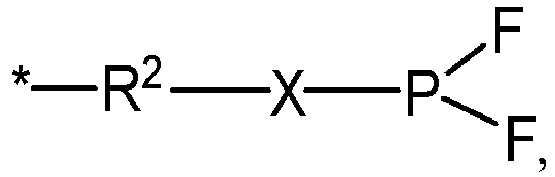
- R2 is selected from the group consisting of a single bond, a substituted or unsubstituted C1-C10 alkylene, and a substituted or unsubstituted C2-C10 unsaturated hydrocarbyl, wherein the substituent, if present, is halogen;
- X is a single bond or an oxygen atom; and
- * indicates a bonding position.
- In some embodiments of the present disclosure, the compound containing (F)2PO-comprises at least one of the following compounds:


- In some embodiments of the present disclosure, based on a total mass of the electrolyte, a mass percentage of the compound containing (F)2PO- in the electrolyte is 0.001% to 5%.
- In some embodiments of the present disclosure, based on a total mass of the electrolyte, the mass percentage of the compound containing (F)2PO- in the electrolyte is 0.1% to 1%.
- In some embodiments of the present disclosure, based on a total mass of the electrolyte, a mass content of the lithium difluorophosphate in the electrolyte is 0.001% to 1%.
- In some embodiments of the present disclosure, based on a total mass of the electrolyte, a mass content of the lithium difluorophosphate in the electrolyte is 0.001% to 0.49%.
- In some embodiments of the present disclosure, the electrolyte further includes a multiple-cyano compound, and the multiple-cyano compound includes at least one of the following compounds:


based on a total mass of the electrolyte, a mass percentage of the multiple-cyano compound in the electrolyte is 0.01% to 10%. - In some embodiments of the present disclosure, the electrolyte further includes a sultone compound, and the sultone compound includes a structure represented by Formula III-A or Formula III-B:

based on a total mass of the electrolyte, a mass percentage of the sultone compound in the electrolyte is 0.01% to 10%. - In some embodiments of the present disclosure, the sultone compound includes at least one of the following compounds:


- In some embodiments of the present disclosure, based on a total mass of the electrolyte , a mass percentage of the sultone compound in the electrolyte is 0.5% to 5%.
- In some embodiments of the present disclosure, the electrolyte further includes a fluoroether compound, and the fluoroether compound is selected from the group consisting of selected from the group consisting of desflurane, sevoflurane, fluroxene, 2,2,2-trifluoroether, bis (fluoromethyl) ether, 2,2,3,3,3-pentafluoropropyl difluoromethyl ether, 2,2-difluoroethyl trifluoromethyl ether, 1,1,2,3,3,3-penta fluoropropyl 2,2,2-trifluoroethyl ether, heptafluoropropyl 1,2,2,2-tetrafluoroethyl ether, trifluoromethyl trifluorovinyl ether, 1,2,2,2-tetrafluoroethyl trifluoromethyl ether, 1,1,2,3,3,3-penta fluoropropyl difluoromethyl ether, 1,2,2-trifluoroethyl trifluoromethyl ether, 2,2,3,3-tetrafluoropropyl difluoromethyl ether, difluoromethyl 2,2,2-trifluoroethyl ether, 1,1-difluorodimethyl ether, trifluoromethyl methyl ether, 1,1,2,2-tetrafluoroethyl ethyl ether, 1,1,2,3,3,3-hexafluoropropyl methyl ether, 1,1,3,3-tetrafluorodimethyl ether, bis(4-fluorobutyl) ether, ethyl trifluoromethyl ether, 2,2,3,3,3-pentafluoropropyl methyl ether, methyl nonafluorobutyl ether, 1,2,2,2-tetrafluoroethyl methyl ether, pentafluorodimethyl ether, 1,1,2,3,3,3-penta fluoropropyl ethyl ether, bis(2,2-difluoroethyl) ether, ethyl perfluorobutyl ether, bis(1,2,2,2-tetrafluoroethyl) ether, 1,1,2,2-tetrafluoroethyl methyl ether, 2-fluoroethyl methyl ether, perfluorobutyl methyl ether, ethyl nonafluorobutyl ether, 2-(perfluoropropoxy)perfluoropropyl trifluorovinyl ether, 1,1,1,3,3,3-hexafluoroisopropyl methyl ether, 2,2,3,3-tetrafluoropropyl-1',1',2',3',3'-hexafluoropropyl ether, perfluorodiglyme, 2,2-difluoroethyl methyl ether, pentafluoroethyl trifluorovinyl ether, heptafluoro-n-propyl trifluorovinyl ether, pentafluoroethyl trifluorovinyl ether, allyl 2,2,3,3-tetrafluoropropyl ether, 2,2,2-trifluoroethyl ethyl ether, perfluoro(3-butenylvinylether), and combinations thereof.
- In some embodiments of the present disclosure, a mass percentage of the fluoroether compound in the electrolyte is 0.1% to 20%, based on a total mass of the electrolyte.
- In some embodiments of the present disclosure, a mass percentage of the fluoroether compound in the electrolyte is 0.5% to 10%, based on a total mass of the electrolyte.
- Another aspect of the present disclosure provides an electrochemical device. The electrochemical device includes a positive electrode, a negative electrode, a separator disposed between the positive electrode and the negative electrode, and the electrode of the present disclosure.
- In some embodiments of the present disclosure, the positive electrode includes a positive current collector and a positive active material layer disposed on the positive current collector, and the positive active material layer comprises a positive active material, a binder and a conductive agent.
- In some embodiments of the present disclosure, the positive active material contains magnesium element, and a content of the magnesium element is m×103 ppm based on a total weight of the positive active material layer, where m is in a range of 0.5 to 2.
- In some embodiments of the present disclosure, a mass percentage of the lithium difluorophosphate in the electrolyte is a %, and a mass percentage of the compound containing (F)2PO- in the electrolyte is b%, based on a total mass of the electrolyte, where (a+b)/m≤1.
- An electronic apparatus, comprising the electrochemical device of the present disclosure.
- The technical solutions provided by present disclosure at least has the following beneficial effects.
- Compared with the related art, the additives of the electrolyte of the present disclosure include lithium difluorophosphate (LiPO2F2) and the compound containing (F)2PO-, which can significantly reduce the resistance and improve a capacitance retention performance of the lithium ion battery during high-temperature storage. Therefore, an electrochemical device containing the electrolyte of the present disclosure has excellent performances in the low temperature environment and the high temperature environment.
- In order to clarify the purposes, technical solutions and advantages of the present disclosure, the technical solutions of the present disclosure is clearly and thoroughly described in combination with the embodiments of the present disclosure. The described embodiments are part of the embodiments rather than all the embodiments of the present disclosure. Based on the technical solutions and the embodiments provided in the present disclosure, all other embodiments obtained by those skilled in the art without paying creative work shall fall within the protection scope of the present disclosure.
- A first aspect of the present disclosure provides an electrolyte including a lithium salt, an organic solvent and an additive. The additive includes lithium difluorophosphate (LiPO2F2) and a compound containing (F)2PO-.
- In the electrolyte of the present disclosure, the compound containing (F)2PO- effects together with LiPO2F2 to reduce a resistance of an electrochemical device at 50% of state of charge and improve a high-temperature storage performance of the electrochemical device. The specific mechanism of such effects is not clear yet, it could be the follows: on the one hand, the combination of the two compounds may promote the increase of a LiF component in an organic protective film, and LiF has good stability, which will reduce further contact between other additives and the active material; and on the other hand, the combination of the two compounds may further enhance an interface stability and reduce a film formation of other additives, thereby reducing the thickness of the organic protective film and reducing the resistance. The LiF, which is rich in organic protective layer, has good stability at high temperature and thus can effectively prevent the side reaction between the active material and the electrolyte at high temperature, thereby improving a capacitance retention performance during high-temperature storage.
- In some embodiments of the present disclosure, the compound containing (F)2PO-is selected from the group consisting of compounds represented by Formula I:

- in which, R1 is selected from the group consisting of a substituted or unsubstituted C1-C10 alkyl and a substituted or unsubstituted C2-C10 unsaturated hydrocarbyl, wherein the substituent, if present, is selected from the group consisting of alkanoyl, cyano, halogen, and combinations thereof; or
- R1 is a group represented by the following formula:

- in which R2 is selected from the group consisting of a single bond, a substituted or unsubstituted C1-C10 alkylene, and a substituted or unsubstituted C2-C10 unsaturated hydrocarbyl, wherein the substituent, if present, is halogen;
- X is a single bond or an oxygen atom; and
- * indicates a bonding position.
- In some embodiments of the present disclosure, the compound containing (F)2PO-includes at least one of the following compounds:


- In some embodiments of the present disclosure, the compound containing (F)2PO-includes at least one of the following compounds:


- In some embodiments of the present disclosure, based on a total mass of the electrolyte, a mass percentage of the compound containing (F)2PO- in the electrolyte is 0.001% to 5%. If the content of the compound containing (F)2PO- in the electrolyte is too low, an efficient composite protective film cannot be formed. In contrast, the compound containing (F)2PO- with a very high content may be not consumed timely, and may be decomposed at high temperature instead of participating in the film formation, thereby adversely influencing the high-temperature storage performance of the electrochemical device. In some embodiments of the present disclosure, based on the total mass of the electrolyte, the mass percentage of the compound containing (F)2PO- in the electrolyte is 0.1% to 1%. The compound containing (F)2PO- having the mass percentage in such a range can form the film with better performances. In the present disclosure, the mass percentage of the compound containing (F)2PO- in the electrolyte is 4%, 3%, 2.5%, 2%, 1.5%, 1%, 0.8%, 0.5%, 0.3%, or in a range defined by any two of these values.
- In some embodiments of the present disclosure, based on the total mass of the electrolyte, a mass content of lithium difluorophosphate in the electrolyte is 0.001% to 1%. In some embodiments of the present disclosure, based on the total mass of the electrolyte, the mass content of lithium difluorophosphate in the electrolyte is 0.001% to 0.49%. A too small content of the lithium difluorophosphate is unfavorable to the formation of the protective film. In contrast, if the content is too high, only a part of lithium difluorophosphate participates in the film formation, while the remaining lithium difluorophosphate may continue to react during storage, which may lead to a deterioration of the high-temperature storage performance.
- In some embodiments of the present disclosure, the electrolyte further includes a multiple-cyano compound.
- In some embodiments of the present disclosure, the multiple-cyano compound includes at least one of the following compounds:


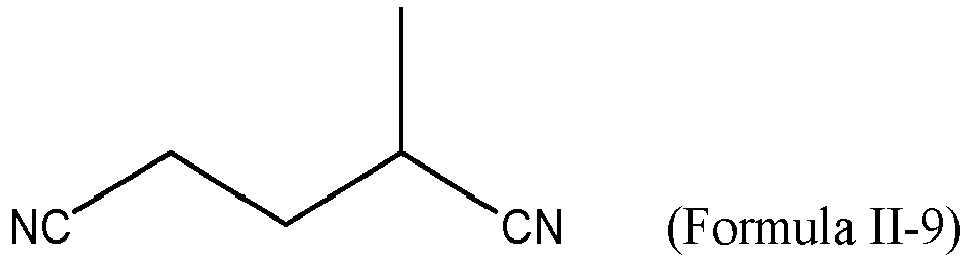

- In some embodiments of the present disclosure, based on the total mass of the electrolyte, a mass percentage of the multiple-cyano compound in the electrolyte is 0.01% to 10%. Lithium difluorophosphate, the compound containing (F)2PO-, and the multiple-cyano compound effect together to further protect the positive active material, reduce the contact between the electrolyte and the positive active material, and further reduce the resistance of the electrochemical device. When the content of the multiple-cyano compound is within the above range, a surface structure of the positive electrode can be effectively protected, without affecting a lithium ion transmission or leading to the deterioration of the resistance performance of the positive electrode. The mass percentage of the multiple-cyano compound in the electrolyte can be 10%, 8%, 7%, 5%, 4% , 3%, 2%, 1%, or in a range defined by any two of these values.
- In some embodiments of the present disclosure, the electrolyte further includes a sultone compound.
- In some embodiments of the present disclosure, the sultone compound includes a compound represented by Formula III-A, a compound represented by Formula III-B, or a combination thereof:

- In some embodiments of the present disclosure, the sultone compound has a structure represented by any one of the following formulas:


- In some embodiments of the present disclosure, based on the total mass of the electrolyte, a mass percentage of the sultone compound in the electrolyte is 0.01% to 10%. In some embodiments of the present disclosure, based on the total mass of the electrolyte, the mass percentage of the sultone compound in the electrolyte is 0.5% to 5%. Lithium difluorophosphate, the compound containing (F)2PO-, and the sultone compound effect together to form films on both the positive and negative electrodes, thereby improving high temperature performance of interface protective films of the positive and negative electrodes. When the content of the sultone compound is within the range, a better film formation effect is achieved. In some embodiments of the present disclosure, the mass percentage of the sultone compound in the electrolyte can be 10%, 8%, 7%, 5%, 4%, 3%, 2%, 1%, 0.8%, or in a range defined by any two of these values.
- In some embodiments of the present disclosure, the electrolyte further includes a fluoroether compound. Lithium difluorophosphate, the compound containing (F)2PO- and the fluoroether compound effect together to improve a voltage resistance of the electrolyte. In some embodiments of the present disclosure, the fluoroether compound is selected from the group consisting of desflurane, sevoflurane, fluroxene, 2,2,2-trifluoroether, bis (fluoromethyl) ether, 2,2,3,3,3-pentafluoropropyl difluoromethyl ether, 2,2-difluoroethyl trifluoromethyl ether, 1,1,2,3,3,3-penta fluoropropyl 2,2,2-trifluoroethyl ether, heptafluoropropyl 1,2,2,2-tetrafluoroethyl ether, trifluoromethyl trifluorovinyl ether, 1,2,2,2-tetrafluoroethyl trifluoromethyl ether, 1,1,2,3,3,3-penta fluoropropyl difluoromethyl ether, 1,2,2-trifluoroethyl trifluoromethyl ether, 2,2,3,3-tetrafluoropropyl difluoromethyl ether, difluoromethyl 2,2,2-trifluoroethyl ether, 1,1-difluorodimethyl ether, trifluoromethyl methyl ether, 1,1,2,2-tetrafluoroethyl ethyl ether, 1,1,2,3,3,3-hexafluoropropyl methyl ether, 1,1,3,3-tetrafluorodimethyl ether, bis(4-fluorobutyl) ether, ethyl trifluoromethyl ether, 2,2,3,3,3-pentafluoropropyl methyl ether, methyl nonafluorobutyl ether, 1,2,2,2-tetrafluoroethyl methyl ether, pentafluorodimethyl ether, 1,1,2,3,3,3-penta fluoropropyl ethyl ether, bis(2,2-difluoroethyl) ether, ethyl perfluorobutyl ether, bis(1,2,2,2-tetrafluoroethyl) ether, 1,1,2,2-tetrafluoroethyl methyl ether, 2-fluoroethyl methyl ether, perfluorobutyl methyl ether, ethyl nonafluorobutyl ether, 2-(perfluoropropoxy)perfluoropropyl trifluorovinyl ether, 1,1,1,3,3,3-hexafluoroisopropyl methyl ether, 2,2,3,3-tetrafluoropropyl-1',1',2',3',3'-hexafluoropropyl ether, perfluorodiglyme, 2,2-difluoroethyl methyl ether, pentafluoroethyl trifluorovinyl ether, heptafluoro-n-propyl trifluorovinyl ether, pentafluoroethyl trifluorovinyl ether, allyl 2,2,3,3-tetrafluoropropyl ether, 2,2,2-trifluoroethyl ethyl ether, perfluoro(3-butenylvinylether), and combinations thereof.
- In some embodiments of the present disclosure, based on the total mass of the electrolyte, a mass percentage of the fluoroether compound in the electrolyte is 0.1% to 20%. In some embodiments of the present disclosure, based on the total mass of the electrolyte, the mass percentage of the fluoroether compound in the electrolyte is 0.5% to 10%. As the fluoroether compound contains a relatively large number of fluorine atoms, it may hinder the transmission of lithium ions in the electrolyte with an increasing content of fluorine atoms, so as to increase a polarization of the electrolyte. The increase in polarization then causes interface lithium precipitation during a charging process, which may lead to a deterioration of the performances of the electrochemical device. In some embodiments of the present disclosure, the mass percentage of the fluoroether compound in the electrolyte can be 20%, 15%, 10%, 5%, 4%, 3%, 2%, 1%, , or in a range defined by any two of these values.
- In the present disclosure, the lithium salt is selected from the lithium salts that are commonly used in the related art. For example, the lithium salt is selected from the group consisting of LiPF6, lithium bis(trifluoromethanesulphonyl)imide (LiTFSI), lithium bis(fluorosulfonyl)imide (LiFSI), lithium bis(oxalate)borate (LiBOB), lithium difluoro(oxalato)borate (LiDFOB), lithium tetrafluorooxalatophosphate (LiPF4C2O4), lithium difluorobis(oxalato)phosphate (LiPF2(C2O4)2), lithium hexafluorophosphate (LiCsF6), and combinations thereof. When LiPF6 and other lithium salt are both used as the lithium salt, a mass percentage of LiPF6 in the lithium salt is greater than 50%.
- In the present disclosure, a concentration of the lithium salt in the electrolyte is 0.5 mol/L to 2 mol/L.
- In the present disclosure, solvent is non proton organic solvent. In some embodiments of the present disclosure, the organic solvent includes at least one of a cyclic carbonate, a chain carbonate, a chain carboxylate, and a cyclic carboxylate. For example, the carbonate may be dimethyl carbonate (DMC), diethyl carbonate (DEC), dipropyl carbonate (DPC), methyl propyl carbonate (MPC), ethyl propyl carbonate (EPC), ethyl methyl carbonate (MEC), ethylene carbonate (EC), propylene carbonate (PC), butylene carbonate (BC), etc. The carboxylate may be, for example, methyl formate, ethyl formate, methyl acetate, ethyl acetate, n-propyl acetate, 1,1-dimethyl ethyl acetate, methyl propionate, ethyl propionate, methyl n-butyrate, propyl propionate, γ-butyrolactone, decalactone, valerolactone, mevalonolactone, caprolactone, etc.
- In some embodiments of the present disclosure, the electrolyte further includes an ether solvent, a phosphorus-containing organic solvent, an aromatic fluorine-containing solvent, a ketone-based solvent, an alcohol-based solvent, or an aprotic solvent. The organic solvent may be used individually, or in a mixture. When a mixture of organic solvents is used, the mixing ratio is controlled according to the desired performances of the electrochemical device.
- In some embodiments, the ether solvent may be a cyclic ether compound, including, but not limited to, tetrahydrofuran, 2-methyltetrahydrofuran, 1,3-dioxolane, 2-methyl-1,3-dioxolane, 4-methyl-1,3-dioxolane, 1,3-dioxane, 1,4-dioxane and dimethoxypropane. In some embodiments, based on the total mass of the electrolyte, a mass percentage of the cyclic ether in the electrolyte is greater than or equal to 0.1%. In some embodiments, based on the total mass of the electrolyte, the mass percentage of the cyclic ether in the electrolyte is greater than or equal 0.5%. In some embodiments, based on the total mass of the electrolyte, the mass percentage of the cyclic ether in the electrolyte is greater than or equal 2%. In some embodiments, based on the total mass of the electrolyte, the mass percentage of the cyclic ether in the electrolyte is smaller than or equal to 5%.
- In some embodiments, the ether solvent is a chain ether compound, including, but not limited to, dimethoxymethane, 1,1-dimethoxyethane, 1,2-dimethoxyethane, diethoxymethane, 1,1-diethoxyethane, 1,2-diethoxyethane, ethoxymethoxymethane, 1,1-ethoxymethoxyethane and 1,2-ethoxymethoxyethane. In some embodiments, based on the total mass of the electrolyte, a mass percentage of the chain ether compound in the electrolyte is greater than 0.1%. In some embodiments, based on the total mass of the electrolyte, the mass percentage of the chain ether compound in the electrolyte is greater than or equal to 0.5%. In some embodiments, based on the total mass of the electrolyte, the mass percentage of the chain ether compound in the electrolyte is greater than or equal to 2%. In some embodiments based on the total mass of the electrolyte, the mass percentage of the chain ether compound in the electrolyte is greater than or equal to 3%. In some embodiments, based on the total mass of the electrolyte, the mass percentage of the chain ether compound in the electrolyte is smaller than or equal to 30%.
- In some embodiments, the phosphorous-containing organic solvent includes, but is not limited to, trimethyl phosphate, triethyl phosphate, dimethyl ethyl phosphate, methyl diethyl phosphate, ethylene methyl phosphate, ethylene ethyl phosphate, triphenyl phosphate, trimethyl phosphite, triethyl phosphite, triphenyl phosphite, tris(2,2,2-trifluoroethyl) phosphate and tris(2,2,3,3,3-(pentafluoropropyl) phosphate. In some embodiments, based on the total mass of the electrolyte, a mass percentage of the phosphorous-containing organic solvent in the electrolyte is greater than or equal to 0.1%. In some embodiments, based on the total mass of the electrolyte, the mass percentage of the phosphorous-containing organic solvent in the electrolyte is greater than or equal to 0.5%. In some embodiments, based on the total mass of the electrolyte, the mass percentage of the phosphorous-containing organic solvent in the electrolyte is greater than or equal to 2%. In some embodiments, based on the total mass of the electrolyte, the mass percentage of the phosphorous-containing organic solvent in the electrolyte is greater than or equal to 3%. In some embodiments, based on the total mass of the electrolyte, the mass percentage of the phosphorous-containing organic solvent in the electrolyte is smaller than or equal to 8%.
- In some embodiments, the aromatic fluorine-containing solvent includes, but is not limited to, fluorobenzene, difluorobenzene, trifluorobenzene, tetrafluorobenzene, pentafluorobenzene, hexafluorobenzene and trifluoromethylbenzene. In some embodiments, based on the total mass of the electrolyte, a mass percentage of the aromatic fluorine-containing solvent in the electrolyte is greater than or equal to 0.1%. In some embodiments, based on the total mass of the electrolyte, the mass percentage of the aromatic fluorine-containing solvent in the electrolyte is greater than or equal to 0.5%. In some embodiments, based on the total mass of the electrolyte, the mass percentage of the aromatic fluorine-containing solvent in the electrolyte is greater than or equal to 2%. In some embodiments, based on the total mass of the electrolyte, the mass percentage of the aromatic fluorine-containing solvent in the electrolyte is greater than or equal to 4%. In some embodiments, based on the total mass of the electrolyte, the mass percentage of the aromatic fluorine-containing solvent in the electrolyte is smaller than or equal to 8%.
- Examples of the ketone-based solvent include cyclohexanone and the like.
- Examples of the alcohol-based solvent include ethanol, isopropanol, etc. Examples of the aprotic solvent include mononitrile such as R-CN (where R is C2-C20 straight chain hydrocarbyl, branched chain hydrocarbyl or cyclic hydrocarbyl, which may include a double bond, an aromatic ring or an ether bond), amide such as dimethylformamide, dioxolane such as 1,3-dioxolane, sulfolane, etc.
- Another aspect of the present disclosure provides an electrochemical device including a positive electrode, a negative electrode, a separator disposed between the positive electrode and the negative electrode, and the electrolyte of the present disclosure.
- In the electrochemical device, the positive electrode includes a positive current collector and a positive active material layer disposed on the positive current collector. The positive active material layer includes a positive active material, a binder and a conductive agent. The positive active material includes a compound that can reversibly intercalate and deintercalate lithium ions. The positive active material can be a composite oxide, which contains lithium and at least one element of cobalt, manganese, or nickel. The positive active material is not limited to a specific type and may be selected according to the requirements. The positive active material may be selected from the group consisting of LiCoO2 (LCO), a lithium nickel manganese cobalt ternary material (NCM), lithium iron phosphate, lithium manganite, or combinations thereof. These positive active materials may be used individually or in any combinations.
- In some embodiments, the positive active material contains magnesium (Mg) element. A content of magnesium (Mg) is m×103ppm, based on a total weight of the positive active material layer, where m is in a range of 0.5 to 2. A mass percentage of the lithium difluorophosphate in the electrolyte is denoted as a%, and a mass percentage of the compound containing (F)2PO- in the electrolyte is denoted as b%, where (a+b)/m≤1.
- In some embodiments, m can be 0.5, 0.7, 0.9, 1.1, 1.3, 1.5, 1.7, 1.9, 2, or in a range defined by any two of these values.
- In some embodiments, (a+b)/m can be 1, 0.8, 0.6, 0.4, 0.2, 0.1, 0.005, or in a range defined by any two of these values.
- The positive active material may have a coating layer on its surface, or be mixed with another compound with a coating layer. The coating layer may include a coating element compound selected from at least one of oxide of a coating element, hydroxide of a coating element, oxyhydroxide of a coating element, oxycarbonate of a coating element, or hydroxycarbonate of a coating element. The compound used for the coating layer may be amorphous or crystalline. The coating element contained in the coating layer may include Mg, Al, Co, K, Na, Ca, Si, Ti, V, Sn, Ge, Ga, B, As, Zr, or combinations thereof. The coating layer may be applied with any method, as long as the method does not adversely affect the performance of the positive active material. For example, the method may be a coating method known for those skilled in the art, such as spray coating, dip coating, etc.
- The binder functions to improve a bonding between positive active material particles, as well as to improve a bonding between the positive active material and the current collector. For example, the binder can be, but not limited to, polyvinyl alcohol, hydroxypropyl cellulose, diacetyl cellulose, polyvinyl chloride, carboxylated polyvinyl chloride, polyvinyl fluoride, ethyleneoxy-containing polymer, polyvinylpyrrolidone, polyurethane, polytetrafluoroethylene, polyvinylidene fluoride, polyethylene, polypropylene, styrene-butadiene rubber, acrylic (acrylated) styrene-butadiene rubber, epoxy resin, nylon, etc.
- The included conductive agent imparts the electrode with conductivity. The conductive agent may include any conductive material as long as it does not cause chemical changes. Examples of the conductive material include, but not limited to, carbon-based materials such as natural graphite, artificial graphite, carbon black, acetylene black, Ketjen black, carbon fiber, etc.; metal-based materials such as metal powder, metal fibers, etc., for example, including copper, nickel, aluminum, silver, etc.; conductive polymers such as polyphenylene derivatives; and mixtures thereof.
- The current collector may be aluminum (Al), but is not limited thereto.
- The negative electrode includes a current collector and a negative active material layer disposed on the current collector. The negative active material layer includes a negative active material. The negative active material is not limited to a specific type and can be selected according to the requirements. For example, the negative active material is selected from the group consisting of natural graphite, artificial graphite, mesophase carbon microball (MCMB), hard carbon, soft carbon, silicon, silicon-carbon composite, Li-Sn alloy, Li-Sn-O alloy, Sn, SnO, SnO2, spinel lithiated TiO2-Li4Ti5O12, Li-Al alloy, or a combination thereof. Non-limiting examples of the carbon materials include crystalline carbon, amorphous carbon, or mixtures thereof. The crystalline carbon may be amorphous, sheet-shaped, platelet-shaped, spherical, or fibrous natural graphite or artificial graphite. The amorphous carbon may be mesophase pitch carbide, calcined coke, etc.
- The negative active material layer may further include a binder, and optionally include a conductive material. The binder functions to improve a bonding between particles of the negative active material, and also to improve a bonding between the negative active material and the current collector. Examples of the binder include, but not limited to, polyvinyl alcohol, hydroxymethyl cellulose, hydroxypropyl cellulose, diacetyl cellulose, polyvinyl chloride, carboxylated polyvinyl chloride, polyvinyl fluoride, ethyleneoxy-containing polymer, polyvinylpyrrolidone, polyurethane, polytetrafluoroethylene, polyvinylidene fluoride, polyethylene, polypropylene, styrene-butadiene rubber, acrylic (acrylated) styrene-butadiene rubber, epoxy resin, nylon, etc.
- The included conductive material imparts the electrode with conductivity. The conductive material may include any conductive material as long as it does not cause chemical changes. Examples of the conductive material include, but not limited to, carbon-based materials such as natural graphite, artificial graphite, carbon black, acetylene black, Ketjen black, carbon fiber, etc.; metal-based materials such as metal powder, metal fibers, etc., for example, including copper, nickel, aluminum, silver, etc.; conductive polymers such as polyphenylene derivatives; and mixtures thereof.
- The current collector may be selected from the group consisting of a copper foil, a nickel foil, a stainless steel foil, a titanium foil, a nickel foam, copper foam, a polymer substrate covered with conductive metal, and combinations thereof.
- In some embodiments, the electrochemical device of the present disclosure is provided with a separator disposed between the positive electrode and the negative electrode, in order to prevent short circuit. The material and shape of the separator used in the electrochemical device of the present disclosure are not particularly limited, and may be any known in the prior art. In some embodiments, the separator includes polymers or inorganic materials formed from materials that are stable to the electrolyte of the present disclosure.
- For example, the separator may include a substrate layer and a surface treatment layer. The substrate layer is a non-woven fabric, a film or a composite film that have a porous structure, and the material of the substrate layer is selected from the group consisting of polyethylene, polypropylene, polyethylene glycol terephthalate, polyimide, and combinations thereof. For example, a porous polypropylene film, a porous polyethylene film, a polypropylene non-woven fabric, a polyethylene non-woven fabric or a porous polypropylene-polyethylene-polypropylene composite film can be selected.
- The surface treatment layer is provided on at least one surface of the substrate layer. The surface treatment layer may be a polymer layer or an inorganic material layer, or a layer formed by mixing a polymer and an inorganic material.
- The inorganic material layer may include inorganic particles and a binder. The inorganic particles may be selected from the group consisting of alumina, silica, magnesium oxide, titanium oxide, hafnium dioxide, tin oxide, cerium dioxide, nickel oxide, zinc oxide, calcium oxide, zirconium oxide, yttrium oxide, silicon carbide, boehmite, aluminum hydroxide, magnesium hydroxide, calcium hydroxide, barium sulfate, and combinations thereof. The binder may be selected from the group consisting of polyvinylidene fluoride, vinylidene fluoride-hexafluoropropylene copolymer, polyamide, polyacrylonitrile, polyacrylate ester, polyacrylic acid, polyacrylate salt, polyvinylpyrrolidone, polyvinyl ether, polymethyl methacrylate, polytetrafluoroethylene, polyhexafluoropropylene, and combinations thereof.
- The polymer layer contains a polymer that may be selected from the group consisting of polyamide, polyacrylonitrile, acrylate polymer, polyacrylic acid, polyacrylate salt, polyvinylpyrrolidone, polyvinyl ether, polyvinylidene fluoride, poly(vinylidene fluoride-hexafluoropropylene), and combinations thereof.
- The technical solutions of the present disclosure are descried below in combination with specific examples.
- 1) Preparation of electrolyte: in an argon atmosphere glove box with a water content of <10ppm, ethylene carbonate (EC), diethyl carbonate (DEC), and propylene carbonate (PC) were mixed uniformly in a mass ratio of 2: 6: 2, and fully dried lithium salt LiPF6 was dissolved in the above solvent until the content of LiPF6 was12.5%. This electrolyte is described as a basic electrolyte.
- As shown in Table 1, a compound represented by Formula I and LiPO2F2 or a SEI film-forming additive were added to the basic electrolyte.
- Examples of the compound represented by Formula I are listed as follows:


- Examples of the multiple-cyano compound are listed as follows:


- Examples of the sultone compound are listed as follows:

- Examples of the fluoroether compound are listed as follows: 1,1,2,2-tetrafluoroethyl-2,2,3,3-tetrafluoropropyl ether, and 2,2-difluoroethyl trifluoromethyl ether.
-
- 2) Preparation of positive active material
The content of Mg element was 1000ppm, for example. Commercially purchased CoCl2 and MgCl2 were prepared into aqueous solutions, respectively, and then the aqueous solutions were mixed according to an active material molar ratio of 1: m, where 0≤m≤0.004027. NH3.HCO3 solution was added to adjust a pH value of the mixture to about 10.5, so as to obtain a precipitate. The obtained precipitate was calcined at 400°C for 5h to obtain Mg element-containing CO3O4. The obtained CO3O4 and Li2CO3 were mixed uniformly in a molar ratio of 2: 3.15, and then calcined at a temperature of 1000°C for 8h to obtain LiCoO2. The obtained LiCoO2 was added to MgO in a molar ratio of 1: (0.004027-m) and mixed uniformly, and the mixture was sintered at 800°C for 8h to obtain a final positive active material lithium cobaltate (molecular formula: LiCoO2) containing Mg element. The positive active material lithium cobaltate contains Mg element,unless otherwise noted, in the following examples and comparative examples, the content of Mg element is 1000 ppm based on the total weight of the positive active material layer. - 3) Preparation of positive electrode: the positive active material lithium cobaltate (molecular formula: LiCoO2), a conductive agent acetylene black, and a binder polyvinylidene fluoride (PVDF) were thoroughly stirred and mixed in a weight ratio of 96: 2: 2 in an appropriate amount of N-methylpyrrolidone (NMP) solvent to form a uniform positive electrode slurry. This slurry was coated on an aluminum foil, as a positive electrode current collector, then dried, and cold pressed to obtain a positive active material layer. Then, after cutting and tab welding, a positive electrode was obtained.
- 4) Preparation of negative electrode: a negative active material graphite, a conductive agent acetylene black, a binder styrene-butadiene rubber (SBR), and a thickener sodium carboxymethyl cellulose (CMC) were thoroughly stirred and mixed in a weight ratio of 95: 2: 2: 1 in an appropriate amount of deionized water solvent, so as to form a uniform negative electrode slurry. The slurry was coated on a copper foil, as a negative current collector, then dried, and cold-pressed to obtain a negative active material layer. Then, after cutting and tab welding, a negative electrode was obtained.
- 5) Separator: a porous PE polymer film was used as the separator.
- 6) Preparation of lithium ion batteries: the positive electrode, the separator, and the negative electrode were stacked in such a manner that the separator was located between the positive electrode and the negative electrode to play a role of isolation, then wound and placed in an outer packaging foil. The battery was then dried and injected with the prepared electrolyte. Then, the battery was then vacuum sealed, after standing, formation and shaping, the preparation of the lithium-ion battery was finished.
- At 25°C, the battery was discharged with a current of 0.5C to 3.0V, rested for 5 minutes, and then charged to 4.45V with a current of 0.5C, and to 0.025C under a constant voltage 4.45V After 5 minutes of inactivity, the battery was discharged to 3.4V with a current of 0.1C, and the released capacitance was recorded as Ci. The battery was charged to 4.45V with a capacitance of 0.5Ci, then to 0.025Ci under a constant voltage 4.45V, rested for 5 minutes, and discharged with a current of 0.1C1 for 5h, and the voltage of the battery at this time was recorded as Vi. Then, the battery was discharged with a current of 1C for 1 second, and the voltage at the end of the discharge was recorded as V2. The resistance at 50% SOC was calculated according to a calculation formula: (V1-V2)/(1C-0.1C1).
- At 25°C, the battery was discharged to 3.0 V with a current of 0.5C, rested for 5min, then charged to 4.45V with a current of 0.5C, charged to 0.025C under a constant voltage of 4.45V, rested for 5min, and then discharged to 3.0V with a current of 0.5C, and the capacitance released at this time was recorded as Ci. The battery was charged to 4.45V with a current of 0.5C, then charged to 0.025C under a constant voltage of 4.45V, placed in a 70°C oven and stored at 70°C for 24h. After 24 hours, the battery was taken out and discharged at a current of 0.5C to 3.0V at a temperature of 25°C, and the discharged capacitance was recorded as C2. The capacitance retention rate after storage at 70°C for 24h was calculated according to a calculation formula: (C2/C1) × 100%.
- At 25°C, the battery was discharged to 3.0V with a current of 0.5C, rested for 5min, then charged to 4.45V with a current of 0.5C, and then charged to 0.05C under a constant voltage of 4.45V Then, the battery was placed in a high temperature box which was heated to 130°C with a rate of 5±2°C/min, and was kept at a constant temperature of 130°C for 60 minutes. If the fire breaking and explosion of the battery did not occur, then it was recorded as passed. 10 lithium-ion batteries were tested, and the number of batteries passing the test was recorded.
- At 45°C, the battery was discharged to 3.0V with a current of 0.5C, rested for 5min, then charged to 4.45V with a current of 0.5C, and then charged to 0.05C under a constant voltage of 4.45V, which was one cycle. Such a charging and discharging process was repeated 800 times at the temperature of 45°C. The capacitance discharged in the first cycle was recorded as Ci, the capacitance discharged in the 500th cycle was recorded as C500, and the capacitance retention rate was calculated according to a calculation formula: (C1/C500) × 100%.
- The battery was discharged to 2.8V with a current of 0.5C, rested for 5 minutes, discharged with a current of 0.05C to 2.8V, rested for 5 minutes, discharged with 0.01C to 2.8V, rested for 5 minutes, and discharged three times with a current of 0.01C. The battery was disassembled by hands wearing clean gloves, and the positive electrode and the negative electrode were carefully separated from each other until they had no mutual contact. In a glove box, the positive electrode was soaked in high-purity dimethyl carbonate (DMC, purity ≥ 99.99%) for 10 minutes, and then taken out and air dried for 30 minutes. Amount of DMC was greater than 15mL/1540mm2 of disc area. In the dry environment, a ceramic spatula was used to scrape powder of more than 0.4g and then the powder was wrapped with a weighing paper. The powder was weighed by using an electronic balance with an accuracy of 0.0001g, and recorded as a sample weight: d, where d≤0.4g. Then, the powder was slowly added in a digestion tank containing 10mL of aqua regia, which was formed by the concentrated nitric acid and the concentrated hydrochloric acid in a mass ratio of 1: 1, the sample attached on the inner wall was flushed to the bottom of the tank, and the digestion tank was gently shaken. The water droplets outside the digestion tank were wiped off with dust-free paper, and the digestion device was assembled and placed in a microwave digestion apparatus for digestion. The digestion tank was disassembled, the lid was rinsed with ultrapure water 2-3 times, and the rinse solution was poured into the digestion tank. The sample solution was slowly shaken, and slowly poured into a volumetric flask through a funnel, and the digestion tank was rinsed 3 times to a volume of 100ml and homogenously shaken. The sample was tested with a plasma emission spectrometer (ICP) using the standard curve method. The concentration of the test sample was recorded as ρ2g/ml. The content of Mg element was calculated as: (ρ2×100)/d.
- The electrolytes and lithium ion batteries of Examples 1.1-1.33 and Comparative Examples 1.1-1.3 were prepared according to the above preparation methods; and the additives in the electrolytes and their respective addition amounts are shown in Table 1.
Table 1: Examples 1.1-1.33 and Comparative Examples 1.1-1.3 Examples Compound represented by Formula I (%) LiPO2F2 (%) 50%SOC DCR(mΩ) 70°C-24h Capacitance retention rate (%) I-1 I-7 I-8 Example 1.1 0.1 - - 0.2 60.0 87.90% Example 1.2 0.3 - - 0.2 57.0 88.60% Example 1.3 0.5 - - 0.2 56.8 88.70% Example 1.4 1 - - 0.2 57.1 88.70% Example 1.5 2 - - 0.2 57.0 88.70% Example 1.6 3 - - 0.2 57.2 88.80% Example 1.7 5 - - 0.2 57.3 88.80% Example 1.8 - 0.1 - 0.2 59.9 88.00% Example 1.9 - 0.3 - 0.2 56.9 88.70% Example 1.10 - 0.5 - 0.2 56.7 88.80% Example 1.11 - 1 - 0.2 57.0 88.80% Example 1.12 - 2 - 0.2 56.9 88.80% Example 1.13 - 3 - 0.2 57.1 88.90% Example 1.14 - 5 - 0.2 57.2 88.90% Example 1.15 - - 0.001 0.2 61.1 87.00% Example 1.16 - - 0.05 0.2 60.1 87.80% Example 1.17 - - 0.1 0.2 59.9 88.10% Example 1.18 - - 0.3 0.2 56.9 88.80% Example 1.19 - - 0.5 0.2 56.7 88.90% Example 1.20 - - 1 0.2 57.0 89.00% Example 1.21 - - 2 0.2 56.9 89.00% Example 1.22 - - 3 0.2 57.1 89.00% Example 1.23 - - 5 0.2 57.2 89.10% Example 1.24 - - 0.3 0.001 60.0 87.00% Example 1.25 - - 0.3 0.01 59.0 87.60% Example 1.26 - - 0.3 0.05 58.5 87.90% Example 1.27 - - 0.3 0.1 58.0 88.00% Example 1.28 - - 0.3 0.15 57.2 88.60% Example 1.29 - - 0.3 0.3 56.0 91.00% Example 1.30 - - 0.3 0.5 56.2 90.10% Example 1.31 - - 0.3 0.7 56.3 90.10% Example 1.32 - - 0.3 0.8 56.3 90.20% Example 1.33 - - 0.3 1 56.2 90.20% Comparative Example 1.1 - - - - 75.0 78.10% Comparative Example 1.2 - - 0.3 - 70.0 82.70% Comparative Example 1.3 - - - 0.3 69.2 83.40% - It can be seen from Examples 1.1-1.22 that the compounds I-1, I-7, and 1-8 have a significant effect on reducing of the resistance and increasing the storage capacitance retention rate. Regarding Examples 1.22-1.33, it can be seen that with an increase in the content of LiPO2F2, the resistance (DCR) is significantly reduced, and the storage capacitance retention rate is significantly increased. Through a comparison analysis between Examples 1.1-1.33 and Comparative Examples 1.1-1.3, the simultaneous addition of the compound represented by Formula I and LiPO2F2 can reduce the resistance of the battery, and significantly improve the storage capacitance retention rate.
- The multiple-cyano compound has the effect of enhancing the interfacial stability of the positive electrode. The LiF component formed by the compound containing (F)2PO- and LiPO2F2 reduces the contact between the active material and the electrolyte, but has a relatively weak effect on the dissolution of the transition metal. The multiple-cyano compound stabilizes the transition metal of the positive electrode through adsorption effect, and thus has a significant effect on reducing the dissolution of high-valent transition metals. The combination of these two compounds will further reduce the side reactions at high temperature and pressure, and further enhance the storage capacitance retention rate of the battery. Such effects can be demonstrated by the examples listed in Table 2.
Table 2: Example 1.29 and Examples 2.1-2.24 Example I-8 (%) LiPO2F2 (%) Multiple-cyano compound (%) 70°C-24h Capacitance retention rate (%) II-2 II-3 II-7 II-10 Example 1.29 0.3 0.3 - - - - 91.00% Example 2.1 0.3 0.3 0.5 - - - 91.50% Example 2.2 0.3 0.3 1 - - - 92.00% Example 2.3 0.3 0.3 3 - - - 93.00% Example 2.4 0.3 0.3 5 - - - 93.30% Example 2.5 0.3 0.3 7 - - - 93.40% Example 2.6 0.3 0.3 10 - - - 93.50% Example 2.7 0.3 0.3 - 0.01 - - 91.20% Example 2.8 0.3 0.3 - 0.5 - - 91.70% Example 2.9 0.3 0.3 - 1 - - 92.50% Example 2.10 0.3 0.3 - 3 - - 93.40% Example 2.11 0.3 0.3 - 5 - - 93.70% Example 2.12 0.3 0.3 - 7 - - 93.80% Example 2.13 0.3 0.3 - 10 - - 93.90% Example 2.14 0.3 0.3 - - 0.5 - 92.00% Example 2.15 0.3 0.3 - - 1 - 93.00% Example 2.16 0.3 0.3 - - 2 - 93.50% Example 2.17 0.3 0.3 - - - 0.5 92.30% Example 2.18 0.3 0.3 - - - 1 93.10% Example 2.19 0.3 0.3 - - - 2 93.80% Example 2.20 0.3 0.3 - - - 3 94.00% Example 2.21 0.2 0.3 3 - - - 92.90% Example 2.22 0.1 0.2 - 3 - - 89.80% Example 2.23 0.2 0.4 - 1 - 91.80% Example 2.24 0.3 0.2 - - 3 92.80% - According to a comparison analysis of Example 1.29 and Examples 2.1-2.24, it is obvious that the solution of the electrolyte is further improved by adding the multiple-cyano compound, and the storage capacitance retention rate is further enhanced.
- The compound containing (F)2PO-, LiPO2F2 and the sultone compound functions together. The sultone compound can form an organic protective film containing organic sulfuric acid through a ring-opening reaction in the battery. The protective film has excellent high-temperature resistance and can further transform and increase the LiS and lithium sulfonate components in the organic protective film at high temperatures. In this way, the storage capacitance retention rate and the hot box performance of the battery can be enhanced at the same time, as demonstrated by the examples listed in Table 3.
Table 3: Example 1.29 and Examples 3.1-3.22 Example I-8 (%) LiPO2F2 (%) Sultone compound (%) 70°C-24h Capacitance retention rate The number of batteries that have passed the hot box test III-1 III-4 III-6 III-7 (%) Example 1.29 0.3 0.3 - - - - 91.00% 8 Example 3.1 0.3 0.3 0.5 - - - 92.00% 10 Example 3.2 0.3 0.3 1 - - - 92.50% 10 Example 3.3 0.3 0.3 3 - - - 92.70% 10 Example 3.4 0.3 0.3 5 - - - 92.80% 10 Example 3.5 0.3 0.3 7 - - - 92.90% 10 Example 3.6 0.3 0.3 10 - - - 93.00% 10 Example 3.7 0.3 0.3 - 0.5 - - 92.10% 10 Example 3.8 0.3 0.3 - 1 - - 92.70% 10 Example 3.9 0.3 0.3 - 3 - - 92.90% 10 Example 3.10 0.3 0.3 - 5 - - 93.00% 10 Example 3.11 0.3 0.3 - 7 - - 93.10% 10 Example 3.12 0.3 0.3 10 - - 93.20% 10 Example 3.13 0.3 0.3 - - 0.5 - 92.50% 10 Example 3.14 0.3 0.3 - - 1 - 93.00% 10 Example 3.15 0.3 0.3 - - 3 - 93.20% 10 Example 3.16 0.3 0.3 - - - 0.5 92.40% 10 Example 3.17 0.3 0.3 - - - 1 93.00% 10 Example 3.18 0.3 0.3 - - - 3 93.10% 10 Example 3.19 0.2 0.3 3 - - - 92.50% 10 Example 3.20 0.1 0.2 3 - - 89.20% 10 Example 3.21 0.2 0.4 - - 1 - 92.80% 10 Example 3.22 0.3 0.2 - - - 1 90.10% 10 - By comparing Example 1.29 with Examples 31-3.22, it can be found that addition of the sultone compound can significantly improve the hot box pass rate, and the capacitance retention rate is further enhanced after the sultone compound was added.
- The compound containing (F)2PO-, LiPO2F2 and a fluoroether compound can effect together to improve the oxidation resistance of the electrolyte. During a long-term high temperature and high pressure cycle test, the oxidative decomposition of the electrolyte was reduced, and the by-products such as HF, which are generated due to the decomposition of the electrolyte, were also reduced. Therefore, the damages of the by-products to the active material and the organic protective film are reduced. The LiF-rich protective film, which is formed in combination with I and LiPO2F2, has a dual protection effect on improving the high-temperature cycle performance of the battery, as demonstrated through the examples listed in Table 4.
Table 4: Example 1.29 and Examples 4.1-4.14 Example I-8 (%) LiPO2F2 (%) Fluorine-containing ether (%) 70°C-24h Capacitance retention rate (%) 45°C-500 els 1,1,2,2-tetrafluoroethyl-2,2,3,3-tetrafluoropropyl ether ethane,1,1-difluoro-2-(trifluoromethoxy)- Example 1.29 0.3 0.3 - - 91.00% 85.40% Example 4.1 0.3 0.3 1 - 91.40% 86.80% Example 4.2 0.3 0.3 5 - 91.50% 88.80% Example 4.3 0.3 0.3 10 - 91.60% 88.90% Example 4.4 0.3 0.3 15 - 91.70% 88.90% Example 4.5 0.3 0.3 20 - 91.80% 89.00% Example 4.6 0.3 0.3 - 1 91.20% 86.90% Example 4.7 0.3 0.3 - 5 91.30% 88.90% Example 4.8 0.3 0.3 - 10 91.50% 89.00% Example 4.9 0.3 0.3 - 15 91.60% 89.10% Example 4.10 0.3 0.3 - 20 91.70% 89.20% Example 4.11 0.2 0.3 5 - 91.00% 88.60% Example 4.12 0.1 0.2 5 - 90.00% 88.20% Example 4.13 0.2 0.4 - 5 91.30% 88.80% Example 4.14 0.3 0.2 - 5 91.20% 88.50% - With reference to Example 1.29 and Examples 4.1-4.14, it can be seen that addition of the fluoroether compound significantly improves the cycle capacitance retention rate of the battery at 45°C.
- Magnesium (Mg) element in the positive electrode material may occupy the lattice of the positive electrode material and has effect on maintaining the stability of the positive electrode material. In a delithium state of the positive electrode, the crystal lattice of the lithium cobaltate may change, which reduces the stability, and the crystal lattice is not as stable as none delithium state.. Magnesium can enhance the structure stability of the positive electrode material, the organic protective film formed by lithium difluorophosphate and difluorophosphine reduces the contact between the electrolyte and the positive electrode material, and the LiF-rich protective film enhances the acid resistance of the surface of the positive electrode material, as demonstrated through the examples in Table 5.
Table 5: Example 1.29 and Examples 5.1-5.13 Example I-8 (%) LiPO2F2 (%) Mg (1000ppm) 70°C-24h Capacitance retention rate (%) Example 1.29 0.3 0.3 1 91.00% Example 5.1 0.3 0.3 0.7 90.00% Example 5.2 0.3 0.3 0.8 90.20% Example 5.3 0.3 0.3 0.9 90.60% Example 5.4 0.3 0.3 1.2 91.70% Example 5.5 0.3 0.3 1.3 92.50% Example 5.6 0.3 0.3 1.5 92.30% Example 5.7 0.3 0.3 1.7 92.40% Example 5.8 0.3 0.3 1.9 92.60% Example 5.9 0.2 0.3 1.2 91.60% Example 5.10 0.1 0.3 0.9 90.20% Example 5.11 0.5 0.3 1.2 92.40% Example 5.12 0.1 0.2 1.2 90.00% Example 5.13 0.2 0.4 1.2 91.30% - With reference to Example 1.29 and Examples 5.1-5.13, it is obvious that the Mg element can improve the storage capacitance retention rate by stabilizing the internal structure of the positive electrode material.
- As a further improvement of the solutions of the present disclosure, by adding a combination of the multiple-cyano compound, the sultone compound, and the fluoroether compound, the storage capacitance retention rate, as well as the cycle performance and the hot box performance are all improved, as demonstrated through Example 1.27 and Examples 6.1-6.6 in Table 6-1.
Table 6-1: Example 1.29 and Examples 6.1-6.6 Example I-8 (%) LiPO2F2 (%) II-3 (%) II-10 (%) III-1 (%) 1,1,2,2-tetrafluoroethyl-2,2,3,3-tetrafluoropropyle ther (%) Mg (100pp m) Example 1.29 0.3 0.3 - - - - 1 Example 6.1 0.3 0.3 3 - 3 - 1 Example 6.2 0.3 0.3 - 2 3 5 1 Example 6.3 0.2 0.4 - 2 3 - 1.2 Example 6.4 0.1 0.3 - 2 3 5 1.2 Example 6.5 0.1 0.2 3 1 3 - 1 Example 6.6 0.2 0.3 3 1 3 5 1.2 - Test resulted are shown in Table 6-2
Table 6-2: Test results of Example 1.29 and Examples 6.1-6.6 Example 50%SOC DCR(mΩ) 70°C-24h Capacitance retention rate (%) The number of batteries that have passed the hot box test 45°C-500 cls Example 1.29 56.0 91.00% 8 85.40% Example 6.1 56.3 94.00% 10 86.10% Example 6.2 56.8 94.50% 10 89.60% Example 6.3 56.8 94.60% 10 89.30% Example 6.4 57.2 95.20% 10 89.20% Example 6.5 57.8 95.00% 10 89.0% Example 6.6 58.0 95.50% 10 90.0% - It can be seen from Table 6-1 and Table 6-2 that all the multiple-cyano compound, the sultone compound, the fluoroether compound, and the Mg element in the positive electrode material can improve the storage capacitance retention rate and the cycle performance.
Claims (14)
- An electrolyte, comprising lithium difluorophosphate and a compound containing (F)2PO-.
- The electrolyte according to claim 1, wherein the compound containing (F)2PO- is selected from compounds represented by Formula I:
 R1 is selected from the group consisting of a substituted or unsubstituted C1-C10 alkyl and a substituted or unsubstituted C2-C10 unsaturated hydrocarbyl, wherein the substituent, if present, is selected from the group consisting of alkanoyl, cyano, halogen, and combinations thereof; orR1 is a group represented by the following formula:
 R2 is selected from the group consisting of a single bond, a substituted or unsubstituted C1-C10 alkylene, and a substituted or unsubstituted C2-C10 unsaturated hydrocarbyl, wherein the substituent, if present, is halogen;X is a single bond or an oxygen atom; and* indicates a bonding position.
 - The electrolyte according to claim 1, wherein the compound containing (F)2PO-comprises at least one of the following compounds:


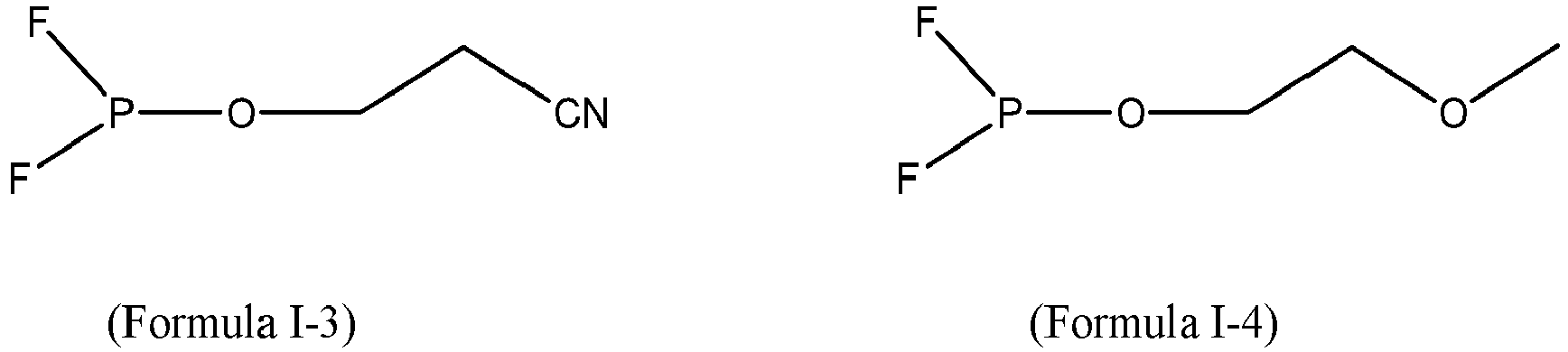


- The electrolyte according to claim 1, wherein, based on a total mass of the electrolyte, a mass percentage of the compound containing (F)2PO- in the electrolyte is 0.001% to 5%, and a mass content of the lithium difluorophosphate in the electrolyte is 0.001% to 1%.
- The electrolyte according to claim 1, wherein, based on a total mass of the electrolyte, the mass percentage of the compound containing (F)2PO- in the electrolyte is 0.1% to 1%, amass content of the lithium difluorophosphate in the electrolyte is 0.001% to 0.49%.
- The electrolyte according to any one of claims 1-5, wherein the electrolyte further comprises at least one of a multiple-cyano compound, a sultone compound, and a fluoroether compound.
- The electrolyte according to claim 6, wherein the multiple-cyano compound comprises at least one of the following compounds:


based on a total mass of the electrolyte, a mass percentage of the multiple-cyano compound in the electrolyte is 0.01% to 10%. - The electrolyte according to claim6, wherein the sultone compound has a structure represented by Formula III-A or Formula III-B:
 R31, R32, R33, R34, R35, R36, and R37 are each independently selected from the group consisting of H, F, Cl, Br, a substituted or unsubstituted C1∼C6 alkyl, and a substituted or unsubstituted C2∼C6 unsaturated hydrocarbyl, wherein the substituent, if present, is selected from the group consisting of F, Cl, and Br; andbased on a total mass of the electrolyte, a mass percentage of the sultone compound in the electrolyte is 0.01% to 10%.
 - The electrolyte according to claim 8, wherein the sultone compound has a structure represented by any one of the following formulas:


- The electrolyte according to claim 6, wherein the fluoroether compound is selected from the group consisting of desflurane, sevoflurane, fluroxene, 2,2,2-trifluoroether, bis (fluoromethyl) ether, 2,2,3,3,3-pentafluoropropyl difluoromethyl ether, 2,2-difluoroethyl trifluoromethyl ether, 1,1,1,2,3,3-hexafluoro-3-(2,2,2-trifluoroethoxy)propane, heptafluoropropyl 1,2,2,2-tetrafluoroethyl ether, trifluoromethyl trifluorovinyl ether, 1,2,2,2-tetrafluoroethyl trifluoromethyl ether, 1,1,2,3,3,3-Hexafluoropropyl dichloromethyl ether, 1,2,2-trifluoroethyl trifluoromethyl ether, 2,2,3,3-tetrafluoropropyl difluoromethyl ether, difluoromethyl 2,2,2-trifluoroethyl ether, 1,1-difluorodimethyl ether, trifluoromethyl methyl ether, 1,1,2,2-tetrafluoroethyl ethyl ether, 1,1,2,3,3,3-hexafluoropropyl methyl ether, 1,1,3,3-tetrafluorodimethyl ether, bis(4-fluorobutyl) ether, ethyl trifluoromethyl ether, 2,2,3,3,3-pentafluoropropyl methyl ether, methyl nonafluorobutyl ether, 1,2,2,2-tetrafluoroethyl methyl ether, pentafluorodimethyl ether, 1,1,1,2,3,3-hexafluoropropyl ethyl ether, bis(2,2-difluoroethyl) ether, ethyl perfluorobutyl ether, bis(1,2,2,2-tetrafluoroethyl) ether, 1,1,2,2-tetrafluoroethyl methyl ether, 2-fluoroethyl methyl ether, perfluorobutyl methyl ether, ethyl nonafluorobutyl ether, 2-(perfluoropropoxy)perfluoropropyl trifluorovinyl ether, 1,1,1,3,3,3-hexafluoroisopropyl methyl ether, 2,2,3,3-tetrafluoropropyl-1',1',2',3',3'-hexafluoropropyl ether, perfluorodiglyme, 2,2-difluoroethyl methyl ether, pentafluoroethyl trifluorovinyl ether, heptafluoro-n-propyl trifluorovinyl ether, pentafluoroethyl trifluorovinyl ether, allyl 2,2,3,3-tetrafluoropropyl ether, 2,2,2-trifluoroethyl ethyl ether, perfluoro(3-butenylvinylether), and combinations thereof; and
a mass percentage of the fluoroether compound in the electrolyte is 0.1% to 20%, based on a total mass of the electrolyte. - The electrolyte according to claim 6, wherein a mass percentage of the fluoroether compound in the electrolyte is 0.5% to 10%, based on a total mass of the electrolyte.
- An electrochemical device, comprising:a positive electrode;a negative electrode;a separator disposed between the positive electrode and the negative electrode; andthe electrolyte according to any one of claims 1-11.
- The electrochemical device according to claim 12, wherein the positive electrode comprises a positive current collector and a positive active material layer disposed on the positive current collector,
the positive active material layer comprises a positive active material containing magnesium element,
a content of the magnesium element is m×103 ppm based on a total weight of the positive active material layer, and based on a total mass of the electrolyte, a mass percentage of the lithium difluorophosphate in the electrolyte is a% and a mass percentage of the compound containing (F)2PO- in the electrolyte is b%, where m is in a range of 0.5 to 2, and (a+b)/m≤1. - An electronic apparatus, comprising the electrochemical device according to claim 12 or 13.
Applications Claiming Priority (1)
| Application Number | Priority Date | Filing Date | Title |
|---|---|---|---|
| CN202010140913.9A CN111430794B (en) | 2020-03-03 | 2020-03-03 | An electrolyte, electrochemical device and electronic device |
Publications (1)
| Publication Number | Publication Date |
|---|---|
| EP3876329A1 true EP3876329A1 (en) | 2021-09-08 |
Family
ID=70681728
Family Applications (1)
| Application Number | Title | Priority Date | Filing Date |
|---|---|---|---|
| EP20174024.8A Pending EP3876329A1 (en) | 2020-03-03 | 2020-05-12 | Electrolyte, electrochemical device and electronic device |
Country Status (2)
| Country | Link |
|---|---|
| EP (1) | EP3876329A1 (en) |
| CN (1) | CN111430794B (en) |
Cited By (3)
| Publication number | Priority date | Publication date | Assignee | Title |
|---|---|---|---|---|
| EP4075560A1 (en) * | 2021-04-13 | 2022-10-19 | SK On Co., Ltd. | Electrolyte solution for lithium secondary battery and lithium secondary battery including the same |
| EP4394980A4 (en) * | 2022-01-28 | 2025-05-14 | Ningde Amperex Technology Limited | ELECTROCHEMICAL DEVICE AND ELECTRONIC DEVICE |
| CN120824431A (en) * | 2025-08-05 | 2025-10-21 | 中南大学 | High-voltage and wide-temperature electrolyte and preparation method thereof, sodium ion full battery and half battery |
Families Citing this family (5)
| Publication number | Priority date | Publication date | Assignee | Title |
|---|---|---|---|---|
| CN111435759A (en) * | 2020-04-03 | 2020-07-21 | 珠海冠宇电池股份有限公司 | Electrolyte, secondary battery and electronic device including the same |
| CN111430798B (en) * | 2020-04-03 | 2021-09-28 | 珠海冠宇电池股份有限公司 | Electrolyte, preparation method thereof and lithium ion battery |
| CN115627200A (en) * | 2022-10-08 | 2023-01-20 | 广东环华氢能科技有限公司 | Cleaning agent and flexible graphite bipolar plate cleaning process |
| KR20250032450A (en) * | 2023-08-31 | 2025-03-07 | 에스케이온 주식회사 | Electrolyte for lithium secondary battery and lithium secondary battery including the same |
| CN117832626B (en) * | 2024-03-06 | 2024-07-02 | 宁德新能源科技有限公司 | Electrolyte, electrochemical device, and electronic apparatus |
Citations (2)
| Publication number | Priority date | Publication date | Assignee | Title |
|---|---|---|---|---|
| US20140272604A1 (en) * | 2013-02-20 | 2014-09-18 | Lg Chem, Ltd. | Electrolyte solution additive for lithium secondary battery, and non-aqueous electrolyte solution and lithium secondary battery including the additive |
| US20190198933A1 (en) * | 2017-12-21 | 2019-06-27 | Pellion Technologies Inc. | Electrochemical cell and electrolyte for same |
Family Cites Families (6)
| Publication number | Priority date | Publication date | Assignee | Title |
|---|---|---|---|---|
| JP5019892B2 (en) * | 2007-01-23 | 2012-09-05 | 三洋電機株式会社 | Nonaqueous electrolyte secondary battery |
| CN103401020B (en) * | 2013-08-08 | 2015-11-04 | 东莞市杉杉电池材料有限公司 | A kind of high-voltage lithium-ion battery electrolyte |
| CA2994527A1 (en) * | 2015-08-04 | 2017-02-09 | Hitachi High-Technologies Corporation | Non-aqueous electrolyte solution containing oxofluorophosphorous compounds |
| CN106654128B (en) * | 2017-01-18 | 2021-01-26 | 宁德新能源科技有限公司 | Secondary battery |
| KR102383073B1 (en) * | 2017-07-21 | 2022-04-04 | 삼성에스디아이 주식회사 | Electrolyte of rechargeable lithium battery and rechargeable lithium battery including same |
| KR102094263B1 (en) * | 2018-02-23 | 2020-03-30 | 에스케이이노베이션 주식회사 | Electrolyte for Lithium Secondary Battery and Lithium Secondary Battery Containing the Same |
-
2020
- 2020-03-03 CN CN202010140913.9A patent/CN111430794B/en active Active
- 2020-05-12 EP EP20174024.8A patent/EP3876329A1/en active Pending
Patent Citations (2)
| Publication number | Priority date | Publication date | Assignee | Title |
|---|---|---|---|---|
| US20140272604A1 (en) * | 2013-02-20 | 2014-09-18 | Lg Chem, Ltd. | Electrolyte solution additive for lithium secondary battery, and non-aqueous electrolyte solution and lithium secondary battery including the additive |
| US20190198933A1 (en) * | 2017-12-21 | 2019-06-27 | Pellion Technologies Inc. | Electrochemical cell and electrolyte for same |
Cited By (3)
| Publication number | Priority date | Publication date | Assignee | Title |
|---|---|---|---|---|
| EP4075560A1 (en) * | 2021-04-13 | 2022-10-19 | SK On Co., Ltd. | Electrolyte solution for lithium secondary battery and lithium secondary battery including the same |
| EP4394980A4 (en) * | 2022-01-28 | 2025-05-14 | Ningde Amperex Technology Limited | ELECTROCHEMICAL DEVICE AND ELECTRONIC DEVICE |
| CN120824431A (en) * | 2025-08-05 | 2025-10-21 | 中南大学 | High-voltage and wide-temperature electrolyte and preparation method thereof, sodium ion full battery and half battery |
Also Published As
| Publication number | Publication date |
|---|---|
| CN111430794A (en) | 2020-07-17 |
| CN111430794B (en) | 2021-06-29 |
Similar Documents
| Publication | Publication Date | Title |
|---|---|---|
| CN111430794B (en) | An electrolyte, electrochemical device and electronic device | |
| JP4325167B2 (en) | Non-aqueous electrolyte secondary battery electrode material | |
| CN101202364B (en) | Electrolyte solution and battery | |
| CN111342135B (en) | Electrochemical device and electronic device including the same | |
| EP3907804B1 (en) | Electrochemical device and electronic device comprising the same | |
| CN111628219A (en) | Electrolyte and electrochemical device and electronic device containing electrolyte | |
| JPWO2003019713A1 (en) | battery | |
| CN108352515A (en) | Non-aqueous electrolyte for high-performance lithium ion battery | |
| CN104737356A (en) | Non-aqueous electrolyte solution for secondary battery and lithium ion secondary battery | |
| WO2012170240A1 (en) | Lithium- ion electrochemical cells including fluorocarbon electrolyte additives | |
| JP7649179B2 (en) | Nonaqueous electrolyte, nonaqueous electrolyte secondary battery including the nonaqueous electrolyte, and compound | |
| CN110429335A (en) | Electrolyte and electrochemical device and electronic device containing same | |
| JP2006294519A (en) | Electrolyte and battery | |
| JP5999090B2 (en) | Active material for secondary battery | |
| KR20090092220A (en) | Non-aqueous electrolyte secondary battery | |
| CN117154224B (en) | Deep eutectic electrolyte additive capable of solubilizing lithium salt, electrolyte and lithium battery | |
| EP2181479A1 (en) | Non-aqueous electrolyte and secondary battery comprising the same | |
| CN111244541A (en) | Electrolyte and electrochemical device using the same | |
| CN111261939A (en) | Electrolyte solution and electrochemical device using the same | |
| WO2018179883A1 (en) | Nonaqueous electrolyte secondary battery | |
| US12095035B2 (en) | Electrolytic solution, and electrochemical device using the same | |
| WO2018054933A1 (en) | Electrochemical cells comprising bifunctional phosphonic acid silylesters | |
| CN107403950A (en) | Electrolyte and lithium ion battery | |
| CN113498562B (en) | Electrolyte, electrochemical device and electronic device | |
| JP5598457B2 (en) | Secondary battery and electronic equipment |
Legal Events
| Date | Code | Title | Description |
|---|---|---|---|
| PUAI | Public reference made under article 153(3) epc to a published international application that has entered the european phase |
Free format text: ORIGINAL CODE: 0009012 |
|
| STAA | Information on the status of an ep patent application or granted ep patent |
Free format text: STATUS: REQUEST FOR EXAMINATION WAS MADE |
|
| 17P | Request for examination filed |
Effective date: 20200512 |
|
| AK | Designated contracting states |
Kind code of ref document: A1 Designated state(s): AL AT BE BG CH CY CZ DE DK EE ES FI FR GB GR HR HU IE IS IT LI LT LU LV MC MK MT NL NO PL PT RO RS SE SI SK SM TR |