EP3875734B1 - Exhaust diffuser strut for reducing flow separation - Google Patents
Exhaust diffuser strut for reducing flow separation Download PDFInfo
- Publication number
- EP3875734B1 EP3875734B1 EP21160714.8A EP21160714A EP3875734B1 EP 3875734 B1 EP3875734 B1 EP 3875734B1 EP 21160714 A EP21160714 A EP 21160714A EP 3875734 B1 EP3875734 B1 EP 3875734B1
- Authority
- EP
- European Patent Office
- Prior art keywords
- strut
- cut portion
- ribs
- turbine
- exhaust diffuser
- Prior art date
- Legal status (The legal status is an assumption and is not a legal conclusion. Google has not performed a legal analysis and makes no representation as to the accuracy of the status listed.)
- Active
Links
Images



Classifications
-
- F—MECHANICAL ENGINEERING; LIGHTING; HEATING; WEAPONS; BLASTING
- F01—MACHINES OR ENGINES IN GENERAL; ENGINE PLANTS IN GENERAL; STEAM ENGINES
- F01D—NON-POSITIVE DISPLACEMENT MACHINES OR ENGINES, e.g. STEAM TURBINES
- F01D25/00—Component parts, details, or accessories, not provided for in, or of interest apart from, other groups
- F01D25/28—Supporting or mounting arrangements, e.g. for turbine casing
-
- F—MECHANICAL ENGINEERING; LIGHTING; HEATING; WEAPONS; BLASTING
- F01—MACHINES OR ENGINES IN GENERAL; ENGINE PLANTS IN GENERAL; STEAM ENGINES
- F01D—NON-POSITIVE DISPLACEMENT MACHINES OR ENGINES, e.g. STEAM TURBINES
- F01D9/00—Stators
- F01D9/06—Fluid supply conduits to nozzles or the like
- F01D9/065—Fluid supply or removal conduits traversing the working fluid flow, e.g. for lubrication-, cooling-, or sealing fluids
-
- F—MECHANICAL ENGINEERING; LIGHTING; HEATING; WEAPONS; BLASTING
- F01—MACHINES OR ENGINES IN GENERAL; ENGINE PLANTS IN GENERAL; STEAM ENGINES
- F01D—NON-POSITIVE DISPLACEMENT MACHINES OR ENGINES, e.g. STEAM TURBINES
- F01D25/00—Component parts, details, or accessories, not provided for in, or of interest apart from, other groups
- F01D25/30—Exhaust heads, chambers, or the like
-
- F—MECHANICAL ENGINEERING; LIGHTING; HEATING; WEAPONS; BLASTING
- F01—MACHINES OR ENGINES IN GENERAL; ENGINE PLANTS IN GENERAL; STEAM ENGINES
- F01D—NON-POSITIVE DISPLACEMENT MACHINES OR ENGINES, e.g. STEAM TURBINES
- F01D5/00—Blades; Blade-carrying members; Heating, heat-insulating, cooling or antivibration means on the blades or the members
- F01D5/12—Blades
- F01D5/14—Form or construction
- F01D5/141—Shape, i.e. outer, aerodynamic form
-
- F—MECHANICAL ENGINEERING; LIGHTING; HEATING; WEAPONS; BLASTING
- F01—MACHINES OR ENGINES IN GENERAL; ENGINE PLANTS IN GENERAL; STEAM ENGINES
- F01D—NON-POSITIVE DISPLACEMENT MACHINES OR ENGINES, e.g. STEAM TURBINES
- F01D5/00—Blades; Blade-carrying members; Heating, heat-insulating, cooling or antivibration means on the blades or the members
- F01D5/12—Blades
- F01D5/14—Form or construction
- F01D5/148—Blades with variable camber, e.g. by ejection of fluid
-
- F—MECHANICAL ENGINEERING; LIGHTING; HEATING; WEAPONS; BLASTING
- F01—MACHINES OR ENGINES IN GENERAL; ENGINE PLANTS IN GENERAL; STEAM ENGINES
- F01D—NON-POSITIVE DISPLACEMENT MACHINES OR ENGINES, e.g. STEAM TURBINES
- F01D9/00—Stators
- F01D9/02—Nozzles; Nozzle boxes; Stator blades; Guide conduits, e.g. individual nozzles
-
- F—MECHANICAL ENGINEERING; LIGHTING; HEATING; WEAPONS; BLASTING
- F01—MACHINES OR ENGINES IN GENERAL; ENGINE PLANTS IN GENERAL; STEAM ENGINES
- F01D—NON-POSITIVE DISPLACEMENT MACHINES OR ENGINES, e.g. STEAM TURBINES
- F01D9/00—Stators
- F01D9/02—Nozzles; Nozzle boxes; Stator blades; Guide conduits, e.g. individual nozzles
- F01D9/04—Nozzles; Nozzle boxes; Stator blades; Guide conduits, e.g. individual nozzles forming ring or sector
- F01D9/041—Nozzles; Nozzle boxes; Stator blades; Guide conduits, e.g. individual nozzles forming ring or sector using blades
-
- F—MECHANICAL ENGINEERING; LIGHTING; HEATING; WEAPONS; BLASTING
- F02—COMBUSTION ENGINES; HOT-GAS OR COMBUSTION-PRODUCT ENGINE PLANTS
- F02C—GAS-TURBINE PLANTS; AIR INTAKES FOR JET-PROPULSION PLANTS; CONTROLLING FUEL SUPPLY IN AIR-BREATHING JET-PROPULSION PLANTS
- F02C7/00—Features, components parts, details or accessories, not provided for in, or of interest apart form groups F02C1/00 - F02C6/00; Air intakes for jet-propulsion plants
- F02C7/20—Mounting or supporting of plant; Accommodating heat expansion or creep
-
- F—MECHANICAL ENGINEERING; LIGHTING; HEATING; WEAPONS; BLASTING
- F05—INDEXING SCHEMES RELATING TO ENGINES OR PUMPS IN VARIOUS SUBCLASSES OF CLASSES F01-F04
- F05D—INDEXING SCHEME FOR ASPECTS RELATING TO NON-POSITIVE-DISPLACEMENT MACHINES OR ENGINES, GAS-TURBINES OR JET-PROPULSION PLANTS
- F05D2220/00—Application
- F05D2220/30—Application in turbines
- F05D2220/32—Application in turbines in gas turbines
-
- F—MECHANICAL ENGINEERING; LIGHTING; HEATING; WEAPONS; BLASTING
- F05—INDEXING SCHEMES RELATING TO ENGINES OR PUMPS IN VARIOUS SUBCLASSES OF CLASSES F01-F04
- F05D—INDEXING SCHEME FOR ASPECTS RELATING TO NON-POSITIVE-DISPLACEMENT MACHINES OR ENGINES, GAS-TURBINES OR JET-PROPULSION PLANTS
- F05D2240/00—Components
- F05D2240/10—Stators
- F05D2240/12—Fluid guiding means, e.g. vanes
-
- F—MECHANICAL ENGINEERING; LIGHTING; HEATING; WEAPONS; BLASTING
- F05—INDEXING SCHEMES RELATING TO ENGINES OR PUMPS IN VARIOUS SUBCLASSES OF CLASSES F01-F04
- F05D—INDEXING SCHEME FOR ASPECTS RELATING TO NON-POSITIVE-DISPLACEMENT MACHINES OR ENGINES, GAS-TURBINES OR JET-PROPULSION PLANTS
- F05D2240/00—Components
- F05D2240/10—Stators
- F05D2240/12—Fluid guiding means, e.g. vanes
- F05D2240/122—Fluid guiding means, e.g. vanes related to the trailing edge of a stator vane
-
- F—MECHANICAL ENGINEERING; LIGHTING; HEATING; WEAPONS; BLASTING
- F05—INDEXING SCHEMES RELATING TO ENGINES OR PUMPS IN VARIOUS SUBCLASSES OF CLASSES F01-F04
- F05D—INDEXING SCHEME FOR ASPECTS RELATING TO NON-POSITIVE-DISPLACEMENT MACHINES OR ENGINES, GAS-TURBINES OR JET-PROPULSION PLANTS
- F05D2240/00—Components
- F05D2240/70—Slinger plates or washers
-
- Y—GENERAL TAGGING OF NEW TECHNOLOGICAL DEVELOPMENTS; GENERAL TAGGING OF CROSS-SECTIONAL TECHNOLOGIES SPANNING OVER SEVERAL SECTIONS OF THE IPC; TECHNICAL SUBJECTS COVERED BY FORMER USPC CROSS-REFERENCE ART COLLECTIONS [XRACs] AND DIGESTS
- Y02—TECHNOLOGIES OR APPLICATIONS FOR MITIGATION OR ADAPTATION AGAINST CLIMATE CHANGE
- Y02E—REDUCTION OF GREENHOUSE GAS [GHG] EMISSIONS, RELATED TO ENERGY GENERATION, TRANSMISSION OR DISTRIBUTION
- Y02E20/00—Combustion technologies with mitigation potential
- Y02E20/16—Combined cycle power plant [CCPP], or combined cycle gas turbine [CCGT]
Definitions
- Apparatuses and methods consistent with exemplary embodiments relate to an exhaust diffuser strut and, more particularly, to an exhaust diffuser strut configured to reduce pressure loss in an exhaust diffuser by reducing flow separation occurring in a trailing edge thereof.
- a gas turbine includes a compressor, a combustor, and a turbine.
- the compressor compresses air by a plurality of compressor blades to generate compressed air which is in a high-temperature and high-pressure state.
- the combustor mixes fuel with the compressed air supplied from the compressor and burns a mixture thereof by a burner to generate high-temperature and high-pressure combustion gas which is discharged to the turbine.
- the turbine includes a plurality of turbine blades rotated by the combustion gas, thereby generating power.
- the generated power is used in various fields, such as generating electric power and driving machines.
- the gas turbine is used for driving a power generator, an aircraft, a locomotive, or the like.
- the combustion gas may be exhausted to outside through an exhaust diffuser located on the turbine.
- an exhaust diffuser located on the turbine.
- a conical hub and a conical casing located outside the conical hub are necessary, and a strut connecting and supporting the conical hub and the conical casing is radially provided.
- the strut has an airfoil-shaped cross-section in order to interrupt the flow of the combustion gas to a minimum extent.
- a trailing edge downstream of the combustion gas forms a boundary layer downstream thereof as the flow of the combustion gas leaves. This may cause flow separation, thereby causing pressure loss inside the exhaust diffuser.
- the pressure loss inside the exhaust diffuser may degrade the efficiency of exhaust and have an adverse effect to the efficiency of a complex power generation system provided by connecting a heat recovery system generator (HRSG) and a steam turbine to a gas turbine.
- HRSG heat recovery system generator
- US 8 061 983 B 1 presents a diffuser for a turbo machine, such as an exhaust diffuser for an industrial gas turbine engine, the diffuser including a plurality of struts connecting the inner shroud of the diffuser to the outer shroud, where the struts have trailing edges with a step shape to reduce the losses and improve the performance of the diffuser.
- the stepped shaped trailing edge includes three or more steps with the middle step being the longest in the chordwise direction and the remaining steps being symmetric about the chord of the strut.
- the invention provides a novel exhaust diffuser strut configured to reduce pressure loss inside an exhaust diffuser that is caused by flow separation occurring in a trailing edge thereof.
- a length of the cut portion may be at least 15% of a span length.
- the cut portion may be provided on an entire trailing edge of the strut.
- Ribs are provided along both boundaries between the cut portion and a wing-shaped surface of an airfoil, respectively.
- the ribs may extend along a wing-shaped curved surface of the airfoil.
- Corresponding ends of a pair of ribs may be spaced apart from each other.
- the cut portion and the ribs may be provided on an entire trailing edge of the strut, and lattice-shaped reinforcement ribs may be provided on a surface of the cut portion.
- An end of a transverse rib of the reinforcement ribs may be in contact with or bonded to the ribs.
- a depth of the cut portion may range from 10% to 30% of a cord length.
- an exhaust diffuser as set forth in claim 9.
- the exhaust diffuser strut having the above-described configuration according to the exemplary embodiments may cause a significant change in a flow of combustion gas due to the cut portion in which the stepped portion is formed on at least a portion of the trailing edge, and delay the formation of a boundary layer in the combustion gas disturbed by an abrupt change in the flow.
- the exhaust diffuser strut according to the exemplary embodiments may reduce pressure loss inside the exhaust diffuser by reducing the occurrence of the flow separation, thereby improving the exhaust efficiency.
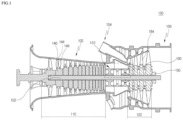
- FIG. 1 is a cross-sectional view illustrating a gas turbine according to an exemplary embodiment.
- a gas turbine 100 according to an exemplary embodiment includes a compressor 110, a combustor 104, a turbine 120, a housing 102, and an exhaust diffuser 106.
- the housing 102 covers the compressor 110 which compresses an introduced air at high pressure and delivers the compressed air to the combustor 104.
- the combustor 104 generates high-temperature and high-pressure combustion gas using a mixture of the compressed air and fuel and supplies the combustion gas to the turbine 120.
- the turbine 120 generates rotational torque using the combustion gas supplied from the combustor 104.
- the exhaust diffuser 106 is located at a rear of the turbine 120 to broaden (or expand) the high temperature combustion gas and reduce the speed thereof.
- the gas turbine 100 further includes a torque tube 130 between the compressor 110 and the turbine 120 in order to transfer the rotational torque generated by the turbine 120 to the compressor 110.
- the compressor 110 includes a plurality of compressor blades 144 radially arranged on a plurality of compressor rotor disks 140.
- Each of the plurality of compressor blades 144 includes a compressor blade root 146 having a shape of a dovetail or a fir tree and configured to be coupled to corresponding one of the compressor rotor disks 140.
- the compressor 110 rotates the plurality of compressor blades 144, and air is compressed and moved to the combustor 104 by the rotation of the plurality of compressor blades 144.
- the compressor 110 is directly or indirectly connected to the turbine 120 to receive a portion of power generated by the turbine 120. The received power is used to rotate the plurality of compressor blades 144.
- Air compressed by the compressor 110 is moved to the combustor 104.
- the combustor 104 includes a plurality of casings and a plurality of burners arranged in a circular pattern.
- the combustor 104 includes a combustion chamber including a liner. Fuel provided through a fuel nozzle is provided to the combustion chamber of the combustor 104.
- the combustor 104 mixes the compressed air with the fuel and burns the mixture in the combustion chamber to generate high-temperature and high-pressure combustion gas which is discharged to the turbine 120, thereby rotating turbine blades 184 attached to turbine rotor disks 180.
- the gas turbine 100 further includes a tie rod 150 extending through the compressor rotor disks 140 and the turbine rotor disks 180.
- One end of the tie rod 150 is attached to the compressor rotor disk 140 that is disposed at the most upstream side, and the other end thereof is fixed by a fixing nut 190.
- adjacent compressor rotor disks 140 are arranged so that facing surfaces thereof are in tight contact with each other by the tie rod 150, so that the adjacent compressor rotor disks 140 do not rotate relative to each other.
- a plurality of compressor vanes are fixedly arranged between each of the compressor rotor disks 140. While the compressor rotor disks 140 rotate along with a rotation of the tie rod 150, the compressor vanes attached to the housing 102 do not rotate. The compressor vanes guide the flow of compressed air moved from front-stage compressor blades 144 of the compressor rotor disk 140 to rear-stage compressor blades 144 of the compressor rotor disk 140.
- the turbine 120 basically has a structure similar to that of the compressor 110. That is, the turbine 120 includes a plurality of turbine blades 184 coupled to the plurality of turbine rotor disks 180 and the turbine rotor disks 180 similar to the compressor rotor disks 140 of the compressor 110. Each turbine rotor disk 180 includes the plurality of turbine blades 184 which are radially disposed on the turbine rotor disks 180. The plurality of turbine blades 184 may be assembled to the turbine rotor disks 180 via a dovetail joint or a fir joint. In addition, turbine vanes fixed to the housing are provided between the turbine blades 184 of the turbine rotor disk 180 to guide a flow direction of combustion gas passing through the turbine blades 184.
- the high temperature combustion gas passes through the turbine 120 along the axial direction and rotates the turbine blades 184.
- the combustion gas may be exhausted to the outside through an exhaust diffuser 106 located at the rear of the turbine 120. That is, the exhaust diffuser 106 receives the exhaust gas from the turbine 120 and discharges the exhaust gas from the gas turbine 100.
- the combustion gas exhausted through the exhaust diffuser 106 is also referred to as exhaust gas.
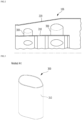
- FIG. 2 is a view schematically illustrating a structure of the exhaust diffuser 106 located at the rear of the turbine 120 according to an exemplary embodiment.
- the exhaust diffuser 106 is configured such that a cylindrical hub 210 located inside and a conical casing 220 located outside are arranged concentrically, thereby forming an annular space through which combustion gas is exhausted.
- the conical casing 220 is large in size, extends long to the rear of the turbine 120, and has a relatively thin thickness. Due to these features, vibration may be caused by a flow of combustion gas, so the conical casing is not structurally durable. For this reason, the casing 220 has a support structure in which the casing 220 is connected to and supported by a strut 300 with respect to the cylindrical hub 210.
- FIG. 3 is a view illustrating a structure of a related-art strut. Because the strut 300 has the airfoil-shaped cross-section, a thinnest trailing edge 310 is located downstream of the combustion gas. Flows of combustion gas passing along both surfaces of the strut 300 are combined with each other while passing over the trailing edge 310. As a boundary layer is gradually formed at a location near the trailing edge 310, flow separation begins to occur.
- the flow separation causes an internal pressure loss in the exhaust diffuser 106, and this pressure loss inside the exhaust diffuser 106 reduces the exhaust efficiency.
- the exhaust efficiency of the gas turbine 100 is deteriorated, and the efficiency of an entire complex power generation system provided by connecting a heat recovery apparatus and a steam turbine to the gas turbine is adversely affected.
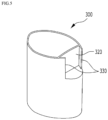
- FIG. 4 is a view illustrating a strut according to an exemplary embodiment. For example, it illustrates an exemplary embodiment for effectively suppressing the effect of flow separation occurring in the area of the trailing edge 310 of the strut 300.
- the trailing edge 310 of the strut 300 includes a cut portion 320 provided in the span direction.
- the cut portion 320 forms a stepped portion on at least a portion of the trailing edge 310.
- the cut portion 320 of the trailing edge 310 causes a significant change in a flow of the combustion gas.
- the combustion gas flowing through the surface of the airfoil of the strut 300 meets the cut portion 320 the combustion gas flows into the cut portion 320 along a sharp curved path to generate a large turbulence. If the combustion gas is disturbed by turbulence, the formation of a boundary layer is delayed. As the formation of the boundary layer is delayed, the occurrence of flow separation in the area of the trailing edge 310 is also delayed and an extinction of flow separation is accelerated.
- the cut portion 320 formed on the trailing edge 310 reduces pressure loss inside the exhaust diffuser 106.
- the cut portion 320 is provided on at least a portion of the trailing edge 310 in the span direction. That is, the cut portion 320 may be formed on a portion of the trailing edge 310 as illustrated in FIG. 4 or on an entire portion of the trailing edge 310 as illustrated in FIG. 6 . When the cut portion 320 is formed in a portion of the trailing edge 310, it may be effective to properly design a position and a minimum length L of the cut portion 320 in consideration of the flow of the combustion gas. Observing the flow of the combustion gas passing through the strut 300, the flowing angle increases from the hub 210 to the casing 220 at about 80% or more of the span in the span direction.
- the cut portion 320 may start from a radially outer end of the strut 300 adjacent to the casing 220, and for example, the length L of the cut portion 320 may be at least 15% of the span length.
- FIG. 5 is a view illustrating a strut according to another exemplary embodiment
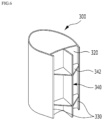
- FIG. 6 is a view illustrating a strut according to still another exemplary embodiment.
- ribs 330 are provided along both boundaries between the cut portion 320 and the wing-shaped surface of the airfoil, respectively.
- the ribs 330 form stepped-portions to the flow of the combustion gas toward the cut portion 320.
- the combustion gas flowing over the ribs 330 flows toward the cut portion 320 along a sharp curved path.
- the ribs 330 may be effective to create an action that delays the formation of the boundary layer.
- the ribs 330 may protrude in a direction in which the ribs 330 extend along the wing-shaped curved surface of the surface of the airfoil. Even when the ribs 330 are formed, corresponding ends of the pair of ribs 330 are spaced apart from each other, because the surface of the cut portion 320 must be exposed to the flow of the combustion gas.
- the strut 300 includes the cut portion 320 and the ribs 330 formed on an entire portion of the trailing edge 310.
- the structural strength of the strut 300 may be reduced, because the entire trailing edge 310 is cut along the span direction.
- reinforcement ribs 340 in a form of a lattice may be provided on the surface of the cut portion 320, as shown in FIG. 6 .
- the effect of the structural reinforcement of the reinforcement ribs 340 may be further increased by bringing ends of horizontal ribs 342 of the reinforcement ribs 340 into contact with or coupled to the ribs 330 or bonding the same.
- a depth D of the cut portion 320 that is, how deep the cut portion 320 will be located in the strut 300. Because the cut portion 320 serves to reduce the flow separation, it may be necessary to properly determine the depth D of the cut portion 320 in consideration of the flow separation. For example, because the stepped portion of the cut portion 320 causes a significant change in the flow of the combustion gas, the cut portion 320 having an excessive depth may adversely affect the overall aerodynamic performance of the strut 300. In general, the flow separation begins in the range of 10% to 30% of a reference cord length of the trailing edge 310. Therefore, in consideration of this feature, it is appropriate to limit the depth D of the cut portion 320 within the range of 10% to 30% of the cord length. Table 1 FIG. 3 FIG. 4 FIG. 5 FIG. 6 Cp 0.839 0.848 0.842 0.844 Press. Loss 2.19 2.14 2.21 2.14
- Table 1 described above compares the flow performance of the related-art strut 300 illustrated in FIG. 3 with the strut 300 according to the exemplary embodiments illustrated in FIGS. 4 to 6 .
- Cp is a dimensionless coefficient of pressure recovery (i.e. a ratio of dynamic pressure to static pressure). The faster the pressure recovery, i.e., the higher the Cp value, the more advantageous the exhaust efficiency.
- the pressure loss refers to a pressure drop in combustion gas occurring while passing through the strut 300. The lower the pressure loss, the higher the exhaust efficiency. Referring to Table 1, it may be appreciated that the pressure recovery of each of the three exemplary embodiments is superior to that of the related-art strut 300, and that the pressure loss is also improved except for the slight increase in the example of FIG.
- the strut 300 including the cut portion 320 according to the exemplary embodiments is obviously more effective in reducing the occurrence of flow separation than the related-art strut 300 illustrated in FIG. 3 .
- the exemplary embodiments illustrated in FIGS. 4 and 6 resulted in significant improvements in both aspects of pressure recovery and pressure loss.
- FIG. 7 is a view illustrating a result of computational analysis performed on combustion gas passing through the related-art strut 300 illustrated in FIG. 3
- FIG. 8 is a view illustrating a result of computational analysis performed on combustion gas passing through the strut 300 having the partial cut portion 320 illustrated in FIG. 4 .
- a recirculation flow is formed in an inner area of the cut portion 320 in the strut 300 according to the exemplary embodiments, thereby significantly improving the length of flow separation.
- This result of computational analysis may be evaluated to be consistent with the result of computational analysis shown in Table 1, in which the strut 300 including the partial cut portion 320 according to the exemplary embodiments is improved in both the pressure recovery and the pressure loss than the related-art strut.
- the strut 300 may effectively reduce flow separation occurring in the area of the trailing edge 310.
- the exhaust diffuser 106 including the cut portion 320in which the stepped portion is formed on at least one portion of the trailing edge 310 of the strut 300 along the span direction thereof, is provided.
- the exhaust diffuser 106 includes the inner cylindrical hub 210, the outer conical casing 220 disposed concentrically with the cylindrical hub 210, and the strut 300 connecting and supporting the casing 220.
Landscapes
- Engineering & Computer Science (AREA)
- Mechanical Engineering (AREA)
- General Engineering & Computer Science (AREA)
- Physics & Mathematics (AREA)
- Fluid Mechanics (AREA)
- Chemical & Material Sciences (AREA)
- Combustion & Propulsion (AREA)
- Structures Of Non-Positive Displacement Pumps (AREA)
- Turbine Rotor Nozzle Sealing (AREA)
- Exhaust Silencers (AREA)
- Medicines Containing Material From Animals Or Micro-Organisms (AREA)
- Cooling, Air Intake And Gas Exhaust, And Fuel Tank Arrangements In Propulsion Units (AREA)
Description
- This application claims priority to
Korean Patent Application No. 10-2020-0027608, filed on March 05, 2020 - Apparatuses and methods consistent with exemplary embodiments relate to an exhaust diffuser strut and, more particularly, to an exhaust diffuser strut configured to reduce pressure loss in an exhaust diffuser by reducing flow separation occurring in a trailing edge thereof.
- A gas turbine includes a compressor, a combustor, and a turbine. The compressor compresses air by a plurality of compressor blades to generate compressed air which is in a high-temperature and high-pressure state. The combustor mixes fuel with the compressed air supplied from the compressor and burns a mixture thereof by a burner to generate high-temperature and high-pressure combustion gas which is discharged to the turbine. The turbine includes a plurality of turbine blades rotated by the combustion gas, thereby generating power. The generated power is used in various fields, such as generating electric power and driving machines. For example, the gas turbine is used for driving a power generator, an aircraft, a locomotive, or the like.
- After rotating the turbine blades, the combustion gas may be exhausted to outside through an exhaust diffuser located on the turbine. In order to form an annular exhaust space of the exhaust diffuser, a conical hub and a conical casing located outside the conical hub are necessary, and a strut connecting and supporting the conical hub and the conical casing is radially provided.
- Here, the strut has an airfoil-shaped cross-section in order to interrupt the flow of the combustion gas to a minimum extent. A trailing edge downstream of the combustion gas forms a boundary layer downstream thereof as the flow of the combustion gas leaves. This may cause flow separation, thereby causing pressure loss inside the exhaust diffuser. The pressure loss inside the exhaust diffuser may degrade the efficiency of exhaust and have an adverse effect to the efficiency of a complex power generation system provided by connecting a heat recovery system generator (HRSG) and a steam turbine to a gas turbine.
-
US 8 061 983 B 1 presents a diffuser for a turbo machine, such as an exhaust diffuser for an industrial gas turbine engine, the diffuser including a plurality of struts connecting the inner shroud of the diffuser to the outer shroud, where the struts have trailing edges with a step shape to reduce the losses and improve the performance of the diffuser. The stepped shaped trailing edge includes three or more steps with the middle step being the longest in the chordwise direction and the remaining steps being symmetric about the chord of the strut. - One or more objects of the present technique are achieved by the invention set out by the subject-matter of the independent claim(s).
- The invention provides a novel exhaust diffuser strut configured to reduce pressure loss inside an exhaust diffuser that is caused by flow separation occurring in a trailing edge thereof.
- Additional aspects will be set forth in part in the description which follows and, in part, will become apparent from the description, or may be learned by practice of the exemplary embodiments.
- According to an aspect of the invention there is provided a strut as set forth in
claim 1. - A length of the cut portion may be at least 15% of a span length.
- The cut portion may be provided on an entire trailing edge of the strut.
- Ribs are provided along both boundaries between the cut portion and a wing-shaped surface of an airfoil, respectively.
- The ribs may extend along a wing-shaped curved surface of the airfoil.
- Corresponding ends of a pair of ribs may be spaced apart from each other.
- The cut portion and the ribs may be provided on an entire trailing edge of the strut, and lattice-shaped reinforcement ribs may be provided on a surface of the cut portion.
- An end of a transverse rib of the reinforcement ribs may be in contact with or bonded to the ribs.
- A depth of the cut portion may range from 10% to 30% of a cord length.
- According to another aspect of the invention, there is provided an exhaust diffuser as set forth in claim 9.
- The exhaust diffuser strut having the above-described configuration according to the exemplary embodiments may cause a significant change in a flow of combustion gas due to the cut portion in which the stepped portion is formed on at least a portion of the trailing edge, and delay the formation of a boundary layer in the combustion gas disturbed by an abrupt change in the flow. As the delayed formation and development of the boundary layer of the combustion gas, the occurrence of flow separation in the edge area is also delayed and the extinction of flow separation is accelerated. Accordingly, the exhaust diffuser strut according to the exemplary embodiments may reduce pressure loss inside the exhaust diffuser by reducing the occurrence of the flow separation, thereby improving the exhaust efficiency.
- The above and other aspects will be more apparent from the following description of the exemplary embodiments with reference to the accompanying drawings, in which:
-
FIG. 1 is a view illustrating an example of a gas turbine to which an exhaust diffuser according to an exemplary embodiment is applied; -
FIG. 2 is a view schematically illustrating a structure of the exhaust diffuser according to an exemplary embodiment; -
FIG. 3 is a view illustrating a structure of a related-art strut; -
FIG. 4 is a view illustrating a strut according to an exemplary embodiment; -
FIG. 5 is a view illustrating a strut according to another exemplary embodiment; -
FIG. 6 is a view illustrating a strut according to another exemplary embodiment; -
FIG. 7 is a view illustrating a result of computational analysis performed on combustion gas passing through the strut illustrated inFIG. 3 ; and -
FIG. 8 is a view illustrating a result of computational analysis performed on combustion gas passing through the strut illustrated inFIG. 4 . - Various modifications and various embodiments will be described in detail with reference to the accompanying drawings so that those skilled in the art can easily carry out the disclosure. It should be understood, however, that the various embodiments are not for limiting the scope of the disclosure to the specific embodiment, but they should be interpreted to include all modifications, equivalents, and alternatives of the embodiments included within the scope disclosed herein.
- The terminology used herein is for the purpose of describing specific embodiments only and is not intended to limit the scope of the disclosure. When terms, such as "on" and "over", are used herein to refer to layers, areas, patterns, or structures, it should be understood that a layer, area, pattern, or structure may be located above another layer, area, pattern, or structure directly or indirectly via an intervening layer, area, pattern, or structure. When terms, such as "under" and "below", are used herein to refer to layers, areas, patterns, or structures, it should be understood that a layer, area, pattern, or structure may be located below another layer, area, pattern, or structure directly or indirectly via an intervening layer, area, pattern, or structure. In the disclosure, terms such as "includes," "comprises," and "have/has" should be construed as designating that there are such features, integers, steps, operations, elements, components, and/or combinations thereof, not to exclude the presence or possibility of adding of one or more of other features, integers, steps, operations, elements, components, and/or combinations thereof.
- In addition, unless otherwise specified, terms such as "first," "second," and so on may be used to describe a variety of elements, but the elements should not be limited by these terms. The terms are used simply to distinguish one element from other elements. The use of such ordinal numbers should not be construed as limiting the meaning of the term. For example, the components associated with such an ordinal number should not be limited in the order of use, placement order, or the like. If necessary, each ordinal number may be used interchangeably.
- Hereinafter, exemplary embodiments will be described in detail with reference to the accompanying drawings. It should be noted that like reference numerals refer to like parts throughout the various figures and exemplary embodiments. In certain embodiments, a detailed description of functions and configurations well known in the art may be omitted to avoid obscuring appreciation of the disclosure by a person of ordinary skill in the art. For the same reason, some components may be exaggerated, omitted, or schematically illustrated in the accompanying drawings.
-
FIG. 1 is a cross-sectional view illustrating a gas turbine according to an exemplary embodiment. Referring toFIG. 1 , agas turbine 100 according to an exemplary embodiment includes acompressor 110, acombustor 104, aturbine 120, ahousing 102, and anexhaust diffuser 106. - The
housing 102 covers thecompressor 110 which compresses an introduced air at high pressure and delivers the compressed air to thecombustor 104. Thecombustor 104 generates high-temperature and high-pressure combustion gas using a mixture of the compressed air and fuel and supplies the combustion gas to theturbine 120. Theturbine 120 generates rotational torque using the combustion gas supplied from thecombustor 104. Theexhaust diffuser 106 is located at a rear of theturbine 120 to broaden (or expand) the high temperature combustion gas and reduce the speed thereof. Thegas turbine 100 further includes a torque tube 130 between thecompressor 110 and theturbine 120 in order to transfer the rotational torque generated by theturbine 120 to thecompressor 110. - The
compressor 110 includes a plurality ofcompressor blades 144 radially arranged on a plurality ofcompressor rotor disks 140. Each of the plurality ofcompressor blades 144 includes acompressor blade root 146 having a shape of a dovetail or a fir tree and configured to be coupled to corresponding one of thecompressor rotor disks 140. Thecompressor 110 rotates the plurality ofcompressor blades 144, and air is compressed and moved to thecombustor 104 by the rotation of the plurality ofcompressor blades 144. Here, thecompressor 110 is directly or indirectly connected to theturbine 120 to receive a portion of power generated by theturbine 120. The received power is used to rotate the plurality ofcompressor blades 144. - Air compressed by the
compressor 110 is moved to thecombustor 104. Thecombustor 104 includes a plurality of casings and a plurality of burners arranged in a circular pattern. Thecombustor 104 includes a combustion chamber including a liner. Fuel provided through a fuel nozzle is provided to the combustion chamber of thecombustor 104. Thecombustor 104 mixes the compressed air with the fuel and burns the mixture in the combustion chamber to generate high-temperature and high-pressure combustion gas which is discharged to theturbine 120, thereby rotatingturbine blades 184 attached toturbine rotor disks 180. - The
gas turbine 100 further includes atie rod 150 extending through thecompressor rotor disks 140 and theturbine rotor disks 180. One end of thetie rod 150 is attached to thecompressor rotor disk 140 that is disposed at the most upstream side, and the other end thereof is fixed by a fixingnut 190. Here, adjacentcompressor rotor disks 140 are arranged so that facing surfaces thereof are in tight contact with each other by thetie rod 150, so that the adjacentcompressor rotor disks 140 do not rotate relative to each other. A plurality of compressor vanes are fixedly arranged between each of thecompressor rotor disks 140. While thecompressor rotor disks 140 rotate along with a rotation of thetie rod 150, the compressor vanes attached to thehousing 102 do not rotate. The compressor vanes guide the flow of compressed air moved from front-stage compressor blades 144 of thecompressor rotor disk 140 to rear-stage compressor blades 144 of thecompressor rotor disk 140. - The
turbine 120 basically has a structure similar to that of thecompressor 110. That is, theturbine 120 includes a plurality ofturbine blades 184 coupled to the plurality ofturbine rotor disks 180 and theturbine rotor disks 180 similar to thecompressor rotor disks 140 of thecompressor 110. Eachturbine rotor disk 180 includes the plurality ofturbine blades 184 which are radially disposed on theturbine rotor disks 180. The plurality ofturbine blades 184 may be assembled to theturbine rotor disks 180 via a dovetail joint or a fir joint. In addition, turbine vanes fixed to the housing are provided between theturbine blades 184 of theturbine rotor disk 180 to guide a flow direction of combustion gas passing through theturbine blades 184. - The high temperature combustion gas passes through the
turbine 120 along the axial direction and rotates theturbine blades 184. For example, after rotating theturbine blades 184, the combustion gas may be exhausted to the outside through anexhaust diffuser 106 located at the rear of theturbine 120. That is, theexhaust diffuser 106 receives the exhaust gas from theturbine 120 and discharges the exhaust gas from thegas turbine 100. Here, the combustion gas exhausted through theexhaust diffuser 106 is also referred to as exhaust gas. -
FIG. 2 is a view schematically illustrating a structure of theexhaust diffuser 106 located at the rear of theturbine 120 according to an exemplary embodiment. Referring toFIG. 2 , theexhaust diffuser 106 is configured such that acylindrical hub 210 located inside and aconical casing 220 located outside are arranged concentrically, thereby forming an annular space through which combustion gas is exhausted. Theconical casing 220 is large in size, extends long to the rear of theturbine 120, and has a relatively thin thickness. Due to these features, vibration may be caused by a flow of combustion gas, so the conical casing is not structurally durable. For this reason, thecasing 220 has a support structure in which thecasing 220 is connected to and supported by astrut 300 with respect to thecylindrical hub 210. - Because the
strut 300 intersects a path through which the combustion gas flows, thestrut 300 has an airfoil-shaped cross-section to minimize the flow of the combustion gas.FIG. 3 is a view illustrating a structure of a related-art strut. Because thestrut 300 has the airfoil-shaped cross-section, athinnest trailing edge 310 is located downstream of the combustion gas. Flows of combustion gas passing along both surfaces of thestrut 300 are combined with each other while passing over the trailingedge 310. As a boundary layer is gradually formed at a location near the trailingedge 310, flow separation begins to occur. - The flow separation causes an internal pressure loss in the
exhaust diffuser 106, and this pressure loss inside theexhaust diffuser 106 reduces the exhaust efficiency. In addition, the exhaust efficiency of thegas turbine 100 is deteriorated, and the efficiency of an entire complex power generation system provided by connecting a heat recovery apparatus and a steam turbine to the gas turbine is adversely affected. -
FIG. 4 is a view illustrating a strut according to an exemplary embodiment. For example, it illustrates an exemplary embodiment for effectively suppressing the effect of flow separation occurring in the area of the trailingedge 310 of thestrut 300. Referring toFIG. 4 , the trailingedge 310 of thestrut 300 includes acut portion 320 provided in the span direction. Thecut portion 320 forms a stepped portion on at least a portion of the trailingedge 310. - The
cut portion 320 of the trailingedge 310 causes a significant change in a flow of the combustion gas. When the combustion gas flowing through the surface of the airfoil of thestrut 300 meets thecut portion 320, the combustion gas flows into thecut portion 320 along a sharp curved path to generate a large turbulence. If the combustion gas is disturbed by turbulence, the formation of a boundary layer is delayed. As the formation of the boundary layer is delayed, the occurrence of flow separation in the area of the trailingedge 310 is also delayed and an extinction of flow separation is accelerated. Thus, thecut portion 320 formed on the trailingedge 310 reduces pressure loss inside theexhaust diffuser 106. - The
cut portion 320 is provided on at least a portion of the trailingedge 310 in the span direction. That is, thecut portion 320 may be formed on a portion of the trailingedge 310 as illustrated inFIG. 4 or on an entire portion of the trailingedge 310 as illustrated inFIG. 6 . When thecut portion 320 is formed in a portion of the trailingedge 310, it may be effective to properly design a position and a minimum length L of thecut portion 320 in consideration of the flow of the combustion gas. Observing the flow of the combustion gas passing through thestrut 300, the flowing angle increases from thehub 210 to thecasing 220 at about 80% or more of the span in the span direction. Thus, the combustion gas does not flow along the surface of thestrut 300, resulting in flow separation. Accordingly, thecut portion 320 may start from a radially outer end of thestrut 300 adjacent to thecasing 220, and for example, the length L of thecut portion 320 may be at least 15% of the span length. -
FIG. 5 is a view illustrating a strut according to another exemplary embodiment, andFIG. 6 is a view illustrating a strut according to still another exemplary embodiment. Referring toFIG. 5 ,ribs 330 are provided along both boundaries between thecut portion 320 and the wing-shaped surface of the airfoil, respectively. Theribs 330 form stepped-portions to the flow of the combustion gas toward thecut portion 320. The combustion gas flowing over theribs 330 flows toward thecut portion 320 along a sharp curved path. Thus, theribs 330 may be effective to create an action that delays the formation of the boundary layer. - In addition, in consideration of the flow of the combustion gas along the surface of the airfoil, the
ribs 330 may protrude in a direction in which theribs 330 extend along the wing-shaped curved surface of the surface of the airfoil. Even when theribs 330 are formed, corresponding ends of the pair ofribs 330 are spaced apart from each other, because the surface of thecut portion 320 must be exposed to the flow of the combustion gas. - Referring to
FIG. 6 , thestrut 300 includes thecut portion 320 and theribs 330 formed on an entire portion of the trailingedge 310. Here, the structural strength of thestrut 300 may be reduced, because theentire trailing edge 310 is cut along the span direction. In order to reinforce the reduced structural strength,reinforcement ribs 340 in a form of a lattice may be provided on the surface of thecut portion 320, as shown inFIG. 6 . - If the
ribs 340 are formed on peripheral portions of thecut portion 320, the effect of the structural reinforcement of thereinforcement ribs 340 may be further increased by bringing ends ofhorizontal ribs 342 of thereinforcement ribs 340 into contact with or coupled to theribs 330 or bonding the same. - In addition, it may be necessary to consider a depth D of the
cut portion 320, that is, how deep thecut portion 320 will be located in thestrut 300. Because thecut portion 320 serves to reduce the flow separation, it may be necessary to properly determine the depth D of thecut portion 320 in consideration of the flow separation. For example, because the stepped portion of thecut portion 320 causes a significant change in the flow of the combustion gas, thecut portion 320 having an excessive depth may adversely affect the overall aerodynamic performance of thestrut 300. In general, the flow separation begins in the range of 10% to 30% of a reference cord length of the trailingedge 310. Therefore, in consideration of this feature, it is appropriate to limit the depth D of thecut portion 320 within the range of 10% to 30% of the cord length.Table 1 FIG. 3 FIG. 4 FIG. 5 FIG. 6 Cp 0.839 0.848 0.842 0.844 Press. Loss 2.19 2.14 2.21 2.14 - Table 1 described above compares the flow performance of the related-
art strut 300 illustrated inFIG. 3 with thestrut 300 according to the exemplary embodiments illustrated inFIGS. 4 to 6 . Here, Cp is a dimensionless coefficient of pressure recovery (i.e. a ratio of dynamic pressure to static pressure). The faster the pressure recovery, i.e., the higher the Cp value, the more advantageous the exhaust efficiency. The pressure loss refers to a pressure drop in combustion gas occurring while passing through thestrut 300. The lower the pressure loss, the higher the exhaust efficiency. Referring to Table 1, it may be appreciated that the pressure recovery of each of the three exemplary embodiments is superior to that of the related-art strut 300, and that the pressure loss is also improved except for the slight increase in the example ofFIG. 5 in which thepartial cut portion 320 and theribs 330 are combined. In other words, on a quantitative basis, thestrut 300 including thecut portion 320 according to the exemplary embodiments is obviously more effective in reducing the occurrence of flow separation than the related-art strut 300 illustrated inFIG. 3 . In particular, the exemplary embodiments illustrated inFIGS. 4 and6 resulted in significant improvements in both aspects of pressure recovery and pressure loss. -
FIG. 7 is a view illustrating a result of computational analysis performed on combustion gas passing through the related-art strut 300 illustrated inFIG. 3 , andFIG. 8 is a view illustrating a result of computational analysis performed on combustion gas passing through thestrut 300 having thepartial cut portion 320 illustrated inFIG. 4 . ComparingFIGS. 7 and8 , it may be seen that a recirculation flow is formed in an inner area of thecut portion 320 in thestrut 300 according to the exemplary embodiments, thereby significantly improving the length of flow separation. This result of computational analysis may be evaluated to be consistent with the result of computational analysis shown in Table 1, in which thestrut 300 including thepartial cut portion 320 according to the exemplary embodiments is improved in both the pressure recovery and the pressure loss than the related-art strut. - As described above, the
strut 300 according to the exemplary embodiments may effectively reduce flow separation occurring in the area of the trailingedge 310. Based on this, theexhaust diffuser 106 including the cut portion 320in which the stepped portion is formed on at least one portion of the trailingedge 310 of thestrut 300 along the span direction thereof, is provided. Theexhaust diffuser 106 includes the innercylindrical hub 210, the outerconical casing 220 disposed concentrically with thecylindrical hub 210, and thestrut 300 connecting and supporting thecasing 220. - While exemplary embodiments have been described with reference to the accompanying drawings, it will be apparent to those skilled in the art that various modifications in form and details may be made therein without departing from the scope as defined in the appended claims. Therefore, the description of the exemplary embodiments should be construed in a descriptive sense and not to limit the scope of the claims, and many alternatives, modifications, and variations will be apparent to those skilled in the art.
Claims (10)
- A strut (300) provided in an exhaust diffuser (106) and having an airfoil-shaped cross-section, the strut (300) comprising:a cut portion (320) formed in a trailing edge (310) of the strut (300) in a span direction,wherein the cut portion (320) provides a stepped portion in at least a portion of the trailing edge (310);wherein the cut portion (320) begins from a radial external end of the strut (300);characterized in that ribs (330) are provided along both boundaries between the cut portion (320) and a wing-shaped surface of the airfoil, respectively.
- The strut (300) of claim 1, wherein a length (L) of the cut portion (320) is at least 15% of a span length.
- The strut (300) of claim 2, wherein the cut portion (320) is provided on an entire trailing edge (310) of the strut (300).
- The strut (300) of claim 1, wherein the ribs (330) extend along a wing-shaped curved surface of the airfoil.
- The strut (300) of claim 4, wherein corresponding ends of a pair of ribs (330) are spaced apart from each other.
- The strut (300) of anyone of claims 1 to 5, wherein the cut portion (320) and the ribs (330) are provided on an entire trailing edge (310) of the strut (300), and lattice-shaped reinforcement ribs (340) are provided on a surface of the cut portion (320).
- The strut (300) of claim 6, wherein an end of a transverse rib (342) of the reinforcement ribs (340) is in contact with or bonded to the ribs (330).
- The strut (300) of claim 1, wherein a depth (D) of the cut portion (320) ranges from 10% to 30% of a cord length.
- An exhaust diffuser (106) comprising:a cylindrical hub (210);a conical casing (220) provided outside and concentric with the cylindrical hub (210); anda strut (300) connecting and supporting the cylindrical hub (210) and the conical casing (220), wherein the strut (300) is according to any one of the preceding claims.
- A gas turbine comprising a compressor (110), a combustor (104), a turbine (120), a housing (102), and an exhaust diffuser (106), wherein the exhaust diffuser (106) is according to claim 9.
Applications Claiming Priority (1)
| Application Number | Priority Date | Filing Date | Title |
|---|---|---|---|
| KR1020200027608A KR102441613B1 (en) | 2020-03-05 | 2020-03-05 | Exhaust diffuser struts reduce flow separation |
Publications (2)
| Publication Number | Publication Date |
|---|---|
| EP3875734A1 EP3875734A1 (en) | 2021-09-08 |
| EP3875734B1 true EP3875734B1 (en) | 2023-11-08 |
Family
ID=74858330
Family Applications (1)
| Application Number | Title | Priority Date | Filing Date |
|---|---|---|---|
| EP21160714.8A Active EP3875734B1 (en) | 2020-03-05 | 2021-03-04 | Exhaust diffuser strut for reducing flow separation |
Country Status (5)
| Country | Link |
|---|---|
| US (2) | US11719131B2 (en) |
| EP (1) | EP3875734B1 (en) |
| JP (1) | JP7107480B2 (en) |
| KR (1) | KR102441613B1 (en) |
| CN (1) | CN113356947B (en) |
Family Cites Families (15)
| Publication number | Priority date | Publication date | Assignee | Title |
|---|---|---|---|---|
| US3572962A (en) * | 1969-06-02 | 1971-03-30 | Canadian Patents Dev | Stator blading for noise reduction in turbomachinery |
| JPS61204089A (en) | 1985-03-06 | 1986-09-10 | Hitachi Plant Eng & Constr Co Ltd | Wastewater treatment agent |
| US4989406A (en) * | 1988-12-29 | 1991-02-05 | General Electric Company | Turbine engine assembly with aft mounted outlet guide vanes |
| DE10352253A1 (en) * | 2003-11-08 | 2005-06-09 | Alstom Technology Ltd | Compressor blade |
| FR2924155B1 (en) * | 2007-11-26 | 2014-02-14 | Snecma | TURBINE DAWN |
| US8061983B1 (en) * | 2008-06-20 | 2011-11-22 | Florida Turbine Technoligies, Inc. | Exhaust diffuser strut with stepped trailing edge |
| FR2933634B1 (en) * | 2008-07-10 | 2010-08-27 | Snecma | AUBE BLOWER RECTIFIER IN COMPOSITE 3D |
| WO2015142200A1 (en) * | 2014-03-18 | 2015-09-24 | General Electric Company | Exhaust gas diffuser with main struts and small struts |
| JP5876894B2 (en) | 2014-04-07 | 2016-03-02 | 川崎重工業株式会社 | Turbine ventilation structure |
| US9784133B2 (en) * | 2015-04-01 | 2017-10-10 | General Electric Company | Turbine frame and airfoil for turbine frame |
| US10047636B2 (en) * | 2015-05-29 | 2018-08-14 | Siemens Energy, Inc. | Gas turbine diffuser outer diameter and inner diameter wall strips for turbine exhaust manifold pressure oscillation reduction |
| US10808539B2 (en) * | 2016-07-25 | 2020-10-20 | Raytheon Technologies Corporation | Rotor blade for a gas turbine engine |
| WO2019027661A1 (en) | 2017-07-31 | 2019-02-07 | Siemens Aktiengesellschaft | Gas turbine exhaust diffuser having flow guiding elements |
| US10876416B2 (en) * | 2018-07-27 | 2020-12-29 | Pratt & Whitney Canada Corp. | Vane segment with ribs |
| KR102217633B1 (en) | 2019-03-26 | 2021-02-22 | 두산중공업 주식회사 | Strut structure of gas turbine, exhaust diffuser and gas turbine comprising it |
-
2020
- 2020-03-05 KR KR1020200027608A patent/KR102441613B1/en active Active
-
2021
- 2021-03-04 US US17/192,827 patent/US11719131B2/en active Active
- 2021-03-04 EP EP21160714.8A patent/EP3875734B1/en active Active
- 2021-03-05 JP JP2021035744A patent/JP7107480B2/en active Active
- 2021-03-05 CN CN202110253305.3A patent/CN113356947B/en active Active
-
2023
- 2023-05-10 US US18/314,976 patent/US11873726B2/en active Active
Also Published As
| Publication number | Publication date |
|---|---|
| US11719131B2 (en) | 2023-08-08 |
| EP3875734A1 (en) | 2021-09-08 |
| KR102441613B1 (en) | 2022-09-06 |
| CN113356947B (en) | 2024-04-26 |
| US11873726B2 (en) | 2024-01-16 |
| JP7107480B2 (en) | 2022-07-27 |
| US20230304418A1 (en) | 2023-09-28 |
| CN113356947A (en) | 2021-09-07 |
| KR20210113461A (en) | 2021-09-16 |
| JP2021139368A (en) | 2021-09-16 |
| US20210277804A1 (en) | 2021-09-09 |
Similar Documents
| Publication | Publication Date | Title |
|---|---|---|
| US7189059B2 (en) | Compressor including an enhanced vaned shroud | |
| US8157514B2 (en) | Components for gas turbine engines | |
| CN112983885B (en) | Shroud for a splitter and rotor airfoil of a fan of a gas turbine engine | |
| US7147426B2 (en) | Shockwave-induced boundary layer bleed | |
| JP2017187019A (en) | Airfoil assembly with leading edge element | |
| US20110110763A1 (en) | Exhaust Ring and Method to Reduce Turbine Acoustic Signature | |
| US20120272663A1 (en) | Centrifugal compressor assembly with stator vane row | |
| CA2634431A1 (en) | Rotary body for turbo machinery with mistuned blades | |
| US10634169B2 (en) | Fan rotor with flow induced resonance control | |
| JP2016538469A (en) | Rotor outflow assembly for improved pressure recovery | |
| US11035385B2 (en) | Fan rotor with flow induced resonance control | |
| JP2019007478A (en) | Rotor blade tip | |
| US7874794B2 (en) | Blade row for a rotary machine and method of fabricating same | |
| JP5264058B2 (en) | Fixed turbine airfoil | |
| EP3875734B1 (en) | Exhaust diffuser strut for reducing flow separation | |
| JP2015514920A (en) | Durable turbine vane | |
| EP3882435B1 (en) | Exhaust diffuser hub, exhaust diffuser and gas turbine |
Legal Events
| Date | Code | Title | Description |
|---|---|---|---|
| PUAI | Public reference made under article 153(3) epc to a published international application that has entered the european phase |
Free format text: ORIGINAL CODE: 0009012 |
|
| STAA | Information on the status of an ep patent application or granted ep patent |
Free format text: STATUS: REQUEST FOR EXAMINATION WAS MADE |
|
| 17P | Request for examination filed |
Effective date: 20210304 |
|
| AK | Designated contracting states |
Kind code of ref document: A1 Designated state(s): AL AT BE BG CH CY CZ DE DK EE ES FI FR GB GR HR HU IE IS IT LI LT LU LV MC MK MT NL NO PL PT RO RS SE SI SK SM TR |
|
| RBV | Designated contracting states (corrected) |
Designated state(s): AL AT BE BG CH CY CZ DE DK EE ES FI FR GB GR HR HU IE IS IT LI LT LU LV MC MK MT NL NO PL PT RO RS SE SI SK SM TR |
|
| RAP3 | Party data changed (applicant data changed or rights of an application transferred) |
Owner name: DOOSAN ENERBILITY CO., LTD. |
|
| GRAP | Despatch of communication of intention to grant a patent |
Free format text: ORIGINAL CODE: EPIDOSNIGR1 |
|
| STAA | Information on the status of an ep patent application or granted ep patent |
Free format text: STATUS: GRANT OF PATENT IS INTENDED |
|
| INTG | Intention to grant announced |
Effective date: 20230613 |
|
| GRAS | Grant fee paid |
Free format text: ORIGINAL CODE: EPIDOSNIGR3 |
|
| GRAA | (expected) grant |
Free format text: ORIGINAL CODE: 0009210 |
|
| STAA | Information on the status of an ep patent application or granted ep patent |
Free format text: STATUS: THE PATENT HAS BEEN GRANTED |
|
| AK | Designated contracting states |
Kind code of ref document: B1 Designated state(s): AL AT BE BG CH CY CZ DE DK EE ES FI FR GB GR HR HU IE IS IT LI LT LU LV MC MK MT NL NO PL PT RO RS SE SI SK SM TR |
|
| REG | Reference to a national code |
Ref country code: GB Ref legal event code: FG4D |
|
| REG | Reference to a national code |
Ref country code: CH Ref legal event code: EP |
|
| REG | Reference to a national code |
Ref country code: DE Ref legal event code: R096 Ref document number: 602021006525 Country of ref document: DE |
|
| REG | Reference to a national code |
Ref country code: IE Ref legal event code: FG4D |
|
| REG | Reference to a national code |
Ref country code: LT Ref legal event code: MG9D |
|
| REG | Reference to a national code |
Ref country code: NL Ref legal event code: MP Effective date: 20231108 |
|
| PG25 | Lapsed in a contracting state [announced via postgrant information from national office to epo] |
Ref country code: GR Free format text: LAPSE BECAUSE OF FAILURE TO SUBMIT A TRANSLATION OF THE DESCRIPTION OR TO PAY THE FEE WITHIN THE PRESCRIBED TIME-LIMIT Effective date: 20240209 |
|
| PG25 | Lapsed in a contracting state [announced via postgrant information from national office to epo] |
Ref country code: IS Free format text: LAPSE BECAUSE OF FAILURE TO SUBMIT A TRANSLATION OF THE DESCRIPTION OR TO PAY THE FEE WITHIN THE PRESCRIBED TIME-LIMIT Effective date: 20240308 |
|
| PG25 | Lapsed in a contracting state [announced via postgrant information from national office to epo] |
Ref country code: LT Free format text: LAPSE BECAUSE OF FAILURE TO SUBMIT A TRANSLATION OF THE DESCRIPTION OR TO PAY THE FEE WITHIN THE PRESCRIBED TIME-LIMIT Effective date: 20231108 |
|
| REG | Reference to a national code |
Ref country code: AT Ref legal event code: MK05 Ref document number: 1629780 Country of ref document: AT Kind code of ref document: T Effective date: 20231108 |
|
| PG25 | Lapsed in a contracting state [announced via postgrant information from national office to epo] |
Ref country code: NL Free format text: LAPSE BECAUSE OF FAILURE TO SUBMIT A TRANSLATION OF THE DESCRIPTION OR TO PAY THE FEE WITHIN THE PRESCRIBED TIME-LIMIT Effective date: 20231108 |
|
| PG25 | Lapsed in a contracting state [announced via postgrant information from national office to epo] |
Ref country code: AT Free format text: LAPSE BECAUSE OF FAILURE TO SUBMIT A TRANSLATION OF THE DESCRIPTION OR TO PAY THE FEE WITHIN THE PRESCRIBED TIME-LIMIT Effective date: 20231108 |
|
| PG25 | Lapsed in a contracting state [announced via postgrant information from national office to epo] |
Ref country code: ES Free format text: LAPSE BECAUSE OF FAILURE TO SUBMIT A TRANSLATION OF THE DESCRIPTION OR TO PAY THE FEE WITHIN THE PRESCRIBED TIME-LIMIT Effective date: 20231108 |
|
| PG25 | Lapsed in a contracting state [announced via postgrant information from national office to epo] |
Ref country code: NL Free format text: LAPSE BECAUSE OF FAILURE TO SUBMIT A TRANSLATION OF THE DESCRIPTION OR TO PAY THE FEE WITHIN THE PRESCRIBED TIME-LIMIT Effective date: 20231108 Ref country code: LT Free format text: LAPSE BECAUSE OF FAILURE TO SUBMIT A TRANSLATION OF THE DESCRIPTION OR TO PAY THE FEE WITHIN THE PRESCRIBED TIME-LIMIT Effective date: 20231108 Ref country code: IS Free format text: LAPSE BECAUSE OF FAILURE TO SUBMIT A TRANSLATION OF THE DESCRIPTION OR TO PAY THE FEE WITHIN THE PRESCRIBED TIME-LIMIT Effective date: 20240308 Ref country code: GR Free format text: LAPSE BECAUSE OF FAILURE TO SUBMIT A TRANSLATION OF THE DESCRIPTION OR TO PAY THE FEE WITHIN THE PRESCRIBED TIME-LIMIT Effective date: 20240209 Ref country code: ES Free format text: LAPSE BECAUSE OF FAILURE TO SUBMIT A TRANSLATION OF THE DESCRIPTION OR TO PAY THE FEE WITHIN THE PRESCRIBED TIME-LIMIT Effective date: 20231108 Ref country code: BG Free format text: LAPSE BECAUSE OF FAILURE TO SUBMIT A TRANSLATION OF THE DESCRIPTION OR TO PAY THE FEE WITHIN THE PRESCRIBED TIME-LIMIT Effective date: 20240208 Ref country code: AT Free format text: LAPSE BECAUSE OF FAILURE TO SUBMIT A TRANSLATION OF THE DESCRIPTION OR TO PAY THE FEE WITHIN THE PRESCRIBED TIME-LIMIT Effective date: 20231108 Ref country code: PT Free format text: LAPSE BECAUSE OF FAILURE TO SUBMIT A TRANSLATION OF THE DESCRIPTION OR TO PAY THE FEE WITHIN THE PRESCRIBED TIME-LIMIT Effective date: 20240308 |
|
| PG25 | Lapsed in a contracting state [announced via postgrant information from national office to epo] |
Ref country code: SE Free format text: LAPSE BECAUSE OF FAILURE TO SUBMIT A TRANSLATION OF THE DESCRIPTION OR TO PAY THE FEE WITHIN THE PRESCRIBED TIME-LIMIT Effective date: 20231108 Ref country code: RS Free format text: LAPSE BECAUSE OF FAILURE TO SUBMIT A TRANSLATION OF THE DESCRIPTION OR TO PAY THE FEE WITHIN THE PRESCRIBED TIME-LIMIT Effective date: 20231108 Ref country code: PL Free format text: LAPSE BECAUSE OF FAILURE TO SUBMIT A TRANSLATION OF THE DESCRIPTION OR TO PAY THE FEE WITHIN THE PRESCRIBED TIME-LIMIT Effective date: 20231108 Ref country code: NO Free format text: LAPSE BECAUSE OF FAILURE TO SUBMIT A TRANSLATION OF THE DESCRIPTION OR TO PAY THE FEE WITHIN THE PRESCRIBED TIME-LIMIT Effective date: 20240208 Ref country code: LV Free format text: LAPSE BECAUSE OF FAILURE TO SUBMIT A TRANSLATION OF THE DESCRIPTION OR TO PAY THE FEE WITHIN THE PRESCRIBED TIME-LIMIT Effective date: 20231108 Ref country code: HR Free format text: LAPSE BECAUSE OF FAILURE TO SUBMIT A TRANSLATION OF THE DESCRIPTION OR TO PAY THE FEE WITHIN THE PRESCRIBED TIME-LIMIT Effective date: 20231108 |
|
| PG25 | Lapsed in a contracting state [announced via postgrant information from national office to epo] |
Ref country code: DK Free format text: LAPSE BECAUSE OF FAILURE TO SUBMIT A TRANSLATION OF THE DESCRIPTION OR TO PAY THE FEE WITHIN THE PRESCRIBED TIME-LIMIT Effective date: 20231108 |
|
| PG25 | Lapsed in a contracting state [announced via postgrant information from national office to epo] |
Ref country code: CZ Free format text: LAPSE BECAUSE OF FAILURE TO SUBMIT A TRANSLATION OF THE DESCRIPTION OR TO PAY THE FEE WITHIN THE PRESCRIBED TIME-LIMIT Effective date: 20231108 |
|
| PG25 | Lapsed in a contracting state [announced via postgrant information from national office to epo] |
Ref country code: SK Free format text: LAPSE BECAUSE OF FAILURE TO SUBMIT A TRANSLATION OF THE DESCRIPTION OR TO PAY THE FEE WITHIN THE PRESCRIBED TIME-LIMIT Effective date: 20231108 |
|
| PG25 | Lapsed in a contracting state [announced via postgrant information from national office to epo] |
Ref country code: SM Free format text: LAPSE BECAUSE OF FAILURE TO SUBMIT A TRANSLATION OF THE DESCRIPTION OR TO PAY THE FEE WITHIN THE PRESCRIBED TIME-LIMIT Effective date: 20231108 Ref country code: SK Free format text: LAPSE BECAUSE OF FAILURE TO SUBMIT A TRANSLATION OF THE DESCRIPTION OR TO PAY THE FEE WITHIN THE PRESCRIBED TIME-LIMIT Effective date: 20231108 Ref country code: RO Free format text: LAPSE BECAUSE OF FAILURE TO SUBMIT A TRANSLATION OF THE DESCRIPTION OR TO PAY THE FEE WITHIN THE PRESCRIBED TIME-LIMIT Effective date: 20231108 Ref country code: IT Free format text: LAPSE BECAUSE OF FAILURE TO SUBMIT A TRANSLATION OF THE DESCRIPTION OR TO PAY THE FEE WITHIN THE PRESCRIBED TIME-LIMIT Effective date: 20231108 Ref country code: EE Free format text: LAPSE BECAUSE OF FAILURE TO SUBMIT A TRANSLATION OF THE DESCRIPTION OR TO PAY THE FEE WITHIN THE PRESCRIBED TIME-LIMIT Effective date: 20231108 Ref country code: DK Free format text: LAPSE BECAUSE OF FAILURE TO SUBMIT A TRANSLATION OF THE DESCRIPTION OR TO PAY THE FEE WITHIN THE PRESCRIBED TIME-LIMIT Effective date: 20231108 Ref country code: CZ Free format text: LAPSE BECAUSE OF FAILURE TO SUBMIT A TRANSLATION OF THE DESCRIPTION OR TO PAY THE FEE WITHIN THE PRESCRIBED TIME-LIMIT Effective date: 20231108 |
|
| REG | Reference to a national code |
Ref country code: DE Ref legal event code: R097 Ref document number: 602021006525 Country of ref document: DE |
|
| PLBE | No opposition filed within time limit |
Free format text: ORIGINAL CODE: 0009261 |
|
| STAA | Information on the status of an ep patent application or granted ep patent |
Free format text: STATUS: NO OPPOSITION FILED WITHIN TIME LIMIT |
|
| 26N | No opposition filed |
Effective date: 20240809 |
|
| PG25 | Lapsed in a contracting state [announced via postgrant information from national office to epo] |
Ref country code: SI Free format text: LAPSE BECAUSE OF FAILURE TO SUBMIT A TRANSLATION OF THE DESCRIPTION OR TO PAY THE FEE WITHIN THE PRESCRIBED TIME-LIMIT Effective date: 20231108 |
|
| PG25 | Lapsed in a contracting state [announced via postgrant information from national office to epo] |
Ref country code: SI Free format text: LAPSE BECAUSE OF FAILURE TO SUBMIT A TRANSLATION OF THE DESCRIPTION OR TO PAY THE FEE WITHIN THE PRESCRIBED TIME-LIMIT Effective date: 20231108 |
|
| REG | Reference to a national code |
Ref country code: CH Ref legal event code: PL |
|
| PG25 | Lapsed in a contracting state [announced via postgrant information from national office to epo] |
Ref country code: LU Free format text: LAPSE BECAUSE OF NON-PAYMENT OF DUE FEES Effective date: 20240304 |
|
| PG25 | Lapsed in a contracting state [announced via postgrant information from national office to epo] |
Ref country code: MC Free format text: LAPSE BECAUSE OF FAILURE TO SUBMIT A TRANSLATION OF THE DESCRIPTION OR TO PAY THE FEE WITHIN THE PRESCRIBED TIME-LIMIT Effective date: 20231108 |
|
| PG25 | Lapsed in a contracting state [announced via postgrant information from national office to epo] |
Ref country code: MC Free format text: LAPSE BECAUSE OF FAILURE TO SUBMIT A TRANSLATION OF THE DESCRIPTION OR TO PAY THE FEE WITHIN THE PRESCRIBED TIME-LIMIT Effective date: 20231108 Ref country code: LU Free format text: LAPSE BECAUSE OF NON-PAYMENT OF DUE FEES Effective date: 20240304 |
|
| REG | Reference to a national code |
Ref country code: BE Ref legal event code: MM Effective date: 20240331 |
|
| PG25 | Lapsed in a contracting state [announced via postgrant information from national office to epo] |
Ref country code: BE Free format text: LAPSE BECAUSE OF NON-PAYMENT OF DUE FEES Effective date: 20240331 |
|
| PG25 | Lapsed in a contracting state [announced via postgrant information from national office to epo] |
Ref country code: IE Free format text: LAPSE BECAUSE OF NON-PAYMENT OF DUE FEES Effective date: 20240304 |
|
| PG25 | Lapsed in a contracting state [announced via postgrant information from national office to epo] |
Ref country code: IE Free format text: LAPSE BECAUSE OF NON-PAYMENT OF DUE FEES Effective date: 20240304 Ref country code: BE Free format text: LAPSE BECAUSE OF NON-PAYMENT OF DUE FEES Effective date: 20240331 Ref country code: CH Free format text: LAPSE BECAUSE OF NON-PAYMENT OF DUE FEES Effective date: 20240331 |
|
| PG25 | Lapsed in a contracting state [announced via postgrant information from national office to epo] |
Ref country code: CY Free format text: LAPSE BECAUSE OF FAILURE TO SUBMIT A TRANSLATION OF THE DESCRIPTION OR TO PAY THE FEE WITHIN THE PRESCRIBED TIME-LIMIT; INVALID AB INITIO Effective date: 20210304 |
|
| PG25 | Lapsed in a contracting state [announced via postgrant information from national office to epo] |
Ref country code: HU Free format text: LAPSE BECAUSE OF FAILURE TO SUBMIT A TRANSLATION OF THE DESCRIPTION OR TO PAY THE FEE WITHIN THE PRESCRIBED TIME-LIMIT; INVALID AB INITIO Effective date: 20210304 |
|
| PG25 | Lapsed in a contracting state [announced via postgrant information from national office to epo] |
Ref country code: FI Free format text: LAPSE BECAUSE OF FAILURE TO SUBMIT A TRANSLATION OF THE DESCRIPTION OR TO PAY THE FEE WITHIN THE PRESCRIBED TIME-LIMIT Effective date: 20231108 |
|
| GBPC | Gb: european patent ceased through non-payment of renewal fee |
Effective date: 20250304 |
|
| PG25 | Lapsed in a contracting state [announced via postgrant information from national office to epo] |
Ref country code: TR Free format text: LAPSE BECAUSE OF FAILURE TO SUBMIT A TRANSLATION OF THE DESCRIPTION OR TO PAY THE FEE WITHIN THE PRESCRIBED TIME-LIMIT Effective date: 20231108 |
|
| PG25 | Lapsed in a contracting state [announced via postgrant information from national office to epo] |
Ref country code: GB Free format text: LAPSE BECAUSE OF NON-PAYMENT OF DUE FEES Effective date: 20250304 |
|
| PGFP | Annual fee paid to national office [announced via postgrant information from national office to epo] |
Ref country code: FR Payment date: 20251231 Year of fee payment: 6 |
|
| PGFP | Annual fee paid to national office [announced via postgrant information from national office to epo] |
Ref country code: DE Payment date: 20260102 Year of fee payment: 6 |