EP3875326B1 - Electronic device for vehicle, and method and system for operating electronic device for vehicle - Google Patents
Electronic device for vehicle, and method and system for operating electronic device for vehicle Download PDFInfo
- Publication number
- EP3875326B1 EP3875326B1 EP18939060.2A EP18939060A EP3875326B1 EP 3875326 B1 EP3875326 B1 EP 3875326B1 EP 18939060 A EP18939060 A EP 18939060A EP 3875326 B1 EP3875326 B1 EP 3875326B1
- Authority
- EP
- European Patent Office
- Prior art keywords
- data
- vehicle
- information
- map data
- processor
- Prior art date
- Legal status (The legal status is an assumption and is not a legal conclusion. Google has not performed a legal analysis and makes no representation as to the accuracy of the status listed.)
- Active
Links
Images








Classifications
-
- G—PHYSICS
- G01—MEASURING; TESTING
- G01C—MEASURING DISTANCES, LEVELS OR BEARINGS; SURVEYING; NAVIGATION; GYROSCOPIC INSTRUMENTS; PHOTOGRAMMETRY OR VIDEOGRAMMETRY
- G01C21/00—Navigation; Navigational instruments not provided for in groups G01C1/00 - G01C19/00
- G01C21/26—Navigation; Navigational instruments not provided for in groups G01C1/00 - G01C19/00 specially adapted for navigation in a road network
- G01C21/34—Route searching; Route guidance
- G01C21/36—Input/output arrangements for on-board computers
- G01C21/3667—Display of a road map
- G01C21/367—Details, e.g. road map scale, orientation, zooming, illumination, level of detail, scrolling of road map or positioning of current position marker
-
- G—PHYSICS
- G08—SIGNALLING
- G08G—TRAFFIC CONTROL SYSTEMS
- G08G1/00—Traffic control systems for road vehicles
- G08G1/01—Detecting movement of traffic to be counted or controlled
- G08G1/0104—Measuring and analyzing of parameters relative to traffic conditions
- G08G1/0108—Measuring and analyzing of parameters relative to traffic conditions based on the source of data
- G08G1/0112—Measuring and analyzing of parameters relative to traffic conditions based on the source of data from the vehicle, e.g. floating car data [FCD]
-
- B—PERFORMING OPERATIONS; TRANSPORTING
- B60—VEHICLES IN GENERAL
- B60W—CONJOINT CONTROL OF VEHICLE SUB-UNITS OF DIFFERENT TYPE OR DIFFERENT FUNCTION; CONTROL SYSTEMS SPECIALLY ADAPTED FOR HYBRID VEHICLES; ROAD VEHICLE DRIVE CONTROL SYSTEMS FOR PURPOSES NOT RELATED TO THE CONTROL OF A PARTICULAR SUB-UNIT
- B60W60/00—Drive control systems specially adapted for autonomous road vehicles
- B60W60/001—Planning or execution of driving tasks
-
- G—PHYSICS
- G01—MEASURING; TESTING
- G01C—MEASURING DISTANCES, LEVELS OR BEARINGS; SURVEYING; NAVIGATION; GYROSCOPIC INSTRUMENTS; PHOTOGRAMMETRY OR VIDEOGRAMMETRY
- G01C21/00—Navigation; Navigational instruments not provided for in groups G01C1/00 - G01C19/00
- G01C21/38—Electronic maps specially adapted for navigation; Updating thereof
- G01C21/3804—Creation or updating of map data
-
- G—PHYSICS
- G01—MEASURING; TESTING
- G01C—MEASURING DISTANCES, LEVELS OR BEARINGS; SURVEYING; NAVIGATION; GYROSCOPIC INSTRUMENTS; PHOTOGRAMMETRY OR VIDEOGRAMMETRY
- G01C21/00—Navigation; Navigational instruments not provided for in groups G01C1/00 - G01C19/00
- G01C21/38—Electronic maps specially adapted for navigation; Updating thereof
- G01C21/3804—Creation or updating of map data
- G01C21/3833—Creation or updating of map data characterised by the source of data
- G01C21/3841—Data obtained from two or more sources, e.g. probe vehicles
-
- G—PHYSICS
- G01—MEASURING; TESTING
- G01C—MEASURING DISTANCES, LEVELS OR BEARINGS; SURVEYING; NAVIGATION; GYROSCOPIC INSTRUMENTS; PHOTOGRAMMETRY OR VIDEOGRAMMETRY
- G01C21/00—Navigation; Navigational instruments not provided for in groups G01C1/00 - G01C19/00
- G01C21/38—Electronic maps specially adapted for navigation; Updating thereof
- G01C21/3804—Creation or updating of map data
- G01C21/3833—Creation or updating of map data characterised by the source of data
- G01C21/3848—Data obtained from both position sensors and additional sensors
-
- G—PHYSICS
- G08—SIGNALLING
- G08G—TRAFFIC CONTROL SYSTEMS
- G08G1/00—Traffic control systems for road vehicles
- G08G1/01—Detecting movement of traffic to be counted or controlled
- G08G1/0104—Measuring and analyzing of parameters relative to traffic conditions
- G08G1/0125—Traffic data processing
- G08G1/0129—Traffic data processing for creating historical data or processing based on historical data
-
- G—PHYSICS
- G08—SIGNALLING
- G08G—TRAFFIC CONTROL SYSTEMS
- G08G1/00—Traffic control systems for road vehicles
- G08G1/01—Detecting movement of traffic to be counted or controlled
- G08G1/0104—Measuring and analyzing of parameters relative to traffic conditions
- G08G1/0137—Measuring and analyzing of parameters relative to traffic conditions for specific applications
- G08G1/0141—Measuring and analyzing of parameters relative to traffic conditions for specific applications for traffic information dissemination
-
- G—PHYSICS
- G08—SIGNALLING
- G08G—TRAFFIC CONTROL SYSTEMS
- G08G1/00—Traffic control systems for road vehicles
- G08G1/09—Arrangements for giving variable traffic instructions
- G08G1/0962—Arrangements for giving variable traffic instructions having an indicator mounted inside the vehicle, e.g. giving voice messages
- G08G1/0968—Systems involving transmission of navigation instructions to the vehicle
- G08G1/096805—Systems involving transmission of navigation instructions to the vehicle where the transmitted instructions are used to compute a route
- G08G1/096827—Systems involving transmission of navigation instructions to the vehicle where the transmitted instructions are used to compute a route where the route is computed onboard
-
- G—PHYSICS
- G08—SIGNALLING
- G08G—TRAFFIC CONTROL SYSTEMS
- G08G1/00—Traffic control systems for road vehicles
- G08G1/09—Arrangements for giving variable traffic instructions
- G08G1/0962—Arrangements for giving variable traffic instructions having an indicator mounted inside the vehicle, e.g. giving voice messages
- G08G1/0968—Systems involving transmission of navigation instructions to the vehicle
- G08G1/096833—Systems involving transmission of navigation instructions to the vehicle where different aspects are considered when computing the route
- G08G1/096844—Systems involving transmission of navigation instructions to the vehicle where different aspects are considered when computing the route where the complete route is dynamically recomputed based on new data
-
- H—ELECTRICITY
- H04—ELECTRIC COMMUNICATION TECHNIQUE
- H04W—WIRELESS COMMUNICATION NETWORKS
- H04W4/00—Services specially adapted for wireless communication networks; Facilities therefor
- H04W4/02—Services making use of location information
- H04W4/024—Guidance services
-
- H—ELECTRICITY
- H04—ELECTRIC COMMUNICATION TECHNIQUE
- H04W—WIRELESS COMMUNICATION NETWORKS
- H04W4/00—Services specially adapted for wireless communication networks; Facilities therefor
- H04W4/30—Services specially adapted for particular environments, situations or purposes
- H04W4/40—Services specially adapted for particular environments, situations or purposes for vehicles, e.g. vehicle-to-pedestrians [V2P]
- H04W4/44—Services specially adapted for particular environments, situations or purposes for vehicles, e.g. vehicle-to-pedestrians [V2P] for communication between vehicles and infrastructures, e.g. vehicle-to-cloud [V2C] or vehicle-to-home [V2H]
-
- B—PERFORMING OPERATIONS; TRANSPORTING
- B60—VEHICLES IN GENERAL
- B60W—CONJOINT CONTROL OF VEHICLE SUB-UNITS OF DIFFERENT TYPE OR DIFFERENT FUNCTION; CONTROL SYSTEMS SPECIALLY ADAPTED FOR HYBRID VEHICLES; ROAD VEHICLE DRIVE CONTROL SYSTEMS FOR PURPOSES NOT RELATED TO THE CONTROL OF A PARTICULAR SUB-UNIT
- B60W2556/00—Input parameters relating to data
- B60W2556/45—External transmission of data to or from the vehicle
Definitions
- the present disclosure relates to an electronic device for a vehicle, and a method and system for operating an electronic device for a vehicle.
- a vehicle refers to a device that carries a passenger in a direction intended by a passenger.
- a car is a major example of such a vehicle.
- ADAS advanced driver assistance system
- application of an advanced driver assistance system (ADAS) is under active study to increase the driving convenience of users.
- the application of autonomous driving of vehicles is also under active study.
- the application of ADAS or the application of autonomous driving may be configured based on map data.
- map data Conventionally, low-scale standard definition (SD) map data is provided to users while being stored in a memory installed in a vehicle.
- SD standard definition
- HD high-scale high-definition
- EP 3 073 224 A1 discloses a positioning method for a vehicle navigation system, which is based on a data fusion of data obtained from a plurality of different sensors.
- the method takes into account the reliability of the sensor data obtained from each of the sensors.
- the method further takes into account electronic horizon data. Reliability of the different sensor data paths is judged by comparing each of the sensor data paths with the information included in the electronic horizon data. As a result, only those sensor data paths which have been judged as being reliable are selected for the data fusion.
- EP 2 042 833 A1 discloses a data architecture for a motor vehicle that continuously provides updated data about paths along roads onto which the motor vehicle can travel from a current position of the motor vehicle as the motor vehicle travels along the roads.
- the data architecture uses a map database containing data about roads in a geographic region and a vehicle positioning program that uses data from sensors to provide an output indicating a current location along a road segment represented by data in the map database.
- the data architecture also includes a data horizon program that uses the output of the vehicle positioning program and data from the map database to determine one or more paths that the motor vehicle can travel extending from the current vehicle position to an extent associated with a threshold.
- Data representing the paths determined by the data horizon program are stored in a data repository from which driver assistance systems can obtain the data.
- CN 107 622 684 A discloses a method for transmitting road information, a traffic control unit (TCU) and an on-board unit (OBU).
- the method includes the following steps: a TCU acquires a planned path of a vehicle; the TCU extends the planned path to generate an available driving area of the vehicle on the planned path, wherein the available driving area includes a safety driving area of the vehicle; and the TCU sends road information to an OBU, wherein the road information includes instruction information of the available driving area.
- US 2012/232733 A1 discloses a method for determining, in a predictive manner, types of road situations of a vehicle comprising the following steps: points defining at least one possible path situated in front of the vehicle are obtained from a navigation system, for each point, at least one attribute describing the type of road environment associated with this point is extracted from the navigation system, the attribute of this point is compared with that of the preceding point, if the attributes are identical, a driving situation is deduced from this such that said driving situation is a function of the attribute of the preceding point, if the two attributes are different, an end of driving situation is deduced from this, and a transition to a new driving situation is determined depending on the attribute of this point, in such a manner as to define a succession of driving situations for this path.
- US 2018/143648 A1 discloses a vehicle control device for controlling a vehicle, which may include a communication unit configured to receive a map having a plurality of layers from a server; and a processor configured to generate a control signal for driving the vehicle using the map, wherein a control region that is a reference for the generation of the control signal around a location of the vehicle is defined differently according to a preset reference.
- the present disclosure may provide an electronic device for a vehicle for adjusting the speed of reception of high-definition (HD) map data depending on traveling situation information.
- HD high-definition
- the present disclosure may provide a method of operating an electronic device for a vehicle for adjusting the speed of reception of HD map data depending on situation information.
- the present disclosure may provide a system for adjusting a speed of reception of HD map data depending on traveling situation information.
- communication load may be reduced by adjusting the speed of reception of HD map data depending on traveling situation information.
- processing efficiency may be enhanced by generating electronic horizon data depending on traveling situation information.
- the left side of the vehicle means the left side with respect to the travel direction of the vehicle and the right side of the vehicle means the right side with respect to the travel direction of the vehicle.
- FIG. 1 is a diagram showing a vehicle that travels on a road according to an embodiment of the present disclosure.
- a vehicle 10 may be defined as a form of a transport that travels on a road or rails.
- the vehicle 10 may be interpreted as including an automobile, a train, or a motorcycle.
- ADAS advanced driver assistance system
- the vehicle described in this specification may include a vehicle equipped with an internal combustion engine as a power source, a hybrid vehicle equipped with both an engine and an electric motor as a power source, and an electric vehicle equipped with an electric motor as a power source.
- the vehicle 10 may include an electronic device 100.
- the electronic device 100 may be referred to as an electronic horizon provider (EHP).
- the electronic device 100 may be conductively connected to another electronic device inside the vehicle 10 in the state of being installed in the vehicle 10.
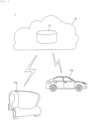
- FIG. 2 is a diagram for explaining a system according to an embodiment of the present disclosure.
- a system 1 may include an infrastructure 20 and at least one vehicle 10a and 10b.
- the infrastructure 20 may include at least one server 21.
- the server 21 may receive data generated by the vehicles 10a and 10b.
- the server 21 may process the received data.
- the server 21 may manipulate the received data.
- the server 21 may receive data generated by at least one electronic device installed in the vehicles 10a and 10b.
- the server 21 may receive data generated by at least one of an EHP, a user interface device, an object detection device, a communication device, a driving manipulation device, a main ECU, a vehicle-driving device, a travel system, a sensor, and a position-data-generating-device.
- the server 21 may generate big data based on the data received from a plurality of vehicles.
- the server 21 may receive dynamic data from the vehicles 10a and 10b and may generate big data based on the received dynamic data.
- the server 21 may update HD map data based on the data received from a plurality of vehicles.
- the server 21 may receive data generated by an object detection device from the EHP included in the vehicles 10a and 10b and may update HD map data.
- the server 21 may provide pre-stored data to the vehicles 10a and 10b.
- the server 21 may provide at least one of high-definition (HD) map data or standard definition (SD) map data to the vehicles 10a and 10b.
- the server 21 may classify the map data into map data for respective sections, and may provide only the map data corresponding to a section requested by the vehicles 10a and 10b.
- the HD map data may be referred to as high-precision map data.
- the server 21 may provide data that is processed or manipulated by the server 21 to the vehicles 10a and 10b.
- the vehicles 10a and 10b may generate a travel control signal based on data received from the server 21.
- the server 21 may provide the HD map data to the vehicles 10a and 10b.
- the server 21 may provide dynamic data to the vehicles 10a and 10b.
- FIG. 3 is a diagram for explaining a vehicle including an electronic device according to an embodiment of the present disclosure.
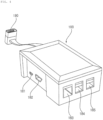
- FIG. 4 is diagram showing an example of the outer appearance of an electronic device according to an embodiment of the present disclosure.
- the vehicle 10 may include the electronic device 100, a user interface device 200, an object detection device 210, a communication device 220, a driving manipulation device 230, a main electronic control unit (ECU) 240, a vehicle-driving device 250, a travel system 260, a sensor 270, and a position-data-generating-device 280.
- ECU electronice control unit
- the electronic device 100 may be referred to as an electronic horizon provider (EHP).
- the electronic device 100 may generate electronic horizon data and may provide the same to at least one electronic device included in the vehicle 10.
- the electronic horizon data may be described as driving plan data used to generate a travel control signal of the vehicle 10 in the travel system 260.
- the electronic horizon data may be understood as driving plan data within a range to a horizon from the point where the vehicle 10 is positioned.
- the horizon may be understood as a point a preset distance ahead of the point at which the vehicle 10 is positioned based on a preset travel path.
- the horizon may refer to a point that the vehicle 10 is capable of reaching after a predetermined time from the point at which the vehicle 10 is positioned along the preset traveling path.
- the travel path may refer to a travel path to a final destination, and may be set by user input.
- the electronic horizon data may include horizon map data and horizon path data.
- the horizon map data may include at least one of topology data, ADAS data, HD map data, or dynamic data.
- the horizon map data may include a plurality of layers.
- the horizon map data may include a first layer matching the topology data, a second layer matching the ADAS data, a third layer matching the HD map data, and a fourth layer matching the dynamic data.
- the horizon map data may further include static object data.
- the topology data may be described as a map made by connecting middle parts of roads.
- the topology data may be appropriate to broadly indicate the position of a vehicle and may be configured in the form of data that is mainly used in a navigation device for a driver.
- the topology data may be understood as data about road information other than information on lanes.
- the topology data may be generated based on data received from the infrastructure 20.
- the topology data may be based on data generated by the infrastructure 20.
- the topology data may be based on data stored in at least one memory included in the vehicle 10.
- the ADAS data may refer to data related to information on a road.
- the ADAS data may include at least one of data on a slope of a road, data on a curvature of a road, or data on a speed limit of a road.
- the ADAS data may further include data on a no-passing zone.
- the ADAS data may be based on data generated by the infrastructure 20.
- the ADAS data may be based on data generated by the object detection device 210.
- the ADAS data may be referred to as road information data.
- the HD map data may include topology information in units of detailed lanes of a road, information on connection between lanes, and information on characteristics for localization of a vehicle (e.g., a traffic sign, lane marking/attributes, or road furniture).
- the HD map data may be based on data generated by the infrastructure 20.
- the dynamic data may include various pieces of dynamic information to be generated on a road.
- the dynamic data may include information on construction, information on variable-speed lanes, information on the state of a road surface, information on traffic, and information on moving objects.
- the dynamic data may be based on data received from the infrastructure 20.
- the dynamic data may be based on data generated by the object detection device 210.
- the electronic device 100 may provide map data within a range to a horizon from the point where the vehicle 10 is positioned.
- the horizon path data may be described as the trajectory of the vehicle 10 within a range to a horizon from the point where the vehicle 10 is positioned.
- the horizon path data may include data indicating the relative probability of selection of any one among roads at a decision point (e.g., a forked road, a junction, or an intersection).
- the relative probability may be calculated based on the time taken to reach a final destination. For example, when a first road is selected at the decision point, if the time taken to reach a final destination is shorter than in the case in which a second road is selected, the probability of selecting the first road may be calculated to be higher than the probability of selecting the second road.
- the horizon path data may include a main path and a sub path.
- the main path may be understood as a trajectory formed by connecting roads having a high probability of being selected.
- the sub path may branch from at least one decision point on the main path.
- the sub path may be understood as a trajectory formed by connecting roads having a low probability of being selected from at least one decision point on the main path.
- the electronic device 100 may include an interface 180, a power supply 190, a memory 140, and a processor 170.
- the interface 180 may exchange a signal with at least one electronic device included in the vehicle 10 in a wired or wireless manner.
- the interface 180 may exchange a signal with at least one of the user interface device 200, the object detection device 210, the communication device 220, the driving manipulation device 230, the main ECU 240, the vehicle-driving device 250, the travel system 260, the sensor 270, or the position-data-generating-device 280 in a wired or wireless manner.
- the interface 180 may include at least one of a communication module, a terminal, a pin, a cable, a port, a circuit, an element, or a device.
- the power supply 190 may supply power to the electronic device 100.
- the power supply 190 may receive power from a power source (e.g., a battery) included in the vehicle 10 and may provide power to each unit of the electronic device 100.
- the power supply 190 may operate according to a control signal provided from the main ECU 240.
- the power supply 190 may be embodied as a switched-mode power supply (SMPS).
- SMPS switched-mode power supply
- the memory 140 is conductively connected to the controller 170.
- the memory 140 may store default data for a unit, control data for controlling the operation of the unit, and input and output data.
- the memory 140 may be any of various storage devices in hardware, such as read only memory (ROM), random access memory (RAM), erasable and programmable ROM (EPROM), flash drive, and hard drive.
- ROM read only memory
- RAM random access memory
- EPROM erasable and programmable ROM
- flash drive and hard drive.
- the memory 140 may store various data for the overall operation of the vehicle 100, such as programs for processing or controlling in the controller 170.
- the processor 170 may be conductively connected to the interface 180 and the power supply 190 and may exchange a signal therewith.
- the processor 170 may be embodied using at least one of application specific integrated circuits (ASICs), digital signal processors (DSPs), digital signal processing devices (DSPDs), programmable logic devices (PLDs), field programmable gate arrays (FPGAs), processors, controllers, micro-controllers, microprocessors, or electric units for performing other functions.
- ASICs application specific integrated circuits
- DSPs digital signal processors
- DSPDs digital signal processing devices
- PLDs programmable logic devices
- FPGAs field programmable gate arrays
- processors controllers, micro-controllers, microprocessors, or electric units for performing other functions.
- the processor 170 may be driven by power provided from the power supply 190.
- the processor 170 may continuously generate electronic horizon data in the state in which the power supply 190 supplies power.
- the processor 170 may generate electronic horizon data.
- the processor 170 may generate electronic horizon data.
- the processor 170 may generate horizon path data.
- the processor 170 may generate electronic horizon data by applying a traveling situation of the vehicle 10. For example, the processor 170 may generate the electronic horizon data based on traveling direction data and traveling speed data of the vehicle 10.
- the processor 170 may combine the generated electronic horizon data with the pre-generated electronic horizon data. For example, the processor 170 may connect horizon map data generated at a first time with horizon map data generated at a second time in terms of position. For example, the processor 170 may connect horizon path data generated at a first time with horizon path data generated at a second time in terms of position.
- the processor 170 may provide electronic horizon data.
- the processor 170 may provide the electronic horizon data to at least one of the travel system 260 or the main ECU 240 through the interface 180.
- the processor 170 may include the memory 140, an HD map processor 171, a dynamic data processor 172, a matcher 173, and a path generator 175.
- the HD map processor 171 may receive HD map data from the server 21 through the communication device 220.
- the HD map processor 171 may store the HD map data.
- the HD map processor 171 may process and manipulate the HD map data.
- the dynamic data processor 172 may receive dynamic data from the object detection device 210.
- the dynamic data processor 172 may receive the dynamic data from the server 21.
- the dynamic data processor 172 may store the dynamic data.
- the dynamic data processor 172 may process and manipulate the dynamic data.
- the matcher 173 may receive an HD map from the HD map processor 171.
- the matcher 173 may receive the dynamic data from the dynamic data processor 172.
- the matcher 173 may generate horizon map data by matching the HD map data and the dynamic data.
- the matcher 173 may receive topology data.
- the matcher 173 may receive ADAS data.
- the matcher 173 may generate horizon map data by matching topology data, ADAS data, HD map data, and dynamic data.
- the path generator 175 may generate horizon path data.
- the path generator 175 may include a main path generator 176 and a sub path generator 177.
- the main path generator 176 may generate main path data.
- the sub path generator 177 may generate sub path data.
- the electronic device 100 may include at least one printed circuit board (PCB).
- the interface 180, the power supply 190, and the processor 170 may be conductively connected to the PCB.
- the electronic device 100 may be integrated into the communication device 220.
- the vehicle 10 may include the communication device 220 as a lower-ranking component of the electronic device 100.
- the user interface device 200 may be a device for communication between the vehicle 10 and a user.
- the user interface device 200 may receive user input and may provide information generated by the vehicle 10 to a user.
- the vehicle 10 may embody a user interface (UI) or user experience (UX) through the user interface device 200.
- UI user interface
- UX user experience
- the object detection device 210 may detect an object outside the vehicle 10.
- the object detection device 210 may include at least one of a camera, a RADAR, a LiDAR, an ultrasonic sensor, or an infrared sensor.
- the object detection device 210 may provide data on an object, generated based on a sensing signal generated by a sensor, to at least one electronic device included in a vehicle.
- the object detection device 210 may generate dynamic data based on a sensing signal for sensing an object.
- the object detection device 210 may provide the dynamic data to the electronic device 100.
- the object detection device 210 may receive electronic horizon data.
- the object detection device 210 may include an electronic horizon re-constructor (EHR) 265.
- the EHR 265 may convert the electronic horizon data into the data format to be used in the object detection device 210.
- the communication device 220 may exchange a signal with a device positioned outside the vehicle 10.
- the communication device 220 may exchange a signal with at least one of an infrastructure (e.g., a server) or other vehicles.
- the communication device 220 may include at least one of a transmission antenna and a reception antenna for communication, and a radio frequency (RF) circuit or an RF device for embodying various communication protocols.
- RF radio frequency
- the driving manipulation device 230 may be a device for receiving user input for driving. In the case of a manual mode, the vehicle 10 may be driven based on a signal provided by the driving manipulation device 230.
- the driving manipulation device 230 may include a steering input device (e.g., a steering wheel), an acceleration input device (e.g., an accelerator pedal), and a brake input device (e.g., a brake pedal).
- the main ECU 240 may control the overall operation of at least one electronic device included in the vehicle 10.
- the main ECU 240 may receive electronic horizon data.
- the main ECU 240 may include an electronic horizon re-constructor (EHR) 265.
- the EHR 265 may convert the electronic horizon data into a data format to be used in the main ECU 240.
- the vehicle-driving device 250 may be a device for electrical control of various devices in the vehicle 10.
- the vehicle-driving device 250 may include a powertrain driver, a chassis driver, a door/window driver, a safety device driver, a lamp driver, and a conditioning driver.
- the powertrain driver may include a power source driver and a transmission driver.
- the chassis driver may include a steering driver, a brake driver, and a suspension driver.
- the travel system 260 may perform a traveling operation of the vehicle 10.
- the travel system 260 may provide a control signal to at least one of a powertrain driver or a chassis driver of the vehicle-driving device 250, and may move the vehicle 10.
- the travel system 260 may receive electronic horizon data.
- the travel system 260 may include an electronic horizon re-constructor (EHR) 265.
- the EHR 265 may convert the electronic horizon data into a data format to be used in an ADAS application and an autonomous driving application.
- the travel system 260 may include at least one of an ADAS application or an autonomous driving application.
- the travel system 260 may generate a travel control signal using at least one of the ADAS application and the autonomous driving application.
- the sensor 270 may sense the state of a vehicle.
- the sensor 270 may include at least one of an inertial navigation unit (IMU) sensor, a collision sensor, a wheel sensor, a speed sensor, an inclination sensor, a weight detection sensor, a heading sensor, a position module, a vehicle forward/backward sensor, a battery sensor, a fuel sensor, a tire sensor, a steering sensor using rotation of a steering wheel, a vehicle interior temperature sensor, a vehicle interior humidity sensor, an ultrasonic sensor, an illumination sensor, an accelerator pedal position sensor, or a brake pedal position sensor.
- the inertial navigation unit (IMU) sensor may include one or more of an acceleration sensor, a gyro sensor, and a magnetic sensor.
- the sensor 270 may generate data on the state of the vehicle based on a signal generated by at least one sensor.
- the sensor 270 may acquire a sensing signal for sensing vehicle posture information, vehicle motion information, vehicle yaw information, vehicle roll information, vehicle pitch information, vehicle collision information, vehicle direction information, vehicle angle information, vehicle speed information, vehicle acceleration information, vehicle inclination information, vehicle forward/backward information, battery information, fuel information, tire information, vehicle lamp information, vehicle interior temperature information, vehicle interior humidity information, steering wheel rotation angle, vehicle external illumination, the pressure applied to an accelerator pedal, the pressure applied to a brake pedal, and the like.
- the sensor 270 may further include an accelerator pedal sensor, a pressure sensor, an engine rotation speed sensor, an air flow sensor (AFS), an air temperature sensor (ATS), a water temperature sensor (WTS), a throttle position sensor (TPS), a TDC sensor, and a crank angle sensor (CAS).
- AFS air flow sensor
- ATS air temperature sensor
- WTS water temperature sensor
- TPS throttle position sensor
- TDC TDC sensor
- CAS crank angle sensor
- the sensor 270 may generate vehicle state information based on sensing data.
- the vehicle state information may be information generated based on data detected by various sensors included in a vehicle.
- the vehicle state information may include vehicle posture information, vehicle speed information, vehicle inclination information, vehicle weight information, vehicle direction information, vehicle battery information, vehicle fuel information, vehicle tire air-pressure information, vehicle steering information, vehicle interior temperature information, vehicle interior humidity information, pedal position information, and vehicle engine temperature information.
- the position-data-generating-device 280 may generate position data of the vehicle 10.
- the position-data-generating-device 280 may include at least one of a global positioning system (GPS) or a differential global positioning system (DGPS).
- GPS global positioning system
- DGPS differential global positioning system
- the position-data-generating-device 280 may generate position data of the vehicle 10 based on a signal generated by at least one of the GPS or the DGPS.
- the position-data-generating-device 280 may correct the position data based on at least one of an inertial measurement unit (IMU) of the sensor 270 or a camera of the object detection device 210.
- IMU inertial measurement unit
- the vehicle 10 may include an internal communication system 50.
- a plurality of electronic devices included in the vehicle 10 may exchange a signal using the internal communication system 50 as a medium.
- the signal may include data.
- the internal communication system 50 may use at least one communication protocol (e.g., CAN, LIN, FlexRay, MOST, or Ethernet).
- FIG. 5A is a flowchart of a signal inside a vehicle including an electronic device according to an embodiment of the present disclosure.
- the electronic device 100 may receive HD map data from the server 21 through the communication device 220.
- the electronic device 100 may receive dynamic data from the object detection device 210. In some embodiments, the electronic device 100 may also receive dynamic data from the server 21 through the communication device 220.
- the electronic device 100 may receive position data of a vehicle from the position-data-generating-device 280.
- the electronic device 100 may receive a signal based on user input through the user interface device 200. In some embodiments, the electronic device 100 may receive vehicle state information from the sensor 270.
- the electronic device 100 may generate electronic horizon data based on HD map data, dynamic data, and position data.
- the electronic device 100 may match the HD map data, the dynamic data, and the position data with each other to generate horizon map data.
- the electronic device 100 may generate horizon path data on a horizon map.
- the electronic device 100 may generate main path data and sub path data on the horizon map.
- the electronic device 100 may provide electronic horizon data to the travel system 260.
- the EHR 265 of the travel system 260 may convert the electronic horizon data into a data format appropriate for applications 266 and 267.
- the applications 266 and 267 may generate a travel control signal based on the electronic horizon data.
- the travel system 260 may provide the travel control signal to the vehicle-driving device 250.
- the travel system 260 may include at least one of an ADAS application 266 or an autonomous driving application 267.
- the ADAS application 266 may generate a control signal for assisting the driver in driving of the vehicle 10 through the driving manipulation device 230 based on the electronic horizon data.
- the autonomous driving application 267 may generate a control signal for moving the vehicle 10 based on the electronic horizon data.
- FIG. 5B is a flowchart of a signal inside a vehicle including an electronic device according to an embodiment of the present disclosure.
- the electronic device 100 may provide the electronic horizon data to the object detection device 210.
- the EHR 265 of the object detection device 210 may convert the electronic horizon data into a data format appropriate for the object detection device 210.
- the object detection device 210 may include at least one of a camera 211, a RADAR 212, a LiDAR 213, an ultrasonic sensor 214, or an infrared sensor 215.
- the electronic horizon data may be provided to at least one of the camera 211, the RADAR 212, the LiDAR 213, the ultrasonic sensor 214, or the infrared sensor 215. At least one of the camera 211, the RADAR 212, the LiDAR 213, the ultrasonic sensor 214, or the infrared sensor 215 may generate data based on the electronic horizon data.
- the electronic device 100 may provide electronic horizon data to the main ECU 240.
- the EHR 265 of the main ECU 240 may convert the electronic horizon data into a data format appropriate for the main ECU 240.
- the main ECU 240 may generate a control signal based on the electronic horizon data.
- the main ECU 240 may generate a control signal for controlling at least one of the user interface device 180, the object detection device 210, the communication device 220, the driving manipulation device 230, the vehicle-driving device 250, the travel system 260, the sensor 270, or the position-data-generating-device 280 based on the electronic horizon data.
- FIGs. 6A and 6B are diagrams for explaining an operation of receiving HD map data according to an embodiment of the present disclosure.
- the server 21 may divide the HD map data in units of HD map tiles and may provide the divided HD map data to the electronic device 100.
- the processor 170 may download the HD map data in units of HD map tiles from the server 21 through the communication device 220.
- the processor 170 may store the downloaded HD map tile in the memory 140.
- the processor 170 may delete the stored HD map tile.
- the processor 170 may delete the HD map tile when the vehicle 10 moves out of a section corresponding to the HD map tile.
- the processor 170 may delete the HD map tile when a preset time elapses since the HD map tile was stored.
- the processor 170 may receive a first HD map tile 351 including a position 350 of the vehicle 10.
- the server 21 may receive data on the position 350 of the vehicle 10 from the vehicle 10 and may provide the first HD map tile 351 including a position 250 of the vehicle 10 to the vehicle 10.
- the processor 170 may receive HD map tiles 352, 353, 354, and 355 around the first HD map tile 351.
- the processor 170 may receive the HD map tiles 352, 353, 354, and 355 that neighbor upper, lower, left, and right sides of the first HD map tile 351, respectively. In this case, the processor 170 may receive five HD map tiles in total.
- the processor 170 may further receive an HD map tile positioned in a diagonal direction from the first HD map tile 351 along with the HD map tiles 352, 353, 354, and 355 that neighbor upper, lower, left, and right sides of the first HD map tile 351, respectively.
- the processor 170 may receive nine HD map tiles in total.
- FIG. 6B is a diagram for explaining an operation of receiving HD map data when there is a preset destination.
- the processor 170 may receive tiles 350, 352, 361, 362, 363, 364, 365, 366, 367, 368, 369, 370, and 371 associated with a path 391 to the position 350 of the vehicle 10.
- the processor 170 may receive the plurality of tiles 350, 352, 361, 362, 363, 364, 365, 366, 367, 368, 369, 370, and 371 to cover the path 391.
- the processor 170 may receive all of the tiles 350, 352, 361, 362, 363, 364, 365, 366, 367, 368, 369, 370, and 371, which cover the path 391, at one time.
- the processor 170 may separately receive all of the tiles 350, 352, 361, 362, 363, 364, 365, 366, 367, 368, 369, 370, and 371. While the vehicle 10 moves along the path 391, the processor 170 may receive only at least some of the tiles 350, 352, 361, 362, 363, 364, 365, 366, 367, 368, 369, 370, and 371 based on the position of the vehicle 10. Then, the processor 170 may continuously receive tiles and may delete the pre-received tiles while the vehicle 10 moves.
- FIG. 6C is a diagram for explaining an operation of generating electronic horizon data according to an embodiment of the present disclosure.
- the processor 170 may generate the electronic horizon data based on HD map data.
- the vehicle 10 may travel in the state in which a final destination is set.
- the final destination may be set based on user input received through the user interface device 200 or the communication device 220. In some embodiments, the final destination may also be set by the travel system 260.
- the vehicle 10 may be positioned within a preset distance from a first point while traveling.
- the processor 170 may generate electronic horizon data using a first point as a start point and a second point as an end point.
- Each of the first point and the second point may be one point on a path toward the final destination.
- the first point may be described as the point at which the vehicle 10 is currently positioned or is to be positioned in the near future.
- the second point may be described as the aforementioned horizon.
- the processor 170 may receive an HD map of a region including a section to the second point from the first point. For example, the processor 170 may make a request for an HD map of a region within a predetermined radius from a section to the second point from the first point and may receive the HD map.
- the processor 170 may generate electronic horizon data on a region including the section to the second point from the first point based on the HD map.
- the processor 170 may generate horizon map data of the region including the section to the second point from the first point.
- the processor 170 may generate horizon path data of the region including the section to the second point from the first point.
- the processor 170 may generate data on a main path 313 of the region including the section to the second point from the first point.
- the processor 170 may generate data on a sub path 314 of the region including the section to the second point from the first point.
- the processor 170 may generate electronic horizon data using a second point as a start point and a third point as an end point.
- Each of the second point and the third point may be one point on a path toward a final destination.
- the second point may be described as a point at which the vehicle 10 is currently positioned or is to be positioned in the near future.
- the third point may be described as the aforementioned horizon.
- the electronic horizon data using the second point as a start point and the third point as an end point may be geographically connected to the aforementioned electronic horizon data using the first point as a start point and the second point as an end point.
- the aforementioned operation of generating the electronic horizon data using the first point as a start point and the second point as an end point may be applied in the same way to the operation of generating the electronic horizon data using the second point as a start point and the third point as an end point.
- the vehicle 10 may also travel in the state in which a final destination is not set.
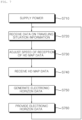
- FIG. 7 is a flowchart of an electronic device according to an embodiment of the present disclosure.
- the processor 170 may receive power through the power supply 190 (S710).
- the power supply 190 may supply power to the processor 170.
- the processor 170 may receive power received from a battery included in the vehicle 10 through the power supply 190.
- the processor 170 may perform a processing operation.
- the processor 170 may receive data of traveling situation information of the vehicle 10 through the interface 180 (S720).
- the interface 180 may receive data of traveling situation information of the vehicle 10.
- the traveling situation information of the vehicle 10 may include at least one of autonomous driving state information, manual driving state information, traveling speed information, parking operation situation information, stop situation information, or vehicle position information.
- the interface 180 may transmit data of traveling situation information to the processor 170.
- the processor 170 may adjust the speed of reception of HD map data based on the traveling situation information (S730).
- the speed of reception of the HD map data may be defined as the amount of HD map data received per unit time.
- the processor 170 may generate a signal for adjusting the speed of reception of the HD map data and may transmit the signal to the communication device 220 through the interface 180.
- the processor 170 may control the speed of reception of the HD map data.
- the adjusting operation S730 may include an operation of adjusting a bandwidth for receiving the HD map data based on the traveling situation information.
- the processor 170 may adjust the bandwidth for receiving the HD map data based on the traveling situation information.
- the processor 170 may adjust the bandwidth in order to change a communication method (e.g., 5G or LTE) for receiving HD map data based on the traveling situation information.
- the processor 170 may adjust the bandwidth in order to change a frequency used to receive the HD map data based on the traveling situation information.
- the speed of reception of the HD map data may be adjusted by adjusting the bandwidth.
- the adjusting operation S730 may further include an operation of adjusting the geographic range of the HD map data based on the traveling situation information.
- the processor 170 may adjust the geographic range of the HD map data based on the traveling situation information. For example, in the case of high-speed traveling, the processor 170 may increase the geographic range of the HD map data, and in the case of low-speed traveling, the processor 170 may reduce the geographic range of the HD map data. As such, the speed of reception of the HD map data may be adjusted by adjusting the geographic range of the HD map data.
- the adjusting operation S730 may further include an operation of adjusting the speed of reception of the HD map data based on at least one of autonomous driving state information, manual driving state information, traveling speed information, parking operation situation information, stop situation information, or vehicle position information.
- the processor 170 may adjust the speed of reception of the HD map data based on at least one of autonomous driving state information, manual driving state information, traveling speed information, parking operation situation information, stop situation information, or vehicle position information.
- the processor 170 may adjust the speed of reception of the HD map data to be higher than a manual driving state. For example, in high-speed traveling, the processor 170 may adjust the speed of reception of the HD map data to be higher than low-speed traveling. For example, when a vehicle currently performs a parking operation or is in a stationary state, the processor 170 may minimize the speed of reception of the HD map data or may not receive data. For example, when the vehicle 10 is located in a city, the processor 170 may adjust the speed of reception of the HD map data to be higher than in the case in which the vehicle 10 is located in the countryside.
- the processor 170 may receive HD map data of a region specified according to a reception speed from the server 21 through the communication device 220 (S740).
- the interface 180 may receive the HD map data of a specified geographic region at the reception speed from the server 21 through the communication device 220.
- the interface 180 may receive HD map data on the vicinity of the position of the vehicle 10.
- the interface 180 may transmit the received HD map data to the processor 170.
- the processor 170 may generate electronic horizon data of the specified region based on the HD map data (S750).
- the generating operation (S750) may further include an operation of generating electronic horizon data based on at least one of autonomous driving state information, manual driving state information, traveling speed information, parking operation situation information, stop situation information, or vehicle position information.
- the processor 170 may generate electronic horizon data based on at least one of autonomous driving state information, manual driving state information, traveling speed information, parking operation situation information, stop situation information, or vehicle position information.
- the processor 170 may generate electronic horizon data including data of an object (e.g., a moving object) to be recognized as an obstacle while a vehicle travels.
- the processor 170 may generate electronic horizon data including only data of an object that needs to be recognized by a driver while the vehicle travels.
- the processor 170 may generate electronic horizon data by adjusting the length of the main path and the sub path depending on the traveling speed of the vehicle 10.
- the processor 170 may generate electronic horizon data including at least one lane type information, information on whether a towaway zone is present, or information on a vehicle that stops in the vicinity thereof.
- the processor 170 may generate electronic horizon data based on road shape information for generating a horizon path. For example, while the vehicle moves to a city from the outskirt, the processor 170 may generate electronic horizon data including road shape information, landmark information, and dynamic information.
- the processor 170 may provide the electronic horizon data to the travel system 260 through the interface 180 (S760).
- the processor 170 may provide electronic horizon data corresponding to a set geographic range to the travel system 260 through the interface 180. Then, the processor 170 may repeatedly perform operations subsequent to operation S720.
- Operations S720 to S760 may be performed in the state in which power is received from the power supply 190.
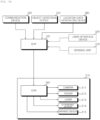
- FIG. 8 is a diagram showing an example of a block diagram of control of an electronic device according to an embodiment of the present disclosure.
Landscapes
- Engineering & Computer Science (AREA)
- Remote Sensing (AREA)
- Radar, Positioning & Navigation (AREA)
- Physics & Mathematics (AREA)
- General Physics & Mathematics (AREA)
- Automation & Control Theory (AREA)
- Chemical & Material Sciences (AREA)
- Analytical Chemistry (AREA)
- Human Computer Interaction (AREA)
- Transportation (AREA)
- Mechanical Engineering (AREA)
- Signal Processing (AREA)
- Computer Networks & Wireless Communication (AREA)
- Mathematical Physics (AREA)
- Traffic Control Systems (AREA)
- Navigation (AREA)
Description
- The present disclosure relates to an electronic device for a vehicle, and a method and system for operating an electronic device for a vehicle.
- A vehicle refers to a device that carries a passenger in a direction intended by a passenger. A car is a major example of such a vehicle. In the industrial field of vehicles, application of an advanced driver assistance system (ADAS) is under active study to increase the driving convenience of users. Furthermore, the application of autonomous driving of vehicles is also under active study.
- The application of ADAS or the application of autonomous driving may be configured based on map data. Conventionally, low-scale standard definition (SD) map data is provided to users while being stored in a memory installed in a vehicle. However, recently, as the need for high-scale high-definition (HD) map data has increased, map data into which a cloud service is integrated has come to be provided to users.
- To process data of the application of ADAS and the application of autonomous driving based on an HD map, capability to process a large amount of data and capability to store a large amount of data are required. There is thus a need to develop technology for effectively transmitting and receiving a large amount of data of the HD map.
-
EP 3 073 224 A1 -
EP 2 042 833 A1 -
CN 107 622 684 A discloses a method for transmitting road information, a traffic control unit (TCU) and an on-board unit (OBU). The method includes the following steps: a TCU acquires a planned path of a vehicle; the TCU extends the planned path to generate an available driving area of the vehicle on the planned path, wherein the available driving area includes a safety driving area of the vehicle; and the TCU sends road information to an OBU, wherein the road information includes instruction information of the available driving area. -
US 2012/232733 A1 discloses a method for determining, in a predictive manner, types of road situations of a vehicle comprising the following steps: points defining at least one possible path situated in front of the vehicle are obtained from a navigation system, for each point, at least one attribute describing the type of road environment associated with this point is extracted from the navigation system, the attribute of this point is compared with that of the preceding point, if the attributes are identical, a driving situation is deduced from this such that said driving situation is a function of the attribute of the preceding point, if the two attributes are different, an end of driving situation is deduced from this, and a transition to a new driving situation is determined depending on the attribute of this point, in such a manner as to define a succession of driving situations for this path. -
US 2018/143648 A1 discloses a vehicle control device for controlling a vehicle, which may include a communication unit configured to receive a map having a plurality of layers from a server; and a processor configured to generate a control signal for driving the vehicle using the map, wherein a control region that is a reference for the generation of the control signal around a location of the vehicle is defined differently according to a preset reference. - To overcome the aforementioned problems, the present disclosure may provide an electronic device for a vehicle for adjusting the speed of reception of high-definition (HD) map data depending on traveling situation information.
- The present disclosure may provide a method of operating an electronic device for a vehicle for adjusting the speed of reception of HD map data depending on situation information.
- The present disclosure may provide a system for adjusting a speed of reception of HD map data depending on traveling situation information.
- It will be appreciated by persons skilled in the art that that the effects that could be achieved with the present disclosure are not limited to what has been particularly described hereinabove and other advantages of the present disclosure will be more clearly understood from the detailed description.
- The above object is solved by the subject matter of the independent claims. Preferred embodiments are defined by the dependent claims.
- Details of other embodiments are included in detailed descriptions and drawings.
- As is apparent from the foregoing description, the embodiments of the present disclosure have the following one or more effects.
- First, communication load may be reduced by adjusting the speed of reception of HD map data depending on traveling situation information.
- Second, processing efficiency may be enhanced by generating electronic horizon data depending on traveling situation information.
- It will be appreciated by persons skilled in the art that that the effects that could be achieved with the present disclosure are not limited to what has been particularly described hereinabove and other advantages of the present disclosure will be more clearly understood from the following claims.
-
-
FIG. 1 is a diagram showing a vehicle that travels on a road according to an embodiment of the present disclosure. -
FIG. 2 is a diagram for explaining a system according to an embodiment of the present disclosure. -
FIG. 3 is a diagram for explaining a vehicle including an electronic device according to an embodiment of the present disclosure. -
FIG. 4 is diagram showing an example of the outer appearance of an electronic device according to an embodiment of the present disclosure. -
FIGs. 5A to 5C are flowcharts of a signal inside a vehicle including an electronic device according to an embodiment of the present disclosure. -
FIGs. 6A and6B are diagrams for explaining an operation of receiving high-definition (HD) map data according to an embodiment of the present disclosure. -
FIG. 6C is a diagram for explaining an operation of generating electronic horizon data according to an embodiment of the present disclosure. -
FIG. 7 is a flowchart of an electronic device according to an embodiment of the present disclosure. -
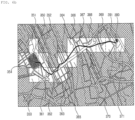
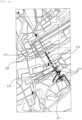
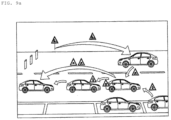
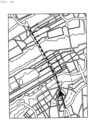
FIGs. 8 to 11B are diagrams for explaining an operation of an electronic device according to an embodiment of the present disclosure. - Reference will now be made in detail to exemplary embodiments of the present disclosure, examples of which are illustrated in the accompanying drawings. The suffixes "module" and "unit" of elements herein are used for convenience of description and thus can be used interchangeably, and do not have any distinguishable meanings or functions. In the following description of the at least one embodiment, a detailed description of known functions and configurations incorporated herein will be omitted for the purposes of clarity and brevity. The features of the present disclosure will be more clearly understood from the accompanying drawings, and should not be understood to be limited by the accompanying drawings.
- It will be understood that, although the terms "first", "second", "third" etc. may be used herein to describe various elements, these elements should not be limited by these terms. These terms are only used to distinguish one element from another element.
- It will be understood that when an element is referred to as being "on", "connected to" or "coupled to" another element, it may be directly on, connected to or coupled to the other element, or intervening elements may be present. In contrast, when an element is referred to as being "directly on," "directly connected to" or "directly coupled to" another element or layer, there are no intervening elements present.
- Singular expressions in the present specification include the plural expressions unless clearly specified otherwise in context.
- It will be further understood that the terms "comprises" or "comprising" when used in this specification specify the presence of stated features, integers, steps, operations, elements, or components, but do not preclude the presence or addition of one or more other features, integers, steps, operations, elements, components, or groups thereof.
- In the description below, the left side of the vehicle means the left side with respect to the travel direction of the vehicle and the right side of the vehicle means the right side with respect to the travel direction of the vehicle.
-
FIG. 1 is a diagram showing a vehicle that travels on a road according to an embodiment of the present disclosure. - Referring to
FIG. 1 , avehicle 10 according to an embodiment may be defined as a form of a transport that travels on a road or rails. Thevehicle 10 may be interpreted as including an automobile, a train, or a motorcycle. Hereinafter, an autonomous driving vehicle that travels without driver manipulation for driving or a vehicle including an advanced driver assistance system (ADAS) will exemplify thevehicle 10. - The vehicle described in this specification may include a vehicle equipped with an internal combustion engine as a power source, a hybrid vehicle equipped with both an engine and an electric motor as a power source, and an electric vehicle equipped with an electric motor as a power source.
- The
vehicle 10 may include anelectronic device 100. Theelectronic device 100 may be referred to as an electronic horizon provider (EHP). Theelectronic device 100 may be conductively connected to another electronic device inside thevehicle 10 in the state of being installed in thevehicle 10. -
FIG. 2 is a diagram for explaining a system according to an embodiment of the present disclosure. - Referring to
FIG. 2 , asystem 1 may include aninfrastructure 20 and at least onevehicle - The
infrastructure 20 may include at least oneserver 21. Theserver 21 may receive data generated by thevehicles server 21 may process the received data. Theserver 21 may manipulate the received data. - The
server 21 may receive data generated by at least one electronic device installed in thevehicles server 21 may receive data generated by at least one of an EHP, a user interface device, an object detection device, a communication device, a driving manipulation device, a main ECU, a vehicle-driving device, a travel system, a sensor, and a position-data-generating-device. Theserver 21 may generate big data based on the data received from a plurality of vehicles. For example, theserver 21 may receive dynamic data from thevehicles server 21 may update HD map data based on the data received from a plurality of vehicles. For example, theserver 21 may receive data generated by an object detection device from the EHP included in thevehicles - The
server 21 may provide pre-stored data to thevehicles server 21 may provide at least one of high-definition (HD) map data or standard definition (SD) map data to thevehicles server 21 may classify the map data into map data for respective sections, and may provide only the map data corresponding to a section requested by thevehicles - The
server 21 may provide data that is processed or manipulated by theserver 21 to thevehicles vehicles server 21. For example, theserver 21 may provide the HD map data to thevehicles server 21 may provide dynamic data to thevehicles -
FIG. 3 is a diagram for explaining a vehicle including an electronic device according to an embodiment of the present disclosure. -
FIG. 4 is diagram showing an example of the outer appearance of an electronic device according to an embodiment of the present disclosure. - Referring to
FIGs. 3 and4 , thevehicle 10 may include theelectronic device 100, auser interface device 200, anobject detection device 210, acommunication device 220, a drivingmanipulation device 230, a main electronic control unit (ECU) 240, a vehicle-drivingdevice 250, atravel system 260, asensor 270, and a position-data-generating-device 280. - The
electronic device 100 may be referred to as an electronic horizon provider (EHP). Theelectronic device 100 may generate electronic horizon data and may provide the same to at least one electronic device included in thevehicle 10. - The electronic horizon data may be described as driving plan data used to generate a travel control signal of the
vehicle 10 in thetravel system 260. For example, the electronic horizon data may be understood as driving plan data within a range to a horizon from the point where thevehicle 10 is positioned. Here, the horizon may be understood as a point a preset distance ahead of the point at which thevehicle 10 is positioned based on a preset travel path. The horizon may refer to a point that thevehicle 10 is capable of reaching after a predetermined time from the point at which thevehicle 10 is positioned along the preset traveling path. Here, the travel path may refer to a travel path to a final destination, and may be set by user input. - The electronic horizon data may include horizon map data and horizon path data.
- The horizon map data may include at least one of topology data, ADAS data, HD map data, or dynamic data. In some embodiments, the horizon map data may include a plurality of layers. For example, the horizon map data may include a first layer matching the topology data, a second layer matching the ADAS data, a third layer matching the HD map data, and a fourth layer matching the dynamic data. The horizon map data may further include static object data.
- The topology data may be described as a map made by connecting middle parts of roads. The topology data may be appropriate to broadly indicate the position of a vehicle and may be configured in the form of data that is mainly used in a navigation device for a driver. The topology data may be understood as data about road information other than information on lanes. The topology data may be generated based on data received from the
infrastructure 20. The topology data may be based on data generated by theinfrastructure 20. The topology data may be based on data stored in at least one memory included in thevehicle 10. - The ADAS data may refer to data related to information on a road. The ADAS data may include at least one of data on a slope of a road, data on a curvature of a road, or data on a speed limit of a road. The ADAS data may further include data on a no-passing zone. The ADAS data may be based on data generated by the
infrastructure 20. The ADAS data may be based on data generated by theobject detection device 210. The ADAS data may be referred to as road information data. - The HD map data may include topology information in units of detailed lanes of a road, information on connection between lanes, and information on characteristics for localization of a vehicle (e.g., a traffic sign, lane marking/attributes, or road furniture). The HD map data may be based on data generated by the
infrastructure 20. - The dynamic data may include various pieces of dynamic information to be generated on a road. For example, the dynamic data may include information on construction, information on variable-speed lanes, information on the state of a road surface, information on traffic, and information on moving objects. The dynamic data may be based on data received from the
infrastructure 20. The dynamic data may be based on data generated by theobject detection device 210. - The
electronic device 100 may provide map data within a range to a horizon from the point where thevehicle 10 is positioned. - The horizon path data may be described as the trajectory of the
vehicle 10 within a range to a horizon from the point where thevehicle 10 is positioned. The horizon path data may include data indicating the relative probability of selection of any one among roads at a decision point (e.g., a forked road, a junction, or an intersection). The relative probability may be calculated based on the time taken to reach a final destination. For example, when a first road is selected at the decision point, if the time taken to reach a final destination is shorter than in the case in which a second road is selected, the probability of selecting the first road may be calculated to be higher than the probability of selecting the second road. - The horizon path data may include a main path and a sub path. The main path may be understood as a trajectory formed by connecting roads having a high probability of being selected. The sub path may branch from at least one decision point on the main path. The sub path may be understood as a trajectory formed by connecting roads having a low probability of being selected from at least one decision point on the main path.
- The
electronic device 100 may include aninterface 180, apower supply 190, amemory 140, and aprocessor 170. - The
interface 180 may exchange a signal with at least one electronic device included in thevehicle 10 in a wired or wireless manner. Theinterface 180 may exchange a signal with at least one of theuser interface device 200, theobject detection device 210, thecommunication device 220, the drivingmanipulation device 230, themain ECU 240, the vehicle-drivingdevice 250, thetravel system 260, thesensor 270, or the position-data-generating-device 280 in a wired or wireless manner. Theinterface 180 may include at least one of a communication module, a terminal, a pin, a cable, a port, a circuit, an element, or a device. - The
power supply 190 may supply power to theelectronic device 100. Thepower supply 190 may receive power from a power source (e.g., a battery) included in thevehicle 10 and may provide power to each unit of theelectronic device 100. Thepower supply 190 may operate according to a control signal provided from themain ECU 240. Thepower supply 190 may be embodied as a switched-mode power supply (SMPS). - The
memory 140 is conductively connected to thecontroller 170. Thememory 140 may store default data for a unit, control data for controlling the operation of the unit, and input and output data. Thememory 140 may be any of various storage devices in hardware, such as read only memory (ROM), random access memory (RAM), erasable and programmable ROM (EPROM), flash drive, and hard drive. Thememory 140 may store various data for the overall operation of thevehicle 100, such as programs for processing or controlling in thecontroller 170. - The
processor 170 may be conductively connected to theinterface 180 and thepower supply 190 and may exchange a signal therewith. Theprocessor 170 may be embodied using at least one of application specific integrated circuits (ASICs), digital signal processors (DSPs), digital signal processing devices (DSPDs), programmable logic devices (PLDs), field programmable gate arrays (FPGAs), processors, controllers, micro-controllers, microprocessors, or electric units for performing other functions. - The
processor 170 may be driven by power provided from thepower supply 190. Theprocessor 170 may continuously generate electronic horizon data in the state in which thepower supply 190 supplies power. - The
processor 170 may generate electronic horizon data. Theprocessor 170 may generate electronic horizon data. Theprocessor 170 may generate horizon path data. - The
processor 170 may generate electronic horizon data by applying a traveling situation of thevehicle 10. For example, theprocessor 170 may generate the electronic horizon data based on traveling direction data and traveling speed data of thevehicle 10. - The
processor 170 may combine the generated electronic horizon data with the pre-generated electronic horizon data. For example, theprocessor 170 may connect horizon map data generated at a first time with horizon map data generated at a second time in terms of position. For example, theprocessor 170 may connect horizon path data generated at a first time with horizon path data generated at a second time in terms of position. - The
processor 170 may provide electronic horizon data. Theprocessor 170 may provide the electronic horizon data to at least one of thetravel system 260 or themain ECU 240 through theinterface 180. - The
processor 170 may include thememory 140, anHD map processor 171, adynamic data processor 172, amatcher 173, and apath generator 175. - The
HD map processor 171 may receive HD map data from theserver 21 through thecommunication device 220. TheHD map processor 171 may store the HD map data. In some embodiments, theHD map processor 171 may process and manipulate the HD map data. - The
dynamic data processor 172 may receive dynamic data from theobject detection device 210. Thedynamic data processor 172 may receive the dynamic data from theserver 21. Thedynamic data processor 172 may store the dynamic data. In some embodiments, thedynamic data processor 172 may process and manipulate the dynamic data. - The
matcher 173 may receive an HD map from theHD map processor 171. Thematcher 173 may receive the dynamic data from thedynamic data processor 172. Thematcher 173 may generate horizon map data by matching the HD map data and the dynamic data. - In some embodiments, the
matcher 173 may receive topology data. Thematcher 173 may receive ADAS data. Thematcher 173 may generate horizon map data by matching topology data, ADAS data, HD map data, and dynamic data. - The
path generator 175 may generate horizon path data. Thepath generator 175 may include amain path generator 176 and asub path generator 177. Themain path generator 176 may generate main path data. Thesub path generator 177 may generate sub path data. - The
electronic device 100 may include at least one printed circuit board (PCB). Theinterface 180, thepower supply 190, and theprocessor 170 may be conductively connected to the PCB. - In some embodiments, the
electronic device 100 may be integrated into thecommunication device 220. In this case, thevehicle 10 may include thecommunication device 220 as a lower-ranking component of theelectronic device 100. - The
user interface device 200 may be a device for communication between thevehicle 10 and a user. Theuser interface device 200 may receive user input and may provide information generated by thevehicle 10 to a user. Thevehicle 10 may embody a user interface (UI) or user experience (UX) through theuser interface device 200. - The
object detection device 210 may detect an object outside thevehicle 10. Theobject detection device 210 may include at least one of a camera, a RADAR, a LiDAR, an ultrasonic sensor, or an infrared sensor. Theobject detection device 210 may provide data on an object, generated based on a sensing signal generated by a sensor, to at least one electronic device included in a vehicle. - The
object detection device 210 may generate dynamic data based on a sensing signal for sensing an object. Theobject detection device 210 may provide the dynamic data to theelectronic device 100. - The
object detection device 210 may receive electronic horizon data. Theobject detection device 210 may include an electronic horizon re-constructor (EHR) 265. TheEHR 265 may convert the electronic horizon data into the data format to be used in theobject detection device 210. - The
communication device 220 may exchange a signal with a device positioned outside thevehicle 10. Thecommunication device 220 may exchange a signal with at least one of an infrastructure (e.g., a server) or other vehicles. Thecommunication device 220 may include at least one of a transmission antenna and a reception antenna for communication, and a radio frequency (RF) circuit or an RF device for embodying various communication protocols. - The driving
manipulation device 230 may be a device for receiving user input for driving. In the case of a manual mode, thevehicle 10 may be driven based on a signal provided by the drivingmanipulation device 230. The drivingmanipulation device 230 may include a steering input device (e.g., a steering wheel), an acceleration input device (e.g., an accelerator pedal), and a brake input device (e.g., a brake pedal). - The
main ECU 240 may control the overall operation of at least one electronic device included in thevehicle 10. - The
main ECU 240 may receive electronic horizon data. Themain ECU 240 may include an electronic horizon re-constructor (EHR) 265. TheEHR 265 may convert the electronic horizon data into a data format to be used in themain ECU 240. - The vehicle-driving
device 250 may be a device for electrical control of various devices in thevehicle 10. The vehicle-drivingdevice 250 may include a powertrain driver, a chassis driver, a door/window driver, a safety device driver, a lamp driver, and a conditioning driver. The powertrain driver may include a power source driver and a transmission driver. The chassis driver may include a steering driver, a brake driver, and a suspension driver. - The
travel system 260 may perform a traveling operation of thevehicle 10. Thetravel system 260 may provide a control signal to at least one of a powertrain driver or a chassis driver of the vehicle-drivingdevice 250, and may move thevehicle 10. - The
travel system 260 may receive electronic horizon data. Thetravel system 260 may include an electronic horizon re-constructor (EHR) 265. TheEHR 265 may convert the electronic horizon data into a data format to be used in an ADAS application and an autonomous driving application. - The
travel system 260 may include at least one of an ADAS application or an autonomous driving application. Thetravel system 260 may generate a travel control signal using at least one of the ADAS application and the autonomous driving application. - The
sensor 270 may sense the state of a vehicle. Thesensor 270 may include at least one of an inertial navigation unit (IMU) sensor, a collision sensor, a wheel sensor, a speed sensor, an inclination sensor, a weight detection sensor, a heading sensor, a position module, a vehicle forward/backward sensor, a battery sensor, a fuel sensor, a tire sensor, a steering sensor using rotation of a steering wheel, a vehicle interior temperature sensor, a vehicle interior humidity sensor, an ultrasonic sensor, an illumination sensor, an accelerator pedal position sensor, or a brake pedal position sensor. The inertial navigation unit (IMU) sensor may include one or more of an acceleration sensor, a gyro sensor, and a magnetic sensor. - The
sensor 270 may generate data on the state of the vehicle based on a signal generated by at least one sensor. Thesensor 270 may acquire a sensing signal for sensing vehicle posture information, vehicle motion information, vehicle yaw information, vehicle roll information, vehicle pitch information, vehicle collision information, vehicle direction information, vehicle angle information, vehicle speed information, vehicle acceleration information, vehicle inclination information, vehicle forward/backward information, battery information, fuel information, tire information, vehicle lamp information, vehicle interior temperature information, vehicle interior humidity information, steering wheel rotation angle, vehicle external illumination, the pressure applied to an accelerator pedal, the pressure applied to a brake pedal, and the like. - In addition, the
sensor 270 may further include an accelerator pedal sensor, a pressure sensor, an engine rotation speed sensor, an air flow sensor (AFS), an air temperature sensor (ATS), a water temperature sensor (WTS), a throttle position sensor (TPS), a TDC sensor, and a crank angle sensor (CAS). - The
sensor 270 may generate vehicle state information based on sensing data. The vehicle state information may be information generated based on data detected by various sensors included in a vehicle. - For example, the vehicle state information may include vehicle posture information, vehicle speed information, vehicle inclination information, vehicle weight information, vehicle direction information, vehicle battery information, vehicle fuel information, vehicle tire air-pressure information, vehicle steering information, vehicle interior temperature information, vehicle interior humidity information, pedal position information, and vehicle engine temperature information.
- The position-data-generating-
device 280 may generate position data of thevehicle 10. The position-data-generating-device 280 may include at least one of a global positioning system (GPS) or a differential global positioning system (DGPS). The position-data-generating-device 280 may generate position data of thevehicle 10 based on a signal generated by at least one of the GPS or the DGPS. In some embodiments, the position-data-generating-device 280 may correct the position data based on at least one of an inertial measurement unit (IMU) of thesensor 270 or a camera of theobject detection device 210. - The
vehicle 10 may include aninternal communication system 50. A plurality of electronic devices included in thevehicle 10 may exchange a signal using theinternal communication system 50 as a medium. The signal may include data. Theinternal communication system 50 may use at least one communication protocol (e.g., CAN, LIN, FlexRay, MOST, or Ethernet). -
FIG. 5A is a flowchart of a signal inside a vehicle including an electronic device according to an embodiment of the present disclosure. - Referring to
FIG. 5A , theelectronic device 100 may receive HD map data from theserver 21 through thecommunication device 220. - The
electronic device 100 may receive dynamic data from theobject detection device 210. In some embodiments, theelectronic device 100 may also receive dynamic data from theserver 21 through thecommunication device 220. - The
electronic device 100 may receive position data of a vehicle from the position-data-generating-device 280. - In some embodiments, the
electronic device 100 may receive a signal based on user input through theuser interface device 200. In some embodiments, theelectronic device 100 may receive vehicle state information from thesensor 270. - The
electronic device 100 may generate electronic horizon data based on HD map data, dynamic data, and position data. Theelectronic device 100 may match the HD map data, the dynamic data, and the position data with each other to generate horizon map data. Theelectronic device 100 may generate horizon path data on a horizon map. Theelectronic device 100 may generate main path data and sub path data on the horizon map. - The
electronic device 100 may provide electronic horizon data to thetravel system 260. TheEHR 265 of thetravel system 260 may convert the electronic horizon data into a data format appropriate forapplications applications travel system 260 may provide the travel control signal to the vehicle-drivingdevice 250. - The
travel system 260 may include at least one of anADAS application 266 or anautonomous driving application 267. TheADAS application 266 may generate a control signal for assisting the driver in driving of thevehicle 10 through the drivingmanipulation device 230 based on the electronic horizon data. Theautonomous driving application 267 may generate a control signal for moving thevehicle 10 based on the electronic horizon data. -
FIG. 5B is a flowchart of a signal inside a vehicle including an electronic device according to an embodiment of the present disclosure. - With reference to
FIG. 5B , the embodiment of the present disclosure will be described in terms of differences fromFIG. 5A . Theelectronic device 100 may provide the electronic horizon data to theobject detection device 210. TheEHR 265 of theobject detection device 210 may convert the electronic horizon data into a data format appropriate for theobject detection device 210. Theobject detection device 210 may include at least one of acamera 211, aRADAR 212, aLiDAR 213, anultrasonic sensor 214, or aninfrared sensor 215. The electronic horizon data, the data format of which is converted by theEHR 265, may be provided to at least one of thecamera 211, theRADAR 212, theLiDAR 213, theultrasonic sensor 214, or theinfrared sensor 215. At least one of thecamera 211, theRADAR 212, theLiDAR 213, theultrasonic sensor 214, or theinfrared sensor 215 may generate data based on the electronic horizon data. -
FIG. 5C is a flowchart of a signal inside a vehicle including an electronic device according to an embodiment of the present disclosure. - With reference to
FIG. 5C , the embodiment of the present disclosure will be described in terms of differences fromFIG. 5A . Theelectronic device 100 may provide electronic horizon data to themain ECU 240. TheEHR 265 of themain ECU 240 may convert the electronic horizon data into a data format appropriate for themain ECU 240. Themain ECU 240 may generate a control signal based on the electronic horizon data. For example, themain ECU 240 may generate a control signal for controlling at least one of theuser interface device 180, theobject detection device 210, thecommunication device 220, the drivingmanipulation device 230, the vehicle-drivingdevice 250, thetravel system 260, thesensor 270, or the position-data-generating-device 280 based on the electronic horizon data. -
FIGs. 6A and6B are diagrams for explaining an operation of receiving HD map data according to an embodiment of the present disclosure. - The
server 21 may divide the HD map data in units of HD map tiles and may provide the divided HD map data to theelectronic device 100. Theprocessor 170 may download the HD map data in units of HD map tiles from theserver 21 through thecommunication device 220. - An HD map tile may be defined as sub HD map data obtained by geographically dividing an entire HD map into rectangular shapes. All HD map data may be acquired by connecting all HD map tiles. The HD map data is high-scale data, and thus the
vehicle 10 requires a high-performance controller to download all of the HD map data and to use the downloaded HD map data by thevehicle 10. As communication technologies have been developed, thevehicle 10 may download and use the HD map data in the form of HD map tiles and may thus obviate a high-performance controller rather than requiring inclusion of the high-performance controller, and thus may effectively process data. - The
processor 170 may store the downloaded HD map tile in thememory 140. Theprocessor 170 may delete the stored HD map tile. For example, theprocessor 170 may delete the HD map tile when thevehicle 10 moves out of a section corresponding to the HD map tile. For example, theprocessor 170 may delete the HD map tile when a preset time elapses since the HD map tile was stored. -
FIG. 6A is a diagram for explaining an operation of receiving HD map data when there is no preset destination. - Referring to
FIG. 6A , when there is no preset destination, theprocessor 170 may receive a firstHD map tile 351 including aposition 350 of thevehicle 10. Theserver 21 may receive data on theposition 350 of thevehicle 10 from thevehicle 10 and may provide the firstHD map tile 351 including aposition 250 of thevehicle 10 to thevehicle 10. Theprocessor 170 may receiveHD map tiles HD map tile 351. For example, theprocessor 170 may receive theHD map tiles HD map tile 351, respectively. In this case, theprocessor 170 may receive five HD map tiles in total. For example, theprocessor 170 may further receive an HD map tile positioned in a diagonal direction from the firstHD map tile 351 along with theHD map tiles HD map tile 351, respectively. In this case, theprocessor 170 may receive nine HD map tiles in total. -
FIG. 6B is a diagram for explaining an operation of receiving HD map data when there is a preset destination. - Referring to
FIG. 6B , when there is a preset destination, theprocessor 170 may receivetiles path 391 to theposition 350 of thevehicle 10. Theprocessor 170 may receive the plurality oftiles path 391. - The
processor 170 may receive all of thetiles path 391, at one time. - While the
vehicle 10 moves along thepath 391, theprocessor 170 may separately receive all of thetiles vehicle 10 moves along thepath 391, theprocessor 170 may receive only at least some of thetiles vehicle 10. Then, theprocessor 170 may continuously receive tiles and may delete the pre-received tiles while thevehicle 10 moves. -
FIG. 6C is a diagram for explaining an operation of generating electronic horizon data according to an embodiment of the present disclosure. - Referring to
FIG. 6C , theprocessor 170 may generate the electronic horizon data based on HD map data. - The
vehicle 10 may travel in the state in which a final destination is set. The final destination may be set based on user input received through theuser interface device 200 or thecommunication device 220. In some embodiments, the final destination may also be set by thetravel system 260. - In the state in which the final destination is set, the
vehicle 10 may be positioned within a preset distance from a first point while traveling. When thevehicle 10 is positioned within a preset distance from the first point, theprocessor 170 may generate electronic horizon data using a first point as a start point and a second point as an end point. Each of the first point and the second point may be one point on a path toward the final destination. The first point may be described as the point at which thevehicle 10 is currently positioned or is to be positioned in the near future. The second point may be described as the aforementioned horizon. - The
processor 170 may receive an HD map of a region including a section to the second point from the first point. For example, theprocessor 170 may make a request for an HD map of a region within a predetermined radius from a section to the second point from the first point and may receive the HD map. - The
processor 170 may generate electronic horizon data on a region including the section to the second point from the first point based on the HD map. Theprocessor 170 may generate horizon map data of the region including the section to the second point from the first point. Theprocessor 170 may generate horizon path data of the region including the section to the second point from the first point. Theprocessor 170 may generate data on amain path 313 of the region including the section to the second point from the first point. Theprocessor 170 may generate data on asub path 314 of the region including the section to the second point from the first point. - When the
vehicle 10 is positioned within a preset distance from the second point, theprocessor 170 may generate electronic horizon data using a second point as a start point and a third point as an end point. Each of the second point and the third point may be one point on a path toward a final destination. The second point may be described as a point at which thevehicle 10 is currently positioned or is to be positioned in the near future. The third point may be described as the aforementioned horizon. The electronic horizon data using the second point as a start point and the third point as an end point may be geographically connected to the aforementioned electronic horizon data using the first point as a start point and the second point as an end point. - The aforementioned operation of generating the electronic horizon data using the first point as a start point and the second point as an end point may be applied in the same way to the operation of generating the electronic horizon data using the second point as a start point and the third point as an end point.
- In some embodiments, the
vehicle 10 may also travel in the state in which a final destination is not set. -
FIG. 7 is a flowchart of an electronic device according to an embodiment of the present disclosure. - Referring to
FIG. 7 , theprocessor 170 may receive power through the power supply 190 (S710). Thepower supply 190 may supply power to theprocessor 170. When thevehicle 10 is turned on, theprocessor 170 may receive power received from a battery included in thevehicle 10 through thepower supply 190. When receiving power, theprocessor 170 may perform a processing operation. - The
processor 170 may receive data of traveling situation information of thevehicle 10 through the interface 180 (S720). Theinterface 180 may receive data of traveling situation information of thevehicle 10. The traveling situation information of thevehicle 10 may include at least one of autonomous driving state information, manual driving state information, traveling speed information, parking operation situation information, stop situation information, or vehicle position information. Theinterface 180 may transmit data of traveling situation information to theprocessor 170. - The
processor 170 may adjust the speed of reception of HD map data based on the traveling situation information (S730). The speed of reception of the HD map data may be defined as the amount of HD map data received per unit time. When theelectronic device 100 and thecommunication device 220 are of a separable type, theprocessor 170 may generate a signal for adjusting the speed of reception of the HD map data and may transmit the signal to thecommunication device 220 through theinterface 180. When theelectronic device 100 and thecommunication device 220 are of an integrated type, theprocessor 170 may control the speed of reception of the HD map data. - The adjusting operation S730 may include an operation of adjusting a bandwidth for receiving the HD map data based on the traveling situation information. The
processor 170 may adjust the bandwidth for receiving the HD map data based on the traveling situation information. For example, theprocessor 170 may adjust the bandwidth in order to change a communication method (e.g., 5G or LTE) for receiving HD map data based on the traveling situation information. For example, theprocessor 170 may adjust the bandwidth in order to change a frequency used to receive the HD map data based on the traveling situation information. As such, the speed of reception of the HD map data may be adjusted by adjusting the bandwidth. - The adjusting operation S730 may further include an operation of adjusting the geographic range of the HD map data based on the traveling situation information. The
processor 170 may adjust the geographic range of the HD map data based on the traveling situation information. For example, in the case of high-speed traveling, theprocessor 170 may increase the geographic range of the HD map data, and in the case of low-speed traveling, theprocessor 170 may reduce the geographic range of the HD map data. As such, the speed of reception of the HD map data may be adjusted by adjusting the geographic range of the HD map data. - The adjusting operation S730 may further include an operation of adjusting the speed of reception of the HD map data based on at least one of autonomous driving state information, manual driving state information, traveling speed information, parking operation situation information, stop situation information, or vehicle position information. The
processor 170 may adjust the speed of reception of the HD map data based on at least one of autonomous driving state information, manual driving state information, traveling speed information, parking operation situation information, stop situation information, or vehicle position information. - For example, in an autonomous driving state, the
processor 170 may adjust the speed of reception of the HD map data to be higher than a manual driving state. For example, in high-speed traveling, theprocessor 170 may adjust the speed of reception of the HD map data to be higher than low-speed traveling. For example, when a vehicle currently performs a parking operation or is in a stationary state, theprocessor 170 may minimize the speed of reception of the HD map data or may not receive data. For example, when thevehicle 10 is located in a city, theprocessor 170 may adjust the speed of reception of the HD map data to be higher than in the case in which thevehicle 10 is located in the countryside. - The
processor 170 may receive HD map data of a region specified according to a reception speed from theserver 21 through the communication device 220 (S740). In the state in which thevehicle 10 travels, theinterface 180 may receive the HD map data of a specified geographic region at the reception speed from theserver 21 through thecommunication device 220. Theinterface 180 may receive HD map data on the vicinity of the position of thevehicle 10. Theinterface 180 may transmit the received HD map data to theprocessor 170. - The
processor 170 may generate electronic horizon data of the specified region based on the HD map data (S750). - The generating operation (S750) may further include an operation of generating electronic horizon data based on at least one of autonomous driving state information, manual driving state information, traveling speed information, parking operation situation information, stop situation information, or vehicle position information. The
processor 170 may generate electronic horizon data based on at least one of autonomous driving state information, manual driving state information, traveling speed information, parking operation situation information, stop situation information, or vehicle position information. - For example, in an autonomous driving state, the
processor 170 may generate electronic horizon data including data of an object (e.g., a moving object) to be recognized as an obstacle while a vehicle travels. For example, in a manual driving state, theprocessor 170 may generate electronic horizon data including only data of an object that needs to be recognized by a driver while the vehicle travels. For example, theprocessor 170 may generate electronic horizon data by adjusting the length of the main path and the sub path depending on the traveling speed of thevehicle 10. For example, when the vehicle currently performs a parking operation or is in a stationary state, theprocessor 170 may generate electronic horizon data including at least one lane type information, information on whether a towaway zone is present, or information on a vehicle that stops in the vicinity thereof. For example, while the vehicle moves to the countryside from a city, theprocessor 170 may generate electronic horizon data based on road shape information for generating a horizon path. For example, while the vehicle moves to a city from the outskirt, theprocessor 170 may generate electronic horizon data including road shape information, landmark information, and dynamic information. - The
processor 170 may provide the electronic horizon data to thetravel system 260 through the interface 180 (S760). Theprocessor 170 may provide electronic horizon data corresponding to a set geographic range to thetravel system 260 through theinterface 180. Then, theprocessor 170 may repeatedly perform operations subsequent to operation S720. - Operations S720 to S760 may be performed in the state in which power is received from the
power supply 190. -
FIG. 8 is a diagram showing an example of a block diagram of control of an electronic device according to an embodiment of the present disclosure. - Referring to
FIG. 8 , theelectronic device 100 may further include thecommunication device 220 in theelectronic device 100 described above with reference toFIG. 3 . - The
electronic device 100 ofFIG. 3 may function as an independent device that is separate from thecommunication device 220. In this case, theprocessor 170 may provide a signal to thecommunication device 220 through theinterface 180. Thecommunication device 220 may communicate with theserver 21 based on a signal received from theelectronic device 100. Theprocessor 170 may generate a signal for adjusting the speed of reception of the HD map data and may transmit the signal to thecommunication device 220 through theinterface 180. Thecommunication device 220 may adjust the speed of reception of the HD map data based on the received signal. - The
electronic device 100 ofFIG. 8 may be integrated into thecommunication device 220 and may be configured as an integrated type. In this case, theprocessor 170 may be conductively connected to thecommunication device 220. Theprocessor 170 may directly control thecommunication device 220. Theprocessor 170 may control thecommunication device 220 to adjust the speed of reception of the HD map data. - The
processor 170 may receive autonomous driving state information and traveling speed information of thevehicle 10 from at least the electronic device included in thevehicle 10 through theinterface 180. When thevehicle 10 travels at a low speed equal to or less than a reference speed in an autonomous driving state, theprocessor 170 may reduce the geographic range of the HD map and the length of the horizon path compared with the case of high-speed travel. Theprocessor 170 may download minimum information required to generate electronic horizon data through long-term evolution (LTE). When thevehicle 10 travels at a high speed equal to or greater than a reference speed in an autonomous driving state, theprocessor 170 may increase the geographic range of the HD map and the length of the horizon path compared with the case of low-speed travel. Theprocessor 170 may rapidly download information required for electronic horizon data through fifth-generation (5G). - When the
vehicle 10 travels at a low speed equal to or less than a reference speed in a manual driving state, theprocessor 170 may reduce the geographic range of the HD map and the length of the horizon path compared with the case of high-seed travel. Theprocessor 170 may download minimum information required to generate electronic horizon data through long-term evolution (LTE). When thevehicle 10 travels at a high speed equal to or greater than a reference speed in a manual driving state, theprocessor 170 may increase the geographic range of the HD map and the length of the horizon path compared with the case of low-speed travel. Theprocessor 170 may rapidly download information required for electronic horizon data through fifth-generation (5G). When thevehicle 10 manually travels, theprocessor 170 may generate electronic horizon data based on information required for manual driving. Theprocessor 170 may provide a horizon path including dynamic information required for safe driving based on information on objects around thevehicle 10 and various real-time events. -
FIGs. 9A to 9B are diagrams for explaining an operation of an electronic device according to an embodiment of the present disclosure. - Referring to the drawing, the
processor 170 may variably receive HD map tiles based on traveling situation information of thevehicle 10. As such, theprocessor 170 may adjust a communication speed and traffic depending on traveling situation information, thereby enhancing communication efficiency and processing efficiency. - The
processor 170 may adjust a communication speed and traffic by adjusting the respective bandwidths of LTE and 5G. When the vehicle travels at a high speed in autonomous driving, safe and rapid data reception is the foremost consideration, so real-time high-speed communication through 5G is required in the case of high-speed traveling. When the vehicle travels at a low speed in autonomous driving, the communication load and processing load may be reduced using LTE or 3G rather than 5G. When the vehicle travels at a high speed in manual traveling, only warnings with respect to dangerous objects may be provided using LTE, without receiving all HD map data. When the vehicle travels at a low speed in manual driving, only warnings with respect to dangerous objects may be provided to a driver using LTE or 3G. - The
processor 170 may variably control the download method of HD map data based on the position of thevehicle 10. For example, when thevehicle 10 moves to the countryside from a city, theprocessor 170 may download and manipulate the HD map data based on road shape data for generating a horizon path. For example, when thevehicle 10 enters a city from the countryside, theprocessor 170 may selectively download and manipulate road shape data, dynamic data, and landmark data required for traveling. - The
processor 170 may variably control the download method of HD map data based on the driving mode of thevehicle 10. - For example, when the
vehicle 10 travels in an autonomous driving mode, theprocessor 170 may download dynamic data and road shape data for generating horizon path data. Theprocessor 170 may receive moving object information from nearby vehicles or a V2I infrastructure (RSU). When the computational load of theprocessor 170 is drastically increased due to excessive downloading and manipulating of HD map data, theprocessor 170 may reduce a geographic region of the downloaded HD map data and may reduce a recommended traveling speed. - For example, when the
vehicle 10 travels in a manual driving mode, theprocessor 170 may download dynamic data and road shape data for generating horizon path data. Theprocessor 170 may selectively receive information on dangers that affect travel, from information on near moving objects through V2X. When computational load of theprocessor 170 is drastically increased due to excessive downloading and manipulating of HD map data, theprocessor 170 may process only basic information required to generate a horizon path and may selectively receive additional information depending on the system situation. -
FIGs. 10A and10B are diagrams for explaining an operation of an electronic device according to an embodiment of the present disclosure. - Referring to the drawings, as shown in
FIG. 10A , when thevehicle 10 moves slowly or temporarily stops, a large amount of HD map data may not be required. In this case, theprocessor 170 may receive HD map data including vehicle lane information, information on whether a towaway zone is present, parking fee information, and information on other vehicles positioned around thevehicle 10. Theprocessor 170 may provide vehicle lane information, information on whether a towaway zone is present, parking fee information, and information on other vehicles positioned around thevehicle 10 to a driver through theuser interface device 200 within a horizon path range. - As shown in
FIG. 10B , theprocessor 170 may flexibly set the length of a horizon path and may provide only information required by a driver. Theelectronic device 100 may provide only required information depending on the situation of a driver to facilitate temporary parking and slow movement, and may receive only a small amount of data to lower an occupancy ratio of a processor, to increase a the lifespan of thememory 140, and to reduce communication costs. -
FIGs. 11A to 11B are diagrams for explaining an operation of an electronic device according to an embodiment of the present disclosure. - Referring to the drawings, the
processor 170 may provide a horizon path of a rear side and a specified region inside a parking lost while the vehicle parks. In this case, when the vehicle reaches a destination and parks, theelectronic device 100 does not necessarily receive a large amount of data, unlike the case in which the vehicle travels. Communication costs and the load on a processor may be reduced using a parking lot map, which is received when communication is disconnected and the vehicle enters the parking lot. In a parking mode, theprocessor 170 may disconnect communication irrespective of autonomous driving or manual driving and may generate electronic horizon data based on the received parking lot map data and data of theobject detection device 210. Thetravel system 260 may receive electronic horizon data at a parking lot and may perform parking. The parking lot map data may receive the data from a server that manages a parking lot. - When the
vehicle 10 reaches a destination and attempts to be parked, only parking lot map data may be required. An available parking space may be recognized in advance based on the parking lot map data. Thevehicle 10 may immediately enter the available parking space recognized in advance and does not need to search an entire parking lot to find an available parking space. As shown inFIG. 11A , thevehicle 10 may search for an available parking space and may provide pieces of information required for parking to a driver using a sensor of theobject detection device 210. - The aforementioned present disclosure can also be embodied as computer readable code stored on a computer readable recording medium. The computer readable recording medium is any data storage device that can store data which can thereafter be read by a computer. Examples of the computer readable recording medium include a hard disk drive (HDD), a solid state drive (SSD), a silicon disk drive (SDD), read-only memory (ROM), random-access memory (RAM), CD-ROM, magnetic tapes, floppy disks, optical data storage devices, carrier waves (e.g., transmission via the Internet), etc. The computer may include a processor or a controller. Accordingly, it is intended that the present disclosure cover the modifications and variations of this invention provided they come within the scope of the appended claims.
-
- 1: System
- 10: Vehicle
- 100: Electronic device
- 170: Processor
Claims (12)
- An electronic device (100) for a vehicle (10), comprising:a power supply (190) configured to supply power;an interface (180) configured to receive high-definition, HD, map data of a specified region from a server (21) through a communication device (220) and to receive traveling situation information of the vehicle;characterized in thatthe electronic device (100) further comprises:at least one processor (170) configured to continuously generate electronic horizon data of the specified region based on the HD map data in a state in which the power is received, and to adjust a speed of reception of the HD map data by changing the bandwidth in order to change a communication method for receiving HD map data based on the traveling situation information,wherein the electronic horizon data is a driving plan data used to generate a travel control signal of the vehicle, andwherein the speed of reception of the HD map data is defined as the amount of HD map data received per unit time.
- The electronic device of claim 1, wherein the processor (170) is configured to adjust a a geographic range of the HD map data based on the traveling situation information.
- The electronic device of claim 1, wherein the processor (170) is configured to adjust the speed of reception of the HD map data based on at least one of autonomous driving state information, manual driving state information, traveling speed information, parking operation situation information, stop situation information, or vehicle position information.
- The electronic device of claim 1, wherein the processor (170) is configured to generate the electronic horizon data based on at least one of autonomous driving state information, manual driving state information, traveling speed information, parking operation situation information, stop situation information, or vehicle position information.
- A method of operating an electronic device (100) for a vehicle (10), the method comprising:receiving power by at least one processor (170);receiving data of traveling situation information of the vehicle in a state in which the power is received, by the at least one processor (170);characterized in thatthe method further comprises:adjusting a speed of reception of high-definition, HD, map data by changing the bandwidth in order to change a communication method for receiving HD map data based on the traveling situation information in a state in which the power is received, by the at least one processor (170);receiving HD map data of a specified region depending on the reception speed from a server (21) through a communication device (220) in the state in which the power is received, by the at least one processor (170); andgenerating electronic horizon data corresponding to a geographic range based on the HD map data in the state in which the power is received, by the at least one processor (170),wherein the electronic horizon data is a driving plan data used to generate a travel control signal of the vehicle, andwherein the speed of reception of the HD map data is defined as the amount of HD map data received per unit time.
- The method of claim 5, wherein the adjusting comprises adjusting a size of the HD map data based on the traveling situation information.
- The method of claim 5, wherein the adjusting comprises adjusting a speed of reception of the HD map data based on at least one of autonomous driving state information, manual driving state information, traveling speed information, parking operation situation information, stop situation information, or vehicle position information.
- The method of claim 5, wherein the generating comprises generating the electronic horizon data based on at least one of autonomous driving state information, manual driving state information, traveling speed information, parking operation situation information, stop situation information, or vehicle position information.
- A system comprising:a server (21) configured to provide high-definition, HD, map data; andat least one vehicle (10) comprising an electronic device (100) configured to receive the HD map data,wherein the electronic device (100) comprises:a power supply (190) configured to supply power;an interface (180) configured to receive HD map data of a specified region from a server through a communication device (220);characterized in thatthe electronic device (100) further comprises:at least one processor (170) configured to continuously generate electronic horizon data of the specified region based on the HD map data in a state in which the power is received, and to adjust a speed of reception of the HD map data by changing the bandwidth in order to change a communication method for receiving HD map data based on traveling situation information of the vehicle,wherein the electronic horizon data is a driving plan data used to generate a travel control signal of the vehicle, andwherein the speed of reception of the HD map data is defined as the amount of HD map data received per unit time.
- The system of claim 9, wherein the processor (170) is configured to adjust a size of the HD map data based on the traveling situation information.
- The system of claim 9, wherein the processor (170) is configured to adjust the speed of reception of the HD map data based on at least one of autonomous driving state information, manual driving state information, traveling speed information, parking operation situation information, stop situation information, or vehicle position information.
- The system of claim 9, wherein the processor (170) is configured to generate the electronic horizon data based on at least one of autonomous driving state information, manual driving state information, traveling speed information, parking operation situation information, stop situation information, or vehicle position information.
Applications Claiming Priority (1)
| Application Number | Priority Date | Filing Date | Title |
|---|---|---|---|
| PCT/KR2018/013231 WO2020091119A1 (en) | 2018-11-02 | 2018-11-02 | Electronic device for vehicle, and method and system for operating electronic device for vehicle |
Publications (3)
| Publication Number | Publication Date |
|---|---|
| EP3875326A1 EP3875326A1 (en) | 2021-09-08 |
| EP3875326A4 EP3875326A4 (en) | 2022-05-18 |
| EP3875326B1 true EP3875326B1 (en) | 2025-03-19 |
Family
ID=70464665
Family Applications (1)
| Application Number | Title | Priority Date | Filing Date |
|---|---|---|---|
| EP18939060.2A Active EP3875326B1 (en) | 2018-11-02 | 2018-11-02 | Electronic device for vehicle, and method and system for operating electronic device for vehicle |
Country Status (3)
| Country | Link |
|---|---|
| US (1) | US11635301B2 (en) |
| EP (1) | EP3875326B1 (en) |
| WO (1) | WO2020091119A1 (en) |
Families Citing this family (5)
| Publication number | Priority date | Publication date | Assignee | Title |
|---|---|---|---|---|
| ES2898922T3 (en) | 2015-04-30 | 2022-03-09 | Musc Found For Res Dev | Oxindole compounds and pharmaceutical compositions thereof |
| JP7236310B2 (en) * | 2019-03-29 | 2023-03-09 | 本田技研工業株式会社 | Route setting device, route setting method and program |
| WO2021226062A1 (en) * | 2020-05-04 | 2021-11-11 | Intel Corporation | Intelligent transport system service dissemination |
| CN115812227B (en) * | 2020-08-25 | 2025-08-22 | 华为技术有限公司 | A method for obtaining dynamic information and related equipment |
| US11898332B1 (en) | 2022-08-22 | 2024-02-13 | Caterpillar Inc. | Adjusting camera bandwidth based on machine operation |
Family Cites Families (15)
| Publication number | Priority date | Publication date | Assignee | Title |
|---|---|---|---|---|
| US6405128B1 (en) | 1999-12-20 | 2002-06-11 | Navigation Technologies Corp. | Method and system for providing an electronic horizon in an advanced driver assistance system architecture |
| ES2569936T3 (en) | 1999-12-20 | 2016-05-13 | Here Global B.V. | Map data architecture platform for advanced driver assistance systems |
| JP2002009734A (en) * | 2000-06-27 | 2002-01-11 | Denso Corp | Communication system employing ofdm system |
| KR101027149B1 (en) | 2008-07-16 | 2011-04-05 | 현대엠엔소프트 주식회사 | How to update a vehicle navigation device and his electronic map |
| FR2947231B1 (en) * | 2009-06-30 | 2013-03-29 | Valeo Vision | METHOD FOR PREDICTIVELY DETERMINING THE ROAD SITUATIONS OF A VEHICLE |
| US8717192B2 (en) | 2010-10-08 | 2014-05-06 | Navteq B.V. | Method and system for using intersecting electronic horizons |
| JP5679928B2 (en) | 2011-07-25 | 2015-03-04 | 三菱電機株式会社 | Data transmission system |
| CN111380545B (en) * | 2015-02-10 | 2024-11-12 | 御眼视觉技术有限公司 | Method, server, autonomous vehicle and medium for autonomous vehicle navigation |
| EP3073224B1 (en) * | 2015-03-27 | 2019-05-08 | Panasonic Automotive & Industrial Systems Europe GmbH | Sensor data fusion based on digital map information |
| US10724874B2 (en) * | 2015-10-13 | 2020-07-28 | Here Global B.V. | Virtual reality environment responsive to predictive route navigation |
| KR102275507B1 (en) | 2016-06-23 | 2021-07-12 | 엘지전자 주식회사 | Vehicle control device mounted on vehicle and method for controlling the vehicle |
| US10474163B2 (en) * | 2016-11-24 | 2019-11-12 | Lg Electronics Inc. | Vehicle control device mounted on vehicle and method for controlling the vehicle |
| KR102631850B1 (en) * | 2017-01-05 | 2024-02-02 | 프라운호퍼 게젤샤프트 쭈르 푀르데룽 데어 안겐반텐 포르슝 에.베. | Generation and use of hd maps |
| CN107622684B (en) * | 2017-09-14 | 2020-07-28 | 华为技术有限公司 | Information transmission method, traffic control unit and vehicle-mounted unit |
| US20210262815A1 (en) * | 2018-11-07 | 2021-08-26 | Lg Electronics Inc. | Vehicular electronic device, operation method of vehicular electronic device, and system |
-
2018
- 2018-11-02 US US17/260,155 patent/US11635301B2/en active Active
- 2018-11-02 EP EP18939060.2A patent/EP3875326B1/en active Active
- 2018-11-02 WO PCT/KR2018/013231 patent/WO2020091119A1/en not_active Ceased
Also Published As
| Publication number | Publication date |
|---|---|
| US11635301B2 (en) | 2023-04-25 |
| EP3875326A1 (en) | 2021-09-08 |
| WO2020091119A1 (en) | 2020-05-07 |
| EP3875326A4 (en) | 2022-05-18 |
| US20210293562A1 (en) | 2021-09-23 |
Similar Documents
| Publication | Publication Date | Title |
|---|---|---|
| US10847032B2 (en) | Apparatus for informing parking position and method thereof | |
| US11409307B2 (en) | Apparatus for providing map | |
| EP3875326B1 (en) | Electronic device for vehicle, and method and system for operating electronic device for vehicle | |
| US9956958B2 (en) | Vehicle driving control device and control device | |
| US10717439B2 (en) | Traveling control system and vehicle control method | |
| US11305654B2 (en) | Apparatus for controlling energy consumption and method thereof | |
| US9896098B2 (en) | Vehicle travel control device | |
| JP6705388B2 (en) | Automatic driving system | |
| CN110888429A (en) | Vehicle navigation and control | |
| US10882449B2 (en) | Vehicle light platoon | |
| US20210262815A1 (en) | Vehicular electronic device, operation method of vehicular electronic device, and system | |
| US12205472B2 (en) | Electronic device for vehicle and method for operating the same | |
| KR102885550B1 (en) | Path providing device and path providing method thereof | |
| CN118805151A (en) | Intelligent driving method, device and vehicle including the device | |
| US11727801B2 (en) | Vehicular electronic device, operation method of vehicular electronic device, and system | |
| EP3875327B1 (en) | Electronic device for vehicle, operating method of electronic device for vehicle | |
| US20210310814A1 (en) | Vehicular electronic device, operation method of vehicular electronic device, and system | |
| US20210318124A1 (en) | Electronic device for commercial vehicle, and method and system for operating electronic device for commercial vehicle | |
| US20220120568A1 (en) | Electronic device for vehicle, and method of operating electronic device for vehicle | |
| US20220349728A1 (en) | System and method | |
| US11486716B2 (en) | Vehicular electronic device, operation method of vehicular electronic device, and system | |
| US20210318128A1 (en) | Electronic device for vehicle, and method and system for operating electronic device for vehicle | |
| CN116658320A (en) | Intelligent adaptive cruise control integrated engine control | |
| US20210310817A1 (en) | Electronic device for vehicle, and method and system for operating electronic device for vehicle | |
| US20220003560A1 (en) | Electronic device for vehicle, and method and system for operating electronic device for vehicle |
Legal Events
| Date | Code | Title | Description |
|---|---|---|---|
| STAA | Information on the status of an ep patent application or granted ep patent |
Free format text: STATUS: THE INTERNATIONAL PUBLICATION HAS BEEN MADE |
|
| PUAI | Public reference made under article 153(3) epc to a published international application that has entered the european phase |
Free format text: ORIGINAL CODE: 0009012 |
|
| STAA | Information on the status of an ep patent application or granted ep patent |
Free format text: STATUS: REQUEST FOR EXAMINATION WAS MADE |
|
| 17P | Request for examination filed |
Effective date: 20210511 |
|
| AK | Designated contracting states |
Kind code of ref document: A1 Designated state(s): AL AT BE BG CH CY CZ DE DK EE ES FI FR GB GR HR HU IE IS IT LI LT LU LV MC MK MT NL NO PL PT RO RS SE SI SK SM TR |
|
| DAV | Request for validation of the european patent (deleted) | ||
| DAX | Request for extension of the european patent (deleted) | ||
| A4 | Supplementary search report drawn up and despatched |
Effective date: 20220422 |
|
| RIC1 | Information provided on ipc code assigned before grant |
Ipc: G08G 1/0968 20060101ALI20220414BHEP Ipc: G08G 1/01 20060101ALI20220414BHEP Ipc: H04W 4/024 20180101ALI20220414BHEP Ipc: B60W 60/00 20200101ALI20220414BHEP Ipc: G05D 1/00 20060101ALI20220414BHEP Ipc: G05D 1/02 20200101ALI20220414BHEP Ipc: B60R 16/03 20060101ALI20220414BHEP Ipc: B60W 40/105 20120101ALI20220414BHEP Ipc: B60W 40/02 20060101ALI20220414BHEP Ipc: B60W 30/14 20060101ALI20220414BHEP Ipc: G01C 21/00 20060101ALI20220414BHEP Ipc: H04W 4/44 20180101AFI20220414BHEP |
|
| REG | Reference to a national code |
Ref country code: DE Ref legal event code: R079 Free format text: PREVIOUS MAIN CLASS: B60W0030140000 Ipc: H04W0004440000 Ref document number: 602018080378 Country of ref document: DE |
|
| GRAP | Despatch of communication of intention to grant a patent |
Free format text: ORIGINAL CODE: EPIDOSNIGR1 |
|
| STAA | Information on the status of an ep patent application or granted ep patent |
Free format text: STATUS: GRANT OF PATENT IS INTENDED |
|
| RIC1 | Information provided on ipc code assigned before grant |
Ipc: G08G 1/0968 20060101ALI20240905BHEP Ipc: G08G 1/01 20060101ALI20240905BHEP Ipc: H04W 4/024 20180101ALI20240905BHEP Ipc: B60W 60/00 20200101ALI20240905BHEP Ipc: G05D 1/00 20060101ALI20240905BHEP Ipc: B60R 16/03 20060101ALI20240905BHEP Ipc: B60W 40/105 20120101ALI20240905BHEP Ipc: B60W 40/02 20060101ALI20240905BHEP Ipc: B60W 30/14 20060101ALI20240905BHEP Ipc: G01C 21/00 20060101ALI20240905BHEP Ipc: H04W 4/44 20180101AFI20240905BHEP |
|
| INTG | Intention to grant announced |
Effective date: 20240926 |
|
| GRAS | Grant fee paid |
Free format text: ORIGINAL CODE: EPIDOSNIGR3 |
|
| GRAA | (expected) grant |
Free format text: ORIGINAL CODE: 0009210 |
|
| STAA | Information on the status of an ep patent application or granted ep patent |
Free format text: STATUS: THE PATENT HAS BEEN GRANTED |
|
| AK | Designated contracting states |
Kind code of ref document: B1 Designated state(s): AL AT BE BG CH CY CZ DE DK EE ES FI FR GB GR HR HU IE IS IT LI LT LU LV MC MK MT NL NO PL PT RO RS SE SI SK SM TR |
|
| REG | Reference to a national code |
Ref country code: GB Ref legal event code: FG4D |
|
| REG | Reference to a national code |
Ref country code: CH Ref legal event code: EP |
|
| REG | Reference to a national code |
Ref country code: DE Ref legal event code: R096 Ref document number: 602018080378 Country of ref document: DE |
|
| REG | Reference to a national code |
Ref country code: IE Ref legal event code: FG4D |
|
| PG25 | Lapsed in a contracting state [announced via postgrant information from national office to epo] |
Ref country code: RS Free format text: LAPSE BECAUSE OF FAILURE TO SUBMIT A TRANSLATION OF THE DESCRIPTION OR TO PAY THE FEE WITHIN THE PRESCRIBED TIME-LIMIT Effective date: 20250619 |
|
| PG25 | Lapsed in a contracting state [announced via postgrant information from national office to epo] |
Ref country code: FI Free format text: LAPSE BECAUSE OF FAILURE TO SUBMIT A TRANSLATION OF THE DESCRIPTION OR TO PAY THE FEE WITHIN THE PRESCRIBED TIME-LIMIT Effective date: 20250319 |
|
| REG | Reference to a national code |
Ref country code: LT Ref legal event code: MG9D |
|
| PG25 | Lapsed in a contracting state [announced via postgrant information from national office to epo] |
Ref country code: NO Free format text: LAPSE BECAUSE OF FAILURE TO SUBMIT A TRANSLATION OF THE DESCRIPTION OR TO PAY THE FEE WITHIN THE PRESCRIBED TIME-LIMIT Effective date: 20250619 |
|
| PG25 | Lapsed in a contracting state [announced via postgrant information from national office to epo] |
Ref country code: HR Free format text: LAPSE BECAUSE OF FAILURE TO SUBMIT A TRANSLATION OF THE DESCRIPTION OR TO PAY THE FEE WITHIN THE PRESCRIBED TIME-LIMIT Effective date: 20250319 |
|
| PG25 | Lapsed in a contracting state [announced via postgrant information from national office to epo] |
Ref country code: LV Free format text: LAPSE BECAUSE OF FAILURE TO SUBMIT A TRANSLATION OF THE DESCRIPTION OR TO PAY THE FEE WITHIN THE PRESCRIBED TIME-LIMIT Effective date: 20250319 |
|
| PG25 | Lapsed in a contracting state [announced via postgrant information from national office to epo] |
Ref country code: GR Free format text: LAPSE BECAUSE OF FAILURE TO SUBMIT A TRANSLATION OF THE DESCRIPTION OR TO PAY THE FEE WITHIN THE PRESCRIBED TIME-LIMIT Effective date: 20250620 Ref country code: BG Free format text: LAPSE BECAUSE OF FAILURE TO SUBMIT A TRANSLATION OF THE DESCRIPTION OR TO PAY THE FEE WITHIN THE PRESCRIBED TIME-LIMIT Effective date: 20250319 |
|
| REG | Reference to a national code |
Ref country code: NL Ref legal event code: MP Effective date: 20250319 |
|
| REG | Reference to a national code |
Ref country code: AT Ref legal event code: MK05 Ref document number: 1777980 Country of ref document: AT Kind code of ref document: T Effective date: 20250319 |
|
| PG25 | Lapsed in a contracting state [announced via postgrant information from national office to epo] |
Ref country code: NL Free format text: LAPSE BECAUSE OF FAILURE TO SUBMIT A TRANSLATION OF THE DESCRIPTION OR TO PAY THE FEE WITHIN THE PRESCRIBED TIME-LIMIT Effective date: 20250319 |
|
| PG25 | Lapsed in a contracting state [announced via postgrant information from national office to epo] |
Ref country code: SE Free format text: LAPSE BECAUSE OF FAILURE TO SUBMIT A TRANSLATION OF THE DESCRIPTION OR TO PAY THE FEE WITHIN THE PRESCRIBED TIME-LIMIT Effective date: 20250319 |
|
| PG25 | Lapsed in a contracting state [announced via postgrant information from national office to epo] |
Ref country code: SM Free format text: LAPSE BECAUSE OF FAILURE TO SUBMIT A TRANSLATION OF THE DESCRIPTION OR TO PAY THE FEE WITHIN THE PRESCRIBED TIME-LIMIT Effective date: 20250319 |
|
| PG25 | Lapsed in a contracting state [announced via postgrant information from national office to epo] |
Ref country code: PT Free format text: LAPSE BECAUSE OF FAILURE TO SUBMIT A TRANSLATION OF THE DESCRIPTION OR TO PAY THE FEE WITHIN THE PRESCRIBED TIME-LIMIT Effective date: 20250721 Ref country code: ES Free format text: LAPSE BECAUSE OF FAILURE TO SUBMIT A TRANSLATION OF THE DESCRIPTION OR TO PAY THE FEE WITHIN THE PRESCRIBED TIME-LIMIT Effective date: 20250319 |
|
| PG25 | Lapsed in a contracting state [announced via postgrant information from national office to epo] |
Ref country code: PL Free format text: LAPSE BECAUSE OF FAILURE TO SUBMIT A TRANSLATION OF THE DESCRIPTION OR TO PAY THE FEE WITHIN THE PRESCRIBED TIME-LIMIT Effective date: 20250319 Ref country code: IT Free format text: LAPSE BECAUSE OF FAILURE TO SUBMIT A TRANSLATION OF THE DESCRIPTION OR TO PAY THE FEE WITHIN THE PRESCRIBED TIME-LIMIT Effective date: 20250319 |
|
| PG25 | Lapsed in a contracting state [announced via postgrant information from national office to epo] |
Ref country code: AT Free format text: LAPSE BECAUSE OF FAILURE TO SUBMIT A TRANSLATION OF THE DESCRIPTION OR TO PAY THE FEE WITHIN THE PRESCRIBED TIME-LIMIT Effective date: 20250319 |
|
| PG25 | Lapsed in a contracting state [announced via postgrant information from national office to epo] |
Ref country code: CZ Free format text: LAPSE BECAUSE OF FAILURE TO SUBMIT A TRANSLATION OF THE DESCRIPTION OR TO PAY THE FEE WITHIN THE PRESCRIBED TIME-LIMIT Effective date: 20250319 Ref country code: EE Free format text: LAPSE BECAUSE OF FAILURE TO SUBMIT A TRANSLATION OF THE DESCRIPTION OR TO PAY THE FEE WITHIN THE PRESCRIBED TIME-LIMIT Effective date: 20250319 |
|
| PG25 | Lapsed in a contracting state [announced via postgrant information from national office to epo] |
Ref country code: RO Free format text: LAPSE BECAUSE OF FAILURE TO SUBMIT A TRANSLATION OF THE DESCRIPTION OR TO PAY THE FEE WITHIN THE PRESCRIBED TIME-LIMIT Effective date: 20250319 |
|
| PG25 | Lapsed in a contracting state [announced via postgrant information from national office to epo] |
Ref country code: SK Free format text: LAPSE BECAUSE OF FAILURE TO SUBMIT A TRANSLATION OF THE DESCRIPTION OR TO PAY THE FEE WITHIN THE PRESCRIBED TIME-LIMIT Effective date: 20250319 |
|
| PG25 | Lapsed in a contracting state [announced via postgrant information from national office to epo] |
Ref country code: IS Free format text: LAPSE BECAUSE OF FAILURE TO SUBMIT A TRANSLATION OF THE DESCRIPTION OR TO PAY THE FEE WITHIN THE PRESCRIBED TIME-LIMIT Effective date: 20250719 |
|
| REG | Reference to a national code |
Ref country code: DE Ref legal event code: R097 Ref document number: 602018080378 Country of ref document: DE |
|
| PGFP | Annual fee paid to national office [announced via postgrant information from national office to epo] |
Ref country code: DE Payment date: 20251002 Year of fee payment: 8 |
|
| PG25 | Lapsed in a contracting state [announced via postgrant information from national office to epo] |
Ref country code: DK Free format text: LAPSE BECAUSE OF FAILURE TO SUBMIT A TRANSLATION OF THE DESCRIPTION OR TO PAY THE FEE WITHIN THE PRESCRIBED TIME-LIMIT Effective date: 20250319 |
|
| PGFP | Annual fee paid to national office [announced via postgrant information from national office to epo] |
Ref country code: FR Payment date: 20251001 Year of fee payment: 8 |
|
| PLBE | No opposition filed within time limit |
Free format text: ORIGINAL CODE: 0009261 |
|
| STAA | Information on the status of an ep patent application or granted ep patent |
Free format text: STATUS: NO OPPOSITION FILED WITHIN TIME LIMIT |
|
| REG | Reference to a national code |
Ref country code: CH Ref legal event code: L10 Free format text: ST27 STATUS EVENT CODE: U-0-0-L10-L00 (AS PROVIDED BY THE NATIONAL OFFICE) Effective date: 20260128 |
|
| 26N | No opposition filed |
Effective date: 20251222 |